WO2011134556A1 - Verzweigte hydroxyalkylpolyoxylenglykolether und deren verwendung - Google Patents
Verzweigte hydroxyalkylpolyoxylenglykolether und deren verwendung Download PDFInfo
- Publication number
- WO2011134556A1 WO2011134556A1 PCT/EP2011/000412 EP2011000412W WO2011134556A1 WO 2011134556 A1 WO2011134556 A1 WO 2011134556A1 EP 2011000412 W EP2011000412 W EP 2011000412W WO 2011134556 A1 WO2011134556 A1 WO 2011134556A1
- Authority
- WO
- WIPO (PCT)
- Prior art keywords
- alcohol
- foam
- general formula
- hydroxyalkylpolyoxylenglykolether
- radical
- Prior art date
- Legal status (The legal status is an assumption and is not a legal conclusion. Google has not performed a legal analysis and makes no representation as to the accuracy of the status listed.)
- Ceased
Links
Classifications
-
- C—CHEMISTRY; METALLURGY
- C07—ORGANIC CHEMISTRY
- C07C—ACYCLIC OR CARBOCYCLIC COMPOUNDS
- C07C43/00—Ethers; Compounds having groups, groups or groups
- C07C43/02—Ethers
- C07C43/03—Ethers having all ether-oxygen atoms bound to acyclic carbon atoms
- C07C43/04—Saturated ethers
- C07C43/10—Saturated ethers of polyhydroxy compounds
- C07C43/11—Polyethers containing —O—(C—C—O—)n units with ≤ 2 n≤ 10
-
- C—CHEMISTRY; METALLURGY
- C09—DYES; PAINTS; POLISHES; NATURAL RESINS; ADHESIVES; COMPOSITIONS NOT OTHERWISE PROVIDED FOR; APPLICATIONS OF MATERIALS NOT OTHERWISE PROVIDED FOR
- C09K—MATERIALS FOR MISCELLANEOUS APPLICATIONS, NOT PROVIDED FOR ELSEWHERE
- C09K23/00—Use of substances as emulsifying, wetting, dispersing, or foam-producing agents
-
- C—CHEMISTRY; METALLURGY
- C11—ANIMAL OR VEGETABLE OILS, FATS, FATTY SUBSTANCES OR WAXES; FATTY ACIDS THEREFROM; DETERGENTS; CANDLES
- C11D—DETERGENT COMPOSITIONS; USE OF SINGLE SUBSTANCES AS DETERGENTS; SOAP OR SOAP-MAKING; RESIN SOAPS; RECOVERY OF GLYCEROL
- C11D1/00—Detergent compositions based essentially on surface-active compounds; Use of these compounds as a detergent
- C11D1/66—Non-ionic compounds
- C11D1/72—Ethers of polyoxyalkylene glycols
-
- C—CHEMISTRY; METALLURGY
- C11—ANIMAL OR VEGETABLE OILS, FATS, FATTY SUBSTANCES OR WAXES; FATTY ACIDS THEREFROM; DETERGENTS; CANDLES
- C11D—DETERGENT COMPOSITIONS; USE OF SINGLE SUBSTANCES AS DETERGENTS; SOAP OR SOAP-MAKING; RESIN SOAPS; RECOVERY OF GLYCEROL
- C11D3/00—Other compounding ingredients of detergent compositions covered in group C11D1/00
Definitions
- Branched hydroxyalkyl polyalkylene glycol ethers and their use The present invention relates to selected branched surfactants of the hydroxyalkyl polyalkylene glycol ether type and their use in detergents or cleaners, in particular for defoaming, foam control or foam suppression of aqueous compositions containing foaming components.
- Aqueous detergents and cleaners often contain substances which lead to undesirable foaming under the conditions of use. These substances are often anionic surfactants, e.g. of the alkylbenzenesulfonate or linear alkyl sulfates type and fatty alcohol polyglycol ether sulfates, or certain nonionic surfactants such as alkyl (oligo) glycosides.
- various constituents of the contaminants to be cleaned off or substances with surface-active properties present in the application system or incorporated into the application system can form foams and / or stabilize the foaming tendency in an application and thus cause or increase the formation of foams.
- exemplary are substances and groups of substances such as e.g. Called proteins, polymers, saponified fats, wood fibers and their ingredients that form foams.
- foam-suppressing additives ie substances which prevent the formation of foams or b) defoamers are used, which are agents which can destroy existing foams.
- defoamers are used, which are agents which can destroy existing foams.
- foam regulators are known, which are substances that do not completely prevent foaming, but can limit the foam volume to a certain extent.
- Foam of the working group "Surface-active substances” from 2007 Foams are stabilized by the solid and homogeneous surfactant film on the liquid - It is therefore the task of a defoamer to destroy this film, or a foam-suppressing additive to prevent its formation.
- foam-suppressing or defoaming additives usually hydrophobic oils (eg mineral oil, paraffin oils, fatty alcohols and their esters, fatty acids and silicone oils) and their combination with finely divided hydrophobic solids are used.
- hydroxyalkyl polyalkylene glycol ethers are used here. These are known compounds which can be obtained, for example, by reacting a 1,2-epoxyalkane with an alkoxylated fatty alcohol.
- EP 0 299 360 A2 discloses such compounds and their use as foam-suppressing additives.
- EP 1 229 103 A1 discloses hydroxypolyoxylene glycol ethers and their use in cleaning agents, the description of which also describes the use of branched alcohols for the preparation, without disclosing specific compounds of this type or their properties.
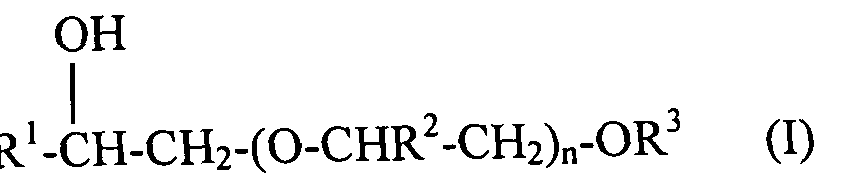
- a first subject of the present invention therefore relates to hydroxyalkyl polyalkylene glycol ethers of the general formula (I)
- OH is R 1 -CH-CH 2 - (O-CHR 2 -CH 2 ) n -OR 3 (I) in which R 1 is a saturated linear alkyl radical having 6 to 18 C atoms, R 2 is a hydrogen atom or a methyl radical where the radical R 3 stands for a mono- or polysubstituted, saturated alkyl radical having 5 to 24 C atoms and the index n stands for integers or fractions of 2 to 20.
- Hydroxyalkylpolyoxylenglykolether are known in principle.
- the teaching of the present invention is based on the surprising finding that, with only variation of the polyoxyglycol-terminal radical R, the defoaming or foam-suppressing action of the hydroxyalkyl polyglycol ethers is maintained at low temperatures, whereas the purely linear derivatives disclosed concretely in the prior art are effective lose.
- the compounds of the general formula (I) are usually prepared by reacting alkoxylated branched fatty alcohols with alkyloxiranes in the presence of alkaline catalysts.
- the preparation processes are known per se and are also disclosed in EP 0 299 360 A2.
- the branched radicals R 3 in the general formula (I) thus originate from the alcohol which has been alkoxylated before the reaction with the oxirane.
- Branched alcohols are e.g. the four isopentanols, especially the
- Methyldecyl alcohol as well as 2-ethylpropyl, 2-ethylbutyl, 2-ethylpentyl, 2-ethylhexyl, 2-ethylheptyl, 2-ethyloctyl, 2-ethylnonyl, 2-ethyldecyl alcohol Question. Also, 3-methyl or 3-ethylpentanol, hexanol, heptanol, octanol, and - nonanol are suitable branched alcohols. Isononanols or isodecanols are also suitable branched alcohols in the context of the present teaching.
- polyhydric alcohols having 6 to 12 carbon atoms may also be suitable.
- the alcohols can also be used in the form of any mixtures with each other. It is also possible for all branched alcohols having 6 to 12 C atoms or mixtures thereof obtained by Guerbet reaction to be particularly suitable.
- 2-ethylhexyl alcohol or isooctanol is a synthetic alcohol based on propene as a raw material. Propene is reacted with CO and hydrogen to the butanal, which is then converted by aldol condensation to 2-ethyl-3-hydroxyethanol. After dehydration and catalytic hydrogenation, 2-ethylhexanol is obtained.
- Isooctanol can also be obtained by so-called oxo synthesis from olefins, carbon monoxide (CO) and hydrogen. This synthesis is also called hydroformylation. The aldehydes formed in the hydroformylation are then hydrogenated. Depending on the olefin used, various primary isoalcohols are obtained. Thus, from an isohepten mixture by hydroformylation and subsequent hydrogenation, a mixture consisting mostly of 3,3-, 3,5- and 4,5-dimethyl-l-hexanol in addition to 3- and 5-methyl-l -heptanol. Also, 6-methyl-1-heptanol is a common industrially available isooctanol.
- branched alcohols are the isononanol and isodecanol; mixtures are also present here.
- isononanol is a mixture of branched primary isononanols with a large proportion of 3,5,5-trimethyl-hexan-1-ol.
- isodecanol a mixture of isomeric trimethylheptanols is present in addition to 3,5-dimethyloctan-1-ol.
- the hydroxyalkyl polyalkylene glycol ethers of the general formula (I) may contain ethylene oxide groups, propylene oxide groups or both ethylene oxide and propylene oxide groups together, which may then be present either in blocks or randomized in the molecule. If propylene oxide groups are contained, these follow the general formula (Ia): R 1 is -CH-CH 2 - (O-CH 2 -CH 2 ) k (O-CHCH 3 -CH 2 ), OR 3
- the value of the index k in the general formula (Ia) is then 2 to 16, preferably 4 to 12 and especially 6 to 10.
- Preferred compounds of this type contain e.g. 2 moles of propylene oxide and 10 moles of ethylene oxide per mole of the Hydroxyalkylpolyoxylenglykolethers, or 14 moles of ethylene oxide and 3 moles of propylene oxide per mole of hydroxyalkyl polyoxylenglykolethers.
- the order of the groups (O-CH 2 -CH 2 ) k (O-CHCH 3 -CH 2 ) i in the formula (Ia) does not specify an order, but rather comprises or stands for all conceivable blockwise as randomized distributed groups (0-CH 2 -CH 2 ) k and (0-CHCH 3 -CH 2 ) i within the Markush formula (Ia).
- particular preference is given to those compounds of the formula (Ia) in which the proportion of propylene oxide groups (O-CHCH 3 -CH 2 ) is smaller than the proportion of ethylene oxide groups (O-CH 2 -CH 2 ). It is also possible, for example, to use side by side pure ethoxylated and purely propoxylated compounds of the formula (I).
- particularly preferred compounds of the general formula (I) always contain ethylene oxide, preferably they contain only ethylene oxide groups, ie are free of propylene oxide groups.
- the degree of alkoxylation characterized in the general formula (I) (ie the proportion of alkoxide groups, ie ethylene oxide and / or propylene oxide groups) by the index n, is preferably from 3 to 20, or from 5 to 15 and in particular from to 6 to 11 ,
- those molecules of the formula (I) are selected in which R 2 is a hydrogen atom (this is to exclusively ethoxylated derivatives), and the radical R 3 is a 2-ethylhexyl radical.
- Hydroxyalkylpolyoxylenglykolether are also preferred according to the general formula (I) in which R 3 is a 2-ethylhexyl and n is an integer or fractional number from 6 to 10 and in particular from 7 to 9 and R 1 is a linear alkyl radical having 6 to 12 C. -Atoms means.
- the radical R l is derived from the oxirane which is used in the reaction.
- R 1 in the formula (I) linear saturated alkyl radicals having 6 to 12, preferably 6 to 10 and in particular 8 to 10 carbon atoms selected.
- the compounds of the general formula (I) are suitable for defoaming as well as foam-suppressing additives or as foam regulators for aqueous systems, agents or solutions, emulsions or dispersions containing foaming and / or foam-stabilizing components.
- foaming surface-active substances such as surfactants
- other substances that are introduced primarily from stains such as proteins, polymers, saponified fats, wood fibers and their ingredients and saponins foams can form and / or stabilize and thus as a foaming component, foam stabilizer and / or foaming act.
- foaming surfactants are, in particular, anionic surfactants, preferably alkyl sulfates, alkyl ether sulfates, alkyl sulfonates and / or alkylbenzenesulfonates.
- Foaming nonionic surfactants such as alkyl (oligo) glycosides and alkoxylated, preferably ethoxylated fatty alcohols, but also amine oxides, betaines, fatty acid amides and their alkoxylated derivatives and other cationic surfactants would be mentioned as further foaming agents.
- Alkyl and / or alkenyl sulfates which are also frequently referred to as fatty alcohol sulfates, are the sulfation products of primary alcohols which follow the formula (II), R 4 0 -SO 3 X (II) in the R for a linear or branched aliphatic alkyl and / or alkenyl radical having 6 to 22, preferably 12 to 18 carbon atoms and X is an alkali and / or alkaline earth metal, ammonium, alkylammonium , Alkanolammonium or glucammonium.
- alkyl sulfates which can be used according to the invention are the sulfation products of caproic alcohol, caprylic alcohol, capric alcohol, 2-ethylhexyl alcohol, lauryl alcohol, myristyl alcohol, cetyl alcohol, palmoleyl alcohol, stearyl alcohol, isostearyl alcohol, oleyl alcohol, elaidyl alcohol, petroselinyl alcohol, arachyl alcohol, gadoleyl alcohol, Behenyl alcohol and erucyl alcohol and their technical mixtures obtained by high-pressure hydrogenation of technical methyl ester fractions or aldehydes from the Roelen oxo synthesis.
- the sulfation products can preferably be used in the form of their alkali metal salts and in particular their sodium salts.
- Particularly preferred are alkyl sulfates based on C 6 / i 8 - tallow or vegetable fatty alcohols of comparable carbon chain distribution in the form of their sodium salts.
- ether sulfates are known anionic surfactants which are industrially produced by S0 3 - or chlorosulfonic acid (CSA) sulfation of fatty alcohol or Oxoalkoholpolyglycolethern and subsequent neutralization.
- CSA chlorosulfonic acid
- ether sulfates which are of formula (III), R 5 0- (CH 2 CH 2 0) m S0 3 X (III) in the R 5 is a linear or branched alkyl and / or alkenyl radical with 6 to 22 carbon atoms, n is a number from 1 to 10 and X is an alkali and / or alkaline earth metal, ammonium, alkylammonium, alkanolammonium or glucammonium.
- Typical examples are the sulfates of addition products of an average of 1 to 10 moles and especially 2 to 5 moles of ethylene oxide to caproic alcohol, caprylic alcohol, 2-ethylhexyl alcohol, capric alcohol, lauryl alcohol, isotridecyl alcohol, myristyl alcohol, cetyl alcohol, palmoleyl alcohol, stearyl alcohol, isostearyl alcohol, oleyl alcohol, elaidyl alcohol, petroselinyl alcohol , Arachyl alcohol, Gadoleyl alcohol, behenyl alcohol, erucyl alcohol and brassidyl alcohol and their technical mixtures in the form of their sodium and / or magnesium salts.
- the ether sulfates may have both a conventional and a narrow homolog distribution. Particularly preferred is the use of ether sulfates based on adducts of an average of 2 to 3 moles of ethylene oxide to technical C 12/14 or C 12/18 coconut fatty alcohol fractions in the form of their sodium and / or magnesium salts.
- Alkylbenzenesulfonates preferably follow the formula R-Ph-S0 3 X in which R is a branched, but preferably linear, alkyl radical having 10 to 18 carbon atoms, Ph is a phenyl radical and X is X is an alkali and / or alkaline earth metal, ammonium, alkylammonium, Alkanolammonium or Glu- cammonium stands.
- Alky (oligo) glycosides are also known.
- Alkyl and alkenyl oligoglycosides are known nonionic surfactants of the formula (IV)
- R 6 O- [G] p (IV) in R 6 is an alkyl and / or alkenyl radical having 4 to 22 carbon atoms
- G is a sugar radical having 5 or 6 carbon atoms
- p is a number from 1 to 10. They can be obtained by the relevant methods of preparative organic chemistry.
- the alkyl and / or alkenyl oligoglycosides can be derived from aldoses or ketoses having 5 or 6 carbon atoms, preferably glucose.
- the preferred alkyl and / or alkenyl oligoglycosides are thus alkyl and / or alkenyl oligoglucosides.
- alkyl and / or alkenyl oligoglycosides are preferred whose degree of oligomerization is less than or equal to 1.7 and in particular between 1.2 and 1.6, preferably 1.2 to 1.4.
- the alkyl or alkenyl radical R 6 can be derived from primary alcohols having 4 to 1 1, preferably 8 to 10 carbon atoms. Typical examples are butanol, caproic alcohol, caprylic alcohol, capric alcohol and undecyl alcohol, and technical mixtures thereof, as obtained, for example, in the hydrogenation of technical fatty acid methyl esters or in the hydrogenation of aldehydes from Roelen's oxo synthesis.
- the alkyl or alkenyl radical R 6 can also be derived from primary alcohols having 12 to 22, preferably 12 to 14 carbon atoms.
- Typical examples are lauryl alcohol, myristyl alcohol, cetyl alcohol, palmoleyl alcohol, stearyl alcohol, isostearyl alcohol, oleyl alcohol, elaidyl alcohol, petroselinyl alcohol, arachyl alcohol, gadoleyl alcohol, behenyl alcohol, erucyl alcohol, brassidyl alcohol, and technical mixtures thereof which can be obtained as described above.
- the effectiveness of the compounds of the general formula (I) in defoaming or as a foam suppressant or as a foam-controlling additive is particularly pronounced in aqueous systems, emulsions or solutions containing alkyl (oligo) glycosides and thus the use thereof is preferred.
- R 7 - (OC 2 FL,) z -OH (V) in the R 7 for linear or branched alkyl and / or alkenyl radicals having 8 to 22
- Carbon atoms and z is a number from 1 to 30 and preferably from 1 to 15, and in particular from 1 to 10 or 1 to 5.
- Typical examples are the adducts of on average 1 to 20 mol of caproic alcohol, caprylic alcohol, 2-ethylhexyl alcohol, capric alcohol, lauryl alcohol, isotridecyl alcohol, myristyl alcohol, cetyl alcohol, palmoleyl alcohol, stearyl alcohol, isostearyl alcohol, oleyl alcohol, elaidyl alcohol, petroselinyl alcohol, arachyl alcohol, gadoleyl alcohol, behenyl alcohol, Erucyl alcohol and brassidyl alcohol and their technical mixtures, which are obtained for example in the high-pressure hydrogenation of technical methyl esters based on fats and oils or aldehydes from Roelen's oxo synthesis and as a monomer fraction in the dimerization of unsaturated fatty alcohols.
- Particularly preferred fatty alcohol ethoxylates are based on tallow alcohols ethoxylated with from 5 to 25 and preferably from 7 to 15 moles of ethylene oxide per mole of alcohol.
- the compounds of the general formula (I) are characterized in that they exhibit their foam-suppressing or defoaming or foam-controlling action at lower temperatures than e.g. the linear isomers or other prior art agents such as silicone defoamers. The effect occurs even at temperatures of less than 30 ° C, especially temperatures of less than or equal to 25 ° C and even at 20 ° C and lower temperatures.
- the compounds of general formula (I) may be combined and formulated with a variety of other surfactants and other ingredients of detergents and cleaners.
- the compositions according to the invention do not have, as it is the case with conventional defoaming additives, e.g.
- hydrophobic oils e.g., mineral oil, paraffin oils, fatty alcohols and their esters, fatty acids, and silicone oils
- hydrophobic oils have an adverse effect or effect on other cleaning components or on the cleaning result or cleaning performance.
- the addition of the compounds of the general formula (I) even unexpectedly shows an improvement in the cleaning performance in cleaning applications.
- the present teaching also includes a method for defoaming aqueous
- Surfactant systems (which also includes aqueous emulsions or dispersions) preferably solutions, wherein at temperatures of less than or equal to 25 ° C compounds according to the general formula (I) in amounts of at least 25 ppm, preferably at least 50 and in particular of at least 100 ppm (mg / kg surfactant solution) of the aqueous surfactant solution.
- the addition can also be carried out in portions. It is also possible to prepare an aqueous solution containing the compounds of the formula (I) and then to bring this into contact with the medium to be defoamed or to add it thereto.
- the compounds of the general formula (I) can thus be advantageously used as an additive, e.g. be used in existing or newly developed formulations of detergents and cleaners for defoaming, as a foam suppressant or as a foam regulator use.
- the compounds of the formula (I) furthermore exhibit particular advantageous properties:
- silicone defoamers-as a rule silica-modified silica particles with silicone oils-do not have a lasting effect, that is to say defoamer is added over and over again must to avoid new foaming.
- the use of the Hydroxyalkylpolyoxylenglykolether according to the invention according to the general formula (I) already leads by a single addition to a permanent defoaming action.
- the amount of defoamer substances is significantly reduced, since the amount of active substance compared to the silicone defoamer does not need to be increased.
- the substances according to the present teachings act faster compared to other liquid defoamers, a property which is advantageous in many applications.
- the compounds of the general formula (I) are also capable of effectively suppressing foams formed by alkyl (oligo) glycosides. A property that other defoamers do not have.
- the compounds of the general formula (I) can be used for defoaming or as foam-suppressing additives or as foam regulators for all types of aqueous solutions, but also for all types of emulsions (in particular of the W / O and O / W type) or dispersions. It may be, for example, wash liquors or detergent solutions in which no or only a slight foaming should occur.
- the hydroxypolyoxylene glycol ethers of the general formula (I) can particularly preferably be used for cleaning agents in the field of industrial and institutional cleaning of hard surfaces, for example in the cleaning of bottles made of glass, plastic or metal.
- the temperature of the aqueous surfactant solution e.g. the energy input during cleaning compared to conventional defoamers are reduced, or you can reduce the amount used at the same temperature.
- Another object of the present invention relates to washing rinse and cleaning agents containing compounds of general formula (I), preferably in amounts of 0.001 to 10 wt .-%, based on the total weight of the agent, and in particular of 0.01 to 2% by weight.
- These detergents and cleaners may be solid, liquid or gel-like and, in addition to the compounds of the general formula (I), contain further characteristic ingredients such as surfactants, bleaches and activators, builders, complexing agents, hydrotopes, nonaqueous solvents, polymers, Colorants and fragrances, inorganic and / or organic pH regulants, preservatives, biocides and / or thickeners. Examples
- 2-ethylhexyl alcohol or n-octanol were reacted in each case in the presence of sodium methoxide as a catalyst with ethylene oxide at 160 ° C to ethoxylated alcohol with 9 moles of ethylene oxide per mole of alcohol and then neutralized.
- the ethoxylated alcohol from the first step was then in a second reaction step at 160-180 ° C in the presence of sodium methylate as a catalyst with a C 10 -Alkylepoxid to the desired 2-ethylhexyl-9-EO-hydroxydecyl ether (El) or isooctanol-9EO -hydroxydecylether (VI) reacted and neutralized.
- the detergency of the invention compound El was measured against other defoaming surfactants of the prior art.
- the surfactant active substance content
- distilled water at 25 ° C. was tested in a Gardner test for PVC with a standard soiling (IPP 83/21).
- a propoxylated fatty alcohol (V2) and a silicone emulsion (V3) were used. El achieved a cleaning performance of 75%, V2 38% and V3 45%.
- the compound El were measured with a commercial silicone defoamer (Antifoam TEGO ® 1488 - Fa Evonik.) Are compared.
- the foaming agent used was the Arlicon ® AT 50.
Landscapes
- Chemical & Material Sciences (AREA)
- Organic Chemistry (AREA)
- Engineering & Computer Science (AREA)
- Materials Engineering (AREA)
- Life Sciences & Earth Sciences (AREA)
- Chemical Kinetics & Catalysis (AREA)
- Oil, Petroleum & Natural Gas (AREA)
- Wood Science & Technology (AREA)
- Detergent Compositions (AREA)
- Organic Low-Molecular-Weight Compounds And Preparation Thereof (AREA)
- Degasification And Air Bubble Elimination (AREA)
- Polyethers (AREA)
Abstract
Description
Claims
Priority Applications (7)
| Application Number | Priority Date | Filing Date | Title |
|---|---|---|---|
| US13/643,176 US20130040874A1 (en) | 2010-04-27 | 2011-01-29 | Branched Hydroxyalkyl Polyoxylene Glycol Ethers |
| BR112012027562A BR112012027562A2 (pt) | 2010-04-27 | 2011-01-29 | éteres de glicol hidroxialquil polioxileno ramificados e seus respectivos usos |
| CN2011800196473A CN102844287A (zh) | 2010-04-27 | 2011-01-29 | 支化羟烷基聚氧化烯乙二醇醚及其用途 |
| MX2012012535A MX2012012535A (es) | 2010-04-27 | 2011-01-29 | Hidroxialquilpolioxilenglicoleteres ramificados y sus uso. |
| KR1020127027919A KR20130098853A (ko) | 2010-04-27 | 2011-01-29 | 분지형 히드록시알킬 폴리옥실렌 글리콜 에테르 |
| JP2013506506A JP2013530133A (ja) | 2010-04-27 | 2011-01-29 | 分枝状ヒドロキシアルキルポリオキシレングリコールエーテルおよびその使用 |
| CA2797452A CA2797452A1 (en) | 2010-04-27 | 2011-01-29 | Branched hydroxyalkyl polyoxylene glycol ethers and use thereof |
Applications Claiming Priority (2)
| Application Number | Priority Date | Filing Date | Title |
|---|---|---|---|
| EP10004428A EP2383247A1 (de) | 2010-04-27 | 2010-04-27 | Verzweigte Hydroxyalkylpolyoxylenglykolether und deren Verwendung |
| EPEP10004428 | 2010-04-27 |
Publications (1)
| Publication Number | Publication Date |
|---|---|
| WO2011134556A1 true WO2011134556A1 (de) | 2011-11-03 |
Family
ID=42649072
Family Applications (1)
| Application Number | Title | Priority Date | Filing Date |
|---|---|---|---|
| PCT/EP2011/000412 Ceased WO2011134556A1 (de) | 2010-04-27 | 2011-01-29 | Verzweigte hydroxyalkylpolyoxylenglykolether und deren verwendung |
Country Status (9)
| Country | Link |
|---|---|
| US (1) | US20130040874A1 (de) |
| EP (1) | EP2383247A1 (de) |
| JP (1) | JP2013530133A (de) |
| KR (1) | KR20130098853A (de) |
| CN (1) | CN102844287A (de) |
| BR (1) | BR112012027562A2 (de) |
| CA (1) | CA2797452A1 (de) |
| MX (1) | MX2012012535A (de) |
| WO (1) | WO2011134556A1 (de) |
Cited By (1)
| Publication number | Priority date | Publication date | Assignee | Title |
|---|---|---|---|---|
| US20170099834A1 (en) * | 2014-05-06 | 2017-04-13 | Basf Se | Composition comprising a pesticide and a hydroxyalkyl polyoxylene glycol ether |
Families Citing this family (2)
| Publication number | Priority date | Publication date | Assignee | Title |
|---|---|---|---|---|
| CN113480726A (zh) * | 2021-06-09 | 2021-10-08 | 内蒙古科学技术研究院 | 一种用于发酵的聚醚消泡剂及其制备方法 |
| CN115124709B (zh) * | 2022-06-29 | 2023-04-21 | 东营市金美化工有限公司 | 以癸基十四醇为起始剂的聚醚破乳剂及其制备方法和应用 |
Citations (5)
| Publication number | Priority date | Publication date | Assignee | Title |
|---|---|---|---|---|
| DE2432757A1 (de) * | 1974-07-08 | 1976-01-29 | Henkel & Cie Gmbh | Als schauminhibitoren geeignete, hydroxylgruppen enthaltende polyaethylenglykol-diaether |
| DE3345349A1 (de) * | 1983-12-15 | 1985-06-27 | Henkel KGaA, 4000 Düsseldorf | Verwendung von polyglykolethern als schaumdrueckende zusaetze in schaumarmen reinigungsmitteln |
| EP0299360A2 (de) | 1987-07-15 | 1989-01-18 | Henkel Kommanditgesellschaft auf Aktien | Hydroxy-Mischether, Verfahren zu deren Herstellung sowie deren Verwendung |
| DE19738866A1 (de) | 1997-09-05 | 1999-03-11 | Henkel Kgaa | Schaumarme Tensidmischungen mit Hydroxymischethern |
| EP1229103A2 (de) | 2001-02-01 | 2002-08-07 | Cognis Deutschland GmbH & Co. KG | Hydroxymischether mit hohem Ethoxylierungsgrad |
-
2010
- 2010-04-27 EP EP10004428A patent/EP2383247A1/de not_active Withdrawn
-
2011
- 2011-01-29 JP JP2013506506A patent/JP2013530133A/ja active Pending
- 2011-01-29 MX MX2012012535A patent/MX2012012535A/es not_active Application Discontinuation
- 2011-01-29 CA CA2797452A patent/CA2797452A1/en not_active Abandoned
- 2011-01-29 KR KR1020127027919A patent/KR20130098853A/ko not_active Withdrawn
- 2011-01-29 CN CN2011800196473A patent/CN102844287A/zh active Pending
- 2011-01-29 WO PCT/EP2011/000412 patent/WO2011134556A1/de not_active Ceased
- 2011-01-29 BR BR112012027562A patent/BR112012027562A2/pt not_active IP Right Cessation
- 2011-01-29 US US13/643,176 patent/US20130040874A1/en not_active Abandoned
Patent Citations (5)
| Publication number | Priority date | Publication date | Assignee | Title |
|---|---|---|---|---|
| DE2432757A1 (de) * | 1974-07-08 | 1976-01-29 | Henkel & Cie Gmbh | Als schauminhibitoren geeignete, hydroxylgruppen enthaltende polyaethylenglykol-diaether |
| DE3345349A1 (de) * | 1983-12-15 | 1985-06-27 | Henkel KGaA, 4000 Düsseldorf | Verwendung von polyglykolethern als schaumdrueckende zusaetze in schaumarmen reinigungsmitteln |
| EP0299360A2 (de) | 1987-07-15 | 1989-01-18 | Henkel Kommanditgesellschaft auf Aktien | Hydroxy-Mischether, Verfahren zu deren Herstellung sowie deren Verwendung |
| DE19738866A1 (de) | 1997-09-05 | 1999-03-11 | Henkel Kgaa | Schaumarme Tensidmischungen mit Hydroxymischethern |
| EP1229103A2 (de) | 2001-02-01 | 2002-08-07 | Cognis Deutschland GmbH & Co. KG | Hydroxymischether mit hohem Ethoxylierungsgrad |
Non-Patent Citations (1)
| Title |
|---|
| N.D. DENKOV: "Mechanisms of Foam Destruction by Oil-based Antifoams", LANGMUIR, vol. 20, 2004, pages 9463 - 9505, XP002468579, DOI: doi:10.1021/la049676o |
Cited By (3)
| Publication number | Priority date | Publication date | Assignee | Title |
|---|---|---|---|---|
| US20170099834A1 (en) * | 2014-05-06 | 2017-04-13 | Basf Se | Composition comprising a pesticide and a hydroxyalkyl polyoxylene glycol ether |
| AU2015257857B2 (en) * | 2014-05-06 | 2019-01-17 | Basf Se | Composition comprising a pesticide and a hydroxyalkyl polyoxylene glycol ether |
| US10694742B2 (en) * | 2014-05-06 | 2020-06-30 | Basf Se | Composition comprising a pesticide and a hydroxyalkyl polyoxylene glycol ether |
Also Published As
| Publication number | Publication date |
|---|---|
| JP2013530133A (ja) | 2013-07-25 |
| KR20130098853A (ko) | 2013-09-05 |
| BR112012027562A2 (pt) | 2016-08-02 |
| US20130040874A1 (en) | 2013-02-14 |
| EP2383247A1 (de) | 2011-11-02 |
| MX2012012535A (es) | 2012-12-17 |
| CA2797452A1 (en) | 2011-11-03 |
| CN102844287A (zh) | 2012-12-26 |
Similar Documents
| Publication | Publication Date | Title |
|---|---|---|
| EP0743975B1 (de) | Reinigungsmittel für harte oberflächen | |
| EP1254949B1 (de) | Geminitenside in Klarspülmitteln | |
| EP0664830B1 (de) | Wässrige detergensgemische | |
| EP1254947B1 (de) | Geminitenside | |
| EP0666898B1 (de) | Verwendung von mischungen nichtionischer tenside | |
| EP1764408B1 (de) | Mischung oberflächenaktiver Substanzen zur Verwendung in Reinigungsmitteln | |
| WO2011134556A1 (de) | Verzweigte hydroxyalkylpolyoxylenglykolether und deren verwendung | |
| EP2240562B1 (de) | Verwendung oberflächenaktiver substanzen in reinigungsmitteln | |
| DE60316906T2 (de) | Verwendung von Lösevermittlern für wässrige Waschmittelzusammensetzungen enthaltend Duftstoffe | |
| EP1259585B1 (de) | Klarspülmittel | |
| EP1129172A1 (de) | Klarspüler für das maschinelle geschirrspülen | |
| EP1250408B1 (de) | Spül- und reinigungsmittel | |
| EP1321512A2 (de) | Spül-und Reinigungsmittel | |
| DE19527596A1 (de) | Wäßrige Tensidmischung | |
| EP1188818B1 (de) | Verfahren zur Herstellung von hellfarbigen Alkyl- und/oder Alkenyloligoglycosidmischungen | |
| EP0743359B1 (de) | Hochkonzentrierter wasserhaltiger Grundreiniger | |
| EP0788537B1 (de) | Wässrige handgeschirrspülmittel | |
| WO1994027953A1 (de) | Fettalkoholethoxylbutylcarbonate | |
| DE10237030A1 (de) | Alkylaminobetaine auf Basis konjugierter Linolsäure | |
| DE19526033A1 (de) | Wäßrige Handgeschirrspülmittel | |
| WO1996037590A1 (de) | Wässrige reinigungsmittelzusammensetzung | |
| WO1999049007A1 (de) | Handgeschirrspülmittel mit fettsäureoligoalkylenglykolestersulfaten | |
| DE19619956A1 (de) | Handgeschirrspülmittel | |
| EP1356014A1 (de) | Hydroxymischether mit hohem ethoxylierungsgrad als entschäumer |
Legal Events
| Date | Code | Title | Description |
|---|---|---|---|
| WWE | Wipo information: entry into national phase |
Ref document number: 201180019647.3 Country of ref document: CN |
|
| 121 | Ep: the epo has been informed by wipo that ep was designated in this application |
Ref document number: 11701950 Country of ref document: EP Kind code of ref document: A1 |
|
| WWE | Wipo information: entry into national phase |
Ref document number: 9006/CHENP/2012 Country of ref document: IN |
|
| WWE | Wipo information: entry into national phase |
Ref document number: 13643176 Country of ref document: US |
|
| ENP | Entry into the national phase |
Ref document number: 2797452 Country of ref document: CA Ref document number: 20127027919 Country of ref document: KR Kind code of ref document: A |
|
| ENP | Entry into the national phase |
Ref document number: 2013506506 Country of ref document: JP Kind code of ref document: A |
|
| WWE | Wipo information: entry into national phase |
Ref document number: MX/A/2012/012535 Country of ref document: MX |
|
| NENP | Non-entry into the national phase |
Ref country code: DE |
|
| ENP | Entry into the national phase |
Ref document number: 2011247406 Country of ref document: AU Date of ref document: 20110129 Kind code of ref document: A |
|
| 122 | Ep: pct application non-entry in european phase |
Ref document number: 11701950 Country of ref document: EP Kind code of ref document: A1 |
|
| REG | Reference to national code |
Ref country code: BR Ref legal event code: B01A Ref document number: 112012027562 Country of ref document: BR |
|
| ENP | Entry into the national phase |
Ref document number: 112012027562 Country of ref document: BR Kind code of ref document: A2 Effective date: 20121026 |