WO2011132504A1 - ラジカル重合性樹脂、ラジカル重合性樹脂組成物及びその硬化物 - Google Patents
ラジカル重合性樹脂、ラジカル重合性樹脂組成物及びその硬化物 Download PDFInfo
- Publication number
- WO2011132504A1 WO2011132504A1 PCT/JP2011/057634 JP2011057634W WO2011132504A1 WO 2011132504 A1 WO2011132504 A1 WO 2011132504A1 JP 2011057634 W JP2011057634 W JP 2011057634W WO 2011132504 A1 WO2011132504 A1 WO 2011132504A1
- Authority
- WO
- WIPO (PCT)
- Prior art keywords
- carbon atoms
- polymerizable resin
- group
- radical polymerizable
- radical
- Prior art date
- Legal status (The legal status is an assumption and is not a legal conclusion. Google has not performed a legal analysis and makes no representation as to the accuracy of the status listed.)
- Ceased
Links
Classifications
-
- C—CHEMISTRY; METALLURGY
- C08—ORGANIC MACROMOLECULAR COMPOUNDS; THEIR PREPARATION OR CHEMICAL WORKING-UP; COMPOSITIONS BASED THEREON
- C08G—MACROMOLECULAR COMPOUNDS OBTAINED OTHERWISE THAN BY REACTIONS ONLY INVOLVING UNSATURATED CARBON-TO-CARBON BONDS
- C08G65/00—Macromolecular compounds obtained by reactions forming an ether link in the main chain of the macromolecule
- C08G65/02—Macromolecular compounds obtained by reactions forming an ether link in the main chain of the macromolecule from cyclic ethers by opening of the heterocyclic ring
- C08G65/04—Macromolecular compounds obtained by reactions forming an ether link in the main chain of the macromolecule from cyclic ethers by opening of the heterocyclic ring from cyclic ethers only
-
- C—CHEMISTRY; METALLURGY
- C08—ORGANIC MACROMOLECULAR COMPOUNDS; THEIR PREPARATION OR CHEMICAL WORKING-UP; COMPOSITIONS BASED THEREON
- C08F—MACROMOLECULAR COMPOUNDS OBTAINED BY REACTIONS ONLY INVOLVING CARBON-TO-CARBON UNSATURATED BONDS
- C08F299/00—Macromolecular compounds obtained by interreacting polymers involving only carbon-to-carbon unsaturated bond reactions, in the absence of non-macromolecular monomers
- C08F299/02—Macromolecular compounds obtained by interreacting polymers involving only carbon-to-carbon unsaturated bond reactions, in the absence of non-macromolecular monomers from unsaturated polycondensates
- C08F299/026—Macromolecular compounds obtained by interreacting polymers involving only carbon-to-carbon unsaturated bond reactions, in the absence of non-macromolecular monomers from unsaturated polycondensates from the reaction products of polyepoxides and unsaturated monocarboxylic acids, their anhydrides, halogenides or esters with low molecular weight
-
- C—CHEMISTRY; METALLURGY
- C08—ORGANIC MACROMOLECULAR COMPOUNDS; THEIR PREPARATION OR CHEMICAL WORKING-UP; COMPOSITIONS BASED THEREON
- C08F—MACROMOLECULAR COMPOUNDS OBTAINED BY REACTIONS ONLY INVOLVING CARBON-TO-CARBON UNSATURATED BONDS
- C08F290/00—Macromolecular compounds obtained by polymerising monomers on to polymers modified by introduction of aliphatic unsaturated end or side groups
- C08F290/08—Macromolecular compounds obtained by polymerising monomers on to polymers modified by introduction of aliphatic unsaturated end or side groups on to polymers modified by introduction of unsaturated side groups
- C08F290/14—Polymers provided for in subclass C08G
-
- C—CHEMISTRY; METALLURGY
- C08—ORGANIC MACROMOLECULAR COMPOUNDS; THEIR PREPARATION OR CHEMICAL WORKING-UP; COMPOSITIONS BASED THEREON
- C08F—MACROMOLECULAR COMPOUNDS OBTAINED BY REACTIONS ONLY INVOLVING CARBON-TO-CARBON UNSATURATED BONDS
- C08F290/00—Macromolecular compounds obtained by polymerising monomers on to polymers modified by introduction of aliphatic unsaturated end or side groups
- C08F290/08—Macromolecular compounds obtained by polymerising monomers on to polymers modified by introduction of aliphatic unsaturated end or side groups on to polymers modified by introduction of unsaturated side groups
- C08F290/14—Polymers provided for in subclass C08G
- C08F290/144—Polymers containing more than one epoxy group per molecule
-
- C—CHEMISTRY; METALLURGY
- C08—ORGANIC MACROMOLECULAR COMPOUNDS; THEIR PREPARATION OR CHEMICAL WORKING-UP; COMPOSITIONS BASED THEREON
- C08F—MACROMOLECULAR COMPOUNDS OBTAINED BY REACTIONS ONLY INVOLVING CARBON-TO-CARBON UNSATURATED BONDS
- C08F299/00—Macromolecular compounds obtained by interreacting polymers involving only carbon-to-carbon unsaturated bond reactions, in the absence of non-macromolecular monomers
- C08F299/02—Macromolecular compounds obtained by interreacting polymers involving only carbon-to-carbon unsaturated bond reactions, in the absence of non-macromolecular monomers from unsaturated polycondensates
-
- C—CHEMISTRY; METALLURGY
- C08—ORGANIC MACROMOLECULAR COMPOUNDS; THEIR PREPARATION OR CHEMICAL WORKING-UP; COMPOSITIONS BASED THEREON
- C08G—MACROMOLECULAR COMPOUNDS OBTAINED OTHERWISE THAN BY REACTIONS ONLY INVOLVING UNSATURATED CARBON-TO-CARBON BONDS
- C08G65/00—Macromolecular compounds obtained by reactions forming an ether link in the main chain of the macromolecule
- C08G65/02—Macromolecular compounds obtained by reactions forming an ether link in the main chain of the macromolecule from cyclic ethers by opening of the heterocyclic ring
- C08G65/04—Macromolecular compounds obtained by reactions forming an ether link in the main chain of the macromolecule from cyclic ethers by opening of the heterocyclic ring from cyclic ethers only
- C08G65/06—Cyclic ethers having no atoms other than carbon and hydrogen outside the ring
- C08G65/14—Unsaturated oxiranes
-
- C—CHEMISTRY; METALLURGY
- C08—ORGANIC MACROMOLECULAR COMPOUNDS; THEIR PREPARATION OR CHEMICAL WORKING-UP; COMPOSITIONS BASED THEREON
- C08G—MACROMOLECULAR COMPOUNDS OBTAINED OTHERWISE THAN BY REACTIONS ONLY INVOLVING UNSATURATED CARBON-TO-CARBON BONDS
- C08G65/00—Macromolecular compounds obtained by reactions forming an ether link in the main chain of the macromolecule
- C08G65/02—Macromolecular compounds obtained by reactions forming an ether link in the main chain of the macromolecule from cyclic ethers by opening of the heterocyclic ring
- C08G65/04—Macromolecular compounds obtained by reactions forming an ether link in the main chain of the macromolecule from cyclic ethers by opening of the heterocyclic ring from cyclic ethers only
- C08G65/06—Cyclic ethers having no atoms other than carbon and hydrogen outside the ring
- C08G65/16—Cyclic ethers having four or more ring atoms
- C08G65/18—Oxetanes
-
- C—CHEMISTRY; METALLURGY
- C08—ORGANIC MACROMOLECULAR COMPOUNDS; THEIR PREPARATION OR CHEMICAL WORKING-UP; COMPOSITIONS BASED THEREON
- C08G—MACROMOLECULAR COMPOUNDS OBTAINED OTHERWISE THAN BY REACTIONS ONLY INVOLVING UNSATURATED CARBON-TO-CARBON BONDS
- C08G65/00—Macromolecular compounds obtained by reactions forming an ether link in the main chain of the macromolecule
- C08G65/02—Macromolecular compounds obtained by reactions forming an ether link in the main chain of the macromolecule from cyclic ethers by opening of the heterocyclic ring
- C08G65/04—Macromolecular compounds obtained by reactions forming an ether link in the main chain of the macromolecule from cyclic ethers by opening of the heterocyclic ring from cyclic ethers only
- C08G65/22—Cyclic ethers having at least one atom other than carbon and hydrogen outside the ring
-
- C—CHEMISTRY; METALLURGY
- C08—ORGANIC MACROMOLECULAR COMPOUNDS; THEIR PREPARATION OR CHEMICAL WORKING-UP; COMPOSITIONS BASED THEREON
- C08L—COMPOSITIONS OF MACROMOLECULAR COMPOUNDS
- C08L71/00—Compositions of polyethers obtained by reactions forming an ether link in the main chain; Compositions of derivatives of such polymers
Definitions
- the present invention relates to the fields of stress relaxation adhesives, waveguides (optical waveguides, mixed substrates, etc.), optical fibers, sealants, underfills, ink jet inks, color filters, nanoimprints, flexible substrates, etc., particularly stress relaxation adhesives.
- the present invention relates to a radical polymerizable resin useful as an agent, a radical polymerizable resin composition and a cured product thereof.
- Patent Document 1 includes a polymerizable resin obtained by polymerizing a monomer component containing an unsaturated monomer having an alicyclic epoxy group and / or oxetane group in the molecule and a radical polymerizable monomer.
- a polymerizable resin composition is disclosed.
- the cured product of this polymerizable resin composition is not sufficiently flexible and cannot sufficiently relieve the stress caused by the difference in thermal expansion coefficient between materials.
- the purpose of the present invention is excellent in the flexibility of the cured product, and when used as an adhesive, it can relieve stress caused by the difference in thermal expansion coefficient between the adhesive and the adherend during heating or cooling, and peels off at the adhesive interface
- Another object of the present invention is to provide a radically polymerizable resin and a radically polymerizable resin composition that can prevent damage to the adherend and the adherend, and a cured product thereof.
- Another object of the present invention is to provide a radical polymerizable resin and a radical polymerizable resin composition capable of obtaining a cured product excellent in flexibility, heat resistance and adhesiveness, and a cured product thereof.
- the present inventors have cationically polymerized a compound having an epoxy group or oxetanyl group having a specific structure and a (meth) acrylic acid ester having an epoxy group or oxetanyl group having a specific structure.
- a radically polymerizable resin that is liquid at 0 ° C. and has a weight average molecular weight of 500 or more is cured, the resin is excellent in flexibility after curing and heated when used as an adhesive.
- the present inventors have found that stress due to a difference in thermal expansion coefficient generated between the adhesive and the adherend during cooling can be relieved, and that peeling at the adhesion interface, breakage of the adherend, and the like can be remarkably prevented.
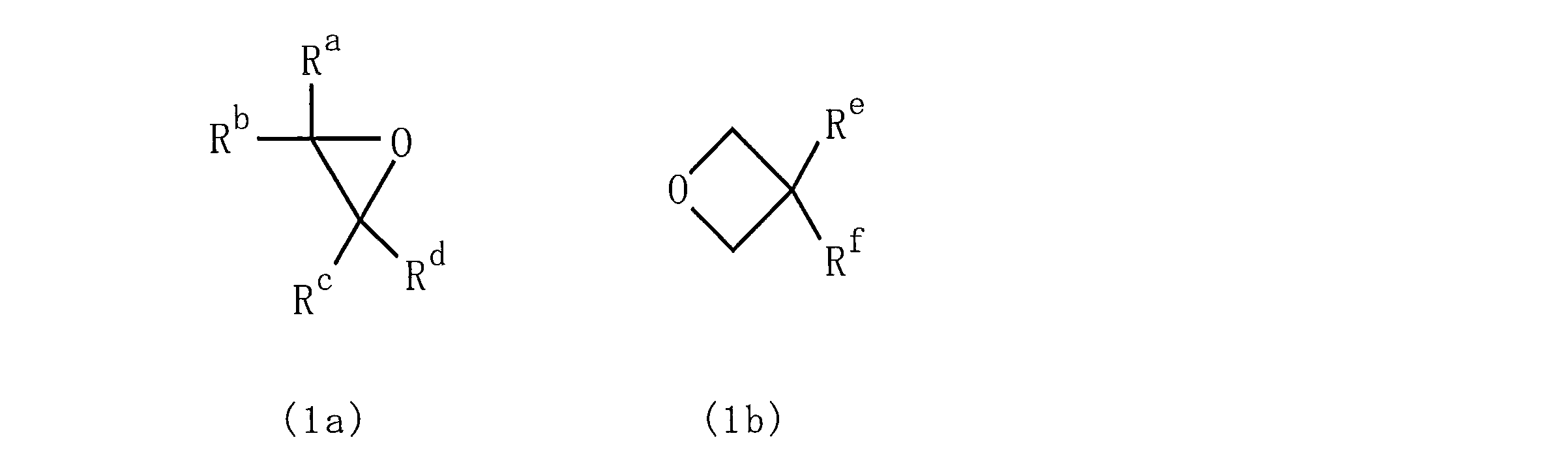
- the present invention provides the following formulas (1a) to (1b) Wherein R a , R b , R c , R d , R e and R f are the same or different and each represents a hydrogen atom or a hydrocarbon group which may contain an oxygen atom having 1 to 20 carbon atoms. Provided that at least one of R a , R b , R c and R d and at least one of R e and R f may be a hydrocarbon group which may contain an oxygen atom having 4 to 20 carbon atoms.
- At least two of R a , R b , R c , and R d may be bonded to each other to form a ring with adjacent one or two carbon atoms, and R e , R f May be bonded to each other to form a ring with adjacent carbon atoms)
- R x represents a hydrogen atom or a methyl group
- R 1 to R 4 each independently represents a hydrogen atom or a hydrocarbon group having 1 to 5 carbon atoms.
- a 1 represents a single bond or a carbon number.
- alkylene group of 1 to 5 show an alkylene oxyalkylene group or an alkyleneoxy group having 1 to 5 carbon atoms of 1 to 5 carbon atoms (oxygen atom of the alkyleneoxy group is attached to the ring in formula), a 2 Represents an alkylene group having 1 to 3 carbon atoms)
- a radically polymerizable resin that is obtained by cationic polymerization of at least one compound selected from the compounds represented by formula (1), is liquid at 0 ° C., and has a weight average molecular weight of 500 or more.
- the present invention also provides a radical polymerizable resin composition containing the radical polymerizable resin.
- the radical polymerizable resin composition may further contain a heat or energy ray radical polymerization initiator.
- a heat or energy ray radical polymerization initiator As the thermal radical polymerization initiator, an organic peroxide is preferable.
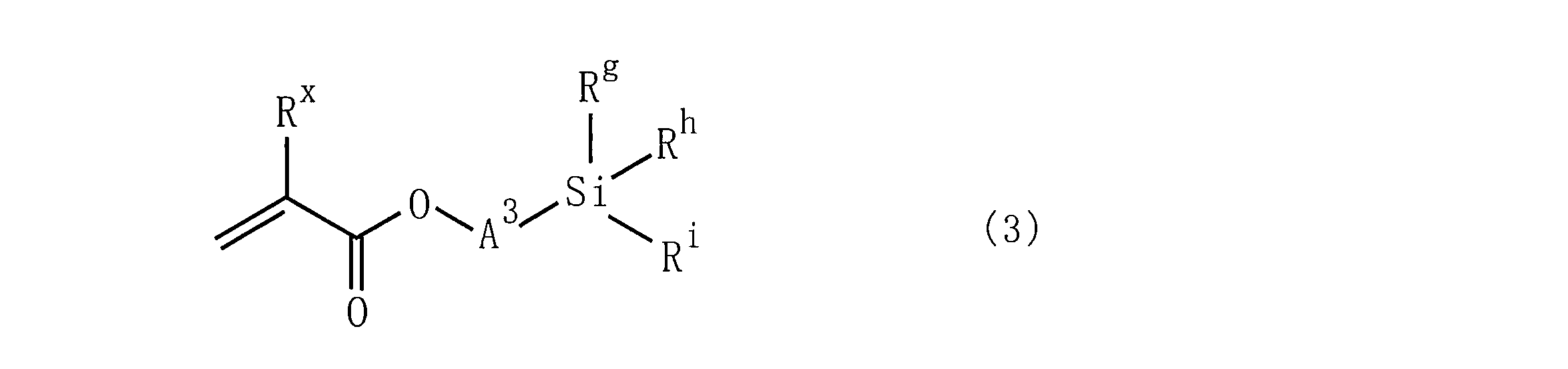
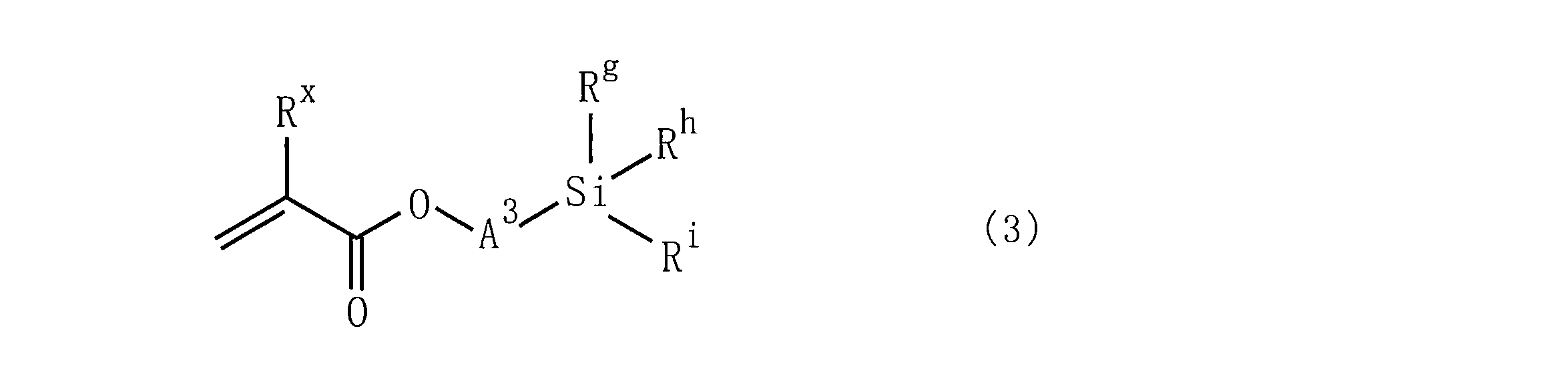
- the radical polymerizable resin composition further includes the following formula (3): (Wherein R x represents a hydrogen atom or a methyl group, A 3 represents a hydrocarbon group having 1 to 20 carbon atoms, and R g , R h , and R i are the same or different and have 1 to 3 carbon atoms) Or an alkyl group having 1 to 3 carbon atoms, provided that at least one of R g , R h and R i is an alkoxy group having 1 to 3 carbon atoms)
- the silane coupling agent represented by these may be included. By adding a silane coupling agent, the adhesive strength to an inorganic material when used as an adhesive can be greatly improved.
- the radical polymerizable resin composition may further contain a radical polymerizable monomer having 2 to 6 radical polymerizable functional groups. By adding such a polyfunctional radical polymerizable monomer, the adhesive strength when used as an adhesive can be further improved.
- the present invention further provides a cured product obtained by radical polymerization of the radical polymerizable resin composition.
- the cured product may be a film or a fiber.
- the radical polymerizable resin of the present invention is a resin obtained by cationic polymerization of a compound having an epoxy group or oxetanyl group having a specific structure and a (meth) acrylic acid ester having an epoxy group or oxetanyl group having a specific structure. Since it is liquid at 0 ° C. and has a weight average molecular weight of 500 or more, when it is subjected to radical polymerization, a cured product in which the distance between crosslinking points is controlled to an appropriate length is obtained.
- cured material of the radically polymerizable resin composition containing the radically polymerizable resin of this invention is excellent in heat resistance, a softness
- the radically polymerizable resin of the present invention includes a compound (A) having at least one epoxy group or oxetanyl group selected from the compounds represented by the formulas (1a) to (1b), and the formula (2a) to A resin obtained by cationic polymerization of (meth) acrylic acid ester (B) having at least one epoxy group or oxetanyl group selected from the compound represented by (2f), which is liquid at 0 ° C. And the weight average molecular weight is 500 or more.
- R a , R b , R c , R d , R e and R f may be the same or different and may contain a hydrogen atom or an oxygen atom having 1 to 20 carbon atoms. Good hydrocarbon group.
- R a , R b , R c and R d and at least one of R e and R f is a hydrocarbon group which may contain an oxygen atom having 4 to 20 carbon atoms. is there.
- hydrocarbon group having 1 to 20 carbon atoms examples include methyl, ethyl, propyl, isopropyl, butyl, isobutyl, s-butyl, t-butyl, pentyl, hexyl, octyl, 2-ethylhexyl, decyl, dodecyl, tetradecyl, Aliphatic hydrocarbon groups such as hexadecyl and octadecyl groups (alkyl groups and the like); alicyclic hydrocarbon groups such as cyclopentyl, cyclohexyl, cyclooctyl and cyclododecyl groups; aromatic hydrocarbon groups such as phenyl and naphthyl groups; Examples include a group in which two or more are bonded. These hydrocarbon groups may have an oxygen atom (—O—) between the carbon atoms.
- —O— oxygen atom
- At least two of R a , R b , R c and R d may be bonded to each other to form a ring together with adjacent one or two carbon atoms.
- R e and R f may be bonded to each other to form a ring together with adjacent carbon atoms.
- Monocyclic or polycyclic carbocyclic rings having 4 to 20 carbon atoms such as heptane ring, tricyclo [5.2.1.0 2,6 ] decane ring, tricyclo [6.2.1.0 2,7 ] undecane ring (May contain an oxygen atom).
- R a , R b , R c and R e are preferably a hydrogen atom or an alkyl group having 1 to 4 carbon atoms.
- R d and R f are preferably hydrocarbon groups which may contain an oxygen atom having 4 to 20 carbon atoms.
- preferred compounds include those in which R a , R b and R c are all hydrogen atoms, and R d contains an oxygen atom having 4 to 20 carbon atoms.
- a compound which is a good hydrocarbon group a compound wherein R a and R d are a hydrogen atom or a methyl group, and R b and R c form a ring having 4 to 20 carbon atoms with two adjacent carbon atoms Is mentioned.
- Representative examples of the compound having an epoxy group represented by the formula (1a) include 1,2-epoxyhexane, 1,2-epoxyheptane, 1,2-epoxyoctane, 1,2-epoxydecane, 1, 2-epoxydodecane, 1,2-epoxytetradecane, 1,2-epoxytetradecane, 1,2-epoxyhexadecane, 1,2-epoxyoctadecane, 2,3-epoxyhexane, 2,3-epoxyheptane, 2,3 -Epoxydecane, cyclohexene oxide and the like.
- a preferable compound is that R e is a hydrogen atom or an alkyl group having 1 to 4 carbon atoms (for example, an ethyl group), and R f is 4 to 4 carbon atoms.
- R e is a hydrogen atom or an alkyl group having 1 to 4 carbon atoms (for example, an ethyl group)
- R f is 4 to 4 carbon atoms.
- examples thereof include a compound which is a hydrocarbon group (for example, a C 3-19 hydrocarbon group-substituted oxymethyl group) which may contain 20 oxygen atoms.
- Representative examples of the compound having an oxetanyl group represented by the formula (1b) include 3-ethyl-3- (propoxymethyl) oxetane, 3-ethyl-3- (butoxymethyl) oxetane, 3-ethyl-3- (Hexyloxymethyl) oxetane, 3-ethyl-3- (2-ethylhexyloxymethyl) oxetane, 3-ethyl-3-[(phenoxy) methyl] oxetane, 3-ethyl-3- (benzyloxymethyl) oxetane, 3 -Ethyl-3- (cyclohexyloxymethyl) oxetane and the like.
- the (meth) acrylic acid ester (B) having an epoxy group or an oxetanyl group is represented by the formulas (2a) to (2f).
- R x represents a hydrogen atom or a methyl group
- R 1 to R 4 each independently represents a hydrogen atom or a hydrocarbon group having 1 to 5 carbon atoms.
- a 1 is a single bond, an alkylene group having 1 to 5 carbon atoms, an alkyleneoxyalkylene group having 1 to 5 carbon atoms, or an alkyleneoxy group having 1 to 5 carbon atoms (the oxygen atom of the alkyleneoxy group is bonded to the ring in the formula)
- a 2 represents an alkylene group having 1 to 3 carbon atoms.
- Examples of the hydrocarbon group having 1 to 5 carbon atoms in R 1 to R 4 include aliphatic hydrocarbon groups (alkyl groups and the like) such as methyl, ethyl, propyl, isopropyl, butyl, isobutyl, and pentyl groups; cyclopropyl, And cycloalkyl groups such as cyclobutyl and cyclopentyl groups.
- R 1 to R 4 are each preferably a hydrogen atom or an alkyl group having 1 to 3 carbon atoms.
- Examples of the alkylene group having 1 to 5 carbon atoms in A 1 include linear or branched C 1-5 alkylene groups such as methylene, ethylene, propylene, trimethylene, tetramethylene, and pentamethylene groups.
- Examples of the alkyleneoxyalkylene group having 1 to 5 carbon atoms include ethyleneoxymethylene, ethyleneoxyethylene, ethyleneoxypropylene, propyleneoxymethylene, and propyleneoxyethylene groups.
- Examples of the alkyleneoxy group having 1 to 5 carbon atoms (the oxygen atom of the alkyleneoxy group is bonded to the ring in the formula) include ethyleneoxy, propyleneoxy, trimethyleneoxy, tetramethyleneoxy, and pentamethyleneoxy groups. Can be mentioned.
- alkylene group having 1 to 3 carbon atoms in A 2 examples include methylene, ethylene, propylene, trimethylene group and the like.
- Examples of the (meth) acrylic acid ester having an epoxy group represented by the formula (2a) include glycidyl (meth) acrylate.
- Examples of the (meth) acrylic acid ester having an epoxy group represented by the formula (2b) include 3,4-epoxycyclohexylmethyl (meth) acrylate.
- Examples of the (meth) acrylic acid ester having an epoxy group represented by the formula (2c) include 2,3-epoxycyclopentyl (meth) acrylate.
- (meth) acrylic acid ester having an epoxy group represented by the formula (2d) for example, 3,4-epoxytricyclo [5.2.1.0 2,6 ] decan-8-yl (or 9 -Yl) (meth) acrylate, 5- [3,4-epoxytricyclo [5.2.1.0 2,6 ] decan-8-yl (or 9-yl) oxy] pentyl (meth) acrylate, etc. Is mentioned.
- Examples of the (meth) acrylic acid ester having an oxetanyl group represented by the formula (2f) include 3-ethyl-3- [2- (meth) acryloyloxyethyloxymethyl] oxetane.
- the radical polymerizable resin of the present invention includes an epoxy group represented by the above formulas (1a) to (1b) or a compound (A) having an oxetanyl group, an epoxy group represented by the above formulas (2a) to (2f), or It can be obtained by cationic polymerization of (meth) acrylic acid ester (B) having an oxetanyl group.
- the cationic polymerization reaction is performed in the presence of a solvent.
- the solvent is not particularly limited as long as it is inert to the reaction, and examples thereof include benzene, toluene, xylene and the like.
- a polymerization initiator may be used for the cationic polymerization reaction.
- the polymerization initiator is not particularly limited as long as it can cause cationic polymerization, and known and commonly used cationic polymerization initiators, acid generators and the like can be used.
- polymerization initiator examples include protonic acids such as perchloric acid, sulfuric acid, phosphoric acid, p-toluenesulfonic acid, trichloroacetic acid, trifluoroacetic acid; boron trifluoride, aluminum bromide, aluminum chloride, antimony pentachloride, chloride Lewis acids such as ferric iron, tin tetrachloride, titanium tetrachloride, mercury chloride, and zinc chloride can be used. In addition, iodine, triphenylchloromethane, and the like can also be used. These can be used alone or in admixture of two or more.
- the amount of the polymerization initiator used in the cationic polymerization reaction is, for example, a total of a cationically polymerizable compound [compound (A) having an epoxy group or oxetanyl group and (meth) acrylic acid ester (B) having an epoxy group or oxetanyl group].
- the weight is, for example, about 0.01 to 50% by weight, preferably about 0.1 to 20% by weight.
- the cationic polymerization reaction may be performed in the presence of a radical polymerization inhibitor.
- a radical polymerization inhibitor examples include 4-methoxyphenol, hydroquinone, methylhydroquinone, dimethylhydroquinone, trimethylhydroquinone, hydroquinone monomethyl ether, 2,5-di-tert-butylhydroquinone, p-tert-butylcatechol, mono-t.
- -Quinone-phenol inhibitors such as butyl hydroquinone, p-benzoquinone, naphthoquinone, 2,5-di-tert-butyl-p-cresol, ⁇ -naphthol, nitrophenol, thioether inhibitors, phosphite esters An agent etc. can be mentioned.
- the epoxy group or oxetanyl group part of the compound (A) having an epoxy group or oxetanyl group and the epoxy group or oxetanyl group part of the (meth) acrylate ester (B) having an epoxy group or oxetanyl group are opened A polymerization reaction involving a ring proceeds, and a radical polymerizable resin having an ethyleneoxy unit and / or a trimethyleneoxy unit in the main chain and a (meth) acryloyloxy group at the terminal is generated.
- the radical polymerizable resin of the present invention is liquid at 0 ° C. That is, it is a liquid material having fluidity at 0 ° C. Resins that are solid at 0 ° C. are not preferred because the cured product obtained by radical polymerization is not sufficiently flexible.
- the weight average molecular weight of the radical polymerizable resin of the present invention is 500 or more (for example, about 500 to 500,000), preferably 550 to 200,000, more preferably 600 to 100,000. When the weight average molecular weight of the radical polymerizable resin is less than 500, it is not cured by radical polymerization.
- the radical polymerizable resin composition of the present invention contains the radical polymerizable resin as a radical polymerizable compound.
- the proportion of the radical polymerizable resin in the radical polymerizable resin composition is, for example, 5% by weight or more, and the radical polymerizable resin composition may be substantially composed of only the radical polymerizable resin. .
- the ratio of the above-mentioned radical polymerizable resin in the radical polymerizable resin composition is preferably 10% by weight or more, in particular, in that a cured product having more flexibility can be formed. % Or more (for example, 30 to 99.9% by weight) is more preferable, and 60% by weight or more (for example, 60 to 95% by weight) is particularly preferable.
- the proportion of the radical polymerizable resin in the radical polymerizable resin composition is less than 5% by weight, the flexibility of the cured product obtained by curing by radical polymerization tends to be reduced.
- the radical polymerizable resin composition of the present invention may have only the radical polymerizable resin as a radical polymerizable compound, but contains a compound having radical polymerization in addition to the radical polymerizable resin. Also good. For example, it contains a radical polymerizable compound different from the above radical polymerizable resin and the compounds represented by the above formulas (2a) to (2f) (hereinafter sometimes referred to as “other radical polymerizable compounds”). May be.
- the ratio of the radical polymerizable resin to the total amount of the radical polymerizable compound in the radical polymerizable resin composition is, for example, 20% by weight or more, preferably 40% by weight or more, more preferably 60% by weight or more (eg, 60 to 95). % By weight).
- radical polymerizable compounds include, for example, radical polymerizable groups such as (meth) acryloyl group, (meth) acryloyloxy group, (meth) acryloylamino group, vinylaryl group, vinyl ether group, vinyloxycarbonyl group and the like.
- radical polymerizable groups such as (meth) acryloyl group, (meth) acryloyloxy group, (meth) acryloylamino group, vinylaryl group, vinyl ether group, vinyloxycarbonyl group and the like.
- numerator can be mentioned.
- Examples of the compound having one or more (meth) acryloyloxy groups in one molecule include methyl (meth) acrylate, ethyl (meth) acrylate, n-butyl (meth) acrylate, isobutyl (meth) acrylate, and t-butyl.
- the compound having one or more (meth) acryloyloxy groups in one molecule also includes a silane coupling agent represented by the formula (3).
- R x represents a hydrogen atom or a methyl group
- a 3 represents a hydrocarbon group having 1 to 20 carbon atoms
- R g , R h , and R i are the same or different, and Represents an alkoxy group having 3 to 3 or an alkyl group having 1 to 3 carbon atoms;
- at least one of R g , R h and R i is an alkoxy group having 1 to 3 carbon atoms.
- hydrocarbon group having 1 to 20 carbon atoms in A 3 examples include direct groups such as methylene, ethylene, propylene, trimethylene, tetramethylene, pentamethylene, hexamethylene, octamethylene, decamethylene, tetradecamethylene, hexadecamethylene group and the like.
- Examples thereof include a chain or branched alkylene group; a cycloalkylene group such as cyclopentylene or cyclohexylene group; an arylene group such as phenylene group; a divalent hydrocarbon group in which two or more of these are bonded.
- Examples of the alkoxy group having 1 to 3 carbon atoms in R g , R h and R i include methoxy, ethoxy, propoxy and isopropoxy groups.
- Examples of the alkyl group having 1 to 3 carbon atoms include methyl, ethyl, propyl, and isopropyl groups.
- silane coupling agent represented by the formula (3) include, for example, 3- (meth) acryloyloxypropyltrimethoxysilane, 3- (meth) acryloyloxypropyltriethoxysilane, 3- (meth) Examples include acryloyloxypropyldimethoxymethylsilane and 3- (meth) acryloyloxypropylmethoxydimethylsilane.
- Examples of the compound having one or more (meth) acryloylamino groups in one molecule include (meth) acryloylmorpholine, N, N-dimethylacrylamide, N, N-diethylacrylamide, N-methylacrylamide, and N-ethylacrylamide. N-propylacrylamide, N-isopropylacrylamide, N-butylacrylamide, Nn-butoxymethylacrylamide, N-hexylacrylamide, N-octylacrylamide and the like, and derivatives thereof.
- Examples of the compound having one or more vinylaryl groups in one molecule include styrene, divinylbenzene, methoxystyrene, ethoxystyrene, hydroxystyrene, vinylnaphthalene, vinylanthracene, 4-vinylphenyl acetate, (4-vinylphenyl) Dihydroxyborane, (4-vinylphenyl) boranoic acid, (4-vinylphenyl) boronic acid, 4-ethenylphenylboronic acid, 4-vinylphenylboranoic acid, 4-vinylphenylboronic acid, p-vinylphenylboric acid, Examples thereof include p-vinylphenylboronic acid, N- (4-vinylphenyl) maleimide, N- (p-vinylphenyl) maleimide, N- (p-vinylphenyl) maleimide, and the like.
- Examples of the compound having one or more vinyl ether groups in one molecule include 2-hydroxyethyl vinyl ether, 3-hydroxypropyl vinyl ether, 2-hydroxypropyl vinyl ether, 2-hydroxyisopropyl vinyl ether, 4-hydroxybutyl vinyl ether, 3-hydroxy Butyl vinyl ether, 2-hydroxybutyl vinyl ether, 3-hydroxyisobutyl vinyl ether, 2-hydroxyisobutyl vinyl ether, 1-methyl-3-hydroxypropyl vinyl ether, 1-methyl-2-hydroxypropyl vinyl ether, 1-hydroxymethylpropyl vinyl ether, 4- Hydroxycyclohexyl vinyl ether, 1,6-hexanediol monovinyl ether, 1,4-cyclohexanedi Tanol monovinyl ether, 1,3-cyclohexanedimethanol monovinyl ether, 1,2-cyclohexanedimethanol monovinyl ether, p-xylene glycol monovinyl ether, m-xylene glycol monoviny
- Examples of the compound having one or more vinyloxycarbonyl groups in one molecule include, for example, isopropenyl formate, isopropenyl acetate, isopropenyl propionate, isopropenyl butyrate, isopropenyl isobutyrate, isopropenyl caproate, and isopropenyl valerate.
- ethylene glycol di (meth) acrylate, diethylene glycol di (meth) acrylate, triethylene glycol di (meth) acrylate are particularly preferable in that the cured product exhibits higher adhesive strength.
- a radical polymerizable monomer having 2 or more radical polymerizable functional groups (for example, 2 to 6) such as decanediol di (meth) acrylate and glycerin di (meth) acrylate is preferable (particularly a polyfunctional acrylic monomer). These can be used alone or in admixture of two or more.
- the blending amount of the radical polymerizable monomer having 2 or more radical polymerizable functional groups is, for example, 1 to 50% by weight with respect to the total amount of the radical polymerizable compound in the radical polymerizable resin composition. It is preferably 5 to 40% by weight, more preferably 8 to 30% by weight.
- a silane coupling agent represented by the formula (3) is also preferable. By adding the silane coupling agent, the adhesive strength of the cured product to the inorganic material can be further improved.
- the amount of the silane coupling agent represented by the formula (3) is, for example, 0.01 to 10% by weight, preferably 0.1%, based on the total amount of radically polymerizable compounds in the radically polymerizable resin composition. To 5% by weight, more preferably 0.3 to 3% by weight.
- a polymerization initiator may or may not be added to the radical polymerizable resin composition of the present invention.
- a polymerization initiator what can raise
- thermal polymerization initiator examples include organic peroxides and azo compounds (azo radical polymerization initiators).
- organic peroxides include ketone peroxides, diacyl peroxides (such as benzoyl peroxide), hydroperoxides, dialkyl peroxides, peroxyketals, alkyl peresters, and percarbonates.
- azo compound examples include azobisisobutyronitrile (AIBN), azobis-2,4-dimethylvaleronitrile, 2,2′-azobis (isobutyric acid) dimethyl, and the like.
- organic radicals particularly peroxide radical polymerization initiators such as diacyl peroxides such as benzoyl peroxide are preferable.
- peroxide radical polymerization initiator When a peroxide radical polymerization initiator is used, bubbles are not generated when the radical polymerizable resin composition is cured, so that the adherend can be adhered cleanly and firmly. If an azo radical polymerization initiator is used, bubbles may be generated when the radical polymerizable resin composition is cured.
- Examples of the energy ray polymerization initiator include benzophenone, acetophenone benzyl, benzyl dimethyl ketone, benzoin, benzoin methyl ether, benzoin ethyl ether, benzoin isopropyl ether, dimethoxyacetophenone, dimethoxyphenylacetophenone, diethoxyacetophenone, diphenyl disulfite and the like. Can be mentioned. These can be used alone or in admixture of two or more.
- a synergist for enhancing the conversion of absorbed energy into polymerization initiation free radicals may be added to the polymerization initiator.
- the synergist include amines such as triethylamine, diethylamine, diethanolamine, ethanolamine, dimethylaminobenzoic acid, methyl dimethylaminobenzoate; ketones such as thioxanthone, 2-isopropylthioxanthone, 2,4-diethylthioxanthone, and acetylacetone. Can be mentioned.
- the addition amount thereof is the radical polymerizable compound (total weight of the radical polymerizable resin and other radical polymerizable compounds) in the radical polymerizable resin composition. On the other hand, it is about 0.01 to 50% by weight, preferably about 0.1 to 20% by weight.
- additives may be added to the radical polymerizable resin composition according to the present invention as necessary within a range not impairing the effects of the present invention.
- Other additives include, for example, curing-expandable monomers, photosensitizers (anthracene sensitizers, etc.), resins, adhesion improvers, reinforcing agents, softeners, plasticizers, viscosity modifiers, solvents, inorganic Or well-known and usual various additives, such as organic particle
- the radical polymerizable resin composition according to the present invention can promote a radical polymerization reaction by heat treatment and / or energy ray irradiation to form a cured product.
- the temperature can be appropriately adjusted according to the components to be subjected to the reaction, the kind of the catalyst, etc., for example, 20 to 200 ° C., preferably 50 to 150 ° C., more preferably 70 to 120 ° C. Degree.
- energy beam irradiation as a light source, for example, a mercury lamp, a xenon lamp, a carbon arc lamp, a metal halide lamp, sunlight, an electron beam, laser light, radiation, X-rays, or the like can be used.
- the curing may be advanced by performing a heat treatment at a temperature of about 50 to 180 ° C., for example.
- the radical polymerization reaction may be performed under normal pressure, or may be performed under reduced pressure or under pressure.
- the atmosphere of the reaction is not particularly limited as long as the reaction is not inhibited, and may be any of an air atmosphere, a nitrogen atmosphere, an argon atmosphere, and the like.
- the shape of the cured product obtained by radical polymerization of the radical polymerizable resin composition according to the present invention is not particularly limited, and examples thereof include a film shape and a fiber shape.
- the film-like cured product is obtained, for example, by applying the radical polymerizable resin composition on a substrate or the like so as to have a uniform thickness using an applicator or the like, and performing heat treatment and / or energy ray irradiation. It can be produced by promoting the radical polymerization reaction.
- the fibrous cured product is obtained by, for example, quantitatively extruding the radical polymerizable resin composition using a syringe or the like, and subjecting the extruded radical polymerizable resin composition to heat treatment and / or energy ray irradiation. It can be produced by promoting the polymerization reaction.
- the radical polymerizable resin composition according to the present invention is particularly useful as a stress relaxation type adhesive.
- it is in the fields of waveguides (optical waveguides, mixed substrates, etc.), optical fibers, sealants, underfills, inkjet inks, color filters, nanoimprints, flexible substrates, etc., especially flexible optical waveguides Useful in fields such as flexible adhesives and underfill.
- Example 1 (Production of radical polymerizable resin) To a three-necked flask equipped with an initiator dropping line, an N 2 line, and a thermometer, 9.28 g of toluene, 4.41 g (34.4 mmol) of glycidyl acrylate (GA), 17.2 g (172 mmol) of 1,2-epoxyhexane ) And 0.0385 g of p-methoxyphenol (monomer mixture) was charged and the temperature was adjusted to 25 ° C.
- Example 2 (Production of radical polymerizable resin) To a three-necked flask equipped with an initiator dropping line, N 2 line, and thermometer, 10.3 g of toluene, 3,4-epoxycyclohexylmethyl methacrylate (trade name “Cyclomer M-100”, manufactured by Daicel Chemical Industries) 6 A mixed solution (monomer mixed solution) of .76 g (34.4 mmol), 1,2-epoxyhexane 17.2 g (172 mmol) and p-methoxyphenol 0.0385 g was prepared, and the temperature was adjusted to 25 ° C.
- Example 3 (Production of radical polymerizable resin) 4. To a three-necked flask equipped with an initiator dropping line, an N 2 line, and a thermometer, 9.90 g of toluene, 3-ethyl-3-oxetanylmethyl acrylate (trade name “OXE-10”, manufactured by Osaka Organic Industry Co., Ltd.) A mixed solution (monomer mixed solution) of 86 g (34.4 mmol), 1,2-epoxyhexane 17.2 g (172 mmol) and p-methoxyphenol 0.0385 g was charged, and the temperature was adjusted to 25 ° C.
- Example 4 (Production of radical polymerizable resin) Into a three-necked flask equipped with an initiator dropping line, an N 2 line, and a thermometer, 10.5 g of toluene and 3-ethyl-3- (2-acryloyloxyethyloxymethyl) oxetane (“OXT-”) synthesized by a known method were used. C2 ”) 7.37 g (34.4 mmol), 1,2-epoxyhexane 17.2 g (172 mmol), and p-methoxyphenol 0.0385 g (monomer mixture) were charged, and the temperature was adjusted to 25 ° C.
- OXT- 3-ethyl-3- (2-acryloyloxyethyloxymethyl) oxetane
- Example 5 Production of radical polymerizable resin
- Toluene To a three-necked flask equipped with an initiator dropping line, N 2 line, and thermometer, 18.7 g of toluene, 4.41 g (34.4 mmol) of GA, 3-ethyl-3- (2-ethylhexyloxymethyl) oxetane ( A mixed solution (monomer mixed solution) of 39.3 g (172 mmol) of trade name “OXT-212” (manufactured by Toagosei Co., Ltd.) and 0.0385 g of p-methoxyphenol was prepared, and the temperature was adjusted to 25 ° C.
- Example 6 Production of radical polymerizable resin
- a mixed liquid of 5.60 g of toluene and 0.95 g (6.60 mmol) of BF 3 OEt 2 was quantitatively added dropwise over 2 hours with a liquid feed pump.
- the resin composition was obtained by holding for 4 hours. This was purified by precipitation with 5 times the amount of methanol (containing 0.1% of p-methoxyphenol), and kept in a vacuum dryer (40 ° C., full vacuum) for 20 hours, whereby a colorless transparent liquid resin (C6 )
- the molecular weight of the obtained resin (C6) measured by GPC was 3800 for Mn and 8300 for Mw. This resin remained liquid even at 0 ° C.
- Example 7 (Production of radical polymerizable resin) To a three-necked flask equipped with an initiator dropping line, an N 2 line, and a thermometer, 19.3 g of toluene, 5.86 g (34.4 mmol) of “OXE-10”, 39.3 g (172 mmol) of “OXT-212” A mixture (monomer mixture) of 0.0385 g of p-methoxyphenol was charged and the temperature was adjusted to 25 ° C. Next, a mixed liquid of 5.60 g of toluene and 0.95 g (6.60 mmol) of BF 3 OEt 2 was quantitatively added dropwise over 2 hours with a liquid feed pump.
- the resin composition was obtained by holding for 4 hours. This was purified by precipitation with 5 times the amount of methanol (containing 0.1% of p-methoxyphenol) and kept in a vacuum dryer (40 ° C., full vacuum) for 20 hours to obtain a colorless and transparent liquid resin (C7 )
- the molecular weight of the obtained resin (C7) measured by GPC was 4500 for Mn and 7000 for Mw. This resin remained liquid even at 0 ° C.
- Example 8 (Production of radical polymerizable resin) 5.
- a mixed solution (monomer mixed solution) of 34 g (34.4 mmol), “OXT-212” 39.2 g (172 mmol), and p-methoxyphenol 0.0385 g was charged, and the temperature was adjusted to 25 ° C.
- Example 9 Production of radical polymerizable resin
- a mixed liquid (monomer mixed liquid) of 0.0385 g of p-methoxyphenol was charged, and the temperature was adjusted to 25 ° C.
- a mixed liquid of 5.60 g of toluene and 0.95 g (6.60 mmol) of BF 3 OEt 2 was quantitatively added dropwise over 2 hours with a liquid feed pump.
- the resin composition was obtained by holding for 4 hours. This was purified by precipitation with 5 times the amount of methanol (containing 0.1% of p-methoxyphenol) and kept in a vacuum dryer (40 ° C., full vacuum) for 20 hours to obtain a colorless and transparent liquid resin (C9 )
- the molecular weight of the obtained resin (C9) measured by GPC was 23300 for Mn and 40900 for Mw. This resin remained liquid even at 0 ° C.
- Comparative Example 1 Production of radical polymerizable resin
- a mixed liquid (monomer mixed liquid) of 1.89 g of toluene, 4.41 g (34.4 mmol) of GA and 0.0385 g of p-methoxyphenol was added. The temperature was adjusted to 25 ° C.
- a mixed liquid of 5.60 g of toluene and 0.95 g (6.60 mmol) of BF 3 OEt 2 was quantitatively added dropwise over 2 hours with a liquid feed pump. After completion of dropping, the resin composition was obtained by holding for 4 hours.
- Comparative Example 3 Production of radical polymerizable resin
- a mixed solution of 2.51 g of toluene, 5.86 g (34.4 mmol) of “OXE-10” and 0.0385 g of p-methoxyphenol ( Monomer mixture) was charged and the temperature was adjusted to 25 ° C.
- a mixed liquid of 5.60 g of toluene and 0.95 g (6.60 mmol) of BF 3 OEt 2 was quantitatively added dropwise over 2 hours with a liquid feed pump. After completion of dropping, the resin composition was obtained by holding for 4 hours.
- Comparative Example 4 (Production of radical polymerizable resin) Into a three-necked flask equipped with an initiator dropping line, N 2 line, and thermometer, a mixture of 2.72 g of toluene, 6.34 g (34.4 mmol) of “OXE-30” and 0.0385 g of p-methoxyphenol (monomer) The mixture was charged and the temperature was adjusted to 25 ° C. Next, a mixed liquid of 5.60 g of toluene and 0.95 g (6.60 mmol) of BF 3 OEt 2 was quantitatively added dropwise over 2 hours with a liquid feed pump. After completion of dropping, the resin composition was obtained by holding for 4 hours.
- Comparative Example 5 (Production of radical polymerizable resin) Into a three-necked flask equipped with an initiator dropping line, N 2 line, and thermometer, a mixture of 3.16 g of toluene, 7.37 g (34.4 mmol) of “OXT-C2” and 0.0385 g of p-methoxyphenol (monomer) The mixture was charged and the temperature was adjusted to 25 ° C. Next, a mixed liquid of 5.60 g of toluene and 0.95 g (6.60 mmol) of BF 3 OEt 2 was quantitatively added dropwise over 2 hours with a liquid feed pump. After completion of dropping, the resin composition was obtained by holding for 4 hours.
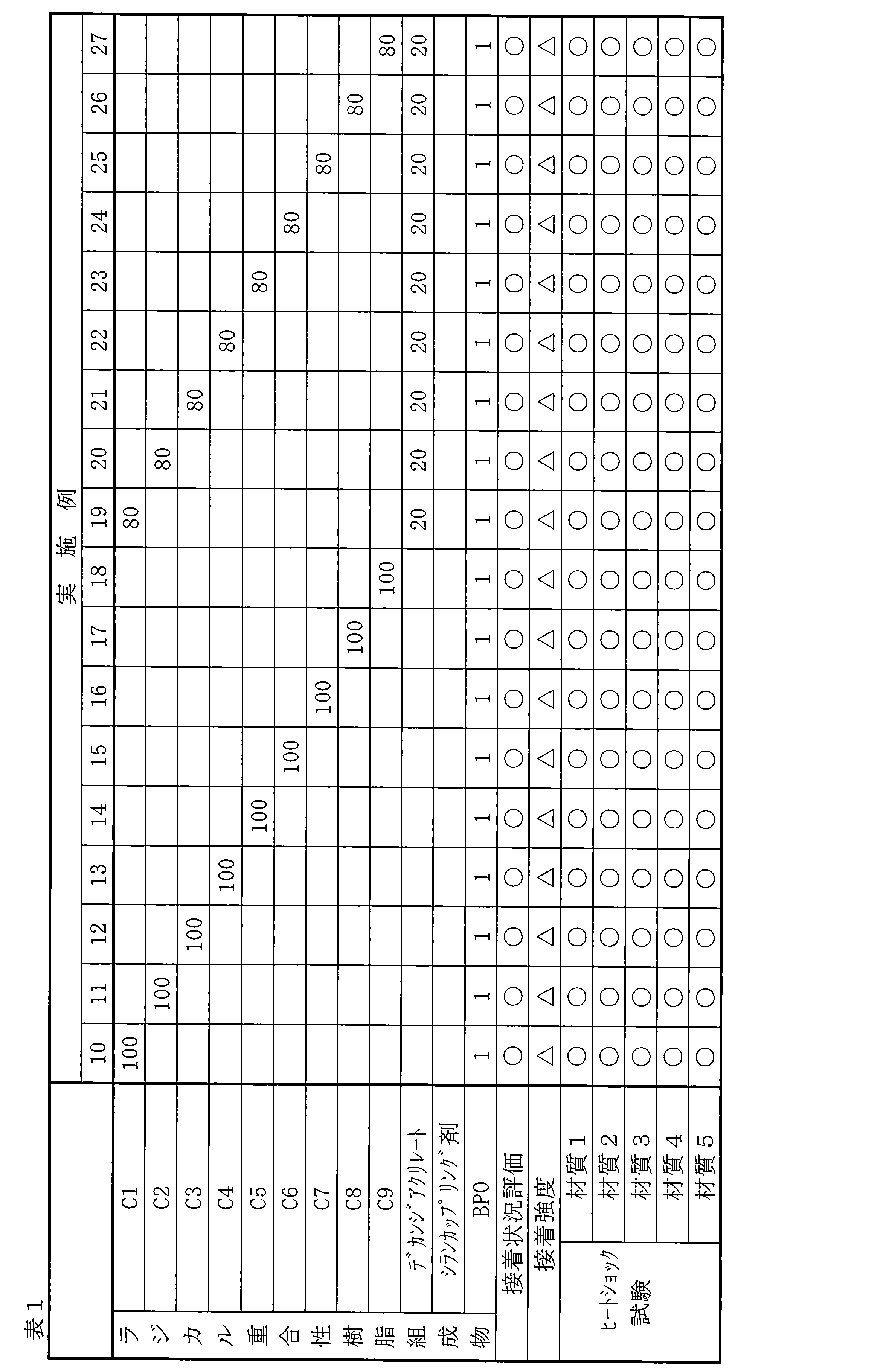
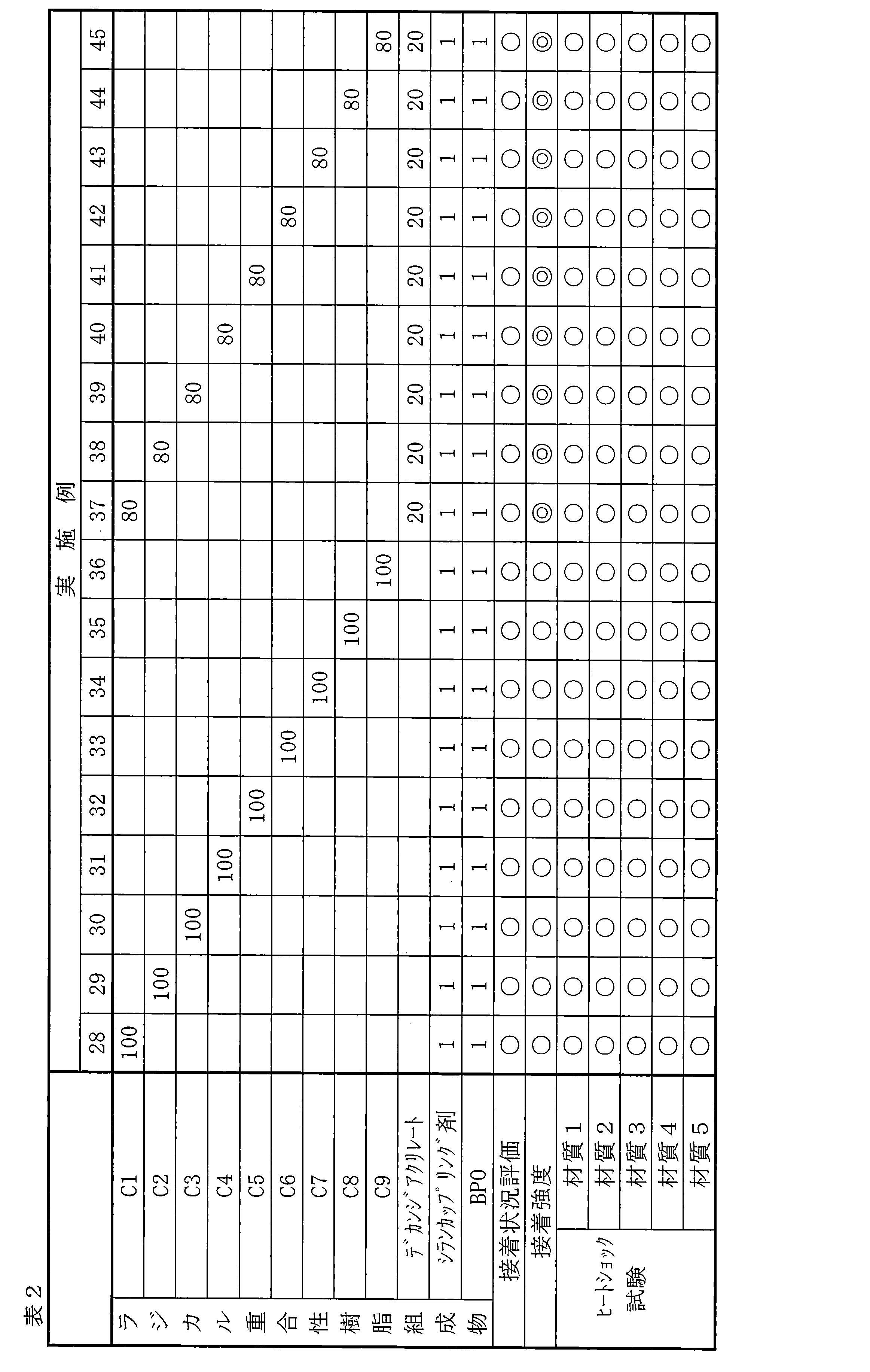
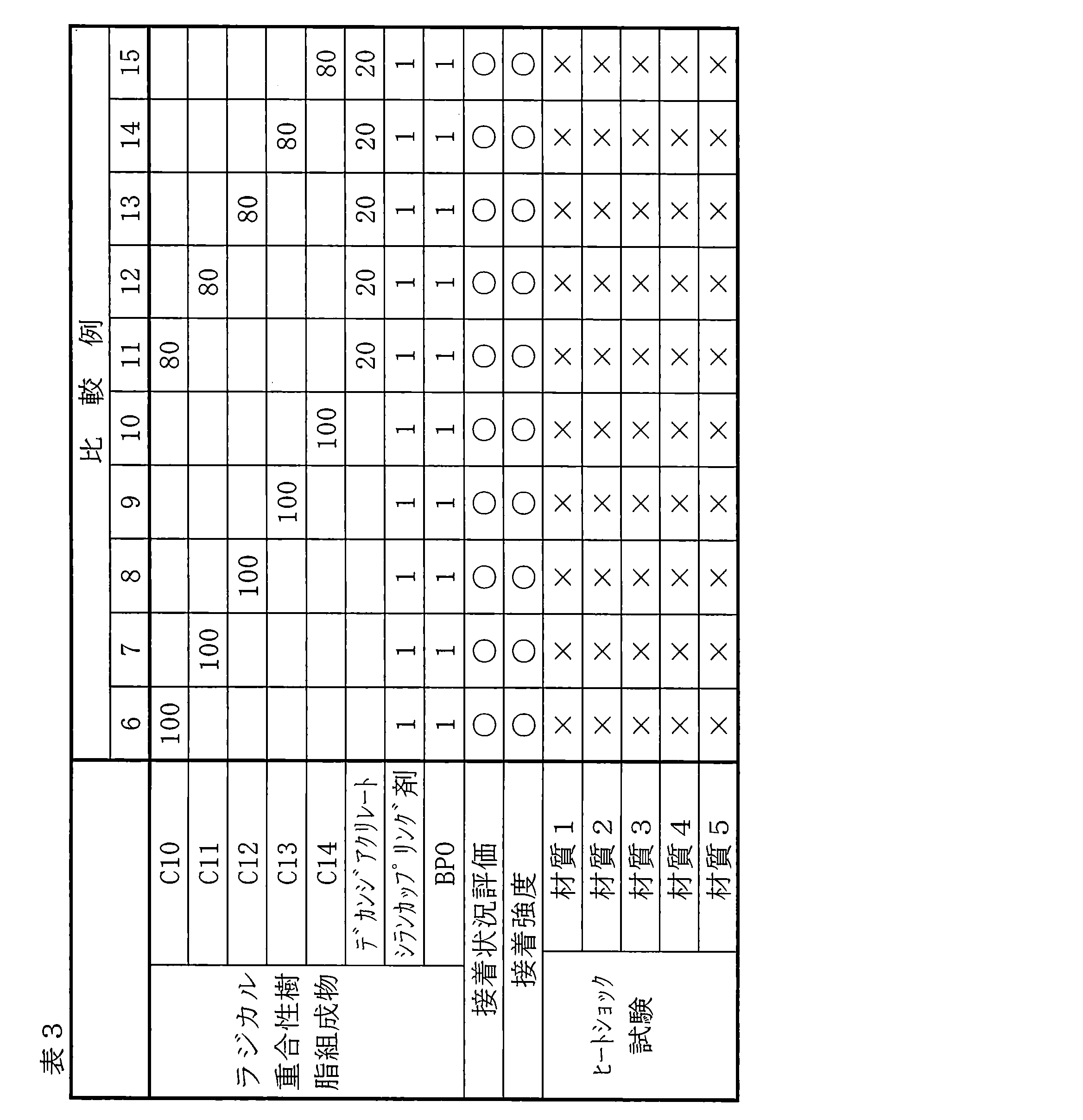
- Examples 10 to 45, Comparative Examples 6 to 15 (Preparation of Thermal Radical Polymerizable Resin Composition) According to the compositions and blending ratios shown in Tables 1 to 3 below, each component was mixed and dissolved to prepare a thermal radical polymerizable resin composition.
- surface shows a weight part.
- C1 to C14 in the table indicate the radical polymerizable resins obtained in Examples 1 to 9 and Comparative Examples 1 to 5.
- “Decaned diacrylate” in the table means 1,10-decanediol diacrylate (bifunctional acrylate; manufactured by Wako Pure Chemical Industries, Ltd.).
- BPO represents benzoyl peroxide (radical polymerization initiator).
- Example 46 (Preparation of radical photopolymerizable resin composition) 16 g of the radical polymerizable resin (C7) obtained in Example 7, 2 g of 1,10-decanediol diacrylate (bifunctional acrylate; manufactured by Wako Pure Chemical Industries, Ltd.), 0.2 g of benzophenone (photo radical polymerization initiator) Were mixed and dissolved to prepare a radical photopolymerizable resin composition.
- Example 47 (Production of cured film)
- the thermal radical polymerizable resin compositions obtained in Examples 10 to 45 were poured into a Teflon (registered trademark) mold (20 mm ⁇ 50 mm ⁇ 1 mm), dried in a vacuum dryer (40 ° C., 10 minutes, As a result of heat curing (140 ° C., 10 minutes) in an N 2 atmosphere, a film-like cured product was obtained.
- Teflon registered trademark
- Example 48 (Production of film-like cured product)
- the photo-radically polymerizable resin composition obtained in Example 46 was poured into a Teflon (registered trademark) mold (20 mm ⁇ 50 mm ⁇ 1 mm) and dried in a vacuum dryer (40 ° C., 10 minutes, full vacuum). ), UV irradiation was performed using a belt conveyor type UV irradiation device (USC, UVC-02516SAA02), and as a result, a film-like cured product was obtained.
- the irradiation energy at that time was about 2 J (wavelength: 320-390 nm).
- the cured product after ultraviolet irradiation was heat-treated at 100 ° C. for 1 hour in the atmosphere.
- Example 49 (Production of fiber-like cured product) 20 g of the radical photopolymerizable resin composition obtained in Example 46 was extruded with a syringe, and the extruded liquid was irradiated with ultraviolet rays (wavelength: 365 nm). As a result, a fiber-like cured product having a diameter of 50 to 2000 ⁇ m was obtained. It was.
- Adhesive strength was performed on an adhesive sample (material 1) bonded to each other between Si wafers. A case where it was bonded but peeled off by hand was ⁇ , and it was not peeled by hand, but it was 7 J / m 2 in a 4-point bending test. The following resistant materials were evaluated as ⁇ , and those resistant to a bending stress of 7 J / m 2 or more in a 4-point bending test were evaluated as ⁇ .
- the radically polymerizable resin of the present invention exhibits the above-described effects, and is particularly suitable for various uses such as a stress relaxation type adhesive.
Landscapes
- Chemical & Material Sciences (AREA)
- Health & Medical Sciences (AREA)
- Chemical Kinetics & Catalysis (AREA)
- Medicinal Chemistry (AREA)
- Polymers & Plastics (AREA)
- Organic Chemistry (AREA)
- Addition Polymer Or Copolymer, Post-Treatments, Or Chemical Modifications (AREA)
- Adhesives Or Adhesive Processes (AREA)
- Polyethers (AREA)
- Macromonomer-Based Addition Polymer (AREA)
Abstract
Description
本発明の他の目的は、柔軟性、耐熱性、及び接着性に優れた硬化物を得ることができるラジカル重合性樹脂及びラジカル重合性樹脂組成物、並びにその硬化物を提供することにある。
で表される化合物から選択された少なくとも1種の化合物と、下記式(2a)~(2f)

で表わされる化合物から選択された少なくとも1種の化合物とをカチオン重合して得られる樹脂であって、0℃において液体であり、且つ重量平均分子量が500以上であるラジカル重合性樹脂を提供する。
で表されるシランカップリング剤を含んでいてもよい。シランカップリング剤を添加することにより、接着剤として用いたときの無機系材料への接着強度を大幅に向上させることができる。
エポキシ基又はオキセタニル基を有する化合物(A)は式(1a)~(1b)で表される。式(1a)~(1b)中、Ra、Rb、Rc、Rd、Re、Rfは、同一又は異なって、水素原子又は炭素数1~20の酸素原子を含んでいてもよい炭化水素基を示す。但し、Ra、Rb、Rc、Rdのうち少なくとも1つ、及びRe、Rfのうち少なくとも1つは、炭素数4~20の酸素原子を含んでいてもよい炭化水素基である。炭素原子1~20の炭化水素基としては、例えば、メチル、エチル、プロピル、イソプロピル、ブチル、イソブチル、s-ブチル、t-ブチル、ペンチル、ヘキシル、オクチル、2-エチルヘキシル、デシル、ドデシル、テトラデシル、ヘキサデシル、オクタデシル基等の脂肪族炭化水素基(アルキル基等);シクロペンチル、シクロヘキシル、シクロオクチル、シクロドデシル基等の脂環式炭化水素基;フェニル、ナフチル基等の芳香族炭化水素基;これらが2以上結合した基などが挙げられる。これらの炭化水素基の炭素原子間に酸素原子(-O-)を有していてもよい。
エポキシ基又はオキセタニル基を有する(メタ)アクリル酸エステル(B)は式(2a)~(2f)で表わされる。式(2a)~(2f)中、Rxは水素原子又はメチル基を示し、R1~R4は、それぞれ独立に、水素原子又は炭素数1~5の炭化水素基を示す。A1は、単結合、炭素数1~5のアルキレン基、炭素数1~5のアルキレンオキシアルキレン基又は炭素数1~5のアルキレンオキシ基(アルキレンオキシ基の酸素原子は式中の環に結合している)を示し、A2は炭素数1~3のアルキレン基を示す。
本発明のラジカル重合性樹脂組成物は、ラジカル重合性化合物として上記ラジカル重合性樹脂を含む。
開始剤滴下ライン、N2ライン、温度計を装着した3口フラスコに、トルエン9.28g、グリシジルアクリレート(GA)4.41g(34.4mmol)、1,2-エポキシヘキサン17.2g(172 mmol)、p-メトキシフェノール0.0385gの混合液(モノマー混合液)を仕込み、25℃に調温した。次いで、トルエン5.60gと三フッ化ホウ素ジエチルエーテラート(BF3OEt2)0.95g(6.60mmol)の混合液を送液ポンプで2時間かけて定量的に滴下した。滴下終了後、4時間保持して樹脂組成物を得た。これを5倍量のメタノール(p-メトキシフェノール0.1%含有)で沈殿精製を行い、真空乾燥機中(40℃、フルバキューム)で20時間保持することで、無色透明の液状樹脂(C1)を得た。
得られた樹脂(C1)のGPC(ゲルパーミエーションクロマトグラフィー)により測定した分子量は、Mn(数平均分子量)が600、Mw(重量平均分子量)が900であった。この樹脂は0℃においても液状のままであった。
開始剤滴下ライン、N2ライン、温度計を装着した3口フラスコに、トルエン10.3g、3,4-エポキシシクロヘキシルメチルメタクリレート(商品名「サイクロマーM-100」、ダイセル化学工業社製)6.76g(34.4mmol)、1,2-エポキシヘキサン17.2g(172mmol)、p-メトキシフェノール0.0385gの混合液(モノマー混合液)を仕込み、25℃に調温した。次いで、トルエン5.60gとBF3OEt2 0.95g(6.60mmol)の混合液を送液ポンプで2時間かけて定量的に滴下した。滴下終了後、4時間保持して樹脂組成物を得た。これを5倍量のメタノール(p-メトキシフェノール0.1%含有)で沈殿精製を行い、真空乾燥機中(40℃、フルバキューム)で20時間保持することで、無色透明の液状樹脂(C2)を得た。
得られた樹脂(C2)のGPCにより測定した分子量は、Mnが500、Mwが800であった。この樹脂は0℃においても液状のままであった。
開始剤滴下ライン、N2ライン、温度計を装着した3口フラスコに、トルエン9.90g、3-エチル-3-オキセタニルメチルアクリレート(商品名「OXE-10」、大阪有機工業社製)5.86g(34.4mmol)、1,2-エポキシヘキサン17.2g(172mmol)、p-メトキシフェノール0.0385gの混合液(モノマー混合液)を仕込み、25℃に調温した。次いで、トルエン5.60gとBF3OEt2 0.95g(6.60mmol)の混合液を送液ポンプで2時間かけて定量的に滴下した。滴下終了後、4時間保持して樹脂組成物を得た。これを5倍量のメタノール(p-メトキシフェノール0.1%含有)で沈殿精製を行い、真空乾燥機中(40℃、フルバキューム)で20時間保持することで、無色透明の液状樹脂(C3)を得た。
得られた樹脂(C3)のGPCにより測定した分子量は、Mnが5000、Mwが8500であった。この樹脂は0℃においても液状のままであった。
開始剤滴下ライン、N2ライン、温度計を装着した3口フラスコに、トルエン10.5g、公知の方法で合成した3-エチル-3-(2-アクリロイルオキシエチルオキシメチル)オキセタン(「OXT-C2」)7.37g(34.4mmol)、1,2-エポキシヘキサン17.2g(172mmol)、p-メトキシフェノール0.0385gの混合液(モノマー混合液)を仕込み、25℃に調温した。次いで、トルエン5.60gとBF3OEt2 0.95g(6.60mmol)の混合液を送液ポンプで2時間かけて定量的に滴下した。滴下終了後、4時間保持して樹脂組成物を得た。これを5倍量のメタノール(p-メトキシフェノール0.1%含有)で沈殿精製を行い、真空乾燥機中(40℃、フルバキューム)で20時間保持することで、無色透明の液状樹脂(C4)を得た。
得られた樹脂(C4)のGPCにより測定した分子量は、Mnが5600、Mwが9200であった。この樹脂は0℃においても液状のままであった。
開始剤滴下ライン、N2ライン、温度計を装着した3口フラスコに、トルエン18.7g、GA 4.41g(34.4mmol)、3-エチル-3-(2-エチルヘキシロキシメチル)オキセタン(商品名「OXT-212」、東亞合成社製)39.3g(172mmol)、p-メトキシフェノール0.0385gの混合液(モノマー混合液)を仕込み、25℃に調温した。次いで、トルエン5.60gとBF3OEt2 0.95g(6.60mmol)の混合液を送液ポンプで2時間かけて定量的に滴下した。滴下終了後、4時間保持して樹脂組成物を得た。これを5倍量のメタノール(p-メトキシフェノール0.1%含有)で沈殿精製を行い、真空乾燥機中(40℃、フルバキューム)で20時間保持することで、無色透明の液状樹脂(C5)を得た。
得られた樹脂(C5)のGPCにより測定した分子量は、Mnが4400、Mwが8500であった。この樹脂は0℃においても液状のままであった。
開始剤滴下ライン、N2ライン、温度計を装着した3口フラスコに、トルエン19.7g、「サイクロマーM-100」6.76g(34.4mmol)、「OXT-212」39.3g(172mmol)、p-メトキシフェノール0.0385gの混合液(モノマー混合液)を仕込み、25℃に調温した。次いで、トルエン5.60gとBF3OEt2 0.95g(6.60mmol)の混合液を送液ポンプで2時間かけて定量的に滴下した。滴下終了後、4時間保持して樹脂組成物を得た。これを5倍量のメタノール(p-メトキシフェノール0.1%含有)で沈殿精製を行い、真空乾燥機中(40℃、フルバキューム)で20時間保持することで、無色透明の液状樹脂(C6)を得た。
得られた樹脂(C6)のGPCにより測定した分子量は、Mnが3800、Mwが8300であった。この樹脂は0℃においても液状のままであった。
開始剤滴下ライン、N2ライン、温度計を装着した3口フラスコに、トルエン19.3 g、「OXE-10」5.86g(34.4mmol)、「OXT-212」39.3g(172mmol)、p-メトキシフェノール0.0385gの混合液(モノマー混合液)を仕込み、25℃に調温した。次いで、トルエン5.60gとBF3OEt2 0.95g(6.60mmol)の混合液を送液ポンプで2時間かけて定量的に滴下した。滴下終了後、4時間保持して樹脂組成物を得た。これを5倍量のメタノール(p-メトキシフェノール0.1%含有)で沈殿精製を行い、真空乾燥機中(40℃、フルバキューム)で20時間保持することで、無色透明の液状樹脂(C7)を得た。
得られた樹脂(C7)のGPCにより測定した分子量は、Mnが4500、Mwが7000であった。この樹脂は0℃においても液状のままであった。
開始剤滴下ライン、N2ライン、温度計を装着した3口フラスコに、トルエン19.3g、3-エチル-3-オキセタニルメチルメタクリレート(商品名「OXE-30」、大阪有機工業社製)6.34g(34.4mmol)、「OXT-212」39.2g(172mmol)、p-メトキシフェノール0.0385g、の混合液(モノマー混合液)を仕込み、25℃に調温した。次いで、トルエン5.60gとBF3OEt2 0.95g(6.60mmol)の混合液を送液ポンプで2時間かけて定量的に滴下した。滴下終了後、4時間保持して樹脂組成物を得た。これを5倍量のメタノール(p-メトキシフェノール0.1%含有)で沈殿精製を行い、真空乾燥機中(40℃、フルバキューム)で20時間保持することで、無色透明の液状樹脂(C8)を得た。
得られた樹脂(C8)のGPCにより測定した分子量は、Mnが3600、Mwが5100であった。又、この樹脂は0℃においても液状のままであった。
開始剤滴下ライン、N2ライン、温度計を装着した3口フラスコに、トルエン20.0g、「OXT-C2」7.37g(34.4mmol)、「OXT-212」39.3g(172mmol)、p-メトキシフェノール0.0385gの混合液(モノマー混合液)を仕込み、25℃に調温した。次いで、トルエン5.60gとBF3OEt2 0.95g(6.60mmol)の混合液を送液ポンプで2時間かけて定量的に滴下した。滴下終了後、4時間保持して樹脂組成物を得た。これを5倍量のメタノール(p-メトキシフェノール0.1%含有)で沈殿精製を行い、真空乾燥機中(40℃、フルバキューム)で20時間保持することで、無色透明の液状樹脂(C9)を得た。
得られた樹脂(C9)のGPCにより測定した分子量は、Mnが23300、Mwが40900であった。この樹脂は0℃においても液状のままであった。
開始剤滴下ライン、N2ライン、温度計を装着した3口フラスコに、トルエン1.89g、GA 4.41g(34.4mmol)、p-メトキシフェノール0.0385gの混合液(モノマー混合液)を仕込み、25℃に調温した。次いで、トルエン5.60gとBF3OEt2 0.95g(6.60mmol)の混合液を送液ポンプで2時間かけて定量的に滴下した。滴下終了後、4時間保持して樹脂組成物を得た。これを5倍量のメタノール(p-メトキシフェノール0.1%含有)で沈殿精製を行い、真空乾燥機中(40℃、フルバキューム)で20時間保持することで、無色透明の液状樹脂(C10)を得た。
得られた樹脂(C10)のGPCにより測定した分子量は、Mnが450、Mwが700であった。
開始剤滴下ライン、N2ライン、温度計を装着した3口フラスコに、トルエン2.90g、「サイクロマーM-100」6.76g(34.4mmol)、p-メトキシフェノール0.0385gの混合液(モノマー混合液)を仕込み、25℃に調温した。次いで、トルエン5.60gとBF3OEt2 0.95g(6.60mmol)の混合液を送液ポンプで2時間かけて定量的に滴下した。滴下終了後、4時間保持して樹脂組成物を得た。これを5倍量のメタノール(p-メトキシフェノール0.1%含有)で沈殿精製を行い、真空乾燥機中(40℃、フルバキューム)で20時間保持することで、無色透明の液状樹脂(C11)を得た。
得られた樹脂(C11)のGPCにより測定した分子量は、Mnが550、Mwが850であった。
開始剤滴下ライン、N2ライン、温度計を装着した3口フラスコに、トルエン2.51 g、「OXE-10」5.86g(34.4mmol)、p-メトキシフェノール0.0385gの混合液(モノマー混合液)を仕込み、25℃に調温した。次いで、トルエン5.60gとBF3OEt2 0.95g(6.60mmol)の混合液を送液ポンプで2時間かけて定量的に滴下した。滴下終了後、4時間保持して樹脂組成物を得た。これを5倍量のメタノール(p-メトキシフェノール0.1%含有)で沈殿精製を行い、真空乾燥機中(40℃、フルバキューム)で20時間保持することで、無色透明の液状樹脂(C12)を得た。
得られた樹脂(C12)のGPCにより測定した分子量は、Mnが4000、Mwが7500であった。
開始剤滴下ライン、N2ライン、温度計を装着した3口フラスコに、トルエン2.72g、「OXE-30」6.34g(34.4mmol)、p-メトキシフェノール0.0385gの混合液(モノマー混合液)を仕込み、25℃に調温した。次いで、トルエン5.60gとBF3OEt2 0.95g(6.60mmol)の混合液を送液ポンプで2時間かけて定量的に滴下した。滴下終了後、4時間保持して樹脂組成物を得た。これを5倍量のメタノール(p-メトキシフェノール0.1%含有)で沈殿精製を行い、真空乾燥機中(40℃、フルバキューム)で20時間保持することで、無色透明の液状樹脂(C13)を得た。
得られた樹脂(C13)のGPCにより測定した分子量は、Mnが3600、Mwが4000であった。
開始剤滴下ライン、N2ライン、温度計を装着した3口フラスコに、トルエン3.16g、「OXT-C2」7.37g(34.4mmol)、p-メトキシフェノール0.0385gの混合液(モノマー混合液)を仕込み、25℃に調温した。次いで、トルエン5.60gとBF3OEt2 0.95g(6.60mmol)の混合液を送液ポンプで2時間かけて定量的に滴下した。滴下終了後、4時間保持して樹脂組成物を得た。これを5倍量のメタノール(p-メトキシフェノール0.1%含有)で沈殿精製を行い、真空乾燥機中(40℃、フルバキューム)で20時間保持することで、無色透明の液状樹脂(C14)を得た。
得られた樹脂(C14)のGPCにより測定した分子量は、Mnが19000、Mwが39000であった。
下記表1~3に示す組成及び配合割合に従って、各成分を混合溶解し、熱ラジカル重合性樹脂組成物を調製した。尚、表中の数値は重量部を示す。表中のC1~C14は実施例1~9、比較例1~5で得られたラジカル重合性樹脂を示す。表中の「デカンジアクリレート」は1,10-デカンジオールジアクリレート(2官能アクリレート;和光純薬工業社製)を意味する。シランカップリング剤は3-アクリロイルオキシプロピルトリメトキシシラン(=3-トリメトキシシリルプロピルアクリレート)である。「BPO」は過酸化ベンゾイル(ラジカル重合開始剤)を示す。
実施例7で得られたラジカル重合性樹脂(C7)16gと、1,10-デカンジオールジアクリレート(2官能アクリレート;和光純薬工業社製)2g、ベンゾフェノン(光ラジカル重合開始剤)0.2gを混合溶解して、光ラジカル重合性樹脂組成物を調製した。
実施例10~45で得られた熱ラジカル重合性樹脂組成物を、テフロン(登録商標)製の型枠(20mm×50mm×1mm)に流し込み、真空乾燥機内で乾燥後(40℃、10分間、フルバキューム)、N2雰囲気下で加熱硬化(140℃、10分間)した結果、フィルム状硬化物が得られた。
実施例46で得られた光ラジカル重合性樹脂組成物を、テフロン(登録商標)製の型枠(20mm×50mm×1mm)に流し込み、真空乾燥機内で乾燥後(40℃、10分間、フルバキューム)、ベルトコンベアー式紫外線照射装置(ウシオ電機製、UVC-02516SAA02)を用いて紫外線を照射した結果、フィルム状硬化物が得られた。その際の照射エネルギーは約2J(波長:320-390nm)であった。紫外線照射後の硬化物は、大気中100℃で1時間加熱処理した。
実施例46で得られた光ラジカル重合性樹脂組成物20gをシリンジで押出し、押し出された液に紫外線(波長:365nm)を照射した結果、直径が50~2000μmであるファイバー状硬化物が得られた。
(1)Siウエハの接着プロセス
実施例10~45、比較例6~15で得られた熱ラジカル重合性樹脂組成物を、それぞれ、基材(Siウエハ、テンパックスガラス、アルミ板またはPETフィルム)にスピンコーターにより約1~5μmの厚みになるよう塗布した。その後、真空乾燥機内で塗膜乾燥後(40℃、10分間、フルバキューム)、貼り合せ(140℃、10分間)を行った。得られた試料(接着サンプル)について、以下の評価を行った。結果を表1~3に示す。表中の材質1~5は下記のものを示す。
材質1:Siウエハどうしを貼り合わせたもの
材質2:テンパックスガラスどうしをを貼り合わせたもの
材質3:Siウエハとテンパックスガラスを貼り合わせたもの
材質4:アルミ板とテンパックスガラスを貼り合わせたもの
材質5:PETフィルムどうしを貼り合わせたもの
Siウエハとテンパックスガラスを貼り合わせた接着サンプル(材質3)を顕微鏡により観測し、気泡やはがれの有無を調査し、下記基準で評価した。
評価基準:気泡やはがれが見られなかったときを「○」、見られたときを「×」とした。
Siウエハどうしを貼り合わせた接着サンプル(材質1)について剥離試験を行い、接着しているが手で剥がれるものは△、手で剥がれないが4点曲げ試験において7J/m2以下の耐性のものは○、4点曲げ試験において7J/m2以上の曲げ応力に耐えるものは◎とした。
各接着サンプルを150℃で30分間加熱後、直ちに液体窒素に浸漬する試験を5回繰り返し、はがれやクラック(ひび割れ)、試験前からの変化発生の有無を目視と顕微鏡により調査し、下記基準で評価した。
評価基準:はがれやクラック(ひび割れ)が見られなかったときを「○」、見られたときを「×」とした。なお、材質1については、剥がれクラックがない状態を「○」とした。また、材質5については、PETフィルムの耐熱性上、加熱を140℃までとした。
Claims (8)
- 下記式(1a)~(1b)

で表される化合物から選択された少なくとも1種の化合物と、下記式(2a)~(2f)

で表わされる化合物から選択された少なくとも1種の化合物とをカチオン重合して得られる樹脂であって、0℃において液体であり、且つ重量平均分子量が500以上であるラジカル重合性樹脂。 - 請求項1記載のラジカル重合性樹脂を含むラジカル重合性樹脂組成物。
- さらに、熱又はエネルギー線ラジカル重合開始剤を含む請求項2記載のラジカル重合性樹脂組成物。
- 熱ラジカル重合開始剤が有機過酸化物である請求項3記載のラジカル重合性樹脂組成物。
- さらに、下記式(3)
で表されるシランカップリング剤を含む請求項2~4の何れかの項に記載のラジカル重合性樹脂組成物。 - さらに、ラジカル重合性官能基数が2~6のラジカル重合性モノマーを含む請求項2~5の何れかの項に記載のラジカル重合性樹脂組成物。
- 請求項2~6の何れかの項に記載のラジカル重合性樹脂組成物をラジカル重合して得られる硬化物。
- 硬化物がフィルム状またはファイバー状である請求項7に記載の硬化物。
Priority Applications (3)
| Application Number | Priority Date | Filing Date | Title |
|---|---|---|---|
| CN2011800198017A CN102844355A (zh) | 2010-04-20 | 2011-03-28 | 自由基聚合性树脂、自由基聚合性树脂组合物及其固化物 |
| US13/642,363 US8735462B2 (en) | 2010-04-20 | 2011-03-28 | Radical-polymerizable resin, radical-polymerizable resin composition, and cured material thereof |
| KR1020127030221A KR20130052573A (ko) | 2010-04-20 | 2011-03-28 | 라디칼 중합성 수지, 라디칼 중합성 수지 조성물 및 그의 경화물 |
Applications Claiming Priority (2)
| Application Number | Priority Date | Filing Date | Title |
|---|---|---|---|
| JP2010-096945 | 2010-04-20 | ||
| JP2010096945A JP5736119B2 (ja) | 2010-04-20 | 2010-04-20 | ラジカル重合性樹脂、ラジカル重合性樹脂組成物及びその硬化物 |
Publications (1)
| Publication Number | Publication Date |
|---|---|
| WO2011132504A1 true WO2011132504A1 (ja) | 2011-10-27 |
Family
ID=44834040
Family Applications (1)
| Application Number | Title | Priority Date | Filing Date |
|---|---|---|---|
| PCT/JP2011/057634 Ceased WO2011132504A1 (ja) | 2010-04-20 | 2011-03-28 | ラジカル重合性樹脂、ラジカル重合性樹脂組成物及びその硬化物 |
Country Status (6)
| Country | Link |
|---|---|
| US (1) | US8735462B2 (ja) |
| JP (1) | JP5736119B2 (ja) |
| KR (1) | KR20130052573A (ja) |
| CN (1) | CN102844355A (ja) |
| TW (1) | TWI490248B (ja) |
| WO (1) | WO2011132504A1 (ja) |
Families Citing this family (2)
| Publication number | Priority date | Publication date | Assignee | Title |
|---|---|---|---|---|
| US9447294B2 (en) * | 2012-06-19 | 2016-09-20 | Natoco Co., Ltd. | Active energy ray curable composition, and cured product and use thereof |
| CN104447635B (zh) * | 2014-10-31 | 2017-09-15 | 常州强力电子新材料股份有限公司 | 一种含氧杂环丁烷基团的酯化合物及其制备方法 |
Citations (4)
| Publication number | Priority date | Publication date | Assignee | Title |
|---|---|---|---|---|
| JP2005305371A (ja) * | 2004-04-26 | 2005-11-04 | Daiso Co Ltd | 気体分離膜 |
| JP2006052278A (ja) * | 2004-08-10 | 2006-02-23 | Toho Chem Ind Co Ltd | 低環境負荷型光重合性化合物 |
| JP2008001901A (ja) * | 2006-06-21 | 2008-01-10 | Bayer Material Science Llc | ペンダントアクリレート−及び/又はメタクリレート含有ポリエーテルモノオール及びポリオール |
| JP2009235136A (ja) * | 2008-03-25 | 2009-10-15 | Fujifilm Corp | 硬化性組成物、インク組成物、インクジェット記録方法、及び硬化性組成物の調整方法 |
Family Cites Families (2)
| Publication number | Priority date | Publication date | Assignee | Title |
|---|---|---|---|---|
| JPH0699655B2 (ja) * | 1985-10-09 | 1994-12-07 | 大日本インキ化学工業株式会社 | 常温硬化性樹脂組成物 |
| JP2001081182A (ja) * | 1999-09-09 | 2001-03-27 | Nippon Shokubai Co Ltd | 重合性樹脂および重合性樹脂組成物 |
-
2010
- 2010-04-20 JP JP2010096945A patent/JP5736119B2/ja not_active Expired - Fee Related
-
2011
- 2011-03-28 WO PCT/JP2011/057634 patent/WO2011132504A1/ja not_active Ceased
- 2011-03-28 US US13/642,363 patent/US8735462B2/en not_active Expired - Fee Related
- 2011-03-28 KR KR1020127030221A patent/KR20130052573A/ko not_active Withdrawn
- 2011-03-28 CN CN2011800198017A patent/CN102844355A/zh active Pending
- 2011-04-11 TW TW100112445A patent/TWI490248B/zh not_active IP Right Cessation
Patent Citations (4)
| Publication number | Priority date | Publication date | Assignee | Title |
|---|---|---|---|---|
| JP2005305371A (ja) * | 2004-04-26 | 2005-11-04 | Daiso Co Ltd | 気体分離膜 |
| JP2006052278A (ja) * | 2004-08-10 | 2006-02-23 | Toho Chem Ind Co Ltd | 低環境負荷型光重合性化合物 |
| JP2008001901A (ja) * | 2006-06-21 | 2008-01-10 | Bayer Material Science Llc | ペンダントアクリレート−及び/又はメタクリレート含有ポリエーテルモノオール及びポリオール |
| JP2009235136A (ja) * | 2008-03-25 | 2009-10-15 | Fujifilm Corp | 硬化性組成物、インク組成物、インクジェット記録方法、及び硬化性組成物の調整方法 |
Also Published As
| Publication number | Publication date |
|---|---|
| JP5736119B2 (ja) | 2015-06-17 |
| JP2011225720A (ja) | 2011-11-10 |
| TW201200534A (en) | 2012-01-01 |
| US8735462B2 (en) | 2014-05-27 |
| KR20130052573A (ko) | 2013-05-22 |
| CN102844355A (zh) | 2012-12-26 |
| US20130030078A1 (en) | 2013-01-31 |
| TWI490248B (zh) | 2015-07-01 |
Similar Documents
| Publication | Publication Date | Title |
|---|---|---|
| KR101615795B1 (ko) | 광경화성 임프린트용 조성물 및 상기 조성물을 이용한 패턴의 형성 방법 | |
| CN104520337A (zh) | 液体光学粘合剂组合物 | |
| CN1235615A (zh) | 液态可固化树脂组合物 | |
| JP5722806B2 (ja) | カチオン重合性樹脂、カチオン重合性樹脂組成物、及びその硬化物 | |
| JP2017039809A (ja) | 硬化性組成物、パターン形成方法およびデバイスの製造方法 | |
| JP5736119B2 (ja) | ラジカル重合性樹脂、ラジカル重合性樹脂組成物及びその硬化物 | |
| JP5770164B2 (ja) | ラジカル重合性樹脂、ラジカル重合性樹脂組成物、及びその硬化物 | |
| CN115109464B (zh) | 墨水组合物、封装结构和半导体器件 | |
| CN110117428A (zh) | 一种柔性有机封装的组成物及其制备和使用方法 | |
| JP6437776B2 (ja) | 光硬化性樹脂組成物及びその用途 | |
| CN116023895B (zh) | 一种uv潮气双重固化密封胶及其制备方法 | |
| JP2014059505A (ja) | アルカリ可溶型樹脂組成物及びその硬化物、並びに光導波路 | |
| JP4713704B2 (ja) | 活性エネルギー線硬化性樹脂組成物 | |
| KR20130107461A (ko) | 광학용 점착제 조성물 | |
| EP0483796B1 (en) | A composition comprising polyether compounds, a process for the preparation thereof and a photocurable resin composition | |
| JP2008208149A (ja) | アクリル共重合体の製造方法 | |
| JP6575508B2 (ja) | 光硬化性組成物 | |
| EP4130081B1 (en) | Compound and polymer composition including said compound | |
| JP2003048922A (ja) | 活性エネルギー線硬化型樹脂シート形成剤 | |
| CN121857244A (zh) | 一种耐高温的纳米压印复合材料及其制备方法 | |
| KR101740057B1 (ko) | 광경화성 접착제 조성물 | |
| JP2022166735A (ja) | 重合体粒子、重合体粒子の製造方法及び樹脂組成物 | |
| JP2016117870A (ja) | 光硬化性樹脂組成物及びそれを用いたガラス板保護用樹脂 | |
| JP2017218558A (ja) | 接着方法、接着装置、及び構造体の製造方法 | |
| CN118206948A (zh) | 一种丙烯酸酯组合物及其制备方法和应用 |
Legal Events
| Date | Code | Title | Description |
|---|---|---|---|
| WWE | Wipo information: entry into national phase |
Ref document number: 201180019801.7 Country of ref document: CN |
|
| 121 | Ep: the epo has been informed by wipo that ep was designated in this application |
Ref document number: 11771841 Country of ref document: EP Kind code of ref document: A1 |
|
| WWE | Wipo information: entry into national phase |
Ref document number: 13642363 Country of ref document: US |
|
| NENP | Non-entry into the national phase |
Ref country code: DE |
|
| ENP | Entry into the national phase |
Ref document number: 20127030221 Country of ref document: KR Kind code of ref document: A |
|
| 122 | Ep: pct application non-entry in european phase |
Ref document number: 11771841 Country of ref document: EP Kind code of ref document: A1 |