WO2011129184A1 - 受信装置 - Google Patents
受信装置 Download PDFInfo
- Publication number
- WO2011129184A1 WO2011129184A1 PCT/JP2011/057017 JP2011057017W WO2011129184A1 WO 2011129184 A1 WO2011129184 A1 WO 2011129184A1 JP 2011057017 W JP2011057017 W JP 2011057017W WO 2011129184 A1 WO2011129184 A1 WO 2011129184A1
- Authority
- WO
- WIPO (PCT)
- Prior art keywords
- channel
- reception
- receiving
- receiving system
- viewing program
- Prior art date
- Legal status (The legal status is an assumption and is not a legal conclusion. Google has not performed a legal analysis and makes no representation as to the accuracy of the status listed.)
- Ceased
Links
Images





Classifications
-
- H—ELECTRICITY
- H04—ELECTRIC COMMUNICATION TECHNIQUE
- H04N—PICTORIAL COMMUNICATION, e.g. TELEVISION
- H04N5/00—Details of television systems
- H04N5/44—Receiver circuitry for the reception of television signals according to analogue transmission standards
- H04N5/455—Demodulation-circuits
-
- H—ELECTRICITY
- H04—ELECTRIC COMMUNICATION TECHNIQUE
- H04B—TRANSMISSION
- H04B7/00—Radio transmission systems, i.e. using radiation field
- H04B7/02—Diversity systems; Multi-antenna system, i.e. transmission or reception using multiple antennas
- H04B7/04—Diversity systems; Multi-antenna system, i.e. transmission or reception using multiple antennas using two or more spaced independent antennas
- H04B7/08—Diversity systems; Multi-antenna system, i.e. transmission or reception using multiple antennas using two or more spaced independent antennas at the receiving station
- H04B7/0882—Diversity systems; Multi-antenna system, i.e. transmission or reception using multiple antennas using two or more spaced independent antennas at the receiving station using post-detection diversity
- H04B7/0888—Diversity systems; Multi-antenna system, i.e. transmission or reception using multiple antennas using two or more spaced independent antennas at the receiving station using post-detection diversity with selection
-
- H—ELECTRICITY
- H04—ELECTRIC COMMUNICATION TECHNIQUE
- H04H—BROADCAST COMMUNICATION
- H04H20/00—Arrangements for broadcast or for distribution combined with broadcast
- H04H20/26—Arrangements for switching distribution systems
-
- H—ELECTRICITY
- H04—ELECTRIC COMMUNICATION TECHNIQUE
- H04H—BROADCAST COMMUNICATION
- H04H40/00—Arrangements specially adapted for receiving broadcast information
- H04H40/18—Arrangements characterised by circuits or components specially adapted for receiving
-
- H—ELECTRICITY
- H04—ELECTRIC COMMUNICATION TECHNIQUE
- H04N—PICTORIAL COMMUNICATION, e.g. TELEVISION
- H04N21/00—Selective content distribution, e.g. interactive television or video on demand [VOD]
- H04N21/40—Client devices specifically adapted for the reception of or interaction with content, e.g. set-top-box [STB]; Operations thereof
- H04N21/41—Structure of client; Structure of client peripherals
- H04N21/414—Specialised client platforms, e.g. receiver in car or embedded in a mobile appliance
- H04N21/41422—Specialised client platforms, e.g. receiver in car or embedded in a mobile appliance located in transportation means, e.g. personal vehicle
-
- H—ELECTRICITY
- H04—ELECTRIC COMMUNICATION TECHNIQUE
- H04N—PICTORIAL COMMUNICATION, e.g. TELEVISION
- H04N21/00—Selective content distribution, e.g. interactive television or video on demand [VOD]
- H04N21/40—Client devices specifically adapted for the reception of or interaction with content, e.g. set-top-box [STB]; Operations thereof
- H04N21/41—Structure of client; Structure of client peripherals
- H04N21/426—Internal components of the client ; Characteristics thereof
- H04N21/42607—Internal components of the client ; Characteristics thereof for processing the incoming bitstream
- H04N21/4263—Internal components of the client ; Characteristics thereof for processing the incoming bitstream involving specific tuning arrangements, e.g. two tuners
-
- H—ELECTRICITY
- H04—ELECTRIC COMMUNICATION TECHNIQUE
- H04N—PICTORIAL COMMUNICATION, e.g. TELEVISION
- H04N21/00—Selective content distribution, e.g. interactive television or video on demand [VOD]
- H04N21/60—Network structure or processes for video distribution between server and client or between remote clients; Control signalling between clients, server and network components; Transmission of management data between server and client, e.g. sending from server to client commands for recording incoming content stream; Communication details between server and client
- H04N21/61—Network physical structure; Signal processing
- H04N21/6106—Network physical structure; Signal processing specially adapted to the downstream path of the transmission network
- H04N21/6112—Network physical structure; Signal processing specially adapted to the downstream path of the transmission network involving terrestrial transmission, e.g. DVB-T
-
- H—ELECTRICITY
- H04—ELECTRIC COMMUNICATION TECHNIQUE
- H04N—PICTORIAL COMMUNICATION, e.g. TELEVISION
- H04N5/00—Details of television systems
- H04N5/44—Receiver circuitry for the reception of television signals according to analogue transmission standards
- H04N5/50—Tuning indicators; Automatic tuning control
-
- H—ELECTRICITY
- H04—ELECTRIC COMMUNICATION TECHNIQUE
- H04H—BROADCAST COMMUNICATION
- H04H2201/00—Aspects of broadcast communication
- H04H2201/60—Aspects of broadcast communication characterised in that the receiver comprises more than one tuner
Definitions
- the present invention relates to a receiving device that receives communications and broadcasts, and more particularly to a receiving device that is mounted on a mobile body and receives terrestrial digital broadcasts while moving.
- broadcasting stations have installed relay stations at a plurality of locations in the broadcasting area, and are expanding broadcast reception areas by sending broadcast radio waves from these relay stations. If the relay station is transmitting at the same frequency (SFN: Single Frequency Network), the program can be continuously viewed even if it moves to another reception area. However, when the relay station is transmitting at a different frequency (MFN: Multi Frequency Network), if the mobile station moves to another reception area, the program that has been viewed until then cannot be received.
- SFN Single Frequency Network
- a digital terrestrial automatic channel selection method has been proposed in which, for example, digital broadcasting is continuously selected for each area even when moving across broadcasting areas (see Patent Document 1).
- a diversity antenna receiver equipped with a double tuner is used to receive signals using signals with better condition by two tuners.
- channel search is performed using one tuner, and all channel information in the reception area is stored in the channel memory of the receiver.
- broadcasting the channel information of the adjacent area by broadcasting, receiving it with one tuner and storing the channel information of the adjacent area, searching for the broadcast channel of that area when moving to the adjacent area And seamless broadcast reception.
- a broadcast receiving apparatus mounted on a mobile body such as an automobile diversity reception using a plurality of antennas is performed in order to stably receive broadcast radio waves even while traveling.
- the antennas are arranged as far apart as possible so that the reception signals of the antennas are uncorrelated. Also, the direction of reception directivity of each antenna or the angle of received polarization differs depending on the mounting method of each antenna, and the reception state of broadcast waves received by each antenna varies accordingly.
- the broadcast wave of the relay station cannot be received well with the channel search tuner antenna, and the channel There may be a possibility that the relay station cannot be found even if the search is performed.
- the present invention has been made in view of the above problems, and its purpose is to search for a relay station that can be received while continuing to watch a program when the reception radio wave state of the program to be watched is reduced. It is an object of the present invention to provide a receiving apparatus that can continuously watch a program even when moving to another receiving area.
- the present invention provides, for example, In a receiving apparatus having first and second receiving systems for transmitting a received signal received by an antenna and capable of diversity receiving operation with a composite signal of demodulated signals by the first and second receiving systems, When a predetermined condition is satisfied during the diversity reception operation, one of the first and second reception systems continuously receives the viewing program selected by the first and second reception systems, and On the other hand, a first combined operation is performed to perform a channel search or to obtain an EPG for a channel registered in the receiver, In the first combined operation, when a channel to be received is not found, the first and second reception systems are switched, and a channel search is performed for one of the first and second reception systems. On the other hand, there is provided control means for executing a second composite operation for continuously receiving the viewing program.
- the reception radio wave state of a viewing program when the reception radio wave state of a viewing program is lowered, searching for a relay station that can be received while continuing to watch the program allows the program to be continuously displayed even when moving to another reception area. It is possible to watch.
- the present invention is conceptually configured as follows, for example. That is, From a received signal received by an antenna and a first receiving system that selects a predetermined channel from a received signal received by an antenna and outputs a video and audio signal by performing demodulation, transmission path decoding, demultiplexing, and decoding processing A second receiving system that selects a predetermined channel, performs demodulation, transmission path decoding, demultiplexing, and decoding processing and outputs video and audio signals; an output of the first receiving system; and a second reception A selection means for selecting and outputting either one of the outputs of the system, and a control means for controlling the operation of the entire receiving device; The control means combines the demodulated signal of the first receiving system and the demodulated signal of the second receiving system, and performs transmission path decoding / demultiplexing / decoding processing of the combined signal using one of the receiving systems.
- the control means allows one of the first reception system and the second reception system to continuously receive the viewing program as it is, and the other Performing a first combined operation of causing the receiving system to perform a channel search to search for a channel satisfying a predetermined condition, and causing the selection unit to select an output of the receiving system that continuously receives the viewing program, If the channel to be received is not found as a result of the first combined operation, the control means switches the receiving system for continuously receiving the viewing program and the receiving system for performing the channel search, and performs the channel search.
- a second composite operation is executed in which the receiving system performs a channel search and causes the selection means to select an output of the receiving system that continuously receives the viewing program.
- a first channel that selects a predetermined channel from the received signal received by the antenna, performs demodulation, transmission path decoding, demultiplexing, and decoding processing, and outputs video and audio signals, and reception received by the antenna
- a second receiving system for selecting a predetermined channel from the signal, performing demodulation, transmission path decoding, demultiplexing and decoding, and outputting a video and audio signal; an output of the first receiving system; Selecting means for selecting and outputting one of the outputs of the receiving system, and a control means for controlling the operation of the entire receiving device, The control means combines the demodulated signal of the first receiving system and the demodulated signal of the second receiving system, and performs transmission path decoding / demultiplexing / decoding processing of the combined signal using one of the receiving systems.
- the control means allows one of the first reception system and the second reception system to continuously receive the viewing program as it is, and the other A channel search is performed for the receiving system of the first channel to search for a channel satisfying a predetermined condition, and the selection unit performs a first combined operation of selecting an output of the receiving system that performs the continuous reception operation, If the channel to be received is not found as a result of the first composite operation, the control means replaces the receiving system for continuously receiving the viewing program and the receiving system for performing the channel search, when the viewing program is switched.
- the channel search is performed with the receiving system that continuously receives the viewing program only when it is determined that the viewing program is receivable.
- the reception system is switched, and a second complex operation is performed in which the reception system that performs the channel search performs a channel search and causes the selection unit to select an output of the reception system that continuously receives the viewing program.
- control means sets a plurality of thresholds for judging the reception state of the viewing program and a time interval value for performing a numerical count between the plurality of thresholds, and the control means receives the diversity reception.
- the numerical count is performed according to the time interval value, and the first composite operation is performed when the numerical count reaches a predetermined numerical value.
- the channel satisfying a predetermined condition to be searched by the channel search is a channel of a relay station or affiliated station of a channel received by a receiving system that continuously receives the viewing program, and the viewing program
- the relay station or the affiliated station is better than the reception state of the channel in which the reception system that continuously receives the signal is receiving.
- the reception system having a better reception state among the first reception system and the second reception system is set as a reception system for continuously receiving the viewing program,
- the other receiving system is set as a receiving system for performing the channel search.
- a first channel that selects a predetermined channel from the received signal received by the antenna, performs demodulation, transmission path decoding, demultiplexing, and decoding processing, and outputs video and audio signals, and reception received by the antenna
- a second receiving system for selecting a predetermined channel from the signal, performing demodulation, transmission path decoding, demultiplexing and decoding, and outputting a video and audio signal; an output of the first receiving system; Selecting means for selecting and outputting one of the outputs of the receiving system, and a control means for controlling the operation of the entire receiving device, The control means combines the demodulated signal of the first receiving system and the demodulated signal of the second receiving system, and performs transmission path decoding / demultiplexing / decoding processing of the combined signal using one of the receiving systems.
- the control means allows one of the first reception system and the second reception system to continuously receive the viewing program as it is, and the other
- the receiving system is caused to perform a channel scan to search for a receivable channel and to cause the selection means to select the output of the receiving system that continuously receives the viewing program, and then execute the control.
- the means replaces a receiving system that continuously receives the viewing program and a receiving system that performs the channel search, causes the receiving system that performs the channel search to perform channel scanning, and allows the selecting means to continuously receive the viewing program.
- a second combined operation for selecting the output of the system is executed.
- a first channel that selects a predetermined channel from the received signal received by the antenna, performs demodulation, transmission path decoding, demultiplexing, and decoding processing, and outputs video and audio signals, and reception received by the antenna
- a second receiving system for selecting a predetermined channel from the signal, performing demodulation, transmission path decoding, demultiplexing and decoding, and outputting a video and audio signal; an output of the first receiving system; Selecting means for selecting and outputting one of the outputs of the receiving system, and a control means for controlling the operation of the entire receiving device, The control means combines the demodulated signal of the first receiving system and the demodulated signal of the second receiving system, and performs transmission path decoding / demultiplexing / decoding processing of the combined signal using one of the receiving systems.
- the control means allows one of the first reception system and the second reception system to continuously receive the viewing program as it is, and the other The receiving system performs a first combined operation for obtaining an EPG for a channel registered in the receiver and causing the selection means to select an output of the receiving system for continuously receiving the viewing program, As a result of the first combined operation, if the EPG cannot be obtained for all channels registered in the receiver, the control means obtains the receiving system and the EPG for continuously receiving the viewing program.
- the reception system that replaces the reception system and causes the reception system that acquires the EPG to acquire the EPG for the channel that could not be acquired by the first combined operation, and the reception means continuously receives the viewing program.
- a second combined operation for selecting the output of the system is executed.
- a first channel that selects a predetermined channel from the received signal received by the antenna, performs demodulation, transmission path decoding, demultiplexing, and decoding processing, and outputs video and audio signals, and reception received by the antenna
- a second receiving system for selecting a predetermined channel from the signal, performing demodulation, transmission path decoding, demultiplexing and decoding, and outputting a video and audio signal; an output of the first receiving system; Selecting means for selecting and outputting one of the outputs of the receiving system, and a control means for controlling the operation of the entire receiving device, The control means combines the demodulated signal of the first receiving system and the demodulated signal of the second receiving system, and performs transmission path decoding / demultiplexing / decoding processing of the combined signal using one of the receiving systems.
- the control means switches the receiving system for continuously receiving the viewing program and the receiving system for performing the channel search, and causes the receiving system for performing the channel search to perform channel search to acquire the reception state of each channel and And a second combined operation for causing the selection means to select an output of a receiving system that continuously receives the viewing program, and performing the first combined operation and the second combined operation.
- the reception state of each of the channels obtained in step 1 is combined for each channel to calculate a combined reception state, and the viewing program is the channel having the best reception state after the combination among the channels satisfying the predetermined condition.
- “predetermined condition during diversity reception operation” indicates a reception radio wave state of a viewing program or the like, for example, when the reception radio wave is reduced and a condition for starting a channel search is reached. Is a case where a signal quality value, which will be described later, is less than a predetermined threshold value or greater than or equal to a threshold value (or a time when the signal quality value is greater than or equal to a predetermined threshold value continues for a certain period).
- the receiving apparatus receives a broadcast signal by ISDB-T (Integrated Services Digital Broadcasting for Terrestrial), which is a transmission system of Japanese terrestrial digital broadcasting, and MPEG2-TS (Transport Stream) (hereinafter referred to as “Transport Stream”).
- ISDB-T Integrated Services Digital Broadcasting for Terrestrial
- MPEG2-TS Transport Stream
- TS signal Transport Stream format video / audio signals can be decoded.
- the transmission band of one channel can be divided into 13 segments, and each segment can be combined to perform hierarchical transmission of up to three layers.
- the 12-segment broadcasting and the one-segment broadcasting are mainly a simulcast that broadcasts the same program content.
- the 12-segment broadcast is a high-quality broadcast with a large transmission capacity, but is weak in error tolerance, and cannot be received unless the reception state of the broadcast radio wave is relatively good.
- one-segment broadcasting is a low-quality broadcasting with a small transmission capacity, but has a high error tolerance and can be received even if the reception state of the broadcast wave is relatively deteriorated.
- Thermal broadcasting means that one broadcasting station simultaneously broadcasts exactly the same content on two or more different media (or broadcast waves).
- the receiving device in the embodiment of the present invention has both 12-segment broadcasting and one-segment broadcasting reception functions, and selects either one of the video / audio signals depending on whether the reception state of the broadcast radio wave is good or bad. It can be output to a display or a speaker.
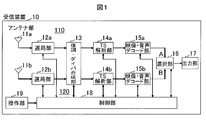
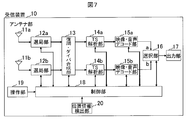
- FIG. 1 is a block diagram showing a configuration of receiving apparatus 10 according to the first embodiment of the present invention.
- reference numeral 110 denotes a first receiving circuit unit, which constitutes a first receiving system.
- the first receiving circuit unit 110 includes an antenna unit 11a, a channel selection unit 11b, a demodulation / diver synthesis unit 13, a TS analysis unit 14a, and a video / audio decoder unit 15a.
- the antenna unit 11a receives broadcast radio waves and supplies them to the channel selection unit 12a.
- the channel selection unit 12 a extracts a channel designated by the control unit 18 (to be described later) from the supplied broadcast radio wave and performs frequency conversion, and supplies a desired channel signal to the demodulation / diver synthesis unit 13.
- Numeral 120 denotes a second receiving circuit unit, which constitutes a second receiving system.
- the second receiving circuit unit 120 includes an antenna unit 11b, a channel selection unit 11c, a demodulation / diver synthesis unit 13, a TS analysis unit 14b, and a video / audio decoder unit 15b.
- the antenna unit 11b and the channel selection unit 12b have the same configuration as the antenna unit 11a and the channel selection unit 12a, and a description thereof will be omitted.
- the demodulation / diver combining unit 13 performs OFDM (Orthogonal Frequency Division Multiplexing) demodulation and transmission path decoding on each channel signal supplied from the channel selection units 12a and 12b, and extracts a TS signal. Each extracted TS signal is output to TS analyzers 14a and 14b.
- OFDM Orthogonal Frequency Division Multiplexing
- the demodulation / diver combining unit 13 can not only independently process the supplied channel signals as described above, but also perform diver combining processing on the two supplied channel signals. Specifically, a maximum ratio combining method is used in which a plurality of subcarriers extracted in each OFDM demodulation process are weighted and combined for each subcarrier.
- the TS signal extracted by the diver synthesis process is output to either the TS analysis unit 14a or 14b according to an instruction from the control unit 18.
- the above-described diver combining method is not limited to the maximum ratio combining method.
- the selective combining method in which the channel signal having the maximum power is selected and the other channel signals are discarded, It is also possible to use an equal gain synthesizing method for synthesizing with the same phase.
- the demodulation / diver combining unit 13 receives BER (Bit Error Rate), PER (Packet Error Rate), CNR (Carrier to Noise Ratio), reception power, synchronization state, etc. when performing OFDM demodulation and transmission path decoding.
- Information indicating the quality of the signal (hereinafter, signal quality value) is periodically extracted and supplied to the control unit 18.
- the TS analysis unit 14a extracts a TS packet including video and audio from the TS signal supplied from the demodulation / diver synthesis unit 13, and supplies the TS packet to the video / audio decoding unit 15a. Further, the TS analysis unit 14 a extracts information such as PSI / SI (Program Specific Information / Service Information) from the TS packet based on an instruction from the control unit 18, and supplies the extracted information to the control unit 18.
- PSI / SI Program Specific Information / Service Information
- the TS analysis unit 14b has the same configuration as the TS analysis unit 14a, and a description thereof will be omitted.
- the video / audio decoding unit 15 a decodes the video and audio TS packets supplied from the TS analysis unit 14 a and supplies the decoded video / audio signals to the selection unit 16.
- the video / audio decoding unit 15a is a 12-segment broadcast encoded with MPEG-2 (Moving Picture Experts Group 2) and H.264. Both of the one-segment broadcasting encoded by H.264 can be decoded, and one of the 12-segment broadcasting and the one-segment broadcasting is supplied to the selection unit 16 based on an instruction from the control unit 18.
- the control unit 18 includes control means including a CPU, for example.
- whether the control unit 18 selects 12-segment broadcasting or one-segment broadcasting may be determined as follows, for example. First, when the control unit 18 has selected 12-segment broadcasting, switching to one-segment broadcasting is performed when the signal quality value supplied from the demodulation / diver combining unit 13 is less than a predetermined threshold. Next, when the control unit 18 selects the one-segment broadcasting, the 12-segment broadcasting is performed when the signal quality value becomes equal to or higher than a predetermined threshold (or when the time when the predetermined threshold or higher is continued for a certain period). Switch to.
- the video / audio decoding unit 15b has the same configuration as the video / audio decoding unit 15a, and a description thereof will be omitted.
- the selection unit 16 Based on an instruction from the control unit 18, the selection unit 16 receives the video and audio signal (hereinafter referred to as “A”) supplied from the video / audio decoding unit 15 a and the video and audio signal (hereinafter referred to as “A”) supplied from the video / audio decoding unit 15 b. , B side) is selected and supplied to the output unit 17.
- A the video and audio signal supplied from the video / audio decoding unit 15 a
- A the video and audio signal supplied from the video / audio decoding unit 15 b. , B side
- the output unit 17 includes a display, a speaker, and the like, and displays the supplied video signal on the display. Further, the supplied audio signal is output by a speaker.
- the control unit 18 controls the overall operation of the receiving device 10 as will be described later.
- the operation unit 19 includes a channel selection button displayed on the display of the output unit 17 or a channel selection button of a remote controller. When the user performs a channel selection operation using these buttons, the channel selection information is controlled. Supplied to the unit 18.
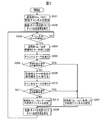
- FIG. 2 is a flowchart showing the operation of the control unit 18.
- the control unit 18 starts each process according to this flowchart.
- step S201 the control unit 18 sets the corresponding reception channel in the channel selection units 12a and 12b based on the channel selection information supplied from the operation unit 19.
- step S202 the control unit 18 causes the demodulation / diver synthesis unit 13 to perform diver synthesis processing, and causes the TS analysis unit 14a to output the extracted TS signal. Further, the control unit 18 causes the selection unit 16 to select the video and audio signals on the A side.
- step S203 the control unit 18 determines whether or not a condition for starting the channel search has been reached. If the condition for starting the channel search is reached, the process proceeds to step S204, where the condition for starting the channel search is reached. If not, the determination in step S203 is repeated.
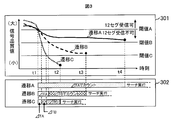
- FIG. 3 is a diagram illustrating the determination process in step S203.
- reference numeral 301 is a graph showing the time variation of the signal quality value for three transitions A, B, and C.
- threshold values A, B, and C are provided in 301 according to the magnitude of the signal quality value, and threshold value A> threshold value B> threshold value C is set.
- the threshold A is a value that is the minimum signal quality value that can be received by the 12-segment broadcast, and is the same as the threshold used to determine whether to switch from the 12-segment broadcast to the one-segment broadcast.
- the time when transitions A, B, and C become smaller than threshold A is set to the same time t1.
- Reference numeral 302 denotes the channel search start timing when the time change of the signal quality value is each of transitions A, B, and C.
- the control unit 18 starts counting the numerical value when the signal quality value becomes less than the threshold A, for example, when the viewing program is switched from the 12-segment broadcasting to the one-segment broadcasting.
- the time interval for performing the numerical count differs depending on the magnitude of the signal quality value.
- the numerical value is counted at a predetermined time interval (assumed as ⁇ TA), and when the signal quality value is equal to or greater than the threshold value C and less than the threshold value B, it is smaller than ⁇ TA.
- Numerical counting is performed at a time interval (denoted as ⁇ TB), and when the signal quality value is less than the threshold value C, numerical counting is performed at a time interval (denoted as ⁇ TC) smaller than ⁇ TB. Then, the channel search is started when the numerical count reaches a predetermined count.
- ⁇ means delta.
- the time interval of the numerical count is shortened as the signal quality value is greatly reduced. Therefore, if there is a relatively small decrease in the reception state, the reception state is likely to change well, so the timing for starting the channel search is extended, and if the reception state greatly decreases, the viewing program cannot be received. Even after that, the channel search can be executed early to switch to the channel of the relay station.
- the timing for starting the channel search can be changed. For example, if the reception state of a broadcast wave suddenly decreases due to entering a tunnel while driving in a car or entering a building shadow or under an overpass, the reception state is likely to improve again after passing through these. . Thus, in order to avoid the occurrence of a channel search due to a temporary deterioration of the broadcast radio wave reception state, it may be set as ⁇ TA ⁇ TB ⁇ TC.
- step S204 the control unit 18 is for reception to continuously receive the channel selection unit of either the channel selection unit 12a or 12b. Are selected for a search for executing a channel search.
- the demodulator / diver combiner 13 calculates the CNR of the channel signals of the channel selection units 12a and 12b, and the higher CNR may be used for reception and the lower CNR may be used for search.
- the assignment may be determined using a signal quality value other than the CNR. In this way, by using the channel selection unit having the better reception state of the broadcast radio wave for reception, it is possible to suppress the degradation of reception performance as much as possible without performing diversity reception.
- step S205 The channel search operation procedure in step S205 will be described below.
- the control unit 18 causes the demodulation / diver combining unit 13 to stop the diver combining process, and independently demodulates and demodulates each channel signal supplied from the channel selecting units 12a and 12b.
- the control unit 18 acquires NIT (Network Information Table) information from the TS analysis unit 14b for each channel while allowing the channel selection unit 12b to sequentially select the transmission channel of the relay station for the viewing program, and stores the information in the NIT information. It is compared whether or not the included network ID (network_id) matches the network ID of the currently viewed program. If they match, it is not a relay station, and if they do not match, it is not a relay station.
- the physical channel of the relay station is described in the NIT information, and the control unit 18 acquires the NIT information of the viewing program in advance and stores the channel information of the relay station in the memory.
- step S206 After executing the channel search in step S205, the process proceeds to step S206. If a receivable relay station (excluding the same channel as the viewing program) is found in step S206, the demodulator / diver combining unit 13 compares the CNR of the relay station with the CNR of the viewing program by the channel selection unit 12a. To do. As a result of the comparison, if the relay station is larger (Yes), the process proceeds to step S207. However, signal quality values other than CNR may be used. In step S207, the control unit 18 first causes the selection unit 16 to select the video and audio signals supplied from the B side, thereby switching to the relay station program found by the channel search.
- control unit 18 causes the channel selection unit 12a to select the same channel as the channel selection unit 12b. Thereafter, in step S208, the control unit 18 causes the demodulation / diver combining unit 13 to perform diver combining processing, and outputs the extracted TS signal to the TS analyzing unit 14b. As a result, the diversity reception operation can be performed while switching to the program of the relay station without interrupting the viewing program.
- step S209 the channel selection unit 12a for reception and the channel selection unit 12b for search are switched, and the channel selection unit 12a is used for search and the channel selection unit 12b is used for reception.
- the control unit 18 causes the channel selection unit 12b to select the channel of the viewing program, and causes the selection unit 16 to select the video and audio signals supplied from the B side.
- step S210 the control unit 18 acquires the NIT information of each channel from the TS analysis unit 14a while causing the channel selection unit 12a to sequentially select the transmission channel of the relay station in the same manner as in step S205. Search for stations.
- step S211 After executing the channel search in step S210, the process proceeds to step S211.
- step S211 as in step S206, if a receivable relay station (however, the same channel as the viewing program is excluded) is found, the demodulator / diver combining unit 13 uses the CNR of the relay station and the viewing program by the channel selection unit 12b. Are compared. As a result of the comparison, if the relay station is larger (Yes), the process proceeds to step S207.
- step S207 the control unit 18 first causes the selection unit 16 to select the video and audio signals supplied from the A side, thereby switching to the relay station program found by the channel search.
- control unit 18 causes the channel selection unit 12b to select the same channel as the channel selection unit 12a. Thereafter, in step S208, the control unit 18 causes the demodulation / diver combining unit 13 to perform diver combining processing, and outputs the extracted TS signal to the TS analyzing unit 14a. As a result, the diversity reception operation can be performed while switching to the program of the relay station without interrupting the viewing program.
- step S211 when a relay station having a better reception state than the viewing program is not found (No), the process proceeds to step S212.
- step S212 the search channel selection unit 12a selects the same channel as the reception channel selection unit 12b.
- step S208 the demodulator / diver synthesizer 13 performs diver synthesis processing, and outputs the extracted TS signal to the TS analyzer 14b. Thereby, it is possible to return to the normal diversity reception operation without interrupting the viewing program.
- step S208 the process returns to step S203, and the processes of steps S203 to S212 are repeatedly executed.
- the channel search can be periodically executed when the reception radio wave state of the viewing program is lowered. For this reason, when traveling in a plurality of reception areas, every time the reception area is moved, a channel of a relay station that can be received in the reception area is automatically selected, and continuous program viewing can be performed.
- the two channel selection units are divided for reception and search, and By stopping the diver combining process, it is possible to search for a channel of the relay station that can be received by the channel selection unit of the other reception system while continuing to watch the program at the channel selection unit of one reception system.
- the channel search is performed again by switching the reception and search channel selection units, so that reception is possible compared to the case where only one channel selection channel search is performed. The possibility of finding the channel of the relay station can be extracted.
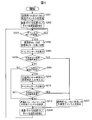
- FIG. 4 is a flowchart showing the operation of the control unit 18 in the second embodiment of the present invention.
- a channel search using one of the channel selection units is set as one set, and this is periodically executed when the reception radio wave state of the viewing program is lowered (first).
- the channel selection units 12a and 12b are alternately set as search channel selection units, and a total of two channel searches are set as one set).
- step S401 it is stored that the channel selection unit 12a is used as the search channel selection unit.
- the channel selection unit 12a is an example, and may be the channel selection unit 12b.
- step S201 diver combination reception using the channel selection units 12a and 12b is performed, and the selection unit 16 selects the video and audio signals on the A side, Output audio signals.
- step S402 it is next determined in step S402 whether the channel selection unit to be set in the search channel selection unit is the channel selection unit 12a or the channel selection unit 12b.
- the channel selection unit 12a is stored as the search channel selection unit in step S401, the process proceeds to step S403.
- step S402 if the search channel selection unit is the channel selection unit 12a, the process proceeds to step S403, where the channel selection unit 12b for reception and the channel selection unit 12a for search are set.
- the control unit 18 causes the channel selection unit 12b to continuously receive the channel of the viewing program, and causes the selection unit 16 to select the video and audio signals supplied from the B side.
- step S205 the control unit 18 causes the channel selection unit 12a to sequentially select the transmission channel of the relay station, acquires NIT information of each channel from the TS analysis unit 14a, and searches for the relay station.
- step S404 the channel selection unit 12a for reception and the channel selection unit 12b for search are set.
- the control unit 18 causes the channel selection unit 12a to continuously receive the channel of the viewing program, and causes the selection unit 16 to select the video and audio signals supplied from the A side.
- step S205 the control unit 18 searches the relay station for NIT information of each channel from the TS analysis unit 14b while causing the channel selection unit 12b to sequentially select the transmission channel of the relay station.
- steps S207, S208, and S212 after step S206 are the same as those in the first embodiment, and a description thereof will be omitted.
- step S405 it is stored as the search channel selection unit that the channel selection unit used for reception in step S205 is the search channel selection unit. After executing Step S405, the process returns to Step S203.
- the reception radio wave state of a viewing program is lowered, the reception is performed while continuing to view the program by dividing the two channel selection units for reception and search. Possible relay station channels can be searched.
- the processing time is reduced by half compared to the first embodiment in which channel search is performed for both channel selection units. it can.
- unnecessary time spent for channel search is reduced, and a longer program viewing time is ensured by diver synthesis reception. be able to.
- the first embodiment of the present invention when a channel search is performed by switching between receiving and searching channel selection units, if the reception status of radio waves in the receiving channel selection unit is poor, during channel search There is a possibility that reception of a viewing program is interrupted.
- the second embodiment of the present invention when one of the channel selection units is set for reception, if the reception status of radio waves in the channel selection unit allocated for reception is poor, channel search is performed. There is a possibility that reception of the viewing program is interrupted.
- FIG. 5 and 6 are flowcharts showing a third embodiment for correcting the above-mentioned problem.
- FIG. 5 is obtained by adding the process of step S501 to the flowchart of FIG. 1 illustrating the operation of the control unit 18 in the first embodiment.
- step S 501 the control unit 18 causes the search channel selection unit to select a channel of the viewing program, and the signal quality value of the channel signal supplied from the demodulation / diver synthesis unit 13 from the search channel selection unit. To get. Then, based on the acquired signal quality value, it is determined whether or not one-segment broadcasting or 12-segment broadcasting can be received. If reception is possible (Yes), the process proceeds to step S209. If reception is not possible, the process proceeds to step S212. move on. Thus, before switching the channel selection unit for reception and search and executing the channel search, it is first determined whether or not the viewing program can be received by the channel selection unit for reception after switching. No) can prevent the channel search from being executed.
- FIG. 6 is obtained by adding steps S601 and S602 to the flowchart of FIG. 2 illustrating the operation of the control unit 18 according to the second embodiment.
- step S402 if the channel selection unit set in the search channel selection unit is the channel selection unit 12a, the process proceeds to step S601.
- step S601 it is determined whether the receiving channel selection unit 12b can receive a program. Specifically, the control unit 18 causes the channel selection unit 12 b to select a channel of the viewing program, and acquires the signal quality value of the channel signal supplied from the channel selection unit 12 b from the demodulation / diver combination unit 13. Then, based on the acquired signal quality value, it is determined whether one-segment broadcasting or 12-segment broadcasting can be received.
- step S403 the channel selection unit 12b is set for reception and the channel selection unit 12a is set for search, and a channel search is executed. If reception is not possible (No), the process proceeds to step S404, where the search and reception channel selection units are changed, the channel selection unit 12a is set for reception and the channel selection unit 12b is set for search, and a channel search is executed. To do.
- step S402 determines whether the channel selection unit set in the search channel selection unit is the channel selection unit 12b.
- the process proceeds to step S602.
- step S602 it is determined whether the receiving channel selection unit 12a can receive the program. Specifically, the control unit 18 causes the channel selection unit 12 a to select a channel of the viewing program, and acquires the signal quality value of the channel signal supplied from the channel selection unit 12 a from the demodulation / diver combination unit 13. Then, based on the acquired signal quality value, it is determined whether one-segment broadcasting or 12-segment broadcasting can be received.
- step S404 the channel selection unit 12a is set for reception, the channel selection unit 12b is set for search, and a channel search is executed.
- step S403 the channel selection unit for search and reception is changed, channel selection unit 12b is set for reception, channel selection unit 12a is set for search, and channel search is executed. To do. In this way, when the reception radio wave condition of the channel selection unit used for reception is poor, the channel search is executed by changing the allocation of the channel selection unit for reception and search, so that when viewing the channel search, The possibility that the program becomes unreceivable can be reduced.
- the processing for searching for a relay station for a viewing program has been described.
- the processing is not limited to only a relay station, and if a relay station is not found, the viewing program A process for searching for affiliated stations can be added.
- FIG. 7 shows a configuration in which a position information detection unit 20 that can acquire the current position of the vehicle using GPS (Global Positioning System) or the like is added to the receiving apparatus 10 shown in FIG.
- FIG. 8 is a database stored in the control unit 18 in advance.
- Reference numeral 801 denotes a broadcast station database that stores information such as series identification of each broadcast station and transmission channel of a relay station in units of broadcast areas.
- Reference numeral 802 denotes an adjacent area database storing information on adjacent areas for each area.
- FIG. 9 is a flowchart showing a channel search execution procedure in the fourth embodiment (corresponding to steps S205 and S210 in FIG. 2 in the first embodiment).
- the control unit 18 first selects the channel of the viewing program relay station using the search channel selection unit in step S901, as in the first to third embodiments.
- step S902 it is determined whether or not a relay station having a better signal quality value than the viewing program received by the receiving channel selection unit has been found. When it is found (Yes), the channel search process is terminated, and then the reception is switched to the relay station. If not found (No), the process proceeds to step S903, and then a process for searching for affiliated stations is performed.
- step S903 the control unit 18 acquires the current position information of the vehicle from the position information detection unit 20.
- step S904 the control unit 18 first searches the broadcasting station database 801 for affiliated stations (broadcasting stations having the same series identification as the viewing program) having the current position as the broadcasting area. Then, the transmission channel of the relay station of the corresponding broadcasting station is extracted, and the BIT (Broadcaster Information Table) is acquired from the TS analysis unit for each channel while selecting the channel for search in the channel selection unit for search, and included in the BIT. If the identified sequence identification matches the sequence identification of the viewing program, it can be determined that it is an affiliated station.
- BIT Broadcaster Information Table
- step S905 it is determined whether an affiliated station having a signal quality value better than that of the viewing program received by the receiving channel selection unit has been found. When it is found (Yes), the channel search process is terminated, and then the reception is switched to the affiliated station. If not found (No), the process proceeds to step S906.
- step S907 as in step S905, it is determined whether an affiliated station having a better signal quality value than the viewing program received by the receiving channel selection unit has been found. When it is found (Yes), the channel search process is terminated, and then the reception is switched to the affiliated station. If not found (No), the process proceeds to step S908.
- step S908 the control unit 18 sequentially searches for channels that have not been searched yet among channels 13 to 62 of terrestrial digital broadcasting in the search processing so far (steps S901, S904, and S906). Then, in step S909, as in step S905, it is determined whether an affiliated station having a better signal quality value than the viewing program received by the receiving channel selection unit has been found. When it is found (Yes), the channel search process is terminated, and then the reception is switched to the affiliated station. If it cannot be found (No), it is determined that the channel of the relay station or affiliated station whose reception state is better than that of the program being viewed cannot be found, and the channel search is terminated.
- the affiliated station search method described in the present embodiment may be a method in which channels 13 to 62 used in digital terrestrial broadcasting are searched one by one in order for simplicity. good.
- channel search process for searching for a relay station or affiliated station of a viewing program has been described, but the process of creating a list of broadcast stations that can be received at the current position of the vehicle (Hereinafter referred to as channel scan processing) can also be realized.
- FIG. 10 is a flowchart illustrating a procedure of channel scan processing of the receiving device 10.
- this flowchart for example, when an operation for executing a channel scan process by the user is performed from the operation unit 19, or the current position of the vehicle is acquired from the position information detection unit 20 and it is detected that the vehicle has moved to another broadcasting area.
- the condition such as when the control unit 18 determines that the reception radio wave status of the viewing program is good is also obtained.
- the control unit 18 causes the demodulation / diver combining unit 13 to stop the diversity combining process.
- the control unit 18 allocates one of the channel selection units 12a and 12b for reception and the other channel selection unit for scanning.
- the CNR of the channel signals of the channel selection units 12a and 12b may be calculated by the demodulation / diver combining unit 13, and the higher CNR may be used for reception and the lower CNR may be used for scanning.
- the assignment may be determined using a signal quality value other than the CNR.
- step S1002 the control unit 18 causes the channel selection unit 12b to sequentially select channels 13 to 62 used in terrestrial digital broadcasting, while receiving NIT information and the like from the TS analysis unit 14b for each channel. Obtain a list of broadcast stations that can be received based on this information.
- step S1003 the receiving channel selection unit 12a and the scanning channel selection unit 12b are switched, and the channel selection unit 12a is used for scanning and the channel selection unit 12b is used for reception.
- the control unit 18 causes the channel selection unit 12b to select the channel of the viewing program, and causes the selection unit 16 to select the video and audio signals supplied from the B side.
- step S1004 the control unit 18 causes the channel selection unit 12a to sequentially select channels 13 to 62 used in the terrestrial digital broadcast, while receiving NIT information and the like from the TS analysis unit 14a for each channel. If a channel that is not yet registered in the list of broadcast stations is found based on these information, it is additionally registered in the list of broadcast stations.
- step S1005 the control unit 18 causes the channel selection unit 12a to select a viewing program having the same channel as that of the channel selection unit 12b.
- the synthesizing unit 13 performs diver synthesis processing, and outputs the extracted TS signal to the TS analyzing unit 14b.
- the receiving apparatus 10 returns to the diversity reception operation.
- the selection unit 16 selects the video and audio signals supplied from the B side, and is different from the A side selected before starting the channel scan processing.
- a list of broadcast stations that can be received at the current position of the vehicle is maintained while continuing to watch the program by dividing the two channel selection units for reception and scanning. Can be created. At this time, even if there is a broadcasting station that was not found by the channel scan processing by one channel selection unit, the same channel scan processing is performed by the other channel selection unit, so the channel scan processing is performed only by one channel selection unit. Compared to this, the possibility of finding more broadcast stations can be extracted.
- step S1004 when the receiving and scanning channel selection units are switched in step S1003 and the viewing program cannot be received by the reception channel selection unit, the processing of step S1004 is performed. By omitting the processing, priority may be given to receiving a viewing program over channel scanning.
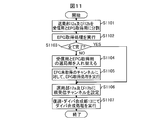
- FIG. 11 is a flowchart illustrating a processing procedure for acquiring EPG information of the receiving device 10. This flowchart is, for example, when an operation for instructing display of an EPG by the user is performed from the operation unit 19 or when the control unit 18 determines that the reception radio wave condition of the viewing program is good (for example, in FIG. 3). When the condition such as when the signal quality value is larger than the threshold value A) is obtained.
- the control unit 18 causes the demodulation / diver combining unit 13 to stop the diversity combining process.
- the control unit 18 allocates one of the channel selection units 12a and 12b for reception and the other channel selection unit for EPG acquisition.
- the demodulator / diver combiner 13 calculates the CNR of the channel signals of the channel selection units 12a and 12b, and the higher CNR may be used for reception and the lower CNR may be used for EPG acquisition.
- the assignment may be determined using a signal quality value other than the CNR.
- the channel selection unit 12a is allocated for reception and the channel selection unit 12b is allocated for EPG acquisition.
- step S1102 the control unit 18 causes the channel selection unit 12b to sequentially select the channel of the broadcast station registered in the reception device 10 and displays the EPG from the TS analysis unit 14b for each channel.
- EIT Event Information Table
- EPGs for each broadcasting station are created based on the information.
- step S1103 it is determined in step S1103 whether all the EPG information of the registered broadcasting stations has been acquired. If it can be acquired (Yes), the process proceeds to step S1106. If it cannot be acquired (No), the process proceeds to step S1104.
- step S1104 the channel selection unit 12a for reception and the channel selection unit 12b for EPG acquisition are switched, and the channel selection unit 12a is used for EPG acquisition and the channel selection unit 12b is used for reception.
- the control unit 18 causes the selection unit 16 to select the video and audio signals supplied from the B side. Then, the process proceeds to step S1105, and the control unit 18 causes the channel selection unit 12a to sequentially select the channel of the broadcasting station that could not acquire the EPG information in step S1102, and from the TS analysis unit 14a to the EIT information for each channel. The EPG of each broadcasting station is created based on such information.
- step S1106 the control unit 18 causes the channel selection unit 12a to select a viewing program having the same channel as that of the channel selection unit 12b.
- a diver synthesis process is instructed to the synthesis unit 13.
- the receiving apparatus 10 returns to the diversity reception operation.
- the selection unit 16 selects the video and audio signals supplied from the B side, and is different from the A side selected before starting the channel scan processing.
- the EPG of the broadcast station registered in the receiving device 10 while continuing to watch the program. Can be created.
- the EPG acquisition process is also performed by the other channel selection unit, so that the EPG acquisition process is performed only by one channel selection unit.
- the EPG can be created more reliably.
- step S1104 when the receiving and EPG acquisition channel selection units are switched in step S1104, if the viewing program cannot be received by the reception channel selection unit, the processing in step S1105 is performed. By omitting, processing for giving priority to reception of a viewing program may be performed rather than performing EPG acquisition processing.
- FIG. 12 is a flowchart showing the operation of the control unit 18 in the seventh embodiment of the present invention.
- the control unit 18 operates the operation in step S201. Based on the channel selection information supplied from the unit 19, the corresponding reception channels are set in the channel selection units 12a and 12b.
- the control unit 18 causes the demodulation / diver combining unit 13 to perform diver combining processing, and causes the TS analysis unit 14a to output the extracted TS signal. Further, the control unit 18 causes the selection unit 16 to select the video and audio signals on the A side. Thereby, the program reception by the diversity reception operation
- step S203 the control unit 18 determines whether or not the condition for starting the channel search has been reached. If the condition for starting the channel search is reached (Yes), the process proceeds to step S1201 and the channel search is performed. If the conditions for starting are not reached (No), the determination in step S203 is repeated.
- the determination process in step S203 is the same as that in the first embodiment, and a description thereof will be omitted.
- step S1201 the control unit 18 allocates one of the channel selection units 12a or 12b for continuous reception, and allocates the other channel selection unit for channel search. Any allocation method may be used.
- step S1202 the channel search operation in step S1202 will be described.
- the control unit 18 causes the demodulation / diver combining unit 13 to stop the diver combining process, and independently demodulates and demodulates each channel signal supplied from the channel selecting units 12a and 12b.
- control unit 18 acquires NIT information from the TS analysis unit 14b for each channel while causing the channel selection unit 12b to sequentially select the transmission channel of the relay station of the viewing program, and the network included in the NIT information. It is compared whether or not the ID matches the network ID of the program that is currently being viewed.
- the physical channel of the relay station is described in the NIT information, and the control unit 18 acquires the NIT information of the viewing program in advance and stores the channel information of the relay station in the memory.
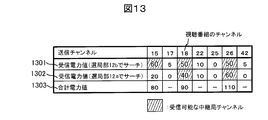
- control unit 18 obtains information indicating whether or not the relay station has been received for each channel of the relay station and the received power from the demodulation / diver combining unit 13 and stores them in the memory. Keep it.
- the relay station can be received on channels 15, 18, and 26.
- step S1203 the reception channel selection unit 12a and the search channel selection unit 12b are switched, and the channel selection unit 12a is used for search and the channel selection unit 12b is used for reception.
- the control unit 18 causes the channel selection unit 12b to select the channel of the viewing program, and causes the selection unit 16 to select the video and audio signals supplied from the B side.
- step S1204 the control unit 18 acquires the NIT information of each channel from the TS analysis unit 14a and searches for the relay station while causing the channel selection unit 12a to sequentially select the transmission channel of the relay station in the same manner as in step S1202. . Further, as indicated by reference numeral 1302 in FIG. 13, the control unit 18 obtains received power from the demodulation / diver combining unit 13 for each channel of the relay station and stores it in the memory. In the example of 1302 in FIG. 13, the relay station can be received on the 18th and 26th channels.
- step S1205 as indicated by 1303 (total power value) in FIG. 13, for the channels determined as relay stations in step S1202 or S1204 (channels 15, 18, and 26 in the example of FIG. 13),
- the total power obtained by adding the received power of 1301 (search received power value in the channel selection unit 12b) and 1302 (received power value of search in the channel selection unit 12a) is obtained.
- step S1206 it is determined whether a relay station channel having a total power value larger than that of the viewing program is found in 1303. If found (Yes), the process proceeds to step S1207. If not found (No), the process proceeds to step S1208. In the example of FIG.
- step S1207 the control unit 18 first causes the channel selection unit 12a to select the channel of the relay station found by the channel search, and causes the selection unit 16 to select the video and audio signals supplied from the A side, This switches to the relay station program found by the channel search.
- the shaded part means a receivable relay channel.
- control unit 18 causes the channel selection unit 12b to select the same channel as the channel selection unit 12a. Thereafter, in step S1209, the control unit 18 causes the demodulation / diver combining unit 13 to perform diver combining processing, and outputs the extracted TS signal to the TS analyzing unit 14a. As a result, the diversity reception operation can be performed while switching to the program of the relay station without interrupting the viewing program.
- step S1208 the channel selection unit 12a for search selects the same channel as the channel selection unit 12b for reception.
- step S1209 the demodulation / diver combining unit 13 is caused to perform diver combining processing, and the extracted TS signal is output to the TS analyzing unit 14b. Thereby, it is possible to return to the normal diversity reception operation without interrupting the viewing program.
- step S1209 After the process of step S1209, the process returns to step S203, and the processes of steps S203 and S1201 to S1209 are repeatedly executed.
- the channel search can be periodically executed when the reception radio wave state of the viewing program is lowered. For this reason, when traveling in a plurality of reception areas, every time the reception area is moved, a channel of a relay station that can be received in the reception area is automatically selected, and continuous program viewing can be performed.
- the channel search is executed by both the channel selection units 12a and 12b, and the process of adding power to the results of the respective channel searches is performed. Therefore, there is a feature that it is possible to find a channel of the relay station in which the reception state is good when the diversity operation using the reception signal in each channel selection unit is performed.
- the same operation as the diversity operation algorithm in the demodulation / diversity combining unit 13 may be performed. That is, for example, assuming that the demodulator / diver combining unit 13 performs diversity operation by maximum ratio combining, channel search by each channel selection unit stores information on subcarriers for each channel and weights combining subcarriers of the same channel. What is necessary is just to calculate the CNR performed and select the channel with the maximum CNR.
- the receiving apparatus 10 has been described as having the two channel selection units 10a and 10b.
- the reception device 10 can also be configured from three or more channel selection units. For example, in the case of four channel selection units, usually, a diversity reception operation using the four channel selection units is performed, and two channel selection units are used when performing channel search (or channel scan, EPG acquisition processing). May be used for reception, and the remaining two tuning sections may be used for search (or for scanning and for EPG acquisition).
Landscapes
- Engineering & Computer Science (AREA)
- Signal Processing (AREA)
- Multimedia (AREA)
- Computer Networks & Wireless Communication (AREA)
- Radio Transmission System (AREA)
- Circuits Of Receivers In General (AREA)
- Two-Way Televisions, Distribution Of Moving Picture Or The Like (AREA)
Abstract
Description
しかしながら、上記従来技術では、受信状態の良好なチューナで受信を継続し、残りのチューナでチャンネルサーチを行っているため、チャンネルサーチ用チューナのアンテナで中継局の放送電波をうまく受信できず、チャンネルサーチを行っても中継局を見つけることができない可能性が生じる場合がある。
アンテナで受信した受信信号を伝送する第1、第2の受信系統を有し、該第1、第2の受信系統による復調信号の合成信号をもってダイバーシティ受信動作が可能な受信装置において、
ダイバーシティ受信動作中に所定の条件を満たした場合、前記第1、第2の受信系統のいずれか一方には、前記第1、第2の受信系統で選局した視聴番組を継続受信させると共に、他方には、チャンネルサーチを行わせ又は受信機に登録されているチャンネルについてのEPGを取得させる第1の複合動作を実行し、
前記第1の複合動作において、受信すべきチャンネルが見つからなかった場合、前記第1、第2の受信系統を切り替え、前記第1、第2の受信系統のいずれか一方には、チャンネルサーチを行わせると共に、他方には、前記視聴番組を継続受信させる第2の複合動作を実行する制御手段を設けたことにある。
アンテナで受信した受信信号より所定のチャンネルを選局し、復調・伝送路復号・多重分離・デコード処理を施して映像及び音声信号を出力する第1の受信系統と、アンテナで受信した受信信号より所定のチャンネルを選局し、復調・伝送路復号・多重分離・デコード処理を施して映像及び音声信号を出力する第2の受信系統と、前記第1の受信系統の出力と前記第2の受信系統の出力のうちどちらか一方を選択して出力する選択手段と、受信装置全体の動作を制御する制御手段とを備え、
前記制御手段は、前記第1の受信系統の復調信号と前記第2の受信系統の復調信号を合成し、合成信号をどちらか一方の受信系統を用いて伝送路復号・多重分離・デコード処理を施して映像及び音声信号を出力させるダイバーシティ受信動作を行わせることが可能であり、
前記制御手段は、前記ダイバーシティ受信動作中に所定の条件を満たすと、前記第1の受信系統と前記第2の受信系統のうち、一方の受信系統にはそのまま視聴番組を継続受信させると共に、他方の受信系統にはチャンネルサーチを行わせて所定の条件を満たすチャンネルを探索させ、かつ前記選択手段に前記視聴番組を継続受信する受信系統の出力を選択させる第1の複合動作を実行し、
前記第1の複合動作の結果、受信すべきチャンネルが見つからなかった場合は、前記制御手段は、前記視聴番組を継続受信する受信系統と前記チャンネルサーチを行う受信系統を入れ替え、前記チャンネルサーチを行う受信系統にチャンネルサーチを行わせると共に、前記選択手段に前記視聴番組を継続受信する受信系統の出力を選択させる第2の複合動作を実行する。
前記制御手段は、前記第1の受信系統の復調信号と前記第2の受信系統の復調信号を合成し、合成信号をどちらか一方の受信系統を用いて伝送路復号・多重分離・デコード処理を施して映像及び音声信号を出力させるダイバーシティ受信動作を行わせることが可能であり、
前記制御手段は、前記ダイバーシティ受信動作中に所定の条件を満たすと、前記第1の受信系統と前記第2の受信系統のうち、一方の受信系統にはそのまま視聴番組を継続受信させると共に、他方の受信系統にはチャンネルサーチを行わせて所定の条件を満たすチャンネルを探索させ、かつ前記選択手段は前記継続受信動作する受信系統の出力を選択させる第1の複合動作を実行し、
前記第1の複合動作の結果、受信すべきチャンネルが見つからなかった場合は、前記制御手段は、前記視聴番組を継続受信する受信系統と前記チャンネルサーチを行う受信系統を入れ替えた時に、前記視聴番組を継続受信する受信系統において、視聴番組が受信可能であるか否かを判定し、受信可能であると判定した場合に限り、実際に前記視聴番組を継続受信する受信系統と前記チャンネルサーチを行う受信系統を入れ替え、前記チャンネルサーチを行う受信系統にチャンネルサーチを行わせると共に、前記選択手段に前記視聴番組を継続受信する受信系統の出力を選択させる第2の複合動作を実行する。
前記制御手段は、前記第1の受信系統の復調信号と前記第2の受信系統の復調信号を合成し、合成信号をどちらか一方の受信系統を用いて伝送路復号・多重分離・デコード処理を施して映像及び音声信号を出力させるダイバーシティ受信動作を行わせることが可能であり、
前記制御手段は、前記ダイバーシティ受信動作中に所定の条件を満たすと、前記第1の受信系統と前記第2の受信系統のうち、一方の受信系統にはそのまま視聴番組を継続受信させると共に、他方の受信系統にはチャンネルスキャンを行わせて受信可能なチャンネルを探索させ、かつ前記選択手段に前記視聴番組を継続受信する受信系統の出力を選択させる第1の複合動作を実行し、その後前記制御手段は、前記視聴番組を継続受信する受信系統と前記チャンネルサーチを行う受信系統を入れ替え、前記チャンネルサーチを行う受信系統にチャンネルスキャンを行わせると共に、前記選択手段に前記視聴番組を継続受信する受信系統の出力を選択させる第2の複合動作を実行する。
前記制御手段は、前記第1の受信系統の復調信号と前記第2の受信系統の復調信号を合成し、合成信号をどちらか一方の受信系統を用いて伝送路復号・多重分離・デコード処理を施して映像及び音声信号を出力させるダイバーシティ受信動作を行わせることが可能であり、
前記制御手段は、前記ダイバーシティ受信動作中に所定の条件を満たすと、前記第1の受信系統と前記第2の受信系統のうち、一方の受信系統にはそのまま視聴番組を継続受信させると共に、他方の受信系統には受信機に登録されているチャンネルについてEPGの取得を行わせ、かつ前記選択手段に前記視聴番組を継続受信する受信系統の出力を選択させる第1の複合動作を実行し、
前記第1の複合動作の結果、全ての前記受信機に登録されているチャンネルについてEPGの取得ができなかった場合は、前記制御手段は、前記視聴番組を継続受信する受信系統と前記EPGを取得する受信系統を入れ替え、前記EPGを取得する受信系統に対して、前記第1の複合動作で取得できなかったチャンネルについてEPGの取得を行わせると共に、前記選択手段に前記視聴番組を継続受信する受信系統の出力を選択させる第2の複合動作を実行する。
前記制御手段は、前記第1の受信系統の復調信号と前記第2の受信系統の復調信号を合成し、合成信号をどちらか一方の受信系統を用いて伝送路復号・多重分離・デコード処理を施して映像及び音声信号を出力させるダイバーシティ受信動作を行わせることが可能で、前記制御手段は、前記ダイバーシティ受信動作中に所定の条件を満たすと、前記第1の受信系統と前記第2の受信系統のうち、一方の受信系統にはそのまま視聴番組を継続受信させると共に、他方の受信系統にはチャンネルサーチを行わせて各チャンネルの受信状態の取得及び所定の条件を満たすチャンネルを探索させ、かつ前記選択手段に前記視聴番組を継続受信する受信系統の出力を選択させる第1の複合動作を実行し、
続いて前記制御手段は、前記視聴番組を継続受信する受信系統と前記チャンネルサーチを行う受信系統を入れ替え、前記チャンネルサーチを行う受信系統にチャンネルサーチを行わせて各チャンネルの受信状態の取得及び所定の条件を満たすチャンネルを探索させると共に、前記選択手段に前記視聴番組を継続受信する受信系統の出力を選択させる第2の複合動作を実行し、前記第1の複合動作と前記第2の複合動作で得られた前記各チャンネルの受信状態をチャンネルごとに合成して合成後の受信状態を算出し、前記所定の条件を満たすチャンネルの中で最も前記合成後の受信状態が良好なチャンネルに視聴番組のチャンネルを設定する。
なお、“ダイバーシティ受信動作中に所定の条件を満たす”とは、視聴番組などの受信電波状態を示し、例えば受信電波が低下し、チャンネルサーチを開始する条件に達した場合であり、具体的には後述する信号品質値が所定の閾値未満や閾値以上(或いは、所定の閾値以上となる時間が一定期間継続)となった場合などである。
なお、本発明の実施の形態における受信装置では、日本の地上デジタル放送の伝送方式であるISDB-T(Integrated Services Digital Broadcasting for Terrestrial)による放送信号を受信し、MPEG2-TS(Transport Stream)(以下、TS信号)形式の映像・音声信号をデコードすることができる。ISDB-Tでは、1チャンネルの伝送帯域を13個のセグメントに分割し、それぞれのセグメントを組み合わせて、最大3階層までの階層伝送を行うことができる。
同図において、110は第1の受信回路部を示し、第1の受信系統を構成している。第1の受信回路部110は、アンテナ部11a、選局部11b、復調・ダイバ合成部13、TS解析部14a、映像・音声デコーダ部15aを含んでいる。アンテナ部11aは、放送電波を受信して選局部12aに供給する。選局部12aは、供給された放送電波の中から後述する制御部18より指示されたチャンネルを抽出及び周波数変換を施し、所望のチャンネル信号を復調・ダイバ合成部13に供給する。
更に、復調・ダイバ合成部13は、OFDM復調及び伝送路復号を行う際にBER(Bit Error Rate)、PER(Packet Error Rate)、CNR(Carrier to Noise Ratio)、受信電力、同期状態などの受信信号の品質を示す情報(以下、信号品質値)を定期的に抽出し、制御部18に供給する。
制御部18は、後述するように受信装置10の動作全体を制御する。
操作部19は、出力部17のディスプレイ上に表示されたチャンネル選局ボタン、或いはリモコンのチャンネル選局ボタンなどで構成され、これらを用いてユーザが選局操作を行うと、選局情報が制御部18に供給される。
同図において、ユーザの選局操作が行われ、操作部19の選局ボタン操作に伴う選局情報が制御部18に供給されると、制御部18は本フローチャートに従って各処理を開始する。
次に、ステップS202にて制御部18は、復調・ダイバ合成部13に対し、ダイバ合成処理を行わせ、抽出したTS信号をTS解析部14aに出力させる。また、制御部18は、選択部16に対し、A側の映像及び音声信号を選択させる。上記処理により、2つのアンテナ11a、11bを使用したダイバーシティ受信動作を行いつつ、ユーザは所望の放送番組を視聴することができる。
続いて、ステップS203にて制御部18は、チャンネルサーチを開始する条件に達したか否かを判定し、チャンネルサーチを開始する条件に達した場合はステップS204に進み、チャンネルサーチを開始する条件に達していない場合はステップS203の判定を繰り返し実行する。
まず、制御部18は復調・ダイバ合成部13に対し、ダイバ合成処理を停止させ、選局部12a及び12bより供給された各々のチャンネル信号を独立に復調及び伝送路復号処理させる。
ステップS207では、まず制御部18は選択部16に対し、B側より供給された映像及び音声信号を選択させ、これによりチャンネルサーチで発見した中継局の番組に切り替わる。
その後、ステップS210に移行し、制御部18は選局部12aに対し、ステップS205と同様に中継局の送信チャンネルを順に選局させながら、TS解析部14aより各チャンネルのNIT情報を取得し、中継局を探索する。
第2の実施の形態は、どちらか一方の選局部を使用したチャンネルサーチを1セットとし、これを視聴番組の受信電波状態が低下している際に定期的に実行するものである(第1の実施の形態では、選局部12a及び12bをそれぞれ交互にサーチ用選局部に設定し、計2回のチャンネルサーチを1セットとしていた)。
ステップS203において、チャンネルサーチの開始条件に達すると、次に、ステップS402において、サーチ用選局部に設定する選局部が選局部12aであるか選局部12bであるかを判定する。ここでは、ステップS401においてサーチ用選局部として選局部12aを記憶させているため、ステップS403に進む。
同様に、本発明の第2の実施の形態において、どちらか一方の選局部を受信用に設定する際に、受信用に割り当てられた選局部における電波の受信状況が悪い場合には、チャンネルサーチ中に視聴番組の受信が途切れてしまう可能性がある。
図5は、第1の実施の形態における制御部18の動作を示す図1のフローチャートにおいて、ステップS501の処理を追加したものである。
これにより、受信用とサーチ用の選局部を切り替えてチャンネルサーチを実行する前に、切り替え後に受信用となる選局部において視聴番組が受信できるか否かを先に判定し、受信不可の場合(No)は、チャンネルサーチを実行しないようにすることができる。
このように、受信用に使用する選局部の受信電波状況が悪い場合には、受信用とサーチ用の選局部の割り当てを変更してチャンネルサーチを実行させることで、チャンネルサーチ実行時において、視聴番組が受信不可となってしまう可能性を軽減することができる。
同図において、制御部18は、チャンネルサーチを開始すると、第1から第3の実施の形態と同様に、まずステップS901において、サーチ用の選局部を使用して視聴番組の中継局のチャンネルをサーチし、続いてステップS902において、受信用の選局部で受信している視聴番組よりも信号品質値が良好な中継局を発見したか否かを判定する。発見した場合(Yes)は、チャンネルサーチ処理を終了し、その後当該中継局の受信に切り替える。発見できなかった場合(No)は、ステップS903に進み、続いて系列局を探索する処理を行う。
本フローチャートは、例えば、操作部19よりユーザによるチャンネルスキャン処理を実行する操作が行われたとき、又は位置情報検出部20より車両の現在位置を取得し別の放送地域に移動したことを検知したとき、更には制御部18が視聴番組の受信電波状況が良好であると判断したとき、などの条件が得られた場合に開始する。
まず、受信装置10がダイバーシティ受信動作を行っている場合、制御部18は、復調・ダイバ合成部13に対し、ダイバ合成処理を停止させる。ステップS1001にて、制御部18は、選局部12a又は12bのどちらか一方の選局部を受信用、他方の選局部をスキャン用に割り当てる。割り当て方法は、復調・ダイバ合成部13にて選局部12a及び12bの各々のチャンネル信号のCNRを算出し、CNRの大きい方を受信用、CNRの小さい方をスキャン用に用いれば良い。但し、CNR以外の他の信号品質値を用いて割り当てを決定しても良い。ここでは例として、選局部12aが受信用、選局部12bがスキャン用に割り当てられたとする。
本フローチャートは、例えば、操作部19よりユーザによるEPGの表示を指示する操作が行われたとき、或いは制御部18が視聴番組の受信電波状況が良好であると判断したとき(例えば、図3において信号品質値が閾値Aよりも大きいとき)、などの条件が得られた場合に開始する。
まず、受信装置10がダイバーシティ受信動作を行っている場合、制御部18は、復調・ダイバ合成部13に対し、ダイバ合成処理を停止させる。ステップS1101にて、制御部18は、選局部12a又は12bのどちらか一方の選局部を受信用、他方の選局部をEPG取得用に割り当てる。割り当て方法は、復調・ダイバ合成部13にて選局部12a及び12bの各々のチャンネル信号のCNRを算出し、CNRの大きい方を受信用、CNRの小さい方をEPG取得用に用いれば良い。但し、CNR以外の他の信号品質値を用いて割り当てを決定しても良い。ここでは例として、選局部12aが受信用、選局部12bがEPG取得用に割り当てられたとする。
そして、ステップS1105に移行し、制御部18は選局部12aに対し、ステップS1102にてEPG情報を取得できなかった放送局のチャンネルを順に選局させながら、各チャンネルについてTS解析部14aよりEIT情報などを取得し、これらの情報を元に各放送局のEPGを作成していく。
まず、制御部18は復調・ダイバ合成部13に対し、ダイバ合成処理を停止させ、選局部12a及び12bより供給された各々のチャンネル信号を独立に復調及び伝送路復号処理させる。
Claims (9)
- アンテナで受信した受信信号より所定のチャンネルを選局し、該選局チャンネルの視聴番組の信号に、復調・伝送路復号・多重分離・デコード処理を施して映像及び音声信号を出力する第1の受信回路部を含む第1の受信系統と、
アンテナで受信した受信信号より所定のチャンネルを選局し、該選局チャンネルの視聴番組の信号に、復調・伝送路復号・多重分離・デコード処理を施して映像及び音声信号を出力する第2の受信回路部を含む第2の受信系統と、
前記第1の受信系統の第1の受信回路部の出力と前記第2の受信系統の第2の受信回路部の出力のうちどちらか一方を選択して出力する選択手段と、
前記第1の受信系統の復調信号と前記第2の受信系統の復調信号を合成し、該合成信号を前記第1、第2の受信系統のどちらか一方の受信系統に供給する復調・ダイバ合成手段と、
前記第1、第2の受信系統と前記選択手段と前記復調・ダイバ合成手段を制御する制御手段とを備え、
前記制御手段は、前記合成信号に前記第1、第2の受信系統のどちらか一方の受信系統を用いて伝送路復号・多重分離・デコード処理を施して映像及び音声信号を出力させるダイバーシティ受信動作を行わせる制御部と、
前記制御手段は、前記ダイバーシティ受信動作中に所定の条件を満たすと、
前記第1の受信系統と前記第2の受信系統のうち、一方の受信系統には、そのまま視聴番組を継続受信させると共に、他方の受信系統には、チャンネルサーチを行わせて所定の条件を満たすチャンネルを探索させ、かつ前記選択手段に前記視聴番組を継続受信する受信系統の出力を選択させる第1の複合動作を実行する制御部と、
前記第1の複合動作の結果、受信すべきチャンネルが見つからなかった場合は、
前記制御手段は、前記視聴番組を継続受信する受信系統と前記チャンネルサーチを行う受信系統を入れ替え、前記チャンネルサーチを行う受信系統にチャンネルサーチを行わせると共に、前記選択手段に前記視聴番組を継続受信する受信系統の出力を選択させる第2の複合動作を実行する制御部を含んでいることを特徴とする受信装置。 - 請求項1において、前記制御手段は、
さらに前記視聴番組を継続受信する受信系統と前記チャンネルサーチを行う受信系統を入れ替えた時に、前記視聴番組を継続受信する受信系統において、該視聴番組が受信可能であるか否かを判定する制御部を含み、
前記判定において、受信可能であると判定した場合に限り、前記視聴番組を継続受信する受信系統(a)と前記チャンネルサーチを行う受信系統(b)を入れ替え、
前記チャンネルサーチを行う受信系統にチャンネルサーチを行わせると共に、前記選択手段に前記視聴番組を継続受信する受信系統の出力を選択させる第2の複合動作を実行することを特徴とする受信装置。 - 請求項1及び請求項2において、
前記制御手段は、前記視聴番組の受信状態を判断するための複数の閾値と、前記複数の閾値間ごとに数値カウントを行うための時間インターバル値を設定する制御部と、
前記制御手段は、前記ダイバーシティ受信動作中において、前記視聴番組の受信状態が前記複数の閾値間を遷移している間は、前記時間インターバル値に従って前記数値カウントを行い、前記数値カウントが所定の数値に達すると前記第1の複合動作を開始する制御部を含んでいることを特徴とする受信装置。 - 請求項1及び請求項2において、
前記チャンネルサーチで探索する所定の条件を満たすチャンネルとは、
前記視聴番組を継続受信している受信系統が受信しているチャンネルの中継局又は系列局のチャンネルであって、かつ前記視聴番組を継続受信している受信系統が受信しているチャンネルの受信状態よりも良好な前記中継局又は系列局であることを特徴とする受信装置。 - 請求項1及び請求項2において、
前記第1の複合動作では、前記第1の受信系統と前記第2の受信系統のうち、受信状態が良好な方の受信系統を、前記視聴番組を継続受信する受信系統に設定し、他方の受信系統を、前記チャンネルサーチを行う受信系統に設定することを特徴とする受信装置。 - アンテナで受信した受信信号より所定のチャンネルを選局し、該選局チャンネルの視聴番組の信号に、復調・伝送路復号・多重分離・デコード処理を施して映像及び音声信号を出力する第1の受信系統と、
アンテナで受信した受信信号より所定のチャンネルを選局し、該選局チャンネルの視聴番組の信号に、復調・伝送路復号・多重分離・デコード処理を施して映像及び音声信号を出力する第2の受信系統と、
前記第1の受信系統の第1の受信回路部の出力と前記第2の受信系統の第2の受信回路部の出力のうちどちらか一方を選択して出力する選択手段と、
前記第1の受信系統の復調信号と前記第2の受信系統の復調信号を合成し、該合成信号を前記第1、第2の受信系統のどちらか一方の受信系統に供給する復調・ダイバ合成手段と、
前記第1、第2の受信系統と前記選択手段と前記復調・ダイバ合成手段を制御する制御手段とを備え、
前記制御手段は、前記合成信号に前記第1、第2の受信系統のどちらか一方の受信系統を用いて伝送路復号・多重分離・デコード処理を施して映像及び音声信号を出力させるダイバーシティ受信動作を行わせる制御部と、
前記制御手段は、前記ダイバーシティ受信動作中に所定の条件を満たすと、
前記第1の受信系統と前記第2の受信系統のうち、一方の受信系統には、そのまま視聴番組を継続受信させると共に、他方の受信系統には、チャンネルスキャンを行わせて受信可能なチャンネルを探索させ、かつ前記選択手段に前記視聴番組を継続受信する受信系統の出力を選択させる第1の複合動作を実行する制御部と、
前記制御手段は、前記視聴番組を継続受信する受信系統と前記チャンネルスキャンサーチを行う受信系統を入れ替え、前記チャンネルサーチを行う受信系統にチャンネルスキャンを行わせると共に、前記選択手段に前記視聴番組を継続受信する受信系統の出力を選択させる第2の複合動作を実行する制御部を含んでいることを特徴とする受信装置。 - アンテナで受信した受信信号より所定のチャンネルを選局し、該選局チャンネルの視聴番組の信号に、復調・伝送路復号・多重分離・デコード処理を施して映像及び音声信号を出力する第1の受信系統と、
アンテナで受信した受信信号より所定のチャンネルを選局し、該選局チャンネルの視聴番組の信号に、復調・伝送路復号・多重分離・デコード処理を施して映像及び音声信号を出力する第2の受信系統と、
前記第1の受信系統の第1の受信回路部の出力と前記第2の受信系統の第2の受信回路部の出力のうちどちらか一方を選択して出力する選択手段と、
前記第1の受信系統の復調信号と前記第2の受信系統の復調信号を合成し、該合成信号を前記第1、第2の受信系統のどちらか一方の受信系統に供給する復調・ダイバ合成手段と、
前記第1、第2の受信系統と前記選択手段と前記復調・ダイバ合成手段を制御する制御手段とを備え、
前記制御手段は、前記(第1の受信系統の復調信号と前記第2の受信系統の復調信号を合成し、該合成信号に前記第1、第2の受信系統のどちらか一方の受信系統を用いて伝送路復号・多重分離・デコード処理を施して映像及び音声信号を出力させるダイバーシティ受信動作を行わせ制御部と、
前記制御手段は、前記ダイバーシティ受信動作中に所定の条件を満たすと、
前記第1の受信系統と前記第2の受信系統のうち、一方の受信系統には、そのまま視聴番組を継続受信させると共に、他方の受信系統には受信機に登録されているチャンネルについてEPGの取得を行わせ、かつ前記選択手段に前記視聴番組を継続受信する受信系統の出力を選択させる第1の複合動作を実行する制御部と、
前記第1の複合動作の結果、全ての前記受信機に登録されているチャンネルについてEPGの取得ができなかった場合は、
前記制御手段は、前記視聴番組を継続受信する受信系統と前記EPGを取得する受信系統を入れ替え、前記EPGを取得する受信系統に対して、前記第1の複合動作で取得できなかったチャンネルについてEPGの取得を行わせると共に、前記選択手段に前記視聴番組を継続受信する受信系統の出力を選択させる第2の複合動作を実行する制御部を含んでいることを特徴とする受信装置。 - アンテナで受信した受信信号より所定のチャンネルを選局し、該選局チャンネルの視聴番組の信号に、復調・伝送路復号・多重分離・デコード処理を施して映像及び音声信号を出力する第1の受信系統と、
アンテナで受信した受信信号より所定のチャンネルを選局し、該選局チャンネルの視聴番組の信号に、復調・伝送路復号・多重分離・デコード処理を施して映像及び音声信号を出力する第2の受信系統と、
前記第1の受信系統の第1の受信回路部の出力と前記第2の受信系統の第2の受信回路部の出力のうちどちらか一方を選択して出力する選択手段と、
前記第1の受信系統の復調信号と前記第2の受信系統の復調信号を合成し、該合成信号を前記第1、第2の受信系統のどちらか一方の受信系統に供給する復調・ダイバ合成手段と、
前記第1、第2の受信系統と前記選択手段と前記復調・ダイバ合成手段を制御する制御手段とを備え、
前記制御手段は、前記合成信号に前記第1、第2の受信系統のどちらか一方の受信系統を用いて伝送路復号・多重分離・デコード処理を施して映像及び音声信号を出力させるダイバーシティ受信動作を行わせる制御部と、
前記制御手段は、前記ダイバーシティ受信動作中に所定の条件を満たすと、前記第1の受信系統と前記第2の受信系統のうち、一方の受信系統にはそのまま視聴番組を継続受信させると共に、他方の受信系統にはチャンネルサーチを行わせて各チャンネルの受信状態の取得及び所定の条件を満たすチャンネルを探索させ、かつ前記選択手段に前記視聴番組を継続受信する受信系統の出力を選択させる第1の複合動作を実行する制御部と、
前記制御手段は、前記視聴番組を継続受信する受信系統と前記チャンネルサーチを行う受信系統を入れ替え、前記チャンネルサーチを行う受信系統にチャンネルサーチを行わせて各チャンネルの受信状態の取得及び所定の条件を満たすチャンネルを探索させると共に、前記選択手段に前記視聴番組を継続受信する受信系統の出力を選択させる第2の複合動作を実行する制御部と、
前記第1の複合動作と前記第2の複合動作で得られた前記各チャンネルの受信状態をチャンネルごとに合成して合成後の受信状態を算出する制御部と、
前記所定の条件を満たすチャンネルの中で最も前記合成後の受信状態が良好なチャンネルに視聴番組のチャンネルを設定する制御部を含んでいることを特徴とする受信装置。 - アンテナで受信した受信信号を伝送する第1、第2の受信系統を有し、該第1、第2の受信系統による復調信号のダイバ合成処理をもってダイバーシティ受信動作が可能な受信装置において、
ダイバーシティ受信動作中にチャンネルサーチを開始する条件に達した場合、前記ダイバ合成処理を停止させ、前記第1、第2の受信系統のいずれか一方には、前記第1、第2の受信系統で選局した視聴番組を継続受信させ、他方には、チャンネルサーチを行わせ又は受信装置に登録されているチャンネルについてのEPGを取得させる第1の複合動作を実行し、
前記第1の複合動作において、受信すべきチャンネルが見つからなかった場合、前記第1、第2の受信系統を切り替え、前記第1、第2の受信系統のいずれか一方には、チャンネルサーチを行わせ、他方には、前記視聴番組を継続受信させ、又はチャンネルサーチを行わせ又は受信装置に登録されているチャンネルについてのEPGを取得させる第2の複合動作を実行する制御手段と、
を設けたことを特徴とする受信装置。
Priority Applications (3)
| Application Number | Priority Date | Filing Date | Title |
|---|---|---|---|
| BR112012025295A BR112012025295A2 (pt) | 2010-04-13 | 2011-03-23 | aparelho receptor |
| US13/640,615 US8724035B2 (en) | 2010-04-13 | 2011-03-23 | Receiver apparatus for receiving a program and searching a channel simultaneously |
| CN201180024889.1A CN102907086B (zh) | 2010-04-13 | 2011-03-23 | 接收装置 |
Applications Claiming Priority (2)
| Application Number | Priority Date | Filing Date | Title |
|---|---|---|---|
| JP2010092136A JP5665347B2 (ja) | 2010-04-13 | 2010-04-13 | 受信装置 |
| JP2010-092136 | 2010-04-13 |
Publications (1)
| Publication Number | Publication Date |
|---|---|
| WO2011129184A1 true WO2011129184A1 (ja) | 2011-10-20 |
Family
ID=44798563
Family Applications (1)
| Application Number | Title | Priority Date | Filing Date |
|---|---|---|---|
| PCT/JP2011/057017 Ceased WO2011129184A1 (ja) | 2010-04-13 | 2011-03-23 | 受信装置 |
Country Status (5)
| Country | Link |
|---|---|
| US (1) | US8724035B2 (ja) |
| JP (1) | JP5665347B2 (ja) |
| CN (1) | CN102907086B (ja) |
| BR (1) | BR112012025295A2 (ja) |
| WO (1) | WO2011129184A1 (ja) |
Families Citing this family (12)
| Publication number | Priority date | Publication date | Assignee | Title |
|---|---|---|---|---|
| JP2013172332A (ja) * | 2012-02-21 | 2013-09-02 | Alpine Electronics Inc | 車載用受信装置 |
| JP2013201682A (ja) * | 2012-03-26 | 2013-10-03 | Pioneer Electronic Corp | 受信装置、チャンネルサーチ方法、プログラム、および記録媒体 |
| WO2013157159A1 (ja) * | 2012-04-18 | 2013-10-24 | 三菱電機株式会社 | デジタル放送受信装置及びデジタル放送受信方法 |
| US9571779B2 (en) * | 2013-01-16 | 2017-02-14 | Maxlinear, Inc. | Method and system for diversity combining for high-performance signal reception |
| JP6128587B2 (ja) * | 2013-02-26 | 2017-05-17 | アルパイン株式会社 | 放送受信装置 |
| US9883228B2 (en) * | 2013-10-15 | 2018-01-30 | Mitsubishi Electric Corporation | Digital broadcast reception device and channel selection method |
| JP6275612B2 (ja) * | 2014-09-27 | 2018-02-07 | アルパイン株式会社 | デジタル放送受信装置 |
| JP6559078B2 (ja) * | 2016-02-11 | 2019-08-14 | アルパイン株式会社 | 受信装置 |
| KR102213760B1 (ko) * | 2017-02-10 | 2021-02-05 | 히르쉬만 카 커뮤니케이션 게엠베하 | 터널을 통한 차량들에 의한 이동들 동안의 송신기 식별 |
| JP6859238B2 (ja) * | 2017-09-15 | 2021-04-14 | マスプロ電工株式会社 | Catvヘッドエンド装置 |
| JP7025877B2 (ja) * | 2017-09-27 | 2022-02-25 | 日本放送協会 | 受信チャンネル同期装置および受信チャンネル同期制御プログラム、ならびに、放送受信装置 |
| JP7338225B2 (ja) * | 2019-04-26 | 2023-09-05 | 船井電機株式会社 | 放送波受信装置 |
Citations (2)
| Publication number | Priority date | Publication date | Assignee | Title |
|---|---|---|---|---|
| JP2006166011A (ja) * | 2004-12-07 | 2006-06-22 | Mitsubishi Electric Corp | ディジタル放送受信装置 |
| JP2008160422A (ja) * | 2006-12-22 | 2008-07-10 | Toshiba Corp | 情報処理装置および制御方法 |
Family Cites Families (20)
| Publication number | Priority date | Publication date | Assignee | Title |
|---|---|---|---|---|
| KR100233410B1 (ko) * | 1997-06-24 | 1999-12-01 | 윤종용 | 디지털 텔레비젼 수상기에서 전자 프로그램 가이드 정보 갱신방법 및 장치 |
| US7373650B1 (en) * | 2000-02-01 | 2008-05-13 | Scientific-Atlanta, Inc. | Apparatuses and methods to enable the simultaneous viewing of multiple television channels and electronic program guide content |
| US6772434B1 (en) * | 2000-05-24 | 2004-08-03 | The Directv Group, Inc. | Device and method for the integrated presentation of a secondary service as a part of a primary service |
| US6714264B1 (en) * | 2000-08-31 | 2004-03-30 | Matsushita Electric Industrial Co., Ltd. | Digital television channel surfing system |
| US7034893B2 (en) * | 2001-03-30 | 2006-04-25 | Broadcom Corporation | Method and apparatus for reception of terrestrial digital television signals |
| DE10224536B4 (de) * | 2002-05-31 | 2009-04-23 | Harman Becker Automotive Systems (Xsys Division) Gmbh | Verfahren und Schaltungsanordnung zum Mehrwegeempfang |
| JP2004320406A (ja) * | 2003-04-16 | 2004-11-11 | Matsushita Electric Ind Co Ltd | 地上デジタル自動選局方法 |
| JP4229816B2 (ja) * | 2003-11-25 | 2009-02-25 | シャープ株式会社 | 受信装置 |
| JP2006270378A (ja) * | 2005-03-23 | 2006-10-05 | Xanavi Informatics Corp | 車載テレビ表示装置 |
| KR100630825B1 (ko) * | 2005-04-08 | 2006-10-02 | 주식회사 현대오토넷 | 다이버시티 안테나를 구비하는 차량용 텔레비전의 방송채널자동 변경 장치 및 방법 |
| JP2006340031A (ja) * | 2005-06-02 | 2006-12-14 | Sharp Corp | チューナ装置 |
| CN100542058C (zh) * | 2005-07-11 | 2009-09-16 | 松下电器产业株式会社 | 广播接收模块以及使用此模块的广播机器 |
| JP4049799B2 (ja) * | 2006-04-26 | 2008-02-20 | 三菱電機株式会社 | デジタル放送受信装置及びその受信方法 |
| EP1879377A3 (en) * | 2006-07-13 | 2010-06-16 | Panasonic Corporation | Portable Device |
| JP2008147808A (ja) * | 2006-12-07 | 2008-06-26 | Matsushita Electric Ind Co Ltd | ダイバシティアンテナを用いた高周波信号受信部とこれを用いた高周波信号受信装置 |
| JP2009088824A (ja) | 2007-09-28 | 2009-04-23 | Nec Personal Products Co Ltd | デジタル放送受信機 |
| JP2010028186A (ja) | 2008-07-15 | 2010-02-04 | Hitachi Ltd | ダイバーシティ受信装置、およびダイバーシティ受信方法 |
| EP2432217B1 (en) * | 2009-05-14 | 2018-11-28 | Mitsubishi Electric Corporation | Digital broadcast reception apparatus |
| WO2011030475A1 (ja) * | 2009-09-11 | 2011-03-17 | 三菱電機株式会社 | デジタル放送受信装置及びデジタル放送受信方法 |
| US8548031B2 (en) * | 2009-12-30 | 2013-10-01 | Silicon Laboratories Inc. | Antenna diversity system with frame synchronization |
-
2010
- 2010-04-13 JP JP2010092136A patent/JP5665347B2/ja not_active Expired - Fee Related
-
2011
- 2011-03-23 US US13/640,615 patent/US8724035B2/en active Active
- 2011-03-23 BR BR112012025295A patent/BR112012025295A2/pt not_active Application Discontinuation
- 2011-03-23 CN CN201180024889.1A patent/CN102907086B/zh not_active Expired - Fee Related
- 2011-03-23 WO PCT/JP2011/057017 patent/WO2011129184A1/ja not_active Ceased
Patent Citations (2)
| Publication number | Priority date | Publication date | Assignee | Title |
|---|---|---|---|---|
| JP2006166011A (ja) * | 2004-12-07 | 2006-06-22 | Mitsubishi Electric Corp | ディジタル放送受信装置 |
| JP2008160422A (ja) * | 2006-12-22 | 2008-07-10 | Toshiba Corp | 情報処理装置および制御方法 |
Also Published As
| Publication number | Publication date |
|---|---|
| US8724035B2 (en) | 2014-05-13 |
| BR112012025295A2 (pt) | 2016-06-28 |
| JP2011223439A (ja) | 2011-11-04 |
| US20130135534A1 (en) | 2013-05-30 |
| CN102907086A (zh) | 2013-01-30 |
| JP5665347B2 (ja) | 2015-02-04 |
| CN102907086B (zh) | 2015-06-24 |
Similar Documents
| Publication | Publication Date | Title |
|---|---|---|
| JP5665347B2 (ja) | 受信装置 | |
| EP2432217B1 (en) | Digital broadcast reception apparatus | |
| JP5400557B2 (ja) | 受信装置 | |
| JP5469121B2 (ja) | 受信装置 | |
| JP2011061753A (ja) | デジタル放送受信装置 | |
| JP4329551B2 (ja) | デジタル放送受信装置 | |
| JP2013051506A (ja) | デジタル放送受信装置 | |
| JP2009188880A (ja) | デジタル放送受信装置及びデジタル放送受信方法 | |
| JP2004282350A (ja) | 携帯型デジタル放送受信システム | |
| JP2009005048A (ja) | デジタル放送受信装置 | |
| JP4902937B2 (ja) | デジタル放送受信装置 | |
| JP5548097B2 (ja) | 受信装置、および受信方法 | |
| JP5114084B2 (ja) | 移動体放送受信端末および移動体放送受信方法 | |
| JP5355258B2 (ja) | デジタル放送受信装置およびデジタル放送受信方法 | |
| JP5284733B2 (ja) | デジタル放送受信装置およびデジタル放送受信方法 | |
| JP5804939B2 (ja) | 車載用デジタル放送受信装置および受信チャンネル切替方法 | |
| JP6013689B2 (ja) | 車両用放送受信装置 | |
| JP6285798B2 (ja) | 放送受信機及び中継局サーチ方法 | |
| JP2011049713A (ja) | デジタル放送受信装置 | |
| JP2012019367A (ja) | テレビジョン信号受信装置 | |
| JP2009021689A (ja) | ディジタル放送受信装置 | |
| JP2011176652A (ja) | 放送受信装置 | |
| JP2008118413A (ja) | デジタル放送受信装置 | |
| JP2011239237A (ja) | 放送受信回路および放送受信装置 |
Legal Events
| Date | Code | Title | Description |
|---|---|---|---|
| WWE | Wipo information: entry into national phase |
Ref document number: 201180024889.1 Country of ref document: CN |
|
| 121 | Ep: the epo has been informed by wipo that ep was designated in this application |
Ref document number: 11768705 Country of ref document: EP Kind code of ref document: A1 |
|
| NENP | Non-entry into the national phase |
Ref country code: DE |
|
| WWE | Wipo information: entry into national phase |
Ref document number: 13640615 Country of ref document: US |
|
| 122 | Ep: pct application non-entry in european phase |
Ref document number: 11768705 Country of ref document: EP Kind code of ref document: A1 |
|
| REG | Reference to national code |
Ref country code: BR Ref legal event code: B01A Ref document number: 112012025295 Country of ref document: BR |
|
| ENP | Entry into the national phase |
Ref document number: 112012025295 Country of ref document: BR Kind code of ref document: A2 Effective date: 20121003 |