WO2011114792A1 - 置換ベンゼンジチオール金属錯体の微粒子を含有する光吸収分散液、ならびにこれを用いた光吸収部材用組成物および光吸収部材 - Google Patents
置換ベンゼンジチオール金属錯体の微粒子を含有する光吸収分散液、ならびにこれを用いた光吸収部材用組成物および光吸収部材 Download PDFInfo
- Publication number
- WO2011114792A1 WO2011114792A1 PCT/JP2011/052335 JP2011052335W WO2011114792A1 WO 2011114792 A1 WO2011114792 A1 WO 2011114792A1 JP 2011052335 W JP2011052335 W JP 2011052335W WO 2011114792 A1 WO2011114792 A1 WO 2011114792A1
- Authority
- WO
- WIPO (PCT)
- Prior art keywords
- light
- dispersion
- absorbing member
- metal complex
- group
- Prior art date
- Legal status (The legal status is an assumption and is not a legal conclusion. Google has not performed a legal analysis and makes no representation as to the accuracy of the status listed.)
- Ceased
Links
- 0 **c(cc1)cc(N2)c1N*21Nc2cc(N*)ccc2N1 Chemical compound **c(cc1)cc(N2)c1N*21Nc2cc(N*)ccc2N1 0.000 description 1
Classifications
-
- C—CHEMISTRY; METALLURGY
- C07—ORGANIC CHEMISTRY
- C07D—HETEROCYCLIC COMPOUNDS
- C07D339/00—Heterocyclic compounds containing rings having two sulfur atoms as the only ring hetero atoms
- C07D339/02—Five-membered rings
- C07D339/06—Five-membered rings having the hetero atoms in positions 1 and 3, e.g. cyclic dithiocarbonates
-
- C—CHEMISTRY; METALLURGY
- C03—GLASS; MINERAL OR SLAG WOOL
- C03C—CHEMICAL COMPOSITION OF GLASSES, GLAZES OR VITREOUS ENAMELS; SURFACE TREATMENT OF GLASS; SURFACE TREATMENT OF FIBRES OR FILAMENTS MADE FROM GLASS, MINERALS OR SLAGS; JOINING GLASS TO GLASS OR OTHER MATERIALS
- C03C17/00—Surface treatment of glass, not in the form of fibres or filaments, by coating
- C03C17/006—Surface treatment of glass, not in the form of fibres or filaments, by coating with materials of composite character
- C03C17/007—Surface treatment of glass, not in the form of fibres or filaments, by coating with materials of composite character containing a dispersed phase, e.g. particles, fibres or flakes, in a continuous phase
-
- C—CHEMISTRY; METALLURGY
- C07—ORGANIC CHEMISTRY
- C07D—HETEROCYCLIC COMPOUNDS
- C07D413/00—Heterocyclic compounds containing two or more hetero rings, at least one ring having nitrogen and oxygen atoms as the only ring hetero atoms
- C07D413/02—Heterocyclic compounds containing two or more hetero rings, at least one ring having nitrogen and oxygen atoms as the only ring hetero atoms containing two hetero rings
- C07D413/12—Heterocyclic compounds containing two or more hetero rings, at least one ring having nitrogen and oxygen atoms as the only ring hetero atoms containing two hetero rings linked by a chain containing hetero atoms as chain links
-
- C—CHEMISTRY; METALLURGY
- C08—ORGANIC MACROMOLECULAR COMPOUNDS; THEIR PREPARATION OR CHEMICAL WORKING-UP; COMPOSITIONS BASED THEREON
- C08K—Use of inorganic or non-macromolecular organic substances as compounding ingredients
- C08K5/00—Use of organic ingredients
- C08K5/0091—Complexes with metal-heteroatom-bonds
-
- C—CHEMISTRY; METALLURGY
- C03—GLASS; MINERAL OR SLAG WOOL
- C03C—CHEMICAL COMPOSITION OF GLASSES, GLAZES OR VITREOUS ENAMELS; SURFACE TREATMENT OF GLASS; SURFACE TREATMENT OF FIBRES OR FILAMENTS MADE FROM GLASS, MINERALS OR SLAGS; JOINING GLASS TO GLASS OR OTHER MATERIALS
- C03C2217/00—Coatings on glass
- C03C2217/40—Coatings comprising at least one inhomogeneous layer
- C03C2217/43—Coatings comprising at least one inhomogeneous layer consisting of a dispersed phase in a continuous phase
- C03C2217/46—Coatings comprising at least one inhomogeneous layer consisting of a dispersed phase in a continuous phase characterized by the dispersed phase
-
- C—CHEMISTRY; METALLURGY
- C08—ORGANIC MACROMOLECULAR COMPOUNDS; THEIR PREPARATION OR CHEMICAL WORKING-UP; COMPOSITIONS BASED THEREON
- C08L—COMPOSITIONS OF MACROMOLECULAR COMPOUNDS
- C08L21/00—Compositions of unspecified rubbers
Definitions
- the present invention relates to a light-absorbing dispersion containing fine particles of a substituted benzenedithiol metal complex, a composition for a light-absorbing member using the same, and a light-absorbing member using the same.
- ultraviolet shielding glass is used to shield the ultraviolet rays that cause sunburn and deterioration of interior materials. Glass is widely used.
- acrylic resins, polycarbonate resins, and polyester resins with UV shielding function are also used for applications such as transparent resin plates used in carports, show windows, showcases, transparent shades for lighting, and various transparent containers.
- a molded body of a transparent thermoplastic resin or the like is used.
- a near-infrared shielding film is used because near-infrared rays radiated from the PDP to the front side cause a malfunction of a remote control of home appliances.
- Patent Documents 3 and 4 when an ultraviolet shielding function is imparted to a glass substrate or a resin substrate, metal oxide fine particles, organic ultraviolet absorbers, etc. are mixed and mixed into the glass substrate or resin substrate itself (patented) Documents 1 and 2) and a method of providing a coating layer containing these light absorbers on the surface of a previously formed glass substrate or resin substrate are generally known (Patent Documents 3 and 4).
- inorganic metal oxide fine particles When inorganic metal oxide fine particles are used as a light absorber, generally metal oxides cannot be dissolved in a solvent, so they are used dispersed in the state of fine particles. In many cases, the visible light transmittance is lowered due to its high performance. In order to prevent this, it is necessary to make the particles finer and finer, but if the particle size becomes smaller, the fine particles tend to reaggregate due to the interaction between the particles, so that they can be stably stored in a fine particle dispersion for a long period of time. In addition to being difficult, there is a problem that reaggregation results in large particles, which further reduce the visible light transmittance.
- the atomized inorganic metal oxide has a photocatalytic activity, there is a problem that an organic material used in combination is deteriorated with an undesired chemical reaction.
- organic light absorbers have good solvent solubility, they are generally used by being dissolved in a solvent and mixed in the base material in the state of being dissolved at the molecular level, or on the base material. Since it is coated, the visible light transmittance is good, and a sufficient shielding effect is often obtained without adding a large amount.
- organic light absorbers have problems with their own light resistance and are continuous. There is a problem that deterioration with time progresses due to continuous light irradiation and it is difficult to maintain the light shielding performance for a long period of time.
- UV-A is an ultraviolet ray having a relatively long wavelength (320 to 400 nm), which is the most abundant ultraviolet ray of sunlight that reaches the earth's surface. Prolonged exposure is known to cause pigmentation and wrinkles.
- the present invention is intended to solve the problems associated with the prior art as described above, and maintains a stable dispersion state without re-aggregation over a long period of time and maintains excellent light resistance.
- M in 1) or (2) is a copper atom, a fine particle dispersion of a substituted benzenedithiol metal complex capable of sufficiently shielding UV-A, which has been difficult to shield, and light using the same It aims at providing the composition for absorption members, and the light absorption member using the same.
- R 1 and R 2 independently have an alkyl group having 1 to 8 carbon atoms, an alkylamino group having 1 to 8 carbon atoms, a morpholino group which may have a substituent, or a substituent.
- a piperidino group which may have a substituent, a pyrrolidino group which may have a substituent, a thiomorpholino group which may have a substituent, a piperazino group which may have a substituent or a substituent M represents a metal atom
- a + represents a quaternary ammonium cation or a quaternary phosphonium cation
- n is an arbitrary integer depending on the oxidation number of the metal atom M.
- R 3 and R 4 independently represent an alkyl group having 1 to 8 carbon atoms.
- M represents a metal atom
- a + represents a quaternary ammonium cation or a quaternary phosphonium cation.
- n is an arbitrary integer and varies depending on the oxidation number of the metal atom M.
- a composition for a light-absorbing member comprising the light-absorbing dispersion liquid according to any one of 1) to 3) and at least one matrix material.
- Composition for members. The light absorbing dispersion liquid according to any one of 1) to 3), wherein the light absorbing dispersion liquid includes a polymerizable monomer as a dispersion medium, and additionally includes a matrix material.
- the light absorbing member according to 7 which is a light absorbing member as a laminate having a matrix material film in which fine particles of a substituted benzenedithiol metal complex are dispersed on a substrate.
- the present invention provides a fine particle dispersion of a substituted benzenedithiol metal complex using a substituted benzenedithiol metal complex as a light absorber.
- the present invention also provides a composition for a light-absorbing member obtained by mixing a fine particle dispersion of the substituted benzenedithiol metal complex with a matrix material such as an organic binder or an inorganic binder.
- the substituted benzenedithiol metal complex is characterized by good dispersibility in organic binders due to its hydrophobicity, and good dispersibility in inorganic binders such as polysiloxane binders because of its high polarity. That is, regardless of whether organic or inorganic, a composition liquid for a light absorbing member mixed with various matrix materials can be easily obtained while maintaining a stable dispersion state.
- this invention provides the light absorption member obtained by giving a coating film on a glass base material or a resin base material using the said composition for light absorption members.
- the substituted benzenedithiol metal complex shows much better light resistance than a general organic light absorber, and even if it continues to irradiate light for a long period of time, its light absorption ability is hardly lowered.
- light absorbers including the substituted benzenedithiol metal complex in the present invention absorb light and reach an excited state.
- the resulting unstable excited species is then stabilized with two competing processes, mainly “(i) relax to ground state” or “(ii) react with other molecules”. Which of these two processes takes precedence depends on the chemical properties of the material itself.
- the process (ii) takes place preferentially, and therefore deteriorates with time due to light irradiation.
- the relaxation process of (i) occurs preferentially, and the light absorption ability is maintained by repeating “excited relaxation” even when irradiated with light over a long period of time. can do.
- each substituted benzenedithiol metal complex has a characteristic absorption wavelength depending on the type of the central metal. That is, in applications where light having a specific absorption wavelength is shielded, a substituted benzenedithiol metal complex that absorbs light having a wavelength to be shielded can be appropriately selected and used.
- the substituted benzenedithiol copper complex has an excellent ultraviolet absorbing ability, and can easily shield UV-A that could not be sufficiently shielded by the prior art.
- the substituted benzenedithiol nickel complex has an excellent near-infrared absorbing ability.
- substituted benzenedithiol metal complexes may be used alone or in combination of two or more.
- a substituted benzenedithiol copper complex and a substituted benzenedithiolnickel complex are used in combination, a highly transparent light-absorbing member that blocks ultraviolet rays and near infrared rays and transmits only visible light can be produced.
- a dispersion medium and a dispersant are used in combination.
- the optimum dispersion medium and dispersant for improving the dispersion stability vary greatly depending on the type of dispersoid (light absorber), more specifically the molecular structure of the dispersoid (acid-basic, hydrophobic, polar, etc.). It has been known. That is, it is often difficult to stably disperse and process several types of dispersoids having greatly different molecular structures in the same dispersion system.
- the absorption wavelength can be changed only by changing the type of the central metal, that is, while maintaining almost the same molecular structure. Therefore, even when several kinds of substituted benzenedithiol metal complexes are dispersed and processed in the same dispersion system, a stable dispersion can be obtained relatively easily.
- a stable dispersion state is maintained without reaggregation over a long period of time, and excellent light resistance is maintained.
- M in the formulas (1) and (2) is a copper atom
- R 1 and R 2 independently have an alkyl group having 1 to 8 carbon atoms, an alkylamino group having 1 to 8 carbon atoms, a morpholino group which may have a substituent, or a substituent.
- a piperidino group which may have a substituent, a pyrrolidino group which may have a substituent, a thiomorpholino group which may have a substituent, a piperazino group which may have a substituent or a substituent M represents a metal atom
- a + represents a quaternary ammonium cation or a quaternary phosphonium cation
- n is an arbitrary integer depending on the oxidation number of the metal atom M. Different.
- R 3 and R 4 independently represent an alkyl group having 1 to 8 carbon atoms.
- M represents a metal atom
- a + represents a quaternary ammonium cation or a quaternary phosphonium cation.
- n is an arbitrary integer and varies depending on the oxidation number of the metal atom M.
- alkyl group having 1 to 8 carbon atoms examples include methyl group, ethyl group, isopropyl group, n-propyl group, n-butyl group, sec-butyl group, tert-butyl group, n-pentyl group, isopentyl group, Neopentyl group, n-hexyl group and isohexyl group, n-heptyl group, n-octyl group and the like can be mentioned.
- alkylamino group having 1 to 8 carbon atoms examples include N-methylamino group, N-ethylamino group, N-isopropylamino group, Nn-propylamino group, Nn-butylamino group, N, N-dimethylamino group, N, N-methylethylamino group, N, N-diethylamino group, N, N-ethylisopropylamino group, N, N-diisopropylamino group, N, N-di-n-propylamino group And N, N-di-n-butylamino group, N, N-diisobutyl group and the like.
- Examples of the morpholino group which may have a substituent include morpholino group, 2-methylmorpholino group, 3-methylmorpholino group, 2-ethylmorpholino group, 3-n-propylmorpholino group, 3-n-butyl. Examples thereof include a morpholino group, a 2,3-dimethylmorpholino group, a 2,6-dimethylmorpholino group, and a 3-phenylmorpholino group.
- Examples of the pyrrolidino group which may have a substituent include pyrrolidino group, 2-methylpyrrolidino group, 3-methylpyrrolidino group, 2-ethylpyrrolidino group, 3-n-propylpyrrolidino group, 3 -N-butylpyrrolidino group, 2,4-dimethylpyrrolidino group, 2,5-dimethylpyrrolidino group, 4-phenylpyrrolidino group and the like.
- Examples of the thiomorpholino group which may have a substituent include a thiomorpholino group, 2-methylthiomorpholino group, 3-methylthiomorpholino group, 2-ethylthiomorpholino group, 3-n-propylthiomorpholino group, 3- Examples thereof include n-butylthiomorpholino group, 2,3-dimethylthiomorpholino group, 2,6-dimethylthiomorpholino group, and 3-phenylthiomorpholino group.
- Examples of the piperazino group which may have a substituent include a piperazino group, 2-methylpiperazino group, 3-methylpiperazino group, 4-methylpiperazino group, 2-ethylpiperazino group, 4-n-propylpiperazino group, 3 -N-butylpiperazino group, 2,4-dimethylpiperazino group, 2,6-dimethylpiperazino group, 4-phenylpiperazino group, 2-pyrimidylpiperazino group and the like.
- M represents a metal atom
- a + represents a quaternary ammonium cation or a quaternary phosphonium cation.
- M and A + in the formulas (1) and (2) may be the same or different between the formula (1) and the formula (2).
- Examples of the quaternary ammonium cation represented by A + include a tetramethylammonium cation, a tetraethylammonium cation, a tetra-n-butylammonium cation, a trimethylbenzylammonium cation, and a tributylbenzylammonium cation.
- Examples of the quaternary phosphonium cation represented by A + include a tetramethylphosphonium cation, a tetraethylphosphonium cation, a tetra-n-butylphosphonium cation, a tetraphenylphosphonium cation, a trimethylbenzylphosphonium cation, and a tributylbenzylphosphonium cation. It is done.
- metal atom represented by M include a tin atom and a zinc atom as typical metals, and examples of the transition metal include a nickel atom, a copper atom, and a cobalt atom.
- the substituted benzenedithiol metal complex represented by the formula (1) can be synthesized, for example, using 1,2-dihalogenobenzene as a starting material and an intermediate synthesized therefrom.
- 1,2-dihalogenobenzene as a starting material
- an intermediate synthesized therefrom a manufacturing method is demonstrated for every process.
- 1,4-Dihalogenobenzene and chlorosulfonic acid are reacted in a reaction solvent in the presence of anhydrous sodium sulfate to synthesize 3,4-dihalogenobenzenesulfonic acid.
- the ratio of the chlorosulfonic acid used is preferably 1.5 to 3.0 mol, and more preferably 1.7 to 2.1 mol, with respect to 1 mol of 1,2-dihalogenobenzene.
- the use ratio of the anhydrous sodium sulfate is preferably 0.05 to 0.15 mol, more preferably 0.07 to 0.1 mol, relative to 1 mol of 1,2-dihalogenobenzene.
- the reaction solvent is preferably a halogenated hydrocarbon solvent such as chloroform, carbon tetrachloride, 1,2-ethylene dichloride.
- the reaction temperature is preferably 50 to 100 ° C., more preferably 70 to 85 ° C.
- the reaction time varies depending on the reaction temperature, but is usually 1 to 4 hours.
- Step 2 3,4-Dihalogenobenzenesulfonic acid obtained in Step 1 is reacted with thionyl chloride to synthesize 3,4-dihalogenobenzenesulfonyl chloride.
- the use ratio of thionyl chloride is preferably 1.0 to 2.0 mol, more preferably 1.1 to 1.5 mol, per 1 mol of 3,4-dihalogenobenzenesulfonic acid. preferable.
- reaction solvent a halogenated hydrocarbon solvent such as chloroform, carbon tetrachloride, 1,2-ethylene dichloride is preferably used as in Step 1.
- the reaction can be carried out continuously, which is advantageous in terms of work efficiency and yield.
- the reaction temperature is preferably 45 to 70 ° C, more preferably 50 to 60 ° C.
- the reaction time varies depending on the reaction temperature, but is usually 1 to 4 hours.
- 4-morpholinosulfonyl-1,2-benzenedithiol metal complex 4-morpholinosulfonyl-1,2-dithiol is obtained by using morpholine as the morpholine which may have a substituent. Synthesize halogenobenzene.
- 4-pyrrolidinosulfonyl-1,2-benzenedithiol metal complex 4-pyrrolidinosulfonyl-1,2 is obtained by using pyrrolidine as a pyrrolidine which may have a substituent. -Synthesize dihalogenobenzene.
- 4-thiomorpholinosulfonyl-1,2-benzenedithiol metal complex 4-thiomorpholinosulfonyl-1 is obtained by using thiomorpholine as a thiomorpholine which may have a substituent.
- 2-Dihalogenobenzene is synthesized.
- Step 3 when the total amount of 3,4-dihalogenobenzenesulfonyl chloride obtained in Step 2 is used, the use ratio of the N, N-diethylamine, morpholine, piperidine, pyrrolidine, thiomorpholine, piperazine, benzene is as follows.
- the amount is preferably 1.0 to 4.0 mol, more preferably 1.1 to 3.0 mol, based on 1 mol of 3,4-dihalogenobenzenesulfonic acid used in the above.
- the use ratio is preferably 0.5 to 2.5 moles per mole of 3,4-dihalogenobenzenesulfonyl chloride, and 1.0 More preferably, it is ⁇ 1.5 mol.
- reaction solvent as in the case of Step 2, halogenated hydrocarbon solvents such as chloroform, carbon tetrachloride and 1,2-ethylene dichloride, and aromatic hydrocarbon solvents such as monochlorobenzene and toluene are preferably used.
- halogenated hydrocarbon solvents such as chloroform, carbon tetrachloride and 1,2-ethylene dichloride
- aromatic hydrocarbon solvents such as monochlorobenzene and toluene
- the reaction temperature is preferably 15 to 40 ° C., more preferably 20 to 30 ° C.
- the reaction time varies depending on the reaction temperature, but is usually 1 to 3 hours.
- the 4-substituted sulfonyl-1,2-dihalogenobenzene obtained in Step 3 is represented by the following formula (3).
- X 1 and X 2 may be the same or different and each represents a halogen atom such as a chlorine atom and a bromine atom
- R is R 1 in the formula (1) or A group corresponding to R 2 , which may have an alkyl group having 1 to 8 carbon atoms, an alkylamino group having 1 to 8 carbon atoms, a morpholino group which may have a substituent, or a substituent.
- a piperidino group, an optionally substituted pyrrolidino group, an optionally substituted thiomorpholino group, an optionally substituted piperazino group, or an optionally substituted group represents a phenyl group;
- R in the formula (4) is the same group as R in the formula (3).
- a method of substituting the thiol group for the halogeno group of 4-substituted sulfonyl-1,2-dihalogenobenzene is carried out, for example, according to the methods described in JP-A-6-25151 and JP-A-5-117225. Can do.
- the halogenated group is converted to a thiol group by reacting the 4-substituted sulfonyl-1,2-dihalogenobenzene obtained in Step 3 with sodium hydrosulfide using iron powder and sulfur powder as a catalyst. Substitution takes place and an iron complex is formed.
- the target 4-substituted sulfonyl-1,2-benzenedithiol can be obtained by decomposing the iron complex using zinc oxide.
- the usage ratio of the sodium hydrosulfide is preferably 1.5 to 4.0 mol, and preferably 1.8 to 2.5 mol with respect to 1 mol of 4-substituted sulfonyl-1,2-dihalogenobenzene. More preferably.
- the ratio of the iron powder used is preferably 0.4 to 2.0 mol, preferably 0.5 to 1.0 mol, per 1 mol of 4-substituted sulfonyl-1,2-dihalogenobenzene. Is more preferable.
- the amount of the sulfur powder used is preferably 1.0 to 20.0 parts by weight, and 1.0 to 5.0 parts by weight with respect to 100 parts by weight of 4-substituted sulfonyl-1,2-dihalogenobenzene. More preferably, it is a part.
- the reaction temperature is preferably 60 to 140 ° C, more preferably 70 to 110 ° C.
- the amount of zinc oxide used for decomposing the iron complex is preferably 20 to 80 parts by weight with respect to 100 parts by weight of 4-substituted sulfonyl-1,2-dihalogenobenzene, and 30 to 50 parts by weight. More preferred are parts by weight.
- the decomposition temperature is preferably 60 to 140 ° C, more preferably 70 to 110 ° C.
- Step 5 A method in which the 4-substituted sulfonyl-1,2-benzenedithiol obtained in Step 4 is reacted in a lower alcohol in the presence of a metal salt and a quaternary ammonium salt or a quaternary phosphonium salt; or A lower alcohol is added to the N, N-dimethylformamide (DMF) solution of the 4-substituted sulfonyl-1,2-benzenedithiol iron complex obtained in 4 to obtain a metal salt and a quaternary ammonium salt or quaternary phosphonium.
- a substituted benzenedithiol metal complex represented by the formula (1) can be obtained by a method of reacting in the presence of a salt.
- Examples of the lower alcohol include methanol, ethanol, isopropanol (IPA), and tert-butanol. Of these, methanol is preferably used from the viewpoint of economy.
- metal salts examples include tin chloride (II), zinc chloride (II), copper chloride (II), cobalt chloride, nickel chloride (II), tin bromide (II), zinc bromide (II), odor Metal halides such as copper (II) iodide, cobalt bromide, tin (II) iodide, zinc (II) iodide, cobalt iodide and nickel iodide, metal nitrates such as copper nitrate and cobalt nitrate, copper sulfate and Examples thereof include metal sulfates such as cobalt sulfate, and metal acetates such as copper acetate and cobalt acetate. Among these, from the viewpoint of economy and reactivity, a halide is preferable, and a chloride is more preferable.
- the ratio of the metal salt used is preferably 0.3 to 10 mol per 1 mol of 4-substituted sulfonyl-1,2-benzenedithiol.
- the use ratio of the metal salt is less than 0.3 mol, the yield is low, and when it exceeds 10 mol, the effect corresponding to the use amount is not obtained and it is not economical.
- Examples of the quaternary ammonium salt include tetramethylammonium salts such as tetramethylammonium bromide and tetramethylammonium chloride, tetraethylammonium salts such as tetraethylammonium bromide and tetraethylammonium chloride, tetra-n-butylammonium bromide and tetra- Examples include tetra-n-butylammonium salts such as n-butylammonium chloride, trimethylbenzylammonium salts such as trimethylbenzylammonium bromide and trimethylbenzylammonium chloride, and tributylbenzylammonium salts such as tributylbenzylammonium bromide and tributylbenzylammonium chloride. be able to.
- Examples of the quaternary phosphonium salt include tetramethylphosphonium salts such as tetramethylphosphonium bromide and tetramethylphosphonium chloride, tetraethylphosphonium salts such as tetraethylphosphonium bromide and tetraethylphosphonium chloride, tetra-n-butylphosphonium bromide and tetra-phosphorus.
- Tetra-n-butylphosphonium salts such as n-butylphosphonium chloride, tetraphenylphosphonium salts such as tetraphenylphosphonium bromide and tetraphenylphosphonium chloride, trimethylbenzylphosphonium salts such as trimethylbenzylphosphonium bromide and trimethylbenzylphosphonium chloride, and tributylbenzyl Phosphonium bromide and And tri-butyl benzyl phosphonium salts such as tributyl benzyl phosphonium chloride and the like.
- quaternary ammonium salts such as tetra-n-butylammonium bromide, tetra-n-butylammonium chloride, tetraethylammonium bromide or tetraethylammonium chloride are preferable from the viewpoint of economy and reactivity. .
- the ratio of the quaternary ammonium salt or quaternary phosphonium salt used is 4 when the central metal M is a tin atom, a copper atom, a cobalt atom, a nickel atom or the like in the formula (1).
- the amount is preferably 0.3 to 1.0 mol, more preferably 0.4 to 0.9 mol, based on 1 mol of -substituted sulfonyl-1,2-benzenedithiol.
- the use ratio is less than 0.3 mol, the yield is low, and when it exceeds 1.0 mol, there is no effect corresponding to the use amount and it is not economical.
- n 2
- 0.6 to 2.0 mol per 1 mol of 4-substituted sulfonyl-1,2-benzenedithiol It is preferable that it is 0.8 to 1.8 mol.
- the use ratio is less than 0.6 mol, the yield is low, and when it exceeds 2.0 mol, there is no effect corresponding to the use amount and it is not economical.
- reaction in this process in presence of a metal alkoxide from a viewpoint of raising a yield.
- the metal alkoxide include sodium methoxide, sodium ethoxide, potassium tert-butoxide, and the like. Among these, sodium methoxide is preferably used from the viewpoint of economy.
- the ratio of the metal alkoxide used is preferably 1.5 to 10 mol, more preferably 2.0 to 3.0 mol, per 1 mol of 4-substituted sulfonyl-1,2-benzenedithiol. .
- the reaction temperature is preferably 15 to 40 ° C, more preferably 25 to 35 ° C.
- the reaction time varies depending on the reaction temperature, but is usually 1 to 10 hours.
- substituted benzenedithiol metal complex represented by the formula (2) is based on, for example, 4-tert-butylbenzenethiol or di (4-tert-butylphenyl) disulfide based on Japanese Patent Publication No. 06-15550. And can be synthesized. Hereinafter, a manufacturing method is demonstrated for every process.
- the amount of sulfur monochloride used is 0.5 to 2.0 mol, preferably 0.55 to 1.5 mol, per 1 mol of 4-tert-butylbenzenethiol.
- di (4-tert-butylphenyl) disulfide is used as a raw material, 1.0 to 4.0 moles, preferably 1.1 to 4.0 moles per mole of di (4-tert-butylphenyl) disulfide. 3.0 moles of sulfur monochloride are used.
- the Lewis acid catalyst examples include zinc chloride, ferric chloride, aluminum chloride, stannic chloride, boron trifluoride, antimony trichloride, antimony pentachloride, etc. Among them, zinc chloride is preferably used. .
- the amount of the Lewis acid catalyst used is preferably 0.05 to 2.0 mol, more preferably 0.1 to 1.0 mol, per 1 mol of 4-tert-butylbenzenethiol. Further, with respect to 1 mol of di (4-tert-butylphenyl) disulfide, the amount is preferably 0.1 to 4.0 mol, and more preferably 0.2 to 2.0 mol.
- the amount is preferably 0.1 to 4.0 moles with respect to 1 mole of 4-tert-butylbenzenethiol or 1 mole of di (4-tert-butylphenyl) disulfide. More preferably, it is 2 to 2.0 mol.
- the reaction solvent is preferably a halogenated hydrocarbon solvent such as chloroform, carbon tetrachloride, 1,2-ethylene chloride.
- the reaction temperature is preferably 20 to 140 ° C., more preferably 20 to 40 ° C. when iodine is used, and more preferably 60 to 100 ° C. when a Lewis acid catalyst is used.
- the reaction time varies depending on the amount of catalyst added and the reaction temperature, but is usually 12 to 72 hours.
- the amount of metal particles or metal powder used in the reduction reaction is 4-tert-butylbenzenethiol 1 1.0 to 10 mol, preferably 3.0 to 7.0 mol, and 2.0 to 13 mol, preferably 4.0 to 1, mol per mol of di (4-tert-butylphenyl) disulfide. 11 moles.
- An acid is added to keep the reaction solution acidic during the reduction.
- the acid to be used one selected from acetic acid, hydrochloric acid, and sulfuric acid may be used.
- the metal particles or metal powder used in the reduction include zinc, tin, and iron.
- the reduction reaction temperature may be maintained at room temperature or lower during the addition of metal particles or metal powder and the addition of acid, and thereafter maintained at 40 to 80 ° C.
- the reaction time is usually 0.5 to 3 hours.
- the 4-tert-butyl-1,2-benzenedithiol thus obtained is reacted with a metal alkoxide, a metal salt, and a quaternary ammonium salt or quaternary phosphonium salt in a lower alcohol to obtain the desired product.
- a 4-tert-butyl-1,2-benzenedithiol metal complex can be obtained, and can be isolated by ordinary separation and purification operations such as crystallization, extraction, and column chromatography.
- the metal alkoxide examples include sodium methoxide, sodium ethoxide, potassium tert-butoxide, and the like. Among these, sodium methoxide is preferably used from the viewpoint of economy.
- the ratio of the metal alkoxide used is preferably 1.5 to 10 mol, more preferably 2.0 to 3.0 mol, per 1 mol of 4-substituted sulfonyl-1,2-benzenedithiol. . When the amount is less than 1.5 mol, the yield is not improved. When the amount exceeds 10 mol, the effect corresponding to the amount used is not obtained and it is not economical.
- metal salt examples include tin (II) chloride, zinc (II) chloride, copper (II) chloride, cobalt chloride, nickel (II) chloride, tin (II) bromide, and zinc (II) bromide.
- a halide is preferable, and a chloride is more preferable.
- the ratio of the metal salt used is preferably 0.3 to 10 mol per 1 mol of 4-substituted sulfonyl-1,2-benzenedithiol.
- the use ratio of the metal salt is less than 0.3 mol, the yield is low, and when it exceeds 10 mol, the effect corresponding to the use amount is not obtained and it is not economical.
- Examples of the quaternary ammonium salt include tetramethylammonium salts such as tetramethylammonium bromide and tetramethylammonium chloride, tetraethylammonium salts such as tetraethylammonium bromide and tetraethylammonium chloride, tetra-n-butylammonium bromide and tetra- Examples include tetra-n-butylammonium salts such as n-butylammonium chloride, trimethylbenzylammonium salts such as trimethylbenzylammonium bromide and trimethylbenzylammonium chloride, and tributylbenzylammonium salts such as tributylbenzylammonium bromide and tributylbenzylammonium chloride. be able to.
- Examples of the quaternary phosphonium salt include tetramethylphosphonium salts such as tetramethylphosphonium bromide and tetramethylphosphonium chloride, tetraethylphosphonium salts such as tetraethylphosphonium bromide and tetraethylphosphonium chloride, tetra-n-butylphosphonium bromide and tetra-phosphorus.
- Tetra-n-butylphosphonium salts such as n-butylphosphonium chloride, tetraphenylphosphonium salts such as tetraphenylphosphonium bromide and tetraphenylphosphonium chloride, trimethylbenzylphosphonium salts such as trimethylbenzylphosphonium bromide and trimethylbenzylphosphonium chloride, and tributylbenzyl Phosphonium bromide and And tri-butyl benzyl phosphonium salts such as tributyl benzyl phosphonium chloride and the like.
- quaternary ammonium salts such as tetra-n-butylammonium bromide, tetra-n-butylammonium chloride, tetraethylammonium bromide or tetraethylammonium chloride are preferable from the viewpoint of economy and reactivity. .
- the amount is preferably 0.3 to 1.0 mol, more preferably 0.4 to 0.9 mol, based on 1 mol of -substituted sulfonyl-1,2-benzenedithiol.
- the use ratio is less than 0.3 mol, the yield is low, and when it exceeds 1.0 mol, there is no effect corresponding to the use amount and it is not economical.
- lower alcohols such as methanol, ethanol, IPA and tert-butanol are suitable.
- the reaction is preferably carried out by stirring at around room temperature for 15 minutes to 5 hours.
- the substituted benzenedithiol metal complex thus obtained is mixed with a dispersion medium and a dispersing agent, and pulverized and dispersed using a conventionally known disperser, whereby the average particle diameter of the substituted benzenedithiol metal complex having a particle diameter of 10 nm to 200 nm.
- a light absorbing dispersion liquid containing fine particles can be obtained.
- the average particle size of the fine particles of the substituted benzenedithiol metal complex is 10 nm to 200 nm, more preferably 10 nm to 150 nm, and still more preferably 10 nm to 100 nm.
- the average particle diameter is larger than 200 nm, the visible light transmittance is remarkably lowered, and the mechanical strength of the finally obtained coating film may be lowered.
- the particle diameter is larger than 200 nm, the surface area of the particle becomes small, so that the light absorption ability corresponding to the addition amount cannot be obtained, and in order to obtain the desired light absorption ability, a large amount of substituted benzenedithiol metal complex is added. This is disadvantageous in terms of economy.
- the average particle size is 10 nm or less, the particles are atomized to a level close to the molecular size and exist in a dissolved state, that is, a state close to the molecular state.
- the average particle size is a value of Z-Average size measured by a general particle size distribution meter, for example, a dynamic light scattering type particle size distribution meter (for example, “Zeta Sizer Nano ZS” manufactured by Sysmex Corporation). .
- a general particle size distribution meter for example, a dynamic light scattering type particle size distribution meter (for example, “Zeta Sizer Nano ZS” manufactured by Sysmex Corporation).
- the disperser In the atomization of the substituted benzenedithiol metal complex, the disperser that can be used is not particularly limited, for example, paint shaker, ball mill, nanomill, attritor, basket mill, sand mill, sand grinder, dyno mill, Examples include media type dispersers such as disperse mats, SC mills, spike mills, agitator mills, and medialess type dispersers such as ultrasonic homogenizers, high pressure homogenizers, nanomizers, resolvers, dispersers, and high speed impeller dispersers. Among these, it is preferable to use a media type disperser from the viewpoint of cost and processing capability. One of these may be used alone, or two or more devices may be used in combination.
- dispersion media depending on the material in the dispersion chamber of the disperser used, stainless steel, steel ball beads such as steel, Ceramic beads such as alumina, steatite, zirconia, zircon, silica, silicon carbide, silicon nitride, Soda glass, glass beads such as high bee, It can be appropriately selected from cemented carbide beads such as WC, and the diameter of the beads is preferably in the range of 0.03 to 1.5 mm.
- the dispersion step a sufficient shearing force is applied to the substituted benzenedithiol metal complex by the collision of the substituted benzenedithiol metal complex and the dispersion medium, and the mixture is pulverized and dispersed to be atomized to an average particle size of 200 nm or less.
- the dispersion is preferably carried out while cooling the dispersion with a known cooling device.
- the cooling temperature is not particularly limited, but is usually ⁇ 50 to 120 ° C., preferably ⁇ 30 to 80 ° C., and more preferably ⁇ 20 to 60 ° C.
- the dispersion medium can be appropriately selected within the range where the solubility of the substituted benzenedithiol metal complex is sufficiently low and the compatibility with the matrix material to be mixed in the subsequent step is good.
- water Alcohols such as methanol, ethanol, IPA, butanol, glycols such as ethylene glycol, 1,2-propanediol, 1,3-propanediol, 1,4-butanediol, diethylene glycol, Ketones such as acetone, methyl ethyl ketone (MEK), methyl isobutyl ketone, cyclopentanone, cyclohexanone, 2-heptanone, 3-heptanone, 3-octanone, Ethyl acetate, ethyl 2-hydroxypropionate, 3-methyl-3-methoxypropionate-n-butyl, ethyl 3-methoxypropionate, methyl 3-ethoxypropionate,
- the preferred dispersion medium varies depending on the type of the substituted benzenedithiol metal complex and the matrix material to be used, but water, methanol, ethanol, IPA, butanol, ethylene glycol, 1 from the viewpoint of economy, dispersibility, and dispersion stability.
- a polymerizable monomer as a dispersion medium.
- the organic polymerizable monomer include styrene, ⁇ -methylstyrene, ⁇ -methylstyrene, 2,4-dimethylstyrene, ⁇ -ethylstyrene, ⁇ -butylstyrene, ⁇ -hexylstyrene, 4-chlorostyrene, 3-chlorostyrene, Styrenic monomers such as chlorostyrene, 4-bromostyrene, 4-nitrostyrene, 4-methoxystyrene, vinyltoluene, (meth) acrylic acid, methyl (meth) acrylate, ethyl (meth) acrylate, n-propyl ( (Meth) acrylate, isopropyl (meth) acrylate, n-butyl (meth) acrylate, sec-butyl (meth) acryl
- Etherified compounds trimethylene oxide, 3-ethyl-3-hydroxymethyloxetane, 3,3-dimethyloxetane, 3,3-dichloromethyloxetane, 3-ethyl-3-phenoxymethyloxetane, 3-ethyl- 3-[ ⁇ (3-Ethyloxetanyl) methoxy ⁇ methyl] oxetane, bis (3-ethyl-3-oxetanylmethyl) ether, 1,4-bis [ ⁇ (3-ethyl-3-oxetanyl) methoxy ⁇ methyl] benzene , Tri [(3-ethyl-3 Oxetanylmethoxy) methyl] benzene, bis [(3-ethyl-3-oxetanylmethoxy) methylphenyl] ether, (3-ethyl-3-oxetanylmethoxy) oxetane compounds such as oligo dimethylsiloxa
- Examples of the inorganic polymerizable monomer include tetrafunctional alkoxysilanes such as tetramethoxysilane, tetraethoxysilane, tetrapropoxysilane, and tetrabutoxysilane, methyltrimethoxysilane, methyltriethoxysilane, methyltripropoxysilane, and methyltrimethyl.
- tetrafunctional alkoxysilanes such as tetramethoxysilane, tetraethoxysilane, tetrapropoxysilane, and tetrabutoxysilane, methyltrimethoxysilane, methyltriethoxysilane, methyltripropoxysilane, and methyltrimethyl.
- These dispersion media may be used alone or in combination of two or more.
- the mixing ratio in the case of using a mixed dispersion medium in which two or more types are combined can be appropriately selected.
- a polymerization initiator may be used in combination when a polymerization step is provided when preparing a light absorbing member described later. It does not specifically limit as a polymerization initiator, According to the kind of polymerizable monomer to be used, it can select suitably. Further, the amount used can be appropriately selected according to the activities of the polymerizable monomer and the polymerization initiator.
- the dispersion medium to be used is not sufficiently low in solubility of the substituted benzenedithiol metal complex, atomization of the substituted benzenedithiol metal complex is inhibited and a stable dispersion cannot be obtained. The reason for this is not clear, but is probably due to the mechanism described below.
- Dispersion stabilization of the substituted benzenedithiol metal complex fine particles can be achieved by adsorbing the dispersant described later on the surface of the fine particles of the substituted benzenedithiol metal complex produced during the grinding and dispersion process, and electrostatic repulsion between the adsorbed dispersants. The repulsion suppresses the reaggregation of the fine particles, resulting in a stable dispersion state.
- the two actions of “dispersing agent adsorption” and “solvent dissolving” on the fine particles of the substituted benzenedithiol metal complex compete to dissolve the solvent. Due to the action, the adsorption of the dispersant is partially hindered. As a result, the atomization is hindered and the dispersion stability is also lowered.
- the amount of the dispersion medium to be used can be appropriately adjusted according to the desired concentration of the light absorbing dispersion liquid, and is not particularly limited, but is usually 40 to 9900 with respect to 100 parts by weight of the substituted benzenedithiol metal complex. Part by weight, preferably 100 to 1900 parts by weight. If it is less than 40 parts by weight, the viscosity of the resulting light-absorbing dispersion liquid may increase excessively, or the dispersion stability may decrease. On the other hand, if the amount is more than 9900 parts by weight, the solid content concentration is lowered, so that sufficient shearing force cannot be applied, and it takes longer time to grind and disperse until the average particle size becomes 200 nm or less, resulting in lower efficiency. There is a risk.
- Dispersant The dispersant is blended as necessary in order to stably disperse the substituted benzenedithiol metal complex in the dispersion medium.
- Dispersants include cationic dispersants such as alkylamine salts, dialkylamine salts, tetraalkylammonium salts, benzalkonium salts, alkylpyridinium salts, imidazolium salts, fatty acid salts, alkylsulfuric acid ester salts, alkylarylsulfonic acids.
- Anionic dispersants such as salts, alkylnaphthalene sulfonates, dialkyl sulfonates, dialkyl sulfosuccinates, alkyl diaryl disulfonates, alkyl phosphates, amphoteric dispersants such as alkyl betaines and amide betaines, and nonionic properties
- a dispersant, a fluorine-based dispersant, a silicon-based dispersant, a polymer-based dispersant, or the like can be used.
- nonionic dispersants and polymer dispersants as exemplified below are particularly preferable.
- Nonionic dispersants include, for example, polyoxyethylene alkyl ethers such as polyoxyethylene lauryl ether, polyoxyethylene cetyl ether, polyoxyethylene stearyl ether, polyoxyethylene oleyl ether, polyoxyethylene octylphenyl ether, polyoxyethylene Polyoxyethylene alkylphenyl ethers such as oxyethylene nonylphenyl ether, polyethylene glycol diesters such as polyethylene glycol dilaurate and polyethylene glycol distearate, and sorbitan fatty acid esters are preferably used. From the viewpoint of dispersibility and economy, more preferred are polyoxyethylene alkyl ethers and polyoxyethylene alkylphenyl ethers.
- polymeric dispersant examples include polyurethane, polycarboxylic acid ester, unsaturated polyamide, polycarboxylic acid and its salt, styrene-acrylic acid copolymer, acrylic acid-acrylic acid ester copolymer, styrene-maleic acid copolymer.
- Polymers, water-soluble resins such as polyvinyl alcohol and polyvinyl pyrrolidone, water-soluble polymer compounds, polyesters, modified polyacrylates, ethylene oxide / propylene oxide adducts, and the like are preferably used.
- These dispersants may be used alone or in combination of two or more.
- Dispersion by the dispersant mainly consists of "electrostatic repulsion" caused by the dispersing agent adsorbed on the surface of the fine particles giving an electric repulsive force to the fine particle and "steric repulsion" between the dispersants adsorbed on the surface of the fine particle.
- Dispersion stabilization is achieved by two types of actions. Generally, the dispersion effect due to electrostatic repulsion is advantageous for dispersion in an aqueous system, but is disadvantageous in an organic solvent system having a low dielectric constant.
- the dispersion effect due to steric repulsion causes the dispersion agent to easily come off from the surface of the fine particles when the interaction between the fine particle surface and the dispersant is insufficient, and the stabilizing effect is impaired and reaggregation occurs.
- the fine particles of the substituted benzenedithiol metal complex have a very strong interaction with the dispersant. Therefore, the fine particles of the substituted benzenedithiol metal complex are excellent regardless of the type of the dispersion medium used, that is, in both aqueous and organic solvent systems. Dispersion stability can be realized.
- the amount of the dispersant used is usually 5 to 100 parts by weight, preferably 10 to 60 parts by weight, based on 100 parts by weight of the substituted benzenedithiol metal complex. When the amount is less than 5 parts by weight, the dispersion efficiency tends to decrease. When the amount added exceeds 100 parts by weight, a dispersion effect commensurate with the amount added cannot be obtained, which is not economical.
- the dilution solvent is not particularly limited and can be appropriately selected and used, but it is preferable to use the dispersion medium used in the dispersion step in order to suppress reaggregation of the substituted benzenedithiol metal complex fine particles at the time of dilution.
- the dispersion step when two or more kinds of dispersion media are used in combination, it is preferable to use a mixed solvent having the same composition ratio.
- a method of adding a dilution solvent while stirring the fine particle dispersion of the substituted benzenedithiol metal complex is preferable. If the fine particle dispersion of the substituted benzenedithiol metal complex is added to the diluting solvent, the fine particles of the substituted benzenedithiol metal complex may reaggregate.
- a conventionally known light absorber can be mixed with a substituted benzenedithiol metal complex and used together as necessary.
- organic light absorbers include phthalocyanine, quinacridone, quinacridonequinone, benzimidazolone, quinone, and anthanthrone.
- Organic dyes such as triarylmethane, benzenedithiol metal complex, dithiolene metal complex, azo metal, metal phthalocyanine, metal naphthalocyanine, porphyrin metal complex, etc., benzophenone, benzo Triazole, triazine, saluchi Over preparative system, phenyl salicylate ester type, hindered amine type, hindered phenol type, benzoate-based,
- organic dyes such as phthalocyanine, quinone, perylene, azo, cyanine, azacyanine, squarylium, triarylmethane, benzophenone, benzotriazole
- Organic UV absorbers such as triazine, hindered amine, hindered phenol, benzoate, phosphorus, amine and sulfur.
- Inorganic light absorbers include hexaboride, tungsten oxide, composite tungsten oxide, titanium oxide, cerium oxide, zirconium oxide, tin oxide, zinc oxide, iron oxide, tantalum oxide, aluminum oxide, scandium oxide, oxide Yttrium, calcium oxide, gallium oxide, lithium oxide, strontium oxide, barium oxide, magnesium oxide, indium oxide, thallium oxide, nickel oxide, neodymium oxide, cobalt oxide, chromium oxide, lanthanum oxide, niobium oxide, hafnium oxide, praseodymium oxide, Metal oxides such as samarium oxide, europium oxide, gadolinium oxide, terbium oxide, dysprosium oxide, holmium oxide, erbium oxide, thulium oxide, ytterbium oxide, lutetium oxide, ITO (in Um - tin composite oxide), ATO (antimony - or tin composite oxide) composite metal oxides such as titanium nitrid
- composition for light absorbing member containing light absorbing dispersion liquid and matrix material By mixing the light-absorbing dispersion liquid containing fine particles of the substituted benzenedithiol metal complex thus obtained and a matrix material such as an organic binder and / or an inorganic binder, a composition for a light-absorbing member can be obtained.
- the inorganic binder means a polymer main chain that does not contain a carbon atom.
- the matrix material used here may be in a solid state such as pellets, or may be in a solution state dissolved in an arbitrary solvent (for example, a commercially available binder solution).
- an arbitrary solvent for example, a commercially available binder solution.
- the solvent is not particularly limited as long as it has good compatibility with the fine particle dispersion of the substituted benzenedithiol metal complex and the solubility of the substituted benzenedithiol metal complex is sufficiently low. That is, it can be appropriately selected and used from those exemplified as the dispersion medium.
- the matrix material When mixing the fine particle dispersion of the substituted benzenedithiol metal complex and the matrix material, it is preferable to add the matrix material while stirring the fine particle dispersion of the substituted benzenedithiol metal complex by a known method. When the fine particle dispersion of the substituted benzenedithiol metal complex is added to the matrix material, the fine particles of the substituted benzenedithiol metal complex may reaggregate.
- the matrix material to be used is solid
- the matrix material for example, organic binder
- the matrix material may be dissolved in an appropriate solvent in advance, and this may be added to and mixed with the fine particle dispersion of the substituted benzenedithiol metal complex.
- the matrix material may be added to the fine particle dispersion of the substituted benzenedithiol metal complex and stirred to dissolve the matrix material in the fine particle dispersion.
- a polymerization initiator may be added separately and a polymerization process may be provided. The polymerization step is preferably provided in place of the drying step or after the drying step among the steps for producing the light absorbing member described later.
- the polymerization step indicates that a curing treatment such as heat treatment or UV irradiation is performed.
- a polymerizable monomer is used as the dispersion medium of the light absorbing dispersion liquid, the polymer becomes a matrix. Therefore, a composition for a light absorbing member may be used without adding a matrix material separately. In addition, you may add a matrix material separately as needed.
- any organic or inorganic binder can be used as the matrix material.
- organic binder examples include poly (meth) methyl acrylate, poly (meth) ethyl acrylate, poly (meth) acrylate propyl, poly (meth) acrylate butyl, poly (meth) acrylate cyclohexyl and the like.
- (Meth) acrylic acid such as (meth) acrylic ester resin, (meth) methyl acrylate- (meth) ethyl acrylate copolymer, (meth) methyl acrylate- (meth) butyl acrylate copolymer Ester copolymers, polystyrene resins such as polystyrene and poly ( ⁇ -methylstyrene), styrene-butadiene copolymers, styrene-isoprene copolymers, styrene-acrylic acid copolymers, styrene-acrylic acid ester copolymers Such as polymer, styrene-maleic acid copolymer, styrene-maleic acid ester copolymer, etc.
- Copolymer polyethylene succinate, polybutylene adipate, polyester resin such as polylactic acid, polyglycolic acid, polycaprolactone, polyethylene terephthalate, polyolefin resin such as polyethylene and polypropylene, polyoxymethylene, polyethylene oxide Polyether resins such as silicone resins, polysulfone resins, polyamide resins, polyimide resins, polyurethane resins, polycarbonate resins, epoxy resins, phenol resins, melamine resins And thermoplastic or thermosetting synthetic resins such as urea resins and polyvinyl resins, and synthetic rubbers such as ethylene-propylene copolymer rubber, polybutadiene rubber, styrene-butadiene rubber, and acrylonitrile-butadiene rubber.
- natural rubber may be used.
- (meth) acryl shows methacryl and acrylic.
- a polysiloxane binder As the inorganic binder, a polysiloxane binder can be suitably used.
- a sol solution (siloxane oligomer solution) obtained by hydrolysis / polycondensation reaction of silicon alkoxide can be suitably used as the polysiloxane binder precursor.
- a silicon alkoxide sol solution can be prepared by adding water to a silicon alkoxide in the presence of an acid catalyst in an organic solvent, followed by hydrolysis and polycondensation. Also good.
- a method for preparing a silicon alkoxide sol solution will be described in detail.
- Silicon alkoxides include tetrafunctional silanes such as tetramethoxysilane, tetraethoxysilane, tetrapropoxysilane, tetrabutoxysilane, methyltrimethoxysilane, methyltriethoxysilane, methyltripropoxysilane, methyltributoxysilane, methyl- Tris (2-methoxyethoxy) silane, ethyltrimethoxysilane, ethyltriethoxysilane, ethyltripropoxysilane, ethyltributoxysilane, ethyl-tris (2-methoxyethoxy) silane, hexyltrimethoxysilane, hexyltriethoxysilane, Hexyltripropoxysilane, hexyltributoxysilane, phenyltrimethoxysilane,
- silicon alkoxides may be used alone or in combination of two or more.
- the mixing ratio when two or more types are used in combination can be appropriately selected as desired.
- a metal alkoxide such as titanium alkoxide, cerium alkoxide, zirconium alkoxide, tin alkoxide, aluminum alkoxide, nickel alkoxide, zinc alkoxide is added as necessary. -You may use together.
- titanium alkoxide or zinc alkoxide is added to increase reflectivity
- zirconium alkoxide is added to increase mechanical strength and alkali resistance
- nickel alkoxide is added to improve weather resistance. It is effective.
- the acid catalyst is not particularly limited, and examples thereof include inorganic acids such as nitric acid, hydrochloric acid and sulfuric acid, and organic acids such as formic acid, acetic acid and oxalic acid. If acid remains after completion of the hydrolysis / polycondensation reaction, the condensation stability deteriorates. Formic acid having a low boiling point and high volatility and a small PKa is preferably used.
- the addition amount of the acid catalyst is not particularly limited as long as sufficient catalytic action is exhibited, but usually 0.01 mol or more, more preferably 0.3 mol or more is added per 1 mol of silicon alkoxide. It is preferable to do.
- water Although it is not particularly limited as long as it can cause hydrolysis of the silicon alkoxide, it is preferable to add water at a ratio of 2 to 6 moles with respect to 1 mole of silicon alkoxide. If the amount is less than 2 moles, the hydrolysis may not proceed sufficiently. If the amount exceeds 6 moles, the hydrolysis proceeds too quickly, hindering the progress of the subsequent polycondensation reaction, and the amount of water removed after the reaction. Increased and not efficient.
- reaction solvent By adding a reaction solvent in addition to silicon alkoxide, water, and an acid catalyst, the hydrolysis rate can be lowered moderately, and hydrolysis and polycondensation can be surely advanced. Further, it also serves as a diluent for adjusting the viscosity of the finally obtained silicon alkoxide sol solution (siloxane oligomer solution) to a level that is easy to handle.
- the reaction solvent is not particularly limited as long as it can dissolve the silicon alkoxide, and can be appropriately selected and used.
- alcohols such as methanol, ethanol, IPA, butanol, glycols such as ethylene glycol, 1,2-propanediol, 1,3-propanediol, 1,4-butanediol, diethylene glycol, acetone, MEK, methyl isobutyl Ketones such as ketone, cyclopentanone, cyclohexanone, 2-heptanone, 3-heptanone, 3-octanone, ethyl acetate, ethyl 2-hydroxypropionate, 3-methyl-3-methoxypropionate-n-butyl, 3- Ethyl methoxypropionate, methyl 3-ethoxypropionate, ethyl 3-ethoxypropionate, n-butyl acetate, isobutyl acetate, n-amyl formate, is
- alcohols such as methanol, ethanol, IPA and butanol
- glycols such as ethylene glycol, 1,3-propanediol, 1,4-butanediol and diethylene glycol
- ethyl acetate Ethyl 2-hydroxypropionate
- n-butyl 3-methyl-3-methoxypropionate ethyl 3-methoxypropionate
- methyl 3-ethoxypropionate ethyl 3-ethoxypropionate
- n-butyl acetate isobutyl acetate
- Formic acid-n-amyl isoamyl acetate, propionate-n-butyl, ethyl butyrate, isopropyl butyrate, n-butyl butyrate, ethyl pyruvate, ⁇ -butyrolactone, ethyl lactate, diethyl ether, cyclopenty
- the amount of the reaction solvent used is desirably 50 to 1000 parts by weight, preferably 100 to 500 parts by weight, based on 100 parts by weight of silicon alkoxide. If the amount is less than 50 parts by weight, it may be difficult to cause the hydrolysis / polycondensation reaction to proceed at an appropriate reaction rate. If the amount exceeds 1000 parts by weight, the rate of the hydrolysis / polycondensation reaction decreases, which is efficient. In addition to this, there is a possibility that a long time is required for the pressure reduction / distillation step described later.
- one or more silicon alkoxides are mixed with an acid catalyst, water and a solvent.
- this solution By maintaining this solution at a temperature of 0 to 150 ° C., preferably 50 to 100 ° C., the hydrolysis / polycondensation reaction proceeds. If it is less than 0 degreeC, a hydrolysis and a polycondensation reaction may not advance easily. On the other hand, when the temperature exceeds 150 ° C., the hydrolysis / polycondensation reaction proceeds rapidly, so that an unreacted alkoxy group may remain or cause gelation or coloring.
- the time for the hydrolysis / polycondensation reaction is usually 1 to 24 hours, more preferably 2 to 8 hours, although it depends on temperature conditions. If it is less than 1 hour, there is a possibility that the hydrolysis / polycondensation reaction does not proceed sufficiently, and even if it exceeds 24 hours, the reaction does not proceed any further, which is not economical.
- sol solution siloxane oligomer solution
- silicon alkoxide as an inorganic binder: polysiloxane binder precursor
- matrix materials may be used alone or in combination of two or more.
- two or more different types selected from organic binders may be combined, two or more different types selected from inorganic binders may be combined, and from each of organic binders and inorganic binders Two or more different types selected may be combined.
- the amount of the matrix material used is preferably 200 to 1000 parts by weight, more preferably 250 to 800 parts by weight, and still more preferably 300 parts by weight as a solid (or heating residue) with respect to 100 parts by weight of the substituted benzenedithiol metal complex. ⁇ 700 parts by weight.
- a curing agent a curing catalyst, a crosslinking agent, a coupling agent, a leveling agent, a lubricant, an antistatic agent, an antioxidant, a thermal stabilizer, a flame retardant, and a filler
- a colorant, a photocatalyst material, a rust inhibitor, a water repellent, a conductive material, an anti-blocking material, a softener, a release agent, a fluorescent brightening agent, and the like may be added as appropriate.
- a light absorbing member can be produced using the composition for a light absorbing member thus obtained.
- the light absorbing member in the present invention mainly has the following two types.
- Light-absorbing member as a laminate having a matrix material film (hereinafter referred to as matrix film) in which fine particles of a substituted benzenedithiol metal complex are dispersed on a base material The composition for a light-absorbing member obtained above
- the light-absorbing member as a laminate having a matrix film in which fine particles of the substituted benzenedithiol metal complex are dispersed on the base material can be produced by applying to the base material and drying and / or curing.
- the method for applying the composition for a light absorbing member to a substrate is not particularly limited.
- known coating methods such as inkjet printing, bar coating, spraying, and reverse coating.
- the substrate may be a film or a board as desired, and the shape is not limited.
- the material is not particularly limited, and can be appropriately selected and used according to the application.
- inorganic substrates such as glass, metal plates and ceramics, poly (cyclo) olefin resins, polycarbonate resins, (meth) acrylic resins, polyester resins, polystyrene resins, epoxy resins, polyvinyl chloride Resin, polyvinylidene chloride resin, polyacetal resin, polyamide resin, polyimide resin, fluorine resin, silicone resin, polysulfone resin, polyethersulfone resin, polyetherketone resin, polyetheretherketone resin Examples thereof include organic base materials such as resins and polyphenylene sulfide resins.
- a resin based on polyacetal, a resin based on polyacetal, a polyamide based resin, a polyimide based resin, a polysulfone based resin, a polyether sulfone based resin, a polyether ketone based resin, a polyether ether ketone based resin and a polyphenylene sulfide resin are preferred.
- the surface of the substrate may be washed before coating for the purpose of preventing delamination and coating unevenness. It does not specifically limit as a washing
- the thickness of the coating film of the matrix material formed by coating is not particularly limited and can be appropriately adjusted according to the use, but is usually 0.1 to 500 ⁇ m, preferably 0.5 to 100 ⁇ m, The thickness is preferably 1 to 100 ⁇ m. If the thickness is less than 0.1 ⁇ m, sufficient light absorption ability may not be obtained. If the thickness exceeds 500 ⁇ m, the dispersion medium or the binder solvent evaporates from the inside of the film during drying, resulting in unevenness on the film surface or cracks. It can happen.
- the drying temperature and drying time can be appropriately set according to the type of the dispersion medium used, the binder solvent, and the like. After drying, a curing process and a baking process may be provided in order to control physical properties such as mechanical strength of the matrix film to meet the purpose.
- the mechanical strength of the film itself can be improved by providing a baking step at 100 to 400 ° C., preferably 130 to 250 ° C. after the drying step. . That is, in the drying step, the sol (siloxane oligomer) undergoes a polycondensation reaction to expand the siloxane network and form a skeleton structure of a gel body. By baking this gel body, the siloxane network further expands.
- the mechanical strength of the resulting matrix film can be controlled by the size of the siloxane network (polysiloxane molecular weight).
- the mechanical strength may not be sufficiently improved, and when the temperature is higher than 400 ° C, the substituted benzenedithiol metal complex dispersed in the matrix film may be thermally decomposed.
- the firing time can be appropriately adjusted according to the desired physical properties of the matrix film, but is usually 10 minutes to 5 hours, preferably 30 minutes to 3 hours. If it is shorter than 10 minutes, the mechanical strength may not be sufficiently improved, and if it is longer than 5 hours, an effect commensurate with time cannot be obtained and it is not economical.
- a treatment such as heat treatment or UV irradiation can be provided. Heating conditions and UV irradiation conditions can be appropriately selected according to the type of polymerization initiator and polymerizable monomer to be used.
- the form obtained by transferring the coating layer to another desired base material after applying a coating on the base material is also included in the form (I).
- the above-mentioned base material is illustrated as another base material.
- a composition for a light absorbing member is applied on a peelable substrate (for example, a polyethylene terephthalate film) and dried, and then another substrate (for example, a glass substrate) using a laminator or the like. ) And then peeling the peelable substrate, whereby a light absorbing member as a laminate having a matrix film in which fine particles of a substituted benzenedithiol metal complex are dispersed on another substrate can be produced.
- the polymerization treatment may be provided as necessary.
- a transfer method can be used in the case of producing a laminate in which matrix films made of different components are multilayered on a desired substrate. That is, when the multilayer film is formed by applying the composition for a light absorbing member directly on the substrate as described above and forming a coating layer, for example, the n + 1th layer (n represents a natural number)
- the composition for a light-absorbing member to be used in the formation must be such that the constituent component of the n-th layer does not dissolve or swell, and the constituent component of the composition for the light-absorbing member constituting the n + 1-th layer
- these limitations can be avoided by using such a transfer method.
- Light-absorbing member in the form of a thin film in which fine particles of a substituted benzenedithiol metal complex are dispersed in a matrix film After the composition for a light-absorbing member obtained above is applied on a peelable substrate and dried or cured A light-absorbing member in the form of a thin film in which fine particles of a substituted benzenedithiol metal complex obtained by peeling the coating film from the peelable substrate are dispersed in the matrix film can be produced.
- the method for applying the light absorbing member composition to the peelable substrate is not particularly limited, and examples thereof include a dip coating method, a spin coating method, a flow coating method, a roll coating method, and a gravure coating method.
- Known coating methods such as flexographic printing method, screen printing method, ink jet printing method, bar coating method, spray method, reverse coating method and the like can be mentioned.
- the peelable substrate may be a film or a board as desired, and the shape is not limited.
- the releasable substrate may be a substrate alone as long as the material constituting the substrate has releasability, or when the material constituting the substrate does not have releasability, or when the releasability is poor. What laminated
- stacked the peelable layer on the base material may be used.
- a polyolefin resin such as a polyethylene resin or a polypropylene resin, a polyester resin such as a polyethylene terephthalate resin, or the like can be used.
- the base material exemplified in the above (I) can be used as the base material.
- the peelable layer is composed of a fluorine resin, a silicone resin, or a material in which a peelable substance is dissolved or dispersed in a binder resin.
- the releasable substance is not particularly limited, and examples thereof include long-chain alkyl compounds, synthetic waxes such as carnauba wax, montan wax, oxidized polyethylene, and non-oxidized polyethylene.
- a solvent dispensersion medium
- a peelable layer can be formed on the substrate.
- the thickness of the peelable layer is preferably about 0.5 ⁇ m to 10 ⁇ m.
- the film thickness of the thin film in which the fine particles of the substituted benzenedithiol metal complex formed by applying the composition for a light-absorbing member on the peelable substrate is dispersed in the matrix film is not particularly limited, depending on the application However, it is usually 0.1 to 500 ⁇ m, preferably 0.5 to 100 ⁇ m, and more preferably 1 to 100 ⁇ m. If the thickness is less than 0.1 ⁇ m, sufficient light absorption ability may not be obtained. If the thickness exceeds 500 ⁇ m, the dispersion medium or the binder solvent evaporates from the inside of the film during drying, resulting in unevenness on the film surface or cracks. It can happen.
- the drying temperature and drying time can be appropriately set according to the type of the dispersion medium used, the binder solvent, and the like.
- a curing process or a baking process may be provided.
- the mechanical strength of the film itself can be improved by providing a baking step at 100 to 400 ° C., preferably 130 to 250 ° C. after the drying step. . That is, in the drying step, the sol (siloxane oligomer) undergoes a polycondensation reaction to expand the siloxane network and form a skeleton structure of a gel body. By baking this gel body, the siloxane network further expands.
- the mechanical strength of the resulting thin film can be controlled by the size of the siloxane network (molecular weight of polysiloxane).
- the mechanical strength may not be sufficiently improved, and when the temperature is higher than 400 ° C., the substituted benzenedithiol metal complex dispersed in the thin film may be thermally decomposed.
- the firing time can be appropriately adjusted according to the desired physical properties of the thin film, but is usually 10 minutes to 5 hours, preferably 30 minutes to 3 hours. If it is shorter than 10 minutes, the mechanical strength may not be sufficiently improved, and if it is longer than 5 hours, an effect commensurate with time cannot be obtained and it is not economical.
- a treatment such as heat treatment or UV irradiation can be provided. Heating conditions and UV irradiation conditions can be appropriately selected according to the type of polymerization initiator and polymerizable monomer to be used.
- the reaction product solution was cooled to room temperature, dropped into 360 g of water, and stirred at 0 to 10 ° C. for 0.5 hour.
- the obtained reaction product solution was separated, and the organic layer (210 g) obtained by removing the aqueous layer was dropped into a mixed solution of morpholine (66.2 g, 0.76 mol) and 1,2-ethylene dichloride (240 g). And allowed to react at room temperature for 1 hour. To this was further added 185 g of water, followed by liquid separation to remove the aqueous layer, and then the solvent was distilled off under reduced pressure to obtain 101.3 g of 4-morpholinosulfonyl-1,2-dichlorobenzene. The yield was 95%.
- reaction solution After adding 1080 g of methanol to the obtained reaction solution at room temperature, 77.2 g of 28% sodium methoxide / methanol solution (0.21 mol as sodium methoxide) was added and stirred for 1 hour, and copper (II) chloride was added. 17.0 g (0.1 mol) of dihydrate was added and further reacted at room temperature for 3 hours. Next, 32.2 g (0.1 mol) of tetra-n-butylammonium bromide was added to the reaction solution, and the mixture was reacted for 2 hours while blowing air at room temperature. The reaction solution thus obtained was concentrated and purified by silica gel column chromatography.
- Production Example 2 Substituted benzenedithiol metal in the same manner as in Production Example 1 except that 87.5 g (0.76 mol) of 2,6-dimethylmorpholine was used instead of 66.2 g (0.76 mol) of morpholine in Production Example 1.
- 87.5 g (0.76 mol) of 2,6-dimethylmorpholine was used instead of 66.2 g (0.76 mol) of morpholine in Production Example 1.
- Production Example 3 In Production Example 1, 78.4 g (0.76 mol) of thiomorpholine was replaced with 17.0 g (0.1 mol) of copper (II) chloride dihydrate instead of 66.2 g (0.76 mol) of morpholine. Instead, green tetra-n-butylammonium bis is used as a substituted benzenedithiol metal complex in the same manner as in Production Example 1 except that 23.8 g (0.1 mol) of nickel (II) chloride hexahydrate is used. 77.5 g of (4-thiomorpholinosulfonyl-1,2-benzenedithiolate-S, S ′-) nickel (C3: see Table 1 below) was obtained.
- Production Example 4 In Production Example 1, instead of 66.2 g (0.76 mol) of morpholine, 64.7 g (0.76 mol) of piperidine was replaced with 17.0 g (0.1 mol) of copper (II) chloride dihydrate. In the same manner as in Production Example 1 except that 19.0 g (0.1 mol) of tin (II) chloride anhydride was used, yellow tetra-n-butylammonium bis (4- (4- 67.4 g of piperidinosulfonyl-1,2-benzenedithiolate-S, S ′-) tin (C4: see Table 1 below) were obtained.
- Production Example 5 In Production Example 1, 98.2 g (0.76 mol) of diisobutylamine was replaced with 17.0 g (0.1 mol) of copper (II) chloride dihydrate instead of 66.2 g (0.76 mol) of morpholine. Instead, 13.6 g (0.1 mol) of zinc (II) chloride was used, and the amount of tetra-n-butylammonium bromide used was changed from 32.2 g (0.1 mol) to 64.4 g (0.2 mol).
- Table 1 shows the functional groups and n corresponding to R 1 and R 2 in formula (1) and the groups and n corresponding to R 3 and R 4 in formula (2) for each obtained substituted benzenedithiol metal complex. .
- Example 1 8.3 g of the substituted benzenedithiol metal complex (C1) obtained in Production Example 1, 30.0 g of ethanol as a dispersion medium, 30.0 g of water, and 2.6 g of polyoxyethylene (23) lauryl ether as a dispersant are mixed. Then, using 0.1 mm ⁇ zirconia beads as the dispersion medium and DYNO-MILL (manufactured by Shinmaru Enterprises, model number: KDL) as the disperser, the jacket temperature is kept at 10 ° C. and the peripheral speed is 15 m / s. Time dispersion treatment was performed to obtain dispersion A.
- DYNO-MILL manufactured by Shinmaru Enterprises, model number: KDL
- Example 2 8.3 g of the substituted benzenedithiol metal complex (C2) obtained in Production Example 2, 30.0 g of ethanol as a dispersion medium, 30.0 g of water, and 2.6 g of polyoxyethylene (23) lauryl ether as a dispersant are mixed. Then, using 0.1 mm ⁇ zirconia beads as the dispersion medium and DYNO-MILL (manufactured by Shinmaru Enterprises, model number: KDL) as the disperser, the jacket temperature is kept at 10 ° C. and the peripheral speed is 15 m / s. Time dispersion treatment was performed to obtain Dispersion B.
- C2 substituted benzenedithiol metal complex
- Example 3 8.3 g of the substituted benzenedithiol metal complex (C3) obtained in Production Example 3, 30.0 g of ethanol as a dispersion medium, 30.0 g of water, and 2.7 g of polyoxyethylene (23) lauryl ether as a dispersant are mixed. Then, using 0.1 mm ⁇ zirconia beads as the dispersion medium and DYNO-MILL (manufactured by Shinmaru Enterprises, model number: KDL) as the disperser, the jacket temperature is kept at 10 ° C. and the peripheral speed is 15 m / s. Time dispersion treatment was performed to obtain Dispersion C.
- DYNO-MILL manufactured by Shinmaru Enterprises, model number: KDL
- Example 4 8.3 g of the substituted benzenedithiol metal complex (C4) obtained in Production Example 4, 30.0 g of ethanol as a dispersion medium, 30.0 g of water, and 2.7 g of polyoxyethylene (23) lauryl ether as a dispersant are mixed. Then, using 0.1 mm ⁇ zirconia beads as the dispersion medium and DYNO-MILL (manufactured by Shinmaru Enterprises, model number: KDL) as the disperser, the jacket temperature is kept at 10 ° C. and the peripheral speed is 15 m / s. Time dispersion treatment was performed to obtain dispersion D.
- DYNO-MILL manufactured by Shinmaru Enterprises, model number: KDL
- Example 5 8.3 g of the substituted benzenedithiol metal complex (C5) obtained in Production Example 5, 30.0 g of ethanol as a dispersion medium, 30.0 g of water, and 2.8 g of polyoxyethylene (23) lauryl ether as a dispersant are mixed. Then, using 0.1 mm ⁇ zirconia beads as the dispersion medium and DYNO-MILL (manufactured by Shinmaru Enterprises, model number: KDL) as the disperser, the jacket temperature is kept at 10 ° C. and the peripheral speed is 15 m / s. Time dispersion treatment was performed to obtain dispersion E.
- DYNO-MILL manufactured by Shinmaru Enterprises, model number: KDL
- Example 6 8.3 g of the substituted benzenedithiol metal complex (C6) obtained in Production Example 6, 30.0 g of ethanol as a dispersion medium, 30.0 g of water, and 2.6 g of polyoxyethylene (23) lauryl ether as a dispersant are mixed. Then, using 0.1 mm ⁇ zirconia beads as the dispersion medium and DYNO-MILL (manufactured by Shinmaru Enterprises, model number: KDL) as the disperser, the jacket temperature is kept at 10 ° C. and the peripheral speed is 15 m / s. Time dispersion treatment was performed to obtain dispersion F.
- DYNO-MILL manufactured by Shinmaru Enterprises, model number: KDL
- Example 7 8.3 g of the substituted benzenedithiol metal complex (C7) obtained in Production Example 7, 30.0 g of ethanol as a dispersion medium, 30.0 g of water, and 2.6 g of polyoxyethylene (23) lauryl ether as a dispersant are mixed. Then, using 0.1 mm ⁇ zirconia beads as the dispersion medium and DYNO-MILL (manufactured by Shinmaru Enterprises, model number: KDL) as the disperser, the jacket temperature is kept at 10 ° C. and the peripheral speed is 15 m / s. Time dispersion treatment was performed to obtain dispersion G.
- DYNO-MILL manufactured by Shinmaru Enterprises, model number: KDL
- Example 8 As a dispersion medium, 8.3 g of the substituted benzenedithiol metal complex (C1) obtained in Production Example 1, 52.0 g of toluene as a dispersion medium, and 3.1 g of polyoxyethylene (23) lauryl ether as a dispersant are mixed. Using 0.1 mm ⁇ zirconia beads, DYNO-MILL (manufactured by Shinmaru Enterprises, model number: KDL) is used as a disperser, and the jacket temperature is kept at 10 ° C. for 1 hour at a peripheral speed of 15 m / s. Dispersion H was obtained.
- DYNO-MILL manufactured by Shinmaru Enterprises, model number: KDL
- Example 9 As a dispersion medium, 8.3 g of the substituted benzenedithiol metal complex (C2) obtained in Production Example 2, 52.0 g of toluene as a dispersion medium, and 3.4 g of polyoxyethylene (20) cetyl ether as a dispersant are mixed. Using 0.1 mm ⁇ zirconia beads, DYNO-MILL (manufactured by Shinmaru Enterprises, model number: KDL) is used as a disperser, and the jacket temperature is kept at 10 ° C. for 1 hour at a peripheral speed of 15 m / s. Dispersion I was obtained.
- DYNO-MILL manufactured by Shinmaru Enterprises, model number: KDL
- Example 10 8.3 g of the substituted benzenedithiol metal complex (C3) obtained in Production Example 3, 52.8 g of toluene as a dispersion medium, and 2.8 g of polyoxyethylene (10) octylphenyl ether as a dispersant are mixed, and the dispersion medium is mixed.
- the jacket temperature is kept at 10 ° C., and the dispersion processing is performed at a peripheral speed of 15 m / s for 1 hour. And dispersion J was obtained.
- Example 11 As a dispersion medium, 8.3 g of the substituted benzenedithiol metal complex (C4) obtained in Production Example 4, 52.5 g of toluene as a dispersion medium, and 2.9 g of polyoxyethylene (20) cetyl ether as a dispersant are mixed. Using 0.1 mm ⁇ zirconia beads, DYNO-MILL (manufactured by Shinmaru Enterprises, model number: KDL) is used as a disperser, and the jacket temperature is kept at 10 ° C. for 1 hour at a peripheral speed of 15 m / s. Dispersion K was obtained.
- DYNO-MILL manufactured by Shinmaru Enterprises, model number: KDL
- Example 12 As a dispersion medium, 8.3 g of the substituted benzenedithiol metal complex (C5) obtained in Production Example 5, 51.5 g of toluene as a dispersion medium, and 3.2 g of polyoxyethylene (23) lauryl ether as a dispersant are mixed. Using 0.1 mm ⁇ zirconia beads, DYNO-MILL (manufactured by Shinmaru Enterprises, model number: KDL) is used as a disperser, and the jacket temperature is kept at 10 ° C. for 1 hour at a peripheral speed of 15 m / s. Dispersion L was obtained.
- DYNO-MILL manufactured by Shinmaru Enterprises, model number: KDL
- Example 13 8.3 g of the substituted benzenedithiol metal complex (C6) obtained in Production Example 6, 52.0 g of toluene as a dispersion medium, and 3.1 g of polyoxyethylene (10) octylphenyl ether as a dispersant are mixed, and the dispersion medium is mixed.
- the jacket temperature is kept at 10 ° C., and the dispersion processing is performed at a peripheral speed of 15 m / s for 1 hour. And dispersion M was obtained.
- Example 14 As a dispersion medium, 8.3 g of the substituted benzenedithiol metal complex (C7) obtained in Production Example 7, 52.5 g of toluene as a dispersion medium, and 2.9 g of polyoxyethylene (20) cetyl ether as a dispersant are mixed. Using 0.1 mm ⁇ zirconia beads, DYNO-MILL (manufactured by Shinmaru Enterprises, model number: KDL) is used as a disperser, and the jacket temperature is kept at 10 ° C. for 1 hour at a peripheral speed of 15 m / s. Dispersion N was obtained.
- DYNO-MILL manufactured by Shinmaru Enterprises, model number: KDL
- Example 15 As a dispersion medium, 8.3 g of the substituted benzenedithiol metal complex (C1) obtained in Production Example 1, 62.0 g of water as a dispersion medium, and 2.7 g of polyoxyethylene (23) lauryl ether as a dispersant are mixed. Using 0.1 mm ⁇ zirconia beads, DYNO-MILL (manufactured by Shinmaru Enterprises, model number: KDL) is used as a disperser, and the jacket temperature is kept at 10 ° C. for 1 hour at a peripheral speed of 15 m / s. Dispersion O was obtained.
- DYNO-MILL manufactured by Shinmaru Enterprises, model number: KDL
- Example 16 5.1 g of the substituted benzenedithiol metal complex (C1) obtained in Production Example 1, 5.2 g of the substituted benzenedithiol metal complex (C3) obtained in Production Example 3, 30.0 g of ethanol as a dispersion medium, 30 water 0.0 g, further mixed with 2.9 g of polyoxyethylene (20) cetyl ether as a dispersant, 0.1 mm ⁇ zirconia beads as a dispersion medium, DYNO-MILL (manufactured by Shinmaru Enterprises, model number: KDL) ) was used for dispersion treatment at a peripheral speed of 15 m / s for 1 hour while keeping the jacket temperature at 10 ° C. to obtain dispersion P.
- C1 substituted benzenedithiol metal complex
- C3 substituted benzenedithiol metal complex obtained in Production Example 3
- 30.0 g of ethanol as a dispersion medium 30 water 0.0 g, further mixed with 2.9 g of polyoxyethylene
- Example 17 5.0 g of the substituted benzenedithiol metal complex (C1) obtained in Production Example 1, 5.0 g of the substituted benzenedithiol metal complex (C3) obtained in Production Example 3, 52.1 g of toluene as a dispersion medium, and further dispersion Polyoxyethylene (10) octylphenyl ether 3.2g was mixed as an agent, 0.1 mm ⁇ zirconia beads were used as a dispersion medium, and DYNO-MILL (manufactured by Shinmaru Enterprises, model number: KDL) was used as a disperser. Dispersion treatment was performed for 1 hour at a peripheral speed of 15 m / s while keeping the jacket temperature at 10 ° C. to obtain dispersion Q.
- Table 2 shows the average particle diameter of the fine particles of the substituted benzenedithiol metal complex in each dispersion immediately after dispersion. Moreover, after putting the obtained fine particle dispersion of the substituted benzenedithiol metal complex into a sealed container and leaving it in a constant temperature bath at 40 ° C. for one month, the average particle size of the fine particles of the substituted benzenedithiol metal complex in each dispersion The diameter is shown in Table 2.
- the average particle diameter indicates a value of Z-Average size measured by a general particle size distribution meter, for example, a dynamic light scattering type particle size distribution meter (for example, “Zeta Sizer Nano ZS” manufactured by Sysmex Corporation).
- the average particle size shown in Table 2 is “Zetasizer Nano ZS” manufactured by Sysmex Corporation, light source: He—Ne laser (633 nm), cell: glass square cell, measurement temperature: 25 ° C., Measurement position: 0.85 It measured on condition of (mm). Moreover, it measured 3 times about each sample, and showed the average value of the obtained value.
- Production Example 9 In Production Example 8, except that IPA 80 g was used in place of PGMEA 80 g, a silicon alkoxide sol / IPA solution (siloxane oligomer / IPA solution, as an inorganic binder: polysiloxane binder precursor) was used in the same manner as in Production Example 8. A heating residue of 41.7%) was obtained.
- Production Example 10 a sol / toluene solution of silicon alkoxide (siloxane oligomer / toluene solution) as an inorganic binder: polysiloxane binder precursor was used in the same manner as in Production Example 8 except that 80 g of toluene was used instead of 80 g of PGMEA. , Heating residue 40.9%).
- Production Example 11 In Production Example 8, a sol / MEK solution of a silicon alkoxide (siloxane oligomer / MEK solution, as an inorganic binder: polysiloxane binder precursor) was used in the same manner as in Production Example 8 except that MEK 80 g was used instead of PGMEA 80 g. A heating residue of 42.1%) was obtained.
- a sol / MEK solution of a silicon alkoxide siloxane oligomer / MEK solution, as an inorganic binder: polysiloxane binder precursor
- Example 18 To 2.0 g of the siloxane oligomer / PGMEA solution obtained in Production Example 8, 1.0 g of PGMEA was added and mixed. Next, this was added to 1.5 g of the fine particle dispersion (dispersion A) of the substituted benzenedithiol metal complex obtained in Example 1 with stirring, and mixed to obtain a composition liquid A for a light absorbing member.
- Example 19 To 2.0 g of the siloxane oligomer / PGMEA solution obtained in Production Example 8, 1.0 g of PGMEA was added and mixed. Next, this was added to 1.5 g of the fine particle dispersion (dispersion B) of the substituted benzenedithiol metal complex obtained in Example 2 with stirring, and mixed to obtain composition liquid B for light absorbing member.
- Example 20 To 2.0 g of the siloxane oligomer / IPA solution obtained in Production Example 9, 0.5 g of IPA was added and mixed. Next, this was added to 1.6 g of the fine particle dispersion (dispersion C) of the substituted benzenedithiol metal complex obtained in Example 3 with stirring, and mixed to obtain composition liquid C for light absorbing member.
- Example 21 To 2.0 g of the siloxane oligomer / PGMEA solution obtained in Production Example 8, 0.5 g of PGMEA was added and mixed. Subsequently, this was added to 1.6 g of the fine particle dispersion (dispersion D) of the substituted benzenedithiol metal complex obtained in Example 4 with stirring, and mixed to obtain a composition liquid D for a light absorbing member.
- Example 22 To 2.0 g of the siloxane oligomer / IPA solution obtained in Production Example 9, 0.5 g of IPA was added and mixed. Next, this was added to 1.5 g of the fine particle dispersion (dispersion E) of the substituted benzenedithiol metal complex obtained in Example 5 with stirring, and mixed to obtain composition E for light absorbing member.
- Example 23 0.4 g of PGMEA was added to and mixed with 2.0 g of the siloxane oligomer / PGMEA solution obtained in Production Example 8. Then, this was added to 1.5 g of the fine particle dispersion (dispersion F) of the substituted benzenedithiol metal complex obtained in Example 6 with stirring, and mixed to obtain a composition liquid F for light absorbing member.
- Example 24 To 2.0 g of the siloxane oligomer / IPA solution obtained in Production Example 9, 0.5 g of IPA was added and mixed. Next, this was added to 1.5 g of the fine particle dispersion (dispersion G) of the substituted benzenedithiol metal complex obtained in Example 7 with stirring, and mixed to obtain a composition liquid G for light absorbing member.
- Example 25 As an organic binder, 0.8 g of methyl acrylate-ethyl methacrylate copolymer (trade name; Paraloid B-72, manufactured by Rohm and Haas) was dissolved in 1.7 g of toluene, and this was obtained in Example 8. By adding and stirring to 1.5 g of the fine particle dispersion (dispersion H) of the substituted benzenedithiol metal complex obtained, a composition liquid H for a light absorbing member was obtained.
- methyl acrylate-ethyl methacrylate copolymer trade name; Paraloid B-72, manufactured by Rohm and Haas
- Example 26 As an organic binder, 0.8 g of methyl acrylate-ethyl methacrylate copolymer (trade name, Paraloid B-72, manufactured by Rohm and Haas) was dissolved in 1.7 g of toluene, and this was obtained in Example 9. A light absorbing member composition liquid I was obtained by adding to 1.5 g of the resulting fine particle dispersion (dispersion I) of the substituted benzenedithiol metal complex while stirring and mixing.
- methyl acrylate-ethyl methacrylate copolymer trade name, Paraloid B-72, manufactured by Rohm and Haas
- Example 27 As an organic binder, 0.8 g of methyl acrylate-ethyl methacrylate copolymer (trade name manufactured by Rohm and Haas; Paraloid B-72) was dissolved in 1.7 g of toluene, and this was obtained in Example 10. A light absorbing member composition liquid J was obtained by adding and mixing to 1.5 g of the resulting fine particle dispersion (dispersion J) of the substituted benzenedithiol metal complex while stirring.
- methyl acrylate-ethyl methacrylate copolymer trade name manufactured by Rohm and Haas; Paraloid B-72
- Example 28 As an organic binder, 0.8 g of methyl acrylate-ethyl methacrylate copolymer (trade name, Paraloid B-72, manufactured by Rohm and Haas) was dissolved in 1.7 g of toluene, and this was obtained in Example 11. A light absorbing member composition liquid K was obtained by adding and mixing to 1.5 g of the resulting fine particle dispersion (dispersion liquid K) of the substituted benzenedithiol metal complex while stirring.
- methyl acrylate-ethyl methacrylate copolymer trade name, Paraloid B-72, manufactured by Rohm and Haas
- Example 29 As an organic binder, 0.8 g of methyl acrylate-ethyl methacrylate copolymer (trade name, Paraloid B-72, manufactured by Rohm and Haas) was dissolved in 1.7 g of toluene, and this was obtained in Example 12. A composition liquid L for light-absorbing member was obtained by adding the mixture to 1.5 g of the fine particle dispersion (dispersion L) of the substituted benzenedithiol metal complex while stirring and mixing.
- methyl acrylate-ethyl methacrylate copolymer trade name, Paraloid B-72, manufactured by Rohm and Haas
- Example 30 As an organic binder, 0.8 g of methyl acrylate-ethyl methacrylate copolymer (trade name; Paraloid B-72, manufactured by Rohm and Haas) was dissolved in 1.7 g of toluene, and this was obtained in Example 13. By adding and stirring to 1.5 g of the fine particle dispersion (dispersion M) of the substituted benzenedithiol metal complex obtained, a composition liquid M for a light absorbing member was obtained.
- methyl acrylate-ethyl methacrylate copolymer trade name; Paraloid B-72, manufactured by Rohm and Haas
- Example 31 As an organic binder, 0.8 g of methyl acrylate-ethyl methacrylate copolymer (trade name, Paraloid B-72, manufactured by Rohm and Haas) was dissolved in 1.7 g of toluene, and this was obtained in Example 14. By adding and stirring to 1.5 g of the fine particle dispersion (dispersion N) of the resulting substituted benzenedithiol metal complex, a composition liquid N for a light absorbing member was obtained.
- methyl acrylate-ethyl methacrylate copolymer trade name, Paraloid B-72, manufactured by Rohm and Haas
- Example 32 0.4 g of IPA was added to and mixed with 2.0 g of the siloxane oligomer / IPA solution obtained in Production Example 9. Then, this was added to 1.5 g of the fine particle dispersion (dispersion O) of the substituted benzenedithiol metal complex obtained in Example 15 with stirring, and mixed to obtain a composition liquid O for a light absorbing member.
- Example 33 0.4 g of PGMEA was added to and mixed with 2.0 g of the siloxane oligomer / PGMEA solution obtained in Production Example 8. Then, this was added to 1.5 g of the fine particle dispersion (dispersion P) of the substituted benzenedithiol metal complex obtained in Example 16 with stirring, and mixed to obtain a composition liquid P for light absorbing member.
- Example 34 As an organic binder, 0.8 g of methyl acrylate-ethyl methacrylate copolymer (trade name manufactured by Rohm and Haas; Paraloid B-72) was dissolved in 1.7 g of toluene, and this was obtained in Example 17. By adding and stirring to 1.5 g of the fine particle dispersion (dispersion Q) of the substituted benzenedithiol metal complex obtained, a composition liquid Q for a light absorbing member was obtained.
- methyl acrylate-ethyl methacrylate copolymer trade name manufactured by Rohm and Haas; Paraloid B-72
- Example 35 2.1 g of the substituted benzenedithiol metal complex (C2) obtained in Production Example 2, 26.0 g of 3,4-epoxycyclohexylmethyl-3,4-epoxycyclohexanecarboxylate as a dispersion medium and polymerizable monomer, and 3-ethyl -3-[ ⁇ (3-Ethyloxetanyl) methoxy ⁇ methyl] oxetane 51.0 g, thermal polymerization initiator (trade name: SI-60L, manufactured by Sanshin Chemical Co., Ltd.) 2.7 g, and polyoxyethylene as a dispersant (10) 0.88 g of octyl phenyl ether is mixed, 0.3 mm ⁇ zirconia beads are used as a dispersion medium, DYNO-MILL (manufactured by Shinmaru Enterprises, model number: KDL) is used as a dispersion temperature, and the jacket temperature is 10 ° C. For 1 hour at a peripheral
- the light absorbing member composition liquids A to R obtained in Examples 18 to 35 were stored at room temperature for 100 days, and the presence or absence of aggregation before and after storage was visually evaluated. As a result, the presence of aggregates and sediments was not confirmed in either case.
- Example 36 The composition liquid A for light absorbing member obtained in Example 18 was applied onto a soda lime glass substrate using a spin coater (manufactured by Active Co., Ltd., model number: ACT-300A), and then at room temperature under a nitrogen atmosphere Then, the substrate was pre-dried for 10 minutes and then baked at 200 ° C. for 30 minutes to obtain a light absorbing member A. The thickness of the coating film was 10 ⁇ m.
- Example 37 The light absorbing member composition liquid C obtained in Example 20 was applied onto a soda lime glass substrate using a spin coater (manufactured by Active Co., Ltd., model number: ACT-300A), and then at room temperature under a nitrogen atmosphere Then, after preliminarily drying for 10 minutes, it was baked at 200 ° C. for 30 minutes to obtain a light absorbing member C.
- the coating film thickness was 9 ⁇ m.
- Example 38 The light absorbing member composition liquid H obtained in Example 25 was applied onto a soda lime glass substrate using a spin coater (manufactured by Active Co., Ltd., model number: ACT-300A), and then at room temperature under a nitrogen atmosphere And 10 minutes of preliminary drying, followed by drying at 80 ° C. for 3 minutes to obtain a light absorbing member H.
- the coating film thickness was 9 ⁇ m.
- Example 39 The light absorbing member composition liquid J obtained in Example 27 was applied onto a soda lime glass substrate using a spin coater (manufactured by Active Co., Ltd., model number: ACT-300A), and then at room temperature under a nitrogen atmosphere Then, after preliminarily drying for 10 minutes, it was dried at 80 ° C. for 3 minutes to obtain a light absorbing member J.
- the thickness of the coating film was 10 ⁇ m.
- Example 40 The light absorbing member composition liquid P obtained in Example 33 was applied onto a soda lime glass substrate using a spin coater (manufactured by Active Co., Ltd., model number: ACT-300A), and then at room temperature under a nitrogen atmosphere Then, after preliminarily drying for 10 minutes, it was baked at 200 ° C. for 30 minutes to obtain a light absorbing member P.
- the thickness of the coating film was 8 ⁇ m.
- Example 41 The light absorbing member composition liquid Q obtained in Example 34 was applied onto a soda lime glass substrate using a spin coater (manufactured by Active Co., Ltd., model number: ACT-300A), and then at room temperature under a nitrogen atmosphere And then dried for 10 minutes at 80 ° C. to obtain a light absorbing member Q.
- the coating film thickness was 9 ⁇ m.
- Example 42 The composition liquid R for light absorbing member obtained in Example 35 was applied onto a soda lime glass substrate using a spin coater (manufactured by Active Co., Ltd., model number: ACT-300A), and then at room temperature under a nitrogen atmosphere After being pre-dried for 10 minutes, it was cured at 160 ° C. for 30 minutes to obtain a light absorbing member R.
- the coating film thickness was 11 ⁇ m.
- Comparative Example 1 0.4 g of IPA was added to and mixed with 2.0 g of the siloxane oligomer / IPA solution obtained in Production Example 9. While stirring this mixed solution, 2.0 g of zinc oxide fine particle dispersion (manufactured by Hakusuitec Co., Ltd., product name: passette GK-IPA dispersion, powder primary particle size: 20 to 40 nm) was added and mixed, The composition liquid S for light absorption members was obtained. This composition for light absorbing member was applied onto a soda lime glass substrate using a spin coater (manufactured by Active Co., Ltd., model number: ACT-300A), and then preliminarily dried at room temperature in a nitrogen atmosphere for 10 minutes. Later, it was baked at 200 ° C. for 30 minutes to obtain a light absorbing member S. The thickness of the coating film was 8 ⁇ m.
- Comparative Example 2 As an organic binder, 0.8 g of methyl acrylate-ethyl methacrylate copolymer (Rohm and Haas brand name; Paraloid B-72) was dissolved in 1.7 g of MEK, and this solution was oxidized while stirring.
- a light-absorbing member composition liquid T is obtained by adding 2.0 g of zinc fine particle dispersion (manufactured by Hakusuitec Co., Ltd., product name: passette GK-MEK dispersion, powder primary particle size: 20 to 40 nm) and mixing. It was.
- This composition for light absorbing member was applied onto a soda lime glass substrate using a spin coater (manufactured by Active Co., Ltd., model number: ACT-300A), and then preliminarily dried at room temperature in a nitrogen atmosphere for 10 minutes. Thereafter, drying was performed at 80 ° C. for 3 minutes to obtain a light absorbing member T.
- the coating film thickness was 11 ⁇ m.
- Comparative Example 3 To 2.0 g of the siloxane oligomer / MEK solution obtained in Production Example 11, 0.4 g of MEK was added and mixed. By adding 0.2 g of the substituted benzenedithiol metal complex (C1) obtained in Production Example 1 to this solution and dissolving it, a composition liquid U for light absorbing member was obtained. This light absorbing member composition liquid U is applied onto a soda lime glass substrate using a spin coater (manufactured by Active Co., Ltd., model number: ACT-300A), and then pre-dried in a nitrogen atmosphere at room temperature for 10 minutes. After that, it was baked at 200 ° C. for 30 minutes to obtain a light absorbing member U. The coating film thickness was 11 ⁇ m.
- Comparative Example 4 As an organic binder, 0.8 g of methyl acrylate-ethyl methacrylate copolymer (trade name manufactured by Rohm and Haas; Paraloid B-72) was dissolved in 1.7 g of MEK. By adding 0.2 g of the obtained substituted benzenedithiol metal complex (C1) and dissolving it, a composition liquid V for a light absorbing member was obtained. The composition liquid V for light absorbing member is applied onto a soda lime glass substrate using a spin coater (manufactured by Active Co., Ltd., model number: ACT-300A), and then pre-dried in a nitrogen atmosphere at room temperature for 10 minutes. And then dried at 80 ° C. for 3 minutes to obtain a light absorbing member V. The thickness of the coating film was 8 ⁇ m.
- soda lime glass has the property of absorbing ultraviolet rays in the short wavelength region, it was emitted from the light source by irradiating light from the coating layer side rather than from the soda lime glass substrate side of the light absorbing member. It is intended to directly irradiate the light absorber dispersed in the coating layer to make the conditions more severe for the light absorber. With respect to the light absorbing member after direct light irradiation, the transmittance was measured, and the change in light absorbing ability due to light irradiation was evaluated.
- ⁇ % T in the table indicates a value obtained by subtracting the transmittance before light irradiation from the transmittance after light irradiation.
- Examples 36, 38 and 42 are systems using a substituted benzenedithiol copper complex (M in formula (1) or formula (2) is a copper atom) as a light absorber, and UV-A is sufficient. It was confirmed that the transmittance change due to light irradiation was small and excellent light resistance was exhibited.
- M in formula (1) or formula (2) is a copper atom
- Examples 37 and 39 are systems using a substituted benzenedithiol nickel complex (M in formula (1) or formula (2) is a nickel atom) as a light absorber, sufficiently shielding near infrared rays, and The change in transmittance due to light irradiation was small, and it was confirmed that excellent light resistance was exhibited.
- M in formula (1) or formula (2) is a nickel atom
- Example 40 and Example 41 a substituted benzenedithiol copper complex (M in Formula (1) is a copper atom) and a substituted benzenedithiol nickel complex (M in Formula (1) is a nickel atom) are used as a light absorber.
- This system was confirmed to be excellent in light resistance because it sufficiently shields UV-A and near-infrared rays and has little change in transmittance due to light irradiation.
- Comparative Example 1 and Comparative Example 2 are systems using conventionally known zinc oxide fine particles as an ultraviolet absorber. However, although the light resistance is very good, UV-A cannot be sufficiently shielded. confirmed.
- Comparative Example 3 and Comparative Example 4 are systems using a substituted benzenedithiol copper complex (M in Formula (1) is a copper atom), but are not dispersed as fine particles but used by dissolving in a good solvent. It is. In this case, although UV-A can be sufficiently shielded, it was confirmed that the change in transmittance due to light irradiation was very large, and there was a problem in terms of light resistance.
- M in Formula (1) is a copper atom
- the fine particle dispersion containing the substituted benzenedithiol metal complex of the present invention, and the composition for light absorbing members and the light absorbing member using the same maintain a stable dispersion state without reaggregation over a long period of time, and are excellent.
- M in the formula (1) or (2) is a copper atom
- UV-A that has been difficult to shield can be sufficiently shielded.
Landscapes
- Chemical & Material Sciences (AREA)
- Organic Chemistry (AREA)
- Chemical Kinetics & Catalysis (AREA)
- Life Sciences & Earth Sciences (AREA)
- Polymers & Plastics (AREA)
- Medicinal Chemistry (AREA)
- Dispersion Chemistry (AREA)
- Composite Materials (AREA)
- Health & Medical Sciences (AREA)
- Engineering & Computer Science (AREA)
- General Chemical & Material Sciences (AREA)
- Geochemistry & Mineralogy (AREA)
- Materials Engineering (AREA)
- Organic Low-Molecular-Weight Compounds And Preparation Thereof (AREA)
- Optical Filters (AREA)
- Laminated Bodies (AREA)
Abstract
本発明は、長期間にわたって再凝集することなく安定な分散状態を保ち、且つ優れた耐光性を持続し、例えば、式(1)または(2)におけるMが銅原子の場合には、従来遮蔽困難であったUV-Aを十分に遮蔽することができる、置換ベンゼンジチオール金属錯体の微粒子分散液、およびこれを用いた光吸収部材用組成物、およびこれを用いた光吸収部材を提供する。より詳しくは、式(1): および/または式(2): で表される置換ベンゼンジチオール金属錯体を含有する光吸収分散液において、該置換ベンゼンジチオール金属錯体の微粒子が、水、有機溶剤および重合性モノマーよりなる群から選択される1以上の単独または混合分散媒中に分散されていることを特徴とする該光吸収分散液、ならびにこれを用いた光吸収部材用組成物および光吸収部材を提供する。
Description
本発明は、置換ベンゼンジチオール金属錯体の微粒子を含有する光吸収分散液、およびこれを用いた光吸収部材用組成物、およびこれを用いた光吸収部材に関する。
近年、可視光線を十分に透過すると同時に、紫外線や近赤外線のみを選択的に遮蔽する機能を有する部材が様々な分野で使用されている。例えば、自動車のウインドウガラスや建築物の窓ガラス等においては、日焼けや内装材の劣化を引き起こす紫外線を遮蔽するために紫外線遮蔽ガラスが、また車内や室内の冷暖房負荷を軽減する目的で、熱線遮蔽ガラスが広く使用されている。
また、カーポート、ショーウインドウ、ショーケース、照明用透明シェード等に使用される透明樹脂板や、各種透明容器等の用途においても、紫外線遮蔽機能を付与したアクリル樹脂、ポリカーボネート系樹脂、ポリエステル系樹脂等の透明な熱可塑性樹脂の成形体が用いられている。
さらに、PDP(プラズマディスプレイパネル)においては、PDPから前面に放射される近赤外線が家電機器のリモコンの誤作動を引き起こす等の悪影響を及ぼすことから、近赤外線遮蔽フィルムが使用されている。
このように、ガラスや樹脂等の基材に紫外線や近赤外線を遮蔽する機能を付与するためには、光吸収剤として無機系金属酸化物微粒子や有機系光吸収剤を用いる方法が一般的に知られている。
例えば、ガラス基材や樹脂基材に紫外線遮蔽機能を付与する場合、金属酸化物微粒子や有機系紫外線吸収剤等を、ガラス基材や樹脂基材自体に混入配合した後に成形するものや(特許文献1、2)、あらかじめ成形したガラス基材や樹脂基材の表面にこれら光吸収剤を含むコーティング層を設けたりする方法が一般的に知られている(特許文献3、4)。
光吸収剤として無機系金属酸化物微粒子を使用する場合、一般的に金属酸化物は溶剤に溶解させることができないため、微粒子の状態で分散させて使用するが、金属酸化物微粒子は可視光隠蔽性が高いため可視光透過率の低下を招くことが多い。これを防止するためにはより細かく微粒化する必要があるが、粒子径が小さくなると粒子間の相互作用によって微粒子同士が再凝集しやすくなるため、微粒子分散液の状態で長期間安定に保存することが難しいことに加え、再凝集によってかえって大きな粒子となりさらに可視光透過率が低下する等といった問題がある。
さらに、微粒化された無機系金属酸化物は、光触媒活性を有するため、望まぬ化学反応を伴い、併用する有機材料を劣化させてしまうといった問題がある。
一方、有機系光吸収剤は溶剤溶解性が良好であるため、一般的に溶剤に溶解させて使用することが多く、分子レベルで溶解した状態で基材中に混入配合、または基材上にコーティングされるため、可視光透過率が良好であり、また多量に添加せずとも十分な遮蔽効果が得られる場合が多いが、有機系光吸収剤はそれ自身の耐光性に問題があり、連続的な光照射により経時的に劣化が進行し、光遮蔽性能を長期間維持することが難しいといった問題がある。
さらに、紫外線遮蔽という観点から見ると、無機系金属酸化物微粒子、有機系光吸収剤を問わず、従来公知の光吸収剤においては、遮蔽可能な紫外線は380nm以下のものに限られ、380~400nmのUV-Aと呼ばれる紫外線を十分に遮蔽でき、且つ長期間に渡る光照射に耐え得る光吸収剤はほとんど知られていなかった。
ここでUV-Aとは、比較的波長の長い紫外線(320~400nm)であり、地表に到達する太陽光の紫外線としては最も多く含まれるが、人体にとっては皮膚への浸透程度が深いため、長時間の曝露が色素沈着(シミ)やシワを引き起こすことが知られている。
本発明は、前記のような従来技術に伴う問題を解決しようとするものであり、長期間にわたって再凝集することなく安定な分散状態を保ち、且つ優れた耐光性を持続し、例えば、式(1)または(2)におけるMが銅原子の場合には、従来遮蔽困難であったUV-Aを十分に遮蔽することができる、置換ベンゼンジチオール金属錯体の微粒子分散液、およびこれを用いた光吸収部材用組成物、およびこれを用いた光吸収部材を提供することを目的としている。
すなわち、本発明は、以下を提供する。
1)式(1):
1)式(1):
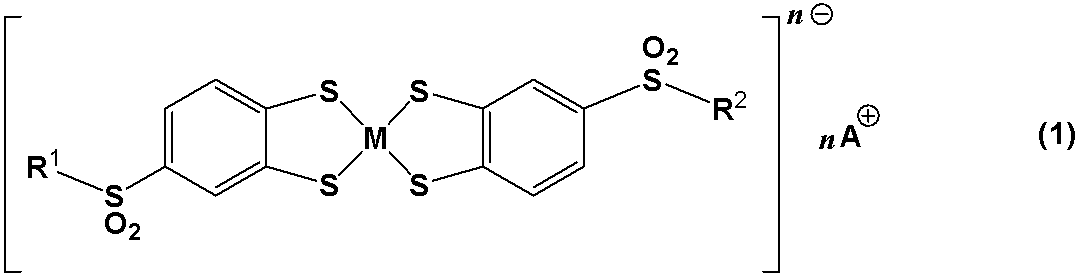
(式中、R1およびR2は、独立して、炭素数1~8のアルキル基、炭素数1~8のアルキルアミノ基、置換基を有していてもよいモルホリノ基、置換基を有していてもよいピペリジノ基、置換基を有していてもよいピロリジノ基、置換基を有していてもよいチオモルホリノ基、置換基を有していてもよいピペラジノ基または置換基を有していてもよいフェニル基を示す。Mは、金属原子を示し、A+は第4級アンモニウムカチオンまたは第4級ホスホニウムカチオンを示す。またnは任意の整数で、金属原子Mの酸化数に応じて異なる。);および/または
式(2):
式(2):
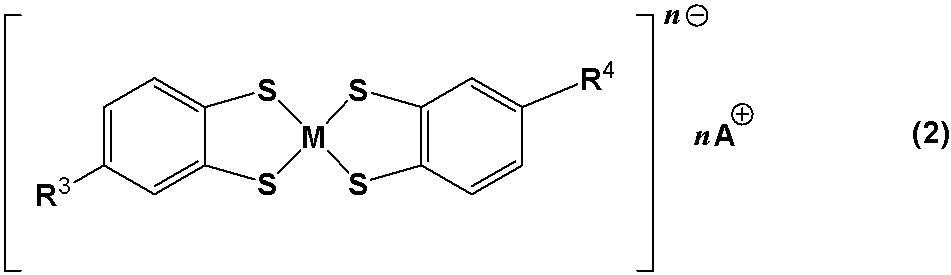
(式中、R3およびR4は、独立して、炭素数1~8のアルキル基を示す。Mは、金属原子を示し、A+は第4級アンモニウムカチオンまたは第4級ホスホニウムカチオンを示す。またnは任意の整数で、金属原子Mの酸化数に応じて異なる。)
で表される置換ベンゼンジチオール金属錯体を含有する光吸収分散液において、該置換ベンゼンジチオール金属錯体の微粒子が、水、有機溶剤および重合性モノマーよりなる群から選択される1以上の単独または混合分散媒中に分散されていることを特徴とする該光吸収分散液。
で表される置換ベンゼンジチオール金属錯体を含有する光吸収分散液において、該置換ベンゼンジチオール金属錯体の微粒子が、水、有機溶剤および重合性モノマーよりなる群から選択される1以上の単独または混合分散媒中に分散されていることを特徴とする該光吸収分散液。
2)式(1)および/または式(2)における金属原子Mが、錫原子、亜鉛原子、ニッケル原子、銅原子またはコバルト原子である前記1)に記載の光吸収分散液。
3)該置換ベンゼンジチオール金属錯体の微粒子の平均粒子径が、10nm以上200nm以下である前記1)または2)に記載の光吸収分散液。
4)前記1)~3)のいずれかに記載の光吸収分散液と、少なくとも1種類のマトリックス材料とを含む光吸収部材用組成物。
5)前記1)~3)のいずれかに記載の光吸収分散液を含み、ここに、該光吸収分散液は、分散媒として重合性モノマーを含み、および別途にマトリックス材料を含まない光吸収部材用組成物。
6)前記1)~3)のいずれかに記載の光吸収分散液を含み、ここに、該光吸収分散液は、分散媒として重合性モノマーを含み、および別途にマトリックス材料を含む光吸収部材用組成物。
7)前記4)~6)のいずれかに記載の光吸収部材用組成物を用いて作製される光吸収部材。
8)基材上に置換ベンゼンジチオール金属錯体の微粒子が分散されたマトリックス材料の膜を有する積層体としての光吸収部材である前記7)に記載の光吸収部材。
9)置換ベンゼンジチオール金属錯体の微粒子がマトリックス材料の膜中に分散した薄膜形態の光吸収部材である前記7)に記載の光吸収部材。
3)該置換ベンゼンジチオール金属錯体の微粒子の平均粒子径が、10nm以上200nm以下である前記1)または2)に記載の光吸収分散液。
4)前記1)~3)のいずれかに記載の光吸収分散液と、少なくとも1種類のマトリックス材料とを含む光吸収部材用組成物。
5)前記1)~3)のいずれかに記載の光吸収分散液を含み、ここに、該光吸収分散液は、分散媒として重合性モノマーを含み、および別途にマトリックス材料を含まない光吸収部材用組成物。
6)前記1)~3)のいずれかに記載の光吸収分散液を含み、ここに、該光吸収分散液は、分散媒として重合性モノマーを含み、および別途にマトリックス材料を含む光吸収部材用組成物。
7)前記4)~6)のいずれかに記載の光吸収部材用組成物を用いて作製される光吸収部材。
8)基材上に置換ベンゼンジチオール金属錯体の微粒子が分散されたマトリックス材料の膜を有する積層体としての光吸収部材である前記7)に記載の光吸収部材。
9)置換ベンゼンジチオール金属錯体の微粒子がマトリックス材料の膜中に分散した薄膜形態の光吸収部材である前記7)に記載の光吸収部材。
本発明は、光吸収剤として置換ベンゼンジチオール金属錯体を用いた、置換ベンゼンジチオール金属錯体の微粒子分散液を提供する。置換ベンゼンジチオール金属錯体を平均粒子径10nm以上200nm以下まで微粒化し、分散媒中に分散させた置換ベンゼンジチオール金属錯体の微粒子分散液は、長期間にわたって静置しても再凝集することなく分散状態を安定に維持することができる。
また、本発明は、前記の置換ベンゼンジチオール金属錯体の微粒子分散液を有機系バインダーまたは無機系バインダー等のマトリックス材料と混合して得られる光吸収部材用組成物を提供する。
置換ベンゼンジチオール金属錯体は、その疎水性により有機系バインダーに対する分散性が良好である一方、高極性であるためポリシロキサン系バインダー等の無機系バインダーに対する分散性も良好であることを特徴とする。すなわち、有機系、無機系を問わず、種々のマトリックス材料と混合した光吸収部材用組成液を、安定な分散状態を保ったまま、簡便に得ることができる。
また、本発明は、前記の光吸収部材用組成物を用いて、ガラス基材や樹脂基材上にコーティング膜を施して得られる光吸収部材を提供する。
置換ベンゼンジチオール金属錯体は、一般的な有機系光吸収剤に比べてはるかに良好な耐光性を示し、長期間にわたって光を照射し続けても、その光吸収能が低下しにくい。
置換ベンゼンジチオール金属錯体は、一般的な有機系光吸収剤に比べてはるかに良好な耐光性を示し、長期間にわたって光を照射し続けても、その光吸収能が低下しにくい。
置換ベンゼンジチオール金属錯体が、一般的な有機系光吸収剤に比べてはるかに高い耐光性を示す理由は詳らかではないが、おそらく以下に述べる機構によるものと考えられる。
本発明における置換ベンゼンジチオール金属錯体を含め、一般的に光吸収剤は、光を吸収し励起状態に至る。次に、生じた不安定な励起種は、主に「(i)基底状態へと緩和する」あるいは「(ii)他の分子と反応する」という2つの競争過程を伴って安定化される。これら2つの過程のうちどちらが優先するかは、材料自身の化学特性によって異なる。一般的な有機系光吸収剤の場合、(ii)の過程が優先して起こるため、光照射により経時的に劣化する。しかしながら本発明における置換ベンゼンジチオール金属錯体の場合は、(i)の緩和過程が優先的に起こり、長期間に渡って光を照射しても「励起⇔緩和」を繰り返すことで光吸収能を持続することができる。
また、置換ベンゼンジチオール金属錯体は、中心金属の種類によってそれぞれ特徴的な吸収波長を有する。すなわち、特定の吸収波長の光を遮蔽する用途において、遮蔽したい波長の光を吸収する置換ベンゼンジチオール金属錯体を適宜選択し、使用することができる。例えば、置換ベンゼンジチオール銅錯体は優れた紫外線吸収能を有しており、従来技術において十分に遮蔽できなかったUV-Aも容易に遮蔽できる。また置換ベンゼンジチオールニッケル錯体は優れた近赤外線吸収能を有している。
これら置換ベンゼンジチオール金属錯体は、単独で用いても良いし、2種類以上を組み合わせて使用してもよい。例えば、置換ベンゼンジチオール銅錯体と置換ベンゼンジチオールニッケル錯体を併用すれば、紫外線と近赤外線を遮蔽し、可視光のみを透過させる透明性の高い光吸収部材を作製することができる。
前記のように数種類の領域の光を同時に遮蔽する光吸収部材を作製する場合、従来技術では数種類の光吸収剤を併用する必要があった。しかしながら従来公知の光吸収剤の中から数種類を選択し、同一の分散系で分散・加工する場合、安定な分散状態を保つことが難しく、多大な労力を要することが多い。
一般的に安定な分散液を得るためには、分散媒や分散剤を併用する。分散安定性を高める上で最適な分散媒および分散剤は、分散質(光吸収剤)の種類、より詳しくは分散質の分子構造(酸-塩基性、疎水性、極性等)によって大きく異なることが知られている。すなわち分子構造の大きく異なる数種類の分散質を、同一の分散系において安定に分散・加工することは困難である場合が多い。
光吸収剤として、本発明における置換ベンゼンジチオール金属錯体を用いれば、中心金属の種類を変更するだけで、すなわちほとんど同じ分子構造を保ったまま吸収波長を変更することができる。それゆえ数種類の置換ベンゼンジチオール金属錯体を同一の分散系で分散・加工する場合においても、比較的容易に安定な分散液を得ることができる。
本発明によると、長期間にわたって再凝集することなく安定な分散状態を保ち、且つ優れた耐光性を持続し、例えば、式(1)および(2)におけるMが銅原子の場合には、従来遮蔽困難であったUV-Aを十分に遮蔽することができる、置換ベンゼンジチオール金属錯体の微粒子分散液、およびこれを用いた光吸収部材用組成物、およびこれを用いた光吸収部材を提供することができる。
以下、本発明を詳細に説明する。
本発明は、式(1):
本発明は、式(1):
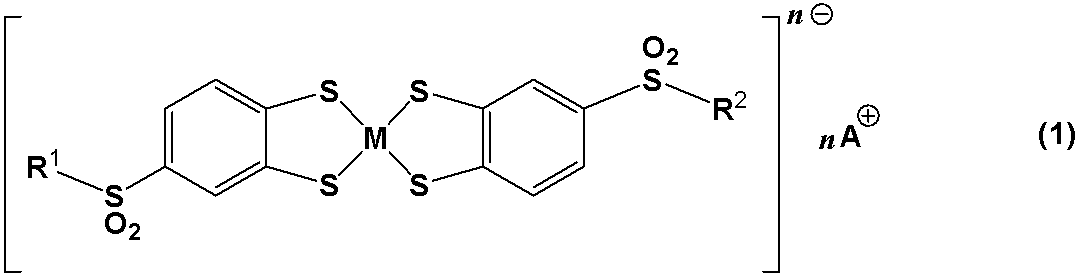
(式中、R1およびR2は、独立して、炭素数1~8のアルキル基、炭素数1~8のアルキルアミノ基、置換基を有していてもよいモルホリノ基、置換基を有していてもよいピペリジノ基、置換基を有していてもよいピロリジノ基、置換基を有していてもよいチオモルホリノ基、置換基を有していてもよいピペラジノ基または置換基を有していてもよいフェニル基を示す。Mは、金属原子を示し、A+は第4級アンモニウムカチオンまたは第4級ホスホニウムカチオンを示す。またnは任意の整数で、金属原子Mの酸化数に応じて異なる。)
および/または式(2):
および/または式(2):
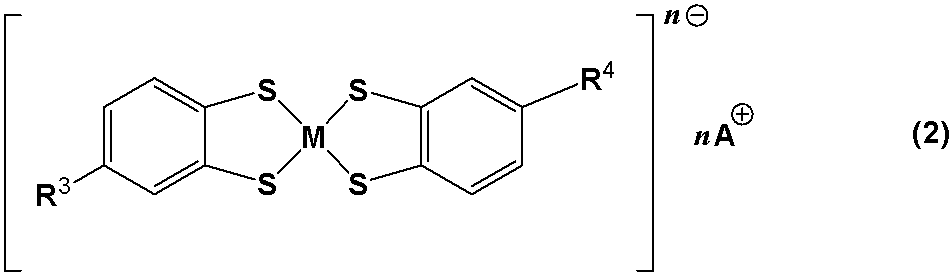
(式中、R3およびR4は、独立して、炭素数1~8のアルキル基を示す。Mは、金属原子を示し、A+は第4級アンモニウムカチオンまたは第4級ホスホニウムカチオンを示す。またnは任意の整数で、金属原子Mの酸化数に応じて異なる。)
で表される置換ベンゼンジチオール金属錯体の微粒子を含有する光吸収分散液、およびこれを用いた光吸収部材用組成物、およびこれを用いた光吸収部材を提供するものである。
で表される置換ベンゼンジチオール金属錯体の微粒子を含有する光吸収分散液、およびこれを用いた光吸収部材用組成物、およびこれを用いた光吸収部材を提供するものである。
また、式(1)におけるR1およびR2、ならびに式(2)におけるR3およびR4について、以下に例示する。
炭素数1~8のアルキル基としては、例えば、メチル基、エチル基、イソプロピル基、n-プロピル基、n-ブチル基、sec-ブチル基、tert-ブチル基、n-ペンチル基、イソペンチル基、ネオペンチル基、n-ヘキシル基およびイソヘキシル基、n-ヘプチル基、n-オクチル基等が挙げられる。
炭素数1~8のアルキルアミノ基としては、例えば、N-メチルアミノ基、N-エチルアミノ基、N-イソプロピルアミノ基、N-n-プロピルアミノ基、N-n-ブチルアミノ基、N,N-ジメチルアミノ基、N,N-メチルエチルアミノ基、N,N-ジエチルアミノ基、N,N-エチルイソプロピルアミノ基、N,N-ジイソプロピルアミノ基、N,N-ジ-n-プロピルアミノ基およびN,N-ジ-n-ブチルアミノ基、N,N-ジイソブチル基等が挙げられる。
置換基を有していてもよいモルホリノ基としては、例えば、モルホリノ基、2-メチルモルホリノ基、3-メチルモルホリノ基、2-エチルモルホリノ基、3-n-プロピルモルホリノ基、3-n-ブチルモルホリノ基、2,3-ジメチルモルホリノ基、2,6-ジメチルモルホリノ基、および3-フェニルモルホリノ基等が挙げられる。
置換基を有していてもよいピペリジノ基としては、例えば、ピペリジノ基、2-メチルピペリジノ基、3-メチルピペリジノ基、4-メチルピペリジノ基、2-エチルピペリジノ基、4-n-プロピルピペリジノ基、3-n-ブチルピペリジノ基、2,4-ジメチルピペリジノ基、2,6-ジメチルピペリジノ基および4-フェニルピペリジノ基等が挙げられる。
置換基を有していてもよいピロリジノ基としては、例えば、ピロリジノ基、2-メチルピロリジノ基、3-メチルピロリジノ基、2-エチルピロリジノ基、3-n-プロピルピロリジノ基、3-n-ブチルピロリジノ基、2,4-ジメチルピロリジノ基、2,5-ジメチルピロリジノ基および4-フェニルピロリジノ基等が挙げられる。
置換基を有していてもよいチオモルホリノ基としては、例えば、チオモルホルノ基、2-メチルチオモルホリノ基、3-メチルチオモルホリノ基、2-エチルチオモルホリノ基、3-n-プロピルチオモルホリノ基、3-n-ブチルチオモルホリノ基、2,3-ジメチルチオモルホリノ基、2,6-ジメチルチオモルホリノ基および3-フェニルチオモルホリノ基等が挙げられる。
置換基を有していてもよいピペラジノ基としては、例えば、ピペラジノ基、2-メチルピペラジノ基、3-メチルピペラジノ基、4-メチルピペラジノ基、2-エチルピペラジノ基、4-n-プロピルピペラジノ基、3-n-ブチルピペラジノ基、2,4-ジメチルピペラジノ基、2,6-ジメチルピペラジノ基、4-フェニルピペラジノ基および2-ピリミジルピペラジノ基等が挙げられる。
置換基を有していてもよいフェニル基としては、例えば、フェニル基、2-メチルフェニル基、3-メチルフェニル基、4-メチルフェニル基、2,6-ジメチルフェニル基、4-エチルフェニル基、2-n-プロピルフェニル基、4-n-ブチルフェニル基、2-クロロフェニル基、4-クロロフェニル基、2,4-ジクロロフェニル基、2-ブロモフェニル基、4-ブロモフェニル基、2-クロロ-4-ブロモフェニル基、4-アミノフェニル基、2,4-ジアミノフェニル基、2,4-ジニトロフェニル基、2-アセチルフェニル基、4-アセチルフェニル基、2-ヒドロキシフェニル基、4-ヒドロキシフェニル基、2-メトキシフェニル基、4-メトキシフェニル基、2-(メチルチオ)フェニル基および4-(メチルチオ)フェニル基等が挙げられる。
また、本発明の式(1)および(2)で表される置換ベンゼンジチオール金属錯体において、Mは、金属原子を示し、A+は、第4級アンモニウムカチオンまたは第4級ホスホニウムカチオンを示す。式(1)および(2)におけるMおよびA+は、式(1)と式(2)との間で同一であっても異なっていても良い。
前記A+で示される第4級アンモニウムカチオンとしては、例えば、テトラメチルアンモニウムカチオン、テトラエチルアンモニウムカチオン、テトラ-n-ブチルアンモニウムカチオン、トリメチルベンジルアンモニウムカチオンおよびトリブチルベンジルアンモニウムカチオン等が、
前記A+で示される第4級ホスホニウムカチオンとしては、例えば、テトラメチルホスホニウムカチオン、テトラエチルホスホニウムカチオン、テトラ-n-ブチルホスホニウムカチオン、テトラフェニルホスホニウムカチオン、トリメチルベンジルホスホニウムカチオンおよびトリブチルベンジルホスホニウムカチオン等が挙げられる。
前記A+で示される第4級ホスホニウムカチオンとしては、例えば、テトラメチルホスホニウムカチオン、テトラエチルホスホニウムカチオン、テトラ-n-ブチルホスホニウムカチオン、テトラフェニルホスホニウムカチオン、トリメチルベンジルホスホニウムカチオンおよびトリブチルベンジルホスホニウムカチオン等が挙げられる。
前記Mで表される金属原子は、具体的には、典型金属として錫原子、亜鉛原子等が挙げられ、遷移金属としては、ニッケル原子、銅原子およびコバルト原子等が挙げられる。
式(1)で表される置換ベンゼンジチオール金属錯体は、例えば、1,2-ジハロゲノベンゼンを出発原料とし、これから合成される中間体を経て合成することができる。以下、製造方法を工程毎に説明する。
(工程1)
1,2-ジハロゲノベンゼンとクロロスルホン酸とを、反応溶媒中、無水硫酸ナトリウムの存在下、反応させ、3,4-ジハロゲノベンゼンスルホン酸を合成する。
前記クロロスルホン酸の使用割合は、1,2-ジハロゲノベンゼン1モルに対して1.5~3.0モルであるのが好ましく、1.7~2.1モルであるのがより好ましい。
前記無水硫酸ナトリウムの使用割合は1,2-ジハロゲノベンゼン1モルに対して0.05~0.15モルであるのが好ましく、0.07~0.1モルであるのがより好ましい。
1,2-ジハロゲノベンゼンとクロロスルホン酸とを、反応溶媒中、無水硫酸ナトリウムの存在下、反応させ、3,4-ジハロゲノベンゼンスルホン酸を合成する。
前記クロロスルホン酸の使用割合は、1,2-ジハロゲノベンゼン1モルに対して1.5~3.0モルであるのが好ましく、1.7~2.1モルであるのがより好ましい。
前記無水硫酸ナトリウムの使用割合は1,2-ジハロゲノベンゼン1モルに対して0.05~0.15モルであるのが好ましく、0.07~0.1モルであるのがより好ましい。
前記反応溶媒としては、クロロホルム、四塩化炭素、1,2-エチレンジクロライド等のハロゲン化炭化水素溶媒が好ましい。
反応温度は、50~100℃であるのが好ましく、70~85℃であるのがより好ましい。反応時間は、反応温度により異なるが、通常、1~4時間である。
反応温度は、50~100℃であるのが好ましく、70~85℃であるのがより好ましい。反応時間は、反応温度により異なるが、通常、1~4時間である。
(工程2)
工程1で得られた3,4-ジハロゲノベンゼンスルホン酸と塩化チオニルとを反応させて、3,4-ジハロゲノベンゼンスルホニルクロライドを合成する。
前記塩化チオニルの使用割合は、3,4-ジハロゲノベンゼンスルホン酸1モルに対して、1.0~2.0モルであるのが好ましく、1.1~1.5モルであるのがより好ましい。
工程1で得られた3,4-ジハロゲノベンゼンスルホン酸と塩化チオニルとを反応させて、3,4-ジハロゲノベンゼンスルホニルクロライドを合成する。
前記塩化チオニルの使用割合は、3,4-ジハロゲノベンゼンスルホン酸1モルに対して、1.0~2.0モルであるのが好ましく、1.1~1.5モルであるのがより好ましい。
反応溶媒としては、工程1の場合と同様、クロロホルム、四塩化炭素、1,2-エチレンジクロライド等のハロゲン化炭化水素溶媒が好ましく用いられる。工程1と同様の反応溶媒を用いた場合、反応を連続して行うことができるため、作業効率や収率等の点で有利である。
反応温度は、45~70℃であるのが好ましく、50~60℃であるのがより好ましい。反応時間は、反応温度により異なるが、通常、1~4時間である。
反応温度は、45~70℃であるのが好ましく、50~60℃であるのがより好ましい。反応時間は、反応温度により異なるが、通常、1~4時間である。
(工程3)
工程2で得られた3,4-ジハロゲノベンゼンスルホニルクロライドに対して、炭素数1~8のアルキル化合物、炭素数1~8のアルキルアミン、置換基を有していてもよいモルホリン、置換基を有していてもよいピペリジン、置換基を有していてもよいピロリジン、置換基を有していてもよいチオモルホリン、置換基を有していてもよいピペラジンまたは、置換基を有していてもよいベンゼンを反応させ、4-置換スルホニル-1,2-ジハロゲノベンゼンを合成する。なお、必要に応じて、塩化アルミニウム等の反応触媒を用いてもよい。
工程2で得られた3,4-ジハロゲノベンゼンスルホニルクロライドに対して、炭素数1~8のアルキル化合物、炭素数1~8のアルキルアミン、置換基を有していてもよいモルホリン、置換基を有していてもよいピペリジン、置換基を有していてもよいピロリジン、置換基を有していてもよいチオモルホリン、置換基を有していてもよいピペラジンまたは、置換基を有していてもよいベンゼンを反応させ、4-置換スルホニル-1,2-ジハロゲノベンゼンを合成する。なお、必要に応じて、塩化アルミニウム等の反応触媒を用いてもよい。
例えば、4-(N,N-ジエチルアミノスルホニル)-1,2-ベンゼンジチオール金属錯体を製造する場合には、炭素数1~8のアルキルアミンとして、N,N-ジエチルアミンを用いることにより、4-(N,N-ジエチルアミノスルホニル)-1,2-ジハロゲノベンゼンを合成する。
また、4-モルホリノスルホニル-1,2-ベンゼンジチオール金属錯体を製造する場合には、置換基を有していてもよいモルホリンとして、モルホリンを用いることにより、4-モルホリノスルホニル-1,2-ジハロゲノベンゼンを合成する。
また、4-ピペリジノスルホニル-1,2-ベンゼンジチオール金属錯体を製造する場合には、置換基を有していてもよいピペリジンとして、ピペリジンを用いることにより、4-ピペリジノスルホニル-1,2-ジハロゲノベンゼンを合成する。
また、4-ピロリジノスルホニル-1,2-ベンゼンジチオール金属錯体を製造する場合には、置換基を有していてもよいピロリジンとして、ピロリジンを用いることにより、4-ピロリジノスルホニル-1,2-ジハロゲノベンゼンを合成する。
また、4-チオモルホリノスルホニル-1,2-ベンゼンジチオール金属錯体を製造する場合には、置換基を有していてもよいチオモルホリンとして、チオモルホリンを用いることにより、4-チオモルホリノスルホニル-1,2-ジハロゲノベンゼンを合成する。
また、4-ピペラジノスルホニル-1,2-ベンゼンジチオール金属錯体を製造する場合には、置換基を有していてもよいピペラジンとして、ピペラジンを用いることにより、4-ピペラジノスルホニル-1,2-ジハロゲノベンゼンを合成する。
また、4-フェニルスルホニル-1,2-ベンゼンジチオール金属錯体を製造する場合には、置換基を有していてもよいベンゼンとして、ベンゼンを用い、さらに反応触媒として塩化アルミニウムを添加することにより、4-フェニルスルホニル-1,2-ジハロゲノベンゼンを合成する。
工程3において、工程2で得られた3,4-ジハロゲノベンゼンスルホニルクロライドを全量用いる場合、前記N,N-ジエチルアミン、モルホリン、ピペリジン、ピロリジン、チオモルホリン、ピペラジン、ベンゼンの使用割合は、工程2で用いた3,4-ジハロゲノベンゼンスルホン酸1モルに対して、1.0~4.0モルであることが好ましく、1.1~3.0モルであることがより好ましい。
なお、塩化アルミニウム等の反応触媒を用いる場合、その使用割合としては、3,4-ジハロゲノベンゼンスルホニルクロライド1モルに対して、0.5~2.5モルであるのが好ましく、1.0~1.5モルであるのがより好ましい。
反応溶媒としては、工程2の場合と同様、クロロホルム、四塩化炭素および1,2-エチレンジクロライド等のハロゲン化炭化水素溶媒、並びにモノクロロベンゼンおよびトルエン等の芳香族炭化水素溶媒が好ましく用いられる。工程2と同様の反応溶媒を用いた場合、反応を連続して行うことができるため、作業効率性や収率等の点で有利である。
反応温度は、15~40℃であるのが好ましく、20~30℃であるのがより好ましい。反応時間は、反応温度により異なるが、通常、1~3時間である。
なお、工程3で得られる4-置換スルホニル-1,2-ジハロゲノベンゼンは、下記式(3)で表される。
なお、工程3で得られる4-置換スルホニル-1,2-ジハロゲノベンゼンは、下記式(3)で表される。
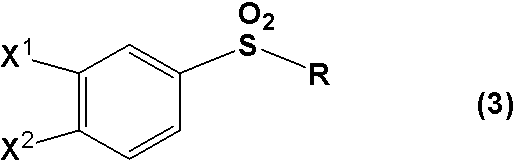
前記式(3)において、X1およびX2は、同一であっても異なっていても良く、塩素原子および臭素原子等のハロゲン原子を示し、Rは、前記式(1)中のR1またはR2に相当する基であって、炭素数1~8のアルキル基、炭素数1~8のアルキルアミノ基、置換基を有していてもよいモルホリノ基、置換基を有していてもよいピペリジノ基、置換基を有していてもよいピロリジノ基、置換基を有していてもよいチオモルホリノ基、置換基を有していてもよいピペラジノ基または、置換基を有していてもよいフェニル基を示す。
(工程4)
工程3で得られた4-置換スルホニル-1,2-ジハロゲノベンゼンのハロゲノ基をチオール基に置換し、式(4);
工程3で得られた4-置換スルホニル-1,2-ジハロゲノベンゼンのハロゲノ基をチオール基に置換し、式(4);

で示される4-置換スルホニル-1,2-ベンゼンジチオールを合成する。なお、式(4)中のRは、前記式(3)中のRと同じ基である。
4-置換スルホニル-1,2-ジハロゲノベンゼンのハロゲノ基をチオール基に置換する方法は、例えば、特開平6-25151号公報および特開平5-117225号公報に記載された方法に従って実施することができる。
具体的には、工程3で得られた4-置換スルホニル-1,2-ジハロゲノベンゼンに、鉄粉と硫黄末とを触媒として、水硫化ナトリウムと反応させることにより、ハロゲノ基がチオール基に置換され、鉄錯体が形成される。当該鉄錯体を、酸化亜鉛を用いて分解することで、目的とする4-置換スルホニル-1,2-ベンゼンジチオールが得られる。
前記水硫化ナトリウムの使用割合は、4-置換スルホニル-1,2-ジハロゲノベンゼン1モルに対して、1.5~4.0モルであるのが好ましく、1.8~2.5モルであるのがより好ましい。
前記鉄粉の使用割合は、4-置換スルホニル-1,2-ジハロゲノベンゼン1モルに対して、0.4~2.0モルであるのが好ましく、0.5~1.0モルであるのがより好ましい。
前記硫黄末の使用量は、4-置換スルホニル-1,2-ジハロゲノベンゼン100重量部に対して、1.0~20.0重量部であることが好ましく、1.0~5.0重量部であることがより好ましい。
反応温度は、60~140℃であるのが好ましく、70~110℃であるのがより好ましい。
前記鉄錯体を分解するために用いられる酸化亜鉛の使用量は、4-置換スルホニル-1,2-ジハロゲノベンゼン100重量部に対して、20~80重量部であることが好ましく、30~50重量部であることがより好ましい。
分解温度としては、60~140℃であるのが好ましく、70~110℃であるのがより好ましい。
(工程5)
工程4で得られた4-置換スルホニル-1,2-ベンゼンジチオールを低級アルコール中において、金属塩と、第4級アンモニウム塩または第4級ホスホニウム塩との存在下に反応させる方法、または、工程4で得られた4-置換スルホニル-1,2-ベンゼンジチオール鉄錯体のN,N-ジメチルホルムアミド(DMF)溶液に、低級アルコールを加え、金属塩と、第4級アンモニウム塩または第4級ホスホニウム塩との存在下に反応させる方法等により、式(1)で表される置換ベンゼンジチオール金属錯体を得ることができる。
工程4で得られた4-置換スルホニル-1,2-ベンゼンジチオールを低級アルコール中において、金属塩と、第4級アンモニウム塩または第4級ホスホニウム塩との存在下に反応させる方法、または、工程4で得られた4-置換スルホニル-1,2-ベンゼンジチオール鉄錯体のN,N-ジメチルホルムアミド(DMF)溶液に、低級アルコールを加え、金属塩と、第4級アンモニウム塩または第4級ホスホニウム塩との存在下に反応させる方法等により、式(1)で表される置換ベンゼンジチオール金属錯体を得ることができる。
前記低級アルコールとしては、例えば、メタノール、エタノール、イソプロパノール(IPA)、およびtert-ブタノール等を挙げることができる。中でも、経済性の観点からメタノールを用いるのが好ましい。
前記金属塩としては、例えば、塩化錫(II)、塩化亜鉛(II)、塩化銅(II)、塩化コバルト、塩化ニッケル(II)、臭化錫(II)、臭化亜鉛(II)、臭化銅(II)、臭化コバルト、ヨウ化錫(II)、ヨウ化亜鉛(II)、ヨウ化コバルトおよびヨウ化ニッケル等の金属ハロゲン化物、硝酸銅および硝酸コバルト等の金属硝酸塩、硫酸銅および硫酸コバルト等の金属硫酸塩、並びに酢酸銅および酢酸コバルト等の金属酢酸塩等を挙げることができる。
中でも、経済性や反応性の観点から、ハロゲン化物であることが好ましく、塩化物であることがより好ましい。
中でも、経済性や反応性の観点から、ハロゲン化物であることが好ましく、塩化物であることがより好ましい。
前記金属塩の使用割合は、4-置換スルホニル-1,2-ベンゼンジチオール1モルに対して、0.3~10モルであるのが好ましい。金属塩の使用割合が0.3モル未満の場合、収率が低くなり、10モルを超える場合、使用量に見合う効果がなく経済的でない。
前記第4級アンモニウム塩としては、例えば、テトラメチルアンモニウムブロマイドおよびテトラメチルアンモニウムクロライド等のテトラメチルアンモニウム塩、テトラエチルアンモニウムブロマイドおよびテトラエチルアンモニウムクロライド等のテトラエチルアンモニウム塩、テトラ-n-ブチルアンモニウムブロマイドおよびテトラ-n-ブチルアンモニウムクロライド等のテトラ-n-ブチルアンモニウム塩、トリメチルベンジルアンモニウムブロマイドおよびトリメチルベンジルアンモニウムクロライド等のトリメチルベンジルアンモニウム塩、並びにトリブチルベンジルアンモニウムブロマイドおよびトリブチルベンジルアンモニウムクロライド等のトリブチルベンジルアンモニウム塩等を挙げることができる。
前記第4級ホスホニウム塩としては、例えば、テトラメチルホスホニウムブロマイドおよびテトラメチルホスホニウムクロライド等のテトラメチルホスホニウム塩、テトラエチルホスホニウムブロマイドおよびテトラエチルホスホニウムクロライド等のテトラエチルホスホニウム塩、テトラ-n-ブチルホスホニウムブロマイドおよびテトラ-n-ブチルホスホニウムクロライド等のテトラ-n-ブチルホスホニウム塩、テトラフェニルホスホニウムブロマイドおよびテトラフェニルホスホニウムクロライド等のテトラフェニルホスホニウム塩、トリメチルベンジルホスホニウムブロマイドおよびトリメチルベンジルホスホニウムクロライド等のトリメチルベンジルホスホニウム塩、並びにトリブチルベンジルホスホニウムブロマイドおよびトリブチルベンジルホスホニウムクロライド等のトリブチルベンジルホスホニウム塩等を挙げることができる。
これらの中でも、経済性や反応性等の観点から、テトラ-n-ブチルアンモニウムブロマイド、テトラ-n-ブチルアンモニウムクロライド、テトラエチルアンモニウムブロマイドまたはテトラエチルアンモニウムクロライドのような第4級アンモニウム塩であることが好ましい。
前記第4級アンモニウム塩または第4級ホスホニウム塩の使用割合は、式(1)において中心金属Mが錫原子、銅原子、コバルト原子、ニッケル原子等の場合にはn=1となるため、4-置換スルホニル-1,2-ベンゼンジチオール1モルに対して、0.3~1.0モルであるのが好ましく、0.4~0.9モルであるのがより好ましい。使用割合が0.3モル未満の場合、収率が低くなり、1.0モルを超える場合、使用量に見合う効果がなく経済的でない。
また、式(1)において中心金属Mが亜鉛原子の場合にはn=2となるため、4-置換スルホニル-1,2-ベンゼンジチオール1モルに対して、0.6~2.0モルであるのが好ましく、0.8~1.8モルであるのがより好ましい。使用割合が0.6モル未満の場合、収率が低くなり、2.0モルを超える場合、使用量に見合う効果がなく経済的でない。
なお、この工程での反応は、収率を高める観点から、金属アルコキシドの存在下で実施するのが好ましい。前記金属アルコキシドとしては、例えば、ナトリウムメトキシド、ナトリウムエトキシドおよびカリウム-tert-ブトキシド等が挙げられる。中でも、経済性の観点から、ナトリウムメトキシドを用いるのが好ましい。
金属アルコキシドの使用割合は、4-置換スルホニル-1,2-ベンゼンジチオール1モルに対して、1.5~10モルであるのが好ましく、2.0~3.0モルであるのがより好ましい。
金属アルコキシドの使用割合は、4-置換スルホニル-1,2-ベンゼンジチオール1モルに対して、1.5~10モルであるのが好ましく、2.0~3.0モルであるのがより好ましい。
1.5モル未満の場合、収率が向上せず、10モルを超える場合、使用量に見合う効果がなく経済でない。
反応温度は、15~40℃であるのが好ましく、25~35℃であるのがより好ましい。なお、反応時間は、反応温度により異なるが、通常、1~10時間である。
かくして得られる置換ベンゼンジチオール金属錯体は、晶析、抽出、カラムクロマトグラフィー等の、通常の分離精製操作によって単離することができる。
反応温度は、15~40℃であるのが好ましく、25~35℃であるのがより好ましい。なお、反応時間は、反応温度により異なるが、通常、1~10時間である。
かくして得られる置換ベンゼンジチオール金属錯体は、晶析、抽出、カラムクロマトグラフィー等の、通常の分離精製操作によって単離することができる。
また、式(2)で表される置換ベンゼンジチオール金属錯体は、例えば、特公平06-15550号に基づいて、4-tert-ブチルベンゼンチオールあるいはジ(4-tert-ブチルフェニル)ジスルフィドを出発原料とし、合成することができる。以下、製造方法を工程毎に説明する。
4-tert-ブチルベンゼンチオールあるいはジ(4-tert-ブチルフェニル)ジスルフィドと、一塩化硫黄をヨウ素またはルイス酸触媒の存在下、溶媒中で反応させた後、亜鉛,錫,鉄から選ばれた少なくとも1種の金属粒または金属末で還元させることにより4-tert-ブチル-1,2-ベンゼンジチオールを製造できる。
前記一塩化硫黄の使用量は、4-tert-ブチルベンゼンチオール1モルに対して0.5~2.0モル、好ましくは0.55~1.5モルである。
一方、原料としてジ(4-tert-ブチルフェニル)ジスルフィドを使用する場合は、ジ(4-tert-ブチルフェニル)ジスルフィド1モルに対して1.0~4.0モル、好ましくは1.1~3.0モルの一塩化硫黄を使用する。
一方、原料としてジ(4-tert-ブチルフェニル)ジスルフィドを使用する場合は、ジ(4-tert-ブチルフェニル)ジスルフィド1モルに対して1.0~4.0モル、好ましくは1.1~3.0モルの一塩化硫黄を使用する。
前記ルイス酸触媒としては、例えば、塩化亜鉛、塩化第二鉄、塩化アルミニウム、塩化第二錫、三弗化ホウ素、三塩化アンチモン、五塩化アンチモン等が挙げられ、中でも塩化亜鉛を用いるのが好ましい。これらルイス酸触媒の使用量は、4-tert-ブチルベンゼンチオール1モルに対して0.05~2.0モルであるのが好ましく、0.1~1.0モルであるのがより好ましい。また、ジ(4-tert-ブチルフェニル)ジスルフィド1モルに対しては、0.1~4.0モルであるのが好ましく、0.2~2.0モルであるのがより好ましい。
また、ヨウ素を使用した場合、4-tert-ブチルベンゼンチオール1モル、またはジ(4-tert-ブチルフェニル)ジスルフィド1モルに対して、0.1~4.0モルであるのが好ましく、0.2~2.0モルであるのがより好ましい。
前記反応溶媒としては、クロロホルム、四塩化炭素、1,2-エチレンクロライド等のハロゲン化炭化水素溶媒が好ましい。
反応温度は、20~140℃であるのが好ましく、特にヨウ素を使用した場合、20~40℃、ルイス酸触媒を使用した場合には60~100℃であるのがより好ましい。
反応時間は触媒の添加量、反応温度により異なるが、通常、12~72時間で行う。
反応時間は触媒の添加量、反応温度により異なるが、通常、12~72時間で行う。
反応生成物を還元することにより、4-tert-ブチル-1,2-ベンゼンジチオールが得られるが、還元反応の際に使用する金属粒または金属末の使用量は4-tert-ブチルベンゼンチオール1モルに対して1.0~10モル、好ましくは3.0~7.0モル、ジ(4-tert-ブチルフェニル)ジスルフィド1モルに対して2.0~13モル、好ましくは4.0~11モルである。還元に際して反応液を酸性に保つため酸を添加するが、用いる酸としては、酢酸、塩酸、硫酸から選ばれた1種を使用すればよい。還元の際に用いる金属粒または金属末としては、亜鉛、錫、鉄等がある。還元反応温度は、金属粒または金属末の添加および酸の添加時には室温以下に保持し、その後は40~80℃に保持して行えばよい。また反応時間は通常0.5~3時間である。
かくして得られた4-tert-ブチル-1,2-ベンゼンジチオールに金属アルコキシド、および金属塩、および第4級アンモニウム塩または第4級ホスホニウム塩を低級アルコール中で反応させることにより、目的物である4-tert-ブチル-1,2-ベンゼンジチオール金属錯体を得ることができ、晶析、抽出、カラムクロマトグラフィー等の、通常の分離精製操作によって単離することができる。
前記金属アルコキシドとしては、例えば、ナトリウムメトキシド、ナトリウムエトキシドおよびカリウム-tert-ブトキシド等が挙げられる。中でも、経済性の観点から、ナトリウムメトキシドを用いるのが好ましい。
金属アルコキシドの使用割合は、4-置換スルホニル-1,2-ベンゼンジチオール1モルに対して、1.5~10モルであるのが好ましく、2.0~3.0モルであるのがより好ましい。1.5モル未満の場合、収率が向上せず、10モルを超える場合、使用量に見合う効果がなく経済的でない。
金属アルコキシドの使用割合は、4-置換スルホニル-1,2-ベンゼンジチオール1モルに対して、1.5~10モルであるのが好ましく、2.0~3.0モルであるのがより好ましい。1.5モル未満の場合、収率が向上せず、10モルを超える場合、使用量に見合う効果がなく経済的でない。
また、前記金属塩としては、例えば、塩化錫(II)、塩化亜鉛(II)、塩化銅(II)、塩化コバルト、塩化ニッケル(II)、臭化錫(II)、臭化亜鉛(II)、臭化銅(II)、臭化コバルト、ヨウ化錫(II)、ヨウ化亜鉛(II)、ヨウ化コバルトおよびヨウ化ニッケル等の金属ハロゲン化物、硝酸銅および硝酸コバルト等の金属硝酸塩、硫酸銅および硫酸コバルト等の金属硫酸塩、並びに酢酸銅および酢酸コバルト等の金属酢酸塩等を挙げることができる。
中でも、経済性や反応性の観点から、ハロゲン化物であることが好ましく、塩化物であることがより好ましい。
前記金属塩の使用割合は、4-置換スルホニル-1,2-ベンゼンジチオール1モルに対して、0.3~10モルであるのが好ましい。金属塩の使用割合が0.3モル未満の場合、収率が低くなり、10モルを超える場合、使用量に見合う効果がなく経済的でない。
前記第4級アンモニウム塩としては、例えば、テトラメチルアンモニウムブロマイドおよびテトラメチルアンモニウムクロライド等のテトラメチルアンモニウム塩、テトラエチルアンモニウムブロマイドおよびテトラエチルアンモニウムクロライド等のテトラエチルアンモニウム塩、テトラ-n-ブチルアンモニウムブロマイドおよびテトラ-n-ブチルアンモニウムクロライド等のテトラ-n-ブチルアンモニウム塩、トリメチルベンジルアンモニウムブロマイドおよびトリメチルベンジルアンモニウムクロライド等のトリメチルベンジルアンモニウム塩、並びにトリブチルベンジルアンモニウムブロマイドおよびトリブチルベンジルアンモニウムクロライド等のトリブチルベンジルアンモニウム塩等を挙げることができる。
前記第4級ホスホニウム塩としては、例えば、テトラメチルホスホニウムブロマイドおよびテトラメチルホスホニウムクロライド等のテトラメチルホスホニウム塩、テトラエチルホスホニウムブロマイドおよびテトラエチルホスホニウムクロライド等のテトラエチルホスホニウム塩、テトラ-n-ブチルホスホニウムブロマイドおよびテトラ-n-ブチルホスホニウムクロライド等のテトラ-n-ブチルホスホニウム塩、テトラフェニルホスホニウムブロマイドおよびテトラフェニルホスホニウムクロライド等のテトラフェニルホスホニウム塩、トリメチルベンジルホスホニウムブロマイドおよびトリメチルベンジルホスホニウムクロライド等のトリメチルベンジルホスホニウム塩、並びにトリブチルベンジルホスホニウムブロマイドおよびトリブチルベンジルホスホニウムクロライド等のトリブチルベンジルホスホニウム塩等を挙げることができる。
これらの中でも、経済性や反応性等の観点から、テトラ-n-ブチルアンモニウムブロマイド、テトラ-n-ブチルアンモニウムクロライド、テトラエチルアンモニウムブロマイドまたはテトラエチルアンモニウムクロライドのような第4級アンモニウム塩であることが好ましい。
前記第4級アンモニウム塩または第4級ホスホニウム塩の使用割合は、式(2)において中心金属Mが錫原子、銅原子、コバルト原子、ニッケル原子等の場合にはn=1となるため、4-置換スルホニル-1,2-ベンゼンジチオール1モルに対して、0.3~1.0モルであるのが好ましく、0.4~0.9モルであるのがより好ましい。使用割合が0.3モル未満の場合、収率が低くなり、1.0モルを超える場合、使用量に見合う効果がなく経済的でない。
また、式(2)において中心金属Mが亜鉛原子の場合にはn=2となるため、4-置換スルホニル-1,2-ベンゼンジチオール1モルに対して、0.6~2.0モルであるのが好ましく、0.8~1.8モルであるのがより好ましい。使用割合が0.6モル未満の場合、収率が低くなり、2.0モルを超える場合、使用量に見合う効果がなく経済的でない。
本反応で用いる溶媒としては、メタノール、エタノール、IPA、tert-ブタノールなどの低級アルコール類が好適である。反応は室温付近で15分~5時間攪拌することにより行うのが好ましい。
《置換ベンゼンジチオール金属錯体の微粒子が分散された光吸収分散液》
かくして得られた置換ベンゼンジチオール金属錯体と、分散媒および分散剤を混合し、従来公知の分散機を用いて粉砕、分散することで、平均粒子径が10nm以上200nm以下の置換ベンゼンジチオール金属錯体の微粒子を含有する光吸収分散液を得ることができる。
かくして得られた置換ベンゼンジチオール金属錯体と、分散媒および分散剤を混合し、従来公知の分散機を用いて粉砕、分散することで、平均粒子径が10nm以上200nm以下の置換ベンゼンジチオール金属錯体の微粒子を含有する光吸収分散液を得ることができる。
前記置換ベンゼンジチオール金属錯体の微粒子の平均粒子径は10nm以上200nm以下、より好ましくは10nm以上150nm以下、さらに好ましくは10nm以上100nm以下である。平均粒子径が200nmよりも大きいと、可視光透過率が著しく低下し、また最終的に得られるコーティング膜の機械的強度が低下するおそれがある。さらに粒子径が200nmよりも大きい場合、粒子表面の面積が小さくなるため、添加量に見合う光吸収能が得られず、所望する光吸収能を得るためには置換ベンゼンジチオール金属錯体を大量に添加する必要があり、経済性の面で不利である。また、平均粒子径が10nm以下の場合には、分子サイズに近いレベルまで微粒化され、溶解状態すなわち分子状態に近い状態で存在することとなり、耐光性が低下するおそれがある。
置換ベンゼンジチオール金属錯体が分子状態で存在する場合、光照射により分子が直接破壊されるため劣化が大きい。一方、微粒子として存在する場合には、微粒子表面の分子が破壊されても内側から新たに分子が現れること、さらに微粒子の場合には結晶格子間の安定エネルギー分だけ光エネルギーに対して耐性を得ること等の理由により、耐光性が良好となる。
ここで、平均粒子径とは、一般的な粒度分布計、例えば動的光散乱式の粒度分布計(例えばシスメックス社製「ゼータサイザーナノZS」)で測定されるZ-Average sizeの値を示す。
以下、置換ベンゼンジチオール金属錯体の微粒子を含有する光吸収分散液の製造方法についてより詳細に説明する。
(分散機)
前記置換ベンゼンジチオール金属錯体を微粒化するにあたって、使用できる分散機としては、特に限定されるものではないが、例えば、ペイントシェーカー、ボールミル、ナノミル、アトライター、バスケットミル、サンドミル、サンドグラインダー、ダイノーミル、ディスパーマット、SCミル、スパイクミル、アジテーターミル等のメディア型分散機や、超音波ホモジナイザー、高圧ホモジナイザー、ナノマイザー、デゾルバー、ディスパー、高速インペラー分散機等のメディアレス型分散機が挙げられる。
中でも、コスト、処理能力の面から、メディア型分散機を使用するのが好ましい。また、これらのうちの1つを単独で用いても良く、2種類以上の装置を組み合わせて使用しても良い。
前記置換ベンゼンジチオール金属錯体を微粒化するにあたって、使用できる分散機としては、特に限定されるものではないが、例えば、ペイントシェーカー、ボールミル、ナノミル、アトライター、バスケットミル、サンドミル、サンドグラインダー、ダイノーミル、ディスパーマット、SCミル、スパイクミル、アジテーターミル等のメディア型分散機や、超音波ホモジナイザー、高圧ホモジナイザー、ナノマイザー、デゾルバー、ディスパー、高速インペラー分散機等のメディアレス型分散機が挙げられる。
中でも、コスト、処理能力の面から、メディア型分散機を使用するのが好ましい。また、これらのうちの1つを単独で用いても良く、2種類以上の装置を組み合わせて使用しても良い。
(分散メディア)
分散メディアとしては、用いる分散機の分散室内部の材質に応じて、ステンレス鋼、スチール等の鋼球ビーズや、
アルミナ、ステアタイト、ジルコニア、ジルコン、シリカ、炭化ケイ素、窒化ケイ素等のセラミックスビーズや、
ソーダガラス、ハイビー等のガラスビーズや、
WC等の超硬ビーズ等の中から適宜選択し使用することができ、そのビーズの直径は0.03~1.5mmの範囲が好ましい。
分散メディアとしては、用いる分散機の分散室内部の材質に応じて、ステンレス鋼、スチール等の鋼球ビーズや、
アルミナ、ステアタイト、ジルコニア、ジルコン、シリカ、炭化ケイ素、窒化ケイ素等のセラミックスビーズや、
ソーダガラス、ハイビー等のガラスビーズや、
WC等の超硬ビーズ等の中から適宜選択し使用することができ、そのビーズの直径は0.03~1.5mmの範囲が好ましい。
当該分散工程では、置換ベンゼンジチオール金属錯体と分散メディアの衝突により、置換ベンゼンジチオール金属錯体に十分な剪断力を負荷し、粉砕・分散させ、平均粒子径200nm以下まで微粒化する。ここで、置換ベンゼンジチオール金属錯体と分散メディアの衝突エネルギーにより、分散液の液温が上昇するため、公知の冷却装置により、分散液を冷却しながら分散を実施するのが好ましい。冷却温度は特に限定されるものではないが、通常-50~120℃、好ましくは-30~80℃、さらに好ましくは-20~60℃である。
(分散媒)
分散媒としては、置換ベンゼンジチオール金属錯体の溶解性が十分低く、且つ後工程において混合するマトリックス材料との相溶性が良好なものの範囲内で、適宜選択することができる。例えば、水や、
メタノール、エタノール、IPA、ブタノール等のアルコール類、エチレングリコールや1,2-プロパンジオール、1,3-プロパンジオール、1,4-ブタンジオール、ジエチレングリコール等のグリコール類、
アセトン、メチルエチルケトン(MEK)、メチルイソブチルケトン、シクロペンタノン、シクロヘキサノン、2 - ヘプタノン、3-ヘプタノン、3 - オクタノン等のケトン類、
酢酸エチル、2-ヒドロキシプロピオン酸エチル、3-メチル-3-メトキシプロピオン酸-n-ブチル、3-メトキシプロピオン酸エチル、3-エトキシプロピオン酸メチル、3-エトキシプロピオン酸エチル、酢酸-n-ブチル、酢酸イソブチル、ギ酸-n-アミル、酢酸イソアミル、プロピオン酸-n-ブチル、酪酸エチル、酪酸イソプロピル、酪酸-n-ブチル、ピルビン酸エチル、γ-ブチロラクトン、乳酸エチル等のエステル類、
ジエチルエーテル、シクロペンチルメチルエーテル、テトラヒドロフラン等のエーテル類、トルエン、キシレン、モノクロロベンゼン、ジクロロベンゼン等の芳香族類、n-ペンタン、シクロペンタン、n-ヘキサン、シクロヘキサン、n-ヘプタン、シクロヘプタン等の炭化水素類、
2-ピロリドン、N-メチル-2-ピロリドン、ε-カプロラクタム等のラクタム類、エチレングリコールモノメチルエーテルアセテート、ジエチレングリコールモノメチルエーテル、ジエチレングリコールジメチルエーテル、ジエチレングリコールモノエチルエーテル、ジエチレングリコールモノ-n-ブチルエーテルアセテート、プロピレングリコールモノメチルエーテルアセテート(PGMEA)、プロピレングリコールモノエチルエーテルアセテート等のグリコールエーテル類、その他アセトニトリル、スルホラン、ジメチルスルホキシド等が挙げられる。
分散媒としては、置換ベンゼンジチオール金属錯体の溶解性が十分低く、且つ後工程において混合するマトリックス材料との相溶性が良好なものの範囲内で、適宜選択することができる。例えば、水や、
メタノール、エタノール、IPA、ブタノール等のアルコール類、エチレングリコールや1,2-プロパンジオール、1,3-プロパンジオール、1,4-ブタンジオール、ジエチレングリコール等のグリコール類、
アセトン、メチルエチルケトン(MEK)、メチルイソブチルケトン、シクロペンタノン、シクロヘキサノン、2 - ヘプタノン、3-ヘプタノン、3 - オクタノン等のケトン類、
酢酸エチル、2-ヒドロキシプロピオン酸エチル、3-メチル-3-メトキシプロピオン酸-n-ブチル、3-メトキシプロピオン酸エチル、3-エトキシプロピオン酸メチル、3-エトキシプロピオン酸エチル、酢酸-n-ブチル、酢酸イソブチル、ギ酸-n-アミル、酢酸イソアミル、プロピオン酸-n-ブチル、酪酸エチル、酪酸イソプロピル、酪酸-n-ブチル、ピルビン酸エチル、γ-ブチロラクトン、乳酸エチル等のエステル類、
ジエチルエーテル、シクロペンチルメチルエーテル、テトラヒドロフラン等のエーテル類、トルエン、キシレン、モノクロロベンゼン、ジクロロベンゼン等の芳香族類、n-ペンタン、シクロペンタン、n-ヘキサン、シクロヘキサン、n-ヘプタン、シクロヘプタン等の炭化水素類、
2-ピロリドン、N-メチル-2-ピロリドン、ε-カプロラクタム等のラクタム類、エチレングリコールモノメチルエーテルアセテート、ジエチレングリコールモノメチルエーテル、ジエチレングリコールジメチルエーテル、ジエチレングリコールモノエチルエーテル、ジエチレングリコールモノ-n-ブチルエーテルアセテート、プロピレングリコールモノメチルエーテルアセテート(PGMEA)、プロピレングリコールモノエチルエーテルアセテート等のグリコールエーテル類、その他アセトニトリル、スルホラン、ジメチルスルホキシド等が挙げられる。
用いる置換ベンゼンジチオール金属錯体ならびにマトリックス材料の種類に応じて好ましい分散媒は異なるが、経済性や分散性、分散液の安定性の観点から、水、メタノール、エタノール、IPA、ブタノール、エチレングリコール、1,2-プロパンジオール、1,3-プロパンジオール、1,4-ブタンジオール、ジエチレングリコール、アセトン、MEK、メチルイソブチルケトン、酢酸エチル、ジエチルエーテル、シクロペンチルメチルエーテル、トルエン、キシレン、n-ヘキサン、シクロヘキサン、n-ヘプタン、ε-カプロラクタム、エチレングリコールモノメチルエーテルアセテート、PGMEA、ジエチレングリコールジメチルエーテルであることが好ましく、より好ましくは、水、メタノール、エタノール、IPA、エチレングリコール、トルエン、キシレン、シクロへキサン、n-ヘプタン、PGMEAである。
また、分散媒として重合性モノマーを用いてもよい。有機系重合性モノマーとしては例えば、スチレン、α-メチルスチレン、β-メチルスチレン、2,4-ジメチルスチレン、α-エチルスチレン、α-ブチルスチレン、α-ヘキシルスチレン、4-クロロスチレン、3-クロロスチレン、4-ブロモスチレン、4-ニトロスチレン、4-メトキシスチレン、ビニルトルエン等のスチレン系モノマーや、(メタ)アクリル酸や、メチル(メタ)アクリレート、エチル(メタ)アクリレート、n-プロピル(メタ)アクリレート、イソプロピル(メタ)アクリレート、n-ブチル(メタ)アクリレート、sec-ブチル(メタ)アクリレート、tert-ブチル(メタ)アクリレート、2-メチルブチル(メタ)アクリレート、2-エチルブチル(メタ)アクリレート、3-メチルブチル(メタ)アクリレート、1,3-ジメチルブチル(メタ)アクリレート、ペンチル(メタ)アクリレート、ヘキシル(メタ)アクリレート、2-エチルヘキシル(メタ)アクリレート、ヘプチル(メタ)アクリレート、オクチル(メタ)アクリレート、2-エトキシエチル(メタ)アクリレート、3-エトキシプロピル(メタ)アクリレート、2-エトキシブチル(メタ)アクリレート、3-エトキシブチル(メタ)アクリレート、ジメチルアミノエチル(メタ)アクリレート、ヒドロキシエチル(メタ)アクリレート、ヒドロキシプロピル(メタ)アクリレート、ヒドロキシブチル(メタ)アクリレート、エチル-α-(ヒドロキシメチル)(メタ)アクリレート、メチル-α-(ヒドロキシメチル)(メタ)アクリレート、フェニル(メタ)アクリレート、ベンジル(メタ)アクリレート、フェニルエチル(メタ)アクリレート、トリメチロールプロパントリ(メタ)アクリレート、ヘキサンジオールジ(メタ)アクリレート、トリプロピレングリコールジ(メタ)アクリレート、ジエチレングリコールジ(メタ)アクリレート、ペンタエリスリトールテトラ(メタ)アクリレート、ジペンタエリスリトールヘキサ(メタ)アクリレート、ネオペンチルグリコールジ(メタ)アクリレート等の(メタ)アクリル酸エステルや、3,4-エポキシシクロヘキシルメチル-3,4-エポキシシクロヘキサンカルボキシレート、3,4-エポキシシクロヘキシルエチル-3,4-エポキシシクロヘキサンカルボキシレート、ビニルシクロヘキセンジオキシド、アリルシクロヘキセンジオキシド、3,4-エポキシ-4-メチルシクロヘキシル-2-プロピレンオキシドおよびビス(3,4-エポキシシクロヘキシル)エーテル等の脂環式エポキシ化合物や、ビスフェノールA、ビスフェノールF、ブロモ化ビスフェノールA、ビフェノール、レゾルシン等をグリシジルエーテル化した化合物や、トリメチレンオキシド、3-エチル-3-ヒドロキシメチルオキセタン、3,3-ジメチルオキセタン、3,3-ジクロルメチルオキセタン、3-エチル-3-フェノキシメチルオキセタン、3-エチル-3-[{(3-エチルオキセタニル)メトキシ}メチル]オキセタン、ビス(3-エチル-3-オキセタニルメチル)エーテル、1,4-ビス[{(3-エチル-3-オキセタニル)メトキシ}メチル]ベンゼン、トリ[(3-エチル-3-オキセタニルメトキシ)メチル]ベンゼン、ビス[(3-エチル-3-オキセタニルメトキシ)メチルフェニル]エーテル、(3-エチル-3-オキセタニルメトキシ)オリゴジメチルシロキサン等のオキセタン化合物等が挙げられる。
なお、(メタ)アクリルとは、メタクリルおよびアクリルを示す。
なお、(メタ)アクリルとは、メタクリルおよびアクリルを示す。
無機系重合性モノマーとしては、例えば、テトラメトキシシラン、テトラエトキシシラン、テトラプロポキシシラン、テトラブトキシシラン等の4官能アルコキシシランや、メチルトリメトキシシラン、メチルトリエトキシシラン、メチルトリプロポキシシラン、メチルトリブトキシシラン、メチル-トリス(2-メトキシエトキシ)シラン、エチルトリメトキシシラン、エチルトリエトキシシラン、エチルトリプロポキシシラン、エチルトリブトキシシラン、エチル-トリス(2-メトキシエトキシ)シラン、ヘキシルトリメトキシシラン、ヘキシルトリエトキシシラン、ヘキシルトリプロポキシシラン、ヘキシルトリブトキシシラン、フェニルトリメトキシシラン、フェニルトリエトキシシラン、フェニルトリプロポキシシラン、フェニルトリブトキシシラン、ビニルトリメトキシシラン、ビニルトリエトキシシラン、γ-メタクリロキシプロピルトリメトキシシラン、メチルジメトキシ(エトキシ)シラン、エチルジエトキシ(メトキシ)シラン等の3官能アルコキシシランや、ジメチルジメトキシシラン、ジメチルジエトキシシラン、ビス(2-メトキシエトキシ)ジメチルシラン、ジエチルジエトキシシラン、ジフェニルジメトキシシラン、ジフェニルジエトキシシラン等の2官能アルコキシシランや、チタンアルコキシド、セリウムアルコキシド、ジルコニウムアルコキシド、スズアルコキシド、アルミニウムアルコキシド、ニッケルアルコキシド、亜鉛アルコキシド等の金属アルコキシド等が挙げられる。
ここで、無機系重合性モノマーとは、重合反応により形成されるポリマー主鎖に炭素原子を含まないものを示す。
ここで、無機系重合性モノマーとは、重合反応により形成されるポリマー主鎖に炭素原子を含まないものを示す。
これらの分散媒は、単独で用いてもよいし、2種類以上を組み合わせて用いてもよい。2種類以上を組み合わせた混合分散媒を使用する場合の混合比率は適宜選択することができる。
分散媒として重合性モノマーを用いる場合において、後述の光吸収部材を作製する際に重合工程を設ける場合には、別途重合開始剤を併用してもよい。重合開始剤としては特に限定されるものではなく、使用する重合性モノマーの種類に応じて適宜選択することができる。また、その使用量は、重合性モノマーおよび重合開始剤の活性に応じて適宜選択することができる。
使用する分散媒が、置換ベンゼンジチオール金属錯体の溶解性が十分低いものでなければ、置換ベンゼンジチオール金属錯体の微粒化が阻害され、安定な分散液が得られない。この理由は、詳らかではないが、おそらく以下に述べる機構によるものと考えられる。
置換ベンゼンジチオール金属錯体の微粒子の分散安定化は、粉砕・分散過程において生成した置換ベンゼンジチオール金属錯体の微粒子表面に、後述の分散剤が吸着し、その吸着した分散剤同士の静電反発、立体反発により微粒子同士の再凝集が抑制され、安定な分散状態がもたらされる。しかしこの分散系に置換ベンゼンジチオール金属錯体の良溶媒が存在すると、置換ベンゼンジチオール金属錯体の微粒子に対する「分散剤の吸着作用」と「溶媒の溶解作用」の二つの作用が競争し、溶媒の溶解作用により分散剤の吸着が一部妨げられ、結果として微粒化が阻害され、分散安定性も低下してしまう。
前記分散媒の使用量は、所望する光吸収分散液の濃度に応じて適宜調整することができ、特に限定されるものではないが、通常置換ベンゼンジチオール金属錯体100重量部に対して40~9900重量部、好ましくは100~1900重量部である。40重量部より少ないと、得られる光吸収分散液の粘度が上昇しすぎたり、分散安定性が低下するおそれがある。また9900重量部よりも多いと、固形分濃度が低下するため十分な剪断力を与えることができず、平均粒子径が200nm以下になるまで粉砕、分散するためにかかる時間が長くなり効率が低下するおそれがある。
(分散剤)
分散剤は、置換ベンゼンジチオール金属錯体を分散媒中に安定に分散させるために、必要に応じて配合される。分散剤としては、アルキルアミン塩、ジアルキルアミン塩、テトラアルキルアンモニウム塩、ベンザルコニウム塩、アルキルピリジニウム塩、イミダゾリウム塩等のカチオン性分散剤や、脂肪酸塩、アルキル硫酸エステル塩、アルキルアリールスルホン酸塩、アルキルナフタレンスルホン酸塩、ジアルキルスルホン酸塩、ジアルキルスルホコハク酸塩、アルキルジアリールジスルホン酸塩、アルキルリン酸塩等のアニオン性分散剤や、アルキルベタインやアミドベタイン等の両性分散剤や、ノニオン性分散剤や、フッ素系分散剤や、シリコン系分散剤や、高分子系分散剤等を使用することができる。中でも、次に例示するようなノニオン性分散剤や高分子系分散剤が特に好ましい。
分散剤は、置換ベンゼンジチオール金属錯体を分散媒中に安定に分散させるために、必要に応じて配合される。分散剤としては、アルキルアミン塩、ジアルキルアミン塩、テトラアルキルアンモニウム塩、ベンザルコニウム塩、アルキルピリジニウム塩、イミダゾリウム塩等のカチオン性分散剤や、脂肪酸塩、アルキル硫酸エステル塩、アルキルアリールスルホン酸塩、アルキルナフタレンスルホン酸塩、ジアルキルスルホン酸塩、ジアルキルスルホコハク酸塩、アルキルジアリールジスルホン酸塩、アルキルリン酸塩等のアニオン性分散剤や、アルキルベタインやアミドベタイン等の両性分散剤や、ノニオン性分散剤や、フッ素系分散剤や、シリコン系分散剤や、高分子系分散剤等を使用することができる。中でも、次に例示するようなノニオン性分散剤や高分子系分散剤が特に好ましい。
ノニオン性分散剤としては、例えば、ポリオキシエチレンラウリルエーテル、ポリオキシエチレンセチルエーテル、ポリオキシエチレンステアリルエーテル、ポリオキシエチレンオレイルエーテル等のポリオキシエチレンアルキルエーテル類や、ポリオキシエチレンオクチルフェニルエーテル、ポリオキシエチレンノニルフェニルエーテル等のポリオキシエチレンアルキルフェニルエーテル類や、ポリエチレングリコールジラウレート、ポリエチレングリコールジステアレート等のポリエチレングリコールジエステル類や、ソルビタン脂肪酸エステル類が好ましく用いられる。分散性や経済性の観点から、より好ましくは、ポリオキシエチレンアルキルエーテル類およびポリオキシエチレンアルキルフェニルエーテル類である。
高分子系分散剤としては、例えばポリウレタン、ポリカルボン酸エステル、不飽和ポリアミド、ポリカルボン酸及びその塩、スチレン-アクリル酸共重合体、アクリル酸-アクリル酸エステル共重合体、スチレン-マレイン酸共重合体、ポリビニルアルコール、ポリビニルピロリドンなどの水溶性樹脂や水溶性高分子化合物、ポリエステル系、変性ポリアクリレート、エチレンオキサイド/プロピレンオキサイド付加物等が好ましく用いられる。
これらの分散剤は単独で用いてもよいし、2種類以上を組み合わせて用いてもよい。
分散剤による分散は主に、微粒子表面に吸着した分散剤が微粒子に電気的な反発力を与えることによってもたらされる「静電反発」と、微粒子表面に吸着した分散剤同士の「立体反発」の2種類の作用により、分散安定化を図るものである。一般的に静電反発による分散効果は、水系での分散には有利であるが、誘電率の低い有機溶剤系においては不利とされている。また、立体反発による分散効果は、微粒子表面と分散剤との相互作用が不十分である場合には、分散剤が微粒子表面から容易に外れてしまい、安定化効果が損なわれ再凝集してしまう。本発明において、置換ベンゼンジチオール金属錯体の微粒子は、前記分散剤との相互作用が非常に強固であるため、用いる分散媒の種類によらず、すなわち、水系、有機溶剤系いずれにおいても、良好な分散安定性を実現することができる。
前記分散剤の使用量は、通常置換ベンゼンジチオール金属錯体100重量部に対して5~100重量部、好ましくは10~60重量部である。5重量部未満の場合、分散効率が低下する傾向が見られ、100重量部を超えて添加した場合には添加量に見合う分散効果が得られず、経済的でない。
以上の方法で置換ベンゼンジチオール金属錯体の微粒子分散液を得た後に、所望する濃度に希釈してもよい。
希釈溶媒は特に限定されず、適宜選択し使用することができるが、希釈時における置換ベンゼンジチオール金属錯体微粒子の再凝集を抑制するために、分散工程で用いた分散媒を使用することが好ましい。分散工程において、分散媒を2種類以上組み合わせて用いた場合には、同一の組成比率の混合溶媒を用いることが好ましい。
希釈方法としては、前記置換ベンゼンジチオール金属錯体の微粒子分散液を攪拌しながら、希釈溶媒を添加する方法が好ましい。希釈溶媒中に前記置換ベンゼンジチオール金属錯体の微粒子分散液を添加すると、置換ベンゼンジチオール金属錯体の微粒子が再凝集するおそれがある。
また、本発明の効果を損なわない範囲で、必要に応じて従来公知の光吸収剤を置換ベンゼンジチオール金属錯体と混合し、併用することも可能である。
併用することのできる光吸収剤としては、特に限定されるものではなく、例えば、有機系光吸収剤としては、フタロシアニン系、キナクリドン系、キナクリドンキノン系、ベンズイミダゾロン系、キノン系、アントアントロン系、ジオキサジン系、ジケトピロロピロール系、アンサンスロン系、インダンスロン系、フラバンスロン系、ペリノン系、ペリレン系、イソインドリン系、イソインドリノン系、アゾ系、シアニン系、アザシアニン系、スクアリリウム系、トリアリールメタン系等の有機色素や、ベンゼンジチオール金属錯体系、ジチオレン金属錯体系、アゾ金属系、金属フタロシアニン系、金属ナフタロシアニン系、ポルフィリン金属錯体系等の金属錯体系色素や、ベンゾフェノン系、ベンゾトリアゾール系、トリアジン系、サルチレート系、サリチル酸フェニルエステル系、ヒンダードアミン系、ヒンダードフェノール系、ベンゾエート系、リン系、アミド系、アミン系、硫黄系等の有機系紫外線吸収剤等が挙げられる。経済性や光吸収性能の観点から、好ましくは、フタロシアニン系、キノン系、ペリレン系、アゾ系、シアニン系、アザシアニン系、スクアリリウム系、トリアリールメタン系等の有機色素や、ベンゾフェノン系、ベンゾトリアゾール系、トリアジン系、ヒンダードアミン系、ヒンダードフェノール系、ベンゾエート系、リン系、アミン系、硫黄系等の有機系紫外線吸収剤である。
また、無機系光吸収剤としては、六ホウ化物や、酸化タングステン、複合酸化タングステン、酸化チタン、酸化セリウム、酸化ジルコニウム、酸化錫、酸化亜鉛、酸化鉄、酸化タンタル、酸化アルミニウム、酸化スカンジウム、酸化イットリウム、酸化カルシウム、酸化ガリウム、酸化リチウム、酸化ストロンチウム、酸化バリウム、酸化マグネシウム、酸化インジウム、酸化タリウム、酸化ニッケル、酸化ネオジム、酸化コバルト、酸化クロム、酸化ランタン、酸化ニオブ、酸化ハフニウム、酸化プラセオジウム、酸化サマリウム、酸化ユウロピウム、酸化ガドリニウム、酸化テルビニウム、酸化ジスプロシウム、酸化ホルミニウム、酸化エルビウム、酸化ツリウム、酸化イッテルビウム、酸化ルテチウム等の金属酸化物や、ITO(インジウム-錫複合酸化物)、ATO(アンチモン-錫複合酸化物)等の複合金属酸化物や、窒化チタン、窒化クロム酸等の金属窒化物等が挙げられる。
また、無機系光吸収剤としては、六ホウ化物や、酸化タングステン、複合酸化タングステン、酸化チタン、酸化セリウム、酸化ジルコニウム、酸化錫、酸化亜鉛、酸化鉄、酸化タンタル、酸化アルミニウム、酸化スカンジウム、酸化イットリウム、酸化カルシウム、酸化ガリウム、酸化リチウム、酸化ストロンチウム、酸化バリウム、酸化マグネシウム、酸化インジウム、酸化タリウム、酸化ニッケル、酸化ネオジム、酸化コバルト、酸化クロム、酸化ランタン、酸化ニオブ、酸化ハフニウム、酸化プラセオジウム、酸化サマリウム、酸化ユウロピウム、酸化ガドリニウム、酸化テルビニウム、酸化ジスプロシウム、酸化ホルミニウム、酸化エルビウム、酸化ツリウム、酸化イッテルビウム、酸化ルテチウム等の金属酸化物や、ITO(インジウム-錫複合酸化物)、ATO(アンチモン-錫複合酸化物)等の複合金属酸化物や、窒化チタン、窒化クロム酸等の金属窒化物等が挙げられる。
《光吸収分散液とマトリックス材料とを含む光吸収部材用組成物》
かくして得られた置換ベンゼンジチオール金属錯体の微粒子を含有する光吸収分散液と、有機系バインダーおよび/または無機系バインダー等のマトリックス材料を混合することで、光吸収部材用組成物を得ることができる。ここで、無機系バインダーとはポリマー主鎖に炭素原子を含まないものを示す。
かくして得られた置換ベンゼンジチオール金属錯体の微粒子を含有する光吸収分散液と、有機系バインダーおよび/または無機系バインダー等のマトリックス材料を混合することで、光吸収部材用組成物を得ることができる。ここで、無機系バインダーとはポリマー主鎖に炭素原子を含まないものを示す。
ここで用いるマトリックス材料は、ペレット等の固体状態のものであってもよいし、任意の溶媒に溶解した溶液状態のもの(例えば市販のバインダー溶液)であってもよい。溶液の場合、その溶媒は前記置換ベンゼンジチオール金属錯体の微粒子分散液との相溶性が良好であり、且つ置換ベンゼンジチオール金属錯体の溶解性が十分低いものであれば特に制限されない。
すなわち、前記の分散媒として例示したものの中から適宜選択し、使用することができる。
すなわち、前記の分散媒として例示したものの中から適宜選択し、使用することができる。
前記置換ベンゼンジチオール金属錯体の微粒子分散液とマトリックス材料とを混合する際には、前記置換ベンゼンジチオール金属錯体の微粒子分散液を公知の方法で攪拌しながら、マトリックス材料を添加する方法が好ましい。マトリックス材料に前記置換ベンゼンジチオール金属錯体の微粒子分散液を添加すると、置換ベンゼンジチオール金属錯体の微粒子が再凝集するおそれがある。
用いるマトリックス材料が固体の場合には、あらかじめマトリックス材料(例えば、有機系バインダー)を適当な溶媒に溶解させておき、これを置換ベンゼンジチオール金属錯体の微粒子分散液に添加、混合してもよいし、置換ベンゼンジチオール金属錯体の微粒子分散液にマトリックス材料を加え、攪拌して、当該微粒子分散液にマトリックス材料を溶解させてもよい。
なお、光吸収分散液の分散媒として、重合性モノマーを用いる場合、別途、重合開始剤を添加し、重合工程を設けてもよい。該重合工程は、後述の光吸収部材を作製する各工程のうち、乾燥工程の代わりに、あるいは乾燥工程の後に設けることが好ましい。重合工程とは、加熱処理やUV照射等の硬化処理を施すことを示す。光吸収分散液の分散媒として、重合性モノマーを用いる場合、当該重合物が、マトリックスとなるため、別途、マトリックス材料を添加することなく、光吸収部材用組成物としてもよい。なお、必要に応じて、別途、マトリックス材料を添加してもよい。
なお、光吸収分散液の分散媒として、重合性モノマーを用いる場合、別途、重合開始剤を添加し、重合工程を設けてもよい。該重合工程は、後述の光吸収部材を作製する各工程のうち、乾燥工程の代わりに、あるいは乾燥工程の後に設けることが好ましい。重合工程とは、加熱処理やUV照射等の硬化処理を施すことを示す。光吸収分散液の分散媒として、重合性モノマーを用いる場合、当該重合物が、マトリックスとなるため、別途、マトリックス材料を添加することなく、光吸収部材用組成物としてもよい。なお、必要に応じて、別途、マトリックス材料を添加してもよい。
(マトリックス材料)
マトリックス材料としては、有機系または無機系バインダーのいずれであっても使用することができる。
マトリックス材料としては、有機系または無機系バインダーのいずれであっても使用することができる。
有機系バインダーとしては、例えば、ポリ(メタ)アクリル酸メチル、ポリ(メタ)アクリル酸エチル、ポリ(メタ)アクリル酸プロピル、ポリ(メタ)アクリル酸ブチル、ポリ(メタ)アクリル酸シクロヘキシル等のポリ(メタ)アクリル酸エステル系樹脂や、(メタ)アクリル酸メチル-(メタ)アクリル酸エチル共重合体、(メタ)アクリル酸メチル-(メタ)アクリル酸ブチル共重合体等の(メタ)アクリル酸エステル共重合体や、ポリスチレン、ポリ(α-メチルスチレン)等のポリスチレン系樹脂や、スチレン-ブタジエン共重合体、スチレン-イソプレン共重合体、スチレン-アクリル酸共重合体、スチレン-アクリル酸エステル共重合体、スチレン-マレイン酸共重合体、スチレン-マレイン酸エステル系共重合体等のスチレン系共重合体や、ポリエチレンサクシネート、ポリブチレンアジペート、ポリ乳酸、ポリグリコール酸、ポリカプロラクトン、ポリエチレンテレフタレート等のポリエステル系樹脂や、ポリエチレン、ポリプロピレン等のポリオレフィン系樹脂や、ポリオキシメチレン、ポリエチレンオキシド等のポリエーテル系樹脂や、シリコーン系樹脂や、ポリスルホン系樹脂や、ポリアミド系樹脂や、ポリイミド系樹脂や、ポリウレタン系樹脂や、ポリカーボネート系樹脂や、エポキシ系樹脂や、フェノール系樹脂や、メラミン樹脂や、ユリア樹脂や、ポリビニル系樹脂等の熱可塑性もしくは熱硬化性合成樹脂や、エチレン-プロピレン共重合ゴム、ポリブタジエンゴム、スチレン-ブタジエンゴム、アクリロニトリル-ブタジエンゴム等の合成ゴムもしくは天然ゴム等が挙げられる。
なお、(メタ)アクリルとは、メタクリルおよびアクリルを示す。
なお、(メタ)アクリルとは、メタクリルおよびアクリルを示す。
基材への密着性や透明性の観点から、好ましくは、ポリ(メタ)アクリル酸エステル系樹脂、ポリスチレン系樹脂、スチレン系共重合体、ポリエステル系樹脂、ポリオレフィン系樹脂、ポリエーテル系樹脂、シリコーン系樹脂、ポリスルホン系樹脂、ポリアミド系樹脂、ポリイミド系樹脂、ポリウレタン系樹脂、ポリカーボネート系樹脂、エポキシ系樹脂、フェノール系樹脂、メラミン樹脂、ユリア樹脂、ポリビニル系樹脂等の熱可塑性もしくは熱硬化性合成樹脂であり、より好ましくは、ポリ(メタ)アクリル酸エステル系樹脂、ポリスチレン系樹脂、スチレン系共重合体、ポリエステル系樹脂、ポリオレフィン系樹脂、ポリエーテル系樹脂、シリコーン系樹脂、ポリカーボネート系樹脂、エポキシ系樹脂、フェノール系樹脂、ポリビニル系樹脂である。
無機系バインダーとしては、ポリシロキサン系バインダーを好適に用いることができる。この場合、ポリシロキサン系バインダー前駆体としてシリコンアルコキシドの加水分解・重縮合反応により得られるゾル溶液(シロキサンオリゴマー溶液)を好適に用いることができる。
シリコンアルコキシドのゾル溶液は、通常、有機溶媒中で酸触媒存在下、シリコンアルコキシドに水を添加し、加水分解・重縮合させることにより、調製することができるが、市販のゾル溶液を使用しても良い。以下、シリコンアルコキシドのゾル溶液の調整方法を具体的に説明する。
(シリコンアルコキシド)
シリコンアルコキシドとしては、テトラメトキシシラン、テトラエトキシシラン、テトラプロポキシシラン、テトラブトキシシラン等の4官能アルコキシシランや、メチルトリメトキシシラン、メチルトリエトキシシラン、メチルトリプロポキシシラン、メチルトリブトキシシラン、メチル-トリス(2-メトキシエトキシ)シラン、エチルトリメトキシシラン、エチルトリエトキシシラン、エチルトリプロポキシシラン、エチルトリブトキシシラン、エチル-トリス(2-メトキシエトキシ)シラン、ヘキシルトリメトキシシラン、ヘキシルトリエトキシシラン、ヘキシルトリプロポキシシラン、ヘキシルトリブトキシシラン、フェニルトリメトキシシラン、フェニルトリエトキシシラン、フェニルトリプロポキシシラン、フェニルトリブトキシシラン、ビニルトリメトキシシラン、ビニルトリエトキシシラン、γ-メタクリロキシプロピルトリメトキシシラン、メチルジメトキシ(エトキシ)シラン、エチルジエトキシ(メトキシ)シラン等の3官能アルコキシシランや、ジメチルジメトキシシラン、ジメチルジエトキシシラン、ビス(2-メトキシエトキシ)ジメチルシラン、ジエチルジエトキシシラン、ジフェニルジメトキシシラン、ジフェニルジエトキシシラン等の2官能アルコキシシランが挙げられる。これらの中でも、得られる膜の状態や強度、経済性の観点から、テトラメトキシシラン、テトラエトキシシラン、メチルトリメトキシシラン、メチルトリエトキシシラン、エチルトリメトキシシラン、エチルトリエトキシシラン、フェニルトリメトキシシラン、フェニルトリエトキシシラン、ジメチルジメトキシシラン、ジメチルジエトキシシラン、ジフェニルジメトキシシラン、ジフェニルジエトキシシランであることが好ましい。
シリコンアルコキシドとしては、テトラメトキシシラン、テトラエトキシシラン、テトラプロポキシシラン、テトラブトキシシラン等の4官能アルコキシシランや、メチルトリメトキシシラン、メチルトリエトキシシラン、メチルトリプロポキシシラン、メチルトリブトキシシラン、メチル-トリス(2-メトキシエトキシ)シラン、エチルトリメトキシシラン、エチルトリエトキシシラン、エチルトリプロポキシシラン、エチルトリブトキシシラン、エチル-トリス(2-メトキシエトキシ)シラン、ヘキシルトリメトキシシラン、ヘキシルトリエトキシシラン、ヘキシルトリプロポキシシラン、ヘキシルトリブトキシシラン、フェニルトリメトキシシラン、フェニルトリエトキシシラン、フェニルトリプロポキシシラン、フェニルトリブトキシシラン、ビニルトリメトキシシラン、ビニルトリエトキシシラン、γ-メタクリロキシプロピルトリメトキシシラン、メチルジメトキシ(エトキシ)シラン、エチルジエトキシ(メトキシ)シラン等の3官能アルコキシシランや、ジメチルジメトキシシラン、ジメチルジエトキシシラン、ビス(2-メトキシエトキシ)ジメチルシラン、ジエチルジエトキシシラン、ジフェニルジメトキシシラン、ジフェニルジエトキシシラン等の2官能アルコキシシランが挙げられる。これらの中でも、得られる膜の状態や強度、経済性の観点から、テトラメトキシシラン、テトラエトキシシラン、メチルトリメトキシシラン、メチルトリエトキシシラン、エチルトリメトキシシラン、エチルトリエトキシシラン、フェニルトリメトキシシラン、フェニルトリエトキシシラン、ジメチルジメトキシシラン、ジメチルジエトキシシラン、ジフェニルジメトキシシラン、ジフェニルジエトキシシランであることが好ましい。
これらのシリコンアルコキシドは、単独で用いてもよいし、2種類以上を組み合わせて用いてもよい。2種類以上を組み合わせて使用する場合の混合比率は所望に応じて適宜選択することができる。
また、最終的に得られるコーティング膜に所望の物性を付与するために、必要に応じて、チタンアルコキシド、セリウムアルコキシド、ジルコニウムアルコキシド、スズアルコキシド、アルミニウムアルコキシド、ニッケルアルコキシド、亜鉛アルコキシド等の金属アルコキシドを添加・併用してもよい。
例えば、反射率を高くしたい場合にはチタンアルコキシドや亜鉛アルコキシドを、また機械的強度、耐アルカリ性を高くしたい場合にはジルコニウムアルコキシドを、耐候性を向上させたい場合にはニッケルアルコキシドを添加・併用することが効果的である。
(酸触媒)
酸触媒としては、特に限定されないが、例えば硝酸、塩酸、硫酸等の無機酸や、蟻酸、酢酸、蓚酸等の有機酸が挙げられる。加水分解・重縮合反応終了後に酸が残存すると、縮合安定性が悪化するため、低沸点で揮発性が高く、PKaの小さな蟻酸を用いることが好ましい。
酸触媒の添加量としては、十分な触媒作用を発揮する限り、特に限定されるものではないが、通常シリコンアルコキシド1モルに対して0.01モル以上、より好ましくは0.3モル以上を配合することが好ましい。0.01モル未満では十分な触媒作用が得られないおそれがあり、また過剰に添加した場合には、最終的に得られるシリコンアルコキシドのゾル溶液が、残存する酸により経時的に劣化するおそれがある。よってシリコンアルコキシド1モルに対して1モル以下の割合で配合することが好ましい。
酸触媒としては、特に限定されないが、例えば硝酸、塩酸、硫酸等の無機酸や、蟻酸、酢酸、蓚酸等の有機酸が挙げられる。加水分解・重縮合反応終了後に酸が残存すると、縮合安定性が悪化するため、低沸点で揮発性が高く、PKaの小さな蟻酸を用いることが好ましい。
酸触媒の添加量としては、十分な触媒作用を発揮する限り、特に限定されるものではないが、通常シリコンアルコキシド1モルに対して0.01モル以上、より好ましくは0.3モル以上を配合することが好ましい。0.01モル未満では十分な触媒作用が得られないおそれがあり、また過剰に添加した場合には、最終的に得られるシリコンアルコキシドのゾル溶液が、残存する酸により経時的に劣化するおそれがある。よってシリコンアルコキシド1モルに対して1モル以下の割合で配合することが好ましい。
(水)
上記シリコンアルコキシドの加水分解を引き起こし得る限り、特に限定されないが、シリコンアルコキシド1モルに対し、2~6モルの割合で水を添加することが好ましい。2モル未満では十分に加水分解が進行しないおそれがあり、6モルを超えると加水分解が速く進行しすぎてしまい、続く重縮合反応の進行を妨げることに加え、反応後に除去する水の量が多くなり効率的でない。
上記シリコンアルコキシドの加水分解を引き起こし得る限り、特に限定されないが、シリコンアルコキシド1モルに対し、2~6モルの割合で水を添加することが好ましい。2モル未満では十分に加水分解が進行しないおそれがあり、6モルを超えると加水分解が速く進行しすぎてしまい、続く重縮合反応の進行を妨げることに加え、反応後に除去する水の量が多くなり効率的でない。
(反応溶媒)
シリコンアルコキシド、水、酸触媒に加えて反応溶媒を添加することにより、加水分解速度を適度に低め、確実に加水分解・重縮合を進行させることができる。さらに、最終的に得られるシリコンアルコキシドのゾル溶液(シロキサンオリゴマー溶液)の粘度をハンドリングしやすいレベルにまで調整するための希釈剤としての役割も兼ねる。
シリコンアルコキシド、水、酸触媒に加えて反応溶媒を添加することにより、加水分解速度を適度に低め、確実に加水分解・重縮合を進行させることができる。さらに、最終的に得られるシリコンアルコキシドのゾル溶液(シロキサンオリゴマー溶液)の粘度をハンドリングしやすいレベルにまで調整するための希釈剤としての役割も兼ねる。
反応溶媒としては、前記シリコンアルコキシドが溶解するものであれば特に限定されることなく、適宜選択し使用することができる。例えば、メタノール、エタノール、IPA、ブタノール等のアルコール類、エチレングリコールや1,2-プロパンジオール、1,3-プロパンジオール、1,4-ブタンジオール、ジエチレングリコール等のグリコール類、アセトン、MEK、メチルイソブチルケトン、シクロペンタノン、シクロヘキサノン、2-ヘプタノン、3-ヘプタノン、3-オクタノン等のケトン類、酢酸エチル、2-ヒドロキシプロピオン酸エチル、3-メチル-3-メトキシプロピオン酸-n-ブチル、3-メトキシプロピオン酸エチル、3-エトキシプロピオン酸メチル、3-エトキシプロピオン酸エチル、酢酸-n-ブチル、酢酸イソブチル、ギ酸-n-アミル、酢酸イソアミル、プロピオン酸-n-ブチル、酪酸エチル、酪酸イソプロピル、酪酸-n-ブチル、ピルビン酸エチル、γ-ブチロラクトン、乳酸エチル等のエステル類、ジエチルエーテル、シクロペンチルメチルエーテル、テトラヒドロフラン等のエーテル類、トルエン、キシレン、モノクロロベンゼン、ジクロロベンゼン等の芳香族類、n-ペンタン、シクロペンタン、n-ヘキサン、シクロヘキサン、n-ヘプタン、シクロヘプタン等の炭化水素類、2-ピロリドン、N-メチル-2-ピロリドン、ε-カプロラクタム等のラクタム類、エチレングリコールモノメチルエーテルアセテート、ジエチレングリコールモノメチルエーテル、ジエチレングリコールジメチルエーテル、ジエチレングリコールモノエチルエーテル、ジエチレングリコールモノ-n-ブチルエーテルアセテート、PGMEA、プロピレングリコールモノエチルエーテルアセテート等のグリコールエーテル類、その他アセトニトリル、スルホラン、ジメチルスルホキシド等が挙げられる。
反応性や経済性の観点から、好ましくは、メタノール、エタノール、IPA、ブタノール等のアルコール類、エチレングリコールや1,3-プロパンジオール、1,4-ブタンジオール、ジエチレングリコール等のグリコール類、酢酸エチル、2-ヒドロキシプロピオン酸エチル、3-メチル-3-メトキシプロピオン酸-n-ブチル、3-メトキシプロピオン酸エチル、3-エトキシプロピオン酸メチル、3-エトキシプロピオン酸エチル、酢酸-n-ブチル、酢酸イソブチル、ギ酸-n-アミル、酢酸イソアミル、プロピオン酸-n-ブチル、酪酸エチル、酪酸イソプロピル、酪酸-n-ブチル、ピルビン酸エチル、γ-ブチロラクトン、乳酸エチル等のエステル類、ジエチルエーテル、シクロペンチルメチルエーテル、テトラヒドロフラン等のエーテル類、エチレングリコールモノメチルエーテルアセテート、ジエチレングリコールモノメチルエーテル、ジエチレングリコールジメチルエーテル、ジエチレングリコールモノエチルエーテル、ジエチレングリコールモノ-n-ブチルエーテルアセテート、PGMEA、プロピレングリコールモノエチルエーテルアセテート等のグリコールエーテル類等である。
反応性や経済性の観点から、好ましくは、メタノール、エタノール、IPA、ブタノール等のアルコール類、エチレングリコールや1,3-プロパンジオール、1,4-ブタンジオール、ジエチレングリコール等のグリコール類、酢酸エチル、2-ヒドロキシプロピオン酸エチル、3-メチル-3-メトキシプロピオン酸-n-ブチル、3-メトキシプロピオン酸エチル、3-エトキシプロピオン酸メチル、3-エトキシプロピオン酸エチル、酢酸-n-ブチル、酢酸イソブチル、ギ酸-n-アミル、酢酸イソアミル、プロピオン酸-n-ブチル、酪酸エチル、酪酸イソプロピル、酪酸-n-ブチル、ピルビン酸エチル、γ-ブチロラクトン、乳酸エチル等のエステル類、ジエチルエーテル、シクロペンチルメチルエーテル、テトラヒドロフラン等のエーテル類、エチレングリコールモノメチルエーテルアセテート、ジエチレングリコールモノメチルエーテル、ジエチレングリコールジメチルエーテル、ジエチレングリコールモノエチルエーテル、ジエチレングリコールモノ-n-ブチルエーテルアセテート、PGMEA、プロピレングリコールモノエチルエーテルアセテート等のグリコールエーテル類等である。
前記反応溶媒の使用量は、シリコンアルコキシド100重量部に対し、50~1000重量部、好ましくは100~500重量部の範囲とすることが望ましい。50重量部未満では、加水分解・重縮合反応を適度な反応速度で進行させることが困難になることがあり、1000重量部を超えると、加水分解・重縮合反応の速度が低下するため効率的でないことに加えて、後述の減圧・留去工程に長時間を必要とするおそれがある。
まず、1種類または2種類以上のシリコンアルコキシドを、酸触媒、水及び溶媒と混合する。この溶液を0~150℃、好ましくは50~100℃ の温度に維持することにより、加水分解・重縮合反応を進行させる。0℃未満では、加水分解・重縮合反応が進行しにくい場合がある。また150℃を超えると加水分解・重縮合反応が急速に進行するため、未反応のアルコキシ基が残存したり、ゲル化や着色を招くおそれがある。加水分解・重縮合反応の時間は、温度条件にもよるが、通常1~24時間、より好ましくは2~8時間である。1時間未満では、十分に加水分解・重縮合反応が進行しないおそれがあり、24時間を超えてもそれ以上反応が進まないことから経済的でない。
加水分解・重縮合反応により副生するアルコールと水を系外に除去するために、反応終了後、あるいは反応中に、反応液を減圧留去することが好ましい。減圧留去しながら反応を進行させれば、重縮合反応の反応速度を向上させる効果も見込めるためより好ましい。この工程において、前記酸触媒として蟻酸等の低沸点で揮発性の高い触媒を用いれば、溶媒とともに酸触媒も系外に除去でき、反応終了後のゾル溶液の安定性を確保することができる。
このようにして加水分解・重縮合反応の進行により、無機系バインダー:ポリシロキサン系バインダー前駆体としての、シリコンアルコキシドのゾル溶液(シロキサンオリゴマー溶液)を得ることができる。
これらのマトリックス材料は単独で用いてもよいし、2種類以上を組み合わせて用いてもよい。組み合わせて使用する場合、有機系バインダーから選ばれる異なる2種類以上を組み合わせてもよいし、無機系バインダーから選ばれる異なる2種類以上を組み合わせてもよいし、有機系バインダーと無機系バインダーのそれぞれから選ばれる異なる2種類以上を組み合わせてもよい。
マトリックス材料の使用量は、置換ベンゼンジチオール金属錯体100重量部に対して、固形分(あるいは加熱残分)として、好ましくは200~1000重量部、より好ましくは250~800重量部、さらに好ましくは300~700重量部である。
マトリックス材料の使用量は、置換ベンゼンジチオール金属錯体100重量部に対して、固形分(あるいは加熱残分)として、好ましくは200~1000重量部、より好ましくは250~800重量部、さらに好ましくは300~700重量部である。
また、本発明の効果を損なわない範囲内であれば、硬化剤、硬化触媒、架橋剤、カップリング剤、レベリング剤、潤滑剤、帯電防止剤、酸化防止剤、熱安定剤、難燃剤、フィラー、着色剤、光触媒材料、防錆剤、撥水剤、導電性材料、アンチブロッキング材、軟化剤、離型剤、蛍光増白剤等を適宜添加してもよい。
《光吸収部材用組成物を用いて作製される光吸収部材》
かくして得られた光吸収部材用組成物を用いて光吸収部材を作製することができる。本発明における光吸収部材は主に以下の2種類の形態を示す。
かくして得られた光吸収部材用組成物を用いて光吸収部材を作製することができる。本発明における光吸収部材は主に以下の2種類の形態を示す。
(I)基材上に置換ベンゼンジチオール金属錯体の微粒子を分散させたマトリックス材料の膜(以下、マトリックス膜という)を有する積層体としての光吸収部材
前記で得られた光吸収部材用組成物を基材に塗布し、乾燥および/または硬化することにより、基材上に置換ベンゼンジチオール金属錯体の微粒子を分散させたマトリックス膜を有する積層体としての光吸収部材を作製することができる。
前記で得られた光吸収部材用組成物を基材に塗布し、乾燥および/または硬化することにより、基材上に置換ベンゼンジチオール金属錯体の微粒子を分散させたマトリックス膜を有する積層体としての光吸収部材を作製することができる。
前記光吸収部材用組成物を基材に塗布する方法としては、特に限定されないが、例えばディップコート法、スピンコート法、フローコート法、ロールコート法、グラビアコート法、フレキソ印刷法、スクリーン印刷法、インクジェット印刷法、バーコート法、スプレー法、リバースコート法等の公知の塗布方法が挙げられる。
基材は、所望によりフィルムでもボードでも良く、形状は限定されない。材質についても特に限定されるものではなく、用途に応じて適宜選択し、使用することができる。例えば、ガラス、金属板、セラミックス等の無機系基材や、ポリ(シクロ)オレフィン系樹脂、ポリカーボネート系樹脂、(メタ)アクリル系樹脂、ポリエステル系樹脂、ポリスチレン系樹脂、エポキシ系樹脂、ポリ塩化ビニル系樹脂、ポリ塩化ビニリデン系樹脂、ポリアセタール系樹脂、ポリアミド系樹脂、ポリイミド系樹脂、フッ素系樹脂、シリコーン系樹脂、ポリスルホン系樹脂、ポリエーテルスルホン系樹脂、ポリエーテルケトン系樹脂、ポリエーテルエーテルケトン系樹脂、ポリフェニレンスルフィド樹脂等の有機系基材が挙げられる。中でも、透明性の観点から、ガラス、ポリ(シクロ)オレフィン系樹脂、ポリカーボネート系樹脂、(メタ)アクリル系樹脂、ポリエステル系樹脂、ポリスチレン系樹脂、エポキシ系樹脂、ポリ塩化ビニル系樹脂、ポリ塩化ビニリデン系樹脂、ポリアセタール系樹脂、ポリアミド系樹脂、ポリイミド系樹脂、ポリスルホン系樹脂、ポリエーテルスルホン系樹脂、ポリエーテルケトン系樹脂、ポリエーテルエーテルケトン系樹脂、ポリフェニレンスルフィド樹脂等が好ましい。
また、層間剥離、コートムラを防ぐ目的で、塗布前に基材表面を洗浄してもよい。洗浄方法としては特に限定されず、基材の種類に応じて適宜選択し、実施することができる。通常、超音波洗浄、UV洗浄、セリ粉洗浄、酸洗浄、アルカリ洗浄、界面活性剤洗浄、有機溶剤洗浄等を単独で、または組み合わせて実施することができる。洗浄終了後は、洗浄剤が残留しないように濯ぎ及び乾燥を行う。
塗布により形成されるマトリックス材料のコーティング被膜の膜厚は特に限定されるものではなく、用途に応じて適宜調整することができるが、通常0.1~500μm、好ましくは0.5~100μm、さらに好ましくは1~100μmである。0.1μm未満では、十分な光吸収能が得られないおそれがあり、500μmを超えると、乾燥時に分散媒やバインダーの溶媒等が膜内部から蒸発し、膜表面に凹凸が生じたり、クラックを生じる可能性がある。
乾燥温度、乾燥時間は、用いる分散媒やバインダーの溶媒等の種類によって適宜設定することができる。
乾燥後、マトリックス膜の機械的強度等の物性を目的に見合うようにコントロールするため、養生工程や焼成工程を設けてもよい。
乾燥後、マトリックス膜の機械的強度等の物性を目的に見合うようにコントロールするため、養生工程や焼成工程を設けてもよい。
例えば、マトリックス材料としてポリシロキサン系バインダーを用いた場合、前記乾燥工程の後に100~400℃、好ましくは130~250℃での焼成工程を設けることによって膜自体の機械的強度を向上させることができる。
すなわち、前記乾燥工程において、ゾル(シロキサンオリゴマー)同士が重縮合反応を起こすことでシロキサンネットワークを拡大し、ゲル体の骨格構造を形成する。このゲル体を焼成することでさらにシロキサンネットワークが拡大する。このシロキサンネットワーク(ポリシロキサンの分子量)の大きさにより、得られるマトリックス膜の機械的強度をコントロールすることができる。
すなわち、前記乾燥工程において、ゾル(シロキサンオリゴマー)同士が重縮合反応を起こすことでシロキサンネットワークを拡大し、ゲル体の骨格構造を形成する。このゲル体を焼成することでさらにシロキサンネットワークが拡大する。このシロキサンネットワーク(ポリシロキサンの分子量)の大きさにより、得られるマトリックス膜の機械的強度をコントロールすることができる。
100℃より低温では、機械的強度が十分向上しないおそれがあり、400℃より高温では、マトリックス膜中に分散された置換ベンゼンジチオール金属錯体が熱分解するおそれがある。
焼成時間は、所望のマトリックス膜の物性に応じて適宜調整可能であるが、通常、10分間~5時間、好ましくは30分間~3時間である。10分間より短いと機械的強度が十分向上しないおそれがあり、5時間より長いと、時間に見合う効果が得られず経済的でない。
また、重合処理を設ける場合、加熱処理やUV照射等の処理を設けることができる。加熱条件やUV照射条件は、使用する重合開始剤や重合性モノマーの種類に応じて適宜選択することができる。
なお、後述の剥離性基材を用い、この上にコーティングを施した後、所望の別基材に該コーティング層を転写して得られた積層体も(I)の形態に含まれる。別基材としては前記の基材が例示される。
具体的な方法としては、例えば、光吸収部材用組成物を剥離性基材(例えば、ポリエチレンテレフタレートフィルム)上に塗布し乾燥させた後、ラミネーター等を用いて別基材(例えば、ガラス基材)と貼り合わせ、その後剥離性基材を剥離することで、別基材上に置換ベンゼンジチオール金属錯体の微粒子を分散させたマトリックス膜を有する積層体としての光吸収部材を作製することができる。この場合にも、必要に応じて前記重合処理を設けてもよい。
例えば、所望の基材上に異なる成分からなるマトリックス膜を多層化させた積層体を作製する場合に、このような転写法を用いることができる。すなわち、前記のように基材上に直接光吸収部材用組成物を塗布し、コーティング層を形成する方法で多層膜を形成しようとする場合、例えば、n+1層目(nは自然数を表す)を形成する際に使用する光吸収部材用組成物は、n層目の構成成分が溶解したり膨潤したりしないものでなければならず、n+1層目を構成する光吸収部材用組成物の構成成分が制限されてしまうが、かかる転写法を用いることにより、これらの制限を回避することができる。
具体的な方法としては、例えば、光吸収部材用組成物を剥離性基材(例えば、ポリエチレンテレフタレートフィルム)上に塗布し乾燥させた後、ラミネーター等を用いて別基材(例えば、ガラス基材)と貼り合わせ、その後剥離性基材を剥離することで、別基材上に置換ベンゼンジチオール金属錯体の微粒子を分散させたマトリックス膜を有する積層体としての光吸収部材を作製することができる。この場合にも、必要に応じて前記重合処理を設けてもよい。
例えば、所望の基材上に異なる成分からなるマトリックス膜を多層化させた積層体を作製する場合に、このような転写法を用いることができる。すなわち、前記のように基材上に直接光吸収部材用組成物を塗布し、コーティング層を形成する方法で多層膜を形成しようとする場合、例えば、n+1層目(nは自然数を表す)を形成する際に使用する光吸収部材用組成物は、n層目の構成成分が溶解したり膨潤したりしないものでなければならず、n+1層目を構成する光吸収部材用組成物の構成成分が制限されてしまうが、かかる転写法を用いることにより、これらの制限を回避することができる。
(II)置換ベンゼンジチオール金属錯体の微粒子がマトリックス膜中に分散した薄膜形態の光吸収部材
前記で得られた光吸収部材用組成物を、剥離性基材上に塗布し、乾燥または硬化した後に、剥離性基材から該コーティング膜を剥離することによって得られる、置換ベンゼンジチオール金属錯体の微粒子がマトリックス膜中に分散した薄膜形態の光吸収部材を作製することができる。
前記で得られた光吸収部材用組成物を、剥離性基材上に塗布し、乾燥または硬化した後に、剥離性基材から該コーティング膜を剥離することによって得られる、置換ベンゼンジチオール金属錯体の微粒子がマトリックス膜中に分散した薄膜形態の光吸収部材を作製することができる。
光吸収部材用組成物を剥離性基材に塗布する方法としては、特に限定されず、例えばディップコート法、スピンコート法、フローコート法、ロールコート法、グラビアコート法。フレキソ印刷法、スクリーン印刷法、インクジェット印刷法、バーコート法、スプレー法、リバースコート法等の公知の塗布方法が挙げられる。
剥離性基材は、所望によりフィルムでもボードでも良く、形状は限定されない。剥離性基材は、基材を構成する素材が剥離性を有するものであれば基材単独でもよいし、基材を構成する素材が剥離性を有しない場合、または剥離性が乏しい場合には基材に剥離性層を積層したものであってもよい。前者の基材を構成する素材が剥離性を有するものである場合には、ポリエチレン樹脂やポリプロピレン樹脂等のポリオレフィン系樹脂、ポリエチレンテレフタレート樹脂等のポリエステル系樹脂等を用いることができる。
後者の、基材に剥離性層を積層したものである場合、基材としては前記(I)で例示したような基材を用いることがきる。これら基材の表面に基材とは接着性を有し、光吸収部材用組成物から作製される置換ベンゼンジチオール金属錯体の微粒子を分散させた薄膜層に対しては剥離性を有する剥離性層を積層したものを使用することができる。
後者の、基材に剥離性層を積層したものである場合、基材としては前記(I)で例示したような基材を用いることがきる。これら基材の表面に基材とは接着性を有し、光吸収部材用組成物から作製される置換ベンゼンジチオール金属錯体の微粒子を分散させた薄膜層に対しては剥離性を有する剥離性層を積層したものを使用することができる。
剥離性層は、フッ素系樹脂、シリコーン系樹脂、剥離性物質をバインダー樹脂中に溶解または分散させたもの等で構成される。
剥離性物質としては、特に制限されるものではなく、例えば長鎖アルキル化合物、カルナバワックスやモンタンワックスや酸化ポリエチレンや非酸化ポリエチレン等の合成ワックス等が挙げられる。
これらから選択される少なくとも1種以上を溶媒(分散媒)中に溶解、分散、希釈し、得られた組成物を基材上に公知の方法で塗布または印刷した後、乾燥または硬化することによって基材上に剥離性層を形成することができる。剥離性層の膜厚は、0.5μm~10μm程度であることが好ましい。
剥離性物質としては、特に制限されるものではなく、例えば長鎖アルキル化合物、カルナバワックスやモンタンワックスや酸化ポリエチレンや非酸化ポリエチレン等の合成ワックス等が挙げられる。
これらから選択される少なくとも1種以上を溶媒(分散媒)中に溶解、分散、希釈し、得られた組成物を基材上に公知の方法で塗布または印刷した後、乾燥または硬化することによって基材上に剥離性層を形成することができる。剥離性層の膜厚は、0.5μm~10μm程度であることが好ましい。
光吸収部材用組成物を剥離性基材上に塗布することによって形成される置換ベンゼンジチオール金属錯体の微粒子がマトリックス膜中に分散した薄膜の膜厚は特に限定されるものではなく、用途に応じて適宜調整することができるが、通常0.1~500μm、好ましくは0.5~100μm、さらに好ましくは1~100μmである。0.1μm未満では、十分な光吸収能が得られないおそれがあり、500μmを超えると、乾燥時に分散媒やバインダーの溶媒等が膜内部から蒸発し、膜表面に凹凸が生じたり、クラックを生じる可能性がある。
乾燥温度、乾燥時間は、用いる分散媒やバインダーの溶媒等の種類によって適宜設定することができる。
乾燥後、置換ベンゼンジチオール金属錯体の微粒子を分散させた薄膜の機械的強度等の物性を目的に見合うようにコントロールするため、養生工程や焼成工程を設けてもよい。
乾燥後、置換ベンゼンジチオール金属錯体の微粒子を分散させた薄膜の機械的強度等の物性を目的に見合うようにコントロールするため、養生工程や焼成工程を設けてもよい。
例えば、マトリックス材料としてポリシロキサン系バインダーを用いた場合、前記乾燥工程の後に100~400℃、好ましくは130~250℃での焼成工程を設けることによって膜自体の機械的強度を向上させることができる。
すなわち、前記乾燥工程において、ゾル(シロキサンオリゴマー)同士が重縮合反応を起こすことでシロキサンネットワークを拡大し、ゲル体の骨格構造を形成する。このゲル体を焼成することでさらにシロキサンネットワークが拡大する。このシロキサンネットワーク(ポリシロキサンの分子量)の大きさにより、得られる薄膜の機械的強度をコントロールすることができる。
すなわち、前記乾燥工程において、ゾル(シロキサンオリゴマー)同士が重縮合反応を起こすことでシロキサンネットワークを拡大し、ゲル体の骨格構造を形成する。このゲル体を焼成することでさらにシロキサンネットワークが拡大する。このシロキサンネットワーク(ポリシロキサンの分子量)の大きさにより、得られる薄膜の機械的強度をコントロールすることができる。
100℃より低温では、機械的強度が十分向上しないおそれがあり、400℃より高温では、薄膜中に分散された置換ベンゼンジチオール金属錯体が熱分解するおそれがある。
焼成時間は、所望の薄膜の物性に応じて適宜調整可能であるが、通常、10分間~5時間、好ましくは30分間~3時間である。10分間より短いと機械的強度が十分向上しないおそれがあり、5時間より長いと、時間に見合う効果が得られず経済的でない。
また、重合処理を設ける場合、加熱処理やUV照射等の処理を設けることができる。加熱条件やUV照射条件は、使用する重合開始剤や重合性モノマーの種類に応じて適宜選択することができる。
以下に実施例および比較例を挙げ、本発明を具体的に説明するが、本発明は、これら実施例によって何ら限定されるものではない。
製造例1
1,2-エチレンジクロライド90g、クロロスルホン酸71.5g(0.61モル)および無水硫酸ナトリウム4.3g(0.03モル)を加えて窒素ガスを緩やかに通じながら、1,2-ジクロロベンゼン53.0g(0.36モル)を滴下し、75℃で2時間反応させた。次に得られた3,4-ジクロロベンゼンスルホン酸を含む反応生成液を50℃に冷却し、塩化チオニル47.6g(0.40モル)を滴下して50~55℃で2時間反応させた。この反応生成液を室温まで冷却した後に水360g中に滴下し、0~10℃で0.5時間攪拌した。得られた反応生成液を分液し、水層を除去して得られた有機層210gを、モルホリン66.2g(0.76モル)および1,2-エチレンジクロライド240gの混合溶液中に滴下して室温で1時間反応させた。これに水185gを更に添加し、分液して水層を除去した後に溶媒を減圧留去して4-モルホリノスルホニル-1,2-ジクロロベンゼン101.3gを得た。収率は95%であった。
1,2-エチレンジクロライド90g、クロロスルホン酸71.5g(0.61モル)および無水硫酸ナトリウム4.3g(0.03モル)を加えて窒素ガスを緩やかに通じながら、1,2-ジクロロベンゼン53.0g(0.36モル)を滴下し、75℃で2時間反応させた。次に得られた3,4-ジクロロベンゼンスルホン酸を含む反応生成液を50℃に冷却し、塩化チオニル47.6g(0.40モル)を滴下して50~55℃で2時間反応させた。この反応生成液を室温まで冷却した後に水360g中に滴下し、0~10℃で0.5時間攪拌した。得られた反応生成液を分液し、水層を除去して得られた有機層210gを、モルホリン66.2g(0.76モル)および1,2-エチレンジクロライド240gの混合溶液中に滴下して室温で1時間反応させた。これに水185gを更に添加し、分液して水層を除去した後に溶媒を減圧留去して4-モルホリノスルホニル-1,2-ジクロロベンゼン101.3gを得た。収率は95%であった。
得られた4-モルホリノスルホニル-1,2-ジクロロベンゼン59.2g(0.2モル)に、DMF183gおよび70重量%水硫化ナトリウム水溶液33.6g(0.42モル)を加え、65℃で3時間反応させた。この溶液に、鉄粉5.9g(0.11モル)および硫黄末6.7g(0.21モル)を添加し、90~95℃で6時間反応させた。
得られた反応液に室温でメタノール1080gを加えた後、28%ナトリウムメトキシド/メタノール溶液77.2g(ナトリウムメトキシドとして0.21モル)を添加して1時間攪拌し、塩化銅(II)2水和物17.0g(0.1モル)を添加して、さらに室温で3時間反応させた。次いで、この反応液にテトラ-n-ブチルアンモニウムブロマイド32.2g(0.1モル)を添加し、室温で空気を吹き込みながら2時間反応させた。
かくして得られた反応液を濃縮し、シリカゲルカラムクロマトグラフィーにより精製を行い、置換ベンゼンジチオール金属錯体として、緑色のテトラ-n-ブチルアンモニウム=ビス(4-モルホリノスルホニル-1,2-ベンゼンジチオラート-S,S’-)銅(C1:下記の表1を参照)78.7gを得た。得られたテトラ-n-ブチルアンモニウム=ビス(4-モルホリノスルホニル-1,2-ベンゼンジチオラート-S,S’-)銅(C1)の収率は、4-モルホリノスルホニル-1,2-ジクロロベンゼンに対して89%であった。
かくして得られた反応液を濃縮し、シリカゲルカラムクロマトグラフィーにより精製を行い、置換ベンゼンジチオール金属錯体として、緑色のテトラ-n-ブチルアンモニウム=ビス(4-モルホリノスルホニル-1,2-ベンゼンジチオラート-S,S’-)銅(C1:下記の表1を参照)78.7gを得た。得られたテトラ-n-ブチルアンモニウム=ビス(4-モルホリノスルホニル-1,2-ベンゼンジチオラート-S,S’-)銅(C1)の収率は、4-モルホリノスルホニル-1,2-ジクロロベンゼンに対して89%であった。
製造例2
製造例1において、モルホリン66.2g(0.76モル)に代えて2,6-ジメチルモルホリン87.5g(0.76モル)を用いた以外は製造例1と同様にして、置換ベンゼンジチオール金属錯体として、緑色のテトラ-n-ブチルアンモニウム=ビス[4-(2,6-ジメチルモルホリノ)スルホニル-1,2-ベンゼンジチオラート-S,S’-]銅(C2:下記の表1を参照)81.9gを得た。得られたテトラ-n-ブチルアンモニウム=ビス[4-(2,6-ジメチルモルホリノ)スルホニル-1,2-ベンゼンジチオラート-S,S’-]銅(C2)の収率は、4-(2,6-ジメチルモルホリノ)スルホニル-1,2-ジクロロベンゼンに対して87%であった。
製造例1において、モルホリン66.2g(0.76モル)に代えて2,6-ジメチルモルホリン87.5g(0.76モル)を用いた以外は製造例1と同様にして、置換ベンゼンジチオール金属錯体として、緑色のテトラ-n-ブチルアンモニウム=ビス[4-(2,6-ジメチルモルホリノ)スルホニル-1,2-ベンゼンジチオラート-S,S’-]銅(C2:下記の表1を参照)81.9gを得た。得られたテトラ-n-ブチルアンモニウム=ビス[4-(2,6-ジメチルモルホリノ)スルホニル-1,2-ベンゼンジチオラート-S,S’-]銅(C2)の収率は、4-(2,6-ジメチルモルホリノ)スルホニル-1,2-ジクロロベンゼンに対して87%であった。
製造例3
製造例1において、モルホリン66.2g(0.76モル)に代えてチオモルホリン78.4g(0.76モル)を、塩化銅(II)2水和物17.0g(0.1モル)に代えて塩化ニッケル(II)6水和物23.8g(0.1モル)を用いた以外は製造例1と同様にして、置換ベンゼンジチオール金属錯体として、緑色のテトラ-n-ブチルアンモニウム=ビス(4-チオモルホリノスルホニル-1,2-ベンゼンジチオラート-S,S’-)ニッケル(C3:下記の表1を参照)77.5gを得た。得られたテトラ-n-ブチルアンモニウム=ビス(4-チオモルホリノスルホニル-1,2-ベンゼンジチオラート-S,S’-)ニッケル(C3)の収率は、4-チオモルホリノスルホニル-1,2-ジクロロベンゼンに対して85%であった。
製造例1において、モルホリン66.2g(0.76モル)に代えてチオモルホリン78.4g(0.76モル)を、塩化銅(II)2水和物17.0g(0.1モル)に代えて塩化ニッケル(II)6水和物23.8g(0.1モル)を用いた以外は製造例1と同様にして、置換ベンゼンジチオール金属錯体として、緑色のテトラ-n-ブチルアンモニウム=ビス(4-チオモルホリノスルホニル-1,2-ベンゼンジチオラート-S,S’-)ニッケル(C3:下記の表1を参照)77.5gを得た。得られたテトラ-n-ブチルアンモニウム=ビス(4-チオモルホリノスルホニル-1,2-ベンゼンジチオラート-S,S’-)ニッケル(C3)の収率は、4-チオモルホリノスルホニル-1,2-ジクロロベンゼンに対して85%であった。
製造例4
製造例1において、モルホリン66.2g(0.76モル)に代えてピペリジン64.7g(0.76モル)を、塩化銅(II)2水和物17.0g(0.1モル)に代えて塩化錫(II)無水物19.0g(0.1モル)を用いた以外は製造例1と同様にして、置換ベンゼンジチオール金属錯体として、黄色のテトラ-n-ブチルアンモニウム=ビス(4-ピペリジノスルホニル-1,2-ベンゼンジチオラート-S,S’-)錫(C4:下記の表1を参照)67.4gを得た。得られたテトラ-n-ブチルアンモニウム=ビス(4-ピペリジノスルホニル-1,2-ベンゼンジチオラート-S,S’-)錫(C4)の収率は、4-ピペリジノスルホニル-1,2-ジクロロベンゼンに対して72%であった。
製造例1において、モルホリン66.2g(0.76モル)に代えてピペリジン64.7g(0.76モル)を、塩化銅(II)2水和物17.0g(0.1モル)に代えて塩化錫(II)無水物19.0g(0.1モル)を用いた以外は製造例1と同様にして、置換ベンゼンジチオール金属錯体として、黄色のテトラ-n-ブチルアンモニウム=ビス(4-ピペリジノスルホニル-1,2-ベンゼンジチオラート-S,S’-)錫(C4:下記の表1を参照)67.4gを得た。得られたテトラ-n-ブチルアンモニウム=ビス(4-ピペリジノスルホニル-1,2-ベンゼンジチオラート-S,S’-)錫(C4)の収率は、4-ピペリジノスルホニル-1,2-ジクロロベンゼンに対して72%であった。
製造例5
製造例1において、モルホリン66.2g(0.76モル)に代えてジイソブチルアミン98.2g(0.76モル)を、塩化銅(II)2水和物17.0g(0.1モル)に代えて塩化亜鉛(II)13.6g(0.1モル)を用い、さらにテトラ-n-ブチルアンモニウムブロマイドの使用量を32.2g(0.1モル)から64.4g(0.2モル)に変えた以外は製造例1と同様にして、置換ベンゼンジチオール金属錯体として、微黄色のビス(テトラ-n-ブチルアンモニウム)=ビス{4-(N,N-ジイソブチルアミノスルホニル)-1,2-ベンゼンジチオラート-S,S’-}亜鉛(C5:下記の表1を参照)91.0gを得た。得られたビス(テトラ-n-ブチルアンモニウム)=ビス{4-(N,N-ジイソブチルアミノスルホニル)-1,2-ベンゼンジチオラート-S,S’-}亜鉛(C5)の収率は、4-(N,N-ジイソブチルアミノスルホニル)-1,2-ジクロロベンゼンに対して75%であった。
製造例1において、モルホリン66.2g(0.76モル)に代えてジイソブチルアミン98.2g(0.76モル)を、塩化銅(II)2水和物17.0g(0.1モル)に代えて塩化亜鉛(II)13.6g(0.1モル)を用い、さらにテトラ-n-ブチルアンモニウムブロマイドの使用量を32.2g(0.1モル)から64.4g(0.2モル)に変えた以外は製造例1と同様にして、置換ベンゼンジチオール金属錯体として、微黄色のビス(テトラ-n-ブチルアンモニウム)=ビス{4-(N,N-ジイソブチルアミノスルホニル)-1,2-ベンゼンジチオラート-S,S’-}亜鉛(C5:下記の表1を参照)91.0gを得た。得られたビス(テトラ-n-ブチルアンモニウム)=ビス{4-(N,N-ジイソブチルアミノスルホニル)-1,2-ベンゼンジチオラート-S,S’-}亜鉛(C5)の収率は、4-(N,N-ジイソブチルアミノスルホニル)-1,2-ジクロロベンゼンに対して75%であった。
製造例6
クロロホルム340gにジ(4-tert-ブチルフェニル)ジスルフィド50g、ヨウ素8.5g、一塩化硫黄45gを加え、室温で24時間反応させ、冷却しながら亜鉛64gを加え、更に濃塩酸240gを加えて60℃で1時間反応させた。反応生成液をろ過し、クロロホルムで抽出を行い、クロロホルムを留去し、減圧蒸留して沸点125℃(4mmHg)、4-tert-ブチル-1,2-ベンゼンジチオール41gを得た。純度は99.3%であり、収率は68%であった。
得られた4-tert-ブチル-1,2-ベンゼンジチオール39.7g(0.2モル)をメタノール400gに溶解させ、28%ナトリウムメチラート/メタノール溶液85.6g(ナトリウムメチラートとして0.44モル)を加え攪拌し、ここに塩化錫(II)無水物19.0g(0.1モル)を添加した。続いてテトラ-n-ブチルアンモニウムブロマイド32.2g(0.1モル)を水400gに溶解させた液を加えて、空気雰囲気下、室温で1時間攪拌した。反応液をろ過した後に水洗浄を行い、乾燥し、置換ベンゼンジチオール金属錯体として、黄色のテトラ-n-ブチルアンモニウム=ビス(4-tert-ブチル-1,2-ベンゼンジチオラート-S,S’-)錫(C6:下記の表1を参照)56.5gを得た。得られたテトラ-n-ブチルアンモニウム=ビス(4-tert-ブチル-1,2-ベンゼンジチオラート-S,S’-)錫(C6)の収率は、4-tert-ブチル-1,2-ベンゼンジチオールに対して75%であった。
クロロホルム340gにジ(4-tert-ブチルフェニル)ジスルフィド50g、ヨウ素8.5g、一塩化硫黄45gを加え、室温で24時間反応させ、冷却しながら亜鉛64gを加え、更に濃塩酸240gを加えて60℃で1時間反応させた。反応生成液をろ過し、クロロホルムで抽出を行い、クロロホルムを留去し、減圧蒸留して沸点125℃(4mmHg)、4-tert-ブチル-1,2-ベンゼンジチオール41gを得た。純度は99.3%であり、収率は68%であった。
得られた4-tert-ブチル-1,2-ベンゼンジチオール39.7g(0.2モル)をメタノール400gに溶解させ、28%ナトリウムメチラート/メタノール溶液85.6g(ナトリウムメチラートとして0.44モル)を加え攪拌し、ここに塩化錫(II)無水物19.0g(0.1モル)を添加した。続いてテトラ-n-ブチルアンモニウムブロマイド32.2g(0.1モル)を水400gに溶解させた液を加えて、空気雰囲気下、室温で1時間攪拌した。反応液をろ過した後に水洗浄を行い、乾燥し、置換ベンゼンジチオール金属錯体として、黄色のテトラ-n-ブチルアンモニウム=ビス(4-tert-ブチル-1,2-ベンゼンジチオラート-S,S’-)錫(C6:下記の表1を参照)56.5gを得た。得られたテトラ-n-ブチルアンモニウム=ビス(4-tert-ブチル-1,2-ベンゼンジチオラート-S,S’-)錫(C6)の収率は、4-tert-ブチル-1,2-ベンゼンジチオールに対して75%であった。
製造例7
製造例6において、塩化錫(II)無水物19.0g(0.1モル)に代えて塩化亜鉛(II)13.6g(0.1モル)を用い、さらにテトラ-n-ブチルアンモニウムブロマイドの使用量を32.2g(0.1モル)から64.4g(0.2モル)に変えた以外は製造例6と同様にして、置換ベンゼンジチオール金属錯体として、微黄色のビス(テトラ-n-ブチルアンモニウム)=ビス(4-tert-ブチル-1,2-ベンゼンジチオラート-S,S’-)亜鉛(C7:下記の表1を参照)73.6gを得た。得られたビス(テトラ-n-ブチルアンモニウム)=ビス(4-tert-ブチル-1,2-ベンゼンジチオラート-S,S’-)亜鉛(C7)の収率は、4-tert-ブチル-1,2-ベンゼンジチオールに対して78%であった。
製造例6において、塩化錫(II)無水物19.0g(0.1モル)に代えて塩化亜鉛(II)13.6g(0.1モル)を用い、さらにテトラ-n-ブチルアンモニウムブロマイドの使用量を32.2g(0.1モル)から64.4g(0.2モル)に変えた以外は製造例6と同様にして、置換ベンゼンジチオール金属錯体として、微黄色のビス(テトラ-n-ブチルアンモニウム)=ビス(4-tert-ブチル-1,2-ベンゼンジチオラート-S,S’-)亜鉛(C7:下記の表1を参照)73.6gを得た。得られたビス(テトラ-n-ブチルアンモニウム)=ビス(4-tert-ブチル-1,2-ベンゼンジチオラート-S,S’-)亜鉛(C7)の収率は、4-tert-ブチル-1,2-ベンゼンジチオールに対して78%であった。
得られた各置換ベンゼンジチオール金属錯体について、式(1)におけるR1、R2に相当する官能基およびn、式(2)におけるR3、R4に相当する基およびnを表1に示す。
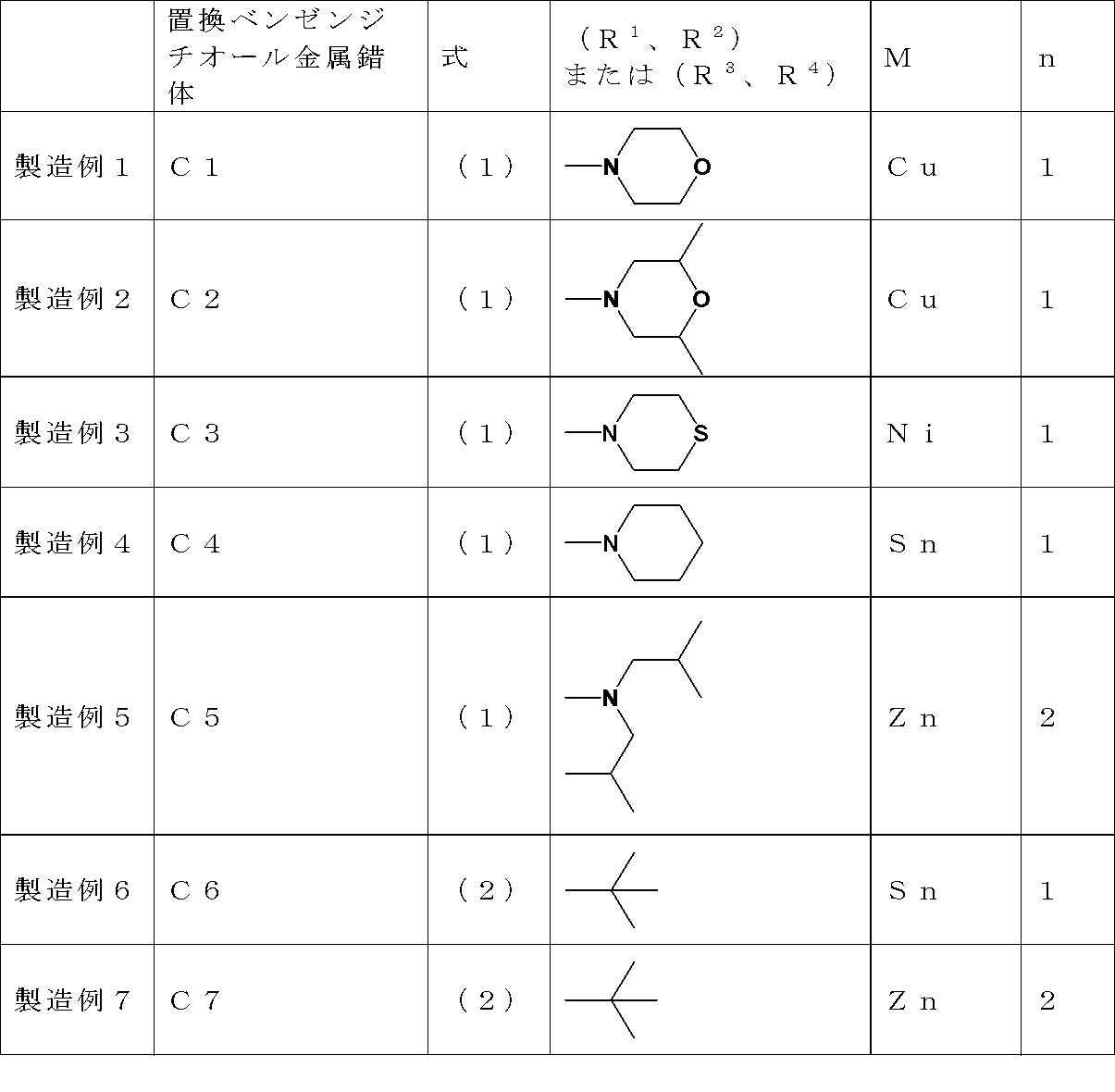
(光吸収分散液)
実施例1
製造例1で得られた置換ベンゼンジチオール金属錯体(C1)8.3gと、分散媒としてエタノール30.0g、水30.0g、さらに分散剤としてポリオキシエチレン(23)ラウリルエーテル2.6gを混合し、分散メディアとして0.1mmφのジルコニアビーズを用い、分散機としてDYNO-MILL(シンマルエンタープライゼス製、型番:KDL)を用いてジャケット温を10℃に保温しながら周速15m/sで1時間分散処理を行い、分散液Aを得た。
実施例1
製造例1で得られた置換ベンゼンジチオール金属錯体(C1)8.3gと、分散媒としてエタノール30.0g、水30.0g、さらに分散剤としてポリオキシエチレン(23)ラウリルエーテル2.6gを混合し、分散メディアとして0.1mmφのジルコニアビーズを用い、分散機としてDYNO-MILL(シンマルエンタープライゼス製、型番:KDL)を用いてジャケット温を10℃に保温しながら周速15m/sで1時間分散処理を行い、分散液Aを得た。
実施例2
製造例2で得られた置換ベンゼンジチオール金属錯体(C2)8.3gと、分散媒としてエタノール30.0g、水30.0g、さらに分散剤としてポリオキシエチレン(23)ラウリルエーテル2.6gを混合し、分散メディアとして0.1mmφのジルコニアビーズを用い、分散機としてDYNO-MILL(シンマルエンタープライゼス製、型番:KDL)を用いてジャケット温を10℃に保温しながら周速15m/sで1時間分散処理を行い、分散液Bを得た。
製造例2で得られた置換ベンゼンジチオール金属錯体(C2)8.3gと、分散媒としてエタノール30.0g、水30.0g、さらに分散剤としてポリオキシエチレン(23)ラウリルエーテル2.6gを混合し、分散メディアとして0.1mmφのジルコニアビーズを用い、分散機としてDYNO-MILL(シンマルエンタープライゼス製、型番:KDL)を用いてジャケット温を10℃に保温しながら周速15m/sで1時間分散処理を行い、分散液Bを得た。
実施例3
製造例3で得られた置換ベンゼンジチオール金属錯体(C3)8.3gと、分散媒としてエタノール30.0g、水30.0g、さらに分散剤としてポリオキシエチレン(23)ラウリルエーテル2.7gを混合し、分散メディアとして0.1mmφのジルコニアビーズを用い、分散機としてDYNO-MILL(シンマルエンタープライゼス製、型番:KDL)を用いてジャケット温を10℃に保温しながら周速15m/sで1時間分散処理を行い、分散液Cを得た。
製造例3で得られた置換ベンゼンジチオール金属錯体(C3)8.3gと、分散媒としてエタノール30.0g、水30.0g、さらに分散剤としてポリオキシエチレン(23)ラウリルエーテル2.7gを混合し、分散メディアとして0.1mmφのジルコニアビーズを用い、分散機としてDYNO-MILL(シンマルエンタープライゼス製、型番:KDL)を用いてジャケット温を10℃に保温しながら周速15m/sで1時間分散処理を行い、分散液Cを得た。
実施例4
製造例4で得られた置換ベンゼンジチオール金属錯体(C4)8.3gと、分散媒としてエタノール30.0g、水30.0g、さらに分散剤としてポリオキシエチレン(23)ラウリルエーテル2.7gを混合し、分散メディアとして0.1mmφのジルコニアビーズを用い、分散機としてDYNO-MILL(シンマルエンタープライゼス製、型番:KDL)を用いてジャケット温を10℃に保温しながら周速15m/sで1時間分散処理を行い、分散液Dを得た。
製造例4で得られた置換ベンゼンジチオール金属錯体(C4)8.3gと、分散媒としてエタノール30.0g、水30.0g、さらに分散剤としてポリオキシエチレン(23)ラウリルエーテル2.7gを混合し、分散メディアとして0.1mmφのジルコニアビーズを用い、分散機としてDYNO-MILL(シンマルエンタープライゼス製、型番:KDL)を用いてジャケット温を10℃に保温しながら周速15m/sで1時間分散処理を行い、分散液Dを得た。
実施例5
製造例5で得られた置換ベンゼンジチオール金属錯体(C5)8.3gと、分散媒としてエタノール30.0g、水30.0g、さらに分散剤としてポリオキシエチレン(23)ラウリルエーテル2.8gを混合し、分散メディアとして0.1mmφのジルコニアビーズを用い、分散機としてDYNO-MILL(シンマルエンタープライゼス製、型番:KDL)を用いてジャケット温を10℃に保温しながら周速15m/sで1時間分散処理を行い、分散液Eを得た。
製造例5で得られた置換ベンゼンジチオール金属錯体(C5)8.3gと、分散媒としてエタノール30.0g、水30.0g、さらに分散剤としてポリオキシエチレン(23)ラウリルエーテル2.8gを混合し、分散メディアとして0.1mmφのジルコニアビーズを用い、分散機としてDYNO-MILL(シンマルエンタープライゼス製、型番:KDL)を用いてジャケット温を10℃に保温しながら周速15m/sで1時間分散処理を行い、分散液Eを得た。
実施例6
製造例6で得られた置換ベンゼンジチオール金属錯体(C6)8.3gと、分散媒としてエタノール30.0g、水30.0g、さらに分散剤としてポリオキシエチレン(23)ラウリルエーテル2.6gを混合し、分散メディアとして0.1mmφのジルコニアビーズを用い、分散機としてDYNO-MILL(シンマルエンタープライゼス製、型番:KDL)を用いてジャケット温を10℃に保温しながら周速15m/sで1時間分散処理を行い、分散液Fを得た。
製造例6で得られた置換ベンゼンジチオール金属錯体(C6)8.3gと、分散媒としてエタノール30.0g、水30.0g、さらに分散剤としてポリオキシエチレン(23)ラウリルエーテル2.6gを混合し、分散メディアとして0.1mmφのジルコニアビーズを用い、分散機としてDYNO-MILL(シンマルエンタープライゼス製、型番:KDL)を用いてジャケット温を10℃に保温しながら周速15m/sで1時間分散処理を行い、分散液Fを得た。
実施例7
製造例7で得られた置換ベンゼンジチオール金属錯体(C7)8.3gと、分散媒としてエタノール30.0g、水30.0g、さらに分散剤としてポリオキシエチレン(23)ラウリルエーテル2.6gを混合し、分散メディアとして0.1mmφのジルコニアビーズを用い、分散機としてDYNO-MILL(シンマルエンタープライゼス製、型番:KDL)を用いてジャケット温を10℃に保温しながら周速15m/sで1時間分散処理を行い、分散液Gを得た。
製造例7で得られた置換ベンゼンジチオール金属錯体(C7)8.3gと、分散媒としてエタノール30.0g、水30.0g、さらに分散剤としてポリオキシエチレン(23)ラウリルエーテル2.6gを混合し、分散メディアとして0.1mmφのジルコニアビーズを用い、分散機としてDYNO-MILL(シンマルエンタープライゼス製、型番:KDL)を用いてジャケット温を10℃に保温しながら周速15m/sで1時間分散処理を行い、分散液Gを得た。
実施例8
製造例1で得られた置換ベンゼンジチオール金属錯体(C1)8.3gと、分散媒としてトルエン52.0g、さらに分散剤としてポリオキシエチレン(23)ラウリルエーテル3.1gを混合し、分散メディアとして0.1mmφのジルコニアビーズを用い、分散機としてDYNO-MILL(シンマルエンタープライゼス製、型番:KDL)を用いてジャケット温を10℃に保温しながら周速15m/sで1時間分散処理を行い、分散液Hを得た。
製造例1で得られた置換ベンゼンジチオール金属錯体(C1)8.3gと、分散媒としてトルエン52.0g、さらに分散剤としてポリオキシエチレン(23)ラウリルエーテル3.1gを混合し、分散メディアとして0.1mmφのジルコニアビーズを用い、分散機としてDYNO-MILL(シンマルエンタープライゼス製、型番:KDL)を用いてジャケット温を10℃に保温しながら周速15m/sで1時間分散処理を行い、分散液Hを得た。
実施例9
製造例2で得られた置換ベンゼンジチオール金属錯体(C2)8.3gと、分散媒としてトルエン52.0g、さらに分散剤としてポリオキシエチレン(20)セチルエーテル3.4gを混合し、分散メディアとして0.1mmφのジルコニアビーズを用い、分散機としてDYNO-MILL(シンマルエンタープライゼス製、型番:KDL)を用いてジャケット温を10℃に保温しながら周速15m/sで1時間分散処理を行い、分散液Iを得た。
製造例2で得られた置換ベンゼンジチオール金属錯体(C2)8.3gと、分散媒としてトルエン52.0g、さらに分散剤としてポリオキシエチレン(20)セチルエーテル3.4gを混合し、分散メディアとして0.1mmφのジルコニアビーズを用い、分散機としてDYNO-MILL(シンマルエンタープライゼス製、型番:KDL)を用いてジャケット温を10℃に保温しながら周速15m/sで1時間分散処理を行い、分散液Iを得た。
実施例10
製造例3で得られた置換ベンゼンジチオール金属錯体(C3)8.3gと、分散媒としてトルエン52.8g、さらに分散剤としてポリオキシエチレン(10)オクチルフェニルエーテル2.8gを混合し、分散メディアとして0.1mmφのジルコニアビーズを用い、分散機としてDYNO-MILL(シンマルエンタープライゼス製、型番:KDL)を用いてジャケット温を10℃に保温しながら周速15m/sで1時間分散処理を行い、分散液Jを得た。
製造例3で得られた置換ベンゼンジチオール金属錯体(C3)8.3gと、分散媒としてトルエン52.8g、さらに分散剤としてポリオキシエチレン(10)オクチルフェニルエーテル2.8gを混合し、分散メディアとして0.1mmφのジルコニアビーズを用い、分散機としてDYNO-MILL(シンマルエンタープライゼス製、型番:KDL)を用いてジャケット温を10℃に保温しながら周速15m/sで1時間分散処理を行い、分散液Jを得た。
実施例11
製造例4で得られた置換ベンゼンジチオール金属錯体(C4)8.3gと、分散媒としてトルエン52.5g、さらに分散剤としてポリオキシエチレン(20)セチルエーテル2.9gを混合し、分散メディアとして0.1mmφのジルコニアビーズを用い、分散機としてDYNO-MILL(シンマルエンタープライゼス製、型番:KDL)を用いてジャケット温を10℃に保温しながら周速15m/sで1時間分散処理を行い、分散液Kを得た。
製造例4で得られた置換ベンゼンジチオール金属錯体(C4)8.3gと、分散媒としてトルエン52.5g、さらに分散剤としてポリオキシエチレン(20)セチルエーテル2.9gを混合し、分散メディアとして0.1mmφのジルコニアビーズを用い、分散機としてDYNO-MILL(シンマルエンタープライゼス製、型番:KDL)を用いてジャケット温を10℃に保温しながら周速15m/sで1時間分散処理を行い、分散液Kを得た。
実施例12
製造例5で得られた置換ベンゼンジチオール金属錯体(C5)8.3gと、分散媒としてトルエン51.5g、さらに分散剤としてポリオキシエチレン(23)ラウリルエーテル3.2gを混合し、分散メディアとして0.1mmφのジルコニアビーズを用い、分散機としてDYNO-MILL(シンマルエンタープライゼス製、型番:KDL)を用いてジャケット温を10℃に保温しながら周速15m/sで1時間分散処理を行い、分散液Lを得た。
製造例5で得られた置換ベンゼンジチオール金属錯体(C5)8.3gと、分散媒としてトルエン51.5g、さらに分散剤としてポリオキシエチレン(23)ラウリルエーテル3.2gを混合し、分散メディアとして0.1mmφのジルコニアビーズを用い、分散機としてDYNO-MILL(シンマルエンタープライゼス製、型番:KDL)を用いてジャケット温を10℃に保温しながら周速15m/sで1時間分散処理を行い、分散液Lを得た。
実施例13
製造例6で得られた置換ベンゼンジチオール金属錯体(C6)8.3gと、分散媒としてトルエン52.0g、さらに分散剤としてポリオキシエチレン(10)オクチルフェニルエーテル3.1gを混合し、分散メディアとして0.1mmφのジルコニアビーズを用い、分散機としてDYNO-MILL(シンマルエンタープライゼス製、型番:KDL)を用いてジャケット温を10℃に保温しながら周速15m/sで1時間分散処理を行い、分散液Mを得た。
製造例6で得られた置換ベンゼンジチオール金属錯体(C6)8.3gと、分散媒としてトルエン52.0g、さらに分散剤としてポリオキシエチレン(10)オクチルフェニルエーテル3.1gを混合し、分散メディアとして0.1mmφのジルコニアビーズを用い、分散機としてDYNO-MILL(シンマルエンタープライゼス製、型番:KDL)を用いてジャケット温を10℃に保温しながら周速15m/sで1時間分散処理を行い、分散液Mを得た。
実施例14
製造例7で得られた置換ベンゼンジチオール金属錯体(C7)8.3gと、分散媒としてトルエン52.5g、さらに分散剤としてポリオキシエチレン(20)セチルエーテル2.9gを混合し、分散メディアとして0.1mmφのジルコニアビーズを用い、分散機としてDYNO-MILL(シンマルエンタープライゼス製、型番:KDL)を用いてジャケット温を10℃に保温しながら周速15m/sで1時間分散処理を行い、分散液Nを得た。
製造例7で得られた置換ベンゼンジチオール金属錯体(C7)8.3gと、分散媒としてトルエン52.5g、さらに分散剤としてポリオキシエチレン(20)セチルエーテル2.9gを混合し、分散メディアとして0.1mmφのジルコニアビーズを用い、分散機としてDYNO-MILL(シンマルエンタープライゼス製、型番:KDL)を用いてジャケット温を10℃に保温しながら周速15m/sで1時間分散処理を行い、分散液Nを得た。
実施例15
製造例1で得られた置換ベンゼンジチオール金属錯体(C1)8.3gと、分散媒として水62.0g、さらに分散剤としてポリオキシエチレン(23)ラウリルエーテル2.7gを混合し、分散メディアとして0.1mmφのジルコニアビーズを用い、分散機としてDYNO-MILL(シンマルエンタープライゼス製、型番:KDL)を用いてジャケット温を10℃に保温しながら周速15m/sで1時間分散処理を行い、分散液Oを得た。
製造例1で得られた置換ベンゼンジチオール金属錯体(C1)8.3gと、分散媒として水62.0g、さらに分散剤としてポリオキシエチレン(23)ラウリルエーテル2.7gを混合し、分散メディアとして0.1mmφのジルコニアビーズを用い、分散機としてDYNO-MILL(シンマルエンタープライゼス製、型番:KDL)を用いてジャケット温を10℃に保温しながら周速15m/sで1時間分散処理を行い、分散液Oを得た。
実施例16
製造例1で得られた置換ベンゼンジチオール金属錯体(C1)5.1gと、製造例3で得られた置換ベンゼンジチオール金属錯体(C3)5.2gと、分散媒としてエタノール30.0g、水30.0g、さらに分散剤としてポリオキシエチレン(20)セチルエーテル2.9gを混合し、分散メディアとして0.1mmφのジルコニアビーズを用い、分散機としてDYNO-MILL(シンマルエンタープライゼス製、型番:KDL)を用いてジャケット温を10℃に保温しながら周速15m/sで1時間分散処理を行い、分散液Pを得た。
製造例1で得られた置換ベンゼンジチオール金属錯体(C1)5.1gと、製造例3で得られた置換ベンゼンジチオール金属錯体(C3)5.2gと、分散媒としてエタノール30.0g、水30.0g、さらに分散剤としてポリオキシエチレン(20)セチルエーテル2.9gを混合し、分散メディアとして0.1mmφのジルコニアビーズを用い、分散機としてDYNO-MILL(シンマルエンタープライゼス製、型番:KDL)を用いてジャケット温を10℃に保温しながら周速15m/sで1時間分散処理を行い、分散液Pを得た。
実施例17
製造例1で得られた置換ベンゼンジチオール金属錯体(C1)5.0gと、製造例3で得られた置換ベンゼンジチオール金属錯体(C3)5.0gと、分散媒としてトルエン52.1g、さらに分散剤としてポリオキシエチレン(10)オクチルフェニルエーテル3.2gを混合し、分散メディアとして0.1mmφのジルコニアビーズを用い、分散機としてDYNO-MILL(シンマルエンタープライゼス製、型番:KDL)を用いてジャケット温を10℃に保温しながら周速15m/sで1時間分散処理を行い、分散液Qを得た。
製造例1で得られた置換ベンゼンジチオール金属錯体(C1)5.0gと、製造例3で得られた置換ベンゼンジチオール金属錯体(C3)5.0gと、分散媒としてトルエン52.1g、さらに分散剤としてポリオキシエチレン(10)オクチルフェニルエーテル3.2gを混合し、分散メディアとして0.1mmφのジルコニアビーズを用い、分散機としてDYNO-MILL(シンマルエンタープライゼス製、型番:KDL)を用いてジャケット温を10℃に保温しながら周速15m/sで1時間分散処理を行い、分散液Qを得た。
分散直後の各分散液中の置換ベンゼンジチオール金属錯体の微粒子の平均粒子径を表2に示す。
また、得られた置換ベンゼンジチオール金属錯体の微粒子分散液を密閉容器に入れ、40℃の恒温槽内に1ヶ月間静置した後の、各分散中の置換ベンゼンジチオール金属錯体の微粒子の平均粒子径を表2に示す。
ここで平均粒子径とは、一般的な粒度分布計、例えば動的光散乱式の粒度分布計(例えばシスメックス社製「ゼータサイザーナノZS」)で測定されるZ-Average sizeの値を示す。
表2に示す平均粒子径は、シスメックス社製「ゼータサイザーナノZS」を用いて、光源:He-Neレーザー(633nm)、セル:ガラス角セル、測定温度:25℃、Measure position:0.85(mm)の条件下で測定した。また、それぞれの試料について3回ずつ測定し、得られた値の平均値を示した。
また、得られた置換ベンゼンジチオール金属錯体の微粒子分散液を密閉容器に入れ、40℃の恒温槽内に1ヶ月間静置した後の、各分散中の置換ベンゼンジチオール金属錯体の微粒子の平均粒子径を表2に示す。
ここで平均粒子径とは、一般的な粒度分布計、例えば動的光散乱式の粒度分布計(例えばシスメックス社製「ゼータサイザーナノZS」)で測定されるZ-Average sizeの値を示す。
表2に示す平均粒子径は、シスメックス社製「ゼータサイザーナノZS」を用いて、光源:He-Neレーザー(633nm)、セル:ガラス角セル、測定温度:25℃、Measure position:0.85(mm)の条件下で測定した。また、それぞれの試料について3回ずつ測定し、得られた値の平均値を示した。
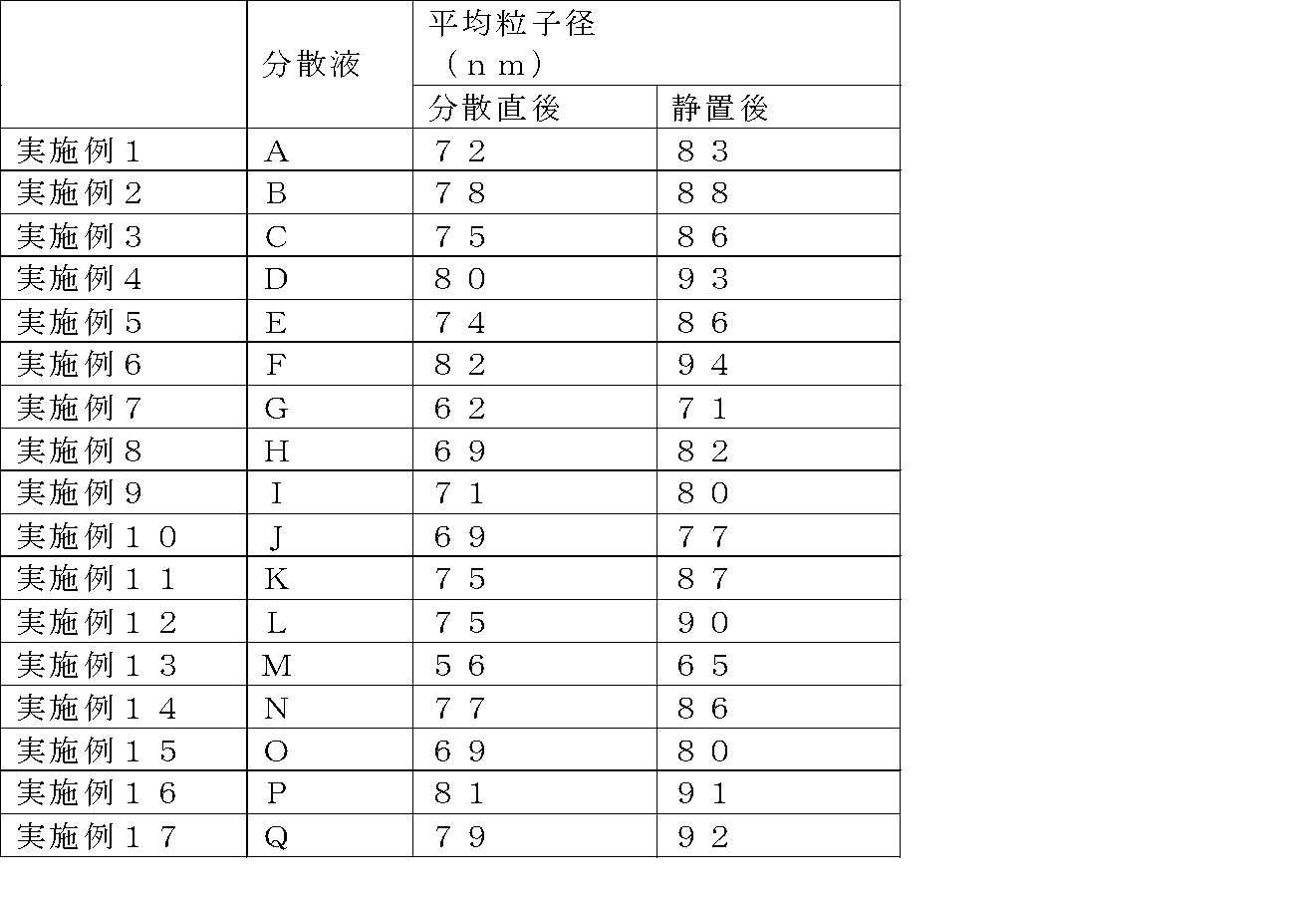
実施例1~17において得られた置換ベンゼンジチオール金属錯体の微粒子分散液A~Qは、40℃の温度下で1ヶ月の長期間に渡り再凝集することなく安定な分散状態を保つことが確認された。
(光吸収部材用組成物)
製造例8
メチルトリエトキシシラン50.0g(0.28モル)と、フェニルトリエトキシシラン25.0g(0.10モル)と、PGMEA80gとを混合し、室温で攪拌し、溶液を得た。この溶液に、触媒としてギ酸3.0g ( 0.01モル)および水25.0gを添加し、室温で30分間攪拌することにより、加水分解を行った。次に加水分解後の溶液を70 ℃まで昇温し、4時間保温し、加水分解・重縮合反応を進行させ、さらに減圧下で、副生したアルコールと水を留去しつつ、さらに1時間加水分解・重縮合反応を進行させることで、無機系バインダー:ポリシロキサン系バインダー前駆体としての、シリコンアルコキシドのゾル/PGMEA溶液(シロキサンオリゴマー/PGMEA溶液,加熱残分40.5%)を得た。
製造例8
メチルトリエトキシシラン50.0g(0.28モル)と、フェニルトリエトキシシラン25.0g(0.10モル)と、PGMEA80gとを混合し、室温で攪拌し、溶液を得た。この溶液に、触媒としてギ酸3.0g ( 0.01モル)および水25.0gを添加し、室温で30分間攪拌することにより、加水分解を行った。次に加水分解後の溶液を70 ℃まで昇温し、4時間保温し、加水分解・重縮合反応を進行させ、さらに減圧下で、副生したアルコールと水を留去しつつ、さらに1時間加水分解・重縮合反応を進行させることで、無機系バインダー:ポリシロキサン系バインダー前駆体としての、シリコンアルコキシドのゾル/PGMEA溶液(シロキサンオリゴマー/PGMEA溶液,加熱残分40.5%)を得た。
製造例9
製造例8において、PGMEA80gに代えてIPA80gを用いた以外は製造例8と同様にして、無機系バインダー:ポリシロキサン系バインダー前駆体としての、シリコンアルコキシドのゾル/IPA溶液(シロキサンオリゴマー/IPA溶液,加熱残分41.7%)を得た。
製造例8において、PGMEA80gに代えてIPA80gを用いた以外は製造例8と同様にして、無機系バインダー:ポリシロキサン系バインダー前駆体としての、シリコンアルコキシドのゾル/IPA溶液(シロキサンオリゴマー/IPA溶液,加熱残分41.7%)を得た。
製造例10
製造例8において、PGMEA80gに代えてトルエン80gを用いた以外は製造例8と同様にして、無機系バインダー:ポリシロキサン系バインダー前駆体としての、シリコンアルコキシドのゾル/トルエン溶液(シロキサンオリゴマー/トルエン溶液,加熱残分40.9%)を得た。
製造例8において、PGMEA80gに代えてトルエン80gを用いた以外は製造例8と同様にして、無機系バインダー:ポリシロキサン系バインダー前駆体としての、シリコンアルコキシドのゾル/トルエン溶液(シロキサンオリゴマー/トルエン溶液,加熱残分40.9%)を得た。
製造例11
製造例8において、PGMEA80gに代えてMEK80gを用いた以外は製造例8と同様にして、無機系バインダー:ポリシロキサン系バインダー前駆体としての、シリコンアルコキシドのゾル/MEK溶液(シロキサンオリゴマー/MEK溶液,加熱残分42.1%)を得た。
製造例8において、PGMEA80gに代えてMEK80gを用いた以外は製造例8と同様にして、無機系バインダー:ポリシロキサン系バインダー前駆体としての、シリコンアルコキシドのゾル/MEK溶液(シロキサンオリゴマー/MEK溶液,加熱残分42.1%)を得た。
実施例18
製造例8で得られたシロキサンオリゴマー/PGMEA溶液2.0gにPGMEAを1.0g加え、混合した。次いで、これを実施例1で得られた置換ベンゼンジチオール金属錯体の微粒子分散液(分散液A)1.5gに攪拌しながら加え、混合することにより、光吸収部材用組成液Aを得た。
製造例8で得られたシロキサンオリゴマー/PGMEA溶液2.0gにPGMEAを1.0g加え、混合した。次いで、これを実施例1で得られた置換ベンゼンジチオール金属錯体の微粒子分散液(分散液A)1.5gに攪拌しながら加え、混合することにより、光吸収部材用組成液Aを得た。
実施例19
製造例8で得られたシロキサンオリゴマー/PGMEA溶液2.0gにPGMEAを1.0g加え、混合した。次いで、これを実施例2で得られた置換ベンゼンジチオール金属錯体の微粒子分散液(分散液B)1.5gに攪拌しながら加え、混合することにより、光吸収部材用組成液Bを得た。
製造例8で得られたシロキサンオリゴマー/PGMEA溶液2.0gにPGMEAを1.0g加え、混合した。次いで、これを実施例2で得られた置換ベンゼンジチオール金属錯体の微粒子分散液(分散液B)1.5gに攪拌しながら加え、混合することにより、光吸収部材用組成液Bを得た。
実施例20
製造例9で得られたシロキサンオリゴマー/IPA溶液2.0gにIPAを0.5g加え、混合した。次いで、これを実施例3で得られた置換ベンゼンジチオール金属錯体の微粒子分散液(分散液C)1.6gに攪拌しながら加え、混合することにより、光吸収部材用組成液Cを得た。
製造例9で得られたシロキサンオリゴマー/IPA溶液2.0gにIPAを0.5g加え、混合した。次いで、これを実施例3で得られた置換ベンゼンジチオール金属錯体の微粒子分散液(分散液C)1.6gに攪拌しながら加え、混合することにより、光吸収部材用組成液Cを得た。
実施例21
製造例8で得られたシロキサンオリゴマー/PGMEA溶液2.0gにPGMEAを0.5g加え、混合した。次いで、これを実施例4で得られた置換ベンゼンジチオール金属錯体の微粒子分散液(分散液D)1.6gに攪拌しながら加え、混合することにより、光吸収部材用組成液Dを得た。
製造例8で得られたシロキサンオリゴマー/PGMEA溶液2.0gにPGMEAを0.5g加え、混合した。次いで、これを実施例4で得られた置換ベンゼンジチオール金属錯体の微粒子分散液(分散液D)1.6gに攪拌しながら加え、混合することにより、光吸収部材用組成液Dを得た。
実施例22
製造例9で得られたシロキサンオリゴマー/IPA溶液2.0gにIPAを0.5g加え、混合した。次いで、これを実施例5で得られた置換ベンゼンジチオール金属錯体の微粒子分散液(分散液E)1.5gに攪拌しながら加え、混合することにより、光吸収部材用組成液Eを得た。
製造例9で得られたシロキサンオリゴマー/IPA溶液2.0gにIPAを0.5g加え、混合した。次いで、これを実施例5で得られた置換ベンゼンジチオール金属錯体の微粒子分散液(分散液E)1.5gに攪拌しながら加え、混合することにより、光吸収部材用組成液Eを得た。
実施例23
製造例8で得られたシロキサンオリゴマー/PGMEA溶液2.0gにPGMEAを0.4g加え、混合した。次いで、これを実施例6で得られた置換ベンゼンジチオール金属錯体の微粒子分散液(分散液F)1.5gに攪拌しながら加え、混合することにより、光吸収部材用組成液Fを得た。
製造例8で得られたシロキサンオリゴマー/PGMEA溶液2.0gにPGMEAを0.4g加え、混合した。次いで、これを実施例6で得られた置換ベンゼンジチオール金属錯体の微粒子分散液(分散液F)1.5gに攪拌しながら加え、混合することにより、光吸収部材用組成液Fを得た。
実施例24
製造例9で得られたシロキサンオリゴマー/IPA溶液2.0gにIPAを0.5g加え、混合した。次いで、これを実施例7で得られた置換ベンゼンジチオール金属錯体の微粒子分散液(分散液G)1.5gに攪拌しながら加え、混合することにより、光吸収部材用組成液Gを得た。
製造例9で得られたシロキサンオリゴマー/IPA溶液2.0gにIPAを0.5g加え、混合した。次いで、これを実施例7で得られた置換ベンゼンジチオール金属錯体の微粒子分散液(分散液G)1.5gに攪拌しながら加え、混合することにより、光吸収部材用組成液Gを得た。
実施例25
有機系バインダーとしてアクリル酸メチル-メタクリル酸エチル共重合体(ローム・アンド・ハース社製の商品名;パラロイド B-72)0.8gをトルエン1.7gに溶解させ、これを実施例8で得られた置換ベンゼンジチオール金属錯体の微粒子分散液(分散液H)1.5gに攪拌しながら加え、混合することにより、光吸収部材用組成液Hを得た。
有機系バインダーとしてアクリル酸メチル-メタクリル酸エチル共重合体(ローム・アンド・ハース社製の商品名;パラロイド B-72)0.8gをトルエン1.7gに溶解させ、これを実施例8で得られた置換ベンゼンジチオール金属錯体の微粒子分散液(分散液H)1.5gに攪拌しながら加え、混合することにより、光吸収部材用組成液Hを得た。
実施例26
有機系バインダーとしてアクリル酸メチル-メタクリル酸エチル共重合体(ローム・アンド・ハース社製の商品名;パラロイド B-72)0.8gをトルエン1.7gに溶解させ、これを実施例9で得られた置換ベンゼンジチオール金属錯体の微粒子分散液(分散液I)1.5gに攪拌しながら加え、混合することにより、光吸収部材用組成液Iを得た。
有機系バインダーとしてアクリル酸メチル-メタクリル酸エチル共重合体(ローム・アンド・ハース社製の商品名;パラロイド B-72)0.8gをトルエン1.7gに溶解させ、これを実施例9で得られた置換ベンゼンジチオール金属錯体の微粒子分散液(分散液I)1.5gに攪拌しながら加え、混合することにより、光吸収部材用組成液Iを得た。
実施例27
有機系バインダーとしてアクリル酸メチル-メタクリル酸エチル共重合体(ローム・アンド・ハース社製の商品名;パラロイド B-72)0.8gをトルエン1.7gに溶解させ、これを実施例10で得られた置換ベンゼンジチオール金属錯体の微粒子分散液(分散液J)1.5gに攪拌しながら加え、混合することにより、光吸収部材用組成液Jを得た。
有機系バインダーとしてアクリル酸メチル-メタクリル酸エチル共重合体(ローム・アンド・ハース社製の商品名;パラロイド B-72)0.8gをトルエン1.7gに溶解させ、これを実施例10で得られた置換ベンゼンジチオール金属錯体の微粒子分散液(分散液J)1.5gに攪拌しながら加え、混合することにより、光吸収部材用組成液Jを得た。
実施例28
有機系バインダーとしてアクリル酸メチル-メタクリル酸エチル共重合体(ローム・アンド・ハース社製の商品名;パラロイド B-72)0.8gをトルエン1.7gに溶解させ、これを実施例11で得られた置換ベンゼンジチオール金属錯体の微粒子分散液(分散液K)1.5gに攪拌しながら加え、混合することにより、光吸収部材用組成液Kを得た。
有機系バインダーとしてアクリル酸メチル-メタクリル酸エチル共重合体(ローム・アンド・ハース社製の商品名;パラロイド B-72)0.8gをトルエン1.7gに溶解させ、これを実施例11で得られた置換ベンゼンジチオール金属錯体の微粒子分散液(分散液K)1.5gに攪拌しながら加え、混合することにより、光吸収部材用組成液Kを得た。
実施例29
有機系バインダーとしてアクリル酸メチル-メタクリル酸エチル共重合体(ローム・アンド・ハース社製の商品名;パラロイド B-72)0.8gをトルエン1.7gに溶解させ、これを実施例12で得られた置換ベンゼンジチオール金属錯体の微粒子分散液(分散液L)1.5gに攪拌しながら加え、混合することにより、光吸収部材用組成液Lを得た。
有機系バインダーとしてアクリル酸メチル-メタクリル酸エチル共重合体(ローム・アンド・ハース社製の商品名;パラロイド B-72)0.8gをトルエン1.7gに溶解させ、これを実施例12で得られた置換ベンゼンジチオール金属錯体の微粒子分散液(分散液L)1.5gに攪拌しながら加え、混合することにより、光吸収部材用組成液Lを得た。
実施例30
有機系バインダーとしてアクリル酸メチル-メタクリル酸エチル共重合体(ローム・アンド・ハース社製の商品名;パラロイド B-72)0.8gをトルエン1.7gに溶解させ、これを実施例13で得られた置換ベンゼンジチオール金属錯体の微粒子分散液(分散液M)1.5gに攪拌しながら加え、混合することにより、光吸収部材用組成液Mを得た。
有機系バインダーとしてアクリル酸メチル-メタクリル酸エチル共重合体(ローム・アンド・ハース社製の商品名;パラロイド B-72)0.8gをトルエン1.7gに溶解させ、これを実施例13で得られた置換ベンゼンジチオール金属錯体の微粒子分散液(分散液M)1.5gに攪拌しながら加え、混合することにより、光吸収部材用組成液Mを得た。
実施例31
有機系バインダーとしてアクリル酸メチル-メタクリル酸エチル共重合体(ローム・アンド・ハース社製の商品名;パラロイド B-72)0.8gをトルエン1.7gに溶解させ、これを実施例14で得られた置換ベンゼンジチオール金属錯体の微粒子分散液(分散液N)1.5gに攪拌しながら加え、混合することにより、光吸収部材用組成液Nを得た。
有機系バインダーとしてアクリル酸メチル-メタクリル酸エチル共重合体(ローム・アンド・ハース社製の商品名;パラロイド B-72)0.8gをトルエン1.7gに溶解させ、これを実施例14で得られた置換ベンゼンジチオール金属錯体の微粒子分散液(分散液N)1.5gに攪拌しながら加え、混合することにより、光吸収部材用組成液Nを得た。
実施例32
製造例9で得られたシロキサンオリゴマー/IPA溶液2.0gにIPAを0.4g加え、混合した。次いで、これを実施例15で得られた置換ベンゼンジチオール金属錯体の微粒子分散液(分散液O)1.5gに攪拌しながら加え、混合することにより、光吸収部材用組成液Oを得た。
製造例9で得られたシロキサンオリゴマー/IPA溶液2.0gにIPAを0.4g加え、混合した。次いで、これを実施例15で得られた置換ベンゼンジチオール金属錯体の微粒子分散液(分散液O)1.5gに攪拌しながら加え、混合することにより、光吸収部材用組成液Oを得た。
実施例33
製造例8で得られたシロキサンオリゴマー/PGMEA溶液2.0gにPGMEAを0.4g加え、混合した。次いで、これを実施例16で得られた置換ベンゼンジチオール金属錯体の微粒子分散液(分散液P)1.5gに攪拌しながら加え、混合することにより、光吸収部材用組成液Pを得た。
製造例8で得られたシロキサンオリゴマー/PGMEA溶液2.0gにPGMEAを0.4g加え、混合した。次いで、これを実施例16で得られた置換ベンゼンジチオール金属錯体の微粒子分散液(分散液P)1.5gに攪拌しながら加え、混合することにより、光吸収部材用組成液Pを得た。
実施例34
有機系バインダーとしてアクリル酸メチル-メタクリル酸エチル共重合体(ローム・アンド・ハース社製の商品名;パラロイド B-72)0.8gをトルエン1.7gに溶解させ、これを実施例17で得られた置換ベンゼンジチオール金属錯体の微粒子分散液(分散液Q)1.5gに攪拌しながら加え、混合することにより、光吸収部材用組成液Qを得た。
有機系バインダーとしてアクリル酸メチル-メタクリル酸エチル共重合体(ローム・アンド・ハース社製の商品名;パラロイド B-72)0.8gをトルエン1.7gに溶解させ、これを実施例17で得られた置換ベンゼンジチオール金属錯体の微粒子分散液(分散液Q)1.5gに攪拌しながら加え、混合することにより、光吸収部材用組成液Qを得た。
実施例35
製造例2で得られた置換ベンゼンジチオール金属錯体(C2)2.1gと、分散媒兼重合性モノマーとして3,4-エポキシシクロヘキシルメチル-3,4-エポキシシクロヘキサンカルボキシレート26.0gおよび3-エチル-3-[{(3-エチルオキセタニル)メトキシ}メチル]オキセタン51.0g、熱重合開始剤(三新化学株式会社製の商品名;SI-60L)2.7g、さらに分散剤としてポリオキシエチレン(10)オクチルフェニルエーテル0.88gを混合し、分散メディアとして0.3mmφのジルコニアビーズを用い、分散機としてDYNO-MILL(シンマルエンタープライゼス製、型番:KDL)を用いてジャケット温を10℃に保温しながら周速15m/sで1時間分散処理を行い、光吸収部材用組成液Rを得た。
製造例2で得られた置換ベンゼンジチオール金属錯体(C2)2.1gと、分散媒兼重合性モノマーとして3,4-エポキシシクロヘキシルメチル-3,4-エポキシシクロヘキサンカルボキシレート26.0gおよび3-エチル-3-[{(3-エチルオキセタニル)メトキシ}メチル]オキセタン51.0g、熱重合開始剤(三新化学株式会社製の商品名;SI-60L)2.7g、さらに分散剤としてポリオキシエチレン(10)オクチルフェニルエーテル0.88gを混合し、分散メディアとして0.3mmφのジルコニアビーズを用い、分散機としてDYNO-MILL(シンマルエンタープライゼス製、型番:KDL)を用いてジャケット温を10℃に保温しながら周速15m/sで1時間分散処理を行い、光吸収部材用組成液Rを得た。
実施例18~35で得られた光吸収部材用組成液A~Rを、室温下で100日間静置保管し、保管前後での凝集の有無を目視で評価した。結果、いずれについても凝集体および沈降物の存在は確認されなかった。
(光吸収部材)
実施例36
実施例18で得られた光吸収部材用組成液Aを、スピンコーター(株式会社アクティブ製、型番:ACT-300A)を用いてソーダライムガラス基材上に塗布し、その後、室温下、窒素雰囲気において10分間予備乾燥させた後に200℃で30分間焼成し、光吸収部材Aを得た。コーティング膜の膜厚は10μmであった。
実施例36
実施例18で得られた光吸収部材用組成液Aを、スピンコーター(株式会社アクティブ製、型番:ACT-300A)を用いてソーダライムガラス基材上に塗布し、その後、室温下、窒素雰囲気において10分間予備乾燥させた後に200℃で30分間焼成し、光吸収部材Aを得た。コーティング膜の膜厚は10μmであった。
実施例37
実施例20で得られた光吸収部材用組成液Cを、スピンコーター(株式会社アクティブ製、型番:ACT-300A)を用いてソーダライムガラス基材上に塗布し、その後、室温下、窒素雰囲気において10分間予備乾燥させた後に200℃で30分間焼成し、光吸収部材Cを得た。コーティング膜の膜厚は9μmであった。
実施例20で得られた光吸収部材用組成液Cを、スピンコーター(株式会社アクティブ製、型番:ACT-300A)を用いてソーダライムガラス基材上に塗布し、その後、室温下、窒素雰囲気において10分間予備乾燥させた後に200℃で30分間焼成し、光吸収部材Cを得た。コーティング膜の膜厚は9μmであった。
実施例38
実施例25で得られた光吸収部材用組成液Hを、スピンコーター(株式会社アクティブ製、型番:ACT-300A)を用いてソーダライムガラス基材上に塗布し、その後、室温下、窒素雰囲気において10分間予備乾燥させた後に80℃で3分間乾燥し、光吸収部材Hを得た。コーティング膜の膜厚は9μmであった。
実施例25で得られた光吸収部材用組成液Hを、スピンコーター(株式会社アクティブ製、型番:ACT-300A)を用いてソーダライムガラス基材上に塗布し、その後、室温下、窒素雰囲気において10分間予備乾燥させた後に80℃で3分間乾燥し、光吸収部材Hを得た。コーティング膜の膜厚は9μmであった。
実施例39
実施例27で得られた光吸収部材用組成液Jを、スピンコーター(株式会社アクティブ製、型番:ACT-300A)を用いてソーダライムガラス基材上に塗布し、その後、室温下、窒素雰囲気において10分間予備乾燥させた後に80℃で3分間乾燥し、光吸収部材Jを得た。コーティング膜の膜厚は10μmであった。
実施例27で得られた光吸収部材用組成液Jを、スピンコーター(株式会社アクティブ製、型番:ACT-300A)を用いてソーダライムガラス基材上に塗布し、その後、室温下、窒素雰囲気において10分間予備乾燥させた後に80℃で3分間乾燥し、光吸収部材Jを得た。コーティング膜の膜厚は10μmであった。
実施例40
実施例33で得られた光吸収部材用組成液Pを、スピンコーター(株式会社アクティブ製、型番:ACT-300A)を用いてソーダライムガラス基材上に塗布し、その後、室温下、窒素雰囲気において10分間予備乾燥させた後に200℃で30分間焼成し、光吸収部材Pを得た。コーティング膜の膜厚は8μmであった。
実施例33で得られた光吸収部材用組成液Pを、スピンコーター(株式会社アクティブ製、型番:ACT-300A)を用いてソーダライムガラス基材上に塗布し、その後、室温下、窒素雰囲気において10分間予備乾燥させた後に200℃で30分間焼成し、光吸収部材Pを得た。コーティング膜の膜厚は8μmであった。
実施例41
実施例34で得られた光吸収部材用組成液Qを、スピンコーター(株式会社アクティブ製、型番:ACT-300A)を用いてソーダライムガラス基材上に塗布し、その後、室温下、窒素雰囲気において10分間予備乾燥させた後に80℃で3分間乾燥し、光吸収部材Qを得た。コーティング膜の膜厚は9μmであった。
実施例34で得られた光吸収部材用組成液Qを、スピンコーター(株式会社アクティブ製、型番:ACT-300A)を用いてソーダライムガラス基材上に塗布し、その後、室温下、窒素雰囲気において10分間予備乾燥させた後に80℃で3分間乾燥し、光吸収部材Qを得た。コーティング膜の膜厚は9μmであった。
実施例42
実施例35で得られた光吸収部材用組成液Rを、スピンコーター(株式会社アクティブ製、型番:ACT-300A)を用いてソーダライムガラス基材上に塗布し、その後、室温下、窒素雰囲気において10分間予備乾燥させた後に、160℃で30分間かけて硬化し、光吸収部材Rを得た。コーティング膜の膜厚は11μmであった。
実施例35で得られた光吸収部材用組成液Rを、スピンコーター(株式会社アクティブ製、型番:ACT-300A)を用いてソーダライムガラス基材上に塗布し、その後、室温下、窒素雰囲気において10分間予備乾燥させた後に、160℃で30分間かけて硬化し、光吸収部材Rを得た。コーティング膜の膜厚は11μmであった。
比較例1
製造例9で得られたシロキサンオリゴマー/IPA溶液2.0gにIPAを0.4g加え、混合した。この混合液を攪拌しながら、酸化亜鉛微粒子分散液(ハクスイテック株式会社製、製品名:パゼットGK-IPA分散体、粉体一次粒子径:20~40nm)2.0gを加え、混合することにより、光吸収部材用組成液Sを得た。
この光吸収部材用組成液を、スピンコーター(株式会社アクティブ製、型番:ACT-300A)を用いてソーダライムガラス基材上に塗布し、その後、室温下、窒素雰囲気において10分間予備乾燥させた後に200℃で30分間焼成し、光吸収部材Sを得た。コーティング膜の膜厚は8μmであった。
製造例9で得られたシロキサンオリゴマー/IPA溶液2.0gにIPAを0.4g加え、混合した。この混合液を攪拌しながら、酸化亜鉛微粒子分散液(ハクスイテック株式会社製、製品名:パゼットGK-IPA分散体、粉体一次粒子径:20~40nm)2.0gを加え、混合することにより、光吸収部材用組成液Sを得た。
この光吸収部材用組成液を、スピンコーター(株式会社アクティブ製、型番:ACT-300A)を用いてソーダライムガラス基材上に塗布し、その後、室温下、窒素雰囲気において10分間予備乾燥させた後に200℃で30分間焼成し、光吸収部材Sを得た。コーティング膜の膜厚は8μmであった。
比較例2
有機系バインダーとしてアクリル酸メチル-メタクリル酸エチル共重合体(ローム・アンド・ハース社製の商品名;パラロイド B-72)0.8gをMEK1.7gに溶解させ、この溶液を攪拌しながら、酸化亜鉛微粒子分散液(ハクスイテック株式会社製、製品名:パゼットGK-MEK分散体、粉体一次粒子径:20~40nm)2.0gを加え、混合することにより、光吸収部材用組成液Tを得た。
この光吸収部材用組成液を、スピンコーター(株式会社アクティブ製、型番:ACT-300A)を用いてソーダライムガラス基材上に塗布し、その後、室温下、窒素雰囲気において10分間予備乾燥させた後に80℃で3分間乾燥し、光吸収部材Tを得た。コーティング膜の膜厚は11μmであった。
有機系バインダーとしてアクリル酸メチル-メタクリル酸エチル共重合体(ローム・アンド・ハース社製の商品名;パラロイド B-72)0.8gをMEK1.7gに溶解させ、この溶液を攪拌しながら、酸化亜鉛微粒子分散液(ハクスイテック株式会社製、製品名:パゼットGK-MEK分散体、粉体一次粒子径:20~40nm)2.0gを加え、混合することにより、光吸収部材用組成液Tを得た。
この光吸収部材用組成液を、スピンコーター(株式会社アクティブ製、型番:ACT-300A)を用いてソーダライムガラス基材上に塗布し、その後、室温下、窒素雰囲気において10分間予備乾燥させた後に80℃で3分間乾燥し、光吸収部材Tを得た。コーティング膜の膜厚は11μmであった。
比較例3
製造例11で得られたシロキサンオリゴマー/MEK溶液2.0gにMEK0.4gを加え、混合した。この溶液に、製造例1で得られた置換ベンゼンジチオール金属錯体(C1)0.2gを加え、溶解させることにより、光吸収部材用組成液Uを得た。
この光吸収部材用組成液Uを、スピンコーター(株式会社アクティブ製、型番:ACT-300A)を用いてソーダライムガラス基材上に塗布し、その後、室温下、窒素雰囲気において10分間予備乾燥させた後に200℃で30分間焼成し、光吸収部材Uを得た。コーティング膜の膜厚は11μmであった。
製造例11で得られたシロキサンオリゴマー/MEK溶液2.0gにMEK0.4gを加え、混合した。この溶液に、製造例1で得られた置換ベンゼンジチオール金属錯体(C1)0.2gを加え、溶解させることにより、光吸収部材用組成液Uを得た。
この光吸収部材用組成液Uを、スピンコーター(株式会社アクティブ製、型番:ACT-300A)を用いてソーダライムガラス基材上に塗布し、その後、室温下、窒素雰囲気において10分間予備乾燥させた後に200℃で30分間焼成し、光吸収部材Uを得た。コーティング膜の膜厚は11μmであった。
比較例4
有機系バインダーとしてアクリル酸メチル-メタクリル酸エチル共重合体(ローム・アンド・ハース社製の商品名;パラロイド B-72)0.8gをMEK1.7gに溶解させ、この溶液に、製造例1で得られた置換ベンゼンジチオール金属錯体(C1)0.2gを加え、溶解させることにより、光吸収部材用組成液Vを得た。
この光吸収部材用組成液Vを、スピンコーター(株式会社アクティブ製、型番:ACT-300A)を用いてソーダライムガラス基材上に塗布し、その後、室温下、窒素雰囲気において10分間予備乾燥させた後に80℃で3分間乾燥し、光吸収部材Vを得た。コーティング膜の膜厚は8μmであった。
有機系バインダーとしてアクリル酸メチル-メタクリル酸エチル共重合体(ローム・アンド・ハース社製の商品名;パラロイド B-72)0.8gをMEK1.7gに溶解させ、この溶液に、製造例1で得られた置換ベンゼンジチオール金属錯体(C1)0.2gを加え、溶解させることにより、光吸収部材用組成液Vを得た。
この光吸収部材用組成液Vを、スピンコーター(株式会社アクティブ製、型番:ACT-300A)を用いてソーダライムガラス基材上に塗布し、その後、室温下、窒素雰囲気において10分間予備乾燥させた後に80℃で3分間乾燥し、光吸収部材Vを得た。コーティング膜の膜厚は8μmであった。
[光吸収部材の評価]
実施例36~42および比較例1~4で得られた光吸収部材について、以下の手順により実施した。
(1)透過率
実施例36~42および比較例1~4で得られた光吸収部材について、分光光度計(株式会社日立製作所製、型番:U-4100)を用いて特定波長(λ=380nm:紫外線UV-A、λ=545nm:可視光線、λ=900nm:近赤外線)における透過率を測定し、光吸収能の評価を実施した。
(2)耐光性試験
(1)の手順により実施例36~42および比較例1~4で得られた光吸収部材について透過率を測定した後、キセノンウェザーメーター(スガ試験機株式会社製、型番:X25)を用いて、これら光吸収部材に放射強度60W/m2(300~400nm域における積算)の光を1000時間照射した。このとき、光吸収部材のソーダライムガラス基材側からではなく、コーティング層側から光を照射した。すなわちこれは、ソーダライムガラスは短波長域の紫外線を吸収する性質があるので、光吸収部材のソーダライムガラス基材側からではなくコーティング層側から光を照射することにより、光源から放射された光を、コーティング層中に分散された光吸収剤に直接照射し、光吸収剤にとってより過酷な条件とすることを意図したものである。直接光照射後の光吸収部材について、透過率を測定し、光照射による光吸収能の変化を評価した。
実施例36~42および比較例1~4で得られた光吸収部材について、以下の手順により実施した。
(1)透過率
実施例36~42および比較例1~4で得られた光吸収部材について、分光光度計(株式会社日立製作所製、型番:U-4100)を用いて特定波長(λ=380nm:紫外線UV-A、λ=545nm:可視光線、λ=900nm:近赤外線)における透過率を測定し、光吸収能の評価を実施した。
(2)耐光性試験
(1)の手順により実施例36~42および比較例1~4で得られた光吸収部材について透過率を測定した後、キセノンウェザーメーター(スガ試験機株式会社製、型番:X25)を用いて、これら光吸収部材に放射強度60W/m2(300~400nm域における積算)の光を1000時間照射した。このとき、光吸収部材のソーダライムガラス基材側からではなく、コーティング層側から光を照射した。すなわちこれは、ソーダライムガラスは短波長域の紫外線を吸収する性質があるので、光吸収部材のソーダライムガラス基材側からではなくコーティング層側から光を照射することにより、光源から放射された光を、コーティング層中に分散された光吸収剤に直接照射し、光吸収剤にとってより過酷な条件とすることを意図したものである。直接光照射後の光吸収部材について、透過率を測定し、光照射による光吸収能の変化を評価した。
以下の表3に結果を示す。
表中のΔ%Tは光照射後の透過率から光照射前の透過率を差し引きした値を示す。
表中のΔ%Tは光照射後の透過率から光照射前の透過率を差し引きした値を示す。
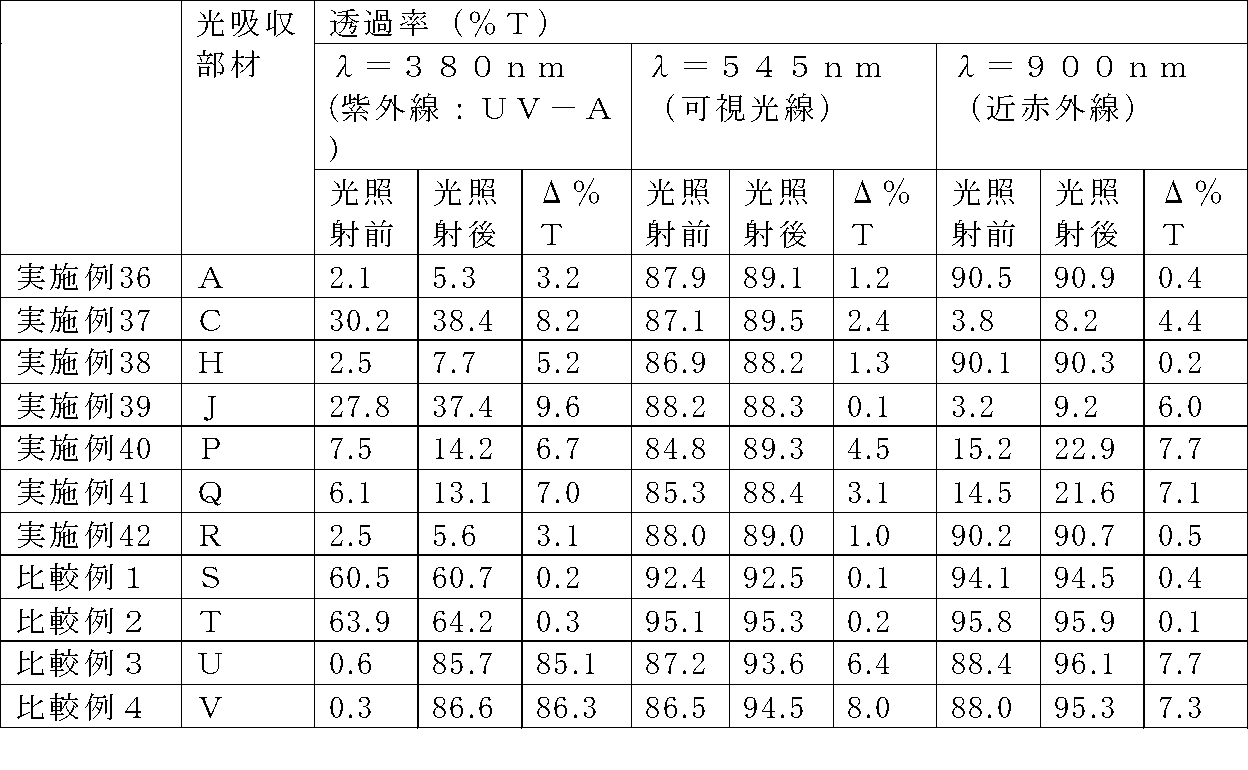
実施例36、実施例38および実施例42は、光吸収剤として置換ベンゼンジチオール銅錯体(式(1)または式(2)におけるMが銅原子)を使用した系であり、UV-Aを十分に遮蔽し、且つ光照射による透過率の変化も小さく、優れた耐光性を示すことが確認された。
実施例37および実施例39は、光吸収剤として置換ベンゼンジチオールニッケル錯体(式(1)または式(2)におけるMがニッケル原子)を使用した系であり、近赤外線を十分に遮蔽し、且つ光照射による透過率の変化も小さく、優れた耐光性を示すことが確認された。
実施例40および実施例41は、光吸収剤として置換ベンゼンジチオール銅錯体(式(1)におけるMが銅原子)と置換ベンゼンジチオールニッケル錯体(式(1)におけるMがニッケル原子)を混合使用した系であり、UV-Aおよび近赤外線を十分に遮蔽し、且つ光照射による透過率の変化も小さく、優れた耐光性を示すことが確認された。
また、実施例の2種以上の置換ベンゼンジチオール金属錯体を光吸収剤として同時に使用した場合にも、単独の場合と同様に、UV-Aや赤外線を十分に遮断し、且つ光照射による透過率の変化も小さく、優れた耐光性を示すことが確認された(データは示さず)。
比較例1および比較例2は、紫外線吸収剤として従来公知の酸化亜鉛微粒子を使用した系であるが、耐光性は非常に良好であるものの、UV-Aを十分に遮蔽することはできないことが確認された。
比較例3および比較例4は、置換ベンゼンジチオール銅錯体(式(1)におけるMが銅原子)を使用した系であるが、微粒子として分散させるのではなく、良溶媒に溶解させて使用した系である。この場合、UV-Aは十分に遮蔽することができるが、光照射による透過率の変化が非常に大きく、耐光性面で問題があることが確認された。
本発明の置換ベンゼンジチオール金属錯体を含有する微粒子分散液、ならびにこれを用いた光吸収部材用組成物および光吸収部材は、長期間にわたって再凝集することなく安定な分散状態を保ち、且つ優れた耐光性を持続し、例えば、式(1)または(2)におけるMが銅原子の場合には、従来遮蔽困難であったUV-Aを十分に遮蔽することができる。
Claims (9)
- 式(1):

式(2):

で表される置換ベンゼンジチオール金属錯体を含有する光吸収分散液において、該置換ベンゼンジチオール金属錯体の微粒子が、水、有機溶剤および重合性モノマーよりなる群から選択される1以上の単独または混合分散媒中に分散されていることを特徴とする該光吸収分散液。 - 式(1)および/または式(2)における金属原子Mが、錫原子、亜鉛原子、ニッケル原子、銅原子またはコバルト原子である請求項1に記載の光吸収分散液。
- 該置換ベンゼンジチオール金属錯体の微粒子の平均粒子径が、10nm以上200nm以下である請求項1または2に記載の光吸収分散液。
- 請求項1~3のいずれかに記載の光吸収分散液と、少なくとも1種類のマトリックス材料とを含む光吸収部材用組成物。
- 請求項1~3のいずれかに記載の光吸収分散液を含み、ここに、該光吸収分散液は、分散媒として重合性モノマーを含み、および別途にマトリックス材料を含まない光吸収部材用組成物。
- 請求項1~3のいずれかに記載の光吸収分散液を含み、ここに、該光吸収分散液は、分散媒として重合性モノマーを含み、および別途にマトリックス材料を含む光吸収部材用組成物。
- 請求項4~6のいずれかに記載の光吸収部材用組成物を用いて作製される光吸収部材。
- 基材上に置換ベンゼンジチオール金属錯体の微粒子が分散されたマトリックス材料の膜を有する積層体としての光吸収部材である請求項7記載の光吸収部材。
- 置換ベンゼンジチオール金属錯体の微粒子がマトリックス材料の膜中に分散した薄膜形態の光吸収部材である請求項7記載の光吸収部材。
Applications Claiming Priority (2)
| Application Number | Priority Date | Filing Date | Title |
|---|---|---|---|
| JP2010-061064 | 2010-03-17 | ||
| JP2010061064A JP2013107917A (ja) | 2010-03-17 | 2010-03-17 | 置換ベンゼンジチオール金属錯体の微粒子を含有する光吸収分散液、ならびにこれを用いた光吸収部材用組成物および光吸収部材 |
Publications (1)
| Publication Number | Publication Date |
|---|---|
| WO2011114792A1 true WO2011114792A1 (ja) | 2011-09-22 |
Family
ID=44648900
Family Applications (1)
| Application Number | Title | Priority Date | Filing Date |
|---|---|---|---|
| PCT/JP2011/052335 Ceased WO2011114792A1 (ja) | 2010-03-17 | 2011-02-04 | 置換ベンゼンジチオール金属錯体の微粒子を含有する光吸収分散液、ならびにこれを用いた光吸収部材用組成物および光吸収部材 |
Country Status (3)
| Country | Link |
|---|---|
| JP (1) | JP2013107917A (ja) |
| TW (1) | TW201136612A (ja) |
| WO (1) | WO2011114792A1 (ja) |
Cited By (2)
| Publication number | Priority date | Publication date | Assignee | Title |
|---|---|---|---|---|
| JP2013242372A (ja) * | 2012-05-18 | 2013-12-05 | Smart Cort Pro Co Ltd | 対太陽光部材及び対太陽光部材の形成方法 |
| WO2023210475A1 (ja) * | 2022-04-27 | 2023-11-02 | Agc株式会社 | 光学フィルタ |
Families Citing this family (4)
| Publication number | Priority date | Publication date | Assignee | Title |
|---|---|---|---|---|
| KR101768287B1 (ko) | 2014-11-28 | 2017-08-16 | 삼성에스디아이 주식회사 | 포스포늄계 화합물, 이를 포함하는 에폭시수지 조성물, 및 이를 사용하여 제조된 반도체 소자 |
| JP6788444B2 (ja) * | 2016-09-07 | 2020-11-25 | 株式会社日本触媒 | 樹脂組成物および光学フィルター |
| JP7371376B2 (ja) * | 2019-07-23 | 2023-10-31 | 住友金属鉱山株式会社 | 赤外線吸収微粒子含有組成物およびその製造方法 |
| JP2022114267A (ja) * | 2021-01-26 | 2022-08-05 | 国立研究開発法人物質・材料研究機構 | 紫外線吸収膜及び紫外線電気変換素子 |
Citations (6)
| Publication number | Priority date | Publication date | Assignee | Title |
|---|---|---|---|---|
| JPS63165392A (ja) * | 1986-12-27 | 1988-07-08 | Mitsui Toatsu Chem Inc | 近赤外線吸収剤用の新規なt−ブチル置換ベンゼンチオールニッケル錯体およびこの錯体を含有するプラスチック組成物 |
| JP2001288380A (ja) * | 2000-04-04 | 2001-10-16 | Sumitomo Seika Chem Co Ltd | 近赤外線吸収色素及びこれを用いた近赤外線吸収材 |
| JP2007070499A (ja) * | 2005-09-08 | 2007-03-22 | Sumitomo Seika Chem Co Ltd | 光吸収色素溶液 |
| JP2007254552A (ja) * | 2006-03-22 | 2007-10-04 | Fujifilm Corp | ベンゾジフラノン化合物含有近赤外吸収組成物 |
| JP2010018735A (ja) * | 2008-07-11 | 2010-01-28 | Sumitomo Seika Chem Co Ltd | 近赤外線吸収部材用組成物およびそれを用いた近赤外線吸収部材。 |
| JP2010222557A (ja) * | 2009-02-25 | 2010-10-07 | Fujifilm Corp | 近赤外線吸収分散液、近赤外線吸収インク、ならびに印刷物 |
-
2010
- 2010-03-17 JP JP2010061064A patent/JP2013107917A/ja not_active Withdrawn
-
2011
- 2011-02-04 WO PCT/JP2011/052335 patent/WO2011114792A1/ja not_active Ceased
- 2011-02-16 TW TW100105031A patent/TW201136612A/zh unknown
Patent Citations (6)
| Publication number | Priority date | Publication date | Assignee | Title |
|---|---|---|---|---|
| JPS63165392A (ja) * | 1986-12-27 | 1988-07-08 | Mitsui Toatsu Chem Inc | 近赤外線吸収剤用の新規なt−ブチル置換ベンゼンチオールニッケル錯体およびこの錯体を含有するプラスチック組成物 |
| JP2001288380A (ja) * | 2000-04-04 | 2001-10-16 | Sumitomo Seika Chem Co Ltd | 近赤外線吸収色素及びこれを用いた近赤外線吸収材 |
| JP2007070499A (ja) * | 2005-09-08 | 2007-03-22 | Sumitomo Seika Chem Co Ltd | 光吸収色素溶液 |
| JP2007254552A (ja) * | 2006-03-22 | 2007-10-04 | Fujifilm Corp | ベンゾジフラノン化合物含有近赤外吸収組成物 |
| JP2010018735A (ja) * | 2008-07-11 | 2010-01-28 | Sumitomo Seika Chem Co Ltd | 近赤外線吸収部材用組成物およびそれを用いた近赤外線吸収部材。 |
| JP2010222557A (ja) * | 2009-02-25 | 2010-10-07 | Fujifilm Corp | 近赤外線吸収分散液、近赤外線吸収インク、ならびに印刷物 |
Cited By (2)
| Publication number | Priority date | Publication date | Assignee | Title |
|---|---|---|---|---|
| JP2013242372A (ja) * | 2012-05-18 | 2013-12-05 | Smart Cort Pro Co Ltd | 対太陽光部材及び対太陽光部材の形成方法 |
| WO2023210475A1 (ja) * | 2022-04-27 | 2023-11-02 | Agc株式会社 | 光学フィルタ |
Also Published As
| Publication number | Publication date |
|---|---|
| TW201136612A (en) | 2011-11-01 |
| JP2013107917A (ja) | 2013-06-06 |
Similar Documents
| Publication | Publication Date | Title |
|---|---|---|
| JP5687210B2 (ja) | 紫外線吸収部材用組成物およびこれを用いた紫外線吸収部材 | |
| WO2011114792A1 (ja) | 置換ベンゼンジチオール金属錯体の微粒子を含有する光吸収分散液、ならびにこれを用いた光吸収部材用組成物および光吸収部材 | |
| US8333831B2 (en) | Dispersion of nanoparticles in organic solvents | |
| JP5704133B2 (ja) | コアシェル型正方晶系酸化チタン固溶体水分散液、その製造方法、紫外線遮蔽性シリコーンコーティング組成物、及び被覆物品 | |
| TWI466931B (zh) | 黑色樹脂組成物、樹脂黑矩陣基板及觸控面板 | |
| JP2014132088A (ja) | 耐摩耗性コーティング組成物およびコーティングされた物品 | |
| JP2013194037A (ja) | 銅錯体、これを含有する紫外線吸収部材用組成物およびこれを用いた紫外線吸収部材 | |
| US20190225821A1 (en) | Coating composition and coated article | |
| WO2016009979A1 (ja) | 金属酸化物粒子分散液、金属酸化物粒子含有組成物、塗膜、および表示装置 | |
| AU2010205242A1 (en) | Coating composition, process for producing the composition, and laminate having a hard coat layer | |
| CN1993429A (zh) | 颜料 | |
| US20150072134A1 (en) | Magnesium fluoride particles, method for producing magnesium fluoride particles, dispersion solution of magnesium fluoride particles, method for producing dispersion solution of magnesium fluoride particles, composition for forming low refractive index layer, method for producing composition for forming a low refractive index layer, substrate with low refractive index layer, and method for manufacturing substrate with low refractive index layer | |
| JP2013023461A (ja) | 金属錯体、これを含有する紫外線吸収部材用組成物およびこれを用いた紫外線吸収部材 | |
| JP2009297626A (ja) | シリカ系被膜形成法及び塗布液 | |
| JP5687274B2 (ja) | 有機色素安定化剤、該有機色素安定化剤と有機色素を含有する光吸収部材用組成物、およびこれを用いた光吸収部材 | |
| WO2012124395A1 (ja) | 紫外線吸収部材用組成物およびこれを用いた紫外線吸収部材 | |
| JP4823045B2 (ja) | 水系光触媒組成物 | |
| JP2014088542A (ja) | 紫外線吸収部材用組成物およびこれを用いた紫外線吸収部材 | |
| JP5414152B2 (ja) | 紫外線熱線遮蔽性を有する透明層形成用組成物、その透明層およびその用途 | |
| TWI326293B (ja) | ||
| JP2003286443A (ja) | 熱硬化型艶消し粉体水分散液塗料組成物 | |
| JP2007084374A (ja) | 酸化チタン分散液及び高屈折率膜並びに高屈折率膜の製造方法 | |
| JP6464840B2 (ja) | カラーフィルタ用赤色顔料組成物、その製造方法及びカラーフィルタ | |
| KR102812932B1 (ko) | 세륨-도핑된 티타니아 입자, 분산액 조성물, 코팅용 조성물 및 세륨-도핑된 티타니아 입자의 제조방법 | |
| KR102737423B1 (ko) | 광산란 잉크 조성물, 컬러필터 및 화상표시장치 |
Legal Events
| Date | Code | Title | Description |
|---|---|---|---|
| 121 | Ep: the epo has been informed by wipo that ep was designated in this application |
Ref document number: 11755982 Country of ref document: EP Kind code of ref document: A1 |
|
| NENP | Non-entry into the national phase |
Ref country code: DE |
|
| 122 | Ep: pct application non-entry in european phase |
Ref document number: 11755982 Country of ref document: EP Kind code of ref document: A1 |
|
| NENP | Non-entry into the national phase |
Ref country code: JP |