WO2011108646A1 - 含窒素縮合環化合物、含窒素縮合環重合体、有機薄膜及び有機薄膜素子 - Google Patents
含窒素縮合環化合物、含窒素縮合環重合体、有機薄膜及び有機薄膜素子 Download PDFInfo
- Publication number
- WO2011108646A1 WO2011108646A1 PCT/JP2011/054924 JP2011054924W WO2011108646A1 WO 2011108646 A1 WO2011108646 A1 WO 2011108646A1 JP 2011054924 W JP2011054924 W JP 2011054924W WO 2011108646 A1 WO2011108646 A1 WO 2011108646A1
- Authority
- WO
- WIPO (PCT)
- Prior art keywords
- group
- formula
- nitrogen
- atom
- represented
- Prior art date
- Legal status (The legal status is an assumption and is not a legal conclusion. Google has not performed a legal analysis and makes no representation as to the accuracy of the status listed.)
- Ceased
Links
- 0 *C(Cc1cccc(-c2nc(C(c3c-4[s]c(-c5c6nc(-c7cc(CC(*N)=O)ccc7)[s]5)c3C6=O)=O)c-4[s]2)c1)=O Chemical compound *C(Cc1cccc(-c2nc(C(c3c-4[s]c(-c5c6nc(-c7cc(CC(*N)=O)ccc7)[s]5)c3C6=O)=O)c-4[s]2)c1)=O 0.000 description 5
- UFEZHDUARJVHGV-UHFFFAOYSA-N CCCCCCNC(c1ncc[s]1)=O Chemical compound CCCCCCNC(c1ncc[s]1)=O UFEZHDUARJVHGV-UHFFFAOYSA-N 0.000 description 1
- UBHAMKRELOMBCX-UHFFFAOYSA-N Cc1nc(C(c(cc2-c3c4nc(C)[s]3)c-3cc2C4=O)=O)c-3[s]1 Chemical compound Cc1nc(C(c(cc2-c3c4nc(C)[s]3)c-3cc2C4=O)=O)c-3[s]1 UBHAMKRELOMBCX-UHFFFAOYSA-N 0.000 description 1
- MBYLGFAUVUCHMN-UHFFFAOYSA-N Cc1nc(C(c2c-3[s]c(-c4c5nc(C)[s]4)c2C5=O)=O)c-3[s]1 Chemical compound Cc1nc(C(c2c-3[s]c(-c4c5nc(C)[s]4)c2C5=O)=O)c-3[s]1 MBYLGFAUVUCHMN-UHFFFAOYSA-N 0.000 description 1
- XQUSXKUIKNAWNL-UHFFFAOYSA-N O=C(c(c-1c2)cc(-c3c4nc(-c5ccccc5)[s]3)c2C4=O)c2c-1[s]c(-c1ccccc1)n2 Chemical compound O=C(c(c-1c2)cc(-c3c4nc(-c5ccccc5)[s]3)c2C4=O)c2c-1[s]c(-c1ccccc1)n2 XQUSXKUIKNAWNL-UHFFFAOYSA-N 0.000 description 1
- GIGPPDCCAULOCS-UHFFFAOYSA-N O=C(c1c-2[s]c(-c3c4nc(-c5ccccc5)[s]3)c1C4=O)c1c-2[s]c(-c2ccccc2)n1 Chemical compound O=C(c1c-2[s]c(-c3c4nc(-c5ccccc5)[s]3)c1C4=O)c1c-2[s]c(-c2ccccc2)n1 GIGPPDCCAULOCS-UHFFFAOYSA-N 0.000 description 1
Images




Classifications
-
- C—CHEMISTRY; METALLURGY
- C07—ORGANIC CHEMISTRY
- C07D—HETEROCYCLIC COMPOUNDS
- C07D513/00—Heterocyclic compounds containing in the condensed system at least one hetero ring having nitrogen and sulfur atoms as the only ring hetero atoms, not provided for in groups C07D463/00, C07D477/00 or C07D499/00 - C07D507/00
- C07D513/02—Heterocyclic compounds containing in the condensed system at least one hetero ring having nitrogen and sulfur atoms as the only ring hetero atoms, not provided for in groups C07D463/00, C07D477/00 or C07D499/00 - C07D507/00 in which the condensed system contains two hetero rings
- C07D513/04—Ortho-condensed systems
-
- C—CHEMISTRY; METALLURGY
- C07—ORGANIC CHEMISTRY
- C07D—HETEROCYCLIC COMPOUNDS
- C07D513/00—Heterocyclic compounds containing in the condensed system at least one hetero ring having nitrogen and sulfur atoms as the only ring hetero atoms, not provided for in groups C07D463/00, C07D477/00 or C07D499/00 - C07D507/00
- C07D513/12—Heterocyclic compounds containing in the condensed system at least one hetero ring having nitrogen and sulfur atoms as the only ring hetero atoms, not provided for in groups C07D463/00, C07D477/00 or C07D499/00 - C07D507/00 in which the condensed system contains three hetero rings
- C07D513/14—Ortho-condensed systems
-
- H—ELECTRICITY
- H10—SEMICONDUCTOR DEVICES; ELECTRIC SOLID-STATE DEVICES NOT OTHERWISE PROVIDED FOR
- H10K—ORGANIC ELECTRIC SOLID-STATE DEVICES
- H10K10/00—Organic devices specially adapted for rectifying, amplifying, oscillating or switching; Organic capacitors or resistors having potential barriers
- H10K10/40—Organic transistors
- H10K10/46—Field-effect transistors, e.g. organic thin-film transistors [OTFT]
- H10K10/462—Insulated gate field-effect transistors [IGFETs]
- H10K10/464—Lateral top-gate IGFETs comprising only a single gate
-
- H—ELECTRICITY
- H10—SEMICONDUCTOR DEVICES; ELECTRIC SOLID-STATE DEVICES NOT OTHERWISE PROVIDED FOR
- H10K—ORGANIC ELECTRIC SOLID-STATE DEVICES
- H10K10/00—Organic devices specially adapted for rectifying, amplifying, oscillating or switching; Organic capacitors or resistors having potential barriers
- H10K10/40—Organic transistors
- H10K10/46—Field-effect transistors, e.g. organic thin-film transistors [OTFT]
- H10K10/462—Insulated gate field-effect transistors [IGFETs]
- H10K10/466—Lateral bottom-gate IGFETs comprising only a single gate
-
- H—ELECTRICITY
- H10—SEMICONDUCTOR DEVICES; ELECTRIC SOLID-STATE DEVICES NOT OTHERWISE PROVIDED FOR
- H10K—ORGANIC ELECTRIC SOLID-STATE DEVICES
- H10K30/00—Organic devices sensitive to infrared radiation, light, electromagnetic radiation of shorter wavelength or corpuscular radiation
-
- H—ELECTRICITY
- H10—SEMICONDUCTOR DEVICES; ELECTRIC SOLID-STATE DEVICES NOT OTHERWISE PROVIDED FOR
- H10K—ORGANIC ELECTRIC SOLID-STATE DEVICES
- H10K85/00—Organic materials used in the body or electrodes of devices covered by this subclass
- H10K85/10—Organic polymers or oligomers
- H10K85/111—Organic polymers or oligomers comprising aromatic, heteroaromatic, or aryl chains, e.g. polyaniline, polyphenylene or polyphenylene vinylene
- H10K85/113—Heteroaromatic compounds comprising sulfur or selene, e.g. polythiophene
-
- Y—GENERAL TAGGING OF NEW TECHNOLOGICAL DEVELOPMENTS; GENERAL TAGGING OF CROSS-SECTIONAL TECHNOLOGIES SPANNING OVER SEVERAL SECTIONS OF THE IPC; TECHNICAL SUBJECTS COVERED BY FORMER USPC CROSS-REFERENCE ART COLLECTIONS [XRACs] AND DIGESTS
- Y02—TECHNOLOGIES OR APPLICATIONS FOR MITIGATION OR ADAPTATION AGAINST CLIMATE CHANGE
- Y02E—REDUCTION OF GREENHOUSE GAS [GHG] EMISSIONS, RELATED TO ENERGY GENERATION, TRANSMISSION OR DISTRIBUTION
- Y02E10/00—Energy generation through renewable energy sources
- Y02E10/50—Photovoltaic [PV] energy
- Y02E10/549—Organic PV cells
Definitions
- the present invention relates to a nitrogen-containing condensed ring compound, a nitrogen-containing condensed ring polymer, an organic thin film, and an organic thin film element.
- a thin film containing an organic material having an electron transporting property or a hole transporting property is expected to be applied to an organic thin film element such as an organic thin film transistor, an organic solar cell, or an optical sensor.
- organic thin film element such as an organic thin film transistor, an organic solar cell, or an optical sensor.
- organic n-type semiconductors shown electron transport properties
- various developments of organic n-type semiconductors have been studied.
- Patent Document 1 discloses a compound in which a fluoroalkyl group is introduced into a thiophene ring as a thin film transistor material.
- Patent Document 2 discloses a monomer, an oligomer, and a polymer including at least one dithienothiophene group and at least one arylene group or heteroarylene group.
- the present invention provides a nitrogen-containing fused ring compound having at least one structural unit selected from the group consisting of a structural unit represented by formula (1-1) and a structural unit represented by formula (1-2).
- a nitrogen-containing fused ring compound having at least one structural unit selected from the group consisting of a structural unit represented by formula (1-1) and a structural unit represented by formula (1-2).
- Ar 1 represents an optionally substituted aromatic ring having 4 or more carbon atoms
- one of Y 1 and Y 2 is represented by —C ( ⁇ X 1 ) —.
- the other represents a single bond
- one of Y 3 and Y 4 represents a group represented by —C ( ⁇ X 2 ) —, the other represents a single bond
- R 3 , R 4 , R 5 and R 6 each independently represent a hydrogen atom, a halogen atom or a monovalent group, and R 3 and R 4 are bonded to each other to form a ring. Also good. ]
- the group represented by the formula (a-3) and the group represented by the formula (a-4) have two right-and-left reversed bonding modes, and any of these bonding modes may be used. .
- the nitrogen-containing fused ring compound according to the present invention has good ⁇ -conjugate planarity between rings, and can exhibit a sufficiently low minimum orbital (LUMO) by introduction of the nitrogen-containing fused ring, thereby improving electron transport properties. It can be used as an excellent organic n-type semiconductor. Further, since the nitrogen-containing fused ring compound according to the present invention is excellent in solubility in an organic solvent, it is easy to form a thin film using these, and an organic thin film element having excellent performance can be produced. Become.
- the nitrogen-containing fused ring compound according to the present invention is chemically stable and excellent in environmental stability (that is, stability to air and water), by forming a thin film using these, An organic thin film element having stable performance can be manufactured.
- Z 1 and Z 2 are preferably sulfur atoms.
- Such a nitrogen-containing fused ring compound can obtain an electronic state suitable for electron transport by the interaction between a sulfur atom and a nitrogen atom that forms a ring together with the sulfur atom, and the electron transport property is further improved. To do.
- X 1 and X 2 are preferably oxygen atoms.
- Such a nitrogen-containing fused ring compound can further reduce LUMO, and in the solid state, since it easily interacts with a hetero atom in an adjacent molecule, the intermolecular interaction is increased, and the electron Transportability is further improved.
- Ar 1 is preferably a benzene ring or a thiophene ring.
- Such a nitrogen-containing fused ring compound is likely to be ⁇ -conjugated, and the ⁇ -conjugated planarity is improved, so that molecules are easily arranged.
- the structural unit represented by the formula (1-1) is preferably a structural unit represented by the formula (2-1), and represented by the formula (1-2).
- the structural unit to be formed is preferably a structural unit represented by the formula (2-2).
- Ar 2 represents an optionally substituted aromatic ring having 4 or more carbon atoms
- X 3 and X 4 each independently represent an oxygen atom, a sulfur atom, or ⁇ C (A 2 ) 2.
- a 2 represents a hydrogen atom, a halogen atom or a monovalent group
- two A 2 may be the same or different from each other, provided that at least one of the two A 2 is cyano.
- Z 3 and Z 4 are each independently an oxygen atom, a sulfur atom, a selenium atom, a tellurium atom, a formula A group represented by (b-1), a group represented by formula (b-2), a group represented by formula (b-3), a group represented by formula (b-4) or a formula (b The group represented by -5) is shown.
- R 7 , R 8 , R 9 and R 10 each independently represent a hydrogen atom, a halogen atom or a monovalent group, and R 7 and R 8 are bonded to each other to form a ring. Also good. ]
- the group represented by the formula (b-3) and the group represented by the formula (b-4) have two right-and-left reversed bonding modes, and any of these bonding modes may be used. .
- Z 3 and Z 4 are preferably sulfur atoms.
- Such a nitrogen-containing fused ring compound can obtain an electronic state suitable for electron transport by the interaction between a sulfur atom and a nitrogen atom that forms a ring together with the sulfur atom, and the electron transport property is further improved. .
- X 3 and X 4 are preferably oxygen atoms.
- Such a nitrogen-containing fused ring compound can further reduce LUMO, and in the solid state, since it easily interacts with a hetero atom in an adjacent molecule, the intermolecular interaction is increased, and the electron Transportability is further improved.
- Ar 2 is preferably a benzene ring or a thiophene ring.
- Such a nitrogen-containing fused ring compound is likely to be ⁇ -conjugated, and the ⁇ -conjugated planarity is improved, so that molecules are easily arranged.
- the structural unit represented by the formula (1-1) and the structural unit represented by the formula (1-2) have line symmetry or point symmetry. It is preferable to have point symmetry. In that case, an increase in the number of intermolecular interactions can be expected, the intermolecular interaction is increased, and the molecules are easily arranged, so that the electron transport property is further improved.
- the structural unit represented by the formula (1-1) is a structural unit represented by the formula (3-1), and is represented by the formula (1-2).
- a nitrogen-containing fused ring compound in which the structural unit is a structural unit represented by the formula (3-2) is preferable.
- Such a nitrogen-containing fused ring compound is particularly excellent in the above-described characteristics.
- the present invention also provides a nitrogen-containing fused ring polymer having a plurality of structural units selected from the group consisting of the structural unit represented by formula (1-1) and the structural unit represented by formula (1-2). provide.
- the plurality of structural units possessed by the nitrogen-containing fused ring polymer may be the same as or different from each other.
- the present invention includes a plurality of structural units represented by formula (1-1), a plurality of structural units represented by formula (1-2), or a group represented by formula (1-1). And a nitrogen-containing fused ring polymer having at least one group represented by formula (1-2).
- the plurality of structural units of the nitrogen-containing fused ring polymer may be the same as or different from each other.
- the nitrogen-containing fused ring polymer according to the present invention has good ⁇ -conjugate planarity between the rings in the structural unit, and can exhibit a LUMO that is sufficiently lower than introducing a plurality of nitrogen-containing fused rings. It can be used as an organic n-type semiconductor having excellent electron transport properties. Moreover, since the nitrogen-containing condensed ring polymer according to the present invention is chemically stable and excellent in solubility in an organic solvent, an organic thin film element having excellent performance can be obtained by forming a thin film using these. Can be manufactured.
- the nitrogen-containing condensed ring polymer according to the present invention is excellent in environmental stability, it is possible to produce an organic thin film element having stable performance even in the air by forming a thin film using these. It becomes.
- Z 1 and Z 2 are preferably sulfur atoms.
- Such a nitrogen-containing fused ring polymer can obtain an electronic state suitable for electron transport by the interaction between a sulfur atom and a nitrogen atom that forms a ring together with the sulfur atom, and further has an electron transport property. improves.
- X 1 and X 2 are preferably oxygen atoms.
- Such a nitrogen-containing fused ring polymer can further reduce LUMO, and in the solid state, since it easily interacts with a hetero atom in an adjacent molecule, the intermolecular interaction is increased, Electron transportability is further improved.
- the structural unit represented by the formula (1-1) is preferably a structural unit represented by the formula (2-1).
- the structural unit represented is preferably a structural unit represented by the formula (2-2).
- Z 3 and Z 4 are preferably sulfur atoms.
- Such a nitrogen-containing fused ring polymer can obtain an electronic state suitable for electron transport by the interaction between a sulfur atom and a nitrogen atom that forms a ring together with the sulfur atom, and further has an electron transport property. improves.
- X 3 and X 4 are preferably oxygen atoms.
- Such a nitrogen-containing fused ring polymer can further reduce LUMO, and in the solid state, since it easily interacts with a hetero atom in an adjacent molecule, the intermolecular interaction is increased, Electron transportability is further improved.
- the aromatic ring is preferably a benzene ring or a thiophene ring.
- a nitrogen-containing fused ring polymer is likely to be ⁇ -conjugated, and the ⁇ -conjugated planarity is improved, so that molecules are easily arranged.
- the structural unit represented by the formula (1-1) and the structural unit represented by the formula (1-2) have line symmetry or point symmetry. It is preferable to have point symmetry. In that case, an increase in the number of intermolecular interactions can be expected, the intermolecular interaction is increased, and the molecules are easily arranged, so that the electron transport property is further improved.
- the nitrogen-containing fused ring polymer according to the present invention may further have a structural unit represented by the formula (4).
- a structural unit represented by the formula (4) By having such a structural unit, the range in which solubility or mechanical, thermal, or electronic properties can be changed is widened.
- Ar 3 represents an arylene group which may have a substituent or a heterocyclic group which may have a substituent.
- the nitrogen-containing fused ring polymer according to the present invention may further have a structural unit represented by the formula (5).
- R 11 and R 12 each independently represents a hydrogen atom, a halogen atom or a monovalent group
- Z 5 represents an oxygen atom, a sulfur atom, a selenium atom, a tellurium atom, or a compound represented by formula (c-1):
- a group represented by formula (c-2), a group represented by formula (c-3), a group represented by formula (c-4) or a group represented by formula (c-5) Represents a group.
- R 13 , R 14 , R 15 and R 16 each independently represent a hydrogen atom, a halogen atom or a monovalent group, and R 13 and R 14 are bonded to each other to form a ring. Also good. ]
- the group represented by the formula (c-3) and the group represented by the formula (c-4) have two right-and-left reversed bonding modes, and any of these bonding modes may be used. .
- Z 5 is preferably a sulfur atom. Since the nitrogen-containing fused ring polymer having such a structural unit can take a stable quinoid structure, it is further excellent in electron transport property.
- the present invention also provides an organic thin film containing at least one selected from the group consisting of the nitrogen-containing fused ring compound according to the present invention and the nitrogen-containing fused ring polymer according to the present invention. Since such an organic thin film contains at least a nitrogen-containing condensed ring compound or a nitrogen-containing condensed ring polymer, it has a sufficiently low LUMO and exhibits excellent electron transport properties.
- the present invention also provides an organic thin film element, an organic thin film transistor, and an organic solar cell including the organic thin film according to the present invention.
- the organic thin film element, the organic thin film transistor, and the organic solar cell include the organic thin film according to the present invention, and the organic thin film efficiently transports the charge injected from the electrode or the charge generated by light absorption. be able to. Therefore, the organic thin film element according to the present invention has excellent performance, the organic thin film transistor according to the present invention has high electron mobility, and the organic solar cell according to the present invention has good conversion efficiency.
- a novel nitrogen-containing fused ring compound and a novel nitrogen-containing fused ring polymer that can be used as an organic n-type semiconductor having excellent electron transport properties can be provided.
- an organic thin film containing the nitrogen-containing condensed ring compound and / or nitrogen-containing condensed ring polymer, and an organic thin film element including the organic thin film can be provided.
- the nitrogen-containing fused ring compound according to this embodiment comprises at least one structural unit selected from the group consisting of a structural unit represented by formula (1-1) and a structural unit represented by formula (1-2). Have.
- the nitrogen-containing fused ring compound according to the present embodiment has such a structural unit, so that the ⁇ -conjugate planarity between the rings is good and sufficiently low LUMO can be exhibited, and the electron transport property is excellent. It can be used as an organic n-type semiconductor. Moreover, since the nitrogen-containing fused ring compound according to the present embodiment is chemically stable and has excellent solubility in an organic solvent, an organic thin film element having excellent performance can be obtained by forming a thin film using these compounds. Can be manufactured.
- the nitrogen-containing fused ring compound according to the present embodiment is excellent in environmental stability (that is, stability to air and water), by forming a thin film using these, even in normal air An organic thin film element with stable performance can be manufactured.
- Ar 1 represents an aromatic ring having 4 or more carbon atoms which may have a substituent.
- aromatic rings include benzenoid aromatic rings and heteroaromatic rings.
- the aromatic ring may be a single ring or a condensed ring. Since the solubility is good and the production is easy, the aromatic ring is preferably a single ring or a condensed ring in which 2 to 5 rings are condensed, and a single ring or two rings are condensed. A condensed ring is more preferable, and a single ring is more preferable.
- Examples of the benzenoid aromatic ring include benzene, naphthalene, anthracene, fluorene, pyrene, and perylene, and benzene or naphthalene is preferable, and benzene is more preferable.
- examples of the heteroaromatic ring include pyridine, thiophene, thienothiophene, dithienothiophene, benzothiophene, benzodithiophene, dibenzothiophene, pyrrole, quinoline, indole, etc., and thiophene, thienothiophene or pyridine is preferable and more preferable. Is thiophene.
- the aromatic ring represented by Ar 1 may have a substituent, and the substituent is preferably a substituent composed of 20 or less atoms, and a substituent composed of 17 or less atoms. More preferred.
- the substituent include alkyl groups such as a methyl group, an ethyl group, an n-propyl group, an isopropyl group, and a sec-propyl group (the carbon number of the alkyl group is preferably 1 to 12, more preferably 1 to 10).
- An alkoxy group such as a methoxy group, an ethoxy group, an n-propyloxy group, an isopropyloxy group, or a sec-propyloxy group (the carbon number of the alkoxy group is preferably 1 to 12, more preferably 1 to 10).
- An aryl group such as a phenyl group and a naphthyl group; a halogen atom such as a fluorine atom, a chlorine atom and a bromine atom; a nitro group; and a cyano group.
- an aryl group represents the remaining atomic group obtained by removing one hydrogen atom from an aromatic hydrocarbon compound
- the aromatic hydrocarbon compound include benzene, naphthalene, anthracene, phenanthrene, naphthacene, and fluorene. , Benzofluorene, pyrene, perylene and the like.
- One of Y 1 and Y 2 represents a group represented by —C ( ⁇ X 1 ) —, and the other represents a single bond.
- One of Y 3 and Y 4 represents a group represented by —C ( ⁇ X 2 ) —, and the other represents a single bond.
- Y 1 is preferably a group represented by —C ( ⁇ X 1 ) —.
- Y 3 is preferably a group represented by —C ( ⁇ X 2 ) —.
- X 1 and X 2 each independently represent an oxygen atom, a sulfur atom or a group represented by ⁇ C (A 1 ) 2 .
- X 1 and X 2 are preferably an oxygen atom or a group represented by ⁇ C (A 1 ) 2 , and more preferably an oxygen atom. Since manufacturing is easy, it is preferred X 1 and X 2 are the same group.
- a 1 represents a hydrogen atom, a halogen atom or a monovalent group.
- two A 1 s may be the same as or different from each other. Since the LUMO may lower, it is preferable that at least one of the two A 1 is a group of electron-attracting, and more preferably two of A 1 are both an electron-withdrawing group.
- At least one of the two A 1 is a cyano group, a nitro group, an acyl group, or an alkoxycarbonyl group (the carbon number of the alkoxycarbonyl group is preferably 2 to 13, more preferably 2 to 11), It is preferably a carboxyl group, a hydroxy group or a halogen atom, more preferably a cyano group, a nitro group or a halogen atom, and even more preferably a cyano group.
- two A 1 are all cyano group, nitro group, acyl group, alkoxycarbonyl group (the carbon number of the alkoxycarbonyl group is preferably 2 to 13, more preferably 2 to 11), carboxyl group , A hydroxy group or a halogen atom, more preferably a cyano group, a nitro group or a halogen atom, and further preferably a cyano group.
- an acyl group represents a group represented by —C ( ⁇ O) —R 17 .
- R 17 represents a hydrogen atom, an alkyl group or an aryl group.
- the number of carbon atoms of the alkyl group in R 17 is preferably 1 to 12, more preferably 1 to 10.
- the acyl group in which R 17 is a hydrogen atom is also referred to as a formyl group, and the acyl group in which R 17 is an alkyl group is also referred to as an alkanoyl group.
- Z 1 and Z 2 are each independently an oxygen atom, a sulfur atom, a selenium atom, a tellurium atom, a group represented by the formula (a-1), a group represented by the formula (a-2), a formula (a- A group represented by 3), a group represented by formula (a-4) or a group represented by formula (a-5);
- Z 1 and Z 2 are represented by an oxygen atom, a sulfur atom, a selenium atom, a group represented by the formula (a-3), a group represented by the formula (a-4), or a formula (a-5) It is preferably a group, more preferably a sulfur atom or a group represented by the formula (a-3).
- R 3 , R 4 , R 5 and R 6 each independently represent a hydrogen atom, a halogen atom or a monovalent group, and R 3 and R 4 may be bonded to each other to form a ring.
- the monovalent group in R 3 , R 4 , R 5 and R 6 may be a linear or branched chain group or a cyclic group.
- the chain group indicates a group having no cyclic structure.
- a cyclic group shows group which has a cyclic structure.
- the cyclic structure may be a monocyclic ring or a condensed ring, may be a carbocyclic ring or a heterocyclic ring, and may be saturated or unsaturated.
- a carbocycle is a cyclic structure consisting of carbon atoms
- a heterocycle is a cyclic structure having atoms (heteroatoms) other than carbon atoms.
- the monovalent group in R 3 , R 4 , R 5 and R 6 may be an electron donating group or an electron withdrawing group.
- Examples of the monovalent group in R 3 , R 4 , R 5, and R 6 include a chain group having 1 to 20 carbon atoms, the number of atoms constituting the ring (hereinafter referred to as “the number of ring-constituting atoms” in some cases). And a cyclic group having 3 to 60).
- an alkyl group (the carbon number of the alkyl group is preferably 1 to 12, more preferably 1 to 10), an unsaturated hydrocarbon group (the carbon number of the unsaturated hydrocarbon group is preferably Is 1-12, more preferably 1-10), a hydroxy group, an alkoxy group (the alkoxy group preferably has 1-12 carbon atoms, more preferably 1-10 carbon atoms), an alkanoyloxy group ( The carbon number of the alkanoyloxy group is preferably 2 to 13, more preferably 2 to 11.), amino group, hydroxyamino group, alkylamino group (the carbon number of the alkyl group in the alkylamino group is preferably 1-12, more preferably 1-10), a dialkylamino group (the carbon number of the alkyl group in the dialkylamino group is preferably 1-12, more preferably 1-12).
- An alkanoylamino group (the carbon number of the alkanoylamino group is preferably 2 to 13, more preferably 2 to 11), a cyano group, a nitro group, a sulfo group, an alkylsulfonyl group (an alkylsulfonyl group).
- the carbon number of the alkyl group in the group is preferably 1 to 12, more preferably 1 to 10.
- a sulfamoyl group, an alkylsulfamoyl group (the carbon number of the alkyl group in the alkylsulfamoyl group is Preferably 1 to 12, more preferably 1 to 10)
- carboxyl group carbamoyl group, alkylcarbamoyl group (the carbon number of the alkyl group in the alkylcarbamoyl group is preferably 1 to 12, more preferably 1 to 10)
- a formyl group an alkanoyl group (the carbon number of the alkanoyl group is preferably 2 to 13, more preferably Is preferably 2 to 11, or an alkoxycarbonyl group (the carbon number of the alkoxycarbonyl group is preferably 2 to 13, more preferably 2 to 11).
- a group partially or wholly substituted with a halogen atom is also preferred.
- Examples of the cyclic group include an aryl group and a cycloalkyl group (the carbon number of the cycloalkyl group is preferably 3 to 12, more preferably 3 to 10).
- Examples of the cyclic group include groups represented by the following formula.
- the monovalent group in R 3 , R 4 , R 5 and R 6 is a hydrogen atom, a halogen atom or an alkyl group (the carbon number of the alkyl group is preferably 1 to 12, more preferably 1 to 10).
- An alkoxy group (the alkoxy group preferably has 1 to 12 carbon atoms, more preferably 1 to 10 carbon atoms) or an aryl group, more preferably a hydrogen atom, an alkyl group or an aryl group. .
- the monovalent group in R 3 , R 4 , R 5 and R 6 may be a group in which part or all of the hydrogen atoms in the above group are substituted with a substituent.
- a substituent the substituent comprised by 20 or less atoms is preferable, and the substituent comprised by 17 or less atoms is more preferable.
- an alkyl group such as a methyl group, an ethyl group, an n-propyl group, an isopropyl group, a sec-propyl group (preferably an alkyl group having 1 to 12 carbon atoms, more preferably an alkyl group having 1 to 10 carbon atoms).
- Alkyl group Alkoxy group such as methoxy group, ethoxy group, n-propyloxy group, isopropyloxy group, sec-propyloxy group (preferably an alkoxy group having 1 to 12 carbon atoms, more preferably 1 to 10 carbon atoms).
- Alkoxy groups alkoxy groups
- aryl groups such as phenyl and naphthyl groups
- halogen atoms such as fluorine, chlorine and bromine
- nitro groups and cyano groups.
- examples of the halogen atom include a fluorine atom, a chlorine atom, a bromine atom, and an iodine atom.
- the alkyl group may be linear or branched.
- the alkyl group include methyl group, ethyl group, n-propyl group, isopropyl group, sec-propyl group, n-butyl group, isobutyl group, sec-butyl group, and tert-butyl group.
- the number of carbon atoms of the alkyl group is preferably 1 to 12, and more preferably 1 to 10.
- examples of the alkyl group in a group containing an alkyl group in its structure include the same groups as described above.
- Examples of the unsaturated hydrocarbon group include a vinyl group, a 1-propenyl group, an allyl group, a propargyl group, an isopropenyl group, a 1-butenyl group, and a 2-butenyl group.
- a vinyl group is preferable.
- the number of carbon atoms of the unsaturated hydrocarbon group is preferably 1 to 12, and more preferably 1 to 10.
- examples of the alkanoyl group include an acetyl group, a propionyl group, an isobutyryl group, a valeryl group, and an isovaleryl group.
- the alkanoyl group in a group containing an alkanoyl group in its structure alkanoyloxy group, alkanoylamino group, etc.
- Preferred alkanoyl groups include acetyl groups.
- Examples of the nitrogen-containing fused ring compound according to this embodiment include compounds represented by formula (6-1) or formula (6-2).
- Ar 1 , Y 1 , Y 2 , Y 3 , Y 4 , Z 1 and Z 2 are the same as described above, and R 1 and R 2 each independently represent a hydrogen atom, a halogen atom or a monovalent group.
- R 1 and R 2 include the same groups as the monovalent group in R 3 , R 4 , R 5 and R 6 .
- the monovalent group in R 1 and R 2 is preferably a group represented by the following formula.
- the monovalent group in R 1 and R 2 is preferably a linear or branched chain group from the viewpoint of the solubility of the nitrogen-containing condensed ring compound in an organic solvent, and is preferably a linear or branched group.
- An alkyl group and a linear or branched alkoxy group are more preferable, and a linear or branched alkyl group is more preferable.
- the monovalent group in R 1 and R 2 is preferably a group having at least one fluorine atom or a group having at least one carbonyl group, and has at least one fluorine atom and at least one fluorine atom.
- a group having a carbonyl group is more preferable. Such groups further reduce LUMO and further improve the solubility in organic solvents.
- the monovalent group in R 1 and R 2 is a fluoroalkyl group (the carbon number of the fluoroalkyl group is preferably 1 to 12, more preferably 1 to 10).
- a fluoroalkoxy group (the carbon number of the fluoroalkoxy group is preferably 1-12, more preferably 1-10), a fluoroaryl group, an ⁇ -fluorocarbonyl structure (—C ( ⁇ O) —CF ⁇ Group, an aryl group in which at least one hydrogen atom is substituted with a fluoroalkyl group, an aryl group in which at least one hydrogen atom is substituted with a fluoroalkoxy group, and at least one hydrogen atom is ⁇
- a heterocyclic group in which at least one hydrogen atom is substituted with a fluoroalkyl group
- the monovalent group in R 1 and R 2 is a fluoroalkyl group, a fluoroalkoxy group, a fluoroaryl group, a group having an ⁇ -fluorocarbonyl structure, or an aryl in which at least one hydrogen atom is substituted with a fluoroalkyl group
- the monovalent group in R 1 and R 2 is a heterocyclic group in which at least one hydrogen atom is substituted with a fluoroalkyl group, a heterocyclic group in which at least one hydrogen atom is substituted with a fluoroalkoxy group, More preferably, it is a heterocyclic group in which at least one hydrogen atom is substituted with a group having an ⁇ -fluorocarbonyl structure or a heterocyclic group condensed with a cyclic structure having an ⁇ -fluorocarbonyl structure.
- both R 1 and R 2 are these groups, the electron transport property of the nitrogen-containing fused ring compound is further improved.
- the monovalent heterocyclic group represents the remaining atomic group obtained by removing one hydrogen atom from the heterocyclic compound.
- the heterocyclic compound has a hetero atom such as an oxygen atom, a sulfur atom, a nitrogen atom, a phosphorus atom, a boron atom, or a silicon atom as an atom constituting a ring among organic compounds having a cyclic structure.
- Heterocyclic compounds include thiophene; compounds obtained by condensing 2 to 6 thiophene rings such as thienothiophene and dithienothiophene; benzothiophene; benzodithiophene; dibenzothiophene; thiazole; pyrrole; pyridine; Can be mentioned.
- the monovalent heterocyclic group is preferably a group having 3 to 60 carbon atoms constituting the ring, more preferably a group having 3 to 20 carbon atoms constituting the ring.
- one hydrogen atom is removed from a compound obtained by condensing 2 to 6 thiophene rings such as thiophene and thienothiophene, benzothiophene, benzodithiophene, dibenzothiophene or thiazole.
- thiophene and thienothiophene such as thiophene and thienothiophene, benzothiophene, benzodithiophene, dibenzothiophene or thiazole.
- the remaining atomic groups are preferred.
- the monovalent heterocyclic group may have a substituent.
- substituents include a halogen atom and an alkyl group (the carbon number of the alkyl group is preferably 1 to 12, more preferably 1 to 10), an unsaturated hydrocarbon group (the carbon number of the unsaturated hydrocarbon group is preferably 1 to 12, more preferably 1 to 10), an aryl group, an alkoxy group (the number of carbon atoms of the alkoxy group). Is preferably 1 to 12, more preferably 1 to 10.), aryloxy group, monovalent heterocyclic group, amino group, nitro group, cyano group and the like.
- the monovalent group in R 1 and R 2 may be a polymerizable group.
- a nitrogen-containing condensed ring compound can be suitably used as a raw material compound (also referred to as a precursor of a nitrogen-containing condensed ring polymer) for synthesizing a nitrogen-containing condensed ring polymer described later.
- R 1 and R 2 are preferably a hydrogen atom, a halogen atom or a polymerizable group.
- the polymerizable group is a group capable of causing a polymerization reaction (for example, an addition polymerization reaction or a condensation polymerization reaction).
- the alkyl sulfonate group (the carbon number of the alkyl group in the alkyl sulfonate group is preferably Is 1 to 12, more preferably 1 to 10.)
- aryl sulfonate group arylalkyl sulfonate group (the number of carbon atoms of the alkyl group in the arylalkyl sulfonate group is preferably 1 to 12, more preferably 1 to 10)
- An alkylstannyl group (the carbon number of the alkyl group in the alkylstannyl group is preferably 1-12, more preferably 1-10), an arylstannyl group, an arylalkylstannyl group (The carbon number of the alkyl group in the arylalkylstannyl group is preferably 1 to 12, more
- R 1 and R 2 are preferably a halogen atom, an alkylstannyl group, or a borate ester residue.
- the boric acid ester residue include a group represented by the following formula.
- the monovalent group in R 1 and R 2 may be a group protected with a protecting group.
- the group is preferably a group derived by deprotecting from the groups exemplified as monovalent groups so far.
- a protecting group shows a group inactive to at least one reaction.
- the group protected with a protecting group include a group having active hydrogen such as trimethylsilyl group (TMS), triethylsilyl group (TES), tert-butyldimethylsilyl group (TBS or TBDMS), triisopropylsilyl group.
- groups substituted with a protecting group such as (TIPS) and tert-butyldiphenylsilyl group (TBDPS).
- TIPS trimethylsilyl group
- TIPS triethylsilyl group
- TBDMS tert-butyldimethylsilyl group
- TBDMS triisopropylsilyl group.
- groups substituted with a protecting group such as (TIPS) and tert-butyldiphenylsilyl group (TBDPS).
- the group having active hydrogen include a hydroxy group, an amino group, an alkylamino group, an alkanoyla
- the organic thin film contains a nitrogen-containing condensed ring compound
- R 1 and / or R 2 is a polymerizable group
- the device characteristics and durability of the device are improved when the organic thin film is used for the production of the device. Since there is a possibility of lowering, the polymerizable group may be substituted with an inert group.
- Examples of the nitrogen-containing fused ring compound according to this embodiment include formulas (2-1), (2-2), (2-3), (2-4), (2-5), (2-6), And nitrogen-containing aromatic ring compounds having the structural unit represented by (2-7) or (2-8).
- Ar 2 represents an aromatic ring having 4 or more carbon atoms which may have a substituent.
- a 2 represented by 2 represents a hydrogen atom, a halogen atom or a monovalent group
- two A 2 May be the same as or different from each other, provided that at least one of the two A 2 represents a cyano group, a nitro group, an acyl group, an alkoxycarbonyl group, a carboxyl group, a hydroxy group, or a halogen atom.
- Z 3 and Z 4 are each independently an oxygen atom, a sulfur atom, a selenium atom, a tellurium atom, a group represented by the formula (b-1), a group represented by the formula (b-2), a formula (b- 3) a group represented by formula (b-4) or a group represented by formula (b-5).
- R 7 , R 8 , R 9 and R 10 each independently represent a hydrogen atom, a halogen atom or a monovalent group, and R 7 and R 8 may be bonded to each other to form a ring.
- Examples of the aromatic ring in Ar 2 include the same aromatic rings as in Ar 1 .
- the same groups as in the above X 1 and X 2 can be exemplified.
- the Z 3 and Z 4 the same groups as in the above Z 1 and Z 2 can be exemplified.
- examples of R 7 and R 8 in formula (b-3) include the same groups as those exemplified as R 3 and R 4 above.
- examples of R 9 in the formula (b-4) the same group as the above R 5 can be exemplified.
- R 10 in the formula (b-5) can be exemplified by the same groups as those exemplified as R 6 above.
- the units are represented by formula (2-1), formula (2-2), formula (2-3), formula (2-4), formula (2-5), or formula (2-6).
- the structural unit represented by formula (2-1) or formula (2-2) is more preferred.
- Nitrogen-containing fused ring compounds having such a structural unit have better ⁇ -conjugate planarity between rings, can exhibit lower LUMO, and can be used as organic n-type semiconductors with better electron transport properties It is.
- nitrogen-containing fused ring compounds are chemically more stable and more excellent in solubility in organic solvents, an organic thin film element with higher performance can be obtained by forming a thin film using them. Can be manufactured.
- Examples of the nitrogen-containing condensed ring compound having the structural unit represented by the formula (2-1) or the structural unit represented by the formula (2-2) include, for example, the formula (7-1) or the formula (7-2) The compound represented by these is mentioned.
- Ar 2 , X 3 , X 4 , Z 3 and Z 4 are as defined above, and R 18 and R 19 each independently represent a hydrogen atom, a halogen atom or a monovalent group.
- R 18 and R 19 include the same groups as those exemplified as R 1 and R 2 above.
- the nitrogen-containing fused ring compound according to this embodiment is at least one selected from the group consisting of a structural unit represented by the formula (3-1) and a structural unit represented by the formula (3-2).
- a nitrogen-containing fused ring compound having a structural unit is more preferred. According to such a nitrogen-containing fused ring compound, the above-described effects of the present invention are more satisfactorily achieved.
- Examples of the nitrogen-containing fused ring compound according to this embodiment include formulas (8-1), (8-2), (8-3), (8-4), (8-5), and (8-6). ), (8-7), (8-8), (8-9), (8-10), (8-11), (8-12), (8-13), (8-14), (8-15), (8-16), (8-17), (8-18), (8-19), (8-20), (8-21), (8-22) Compounds.
- m represents an integer of 0 to 2
- R 0 represents a substituent.
- a substituent composed of 20 or less atoms is preferable, and a substituent composed of 17 or less atoms is more preferable.
- the substituent include alkyl groups such as a methyl group, an ethyl group, an n-propyl group, an isopropyl group, and a sec-propyl group (preferably an alkyl group having 1 to 12 carbon atoms, more preferably an alkyl group having 1 to 10 carbon atoms).
- Alkyl group Alkoxy group such as methoxy group, ethoxy group, n-propyloxy group, isopropyloxy group, sec-propyloxy group (preferably an alkoxy group having 1 to 12 carbon atoms, more preferably 1 to 10 carbon atoms).
- Alkoxy groups aryl groups such as phenyl and naphthyl groups; halogen atoms such as fluorine, chlorine and bromine; nitro groups; and cyano groups.
- R 0 is preferably an alkyl group, an alkoxy group or an aryl group, and more preferably an alkyl group. When m is 2, a plurality of R 0 may be the same as or different from each other.
- the nitrogen-containing fused ring polymer according to the present embodiment is represented by the structural unit represented by the formula (1-1) (hereinafter sometimes referred to as “first structural unit”) and the formula (1-2).
- a plurality of structural units selected from the group consisting of structural units hereinafter sometimes referred to as “second structural units”.
- the nitrogen-containing fused ring polymer has a plurality of first structural units
- the plurality of first structural units may be the same as or different from each other.
- the nitrogen-containing fused ring polymer has a plurality of second structural units
- the plurality of second structural units may be the same as or different from each other.
- the structural units represented by the formulas (1-1) and (1-2) in the nitrogen-containing fused ring polymer include the formulas (1-1) and (1-2) in the nitrogen-containing fused ring compound described above.
- the same structural unit as the structural unit represented by can be illustrated.
- the nitrogen-containing fused ring polymer according to this embodiment has a plurality of at least one of the first structural unit and the second structural unit, or a combination of the first structural unit and the second structural unit.
- the “structural unit” of the nitrogen-containing condensed ring polymer means a structural unit constituting at least a part of the main chain of the nitrogen-containing condensed ring polymer.
- the “polymer” refers to a compound having at least two such “structural units”, and includes any of those usually classified as oligomers or polymers.
- the total content of the first structural unit and the second structural unit in the nitrogen-containing condensed ring polymer is preferably 20% by mass or more, and preferably 50 to 95% by mass based on the total amount of the nitrogen-containing condensed ring polymer. It is more preferable.
- the first structural unit is preferably a structural unit represented by the formula (2-1).
- the second structural unit is preferably a structural unit represented by the formula (2-2).
- the nitrogen-containing fused ring polymer according to the present embodiment is a structural unit represented by the formula (4) (hereinafter sometimes referred to as “third structural unit”). It is preferable to further have.
- the third structural unit By having the third structural unit, the range in which solubility or mechanical, thermal, or electronic properties can be changed is widened.
- the nitrogen-containing condensed ring polymer has a plurality of third structural units, the plurality of third structural units may be the same or different from each other.
- Ar 3 represents an arylene group which may have a substituent or a divalent heterocyclic group which may have a substituent.
- the arylene group represents the remaining atomic group obtained by removing two hydrogen atoms from benzene or a condensed ring compound obtained by condensing two or more rings.
- the condensed ring compound include naphthalene, anthracene, tetracene, pentacene, pyrene, perylene, and fluorene.
- the arylene group is preferably a group having 6 to 60 carbon atoms constituting the ring, more preferably a group having 6 to 20 carbon atoms constituting the ring.
- the arylene group is preferably an atomic group remaining after removing two hydrogen atoms from benzene, pentacene, pyrene or fluorene.
- the arylene group may have a substituent, and examples of the substituent include a halogen atom and an alkyl group (the carbon number of the alkyl group is preferably 1 to 12, more preferably 1 to 10).
- An unsaturated hydrocarbon group (the unsaturated hydrocarbon group preferably has 1 to 12 carbon atoms, more preferably 1 to 10 carbon atoms), an aryl group, an alkoxy group (the alkoxy group preferably has 1 to 10 carbon atoms); 12, more preferably 1 to 10), aryloxy group, monovalent heterocyclic group, amino group, nitro group, cyano group and the like.
- the divalent heterocyclic group represents the remaining atomic group obtained by removing two hydrogen atoms from the heterocyclic compound.
- the heterocyclic compound has a hetero atom such as an oxygen atom, a sulfur atom, a nitrogen atom, a phosphorus atom, a boron atom, or a silicon atom as an atom constituting a ring among organic compounds having a cyclic structure.
- Heterocyclic compounds include thiophene; compounds obtained by condensing 2 to 6 thiophene rings such as thienothiophene and dithienothiophene; benzothiophene; benzodithiophene; dibenzothiophene; thiazole; pyrrole; pyridine; Can be mentioned.
- the divalent heterocyclic group is preferably a group having 3 to 60 carbon atoms constituting the ring, more preferably a group having 3 to 20 carbon atoms constituting the ring.
- two hydrogen atoms are removed from a compound in which 2 to 6 thiophene rings such as thiophene and thienothiophene are condensed, benzothiophene, benzodithiophene, dibenzothiophene or thiazole. The remaining atomic groups are preferred.
- the divalent heterocyclic group may have a substituent.
- substituents include a halogen atom and an alkyl group (the carbon number of the alkyl group is preferably 1 to 12, more preferably 1 to 10.
- An unsaturated hydrocarbon group (the carbon number of the unsaturated hydrocarbon group is preferably 1-12, more preferably 1-10), an aryl group, an alkoxy group (the carbon number of the alkoxy group is Preferably 1 to 12, more preferably 1 to 10), aryloxy group, monovalent heterocyclic group, amino group, nitro group, cyano group and the like.
- the dihedral angle is an angle formed by a plane including a heterocyclic ring in the first structural unit or the second structural unit and a plane including a group represented by Ar 2 in the third structural unit. It is defined as an angle between 0 degrees and 90 degrees.
- the dihedral angle is usually 0 to 45 degrees, typically 0 to 40 degrees, more typically Specifically, it is 0 to 30 degrees.
- a structural unit represented by the formula (5) is preferable.
- R 11 and R 12 each independently represent a hydrogen atom, a halogen atom or a monovalent group, and R 11 and R 12 may be bonded to each other to form a ring.
- Examples of the monovalent group include the same groups as those exemplified as the monovalent group in R 3 and the like described above.
- an alkyl group such as a methyl group, an ethyl group, an n-propyl group, an isopropyl group, or a sec-propyl group (preferably an alkyl group having 1 to 12 carbon atoms, more preferably An alkyl group having 1 to 10 carbon atoms); an alkoxy group such as a methoxy group, an ethoxy group, an n-propyloxy group, an isopropyloxy group, or a sec-propyloxy group (preferably an alkoxy group having 1 to 12 carbon atoms, more preferably An alkoxy group having 1 to 10 carbon atoms); an aryl group such as a phenyl group or a naphthyl group; a halogen atom such as a fluorine atom, a chlorine atom or a bromine atom; a nitro group; Among these, as a monovalent group in R 11 and R 12, an alkyl group such as a methyl group, an
- Z 5 is an oxygen atom, a sulfur atom, a selenium atom, a tellurium atom, a group represented by the formula (c-1), a group represented by the formula (c-2), or a formula (c-3) A group represented by formula (c-4) or a group represented by formula (c-5);
- R 13 , R 14 , R 15 and R 16 each independently represent a hydrogen atom, a halogen atom or a monovalent group, and R 13 and R 14 may be bonded to each other to form a ring.
- R 13 and R 14 in Formula (c-3) include the same groups as those exemplified as R 3 and R 4 above.
- R 15 in the formula (c-4) can be exemplified by the same group as the above R 5 .
- R 16 in the formula (c-5) can be exemplified by the same groups as those exemplified as R 6 above.
- Z 5 exhibits characteristic electrical properties (for example, the highest occupied orbital (HOMO), LUMO level more suitable for electron transport), and exhibits various electrical characteristics (for example, higher electron transport properties).
- the ratio C 3 / C 1 + 2 of the total content C 1 + 2 (mol) of the first structural unit and the second structural unit in the nitrogen-containing condensed ring polymer and the content C 3 (mol) of the third structural unit is preferably Is from 0.05 to 3, more preferably from 0.2 to 2, and even more preferably from 0.5 to 1.
- the nitrogen-containing fused ring polymer according to the present embodiment is further represented by the formula (9-1), (9-2), (9-3) or (9-4) because the electron transport property is further enhanced. Polymers are preferred.
- Z 6 and Z 7 are each independently an oxygen atom, a sulfur atom, a selenium atom, a tellurium atom, a group represented by the formula (a-1), a group represented by the formula (a-2), a formula (a- 3), a group represented by formula (a-4) or a group represented by formula (a-5), wherein Z 8 and Z 9 are each independently an oxygen atom, a sulfur atom, Selenium atom, tellurium atom, group represented by formula (a-1), group represented by formula (a-2), group represented by formula (a-3), represented by formula (a-4) Or a group represented by formula (a-5), m represents an integer of 0 to 2, p and q each independently represent an integer of 0 to 6, and n represents an integer of 2 to 500 And R 20 represents a substituent.
- Examples of Z 6 and Z 7 include the same groups as those exemplified as Z 1 and Z 2 above. As the Z 8 and Z 9, the same groups as in the above Z 1 and Z 2 can be exemplified. Examples of R 20 include the same groups as those exemplified as R 0 above.
- P + q is preferably from 0 to 6, and more preferably from 0 to 3. Further, n is preferably an integer of 2 to 100, and more preferably an integer of 2 to 20.
- Ar 3 is preferably a structural unit represented by the formula (5).
- the nitrogen-containing condensed ring polymer according to the present embodiment has, for example, the same group as the groups exemplified as R 1 and R 2 in the above formulas (6-1) and (6-2) at the terminal portion. Also good.
- terminal group of the nitrogen-containing fused ring polymer examples include a hydrogen atom, a fluorine atom, and an alkyl group (the carbon number of the alkyl group is preferably 1 to 12, more preferably 1 to 10), an alkoxy group (the alkoxy group preferably has 1 to 12 carbon atoms, more preferably 1 to 10 carbon atoms), an acyl group, a carbamoyl group, an aryl group, and a monovalent heterocyclic group. And a group having an ⁇ -fluorocarbonyl structure, an electron donating group, and an electron withdrawing group.
- the hydrogen atom in these groups may be substituted with a fluorine atom.
- groups in which all hydrogen atoms are substituted with fluorine atoms such as perfluoroalkyl groups, perfluoroalkoxy groups, and perfluorophenyl groups, are preferred.
- a group having a conjugated bond continuous with the conjugated structure of the main chain is also preferred. Examples of such a group include an aryl group and a monovalent heterocyclic group that are connected to a conjugated structure of the main chain via a carbon-carbon bond.
- the terminal group may be a polymerizable group.
- a nitrogen-containing fused ring polymer can be used as a raw material compound for synthesizing a nitrogen-containing fused ring polymer having a higher molecular weight.
- both end groups of the nitrogen-containing condensed ring polymer are polymerizable groups.
- examples of the polymerizable group include the same groups as described above.
- the organic thin film contains a nitrogen-containing condensed ring polymer
- the terminal group is a polymerizable group
- the device characteristics and durability of the device may be reduced when the organic thin film is used in the production of the device. Therefore, the polymerizable group may be substituted with an inert group.
- Examples of the nitrogen-containing fused ring polymer according to this embodiment include formulas (10-1), (10-2), (10-3), (10-4), (10-5), and (10-6). , (10-7), (10-8), (10-9) and (10-10) are particularly preferred.
- n and R 20 are as defined above, r represents an integer of 2 or more, R 21 and R 22 each independently represent a hydrogen atom, a halogen atom or a monovalent group, and R 23 , R 24 , R 25 And R 26 each independently represents a hydrogen atom, a halogen atom or a monovalent group, R 23 and R 24 may be bonded to each other to form a ring, and R 25 and R 26 are bonded to each other. To form a ring. R 27 and R 28 each independently represent a hydrogen atom, a halogen atom or a monovalent group.
- Examples of the monovalent group in R 21 and R 22 include the same groups as those exemplified as the monovalent group in R 1 and R 2 above.
- Examples of the monovalent group in R 23 , R 24 , R 25, and R 26 include the same groups as those exemplified as the monovalent group in R 3 , R 4 , R 5, and R 6 .
- Examples of the monovalent group in R 27 and R 28 include the same groups as those exemplified as the monovalent group in R 3 , R 4 , R 5 and R 6 above.
- Examples of the monovalent group in R 27 and R 28 include alkyl groups such as a methyl group, an ethyl group, an n-propyl group, an isopropyl group, and a sec-propyl group (preferably an alkyl group having 1 to 12 carbon atoms).
- an alkyl group having 1 to 10 carbon atoms Preferably an alkyl group having 1 to 10 carbon atoms); an alkoxy group such as a methoxy group, an ethoxy group, an n-propyloxy group, an isopropyloxy group, or a sec-propyloxy group (preferably an alkoxy group having 1 to 12 carbon atoms)
- an alkoxy group having 1 to 10 carbon atoms Preferably an alkoxy group having 1 to 10 carbon atoms); an aryl group such as a phenyl group or a naphthyl group; a halogen atom such as a fluorine atom, a chlorine atom or a bromine atom; a nitro group; a cyano group;
- An alkoxy group or an aryl group is preferable, and an alkyl group is more preferable.
- the monovalent group in R 21 and R 22 is preferably a fluoroalkyl group or a group having an ⁇ -fluorocarbonyl structure, and more preferably a perfluoroalkyl group or a group having an ⁇ -fluorocarbonyl structure.
- R 20 , R 23 , R 24 , R 25 , R 26 , R 27 or R 28 When a plurality of R 20 , R 23 , R 24 , R 25 , R 26 , R 27 or R 28 are present in the nitrogen-containing fused ring polymer, they may be the same as or different from each other. Considering the ease of synthesis of the nitrogen-containing fused ring polymer, when there are a plurality of R 20 , R 23 , R 24 , R 25 , R 26 , R 27 or R 28 , they are preferably the same as each other. .
- R can be selected according to the method for producing the organic thin film when the nitrogen-containing fused ring polymer is used for producing the organic thin film.
- the nitrogen-containing condensed ring polymer has sublimability
- an organic thin film containing the nitrogen-containing condensed ring polymer can be produced using a vapor phase growth method such as a vacuum deposition method.
- r is preferably an integer of 2 to 10, and more preferably an integer of 2 to 5.
- r is preferably an integer of 3 to 500, and an integer of 6 to 300. More preferably, it is more preferably an integer of 20 to 200. Since the uniformity of the film when it is formed by coating becomes good, the number-average molecular weight in terms of polystyrene of the nitrogen-containing condensed ring polymer is preferably 1 ⁇ 10 3 to 1 ⁇ 10 7 , and 1 ⁇ 10 4 to 1 ⁇ 10 6 is more preferable.
- Examples of the nitrogen-containing fused ring polymer according to this embodiment include formulas (11-1), (11-2), (11-3), (11-4), (11-5), and (11-6) A polymer represented by the formula is also particularly preferred.
- n represents an integer of 2 to 500, preferably an integer of 2 to 100, and more preferably an integer of 2 to 20.
- the nitrogen-containing fused ring compound and the nitrogen-containing fused ring polymer according to this embodiment may be produced by any method, but are preferably produced by the production method described below.
- the nitrogen-containing fused ring compound according to this embodiment can be produced, for example, according to the following scheme 1.
- Ar 11 represents an optionally substituted aromatic ring having 4 or more carbon atoms
- X 11 and X 12 are each independently an oxygen atom, a sulfur atom or ⁇ C (A 1 ) 2
- R * represents a hydrogen atom, a halogen atom or a monovalent group
- Z * represents an oxygen atom, a sulfur atom, a selenium atom, a tellurium atom
- a group represented by the formula (a-1) Represents a group represented by the formula (a-2), a group represented by the formula (a-3), a group represented by the formula (a-4) or a group represented by the formula (a-5) .
- Examples of Ar 11 include the same groups as those exemplified as Ar 1 above.
- Examples of X 11 and X 12 include the same groups as those exemplified as X 1 and X 2 above.
- Examples of R * include the same groups as those exemplified as R 1 and R 2 above.
- Examples of Z * include the same groups as those exemplified as Z 1 and Z 2 above.
- a catalytic amount of dimethylformamide hereinafter referred to as “DMF”
- compound (12-1) a compound represented by formula (12-1)
- SOCl 2 thionyl chloride
- triethylamine and piperidine are further reacted in methylene chloride.
- the reaction of compound (12-1) with thionyl chloride includes, for example, a catalytic amount of DMF, compound (12-1), and 200 to 4000 mol% thionyl chloride based on the total amount of the compound (12-1). Can be mixed and heated to reflux.
- compound (12-4) is reacted with compound (12-3) in the presence of a palladium catalyst to obtain compound (12-4).
- a palladium catalyst for example, compound (12-2), compound (12-3), 0.5 to 20 mol% of palladium catalyst based on the total amount of compound (12-2), and tetrahydrofuran (hereinafter referred to as “ It can be carried out by heating and refluxing in THF. Tetrakis (triphenylphosphine) palladium (Pd (PPh 3 )) or the like can be used as the palladium catalyst.
- compound (12-5) can be obtained by cyclization reaction of compound (12-4) in the presence of lithium diisopropylamide (LDA).
- LDA lithium diisopropylamide
- This reaction can be carried out, for example, in THF at a temperature of ⁇ 78 to 0 ° C. using 200 to 3000 mol% of lithium diisopropylamide based on the total amount of compound (12-4).
- an acid chloride such as oxalyl chloride may be used instead of thionyl chloride.
- toluene or chlorobenzene may be used instead of THF.
- lithium hexamethyldisilazide may be used instead of lithium diisopropylamide.
- a nitrogen-containing condensed ring compound that is, a compound represented by the formula (12-6)
- R * in the formula (12-5) is a hydrogen atom
- a nitrogen-containing fused ring compound into which various groups R ** are introduced that is, a compound represented by the formula (12-10)
- R ** represents a hydrogen atom, a halogen atom or a monovalent group
- X represents a halogen atom.
- R ** include the same groups as those exemplified as R 1 and R 2 above.
- the carboxyl group in the compound (12-6) is protected.
- compound (12-7) can be obtained by reacting compound (12-6) and 2-chloroethanol in the presence of tert-butoxypotassium (tert-BuOK).
- tert-BuOK tert-butoxypotassium
- the carboxyl group may be protected by reacting 2,2-dibutyl-1,3-propenediol or the like instead of 2-chloroethanol to acetalize the compound.
- the compound (12-7) is reacted with n-butyllithium (n-BuLi) in THF, and then reacted with tributyltin chloride (n-Bu 3 SnCl) to give the compound (12 -8) is obtained.
- n-butyllithium n-BuLi
- tributyltin chloride n-Bu 3 SnCl
- compound (12-9) is obtained by reacting compound (12-8) with a compound represented by R ** -X in the presence of a palladium catalyst.
- a compound (12-8), a compound represented by R ** -X, and 0.5 to 20 mol% of a palladium catalyst based on the total amount of the compound (12-8) were dissolved in toluene. This can be done by heating and refluxing. Tetrakis (triphenylphosphine) palladium (Pd (PPh 3 )) or the like can be used as the palladium catalyst.
- compound (12-10) can be obtained by reacting compound (12-9) with hydrochloric acid in acetic acid.
- the first step as a reaction for protecting the carboxyl group, instead of the reaction using 2-chloroethanol, a ketal reaction under general acidic conditions, ethylene glycol in the presence of p-toluenesulfonic acid and The reaction may be used.
- trimethyltin chloride may be used instead of tributyltin chloride.
- THF or chlorobenzene may be used instead of toluene.
- sulfuric acid or a mixed solvent of chloroform / acetic acid may be used instead of acetic acid.
- the nitrogen-containing fused ring compound having the structural unit represented by the formula (2-1) has been described as an example.
- the formulas (2-2), (2-3), (2-4), Nitrogen-containing fused ring compounds having structural units represented by (2-5), (2-6), (2-7), and (2-8) are also the compounds (12-1) and (12).
- -3) and compound (12-4) can be produced in the same manner by appropriately changing the compound (12-4).
- the purity may affect the element characteristics.
- the nitrogen-containing fused ring compound obtained by the above production method Is preferably purified by a method such as distillation, sublimation purification or recrystallization.
- reaction conditions, reaction reagents, etc. in the above production method can be selected in addition to the above examples.
- the first structural unit is a structural unit represented by the formula (2-1), and the second structural unit is represented by the formula (2-2).
- a method for producing a nitrogen-containing fused ring polymer having a structural unit represented by formula (4) and a structural unit represented by formula (5) as a third structural unit will be described as an example. To do.
- the nitrogen-containing fused ring polymer according to the present embodiment includes, for example, compounds represented by the following formulas (13-1), (13-2), (13-3) and (13-4) (hereinafter, depending on circumstances). , Which are referred to as “monomer (13-1)”, “monomer (13-2)”, “monomer (13-3)”, and “monomer (13-4)”, respectively, as raw materials. Can be manufactured.
- Ar 21 represents an optionally substituted aromatic ring having 4 or more carbon atoms
- X 21 and X 22 each independently represent an oxygen atom, a sulfur atom, or ⁇ C (A 1 ) 2
- Z 21 and Z 22 are each independently an oxygen atom, a sulfur atom, a selenium atom, a tellurium atom, a group represented by the formula (a-1), or a formula (a-2)
- Ar 13 has a substituent.
- R 31 and R 32 each independently represents a hydrogen atom, a halogen atom or a monovalent group
- Z 15 represents an oxygen atom, sulfur An atom, a selenium atom, a tellurium atom, a group represented by formula (c-1), a group represented by formula (c-2), a group represented by formula (c-3), (C-4) indicates a group represented by or a group represented by the formula (c-5) with independently W 1 and W 2 represents a hydrogen atom, a halogen atom or a polymerizable group.
- Ar 21 examples include the same groups as those exemplified as Ar 1 above.
- X 21 and X 22 the same groups as in the above X 1 and X 2 can be exemplified.
- Z 21 and Z 22 the same groups as in the above Z 1 and Z 2 can be exemplified.
- Ar 13 the same groups as those exemplified as Ar 3 can be exemplified.
- R 31 and R 32 the same groups as in the above R 11 and R 12 can be exemplified.
- Z 15 the same groups as in the above Z 5 can be exemplified.
- Examples of the polymerizable group in W 1 and W 2 include the same groups as those exemplified above as the polymerizable group.
- W 1 and W 2 are easy to react in the synthesis, they must be halogen atoms, alkyl sulfonate groups, aryl sulfonate groups, aryl alkyl sulfonate groups, alkylstannyl groups, boric acid ester residues or boric acid residues. Is preferred.
- Examples of the reaction method used for producing the nitrogen-containing fused ring polymer according to the present embodiment include a method using a Wittig reaction, a method using a Heck reaction, a method using a Horner-Wadsworth-Emmons reaction, a method using a Knoevenagel reaction, A method using a Suzuki coupling reaction, a method using a Grignard reaction, a method using a Stille reaction, a method using a Ni (0) catalyst, a method using an oxidizing agent such as FeCl 3 , a method using an electrochemical oxidation reaction, or A method by decomposition of an intermediate compound having an appropriate leaving group is exemplified.
- a method using a Wittig reaction a method using a Heck reaction, a method using a Horner-Wadsworth-Emmons reaction, a method using a Knoevenagel reaction, a method using a Suzuki coupling reaction, a method using a Grignard reaction, and a Stille reaction are used.
- the method and the method using a Ni (0) catalyst are preferable because the structure of the compound can be easily controlled.
- a method using a Suzuki coupling reaction, a method using a Grignard reaction, a method using a Stille reaction, and a method using a Ni (0) catalyst are preferable because the raw materials are easily available and the reaction operation is simple.
- Monomer (13-1), monomer (13-2), monomer (13-3) and monomer (13-4) are dissolved in an organic solvent as necessary, and an alkali or an appropriate catalyst is used to dissolve the organic solvent.
- the reaction can be carried out at a melting point or more and a boiling point or less.
- the organic solvent varies depending on the monomer and reaction used, it is preferable that a sufficient deoxygenation treatment is performed in order to suppress side reactions. Moreover, it is preferable to advance reaction in inert atmosphere. Further, similarly, it is preferable to perform a dehydration treatment (however, this is not the case in the case of a two-phase reaction with water such as a Suzuki coupling reaction).
- an alkali or an appropriate catalyst is added as necessary. These may be selected according to the reaction used. As the alkali or catalyst, those which are sufficiently dissolved in the solvent used for the reaction are preferable.
- the nitrogen-containing condensed ring polymer according to the present embodiment is used as a material for an organic thin film device
- the purity affects the device characteristics, so the monomer before the reaction is purified by a method such as distillation, sublimation purification, recrystallization, etc. It is preferable to make it react after making (polymerize). Further, it is preferable to carry out a purification treatment such as reprecipitation and fractionation by chromatography after the synthesis of the nitrogen-containing fused ring polymer.
- organic solvent used in the reaction examples include saturated hydrocarbons such as pentane, hexane, heptane, octane, and cyclohexane; unsaturated hydrocarbons such as benzene, toluene, ethylbenzene, and xylene; carbon tetrachloride, chloroform, dichloromethane, chlorobutane, Halogenated saturated hydrocarbons such as bromobutane, chloropentane, bromopentane, chlorohexane, bromohexane, chlorocyclohexane and bromocyclohexane; halogenated unsaturated hydrocarbons such as chlorobenzene, dichlorobenzene and trichlorobenzene; methanol, ethanol, propanol and isopropanol Alcohols such as butanol and tert-butyl alcohol; carboxylic acids such as formic acid, acetic acid
- inorganic acids such as hydrochloric acid, bromic acid, hydrofluoric acid, sulfuric acid, and nitric acid may be used.
- the reaction temperature can be set to the melting point or higher and the boiling point or lower of the inorganic acid.
- the nitrogen-containing condensed ring polymer can be obtained by carrying out a usual post-treatment such as extraction with an organic solvent after the reaction is stopped with water and evaporation of the solvent.
- the isolation and purification of the obtained nitrogen-containing fused ring polymer can be performed by a method such as fractionation by chromatography or recrystallization.
- the first structural unit is the structural unit represented by the formula (2-1)
- the second structural unit is the structural unit represented by the formula (2-2)
- the third structural unit is the formula (4 )
- a method for producing a nitrogen-containing fused ring polymer each having a structural unit represented by the formula (5) has been described as an example, but the nitrogen-containing fused ring weight having other structural units has been described.
- the coalescence can also be produced in the same manner as the above reaction by appropriately selecting the monomer.
- the purity may affect the element characteristics.
- the nitrogen-containing fused ring obtained by the above production method The polymer is preferably purified by a method such as distillation, sublimation purification or recrystallization.
- the organic thin film according to the present embodiment includes the nitrogen-containing fused ring compound and / or the nitrogen-containing fused ring polymer according to the present embodiment (hereinafter collectively referred to as “the nitrogen-containing compound according to the present embodiment”). contains.
- the organic thin film according to this embodiment has a thickness of usually 1 nm to 100 ⁇ m, preferably 2 nm to 1000 nm, more preferably 5 nm to 500 nm, and further preferably 20 nm to 200 nm.
- the organic thin film may contain one type of nitrogen-containing compound according to this embodiment alone, or may contain two or more types of nitrogen-containing compounds according to this embodiment. Further, in order to enhance the electron transport property or hole transport property of the organic thin film, in addition to the nitrogen-containing compound according to the present embodiment, a low molecular compound or a polymer compound having electron transport property (hereinafter referred to as “electron transport material”). ), A low molecular compound or a high molecular compound having a hole transporting property (hereinafter referred to as “hole transporting material”) may be used in combination.
- hole transporting material known materials can be used, for example, pyrazoline derivatives, arylamine derivatives, stilbene derivatives, triaryldiamine derivatives, oligothiophenes and derivatives thereof, polyvinylcarbazole and derivatives thereof, polysilanes and derivatives thereof, side chains.
- pyrazoline derivatives arylamine derivatives, stilbene derivatives, triaryldiamine derivatives, oligothiophenes and derivatives thereof
- polyvinylcarbazole and derivatives thereof polysilanes and derivatives thereof, side chains.
- polysiloxane derivatives having an aromatic amine in the main chain polyaniline and derivatives thereof, polythiophene and derivatives thereof, polypyrrole and derivatives thereof, polyarylene vinylene and derivatives thereof, polythienylene vinylene and derivatives thereof can be given.
- known materials can be used, such as oxadiazole derivatives, anthraquinodimethane and its derivatives, benzoquinone and its derivatives, naphthoquinone and its derivatives, anthraquinone and its derivatives, tetracyanoanthraquinodimethane. And derivatives thereof, fluorenone derivatives, diphenyldicyanoethylene and derivatives thereof, diphenoquinone derivatives, or metal complexes of 8-hydroxyquinoline and derivatives thereof, polyquinoline and derivatives thereof, polyquinoxaline and derivatives thereof, polyfluorene and derivatives thereof, C 60 and the like Examples include fullerenes and derivatives thereof.
- the organic thin film according to the present embodiment may include a charge generation material in order to generate a charge by light absorbed in the organic thin film.
- charge generation materials can be used, such as azo compounds and derivatives thereof, diazo compounds and derivatives thereof, metal-free phthalocyanine compounds and derivatives thereof, metal phthalocyanine compounds and derivatives thereof, perylene compounds and derivatives thereof, and polycyclic quinones. systems compound and a derivative thereof, a squarylium compound and a derivative thereof, an azulenium compound and a derivative thereof, a thiapyrylium compound and a derivative thereof, and fullerenes and their derivatives such as C 60.
- the organic thin film according to the present embodiment may include materials necessary for developing various functions. Examples thereof include a sensitizer for sensitizing the function of generating charges by absorbed light, a stabilizer for increasing stability, a UV absorber for absorbing ultraviolet (UV) light, and the like.
- the organic thin film according to the present embodiment may contain a polymer material other than the nitrogen-containing compound according to the present embodiment as a polymer binder in order to enhance mechanical properties.
- a polymer binder those not extremely disturbing the electron transport property or hole transport property are preferable, and those having no strong absorption against visible light are preferably used.
- polystyrene examples include poly(N-vinylcarbazole), polyaniline and derivatives thereof, polythiophene and derivatives thereof, poly (p-phenylene vinylene) and derivatives thereof, poly (2,5-thienylene vinylene) and derivatives thereof.
- polycarbonate examples include polyacrylate, polymethyl acrylate, polymethyl methacrylate, polystyrene, polyvinyl chloride, and polysiloxane.
- Examples of the method for producing an organic thin film according to the present embodiment include film formation from a solution containing a nitrogen-containing compound according to the present embodiment, an electron transporting material or hole transporting material to be mixed as necessary, and a polymer binder. The method by is mentioned. Moreover, when the nitrogen-containing compound which concerns on this embodiment has sublimation property, it can also form in a thin film by a vacuum evaporation method.
- a thin film containing a precursor of the nitrogen-containing compound according to this embodiment (for example, the above compound (12-9)) is prepared, and the precursor is converted into the nitrogen-containing compound according to this embodiment by heating or the like.
- the organic thin film according to this embodiment can also be manufactured.
- the organic thin film thus produced may contain the precursor and its by-products in addition to the nitrogen-containing compound according to the present embodiment as long as the characteristics are not greatly affected.
- any solvent may be used as long as it dissolves the nitrogen-containing compound according to this embodiment, the electron transporting material or hole transporting material to be mixed, and the polymer binder.
- Solvents used when the organic thin film according to the present embodiment is formed from a solution include solvents such as toluene, xylene, mesitylene, tetralin, decalin, bicyclohexyl, n-butylbenzene, sec-butylbenzene, and tert-butylbenzene.
- Saturated hydrocarbons halogenated saturated hydrocarbons such as carbon tetrachloride, chloroform, dichloromethane, dichloroethane, chlorobutane, bromobutane, chloropentane, bromopentane, chlorohexane, bromohexane, chlorocyclohexane, bromocyclohexane; chlorobenzene, dichlorobenzene, trichlorobenzene And halogenated unsaturated hydrocarbons; ethers such as THF and tetrahydropyran.
- ethers such as THF and tetrahydropyran.
- a spin coating method, a casting method, a micro gravure coating method, a gravure coating method, a bar coating method, a roll coating method, a wire bar coating method, a dip coating method, a spray coating method, a screen printing method, Flexographic printing methods, offset printing methods, inkjet printing methods, dispenser printing methods, nozzle coating methods, capillary coating methods, and other coating methods can be used.
- spin coating methods, flexographic printing methods, inkjet printing methods, dispensers A printing method, a nozzle coating method and a capillary coating method are preferred.
- the step of manufacturing the organic thin film according to this embodiment may include a step of orienting the nitrogen-containing compound according to this embodiment.
- the main chain molecules or the side chain molecules are arranged in one direction, so that the electron mobility or hole mobility is improved.
- a method for aligning the nitrogen-containing compound according to this embodiment a method known as a liquid crystal alignment method can be used.
- the rubbing method, the photo-alignment method, the sharing method (shear stress application method) and the pulling coating method are simple, useful and easy to use as the alignment method, and the rubbing method and the sharing method are preferable.
- the step of manufacturing the organic thin film according to this embodiment may include a step of performing an annealing process after the film formation.
- the film quality of the organic thin film is improved, for example, the interaction between the nitrogen-containing compounds according to this embodiment is promoted, and the electron mobility or hole mobility is improved.
- the annealing temperature is preferably a temperature between 50 ° C. and the vicinity of the glass transition temperature (Tg) of the nitrogen-containing compound according to this embodiment, and more preferably a temperature between (Tg ⁇ 30 ° C.) and Tg.
- the annealing time is preferably 1 minute to 10 hours, and more preferably 10 minutes to 1 hour.
- the atmosphere for annealing treatment is preferably in a vacuum or in an inert gas atmosphere.
- the organic thin film according to the present embodiment has an electron transporting property or a hole transporting property
- the organic thin film transistor and the organic solar cell are controlled by transporting electrons or holes injected from the electrodes or charges generated by light absorption. It can be used for various organic thin film elements such as optical sensors.
- Organic thin film element Since the organic thin film which concerns on this embodiment mentioned above contains the nitrogen-containing compound which concerns on this embodiment, it has the outstanding electric charge (electron or hole) transportability. Therefore, this organic thin film can efficiently transport electrons or holes injected from electrodes or the like, or electric charges generated by light absorption, etc., and can be used for various electric elements (organic thin film elements) using the organic thin film. Can be applied.
- the nitrogen-containing compound according to this embodiment is excellent in environmental stability, it is possible to produce an organic thin film element having stable performance even in normal air by forming a thin film using these compounds. It becomes.
- examples of organic thin film elements will be described.
- the organic thin film transistor includes a source electrode and a drain electrode, an active layer including the nitrogen-containing compound according to the present embodiment (that is, an organic thin film layer) serving as a current path between them, and a gate electrode that controls the amount of current passing through the current path.
- an active layer including the nitrogen-containing compound according to the present embodiment that is, an organic thin film layer
- a gate electrode that controls the amount of current passing through the current path.
- Any structure may be used, and a field effect type and an electrostatic induction type are exemplified.
- a field-effect organic thin film transistor includes a source electrode and a drain electrode, an active layer that is a current path between them, a nitrogen-containing compound according to this embodiment, a gate electrode that controls the amount of current passing through the current path, and an active layer, It is preferable to include an insulating layer disposed between the gate electrode.
- the source electrode and the drain electrode are provided in contact with the active layer containing the nitrogen-containing compound according to this embodiment, and further, the gate electrode is provided with an insulating layer in contact with the active layer interposed therebetween.
- the electrostatic induction type organic thin film transistor has a source electrode and a drain electrode, an active layer containing a nitrogen-containing compound according to the present embodiment as a current path between them, and a gate electrode for controlling the amount of current passing through the current path.
- the gate electrode is preferably provided in the active layer.
- the source electrode, the drain electrode, and the gate electrode provided in the active layer are preferably provided in contact with the active layer containing the nitrogen-containing compound according to the present embodiment.
- the structure of the gate electrode may be any structure as long as a current path flowing from the source electrode to the drain electrode is formed and the amount of current flowing through the current path can be controlled by a voltage applied to the gate electrode. It is done.
- FIG. 1 is a schematic cross-sectional view of an organic thin film transistor (field effect organic thin film transistor) according to a first embodiment.
- An organic thin film transistor 100 shown in FIG. 1 includes a substrate 1, a source electrode 5 and a drain electrode 6 formed on the substrate 1 with a predetermined interval, and a source electrode 5 and a drain electrode 6 so as to cover the substrate 1. Formed on the insulating layer 3 so as to cover the region of the insulating layer 3 between the source electrode 5 and the drain electrode 6, the insulating layer 3 formed on the active layer 2, and the insulating layer 3 formed between the source electrode 5 and the drain electrode 6. And a gate electrode 4.
- FIG. 2 is a schematic cross-sectional view of an organic thin film transistor (field effect organic thin film transistor) according to a second embodiment.
- An organic thin film transistor 110 shown in FIG. 2 includes a substrate 1, a source electrode 5 formed on the substrate 1, an active layer 2 formed on the substrate 1 so as to cover the source electrode 5, a source electrode 5 and a predetermined electrode.
- the drain electrode 6 formed on the active layer 2 with an interval of the insulating layer 3 formed on the active layer 2 and the drain electrode 6, and the insulating layer 3 between the source electrode 5 and the drain electrode 6.
- a gate electrode 4 formed on the insulating layer 3 so as to cover the region.
- FIG. 3 is a schematic cross-sectional view of an organic thin film transistor (field effect organic thin film transistor) according to a third embodiment.
- the organic thin film transistor 120 shown in FIG. 3 includes a substrate 1, an active layer 2 formed on the substrate 1, a source electrode 5 and a drain electrode 6 formed on the active layer 2 with a predetermined interval, and a source electrode. 5 and the drain electrode 6 so as to partially cover the insulating layer 3 formed on the active layer 2, the region of the insulating layer 3 where the source electrode 5 is formed below, and the drain electrode 6 are formed below.
- a gate electrode 4 formed on the insulating layer 3 so as to partially cover the region of the insulating layer 3.
- FIG. 4 is a schematic cross-sectional view of an organic thin film transistor (field effect organic thin film transistor) according to a fourth embodiment.
- 4 includes a substrate 1, a gate electrode 4 formed on the substrate 1, an insulating layer 3 formed on the substrate 1 so as to cover the gate electrode 4, and the gate electrode 4 at the bottom.
- an active layer 2 formed on the insulating layer 3 so as to cover it.
- FIG. 5 is a schematic cross-sectional view of an organic thin film transistor (field effect type organic thin film transistor) according to a fifth embodiment.
- An organic thin film transistor 140 shown in FIG. 5 includes a substrate 1, a gate electrode 4 formed on the substrate 1, an insulating layer 3 formed on the substrate 1 so as to cover the gate electrode 4, and the gate electrode 4 at the bottom.
- a source electrode 5 formed on the insulating layer 3 so as to partially cover the region of the insulating layer 3 formed on the active layer 2 and an active layer 2 formed on the insulating layer 3 so as to partially cover the source electrode 5.
- a drain electrode 6 formed on the insulating layer 3 at a predetermined interval so as to partially cover the region of the active layer 2 formed below the gate electrode 4 It is.
- FIG. 6 is a schematic cross-sectional view of an organic thin film transistor (field effect type organic thin film transistor) according to a sixth embodiment.
- An organic thin film transistor 150 shown in FIG. 6 includes a substrate 1, a gate electrode 4 formed on the substrate 1, an insulating layer 3 formed on the substrate 1 so as to cover the gate electrode 4, and the gate electrode 4 at the bottom.
- the active layer 2 is formed on the insulating layer 3 so as to partially cover the region of the active layer 2 formed under the active layer 2 and the gate electrode 4 formed below.
- the source electrode 5 and the drain electrode 6 formed on the insulating layer 3 with a predetermined distance from the source electrode 5 so as to partially cover the region of the active layer 2 where the gate electrode 4 is formed below. , Are provided.
- FIG. 7 is a schematic cross-sectional view of an organic thin film transistor (electrostatic induction type organic thin film transistor) according to a seventh embodiment.
- the organic thin film transistor 160 shown in FIG. 7 includes a substrate 1, a source electrode 5 formed on the substrate 1, an active layer 2 formed on the source electrode 5, and a plurality on the active layer 2 with a predetermined interval.
- a drain electrode 6 formed on the active layer 2a.
- the active layer 2 and / or the active layer 2a contains the nitrogen-containing compound according to this embodiment, and the current between the source electrode 5 and the drain electrode 6 is determined. It becomes a passage (channel).
- the gate electrode 4 controls the amount of current passing through the current path (channel) in the active layer 2 and / or the active layer 2a by applying a voltage.
- Such a field effect organic thin film transistor can be produced by a known method, for example, a method described in JP-A-5-110069.
- the electrostatic induction organic thin film transistor can be produced by a known method, for example, a method described in JP-A-2004-006476.
- the substrate 1 it is sufficient that the characteristics as an organic thin film transistor are not hindered, and a glass substrate, a flexible film substrate, or a plastic substrate can be used.
- the active layer 2 it is advantageous and preferable to use an organic solvent-soluble compound, so that the active layer 2 is formed by using the method for manufacturing an organic thin film according to the present embodiment described above. An organic thin film can be formed.
- any material having high electrical insulation may be used, and a known material can be used.
- a known material can be used.
- a material having a high dielectric constant is preferable because the voltage can be lowered.
- the surface of the insulating layer 3 is treated with a surface treatment agent such as a silane coupling agent in order to improve the interface characteristics between the insulating layer 3 and the active layer 2. It is also possible to form the active layer 2 after the modification.
- a surface treatment agent such as a silane coupling agent
- the surface treatment agent include silylamine compounds such as long-chain alkylchlorosilanes, long-chain alkylalkoxysilanes, fluorinated alkylchlorosilanes, fluorinated alkylalkoxysilanes, and hexamethyldisilazane.
- the surface of the insulating layer can be treated with ozone UV or O 2 plasma.
- a protective film on the organic thin film transistor after the organic thin film transistor is manufactured in order to protect the element.
- an organic thin-film transistor is interrupted
- the influence from the outside in the process of forming the display device driven on an organic thin-film transistor with a protective film can be reduced.
- Examples of the method for forming the protective film include a method of covering with a UV curable resin, a thermosetting resin, or an inorganic SiONx film.
- a method of covering with a UV curable resin, a thermosetting resin, or an inorganic SiONx film In order to effectively cut off from the atmosphere, it is preferable to perform the steps from the preparation of the organic thin film transistor to the formation of the protective film without exposure to the atmosphere (for example, in a dry nitrogen atmosphere or in a vacuum).
- An organic thin film transistor array can be formed by integrating a plurality of organic thin film transistors, and can also be used as a backplane of a flat panel display.
- FIG. 8 is a schematic cross-sectional view of the solar cell according to the embodiment.
- a solar cell 200 shown in FIG. 8 includes an organic thin film containing a substrate 1, a first electrode 7a formed on the substrate 1, and a nitrogen-containing compound according to this embodiment formed on the first electrode 7a. And the second electrode 7 b formed on the active layer 2.
- a transparent or translucent electrode is used as one of the first electrode 7a and the second electrode 7b.
- an electrode material a metal such as aluminum, gold, silver, copper, alkali metal, alkaline earth metal, or a translucent film or a transparent conductive film thereof can be used.
- each electrode is preferably selected so that the difference in work function is large.
- a charge generating agent, a sensitizer and the like can be added and used in order to increase the photosensitivity.
- the substrate 1 a silicon substrate, a glass substrate, a plastic substrate, or the like can be used.
- FIG. 9 is a schematic cross-sectional view of the photosensor according to the first embodiment.
- An optical sensor 300 shown in FIG. 9 includes an organic thin film containing a substrate 1, a first electrode 7a formed on the substrate 1, and a nitrogen-containing compound according to this embodiment formed on the first electrode 7a.
- An active layer 2 made of the above, a charge generation layer 8 formed on the active layer 2, and a second electrode 7 b formed on the charge generation layer 8.
- FIG. 10 is a schematic cross-sectional view of an optical sensor according to the second embodiment.
- An optical sensor 310 illustrated in FIG. 10 is formed on the substrate 1, the first electrode 7a formed on the substrate 1, the charge generation layer 8 formed on the first electrode 7a, and the charge generation layer 8.
- the active layer 2 made of an organic thin film containing a nitrogen-containing compound according to the present embodiment and the second electrode 7b formed on the active layer 2 are provided.
- FIG. 11 is a schematic cross-sectional view of an optical sensor according to the third embodiment.
- An optical sensor 320 shown in FIG. 11 includes an organic thin film containing a substrate 1, a first electrode 7a formed on the substrate 1, and a nitrogen-containing compound according to this embodiment formed on the first electrode 7a. And the second electrode 7 b formed on the active layer 2.
- a transparent or translucent electrode is used as one of the first electrode 7a and the second electrode 7b.
- the charge generation layer 8 is a layer that absorbs light and generates charges.
- a metal such as aluminum, gold, silver, copper, alkali metal, alkaline earth metal, or a translucent film or a transparent conductive film thereof can be used.
- a carrier generating agent, a sensitizer and the like can be added and used in order to increase the photosensitivity.
- the substrate 1 a silicon substrate, a glass substrate, a plastic substrate, or the like can be used.
- the nuclear magnetic resonance (NMR) spectrum was measured using a product name JMN-270 (270 MHz at 1 H measurement) manufactured by JEOL (JEOL Ltd.). Chemical shifts are expressed in parts per million (ppm). Tetramethylsilane (TMS) was used for the internal standard of 0 ppm.
- the coupling constant (J) is shown in hertz, and the abbreviations s, d, t, q, m, and br are singlet, doublet, triplet, quadruple, respectively. Represents a line, a multiplet, and a broad line.
- MS mass spectrometry
- EI electron ionization
- DI direct sample introduction
- GCMS-QP5050A trade name
- silica gel in the column chromatography separation trade name Silicagel 60N (40-50 ⁇ m) manufactured by Kanto Chemical Co., Ltd. was used. All chemical substances are reagent grade and purchased from Wako Pure Chemical Industries, Ltd., Tokyo Chemical Industry Co., Ltd., Kanto Chemical Co., Ltd., Nacalai Tesque Co., Ltd., Sigma Aldrich Japan Co., Ltd., or Daikin Chemicals Co., Ltd. Reaction under microwave irradiation was performed by Initiator TM Ver. Manufactured by Biotage AB. 2.5 was used and the output was 400 W and 2.45 GHz.
- Cyclic voltammetry uses the product name “CV-50W” manufactured by BAS Co., Ltd. (BAS) as the measuring device, Pt electrode manufactured by BAS as the working electrode, Pt wire as the counter electrode, Measurement was performed using Ag wire as a reference electrode. During this measurement, the sweep rate was 100 mV / s, and the scanning potential region was ⁇ 2.8 V to 1.6 V. The reduction potential and oxidation potential were measured by completely dissolving 1 ⁇ 10 ⁇ 3 mol / L of the compound and polymer and 0.1 mol / L of tetrabutylammonium hexafluorophosphate (TBAPF6) as a supporting electrolyte in a monofluorobenzene solvent. And then measured.
- BAS tetrabutylammonium hexafluorophosphate
- Example 1 ⁇ Synthesis of Compound A> 2,5-dibromothiophene-3,4-dicarboxylic acid (100 mg, 0.303 mmol), a catalytic amount of DMF, and an excessive amount of thionyl chloride were placed in an eggplant flask and refluxed for 1 hour. After the reaction, thionyl chloride was removed in vacuo. Next, this was cooled to 0 ° C., triethylamine (0.25 mL, 1.818 mmol) was added, and piperidine (0.18 mL, 1.818 mmol) was further added dropwise. After dropping, the mixture was stirred at room temperature. After 3 hours, water was added and extracted with chloroform.
- TIPS represents a triisopropylsilyl group.
- a source electrode and a drain electrode are formed on a surface of a 300 nm thick silicon oxide film which is an insulating layer formed on the surface of a heavily doped p-type silicon substrate which becomes a gate electrode by thermal oxidation. Prepared. On the substrate, comb source and drain electrodes having a channel width of 38 mm and a channel length of 5 ⁇ m were formed by a lift-off method. The substrate with electrodes was ultrasonically cleaned with acetone for 10 minutes and then with isopropyl alcohol for 10 minutes, and then irradiated with ozone UV for 30 minutes to clean the substrate surface.
- an organic thin film of the compound O was deposited by a vacuum vapor deposition method to produce an organic transistor element 1.
- the organic transistor element 1 was measured by varying the gate voltage Vg and the source-drain voltage Vsd in the range of 0 to 80 V in vacuum and measuring the characteristics of the organic transistor.
- the drain current (Id) of the good n-type semiconductor-gate A voltage (Vg) characteristic was obtained.
- the mobility at this time was as good as 0.27 cm 2 / Vs, threshold voltage 25 V, and on / off ratio 10 6 .
- Example 9 ⁇ Synthesis of Compound Y>
- compound M 325 mg, 0.27 mmol
- 2-bromo-5- (2 ′, 2 ′, 2′-trifluoroethanonyl) -thiophene 207 mg, 0.80 mmol
- tetrakis Triphenylphosphine
- palladium (0) 31 mg, 0.027 mmol
- toluene 3 mL
- Example 12 ⁇ Production of organic transistor element 2 and evaluation of transistor characteristics> Organic transistor element 2 was produced in the same manner as in Example 7, except that Compound Y of Example 9 was used instead of Compound O.
- the obtained organic transistor element 2 was measured by varying the gate voltage Vg and the source-drain voltage Vsd in the range of 0 to 80 V in vacuum, and measuring the organic transistor characteristics. As a result, the Id-Vg characteristics of a good n-type semiconductor were obtained. was gotten. At this time, the mobility was 0.17 cm 2 / Vs, the threshold voltage was 15 V, and the on / off ratio was 10 4 . Even when the organic transistor element 2 was driven in the atmosphere, good transistor characteristics were obtained.
- FIG. 12 is a graph showing organic transistor characteristics when the organic transistor element 2 is stored in the atmosphere.
- the characteristics were measured after the organic transistor element 2 was stored in the atmosphere, the decrease in electron mobility was small even after 3000 hours as shown in FIG. From this, it was confirmed that the organic transistor element 2 using the compound Y effectively functions as an n-type organic transistor and has excellent stability in the atmosphere. It was also confirmed that Compound Y can be used as an organic n-type semiconductor having excellent electron transport properties.
Landscapes
- Chemical & Material Sciences (AREA)
- Organic Chemistry (AREA)
- Engineering & Computer Science (AREA)
- Materials Engineering (AREA)
- Physics & Mathematics (AREA)
- Electromagnetism (AREA)
- Nitrogen And Oxygen Or Sulfur-Condensed Heterocyclic Ring Systems (AREA)
- Thin Film Transistor (AREA)
- Photovoltaic Devices (AREA)
- Electroluminescent Light Sources (AREA)
- Polyoxymethylene Polymers And Polymers With Carbon-To-Carbon Bonds (AREA)
- Junction Field-Effect Transistors (AREA)
- Heterocyclic Carbon Compounds Containing A Hetero Ring Having Oxygen Or Sulfur (AREA)
Abstract
Description


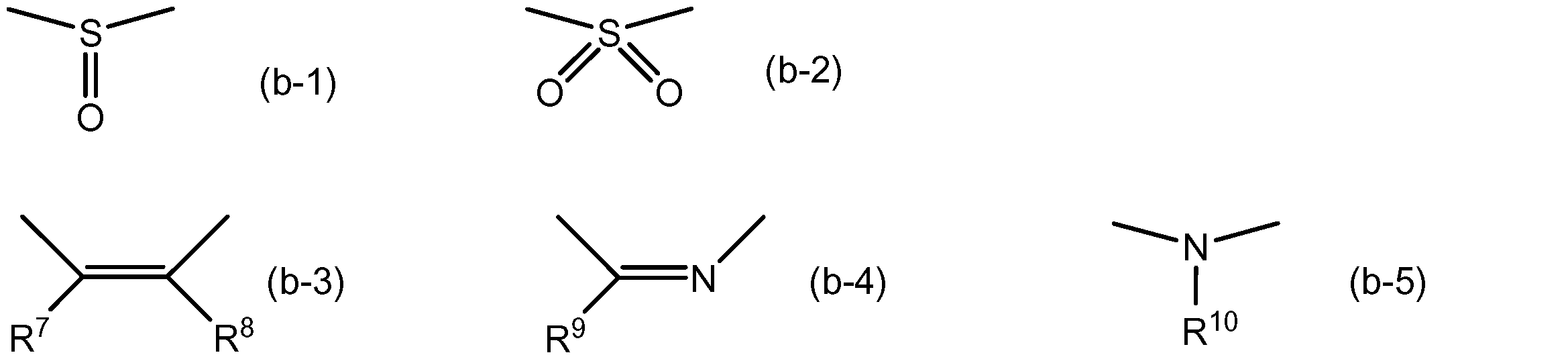
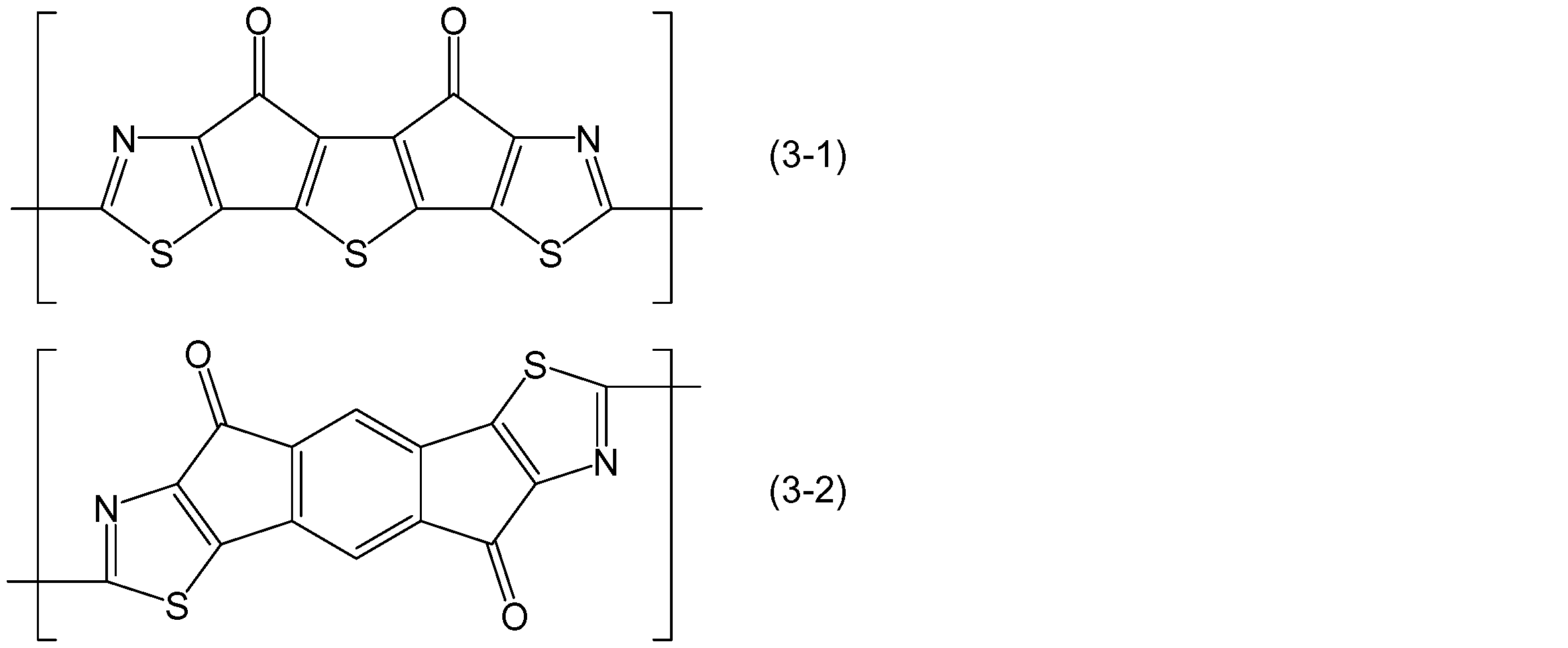


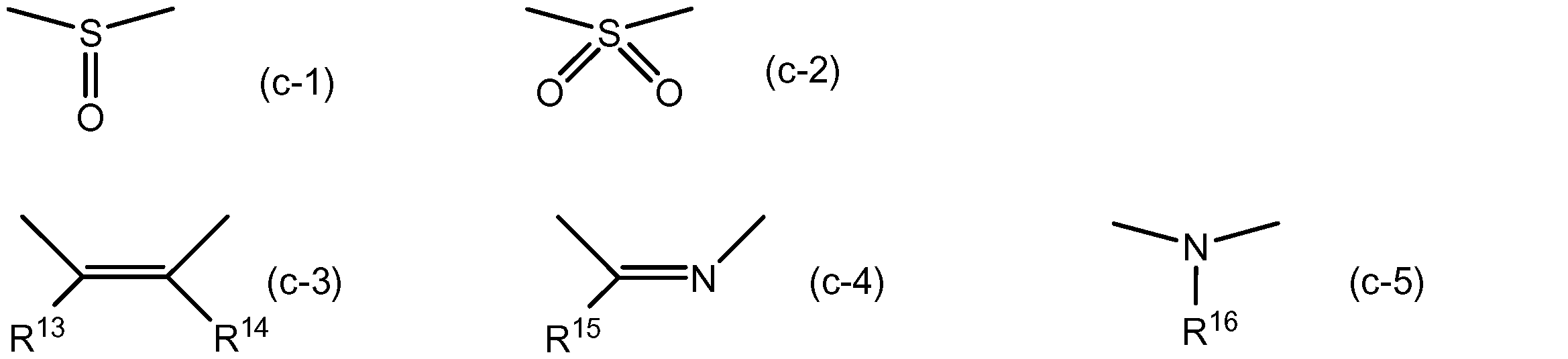
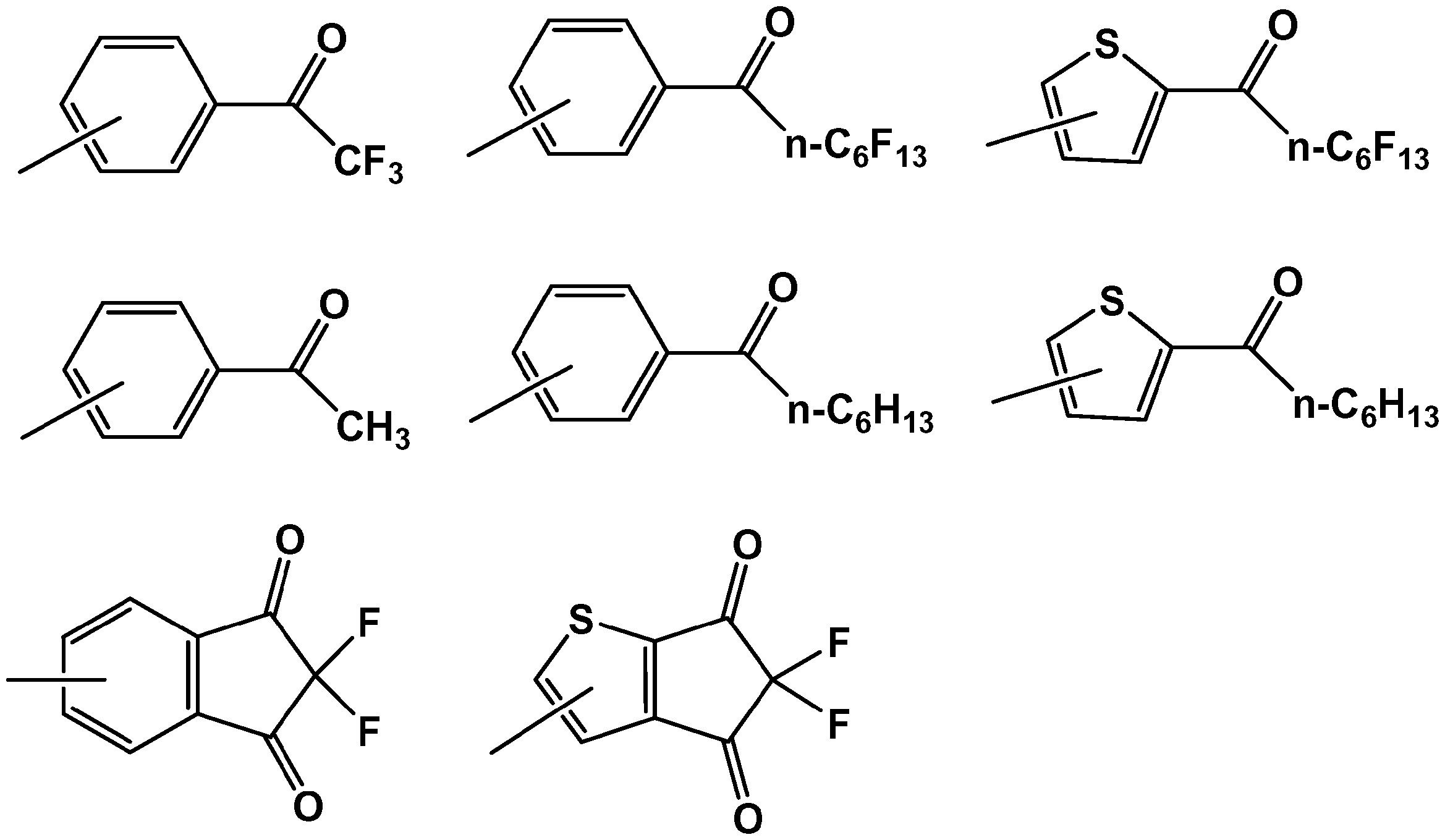

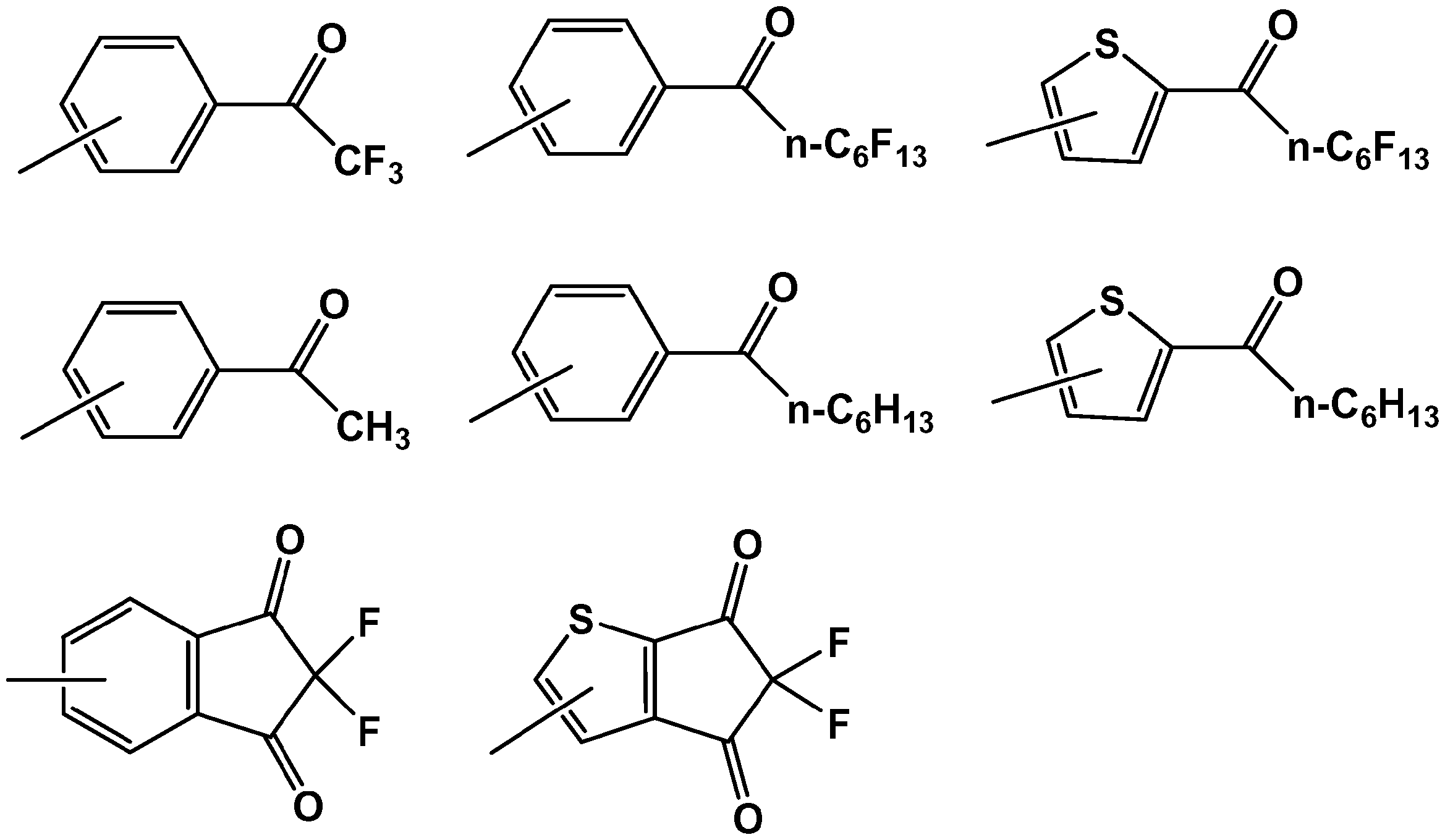

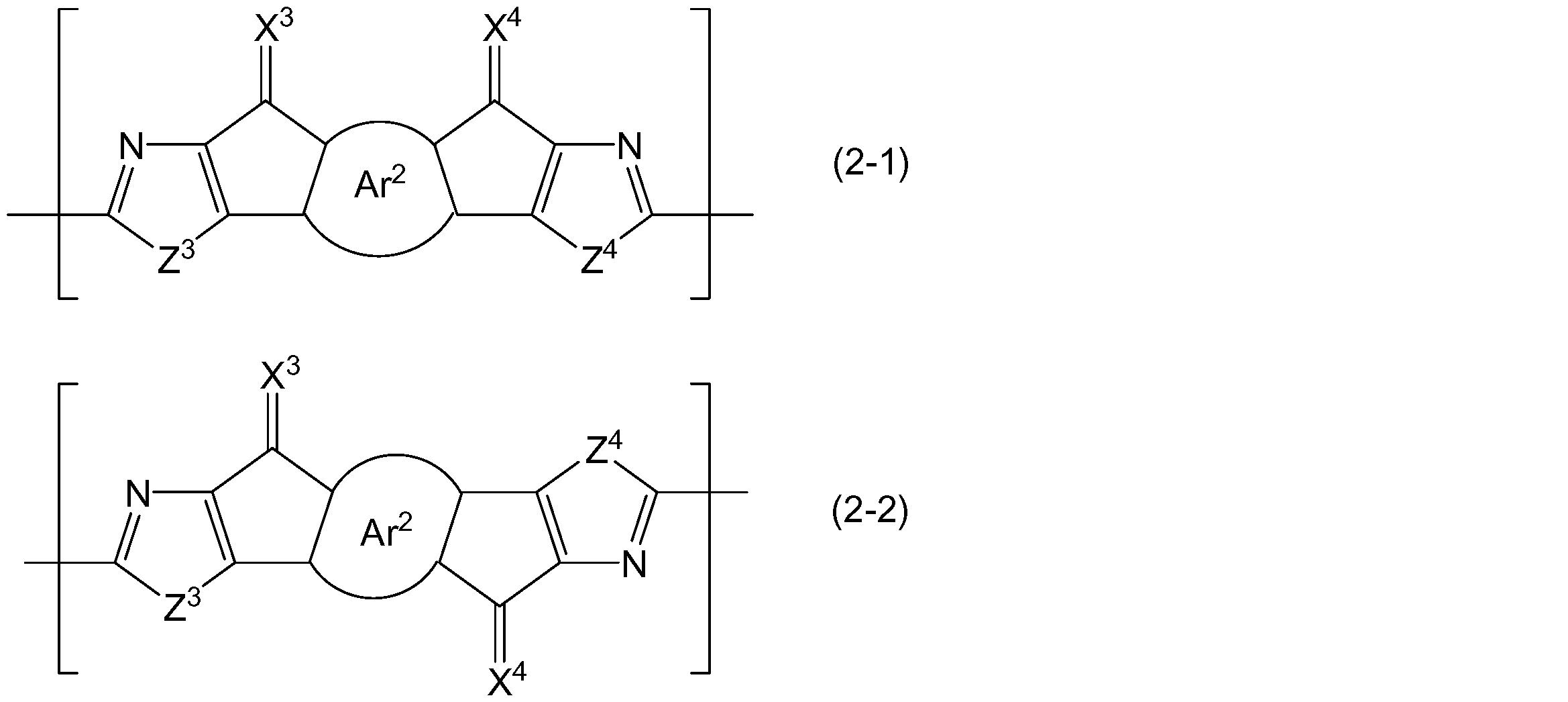
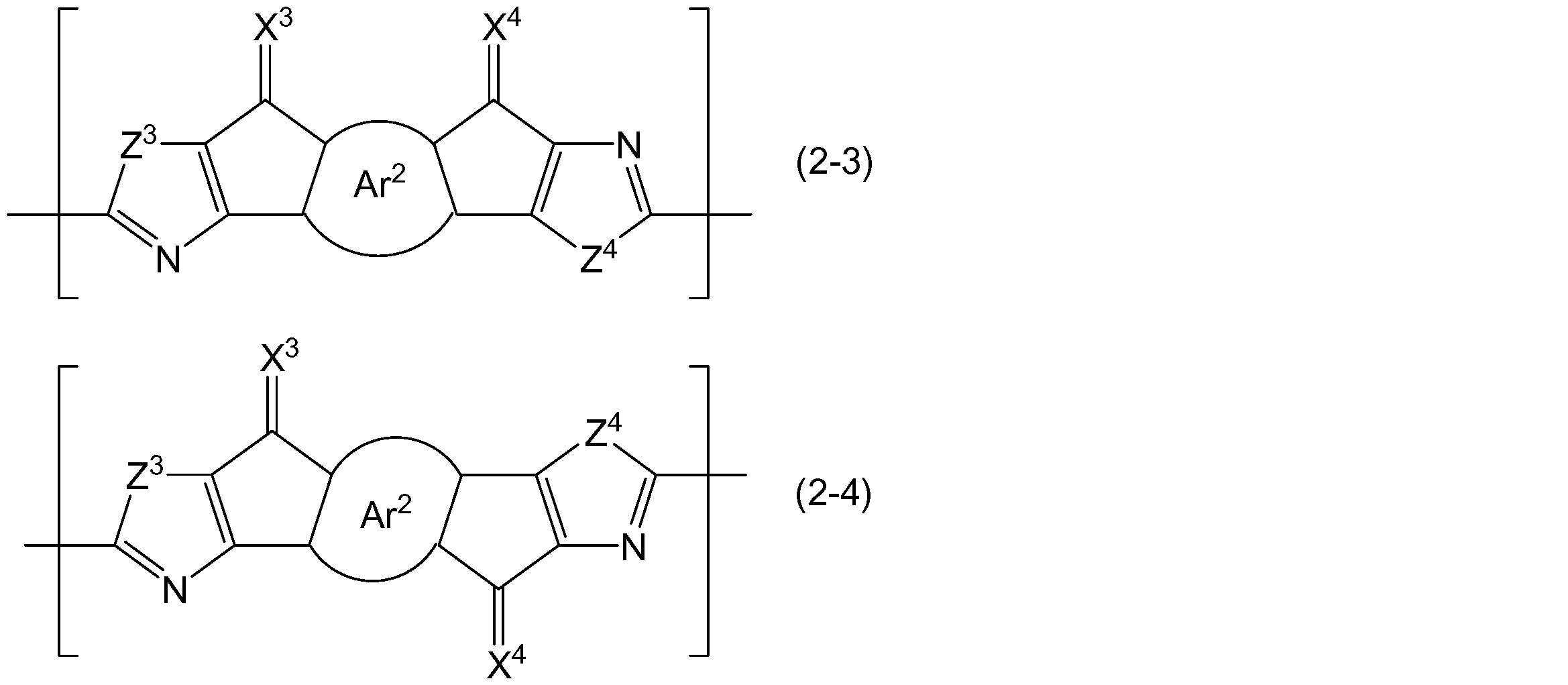
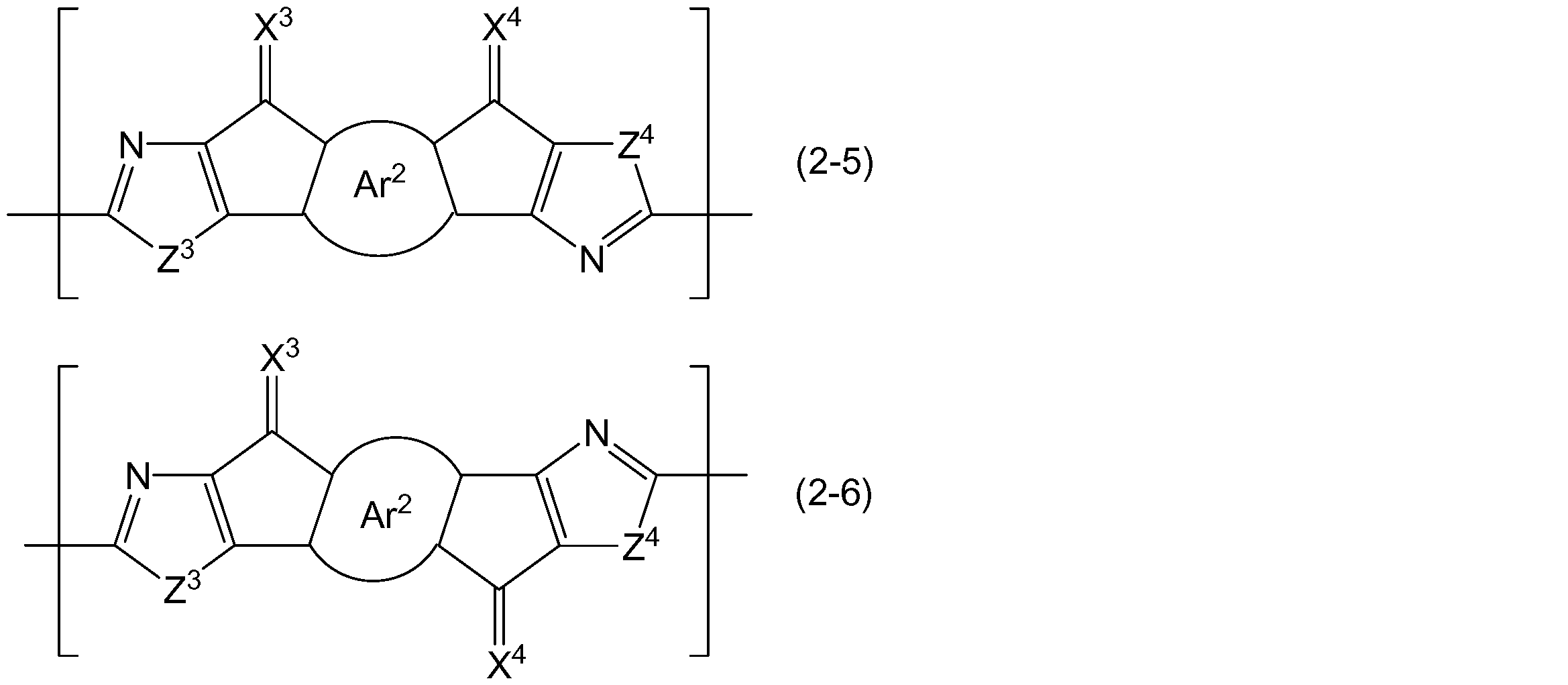


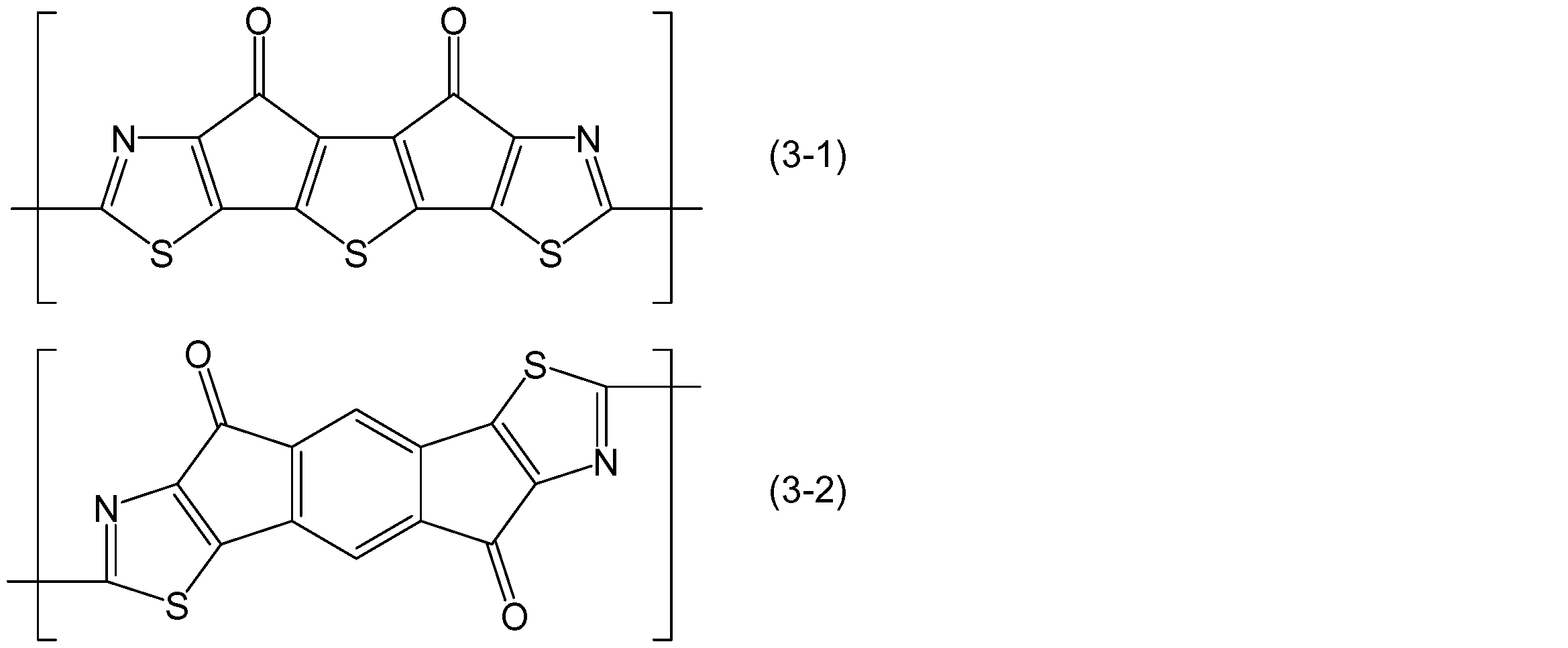
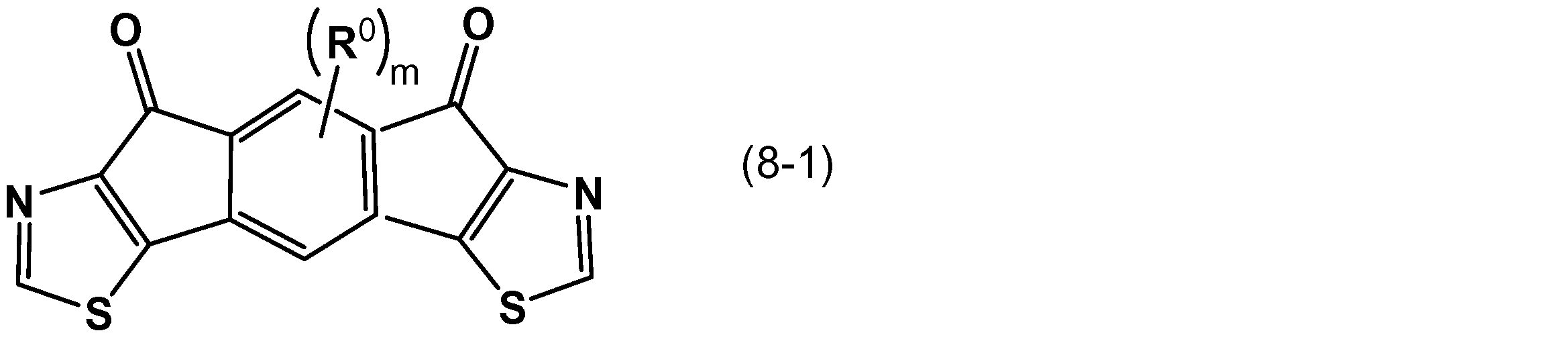


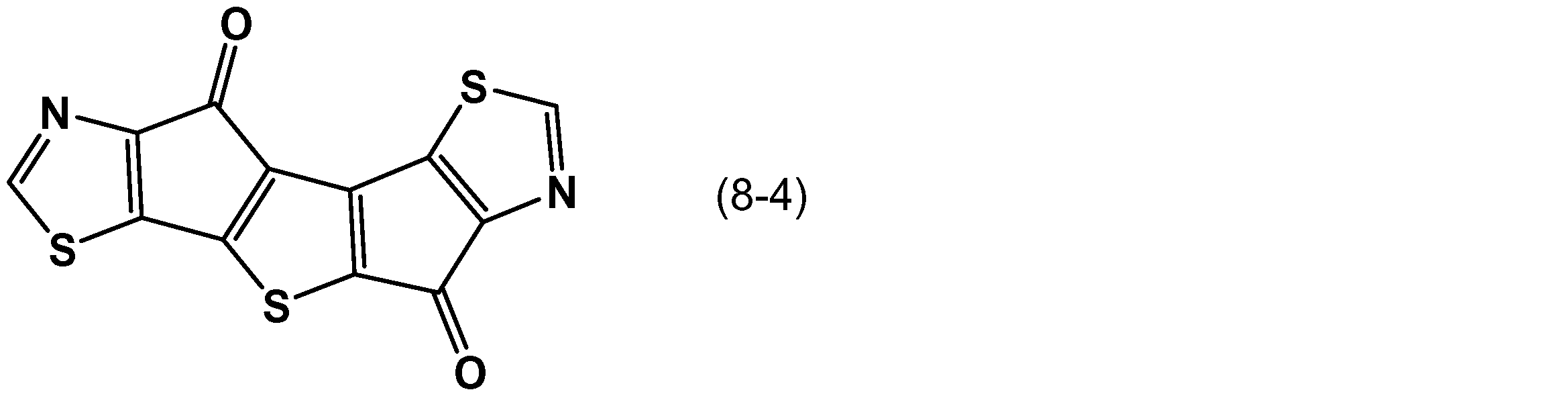

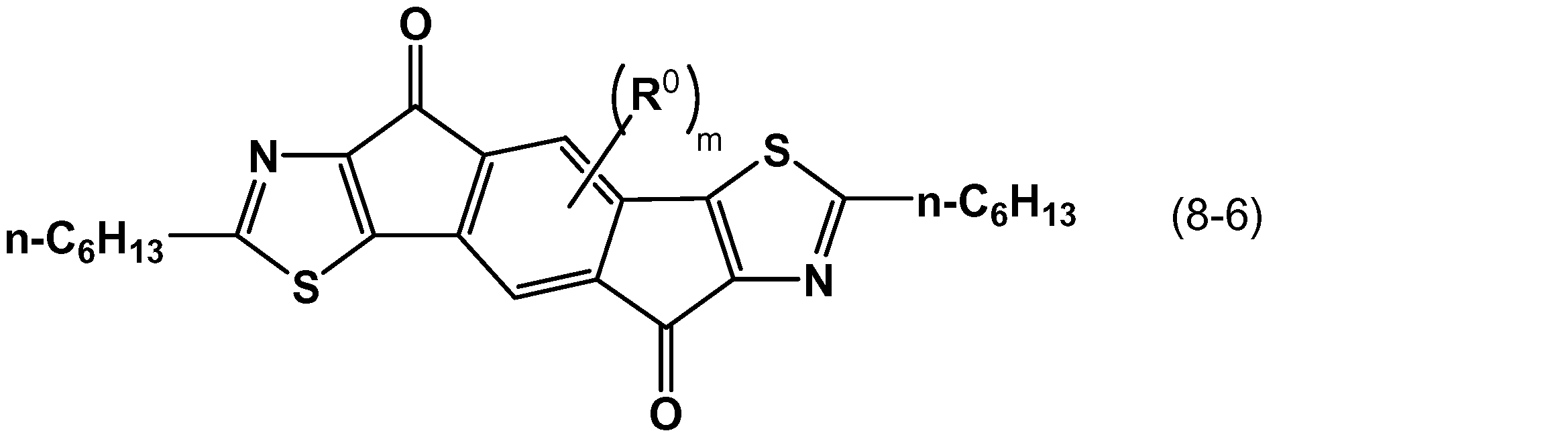


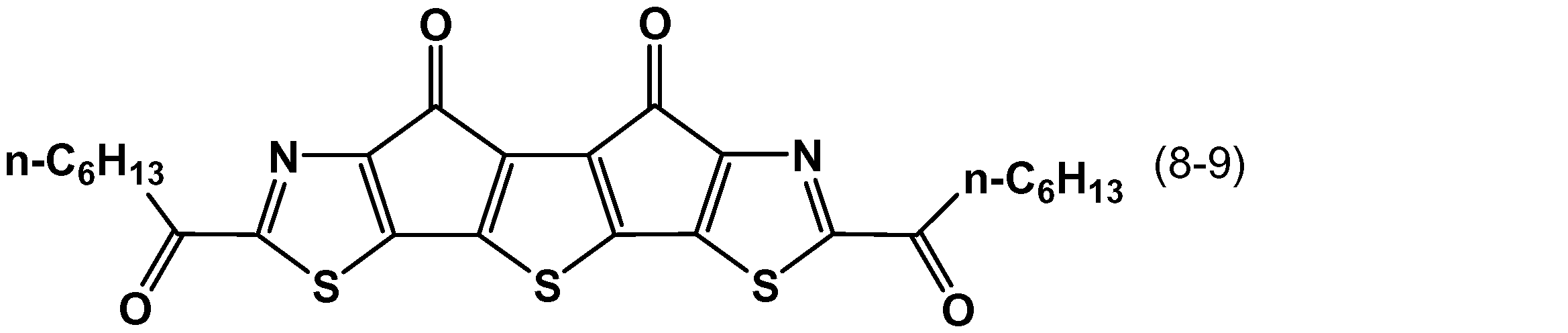
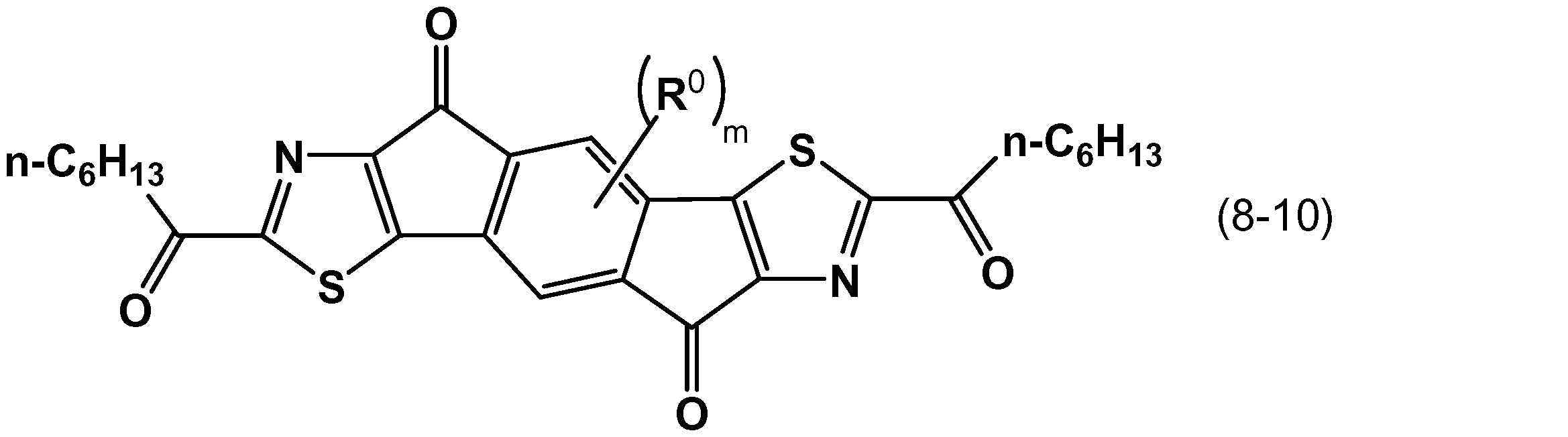


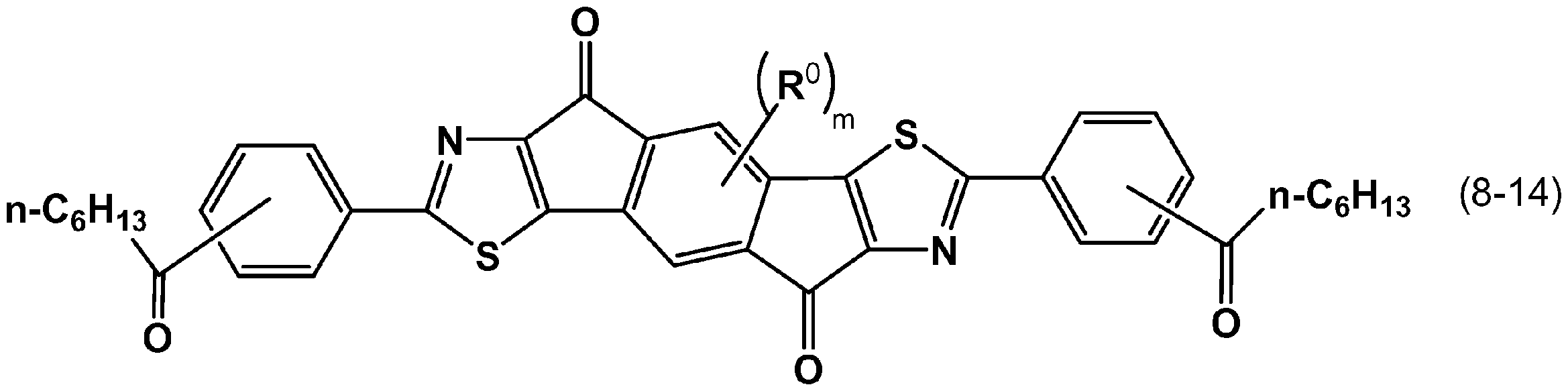
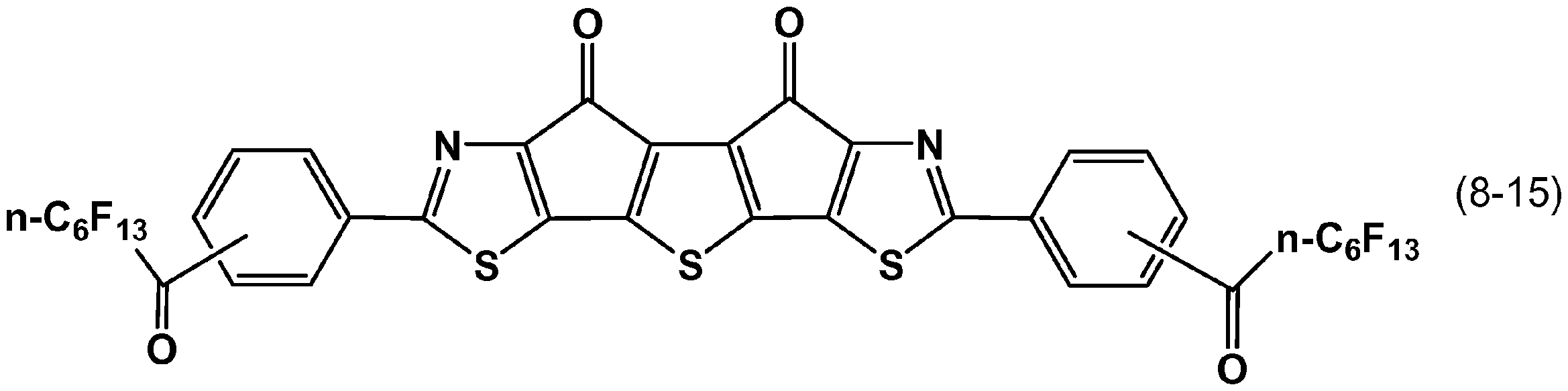


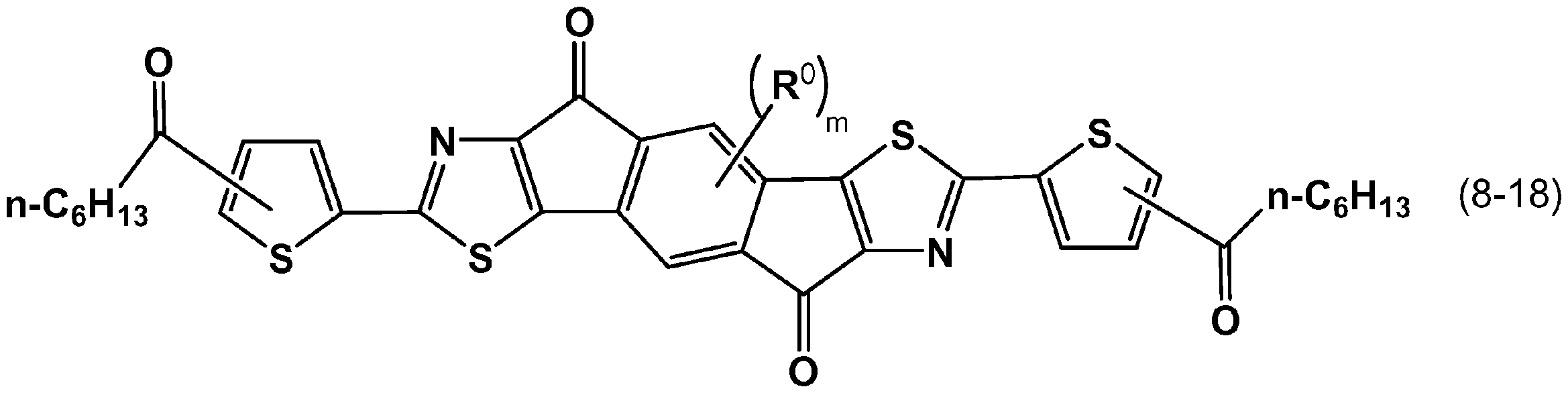


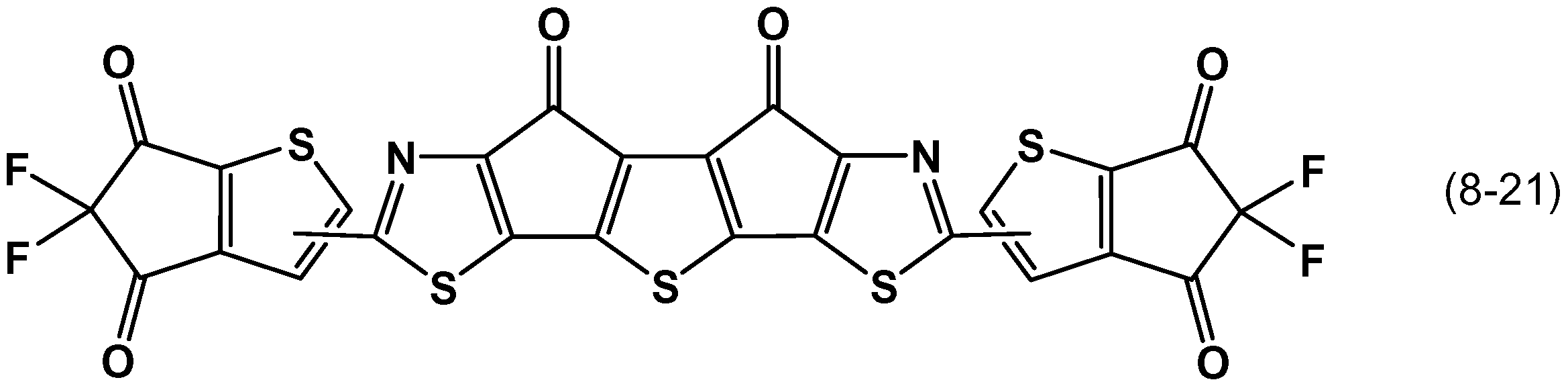

本実施形態に係る含窒素縮合環重合体は、式(1-1)で表される構造単位(以下、場合により「第一構造単位」と称する。)及び式(1-2)で表される構造単位(以下、場合により「第二構造単位」と称する。)からなる群より選ばれる構造単位を複数有する。含窒素縮合環重合体が第一構造単位を複数有するとき、複数の第一構造単位は互いに同一でも異なっていてもよい。また、含窒素縮合環重合体が第二構造単位を複数有するとき、複数の第二構造単位は互いに同一でも異なっていてもよい。なお、含窒素縮合環重合体における式(1-1)、(1-2)で表される構造単位としては、上述した含窒素縮合環化合物における式(1-1)、(1-2)で表される構造単位と同じ構造単位が例示できる。
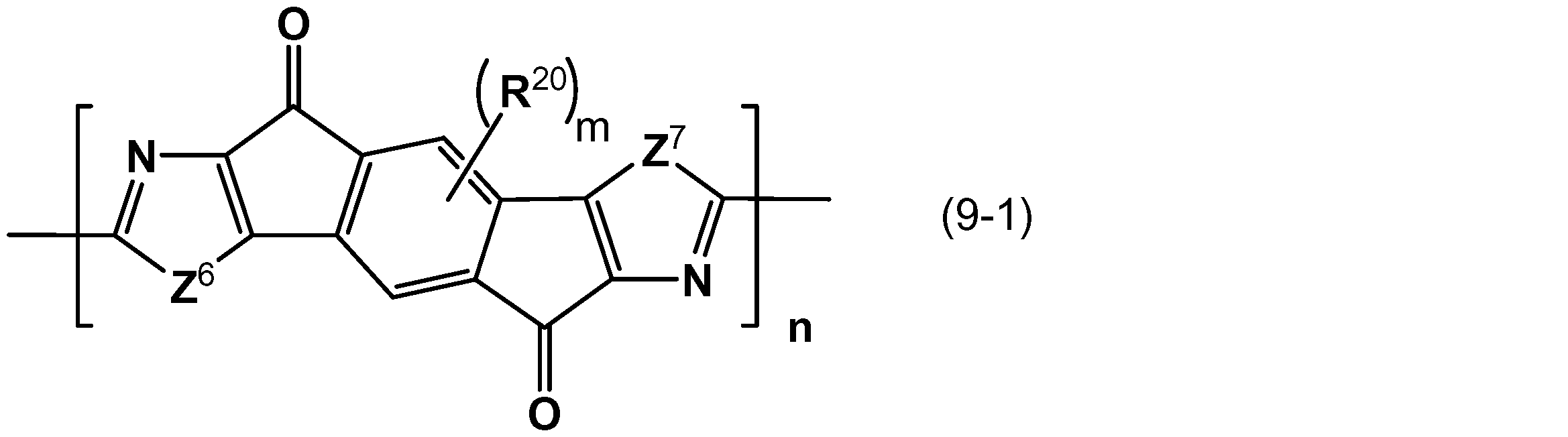
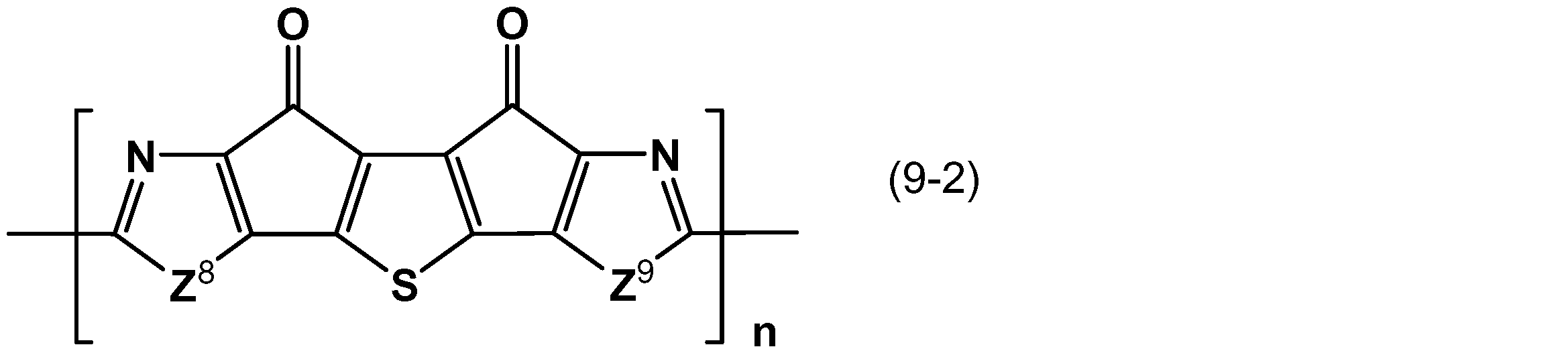


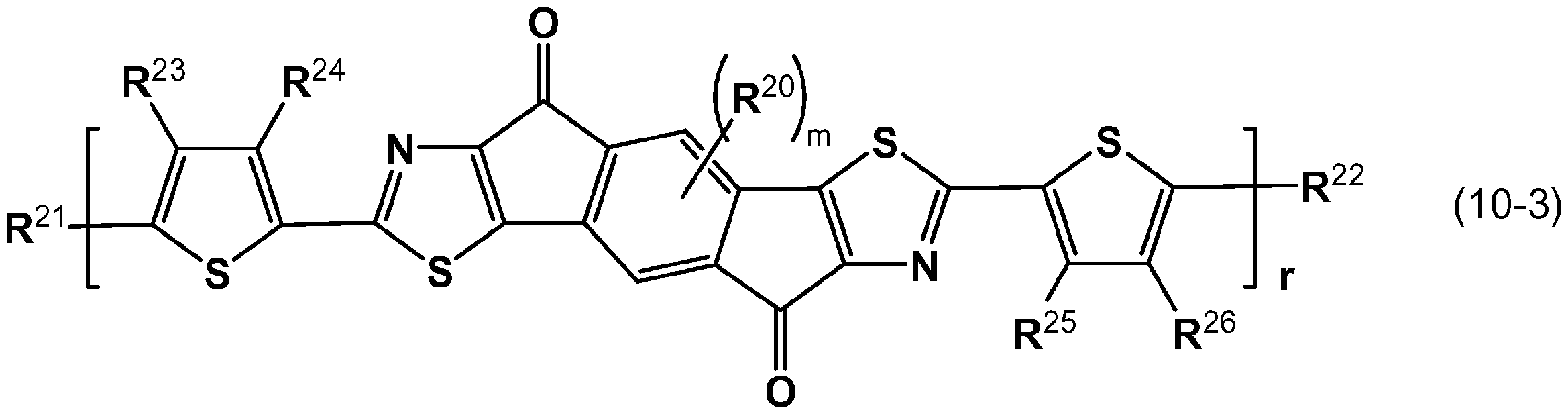


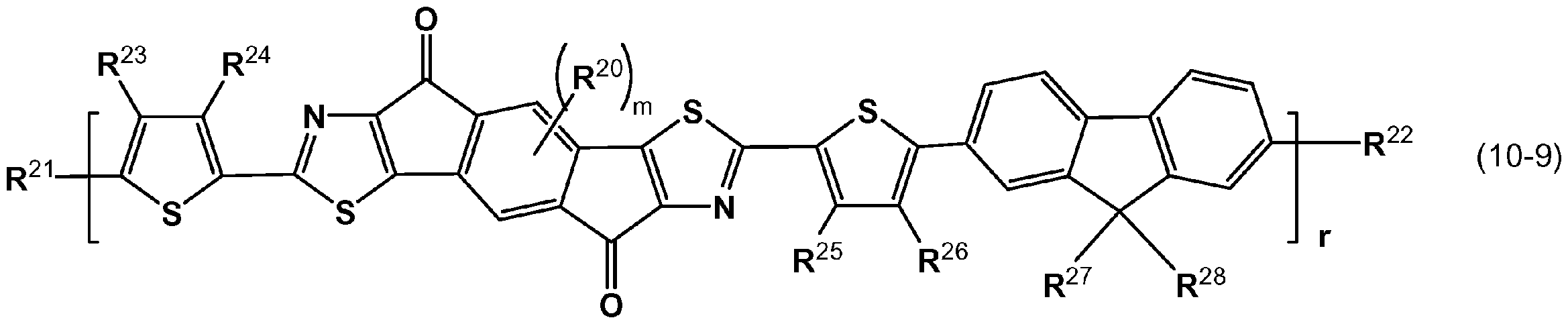
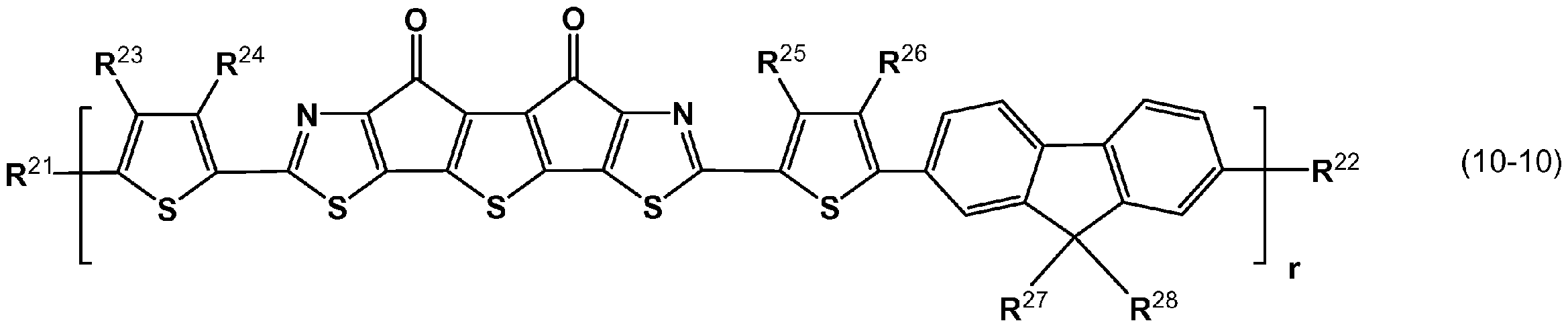
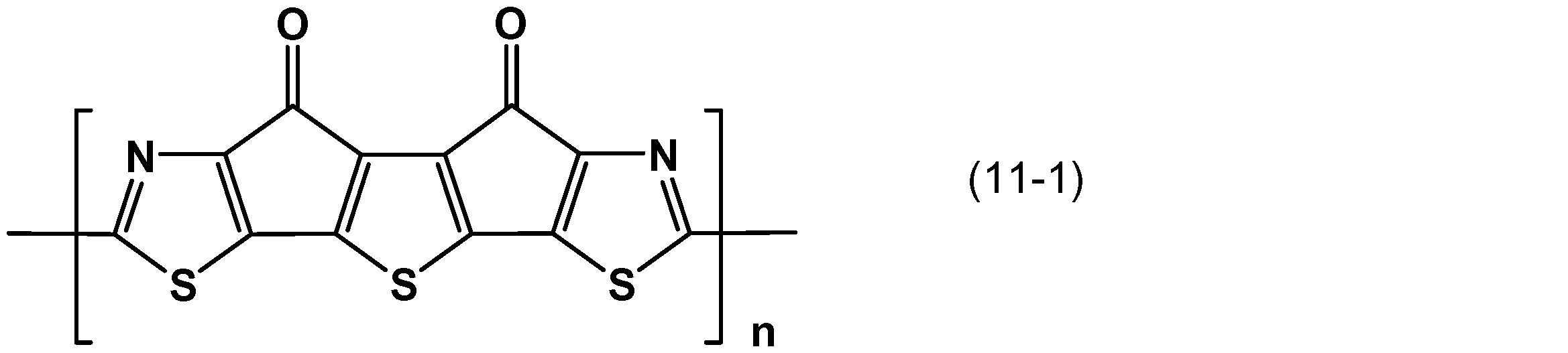
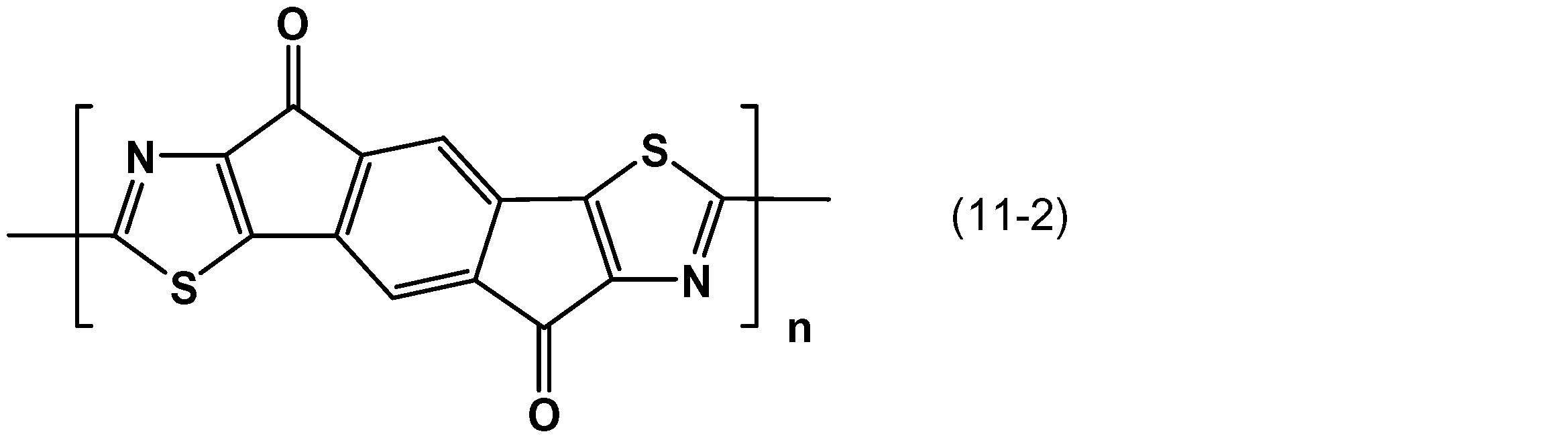
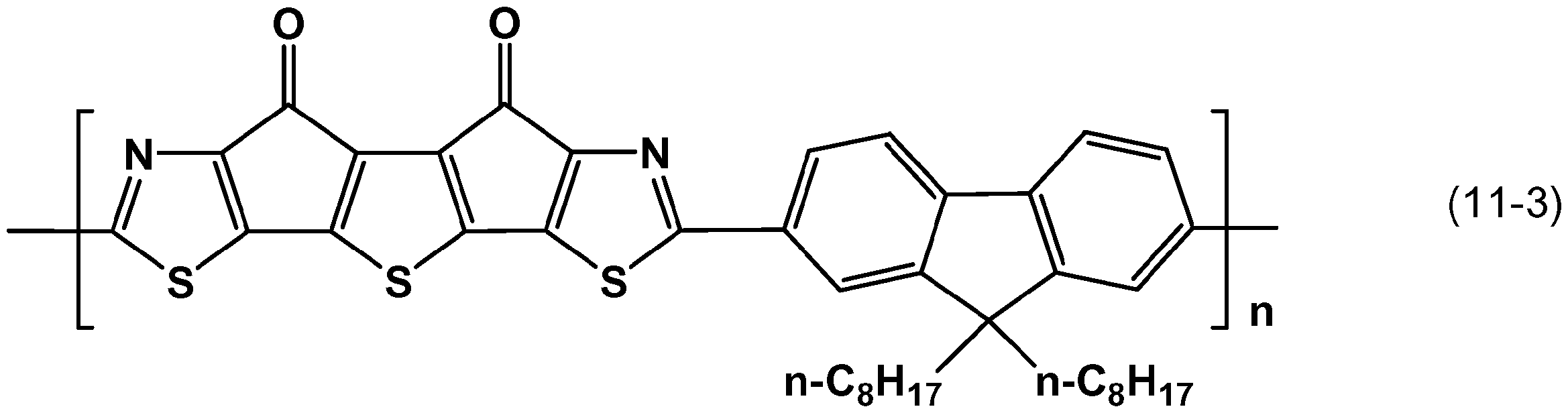

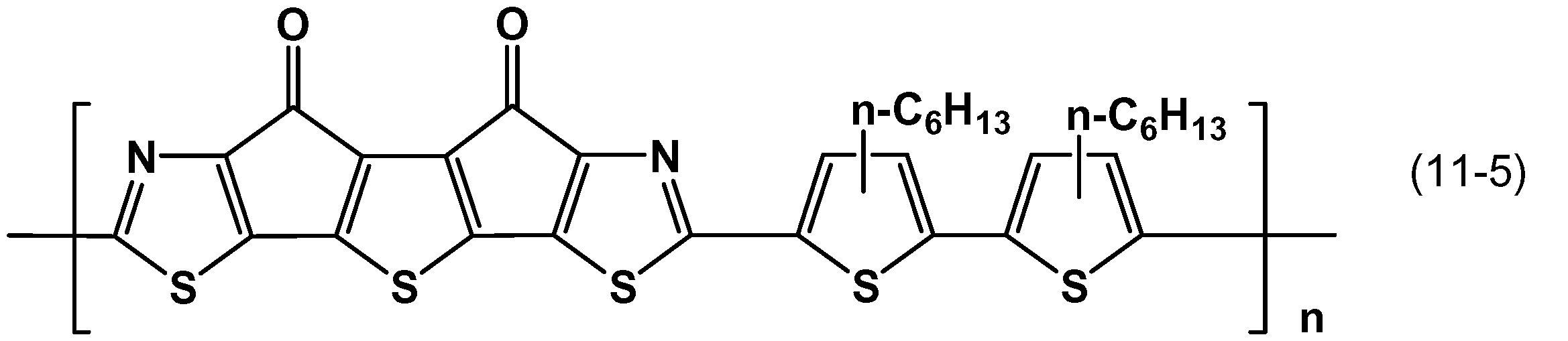
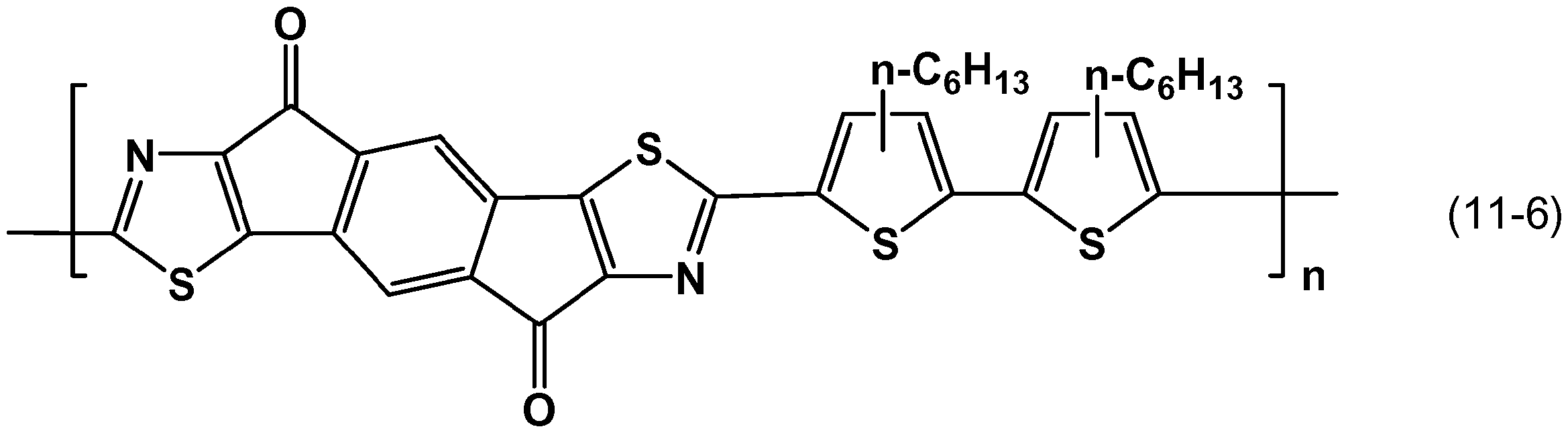

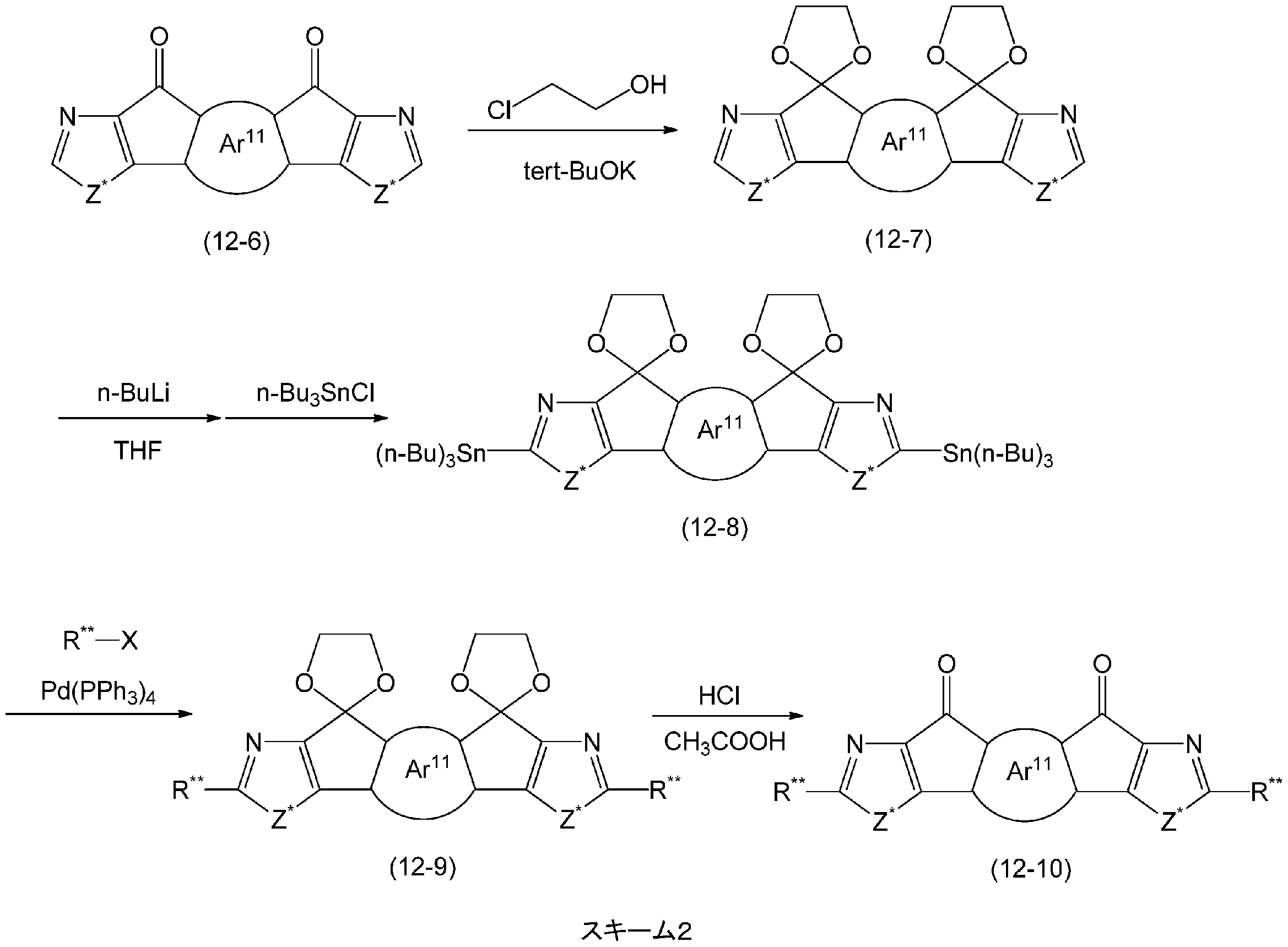
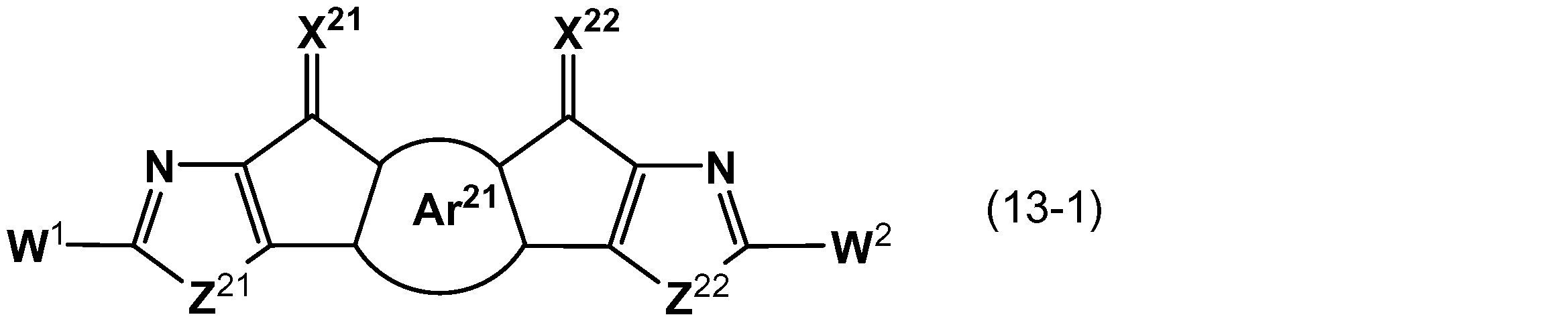



上述した本実施形態に係る有機薄膜は、本実施形態に係る含窒素化合物を含むことから、優れた電荷(電子又はホール)輸送性を有するものとなる。したがって、この有機薄膜は、電極等から注入された電子又はホール、或いは、光吸収により発生した電荷等を効率よく輸送できるものであり、有機薄膜を用いた各種の電気素子(有機薄膜素子)に応用することができる。また、本実施形態に係る含窒素化合物は、環境安定性に優れているため、これらを用いて薄膜を形成することで、通常の大気中においても性能が安定している有機薄膜素子が製造可能となる。以下、有機薄膜素子の例についてそれぞれ説明する。
まず、好適な実施形態に係る有機薄膜トランジスタについて説明する。有機薄膜トランジスタは、ソース電極及びドレイン電極、これらの間の電流経路となり本実施形態に係る含窒素化合物を含む活性層(即ち、有機薄膜層)、電流経路を通る電流量を制御するゲート電極を備えた構造であればよく、電界効果型、静電誘導型が例示される。
核磁気共鳴(NMR)スペクトルは、JEOL(日本電子株式会社)製の商品名JMN-270(1H測定時270MHz)を用いて測定した。ケミカルシフトは百万分率(ppm)で表している。内部標準0ppmには、テトラメチルシラン(TMS)を用いた。結合定数(J)は、ヘルツで示しており、略号s、d、t、q、m及びbrは、それぞれ、一重線(singlet)、二重線(doublet)、三重線(triplet)、四重線(quartet)、多重線(multiplet)及び広幅線(broad)を表す。また、質量分析(MS)は、株式会社島津製作所製のGCMS-QP5050A(商品名)を用い、電子イオン化(EI)法、直接試料導入(DI)法により測定した。カラムクロマトグラフィー分離におけるシリカゲルは、関東化学株式会社製の商品名Silicagel 60N(40~50μm)を用いた。全ての化学物質は、試薬級であり、和光純薬工業株式会社、東京化成工業株式会社、関東化学株式会社、ナカライテスク株式会社、シグマアルドリッチジャパン株式会社、又はダイキン化成品株式会社より購入した。マイクロウェーブ照射下での反応は、Biotage AB社製のInitiatorTM Ver.2.5を用い、出力400W、2.45GHzで行った。
<化合物Aの合成>
ナスフラスコに2,5-ジブロモチオフェン-3,4-ジカルボン酸(100mg,0.303mmol)、触媒量のDMF、過剰量の塩化チオニルを入れ、1時間還流させた。反応後、塩化チオニルを真空留去した。次にこれを0℃に冷却した後、トリエチルアミン(0.25mL,1.818mmol)を加え、更にピペリジン(0.18mL,1.818mmol)を滴下した。滴下後、室温で撹拌した。3時間後、水を加えクロロホルムで抽出した。有機層を硫酸マグネシウムで乾燥させ減圧濃縮した。シリカゲルカラムクロマトグラフィー(ヘキサン/酢酸エチル=1/1(容積比))で精製を行い、赤みを帯びたパウダーの化合物A(61mg,収率43%)を得た。得られた化合物Aの分析結果及び化学式は以下の通りである。
TLC Rf=0.33(ヘキサン/酢酸エチル=1/1(容積比))
GC-MS(DI):m/z=464(M+).

加熱乾燥した蓋付き試験管に化合物A(61mg,0.131mmol)、2-トリイソプロピルシリル-5-トリブチルスズ-チアゾール(153mg,0.288mmol)、テトラキス(トリフェニルホスフィン)パラジウム(0)(15mg,0.013mmol)、トルエン(2mL)を入れ、試験管内の気体を窒素で置換した後、8時間還流させた。反応溶液をセライト濾過後、減圧濃縮し、シリカゲルカラムクロマトグラフィー(ヘキサン/酢酸エチル=2/1(容積比))で精製を行い、黄色液体の化合物B(93mg,収率79%)を得た。得られた化合物Bの分析結果及び化学式は以下の通りである。
TLC Rf=0.32(ヘキサン/酢酸エチル=2/1(容積比))
1H NMR(400 MHz,CDCl3):δ8.20(s,2H)
GC-MS(DI):m/z=785(M+).

加熱乾燥したナスフラスコに化合物B(93mg,0.118mmol)、THF(2mL)を入れた。ナスフラスコ内の気体を窒素で置換し、-78℃に冷却した後、リチウムジイソプロピルアミド(1M,2.6mL,1.43mmol)を加え反応させた。1時間後、-78℃で水を加え室温まで昇温させ、クロロホルムで抽出した。有機層を硫酸マグネシウムで乾燥させ減圧濃縮した。シリカゲルカラムクロマトグラフィー(ヘキサン/酢酸エチル=10/1(容積比))で精製を行い、紫色固体の化合物C(1mg,収率1.3%)を得た。得られた化合物Cは、クロロホルム、酢酸エチル、THFに可溶であった。得られた化合物Cの分析結果及び化学式は以下の通りである。
TLC Rf=0.27(ヘキサン/酢酸エチル=8/1(容積比))
1H NMR(400MHz,CDCl3):δ1.46(m,6H),1.15(d,36H)
GC-MS(DI):m/z=614(M+)

加熱乾燥したナスフラスコに化合物C、THFを入れる。ナスフラスコ内の気体を窒素で置換し、-78℃に冷却した後、リチウムジイソプロピルアミドを加え反応させる。1時間後、-78℃で水を加え室温まで昇温させ、クロロホルムで抽出する。有機層を硫酸マグネシウムで乾燥させ減圧濃縮した後、シリカゲルカラムクロマトグラフィーで精製することにより、化合物C’を得る。

<化合物Dの合成>
ナスフラスコに1,4-ジブロモ-2,5-ベンゼンジカルボン酸(10g,30.87mmol)、触媒量のDMF、過剰量の塩化チオニルを入れ、該ナスフラスコ内の気体を窒素で置換し、1時間還流させた。反応後、塩化チオニルを真空留去した。次にこれを0℃に冷却した後、トリエチルアミン(25.89mL,185.2mmol)を加え、更にピペリジン(18.36mL,185.2mmol)を滴下した。滴下後、室温で撹拌した。2時間後、水を加えジクロロメタンで抽出した。有機層を硫酸マグネシウムで乾燥させ減圧濃縮した。生じた固体をメタノールで洗浄し、白色固体の化合物D(11.76g,収率83%)を得た。得られた化合物Dの分析結果及び化学式は以下の通りである。
1H NMR(400MHz,CDCl3):δ7.44(s,2H)
GC-MS(DI):m/z=457(M+).
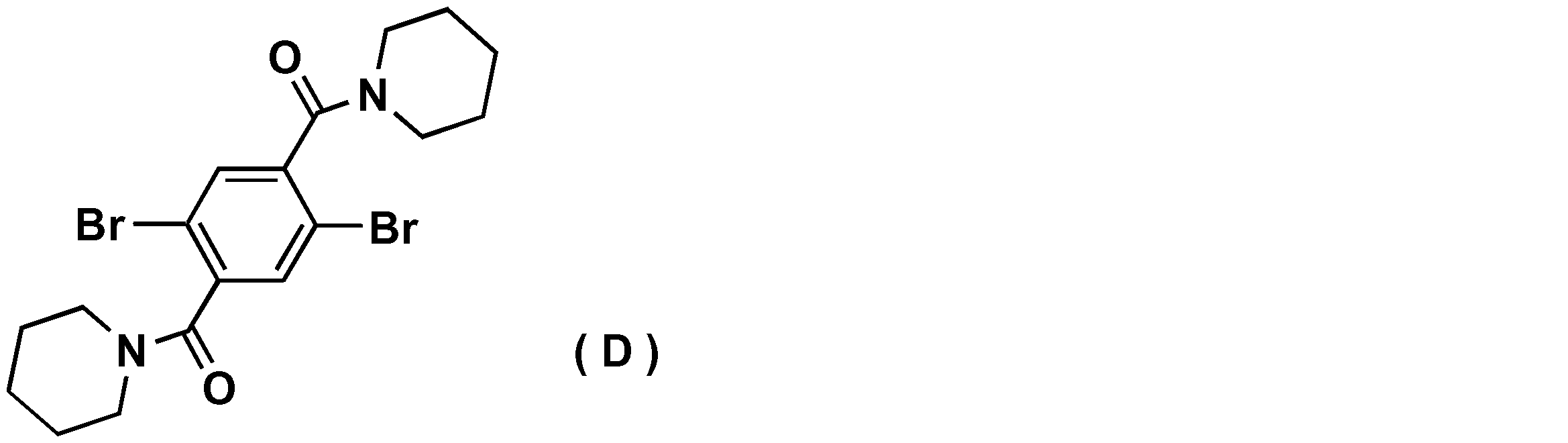
加熱乾燥した蓋付き試験管に化合物D(2g,4.37mmol)、2-トリイソプロピルシリル-5-トリブチルスズ-チアゾール(5.10g,9.60mmol)、テトラキス(トリフェニルホスフィン)パラジウム(0)(505mg,0.44mmol)、トルエン(20mL)を入れた後、試験管内の気体を窒素で置換し、10時間還流させた。反応溶液をセライト濾過後、減圧濃縮し、生じた固体をメタノールで洗浄することにより、白色固体の化合物E(2.65mg,収率78%)を得た。得られた化合物Eの分析結果及び化学式は以下の通りである。
1H NMR(400MHz,CDCl3):δ8.28(s,2H),7.52(s,2H)

加熱乾燥したナスフラスコに化合物E(500mg,0.642mmol)、THF(45mL)を入れた。ナスフラスコ内の気体を窒素で置換し、-78℃に冷却した後、リチウムジイソプロピルアミド(1M,14mL,7.77mmol)を加え反応させた。1時間後、-78℃で水を加え室温まで昇温させ、クロロホルムで抽出した。有機層を硫酸マグネシウムで乾燥させ減圧濃縮した。シリカゲルカラムクロマトグラフィー(ヘキサン/クロロホルム=2.5/1(容積比))で精製を行い、紫色固体の化合物F(343mg,収率88%)を得た。得られた化合物Fは、クロロホルム、酢酸エチル、THFに可溶であった。得られた化合物Fの分析結果及び化学式は以下の通りである。
TLC Rf=0.29(ヘキサン/クロロホルム=2.5/1(容積比))
GC-MS(DI):m/z= 609(M+).
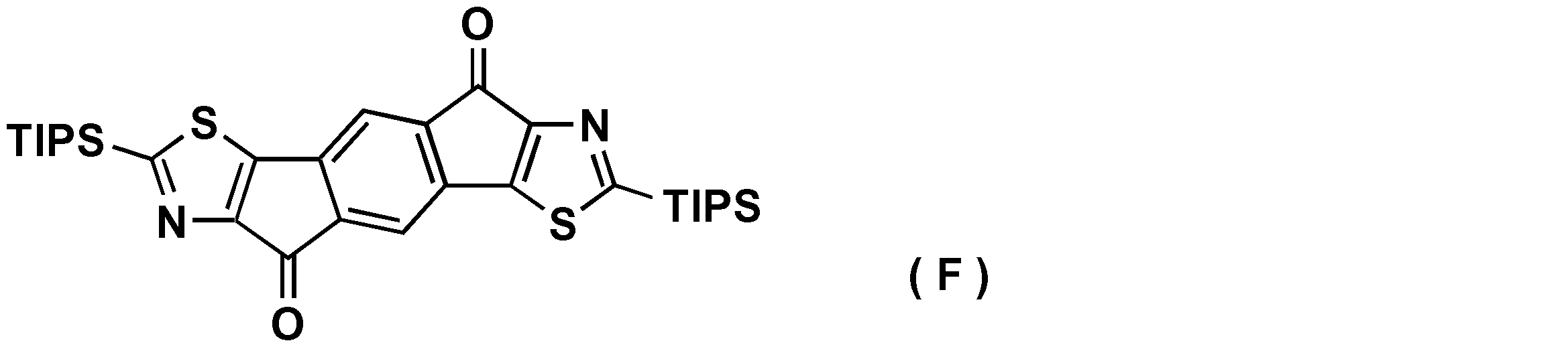
加熱乾燥したナスフラスコに化合物F(207mg,0.340mmol)、THF(5mL)を入れた。該ナスフラスコ内の気体を窒素で置換した後、0℃に冷却し、フッ化テトラブチルアンモニウムのTHF溶液(1.0M,0.850mL,0.850mmol)を加え反応させながら室温まで昇温させた。12時間後、水を加えクロロホルムで抽出し、有機層に懸濁している緑色固体を濾取した。これを真空乾燥し昇華精製することにより、緑色固体の化合物G(74mg,収率74%)を得た。得られた化合物Gの分析結果及び化学式は以下の通りである。
GC-MS(DI):m/z=296(M+).
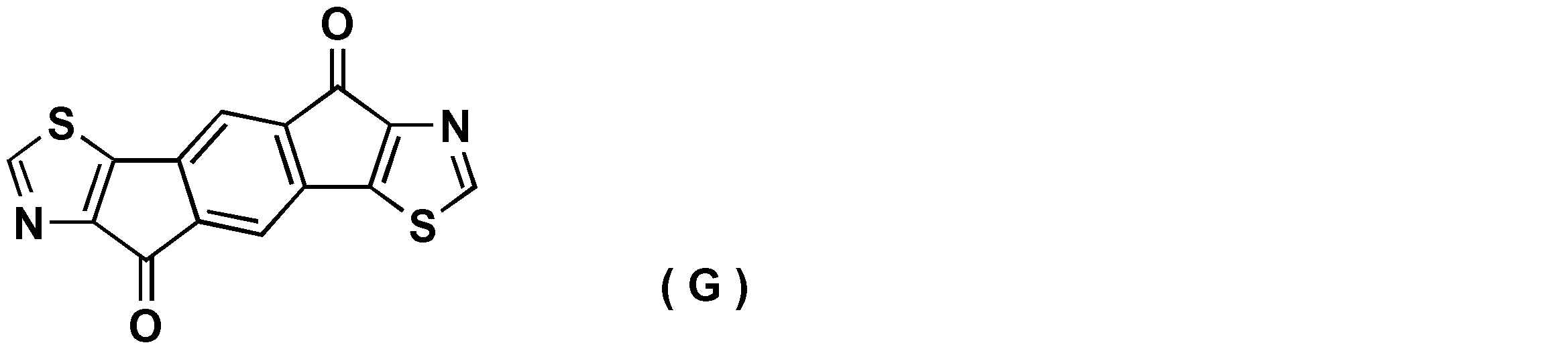
<化合物Hの合成>
加熱乾燥したナスフラスコにチアゾール(1g,11.75mmol)、THF(60mL)を入れた。-78℃に冷却し、n-ブチルリチウム(8.8mL,14.1mmol)を加え反応させた。30分後、1-ヨードヘキサン(2.74g,12.93mmol)を加え、30分後、室温まで昇温させた。1時間後、水を加え酢酸エチルで抽出し、有機層を硫酸マグネシウム上で乾燥させ減圧濃縮した。シリカゲルカラムクロマトグラフィー(ヘキサン/酢酸エチル=10/1(容積比))で精製を行い、褐色透明の化合物H(700mg,収率35%)を得た。得られた化合物Hの分析結果及び化学式は以下の通りである。
TLC Rf=0.23(ヘキサン/酢酸エチル=10/1(容積比))
1H NMR(400MHz,CDCl3):δ 7.66(d,1H),7.18(d,1H),3.02(t,2H),1.80(m,2H),1.24-1.46(m,6H),0.89(t,3H)

加熱乾燥したナスフラスコに化合物H(500mg,2.95mmol)、THF(3mL)を入れた。-78℃に冷却し、n-ブチルリチウム(1.9mL,3.10mmol)を加え反応させた。30分後、塩化トリブチルスズ(0.84mL,3.10mmol)を加え、30分後、室温まで昇温させた。1時間後、水を加え酢酸エチルで抽出し、有機層を硫酸マグネシウム上で乾燥させ減圧濃縮した。アルミナカラムクロマトグラフィー(ヘキサン)で精製を行い、黄色透明な化合物I(1.15g,収率85%)を得た。得られた化合物Iの分析結果及び化学式は以下の通りである。
1H NMR(400MHz,CDCl3):δ 7.58(s,1H),3.06(t,2H),1.81(m,2H),0.90(m,12H)

加熱乾燥した蓋付き試験管に化合物D(100mg,0.22mmol)、化合物I(220mg,0.48mmol)、テトラキス(トリフェニルホスフィン)パラジウム(0)(25mg,0.022mmol)、トルエン(2mL)を入れた後、該試験管内の気体を窒素で置換し、10時間還流させた。セライト濾過後、減圧濃縮し、シリカゲルカラムクロマトグラフィー(ヘキサン/酢酸エチル=1/3(容積比))で精製を行い、化合物J(113mg,収率82%)を得た。得られた化合物Jの分析結果及び化学式は以下の通りである。
TLC Rf=0.43(ヘキサン/酢酸エチル=1:3)
1H NMR(400MHz,CDCl3):δ 7.80(s,1H),7.45(s,1H)
GC-MS(DI):m/z=635(M+).
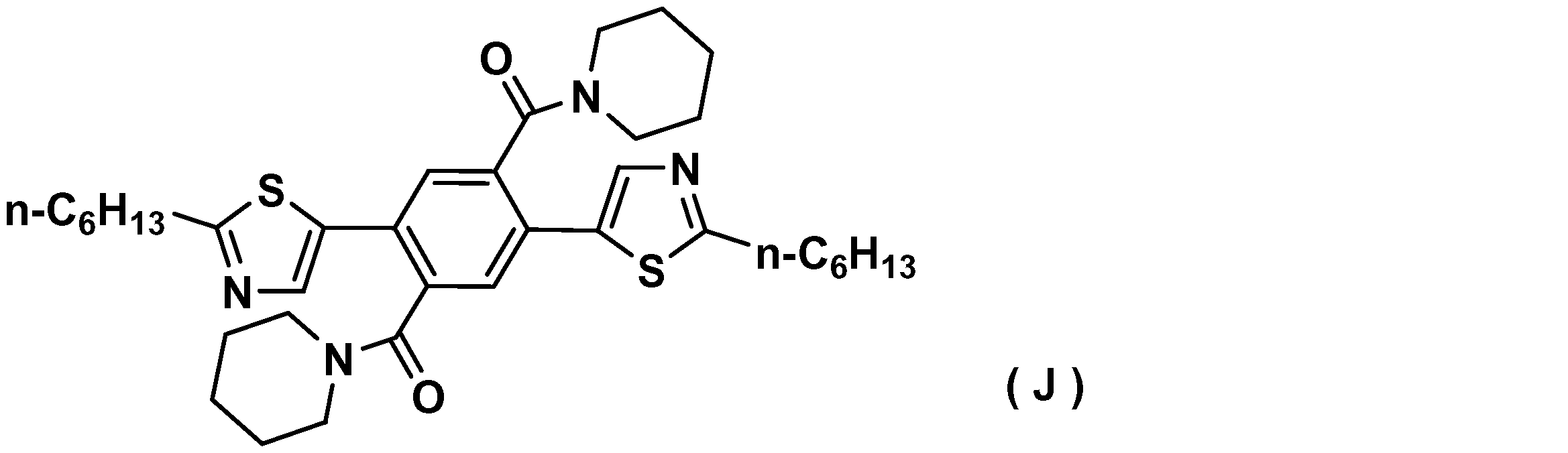
加熱乾燥したナスフラスコに化合物J、THFを入れる。ナスフラスコ内の気体を窒素で置換し、-78℃に冷却した後、リチウムジイソプロピルアミドを加え反応させる。1時間後、-78℃で水を加え室温まで昇温させ、クロロホルムで抽出する。有機層を硫酸マグネシウムで乾燥させ減圧濃縮する。シリカゲルカラムクロマトグラフィーで精製を行い、化合物Kを得る。
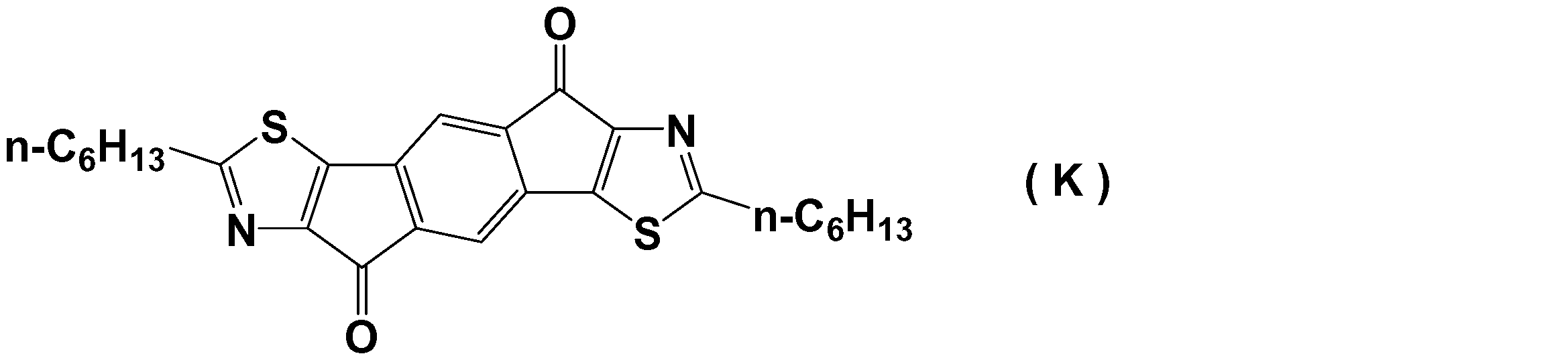
<化合物Lの合成>
加熱乾燥したナスフラスコに化合物F(47mg,0.077mmol)、2,2-ジブチル-1,3-プロパンジオール(58mg,0.031mmol)、p-トルエンスルホン酸(133mg,0.77mmol)、ベンゼン(30mL)を入れ、該ナスフラスコ内の気体を窒素で置換し、8時間還流させた。セライト濾過後、減圧濃縮し、シリカゲルカラムクロマトグラフィー(ヘキサン/酢酸エチル=20/1(容積比))で精製を行い、化合物L(42mg,0.066mmol)を得た。得られた化合物Lの分析結果及び化学式は以下の通りである。
1H NMR(400MHz,CDCl3):δ8.68(s,2H),7.46(s,2H),4.60(s,2H),4.57(s,2H),3.82(s,2H),3.79(s,2H).

加熱乾燥したナスフラスコに化合物L(237mg,0.37mmol)、THF(5mL)を入れた。該ナスフラスコ内の気体を窒素で置換し、-78℃に冷却した後、n-ブチルリチウム(0.71mL,1.12mmol)を加え反応させた。1時間後、-78℃で塩化トリブチルスズ(0.33mL,1.23mmol)を加え室温まで昇温させた。1時間後、水を加え酢酸エチルで抽出した。有機層を硫酸マグネシウムで乾燥させ減圧濃縮した。アルミナカラム(ヘキサン/重クロロホルム=10/1(容積比))で精製を行い、化合物M(396mg,収率88%)を得た。得られた化合物Mの分析結果及び化学式は以下の通りである。
1H NMR(400MHz,CDCl3):δ7.41(s,2H),4.76(s,2H),4.73(s,2H),3.77(s,2H),3.74(s,2H).

加熱乾燥した蓋付き試験管に化合物M(322mg,0.27mmol)、4’-ブロモ-2,2,2-トリフルオロアセトフェノン(201mg,0.80mmol)、テトラキス(トリフェニルホスフィン)パラジウム(0)(31mg,0.027mmol)、トルエン(3mL)を入れた後、該試験管内の気体を窒素で置換し、13時間還流させた。セライト濾過後、減圧濃縮し、得られた固体をメタノール、ジエチルエーテルで洗浄した。ナスフラスコに得られた朱色固体、酢酸、濃塩酸を入れた後、100℃に加熱した。2時間後、室温まで降温し、水を加え生じた固体を水、メタノール、ジエチルエーテルで洗浄した。減圧下で昇華精製を行い、濃緑色固体の化合物O(77mg,収率45%)を得た。

<化合物Pの合成>
加熱乾燥したナスフラスコにチアゾール、THFを入れる。該ナスフラスコ内の気体を窒素で置換し、-78に冷却し、n-ブチルリチウムを加え反応させる。30分後、塩化ヘプタノイルを加え、30分後、室温まで昇温させる。1時間後、水を加え酢酸エチルで抽出し、有機層を硫酸マグネシウムで乾燥させ減圧濃縮する。シリカゲルカラムクロマトグラフィーで精製を行い、化合物Pを得る。

加熱乾燥したナスフラスコに化合物P、2-クロロエタノール、DMF、THFを入れる。該ナスフラスコ内の気体を窒素で置換した後、-78℃に冷却し、tert-ブトキシカリウムを加え反応させる。7時間後、10質量%の塩化アンモニウム水溶液を加え酢酸エチルで抽出する。有機層を硫酸マグネシウム上で乾燥させ減圧濃縮する。シリカゲルカラムクロマトグラフィーで精製を行い、化合物Vを得る。

加熱乾燥したナスフラスコに化合物V、THFを入れる。該ナスフラスコ内の気体を窒素で置換し、-78℃に冷却した後、n-ブチルリチウムを加え反応させる。1時間後、-78℃で塩化トリブチルスズを加え室温まで昇温させる。1時間後、水を加え酢酸エチルで抽出する。有機層を硫酸マグネシウムで乾燥させ減圧濃縮する。アルミナカラムで精製を行い、化合物Qを得る。

加熱乾燥した蓋付き試験管に化合物D、化合物Q、テトラキス(トリフェニルホスフィン)パラジウム(0)、トルエンを入れた後、該試験管内の気体を窒素で置換し、8時間還流させる。セライト濾過後、減圧濃縮し、シリカゲルカラムクロマトグラフィーで精製を行い、化合物Rを得る。
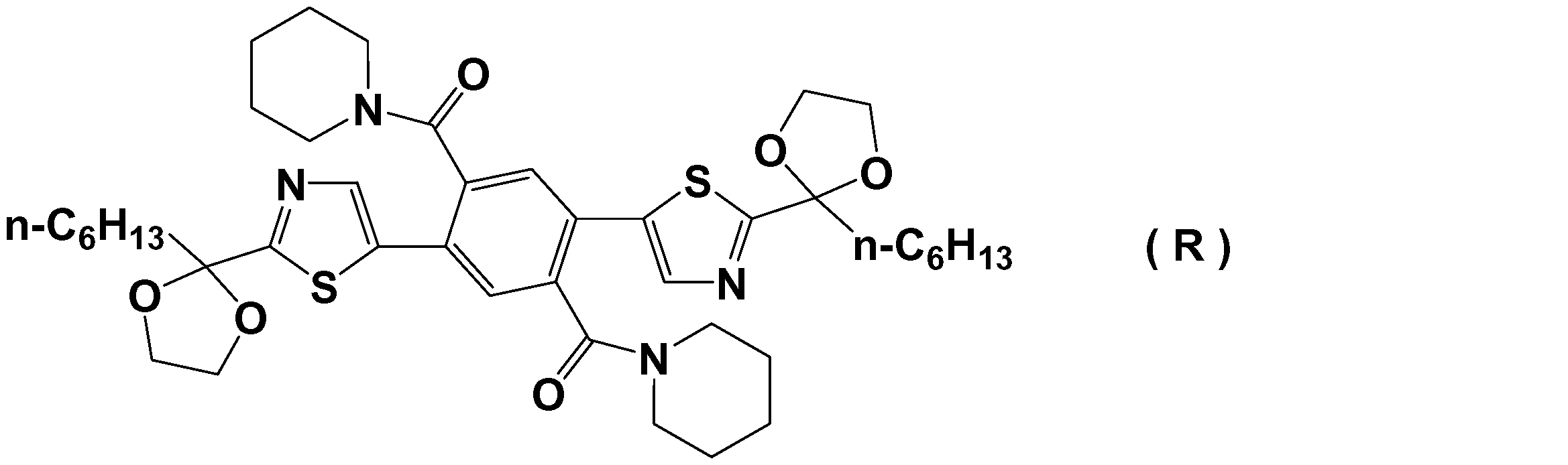
加熱乾燥したナスフラスコに化合物R、THFを入れる。該ナスフラスコ内の気体を窒素で置換し、-78℃に冷却した後、リチウムジイソプロピルアミドを加え反応させる。1時間後、-78℃で水を加え室温まで昇温させ、クロロホルムで抽出する。有機層を硫酸マグネシウムで乾燥させ減圧濃縮する。シリカゲルカラムクロマトグラフィーで精製を行い、固体を得る。ナスフラスコに得られた固体、酢酸、濃塩酸を入れた後、100℃に加熱する。2時間後、室温まで降温し、水を加え生じた固体を水、メタノール、ジエチルエーテルで洗浄する。減圧下で昇華精製を行い、固体の化合物Sを得る。
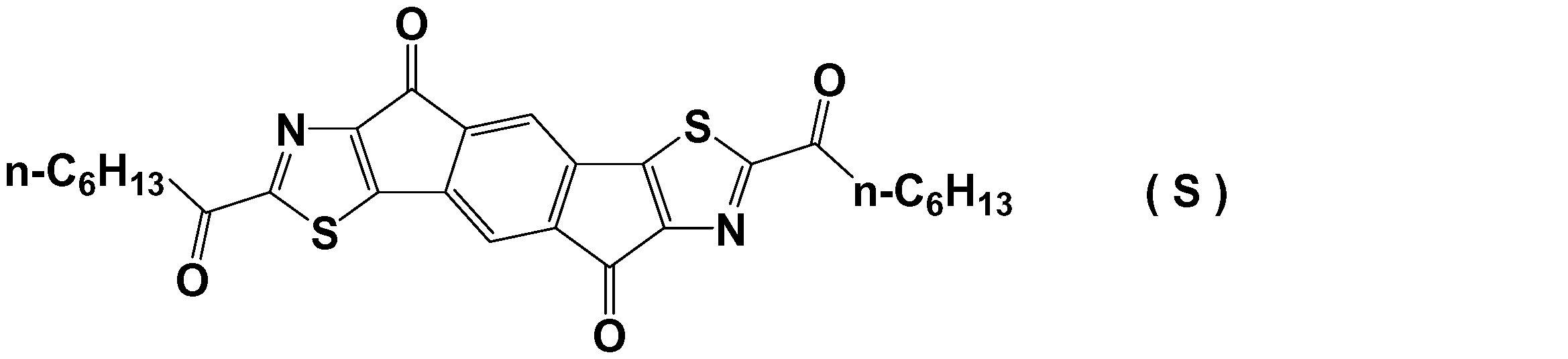
<化合物Tの合成>
加熱乾燥した蓋付き試験管に化合物A、化合物Q、テトラキス(トリフェニルホスフィン)パラジウム(0)、トルエンを入れた後、該試験管内の気体を窒素で置換し、8時間還流させる。セライト濾過後、減圧濃縮し、シリカゲルカラムクロマトグラフィーで精製を行い、化合物Tを得る。
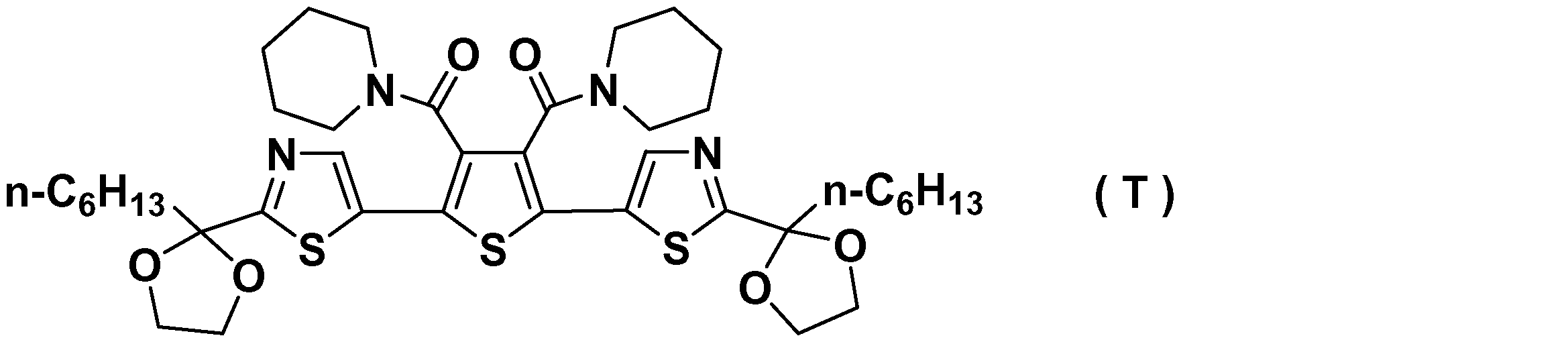
加熱乾燥したナスフラスコに化合物T、THFを入れる。ナスフラスコ内の気体を窒素で置換し、-78℃に冷却した後、リチウムジイソプロピルアミドを加え反応させる。1時間後、-78℃で水を加え室温まで昇温させ、クロロホルムで抽出する。有機層を硫酸マグネシウムで乾燥させ減圧濃縮する。シリカゲルカラムクロマトグラフィーで精製を行う。ナスフラスコに得られた化合物、酢酸、濃塩酸を入れた後、100℃に加熱する。2時間後、室温まで降温し、水を加え生じた固体を水、メタノール、ジエチルエーテルで洗浄する。減圧下で昇華精製を行い、固体の化合物Uを得る。

<有機トランジスタ素子1の作製及びトランジスタ特性の評価>
ゲート電極となる高濃度にドープされたp型シリコン基板の表面に、絶縁層となるシリコン酸化膜を熱酸化により、300nm形成した基板の上に、ソース電極及びドレイン電極を形成し、電極付き基板を準備した。この基板の上に、リフトオフ法によりチャネル幅38mm、チャネル長5μmの櫛形ソース電極及びドレイン電極を形成した。電極付き基板をアセトンで10分間、次いでイソプロピルアルコールで10分間超音波洗浄した後、オゾンUVを30分間照射し基板表面を洗浄した。洗浄した基板上に、実施例4で合成した化合物Oを用い、真空蒸着法により化合物Oの有機薄膜を堆積させ、有機トランジスタ素子1を作製した。有機トランジスタ素子1に、真空中でゲート電圧Vg及びソース-ドレイン間電圧Vsdを0~80Vの範囲で変化させ、有機トランジスタ特性を測定したところ、良好なn型半導体のドレイン電流(Id)-ゲート電圧(Vg)特性が得られた。このときの移動度は0.27cm2/Vs、しきい値電圧25V、オン/オフ比106と良好であった。有機トランジスタ素子1を大気中で駆動させても、良好なトランジスタ特性が得られた。このことから、化合物Oを用いた有機トランジスタ素子1は、n型有機トランジスタとして有効に機能することが確認され、また化合物Oは電子輸送性に優れた有機n型半導体として利用可能であることが確認された。
<化合物Wの合成>
加熱乾燥した蓋付き試験管に化合物A、化合物I、テトラキス(トリフェニルホスフィン)パラジウム(0)、トルエンを入れた後、該試験管内の気体を窒素で置換し、8時間還流させた。セライト濾過後、減圧濃縮し、シリカゲルカラムクロマトグラフィーで精製を行い、化合物Wを得た。

加熱乾燥したナスフラスコに化合物W、THFを入れる。該ナスフラスコ内の気体を窒素で置換し、-78℃に冷却した後、リチウムジイソプロピルアミドを加え反応させる。1時間後、-78℃で水を加え室温まで昇温させ、クロロホルムで抽出する。有機層を硫酸マグネシウム上で乾燥させ減圧濃縮する。シリカゲルカラムクロマトグラフィーで精製を行い、化合物Xを得る。

<化合物Yの合成>
加熱乾燥した蓋付き試験管に化合物M(325mg,0.27mmol)、2-ブロモ-5-(2’,2’,2’-トリフルオロエタノニル)-チオフェン(207mg,0.80mmol)、テトラキス(トリフェニルホスフィン)パラジウム(0)(31mg,0.027mmol)、トルエン(3mL)を入れた後、該試験管内の気体を窒素で置換し、13時間還流させた。反応溶液を減圧濃縮し、得られた固体をメタノール、ジエチルエーテルで洗浄した。ナスフラスコに得られた赤紫色固体、酢酸、濃塩酸を入れた後、100℃に加熱した。12時間後、室温まで降温し、水を加え生じた固体を水、メタノール、ジエチルエーテルで洗浄した。減圧下で昇華精製を行い、緑色固体の化合物Y(25mg,収率14%)を得た。得られた化合物Yの分析結果及び化学式は以下の通りである。
MS(TOF):m/z=653.04(M+)

<化合物Zの合成>
加熱乾燥したナスフラスコに1,4-ジブロモチオフェン-2,5-ビスメトキシメチルベンゼン、THF/テトラメチルエチレンジアミン(10/1(容積比))を入れ、-78℃に冷却し、tert-ブチルリチウムを加えて1時間撹拌した。1-ヨードドデカンを加え、1時間撹拌した後に水を加え、酢酸エチルで抽出した有機層を硫酸マグネシウム上で乾燥させ減圧濃縮した。シリカゲルカラムクロマトグラフィーで精製を行い、化合物Zを得た。

加熱乾燥したナスフラスコに化合物Z、酢酸、臭化水素を入れ、室温で1時間撹拌した。その後、水を加え、酢酸エチルで抽出した有機層を硫酸マグネシウム上で乾燥させ減圧濃縮した。シリカゲルカラムクロマトグラフィーで精製を行い、化合物AAを得た。

加熱乾燥したナスフラスコに化合物AA、鉄、臭素、触媒量のヨウ素、ジクロロメタンを入れ、40℃で48時間撹拌した。その後、反応溶液を濃縮し、ジエチルエーテルで洗浄して精製を行い、化合物ABを得た。

加熱乾燥したナスフラスコに化合物AB(740mg,0.97mmol)、ジメチルスルホキシド(DMSO)/クロロホルム(24mL/12mL)、炭酸水素ナトリウム(2.46g,29.3mmol)を入れ、100℃で12時間撹拌した。その後、水を加え、クロロホルムで抽出した有機層を硫酸マグネシウム上で乾燥させ減圧濃縮した。得られた固体をメタノールで洗浄し、化合物AC(324mg、収率53%)を得た。

加熱乾燥したナスフラスコに化合物AC(644mg,1.02mmol)、リン酸二水素ナトリウム(247mg,2.06mmol)、亜塩素酸ナトリウム(188mg,1.95mmol)、DMSO/クロロホルム/水、を入れ、室温で12時間撹拌した。その後、減圧濃縮し、塩酸を加えてクロロホルムで抽出した。有機層を硫酸マグネシウム上で乾燥させ減圧濃縮し、白色固体の化合物AD(470mg,収率70%)を得た。

加熱乾燥したナスフラスコに化合物AD(470mg,0.71mmol)、触媒量のDMF、過剰量の塩化チオニルを入れ、1時間還流させた。反応後、塩化チオニルを真空留去した。次にジクロロメタンを加えて0℃に冷却した後、トリエチルアミン(0.4mL)を加え、更にピペリジン(0.3mL)を滴下した。滴下後、室温で撹拌した。2時間後、水を加え酢酸エチルで抽出した。有機層を硫酸マグネシウム上で乾燥させ減圧濃縮し、シリカゲルカラムクロマトグラフィー(ヘキサン/酢酸エチル=5:1)で精製を行い、化合物AE(240mg、収率42%)を得た。得られた化合物AEの分析結果及び化学式は以下の通りである。
1H NMR(400MHz,CDCl3):δ 3.81(m),3.70(m),3.15(m),2.72(m),2.58(m),1.80-1.20(m),0.89(t).

加熱乾燥した蓋付き試験管に化合物AE(240mg,0.30mmol)、2-トリイソプロピル-5-トリメチルスズ-チアゾール(366mg,0.91mmol)、テトラキス(トリフェニルホスフィン)パラジウム(0)(4mg)、トルエン(2mL)を入れた後、該試験管内の気体を窒素で置換し、10時間還流させた。セライト濾過後、減圧濃縮し、シリカゲルカラムクロマトグラフィー(ヘキサン/酢酸エチル=6/1(容積比))で精製を行い、化合物AF(90mg、収率27%)を得た。

加熱乾燥したナスフラスコに化合物AF(333mg,0.29mmol)、THF(10mL)を入れた。該ナスフラスコ内の気体を窒素で置換し、-78℃に冷却した後、リチウムジイソプロピルアミド(1M)を加え反応させた。1時間後、-78℃で水を加え室温まで昇温させ、クロロホルムで抽出した。有機層を硫酸マグネシウム上で乾燥させ減圧濃縮した。シリカゲルカラムクロマトグラフィー(ヘキサン/酢酸エチル=60/1(容積比))で精製を行い、化合物AG(52mg、収率18%)を得た。得られた化合物AGの分析結果及び化学式は以下の通りである。
1H NMR(400MHz,CDCl3):δ 3.05(t,4H),1.62-1.06(m),0.88(t,6H).

加熱乾燥したナスフラスコに化合物AG(30mg,0.032mmol)、2,2-ジブチル-1,3-プロパンジオール(36mg,0.192mmol)、p-トルエンスルホン酸(55mg,0.32mmol)、ベンゼン(2mL)を入れ、該ナスフラスコ内の気体を窒素で置換し、24時間還流させた。放冷後、水を加えて酢酸エチルで抽出し、有機層を硫酸マグネシウム上で乾燥させ減圧濃縮し、シリカゲルカラムクロマトグラフィー(ヘキサン/酢酸エチル=5/1(容積比))で精製を行い、化合物AH(11mg,収率35%)を得た。得られた化合物AHの分析結果及び化学式は以下の通りである。
TLC Rf=0.65(ヘキサン/酢酸エチル=5:1(容積比))
1H NMR(400MHz,CDCl3):δ 8.68(s,2H),4.71(d,J=11.5Hz,4H),3.78(d,J=11.5Hz,4H),3.10(m,4H),1.98(m,4H),1.7-1.2(m),1.01(t,J=7.1Hz,6H),0.94(t,J=7.1Hz,6H),0.88(t,J=6.8Hz,6H)
MS(MALDI):m/z=970.18(M+).
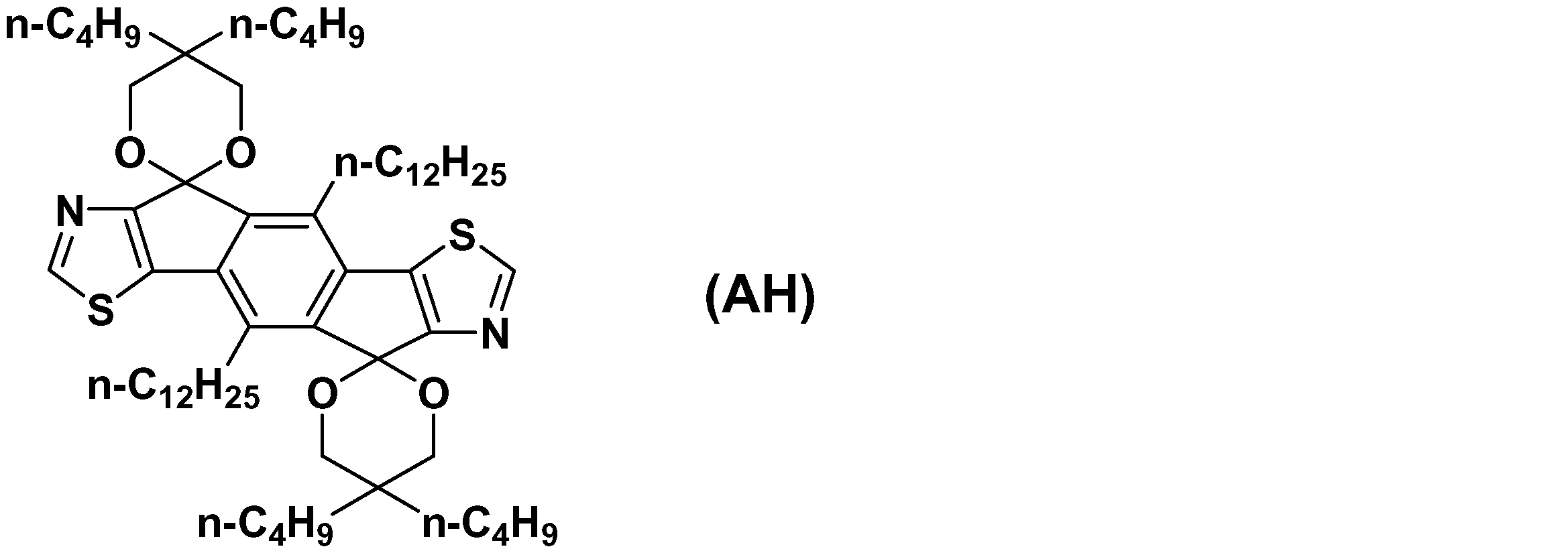
加熱乾燥したナスフラスコに化合物AH、THFを入れる。該ナスフラスコ内の気体を窒素で置換し、-78℃に冷却した後、n-ブチルリチウムを加え反応させる。1時間後、-78℃で塩化トリブチルスズを加え室温まで昇温させる。1時間後、水を加え酢酸エチルで抽出し、有機層を硫酸マグネシウム上で乾燥させ減圧濃縮する。アルミナカラムで精製を行い、化合物AIを得る。

加熱乾燥した蓋付き試験管に化合物AI、4’-ブロモ-2,2,2-トリフルオロアセトフェノン、テトラキス(トリフェニルホスフィン)パラジウム(0)、トルエンを入れた後、該試験管内の気体を窒素で置換し、13時間還流させる。セライト濾過後、減圧濃縮し、得られた固体をメタノール、ジエチルエーテルで洗浄する。ナスフラスコに得られた固体、酢酸、濃塩酸を入れた後、100℃に加熱する。2時間後、室温まで降温し、水を加え生じた固体を水、メタノール、ジエチルエーテルで洗浄する。減圧下で昇華精製を行い、化合物AJを得る。
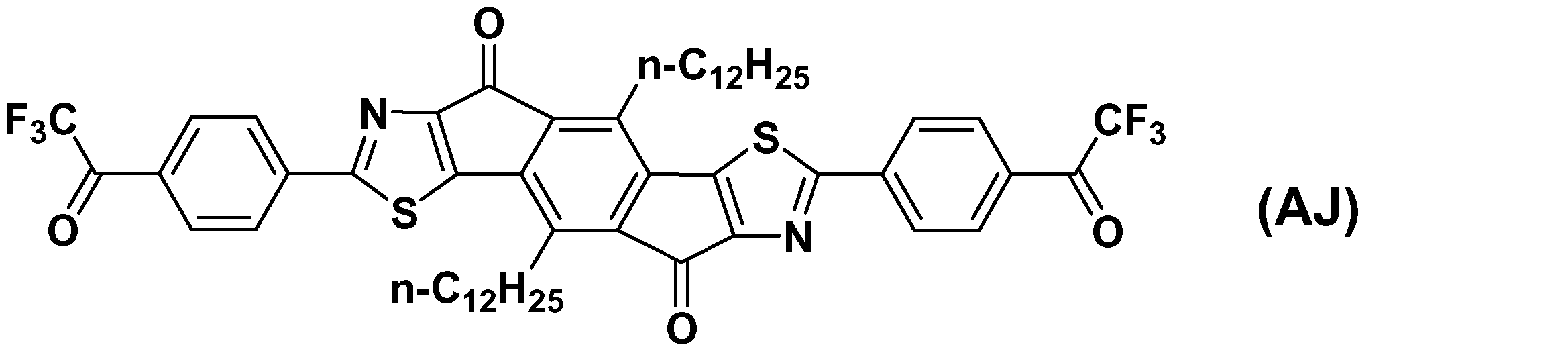
<化合物AKの合成>
加熱乾燥した蓋付き試験管に化合物AI、2-ブロモ-5-(2’,2’,2’-トリフルオロエタノニル)-チオフェン、テトラキス(トリフェニルホスフィン)パラジウム(0)、トルエンを入れた後、該試験管内の気体を窒素で置換し、13時間還流させる。セライト濾過後、減圧濃縮し、得られた固体をメタノール、ジエチルエーテルで洗浄する。ナスフラスコに得られた固体、酢酸、濃塩酸を入れた後、100℃に加熱する。2時間後、室温まで降温し、水を加え生じた固体を水、メタノール、ジエチルエーテルで洗浄する。減圧下で昇華精製を行い、化合物AKを得る。
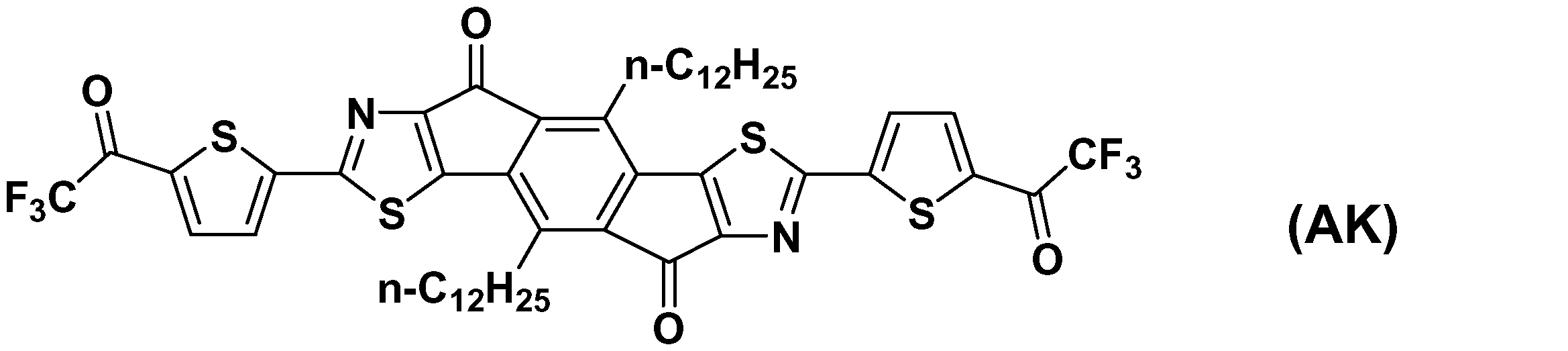
<有機トランジスタ素子2の作製及びトランジスタ特性の評価>
化合物Oに代えて実施例9の化合物Yを用いたこと以外は、実施例7と同様にして、有機トランジスタ素子2を作製した。
<化合物ALの合成>
化合物ALを特開2009-21527号公報に記載の方法で合成した。合成により得られた目的物は、有機溶剤への溶解性が低かった。得られた合成物を減圧下で昇華精製を行い、化合物ALの緑色固体(33mg,収率21%)を得た。得られた化合物ALの分析結果及び化学式は以下の通りである。
1H NMR(400MHz,CDCl3):δ 8.08(d,4H,J=8.8Hz),8.05(d,4H,J=8.8Hz)
GC-MS(DI):m/z=538(M+)

実施例7と同様にして、洗浄したソース電極及びドレイン電極を形成した基板を準備し、上記で合成した化合物AL用い、真空蒸着法により基板温度110℃、堆積速度0.2nm/分で、化合物ALの有機薄膜を成膜し、有機トランジスタ素子3を作成した。有機トランジスタ素子3に、真空中でゲート電圧Vgを0~120V、ソース-ドレイン間電圧Vsdを0~100Vの範囲で変化させ、有機トランジスタ特性を測定することによりn型半導体のId-Vg特性が得られた。このときの移動度は5.6×10-2cm2/Vs、しきい値電圧20V、オン/オフ比106であった。
Claims (24)
- 式(1-1)で表される構造単位及び式(1-2)で表される構造単位からなる群より選択される少なくとも一種の構造単位を有する、含窒素縮合環化合物。

Ar1は、置換基を有していてもよい炭素数4以上の芳香環を示し、
Y1及びY2のうちいずれか一方は、-C(=X1)-で表される基を示し、他方は、単結合を示し、
Y3及びY4のうちいずれか一方は、-C(=X2)-で表される基を示し、他方は、単結合を示し、
X1及びX2は各々独立に、酸素原子、硫黄原子又は=C(A1)2で表される基(A1は、水素原子、ハロゲン原子又は1価の基を示し、二つのA1は互いに同一でも異なっていてもよい。)を示し、
Z1及びZ2は各々独立に、酸素原子、硫黄原子、セレン原子、テルル原子、式(a-1)で表される基、式(a-2)で表される基、式(a-3)で表される基、式(a-4)で表される基又は式(a-5)で表される基を示す。]

- Z1及びZ2が硫黄原子である、請求項1に記載の含窒素縮合環化合物。
- X1及びX2が酸素原子である、請求項1又は2に記載の含窒素縮合環化合物。
- Ar1がベンゼン環又はチオフェン環である、請求項1~3のいずれか一項に記載の含窒素縮合環化合物。
- 式(1-1)で表される構造単位が、式(2-1)で表される構造単位であり、
式(1-2)で表される構造単位が、式(2-2)で表される構造単位である、請求項1に記載の含窒素縮合環化合物。
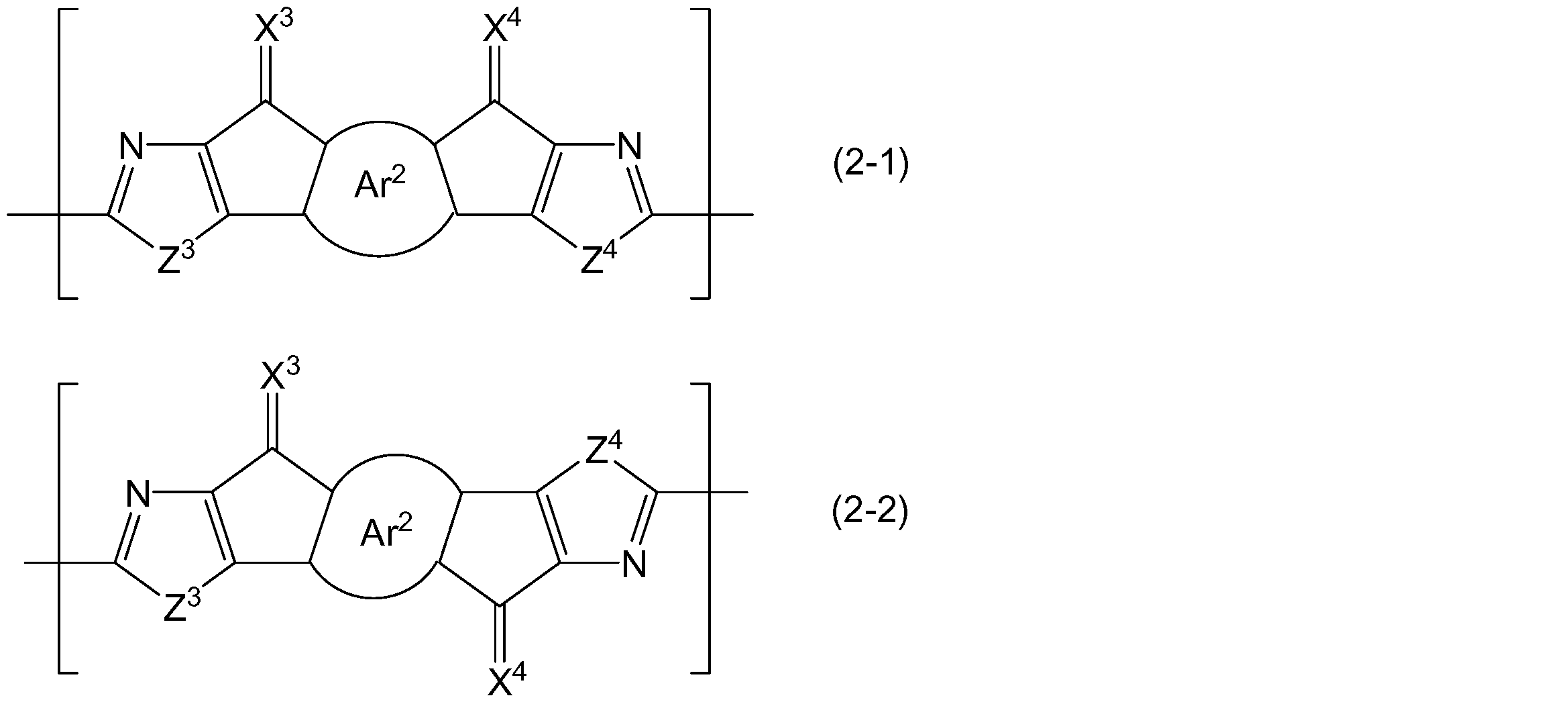
Ar2は、置換基を有していてもよい炭素数4以上の芳香環を示し、
X3及びX4は各々独立に、酸素原子、硫黄原子又は=C(A2)2で表される基(A2は、水素原子、ハロゲン原子又は1価の基を示し、二つのA2は互いに同一でも異なっていてもよい。但し、二つのA2のうち少なくとも一方は、シアノ基、ニトロ基、アシル基、アルコキシカルボニル基、カルボキシル基、ヒドロキシ基又はハロゲン原子を示す。)を示し、
Z3及びZ4は各々独立に、酸素原子、硫黄原子、セレン原子、テルル原子、式(b-1)で表される基、式(b-2)で表される基、式(b-3)で表される基、式(b-4)で表される基又は式(b-5)で表される基を示す。]
- Z3及びZ4が硫黄原子である、請求項5に記載の含窒素縮合環化合物。
- X3及びX4が酸素原子である、請求項5又は6に記載の含窒素縮合環化合物。
- Ar2がベンゼン環又はチオフェン環である、請求項5~7のいずれか一項に記載の含窒素縮合環化合物。
- 式(1-1)で表される構造単位が、式(3-1)で表される構造単位であり、
式(1-2)で表される構造単位が、式(3-2)で表される構造単位である、請求項1に記載の含窒素縮合環化合物。
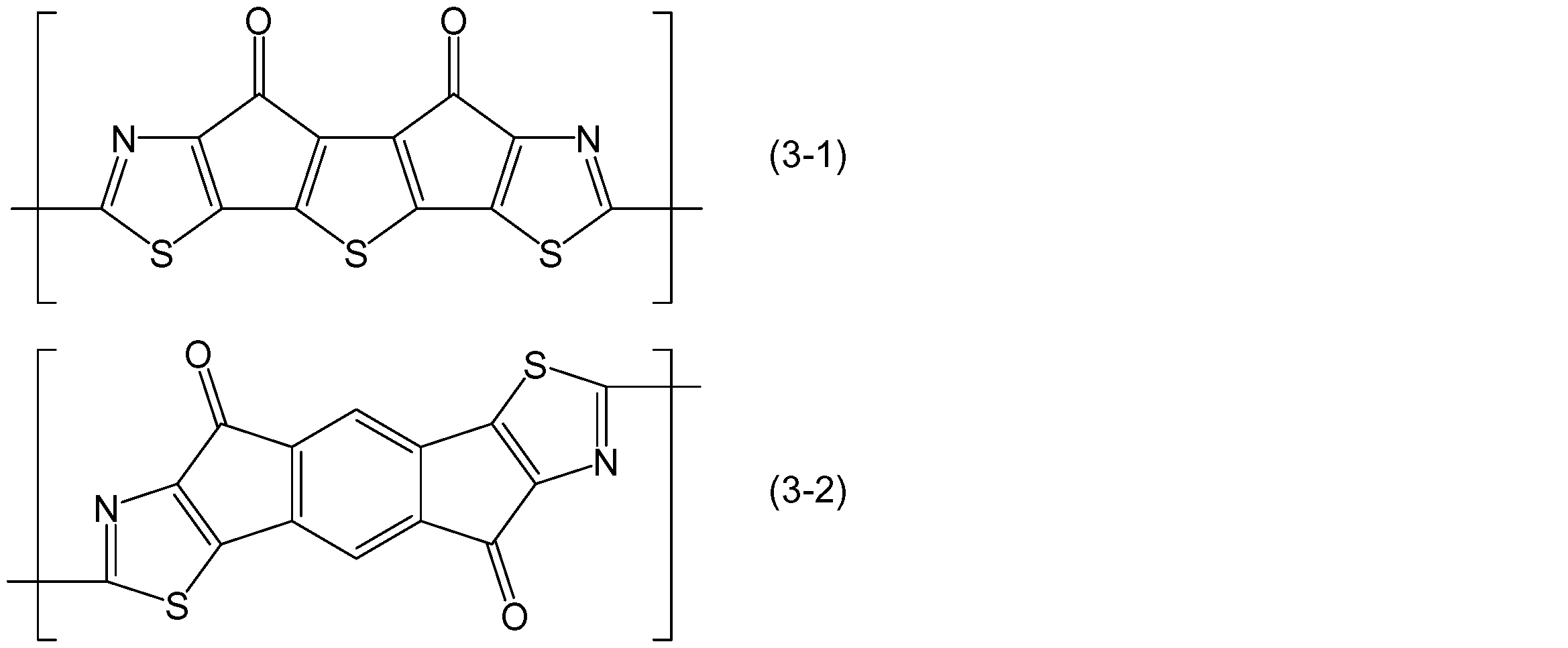
- 式(1-1)で表される構造単位及び式(1-2)で表される構造単位からなる群より選択される構造単位を複数有する(複数の前記構造単位は、互いに同一でも異なっていてもよい。)、含窒素縮合環重合体。

Ar1は、置換基を有していてもよい炭素数4以上の芳香環を示し、
Y1及びY2のうちいずれか一方は、-C(=X1)-で表される基を示し、他方は、単結合を示し、
Y3及びY4のうちいずれか一方は、-C(=X2)-で表される基を示し、他方は、単結合を示し、
X1及びX2は各々独立に、酸素原子、硫黄原子又は=C(A1)2で表される基(A1は、水素原子、ハロゲン原子又は1価の基を示し、二つのA1は互いに同一でも異なっていてもよい。)を示し、
Z1及びZ2は各々独立に、酸素原子、硫黄原子、セレン原子、テルル原子、式(a-1)で表される基、式(a-2)で表される基、式(a-3)で表される基、式(a-4)で表される基又は式(a-5)で表される基を示す。]
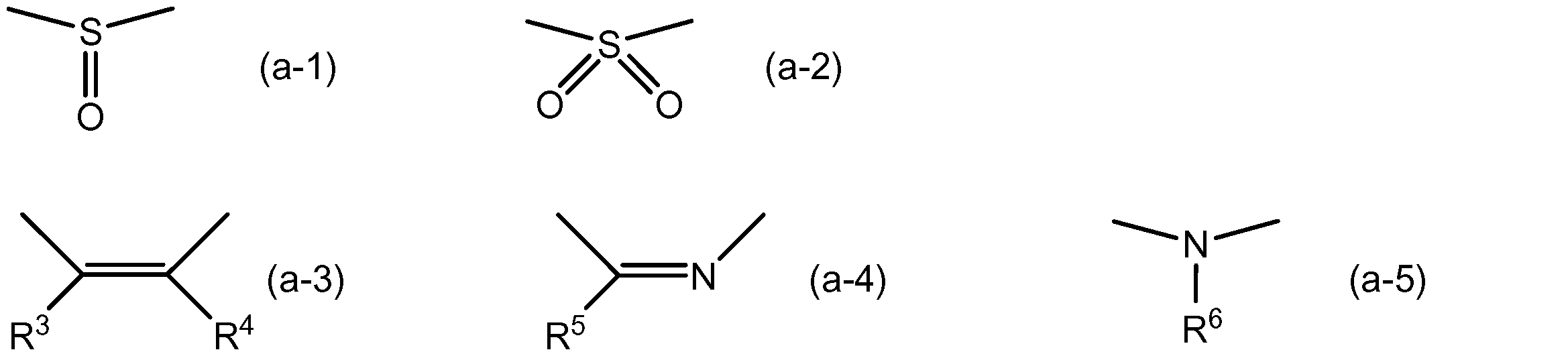
- Z1及びZ2が硫黄原子である、請求項10に記載の含窒素縮合環重合体。
- X1及びX2が酸素原子である、請求項10又は11に記載の含窒素縮合環重合体。
- Ar1がベンゼン環又はチオフェン環である、請求項10~12のいずれか一項に記載の含窒素縮合環重合体。
- 式(1-1)で表される構造単位が、式(2-1)で表される構造単位であり、
式(1-2)で表される構造単位が、式(2-2)で表される構造単位である、請求項10に記載の含窒素縮合環重合体。

Ar2は、置換基を有していてもよい炭素数4以上の芳香環を示し、
X3及びX4は各々独立に、酸素原子、硫黄原子又は=C(A2)2で表される基(A2は、水素原子、ハロゲン原子又は1価の基を示し、二つのA2は互いに同一でも異なっていてもよい。但し、二つのA2のうち少なくとも一方は、シアノ基、ニトロ基、アシル基、アルコキシカルボニル基、カルボキシル基、ヒドロキシ基又はハロゲン原子を示す。)を示し、
Z3及びZ4は各々独立に、酸素原子、硫黄原子、セレン原子、テルル原子、式(b-1)で表される基、式(b-2)で表される基、式(b-3)で表される基、式(b-4)で表される基又は式(b-5)で表される基を示す。]

- Z3及びZ4が硫黄原子である、請求項14に記載の含窒素縮合環重合体。
- X3及びX4が酸素原子である、請求項14又は15に記載の含窒素縮合環重合体。
- Ar2がベンゼン環又はチオフェン環である、請求項14~16のいずれか一項に記載の含窒素縮合環重合体。
- 式(4)で表される構造単位をさらに有する、請求項10~17のいずれか一項に記載の含窒素縮合環重合体。

- 式(5)で表される構造単位をさらに有する、請求項10~18のいずれか一項に記載の含窒素縮合環重合体。

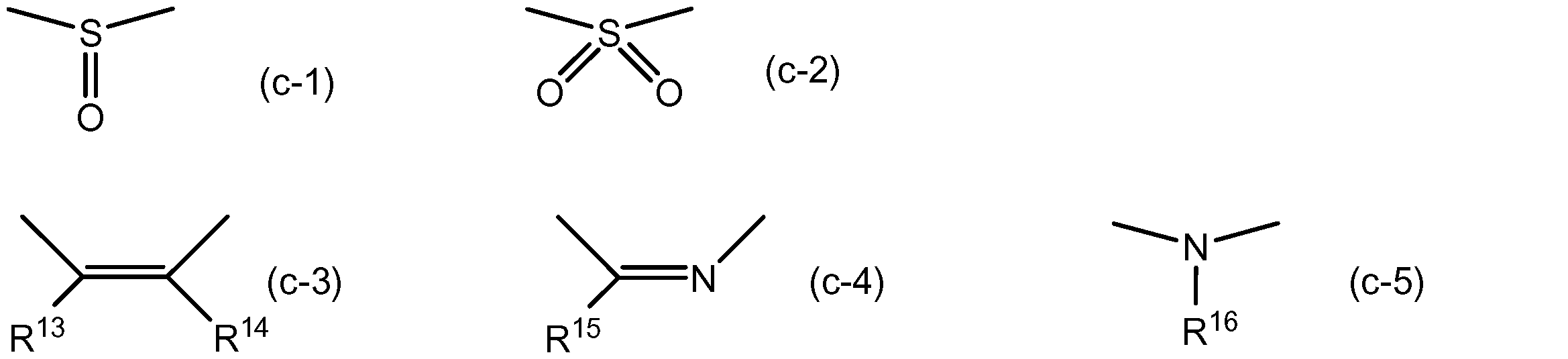
- Z5が硫黄原子である、請求項19に記載の含窒素縮合環重合体。
- 請求項1~9のいずれか一項に記載の含窒素縮合環化合物及び請求項10~20のいずれか一項に記載の含窒素縮合環重合体からなる群より選択される少なくとも一種を含有する、有機薄膜。
- 請求項21に記載の有機薄膜を備える有機薄膜素子。
- 請求項21に記載の有機薄膜を備える有機薄膜トランジスタ。
- 請求項21に記載の有機薄膜を備える有機太陽電池。
Priority Applications (2)
| Application Number | Priority Date | Filing Date | Title |
|---|---|---|---|
| KR1020127025358A KR20130018720A (ko) | 2010-03-04 | 2011-03-03 | 질소 함유 축합환 화합물, 질소 함유 축합환 중합체, 유기 박막 및 유기 박막 소자 |
| US13/582,246 US8859717B2 (en) | 2010-03-04 | 2011-03-03 | Nitrogen-containing fused ring compound, nitrogen-containing fused ring polymer, organic thin film, and organic thin film element |
Applications Claiming Priority (4)
| Application Number | Priority Date | Filing Date | Title |
|---|---|---|---|
| JP2010047852 | 2010-03-04 | ||
| JP2010-047852 | 2010-03-04 | ||
| JP2010261575 | 2010-11-24 | ||
| JP2010-261575 | 2010-11-24 |
Publications (1)
| Publication Number | Publication Date |
|---|---|
| WO2011108646A1 true WO2011108646A1 (ja) | 2011-09-09 |
Family
ID=44542293
Family Applications (1)
| Application Number | Title | Priority Date | Filing Date |
|---|---|---|---|
| PCT/JP2011/054924 Ceased WO2011108646A1 (ja) | 2010-03-04 | 2011-03-03 | 含窒素縮合環化合物、含窒素縮合環重合体、有機薄膜及び有機薄膜素子 |
Country Status (5)
| Country | Link |
|---|---|
| US (1) | US8859717B2 (ja) |
| JP (1) | JP5792482B2 (ja) |
| KR (1) | KR20130018720A (ja) |
| TW (1) | TW201139391A (ja) |
| WO (1) | WO2011108646A1 (ja) |
Cited By (1)
| Publication number | Priority date | Publication date | Assignee | Title |
|---|---|---|---|---|
| WO2012105511A1 (ja) * | 2011-01-31 | 2012-08-09 | 住友化学株式会社 | 含窒素縮合環化合物、含窒素縮合環重合体、有機薄膜及び有機薄膜素子 |
Families Citing this family (3)
| Publication number | Priority date | Publication date | Assignee | Title |
|---|---|---|---|---|
| JP2015157910A (ja) * | 2014-02-25 | 2015-09-03 | 住友化学株式会社 | 高分子化合物およびそれを用いた有機半導体素子 |
| JP6252264B2 (ja) * | 2014-03-12 | 2017-12-27 | 住友化学株式会社 | 高分子化合物およびそれを用いた有機半導体素子 |
| JP6521818B2 (ja) * | 2015-09-29 | 2019-05-29 | 東ソー株式会社 | ジチアゾロベンゾジチオフェン化合物、その製造方法及びトランジスタ素子 |
Citations (4)
| Publication number | Priority date | Publication date | Assignee | Title |
|---|---|---|---|---|
| WO2009069717A1 (ja) * | 2007-11-30 | 2009-06-04 | Idemitsu Kosan Co., Ltd. | アザインデノフルオレンジオン誘導体、有機エレクトロルミネッセンス素子用材料及び有機エレクトロルミネッセンス素子 |
| WO2009099070A1 (ja) * | 2008-02-06 | 2009-08-13 | Sumitomo Chemical Company, Limited | 有機半導体材料 |
| JP2009215278A (ja) * | 2008-02-13 | 2009-09-24 | Osaka Univ | 含窒素縮合環化合物、含窒素縮合環重合体、有機薄膜及び有機薄膜素子 |
| WO2010064655A1 (ja) * | 2008-12-03 | 2010-06-10 | 出光興産株式会社 | インデノフルオレンジオン誘導体、有機エレクトロルミネッセンス素子用材料及び有機エレクトロルミネッセンス素子 |
Family Cites Families (9)
| Publication number | Priority date | Publication date | Assignee | Title |
|---|---|---|---|---|
| JPH05110069A (ja) | 1991-10-14 | 1993-04-30 | Mitsubishi Electric Corp | 電界効果トランジスタの製造方法 |
| JP4272068B2 (ja) * | 2001-12-26 | 2009-06-03 | 日本曹達株式会社 | 自己組織化単分子膜を形成する電子受容性化合物 |
| US7002176B2 (en) | 2002-05-31 | 2006-02-21 | Ricoh Company, Ltd. | Vertical organic transistor |
| JP4234952B2 (ja) | 2002-05-31 | 2009-03-04 | 株式会社リコー | 縦型有機トランジスタ |
| US6960643B2 (en) * | 2003-03-19 | 2005-11-01 | Xerox Corporation | Fluorinated polythiophenes and devices thereof |
| US7244809B2 (en) * | 2003-05-16 | 2007-07-17 | Merck Patent Gmbh | Mono-, oligo- and polymers comprising dithienothiophene and aryl groups |
| JP2008255097A (ja) * | 2007-03-09 | 2008-10-23 | Sumitomo Chemical Co Ltd | 含フッ素多環芳香族化合物、含フッ素重合体、有機薄膜及び有機薄膜素子 |
| US8378338B2 (en) | 2007-11-30 | 2013-02-19 | Sumitomo Chemical Company, Limited | Conjugated compound, nitrogenated condensed-ring compound, nitrogenated condensed-ring polymer, organic thin film, and organic thin film element |
| JP2009190999A (ja) * | 2008-02-13 | 2009-08-27 | Osaka Univ | 縮合環化合物及びその製造方法、重合体、これらを含む有機薄膜、並びに、これを備える有機薄膜素子及び有機薄膜トランジスタ。 |
-
2011
- 2011-03-02 JP JP2011045515A patent/JP5792482B2/ja active Active
- 2011-03-03 US US13/582,246 patent/US8859717B2/en not_active Expired - Fee Related
- 2011-03-03 KR KR1020127025358A patent/KR20130018720A/ko not_active Withdrawn
- 2011-03-03 WO PCT/JP2011/054924 patent/WO2011108646A1/ja not_active Ceased
- 2011-03-04 TW TW100107278A patent/TW201139391A/zh unknown
Patent Citations (4)
| Publication number | Priority date | Publication date | Assignee | Title |
|---|---|---|---|---|
| WO2009069717A1 (ja) * | 2007-11-30 | 2009-06-04 | Idemitsu Kosan Co., Ltd. | アザインデノフルオレンジオン誘導体、有機エレクトロルミネッセンス素子用材料及び有機エレクトロルミネッセンス素子 |
| WO2009099070A1 (ja) * | 2008-02-06 | 2009-08-13 | Sumitomo Chemical Company, Limited | 有機半導体材料 |
| JP2009215278A (ja) * | 2008-02-13 | 2009-09-24 | Osaka Univ | 含窒素縮合環化合物、含窒素縮合環重合体、有機薄膜及び有機薄膜素子 |
| WO2010064655A1 (ja) * | 2008-12-03 | 2010-06-10 | 出光興産株式会社 | インデノフルオレンジオン誘導体、有機エレクトロルミネッセンス素子用材料及び有機エレクトロルミネッセンス素子 |
Non-Patent Citations (1)
| Title |
|---|
| GLINZER, OTTO ET AL.: "Mass spectrometry of bisanellated thiophenediones as model substances for oxidation products of sulfur compounds in high-boiling crude oil fractions, Fresenius", ZEITSCHRIFT FUER ANALYTISCHE CHEMIE, vol. 315, no. 6, 1983, pages 505 - 509 * |
Cited By (2)
| Publication number | Priority date | Publication date | Assignee | Title |
|---|---|---|---|---|
| WO2012105511A1 (ja) * | 2011-01-31 | 2012-08-09 | 住友化学株式会社 | 含窒素縮合環化合物、含窒素縮合環重合体、有機薄膜及び有機薄膜素子 |
| US8841410B2 (en) | 2011-01-31 | 2014-09-23 | Sumitomo Chemical Company, Limited | Nitrogen-containing condensed ring compound, nitrogen-containing condensed ring polymer, organic thin film, and organic thin film element |
Also Published As
| Publication number | Publication date |
|---|---|
| JP5792482B2 (ja) | 2015-10-14 |
| US20130041123A1 (en) | 2013-02-14 |
| KR20130018720A (ko) | 2013-02-25 |
| JP2012126703A (ja) | 2012-07-05 |
| US8859717B2 (en) | 2014-10-14 |
| TW201139391A (en) | 2011-11-16 |
Similar Documents
| Publication | Publication Date | Title |
|---|---|---|
| US8841410B2 (en) | Nitrogen-containing condensed ring compound, nitrogen-containing condensed ring polymer, organic thin film, and organic thin film element | |
| JP2009215546A (ja) | 多環縮環化合物、多環縮環重合体及びこれらを含む有機薄膜 | |
| KR20080107420A (ko) | 불소 함유 화합물 및 그의 제조 방법, 불소 함유 중합체, 유기 박막, 및 유기 박막 소자 | |
| WO2009101982A1 (ja) | 縮合環化合物及びその製造方法、重合体、これらを含む有機薄膜、並びに、これを備える有機薄膜素子及び有機薄膜トランジスタ | |
| JP2008255097A (ja) | 含フッ素多環芳香族化合物、含フッ素重合体、有機薄膜及び有機薄膜素子 | |
| WO2012105517A1 (ja) | 多環縮環化合物、多環縮環重合体及びこれらを含む有機薄膜 | |
| JP5426199B2 (ja) | 分岐型化合物、並びにこれを用いた有機薄膜及び有機薄膜素子 | |
| WO2012070582A1 (ja) | 共役系化合物、並びにこれを用いた有機薄膜及び有機薄膜素子 | |
| WO2010104131A1 (ja) | 共役系化合物、並びにこれを用いた有機薄膜及び有機薄膜素子 | |
| JP5792482B2 (ja) | 含窒素縮合環化合物、含窒素縮合環重合体、有機薄膜及び有機薄膜素子 | |
| WO2010104042A1 (ja) | 含フッ素重合体及びこれを用いた有機薄膜 | |
| JP2012184227A (ja) | アクセプター性の基を有する化合物、これを用いた有機薄膜及び有機薄膜素子 | |
| JP2011184324A (ja) | 含窒素縮合環化合物、有機薄膜及び有機薄膜素子 | |
| JP5105581B2 (ja) | 含フッ素化合物及びその製造方法、含フッ素重合体、有機薄膜、並びに、有機薄膜素子 | |
| JP5363771B2 (ja) | 含窒素縮合環化合物、含窒素縮合環重合体、有機薄膜及び有機薄膜素子 | |
| WO2010104037A1 (ja) | 重合体、この重合体を用いた有機薄膜及びこれを備える有機薄膜素子 | |
| JP2012051874A (ja) | 縮合環化合物、有機薄膜及び有機薄膜素子 | |
| WO2011102390A1 (ja) | 芳香族化合物、及びこれを用いた有機薄膜、並びにこの有機薄膜を備える有機薄膜素子 | |
| JP2012193338A (ja) | 重合体、この重合体を用いた有機薄膜及び有機薄膜素子 | |
| JP5035958B2 (ja) | 分岐型化合物、これを用いた有機薄膜及び有機薄膜素子 | |
| WO2009101914A1 (ja) | 重合体、これを用いた有機薄膜及び有機薄膜素子 | |
| JP5995594B2 (ja) | 高分子化合物及びそれを用いた有機トランジスタ |
Legal Events
| Date | Code | Title | Description |
|---|---|---|---|
| 121 | Ep: the epo has been informed by wipo that ep was designated in this application |
Ref document number: 11750755 Country of ref document: EP Kind code of ref document: A1 |
|
| NENP | Non-entry into the national phase |
Ref country code: DE |
|
| ENP | Entry into the national phase |
Ref document number: 20127025358 Country of ref document: KR Kind code of ref document: A |
|
| WWE | Wipo information: entry into national phase |
Ref document number: 13582246 Country of ref document: US |
|
| 122 | Ep: pct application non-entry in european phase |
Ref document number: 11750755 Country of ref document: EP Kind code of ref document: A1 |