WO2011096150A1 - 自動車用合わせガラス - Google Patents
自動車用合わせガラス Download PDFInfo
- Publication number
- WO2011096150A1 WO2011096150A1 PCT/JP2010/073489 JP2010073489W WO2011096150A1 WO 2011096150 A1 WO2011096150 A1 WO 2011096150A1 JP 2010073489 W JP2010073489 W JP 2010073489W WO 2011096150 A1 WO2011096150 A1 WO 2011096150A1
- Authority
- WO
- WIPO (PCT)
- Prior art keywords
- laminated glass
- glass
- automobiles
- heat ray
- ray reflective
- Prior art date
- Legal status (The legal status is an assumption and is not a legal conclusion. Google has not performed a legal analysis and makes no representation as to the accuracy of the status listed.)
- Ceased
Links
Images


Classifications
-
- B—PERFORMING OPERATIONS; TRANSPORTING
- B60—VEHICLES IN GENERAL
- B60J—WINDOWS, WINDSCREENS, NON-FIXED ROOFS, DOORS, OR SIMILAR DEVICES FOR VEHICLES; REMOVABLE EXTERNAL PROTECTIVE COVERINGS SPECIALLY ADAPTED FOR VEHICLES
- B60J1/00—Windows; Windscreens; Accessories therefor
-
- B—PERFORMING OPERATIONS; TRANSPORTING
- B32—LAYERED PRODUCTS
- B32B—LAYERED PRODUCTS, i.e. PRODUCTS BUILT-UP OF STRATA OF FLAT OR NON-FLAT, e.g. CELLULAR OR HONEYCOMB, FORM
- B32B17/00—Layered products essentially comprising sheet glass, or glass, slag, or like fibres
- B32B17/06—Layered products essentially comprising sheet glass, or glass, slag, or like fibres comprising glass as the main or only constituent of a layer, next to another layer of a specific material
- B32B17/10—Layered products essentially comprising sheet glass, or glass, slag, or like fibres comprising glass as the main or only constituent of a layer, next to another layer of a specific material of synthetic resin
- B32B17/10005—Layered products essentially comprising sheet glass, or glass, slag, or like fibres comprising glass as the main or only constituent of a layer, next to another layer of a specific material of synthetic resin laminated safety glass or glazing
- B32B17/10165—Functional features of the laminated safety glass or glazing
- B32B17/10174—Coatings of a metallic or dielectric material on a constituent layer of glass or polymer
Definitions
- the present invention relates to a laminated glass for automobiles, and particularly to a laminated glass for automobiles used for a front window having a heat ray reflecting function.
- laminated glass is obtained by press-bonding two glass plates with an intermediate film.
- laminated glass for automobiles the above laminated glass is applied to the above laminated glass for the purpose of imparting suitable visible light permeability, heat insulation, and the like.
- Those provided with various films, thin films, layers and the like are widely known (Patent Document 1, Patent Document 2).
- Patent Document 1 Patent Document 2
- the heat ray reflective layer needs to be installed so as not to come into contact with air from the viewpoint of durability. For this reason, generally, the heat ray reflective layer is located inside the glass edge of the laminated glass for automobiles. The method of providing the edge part of this is used.
- An object of the present invention is to obtain a laminated glass for automobiles capable of simultaneously achieving suitable radio wave permeability maintenance and shielding of solar radiation energy.
- the present invention is a laminated glass for automobiles having a transparent colored band, and has a ceramic color layer on the peripheral part of the laminated glass for automobiles, a transparent colored band on the upper side part, and a heat ray reflective layer at least in the center part, When viewed from a direction perpendicular to the glass surface, at least an upper end of the heat ray reflective layer overlaps with the transparent colored band.
- the “upper side” refers to the upper side of the center line in the horizontal direction of the glass surface of the laminated glass for automobiles.
- the transparent colored band is one in which a colored region (colored band) is formed on the upper side of a laminated glass for automobiles in order to prevent glare from sunlight incident from above (hereinafter sometimes referred to as a shade band).
- the transparent colored band has a surface that does not overlap the ceramic color layer when the laminated glass for automobiles is viewed from a direction perpendicular to the glass surface, and suppresses the transmission of solar radiation. This has the effect of suppressing the temperature rise in the vehicle and reducing the cooling load.
- the solar radiation transmittance (hereinafter sometimes referred to as Ts) is preferably 50% or less.
- the ceramic color layer is formed by baking a paste made of a ceramic color composition (hereinafter sometimes referred to as a ceramic color paste) on the periphery of an automotive glass screen by screen printing, followed by baking in a bending process. It is.
- a paste made of a ceramic color composition hereinafter sometimes referred to as a ceramic color paste
- the ceramic color layer is an opaque colored layer, which prevents light incident on the vehicle and transmitted light, for example, preventing deterioration of adhesives such as urethane sealant due to ultraviolet rays, or hiding terminals for heat rays from the outside. It has a function. Therefore, it is important that the ceramic color layer does not transmit visible light, particularly ultraviolet rays, and it is preferable that the visible light transmittance is 0.3% or less and the ultraviolet transmittance is 0.1% or less.
- the heat ray reflective layer is a layer having a function of reflecting infrared rays, and laminated glass for automobiles by sandwiching an infrared reflection film having an infrared reflection function, or forming a film having an infrared reflection function on glass or an intermediate film. Is provided.
- the heat ray reflective layer is formed at the center of the glass surface of the automotive glass, and it is desirable to increase the area to be formed in order to obtain suitable heat ray reflective performance. Further, when viewed from the direction perpendicular to the glass surface, the upper end of the heat ray reflective layer appears to overlap the transparent colored band, and may partially overlap the ceramic color layer.
- the end portion of the heat ray reflective layer that does not overlap the transparent colored band is mainly formed with the ceramic color layer. It overlaps with a peripheral part, It is characterized by the above-mentioned.
- the end portion of the heat ray reflective layer that does not overlap with the transparent colored band mainly overlaps with a peripheral portion that is not colored. It is characterized by that.
- the laminated glass for automobiles of the present invention has a colored pattern layer on the inner peripheral side of the ceramic color layer, and the colored pattern layer is in contact with the ceramic color layer when viewed from a direction perpendicular to the glass surface. It is characterized by that.
- the colored pattern layer uses a fine dot pattern, gradation pattern, etc. to give a visual discomfort. It is to ease. Accordingly, the portion that appears to be in contact with the ceramic color layer is colored to the same extent as the ceramic color layer, and the colored area decreases as it approaches the center.
- the laminated glass for automobiles of the present invention can simultaneously achieve suitable radio wave permeability maintenance and shielding of solar radiation energy. Further, it is possible to make the end portion inconspicuous by overlapping the end portion of the heat ray reflective layer on the shade band portion.
- the transparent colored band in the laminated glass for automobiles according to the present invention may be formed on a glass surface or an intermediate film, and sandwiches and presses a resin film in which a transparent colored band is formed in the laminated glass.
- a resin film in which a transparent colored band is formed as an intermediate film it is preferable to use a resin film in which a transparent colored band is formed as an intermediate film.
- the transparent colored band preferably has a visible light transmittance of 10% or less in order to prevent glare from sunlight entering from above.
- Various colors can be selected for the transparent coloring band, and blue, green, brown, gray and the like are preferably used.
- zone should just be a grade which has a lower end above the laminated glass for motor vehicles, and does not reduce a driver
- a layer having a gradation effect may be formed from the lower end of the transparent colored strip toward the center line in the horizontal direction of the glass surface of the laminated glass for automobiles in order to improve the aesthetic appearance.
- the ceramic color layer of the present invention is formed on glass, and is particularly preferably formed on the vehicle inner surface side of the vehicle interior glass.
- the ceramic color layer is formed of a ceramic color paste containing a colored pigment and a low melting point glass frit.
- the colored pigment include chromium oxide, copper oxide, manganese oxide, cobalt oxide, and titanium oxide. Etc., and may be used alone or as a mixture of a plurality of types. Although it does not specifically limit as a low melting glass frit, Amorphous, crystalline, lead-free, leaded glass, etc. can be used.
- Various colors are selected as the color of the ceramic color layer, and black is particularly preferably used.
- the heat ray reflective layer of the present invention is formed on the glass surface or the intermediate film surface, a film having a heat ray reflective function is sandwiched between the glass and the intermediate film or between the intermediate film and the intermediate film. You may do it.
- the heat ray reflective layer is formed on the glass surface, it is preferable that the heat ray reflective layer is formed on the surface on the side of sandwiching the intermediate film of laminated glass from the viewpoint of durability.
- the heat ray reflective layer only needs to have suitable infrared reflectivity and visible light transmittance, and as a main component for reflecting infrared rays, Ag, Zn, Ti, Sn, Cr, Nb, Ta, Al, In , ITO, ATO, AZO, GZO, IZO and the like. These components may be used as a metal film or a transparent conductive film, or may be contained as particles in a film or resin. Further, a laminated film in which a metal film or a transparent conductive film using the above components as a main component and a dielectric film or the like may be used. Alternatively, the heat ray reflective layer may be an optical interference film in which a plurality of dielectric films are laminated.
- a mask member is set in advance before forming the layer, and a heat ray reflective layer having a desired shape is obtained.
- a desired shape may be obtained by removing the formed heat ray reflective layer by etching with a grindstone, a laser, a chemical agent, or the like after formation.
- the resin when using a resin in which a component that reflects infrared rays is contained in a film or an intermediate film, the resin may be cut into a desired shape and then bonded as a laminated glass member.
- the laminated glass for automobiles of the present invention is formed by heating and bending into a desired shape according to the type of automobile to be employed.
- the step of forming the ceramic color layer on the glass and the step of cutting and polishing the glass into a desired shape are preferably performed before the step of heat bending.
- the formation method of the heat ray reflective layer and the transparent colored strip is various as described above, it is only necessary to appropriately select which step in the manufacturing process of the laminated glass for automobiles is to be performed.
- the heat ray reflective layer is formed in a central portion including at least the center of the glass surface when viewed from the direction perpendicular to the glass surface, and the upper end thereof seems to overlap the transparent colored band.
- Is. 1 to 4 show schematic views of the embodiment as viewed from the outside of the vehicle in the direction perpendicular to the glass surface.
- a band-shaped ceramic color layer 3 having a width of about 30 mm to 100 mm is formed on a flat glass having a length of about 1000 mm, a width of about 1500 mm, and a thickness of 2.0 mm.
- the pigment a mixed pigment of chromium oxide, copper oxide and manganese oxide is used as a black pigment.
- the mixing ratio of the low melting point glass frit and the pigment, the kind of the pigment, etc. may be appropriately selected according to the purpose.
- a mask member is placed on the glass surface on which the heat ray reflective layer 4 is not formed, placed on a substrate holder of a magnetron sputtering apparatus, and the inside of the vacuum chamber of the apparatus is removed to about 5 ⁇ 10 ⁇ 4 Pa with a vacuum pump.
- a sputtering gas is introduced, the pressure in the vacuum chamber is maintained between 0.1 and 1 Pa, power is applied to the sputtering target, and the Ag film and the dielectric are conveyed while the glass substrate with the patterning film is conveyed.
- a heat ray reflective laminated film composed of a body film is formed on the entire surface.
- the heat ray reflective layer 4 is formed by removing the mask member after the film formation.
- the plate-like glass on which the ceramic color layer 3 and the heat ray reflective layer 4 are formed is cut and polished into a desired shape, and the plate-like glass cut and polished into a predetermined shape prepared separately is stacked to form a glass bending die. Install and heat-bend form.
- the PVB on which the transparent colored band 2 is formed is inserted between the two sheets of glass described above to form a laminate, the laminate is put in a rubber vacuum bag, the inside of the bag is deaerated and decompressed, After holding at about 80 to 110 ° C. for about 20 to 30 minutes, once brought to room temperature, the laminate taken out from the bag is put into an autoclave apparatus, and the pressure is about 10 to 14 kg / cm 2 and the temperature is about 110 to 140 ° C. for about 20 Press and heat for ⁇ 40 minutes to obtain laminated glass for automobiles.
- the end portion 5 of the heat ray reflective layer 4 has a transparent colored band 2 and a ceramic color layer 3 whose upper ends are formed above the horizontal center line 1, and end portions other than the upper ends.
- the ceramic color layer 3 appears to overlap each other.
- the transparent colored band 2 is preferably formed so that the upper edge of the glass and the lower end of the transparent colored band 2 are parallel from the viewpoint of aesthetics and function, and the transparent colored band 2 is partially ceramic.
- the color layer 3 may overlap.
- the end 5 of the heat ray reflective layer 4 is colored at the upper end of the transparent colored band 2, the peripheral edge not colored at the lower end, and the end other than the upper and lower ends. It appears to overlap with the peripheral portion and the transparent colored band 2 that are not formed.
- the non-colored peripheral portion may refer to a glass surface portion that appears to be adjacent to the ceramic color layer 3 or the colored pattern layer 6 when viewed from a direction perpendicular to the glass surface. This is a portion not including the layer 3 and the colored pattern layer 6.
- a part of the end portion 5 of the heat ray reflective layer 4 may inevitably cross the colored pattern layer 6 due to its structure.
Landscapes
- Engineering & Computer Science (AREA)
- Mechanical Engineering (AREA)
- Joining Of Glass To Other Materials (AREA)
- Laminated Bodies (AREA)
Abstract
【課題】本発明は、好適な電波透過性の維持と太陽輻射エネルギーの遮蔽を同時に達成することが可能な自動車用合わせガラスを得ることを目的とした。 【解決手段】透明着色帯を有する自動車用合わせガラスにおいて、前記自動車用合わせガラスの周縁部にセラミックカラー層と、上辺部に透明着色帯と、少なくとも中心部に熱線反射層とを有し、ガラス面に対して垂直方向から見たとき、少なくとも前記熱線反射層の上端が前記透明着色帯と重なることを特徴とする自動車用合わせガラス。
Description
本発明は、自動車用合わせガラスに関するものであり、特に熱線反射機能を有するフロントウインドーに使用される自動車用合わせガラスに関するものである。
従来、冷房負荷の低減に代表される省エネルギーの観点から、赤外線の影響を極力小さくしようとする傾向にある。この傾向により、近年、自動車用合わせガラスにおいて、車内に通入する太陽輻射エネルギー(以下、日射と記載することもある)を遮蔽し、車内の温度上昇を抑え、冷房負荷を低減させる目的から熱線反射性を有するフィルムや膜や粒子等を用いた熱線反射層が採用されている。
一般的に合わせガラスは、2枚のガラス板を中間膜によって圧着したものであり、自動車用合わせガラスにおいて、好適な可視光透過性、断熱性、などを付与する目的で、上記の合わせガラスに各種フィルムや薄膜、層などを付与したものが広く知られている(特許文献1、特許文献2)。しかし一方で、前記熱線反射層は、耐久性の面から空気と接しないように設置される必要があり、このため、一般的には自動車用合わせガラスのガラス縁部よりも内側に熱線反射層の端部を設けるという方法が用いられている。
また、熱線反射層は、広い波長範囲で光や電磁波等を反射してしまうことから、携帯電話による通信、あるいは自動車窓ガラスに設けられたガラスアンテナの利得を低下させるなど、電波障害が生じ易いという問題があった。このような事情から、現在、熱線反射層を一部取り除くことで、好適な電波透過性を獲得する方法が検討されている(特許文献3)。
前述したように、好適な電波透過性を獲得するためには、熱線反射層を取り除く面積を大きくとることが好ましい。しかし一方で、熱線反射層を取り除く面積が大きいと、熱線反射層本来の太陽輻射エネルギーを遮蔽するという目的が達成されず、また、自動車用合わせガラスにおいて、熱線反射層の端部が線状に視認されてしまうことがあり、見映えが悪いという問題があった。
本発明は、好適な電波透過性の維持と太陽輻射エネルギーの遮蔽を同時に達成することが可能な自動車用合わせガラスを得ることを目的とした。
すなわち本発明は、透明着色帯を有する自動車用合わせガラスにおいて、前記自動車用合わせガラスの周縁部にセラミックカラー層と、上辺部に透明着色帯と、少なくとも中心部に熱線反射層とを有し、ガラス面に対して垂直方向から見たとき、少なくとも前記熱線反射層の上端が前記透明着色帯と重なることを特徴とする自動車用合わせガラスである。
ここで「上辺部」とは、自動車用合わせガラスのガラス面水平方向の中心線よりも上方を指すものである。
前記透明着色帯は、上方から入射する太陽光の防眩のために自動車用合わせガラスの上辺部に着色域(着色帯)を形成したもの(以下シェードバンドと記載することもある)である。また、前記透明着色帯は、自動車用合わせガラスをガラス面に対して垂直方向から見たとき、前記セラミックカラー層と重ならない面を有し、また、日射の透過を抑制するものであることから、車内の温度上昇を抑え、冷房負荷を低減させる効果がある。
前記熱線反射層を取り除くと、取り除いた部分は赤外線の反射が不十分となり日射の遮蔽が十分ではないものとなるが、前記透明着色帯と重なる部分の熱線反射層を取り除くことで、日射の透過を抑制するため、遮蔽性能を大きく低下させることなく、電波透過性を獲得することが可能となる。そのため、日射透過率(以下、Tsと記載することもある)は50%以下であることが好ましい。
前記セラミックカラー層は、スクリーン印刷によって自動車用ガラス周縁部に、セラミックカラー組成物でなるペースト(以後セラミックカラーペーストと記載することもある)を、層形成し乾燥後、曲げ加工工程にて焼き付けるものである。
前記セラミックカラー層は不透明着色層であり、車内への入射光や透過光を防ぐことで、例えばウレタンシーラント等接着剤の紫外線による劣化防止、あるいは熱線用端子等が外部から見えないようにする隠蔽機能を有する。従って、セラミックカラー層は、可視光線、特に紫外線を透過させないことが重要であり、その可視光線透過率は0.3%以下、紫外線透過率は0.1%以下であることが好適である。
前記熱線反射層は、赤外線を反射する機能を有する層であり、赤外線反射機能を有する赤外線反射フィルムの挟持、ガラスや中間膜上への赤外線反射機能を有する膜の成膜などによって自動車用合わせガラスに設けられるものである。
前記熱線反射層は自動車用ガラスのガラス面の中心部に形成され、好適な熱線反射性能を得るために、形成される面積を大きくすることが望ましい。また、ガラス面に対して垂直方向から見たとき、前記熱線反射層の上端は前記透明着色帯と重なって見えるものとし、一部がセラミックカラー層と重なるものでも差し支えない。
また、本発明の自動車用合わせガラスは、ガラス面に対して垂直方向から見たとき、前記透明着色帯と重なっていない前記熱線反射層の端部が、主に前記セラミックカラー層が形成された周縁部と重なることを特徴とする。
また、本発明の自動車用合わせガラスは、ガラス面に対して垂直方向から見たとき、前記透明着色帯と重なっていない前記熱線反射層の端部が、主に着色されていない周縁部と重なることを特徴とする。
また、本発明の自動車用合わせガラスは、前記セラミックカラー層の内周側に着色パターン層を有し、ガラス面に対して垂直方向から見たとき、前記着色パターン層が前記セラミックカラー層と接することを特徴とする。
前記着色パターン層は、自動車のガラス色とボディ色との間で、セラミックカラー層の色が目立ちすぎないようにするために、微細なドットパターンやグラデーションパターン等を用いて、視覚的な違和感を緩和するものである。従って、セラミックカラー層と接して見える箇所はセラミックカラー層と同程度に着色され、中心部へと近付くにつれて着色面積が減るものである。
本発明の自動車用合わせガラスは、好適な電波透過性の維持と太陽輻射エネルギーの遮蔽を同時に達成することが可能である。また、シェードバンド部分に熱線反射層の端部を重ねることで端部を目立ち難くすることが可能である。
本発明の自動車用合わせガラスにおける透明着色帯は、ガラス面や中間膜に形成されてもよく、また、合わせガラス内に透明着色帯が形成された樹脂膜等を挟持し圧着するものであってもよいが、透明着色帯が形成された樹脂膜を中間膜として用いるのが好適である。
また、特にフロントウインドーとして用いる自動車用合わせガラスである場合、上辺部にレーンキープ用カメラや雨滴等を検知するレインセンサーの検出器等を設置するために、部分的に透明着色帯の着色部分が除去されてもよい。
また、前記透明着色帯は、上方から入射する太陽光の防眩のために
可視光透過率を10%以下とすることが好ましい。また、前記透明着色帯の色は様々なものが選択可能であるが、青、緑、茶、グレーなどが好適に使用される。
可視光透過率を10%以下とすることが好ましい。また、前記透明着色帯の色は様々なものが選択可能であるが、青、緑、茶、グレーなどが好適に使用される。
また、前記透明着色帯の幅は、下端が自動車用合わせガラスの上方にあり、運転者の視認性を低下させない程度であればよく、例えば
50mm以上、300mm以下としてもよい。さらに、透明着色帯の下端から自動車用合わせガラスのガラス面水平方向の中心線へむかって、美観の向上のためにグラデーション効果を有する層が形成されてもよい。
50mm以上、300mm以下としてもよい。さらに、透明着色帯の下端から自動車用合わせガラスのガラス面水平方向の中心線へむかって、美観の向上のためにグラデーション効果を有する層が形成されてもよい。
本発明のセラミックカラー層は、ガラス上に形成されるものであり、特に車内側ガラスの車内面側に形成されるのが好ましい。
また、前記セラミックカラー層は、有色顔料と低融点ガラスフリットとを含有するセラミックカラーペーストにより形成されるものであり、有色顔料として、例えば、酸化クロム、酸化銅、酸化マンガン、酸化コバルト、酸化チタン等が挙げられ、単独で用いても複数種類を混合して用いてもよい。低融点ガラスフリットとしては、特に限定するものではないが、非晶質、結晶質、無鉛、有鉛等のガラスを用いることができる。また、前記セラミックカラー層の色は様々な色が選択されるが、特に黒は好適に用いられる。
本発明の熱線反射層は、ガラス面上または中間膜面上に形成されるものでも、熱線反射機能を有するフィルムをガラスと中間膜との間、または中間膜と中間膜との間に狭持するものでもよい。熱線反射層がガラス面上に形成される場合、耐久性の面から、合わせガラスの中間膜等を挟持する側の面に形成されるのが好ましい。
また、前記熱線反射層は好適な赤外線反射性と可視光線透過性を有していればよく、赤外線を反射する主成分として、Ag、Zn、Ti、Sn、Cr、Nb、Ta、Al、In、ITO、ATO、AZO、GZO、IZOなどが挙げられ、これら成分は金属膜や透明導電性膜として用いられてもよく、また、フィルム中や樹脂中に粒子として含有されてもよい。さらに、上記の成分を主成分として用いる金属膜や透明導電性膜と、誘電体膜等とを積層した積層膜を用いても差し支えない。あるいは、前記熱線反射層は誘電体膜を多層積層した光学干渉膜であってもよい。
前記熱線反射層をガラス面や樹脂面に形成する際、基材としてのガラスや樹脂を劣化させないのであれば、層形成前に予めマスク部材をセットし、所望の形状の熱線反射層を得てもよく、あるいは、形成後に砥石、レーザー、薬剤等によるエッチングなどによって、形成された熱線反射層を除去することで所望の形状を得るものでもよい。
また、赤外線を反射する成分がフィルムや中間膜などに含有される樹脂を用いる場合、該樹脂を所望の形状に切断した後、合わせガラスの部材として圧着すればよい。
本発明の自動車用合わせガラスは、採用する自動車の種類に応じて所望の形状に加熱曲げ成形するものである。自動車用合わせガラスの製造工程において、セラミックカラー層をガラス上に形成する工程、及びガラスを所望の形状に切断・研磨する工程は、加熱曲げ成形の工程の前に行われるのが好ましい。また、熱線反射層及び透明着色帯は前述したように形成方法が多様であることから、自動車用合わせガラスの製造工程のどの工程の後にそれぞれの形成を行うかは、適宜選択されればよい。
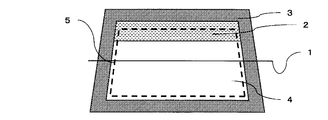
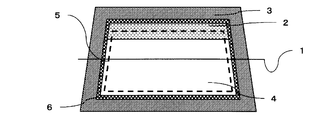
前記熱線反射層は、ガラス面に対して垂直方向から見た時、少なくともガラス面の中心を含む中心部に形成されているものであり、その上端は前記透明着色帯と重なっているように見えるものである。図1~図4はガラス面に対して垂直方向の車外側から見たときの実施形態の概略図を示したものであり、以下、図1~図4を参照しながら本発明の好適な実施形態についての説明を行う。なお、本発明は以下に限定されるものではない。
まず、縦約1000mm、横約1500mm、厚み2.0mmの平板ガラスに、幅30mm~100mm前後の帯状のセラミックカラー層3を形成する。
セラミックカラーペーストをスクリーン印刷にて所望の形状に塗布後、乾燥炉にて120℃、5分間乾燥後、焼成炉内で3分間焼成する。この時、セラミックカラーペーストは、低融点ガラスフリットと顔料の比率を、低融点ガラスフリット:顔料=80:20で調整し、樹脂分を5wt%、溶剤15wt%を加え100wt%としたものを使用し、顔料としては、黒色の顔料に酸化クロム、酸化銅、酸化マンガンの混合顔料を使用する。なお、低融点ガラスフリットと顔料の混合比、及び顔料の種類等は目的に応じて適宜選択されればよい。
次に、熱線反射層4を形成しないガラス面上にマスク部材を設置し、マグネトロンスパッタリング装置の基材ホルダーに設置し、該装置の真空チャンバー内を真空ポンプで約5×10⁻⁴Paまで脱気した後、スパッタガスを導入し、真空チャンバー内の圧力を0.1~1Paの間で保持し、スパッタターゲットに電力を印加し、該パターニング膜付きガラス基板を搬送させながら、Ag膜と誘電体膜とからなる熱線反射積層膜を全面に成膜する。成膜後にマスク部材を取り除くことで、熱線反射層4が形成される。
次に、セラミックカラー層3及び熱線反射層4が形成された板状ガラスを所望の形状に切断、研磨し、別途用意した所定形状に切断、研磨された板状ガラスを重ね、ガラス曲げ型に設置し、加熱曲げ成形する。
次に、透明着色帯2が形成されたPVBを前述した2枚のガラスの間に挿入して積層体とし、該積層体をゴム製の真空袋に入れ、袋内を脱気減圧し、約80~110 ℃程度で約20~30分程度保持した後、一旦常温にし、袋から取り出した積層体をオートクレーブ装置に入れ、圧力約10~14kg/cm2 、温度約110~140℃で約20~40分間、加圧、加熱して自動車用合わせガラスを得る。
図1の実施形態において前記熱線反射層4の端部5は、その上端が水平方向の中心線1よりも上方に形成された透明着色帯2及びセラミックカラー層3、前記上端以外の端部がセラミックカラー層3と、それぞれ重なって見えるものである。
透明着色帯2は美観上と機能面から、ガラスの上縁部と透明着色帯2の下端とが平行になるように形成されるのが好ましく、また、前記透明着色帯2は部分的にセラミックカラー層3と重なっていてもよい。
また、図2及び図3の実施形態において、前記熱線反射層4の端部5は、その上端が前記透明着色帯2、下端が着色されていない周縁部、上端及び下端以外の端部が着色されていない周縁部及び透明着色帯2と、それぞれ重なって見えるものである。
前記着色されていない周縁部とは、ガラス面に対して垂直方向から見たとき、セラミックカラー層3又は着色パターン層6に隣接するように見えるガラス面部分を指すものとしてもよく、上記セラミックカラー層3及び着色パターン層6を含まない部分である。
また、図4に見られる実施形態のように、前記熱線反射層4の端部5の一部が、構造上やむを得ず着色パターン層6を横切るものであっても差し支えない。
1 水平方向の中心線
2 透明着色帯
3 セラミックカラー層
4 熱線反射層
5 熱線反射層の端部
6 着色パターン層
2 透明着色帯
3 セラミックカラー層
4 熱線反射層
5 熱線反射層の端部
6 着色パターン層
Claims (5)
- 透明着色帯を有する自動車用合わせガラスにおいて、前記自動車用合わせガラスの周縁部にセラミックカラー層と、上辺部に透明着色帯と、少なくとも中心部に熱線反射層とを有し、ガラス面に対して垂直方向から見たとき、少なくとも前記熱線反射層の上端が前記透明着色帯と重なることを特徴とする自動車用合わせガラス。
- ガラス面に対して垂直方向から見たとき、前記透明着色帯と重なっていない前記熱線反射層の端部が、主に前記セラミックカラー層が形成された周縁部と重なることを特徴とする請求項1に記載の自動車用合わせガラス。
- ガラス面に対して垂直方向から見たとき、前記透明着色帯と重なっていない前記熱線反射層の端部が、主に着色されていない周縁部と重なることを特徴とする請求項1に記載の自動車用合わせガラス。
- 前記セラミックカラー層の内周側に着色パターン層を有し、ガラス面に対して垂直方向から見たとき、前記着色パターン層が前記セラミックカラー層と接することを特徴とする請求項1乃至請求項3のいずれか1項に記載の自動車用合わせガラス。
- 前記熱線反射層の日射透過率が50%以下であることを特徴とする請求項1乃至請求項4のいずれか1項に記載の自動車用合わせガラス。
Applications Claiming Priority (2)
| Application Number | Priority Date | Filing Date | Title |
|---|---|---|---|
| JP2010-021917 | 2010-02-03 | ||
| JP2010021917A JP2011157241A (ja) | 2010-02-03 | 2010-02-03 | 自動車用合わせガラス |
Publications (1)
| Publication Number | Publication Date |
|---|---|
| WO2011096150A1 true WO2011096150A1 (ja) | 2011-08-11 |
Family
ID=44355172
Family Applications (1)
| Application Number | Title | Priority Date | Filing Date |
|---|---|---|---|
| PCT/JP2010/073489 Ceased WO2011096150A1 (ja) | 2010-02-03 | 2010-12-27 | 自動車用合わせガラス |
Country Status (2)
| Country | Link |
|---|---|
| JP (1) | JP2011157241A (ja) |
| WO (1) | WO2011096150A1 (ja) |
Cited By (4)
| Publication number | Priority date | Publication date | Assignee | Title |
|---|---|---|---|---|
| CN106064509A (zh) * | 2015-04-22 | 2016-11-02 | 爱信精机株式会社 | 车辆用树脂玻璃 |
| FR3043025A1 (fr) * | 2015-10-30 | 2017-05-05 | Peugeot Citroen Automobiles Sa | Panneau transparent ou translucide de vehicule automobile avec elements optiques luminophores |
| CN109986935A (zh) * | 2017-12-29 | 2019-07-09 | 宝沃汽车(中国)有限公司 | 车辆的风挡玻璃以及车辆 |
| US10792894B2 (en) | 2015-10-15 | 2020-10-06 | Saint-Gobain Performance Plastics Corporation | Seasonal solar control composite |
Families Citing this family (9)
| Publication number | Priority date | Publication date | Assignee | Title |
|---|---|---|---|---|
| US10164135B2 (en) | 2009-08-07 | 2018-12-25 | Guardian Glass, LLC | Electronic device including graphene-based layer(s), and/or method or making the same |
| US10167572B2 (en) | 2009-08-07 | 2019-01-01 | Guardian Glass, LLC | Large area deposition of graphene via hetero-epitaxial growth, and products including the same |
| JP5902496B2 (ja) * | 2012-01-30 | 2016-04-13 | 株式会社トッパンTdkレーベル | 焼成用ペースト組成物、それを用いた合わせガラス、及び、合わせガラスの製造方法 |
| CN107425178B (zh) | 2012-04-16 | 2020-12-01 | 株式会社Lg 化学 | 制造二次电池用电极的方法 |
| US9593019B2 (en) * | 2013-03-15 | 2017-03-14 | Guardian Industries Corp. | Methods for low-temperature graphene precipitation onto glass, and associated articles/devices |
| US10431354B2 (en) | 2013-03-15 | 2019-10-01 | Guardian Glass, LLC | Methods for direct production of graphene on dielectric substrates, and associated articles/devices |
| US10145005B2 (en) | 2015-08-19 | 2018-12-04 | Guardian Glass, LLC | Techniques for low temperature direct graphene growth on glass |
| JP7024618B2 (ja) * | 2017-07-26 | 2022-02-24 | Agc株式会社 | 車両用合わせガラス |
| JP7409205B2 (ja) * | 2020-04-08 | 2024-01-09 | Agc株式会社 | 熱線反射膜付きガラス |
Citations (4)
| Publication number | Priority date | Publication date | Assignee | Title |
|---|---|---|---|---|
| JPS6430335U (ja) * | 1987-08-11 | 1989-02-23 | ||
| JPH05286358A (ja) * | 1992-04-10 | 1993-11-02 | Asahi Glass Co Ltd | 自動車用窓ガラス及びその製造方法 |
| JPH08210042A (ja) * | 1994-09-16 | 1996-08-13 | Saint Gobain Vitrage | 電磁放射線透過性の窓ガラス |
| JP2002528374A (ja) * | 1998-10-30 | 2002-09-03 | ソシエタ イタリアーナ ベトロ − エスアイブイ − ソシエタ ペル アチオニ | 透明パネル |
-
2010
- 2010-02-03 JP JP2010021917A patent/JP2011157241A/ja active Pending
- 2010-12-27 WO PCT/JP2010/073489 patent/WO2011096150A1/ja not_active Ceased
Patent Citations (4)
| Publication number | Priority date | Publication date | Assignee | Title |
|---|---|---|---|---|
| JPS6430335U (ja) * | 1987-08-11 | 1989-02-23 | ||
| JPH05286358A (ja) * | 1992-04-10 | 1993-11-02 | Asahi Glass Co Ltd | 自動車用窓ガラス及びその製造方法 |
| JPH08210042A (ja) * | 1994-09-16 | 1996-08-13 | Saint Gobain Vitrage | 電磁放射線透過性の窓ガラス |
| JP2002528374A (ja) * | 1998-10-30 | 2002-09-03 | ソシエタ イタリアーナ ベトロ − エスアイブイ − ソシエタ ペル アチオニ | 透明パネル |
Cited By (6)
| Publication number | Priority date | Publication date | Assignee | Title |
|---|---|---|---|---|
| CN106064509A (zh) * | 2015-04-22 | 2016-11-02 | 爱信精机株式会社 | 车辆用树脂玻璃 |
| CN106064509B (zh) * | 2015-04-22 | 2018-10-16 | 爱信精机株式会社 | 车辆用树脂玻璃 |
| US10259205B2 (en) | 2015-04-22 | 2019-04-16 | Aisin Seiki Kabushiki Kaisha | Vehicular resin glass |
| US10792894B2 (en) | 2015-10-15 | 2020-10-06 | Saint-Gobain Performance Plastics Corporation | Seasonal solar control composite |
| FR3043025A1 (fr) * | 2015-10-30 | 2017-05-05 | Peugeot Citroen Automobiles Sa | Panneau transparent ou translucide de vehicule automobile avec elements optiques luminophores |
| CN109986935A (zh) * | 2017-12-29 | 2019-07-09 | 宝沃汽车(中国)有限公司 | 车辆的风挡玻璃以及车辆 |
Also Published As
| Publication number | Publication date |
|---|---|
| JP2011157241A (ja) | 2011-08-18 |
Similar Documents
| Publication | Publication Date | Title |
|---|---|---|
| WO2011096150A1 (ja) | 自動車用合わせガラス | |
| JP4442863B2 (ja) | ウインドシールド、および車両用合わせガラスの製造方法 | |
| CN102471153B (zh) | 车辆用夹层玻璃 | |
| EP1923365B1 (en) | Laminated glass for vehicle window | |
| EP3081378B2 (de) | Scheibe mit hochfrequenz-transmission | |
| US7629040B2 (en) | Infrared reflection glass plate and laminated glass for vehicle window | |
| CN112456811B (zh) | 一种镀膜玻璃及其夹层玻璃 | |
| US6572990B1 (en) | Transportation equipment window antireflection film, glass with antireflection film, laminated glass and production method therefor | |
| CN113748017A (zh) | 层压窗玻璃和工艺 | |
| MX2011001345A (es) | Pantalla de plasma que incluye filtro de emi sin marco y/o metodo para hacer la misma. | |
| CN112574614B (zh) | 一种用于激光除膜的印刷组合物和夹层玻璃的制造方法 | |
| CN101243023A (zh) | 车窗用夹层玻璃 | |
| JPH03110147A (ja) | 合わせ窓ガラス | |
| JP2022546971A (ja) | 高周波伝送用のパターンを有しているペイン | |
| CN116395985A (zh) | 抗反射玻璃及其制造方法、车窗玻璃 | |
| EP1106343A1 (en) | Laminated glazing panel | |
| JPWO2007049766A1 (ja) | シェードバンド付き合わせガラス | |
| JP5732832B2 (ja) | 車両用窓ガラスの製造方法 | |
| KR100666525B1 (ko) | 플라즈마 디스플레이 판넬용 전면필터의 제조방법 | |
| JP2020193122A (ja) | 合わせガラス | |
| JPH0474737A (ja) | 合わせガラス | |
| CN217649272U (zh) | 基于偏振光反射抬头显示的前风挡玻璃 | |
| CN117863673B (zh) | 层压窗玻璃和工艺 | |
| JP2555737C (ja) |
Legal Events
| Date | Code | Title | Description |
|---|---|---|---|
| 121 | Ep: the epo has been informed by wipo that ep was designated in this application |
Ref document number: 10845281 Country of ref document: EP Kind code of ref document: A1 |
|
| NENP | Non-entry into the national phase |
Ref country code: DE |
|
| 122 | Ep: pct application non-entry in european phase |
Ref document number: 10845281 Country of ref document: EP Kind code of ref document: A1 |