WO2011071102A1 - 耐候性に優れたアルミ・樹脂複合品及びその製造方法 - Google Patents
耐候性に優れたアルミ・樹脂複合品及びその製造方法 Download PDFInfo
- Publication number
- WO2011071102A1 WO2011071102A1 PCT/JP2010/072102 JP2010072102W WO2011071102A1 WO 2011071102 A1 WO2011071102 A1 WO 2011071102A1 JP 2010072102 W JP2010072102 W JP 2010072102W WO 2011071102 A1 WO2011071102 A1 WO 2011071102A1
- Authority
- WO
- WIPO (PCT)
- Prior art keywords
- aluminum
- resin
- weather resistance
- shaped body
- test
- Prior art date
- Legal status (The legal status is an assumption and is not a legal conclusion. Google has not performed a legal analysis and makes no representation as to the accuracy of the status listed.)
- Ceased
Links
Images




Classifications
-
- B—PERFORMING OPERATIONS; TRANSPORTING
- B29—WORKING OF PLASTICS; WORKING OF SUBSTANCES IN A PLASTIC STATE IN GENERAL
- B29C—SHAPING OR JOINING OF PLASTICS; SHAPING OF MATERIAL IN A PLASTIC STATE, NOT OTHERWISE PROVIDED FOR; AFTER-TREATMENT OF THE SHAPED PRODUCTS, e.g. REPAIRING
- B29C45/00—Injection moulding, i.e. forcing the required volume of moulding material through a nozzle into a closed mould; Apparatus therefor
- B29C45/14—Injection moulding, i.e. forcing the required volume of moulding material through a nozzle into a closed mould; Apparatus therefor incorporating preformed parts or layers, e.g. injection moulding around inserts or for coating articles
- B29C45/14311—Injection moulding, i.e. forcing the required volume of moulding material through a nozzle into a closed mould; Apparatus therefor incorporating preformed parts or layers, e.g. injection moulding around inserts or for coating articles using means for bonding the coating to the articles
-
- B—PERFORMING OPERATIONS; TRANSPORTING
- B29—WORKING OF PLASTICS; WORKING OF SUBSTANCES IN A PLASTIC STATE IN GENERAL
- B29C—SHAPING OR JOINING OF PLASTICS; SHAPING OF MATERIAL IN A PLASTIC STATE, NOT OTHERWISE PROVIDED FOR; AFTER-TREATMENT OF THE SHAPED PRODUCTS, e.g. REPAIRING
- B29C45/00—Injection moulding, i.e. forcing the required volume of moulding material through a nozzle into a closed mould; Apparatus therefor
- B29C45/14—Injection moulding, i.e. forcing the required volume of moulding material through a nozzle into a closed mould; Apparatus therefor incorporating preformed parts or layers, e.g. injection moulding around inserts or for coating articles
- B29C45/14778—Injection moulding, i.e. forcing the required volume of moulding material through a nozzle into a closed mould; Apparatus therefor incorporating preformed parts or layers, e.g. injection moulding around inserts or for coating articles the article consisting of a material with particular properties, e.g. porous, brittle
-
- B—PERFORMING OPERATIONS; TRANSPORTING
- B29—WORKING OF PLASTICS; WORKING OF SUBSTANCES IN A PLASTIC STATE IN GENERAL
- B29K—INDEXING SCHEME ASSOCIATED WITH SUBCLASSES B29B, B29C OR B29D, RELATING TO MOULDING MATERIALS OR TO MATERIALS FOR MOULDS, REINFORCEMENTS, FILLERS OR PREFORMED PARTS, e.g. INSERTS
- B29K2705/00—Use of metals, their alloys or their compounds, for preformed parts, e.g. for inserts
-
- B—PERFORMING OPERATIONS; TRANSPORTING
- B29—WORKING OF PLASTICS; WORKING OF SUBSTANCES IN A PLASTIC STATE IN GENERAL
- B29K—INDEXING SCHEME ASSOCIATED WITH SUBCLASSES B29B, B29C OR B29D, RELATING TO MOULDING MATERIALS OR TO MATERIALS FOR MOULDS, REINFORCEMENTS, FILLERS OR PREFORMED PARTS, e.g. INSERTS
- B29K2705/00—Use of metals, their alloys or their compounds, for preformed parts, e.g. for inserts
- B29K2705/02—Aluminium
Definitions
- the present invention relates to an aluminum-shaped body made of an aluminum alloy, an aluminum / resin composite product in which a resin molded body is integrally provided on the surface of the aluminum-shaped body, and a method for manufacturing the same. In addition to being excellent in airtightness, it also has excellent corrosion resistance and weather resistance, as well as excellent tensile strength of the aluminum / resin joint surface.
- the present invention relates to an aluminum / resin composite product that can be suitably used in a wide range of fields, including various switch parts, capacitor parts for various industrial equipment, and the like, and a method for producing the same.
- a method using an adhesive is known as a general technique.
- a metal part is set in an injection mold, a molten resin is injected into the mold and filled, and the resin is fixed to the metal part. It is done.
- a method of performing a predetermined surface treatment on the surface of the metal part to be bonded to the resin is also known in order to perform bonding between the metal part and the resin at a lower cost and further improve the adhesive force.
- Patent Document 1 an aluminum alloy shaped article having a surface roughness of 5 ⁇ m to 50 ⁇ m and a fine concave or convex portion of 1 ⁇ m or less on the surface, and a concave or convex portion of the aluminum alloy shaped article are provided.
- a composite comprising a predetermined thermoplastic resin composition that has entered and is fixed.
- Patent Document 2 aluminum obtained by immersing in one or more aqueous solutions selected from ammonia, hydrazine, and a water-soluble amine compound and having ultrafine recesses with a number average inner diameter of 10 to 80 nm formed on the surface.
- a metal resin composite comprising an alloy part and a thermoplastic synthetic resin composition part fixed to the surface thereof by injection molding.
- Patent Document 3 a metal plate subjected to any base treatment selected from alumite treatment, unsealed alumite treatment, acid etching treatment, galvanized chromate treatment, and sandblast treatment, and insert injection molding method has proposed a molded body made of a thermoplastic material integrated without an adhesive.
- Patent Document 4 proposes a method for producing a silicone resin-metal composite by providing a fine rough surface layer on an aluminum thin plate by chemical etching or electrolytic etching, and then injecting silicone resin. .
- Patent Document 5 proposes a method of manufacturing a metal insert resin composite molded product by chemically etching the surface of a metal part and then injection molding using a thermoplastic resin material.
- Patent Document 6 a metal part surface such as aluminum or aluminum alloy is treated with warm water to form a hydroxyl group-containing film on the surface, and then injection-molded using a thermoplastic resin material, so that the metal material and the heat.
- a method for producing a metal insert resin composite molded product capable of achieving a sufficient bonding strength with a plastic resin.
- Patent Document 7 an insulating resin and aluminum are bonded by bonding a metal foil to an aluminum or aluminum alloy having a surface roughness (Rmax) of about 8 to 18 ⁇ m through an organic resin or an organic-inorganic composite resin.
- Rmax surface roughness
- the present inventors first focused on an aluminum alloy as a metal material, and the adhesion strength at the interface between the aluminum shaped body made of this aluminum alloy and the resin molded body integrally provided on the surface thereof, and We have studied aluminum / resin composites that have extremely high airtightness and can exhibit excellent adhesion strength and airtightness even in harsh environments, as well as excellent durability and heat resistance. It was found that by forming a concave and convex portion having a concave portion with a specific surface shape, the adhesion and airtightness between the aluminum shape body and the resin molded body are remarkably improved. No. 2008-153,805 and Japanese Patent Application No. 2008-153,806 were filed.
- the inventors of the present invention maintain excellent adhesion strength and airtightness of the aluminum / resin joint surface even in harsh environments such as temperature, humidity, dust, and corrosive substances.
- etching treatment To form an uneven portion having a concave portion with a specific surface shape on the surface of the aluminum shape body, and further, on the outermost surface of this uneven portion, Al (OH) 3 , AlO (OH ), Al 2 O 3 , Al (PO 4 ), Al 2 (HPO 4 ) 3 , Al (H 2 PO 4 ) 3 , and AlOSiO 2 , an aluminum film containing one or more aluminum compounds is formed.
- the object of the present invention is extremely high adhesion strength and airtightness at the interface between the aluminum molded body made of aluminum alloy and the resin molded body integrally bonded, and temperature, humidity, dust, corrosive substances, etc.
- it In addition to maintaining excellent adhesion strength and airtightness of the aluminum / resin joint surface in harsh environments, it not only has excellent corrosion resistance, durability and heat resistance, but also has weather resistance and tensile strength of the aluminum / resin joint surface.
- An object of the present invention is to provide an aluminum / resin composite product that can exhibit excellent performance in terms of strength.
- Another object of the present invention is that the adhesion strength and airtightness of the interface between the aluminum shaped body and the resin molded body are extremely high, and the adhesion strength of the aluminum / resin bonding surface is excellent even in harsh environments.
- An aluminum / resin composite that retains airtightness and is not only excellent in corrosion resistance, durability, and heat resistance, but also excellent in weather resistance and tensile strength of the aluminum / resin bonded surface.
- the object is to provide a method for producing an aluminum / resin composite product that can be produced.
- the present invention relates to an aluminum alloy comprising an aluminum shape body made of an aluminum alloy having a concavo-convex portion on a part or the entire surface thereof, and a resin molded body in which a resin is bonded to one surface of the aluminum shape body.
- An aluminum film containing one or more aluminum compounds selected from 2 (HPO 4 ) 3 , Al (H 2 PO 4 ) 3 , and AlOSiO 2 is formed, and a plurality of concave portions resulting from the uneven portions
- the resin molded body is formed with a plurality of fitting portions into which the resin has entered and solidified into the plurality of concave portions, and an aluminum shape body is formed by the concave portions and the fitting portions. And the resin molded body are locked to each other It is an excellent aluminum and resin composite article in weather resistance.
- the present invention is a composite product comprising an aluminum shape body made of an aluminum alloy having a concavo-convex portion on a part or the entire surface thereof, and a resin molded body provided on the surface of the aluminum shape body, On the surface of the aluminum shaped body, Al (OH) 3 , AlO (OH), Al 2 O 3 , Al (PO 4 ), Al 2 (HPO 4 ) derived from the aluminum film formation treatment on the outermost surface of the uneven portion. 3 , an aluminum film containing one or more aluminum compounds selected from Al (H 2 PO 4 ) 3 and AlOSiO 2 is formed, and a plurality of concave portions are formed due to the uneven portions.
- Each concave portion is perpendicular to the thickness direction in the thickness direction cross section of the aluminum-shaped body, and in a half line between the top line passing through the highest part of the uneven part and the bottom line passing through the deepest part.
- the opening width measured by observation with a scanning electron microscope is 0.1 ⁇ m or more and 30 ⁇ m or less, and the depth is 0.1 ⁇ m or more and 30 ⁇ m or less,
- the resin molded body is formed with a plurality of insertion portions into which the resin has entered and solidified in the plurality of concave portions, An aluminum / resin composite product excellent in weather resistance, wherein the concave shape portion and the fitting portion hold the aluminum shape body and the resin molded body together.
- this invention is the manufacturing method of the aluminum article made from an aluminum alloy, and the composite article which contains the resin molding on the surface of this aluminum shape body, Comprising: The aluminum alloy material is etched, and a part or whole surface of the surface An aluminum alloy material having a plurality of concave portions due to the uneven portions is formed, and then an aluminum film forming treatment is applied to at least the uneven portion surface of the aluminum alloy material, and the outermost surface of the uneven portions is derived from the aluminum film forming treatment.
- An aluminum shape body made of an aluminum alloy is formed by forming an aluminum film containing the aluminum compound, and at the time of molding of the resin molded body, the resin molded body in which the resin has entered and solidified into each concave portion of the aluminum shaped body Insertion Characterized in that an aluminum-resin composite product in which the concave portion of the aluminum shaped body and the fitting portion of the resin molded body are engaged with each other and the aluminum shaped body and the resin molded body are integrally bonded is manufactured. This is a method for producing an aluminum / resin composite product having excellent weather resistance.
- the aluminum alloy material for forming the aluminum shaped body specifically, pure Al 1000 series, Al-Cu 2000 series, Al-Mn 3000 series, Al-Si series 4000 series, Al-Mg series 5000 series, ADC5 and ADC6, Al-Mg-Si series 6000 series, Al-Zn-Mg series 7000 series, Al-Fe series 8000 series, Al-Si-Mg
- a processing material obtained by appropriately processing a material made of a material such as a system ADC3, an Al-Si-Cu system ADC10, an ADC10Z, an ADC12, an ADC12Z, an Al-Si-Cu-Mg system ADC14, Furthermore, the combination material etc. which are obtained by combining these processed materials suitably are mentioned.
- the plurality of concave portions formed on the surface of the aluminum shape body due to the uneven portions on the surface of the aluminum shape body have a hole shape or an opening edge portion which is an endless peripheral portion. It may be a hole (a concave part having an endless opening edge), or a slit or groove having an opening edge having both ends (a concave part having an end opening edge) Further, a hole-like or hole-like one having these endless opening edges and a slit-like or groove-like one having endless opening edges may be mixed.
- the protrusion part protruded in the shape of a snow flake toward the opening width direction center from a part or all part of the opening edge part of a recessed part preferably is formed.
- the opening width of the concave portion is narrower than the width of the inside of the concave portion, and the insertion portions of the resin molded body that has entered into the concave portion and solidified are mutually connected with the concave portion.
- a non-detachable locking structure is formed, and the aluminum molded body and the resin molded body are not detached unless one or both of the concave portion of the aluminum molded body or the insertion portion of the resin molded body are destroyed. The adhesion strength and airtightness between them are further improved.
- the resin molded body is inserted into the concave portions.
- the parts do not necessarily fit in close contact, for example, based on the difference in linear expansion coefficient between the aluminum shaped body and the resin molded body and the ambient temperature, between the aluminum shaped body and the resin molded body. Even if an inevitable extremely small gap is generated, excellent adhesion strength and airtightness are maintained between the aluminum shaped body and the resin molded body.
- Al (OH) 3 , AlO (OH), Al 2 O 3 , Al (PO 4 ), Al 2 derived from the aluminum film formation treatment is provided on the outermost surface of the concavo-convex portion of the aluminum shaped body.
- An aluminum film containing one or more aluminum compounds selected from (HPO 4 ) 3 , Al (H 2 PO 4 ) 3 , and AlOSiO 2 is formed, and this aluminum film is formed due to the uneven portion. Since a boehmite film having a functional group having a chemical bonding force to the resin or a fine uneven shape is formed on the outermost surface of the plurality of recessed portions, it enters into the recessed portion having such a specific surface shape.
- the molded resin molded body fitting part not only forms a strong physical locking structure with the concave part, but also forms a chemical bond that cannot be removed from each other, and forms an aluminum molded body. Either one or both of the concave part of the resin or the insertion part of the resin molded body Without desorption unless broken, the adhesion strength and air tightness between the aluminum molded body and the molded resin are further improved.
- an aluminum shape body having the above specific surface shape and having an aluminum film on the outermost surface of the concavo-convex portion (particularly its concave portion) has a corrosion resistance as compared with the case of only having a specific surface shape by etching treatment.
- the weather resistance and the tensile strength of the aluminum / resin bonded surface have been significantly improved. Therefore, such an aluminum body is left in a very harsh environment, and then the resin enters the recess. Even when solidified, excellent adhesion strength and airtightness are maintained between the aluminum shaped body and the resin molded body.
- the aluminum shape body having the above surface property and the resin molded body are integrally bonded
- the aluminum shape body and the resin molded body only by etching treatment are integrally bonded.
- resin composite products not only adhesion strength and airtightness are improved, but also an aluminum / resin composite product capable of exhibiting remarkable corrosion resistance can be produced.
- the opening width (d) measured by observation with a scanning electron microscope is 0.1 ⁇ m or more and 30 ⁇ m or less, preferably 0.5 ⁇ m or more and 20 ⁇ m or less, more preferably 1 ⁇ m or more and 10 ⁇ m or less, and the depth is 0.
- the size may be 1 ⁇ m or more and 30 ⁇ m or less, preferably 0.5 ⁇ m or more and 20 ⁇ m or less.
- the opening width (d) of the concave portion is smaller than 0.1 ⁇ m, it is difficult for the molten resin to enter during injection molding, and a fine void is generated at the interface between the aluminum shaped body 1 and the resin molded body 2. Adhesion strength and air tightness are difficult to obtain, and conversely, if it is attempted to increase the thickness beyond 30 ⁇ m, the dissolution reaction proceeds excessively during the surface treatment (etching treatment) of the aluminum molded body 1, and the material surface is missing or the plate thickness of the material is increased.
- the depth is less than 0.1 ⁇ m, it is difficult to obtain a sufficient insertion portion of the resin molded body 2.
- the surface treatment (etching treatment) of the aluminum molded body 1 is performed. Occasionally, the dissolution reaction proceeds excessively, resulting in a problem that the surface of the material is missing or the thickness of the material is increased.
- the density of the plurality of concave portions formed due to the concave and convex portions on the surface of the aluminum-shaped body is in the range of an opening width of 0.5 ⁇ m to 20 ⁇ m and a depth of 0.5 ⁇ m to 20 ⁇ m per 0.1 mm square. It is preferable that one or two or more of them have a size of about 5 to 200.
- the snow candy-like protrusion formed on the concave portion is preferably directed from the resin molded body side to the aluminum shape body side in the cross section in the thickness direction of the aluminum / resin integral molded product.
- observation lines extending in the thickness direction
- at least one laminated portion made of resin-aluminum-resin is formed on one observation line, and this lamination
- the thickness of the aluminum-shaped body part of the part should be in the range of 0.1 ⁇ m or more and 30 ⁇ m or less, and in such an aluminum / resin integrated molded product, such a snow ridge-like protrusion is within the range of 1000 observation lines. There may be one or more.
- the plurality of concave portions of the aluminum-shaped body may have a double concave portion structure in which at least one or more internal concave portions are formed on the inner wall surface, in part or in whole.
- the inner wall surface may have an internal concavo-convex structure in which at least one or more internal protrusions are formed, and the double concave structure or the internal concavo-convex structure may coexist.
- the presence of such a double concave portion structure or internal concavo-convex structure allows the concave portion of the aluminum shape body and the insertion portion of the resin molded body to be more It bonds firmly and exhibits better adhesion strength and airtightness between the aluminum shaped body and the resin molded body.
- the thickness of the aluminum film formed on the outermost surface of the concavo-convex portion of the surface of the aluminum shaped body is 0.001 ⁇ m in order to exhibit excellent performance in weather resistance and tensile strength of the aluminum / resin bonded surface. It may be in the range of 30 ⁇ m or less, preferably 0.003 ⁇ m or more and 8 ⁇ m or less, more preferably 0.006 ⁇ m or more and 5 ⁇ m or less. However, when the aluminum film is an alumina film (Al 2 O 3 ), the thickness is preferably 0.1 ⁇ m or more.
- the thickness of the aluminum film is less than 0.01 ⁇ m (in the case of alumina film (Al 2 O 3 ), less than 0.1 ⁇ m), the effect of weather resistance cannot be fully exhibited. The problem that the uneven part of the surface is buried with the film occurs, and the tensile strength and airtightness of the joint surface are lowered.
- an aluminum shape body having a plurality of desired concave portions as described above is formed on the surface.
- An example is a method in which an etching process is performed on a material to form a concavo-convex portion on a part or the entire surface, and an aluminum shape body having a plurality of concave portions due to the concavo-convex portion is formed.
- Etching solutions used for etching the aluminum alloy material include, for example, hydrochloric acid, phosphoric acid, sulfuric acid, acetic acid, oxalic acid, ascorbic acid, benzoic acid, butyric acid, citric acid, formic acid, lactic acid, isobutyric acid, apple
- An etching solution composed of an acid aqueous solution such as acid, propionic acid, and tartaric acid can be mentioned, but a plurality of concave portions having a desired opening width and depth are formed, or part or all of the concave portions
- an acid aqueous solution such as acid, propionic acid, and tartaric acid
- An etching solution containing the above halogen ions in a predetermined concentration range is preferably used. Then, using such an aqueous acid solution containing a relatively weak oxidizing power containing halogen ions, and immersing the aluminum alloy material in this etching solution, the halogen ions in the etching solution first dissolve the oxide film on the surface of the aluminum alloy material. After that, the inner aluminum alloy is melted and further eroded into the aluminum alloy material.
- the inner aluminum alloy is more easily eroded (dissolved) than the surface oxide film.
- the composition of the etching solution By setting the composition of the etching solution, the conditions of the etching process, etc., for the concave portion due to the concave and convex portions formed on the surface, the opening width and depth etc. are controlled to a desired size, or A snowbowl-like protruding portion protruding toward the center in the opening width direction can be formed on a part or all of the opening edge.
- an aqueous hydrochloric acid solution having an acid concentration of 0.1 to 80% by weight, preferably 0.5 to 50% by weight, phosphoric acid
- halides added for introducing halogen ions include chlorides such as sodium chloride, potassium chloride, magnesium chloride, and aluminum chloride, fluorides such as calcium fluoride, and bromides such as potassium bromide.
- halogen ion concentration in this etching solution is usually 0.5 g / liter (g / L) or more and 300 g / L or less, preferably 1 g / L or more and 100 g / L or less. If it is less than / L, the effect of halogen ions is small, so there is a problem that a concave part having a snow ridge-like protrusion is not formed at the opening edge, and if it exceeds 300 g / L, the surface of the aluminum molded body Since the dissolution reaction proceeds rapidly during processing (etching processing), there arises a problem that it becomes difficult to control the concave portion.
- an etching solution for forming a desired concave portion on the surface of the aluminum-shaped body may be an aqueous solution or water of a relatively strong oxidizing power such as nitric acid or concentrated sulfuric acid having a concentration exceeding 80% by weight.
- aqueous solution of an alkali such as sodium oxide or potassium hydroxide is not suitable.
- An acid aqueous solution having a relatively strong oxidizing power has a film forming ability with respect to an aluminum alloy. On the contrary, a strong oxide film is formed on the surface of the aluminum shaped body, and it becomes difficult to dissolve the oxide film by halogen ions.
- the dissolution mechanism of an aqueous alkali solution such as sodium hydroxide or potassium hydroxide is the entire surface dissolution type, and the tendency does not change even when halogen ions are added, and the desired shape and size are obtained. It becomes difficult to form the concave portion.
- the processing conditions for etching the surface of the aluminum alloy material using the above etching solution are required for the type of etching solution used, the acid concentration, the halogen ion concentration, etc., and the aluminum shape.
- the bath temperature is usually 20 to 80 ° C. for a hydrochloric acid aqueous solution and the immersion time is 1 to 30 minutes, and the bath temperature is 30 to 80 ° C. for a phosphoric acid aqueous solution.
- the bath temperature is preferably 50 to 80 ° C. and the immersion time is 1 to 3 minutes. The higher the acid concentration and bath temperature of the etching solution to be used, the more effective the etching process becomes and the shorter the processing time is possible.
- the dissolution reaction proceeds rapidly, making it difficult to control the opening width and depth of the concave portion.
- the immersion time if the opening time is less than 1 minute, it is difficult to control the opening width and depth of the concave portion, and conversely, if the immersion time exceeds 30 minutes, the productivity is lowered.
- the surface of the aluminum alloy material before the etching treatment is degreased or surface-adjusted as necessary.
- a pretreatment comprising an acid treatment with an acid aqueous solution and / or an alkali treatment with an alkali solution may be performed.
- examples of the acid aqueous solution used for this pretreatment include those prepared with commercially available acid degreasing agents, mineral acids such as sulfuric acid, nitric acid, hydrofluoric acid, and phosphoric acid, organic acids such as acetic acid and citric acid, and the like.
- acid reagents such as a mixed acid obtained by mixing acid
- alkaline aqueous solution for example, what was prepared with a commercially available alkaline degreasing agent, caustic soda, etc.
- alkali reagent, or what was prepared by mixing these things etc. can be used.
- the operation method and treatment conditions of the pretreatment conventionally performed using this type of acid aqueous solution or alkali aqueous solution and For example, it can be performed by a method such as an immersion method or a spray method.
- An aluminum film forming treatment is performed to form an aluminum film containing at least one aluminum compound selected from Al 2 (HPO 4 ) 3 , Al (H 2 PO 4 ) 3 , and AlOSiO 2 .
- the treatment solution used for the aluminum film formation treatment is not particularly limited as long as an aluminum film containing such an aluminum compound can be formed, and examples thereof include ion-exchanged water, distilled water, and silane coupling. Agents, ammonium monohydrogen phosphate solution, ammonium dihydrogen phosphate solution, phosphoric acid solution, and the like.
- the aluminum alloy material that has been subjected to the aluminum film formation treatment is subjected to a drying treatment if necessary.
- This drying treatment may be natural drying that is allowed to stand at room temperature, or may be an air blower, a dryer, an oven, or the like. Forced drying may be used.
- the treatment conditions for this aluminum film formation treatment vary depending on the treatment solution used. Specifically, when the treatment solution is ion-exchanged water or distilled water, it is immersed in warm water of 50 ° C. or higher for 60 seconds or longer. It is preferable to perform a treatment or a steam treatment for 1 minute or more under a pressure of 0.1 MPa or more, and the treatment solution contains at least one of phosphate ion, phosphate monohydrogen ion and phosphate dihydrogen ion.
- a phosphoric acid aqueous solution system containing phosphate ion species at a rate of 0.1 to 100 g / L it is immersed in a treatment solution for 30 seconds to 30 minutes and then dried with hot air at 80 to 400 ° C. for 30 seconds to 30 minutes.
- the treatment solution is a solution containing a silane coupling agent at a rate of 0.1 to 100 g / L
- the glossiness is preferably 60 or less. When the surface glossiness exceeds 60, the resin melted at the time of injection molding of the thermoplastic resin does not sufficiently enter the concave portion of the aluminum shape body, and is sufficient between the aluminum shape body and the resin molding body. A sufficient bonding strength cannot be obtained.
- the surface of the aluminum shaped body obtained by the above-described etching treatment and aluminum film formation treatment, or by pretreatment, etching treatment, and aluminum film formation treatment is observed by a cross-section at a magnification of 1000 times using an SEM or an optical microscope.
- the surface area of the aluminum shaped body is 1.2 times or more and 10 times or less than the surface area of the aluminum alloy material before forming the uneven portion by etching treatment.
- the surface area increase rate is less than 1.2 times or more than 10 times, the resin does not sufficiently enter the concave portion of the aluminum shaped body, and the sufficient bonding strength between the aluminum shaped body and the resin molded body Cannot be obtained.
- an adhesive is applied to the surface of the aluminum shaped body obtained as described above, and then a metal or resin is joined thereto, or the obtained aluminum shaped body.
- a resin is interposed between the metal and the metal, and these are joined by applying heat and pressure with a hot press machine, or the obtained aluminum shape is set in an injection mold and melted in this mold
- a composite product of the target aluminum shape and resin is manufactured by combining the resin using a so-called aluminum shape that is injected and solidified by injection of the predetermined thermoplastic resin.
- thermoplastic resin is preferably a polyarylene sulfide such as polypropylene resin, polyethylene resin, acrylonitrile / butadiene / styrene copolymer (ABS), polycarbonate resin, polyamide resin, polyphenylene sulfide (PPS), etc.
- ABS acrylonitrile / butadiene / styrene copolymer
- PPS polyphenylene sulfide
- thermoplastic resins such as polyethylene terephthalate (PET) and polybutylene terephthalate (PBT), polyoxymethylene resin, polyimide resin, syndiotactic polystyrene resin, and these thermoplastic resins Mixture of
- PET polyethylene terephthalate
- PBT polybutylene terephthalate
- polyoxymethylene resin polyimide resin
- syndiotactic polystyrene resin and these thermoplastic resins Mixture of
- fillers such as fibers, powders, and plates and various elastomer components to these thermoplastic resins.
- Fillers added to thermoplastic resins include inorganic fiber fillers such as glass fibers, carbon fibers, metal fibers, asbestos fibers and boron fibers, and high melting point organic fibers such as polyamides, fluororesins and acrylic resins. And powder fillers such as silica powder, glass beads, glass powder, inorganic powders such as calcium carbonate, and plate fillers such as glass flakes, silicates such as talc and mica, etc. In addition, it is added in an amount of 250 parts by weight or less, preferably 20 parts by weight or more and 220 parts by weight or less, more preferably 30 parts by weight or more and 100 parts by weight or less with respect to 100 parts by weight of the thermoplastic resin. When the added amount of the filler exceeds 250 parts by weight, there is a problem that the fluidity is lowered and it is difficult to enter the concave portion of the aluminum shaped body and good adhesion strength cannot be obtained and the mechanical properties are deteriorated.
- inorganic fiber fillers such as glass fibers, carbon
- the elastomer component added to the thermoplastic resin examples include urethane type, core shell type, olefin type, polyester type, amide type, and styrene type elastomers.
- the melting temperature of the thermoplastic resin at the time of injection molding, etc. it is selected in consideration of 30 parts by weight or less, preferably 3 to 25 parts by weight based on 100 parts by weight of the thermoplastic resin.
- the added amount of the elastomer component exceeds 30 parts by weight, a further effect of improving the adhesion strength is not seen, and problems such as a decrease in mechanical properties occur.
- This blending effect of the elastomer component is particularly prominent when a polyester resin is used as the thermoplastic resin.
- thermoplastic resin for producing the aluminum / resin composite product of the present invention includes known additives generally added to thermoplastic resins, that is, flame retardants, colorants such as dyes and pigments, antioxidants, Stabilizers such as ultraviolet absorbers, plasticizers, lubricants, lubricants, mold release agents, crystallization accelerators, crystal nucleating agents, and the like can be appropriately added according to the required performance.
- thermoplastic resin performed by setting the aluminum shape body in the injection mold
- normal molding conditions required for the thermoplastic resin to be used can be adopted. It is important that the thermoplastic resin melted at the time of molding surely enters and solidifies into the concave part of the aluminum shaped body, and the mold temperature and cylinder temperature are within the range permitted by the type and physical properties of the thermoplastic resin, as well as the molding cycle. It is preferable that the lower limit temperature be 90 ° C. or higher, preferably 130 ° C. or higher, but the upper limit depends on the type of thermoplastic resin used. In the range from 100 ° C. to a temperature about 20 ° C.
- the lower limit mold temperature is preferably set so as not to be lowered by 140 ° C. or more from the melting point of the thermoplastic resin.
- thermosetting resin examples include an epoxy resin
- room temperature curable resin examples include a polyester resin
- adhesive examples include nitrile rubber, synthetic rubber, epoxy, cyanoacryl, vinyl chloride, plastic, and hot melt.
- the aluminum / resin composite product of the present invention has higher adhesion strength and air tightness at the interface (aluminum / resin interface) between the aluminum shaped body and the resin molded body, and severe corrosion. Even if exposed to the environment, its excellent adhesion strength, airtightness and corrosion resistance can be maintained, and the appearance change due to corrosion of aluminum can also be maintained for a long time, and it is highly reliable over the long term Can be maintained. Therefore, the aluminum / resin composite product of the present invention is suitable for metal-resin integral molded parts in a wide range of fields, including various sensor parts for automobiles, various switch parts for home appliances, condenser parts for various industrial equipments, etc. In particular, it is suitably used for a metal-resin integral molded part that requires a high bonding strength because the resin molded body protrudes in a butted state from a part of the surface of the aluminum shaped body.
- an aluminum / resin composite product of the present invention it is possible to predict the adhesion strength of the obtained product by measuring the surface gloss or surface roughness of the aluminum molded body during production, In addition to facilitating quality control during manufacturing, it is possible to manufacture highly reliable products with little variation in adhesion strength between products.
- FIG. 1 is a cross-sectional schematic view for illustrating a concave portion by copying a cross section in the thickness direction of an aluminum shape according to the first embodiment.
- FIG. 2 is a cross-sectional explanatory view showing a typical example of the shape of the concave portion conceived from FIG.
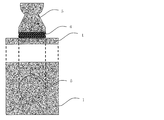
- FIG. 3 is a front view and a side view of an aluminum / adhesive / aluminum test piece (evaluation specimen) prepared for a posiTEST test using an aluminum test piece (aluminum shape).
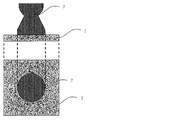
- FIG. 4 is a front view and a side view of an aluminum / resin / aluminum test piece (evaluation test piece) prepared for a posiTEST test using an aluminum test piece (aluminum shape).
- FIG. 5 is a front view and a side view of an aluminum / resin test piece (evaluation test piece) prepared for a posiTEST test using an aluminum test piece (aluminum shape).
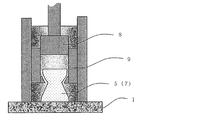
- FIG. 6 is a cross-sectional explanatory view showing a state in which the test specimen for evaluation is set in the actuator portion of the posiTEST test apparatus during the posiTEST test.
- FIG. 7 is an explanatory cross-sectional view for explaining a method of observation and evaluation of a resin / aluminum / resin laminate in an evaluation test body.
- Example 1 [Preparation of aluminum shape] Three aluminum pieces (aluminum alloy material) having a size of 50 mm ⁇ 50 mm are cut out from an aluminum alloy (JISA 1050-H24) plate having a thickness of 1 mm, and these aluminum pieces are first added to a 30 wt% nitric acid aqueous solution at room temperature. Pre-treatment of rinsing with ion-exchanged water after immersion for 1 minute, then immersing in 5 wt% sodium hydroxide solution at 50 ° C. for 1 minute and then immersing in 30 wt. Was given.
- the pre-treated aluminum pieces were etched by adding 54 g / L of aluminum chloride hexahydrate (AlCl 3 .6H 2 O) as a water-soluble inorganic halogen compound in a 2.5 wt% hydrochloric acid aqueous solution. Etching was performed using a solution (chlorine ion concentration: 48 g / L), which was immersed in this etching solution at 66 ° C. for 4 minutes and then washed with water.
- AlCl 3 .6H 2 O aluminum chloride hexahydrate
- the surface of the aluminum piece formed by the above etching treatment is subjected to a hydration treatment in which it is immersed in a 30 wt% nitric acid aqueous solution for 3 minutes at room temperature, then washed with water and immersed in hot water at 80 ° C. for 20 minutes.
- An aluminum film forming treatment for forming an aluminum film [AlO (OH)] on the outermost surface of the part was performed to prepare three aluminum test pieces (aluminum shaped bodies).
- the cross section of a region where each aluminum test piece (aluminum shaped body) was observed is, for example, as shown in the cross-sectional view of the aluminum shaped body in FIG. 1, and the concave portion 3 envisioned from FIG.
- a typical example of the shape is a concave portion having a protruding portion protruding from a part of the opening edge portion toward the center in the opening width direction (shape a: see FIG. 2 (a)), opening A double concave structure having a concave portion (see shape b: FIG.
- Example 2 (b) having a protruding portion protruding in the shape of a snow flake from the entire edge toward the center of the opening width direction, and further having a concave portion formed therein.
- concave portions of all the shapes a to d were observed. Further, the shape of the concave portion 3 was the same for each aluminum test piece, and was the same even when the observation place in each aluminum test piece was changed.
- the size (opening width and depth) of the concave portion observed in a cross section of a certain region of each aluminum test piece and the ratio thereof are the concave portion having an opening width of 0.1 ⁇ m to 1 ⁇ m per 0.1 mm square. 10 to 100, 1 to 10 concave portions with an opening width of 1 ⁇ m to 10 ⁇ m, 1 to 3 concave portions with an opening width of 11 ⁇ m to 30 ⁇ m, and a depth within a range of 0.1 ⁇ m to 30 ⁇ m Met.
- the concave shape having an opening width of 0.1 ⁇ m to 1 ⁇ m per 0.1 mm square is substantially similar to the above. 10 to 50 parts, 1 to 50 concave parts with an opening width of 1 ⁇ m to 10 ⁇ m, 1 to 2 concave parts with an opening width of 11 ⁇ m to 30 ⁇ m, and a depth in the range of 0.1 ⁇ m to 20 ⁇ m It was in.
- the size of the concave portion was the same for each aluminum test piece, and there was almost no change even when the observation place in each aluminum test piece was changed.
- the case where the opening width is within a range of 0.1 to 30 ⁇ m and the depth is within a range of 0.1 to 30 ⁇ m is good ( ⁇ ), and the case where the opening is not so is bad ( X).
- the size of the concave portion observed in Examples 2 to 18 and Comparative Examples 1 to 3 shown below was also evaluated based on the same criteria.
- test specimen preparation dolly For aluminum posiTEST test dolly (manufactured by Defelsco; size: 20mm ⁇ , JISA 1100) Similarly, a pretreatment, an etching treatment, and an aluminum film formation treatment were performed to prepare a test specimen preparation dolly for preparing a test specimen for evaluation used in the following posiTEST test and weather resistance test (salt spray test).
- test specimen for evaluation [bonding of resin (adhesive) with adhesive]
- the aluminum test piece (aluminum shaped body) 1 obtained above and the dolly 5 for test specimen preparation Are bonded via a two-component mixed epoxy rapid-curing adhesive (trade name: Araldai Trapid manufactured by Huntsman Advantest Materials) 4 and then pressed using a hot press machine (AH-2003 manufactured by ASONE) Pressurize at room temperature at 0.1 MPa, hold it as it is for 24 hours, and then press-bond, then use the cutter after the adhesive 4 solidifies the excess adhesive 4 protruding from the joint surface between the aluminum test piece 1 and the dolly 5 Then, it was separated from the joint surface and adjusted so that the joint surface was 3.14 cm 2 to prepare an aluminum / adhesive / aluminum test piece (evaluation specimen).
- test specimen for evaluation bonding of resin by thermocompression bonding
- pellets of polyphenylene sulfide resin manufactured by Toray
- (Resin) 6 is placed at 0.04 g / cm 2, and a test specimen preparation dolly 5 is set thereon, and a pressing pressure of 0.1 MPa and a plate using a hot press machine (AH-2003 manufactured by ASONE)
- An aluminum / resin / aluminum test piece (evaluation specimen) to which the resin was fixed at a bonding area of 3.14 cm 2 was thermocompression bonded at a temperature of 300 ° C.
- test specimen for evaluation (resin bonding by injection molding)
- the aluminum test piece (aluminum shaped body) 1 obtained above was injected into an injection molding machine (ST10R2V manufactured by NISSI).
- ST10R2V injection molding machine
- a polyphenylene sulfide resin manufactured by Toray
- a holding pressure 100 MPa
- a molding temperature of 320 ° C. a molding temperature of 320 ° C.
- mold temperature 160 ° C.
- Injection molding is performed under molding conditions, and a resin dolly 7 is integrally formed on the upper surface of the aluminum test piece 1, and an aluminum / resin test piece (bonding area of the resin dolly 7 to the upper surface of the aluminum test piece 1 is 3.14 cm 2 ( Test specimen for evaluation) was prepared.
- the peel load of the test specimen for evaluation is 6.3 MPa for aluminum / adhesive / aluminum specimens, 5.7 MPa for aluminum / resin / aluminum specimens, and for aluminum / resin specimens. In some cases, it was 5.5 MPa.
- the case where the adhesive or resin remains on the entire joining surface of the aluminum test piece is good ( ⁇ )
- the case where only a part remains on the aluminum test piece side is good
- ( ⁇ ) and the case of not remaining on the aluminum test piece side (interfacial peeling) were evaluated as defective ( ⁇ ), both were good ( ⁇ ).
- observation lines (OL) extending in the thickness direction from the resin molded body 2 side to the aluminum shape body 1 side are drawn at intervals of 0.1 ⁇ m, 1
- the range is 30 ⁇ m or less and 1
- the case where there is one or more ratios within the range of 00 observation lines (OL) is judged as good ( ⁇ ), and no such laminated portion exists within the range of 1000 observation lines (OL).
- the product was evaluated as defective (x), the result was good ( ⁇ ) in all cases.
- the following Examples 2 to 18 and Comparative Examples 1 to 3 were also evaluated based on the same criteria.
- Examples 2 to 5 As an aluminum film formation treatment, instead of the hydration treatment by hot water immersion at 80 ° C. for 20 minutes in Example 1, the treatment liquid shown in Table 1 below was used and the aluminum test piece ( Except that the aluminum molded body) and the dolly for preparing the test specimen were prepared, the test specimens for evaluation (aluminum / adhesive / aluminum specimen, aluminum / resin / aluminum specimen, and aluminum / resin were prepared in the same manner as in Example 1 above. A test piece) was prepared, and in the same manner as in Example 1, the weather resistance test (salt spray test), the posiTEST test, and the observation evaluation of the resin / aluminum / resin laminate were performed. The results are shown in Table 2 together with the results of Example 1.
- Example 6 An aluminum test piece (aluminum shaped body) was produced and a dolly was produced in the same manner as in Example 1 except that JIS A5052-H34 was used as the aluminum alloy plate for producing the aluminum piece.
- test specimens for evaluation (aluminum / adhesive / aluminum test piece, aluminum / resin / aluminum test piece, and aluminum / resin test piece) were prepared in the same manner as in Example 1 above.
- a weather resistance test salt spray test
- a posiTEST test observation and evaluation of the resin / aluminum / resin laminate were performed. The results are shown in Table 2 together with the results of Example 1.
- Example 7 An aluminum test piece (aluminum shaped body) was produced and a dolly was produced in the same manner as in Example 1 except that JIS A3003-H24 was used as the aluminum alloy plate for producing the aluminum piece.
- test specimens for evaluation (aluminum / adhesive / aluminum test piece, aluminum / resin / aluminum test piece, and aluminum / resin test piece) were prepared in the same manner as in Example 1 above.
- a weather resistance test salt spray test
- a posiTEST test observation and evaluation of the resin / aluminum / resin laminate were performed. The results are shown in Table 2 together with the results of Example 1.
- Example 8 An aluminum test piece and a dolly were prepared in the same manner as in Example 1, and then a test specimen for evaluation (aluminum / adhesive / aluminum test piece, aluminum / resin / aluminum test piece in the same manner as in Example 1 above) , And an aluminum / resin test piece), and a posiTEST test was performed in the same manner as in Example 1 without performing a weather resistance test (salt spray test). The observational evaluation of the part was carried out. The results are shown in Table 2 together with the results of Example 1.
- Example 1 When the test result of Example 1 and the test result of Example 8 are compared and examined, the aluminum / resin composite product of the present invention is subjected to conditions such as a weather resistance test, It was found that the tensile strength of the excellent aluminum / resin joint surface was maintained as before exposure to such conditions.
- Example 9 In the same manner as in Example 1, an aluminum test piece (aluminum shaped body) was produced, and a dolly was produced. Next, the produced aluminum test piece was subjected to a weather resistance test (salt spray test), then washed with water, dried with hot air at 100 ° C. for 5 minutes, and subsequently subjected to an evaluation test in the same manner as in Example 1. A body (aluminum / adhesive / aluminum test piece, aluminum / resin / aluminum test piece, aluminum / resin test piece) was prepared.
- Example 1 For the test specimen for evaluation thus produced, a posiTEST test was conducted in the same manner as in Example 1 above, and the results of the weather resistance test [(salt spray test)] were also evaluated. In the same manner as in Example 1, the observation and evaluation of the laminated portion of resin, aluminum, and resin were performed. The results are shown in Table 2 together with the results of Example 1.
- the aluminum shape body (aluminum test piece) by which the aluminum film process was carried out after the etching process in this invention was excellent itself. Shows weather resistance, and even when exposed to harsh environments for a long time before being processed into an aluminum / resin composite product, it still has excellent tensile strength of the aluminum / resin joint surface, and has excellent handleability. There was found.
- Example 10 Pre-treatment and etching treatment are performed in the same manner as in Example 1. Further, after immersing in a 30 wt% nitric acid aqueous solution at room temperature for 3 minutes, washing with water and then immersing in 100 ° C. hot water for 1 minute. Then, an aluminum film was formed in the same manner as in Example 1 to produce an aluminum test piece (aluminum shaped body), and a dolly was produced in the same manner as in Example 1.
- Example 2 the test specimen for evaluation (aluminum / adhesive / aluminum test piece, aluminum / resin / aluminum test piece, and aluminum / resin test piece) was performed in the same manner as in Example 1 above.
- the posiTEST test, the weather resistance test (salt water spray test), and the observation evaluation of the laminated part of the resin / aluminum / resin were carried out. The results are shown in Table 3 following Table 2.
- Example 11 In the same manner as in Example 1, pre-treatment and etching treatment were performed. Further, after immersion in a 30 wt% nitric acid aqueous solution at room temperature for 3 minutes, sufficient water washing was performed, followed by a dissolution temperature of 18 ° C. in a solution having a sulfuric acid concentration of 160 g / L. And anodizing (aluminum film forming process) under the condition of a DC voltage of 20 V to form an anodized film (aluminum film of Al 2 O 3 ) having a film thickness of 5 ⁇ m and a pore number of 10 16 holes / m 2 . The sample was washed with water and dried with hot air at 120 ° C. for 5 minutes to produce an aluminum test piece (aluminum shape), and a dolly was produced in the same manner.
- aluminum film forming process under the condition of a DC voltage of 20 V to form an anodized film (aluminum film of Al 2 O 3 ) having
- Example 2 the test specimen for evaluation (aluminum / adhesive / aluminum test piece, aluminum / resin / aluminum test piece, and aluminum / resin test piece was used in the same manner as in Example 1 above.
- the posiTEST test, the weather resistance test (salt water spray test), and the observation evaluation of the resin / aluminum / resin laminate were performed. The results are shown in Table 3 following Table 2.
- Example 12 Pretreatment and etching are performed in the same manner as in Example 1. Further, the substrate is immersed in a 30 wt% aqueous nitric acid solution at room temperature for 3 minutes, washed with water, and then subjected to water vapor treatment (aluminum film formation) under a pressure of 0.5 MPa for 20 minutes. By processing, a dense aluminum film of AlO (OH) was formed, and an aluminum test piece (aluminum shaped body) was produced, and a dolly was produced in the same manner.
- aqueous nitric acid solution at room temperature for 3 minutes
- water vapor treatment aluminum film formation
- Example 2 the test specimen for evaluation (aluminum / adhesive / aluminum test piece, aluminum / resin / aluminum test piece, and aluminum / resin test piece was used in the same manner as in Example 1 above.
- the posiTEST test, the weather resistance test (salt water spray test), and the observation evaluation of the resin / aluminum / resin laminate were performed. The results are shown in Table 3 following Table 2.
- Example 13 Except that polybutylene terephthalate resin (manufactured by Toray) was used as the thermoplastic resin, an aluminum test piece and a dolly were prepared in the same manner as in Example 1 above, and an aluminum / resin test piece (test specimen for evaluation) The test specimen for evaluation obtained was subjected to the posiTEST test and the observation evaluation of the resin / aluminum / resin laminate without performing the salt spray test. The results are shown in Table 3 following Table 2.
- Example 14 After pre-treatment as in Example 1, using an etching solution (chlorine ion concentration: 30 g / L) prepared by adding 50 g / L sodium chloride in a 50 wt% phosphoric acid aqueous solution, 66 ° C. Etching is performed by immersing in this etching solution under the condition of 4 minutes, further rinsing with water, then immersing in a 30 wt% nitric acid aqueous solution at room temperature for 3 minutes, then rinsing again, and then immersed in hot water at 100 ° C. for 1 minute. Hydration treatment (aluminum film formation treatment) was performed to produce an aluminum test piece (aluminum shaped body) in the same manner as in Example 1 above, and a dolly was produced in the same manner as in Example 1.
- chlorine ion concentration: 30 g / L prepared by adding 50 g / L sodium chloride in a 50 wt% phosphoric acid aqueous solution, 66
- Example 2 the test specimen for evaluation (aluminum / adhesive / aluminum test piece, aluminum / resin / aluminum test piece, and aluminum / resin test piece) was performed in the same manner as in Example 1 above.
- the posiTEST test, the weather resistance test (salt water spray test), and the observation evaluation of the laminated part of the resin / aluminum / resin were carried out. The results are shown in Table 3 following Table 2.
- Example 15 After pretreatment in the same manner as in Example 1, an etching solution (chlorine ion concentration: 30 g / L) prepared by adding 50 g / L sodium chloride in a 10 wt% sulfuric acid aqueous solution was used at 66 ° C. for 4 minutes. Etching treatment immersed in this etching solution under the conditions described above, followed by rinsing with water, followed by immersing in a 30 wt% nitric acid aqueous solution at room temperature for 3 minutes, then rinsing with water, and then immersing in hot water at 100 ° C. for 1 minute ( (Aluminum film forming treatment) was carried out to produce an aluminum test piece (aluminum shaped body) in the same manner as in Example 1, and a dolly was produced in the same manner as in Example 1.
- Chlorine ion concentration: 30 g / L prepared by adding 50 g / L sodium chloride in a 10 wt% sulfuric acid aqueous solution
- Example 2 the test specimen for evaluation (aluminum / adhesive / aluminum test piece, aluminum / resin / aluminum test piece, and aluminum / resin test piece) was performed in the same manner as in Example 1 above.
- the posiTEST test, the weather resistance test (salt water spray test), and the observation evaluation of the laminated part of the resin / aluminum / resin were carried out. The results are shown in Table 3 following Table 2.
- Example 16 After pretreatment in the same manner as in Example 1, an etching solution (chlorine ion concentration: 30 g / L) prepared by adding 50 g / L sodium chloride in a 30 wt% oxalic acid aqueous solution was used at 66 ° C., 4 ° C. Hydration treatment is performed by immersing in this etching solution under conditions of minutes, further rinsing with water, then immersing in a 30 wt% nitric acid aqueous solution at room temperature for 3 minutes, then rinsing with water, and then immersing in hot water at 100 ° C. for 1 minute. (Aluminum film forming treatment) was carried out to produce an aluminum test piece (aluminum shaped body) in the same manner as in Example 1, and a dolly was produced in the same manner as in Example 1.
- chlorine ion concentration: 30 g / L prepared by adding 50 g / L sodium chloride in a 30 wt% ox
- Example 2 the test specimen for evaluation (aluminum / adhesive / aluminum test piece, aluminum / resin / aluminum test piece, and aluminum / resin test piece) was performed in the same manner as in Example 1 above.
- the posiTEST test, the weather resistance test (salt water spray test), and the observation evaluation of the laminated part of the resin / aluminum / resin were carried out. The results are shown in Table 3 following Table 2.
- Example 17 After pre-treatment in the same manner as in Example 1, an etching solution (chlorine ion concentration: 54 g / L) prepared by adding 50 g / L sodium chloride (NaCl) to a 2.5 wt% hydrochloric acid aqueous solution was used. Etching is performed by immersing in this etching solution at 4 ° C for 4 minutes, followed by rinsing with water, then immersing in a 30 wt% nitric acid aqueous solution for 3 minutes at room temperature, followed by rinsing with water and then immersing in hot water at 100 ° C for 1 minute. Hydration treatment (aluminum film formation treatment) was performed to produce an aluminum test piece (aluminum shaped body) in the same manner as in Example 1 above, and a dolly was produced in the same manner as in Example 1.
- Hydration treatment aluminum film formation treatment
- Example 2 the test specimen for evaluation (aluminum / adhesive / aluminum test piece, aluminum / resin / aluminum test piece, and aluminum / resin test piece) was performed in the same manner as in Example 1 above.
- the posiTEST test, the weather resistance test (salt water spray test), and the observation evaluation of the laminated part of the resin / aluminum / resin were carried out. The results are shown in Table 3 following Table 2.
- Example 18 In the same manner as in Example 1, the pretreatment and the etching treatment were performed, and further, after being immersed in a 30 wt% nitric acid aqueous solution for 3 minutes at room temperature, sufficient water washing was performed, followed by a solution temperature of 18 ° C. in a solution having a sulfuric acid concentration of 160 g / L. And anodizing (aluminum film forming process) under the condition of a DC voltage of 20 V to form an anodized film (Al 2 O 3 aluminum film) having a film thickness of 1 ⁇ m and a pore number of 10 16 holes / m 2 . The sample was washed with water and dried with hot air at 120 ° C. for 5 minutes to produce an aluminum test piece (aluminum shape), and a dolly was produced in the same manner.
- anodizing aluminum film forming process
- Example 2 the test specimen for evaluation (aluminum / adhesive / aluminum test piece, aluminum / resin / aluminum test piece, and aluminum / resin test piece was used in the same manner as in Example 1 above.
- the posiTEST test, the weather resistance test (salt water spray test), and the observation evaluation of the resin / aluminum / resin laminate were performed. The results are shown in Table 3 following Table 2.
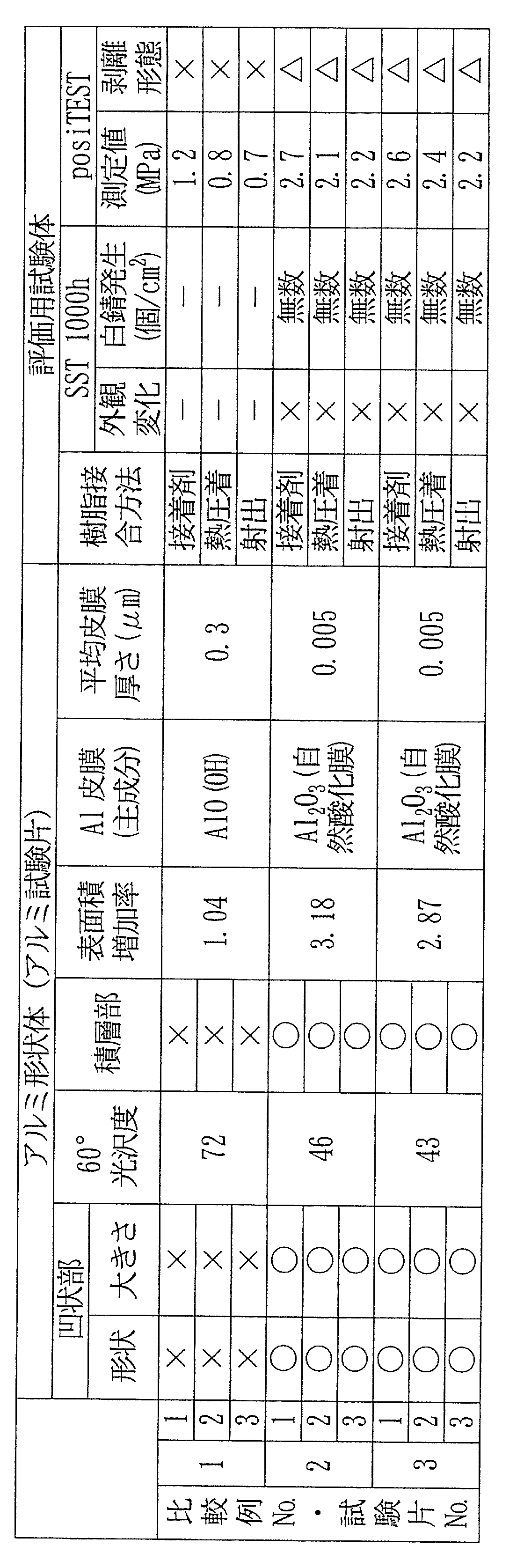
- Example 1 After pre-treating in the same manner as in Example 1, an aluminum film forming treatment by hydration treatment similar to that in Example 1 is performed without performing an etching process, and an aluminum test piece (aluminum shaped body) is produced. A dolly was produced in the same manner as in Example 1. Next, in the same manner as in Example 1, an evaluation test body (aluminum / adhesive / aluminum test piece, aluminum / resin / aluminum test piece, aluminum / resin test piece) was prepared, and the obtained evaluation test body was obtained. The posiTEST test and the observation evaluation of the laminated part of resin / aluminum / resin were carried out. The results are shown in Table 4.
- Example 2 After pretreatment and etching as in Example 1, it was immersed in a 30 wt% nitric acid aqueous solution at room temperature for 3 minutes, washed with water, and then dried with hot air at 100 ° C. for 5 minutes without performing an aluminum film formation treatment. An aluminum test piece (aluminum shaped body) was produced, and a dolly was produced in the same manner as in Example 1.
- test specimens for evaluation (aluminum / adhesive / aluminum test piece, aluminum / resin / aluminum test piece, and aluminum / resin test piece) were prepared.
- the weather resistance test salt spray test
- the posiTEST test and the observation evaluation of the laminated part of resin / aluminum / resin were carried out.
- the results are shown in Table 4 together with the results of Comparative Example 1.
- Example 3 After the pretreatment of Example 1, the sample was immersed in a 2.5 wt% hydrochloric acid aqueous solution at 66 ° C. for 4 minutes, washed with water, further immersed in a 30 wt% nitric acid aqueous solution at room temperature for 3 minutes, washed with water, and heated with 100 ° C. hot air. After drying for 1 minute, it was introduced into a salt spray tester. After 1000 hours, the test piece was taken out from the tester, washed with water and dried with hot air at 100 ° C. for 5 minutes to produce an aluminum test piece (aluminum shaped body).
- Example 1 dolly was produced in the same manner as in Example 1, and aluminum / adhesive / aluminum test piece, aluminum / resin / aluminum test piece, and aluminum / resin test piece (evaluation specimen) were produced. About the test specimen for evaluation produced in this way, as in the case of Example 1 above, the posiTEST test is conducted and evaluated, and the results of the weather resistance test (salt spray test) are also evaluated. In the same manner as in Example 1 above, observation and evaluation of the laminated portion of resin, aluminum, and resin were performed. The results are shown in Table 4 together with the results of Comparative Example 1.
- SYMBOLS 1 Aluminum shape body (aluminum test piece), TL ... Top line, BL ... Bottom line, HL ... Half line, d ... Opening width, OL ... Observation line, 2 ... Resin molding, 3 ... Concave part, 4 ... Adhesion Agent, 5, 7 ... dolly, 8 ... actuator, 9 ... dolly fixing jig.
Landscapes
- Engineering & Computer Science (AREA)
- Manufacturing & Machinery (AREA)
- Mechanical Engineering (AREA)
- Laminated Bodies (AREA)
- Injection Moulding Of Plastics Or The Like (AREA)
- ing And Chemical Polishing (AREA)
Abstract
Description
前記アルミ形状体の表面には、前記凹凸部の最表面にアルミニウム皮膜形成処理由来のAl(OH)3、AlO(OH)、Al2O3、Al(PO4)、Al2(HPO4)3、Al(H2PO4)3、及びAlOSiO2から選ばれたいずれか一種以上のアルミニウム化合物を含むアルミニウム皮膜が形成されていると共に、この凹凸部に起因して複数の凹状部が形成されており、
前記各凹状部は、アルミ形状体の厚さ方向断面においてこの厚さ方向に直交し、かつ、凹凸部の最高部を通過するトップラインと最深部を通過するボトムラインとの間のハーフラインにおいて、走査型電子顕微鏡観察により測定される開口幅が0.1μm以上30μm以下の大きさであって、その深さが0.1μm以上30μm以下の大きさであり、また、
前記樹脂成形体には前記複数の凹状部内に前記樹脂が進入して固化した複数の嵌入部が形成されており、
前記凹状部と前記嵌入部とによりアルミ形状体と樹脂成形体とが互いに係止されていることを特徴とする耐候性に優れたアルミ・樹脂複合品である。
本発明において、アルミ形状体を形成するためのアルミニウム合金材としては、具体的には、純Al系の1000系、Al-Cu系の2000系、Al-Mn系の3000系、Al-Si系の4000系、Al-Mg系の5000系、ADC5、及びADC6、Al-Mg-Si系の6000系、Al-Zn-Mg系の7000系、Al-Fe系の8000系、Al-Si-Mg系のADC3、Al-Si-Cu系のADC10、ADC10Z、ADC12、及びADC12Z、Al-Si-Cu-Mg系のADC14等の材質からなる材料を所望の形状に適宜加工して得られる加工材、更にはこれらの加工材を適宜組み合わせて得られる組合せ材等が挙げられる。
本発明において、このようなアルミ・樹脂複合品を製造する際には、先ず、表面に上述した複数の所望の凹状部を有するアルミ形状体を形成するが、その方法としては、例えば、アルミニウム合金材にエッチング処理を施して表面の一部又は全面に凹凸部を形成し、この凹凸部に起因して複数の凹状部を有するアルミ形状体を形成する方法が挙げられる。
[アルミ形状体の調製]
厚さ1mmのアルミニウム合金(JISA 1050-H24)板から50mm×50mmの大きさを有する3個のアルミ片(アルミニウム合金材)を切り出し、これらのアルミ片について、先ず30wt%硝酸水溶液に常温で5分間浸漬した後にイオン交換水で十分に水洗し、次いで5wt%水酸化ナトリウム溶液に50℃で1分間浸漬した後に水洗し、更に、30wt%硝酸水溶液に常温で3分間浸漬した後に水洗する前処理を施した。
得られた各アルミ試験片について、その厚さ方向断面のうちのある領域の断面を、走査型電子顕微鏡(日立製FE-SEM、S-4500形)を用いて観察し、先ず、アルミ形状体の厚さ方向断面においてこの厚さ方向に直交し、かつ、凹凸部の最高部を通過するトップライン(TL)を決め、次に上記と概ね同様に、アルミ形状体の厚さ方向に直交し、かつ、凹凸部の最深部を通過するボトムラインを決定し、更に、トップライン(TL)からボトムライン(BL)に対して垂直方向に線分を引き、この線分の中間部を通過し、かつ、トップライン(TL)〔あるいはボトムライン(BL)〕と平行に引かれたハーフライン(HL)上のアルミ形状体とアルミ形状体との間に存在する空隙間の距離を凹状部の開口幅(d)とし、アルミ試験片の表面の凹凸部に起因して形成された凹状部の形状と大きさ(開口幅及び深さ)を観察し、また、測定した。
得られた3個のアルミ試験片について、それぞれハンディ光沢計(スガ試験機社製)を用いて表面の60度光沢度を測定し、測定された3つの値の平均値を算出してアルミ試験片の60度光沢度とした。結果は、26であった。
得られた3個のアルミ試験片について、それぞれSEMあるいは光学顕微鏡により倍率1000倍で断面観察を行い、得られた断面観察写真について画像処理ソフト(ImageJ)を用いアルミ形状体の表面の表面積を測定した。未処理のアルミニウム合金材に対して得られた各アルミ試験片表面の表面積が増加した割合をそれぞれ求め、得られた3つ値の平均値を算出して表面積増加率と定義した。結果は、3.48倍であった。
得られた3個のアルミ試験片について、それぞれTEM(FEI製 TECNAI G2 F20 S-TWIN)により倍率10万倍~30万倍で断面観察を行い、得られた断面観察写真よりアルミ試験片表面に形成された皮膜の厚さを測定し、測定された3つの値の平均値を算出して平均皮膜厚さとした。結果は、0.3μmであった。
1.評価用試験体の調製
(1) 試験体調製用ドリーの調製
アルミニウム製のposiTEST試験用ドリー(デフェルスコ社製;サイズ:20mmφ,JISA 1100)について、上記のアルミ試験片(アルミ形状体)の場合と同様に、前処理、エッチング処理及びアルミニウム皮膜形成処理を施し、以下のposiTEST試験及び耐候性試験(塩水噴霧試験)で用いる評価用試験体を作成するための試験体調製用ドリーを作製した。
図3に示すように、上で得られたアルミ試験片(アルミ形状体)1と試験体調製用ドリー5とを二液混合型のエポキシ系急速硬化接着剤(ハンツマン・アドバンテスト・マテリアルズ社製商品名:アラルダイトラピッド)4を介して接合した後、ホットプレス機(アズワン製AH-2003)を用いて押し圧力0.1MPaで常温加圧し、そのまま24時間保持して圧着させ、次いで、アルミ試験片1とドリー5との間の接合面よりはみ出した余分な接着剤4を、接着剤固化後に、カッターを用いて接合面より分離し、接合面が3.14cm2になるように調整し、アルミ・接着剤・アルミ試験片(評価用試験体)を作製した。
図4に示すように、上で得られたアルミ試験片(アルミ形状体)1上にポリフェニレンスルファイド樹脂(東レ製)のペレット(樹脂)6を0.04g/cm2となるように載せ、その上に試験体調製用ドリー5をセットし、ホットプレス機(アズワン製AH-2003)を用いて押し圧力0.1MPa、プレート温度300℃で熱圧着させ、樹脂が3.14cm2の接合面積で固着するアルミ・樹脂・アルミ試験片(評価用試験体)を作製した。
図5に示すように、上で得られたアルミ試験片(アルミ形状体)1を図示外の射出成形機(NISSEI社製ST10R2V)の金型内にセットし、熱可塑性樹脂としてポリフェニレンスルフィド樹脂(東レ製)を用い、射出時間5秒、射出速度80mm/秒、保圧力100MPa、成形温度320℃、及び金型温度160℃の成形条件で射出成形し、アルミ試験片1の上面に樹脂製ドリー7を一体成形し、アルミ試験片1の上面に対する樹脂製ドリー7の接合面積が3.14cm2であるアルミ・樹脂試験片(評価用試験体)を作製した。
上で調製した3種の評価用試験体、アルミ・接着剤・アルミ試験片、アルミ・樹脂・アルミ試験片、及びアルミ・樹脂試験片について、各々の評価用試験体を塩水噴霧試験機(スガ試験機製CASSER-23L-ISO)に導入し、1000時間経過後に試験機から評価用試験体を取り出し、外観観察を行った。この外観観察において、接合部を除く部位の試験片側の表面の白サビ発生数を評価したところ、結果は、いずれの評価用試験体においても、零(0)であった。また、表面における変色の様子を○:変化なし、△:わずかに変化あり、×:著しく変化ありの三段階で評価したところ、結果は、いずれの評価用試験体においても、外観の評価は○であった。
上記耐候性試験後の各々の評価用試験体についてposiTEST試験機(デフェルスコ社製)を用い、ASTM D4541 (ISO 4624)試験法に準拠してアルミ・樹脂接合面の引張強度(ドリーサイズ:20mmφ、分解能:±0.01MPa、精度:±1%、及び測定範囲:0~20 MPa)を測定した。このposiTEST試験においては、図6に示すように、posiTEST試験機のアクチュエーター8に、ドリー固定用冶具9を介して、評価用試験体のドリー5(又は7)部分を連結させた後、ポンプで圧力をかけてドリー5(又は7)部分がアルミ試験片(アルミ形状体)1から引き剥れるまでの荷重(剥離荷重)を測定し、また、引き剥れ後のアルミ試験片1の接合部の剥離状態を調べた。
また、図7に示すように、上で調製した3種の評価用試験体、アルミ・接着剤・アルミ試験片、アルミ・樹脂・アルミ試験片、及びアルミ・樹脂試験片について、それぞれそのアルミ試験片からその上に積層された樹脂(接着剤)に向けて厚さ方向に切断し、この厚さ方向断面をSEMあるいは光学顕微鏡により倍率1000倍で観察し、得られた断面観察写真について、樹脂成形体2側からアルミ形状体1側に向けて厚さ方向に延びる多数の観察ライン(OL)を互いに0.1μmの間隔で引いた際に、1観察ライン(OL)上に樹脂(接着剤)-アルミ-樹脂(接着剤)からなる少なくとも1つ以上の積層部が存在し、かつ、この積層部のアルミ形状体部分の厚さが0.1μm以上30μm以下の範囲であって、1000本の観察ライン(OL)の範囲内に1つ以上の割合で存在する場合を良好(○)とし、このような積層部が1000本の観察ライン(OL)の範囲内に1つも存在しないものを不良(×)として評価したところ、結果はいずれの場合も良好(○)であった。なお、以下の実施例2~18及び比較例1~3についても同様の基準で評価した。
アルミニウム皮膜形成処理として、実施例1の80℃20分間の熱水浸漬による水和処理に代えて、下記の表1に示す処理液を用い下記の表1に示す処理条件で、アルミ試験片(アルミ成形体)及び試験体調製用ドリーを調製した以外は、上記実施例1と同様にして評価用試験体(アルミ・接着剤・アルミ試験片、アルミ・樹脂・アルミ試験片、及びアルミ・樹脂試験片)を調製し、また、上記実施例1の場合と同様に、耐候性試験(塩水噴霧試験)、posiTEST試験、及び樹脂・アルミ・樹脂の積層部の観察評価を実施した。
結果を、実施例1の結果と共に、表2に示す。

アルミ片を作製するアルミニウム合金板としてJIS A5052-H34を用いた以外は、上記実施例1と同様にしてアルミ試験片(アルミ形状体)を作製すると共にドリーを作製した。次いで上記実施例1と同様にして評価用試験体(アルミ・接着剤・アルミ試験片、アルミ・樹脂・アルミ試験片、及びアルミ・樹脂試験片)を作製し、また、上記実施例1の場合と同様に、耐候性試験(塩水噴霧試験)、posiTEST試験、及び樹脂・アルミ・樹脂の積層部の観察評価を実施した。
結果を、実施例1の結果と共に、表2に示す。
アルミ片を作製するアルミニウム合金板としてJIS A3003-H24を用いた以外は、上記実施例1と同様にしてアルミ試験片(アルミ形状体)を作製すると共にドリーを作製した。次いで上記実施例1と同様にして評価用試験体(アルミ・接着剤・アルミ試験片、アルミ・樹脂・アルミ試験片、及びアルミ・樹脂試験片)を作製し、また、上記実施例1の場合と同様に、耐候性試験(塩水噴霧試験)、posiTEST試験、及び樹脂・アルミ・樹脂の積層部の観察評価を実施した。
結果を、実施例1の結果と共に、表2に示す。
上記実施例1と同様にしてアルミ試験片を作製すると共にドリーを作製し、次いで上記実施例1と同様にして評価用試験体(アルミ・接着剤・アルミ試験片、アルミ・樹脂・アルミ試験片、及びアルミ・樹脂試験片)を作製し、耐候性試験(塩水噴霧試験)を実施することなく上記実施例1の場合と同様にしてposiTEST試験を実施し、更に、樹脂・アルミ・樹脂の積層部の観察評価を実施した。
結果を、実施例1の結果と共に、表2に示す。
上記の実施例1の試験結果とこの実施例8の試験結果とを比較して検討すると、本発明のアルミ・樹脂複合品は、耐候性試験の如き条件に晒された後であっても、かかる条件に晒される前と同様に、優れたアルミ・樹脂接合面の引張強度を維持することが判明した。
上記実施例1と同様にして、アルミ試験片(アルミ形状体)を作製し、また、ドリーを作製した。次に、作製されたアルミ試験片について、耐候性試験(塩水噴霧試験)を実施し、その後、水洗した後に100℃の熱風で5分間乾燥させ、引き続いて実施例1と同様にして評価用試験体(アルミ・接着剤・アルミ試験片、アルミ・樹脂・アルミ試験片、アルミ・樹脂試験片)を作製した。
結果を、実施例1の結果と共に、表2に示す。
この実施例9の試験結果と上記実施例1の各試験結果とを比較して検討すると、本発明においてエッチング処理後にアルミニウム皮膜処理されたアルミ形状体(アルミ試験片)は、それ自体が優れた耐候性を示し、アルミ・樹脂複合品に加工される前に長時間過酷な環境下に晒されても依然として優れたアルミ・樹脂接合面の引張強度が得られ、その取扱性に優れていることが判明した。
実施例1と同様にして前処理とエッチング処理とを行い、更に30wt%硝酸水溶液に常温で3分間浸漬した後に水洗し、次いで100℃の熱水中に1分間浸漬させる水和処理を施すことによりアルミニウム皮膜形成処理を実施し、上記実施例1と同様にしてアルミ試験片(アルミ形状体)を作製すると共に、実施例1の場合と同様にしてドリーを作製した。
結果を、表2に引き続いて表3に示す。
実施例1と同様にして前処理とエッチング処理とを行い、更に30wt%硝酸水溶液に常温で3分間浸漬した後に充分な水洗を行い、続いて硫酸濃度160g/Lの溶液中で溶温18℃及び直流電圧20Vの条件で陽極酸化処理(アルミニウム皮膜形成処理)を施し、皮膜厚さ5μm及び孔数1016個/m2の陽極酸化皮膜(Al2O3のアルミニウム皮膜)を形成した後、水洗し、120℃の熱風で5分間乾燥させてアルミ試験片(アルミ形状体)を作製し、また、同様にしてドリーを作製した。
結果を、表2に引き続いて表3に示す。
実施例1と同様にして前処理とエッチング処理とを行い、更に30wt%硝酸水溶液に常温で3分間浸漬した後に水洗し、次いで、0.5MPaの加圧下で20分間の水蒸気処理(アルミニウム皮膜形成処理)をすることにより、緻密なAlO(OH)のアルミニウム皮膜を形成し、アルミ試験片(アルミ形状体)を作製すると共に、同様にしてドリーを作製した。
結果を、表2に引き続いて表3に示す。
熱可塑性樹脂として、ポリブチレンテレフタラート樹脂(東レ製)を用いた以外は、上記実施例1と同様にして、アルミ試験片とドリーを作製し、また、アルミ・樹脂試験片(評価用試験体)を作製し、得られた評価用試験体について塩水噴霧試験を実施することなくposiTEST試験及び樹脂・アルミ・樹脂の積層部の観察評価を実施した。
結果を、表2に引き続いて表3に示す。
実施例1と同様にして前処理を行った後に、50wt%リン酸水溶液中に50g/Lの塩化ナトリウムを添加して調製したエッチング液(塩素イオン濃度:30g/L)を用いて、66℃、4分間の条件でこのエッチング液に浸漬するエッチング処理を行い、更に水洗してから30wt%硝酸水溶液に常温で3分間浸漬した後に再び水洗し、次いで100℃の熱水中に1分間浸漬させる水和処理(アルミニウム皮膜形成処理)を実施し、上記実施例1と同様にしてアルミ試験片(アルミ形状体)を作製すると共に、実施例1の場合と同様にしてドリーを作製した。
結果を、表2に引き続いて表3に示す。
実施例1と同様にして前処理をした後に、10wt%硫酸水溶液中に50g/Lの塩化ナトリウムを添加して調製したエッチング液(塩素イオン濃度:30g/L)を用い、66℃、4分間の条件でこのエッチング液に浸漬するエッチング処理を行い、更に水洗してから30wt%硝酸水溶液に常温で3分間浸漬した後に水洗し、次いで100℃の熱水中に1分間浸漬させる水和処理(アルミニウム皮膜形成処理)を実施し、上記実施例1と同様にしてアルミ試験片(アルミ形状体)を作製すると共に、実施例1の場合と同様にしてドリーを作製した。
結果を、表2に引き続いて表3に示す。
実施例1と同様にして前処理をした後に、30wt%シュウ酸水溶液中に50g/Lの塩化ナトリウムを添加して調製したエッチング液(塩素イオン濃度:30g/L)を用い、66℃、4分間の条件でこのエッチング液に浸漬するエッチング処理を行い、更に水洗してから30wt%硝酸水溶液に常温で3分間浸漬した後に水洗し、次いで100℃の熱水中に1分間浸漬させる水和処理(アルミニウム皮膜形成処理)を実施し、上記実施例1と同様にしてアルミ試験片(アルミ形状体)を作製すると共に、実施例1の場合と同様にしてドリーを作製した。
結果を、表2に引き続いて表3に示す。
実施例1と同様にして前処理をした後に、2.5wt%塩酸水溶液中に50g/Lの塩化ナトリウム(NaCl)を添加して調製したエッチング液(塩素イオン濃度:54g/L)を用い、66℃、4分間の条件でこのエッチング液に浸漬するエッチング処理を行い、更に水洗してから30wt%硝酸水溶液に常温で3分間浸漬した後に水洗し、次いで100℃の熱水中に1分間浸漬させる水和処理(アルミニウム皮膜形成処理)を実施し、上記実施例1と同様にしてアルミ試験片(アルミ形状体)を作製すると共に、実施例1の場合と同様にしてドリーを作製した。
結果を、表2に引き続いて表3に示す。
実施例1と同様にして前処理とエッチング処理とを行い、更に30wt%硝酸水溶液に常温で3分間浸漬した後に充分な水洗を行い、続いて硫酸濃度160g/Lの溶液中で溶温18℃及び直流電圧20Vの条件で陽極酸化処理(アルミニウム皮膜形成処理)を施し、皮膜厚さ1μm及び孔数1016個/m2の陽極酸化皮膜(Al2O3のアルミニウム皮膜)を形成した後、水洗し、120℃の熱風で5分間乾燥させてアルミ試験片(アルミ形状体)を作製し、また、同様にしてドリーを作製した。
結果を、表2に引き続いて表3に示す。


実施例1と同様にして前処理をした後、エッチング処理を行うことなく、実施例1と同様の水和処理によるアルミニウム皮膜形成処理を実施し、アルミ試験片(アルミ形状体)を作製すると共に、実施例1と同様にしてドリーを作製した。
次いで、上記実施例1と同様にして、評価用試験体(アルミ・接着剤・アルミ試験片、アルミ・樹脂・アルミ試験片、アルミ・樹脂試験片)を作製し、得られた評価用試験体についてposiTEST試験及び樹脂・アルミ・樹脂の積層部の観察評価を実施した。
結果を、表4に示す。
実施例1と同様にして前処理とエッチング処理とをした後に、30wt%硝酸水溶液に常温で3分間浸漬した後に水洗し、次いでアルミニウム皮膜形成処理を行うことなく、100℃の熱風で5分間乾燥させ、アルミ試験片(アルミ形状体)を作製すると共に、実施例1と同様にしてドリーを作製した。
結果を、比較例1の結果と共に、表4に示す。
実施例1の前処理をした後に、2.5wt%塩酸水溶液に66℃で4分間浸漬して水洗し、更に、30wt%硝酸水溶液に常温で3分間浸漬した後に水洗し、100℃の熱風で5分間乾燥後、塩水噴霧試験機に導入し、1000時間経過後に試験機から試験片を取り出し、水洗後、100℃の熱風で5分間乾燥させ、アルミ試験片(アルミ形状体)を作製した。また、実施例1と同様にしてドリーを作製し、アルミ・接着剤・アルミ試験片、アルミ・樹脂・アルミ試験片、アルミ・樹脂試験片(評価用試験体)をそれぞれ作製した。このようにして作製された評価用試験体について、上記実施例1の場合と同様に、posiTEST試験を実施して評価し、併せて上記耐候性試験(塩水噴霧試験)の結果を評価すると共に、上記実施例1と同様に、樹脂・アルミ・樹脂の積層部の観察評価を実施した。
結果を、比較例1の結果と共に、表4に示す。
Claims (10)
- 表面の一部又は全面に凹凸部を有するアルミニウム合金製のアルミ形状体と、このアルミ形状体の一表面に樹脂が突合せ状態に結合された樹脂成形体とを含むアルミ・樹脂複合品であり、前記アルミ形状体の表面には、前記凹凸部の最表面にアルミニウム皮膜形成処理由来のAl(OH)3、AlO(OH)、Al2O3、Al(PO4)、Al2(HPO4)3、Al(H2PO4)3、及びAlOSiO2から選ばれたいずれか一種以上のアルミニウム化合物を含むアルミニウム皮膜が形成されていると共にこの凹凸部に起因した複数の凹状部が形成されており、また、前記樹脂成形体には前記複数の凹状部内に前記樹脂が進入して固化した複数の嵌入部が形成されており、前記凹状部と前記嵌入部とによりアルミ形状体と樹脂成形体とが互いに係止されていることを特徴とする耐候性に優れたアルミ・樹脂複合品。
- 表面の一部又は全面に凹凸部を有するアルミニウム合金製のアルミ形状体と、このアルミ形状体の表面に設けられた樹脂成形体とを含む複合品であり、
前記アルミ形状体の表面には、前記凹凸部の最表面にアルミニウム皮膜形成処理由来のAl(OH)3、AlO(OH)、Al2O3、Al(PO4)、Al2(HPO4)3、Al(H2PO4)3、及びAlOSiO2から選ばれたいずれか一種以上のアルミニウム化合物を含むアルミニウム皮膜が形成されていると共に、この凹凸部に起因して複数の凹状部が形成されており、
前記各凹状部は、アルミ形状体の厚さ方向断面においてこの厚さ方向に直交し、かつ、凹凸部の最高部を通過するトップラインと最深部を通過するボトムラインとの間のハーフラインにおいて、走査型電子顕微鏡観察により測定される開口幅が0.1μm以上30μm以下の大きさであって、その深さが0.1μm以上30μm以下の大きさであり、また、
前記樹脂成形体には、前記複数の凹状部内に前記樹脂が進入して固化した複数の嵌入部が形成されており、
前記凹状部と前記嵌入部とによりアルミ形状体と樹脂成形体とが互いに係止されていることを特徴とする耐候性に優れたアルミ・樹脂複合品。 - 前記アルミ形状体には、その複数の凹状部のうちの一部又は全部において、凹状部の開口縁部の一部分又は全体から開口幅方向中心に向けて雪庇状に突き出した突出部が形成されており、この突出部によりアルミ成形体の凹状部と樹脂成形体の嵌入部とが互いに脱離不能な係止構造を形成している請求項1又は2に記載の耐候性に優れたアルミ・樹脂複合品。
- アルミ・樹脂一体成形品の厚さ方向断面において、その樹脂成形体側からアルミ形状体側に向けて厚さ方向に延びる多数の観察ラインを互いに0.1μmの間隔で引いた際に、雪庇状の突出部は、1観察ライン上に少なくとも1つ以上の樹脂-アルミ-樹脂からなる積層部が存在し、かつ、この積層部のアルミ形状体部分の厚さが0.1μm以上30μm以下の範囲であって、この雪庇状の突出部が1000本の観察ラインの範囲内に1つ以上存在することを特徴とする請求項3に記載の耐候性に優れたアルミ・樹脂複合品。
- アルミ形状体の複数の凹状部は、その一部又は全部において、内部の壁面に少なくとも1つ以上の内部凹状部が形成された二重凹状部構造を有している請求項1~4のいずれかに記載の耐候性に優れたアルミ・樹脂複合品。
- アルミ形状体の複数の凹状部は、その一部又は全部において、内部の壁面に少なくとも1つ以上の内部突起部が形成された内部凹凸構造を有している請求項1~4のいずれかに記載の耐候性に優れたアルミ・樹脂複合品。
- アルミ形状体の60度鏡面光沢度が60以下である請求項1~6いずれかに記載の耐候性に優れたアルミ・樹脂複合品。
- アルミ形状体の表面積が、凹凸部を形成する前のアルミニウム合金材の表面積の1.2倍以上10倍以下である請求項1~7いずれかに記載の耐候性に優れたアルミ・樹脂複合品。
- アルミニウム合金製のアルミ形状体と、このアルミ形状体の表面に樹脂成形体を含む複合品の製造方法であって、アルミニウム合金材をエッチング処理して表面の一部又は全面に凹凸部に起因する複数の凹状部を有するアルミニウム合金材を形成し、次いでこのアルミニウム合金材の少なくとも凹凸部表面にアルミニウム皮膜形成処理を施してこの凹凸部の最表面にAl(OH)3、AlO(OH)、Al2O3、Al(PO4)、Al2(HPO4)3、Al(H2PO4)3、及びAlOSiO2から選ばれたいずれか一種以上のアルミニウム化合物を含むアルミニウム皮膜を形成することによりアルミニウム合金製のアルミ形状体を形成し、また、樹脂成形体の成形時にはアルミ形状体の各凹状部内に樹脂が進入して固化した樹脂成形体の嵌入部を成形し、アルミ形状体の凹状部と樹脂成形体の嵌入部とが互いに係止してアルミ形状体と樹脂成形体とが一体的に結合したアルミ・樹脂複合品を製造することを特徴とする耐候性に優れたアルミ・樹脂複合品の製造方法。
- アルミ形状体のアルミニウム皮膜は、50℃以上の温水に60秒以上浸漬すること、0.1MPa以上の加圧下で1分間以上の水蒸気処理をすること、リン酸イオン、リン酸一水素イオン、リン酸二水素イオンのいずれか一種以上のリン酸イオン種を含有する0.1~100g/Lのリン酸系水溶液に30秒~30分間浸漬した後に80~400℃の熱風で30秒~30分間乾燥させること、及び0.1~100g/Lのシランカップリング剤を含有する溶液に30秒~30分間浸漬した後に80~400℃の熱風で30秒~30分間乾燥させることから選ばれたいずれか1種のアルミニウム皮膜形成処理により形成される請求項9に記載の耐候性に優れたアルミ・樹脂複合品の製造方法。
Priority Applications (1)
| Application Number | Priority Date | Filing Date | Title |
|---|---|---|---|
| CN201080055591.2A CN102652058B (zh) | 2009-12-11 | 2010-12-09 | 耐候性优良的铝-树脂复合物及其制造方法 |
Applications Claiming Priority (2)
| Application Number | Priority Date | Filing Date | Title |
|---|---|---|---|
| JP2009281827A JP5581680B2 (ja) | 2009-12-11 | 2009-12-11 | 耐候性に優れたアルミ・樹脂複合品及びその製造方法 |
| JP2009-281827 | 2009-12-11 |
Publications (1)
| Publication Number | Publication Date |
|---|---|
| WO2011071102A1 true WO2011071102A1 (ja) | 2011-06-16 |
Family
ID=44145647
Family Applications (1)
| Application Number | Title | Priority Date | Filing Date |
|---|---|---|---|
| PCT/JP2010/072102 Ceased WO2011071102A1 (ja) | 2009-12-11 | 2010-12-09 | 耐候性に優れたアルミ・樹脂複合品及びその製造方法 |
Country Status (4)
| Country | Link |
|---|---|
| JP (1) | JP5581680B2 (ja) |
| CN (1) | CN102652058B (ja) |
| TW (1) | TW201136741A (ja) |
| WO (1) | WO2011071102A1 (ja) |
Cited By (16)
| Publication number | Priority date | Publication date | Assignee | Title |
|---|---|---|---|---|
| WO2013123898A1 (en) * | 2012-02-24 | 2013-08-29 | Shenzhen Byd Auto R&D Company Limited | Aluminum alloy resin composite and method of preparing the same |
| CN103862619A (zh) * | 2012-12-14 | 2014-06-18 | 宝理塑料株式会社 | 金属树脂复合成型体用嵌件金属构件和金属树脂复合成型体 |
| CN105829452A (zh) * | 2013-12-20 | 2016-08-03 | 住友电木株式会社 | 热固化性树脂组合物及金属树脂复合体 |
| CN105829096A (zh) * | 2013-12-13 | 2016-08-03 | 住友电木株式会社 | 金属树脂复合体 |
| JP2016215654A (ja) * | 2011-09-26 | 2016-12-22 | 日本軽金属株式会社 | アルミ樹脂接合体の製造方法 |
| US9657728B2 (en) | 2013-04-10 | 2017-05-23 | Ntn Corporation | Semispherical shoe for swash plate compressor and swash plate compressor |
| US9770884B2 (en) | 2012-02-24 | 2017-09-26 | Shenzhen Byd Auto R&D Company Limited | Metal-resin composite and method for producing the same |
| US9783894B2 (en) | 2012-05-28 | 2017-10-10 | Byd Company Limited | Metal composite and method of preparing the same, metal-resin composite and method of preparing the same |
| US9809895B2 (en) | 2012-02-24 | 2017-11-07 | Shenzhen Byd Auto R&D Company Limited | Method of preparing aluminum alloy resin composite and aluminum alloy-resin composite obtainable by the same |
| US9808974B2 (en) | 2012-02-24 | 2017-11-07 | Shenzhen Byd Auto R&D Company Limited | Method of preparing aluminum alloy resin composite and aluminum alloy-resin composite obtainable by the same |
| US9862131B2 (en) | 2012-02-24 | 2018-01-09 | Byd Company Limited | Method for integrally molding metal and resin and metal-resin composite structure obtainable by the same |
| US9889588B2 (en) | 2012-02-24 | 2018-02-13 | Shenzhen Byd Auto R&D Company Limited | Method for integrally molding metal and resin and metal-resin composite structure obtainable by the same |
| US9956744B2 (en) | 2012-02-24 | 2018-05-01 | Shenzhen Byd Auto R&D Company Limited | Shell, method of preparing the shell and electronic product comprising the shell |
| US9999997B2 (en) | 2013-12-31 | 2018-06-19 | Byd Company Limited | Metal-plastic composite and method for producing the same |
| CN110284142A (zh) * | 2019-07-24 | 2019-09-27 | 东莞智富五金制品有限公司 | 一种改进铆嵌结构的铝散热器及铆固方法 |
| CN112644000A (zh) * | 2019-10-10 | 2021-04-13 | 新东工业株式会社 | 复合构件的制造方法和复合构件 |
Families Citing this family (12)
| Publication number | Priority date | Publication date | Assignee | Title |
|---|---|---|---|---|
| CN102847668B (zh) * | 2012-08-30 | 2013-12-25 | 重庆大学 | 一种高强铝合金表面超疏水防护膜的制备方法 |
| CA2888146A1 (en) * | 2012-10-17 | 2014-04-24 | Koji Koizumi | Metal resin composite body and manufacturing method of metal resin composite body |
| CN104736337B (zh) * | 2012-10-17 | 2017-03-08 | 住友电木株式会社 | 金属树脂复合体和金属树脂复合体的制造方法 |
| JP2015203473A (ja) * | 2014-04-16 | 2015-11-16 | 住友ベークライト株式会社 | ブレーキピストン、ディスクブレーキ、ブレーキピストンの製造方法および熱硬化性樹脂組成物 |
| JP6689033B2 (ja) * | 2015-05-20 | 2020-04-28 | 株式会社Uacj | アルミニウム材/熱可塑性樹脂の複合材 |
| JP6801296B2 (ja) * | 2016-08-26 | 2020-12-16 | 東レ株式会社 | 複合構造体とその製造方法 |
| CN108081729B (zh) * | 2016-11-23 | 2019-10-11 | 比亚迪股份有限公司 | 一种金属纤维复合板及其制备方法 |
| JP6477673B2 (ja) * | 2016-12-07 | 2019-03-06 | 日立化成株式会社 | インサート金属部材、金属樹脂複合成形体及び金属樹脂複合成形体の製造方法 |
| CN108790012A (zh) * | 2017-04-27 | 2018-11-13 | 优尔工业材料(廊坊)有限公司 | 铝基树脂复合材料及其制备方法 |
| JP7319610B2 (ja) * | 2019-02-15 | 2023-08-02 | 国立大学法人 東京大学 | 複合部材の製造方法、及び複合部材 |
| CN110588104B (zh) * | 2019-08-13 | 2022-01-14 | 安徽凤杰金属资源有限公司 | 阻燃再生塑料颗粒 |
| JP7371867B2 (ja) * | 2020-03-24 | 2023-10-31 | 新東工業株式会社 | 複合部材の製造方法、及び複合部材 |
Citations (7)
| Publication number | Priority date | Publication date | Assignee | Title |
|---|---|---|---|---|
| JPH01275036A (ja) * | 1988-04-27 | 1989-11-02 | Mitsubishi Alum Co Ltd | アルミニウム芯金属箔張積層板及びその製造方法 |
| JPH03224666A (ja) * | 1990-01-31 | 1991-10-03 | Sumitomo Electric Ind Ltd | 弗素樹脂被覆法 |
| JPH06297639A (ja) * | 1993-04-13 | 1994-10-25 | Sky Alum Co Ltd | フィルム積層アルミニウム材およびフィルム積層用アルミニウム材の製造方法 |
| JP2002120002A (ja) * | 2000-10-17 | 2002-04-23 | Sky Alum Co Ltd | 被覆層の密着性に優れた被覆用アルミニウム合金板 |
| WO2004041533A1 (ja) * | 2002-11-08 | 2004-05-21 | Taisei Plas Co., Ltd. | アルミニウム合金と樹脂組成物の複合体とその製造方法 |
| JP2007138224A (ja) * | 2005-11-16 | 2007-06-07 | Kanto Gakuin Univ Surface Engineering Research Institute | アルミニウム材又はアルミニウム合金材の表面加工方法及び該方法により加工された表面を有するアルミニウム材又はアルミニウム合金材 |
| JP2008162115A (ja) * | 2006-12-28 | 2008-07-17 | Ykk Corp | 金属と樹脂の複合体の製造方法 |
Family Cites Families (5)
| Publication number | Priority date | Publication date | Assignee | Title |
|---|---|---|---|---|
| JP2004041533A (ja) * | 2002-07-15 | 2004-02-12 | Miyaura Kinzoku Kogyo Kk | コーヒー抽出器 |
| JP4195881B2 (ja) * | 2002-11-08 | 2008-12-17 | 大成プラス株式会社 | アルミニウム合金と樹脂の複合体とその製造方法 |
| JP2005113228A (ja) * | 2003-10-09 | 2005-04-28 | Daikin Ind Ltd | プレート素材及びその製造方法 |
| US8057890B2 (en) * | 2005-12-08 | 2011-11-15 | Taisei Plas Co., Ltd. | Composite of aluminum alloy and resin and manufacturing method thereof |
| CN101575703A (zh) * | 2008-05-09 | 2009-11-11 | 日本轻金属株式会社 | 表面处理铝材的制造方法、表面处理铝材及铝材的表面处理方法 |
-
2009
- 2009-12-11 JP JP2009281827A patent/JP5581680B2/ja not_active Expired - Fee Related
-
2010
- 2010-12-08 TW TW99142813A patent/TW201136741A/zh unknown
- 2010-12-09 CN CN201080055591.2A patent/CN102652058B/zh active Active
- 2010-12-09 WO PCT/JP2010/072102 patent/WO2011071102A1/ja not_active Ceased
Patent Citations (7)
| Publication number | Priority date | Publication date | Assignee | Title |
|---|---|---|---|---|
| JPH01275036A (ja) * | 1988-04-27 | 1989-11-02 | Mitsubishi Alum Co Ltd | アルミニウム芯金属箔張積層板及びその製造方法 |
| JPH03224666A (ja) * | 1990-01-31 | 1991-10-03 | Sumitomo Electric Ind Ltd | 弗素樹脂被覆法 |
| JPH06297639A (ja) * | 1993-04-13 | 1994-10-25 | Sky Alum Co Ltd | フィルム積層アルミニウム材およびフィルム積層用アルミニウム材の製造方法 |
| JP2002120002A (ja) * | 2000-10-17 | 2002-04-23 | Sky Alum Co Ltd | 被覆層の密着性に優れた被覆用アルミニウム合金板 |
| WO2004041533A1 (ja) * | 2002-11-08 | 2004-05-21 | Taisei Plas Co., Ltd. | アルミニウム合金と樹脂組成物の複合体とその製造方法 |
| JP2007138224A (ja) * | 2005-11-16 | 2007-06-07 | Kanto Gakuin Univ Surface Engineering Research Institute | アルミニウム材又はアルミニウム合金材の表面加工方法及び該方法により加工された表面を有するアルミニウム材又はアルミニウム合金材 |
| JP2008162115A (ja) * | 2006-12-28 | 2008-07-17 | Ykk Corp | 金属と樹脂の複合体の製造方法 |
Cited By (22)
| Publication number | Priority date | Publication date | Assignee | Title |
|---|---|---|---|---|
| JP2016215654A (ja) * | 2011-09-26 | 2016-12-22 | 日本軽金属株式会社 | アルミ樹脂接合体の製造方法 |
| US9862131B2 (en) | 2012-02-24 | 2018-01-09 | Byd Company Limited | Method for integrally molding metal and resin and metal-resin composite structure obtainable by the same |
| WO2013123898A1 (en) * | 2012-02-24 | 2013-08-29 | Shenzhen Byd Auto R&D Company Limited | Aluminum alloy resin composite and method of preparing the same |
| US9956744B2 (en) | 2012-02-24 | 2018-05-01 | Shenzhen Byd Auto R&D Company Limited | Shell, method of preparing the shell and electronic product comprising the shell |
| US9889588B2 (en) | 2012-02-24 | 2018-02-13 | Shenzhen Byd Auto R&D Company Limited | Method for integrally molding metal and resin and metal-resin composite structure obtainable by the same |
| US9770884B2 (en) | 2012-02-24 | 2017-09-26 | Shenzhen Byd Auto R&D Company Limited | Metal-resin composite and method for producing the same |
| US9802388B2 (en) | 2012-02-24 | 2017-10-31 | Shenzhen Byd Auto R&D Company Limited | Aluminum alloy resin composite and method of preparing the same |
| US9809895B2 (en) | 2012-02-24 | 2017-11-07 | Shenzhen Byd Auto R&D Company Limited | Method of preparing aluminum alloy resin composite and aluminum alloy-resin composite obtainable by the same |
| US9808974B2 (en) | 2012-02-24 | 2017-11-07 | Shenzhen Byd Auto R&D Company Limited | Method of preparing aluminum alloy resin composite and aluminum alloy-resin composite obtainable by the same |
| US9783894B2 (en) | 2012-05-28 | 2017-10-10 | Byd Company Limited | Metal composite and method of preparing the same, metal-resin composite and method of preparing the same |
| CN103862619A (zh) * | 2012-12-14 | 2014-06-18 | 宝理塑料株式会社 | 金属树脂复合成型体用嵌件金属构件和金属树脂复合成型体 |
| US9657728B2 (en) | 2013-04-10 | 2017-05-23 | Ntn Corporation | Semispherical shoe for swash plate compressor and swash plate compressor |
| US9987817B2 (en) | 2013-12-13 | 2018-06-05 | Sumitomo Bakelite Company Limited | Metal-resin composite body |
| CN105829096A (zh) * | 2013-12-13 | 2016-08-03 | 住友电木株式会社 | 金属树脂复合体 |
| CN105829096B (zh) * | 2013-12-13 | 2019-03-15 | 住友电木株式会社 | 金属树脂复合体 |
| EP3085741A4 (en) * | 2013-12-20 | 2017-05-17 | Sumitomo Bakelite Company Limited | Thermosetting resin composition and metal-resin composite |
| CN105829452A (zh) * | 2013-12-20 | 2016-08-03 | 住友电木株式会社 | 热固化性树脂组合物及金属树脂复合体 |
| US9999997B2 (en) | 2013-12-31 | 2018-06-19 | Byd Company Limited | Metal-plastic composite and method for producing the same |
| CN110284142A (zh) * | 2019-07-24 | 2019-09-27 | 东莞智富五金制品有限公司 | 一种改进铆嵌结构的铝散热器及铆固方法 |
| CN110284142B (zh) * | 2019-07-24 | 2023-12-15 | 东莞智富五金制品有限公司 | 一种改进铆嵌结构的铝散热器及铆固方法 |
| CN112644000A (zh) * | 2019-10-10 | 2021-04-13 | 新东工业株式会社 | 复合构件的制造方法和复合构件 |
| CN112644000B (zh) * | 2019-10-10 | 2024-06-25 | 新东工业株式会社 | 复合构件的制造方法和复合构件 |
Also Published As
| Publication number | Publication date |
|---|---|
| CN102652058B (zh) | 2015-05-06 |
| JP2011121306A (ja) | 2011-06-23 |
| JP5581680B2 (ja) | 2014-09-03 |
| TW201136741A (en) | 2011-11-01 |
| CN102652058A (zh) | 2012-08-29 |
Similar Documents
| Publication | Publication Date | Title |
|---|---|---|
| JP5581680B2 (ja) | 耐候性に優れたアルミ・樹脂複合品及びその製造方法 | |
| WO2009151099A1 (ja) | アルミ・樹脂射出一体成形品及びその製造方法 | |
| JP5960847B2 (ja) | アルミニウム合金樹脂複合材及びそれを調製する方法 | |
| JP2011124142A (ja) | アルミ・樹脂・銅複合品及びその製造方法並びに密閉型電池向け蓋部材 | |
| WO2011071062A1 (ja) | アルミニウム接着複合材及びその製造方法 | |
| CN104540674B (zh) | 铝树脂接合体及其制造方法 | |
| CN110506136B (zh) | 接合用涂装的铝材及铝树脂复合材料 | |
| WO2011027854A1 (ja) | アルミニウム合金物品、アルミニウム合金部材およびその製造方法 | |
| JP5673814B2 (ja) | アルミ・樹脂射出一体成形品製造用のアルミ形状体及びこれを用いたアルミ・樹脂射出一体成形品並びにそれらの製造方法 | |
| JP2008162115A (ja) | 金属と樹脂の複合体の製造方法 | |
| JP2022125057A (ja) | 少なくとも表面の全部又は一部が金属材料からなる基材であって、該金属材料の表面が孔を有する基材及び該基材と樹脂硬化物を含む基材-樹脂硬化物の複合体 | |
| JP2013022761A (ja) | 銅−樹脂複合体の製造方法 | |
| WO2014170946A1 (ja) | 樹脂接合用Al-Mg-Si系アルミ合金部材の製造方法及びこの方法で得られた樹脂接合用Al-Mg-Si系アルミ合金部材 | |
| KR20170092210A (ko) | 알루미늄ㆍ수지 사출 일체 성형품 및 그 제조 방법 | |
| WO2011071105A1 (ja) | アルミニウム塗装材及びその製造方法 | |
| JP5994290B2 (ja) | 樹脂接合用Al−Mg−Si系アルミ合金部材の製造方法及びこの方法で得られた樹脂接合用Al−Mg−Si系アルミ合金部材 | |
| WO2016199339A1 (ja) | 金属樹脂複合成形体及びその製造方法 | |
| WO2025142424A1 (ja) | 表面処理皮膜を有するアルミニウム材及びその製造方法、並びにこれを用いたアルミニウム材と樹脂成形体との接合体及びその製造方法 |
Legal Events
| Date | Code | Title | Description |
|---|---|---|---|
| WWE | Wipo information: entry into national phase |
Ref document number: 201080055591.2 Country of ref document: CN |
|
| 121 | Ep: the epo has been informed by wipo that ep was designated in this application |
Ref document number: 10836022 Country of ref document: EP Kind code of ref document: A1 |
|
| NENP | Non-entry into the national phase |
Ref country code: DE |
|
| WWE | Wipo information: entry into national phase |
Ref document number: 1201002763 Country of ref document: TH |
|
| 122 | Ep: pct application non-entry in european phase |
Ref document number: 10836022 Country of ref document: EP Kind code of ref document: A1 |