WO2011040195A1 - 不快味マスキング粒子及びこれを含有する経口製剤 - Google Patents
不快味マスキング粒子及びこれを含有する経口製剤 Download PDFInfo
- Publication number
- WO2011040195A1 WO2011040195A1 PCT/JP2010/065432 JP2010065432W WO2011040195A1 WO 2011040195 A1 WO2011040195 A1 WO 2011040195A1 JP 2010065432 W JP2010065432 W JP 2010065432W WO 2011040195 A1 WO2011040195 A1 WO 2011040195A1
- Authority
- WO
- WIPO (PCT)
- Prior art keywords
- unpleasant taste
- particles
- masking
- coating
- taste masking
- Prior art date
- Legal status (The legal status is an assumption and is not a legal conclusion. Google has not performed a legal analysis and makes no representation as to the accuracy of the status listed.)
- Ceased
Links
Classifications
-
- A—HUMAN NECESSITIES
- A61—MEDICAL OR VETERINARY SCIENCE; HYGIENE
- A61K—PREPARATIONS FOR MEDICAL, DENTAL OR TOILETRY PURPOSES
- A61K9/00—Medicinal preparations characterised by special physical form
- A61K9/48—Preparations in capsules, e.g. of gelatin, of chocolate
- A61K9/50—Microcapsules having a gas, liquid or semi-solid filling; Solid microparticles or pellets surrounded by a distinct coating layer, e.g. coated microspheres, coated drug crystals
- A61K9/5005—Wall or coating material
- A61K9/501—Inorganic compounds
-
- A—HUMAN NECESSITIES
- A61—MEDICAL OR VETERINARY SCIENCE; HYGIENE
- A61K—PREPARATIONS FOR MEDICAL, DENTAL OR TOILETRY PURPOSES
- A61K31/00—Medicinal preparations containing organic active ingredients
- A61K31/16—Amides, e.g. hydroxamic acids
- A61K31/165—Amides, e.g. hydroxamic acids having aromatic rings, e.g. colchicine, atenolol, progabide
- A61K31/167—Amides, e.g. hydroxamic acids having aromatic rings, e.g. colchicine, atenolol, progabide having the nitrogen of a carboxamide group directly attached to the aromatic ring, e.g. lidocaine, paracetamol
-
- A—HUMAN NECESSITIES
- A61—MEDICAL OR VETERINARY SCIENCE; HYGIENE
- A61K—PREPARATIONS FOR MEDICAL, DENTAL OR TOILETRY PURPOSES
- A61K47/00—Medicinal preparations characterised by the non-active ingredients used, e.g. carriers or inert additives; Targeting or modifying agents chemically bound to the active ingredient
- A61K47/02—Inorganic compounds
-
- A—HUMAN NECESSITIES
- A61—MEDICAL OR VETERINARY SCIENCE; HYGIENE
- A61K—PREPARATIONS FOR MEDICAL, DENTAL OR TOILETRY PURPOSES
- A61K47/00—Medicinal preparations characterised by the non-active ingredients used, e.g. carriers or inert additives; Targeting or modifying agents chemically bound to the active ingredient
- A61K47/30—Macromolecular organic or inorganic compounds, e.g. inorganic polyphosphates
- A61K47/32—Macromolecular compounds obtained by reactions only involving carbon-to-carbon unsaturated bonds, e.g. carbomers, poly(meth)acrylates, or polyvinyl pyrrolidone
-
- A—HUMAN NECESSITIES
- A61—MEDICAL OR VETERINARY SCIENCE; HYGIENE
- A61K—PREPARATIONS FOR MEDICAL, DENTAL OR TOILETRY PURPOSES
- A61K47/00—Medicinal preparations characterised by the non-active ingredients used, e.g. carriers or inert additives; Targeting or modifying agents chemically bound to the active ingredient
- A61K47/30—Macromolecular organic or inorganic compounds, e.g. inorganic polyphosphates
- A61K47/36—Polysaccharides; Derivatives thereof, e.g. gums, starch, alginate, dextrin, hyaluronic acid, chitosan, inulin, agar or pectin
- A61K47/38—Cellulose; Derivatives thereof
-
- A—HUMAN NECESSITIES
- A61—MEDICAL OR VETERINARY SCIENCE; HYGIENE
- A61K—PREPARATIONS FOR MEDICAL, DENTAL OR TOILETRY PURPOSES
- A61K9/00—Medicinal preparations characterised by special physical form
- A61K9/0012—Galenical forms characterised by the site of application
- A61K9/0053—Mouth and digestive tract, i.e. intraoral and peroral administration
-
- A—HUMAN NECESSITIES
- A61—MEDICAL OR VETERINARY SCIENCE; HYGIENE
- A61K—PREPARATIONS FOR MEDICAL, DENTAL OR TOILETRY PURPOSES
- A61K9/00—Medicinal preparations characterised by special physical form
- A61K9/48—Preparations in capsules, e.g. of gelatin, of chocolate
- A61K9/50—Microcapsules having a gas, liquid or semi-solid filling; Solid microparticles or pellets surrounded by a distinct coating layer, e.g. coated microspheres, coated drug crystals
- A61K9/5005—Wall or coating material
- A61K9/5021—Organic macromolecular compounds
- A61K9/5026—Organic macromolecular compounds obtained by reactions only involving carbon-to-carbon unsaturated bonds, e.g. polyvinyl pyrrolidone, poly(meth)acrylates
-
- A—HUMAN NECESSITIES
- A61—MEDICAL OR VETERINARY SCIENCE; HYGIENE
- A61K—PREPARATIONS FOR MEDICAL, DENTAL OR TOILETRY PURPOSES
- A61K9/00—Medicinal preparations characterised by special physical form
- A61K9/48—Preparations in capsules, e.g. of gelatin, of chocolate
- A61K9/50—Microcapsules having a gas, liquid or semi-solid filling; Solid microparticles or pellets surrounded by a distinct coating layer, e.g. coated microspheres, coated drug crystals
- A61K9/5005—Wall or coating material
- A61K9/5021—Organic macromolecular compounds
- A61K9/5036—Polysaccharides, e.g. gums, alginate; Cyclodextrin
- A61K9/5042—Cellulose; Cellulose derivatives, e.g. phthalate or acetate succinate esters of hydroxypropyl methylcellulose
- A61K9/5047—Cellulose ethers containing no ester groups, e.g. hydroxypropyl methylcellulose
-
- A—HUMAN NECESSITIES
- A61—MEDICAL OR VETERINARY SCIENCE; HYGIENE
- A61P—SPECIFIC THERAPEUTIC ACTIVITY OF CHEMICAL COMPOUNDS OR MEDICINAL PREPARATIONS
- A61P29/00—Non-central analgesic, antipyretic or antiinflammatory agents, e.g. antirheumatic agents; Non-steroidal antiinflammatory drugs [NSAID]
-
- A—HUMAN NECESSITIES
- A61—MEDICAL OR VETERINARY SCIENCE; HYGIENE
- A61P—SPECIFIC THERAPEUTIC ACTIVITY OF CHEMICAL COMPOUNDS OR MEDICINAL PREPARATIONS
- A61P29/00—Non-central analgesic, antipyretic or antiinflammatory agents, e.g. antirheumatic agents; Non-steroidal antiinflammatory drugs [NSAID]
- A61P29/02—Non-central analgesic, antipyretic or antiinflammatory agents, e.g. antirheumatic agents; Non-steroidal antiinflammatory drugs [NSAID] without antiinflammatory effect
Definitions
- the present invention relates to an unpleasant taste masking particle which is excellent in the masking effect of a drug having an unpleasant taste in the oral cavity and has a high drug dissolution property in the stomach, and an oral preparation containing the same.
- the most commonly used dosage form for oral solid preparations is tablets, but normal tablets disintegrate for more than 2 minutes, so swallow them immediately with water after taking them, and disintegrate in the digestive tract such as the stomach To do.
- orally disintegrating tablets and chewable tablets which are attracting attention as dosage forms that are easy for the elderly or children to drink, that is, dosage forms that improve the quality of life (QOL) of patients, It can be taken without water because it disintegrates in the body, but in the case of an active ingredient having an unpleasant taste, the feeling of taking may be worsened and it is necessary to mask it.
- a method of adding a sweetener or a corrigent, a matrix method of dispersing a drug in a carrier by spray-drying a liquid in which a gastric or water-insoluble polymer is suspended or dissolved A coating method in which a nucleus containing a drug is coated with a film containing a gastric polymer or a water-insoluble polymer is mainly known.
- the method of adding sweeteners and flavoring agents has insufficient masking of unpleasant taste, and the matrix method can be used for drugs having a strong unpleasant taste because part of the drug is exposed on the surface of the preparation. difficult.
- Patent Document 1 describes drug-containing particles for an orally rapidly disintegrating tablet having an average particle size of about 50 ⁇ m to about 250 ⁇ m.
- bitterness masking of famotidine prepared by a spray drying method is described.
- a coating method a method using a film containing a gastric polymer is known, but this method has a problem that the drug elution is affected by the pH change of gastric juice or intestinal fluid.
- the water-insoluble polymer means a polymer that does not dissolve at normal pH in the digestive tract.
- Patent Document 2 Japanese Patent Application Laid-Open No. 2000-53563 (Patent Document 2) and Japanese Translation of PCT International Publication No. 2004-532257 (Patent Document 3) describe a coating film comprising ethylcellulose and a water-soluble substance as a bitterness suppressing layer on a core containing an active ingredient having a bitter taste. Particles are disclosed.
- Patent No. 3317444 Patent Document 4 discloses particles in which a core containing an unpleasant bitter drug and a water-swellable substance is coated with a film containing ethylcellulose and a water-soluble substance. All of these particles aim to satisfy unpleasant taste masking and quick release simultaneously.
- the amount of the coating increases as the unpleasant taste masking property is increased, and the dissolution rate decreases accordingly, so that both the masking property and the dissolution property are not satisfied.
- Patent Document 5 Japanese Patent Application Laid-Open No. 9-2976
- PVP polyvinyl pyrrolidone
- PVA polyvinyl alcohol
- Coating compositions for this have been proposed.
- PVP and PVA which are water-soluble polymers
- it has solubility in the mouth and the masking effect is not sufficient.
- a chewable tablet or an orally disintegrating tablet that is chewed and disintegrated in the mouth without being swallowed immediately with water, there is a problem in that the coating composition dissolves and unpleasant taste cannot be suppressed.
- the present invention has been made in view of the above circumstances, has an unpleasant taste masking effect of a drug having an unpleasant taste in the oral cavity, and has a high dissolution property of the drug in the stomach and an oral containing the same
- the purpose is to provide a formulation.
- the present inventors have dissolved a hydroxide having an unpleasant taste in the oral cavity at a pH in the stomach and hardly soluble in the oral pH.
- An unpleasant taste masking particle that can mask an unpleasant taste in the oral cavity and has a high dissolution property in the stomach by coating a specific gastric poorly water-soluble polymer compound formulated as a regulator, and an oral preparation containing this particle.
- Claim 1 (A) Core particles containing an unpleasant drug are selected from (B) ethyl cellulose, aminoalkyl methacrylate copolymer E, aminoalkyl methacrylate copolymer RS, cellulose acetate phthalate, and ethyl acrylate / methyl methacrylate copolymer An unpleasant taste masking particle characterized by being coated with a coating agent comprising one or more kinds and (C) a water-soluble hydroxide at pH 1.2 and a water-insoluble hydroxide at pH 6.8. .
- Claim 2 The content ratio of the total solid content of the components (B) and (C) to the component (A) represented by ⁇ (B) + (C) ⁇ / (A) is 0.03 to 0.6 by mass ratio.
- Claim 3 The content ratio of the component (C) to the total solid content of the components (B) and (C) represented by (C) / ⁇ (B) + (C) ⁇ is 0.05 to 0.8 by mass ratio.
- Claim 4 The unpleasant taste masking particles according to any one of claims 1 to 3, wherein (A) the core particles are acetaminophen or caffeine.
- Claim 5 The unpleasant taste masking particles according to any one of claims 1 to 4, wherein (A) the average particle diameter of the core particles is 30 to 1000 ⁇ m.
- Claim 6 The unpleasant taste masking particles according to any one of claims 1 to 5, wherein the hydroxide (C) is one or more selected from synthetic hydrotalcite and magnesium hydroxide.
- Claim 7 The unpleasant taste masking particles according to any one of claims 1 to 6, which are masking immediate release particles.
- Claim 8 An oral preparation comprising the unpleasant taste masking particles according to any one of claims 1 to 7.
- Claim 9 The oral preparation according to claim 8, which is a granule tablet, a chewable tablet or an orally disintegrating tablet.
- an unpleasant taste masking particle capable of masking a drug having an unpleasant taste in the oral cavity and exhibiting a high drug dissolution property in the stomach and an oral preparation containing the particle.
- the core particle containing a drug having an unpleasant taste is easily soluble in water at the above component (B) and (C) pH 1.2, and hardly soluble in water at pH 6.8. It is characterized by being coated with a coating agent containing a hydroxide.
- ⁇ Nuclear particles> (A) Core particle containing a drug having an unpleasant taste As a drug having an unpleasant taste, acetaminophen, aspirin, ibuprofen, etenzamid, phenacetin, mefenamic acid, antipyrine, phenylbutazone, sulpyrine, diclofenate sodium, ketoprofen, Naproxen, loxoprofen sodium, etodolac, epilysole, thiaramide hydrochloride, indomethacin, pentazocine, acetylcholine chloride, alimemazine tartrate, cyproheptazine hydrochloride, diphenhydramine hydrochloride, chlorpheniramine maleate, codeine phosphate, dihydrocodeine phosphate, dextromethorphan hydrobromide, Pentoxyberine citrate, theophylline, aminophylline, ephedrine hydrochloride, epinephrine
- the average particle diameter of the drug core particles is preferably in the range of 30 to 1000 ⁇ m, more preferably in the range of 30 to 800 ⁇ m, still more preferably in the range of 50 to 600 ⁇ m, and particularly preferably in the range of 100 to 400 ⁇ m. If it is less than 30 ⁇ m, since the particles are fine, agglomeration of the particles easily occurs, so that granulation tends to proceed, the coating becomes uneven, and the masking property may be inferior. On the other hand, if it exceeds 1000 ⁇ m, there is no problem in the masking property, but the roughness becomes strong and the dosing property may deteriorate.
- the average particle size means a sieve of 1000 ⁇ m, 850 ⁇ m, 500 ⁇ m, 355 ⁇ m, 250 ⁇ m, 150 ⁇ m, 75 ⁇ m, 45 ⁇ m, 20 ⁇ m with an inner diameter of 75 mm and a sample amount of 10 g.
- the particle diameter is 50% of the cumulative mass when the test is performed based on the second method and measured.
- the average particle diameter of 50% of the cumulative mass when measured using a laser-type scattering diffraction particle size distribution analyzer manufactured by BECKMAN COULTER. The particle size was taken.
- raw materials can be used as they are, or granulated products or those adjusted to the target particle size can be used as appropriate.
- granulating other ingredients such as dextrin, hydroxypropylcellulose, hydroxypropylmethylcellulose, polyvinylpyrrolidone, polyvinyl alcohol partial saponified product, binders such as gelatin, pullulan, carboxyvinyl polymer, starches such as corn starch and rice starch , Starch derivatives such as sodium carboxymethyl starch and hydroxypropyl starch, celluloses such as crystalline cellulose and powdered cellulose, cellulose derivatives such as low-substituted hydroxypropylcellulose, sugars such as lactose and mannitol, and sugar alcohols as appropriate can do.
- the content of the drug or the core particle containing the drug may be a ratio of 0.25 to 0.98 in terms of mass ratio with respect to the entire particle of the present invention in terms of masking property and formulation. Preferably, it is 0.33 to 0.96.
- the coating agent of the present invention comprises the following (B) component and (C) a coating composition which is easily soluble in water at pH 1.2 and contains a hardly water-soluble hydroxide at pH 6.8 as an essential component.
- component (B) component is a component used as the film base of a coating agent.
- official document listed products such as standard specifications for pharmaceutical additives such as ethyl cellulose, aminoalkyl methacrylate copolymer E, aminoalkyl methacrylate copolymer RS, cellulose acetate phthalate, ethyl acrylate / methyl methacrylate copolymer can be used.
- These are gastric soluble poorly water-soluble polymer compounds whose amount dissolved in 10,000 mL of water is 1 g or less than 1 mL. These can be used singly or in appropriate combination of two or more.
- ethyl cellulose is particularly preferred from the viewpoint of usability and odor, and commercially available ethyl cellulose aqueous dispersions (standards for pharmaceutical additives, FMC) For example, Aqua Coat ECD-30) manufactured by the company can be used.
- the content of the component (B) in the coating agent is preferably 11 to 80% by mass, more preferably 18 to 80% with respect to the total solid content of the coating agent in consideration of ease of coating, plasticity, elution property, and the like. % By mass, more preferably 20 to 73% by mass, and particularly preferably 32 to 67% by mass. If the amount of the component (B) in the coating agent is too small, the film forming property and masking property may be inferior, and if too large, the dissolution property and quick release property may be deteriorated.
- (B) component is 5% by mass or less, more preferably 1% by mass or less, and particularly preferably 0.5% by mass or less.
- the hydroxide (C) component that is easily water-soluble at pH 1.2 and hardly water-soluble at pH 6.8 is a component that controls the solubility of the coating agent. It is a hydroxide that is readily soluble in water and hardly soluble at pH 6.8.
- the coating agent does not dissolve in the oral cavity (about pH 6.8) after taking, and the masking effect is high.
- the component (C) in the coating agent dissolves and the film is broken, so that the drug as the core particles can be quickly released, and the coating agent can be made excellent in dissolution and rapid efficacy.
- “easily water-soluble” in “a component that is readily water-soluble at pH 1.2 and hardly water-soluble at pH 6.8” means that the amount of solvent required to dissolve 1 g of solute is less than 30 mL. In some cases, “poorly water-soluble” refers to the case where the amount of solvent required to dissolve 1 g of solute is 100 mL or more.
- component (C) examples include synthetic hydrotalcite, magnesium hydroxide, dry aluminum hydroxide gel, aluminum hydroxide gel, alumina magnesium hydroxide, aluminum hydroxide / sodium bicarbonate coprecipitation product, water Examples thereof include aluminum oxide / magnesium carbonate mixed dry gel and aluminum hydroxide / magnesium carbonate / calcium carbonate coprecipitation product. These can be used individually by 1 type or in combination of 2 or more types. Among these, synthetic hydrotalcite and magnesium hydroxide are preferable, and synthetic hydrotalcite is more preferable. In addition, it is preferable to use the particle diameter of (C) component mix
- the coating agent of the present invention preferably contains a plasticizer.
- the plasticizer is presumed to have a function of imparting appropriate spreadability to the solution containing the coating composition and facilitating film formation.
- the plasticizer include those described in official documents such as standards for pharmaceutical additives such as triacetin and triethyl citrate (Pharmaceutical Daily Inc.). These can be used individually by 1 type or in combination of 2 or more types. Considering film formability, triacetin and triethyl citrate are preferable, and triacetin is more preferable from the viewpoint of taste.
- the content of the plasticizer is preferably 7 to 50% by mass, more preferably 8 to 47% by mass, based on the total solid content of the coating agent. Further, the total solid content (mass ratio) of the plasticizer: component (B) is preferably 1: 1 to 1: 8, more preferably 1: 3 to 1: 5.
- the coating agent may further contain optional components such as pigments such as titanium oxide and iron oxide, coating composition cetanol, and sodium lauryl sulfate.
- the ratio of the total solid content of the components (B) and (C) to the component (A) represented by ⁇ (B) + (C) ⁇ / (A) in the coating agent is a mass ratio, preferably 0. 0.03 to 0.6, more preferably 0.04 to 0.6, still more preferably 0.08 to 0.55, and particularly preferably 0.08 to 0.35. If it is less than 0.03, the masking film may become thin and sufficient masking properties may not be obtained. If it exceeds 0.6, the coating film becomes thick and it may be difficult to ensure quick release.
- the component (C) is represented by (C) / ⁇ (B) + (C) ⁇ in the coating agent, and the ratio of the component (C) to the total amount of the components (B) and (C) is The mass ratio is preferably 0.05 to 0.8, more preferably 0.05 to 0.7, still more preferably 0.09 to 0.7, and particularly preferably 0.1 to 0.65. Blend. If it is less than 0.05, sufficient elution in the stomach may not be obtained, and if it exceeds 0.8, the blending amount in the coating film becomes excessive and the film formability of the coating film decreases. In addition, masking properties in the oral cavity may be deteriorated.
- the coating rate of the masking particles of the present invention is expressed as a ratio of the total amount of the coating agent solid to the component (A), preferably 2 to 70% by mass, more preferably 5 to 40% by mass.
- the production method of the oral preparation of the present invention is not particularly limited, and (A) core particles containing a drug having an unpleasant taste are readily soluble in water at (B) component and (C) pH 1.2, and pH 6. No. 8 can be obtained by coating with a coating agent containing an elution regulator that is sparingly soluble in water.
- the coating with the coating agent is generally wet coating, but is not limited thereto.
- a dispersion liquid in which a coating agent composition is dispersed in an arbitrary dispersion medium hereinafter also referred to as a coating agent solution
- Preferred examples of the dispersion medium for the coating agent solution include hydrophilic solvents such as water and ethanol.
- the method of spraying the coating agent solution is not particularly limited, but it is preferable to use a coating apparatus having a fluidized bed because the coating agent can be uniformly attached to the surface of the core particles. Thereby, it is possible to perform an excellent coating that is uniform and has less unevenness in elution. Moreover, the strength of the coating film to be formed is high, and the possibility of breaking by tableting or chewing is reduced.
- the following apparatus can be used for coating fine particles.
- multiplex capable of stirring rolling fluidized bed coating CF granulator capable of centrifugal rolling bed coating
- flow coater capable of fluidized bed coating
- GPCG GPCG
- Spirer flow a stream of fluidized bed coating
- efficient fine particle coating is possible.
- the Wurster method is a system in which a spray liquid is sprayed onto the core particle powder from the bottom of the fluidized bed toward the top.
- the conditions for coating are not particularly limited, and commonly used conditions can be used.
- the spraying rate of the coating agent solution is preferably adjusted as appropriate depending on the charged amount and the scale of the apparatus to be used. For example, when the charged amount is 1 kg, it can be 5 to 30 g / min.
- the exhaust temperature of the coating apparatus is preferably 20 to 70 ° C, and the supply air temperature is preferably 60 to 90 ° C. When the exhaust temperature and the supply air temperature are within this range, uniform coating can be achieved.
- the average particle size of the masking particles of the present invention obtained as described above is not particularly limited, and is preferably adjusted as appropriate according to the target dosage form.
- a dosage form such as orally disintegrating tablets or chewable tablets that are dissolved in the mouth and taken
- it is preferably 50 to 600 ⁇ m in order to prevent roughness during taking.
- it is not restrict
- the method for measuring the average particle diameter is as described above.
- the structure of the masking particles of the present invention comprises (A) core particles and a coating formed so as to cover the (A) core particles with the polymer compound of component (B).
- (A) hydroxide fine particles (C) having a particle size of 1/10 or less of the average particle size of the core particles are dispersed.
- the masking particles of the present invention are masking fast-release particles that have excellent masking properties that shield the unpleasant taste of core particles in the oral cavity and that have high dissolution properties (fast release) in the stomach.
- the rapid release means a substance exhibiting an elution property of 60% by mass or more of the saturated solubility of the drug (A) within 30 minutes at 37 ° C. in a pH 1.2 solution.
- the masking particles of the present invention can be used as oral preparations, and the types of preparations are tablets, pills, solutions, extracts, capsules, granules, powders, syrups, dip / decoction, troches, chewables. Agents, jelly preparations and the like.
- the dosage form that dissolves the coating film is excluded.
- bitterness is suppressed, it is useful as an orally disintegrating tablet, jelly preparation, etc. to be taken without water.
- the production method of these preparations is not particularly limited, and can be produced according to a conventional method under ordinary conditions.
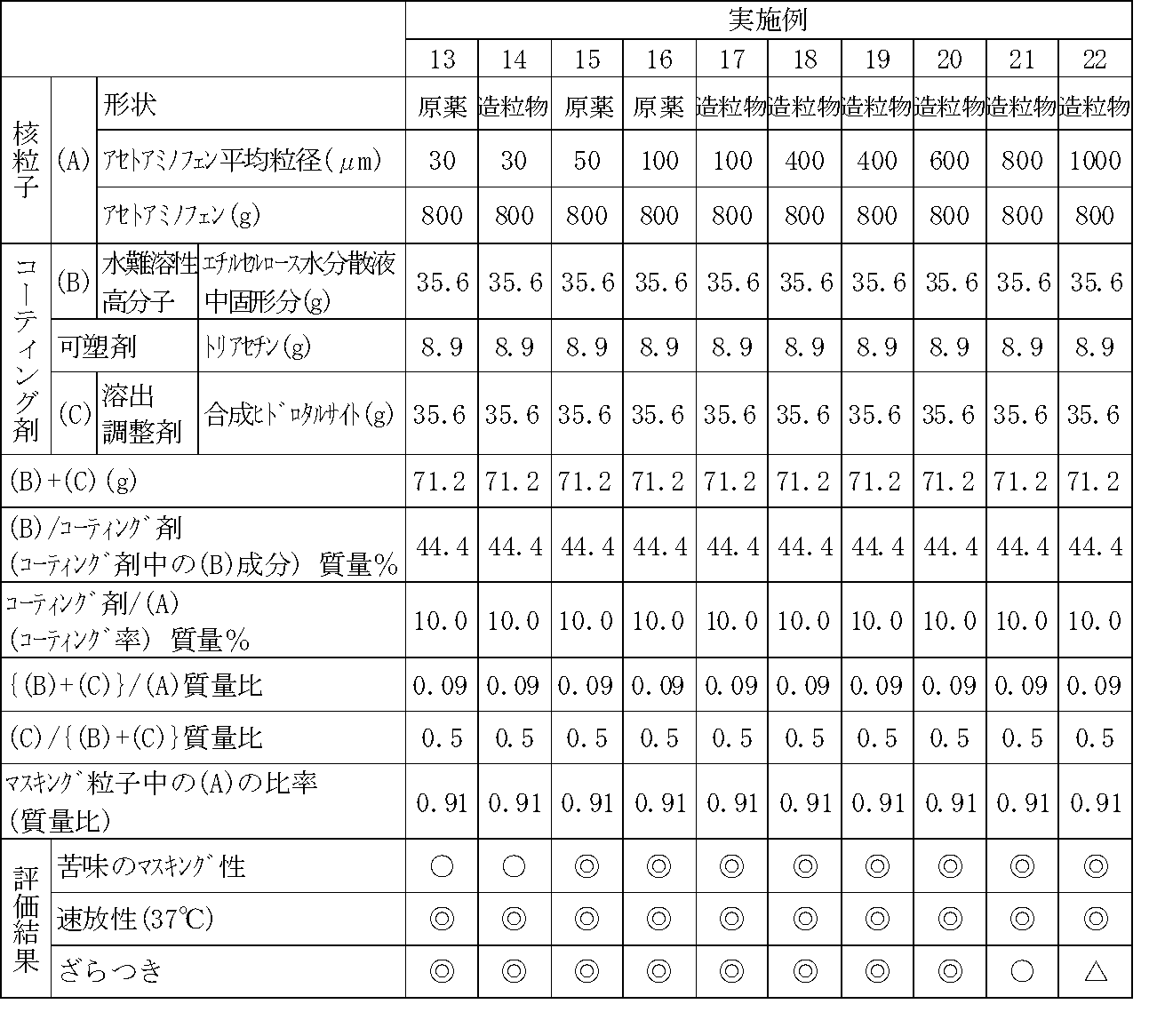
- acetaminophen drug substance When acetaminophen drug substance is used for the core particles, it is prepared by sieving acetaminophen drug substance (POWDER) for Examples 13 and 15 and acetaminophen drug substance (DENSE POWDER) for Example 16; In Examples and Comparative Examples, acetaminophen drug substance (SPECIAL GRANULAR) was used as it was.
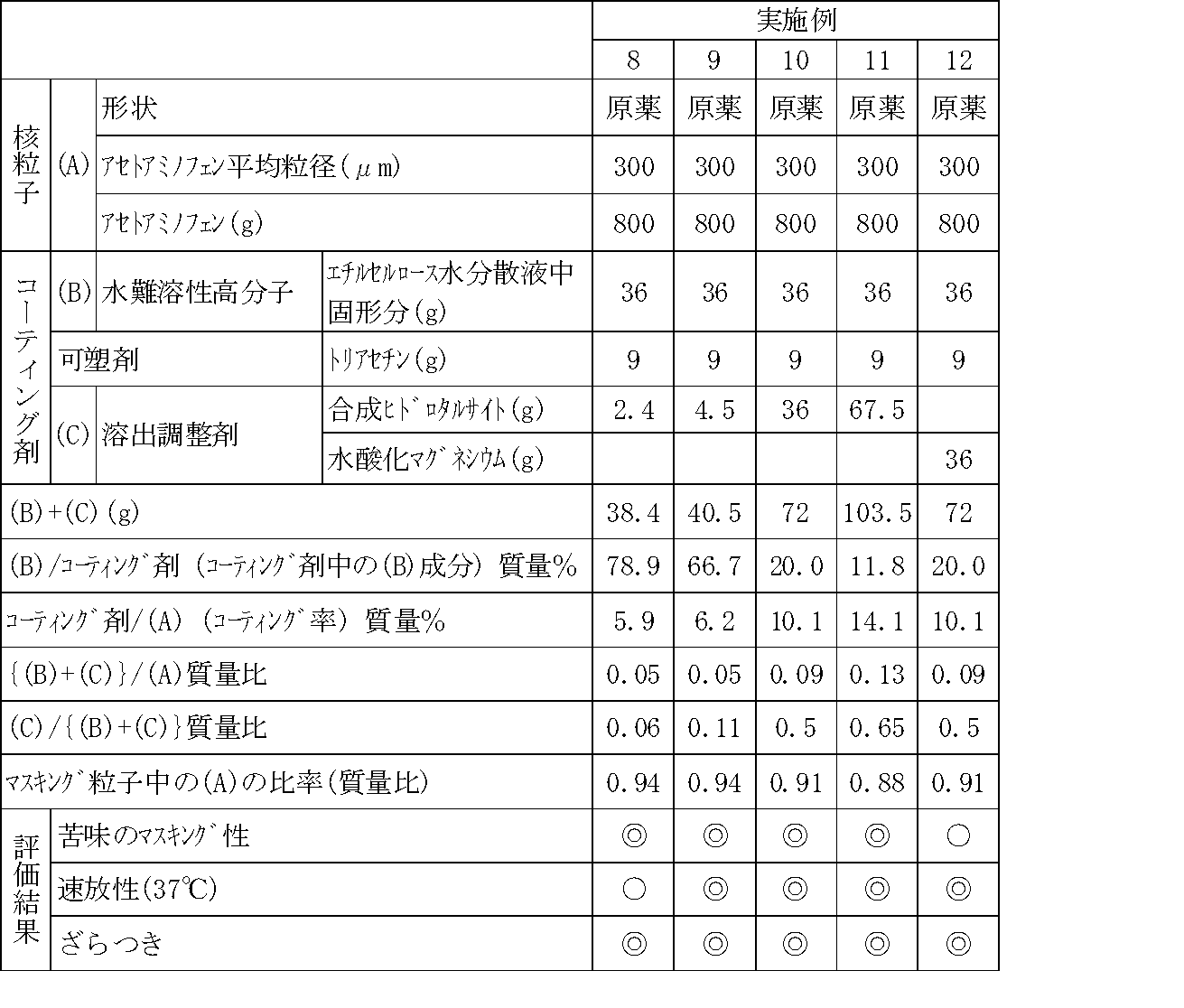
- the ethyl cellulose aqueous dispersion, triacetin and the elution regulator of the component (C) are listed in Tables 1 to 3 as the component (B).
- the coating liquid was obtained by stirring well and stirring well.
- 800 g of acetaminophen particles prepared as described above were added as component (A) using a fluidized bed granulator multiplex MP-01 (manufactured by Powrec Co., Ltd.).
- the coating liquid prepared above was sprayed at a rate of 14 g / min at a temperature of 25 to 40 ° C.
- the masking particles obtained in Examples 1 to 22 and Comparative Examples 1 to 4 were evaluated for bitterness masking property, quick release property and roughness. The results are also shown in Tables 1 to 4. The bitterness masking property and quick release property were evaluated by dissolution property. The dissolution test based on the Japanese Pharmacopoeia paddle method was conducted.
- the bitterness masking property was evaluated using a buffer solution of 37 ° C. and pH 6.8 assuming the pH of saliva as an alternative to the elution properties of saliva in the oral cavity.
- the dissolution was carried out in accordance with the 15th revised Japanese Pharmacopoeia / dissolution test method.
- the 15th revised Japanese Pharmacopoeia, Dissolution Test Method, Dissolution Test Second Solution (pH about 6.8) was prepared and used at 900 mL per vessel.
- granulated particles or tablets are put into the test solution, the paddle rotation speed is set to 50 rpm, 10 mL of the test solution is sampled over a predetermined time while stirring, and the dissolution rate (initial value of the drug) (Elution amount relative to the set amount of drug contained in the granulated particles) was measured by an absorbance measurement method (device name: spectrophotometer U-3310 type, manufactured by Hitachi High-Technologies Corporation, wavelength 243 nm).
- the amount of sample input was 100 mg of acetamine phene (when 100 mg in the tablet was exceeded, 1 tablet was input).
- ⁇ Quick release> The rapid release was evaluated using a buffer solution at 37 ° C. and pH 1.2 assuming the pH of the gastric juice as an alternative to the dissolution property in the gastric juice in the stomach. At that time, when the content of acetaminophen contained in one sample was 100% by mass, the ratio of eluted acetaminophen to that was shown as the dissolution rate (% by mass).
- the dissolution was carried out in accordance with the 15th revised Japanese Pharmacopoeia / dissolution test method. As a test solution, the 15th revised Japanese Pharmacopoeia, dissolution test method, dissolution test first solution (pH about 1.2) was prepared and used at 900 mL per vessel.
- granulated particles or tablets are put into the test solution, the paddle rotation speed is set to 50 rpm, 10 mL of the test solution is sampled over a predetermined time while stirring, and the dissolution rate (initial value of the drug) (Elution amount relative to the set amount of drug contained in the granulated particles) was measured by an absorbance measurement method (device name: spectrophotometer U-3310 type, manufactured by Hitachi High-Technologies Corporation, wavelength 243 nm).
- the amount of sample input was 100 mg of acetamine phene (when 100 mg in the tablet was exceeded, 1 tablet was input). The same evaluation was performed for the caffeine of Example 26.
- ⁇ Roughness> Four panelists included 0.3 g of the masking particles in a drug equivalent amount in the mouth, evaluated the roughness of the feeling felt when dissolved in the oral cavity in five stages, and calculated the average score. [Evaluation criteria] An average score of less than 3 is acceptable. This is because the texture becomes worse and the ingestibility worsens as the texture becomes stronger. [Evaluation points] 0: Does not feel rough 1: Feels rough slightly 2: Feels a little rough 3: Feels rough considerably 4: Feels very rough [Average] ⁇ : Less than 1 ⁇ : 1 or more and less than 2 ⁇ : 2 or more and less than 3 ⁇ : 3 or more
- Example 23 Orally disintegrating tablet As masking particles, acetaminophen coated particles produced in the same manner as in Example 5 were used. Next, an erythritol / starch granulated product was prepared by the following procedure. Erythritol (erythritol, Saneigen FFI Co., Ltd.) 3200g and starch (refined and sterilized corn starch, Matsutani Chemical Industry Co., Ltd.) 600g are mixed, and Spirer Flow SFC-5 (Freund Sangyo Co., Ltd.) is mixed.
- Erythritol erythritol, Saneigen FFI Co., Ltd.
- starch refined and sterilized corn starch, Matsutani Chemical Industry Co., Ltd. 600g are mixed
- Spirer Flow SFC-5 Feund Sangyo Co., Ltd.
- Example 24 Chewable tablets As masking particles, acetaminophen-coated particles produced in the same manner as in Example 5 were used. Next, a mannitol granulated product was prepared by the following procedure. 900 g of D-mannitol (manufactured by Rocket Japan Co., Ltd.) is placed in a fluidized bed granulator multiplex MP-01 (manufactured by POWREC Co., Ltd.), and at an air supply temperature of 80 ° C. and an exhaust temperature of 40-50 ° C., hydroxypropylcellulose 600 g of 12% by mass aqueous solution was sprayed and granulated.
- D-mannitol manufactured by Rocket Japan Co., Ltd.
- MP-01 manufactured by POWREC Co., Ltd.
- tablets having the composition shown in Table 6 were tableted (tablet pressure 1200 kgf) with a clean press (manufactured by Kikusui Seisakusho Co., Ltd.) to obtain a circular tablet having a mass of 280 mg and 9 mm. .
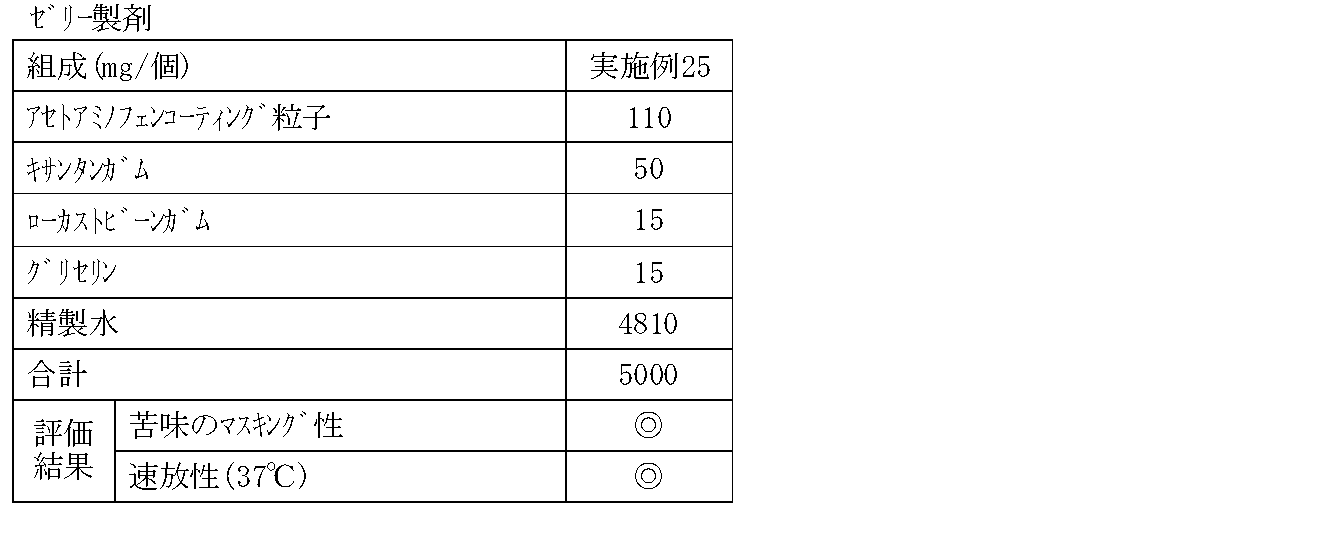
- Example 25 Jelly preparation As masking particles, acetaminophen-coated particles produced in the same manner as in Example 16 were used. Next, a jelly-form preparation having the composition shown in Table 7 was prepared by the following procedure. (1) 0.5 g of xanthan gum (xanthan gum, manufactured by San-Ei Gen FFI Co., Ltd.) was dispersed in 0.1 g of glycerin (Japanese glycerin, manufactured by Yuka Sangyo Co., Ltd.) to obtain a dispersion A. (2) 0.15 g of locust bean gum (Locust bean gum, manufactured by Sanki Co., Ltd.) was dispersed in 0.05 g of glycerin to prepare dispersion B.
- xanthan gum xanthan gum, manufactured by San-Ei Gen FFI Co., Ltd.
- glycerin Japanese glycerin, manufactured by Yuka Sangyo Co., Ltd.
- locust bean gum Locust bean
- Dispersion A, dispersion B, and 1.1 g of acetaminophen coating particles were added to 4.81 g of water, stirred for 30 minutes at room temperature, and then heated to 60 ° C. to obtain liquid C.
- the liquid C was stirred for 20 minutes under reduced pressure to remove bubbles while maintaining the temperature at 60 ° C. This was poured into an aluminum container (single dose 5 g) and cooled to 30 ° C. or lower to obtain a jelly preparation.
- Example 26 Granules Acetaminophen coated particles produced in the same manner as in Example 16 were used as acetaminophen masking particles.
- caffeine coating particles were prepared as caffeine masking particles by the following procedure. (1) 6.7 g of an ethylcellulose aqueous dispersion (manufactured by FMC) in purified water in terms of solid content, 1.7 g of triacetin (manufactured by Daihachi Chemical Industry Co., Ltd.), and synthetic hydrotalcite (Kyowa Chemical Industry) 6.7g) was added and stirred well to obtain a coating solution.
- the total amount of ethyl cellulose and synthetic hydrotalcite in the coating agent for caffeine coating particles was 13.5 g, and the ratio of caffeine coating particles to caffeine particles was 0.27 in terms of mass ratio. Moreover, the ratio of the synthetic hydrotalcite to the total amount of ethyl cellulose and synthetic hydrotalcite was 0.56 in mass ratio.
- V-type mixer V-5 type manufactured by Tokuju Seisakusho Co., Ltd.
Landscapes
- Health & Medical Sciences (AREA)
- Chemical & Material Sciences (AREA)
- Medicinal Chemistry (AREA)
- Pharmacology & Pharmacy (AREA)
- Life Sciences & Earth Sciences (AREA)
- Animal Behavior & Ethology (AREA)
- General Health & Medical Sciences (AREA)
- Public Health (AREA)
- Veterinary Medicine (AREA)
- Epidemiology (AREA)
- Inorganic Chemistry (AREA)
- Bioinformatics & Cheminformatics (AREA)
- Engineering & Computer Science (AREA)
- Pain & Pain Management (AREA)
- Rheumatology (AREA)
- Chemical Kinetics & Catalysis (AREA)
- General Chemical & Material Sciences (AREA)
- Nuclear Medicine, Radiotherapy & Molecular Imaging (AREA)
- Organic Chemistry (AREA)
- Nutrition Science (AREA)
- Physiology (AREA)
- Medicinal Preparation (AREA)
- Pharmaceuticals Containing Other Organic And Inorganic Compounds (AREA)
- Acyclic And Carbocyclic Compounds In Medicinal Compositions (AREA)
Abstract
口腔内における不快な味を有する薬物の不快味マスキング効果に優れ、かつ胃内における薬物の溶出性が高い粒子及びこれを含む経口製剤を提供する。 (A)不快味を有する薬物を含有する核粒子が、(B)エチルセルロース、アミノアルキルメタクリレートコポリマーE、アミノアルキルメタクリレートコポリマーRS、酢酸フタル酸セルロース及びアクリル酸エチル・メタクリル酸メチル共重合体から選ばれる1種又は2種以上及び(C)pH1.2で水易溶性であり、pH6.8で水難溶性の水酸化物を含むコーティング剤で被覆されてなる不快味マスキング粒子。
Description
本発明は、口腔内における不快な味を有する薬物のマスキング効果に優れ、かつ胃内における薬物の溶出性が高い不快味マスキング粒子及びこれを含む経口製剤に関する。
経口用の固形製剤で最も汎用されている剤型は錠剤であるが、通常の錠剤は、崩壊が2分以上であるため、服用後、水等ですぐに飲み込み、胃等の消化管で崩壊する。一方、近年、高齢者又は小児にも飲みやすい剤型、即ち、患者のクオリティ・オブ・ライフ(QOL)を向上させる剤型として注目されている口腔内崩壊錠やチュアブル錠剤は、服用後、口腔内で崩壊するため、水なしで服用することができるが、不快味を有する主薬の場合、服用感を悪化させることがあり、マスキングする必要がある。
不快味のマスキング法としては、甘味剤や矯味剤を添加する方法、胃溶性高分子又は水不溶性高分子を懸濁又は溶解した液を噴霧乾燥することで薬物を担体中に分散させるマトリックス法、薬物を含有する核を胃溶性高分子又は水不溶性高分子を含む被膜で被覆するコーティング法が主に知られている。一般に、甘味剤や矯味剤を添加する方法は、不快味のマスキングが不十分であり、マトリックス法では薬物の一部が製剤の表面に露出するため強い不快味を有する薬物には利用することが難しい。
特許第3415835号公報(特許文献1)には、平均粒子径約50μm~約250μmの口腔内速崩壊錠用薬物含有粒子についての記載があり、実施例では噴霧乾燥法によって調製したファモチジンの苦味マスキング粒子に関する記載があるが、この方法では、非常に強い不快味を有する薬物の不快味をマスキングすることは困難である。また、コーティング法では胃溶性高分子を含む被膜を用いる方法が知られているが、この方法は、胃液や腸液のpH変動によって薬物の溶出性に影響が出るという問題点がある。
そこで、pH依存性のない不快味マスキング法として、水不溶性高分子を用いたコーティング法が検討されている。ここで、水不溶性高分子とは通常の消化管内のpHで溶解しない高分子のことを意味する。水不溶性高分子を用いた不快味マスキング法については多くの報告があるが、不快味マスキングと速放性を同時に満たす製剤に関する報告は少ない。
特開2000-53563号公報(特許文献2)及び特表2004-532257号公報(特許文献3)は、苦味を有する有効成分を含有する核に、苦味抑制層としてエチルセルロースと水溶性物質からなる被膜をコーティングした粒子を開示している。また、特許第3317444号公報(特許文献4)では、不快な苦味の薬物と水膨潤性物質を含有した核に、エチルセルロース及び水溶性物質が含まれる被膜をコーティングした粒子を開示している。これらの粒子はいずれも不快味マスキングと速放性を同時に満たすことを目的としている。しかし、不快味マスキング性を高めるほど被膜の量が増加し、それに伴い溶出率が低下するという課題があるため、マスキング性と溶出性の両課題を満足するには至っていない。
また、上記以外にも種々の被覆組成物が提案されているが、いずれもマスキング性と胃内溶出性を同時に達成できるものではなかった。例えば、特開平9-2976号公報(特許文献5)には、無機物質及び被覆剤に、ポリビニルピロリドン(PVP)及び/又はポリビニルアルコール(PVA)を配合した、錠剤や粒錠剤の汚れを防止するための被覆組成物が提案されている。しかし、被覆組成物成分として、水溶性高分子であるPVP、PVAを含むため口中で溶解性を有し、マスキング効果が十分ではなかった。特に、水ですぐに飲み込まずに口中で咀嚼・崩壊させるチュアブル錠や口腔内崩壊錠とした場合、被覆組成物が溶けて不快味が抑制できないという問題があった。
本発明は、上記事情に鑑みなされたものであり、口腔内における不快な味を有する薬物の不快味マスキング効果に優れ、かつ胃内における薬物の溶出性が高い不快味マスキング粒子及びこれを含む経口製剤を提供することを目的とする。
本発明者らは、上記目的を達成するため鋭意検討した結果、口腔内における不快な味を有する薬物に、口腔内のpHではほとんど溶けず、胃内のpHで可溶な水酸化物を溶出調整剤として配合した特定の胃溶性水難溶性高分子化合物をコーティングすることで、口腔内では不快な味をマスキングでき、胃内では高い溶出性を示す不快味マスキング粒子及びこの粒子を含む経口製剤が得られることを見出し、本発明をなすに至った。
即ち、本発明は、下記不快味マスキング粒子及び経口製剤を提供する。
請求項1:
(A)不快味を有する薬物を含有する核粒子が、(B)エチルセルロース、アミノアルキルメタクリレートコポリマーE、アミノアルキルメタクリレートコポリマーRS、酢酸フタル酸セルロース及びアクリル酸エチル・メタクリル酸メチル共重合体から選ばれる1種又は2種以上と、(C)pH1.2で水易溶性であり、pH6.8で水難溶性の水酸化物とを含むコーティング剤で被覆されてなることを特徴とする不快味マスキング粒子。
請求項2:
{(B)+(C)}/(A)で表される、(A)成分に対する(B)及び(C)成分の固形分総量の含有割合が、質量比で0.03~0.6である請求項1記載の不快味マスキング粒子。
請求項3:
(C)/{(B)+(C)}で表される、(B)及び(C)成分の固形分総量に対する(C)成分の含有割合が、質量比で0.05~0.8である請求項1又は2記載の不快味マスキング粒子。
請求項4:
(A)核粒子が、アセトアミノフェン又はカフェインである請求項1乃至3のいずれか1項記載の不快味マスキング粒子。
請求項5:
(A)核粒子の平均粒径が、30~1000μmである請求項1乃至4のいずれか1項記載の不快味マスキング粒子。
請求項6:
(C)水酸化物が、合成ヒドロタルサイト及び水酸化マグネシウムから選ばれる1種又は2種以上である請求項1乃至5のいずれか1項記載の不快味マスキング粒子。
請求項7:
マスキング速放性粒子である請求項1乃至6のいずれか1項記載の不快味マスキング粒子。
請求項8:
請求項1乃至7のいずれか1項記載の不快味マスキング粒子を含有することを特徴とする経口製剤。
請求項9:
粒錠剤、チュアブル錠又は口腔内崩壊錠である請求項8記載の経口製剤。
請求項1:
(A)不快味を有する薬物を含有する核粒子が、(B)エチルセルロース、アミノアルキルメタクリレートコポリマーE、アミノアルキルメタクリレートコポリマーRS、酢酸フタル酸セルロース及びアクリル酸エチル・メタクリル酸メチル共重合体から選ばれる1種又は2種以上と、(C)pH1.2で水易溶性であり、pH6.8で水難溶性の水酸化物とを含むコーティング剤で被覆されてなることを特徴とする不快味マスキング粒子。
請求項2:
{(B)+(C)}/(A)で表される、(A)成分に対する(B)及び(C)成分の固形分総量の含有割合が、質量比で0.03~0.6である請求項1記載の不快味マスキング粒子。
請求項3:
(C)/{(B)+(C)}で表される、(B)及び(C)成分の固形分総量に対する(C)成分の含有割合が、質量比で0.05~0.8である請求項1又は2記載の不快味マスキング粒子。
請求項4:
(A)核粒子が、アセトアミノフェン又はカフェインである請求項1乃至3のいずれか1項記載の不快味マスキング粒子。
請求項5:
(A)核粒子の平均粒径が、30~1000μmである請求項1乃至4のいずれか1項記載の不快味マスキング粒子。
請求項6:
(C)水酸化物が、合成ヒドロタルサイト及び水酸化マグネシウムから選ばれる1種又は2種以上である請求項1乃至5のいずれか1項記載の不快味マスキング粒子。
請求項7:
マスキング速放性粒子である請求項1乃至6のいずれか1項記載の不快味マスキング粒子。
請求項8:
請求項1乃至7のいずれか1項記載の不快味マスキング粒子を含有することを特徴とする経口製剤。
請求項9:
粒錠剤、チュアブル錠又は口腔内崩壊錠である請求項8記載の経口製剤。
本発明によれば、口腔内では不快な味を有する薬物のマスキングができ、胃内では高い薬物の溶出性を示す不快味マスキング粒子及びこの粒子を含む経口製剤を提供することができる。
本発明の不快味マスキング粒子は、(A)不快味を有する薬物を含有する核粒子が、上記(B)成分及び(C)pH1.2で水易溶性であり、pH6.8で水難溶性の水酸化物を含むコーティング剤で被覆されてなることを特徴とする。
<核粒子>
(A)不快味を有する薬物を含有する核粒子
不快味を有する薬物としては、アセトアミノフェン、アスピリン、イブプロフェン、エテンザミド、フェナセチン、メフェナム酸、アンチピリン、フェニルブタゾン、スルピリン、ジクロフェナトリウム、ケトプロフェン、ナプロキセン、ロキソプロフェンナトリウム、エトドラク、エピリゾール、塩酸チアラミド、インドメタシン、ペンタゾシン、塩化アセチルコリン、酒石酸アリメマジン、塩酸シプロヘプタジン、塩酸ジフェンヒドラミン、マレイン酸クロルフェニラミン、リン酸コデイン、リン酸ジヒドロコデイン、臭化水素酸デキストロメトルファン、クエン酸ペントキシベリン、テオフィリン、アミノフィリン、塩酸エフェドリン、塩酸エピネフリン、硫酸サルブタモール、塩酸トリメトキノール、塩酸プロカテロール、塩酸メチルエフェドリン、塩酸フェニルプロパノールアミン、グアイフェネシン、トラネキサム酸、無水カフェイン、カフェイン、サリチル酸コリン、サリチル酸ナトリウム等が挙げられ、核粒子としては、1種単独で又は2種以上を組み合わせて、原薬のまま、或いは適当な結合剤や賦形剤を組合せて用いて造粒した粒子を使用してもよい。これらの中でもアセトアミノフェン及びカフェインが好ましい。
(A)不快味を有する薬物を含有する核粒子
不快味を有する薬物としては、アセトアミノフェン、アスピリン、イブプロフェン、エテンザミド、フェナセチン、メフェナム酸、アンチピリン、フェニルブタゾン、スルピリン、ジクロフェナトリウム、ケトプロフェン、ナプロキセン、ロキソプロフェンナトリウム、エトドラク、エピリゾール、塩酸チアラミド、インドメタシン、ペンタゾシン、塩化アセチルコリン、酒石酸アリメマジン、塩酸シプロヘプタジン、塩酸ジフェンヒドラミン、マレイン酸クロルフェニラミン、リン酸コデイン、リン酸ジヒドロコデイン、臭化水素酸デキストロメトルファン、クエン酸ペントキシベリン、テオフィリン、アミノフィリン、塩酸エフェドリン、塩酸エピネフリン、硫酸サルブタモール、塩酸トリメトキノール、塩酸プロカテロール、塩酸メチルエフェドリン、塩酸フェニルプロパノールアミン、グアイフェネシン、トラネキサム酸、無水カフェイン、カフェイン、サリチル酸コリン、サリチル酸ナトリウム等が挙げられ、核粒子としては、1種単独で又は2種以上を組み合わせて、原薬のまま、或いは適当な結合剤や賦形剤を組合せて用いて造粒した粒子を使用してもよい。これらの中でもアセトアミノフェン及びカフェインが好ましい。
薬物核粒子の平均粒径は、30~1000μmの範囲が好ましく、30~800μmの範囲がより好ましく、50~600μmの範囲が更に好ましく、特に好ましくは100~400μmの範囲である。30μm未満であると、粒子が細かいため粒子同士の凝集が起こることにより造粒が進みやすく、コーティングが不均一になり、マスキング性が劣る場合がある。一方、1000μmを超えると、マスキング性には問題はないが、ざらつきが強くなり、服用性が悪化することがある。本コーティング粒子を製造する上で装置の性能を最も活かせるのは100μm以上であり、コーティング粒子が口中でよりざらつきが少なくできるのは600μm以下である。
なお、本発明において、平均粒径とは、1000μm、850μm、500μm、355μm、250μm、150μm、75μm、45μm、20μmの内径75mmのふるいを用い、サンプル量10gで、日局「粉体粒度測定法」第2法に基づき試験を行い測定した際の累積質量の50%粒子径とする。また、上記測定法により平均粒径が100μm以下であったものについてはレーザー式散乱回析法粒度分布測定装置(BECKMAN COULTER社製)を用いて測定した際の累積質量の50%粒子径を平均粒径とした。
なお、本発明において、平均粒径とは、1000μm、850μm、500μm、355μm、250μm、150μm、75μm、45μm、20μmの内径75mmのふるいを用い、サンプル量10gで、日局「粉体粒度測定法」第2法に基づき試験を行い測定した際の累積質量の50%粒子径とする。また、上記測定法により平均粒径が100μm以下であったものについてはレーザー式散乱回析法粒度分布測定装置(BECKMAN COULTER社製)を用いて測定した際の累積質量の50%粒子径を平均粒径とした。
核粒子としては、原料をそのまま、或いは造粒品や、目的の粒径に調整したものを適宜使用することができる。造粒する場合、他の成分、例えばデキストリン、ヒドロキシプロピルセルロース、ヒドロキシプロピルメチルセルロース、ポリビニルピロリドン、ポリビニルアルコール部分けん化物、ゼラチン、プルラン、カルボキシビニルポリマー等の結合剤、トウモロコシデンプン、コメデンプン等のデンプン類、カルボキシメチルスターチナトリウム、ヒドロキシプロピルスターチ等デンプン誘導体類、結晶セルロース、粉末セルロース等のセルロース類、低置換度ヒドロキシプロピルセルロース等のセルロース誘導体類、乳糖、マンニトール等の糖および糖アルコール類等を適宜添加することができる。不快味を有する薬物に対するこれら結合剤等の含有量(質量比)は、特に限定されないが、不快味を有する薬物:他の成分=1:0.01~1:1程度が好ましい。
(A)薬物又は薬物を含んだ核粒子の含有量は、マスキング性及び製剤化の点から、本発明の粒子全体に対して、質量比で0.25~0.98の比率とすることが好ましく、より好ましくは0.33~0.96である。
<コーティング剤>
本発明のコーティング剤は、下記(B)成分及び(C)pH1.2で水易溶性であり、pH6.8で水難溶性の水酸化物を必須成分として含有するコーティング組成物からなる。
本発明のコーティング剤は、下記(B)成分及び(C)pH1.2で水易溶性であり、pH6.8で水難溶性の水酸化物を必須成分として含有するコーティング組成物からなる。
(B)成分
(B)成分は、コーティング剤の被膜基剤となる成分である。本発明においては、エチルセルロース、アミノアルキルメタクリレートコポリマーE、アミノアルキルメタクリレートコポリマーRS、酢酸フタル酸セルロース、アクリル酸エチル・メタクリル酸メチル共重合体等の医薬品添加物規格等の公定書収載品を使用できる。これらは、水10,000mLに溶解する量が1g又は1mL未満である胃溶性水難溶性高分子化合物である。これらは1種単独で又は2種以上を適宜組み合わせて用いることができるが、これらの中でも使用性、臭いの点から、特にエチルセルロースが好まく、市販のエチルセルロース水分散液(医薬品添加物規格、FMC社製、アクアコートECD-30)等を用いることができる。
(B)成分は、コーティング剤の被膜基剤となる成分である。本発明においては、エチルセルロース、アミノアルキルメタクリレートコポリマーE、アミノアルキルメタクリレートコポリマーRS、酢酸フタル酸セルロース、アクリル酸エチル・メタクリル酸メチル共重合体等の医薬品添加物規格等の公定書収載品を使用できる。これらは、水10,000mLに溶解する量が1g又は1mL未満である胃溶性水難溶性高分子化合物である。これらは1種単独で又は2種以上を適宜組み合わせて用いることができるが、これらの中でも使用性、臭いの点から、特にエチルセルロースが好まく、市販のエチルセルロース水分散液(医薬品添加物規格、FMC社製、アクアコートECD-30)等を用いることができる。
コーティング剤中の(B)成分の含有量は、コーティングしやすさ、可塑性、溶出性等を考慮すると、コーティング剤の総固形分に対して11~80質量%が好ましく、より好ましくは18~80質量%であり、更に好ましくは20~73質量%であり、特に好ましくは32~67質量%である。コーティング剤中の(B)成分の量が少なすぎると成膜性、マスキング性に劣る場合があり、多すぎると溶出性、速放性が低下する場合がある。
なお、コーティング基剤としてポリビニルピロリドンやポリビニルアルコール、ヒドロキシプロピルセルロースなどの水溶性高分子化合物を含有すると、口腔内での不快味マスキング効果が損なわれるため、使用しないことが好ましく、使用する場合においても、(B)成分に対して5質量%以下、より好ましくは1質量%以下、特に好ましくは0.5質量%以下に制限される。
(C)pH1.2で水易溶性であり、pH6.8で水難溶性である水酸化物
(C)成分は、コーティング剤の溶解性をコントロールする成分であり、温度37℃において、pH1.2で水易溶性であり、pH6.8で水難溶性である水酸化物である。これを被膜成分である(B)成分と併用して、コーティング剤中に配合することにより、服用後、口腔内(pH6.8程度)ではコーティング剤が溶解せずにマスキング効果が高く、胃内(pH1.2程度)ではコーティング剤中の(C)成分が溶解し被膜が壊れるため、核粒子である薬物を素早く放出させ、溶出性・速効性に優れたコーティング剤とすることができる。なお、本発明において、「pH1.2で水易溶性であり、pH6.8で水難溶性である成分」の「水易溶性」とは、溶質1gを溶かすのに必要な溶媒量が30mL未満の場合をいい、「水難溶性」とは、溶質1gを溶かすのに必要な溶媒量が100mL以上の場合をいう。
(C)成分は、コーティング剤の溶解性をコントロールする成分であり、温度37℃において、pH1.2で水易溶性であり、pH6.8で水難溶性である水酸化物である。これを被膜成分である(B)成分と併用して、コーティング剤中に配合することにより、服用後、口腔内(pH6.8程度)ではコーティング剤が溶解せずにマスキング効果が高く、胃内(pH1.2程度)ではコーティング剤中の(C)成分が溶解し被膜が壊れるため、核粒子である薬物を素早く放出させ、溶出性・速効性に優れたコーティング剤とすることができる。なお、本発明において、「pH1.2で水易溶性であり、pH6.8で水難溶性である成分」の「水易溶性」とは、溶質1gを溶かすのに必要な溶媒量が30mL未満の場合をいい、「水難溶性」とは、溶質1gを溶かすのに必要な溶媒量が100mL以上の場合をいう。
このような(C)成分としては、例えば、合成ヒドロタルサイト、水酸化マグネシウム、乾燥水酸化アルミニウムゲル、水酸化アルミニウムゲル、水酸化アルミナマグネシウム、水酸化アルミニウム・炭酸水素ナトリウム共沈生成物、水酸化アルミニウム・炭酸マグネシウム混合乾燥ゲル、水酸化アルミニウム・炭酸マグネシウム・炭酸カルシウム共沈生成物等が挙げられる。これらは1種単独で又は2種以上を適宜組み合わせて用いることができる。これらのなかでも、合成ヒドロタルサイト、水酸化マグネシウムが好ましく、さらに好ましくは合成ヒドロタルサイトである。なお、コーティング液中に配合する(C)成分の粒子径は、核粒子の10分の1以下のものを用いることが好ましい。
本発明のコーティング剤には可塑剤が含まれることが好ましい。可塑剤はコーティング組成物を含む溶液に適度な展延性を与え、成膜しやすくする機能を有すると推測される。可塑剤としては、トリアセチン、クエン酸トリエチル等の医薬品添加物規格((株)薬事日報社)等の公定書に記載されているものが挙げられる。これらは、1種単独で又は2種以上を適宜組み合わせて用いることができる。成膜性を考慮するとトリアセチン、クエン酸トリエチルが好ましく、味の点からトリアセチンがさらに好ましい。可塑剤の含有量はコーティング剤の総固形分に対して7~50質量%が好ましく、8~47質量%がより好ましい。また、可塑剤:(B)成分の総固形分(質量比)=1:1~1:8が好ましく、1:3~1:5がより好ましい。
コーティング剤には、更に酸化チタン、酸化鉄などの顔料、コーティング組成物セタノール、ラウリル硫酸ナトリウム等の任意成分を含むことができる。
コーティング剤中の{(B)+(C)}/(A)で表される、(A)成分に対する(B),(C)成分の固形分総量の割合は、質量比で、好ましくは0.03~0.6、より好ましくは0.04~0.6、更に好ましくは0.08~0.55、特に好ましくは0.08~0.35である。0.03未満の場合、コーティング膜が薄くなることにより、十分なマスキング性が得られない場合があり、0.6を超えるとコーティング膜が厚くなり、速放性の確保が難しいことがある。
また、(C)成分は、コーティング剤中に、(C)/{(B)+(C)}で表される、(B),(C)成分の合計量に対する(C)成分の割合が、質量比で、好ましくは0.05~0.8、より好ましくは0.05~0.7、更に好ましくは0.09~0.7、特に好ましくは0.1~0.65となるよう配合する。0.05未満であると、胃内での十分な溶出性が得られない場合があり、0.8を超えると、コーティング膜中の配合量が過多になり、コーティング膜の成膜性が低下し、口腔内でのマスキング性が悪化する場合がある。
更に、本発明のマスキング粒子のコーティング率は、(A)成分に対するコーティング剤固形分総量の割合で示され、2~70質量%が好ましく、より好ましくは5~40質量%である。
本発明の経口製剤の製造方法は、特に制限されず、(A)不快味を有する薬物を含有する核粒子を、(B)成分及び(C)pH1.2で水易溶性であり、pH6.8で水難溶性である溶出調整剤を含むコーティング剤でコーティングして得ることができる。
コーティング剤によるコーティングは、湿式コーティングが一般的だが、この限りではない。湿式コーティングの場合は、例えば、コーティング剤組成物を任意の分散媒に分散させた分散液(以下、コーティング剤溶液ということがある。)を核粒子に噴霧する。コーティング剤溶液の分散媒としては、水、エタノール等の親水性溶媒が好ましく挙げられる。
コーティング剤によるコーティングは、湿式コーティングが一般的だが、この限りではない。湿式コーティングの場合は、例えば、コーティング剤組成物を任意の分散媒に分散させた分散液(以下、コーティング剤溶液ということがある。)を核粒子に噴霧する。コーティング剤溶液の分散媒としては、水、エタノール等の親水性溶媒が好ましく挙げられる。
コーティング剤溶液の噴霧方法としては、特に限定されないが、コーティング剤を核粒子の表面に均一に付着させることができることから、流動層を有するコーティング装置を使用することが好ましい。これにより、均一で溶出性にむらが少ない、優れたコーティングを行うことができる。また、形成されるコーティング膜の強度も高く、打錠や咀嚼により壊れる可能性が低くなる。
微粒子のコーティングには下記に示すような装置を用いることができる。攪拌転動流動層コーティングができるマルチプレックス、遠心転動層コーティングができるCFグラニュレーター、流動層コーティングができるフローコーター、GPCG、スパイラーフローがある。中でもワースター法が可能な装置(例えばGPCGのワースター仕様機)においては、効率の良い微粒子コーティングが可能である。ワースター法とは、流動層底部から上部に向かって核粒子粉体に噴霧液を噴霧する仕組みのものである。
装置名 型 仕込み量(例) メーカー
マルチプレックス MP-25 20kg (株)パウレック
CFグラニュレーター CF-360 3kg フロイント産業(株)
フローコーター FLO-5 1.8kg フロイント産業(株)
GPCG GPCG-15 15kg (株)パウレック
スパイラーフロー SFC-5 3kg フロイント産業(株)
マルチプレックス MP-25 20kg (株)パウレック
CFグラニュレーター CF-360 3kg フロイント産業(株)
フローコーター FLO-5 1.8kg フロイント産業(株)
GPCG GPCG-15 15kg (株)パウレック
スパイラーフロー SFC-5 3kg フロイント産業(株)
コーティングを行う際の条件としては、特に限定されず、通常用いられている条件が使用できる。例えば、コーティング剤溶液の噴霧速度は、仕込み量や使用する装置のスケールによって適宜調製することが好ましいが、例えば仕込み量が1kgの場合、5~30g/minとすることができる。コーティング装置の排気温度は、20~70℃が好ましく、給気温度は60~90℃が好ましい。排気温度及び給気温度がこの範囲内であると均一なコーティングができる。
以上のようにして得られる本発明のマスキング粒子の平均粒径は、特に制限されず、目的の剤型によって適宜調整することが好ましい。例えば、口腔内崩壊錠やチュアブル錠など口の中で溶かして服用する剤型に配合する場合は、服用時のざらつきを防ぐため、50~600μmであることが好ましい。また、錠剤では特に制限されず、顆粒剤や散剤は規定された範囲内の粒度に調整することが好ましい。なお、平均粒径の測定方法は、上述した通りである。
また、本発明のマスキング粒子の構造は、(A)核粒子と、この(A)核粒子を(B)成分の高分子化合物で被覆するように形成された被膜とからなり、この被膜中に、好ましくは(A)核粒子の平均粒径の1/10以下の粒径を有する(C)水酸化物微粒子が分散されたものである。
本発明のマスキング粒子は、口腔内では核粒子の不快味を遮蔽するマスキング性に優れ、胃内では高い溶出性(速放性)を有するマスキング速放性粒子である。なお、本発明において、速放性とは、pH1.2液中において、37℃、30分以内で(A)成分の薬物の飽和溶解度の60質量%以上の溶出性を示すものをいう。
本発明のマスキング粒子は、経口製剤として用いることができ、製剤の種類としては、錠剤、丸剤、液剤、エキス剤、カプセル剤、顆粒剤、散剤、シロップ剤、浸剤・煎剤、トローチ剤、チュアブル剤、ゼリー製剤等が挙げられる。ただし、コーティング膜を溶解させる剤型は除く。これらの中でも特に、錠剤、特に口腔内崩壊錠(チュアブル錠を含む、以下同じ)、顆粒剤、散剤として用いることが好ましい。また、苦みが抑えられている点から、水無しで服用する口腔内崩壊錠、ゼリー製剤等として有用である。これらの製剤の製造方法も特に制限されず、常法に従って通常の条件で製造することができる。
以下、実施例及び比較例を示し、本発明を具体的に説明するが、本発明は下記の実施例に制限されるものではない。
[実施例1~22]
<核粒子の製造>
核粒子に造粒物を用いる場合(実施例14,17~22)の製造方法としては、アセトアミノフェン(POWDER)3000gにデキストリン(パインデックス#100)20質量%水溶液400gを添加し、ハイスピードミキサー(FS-25型、深江パウテック(株)製)を用いて、400rpmで5~7分攪拌造粒した。得られた造粒物を80℃で5時間棚乾燥させた後、目的の平均粒径±200μmの分画のものを篩ってコーティングに用いる核粒子とした。
<核粒子の製造>
核粒子に造粒物を用いる場合(実施例14,17~22)の製造方法としては、アセトアミノフェン(POWDER)3000gにデキストリン(パインデックス#100)20質量%水溶液400gを添加し、ハイスピードミキサー(FS-25型、深江パウテック(株)製)を用いて、400rpmで5~7分攪拌造粒した。得られた造粒物を80℃で5時間棚乾燥させた後、目的の平均粒径±200μmの分画のものを篩ってコーティングに用いる核粒子とした。
核粒子にアセトアミノフェン原薬を用いる場合、実施例13,15についてはアセトアミノフェン原薬(POWDER)、実施例16についてはアセトアミノフェン原薬(DENSE POWDER)を篩って調製し、その他の実施例及び比較例についてはアセトアミノフェン原薬(SPECIAL GRANULAR)をそのまま用いた。
<マスキング粒子の製造>
まず、コーティング液の総固形分濃度を20質量%に調整する量の精製水に(B)成分としてエチルセルロース水分散液、トリアセチン及び(C)成分の溶出調整剤を、それぞれ表1~3に記載した割合で入れ、よく攪拌してコーティング液を得た。
次いで、流動層造粒機マルチプレックスMP-01((株)パウレック製)を用い、(A)成分として上記のように調製したアセトアミノフェン粒子800gを入れ、これに給気温度65℃、排気温度25~40℃になる風量にて、上記で調製したコーティング液を14g/minの速度で、表1~3に示す(B)+(C)の固形分総量となるよう噴霧した。これを給気温度80℃で30分間乾燥し、マスキング粒子を得た。得られた粒子の平均粒径は、核粒子として用いた粒子の平均粒径とほぼ同じか、大きくなってもわずかであった。マスキング粒子の構造は、(A)核粒子を(B)成分が均一に被覆し、この(B)成分中に(C)成分が均一に分散されたものであった。
まず、コーティング液の総固形分濃度を20質量%に調整する量の精製水に(B)成分としてエチルセルロース水分散液、トリアセチン及び(C)成分の溶出調整剤を、それぞれ表1~3に記載した割合で入れ、よく攪拌してコーティング液を得た。
次いで、流動層造粒機マルチプレックスMP-01((株)パウレック製)を用い、(A)成分として上記のように調製したアセトアミノフェン粒子800gを入れ、これに給気温度65℃、排気温度25~40℃になる風量にて、上記で調製したコーティング液を14g/minの速度で、表1~3に示す(B)+(C)の固形分総量となるよう噴霧した。これを給気温度80℃で30分間乾燥し、マスキング粒子を得た。得られた粒子の平均粒径は、核粒子として用いた粒子の平均粒径とほぼ同じか、大きくなってもわずかであった。マスキング粒子の構造は、(A)核粒子を(B)成分が均一に被覆し、この(B)成分中に(C)成分が均一に分散されたものであった。
[比較例1]
<核粒子の製造>
核粒子にアセトアミノフェン原薬(SPECIAL GRANULAR)をそのまま用いた。
<マスキング粒子の製造>
エチルセルロース水分散液及びトリアセチンの代わりに、ヒプロメロース2910(信越化学工業(株)製)及びマクロゴール6000(三洋化成工業(株)製)を用いる以外、実施例13と同様に表4に示す割合でコーティング液を調製し、マスキング粒子を得た。
<核粒子の製造>
核粒子にアセトアミノフェン原薬(SPECIAL GRANULAR)をそのまま用いた。
<マスキング粒子の製造>
エチルセルロース水分散液及びトリアセチンの代わりに、ヒプロメロース2910(信越化学工業(株)製)及びマクロゴール6000(三洋化成工業(株)製)を用いる以外、実施例13と同様に表4に示す割合でコーティング液を調製し、マスキング粒子を得た。
[比較例2]
<核粒子の製造>
実施例14と同様に造粒した。
<マスキング粒子の製造>
溶出調整剤としてD-マンニトール(ロケットジャパン(株)製、いずれのpHにおいても水溶性)を用いた以外は、実施例13と同様に表4に示す割合でコーティング液を調製し、マスキング粒子を得た。
<核粒子の製造>
実施例14と同様に造粒した。
<マスキング粒子の製造>
溶出調整剤としてD-マンニトール(ロケットジャパン(株)製、いずれのpHにおいても水溶性)を用いた以外は、実施例13と同様に表4に示す割合でコーティング液を調製し、マスキング粒子を得た。
[比較例3]
<核粒子の製造>
核粒子にアセトアミノフェン原薬(SPECIAL GRANULAR)をそのまま用いた。
<マスキング粒子の製造>
溶出調整剤として炭酸カルシウムを用いた以外は、実施例13と同様に表4に示す割合でコーティング液を調製し、マスキング粒子を得た。
<核粒子の製造>
核粒子にアセトアミノフェン原薬(SPECIAL GRANULAR)をそのまま用いた。
<マスキング粒子の製造>
溶出調整剤として炭酸カルシウムを用いた以外は、実施例13と同様に表4に示す割合でコーティング液を調製し、マスキング粒子を得た。
[比較例4]
<核粒子の製造>
核粒子にアセトアミノフェン原薬(SPECIAL GRANULAR)をそのまま用いた。
<マスキング粒子の製造>
溶出調整剤を用いない以外は、実施例13と同様に表4に示す割合でコーティング液を調製し、マスキング粒子を得た。
<核粒子の製造>
核粒子にアセトアミノフェン原薬(SPECIAL GRANULAR)をそのまま用いた。
<マスキング粒子の製造>
溶出調整剤を用いない以外は、実施例13と同様に表4に示す割合でコーティング液を調製し、マスキング粒子を得た。
実施例1~22、比較例1~4で得られたマスキング粒子について、苦みのマスキング性、速放性及びざらつきの評価を行った。結果を表1~4に併記する。
苦味のマスキング性と速放性は溶出性により評価した。日本薬局方パドル法に準拠する溶出試験を行った。
苦味のマスキング性と速放性は溶出性により評価した。日本薬局方パドル法に準拠する溶出試験を行った。
<苦味のマスキング性>
苦味のマスキング性については口腔内における唾液での溶出性の代替として、唾液のpHを想定した37℃、pH6.8の緩衝液を用いて評価した。
[溶出性試験方法]
溶出性は第15改正日本薬局方・溶出試験法に準じて行なった。試験液として、第15改正日本薬局方・溶出試験法・溶出試験第2液(pH約6.8)を調製し、1ベッセル当り900mL用いた。試験は、該試験液に造粒粒子又は錠剤(サンプル)を投入し、パドル回転数を50rpmに設定し、攪拌しながら所定の経時で試験液をそれぞれ10mL採取し、溶出率(薬物の初期値(造粒粒子に含有させた薬物の設定量)に対する溶出量)を吸光度測定法(装置名:分光光度計U-3310型、(株)日立ハイテクノロジーズ製、波長243nm)により測定した。サンプル投入量は、造粒粒子及び錠剤の場合、アセトアミンフェンが100mgとなる量を投入した(錠剤中100mgを超える場合には、1錠を投入)。
苦味のマスキング性については口腔内における唾液での溶出性の代替として、唾液のpHを想定した37℃、pH6.8の緩衝液を用いて評価した。
[溶出性試験方法]
溶出性は第15改正日本薬局方・溶出試験法に準じて行なった。試験液として、第15改正日本薬局方・溶出試験法・溶出試験第2液(pH約6.8)を調製し、1ベッセル当り900mL用いた。試験は、該試験液に造粒粒子又は錠剤(サンプル)を投入し、パドル回転数を50rpmに設定し、攪拌しながら所定の経時で試験液をそれぞれ10mL採取し、溶出率(薬物の初期値(造粒粒子に含有させた薬物の設定量)に対する溶出量)を吸光度測定法(装置名:分光光度計U-3310型、(株)日立ハイテクノロジーズ製、波長243nm)により測定した。サンプル投入量は、造粒粒子及び錠剤の場合、アセトアミンフェンが100mgとなる量を投入した(錠剤中100mgを超える場合には、1錠を投入)。
[評価基準(pH6.8)]
5分後のアセトアミノフェンの溶出率が25質量%未満であれば効果があると判断した。25質量%未満の場合、苦味が許容できるレベルであるためである。
予備試験として官能評価を行った結果、アセトアミノフェンの溶出率が25質量%未満の場合は苦味が許容できるレベルであり、10質量%未満ではより苦味が改善されていた。一方、25質量%以上の場合は苦味が許容できないレベルであった。したがって、本評価では5分後のアセトアミノフェンの溶出率を苦味マスキング性の評価指標とした。
◎:10質量%未満
○:10質量%以上25質量%未満
×:25質量%以上
5分後のアセトアミノフェンの溶出率が25質量%未満であれば効果があると判断した。25質量%未満の場合、苦味が許容できるレベルであるためである。
予備試験として官能評価を行った結果、アセトアミノフェンの溶出率が25質量%未満の場合は苦味が許容できるレベルであり、10質量%未満ではより苦味が改善されていた。一方、25質量%以上の場合は苦味が許容できないレベルであった。したがって、本評価では5分後のアセトアミノフェンの溶出率を苦味マスキング性の評価指標とした。
◎:10質量%未満
○:10質量%以上25質量%未満
×:25質量%以上
<速放性>
速放性については胃内における胃液での溶出性の代替として、胃液のpHを想定した37℃、pH1.2の緩衝液を用いて評価した。その際、1サンプルに含まれるアセトアミノフェン含量を100質量%とした場合、それに対する溶出したアセトアミノフェンの割合を溶出率(質量%)として示した。
[溶出性試験方法]
溶出性は第15改正日本薬局方・溶出試験法に準じて行なった。試験液として、第15改正日本薬局方・溶出試験法・溶出試験第1液(pH約1.2)を調製し、1ベッセル当り900mL用いた。試験は、該試験液に造粒粒子又は錠剤(サンプル)を投入し、パドル回転数を50rpmに設定し、攪拌しながら所定の経時で試験液をそれぞれ10mL採取し、溶出率(薬物の初期値(造粒粒子に含有させた薬物の設定量)に対する溶出量)を吸光度測定法(装置名:分光光度計U-3310型、(株)日立ハイテクノロジーズ製、波長243nm)により測定した。サンプル投入量は、造粒粒子及び錠剤の場合、アセトアミンフェンが100mgとなる量を投入した(錠剤中100mgを超える場合には、1錠を投入)。
実施例26のカフェインについても同様の評価を行った。
速放性については胃内における胃液での溶出性の代替として、胃液のpHを想定した37℃、pH1.2の緩衝液を用いて評価した。その際、1サンプルに含まれるアセトアミノフェン含量を100質量%とした場合、それに対する溶出したアセトアミノフェンの割合を溶出率(質量%)として示した。
[溶出性試験方法]
溶出性は第15改正日本薬局方・溶出試験法に準じて行なった。試験液として、第15改正日本薬局方・溶出試験法・溶出試験第1液(pH約1.2)を調製し、1ベッセル当り900mL用いた。試験は、該試験液に造粒粒子又は錠剤(サンプル)を投入し、パドル回転数を50rpmに設定し、攪拌しながら所定の経時で試験液をそれぞれ10mL採取し、溶出率(薬物の初期値(造粒粒子に含有させた薬物の設定量)に対する溶出量)を吸光度測定法(装置名:分光光度計U-3310型、(株)日立ハイテクノロジーズ製、波長243nm)により測定した。サンプル投入量は、造粒粒子及び錠剤の場合、アセトアミンフェンが100mgとなる量を投入した(錠剤中100mgを超える場合には、1錠を投入)。
実施例26のカフェインについても同様の評価を行った。
[評価基準(pH1.2)]
30分後のアセトアミノフェンの溶出率が60質量%以上であれば本発明の効果があるとした。
◎:80質量%以上
○:60質量%以上80質量%未満
×:60質量%未満
30分後のアセトアミノフェンの溶出率が60質量%以上であれば本発明の効果があるとした。
◎:80質量%以上
○:60質量%以上80質量%未満
×:60質量%未満
<ざらつき>
パネラー4名がマスキング粒子を薬物換算量で0.3g口に含み、口腔内で溶解した際に感じたざらつきの強さを5段階で評価し、平均点を算出した。
[評価基準]
平均点が3未満であれば許容できる。
ざらつきを強く感じるほど食感が悪化し、服用性が悪化するためである。
[評価点]
0:ざらつきを感じない
1:ざらつきをやや感じる
2:ざらつきを少し感じる
3:ざらつきをかなり感じる
4:ざらつきを非常に感じる
[平均点]
◎:1未満
○:1以上2未満
△:2以上3未満
×:3以上
パネラー4名がマスキング粒子を薬物換算量で0.3g口に含み、口腔内で溶解した際に感じたざらつきの強さを5段階で評価し、平均点を算出した。
[評価基準]
平均点が3未満であれば許容できる。
ざらつきを強く感じるほど食感が悪化し、服用性が悪化するためである。
[評価点]
0:ざらつきを感じない
1:ざらつきをやや感じる
2:ざらつきを少し感じる
3:ざらつきをかなり感じる
4:ざらつきを非常に感じる
[平均点]
◎:1未満
○:1以上2未満
△:2以上3未満
×:3以上


<使用原料>
デキストリン(松谷化学工業(株)、パインデックス#100)
アセトアミノフェン(タイコヘルスケアジャパン(株)、SPECIAL GRANULAR)
アセトアミノフェン(タイコヘルスケアジャパン(株)、DENSE POWDER)
アセトアミノフェン(タイコヘルスケアジャパン(株)、POWDER)
エチルセルロース水分散液(FMC社、アクアコートECD-30)
トリアセチン(大八化学工業(株)、トリアセチン)
合成ヒドロタルサイト(協和化学工業(株)、アルカマックVF)
水酸化マグネシウム(協和化学工業(株)、キョーワスイマグ キスマ200)
炭酸カルシウム水分散液(白石工業(株)、カルエッセン-P2)
ヒプロメロース2910(信越化学工業(株)、TC-5E)
マクロゴール6000(三洋化成工業(株))
D-マンニトール(ロケットジャパン(株)、PEARLITOL 50C)
デキストリン(松谷化学工業(株)、パインデックス#100)
アセトアミノフェン(タイコヘルスケアジャパン(株)、SPECIAL GRANULAR)
アセトアミノフェン(タイコヘルスケアジャパン(株)、DENSE POWDER)
アセトアミノフェン(タイコヘルスケアジャパン(株)、POWDER)
エチルセルロース水分散液(FMC社、アクアコートECD-30)
トリアセチン(大八化学工業(株)、トリアセチン)
合成ヒドロタルサイト(協和化学工業(株)、アルカマックVF)
水酸化マグネシウム(協和化学工業(株)、キョーワスイマグ キスマ200)
炭酸カルシウム水分散液(白石工業(株)、カルエッセン-P2)
ヒプロメロース2910(信越化学工業(株)、TC-5E)
マクロゴール6000(三洋化成工業(株))
D-マンニトール(ロケットジャパン(株)、PEARLITOL 50C)
[実施例23]口腔内崩壊錠
マスキング粒子は、実施例5と同様に製造したアセトアミノフェンコーティング粒子を用いた。次に、以下の手順でエリスリトール/スターチ造粒品を調製した。エリスリトール(エリスリトール、三栄源エフ・エフ・アイ(株)製)3200gとスターチ(精製乾燥滅菌コーンスターチ、松谷化学工業(株)製)600gを混ぜ、スパイラーフローSFC-5型(フロイント産業(株)製)に入れ、給気温度90℃、排気温度35~45℃で、ヒドロキシプロピルセルロース6質量%水溶液(HPC-L、日本曹達(株)製)を2400g噴霧し造粒した。
次いで、得られた顆粒を用いて、表5に示す組成の錠剤を、クリーンプレス((株)菊水製作所製)で打錠(打錠圧1200kgf)し、質量410mg、12mmの円形錠を得た。
マスキング粒子は、実施例5と同様に製造したアセトアミノフェンコーティング粒子を用いた。次に、以下の手順でエリスリトール/スターチ造粒品を調製した。エリスリトール(エリスリトール、三栄源エフ・エフ・アイ(株)製)3200gとスターチ(精製乾燥滅菌コーンスターチ、松谷化学工業(株)製)600gを混ぜ、スパイラーフローSFC-5型(フロイント産業(株)製)に入れ、給気温度90℃、排気温度35~45℃で、ヒドロキシプロピルセルロース6質量%水溶液(HPC-L、日本曹達(株)製)を2400g噴霧し造粒した。
次いで、得られた顆粒を用いて、表5に示す組成の錠剤を、クリーンプレス((株)菊水製作所製)で打錠(打錠圧1200kgf)し、質量410mg、12mmの円形錠を得た。
[実施例24]チュアブル錠
マスキング粒子は、実施例5と同様に製造したアセトアミノフェンコーティング粒子を用いた。次に、以下の手順でマンニトール造粒品を調製した。D-マンニトール(ロケットジャパン(株)製)900gを流動層造粒機マルチプレックスMP-01((株)パウレック製)に入れ、給気温度80℃、排気温度40~50℃で、ヒドロキシプロピルセルロース12質量%水溶液を600g噴霧し造粒した。
次いで、得られた顆粒を用いて、表6に示す組成の錠剤を、クリーンプレス((株)菊水製作所製)で打錠(打錠圧1200kgf)し、質量280mg、9mmの円形錠を得た。
マスキング粒子は、実施例5と同様に製造したアセトアミノフェンコーティング粒子を用いた。次に、以下の手順でマンニトール造粒品を調製した。D-マンニトール(ロケットジャパン(株)製)900gを流動層造粒機マルチプレックスMP-01((株)パウレック製)に入れ、給気温度80℃、排気温度40~50℃で、ヒドロキシプロピルセルロース12質量%水溶液を600g噴霧し造粒した。
次いで、得られた顆粒を用いて、表6に示す組成の錠剤を、クリーンプレス((株)菊水製作所製)で打錠(打錠圧1200kgf)し、質量280mg、9mmの円形錠を得た。
[実施例25]ゼリー製剤
マスキング粒子は、実施例16と同様に製造したアセトアミノフェンコーティング粒子を用いた。次に、以下の手順で、表7に示す組成のゼリー状製剤を調製した。
(1)グリセリン(日局グリセリン、油化産業(株)製)0.1gにキサンタンガム(キサンタンガム、三栄源エフ・エフ・アイ(株)製)0.5gを分散させ、分散液Aとした。
(2)グリセリン0.05gにローカストビーンガム(ローカストビーンガム、三晶(株)製)0.15gを分散させ、分散液Bとした。
(3)水4.81gに分散液A、分散液B、アセトアミノフェンコーティング粒子1.1gを加え、室温で30分間攪拌した後、60℃に加温してC液とした。
(4)C液を、60℃に保ったまま、気泡を抜くため減圧下で20分間攪拌した。これをアルミニウム容器(1回投与量5g)に注入し、30℃以下に冷却して、ゼリー製剤を得た。
マスキング粒子は、実施例16と同様に製造したアセトアミノフェンコーティング粒子を用いた。次に、以下の手順で、表7に示す組成のゼリー状製剤を調製した。
(1)グリセリン(日局グリセリン、油化産業(株)製)0.1gにキサンタンガム(キサンタンガム、三栄源エフ・エフ・アイ(株)製)0.5gを分散させ、分散液Aとした。
(2)グリセリン0.05gにローカストビーンガム(ローカストビーンガム、三晶(株)製)0.15gを分散させ、分散液Bとした。
(3)水4.81gに分散液A、分散液B、アセトアミノフェンコーティング粒子1.1gを加え、室温で30分間攪拌した後、60℃に加温してC液とした。
(4)C液を、60℃に保ったまま、気泡を抜くため減圧下で20分間攪拌した。これをアルミニウム容器(1回投与量5g)に注入し、30℃以下に冷却して、ゼリー製剤を得た。
[実施例26]顆粒剤
アセトアミノフェンのマスキング粒子は、実施例16と同様に製造したアセトアミノフェンコーティング粒子を用いた。次に、カフェインのマスキング粒子として、以下の手順で、カフェインコーティング粒子を調製した。
(1)精製水にエチルセルロース水分散液(FMC社製)を固形分換算量で6.7g、トリアセチン(大八化学工業(株)製)を1.7g、及び合成ヒドロタルサイト(協和化学工業(株)製)を6.7g入れ、よく攪拌し、コーティング剤溶液を得た。
(2)平均粒子径380μmのカフェイン粒子(無水カフェイン、(株)静岡カフェイン工業所製)1000gを流動層造粒機マルチプレックスMP-01((株)パウレック製)に入れ、給気温度80℃、排気温度35~45℃になる風量で、(1)で調製したコーティング剤溶液を、20g/minの速度で、300g噴霧してコーティングを行った。これを給気温度80℃で30分間乾燥し、カフェインコーティング粒子を得た。カフェインコーティング粒子のコーティング剤中のエチルセルロース及び合成ヒドロタルサイトの総量は13.5gであり、そのカフェイン粒子に対する割合は、質量比で0.27であった。また、エチルセルロース及び合成ヒドロタルサイトの総量に対する合成ヒドロタルサイトの割合は、質量比で0.56であった。
次いで、V型混合機V-5型((株)徳寿製作所製)を用い、表8に示す組成を混合して、顆粒剤を得た。
アセトアミノフェンのマスキング粒子は、実施例16と同様に製造したアセトアミノフェンコーティング粒子を用いた。次に、カフェインのマスキング粒子として、以下の手順で、カフェインコーティング粒子を調製した。
(1)精製水にエチルセルロース水分散液(FMC社製)を固形分換算量で6.7g、トリアセチン(大八化学工業(株)製)を1.7g、及び合成ヒドロタルサイト(協和化学工業(株)製)を6.7g入れ、よく攪拌し、コーティング剤溶液を得た。
(2)平均粒子径380μmのカフェイン粒子(無水カフェイン、(株)静岡カフェイン工業所製)1000gを流動層造粒機マルチプレックスMP-01((株)パウレック製)に入れ、給気温度80℃、排気温度35~45℃になる風量で、(1)で調製したコーティング剤溶液を、20g/minの速度で、300g噴霧してコーティングを行った。これを給気温度80℃で30分間乾燥し、カフェインコーティング粒子を得た。カフェインコーティング粒子のコーティング剤中のエチルセルロース及び合成ヒドロタルサイトの総量は13.5gであり、そのカフェイン粒子に対する割合は、質量比で0.27であった。また、エチルセルロース及び合成ヒドロタルサイトの総量に対する合成ヒドロタルサイトの割合は、質量比で0.56であった。
次いで、V型混合機V-5型((株)徳寿製作所製)を用い、表8に示す組成を混合して、顆粒剤を得た。
実施例23~26で得られた製剤について、上記と同様の評価を行った。結果を表5~8に併記する。



<使用原料>
エリスリトール(三栄源エフ・エフ・アイ(株)、エリスリトール)
スターチ(松谷化学工業(株)、精製乾燥滅菌コーンスターチ)
ヒドロキシプロピルセルロース(日本曹達(株)、HPC-L)
クロスポビドン(ISP Japan、ポリプラスドンXL-10)
結晶セルロース(旭化成ケミカルズ(株)、セオラスPH-102)
クロスカルメロースナトリウム(三栄源エフ・エフ・アイ(株)、キッコレート)
ステアリン酸マグネシウム(Mallinckrodt Inc.、ステアリン酸マグネシウム)
キサンタンガム(三栄源エフ・エフ・アイ(株)、キサンタンガム)
ローカストビーンガム(三晶(株)、ローカストビーンガム)
グリセリン(油化産業(株)、日局グリセリン)
カフェイン((株)静岡カフェイン工業所、無水カフェイン)
バレイショデンプン(日澱化学(株)、バレイショデンプン)
エリスリトール(三栄源エフ・エフ・アイ(株)、エリスリトール)
スターチ(松谷化学工業(株)、精製乾燥滅菌コーンスターチ)
ヒドロキシプロピルセルロース(日本曹達(株)、HPC-L)
クロスポビドン(ISP Japan、ポリプラスドンXL-10)
結晶セルロース(旭化成ケミカルズ(株)、セオラスPH-102)
クロスカルメロースナトリウム(三栄源エフ・エフ・アイ(株)、キッコレート)
ステアリン酸マグネシウム(Mallinckrodt Inc.、ステアリン酸マグネシウム)
キサンタンガム(三栄源エフ・エフ・アイ(株)、キサンタンガム)
ローカストビーンガム(三晶(株)、ローカストビーンガム)
グリセリン(油化産業(株)、日局グリセリン)
カフェイン((株)静岡カフェイン工業所、無水カフェイン)
バレイショデンプン(日澱化学(株)、バレイショデンプン)
Claims (9)
- (A)不快味を有する薬物を含有する核粒子が、(B)エチルセルロース、アミノアルキルメタクリレートコポリマーE、アミノアルキルメタクリレートコポリマーRS、酢酸フタル酸セルロース及びアクリル酸エチル・メタクリル酸メチル共重合体から選ばれる1種又は2種以上と、(C)pH1.2で水易溶性であり、pH6.8で水難溶性の水酸化物とを含むコーティング剤で被覆されてなることを特徴とする不快味マスキング粒子。
- {(B)+(C)}/(A)で表される、(A)成分に対する(B)及び(C)成分の固形分総量の含有割合が、質量比で0.03~0.6である請求項1記載の不快味マスキング粒子。
- (C)/{(B)+(C)}で表される、(B)及び(C)成分の固形分総量に対する(C)成分の含有割合が、質量比で0.05~0.8である請求項1又は2記載の不快味マスキング粒子。
- (A)核粒子が、アセトアミノフェン又はカフェインである請求項1乃至3のいずれか1項記載の不快味マスキング粒子。
- (A)核粒子の平均粒径が、30~1000μmである請求項1乃至4のいずれか1項記載の不快味マスキング粒子。
- (C)水酸化物が、合成ヒドロタルサイト及び水酸化マグネシウムから選ばれる1種又は2種以上である請求項1乃至5のいずれか1項記載の不快味マスキング粒子。
- マスキング速放性粒子である請求項1乃至6のいずれか1項記載の不快味マスキング粒子。
- 請求項1乃至7のいずれか1項記載の不快味マスキング粒子を含有することを特徴とする経口製剤。
- 粒錠剤、チュアブル錠又は口腔内崩壊錠である請求項8記載の経口製剤。
Priority Applications (1)
| Application Number | Priority Date | Filing Date | Title |
|---|---|---|---|
| KR1020127009351A KR101680925B1 (ko) | 2009-09-30 | 2010-09-08 | 불쾌미 마스킹 입자 및 이것을 함유하는 경구제제 |
Applications Claiming Priority (2)
| Application Number | Priority Date | Filing Date | Title |
|---|---|---|---|
| JP2009-226171 | 2009-09-30 | ||
| JP2009226171 | 2009-09-30 |
Publications (1)
| Publication Number | Publication Date |
|---|---|
| WO2011040195A1 true WO2011040195A1 (ja) | 2011-04-07 |
Family
ID=43826023
Family Applications (1)
| Application Number | Title | Priority Date | Filing Date |
|---|---|---|---|
| PCT/JP2010/065432 Ceased WO2011040195A1 (ja) | 2009-09-30 | 2010-09-08 | 不快味マスキング粒子及びこれを含有する経口製剤 |
Country Status (3)
| Country | Link |
|---|---|
| JP (1) | JP4716063B2 (ja) |
| KR (1) | KR101680925B1 (ja) |
| WO (1) | WO2011040195A1 (ja) |
Cited By (2)
| Publication number | Priority date | Publication date | Assignee | Title |
|---|---|---|---|---|
| WO2014181390A1 (ja) * | 2013-05-08 | 2014-11-13 | 全星薬品工業株式会社 | 機能性高分子皮膜で被覆された高含量薬物粒子およびそれを含む錠剤ならびにそれらの製造方法 |
| JP2018100257A (ja) * | 2016-07-28 | 2018-06-28 | 大原薬品工業株式会社 | 原薬の化学的安定性や服用感を向上した、口腔内崩壊錠 |
Families Citing this family (1)
| Publication number | Priority date | Publication date | Assignee | Title |
|---|---|---|---|---|
| JP5828280B2 (ja) * | 2011-12-28 | 2015-12-02 | ライオン株式会社 | 錠剤及びその製造方法 |
Citations (6)
| Publication number | Priority date | Publication date | Assignee | Title |
|---|---|---|---|---|
| JPS55129224A (en) * | 1979-03-27 | 1980-10-06 | Toyo Jozo Co Ltd | Fine granules having improved taste |
| JPS584714A (ja) * | 1981-06-18 | 1983-01-11 | アストラ・レ−ケメデル・アクチエボラ−グ | 薬学的混合物製剤用の乾燥粉末 |
| JPH0259515A (ja) * | 1988-07-12 | 1990-02-28 | Farma Resa Srl | 鎮痛活性及び抗炎症活性を有し、優れた嗜好性をもち、且つ粘膜に刺激作用のない経口投与用製薬組成物 |
| JPH04327529A (ja) * | 1991-04-25 | 1992-11-17 | Kyoto Yakuhin Kogyo Kk | 矯味経口剤 |
| JPH04327531A (ja) * | 1991-04-25 | 1992-11-17 | Kyoto Yakuhin Kogyo Kk | 矯味経口用医薬組成物 |
| JPH05194225A (ja) * | 1991-11-07 | 1993-08-03 | Yoshitomi Pharmaceut Ind Ltd | 安定化された抗潰瘍剤含有製剤 |
Family Cites Families (1)
| Publication number | Priority date | Publication date | Assignee | Title |
|---|---|---|---|---|
| JP3317444B2 (ja) | 1989-07-20 | 2002-08-26 | 大日本製薬株式会社 | 不快な味が遮蔽された速放性製剤 |
-
2010
- 2010-09-08 JP JP2010201212A patent/JP4716063B2/ja active Active
- 2010-09-08 WO PCT/JP2010/065432 patent/WO2011040195A1/ja not_active Ceased
- 2010-09-08 KR KR1020127009351A patent/KR101680925B1/ko active Active
Patent Citations (6)
| Publication number | Priority date | Publication date | Assignee | Title |
|---|---|---|---|---|
| JPS55129224A (en) * | 1979-03-27 | 1980-10-06 | Toyo Jozo Co Ltd | Fine granules having improved taste |
| JPS584714A (ja) * | 1981-06-18 | 1983-01-11 | アストラ・レ−ケメデル・アクチエボラ−グ | 薬学的混合物製剤用の乾燥粉末 |
| JPH0259515A (ja) * | 1988-07-12 | 1990-02-28 | Farma Resa Srl | 鎮痛活性及び抗炎症活性を有し、優れた嗜好性をもち、且つ粘膜に刺激作用のない経口投与用製薬組成物 |
| JPH04327529A (ja) * | 1991-04-25 | 1992-11-17 | Kyoto Yakuhin Kogyo Kk | 矯味経口剤 |
| JPH04327531A (ja) * | 1991-04-25 | 1992-11-17 | Kyoto Yakuhin Kogyo Kk | 矯味経口用医薬組成物 |
| JPH05194225A (ja) * | 1991-11-07 | 1993-08-03 | Yoshitomi Pharmaceut Ind Ltd | 安定化された抗潰瘍剤含有製剤 |
Cited By (6)
| Publication number | Priority date | Publication date | Assignee | Title |
|---|---|---|---|---|
| WO2014181390A1 (ja) * | 2013-05-08 | 2014-11-13 | 全星薬品工業株式会社 | 機能性高分子皮膜で被覆された高含量薬物粒子およびそれを含む錠剤ならびにそれらの製造方法 |
| JP5758552B2 (ja) * | 2013-05-08 | 2015-08-05 | 全星薬品工業株式会社 | 機能性高分子皮膜で被覆された高含量薬物粒子およびそれを含む錠剤ならびにそれらの製造方法 |
| US20160120813A1 (en) * | 2013-05-08 | 2016-05-05 | Powrex Corporation | Functional polymer film-coated particle having high drug content, tablet containing same, and methods for production thereof |
| US9693965B2 (en) | 2013-05-08 | 2017-07-04 | Powerex Corporation | Functional polymer film-coated particle having high drug content, tablet containing same, and methods for production thereof |
| JP2018100257A (ja) * | 2016-07-28 | 2018-06-28 | 大原薬品工業株式会社 | 原薬の化学的安定性や服用感を向上した、口腔内崩壊錠 |
| JP2018145206A (ja) * | 2016-07-28 | 2018-09-20 | 大原薬品工業株式会社 | 原薬の化学的安定性や服用感を向上した、口腔内崩壊錠 |
Also Published As
| Publication number | Publication date |
|---|---|
| JP4716063B2 (ja) | 2011-07-06 |
| KR20120084296A (ko) | 2012-07-27 |
| KR101680925B1 (ko) | 2016-11-29 |
| JP2011093882A (ja) | 2011-05-12 |
Similar Documents
| Publication | Publication Date | Title |
|---|---|---|
| JP6092936B2 (ja) | 口腔内崩壊錠の製造方法 | |
| AU2010242749B2 (en) | Orally disintegrating tablet compositions comprising combinations of non-opioid and opioid analgesics | |
| ES2739888T3 (es) | Composiciones y comprimidos farmacéuticos con recubrimiento compresible y métodos de fabricación | |
| JP4868695B2 (ja) | 崩壊性が良好な経口製剤 | |
| CN1747723B (zh) | 含活性成分混合物的组合物及其制备方法 | |
| KR20180098282A (ko) | 압축 성형 제제 | |
| JP5405752B2 (ja) | 被覆された薬物含有粒子および該粒子を含む固形製剤 | |
| JP5664225B2 (ja) | 不快味マスキング粒子及びこれを含有する経口製剤 | |
| JP2007516188A (ja) | アミスルプリドを含む新規な固形医薬組成物 | |
| JPWO2005039542A1 (ja) | 口腔内崩壊錠用の薬物含有被覆微粒子 | |
| JP3833314B2 (ja) | 発泡性組成物およびその製造方法 | |
| JP4716063B2 (ja) | 不快味マスキング粒子及びこれを含有する経口製剤 | |
| JP2003300872A (ja) | 被覆固形催眠製剤 | |
| JP5828280B2 (ja) | 錠剤及びその製造方法 | |
| JP6688819B2 (ja) | 易服用性固形製剤 | |
| WO2010119851A1 (ja) | 口腔内崩壊錠 | |
| JP2010120872A (ja) | 口腔内速崩錠の製造方法 | |
| JP7750663B2 (ja) | 被覆固形医薬製剤 | |
| JP5919173B2 (ja) | 徐放性塩酸アンブロキソール口腔内崩壊錠 | |
| JP2008081448A (ja) | 酒石酸ゾルピデムの苦味マスキング速放性粒子 | |
| JP2005343800A (ja) | 被覆カフェイン粒子、固形製剤および眠気防止薬 | |
| JP7761403B2 (ja) | 水不溶性ポリマーコーティング顆粒、それを含む製剤、口腔内崩壊錠及びそれらの製造方法 | |
| JP2006327943A (ja) | 経時的溶出遅延を抑制したテイストマスク錠剤 | |
| JP6150564B2 (ja) | 口腔内速崩壊性錠剤 | |
| US20040086567A1 (en) | Bioequivalent composition of itraconazole and a hydrophilic polymer |
Legal Events
| Date | Code | Title | Description |
|---|---|---|---|
| 121 | Ep: the epo has been informed by wipo that ep was designated in this application |
Ref document number: 10820315 Country of ref document: EP Kind code of ref document: A1 |
|
| NENP | Non-entry into the national phase |
Ref country code: DE |
|
| ENP | Entry into the national phase |
Ref document number: 20127009351 Country of ref document: KR Kind code of ref document: A |
|
| 122 | Ep: pct application non-entry in european phase |
Ref document number: 10820315 Country of ref document: EP Kind code of ref document: A1 |