WO2011004887A1 - 高純度モリブデン粉末およびその製造方法 - Google Patents
高純度モリブデン粉末およびその製造方法 Download PDFInfo
- Publication number
- WO2011004887A1 WO2011004887A1 PCT/JP2010/061681 JP2010061681W WO2011004887A1 WO 2011004887 A1 WO2011004887 A1 WO 2011004887A1 JP 2010061681 W JP2010061681 W JP 2010061681W WO 2011004887 A1 WO2011004887 A1 WO 2011004887A1
- Authority
- WO
- WIPO (PCT)
- Prior art keywords
- molybdenum
- purity
- powder
- aqueous solution
- molybdenum powder
- Prior art date
- Legal status (The legal status is an assumption and is not a legal conclusion. Google has not performed a legal analysis and makes no representation as to the accuracy of the status listed.)
- Ceased
Links
Images

Classifications
-
- C—CHEMISTRY; METALLURGY
- C22—METALLURGY; FERROUS OR NON-FERROUS ALLOYS; TREATMENT OF ALLOYS OR NON-FERROUS METALS
- C22C—ALLOYS
- C22C1/00—Making non-ferrous alloys
- C22C1/04—Making non-ferrous alloys by powder metallurgy
- C22C1/045—Alloys based on refractory metals
-
- B—PERFORMING OPERATIONS; TRANSPORTING
- B22—CASTING; POWDER METALLURGY
- B22F—WORKING METALLIC POWDER; MANUFACTURE OF ARTICLES FROM METALLIC POWDER; MAKING METALLIC POWDER; APPARATUS OR DEVICES SPECIALLY ADAPTED FOR METALLIC POWDER
- B22F9/00—Making metallic powder or suspensions thereof
- B22F9/16—Making metallic powder or suspensions thereof using chemical processes
- B22F9/18—Making metallic powder or suspensions thereof using chemical processes with reduction of metal compounds
- B22F9/20—Making metallic powder or suspensions thereof using chemical processes with reduction of metal compounds starting from solid metal compounds
- B22F9/22—Making metallic powder or suspensions thereof using chemical processes with reduction of metal compounds starting from solid metal compounds using gaseous reductors
-
- B—PERFORMING OPERATIONS; TRANSPORTING
- B22—CASTING; POWDER METALLURGY
- B22F—WORKING METALLIC POWDER; MANUFACTURE OF ARTICLES FROM METALLIC POWDER; MAKING METALLIC POWDER; APPARATUS OR DEVICES SPECIALLY ADAPTED FOR METALLIC POWDER
- B22F2999/00—Aspects linked to processes or compositions used in powder metallurgy
Definitions
- the present invention relates to a high-purity molybdenum powder and a method for producing the same, and more particularly to a high-purity molybdenum powder having a purity of 99.99% or more (4N or more) and a method for producing the same.
- high-purity metal powder has been produced using various purification methods.
- the metal particle material immediately after production is observed, it is not only composed of fine primary particles, but a large proportion of secondary particles in which metal particles adhere to each other and agglomerate to become coarse, and a single metal component Even with products made of, there were many defects that the characteristics differed depending on the product parts.
- High purity molybdenum powder is often used as a raw material for sputtering targets by melting or sintering.
- the impurity management is stricter, and the purity is 99.99% (4N) to 99.999% (5N).
- High purity Mo powder must be used as a raw material.
- a sputtering target is required to have not only high purity but also a fine crystal grain size and a uniform crystal orientation.
- a target having such a uniform structure is produced by a melting method, the raw material powder is once dissolved, so the presence of primary particles and secondary particles can be ignored to a certain extent. The influence of variation (non-uniformity) is small.
- a large melting furnace is required, and there is a drawback that the initial investment of the facility is enormous.
- the secondary particles are a plurality of primary particles, and in some cases, several tens of particles are adhered and aggregated to each other to form one coarse particle. If the proportion of secondary particles in the raw material powder is large, non-uniform structure will occur between the part where secondary particles are solidified and the part where primary particles are solidified when sintered, and the structure as a target is non-uniform. It was a big cause to bring.
- Such a problem of the unevenness of the product structure is not limited to the sputtering target, but also occurs in a molybdenum boat used as a firing jig in a high temperature environment, a crucible used as a firing container, or the like.
- Patent Document 1 As a conventional method for producing high-purity molybdenum powder, as disclosed in Japanese Patent Publication No. 6-10317 (Patent Document 1), a process of decomposing molybdenum raw material powder with aqueous hydrogen peroxide, and an aqueous solution obtained
- Patent Document 1 a production method comprising a step of treating a cation exchange resin with a cation exchange resin and a step of concentrating the treated aqueous solution and reducing it with hydrogen is generally used. According to such a manufacturing method, it is described that high purity molybdenum powder of 4N or more can be obtained.
- the highly purified molybdenum powder as described above has been obtained, but the obtained particles have a large proportion of coarse secondary particles, and when a sintered body is formed from the coarse secondary particles.
- the sintered body structure is not uniform and the surface area required for powder application does not increase.
- the conventional high-purity molybdenum powder has a high purity and a small average particle diameter, but contains many secondary particles that are coarsened by adhering to the primary particles. For this reason, when the powder is used to make a product, there is a problem that the problem that the characteristics differ depending on the product part frequently occurs.
- the present invention has been made to solve the above-mentioned problems, and its object is to produce primary particles having a uniform and fine particle size in a high-purity molybdenum powder, particularly in a high-purity molybdenum powder of 4N (99.99%) or higher.
- An object of the present invention is to provide a high-purity molybdenum powder having a large ratio.
- Another object of the present invention is to provide a production method for efficiently obtaining such high-purity molybdenum powder by a simple processing step.
- the high-purity molybdenum powder according to the present invention has an average particle diameter of 0.5 to 100 ⁇ m, a ratio of primary particles of 50% or more, and a purity of 99.99% or more. is there. Moreover, it is preferable that the particle diameter of all the high purity molybdenum powders is 2 times or less of the average particle diameter. The purity is preferably 99.999% or higher. Moreover, it is preferable that the ratio of a primary particle is 90% or more. Moreover, it is preferable that only one peak of the particle size distribution curve of the high-purity molybdenum powder exists.
- the method for producing high-purity molybdenum powder according to the present invention comprises a step of preparing a first molybdenum powder by hydrogen reduction of an ammonium molybdate powder and a step of reacting the first molybdenum powder with hydrogen peroxide to produce molybdenum.
- a step of preparing a first aqueous solution containing a compound a step of preparing a second aqueous solution containing a molybdenum compound by contacting the first aqueous solution with a cation exchange resin, and an oxidation by drying the second aqueous solution
- a step of preparing molybdenum powder a step of placing the molybdenum oxide powder in a vessel whose inner wall is covered with molybdenum and heat-treating it at a temperature of 400 to 600 ° C., a step of pulverizing the obtained molybdenum oxide powder, and an inner wall of molybdenum
- the crushed molybdenum oxide powder is put into a container covered with, and the temperature is 950 to 1100 ° C.
- the temperature is 50 ° C. or more and 100 ° C. It is preferable to use a step of drying at a temperature of 0 ° C. or lower.
- the step of preparing the molybdenum oxide powder by drying the second aqueous solution containing the molybdenum compound the second aqueous solution is sprayed onto a rotating plate to form fine droplets, and a liquid containing the molybdenum compound It is preferable to use a step of drying with a spray dryer in the middle of dropping the droplets from the rotating plate.
- the container whose inner wall is covered with molybdenum is a container whose inner wall is covered with molybdenum having a purity of 99.99% or more.
- the container whose inner wall is covered with molybdenum is configured by placing a lid member made of molybdenum having a purity of 99.99% or more on a molybdenum boat having a purity of 99.99% or more as an interior material. It is preferable that
- the ratio of the primary particles in the obtained high purity molybdenum powder is 50% or more. Further, it is preferable that the obtained high purity molybdenum powder has an average particle size of 0.5 to 100 ⁇ m.
- the high-purity molybdenum powder according to the present invention it is possible to provide a high-purity molybdenum powder having a large proportion of primary particles even though the average particle diameter is 0.5 to 100 ⁇ m and a fine powder. Moreover, according to the method for producing high-purity molybdenum powder according to the present invention, high-purity molybdenum powder having a fine particle size can be efficiently produced with a high production yield using a simple production facility.
- the high-purity molybdenum powder of the present invention is characterized in that the average particle diameter is in the range of 0.5 to 100 ⁇ m, the ratio of primary particles is 50% by mass or more, and the purity is 99.99% or more. To do.
- This average particle size is preferably in the range of 1 to 30 ⁇ m.
- the average particle size of the high-purity molybdenum powder is measured with a particle size distribution meter.
- the purity of the molybdenum powder is 99.99% or more, preferably 99.999% or more. Purity is calculated by uranium (U), thorium (Th), sodium (Na), K (potassium), iron (Fe), Cr (chromium), Ni (nickel), magnesium (Mg), calcium (Ca). The content of copper (Cu), manganese (Mn), zinc (Zn), tungsten (W), and aluminum (Al) was determined by mass%, and the total value was subtracted from 100% to determine the purity of molybdenum. And
- the uranium (U) content in the molybdenum powder can be 0.1 ppb or less, and the thorium (Th) content can be 0.1 ppb or less.
- the sodium (Na) content is 0.5 ppm or less
- the K (potassium) content is 0.5 ppm or less
- the iron (Fe) content is 0.5 ppm or less
- the Cr (chromium) content is 0.5 ppm or less
- Ni (nickel) content 0.5 ppm or less
- magnesium (Mg) content 0.5 ppm or less
- manganese ( Mn) content may be reduced to 0.5 ppm or less
- zinc (Zn) content to 0.5 ppm or less
- tungsten (W) content to 0.5 ppm or less
- aluminum (Al) content to 0.5 ppm or less. it can.
- the sodium (Na) content is 0.05 ppm or less
- the K (potassium) content is 0.05 ppm or less
- the iron (Fe) content is 0.05 ppm or less
- the Cr (chromium) content is 0.05 ppm or less.
- the (Mn) content is 0.05 ppm or less
- the zinc (Zn) content is 0.05 ppm or less
- the tungsten (W) content is 0.05 ppm or less
- the aluminum (Al) content is as low as 0.05 ppm or less. be able to.
- the high purity molybdenum powder according to the present invention has a high purity of molybdenum purity of 99.99% or higher (4N), further 99.999% (5N) or higher, and an average particle size of 0.5 to 100 ⁇ m. While maintaining the diameter, the ratio of the primary particles can be 50% or more, further 90% or more.
- the primary particles mean particles in a state where fine particles are individually separated without agglomeration.
- the primary particles adhere to each other and aggregate to form secondary particles.
- the primary particle ratio measurement method counts the number of primary particles and the number of secondary particles in a field of view of 200 particles. And the ratio of a primary particle is computed with the following formula.
- the ratio of primary particles is high in the high-purity molybdenum powder, all the molybdenum powder particles can be made to be twice the average particle size or less. That is, when the particle size distribution of the powder is created, there can be provided particles having a uniform particle size with little variation in particle size, in which there are no particles having a particle size of twice or more the average particle size.
- the high-purity molybdenum powder according to the present invention is applied to various fields such as sputtering targets, plate members used in sintering furnaces (boats, etc.), sintered parts such as cold cathode tube electrodes, molybdenum foils, various powdered catalysts, etc. Can do.
- the high-purity molybdenum powder of the present invention has a large proportion of primary particles, the structure non-uniformity can be eliminated when a sintered body is formed. Moreover, since the purity is high, it is possible to effectively prevent impurities from being mixed into other products used at the same time.
- the production method of the high-purity molybdenum powder of the present invention is not particularly limited, but the following method is adopted as a production method for obtaining it efficiently.
- the method for producing high-purity molybdenum powder of the present invention comprises preparing a first molybdenum powder by hydrogen reduction of ammonium molybdate powder, and reacting the first molybdenum powder with hydrogen peroxide to produce a molybdenum compound.
- a step of preparing a first molybdenum powder by hydrogen reduction of ammonium molybdate powder is performed.
- the ammonium molybdate powder include ammonium dimolybdate ((NH 4 ) 2 Mo 2 O 7 .nH 2 O) powder, and the average particle diameter is preferably in the range of 50 to 300 ⁇ m.
- the average particle size is less than 50 ⁇ m or the average particle size exceeds 300 ⁇ m, the average particle size of the finally obtained powder is unlikely to be in the range of 0.5 to 100 ⁇ m.
- ammonium molybdate powder having an average particle diameter of 50 to 300 ⁇ m is easily available on the market.
- the hydrogen reduction operation is preferably carried out at a temperature of 530 to 600 ° C. for 2 to 4 hours in a hydrogen reducing atmosphere with a hydrogen flow rate of 1 liter / minute or more and 10 liter / minute or less.
- the first molybdenum powder is obtained.
- the molybdenum powder at this stage has low purity and a coarse particle size.
- the first molybdenum powder is reacted with hydrogen peroxide to prepare a first aqueous solution containing a molybdenum compound, and the process is performed.
- a reaction based on the following reaction formula proceeds.
- a first aqueous solution containing a molybdenum compound is prepared by the above reaction.
- the reaction with the hydrogen peroxide solution is preferably carried out at a temperature of 80 ° C. or lower. That is, it should be noted that if this reaction temperature exceeds 80 ° C., the hydrogen peroxide solution may explode.
- the first aqueous solution is brought into contact with the cation exchange resin so that impurities are adsorbed on the cation exchange resin as cations, while the second aqueous solution containing the complexed Mo component is prepared.
- the first aqueous solution containing the molybdenum compound since the impurity metal is present as a cation, the cation impurity is removed by contacting with the cation exchange resin, and the molybdate anion such as MoO 4- anion is separated.
- the material of the cation exchange resin is not particularly limited, but for example, Diaion SK, Amber, etc. can be suitably used as trade names.
- the cation exchange resin having an average particle size of about 50 to 100 ⁇ m is used and packed in a cylindrical column. Impurity cations are separated and removed through a first aqueous solution containing a molybdenum compound in a column filled with a cation exchange resin.
- the step of bringing the cation exchange resin into contact with the first aqueous solution containing the molybdenum compound is performed by filling a cation exchange resin having an average particle diameter of 50 to 100 ⁇ m in a column having a diameter of 30 to 50 mm ⁇ length of 350 mm or more. Are arranged in the vertical direction and the first aqueous solution containing the molybdenum compound is allowed to pass through.
- a length of about 350 to 450 mm is sufficient for the column.
- the column length is preferably 450 mm or higher.
- the upper limit of the column length is not particularly limited, but is preferably 800 mm or less in consideration of workability of the processing operation. Further, it is preferable to use a resin column such as polypropylene in order to prevent metal impurities from being mixed into the liquid to be treated from the column.
- a second aqueous solution containing molybdate anion (MoO 4 ⁇ ) can be obtained through the step of bringing the cation exchange resin into contact with the first aqueous solution.
- molybdenum oxide powder (MoO 3 ) can be obtained by drying the second aqueous solution in an atmosphere at a temperature of 300 ° C. or lower.
- drying step for example, a method such as the following first drying step or second drying step can be employed.
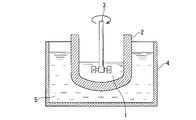
- the first drying step is a step in which the second aqueous solution is put in a polyethylene container and then dried at a temperature of 50 ° C. or more and 100 ° C. or less for 6 to 8 hours.
- FIG. 1 shows an example of the first drying step.
- reference numeral 1 denotes a second aqueous solution
- 2 denotes a resin container
- 3 denotes a stirring rod
- 4 denotes a heating container
- 5 denotes a heating medium.
- the use of a polyethylene container, a polytetrafluoroethylene container, or the like as the resin container 2 can prevent metal impurities from being mixed into the second aqueous solution 1.
- polyethylene is particularly excellent in terms of heat resistance, corrosion resistance, lightness, strength characteristics, and price.
- Hot water is preferably used as the heating medium 5. If necessary, the heating vessel 4 is warmed, and the second aqueous solution is heated and concentrated while indirectly heating the resin vessel.
- this first drying step is effective when the amount of molybdenum oxide powder obtained in one batch (one batch treatment) is 1 kg or less. If the amount is 1 kg or less, a drying time of about 6 to 8 hours is preferable.
- the second drying step is a step of spraying the second aqueous solution onto the rotating plate and drying it with a spray dryer while the molybdenum compound is repelled and dropped by the rotating plate.
- FIG. 2 schematically shows a configuration example of a drying apparatus that performs the second drying step.
- reference numeral 1 denotes a second aqueous solution
- 6 denotes an injection port for injecting the second aqueous solution 1
- 7 denotes a rotating mechanism that rotates the rotating disk 8
- 8 denotes a rotating plate that finely disperses the second aqueous solution 1
- 9 denotes
- a dry container 10 is a spray dryer
- 11 is a collection container
- 12 is a dried molybdenum oxide powder.
- a disk-shaped rotating plate 8 is attached to the tip of the rotating mechanism 7, and the rotating plate 8 is rotated at a high speed.
- the rotation speed of the rotating plate 8 is preferably about 500 to 3000 rpm.
- the temperature of the hot air sprayed from the spray dryer 10 is preferably in the range of 50 to 100 ° C.
- the droplets that are introduced into the rotating plate 8 as droplets and repelled by the rotational force of the rotating plate 8 are further reduced. Since the liquid droplets finely dispersed by the rotating plate 8 are minute water droplets, even with a short period of time while falling in the drying container 9, the hot air blown from the spray dryer 10 It is possible to dry instantaneously in a short time.
- the dried object to be processed becomes molybdenum oxide powder 12 and is deposited in the collection container 11.
- the drying process can be performed continuously, so that a large amount of molybdenum oxide powder 12 of 1 kg or more can be obtained per batch (one batch treatment).
- the drying capacity can be appropriately increased by increasing the longitudinal dimension of the drying container 9 or increasing the number of spray dryers 10 provided.
- the inner wall of the drying container 9 is coated with a resin such as polytetrafluoroethylene so that the metal impurities can be effectively prevented from being mixed into the second aqueous solution 1 from the drying container 9.
- the labor and time required for transporting the aqueous solution can be greatly reduced as in the first drying step, so that workability is good and a clean working environment can be maintained.
- the drying operation is performed in a fine droplet state in the second drying step, there is little adhesion between the powders during the drying operation, and the aggregation of the finally obtained molybdenum oxide powders is effectively prevented. be able to.
- the high-purity molybdenum powder is produced by reducing the molybdenum oxide powder having a large proportion of the primary particles, a high-purity powder having a large proportion of the primary particles is obtained for the finally obtained high-purity molybdenum powder. It is done.
- the production method of the present invention it is possible to efficiently produce a fine and high-purity molybdenum powder having a uniform particle size such that the ratio of primary particles is 90% or more.
- the obtained molybdenum oxide powder 12 is put into a container whose inner wall is covered with molybdenum and subjected to a heat treatment at a temperature of 400 to 600 ° C. If any moisture remains in the molybdenum oxide powder obtained by the drying step, the reduction step described later will be affected. Therefore, complete dehydration is performed by sufficiently performing the heat treatment in the temperature range of 400 to 600 ° C. .
- the treatment temperature in the heat treatment step is less than 400 ° C., it is necessary to lengthen the heat treatment time.
- the treatment temperature exceeds 600 ° C., the molybdenum oxide powder may grow or sublimate.
- a preferable heat treatment time is 2 hours or more.
- the heat treatment is preferably performed in the atmosphere. Even when molybdenum oxide (MoO 2 , Mo 3 O 8 , Mo 9 O 26, etc.) having a different valence from the MoO 3 powder coexists in the molybdenum oxide powder by performing heat treatment in the atmosphere
- MoO 2 , Mo 3 O 8 , Mo 9 O 26, etc. molybdenum oxide having a different valence from the MoO 3 powder coexists in the molybdenum oxide powder by performing heat treatment in the atmosphere
- the material species can be narrowed down to be composed of only MoO 3 powder.
- the heat treatment process may be performed in a hydrogen atmosphere.
- Performing heat treatment in a hydrogen atmosphere also has the effect of aligning the valence of molybdenum oxide. Thereby, the effect in the reduction
- a step of pulverizing the obtained molybdenum oxide powder is performed. Since the molybdenum oxide powder obtained in the heat treatment step has a coarse particle size and the reduction effect is not constant even if the reduction step is performed as it is, it is preferable to carry out the pulverization step in advance.
- the pulverization step is preferably performed using a pulverizer such as a ball mill. Further, by applying a resin coating such as polytetrafluoroethylene on the inner wall of the ball mill, it is possible to effectively prevent metal impurities from being mixed into the molybdenum oxide powder. It is also possible to adjust the average particle size of the finally obtained high-purity molybdenum powder by adjusting the pulverization degree.
- the pulverized molybdenum oxide powder is put into a container whose inner wall is covered with molybdenum and heated to a temperature of 950 ° C. to 1100 ° C. for reduction.
- the container used for this reduction step is preferably a container whose inner wall is coated with molybdenum.
- Molybdenum covering the inner wall of the reducing vessel is preferably as high as possible. Specifically, it is preferable to use high-purity molybdenum of 99.99% or higher, more preferably 99.999% or higher. In addition, when using a molybdenum boat, the purity is 99.99% or more, and further 99.999% or more.
- the reduction step is preferably carried out in a temperature range of 950 to 1100 ° C.
- This reduction step is a step of reducing molybdenum oxide to convert it to metal molybdenum.
- the reduction temperature is less than 950 ° C., the reduction reaction does not proceed sufficiently.
- the reduction temperature exceeds 1100 ° C., molybdenum grows and it is difficult to make the target “the particle size of all high-purity molybdenum powders equal to or less than twice the average particle size”.
- the reduction step is carried out while holding the molybdenum oxide at the above-described reduction temperature for 3 hours or more. If the holding time is less than 3 hours, there is a possibility that sufficient reduction reaction may not be performed when the amount of treatment in one batch is as large as 1 kg or more. Moreover, when the processing amount in 1 batch is less than 1 kg, the hydrogen air flow rate used as a reducing agent is preferably 1 liter / min or more.
- a high-purity molybdenum powder having a purity of 99.99% or more and further a purity of 99.999% or more can be obtained.
- the high-purity molybdenum powder obtained should have a primary particle ratio of 50% or more, more preferably 90% or more. Can do.
- the obtained high-purity molybdenum powder has a fine average particle diameter of 0.5 to 100 ⁇ m without performing a sieving operation. It becomes powder.
- the particle size distribution is measured, there is no powder having a particle size that is twice or more the average particle size of the total molybdenum powder.
- Mo powder having a uniform particle size such that only one peak at a predetermined fine particle size exists.
- ammonium dimolybdate (average particle size 100 ⁇ m) powder was prepared as a raw material common to each example and comparative example.
- ammonium dimolybdate powder as the raw material was reduced in a hydrogen stream at a flow rate of 5 liters / minute for 3 hours at a temperature of 580 ° C. to prepare a first molybdenum powder.
- a first aqueous solution containing a molybdenum compound was prepared by reacting the obtained first molybdenum powder with a hydrogen peroxide solution while adjusting the temperature so as not to exceed 60 ° C.
- a cation exchange resin powder having an average particle size of 70 ⁇ m was packed in a column 40 mm in diameter ⁇ 500 mm in length.
- a second aqueous solution containing a molybdenum compound from which the cation was removed was prepared by passing the first aqueous solution through a column packed with a cation exchange resin.
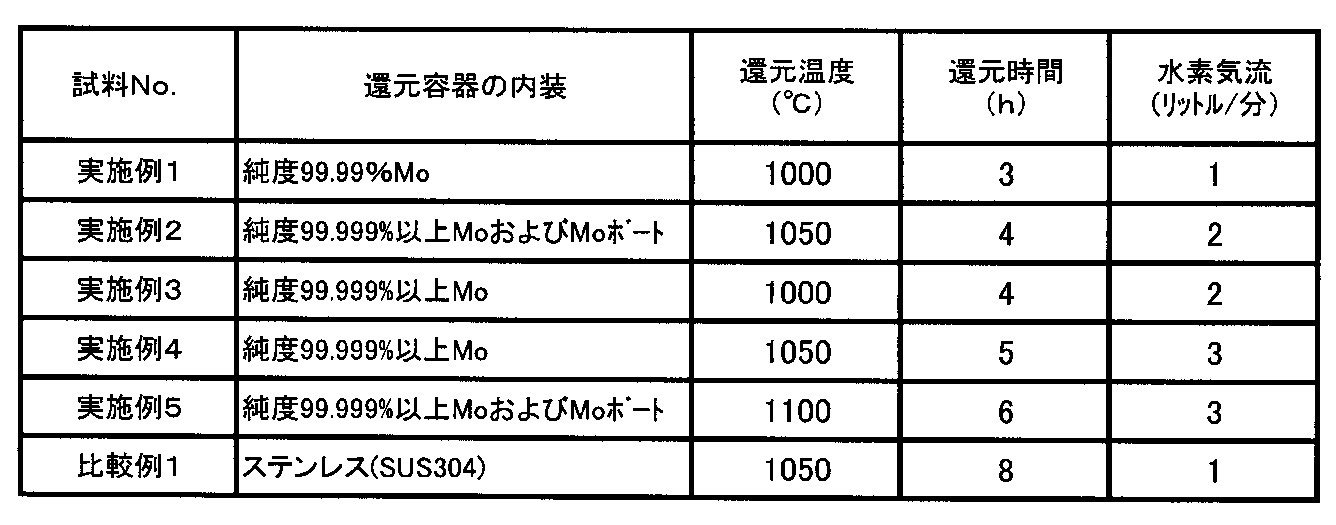
- the drying step of the second aqueous solution was performed by each method shown in Table 1. That is, in Examples 1 and 2, as shown in FIG. 1, while the resin container 2 charged with the second aqueous solution 1 is heated with warm water as a heating medium in the heating container 4, the second aqueous solution is used by the stirring rod 3. 1 was processed by the 1st drying process dried with stirring.
- each molybdenum oxide powder obtained in the drying step is put into an interior container whose inner wall is coated with molybdenum having a purity of 99.999% or more and heat-treated at a temperature of 550 ° C. to completely remove moisture. Drying was performed.
- the dried molybdenum oxide powder was pulverized with a pot mill using a rod made of high-purity Mo material as a pulverized ball in a pot whose inner wall was covered with molybdenum.
- the average particle diameter of each molybdenum oxide powder before and after pulverization is as shown in Table 2 below.
- each of Examples 1 to 5 uses a reduction container internally made of high-purity Mo material
- Comparative Example 1 uses a reduction container made of stainless steel (SUS304) without using the interior material.
- the reduction temperature, reduction time, and hydrogen flow rate were as shown in Table 3.
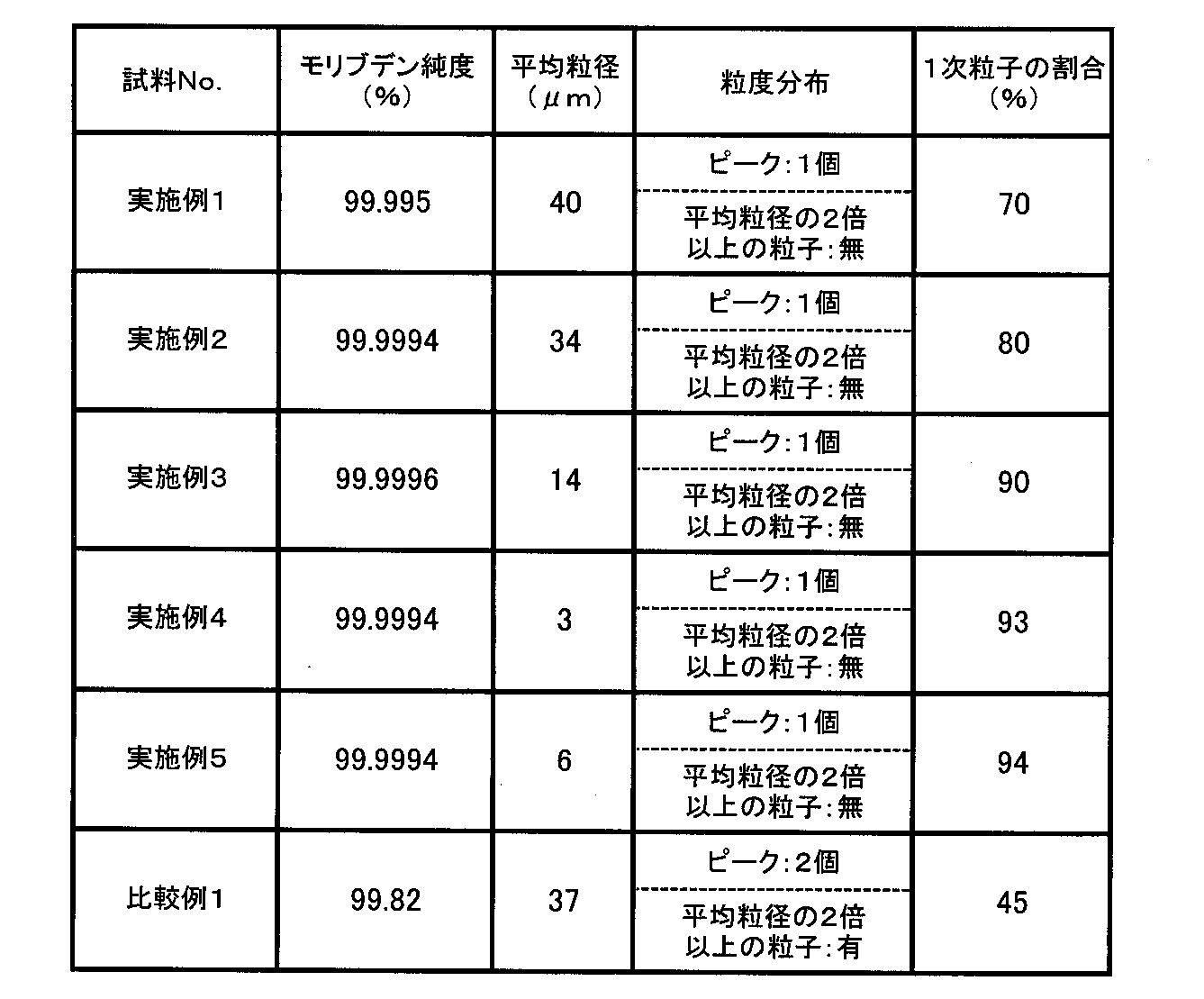
- Each high-purity molybdenum powder obtained by the above reduction treatment was measured for average particle size, primary particle ratio, particle size distribution, and purity characteristics without carrying out sieving.
- the average particle size and particle size distribution were measured with a particle size distribution meter.
- the ratio of primary particles was determined by taking an enlarged photograph at a magnification such that about 200 grains of each powder can be observed in the observation field, counting the number of primary particles, and the number of secondary particles.
- Comparative Example 1 the reduction process was processed under the conditions shown in Table 3, and the same measurement as in each Example was performed.
- the high-purity molybdenum powder according to each example has a primary particle ratio of 50% or more.
- the proportion of primary particles was as good as 90% or more. Further, even if no special sieving treatment was carried out, there was only one particle size distribution peak, and particles having a particle size exceeding twice the average particle size were not confirmed.
- a high-purity molybdenum powder having a large primary particle ratio of 50% or more despite having a fine particle diameter of 0.5 to 100 ⁇ m is obtained.
- a method for producing high-purity molybdenum powder according to the present invention high-purity molybdenum powder having a fine particle size can be efficiently produced with a high production yield using a simple production facility.
Landscapes
- Chemical & Material Sciences (AREA)
- Engineering & Computer Science (AREA)
- Materials Engineering (AREA)
- Mechanical Engineering (AREA)
- Metallurgy (AREA)
- Organic Chemistry (AREA)
- Chemical Kinetics & Catalysis (AREA)
- General Chemical & Material Sciences (AREA)
- Manufacture Of Metal Powder And Suspensions Thereof (AREA)
- Powder Metallurgy (AREA)
Abstract
Description
[1次粒子の個数/(1次粒子の個数+2次粒子の個数)]×100%=1次粒子の割合
本発明では、1次粒子の割合が50%以上と多く、付着凝集している2次粒子が少ないため、この高純度モリブデン粉末を原材料として使用してスパッタリングターゲットや焼結部品などのような焼結体を作製した場合には、均一な組織状態を有する製品を得ることができる。
上記反応により、モリブデン化合物を含む第1水溶液が調製される。また、過酸化水素水との反応は温度80℃以下の条件で実施することが好ましい。すなわち、この反応温度が80℃を超えると、過酸化水素水が爆発するおそれがあるので注意すべきである。
次に本発明に係る高純度モリブデン粉末およびその製造方法の実施形態について、以下の実施例および比較例を参照しながら、より具体的に説明する。
まず各実施例及び比較例で共通する原材料としてアンモニウムダイモリブデート(平均粒径100μm)粉末を用意した。次に、上記原材料としてのアンモニウムダイモリブデート粉末を、温度580℃で3時間に渡り、流量が5リットル/分の水素気流中で還元して第1モリブデン粉末を調製した。


[1次粒子の個数/(1次粒子の個数+2次粒子の個数)]×100(%)
に基づいて算出した。また、純度については、ウラン(U)、トリウム(Th)、ナトリウム(Na)、カリウム(K)、鉄(Fe),クロム(Cr)、ニッケル(Ni)、マグネシウム(Mg)、カルシウム(Ca)、銅(Cu),マンガン(Mn)、亜鉛(Zn)、タングステン(W)、アルミニウム(Al)の個々の質量%を求めその合計値を100%から差し引いた値をモリブデンの純度とした。
Claims (13)
- 平均粒径が0.5~100μmであり、1次粒子の割合が50%以上であり、さらに純度が99.99%以上であることを特徴とする高純度モリブデン粉末。
- 全ての高純度モリブデン粉末の粒径が平均粒径の2倍以下であることを特徴とする請求項1記載の高純度モリブデン粉末。
- 純度が99.999%以上であることを特徴とする請求項1ないし請求項2のいずれか1項に記載の高純度モリブデン粉末。
- 1次粒子の割合が90%以上であることを特徴とする請求項1ないし請求項3のいずれか1項に記載の高純度モリブデン粉末。
- 高純度モリブデン粉末の粒度分布曲線のピークが1個のみ存在することを特徴とする請求項1ないし請求項4のいずれか1項に記載の高純度モリブデン粉末。
- モリブデン酸アンモニウム塩粉末を水素還元することにより第1モリブデン粉末を調製する工程と、
上記第1モリブデン粉末を過酸化水素と反応させることによりモリブデン化合物を含む第1水溶液を調製すると工程と、
上記第1水溶液を陽イオン交換樹脂と接触させることにより、モリブデン化合物を含む第2水溶液を調製する工程と、
上記第2水溶液を乾燥させることにより酸化モリブデン粉末を調製する工程と、
内壁をモリブデンで覆った容器に上記酸化モリブデン粉末を投入して温度400~600℃で熱処理する工程と、
得られた酸化モリブデン粉末を粉砕する工程と、
内壁をモリブデンで覆った容器に、上記粉砕した酸化モリブデン粉末を投入して温度950~1100℃で還元する工程と、を具備することにより、純度が99.99%以上であるモリブデン粉末を得ることを特徴とする高純度モリブデン粉末の製造方法。 - 前記モリブデン化合物を含む第2水溶液を乾燥させることにより酸化モリブデン粉末を調製する工程として、樹脂容器に第2水溶液を投入した後に、温度50℃以上100℃以下で乾燥させる工程を用いることを特徴とする請求項6記載の高純度モリブデン粉末の製造方法。
- 前記モリブデン化合物を含む第2水溶液を乾燥させることにより酸化モリブデン粉末を調製する工程として、第2水溶液を回転板上に噴射して微細な液滴とし、モリブデン化合物を含む液滴が回転板からはじかれていて落下する途中において、スプレードライヤーにより乾燥させる工程を用いることを特徴とする請求項6記載の高純度モリブデン粉末の製造方法。
- 前記内壁をモリブデンで覆った容器が、純度が99.99%以上であるモリブデンで内壁を覆った容器であることを特徴とする請求項6ないし請求項8のいずれか1項に記載の高純度モリブデン粉末の製造方法。
- 前記内壁をモリブデンで覆った容器が、純度が99.99%以上であるモリブデンボートに、純度が99.99%以上であるモリブデンを内装材とした蓋部材を載せて構成されていることを特徴とする請求項6ないし請求項9のいずれか1項に記載の高純度モリブデン粉末の製造方法。
- 純度が99.999%以上である高純度モリブデン粉末が得られることを特徴とする請求項6ないし請求項10のいずれか1項に記載の高純度モリブデン粉末の製造方法。
- 得られる高純度モリブデン粉末中の1次粒子の割合が50%以上であることを特徴とする請求項6ないし請求項11のいずれか1項に記載の高純度モリブデン粉末の製造方法。
- 得られる高純度モリブデン粉末の平均粒径が0.5~100μmであることを特徴とする請求項6ないし請求項12のいずれか1項に記載の高純度モリブデン粉末の製造方法。
Priority Applications (2)
| Application Number | Priority Date | Filing Date | Title |
|---|---|---|---|
| JP2011521974A JP5773869B2 (ja) | 2009-07-09 | 2010-07-09 | 高純度モリブデン粉末の製造方法 |
| CN201080030705.8A CN102470437B (zh) | 2009-07-09 | 2010-07-09 | 高纯度钼粉末及其制造方法 |
Applications Claiming Priority (2)
| Application Number | Priority Date | Filing Date | Title |
|---|---|---|---|
| JP2009163106 | 2009-07-09 | ||
| JP2009-163106 | 2009-07-09 |
Publications (1)
| Publication Number | Publication Date |
|---|---|
| WO2011004887A1 true WO2011004887A1 (ja) | 2011-01-13 |
Family
ID=43429311
Family Applications (1)
| Application Number | Title | Priority Date | Filing Date |
|---|---|---|---|
| PCT/JP2010/061681 Ceased WO2011004887A1 (ja) | 2009-07-09 | 2010-07-09 | 高純度モリブデン粉末およびその製造方法 |
Country Status (3)
| Country | Link |
|---|---|
| JP (1) | JP5773869B2 (ja) |
| CN (1) | CN102470437B (ja) |
| WO (1) | WO2011004887A1 (ja) |
Cited By (5)
| Publication number | Priority date | Publication date | Assignee | Title |
|---|---|---|---|---|
| CN103255288A (zh) * | 2012-02-17 | 2013-08-21 | 苏州艾默特材料技术有限公司 | 一种工业钼粉的提纯方法 |
| JP2014109070A (ja) * | 2012-11-30 | 2014-06-12 | Korea Institute Of Geoscience And Mineral Resources | 三酸化モリブデンの還元及び低酸素モリブデン粉末の製造装置 |
| US8979975B2 (en) | 2012-11-29 | 2015-03-17 | Korea Institute Of Geoscience And Mineral Resources | Method of producing low oxygen-content molybdenum powder by reducing molybdenum trioxide |
| CN104508158A (zh) * | 2012-04-27 | 2015-04-08 | 加拿大国家粒子物理与核物理物理实验室 | 用于锝-99m的回旋加速器生产的方法、系统和装置 |
| WO2024117184A1 (ja) * | 2022-11-30 | 2024-06-06 | 東ソー株式会社 | モリブデンスパッタリングターゲット、その製造方法及びモリブデン膜の成膜方法 |
Families Citing this family (3)
| Publication number | Priority date | Publication date | Assignee | Title |
|---|---|---|---|---|
| CN103801706B (zh) * | 2012-11-09 | 2016-05-18 | 北京有色金属研究总院 | 陶瓷金属化用钼粉及其制备方法 |
| CN103736991B (zh) * | 2014-02-14 | 2016-03-30 | 山东昊轩电子陶瓷材料有限公司 | 高纯钼粉及其制备方法 |
| CN113118452B (zh) * | 2021-04-15 | 2022-02-18 | 湖南省南铂新材料有限公司 | 一种高纯钌生产加工设备及其制备方法 |
Citations (3)
| Publication number | Priority date | Publication date | Assignee | Title |
|---|---|---|---|---|
| JPH0610317B2 (ja) * | 1985-06-24 | 1994-02-09 | 株式会社東芝 | 高純度のモリブデン又はタングステンの製造方法 |
| JPH1136006A (ja) * | 1997-05-22 | 1999-02-09 | Tokyo Tungsten Co Ltd | 均粒モリブデン粉及びその製造方法 |
| JP2008223061A (ja) * | 2007-03-09 | 2008-09-25 | Asahi Pretec Corp | ルテニウム粉末の製造方法 |
Family Cites Families (5)
| Publication number | Priority date | Publication date | Assignee | Title |
|---|---|---|---|---|
| US20060042728A1 (en) * | 2004-08-31 | 2006-03-02 | Brad Lemon | Molybdenum sputtering targets |
| JP2006193795A (ja) * | 2005-01-14 | 2006-07-27 | Dowa Mining Co Ltd | 球状銀粉およびその製造方法 |
| JP5008377B2 (ja) * | 2006-10-26 | 2012-08-22 | 住友金属鉱山株式会社 | 真球状錫微粉末の製造方法 |
| JP2009079239A (ja) * | 2007-09-25 | 2009-04-16 | Sumitomo Electric Ind Ltd | ニッケル粉末、またはニッケルを主成分とする合金粉末およびその製造方法、導電性ペースト、並びに積層セラミックコンデンサ |
| CN100579692C (zh) * | 2007-12-27 | 2010-01-13 | 南京航空航天大学 | 电子级高纯钼粉的还原制备方法 |
-
2010
- 2010-07-09 CN CN201080030705.8A patent/CN102470437B/zh active Active
- 2010-07-09 WO PCT/JP2010/061681 patent/WO2011004887A1/ja not_active Ceased
- 2010-07-09 JP JP2011521974A patent/JP5773869B2/ja active Active
Patent Citations (3)
| Publication number | Priority date | Publication date | Assignee | Title |
|---|---|---|---|---|
| JPH0610317B2 (ja) * | 1985-06-24 | 1994-02-09 | 株式会社東芝 | 高純度のモリブデン又はタングステンの製造方法 |
| JPH1136006A (ja) * | 1997-05-22 | 1999-02-09 | Tokyo Tungsten Co Ltd | 均粒モリブデン粉及びその製造方法 |
| JP2008223061A (ja) * | 2007-03-09 | 2008-09-25 | Asahi Pretec Corp | ルテニウム粉末の製造方法 |
Cited By (10)
| Publication number | Priority date | Publication date | Assignee | Title |
|---|---|---|---|---|
| CN103255288A (zh) * | 2012-02-17 | 2013-08-21 | 苏州艾默特材料技术有限公司 | 一种工业钼粉的提纯方法 |
| CN103255288B (zh) * | 2012-02-17 | 2014-11-26 | 苏州艾默特材料技术有限公司 | 一种工业钼粉的提纯方法 |
| CN104508158A (zh) * | 2012-04-27 | 2015-04-08 | 加拿大国家粒子物理与核物理物理实验室 | 用于锝-99m的回旋加速器生产的方法、系统和装置 |
| EP2841607A4 (en) * | 2012-04-27 | 2015-10-07 | Triumf | METHOD, SYSTEMS AND DEVICE FOR CYCLOTRON MANUFACTURE OF TECHNETIUM-99M |
| CN104508158B (zh) * | 2012-04-27 | 2017-02-22 | 加拿大国家粒子物理与核物理物理实验室 | 用于锝‑99m的回旋加速器生产的方法、系统和装置 |
| US11661668B2 (en) | 2012-04-27 | 2023-05-30 | Triumf Inc. | Processes, systems, and apparatus for cyclotron production of technetium-99m |
| US8979975B2 (en) | 2012-11-29 | 2015-03-17 | Korea Institute Of Geoscience And Mineral Resources | Method of producing low oxygen-content molybdenum powder by reducing molybdenum trioxide |
| JP2014109070A (ja) * | 2012-11-30 | 2014-06-12 | Korea Institute Of Geoscience And Mineral Resources | 三酸化モリブデンの還元及び低酸素モリブデン粉末の製造装置 |
| US8986603B2 (en) | 2012-11-30 | 2015-03-24 | Korea Institute Of Geoscience And Mineral Resources | Apparatus for producing low-oxygen content molybdenum powder |
| WO2024117184A1 (ja) * | 2022-11-30 | 2024-06-06 | 東ソー株式会社 | モリブデンスパッタリングターゲット、その製造方法及びモリブデン膜の成膜方法 |
Also Published As
| Publication number | Publication date |
|---|---|
| CN102470437A (zh) | 2012-05-23 |
| JP5773869B2 (ja) | 2015-09-02 |
| CN102470437B (zh) | 2014-11-05 |
| JPWO2011004887A1 (ja) | 2012-12-20 |
Similar Documents
| Publication | Publication Date | Title |
|---|---|---|
| JP5773869B2 (ja) | 高純度モリブデン粉末の製造方法 | |
| JP3862385B2 (ja) | 酸化スズ含有酸化インジウム粉及び焼結体の製造方法 | |
| JP7550475B2 (ja) | 粉体材料の作製方法及びその応用 | |
| JP2023539090A (ja) | 高純度粉体材料の作製方法と応用及びある種類二相粉体材料 | |
| CN102202817B (zh) | 硬质合金混合料制备的球磨工艺 | |
| Yu et al. | The lattice contraction of nanometre-sized Sn and Bi particles produced by an electrohydrodynamic technique | |
| CN110625112B (zh) | 表面分布稀土氧化物的钛或钛合金球形粉末及其制备方法 | |
| CN105057680B (zh) | 一种机械合金化铜钨合金粉末的制备方法 | |
| CN107470639A (zh) | 一种窄粒度分布球形钨粉的制备方法 | |
| JP6159306B2 (ja) | 酸化ニッケル粉末 | |
| CN113579237B (zh) | 一种降低铜锡合金粉松装密度的制备方法 | |
| CN107585792B (zh) | 二水合氯化亚铁固体的制备方法及二水合氯化亚铁固体 | |
| CN106041111B (zh) | 一种含砷和磷的仲钨酸铵或偏钨酸铵制备纳米钨粉的方法 | |
| CN110014161B (zh) | 一种制备球形钨基粉末的方法 | |
| CN105366722A (zh) | 常温萃取法生产高纯五氧化二钒 | |
| CN109019690B (zh) | 一种稀土掺杂改性仲钨酸铵粉末的短流程制备方法 | |
| KR102249422B1 (ko) | 다공성 은 분말 및 이의 제조방법 | |
| CN108274011B (zh) | 一种适用于3d打印的具有双峰分布金属粉末的制备方法 | |
| CN105855561B (zh) | 一种超细/纳米钽钨复合粉末的制备方法及其制备的超细/纳米钽钨复合粉末 | |
| CN110014162B (zh) | 一种制备球形钼基粉末的方法 | |
| CN110026551B (zh) | 一种冷冻制备钴包裹碳化钨粉的方法 | |
| CN114082934A (zh) | 一种多组元高密度热值铝锆合金粉体及其制备方法和装置 | |
| CN111097916A (zh) | 一种超细高纯铼粉的制备方法 | |
| JP5869361B2 (ja) | Ito粉末の製造方法及びitoスパッタリングターゲットの製造方法 | |
| CN103476522B (zh) | 钼造粒粉的制造方法及钼造粒粉 |
Legal Events
| Date | Code | Title | Description |
|---|---|---|---|
| WWE | Wipo information: entry into national phase |
Ref document number: 201080030705.8 Country of ref document: CN |
|
| 121 | Ep: the epo has been informed by wipo that ep was designated in this application |
Ref document number: 10797198 Country of ref document: EP Kind code of ref document: A1 |
|
| NENP | Non-entry into the national phase |
Ref country code: DE |
|
| WWE | Wipo information: entry into national phase |
Ref document number: 2011521974 Country of ref document: JP |
|
| 122 | Ep: pct application non-entry in european phase |
Ref document number: 10797198 Country of ref document: EP Kind code of ref document: A1 |