WO2010137574A1 - 醤油糖類加熱混合物及び油脂食品 - Google Patents
醤油糖類加熱混合物及び油脂食品 Download PDFInfo
- Publication number
- WO2010137574A1 WO2010137574A1 PCT/JP2010/058784 JP2010058784W WO2010137574A1 WO 2010137574 A1 WO2010137574 A1 WO 2010137574A1 JP 2010058784 W JP2010058784 W JP 2010058784W WO 2010137574 A1 WO2010137574 A1 WO 2010137574A1
- Authority
- WO
- WIPO (PCT)
- Prior art keywords
- fat
- oil
- food
- soy sauce
- soy
- Prior art date
- Legal status (The legal status is an assumption and is not a legal conclusion. Google has not performed a legal analysis and makes no representation as to the accuracy of the status listed.)
- Ceased
Links
Classifications
-
- A—HUMAN NECESSITIES
- A23—FOODS OR FOODSTUFFS; TREATMENT THEREOF, NOT COVERED BY OTHER CLASSES
- A23D—EDIBLE OILS OR FATS, e.g. MARGARINES, SHORTENINGS OR COOKING OILS
- A23D7/00—Edible oil or fat compositions containing an aqueous phase, e.g. margarines
- A23D7/005—Edible oil or fat compositions containing an aqueous phase, e.g. margarines characterised by ingredients other than fatty acid triglycerides
- A23D7/0053—Compositions other than spreads
-
- A—HUMAN NECESSITIES
- A23—FOODS OR FOODSTUFFS; TREATMENT THEREOF, NOT COVERED BY OTHER CLASSES
- A23L—FOODS, FOODSTUFFS OR NON-ALCOHOLIC BEVERAGES, NOT OTHERWISE PROVIDED FOR; PREPARATION OR TREATMENT THEREOF
- A23L27/00—Spices; Flavouring agents or condiments; Artificial sweetening agents; Table salts; Dietetic salt substitutes; Preparation or treatment thereof
- A23L27/50—Soya sauce
Definitions
- the present invention relates to a soy sauce saccharide heated mixture and a fat and oil food, and more specifically, obtained by heating a mixed aqueous solution of soy sauce and saccharide, and useful as a substitute for an emulsifier or a surfactant, and the heated mixture.
- the present invention relates to an oil and fat food in which oil and fat are not separated over a long period of time.
- a method using a surfactant is used as a method for solubilizing or emulsifying oils and fats in the aqueous phase.
- the aqueous solution becomes cloudy, which is called emulsification.
- the size of the fats and oils to be dispersed is minute, the phenomenon becomes transparent as if part of the fats and oils are apparently dissolved, and this phenomenon is also referred to as solubilization.
- surfactants are essential, and it is judged that application to foods is difficult due to problems such as flavor, nutrition, and safety.
- the present applicant for example, extracted meat with hot water. It has been found that the extract and saccharides mainly composed of the obtained water-soluble protein exhibit extremely strong oil-and-fat solubilization ability under specific conditions. And the method of obtaining the fats and oils food which solubilizes fats and oils and does not isolate
- boiled soy sauce a method for producing a dressing using soy sauce boiled with sugar (hereinafter referred to as “boiled soy sauce”) is known (see, for example, Patent Document 5).
- the purpose of using boiled soy sauce in this production method is that when the soy sauce is blended with seasonings such as dressing by the usual method, the disadvantage that the corner unique to soy sauce appears in the taste, and the soy sauce and auxiliary ingredients
- the object is to eliminate the disadvantage that a taste of aging cannot be obtained due to the interaction.
- an emulsifier is essential as before.
- an object of the present invention is to provide a fat and oil food that does not separate fats and oils by emulsifying or solubilizing fats and oils in the aqueous phase part, and in particular without using any synthetic emulsifier or surfactant,
- An object of the present invention is to provide an oil and fat food in which the emulsifying action is not lowered by heat or the like.
- a mixed aqueous solution of soy sauce and saccharides has an absorbance at 430 nm of a 0.1% (w / w) water dilution of the mixed aqueous solution of 0. It was found that the heated mixture obtained by heating to 05 to 0.40 has excellent emulsifying ability.
- an emulsified oil / fat food obtained by adding oil / fat to the heated mixture and emulsifying the oil / fat can be obtained evenly by dispersing the oil / fat for a long period of time and mixing with another aqueous solution (for example, water or an aqueous seasoning liquid).
- the above-mentioned heated mixture is capable of solubilizing fats and oils stably in the presence of a specific concentration of sugar, and even if other seasonings and the like are contained at a high concentration. Furthermore, it was found that the solubilization ability is not impaired even if the inorganic salt is present at a high concentration, being resistant to pH change and heat.
- the present invention has been made based on these findings and provides the following 1) to 8).
- a heated soy saccharide mixture obtained by heating a mixed aqueous solution of soy sauce and saccharide, wherein the 0.1% (w / w) water dilution has an absorbance at 430 nm of 0.05 to 0.40.
- the above mixed aqueous solution is prepared by mixing 0.5 to 2.0 parts by weight of sugar with 1 part by weight of soy sauce having a total nitrogen concentration of 1.0 to 4.5% (w / v), and the liquid temperature is 70.
- the soy sauce saccharide heating mixture of 1) above which is heated at ⁇ 95 ° C. for 9 to 66 hours.
- 0.02 to 1.0 weight of the fat or oil is added to 1 part by weight of the emulsified base obtained by adding water or an aqueous seasoning liquid to the soy saccharide heated mixture so that the Brix is 50% (w / w) or less.
- the oil / fat food according to 3 which is solubilized.
- soy sauce saccharide heating mixture that has excellent emulsifying ability and solubilizing ability and is useful as an alternative to emulsifiers or surfactants. If this soy saccharide heated mixture is used, the fats and oils are not uniformly emulsified or solubilized in the aqueous phase over a long period of time without using any synthetic emulsifiers or surfactants or proteins derived from animals and plants, and are not separated. Food can be easily obtained.
- the oil and fat food of the present invention is obtained by using basic nutritional seasoning ingredients of food such as soy sauce, sugar and edible oil and fat, even if it is heavily used in the seasoning of food, the flavor of the food is affected.
- the fat and oil food of the present invention is uniformly emulsified in an aqueous seasoning liquid of an arbitrary ratio, a stable emulsified food with a high emulsification degree can be obtained. Moreover, since the aqueous
- the dispersed oil droplets are extremely stable, so that their suitability for food processing is extremely high.
- oil and fat can be stably dispersed as fine colloidal oil droplets in the emulsified food, Various problems in food processing that are conventionally known can be solved.
- the heated soy saccharide mixture of the present invention is described in detail below based on preferred embodiments.
- the heated soy saccharide mixture of the present invention can be obtained by performing the following first to second steps.
- soy sauce and saccharide mixed aqueous solution are mixed to prepare a mixed aqueous solution (hereinafter referred to as soy sauce saccharide mixed aqueous solution).
- soy sauce normal soy sauce can be used, and examples thereof include thick soy sauce, light soy sauce, tame soy sauce, recharged soy sauce, reduced salt soy sauce, and membrane concentrated soy sauce.
- soy sauce a heating mixture having a predetermined absorbance according to the present invention can be easily obtained, and the emulsifying ability and solubilizing ability (hereinafter referred to as emulsifying ability and solubilizing ability) of the obtained heating mixture are simply combined.
- soy sauce having a total nitrogen concentration of 1.0 to 4.5% (w / v), particularly 2.0 to 2.5% (w / v). Further, it is more preferable to use a concentrated or pale soy sauce film concentrated soy sauce or a soy sauce satisfying such a total nitrogen concentration range.
- the membrane-concentrated soy sauce is obtained by adjusting the concentration of the components by membrane concentration. If membrane concentration is performed, the total nitrogen concentration can be adjusted.
- membrane-concentrated soy sauce is permeabilized with soy sauce or fired rice using a molecular sieving membrane such as a reverse osmosis membrane, NF membrane (Nano-Filtration membrane), loose RO membrane or UF membrane (Ultra-Filtration membrane), and the like. It can be obtained separately from the transmission side (see JP-A-10-234332 and Japanese Patent No. 3530753).
- the soy sauce can be obtained by filtering the soy sauce ori by a conventional method (celite filtration or microfiltration membrane filtration) and then concentrating the filtrate with a reverse osmosis membrane (see JP-A-4-197154).
- a conventional method celite filtration or microfiltration membrane filtration
- a reverse osmosis membrane see JP-A-4-197154.
- membrane concentrated soy sauce having a total nitrogen concentration of 2.0 to 2.5% (w / v) can be obtained.
- reducing sugar is used as the saccharide.
- the reducing sugar include monosaccharides such as glucose (glucose), fructose (fructose), glyceraldehyde; oligosaccharides such as maltose (malt sugar), lactose (lactose), arabinose; and water-soluble sugars such as dextrin and syrup.
- monosaccharides such as glucose (glucose), fructose (fructose), glyceraldehyde
- oligosaccharides such as maltose (malt sugar), lactose (lactose), arabinose
- water-soluble sugars such as dextrin and syrup.
- These saccharides can be used alone or in combination, or can be used as an isomerized sugar such as fructose-glucose liquid sugar.
- glucose or chickenpox is preferable because it is inexpensive and easily available.
- the amount of the saccharide mixed with the soy sauce is preferably 0.5 to 2.0 parts by weight, more preferably 0.5 to 1.5 parts by weight, and 0.7 to 1.2 parts by weight with respect to 1 part by weight of soy sauce. Part is most preferred.
- the mixing amount of saccharides is less than 0.5 parts by weight, the emulsifying ability of the resulting soy sauce saccharide heating mixture may be weakened.
- the mixing amount exceeds 2 parts by weight, the viscosity increases and handling becomes difficult. Therefore, it is not preferable.
- the soy saccharide heating is performed in order to further stabilize the solubilizing ability of the soy sauce saccharide heating mixture of the present invention.
- Sugar is further added to the mixture to make a solubilized base, but the soy sauce may be premixed with a large amount of sugar (for example, more than 1.2 parts by weight).
- a method of adding sugar after obtaining a heated mixture is preferred.
- the soy saccharide mixed solution obtained in the first step has an absorbance at 430 nm of a 0.1% (w / w) water dilution of 0.05 to 0.40, preferably 0.10 to 0. .40, more preferably 0.30 to 0.40, to obtain the heated soy saccharide mixture of the present invention.
- this is extremely important.
- the absorbance is less than 0.05, the fat emulsifying ability is low, and the fats and oils in the fat and oil food are quickly floated and separated, and the object of the present invention cannot be achieved.
- the absorbance increases with the progress of the Maillard reaction by heating, and an excellent fat emulsifying ability is observed in the absorbance range of 0.05 to 0.40.
- the reaction is allowed to proceed excessively, an insoluble substance is precipitated in the soy saccharide heated mixture, the fat emulsifying ability is lowered, and the fats and oils of the fat and oil food are floated and separated, so that the object of the present invention cannot be achieved.
- the soy sauce saccharide mixed aqueous solution obtained in the first step is heated, it is necessary to heat so that insoluble substances do not precipitate.
- the heating temperature and time of the soy saccharide mixed aqueous solution can be appropriately selected from the conditions under which the soy saccharide heated mixture having the above absorbance can be obtained.
- the heating temperature is preferably 70 to 95 ° C., more preferably 75 to 85 ° C.
- the heating time is preferably 9 to 66 hours, more preferably 18 to 60 hours.
- the heating temperature and time are below the lower limit of the above conditions, the emulsifying ability and the solubilizing ability are lowered, which is not preferable.
- the value exceeds the upper limit of the above conditions an insoluble substance due to the excessive progress of the reaction is precipitated, and the emulsifying ability and the solubilizing ability are lowered.
- the heated soy saccharide mixture of the present invention has an excellent emulsifying ability and can be used as it is as a natural emulsifier.
- the heated soy saccharide mixture of the present invention can uniformly emulsify or solubilize a large amount of fats and oils in water or an aqueous seasoning liquid for a long period of time.
- the soy saccharide heated mixture of the present invention can also be used for applications such as blackening (substitution of caramel pigment) and flavor enhancement.
- the fat and oil food of the present invention contains the heated mixture of the soy saccharides and fats and oils of the present invention and, if necessary, an aqueous solution and the like, and is mainly used as an intermediate product in the production of an emulsified food (final product) described later. It is what
- the content of the heated soy saccharide mixture of the present invention in the total amount of the fat and oil food of the present invention is preferably 2 to 45% (w / w), more preferably, although it depends on the amount of fat and oil contained in the fat and oil food. Select from the range of 6-30%. If it is less than 2%, the stability of emulsification or solubilization may be lowered. Even if it exceeds 45%, the stability of emulsification or solubilization does not change significantly.
- the content of fats and oils in the total amount of the fats and oils food of the present invention can be appropriately selected according to the type of the emulsified food (final product) and the like, for example, selected from the range of 1 to 80% (w / w). be able to. When the upper limit of 80% is exceeded, the stability of emulsification or solubilization may be lowered. From the viewpoint of the stability of fats and oils in emulsified foods, the content of fats and oils in the total amount of fats and oils food is more preferably 30 to 70%.
- the fats and oils include any fats and oils that can be used for food, for example, vegetable oils such as cottonseed oil, sesame oil, rapeseed oil, soybean oil, palm oil, palm oil, olive oil; pork fat, beef fat, chicken oil, Animal fats and oils such as whale oil and fish oil; essential oils such as orange oil, lemon oil, yuzu oil and paprika oil; and spice oils such as mustard oil can be used alone or in combination.
- vegetable oils such as cottonseed oil, sesame oil, rapeseed oil, soybean oil, palm oil, palm oil, olive oil
- solid fats and oils such as lard and beef tallow, at room temperature, it is necessary to use on the temperature conditions more than melting
- aqueous solution examples include soy sauce, sauce, mirin, alcoholic beverages, vinegar, fruit juice, vegetable juice, pulp paste (jam, ketchup, etc.), salt, saccharides, organic acids, amino acids, taste nucleic acids, and nodal extract.
- Various food materials such as animal and plant extracts, flavors (flavors), spices, colorants, nutrient enhancers (vitamins), preservatives or thickeners, which are in the form of aqueous solutions can be used as they are.
- flavors (flavors) flavors
- spices colorants
- nutrient enhancers vitamins
- preservatives or thickeners which are in the form of aqueous solutions can be used as they are.
- what is not in the form of an aqueous solution itself can be used by being contained in a food material in the form of water or an aqueous solution at an appropriate concentration.
- One or two or more aqueous solutions can be used. When using an aqueous solution in the fat
- the fat and oil food of the present invention can be obtained by adding the above fat and oil to the soy saccharide heated mixture of the present invention and emulsifying or adding the fat and oil and solubilizing it.
- the emulsified fat and oil food and the solubilized fat and oil food that are the fat and oil food of the present invention will be further described based on preferred forms.
- the fat and oil food of the present invention obtained by adding fat and oil to the heated soy saccharide mixture of the present invention and emulsifying it will be described below based on its preferred production method.
- fats and oils may be added to the soy sauce sugar heated mixture itself of the present invention, but the soy sauce sugar heated mixture of the present invention has a high viscosity and when adding fats and oils May be difficult to handle.
- water can be added to the soy sauce saccharide heating mixture of the present invention in advance to lower the viscosity, and it can be used as an emulsification base.
- the amount of water and / or aqueous solution to be added can be appropriately selected from the amount that the solid content concentration (Brix) of the emulsification base is 50% (w / w) or less, and 20 to 50% (w / w), In particular, it is preferable to select from an amount of 30 to 50%.
- the content of the heated soy saccharide mixture of the present invention in the total amount of the emulsified base is preferably selected to be 35 to 90% (w / w).
- the soy sauce saccharide heating mixture of this invention itself satisfy
- the oil or fat is preferably added in an amount of 0.02 to 1.0 part by weight with respect to 1 part by weight of the emulsified base to emulsify the oil or fat.
- the fat and oil food of the present invention in an emulsified state preferably contains 2 to 50% by weight, especially 5 to 30% by weight of the heated soy saccharide mixture of the present invention based on the total amount of the fat and oil food. It is preferable to contain 20 to 80% by weight, particularly 30 to 70% by weight. By satisfy
- the oil and fat food of the present invention in an emulsified state can be obtained by adding an oil and fat to the soy saccharide heated mixture of the present invention or an aqueous solution thereof as an emulsification base and performing an emulsification treatment.
- a conventional method such as high-speed stirring can be used.
- a high-speed stirrer such as a homogenizer is used for high-speed stirring.
- the high-speed stirrer may be appropriately selected from those used for the production of various foods as long as it can stir the soy saccharide heated mixture of the present invention or an aqueous solution thereof and fats and oils at high speed.
- a high-speed stirrer capable of stirring at a rotation speed of 10,000 rpm or higher is used, and stirring is performed for a sufficient time required for the oil and fat to be uniformly dispersed at the rotation speed. More preferably, high-speed stirring is performed at a rotational speed of 14,000 to 20,000 rpm for 5 to 60 seconds. For example, if high-speed stirring is performed at 16,000 rpm for 30 seconds, the fats and oils are uniformly dispersed and emulsified.
- the oil and fat food of the present invention in an emulsified state in which the oil and fat are not separated even after being stored for a long period of time can be obtained.
- the fat and oil food of the present invention obtained by adding fat and oil to the heated soy saccharide mixture of the present invention and solubilizing it will be described below based on its preferred production method.
- fats and oils may be added to the soy sauce saccharide heated mixture itself of the present invention.
- Sugar can be added to the heated mixture and used as a solubilization base.
- the Brix in the solubilized base is preferably 30% (w / w) or more, more preferably 30 to 70%.
- the amount of sugar to be added can be appropriately selected depending on the amount of sugar mixed with soy sauce and the heating conditions when the soy sauce sugar heated mixture of the present invention is obtained.
- soy saccharide heated mixture or the solubilized base of the present invention when the viscosity of the soy saccharide heated mixture or the solubilized base of the present invention is high, water may be added to them to facilitate stirring. Even when water is added, Brix is preferably within the above range. Moreover, when adding fats and oils to the soy sauce saccharide heating mixture itself of this invention, it is preferable that the soy sauce saccharide heating mixture of this invention satisfy
- sugar to be added to the soy sauce saccharide heating mixture of the present invention glucose, dextrin or syrup is preferred.
- blended with soy sauce when obtaining the soy sauce saccharide heating mixture of this invention.
- These sugars may be added to the heated soy saccharide mixture of the present invention in the form of an aqueous solution.
- adding sugar to the heated mixture is one of the main purposes to improve thickening stability. Or these aqueous solution is the most preferable.
- the amount of the soy saccharide heated mixture of the present invention in the solubilized base can be appropriately selected from the amount that the Brix of the solubilized base is 30% (w / w) or more.
- the soy saccharide heated mixture of the present invention it is preferable to select the soy saccharide heated mixture of the present invention to be 2 to 70% (w / w) in the total amount of the solubilized base.
- the amount of the soy saccharide heated mixture is more preferably 3 to 40%, and most preferably 3 to 30%.
- the solubilization rate represents the maximum amount of fats and oils that can be solubilized in the solubilization base in terms of weight percent concentration (w / w) based on the weight of the fats and oils food.
- the solubilization rate when adding 4.0 parts by weight of fat / oil to 1 part by weight of the solubilized base is 80%, which is almost equal to the maximum solubilization rate. Therefore, it cannot be solubilized even if an amount exceeding 4.0 parts by weight of fat / oil is added to 1 part by weight of the solubilized base.
- the solubilization of fats and oils in the above-mentioned solubilization base does not require a high-speed stirrer and an advanced emulsification device such as an electrical dispersion device, which are required for the production of conventional emulsified foods, but by a spoon or a stirring bar It can be carried out by artificial stirring or by gentle mechanical stirring using a conventional simple stirring device such as a commercially available universal mixing stirring device or a kneader with a steam jacket. In this respect, the fat and oil food of the present invention in a solubilized state can be produced economically.
- the rotation speed of 1000 rpm or less is preferable, and since the fats and oils are mixed more uniformly, the rotation speed is more preferably 600 rpm or less.
- stirring is performed for a sufficient time necessary for the oil and fat to be uniformly dispersed.
- the stirring time is not particularly limited, but the fats and oils can be uniformly dispersed by stirring for 1 minute or more at the rotation speed. Even by such gentle stirring, the solubilized oil and fat food of the present invention can be obtained very easily.
- stirring with the above-described high-speed stirrer such as a high-level emulsifying apparatus generally required for the production of emulsified foods, such as a homogenizer, may not be suitable due to the high viscosity of the solubilized base.
- the oil-and-fat food of the present invention in a solubilized state in which the oil-and-fat does not separate even after long-term storage can be obtained.
- the fat and oil food of the present invention is prepared by appropriately selecting the amount of the soy sauce saccharide heated mixture, fat and oil, water, aqueous solution, and sugar of the present invention contained in the fat and oil food, and dressing the fat and oil food itself. It is also possible to make an emulsified food (final product) such as liquid or sauce. However, in order to obtain an emulsified food in which fats and oils are more stably emulsified or solubilized, after the fats and oils food of the present invention is once produced as described above, it is appropriately mixed with an aqueous seasoning liquid to obtain a desired food. It is desirable to use an emulsified food.
- the fat and oil food of the present invention is emulsified in an aqueous seasoning liquid of an arbitrary ratio, a stable emulsified food (final product) having a high degree of emulsification or solubilization can be obtained when the fat or oil food is used.
- the amount of the oil / fat food of the present invention in the emulsified food can be appropriately selected according to the type of the emulsified food, and can be selected, for example, from a range of 10 to 100% (w / w) (the remainder) Is an aqueous seasoning liquid).
- aqueous seasoning liquid when increasing the proportion of the aqueous seasoning liquid to make a dilute emulsified food of fats and oils, it becomes easier for oil droplets to float and separate based on the difference in specific gravity between water and fats and oils, such as xanthan gum and locust bean gum.
- Such a thickening stabilizer is preferably used by dissolving it in an aqueous seasoning solution in advance. Thereby, it is possible to obtain a stable emulsified food in which oil droplets do not float and separate over a long period of time.
- the method for mixing the fat and oil food of the present invention and the aqueous seasoning liquid is not particularly limited, and can be sufficiently mixed by artificial stirring or gentle mechanical stirring, and may be high-speed stirring.
- the emulsified food thus obtained can be heated to adjust the flavor or sterilized as necessary to obtain a product.
- soy sauce is the main ingredient, and mirin, alcoholic beverages (sake, wine, etc.), vinegar, sugar, spices, etc. are added as appropriate, and cooked seasoning liquid is used.
- emulsified foods such as seasonings for rice crackers, dressings, sauces (for example, for yakiniku), soups (for example, concentrated soup for ramen or straight soup), which contain oils and fats homogeneously and stably, can be obtained.
- Examples 1-1 to 1-8, Comparative Examples 1-1 to 1-7 (Preparation of heated soy saccharide mixture)
- Membrane concentrated soy sauce obtained by permeabilizing commercially available concentrated soy sauce (total nitrogen concentration 1.65% (w / v)) with a reverse osmosis membrane (NTR-7450; manufactured by Nitto Denko Corporation) and separating from the non-permeate side 500 ml of (total nitrogen concentration 2.0% (w / v)) and 500 g of glucose (anhydrous equivalent) were mixed to prepare a soy saccharide mixed solution.
- the mixed aqueous solution was heated at a liquid temperature of 85 ° C. for 0 to 96 hours to obtain a heated mixture of soy saccharides having different emulsifying ability.
- Table 1 shows the correlation between the heating time for preparing the soy saccharide heated mixture, the absorbance of the obtained soy saccharide heated mixture, and the observation results after 24 hours of standing of the emulsified oil / fat food.
- Table 1 below, the pH and Brix of the obtained emulsified oil / fat food are also shown.
- the soy saccharide heated mixture is an excellent emulsification
- the emulsified oil / fat food using the oil / fat was uniformly dispersed even after 24 hours, and the emulsification stability was high.
- the heating time is short and the absorbance of the soy saccharide heated mixture is less than 0.05, the emulsifying ability is low, and the fat cannot be stably dispersed in the aqueous phase over a long period of time. Has happened.
- Example 1-9 (Preparation of soy saccharide heated mixture and production of emulsified oil and fat food) 500 ml of commercially available distilled soy sauce (total nitrogen concentration 2.2% (w / v)) and 500 g of glucose (anhydrous equivalent) were mixed to prepare a soy saccharide mixed aqueous solution.
- the soy saccharide mixed aqueous solution is heated at a liquid temperature of 80 ° C. for 48 hours, so that the absorbance at 430 nm of a 0.1% (w / w) water diluted solution (1,000 times water diluted solution) becomes 0.40. A heated mixture was obtained.
- the soy saccharide heated mixture of the present invention in which the absorbance at 430 nm of a 0.1% (w / w) water dilution is 0.05 to 0.40 has excellent emulsifying ability.
- the oil / fat is uniformly dispersed and the emulsification stability is extremely high.
- Membrane concentrated soy sauce obtained by permeabilizing commercially available concentrated soy sauce (total nitrogen concentration 1.65% (w / v)) with a reverse osmosis membrane (NTR-7450; manufactured by Nitto Denko Corporation) and separating from the non-permeate side 500 ml of (total nitrogen concentration 2.0% (w / v)) and 500 g of glucose (anhydrous equivalent) were mixed to prepare a soy saccharide mixed solution.
- the mixed aqueous solution was heated at a liquid temperature of 85 ° C.
- Glucose 500 g was added to and mixed with 500 ml of commercially available distilled soy sauce (total nitrogen concentration 2.27% (w / v)) to prepare a soy saccharide mixed aqueous solution.
- the mixed aqueous solution was heated at a liquid temperature of 80 ° C. for 48 hours to obtain a soy saccharide heated mixture.
- the heated mixture had an absorbance at 430 nm of 0.4.
- the heated mixture had pH 4.8, Brix 50, and a total nitrogen concentration of 1.23% (w / v).
- soy saccharide heated mixture was mixed with syrup (Brix 75%) so as to be Brix as shown in Table 4 below to obtain a solubilized base.
- syrup Biller 75% so as to be Brix as shown in Table 4 below.
- 1 part by weight of fats and oils was added to 1 part by weight of the solubilized base, and the mixture was stirred and solubilized with a spoon to obtain a solubilized fat and oil food of the present invention.
- each obtained fat and oil food were visually confirmed based on the presence or absence of the fat and oil separation.
- a predetermined amount of each fat and oil food is taken, added to water, stirred uniformly with a spoon to prepare a 0.1% (w / w) water dilution (emulsion), and the turbidimeter UT-11 ( The turbidity was investigated by Corona).
- the results are shown in Table 4.
- Glucose 500 g was added to and mixed with 500 ml of commercially available distilled soy sauce (total nitrogen concentration 2.27% (w / v)) to prepare a soy sauce saccharide mixed aqueous solution.
- the mixed aqueous solution was heated at a liquid temperature of 80 ° C. for 48 hours to obtain a soy saccharide heated mixture.
- the soy saccharide heated mixture had an absorbance at 430 nm of 0.4.
- soy sauce saccharide heating mixture chickenpox (Brix 75%) and water were mixed in the proportions shown in Table 5 to prepare a solubilized base.
- the maximum amount of fats and oils that can be solubilized was added to the solubilized base, and it was solubilized by stirring with a spoon to obtain the fat and oil food of the present invention. Water was used for the purpose of facilitating stirring.
- Table 5 shows the solubilization rate of the obtained fat and oil food of the present invention.
- Comparative Example 2 For comparison, 500 g of glucose was added to and mixed with 500 ml of commercially available distilled soy sauce to prepare a soy saccharide mixed aqueous solution. Next, 20 g of the mixed aqueous solution was directly mixed with 180 g of chickenpox (Brix 75%) and 20 g of water without heating, and added with fats and oils, and solubilized by stirring with a spoon to obtain fat and oil foods. Table 5 shows the solubilization rate of the obtained fat and oil food of Comparative Example.
- the solubilized base containing the soy sauce saccharide heating mixture of the present invention when used, the fats and oils can be uniformly mixed by mixing the fats and oils with the solubilized base. A solubilized oil and fat food can be obtained. Moreover, solubilization ability is especially high in content of the soy sauce saccharide heating mixture of this invention in a solubilization base being 3% (w / w) or more.
- Glucose 500 g was added to and mixed with 500 ml of membrane concentrated soy sauce prepared by the method described in Example 6 to prepare a soy saccharide mixed aqueous solution.
- the mixed aqueous solution was heated at a liquid temperature of 80 ° C. for 48 hours to obtain a soy saccharide heated mixture.
- the soy saccharide heated mixture had an absorbance at 430 nm of 0.38.
- solubilized oil and fat foods and manufacture of seasoning liquid for rice crackers 80 g of starch syrup (Brix 75%) was added to 20 g of the heated soy saccharide mixture to prepare a solubilized base.
- solubilized base 100 g of a mixed oil of 9 parts by weight of salad oil (edible fats and oils) and 1 part by weight of yuzu oil was added and stirred to solubilize to obtain a yuzu base fat food.
- an aqueous seasoning liquid obtained by mixing the aqueous seasoning raw material shown in Table 7 with 80 g of the yuzu-based oil / fat food was mixed to obtain an emulsified rice seasoning seasoning for rice confectionery. Even if this seasoning liquid was stored at room temperature for 2 months, it had a rich yuzu flavor, had no separation of oils and fats, and was stable and milky.
- aqueous seasoning liquid obtained by mixing the raw material for aqueous seasoning liquid shown in Table 8 was mixed with 30 g of the wasabi-based oil / fat food to obtain a milky rice confectionery seasoning liquid as an emulsified food. Even if this seasoning liquid was stored at room temperature for 2 months at room temperature, it had a wasabi flavor, had no oil and fat separation, and had a stable emulsion.
- Glucose 500 g was added to and mixed with 500 ml of membrane concentrated soy sauce prepared by the method described in Example 6 to prepare a soy saccharide mixed aqueous solution.
- the mixed aqueous solution was heated at a liquid temperature of 80 ° C. for 48 hours to obtain a soy saccharide heated mixture.
- the soy saccharide heated mixture had an absorbance at 430 nm of 0.38.
- the solubilized fat and oil food obtained by using the soy saccharide heated mixture can stably emulsify and disperse the fat and oil in the aqueous solution even when stored for a long period of time, without the floating separation of the fat and oil by heating. .
Landscapes
- Chemical & Material Sciences (AREA)
- Life Sciences & Earth Sciences (AREA)
- Engineering & Computer Science (AREA)
- Food Science & Technology (AREA)
- Polymers & Plastics (AREA)
- Oil, Petroleum & Natural Gas (AREA)
- Health & Medical Sciences (AREA)
- Nutrition Science (AREA)
- Seasonings (AREA)
- Edible Oils And Fats (AREA)
- General Preparation And Processing Of Foods (AREA)
Abstract
Description
1)醤油と糖類の混合水溶液を加熱してなり、0.1%(w/w)水希釈液の430nmにおける吸光度が0.05~0.40である醤油糖類加熱混合物。
2)上記混合水溶液は、全窒素濃度1.0~4.5%(w/v)の醤油1重量部に対し糖類0.5~2.0重量部を混合したものであり、液温70~95℃で9~66時間加熱してなる上記1)の醤油糖類加熱混合物。
3)上記1)又は2)の醤油糖類加熱混合物に、油脂を添加し乳化又は可溶化してなる油脂食品。
4)上記醤油糖類加熱混合物に、Brix50%(w/w)以下となるよう水又は水性調味液を添加、混和してなる乳化ベース1重量部に対し、上記油脂0.02~1.0重量部を添加し乳化してなる上記3)の油脂食品。
5)上記醤油糖類加熱混合物に、Brix30%(w/w)以上となるようさらに糖を添加、混和してなる可溶化ベース1重量部に対し、油脂0.02~4.0重量部を添加し可溶化してなる上記3)の油脂食品。
6)上記可溶化ベース中に含まれる上記醤油糖類加熱混合物の濃度が2~70%(w/w)である上記5)の油脂食品。
7)上記3)~6)のいずれかの油脂食品と水性調味液とを混和してなる乳化食品。
8)米菓用調味液、ドレッシング、タレ又はスープである上記7)の乳化食品。
(2)本発明の油脂食品は、醤油、糖類及び食用油脂等、食品の基本的栄養調味成分を使用して得るものであるから、食品の調味に多用しても該食品の風味に影響を与えることが少なく、広く応用が可能である。
(3)本発明の油脂食品は、任意の割合の水性調味液に均一に乳化するため、乳化度が高く安定な乳化食品を得ることができる。また、用いる水性調味液は制限されることがないため、ドレッシングや焼肉用タレ等の様々な乳化食品を提供することができる。
(4)さらに、得られる乳化食品は、調理や殺菌するための加熱処理に対しても、熱変性等による乳化分離を起こすことがない。また、高濃度の塩を含有しても、分散した油滴は極めて安定であるため、食品加工への適性は極めて高い。すなわち、醤油やソース等の含塩調味液や加熱工程を経て製品となる各種の食品に応用しても、微細なコロイド状油滴として、乳化食品中に油脂を安定分散させることができるので、従来より知られている食品加工における種々の問題点を解決することができる。
本発明の醤油糖類加熱混合物は、下記第一工程~第二工程を実施することにより得ることができる。
第一工程では、醤油と糖類とを混和して混合水溶液(以下、醤油糖類混合水溶液という)を調製する。
上記醤油としては、通常の醤油を用いることができ、例えば、濃口醤油、淡口醤油、溜醤油、再仕込醤油、これらの減塩醤油及び膜濃縮醤油等が挙げられる。上記醤油としては、本発明に係る所定の吸光度を有する加熱混合物を容易に得ることができ、得られる加熱混合物の乳化能及び可溶化能(以下、乳化能と可溶化能とをあわせて、単に乳化能という場合もある)が高いことから、全窒素濃度1.0~4.5%(w/v)、特に2.0~2.5%(w/v)の醤油を用いることが好ましく、かかる全窒素濃度範囲を満たす濃口若しくは淡口醤油の膜濃縮醤油又は溜醤油を用いることがさらに好ましい。
第二工程においては、第一工程で得た醤油糖類混合水溶液を、0.1%(w/w)水希釈液の430nmにおける吸光度が0.05~0.40、好ましくは0.10~0.40、さらに好ましくは0.30~0.40となるように加熱して、本発明の醤油糖類加熱混合物を得る。本発明においてこのことは極めて重要であって、吸光度が0.05未満であるときは、油脂乳化能が低く、油脂食品の油脂が速やかに浮上分離して本発明の目的を達成できない。吸光度は、加熱によるメイラード反応が進行することに伴ってその値が高くなり、吸光度0.05~0.40の範囲で、優れた油脂乳化能が認められる。一方、反応を過剰に進行させてしまうと、醤油糖類加熱混合物内に不溶性物質が析出し、その油脂乳化能が低下し、油脂食品の油脂が浮上分離して本発明の目的を達成できない。第二工程において、第一工程で得た醤油糖類混合水溶液を加熱する際には、不溶性物質が析出しないように加熱することが必要である。
本発明の醤油糖類加熱混合物に油脂を添加する際には、本発明の醤油糖類加熱混合物そのものに油脂を添加してもよいが、本発明の醤油糖類加熱混合物は粘度が高く、油脂を加える際の取り扱いが困難となる場合がある。この場合、本発明の醤油糖類加熱混合物にあらかじめ水を加えて、粘度を低くし、乳化ベースとして用いることもできる。また、水に代えて又は水とともに、前述の水性溶液を加えてもよい。加える水及び/又は水性溶液の量は、乳化ベースの固形分濃度(Brix)が50%(w/w)以下となる量から適宜選択することができ、20~50%(w/w)、特に30~50%となる量から選択することが好ましい。乳化ベース全量中の本発明の醤油糖類加熱混合物の含有量は、35~90%(w/w)となるように選択することが好ましい。尚、本発明の醤油糖類加熱混合物そのものに油脂を添加する場合は、本発明の醤油糖類加熱混合物そのものが上記のBrixの範囲を満たしていることが好ましい。
本発明の醤油糖類加熱混合物に油脂を添加する際には、本発明の醤油糖類加熱混合物そのものに油脂を添加してもよいが、油脂をより安定に可溶化分散させるため、本発明の醤油糖類加熱混合物に糖を添加し可溶化ベースとして用いることもできる。この際、可溶化ベース中のBrixを好ましくは30%(w/w)以上、さらに好ましくは30~70%とする。添加する糖の量は、本発明の醤油糖類加熱混合物を得た際の醤油に対する糖類の混和量及び加熱条件により適宜選択することができる。
尚、本発明の醤油糖類加熱混合物又は可溶化ベースの粘度が高い場合には、撹拌を容易にするため、それらに水を加えてもよい。水を加える場合も、Brixは上記の範囲となるようにすることが好ましい。また、本発明の醤油糖類加熱混合物そのものに油脂を添加する場合は、本発明の醤油糖類加熱混合物が上記のBrixの範囲を満たしていることが好ましい。
(醤油糖類加熱混合物の調製)
市販の濃口醤油(全窒素濃度1.65%(w/v))を逆浸透膜(NTR-7450;日東電工社製)で透過処理し、非透過側から分離して得られた膜濃縮醤油(全窒素濃度2.0%(w/v))500mlと、グルコース500g(無水物換算)を混和して、醤油糖類混合水溶液を調製した。当該混合水溶液を液温85℃で0~96時間加熱して、それぞれ乳化能を異にする醤油糖類加熱混合物を得た。
得られた各醤油糖類加熱混合物の色を測定した。色の測定においては、レシオビーム分光光度計U-1100型spectro photometer(日立ハイテクノロジーズ社製)を用い、0.1%(w/w)水希釈液の430nmにおける吸光度を測定した。吸光度は、溶液の色に濁りがあると正確な測定ができないため、醤油糖類加熱混合物を水で1,000倍希釈後、0.45ミクロンフィルターであらかじめ濾過して測定した。
なお、以降の実施例においても、吸光度の測定は上記の測定法にて行った。
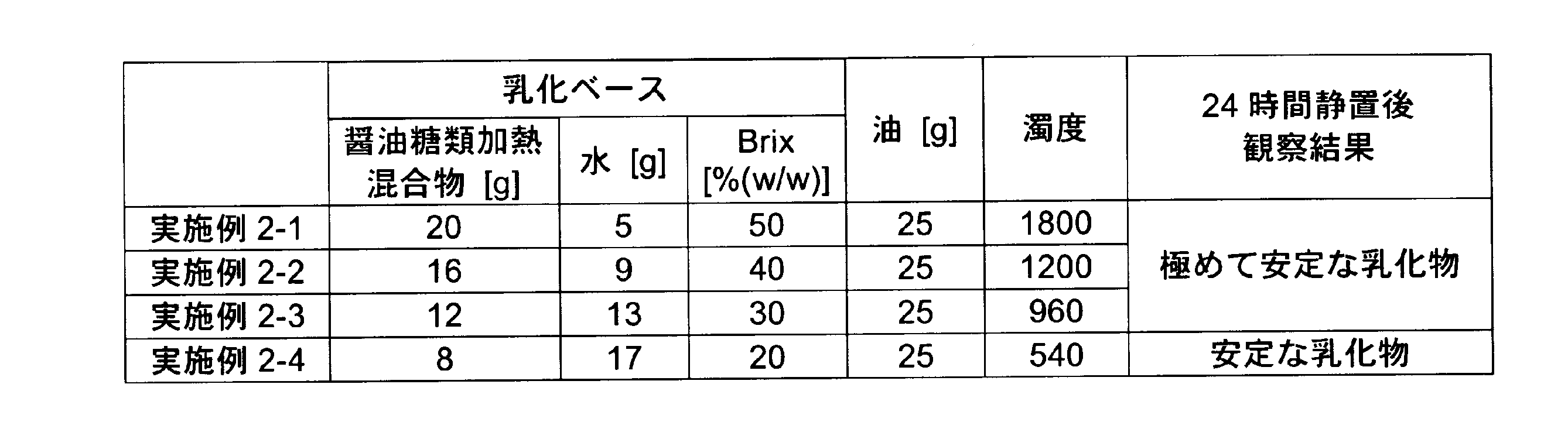
上記で得た醤油糖類加熱混合物13gに水7gを混和し、油脂20gを加え、ホモジナイザー(DIAX900;ハイドルフ社製)により高速撹拌(16,000rpm、30秒間)し、乳化油脂食品を得た。各乳化油脂食品を調製後24時間静置し、油脂の乳化分散の様子を目視にて観察した。醤油糖類加熱混合物を調製する際の加熱時間と、得られた醤油糖類加熱混合物の吸光度及び乳化油脂食品の24時間静置後観察結果との相関を表1に示す。なお、下記表1には、得られた乳化油脂食品のpH及びBrixも併記する。

(醤油糖類加熱混合物の調製、及び乳化油脂食品の製造)
市販の溜醤油(全窒素濃度2.2%(w/v))500mlと、グルコース500g(無水物換算)を混和して、醤油糖類混合水溶液を調製した。該醤油糖類混合水溶液を液温80℃で48時間加熱して、0.1%(w/w)水希釈液(1,000倍水希釈液)の430nmにおける吸光度が0.40となる醤油糖類加熱混合物を得た。
該醤油糖類加熱混合物13gに水7gを混和し、油脂20gを加え、ホモジナイザーにより高速撹拌(16,000rpm、30秒間)し、乳化油脂食品を得た。乳化油脂食品を調製後24時間静置し、乳化分散の様子を目視にて確認した。得られた醤油糖類加熱混合物は、油脂を均一に分散させ、乳化安定性が高かった。
市販の濃口醤油(全窒素濃度1.65%(w/v))を逆浸透膜(NTR-7450;日東電工社製)で透過処理し、非透過側から分離して得られた膜濃縮醤油(全窒素濃度2.0%(w/v))500mlと、グルコース500g(無水物換算)を混和して、醤油糖類混合水溶液を調製した。当該混合水溶液を液温85℃で48時間加熱し、Brix62%(w/w)、0.1%(w/w)水希釈液(1,000倍水希釈液)の430nmにおける吸光度が0.28となる醤油糖類加熱混合物を得た。
上記醤油糖類加熱混合物に、下記表2記載の割合で水を加え、乳化ベースを調製した。該乳化ベースに油脂を等量加え、ホモジナイザー(DIAX900;ハイドルフ社製)により高速撹拌(16,000rpm、30秒間)し、乳化油脂食品を調製した。各油脂食品を調製後24時間静置し、油脂の乳化分散の様子を目視にて観察した。また、各油脂食品を所定量取り、これを水に添加し、スプーンで均一に撹拌して0.1%(w/w)水希釈(乳化液)を調製し、濁度計UT-11(コロナ社製)により濁度を調べた。結果を表2に記載する。
市販の濃口醤油(全窒素濃度1.65%(w/v))500mlと、グルコース500g(無水物換算)を混和して、醤油糖類混合水溶液を調製した。当該混合水溶液を液温85℃で48時間加熱して、醤油糖類加熱混合物(430nmにおける0.1%(w/w)水溶液の吸光度0.28)を得た。
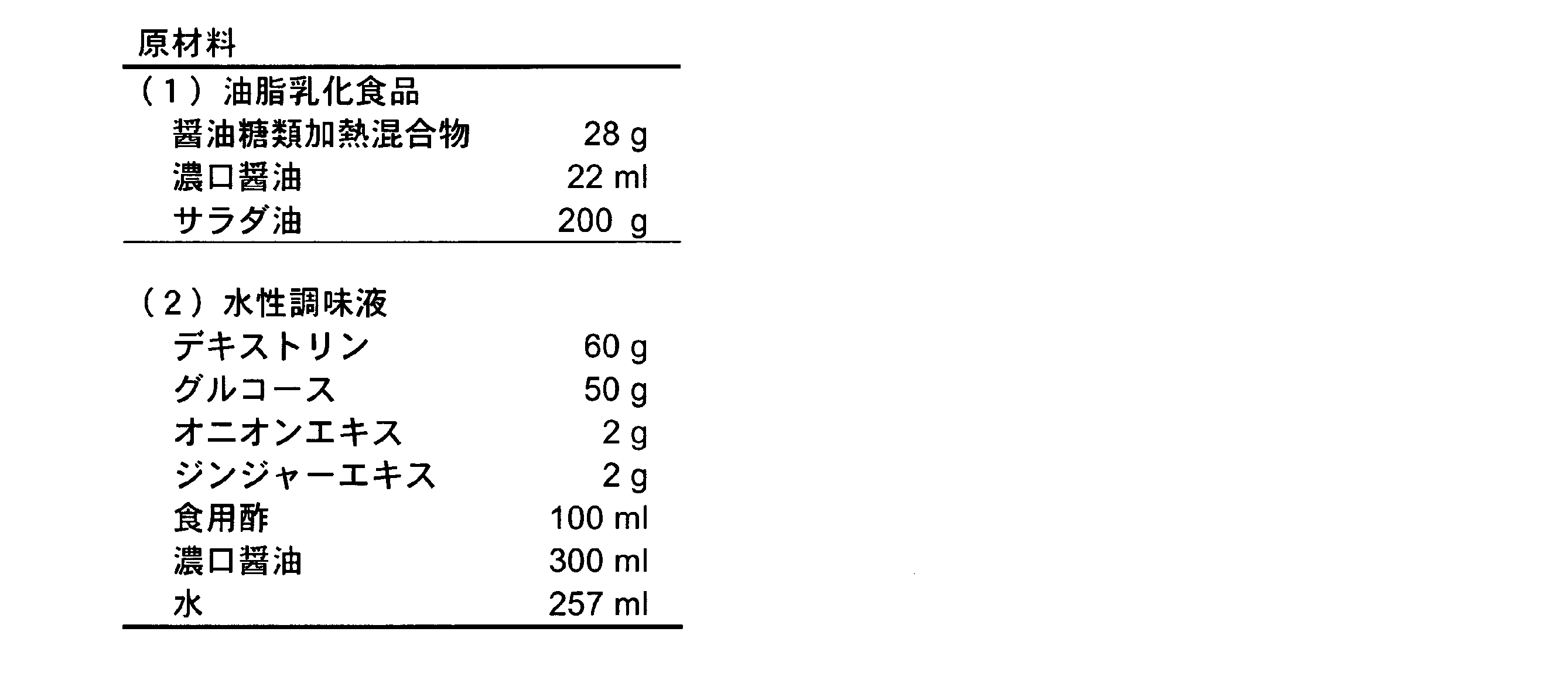
次いで、上記醤油糖類加熱混合物28gに、市販の濃口醤油22mlを加えて、醤油糖類加熱混合物の粘度を調整した。次いで、該醤油糖類加熱混合物に、サラダ油(日清オイリオ社製)200gを添加後、ホモジナイザーにて高速撹拌し、サラダ油が均一に分散した乳化油脂食品を得た(表3(1)参照)。
次いで、上記乳化油脂食品に表3(2)に示す水性調味液を混合後、80℃で30分加熱殺菌し、乳化型ドレッシングを調製した。本ドレッシングは、室温で2ヶ月間保存しても、油脂が分離することがなく、ドレッシング中に均一に分散され、乳化安定性が高かった。また、乳化が長期間にわたって安定に保持されたことにより、酸化や空気中に分散してしまうことによる香気成分の低下が起こらず、2ヶ月後においても良好な風味を呈していた。
市販の溜醤油(全窒素濃度2.27%(w/v))500mlにグルコース500gを添加、混合して、醤油糖類混合水溶液を調製した。当該混合水溶液を液温80℃で48時間加熱し、醤油糖類加熱混合物を得た。当該加熱混合物は、430nmにおける吸光度が0.4であった。なお、当該加熱混合物は、pH4.8、Brix50、全窒素濃度1.23%(w/v)であった。
上記醤油糖類加熱混合物に、下表4記載のBrixとなるよう水飴(Brix75%)を混和し、可溶化ベースを得た。次いで、該可溶化ベース1重量部に対し、油脂1重量部を加えてスプーンで撹拌して可溶化し、本発明の可溶化状態の油脂食品を得た。

市販の溜醤油500ml(全窒素濃度2.27%(w/v))にグルコース500gを添加混合して、醤油糖類混合水溶液を調製した。当該混合水溶液を液温80℃で48時間加熱し、醤油糖類加熱混合物を得た。該醤油糖類加熱混合物は、430nmにおける吸光度が0.4であった。
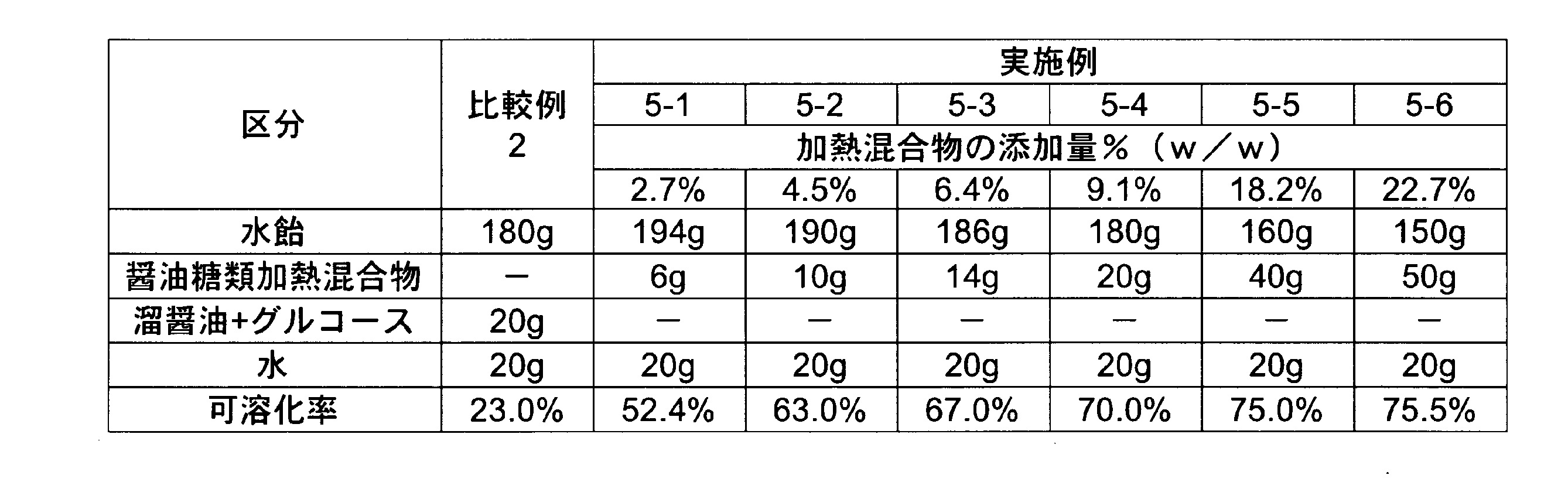
上記醤油糖類加熱混合物、水飴(Brix75%)及び水を表5記載の割合にて混和し、可溶化ベースを調製した。該可溶化ベースに、可溶化し得る最大量の油脂を加えてスプーンで撹拌して可溶化し、本発明の油脂食品を得た。尚、水は撹拌を容易にする目的で使用した。得られた本発明の油脂食品の可溶化率を表5に示す。
比較のため、市販の溜醤油500mlにグルコース500gを添加、混合し、醤油糖類混合水溶液を調製した。次いで、該混合水溶液20gを加熱することなく、そのまま水飴(Brix75%)180g及び水20gに混和し、これに油脂を加えスプーンで撹拌して可溶化して油脂食品を得た。得られた比較例の油脂食品の可溶化率を表5に示す。
市販の濃口醤油(全窒素濃度1.65%(w/v))を逆浸透膜(NTR-7450;日東電工社製)で透過処理し、非透過側から分離して得られた醤油(全窒素濃度2.0%(w/v))500mlと、グルコース500g(無水物換算)を混和して、醤油糖類混合水溶液を調製した。当該混合水溶液を液温85℃で48時間加熱して、Brix(乾物換算)約50%(w/w)の醤油糖類加熱混合物を調製した。該醤油糖類加熱混合物は、430nmにおける吸光度が0.28であった。
次いで、上記醤油糖類加熱混合物1重量部に対し、水飴(Brix75%)0.7重量部を添加し、可溶化ベースを調製した。該可溶化ベース1重量部に対し、ユズオイル(曽田香料社製)0.02重量部を少しずつ加えスプーンで撹拌して可溶化し、ユズ風味油脂食品を得た。この油脂食品は、室温で2ヶ月間保存しても、全く油脂の分離がなく、安定であった。
実施例6で得られたユズ風味油脂食品を用い、表6記載の原料配合で、乳化食品であるユズ風味ポン酢醤油を調製した。このポン酢醤油は、室温で2ヶ月間保存しても、油脂の分離がなく、乳濁性の安定なものであった。

実施例6に記載の方法で調製した膜濃縮醤油500mlにグルコース500gを添加、混合して、醤油糖類混合水溶液を調製した。当該混合水溶液を液温80℃で48時間加熱し、醤油糖類加熱混合物を得た。該醤油糖類加熱混合物は、430nmにおける吸光度が
0.38であった。
次いで、上記醤油糖類加熱混合物20gに水飴(Brix75%)80gを添加し、可溶化ベースを調製した。該可溶化ベースに100gに対し、サラダ油(食用油脂)9重量部とユズオイル1重量部の混合油100gを加えスプーンで撹拌して可溶化し、ユズベース油脂食品を得た。
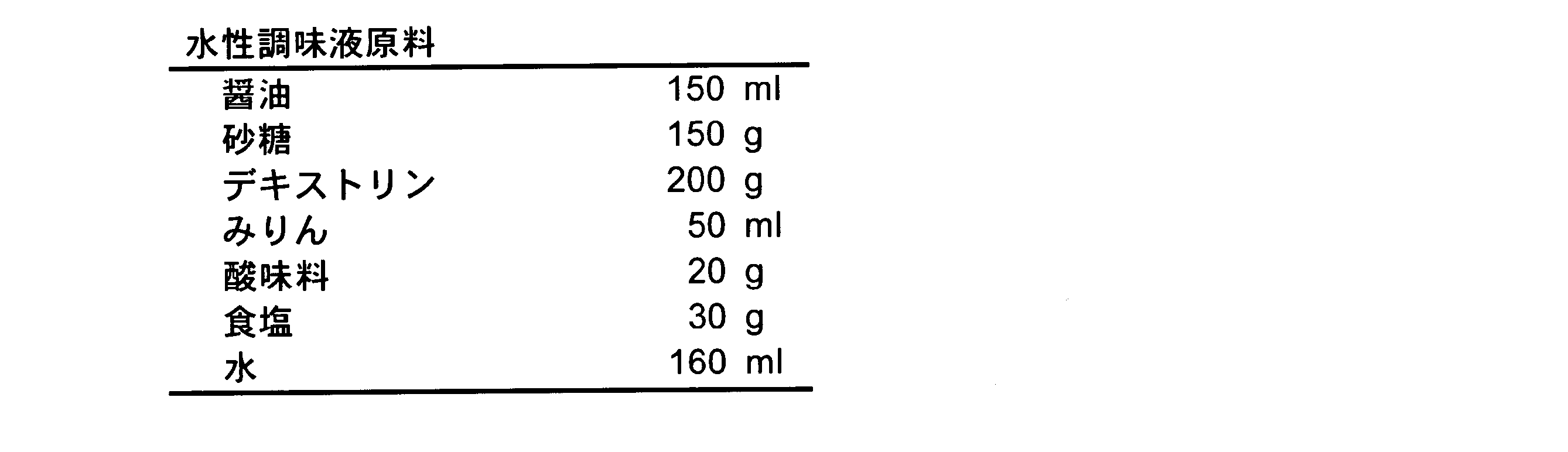
該ユズベース油脂食品80gに、表7記載の水性調味液原料を混和して得られた水性調味液約760gを混和して、乳化食品である乳濁性の米菓用調味液を得た。この調味液は、室温で2ヶ月間保存しても、ユズ風味を濃厚に有し、油脂の分離がなく、乳濁性の安定なものであった。
実施例8で得られた米菓用調味液に、常法により調製した煎餅の素焼きの生地をドブ漬した。次いで、該生地を引き上げ、余分な米菓用調味液を振切り、生地の表面に米菓用調味液を塗布した。次に、常法により温度80℃で乾熱乾燥し、調味液の水分を蒸発させ、ユズ風味を濃厚に有する煎餅を得た。
実施例8のユズベース油脂食品の製造において、「サラダ油(食用油脂)9重量部とユズオイル1重量部の混合油100g」を用いる代わりに、「サラダ油(食用油脂)10重量部とマスタードオイル10重量部、ワサビ香料11重量部を混合して得られた混合油111g」を用いる以外は全く同様にして、ワサビベース油脂食品を得た。
該ワサビベース油脂食品30gに、表8記載の水性調味液原料を混和して得られた水性調味液約70gを混和し、乳化食品である乳濁性の米菓用調味液を得た。この調味液は、室温で2ヶ月間室温で保存しても、ワサビ風味を濃厚に有し、油脂の分離がなく、乳濁性の安定なものであった。

まず、柿の種の素焼きの生地を中空の回転釜に入れ、これに実施例10に記載の米菓用調味液を少しずつ加え、生地の表面に均一に塗布した。次に、常法により温度80℃で乾熱乾燥し、調味液の水分を蒸発させ、ワサビ風味を濃厚に有する柿の種を得た。
実施例6に記載の方法で調製した膜濃縮醤油500mlにグルコース500gを添加、混合して、醤油糖類混合水溶液を調製した。当該混合水溶液を液温80℃で48時間加熱し、醤油糖類加熱混合物を得た。該醤油糖類加熱混合物は、430nmにおける吸光度が
0.38であった。
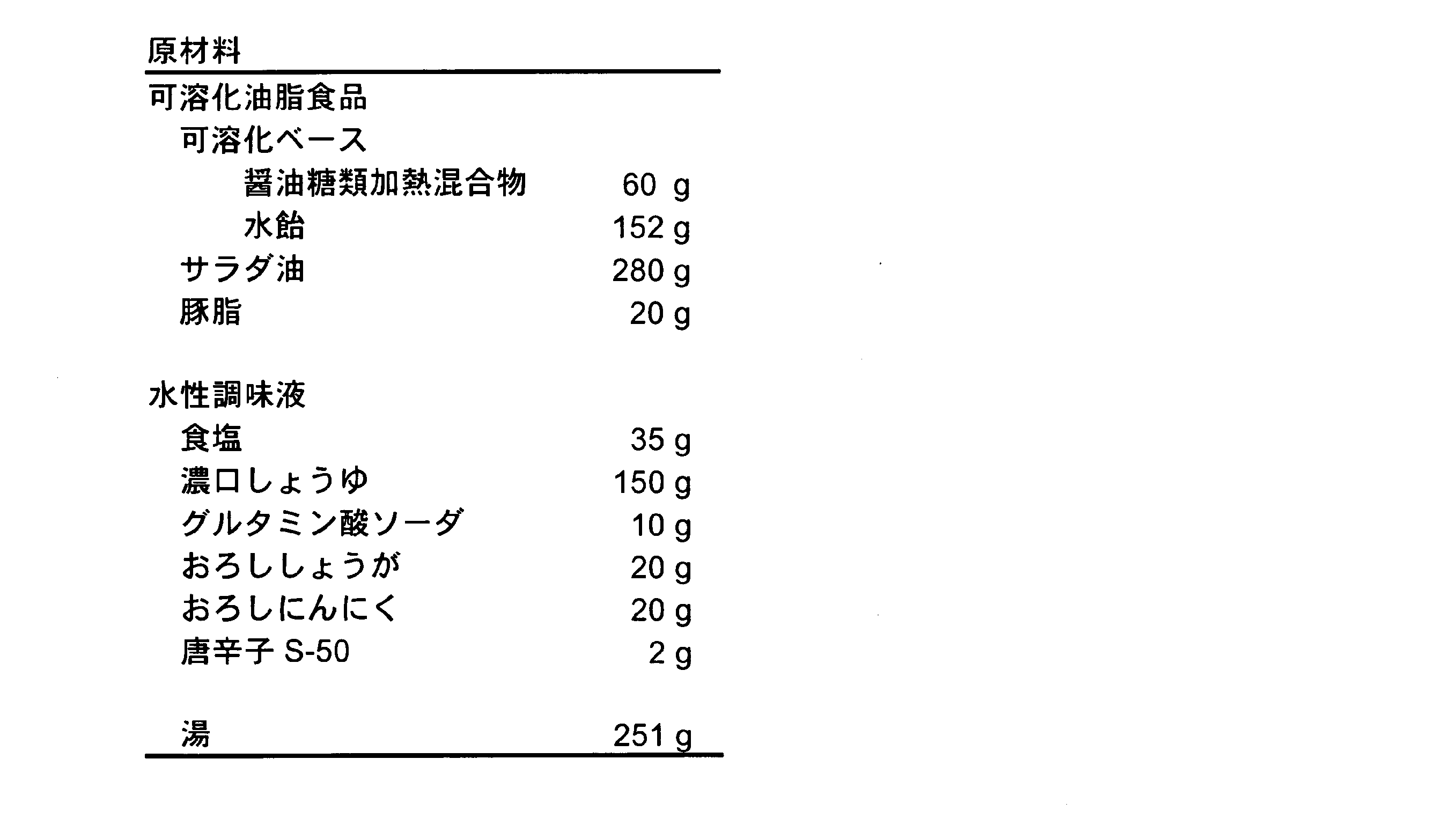
次いで、上記醤油糖類加熱混合物に、水飴を少しずつ加えてゆるやかに撹拌し、可溶化ベースを調製した。該可溶化ベースに、サラダ油及び豚脂を少しずつ加えてゆるやかに撹拌して可溶化し、油脂食品を得た。次いで、該油脂食品に、水性調味液を加えて加熱し、ラーメンスープのもとを調製した。尚、各原材料の配合は表9に記載の通りである。
該ラーメンスープのもとを2ヶ月間保存した後、お湯を加えると、油脂が水溶液中に安定に乳化分散され、油脂の浮上分離がないラーメンスープが得られた。このことから、醤油糖類加熱混合物を用いて得られる可溶化油脂食品は、加熱による油脂の浮上分離が起こらず、長期間保存しても油脂を水溶液中に安定に乳化分散させることができることが分かる。
Claims (8)
- 醤油と糖類の混合水溶液を加熱してなり、0.1%(w/w)水希釈液の430nmにおける吸光度が0.05~0.40である醤油糖類加熱混合物。
- 上記混合水溶液は、全窒素濃度1.0~4.5%(w/v)の醤油1重量部に対し糖類0.5~2.0重量部を混合したものであり、液温70~95℃で9~66時間加熱してなる請求項1記載の醤油糖類加熱混合物。
- 請求項1又は2記載の醤油糖類加熱混合物に、油脂を添加し乳化又は可溶化してなる油脂食品。
- 上記醤油糖類加熱混合物に、Brix50%(w/w)以下となるよう水又は水性調味液を添加、混和してなる乳化ベース1重量部に対し、上記油脂0.02~1.0重量部を添加し乳化してなる請求項3記載の油脂食品。
- 上記醤油糖類加熱混合物に、Brix30%(w/w)以上となるようさらに糖を添加、混和してなる可溶化ベース1重量部に対し、上記油脂0.02~4.0重量部を添加し可溶化してなる請求項3記載の油脂食品。
- 上記可溶化ベース中に含まれる上記醤油糖類加熱混合物の濃度が2~70%(w/w)である請求項5記載の油脂食品。
- 請求項3~6のいずれかに記載の油脂食品と水性調味液とを混和してなる乳化食品。
- 米菓用調味液、ドレッシング、タレ又はスープである請求項7に記載の乳化食品。
Priority Applications (4)
| Application Number | Priority Date | Filing Date | Title |
|---|---|---|---|
| JP2011516018A JP5620372B2 (ja) | 2009-05-29 | 2010-05-25 | 醤油糖類加熱混合物及び油脂食品 |
| SG2011079175A SG175813A1 (en) | 2009-05-29 | 2010-05-25 | Heated mixture of soy sauce and sugar, and fatty food |
| CN2010800192232A CN102413705B (zh) | 2009-05-29 | 2010-05-25 | 酱油糖类加热混合物及油脂食品 |
| HK12106262.4A HK1165225B (en) | 2009-05-29 | 2010-05-25 | Heated mixture of soy sauce and sugar, and fatty food |
Applications Claiming Priority (4)
| Application Number | Priority Date | Filing Date | Title |
|---|---|---|---|
| JP2009-129773 | 2009-05-29 | ||
| JP2009129773 | 2009-05-29 | ||
| JP2009-246363 | 2009-10-27 | ||
| JP2009246363 | 2009-10-27 |
Publications (1)
| Publication Number | Publication Date |
|---|---|
| WO2010137574A1 true WO2010137574A1 (ja) | 2010-12-02 |
Family
ID=43222682
Family Applications (1)
| Application Number | Title | Priority Date | Filing Date |
|---|---|---|---|
| PCT/JP2010/058784 Ceased WO2010137574A1 (ja) | 2009-05-29 | 2010-05-25 | 醤油糖類加熱混合物及び油脂食品 |
Country Status (4)
| Country | Link |
|---|---|
| JP (1) | JP5620372B2 (ja) |
| CN (1) | CN102413705B (ja) |
| SG (1) | SG175813A1 (ja) |
| WO (1) | WO2010137574A1 (ja) |
Cited By (1)
| Publication number | Priority date | Publication date | Assignee | Title |
|---|---|---|---|---|
| CN102763737A (zh) * | 2012-08-07 | 2012-11-07 | 饶雨农 | 一种富含天然维生素的油脂的制备方法 |
Families Citing this family (1)
| Publication number | Priority date | Publication date | Assignee | Title |
|---|---|---|---|---|
| CN103005379B (zh) * | 2012-11-30 | 2014-02-12 | 阜阳九珍食品有限公司 | 一种降血糖酱油醋及其制备方法 |
Citations (1)
| Publication number | Priority date | Publication date | Assignee | Title |
|---|---|---|---|---|
| JP2000069934A (ja) * | 1998-08-31 | 2000-03-07 | Lion Corp | ドレッシング |
Family Cites Families (4)
| Publication number | Priority date | Publication date | Assignee | Title |
|---|---|---|---|---|
| JP3845300B2 (ja) * | 2001-12-11 | 2006-11-15 | 昭和化学工業株式会社 | 食品調味料とその製造方法 |
| JP2005198572A (ja) * | 2004-01-16 | 2005-07-28 | Shoda Shoyu Kk | 煮物用調味液の製造方法 |
| JP2006158213A (ja) * | 2004-12-02 | 2006-06-22 | Kikkoman Corp | 機能性醤油およびそれを含有する機能性飲食品 |
| CN101411518A (zh) * | 2008-11-15 | 2009-04-22 | 泰祥集团技术开发有限公司 | 一种软烤紫菜牡蛎食品的制备方法 |
-
2010
- 2010-05-25 CN CN2010800192232A patent/CN102413705B/zh active Active
- 2010-05-25 SG SG2011079175A patent/SG175813A1/en unknown
- 2010-05-25 JP JP2011516018A patent/JP5620372B2/ja active Active
- 2010-05-25 WO PCT/JP2010/058784 patent/WO2010137574A1/ja not_active Ceased
Patent Citations (1)
| Publication number | Priority date | Publication date | Assignee | Title |
|---|---|---|---|---|
| JP2000069934A (ja) * | 1998-08-31 | 2000-03-07 | Lion Corp | ドレッシング |
Non-Patent Citations (3)
| Title |
|---|
| JOURNAL OF JAPAN SOY SAUCE RESEARCH INSTITUTE, vol. 16, no. 5, 1990, pages 195 - 199 * |
| NIHON SHOKUHIN KOGYO GAKKAISHI, vol. 23, no. 7, 1976, pages 306 - 310 * |
| NIHON SHOKUHIN KOGYO GAKKAISHI, vol. 24, no. 5, 1977, pages 230 - 235 * |
Cited By (2)
| Publication number | Priority date | Publication date | Assignee | Title |
|---|---|---|---|---|
| CN102763737A (zh) * | 2012-08-07 | 2012-11-07 | 饶雨农 | 一种富含天然维生素的油脂的制备方法 |
| CN102763737B (zh) * | 2012-08-07 | 2013-09-25 | 山东省恒兴油脂有限公司 | 一种富含天然维生素的油脂的制备方法 |
Also Published As
| Publication number | Publication date |
|---|---|
| SG175813A1 (en) | 2011-12-29 |
| HK1165225A1 (en) | 2012-10-05 |
| JP5620372B2 (ja) | 2014-11-05 |
| CN102413705A (zh) | 2012-04-11 |
| JPWO2010137574A1 (ja) | 2012-11-15 |
| CN102413705B (zh) | 2013-11-06 |
Similar Documents
| Publication | Publication Date | Title |
|---|---|---|
| JP5734839B2 (ja) | 乳化剤、油脂食品及び油脂食品の製造方法 | |
| JP5000463B2 (ja) | 油脂含有乳化組成物及びその製造方法、並びに油脂含有乳化組成物を含有する食品 | |
| CN114423303A (zh) | 包含植物蛋白的水包油乳液 | |
| JP2741093B2 (ja) | 飲食品用乳化液組成物の製法 | |
| JP6514110B2 (ja) | 酸性水中油型乳化調味料 | |
| EP4229157A2 (en) | Composition | |
| JP5620372B2 (ja) | 醤油糖類加熱混合物及び油脂食品 | |
| JP3358225B2 (ja) | 水溶性化合物油溶化製剤およびその製造方法 | |
| JP2021151197A (ja) | 生クリーム風味を付与する方法 | |
| JP5644211B2 (ja) | 酸性水中油型乳化食品 | |
| JP2741004B2 (ja) | 水性ペースト状ルウ | |
| JP7627558B2 (ja) | 飲料 | |
| JPS6019980B2 (ja) | 水中油滴型乳化食品及びその製造法 | |
| WO2023021782A1 (ja) | 酸性液状調味料 | |
| US20220225652A1 (en) | Saponin comprising compositions | |
| JP4087869B2 (ja) | 保水性及び耐熱性に優れた高油分マヨネーズの製造方法 | |
| JP6576626B2 (ja) | 水中油型乳化ソース | |
| JPS6121064A (ja) | 水中油型乳化食品の製造方法 | |
| HK1165225B (en) | Heated mixture of soy sauce and sugar, and fatty food | |
| JP5176972B2 (ja) | 液卵の製造方法及び該液卵を用いた酸性水中油型エマルジョン食品の製造方法 | |
| JP3754971B2 (ja) | 耐熱性に優れた水中油型乳化食品の製造方法 | |
| RU2662292C1 (ru) | Способ получения майонеза "низкокалорийный" | |
| JP2005102641A (ja) | 水中油型エマルジョン食品及びその製造方法 | |
| CN116761517A (zh) | 蛋黄酱风味调味品 | |
| WO2025041785A1 (ja) | 水中油型乳化物及びその製造方法 |
Legal Events
| Date | Code | Title | Description |
|---|---|---|---|
| WWE | Wipo information: entry into national phase |
Ref document number: 201080019223.2 Country of ref document: CN |
|
| 121 | Ep: the epo has been informed by wipo that ep was designated in this application |
Ref document number: 10780529 Country of ref document: EP Kind code of ref document: A1 |
|
| ENP | Entry into the national phase |
Ref document number: 2011516018 Country of ref document: JP Kind code of ref document: A |
|
| NENP | Non-entry into the national phase |
Ref country code: DE |
|
| 122 | Ep: pct application non-entry in european phase |
Ref document number: 10780529 Country of ref document: EP Kind code of ref document: A1 |