WO2010137501A1 - 光学レンズシート用エネルギー線硬化型樹脂組成物及びその硬化物 - Google Patents
光学レンズシート用エネルギー線硬化型樹脂組成物及びその硬化物 Download PDFInfo
- Publication number
- WO2010137501A1 WO2010137501A1 PCT/JP2010/058421 JP2010058421W WO2010137501A1 WO 2010137501 A1 WO2010137501 A1 WO 2010137501A1 JP 2010058421 W JP2010058421 W JP 2010058421W WO 2010137501 A1 WO2010137501 A1 WO 2010137501A1
- Authority
- WO
- WIPO (PCT)
- Prior art keywords
- meth
- group
- acrylate
- resin composition
- compound
- Prior art date
- Legal status (The legal status is an assumption and is not a legal conclusion. Google has not performed a legal analysis and makes no representation as to the accuracy of the status listed.)
- Ceased
Links
Classifications
-
- G—PHYSICS
- G02—OPTICS
- G02B—OPTICAL ELEMENTS, SYSTEMS OR APPARATUS
- G02B1/00—Optical elements characterised by the material of which they are made; Optical coatings for optical elements
- G02B1/04—Optical elements characterised by the material of which they are made; Optical coatings for optical elements made of organic materials, e.g. plastics
- G02B1/041—Lenses
-
- C—CHEMISTRY; METALLURGY
- C08—ORGANIC MACROMOLECULAR COMPOUNDS; THEIR PREPARATION OR CHEMICAL WORKING-UP; COMPOSITIONS BASED THEREON
- C08F—MACROMOLECULAR COMPOUNDS OBTAINED BY REACTIONS ONLY INVOLVING CARBON-TO-CARBON UNSATURATED BONDS
- C08F220/00—Copolymers of compounds having one or more unsaturated aliphatic radicals, each having only one carbon-to-carbon double bond, and only one being terminated by only one carboxyl radical or a salt, anhydride ester, amide, imide or nitrile thereof
- C08F220/02—Monocarboxylic acids having less than ten carbon atoms; Derivatives thereof
- C08F220/10—Esters
- C08F220/26—Esters containing oxygen in addition to the carboxy oxygen
- C08F220/30—Esters containing oxygen in addition to the carboxy oxygen containing aromatic rings in the alcohol moiety
- C08F220/302—Esters containing oxygen in addition to the carboxy oxygen containing aromatic rings in the alcohol moiety and two or more oxygen atoms in the alcohol moiety
-
- C—CHEMISTRY; METALLURGY
- C08—ORGANIC MACROMOLECULAR COMPOUNDS; THEIR PREPARATION OR CHEMICAL WORKING-UP; COMPOSITIONS BASED THEREON
- C08F—MACROMOLECULAR COMPOUNDS OBTAINED BY REACTIONS ONLY INVOLVING CARBON-TO-CARBON UNSATURATED BONDS
- C08F220/00—Copolymers of compounds having one or more unsaturated aliphatic radicals, each having only one carbon-to-carbon double bond, and only one being terminated by only one carboxyl radical or a salt, anhydride ester, amide, imide or nitrile thereof
- C08F220/02—Monocarboxylic acids having less than ten carbon atoms; Derivatives thereof
- C08F220/10—Esters
- C08F220/34—Esters containing nitrogen, e.g. N,N-dimethylaminoethyl (meth)acrylate
Definitions
- the present invention relates to an energy ray curable resin composition for an optical lens sheet and a cured product thereof. More specifically, the present invention relates to a resin composition and a cured product particularly suitable for lenses such as a Fresnel lens, a lenticular lens, a prism lens, and a microlens.
- the above-described lens has been molded by a method such as a press method or a cast method (casting method).
- the former pressing method was poor in productivity because it was manufactured by heating, pressurizing and cooling cycles.
- the latter casting method has a problem that it takes a long manufacturing time because a monomer is poured into a mold for polymerization, and a manufacturing cost increases because a large number of molds are required.
- Patent Documents 1 and 2 various proposals have been made for using an ultraviolet curable resin composition.
- a method for producing an optical lens sheet used for a transmission screen or the like by using these ultraviolet curable resin compositions has been somewhat successful.
- these conventional cured resin compositions have the drawback of poor adhesion to the substrate and releasability from the mold. If the adhesion is poor, the types of substrates that can be used are limited, making it difficult to obtain the intended optical properties. If the releasability is poor, the resin remains in the mold at the time of mold release, and the mold cannot be used.
- a resin composition that gives a cured product with good adhesion is likely to have poor mold releasability because of good adhesion to the mold.
- a resin composition with good mold releasability tends to have poor adhesion. is there. Therefore, it is desired to provide a resin composition that can satisfy both the performance of adhesion to the substrate and the releasability from the mold.
- the composition for lenses used in these optical lens sheets and the like has been demanded to have a high refractive index in accordance with recent high-definition images and thinning of final products.
- a low-viscosity one tends to be required.
- the fine structure is not easily crushed when the lens sheet is wound up.
- a high glass transition temperature (Tg) is required.
- Patent Document 3 proposes a resin composition having both adhesiveness and releasability, but it cannot be said that the viscosity for processing into a finer shape is sufficient.
- Reference 4 discloses that ⁇ -N-carbazolylethyl acrylate is used as a monomer for obtaining a photoconductive resin, but the performance of ⁇ -N-carbazolylethyl acrylate before polymerization is disclosed. And its optical features are not specified.
- Patent Document 5 proposes a transparent resin composition containing a compound having a carbazolyl group, but the compound is an antioxidant and is not a monomer for an energy ray curable resin, but a cured product. It prevents coloring.
- Patent Document 6 discusses a curable composition containing a compound having a carbazolyl group, but the compound is a polymer having a carbazolyl group as a structural unit, not a monomer.
- the object of the present invention is a low-viscosity resin composition suitable for the production of lens sheets such as Fresnel lenses, lenticular lenses, prism lenses, and micro lenses, and is excellent in releasability, mold reproducibility, adhesion, and light resistance. It provides a cured product having a high refractive index.
- an ultraviolet curable resin composition having a specific composition and a cured product thereof can solve the above problems, and have completed the present invention.
- the present invention provides (1) an energy ray curable resin composition for an optical lens sheet comprising a compound (A) having a carbazolyl group and a photopolymerization initiator (B), (2) Compound (C) in which compound (A) having a carbazolyl group is represented by formula (2)
- the resin composition of the present invention has a low viscosity, and its cured product is excellent in releasability, mold reproducibility, and adhesion to a substrate, and has a high refractive index and good light resistance. Therefore, it is particularly suitable for optical lens sheets such as Fresnel lenses, lenticular lenses, prism lenses, and micro lenses.
- the resin composition of the present invention contains a compound (A) having a carbazolyl group and a photopolymerization initiator (B).
- the compound (A) having a carbazolyl group used in the resin composition of the present invention will be described.
- the compound (A) having a carbazolyl group is not limited as long as it has a carbazolyl group, and examples thereof include compounds represented by the following general formula (1).
- R 1 to R 9 are the same or different and are a hydrogen atom, alkyl group, alkenyl group, alkynyl group, alkoxy group, alkylthio group, amino group, alkylamino group, aryl group, aryloxy group, arylthio group, aryl amino group, a diarylamino group, an alkylaryl group, a heterocyclic group, a polymerizable group, among .R 2 ⁇ R 9 at least one is a polymerizable group of R 1 ⁇ R 9, two adjacent Two substituents may be bonded to each other to form a ring structure, and R 2 to R 9 may further have a substituent.
- the alkyl group preferably has 1 to 30 carbon atoms, more preferably 1 to 15 carbon atoms, still more preferably 1 to 8 carbon atoms. Specific examples include methyl, ethyl, t-butyl, cyclohexyl and the like.
- the alkenyl group preferably has 2 to 30 carbon atoms, more preferably 2 to 15 carbon atoms, still more preferably 2 to 8 carbon atoms. Specific examples include vinyl, 1-propenyl, 1-buten-2-yl, cyclohexen-1-yl and the like.
- the alkynyl group preferably has 2 to 30 carbon atoms, more preferably 2 to 15 carbon atoms, and still more preferably 2 to 8 carbon atoms. Specific examples include ethynyl, 1-propynyl and the like.
- the alkoxy group preferably has 2 to 30 carbon atoms, more preferably 2 to 15 carbon atoms, still more preferably 2 to 8 carbon atoms.
- Specific examples include methoxy group, ethoxy group, butoxy group, octyloxy group, 2-ethylhexyloxy group and the like.
- the alkylthio group preferably has 2 to 30 carbon atoms, more preferably 2 to 15 carbon atoms, and still more preferably 2 to 8 carbon atoms.
- Specific examples include a methylthio group, an ethylthio group, a butylthio group, and an octylthio group.
- the alkylamino group preferably has 2 to 30 carbon atoms, more preferably 2 to 15 carbon atoms, and still more preferably 2 to 8 carbon atoms.
- Specific examples include a methylamino group, an ethylamino group, a butylamino group, a phenoxypropylamino group, a dimethylamino group, a diethylamino group, a dibutylamino group, a piperidino group, and a morpholino group.
- the aryl group preferably has 6 to 30 carbon atoms, more preferably 6 to 15 carbon atoms, and still more preferably 6 to 12 carbon atoms.
- Specific examples include phenyl, biphenyl, tolyl, xylyl, naphthyl, pyrenyl and the like.
- the aryloxy group preferably has 6 to 30 carbon atoms, more preferably 6 to 15 carbon atoms, still more preferably 6 to 8 carbon atoms.
- Specific examples include a phenoxy group and a tolyloxy group.
- the arylthio group preferably has 6 to 30 carbon atoms, more preferably 6 to 15 carbon atoms, and still more preferably 6 to 8 carbon atoms.
- Specific examples include a phenylthio group.
- the arylamino group preferably has 6 to 30 carbon atoms, more preferably 6 to 15 carbon atoms, and still more preferably 6 to 8 carbon atoms.
- an anilino group, a toluidino group, etc. can be mentioned, for example.
- the diarylamino group preferably has 12 to 30 carbon atoms, more preferably 12 to 20 carbon atoms, and still more preferably 12 to 15 carbon atoms. Specific examples include a diphenylamino group.
- the alkylarylamino group preferably has 7 to 30 carbon atoms, more preferably 7 to 15 carbon atoms, and still more preferably 7 to 8 carbon atoms.
- Specific examples include an N-methylanilino group and an N-ethylanilino group.
- the heterocyclic group preferably has 2 to 30 carbon atoms, more preferably 2 to 15 carbon atoms, and still more preferably 4 to 8 carbon atoms.
- Specific examples include a pyrrole group, a furan group, and a carbazolyl group. These heterocyclic groups may have the above substituents represented by R 1 to R 9 .
- a cyclic structure such as a cyclic hydrocarbon, an aromatic ring, a hetero ring, a hetero aromatic ring, etc. Also good.
- Particularly preferred ring structures are aromatic hydrocarbon rings or heteroaromatic rings having a ring skeleton selected from thiophene, furan, pyrrole, selenophene and carbazole.
- examples of the polymerizable group include a high strain hydrocarbon group such as a cyclopropane group and a cyclobutane group, a cyclic ether group such as an epoxy group and an oxetane group, an acrylic group, a methacryl group, a vinyl group, A vinyl ether group, a vinyl ester group, etc. are mentioned.
- the polymerizable group is preferably an acryl group, a methacryl group, a vinyl group, an epoxy group, or an oxetane group, and particularly preferably an acryl group or a methacryl group.
- the polymerizable group may be directly substituted on the ring structure or may be substituted via a divalent linking group.
- Examples of the divalent linking group include an ether group and an alkylene group (preferably having 1 to 20 carbon atoms, more preferably 1 to 12 carbon atoms, and particularly preferably 1 to 8 carbon atoms, such as a methylene group (— CH 2- ), ethylene group (-CH 2 CH 2- ), trimethylene group (-CH 2 CH 2 CH 2- ), etc.), arylene group (preferably having 6 to 30 carbon atoms, more preferably 6 to 20 carbon atoms, particularly preferably 6 to 12 carbon atoms, and examples thereof include a phenylene group (—C 6 H 4 —), a naphthylene group (—C 10 H 6 —), and the like, and an oxyalkylene group ( Preferably it has 1 to 20 carbon atoms, more preferably 1 to 12 carbon atoms, and particularly preferably 1 to 8 carbon atoms.
- an alkylene group preferably having 1 to 20 carbon atoms, more preferably 1 to 12 carbon atoms, and particularly preferably 1 to 8 carbon
- oxymethylene group (—OCH 2 —), oxyethylene group (—OCH 2 CH 2 —) ,Such . Cited
- oxyarylene group (preferably 6 to 20 carbon atoms, more preferably 6 to 16 carbon atoms, particularly preferably 6 to 12 carbon atoms, for example oxy-phenylene group (-OC 6 H 4 -), An oxynaphthylene group (—OC 10 H 6 —) and the like), an oxycarbonyl group (—COO—), an iminocarbonyl group (—CONH—), a ureylene group (—NHCONH—) and the like.
- These divalent linking groups may be further substituted with the above substituents.
- the divalent linking group has a structure in which the same kind of divalent linking group (for example, ethylene oxide group) is repeatedly bonded. Or you may have a structure which couple
- the compound represented by the general formula (1) can be synthesized by a known method.
- a carbazole derivative can be obtained by synthesis or the like by an efficient cyclization reaction.
- the raw material carbazole derivative is commercially available as an aryl hydrazine having a substituent corresponding to R 1, and is available from, for example, Aldrich or NJR Aromatics GmdH.
- the obtained carbazole derivative is reacted with, for example, alkylene oxide or alkylene carbonate, and subjected to dehydration condensation reaction in the presence of (meth) acrylic acid and an acid catalyst, or reacted with epichlorohydrin, and then (meth) acrylic acid.
- the compound represented by the general formula (1) can be obtained by reacting, but is not limited thereto.
- a compound in which the heterocyclic group is a carbazolyl group can be synthesized by a known method described in WO 2005/014398 and J. Org. Chem. 2009, 74, p.4490-4498, and is also commercially available. .
- the compound (A) having a carbazolyl group used in the resin composition of the present invention at least one of the substituents is a polymerizable group, and at least one of the substituents is a polymerizable group and is substituted.
- at least one of the groups is a carbazolyl group which may have a substituent.
- R 10 is a hydrogen atom or a hydrocarbon group having 1 to 4 carbon atoms
- R 11 is the same or different hydrocarbon group having 1 to 4 carbon atoms
- n is an average number of repetitions
- n 0 to 4 (which may have a substituent on the carbazolyl group)
- the compound (C2) represented by the formula (wherein R 10 and R 11 and n are the same as those in the general formula (2)) is more preferable.
- the compound (C) represented by the general formula (2) can be obtained by reacting carbazole with alkylene oxide or alkylene carbonate, followed by dehydration condensation reaction in the presence of (meth) acrylic acid and an acid catalyst. .
- carbazole and alkylene oxide 1 to 8 mol of alkylene oxide is reacted with 1 mol of carbazole.
- carbazole and alkylene carbonate 1 to 3 mol of alkylene carbonate is reacted with 1 mol of carbazole.
- Alkylene oxide or alkylene carbonate may be used alone or in combination of two or more. When used alone, R 11 is all the same, and when used in a mixture of two or more, R 11 can be arbitrarily different.
- the compound (C2) represented by the general formula (3) is obtained by reacting 3,3′-bi [9H-carbazole] with alkylene oxide or alkylene carbonate, and subsequently in the presence of (meth) acrylic acid and an acid catalyst. It can be obtained by dehydrating condensation reaction. In the reaction of carbazole with alkylene oxide, 2 to 16 moles of alkylene oxide are reacted with 1 mole of 3,3′-bi [9H-carbazole]. In the reaction of 3,3′-bi [9H-carbazole] with alkylene carbonate, 2 to 6 mol of alkylene carbonate is reacted with 1 mol of 3,3′-bi [9H-carbazole]. Alkylene oxide or alkylene carbonate may be used alone or in combination of two or more. When used alone, R 11 is all the same, and when used in a mixture of two or more, R 11 can be arbitrarily different.
- alkylene oxide examples include alkylene oxides (1 to 4 carbon atoms) such as ethylene oxide, propylene oxide, and butylene oxide.
- alkylene carbonate examples include alkylene carbonates (having 1 to 4 carbon atoms) such as ethylene carbonate (ethylene carbonate), propylene carbonate (propylene carbonate), butylene carbonate (butylene carbonate).
- the reaction of carbazole or 3,3′-bi [9H-carbazole] with alkylene oxide or alkylene carbonate is carried out under an alkali catalyst such as sodium hydroxide or potassium hydroxide for a reaction time of 1 to 48 hours and a reaction temperature of 90 ° C. to 200 ° C. Performed between ° C.
- an alkali catalyst such as sodium hydroxide or potassium hydroxide
- 0.01 to 5% by mass of an alkali catalyst is used with respect to 100% by mass of the reaction mixture.
- (meth) acrylic acid is carbazole or 3,3′-bi [ 9H-carbazole] is used in an amount of 0.1 to 20 moles per mole.
- a reaction solvent in the dehydration condensation reaction an azeotropic solvent capable of distilling off water generated in the reaction can be used.
- the azeotropic solvent here has a boiling point of 60 to 130 ° C.
- non-reactive organic solvents such as benzene, toluene, n-hexane, n-heptane, and cyclohexane. It is desirable to use one kind or a mixture of two or more kinds.
- the amount used is arbitrary, but is preferably 10 to 70% by mass with respect to the reaction mixture.
- the reaction time in the dehydration condensation reaction may be 1 to 24 hours, and the reaction temperature may be in the range of 60 to 150 ° C., but it is preferably performed at 75 to 120 ° C. from the viewpoint of shortening the reaction time and preventing polymerization.
- a commercially available (meth) acrylic acid used as a raw material is usually already added with a polymerization inhibitor such as p-methoxyphenol, but a polymerization inhibitor may be added again during the reaction.
- a polymerization inhibitor such as p-methoxyphenol
- examples of such polymerization inhibitors include hydroquinone, p-methoxyphenol, 2,4-dimethyl-6-t-butylphenol, 3-hydroxythiophenol, p-benzoquinone, 2,5-dihydroxy-p-benzoquinone, Examples include phenothiazine.
- the amount used is 0.01 to 1% by mass with respect to the reaction mixture.
- the acid catalyst used in the dehydration condensation reaction can be arbitrarily selected from known ones such as sulfuric acid, methanesulfonic acid, trifluoromethanesulfonic acid, p-toluenesulfonic acid, and the amount used is 1 mol of (meth) acrylic acid.
- the content is 0.01 to 10 mol%, preferably 1 to 5 mol%.
- the compound (C) that can be used in the resin composition of the present invention is a compound obtained by reacting 1 to 2 moles of alkylene oxide with 1 mole of carbazole in consideration of the refractive index and compatibility with other components.
- a compound obtained by reacting (meth) acrylic acid with a compound obtained by reacting 1 to 2 moles of alkylene carbonate with 1 mole of carbazole is preferable.
- the alkylene oxide may be any alkylene oxide having a methylene group of 1 to 4, but ethylene oxide or propylene oxide is preferred.
- the alkylene carbonate may be any alkylene carbonate having a methylene group of 1 to 4, but ethylene carbonate (ethylene carbonate) or propylene carbonate (propylene carbonate) is preferred.
- the compound (C2) that can be used in the resin composition of the present invention is 2 to 2 mol per mol of 3,3′-bi [9H-carbazole] in consideration of the refractive index and compatibility with other components.
- (Meth) acrylic acid is reacted with a compound obtained by reacting 4 mol of alkylene oxide or a compound obtained by reacting 2 to 4 mol of alkylene carbonate with 1 mol of 3,3′-bi [9H-carbazole].
- the compound obtained is preferred.
- the alkylene oxide may be any alkylene oxide having a methylene group of 1 to 4, but ethylene oxide or propylene oxide is preferred.
- the alkylene carbonate may be any alkylene carbonate having a methylene group of 1 to 4, but ethylene carbonate (ethylene carbonate) or propylene carbonate (propylene carbonate) is preferred.
- Examples of the photopolymerization initiator (B) contained in the resin composition of the present invention include benzoins such as benzoin, benzoin methyl ether, benzoin ethyl ether, benzoin propyl ether, and benzoin isobutyl ether; acetophenone, 2,2-diethoxy- 2-phenylacetophenone, 2,2-diethoxy-2-phenylacetophenone, 1,1-dichloroacetophenone, 2-hydroxy-2-methyl-phenylpropan-1-one, diethoxyacetophenone, 1-hydroxycyclohexyl phenyl ketone, 2 Acetophenones such as methyl-1- [4- (methylthio) phenyl] -2-morpholinopropan-1-one, oligo [2-hydroxy-2-methyl-1- [4- (1-methylvinyl) phenyl] propanone] 2-D Anthraquinones such as luanthraquinone, 2-tert-butylanthra
- the photopolymerization initiator (B) may be used singly or as a mixture of a plurality of types, but 2,4,6-trimethylbenzoyldiphenylphosphine oxide At least one phosphine oxide such as bis (2,4,6-trimethylbenzoyl) -phenylphosphine oxide or diphenyl- (2,4,6-trimethylbenzoyl) -phosphine oxide is preferably used.
- the monoacrylate monomer (D) having a phenyl ether group that can be used in the present invention will be described.
- Examples of the monoacrylate monomer (D) having a phenyl ether group include phenoxyethyl (meth) acrylate, phenyl (poly) ethoxy (meth) acrylate, p-cumylphenoxyethyl (meth) acrylate, and tribromophenyloxyethyl (meth).
- Acrylate phenylthioethyl (meth) acrylate, 2-hydroxy-3-phenyloxypropyl (meth) acrylate, phenylphenol (poly) ethoxy (meth) acrylate, phenylphenol epoxy (meth) acrylate, and the like.
- Phenylphenol (poly) ethoxy (meth) acrylate and phenylphenol epoxy (meth) acrylate are preferred, among which o-phenylphenol (poly) ethoxy (meth) acrylate, - phenylphenol (poly) ethoxy (meth) acrylate, o- phenylphenol epoxy (meth) acrylate, p- phenylphenol epoxy (meth) acrylate.
- the monoacrylate monomer (D) may be used alone or in combination of two or more.
- the phenylphenol (poly) ethoxy (meth) acrylate is preferably a compound having an average number of repeating ethoxy structure moieties of 1 to 3, and a reaction product of phenylphenol and ethylene oxide, which is a raw material, and (meth) It can be obtained by reacting acrylic acid.
- Phenylphenol can be obtained by using commercially available o-phenylphenol which is ortho form and p-phenylphenol which is para form (for example, O-PP and P-PP, both Can be obtained).
- a reaction product of phenylphenol and ethylene oxide can be obtained by a known method, and a commercially available product can also be used.
- the reaction product of phenylphenol and ethylene oxide is preferably a solvent (for example, toluene, cyclohexane, n- Phenylphenol polyethoxy (meth) acrylate is obtained by reacting with (meth) acrylic acid in the presence of hexane, n-heptane, etc., preferably at 70 to 150 ° C.
- a solvent for example, toluene, cyclohexane, n- Phenylphenol polyethoxy (meth) acrylate is obtained by reacting with (meth) acrylic acid in the presence of hexane, n-heptane, etc., preferably at 70 to 150 ° C.
- the proportion of (meth) acrylic acid used is 1 to 5 mol, preferably 1.05 to 2 mol, per mol of the reaction product of phenylphenol and ethylene oxide.
- the esterification catalyst is 0.1 to 15 mol%, preferably 1 to 6 mol%, based on (meth) acrylic acid to be used.
- the phenylphenol epoxy (meth) acrylate is obtained by reacting the above phenylphenol with an epihalohydrin in the presence of an alkali metal hydroxide, and reacting an epoxy resin as a reaction product with acrylic acid.
- epihalohydrin epichlorohydrin, ⁇ -methylepichlorohydrin, ⁇ -methylepichlorohydrin, epibromohydrin and the like can be used, and among them, epichlorohydrin which is easily available industrially is preferable.
- the amount of epihalohydrin used is usually 2 to 20 mol, preferably 3 to 15 mol, per 1 mol of phenylphenol.
- alkali metal hydroxide examples include sodium hydroxide and potassium hydroxide, and a solid substance or an aqueous solution thereof may be used.
- aqueous solution When using an aqueous solution, the aqueous solution of the alkali metal hydroxide is continuously added to the reaction system, and water and epihalohydrin are distilled off continuously under reduced pressure or normal pressure, followed by liquid separation to remove the water. Alternatively, the epihalohydrin may be continuously returned to the reaction system.
- the amount of alkali metal hydroxide used is usually 0.1 to 10.0 moles, preferably 0.3 to 5.0 moles, more preferably 0.8 to 3.0 moles per mole of the above phenylphenol. Is a mole.
- a quaternary ammonium salt such as tetramethylammonium chloride, tetramethylammonium bromide, trimethylbenzylammonium chloride as a catalyst.
- the amount used is usually 0.1 to 20 g, preferably 0.2 to 15 g, per 1 mol of the phenylphenol.
- reaction it is preferable for the reaction to proceed by adding an aprotic polar solvent such as aliphatic alcohols such as methanol, ethanol and isopropyl alcohol, dimethylsulfone, dimethylsulfoxide, tetrahydrofuran and dioxane.
- an aprotic polar solvent such as aliphatic alcohols such as methanol, ethanol and isopropyl alcohol, dimethylsulfone, dimethylsulfoxide, tetrahydrofuran and dioxane.
- the amount used is usually 1 to 50% by mass, preferably 2 to 30% by mass, based on the amount of epihalohydrin used.
- an aprotic polar solvent is used, it is usually 3 to 100% by mass, preferably 5 to 80% by mass, based on the amount of epihalohydrin used.
- the reaction temperature is usually 30 to 100 ° C, preferably 35 to 90 ° C.
- the reaction time is usually 0.2 to 10 hours, preferably 0.5 to 8 hours.
- an alkali metal hydroxide, epihalohydrin and the like are removed under heating and reduced pressure after washing the reaction solution of phenylphenol and epihalohydrin with or without washing with water.
- the obtained epoxy resin is dissolved in a solvent such as toluene or methyl isobutyl ketone, and an alkali metal hydroxide such as sodium hydroxide or potassium hydroxide is dissolved.
- the reaction can be carried out by adding an aqueous solution to ensure ring closure.
- the amount of alkali metal hydroxide used is usually 0.01 to 0.5 mol, preferably 0.05 to 0.3 mol, relative to 1 mol of phenylphenol used.
- the reaction temperature is usually 50 to 120 ° C., and the reaction time is usually 0.5 to 2 hours.
- the produced salt is removed by filtration, washing with water, etc., and the solvent is distilled off under heating and reduced pressure to obtain the desired epoxy resin.
- An epoxy resin that can be used without special purification is obtained by a method represented by such a formulation.
- Phenylphenol epoxy (meth) acrylate is obtained by reacting the aforementioned epoxy resin with (meth) acrylic acid.
- (Meth) acrylic acid is preferably reacted in an amount of 0.8 to 1.1 equivalents, more preferably 0.9 to 1.05 equivalents, based on an epoxy equivalent of 1 of the epoxy resin.
- the reaction can be carried out without a solvent, but if necessary, a solvent having no alcoholic hydroxyl group, for example, ketones such as acetone, methyl ethyl ketone and cyclohexanone, aromatic carbonization such as benzene, toluene, xylene and tetramethylbenzene Hydrogens, ethylene glycol dimethyl ether, ethylene glycol diethyl ether, dipropylene glycol dimethyl ether, dipropylene glycol diethyl ether, triethylene glycol dimethyl ether, triethylene glycol diethyl ether and other glycol ethers, ethyl acetate, butyl acetate, methyl cellosolve acetate, ethyl Cellosolve acetate, butyl cellosolve acetate, carbitol acetate, propylene glycol monomethyl ether monoacetate, Esters such as dialkyl talates, dialkyl succinates, dialkyl
- acryloylmorpholine terminal acrylic acid ester of 2-phenylphenol ethylene oxide adduct
- Polyethylene glycol di (meth) acrylate tripropylene glycol di (meth) acrylate, trimethylolpropane tri (meth) acrylate, trimethylolpropane polyethoxytri (meth) acrylate, glycerin polypropoxytri (meth) Di (meth) acrylate (e.g. Nippon Kayaku Co., Ltd.
- the reaction can be performed in a reaction product of pentaerythritol and ⁇ -caprolactone, such as poly (meth) acrylate or dipentaerythritol poly (meth) acrylate.
- a reaction product of pentaerythritol and ⁇ -caprolactone such as poly (meth) acrylate or dipentaerythritol poly (meth) acrylate.
- a catalyst for promoting the reaction.
- the amount of the catalyst used is 0.1 to 10% by mass with respect to the reaction product.
- the reaction temperature at that time is 60 to 150 ° C., and the reaction time is preferably 5 to 60 hours.
- the catalyst used include triethylamine, benzyldimethylamine, triethylammonium chloride, benzyltrimethylammonium bromide, benzyltrimethylammonium iodide, triphenylphosphine, triphenylstibine, methyltriphenylstibine, chromium octoate, zirconium octoate and the like. Can be mentioned.
- a thermal polymerization inhibitor may be used, and examples of the thermal polymerization inhibitor include hydroquinone monomethyl ether, 2-methylhydroquinone, hydroquinone, 2,6-di-tert-butyl-p-cresol, and diphenylpicryl. Examples include hydrazine and diphenylamine.
- a thermal polymerization inhibitor is used, it is preferably used in an amount of about 0.1 to 10% by mass with respect to the reaction product. The reaction is terminated at an appropriate time when the acid value of the sample is 5 mg ⁇ KOH / g or less, preferably 3 mg ⁇ KOH / g or less.
- the (meth) acrylate compound (E) other than the component (A) and the component (D) may be used alone or in combination of two or more. Good.
- the (meth) acrylate compound (E) include (meth) acrylate monomers and (meth) acrylate oligomers.
- Examples of the (meth) acrylate monomer include a monofunctional (meth) acrylate monomer, a bifunctional (meth) acrylate monomer, a trifunctional or higher polyfunctional (meth) acrylate monomer, and the like.
- Examples of the monofunctional (meth) acrylate monomer include acryloylmorpholine, 2-hydroxypropyl (meth) acrylate, 4-hydroxybutyl (meth) acrylate, cyclohexane-1,4-dimethanol mono (meth) acrylate, and tetrahydrofurfuryl.
- bifunctional (meth) acrylate monomers include 1,4-butanediol di (meth) acrylate, 1,6-hexanediol di (meth) acrylate, 1,9-nonanediol di (meth) acrylate, and tricyclodecanedi.
- Examples of the trifunctional or higher polyfunctional (meth) acrylate monomer include tris (acryloxyethyl) isocyanurate, pentaerythritol tetra (meth) acrylate, dipentaerythritol hexa (meth) acrylate, dipentaerythritol penta (meth) acrylate, Examples include pentaerythritol hexa (meth) acrylate, tripentaerythritol penta (meth) acrylate, trimethylolpropane tri (meth) acrylate, trimethylolpropane polyethoxytri (meth) acrylate, and ditrimethylolpropane tetra (meth) acrylate. it can.
- Examples of (meth) acrylate oligomers include urethane (meth) acrylate, epoxy (meth) acrylate, and polyester (meth) acrylate.
- urethane (meth) acrylate examples include diol compounds (for example, ethylene glycol, diethylene glycol, triethylene glycol, propylene glycol, dipropylene glycol, tripropylene glycol, 1,4-butanediol, neopentyl glycol, 1,6- Hexanediol, 1,8-octanediol, 1,9-nonanediol, 2-methyl-1,8-octanediol, 3-methyl-1,5-pentanediol, 2,4-diethyl-1,5-pentane Diol, 2-butyl-2-ethyl-1,3-propanediol, cyclohexane-1,4-dimethanol, polyethylene glycol, polypropylene glycol, bisphenol A polyethoxydiol, bisphenol A polypropoxydiol Etc.) or polyesters that are the reaction product of these diol compounds
- Epoxy (meth) acrylates include bisphenol A type epoxy resin, bisphenol F type epoxy resin, phenol novolac type epoxy resin, terminal glycidyl ether of bisphenol A propylene oxide adduct, and fluorene epoxy resin and (meth) Examples include a reaction product with acrylic acid.
- polyester (meth) acrylate examples include a reaction product of polyester diol which is a reaction product of the above diol compound and the above dibasic acid or anhydride thereof, and (meth) acrylic acid.
- the (meth) acrylate compound (E) that can be used in the resin composition of the present invention is preferably a compound having a bisphenol A skeleton in consideration of the refractive index, such as bisphenol A polyethoxydi (meth) acrylate and bisphenol A poly.
- (Meth) acrylate monomers such as propoxy di (meth) acrylate, urethane (meth) acrylate oligomers having a bisphenol A skeleton (diol compounds such as bisphenol A polyethoxydiol and bisphenol A polypropoxydiol, or these diol compounds and dibasic compounds
- a bisphenol A skeleton diol compounds such as bisphenol A polyethoxydiol and bisphenol A polypropoxydiol, or these diol compounds and dibasic compounds
- a bisphenol A skeleton Poxy (meth) acrylate oligomer bisphenol A type epoxy resin, epoxy resin such as terminal glycidyl ether of bisphenol A propylene oxide adduct and a reaction product of (
- monofunctional or bifunctional (meth) acrylate monomers are suitable as the (meth) acrylate compound (E), and among them, acryloylmorpholine, tetrahydrofurfuryl (meth).
- the (meth) acrylate compound (E) includes tris (acryloxyethyl) isocyanurate, pentaerythritol tetra (meth) acrylate, dipentaerythritol hexa (meth) acrylate, Trifunctional or higher functional (meth) acrylate monomers such as dipentaerythritol penta (meth) acrylate and trimethylolpropane tri (meth) acrylate are preferred.
- each component of the resin composition of the present invention is determined in consideration of the desired refractive index, glass transition temperature, viscosity, adhesion, etc., but component (A) + component (D) + component (E) Is 100 parts by mass, the content of component (A) is 2 to 100 parts by mass, preferably 5 to 100 parts by mass.
- the content of component (D) is 0 to 85 parts by mass, preferably 0 to 75 parts by mass.
- the content of component (E) is 0 to 60 parts by mass, preferably 0 to 50 parts by mass.
- Component (B) is usually used in an amount of 0.1 to 10 parts by weight, preferably 0.3 to 7 parts by weight, based on 100 parts by weight of the total amount of component (A) + component (D) + component (E). It is.
- the energy ray curable resin composition of the present invention includes a mold release agent, an antifoaming agent, a leveling agent, a light stabilizer, an antioxidant, and a polymerization prohibition in order to improve convenience during handling.
- An agent, an antistatic agent, an ultraviolet absorber and the like can be used in combination depending on the situation.
- polymers such as acrylic polymer, polyester elastomer, urethane polymer and nitrile rubber, inorganic or organic light diffusing filler, and the like can be added as necessary.
- the resin composition of the present invention can be obtained by adding a solvent as necessary, in the present invention, it is preferable not to add a solvent.
- the resin composition of the present invention can be prepared by mixing and dissolving each component according to a conventional method.
- each component can be charged into a round bottom flask equipped with a stirrer and a thermometer and stirred at 40 to 80 ° C. for 0.5 to 6 hours.
- the viscosity of the resin composition of the present invention is 4,000 mPa ⁇ s at 25 ° C. measured using an E-type viscometer (TV-200: manufactured by Toki Sangyo Co., Ltd.) as a viscosity suitable for producing optical lens sheets. Compositions that are s or less are preferred.
- a cured product obtained by curing the resin composition of the present invention by irradiating energy rays such as ultraviolet rays according to a conventional method is also included in the present invention.
- the cured product is obtained by applying the resin composition of the present invention on a stamper having a shape of, for example, a Fresnel lens, a lenticular lens, or a prism lens to form a layer of the resin composition, and a hard transparent substrate on the layer.
- a back sheet (for example, a substrate or film made of polymethacrylic resin, polycarbonate resin, polystyrene resin, polyester resin, or a blend of these polymers) is adhered, and then ultraviolet light is emitted from the hard transparent substrate side by a high-pressure mercury lamp or the like. After the resin composition is cured by irradiation, the cured product can be peeled off from the stamper. Moreover, it can also carry out by a continuous process as these applications.
- the refractive index can be measured with an Abbe refractometer (DR-M2: manufactured by Atago Co., Ltd.).
- the resin composition of the present invention is useful as an optical lens sheet as described above.
- Applications other than those for optical lens sheets include various coating agents and adhesives.
- Synthesis example 1 Synthesis of Compound (A) In an autoclave, 167.2 g (1.0 mol) of carbazole, 114.5 g of toluene and 0.5 g of potassium hydroxide were charged, and after nitrogen substitution, 48.5 g (1.1 mol) ) was added dropwise within a range of 120 ° C. to 140 ° C. and a reaction pressure of 0.2 MPa or less, and reacted for 6 hours. After the reaction, unreacted ethylene oxide and toluene were distilled off under reduced pressure to obtain 211.3 g of N- (2-hydroxyethyl) carbazole.
- Synthesis example 2 Synthesis of Compound (E) Synthesis was performed according to Synthesis Example 2 and Example 2 of International Publication 2008/136262.
- a flask equipped with a thermometer, a cooler, and a stirrer was charged with 181 g of p-phenylphenol (P-PP Sanko Co., Ltd.), 394 g of epichlorohydrin, and 80 g of methanol while being purged with nitrogen gas.
- the mixture was further heated to 70 ° C., 44 g of flaky sodium hydroxide was added in portions over 90 minutes, and then reacted at 70 ° C. for 60 minutes.
- Etc. were distilled off to obtain 227 g of the desired epoxy resin (e-1).
- the obtained epoxy resin (e-1) had an epoxy equivalent of 242 g / eq. It was white crystalline at room temperature.
- 145.2 g (0.6 eq.) Of the obtained epoxy resin (e-1) was used as a thermal polymerization inhibitor in a 1 L flask equipped with a stirrer and a reflux tube, and 2,6-di-tert- 0.57 g of butyl-p-cresol, 43.3 g (0.6 eq.) Of acrylic acid and 0.57 g of triphenylphosphine as a reaction catalyst were charged and reacted at 98 ° C. for 30 hours.
- the first reaction was completed at 2 mg ⁇ KOH / g. After the completion of the first reaction, the reaction temperature was 40 ° C., 232.0 g of o-phenylphenol monoethoxy acrylate was added as a reaction diluent, and the mixture was stirred and mixed. Next, 0.070 g of dibutyltin dilaurate was added as a urethane reaction catalyst, 43.6 g (0.5 eq.) Of 2,4-tolylene diisocyanate was added, the reaction temperature was raised to 60 ° C., and the reaction was allowed to proceed for 24 hours. %). At this time, NCO (%) was 0.00%, and the reaction was terminated. The product was 460 g, and an o-phenylphenol monoethoxy acrylate mixture containing 50% by mass of the urethane acrylate as the compound (E) was obtained.
- Synthesis example 3 Synthesis of Compound (E) 139.3 parts of 2,4-tolylene diisocyanate, 0.05 parts of di-n-butyltin dilaurate and 0.16 parts of methoquinone were placed in a drying container and heated to 40 ° C. , Stirred. To this was added 185.6 parts of 2-hydroxyethyl acrylate dropwise over 1 hour while confirming the exotherm, and reacted at 80 ° C. for 1-2 hours. The isocyanate value after the reaction was 0.1 or less, indicating that the reaction was almost quantitatively completed, and urethane acrylate as compound (E) was obtained.
- Synthesis example 4 Synthesis of Compound (E) Synthesis was performed according to Synthesis Example 1 of JP-A-2008-94987. After attaching a stirrer, thermometer, condenser water separator, etc. to a 2 L 4-neck flask, 9,9-bis (4- (2-hydroxyethoxy) phenyl) fluorene (trade names: BPEF, JEF Chemical Co., Ltd.) )), 401.0 g, acrylic acid 161.0 g, toluene 600 ml, p-toluenesulfonic acid 45.6 g, hydroquinone 4.6 g, heated with stirring and dehydrated for esterification reaction. went.
- the reaction time was 5 hours, the reaction temperature was 103 to 120 ° C., and the amount of distilled water by dehydration reaction was 38 g.
- the reaction solution was diluted with 1500 ml of toluene, neutralized by adding 200 g of a 20% by weight aqueous sodium hydroxide solution, washed with 500 g of a 15% by weight aqueous sodium chloride solution, and further toluene was distilled off.
- 458.2g of bifunctional acrylate which is a compound (E) was obtained.
- the resin composition and the cured product of the present invention were obtained with the composition as shown in the following examples (numerical values indicate parts by mass).
- the evaluation method and evaluation criteria for the resin composition and the cured film were as follows.
- Viscosity Viscosity was measured at 25 ° C. using an E-type viscometer (TV-200: manufactured by Toki Sangyo Co., Ltd.).
- Releasability Expresses the degree of difficulty when releasing a cured resin from a mold.
- ⁇ ⁇ Mold reproducibility The surface shape of the cured ultraviolet curable resin layer and the surface shape of the mold were observed. ⁇ ⁇ Reproducibility is good ⁇ ⁇ Reproducibility is poor
- a test piece was prepared by applying a resin composition on a substrate to a film thickness of about 50 ⁇ m and then irradiating it with a high-pressure mercury lamp (80 W / cm, ozone-less) at 1000 mJ / cm 2.
- the adhesion was evaluated according to JIS K5600-5-6. In the evaluation results, 0 to 2 were marked with ⁇ , and 3 to 5 were marked with ⁇ .
- Refractive index (25 ° C.) The refractive index (25 ° C.) of the cured ultraviolet curable resin layer was measured with an Abbe refractometer (DR-M2: manufactured by Atago Co., Ltd.).
- DMS-6000 viscoelasticity measurement system
- a test piece was prepared by applying a resin composition on a substrate to a film thickness of about 80 ⁇ m and then irradiating it with a high-pressure mercury lamp (80 W / cm, ozone-less) at 600 mJ / cm 2 . .
- a light resistance test was conducted for 4 hours under conditions of 60 ° C. and 60% RH using EYE SUPER UV TESTER SUV-W11 (manufactured by Iwasaki Electric Co., Ltd.), and the state of the film was visually evaluated.
- ⁇ ⁇ State of great appearance change such as coloring and cracking of resin layer
- Example 1 20 parts of the compound obtained in Synthesis Example 1 as component (A), 31 parts of o-phenylphenol monoethoxyacrylate as component (D), and 3 parts of Irgacure 184 (1-hydroxycyclohexyl phenyl ketone) as component (B) Parts, 0.1 parts of diphenyl- (2,4,6-trimethylbenzoyl) phosphine oxide, 20 parts of KAYARAD R-551 (Nippon Kayaku: bisphenol A polyethoxydiacrylate) as component (E), KAYARAD 4 parts of R-115 (Nippon Kayaku: bisphenol A epoxy acrylate), 18 parts of tris (2-acryloyloxyethyl) isocyanurate, 7 parts of acryloylmorpholine, heated to 60 ° C., and mixed.
- component (A) 20 parts of the compound obtained in Synthesis Example 1 as component (A), 31 parts of o-phenylphenol monoethoxyacrylate as component (D), and 3
- a resin composition was obtained.
- the viscosity of this resin composition was 690 mPa ⁇ s.
- the refractive index (25 ° C.) of the 200 ⁇ m-thick UV curable resin layer obtained by curing this resin composition by irradiation with 600 mJ / cm 2 with a high-pressure mercury lamp (80 w / cm, ozone-less) is 1.589.
- the glass transition temperature (Tg) was 82 ° C.
- this resin composition was applied onto a prism lens mold so that the film thickness was 50 ⁇ m, and an easy-adhesion PET film (Toyobo Cosmo Shine A4300, 100 ⁇ m thickness) was adhered thereon as a base material,
- the prism lens sheet of the present invention was obtained from above by being cured by irradiating with an ultraviolet ray of 600 mJ / cm 2 with a high-pressure mercury lamp and then curing. Evaluation results: releasability: ⁇ , mold reproducibility: ⁇ , adhesion: ⁇ .
- Example 2 In Example 1, 52 parts of o-phenylphenol monoethoxyacrylate as component (D), 3 parts of 2-hydroxy-2-methyl-1-phenylpropan-1-one as component (B), and as component (E) 10 parts of the compound obtained in Synthesis Example 3, 13 parts of acryloylmorpholine, 5 parts of tetrahydrofurfuryl acrylate, heated to 60 ° C. and mixed to obtain a resin composition of the present invention. The viscosity of this resin composition was 150 mPa ⁇ s.
- the resin layer obtained in the same manner as in Example 1 had a refractive index (25 ° C.) of 1.599 and a glass transition temperature (Tg) of 59 ° C.
- Tg glass transition temperature
- a prism lens sheet of the present invention was obtained in the same manner as in Example 1. Evaluation results: releasability: ⁇ , mold reproducibility: ⁇ , adhesion: ⁇ , light resistance: ⁇ .
- Example 3 In Example 1, 65 parts of the compound obtained in Synthesis Example 1 as component (A), 3 parts of Irgacure 184 as component (B), and 0 of diphenyl- (2,4,6-trimethylbenzoyl) phosphine oxide .1 part, 25 parts phenoxyethyl acrylate as component (D), 10 parts KAYARAD DPHA (manufactured by Nippon Kayaku: dipentaerythritol hexaacrylate) as component (E), heated to 60 ° C. and mixed, An inventive resin composition was obtained. The viscosity of this resin composition was 340 mPa ⁇ s.
- the resin layer obtained in the same manner as in Example 1 had a refractive index (25 ° C.) of 1.622 and a glass transition temperature (Tg) of 69 ° C.
- Tg glass transition temperature
- a prism lens sheet of the present invention was obtained in the same manner as in Example 1. Evaluation results: releasability: ⁇ , mold reproducibility: ⁇ , adhesion: ⁇ .
- Example 4 In Example 1, 10 parts of the compound obtained in Synthesis Example 1 as component (A), 59 parts of o-phenylphenol monoethoxy acrylate, 8 parts of phenoxyethyl acrylate as component (D), and Irga as component (B) 5 parts of Cure 184, 0.1 part of diphenyl- (2,4,6-trimethylbenzoyl) phosphine oxide, 3 parts of KAYARAD DPHA as component (E), 30 parts of the mixture obtained in Synthesis Example 2 5 parts of the compound obtained in Example 3 and 3 parts of 1,4-butanediol diacrylate were heated to 60 ° C. and mixed to obtain a resin composition of the present invention.
- the viscosity of this resin composition was 510 mPa ⁇ s.
- the resin layer obtained in the same manner as in Example 1 had a refractive index (25 ° C.) of 1.604 and a glass transition temperature (Tg) of 52 ° C.
- Tg glass transition temperature
- a prism lens sheet of the present invention was obtained in the same manner as in Example 1. Evaluation results: releasability: ⁇ , mold reproducibility: ⁇ , adhesion: ⁇ .
- Example 5 In Example 1, 55 parts of the compound obtained in Synthesis Example 1 as component (A), 7 parts of o-phenylphenol monoethoxyacrylate as component (D), 25 parts of phenoxyethyl acrylate, and Irga as component (B) 3 parts of Cure 184, 0.1 part of diphenyl- (2,4,6-trimethylbenzoyl) phosphine oxide, 10 parts of KAYARAD DPHA as component (E), 60 parts of the compound obtained in Synthesis Example 4
- the resin composition of the present invention was obtained by heating to °C and mixing. The viscosity of this resin composition was 465 mPa ⁇ s.
- the resin layer obtained in the same manner as in Example 1 had a refractive index (25 ° C.) of 1.618 and a glass transition temperature (Tg) of 71 ° C.
- Tg glass transition temperature
- a prism lens sheet of the present invention was obtained in the same manner as in Example 1. Evaluation results: releasability: ⁇ , mold reproducibility: ⁇ , adhesion: ⁇ .
- Comparative Example 1 According to Example 1 of Patent Document 1 (Japanese Patent Laid-Open No. 63-167301), 70 parts of Aronics M-315 (tris (2-acryloyloxyethyl) isocyanurate), 30 parts of tetrahydrofurfuryl acrylate, 1 as a photopolymerization initiator 3 parts of-(4-isopropylphenyl) -2-hydroxy-2-methylpropan-1-one were heated to 60 ° C. and mixed to obtain a comparative resin composition. The viscosity of this resin composition was 134 mPa ⁇ s. The refractive index (25 ° C.) of the resin layer obtained in the same manner as in Example 1 was 1.520. From this result, the composition of Comparative Example 1 has a lower refractive index than the composition of the present invention, and is not suitable for the production of the lenses of the present invention.
- Aronics M-315 tris (2-acryloyloxyethyl) isocyanur
- the viscosity of this resin composition was 4420 mPa ⁇ s. Further, the refractive index (25 ° C.) of the resin layer obtained in the same manner as in Example 1 was 1.574. From this result, the composition of Comparative Example 2 has a higher viscosity than the composition of the present invention, and is unsuitable for fine processing and continuous processing of roll-shaped sheets and films.
- Comparative Example 3 Without component (A), 51 parts o-phenylphenol monoethoxyacrylate as component (D), 3 parts Irgacure 184 as component (B), diphenyl- (2,4,6-trimethylbenzoyl) phosphine 0.1 parts of oxide, 20 parts of KAYARAD R-551 as component (E), 4 parts of KAYARAD R-115, 18 parts of tris (2-acryloyloxyethyl) isocyanurate, 7 parts of acryloylmorpholine, 60 ° C. The mixture was heated and mixed to obtain a comparative resin composition. The viscosity of this resin composition was 409 mPa ⁇ s.
- the resin layer obtained in the same manner as in Example 1 had a refractive index (25 ° C.) of 1.581 and a glass transition temperature (Tg) of 71 ° C.
- a comparative prism lens sheet was obtained in the same manner as in Example 1 using the obtained resin composition. From this result, the composition of Comparative Example 3 has a lower refractive index than the composition of the present invention, and is not suitable for the production of the lenses of the present invention. Evaluation results: releasability: ⁇ , mold reproducibility: ⁇ , adhesion: ⁇ , light resistance: ⁇ .
- the resin composition of the present invention has a low viscosity, and the cured product of the present invention has a high refractive index, as well as releasability and mold reproduction. And excellent adhesion to the substrate. For this reason, it is suitable for an optical lens sheet having a fine structure, for example, a Fresnel lens, a lenticular lens, a prism lens, a microlens and the like. In particular, since it has a high refractive index, it is suitable for high-luminance products, and it is suitable for manufacturing that requires fine processing and processes that require continuous processing.
- the ultraviolet curable resin composition of the present invention and the cured product thereof are particularly suitable mainly for optical lens sheets such as Fresnel lenses, lenticular lenses, prism lenses, and micro lenses.
Landscapes
- Physics & Mathematics (AREA)
- Chemical & Material Sciences (AREA)
- General Physics & Mathematics (AREA)
- Optics & Photonics (AREA)
- Health & Medical Sciences (AREA)
- Chemical Kinetics & Catalysis (AREA)
- Medicinal Chemistry (AREA)
- Polymers & Plastics (AREA)
- Organic Chemistry (AREA)
- Polymerisation Methods In General (AREA)
- Macromonomer-Based Addition Polymer (AREA)
- Addition Polymer Or Copolymer, Post-Treatments, Or Chemical Modifications (AREA)
Abstract
課題 離型性、型再現性、基材への密着性、耐光性に優れ、高屈折率でガラス転移点が高く、低粘度な樹脂組成物を提供する。 解決手段 カルバゾリル基を有する化合物(A)及び光重合開始剤(B)を含む光学レンズシート用エネルギー線硬化型樹脂組成物。
Description
本発明は、光学レンズシート用エネルギー線硬化型樹脂組成物及びその硬化物に関する。更に詳しくは、フレネルレンズ、レンチキュラーレンズ、プリズムレンズ、マイクロレンズ等のレンズ類に特に適する樹脂組成物及び硬化物に関するものである。
従来、上記のレンズはプレス法、キャスト法(注型形成法)等の方法により成形されていた。前者のプレス法は、加熱、加圧、冷却サイクルで製造するため生産性が悪かった。又、後者のキャスト法は、金型にモノマーを流し込んで重合するため製作時間が長くかかるとともに、金型が多数個必要なため製造コストが上がるという問題があった。このような問題を解決するために、紫外線硬化性樹脂組成物を使用することについて種々の提案がなされている(特許文献1、特許文献2)。
これら紫外線硬化型樹脂組成物を使用することによって透過型スクリーンなどに用いる光学レンズシートを製造する方法はある程度成功している。しかしながら、これら従来の樹脂組成物の硬化物は基板との密着性、型からの離型性が悪いという欠点があった。密着性が悪いと、使用可能な基板の種類が限られ、意図する光学物性を得づらくなる。離型性が悪いと、離型時に型に樹脂が残り、型が使用できなくなる。又、密着性の良い硬化物を与える樹脂組成物は型への密着も良くなるため離型性が悪くなり易く、一方、離型性の良い樹脂組成物は密着性が悪くなり易いという課題もある。そのため、基板との密着性と型からの離型性の両性能を満足できる樹脂組成物を提供することが望まれている。
これら光学レンズシート等に用いられるレンズ類用組成物には、近年の画像の高精細化や最終製品の薄型化等に伴い屈折率の高さが望まれており、また、より微細な形状に加工されたり、より薄く加工されたり、ロール状のシートやフィルムに連続加工をしたりするために、低粘度のものが求められる傾向がある。さらに、レンズシートを巻き取ったときなどに微細構造が潰れにくいことも必要である。また実際に製品として使用される際にも光源等による熱によってレンズ形状が変化してしまうことは致命的であり、この場合、ガラス転移温度(Tg)が高いことが求められる。
その中で、特許文献3では密着性、離型性の両性能を兼ね備えた樹脂組成物が提案されているがより微細な形状に加工するための粘度としては十分なものとは言えず、特許文献4ではβ-N-カルバゾリルエチルアクリレートを、光導電性樹脂を得るための単量体として用いることが開示されているが、重合する前のβ-N-カルバゾリルエチルアクリレートの性能についてや、その光学的な特長については明記されていない。また、特許文献5にはカルバゾリル基を有する化合物を含む透明性樹脂組成物が提案されているが、該化合物は酸化防止剤であって、エネルギー線硬化型樹脂用のモノマーではなく、硬化物の着色を防ぐものである。
特許文献6ではカルバゾリル基を有する化合物を含む硬化性組成物が検討されているが、該化合物はカルバゾリル基を構造単位に有するポリマーであって、モノマーではない。
いずれにしても高屈折率で微細な構造を持ち、高いTg点、離型性、密着性を兼ね備える光学レンズシート等に用いられる低粘度のレンズ類用組成物を得ることは難しく、すべてを満足できるものは得られていなかった。
本発明の目的は、フレネルレンズ、レンチキュラーレンズ、プリズムレンズ、マイクロレンズ等のレンズシートの製造に適した低粘度の樹脂組成物や、離型性、型再現性、密着性、耐光性に優れ、高屈折率である硬化物を提供するものである。
本発明者らは、前記課題を解決するため鋭意研究の結果、特定の組成を有する紫外線硬化性樹脂組成物及びその硬化物が前記課題を解決することを見い出し、本発明を完成させた。
即ち、本発明は
(1)カルバゾリル基を有する化合物(A)及び光重合開始剤(B)を含む光学レンズシート用エネルギー線硬化型樹脂組成物、
(2)カルバゾリル基を有する化合物(A)が、一般式(2)で表される化合物(C)
(1)カルバゾリル基を有する化合物(A)及び光重合開始剤(B)を含む光学レンズシート用エネルギー線硬化型樹脂組成物、
(2)カルバゾリル基を有する化合物(A)が、一般式(2)で表される化合物(C)
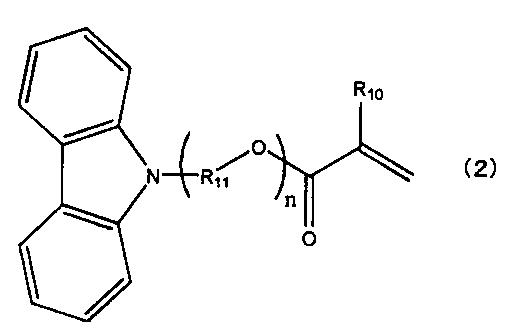
(式中、R10は水素原子または炭素数1から4の炭化水素基、R11は同一もしくは異なり炭素数1から4の炭化水素基、nは平均の繰り返し数であって、n=0~4を示し、カルバゾリル基上に置換基を有していてもよい。)である前記(1)に記載の樹脂組成物、
(3)フェニルエーテル基を有するモノアクリレートモノマー(D)を更に含む前記(1)または(2)に記載の樹脂組成物、
(4)フェニルエーテル基を有するモノアクリレートモノマー(D)がo-フェニルフェノール(ポリ)エトキシ(メタ)アクリレート、p-フェニルフェノール(ポリ)エトキシ(メタ)アクリレート、o-フェニルフェノールエポキシ(メタ)アクリレート、p-フェニルフェノールエポキシ(メタ)アクリレートからなる群より選ばれる1種以上である前記(1)ないし(3)のいずれか一項に記載の樹脂組成物、
(5)化合物(A)およびフェニルエーテル基を有するモノアクリレートモノマー(D)以外の(メタ)アクリレート化合物(E)を更に含む前記(1)ないし(4)のいずれか一項に記載の樹脂組成物、
(6)前記(1)ないし(5)のいずれか一項に記載の樹脂組成物を硬化して得られる硬化物、
(7)前記(6)に記載の硬化物を用いる光学レンズシート、
に関する。
(3)フェニルエーテル基を有するモノアクリレートモノマー(D)を更に含む前記(1)または(2)に記載の樹脂組成物、
(4)フェニルエーテル基を有するモノアクリレートモノマー(D)がo-フェニルフェノール(ポリ)エトキシ(メタ)アクリレート、p-フェニルフェノール(ポリ)エトキシ(メタ)アクリレート、o-フェニルフェノールエポキシ(メタ)アクリレート、p-フェニルフェノールエポキシ(メタ)アクリレートからなる群より選ばれる1種以上である前記(1)ないし(3)のいずれか一項に記載の樹脂組成物、
(5)化合物(A)およびフェニルエーテル基を有するモノアクリレートモノマー(D)以外の(メタ)アクリレート化合物(E)を更に含む前記(1)ないし(4)のいずれか一項に記載の樹脂組成物、
(6)前記(1)ないし(5)のいずれか一項に記載の樹脂組成物を硬化して得られる硬化物、
(7)前記(6)に記載の硬化物を用いる光学レンズシート、
に関する。
本発明の樹脂組成物は低粘度で、その硬化物は離型性、型再現性、基板との密着性に優れ、高屈折率で耐光性が良い。そのため特にフレネルレンズ、レンチキュラーレンズ、プリズムレンズ、マイクロレンズ等の光学レンズシートに適している。
本発明の樹脂組成物は、カルバゾリル基を有する化合物(A)及び光重合開始剤(B)を含む。
本発明の樹脂組成物に使用するカルバゾリル基を有する化合物(A)について説明する。カルバゾリル基を有する化合物(A)はカルバゾリル基を有するものであれば限定されないが、例えば、下記一般式(1)で表される化合物等を挙げることができる。

(式中、R1~R9は同一もしくは異なり、水素原子、アルキル基、アルケニル基、アルキニル基、アルコキシ基、アルキルチオ基、アミノ基、アルキルアミノ基、アリール基、アリールオキシ基、アリールチオ基、アリールアミノ基、ジアリールアミノ基、アルキルアリールアミノ基、ヘテロ環基、重合性基を表し、R1~R9のうち少なくとも1つは重合性基である。R2~R9の内、隣接する2つの置換基が互いに結合して環構造を形成してもよい。またR2~R9は更に置換基を有していてもよい。)
前記一般式(1)中、アルキル基としては、炭素数1~30のものが好ましく、より好ましくは炭素数1~15、さらに好ましくは炭素数1~8である。具体的には、例えばメチル、エチル、t-ブチル、シクロヘキシル等が挙げられる。アルケニル基としては、炭素数2~30のものが好ましく、より好ましくは炭素数2~15、さらに好ましくは炭素数2~8である。具体的には、例えばビニル、1-プロペニル、1-ブテン-2-イル、シクロヘキセン-1-イル等が挙げられる。アルキニル基としては、炭素教2~30のものが好ましく、より好ましくは炭素数2~15、さらに好ましくは炭素数2~8である。具体的には、例えばエチニル、1-プロピニル等が挙げられる。
前記一般式(1)中、アルコキシ基としては、炭素数2~30のものが好ましく、より好ましくは炭素数2~15、さらに好ましくは炭素数2~8である。具体的には、例えばメトキシ基、エトキシ基、ブトキシ基、オクチルオキシ基、2-エチルヘキシルオキシ基等を挙げることができる。アルキルチオ基としては、炭素数2~30のものが好ましく、より好ましくは炭素数2~15、さらに好ましくは炭素数2~8である。具体的には、例えばメチルチオ基、エチルチオ基、ブチルチオ基、オクチルチオ基等を挙げることができる。アルキルアミノ基としては、炭素数2~30のものが好ましく、より好ましくは炭素数2~15、さらに好ましくは炭素数2~8である。具体的には、例えばメチルアミノ基、エチルアミノ基、ブチルアミノ基、フェノキシプロピルアミノ基、ジメチルアミノ基、ジエチルアミノ基、ジブチルアミノ基、ピペリジノ基、モルホリノ基等を挙げることができる。
前記一般式(1)中、アリール基としては、炭素数6~30のものが好ましく、より好ましくは炭素数6~15、さらに好ましくは炭素数6~12である。具体的には、例えばフェニル、ビフェニル、トリル、キシリル、ナフチル、ピレニル等が挙げられる。
前記一般式(1)中、アリールオキシ基としては、炭素数6~30のものが好ましく、より好ましくは炭素数6~15、さらに好ましくは炭素数6~8である。具体的には、例えばフェノキシ基、トリルオキシ基等が挙げられる。アリールチオ基としては、炭素数6~30のものが好ましく、より好ましくは炭素数6~15、さらに好ましくは炭素数6~8である。具体的には、例えばフェニルチオ基等を挙げることができる。アリールアミノ基としては、炭素数6~30のものが好ましく、より好ましくは炭素数6~15、さらに好ましくは炭素数6~8である。具体的には、例えばアニリノ基、トルイジノ基等を挙げることができる。ジアリールアミノ基としては、炭素数12~30のものが好ましく、より好ましくは炭素数12~20、さらに好ましくは炭素数12~15である。具体的には、例えばジフェニルアミノ基等を挙げることができる。
前記一般式(1)中、アルキルアリールアミノ基としては、炭素数7~30のものが好ましく、より好ましくは炭素数7~15、さらに好ましくは炭素数7~8である。具体的には、例えばN-メチルアニリノ基、N-エチルアニリノ基等が挙げられる。ヘテロ環基としては、炭素数2~30のものが好ましく、より好ましくは炭素数2~15、さらに好ましくは炭素数4~8である。具体的には、例えばピロール基、フラン基、カルバゾリル基等が挙げられる。これらへテロ環基はR1~R9として表される上記置換基を有していてもよい。
前記一般式(1)中、R2~R9の内、隣接する2つの置換基が互いに結合して環状炭化水素、芳香族環、ヘテロ環、ヘテロ芳香族環等の環構造を形成してもよい。特に好ましい環構造は、芳香族炭化水素環あるいはチオフェン、フラン、ピロール、セレノフェンおよびカルバゾールから選ばれる環骨格を有するヘテロ芳香族環である。
前記一般式(1)中、重合性基としては、例えば、シクロプロパン基やシクロブタン基等の高歪炭化水素基、エポキシ基やオキセタン基等の環状エーテル基、アクリル基、メタクリル基、ビニル基、ビニルエーテル基、ビニルエステル基等が挙げられる。重合性基として好ましくは、アクリル基、メタクリル基、ビニル基、エポキシ基、オキセタン基であり、特に好ましくは、アクリル基、メタクリル基である。重合性基は環構造に直接置換されていても、二価の結合基を介して置換されていてもよい。
前記の二価の結合基としては、例えばエーテル基、アルキレン基(好ましくは炭素数1 ~20、より好ましくは炭素数1~12、特に好ましくは炭素数1~8であり、例えばメチレン基(-CH2-)、エチレン基(-CH2CH2-)、トリメチレン基(-CH2CH2CH2-)、などが挙げられる。)、アリーレン基(好ましくは炭素数6~30、より好ましくは炭素数6~20、特に好ましくは炭素数6~12であり、例えばフェニレン基(-C6H4-)、ナフチレン基(-C10H6-)などが挙げられる。)、オキシアルキレン基(好ましくは炭素数1~20、より好ましくは炭素数1~12、特に好ましくは炭素数1~8であり、例えばオキシメチレン基(-OCH2-)、オキシエチレン基(-OCH2CH2-)、などが挙げられる。)、オキシアリーレン基(好ましくは炭素数6~20、より好ましくは炭素数6~16、特に好ましくは炭素数6~12であり、例えばオキシフェニレン基(-OC6H4-)、オキシナフチレン基(-OC10H6-)などが挙げられる。)、オキシカルボニル基(-COO-)、イミノカルボニル基(-CONH-)、ウレイレン基(-NHCONH-)などが挙げられる。これらの二価の結合基は更に上記の置換基で置換されてもよい。また、本発明においては、二価の結合基は、同種の二価の結合基(例えば、エチレンオキサイド基)が繰り返しに結合した構造を有するもの、また、異種の二価の結合基がそれぞれ1又は複数個結合した構造を有するものであってもよい。
前記一般式(1)で表される化合物は、公知の方法で合成可能である。まず、アリールヒドラジンとシクロヘキサノン誘導体とのAza-Cope転位反応の後、脱水素芳香族化による合成、ビフェニル-2-アジドの脱窒素環化反応による合成、2-ニトロビフェニルの亜リン酸トリエチルによる還元的環化反応による合成等によりカルバゾール誘導体を得ることができる。この原料であるカルバゾール誘導体は、R1に対応する置換基を有するアリールヒドラジンとして市販品のものを入手して使用する事ができ、例えばアルドリッチ社やNJR Aromatics GmdH社等から入手可能である。得られたカルバゾール誘導体に、例えば、アルキレンオキサイドまたはアルキレンカーボネートを反応させ、(メタ)アクリル酸と酸触媒存在下で脱水縮合反応させる、またはエピクロロヒドリンを反応させ、次いで、(メタ)アクリル酸を反応させることにより、一般式(1)で表される化合物を得ることができるが、これらに限られるものではない。
なお、ヘテロ環基がカルバゾリル基である化合物は、WO2005/014398やJ.Org.Chem.2009, 74, p.4490-4498に記載の公知の手法により合成できる他、市場から入手も可能である。
本発明の樹脂組成物に使用するカルバゾリル基を有する化合物(A)としては、置換基のうち少なくとも一つが重合性基であるもの、及び、置換基のうち少なくとも一つが重合性基であって置換基のうち少なくとも一つが置換基を有しうるカルバゾリル基であるものが本発明においては好ましい。そのようなカルバゾリル基を有する化合物(A)である前記一般式(1)で表される化合物の中でも下記一般式(2)

(式中、R10は水素原子または炭素数1から4の炭化水素基、R11は同一もしくは異なり炭素数1から4の炭化水素基、nは平均の繰り返し数であって、n=0~4を示し、カルバゾリル基上に置換基を有していてもよい。)で表される化合物(C)、及び下記一般式(3)

(式中、R10並びにR11及びnは一般式(2)に同じ)で表される化合物(C2)がさらに好ましい。
一般式(2)で表される化合物(C)は、カルバゾールとアルキレンオキサイドまたはアルキレンカーボネートを反応させ、続いて、(メタ)アクリル酸と酸触媒存在下で脱水縮合反応させることにより得ることができる。カルバゾールとアルキレンオキサイドとの反応においては、1モルのカルバゾールに対して1~8モルのアルキレンオキサイドを反応させる。カルバゾールとアルキレンカーボネートとの反応においては、1モルのカルバゾールに対して1~3モルのアルキレンカーボネートを反応させる。アルキレンオキサイドまたはアルキレンカーボネートは1種類のものを単独で用いても、2種類以上を混合して用いてもよい。単独で用いる場合はR11は全て同一となり、2種類以上を混合して用いる場合はR11は任意に異なるものを取りうる。
一般式(3)で表される化合物(C2)は、3,3’-ビ[9H-カルバゾール]とアルキレンオキサイドまたはアルキレンカーボネートを反応させ、続いて、(メタ)アクリル酸と酸触媒存在下で脱水縮合反応させることにより得ることができる。カルバゾールとアルキレンオキサイドとの反応においては、1モルの3,3’-ビ[9H-カルバゾール]に対して2~16モルのアルキレンオキサイドを反応させる。3,3’-ビ[9H-カルバゾール]とアルキレンカーボネートとの反応においては、1モルの3,3’-ビ[9H-カルバゾール]に対して2~6モルのアルキレンカーボネートを反応させる。アルキレンオキサイドまたはアルキレンカーボネートは1種類のものを単独で用いても、2種類以上を混合して用いてもよい。単独で用いる場合はR11は全て同一となり、2種類以上を混合して用いる場合はR11は任意に異なるものを取りうる。
アルキレンオキサイドの具体例としては、エチレンオキサイド、プロピレンオキサイド、ブチレンオキサイド等の(炭素数1~4)アルキレンオキサイドが挙げられる。また、アルキレンカーボネートの具体例としては、エチレンカーボネート(炭酸エチレン)、プロピレンカーボネート(炭酸プロピレン)、ブチレンカーボネート(炭酸ブチレン)等の(炭素数1~4)アルキレンカーボネートが挙げられる。
カルバゾール又は3,3’-ビ[9H-カルバゾール]とアルキレンオキサイド又はアルキレンカーボネートとの反応は、水酸化ナトリウム、水酸化カリウムなどのアルカリ触媒下、反応時間1~48時間、反応温度90℃~200℃の間で行なわれる。カルバゾール又は3,3’-ビ[9H-カルバゾール]とアルキレンオキサイドとの反応においては、反応混合物100質量%に対して0.01~5質量%のアルカリ触媒が用いられる。カルバゾール又は3,3’-ビ[9H-カルバゾール]とアルキレンカーボネートとの反応においては、1モルのカルバゾール又は3,3’-ビ[9H-カルバゾール]に対して0.01~1.0モルのアルカリ触媒が用いられる。
カルバゾール又は3,3’-ビ[9H-カルバゾール]とアルキレンオキサイド又はアルキレンカーボネートとの反応物と(メタ)アクリル酸の脱水縮合反応において、(メタ)アクリル酸はカルバゾール又は3,3’-ビ[9H-カルバゾール]1モルに対して0.1~20モル用いられる。脱水縮合反応における反応溶媒としては、反応において生成した水を留去することのできる共沸溶媒を用いることができる。ここでいう共沸溶媒とは60~130℃の沸点を有し、水と容易に分離できるものであり、特に、ベンゼン、トルエン、n-ヘキサン、n-ヘプタン、シクロヘキサン等の非反応性有機溶剤の1種又は2種以上を混合して使用するのが望ましい。その使用量は任意であるが、好ましくは反応混合物に対し10~70質量%である。
脱水縮合反応における反応時間は1~24時間、反応温度は60~150℃の範囲でよいが、反応時間の短縮と重合防止の点から、75~120℃で行なうことが好ましい。
原料として用いる市販品の(メタ)アクリル酸には、既にp-メトキシフェノール等の重合禁止剤が添加されているのが普通であるが、反応時に改めて重合禁止剤を添加してもよい。そのような重合禁止剤の例としては、ハイドロキノン、p-メトキシフェノール、2,4-ジメチル-6-t-ブチルフェノール、3-ヒドロキシチオフェノール、p-ベンゾキノン、2,5-ジヒドロキシ-p-ベンゾキノン、フェノチアジン等が挙げられる。その使用量は反応混合物に対し0.01~1質量%である。
脱水縮合反応に使用される酸触媒は、硫酸、メタンスルホン酸、トリフルオロメタンスルホン酸、p-トルエンスルホン酸等公知のものから任意に選択でき、その使用量は、(メタ)アクリル酸1モルに対して0.01~10モル%、好ましくは1~5モル%である。
本発明の樹脂組成物に使用し得る化合物(C)としては、屈折率や他の成分との相溶性を考慮すると、1モルのカルバゾールに対して1~2モルのアルキレンオキサイドを反応させた化合物や、1モルのカルバゾールに対して1~2モルのアルキレンカーボネートを反応させた化合物に(メタ)アクリル酸を反応させて得られる化合物が好ましい。アルキレンオキサイドとしてはメチレン基が1~4のアルキレンオキサイドであればいずれでもよいが、エチレンオキサイドあるいはプロピレンオキサイドが好ましい。アルキレンカーボネートとしてはメチレン基が1~4のアルキレンカーボネートであればいずれでもよいが、エチレンカーボネート(炭酸エチレン)あるいはプロピレンカーボネート(炭酸プロピレン)が好ましい。
本発明の樹脂組成物に使用し得る化合物(C2)としては、屈折率や他の成分との相溶性を考慮すると、1モルの3,3’-ビ[9H-カルバゾール]に対して2~4モルのアルキレンオキサイドを反応させた化合物や、1モルの3,3’-ビ[9H-カルバゾール]に対して2~4モルのアルキレンカーボネートを反応させた化合物に(メタ)アクリル酸を反応させて得られる化合物が好ましい。アルキレンオキサイドとしてはメチレン基が1~4のアルキレンオキサイドであればいずれでもよいが、エチレンオキサイドあるいはプロピレンオキサイドが好ましい。アルキレンカーボネートとしてはメチレン基が1~4のアルキレンカーボネートであればいずれでもよいが、エチレンカーボネート(炭酸エチレン)あるいはプロピレンカーボネート(炭酸プロピレン)が好ましい。
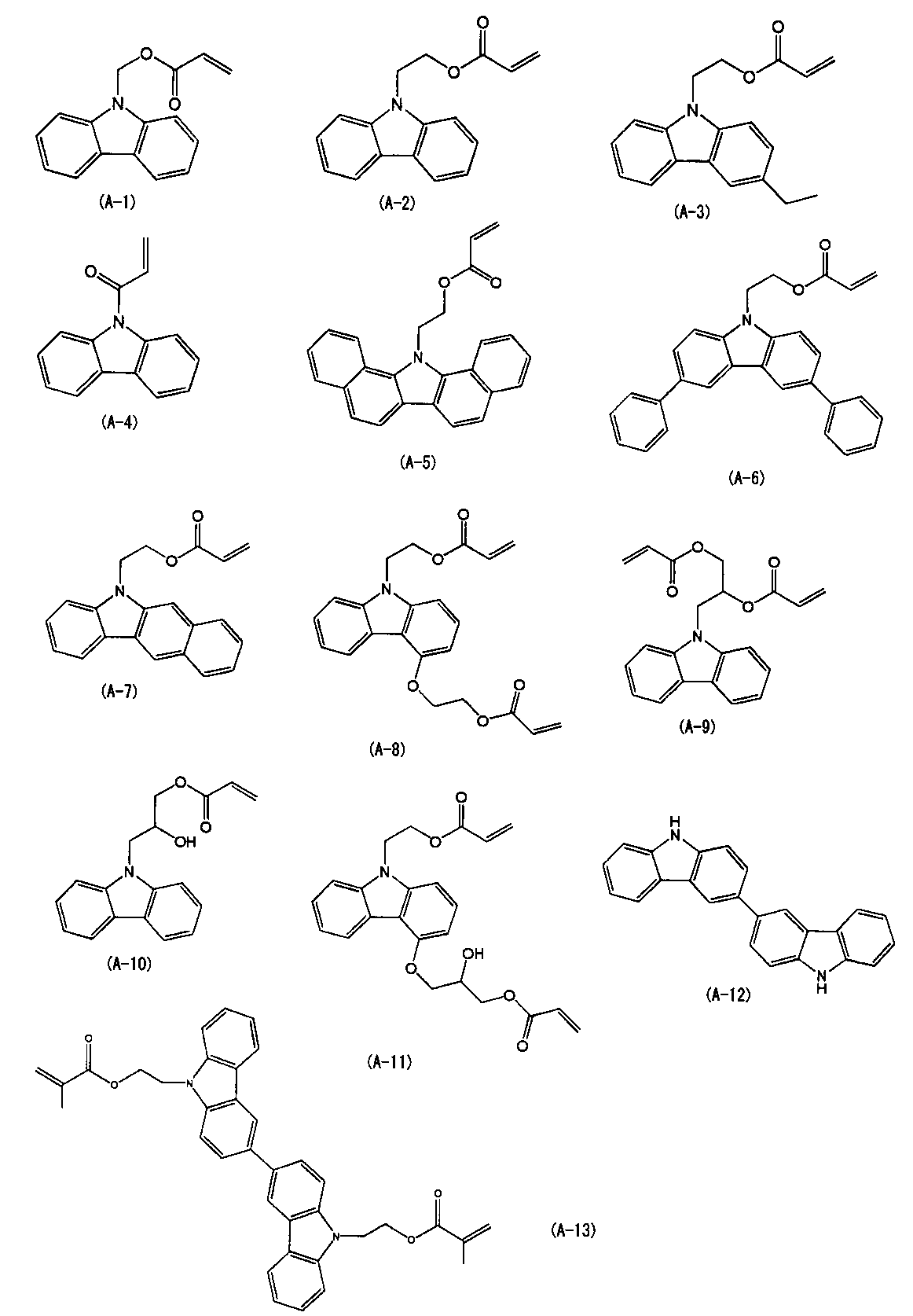
以下に前記一般式(2)で表される化合物の具体例(A-1)~(A-11)、前記一般式(1)で表される化合物の具体例(A-12)及び一般式(3)で表される化合物の具体例(A-13)を挙げるが本発明はこれらに限定されるものではない。
本発明の樹脂組成物に含有される光重合開始剤(B)としては、ベンゾイン、ベンゾインメチルエーテル、ベンゾインエチルエーテル、ベンゾインプロピルエーテル、ベンゾインイソブチルエーテル等のベンゾイン類;アセトフェノン、2,2-ジエトキシ-2-フェニルアセトフェノン、2,2-ジエトキシ-2-フェニルアセトフェノン、1,1-ジクロロアセトフェノン、2-ヒドロキシ-2-メチル-フェニルプロパン-1-オン、ジエトキシアセトフェノン、1-ヒドロキシシクロヘキシルフェニルケトン、2-メチル-1-〔4-(メチルチオ)フェニル〕-2-モルホリノプロパン-1-オン、オリゴ[2-ヒドロキシー2-メチル-1-[4-(1-メチルビニル)フェニル]プロパノン]等のアセトフェノン類;2-エチルアントラキノン、2-tert-ブチルアントラキノン、2-クロロアントラキノン、2-アミルアントラキノン等のアントラキノン類;2,4-ジエチルチオキサントン、2-イソプロピルチオキサントン、2-クロロチオキサントン等のチオキサントン類;アセトフエノンジメチルケタール、ベンジルジメチルケタール等のケタール類;ベンゾフェノン、4-ベンゾイル-4’-メチルジフェニルサルファイド、4,4’-ビスメチルアミノベンゾフェノン等のベンゾフェノン類;2,4,6-トリメチルベンゾイルジフェニルホスフィンオキサイド、ビス(2,4,6-トリメチルベンゾイル)-フェニルホスフィンオキサイド、ジフェニル-(2,4,6-トリメチルベンゾイル)-フォスフィンオキサイド等のホスフィンオキサイド類等を挙げることができる。好ましくは、アセトフェノン類であり、さらに好ましくは2-ヒドロキシ-2-メチル-フェニルプロパン-1-オン、1-ヒドロキシシクロヘキシルフェニルケトンを挙げることができる。なお、本発明の樹脂組成物においては、光重合開始剤(B)は単独で用いてもよいし、複数種を混合して用いてもよいが、2,4,6-トリメチルベンゾイルジフェニルホスフィンオキサイド、ビス(2,4,6-トリメチルベンゾイル)-フェニルホスフィンオキサイド、ジフェニル-(2,4,6-トリメチルベンゾイル)-フォスフィンオキサイド等のホスフィンオキサイド類を、少なくとも1種は用いるのが好ましい。
本発明に使用し得る、フェニルエーテル基を有するモノアクリレートモノマー(D)について説明する。
フェニルエーテル基を有するモノアクリレートモノマー(D)としては、フェノキシエチル(メタ)アクリレート、フェニル(ポリ)エトキシ(メタ)アクリレート、p-クミルフェノキシエチル(メタ)アクリレート、トリブロモフェニルオキシエチル(メタ)アクリレート、フェニルチオエチル(メタ)アクリレート、2-ヒドロキシ-3-フェニルオキシプロピル(メタ)アクリレート、フェニルフェノール(ポリ)エトキシ(メタ)アクリレート、フェニルフェノールエポキシ(メタ)アクリレート等を挙げることができるが、フェニルフェノール(ポリ)エトキシ(メタ)アクリレート及びフェニルフェノールエポキシ(メタ)アクリレートが好ましく、中でもo-フェニルフェノール(ポリ)エトキシ(メタ)アクリレート、p-フェニルフェノール(ポリ)エトキシ(メタ)アクリレート、o-フェニルフェノールエポキシ(メタ)アクリレート、p-フェニルフェノールエポキシ(メタ)アクリレートが好ましい。本発明においてモノアクリレートモノマー(D)は1種または2種以上を用いてもよい。
フェニルフェノール(ポリ)エトキシ(メタ)アクリレートとしては、エトキシ構造部分の繰り返し数が平均で1~3の正数である化合物が好ましく、原料であるフェニルフェノールとエチレンオキサイドとの反応物と(メタ)アクリル酸を反応させることにより得ることができる。フェニルフェノールはオルト体であるo-フェニルフェノール、パラ体であるp-フェニルフェノールが、市販品のものを入手して使用することができる(例えば、O-PP、P-PPとして、何れも三光(株)製)として入手できる)。フェニルフェノールとエチレンオキサイドとの反応物は公知の方法により得ることができ、又、市販品も使用できる。フェニルフェノールとエチレンオキサイドとの反応物を、p-トルエンスルホン酸又は硫酸等のエステル化触媒、ハイドロキノンやフェノチアジン等の重合禁止剤の存在下に、好ましくは溶剤類(例えば、トルエン、シクロヘキサン、n-ヘキサン、n-ヘプタン等)の存在下、好ましくは70~150℃で(メタ)アクリル酸と反応させることによりフェニルフェノールポリエトキシ(メタ)アクリレートが得られる。(メタ)アクリル酸の使用割合は、フェニルフェノールとエチレンオキサイドとの反応物1モルに対して1~5モル、好ましくは1.05~2モルである。エステル化触媒は使用する(メタ)アクリル酸に対して0.1~15モル%、好ましくは1~6モル%である。
フェニルフェノールエポキシ(メタ)アクリレートとしては、上記フェニルフェノールを、アルカリ金属水酸化物存在下、エピハロヒドリンと反応させ、その反応生成物であるエポキシ樹脂と、アクリル酸とを反応させて得られる。
該エピハロヒドリンとしては、エピクロルヒドリン、α-メチルエピクロルヒドリン、γ-メチルエピクロルヒドリン、エピブロモヒドリン等が使用でき、中でも工業的に入手が容易なエピクロルヒドリンが好ましい。エピハロヒドリンの使用量はフェニルフェノール1モルに対し通常2~20モル、好ましくは3~15モルである。
該アルカリ金属水酸化物としては、水酸化ナトリウム、水酸化カリウム等が挙げられ、固形物を使用してもよく、その水溶液を使用してもよい。水溶液を使用する場合は該アルカリ金属水酸化物の水溶液を連続的に反応系内に添加すると共に減圧下、又は常圧下連続的に水及びエピハロヒドリンを留出させ、更に分液して水を除去し、エピハロヒドリンを反応系内に連続的に戻す方法でもよい。アルカリ金属水酸化物の使用量は上記フェニルフェノール1モルに対して通常0.1~10.0モルであり、好ましくは0.3~5.0モル、より好ましくは0.8~3.0モルである。
反応を促進するためにテトラメチルアンモニウムクロライド、テトラメチルアンモニウムブロマイド、トリメチルベンジルアンモニウムクロライド等の4級アンモニウム塩を触媒として添加することは好ましい。4級アンモニウム塩を使用する場合、その使用量としては上記フェニルフェノール1モルに対し通常0.1~20gであり、好ましくは0.2~15gである。
この際、メタノール、エタノール、イソプロピルアルコール等の脂肪族アルコール類、ジメチルスルホン、ジメチルスルホキシド、テトラヒドロフラン、ジオキサン等の非プロトン性の極性溶媒等を添加して反応を行うことが反応進行上好ましい。
アルコール類を使用する場合、その使用量はエピハロヒドリンの使用量に対し通常1~50質量%、好ましくは2~30質量%である。又、非プロトン性の極性溶媒を用いる場合はエピハロヒドリンの使用量に対し通常3~100質量%、好ましくは5~80質量%である。
反応温度は通常30~100℃であり、好ましくは35~90℃である。反応時間は通常0.2~10時間であり、好ましくは0.5~8時間である。アルカリ金属水酸化物存在下、フェニルフェノールとエピハロヒドリンとの反応の反応液を水洗後、又は水洗無しに、加熱減圧下でエピハロヒドリン等を除去する。又、更に、加水分解性ハロゲンの少ないエポキシ樹脂とするために、得られたエポキシ樹脂をトルエン、メチルイソブチルケトン等の溶剤に溶解し、水酸化ナトリウム、水酸化カリウム等のアルカリ金属水酸化物の水溶液を加えて反応を行い、閉環を確実なものにすることもできる。この場合アルカリ金属水酸化物の使用量は、使用したフェニルフェノール1モルに対して通常0.01~0.5モル、好ましくは0.05~0.3モルである。反応温度は通常50~120℃、反応時間は通常0.5~2時間である。
反応終了後、生成した塩を濾過、水洗等により除去し、更に加熱減圧下溶剤等を留去することにより目的とするエポキシ樹脂が得られる。このような処方に代表される方法により、特別な精製をすること無しで使用できるエポキシ樹脂が得られる。
フェニルフェノールエポキシ(メタ)アクリレートは、前述のエポキシ樹脂と(メタ)アクリル酸とを反応させることにより得られる。前記エポキシ樹脂のエポキシ当量1に対して(メタ)アクリル酸を好ましくは0.8~1.1当量、より好ましくは0.9~1.05当量反応させる。
反応は無溶剤で行うことができるが、必要に応じてアルコール性水酸基を有さない溶媒、例えば、アセトン、メチルエチルケトン、シクロヘキサノン等のケトン類、ベンゼン、トルエン、キシレン、テトラメチルベンゼン等の芳香族炭化水素類、エチレングリコールジメチルエーテル、エチレングリコールジエチルエーテル、ジプロピレングリコールジメチルエーテル、ジプロピレングリコールジエチルエーテル、トリエチレングリコールジメチルエーテル、トリエチレングリコールジエチルエーテル等のグリコールエーテル類、酢酸エチル、酢酸ブチル、メチルセロソルブアセテート、エチルセロソルブアセテート、ブチルセロソルブアセテート、カルビトールアセテート、プロピレングリコールモノメチルエーテルモノアセテート、グルタル酸ジアルキル、コハク酸ジアルキル、アジピン酸ジアルキル等のエステル類、γ-ブチロラクトン等の環状エステル類、石油エーテル、石油ナフサ、水添石油ナフサ、ソルベントナフサ等の石油系溶剤、更にはアルコール性水酸基を有さない単独又は混合された各種モノマー、例えば、アクリロイルモルホリン、2-フェニルフェノールのエチレンオキサイド付加物の末端アクリル酸エステル化物(例えば、日本化薬(株) KAYARAD OPP-1、OPP-2)、ポリエチレングリコールジ(メタ)アクリレート、トリプロピレングリコールジ(メタ)アクリレート、トリメチロールプロパントリ(メタ)アクリレート、トリメチロールプロパンポリエトキシトリ(メタ)アクリレート、グリセリンポリプロポキシトリ(メタ)アクリレート、ヒドロキシビバリン酸ネオペンチルグリコールのε-カプロラクトン付加物のジ(メタ)アクリレート(例えば、日本化薬(株) KAYARAD HX-220、HX-620等)、ペンタエリスリトールテトラ(メタ)アクリレート、ジペンタエリスリトールとε-カプロラクトンの反応物のポリ(メタ)アクリレート、ジペンタエリスリトールポリ(メタ)アクリレート等の中で行うことができる。本発明において使用し得る成分(D)や(E)の中に、該各種モノマーに含まれるものがあるが、成分(D)や(E)を該各種モノマーとして使用する場合、反応で得られたものを精製し、または、精製することなく、本発明において使用することができる。
反応時には、反応を促進させるために触媒を使用することが好ましく、触媒を使用する場合の該触媒の使用量は、反応物に対して0.1~10質量%である。その際の反応温度は60~150℃であり、又、反応時間は好ましくは5~60時間である。使用する触媒としては、例えば、トリエチルアミン、ベンジルジメチルアミン、トリエチルアンモニウムクロライド、ベンジルトリメチルアンモニウムブロマイド、ベンジルトリメチルアンモニウムアイオダイド、トリフェニルホスフィン、トリフェニルスチビン、メチルトリフェニルスチビン、オクタン酸クロム、オクタン酸ジルコニウム等を挙げることができる。
又、熱重合禁止剤を使用してもよく、該熱重合禁止剤としては、例えば、ハイドロキノンモノメチルエーテル、2-メチルハイドロキノン、ハイドロキノン、2,6-ジ-tert-ブチル-p-クレゾール、ジフェニルピクリルヒドラジン、ジフェニルアミン等が挙げられ、熱重合禁止剤を使用する場合、反応物に対して0.1~10質量%程度使用するのが好ましい。反応は、適宜サンプリングしながら、サンプルの酸価が5mg・KOH/g以下、好ましくは3mg・KOH/g以下となった時点を終点とする。
更に、先に挙げた一般式(1)で表される化合物(A)、フェニルエーテル基を有するモノアクリレートモノマー(D)の他に、得られる本発明の樹脂組成物の粘度、密着性や、ガラス転移温度(Tg)、硬化物の硬度等を考慮して、成分(A)、成分(D)以外の(メタ)アクリレート化合物(E)を単独あるいは二種類以上を混合して使用してもよい。該(メタ)アクリレート化合物(E)としては、(メタ)アクリレートモノマーや(メタ)アクリレートオリゴマーが挙げられる。
(メタ)アクリレートモノマーとしては、単官能(メタ)アクリレートモノマー、2官能(メタ)アクリレートモノマー、3官能以上の多官能(メタ)アクリレートモノマー等を挙げることができる。
単官能(メタ)アクリレートモノマーとしては、例えば、アクリロイルモルホリン、2-ヒドロキシプロピル(メタ)アクリレート、4-ヒドロキシブチル(メタ)アクリレート、シクロヘキサン-1,4-ジメタノールモノ(メタ)アクリレート、テトラヒドロフルフリル(メタ)アクリレート、イソボルニル(メタ)アクリレート、トリブロモフェニルオキシエチル(メタ)アクリレート、ジシクロペンタニル(メタ)アクリレート、ジシクロペンテニル(メタ)アクリレート、ジシクロペンテニルオキシエチル(メタ)アクリレート等を挙げることができる。
2官能(メタ)アクリレートモノマーとしては、1,4-ブタンジオールジ(メタ)アクリレート、1,6-ヘキサンジオールジ(メタ)アクリレート、1,9-ノナンジオールジ(メタ)アクリレート、トリシクロデカンジメタノール(メタ)アクリレート、ビスフェノールAポリエトキシジ(メタ)アクリレート、ビスフェノールAポリプロポキシジ(メタ)アクリレート、ビスフェノールFポリエトキシジ(メタ)アクリレート、エチレングリコールジ(メタ)アクリレート、ポリエチレングリコールジ(メタ)アクリレートヒドロキシビバリン酸ネオペンチルグリコールのε-カプロラクトン付加物のジ(メタ)アクリレート(例えば、日本化薬(株) KAYARAD HX-220、HX-620等)等を挙げることができる。
3官能以上の多官能(メタ)アクリレートモノマーとしては、トリス(アクリロキシエチル)イソシアヌレート、ペンタエリスリトールテトラ(メタ)アクリレート、ジペンタエリスリトールヘキサ(メタ)アクリレート、ジペンタエリスリトールペンタ(メタ)アクリレート、トリペンタエリスリトールヘキサ(メタ)アクリレート、トリペンタエリスリトールペンタ(メタ)アクリレート、トリメチロールプロパントリ(メタ)アクリレート、トリメチロールプロパンポリエトキシトリ(メタ)アクリレート、ジトリメチロールプロパンテトラ(メタ)アクリレート等を挙げることができる。
(メタ)アクリレートオリゴマーとしては、ウレタン(メタ)アクリレート、エポキシ(メタ)アクリレート、ポリエステル(メタ)アクリレート等を挙げることができる。
ウレタン(メタ)アクリレートとしては、例えば、ジオール化合物(例えば、エチレングリコール、ジエチレングリコール、トリエチレングリコール、プロピレングリコール、ジプロピレングリコール、トリプロピレングリコール、1,4-ブタンジオール、ネオペンチルグリコール、1,6-ヘキサンジオール、1,8-オクタンジオール、1,9-ノナンジオール、2-メチル-1,8-オクタンジオール、3-メチル-1,5-ペンタンジオール、2,4-ジエチル-1,5-ペンタンジオール、2-ブチル-2-エチル-1,3-プロパンジオール、シクロヘキサン-1,4-ジメタノール、ポリエチレングリコール、ポリプロピレングリコール、ビスフェノールAポリエトキシジオール、ビスフェノールAポリプロポキシジオール等)又はこれらジオール化合物と二塩基酸若しくはその無水物(例えば、コハク酸、アジピン酸、アゼライン酸、ダイマー酸、イソフタル酸、テレフタル酸、フタル酸若しくはこれらの無水物)との反応物であるポリエステルジオールと、有機ポリイソシアネート(例えば、テトラメチレンジイソシアネート、ヘキサメチレンジイソシアネート、2,2,4-トリメチルヘキサメチレンジイソシアネート、2,4,4-トリメチルヘキサメチレンジイソシアネート等の鎖状飽和炭化水素イソシアネート、イソホロンジイソシアネート、ノルボルナンジイソシアネート、ジシクロヘキシルメタンジイソシアネート、メチレンビス(4-シクロヘキシルイソシアネート)、水添ジフェニルメタンジイソシアネート、水添キシレンジイソシアネート、水添トルエンジイソシアネート等の環状飽和炭化水素イソシアネート、2,4-トリレンジイソシアネート、1,3-キシリレンジイソシアネート、p-フェニレンジイソシアネート、3,3’-ジメチル-4,4’-ジフェニレンイソシアネート、6-イソプロピル-1,3-フェニルジイソシアネート、1,5-ナフタレンジイソシアネート等の芳香族ポリイソシアネート)を反応させ、次いで水酸基含有(メタ)アクリレートを付加した反応物が挙げられる。また、前記有機ポリイソシアネートと水酸基含有(メタ)アクリレートを反応させた化合物等が挙げられる。
エポキシ(メタ)アクリレートとしては、ビスフェノールA型エポキシ樹脂、ビスフェノールF型エポキシ樹脂、フェノールノボラック型エポキシ樹脂、ビスフェノールAのプロピレンオキサイド付加物の末端グリシジルエーテル、フルオレンエポキシ樹脂等のエポキシ樹脂類と(メタ)アクリル酸との反応物等を挙げることができる。
ポリエステル(メタ)アクリレートとしては、例えば、上記のジオール化合物と上記の二塩基酸又はその無水物との反応物であるポリエステルジオールと、(メタ)アクリル酸の反応物等が挙げられる。
中でも本発明の樹脂組成物に使用することのできる(メタ)アクリレート化合物(E)としては、屈折率を考慮するとビスフェノールA骨格を有する化合物が好ましく、例えばビスフェノールAポリエトキシジ(メタ)アクリレート、ビスフェノールAポリプロポキシジ(メタ)アクリレートなどの(メタ)アクリレートモノマー、ビスフェノールAの骨格をもつウレタン(メタ)アクリレートオリゴマー(ビスフェノールAポリエトキシジオール、ビスフェノールAポリプロポキシジオール等のジオール化合物、あるいはこれらジオール化合物と二塩基酸若しくはその無水物との反応物であるポリエステルジオールと、有機ポリイソシアネートと、水酸基含有(メタ)アクリレートとを反応した化合物)、ビスフェノールAの骨格をもつエポキシ(メタ)アクリレートオリゴマー(ビスフェノールA型エポキシ樹脂、ビスフェノールAのプロピレンオキサイド付加物の末端グリシジルエーテル等のエポキシ樹脂類と(メタ)アクリル酸との反応物など)、9,10-ジヒドロ-9-オキサ-10-ホスファフェナントレン-10-オキサイドから得られるホスフィンオキサイド化合物、ビナフトール骨格を有するジ(メタ)アクリレート、フルオレン骨格を有する(メタ)アクリレート、又はフェニルフェノールエポキシアクリレートと芳香族有機ポリイソシアネートを反応させたウレタンアクリレート等が挙げられる。
また、硬化物の密着性や粘度などを考慮すると、(メタ)アクリレート化合物(E)としては単官能あるいは2官能(メタ)アクリレートモノマーが適しており、中でも、アクリロイルモルホリン、テトラヒドロフルフリル(メタ)アクリレート、フェノキシエチル(メタ)アクリレート、1,4-ブタンジオールジ(メタ)アクリレート、1,6-ヘキサンジオールジ(メタ)アクリレート、イソボルニル(メタ)アクリレート、ジシクロペンタニル(メタ)アクリレート、ジシクロペンテニル(メタ)アクリレート、ジシクロペンテニルオキシエチル(メタ)アクリレート等が好ましい。
また、硬化物のガラス転移温度(Tg)を考慮すると(メタ)アクリレート化合物(E)としてはトリス(アクリロキシエチル)イソシアヌレート、ペンタエリスリトールテトラ(メタ)アクリレート、ジペンタエリスリトールヘキサ(メタ)アクリレート、ジペンタエリスリトールペンタ(メタ)アクリレート、トリメチロールプロパントリ(メタ)アクリレート等の3官能以上の(メタ)アクリレートモノマーが好ましい。
本発明の樹脂組成物の各成分の使用割合は、所望の屈折率やガラス転移温度や粘度や密着性等を考慮して決められるが、成分(A)+成分(D)+成分(E)を100質量部とした場合に、成分(A)の含有量は2~100質量部であり、好ましくは5~100質量部である。成分(D)の含有量は0~85質量部、好ましくは0~75質量部である。成分(E)の含有量は0~60質量部、好ましくは0~50質量部である。成分(B)は成分(A)+成分(D)+成分(E)の総量100質量部に対して、通常0.1~10質量部使用されるが、好ましくは0.3~7質量部である。
本発明のエネルギー線硬化型樹脂組成物には、前記成分以外に取り扱い時の利便性等を改善するために、離型剤、消泡剤、レベリング剤、光安定剤、酸化防止剤、重合禁止剤、帯電防止剤、紫外線吸収剤等を状況に応じて併用して含有することができる。更に、必要に応じて、アクリルポリマー、ポリエステルエラストマー、ウレタンポリマー及びニトリルゴム等のポリマー類、無機あるいは有機の光拡散フィラー等も添加することができる。必要に応じて溶剤を加えて本発明の樹脂組成物を得ることができるが、本発明においては溶剤を添加しないことが好ましい。
本発明の樹脂組成物は、各成分を常法に従い混合溶解することにより調製することができる。例えば、撹拌装置、温度計のついた丸底フラスコに各成分を仕込み、40~80℃にて0.5~6時間撹拌することにより得ることができる。
本発明の樹脂組成物の粘度は、光学レンズシート類を製造するに適した粘度として、E型粘度計(TV-200:東機産業社製)を用いて測定した粘度が25℃で4000mPa・s以下である組成物が好ましい。
常法に従い、本発明の樹脂組成物に紫外線等のエネルギー線を照射することにより硬化して得ることができる硬化物も本発明に含まれる。該硬化物は本発明の樹脂組成物を、例えば、フレネルレンズ、レンチキュラーレンズ、プリズムレンズ等の形状を有するスタンパー上に塗布して該樹脂組成物の層を設け、その層の上に硬質透明基板であるバックシート(例えば、ポリメタクリル樹脂、ポリカーボネート樹脂、ポリスチレン樹脂、ポリエステル樹脂、又はこれらポリマーのブレンド品等からなる基板あるいはフィルム)を接着させ、次いで該硬質透明基板側から高圧水銀灯等により紫外線を照射して該樹脂組成物を硬化させた後、該スタンパーから硬化物を剥離して得ることができる。又、これらの応用として連続式での加工により行うこともできる。
この様にして屈折率(25℃)が高く、離型性、型再現性、密着性、耐光性に優れたフレネルレンズ、レンチキュラーレンズ、プリズムレンズ、マイクロレンズ等の光学レンズ部分を形成した光学レンズシートを得ることができ、これらも本発明に含まれる。なお、屈折率はアッベ屈折率計(DR-M2:(株)アタゴ製)等で測定することができる。
本発明の樹脂組成物は、上記したように、光学レンズシート用として有用である。光学レンズシート用以外の用途としては、各種コーティング剤、接着剤等が挙げられる。
次に、実施例により本発明を更に詳細に説明する。なお、本発明は以下の実施例によって何ら限定されるものではない。実施例において「部」は「質量部」を示す。
合成例1
化合物(A)の合成
オートクレーブ中に、カルバゾールを167.2g(1.0mol)、トルエンを114.5g、水酸化カリウムを0.5g仕込み、窒素置換を行なった後、48.5g(1.1mol)のエチレンオキサイドを120℃~140℃、反応圧0.2MPa以下の範囲で滴下し、6時間反応させた。反応後、減圧下で未反応エチレンオキサイド、トルエンを留去し、211.3gのN-(2-ヒドロキシエチル)カルバゾールを得た。
続いて、攪拌装置、還流管、温度計、及び水分離機をつけたフラスコ中に、N-(2-ヒドロキシエチル)カルバゾールを105.6g(0.5mol)、アクリル酸を54.1g(0.7mol)、パラトルエンスルホン酸を1.44g、ハイドロキノンを0.54g、トルエンを517.6g、シクロヘキサンを221.8gそれぞれ仕込み、反応温度95~105℃で生成水を溶媒と共沸留去しながら反応させた。反応後、25%NaOH水溶液で中和した後、15質量%食塩水200gで3回洗浄した。溶媒を減圧留去して淡黄色固体の下記式(C-1)にて表されるN-(2-アクリロイルオキシエチル)カルバゾールを130.0g得た。
化合物(A)の合成
オートクレーブ中に、カルバゾールを167.2g(1.0mol)、トルエンを114.5g、水酸化カリウムを0.5g仕込み、窒素置換を行なった後、48.5g(1.1mol)のエチレンオキサイドを120℃~140℃、反応圧0.2MPa以下の範囲で滴下し、6時間反応させた。反応後、減圧下で未反応エチレンオキサイド、トルエンを留去し、211.3gのN-(2-ヒドロキシエチル)カルバゾールを得た。
続いて、攪拌装置、還流管、温度計、及び水分離機をつけたフラスコ中に、N-(2-ヒドロキシエチル)カルバゾールを105.6g(0.5mol)、アクリル酸を54.1g(0.7mol)、パラトルエンスルホン酸を1.44g、ハイドロキノンを0.54g、トルエンを517.6g、シクロヘキサンを221.8gそれぞれ仕込み、反応温度95~105℃で生成水を溶媒と共沸留去しながら反応させた。反応後、25%NaOH水溶液で中和した後、15質量%食塩水200gで3回洗浄した。溶媒を減圧留去して淡黄色固体の下記式(C-1)にて表されるN-(2-アクリロイルオキシエチル)カルバゾールを130.0g得た。

化合物(A)の物性を以下に示す。
液屈折率(D線、25℃) 1.61
1H-NMR(CDCl3、300MHz)
4.48-4.60ppm=4H、5.70-5.80ppm=1H、5.90-6.05ppm=1H、6.20-6.30ppm=1H、7.10-7.55ppm=6H、8.05-8.15ppm=2H
液屈折率(D線、25℃) 1.61
1H-NMR(CDCl3、300MHz)
4.48-4.60ppm=4H、5.70-5.80ppm=1H、5.90-6.05ppm=1H、6.20-6.30ppm=1H、7.10-7.55ppm=6H、8.05-8.15ppm=2H
合成例2
化合物(E)の合成
国際公開2008/136262の合成例2および実施例2に準じて合成を行った。温度計、冷却官、撹拌器を取り付けたフラスコに窒素ガスパージを施しながらp-フェニルフェノール(P-PP 三光株式会社製)を181g、エピクロルヒドリンを394g、メタノールを80g、仕込んで溶解させた。更に70℃に加熱し44gのフレーク状水酸化ナトリウムを90分かけて分割添加し、その後、更に70℃で60分間反応させた。反応終了後、水200gで二回洗浄を行い生成した塩等を除去した後、加熱減圧下(~70℃、-0.08MPa~-0.09MPa)、撹拌しながら、3時間で、過剰のエピクロルヒドリン等を留去した。残留物に480gのメチルイソブチルケトンを加え溶解し、70℃にまで昇温した。攪拌下で10質量%の水酸化ナトリウム水溶液を12g加え、1時間反応を行った後、洗浄水が中性になるまで水洗を行い、得られた溶液をロータリーエバポレーターにて減圧下にメチルイソブチルケトン等を留去することで227gの目的とするエポキシ樹脂(e-1)を得た。得られたエポキシ樹脂(e-1)はエポキシ当量が242g/eq.で、常温で白色結晶状であった。
次いで、攪拌装置、還流管をつけた1Lフラスコ中に、得られたエポキシ樹脂(e-1)を145.2g(0.6eq.)、熱重合禁止剤として、2,6-ジ-tert-ブチル-p-クレゾールを0.57g、アクリル酸を43.3g(0.6eq.)、反応触媒としてトリフェニルホスフィンを0.57g仕込み、98℃で30時間反応させ、酸価を測定したところ1.2mg・KOH/gであり第一の反応を終了した。
第一の反応終了後、反応温度を40℃とし、反応希釈剤としてo-フェニルフェノールモノエトキシアクリレートを232.0g加え攪拌混合した。次いでウレタン反応触媒としてジブチル錫ジラウレートを0.070g加え、2,4-トリレンジイソシアネートを43.6g(0.5eq.)を加えて反応温度を60℃まで昇温し、24時間反応させNCO(%)を測定した。このときのNCO(%)は0.00%であり反応を終了とした。生成物は460gであり、化合物(E)であるウレタンアクリレートを50質量%含有するo-フェニルフェノールモノエトキシアクリレート混合物を得た。
化合物(E)の合成
国際公開2008/136262の合成例2および実施例2に準じて合成を行った。温度計、冷却官、撹拌器を取り付けたフラスコに窒素ガスパージを施しながらp-フェニルフェノール(P-PP 三光株式会社製)を181g、エピクロルヒドリンを394g、メタノールを80g、仕込んで溶解させた。更に70℃に加熱し44gのフレーク状水酸化ナトリウムを90分かけて分割添加し、その後、更に70℃で60分間反応させた。反応終了後、水200gで二回洗浄を行い生成した塩等を除去した後、加熱減圧下(~70℃、-0.08MPa~-0.09MPa)、撹拌しながら、3時間で、過剰のエピクロルヒドリン等を留去した。残留物に480gのメチルイソブチルケトンを加え溶解し、70℃にまで昇温した。攪拌下で10質量%の水酸化ナトリウム水溶液を12g加え、1時間反応を行った後、洗浄水が中性になるまで水洗を行い、得られた溶液をロータリーエバポレーターにて減圧下にメチルイソブチルケトン等を留去することで227gの目的とするエポキシ樹脂(e-1)を得た。得られたエポキシ樹脂(e-1)はエポキシ当量が242g/eq.で、常温で白色結晶状であった。
次いで、攪拌装置、還流管をつけた1Lフラスコ中に、得られたエポキシ樹脂(e-1)を145.2g(0.6eq.)、熱重合禁止剤として、2,6-ジ-tert-ブチル-p-クレゾールを0.57g、アクリル酸を43.3g(0.6eq.)、反応触媒としてトリフェニルホスフィンを0.57g仕込み、98℃で30時間反応させ、酸価を測定したところ1.2mg・KOH/gであり第一の反応を終了した。
第一の反応終了後、反応温度を40℃とし、反応希釈剤としてo-フェニルフェノールモノエトキシアクリレートを232.0g加え攪拌混合した。次いでウレタン反応触媒としてジブチル錫ジラウレートを0.070g加え、2,4-トリレンジイソシアネートを43.6g(0.5eq.)を加えて反応温度を60℃まで昇温し、24時間反応させNCO(%)を測定した。このときのNCO(%)は0.00%であり反応を終了とした。生成物は460gであり、化合物(E)であるウレタンアクリレートを50質量%含有するo-フェニルフェノールモノエトキシアクリレート混合物を得た。
合成例3
化合物(E)の合成
乾燥容器中に2,4-トリレンジイソシアネートを139.3部、ジラウリン酸ジ-n-ブチルスズを0.05部、メトキノンを0.16部、入れて40℃まで昇温、撹拌した。これに185.6部の2-ヒドロキシエチルアクリレートを、発熱を確認しながら1時間かけて滴下し、80℃で1~2時間反応させた。反応後のイソシアネート値は0.1以下であり、反応がほぼ定量的に終了したことを示し、化合物(E)であるウレタンアクリレートを得た。
化合物(E)の合成
乾燥容器中に2,4-トリレンジイソシアネートを139.3部、ジラウリン酸ジ-n-ブチルスズを0.05部、メトキノンを0.16部、入れて40℃まで昇温、撹拌した。これに185.6部の2-ヒドロキシエチルアクリレートを、発熱を確認しながら1時間かけて滴下し、80℃で1~2時間反応させた。反応後のイソシアネート値は0.1以下であり、反応がほぼ定量的に終了したことを示し、化合物(E)であるウレタンアクリレートを得た。
合成例4
化合物(E)の合成
特開2008-94987の合成例1に準じて合成を行った。2Lの4つ口フラスコに攪拌機、温度計、コンデンサー付水分離機などを装着した後、9,9-ビス(4-(2-ヒドロキシエトキシ)フェニル)フルオレン(商品名:BPEF、JEFケミカル(株)製)を400.0g、アクリル酸を161.0g、トルエンを600ml、p-トルエンスルホン酸を45.6g、ハイドロキノンを4.6g仕込み、攪拌しながら加熱し、脱水することによりエステル化反応を行った。反応時間は5時間であり、反応温度は103~120℃であり、脱水反応による留出水は38gであった。次いで反応液を冷却した後、反応液をトルエン1500mlで希釈し、20重量%水酸化ナトリウム水溶液200gを仕込んで中和した後、15重量%塩化ナトリウム水溶液500gを用いて洗浄し、さらにトルエンを留去することにより化合物(E)である2官能アクリレートを458.2g得た。
化合物(E)の合成
特開2008-94987の合成例1に準じて合成を行った。2Lの4つ口フラスコに攪拌機、温度計、コンデンサー付水分離機などを装着した後、9,9-ビス(4-(2-ヒドロキシエトキシ)フェニル)フルオレン(商品名:BPEF、JEFケミカル(株)製)を400.0g、アクリル酸を161.0g、トルエンを600ml、p-トルエンスルホン酸を45.6g、ハイドロキノンを4.6g仕込み、攪拌しながら加熱し、脱水することによりエステル化反応を行った。反応時間は5時間であり、反応温度は103~120℃であり、脱水反応による留出水は38gであった。次いで反応液を冷却した後、反応液をトルエン1500mlで希釈し、20重量%水酸化ナトリウム水溶液200gを仕込んで中和した後、15重量%塩化ナトリウム水溶液500gを用いて洗浄し、さらにトルエンを留去することにより化合物(E)である2官能アクリレートを458.2g得た。
以下の実施例に示すような組成(数値は質量部を示す)にて本発明の樹脂組成物及び硬化物を得た。又、樹脂組成物及び硬化膜についての評価方法及び評価基準は以下の通り行った。
(1)粘度:E型粘度計(TV-200:東機産業(株)製)を用い、25℃にて測定した。
(2)離型性:硬化した樹脂を金型より離型させるときの難易度を表す。
○・・・・金型からの離型が良好である
△・・・・離型がやや困難あるいは離型時に剥離音がある
×・・・・離型が困難あるいは型残りがある
(3)型再現性:硬化した紫外線硬化性樹脂層の表面形状と金型の表面形状を観察した。
○・・・・再現性良好である
×・・・・再現性が不良である
(2)離型性:硬化した樹脂を金型より離型させるときの難易度を表す。
○・・・・金型からの離型が良好である
△・・・・離型がやや困難あるいは離型時に剥離音がある
×・・・・離型が困難あるいは型残りがある
(3)型再現性:硬化した紫外線硬化性樹脂層の表面形状と金型の表面形状を観察した。
○・・・・再現性良好である
×・・・・再現性が不良である
(4)密着性:基材上に樹脂組成物を膜厚約50μm程度に塗布し、次いで高圧水銀灯(80W/cm、オゾンレス)で1000mJ/cm2の照射を行い硬化させたテストピースを作製し、JIS K5600-5-6に準じて密着性評価を行った。
評価結果は0~2を○とし、3~5を×とした。
評価結果は0~2を○とし、3~5を×とした。
(5)屈折率(25℃):硬化した紫外線硬化性樹脂層の屈折率(25℃)をアッベ屈折率計(DR-M2:(株)アタゴ製)で測定した。
(6)ガラス転移温度(Tg):硬化した紫外線硬化性樹脂層のTg点を粘弾性測定システム(DMS-6000:セイコー電子工業(株)製)において、引っ張りモード、周波数1Hzにて測定した。
(7)耐光性:基材上に樹脂組成物を膜厚約80μm程度に塗布し、次いで高圧水銀灯(80W/cm、オゾンレス)で600mJ/cm2の照射を行い硬化させたテストピースを作製した。次いで、EYE SUPER UV TESTER SUV-W11(岩崎電気製)にて60℃、60%RHの条件で4時間の耐光試験を行った後、フィルムの状態を目視で評価した。
○・・・・黄変は少しあるが、外観、透明性などに問題はなく良好な状態
×・・・・着色、樹脂層のひび割れなど外観変化が大きい状態
(6)ガラス転移温度(Tg):硬化した紫外線硬化性樹脂層のTg点を粘弾性測定システム(DMS-6000:セイコー電子工業(株)製)において、引っ張りモード、周波数1Hzにて測定した。
(7)耐光性:基材上に樹脂組成物を膜厚約80μm程度に塗布し、次いで高圧水銀灯(80W/cm、オゾンレス)で600mJ/cm2の照射を行い硬化させたテストピースを作製した。次いで、EYE SUPER UV TESTER SUV-W11(岩崎電気製)にて60℃、60%RHの条件で4時間の耐光試験を行った後、フィルムの状態を目視で評価した。
○・・・・黄変は少しあるが、外観、透明性などに問題はなく良好な状態
×・・・・着色、樹脂層のひび割れなど外観変化が大きい状態
実施例1
成分(A)として合成例1で得た化合物を20部、成分(D)としてo-フェニルフェノールモノエトキシアクリレートを31部、成分(B)としてイルガキュアー184(1-ヒドロキシシクロヘキシルフェニルケトン)を3部、ジフェニル-(2,4,6-トリメチルベンゾイル)フォスフィンオキシドを0.1部、成分(E)としてKAYARAD R-551(日本化薬製:ビスフェノールAポリエトキシジアクリレート)を20部、KAYARAD R-115(日本化薬製:ビスフェノールAエポキシアクリレート)を4部、トリス(2-アクリロイルオキシエチル)イソシアヌレートを18部、アクリロイルモルホリンを7部、60℃に加温して混合し、本発明の樹脂組成物を得た。この樹脂組成物の粘度は690mPa・sであった。又、この樹脂組成物を高圧水銀灯(80w/cm、オゾンレス)にて600mJ/cm2の照射を行って硬化した、膜厚200μmの紫外線硬化型樹脂層の屈折率(25℃)は1.589であり、ガラス転移温度(Tg)は82℃だった。
さらに、この樹脂組成物をプリズムレンズ金型の上に膜厚が50μmになるように塗布し、その上に基材として易接着PETフィルム(東洋紡コスモシャインA4300、100μm厚)を接着させ、更にその上から高圧水銀ランプで600mJ/cm2の照射量の紫外線を照射して硬化させた後剥離して、本発明のプリズムレンズシートを得た。
評価結果
離型性:○、型再現性:○、密着性:○であった。
成分(A)として合成例1で得た化合物を20部、成分(D)としてo-フェニルフェノールモノエトキシアクリレートを31部、成分(B)としてイルガキュアー184(1-ヒドロキシシクロヘキシルフェニルケトン)を3部、ジフェニル-(2,4,6-トリメチルベンゾイル)フォスフィンオキシドを0.1部、成分(E)としてKAYARAD R-551(日本化薬製:ビスフェノールAポリエトキシジアクリレート)を20部、KAYARAD R-115(日本化薬製:ビスフェノールAエポキシアクリレート)を4部、トリス(2-アクリロイルオキシエチル)イソシアヌレートを18部、アクリロイルモルホリンを7部、60℃に加温して混合し、本発明の樹脂組成物を得た。この樹脂組成物の粘度は690mPa・sであった。又、この樹脂組成物を高圧水銀灯(80w/cm、オゾンレス)にて600mJ/cm2の照射を行って硬化した、膜厚200μmの紫外線硬化型樹脂層の屈折率(25℃)は1.589であり、ガラス転移温度(Tg)は82℃だった。
さらに、この樹脂組成物をプリズムレンズ金型の上に膜厚が50μmになるように塗布し、その上に基材として易接着PETフィルム(東洋紡コスモシャインA4300、100μm厚)を接着させ、更にその上から高圧水銀ランプで600mJ/cm2の照射量の紫外線を照射して硬化させた後剥離して、本発明のプリズムレンズシートを得た。
評価結果
離型性:○、型再現性:○、密着性:○であった。
実施例2
実施例1において、成分(D)としてo-フェニルフェノールモノエトキシアクリレートを52部、成分(B)として2-ヒドロキシ-2-メチルー1-フェニルプロパン-1-オンを3部、成分(E)として合成例3で得た化合物を10部、アクリロイルモルホリンを13部、テトラヒドロフルフリルアクリレートを5部、60℃に加温して混合し、本発明の樹脂組成物を得た。この樹脂組成物の粘度は150mPa・sであった。又、実施例1と同様にして得た樹脂層の屈折率(25℃)は1.599であり、ガラス転移温度(Tg)は59℃だった。
得られた樹脂組成物を用いて実施例1と同様にして本発明のプリズムレンズシートを得た。
評価結果
離型性:○、型再現性:○、密着性:○、耐光性:○であった。
実施例1において、成分(D)としてo-フェニルフェノールモノエトキシアクリレートを52部、成分(B)として2-ヒドロキシ-2-メチルー1-フェニルプロパン-1-オンを3部、成分(E)として合成例3で得た化合物を10部、アクリロイルモルホリンを13部、テトラヒドロフルフリルアクリレートを5部、60℃に加温して混合し、本発明の樹脂組成物を得た。この樹脂組成物の粘度は150mPa・sであった。又、実施例1と同様にして得た樹脂層の屈折率(25℃)は1.599であり、ガラス転移温度(Tg)は59℃だった。
得られた樹脂組成物を用いて実施例1と同様にして本発明のプリズムレンズシートを得た。
評価結果
離型性:○、型再現性:○、密着性:○、耐光性:○であった。
実施例3
実施例1において、成分(A)として合成例1で得た化合物を65部、成分(B)としてイルガキュアー184を3部、ジフェニル-(2,4,6-トリメチルベンゾイル)フォスフィンオキシドを0.1部、成分(D)としてフェノキシエチルアクリレートを25部、成分(E)としてKAYARAD DPHA(日本化薬製:ジペンタエリスリトールヘキサアクリレート)を10部、60℃に加温して混合し、本発明の樹脂組成物を得た。この樹脂組成物の粘度は340mPa・sであった。又、実施例1と同様にして得た樹脂層の屈折率(25℃)は1.622であり、ガラス転移温度(Tg)は69℃だった。
得られた樹脂組成物を用いて実施例1と同様にして本発明のプリズムレンズシートを得た。
評価結果
離型性:○、型再現性:○、密着性:○であった。
実施例1において、成分(A)として合成例1で得た化合物を65部、成分(B)としてイルガキュアー184を3部、ジフェニル-(2,4,6-トリメチルベンゾイル)フォスフィンオキシドを0.1部、成分(D)としてフェノキシエチルアクリレートを25部、成分(E)としてKAYARAD DPHA(日本化薬製:ジペンタエリスリトールヘキサアクリレート)を10部、60℃に加温して混合し、本発明の樹脂組成物を得た。この樹脂組成物の粘度は340mPa・sであった。又、実施例1と同様にして得た樹脂層の屈折率(25℃)は1.622であり、ガラス転移温度(Tg)は69℃だった。
得られた樹脂組成物を用いて実施例1と同様にして本発明のプリズムレンズシートを得た。
評価結果
離型性:○、型再現性:○、密着性:○であった。
実施例4
実施例1において、成分(A)として合成例1で得た化合物を10部、成分(D)としてo-フェニルフェノールモノエトキシアクリレートを59部、フェノキシエチルアクリレートを8部、成分(B)としてイルガキュアー184を5部、ジフェニル-(2,4,6-トリメチルベンゾイル)フォスフィンオキシドを0.1部、成分(E)としてKAYARAD DPHAを3部、合成例2で得た混合物を30部、合成例3で得た化合物を5部、1,4-ブタンジオールジアクリレートを3部、60℃に加温して混合し、本発明の樹脂組成物を得た。この樹脂組成物の粘度は510mPa・sであった。又、実施例1と同様にして得た樹脂層の屈折率(25℃)は1.604であり、ガラス転移温度(Tg)は52℃だった。
得られた樹脂組成物を用いて実施例1と同様にして本発明のプリズムレンズシートを得た。
評価結果
離型性:○、型再現性:○、密着性:○であった。
実施例1において、成分(A)として合成例1で得た化合物を10部、成分(D)としてo-フェニルフェノールモノエトキシアクリレートを59部、フェノキシエチルアクリレートを8部、成分(B)としてイルガキュアー184を5部、ジフェニル-(2,4,6-トリメチルベンゾイル)フォスフィンオキシドを0.1部、成分(E)としてKAYARAD DPHAを3部、合成例2で得た混合物を30部、合成例3で得た化合物を5部、1,4-ブタンジオールジアクリレートを3部、60℃に加温して混合し、本発明の樹脂組成物を得た。この樹脂組成物の粘度は510mPa・sであった。又、実施例1と同様にして得た樹脂層の屈折率(25℃)は1.604であり、ガラス転移温度(Tg)は52℃だった。
得られた樹脂組成物を用いて実施例1と同様にして本発明のプリズムレンズシートを得た。
評価結果
離型性:○、型再現性:○、密着性:○であった。
実施例5
実施例1において、成分(A)として合成例1で得た化合物を55部、成分(D)としてo-フェニルフェノールモノエトキシアクリレートを7部、フェノキシエチルアクリレートを25部、成分(B)としてイルガキュアー184を3部、ジフェニル-(2,4,6-トリメチルベンゾイル)フォスフィンオキシドを0.1部、成分(E)としてKAYARAD DPHAを10部、合成例4で得た化合物を10部を60℃に加温して混合し、本発明の樹脂組成物を得た。この樹脂組成物の粘度は465mPa・sであった。又、実施例1と同様にして得た樹脂層の屈折率(25℃)は1.618であり、ガラス転移温度(Tg)は71℃だった。
得られた樹脂組成物を用いて実施例1と同様にして本発明のプリズムレンズシートを得た。
評価結果
離型性:○、型再現性:○、密着性:○であった。
実施例1において、成分(A)として合成例1で得た化合物を55部、成分(D)としてo-フェニルフェノールモノエトキシアクリレートを7部、フェノキシエチルアクリレートを25部、成分(B)としてイルガキュアー184を3部、ジフェニル-(2,4,6-トリメチルベンゾイル)フォスフィンオキシドを0.1部、成分(E)としてKAYARAD DPHAを10部、合成例4で得た化合物を10部を60℃に加温して混合し、本発明の樹脂組成物を得た。この樹脂組成物の粘度は465mPa・sであった。又、実施例1と同様にして得た樹脂層の屈折率(25℃)は1.618であり、ガラス転移温度(Tg)は71℃だった。
得られた樹脂組成物を用いて実施例1と同様にして本発明のプリズムレンズシートを得た。
評価結果
離型性:○、型再現性:○、密着性:○であった。
比較例1
特許文献1(特開昭63-167301)の実施例1に従い、アロニックスM-315(トリス(2-アクリロイルオキシエチル)イソシアヌレート)を70部、テトラヒドロフルフリルアクリレート30部、光重合開始剤として1-(4-イソプロピルフェニル)-2-ヒドロキシ-2-メチルプロパン-1-オン3部を60℃に加温して混合し、比較用の樹脂組成物を得た。この樹脂組成物の粘度は134mPa・sであった。又、実施例1と同様にして得た樹脂層の屈折率(25℃)は1.520であった。
この結果から比較例1の組成物は本発明の組成物に比べて屈折率が低く、本発明のレンズ類の製造に不向きである。
特許文献1(特開昭63-167301)の実施例1に従い、アロニックスM-315(トリス(2-アクリロイルオキシエチル)イソシアヌレート)を70部、テトラヒドロフルフリルアクリレート30部、光重合開始剤として1-(4-イソプロピルフェニル)-2-ヒドロキシ-2-メチルプロパン-1-オン3部を60℃に加温して混合し、比較用の樹脂組成物を得た。この樹脂組成物の粘度は134mPa・sであった。又、実施例1と同様にして得た樹脂層の屈折率(25℃)は1.520であった。
この結果から比較例1の組成物は本発明の組成物に比べて屈折率が低く、本発明のレンズ類の製造に不向きである。
比較例2
特許文献3(特許第3209554号)の実施例1に従い、該文献の合成例1のウレタンアクリレート(ネオペンチルグリコールとアジピン酸のポリエステルジオール、エチレングリコール、トリレンジイソシアネート及び2-ヒドロキシエチルアクリレートの反応物)及び該文献合成例3の化合物(o-フェニルフェノールジエトキシアクリレート)を合成し、上記のウレタンアクリレートを30部、上記のo-フェニルフェノールジエトキシアクリレートを15部、KAYARAD R-551を45部、トリブロモフェニルアクリレートを10部、イルガキュアー184を3部、60℃に加温して混合し、比較用の樹脂組成物を得た。この樹脂組成物の粘度は4420mPa・sであった。又、実施例1と同様にして得た樹脂層の屈折率(25℃)は1.574であった。
この結果から比較例2の組成物は本発明の組成物に比べて粘度が高く、微細な加工やロール状のシートやフィルムの連続加工に不向きである。
特許文献3(特許第3209554号)の実施例1に従い、該文献の合成例1のウレタンアクリレート(ネオペンチルグリコールとアジピン酸のポリエステルジオール、エチレングリコール、トリレンジイソシアネート及び2-ヒドロキシエチルアクリレートの反応物)及び該文献合成例3の化合物(o-フェニルフェノールジエトキシアクリレート)を合成し、上記のウレタンアクリレートを30部、上記のo-フェニルフェノールジエトキシアクリレートを15部、KAYARAD R-551を45部、トリブロモフェニルアクリレートを10部、イルガキュアー184を3部、60℃に加温して混合し、比較用の樹脂組成物を得た。この樹脂組成物の粘度は4420mPa・sであった。又、実施例1と同様にして得た樹脂層の屈折率(25℃)は1.574であった。
この結果から比較例2の組成物は本発明の組成物に比べて粘度が高く、微細な加工やロール状のシートやフィルムの連続加工に不向きである。
比較例3
成分(A)を用いず、成分(D)としてo-フェニルフェノールモノエトキシアクリレートを51部、成分(B)としてイルガキュアー184を3部、ジフェニル-(2,4,6-トリメチルベンゾイル)フォスフィンオキシドを0.1部、成分(E)としてKAYARAD R-551を20部、KAYARAD R-115を4部、トリス(2-アクリロイルオキシエチル)イソシアヌレートを18部、アクリロイルモルホリンを7部、60℃に加温して混合し、比較用の樹脂組成物を得た。この樹脂組成物の粘度は409mPa・sであった。又、実施例1と同様にして得た樹脂層の屈折率(25℃)は1.581であり、ガラス転移温度(Tg)は71℃だった。
得られた樹脂組成物を用いて実施例1と同様にして比較用のプリズムレンズシートを得た。
この結果から比較例3の組成物は本発明の組成物に比べて屈折率が低く、本発明のレンズ類の製造に不向きである。
評価結果
離型性:○、型再現性:○、密着性:○、耐光性:○であった。
成分(A)を用いず、成分(D)としてo-フェニルフェノールモノエトキシアクリレートを51部、成分(B)としてイルガキュアー184を3部、ジフェニル-(2,4,6-トリメチルベンゾイル)フォスフィンオキシドを0.1部、成分(E)としてKAYARAD R-551を20部、KAYARAD R-115を4部、トリス(2-アクリロイルオキシエチル)イソシアヌレートを18部、アクリロイルモルホリンを7部、60℃に加温して混合し、比較用の樹脂組成物を得た。この樹脂組成物の粘度は409mPa・sであった。又、実施例1と同様にして得た樹脂層の屈折率(25℃)は1.581であり、ガラス転移温度(Tg)は71℃だった。
得られた樹脂組成物を用いて実施例1と同様にして比較用のプリズムレンズシートを得た。
この結果から比較例3の組成物は本発明の組成物に比べて屈折率が低く、本発明のレンズ類の製造に不向きである。
評価結果
離型性:○、型再現性:○、密着性:○、耐光性:○であった。
表1に評価結果をまとめて示す。
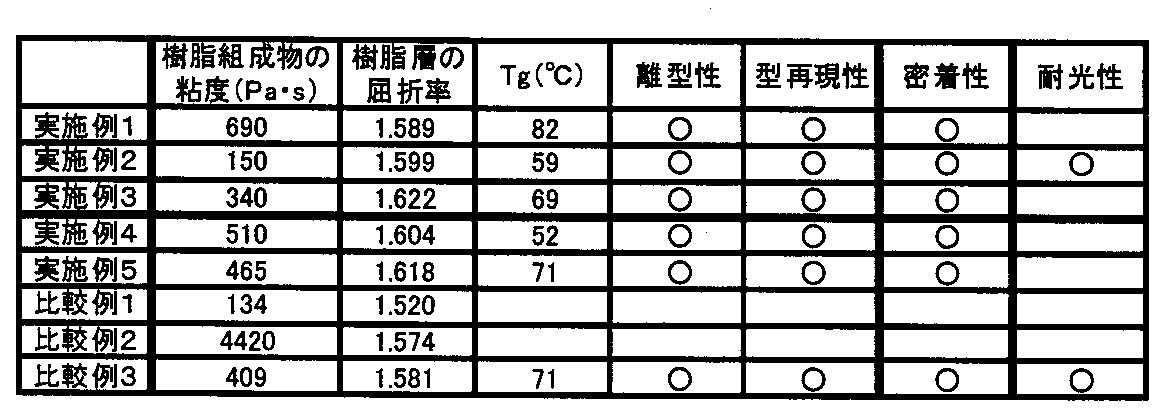
実施例1~5及び比較例1~3の評価結果から明らかなように、本発明の樹脂組成物は低粘度であり、本発明の硬化物は屈折率が高い他、離型性、型再現性、基材への密着性に優れる。このため微細構造を有する光学レンズシート、例えば、フレネルレンズ、レンチキュラーレンズ、プリズムレンズ、マイクロレンズ等に適している。特に高屈折率であるため高輝度品に適し、微細な加工が必要な用途や連続加工が必要な工程を含む製造に適している。
本発明の紫外線硬化性樹脂組成物及びその硬化物は、主に、フレネルレンズ、レンチキュラーレンズ、プリズムレンズ、マイクロレンズ等の光学レンズシート用に特に適するものである。
Claims (7)
- カルバゾリル基を有する化合物(A)及び光重合開始剤(B)を含む光学レンズシート用エネルギー線硬化型樹脂組成物。
- カルバゾリル基を有する化合物(A)が、一般式(2)で表される化合物(C)

- フェニルエーテル基を有するモノアクリレートモノマー(D)を更に含む請求項1または2に記載の樹脂組成物。
- フェニルエーテル基を有するモノアクリレートモノマー(D)がo-フェニルフェノール(ポリ)エトキシ(メタ)アクリレート、p-フェニルフェノール(ポリ)エトキシ(メタ)アクリレート、o-フェニルフェノールエポキシ(メタ)アクリレート、p-フェニルフェノールエポキシ(メタ)アクリレートからなる群より選ばれる1種以上である請求項1ないし3のいずれか一項に記載の樹脂組成物。
- カルバゾリル基を有する化合物(A)およびフェニルエーテル基を有するモノアクリレートモノマー(D)以外の(メタ)アクリレート化合物(E)を更に含む請求項1ないし4のいずれか一項に記載の樹脂組成物。
- 請求項1ないし5のいずれか一項に記載の樹脂組成物を硬化して得られる硬化物。
- 請求項6に記載の硬化物を用いる光学レンズシート。
Priority Applications (1)
| Application Number | Priority Date | Filing Date | Title |
|---|---|---|---|
| JP2011515992A JPWO2010137501A1 (ja) | 2009-05-25 | 2010-05-19 | 光学レンズシート用エネルギー線硬化型樹脂組成物及びその硬化物 |
Applications Claiming Priority (2)
| Application Number | Priority Date | Filing Date | Title |
|---|---|---|---|
| JP2009-125101 | 2009-05-25 | ||
| JP2009125101 | 2009-05-25 |
Publications (1)
| Publication Number | Publication Date |
|---|---|
| WO2010137501A1 true WO2010137501A1 (ja) | 2010-12-02 |
Family
ID=43222612
Family Applications (1)
| Application Number | Title | Priority Date | Filing Date |
|---|---|---|---|
| PCT/JP2010/058421 Ceased WO2010137501A1 (ja) | 2009-05-25 | 2010-05-19 | 光学レンズシート用エネルギー線硬化型樹脂組成物及びその硬化物 |
Country Status (3)
| Country | Link |
|---|---|
| JP (1) | JPWO2010137501A1 (ja) |
| TW (1) | TW201114783A (ja) |
| WO (1) | WO2010137501A1 (ja) |
Cited By (7)
| Publication number | Priority date | Publication date | Assignee | Title |
|---|---|---|---|---|
| JP2012052016A (ja) * | 2010-09-01 | 2012-03-15 | Olympus Corp | 材料組成物およびそれを用いた光学素子 |
| WO2012096071A1 (ja) * | 2011-01-13 | 2012-07-19 | 丸善石油化学株式会社 | 光インプリント用樹脂組成物、パターン形成方法及びエッチングマスク |
| KR20140077889A (ko) * | 2011-09-27 | 2014-06-24 | 마루젠 세끼유가가꾸 가부시키가이샤 | 광학 소자 재료, 및 그 제조 방법 |
| JPWO2021006012A1 (ja) * | 2019-07-08 | 2021-01-14 | ||
| US20220101878A1 (en) * | 2019-01-31 | 2022-03-31 | Sony Group Corporation | Hologram recording composition, hologram recording medium, hologram, and optical device and optical component using same |
| US20220289678A1 (en) * | 2019-07-08 | 2022-09-15 | Sony Group Corporation | Compound, polymer, and organic material, and optical apparatus, optical part, and image display apparatus using the organic material |
| US20240071417A1 (en) * | 2021-01-13 | 2024-02-29 | Sony Group Corporation | Hologram recording medium, hologram optical element, optical device, optical component, and method for forming hologram diffraction grating |
Citations (5)
| Publication number | Priority date | Publication date | Assignee | Title |
|---|---|---|---|---|
| JP2003040940A (ja) * | 2001-07-31 | 2003-02-13 | Dainippon Ink & Chem Inc | 光学素子用重合性組成物及びこれを用いた光学素子 |
| JP2008158361A (ja) * | 2006-12-25 | 2008-07-10 | Olympus Corp | 光学用樹脂組成物およびそれを用いた光学素子 |
| JP2009051972A (ja) * | 2007-08-28 | 2009-03-12 | Nippon Shokubai Co Ltd | 硬化性樹脂組成物および硬化物 |
| JP2009057528A (ja) * | 2007-09-04 | 2009-03-19 | Nippon Shokubai Co Ltd | 高分子量カルバゾール基含有ポリマー |
| JP2009091462A (ja) * | 2007-10-09 | 2009-04-30 | Nippon Shokubai Co Ltd | カルバゾイル基含有共重合体、光学材料用樹脂組成物および光学材料用部材 |
-
2010
- 2010-05-19 JP JP2011515992A patent/JPWO2010137501A1/ja not_active Withdrawn
- 2010-05-19 WO PCT/JP2010/058421 patent/WO2010137501A1/ja not_active Ceased
- 2010-05-24 TW TW099116542A patent/TW201114783A/zh unknown
Patent Citations (5)
| Publication number | Priority date | Publication date | Assignee | Title |
|---|---|---|---|---|
| JP2003040940A (ja) * | 2001-07-31 | 2003-02-13 | Dainippon Ink & Chem Inc | 光学素子用重合性組成物及びこれを用いた光学素子 |
| JP2008158361A (ja) * | 2006-12-25 | 2008-07-10 | Olympus Corp | 光学用樹脂組成物およびそれを用いた光学素子 |
| JP2009051972A (ja) * | 2007-08-28 | 2009-03-12 | Nippon Shokubai Co Ltd | 硬化性樹脂組成物および硬化物 |
| JP2009057528A (ja) * | 2007-09-04 | 2009-03-19 | Nippon Shokubai Co Ltd | 高分子量カルバゾール基含有ポリマー |
| JP2009091462A (ja) * | 2007-10-09 | 2009-04-30 | Nippon Shokubai Co Ltd | カルバゾイル基含有共重合体、光学材料用樹脂組成物および光学材料用部材 |
Cited By (16)
| Publication number | Priority date | Publication date | Assignee | Title |
|---|---|---|---|---|
| JP2012052016A (ja) * | 2010-09-01 | 2012-03-15 | Olympus Corp | 材料組成物およびそれを用いた光学素子 |
| KR101755759B1 (ko) | 2011-01-13 | 2017-07-07 | 마루젠 세끼유가가꾸 가부시키가이샤 | 광 임프린트용 수지 조성물, 패턴 형성 방법 및 에칭 마스크 |
| WO2012096071A1 (ja) * | 2011-01-13 | 2012-07-19 | 丸善石油化学株式会社 | 光インプリント用樹脂組成物、パターン形成方法及びエッチングマスク |
| CN103261238A (zh) * | 2011-01-13 | 2013-08-21 | 丸善石油化学株式会社 | 光压印用树脂组合物、图案形成方法及蚀刻掩模 |
| CN103261238B (zh) * | 2011-01-13 | 2015-08-26 | 丸善石油化学株式会社 | 光压印用树脂组合物、图案形成方法及蚀刻掩模 |
| JP5890323B2 (ja) * | 2011-01-13 | 2016-03-22 | 丸善石油化学株式会社 | 光インプリント用樹脂組成物、パターン形成方法及びエッチングマスク |
| US9399693B2 (en) | 2011-01-13 | 2016-07-26 | Maruzen Petrochemical Co., Ltd. | Resin composition for photoimprinting, pattern forming process and etching mask |
| KR101864920B1 (ko) | 2011-09-27 | 2018-06-05 | 마루젠 세끼유가가꾸 가부시키가이샤 | 광학 소자 재료, 및 그 제조 방법 |
| KR20140077889A (ko) * | 2011-09-27 | 2014-06-24 | 마루젠 세끼유가가꾸 가부시키가이샤 | 광학 소자 재료, 및 그 제조 방법 |
| US20220101878A1 (en) * | 2019-01-31 | 2022-03-31 | Sony Group Corporation | Hologram recording composition, hologram recording medium, hologram, and optical device and optical component using same |
| JPWO2021006012A1 (ja) * | 2019-07-08 | 2021-01-14 | ||
| US20220242985A1 (en) * | 2019-07-08 | 2022-08-04 | Sony Group Corporation | Photosensitive composition, hologram recording medium using the same, hologram optical element, and method of forming hologram diffraction grating |
| US20220289678A1 (en) * | 2019-07-08 | 2022-09-15 | Sony Group Corporation | Compound, polymer, and organic material, and optical apparatus, optical part, and image display apparatus using the organic material |
| JP7505493B2 (ja) | 2019-07-08 | 2024-06-25 | ソニーグループ株式会社 | 感光性組成物、及びこれを用いたホログラム記録媒体、ホログラム光学素子並びにホログラム回折格子の形成方法 |
| US12371521B2 (en) * | 2019-07-08 | 2025-07-29 | Sony Group Corporation | Photosensitive composition, hologram recording medium using the same, hologram optical element, and method of forming hologram diffraction grating |
| US20240071417A1 (en) * | 2021-01-13 | 2024-02-29 | Sony Group Corporation | Hologram recording medium, hologram optical element, optical device, optical component, and method for forming hologram diffraction grating |
Also Published As
| Publication number | Publication date |
|---|---|
| TW201114783A (en) | 2011-05-01 |
| JPWO2010137501A1 (ja) | 2012-11-15 |
Similar Documents
| Publication | Publication Date | Title |
|---|---|---|
| JP5219084B2 (ja) | 光学レンズシート用エネルギー線硬化型樹脂組成物及びその硬化物 | |
| JP5241023B2 (ja) | 光学レンズシート用エネルギー線硬化型樹脂組成物及びその硬化物 | |
| CN101675089B (zh) | (甲基)丙烯酸酯化合物、含有该化合物的树脂组合物及其固化物以及光学透镜片用能量射线固化型树脂组合物及其固化物 | |
| JP5757664B2 (ja) | ウレタン(メタ)アクリレート化合物及びそれを含有する樹脂組成物 | |
| JP2010138393A (ja) | 光学レンズシート用エネルギー線硬化型樹脂組成物及びその硬化物 | |
| KR101456513B1 (ko) | 광학 렌즈 시트용 에너지선 경화형 수지 조성물 및 그의 경화물 | |
| JPWO2010137501A1 (ja) | 光学レンズシート用エネルギー線硬化型樹脂組成物及びその硬化物 | |
| JP5057367B2 (ja) | 活性エネルギー線硬化型樹脂組成物及びその硬化物 | |
| JP6381318B2 (ja) | 光学レンズ用活性エネルギー線硬化性樹脂組成物 | |
| JP5744847B2 (ja) | 光学レンズシート用エネルギー線硬化型樹脂組成物及びその硬化物 | |
| JP5083830B2 (ja) | 光学レンズシート用エネルギー線硬化型樹脂組成物及び光学レンズシート | |
| KR20090042900A (ko) | 수지 조성물, 렌즈용 수지 조성물 및 그 경화물 | |
| JP2011033875A (ja) | 光学レンズ用エネルギー線硬化型樹脂組成物及び光学レンズ | |
| CN107531831A (zh) | (甲基)丙烯酸酯树脂及光学构件 | |
| JP4678726B2 (ja) | 樹脂組成物、レンズ用樹脂組成物及びその硬化物 | |
| JP5328003B2 (ja) | 樹脂組成物、レンズ用樹脂組成物及びその硬化物 | |
| WO2010004959A1 (ja) | 光学レンズシート用エネルギー線硬化型樹脂組成物及びその硬化物 | |
| JP5429832B2 (ja) | ウレタン(メタ)アクリレート化合物 | |
| JP5207388B2 (ja) | 光学レンズシート用エネルギー線硬化型樹脂組成物及びその硬化物 | |
| JP2009031779A (ja) | 光学レンズシート用エネルギー線硬化型樹脂組成物及び光学レンズシート |
Legal Events
| Date | Code | Title | Description |
|---|---|---|---|
| 121 | Ep: the epo has been informed by wipo that ep was designated in this application |
Ref document number: 10780456 Country of ref document: EP Kind code of ref document: A1 |
|
| WWE | Wipo information: entry into national phase |
Ref document number: 2011515992 Country of ref document: JP |
|
| NENP | Non-entry into the national phase |
Ref country code: DE |
|
| 122 | Ep: pct application non-entry in european phase |
Ref document number: 10780456 Country of ref document: EP Kind code of ref document: A1 |