WO2010134477A1 - 感放射線性樹脂組成物及び化合物 - Google Patents
感放射線性樹脂組成物及び化合物 Download PDFInfo
- Publication number
- WO2010134477A1 WO2010134477A1 PCT/JP2010/058214 JP2010058214W WO2010134477A1 WO 2010134477 A1 WO2010134477 A1 WO 2010134477A1 JP 2010058214 W JP2010058214 W JP 2010058214W WO 2010134477 A1 WO2010134477 A1 WO 2010134477A1
- Authority
- WO
- WIPO (PCT)
- Prior art keywords
- group
- general formula
- radiation
- carbon atoms
- linear
- Prior art date
- Legal status (The legal status is an assumption and is not a legal conclusion. Google has not performed a legal analysis and makes no representation as to the accuracy of the status listed.)
- Ceased
Links
Images

Classifications
-
- C—CHEMISTRY; METALLURGY
- C07—ORGANIC CHEMISTRY
- C07C—ACYCLIC OR CARBOCYCLIC COMPOUNDS
- C07C65/00—Compounds having carboxyl groups bound to carbon atoms of six—membered aromatic rings and containing any of the groups OH, O—metal, —CHO, keto, ether, groups, groups, or groups
- C07C65/01—Compounds having carboxyl groups bound to carbon atoms of six—membered aromatic rings and containing any of the groups OH, O—metal, —CHO, keto, ether, groups, groups, or groups containing hydroxy or O-metal groups
- C07C65/03—Compounds having carboxyl groups bound to carbon atoms of six—membered aromatic rings and containing any of the groups OH, O—metal, —CHO, keto, ether, groups, groups, or groups containing hydroxy or O-metal groups monocyclic and having all hydroxy or O-metal groups bound to the ring
- C07C65/05—Compounds having carboxyl groups bound to carbon atoms of six—membered aromatic rings and containing any of the groups OH, O—metal, —CHO, keto, ether, groups, groups, or groups containing hydroxy or O-metal groups monocyclic and having all hydroxy or O-metal groups bound to the ring o-Hydroxy carboxylic acids
- C07C65/10—Salicylic acid
-
- C—CHEMISTRY; METALLURGY
- C08—ORGANIC MACROMOLECULAR COMPOUNDS; THEIR PREPARATION OR CHEMICAL WORKING-UP; COMPOSITIONS BASED THEREON
- C08F—MACROMOLECULAR COMPOUNDS OBTAINED BY REACTIONS ONLY INVOLVING CARBON-TO-CARBON UNSATURATED BONDS
- C08F12/00—Homopolymers and copolymers of compounds having one or more unsaturated aliphatic radicals, each having only one carbon-to-carbon double bond, and at least one being terminated by an aromatic carbocyclic ring
- C08F12/02—Monomers containing only one unsaturated aliphatic radical
- C08F12/04—Monomers containing only one unsaturated aliphatic radical containing one ring
- C08F12/14—Monomers containing only one unsaturated aliphatic radical containing one ring substituted by hetero atoms or groups containing heteroatoms
- C08F12/22—Oxygen
-
- C—CHEMISTRY; METALLURGY
- C08—ORGANIC MACROMOLECULAR COMPOUNDS; THEIR PREPARATION OR CHEMICAL WORKING-UP; COMPOSITIONS BASED THEREON
- C08F—MACROMOLECULAR COMPOUNDS OBTAINED BY REACTIONS ONLY INVOLVING CARBON-TO-CARBON UNSATURATED BONDS
- C08F212/00—Copolymers of compounds having one or more unsaturated aliphatic radicals, each having only one carbon-to-carbon double bond, and at least one being terminated by an aromatic carbocyclic ring
- C08F212/02—Monomers containing only one unsaturated aliphatic radical
- C08F212/04—Monomers containing only one unsaturated aliphatic radical containing one ring
- C08F212/06—Hydrocarbons
-
- C—CHEMISTRY; METALLURGY
- C08—ORGANIC MACROMOLECULAR COMPOUNDS; THEIR PREPARATION OR CHEMICAL WORKING-UP; COMPOSITIONS BASED THEREON
- C08F—MACROMOLECULAR COMPOUNDS OBTAINED BY REACTIONS ONLY INVOLVING CARBON-TO-CARBON UNSATURATED BONDS
- C08F212/00—Copolymers of compounds having one or more unsaturated aliphatic radicals, each having only one carbon-to-carbon double bond, and at least one being terminated by an aromatic carbocyclic ring
- C08F212/02—Monomers containing only one unsaturated aliphatic radical
- C08F212/04—Monomers containing only one unsaturated aliphatic radical containing one ring
- C08F212/14—Monomers containing only one unsaturated aliphatic radical containing one ring substituted by heteroatoms or groups containing heteroatoms
- C08F212/22—Oxygen
-
- C—CHEMISTRY; METALLURGY
- C08—ORGANIC MACROMOLECULAR COMPOUNDS; THEIR PREPARATION OR CHEMICAL WORKING-UP; COMPOSITIONS BASED THEREON
- C08F—MACROMOLECULAR COMPOUNDS OBTAINED BY REACTIONS ONLY INVOLVING CARBON-TO-CARBON UNSATURATED BONDS
- C08F220/00—Copolymers of compounds having one or more unsaturated aliphatic radicals, each having only one carbon-to-carbon double bond, and only one being terminated by only one carboxyl radical or a salt, anhydride ester, amide, imide or nitrile thereof
- C08F220/02—Monocarboxylic acids having less than ten carbon atoms; Derivatives thereof
- C08F220/10—Esters
-
- C—CHEMISTRY; METALLURGY
- C08—ORGANIC MACROMOLECULAR COMPOUNDS; THEIR PREPARATION OR CHEMICAL WORKING-UP; COMPOSITIONS BASED THEREON
- C08F—MACROMOLECULAR COMPOUNDS OBTAINED BY REACTIONS ONLY INVOLVING CARBON-TO-CARBON UNSATURATED BONDS
- C08F8/00—Chemical modification by after-treatment
- C08F8/12—Hydrolysis
-
- C—CHEMISTRY; METALLURGY
- C09—DYES; PAINTS; POLISHES; NATURAL RESINS; ADHESIVES; COMPOSITIONS NOT OTHERWISE PROVIDED FOR; APPLICATIONS OF MATERIALS NOT OTHERWISE PROVIDED FOR
- C09D—COATING COMPOSITIONS, e.g. PAINTS, VARNISHES OR LACQUERS; FILLING PASTES; CHEMICAL PAINT OR INK REMOVERS; INKS; CORRECTING FLUIDS; WOODSTAINS; PASTES OR SOLIDS FOR COLOURING OR PRINTING; USE OF MATERIALS THEREFOR
- C09D125/00—Coating compositions based on homopolymers or copolymers of compounds having one or more unsaturated aliphatic radicals, each having only one carbon-to-carbon double bond, and at least one being terminated by an aromatic carbocyclic ring; Coating compositions based on derivatives of such polymers
- C09D125/18—Homopolymers or copolymers of aromatic monomers containing elements other than carbon and hydrogen
-
- G—PHYSICS
- G03—PHOTOGRAPHY; CINEMATOGRAPHY; ANALOGOUS TECHNIQUES USING WAVES OTHER THAN OPTICAL WAVES; ELECTROGRAPHY; HOLOGRAPHY
- G03F—PHOTOMECHANICAL PRODUCTION OF TEXTURED OR PATTERNED SURFACES, e.g. FOR PRINTING, FOR PROCESSING OF SEMICONDUCTOR DEVICES; MATERIALS THEREFOR; ORIGINALS THEREFOR; APPARATUS SPECIALLY ADAPTED THEREFOR
- G03F7/00—Photomechanical, e.g. photolithographic, production of textured or patterned surfaces, e.g. printing surfaces; Materials therefor, e.g. comprising photoresists; Apparatus specially adapted therefor
- G03F7/004—Photosensitive materials
- G03F7/0045—Photosensitive materials with organic non-macromolecular light-sensitive compounds not otherwise provided for, e.g. dissolution inhibitors
-
- G—PHYSICS
- G03—PHOTOGRAPHY; CINEMATOGRAPHY; ANALOGOUS TECHNIQUES USING WAVES OTHER THAN OPTICAL WAVES; ELECTROGRAPHY; HOLOGRAPHY
- G03F—PHOTOMECHANICAL PRODUCTION OF TEXTURED OR PATTERNED SURFACES, e.g. FOR PRINTING, FOR PROCESSING OF SEMICONDUCTOR DEVICES; MATERIALS THEREFOR; ORIGINALS THEREFOR; APPARATUS SPECIALLY ADAPTED THEREFOR
- G03F7/00—Photomechanical, e.g. photolithographic, production of textured or patterned surfaces, e.g. printing surfaces; Materials therefor, e.g. comprising photoresists; Apparatus specially adapted therefor
- G03F7/004—Photosensitive materials
- G03F7/0046—Photosensitive materials with perfluoro compounds, e.g. for dry lithography
-
- G—PHYSICS
- G03—PHOTOGRAPHY; CINEMATOGRAPHY; ANALOGOUS TECHNIQUES USING WAVES OTHER THAN OPTICAL WAVES; ELECTROGRAPHY; HOLOGRAPHY
- G03F—PHOTOMECHANICAL PRODUCTION OF TEXTURED OR PATTERNED SURFACES, e.g. FOR PRINTING, FOR PROCESSING OF SEMICONDUCTOR DEVICES; MATERIALS THEREFOR; ORIGINALS THEREFOR; APPARATUS SPECIALLY ADAPTED THEREFOR
- G03F7/00—Photomechanical, e.g. photolithographic, production of textured or patterned surfaces, e.g. printing surfaces; Materials therefor, e.g. comprising photoresists; Apparatus specially adapted therefor
- G03F7/004—Photosensitive materials
- G03F7/0047—Photosensitive materials characterised by additives for obtaining a metallic or ceramic pattern, e.g. by firing
-
- G—PHYSICS
- G03—PHOTOGRAPHY; CINEMATOGRAPHY; ANALOGOUS TECHNIQUES USING WAVES OTHER THAN OPTICAL WAVES; ELECTROGRAPHY; HOLOGRAPHY
- G03F—PHOTOMECHANICAL PRODUCTION OF TEXTURED OR PATTERNED SURFACES, e.g. FOR PRINTING, FOR PROCESSING OF SEMICONDUCTOR DEVICES; MATERIALS THEREFOR; ORIGINALS THEREFOR; APPARATUS SPECIALLY ADAPTED THEREFOR
- G03F7/00—Photomechanical, e.g. photolithographic, production of textured or patterned surfaces, e.g. printing surfaces; Materials therefor, e.g. comprising photoresists; Apparatus specially adapted therefor
- G03F7/004—Photosensitive materials
- G03F7/039—Macromolecular compounds which are photodegradable, e.g. positive electron resists
- G03F7/0392—Macromolecular compounds which are photodegradable, e.g. positive electron resists the macromolecular compound being present in a chemically amplified positive photoresist composition
- G03F7/0397—Macromolecular compounds which are photodegradable, e.g. positive electron resists the macromolecular compound being present in a chemically amplified positive photoresist composition the macromolecular compound having an alicyclic moiety in a side chain
-
- Y—GENERAL TAGGING OF NEW TECHNOLOGICAL DEVELOPMENTS; GENERAL TAGGING OF CROSS-SECTIONAL TECHNOLOGIES SPANNING OVER SEVERAL SECTIONS OF THE IPC; TECHNICAL SUBJECTS COVERED BY FORMER USPC CROSS-REFERENCE ART COLLECTIONS [XRACs] AND DIGESTS
- Y10—TECHNICAL SUBJECTS COVERED BY FORMER USPC
- Y10S—TECHNICAL SUBJECTS COVERED BY FORMER USPC CROSS-REFERENCE ART COLLECTIONS [XRACs] AND DIGESTS
- Y10S430/00—Radiation imagery chemistry: process, composition, or product thereof
- Y10S430/1053—Imaging affecting physical property or radiation sensitive material, or producing nonplanar or printing surface - process, composition, or product: radiation sensitive composition or product or process of making binder containing
- Y10S430/1055—Radiation sensitive composition or product or process of making
- Y10S430/114—Initiator containing
- Y10S430/122—Sulfur compound containing
-
- Y—GENERAL TAGGING OF NEW TECHNOLOGICAL DEVELOPMENTS; GENERAL TAGGING OF CROSS-SECTIONAL TECHNOLOGIES SPANNING OVER SEVERAL SECTIONS OF THE IPC; TECHNICAL SUBJECTS COVERED BY FORMER USPC CROSS-REFERENCE ART COLLECTIONS [XRACs] AND DIGESTS
- Y10—TECHNICAL SUBJECTS COVERED BY FORMER USPC
- Y10S—TECHNICAL SUBJECTS COVERED BY FORMER USPC CROSS-REFERENCE ART COLLECTIONS [XRACs] AND DIGESTS
- Y10S430/00—Radiation imagery chemistry: process, composition, or product thereof
- Y10S430/1053—Imaging affecting physical property or radiation sensitive material, or producing nonplanar or printing surface - process, composition, or product: radiation sensitive composition or product or process of making binder containing
- Y10S430/1055—Radiation sensitive composition or product or process of making
- Y10S430/114—Initiator containing
- Y10S430/126—Halogen compound containing
Definitions
- the present invention relates to a radiation sensitive resin composition and a compound. More specifically, for microfabrication by various types of radiation such as KrF excimer laser, ArF excimer laser, F 2 excimer laser, EUV (extreme) deep ultraviolet rays, synchrotron radiation, etc., X-rays, electron beams, etc.
- the present invention relates to a radiation-sensitive resin composition used as a suitable chemically amplified resist and a compound used therefor.
- Lithography using EUV light is positioned as a next-generation or next-generation pattern forming technology, and a positive resist with high sensitivity and high resolution is desired.
- high sensitivity is a very important issue for shortening the wafer processing time.
- the positive resist for EUV if high sensitivity is pursued, not only the resolution is lowered but also the nano edge roughness is deteriorated. Therefore, it is strongly desired to develop a resist that simultaneously satisfies these characteristics.
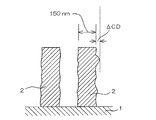
- Nano edge roughness is designed when the pattern is viewed from directly above because the resist pattern and the edge of the substrate interface vary irregularly in the direction perpendicular to the line direction due to the characteristics of the resist. This refers to the deviation that occurs between the dimensions and the actual pattern dimensions.
- Patent Document 1 discloses a radiation-sensitive resin composition containing a copolymer of 4-hydroxystyrene and 2-methyl-2-adamantyl acrylate.
- Patent Document 2 discloses a radiation-sensitive resin composition using two types of photoacid generators.
- Patent Document 3 discloses a radiation-sensitive resin composition that uses a photoacid generator that generates a strong acid and a photoacid generator that generates a weak acid, and Patent Document 4 has a boiling point of 150 ° C. or higher.
- a radiation-sensitive resin composition using a compound that generates carboxylic acid and a compound that generates an acid other than carboxylic acid is disclosed.
- JP 2001-166478 A JP-A-5-323590 Japanese Patent Laid-Open No. 5-181279 JP-A-11-125907
- the present invention has been made in view of the above-described problems of the prior art, and the problem is that KrF excimer laser, ArF excimer laser, EUV and other (ultra) far ultraviolet rays, synchrotron radiation, etc.
- a radiation-sensitive resin composition capable of forming a chemically amplified positive resist film capable of forming a fine pattern with high accuracy and stability, effectively sensitive to X-rays and electron beams It is to provide.
- the following radiation-sensitive resin composition and compound are provided.
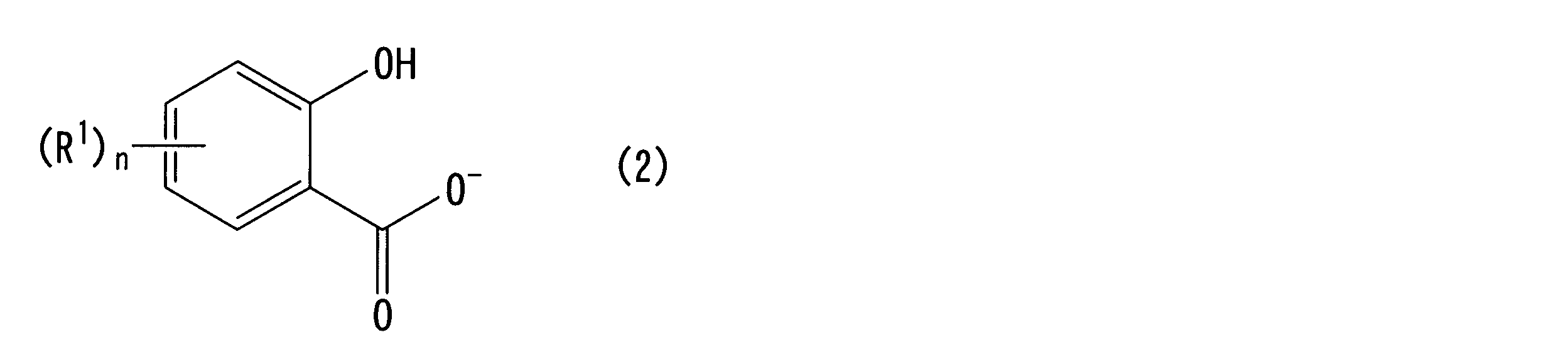
- Z ⁇ represents a monovalent anion represented by the following general formula (2).
- M + represents a monovalent onium cation.
- R 1 is a linear or branched alkyl group having 1 to 12 carbon atoms substituted or unsubstituted by a fluorine atom, or a linear or branched group having 1 to 12 carbon atoms.
- n represents 1 or 2.
- the (A) acid-dissociable group-containing resin is represented by the following general formula (3): a repeating unit represented by the following general formula (3) (hereinafter also referred to as “repeating unit (2)”): Selected from the group consisting of repeating units (hereinafter also referred to as “repeating units (3)”) and repeating units represented by the following general formula (5) (hereinafter also referred to as “repeating units (4)”).
- the radiation-sensitive resin composition according to any one of [1] to [3], which has at least one repeating unit.
- R 2 represents a hydrogen atom or a methyl group.
- R 3 represents a hydrogen atom, a linear or branched alkyl group having 1 to 12 carbon atoms, or 1 to 12 carbon atoms.
- i represents an integer of 0 to 3.
- j represents an integer of 0 to 3.
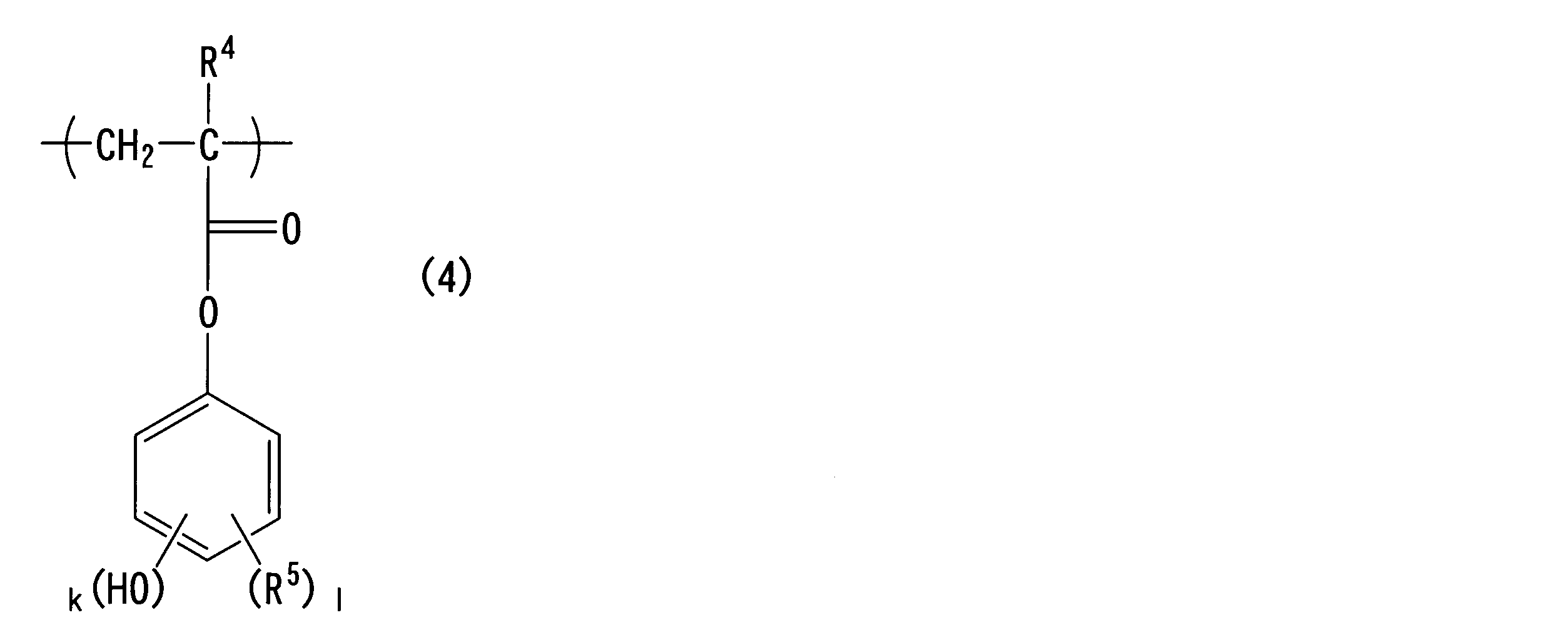
- R 4 represents a hydrogen atom or a methyl group.
- R 5 represents a hydrogen atom, a linear or branched alkyl group having 1 to 12 carbon atoms, or 1 to 12 carbon atoms.
- R 6 represents a hydrogen atom or a methyl group.
- R 7 represents a hydrogen atom, a linear or branched alkyl group having 1 to 12 carbon atoms, or a carbon number of 1 to 12).
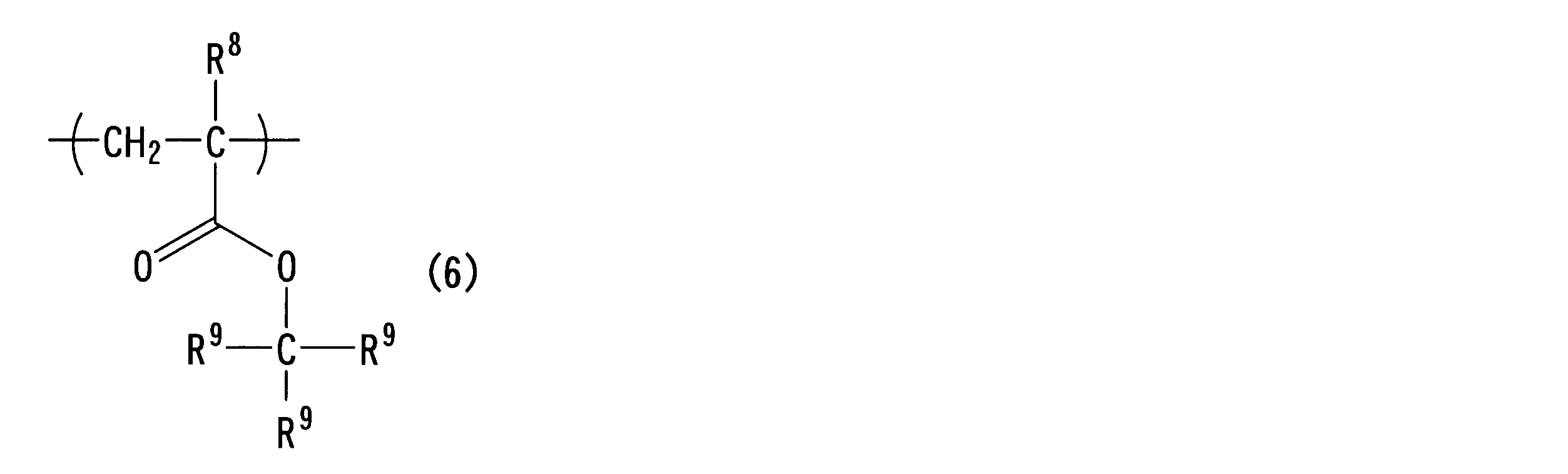
- R 8 represents a hydrogen atom, a methyl group, a trifluoromethyl group, or a hydroxymethyl group.
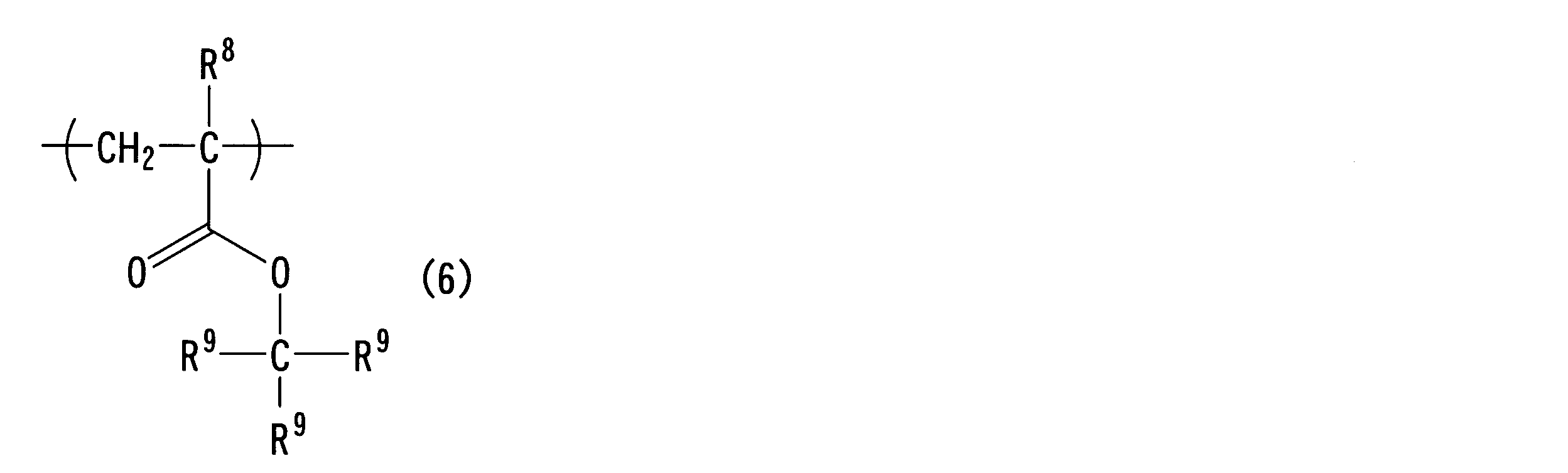
- the plurality of R 9 s are independently monovalent from 4 to 20 carbon atoms. shows a alicyclic hydrocarbon group or a derivative thereof, or linear or branched alkyl group having 1 to 4 carbon atoms. However, any two of R 9 is bonded to each other, they are bonded to each other And a divalent alicyclic hydrocarbon group or a derivative thereof may be formed together with the carbon atom.
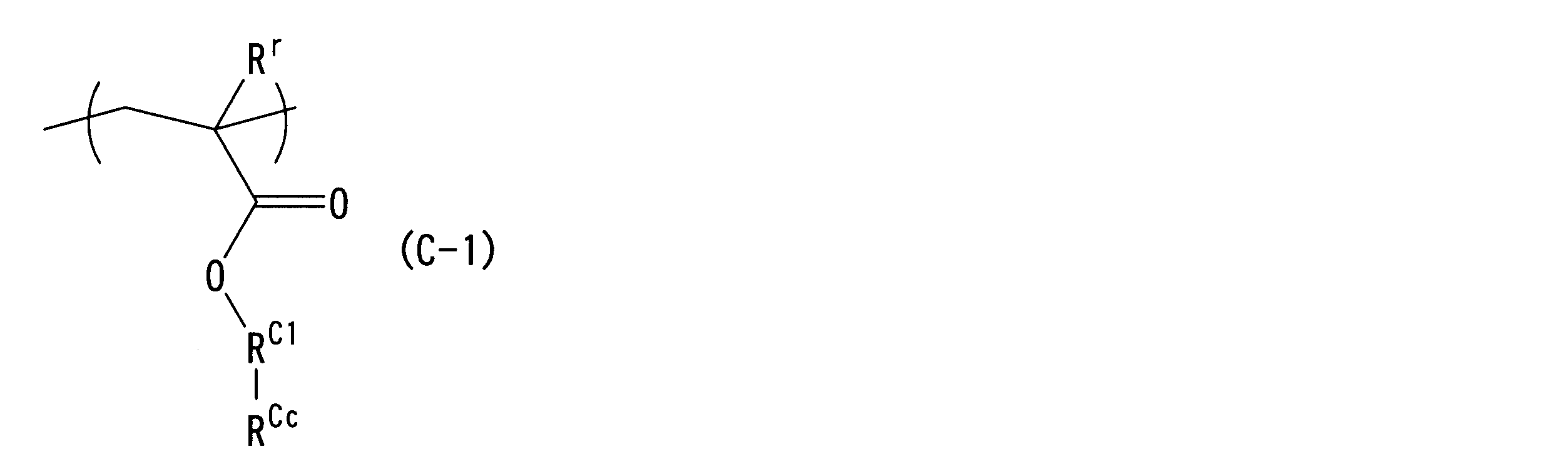
- the (A) acid-dissociable group-containing resin comprises a repeating unit represented by the following general formula (L-1) (hereinafter also referred to as “repeating unit (L)”) and a general formula (C-1
- L-1 repeating unit
- C-1 general formula (C-1)
- R r represents a hydrogen atom, a methyl group, or a trifluoromethyl group.
- R L1 represents a single bond or a divalent linking group.
- R Lc represents a lactone structure.
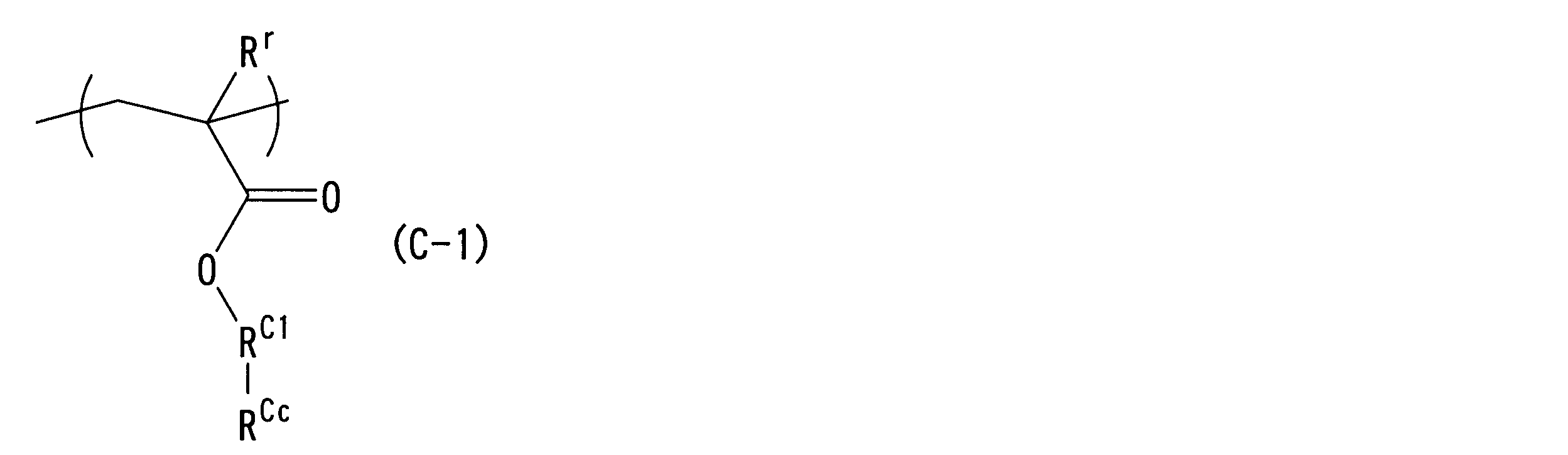
- R r represents a hydrogen atom, a methyl group, or a trifluoromethyl group.
- R C1 represents a single bond or a divalent linking group.
- R Cc represents a cyclic carbonate. A monovalent organic group having a structure is shown.
- Z ⁇ represents a monovalent anion represented by the following general formula (2).
- M + represents a monovalent onium cation.
- R 1 is a linear or branched alkyl group having 1 to 12 carbon atoms substituted or unsubstituted by a fluorine atom, or a linear or branched group having 1 to 12 carbon atoms.
- n represents 1 or 2.
- the radiation-sensitive resin composition of the present invention is sensitive to X-rays such as KrF excimer laser, ArF excimer laser, EUV (extreme) deep ultraviolet rays, synchrotron radiation, and electron beams, nano edge roughness, sensitivity and
- X-rays such as KrF excimer laser, ArF excimer laser, EUV (extreme) deep ultraviolet rays, synchrotron radiation, and electron beams, nano edge roughness, sensitivity and
- the chemical amplification type positive resist film which has excellent resolution and can form a fine pattern with high accuracy and stability can be formed.
- the compound of the present invention has an effect that it can be suitably used for the radiation-sensitive resin composition of the present invention.
- the radiation-sensitive resin composition of the present invention contains a resin (A) and a carboxylic acid generator (C), and further contains an acid generator (B). preferable.
- the resin (A) has a repeating unit having an acid dissociable group, and is usually a resin that is insoluble in alkali or hardly soluble in alkali, and becomes easily soluble in alkali by the action of an acid.
- alkali insoluble or alkali insoluble refers to alkali development conditions employed when forming a resist pattern from a resist film formed using a radiation-sensitive resin composition containing the resin (A). Below, when a 100 nm-thick film using only the resin (A) is developed instead of the resist film, 50% or more of the initial film thickness remains after development.
- the radiation sensitive resin composition contains such a resin (A), it has excellent sensitivity. For this reason, the radiation-sensitive resin composition is sensitive to an electron beam or extreme ultraviolet rays in a lithography process, has low roughness, excellent sensitivity and resolution, and forms a fine pattern with high accuracy and stability. It is possible to form a chemically amplified positive resist film capable of
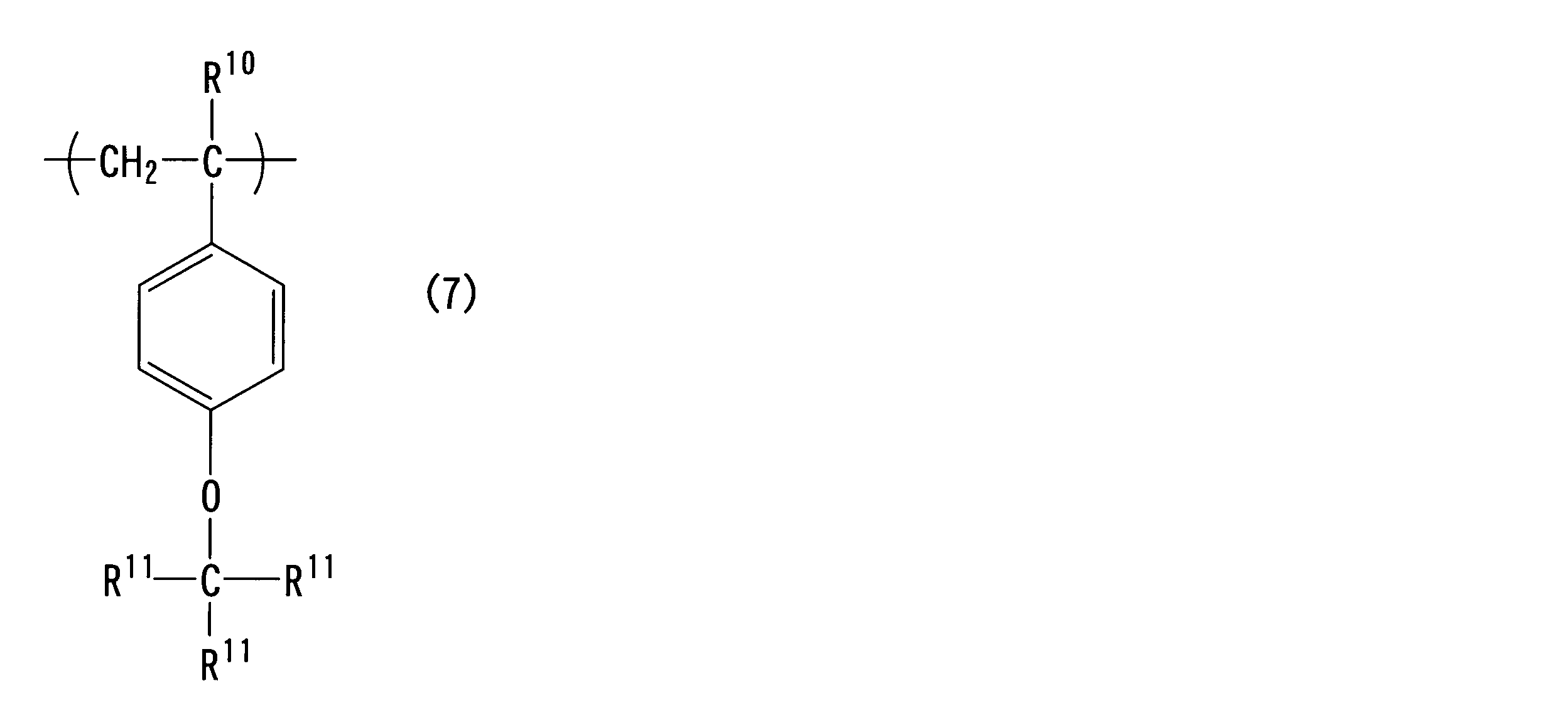
- Resin (A) contains at least one repeating unit (hereinafter referred to as “repeating unit (1)”) among the repeating unit represented by formula (6) and the repeating unit represented by formula (7). It is preferable to have.
- R 10 represents a hydrogen atom, a methyl group, a trifluoromethyl group, or a hydroxymethyl group.
- the plurality of R 11 are each independently a monovalent group having 4 to 20 carbon atoms.
- the divalent alicyclic hydrocarbon group or its derivative may be formed with the carbon atom.
- examples of the linear or branched alkyl group having 1 to 4 carbon atoms include a methyl group, an ethyl group, an n-propyl group, i -Propyl group, n-butyl group, 2-methylpropyl group, 1-methylpropyl group, t-butyl group and the like.
- Examples of the monovalent alicyclic hydrocarbon group having 4 to 20 carbon atoms include norbornane, tricyclodecane, tetracyclododecane, adamantane, and cyclobutane, cyclopentane, cyclohexane, cycloheptane, cyclooctane and the like.
- any two R 9 s bonded to each other and the divalent alicyclic hydrocarbon group or derivative thereof formed together with the carbon atom to which each is bonded include, for example, norbornane, tricyclodecane, Examples thereof include a group composed of an alicyclic ring derived from tetracyclododecane, adamantane, cyclopentane and cyclohexane, and a group obtained by substituting a group composed of these alicyclic rings with the alkyl group.
- repeating units (1) the repeating units represented by the general formulas (6-1) to (6-7) and the repeating unit represented by the general formula (7-1) are preferable, and the general formula (6- The repeating units represented by 2) to (6-4) are particularly preferred.
- R 12 is a hydrogen atom, a methyl group, .R 13 showing a trifluoromethyl group, or a hydroxymethyl group are mutually Independently, it represents a linear or branched alkyl group having 1 to 4 carbon atoms.
- resin (A) may have only 1 type of repeating unit (1), and may have 2 or more types.
- the resin (A) may be composed only of the repeating unit (1), but in addition to the repeating unit (1), the repeating unit (2), the repeating unit (3), and the repeating unit (4). More preferably, it has at least one repeating unit selected from the group consisting of:
- Examples of the repeating unit (2) include the general formula (3).
- examples of the linear or branched alkyl group having 1 to 12 carbon atoms include: Methyl group, ethyl group, n-propyl group, i-propyl group, n-butyl group, 2-methylpropyl group, 1-methylpropyl group, t-butyl group and the like.
- Examples of the linear or branched alkoxy group having 1 to 12 carbon atoms include a methoxy group, an ethoxy group, an n-propoxy group, an i-propoxy group, an n-butoxy group, a 2-methylpropoxy group, -Methylpropoxy group, t-butoxy group and the like.
- the group represented by R 3 is preferably a methyl group, an ethyl group, an n-butyl group, or a t-butyl group.
- i is an integer of 0 to 3, more preferably 1 or 2.
- J is an integer from 0 to 3, more preferably an integer from 0 to 2.
- repeating unit (2) represented by the general formula (3) examples include repeating units represented by the formulas (3-1) to (3-4).
- resin (A) when resin (A) has a repeating unit (2), resin (A) may have 1 type of repeating units (2), and may have 2 or more types.
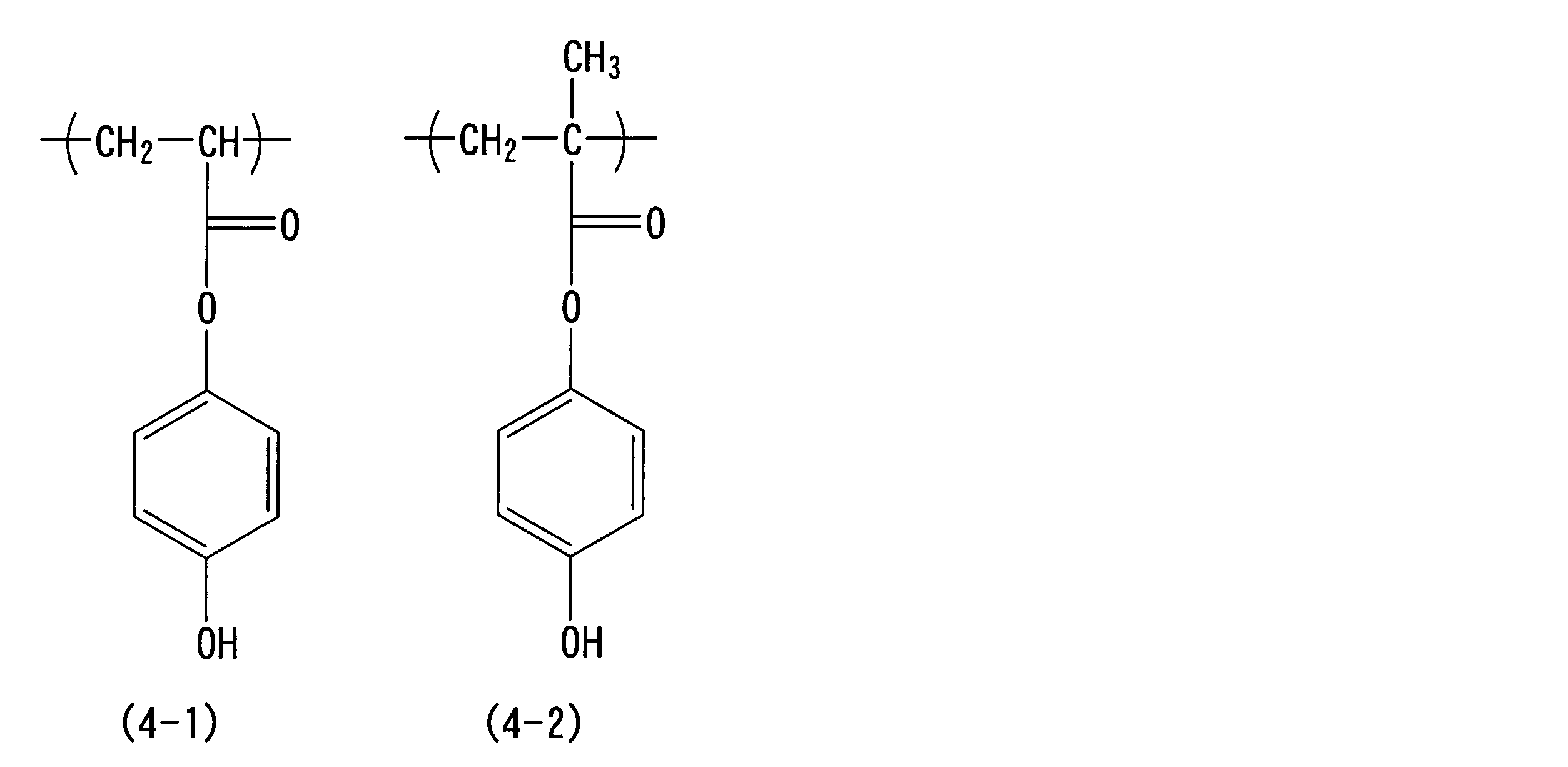
- Examples of the repeating unit (3) include the general formula (4).
- the groups represented by R 5 a linear or branched alkyl group having 1 to 12 carbon atoms and a carbon number of 1
- Specific examples of the linear or branched alkoxy group of 12 to 12 are the same as the group represented by R 3 in the general formula (3).
- k is an integer of 1 to 3, more preferably 1 or 2.
- L is an integer of 0 to 3, more preferably 0 or 1.
- repeating unit (3) examples include repeating units represented by the formulas (4-1) and (4-2).
- resin (A) may have 1 type of repeating units (3), and may have 2 or more types.
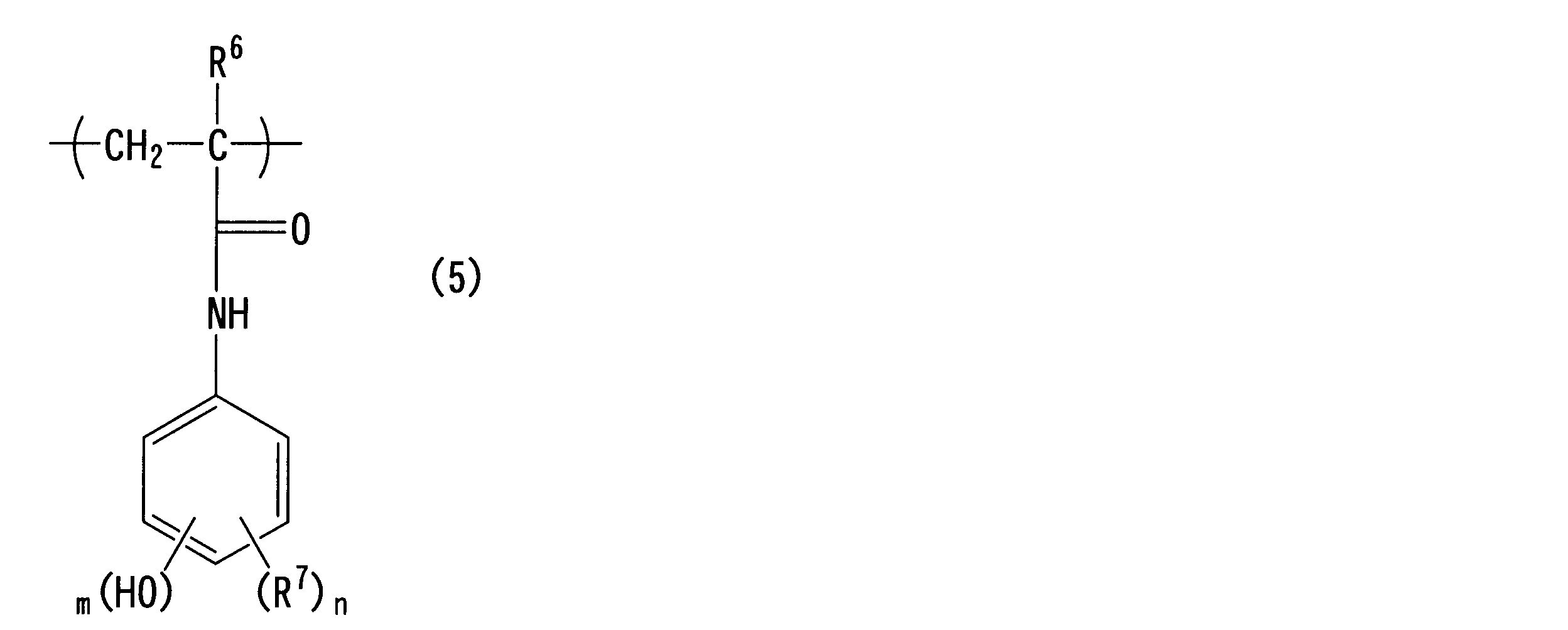
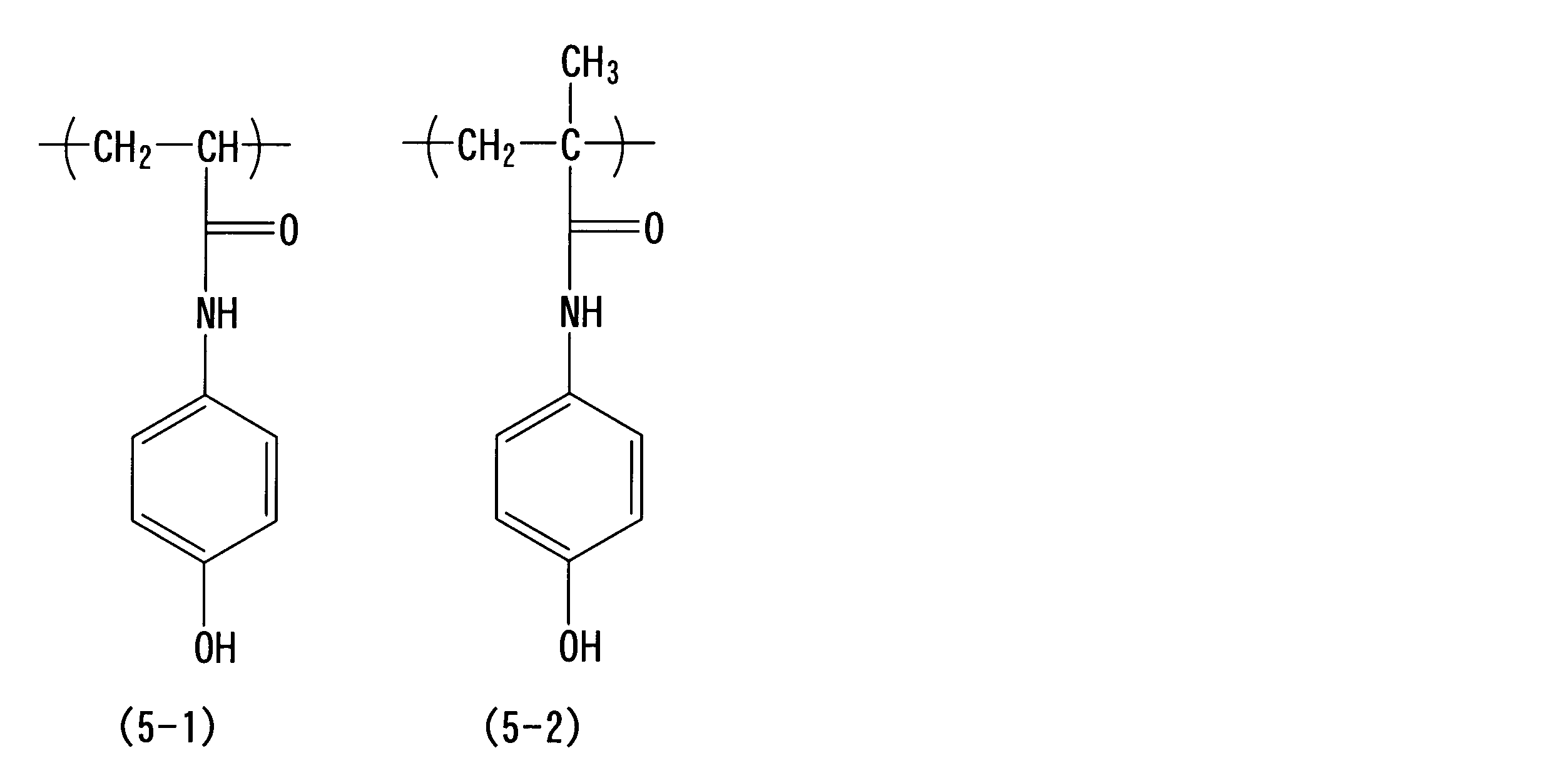
- Examples of the repeating unit (4) include the general formula (5).
- the groups represented by R 7 a linear or branched alkyl group having 1 to 12 carbon atoms and a carbon number of 1
- Specific examples of the linear or branched alkoxy group of 12 to 12 are the same as the group represented by R 3 in the general formula (3).
- m is an integer of 1 to 3, and is more preferably 1 or 2.
- N is an integer of 0 to 3, more preferably 0 or 1.
- repeating unit (4) examples include repeating units represented by the formulas (5-1) and (5-2).
- resin (A) may have 1 type of repeating units (4), and may have 2 or more types.
- a polymer having repeating units represented by the formulas (3-1) to (3-3) can be obtained by polymerization using a corresponding hydroxystyrene derivative as a monomer. Furthermore, it can also obtain by superposing
- the monomer used for obtaining the polymer having the repeating unit represented by the formulas (3-1) to (3-3) include p-acetoxystyrene, p- (1-ethoxyethoxy) styrene, and the like. preferable. When these monomers are used, a polymer having repeating units represented by the formulas (3-1) to (3-3) can be obtained by polymerizing and then hydrolyzing the side chain. .
- the polymer having repeating units represented by the formulas (3-4), (4-1), (4-2), (5-1), and (5-2) includes a corresponding monomer. It can obtain by superposing
- Monomer used to obtain a polymer having repeating units represented by formulas (3-4), (4-1), (4-2), (5-1), and (5-2) As such, p-isopropenylphenol, 4-hydroxyphenyl acrylate, 4-hydroxyphenyl methacrylate, N- (4-hydroxyphenyl) acrylamide, N- (4-hydroxyphenyl) methacrylamide and the like are preferable.
- Resin (A) may have a repeating unit derived from a non-acid dissociable compound (hereinafter also referred to as “repeating unit (5)”).
- repeating unit (5) examples include styrene, ⁇ -methylstyrene, 4-methylstyrene, 2-methylstyrene, 3-methylstyrene, isobornyl acrylate, tricyclodecanyl (meth) acrylate, and tetracyclodone.
- a repeating unit derived from styrene, ⁇ -methylstyrene, 4-methylstyrene, 2-methylstyrene, 3-methylstyrene, tricyclodecanyl acrylate, the repeating unit (L), or the repeating unit (C ) is preferred.
- resin (A) may have 1 type of repeating units (5), and may have 2 or more types.
- the “(meth) acrylate” here means “acrylate” or “methacrylate”.
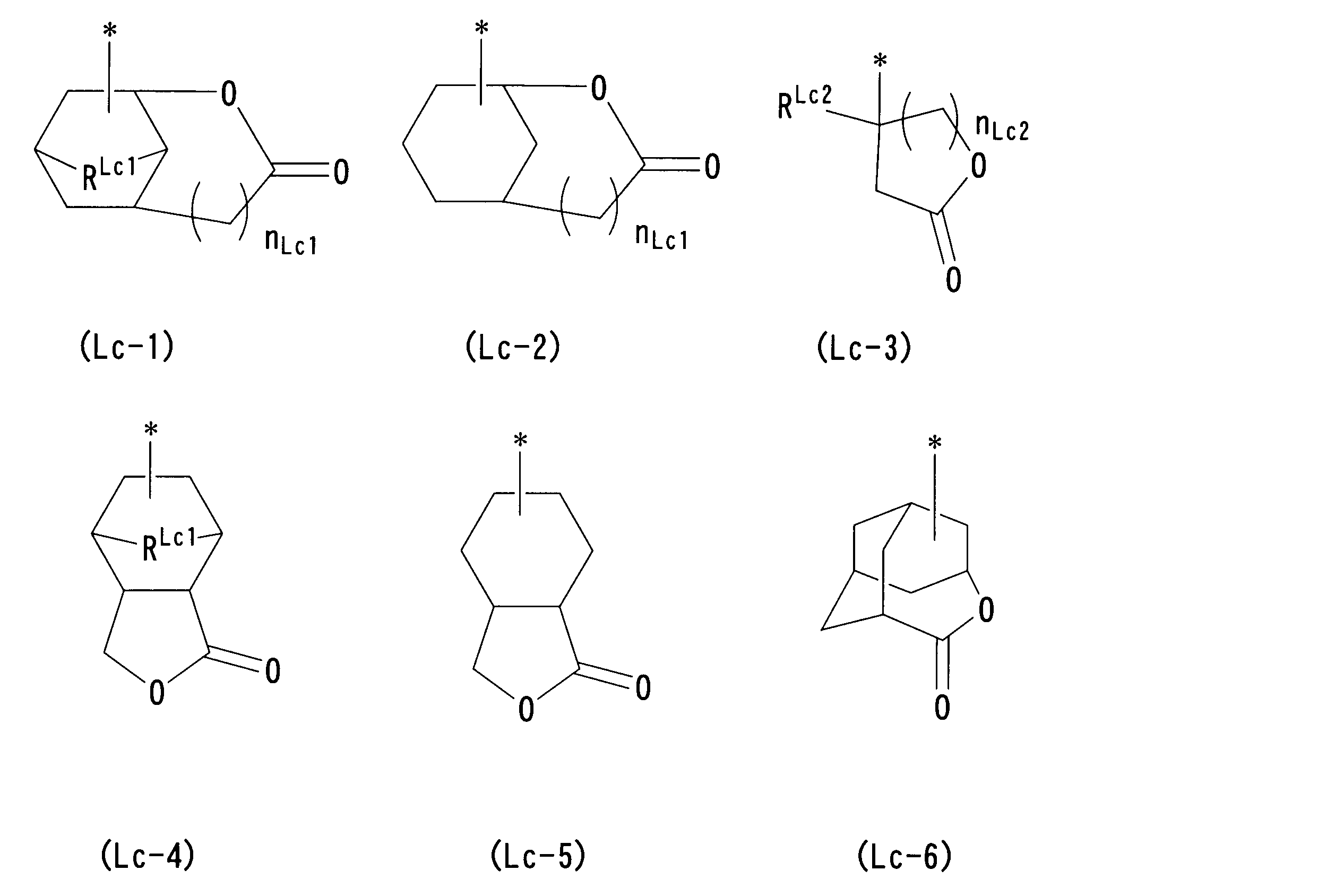
- Specific examples of the monovalent organic group having a lactone structure represented by R Lc in the general formula (L-1) include groups represented by the following general formulas (Lc-1) to (Lc-6) Can be mentioned.
- R Lc1 represents an oxygen atom or a methylene group.
- R Lc2 represents a hydrogen atom or a group having 1 to 4 carbon atoms.
- n Lc1 is 0 or 1.
- n Lc2 is an integer of 0 to 3.
- “*” represents a bond bonded to R L1 in the general formula (L-1), and the general formulas (Lc-1) to (Lc) The group represented by -6) may have a substituent.
- repeating unit (L) examples include repeating units described in paragraphs 0054 to 0057 of JP2007-304537, repeating units described in paragraphs 0086 to 0087 of JP2008-088343, and the following general formula. Mention may be made of the repeating units represented by (L-1a) to (L-1l). In the following general formulas (L-1a) to (L-1l), R represents a hydrogen atom, a methyl group, or a trifluoromethyl group.
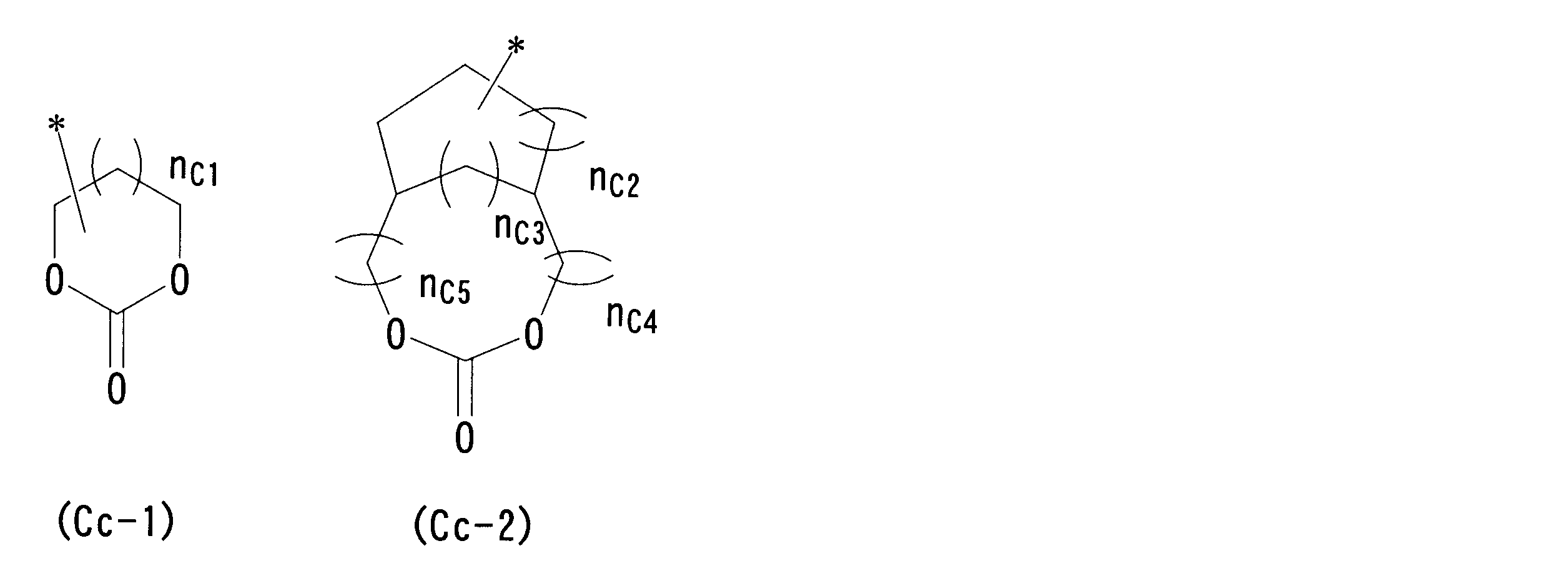
- examples of the monovalent organic group having a cyclic carbonate structure represented by R Cc include groups represented by the following general formula (Cc-1) or (Cc-2). is there.
- n C1 represents an integer of 0 to 2.
- n C2 to n C5 each independently represents an integer of 0 to 2.
- “*” represents a bond bonded to R C1 in the general formula (C-1).
- To (Cc-2) may have a substituent.
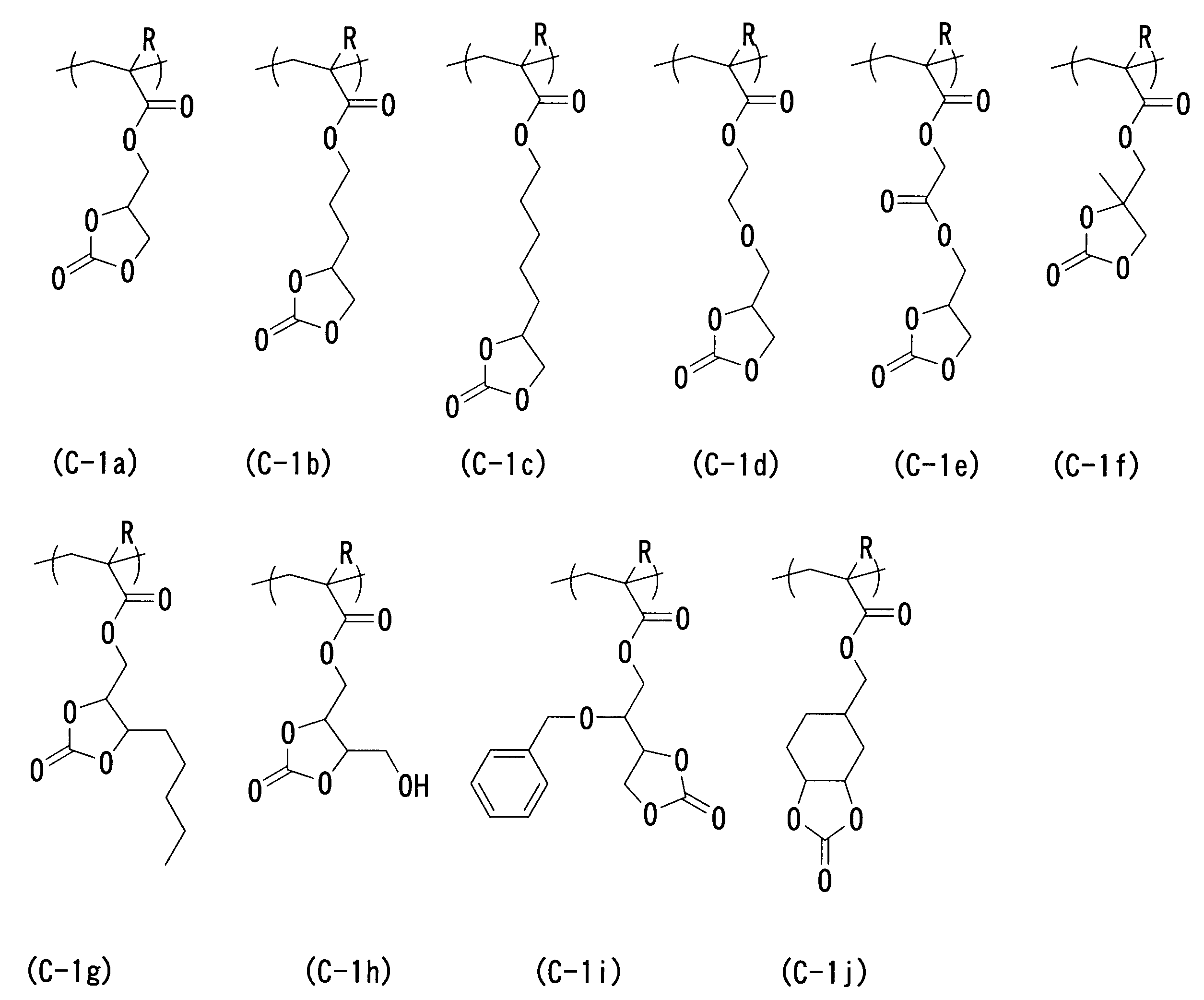
- repeating unit (C) having a group represented by the formula (Cc-11) or (Cc-21) include those represented by the following general formulas (C-1a) to (C-1j). Can be mentioned.
- R represents a hydrogen atom, a methyl group, or a trifluoromethyl group.
- the content of the repeating unit (1) is preferably 1 mol% or more, and 20 to 70 mol% when the total of all the repeating units in the resin (A) is 100 mol%. Is more preferable, and 20 to 60 mol% is still more preferable.
- the content of the repeating unit (1) is 1 mol% or more, the nano edge roughness can be excellent.
- the total content of the repeating units (2) to (4) in the resin (A) is 1 to 95 mol% when the total of all the repeating units in the resin (A) is 100 mol%. Preferably, it is 10 to 95 mol%, more preferably 40 to 80 mol%. If the total content of the repeating units (2) to (4) is more than 95 mol%, the nano edge roughness may be deteriorated.
- the total content of the repeating units (1) to (4) in the resin (A) is preferably 10 mol% or more when the total of all the repeating units in the resin (A) is 100 mol%. 40 to 100 mol% is more preferable, and 50 to 100 mol% is still more preferable. When the total content of the repeating units (1) to (4) is 10 mol% or more, the nano edge roughness can be improved.
- the content of the repeating unit (5) in the resin (A) is usually 60 mol% or less and 50 mol% or less when the total of all repeating units in the resin (A) is 100 mol%. Is preferred.
- the content of the repeating unit (5) is 60 mol% or less, the performance balance between the resolution performance and the nano edge roughness can be excellent.
- the preparation method of resin (A) is not specifically limited, For example, it can carry out by well-known radical polymerization or anionic polymerization. Further, the side chain hydroxystyrene units in the repeating units (2) to (4) can be obtained by hydrolysis of an acetoxy group or the like in the presence of a base or acid in an organic solvent after completion of the polymerization reaction. .
- a necessary monomer such as a monomer giving the repeating unit (1) is stirred and heated in a suitable organic solvent in a nitrogen atmosphere in the presence of a radical polymerization initiator.
- a radical polymerization initiator for example, a necessary monomer such as a monomer giving the repeating unit (1) is stirred and heated in a suitable organic solvent in a nitrogen atmosphere in the presence of a radical polymerization initiator.
- radical polymerization initiators examples include 2,2′-azobisisobutyronitrile, dimethyl-2,2′-azobisisobutyrate, and 2,2′-azobis- (2,4-dimethylvaleronitrile).
- the reaction temperature in radical polymerization is not particularly limited and is appropriately selected depending on the type of radical polymerization initiator (eg, 50 to 200 ° C.). In particular, when an azo initiator or a peroxide initiator is used, a temperature at which the half-life of the radical polymerization initiator is about 10 minutes to 30 hours is preferable, and the half-life of the radical polymerization initiator is 30 minutes to 10 A temperature that is on the order of hours is more preferable.
- the reaction time varies depending on the type of radical polymerization initiator and the reaction temperature, but the reaction time during which 50% or more of the radical polymerization initiator is consumed is desirable and is usually about 0.5 to 24 hours.
- anionic polymerization for example, necessary monomers such as the repeating unit (1) are stirred and maintained at a predetermined temperature in a suitable organic solvent in a nitrogen atmosphere in the presence of an anionic polymerization initiator. Can be implemented.
- anionic polymerization initiator examples include n-butyllithium, s-butyllithium, t-butyllithium, ethyllithium, ethylsodium, 1,1-diphenylhexyllithium, 1,1-diphenyl-3-methylpentyllithium, etc.
- organic alkali metals There are organic alkali metals.
- the reaction temperature in the anionic polymerization is not particularly limited and is appropriately selected depending on the kind of the anionic polymerization initiator.
- the temperature is preferably ⁇ 100 to 50 ° C., more preferably ⁇ 78 to 30 ° C.
- the reaction time varies depending on the kind of anionic polymerization initiator and the reaction temperature, but the reaction time during which 50% or more of the anionic polymerization initiator is consumed is desirable, and is usually about 0.5 to 24 hours.
- examples of the acid used for the hydrolysis reaction include p-toluenesulfonic acid and its hydrate, methanesulfonic acid, trifluoro Organic acids such as romethanesulfonic acid, malonic acid, succinic acid, 1,1,1-trifluoroacetic acid; inorganic acids such as sulfuric acid, hydrochloric acid, phosphoric acid, hydrobromic acid; pyridinium p-toluenesulfonate, ammonium p-toluenesulfonate And salts of 4-methylpyridinium p-toluenesulfonate and the like.
- the base examples include inorganic bases such as potassium hydroxide, sodium hydroxide, sodium carbonate, and potassium carbonate; organic bases such as triethylamine, N-methyl-2-pyrrolidone, piperidine, and tetramethylammonium hydroxide.
- inorganic bases such as potassium hydroxide, sodium hydroxide, sodium carbonate, and potassium carbonate
- organic bases such as triethylamine, N-methyl-2-pyrrolidone, piperidine, and tetramethylammonium hydroxide.
- organic solvent used for polymerization and hydrolysis examples include ketones such as acetone, methyl ethyl ketone, and methyl amyl ketone; ethers such as diethyl ether and tetrahydrofuran (THF); alcohols such as methanol, ethanol, and propanol; Aliphatic hydrocarbons such as hexane, heptane and octane; aromatic hydrocarbons such as benzene, toluene and xylene; halogenated alkyls such as chloroform, bromoform, methylene chloride, methylene bromide and carbon tetrachloride; ethyl acetate, Esters such as butyl acetate, ethyl lactate, propylene glycol monomethyl ether, propylene glycol monomethyl ether acetate, cellosolves; non-prototypes such as dimethylformamide, dimethyl sulfoxide, hex
- acetone, methyl amyl ketone, methyl ethyl ketone, tetrahydrofuran, methanol, ethanol, propanol, ethyl acetate, butyl acetate, ethyl lactate, propylene glycol monomethyl ether, propylene glycol monomethyl ether acetate and the like are preferable.
- the weight average molecular weight (hereinafter also referred to as “Mw”) in terms of polystyrene measured by gel permeation chromatography (GPC) of the resin (A) is preferably 3000 to 100,000, and preferably 3000 to 40000. More preferably, it is 3000 to 25000.
- the ratio (Mw / Mn) between the Mw of the resin (A) and the polystyrene-equivalent number average molecular weight (hereinafter also referred to as “Mn”) measured by GPC is usually from 1 to 5, and from 1 to 3 Preferably, it is preferably 1 to 2.5.
- the acid generator (B) generates an acid having a pKa of 2 or less in the resist film by irradiating the resist film formed using the radiation-sensitive resin composition with an electron beam or radiation in a lithography process. Is. Moreover, it is preferable that pKa of the acid generate
- the lower limit value of the pKa of the acid generated by irradiation with radiation is not particularly limited, but is usually ⁇ 15 or more.
- An acid having a pKa of 2 or less generated by irradiation with radiation is obtained by dissociating an acid-dissociable group present in the resin (A) contained in the radiation-sensitive resin composition (by removing a protecting group), (A) is alkali-soluble.
- an acid generator (B) is preferably a sulfonic acid generator that generates sulfonic acid upon irradiation with radiation.
- the acid generator (B) is not particularly limited as long as it has the above action, and examples thereof include a sulfonic acid generator represented by the general formula (9).
- R 14 represents a hydrogen atom, a fluorine atom, a hydroxyl group, a linear or branched alkyl group having 1 to 10 carbon atoms, or a linear or branched alkoxy group having 1 to 10 carbon atoms. Or a linear or branched alkoxycarbonyl group having 2 to 11 carbon atoms, and R 15 is a linear or branched alkyl group having 1 to 10 carbon atoms, or a 1 to 10 carbon atom group.
- a linear or branched alkoxy group, or a linear, branched or cyclic alkylsulfonyl group having 1 to 10 carbon atoms, and R 16 independently of one another has 1 to 10 carbon atoms.
- k represents an integer of 0 to 2.
- r represents an integer of 0 to 10.
- X ⁇ represents a general formula (10): R 17 C n F 2n SO 3 ⁇ , or general formula (11): R 18 SO 3 — (in general formulas (10) and (11), R 17 and R 18 are fluorine atoms or carbon atoms having 1 to 12 carbon atoms which may be substituted.
- a hydrogen group or an alicyclic hydrocarbon group having 3 to 20 carbon atoms, and in general formula (10), n represents an integer of 1 to 10).
- examples of the linear or branched alkyl group having 1 to 10 carbon atoms include a methyl group, an ethyl group, an n-butyl group, 2- Examples include a methylpropyl group, a 1-methylpropyl group, a t-butyl group, and an n-pentyl group. Among these, a methyl group, an ethyl group, an n-butyl group, and a t-butyl group are preferable.
- the groups represented by R 15 and R 16 the same examples can be given as specific examples of linear or branched alkyl groups having 1 to 10 carbon atoms.
- Examples of the linear or branched alkoxy group having 1 to 10 carbon atoms include methoxy group, ethoxy group, n-propoxy group, i-propoxy group, n-butoxy group, 2-methylpropoxy group, -Methylpropoxy group, t-butoxy group and the like. Among these, a methoxy group, an ethoxy group, an n-propoxy group, and an n-butoxy group are preferable.
- the groups represented by R 15 the same examples can be given as specific examples of linear or branched alkoxy groups having 1 to 10 carbon atoms.
- examples of the linear or branched alkoxycarbonyl group having 2 to 11 carbon atoms include a methoxycarbonyl group, an ethoxycarbonyl group, an n-propoxycarbonyl group, an i-propoxycarbonyl group, an n-butoxycarbonyl group, -Methylpropoxycarbonyl group, 1-methylpropoxycarbonyl group, t-butoxycarbonyl group and the like.
- a methoxycarbonyl group, an ethoxycarbonyl group, and an n-butoxycarbonyl group are preferable.
- examples of the linear, branched, or cyclic alkylsulfonyl group having 1 to 10 carbon atoms include, for example, a methylsulfonyl group, an ethylsulfonyl group, an n-propylsulfonyl group, Examples include n-butylsulfonyl group, tert-butylsulfonyl group, cyclopentylsulfonyl group, cyclohexylsulfonyl group and the like.
- a methylsulfonyl group, an ethylsulfonyl group, an n-propylsulfonyl group, an n-butylsulfonyl group, a cyclopentylsulfonyl group, and a cyclohexylsulfonyl group are preferable.
- r is an integer from 0 to 10, but is preferably an integer from 0 to 2.
- the optionally substituted phenyl group includes, for example, a phenyl group, a 4-ethylphenyl group, a 4-t-butylphenyl group, a 4-cyclohexylphenyl group, a 4-cyclohexylphenyl group, A phenyl group such as a fluorophenyl group, or a phenyl group substituted with a linear, branched or cyclic alkyl group having 1 to 10 carbon atoms; these phenyl group or alkyl-substituted phenyl group can be substituted with an alkoxy group or an alkoxyalkyl group; , An alkoxycarbonyl group, an alkoxycarbonyloxy group, a hydroxyl group, a carboxyl group, a cyano group, a group substituted with at least one group such as a nitro group, and the like.
- the alkoxy group includes, for example, a methoxy group, an ethoxy group, an n-propoxy group, a t-butoxy group, a cyclopentyloxy group, a cyclohexyloxy group, etc.
- a methoxy group an ethoxy group
- an n-propoxy group a t-butoxy group
- a cyclopentyloxy group a cyclohexyloxy group, etc.
- a cyclohexyloxy group etc.
- alkoxyalkyl group examples include a straight chain having 2 to 21 carbon atoms such as a methoxymethyl group, an ethoxymethyl group, a 1-methoxyethyl group, a 2-methoxyethyl group, a 1-ethoxyethyl group, and a 2-ethoxyethyl group.
- examples of the alkoxycarbonyl group include a methoxycarbonyl group, an ethoxycarbonyl group, an n-propoxycarbonyl group, an i-propoxycarbonyl group, an n-butoxycarbonyl group, a 2-methylpropoxycarbonyl group, a 1-methylpropoxycarbonyl group, Examples thereof include a linear, branched, or cyclic alkoxycarbonyl group having 2 to 21 carbon atoms such as a t-butoxycarbonyl group, a cyclopentyloxycarbonyl group, and a cyclohexyloxycarbonyl group.
- alkoxycarbonyloxy group examples include methoxycarbonyloxy group, ethoxycarbonyloxy group, n-propoxycarbonyloxy group, i-propoxycarbonyloxy group, n-butoxycarbonyloxy group, t-butoxycarbonyloxy group, and cyclopentyl.
- alkoxycarbonyloxy group examples include straight-chain, branched or cyclic alkoxycarbonyloxy groups having 2 to 21 carbon atoms such as oxycarbonyloxy group and cyclohexyloxycarbonyloxy.
- a phenyl group, 4-cyclohexylphenyl group, 4-t-butylphenyl group, 4-methoxyphenyl group, and 4-t-butoxyphenyl group are preferable.
- examples of the optionally substituted naphthyl group include a 1-naphthyl group, 2-methyl-1-naphthyl group, 3-methyl-1-naphthyl group, 4-methyl- 1-naphthyl group, 5-methyl-1-naphthyl group, 6-methyl-1-naphthyl group, 7-methyl-1-naphthyl group, 8-methyl-1-naphthyl group, 2,3-dimethyl-1-naphthyl group Group, 2,4-dimethyl-1-naphthyl group, 2,5-dimethyl-1-naphthyl group, 2,6-dimethyl-1-naphthyl group, 2,7-dimethyl-1-naphthyl group, 2,8- Dimethyl-1-naphthyl group, 3,4-dimethyl-1-naphthyl group, 3,5-dimethyl-1-naphthyl group,
- substituent for substituting the naphthyl group or the alkyl-substituted naphthyl group include the same substituents as those exemplified as the substituent for the phenyl group or the alkyl-substituted phenyl group.
- naphthyl groups 1-naphthyl group, 1- (4-methoxynaphthyl) group, 1- (4-ethoxynaphthyl) group, 1- (4-n-propoxynaphthyl) group, 1-naphthyl group, (4-n-butoxynaphthyl) group, 2- (7-methoxynaphthyl) group, 2- (7-ethoxynaphthyl) group, 2- (7-n-propoxynaphthyl) group, 2- (7-n-butoxy) A naphthyl) group is preferred.
- Examples of the optionally substituted divalent group having 2 to 10 carbon atoms formed by bonding two R 16 to each other include a 5-membered member together with a sulfur cation in the compound represented by the general formula (9).
- a group forming a ring or a 6-membered ring is preferable, and a group forming a 5-membered ring (that is, a tetrahydrothiophene ring) is more preferable.
- Examples of the substituent of the divalent group having 2 to 10 carbon atoms include a hydroxyl group, a carboxyl group, a cyano group, a nitro group, an alkoxy group, an alkoxyalkyl group, an alkoxycarbonyl group, and an alkoxycarbonyloxy group.
- the group represented by R 16 includes a methyl group, an ethyl group, a phenyl group, a 4-methoxyphenyl group, a 1-naphthyl group, and two R 16s bonded to each other to form a tetrahydrothiophene ring structure together with a sulfur cation.
- a divalent group to be formed is preferable.
- —C n F 2n — is a perfluoroalkylene group having n carbon atoms. However, this group may be linear or branched. Here, n is preferably 1, 2, 4 or 8.
- the optionally substituted hydrocarbon group having 1 to 12 carbon atoms includes an alkyl group having 1 to 12 carbon atoms, a cycloalkyl group, and a bridged alicyclic hydrocarbon group. preferable. Specifically, methyl group, ethyl group, n-propyl group, i-propyl group, n-butyl group, 2-ethylhexyl group, n-nonyl group, n-decyl group, norbornyl group, norbornylmethyl group, A hydroxynorbornyl group and an adamantyl group are preferred.
- specific examples of the optionally substituted hydrocarbon group having 1 to 12 carbon atoms can be exemplified.
- anion represented by X ⁇ examples include trifluoromethanesulfonate anion, perfluoro-n-butanesulfonate anion, perfluoro-n-octanesulfonate anion, 2-bicyclo [2.2.1] hept-2-yl-1 1,2,2,2-tetrafluoroethanesulfonate anion and 2-bicyclo [2.2.1] hept-2-yl-1,1-difluoroethanesulfonate anion are preferred.
- Specific examples of the compound represented by the general formula (9) include triphenylsulfonium trifluoromethanesulfonate, tri-tert-butylphenylsulfonium trifluoromethanesulfonate, 4-cyclohexylphenyl-diphenylsulfonium trifluoromethanesulfonate, 4-methane.
- Triphenylsulfonium 2- (bicyclo [2.2.1] hepta-2'-yl) -1,1,2,2-tetrafluoroethanesulfonate, tri-tert-butylphenylsulfonium 2- (bicyclo [2.2 .1] Hepta-2'-yl) -1,1,2,2-tetrafluoroethanesulfonate, 4-cyclohexylphenyl-diphenylsulfonium 2- (bicyclo [2.2.1] hepta-2'-yl)- 1,1,2,2-tetrafluoroethanesulfonate, 4-methanesulfonylphenyl-diphenylsulfonium 2- (bicyclo [2.2.1] hepta-2'-yl) -1,1,2,2-tetrafluoro Ethanesulfonate, 1- (3,5-dimethyl-4-hydroxyphenyl) tetrahydrothiophenium 2-
- Triphenylsulfonium 2- (bicyclo [2.2.1] hepta-2'-yl) -1,1-difluoroethanesulfonate, tri-tert-butylphenylsulfonium 2- (bicyclo [2.2.1] hepta-2 '-Yl) -1,1-difluoroethanesulfonate, 4-cyclohexylphenyl-diphenylsulfonium 2- (bicyclo [2.2.1] hepta-2'-yl) -1,1-difluoroethanesulfonate, 4-methanesulfonylphenyl -Diphenylsulfonium 2- (bicyclo [2.2.1] hepta-2'-yl) -1,1-difluoroethanesulfonate, 1- (3,5-dimethyl-4-hydroxyphenyl) tetrahydrothiophenium 2- ( Bicyclo [
- the content of the acid generator (B) is preferably 0.1 to 40 parts by mass, and more preferably 10 to 35 parts by mass with respect to 100 parts by mass of the resin (A).
- the content is within this range, the sensitivity and developability of the formed resist film can be maintained. There exists a possibility that a sensitivity and developability may fall that content is less than 0.1 mass part. On the other hand, if it exceeds 40 parts by mass, the transparency to radiation is lowered, and it may be difficult to obtain a rectangular resist pattern.
- Carboxylic acid generator (C) usually exhibits basicity, but in a lithography process, the resist film is irradiated with an electron beam or radiation to generate carboxylic acid in the resist film and lose basicity. It is a compound represented by the said General formula (1).
- Examples of the chain or branched alkoxy group include a methyl group, an ethyl group, an n-propyl group, an i-propyl group, an n-butyl group, a 2-methylpropyl group, a 1-methylpropyl group, and a t-butyl group.
- Examples include a fluoropropyl group, a nonafluorobutyl group, a dodecafluoropentyl group, and a perfluorooctyl group.
- n is 1 or 2, and is preferably 1.
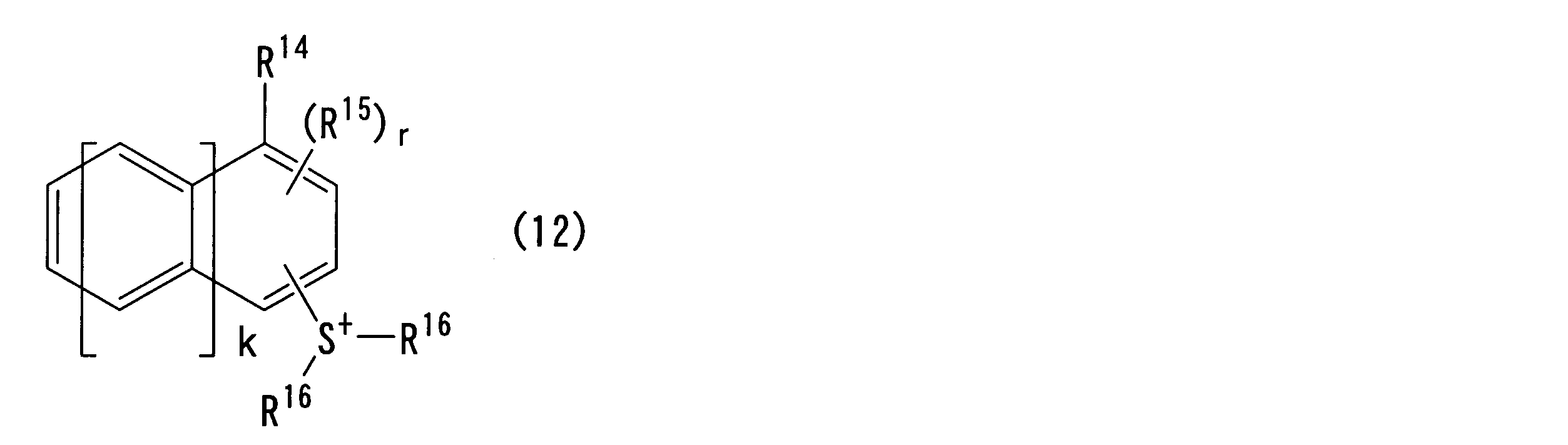
- M + is a monovalent onium cation, preferably a sulfonium cation or an iodonium cation, and particularly preferably a cation represented by the general formula (12).
- R 14 the same can be said with R 14 in the general formula (9).
- R 15 may be the same as R 15 in the general formula (9)
- R 16 can be said to be the same as R 16 in the general formula (9), and r can be the same as r in the general formula (9). The same can be said for k in the general formula (9).
- Specific examples of the compound represented by the general formula (1) include compounds represented by the formulas (1-1) and (1-2).
- the method for synthesizing the carboxylic acid generator (C) is not particularly limited.
- the compound represented by the general formula (13) is mixed with sodium carbonate in an aqueous solution.
- the compound represented by the general formula (14) can be synthesized by further reacting with a desired onium cation M + halide (for example, M + Br ⁇ ) in an aqueous solution. .
- R 1 is a linear or branched alkyl group having 1 to 12 carbon atoms substituted or unsubstituted by a fluorine atom, or a linear chain having 1 to 12 carbon atoms. Alternatively, it represents a branched alkoxy group, n represents 1 or 2.
- M + represents a monovalent onium cation.
- the content of the carboxylic acid generator (C) is preferably 30 parts by mass or less, more preferably 2 to 25 parts by mass with respect to 100 parts by mass of the resin (A). More preferably. There exists a possibility that the resolution of the formed resist film may fall that content of a carboxylic acid generator (C) is more than 30 mass parts. On the other hand, if it is less than 2 parts by mass, the resolution may be lowered.
- Acid diffusion controller (D) The radiation sensitive resin composition of the present invention preferably further contains an acid diffusion controller (D).
- the acid diffusion controller (D) has a function of controlling a diffusion phenomenon in the resist film of an acid generated from the acid generator (B) by exposure and suppressing an undesirable chemical reaction in a non-exposed region.
- the storage stability of the resulting radiation-sensitive resin composition is improved, the resolution of the formed resist film is further improved, and exposure is performed after exposure. Changes in the line width of the resist pattern due to fluctuations in the holding time (PED) until the subsequent heat treatment can be suppressed, and a radiation-sensitive resin composition that is extremely excellent in process stability can be obtained.
- Examples of the acid diffusion controller (D) include nitrogen-containing organic compounds and photosensitive basic compounds.
- Examples of the nitrogen-containing organic compound include a compound represented by the general formula (16) (hereinafter referred to as “nitrogen-containing compound (i)”), a compound having two nitrogen atoms in the same molecule (hereinafter referred to as “nitrogen-containing compound”).
- Compound (ii) "), polyamino compounds and polymers having 3 or more nitrogen atoms hereinafter collectively referred to as" nitrogen-containing compounds (iii) "), amide group-containing compounds, urea compounds, nitrogen-containing heterocycles There are compounds.
- a plurality of R 19 are each independently a hydrogen atom, an optionally substituted linear, branched or cyclic alkyl group, an optionally substituted aryl group, or (The aralkyl group which may be substituted is shown.)
- nitrogen-containing compound (i) examples include mono (cyclo) alkylamines such as n-hexylamine, n-heptylamine, n-octylamine, n-nonylamine, n-decylamine, cyclohexylamine; di-n- Butylamine, di-n-pentylamine, di-n-hexylamine, di-n-heptylamine, di-n-octylamine, di-n-nonylamine, di-n-decylamine, cyclohexylmethylamine, dicyclohexylamine, etc. Di (cyclo) alkylamines;
- nitrogen-containing compound (ii) examples include ethylenediamine, N, N, N ′, N′-tetramethylethylenediamine, tetramethylenediamine, hexamethylenediamine, 4,4′-diaminodiphenylmethane, and 4,4′-diaminodiphenyl ether.
- Nitrogen-containing compounds (iii) include, for example, polyethyleneimine, polyallylamine, 2-dimethylaminoethylacrylamide polymer, and the like.
- Examples of the amide group-containing compound include Nt-butoxycarbonyldi-n-octylamine, Nt-butoxycarbonyldi-n-nonylamine, Nt-butoxycarbonyldi-n-decylamine, Nt- Butoxycarbonyldicyclohexylamine, Nt-butoxycarbonyl-1-adamantylamine, Nt-butoxycarbonyl-2-adamantylamine, Nt-butoxycarbonyl-N-methyl-1-adamantylamine, (S)-( -)-1- (t-butoxycarbonyl) -2-pyrrolidinemethanol, (R)-(+)-1- (t-butoxycarbonyl) -2-pyrrolidinemethanol, Nt-butoxycarbonyl-4-hydroxypiperidine Nt-butoxycarbonylpyrrolidine, Nt-butoxycarbonyl Piperazine, N, N-di-t-butoxycarbonyl-1-adamantyl
- urea compounds include urea, methylurea, 1,1-dimethylurea, 1,3-dimethylurea, 1,1,3,3-tetramethylurea, 1,3-diphenylurea, tri-n-butylthiourea. Etc.
- nitrogen-containing heterocyclic compound examples include imidazole, 4-methylimidazole, 4-methyl-2-phenylimidazole, benzimidazole, 2-phenylbenzimidazole, 1-benzyl-2-methylimidazole, 1-benzyl-2- Imidazoles such as methyl-1H-imidazole; pyridine, 2-methylpyridine, 4-methylpyridine, 2-ethylpyridine, 4-ethylpyridine, 2-phenylpyridine, 4-phenylpyridine, 2-methyl-4-phenylpyridine , Nicotine, nicotinic acid, nicotinamide, quinoline, 4-hydroxyquinoline, 8-oxyquinoline, acridine, pyridines such as 2,2 ′: 6 ′, 2 ′′ -terpyridine; piperazine, 1- (2-hydroxy In addition to piperazines such as ethyl) piperazine, Razine, pyrazole, pyridazine, quinosaline, purine,
- a radiation sensitive resin composition may contain 1 type of acid diffusion control agents (D) individually or in combination of 2 or more types.
- the content of the acid diffusion controller (D) is preferably 15 parts by mass or less, more preferably 0.001 to 10 parts by mass, with respect to 100 parts by mass of the resin (A). It is particularly preferable that the amount be ⁇ 5 parts by mass. There exists a possibility that the sensitivity of the formed resist film and the developability of an exposure part may fall that content of an acid diffusion control agent (D) exceeds 15 mass parts. On the other hand, if it is less than 0.001 part by mass, the pattern shape and dimensional fidelity of the formed resist film may be lowered depending on the process conditions.
- the radiation-sensitive resin composition of the present invention is preferably a resin (A), an acid generator (B), and a carboxylic acid generator (C) dissolved in a solvent. That is, it is preferable to further contain a solvent as another component. Moreover, the radiation sensitive resin composition of this invention can further contain various additives, such as surfactant, a sensitizer, and an aliphatic additive, as other components as needed.
- Solvents include linear or branched ketones, cyclic ketones, propylene glycol monoalkyl ether acetates, alkyl 2-hydroxypropionate, alkyl 3-alkoxypropionate, and ⁇ -butyrolactone. It is preferably at least one selected from the group.
- the content of the solvent is preferably such that the total solid concentration in the radiation-sensitive resin composition is 1 to 70% by mass, more preferably 1 to 15% by mass.
- the amount is more preferably 10% by mass.
- the radiation-sensitive resin composition of the present invention comprises a resin (A), an acid generator (B), a carboxylic acid generator (C), and other components (except for a solvent) as required, with a total solid content concentration of It can be prepared by uniformly dissolving in a solvent so as to be in the range.
- a filter with a pore diameter of about 0.2 ⁇ m, for example.
- Surfactant is a component that exhibits the action of improving coatability, striation, developability, and the like.
- examples of such surfactants include polyoxyethylene lauryl ether, polyoxyethylene stearyl ether, polyoxyethylene oleyl ether, polyoxyethylene n-octylphenyl ether, polyoxyethylene n-nonylphenyl ether, polyethylene glycol dilaurate.
- nonionic surfactants such as polyethylene glycol distearate, KP341 (manufactured by Shin-Etsu Chemical Co., Ltd.), Polyflow No. 75, no.
- these surfactants may be used individually by 1 type, and may be used in combination of 2 or more type.
- the content of the surfactant is preferably 0.001 to 2 parts by mass with respect to 100 parts by mass of the resin (A).
- the sensitizer absorbs radiation energy and transmits the energy to the acid generator (B), thereby increasing the amount of acid produced.
- the apparent sensitivity of the radiation-sensitive resin composition It has the effect of improving sensitivity.
- sensitizers include carbazoles, acetophenones, benzophenones, naphthalenes, phenols, biacetyl, eosin, rose bengal, pyrenes, anthracenes, and phenothiazines.
- these sensitizers may be used individually by 1 type, and may be used in combination of 2 or more type.
- the content of the sensitizer is preferably 0.1 to 10 parts by mass with respect to 100 parts by mass of the resin (A).
- the latent image in the exposed area can be visualized, and the influence of halation during exposure can be mitigated.
- substrate can be improved by containing an adhesion aid.
- the alicyclic additive is a component having an action of further improving dry etching resistance, pattern shape, adhesion to the substrate, and the like.
- Examples of such alicyclic additives include 1-adamantane carboxylic acid, 2-adamantanone, 1-adamantane carboxylic acid t-butyl, 1-adamantane carboxylic acid t-butoxycarbonylmethyl, 1-adamantane carboxylic acid ⁇ .
- the content of the alicyclic additive is preferably 0.5 to 20 parts by mass with respect to 100 parts by mass of the resin (A). There exists a possibility that the heat resistance of the formed resist film may fall that content of this alicyclic additive exceeds 20 mass parts.
- an alkali-soluble polymer a low-molecular alkali solubility control agent having an acid-dissociable protecting group, an antihalation agent, a storage stabilizer, an antifoaming agent, and the like can be contained.
- the radiation-sensitive resin composition of the present invention is useful as a material capable of forming a chemically amplified positive resist film.
- the acid-dissociable group in the resin (A) is eliminated by the action of the acid generated from the acid generator (B) by exposure, and the resin (A) becomes alkali-soluble. That is, an alkali-soluble site is generated in the resist film.
- This alkali-soluble portion is an exposed portion of the resist, and this exposed portion can be dissolved and removed by an alkali developer. In this way, a positive resist pattern having a desired shape can be formed. This will be specifically described below.
- a resist film is formed with the radiation sensitive resin composition of the present invention.
- the radiation-sensitive resin composition for example, as described above, after adjusting the total solid content concentration, it can be filtered with a filter having a pore diameter of about 0.2 ⁇ m.
- a resist film is formed.
- heat treatment hereinafter referred to as “PB” may be performed at a temperature of about 70 to 160 ° C. in advance.
- the resist film is exposed so that a predetermined resist pattern is formed.
- radiation that can be used for this exposure include (extreme) far ultraviolet rays such as KrF excimer laser (wavelength 248 nm), ArF excimer laser (wavelength 193 nm), EUV (extreme ultraviolet light, wavelength 13.5 nm, etc.), and synchro Examples include X-rays such as tron radiation, and charged particle beams such as electron beams.
- exposure conditions, such as exposure amount can be suitably selected according to the composition of the radiation-sensitive resin composition, the type of additive, and the like. This exposure can also be immersion exposure.
- PEB a heat treatment
- the heating conditions for PEB can be appropriately selected depending on the composition of the radiation sensitive resin composition, but it is preferably 30 to 200 ° C, more preferably 50 to 170 ° C.
- a predetermined resist pattern is formed by developing the exposed resist film.
- the developer used for development include sodium hydroxide, potassium hydroxide, sodium carbonate, sodium silicate, sodium metasilicate, ammonia, ethylamine, n-propylamine, diethylamine, di-n-propylamine, Triethylamine, methyldiethylamine, ethyldimethylamine, triethanolamine, tetramethylammonium hydroxide, pyrrole, piperidine, choline, 1,8-diazabicyclo- [5.4.0] -7-undecene, 1,5-diazabicyclo- [ 4.3.0]
- An alkaline aqueous solution in which at least one alkaline compound such as 5-nonene is dissolved is preferable.
- the concentration of the alkaline aqueous solution is preferably 10% by mass or less. If the concentration of the alkaline aqueous solution is more than 10% by mass, the unexposed area may be dissolved in the developer.
- the developer is preferably pH 8-14, more preferably pH 9-14.
- an organic solvent can be added to the developer composed of an alkaline aqueous solution.
- the organic solvent include ketones such as acetone, methyl ethyl ketone, methyl i-butyl ketone, cyclopentanone, cyclohexanone, 3-methylcyclopentanone, and 2,6-dimethylcyclohexanone; methanol, ethanol, n-propyl alcohol, i Alcohols such as propyl alcohol, n-butyl alcohol, t-butyl alcohol, cyclopentanol, cyclohexanol, 1,4-hexanediol, 1,4-hexanedimethylol; ethers such as tetrahydrofuran and dioxane; ethyl acetate And esters such as n-butyl acetate and i-amyl acetate; aromatic hydrocarbons such as toluene and xylene;
- the blending amount of the organic solvent is preferably 100 parts by volume or less with respect to 100 parts by volume of the alkaline aqueous solution. If the blending amount of the organic solvent is more than 100 parts by volume, the developability is lowered, and there is a possibility that the remaining development in the exposed part increases.
- an appropriate amount of a surfactant or the like can be added to the developer composed of an alkaline aqueous solution. In addition, after developing with the developing solution which consists of alkaline aqueous solution, it can also wash and dry with water.
- Pattern (so-called “pattern”) including a line part having a line width of 150 nm and a space part (that is, a groove) having an interval of 150 nm formed by adjacent line parts.
- the exposure amount for forming a line-and-space pattern (1L1S) with a one-to-one line width was taken as the optimum exposure amount, and the sensitivity was evaluated based on this optimum exposure amount.
- the reaction solution was dropped into 1000 g of n-hexane to coagulate and purify the copolymer.
- 150 g of propylene glycol monomethyl ether was added to the copolymer again, and then 150 g of methanol, 35 g of triethylamine, and 7 g of water were further added, and a hydrolysis reaction was performed for 8 hours while refluxing at the boiling point.
- the solvent and triethylamine were distilled off under reduced pressure, and the obtained copolymer was dissolved in 150 g of acetone, then dropped into 2000 g of water to solidify, and the resulting white powder was filtered and filtered at 50 ° C. under reduced pressure. Dried overnight.
- the obtained copolymer had Mw of 11000 and Mw / Mn of 2.0.
- the copolymer was derived from the repeating unit derived from p-hydroxystyrene and the compound (M-1). It was a copolymer having a content ratio (mol ratio) of the repeating unit of 65:35.
- this copolymer is referred to as a resin (A-1).
- the obtained copolymer had Mw of 10,000, Mw / Mn of 2.1, and as a result of 13 C-NMR analysis, it was derived from the repeating unit derived from p-hydroxystyrene and the compound (M-2). It was a copolymer having a content ratio (mol ratio) of the repeating unit of 65:35.
- this copolymer is referred to as a resin (A-2).
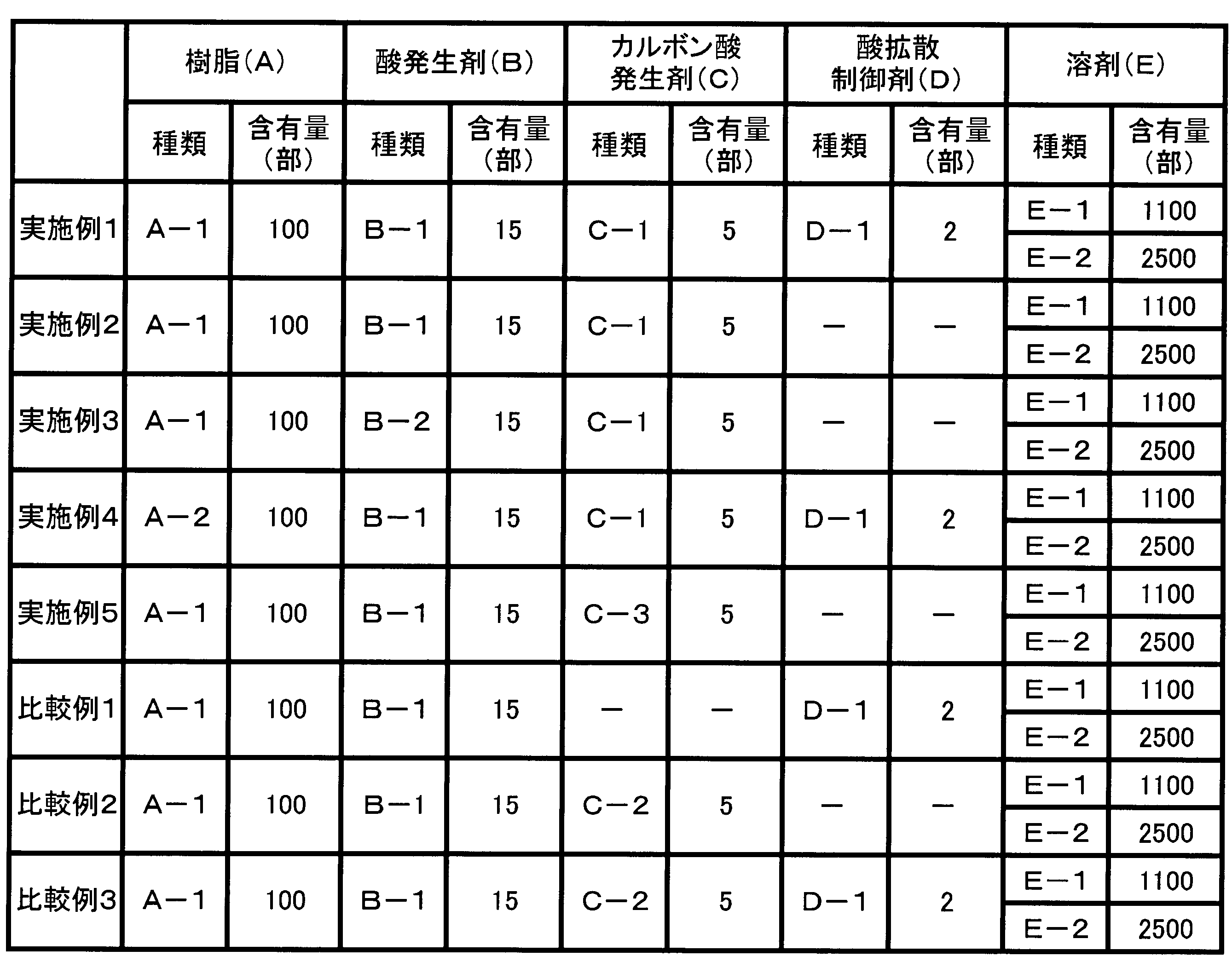
- Example 1 100 parts of resin (A-1) prepared in Synthesis Example 1, 15 parts of acid generator (B-1), 5 parts of carboxylic acid generator (C-1), 2 parts of acid diffusion controller (D-1), By mixing 1100 parts of the solvent (E-1) and 2500 parts of the solvent (E-2), and filtering the obtained mixed solution through a membrane filter having a pore diameter of 200 nm, a composition solution of the radiation sensitive resin composition was obtained. Prepared.
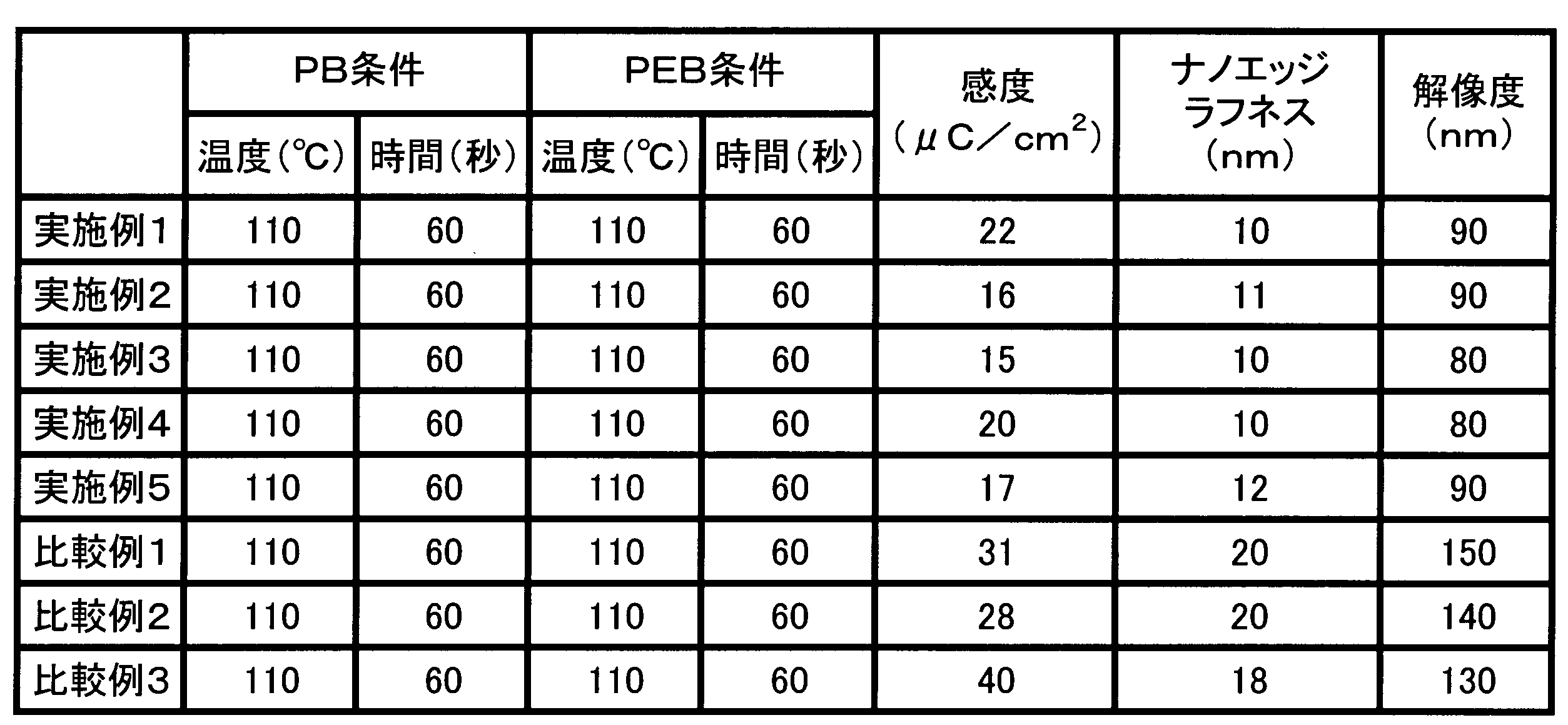
- the radiation-sensitive resin compositions of Examples 1 to 5 containing the carboxylic acid generator (C-1) or (C-3) were compared without containing the carboxylic acid generator (C).
- the radiation sensitive resin composition of Example 1 it is more sensitive to electron beams or extreme ultraviolet rays, has low roughness and excellent sensitivity, and can form a fine pattern with high accuracy and stability.
- a possible chemically amplified positive resist film can be formed.
- the radiation-sensitive resin compositions of Examples 1 to 5 containing the carboxylic acid generator (C-1) or (C-3) are comparative examples 2 to 3 containing the carboxylic acid generator (C-2).
- a chemically amplified positive resist film that has low roughness and excellent sensitivity and can form a fine pattern with high accuracy and stability. Can be membrane.
- a lower antireflection film (trade name “ARC66”, manufactured by Brewer Science) is spinned using a coater / developer (trade name “CLEAN TRACK ACT12”, manufactured by Tokyo Electron).
- PB was performed at 205 ° C. for 60 seconds to form a coating film having a thickness of 105 nm.
- a radiation sensitive resin composition to be described later is spin-coated using the coater / developer, baked under the conditions shown in Table 6, and then cooled at 23 ° C. for 30 seconds to apply a film having a thickness of 80 nm. A film was formed.
- an ArF immersion exposure apparatus (trade name “NSR-S610C”, manufactured by Nikon) is used for the formed coating film, and the optical condition of NA: 1.30 is used for 48 nm line / 2 ⁇ 48 nm pitch.
- the exposure was carried out through a mask having a mask size of.
- a semiconductor manufacturing apparatus (trade name “CLEAN TRACK LITHIUS PROI”, manufactured by Tokyo Electron Ltd.), cooling at 23 ° C. for 30 seconds, Using a GP nozzle, paddle development (10 seconds) was performed using a 2.38% tetramethylammonium hydroxide aqueous solution as a developer, and rinsed with ultrapure water. Thereafter, the substrate for evaluation on which a resist pattern was formed was obtained by shaking off at 2000 rpm for 15 seconds and spin drying.
- Line Roughness (LWR) A 48 nm line and space pattern resolved at the optimum exposure for sensitivity evaluation, using a scanning electron microscope (trade name “CG-4000”, manufactured by Hitachi High-Technologies Corporation) And observed from above the pattern. The line width (line width) was measured at an arbitrary point, and the variation in the measurement was evaluated at 3 ⁇ (nm). As a result of the measurement, the case where the value of LWR was less than 7 nm was evaluated as “good”, and the case where it was 7 nm or more was evaluated as “bad”.
- the precipitated white substance was filtered off, and the filtered white substance was washed with 800 g of methanol. Thereafter, the white substance was again filtered off and dried at 50 ° C. for 17 hours to obtain a white powder (copolymer) (60.2 g, yield 60%).
- This copolymer has a weight average molecular weight (Mw) of 4100 and Mw / Mn of 1.12.
- Mw weight average molecular weight
- Mw / Mn Mw / Mn of 1.12.
- the compound (M-3), the compound (M-6), and The content ratio (mol ratio) of each repeating unit derived from the compound (M-1) was a copolymer of 51.2: 14.6: 34.2. This copolymer is referred to as “resin (A-3)”.
- This copolymer has a weight average molecular weight (Mw) of 3900 and Mw / Mn of 1.28.
- Mw weight average molecular weight
- M-7 compound The content ratio (mol ratio) of each repeating unit derived from (M-3) and compound (M-2) was a copolymer of 35.5: 10.0: 45.2: 9.3.
- This copolymer is referred to as “resin (A-7)”.
- This copolymer had a weight average molecular weight (Mw) of 4000 and Mw / Mn of 1.35, and as a result of 13 C-NMR analysis, it was found that the compound (M-9) and the compound (M-10) The content ratio (mol ratio) of each derived repeating unit was a copolymer of 40.2: 59.8. This copolymer is referred to as “resin additive (F-1)”.
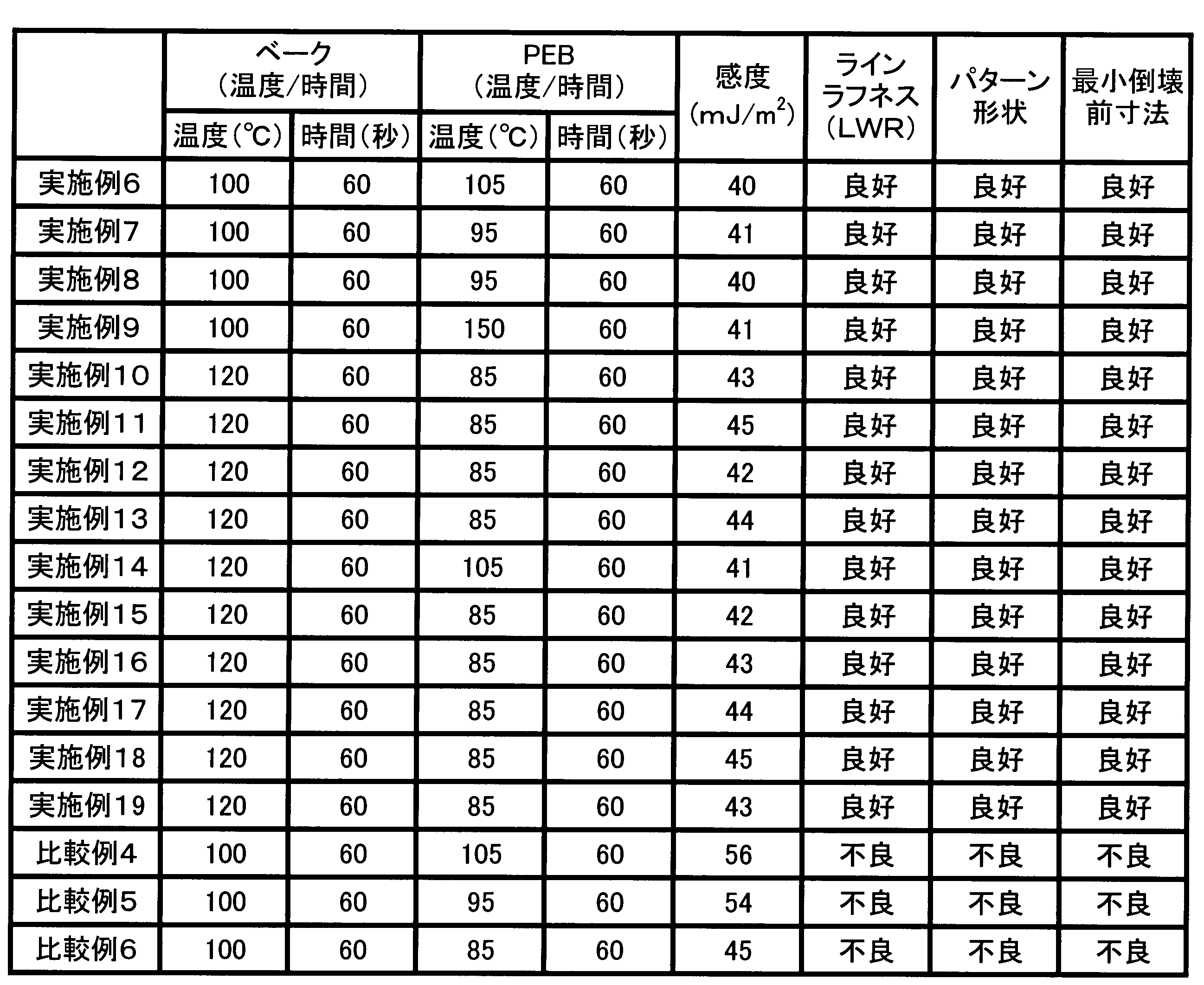
- Example 6 to 19 and Comparative Examples 4 to 6 After adjusting with the compounding quantity shown in Table 5, it filtered with the filter of the hole diameter 0.05 micrometer, and obtained the radiation sensitive resin composition of Examples 6-19 and Comparative Examples 4-6. Various evaluation was performed about the obtained radiation sensitive resin composition. The evaluation results are shown in Table 6.
- the radiation-sensitive resin compositions of Examples 6 to 19 containing the carboxylic acid generator (C-1) are the same as those of Comparative Examples 4 to 6 not containing the carboxylic acid generator (C).
- the radiation resin composition effectively responds to ArF excimer laser, has excellent line roughness characteristics, sensitivity, and pattern shape, and can form fine patterns with high accuracy and stability. Since the minimum dimensions before collapse are excellent, a chemically amplified positive resist film having excellent pattern collapse characteristics can be formed.
- the radiation-sensitive resin composition of the present invention is excellent not only in the resolution of the line and space pattern at the time of forming the resist pattern but also in the nano edge roughness, so that it is fine by ArF excimer laser, EB, EUV or X-ray. Useful for pattern formation. Therefore, the radiation-sensitive resin composition of the present invention is extremely useful as a material capable of forming a chemically amplified resist for manufacturing semiconductor devices, which is expected to be further miniaturized in the future.
Landscapes
- Chemical & Material Sciences (AREA)
- Physics & Mathematics (AREA)
- Organic Chemistry (AREA)
- Spectroscopy & Molecular Physics (AREA)
- Health & Medical Sciences (AREA)
- General Physics & Mathematics (AREA)
- Medicinal Chemistry (AREA)
- Polymers & Plastics (AREA)
- Chemical Kinetics & Catalysis (AREA)
- Engineering & Computer Science (AREA)
- Emergency Medicine (AREA)
- General Chemical & Material Sciences (AREA)
- Life Sciences & Earth Sciences (AREA)
- Materials Engineering (AREA)
- Wood Science & Technology (AREA)
- Ceramic Engineering (AREA)
- Materials For Photolithography (AREA)
- Organic Low-Molecular-Weight Compounds And Preparation Thereof (AREA)
- Addition Polymer Or Copolymer, Post-Treatments, Or Chemical Modifications (AREA)
Abstract
Description





本発明の感放射線性樹脂組成物は、樹脂(A)と、カルボン酸発生剤(C)と、を含有するものであり、酸発生剤(B)と、を更に含有するものであることが好ましい。
樹脂(A)は、酸解離性基を有する繰り返し単位を有し、通常、アルカリ不溶性又はアルカリ難溶性であり、酸の作用によりアルカリ易溶性となる樹脂である。尚、ここでいう「アルカリ不溶性又はアルカリ難溶性」とは、樹脂(A)を含有する感放射線性樹脂組成物を用いて形成したレジスト被膜からレジストパターンを形成する際に採用されるアルカリ現像条件下で、レジスト被膜の代わりに樹脂(A)のみを用いた膜厚100nmの被膜を現像した場合に、被膜の初期膜厚の50%以上が現像後に残存する性質をいう。
樹脂(A)は、前記一般式(6)で表される繰り返し単位、及び一般式(7)で表される繰り返し単位のうちの少なくとも一の繰り返し単位(以下、「繰り返し単位(1)」ともいう)を有することが好ましい。




樹脂(A)の調製方法は特に限定されないが、例えば、公知のラジカル重合又はアニオン重合により行うことができる。また、繰り返し単位(2)~(4)における側鎖のヒドロキシスチレン単位は、重合反応終了後、有機溶媒中で塩基又は酸の存在下でアセトキシ基等の加水分解を行なうことにより得ることもできる。
樹脂(A)の、ゲルパーミエーションクロマトグラフィー(GPC)で測定したポリスチレン換算の重量平均分子量(以下、「Mw」ともいう)は、3000~100000であることが好ましく、3000~40000であることがより好ましく、3000~25000であることが更に好ましい。また、樹脂(A)のMwと、GPCで測定したポリスチレン換算の数平均分子量(以下、「Mn」ともいう)との比(Mw/Mn)は、通常、1~5であり、1~3であることが好ましく、1~2.5であることが更に好ましい。
酸発生剤(B)は、リソグラフィープロセスにおいて、感放射線性樹脂組成物を用いて形成したレジスト被膜に電子線や放射線等を照射することによって、レジスト被膜内でpKaが2以下の酸を発生するものである。また、放射線の照射により発生する酸のpKaは、0以下であることが好ましい。なお、放射線の照射により発生する酸のpKaの下限値は特に限定されるものではないが、通常、-15以上である。

カルボン酸発生剤(C)は、通常、塩基性を示すが、リソグラフィープロセスにおいて、レジスト被膜に電子線や放射線等を照射することによって、レジスト被膜内でカルボン酸を発生し、塩基性を失う物質であり、前記一般式(1)で表される化合物である。

カルボン酸発生剤(C)の合成方法は特に限定されるものではないが、例えば、下記反応式で表されるように、一般式(13)で表される化合物を、水溶液中、炭酸ナトリウムと反応させることにより、一般式(14)で表される化合物とし、更に、所望のオニウムカチオンM+のハロゲン化物(例えば、M+Br-)と水溶液中にて反応させることにより合成することができる。

本発明の感放射線性樹脂組成物は、酸拡散制御剤(D)を更に含有することが好ましい。酸拡散制御剤(D)は、露光により酸発生剤(B)から生じる酸の、レジスト被膜中における拡散現象を制御し、非露光領域における好ましくない化学反応を抑制する作用を有するものである。

本発明の感放射線性樹脂組成物は、樹脂(A)、酸発生剤(B)、及びカルボン酸発生剤(C)を、溶剤に溶解させたものであることが好ましい。即ち、その他の成分として溶剤を更に含有することが好ましい。また、本発明の感放射線性樹脂組成物は、その他の成分として、必要に応じて、界面活性剤、増感剤、脂肪族添加剤等の各種の添加剤を更に含有させることができる。
本発明の感放射線性樹脂組成物は、化学増幅型ポジ型レジスト膜を成膜可能な材料として有用である。化学増幅型ポジ型レジスト膜においては、露光により酸発生剤(B)から発生した酸の作用によって、樹脂(A)中の酸解離性基が脱離し、樹脂(A)がアルカリ可溶性となる。即ち、レジスト被膜に、アルカリ可溶性部位が生じる。このアルカリ可溶性部位は、レジストの露光部であり、この露光部はアルカリ現像液によって溶解、除去することができる。このようにして所望の形状のポジ型のレジストパターンを形成することができる。以下、具体的に説明する。
本発明の化合物は、「I.感放射線性樹脂組成物」の「3.カルボン酸発生剤(C)」に記載したものである。
p-アセトキシスチレン56g、式(M-1)で表される化合物(以下、「化合物(M-1)」ともいう)44g、アゾビスイソブチロニトリル(以下、「AIBN」という)4g、及びt-ドデシルメルカプタン1gを、プロピレングリコールモノメチルエーテル100gに溶解した後、窒素雰囲気下、反応温度を70℃に保持して、16時間重合させた。重合後、反応溶液を1000gのn-ヘキサン中に滴下して、共重合体を凝固精製した。次いで、この共重合体に、再度プロピレングリコールモノメチルエーテル150gを加えた後、更に、メタノール150g、トリエチルアミン35g、及び水7gを加えて、沸点にて還流させながら、8時間加水分解反応を行なった。反応後、溶剤及びトリエチルアミンを減圧留去し、得られた共重合体をアセトン150gに溶解した後、2000gの水中に滴下して凝固させ、生成した白色粉末をろ過して、減圧下50℃で一晩乾燥した。得られた共重合体は、Mwが11000であり、Mw/Mnが2.0であり、13C-NMR分析の結果、p-ヒドロキシスチレンに由来する繰り返し単位及び化合物(M-1)に由来する繰り返し単位の含有比(mol比)が65:35の共重合体であった。以下、この共重合体を、樹脂(A-1)とする。
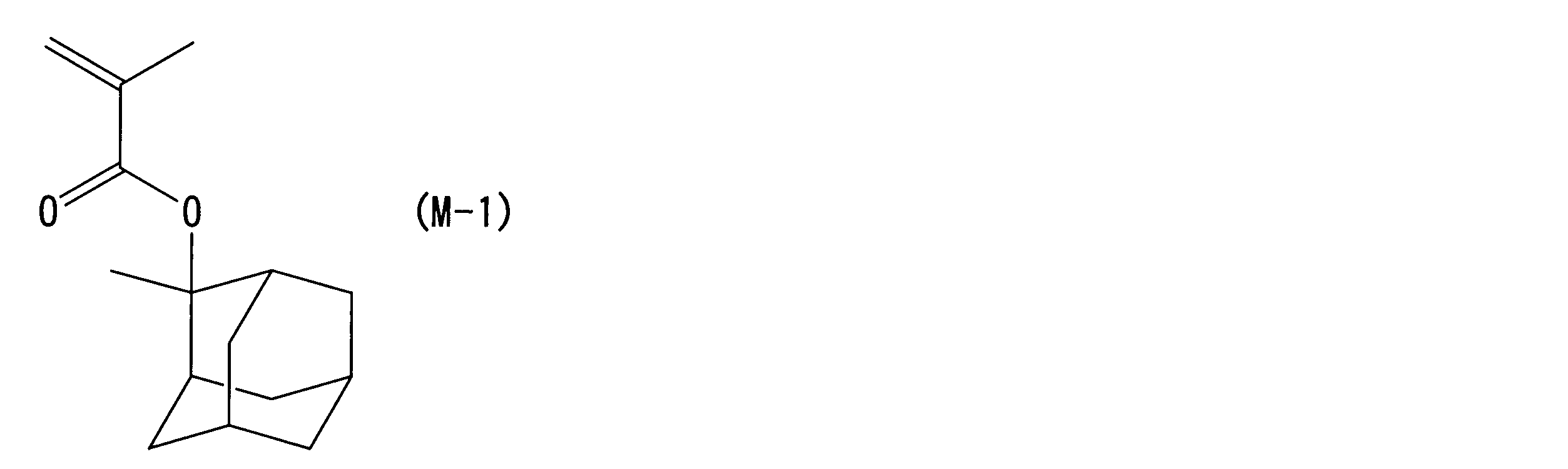
p-アセトキシスチレン55g、式(M-2)で表される化合物(以下、「化合物(M-2)」ともいう)45g、AIBN4g、及びt-ドデシルメルカプタン1gを、プロピレングリコールモノメチルエーテル100gに溶解した後、窒素雰囲気下、反応温度を70℃に保持して、16時間重合させた。重合後、反応溶液を1000gのn-ヘキサン中に滴下して、共重合体を凝固精製した。次いで、この共重合体に、再度プロピレングリコールモノメチルエーテル150gを加えた後、更に、メタノール150g、トリエチルアミン34g、及び水6gを加えて、沸点にて還流させながら、8時間加水分解反応を行なった。反応後、溶剤及びトリエチルアミンを減圧留去し、得られた共重合体をアセトン150gに溶解した後、2000gの水中に滴下して凝固させ、生成した白色粉末をろ過して、減圧下50℃で一晩乾燥した。得られた共重合体は、Mwが10000であり、Mw/Mnが2.1であり、13C-NMR分析の結果、p-ヒドロキシスチレンに由来する繰り返し単位及び化合物(M-2)に由来する繰り返し単位の含有比(mol比)が65:35の共重合体であった。以下、この共重合体を、樹脂(A-2)とする。

合成例1で調製した樹脂(A-1)100部、酸発生剤(B-1)15部、カルボン酸発生剤(C-1)5部、酸拡散制御剤(D-1)2部、溶剤(E-1)1100部、及び溶剤(E-2)2500部を混合し、得られた混合液を孔径200nmのメンブランフィルターでろ過することにより、感放射線性樹脂組成物の組成物溶液を調製した。
表1に示す仕込み量にて、樹脂(A)、酸発生剤(B)、カルボン酸発生剤(C)、酸拡散制御剤(D)、溶剤(E)を混合し、得られた混合液を孔径200nmのメンブランフィルターでろ過することにより、各感放射線性樹脂組成物の組成物溶液を調製した。
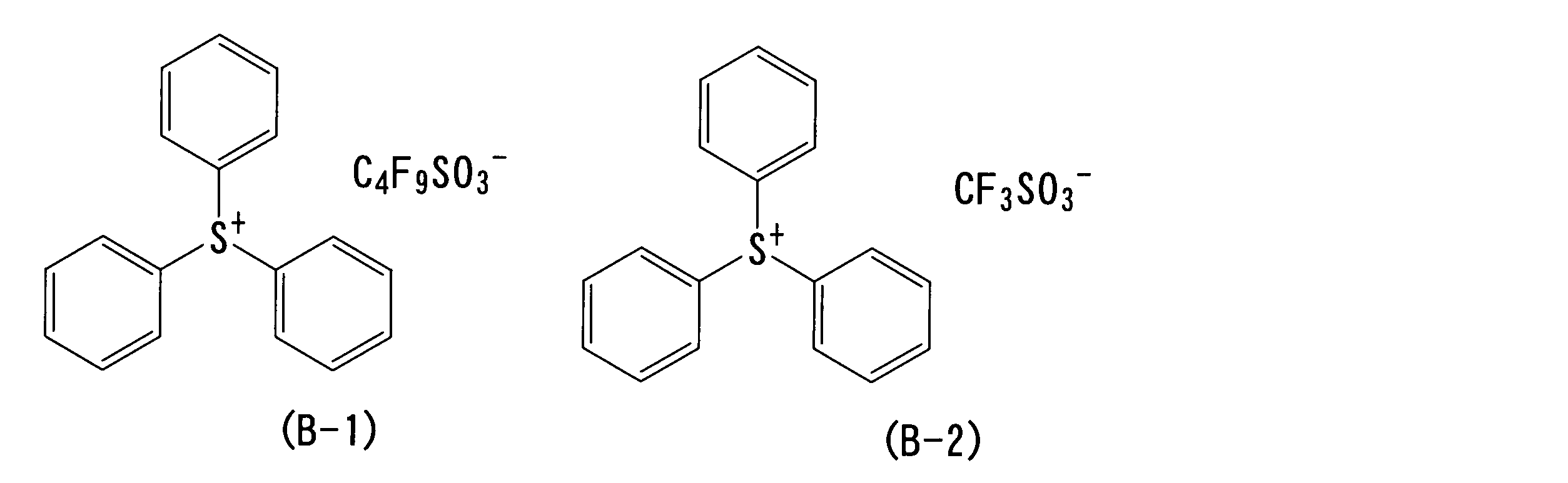
(B-1):式(B-1)で表される化合物
(B-2):式(B-2)で表される化合物
(C-1):式(C-1)で表される化合物
(C-2):式(C-2)で表される化合物
(C-3):式(C-3)で表される化合物

(D-1):トリ-n-オクチルアミン
(E-1):乳酸エチル
(E-2):プロピレングリコールモノメチルエーテルアセテート
半導体製造装置(東京エレクトロン社製のクリーントラックACT-8)内で、シリコンウエハー上に感放射線性樹脂組成物の組成物溶液をスピンコートした後、表2に示す条件でPB(加熱処理)を行い、膜厚50nmのレジスト被膜を形成した。その後、簡易型の電子線描画装置(日立製作所社製、型式「HL800D」、出力;50KeV、電流密度;5.0アンペア/cm2)を用いてレジスト被膜に電子線を照射した。電子線の照射後、表2に示す条件でPEBを行った。その後、2.38%テトラメチルアンモニウムヒドロキシド水溶液を用い、23℃で1分間、パドル法により現像した後、純水で水洗し、乾燥して、レジストパターンを形成した。このようにして形成したレジストパターンについて評価試験を行った。評価結果を表2に示す。

まず、前記式(M-3)で表される化合物(化合物(M-3))50.4g(50mol%)、前記式(M-6)で表される化合物(化合物(M-6))12.4g(15mol%)、及び前記式(M-1)で表される化合物(化合物(M-1))37.2g(35mol%)を、2-ブタノン200gに溶解して溶解溶液を得た。得られた溶解溶液にAIBN7.45gを投入して単量体溶液を得た。
表3に示す配合処方としたこと以外は合成例3と同様にして各共重合体を得た。なお、各共重合体の収量及び収率を表3に併せて記す。得られた共重合体をそれぞれ樹脂(A-4)~(A-6)とし、各樹脂の物性値を表4に記す。
前記式(M-6)で表される化合物(化合物(M-6))31.6g(35mol%)、前記式(M-7)で表される化合物(化合物(M-7))6.5g(10mol%)、及び前記式(M-3)で表される化合物(化合物(M-3))45.83g(45mol%)を、2-ブタノン200gに溶解して溶解溶液を得た。得られた溶解溶液にAIBN8.1gを投入して単量体溶液を得た。
表3に示す配合処方としたこと以外は合成例3と同様にして共重合体を得た。なお、共重合体の収量及び収率を表3に併せて記す。得られた共重合体を樹脂(A-8)とし、その物性値を表4に記す。
表3に示す配合処方としたこと以外は合成例7と同様にして各共重合体を得た。なお、各共重合体の収量及び収率を表3に併せて記す。得られた各共重合体をそれぞれ樹脂(A-9)~(A-10)とし、各樹脂の物性値を表4に記す。
表3に示す配合処方としたこと以外は合成例3と同様にして共重合体を得た。なお、共重合体の収量及び収率を表3に併せて記す。得られた共重合体を樹脂(A-8)とし、その物性値を表4に記す。
表3に示す配合処方としたこと以外は合成例7と同様にして各共重合体を得た。なお、各共重合体の収量及び収率を表3に併せて記す。得られた各共重合体をそれぞれ樹脂(A-12)~(A-14)とし、各樹脂の物性値を表4に記す。
前記式(M-9)で表わされる化合物(化合物(M-9))37.4g(40mol%)、及び前記式(M-10)で表わされる化合物(化合物(M-10))62.6g(60mol%)を、2-ブタノン100gに溶解して溶解溶液を得た。得られた溶解溶液にジメチル-2,2’-アゾビスイソブチレート4.8gを投入して単量体溶液を準備した。

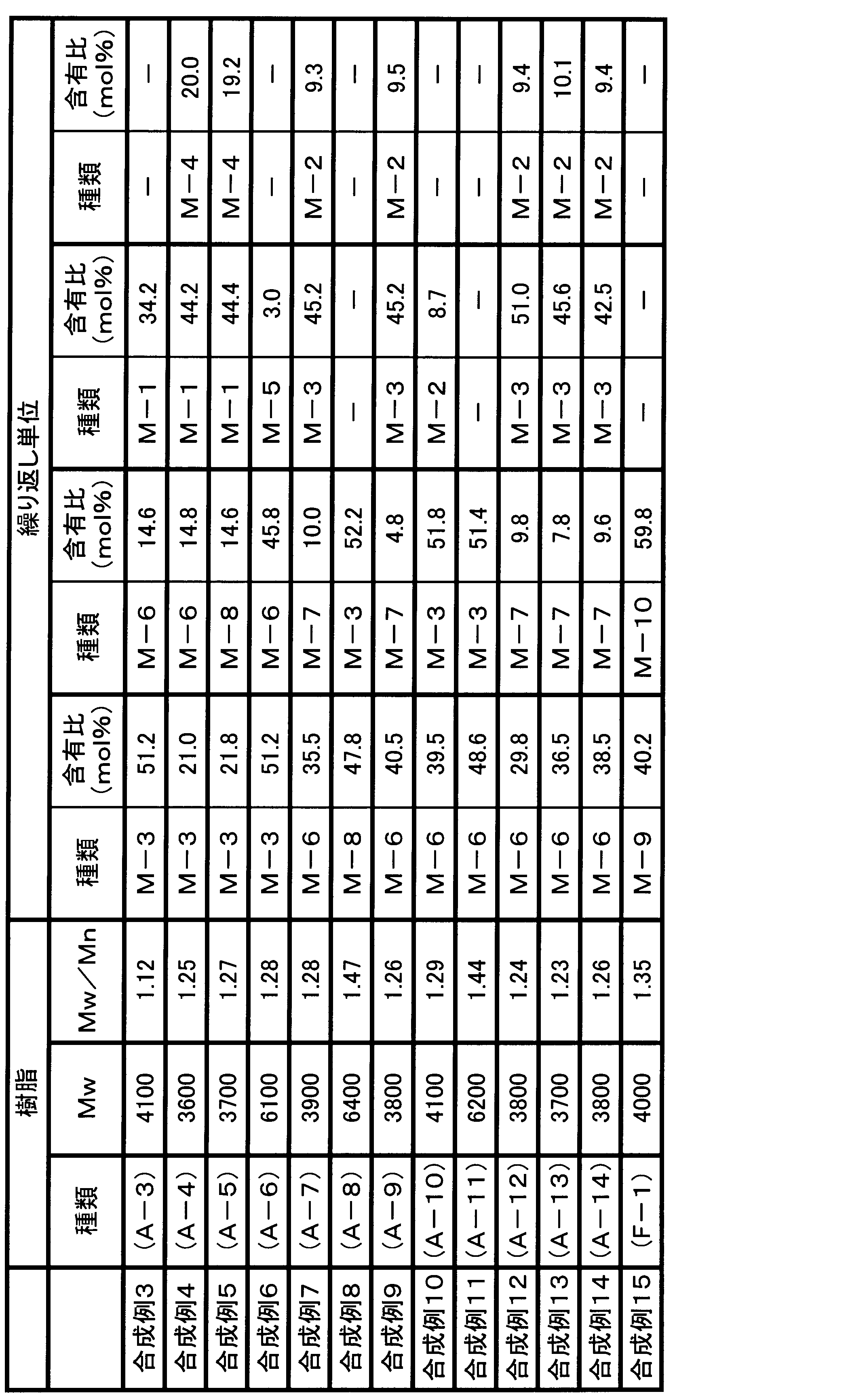
表5に示す配合量で調整した後、孔径0.05μmのフィルターでろ過して実施例6~19及び比較例4~6の感放射線性樹脂組成物を得た。得られた感放射線性樹脂組成物について各種評価を行った。評価結果を表6に示す。
(B-3):式(B-3)で表される化合物
(B-4):式(B-4)で表される化合物

(C-1):前記式(C-1)で表される化合物
(C-2):前記式(C-2)で表される化合物
(C-3):前記式(C-3)で表される化合物
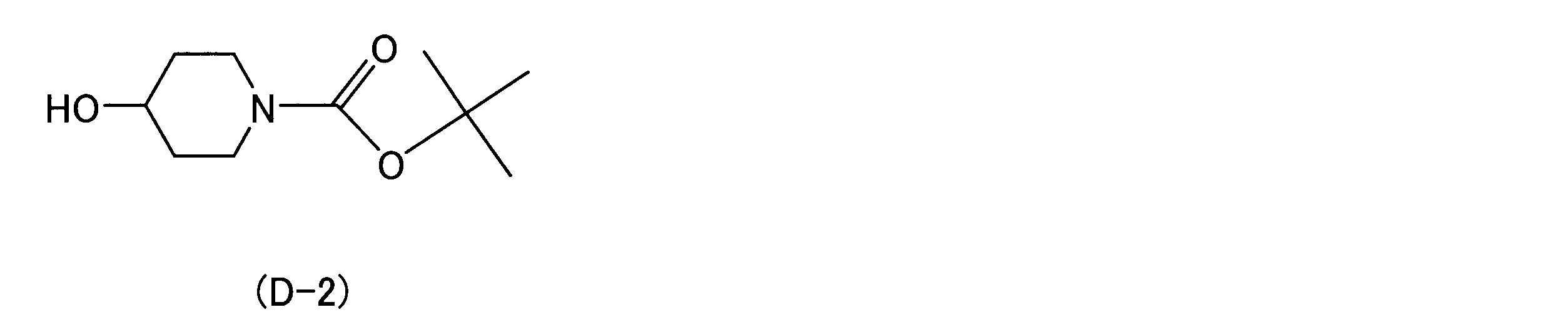
(D-2):下記式(D-2)で表される化合物(N-t-ブトキシカルボニル-4-ヒドロキシピペリジン)
(E-2):プロピレングリコールモノメチルエーテルアセテート
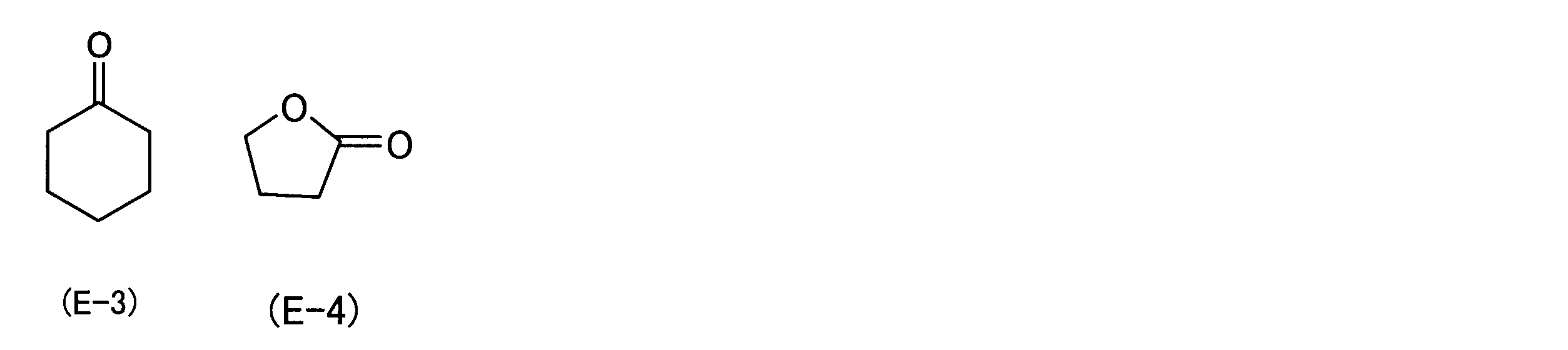
(E-3):式(E-3)で表される化合物(シクロヘキサノン)
(E-4):式(E-4)で表される化合物(γ-ブチロラクトン)

Claims (7)
- (A)酸解離性基含有樹脂と、
(C)下記一般式(1)で表される化合物と、を含有する感放射線性樹脂組成物。

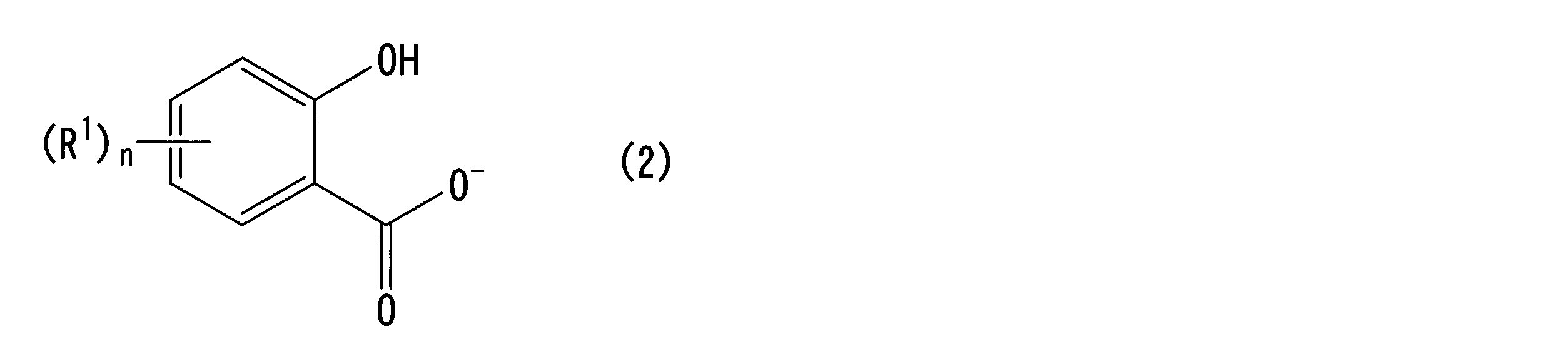
- (B)放射線の照射によりpKaが2以下の酸を発生する感放射線性酸発生剤を更に含有する請求項1に記載の感放射線性樹脂組成物。
- 前記(B)感放射線性酸発生剤が、放射線の照射によりスルホン酸を発生するスルホン酸発生剤である請求項2に記載の感放射線性樹脂組成物。
- 前記(A)酸解離性基含有樹脂が、
下記一般式(3)で表される繰り返し単位、下記一般式(4)で表される繰り返し単位、及び下記一般式(5)で表される繰り返し単位からなる群より選択される少なくとも一の繰り返し単位を有するものである請求項1~3のいずれか一項に記載の感放射線性樹脂組成物。


- 前記(A)酸解離性基含有樹脂が、下記一般式(6)で表される繰り返し単位を有するものである請求項1~4のいずれか一項に記載の感放射線性樹脂組成物。
- 前記(A)酸解離性基含有樹脂が、下記一般式(L-1)で表される繰り返し単位及び下記一般式(C-1)で表される繰り返し単位の少なくともいずれかを更に有するものである請求項5に記載の感放射線性樹脂組成物。

- 下記一般式(1)で表される化合物。


Priority Applications (3)
| Application Number | Priority Date | Filing Date | Title |
|---|---|---|---|
| KR1020117024507A KR101716913B1 (ko) | 2009-05-18 | 2010-05-14 | 감방사선성 수지 조성물 및 화합물 |
| JP2011514394A JP5660037B2 (ja) | 2009-05-18 | 2010-05-14 | 感放射線性樹脂組成物 |
| US13/288,963 US8968980B2 (en) | 2009-05-18 | 2011-11-04 | Radiation-sensitive resin composition and compound |
Applications Claiming Priority (2)
| Application Number | Priority Date | Filing Date | Title |
|---|---|---|---|
| JP2009-119960 | 2009-05-18 | ||
| JP2009119960 | 2009-05-18 |
Related Child Applications (1)
| Application Number | Title | Priority Date | Filing Date |
|---|---|---|---|
| US13/288,963 Continuation US8968980B2 (en) | 2009-05-18 | 2011-11-04 | Radiation-sensitive resin composition and compound |
Publications (1)
| Publication Number | Publication Date |
|---|---|
| WO2010134477A1 true WO2010134477A1 (ja) | 2010-11-25 |
Family
ID=43126158
Family Applications (1)
| Application Number | Title | Priority Date | Filing Date |
|---|---|---|---|
| PCT/JP2010/058214 Ceased WO2010134477A1 (ja) | 2009-05-18 | 2010-05-14 | 感放射線性樹脂組成物及び化合物 |
Country Status (5)
| Country | Link |
|---|---|
| US (1) | US8968980B2 (ja) |
| JP (1) | JP5660037B2 (ja) |
| KR (1) | KR101716913B1 (ja) |
| TW (1) | TWI468856B (ja) |
| WO (1) | WO2010134477A1 (ja) |
Cited By (9)
| Publication number | Priority date | Publication date | Assignee | Title |
|---|---|---|---|---|
| JP2012141458A (ja) * | 2010-12-28 | 2012-07-26 | Jsr Corp | 感放射線性樹脂組成物及びパターン形成方法 |
| JP2012141586A (ja) * | 2010-12-15 | 2012-07-26 | Sumitomo Chemical Co Ltd | レジスト組成物及びレジストパターンの製造方法 |
| JP2012203401A (ja) * | 2011-03-28 | 2012-10-22 | Jsr Corp | 感放射線性樹脂組成物 |
| JP2013125070A (ja) * | 2011-12-13 | 2013-06-24 | Tokyo Ohka Kogyo Co Ltd | レジスト組成物、レジストパターン形成方法 |
| JP2013200560A (ja) * | 2012-02-23 | 2013-10-03 | Tokyo Ohka Kogyo Co Ltd | レジスト組成物、レジストパターン形成方法 |
| JP2014089440A (ja) * | 2012-10-01 | 2014-05-15 | Sumitomo Chemical Co Ltd | レジスト組成物及びレジストパターンの製造方法 |
| JP2017129695A (ja) * | 2016-01-20 | 2017-07-27 | 信越化学工業株式会社 | レジスト材料及びパターン形成方法 |
| JP2020203984A (ja) * | 2019-06-17 | 2020-12-24 | Jsr株式会社 | 感放射線性樹脂組成物、レジストパターン形成方法、酸拡散制御剤及び化合物 |
| KR20240040785A (ko) | 2021-08-31 | 2024-03-28 | 후지필름 가부시키가이샤 | 감활성광선성 또는 감방사선성 수지 조성물, 감활성광선성 또는 감방사선성막, 패턴 형성 방법, 전자 디바이스의 제조 방법, 및 화합물 |
Families Citing this family (3)
| Publication number | Priority date | Publication date | Assignee | Title |
|---|---|---|---|---|
| JP6515831B2 (ja) * | 2015-02-25 | 2019-05-22 | 信越化学工業株式会社 | 化学増幅ポジ型レジスト組成物及びレジストパターン形成方法 |
| JP7067081B2 (ja) * | 2017-02-20 | 2022-05-16 | 信越化学工業株式会社 | レジスト材料及びパターン形成方法 |
| WO2020195428A1 (ja) * | 2019-03-28 | 2020-10-01 | Jsr株式会社 | 感放射線性樹脂組成物及びレジストパターンの形成方法 |
Citations (7)
| Publication number | Priority date | Publication date | Assignee | Title |
|---|---|---|---|---|
| JPS62195324A (ja) * | 1985-11-29 | 1987-08-28 | ア−ル.ピ−.シエラ− コ−ポレイシヨン | 目標とする腸への投与システム |
| JPH05181279A (ja) * | 1991-04-30 | 1993-07-23 | Toshiba Corp | パターン形成用レジストおよびパターン形成方法 |
| JPH05323590A (ja) * | 1992-05-20 | 1993-12-07 | Fujitsu Ltd | 化学増幅型レジスト組成物 |
| JPH11125907A (ja) * | 1997-08-18 | 1999-05-11 | Jsr Corp | 感放射線性樹脂組成物 |
| JP2001166478A (ja) * | 1999-12-03 | 2001-06-22 | Jsr Corp | 感放射線性樹脂組成物 |
| JP2005274647A (ja) * | 2004-03-23 | 2005-10-06 | Fuji Photo Film Co Ltd | ポジ型レジスト組成物及びそれを用いたパターン形成方法 |
| JP2007297284A (ja) * | 2006-04-27 | 2007-11-15 | Jsr Corp | スルホニウム塩化合物および感放射線性樹脂組成物 |
Family Cites Families (13)
| Publication number | Priority date | Publication date | Assignee | Title |
|---|---|---|---|---|
| DE3224148A1 (de) * | 1982-06-29 | 1983-12-29 | Hoechst Ag, 6230 Frankfurt | Quartaere ammoniumsalze und deren verwendung als stroemungsbeschleuniger |
| US4822718A (en) | 1982-09-30 | 1989-04-18 | Brewer Science, Inc. | Light absorbing coating |
| JPH0612452B2 (ja) | 1982-09-30 | 1994-02-16 | ブリュ−ワ−・サイエンス・インコ−ポレイテッド | 集積回路素子の製造方法 |
| US4910122A (en) | 1982-09-30 | 1990-03-20 | Brewer Science, Inc. | Anti-reflective coating |
| JPS59169889A (ja) * | 1983-03-16 | 1984-09-25 | Ricoh Co Ltd | 感熱記録材料 |
| DE3345806A1 (de) * | 1983-12-17 | 1985-06-27 | Hoechst Ag, 6230 Frankfurt | Oxalkylierte quaternaere ammonium-verbindungen, verfahren zu deren herstellung und deren verwendung als stroemungsbeschleuniger |
| US5674648A (en) | 1984-08-06 | 1997-10-07 | Brewer Science, Inc. | Anti-reflective coating |
| US5403695A (en) | 1991-04-30 | 1995-04-04 | Kabushiki Kaisha Toshiba | Resist for forming patterns comprising an acid generating compound and a polymer having acid decomposable groups |
| JP2643056B2 (ja) | 1991-06-28 | 1997-08-20 | インターナショナル・ビジネス・マシーンズ・コーポレイション | 表面反射防止コーティング形成組成物及びその使用 |
| KR100551653B1 (ko) | 1997-08-18 | 2006-05-25 | 제이에스알 가부시끼가이샤 | 감방사선성수지조성물 |
| ES2190373B1 (es) * | 2001-12-07 | 2004-10-16 | J. URIACH & CIA, S.A. | Uso del acido 2-hidroxi- o 2-acetiloxi-4-trifluorometilbenzoico como agente para el tratamiento y prevencion del deterioro cognitivo ligero. |
| US20040047905A1 (en) * | 2002-09-06 | 2004-03-11 | Unilever Home & Personal Care Usa, Division Of Conopco, Inc. | Personal care towelette tablet |
| WO2008066011A1 (fr) * | 2006-11-28 | 2008-06-05 | Jsr Corporation | Composition de résine sensible au rayonnement positif et procédé de formation de motif |
-
2010
- 2010-05-14 WO PCT/JP2010/058214 patent/WO2010134477A1/ja not_active Ceased
- 2010-05-14 KR KR1020117024507A patent/KR101716913B1/ko active Active
- 2010-05-14 JP JP2011514394A patent/JP5660037B2/ja active Active
- 2010-05-18 TW TW99115895A patent/TWI468856B/zh active
-
2011
- 2011-11-04 US US13/288,963 patent/US8968980B2/en active Active
Patent Citations (7)
| Publication number | Priority date | Publication date | Assignee | Title |
|---|---|---|---|---|
| JPS62195324A (ja) * | 1985-11-29 | 1987-08-28 | ア−ル.ピ−.シエラ− コ−ポレイシヨン | 目標とする腸への投与システム |
| JPH05181279A (ja) * | 1991-04-30 | 1993-07-23 | Toshiba Corp | パターン形成用レジストおよびパターン形成方法 |
| JPH05323590A (ja) * | 1992-05-20 | 1993-12-07 | Fujitsu Ltd | 化学増幅型レジスト組成物 |
| JPH11125907A (ja) * | 1997-08-18 | 1999-05-11 | Jsr Corp | 感放射線性樹脂組成物 |
| JP2001166478A (ja) * | 1999-12-03 | 2001-06-22 | Jsr Corp | 感放射線性樹脂組成物 |
| JP2005274647A (ja) * | 2004-03-23 | 2005-10-06 | Fuji Photo Film Co Ltd | ポジ型レジスト組成物及びそれを用いたパターン形成方法 |
| JP2007297284A (ja) * | 2006-04-27 | 2007-11-15 | Jsr Corp | スルホニウム塩化合物および感放射線性樹脂組成物 |
Cited By (14)
| Publication number | Priority date | Publication date | Assignee | Title |
|---|---|---|---|---|
| JP2012141586A (ja) * | 2010-12-15 | 2012-07-26 | Sumitomo Chemical Co Ltd | レジスト組成物及びレジストパターンの製造方法 |
| JP2012141458A (ja) * | 2010-12-28 | 2012-07-26 | Jsr Corp | 感放射線性樹脂組成物及びパターン形成方法 |
| JP2012203401A (ja) * | 2011-03-28 | 2012-10-22 | Jsr Corp | 感放射線性樹脂組成物 |
| JP2013125070A (ja) * | 2011-12-13 | 2013-06-24 | Tokyo Ohka Kogyo Co Ltd | レジスト組成物、レジストパターン形成方法 |
| JP2013200560A (ja) * | 2012-02-23 | 2013-10-03 | Tokyo Ohka Kogyo Co Ltd | レジスト組成物、レジストパターン形成方法 |
| JP2014089440A (ja) * | 2012-10-01 | 2014-05-15 | Sumitomo Chemical Co Ltd | レジスト組成物及びレジストパターンの製造方法 |
| JP2017129695A (ja) * | 2016-01-20 | 2017-07-27 | 信越化学工業株式会社 | レジスト材料及びパターン形成方法 |
| KR20170087418A (ko) * | 2016-01-20 | 2017-07-28 | 신에쓰 가가꾸 고교 가부시끼가이샤 | 레지스트 재료 및 패턴 형성 방법 |
| KR102128149B1 (ko) | 2016-01-20 | 2020-06-29 | 신에쓰 가가꾸 고교 가부시끼가이샤 | 레지스트 재료 및 패턴 형성 방법 |
| JP2020203984A (ja) * | 2019-06-17 | 2020-12-24 | Jsr株式会社 | 感放射線性樹脂組成物、レジストパターン形成方法、酸拡散制御剤及び化合物 |
| KR20200144064A (ko) * | 2019-06-17 | 2020-12-28 | 제이에스알 가부시끼가이샤 | 감방사선성 수지 조성물, 레지스트 패턴 형성 방법, 산 확산 제어제 및 화합물 |
| JP7318338B2 (ja) | 2019-06-17 | 2023-08-01 | Jsr株式会社 | 感放射線性樹脂組成物、レジストパターン形成方法、酸拡散制御剤及び化合物 |
| KR102699305B1 (ko) | 2019-06-17 | 2024-08-30 | 제이에스알 가부시끼가이샤 | 감방사선성 수지 조성물, 레지스트 패턴 형성 방법, 산 확산 제어제 및 화합물 |
| KR20240040785A (ko) | 2021-08-31 | 2024-03-28 | 후지필름 가부시키가이샤 | 감활성광선성 또는 감방사선성 수지 조성물, 감활성광선성 또는 감방사선성막, 패턴 형성 방법, 전자 디바이스의 제조 방법, 및 화합물 |
Also Published As
| Publication number | Publication date |
|---|---|
| JPWO2010134477A1 (ja) | 2012-11-12 |
| KR20120027153A (ko) | 2012-03-21 |
| US20120045719A1 (en) | 2012-02-23 |
| US8968980B2 (en) | 2015-03-03 |
| TWI468856B (zh) | 2015-01-11 |
| KR101716913B1 (ko) | 2017-03-15 |
| JP5660037B2 (ja) | 2015-01-28 |
| TW201100958A (en) | 2011-01-01 |
Similar Documents
| Publication | Publication Date | Title |
|---|---|---|
| JP5660037B2 (ja) | 感放射線性樹脂組成物 | |
| JP5737174B2 (ja) | 重合体及び感放射線性組成物 | |
| JP5655786B2 (ja) | 感放射線性組成物 | |
| JP5578170B2 (ja) | 感放射線性樹脂組成物および重合体 | |
| JP5713004B2 (ja) | 感放射線性樹脂組成物 | |
| JP5434906B2 (ja) | 感放射線性組成物及び重合体並びに単量体 | |
| JP5609881B2 (ja) | 重合体及び感放射線性組成物並びに単量体 | |
| JP5621275B2 (ja) | イオンプランテーション用フォトレジストパターン形成方法。 | |
| JP2010134126A (ja) | 感放射線性組樹脂組成物 | |
| JP4892698B2 (ja) | 新規樹脂及びそれを用いた感放射線性樹脂組成物 | |
| JP4655886B2 (ja) | ポジ型感放射線性樹脂組成物 | |
| JP5092986B2 (ja) | 重合体及び感放射線性組成物並びに単量体 | |
| JP5434323B2 (ja) | 感放射線性樹脂組成物及びスルホニウム塩 | |
| JP3975790B2 (ja) | 感放射線性樹脂組成物 | |
| WO2011048919A1 (ja) | 感放射線性樹脂組成物及び新規化合物 | |
| JP5299031B2 (ja) | 感放射線性樹脂組成物 | |
| JP2007112898A (ja) | 共重合体及び感放射線性樹脂組成物 | |
| JP5157932B2 (ja) | 感放射線性樹脂組成物 | |
| JP2011059531A (ja) | 感放射線性樹脂組成物及びパターン形成方法 | |
| JP5617504B2 (ja) | 感放射線性樹脂組成物 | |
| JP2007112899A (ja) | 共重合体及び感放射線性樹脂組成物 | |
| JP2007052459A (ja) | 感放射線性樹脂組成物 | |
| JP2011075750A (ja) | 化学増幅型レジスト用感放射線性樹脂組成物および重合体 |
Legal Events
| Date | Code | Title | Description |
|---|---|---|---|
| 121 | Ep: the epo has been informed by wipo that ep was designated in this application |
Ref document number: 10777710 Country of ref document: EP Kind code of ref document: A1 |
|
| ENP | Entry into the national phase |
Ref document number: 20117024507 Country of ref document: KR Kind code of ref document: A |
|
| ENP | Entry into the national phase |
Ref document number: 2011514394 Country of ref document: JP Kind code of ref document: A |
|
| NENP | Non-entry into the national phase |
Ref country code: DE |
|
| 122 | Ep: pct application non-entry in european phase |
Ref document number: 10777710 Country of ref document: EP Kind code of ref document: A1 |