WO2010110312A1 - 車両外装材用積層体及びその製造方法並びに車両外装材 - Google Patents
車両外装材用積層体及びその製造方法並びに車両外装材 Download PDFInfo
- Publication number
- WO2010110312A1 WO2010110312A1 PCT/JP2010/055076 JP2010055076W WO2010110312A1 WO 2010110312 A1 WO2010110312 A1 WO 2010110312A1 JP 2010055076 W JP2010055076 W JP 2010055076W WO 2010110312 A1 WO2010110312 A1 WO 2010110312A1
- Authority
- WO
- WIPO (PCT)
- Prior art keywords
- synthetic resin
- fiber
- heat
- vehicle exterior
- resin film
- Prior art date
- Legal status (The legal status is an assumption and is not a legal conclusion. Google has not performed a legal analysis and makes no representation as to the accuracy of the status listed.)
- Ceased
Links
Images

Classifications
-
- B—PERFORMING OPERATIONS; TRANSPORTING
- B32—LAYERED PRODUCTS
- B32B—LAYERED PRODUCTS, i.e. PRODUCTS BUILT-UP OF STRATA OF FLAT OR NON-FLAT, e.g. CELLULAR OR HONEYCOMB, FORM
- B32B27/00—Layered products comprising a layer of synthetic resin
- B32B27/12—Layered products comprising a layer of synthetic resin next to a fibrous or filamentary layer
-
- B—PERFORMING OPERATIONS; TRANSPORTING
- B32—LAYERED PRODUCTS
- B32B—LAYERED PRODUCTS, i.e. PRODUCTS BUILT-UP OF STRATA OF FLAT OR NON-FLAT, e.g. CELLULAR OR HONEYCOMB, FORM
- B32B5/00—Layered products characterised by the non- homogeneity or physical structure, i.e. comprising a fibrous, filamentary, particulate or foam layer; Layered products characterised by having a layer differing constitutionally or physically in different parts
- B32B5/02—Layered products characterised by the non- homogeneity or physical structure, i.e. comprising a fibrous, filamentary, particulate or foam layer; Layered products characterised by having a layer differing constitutionally or physically in different parts characterised by structural features of a fibrous or filamentary layer
-
- B—PERFORMING OPERATIONS; TRANSPORTING
- B32—LAYERED PRODUCTS
- B32B—LAYERED PRODUCTS, i.e. PRODUCTS BUILT-UP OF STRATA OF FLAT OR NON-FLAT, e.g. CELLULAR OR HONEYCOMB, FORM
- B32B5/00—Layered products characterised by the non- homogeneity or physical structure, i.e. comprising a fibrous, filamentary, particulate or foam layer; Layered products characterised by having a layer differing constitutionally or physically in different parts
- B32B5/02—Layered products characterised by the non- homogeneity or physical structure, i.e. comprising a fibrous, filamentary, particulate or foam layer; Layered products characterised by having a layer differing constitutionally or physically in different parts characterised by structural features of a fibrous or filamentary layer
- B32B5/08—Layered products characterised by the non- homogeneity or physical structure, i.e. comprising a fibrous, filamentary, particulate or foam layer; Layered products characterised by having a layer differing constitutionally or physically in different parts characterised by structural features of a fibrous or filamentary layer the fibres or filaments of a layer being of different substances, e.g. conjugate fibres, mixture of different fibres
-
- B—PERFORMING OPERATIONS; TRANSPORTING
- B32—LAYERED PRODUCTS
- B32B—LAYERED PRODUCTS, i.e. PRODUCTS BUILT-UP OF STRATA OF FLAT OR NON-FLAT, e.g. CELLULAR OR HONEYCOMB, FORM
- B32B2260/00—Layered product comprising an impregnated, embedded, or bonded layer wherein the layer comprises an impregnation, embedding, or binder material
- B32B2260/02—Composition of the impregnated, bonded or embedded layer
- B32B2260/021—Fibrous or filamentary layer
-
- B—PERFORMING OPERATIONS; TRANSPORTING
- B32—LAYERED PRODUCTS
- B32B—LAYERED PRODUCTS, i.e. PRODUCTS BUILT-UP OF STRATA OF FLAT OR NON-FLAT, e.g. CELLULAR OR HONEYCOMB, FORM
- B32B2260/00—Layered product comprising an impregnated, embedded, or bonded layer wherein the layer comprises an impregnation, embedding, or binder material
- B32B2260/04—Impregnation, embedding, or binder material
- B32B2260/046—Synthetic resin
-
- B—PERFORMING OPERATIONS; TRANSPORTING
- B32—LAYERED PRODUCTS
- B32B—LAYERED PRODUCTS, i.e. PRODUCTS BUILT-UP OF STRATA OF FLAT OR NON-FLAT, e.g. CELLULAR OR HONEYCOMB, FORM
- B32B2262/00—Composition or structural features of fibres which form a fibrous or filamentary layer or are present as additives
- B32B2262/02—Synthetic macromolecular fibres
-
- B—PERFORMING OPERATIONS; TRANSPORTING
- B32—LAYERED PRODUCTS
- B32B—LAYERED PRODUCTS, i.e. PRODUCTS BUILT-UP OF STRATA OF FLAT OR NON-FLAT, e.g. CELLULAR OR HONEYCOMB, FORM
- B32B2262/00—Composition or structural features of fibres which form a fibrous or filamentary layer or are present as additives
- B32B2262/10—Inorganic fibres
-
- B—PERFORMING OPERATIONS; TRANSPORTING
- B32—LAYERED PRODUCTS
- B32B—LAYERED PRODUCTS, i.e. PRODUCTS BUILT-UP OF STRATA OF FLAT OR NON-FLAT, e.g. CELLULAR OR HONEYCOMB, FORM
- B32B2262/00—Composition or structural features of fibres which form a fibrous or filamentary layer or are present as additives
- B32B2262/14—Mixture of at least two fibres made of different materials
-
- B—PERFORMING OPERATIONS; TRANSPORTING
- B32—LAYERED PRODUCTS
- B32B—LAYERED PRODUCTS, i.e. PRODUCTS BUILT-UP OF STRATA OF FLAT OR NON-FLAT, e.g. CELLULAR OR HONEYCOMB, FORM
- B32B2307/00—Properties of the layers or laminate
- B32B2307/30—Properties of the layers or laminate having particular thermal properties
- B32B2307/306—Resistant to heat
-
- B—PERFORMING OPERATIONS; TRANSPORTING
- B32—LAYERED PRODUCTS
- B32B—LAYERED PRODUCTS, i.e. PRODUCTS BUILT-UP OF STRATA OF FLAT OR NON-FLAT, e.g. CELLULAR OR HONEYCOMB, FORM
- B32B2307/00—Properties of the layers or laminate
- B32B2307/50—Properties of the layers or laminate having particular mechanical properties
-
- B—PERFORMING OPERATIONS; TRANSPORTING
- B32—LAYERED PRODUCTS
- B32B—LAYERED PRODUCTS, i.e. PRODUCTS BUILT-UP OF STRATA OF FLAT OR NON-FLAT, e.g. CELLULAR OR HONEYCOMB, FORM
- B32B2307/00—Properties of the layers or laminate
- B32B2307/50—Properties of the layers or laminate having particular mechanical properties
- B32B2307/51—Elastic
-
- B—PERFORMING OPERATIONS; TRANSPORTING
- B32—LAYERED PRODUCTS
- B32B—LAYERED PRODUCTS, i.e. PRODUCTS BUILT-UP OF STRATA OF FLAT OR NON-FLAT, e.g. CELLULAR OR HONEYCOMB, FORM
- B32B2307/00—Properties of the layers or laminate
- B32B2307/50—Properties of the layers or laminate having particular mechanical properties
- B32B2307/558—Impact strength, toughness
-
- B—PERFORMING OPERATIONS; TRANSPORTING
- B32—LAYERED PRODUCTS
- B32B—LAYERED PRODUCTS, i.e. PRODUCTS BUILT-UP OF STRATA OF FLAT OR NON-FLAT, e.g. CELLULAR OR HONEYCOMB, FORM
- B32B2605/00—Vehicles
Definitions
- the present invention relates to a laminate for a vehicle exterior material, a manufacturing method thereof, and a vehicle exterior material.
- a vehicle under cover is attached to the bottom of the vehicle, such as an automobile, to reduce the air resistance by covering the uneven shape of the bottom of the vehicle, to prevent noise from outside the vehicle, and to prevent damage to the bottom of the vehicle body due to stepping stones. It is required to be lightweight.
- the conventional vehicle undercover is manufactured by injection molding, it has a problem of being heavy and poor in sound absorption.
- Patent Document 1 discloses a core material obtained by mixing a reinforcing material such as glass fiber and an olefin resin, and an olefin on one side or both sides of the core material.
- a sound-absorbing undercover in which a reinforcing layer made of resin or the like is laminated and integrated has been proposed.
- the sound-absorbing type undercover has a problem that when a stepping stone collides during traveling, the surface is more easily damaged than a vehicle undercover manufactured by injection molding.
- the vehicle under cover is provided with an uneven shape that matches the bottom of the vehicle body.
- the sound-absorbing type undercover has a problem that wrinkles are generated on the uneven surface and the base of the uneven shape when the flat material is heat formed into the uneven shape.
- the present invention relates to a laminate for a vehicle exterior material capable of obtaining a vehicle exterior material that is hardly flawed on the surface even when it is thermoformed and is not easily torn even when a stepping stone collides, a method for manufacturing the same, and a vehicle exterior material I will provide a.
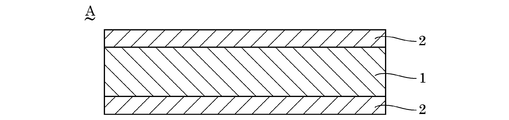
- the laminate for a vehicle exterior material of the present invention includes a fiber mat 1 in which inorganic fibers and heat-resistant organic fibers having a melting point of 200 ° C. or higher are bound by molten binder resin fibers, and at least the fiber mat 1.
- the synthetic resin film 2 is laminated and integrated on one surface, and a part of the synthetic resin film 2 is melted and impregnated in the fiber mat.
- FIG. 1 shows a laminate A for a vehicle exterior material in which synthetic resin films 2 are laminated and integrated on both surfaces of a fiber mat.
- Examples of the inorganic fiber constituting the fiber mat 1 include glass fiber, rock wool, metal fiber, and carbon fiber.
- Inorganic fibers are preferably glass fibers and rock wool because they are easy to handle, and glass fibers are more preferable.
- an inorganic fiber may be used independently or 2 or more types may be used together.
- the length of the inorganic fiber is preferably 5 to 250 mm, more preferably 30 to 150 mm.
- the thickness of the inorganic fiber is preferably 3 to 30 ⁇ m, more preferably 5 to 20 ⁇ m, and more preferably 6 to 15 ⁇ m.
- the content of inorganic fibers in the fiber mat 1 is preferably 15 to 60% by weight because a vehicle exterior material having a light weight and sufficient mechanical strength can be obtained.
- the heat-resistant organic fiber constituting the fiber mat 1 may be maintained in a form without melting during the manufacturing process, and specifically, the melting point needs to be 200 ° C. or higher.
- the resin used for the heat-resistant organic fiber include synthetic resin fibers such as polyethylene terephthalate fiber, polybutylene terephthalate fiber, polyamide fiber, aramid fiber, and polyurethane fiber, and natural fibers such as cotton, hemp, kenaf, and wool.
- fusing point of a heat resistant organic fiber means what was measured based on JISK7121.
- the heat-resistant organic fibers may be used alone or in combination of two or more.
- the length of the heat resistant organic fiber is preferably 5 to 250 mm, more preferably 30 to 150 mm.
- the content of the heat-resistant organic fiber having a length of 30 to 150 mm in the heat-resistant organic fiber is preferably 25% by weight or more, and more preferably 26 to 100% by weight because sufficient strength can be given to the fiber mat.
- the fineness of the heat-resistant organic fiber is preferably 2 to 50 dtex, more preferably 5 to 30 dtex because the fibers can be mixed and dispersed uniformly.
- the content of the heat resistant organic fiber in the fiber mat 1 is preferably 5 to 60% by weight, and more preferably 10 to 40% by weight. If the content of the heat-resistant organic fiber is small, the impact resistance of the vehicle exterior material may be lowered. When the content of the heat-resistant organic fiber is large, the mechanical strength of the vehicle exterior material may be lowered.
- the fiber mat 1 contains binder resin fibers, and the inorganic resin and heat-resistant organic fibers having a melting point of 200 ° C. or higher are bound by the binder resin fibers.
- the synthetic resin constituting the binder resin fiber include polyolefin resins such as polyethylene resins and polypropylene resins.
- the form of the binder resin fiber may be a fiber having a core-sheath structure in addition to a fiber formed from a single synthetic resin.
- the inorganic fiber and the heat-resistant organic fiber having a melting point of 200 ° C. or higher are bound by the synthetic resin constituting the fiber surface.
- the heat resistance may be lowered. 70 to 170 ° C. is preferable because the heat-resistant organic fibers having a temperature higher than or equal to 0 ° C. may be insufficiently bonded and the strength of the vehicle exterior material may be lowered.
- the melting point of the synthetic resin refers to a value measured according to JIS K7121.
- the length of the binder resin fiber is preferably 5 to 250 mm, more preferably 30 to 150 mm.
- the fineness of the binder resin fiber is preferably 2 to 50 dtex, more preferably 5 to 30 dtex because it can be easily dispersed in the fiber and is easy to handle.
- the content of the binder resin fiber in the fiber mat 1 is preferably 10 to 40% by weight. By adjusting the content of the binder resin fiber, the mechanical strength of the vehicle exterior material can be sufficiently expressed.
- Basis weight of the fiber mat 1, because it is easy to achieve both weight and mechanical strength preferably 100 ⁇ 1500g / m 2, more preferably 300 ⁇ 1000g / m 2.
- the synthetic resin film 2 is laminated and integrated on at least one surface, preferably both surfaces, of the fiber mat 1, and a part of the synthetic resin film 2 is melted and impregnated in the fiber mat 1.
- the synthetic resin constituting the synthetic resin film 2 contains a binder resin that can be impregnated into the fiber mat 1 to bind inorganic fibers and heat-resistant organic fibers having a melting point of 200 ° C. or higher.
- binder resins include polyethylene resins, polypropylene resins, ethylene-vinyl acetate copolymers, polyethylene terephthalate, polyethylene terephthalate copolymer resins, and maleic anhydride-modified polyethylene.
- the synthetic resin constituting the synthetic resin film 2 is preferably made of a binder resin. If the content of the binder resin in the synthetic resin constituting the synthetic resin film 2 is small, the mechanical strength of the fiber mat may be lowered.
- the content is preferably 50% by weight or more, and 80% by weight or more. More preferred.
- the synthetic resin may contain a synthetic resin other than the binder resin as long as the binding between the inorganic fiber and the heat-resistant organic fiber is not inhibited.
- the synthetic resin other than the binder resin include polystyrene resin and polyvinyl chloride resin.
- the synthetic resin which comprises the synthetic resin film 2 may be used independently, or 2 or more types may be used together.
- the melt flow rate of the synthetic resin constituting the synthetic resin film 2 is preferably 0.1 to 25 g / 10 minutes, and more preferably 0.3 to 15 g / 10 minutes. If the melt flow rate of the synthetic resin is low, it may take time until the molten resin is sufficiently impregnated into the fiber mat. When the melt flow rate of the synthetic resin is high, it becomes difficult to accurately adjust the amount of molten resin impregnated in the fiber mat.
- the melt flow rate of the synthetic resin refers to that measured in accordance with JIS K 7210.
- the synthetic resin film 2 is composed of a plurality of synthetic resin layers 21, 21. It may be a film.
- the innermost synthetic resin layer 21a that is, the synthetic resin layer 21a in contact with the fiber mat 1
- the synthetic resin film 2 is laminated and integrated on both surfaces of the fiber mat 1
- both synthetic resin films 2 May be a multilayer synthetic resin film.
- FIG. 2 the case where one synthetic resin film 2 was a multilayer synthetic resin film was shown.
- the at least one synthetic resin layer other than the innermost layer is preferably a heat resistant synthetic resin layer composed of a heat resistant synthetic resin having a melting point of 200 ° C. or higher, and the outermost synthetic resin layer 21b has a melting point.
- a heat resistant synthetic resin layer composed of a heat-resistant synthetic resin at 200 ° C. or higher.
- the synthetic resin layer 21 remains thick on the surface of the fiber mat 1 even after the laminated body for vehicle exterior materials is thermoformed.
- a vehicle exterior material excellent in mechanical strength, particularly in impact resistance can be obtained.
- the outermost synthetic resin layer 21b of the synthetic resin film 2 is made of a heat resistant synthetic resin
- the outermost layer does not melt during the manufacturing process of the laminated body for vehicle exterior materials or during the thermoforming of the laminated body for vehicle exterior materials. Therefore, the surface of the vehicle exterior material can be a smooth surface that is difficult to be iced. Therefore, the vehicle exterior material has excellent impact resistance, and it is possible to prevent the vehicle exterior material from icing when used in a cold region.
- heat-resistant synthetic resins examples include polyethylene terephthalate, polybutylene terephthalate, polyamide, aromatic polyamide, and modified resins thereof.
- the melting point of the heat resistant synthetic resin is preferably 30 ° C. or higher, more preferably 50 ° C. or higher than the melting point of the synthetic resin constituting the innermost synthetic resin layer 21a. If the difference between the melting point of the heat-resistant synthetic resin and the melting point of the synthetic resin constituting the innermost synthetic resin layer 21a is small, the laminate for the vehicle exterior material or the laminate for the vehicle exterior material The synthetic resin layer formed from the heat resistant synthetic resin may be melted by the heat applied at the time of thermoforming.
- the melt flow rate of the synthetic resin constituting at least one synthetic resin layer other than the innermost layer is 1 ⁇ 2 or less of the melt flow rate of the synthetic resin constituting the innermost synthetic resin film layer 21a.
- a synthetic resin layer can be reliably formed in the surface of a fiber mat, and the impact resistance of the surface of a vehicle exterior material can be improved.
- the total thickness of the single layer or multilayer synthetic resin film 2 is preferably 30 to 500 ⁇ m, and more preferably 100 to 400 ⁇ m.
- the thickness of the synthetic resin film 2 is thin, it is difficult to obtain a vehicle exterior material having high impact resistance, and the surface smoothness of the vehicle exterior material is lowered, and it may be easy to form ice when used in a cold region.
- the thickness of the synthetic resin film 2 is thick, it may be difficult to form the vehicle exterior material.
- the manufacturing method of the laminated body for vehicle exterior materials of this invention is demonstrated.
- the manufacturing method of the fiber mat 1 is demonstrated.
- a manufacturing method of the fiber mat 1 for example, after a mixed fiber formed by mixing inorganic fibers, a heat-resistant organic fiber having a melting point of 200 ° C. or more, and a binder resin fiber is supplied to a card machine to form a mat. And a method of producing a fiber mat by entanglement of fibers.
- Examples of the method for entanglement of fibers include a needle punch method in which a needle punch is applied to a mat, and a water entanglement method in which a water flow collides with a mat.
- the needle punch is preferably 1 to 150 locations per 1 cm 2 and more preferably 10 to 100 locations.
- the fiber mat may contain a thermoplastic resin powder capable of binding the inorganic fiber and the heat-resistant organic fiber in order to improve the binding property between the inorganic fiber and the heat-resistant organic fiber.
- thermoplastic resin powder examples include polyethylene resins, polypropylene resins, ethylene-vinyl acetate copolymers, polyethylene terephthalate, and maleic anhydride-modified polyethylene.
- a synthetic resin film is directly laminated on one side or both sides of the fiber mat to form a laminated sheet.
- the synthetic resin film in a molten state immediately after being extruded from the extruder is continuously supplied onto the fiber mat, and the synthetic resin film is laminated on the fiber mat. Also good.
- the synthetic resin film laminated on the fiber mat may bind inorganic fibers and heat-resistant organic fibers having a melting point of 200 ° C. or higher. It is necessary to laminate so that the synthetic resin layer containing the binder resin that can be brought into direct contact with the fiber mat.
- the synthetic resin film composed of a plurality of synthetic resin layers
- a plurality of synthetic resin films may be laminated on the fiber mat.
- the synthetic resin film that is in direct contact with the fiber mat contains a binder resin that can bind the inorganic fibers of the fiber mat 1 and heat-resistant organic fibers having a melting point of 200 ° C. or higher. There is a need.
- the binder resin fiber in the fiber mat of the laminated sheet and the binder resin of the synthetic resin film are melted and The heat-resistant organic fiber is heated to a temperature at which it does not melt, the laminated sheet is compressed in the thickness direction, preferably 0.5 to 3 mm, and the binder resin is impregnated into the fiber mat from the synthetic resin film.
- the heat resistant synthetic resin layer is formed in the synthetic resin film, it is necessary to set to a temperature at which the heat resistant synthetic resin does not melt.
- the laminated sheet expands in the thickness direction due to the restoring force of the entangled inorganic fibers in the laminated sheet fiber mat, and numerous voids are formed in the laminated sheet fiber mat.
- a lightweight laminated sheet is obtained.
- the laminated sheet is supplied between the pair of conveying belts, the laminated sheet is sucked through the conveying belt, and is laminated by widening the interval between the pair of conveying belts with the laminated sheet adsorbed on the conveying belt.
- the sheet may be forcibly expanded in the thickness direction.
- the porosity of the laminated body for vehicle exterior materials is 30 to 90%.
- the laminated body for vehicle exterior materials can be obtained by cooling the laminated sheet.
- the binder resin fibers in the fiber mat of the obtained laminate for vehicle exterior materials are melted to bind inorganic fibers and heat-resistant organic fibers having a melting point of 200 ° C. or higher, and to bind the synthetic resin film.
- Part of the adhesive resin is impregnated into the fiber mat to bind the inorganic fiber and the heat-resistant organic fiber having a melting point of 200 ° C. or higher.
- the binder resin of the synthetic resin film impregnated in the fiber mat is concentrated on the surface portion of the fiber mat, and the surface portion of the fiber mat 1 is reinforced.
- the surface portion of the laminate for vehicle exterior materials is superior in mechanical strength such as impact resistance compared to the central portion in the thickness direction, and the laminate for vehicle exterior materials is torn by collision with stepping stones, etc. Is less likely to break.
- a vehicle exterior material can be obtained by thermoforming the laminate for a vehicle exterior material.
- the vehicle exterior material include a vehicle under cover, a vehicle fender cover, a tire housing, and the like.
- the vehicle undercover is used to cover the bottom of the vehicle completely or partially to reduce air resistance at the bottom of the vehicle or to protect the bottom of the vehicle.
- the entangled inorganic fibers in the fiber mat recover the thickness of the fiber mat by its own restoring force.
- the laminate for a vehicle exterior material whose thickness has been recovered by such an action can be heat-molded into a vehicle exterior material having a complicated shape.
- the obtained vehicle exterior material is very light with many voids formed inside the fiber mat. Furthermore, if the vehicle exterior material has an appropriate thickness, specifically, preferably 2 mm or more, more preferably 3 mm or more, the vehicle exterior material has excellent elasticity and is not easily damaged by a collision with a stepping stone or the like.
- the synthetic resin constituting the laminate for vehicle exterior materials may contain a pigment such as carbon black, an antioxidant, a slip agent, a crystallization nucleating agent, and the like as necessary.
- the laminate for a vehicle exterior material of the present invention has the above-described configuration, and has excellent mechanical strength because the fiber mat contains inorganic fibers and heat-resistant organic fibers. Furthermore, the laminated body for vehicle exterior materials is provided with excellent elasticity by the heat-resistant organic fiber, and effectively absorbs the impact caused by the collision of the stepping stones and is not easily broken.
- the laminated body for vehicle exterior materials is particularly excellent in mechanical strength on the surface thereof, and is hardly broken by an impact caused by a stepping stone collision or the like due to a synergistic effect with the impact absorbing effect by the fiber mat described above.
- the laminated body for vehicle exterior materials when at least one synthetic resin layer other than the innermost layer is a heat-resistant synthetic resin layer having a melting point of 200 ° C. or higher, it is thick on the surface of the fiber mat even after thermoforming. Since the synthetic resin layer can remain, the mechanical strength on the surface of the vehicle exterior material can be further improved.
- Example 1 Glass fiber having a length of 40 to 75 mm and a diameter of 9 ⁇ m, polypropylene fiber having a fineness of 6.6 dtex and a length of 64 mm (melting point: 160 ° C.), polyethylene terephthalate having a fineness of 17 dtex and a length of 64 mm Fibers (melting point: 255 ° C.) were mixed so as to have the basis weight shown in Table 1, respectively, supplied to a card machine, defibrated and mixed to obtain a long mat. The resulting mat was hit with 20 needle punches per 1 cm 2 to entangle the fibers to obtain a long fiber mat 1 having a basis weight of 700 g / m 2 .
- a thickness of 160 ⁇ m (weight per unit area: 144 g / m 2 ) made of high-density polyethylene (melting point: 135 ° C., melt flow rate: 5.0 g / 10 min) is formed on each of the upper and lower surfaces of the long fiber mat 1.
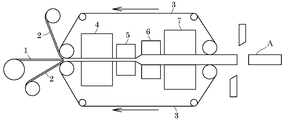
- the long synthetic resin films 2 and 2 are continuously laminated to obtain a laminated sheet B having a thickness of 8 mm.
- a pair of upper and lower endless conveyor belts 3 and 3 whose surfaces were coated with polytetrafluoroethylene were prepared.
- a laminated sheet was continuously supplied between the pair of conveying belts 3 and 3, and the laminated sheet B was passed through a 200 ° C. hot air heating furnace 4 and heated for 5 minutes.
- the laminated sheet B is supplied between a pair of flat plate presses 5 and 5 heated to 200 ° C., and the laminated sheet B is compressed so that its thickness becomes 1.5 mm and held for 5 seconds, A portion of the high-density polyethylene constituting the synthetic resin film was impregnated into the fiber mat, and the polypropylene fiber was melted.
- the laminated sheet B is supplied between the flat plate-like upper and lower vacuum expansion devices 6 and 6, and the laminated sheet B is vacuum-sucked through the pair of conveying belts 3 and 3 to bring the laminated sheet B in the thickness direction
- the laminated sheet B was supplied into the cooling device 7 and cooled to obtain a laminated body for a vehicle exterior material having a thickness of 4.5 mm and a basis weight of 1000 g / m 2 .
- the resulting laminate for vehicle exterior materials had a synthetic resin film made of high-density polyethylene laminated and integrated on both sides of the fiber mat.
- the glass fiber and polyethylene terephthalate fiber of the fiber mat are partially bound by polypropylene, and the surface portion of the fiber mat is impregnated with part of the high-density polyethylene constituting the synthetic resin film.
- the fibers were bound together.
- a void was formed in the fiber mat of the laminate for a vehicle exterior material, and the void ratio was 82%.
- Example 2 As a synthetic resin film laminated on the upper surface of the fiber mat, two synthetic resin films made of high-density polyethylene (melting point: 135 ° C., melt flow rate: 5.0 g / 10 min) are laminated and integrated. A laminated body for vehicle exterior materials having a basis weight of 1130 g / m 2 was obtained in the same manner as in Example 1 except that (thickness: 320 ⁇ m, basis weight: 288 g / m 2 ) was used.
- the resulting laminate for vehicle exterior materials had a synthetic resin film made of high-density polyethylene laminated and integrated on both sides of the fiber mat.
- the glass fibers of the fiber mat are partly bound by polypropylene, and the fiber mat surfaces are impregnated with a part of the high density polyethylene constituting the synthetic resin film to bind the fibers of the fiber mat. I was wearing it.
- a void was formed in the fiber mat of the laminate for a vehicle exterior material, and the void ratio was 78%.
- Example 3 As a synthetic resin film laminated on the upper surface of the fiber mat, a polyethylene terephthalate copolymer resin (Bell Polyester Products Co., Ltd.) having a melting point of 150 ° C. and a melt flow rate of 2.9 g / 10 min with respect to a polyethylene terephthalate film having a melting point of 255 ° C.
- a polyethylene terephthalate copolymer resin Bell Polyester Products Co., Ltd.
- a laminate for vehicle exterior materials having a basis weight of 1050 g / m 2 was obtained.
- the resulting laminate for vehicle exterior materials had a synthetic resin film laminated and integrated on both sides of the fiber mat.
- the glass fiber of the fiber mat and the polyethylene terephthalate fiber are partially bound by polypropylene, and on the surface layer of the fiber mat, a part of the high-density polyethylene constituting the synthetic resin film has a melting point of 150 ° C. and a melt flow rate.
- Part of the 2.9 g / 10 min polyethylene terephthalate copolymer resin was impregnated to bind the fibers of the fiber mat.
- a void was formed in the fiber mat of the laminate for a vehicle exterior material, and the void ratio was 82%.
- Example 1 A laminated body for vehicle exterior materials having a basis weight of 1000 g / m 2 was obtained in the same manner as in Example 1 except that a fiber mat was made of the same glass fiber and polypropylene fiber as in Example 1.
- the resulting laminate for vehicle exterior materials had a synthetic resin film laminated and integrated on both sides of the fiber mat.
- the glass fiber of the fiber mat is partially bound by polypropylene, and the surface portion of the fiber mat is impregnated with a part of the high density polyethylene constituting the synthetic resin film so that the fibers of the fiber mat are interleaved. I was bound. Gaps were formed in the fiber mat of the laminate for vehicle exterior materials, and the porosity was 83%.
- Step stone test A test piece was cut out from a laminate for a vehicle exterior material into a rectangular shape having a length of 220 mm and a width of 290 mm, and the test piece was fixed in a metal frame. Next, a synthetic resin ball having a diameter of 6 mm was caused to collide with the center of the test piece using a commercially available model gun. In addition, about the laminated body for vehicle exterior materials of Example 3, the ball
- the synthetic resin ball was repeatedly collided 30 times with the same part of the test piece, and the maximum depth of the dent of the test piece formed by colliding the synthetic resin ball was measured with a caliper.
- test piece (High temperature elongation) A test piece was cut out from the laminate for a vehicle exterior material, and the test piece was fixed with a pair of chucks at a distance between chucks of 100 mm. In this state, the test piece was supplied into a thermostat kept at 190 ° C. and heated for 5 minutes.
- a test piece is cut out from the laminated body for vehicle exterior materials into a rectangle of 500 mm in length and 600 mm in width, and this test piece is attached to a metal frame with a needle installed at equal intervals around it, and a far infrared heater is used.
- the test piece was heated so that the surface temperature was 180 ° C.
- the male and female molds were clamped and held for 30 seconds, and then the mold was opened to obtain a molded product.
- the periphery of the convex part of the obtained molded product was visually observed to determine whether wrinkles were generated on the molded product, and judged based on the following criteria. Good: no wrinkle around the convex part Bad: there is a wrinkle around the convex part
- the laminated body for vehicle exterior materials of the present invention has excellent mechanical strength and excellent elasticity, it effectively absorbs impact caused by collision of stepping stones, is not easily torn, and is formed by heat molding. It can be suitably used for vehicle exterior materials such as an undercover, a vehicle fender cover, a tire housing, and an engine cover.
Landscapes
- Laminated Bodies (AREA)
- Body Structure For Vehicles (AREA)
Abstract
Description
長さが40~75mmで且つ直径が9μmのガラス繊維と、繊度が6.6dtexで且つ長さが64mmのポリプロピレン繊維(融点:160℃)と、繊度が17dtexで且つ長さが64mmのポリエチレンテレフタレート繊維(融点:255℃)がそれぞれ表1に記載の目付量となるように混合しカード機に供給して解繊及び混繊して長尺状のマットを得た。得られたマットにニードルパンチを1cm2当たり20箇所打って繊維同士を交絡させて目付が700g/m2の長尺状の繊維マット1を得た。
繊維マットの上面に積層させた合成樹脂フィルムとして、高密度ポリエチレン(融点:135℃、メルトフローレイト:5.0g/10分)からなる合成樹脂フィルムを2枚、積層一体化させた合成樹脂フィルム(厚み:320μm、目付:288g/m2)を用いたこと以外は実施例1と同様にして目付が1130g/m2の車両外装材用積層体を得た。
繊維マットの上面に積層させた合成樹脂フィルムとして、融点255℃のポリエチレンテレフタレートフィルムに対して、融点150℃、メルトフローレイト:2.9g/10分のポリエチレンテレフタレート共重合樹脂(株式会社ベルポリエステルプロダクツ製 商品名「ベルペット E-02」)からなる層が積層一体化された二層構造の合成樹脂フィルム(厚み:160μm、目付:203g/m2)を用い、繊維マットの上面に対して、ポリエチレンテレフタレート共重合樹脂層が接するように合成樹脂フィルムを積層し、下面に実施例1で使用した高密度ポリエチレンからなる合成樹脂フィルム(厚さ=160μm)と同様のフィルムを用いたこと以外は実施例1と同様にして目付が1050g/m2の車両外装材用積層体を得た。
実施例1と同様のガラス繊維とポリプロピレン繊維により繊維マットを作成した以外は、実施例1と同様にして目付が1000g/m2の車両外装材用積層体を得た。
車両外装材用積層体から試験片を縦220mm、横290mmの長方形に切り出し、この試験片を金属製の額縁状枠体内に固定した。次に、試験片の中央部に、直径6mmの合成樹脂製の球を市販のモデルガンを用いて衝突させた。なお、実施例3の車両外装材用積層体については、二層構造の合成樹脂フィルムが形成されている表面に合成樹脂製の球を衝突させた。
車両外装材用積層体から試験片を切り出し、この試験片をチャック間距離100mmにて一対のチャックで固定した。この状態で試験片を190℃に保持した恒温槽内に供給して5分間に亘って加熱した。
高温伸び率(%)=(L/100)×100
底面が直径80mmの真円形状で且つ頂面が直径40mmの真円形状である截頭円錐状の凸部が形成された雄型と、この雄型の凸部に対応した凹部を有する雌型とからなる成形型を用意した。
良(good)・・・凸部周辺に皺の発生が無い
不良(bad)・・・凸部周辺に皺の発生が有り

2 合成樹脂フィルム
21、21a、21b 合成樹脂層
3 搬送ベルト
4 熱風加熱炉
5 平板プレス
6 上下真空拡開装置
7 冷却装置
A 車両外装材用積層体
Claims (7)
- 無機繊維と、融点が200℃以上の耐熱性有機繊維と、上記無機繊維及び上記耐熱性有機繊維を結着する結着樹脂繊維とを混合してなる繊維マットの少なくとも一方の表面に、上記無機繊維と上記耐熱性有機繊維を結着可能な結着樹脂を含有する合成樹脂フィルムを積層し、上記結着樹脂繊維と上記合成樹脂フィルムに含まれる結着樹脂を溶融させ、上記合成樹脂フィルムから溶融した結着樹脂を繊維マット内に含浸させ、上記無機繊維と上記耐熱性有機繊維とを結着させて得られたことを特徴とする車両外装材用積層体。
- 合成樹脂フィルムが、複数の合成樹脂層からなり、最内層の合成樹脂層を除く少なくとも一層の合成樹脂層が、融点が200℃以上の耐熱性合成樹脂からなることを特徴とする請求項1に記載の車両外装材用積層体。
- 合成樹脂フィルムの最外層の合成樹脂層が、融点が200℃以上の耐熱性合成樹脂からなることを特徴とする請求項2に記載の車両外装材用積層体。
- 無機繊維と、融点が200℃以上の耐熱性有機繊維と、上記無機繊維及び上記耐熱性有機繊維を結着する結着樹脂繊維とを混合してなる繊維マットの少なくとも一方の表面に、上記無機繊維と上記耐熱性有機繊維を結着可能な結着樹脂を含有する合成樹脂フィルムを積層して積層シートを製造し、上記結着樹脂繊維及び上記合成樹脂フィルムを溶融させながら上記積層シートをその厚み方向に圧縮し、上記合成樹脂フィルムから溶融した結着樹脂を上記繊維マットに含浸させ、圧力を除いた後、冷却することを特徴とする車両外装材用積層体の製造方法。
- 合成樹脂フィルムが、複数の合成樹脂層からなり、最内層の合成樹脂層を除く少なくとも一層の合成樹脂層が、融点が200℃以上の耐熱性合成樹脂からなることを特徴とする請求項4に記載の車両外装材用積層体の製造方法。
- 合成樹脂フィルムの最外層の合成樹脂層が、融点が200℃以上の耐熱性合成樹脂からなることを特徴とする請求項5に記載の車両外装材用積層体の製造方法。
- 請求項1乃至請求項3の何れか1項に記載の車両外装材用積層体を加熱成形してなることを特徴とする車両外装材。
Priority Applications (3)
| Application Number | Priority Date | Filing Date | Title |
|---|---|---|---|
| CN201080010904.2A CN102341296B (zh) | 2009-03-24 | 2010-03-24 | 车辆外装材料用叠层体及其制造方法、以及车辆外装材料 |
| JP2010518451A JP5374506B2 (ja) | 2009-03-24 | 2010-03-24 | 車両外装材用積層体及びその製造方法並びに車両外装材 |
| DE112010001365T DE112010001365T5 (de) | 2009-03-24 | 2010-03-24 | Schichtkörper für Fahrzeugaußenverkleidungsmaterial und Verfahren zum Herstellen desselben sowie Fahrzeugaußenverkleidungsmaterial |
Applications Claiming Priority (2)
| Application Number | Priority Date | Filing Date | Title |
|---|---|---|---|
| JP2009-072454 | 2009-03-24 | ||
| JP2009072454 | 2009-03-24 |
Publications (1)
| Publication Number | Publication Date |
|---|---|
| WO2010110312A1 true WO2010110312A1 (ja) | 2010-09-30 |
Family
ID=42781006
Family Applications (1)
| Application Number | Title | Priority Date | Filing Date |
|---|---|---|---|
| PCT/JP2010/055076 Ceased WO2010110312A1 (ja) | 2009-03-24 | 2010-03-24 | 車両外装材用積層体及びその製造方法並びに車両外装材 |
Country Status (4)
| Country | Link |
|---|---|
| JP (1) | JP5374506B2 (ja) |
| CN (1) | CN102341296B (ja) |
| DE (1) | DE112010001365T5 (ja) |
| WO (1) | WO2010110312A1 (ja) |
Cited By (4)
| Publication number | Priority date | Publication date | Assignee | Title |
|---|---|---|---|---|
| JP2012051428A (ja) * | 2010-08-31 | 2012-03-15 | Sekisui Chem Co Ltd | 車両外装材用積層体及びその製造方法並びに車両外装材 |
| JP2012214003A (ja) * | 2011-03-30 | 2012-11-08 | Sekisui Chem Co Ltd | 複合成形体の製造方法 |
| JP2013032609A (ja) * | 2011-07-01 | 2013-02-14 | Sekisui Chem Co Ltd | 繊維マット及び積層体 |
| JP2021020365A (ja) * | 2019-07-26 | 2021-02-18 | 日本バイリーン株式会社 | 表面材および車両用外装材 |
Families Citing this family (7)
| Publication number | Priority date | Publication date | Assignee | Title |
|---|---|---|---|---|
| CN103042702B (zh) * | 2012-11-13 | 2015-01-07 | 中国科学院宁波材料技术与工程研究所 | 减少纤维增强热塑性复合材料制品表面缺陷的方法 |
| CN103434227B (zh) * | 2013-09-07 | 2015-07-29 | 浙江华江科技发展有限公司 | 一种轻质、高韧性、高吸音汽车轮罩护板用热塑性复合材料及其制备工艺 |
| WO2015155889A1 (ja) * | 2014-04-11 | 2015-10-15 | 日産自動車株式会社 | 衝撃吸収構造及びこれを備えた車両用外板部材 |
| DE102014224522A1 (de) | 2014-12-01 | 2016-06-02 | Thyssenkrupp Ag | Faserverbundwerkstoff, Verfahren zur Herstellung eines Verbundbauteils sowie dessen Verwendung |
| DE102015211222B4 (de) * | 2015-06-18 | 2020-04-23 | Bayerische Motoren Werke Aktiengesellschaft | Unterbodenschutzvorrichtung für ein Kraftfahrzeug |
| KR101923379B1 (ko) * | 2015-06-29 | 2018-11-30 | (주)엘지하우시스 | 차량용 언더바디 커버 및 이를 제조하는 방법 |
| CN107379713A (zh) * | 2017-07-25 | 2017-11-24 | 芜湖尚唯汽车饰件有限公司 | 一种隔音降噪汽车外轮罩的加工工艺 |
Citations (3)
| Publication number | Priority date | Publication date | Assignee | Title |
|---|---|---|---|---|
| JPH10100299A (ja) * | 1996-09-30 | 1998-04-21 | Kawasaki Steel Corp | 成形吸音材およびその製造方法 |
| JP2000167964A (ja) * | 1998-12-08 | 2000-06-20 | Ikeda Bussan Co Ltd | 内装基材 |
| JP2009001045A (ja) * | 2007-06-19 | 2009-01-08 | Hayashi Engineering Inc | フェンダライナ及びその製造方法 |
Family Cites Families (4)
| Publication number | Priority date | Publication date | Assignee | Title |
|---|---|---|---|---|
| JP2006240408A (ja) | 2005-03-02 | 2006-09-14 | Hirotani:Kk | 自動車用軽量・吸音型アンダーカバー |
| JP4507919B2 (ja) * | 2005-03-08 | 2010-07-21 | 豊田合成株式会社 | 外装材 |
| JP5016833B2 (ja) * | 2005-03-31 | 2012-09-05 | 豊田合成株式会社 | 外装材 |
| JP4582020B2 (ja) * | 2006-02-28 | 2010-11-17 | 三菱自動車工業株式会社 | フェンダーパネル構造 |
-
2010
- 2010-03-24 WO PCT/JP2010/055076 patent/WO2010110312A1/ja not_active Ceased
- 2010-03-24 CN CN201080010904.2A patent/CN102341296B/zh not_active Expired - Fee Related
- 2010-03-24 JP JP2010518451A patent/JP5374506B2/ja not_active Expired - Fee Related
- 2010-03-24 DE DE112010001365T patent/DE112010001365T5/de not_active Withdrawn
Patent Citations (3)
| Publication number | Priority date | Publication date | Assignee | Title |
|---|---|---|---|---|
| JPH10100299A (ja) * | 1996-09-30 | 1998-04-21 | Kawasaki Steel Corp | 成形吸音材およびその製造方法 |
| JP2000167964A (ja) * | 1998-12-08 | 2000-06-20 | Ikeda Bussan Co Ltd | 内装基材 |
| JP2009001045A (ja) * | 2007-06-19 | 2009-01-08 | Hayashi Engineering Inc | フェンダライナ及びその製造方法 |
Cited By (5)
| Publication number | Priority date | Publication date | Assignee | Title |
|---|---|---|---|---|
| JP2012051428A (ja) * | 2010-08-31 | 2012-03-15 | Sekisui Chem Co Ltd | 車両外装材用積層体及びその製造方法並びに車両外装材 |
| JP2012214003A (ja) * | 2011-03-30 | 2012-11-08 | Sekisui Chem Co Ltd | 複合成形体の製造方法 |
| JP2013032609A (ja) * | 2011-07-01 | 2013-02-14 | Sekisui Chem Co Ltd | 繊維マット及び積層体 |
| JP2021020365A (ja) * | 2019-07-26 | 2021-02-18 | 日本バイリーン株式会社 | 表面材および車両用外装材 |
| JP7430043B2 (ja) | 2019-07-26 | 2024-02-09 | 日本バイリーン株式会社 | 表面材および車両用外装材 |
Also Published As
| Publication number | Publication date |
|---|---|
| CN102341296A (zh) | 2012-02-01 |
| DE112010001365T5 (de) | 2012-10-11 |
| CN102341296B (zh) | 2014-06-11 |
| JPWO2010110312A1 (ja) | 2012-09-27 |
| JP5374506B2 (ja) | 2013-12-25 |
Similar Documents
| Publication | Publication Date | Title |
|---|---|---|
| JP5374506B2 (ja) | 車両外装材用積層体及びその製造方法並びに車両外装材 | |
| KR101340719B1 (ko) | 차량용 휀더 라이너 및 그 제조방법 | |
| KR101974469B1 (ko) | 딥 드로우 복합물 및 이를 사용하는 방법 | |
| CN101711208B (zh) | 翼子板内衬板及其制造方法 | |
| JP2012245925A (ja) | 自動車用ボディーアンダーカバー | |
| JP2003112661A (ja) | 車両用外装材及びそれを用いた外装品並びにその成形方法 | |
| JP5666143B2 (ja) | 自動車外装材 | |
| JP5820773B2 (ja) | フェンダーライナ及びその製造方法 | |
| US20220034012A1 (en) | Nonwoven-fabric structure and manufacturing method therefor | |
| KR101901235B1 (ko) | 폐섬유를 이용한 자동차용 경량 흡음 내장재 및 이의 제조방법 | |
| JP2009096401A (ja) | 自動車用ボディーアンダーカバー | |
| JP6046930B2 (ja) | 繊維マット及び積層体 | |
| KR102512960B1 (ko) | Rv 차량의 트렁크용 내장재 및 그 제조방법 | |
| JP2002144976A (ja) | 車両用成形天井及びその製造方法 | |
| KR20080027656A (ko) | 자동차용 내장재 패널 및 그 제조방법 | |
| JP6527791B2 (ja) | 車両用外装防音材の製造方法 | |
| JP5898873B2 (ja) | 車両用アンダーカバー及びその製造方法 | |
| JP5740199B2 (ja) | 複合成形体の製造方法 | |
| US20200262363A1 (en) | Sheet for interior or exterior materials for automobiles and method for producing same | |
| JP3966125B2 (ja) | 防音材の製造方法 | |
| JP6033367B2 (ja) | フェンダーライナ及びその製造方法 | |
| JPH079632A (ja) | 成形複合体及びその製造方法 | |
| JP2016221711A (ja) | 不織布積層体及びこれに使用される孔あきフィルム | |
| CN115702093A (zh) | 交通工具用内外饰及交通工具用内外饰的制造方法 | |
| JP2012051428A (ja) | 車両外装材用積層体及びその製造方法並びに車両外装材 |
Legal Events
| Date | Code | Title | Description |
|---|---|---|---|
| WWE | Wipo information: entry into national phase |
Ref document number: 201080010904.2 Country of ref document: CN |
|
| WWE | Wipo information: entry into national phase |
Ref document number: 2010518451 Country of ref document: JP |
|
| 121 | Ep: the epo has been informed by wipo that ep was designated in this application |
Ref document number: 10756108 Country of ref document: EP Kind code of ref document: A1 |
|
| WWE | Wipo information: entry into national phase |
Ref document number: 1120100013659 Country of ref document: DE Ref document number: 112010001365 Country of ref document: DE |
|
| 122 | Ep: pct application non-entry in european phase |
Ref document number: 10756108 Country of ref document: EP Kind code of ref document: A1 |