WO2010107095A1 - ポリマー部材の製造方法、及びポリマー部材 - Google Patents
ポリマー部材の製造方法、及びポリマー部材 Download PDFInfo
- Publication number
- WO2010107095A1 WO2010107095A1 PCT/JP2010/054712 JP2010054712W WO2010107095A1 WO 2010107095 A1 WO2010107095 A1 WO 2010107095A1 JP 2010054712 W JP2010054712 W JP 2010054712W WO 2010107095 A1 WO2010107095 A1 WO 2010107095A1
- Authority
- WO
- WIPO (PCT)
- Prior art keywords
- layer
- monomer
- polymer
- sheet
- substance
- Prior art date
- Legal status (The legal status is an assumption and is not a legal conclusion. Google has not performed a legal analysis and makes no representation as to the accuracy of the status listed.)
- Ceased
Links
Images


















Classifications
-
- C—CHEMISTRY; METALLURGY
- C08—ORGANIC MACROMOLECULAR COMPOUNDS; THEIR PREPARATION OR CHEMICAL WORKING-UP; COMPOSITIONS BASED THEREON
- C08F—MACROMOLECULAR COMPOUNDS OBTAINED BY REACTIONS ONLY INVOLVING CARBON-TO-CARBON UNSATURATED BONDS
- C08F20/00—Homopolymers and copolymers of compounds having one or more unsaturated aliphatic radicals, each having only one carbon-to-carbon double bond, and only one being terminated by only one carboxyl radical or a salt, anhydride, ester, amide, imide or nitrile thereof
-
- Y—GENERAL TAGGING OF NEW TECHNOLOGICAL DEVELOPMENTS; GENERAL TAGGING OF CROSS-SECTIONAL TECHNOLOGIES SPANNING OVER SEVERAL SECTIONS OF THE IPC; TECHNICAL SUBJECTS COVERED BY FORMER USPC CROSS-REFERENCE ART COLLECTIONS [XRACs] AND DIGESTS
- Y10—TECHNICAL SUBJECTS COVERED BY FORMER USPC
- Y10T—TECHNICAL SUBJECTS COVERED BY FORMER US CLASSIFICATION
- Y10T428/00—Stock material or miscellaneous articles
- Y10T428/24—Structurally defined web or sheet [e.g., overall dimension, etc.]
- Y10T428/24802—Discontinuous or differential coating, impregnation or bond [e.g., artwork, printing, retouched photograph, etc.]
Definitions
- the present invention relates to a method for producing a polymer member having an unevenly distributed structure of incompatible substances, and a polymer member having an unevenly distributed structure of incompatible substances.
- a composite base material in which a substance different from the base material is unevenly distributed inside the base material is expected as a base material with new functions such as optical and electrical functions.
- a substrate examples include a laminated substrate having an intermediate layer containing particles.
- a laminated base material having an intermediate layer containing particles is obtained by, for example, obtaining a solution in which fine particles are dispersed in a solution in which a polymer component is dissolved in an organic solvent as a binder, and then dispersing the fine particles.
- This method is difficult when the base material is dissolved by a solvent, or when the base material has low heat resistance and is easily melted and deformed by heat drying, and the surface is sticky like an adhesive layer. Even if it is rich, it is difficult to coat the substrate surface. Furthermore, a solvent such as a solvent or water must be dried, which is not preferable from the viewpoint of environment and energy saving. Moreover, if the adhesion between the upper and lower substrates is not sufficient, there is a risk of peeling at the interface.
- the fine particle layer can be formed on the surface of the substrate sheet by forming a fine particle layer on the release-treated film and transferring it to the base material sheet.
- the affinity and compatibility between the substrate and the fine particle layer Is low, the adhesion between the base material layer and the fine particle layer is poor, and problems such as peeling between the layers are likely to occur.
- both the base material and the fine particle layer have almost no adhesiveness, it is difficult to bond them together, and it is necessary to bond them after applying an adhesive or the like to either one or both. come.
- the present inventors have previously described an incompatible material containing, on at least one surface of the monomer absorption layer, a polymerizable monomer and an incompatible material that is incompatible with a polymer obtained by polymerizing the polymerizable monomer. If the containing polymerizable composition layer is provided, the incompatible substance moves in the incompatible substance-containing polymerizable composition layer, and an incompatible substance unevenly distributed polymerizable composition layer is obtained, and the incompatible substance uneven distribution is obtained.
- the incompatible substance is unevenly distributed on or near the interface opposite to the monomer absorption layer, that is, unevenly distributed on one surface of the polymer member or in the vicinity of the surface and distributed inside the polymer member. I could't get what to do.
- a new layer is provided on the surface of the polymer member of the present invention, an interface always occurs between the polymer member and the new layer, and it is difficult to integrate them, and the newly provided layer peels off. was there.
- an object of the present invention is to provide a polymer member that does not require a volatile component such as a solvent at the time of production and controls the distribution of incompatible substances.
- the present inventor has found an incompatible substance-containing polymerizable composition containing an incompatible substance that is incompatible with a polymer obtained by polymerizing a polymerizable monomer. If a monomer-absorbing layer capable of absorbing a polymerizable monomer is laminated on both sides of the material layer and then subjected to polymerization, the distribution of the incompatible substance can be controlled to a fixed layered region inside, and the unevenly distributed structure of the incompatible substance The present invention has been completed by finding that a polymer member having the above can be obtained.
- the present invention can absorb the polymerizable monomer on both sides of the incompatible substance-containing polymerizable composition layer containing the incompatible substance that is incompatible with the polymer obtained by polymerizing the polymerizable monomer.
- a polymer member having an uneven distribution structure in which an incompatible substance is not present at the interface between the immiscible substance-containing polymerizable composition layer and the monomer absorbing layer immediately after lamination after being subjected to polymerization after laminating a monomer absorbing layer A method for producing a polymer member is provided.
- the present invention provides the method for producing a polymer member, wherein the monomer absorption layer is a monomer absorption polymer layer made of a polymer.
- the present invention provides the polymer member, wherein at least one monomer component constituting the polymer of the monomer-absorbing polymer layer is the same as at least one polymerizable monomer constituting the incompatible substance-containing polymerizable composition layer.
- a manufacturing method is provided.
- this invention provides the manufacturing method of the said polymer member whose monomer absorption layer is an adhesive composition layer.
- the present invention provides a method for producing the above polymer member using active energy ray irradiation during polymerization.
- the present invention provides a method for producing the polymer member, wherein the incompatible substance is particles.
- the present invention provides a method for producing the polymer member, wherein the incompatible substance is a polymer.
- the present invention provides a method for producing the polymer member, wherein the polymerizable monomer is an acrylic monomer.
- the present invention provides a method for producing the polymer member, wherein the polymer member is in the form of a tape or a sheet.
- the present invention provides a polymer member obtained by the above-described method for producing a polymer member.
- the method for producing a polymer member of the present invention since it has the above-described configuration, it does not require a volatile component such as a solvent at the time of production, and the distribution of the incompatible substance is a constant layer shape inside. It is possible to efficiently obtain a polymer member that is controlled in the region and has an unevenly distributed structure of an incompatible substance.
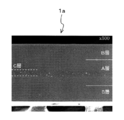
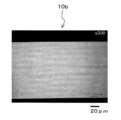
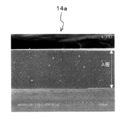
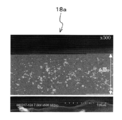
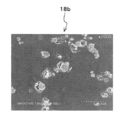
- FIG. 2 is a scanning electron micrograph of a cross section of the polymer sheet of Example 1.
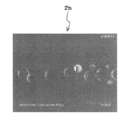
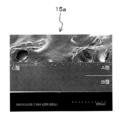
- FIG. 2 is a scanning electron micrograph of a cross section in the vicinity of an unevenly distributed portion of a polymer sheet of Example 1.
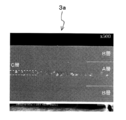
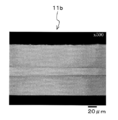
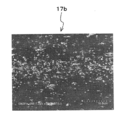
- FIG. 4 is a scanning electron micrograph of the cross section of the polymer sheet of Example 2.
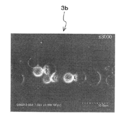
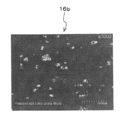
- FIG. 4 is a scanning electron micrograph of a cross section in the vicinity of a particle uneven distribution portion of a polymer sheet of Example 2.
- FIG. 4 is a scanning electron micrograph of the cross section of the polymer sheet of Example 3.
- FIG. 4 is a scanning electron micrograph of a cross section in the vicinity of an unevenly distributed part of a polymer sheet of Example 3.
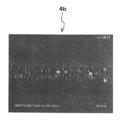
- FIG. 4 is a scanning electron micrograph of the cross section of the polymer sheet of Example 4.
- FIG. 4 is a scanning electron micrograph of a cross section in the vicinity of a particle uneven distribution portion of a polymer sheet of Example 4.
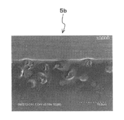
- FIG. 6 is a scanning electron micrograph of the cross section of the polymer sheet of Example 5.
- FIG. 6 is a scanning electron micrograph of a cross section in the vicinity of a particle uneven distribution portion of a polymer sheet of Example 5.
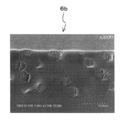
- FIG. 6 is a scanning electron micrograph of the cross section of the polymer sheet of Example 6.
- FIG. 6 is a scanning electron micrograph of a cross section in the vicinity of an unevenly distributed part of a polymer sheet of Example 6.
- FIG. 6 is a scanning electron micrograph of the cross section of the polymer sheet of Example 7.
- FIG. 6 is a scanning electron micrograph of a cross section near a particle uneven distribution portion of a polymer sheet of Example 7.
- FIG. 6 is a scanning electron micrograph of the cross section of the polymer sheet of Example 8.
- FIG. 6 is a scanning electron micrograph of a cross section in the vicinity of a particle uneven distribution portion of a polymer sheet of Example 8.
- FIG. 10 is a scanning electron micrograph of the cross section of the polymer sheet of Example 9.
- 4 is a scanning electron micrograph of a cross section in the vicinity of a particle uneven distribution portion of a polymer sheet of Example 9.
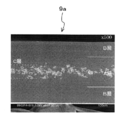
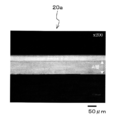
- FIG. 2 is an optical micrograph of a cross section of a polymer sheet of Example 10.
- 4 is an optical micrograph of a cross section in the vicinity of an incompatible substance uneven distribution portion of a polymer sheet of Example 10.
- FIG. 2 is an optical micrograph of a cross section of the polymer sheet of Example 11.
- FIG. 2 is an optical micrograph of a cross section in the vicinity of an incompatible substance uneven distribution portion of a polymer sheet of Example 11.
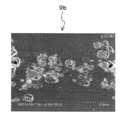
- FIG. 3 is a scanning electron micrograph of the cross section of the sheet of Comparative Example 1.
- 4 is a scanning electron micrograph of a cross section of a part of the sheet of Comparative Example 1.
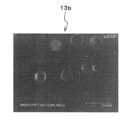
- 4 is a scanning electron micrograph of a cross section of a sheet of Comparative Example 2.
- 4 is a scanning electron micrograph of a cross section of a part of the sheet of Comparative Example 2.
- 10 is a scanning electron micrograph of the cross section of the sheet of Comparative Example 3.
- 6 is a scanning electron micrograph of a cross section of a part of the sheet of Comparative Example 3.
- 6 is a scanning electron micrograph of the cross section of the sheet of Comparative Example 4.
- 6 is a scanning electron micrograph of a cross section in the vicinity of an unevenly distributed portion of a sheet of Comparative Example 4.
- 6 is a scanning electron micrograph of a cross section of a sheet of Comparative Example 5.
- 10 is a scanning electron micrograph of a cross section of a part of the sheet of Comparative Example 5.
- 10 is a scanning electron micrograph of the cross section of the sheet of Comparative Example 6.
- 10 is a scanning electron micrograph of a cross section of a part of the sheet of Comparative Example 6.
- 10 is a scanning electron micrograph of the cross section of the sheet of Comparative Example 7.
- 10 is a scanning electron micrograph of a cross section of a part of the sheet of Comparative Example 7.
- 10 is an optical micrograph of a cross section of a sheet of Comparative Example 8.
- 10 is an optical micrograph of a cross section of a part of the sheet of Comparative Example 8.
- 10 is an optical micrograph of a cross section of a sheet of Comparative Example 9.
- 10 is an optical micrograph of a cross section of a part of the sheet of Comparative Example 9.
- the method for producing a polymer member of the present invention comprises a polymerizable composition layer containing an incompatible substance containing an incompatible substance that is incompatible with a polymer obtained by polymerizing a polymerizable monomer.
- An unevenly distributed structure in which an incompatible substance is not present at the interface between the immiscible substance-containing polymerizable composition layer and the monomer-absorbing layer immediately after lamination after the monomer-absorbing layer capable of absorbing the monomer is laminated. It is characterized by obtaining the polymer member which has.
- a laminate of the monomer absorption layer / incompatible substance-containing polymerizable composition layer / monomer absorption layer (hereinafter referred to as “specific lamination”). May be referred to as "body”). That is, in the method for producing a polymer member of the present invention, an incompatible substance-containing polymerizable composition layer is laminated on a monomer absorption layer, and further, a monomer absorption layer is formed on the incompatible substance-containing polymerizable composition layer.
- the incompatible substance is present at the interface between the immiscible substance-containing polymerizable composition layer and the monomer absorption layer immediately after lamination. You may be characterized by having the uneven distribution structure which does not exist.
- the specific laminate is obtained, for example, by applying an incompatible substance-containing polymerizable composition layer to the monomer-absorbing layer to obtain an incompatible substance-containing polymerizable composition layer, and then the incompatible substance-containing polymerizable composition layer.
- a monomer-absorbing layer is laminated thereon, or an incompatible substance-containing polymerizable composition is coated on an appropriate support to obtain an incompatible substance-containing polymerizable composition layer.
- the immiscible substance-containing polymerizable composition layer can be transferred, and a monomer absorption layer can be laminated on the transferred immiscible substance-containing polymerizable composition layer.
- the surface provided by the monomer absorption layer may be referred to as a monomer absorption surface.
- a conventional coater for example, comma roll coater, die roll coater, gravure roll coater, reverse roll coater, kiss roll coater, dip roll coater, bar coater. , Knife coaters, spray coaters, etc.
- the incompatible substance does not exist at the interface between the immiscible substance-containing polymerizable composition layer and the monomer absorption layer immediately after lamination, and the distribution of the incompatible substance is not present inside.
- the reason why a polymer member having an unevenly distributed structure controlled in a certain layered region is obtained is as follows (i) to (iii). (I) When the incompatible substance-containing polymerizable composition layer is provided in a form in contact with the monomer absorption layer, the polymerizable monomer of the incompatible substance-containing polymerizable composition layer is absorbed by the monomer absorption layer.
- the incompatible substance moves in the incompatible substance-containing polymerizable composition layer, and the incompatible substance
- An unevenly distributed structure is obtained in which the incompatible substance is distributed in a layered manner in the central portion in the thickness direction, and the incompatible substance does not exist at the interface between the immiscible substance-containing polymerizable composition layer and the monomer absorption layer immediately after lamination ( iii) polymerization is caused by irradiation of active energy rays or heat, and curing is performed while maintaining the uneven distribution structure of (ii) above to form a polymer member.
- the polymerization is performed using a light source, heat source, irradiation energy or thermal energy, irradiation method or heating method, irradiation time or heating time, irradiation or heating start timing, irradiation or heating end timing, etc.
- a light source heat source
- irradiation energy or thermal energy irradiation energy or thermal energy
- irradiation method or heating method irradiation time or heating time
- irradiation or heating start timing irradiation or heating end timing, etc.
- Examples of the active energy rays used in the polymerization include ionizing radiation such as ⁇ rays, ⁇ rays, ⁇ rays, neutron rays, and electron rays, and ultraviolet rays. Ultraviolet rays are particularly preferable.
- the irradiation energy, irradiation time, irradiation method, and the like of the active energy ray are not particularly limited as long as the polymer member can be formed.
- Examples of irradiation with active energy rays include irradiation with ultraviolet rays from a black light lamp, a chemical lamp, a high-pressure mercury lamp, a metal halide lamp, and the like.
- examples of the heating include known heating methods (for example, a heating method using an electric heater, a heating method using an electromagnetic wave such as infrared rays, etc.).
- the incompatible substance-containing polymerizable composition layer is a layer formed of the incompatible substance-containing polymerizable composition.
- the incompatible substance-containing polymerizable composition is a composition that forms an incompatible substance-containing polymerizable composition layer, and includes at least a polymerizable monomer that can be polymerized by light or heat, and an incompatible substance.
- the incompatible substance-containing polymerizable composition may be a particle-containing polymerizable composition using particles as an incompatible substance, or contains an incompatible substance containing a photopolymerization initiator as a polymerization initiator. It may be a photopolymerizable composition.
- the incompatible substance-containing polymerizable composition may be a particle-containing photopolymerizable composition using particles as the incompatible substance and further using a photopolymerization initiator as the polymerization initiator.
- the polymerizable monomer is a compound that can be polymerized using light energy or thermal energy regardless of the reaction mechanism such as radical polymerization or cationic polymerization.
- Such polymerizable monomers include, for example, radical polymerizable monomers such as acrylic monomers that form acrylic polymers; epoxy monomers that form epoxy resins, oxetane monomers that form oxetane resins, and vinyl ether resins. Examples thereof include cationic polymerizable monomers such as vinyl ether monomers to be formed; combinations of polyisocyanates and polyols that form urethane resins; combinations of polycarboxylic acids and polyols that form polyester resins.
- an acrylic monomer is preferably used because it has a high polymerization rate and is superior in productivity. That is, in the present invention, an acrylic polymer member is preferable.
- an acrylic monomer is suitably used as the polymerizable monomer. Therefore, as the incompatible substance-containing polymerizable composition (particle-containing polymerizable composition), the incompatible substance-containing acrylic polymerizable composition is used. Product (particle-containing acrylic polymerizable composition) is preferred.
- a (meth) acrylic acid alkyl ester having an alkyl group can be suitably used.
- (meth) acrylic acid alkyl esters having 2 to 14 carbon atoms in the alkyl group are preferable, and (meth) acrylic acid alkyl esters having 2 to 10 carbon atoms in the alkyl group are more preferable.
- said "(meth) acryl” represents “acryl” and / or "methacryl", and others are the same.
- both a (meth) acrylic acid alkyl ester having a linear or branched alkyl group and a (meth) acrylic acid alkyl ester having a cyclic alkyl group are suitable. Can be used.
- Examples of the (meth) acrylic acid alkyl ester having a linear or branched alkyl group include, for example, methyl (meth) acrylate, ethyl (meth) acrylate, propyl (meth) acrylate, and isopropyl (meth) acrylate.
- Examples of the (meth) acrylic acid alkyl ester having a cyclic alkyl group include cyclopentyl (meth) acrylate, cyclohexyl (meth) acrylate, and isobornyl (meth) acrylate.
- Acrylic monomers can be used alone or in combination of two or more.
- the acrylic monomer is preferably 60% by weight or more, more preferably 80% by weight, based on the total amount of the polymerizable monomer. That's it.
- various copolymerizable monomers such as a polar group-containing monomer and a polyfunctional monomer may be used as the polymerizable monomer.
- the cohesive force can be increased by using a copolymerizable monomer in the incompatible substance-containing acrylic polymerizable composition, for example.
- the copolymerizable monomers can be used alone or in combination of two or more.
- Examples of the polar group-containing monomer include carboxyl group-containing monomers such as (meth) acrylic acid, itaconic acid, maleic acid, fumaric acid, crotonic acid, and isocrotonic acid or anhydrides thereof (such as maleic anhydride); Hydroxyethyl acrylate, hydroxypropyl (meth) acrylate, hydroxyalkyl (meth) acrylate such as hydroxybutyl (meth) acrylate, hydroxyl group-containing monomers such as vinyl alcohol and allyl alcohol; (meth) acrylamide, N, N- Amide group-containing monomers such as dimethyl (meth) acrylamide, N-methylol (meth) acrylamide, N-methoxymethyl (meth) acrylamide, N-butoxymethyl (meth) acrylamide; aminoethyl (meth) acrylate, (meth) acrylic Acid di Amino group-containing monomers such as tilaminoethyl and t-but
- the amount of the polar group-containing monomer used can be appropriately adjusted depending on the purpose and application of the polymer member to be obtained. For example, in the case of an incompatible substance-containing acrylic polymerizable composition, 30 wt. % Or less (for example, 1 to 30% by weight), and preferably 3 to 20% by weight. When the proportion of the polar group-containing monomer exceeds 30% by weight, the resulting polymer has too high agglomeration force, which may cause problems in terms of flexibility, for example. On the other hand, if the amount of the polymerizable monomer used is too small (less than 1% by weight based on the total amount of the polymerizable monomer), the cohesive force of the resulting polymer may be reduced, and high strength may not be obtained.
- polyfunctional monomer examples include hexanediol di (meth) acrylate, butanediol di (meth) acrylate, (poly) ethylene glycol di (meth) acrylate, (poly) propylene glycol di (meth) acrylate, and neopentyl.
- the amount of the polyfunctional monomer used can be appropriately adjusted depending on the purpose and application of the polymer member to be obtained. For example, in the case of an incompatible substance-containing acrylic polymerizable composition, 2 wt. % Or less (for example, 0.01 to 2% by weight), preferably 0.02 to 1% by weight. If the amount of the polyfunctional monomer used exceeds 2% by weight based on the total amount of the polymerizable monomer, the resulting polymer may have too high agglomeration force and become too brittle. If the amount of the polymerizable monomer used is too small (if it is less than 0.01% by weight based on the total amount of the polymerizable monomer), the cohesive strength of the resulting polymer may be lowered, and the shape may not be maintained.
- copolymerizable monomers other than the above polar group-containing monomers and polyfunctional monomers examples include (meth) acrylic acid esters having an aromatic hydrocarbon group such as phenyl (meth) acrylate (meta) ) Acrylic acid alkyl esters, (meth) acrylic acid esters other than polar group-containing monomers and polyfunctional monomers; vinyl esters such as vinyl acetate and vinyl propionate; aromatic vinyl compounds such as styrene and vinyltoluene; ethylene and butadiene Olefins or dienes such as isoprene and isobutylene; vinyl ethers such as vinyl alkyl ether; vinyl chloride and the like.
- the polymerization initiator may be used as necessary.
- any of a thermal polymerization initiator and a photopolymerization initiator (photoinitiator) may be used.
- a polymerization initiator when used, it is easy to maintain an unevenly distributed structure in which the incompatible substance does not exist at the interface between the immiscible substance-containing polymerizable composition layer and the monomer absorption layer immediately after lamination. It can be cured.
- the photopolymerization initiator is not particularly limited.
- benzoin ether photopolymerization initiator acetophenone photopolymerization initiator, ⁇ -ketol photopolymerization initiator, aromatic sulfonyl chloride photopolymerization initiator, photoactive oxime.
- a photopolymerization initiator, a benzoin photopolymerization initiator, a benzyl photopolymerization initiator, a benzophenone photopolymerization initiator, a ketal photopolymerization initiator, a thioxanthone photopolymerization initiator, or the like can be used.
- a photoinitiator can be used individually or in combination of 2 or more types.
- the ketal photopolymerization initiator includes, for example, 2,2-dimethoxy-1,2-diphenylethane-1-one [for example, trade name “Irgacure 651” (manufactured by Ciba Specialty Chemicals) Etc.] etc. are included.
- acetophenone-based photopolymerization initiator examples include 1-hydroxycyclohexyl phenyl ketone [for example, trade name “Irgacure 184” (manufactured by Ciba Specialty Chemicals), etc.], 2,2-diethoxyacetophenone, 2,2- Examples include dimethoxy-2-phenylacetophenone, 4-phenoxydichloroacetophenone, and 4- (t-butyl) dichloroacetophenone.
- benzoin ether photopolymerization initiator examples include benzoin methyl ether, benzoin ethyl ether, benzoin propyl ether, benzoin isopropyl ether, and benzoin isobutyl ether.
- acylphosphine oxide photopolymerization initiator for example, trade name “Lucirin TPO” (manufactured by BASF) can be used.
- ⁇ -ketol photopolymerization initiator examples include 2-methyl-2-hydroxypropiophenone and 1- [4- (2-hydroxyethyl) phenyl] -2-methylpropan-1-one.
- aromatic sulfonyl chloride photopolymerization initiator include 2-naphthalenesulfonyl chloride.
- photoactive oxime photopolymerization initiator include 1-phenyl-1,1-propanedione-2- (o-ethoxycarbonyl) -oxime.
- benzoin photopolymerization initiator examples include benzoin.
- benzyl photopolymerization initiator examples include benzyl.
- benzophenone-based photopolymerization initiator examples include benzophenone, benzoylbenzoic acid, 3,3′-dimethyl-4-methoxybenzophenone, polyvinylbenzophenone, ⁇ -hydroxycyclohexyl phenyl ketone, and the like.
- thioxanthone photopolymerization initiator examples include thioxanthone, 2-chlorothioxanthone, 2-methylthioxanthone, 2,4-dimethylthioxanthone, isopropylthioxanthone, 2,4-diisopropylthioxanthone, dodecylthioxanthone, and the like.
- the amount of the photopolymerization initiator used is not particularly limited. For example, 0.01 to 5 parts by weight (preferably 0 to 100 parts by weight of the total polymerizable monomer constituting the incompatible substance-containing polymerizable composition). .05 to 3 parts by weight).
- thermal polymerization initiator examples include azo polymerization initiators [for example, 2,2′-azobisisobutyronitrile, 2,2′-azobis-2-methylbutyronitrile, 2,2′- Azobis (2-methylpropionic acid) dimethyl, 4,4′-azobis-4-cyanovaleric acid, azobisisovaleronitrile, 2,2′-azobis (2-amidinopropane) dihydrochloride, 2,2′-azobis [2- (5-Methyl-2-imidazolin-2-yl) propane] dihydrochloride, 2,2′-azobis (2-methylpropionamidine) disulfate, 2,2′-azobis (N, N′- Dimethyleneisobutylamidine) dihydrochloride, etc.], peroxide-based polymerization initiators (for example, dibenzoyl peroxide, tert-butylpermaleate).
- azo polymerization initiators for example, 2,2′-azobisisobutyronitrile
- Redox polymerization initiators such as organic peroxide / vanadium compound; the organic peroxide / dimethylaniline; naphthenic acid metal salt / butyl aldehyde, a combination such as aniline or acetylbutyrolactone, and the like.
- the amount of the thermal polymerization initiator used is not particularly limited as long as it can be used as a thermal polymerization initiator. If a redox polymerization initiator is used as a thermal polymerization initiator, it can be polymerized at room temperature.
- the incompatible substance is not particularly limited as long as it is a substance that is not compatible (dissolves) with a polymer obtained by polymerizing a polymerizable monomer, and even an inorganic substance (inorganic substance) is an organic substance (organic substance). It may be. Further, the incompatible substance may be a solid or may have fluidity.
- Examples of the inorganic substance as the incompatible substance include particles exemplified below (fine particles, fine particle powder) and the like.
- Examples of organic substances as incompatible substances include acrylic polymers, polyesters, polyurethanes, polyethers, silicones, natural rubbers, synthetic rubbers [especially styrene-isoprene-styrene rubber (SIS), styrene-butadiene-styrene rubber.
- SBS styrene-ethylene-butylene-styrene rubber
- SEBS styrene-ethylene-butylene-styrene rubber
- rosin tackifier resins terpene tackifier resins, phenol tackifier resins , Hydrocarbon tackifier resins, ketone tackifier resins, polyamide tackifier resins, epoxy tackifier resins, elastomer tackifier resins and other tackifiers (tackifier resins); surfactants; antioxidants; Organic pigments; plasticizers; solvents (organic solvents) Such as liquid, and the like.
- water and aqueous solutions for example, salt aqueous solution, acid aqueous solution, etc.
- water and aqueous solutions are also used as incompatible substances.
- Whether a certain substance is incompatible with a certain polymer is determined by visual observation, optical microscope, scanning electron microscope (SEM), transmission electron microscope (TEM), X-ray diffraction, etc.
- General methods not according to the invention for example, a method in which a substance is dissolved in a polymerizable monomer, and the polymerizable monomer is polymerized to be polymerized to determine; the polymer is dissolved in a solvent in which the polymer is dissolved, and the substance is added thereto.
- the polymer and if the polymer is a thermoplastic polymer, the polymer is heated and dissolved, and then the substance is blended into the polymer and then judged after cooling. It can be determined by how large the substance or aggregate thereof is dispersed.
- the criterion is that the substance or aggregate thereof has a diameter of 5 nm or more when it can be approximated to a sphere such as a sphere, a cube, or an indefinite shape, and a columnar shape such as a rod, thin layer, or cuboid. If it can be approximated, the length of the longest side is 10 nm or more.
- a substance or aggregate thereof in a polymer for example, polymerizable monomer constituting the polymer: 100 parts by weight, photopolymerization initiator: 0.5 part by weight, substance or aggregate thereof: Add 50 parts by weight or uniformly disperse, then coat on PET film to a thickness of about 10 to 500 ⁇ m, and remove the influence of oxygen in an inert gas such as nitrogen or with a cover film.
- the substance or aggregate thereof is uniformly dispersed by adding, stirring, etc., and the thickness after removing the solvent by coating on PET and drying is about 10 to 500 ⁇ m. That way, and the like.
- the substance in the polymer or an aggregate thereof can be approximated to a sphere such as a sphere, cube, or irregular shape, and the spherical substance or an aggregate thereof has a diameter of 5 nm or more. If it has, it can be regarded as an incompatible substance for the polymer, and the substance in the polymer or an aggregate thereof can be approximated to a columnar shape such as a rod shape, a thin layer shape, a rectangular parallelepiped shape, etc. If the length of the longest side of the solid substance or the aggregate thereof is 10 nm or more, it can be regarded as an incompatible substance for the polymer.
- Particles as incompatible materials include, for example, silica, silicone (silicone powder), calcium carbonate, clay, titanium oxide, talc, layered silicate, clay mineral, metal powder (for example, nickel powder, aluminum powder, iron powder, Magnesium powder, copper powder, powder, etc.), inorganic particles such as barium titanate, boron nitride, silicon nitride, aluminum nitride, glass, glass beads, glass balloon, alumina balloon, ceramic balloon, titanium white, carbon black; polyester beads, Organic particles such as nylon beads, silicon beads, urethane beads, vinylidene chloride beads, acrylic balloons; resin particles such as crosslinked acrylic particles, crosslinked styrene particles, melamine resin particles, benzoguanamine resin, nylon resin; inorganic-organic hybrid particles And the like.
- the particles may be solid or hollow (balloon). Moreover, you may use particle
- the particle size (average particle size) of the particles is not particularly limited, but can be selected from the range of, for example, 0.1 to 600 ⁇ m (preferably 0.2 to 300 ⁇ m, more preferably 0.2 to 100 ⁇ m). .
- the particles may be used in combination of two or more kinds having different particle diameters.
- the shape of the particles may be any shape such as a spherical shape such as a spherical shape or an elliptical shape, an indefinite shape, a needle shape, a rod shape, or a flat plate shape.
- grains may have a hole, a protrusion, etc. on the surface.
- only one type of particle may be selected and used, or two or more types of particles having different shapes may be used in combination.
- the surface of the particles may be subjected to various surface treatments (for example, a low surface tension treatment with a silicone compound or a fluorine compound).
- the amount of the incompatible substance used is not particularly limited. For example, 0.001 to 100 parts by weight, preferably 100 parts by weight with respect to 100 parts by weight of the total polymerizable monomer constituting the incompatible substance-containing polymerizable composition. It can be selected from a range of 0.01 to 75 parts by weight, more preferably 0.1 to 50 parts by weight. When the amount used exceeds 100 parts by weight, it may be difficult to produce the polymer member, or there may be a problem of strength in the polymer member after production.
- the incompatible substance in the polymer member is unevenly distributed in a layered form near the central portion in the thickness direction.
- the thickness of the portion where the incompatible substance is distributed can be controlled by adjusting the amount of the incompatible substance used.
- the incompatible substance-containing polymerizable composition may contain appropriate additives as necessary.
- additives include surfactants (for example, ionic surfactants, silicone-based surfactants, fluorine-based surfactants), and crosslinking agents (for example, polyisocyanate-based crosslinking agents, silicone-based crosslinking agents).
- Agents epoxy crosslinkers, alkyl etherified melamine crosslinkers, etc.) and tackifiers (for example, rosin derivative resins, polyterpene resins, petroleum resins, oil-soluble phenol resins, etc.) ), Plasticizers, fillers, anti-aging agents, antioxidants, colorants (such as pigments and dyes), and the like.
- a pigment (colored pigment) that does not inhibit a polymerization reaction such as a photopolymerization reaction can be used.
- carbon black can be used as the color pigment.
- the amount of carbon black used is, for example, 0.15 parts by weight with respect to 100 parts by weight of the total polymerizable monomer constituting the incompatible substance-containing polymerizable composition, from the viewpoint of not inhibiting the degree of coloring and the photopolymerization reaction. The following (for example, 0.001 to 0.15 parts by weight).
- the incompatible substance-containing polymerizable composition can be prepared by uniformly mixing and dispersing the above components. Since this incompatible substance-containing polymerizable composition is usually formed into a sheet by coating on a substrate, it is preferable to have an appropriate viscosity suitable for the coating operation.
- the viscosity of the incompatible substance-containing polymerizable composition can be determined by, for example, blending various polymers such as acrylic rubber and thickening additives, or irradiating the polymerizable monomer in the incompatible substance-containing polymerizable composition with light. It can be adjusted by partially polymerizing by heating or heating.
- a desirable viscosity is a rotor: No.
- the viscosity set under the conditions of 5 rotors, 10 rpm, and measurement temperature: 30 ° C. is 5 to 50 Pa ⁇ s, more preferably 10 to 40 Pa ⁇ s.
- the viscosity is less than 5 Pa ⁇ s, the liquid flows when applied on the substrate, and when it exceeds 50 Pa ⁇ s, the viscosity is too high to make application difficult.
- the thickness of the incompatible substance-containing polymerizable composition layer is not particularly limited, but is 99% or less, preferably 75% or less of the total thickness of the incompatible substance-containing polymerizable composition layer and the monomer absorption layer. More preferably, it is 50% or less. This is because when the thickness ratio of the immiscible substance-containing polymerizable composition layer is smaller, the incompatible substance tends to be unevenly distributed, and the incompatible substance can be filled more.
- the specific thickness of the incompatible substance-containing polymerizable composition layer is, for example, 1 to 3000 ⁇ m, preferably 10 to 1000 ⁇ m, and more preferably 50 to 500 ⁇ m. If it is less than 1 ⁇ m, uniform coating may not be possible. On the other hand, if it exceeds 3000 ⁇ m, undulation may occur, and a member having a uniform surface shape and excellent appearance may not be obtained. For example, when a polymer member is formed into a film, undulation occurs and the film is smooth. A film may not be obtained.
- the monomer absorption layer is a layer provided on both sides of an incompatible substance-containing polymerizable composition layer containing a polymerizable monomer and an incompatible substance, and the polymerizable monomer layer is formed from the incompatible substance-containing polymerizable composition layer. It is a layer which absorbs at least one of the following.
- Such a monomer absorption layer provides a monomer absorption surface capable of absorbing at least one monomer component in the incompatible substance-containing polymerizable composition.
- absorption of the polymerizable monomer in the monomer absorption layer occurs at the time when the incompatible substance-containing polymerizable composition layer is formed on the monomer absorption surface. Further, it may occur during the period from the formation of the incompatible substance-containing polymerizable composition layer to the polymerization, or during the polymerization.
- the monomer absorption layer a sheet having at least one monomer absorption layer and a structure in which the monomer absorption surface of the monomer absorption layer can be in contact with the incompatible substance-containing polymerizable composition layer (“monomer absorption property”).
- the monomer absorption layer may be used.
- the monomer-absorbing sheet include a monomer-absorbing sheet composed of only a monomer-absorbing layer (sometimes referred to as a “baseless monomer-absorbing sheet”), and a monomer-absorbing layer in which a monomer-absorbing layer is provided on a substrate. Sheet (sometimes referred to as “monomer-absorbing sheet with substrate”).
- the monomer-absorbing sheet is a substrate-less monomer-absorbing sheet
- either surface may be used as the monomer-absorbing surface.
- the surface of the monomer-absorbing layer is monomer-absorbing. It becomes a surface.
- Examples of such a monomer-absorbing layer include a paper sheet (for example, kraft paper, crepe paper, Japanese paper, etc.); a fiber-based sheet (for example, cloth, nonwoven fabric, net, etc.); a porous film; For example, acrylic polymer, polyurethane resin, ethylene-vinyl acetate copolymer, epoxy resin and the like); natural rubber; synthetic rubber and the like.
- a monomer absorption layer may use these individually or in combination of 2 or more types.
- the monomer absorption layer is not particularly limited as long as it can absorb at least one of the polymerizable monomers used in the incompatible substance-containing polymerizable composition.
- the elastic modulus is not particularly limited. Therefore, as the monomer absorption layer, as long as at least one of the polymerizable monomers used in the incompatible substance-containing polymerizable composition can be absorbed, the elastic modulus of the pressure-sensitive adhesive layer, the polymer layer, etc. is low. Any of those having a high elastic modulus such as a plastic sheet, a hard coat layer, and a colored coating layer can be used.
- a polymer can be suitably used for forming the monomer absorption layer because of its high affinity with the monomer and high absorption rate. That is, as the monomer absorption layer, a monomer absorption polymer layer made of a polymer can be suitably used, and a sheet having a polymer layer can be suitably used as the monomer absorptive sheet.
- a polymer is not particularly limited, but a polymer having at least one polymerizable monomer constituting the incompatible substance-containing polymerizable composition as a constituent monomer component is preferable.
- an acrylic polymer is preferable as the polymer that forms the monomer absorption layer.
- the acrylic monomer that is the polymerizable monomer migrates It is because it becomes easy to do.
- the monomer absorption layer may be composed of a polymer layer obtained by polymerizing a polymerizable composition having the same composition except that the incompatible substance is removed from the incompatible substance-containing polymerizable composition.
- the monomer absorption layer may be composed of a photopolymerization cured layer obtained by curing a photopolymerizable composition having the same composition except that the particles are removed from the particle-containing photopolymerizable composition.
- the monomer absorption layer may be an adhesive composition layer.
- the monomer absorption layer is a pressure-sensitive adhesive composition layer
- all components of a specific laminate are polymerized simultaneously by being subjected to polymerization. -Since it hardens
- an adhesive composition layer is a layer formed with an adhesive composition
- an adhesive composition is a composition which forms an adhesive.
- the monomer component that forms the base polymer of the pressure-sensitive adhesive may be partially polymerized.
- the pressure-sensitive adhesive composition is not particularly limited, and examples thereof include known pressure-sensitive adhesives (for example, acrylic pressure-sensitive adhesives, rubber-based pressure-sensitive adhesives, vinyl alkyl ether-based pressure-sensitive adhesives, silicone-based pressure-sensitive adhesives, and polyester-based pressure-sensitive adhesives). , Polyamide-based pressure-sensitive adhesives, urethane-based pressure-sensitive adhesives, fluorine-based pressure-sensitive adhesives, epoxy-based pressure-sensitive adhesives, and the like).
- known pressure-sensitive adhesives for example, acrylic pressure-sensitive adhesives, rubber-based pressure-sensitive adhesives, vinyl alkyl ether-based pressure-sensitive adhesives, silicone-based pressure-sensitive adhesives, and polyester-based pressure-sensitive adhesives.
- Polyamide-based pressure-sensitive adhesives for example, acrylic pressure-sensitive adhesives, rubber-based pressure-sensitive adhesives, vinyl alkyl ether-based pressure-sensitive adhesives, silicone-based pressure-sensitive adhesives, and polyester-based pressure-sensitive adhesives.
- At least one of the polymerizable monomers constituting the incompatible substance-containing polymerizable composition is a monomer component that has a high affinity with the monomer and a high absorption rate. It is preferable that the same.
- an acrylic pressure-sensitive adhesive layer is formed as the pressure-sensitive adhesive composition that forms the monomer absorption layer.
- An acrylic pressure-sensitive adhesive composition is preferred.
- the pressure-sensitive adhesive composition layer as the monomer absorption layer is formed by applying the following conventional coater on a predetermined surface of an appropriate support such as the following base material or the surface of the cover film that has been subjected to the release treatment. Is done.
- the volume of the monomer absorption layer may be constant or may be changed as compared with before and after the absorption of the polymerizable monomer.
- the monomer-absorbing layer is a polymer substance [for example, the above-mentioned polymer (acrylic polymer, polyurethane resin, ethylene-vinyl acetate copolymer, epoxy resin, etc.) or an incompatible substance-containing polymerizable composition.
- the volume of the polymer substance layer that is the monomer absorption layer is a non-phase. It usually increases by absorbing the polymerizable monomer from the soluble substance-containing polymerizable composition layer. That is, the polymer substance forming the monomer absorption layer swells by absorbing the polymerizable monomer. Therefore, the monomer absorption layer may be a monomer swelling layer whose volume increases by absorbing the polymerizable monomer.
- the gel fraction is not particularly limited. Therefore, in the monomer-absorbing polymer layer, a polymer member can be obtained even if the gel fraction is crosslinked to about 98% by weight or is hardly crosslinked (gel fraction: 10% by weight or less). it can.
- the gel fraction of the polymer layer may be crosslinked to about 98% by weight, or Even if it is hardly crosslinked (gel fraction: 10% by weight or less), a polymer member can be produced.
- the polymer layer a high degree of crosslinking (for example, a gel fraction of 90% by weight or more), in the obtained polymer member, heat resistance and solvent resistance are imparted to the polymer layer as the monomer absorption layer. can do. Furthermore, a softness
- a low crosslinking degree for example, gel fraction is 10 weight% or less
- a polymer member can be obtained regardless of whether the monomer absorption layer is a hard layer or a soft layer. For this reason, when a hard layer (for example, a layer having a 100% modulus of 100 N / cm 2 or more) is used as the monomer absorption layer, the obtained monomer absorption layer may be used as a support (base material). . Furthermore, when a soft layer (for example, a layer having a 100% modulus of 30 N / cm 2 or less) is used as the monomer absorption layer, the obtained monomer absorption layer may be used as an adhesive layer.
- a hard layer for example, a layer having a 100% modulus of 100 N / cm 2 or more
- the obtained monomer absorption layer may be used as a support (base material).
- a soft layer for example, a layer having a 100% modulus of 30 N / cm 2 or less
- the obtained monomer absorption layer may be used as an adhesive layer.
- the monomer absorption layer is, for example, a layer of the polymer substance
- the monomer absorption layer is formed on the predetermined surface of an appropriate support such as the following base material or the surface of the cover film that has been subjected to the release treatment.
- the coater is used to coat the polymer substance or a polymerizable composition (hereinafter sometimes referred to as “monomer absorption layer forming composition”) that forms the polymer substance by polymerization.
- the monomer absorption layer forming composition provided on the support is usually dried and / or cured (for example, cured by light) as necessary.
- the monomer-absorbing layer-forming composition when applied on a predetermined surface of an appropriate support, it can be blended with various polymers such as acrylic rubber and thickening additives, and the monomer component can be heated or irradiated ( It may be adjusted to a viscosity suitable for coating by partial polymerization such as by irradiation of active energy rays.
- various polymers such as acrylic rubber and thickening additives
- the monomer component can be heated or irradiated ( It may be adjusted to a viscosity suitable for coating by partial polymerization such as by irradiation of active energy rays.
- the thickness of the monomer absorption layer before absorbing the polymerizable monomer is not particularly limited, and can be selected, for example, from the range of 1 to 3000 ⁇ m (preferably 2 to 2000 ⁇ m, more preferably 5 to 1000 ⁇ m). If the thickness is less than 1 ⁇ m, a large amount of the polymerizable monomer may be absorbed and the sheet may be deformed or sufficient polymerizable monomer may not be absorbed. On the other hand, if the thickness exceeds 3000 ⁇ m, it may be difficult to wind the sheet. Problems may arise in terms of handling properties. Moreover, the monomer absorption layer may have any form of a single layer or a laminate.
- Examples of the substrate (monomer-absorbing sheet substrate) used when the monomer-absorbing sheet is a monomer-absorbing sheet with a substrate include, for example, paper-based substrates such as paper; fibers such as cloth, nonwoven fabric, and net Metal base materials such as metal foils and metal plates; Plastic base materials such as plastic films and sheets; Rubber base materials such as rubber sheets; Foams such as foam sheets and laminates thereof [
- a suitable thin leaf body such as a laminate of a plastic-based substrate and another substrate or a laminate of plastic films (or sheets) can be used.
- a plastic substrate such as a plastic film or sheet can be suitably used.
- an ⁇ -olefin such as polyethylene (PE), polypropylene (PP), ethylene-propylene copolymer, ethylene-vinyl acetate copolymer (EVA) or the like is used as a monomer component.
- Olefin resins Polyester resins such as polyethylene terephthalate (PET), polyethylene naphthalate (PEN), polybutylene terephthalate (PBT); polyvinyl chloride (PVC); vinyl acetate resin; polyphenylene sulfide (PPS); polyamide (Nylon), amide resins such as wholly aromatic polyamide (aramid); polyimide resins; polyether ether ketone (PEEK). These materials can be used alone or in combination of two or more.
- the deformability such as the elongation rate may be controlled by a stretching process or the like.
- a base material for monomer absorptive sheets when a monomer absorption layer is formed by hardening by an active energy ray, it is preferable to use what does not inhibit permeation
- the surface of the substrate for the monomer-absorbing sheet has a conventional surface treatment, for example, corona treatment, chromic acid treatment, ozone exposure, flame exposure, high piezoelectric impact exposure, ionizing radiation treatment, etc., in order to improve the adhesion with the monomer absorption layer.
- a conventional surface treatment for example, corona treatment, chromic acid treatment, ozone exposure, flame exposure, high piezoelectric impact exposure, ionizing radiation treatment, etc.
- These may be subjected to an oxidation treatment or the like by a chemical or physical method, or may be subjected to a coating treatment with an undercoat agent or a release agent.
- the thickness of the substrate for the monomer-absorbing sheet can be appropriately selected according to strength, flexibility, purpose of use, and the like, and is generally 1000 ⁇ m or less (for example, 1 to 1000 ⁇ m), preferably 1 to 500 ⁇ m, More preferably, it is about 3 to 300 ⁇ m, but is not limited thereto.
- the base material may have any form of a single layer or a lamination.
- a volatile component contained in the incompatible substance-containing polymerizable composition for example, a solvent or an organic material.
- the polymer member can be manufactured without evaporating and removing the compound). For this reason, it is advantageous in terms of environment.
- the polymer member has polymerizable monomers on both sides of the incompatible substance-containing polymerizable composition layer containing an incompatible substance that is incompatible with the polymer obtained by polymerizing the polymerizable monomer.
- An unevenly distributed structure obtained by laminating an absorbable monomer-absorbing layer and then subjecting it to polymerization, in which an incompatible substance does not exist at the interface between the immiscible-substance-containing polymerizable composition layer and the monomer-absorbing layer immediately after lamination.
- Such an uneven distribution structure of incompatible substances in the polymer member is also a structure in which the incompatible substance is distributed in a layered manner in the central portion in the thickness direction.
- Such a polymer member can be produced by the method for producing the polymer member.
- an incompatible substance-containing polymerizable composition layer is laminated on the monomer-absorbing sheet of the monomer-absorbing sheet, and the monomer-absorbing layer and the incompatible substance-containing substance are further laminated on the incompatible substance-containing polymerizable composition layer.
- a laminated body having a structure in which another monomer-absorbing sheet is laminated in a form in contact with the polymerizable composition layer is prepared, and then subjected to polymerization, so that the incompatible substance is a non-compatible material immediately after lamination. It can be produced by forming an unevenly distributed structure that does not exist at the interface between the soluble substance-containing polymerizable composition layer and the monomer absorption layer.
- the polymer member is provided with an incompatible substance-containing photopolymerizable composition layer on the monomer absorbing layer (monomer absorbing surface) of the monomer-absorbing sheet, and further on the incompatible substance-containing photopolymerizable composition layer.
- Irradiation of active energy rays to a laminate having a structure in which another monomer-absorbing sheet is provided in a form where the incompatible substance-containing photopolymerizable composition layer and the monomer-absorbing surface are in contact with each other It can also be produced by forming an unevenly distributed structure in which the incompatible substance does not exist at the interface between the immiscible substance-containing polymerizable composition layer and the monomer absorption layer immediately after lamination.
- the shape of the polymer member is not particularly limited, and usually has a sheet shape or a tape shape.
- a pressure-sensitive adhesive layer pressure-sensitive adhesive layer
- the outermost layer of the polymer member is a monomer-absorbing layer, whereby the polymer member is simply attached to a pressure-sensitive adhesive tape or sheet (“tape or sheet”). It may be referred to as “tape” or “sheet”.
- pressure-sensitive adhesives for polymer members
- polymer members for example, acrylic pressure-sensitive adhesives, rubber-based pressure-sensitive adhesives, vinyl alkyl ether-based pressure-sensitive adhesives, silicone-based pressure-sensitive adhesives, polyester-based pressure-sensitive adhesives, polyamide-based pressure-sensitive adhesives
- the polymer member can also be used as a pressure-sensitive adhesive tape or sheet by providing a pressure-sensitive adhesive layer (pressure-sensitive adhesive layer) made of a urethane-based pressure-sensitive adhesive, a fluorine-based pressure-sensitive adhesive, an epoxy-based pressure-sensitive adhesive, or the like.
- the polymer member may have other layers (for example, an intermediate layer, an undercoat layer, etc.) as long as the effects of the present invention are not impaired.
- the member surface may be protected by a cover film.
- the cover film may have releasability or may not have releasability.
- the cover film may be peeled off, or may be maintained as it is without being peeled off, and may constitute a part of the polymer member.
- the photopolymerization method since the reaction is inhibited by oxygen in the air, it is preferable to block it from oxygen in the air with a cover film.
- Such a cover film is not particularly limited as long as it is a thin leaf body that hardly permeates oxygen.
- a transparent film is preferable.
- a conventional release paper can be used.
- a fluorine-based polymer eg, polytetrafluoroethylene
- Low adhesive substrates made of fluoroethylene, polychlorotrifluoroethylene, polyvinyl fluoride, polyvinylidene fluoride, tetrafluoroethylene / hexafluoropropylene copolymer, chlorofluoroethylene / vinylidene fluoride copolymer, etc.
- a low-adhesive substrate made of an adhesive polymer for example, an olefin resin such as polyethylene or polypropylene
- an adhesive polymer for example, an olefin resin such as polyethylene or polypropylene
- both surfaces can be used as a release surface, while in a substrate having a release treatment layer, the release treatment layer surface is used as a release surface (release treatment surface). can do.
- cover film for example, a cover film (a substrate having a release treatment layer) in which a release treatment layer is formed on at least one surface of the cover film substrate may be used.
- the material may be used as it is.
- cover film substrates include polyester films (polyethylene terephthalate film, etc.), olefin resin films (polyethylene film, polypropylene film, etc.), polyvinyl chloride films, polyimide films, polyamide films (nylon film), rayon films.
- plastic base film synthetic resin film
- cover film substrate a cover film substrate using a highly transparent plastic substrate film (particularly, a polyethylene terephthalate film) can be suitably used.
- the release treatment agent is not particularly limited, and for example, a silicone release treatment agent, a fluorine release treatment agent, a long chain alkyl release treatment agent, or the like can be used. You may use a mold release processing agent individually or in combination of 2 or more types.
- the cover film that has been subjected to the release treatment with the release treatment agent is formed by, for example, a known formation method.
- the thickness of the cover film is not particularly limited, but can be selected from the range of, for example, 12 to 250 ⁇ m (preferably 20 to 200 ⁇ m) from the viewpoint of ease of handling and economy.
- the cover film may have either a single layer or a laminated form.
- the overall thickness of the polymer member is not particularly limited, but is preferably 1 to 3000 ⁇ m, more preferably 10 to 1000 ⁇ m, from the viewpoint of deformation and handling properties such as ease of winding after forming into a sheet shape, for example. And even more preferably 50 to 500 ⁇ m.
- the total thickness of the polymer member is obtained by subjecting a laminate (specific laminate) obtained by laminating a monomer absorption layer on both sides of the incompatible substance-containing polymerizable composition layer to polymerization. It means the thickness of the portion, and does not include the thickness of the cover film or the substrate for the monomer absorbent sheet.
- the thickness of the incompatible substance uneven distribution polymer layer in the polymer member is not particularly limited, but is preferably 1 to 3000 ⁇ m from the viewpoint of deformation and handling properties such as ease of winding from a sheet shape, The thickness is preferably 10 to 1000 ⁇ m, more preferably 50 to 500 ⁇ m.
- the immiscible substance uneven distribution polymer layer is a polymer member obtained by subjecting a specific laminate (monomer absorption layer / incompatible substance-containing polymerizable composition layer / monomer absorption layer laminate) to polymerization.
- the incompatible substance uneven distribution polymer layer is shown as A layer.
- the thickness of the portion where the incompatible substance is distributed in the polymer member is not particularly limited, but is 0.1 to 500 ⁇ m from the viewpoint of the strength of the member and ease of winding such as a sheet shape.
- the thickness is preferably 0.5 to 300 ⁇ m, more preferably 1 to 100 ⁇ m.
- the part where the incompatible substance in the polymer member is distributed may be referred to as “incompatible substance uneven distribution part”. In each figure, the incompatible substance uneven distribution part is shown as a C layer.
- the thickness of the incompatible substance uneven distribution portion is 50% or less (preferably 40% or less, more preferably 30% or less) with respect to the thickness of the incompatible substance uneven distribution polymer layer.
- the incompatible substance uneven distribution polymer layer is a virtual layer. This is because when the incompatible substance-containing polymerizable composition layer is provided in a form in contact with the monomer absorption layer, at least one monomer component in the incompatible substance-containing polymerizable composition layer is absorbed by the monomer absorption layer. It is presumed that the compatible substance moves and that the monomer-absorbing layer is provided on both surfaces of the incompatible substance-containing polymerizable composition layer.
- the time from the contact of the incompatible substance-containing polymerizable composition layer with the monomer absorption layer to the completion of the polymerization is longer.
- the initiation of polymerization can be easily controlled by light irradiation (particularly irradiation of activation energy rays)
- it is 1 second or longer after contact, preferably 5 seconds or longer, more preferably 10 seconds or longer (usually within 24 hours). It is preferable to irradiate with light (especially irradiation with activation energy rays).
- the thickness of the portion where the incompatible substance is distributed (the incompatible substance uneven distribution portion) can be controlled by adjusting the amount of the incompatible substance.
- the thickness of the incompatible substance unevenly distributed portion may cause an adhesion problem between the incompatible substance unevenly distributed portion and the other parts in the polymer member, or the strength of the polymer member,
- the ratio is preferably from 0.1 to 50%, more preferably from 1 to 20%, based on the thickness of the entire polymer member.
- the polymer member is integrated as a whole.
- the polymer member is also excellent in strength.
- the incompatible substance and the polymer component are mixed in the part where the incompatible substance of the polymer member is distributed. For this reason, in the said part, the characteristic based on the characteristic based on a polymer component, the characteristic which an incompatible substance inherently exists, and the incompatible substance unevenly distributed within a polymer member can be exhibited.
- the characteristics based on the polymer component include flexibility, hard coat properties, adhesiveness, stress relaxation properties, impact resistance, and the like.
- the inherent characteristics of an incompatible substance include the specific function when using an incompatible substance having a specific function (for example, expandability, contractility, absorption, divergence, conductivity, etc.). Can be mentioned.
- the characteristics based on the uneven distribution of incompatible substances in the polymer member are, for example, the characteristics of the characteristics inherent to the incompatible substances (for example, expandability, contractility, absorbability, divergence, conductivity, etc.). It has the characteristic of a base material (For example, a softness
- the polymer member of the present invention can be used in a wide range of fields because it exhibits various characteristics by adjusting the type and amount of the incompatible substance, the type of polymer of the polymer member and the thickness thereof, and the like. .
- it can be suitably used for optical sheets, electronic circuits, power electronics materials, adhesive tapes, medical field applications, and the like.
- composition was polymerized by irradiating ultraviolet light from the outside of the flask with a black light lamp.
- a composition in which a polymerization rate of 7% was partially polymerized (syrup) ) (Sometimes referred to as “photopolymerizable syrup (A)”).
- composition was polymerized by irradiating ultraviolet light from the outside of the flask with a black light lamp.
- a composition in which a polymerization rate of 7% was partially polymerized (syrup) ) (Sometimes referred to as “photopolymerizable syrup (B)”).
- composition was polymerized by irradiating ultraviolet light from the outside of the flask with a black light lamp.
- a composition in which a polymerization rate of 7% was partially polymerized (syrup) ) (Sometimes referred to as “photopolymerizable syrup (C)”).
- composition was polymerized by irradiating ultraviolet light from the outside of the flask with a black light lamp.
- a composition in which a polymerization rate of 7% was partially polymerized (syrup) ) (Sometimes referred to as “photopolymerizable syrup (D)”).
- cyclohexyl acrylate 100 parts by weight, incompatible substances as SEBS (styrene-ethylene-butylene-styrene) (trade name “G1726” manufactured by Kraton Polymer Japan Co., Ltd.): 20 parts by weight, 1,6-hexanediol Diacrylate: 0.1 part by weight is dissolved, and the product name “Irgacure 651” (manufactured by Ciba Specialty Chemicals): 0.2 part by weight, product name “Irgacure 184” (Ciba Specialty) Chemicals): 0.2 parts by weight were dissolved to prepare a transparent viscous liquid (syrup) (sometimes referred to as “photopolymerizable syrup (E)”) in a uniform state.
- SEBS styrene-ethylene-butylene-styrene
- 1,6-hexanediol Diacrylate 0.1 part by weight is dissolved
- a particle-containing photopolymerizable composition sometimes referred to as “particle-containing photopolymerizable composition (D)”.
- Ni210 manufactured by Inco Tokyo Nickel Co., Ltd., average particle size: 0.5 ⁇ m to 1.0 ⁇ m
- 1,6-hexanediol Diacrylate 0.1 part by weight
- cover film As the cover film, a biaxially stretched polyethylene terephthalate film (trade name “MRN38” manufactured by Mitsubishi Chemical Polyester Film Co., Ltd.) having a thickness of 38 ⁇ m and one side of which was subjected to silicone-based release treatment was used.
- MRN38 polyethylene terephthalate film
- Photopolymerizable syrup A photopolymerizable syrup composition (“photopolymerizable syrup composition (A)”) obtained by uniformly mixing 100 parts by weight of 1,6-hexanediol diacrylate: 0.1 part by weight Is applied to one surface of a biaxially stretched polyethylene terephthalate film having a thickness of 38 ⁇ m so that the thickness after curing is 108 ⁇ m to form a photopolymerizable syrup composition layer.
- the cover film is bonded to the layer in such a form that the release-treated surface is in contact, and ultraviolet light (illuminance: 5 mW / cm 2 ) is irradiated for 3 minutes using a black light to cure the layer.
- ultraviolet light illumination: 5 mW / cm 2
- a monomer-absorbing sheet with a substrate whose surface of the monomer absorption layer is protected by the cover film (sometimes referred to as “monomer-absorbing sheet with substrate (A)”) is produced. did.
- Photopolymerizable syrup A photopolymerizable syrup composition (“photopolymerizable syrup composition (A)”) obtained by uniformly mixing 100 parts by weight of 1,6-hexanediol diacrylate: 0.1 part by weight was applied to one surface of a biaxially stretched polyethylene terephthalate film having a thickness of 38 ⁇ m so that the thickness after curing was 40 ⁇ m to form a photopolymerizable syrup composition layer.
- the cover film is bonded to the layer in such a form that the release-treated surface is in contact, and ultraviolet light (illuminance: 5 mW / cm 2 ) is irradiated for 3 minutes using a black light to cure the layer.
- ultraviolet light illumination: 5 mW / cm 2
- a monomer-absorbing sheet with a substrate whose surface of the monomer-absorbing layer is protected by the cover film (sometimes referred to as “monomer-absorbing sheet with substrate (B)”) is produced. did.
- Photopolymerizable syrup (B) A photopolymerizable syrup composition obtained by uniformly mixing 100 parts by weight of 1,6-hexanediol diacrylate: 0.1 part by weight (“photopolymerizable syrup composition (B)”) was applied to one surface of a biaxially stretched polyethylene terephthalate film having a thickness of 38 ⁇ m so that the thickness after curing was 37 ⁇ m, thereby forming a photopolymerizable syrup composition layer.
- the cover film is bonded to the layer so that the surface subjected to the mold release treatment is in contact with the layer, and an ultraviolet edge (illuminance: 5 mW / cm 2 ) is irradiated with a black light for 3 minutes to cure the layer.
- an ultraviolet edge (illuminance: 5 mW / cm 2 ) is irradiated with a black light for 3 minutes to cure the layer.
- Photopolymerizable syrup (C) A photopolymerizable syrup composition (“photopolymerizable syrup composition (C)”) in which 100 parts by weight of 1,6-hexanediol diacrylate: 0.1 part by weight was uniformly mixed. was applied to one surface of a biaxially stretched polyethylene terephthalate film having a thickness of 38 ⁇ m so that the thickness after curing was 38 ⁇ m, thereby forming a photopolymerizable syrup composition layer.
- the cover film is bonded to the layer in such a form that the release-treated surface is in contact, and ultraviolet light (illuminance: 5 mW / cm 2 ) is irradiated for 3 minutes using a black light to cure the layer.
- ultraviolet light illumination: 5 mW / cm 2
- a monomer-absorbing sheet with a substrate whose surface of the monomer-absorbing layer is protected by the cover film (sometimes referred to as “monomer-absorbing sheet with substrate (D)”) is produced. did.
- Photopolymerizable syrup (D) A photopolymerizable syrup composition (“photopolymerizable syrup composition (D)”) obtained by uniformly mixing 100 parts by weight of 1,6-hexanediol diacrylate: 0.1 part by weight Is applied to one surface of a biaxially stretched polyethylene terephthalate film having a thickness of 38 ⁇ m so that the thickness after curing is 33 ⁇ m, thereby forming a photopolymerizable syrup composition layer.
- the cover film is bonded to the layer in such a form that the release-treated surface is in contact, and ultraviolet light (illuminance: 5 mW / cm 2 ) is irradiated for 3 minutes using a black light to cure the layer.
- ultraviolet light illumination: 5 mW / cm 2
- a monomer-absorbing sheet with a substrate whose surface of the monomer-absorbing layer is protected by the cover film (sometimes referred to as “monomer-absorbing sheet with substrate (E)”) is produced. did.
- Example 1 The particle-containing photopolymerizable composition layer (thickness) is obtained by applying the particle-containing photopolymerizable composition (A) to the exposed surface of the monomer-absorbing sheet with base material (B) from which the monomer-absorbing layer is exposed by peeling the cover film.
- the monomer-absorbing layer and the particle-containing photopolymerizable composition layer are exposed on the exposed surface of the substrate-coated monomer-absorbing sheet (B) from which the monomer-absorbing layer is exposed by peeling the cover film.
- the laminate was formed by bonding.
- the laminate was irradiated with ultraviolet rays (illuminance: 5 mW / cm 2 ) for 3 minutes using a black light lamp as a light source to produce a polymer sheet.
- the particle-containing photopolymerizable composition layer (thickness) is obtained by applying the particle-containing photopolymerizable composition (A) to the exposed surface of the monomer-absorbing sheet with base material (B) from which the monomer-absorbing layer is exposed by peeling the cover film.
- the monomer-absorbing layer and the particle-containing photopolymerizable composition layer are exposed on the exposed surface of the monomer-absorbing sheet (B) with a base material from which the monomer-absorbing layer is exposed by peeling the cover film.
- the laminate was formed by bonding.
- the laminate was irradiated with ultraviolet rays (illuminance: 5 mW / cm 2 ) for 3 minutes using a black light lamp as a light source, and photocured to produce a polymer sheet.
- ultraviolet rays illumination: 5 mW / cm 2
- the particle-containing photopolymerizable composition layer (thickness) is obtained by applying the particle-containing photopolymerizable composition (B) to the exposed surface of the substrate-absorbed monomer-absorbing sheet (B) from which the monomer-absorbing layer is exposed by peeling off the cover film.
- the monomer-absorbing layer and the particle-containing photopolymerizable composition layer are exposed on the exposed surface of the substrate-coated monomer-absorbing sheet (B) from which the monomer-absorbing layer is exposed by peeling the cover film.
- the laminate was formed by bonding.
- the laminate was irradiated with ultraviolet rays (illuminance: 5 mW / cm 2 ) for 3 minutes using a black light lamp as a light source, and photocured to produce a polymer sheet.
- ultraviolet rays illumination: 5 mW / cm 2
- Example 4 The particle-containing photopolymerizable composition layer (thickness) is obtained by applying the particle-containing photopolymerizable composition (A) to the exposed surface of the monomer-absorbing sheet with substrate (A) from which the monomer-absorbing layer is exposed by peeling the cover film.
- the monomer-absorbing layer and the particle-containing photopolymerizable composition layer are exposed on the exposed surface of the substrate-coated monomer-absorbing sheet (B) from which the monomer-absorbing layer is exposed by peeling the cover film.
- the laminate was formed by bonding.
- the laminate was irradiated with ultraviolet rays (illuminance: 5 mW / cm 2 ) for 3 minutes using a black light lamp as a light source, and photocured to produce a polymer sheet.
- ultraviolet rays illumination: 5 mW / cm 2
- the particle-containing photopolymerizable composition layer (thickness) was prepared by applying the particle-containing photopolymerizable composition (C) to the exposed surface of the substrate-coated monomer-absorbing sheet (E) from which the monomer absorption layer was exposed by peeling off the cover film.
- the monomer-absorbing layer and the particle-containing photopolymerizable composition layer are formed on the exposed surface of the monomer-absorbing sheet (C) with a base material in which the monomer-absorbing layer is exposed by peeling the cover film. In a form in contact with each other, the laminate was formed by bonding.
- the laminate was irradiated with ultraviolet rays (illuminance: 5 mW / cm 2 ) for 3 minutes using a black light lamp as a light source, and photocured to produce a polymer sheet.
- ultraviolet rays illumination: 5 mW / cm 2
- the particle-containing photopolymerizable composition layer (thickness) is obtained by applying the particle-containing photopolymerizable composition (B) to the exposed surface of the substrate-absorbed monomer-absorbing sheet (B) from which the monomer-absorbing layer is exposed by peeling off the cover film.
- the monomer-absorbing layer and the particle-containing photopolymerizable composition layer are exposed on the exposed surface of the monomer-absorbing sheet (D) with a base material in which the monomer-absorbing layer is exposed by peeling the cover film. In a form in contact with each other, the laminate was formed by bonding.
- the laminate was irradiated with ultraviolet rays (illuminance: 5 mW / cm 2 ) for 3 minutes using a black light lamp as a light source, and photocured to produce a polymer sheet.
- ultraviolet rays illumination: 5 mW / cm 2
- the particle-containing photopolymerizable composition layer (thickness) is obtained by applying the particle-containing photopolymerizable composition (D) to the exposed surface of the substrate-absorbing monomer-absorbing sheet (B) from which the monomer absorption layer is exposed by peeling off the cover film.
- the monomer-absorbing layer and the particle-containing photopolymerizable composition layer are exposed on the exposed surface of the substrate-coated monomer-absorbing sheet (B) from which the monomer-absorbing layer is exposed by peeling the cover film.
- the laminate was formed by bonding.
- the laminate was irradiated with ultraviolet rays (illuminance: 5 mW / cm 2 ) for 3 minutes using a black light lamp as a light source, and photocured to produce a polymer sheet.
- ultraviolet rays illumination: 5 mW / cm 2
- the particle-containing photopolymerizable composition layer (thickness) is obtained by applying the particle-containing photopolymerizable composition (E) to the exposed surface of the substrate-coated monomer-absorbing sheet (B) from which the monomer-absorbing layer is exposed by peeling off the cover film.
- the monomer-absorbing layer and the particle-containing photopolymerizable composition layer are exposed on the exposed surface of the substrate-coated monomer-absorbing sheet (B) from which the monomer-absorbing layer is exposed by peeling the cover film.
- the laminate was formed by bonding.
- the laminate was irradiated with ultraviolet rays (illuminance: 5 mW / cm 2 ) for 3 minutes using a black light lamp as a light source, and photocured to produce a polymer sheet.
- ultraviolet rays illumination: 5 mW / cm 2
- Example 9 The particle-containing photopolymerizable composition layer (thickness) is obtained by applying the particle-containing photopolymerizable composition (F) to the exposed surface of the substrate-absorbing monomer-absorbing sheet (B) from which the monomer absorption layer is exposed by peeling the cover film.
- the monomer-absorbing layer and the particle-containing photopolymerizable composition layer are exposed on the exposed surface of the substrate-coated monomer-absorbing sheet (B) from which the monomer-absorbing layer is exposed by peeling the cover film.
- the laminate was formed by bonding.
- the laminate was irradiated with ultraviolet rays (illuminance: 5 mW / cm 2 ) for 3 minutes using a black light lamp as a light source, and photocured to produce a polymer sheet.
- ultraviolet rays illumination: 5 mW / cm 2
- a photopolymerizable syrup (E) is applied to the exposed surface of the monomer-absorbing sheet (B) with a base material from which the monomer-absorbing layer is exposed by peeling the cover film, and a photopolymerizable composition layer (thickness) containing an incompatible substance Is formed on the exposed surface of the monomer-absorbing sheet (B) with a base material in which the monomer-absorbing layer is exposed by peeling the cover film, and the monomer-absorbing layer and the incompatible substance are combined.
- the laminate was formed by bonding.
- the laminate was irradiated with ultraviolet rays (illuminance: 5 mW / cm 2 ) for 3 minutes using a black light lamp as a light source, and photocured to produce a polymer sheet.
- ultraviolet rays illumination: 5 mW / cm 2
- Example 11 A photopolymerizable syrup (F) is applied to the exposed surface of the monomer-absorbing sheet with base material (B) from which the monomer-absorbing layer is exposed by peeling the cover film, and a photopolymerizable composition layer (thickness) containing an incompatible substance Is formed on the exposed surface of the monomer-absorbing sheet (B) with a base material in which the monomer-absorbing layer is exposed by peeling the cover film, and the monomer-absorbing layer and the incompatible substance are combined.
- the laminate was formed by bonding.
- the laminate was irradiated with ultraviolet rays (illuminance: 5 mW / cm 2 ) for 3 minutes using a black light lamp as a light source, and photocured to produce a polymer sheet.
- ultraviolet rays illumination: 5 mW / cm 2
- a particle-containing photopolymerizable composition (A) is formed on a biaxially stretched polyethylene terephthalate film having a thickness of 38 ⁇ m to form a particle-containing photopolymerizable composition layer (thickness: 100 ⁇ m).
- a biaxially stretched polyethylene terephthalate film having a thickness of 38 ⁇ m was bonded onto the composition layer to form a laminate.
- the laminate was irradiated with ultraviolet rays (illuminance: 5 mW / cm 2 ) for 3 minutes using a black light lamp as a light source to photocur the particle-containing photopolymerizable composition layer.
- a particle-containing photopolymerizable composition (A) is formed on a biaxially stretched polyethylene terephthalate film having a thickness of 38 ⁇ m to form a particle-containing photopolymerizable composition layer (thickness: 50 ⁇ m).
- a biaxially stretched polyethylene terephthalate film having a thickness of 38 ⁇ m was bonded onto the composition layer to form a laminate.
- the laminate was irradiated with ultraviolet rays (illuminance: 5 mW / cm 2 ) for 3 minutes using a black light lamp as a light source to light the particle-containing photopolymerizable composition layer.
- a particle-blended photopolymerizable composition (B) is coated on a biaxially stretched polyethylene terephthalate film having a thickness of 38 ⁇ m to form a particle-blended photopolymerizable composition layer (thickness: 100 ⁇ m), and the particle-blended photopolymerizable composition A biaxially stretched polyethylene terephthalate film having a thickness of 38 ⁇ m was bonded onto the physical layer to form a laminate.
- the laminate was irradiated with ultraviolet rays (illuminance: 5 mW / cm 2 ) for 3 minutes using a black light lamp as a light source to photocur the particle-containing photopolymerizable composition layer.
- ultraviolet rays illumination: 5 mW / cm 2
- a black light lamp as a light source to photocur the particle-containing photopolymerizable composition layer.
- the particle-containing photopolymerizable composition layer (thickness) is obtained by applying the particle-containing photopolymerizable composition (A) to the exposed surface of the monomer-absorbing sheet with base material (B) from which the monomer-absorbing layer is exposed by peeling the cover film. And a biaxially stretched polyethylene terephthalate film having a thickness of 38 ⁇ m was bonded onto the particle-containing photopolymerizable composition layer to form a laminate. Next, the laminate was irradiated with ultraviolet rays (illuminance: 5 mW / cm 2 ) for 3 minutes using a black light lamp as a light source 1 minute after the formation of the laminate, and photocured to produce a sheet.
- ultraviolet rays illumination: 5 mW / cm 2
- a particle-containing photopolymerizable composition layer (thickness: 100 ⁇ m) is formed by applying a particle-containing photopolymerizable composition (D) to a biaxially stretched polyethylene terephthalate film having a thickness of 38 ⁇ m, and further the particle-containing photopolymerizable composition.
- a biaxially stretched polyethylene terephthalate film having a thickness of 38 ⁇ m was bonded onto the composition layer to form a laminate.
- the laminate was irradiated with ultraviolet rays (illuminance: 5 mW / cm 2 ) for 3 minutes using a black light lamp as a light source to photocur the particle-containing photopolymerizable composition layer.
- a particle-blended photopolymerizable composition (E) is applied to a biaxially stretched polyethylene terephthalate film having a thickness of 38 ⁇ m to form a particle-blended photopolymerizable composition layer (thickness: 100 ⁇ m).
- a biaxially stretched polyethylene terephthalate film having a thickness of 38 ⁇ m was bonded onto the composition layer to form a laminate.
- the laminate was irradiated with ultraviolet rays (illuminance: 5 mW / cm 2 ) for 3 minutes using a black light lamp as a light source to photocur the particle-containing photopolymerizable composition layer.
- a particle-blended photopolymerizable composition (F) is applied to a biaxially stretched polyethylene terephthalate film having a thickness of 38 ⁇ m to form a particle-blended photopolymerizable composition layer (thickness: 100 ⁇ m).
- a biaxially stretched polyethylene terephthalate film having a thickness of 38 ⁇ m was bonded onto the composition layer to form a laminate.
- the laminate was irradiated with ultraviolet rays (illuminance: 5 mW / cm 2 ) for 3 minutes using a black light lamp as a light source to photocur the particle-containing photopolymerizable composition layer.
- a photopolymerizable syrup (E) is applied to a biaxially stretched polyethylene terephthalate film having a thickness of 38 ⁇ m to form a photopolymerizable composition layer (thickness: 100 ⁇ m) containing an incompatible material, and the incompatible material containing light
- a biaxially stretched polyethylene terephthalate film having a thickness of 38 ⁇ m was bonded to form a laminate.
- the laminated body was irradiated with ultraviolet rays (illuminance: 5 mW / cm 2 ) for 3 minutes using a black light lamp as a light source 1 minute after the formation of the laminated body to form a photopolymerizable composition layer containing an incompatible substance.
- a biaxially stretched polyethylene terephthalate film having a thickness of 38 ⁇ m is provided on both sides of the incompatible substance-containing photopolymerization / curing layer (A layer) by photocuring to form an incompatible substance-containing photopolymerization / curing layer.
- Manufactured sheet Manufactured sheet.
- a photopolymerizable syrup (F) is applied to a biaxially stretched polyethylene terephthalate film having a thickness of 38 ⁇ m to form a photopolymerizable composition layer (thickness: 100 ⁇ m) containing an incompatible material, and the incompatible material containing light
- a biaxially stretched polyethylene terephthalate film having a thickness of 38 ⁇ m was bonded to form a laminate.
- the laminated body was irradiated with ultraviolet rays (illuminance: 5 mW / cm 2 ) for 3 minutes using a black light lamp as a light source 1 minute after the formation of the laminated body to form a photopolymerizable composition layer containing an incompatible substance.
- ultraviolet rays illumination: 5 mW / cm 2
- a black light lamp as a light source 1 minute after the formation of the laminated body to form a photopolymerizable composition layer containing an incompatible substance.
- a biaxially stretched polyethylene terephthalate film having a thickness of 38 ⁇ m is provided on both sides of the photopolymerization cured layer (A layer) containing the incompatible substance.
- the magnification of the scanning electron micrograph of the cross section corresponding to the scanning electron micrograph a of each figure is 200 times in FIGS. 7 (4a) and 29 (15a), and 500 times in the other cases.
- the magnification of the scanning electron micrograph of the cross section corresponding to the scanning electron micrograph of b in each figure is 1000 times in FIGS. 8 (4b) and 30 (15b), and 3000 times in the other cases.
- the magnification of the optical micrograph of the cross section corresponding to the optical micrograph a of each figure is 200 times.
- the magnification of the optical micrograph of the cross section corresponding to the optical micrograph of b is 500 times.
- layer A is a virtual representation of a layer containing particles and incompatible materials, and is obtained from an incompatible material-containing photopolymerizable composition layer or particle-containing photopolymerizable composition layer. It is a layer that can be imagined with the polymer layer formed.
- B layer shows the monomer absorption layer virtually in the sheet
- the C layer is a layered portion in which particles or incompatible substances are present (particles are unevenly distributed, particle segregated parts, incompatible substances are unevenly distributed, when particles or incompatible substances are unevenly distributed in the sheet. Part, incompatible substance segregation part).
- the thickness of the A layer is obtained by observing the cross section of the member with the scanning electron microscope (SEM) and the optical microscope, or by measuring the thickness of the monomer-absorbing sheet with the substrate and the thickness of the member using a 1/1000 dial gauge.
- SEM scanning electron microscope
- B the thickness of the monomer absorption layer
- C the thickness of the C layer were determined. These thicknesses are shown in the respective thickness columns of Table 1.
- the segregation rate is obtained by the following (calculation method of segregation rate), and the occupancy rate is further obtained by the following (calculation method of occupancy rate), and these values are entered in the respective segregation rate or occupancy column of Table 1. Indicated.
- the thickness of the monomer absorption layer (thickness: B)
- the thickness of the monomer-absorbing sheet with substrate (the thickness of the substrate film, monomer absorption layer and cover film) is measured, and the monomer absorption with substrate is measured. It calculated
- the thickness of the sheet is measured, and from the thickness of the sheet, the base of the monomer-absorbing sheet with substrate is determined. It was determined by removing the thickness of the material film.
- the thickness of the A layer was determined by removing the thickness (thickness: B) of the monomer absorption layer from the total thickness (thickness: A + B).
- the thickness of the A layer is not a measured value but a theoretical value.
- the thickness of the layered portion (C layer) in which particles or incompatible substances in layer A are distributed is obtained from a scanning electron micrograph of a section taken by a scanning electron microscope and an optical micrograph of a section taken by an optical microscope. It was.
- the thickness C is an average value measured from a scanning electron micrograph of a cross section by a scanning electron microscope and an optical micrograph of a cross section by an optical microscope.
- Segregation rate (%) (1-C / A) ⁇ 100
- C layer particle uneven distribution part, incompatible substance uneven distribution part
- a member could be obtained without evaporating and removing volatile components such as a solvent.
- the particles (incompatible substance) in the A layer are not present at the interface between the A layer and the B layer and in the vicinity of the interface. It was confirmed that the distribution was unevenly distributed.
- the monomer-absorbing layer is not laminated on both sides of the particle-containing photopolymerizable composition layer (incompatible substance-containing photopolymerizable composition layer)
- the particles in the A layer (incompatible substance) was not distributed unevenly, but was confirmed to be distributed in the layer.
- the particles in the layer A are the layer surface or the vicinity thereof. It was confirmed that the distribution was biased toward (the interface on the side opposite to the interface on the B layer side and the vicinity thereof). Also from Table 1, since the thickness of the C layer is thinner than the thickness of the A layer in the examples, the particles (incompatible substances) are unevenly distributed in the A layer. Was confirmed. On the other hand, in the comparative example, it was confirmed that the thickness of the A layer and the thickness of the C layer were the same and distributed and distributed in the layer.
- the segregation rate is an index of the proportion of the C layer in the A layer, and a segregation rate of 0 means that no unevenly distributed structure of particles (incompatible substances) is observed.
- the segregation rate is low (for example, 0)
- there is a problem in the adhesion between the A layer and the B layer and there is a possibility that the sheet is peeled and decomposed, or the strength of the A layer is problematic.
- the problem of the strength of the A layer adversely affects the strength of the entire sheet.
- the segregation rate is high, the adhesion between the A layer and the B layer is excellent because of the uneven distribution structure of particles (incompatible substances) near the center of the A layer.
- the excellent adhesion between the A layer and the B layer has a positive effect on the integration of the entire sheet and the strength of the entire sheet.
- the polymer member of the present invention can be used in a wide range of fields because it exhibits various characteristics by adjusting the type and amount of the incompatible substance, the type and thickness of the polymer of the polymer member, and the like.
- it can be suitably used for optical sheets, electronic circuits, power electronics materials, adhesive tapes, medical field applications, and the like.
Landscapes
- Chemical & Material Sciences (AREA)
- Health & Medical Sciences (AREA)
- Chemical Kinetics & Catalysis (AREA)
- Medicinal Chemistry (AREA)
- Polymers & Plastics (AREA)
- Organic Chemistry (AREA)
- Laminated Bodies (AREA)
- Polymerisation Methods In General (AREA)
Abstract
Description
本発明のポリマー部材の製造方法は、重合性モノマーを重合して得られるポリマーに対して非相溶な非相溶性物質を含有する非相溶性物質含有重合性組成物層の両面に、重合性モノマーを吸収可能なモノマー吸収層を積層した後に、重合に付して、非相溶性物質が積層直後の非相溶性物質含有重合性組成物層とモノマー吸収層との界面には存在しない偏在構造を有するポリマー部材を得ることを特徴とする。
(i)非相溶性物質含有重合性組成物層がモノマー吸収層と接する形態で設けられると、非相溶性物質含有重合性組成物層の重合性モノマーがモノマー吸収層に吸収されること
(ii)非相溶性物質含有重合性組成物層の両面にモノマー吸収層が設けられると、非相溶性物質が非相溶性物質含有重合性組成物層中で移動して、非相溶性物質が層の厚さ方向の中央部に層状に偏って分布し、非相溶性物質が積層直後の非相溶性物質含有重合性組成物層とモノマー吸収層との界面には存在しない偏在構造が得られること
(iii)活性エネルギー線の照射や熱により重合が生じて、上記(ii)の偏在構造を維持しつつ硬化し、ポリマー部材を形成すること
非相溶性物質含有重合性組成物層は、非相溶性物質含有重合性組成物により形成される層である。非相溶性物質含有重合性組成物は、非相溶性物質含有重合性組成物層を形成する組成物であり、光や熱により重合可能な重合性モノマー、及び非相溶性物質を少なくとも含んでいる。また、非相溶性物質含有重合性組成物は、非相溶性物質として粒子を用いた粒子含有重合性組成物であってもよいし、重合開始剤として光重合開始剤を含む非相溶性物質含有光重合性組成物であってもよい。例えば、非相溶性物質含有重合性組成物は、非相溶性物質として粒子を用い、さらに重合開始剤として光重合開始剤を用いた粒子含有光重合性組成物であってもよい。
モノマー吸収層は、重合性モノマー及び非相溶性物質を含有する非相溶性物質含有重合性組成物層の両面に設けられる層であって、非相溶性物質含有重合性組成物層から重合性モノマーの少なくとも1つを吸収する層である。このようなモノマー吸収層は、非相溶性物質含有重合性組成物中の少なくとも一つのモノマー成分を吸収することできるモノマー吸収面を提供する。
本発明において、ポリマー部材は、重合性モノマーを重合して得られるポリマーに対して非相溶な非相溶性物質を含有する非相溶性物質含有重合性組成物層の両面に、重合性モノマーを吸収可能なモノマー吸収層を積層した後に、重合に付すことにより得られ、非相溶性物質が積層直後の非相溶性物質含有重合性組成物層とモノマー吸収層との界面には存在しない偏在構造を有する。このようなポリマー部材における非相溶性物貢の偏在構造は、非相溶性物質が厚さ方向の中央部に層状に偏って分布する構造でもある。
モノマー成分として、シクロヘキシルアクリレート:100重量部、光重合開始剤(商品名「イルガキュア651」チバ・スペシャルティ・ケミカルズ社製):0.1重量部、及び光重合開始剤(商品名「イルガキュア184」チバ・スペシャルティ・ケミカルズ社製):0.1重量部を、攪拌機、温度計、窒素ガス導入管、冷却管を備えた4つ口のセパラブルフラスコ中で均一になるまで攪拌した後、窒素ガスによりバブリングを1時間行って溶存酸素を除去した。その後、ブラックライトランプにより紫外線をフラスコ外側より照射して重合し、適度な粘度になった時点でランプを消灯、窒素吹き込みを停止して、重合率7%の一部が重合した組成物(シロップ)(「光重合性シロップ(A)」と称する場合がある)を調製した。
モノマー成分として、ブチルアクリレート:100重量部、光重合開始剤(商品名「イルガキュア651」チバ・スペシャルティ・ケミカルズ社製):0.1重量部、及び光重合開始剤(商品名「イルガキュア184」チバ・スペシャルティ・ケミカルズ社製):0.1重量部を、攪拌機、温度計、窒素ガス導入管、冷却管を備えた4つ口のセパラブルフラスコ中で均一になるまで攪拌した後、窒素ガスによりバブリングを1時間行って溶存酸素を除去した。その後、ブラックライトランプにより紫外線をフラスコ外側より照射して重合し、適度な粘度になった時点でランプを消灯、窒素吹き込みを停止して、重合率7%の一部が重合した組成物(シロップ)(「光重合性シロップ(B)」と称する場合がある)を調製した。
モノマー成分として、2−エチルヘキシルアクリレート:100重量部、光重合開始剤(商品名「イルガキュア651」チバ・スペシャルティ・ケミカルズ社製):0.1重量部、及び光重合開始剤(商品名「イルガキュア184」チバ・スペシャルティ・ケミカルズ社製):0.1重量部を、攪拌機、温度計、窒素ガス導入管、冷却管を備えた4つ口のセパラブルフラスコ中で均一になるまで攪拌した後、窒素ガスによりバブリングを1時間行って溶存酸素を除去した。その後、ブラックライトランプにより紫外線をフラスコ外側より照射して重合し、適度な粘度になった時点でランプを消灯、窒素吹き込みを停止して、重合率7%の一部が重合した組成物(シロップ)(「光重合性シロップ(C)」と称する場合がある)を調製した。
モノマー成分として、テトラヒドロフルフリルアクリレート:100重量部、光重合開始剤(商品名「イルガキュア651」チバ・スペシャルティ・ケミカルズ社製):0.1重量部、及び光重合開始剤(商品名「イルガキュア184」チバ・スペシャルティ・ケミカルズ社製):0.1重量部を、攪拌機、温度計、窒素ガス導入管、冷却管を備えた4つ口のセパラブルフラスコ中で均一になるまで攪拌した後、窒素ガスによりバブリングを1時間行って溶存酸素を除去した。その後、ブラックライトランプにより紫外線をフラスコ外側より照射して重合し、適度な粘度になった時点でランプを消灯、窒素吹き込みを停止して、重合率7%の一部が重合した組成物(シロップ)(「光重合性シロップ(D)」と称する場合がある)を調製した。
モノマー成分として、シクロヘキシルアクリレート:100重量部に、非相溶性物質としてSEBS(スチレン−エチレン−ブチレン−スチレン)(商品名「G1726」クレイトンポリマージャパン社製):20重量部、1,6−ヘキサンジオールジアクリレート:0.1重量部を溶解させ、さらに光重合開始剤として商品名「イルガキュア651」(チバ・スペシャルティ・ケミカルズ社製):0.2重量部、商品名「イルガキュア184」(チバ・スペシャルティ・ケミカルズ社製):0.2重量部を溶解させ、均一な状態で透明な粘調液(シロップ)(「光重合性シロップ(E)」と称する場合がある)を調製した。
モノマー成分として、2−エチルヘキシルアクリレート:100重量部に、非相溶性物質としてSEBS(スチレン−エチレン−ブチレン−スチレン)(商品名「G1726」クレイトンポリマージャパン社製):20重量部、1,6−ヘキサンジオールジアクリレート:0.1重量部を溶解させ、さらに光重合開始剤として商品名「イルガキュア651」(チバ・スペシャルティ・ケミカルズ社製):0.2重量部、商品名「イルガキュア184」(チバ・スベシャルティ・ケミカルズ社製):0.2重量部を溶解させ、均一な状態で透明な粘調液(シロップ)(「光重合性シロップ(F)」と称する場合がある)を調製した。
光重合性シロップ(A):100重量部に、平均粒径5μmの架橋アクリル粒子(商品名「MX−500」綜研化学社製):10重量部、1,6−ヘキサンジオールジアクリレート:0.1重量部、さらに光重合開始剤として商品名「イルガキュア651」(チバ・スペシャルティ・ケミカルズ社製):0.1重量部、商品名「イルガキュア184」(チバ・スペシャルティ・ケミカルズ社製):0.1重量部を均一に混合して、粒子配合光重合性組成物(「粒子配合光重合性組成物(A)」と称する場合がある)を調製した。
光重合性シロップ(A):100重量部に、平均粒径5μmの架橋アクリル粒子(商品名「MX−500」綜研化学社製):5重量部、1,6−ヘキサンジオールジアクリレート:0.1重量部、さらに光重合開始剤として商品名「イルガキュア651」(チバ・スペシャルティ・ケミカルズ社製)0.1重量部、商品名「イルガキュア184」(チバ・スペシャルティ・ケミカルズ社製):0.1重量部を均一に混合して、粒子配合光重合性組成物(「粒子配合光重合性組成物(B)」と称する場合がある)を調製した。
光重合性シロップ(B):100重量部に、平均粒径5μmの架橋アクリル粒子(商品名「MX−500」綜研化学社製):10重量部、1,6−ヘキサンジオールジアクリレート:0.1重量部、さらに光重合開始剤として商品名「イルガキュア651」(チバ・スペシャルティ・ケミカルズ社製):0.1重量部、商品名「イルガキュア184」(チバ・スペシャルティ・ケミカルズ社製):0.1重量部を均一に混合して、粒子配合光重合性組成物(「粒子配合光重合性組成物(C)」と称する場合がある)を調製した。
光重合性シロップ(A):100重量部に、平均粒径500nmのチタン酸バリウム(商品名「BT−05」堺化学工業社製):10重量部、1,6−ヘキサンジオールジアクリレート:0.1重量部、さらに光重合開始剤として商品名「イルガキュア651」(チバ・スペシャルティ・ケミカルズ社製):0.1重量部、商品名「イルガキュア184」(チバ・スペシャルティ・ケミカルズ社製):0.1重量部を均一に混合して、粒子配合光重合性組成物(「粒子配合光重合性組成物(D)」と称する場合がある)を調製した。
光重合性シロップ(A):100重量部に、酸化第二スズ及びアンチモン導電層被覆ルチル型針状酸化チタン(商品名「FT−3000」石原産業社製、平均短軸粒径:0.27μm、平均長軸粒径:5.15μm):10重量部、1,6−ヘキサンジオールジアクリレート:0.1重量部、さらに光重合開始剤として商品名「イルガキュア651」(チバ・スペシャルティ・ケミカルズ社製):0.1重量部、商品名「イルガキュア184」(チバ・スペシャルティ・ケミカルズ社製):0.1重量部を均一に混合して、粒子配合光重合性組成物(「粒子配合光重合性組成物(E)」と称する場合がある)を調製した。
光重合性シロップ(A):100重量部に、ニッケル微粒子(商品名「Ni210」インコ東京ニッケル社製、平均粒径:0.5μmから1.0μm):40重量部、1,6−ヘキサンジオールジアクリレート:0.1重量部、さらに光重合開始剤として商品名「イルガキュア651」(チバ・スペシャルティ・ケミカルズ社製):0.1重量部、商品名「イルガキュア184」(チバ・スペシャルティ・ケミカルズ社製):0.1重量部を均一に混合して、粒子配合光重合性組成物(「粒子配合光重合性組成物(F)」と称する場合がある)を調製した。
カバーフィルムは、片面がシリコーン系離型処理された、厚さ38μmの2軸延伸ポリエチレンテレフタレートフィルム(商品名「MRN38」三菱化学ポリエステルフィルム株式会社製)を用いた。
光重合性シロップ(A):100重量部に1,6−ヘキサンジオールジアクリレート:0.1重量部を均一に混合した光重合性シロップ組成物(「光重合性シロップ組成物(A)」と称する場合がある)を、厚さ38μmの2軸延伸ポリエチレンテレフタレートフィルムの一方の面に、硬化後の厚さが108μmとなるように塗布し、光重合性シロップ組成物層を形成させた。そして、該層上に、離型処理された面が接する形態で上記カバーフィルムを貼り合わせ、ブラックライトを用いて紫外線(照度:5mW/cm2)を3分間照射し、該層を硬化させてモノマー吸収層を形成させることにより、モノマー吸収層表面が上記カバーフィルムで保護されている基材付きモノマー吸収性シート(「基材付きモノマー吸収性シート(A)」と称する場合がある)を作製した。
光重合性シロップ(A):100重量部に1,6−ヘキサンジオールジアクリレート:0.1重量部を均一に混合した光重合性シロップ組成物(「光重合性シロップ組成物(A)」と称する場合がある)を、厚さ38μmの2軸延伸ポリエチレンテレフタレートフィルムの一方の面に、硬化後の厚さが40μmとなるように塗布し、光重合性シロップ組成物層を形成させた。そして、該層上に、離型処理された面が接する形態で上記カバーフィルムを貼り合わせ、ブラックライトを用いて紫外線(照度:5mW/cm2)を3分間照射し、該層を硬化させてモノマー吸収層を形成させることにより、モノマー吸収層表面が上記カバーフィルムで保護されている基材付きモノマー吸収性シート(「基材付きモノマー吸収性シート(B)」と称する場合がある)を作製した。
光重合性シロップ(B):100重量部に1,6−ヘキサンジオールジアクリレート:0.1重量部を均一に混合した光重合性シロップ組成物(「光重合性シロップ組成物(B)」と称する場合がある)を、厚さ38μmの2軸延伸ポリエチレンテレフタレートフィルムの一方の面に、硬化後の厚さが37μmとなるように塗布し、光重合性シロップ組成物層を形成させた。そして、該層上に、離型処理された面が接する形態で上記カバーフィルムを貼り合わせ、ブラックライトを用いて紫外縁(照度:5mW/cm2)を3分間照射し、該層を硬化させてモノマー吸収層を形成させることにより、モノマー吸収層表面が上記カバーフィルムで保護されている基材付きモノマー吸収性シート(「基材付きモノマー吸収性シート(C)」と称する場合がある)を作製した。
光重合性シロップ(C):100重量部に1,6−ヘキサンジオールジアクリレート:0.1重量部を均一に混合した光重合性シロップ組成物(「光重合性シロップ組成物(C)」と称する場合がある)を、厚さ38μmの2軸延伸ポリエチレンテレフタレートフィルムの一方の面に、硬化後の厚さが38μmとなるように塗布し、光重合性シロップ組成物層を形成させた。そして、該層上に、離型処理された面が接する形態で上記カバーフィルムを貼り合わせ、ブラックライトを用いて紫外線(照度:5mW/cm2)を3分間照射し、該層を硬化させてモノマー吸収層を形成させることにより、モノマー吸収層表面が上記カバーフィルムで保護されている基材付きモノマー吸収性シート(「基材付きモノマー吸収性シート(D)」と称する場合がある)を作製した。
光重合性シロップ(D):100重量部に1,6−ヘキサンジオールジアクリレート:0.1重量部を均一に混合した光重合性シロップ組成物(「光重合性シロップ組成物(D)」と称する場合がある)を、厚さ38μmの2軸延伸ポリエチレンテレフタレートフィルムの一方の面に、硬化後の厚さが33μmとなるように塗布し、光重合性シロップ組成物層を形成させた。そして、該層上に、離型処理された面が接する形態で上記カバーフィルムを貼り合わせ、ブラックライトを用いて紫外線(照度:5mW/cm2)を3分間照射し、該層を硬化させてモノマー吸収層を形成させることにより、モノマー吸収層表面が上記カバーフィルムで保護されている基材付きモノマー吸収性シート(「基材付きモノマー吸収性シート(E)」と称する場合がある)を作製した。
カバーフィルムを剥がしてモノマー吸収層を露出させた基材付きモノマー吸収性シート(B)の露出面に粒子配合光重合性組成物(A)を塗布して粒子配合光重合性組成物層(厚さ:100μm)を形成させたものを、カバーフィルムを剥がしてモノマー吸収層を露出させた基材付きモノマー吸収性シート(B)の露出面に、モノマー吸収層と粒子配合光重合性組成物層とが接する形態で、貼り合わせて、積層体を形成した。
次に、該積層体に、積層体形成後1分後に、光源としてブラックライトランプを用い、紫外線(照度:5mW/cm2)を3分間照射し、ポリマーシートを製造した。
カバーフィルムを剥がしてモノマー吸収層を露出させた基材付きモノマー吸収性シート(B)の露出面に粒子配合光重合性組成物(A)を塗布して粒子配合光重合性組成物層(厚さ:50μm)を形成させたものを、カバーフィルムを剥がしてモノマー吸収層を露出させた基材付きモノマー吸収性シート(B)の露出面に、モノマー吸収層と粒子配合光重合性組成物層とが接する形態で、貼り合わせて、積層体を形成した。
次に、該積層体に、積層体形成後1分後に、光源としてブラックライトランプを用い、紫外線(照度:5mW/cm2)を3分間照射し、光硬化させて、ポリマーシートを製造した。
カバーフィルムを剥がしてモノマー吸収層を露出させた基材付きモノマー吸収性シート(B)の露出面に粒子配合光重合性組成物(B)を塗布して粒子配合光重合性組成物層(厚さ:100μm)を形成させたものを、カバーフィルムを剥がしてモノマー吸収層を露出させた基材付きモノマー吸収性シート(B)の露出面に、モノマー吸収層と粒子配合光重合性組成物層とが接する形態で、貼り合わせて、積層体を形成した。
次に、該積層体に、積層体形成後1分後に、光源としてブラックライトランプを用い、紫外線(照度:5mW/cm2)を3分間照射し、光硬化させて、ポリマーシートを製造した。
カバーフィルムを剥がしてモノマー吸収層を露出させた基材付きモノマー吸収性シート(A)の露出面に粒子配合光重合性組成物(A)を塗布して粒子配合光重合性組成物層(厚さ:100μm)を形成させたものを、カバーフィルムを剥がしてモノマー吸収層を露出させた基材付きモノマー吸収性シート(B)の露出面に、モノマー吸収層と粒子配合光重合性組成物層とが接する形態で、貼り合わせて、積層体を形成した。
次に、該積層体に、積層体形成後1分後に、光源としてブラックライトランプを用い、紫外線(照度:5mW/cm2)を3分間照射し、光硬化させて、ポリマーシートを製造した。
カバーフィルムを剥がしてモノマー吸収層を露出させた基材付きモノマー吸収性シート(E)の露出面に粒子配合光重合性組成物(C)を塗布して粒子配合光重合性組成物層(厚さ:100μm)を形成させたものを、カバーフィルムを剥がしてモノマー吸収層を露出させた基材付きモノマー吸収性シート(C)の露出面に、モノマー吸収層と粒子配合光重合性組成物層とが接する形態で、貼り合わせて、積層体を形成した。
次に、該積層体に、積層体形成後1分後に、光源としてブラックライトランプを用い、紫外線(照度:5mW/cm2)を3分間照射し、光硬化させて、ポリマーシートを製造した。
カバーフィルムを剥がしてモノマー吸収層を露出させた基材付きモノマー吸収性シート(B)の露出面に粒子配合光重合性組成物(B)を塗布して粒子配合光重合性組成物層(厚さ:100μm)を形成させたものを、カバーフィルムを剥がしてモノマー吸収層を露出させた基材付きモノマー吸収性シート(D)の露出面に、モノマー吸収層と粒子配合光重合性組成物層とが接する形態で、貼り合わせて、積層体を形成した。
次に、該積層体に、積層体形成後1分後に、光源としてブラックライトランプを用い、紫外線(照度:5mW/cm2)を3分間照射し、光硬化させて、ポリマーシートを製造した。
カバーフィルムを剥がしてモノマー吸収層を露出させた基材付きモノマー吸収性シート(B)の露出面に粒子配合光重合性組成物(D)を塗布して粒子配合光重合性組成物層(厚さ:100μm)を形成させたものを、カバーフィルムを剥がしてモノマー吸収層を露出させた基材付きモノマー吸収性シート(B)の露出面に、モノマー吸収層と粒子配合光重合性組成物層とが接する形態で、貼り合わせて、積層体を形成した。
次に、該積層体に、積層体形成後1分後に光源としてブラックライトランプを用い、紫外線(照度:5mW/cm2)を3分間照射し、光硬化させて、ポリマーシートを製造した。
カバーフィルムを剥がしてモノマー吸収層を露出させた基材付きモノマー吸収性シート(B)の露出面に粒子配合光重合性組成物(E)を塗布して粒子配合光重合性組成物層(厚さ:100μm)を形成させたものを、カバーフィルムを剥がしてモノマー吸収層を露出させた基材付きモノマー吸収性シート(B)の露出面に、モノマー吸収層と粒子配合光重合性組成物層とが接する形態で、貼り合わせて、積層体を形成した。
次に、該積層体に、積層体形成後1分後に、光源としてブラックライトランプを用い、紫外線(照度:5mW/cm2)を3分間照射し、光硬化させて、ポリマーシートを製造した。
カバーフィルムを剥がしてモノマー吸収層を露出させた基材付きモノマー吸収性シート(B)の露出面に粒子配合光重合性組成物(F)を塗布して粒子配合光重合性組成物層(厚さ:100μm)を形成させたものを、カバーフィルムを剥がしてモノマー吸収層を露出させた基材付きモノマー吸収性シート(B)の露出面に、モノマー吸収層と粒子配合光重合性組成物層とが接する形態で、貼り合わせて、積層体を形成した。
次に、該積層体に、積層体形成後1分後に光源としてブラックライトランプを用い、紫外線(照度:5mW/cm2)を3分間照射し、光硬化させて、ポリマーシートを製造した。
カバーフィルムを剥がしてモノマー吸収層を露出させた基材付きモノマー吸収性シート(B)の露出面に光重合性シロップ(E)を塗布して非相溶性物質配合光重合性組成物層(厚さ:100μm)を形成させたものを、カバーフィルムを剥がしてモノマー吸収層を露出させた基材付きモノマー吸収性シート(B)の露出面に、モノマー吸収層と非相溶性物質配合光重合性組成物層とが接する形態で、貼り合わせて、積層体を形成した。
次に、該積層体に、積層体形成後1分後に光源としてブラックライトランプを用い、紫外線(照度:5mW/cm2)を3分間照射し、光硬化させて、ポリマーシートを製造した。
カバーフィルムを剥がしてモノマー吸収層を露出させた基材付きモノマー吸収性シート(B)の露出面に光重合性シロップ(F)を塗布して非相溶性物質配合光重合性組成物層(厚さ:100μm)を形成させたものを、カバーフィルムを剥がしてモノマー吸収層を露出させた基材付きモノマー吸収性シート(B)の露出面に、モノマー吸収層と非相溶性物質配合光重合性組成物層とが接する形態で、貼り合わせて、積層体を形成した。
次に、該積層体に、積層体形成後1分後に光源としてブラックライトランプを用い、紫外線(照度:5mW/cm2)を3分間照射し、光硬化させて、ポリマーシートを製造した。
厚さ38μmの2軸延伸ポリエチレンテレフタレートフィルムに粒子配合光重合性組成物(A)を塗布して粒子配合光重合性組成物層(厚さ:100μm)を形成させ、さらに該粒子配合光重合性組成物層上に、厚さ38μmの2軸延伸ポリエチレンテレフタレートフィルムを貼り合わせて、積層体を形成した。
次に、該積層体に、積層体形成後1分後に光源としてブラックライトランプを用い、紫外線(照度:5mW/cm2)を3分間照射し、粒子配合光重合性組成物層を光硬化させて、粒子配合光重合硬化層を形成させることにより、粒子配合光重合硬化層(A層)の両面に、厚さ38μmの2軸延伸ポリエチレンテレフタレートフィルムが設けられているシートを製造した。
厚さ38μmの2軸延伸ポリエチレンテレフタレートフィルムに粒子配合光重合性組成物(A)を塗布して粒子配合光重合性組成物層(厚さ:50μm)を形成させ、さらに該粒子配合光重合性組成物層上に、厚さ38μmの2軸延伸ポリエチレンテレフタレートフィルムを貼り合わせて、積層体を形成した。
次に、該積層体に、積層体形成後1分後にから、光源としてブラックライトランプを用い、紫外線(照度:5mW/cm2)を3分間照射し、粒子配合光重合性組成物層を光硬化させて、粒子配合光重合硬化層を形成させることにより、粒子配合光重合硬化層(A層)の両面に、厚さ38μmの2軸延伸ポリエチレンテレフタレートフィルムが設けられているシートを製造した。
厚さ38μmの2軸延伸ポリエチレンテレフタレートフィルムに粒子配合光重合性組成物(B)塗布して粒子配合光重合性組成物層(厚さ:100μm)を形成させ、さらに該粒子配合光重合性組成物層上に、厚さ38μmの2軸延伸ポリエチレンテレフタレートフィルムを貼り合わせて、積層体を形成した。
次に、該積層体に、積層体形成後1分後に光源としてブラックライトランプを用い、紫外線(照度:5mW/cm2)を3分間照射し、粒子配合光重合性組成物層を光硬化させて、粒子配合光重合硬化層を形成させることにより、粒子配合光重合硬化層(A層)の両面に、厚さ38μmの2軸延伸ポリエチレンテレフタレートフィルムが設けられているシートを製造した。
カバーフィルムを剥がしてモノマー吸収層を露出させた基材付きモノマー吸収性シート(B)の露出面に粒子配合光重合性組成物(A)を塗布して粒子配合光重合性組成物層(厚さ:100μm)を形成させ、さらに該粒子配合光重合性組成物層上に、厚さ38μmの2軸延伸ポリエチレンテレフタレートフィルムを貼り合わせて、積層体を形成した。
次に、該積層体に、積層体形成後1分後に光源としてブラックライトランプを用い、紫外線(照度:5mW/cm2)を3分間照射し、光硬化させて、シートを製造した。
厚さ38μmの2軸延伸ポリエチレンテレフタレートフィルムに粒子配合光重合性組成物(D)を塗布して粒子配合光重合性組成物層(厚さ:100μm)を形成させ、さらに該粒子配合光重合性組成物層上に、厚さ38μmの2軸延伸ポリエチレンテレフタレートフィルムを貼り合わせて、積層体を形成した。
次に、該積層体に、積層体形成後1分後に光源としてブラックライトランプを用い、紫外線(照度:5mW/cm2)を3分間照射し、粒子配合光重合性組成物層を光硬化させて、粒子配合光重合硬化層を形成させることにより、粒子配合光重合硬化層(A層)の両面に、厚さ38μmの2軸延伸ポリエチレンテレフタレートフィルムが設けられているシートを製造した。
厚さ38μmの2軸延伸ポリエチレンテレフタレートフィルムに粒子配合光重合性組成物(E)を塗布して粒子配合光重合性組成物層(厚さ:100μm)を形成させ、さらに該粒子配合光重合性組成物層上に、厚さ38μmの2軸延伸ポリエチレンテレフタレートフィルムを貼り合わせて、積層体を形成した。
次に、該積層体に、積層体形成後1分後に光源としてブラックライトランプを用い、紫外線(照度:5mW/cm2)を3分間照射し、粒子配合光重合性組成物層を光硬化させて、粒子配合光重合硬化層を形成させることにより、粒子配合光重合硬化層(A層)の両面に、厚さ38μmの2軸延伸ポリエチレンテレフタレートフィルムが設けられているシートを製造した。
厚さ38μmの2軸延伸ポリエチレンテレフタレートフィルムに粒子配合光重合性組成物(F)を塗布して粒子配合光重合性組成物層(厚さ:100μm)を形成させ、さらに該粒子配合光重合性組成物層上に、厚さ38μmの2軸延伸ポリエチレンテレフタレートフィルムを貼り合わせて、積層体を形成した。
次に、該積層体に、積層体形成後1分後に光源としてブラックライトランプを用い、紫外線(照度:5mW/cm2)を3分間照射し、粒子配合光重合性組成物層を光硬化させて、粒子配合光重合硬化層を形成させることにより、粒子配合光重合硬化層(A層)の両面に、厚さ38μmの2軸延伸ポリエチレンテレフタレートフィルムが設けられているシートを製造した。
厚さ38μmの2軸延伸ポリエチレンテレフタレートフィルムに光重合性シロップ(E)を塗布して非相溶性物質配合光重合性組成物層(厚さ:100μm)を形成させ、さらに該非相溶性物質配合光重合性組成物層上に、厚さ38μmの2軸延伸ポリエチレンテレフタレートフィルムを貼り合わせて、積層体を形成した。
次に、該積層体に、積層体形成後1分後に光源としてブラックライトランプを用い、紫外線(照度:5mW/cm2)を3分間照射し、非相溶性物質配合光重合性組成物層を光硬化させて、非相溶性物質配合光重合硬化層を形成させることにより、非相溶性物質配合光重合硬化層(A層)の両面に、厚さ38μmの2軸延伸ポリエチレンテレフタレートフィルムが設けられているシートを製造した。
厚さ38μmの2軸延伸ポリエチレンテレフタレートフィルムに光重合性シロップ(F)を塗布して非相溶性物質配合光重合性組成物層(厚さ:100μm)を形成させ、さらに該非相溶性物質配合光重合性組成物層上に、厚さ38μmの2軸延伸ポリエチレンテレフタレートフィルムを貼り合わせて、積層体を形成した。
次に、該積層体に、積層体形成後1分後に光源としてブラックライトランプを用い、紫外線(照度:5mW/cm2)を3分間照射し、非相溶性物質配合光重合性組成物層を光硬化させて、非相溶性物質配合光重合硬化層を形成させることにより、非相溶性物質配合光重合硬化層(A層)の両面、厚さ38μmの2軸延伸ポリエチレンテレフタレートフィルムが設けられているシートを製造した。
走査型電子顕微鏡(SEM)(商品名「S−4800」株式会社日立ハイテクノロジーズ製)、又は光学顕微鏡(商品名「オプチフォト2」株式会社ニコン製)で、それぞれの部材(ポリマーシート、シート)の断面を観察した。実施例1~実施例9、比較例1~7の断面の走査型電子顕微鏡写真(SEM像)を、それぞれ、図1~18、図23~36に示し、実施例10~11、比較例8~9の断面の光学顕微鏡写真を、それぞれ、図19~22、図37~40に示した。
1a、2a等のaの写真はポリマーシート全体やシート全体の断面を示し、1b、2b等のbの写真は粒子偏在部(非相溶性物質偏在部)(偏析層、コート層)付近あるいはシートの任意の一部分の断面を示す。
各図におけるaの走査型電子顕微鏡写真に相当する断面の走査型電子顕微鏡写真の倍率は、図7(4a)及び図29(15a)は200倍、それ以外は500倍である。また、各図におけるbの走査型電子顕微鏡写真に相当する断面の走査型電子顕微鏡写真の倍率は、図8(4b)及び図30(15b)は1000倍、それ以外は3000倍である。さらに、各図におけるaの光学顕微鏡写真に相当する断面の光学顕微鏡写真の倍率は、200倍である。さらにまた、bの光学顕微鏡写真に相当する断面の光学顕微鏡写真の倍率は、500倍である。
前記走査型電子顕微鏡(SEM)及び光学顕微鏡で部材の断面を観察することや、基材付きモノマー吸収性シート及び部材の厚さの1/1000ダイヤルゲージを用いた測定により、A層の厚さ(厚さ:A)、モノマー吸収層(B層)の厚さ(厚さ:B)、C層の厚さ(厚さ:C)を求めた。これらの厚さについては、表1のそれぞれの厚さの欄に示した。また、下記の(偏析率の算出方法)により偏析率を求め、さらに下記の(占有率の算出方法)により占有率を求め、これらの値を表1のそれぞれの偏析率あるいは占有率の欄に示した。
なお、A層の厚さ(厚さ:A)は、測定値ではなく、理論値である。
なお、厚さ:Cは、走査型電子顕微鏡による断面の走査型電子顕微鏡写真、及び光学顕微鏡による断面の光学顕微鏡写真から測定した平均の値である。
A層の偏析率は、下記式より算出した。
偏析率(%)=(1−C/A)×100
C層(粒子偏在部、非相溶性物質偏在部)が、全体の厚さ(A層とB層との積層構造の厚さ、厚さ:A+B)に対して高さ方向(厚さ方向)に占める割合(占有率)は、下記式より算出した。
占有率(%)=C/(A+B)×100

実施例の断面の走査型顕微鏡写真及び光学顕微鏡写真から、A層中の粒子(非相溶性物質)は、A層とB層との界面及びその界面付近には存在せず、A層内部に層状に偏って分布していることが確認できた。
一方、比較例では、粒子配合光重合性組成物層(非相溶性物質配合光重合性組成物層)の両面にモノマー吸収層を積層させない場合にはA層中の粒子(非相溶性物質)は、偏って分布することはなく、層中に分散して分布することが確認できた。また、粒子配合光重合性組成物層(非相溶性物質配合光重合性組成物層)の片面にのみモノマー吸収層を積層させた場合には、A層中の粒子は、層表面やその近傍(B層側の界面とは反対側の界面やその近傍)に偏って分布していることが確認できた。
また、表1からも、実施例ではA層の厚さに対してC層の厚さが薄くなっていることから、粒子(非相溶性物質)はA層中で偏って分布していることが確認できた。一方、比較例では、A層の厚さとC層の厚さとが同一であり、層中に分散して分布することが確認できた。
1b 実施例1のポリマーシート断面における粒子偏在部
2a 実施例2のポリマーシート断面
2b 実施例2のポリマーシート断面における粒子偏在部
3a 実施例3のポリマーシート断面
3b 実施例3のポリマーシート断面における粒子偏在部
4a 実施例4のポリマーシート断面
4b 実施例4のポリマーシート断面における粒子偏在部
5a 実施例5のポリマーシート断面
5b 実施例5のポリマーシート断面における粒子偏在部
6a 実施例6のポリマーシート断面
6b 実施例6のポリマーシート断面における粒子偏在部
7a 実施例7のポリマーシート断面
7b 実施例7のポリマーシート断面における粒子偏在部
8a 実施例8のポリマーシート断面
8b 実施例8のポリマーシート断面における粒子偏在部
9a 実施例9のポリマーシート断面
9b 実施例9のポリマーシート断面における粒子偏在部
10a 実施例10のポリマーシート断面
10b 実施例10のポリマーシート断面における非相溶性物質偏在部
11a 実施例11のポリマーシート断面
11b 実施例11のポリマーシート断面における非相溶性物質偏在部
12a 比較例1のシート断面
12b 比較例1のシート断面における粒子配合光重合硬化層
13a 比較例2のシート断面
13b 比較例2のシート断面における粒子配合光重合硬化層
14a 比較例3のシート断面
14b 比較例3のシート断面における粒子配合光重合硬化層
15a 比較例4のシート断面
15b 比較例4のシート断面における粒子偏在部
16a 比較例5のシート断面
16b 比較例5のシート断面における粒子配合光重合硬化層
17a 比較例6のシート断面
17b 比較例6のシート断面における粒子配合光重合硬化層
18a 比較例7のシート断面
18b 比較例7のシート断面における粒子配合光重合硬化層
19a 比較例8のシート断面
19b 比較例8のシート断面における非相溶性物質配合光重合硬化層
20a 比較例9のシート断面
20b 比較例9のシート断面における非相溶性物質配合光重合硬化層
Claims (10)
- 重合性モノマーを重合して得られるポリマーに対して非相溶な非相溶性物質を含有する非相溶性物質含有重合性組成物層の両面に、重合性モノマーを吸収可能なモノマー吸収層を積層した後に、重合に付して、非相溶性物質が積層直後の非相溶性物質含有重合性組成物層とモノマー吸収層との界面には存在しない偏在構造を有するポリマー部材を得ることを特徴とするポリマー部材の製造方法。
- モノマー吸収層が、ポリマーからなるモノマー吸収ポリマー層である請求項1記載のポリマー部材の製造方法。
- モノマー吸収ポリマー層のポリマーを構成するモノマー成分の少なくとも1つが、非相溶性物質含有重合性組成物層を構成する重合性モノマーの少なくとも1つと同じである請求項2記載のポリマー部材の製造方法。
- モノマー吸収層が、粘着剤組成物層である請求項1~3の何れかの項に記載のポリマー部材の製造方法。
- 重合の際に活性エネルギー線照射を用いる請求項1~3の何れかの項に記載のポリマー部材の製造方法。
- 非相溶性物質が、粒子である請求項1~3の何れかの項に記載のポリマー部材の製造方法。
- 非相溶性物質が、ポリマーである請求項1~3の何れかの項に記載のポリマー部材の製造方法。
- 重合性モノマーが、アクリル系モノマーである請求項1~3の何れかの項に記載のポリマー部材の製造方法。
- ポリマー部材がテープ状又はシート状の形態である請求項1~3の何れかの項に記載のポリマー部材の製造方法。
- 請求項1~3の何れかの項に記載のポリマー部材の製造方法により得ることを特徴とするポリマー部材。
Priority Applications (2)
| Application Number | Priority Date | Filing Date | Title |
|---|---|---|---|
| US13/256,589 US20120015160A1 (en) | 2009-03-17 | 2010-03-12 | Process for producing polymer member and polymer member |
| CN2010800124998A CN102355993A (zh) | 2009-03-17 | 2010-03-12 | 聚合物部件的制造方法及聚合物部件 |
Applications Claiming Priority (2)
| Application Number | Priority Date | Filing Date | Title |
|---|---|---|---|
| JP2009063729A JP5443028B2 (ja) | 2009-03-17 | 2009-03-17 | ポリマー部材の製造方法、及びポリマー部材 |
| JP2009-063729 | 2009-03-17 |
Publications (1)
| Publication Number | Publication Date |
|---|---|
| WO2010107095A1 true WO2010107095A1 (ja) | 2010-09-23 |
Family
ID=42739751
Family Applications (1)
| Application Number | Title | Priority Date | Filing Date |
|---|---|---|---|
| PCT/JP2010/054712 Ceased WO2010107095A1 (ja) | 2009-03-17 | 2010-03-12 | ポリマー部材の製造方法、及びポリマー部材 |
Country Status (4)
| Country | Link |
|---|---|
| US (1) | US20120015160A1 (ja) |
| JP (1) | JP5443028B2 (ja) |
| CN (1) | CN102355993A (ja) |
| WO (1) | WO2010107095A1 (ja) |
Cited By (4)
| Publication number | Priority date | Publication date | Assignee | Title |
|---|---|---|---|---|
| WO2011052461A1 (ja) * | 2009-10-29 | 2011-05-05 | 日東電工株式会社 | 表面に3次元模様を有するポリマーシートの製造方法 |
| WO2012096206A1 (ja) * | 2011-01-12 | 2012-07-19 | 日東電工株式会社 | ポリマー部材の製造方法 |
| JP2013058701A (ja) * | 2011-09-09 | 2013-03-28 | Nitto Denko Corp | 熱伝導性シートおよびその製造方法 |
| JP2013058700A (ja) * | 2011-09-09 | 2013-03-28 | Nitto Denko Corp | 熱伝導性シートおよびその製造方法 |
Citations (3)
| Publication number | Priority date | Publication date | Assignee | Title |
|---|---|---|---|---|
| JP2003340983A (ja) * | 2002-05-27 | 2003-12-02 | Nitto Denko Corp | 帯電防止フィルム、その製造方法、光学素子および画像表示装置 |
| JP2007133236A (ja) * | 2005-11-11 | 2007-05-31 | Fujifilm Corp | 光学フィルム、偏光板、及び画像表示装置 |
| JP2008006817A (ja) * | 2006-06-02 | 2008-01-17 | Nitto Denko Corp | 非相溶性物質偏在ポリマー層を有するポリマー部材、及び該ポリマー部材からなる表面凹凸テープ又はシート |
Family Cites Families (1)
| Publication number | Priority date | Publication date | Assignee | Title |
|---|---|---|---|---|
| US5874143A (en) * | 1996-02-26 | 1999-02-23 | Minnesota Mining And Manufacturing Company | Pressure sensitive adhesives for use on low energy surfaces |
-
2009
- 2009-03-17 JP JP2009063729A patent/JP5443028B2/ja not_active Expired - Fee Related
-
2010
- 2010-03-12 CN CN2010800124998A patent/CN102355993A/zh active Pending
- 2010-03-12 WO PCT/JP2010/054712 patent/WO2010107095A1/ja not_active Ceased
- 2010-03-12 US US13/256,589 patent/US20120015160A1/en not_active Abandoned
Patent Citations (3)
| Publication number | Priority date | Publication date | Assignee | Title |
|---|---|---|---|---|
| JP2003340983A (ja) * | 2002-05-27 | 2003-12-02 | Nitto Denko Corp | 帯電防止フィルム、その製造方法、光学素子および画像表示装置 |
| JP2007133236A (ja) * | 2005-11-11 | 2007-05-31 | Fujifilm Corp | 光学フィルム、偏光板、及び画像表示装置 |
| JP2008006817A (ja) * | 2006-06-02 | 2008-01-17 | Nitto Denko Corp | 非相溶性物質偏在ポリマー層を有するポリマー部材、及び該ポリマー部材からなる表面凹凸テープ又はシート |
Cited By (5)
| Publication number | Priority date | Publication date | Assignee | Title |
|---|---|---|---|---|
| WO2011052461A1 (ja) * | 2009-10-29 | 2011-05-05 | 日東電工株式会社 | 表面に3次元模様を有するポリマーシートの製造方法 |
| JP2011093995A (ja) * | 2009-10-29 | 2011-05-12 | Nitto Denko Corp | 表面に3次元模様を有するポリマーシートの製造方法 |
| WO2012096206A1 (ja) * | 2011-01-12 | 2012-07-19 | 日東電工株式会社 | ポリマー部材の製造方法 |
| JP2013058701A (ja) * | 2011-09-09 | 2013-03-28 | Nitto Denko Corp | 熱伝導性シートおよびその製造方法 |
| JP2013058700A (ja) * | 2011-09-09 | 2013-03-28 | Nitto Denko Corp | 熱伝導性シートおよびその製造方法 |
Also Published As
| Publication number | Publication date |
|---|---|
| US20120015160A1 (en) | 2012-01-19 |
| CN102355993A (zh) | 2012-02-15 |
| JP2010214744A (ja) | 2010-09-30 |
| JP5443028B2 (ja) | 2014-03-19 |
Similar Documents
| Publication | Publication Date | Title |
|---|---|---|
| JP4916423B2 (ja) | ガスバリア性物質偏在ポリマー層を有するガスバリア部材 | |
| JP4628416B2 (ja) | エラストマー偏在ポリマー層を有する粘弾性部材 | |
| JP2009132803A (ja) | リワーク性粘着部材 | |
| KR101302285B1 (ko) | 폴리머 부재 및 폴리머 부재의 제조 방법 | |
| JP5749052B2 (ja) | 硬化多層シートの製造方法及び硬化多層シート | |
| JP5507806B2 (ja) | 導電性物質偏在ポリマー層を有する導電部材 | |
| JP5060834B2 (ja) | 非相溶性物質偏在ポリマー層を有するポリマー部材、及び該ポリマー部材からなる表面凹凸テープ又はシート | |
| JP5443028B2 (ja) | ポリマー部材の製造方法、及びポリマー部材 | |
| WO2012014995A1 (ja) | 表面凹凸構造を有するポリマー部材の製造方法、及びポリマー部材 | |
| JP5507807B2 (ja) | 導電性粒子偏在ポリマー層を有する導電撥水部材 | |
| JP4815425B2 (ja) | 光拡散粒子偏在ポリマー層を有する光拡散部材、及び光学素子 | |
| JP5683801B2 (ja) | 表面に3次元模様を有するポリマーシートの製造方法 | |
| WO2011093251A1 (ja) | ポリマー部材の製造方法 | |
| JP2012066407A (ja) | ポリマー部材の製造方法、及びポリマー部材 | |
| JP2010247482A (ja) | 光学部材成形用型の製造方法 | |
| JP4726999B2 (ja) | ガスバリア性物質偏在ポリマー層を有するガスバリア部材の製造方法 | |
| JP2011235648A (ja) | ガスバリア性物質偏在ポリマー層を有するガスバリア部材 | |
| JP2011132279A (ja) | 含水物質含有ポリマー部材の製造方法 | |
| JP2012143961A (ja) | ポリマー部材の製造方法 |
Legal Events
| Date | Code | Title | Description |
|---|---|---|---|
| WWE | Wipo information: entry into national phase |
Ref document number: 201080012499.8 Country of ref document: CN |
|
| 121 | Ep: the epo has been informed by wipo that ep was designated in this application |
Ref document number: 10753586 Country of ref document: EP Kind code of ref document: A1 |
|
| WWE | Wipo information: entry into national phase |
Ref document number: 13256589 Country of ref document: US |
|
| NENP | Non-entry into the national phase |
Ref country code: DE |
|
| 122 | Ep: pct application non-entry in european phase |
Ref document number: 10753586 Country of ref document: EP Kind code of ref document: A1 |