WO2010103796A1 - 二剤式染毛剤 - Google Patents
二剤式染毛剤 Download PDFInfo
- Publication number
- WO2010103796A1 WO2010103796A1 PCT/JP2010/001628 JP2010001628W WO2010103796A1 WO 2010103796 A1 WO2010103796 A1 WO 2010103796A1 JP 2010001628 W JP2010001628 W JP 2010001628W WO 2010103796 A1 WO2010103796 A1 WO 2010103796A1
- Authority
- WO
- WIPO (PCT)
- Prior art keywords
- agent
- foam
- hair dye
- component
- mass
- Prior art date
- Legal status (The legal status is an assumption and is not a legal conclusion. Google has not performed a legal analysis and makes no representation as to the accuracy of the status listed.)
- Ceased
Links
Images


Classifications
-
- A—HUMAN NECESSITIES
- A61—MEDICAL OR VETERINARY SCIENCE; HYGIENE
- A61Q—SPECIFIC USE OF COSMETICS OR SIMILAR TOILETRY PREPARATIONS
- A61Q5/00—Preparations for care of the hair
- A61Q5/08—Preparations for bleaching the hair
-
- A—HUMAN NECESSITIES
- A61—MEDICAL OR VETERINARY SCIENCE; HYGIENE
- A61K—PREPARATIONS FOR MEDICAL, DENTAL OR TOILETRY PURPOSES
- A61K8/00—Cosmetics or similar toiletry preparations
- A61K8/02—Cosmetics or similar toiletry preparations characterised by special physical form
- A61K8/04—Dispersions; Emulsions
- A61K8/046—Aerosols; Foams
-
- A—HUMAN NECESSITIES
- A61—MEDICAL OR VETERINARY SCIENCE; HYGIENE
- A61K—PREPARATIONS FOR MEDICAL, DENTAL OR TOILETRY PURPOSES
- A61K8/00—Cosmetics or similar toiletry preparations
- A61K8/18—Cosmetics or similar toiletry preparations characterised by the composition
- A61K8/19—Cosmetics or similar toiletry preparations characterised by the composition containing inorganic ingredients
-
- A—HUMAN NECESSITIES
- A61—MEDICAL OR VETERINARY SCIENCE; HYGIENE
- A61K—PREPARATIONS FOR MEDICAL, DENTAL OR TOILETRY PURPOSES
- A61K8/00—Cosmetics or similar toiletry preparations
- A61K8/18—Cosmetics or similar toiletry preparations characterised by the composition
- A61K8/19—Cosmetics or similar toiletry preparations characterised by the composition containing inorganic ingredients
- A61K8/22—Peroxides; Oxygen; Ozone
-
- A—HUMAN NECESSITIES
- A61—MEDICAL OR VETERINARY SCIENCE; HYGIENE
- A61K—PREPARATIONS FOR MEDICAL, DENTAL OR TOILETRY PURPOSES
- A61K2800/00—Properties of cosmetic compositions or active ingredients thereof or formulation aids used therein and process related aspects
- A61K2800/80—Process related aspects concerning the preparation of the cosmetic composition or the storage or application thereof
- A61K2800/88—Two- or multipart kits
Definitions
- the present invention relates to a two-component hair dye.
- liquid or cream-like hair bleaching agents and hair coloring agents have been widely used, but it is difficult for those who are not accustomed to apply these to hair evenly.
- the viscosity of the mixture applied to the hair is adjusted to be as high as 1000 to 10,000 mPa ⁇ s to prevent dripping when left standing, and it is difficult to spread the agent uniformly, and the agent is fully applied to the root of the hair. This is because it is difficult to spread.
- skills such as blocking and a matching mirror are required for applying the root portion and the back of the hair, and a lot of time is required.
- Patent Document 1 a two-component hair bleaching agent or a mixture of two-component hair dyes is discharged in a foam form from a non-aerosol type former container.
- This hair bleaching agent or hair coloring agent can be applied to the hair evenly by discharging the mixed solution of the first agent and the second agent from the non-aerosol-type former container in the form of foam, and color unevenness does not occur in the finish.
- it is useful for eliminating the color difference between the newly born area and the already-dyed area, and is supported by a wide range of customers regardless of gender or age group.
- the above-mentioned types of hair bleaching agents and hair dyes are “single-use type” in which the first agent and the second agent are mixed and used all at once due to the nature of the product. Even when the target is short hair, it is often used such that the entire amount in the product is discharged and all the mixed solution is applied. In such a case, the ratio of the mixed solution to the amount of hair (bath ratio) was excessive, and some inconveniences such as dripping during standing after application were observed.
- the “first invention” includes a first agent containing an alkaline agent, a second agent containing hydrogen peroxide, and a non-aerosol that discharges a mixture of the first agent and the second agent in the form of foam. It consists of a formula former container, and the following components (A) and (B) (A) Mono long chain aliphatic group trimethylammonium salt: 0.02 to 10% by mass (B) Anionic surfactant: 0.5-10% by mass And a two-component hair dye having a viscosity of 1 to 300 mPa ⁇ s at 25 ° C.
- the present invention provides a “second invention” in which a first agent containing an alkali agent and a second agent containing hydrogen peroxide, and a mixture of the first agent and the second agent are discharged in the form of bubbles.
- a two-component hair dye consisting of an aerosol-former container, measured for the dynamic viscoelasticity of the foam immediately after the liquid mixture is discharged from the non-aeroform-former container in the form of foam using the following conditions:
- a two-component hair dye having a complex elastic modulus G * in the range of 50 to 600 is provided.
- Rheometer settings The geometry is 50mm in diameter and uses a stainless steel parallel plate. Measurement unit temperature is kept at 30 ° C. Measurement procedure: 1. The foam with a spatula over to the pedestal part of the rheometer 4.5 ⁇ 5.5cm 3 take. 2. Adjust the gap to 2mm and carefully remove any foam that overflows between the pedestals. 3. Hold for 30 seconds to allow the foam to adjust to the temperature of the measurement section, and then start dynamic strain sweep evaluation under the following conditions. Frequency: Fixed at 2 Hz, strain: 1 ⁇ 10 ⁇ 3 to 1 ⁇ 10 3 % 4). From the obtained data, a value that becomes a linear region with respect to strain is adopted as G * .
- the present invention is to discharge a mixed solution of the two-component hair dye according to the “first invention” or “second invention” from the non-aerosol foamer container,
- the present invention provides a method for dyeing hair that is applied to the hair and then foamed again on the hair.
- FIG. 1 It is a schematic diagram which shows the state before mixing of the 1st agent and the 2nd agent in the two-component hair dye of this invention. It is a longitudinal cross-sectional view of a squeeze container.
- the present invention relates to a good non-aerosol type two-component hair dye.
- the present inventors have added a specific amount of a mono long-chain aliphatic group trimethylammonium salt and an anionic surfactant in a mixed solution of a non-aerosol two-component foam hair dye. It has been found that the above problem can be solved by making the foam have a specific viscoelasticity.
- the “two-component hair dye” is a concept including both a hair dye containing a dye and a decoloring agent not containing a dye.
- simply referring to the “two-component hair dye of the present invention” refers to the two-component hair dye of both the “first invention” and the “second invention”.
- the long-chain aliphatic group in the mono-long-chain aliphatic group trimethylammonium salt of the component (A) used in the “first invention” may be either a straight chain or branched chain, and any of an alkyl group and an alkenyl group
- the number of carbon atoms is preferably 16 to 22, more preferably 16 to 20, particularly preferably 16 to 18, more preferably an alkyl group, and even more preferably a straight chain.
- the long chain aliphatic group is preferably a cetyl group or a stearyl group.
- Examples of the counter ion of the ammonium ion of component (A) include halide ions (chloride ions, bromide ions, etc.) and organic anions (methyl sulfate ions, ethyl sulfate ions, saccharin ions, etc.). Ions and bromide ions are preferred.
- the content of the component (A) in the mixed solution of the first agent and the second agent is used in combination with the anionic surfactant of the component (B), when used at a high bath ratio.
- it is set to 0.02 to 10% by mass, more preferably 0.05 to 5% by mass, and particularly preferably 0.1 to 2% by mass. .
- anionic surfactant examples include sulfate anionic surfactants such as alkyl sulfates and alkyl ether sulfates; N-acyl amino acid salts, N-acyls.
- Carboxylic acid anionic surfactants such as -N-alkyl amino acid salts, amide type N-acyl amino acid salts, ether carboxylates, fatty acid salts, alkyl succinates or alkenyl succinate salts; sulfosuccinates, isethionates Type, taurine salt type, alkylbenzene sulfonate type, ⁇ -olefin sulfonate type, alkane sulfonic acid type and other sulfonic acid anionic surfactants; alkyl phosphates, alkyl ether phosphates and other phosphate esters Anionic surfactants may be mentioned.
- a carboxylic acid type and a sulfuric acid ester type are preferable, and a carboxylic acid type is particularly preferable.
- carboxylic acid anionic surfactants N-acyl amino acid salts, N-acyl-N-alkyl amino acid salts, and ether carboxylates are preferable.
- the amino acid residue of the N-acyl amino acid salt include glutamic acid and aspartic acid
- examples of the amino acid residue of the N-acyl-N-alkyl amino acid salt include glutamic acid, glycine, and ⁇ -alanine.
- the number of carbon atoms in the acyl group of the N-acyl amino acid salt and N-acyl-N-alkyl amino acid salt is preferably 10 to 18, more preferably 10 to 16, and further preferably 10 to 14.
- the number of carbon atoms in the alkyl group of the N-acyl-N-alkyl amino acid salt is preferably 10 to 18, more preferably 10 to 16, and further preferably 10 to 14.
- ether carboxylates examples include polyglyceryl alkyl ether acetates and ether acetates represented by the following general formula (1).
- R represents a linear or branched alkyl group or alkenyl group having 7 to 19 carbon atoms
- Z represents —O— or —CONH—
- Y represents a hydrogen atom, an alkali metal, triethanolamine or A represents a number from 1 to 20;
- R preferably has a carbon number of 10 to 18, more preferably 11 to 15, and a is preferably 3 to 15 and particularly preferably 6 to 12. Among these, those satisfying both the carbon number of R and the range of a are preferable.
- the content of the component (B) in the mixed solution of the first agent and the second agent is used in combination with the cationic surfactant of the component (A), when used at a high bath ratio.
- the content is set to 0.5 to 10% by mass, more preferably 1 to 8% by mass, and particularly preferably 2 to 5% by mass. .
- the mass ratio (B) / (A) of component (B) to component (A) increases the stability of the foam on the hair and suppresses dripping more, and the foam is fully distributed to the root. From the viewpoint of achieving the above, it is preferably 1 to 100, more preferably 2 to 50, and particularly preferably 4 to 20.
- the component (A) and the component (B) are the first from the viewpoint of enhancing the storage stability and being mixed immediately before use, thereby further improving the stability of the foam and enhancing the effect of suppressing dripping. It is preferable to be contained separately in the agent and the second agent. That is, the first agent contains component (B) and the second agent contains component (A), or the first agent contains component (A) and the second agent contains component (B). In particular, the first agent contains the whole amount of the component (B), the second agent contains the whole amount of the component (A), or the first agent contains the whole amount of the component (A). And the aspect that a 2nd agent contains the whole quantity of a component (B) is preferable.
- the two-component hair dye according to the “first invention” may further contain a surfactant other than the component (A) and the component (B).
- surfactants include nonionic surfactants, amphoteric surfactants, semipolar surfactants, and cationic surfactants other than component (A).
- nonionic surfactant examples include alkyl polyglucoside, polyoxyalkylene alkyl ether, alkyl glyceryl ether and the like.
- alkyl polyglucoside an alkyl group having 8 to 18, more preferably 8 to 14, particularly 9 to 11 carbon atoms is preferable, and an alkyl group having a straight chain is preferable.
- the average degree of condensation of glucoside is preferably 1 to 5, particularly preferably 1 to 2.
- polyoxyalkylene alkyl ether those in which the alkyl group has 10 to 22 carbon atoms, particularly 12 to 18 carbon atoms are preferable, and those in which the alkyl group is linear are preferable.
- Polyoxyethylene alkyl ethers are more preferable, and those having an average addition mole number of oxyethylene groups of 1 to 40, particularly 4 to 30 are preferable.
- alkyl glyceryl ether those in which the alkyl group has 8 to 18 carbon atoms, particularly 8 to 12 carbon atoms, are preferred, and those in which the alkyl group is branched are preferred.
- Amphoteric surfactants include carbobetaines, amidebetaines, sulfobetaines, hydroxysulfobetaines, amidesulfobetaines, phosphobetaines, imidazo having 8 to 24 carbon atoms, alkyl groups, alkenyl groups or acyl groups. Examples thereof include linium-based surfactants, and among them, carbobetaine-based surfactants and sulfobetaine-based surfactants are preferable.
- Preferred amphoteric surfactants include lauric acid amidopropyl betaine, coconut oil fatty acid amidopropyl betaine, lauryldimethylaminoacetic acid betaine, lauryl hydroxysulfobetaine and the like.
- semipolar surfactant examples include alkylamine oxide and alkylamidoamine oxide.
- Examples of the cationic surfactant other than the component (A) include dilong chain aliphatic group dimethylammonium salts such as dialkyldimethylammonium salts.
- the content of the surfactant other than the component (A) and the component (B) in the mixed solution of the first agent and the second agent depends on the viewpoint of enhancing the foamability and on the hair. From the viewpoint of further improving the stability of the foam, the content is preferably 0.1 to 8% by mass, more preferably 0.5 to 6% by mass, and particularly preferably 1 to 5% by mass.
- the first agent of the two-component hair dye of the present invention contains an alkali agent.
- Alkaline agents such as ammonia and salts thereof; alkanolamines such as monoethanolamine, isopropanolamine, 2-amino-2-methylpropanol and 2-aminobutanol and salts thereof; alkanediamines such as 1,3-propanediamine and the like Salts: carbonates such as guanidine carbonate, sodium carbonate, potassium carbonate, sodium hydrogen carbonate, potassium hydrogen carbonate and the like.
- These alkaline agents may be used in combination of two or more, and the content thereof is 0.05 to 0.05% in the mixture from the viewpoint of sufficient hair dyeing / bleaching effect and reduction of hair damage and scalp irritation. It is preferably 15% by mass, more preferably 0.1 to 10% by mass, and particularly preferably 0.2 to 5% by mass.
- the content of hydrogen peroxide in the second agent of the two-component hair dye of the present invention is preferably 1 to 9% by mass, particularly preferably 3 to 6% by mass, in the mixed solution of the first agent and the second agent.
- the content of hydrogen peroxide is preferably 1 to 6% by mass, particularly 2 to 5% by mass.
- the pH of the second agent is preferably 2 to 6, particularly 2.5 to 4 in order to suppress the decomposition of hydrogen peroxide.
- the two-component hair dye of the present invention is a hair bleaching agent, no dye is contained, and when it is a hair dye, the first agent contains an oxidative dye intermediate or a direct dye.
- oxidation dye intermediate As the oxidation dye intermediate, known precursors and couplers usually used in hair dyes can be used.
- the precursor include paraphenylenediamine, toluene-2,5-diamine, 2-chloro-paraphenylenediamine, N-methoxyethyl-paraphenylenediamine, N, N-bis (2-hydroxyethyl) -paraphenylenediamine, 2- (2-hydroxyethyl) -paraphenylenediamine, 2,6-dimethyl-paraphenylenediamine, 4,4'-diaminodiphenylamine, 1,3-bis (N- (2-hydroxyethyl) -N- (4 -Aminophenyl) amino) -2-propanol, PEG-3,3,2'-paraphenylenediamine, paraaminophenol, paramethylaminophenol, 3-methyl-4-aminophenol, 2-aminomethyl-4-aminophenol , 2- (2-(2-
- couplers examples include metaphenylenediamine, 2,4-diaminophenoxyethanol, 2-amino-4- (2-hydroxyethylamino) anisole, 2,4-diamino-5-methylphenetole, and 2,4-diamino.
- Two or more precursors and couplers may be used in combination, and the content of each of the precursor and the coupler is preferably 0.01 to 5% by mass, particularly preferably 0.1 to 4% by mass in the mixed solution.
- Direct dye examples include acid dyes, nitro dyes, disperse dyes, and basic dyes.
- acid dyes include Blue No. 1, Purple No. 401, Black No. 401, Orange No. 205, Red No. 227, Red No. 106, Yellow No.
- nitro dyes include 2-nitro -p-phenylenediamine, 2-amino-6-chloro-4-nitrophenol, 3-nitro-p-hydroxyethylaminophenol, 4-nitro-o-phenylenediamine, 4-amino-3-nitrophenol, 4- Hydroxypropylamino-3-nitrophenol, HC Blue No.2, HC Orange No.1, HC Red No.1, HC Yellow No.2, HC Yellow No.4, HC Yellow No.5, HC Red No.3 N, N-bis- (2-hydroxyethyl) -2-nitro-p-phenylenediamine and the like, and disperse dyes include Disperse Violet 1, Disperse Blue 1, Disperse Black 9 and the like.
- Basic dyes such as Basic Blue 99 and Basic Kuburaun 16, Basic Brown 17, Basic Red 76, Basic Red 51, Basic Yellow 57, Basic Yellow 87, Basic Orange 31, and the like.
- Two or more direct dyes may be used in combination, or may be used in combination with an oxidation dye intermediate.
- the content thereof is preferably 0.001 to 5% by mass, particularly 0.01 to 3% by mass in the mixed solution.
- the two-component hair dye according to the “first invention” has improved foam and suppresses dripping while being left on after applying the two-component hair dye of the present invention to the hair.
- a higher alcohol can be further contained.
- those having an alkyl group or alkenyl group having 12 to 22, more preferably 14 to 18 carbon atoms are preferable, and those having an alkyl group, particularly a linear alkyl group are preferable.
- myristyl alcohol, cetyl alcohol, stearyl alcohol, aralkyl alcohol, behenyl alcohol, oleyl alcohol and the like can be mentioned.
- the content of the higher alcohol in the mixed solution of the first agent and the second agent enhances the effect of suppressing foaming, fine and soft foam quality, and dripping during standing. From the viewpoint, 0.01 to 1.5% by mass is preferable, further 0.1 to 1% by mass, further 0.4 to 0.9% by mass, and particularly 0.6 to 0.8% by mass is preferable.
- the content in the first agent is preferably 0.01 to 2% by mass, more preferably 0.1 to 1.5% by mass, and particularly preferably 0.2 to 1% by mass.
- the content in the second agent is preferably 0.01 to 2% by mass, more preferably 0.1 to 1.5% by mass, and particularly preferably 0.5 to 1% by mass.
- the two-component hair dye according to the “first invention” further includes diallyl quaternary ammonium salt from the viewpoint of enhancing the effect of maintaining an appropriate foam residue after application to the hair and making it easier to confirm the application location.
- a polymer or copolymer can be included.
- diallyl quaternary ammonium salt examples include dimethyldiallylammonium chloride polymer (polyquaternium-6, such as Marquat 100; Nalco), dimethyldiallylammonium chloride / acrylic acid copolymer (polyquaternium- 22, eg, Marquat 280, 295; Nalco), dimethyldiallylammonium chloride / acrylamide copolymer (Polyquaternium-7, eg, Marquat 550; Nalco), dimethyldiallylammonium chloride / acrylic acid / acrylamide copolymer (Polyquaternium- 39, for example, Marquat Plus 3330, 3331; Nalco). Of these, dimethyldiallylammonium chloride polymer and dimethyldiallylammonium chloride / acrylic acid copolymer are preferable.
- the content of the polymer or copolymer of diallyl quaternary ammonium salt in the mixed solution of the first agent and the second agent is kept in a suitable foam residue after being applied to the hair. From the viewpoint of enhancing the effect of making it easy to confirm the location, 0.01 to 3% by mass, more preferably 0.1 to 2% by mass, and particularly preferably 0.3 to 1.5% by mass.
- the two-component hair dye according to the “first invention” further contains a nonvolatile hydrophilic solvent. This reduces the irritation to the scalp caused by the application of foam of the liquid mixture to the hair and the evaporation of moisture from the liquid mixture to concentrate irritating components such as hydrogen peroxide while it is left standing. be able to.
- a nonvolatile hydrophilic solvent those having no defoaming action such as polyols and lower (1 to 4 carbon atoms) alkyl ethers thereof are preferable.
- the polyols preferably have 2 to 6 carbon atoms, and examples include glycerin, diglycerin, propylene glycol, dipropylene glycol, 1,3-butanediol, ethylene glycol, diethylene glycol, isoprene glycol, sorbitol and the like.
- examples of the lower alkyl ethers of the polyol include mono-lower alkyl ethers and poly-lower alkyl ethers (for example, di-lower alkyl ethers) of the above-described polyols.
- monomethyl ether or monoethyl ether of polyol is preferable, and specific examples include ethylene glycol monomethyl ether, ethylene glycol monoethyl ether, diethylene glycol monomethyl ether, and diethylene glycol monoethyl ether. Two or more of these can be used in combination.
- the content of the non-volatile hydrophilic solvent in the mixed solution of the first agent and the second agent is effective in reducing scalp irritation and good foam quality even when the liquid temperature is low. Therefore, the content is preferably 0.1 to 4% by mass, more preferably 0.5 to 3% by mass, and further preferably 1 to 2% by mass.
- the first agent and the second agent of the two-component hair dye of the present invention contain water as a medium, and in addition to the above components, other components that are usually used as cosmetic raw materials can be added.
- Such optional ingredients include animal and vegetable oils and fats, natural or synthetic polymers, ethers, protein derivatives, hydrolyzed proteins, amino acids, preservatives, chelating agents, stabilizers, antioxidants, plant extracts, Examples include herbal extracts, vitamins, fragrances, and UV absorbers.
- the pH of the two-component hair dye of the present invention (25 ° C.) is 8 to 12, more preferably 9 to 11, especially 9 in use (mixing) from the viewpoint of decolorization / hair dyeing effect and skin irritation. ⁇ 10 are preferred.
- the pH adjuster in addition to the above alkaline agents, inorganic acids such as hydrochloric acid and phosphoric acid, organic acids such as citric acid, glycolic acid and lactic acid, phosphorous such as dipotassium dihydrogen phosphate, disodium monohydrogen phosphate, etc. Examples include acid salts.
- the viscosity of the mixed solution of the first agent and the second agent of the two-component hair dye of the present invention is 1 to 300 mPa ⁇ s, preferably 5 to 200 mPa ⁇ s, particularly 10 to 100 mPa ⁇ s.
- the viscosity here is 25 ° C., using a B-type rotational viscometer, using rotor No. 1, the rotational speed is 60 rpm when the measurement target is 100 mPa ⁇ s or less, 30 rpm when 100 to 200 mPa ⁇ s, In case of 200mPa ⁇ s or more, measure at 12rpm.
- the measurement is performed in order from the measurement with the largest number of revolutions, and the measurement is completed when the measurement can be performed without the display being shaken.
- the viscosity of the mixed solution of the first agent and the second agent By adjusting the viscosity of the mixed solution of the first agent and the second agent to be in the above range, it is possible to realize a foam volume that is easy to apply, and to prevent dripping after the mixed solution is applied to the hair. In addition to being able to suppress, it becomes easy to squeeze when discharging bubbles with a squeeze foamer or the like.
- a water-soluble solvent such as ethanol may be added, or the content and type of surfactants, polyols, higher alcohols, and the like may be appropriately adjusted.
- the foam immediately after the liquid mixture is discharged in a foam form from a non-aerosol foamer container
- the complex elastic modulus G * is preferably in the range of 50 to 600. Further, G * is preferably 70 to 600, more preferably 100 to 400, and particularly preferably 120 to 300.
- Rheometer settings The geometry is 50mm in diameter and uses a stainless steel parallel plate. Measurement unit temperature is kept at 30 ° C. Measurement procedure: 1. The foam with a spatula over to the pedestal part of the rheometer 4.5 ⁇ 5.5cm 3 take. 2. Adjust the gap to 2mm and carefully remove any foam that overflows between the pedestals. 3. Hold for 30 seconds to allow the foam to adjust to the temperature of the measurement section, and then start dynamic strain sweep evaluation under the following conditions. Frequency: Fixed at 2 Hz, strain: 1 ⁇ 10 ⁇ 3 to 1 ⁇ 10 3 % 4). From the obtained data, a value that becomes a linear region with respect to strain is adopted as G * .
- the dynamic viscosity is quickly (for example, within 1 minute, preferably within 30 seconds, further within 10 seconds). It is preferable to apply the measurement of elasticity.
- a measuring apparatus used for the measurement of dynamic viscoelasticity for example, MCR300 manufactured by Paar Physica can be used.
- MCR300 manufactured by Paar Physica
- a parallel plate type (diameter 50 mm, stainless steel) geometry is used, and the measurement part temperature is 30 ° C.
- the two-component hair dye according to the “first invention” allows the discharged foam to have both proper fluidity and appropriate elasticity, spreads well to the root of the hair, and enables uniform hair dyeing.
- the tan ⁇ is It is preferably within the range of 0.3 to 0.8, more preferably tan ⁇ is 0.35 to 0.75, particularly 0.4 to 0.7.
- the gas / liquid mixing ratio of the air and the mixed liquid by the foam discharge means of the foam container of the two-component hair dye of the present invention is 7 to 40 mL / g from the viewpoint of ease of application of the agent to the hair and ease of application. Is preferable, and 15 to 30 mL / g is more preferable.
- the gas-liquid mixing ratio here is a value measured as follows.
- the gas-liquid mixing ratio is determined by measuring the weight and volume of the foam discharged at 25 ° C.
- Liquid mixture in squeeze foamer container (Daiwa Seisakusho S1 squeeze foamer, volume 210mL, mesh roughness (mesh) is 150 mesh in mixing chamber (150 mesh per inch (25.4mm)), tip 200 mesh) 100g
- 20g of foam is discharged into a 1000mL measuring cylinder from the time when the remaining amount is 80g, and the volume of the foam is measured 1 minute after the start of discharge.
- the gas-liquid mixing ratio (mL / g) is obtained by dividing the volume (mL) of the discharged foam by the weight of 20 g.
- Non-aerosol type former container The former container used in the present invention is of a non-aerosol type, and is used for mixing the liquid mixture of the first agent and the second agent with air without using a propellant and discharging it in the form of foam. .
- a non-aerosol type container can manufacture a product at a lower cost than an aerosol type container and does not require a high-pressure gas propellant. Therefore, the product can be handled more safely in distribution.
- a known pump former container having a foam discharge means, a squeeze foam container, an electric frother, a pressure accumulating pump former container, or the like can be used. More specifically, for example, food and containers (vol.35, No.10, p588-593 (1994); vol.35, No.11, p624-627 (1994); vol.36, No.3, p154-158 (1995)) Pump former E3 type, F2 type (above, Daiwa Steel Co., Ltd.), squeeze foamer (Daiwa Steel Co., Ltd.), electric whisk (Matsushita Electric Works), air spray for Mar (Air Spray International).
- a pump former container and a squeeze foamer container are preferable because they are inexpensive and easy to use.
- a pump former container or a squeeze foamer container has a foam-generating part such as a net, and when the liquid mixture of one agent and two agents is dried and solidified to cause clogging, bubbles are generated at the next discharge. It is preferable to have a thin-walled net because the solidified material can be immediately dissolved by this flow to eliminate clogging.
- the mesh of the net is preferably 50 to 280 mesh, more preferably 90 to 250 mesh, and further preferably 130 to 220 mesh.
- the mesh means the number of eyes per inch.
- creamy foam can be generated.
- nylon, polyester, etc. can be illustrated preferably.
- the former container used in the two-component hair dye of the present invention is provided with at least one, preferably a plurality of such nets, particularly two in view of economy, foam stability, etc. It is preferable to do.
- the parts that come into contact with the contents are made of a material that does not corrode with alkali and hydrogen peroxide and is permeable to oxygen generated by the decomposition of hydrogen peroxide. It is preferable.
- the first agent or the second agent is filled in a container separate from the former container, and both are used at the time of use.
- the agent may be transferred to the former container and mixed, but one agent is filled into the former container, the other agent is filled into a separate container, and the other agent is transferred into the former container at the time of use.
- the second agent is a gas permeable container, particularly an oxygen permeable material (for example, polyethylene) in order to prevent the pressure in the container from rising due to oxygen generated by the decomposition of hydrogen peroxide. It is preferable to fill a former container consisting of
- the first agent needs to use a container that does not easily transmit oxygen.
- FIG. 1 is a schematic view showing one embodiment of the two-component hair dye of the first invention, and shows a state before mixing the first agent and the second agent.
- This two-component hair dye 1 is composed of a first agent A 1 filled in a first container 2, a second agent A 2 filled in a second container 3, and a squeeze foamer 5.
- the container body 4 of the second container 3 is also a container body of a squeeze container, and the squeeze container is composed of the container body 4 and the squeeze former 5.
- a squeeze container for foaming a two-component hair dye has the same basic structure as a known squeeze container described in JP-A-7-215352 and the like, and as shown in FIG. It consists of a container body 4 and a squeeze former 5.
- the squeeze former 5 includes a cap portion 7 that is attached to the opening of the container body 4 and a head portion 8 that is attached to the cap portion 7.
- the mixer 10 is attached to the cap part 7 and hangs down. Inside the mixer 10, there are provided a gas-liquid mixing chamber 11 and an air introduction path 12 that allows the internal space in the container body 4 to communicate with the gas-liquid mixing chamber 11. Further, a dip tube 13 extends and fits in the container body 4 to the mixer 10, and a net is attached to the top surface of the gas-liquid mixing chamber 11 as a foam homogenizing means 14, and the foam homogenizing means
- the head portion 8 side of 14 is a liquid passage 15.
- the head portion 8 is provided with a liquid passage 16 communicating with the liquid passage 15 of the cap portion 7 and a discharge port 17 communicating with the liquid passage 16. Further, in the liquid passage 16 near the discharge port 17. Is provided with a net as the foam homogenizing means 18.
- the foam homogenizing means 14 and 18 on the gas-liquid mixing chamber side and the discharge port side are not limited to nets, and porous materials such as sponges and sintered bodies may be used.
- the container body 4 is made of polypropylene, high-density polyethylene, medium-density polyethylene, low-density polyethylene, linear, in order to reduce the pressing force required for squeezing the container body 4 and to improve the restoring property of the squeezed container body 4. It is preferably formed from a polyolefin resin such as low density polyethylene, and particularly preferably formed from polypropylene. Further, when the container body 4 is formed from such a polyolefin resin, the ratio (w / V) of the resin amount w (g) of the container body 4 to the 2/3 power of the internal volume V (mL) of the container body 4 2/3 ) is preferably 0.40 to 0.60, more preferably 0.45 to 0.55.
- the amount of resin is preferably 14 to 20 g, more preferably 16 to 18 g. As a result, it is possible to reduce the pressing force required for squeezing and to improve the recoverability and to repeat squeezing continuously.
- the ratio of the opening area of the narrowest part of the air introduction path 12 to the cross-sectional area of the flow path of the dip tube 13 (the narrowest part) Is preferably 0.05 to 0.4, more preferably 0.055 to 0.35, and particularly preferably 0.060 to 0.3.
- the ratio of the total opening area of the narrowest portion to the flow path cross-sectional area of the dip tube 13 is set in the above range.
- the number of air introduction paths 12 is preferably 1 to 8, more preferably 2 to 6, and particularly preferably 3 to 4 from the viewpoint of ease of molding and foam quality.
- the cross-sectional area of the flow path of the dip tube 13 is wide or narrow, the cross-sectional area of the narrowest portion is used in the above-described ratio calculation.
- the roughness of the net constituting the foam homogenizing means 14 on the gas-liquid mixing chamber 11 side is preferably 50 to 220 mesh, more preferably 90 to 195 mesh, still more preferably 130 to 170 mesh, and the outlet 17 side
- the roughness of the net constituting the foam homogenizing means 18 is preferably 150 to 280 mesh, more preferably 165 to 250 mesh, and still more preferably 180 to 220 mesh.
- the mesh means the number of eyes per inch.
- the entire amount of the first agent A 1 filled in the first container 2 is used for the second container 3 filled with the second agent A 2.
- the mixing of the first agent A1 and the second agent A2 is preferably performed so as not to foam as much as possible or to prevent foaming.
- “no foaming” or “no foaming” means that intentional foaming is excluded, and it is a concept including a slight unintentional foaming when mixed. For example, as shown below It is a concept including what is mixed by a specific method.
- the mixing method is not limited.
- a mixing method is mentioned. More specifically, the container main body 4 containing the first agent A1 and the second agent A2 is covered with the second container 3, and the container main body 4 is changed from a substantially upright state to an upside down or sideways state, and then again substantially upright.
- the cycle for returning to the state may be carried out at a speed of 1 to 30 times, preferably 1.5 to 20 times, most preferably 2 to 10 times per 10 seconds.
- the operation of changing from the substantially upright state to the inverted or sideways state to return to the substantially upright state again is performed 1 to 15 times, preferably 2 to 10 times, and most preferably 3 to 7 times. Even if the container body 4 is shaken slowly in this way, the first agent A1 and the second agent A2 used in the present invention have much lower viscosities than gel or cream-like dosage forms. A uniform mixed solution A3 can be easily obtained, and there is no foaming.
- the squeeze foamer 5 is attached to the container body 4.
- the entire amount of the first agent A1 is transferred to the container body 4 of the second container filled with the second agent A2, and then the container body 4 2
- the squeeze former 5 may be attached in place of the lid of the container 3, and the container body 4 may be slowly shaken by a mixing method such as shaking the test tube.
- the first agent and the second agent of the two-component hair dye of the present invention may be mixed in a former container, and the foamy agent discharged from the container may be directly applied to the hair, It may be applied to the hair using a tool such as a brush. After application, leave for about 3 to 60 minutes, preferably about 5 to 45 minutes, and wash away. Then, after shampooing and rinsing as appropriate, the hair is washed and dried.
- the applied foam is foamed on the hair again, and it hangs down after being applied to the hair until it is washed away. It is possible to further prevent dropping, and to avoid unpainted portions and uneven coating.
- gas may be injected, an instrument such as a vibrator or brush may be used, or a finger may be used, but it is more preferable to use a finger.
- the foaming time may be after the foam has completely disappeared, during the foam disappearance, or before the applied foam changes. Or it may be in the middle of application, even after it completes application to the whole range which wants to apply foam. Foaming again may be performed once continuously or may be repeated a plurality of times intermittently.
- the foam of the two-component hair dye composition is left uncoated even on a difficult-to-confirm part such as the hair on the back of the head without using a mirror.
- the foam can be spread quickly and surely to the base of the hair without blocking and without uneven coating.
- the “second invention” (Dynamic viscoelasticity)
- the foam of the liquid mixture discharged from the non-aerosol-type former container is destroyed as time passes, so it is promptly (for example, within 1 minute, preferably within 30 seconds, Within 10 seconds) It is subjected to the measurement of dynamic viscoelasticity shown below.
- MCR300 manufactured by Paar Physica
- a parallel plate type (diameter 50 mm, stainless steel) geometry is used, and the measurement part temperature is 30 ° C.
- the measurement procedure is as follows. 1. The foam with a spatula over to the pedestal part of the rheometer 4.5 ⁇ 5.5cm 3 take. 2. Adjust the gap to 2mm and carefully remove any foam that overflows between the pedestals. 3. Hold for 30 seconds to allow the foam to adjust to the temperature of the measurement section, and then start dynamic strain sweep evaluation under the following conditions. Frequency: Fixed at 2 Hz, strain: 1 ⁇ 10 ⁇ 3 to 1 ⁇ 10 3 % 4). From the obtained data, a value that becomes a linear region with respect to strain is adopted as G * .
- the foam immediately after discharge has an appropriate value of a complex elastic modulus G * of 50 to 600, so that the liquid can be dripped during standing after being applied to the hair. Does not have a firm foam quality.
- G * is preferably 70 to 600, more preferably 100 to 400, and particularly preferably 120 to 300.
- the two-component hair dye according to the “second invention” allows the discharged foam to have both proper fluidity and appropriate elasticity, spreads well to the root of the hair, and enables uniform hair dyeing.
- the tan ⁇ is It is preferably within the range of 0.3 to 0.8, more preferably tan ⁇ is 0.35 to 0.75, particularly 0.4 to 0.7.
- oils include hydrocarbons such as squalene, squalane, liquid paraffin, liquid isoparaffin, cycloparaffin; glycerides such as castor oil, cacao oil, mink oil, avocado oil, olive oil; beeswax, whale wax, lanolin, Waxes such as carnauba wax; isopropyl palmitate, isopropyl myristate, octyldodecyl myristate, hexyl laurate, cetyl lactate, propylene glycol monostearate, oleyl oleate, hexadecyl 2-ethylhexanoate, isononyl isononanoate, tridecyl isononanoate Esters such as capric acid, lauric acid, myristic acid, palmitic acid, stearic acid, behenic acid, oleic acid, coconut oil fatty acid, isostearyl acid, isopalmitic acid,
- it does not spill, and it can be formulated to contain a certain amount of water-soluble polymer in the mixture from the viewpoint of uniformly dyeing from the base of the hair to the tip of the hair.
- the amount of the water-soluble polymer contained in the mixed solution varies depending on the molecular weight, but when a very small amount is contained, tan ⁇ is decreased to make the foam elastic, and when it is further contained, G * Increases to a firm foam. From this viewpoint, it is preferable to contain 0.01 to 3% by mass, more preferably 0.1 to 2% by mass, and particularly preferably 0.2 to 1.5% by mass in the mixed solution.
- any of a cationic polymer, an amphoteric polymer, an anionic polymer, and a nonionic polymer can be used.
- the cationic polymer includes an amino group or an ammonium group in the side chain of the polymer chain, a diallyldialkylammonium salt as a structural unit, or a polymer main chain consisting of repeating structural units including a quaternary ammonium group.
- a diallyldialkylammonium salt as a structural unit
- a polymer main chain consisting of repeating structural units including a quaternary ammonium group for example, cationized cellulose, cationic starch, cationized guar gum, diallyldialkylammonium salt polymer or copolymer, vinylpyrrolidone quaternized copolymer, represented by the following general formula (A)
- Examples include quaternary ammonium polymers composed of repeating units, and quaternary ammonium polymers composed of repeating units represented by the following general formula (B).
- p represents an integer of 1 to 6
- D represents a bond or a group — (CH 2 ) r —CO— (r represents 4 or 7), and
- X ⁇ represents an anion.
- R 1 to R 4 may be the same or different and each represents an alkyl group having 1 to 4 carbon atoms or a hydroxyalkyl group, n and m each represents an integer of 2 to 20, and X ⁇ represents an anion. Show. ]
- Polycationium-10 such as Leogard G, GP (Lion), Polymer JR-125, 400, 30M (Dow Chemical), etc .; Cellcoat H-100, L- Examples thereof include hydroxyethyl cellulose dimethyl diallylammonium chloride (polyquaternium-4) commercially available as 200 (National Starch and Chemical Co., Ltd.).
- guar hydroxytrimonium chloride commercially available as Jaguar C-13S, C-14S, C-17 (Rhodia).
- diallyldialkylammonium salt examples include polydimethyldiallylammonium chloride (polyquaternium-6) commercially available as Marquat 100 (Nalco); dimethyl commercially available as Marquat 550 (Nalco) And diallylammonium chloride / acrylamide copolymer (polyquaternium-7).
- Quaternized copolymers of vinyl pyrrolidone include Polyquaternium-11, which is commercially available as Guffcut 734, 755, and 755N (ISP); Rubycut FC307, FC550, FC905 (BASF), etc. Polyquaternium-16, which is commercially available as; Polyquaternium-28, which is commercially available as Guffcut HS-100 (ISP).
- polyquaternium-2 commercially available as Mirapol A15 (Rhodia) etc .
- Mirapol AD1 commercially available as Mirapol AD1 (Rhodia) etc.
- Polyquaternium-17 commercially available as Mirapol AZ1 (Rhodia Co., Ltd.) and the like.
- Examples of the quaternary ammonium polymer composed of the repeating unit represented by the general formula (B) include polyquaternium-34 commercially available as Mexomere® PAK (Simex).
- amphoteric polymer examples include a copolymer of a monomer having an anionic group such as a sulfonic acid group or a carboxyl group and a monomer having an amino group or an ammonium group, a polymer or copolymer of a betaine monomer, a sulfonic acid group, Examples thereof include those obtained by introducing an anionic group such as a carboxyl group into a cationic polymer.
- dimethyldiallylammonium chloride / acrylic acid copolymer (Polyquaternium-22) commercially available as Marquat 280, 295 (Nalco), etc .; commercially available as Marquat Plus 3330, 3331 (Nalco), etc.
- anionic polymer examples include synthetic or natural or semi-synthetic anionic polymers.
- synthetic anionic polymer examples include polymers or copolymers obtained by polymerizing acidic vinyl monomers or salts thereof, and crosslinking. May be.
- acidic vinyl monomer examples include compounds having an acidic group such as a carboxy group, a sulfonic acid group, and a phosphoric acid group, and a polymerizable vinyl group, such as acrylic acid, methacrylic acid, crotonic acid, and vinyl benzoic acid.
- Unsaturated monobasic acids such as 2-acrylamido-2-methylpropanesulfonic acid, styrenesulfonic acid, vinylsulfonic acid, allylsulfonic acid, methacrylsulfonic acid, 3-methacrylpropanesulfonic acid, itaconic acid, maleic acid, fumaric acid And unsaturated dibasic acids, and monoesters thereof.
- the other vinyl monomer copolymerizable with these can also be copolymerized.
- vinyl monomers examples include acrylic esters such as methyl acrylate and ethyl acrylate, methacrylic esters such as methyl methacrylate and ethyl methacrylate, styrenes such as styrene and ⁇ -methylstyrene, acrylamide, and methacrylamide. , Vinyl ether, vinyl acetate and the like.
- carbomer commercially available products are Carbopol 980 and 981 (Noveon)), Stabilise QM (ISP) and the like, vinyl vinyl / maleic anhydride decadiene crosspolymer; Aculin 22 ( Rohm and Haas Co.) and the like, and acrylic acid / alkyl methacrylate copolymers commercially available.
- Examples of natural or semi-synthetic anionic polymers include xanthan gum, hydroxypropyl xanthan gum, carrageenan, sodium alginate, pectin, fercelan, gum arabic, gatch gum, karaya gum, welan gum, tragacanth gum, carboxymethyl cellulose, carboxymethyl hydroxyethyl cellulose and the like.
- Nonionic polymers include natural, semi-synthetic or synthetic nonionic polymers, and natural nonionic polymers include cellulose, guar gum, agar, starch and the like.
- Examples of semisynthetic nonionic polymers include methylcellulose, ethylcellulose, hydroxyethylcellulose, hydroxypropylcellulose, hydroxypropylmethylcellulose, and the like.
- Examples of the synthetic nonionic polymer include polyacrylamide, polyethyl acrylate, polyvinyl alcohol, polyethylene glycol, polypropylene glycol, and polyoxyethylene / polyoxypropylene copolymer.
- polyquaternium-6, polyquaternium-7, polyquaternium-22, and polyquaternium-39 which are polymers or copolymers of diallyldialkylammonium salts, are preferred, and polyquaternium-6 (Mercoat 100 as a commercial product) and polyquaternium are preferred. -22 (Mercoat 295 as a commercial product) is particularly preferred.
- cationic surfactant mono long chain alkyl quaternary ammonium salts are preferable, and specific examples thereof include cetrimonium chloride, steartrimonium chloride, behentrimonium chloride and the like, and steartrimonium chloride, behentrimonium chloride. Is more preferable.
- Commercially available cationic surfactants include Coatamine 86W, 86P Conch, 60W (above, manufactured by Kao Corporation), Nikkor CA-2580 (manufactured by Nippon Surfactant Kogyo Co., Ltd.).
- the content of the oil agent ii) the water solution It is preferable to satisfy i) among the three conditions of the content of the functional polymer, iii) the content of the cationic surfactant, and further satisfy one condition of the other two, especially satisfy all three conditions Is preferred.
- the foam in order that air and hair cosmetics are mixed by the foam discharge means of the non-aerosol foamer container, the foam is easily formed and the foam is stabilized.
- the agent and the second agent may contain an anionic surfactant, an amphoteric surfactant, or a nonionic surfactant in addition to the cationic surfactant.
- Anionic surfactants include sulfate surfactants such as alkyl sulfates and alkyl ether sulfates; fatty acid salts, N-acyl amino acid salts (N-acyl sarcosine salts, N-acyl glutamate salts, N-acyl glycine salts, etc.) ), N-acyl-N-alkylamino acid salts, alkyl succinates or alkenyl succinate salts, alkyl ether carboxylates, fatty acid amide ether acetates and other carboxylic acid surfactants; alkyl phosphates, alkyl ether phosphates Phosphate ester surfactants such as salts; anionic surfactants such as sulfonic acid surfactants such as sulfosuccinate, isethionate, taurine, alkylbenzene sulfonate, ⁇ -olefin sulfonate, and alkane
- alkyl sulfates and polyoxyalkylene alkyl sulfates preferably those whose alkyl group has 10 to 24 carbon atoms, particularly those having 12 to 18 carbon atoms, and those whose alkyl groups are linear Is preferred.
- polyoxyalkylene alkyl sulfates, particularly polyoxyethylene alkyl sulfates are more preferable, and those having an average addition mole number of oxyethylene groups of 1 to 10, particularly 2 to 5 are preferable.
- N-acyl amino acid salts N-acyl-N-alkyl amino acid salts, and ether carboxylates are also preferable.
- amino acid residue of the N-acyl amino acid salt include glutamic acid and aspartic acid
- amino acid residue of the N-acyl-N-alkyl amino acid salt include glutamic acid, glycine, and ⁇ -alanine. It is done.
- alkyl group of the N-acyl-N-alkyl amino acid salt include methyl, ethyl, propyl, and isopropyl groups.
- the acyl group of the N-acyl amino acid salt or N-acyl-N-alkyl amino acid salt preferably has 10 to 18 carbon atoms.
- these preferable N-acyl amino acid salts include N-lauroyl glutamate, N-myristoyl glutamate, N-cocoyl glutamate and the like.
- N-acyl-N-alkyl amino acid salts include N -Lauroyl-N-isopropylglycine salt, N-lauroyl sarcosine salt, N-myristoyl sarcosine salt, N-palmitoyl sarcosine salt, N-lauroyl-N-methyl- ⁇ -alanine salt and the like.
- ether carboxylates examples include polyglyceryl alkyl ether acetates and ether acetates represented by the following general formula (1).
- R represents a linear or branched alkyl group or alkenyl group having 7 to 19 carbon atoms
- Z represents —O— or —CONH—
- Y represents a hydrogen atom, an alkali metal, triethanolamine or A represents a number from 1 to 20;
- ether acetates those having an R carbon number of 10 to 18, more preferably 11 to 15 are preferred.
- a is preferably 3 to 15, particularly preferably 6 to 12.
- the neutralization degree is preferably 60 to 120%, and the counter ion Y is preferably an alkali metal, particularly potassium.
- the counter ion Y is preferably an alkali metal, particularly potassium.
- ether acetates include polyoxyethylene tridecyl ether acetate and polyoxyethylene lauryl ether acetate.
- salts include sodium salt and potassium salt.
- the content of the first agent and the second agent in the mixed solution is preferably 0.01 to 8% by weight, more preferably 0.1 to 6% by weight, particularly 1 to 5% by weight is preferred.
- Amphoteric surfactants include carbobetaines, amidebetaines, sulfobetaines, hydroxysulfobetaines, amidesulfobetaines, phosphobetaines, imidazo having 8 to 24 carbon atoms, alkyl groups, alkenyl groups or acyl groups. Examples thereof include linium-based surfactants, and among them, carbobetaine-based surfactants and sulfobetaine-based surfactants are preferable.
- Preferred amphoteric surfactants include lauric acid amidopropyl betaine, coconut oil fatty acid amidopropyl betaine, lauryldimethylaminoacetic acid betaine, lauryl hydroxysulfobetaine and the like.
- the content of the first agent and the second agent in the mixed solution is preferably 0.001 to 5% by weight, more preferably 0.005 to 1% by weight, particularly 0.01 to 0.4% by weight is preferred.
- nonionic surfactant examples include alkyl polyglucoside, polyoxyalkylene alkyl ether, alkyl glyceryl ether and the like.
- alkyl polyglucoside an alkyl group having 8 to 18, more preferably 8 to 14, particularly 9 to 11 carbon atoms is preferable, and an alkyl group having a straight chain is preferable.
- the average degree of condensation of glucoside is preferably 1 to 5, particularly preferably 1 to 2.
- polyoxyalkylene alkyl ether those in which the alkyl group has 10 to 22 carbon atoms, particularly 12 to 18 carbon atoms are preferable, and those in which the alkyl group is linear are preferable.
- Polyoxyethylene alkyl ethers are more preferable, and those having an average addition mole number of oxyethylene groups of 1 to 40, particularly 4 to 30 are preferable.
- the alkyl glyceryl ether those in which the alkyl group has 8 to 18 carbon atoms, particularly 8 to 12 carbon atoms, are preferred, and those in which the alkyl group is branched are preferred.
- two or more nonionic surfactants may be used in combination, and the content of the first agent and the second agent in the mixed solution is preferably 0.1 to 14.8% by weight, 0.4 to 8% by weight, particularly 1 to 5% by weight is preferred.
- the two-component hair dye according to the “second invention” preferably contains no silicone in the mixed solution of the first agent and the second agent from the viewpoint of maintaining the discharged foam for a long time.
- silicones can be further contained within a certain range. Examples of silicones include dimethylpolysiloxane, methylphenylpolysiloxane, polyether-modified silicone, amino-modified silicone, oxazoline-modified silicone elastomer, and the like, and emulsions in which these are dispersed in water using a surfactant.
- polyether-modified silicones, amino-modified silicones, and emulsions thereof are preferable because they can be stably dispersed in water without using a thickener.
- the polyether-modified silicone includes terminal-modified and side-chain-modified types such as a pendant type (comb type), a both-end modified type, and a one-end modified type.
- modified silicones include dimethylsiloxane / methyl (polyoxyethylene) siloxane copolymer, dimethylsiloxane / methyl (polyoxypropylene) siloxane copolymer, dimethylsiloxane / methyl (polyoxyethylene / polyoxypropylene) siloxane.
- a copolymer etc. are mentioned.
- the polyether-modified silicone those having an HLB of 10 or more, particularly those having an HLB of 10 to 18, are preferred from the viewpoint of compatibility with water.
- HLB is based on the value obtained from the cloud number (cloud number: an index correlated with HLB and applied to ether type nonionic surfactants).
- the amino-modified silicone is not particularly limited as long as it has an amino group or an ammonium group, but amodimethicone is preferable.
- silicones When silicones are added to the mixture of the first and second agents, the content of silicones allows the foam to smoothly fit into the hair without impairing foaming properties, and has a high conditioning effect on the hair.
- it is preferably 2% by mass or less, more preferably 0.005 to 1% by mass, and particularly preferably 0.01 to 0.5% by mass.
- organic solvents include lower alcohols such as ethanol and 2-propanol, aromatic alcohols such as benzyl alcohol and benzyloxyethanol, polyols such as propylene glycol, 1,3-butanediol, diethylene glycol, and glycerin, ethyl cellosolve, Examples thereof include cellosolves such as butyl cellosolve and benzyl cellosolve, and carbitols such as ethyl carbitol and butyl carbitol.
- lower alcohols such as ethanol and 2-propanol
- aromatic alcohols such as benzyl alcohol and benzyloxyethanol
- polyols such as propylene glycol, 1,3-butanediol, diethylene glycol, and glycerin
- ethyl cellosolve examples thereof include cellosolves such as butyl cellosolve and benzyl cellosolve, and carbitols such as ethy
- the alkali agent, hydrogen peroxide, dye, other optional components, pH, viscosity, gas-liquid mixing ratio, and method of use are the same as in the “first invention” described above.
- Examples 1 to 11 and Comparative Examples 1 to 4 A first agent and a second agent having the composition (mass%) shown in Tables 1 to 3 were prepared and mixed at a mass ratio of 1: 1.5 to obtain a mixed solution. These “ejection properties”, “drip control effect” and “bleaching power” were evaluated. The results are also shown in Tables 1 to 3.
- squeeze foamer As foamer container, squeeze foamer (Daiwaseikan Co., S1 squeeze foamer, the roughness of the mesh mixing chamber 150 mesh, tip 200 mesh, the total opening area of the narrowest portion of the air introduction passage is 0.27 mm 2
- the inner diameter of the dip tube is 2.0 mm in Examples 1 to 6 and Comparative Examples 1 to 4 for the purpose of adjusting the amount of liquid mixed in the bubbles to adjust the stability of the bubbles and the uniformity of the bubbles. 11 was used properly with ⁇ 1.7mm.).
- the flexible container part to be squeezed was made of polypropylene and used an internal volume of 210 mL.
- ⁇ Drip-suppressing effect Four wigs (Burelux, No. 775S, total hair weight of about 70 g) were cut into short hairs with the hair cut along the chin line for each example and comparative example. Prepared one by one. 50 g, 70 g, 85 g, and 100 g of foam discharged in a squeezed foam container were placed in a former container in which the mixed liquid was erected, and the presence or absence of dripping was observed after 30 minutes.
- the bath ratio (the amount of hair: the mass ratio of the amount of foam in the mixed solution) was changed, and the amount without dripping of each example and comparative example was applied. The decolorizing power was compared.
- the bath ratio based on the evaluation of the dripping suppression effect is as follows.
- Tables 1 to 3 show evaluations made by two or more people, or intermediate evaluations when the evaluations of three people were divided.
- Examples 12-15 The 1st agent and 2nd agent which are shown in Table 4 were prepared, and it mixed with the mass ratio of 1: 1.5 like the above, and after putting it into the liquid mixture, it put into the squeeze foamer container.
- the inner diameter of the squeeze foamer dip tube was ⁇ 1.3 mm in Examples 12 and 13, and ⁇ 1.6 mm in Examples 14 and 15.
- “Ejectability”, “Drip-suppressing effect” and “Dyeing power” were evaluated, all were good.
- Examples 16 to 26, Comparative Examples 5 to 11 The first agent and the second agent shown in Tables 5 and 6 were prepared, put into a squeeze foamer container, and the dynamic viscoelasticity (G * , tan ⁇ ) was measured with a rheometer for the foam of the discharged mixture. In addition, “dipping”, “decolorization” and “uniformity of decolorization” were evaluated.
- the first agent A1 was filled in the first container 2
- 60 g of the second agent A2 was filled in the second container 3 (container body 4 of squeeze container; internal volume 210 mL).
- a squeeze former 5 S1 squeeze foamer manufactured by Daiwa Steel Co., Ltd., with a mesh roughness of 150 mesh mixing chamber and 200 mesh tip
- the total opening area of the narrowest part of the air introduction path was 0.27 mm 2 in all measurements.
- the dip tube had three inner diameters of ⁇ 1.3 mm, ⁇ 1.6 mm, and ⁇ 2.0 mm.
- Examples 27-30 Prepare the 1st agent and 2nd agent which are shown in Table 7, like the above, measure the dynamic viscoelasticity (G *, tan ⁇ ) with the rheometer about the foam of the liquid mixture which was put into the squeeze foamer container and discharged did. Further, as described above, when “dipping”, “dyeability” and “uniformity of dyeing” were evaluated, all were good.
- Second agent (mass%) Polyoxyethylene (2.5) sodium lauryl ether sulfate 1.9 Lauric acid amidopropyl betaine 0.05 Lauryl hydroxysulfobetaine 0.05 Lauric acid 0.04 Phosphoric acid (75% by mass) Amount to adjust the second agent to pH 3.8 Glycerin 30.0 Hydrogen peroxide solution (35% by mass) 16.3 Water remaining
- Second agent Strong ammonia water (28% by mass) 8.5 Ammonium bicarbonate 8.0 Decyl poly (1.4) glucoside 3.2 Polyoxyethylene (23) lauryl ether 2.0 Propylene glycol 4.0 Dimethyldiallylammonium chloride / acrylic acid copolymer 0.4 Polyether-modified silicone (KF6005, manufactured by Shin-Etsu Chemical Co., Ltd.) 1.0 Methyl paraoxybenzoate 0.1 Edetate tetrasodium dihydrate 0.1 Fragrance 0.5 Ascorbic acid 0.3 Anhydrous sodium sulfite 0.4 Water remaining
- Second agent Polyoxyethylene (2.5) sodium lauryl ether sulfate 1.9 Lauric acid amidopropyl betaine 0.05 Lauryl hydroxysulfobetaine 0.05 Lauric acid 0.04 Cetyl alcohol 1.5 1-hydroxyethane-1,1-diphosphonic acid 0.04 Phosphoric acid (75% by mass) Amount to adjust the second agent to pH 3.8 Sodium hydroxide solution (48% by mass) 0.01 Oxyquinoline sulfate 0.04 Amino-modified silicone (SM8704C, manufactured by Toray Dow Corning) 1.0 Glycerin 5.0 Hydrogen peroxide solution (35% by mass) 16.3 Water remaining
- Second agent Strong ammonia water (28% by mass) 8.5 Ammonium bicarbonate 8.0 Decyl poly (1.4) glucoside 3.2 Polyoxyethylene (23) lauryl ether 2.0 Propylene glycol 4.0 Dimethyldiallylammonium chloride / acrylic acid copolymer 0.4 Polyether-modified silicone (KF6005, manufactured by Shin-Etsu Chemical Co., Ltd.) 1.0 Methyl paraoxybenzoate 0.1 Edetate tetrasodium dihydrate 0.1 Fragrance 0.5 Ascorbic acid 0.3 Anhydrous sodium sulfite 0.4 Water remaining
- Second agent Polyoxyethylene (2.5) sodium lauryl ether sulfate 1.9 Lauric acid amidopropyl betaine 0.05 Lauryl hydroxysulfobetaine 0.05 Lauric acid 0.04 Cetyl alcohol 2.25 1-hydroxyethane-1,1-diphosphonic acid 0.04 Phosphoric acid (75% by mass) Amount to adjust the second agent to pH 3.8 Sodium hydroxide solution (48% by mass) 0.01 Oxyquinoline sulfate 0.04 Amino-modified silicone (SM8704C, manufactured by Toray Dow Corning) 1.0 Glycerin 5.0 Hydrogen peroxide solution (35% by mass) 16.3 Water remaining
- Second agent (mass%) Hydrogen peroxide solution (35% by mass) 16.3 Polyoxyethylene (2.5) sodium lauryl ether sulfate 2.8 Cetyl alcohol 0.6 8-quinolinol sulfate 0.03 1-hydroxyethane-1,1-diphosphonic acid 0.08 Amount of sodium hydroxide second agent adjusted to pH 3.5 Water remaining
- Second agent (mass%) Hydrogen peroxide solution (35% by mass) 16.3 Polyoxyethylene (2.5) sodium lauryl ether sulfate 1.0 Cetyl alcohol 2.0 8-quinolinol sulfate 0.03 1-hydroxyethane-1,1-diphosphonic acid 0.08 Amount of sodium hydroxide second agent adjusted to pH 3.5 Water remaining
- Second agent (mass%) Trimethylstearylammonium chloride 1.2 Phosphoric acid (75% by mass) Amount to adjust the second agent to pH 3.8 Glycerin 3.5 Hydrogen peroxide solution (35% by mass) 16.3 Water remaining
- Second agent (mass%) Hydrogen peroxide solution (35% by mass) 16.3 Stearyl trimethyl ammonium chloride 0.3 Dialkyl chloride (12-18) dimethylammonium 0.1 Dimethylpolysiloxane (20mm 2 / s) 0.01 Cetyl alcohol 0.4 Stearyl alcohol 0.2 1-hydroxyethane-1,1-diphosphonic acid 0.08 Amount of sodium hydroxide second agent adjusted to pH 3.5 Water remaining
- Second agent Strong ammonia water (28% by mass) 6.0 Ammonium bicarbonate 10.0 Decylpoly (1.4) glucoside 6.0 Polyoxyethylene (23) lauryl ether 2.0 Propylene glycol 4.0 Ethanol 7.0 Dimethyldiallylammonium chloride / acrylamide copolymer 0.5 Dimethyldiallylammonium chloride / acrylic acid copolymer 0.4 Edetic acid tetrasodium salt dihydrate 0.1 Ascorbic acid 0.3 Anhydrous sodium sulfite 0.4 Fragrance 0.5 Water remaining
- Second agent Hydrogen peroxide solution (35% by mass) 16.3 Polyoxyethylene (2.5) sodium lauryl ether sulfate 0.5 Glycerin mono-2-ethylhexyl ether 0.1 Lauric acid amidopropyl betaine 0.05 Laurylhydroxysulfobetaine 0.05 Lauric acid 0.01 Cetyl alcohol 0.58 Stearyl alcohol 0.15 Oxyquinoline sulfate 0.04 1-hydroxyethane-1,1-diphosphonic acid 0.08 Amount of sodium hydroxide second agent adjusted to pH 3.5 Water remaining
Landscapes
- Health & Medical Sciences (AREA)
- Life Sciences & Earth Sciences (AREA)
- Animal Behavior & Ethology (AREA)
- General Health & Medical Sciences (AREA)
- Public Health (AREA)
- Veterinary Medicine (AREA)
- Birds (AREA)
- Chemical & Material Sciences (AREA)
- Epidemiology (AREA)
- Inorganic Chemistry (AREA)
- Emergency Medicine (AREA)
- Dispersion Chemistry (AREA)
- Cosmetics (AREA)
Abstract
アルカリ剤を含有する第1剤、過酸化水素を含有する第2剤、及び第1剤と第2剤の混合液を泡状に吐出するノンエアゾール式フォーマー容器からなり、混合液中に次の成分(A)及び(B) (A)モノ長鎖脂肪族基トリメチルアンモニウム塩:0.02~10質量% (B)アニオン界面活性剤:0.5~10質量% を含有し、混合液の25℃における粘度が1~300mPa・sである二剤式染毛剤。 アルカリ剤を含有する第1剤と過酸化水素を含有する第2剤、及び第1剤と第2剤の混合液を泡状に吐出するノンエアゾール式フォーマー容器からなる二剤式染毛剤であって、ノンエアゾール式フォーマー容器から混合液を泡状に吐出させた直後の泡の動的粘弾性について、レオメーターを用いて測定した複素弾性率G*が50~600の範囲内である二剤式染毛剤。
Description
本発明は、二剤式染毛剤に関する。
従来、毛髪脱色剤、染毛剤としては、液状又はクリーム状のものが普及しているが、これらを毛髪にムラなく塗布するのは慣れない人にとって難しい。髪に適用する混合物の粘度が、放置時のタレ落ち防止のために1000~10000mPa・s程度と高めになるよう調整されており、均一に剤を広げにくく、また毛髪の根元まで充分に剤を行き渡らせにくいからである。更に、毛髪の根元部分や後頭部の塗布にはブロッキング、合わせ鏡等のスキルが必要とされ、多くの時間も要する。
これに対し、二剤式毛髪脱色剤又は二剤式染毛剤の混合液をノンエアゾールタイプのフォーマー容器から泡状に吐出させるものが提案されている(特許文献1)。この毛髪脱色剤又は染毛剤は、第1剤と第2剤の混合液をノンエアゾールタイプのフォーマー容器から泡状に吐出することにより、毛髪にムラなく適用でき、仕上がりに色ムラが生じず、特に新生部と既染部の色の段差を解消するのに有用なものであり、男女、年齢層を問わず幅広い客層に支持されている。
しかし、上記のようなタイプの毛髪脱色剤や染毛剤は、その製品の性格上、第1剤と第2剤を一度に全て混合して使用する「1回使い切りタイプ」となるため、処理対象がショートヘアの場合であっても、製品中の全量を吐出して、全ての混合液を塗布するという使い方がされがちである。このような場合には、毛髪の量に対する混合液の比率(浴比)が過剰となり、塗布後の放置中に液だれするという不都合が一部で見られた。
そこで、そのような高い浴比で使用した場合であっても、塗布した泡が液だれせず、しかも根元まで充分に行き渡り、かつ染色性も良好な毛髪脱色剤及び染毛剤が求められている。
本発明は、「第1の発明」として、アルカリ剤を含有する第1剤、過酸化水素を含有する第2剤、及び第1剤と第2剤の混合液を泡状に吐出するノンエアゾール式フォーマー容器からなり、混合液中に次の成分(A)及び(B)
(A)モノ長鎖脂肪族基トリメチルアンモニウム塩:0.02~10質量%
(B)アニオン界面活性剤:0.5~10質量%
を含有し、混合液の25℃における粘度が1~300mPa・sである二剤式染毛剤を提供するものである。
(A)モノ長鎖脂肪族基トリメチルアンモニウム塩:0.02~10質量%
(B)アニオン界面活性剤:0.5~10質量%
を含有し、混合液の25℃における粘度が1~300mPa・sである二剤式染毛剤を提供するものである。
また本発明は、「第2の発明」として、アルカリ剤を含有する第1剤と過酸化水素を含有する第2剤、及び第1剤と第2剤の混合液を泡状に吐出するノンエアゾール式フォーマー容器からなる二剤式染毛剤であって、ノンエアゾール式フォーマー容器から混合液を泡状に吐出させた直後の泡の動的粘弾性について、レオメーターを用いて下記条件で測定したとき、複素弾性率G*が50~600の範囲内である二剤式染毛剤を提供するものである。
レオメーターの設定:
ジオメトリーは直径50mm、ステンレス製パラレルプレートを使用。
測定部温度は30℃に保持。
測定手順:
1.スパチュラーで泡をレオメーターの台座部分に4.5~5.5cm3取る。
2.ギャップを2mmに調整し、台座の間から溢れた泡は丁寧に取り除く。
3.30秒間保持して泡を測定部温度になじませた後、下記条件にて動的ひずみ掃引評価を開始する。
周波数:2Hzに固定、ひずみ:1×10⁻³~1×10³%
4.得られたデータから、G*として、ひずみに対して線形領域となる値を採用する。
ジオメトリーは直径50mm、ステンレス製パラレルプレートを使用。
測定部温度は30℃に保持。
測定手順:
1.スパチュラーで泡をレオメーターの台座部分に4.5~5.5cm3取る。
2.ギャップを2mmに調整し、台座の間から溢れた泡は丁寧に取り除く。
3.30秒間保持して泡を測定部温度になじませた後、下記条件にて動的ひずみ掃引評価を開始する。
周波数:2Hzに固定、ひずみ:1×10⁻³~1×10³%
4.得られたデータから、G*として、ひずみに対して線形領域となる値を採用する。
更に本発明は、上記「第1の発明」又は「第2の発明」に係る二剤式染毛剤の混合液をノンエアゾール式フォーマー容器から泡状に吐出させ、この泡状の混合液を頭髪に適用した後、頭髪上で再度泡立てる頭髪染色方法を提供するものである。
本発明は、ショートヘアに全量を塗布するというような高い浴比での使用態様の場合であっても、吐出・塗布した泡が、放置中に液だれせず、かつ染色性又は脱色性も良好なノンエアゾールタイプの二剤式染毛剤に関する。
本発明者らは、ノンエアゾールの二剤式泡状染毛剤の混合液中にモノ長鎖脂肪族基トリメチルアンモニウム塩及びアニオン界面活性剤をそれぞれ特定量含有させることにより、また、混合液の泡を、特定の粘弾性を有するものとすることにより、上記の課題を解決できることを見出した。
本発明において「二剤式染毛剤」は、染料を含有する染毛剤と、染料を含有しない脱色剤との両方を含む概念である。また、単に「本発明の二剤式染毛剤」というときは、前記「第1の発明」及び「第2の発明」の双方の二剤式染毛剤を指すものとする。
以下、「第1の発明」について説明する。
〔(A):モノ長鎖脂肪族基トリメチルアンモニウム塩〕
「第1の発明」において使用する成分(A)のモノ長鎖脂肪族基トリメチルアンモニウム塩における長鎖脂肪族基は、直鎖及び分岐鎖のいずれでもよく、またアルキル基及びアルケニル基のいずれでもよいが、炭素数は16~22、更には16~20、特に16~18が好ましく、アルキル基がより好ましく、また直鎖であるのがより好ましい。具体的には、長鎖脂肪族基としては、セチル基、ステアリル基が好ましい。また成分(A)のアンモニウムイオンの対イオンとしては、ハロゲン化物イオン(塩化物イオン、臭化物イオン等)、有機アニオン(メチル硫酸イオン、エチル硫酸イオン、サッカリンイオン等)が挙げられ、なかでも塩化物イオン、臭化物イオンが好ましい。
〔(A):モノ長鎖脂肪族基トリメチルアンモニウム塩〕
「第1の発明」において使用する成分(A)のモノ長鎖脂肪族基トリメチルアンモニウム塩における長鎖脂肪族基は、直鎖及び分岐鎖のいずれでもよく、またアルキル基及びアルケニル基のいずれでもよいが、炭素数は16~22、更には16~20、特に16~18が好ましく、アルキル基がより好ましく、また直鎖であるのがより好ましい。具体的には、長鎖脂肪族基としては、セチル基、ステアリル基が好ましい。また成分(A)のアンモニウムイオンの対イオンとしては、ハロゲン化物イオン(塩化物イオン、臭化物イオン等)、有機アニオン(メチル硫酸イオン、エチル硫酸イオン、サッカリンイオン等)が挙げられ、なかでも塩化物イオン、臭化物イオンが好ましい。
「第1の発明」において、第1剤と第2剤の混合液における成分(A)の含有量は、成分(B)のアニオン界面活性剤と併用することで、高い浴比で使用した場合であっても頭髪上での泡の安定性を高め垂れ落ちを抑制する効果を高める観点より、0.02~10質量%とするが、更には0.05~5質量%、特に0.1~2質量%が好ましい。
〔(B):アニオン界面活性剤〕
「第1の発明」において使用する成分(B)のアニオン界面活性剤としては、例えば、アルキル硫酸塩、アルキルエーテル硫酸塩等の硫酸エステル系アニオン界面活性剤;N-アシルアミノ酸塩、N-アシル-N-アルキルアミノ酸塩、アミド型N-アシルアミノ酸塩、エーテルカルボン酸塩、脂肪酸塩、コハク酸アルキル又はコハク酸アルケニルの塩等のカルボン酸系アニオン界面活性剤;スルホコハク酸塩型、イセチオン酸塩型、タウリン塩型、アルキルベンゼンスルホン酸塩型、α-オレフィンスルホン酸塩型、アルカンスルホン酸型等のスルホン酸系アニオン界面活性剤;アルキルリン酸塩、アルキルエーテルリン酸塩等のリン酸エステル系アニオン界面活性剤が挙げられる。これらのうち、カルボン酸系、硫酸エステル系が好ましく、特にカルボン酸系が好ましい。カルボン酸系アニオン界面活性剤の中でも、N-アシルアミノ酸塩、N-アシル-N-アルキルアミノ酸塩、エーテルカルボン酸塩が好ましい。N-アシルアミノ酸塩のアミノ酸残基としては、グルタミン酸、アスパラギン酸等が挙げられ、N-アシル-N-アルキルアミノ酸塩のアミノ酸残基としては、グルタミン酸、グリシン、β-アラニン等が挙げられる。N-アシルアミノ酸塩、N-アシル-N-アルキルアミノ酸塩のアシル基の炭素数は、10~18、更には10~16、更には10~14であることが好ましい。N-アシル-N-アルキルアミノ酸塩のアルキル基の炭素数は、10~18、更には10~16、更には10~14であることが好ましい。
「第1の発明」において使用する成分(B)のアニオン界面活性剤としては、例えば、アルキル硫酸塩、アルキルエーテル硫酸塩等の硫酸エステル系アニオン界面活性剤;N-アシルアミノ酸塩、N-アシル-N-アルキルアミノ酸塩、アミド型N-アシルアミノ酸塩、エーテルカルボン酸塩、脂肪酸塩、コハク酸アルキル又はコハク酸アルケニルの塩等のカルボン酸系アニオン界面活性剤;スルホコハク酸塩型、イセチオン酸塩型、タウリン塩型、アルキルベンゼンスルホン酸塩型、α-オレフィンスルホン酸塩型、アルカンスルホン酸型等のスルホン酸系アニオン界面活性剤;アルキルリン酸塩、アルキルエーテルリン酸塩等のリン酸エステル系アニオン界面活性剤が挙げられる。これらのうち、カルボン酸系、硫酸エステル系が好ましく、特にカルボン酸系が好ましい。カルボン酸系アニオン界面活性剤の中でも、N-アシルアミノ酸塩、N-アシル-N-アルキルアミノ酸塩、エーテルカルボン酸塩が好ましい。N-アシルアミノ酸塩のアミノ酸残基としては、グルタミン酸、アスパラギン酸等が挙げられ、N-アシル-N-アルキルアミノ酸塩のアミノ酸残基としては、グルタミン酸、グリシン、β-アラニン等が挙げられる。N-アシルアミノ酸塩、N-アシル-N-アルキルアミノ酸塩のアシル基の炭素数は、10~18、更には10~16、更には10~14であることが好ましい。N-アシル-N-アルキルアミノ酸塩のアルキル基の炭素数は、10~18、更には10~16、更には10~14であることが好ましい。
エーテルカルボン酸塩としては、ポリグリセリルアルキルエーテル酢酸塩又は次の一般式(1)で表されるエーテル酢酸塩が挙げられる。
R-Z-(CH2CH2O)a-CH2CO2Y (1)
〔式中、Rは炭素数7~19の直鎖又は分岐鎖のアルキル基又はアルケニル基を示し、Zは-O-又は-CONH-を示し、Yは水素原子、アルカリ金属、トリエタノールアミン又はアンモニウムを示し、aは1~20の数を示す。〕
上記エーテル酢酸塩において、Rの炭素数が10~18、更には11~15のものが好ましく、また、aは3~15であることが好ましく、6~12が特に好ましい。これらの中でも、上記のRの炭素数とaの範囲を共に満たすものが好ましい。
「第1の発明」において、第1剤と第2剤の混合液における成分(B)の含有量は、成分(A)のカチオン界面活性剤と併用することで、高い浴比で使用した場合であっても頭髪上での泡の安定性を高め垂れ落ちを抑制する効果を高める観点より、0.5~10質量%とするが、更には1~8質量%、特に2~5質量%が好ましい。
成分(B)と成分(A)との質量比(B)/(A)は、頭髪上での泡の安定性を高め垂れ落ちを抑制する効果をより高めるとともに、泡を根元まで充分に行き渡らせる観点より、1~100とすることが好ましく、更には2~50、特に4~20とすることが好ましい。
また、成分(A)と成分(B)とは、保存安定性を高め、使用直前に混合されることで、泡の安定性をより向上させ、垂れ落ちの抑制効果を高める観点より、第1剤と第2剤とに分離して含有されることが好ましい。すなわち、第1剤が成分(B)を含有し、第2剤が成分(A)を含有するか、又は第1剤が成分(A)を含有し、第2剤が成分(B)を含有するという態様が好ましく、特に、第1剤が成分(B)の全量を含有し、第2剤が成分(A)の全量を含有するか、又は第1剤が成分(A)の全量を含有し、第2剤が成分(B)の全量を含有するという態様が好ましい。
〔その他の界面活性剤〕
「第1の発明」に係る二剤式染毛剤には、更に、成分(A)、成分(B)以外の界面活性剤を含有させることができる。そのような界面活性剤としては、非イオン界面活性剤、両性界面活性剤、半極性界面活性剤、成分(A)以外のカチオン界面活性剤が挙げられる。
「第1の発明」に係る二剤式染毛剤には、更に、成分(A)、成分(B)以外の界面活性剤を含有させることができる。そのような界面活性剤としては、非イオン界面活性剤、両性界面活性剤、半極性界面活性剤、成分(A)以外のカチオン界面活性剤が挙げられる。
非イオン界面活性剤としては、アルキルポリグルコシド、ポリオキシアルキレンアルキルエーテル、アルキルグリセリルエーテル等が挙げられる。アルキルポリグルコシドとしては、アルキル基の炭素数が8~18、更には8~14、特に9~11であるものが好ましく、またこのアルキル基が直鎖であるものが好ましい。グルコシドの平均縮合度は1~5、特に1~2が好ましい。ポリオキシアルキレンアルキルエーテルとしては、アルキル基の炭素数が10~22、特に12~18であるものが好ましく、またこのアルキル基が直鎖であるものが好ましい。また、ポリオキシエチレンアルキルエーテルがより好ましく、なかでもオキシエチレン基の平均付加モル数が1~40、特に4~30であるものが好ましい。アルキルグリセリルエーテルとしては、アルキル基の炭素数が8~18、特に8~12であるものが好ましく、またこのアルキル基が分岐鎖であるものが好ましい。
両性界面活性剤としては、炭素数8~24のアルキル基、アルケニル基又はアシル基を有するカルボベタイン系、アミドベタイン系、スルホベタイン系、ヒドロキシスルホベタイン系、アミドスルホベタイン系、ホスホベタイン系、イミダゾリニウム系の界面活性剤が挙げられ、なかでもカルボベタイン系界面活性剤、スルホベタイン系界面活性剤が好ましい。好ましい両性界面活性剤としては、ラウリン酸アミドプロピルベタイン、ヤシ油脂肪酸アミドプロピルベタイン、ラウリルジメチルアミノ酢酸ベタイン、ラウリルヒドロキシスルホベタイン等が挙げられる。
半極性界面活性剤としては、アルキルアミンオキサイド、アルキルアミドアミンオキサイド等が挙げられる。
成分(A)以外のカチオン界面活性剤としては、ジアルキルジメチルアンモニウム塩等のジ長鎖脂肪族基ジメチルアンモニウム塩が挙げられる。
「第1の発明」において、第1剤と第2剤の混合液における、上記成分(A)、成分(B)以外の界面活性剤の含有量は、起泡性をより高める観点と頭髪上での泡の安定性をより高める観点より、0.1~8質量%、更には0.5~6質量%、特に1~5質量%が好ましい。
〔アルカリ剤〕
本発明の二剤式染毛剤の第1剤中にはアルカリ剤を含有する。アルカリ剤としては、アンモニア及びその塩; モノエタノールアミン、イソプロパノールアミン、2-アミノ-2-メチルプロパノール、2-アミノブタノール等のアルカノールアミン及びその塩; 1,3-プロパンジアミン等のアルカンジアミン及びその塩; 炭酸グアニジン、炭酸ナトリウム、炭酸カリウム、炭酸水素ナトリウム、炭酸水素カリウム等の炭酸塩等が挙げられる。これらのアルカリ剤は、2種以上を併用してもよく、またその含有量は、十分な染毛・脱色効果の点、及び毛髪損傷や頭皮刺激の低減の点から、混合液中の0.05~15質量%が好ましく、更に0.1~10質量%、特に0.2~5質量%が好ましい。
本発明の二剤式染毛剤の第1剤中にはアルカリ剤を含有する。アルカリ剤としては、アンモニア及びその塩; モノエタノールアミン、イソプロパノールアミン、2-アミノ-2-メチルプロパノール、2-アミノブタノール等のアルカノールアミン及びその塩; 1,3-プロパンジアミン等のアルカンジアミン及びその塩; 炭酸グアニジン、炭酸ナトリウム、炭酸カリウム、炭酸水素ナトリウム、炭酸水素カリウム等の炭酸塩等が挙げられる。これらのアルカリ剤は、2種以上を併用してもよく、またその含有量は、十分な染毛・脱色効果の点、及び毛髪損傷や頭皮刺激の低減の点から、混合液中の0.05~15質量%が好ましく、更に0.1~10質量%、特に0.2~5質量%が好ましい。
〔過酸化水素〕
本発明の二剤式染毛剤の第2剤中の過酸化水素の含有量は、1~9質量%、特に3~6質量%が好ましく、第1剤と第2剤の混合液中における過酸化水素の含有量は、1~6質量%、特に2~5質量%が好ましい。また、第2剤のpHは、過酸化水素の分解抑制のため、2~6、特にpH2.5~4とすることが好ましい。
本発明の二剤式染毛剤の第2剤中の過酸化水素の含有量は、1~9質量%、特に3~6質量%が好ましく、第1剤と第2剤の混合液中における過酸化水素の含有量は、1~6質量%、特に2~5質量%が好ましい。また、第2剤のpHは、過酸化水素の分解抑制のため、2~6、特にpH2.5~4とすることが好ましい。
〔染料〕
本発明の二剤式染毛剤が、毛髪脱色剤である場合には、染料は含有せず、染毛剤である場合には、第1剤に酸化染料中間体又は直接染料を含有する。
本発明の二剤式染毛剤が、毛髪脱色剤である場合には、染料は含有せず、染毛剤である場合には、第1剤に酸化染料中間体又は直接染料を含有する。
(酸化染料中間体)
酸化染料中間体としては、通常染毛剤に使用されている公知のプレカーサー及びカプラーを用いることができる。プレカーサーとしては、例えばパラフェニレンジアミン、トルエン-2,5-ジアミン、2-クロロ-パラフェニレンジアミン、N-メトキシエチル-パラフェニレンジアミン、N,N-ビス(2-ヒドロキシエチル)-パラフェニレンジアミン、2-(2-ヒドロキシエチル)-パラフェニレンジアミン、2,6-ジメチル-パラフェニレンジアミン、4,4′-ジアミノジフェニルアミン、1,3-ビス(N-(2-ヒドロキシエチル)-N-(4-アミノフェニル)アミノ)-2-プロパノール、PEG-3,3,2′-パラフェニレンジアミン、パラアミノフェノール、パラメチルアミノフェノール、3-メチル-4-アミノフェノール、2-アミノメチル-4-アミノフェノール、2-(2-ヒドロキシエチルアミノメチル)-4-アミノフェノール、オルトアミノフェノール、2-アミノ-5-メチルフェノール、2-アミノ-6-メチルフェノール、2-アミノ-5-アセタミドフェノール、3,4-ジアミノ安息香酸、5-アミノサリチル酸、2,4,5,6-テトラアミノピリミジン、2,5,6-トリアミノ-4-ヒドロキシピリミジン、4,5-ジアミノ-1-(4′-クロロベンジル)ピラゾール、4,5-ジアミノ-1-ヒドロキシエチルピラゾールとこれらの塩等が挙げられる。
酸化染料中間体としては、通常染毛剤に使用されている公知のプレカーサー及びカプラーを用いることができる。プレカーサーとしては、例えばパラフェニレンジアミン、トルエン-2,5-ジアミン、2-クロロ-パラフェニレンジアミン、N-メトキシエチル-パラフェニレンジアミン、N,N-ビス(2-ヒドロキシエチル)-パラフェニレンジアミン、2-(2-ヒドロキシエチル)-パラフェニレンジアミン、2,6-ジメチル-パラフェニレンジアミン、4,4′-ジアミノジフェニルアミン、1,3-ビス(N-(2-ヒドロキシエチル)-N-(4-アミノフェニル)アミノ)-2-プロパノール、PEG-3,3,2′-パラフェニレンジアミン、パラアミノフェノール、パラメチルアミノフェノール、3-メチル-4-アミノフェノール、2-アミノメチル-4-アミノフェノール、2-(2-ヒドロキシエチルアミノメチル)-4-アミノフェノール、オルトアミノフェノール、2-アミノ-5-メチルフェノール、2-アミノ-6-メチルフェノール、2-アミノ-5-アセタミドフェノール、3,4-ジアミノ安息香酸、5-アミノサリチル酸、2,4,5,6-テトラアミノピリミジン、2,5,6-トリアミノ-4-ヒドロキシピリミジン、4,5-ジアミノ-1-(4′-クロロベンジル)ピラゾール、4,5-ジアミノ-1-ヒドロキシエチルピラゾールとこれらの塩等が挙げられる。
また、カプラーとしては、例えばメタフェニレンジアミン、2,4-ジアミノフェノキシエタノール、2-アミノ-4-(2-ヒドロキシエチルアミノ)アニソール、2,4-ジアミノ-5-メチルフェネトール、2,4-ジアミノ-5-(2-ヒドロキシエトキシ)トルエン、2,4-ジメトキシ-1,3-ジアミノベンゼン、2,6-ビス(2-ヒドロキシエチルアミノ)トルエン、2,4-ジアミノ-5-フルオロトルエン、1,3-ビス(2,4-ジアミノフェノキシ)プロパン、メタアミノフェノール、2-メチル-5-アミノフェノール、2-メチル-5-(2-ヒドロキシエチルアミノ)フェノール、2,4-ジクロロ-3-アミノフェノール、2-クロロ-3-アミノ-6-メチルフェノール、2-メチル-4-クロロ-5-アミノフェノール、N-シクロペンチル-メタアミノフェノール、2-メチル-4-メトキシ-5-(2-ヒドロキシエチルアミノ)フェノール、2-メチル-4-フルオロ-5-アミノフェノール、レゾルシン、2-メチルレゾルシン、4-クロロレゾルシン、1-ナフトール、1,5-ジヒドロキシナフタレン、1,7-ジヒドロキシナフタレン、2,7-ジヒドロキシナフタレン、2-イソプロピル-5-メチルフェノール、4-ヒドロキシインドール、5-ヒドロキシインドール、6-ヒドロキシインドール、7-ヒドロキシインドール、6-ヒドロキシベンゾモルホリン、3,4-メチレンジオキシフェノール、2-ブロモ-4,5-メチレンジオキシフェノール、3,4-メチレンジオキシアニリン、1-(2-ヒドロキシエチル)アミノ-3,4-メチレンジオキシベンゼン、2,6-ジヒドロキシ-3,4-ジメチルピリジン、2,6-ジメトキシ-3,5-ジアミノピリジン、2,3-ジアミノ-6-メトキシピリジン、2-メチルアミノ-3-アミノ-6-メトキシピリジン、2-アミノ-3-ヒドロキシピリジン、2,6-ジアミノピリジンとこれらの塩等が挙げられる。
プレカーサーとカプラーはそれぞれ2種以上を併用してもよく、プレカーサーとカプラーそれぞれの含有量は、混合液中の0.01~5質量%、特に0.1~4質量%が好ましい。
(直接染料)
直接染料としては、酸性染料、ニトロ染料、分散染料、塩基性染料等が挙げられる。酸性染料としては、青色1号、紫色401号、黒色401号、だいだい色205号、赤色227号、赤色106号、黄色203号、アシッドオレンジ3等が挙げられ、ニトロ染料としては、2-ニトロ-p-フェニレンジアミン、2-アミノ-6-クロロ-4-ニトロフェノール、3-ニトロ-p-ヒドロキシエチルアミノフェノール、4-ニトロ-o-フェニレンジアミン、4-アミノ-3-ニトロフェノール、4-ヒドロキシプロピルアミノ-3-ニトロフェノール、HCブルーNo.2、HCオレンジNo.1、HCレッドNo.1、HCイエローNo.2、HCイエローNo.4、HCイエローNo.5、HCレッドNo.3、N,N-ビス-(2-ヒドロキシエチル)-2-ニトロ-p-フェニレンジアミン等が挙げられ、分散染料としては、ディスパーズバイオレット1、ディスパーズブルー1、ディスパーズブラック9等が挙げられ、塩基性染料としては、ベーシックブルー99、ベーシックブラウン16、ベーシックブラウン17、ベーシックレッド76、ベーシックレッド51、ベーシックイエロー57、ベーシックイエロー87、ベーシックオレンジ31等が挙げられる。
直接染料としては、酸性染料、ニトロ染料、分散染料、塩基性染料等が挙げられる。酸性染料としては、青色1号、紫色401号、黒色401号、だいだい色205号、赤色227号、赤色106号、黄色203号、アシッドオレンジ3等が挙げられ、ニトロ染料としては、2-ニトロ-p-フェニレンジアミン、2-アミノ-6-クロロ-4-ニトロフェノール、3-ニトロ-p-ヒドロキシエチルアミノフェノール、4-ニトロ-o-フェニレンジアミン、4-アミノ-3-ニトロフェノール、4-ヒドロキシプロピルアミノ-3-ニトロフェノール、HCブルーNo.2、HCオレンジNo.1、HCレッドNo.1、HCイエローNo.2、HCイエローNo.4、HCイエローNo.5、HCレッドNo.3、N,N-ビス-(2-ヒドロキシエチル)-2-ニトロ-p-フェニレンジアミン等が挙げられ、分散染料としては、ディスパーズバイオレット1、ディスパーズブルー1、ディスパーズブラック9等が挙げられ、塩基性染料としては、ベーシックブルー99、ベーシックブラウン16、ベーシックブラウン17、ベーシックレッド76、ベーシックレッド51、ベーシックイエロー57、ベーシックイエロー87、ベーシックオレンジ31等が挙げられる。
直接染料は、2種以上を併用してもよく、酸化染料中間体と併用してもよい。またその含有量は、混合液中の0.001~5質量%、特に0.01~3質量%が好ましい。
〔高級アルコール〕
「第1の発明」に係る二剤式染毛剤には、泡もちを良くし、本発明の二剤式染毛剤を頭髪に塗布した後、放置している間の液だれを抑制する効果を高めるため、更に高級アルコールを含有させることができる。
「第1の発明」に係る二剤式染毛剤には、泡もちを良くし、本発明の二剤式染毛剤を頭髪に塗布した後、放置している間の液だれを抑制する効果を高めるため、更に高級アルコールを含有させることができる。
高級アルコールとしては、炭素数が12~22、更には14~18のアルキル基又はアルケニル基を有するものが好ましく、なかでもアルキル基、特に直鎖アルキル基を有するものが好ましい。例えば、ミリスチルアルコール、セチルアルコール、ステアリルアルコール、アラキルアルコール、ベヘニルアルコール、オレイルアルコール等が挙げられる。なかでも、ミリスチルアルコール、セチルアルコール、ステアリルアルコールのうち2種又は3種を併用することが好ましい。
「第1の発明」において、第1剤と第2剤の混合液中における高級アルコールの含有量は、泡立ち、きめ細かく柔らかな泡質、また放置している間の液だれを抑制する効果を高める点から、0.01~1.5質量%が好ましく、更には0.1~1質量%、更には0.4~0.9質量%、特に0.6~0.8質量%が好ましい。また、高級アルコールを第1剤に含有させる場合の第1剤中における含有量は、0.01~2質量%が好ましく、更に0.1~1.5質量%、特に0.2~1質量%が好ましい。高級アルコールを第2剤に含有させる場合の第2剤中における含有量は、0.01~2質量%が好ましく、更に0.1~1.5質量%、特に0.5~1質量%が好ましい。
〔ジアリル4級アンモニウム塩の重合体又は共重合体〕
「第1の発明」に係る二剤式染毛剤には、髪に塗布した後に適度な泡残りを保ち、塗布した場所を確認しやすくする効果を高める観点より、更にジアリル4級アンモニウム塩の重合体又は共重合体を含有させることができる。ジアリル4級アンモニウム塩の重合体又は共重合体の具体例としては、ジメチルジアリルアンモニウムクロリド重合体(ポリクオタニウム-6、例えばマーコート100;Nalco社)、ジメチルジアリルアンモニウムクロリド/アクリル酸共重合体(ポリクオタニウム-22、例えばマーコート280、同295;Nalco社)、ジメチルジアリルアンモニウムクロリド/アクリルアミド共重合体(ポリクオタニウム-7、例えばマーコート550;Nalco社)、ジメチルジアリルアンモニウムクロリド/アクリル酸/アクリルアミド共重合体(ポリクオタニウム-39、例えばマーコートプラス3330、同3331;Nalco社)等が挙げられる。なかでも、ジメチルジアリルアンモニウムクロリド重合体、ジメチルジアリルアンモニウムクロリド/アクリル酸共重合体が好ましい。
「第1の発明」に係る二剤式染毛剤には、髪に塗布した後に適度な泡残りを保ち、塗布した場所を確認しやすくする効果を高める観点より、更にジアリル4級アンモニウム塩の重合体又は共重合体を含有させることができる。ジアリル4級アンモニウム塩の重合体又は共重合体の具体例としては、ジメチルジアリルアンモニウムクロリド重合体(ポリクオタニウム-6、例えばマーコート100;Nalco社)、ジメチルジアリルアンモニウムクロリド/アクリル酸共重合体(ポリクオタニウム-22、例えばマーコート280、同295;Nalco社)、ジメチルジアリルアンモニウムクロリド/アクリルアミド共重合体(ポリクオタニウム-7、例えばマーコート550;Nalco社)、ジメチルジアリルアンモニウムクロリド/アクリル酸/アクリルアミド共重合体(ポリクオタニウム-39、例えばマーコートプラス3330、同3331;Nalco社)等が挙げられる。なかでも、ジメチルジアリルアンモニウムクロリド重合体、ジメチルジアリルアンモニウムクロリド/アクリル酸共重合体が好ましい。
「第1の発明」において、第1剤と第2剤の混合液における、ジアリル4級アンモニウム塩の重合体又は共重合体の含有量は、髪に塗布した後に適度な泡残りを保ち、塗布した場所を確認しやすくする効果を高める観点より、0.01~3質量%、更には0.1~2質量%、特に0.3~1.5質量%が好ましい。
〔不揮発性親水性溶剤〕
「第1の発明」に係る二剤式染毛剤には、更に、不揮発性親水性溶剤を含有することが好ましい。これにより、混合液の泡を頭髪に塗布した後、放置している間に、混合液から水分が蒸発して過酸化水素等の刺激性の成分が濃縮されることによる頭皮に対する刺激を軽減することができる。不揮発性親水性溶剤としては、ポリオール類やその低級(炭素数1~4)アルキルエーテル類などの消泡作用のないものが好ましい。ポリオール類としては、炭素数2~6のものが好ましく、例えば、グリセリン、ジグリセリン、プロピレングリコール、ジプロピレングリコール、1,3-ブタンジオール、エチレングリコール、ジエチレングリコール、イソプレングリコール、ソルビトール等が挙げられる。ポリオールの低級アルキルエーテル類としては、前掲のポリオールのモノ低級アルキルエーテルやポリ低級アルキルエーテル(例えば、ジ低級アルキルエーテル)などが挙げられる。なかでもポリオールのモノメチルエーテル又はモノエチルエーテルが好ましく、具体的には、エチレングリコールモノメチルエーテル、エチレングリコールモノエチルエーテル、ジエチレングリコールモノメチルエーテル、ジエチレングリコールモノエチルエーテルが挙げられる。これらは、二種以上を併用することができる。
「第1の発明」に係る二剤式染毛剤には、更に、不揮発性親水性溶剤を含有することが好ましい。これにより、混合液の泡を頭髪に塗布した後、放置している間に、混合液から水分が蒸発して過酸化水素等の刺激性の成分が濃縮されることによる頭皮に対する刺激を軽減することができる。不揮発性親水性溶剤としては、ポリオール類やその低級(炭素数1~4)アルキルエーテル類などの消泡作用のないものが好ましい。ポリオール類としては、炭素数2~6のものが好ましく、例えば、グリセリン、ジグリセリン、プロピレングリコール、ジプロピレングリコール、1,3-ブタンジオール、エチレングリコール、ジエチレングリコール、イソプレングリコール、ソルビトール等が挙げられる。ポリオールの低級アルキルエーテル類としては、前掲のポリオールのモノ低級アルキルエーテルやポリ低級アルキルエーテル(例えば、ジ低級アルキルエーテル)などが挙げられる。なかでもポリオールのモノメチルエーテル又はモノエチルエーテルが好ましく、具体的には、エチレングリコールモノメチルエーテル、エチレングリコールモノエチルエーテル、ジエチレングリコールモノメチルエーテル、ジエチレングリコールモノエチルエーテルが挙げられる。これらは、二種以上を併用することができる。
「第1の発明」において、第1剤と第2剤の混合液中における不揮発性親水性溶剤の含有量は、頭皮刺激を低減する効果と液温が低い時でも泡質を良好なものとする点から、0.1~4質量%が好ましく、更には0.5~3質量%、更には1~2質量%が好ましい。
〔その他任意成分〕
本発明の二剤式染毛剤の第1剤及び第2剤は水を媒体とし、また、上記成分のほかに通常化粧品原料として用いられる他の成分を加えることができる。このような任意成分としては、動植物油脂、天然又は合成の高分子、エーテル類、蛋白誘導体、加水分解蛋白、アミノ酸類、防腐剤、キレート剤、安定化剤、酸化防止剤、植物性抽出物、生薬抽出物、ビタミン類、香料、紫外線吸収剤が挙げられる。
本発明の二剤式染毛剤の第1剤及び第2剤は水を媒体とし、また、上記成分のほかに通常化粧品原料として用いられる他の成分を加えることができる。このような任意成分としては、動植物油脂、天然又は合成の高分子、エーテル類、蛋白誘導体、加水分解蛋白、アミノ酸類、防腐剤、キレート剤、安定化剤、酸化防止剤、植物性抽出物、生薬抽出物、ビタミン類、香料、紫外線吸収剤が挙げられる。
〔pH〕
本発明の二剤式染毛剤のpH(25℃)は、脱色・染毛効果と皮膚刺激性の点から、使用時(混合時)において、8~12、更には9~11、特に9~10が好ましい。pH調整剤としては、前記のアルカリ剤のほか、塩酸、リン酸等の無機酸、クエン酸、グリコール酸、乳酸等の有機酸、リン酸二水素一カリウム、リン酸一水素二ナトリウム等のリン酸塩等が挙げられる。
本発明の二剤式染毛剤のpH(25℃)は、脱色・染毛効果と皮膚刺激性の点から、使用時(混合時)において、8~12、更には9~11、特に9~10が好ましい。pH調整剤としては、前記のアルカリ剤のほか、塩酸、リン酸等の無機酸、クエン酸、グリコール酸、乳酸等の有機酸、リン酸二水素一カリウム、リン酸一水素二ナトリウム等のリン酸塩等が挙げられる。
〔粘度〕
本発明の二剤式染毛剤の第1剤と第2剤の混合液の粘度は、1~300mPa・sであり、5~200mPa・s、特に10~100mPa・sが好ましい。なお、ここでの粘度は、25℃、B型回転粘度計で、ローターNo.1を用い、測定対象が100mPa・s以下の場合の回転速度は60rpm、100~200mPa・sの場合は30rpm、200mPa・s以上の場合は12rpmで測定する。回転数の大きい測定から順番に行い、表示が振り切れることなく測定できた時点で測定を完了し、以降の回転数の小さい測定は行わない。
本発明の二剤式染毛剤の第1剤と第2剤の混合液の粘度は、1~300mPa・sであり、5~200mPa・s、特に10~100mPa・sが好ましい。なお、ここでの粘度は、25℃、B型回転粘度計で、ローターNo.1を用い、測定対象が100mPa・s以下の場合の回転速度は60rpm、100~200mPa・sの場合は30rpm、200mPa・s以上の場合は12rpmで測定する。回転数の大きい測定から順番に行い、表示が振り切れることなく測定できた時点で測定を完了し、以降の回転数の小さい測定は行わない。
第1剤と第2剤の混合液の粘度が上記範囲となるように調整することにより、塗布しやすい泡体積を実現することができ、かつ混合液が毛髪に塗布された後の垂れ落ちを抑制することができると共に、スクイズフォーマーなどで泡を吐出する際にスクイズしやすくなる。混合液の粘度を前述の範囲に調整するためには、エタノール等の水溶性溶剤を添加したり、あるいは界面活性剤、ポリオール類、高級アルコール等の含有量や種類を適宜調整すればよい。
〔動的粘弾性〕
「第1の発明」において、毛髪に塗布後、放置中に液だれしないしっかりした泡質を有するものとする観点から、ノンエアゾール式フォーマー容器から混合液を泡状に吐出させた直後の泡の動的粘弾性をレオメーターを用いて下記条件で測定したとき、複素弾性率G*が50~600の範囲内であることが好ましい。更にはG*が70~600、更には100~400、特に120~300であることが好ましい。
「第1の発明」において、毛髪に塗布後、放置中に液だれしないしっかりした泡質を有するものとする観点から、ノンエアゾール式フォーマー容器から混合液を泡状に吐出させた直後の泡の動的粘弾性をレオメーターを用いて下記条件で測定したとき、複素弾性率G*が50~600の範囲内であることが好ましい。更にはG*が70~600、更には100~400、特に120~300であることが好ましい。
レオメーターの設定:
ジオメトリーは直径50mm、ステンレス製パラレルプレートを使用。
測定部温度は30℃に保持。
測定手順:
1.スパチュラーで泡をレオメーターの台座部分に4.5~5.5cm3取る。
2.ギャップを2mmに調整し、台座の間から溢れた泡は丁寧に取り除く。
3.30秒間保持して泡を測定部温度になじませた後、下記条件にて動的ひずみ掃引評価を開始する。
周波数:2Hzに固定、ひずみ:1×10⁻³~1×10³%
4.得られたデータから、G*として、ひずみに対して線形領域となる値を採用する。
ジオメトリーは直径50mm、ステンレス製パラレルプレートを使用。
測定部温度は30℃に保持。
測定手順:
1.スパチュラーで泡をレオメーターの台座部分に4.5~5.5cm3取る。
2.ギャップを2mmに調整し、台座の間から溢れた泡は丁寧に取り除く。
3.30秒間保持して泡を測定部温度になじませた後、下記条件にて動的ひずみ掃引評価を開始する。
周波数:2Hzに固定、ひずみ:1×10⁻³~1×10³%
4.得られたデータから、G*として、ひずみに対して線形領域となる値を採用する。
ノンエアゾール式フォーマー容器から吐出させた混合液の泡は、時間の経過とともに泡が破壊されるので、速やかに(例えば1分以内、好ましくは30秒以内、更には10秒以内)上記動的粘弾性の測定に付すことが好ましい。動的粘弾性の測定に用いる測定装置としては、例えば、Paar Physica社製のMCR300を使用することができる。本発明においては、パラレルプレート型(直径50mm、ステンレス製)のジオメトリーを使用し、測定部温度は30℃とする。
また、「第1の発明」に係る二剤式染毛剤は、吐出した泡が適度な流動性と適度な弾力性を両立し、毛髪の根元まで良好に行き渡り、ムラのない染毛を可能とする観点より、吐出直後の泡が、上記手順4において、貯蔵弾性率G'と損失弾性率G"の比(tanδ)として、ひずみに対して線形領域となる値を採用したとき、tanδが0.3~0.8の範囲内であることが好ましい。更にはtanδが0.35~0.75、特に0.4~0.7であることが好ましい。
〔気液混合比〕
本発明の二剤式染毛剤のフォーマー容器の泡吐出手段による空気と混合液との気液混合比は、剤の髪への馴染み易さ及び塗り易さの点から、7~40mL/gが好ましく、15~30mL/gがより好ましい。なお、ここでの気液混合比は次のようにして測定した値である。
本発明の二剤式染毛剤のフォーマー容器の泡吐出手段による空気と混合液との気液混合比は、剤の髪への馴染み易さ及び塗り易さの点から、7~40mL/gが好ましく、15~30mL/gがより好ましい。なお、ここでの気液混合比は次のようにして測定した値である。
まず、25℃で吐出した泡の重量と体積を測定することにより気液混合比を求める。スクイズフォーマー容器(大和製罐社S1スクイズフォーマー、容積210mL、メッシュの粗さ(目開き)は混合室150メッシュ(1インチ(25.4mm)あたり150の桝目)、先端200メッシュ)に混合液を100g入れ、残量が80gの時点から、20gの泡を1000mLのメスシリンダーに吐出し、吐出開始から1分後に泡の体積を測定する。この吐出された泡の容積(mL)を重量20gで割ることにより気液混合比(mL/g)が得られる。
〔ノンエアゾール式フォーマー容器〕
本発明において用いるフォーマー容器は、ノンエアゾール式のものであって、第1剤と第2剤の混合液を、噴射剤を使用することなく空気と混合して泡状に吐出させるために使用する。フォーマー容器の使用により、吐出させた剤の飛び散りを防止できるという効果も得られる。特に、ノンエアゾールタイプの容器は、エアゾールタイプの容器に比べて、製品を安価に製造可能であり、高圧ガスの噴射剤が不要であるため、製品を流通においてより安全に取り扱うことができる。
本発明において用いるフォーマー容器は、ノンエアゾール式のものであって、第1剤と第2剤の混合液を、噴射剤を使用することなく空気と混合して泡状に吐出させるために使用する。フォーマー容器の使用により、吐出させた剤の飛び散りを防止できるという効果も得られる。特に、ノンエアゾールタイプの容器は、エアゾールタイプの容器に比べて、製品を安価に製造可能であり、高圧ガスの噴射剤が不要であるため、製品を流通においてより安全に取り扱うことができる。
フォーマー容器としては、泡吐出手段を有する公知のポンプフォーマー容器、スクイズフォーマー容器、電動式泡立て器、蓄圧式ポンプフォーマー容器等を使用することができる。より具体的には、例えば、食品と容器(vol.35, No.10, p588~593(1994); vol.35, No.11, p624~627(1994); vol.36, No.3, p154~158(1995))に記載のポンプフォーマーE3タイプ、同F2タイプ(以上、大和製罐社)、スクイズフォーマー(大和製罐社)、電動泡立て器(松下電工社)、エアスプレーフォーマー(エアスプレーインターナショナル社)等が挙げられる。本発明の二剤式染毛剤に用いるフォーマー容器としては、安価で使い勝手が良いことから、ポンプフォーマー容器及びスクイズフォーマー容器が好ましい。
ポンプフォーマー容器又はスクイズフォーマー容器は、ネット等の泡生成部分を有するものであり、1剤と2剤との混合液が乾燥固化して目詰まりを起こした場合に、次回の吐出時に泡の流れによって、直ちに固化物を溶解して目詰まりを解消できるという点から薄肉のネットを有することが好ましい。この場合、ネットのメッシュとしては、50~280メッシュ、更には90~250メッシュ、更には130~220メッシュが好ましい。ここで、メッシュとは、1インチ当たりの目の数をいう。この範囲のメッシュのネットを使用することにより、クリーミーな泡を生成することができる。また、このようなメッシュの材質としては、ナイロン、ポリエステル等を好ましく例示することができる。
本発明の二剤式染毛剤において使用するフォーマー容器には、このようなネットを少なくとも一枚、好ましくは複数枚配設し、特に経済性、泡の安定性等の点から2枚配設することが好ましい。
フォーマー容器において、内容物に接触する部分(容器内壁,泡吐出手段内壁等)は、アルカリ及び過酸化水素により腐食せず、また、過酸化水素の分解により発生した酸素が透過する材質で構成することが好ましい。
第1剤、第2剤及びフォーマー容器からなる本発明の二剤式染毛剤の製品形態としては、第1剤又は第2剤をそれぞれフォーマー容器と別個の容器に充填し、使用時に双方の剤をフォーマー容器に移し入れ、混合するようにしてもよいが、一方の剤をフォーマー容器に充填し、他方の剤を別個の容器に充填し、使用時に、他方の剤をフォーマー容器内に移し入れるようにしてもよい。この場合、第2剤は、過酸化水素の分解によって生じる酸素のために容器内の圧力が上昇することを防止するため、ガス透過性のある容器、特に酸素透過性のある材質(例えば、ポリエチレン)から成るフォーマー容器に充填することが好ましい。一方、第1剤は、酸化染料の酸化を防止するため、酸素が透過し難い容器を用いる必要がある。
以下、図面を参照しつつ好ましい態様であるスクイズフォーマー容器について説明する。
図1は、第1の本発明の二剤式染毛剤の一態様を示す模式図であって、第1剤と第2剤の混合前の状態を表している。この二剤式染毛剤1は、第1容器2に充填された第1剤A1 と、第2容器3に充填された第2剤A2 と、スクイズフォーマー5からなっている。第2容器3の容器本体4はスクイズ容器の容器本体でもあり、容器本体4とスクイズフォーマー5からスクイズ容器が構成される。
図1は、第1の本発明の二剤式染毛剤の一態様を示す模式図であって、第1剤と第2剤の混合前の状態を表している。この二剤式染毛剤1は、第1容器2に充填された第1剤A1 と、第2容器3に充填された第2剤A2 と、スクイズフォーマー5からなっている。第2容器3の容器本体4はスクイズ容器の容器本体でもあり、容器本体4とスクイズフォーマー5からスクイズ容器が構成される。
一方、二剤式染毛剤を起泡させるスクイズ容器は、特開平7-215352号公報等に記載の公知のスクイズ容器と同様の基本構成を備えており、図2に示すように、可撓性の容器本体4とスクイズフォーマー5からなっている。スクイズフォーマー5は、容器本体4の開口部に被着するキャップ部7と、キャップ部7に冠着するヘッド部8からなる。
キャップ部7には混合器10が冠着し、垂下している。混合器10の内部には気液混合室11と、容器本体4内の内部空間と気液混合室11とを連通させる空気導入路12が設けられている。また、混合器10にはディップチューブ13が容器本体4内に伸びて嵌合しており、さらに気液混合室11の天面には泡均質化手段14としてネットが取り付けられ、泡均質化手段14のヘッド部8側が通液路15となっている。
ヘッド部8には、キャップ部7の通液路15に連通する通液路16と、通液路16に連通する吐出口17が設けられ、さらに、吐出口17近傍の通液路16内には泡均質化手段18としてネットが設けられている。
本発明において、気液混合室側及び吐出口側の泡均質化手段14、18としては、それぞれネットに限らず、スポンジ、焼結体等の多孔性物質を使用してもよい。
容器本体4のスクイズに必要な押し圧を低下させると共に、スクイズした容器本体4の復元性を向上させるため、容器本体4は、ポリプロピレン、高密度ポリエチレン、中密度ポリエチレン、低密度ポリエチレン、直鎖状低密度ポリエチレン等のポリオレフィン樹脂から形成することが好ましく、特にポリプロピレンから形成することが好ましい。また、このようなポリオレフィン樹脂から容器本体4を形成する場合に、容器本体4の樹脂量w(g)と容器本体4の内容積V(mL)の2/3乗との比(w/V2/3)である「2/3乗係数」を0.40~0.60とすることが好ましく、0.45~0.55とすることがより好ましい。ちなみに容器本体4の内容積が210mLの場合、樹脂量は好ましくは14~20g、より好ましくは16~18gとなる。これにより、スクイズに必要な押し圧を低下させると共に、復元性を向上させて連続的にスクイズを繰り返すことが可能となる。
また、スクイズ容器6から吐出させた混合液A3 の泡の泡質をさらに改善するため、空気導入路12の最狭部の開口面積とディップチューブ13の流路断面積との比(最狭部の開口面積/流路断面積)を0.05~0.4とすることが好ましく、より好ましくは0.055~0.35、特に好ましくは0.060~0.3とする。なお、スクイズフォーマー5に空気導入路12が複数形成されている場合には、その最狭部の開口面積の合計とディップチューブ13の流路断面積との比を上述の範囲とする。空気導入路12の数は成型のしやすさと、泡質の観点から1~8個とすることが好ましく、より好ましくは2~6個、特に好ましくは3~4個とする。また、ディップチューブ13の流路においてその断面積に広狭がある場合には、上述の比の算出において最狭部の流路断面積を使用する。
気液混合室11側の泡均質化手段14を構成するネットの粗さは、好ましくは50~220メッシュ、より好ましくは90~195メッシュ、さらに好ましくは130~170メッシュであり、吐出口17側の泡均質化手段18を構成するネットの粗さは、好ましくは150~280メッシュ、より好ましくは165~250メッシュ、さらに好ましくは180~220メッシュである。ここで、メッシュとは、1インチ当たりの目の数をいう。
この二剤式染毛剤1の使用方法としては、使用時に、まず、第1容器2に充填されていた第1剤A1の全量を、第2剤A2が充填されている第2容器3の容器本体4に移して混合液A3を作る。したがって、第1剤と第2剤の合計容積が、容器本体4における混合液A3の初期充填量となる。この第1剤A1と第2剤A2の混合は、できる限り泡立てないように、あるいは泡立たないように行うことが好ましい。ここで、泡立てない、あるいは泡立たないとは、意図して泡立てることを排除する意味であり、混合した際に、意図せず僅かな泡が発生することは含む概念であり、たとえば以下に示すような具体的方法で混合するものを含む概念である。混合時に泡立たないのであれば、混合方法に制限は無いが、例えば試験管を振とうするような混合方法、あるいは容器本体4を略正立状態から倒立ないし横倒し状態とし再度略正立状態に戻す混合方法が挙げられる。より具体的には、第1剤A1と第2剤A2が入っている容器本体4に第2容器3の蓋をし、容器本体4を略正立状態から倒立ないし横倒し状態とし再度略正立状態に戻すサイクルを10秒間に1~30回、好ましくは1.5~20回、最も好ましくは2~10回の速さで行うと良い。略正立状態から倒立ないし横倒し状態とし再度略正立状態に戻す操作は1~15回、好ましくは2~10回、最も好ましくは3~7回行う。このように容器本体4をゆっくりと振とうしても、本発明に用いられる第1剤A1と第2剤A2は、粘度がジェル状やクリーム状の剤型と比較してはるかに低いから、容易に均一な混合液A3を得ることができ、しかも泡立つことがない。
第1剤A1と第2剤A2を混合した後は、この容器本体4にスクイズフォーマー5を取り付ける。なお、第1剤A1と第2剤A2の混合時に、第1剤A1の全量を、第2剤A2が充填されている第2容器の容器本体4に移した後、容器本体4に、第2容器3の蓋に代えてスクイズフォーマー5を取り付け、試験管を振とうする様な混合方法で容器本体4をゆっくりと振とうしてもよい。
〔使用方法〕
本発明の二剤式染毛剤を使用して毛髪(特に頭髪)を染色するには、予め毛髪を梳かしておくことが好ましい。これにより、後述する再度泡立てる処理中に毛髪がからみにくくなるので、混合液が飛び散るおそれがない。また、毛髪を梳かした後、染毛剤組成物の適用で汎用されているブロッキング操作を行う必要はなく、更にはブロッキング操作を行わないことが好ましい。これにより、後述する染毛剤組成物を毛髪に適用する操作や再度泡立てる操作がやりやすくなる。次いで、本発明の二剤式染毛剤の第1剤と第2剤をフォーマー容器内で混合し、その容器から吐出される泡状の剤を、直接毛髪に塗布してもよく、手又はブラシなどの道具を使って毛髪に塗布してもよい。塗布後は3~60分程度、好ましくは5~45分程度放置し、洗い流す。その後、適宜シャンプーやリンスをした後水洗して、髪を乾燥させる。
本発明の二剤式染毛剤を使用して毛髪(特に頭髪)を染色するには、予め毛髪を梳かしておくことが好ましい。これにより、後述する再度泡立てる処理中に毛髪がからみにくくなるので、混合液が飛び散るおそれがない。また、毛髪を梳かした後、染毛剤組成物の適用で汎用されているブロッキング操作を行う必要はなく、更にはブロッキング操作を行わないことが好ましい。これにより、後述する染毛剤組成物を毛髪に適用する操作や再度泡立てる操作がやりやすくなる。次いで、本発明の二剤式染毛剤の第1剤と第2剤をフォーマー容器内で混合し、その容器から吐出される泡状の剤を、直接毛髪に塗布してもよく、手又はブラシなどの道具を使って毛髪に塗布してもよい。塗布後は3~60分程度、好ましくは5~45分程度放置し、洗い流す。その後、適宜シャンプーやリンスをした後水洗して、髪を乾燥させる。
なお、泡状に吐出させた第1剤と第2剤の混合液を頭髪に塗布した後、塗布した泡を頭髪上で再度泡立てることにより、頭髪に適用されてから洗い流されるまでの間における垂れ落ちをより一層防止でき、しかも塗り残しや塗りムラを回避することもできる。再度泡立てるには、ガスを注入しても、振動機やブラシのような器具を用いても、あるいは指を用いてもよいが、指を用いるのがより好ましい。ここで再度泡立てる時期は、完全に泡が消えた後であってもよく、泡が消える途中であってもよく、あるいは適用した泡が変化する前であってもよい。あるいは泡を適用したい範囲全てに適用完了した後であっても、適用途中であってもよい。再度泡立てるのは、連続的に1回行ってもよく、断続的に複数回繰り返してもよい。
この方法によれば、塗布した泡を頭髪上で再度泡立てるため、二剤式染毛剤組成物の泡を、後頭部の髪といった確認しづらい部分に対しても、鏡を用いなくても塗り残しや塗りムラを生じることなく、更に、ブロッキングを行わなくとも頭髪の根元まで素速くかつ確実に泡を行き亘らせることができる。
以下、「第2の発明」について説明する。
〔動的粘弾性〕
「第2の発明」において、ノンエアゾール式フォーマー容器から吐出させた混合液の泡は、時間の経過とともに泡が破壊されるので、速やかに(例えば1分以内、好ましくは30秒以内、更には10秒以内)下記に示す動的粘弾性の測定に付す。
〔動的粘弾性〕
「第2の発明」において、ノンエアゾール式フォーマー容器から吐出させた混合液の泡は、時間の経過とともに泡が破壊されるので、速やかに(例えば1分以内、好ましくは30秒以内、更には10秒以内)下記に示す動的粘弾性の測定に付す。
動的粘弾性の測定に用いる測定装置としては、例えば、Paar Physica社製のMCR300を使用することができる。本発明においては、パラレルプレート型(直径50mm、ステンレス製)のジオメトリーを使用し、測定部温度は30℃とする。
測定手順は、以下のとおりである。
1.スパチュラーで泡をレオメーターの台座部分に4.5~5.5cm3取る。
2.ギャップを2mmに調整し、台座の間から溢れた泡は丁寧に取り除く。
3.30秒間保持して泡を測定部温度になじませた後、下記条件にて動的ひずみ掃引評価を開始する。
周波数:2Hzに固定、ひずみ:1×10⁻³~1×10³%
4.得られたデータから、G*として、ひずみに対して線形領域となる値を採用する。
1.スパチュラーで泡をレオメーターの台座部分に4.5~5.5cm3取る。
2.ギャップを2mmに調整し、台座の間から溢れた泡は丁寧に取り除く。
3.30秒間保持して泡を測定部温度になじませた後、下記条件にて動的ひずみ掃引評価を開始する。
周波数:2Hzに固定、ひずみ:1×10⁻³~1×10³%
4.得られたデータから、G*として、ひずみに対して線形領域となる値を採用する。
「第2の発明」に係る二剤式染毛剤は、吐出直後の泡が、複素弾性率G*が50~600という適度な値を有することにより、毛髪に塗布後、放置中に液だれしないしっかりした泡質を有するものである。更にはG*が70~600、更には100~400、特に120~300であることが好ましい。
また、「第2の発明」に係る二剤式染毛剤は、吐出した泡が適度な流動性と適度な弾力性を両立し、毛髪の根元まで良好に行き渡り、ムラのない染毛を可能とする観点より、吐出直後の泡が、上記手順4において、貯蔵弾性率G'と損失弾性率G"の比(tanδ)として、ひずみに対して線形領域となる値を採用したとき、tanδが0.3~0.8の範囲内であることが好ましい。更にはtanδが0.35~0.75、特に0.4~0.7であることが好ましい。
〔油剤〕
「第2の発明」に係る二剤式染毛剤において、第1剤と第2剤の混合液の泡をG*=50~600の範囲内にさせ、しっかりした泡質のものとし高い浴比で使用された場合にも液だれせず、しかも髪の根元から毛先まで均一に染める観点から、混合液中に、油剤を0.01~3質量%含有するように処方することが好ましく、更には0.03~2.5質量%、特に0.05~2質量%含有させることが好ましい。
「第2の発明」に係る二剤式染毛剤において、第1剤と第2剤の混合液の泡をG*=50~600の範囲内にさせ、しっかりした泡質のものとし高い浴比で使用された場合にも液だれせず、しかも髪の根元から毛先まで均一に染める観点から、混合液中に、油剤を0.01~3質量%含有するように処方することが好ましく、更には0.03~2.5質量%、特に0.05~2質量%含有させることが好ましい。
このような油剤としては、スクワレン、スクワラン、流動パラフィン、流動イソパラフィン、シクロパラフィン等の炭化水素類;ヒマシ油、カカオ油、ミンク油、アボガド油、オリーブ油等のグリセリド類;ミツロウ、鯨ロウ、ラノリン、カルナウバロウ等のロウ類;パルミチン酸イソプロピル、ミリスチン酸イソプロピル、ミリスチン酸オクチルドデシル、ラウリン酸ヘキシル、乳酸セチル、モノステアリン酸プロピレングリコール、オレイン酸オレイル、2-エチルヘキサン酸ヘキサデシル、イソノナン酸イソノニル、イソノナン酸トリデシル等のエステル類;カプリン酸、ラウリン酸、ミリスチン酸、パルミチン酸、ステアリン酸、ベヘニン酸、オレイン酸、ヤシ油脂肪酸、イソステアリル酸、イソパルミチン酸等の高級脂肪酸類;ミリスチルアルコール、セチルアルコール、ステアリルアルコール、ベヘニルアルコール、2-オクチルドデカノール、セトステアリルアルコール等の高級アルコール類;その他イソステアリルグリセリルエーテル、ポリオキシプロピレンブチルエーテルなどが挙げられる。これらのうち、高級アルコール類が好ましく、特にミリスチルアルコール、セチルアルコール、ステアリルアルコールが好ましい。
〔水溶性ポリマー〕
また、「第2の発明」に係る二剤式染毛剤において、同様に第1剤と第2剤の混合液の泡をG*=50~600の範囲内にさせ、しっかりした泡質のものとし高い浴比で使用された場合にも液だれせず、しかも髪の根元から毛先まで均一に染める観点から、混合液中に、水溶性ポリマーを一定量含有するように処方することが好ましい。混合液中に含有させる水溶性ポリマーの量は、その分子量によっても異なるが、ごく少量を含有させた場合にはtanδを減少させて泡を弾性的にさせ、更に含有させた場合にはG*を増大させてしっかりとした泡となる。その観点から混合液中に0.01~3質量%、更には0.1~2質量%、特に0.2~1.5質量%含有させることが好ましい。
また、「第2の発明」に係る二剤式染毛剤において、同様に第1剤と第2剤の混合液の泡をG*=50~600の範囲内にさせ、しっかりした泡質のものとし高い浴比で使用された場合にも液だれせず、しかも髪の根元から毛先まで均一に染める観点から、混合液中に、水溶性ポリマーを一定量含有するように処方することが好ましい。混合液中に含有させる水溶性ポリマーの量は、その分子量によっても異なるが、ごく少量を含有させた場合にはtanδを減少させて泡を弾性的にさせ、更に含有させた場合にはG*を増大させてしっかりとした泡となる。その観点から混合液中に0.01~3質量%、更には0.1~2質量%、特に0.2~1.5質量%含有させることが好ましい。
水溶性ポリマーとしては、カチオン性ポリマー、両性ポリマー、アニオン性ポリマー及び非イオン性ポリマーのいずれを用いることもできる。
カチオン性ポリマーとしては、ポリマー鎖の側鎖にアミノ基又はアンモニウム基を含むか、ジアリルジアルキルアンモニウム塩を構成単位として含むか、又はポリマー主鎖が第4級アンモニウム基を含む構成単位の繰り返しから成るもの、例えば、カチオン化セルロース、カチオン性澱粉、カチオン化グアーガム、ジアリルジアルキルアンモニウム塩の重合体又は共重合体、ビニルピロリドンの第4級化共重合体、以下の一般式(A)で表される繰り返し単位からなる第4級アンモニウムポリマー、以下の一般式(B)で表される繰り返し単位からなる第4級アンモニウムポリマー等が挙げられる。

〔式中、pは1~6の整数を示し、Dは結合手又は基-(CH2)r-CO-(rは4又は7を示す)を示し、X-はアニオンを示す。〕

〔式中、R1~R4は同一でも異なってもよく、炭素数1~4のアルキル基又はヒドロキシアルキル基を示し、n及びmはそれぞれ2~20の整数を示し、X-はアニオンを示す。〕
カチオン化セルロースとしては、レオガードG、同GP(ライオン社)、ポリマーJR-125、同400、同30M(ダウ・ケミカル社)等として市販されているポリクオタニウム-10;セルコートH-100、同L-200(ナショナルスターチアンドケミカル社)等として市販されているヒドロキシエチルセルロースジメチルジアリルアンモニウムクロリド(ポリクオタニウム-4)が挙げられる。
カチオン化グアーガムとしては、ジャガーC-13S、同C-14S、C-17(ローディア社)等として市販されているグアーヒドロキシトリモニウムクロリドが挙げられる。
ジアリルジアルキルアンモニウム塩の重合体又は共重合体としては、マーコート100(ナルコ社)等として市販されているポリジメチルジアリルアンモニウムクロリド(ポリクオタニウム-6);マーコート550(ナルコ社)等として市販されているジメチルジアリルアンモニウムクロリド・アクリルアミド共重合体(ポリクオタニウム-7)が挙げられる。
ビニルピロリドンの第4級化共重合体としては、ガフカット734、同755、同755N(アイエスピー社)等として市販されているポリクオタニウム-11;ルビカットFC307、同FC550、同FC905(ビーエーエスエフ社)等として市販されているポリクオタニウム-16;ガフカットHS-100(アイエスピー社)等として市販されているポリクオタニウム-28が挙げられる。
前記の一般式(A)で表される繰り返し単位からなる第4級アンモニウムポリマーとしては、ミラポールA15(ローディア社)等として市販されているポリクオタニウム-2;ミラポールAD1(ローディア社)等として市販されているポリクオタニウム-17;ミラポールAZ1(ローディア社)等として市販されているポリクオタニウム-18が挙げられる。
前記の一般式(B)で表される繰り返し単位からなる第4級アンモニウムポリマーとしては、Mexomere PAK(シメックス社)等として市販されているポリクオタニウム-34が挙げられる。
両性ポリマーとしては、例えばスルホン酸基やカルボキシル基などのアニオン性基を有するモノマーとアミノ基又はアンモニウム基を有するモノマーとの共重合体、ベタイン型モノマーの重合体又は共重合体、スルホン酸基やカルボキシル基などのアニオン性基をカチオン性ポリマーに導入したもの等が挙げられる。
具体的には、マーコート280、同295(ナルコ社)等として市販品されているジメチルジアリルアンモニウムクロリド・アクリル酸共重合体(ポリクオタニウム-22);マーコートプラス3330、同3331(ナルコ社)等として市販されているアクリルアミド・アクリル酸・ジメチルジアリルアンモニウムクロリド共重合体(ポリクオタニウム-39);マーコート2001(ナルコ社)等として市販されているアクリル酸・アクリル酸メチル・メタクリルアミドプロピルトリメチルアンモニウムクロリド共重合体(ポリクオタニウム-47);ユカフォーマーM-75(三菱化学社)等として市販されているメタクリロイルエチルベタイン・アクリレーツ共重合体;アンフォマー(ナショナルスターチアンドケミカル社)等として市販されているオクチルアクリルアミド・アクリレーツ・メタクリル酸エチルアミノブチル共重合体;プラスサイズL401(互応化学社)等として市販されているポリメタクリロイルエチルベタイン(ポリクオタニウム-50);プラスサイズL440(互応化学社)等として市販されているメタクリロイルエチルベタイン・メタクリロイルエチルトリメチルアンモニウムクロリド・メタクリル酸メトキシポリエチレングリコール共重合体(ポリクオタニウム-49);プラスサイズL450(互応化学社)等として市販されているメタクリロイルエチルベタイン・メタクリロイルエチルトリメチルアンモニウムクロリド・メタクリル酸2-ヒドリキシエチル共重合体(ポリクオタニウム-48)などが挙げられる。
アニオン性ポリマーとしては、合成又は天然若しくは半合成のアニオン性ポリマーが挙げられ、合成のアニオン性ポリマーとしては酸性ビニルモノマー又はその塩を重合して得られる重合体又は共重合体が挙げられ、架橋されていてもよい。上記酸性ビニルモノマーとしては、カルボキシ基、スルホン酸基、リン酸基等の酸性基と、重合可能なビニル基とを有する化合物であって、例えば、アクリル酸、メタクリル酸、クロトン酸、ビニル安息香酸、2-アクリルアミド-2-メチルプロパンスルホン酸、スチレンスルホン酸、ビニルスルホン酸、アリルスルホン酸、メタクリルスルホン酸、3-メタクリルプロパンスルホン酸等の不飽和一塩基酸、イタコン酸、マレイン酸、フマル酸等の不飽和二塩基酸、及びこれらのモノエステル等が挙げられる。また、これらと共重合可能な他のビニルモノマーを共重合することもできる。他のビニルモノマーとしては、アクリル酸メチル、アクリル酸エチル等のアクリル酸エステル類、メタクリル酸メチル、メタクリル酸エチル等のメタクリル酸エステル類、スチレン、α-メチルスチレン等のスチレン類、アクリルアミド、メタクリルアミド、ビニルエーテル、酢酸ビニル等が挙げられる。
具体的には、カルボマー(市販品としてはカーボポール980、同981(ノベオン社))、スタビリーゼQM(アイエスピー社)等として市販されているメチルビニルエーテル/無水マレイン酸デカジエンクロスポリマー;アキュリン22(ロームアンドハース社)等として市販されているアクリル酸・メタクリル酸アルキル共重合体などが挙げられる。
天然又は半合成のアニオン性ポリマーとしては、キサンタンガム、ヒドロキシプロピルキサンタンガム、カラギーナン、アルギン酸ナトリウム、ペクチン、ファーセラン、アラビアガム、ガッチガム、カラヤガム、ウェランガム、トラガントガム、カルボキシメチルセルロース、カルボキシメチルヒドロキシエチルセルロース等が挙げられる。
非イオン性ポリマーとしては、天然、半合成又は合成の非イオン性ポリマーが挙げられ、天然の非イオン性ポリマーとしては、セルロース、グアーガム、寒天、デンプン等が挙げられる。半合成の非イオン性ポリマーとしては、メチルセルロース、エチルセルロース、ヒドロキシエチルセルロース、ヒドロキシプロピルセルロース、ヒドロキシプロピルメチルセルロース等が挙げられる。合成の非イオン性ポリマーとしては、ポリアクリルアミド、ポリアクリル酸エチル、ポリビニルアルコール、ポリエチレングリコール、ポリプロピレングリコール、ポリオキシエチレン・ポリオキシプロピレン共重合体等が挙げられる。
これらポリマーの中では、ジアリルジアルキルアンモニウム塩の重合体又は共重合体であるポリクオタニウム-6、ポリクオタニウム-7、ポリクオタニウム-22、ポリクオタニウム-39が好ましく、ポリクオタニウム-6(市販品としてはマーコート100)とポリクオタニウム-22(市販品としてはマーコート295)が特に好ましい。
〔カチオン界面活性剤〕
また、「第2の発明」に係る二剤式染毛剤において、油剤を乳化させ、かつ第1剤と第2剤の混合液の泡をG*=50~600の範囲内にさせ、しっかりした泡質のものとし高い浴比で使用された場合にも液だれせず、しかも髪の根元から毛先まで均一に染める観点から、混合液中に、カチオン界面活性剤を0~5質量%、更には0.1~4質量%、特に0.5~3質量%含有させることが好ましい。特に後述するアニオン界面活性剤と併用したときに上記効果が得られる。
また、「第2の発明」に係る二剤式染毛剤において、油剤を乳化させ、かつ第1剤と第2剤の混合液の泡をG*=50~600の範囲内にさせ、しっかりした泡質のものとし高い浴比で使用された場合にも液だれせず、しかも髪の根元から毛先まで均一に染める観点から、混合液中に、カチオン界面活性剤を0~5質量%、更には0.1~4質量%、特に0.5~3質量%含有させることが好ましい。特に後述するアニオン界面活性剤と併用したときに上記効果が得られる。
カチオン界面活性剤としては、モノ長鎖アルキル4級アンモニウム塩が好ましく、具体的には、セトリモニウムクロリド、ステアルトリモニウムクロリド、ベヘントリモニウムクロリド等が挙げられ、ステアルトリモニウムクロリド、ベヘントリモニウムクロリドがより好ましい。カチオン界面活性剤の市販品としては、コータミン86W、同86P コンク、同60W(以上、花王社製)、ニッコール CA-2580(日本サーファクタント工業社製)が挙げられる
「第2の発明」において、第1剤と第2剤の混合液の泡を、G*=50~600の範囲内のものとするには、前記のi)油剤の含有量、ii)水溶性ポリマーの含有量、iii)カチオン界面活性剤の含有量、の3条件のうちi)を満たすことが好ましく、更には他の2つのうちの1条件を満たすこと、特に3条件全てを満たすことが好ましい。
〔界面活性剤〕
「第2の発明」において、ノンエアゾール式フォーマー容器の泡吐出手段によって空気と毛髪化粧料が混合されることで容易に泡が形成され、かつその泡が安定となるようにするため、第1剤と第2剤のいずれか一方、又は両方に、前記カチオン界面活性剤以外に、アニオン界面活性剤、両性界面活性剤又は非イオン界面活性剤を含有させることができる。
「第2の発明」において、ノンエアゾール式フォーマー容器の泡吐出手段によって空気と毛髪化粧料が混合されることで容易に泡が形成され、かつその泡が安定となるようにするため、第1剤と第2剤のいずれか一方、又は両方に、前記カチオン界面活性剤以外に、アニオン界面活性剤、両性界面活性剤又は非イオン界面活性剤を含有させることができる。
アニオン界面活性剤としては、アルキル硫酸塩、アルキルエーテル硫酸塩等の硫酸エステル界面活性剤;脂肪酸塩、N-アシルアミノ酸塩(N-アシルサルコシン塩、N-アシルグルタミン酸塩、N-アシルグリシン塩等)、N-アシル-N-アルキルアミノ酸塩、コハク酸アルキル又はコハク酸アルケニルの塩、アルキルエーテルカルボン酸塩、脂肪酸アミドエーテル酢酸塩等のカルボン酸界面活性剤;アルキルリン酸塩、アルキルエーテルリン酸塩等のリン酸エステル界面活性剤;スルホコハク酸塩、イセチオン酸塩、タウリン塩、アルキルベンゼンスルホン酸塩、α-オレフィンスルホン酸塩、アルカンスルホン酸塩等のスルホン酸界面活性剤等のアニオン界面活性剤が挙げられる。これらの塩としては、ナトリウム、カリウム、リチウム、エタノールアミン、ジエタノールアミン、トリエタノールアミン(以下、TEAと略す)等の各塩が挙げられる。
好ましくはアルキル硫酸塩、ポリオキシアルキレンアルキル硫酸塩が挙げられ、そのアルキル基の炭素数が10~24、特に炭素数が12~18であるものが好ましく、またこのアルキル基が直鎖であるものが好ましい。また、ポリオキシアルキレンアルキル硫酸塩、特にポリオキシエチレンアルキル硫酸塩がより好ましく、なかでもオキシエチレン基の平均付加モル数が1~10、特に2~5であるものが好ましい。
また、N-アシルアミノ酸塩、N-アシル-N-アルキルアミノ酸塩、エーテルカルボン酸塩も好ましい。ここで、N-アシルアミノ酸塩のアミノ酸残基としては、グルタミン酸、アスパラギン酸等が挙げられ、N-アシル-N-アルキルアミノ酸塩のアミノ酸残基としては、グルタミン酸、グリシン、β-アラニン等が挙げられる。また、N-アシル-N-アルキルアミノ酸塩のアルキル基としては、メチル、エチル、プロピル、イソプロピル基等が挙げられる。またN-アシルアミノ酸塩、N-アシル-N-アルキルアミノ酸塩のアシル基の炭素数が10~18であることが好ましい。これらの好ましい具体例として、N-アシルアミノ酸塩としては、N-ラウロイルグルタミン酸塩、N-ミリストイルグルタミン酸塩、N-ココイルグルタミン酸塩等が挙げられ、N-アシル-N-アルキルアミノ酸塩としては、N-ラウロイル-N-イソプロピルグリシン塩、N-ラウロイルサルコシン塩、N-ミリストイルサルコシン塩、N-パルミトイルサルコシン塩、N-ラウロイル-N-メチル-β-アラニン塩等が挙げられる。
エーテルカルボン酸塩としては、ポリグリセリルアルキルエーテル酢酸塩又は次の一般式(1)で表されるエーテル酢酸塩が挙げられる。
R-Z-(CH2CH2O)a-CH2CO2Y (1)
〔式中、Rは炭素数7~19の直鎖又は分岐鎖のアルキル基又はアルケニル基を示し、Zは-O-又は-CONH-を示し、Yは水素原子、アルカリ金属、トリエタノールアミン又はアンモニウムを示し、aは1~20の数を示す。〕
上記エーテル酢酸塩において、Rの炭素数が10~18、更には11~15のものが好ましい。また、aは3~15であることが好ましく、6~12が特に好ましい。具体例としては、ポリオキシエチレン(10)ラウリルエーテル酢酸(一般式(1)中、R=C12H25、Z=-O-、a=10)、ポリオキシエチレン(8)ミリスチルエーテル酢酸(一般式(1)中、R=C14H29、Z=-O-、a=8)、ラウリン酸アミドポリオキシエチレン(6)エーテル酢酸(一般式(1)中、R=C11H23、Z=-CONH-、a=6)、ラウリン酸アミドポリオキシエチレン(10)エーテル酢酸(一般式(1)中、R=C11H23、Z=-CONH-、a=10)等が挙げられる。またその中和度は60~120%であるのが好ましく、対イオンYとしては、アルカリ金属、特にカリウムが好ましい。エーテル酢酸塩としては、ポリオキシエチレントリデシルエーテル酢酸塩、ポリオキシエチレンラウリルエーテル酢酸塩等が挙げられ、塩としては、ナトリウム塩、カリウム塩等が挙げられる。
アニオン界面活性剤は二種以上を併用することもでき、第1剤と第2剤の混合液中における含有量は、0.01~8重量%が好ましく、更には0.1~6重量%、特に1~5重量%が好ましい。
両性界面活性剤としては、炭素数8~24のアルキル基、アルケニル基又はアシル基を有するカルボベタイン系、アミドベタイン系、スルホベタイン系、ヒドロキシスルホベタイン系、アミドスルホベタイン系、ホスホベタイン系、イミダゾリニウム系の界面活性剤が挙げられ、なかでもカルボベタイン系界面活性剤、スルホベタイン系界面活性剤が好ましい。好ましい両性界面活性剤としては、ラウリン酸アミドプロピルベタイン、ヤシ油脂肪酸アミドプロピルベタイン、ラウリルジメチルアミノ酢酸ベタイン、ラウリルヒドロキシスルホベタイン等が挙げられる。両性界面活性剤は二種以上を併用することもでき、第1剤と第2剤の混合液中における含有量は、0.001~5重量%が好ましく、更には0.005~1重量%、特に0.01~0.4重量%が好ましい。
非イオン界面活性剤としては、アルキルポリグルコシド、ポリオキシアルキレンアルキルエーテル、アルキルグリセリルエーテル等が挙げられる。アルキルポリグルコシドとしては、アルキル基の炭素数が8~18、更には8~14、特に9~11であるものが好ましく、またこのアルキル基が直鎖であるものが好ましい。グルコシドの平均縮合度は1~5、特に1~2が好ましい。ポリオキシアルキレンアルキルエーテルとしては、アルキル基の炭素数が10~22、特に12~18であるものが好ましく、またこのアルキル基が直鎖であるものが好ましい。また、ポリオキシエチレンアルキルエーテルがより好ましく、なかでもオキシエチレン基の平均付加モル数が1~40、特に4~30であるものが好ましい。アルキルグリセリルエーテルとしては、アルキル基の炭素数が8~18、特に8~12であるものが好ましく、またこのアルキル基が分岐鎖であるものが好ましい。「第2の発明」において、非イオン界面活性剤は二種以上を併用することもでき、第1剤と第2剤の混合液中における含有量は、0.1~14.8重量%が好ましく、更には0.4~8重量%、特に1~5重量%が好ましい。
〔シリコーン類〕
「第2の発明」に係る二剤式染毛剤には、吐出させた泡を長時間維持できる観点からは、第1剤と第2剤の混合液中にシリコーンを含有しないことが好ましいが、泡を頭髪に滑らかになじませるため、また頭髪に高いコンディショニング効果を付与するため、一定範囲内で、更にシリコーン類を含有させることもできる。シリコーン類としては、ジメチルポリシロキサン、メチルフェニルポリシロキサン、ポリエーテル変性シリコーン、アミノ変性シリコーン、オキサゾリン変性シリコーンエラストマー等、及びこれらを界面活性剤により水中に分散させたエマルションが挙げられる。これらのうち、増粘剤を用いることなく安定に水中に分散可能な点から、ポリエーテル変性シリコーン、アミノ変性シリコーン及びこれらのエマルションが好ましい。
「第2の発明」に係る二剤式染毛剤には、吐出させた泡を長時間維持できる観点からは、第1剤と第2剤の混合液中にシリコーンを含有しないことが好ましいが、泡を頭髪に滑らかになじませるため、また頭髪に高いコンディショニング効果を付与するため、一定範囲内で、更にシリコーン類を含有させることもできる。シリコーン類としては、ジメチルポリシロキサン、メチルフェニルポリシロキサン、ポリエーテル変性シリコーン、アミノ変性シリコーン、オキサゾリン変性シリコーンエラストマー等、及びこれらを界面活性剤により水中に分散させたエマルションが挙げられる。これらのうち、増粘剤を用いることなく安定に水中に分散可能な点から、ポリエーテル変性シリコーン、アミノ変性シリコーン及びこれらのエマルションが好ましい。
ポリエーテル変性シリコーンには、末端変性及び側鎖変性のもの、例えばペンダント型(櫛型)、両末端変性型、片末端変性型のものなどが含まれる。このような変性シリコーンとしては、ジメチルシロキサン・メチル(ポリオキシエチレン)シロキサン共重合体、ジメチルシロキサン・メチル(ポリオキシプロピレン)シロキサン共重合体、ジメチルシロキサン・メチル(ポリオキシエチレン・ポリオキシプロピレン)シロキサン共重合体等が挙げられる。ポリエーテル変性シリコーンとしては、HLB10以上、特にHLB10~18のものが、水との相溶性の点から好ましい。ここで、HLBは、曇数(曇数:HLBと相関のある指標でエーテル型非イオン界面活性剤に適用される)から求めた値によるものである。
アミノ変性シリコーンとしては、アミノ基又はアンモニウム基を有しているものであればよいが、アモジメチコーンが好ましい。
第1剤と第2剤の混合液中にシリコーン類を加える場合におけるシリコーン類の含有量は、起泡性を妨げずに、泡を頭髪に滑らかになじませるため、また頭髪に高いコンディショニング効果を付与するため、2質量%以下が好ましく、更には0.005~1質量%、特に0.01~0.5質量%が好ましい。
〔媒体〕
「第2の発明」に係る二剤式染毛剤には、媒体として、水及び必要により有機溶剤が使用される。有機溶剤としては、エタノール、2-プロパノール等の低級アルカノール類、ベンジルアルコール、ベンジルオキシエタノール等の芳香族アルコール類、プロピレングリコール、1,3-ブタンジオール、ジエチレングリコール、グリセリン等のポリオール類、エチルセロソルブ、ブチルセロソルブ、ベンジルセロソルブ等のセロソルブ類、エチルカルビトール、ブチルカルビトール等のカルビトール類が挙げられる。
「第2の発明」に係る二剤式染毛剤には、媒体として、水及び必要により有機溶剤が使用される。有機溶剤としては、エタノール、2-プロパノール等の低級アルカノール類、ベンジルアルコール、ベンジルオキシエタノール等の芳香族アルコール類、プロピレングリコール、1,3-ブタンジオール、ジエチレングリコール、グリセリン等のポリオール類、エチルセロソルブ、ブチルセロソルブ、ベンジルセロソルブ等のセロソルブ類、エチルカルビトール、ブチルカルビトール等のカルビトール類が挙げられる。
「第2の発明」において、アルカリ剤、過酸化水素、染料、その他の任意成分、pH、粘度、気液混合比、使用方法については、前述の「第1の発明」と全く同様である。
実施例1~11,比較例1~4
表1~3に示す配合組成(質量%)の第1剤と第2剤を調製し、1:1.5の質量比で混合して混合液とした。これらの「吐出性」、「液だれ抑制効果」及び「脱色力」について評価した。この結果を表1~3に併せて示す。
なお、フォーマー容器として、スクイズフォーマー(大和製罐社、S1スクイズフォーマー、メッシュの粗さは混合室150メッシュ、先端200メッシュ、空気導入路の最狭部の開口面積の合計は0.27mm2、ディップチューブの内径は、泡に混ざる液の量を調整し泡の安定や泡の均一性を調整する目的で、実施例1~6と比較例1~4ではφ2.0mm、実施例7~11ではφ1.7mmで使い分けた。)を用いた。スクイズする可撓性容器部は、ポリプロピレン製で、内容積210mLを用いた。
表1~3に示す配合組成(質量%)の第1剤と第2剤を調製し、1:1.5の質量比で混合して混合液とした。これらの「吐出性」、「液だれ抑制効果」及び「脱色力」について評価した。この結果を表1~3に併せて示す。
なお、フォーマー容器として、スクイズフォーマー(大和製罐社、S1スクイズフォーマー、メッシュの粗さは混合室150メッシュ、先端200メッシュ、空気導入路の最狭部の開口面積の合計は0.27mm2、ディップチューブの内径は、泡に混ざる液の量を調整し泡の安定や泡の均一性を調整する目的で、実施例1~6と比較例1~4ではφ2.0mm、実施例7~11ではφ1.7mmで使い分けた。)を用いた。スクイズする可撓性容器部は、ポリプロピレン製で、内容積210mLを用いた。
(評価方法)
・フォーマー容器からの吐出性(泡立ち)
混合液を正立させたフォーマー容器に入れ、スクイズして吐出した泡をパネラー3名が目視で観察し、下記基準に基づいて評価した。表1~3には2名以上が下した評価、又は3名の評価が分かれた場合には中間の評価を示した。
A:均一できめ細かい泡
B:ほぼ均一できめ細かい泡
C:きめがやや粗い泡
D:泡にならない部分が生じ、液が混じる
・フォーマー容器からの吐出性(泡立ち)
混合液を正立させたフォーマー容器に入れ、スクイズして吐出した泡をパネラー3名が目視で観察し、下記基準に基づいて評価した。表1~3には2名以上が下した評価、又は3名の評価が分かれた場合には中間の評価を示した。
A:均一できめ細かい泡
B:ほぼ均一できめ細かい泡
C:きめがやや粗い泡
D:泡にならない部分が生じ、液が混じる
・液だれ抑制効果
髪をあごのラインで切り揃えたショートヘアにカットしたウィッグ(ビューラックス社、No.775S、毛髪全体の質量を約70gにした)を各実施例、比較例に対し4つずつ用意した。混合液を正立させたフォーマー容器に入れ、スクイズして吐出した泡を、ウィッグにそれぞれ50g、70g、85g、100g塗布し、30分後に液だれの有無を観察した。
A:100g塗布しても液だれなし
B:85g塗布しても液だれなし、100g塗布した場合に若干の液だれがある
C:70g塗布しても液だれなし、85g塗布した場合に若干の液だれがある
D:50g塗布しても液だれなし、70g塗布した場合に若干の液だれがある
E:50g塗布した場合に液だれがある
髪をあごのラインで切り揃えたショートヘアにカットしたウィッグ(ビューラックス社、No.775S、毛髪全体の質量を約70gにした)を各実施例、比較例に対し4つずつ用意した。混合液を正立させたフォーマー容器に入れ、スクイズして吐出した泡を、ウィッグにそれぞれ50g、70g、85g、100g塗布し、30分後に液だれの有無を観察した。
A:100g塗布しても液だれなし
B:85g塗布しても液だれなし、100g塗布した場合に若干の液だれがある
C:70g塗布しても液だれなし、85g塗布した場合に若干の液だれがある
D:50g塗布しても液だれなし、70g塗布した場合に若干の液だれがある
E:50g塗布した場合に液だれがある
・脱色力
上記の液だれ抑制効果の評価に基づき、浴比(毛髪量:混合液の泡量の質量比)を変えて、各実施例、比較例の液だれのない量を塗布した場合の脱色力を比較した。液だれ抑制効果の評価に基づく浴比は次の通りである。評価A:浴比1:1.4、評価B:浴比1:1.2、評価C:浴比1:1、評価D:浴比1:0.7、評価E:浴比1:0.5。
脱色力の評価は、各混合液を泡として吐出した脱色剤を、10gの中国人黒髪トレスに対し、決められた浴比で塗布し、30℃の恒温槽中で30分間静置した。その後40℃の温水ですすぎ、シャンプー、リンス後、ドライヤーで乾燥した。
比較例1の髪の明るさを標準とし、パネラー3名が目視で観察し、下記基準に基づいて評価した。表1~3には2名以上が下した評価、又は3名の評価が分かれた場合には中間の評価を示した。
A:標準よりもかなり明るい
B:標準よりも明るい
C:標準よりもやや明るい
D:標準とほぼ同等
E:標準よりも暗い
上記の液だれ抑制効果の評価に基づき、浴比(毛髪量:混合液の泡量の質量比)を変えて、各実施例、比較例の液だれのない量を塗布した場合の脱色力を比較した。液だれ抑制効果の評価に基づく浴比は次の通りである。評価A:浴比1:1.4、評価B:浴比1:1.2、評価C:浴比1:1、評価D:浴比1:0.7、評価E:浴比1:0.5。
脱色力の評価は、各混合液を泡として吐出した脱色剤を、10gの中国人黒髪トレスに対し、決められた浴比で塗布し、30℃の恒温槽中で30分間静置した。その後40℃の温水ですすぎ、シャンプー、リンス後、ドライヤーで乾燥した。
比較例1の髪の明るさを標準とし、パネラー3名が目視で観察し、下記基準に基づいて評価した。表1~3には2名以上が下した評価、又は3名の評価が分かれた場合には中間の評価を示した。
A:標準よりもかなり明るい
B:標準よりも明るい
C:標準よりもやや明るい
D:標準とほぼ同等
E:標準よりも暗い

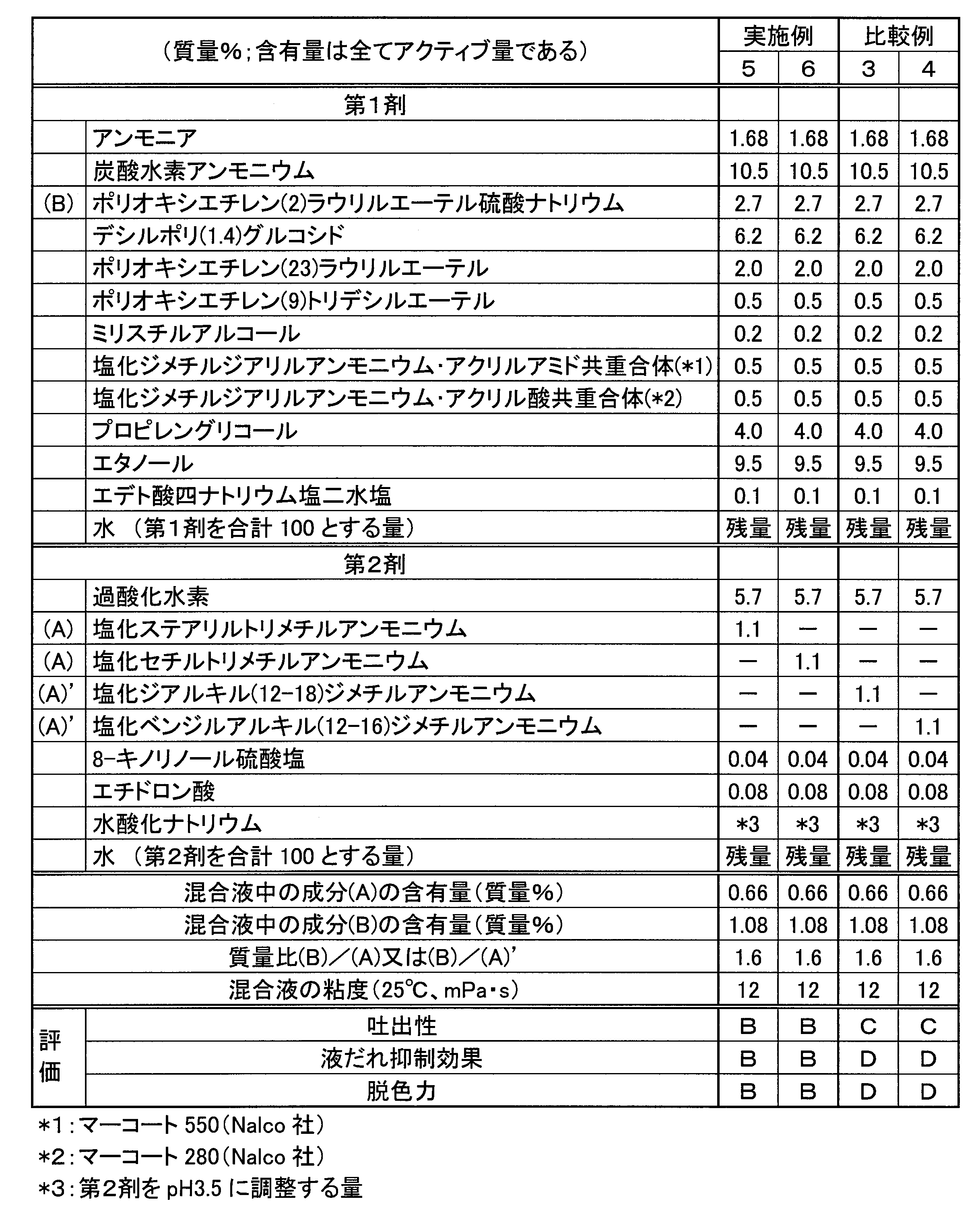
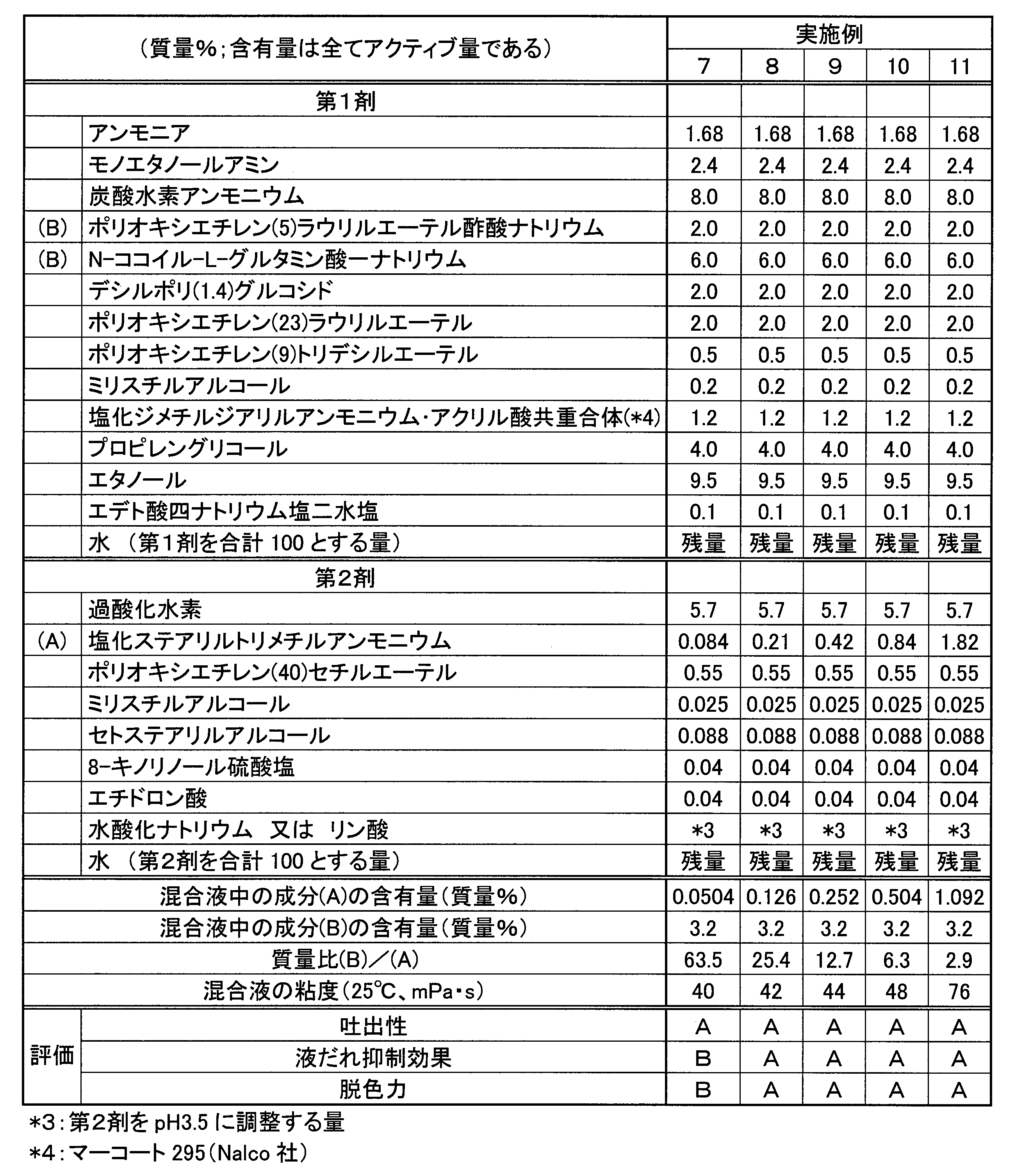
実施例12~15
表4に示す第1剤及び第2剤を調製し、前述と同様、1:1.5の質量比で混合して混合液とした上でスクイズフォーマー容器に入れた。ただし、スクイズフォーマーのディップチューブの内径は、実施例12と実施例13ではφ1.3mm、実施例14と実施例15ではφ1.6mmとした。
前述と同様、「吐出性」、「液だれ抑制効果」及び「染色力」について評価したところ、いずれも良好であった。
表4に示す第1剤及び第2剤を調製し、前述と同様、1:1.5の質量比で混合して混合液とした上でスクイズフォーマー容器に入れた。ただし、スクイズフォーマーのディップチューブの内径は、実施例12と実施例13ではφ1.3mm、実施例14と実施例15ではφ1.6mmとした。
前述と同様、「吐出性」、「液だれ抑制効果」及び「染色力」について評価したところ、いずれも良好であった。
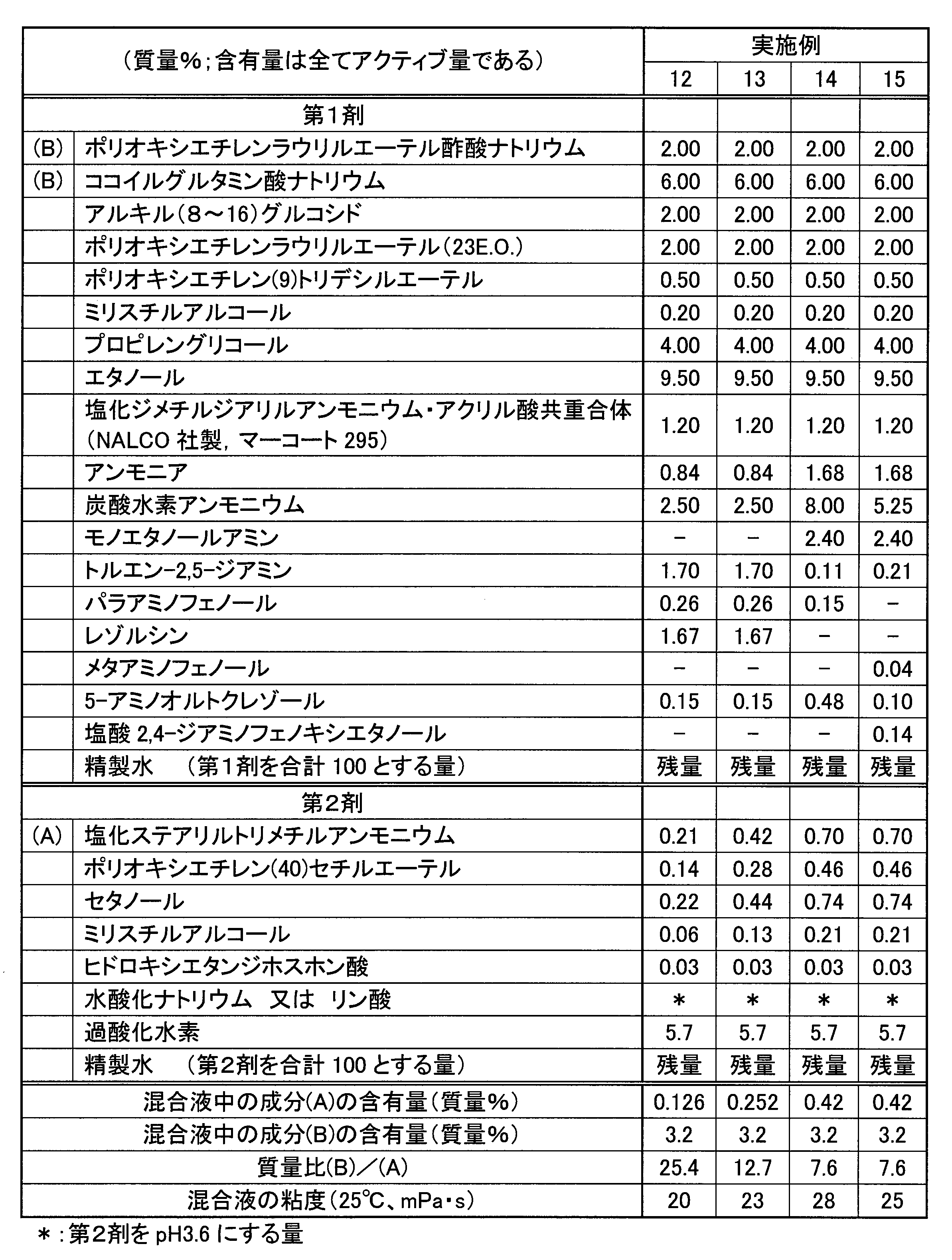
実施例16~26、比較例5~11
表5及び6に示す第1剤及び第2剤を調製し、スクイズフォーマー容器に入れ、吐出させた混合液の泡について、レオメーターにより動的粘弾性(G*,tanδ)を測定し、また「液だれ」、「脱色性」及び「脱色の均一性」について評価した。
表5及び6に示す第1剤及び第2剤を調製し、スクイズフォーマー容器に入れ、吐出させた混合液の泡について、レオメーターにより動的粘弾性(G*,tanδ)を測定し、また「液だれ」、「脱色性」及び「脱色の均一性」について評価した。
図1に示すように、第1剤A1の40gを第1容器2に、第2剤A2の60gを第2容器3(兼スクイズ容器の容器本体4;内容積210mL)に、それぞれ充填した。また、スクイズフォーマー5(大和製罐社製のS1スクイズフォーマー、メッシュの粗さは混合室150メッシュ、先端200メッシュ)を用意した。空気導入路の最狭部の開口面積の合計は、全ての測定で0.27mm2とした。一方、ディップチューブの内径はφ1.3mm、φ1.6mm、φ2.0mmの3通り用意した。ディップチューブ内径を変えることにより、泡に混ざる液の量を調整し、泡の安定や泡の均一性を調整できる。各実施例・比較例とも、泡の均一性・安定性に最も適したディップチューブを選択した。
第1剤の全量を容器本体4に入れ(第1剤:第2剤=1:1.5(質量比))、キャップをして正立状態から倒立状態とし再度正立状態に戻す動作を10秒間に10回繰り返すことにより泡立てないように混合した後、スクイズフォーマー5をセットして図2の状態とした。このフォーマー容器から混合液を泡状に吐出させ、以下に示す評価を行った。
なお、ポンプフォーマーを用いても同様な結果が得られる。
第1剤の全量を容器本体4に入れ(第1剤:第2剤=1:1.5(質量比))、キャップをして正立状態から倒立状態とし再度正立状態に戻す動作を10秒間に10回繰り返すことにより泡立てないように混合した後、スクイズフォーマー5をセットして図2の状態とした。このフォーマー容器から混合液を泡状に吐出させ、以下に示す評価を行った。
なお、ポンプフォーマーを用いても同様な結果が得られる。
(泡の動的粘弾性の測定方法)
フォーマー容器をスクイズさせてノズルから吐出した直後の混合液の泡について、以下のようにして動的粘弾性(G*,tanδ)を測定した。
レオメーター:Paar Physica社製MCR300
ジオメトリーは直径50mm、ステンレス製パラレルプレートを使用。
測定部温度は30℃に保持。
測定手順:
1.スパチュラーで泡をレオメーターの台座部分に4.5~5.5cm3取る。
2.ギャップを2mmに調整し、台座の間から溢れた泡は丁寧に取り除く。
3.30秒間保持して泡を測定部温度になじませた後、下記条件にて動的ひずみ掃引評価を開始する。
周波数:2Hzに固定、ひずみ:1×10⁻³~1×10³%
4.得られたデータから、tanδ及びG*として、ひずみに対してそれぞれ線形領域となる値を採用する。
フォーマー容器をスクイズさせてノズルから吐出した直後の混合液の泡について、以下のようにして動的粘弾性(G*,tanδ)を測定した。
レオメーター:Paar Physica社製MCR300
ジオメトリーは直径50mm、ステンレス製パラレルプレートを使用。
測定部温度は30℃に保持。
測定手順:
1.スパチュラーで泡をレオメーターの台座部分に4.5~5.5cm3取る。
2.ギャップを2mmに調整し、台座の間から溢れた泡は丁寧に取り除く。
3.30秒間保持して泡を測定部温度になじませた後、下記条件にて動的ひずみ掃引評価を開始する。
周波数:2Hzに固定、ひずみ:1×10⁻³~1×10³%
4.得られたデータから、tanδ及びG*として、ひずみに対してそれぞれ線形領域となる値を採用する。
(液だれの評価方法)
ビューラックス社製ウイッグNo.775Sの髪を、髪全体の質量が約70gとなるようにショートヘアにカットし、通常は混合液の質量を髪の質量と同量の70g(浴比:剤の質量/髪の質量=1)とするところ、本評価においては100g(浴比=1.43)に設定して塗布した。塗布後放置し、経時的に液だれの発生について以下の評価基準で評価した。
◎:45分間放置しても液だれしなかった。
○:30分間放置しても液だれしなかったが、45分間放置では液だれが見られた。
△:20分間放置しても液だれしなかったが、30分間放置では液だれが見られた。
×:20分間放置でも液だれが見られた。
ビューラックス社製ウイッグNo.775Sの髪を、髪全体の質量が約70gとなるようにショートヘアにカットし、通常は混合液の質量を髪の質量と同量の70g(浴比:剤の質量/髪の質量=1)とするところ、本評価においては100g(浴比=1.43)に設定して塗布した。塗布後放置し、経時的に液だれの発生について以下の評価基準で評価した。
◎:45分間放置しても液だれしなかった。
○:30分間放置しても液だれしなかったが、45分間放置では液だれが見られた。
△:20分間放置しても液だれしなかったが、30分間放置では液だれが見られた。
×:20分間放置でも液だれが見られた。
(脱色性及び脱色の均一性の評価方法)
ビューラックス社製ウイッグNo.775Sの髪を、髪全体の質量が約70gとなるようにショートヘアにカットし、通常は混合液の質量を髪の質量と同量の70g(浴比=1)とするところ、本評価においては100g(浴比=1.43)に設定して塗布した。30分間放置した後、剤を洗い流し、シャンプー、リンス、乾燥処理を行った。乾燥後の髪の脱色性及び脱色の均一性についてパネラーによる目視評価を行い、以下の判定基準で評価した。
A:良い
B:やや良い
C:やや悪い
D:悪い
ビューラックス社製ウイッグNo.775Sの髪を、髪全体の質量が約70gとなるようにショートヘアにカットし、通常は混合液の質量を髪の質量と同量の70g(浴比=1)とするところ、本評価においては100g(浴比=1.43)に設定して塗布した。30分間放置した後、剤を洗い流し、シャンプー、リンス、乾燥処理を行った。乾燥後の髪の脱色性及び脱色の均一性についてパネラーによる目視評価を行い、以下の判定基準で評価した。
A:良い
B:やや良い
C:やや悪い
D:悪い

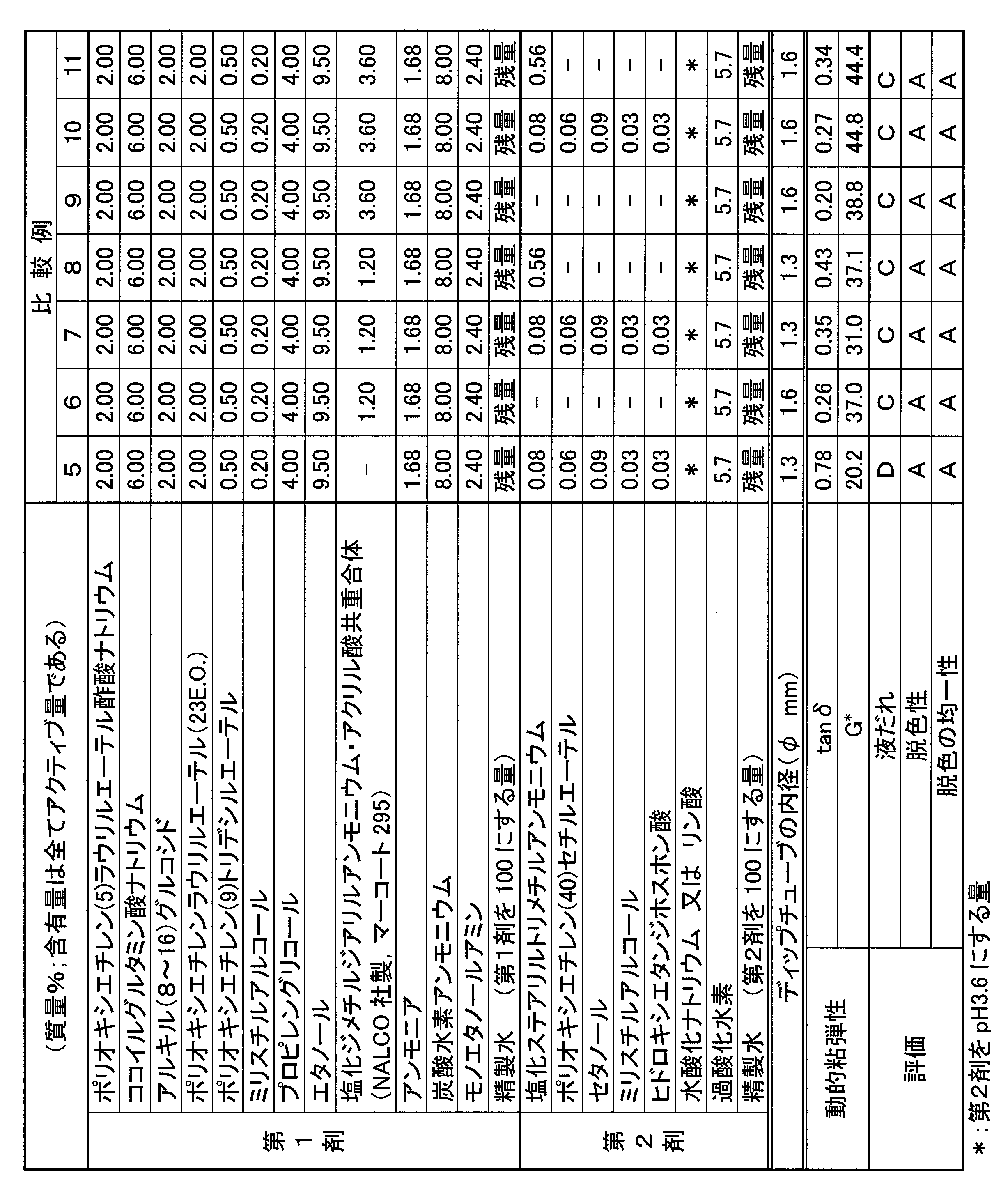
実施例27~30
表7に示す第1剤及び第2剤を調製し、前述と同様、スクイズフォーマー容器に入れ、吐出させた混合液の泡について、レオメーターにより動的粘弾性(G*,tanδ)を測定した。
また、前述と同様、「液だれ」、「染色性」及び「染色の均一性」について評価したところ、いずれも良好であった。
表7に示す第1剤及び第2剤を調製し、前述と同様、スクイズフォーマー容器に入れ、吐出させた混合液の泡について、レオメーターにより動的粘弾性(G*,tanδ)を測定した。
また、前述と同様、「液だれ」、「染色性」及び「染色の均一性」について評価したところ、いずれも良好であった。
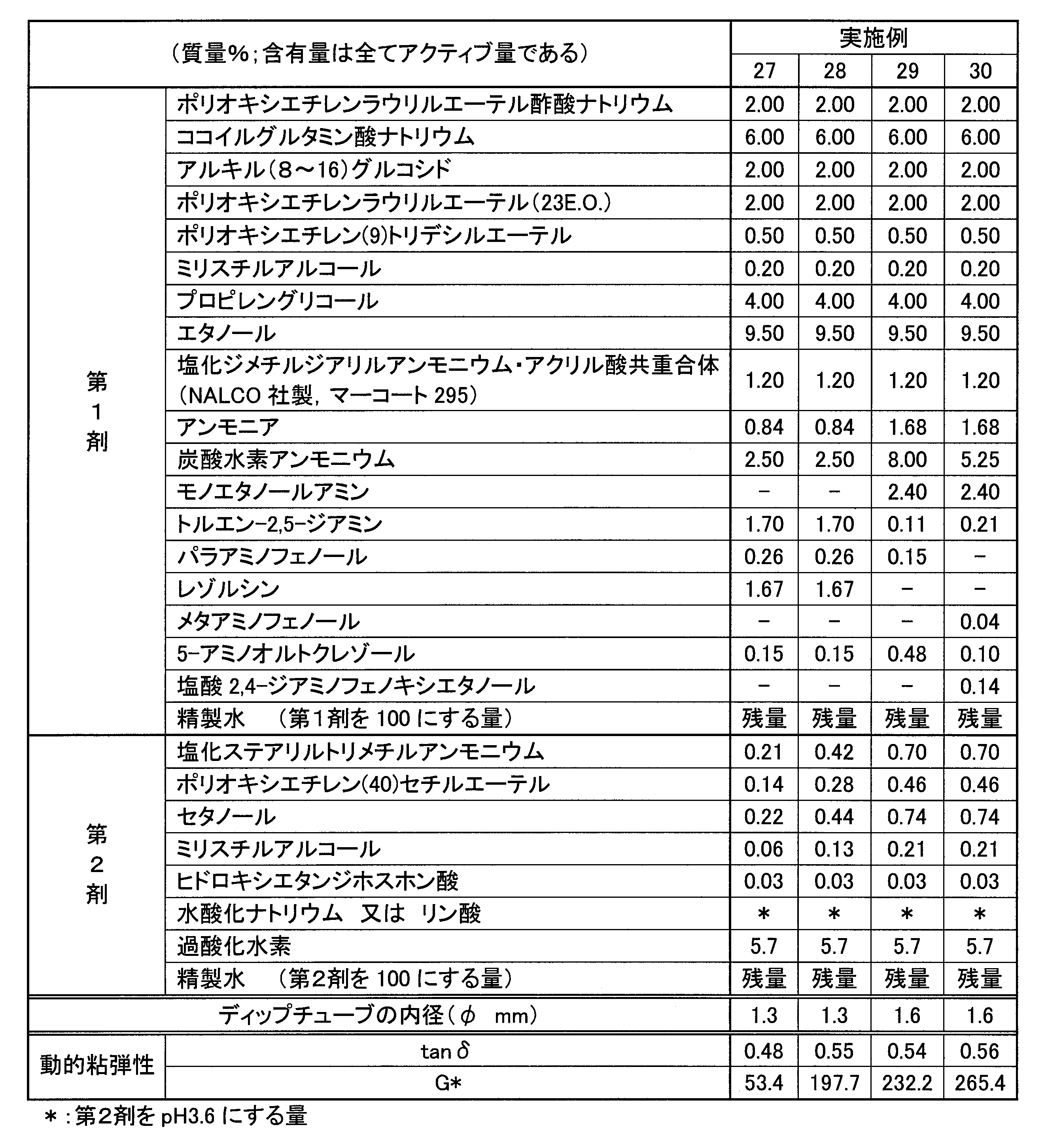
比較例12(特開2004-339216号公報の表3の処方から染料を抜いたもの)
下記処方の第1剤及び第2剤からなる二剤式染毛剤を調製し、質量比1:1.5で前述したスクイズフォーマー容器に入れた。ディップチューブの内径はφ2.0mmとした(以下全て同じ)。次いで、前述の方法に従って、動的粘弾性を測定した。その結果、G*=36.8、tanδ=0.30であった。
下記処方の第1剤及び第2剤からなる二剤式染毛剤を調製し、質量比1:1.5で前述したスクイズフォーマー容器に入れた。ディップチューブの内径はφ2.0mmとした(以下全て同じ)。次いで、前述の方法に従って、動的粘弾性を測定した。その結果、G*=36.8、tanδ=0.30であった。
第1剤 (質量%)
強アンモニア水(28質量%) 8.0
炭酸水素アンモニウム 14.0
パラオキシ安息香酸メチル 0.1
香料 0.5
アスコルビン酸 0.3
無水亜硫酸ナトリウム 0.4
水 残量
強アンモニア水(28質量%) 8.0
炭酸水素アンモニウム 14.0
パラオキシ安息香酸メチル 0.1
香料 0.5
アスコルビン酸 0.3
無水亜硫酸ナトリウム 0.4
水 残量
第2剤 (質量%)
ポリオキシエチレン(2.5)ラウリルエーテル硫酸ナトリウム 1.9
ラウリン酸アミドプロピルベタイン 0.05
ラウリルヒドロキシスルホベタイン 0.05
ラウリン酸 0.04
リン酸(75質量%) 第2剤をpH3.8に調整する量
グリセリン 30.0
過酸化水素水(35質量%) 16.3
水 残量
ポリオキシエチレン(2.5)ラウリルエーテル硫酸ナトリウム 1.9
ラウリン酸アミドプロピルベタイン 0.05
ラウリルヒドロキシスルホベタイン 0.05
ラウリン酸 0.04
リン酸(75質量%) 第2剤をpH3.8に調整する量
グリセリン 30.0
過酸化水素水(35質量%) 16.3
水 残量
比較例13(特開2006-124279号公報の実施例1の処方から染料を抜いたもの)
下記処方の第1剤及び第2剤からなる二剤式染毛剤を調製し、質量比1:1.5で前述したスクイズフォーマー容器に入れ、前述の方法に従って、動的粘弾性を測定した。その結果、G*=11.3、tanδ=0.92であった。
下記処方の第1剤及び第2剤からなる二剤式染毛剤を調製し、質量比1:1.5で前述したスクイズフォーマー容器に入れ、前述の方法に従って、動的粘弾性を測定した。その結果、G*=11.3、tanδ=0.92であった。
第1剤 (質量%)
強アンモニア水(28質量%) 8.5
炭酸水素アンモニウム 8.0
デシルポリ(1.4)グルコシド 3.2
ポリオキシエチレン(23)ラウリルエーテル 2.0
プロピレングリコール 4.0
塩化ジメチルジアリルアンモニウム・アクリル酸共重合体 0.4
ポリエーテル変性シリコーン(KF6005,信越化学社製) 1.0
パラオキシ安息香酸メチル 0.1
エデト酸四ナトリウム二水塩 0.1
香料 0.5
アスコルビン酸 0.3
無水亜硫酸ナトリウム 0.4
水 残量
強アンモニア水(28質量%) 8.5
炭酸水素アンモニウム 8.0
デシルポリ(1.4)グルコシド 3.2
ポリオキシエチレン(23)ラウリルエーテル 2.0
プロピレングリコール 4.0
塩化ジメチルジアリルアンモニウム・アクリル酸共重合体 0.4
ポリエーテル変性シリコーン(KF6005,信越化学社製) 1.0
パラオキシ安息香酸メチル 0.1
エデト酸四ナトリウム二水塩 0.1
香料 0.5
アスコルビン酸 0.3
無水亜硫酸ナトリウム 0.4
水 残量
第2剤 (質量%)
ポリオキシエチレン(2.5)ラウリルエーテル硫酸ナトリウム 1.9
ラウリン酸アミドプロピルベタイン 0.05
ラウリルヒドロキシスルホベタイン 0.05
ラウリン酸 0.04
セチルアルコール 1.5
1-ヒドロキシエタン-1,1-ジホスホン酸 0.04
リン酸(75質量%) 第2剤をpH3.8に調整する量
水酸化ナトリウム液(48質量%) 0.01
硫酸オキシキノリン 0.04
アミノ変性シリコーン(SM8704C,東レダウコーニング社製) 1.0
グリセリン 5.0
過酸化水素水(35質量%) 16.3
水 残量
ポリオキシエチレン(2.5)ラウリルエーテル硫酸ナトリウム 1.9
ラウリン酸アミドプロピルベタイン 0.05
ラウリルヒドロキシスルホベタイン 0.05
ラウリン酸 0.04
セチルアルコール 1.5
1-ヒドロキシエタン-1,1-ジホスホン酸 0.04
リン酸(75質量%) 第2剤をpH3.8に調整する量
水酸化ナトリウム液(48質量%) 0.01
硫酸オキシキノリン 0.04
アミノ変性シリコーン(SM8704C,東レダウコーニング社製) 1.0
グリセリン 5.0
過酸化水素水(35質量%) 16.3
水 残量
比較例14(特開2006-124279号公報の実施例5の処方から染料を抜いたもの)
下記処方の第1剤及び第2剤からなる二剤式染毛剤を調製し、質量比1:1.5で前述したスクイズフォーマー容器に入れ、前述の方法に従って、動的粘弾性を測定した。その結果、G*=43.8、tanδ=0.39であった。
下記処方の第1剤及び第2剤からなる二剤式染毛剤を調製し、質量比1:1.5で前述したスクイズフォーマー容器に入れ、前述の方法に従って、動的粘弾性を測定した。その結果、G*=43.8、tanδ=0.39であった。
第1剤 (質量%)
強アンモニア水(28質量%) 8.5
炭酸水素アンモニウム 8.0
デシルポリ(1.4)グルコシド 3.2
ポリオキシエチレン(23)ラウリルエーテル 2.0
プロピレングリコール 4.0
塩化ジメチルジアリルアンモニウム・アクリル酸共重合体 0.4
ポリエーテル変性シリコーン(KF6005,信越化学社製) 1.0
パラオキシ安息香酸メチル 0.1
エデト酸四ナトリウム二水塩 0.1
香料 0.5
アスコルビン酸 0.3
無水亜硫酸ナトリウム 0.4
水 残量
強アンモニア水(28質量%) 8.5
炭酸水素アンモニウム 8.0
デシルポリ(1.4)グルコシド 3.2
ポリオキシエチレン(23)ラウリルエーテル 2.0
プロピレングリコール 4.0
塩化ジメチルジアリルアンモニウム・アクリル酸共重合体 0.4
ポリエーテル変性シリコーン(KF6005,信越化学社製) 1.0
パラオキシ安息香酸メチル 0.1
エデト酸四ナトリウム二水塩 0.1
香料 0.5
アスコルビン酸 0.3
無水亜硫酸ナトリウム 0.4
水 残量
第2剤 (質量%)
ポリオキシエチレン(2.5)ラウリルエーテル硫酸ナトリウム 1.9
ラウリン酸アミドプロピルベタイン 0.05
ラウリルヒドロキシスルホベタイン 0.05
ラウリン酸 0.04
セチルアルコール 2.25
1-ヒドロキシエタン-1,1-ジホスホン酸 0.04
リン酸(75質量%) 第2剤をpH3.8に調整する量
水酸化ナトリウム液(48質量%) 0.01
硫酸オキシキノリン 0.04
アミノ変性シリコーン(SM8704C,東レダウコーニング社製) 1.0
グリセリン 5.0
過酸化水素水(35質量%) 16.3
水 残量
ポリオキシエチレン(2.5)ラウリルエーテル硫酸ナトリウム 1.9
ラウリン酸アミドプロピルベタイン 0.05
ラウリルヒドロキシスルホベタイン 0.05
ラウリン酸 0.04
セチルアルコール 2.25
1-ヒドロキシエタン-1,1-ジホスホン酸 0.04
リン酸(75質量%) 第2剤をpH3.8に調整する量
水酸化ナトリウム液(48質量%) 0.01
硫酸オキシキノリン 0.04
アミノ変性シリコーン(SM8704C,東レダウコーニング社製) 1.0
グリセリン 5.0
過酸化水素水(35質量%) 16.3
水 残量
比較例15(特開2007-291015号公報の比較例2の処方から染料を抜いたもの)
下記処方の第1剤及び第2剤からなる二剤式染毛剤を調製し、質量比1:1.5で前述したスクイズフォーマー容器に入れ、前述の方法に従って、動的粘弾性を測定した。その結果、G*=20.0、tanδ=0.70であった。
下記処方の第1剤及び第2剤からなる二剤式染毛剤を調製し、質量比1:1.5で前述したスクイズフォーマー容器に入れ、前述の方法に従って、動的粘弾性を測定した。その結果、G*=20.0、tanδ=0.70であった。
第1剤 (質量%)
強アンモニア水(28質量%) 6.0
炭酸水素アンモニウム 10.0
デシルポリ(1.4)グルコシド 23.8
プロピレングリコール 4.0
エデト酸四ナトリウム二水塩 0.1
アスコルビン酸 0.4
無水亜硫酸ナトリウム 0.5
水 残量
強アンモニア水(28質量%) 6.0
炭酸水素アンモニウム 10.0
デシルポリ(1.4)グルコシド 23.8
プロピレングリコール 4.0
エデト酸四ナトリウム二水塩 0.1
アスコルビン酸 0.4
無水亜硫酸ナトリウム 0.5
水 残量
第2剤 (質量%)
過酸化水素水(35質量%) 16.3
ポリオキシエチレン(2.5)ラウリルエーテル硫酸ナトリウム 2.8
セチルアルコール 0.6
8-キノリノール硫酸塩 0.03
1-ヒドロキシエタン-1,1-ジホスホン酸 0.08
水酸化ナトリウム 第2剤をpH3.5に調整する量
水 残量
過酸化水素水(35質量%) 16.3
ポリオキシエチレン(2.5)ラウリルエーテル硫酸ナトリウム 2.8
セチルアルコール 0.6
8-キノリノール硫酸塩 0.03
1-ヒドロキシエタン-1,1-ジホスホン酸 0.08
水酸化ナトリウム 第2剤をpH3.5に調整する量
水 残量
比較例16(特開2007-291015号公報の比較例4の処方から染料を抜いたもの)
下記処方の第1剤及び第2剤からなる二剤式染毛剤を調製し、質量比1:1.5で前述したスクイズフォーマー容器に入れ、前述の方法に従って、動的粘弾性を測定した。その結果、G*=23.0、tanδ=0.47であった。
下記処方の第1剤及び第2剤からなる二剤式染毛剤を調製し、質量比1:1.5で前述したスクイズフォーマー容器に入れ、前述の方法に従って、動的粘弾性を測定した。その結果、G*=23.0、tanδ=0.47であった。
第1剤 (質量%)
強アンモニア水(28質量%) 6.0
炭酸水素アンモニウム 10.0
デシルポリ(1.4)グルコシド 8.5
プロピレングリコール 4.0
エデト酸四ナトリウム二水塩 0.1
アスコルビン酸 0.4
無水亜硫酸ナトリウム 0.5
水 残量
強アンモニア水(28質量%) 6.0
炭酸水素アンモニウム 10.0
デシルポリ(1.4)グルコシド 8.5
プロピレングリコール 4.0
エデト酸四ナトリウム二水塩 0.1
アスコルビン酸 0.4
無水亜硫酸ナトリウム 0.5
水 残量
第2剤 (質量%)
過酸化水素水(35質量%) 16.3
ポリオキシエチレン(2.5)ラウリルエーテル硫酸ナトリウム 1.0
セチルアルコール 2.0
8-キノリノール硫酸塩 0.03
1-ヒドロキシエタン-1,1-ジホスホン酸 0.08
水酸化ナトリウム 第2剤をpH3.5に調整する量
水 残量
過酸化水素水(35質量%) 16.3
ポリオキシエチレン(2.5)ラウリルエーテル硫酸ナトリウム 1.0
セチルアルコール 2.0
8-キノリノール硫酸塩 0.03
1-ヒドロキシエタン-1,1-ジホスホン酸 0.08
水酸化ナトリウム 第2剤をpH3.5に調整する量
水 残量
比較例17(特開2007-291016号公報の実施例1の処方から染料を抜いたもの)
下記処方の第1剤及び第2剤からなる二剤式染毛剤を調製し、質量比1:1.5で前述したスクイズフォーマー容器に入れ、前述の方法に従って、動的粘弾性を測定した。その結果、G*=18.0、tanδ=0.34であった。
下記処方の第1剤及び第2剤からなる二剤式染毛剤を調製し、質量比1:1.5で前述したスクイズフォーマー容器に入れ、前述の方法に従って、動的粘弾性を測定した。その結果、G*=18.0、tanδ=0.34であった。
第1剤 (質量%)
強アンモニア水(28質量%) 8.0
炭酸水素アンモニウム 14.0
デシルポリ(1.4)グルコシド 3.2
ポリオキシエチレン(23)ラウリルエーテル 2.0
パラオキシ安息香酸メチル 0.1
香料 0.5
水 残量
強アンモニア水(28質量%) 8.0
炭酸水素アンモニウム 14.0
デシルポリ(1.4)グルコシド 3.2
ポリオキシエチレン(23)ラウリルエーテル 2.0
パラオキシ安息香酸メチル 0.1
香料 0.5
水 残量
第2剤 (質量%)
塩化トリメチルステアリルアンモニウム 1.2
リン酸(75質量%) 第2剤をpH3.8に調整する量
グリセリン 3.5
過酸化水素水(35質量%) 16.3
水 残量
塩化トリメチルステアリルアンモニウム 1.2
リン酸(75質量%) 第2剤をpH3.8に調整する量
グリセリン 3.5
過酸化水素水(35質量%) 16.3
水 残量
比較例18(特開2007-291016号公報の実施例2の処方から染料を抜いたもの)
下記処方の第1剤及び第2剤からなる二剤式染毛剤を調製し、質量比1:1.5で前述したスクイズフォーマー容器に入れ、前述の方法に従って、動的粘弾性を測定した。その結果、G*=20.0、tanδ=0.63であった。
下記処方の第1剤及び第2剤からなる二剤式染毛剤を調製し、質量比1:1.5で前述したスクイズフォーマー容器に入れ、前述の方法に従って、動的粘弾性を測定した。その結果、G*=20.0、tanδ=0.63であった。
第1剤 (質量%)
強アンモニア水(28質量%) 6.0
炭酸水素アンモニウム 10.0
デシルポリ(1.4)グルコシド 11.0
ポリオキシエチレン(23)ラウリルエーテル 1.0
プロピレングリコール 4.0
塩化ジメチルジアリルアンモニウム・アクリルアミド共重合体 0.5
エデト酸四ナトリウム塩二水塩 0.1
アスコルビン酸 0.4
無水亜硫酸ナトリウム 0.5
香料 0.5
水 残量
強アンモニア水(28質量%) 6.0
炭酸水素アンモニウム 10.0
デシルポリ(1.4)グルコシド 11.0
ポリオキシエチレン(23)ラウリルエーテル 1.0
プロピレングリコール 4.0
塩化ジメチルジアリルアンモニウム・アクリルアミド共重合体 0.5
エデト酸四ナトリウム塩二水塩 0.1
アスコルビン酸 0.4
無水亜硫酸ナトリウム 0.5
香料 0.5
水 残量
第2剤 (質量%)
過酸化水素水(35質量%) 16.3
塩化ステアリルトリメチルアンモニウム 0.3
塩化ジアルキル(12~18)ジメチルアンモニウム 0.1
ジメチルポリシロキサン(20mm2/s) 0.01
セチルアルコール 0.4
ステアリルアルコール 0.2
1-ヒドロキシエタン-1,1-ジホスホン酸 0.08
水酸化ナトリウム 第2剤をpH3.5に調整する量
水 残量
過酸化水素水(35質量%) 16.3
塩化ステアリルトリメチルアンモニウム 0.3
塩化ジアルキル(12~18)ジメチルアンモニウム 0.1
ジメチルポリシロキサン(20mm2/s) 0.01
セチルアルコール 0.4
ステアリルアルコール 0.2
1-ヒドロキシエタン-1,1-ジホスホン酸 0.08
水酸化ナトリウム 第2剤をpH3.5に調整する量
水 残量
比較例19(特開2007-314523号公報の実施例5の処方から染料を抜いたもの)
下記処方の第1剤及び第2剤からなる二剤式染毛剤を調製し、質量比1:1.5で前述したスクイズフォーマー容器に入れ、前述の方法に従って、動的粘弾性を測定した。その結果、G*=26.2、tanδ=0.27であった。
下記処方の第1剤及び第2剤からなる二剤式染毛剤を調製し、質量比1:1.5で前述したスクイズフォーマー容器に入れ、前述の方法に従って、動的粘弾性を測定した。その結果、G*=26.2、tanδ=0.27であった。
第1剤 (質量%)
強アンモニア水(28質量%) 6.0
炭酸水素アンモニウム 10.0
デシルポリ(1.4)グルコシド 6.0
ポリオキシエチレン(23)ラウリルエーテル 2.0
プロピレングリコール 4.0
エタノール 7.0
塩化ジメチルジアリルアンモニウム・アクリルアミド共重合体 0.5
塩化ジメチルジアリルアンモニウム・アクリル酸共重合体 0.4
エデト酸四ナトリウム塩二水塩 0.1
アスコルビン酸 0.3
無水亜硫酸ナトリウム 0.4
香料 0.5
水 残量
強アンモニア水(28質量%) 6.0
炭酸水素アンモニウム 10.0
デシルポリ(1.4)グルコシド 6.0
ポリオキシエチレン(23)ラウリルエーテル 2.0
プロピレングリコール 4.0
エタノール 7.0
塩化ジメチルジアリルアンモニウム・アクリルアミド共重合体 0.5
塩化ジメチルジアリルアンモニウム・アクリル酸共重合体 0.4
エデト酸四ナトリウム塩二水塩 0.1
アスコルビン酸 0.3
無水亜硫酸ナトリウム 0.4
香料 0.5
水 残量
第2剤 (質量%)
過酸化水素水(35質量%) 16.3
ポリオキシエチレン(2.5)ラウリルエーテル硫酸ナトリウム 0.5
グリセリン モノ-2-エチルヘキシルエーテル 0.1
ラウリン酸アミドプロピルベタイン 0.05
ラウリルヒドロシキスルホベタイン 0.05
ラウリン酸 0.01
セチルアルコール 0.58
ステアリルアルコール 0.15
硫酸オキシキノリン 0.04
1-ヒドロキシエタン-1,1-ジホスホン酸 0.08
水酸化ナトリウム 第2剤をpH3.5に調整する量
水 残量
過酸化水素水(35質量%) 16.3
ポリオキシエチレン(2.5)ラウリルエーテル硫酸ナトリウム 0.5
グリセリン モノ-2-エチルヘキシルエーテル 0.1
ラウリン酸アミドプロピルベタイン 0.05
ラウリルヒドロシキスルホベタイン 0.05
ラウリン酸 0.01
セチルアルコール 0.58
ステアリルアルコール 0.15
硫酸オキシキノリン 0.04
1-ヒドロキシエタン-1,1-ジホスホン酸 0.08
水酸化ナトリウム 第2剤をpH3.5に調整する量
水 残量
1 二剤式染毛剤の各構成要素
2 第1容器
3 第2容器
4 スクイズ容器の容器本体
5 スクイズフォーマー
7 キャップ部
8 ヘッド部
10 混合器
11 気液混合室
12 空気導入路
13 ディップチューブ
14 泡均質化手段
15 通液路
16 通液路
17 吐出口
18 泡均質化手段
A1 第1剤
A2 第2剤
A3 混合液
2 第1容器
3 第2容器
4 スクイズ容器の容器本体
5 スクイズフォーマー
7 キャップ部
8 ヘッド部
10 混合器
11 気液混合室
12 空気導入路
13 ディップチューブ
14 泡均質化手段
15 通液路
16 通液路
17 吐出口
18 泡均質化手段
A1 第1剤
A2 第2剤
A3 混合液
Claims (15)
- アルカリ剤を含有する第1剤、過酸化水素を含有する第2剤、及び第1剤と第2剤の混合液を泡状に吐出するノンエアゾール式フォーマー容器からなり、混合液中に次の成分(A)及び(B)
(A)モノ長鎖脂肪族基トリメチルアンモニウム塩:0.02~10質量%
(B)アニオン界面活性剤:0.5~10質量%
を含有し、混合液の25℃における粘度が1~300mPa・sである二剤式染毛剤。 - 成分(B)と成分(A)との質量比(B)/(A)が1~100である請求項1記載の二剤式染毛剤。
- 更に、高級アルコールを含有する請求項1又は2記載の二剤式染毛剤。
- 更に、ジアリル4級アンモニウム塩の重合体又は共重合体を含有する請求項1~3のいずれかに記載の二剤式染毛剤。
- 更に、不揮発性親水性溶剤を含有する請求項1~4のいずれかに記載の二剤式染毛剤。
- 成分(A)がセチルトリメチルアンモニウム塩又はステアリルトリメチルアンモニウム塩である請求項1~5のいずれかに記載の二剤式染毛剤。
- 成分(B)がカルボン酸系アニオン界面活性剤である請求項1~6のいずれかに記載の二剤式染毛剤。
- 成分(A)と成分(B)とが、第1剤と第2剤とに分離して含有されるものである請求項1~7のいずれかに記載の二剤式染毛剤。
- アルカリ剤を含有する第1剤と過酸化水素を含有する第2剤、及び第1剤と第2剤の混合液を泡状に吐出するノンエアゾール式フォーマー容器からなる二剤式染毛剤であって、ノンエアゾール式フォーマー容器から混合液を泡状に吐出させた直後の泡の動的粘弾性について、レオメーターを用いて下記条件で測定したとき、複素弾性率G*が50~600の範囲内である二剤式染毛剤。
レオメーターの設定:
ジオメトリーは直径50mm、ステンレス製パラレルプレートを使用。
測定部温度は30℃に保持。
測定手順:
1.スパチュラーで泡をレオメーターの台座部分に4.5~5.5cm3取る。
2.ギャップを2mmに調整し、台座の間から溢れた泡は丁寧に取り除く。
3.30秒間保持して泡を測定部温度になじませた後、下記条件にて動的ひずみ掃引評価を開始する。
周波数:2Hzに固定、ひずみ:1×10⁻³~1×10³%
4.得られたデータから、G*として、ひずみに対して線形領域となる値を採用する。 - 測定手順4において、レオメーターで測定された貯蔵弾性率G'と損失弾性率G"の比(tanδ)として、ひずみに対して線形領域となる値を採用したとき、tanδが0.3~0.8である請求項9記載の二剤式染毛剤。
- 油剤を、第1剤と第2剤の混合液中に0.01~3質量%含有する請求項9~10記載の二剤式染毛剤。
- 水溶性ポリマーを、第1剤と第2剤の混合液中に0.01~3質量%含有する請求項9~11記載の二剤式染毛剤。
- カチオン界面活性剤を、第1剤と第2剤の混合液中に0~5質量%含有する請求項9~12記載の二剤式染毛剤。
- 第1剤と第2剤の混合時におけるpH(25℃)が、8~12である請求項1~13のいずれかに記載の二剤式染毛剤。
- 請求項1~14のいずれかに記載の二剤式染毛剤の混合液をノンエアゾール式フォーマー容器から泡状に吐出させ、この泡状の混合液を頭髪に適用した後、頭髪上で再度泡立てる頭髪染色方法。
Applications Claiming Priority (8)
| Application Number | Priority Date | Filing Date | Title |
|---|---|---|---|
| JP2009058762 | 2009-03-11 | ||
| JP2009-058764 | 2009-03-11 | ||
| JP2009058764 | 2009-03-11 | ||
| JP2009-058762 | 2009-03-11 | ||
| JP2009280283A JP5756258B2 (ja) | 2009-03-11 | 2009-12-10 | 二剤式染毛剤 |
| JP2009-280281 | 2009-12-10 | ||
| JP2009280281A JP6093104B2 (ja) | 2009-03-11 | 2009-12-10 | 二剤式染毛剤 |
| JP2009-280283 | 2009-12-10 |
Publications (1)
| Publication Number | Publication Date |
|---|---|
| WO2010103796A1 true WO2010103796A1 (ja) | 2010-09-16 |
Family
ID=42728092
Family Applications (1)
| Application Number | Title | Priority Date | Filing Date |
|---|---|---|---|
| PCT/JP2010/001628 Ceased WO2010103796A1 (ja) | 2009-03-11 | 2010-03-09 | 二剤式染毛剤 |
Country Status (1)
| Country | Link |
|---|---|
| WO (1) | WO2010103796A1 (ja) |
Cited By (12)
| Publication number | Priority date | Publication date | Assignee | Title |
|---|---|---|---|---|
| US7938864B2 (en) | 2007-10-24 | 2011-05-10 | Kao Corporation | Two-part hair dye |
| US7955400B2 (en) | 2007-10-24 | 2011-06-07 | Kao Corporation | Two-part hair dye composition |
| US8025702B2 (en) | 2007-10-24 | 2011-09-27 | Kao Corporation | Two-part hairdye composition |
| WO2012029779A1 (ja) * | 2010-08-31 | 2012-03-08 | 花王株式会社 | 二剤式泡状染毛剤 |
| JP2012105842A (ja) * | 2010-11-18 | 2012-06-07 | Mandom Corp | 脱色剤又は酸化染毛剤の塗布具、脱色剤又は酸化染毛剤を備えた塗布具並びに毛髪の脱色又は染色方法 |
| JP2015083554A (ja) * | 2013-10-25 | 2015-04-30 | 花王株式会社 | 毛髪の染色又は脱色方法 |
| WO2015060416A1 (ja) * | 2013-10-25 | 2015-04-30 | 花王株式会社 | 毛髪脱色用又は染毛用化粧品 |
| JP2015083555A (ja) * | 2013-10-25 | 2015-04-30 | 花王株式会社 | 頭髪の染色又は脱色方法 |
| JP2015083553A (ja) * | 2013-10-25 | 2015-04-30 | 花王株式会社 | 毛髪の染色又は脱色方法 |
| EP2275079A3 (de) * | 2009-07-06 | 2015-10-28 | Henkel AG & Co. KGaA | Schaumförmige Färbemittel |
| JP2016155787A (ja) * | 2015-02-25 | 2016-09-01 | 株式会社ダリヤ | 染毛剤組成物 |
| JP2017095373A (ja) * | 2015-11-19 | 2017-06-01 | 株式会社ヘアテック・ジャパン | 後発泡型染毛組成物 |
Citations (10)
| Publication number | Priority date | Publication date | Assignee | Title |
|---|---|---|---|---|
| JP2000297018A (ja) * | 1999-04-13 | 2000-10-24 | Hoyu Co Ltd | 毛髪化粧剤、毛髪化粧品及び毛髪化粧剤の使用方法 |
| JP2000297019A (ja) * | 1999-04-15 | 2000-10-24 | Hoyu Co Ltd | 酸化染毛剤組成物 |
| JP2001328927A (ja) * | 2000-05-19 | 2001-11-27 | Hoyu Co Ltd | 染毛剤組成物 |
| JP2002284655A (ja) * | 2001-03-23 | 2002-10-03 | Hoyu Co Ltd | 二剤式泡状染毛剤組成物及び二剤式泡状染毛剤組成物含有エアゾール製品 |
| JP2003192551A (ja) * | 2001-12-21 | 2003-07-09 | L'oreal Sa | オキシアルキレン化カルボン酸エーテル、非イオン性界面活性剤及び特定のポリマーを含有するケラチン繊維の酸化染色組成物 |
| JP2004075644A (ja) * | 2002-08-22 | 2004-03-11 | Kanebo Ltd | 染毛剤組成物 |
| JP2004339216A (ja) * | 2003-04-25 | 2004-12-02 | Kao Corp | 毛髪化粧品 |
| JP2004339179A (ja) * | 2003-05-19 | 2004-12-02 | Arimino Kagaku Kk | 酸化染毛剤組成物、毛髪脱色剤組成物、酸化染毛剤セット |
| JP2005023025A (ja) * | 2003-07-03 | 2005-01-27 | Kao Corp | 酸化染毛剤又は脱色剤組成物 |
| JP2006241082A (ja) * | 2005-03-03 | 2006-09-14 | Toho Chem Ind Co Ltd | カチオン変性精製ローカストビーンガム及び該物質を含む化粧料組成物 |
-
2010
- 2010-03-09 WO PCT/JP2010/001628 patent/WO2010103796A1/ja not_active Ceased
Patent Citations (10)
| Publication number | Priority date | Publication date | Assignee | Title |
|---|---|---|---|---|
| JP2000297018A (ja) * | 1999-04-13 | 2000-10-24 | Hoyu Co Ltd | 毛髪化粧剤、毛髪化粧品及び毛髪化粧剤の使用方法 |
| JP2000297019A (ja) * | 1999-04-15 | 2000-10-24 | Hoyu Co Ltd | 酸化染毛剤組成物 |
| JP2001328927A (ja) * | 2000-05-19 | 2001-11-27 | Hoyu Co Ltd | 染毛剤組成物 |
| JP2002284655A (ja) * | 2001-03-23 | 2002-10-03 | Hoyu Co Ltd | 二剤式泡状染毛剤組成物及び二剤式泡状染毛剤組成物含有エアゾール製品 |
| JP2003192551A (ja) * | 2001-12-21 | 2003-07-09 | L'oreal Sa | オキシアルキレン化カルボン酸エーテル、非イオン性界面活性剤及び特定のポリマーを含有するケラチン繊維の酸化染色組成物 |
| JP2004075644A (ja) * | 2002-08-22 | 2004-03-11 | Kanebo Ltd | 染毛剤組成物 |
| JP2004339216A (ja) * | 2003-04-25 | 2004-12-02 | Kao Corp | 毛髪化粧品 |
| JP2004339179A (ja) * | 2003-05-19 | 2004-12-02 | Arimino Kagaku Kk | 酸化染毛剤組成物、毛髪脱色剤組成物、酸化染毛剤セット |
| JP2005023025A (ja) * | 2003-07-03 | 2005-01-27 | Kao Corp | 酸化染毛剤又は脱色剤組成物 |
| JP2006241082A (ja) * | 2005-03-03 | 2006-09-14 | Toho Chem Ind Co Ltd | カチオン変性精製ローカストビーンガム及び該物質を含む化粧料組成物 |
Cited By (15)
| Publication number | Priority date | Publication date | Assignee | Title |
|---|---|---|---|---|
| US7938864B2 (en) | 2007-10-24 | 2011-05-10 | Kao Corporation | Two-part hair dye |
| US7955400B2 (en) | 2007-10-24 | 2011-06-07 | Kao Corporation | Two-part hair dye composition |
| US8021439B2 (en) | 2007-10-24 | 2011-09-20 | Kao Corporation | Two-part hair dye |
| US8025702B2 (en) | 2007-10-24 | 2011-09-27 | Kao Corporation | Two-part hairdye composition |
| EP2275079A3 (de) * | 2009-07-06 | 2015-10-28 | Henkel AG & Co. KGaA | Schaumförmige Färbemittel |
| US8636812B2 (en) | 2010-08-31 | 2014-01-28 | Kao Corporation | Two-part foam hair dye |
| WO2012029779A1 (ja) * | 2010-08-31 | 2012-03-08 | 花王株式会社 | 二剤式泡状染毛剤 |
| JP2012105842A (ja) * | 2010-11-18 | 2012-06-07 | Mandom Corp | 脱色剤又は酸化染毛剤の塗布具、脱色剤又は酸化染毛剤を備えた塗布具並びに毛髪の脱色又は染色方法 |
| JP2015083554A (ja) * | 2013-10-25 | 2015-04-30 | 花王株式会社 | 毛髪の染色又は脱色方法 |
| WO2015060416A1 (ja) * | 2013-10-25 | 2015-04-30 | 花王株式会社 | 毛髪脱色用又は染毛用化粧品 |
| JP2015083555A (ja) * | 2013-10-25 | 2015-04-30 | 花王株式会社 | 頭髪の染色又は脱色方法 |
| JP2015083553A (ja) * | 2013-10-25 | 2015-04-30 | 花王株式会社 | 毛髪の染色又は脱色方法 |
| US9782332B2 (en) | 2013-10-25 | 2017-10-10 | Kao Corporation | Hair bleaching or hair dye cosmetics |
| JP2016155787A (ja) * | 2015-02-25 | 2016-09-01 | 株式会社ダリヤ | 染毛剤組成物 |
| JP2017095373A (ja) * | 2015-11-19 | 2017-06-01 | 株式会社ヘアテック・ジャパン | 後発泡型染毛組成物 |
Similar Documents
| Publication | Publication Date | Title |
|---|---|---|
| JP6181826B2 (ja) | 二剤式染毛剤 | |
| CN102316847B (zh) | 双剂型染发剂 | |
| EP2535036B1 (en) | Dyeing or bleaching kit | |
| CN111132736B (zh) | 染发方法 | |
| CN101835453B (zh) | 双剂型毛发染色剂组合物 | |
| JP5756258B2 (ja) | 二剤式染毛剤 | |
| EP2283803A1 (en) | Two-part foam hair dye | |
| JP5732240B2 (ja) | 二剤式染毛剤 | |
| JP5369153B2 (ja) | 二剤式泡状染毛剤 | |
| JP5940324B2 (ja) | 2剤式染毛剤 | |
| JP5669485B2 (ja) | 二剤式染毛剤 | |
| CN105682636B (zh) | 毛发脱色用或染发用化妆品 | |
| JP6420119B2 (ja) | 染色又は脱色キット | |
| TWI444201B (zh) | Two doses of hair dye | |
| CN120641072A (zh) | 毛发脱色用或染发用化妆品 | |
| RU2462230C2 (ru) | Двухкомпонентная композиция для окрашивания волос | |
| HK1164689B (en) | Two-pack type hair dye product |
Legal Events
| Date | Code | Title | Description |
|---|---|---|---|
| 121 | Ep: the epo has been informed by wipo that ep was designated in this application |
Ref document number: 10750553 Country of ref document: EP Kind code of ref document: A1 |
|
| NENP | Non-entry into the national phase |
Ref country code: DE |
|
| 122 | Ep: pct application non-entry in european phase |
Ref document number: 10750553 Country of ref document: EP Kind code of ref document: A1 |