WO2010095396A1 - 植物油の製造方法 - Google Patents
植物油の製造方法 Download PDFInfo
- Publication number
- WO2010095396A1 WO2010095396A1 PCT/JP2010/000823 JP2010000823W WO2010095396A1 WO 2010095396 A1 WO2010095396 A1 WO 2010095396A1 JP 2010000823 W JP2010000823 W JP 2010000823W WO 2010095396 A1 WO2010095396 A1 WO 2010095396A1
- Authority
- WO
- WIPO (PCT)
- Prior art keywords
- oil
- surfactant
- vegetable oil
- phosphorous
- weight
- Prior art date
- Legal status (The legal status is an assumption and is not a legal conclusion. Google has not performed a legal analysis and makes no representation as to the accuracy of the status listed.)
- Ceased
Links
Classifications
-
- C—CHEMISTRY; METALLURGY
- C11—ANIMAL OR VEGETABLE OILS, FATS, FATTY SUBSTANCES OR WAXES; FATTY ACIDS THEREFROM; DETERGENTS; CANDLES
- C11C—FATTY ACIDS FROM FATS, OILS OR WAXES; CANDLES; FATS, OILS OR FATTY ACIDS BY CHEMICAL MODIFICATION OF FATS, OILS, OR FATTY ACIDS OBTAINED THEREFROM
- C11C3/00—Fats, oils, or fatty acids by chemical modification of fats, oils, or fatty acids obtained therefrom
- C11C3/12—Fats, oils, or fatty acids by chemical modification of fats, oils, or fatty acids obtained therefrom by hydrogenation
- C11C3/126—Fats, oils, or fatty acids by chemical modification of fats, oils, or fatty acids obtained therefrom by hydrogenation using catalysts based principally on other metals or derivates
Definitions
- the present invention relates to a method for producing vegetable oil.
- the former process is divided into degumming, alkaline deoxidation, decolorization, and deodorization, and the latter is divided into degumming, decolorization, and deodorization processes.
- the degumming process is a process for removing gum contained in crude oil, and is a process common to chemical and physical refining. Specifically, a method of adding an acid, a method of using an enzyme, a method of using a membrane, and the like have been developed (Oleo Science, Japan Oil Chemists' Society, March 1, 2006, Vol. 3, No. 3, 21).
- a surfactant is added to fats and oils as a degumming agent, and a technique for removing impurities in the fats and oils (US-A 2,525,702).
- a mixture of two or more acids and surfactants is added as a degumming agent. (WO-A 1995/000609) has been reported.
- JP-A51-1112810, Examples 68-70 describes a method of adding a citric acid solution to water-degummed soybean oil and then adding a solution containing 0.5% by weight of sodium lauryl sulfate. Has been.
- the present invention relates to a method for producing vegetable oil comprising the following steps 1 to 3.
- Step 1 One or more non-phosphorous surfactants selected from an anionic surfactant, a cationic surfactant, and an amphoteric surfactant or a non-phosphorous interface selected from vegetable oils containing a sterol glycoside and a phosphorus compound
- Step 2 Add a solution containing an active agent to obtain a mixture
- Step 2 The water content of the mixture in the mixture obtained in Step 1 is 0.1 to 80% by weight with respect to the vegetable oil used in Step 1. % Of water to obtain a mixture containing aggregates
- Step 3 Separation of aggregates from the mixture obtained in Step 2 results in the removal rate of sterol glycosides and phosphorus compounds.
- the process of obtaining vegetable oil which is 60% or more respectively.
- the present invention provides a method for producing an ester compound in which an ester reaction is performed as Step 4 on the vegetable oil obtained by the above-described method of the present invention, and the ester compound obtained by the method of the present invention.
- Step 5 relates to a method for producing an alcohol compound that performs a hydrogenation reaction.
- An object of the present invention is to provide a method for efficiently reducing / removing a phosphorus compound containing a phospholipid as a main component and a sterol glycoside (sugar sterol) contained as an impurity in a vegetable oil from the vegetable oil.
- citric acid and phosphoric acid are mainly used to remove gums such as phospholipids.
- a surfactant instead of these, the phosphate removal efficiency can be greatly improved, and sugar sterols that cannot be removed by ordinary degumming can be removed.
- a method for efficiently reducing / removing phosphorus compounds and sterol glycosides mainly composed of phospholipids contained as impurities in vegetable oils.
- vitamin E which has an excellent antioxidant effect and is useful as a edible oil and as a chemical raw material, can be retained in vegetable oil.
- the present invention adds a specific non-phosphorous surfactant or a solution containing the non-phosphorous surfactant as step 1 and step 2 as step 1.
- Water is added to the used vegetable oil so as to be 0.1 to 80% by weight, and agglomerates are produced by treatment, and in step 3, the agglomerates containing impurities are separated. That is, an aggregate containing an insoluble component efficiently by adding a specific non-phosphorous surfactant or a solution containing the non-phosphorous surfactant in step 1 and adding a predetermined amount of water in step 2. After that, by performing centrifugation, filtration separation, etc. in step 3, the aggregate containing insoluble components is reduced / removed to produce vegetable oil.
- the production method of the present invention is a method for refining raw material vegetable oil, that is, a refined oil.
- the manufacturing process of the present invention is sometimes referred to as purification.
- this invention provides the manufacturing method of the ester compound and alcohol compound using the vegetable oil obtained by doing in this way.
- Step 1 one or more non-phosphorous surfactants selected from anionic surfactants, cationic surfactants and amphoteric surfactants or non-phosphorous surfactants are added to vegetable oils containing sterol glycosides and phosphorus compounds. Add a solution containing a surfactant.
- the vegetable oil is not particularly limited, but includes palm oil, palm oil, palm kernel oil, palm kernel olein, palm kernel stearin, soybean oil, rapeseed oil, corn oil, sunflower oil, Jatropha oil, algal oil, and the like. It is done.
- these vegetable oils, especially vegetable oils obtained by the complete pressing method contain about 1 to 500 ppm of sterol glycosides and about 1 to 1000 ppm of phosphorus compounds before purification.
- the non-phosphorous surfactant is preferably one or more non-phosphorous surfactants selected from anionic surfactants and amphoteric surfactants, and one or more non-phosphorous surfactants selected from amphoteric surfactants.
- An activator is more preferred.
- the anionic surfactant is not particularly limited, and examples thereof include alkyl sulfates, alkyl ether sulfates, alkyl ether carboxylates, and alkylbenzene sulfonates. These alkyl groups preferably have 8 to 18 carbon atoms, more preferably 10 to 16 carbon atoms, and particularly preferably 12 to 14 carbon atoms.
- the ether compound preferably has an average addition mole number of alkylene oxide of 2 to 10, and examples of the alkylene oxide include ethylene oxide and propylene oxide.
- An anionic surfactant selected from alkyl sulfates, alkyl ether sulfates and alkylbenzene sulfonates is preferred. More preferred is an anionic surfactant selected from alkyl sulfates and alkyl benzene sulfonates.
- the cationic surfactant is not particularly limited, but alkyl (preferably having 8 to 22 carbon atoms, more preferably 10 to 18 carbon atoms, particularly preferably 12 to 14 carbon atoms) trimethylammonium chloride, alkyl (Preferably having 8 to 22 carbon atoms, more preferably having 10 to 18 carbon atoms, particularly preferably having 12 to 14 carbon atoms) trimethylammonium bromide, dialkyl (preferably having 8 to 18 carbon atoms, more preferably having 10 to 16 carbon atoms, Particularly preferable examples include dimethylammonium chloride having 12 to 14 carbon atoms and alkyl (preferably having 8 to 18, more preferably 10 to 16 and particularly preferably 12 to 14 carbon atoms) benzyldimethylammonium chloride. More preferred is a cationic surfactant selected from alkyltrimethylammonium chloride and alkylbenzyldimethylammonium chloride.
- amphoteric surfactant is not particularly limited, but sulfobetaines such as alkylamidopropylsulfobetaine, alkylsulfobetaine, alkylhydroxysulfobetaine, carbobetaines such as alkylamidopropylcarbobetaine, alkylcarbobetaine, alkyl An amine oxide etc. are mentioned.
- An amphoteric surfactant selected from carbobetaine and sulfobetaine is preferable.
- These alkyl groups preferably have 8 to 18 carbon atoms, more preferably 10 to 16 carbon atoms, and particularly preferably 12 to 14 carbon atoms.
- the non-phosphorus surfactant or a solution containing the non-phosphorus surfactant is added in an amount of 0.01 to 10% by weight, more preferably 0.05 to 5% by weight, based on the vegetable oil as an effective component of the non-phosphorus surfactant. Further, it is preferable to add 0.1 to 1% by weight.
- the proportion of the non-phosphorous surfactant in the surfactant used in Step 1 is preferably 50 to 100% by weight, more preferably 90 to 100% by weight, and further preferably 100% by weight.
- the non-phosphorus surfactant can be added to the vegetable oil as it is or as a solution containing other components (hereinafter also referred to as a non-phosphorus surfactant solution or simply a solution).
- the content (effective content) of the non-phosphorous surfactant is preferably 5% by weight or more and less than 100% by weight. From the viewpoint of the amount of material in operation, it is more preferably 10% by weight or more, more preferably 15% by weight or more, more preferably 20% by weight or more, and more preferably 25% by weight or more.
- it is more preferably less than 100% by weight, more preferably 80% by weight or less, more preferably 65% by weight or less, more preferably 50% by weight or less. From the viewpoint of actual operability, it is 10 to 80% by weight, more preferably 20 to 65% by weight, more preferably 25 to 50% by weight.
- non-phosphorous surfactant solution examples include water, methanol, ethanol, isopropanol, acetone, and hexane.
- the form when the non-phosphorous surfactant is used as it is may be either liquid or solid.
- dispersions preferably aqueous dispersions
- emulsions and suspensions of non-phosphorous surfactants can also be used.
- a solid mixture containing a solid non-phosphorous surfactant and other solid components can also be used.
- a powder composition is preferable. Examples of components that the mixture may contain in the case of a solid include sodium chloride, water, and alcohol.
- a solution of a non-phosphorous surfactant especially an aqueous solution.
- a solution of a non-phosphorous surfactant the whole amount to be finally added may be added at once, or may be added in divided portions. Moreover, you may add continuously and may add intermittently.
- the amount of water added with the addition of the aqueous surfactant solution is preferably 80% by weight or less, more preferably 10% by weight or less, and still more preferably 1% by weight or less based on the vegetable oil used.
- step 1 it is preferable to add a non-phosphorous surfactant or non-phosphorous surfactant solution in a state where the vegetable oil is heated to 30 to 90 ° C. Further, it is preferable to add the non-phosphorous surfactant or the non-phosphorous surfactant solution in a state where the vegetable oil is stirred.
- step 1 after adding the non-phosphorous surfactant or non-phosphorous surfactant solution to the vegetable oil, the mixture is stirred at 30 to 90 ° C., further 40 to 90 ° C., and further 50 to 90 ° C. for 1 minute to 10 hours. It is preferable from the viewpoint of operability to perform the operation of step 2 after mixing.
- the stirring and mixing time is preferably 3 minutes or more, more preferably 5 minutes or more, and preferably within 5 hours, more preferably within 1 hour, more preferably from the viewpoint of handling and operability. Is within 30 minutes.
- both the batch type and the continuous type can be used for the stirring and mixing in the step 1.
- step 2 water is added to the mixture obtained in step 1 to obtain a mixture containing aggregates.
- step 2 water is added so that the content of water in the mixture obtained in step 1 is 0.1 to 80% by weight with respect to the vegetable oil used in step 1.
- the lower limit is preferably 0.5% by weight or more, more preferably 1% by weight or more, further preferably 2% by weight or more, still more preferably 3% by weight or more, and particularly preferably 5% by weight or more.
- the upper limit is preferably 75% by weight or less, more preferably 50% by weight or less, and still more preferably 20% by weight or less.
- the amount of water in the mixture obtained in process 1 is 0.1 to 80% by weight with respect to the vegetable oil used in process 1.
- Add water Deionized water, tap water, or the like can be used as the water, and it may contain other components (such as a sterilizing component) in an amount that does not affect aggregation.
- the amount of water added in Step 2 is preferably 0.1 to 80% by weight with respect to the vegetable oil used in Step 1.
- it is more preferably 2% by weight or more, more preferably 3% by weight or more, more preferably 5% by weight or more, and more preferably 50% by weight or less, more preferably 20% by weight or less.
- the temperature of the mixture obtained in step 1 when adding water is preferably 30 to 90 ° C., more preferably 50 to 90 ° C. After adding water, 30 to 90 ° C., further 40 to 90 ° C., It is preferable to stir at 50 to 90 ° C. for 5 minutes to 5 hours.
- the stirring and mixing time at the temperature is preferably 10 minutes or more, more preferably 20 minutes or more.
- the stirring and mixing time at the temperature is preferably 3 hours or less, more preferably 1 hour or less, and more preferably 30 minutes or less. From the viewpoint of operability, it is preferable to stir and mix at this temperature for 5 to 30 minutes, and further for 10 to 30 minutes.
- the stirring conditions at that time are preferably a batch type or a continuous type.
- the whole amount to be finally added may be added at once, or may be added in divided portions. Moreover, you may add continuously and may add intermittently.
- the stirring and mixing in step 2 the same means as in step 1 can be used.
- the ratio of W2 is preferably 50% by weight or more and less than 100% by weight, more preferably 70% by weight or more and less than 100% by weight.
- the non-phosphorus surfactant or non-phosphorus surfactant solution in step 1 is used for vegetable oil (preferably vegetable oil heated to 40 to 90 ° C., more preferably 50 to 90 ° C.).
- vegetable oil preferably vegetable oil heated to 40 to 90 ° C., more preferably 50 to 90 ° C.
- an effective component of the non-phosphorous surfactant 0.01 to 10% by weight is added, and in step 2, water is added to 1 to 1000% by weight based on the vegetable oil, and then maintained at 30 to 90 ° C. for 5 minutes to 5 hours.
- maintaining under stirring is preferable in order to obtain a vegetable oil in which the removal rate of sterol glycoside and phosphorus compound is 60% or more, respectively.
- the stirring conditions in step 2 are preferably batchwise or continuous.
- step 3 vegetable oils with a sterol glycoside and phosphorus compound removal rate of 60% or more are obtained by separating the aggregates from the mixture obtained in step 2.
- the removal rate of sterol glycoside is preferably 70% or more, more preferably 80% or more, more preferably 90% or more, and more preferably 95% or more.
- the removal rate of the phosphorus compound is preferably 70% or more, more preferably 80% or more, more preferably 90% or more, and more preferably 95% or more.
- the removal rate (%) of a sterol glycoside and a phosphorus compound is calculated
- the content of the sterol glycoside and the phosphorus compound in the vegetable oil (crude oil and refined oil) is measured by the method of Examples described later.
- Phosphorus compound removal rate (%) [1- (phosphorus compound content in vegetable oil after separation of aggregates) / (phosphorus compound content in vegetable oil (crude oil)]] ⁇ 100
- the vegetable oil that has undergone Steps 1 and 2 produces an aggregate containing insoluble components, and the sterol glycoside and the phosphorus compound are contained in the aggregate.
- the specific non-phosphorous surfactant selected in the present invention is excellent in the ability to disperse such aggregates in water. Is assumed to be easier. Therefore, in Step 3, if the aggregate is removed by using a method known as a solid-liquid or liquid-liquid separation means, the removal rate of sterol glycoside and phosphorus compound is 60% or more, respectively. Can be obtained.
- Centrifugation can be carried out under conditions of 40 to 100 ° C., preferably 40 to 70 ° C. and 1,000 to 100,000 G, preferably 5,000 to 50,000 G.
- the vegetable oil that has undergone step 3 can be treated according to a normal purification method.
- the vegetable oil that has undergone the above steps 1 to 3 and that contains vitamin E can retain (do not lose) more vitamin E than the usual method.
- a retention rate of vitamin E 80% or more is preferable, 90% or more is more preferable, and 95% or more is more preferable.
- the retention rate (%) of vitamin E is determined as follows. Moreover, the content of vitamin E in the vegetable oil (crude oil and refined oil) is measured by the method of Examples described later.
- Retention rate of vitamin E (%) [(content of vitamin E in vegetable oil after separation of aggregates) / (content of vitamin E in vegetable oil (crude oil)]] ⁇ 100
- the manufacturing method of the ester compound which performs ester reaction is provided as process 4 with respect to the vegetable oil obtained by the method of the said invention.
- the ester reaction in step 4 can be performed by a known method.
- the reaction can be performed in either a continuous or batch mode, but a continuous reaction is advantageous when a large amount of ester is produced.
- a homogeneous alkaline catalyst such as sodium hydroxide, potassium hydroxide or sodium alcoholate is generally used, but solid catalysts such as ion exchange resin, hydrous zirconium oxide, aluminum phosphate, sulfuric acid-supported zirconia, titanosilicate, etc. Can also be used.
- the reaction is generally carried out under the following conditions.
- the reaction temperature is 30 to 90 ° C, preferably 40 to 80 ° C
- the reaction pressure is in the range of normal pressure to 0.5 MPa, preferably normal pressure.
- Step 5 includes a method in which an ester compound such as a fatty acid ester is used as a raw material and a hydrogenation reaction is performed using a hydrogenation catalyst.
- a hydrogenation catalyst a commonly known copper-based or noble metal-based catalyst such as palladium or platinum is used.
- the copper catalyst include copper-chromium, copper-zinc, copper-iron-aluminum, and copper-silica.
- the hydrogenation reaction can be carried out by any commonly used reaction method such as a liquid phase suspension bed or a fixed bed method.
- the catalyst amount is preferably 0.1 to 20% by weight based on the ester compound such as a fatty acid ester, but a practical reaction yield depending on the reaction temperature or reaction pressure. Can be arbitrarily selected within the range in which is obtained.
- the reaction temperature is preferably 160 to 350 ° C, more preferably 200 to 280 ° C.
- the reaction pressure is preferably 0.1 to 35 MPa, more preferably 3 to 30 MPa.
- the catalyst used is a cylinder, pellet, or sphere.
- the reaction temperature is preferably 130 to 300 ° C., more preferably 150 to 270 ° C., and the reaction pressure is preferably 0.1 to 30 MPa.
- LHSV is arbitrarily determined according to reaction conditions in consideration of productivity and reactivity.
- phosphorus compound (ppm), sterol glycoside (ppm) and vitamin E (ppm) contained in the vegetable oil (crude oil) used in the following examples and comparative examples are shown in Table 1 below.
- the phosphorus compound content of vegetable oil (crude oil) and its refined oil was measured based on the standard oil analysis method 2.4.11-2003 (phosphorus) [edited by Japan Oil Chemists' Society, 2003 edition].
- Example 1 A vertically long 500 cc separable flask was used as a reaction vessel.
- Stir in 200 g of palm oil ( Stirring uses a mechanical stirrer and six-blade stainless steel blades with a diameter of 60 mm. The temperature was raised to 60 ° C. while rotating at a speed of 580 rpm, and 1.2 g of 30% (weight%, hereinafter the same for the surfactant aqueous solution) dodecylamidopropylcarbobetaine aqueous solution was added. Stir for minutes. Thereafter, 20 g of water was added and stirring was further continued for 30 minutes at 60 ° C. to obtain a mixture containing aggregates.
- the obtained mixture was centrifuged at 15,000 G for 10 minutes under the condition of 60 ° C. (HITACHI himac CR22F), and the aqueous phase containing aggregates was separated by decantation to obtain purified coconut oil.
- the phosphorus compound content and sterol glycoside content of the refined coconut oil were measured, and the removal rate was determined by comparison with that of coconut crude oil.
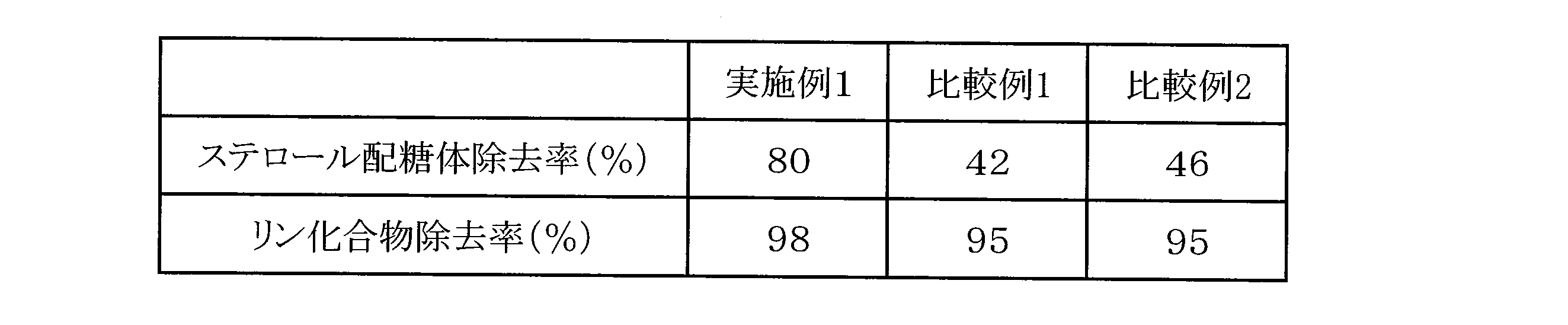
- Example 1 Comparative Example 1 In Example 1, the temperature rise of palm crude oil was 40 ° C., a mixture of 1.2 g of 30% aqueous dodecylamidopropylcarbobetaine and 20 g of water was added, and the mixture was stirred for 30 minutes. From the resulting mixture, gum water was separated in the same manner as in Example 1 to obtain purified coconut oil. The removal rate of sterol glycoside and phosphorus compound was determined in the same manner as in Example 1. The results are shown in Table 2.
- Comparative Example 2 In Comparative Example 1, refined coconut oil was obtained in the same manner except that the temperature of the coconut crude oil was raised to 60 ° C. The removal rate of sterol glycoside and phosphorus compound was determined in the same manner as in Example 1. The results are shown in Table 2.
- Example 2 instead of a 30% aqueous solution of dodecylamidopropylcarbobetaine as a surfactant, a 98% aqueous solution of sodium dodecyl sulfate (Example 2, Comparative Example 3), a 26% aqueous solution of sodium dodecylbenzenesulfonate (Example 3, Comparative) Example 4), except that an aqueous 50% dodecylbenzyldimethylammonium chloride solution (Example 4, Comparative Example 5) was used, Example 2 to Example 4 were the same as Example 1, and Comparative Example 3 to 5 were comparative examples. In the same manner as in No. 1, purified palm oil was obtained. The removal rate of sterol glycoside and phosphorus compound was determined in the same manner as in Example 1. The results are shown in Table 3.
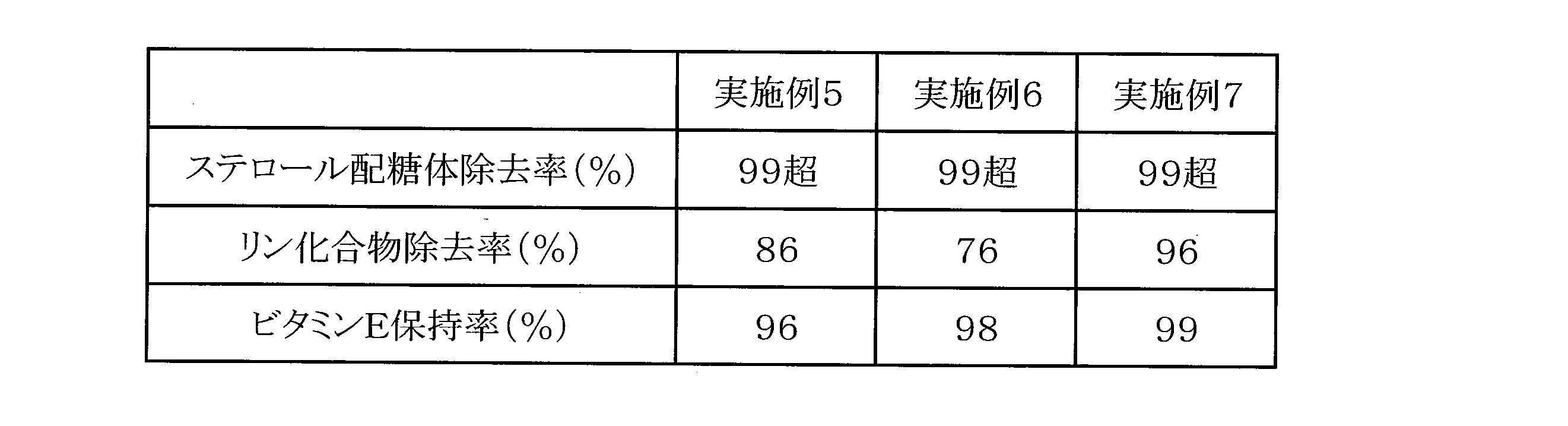
- Examples 5-7 A refined oil was obtained in the same manner as in Example 1 except that palm crude oil (Example 5), rapeseed crude oil (Example 6), or sunflower crude oil (Example 7) was used as the fat raw material. The removal rate of sterol glycoside and phosphorus compound was determined in the same manner as in Example 1. Vitamin E retention was also measured. The results are shown in Table 4.
- the method of the present invention is an operation effective for removing impurities even for palm oil, rapeseed oil, and sunflower oil, and that vitamin E, which is a useful component, can be retained very efficiently. I understand.
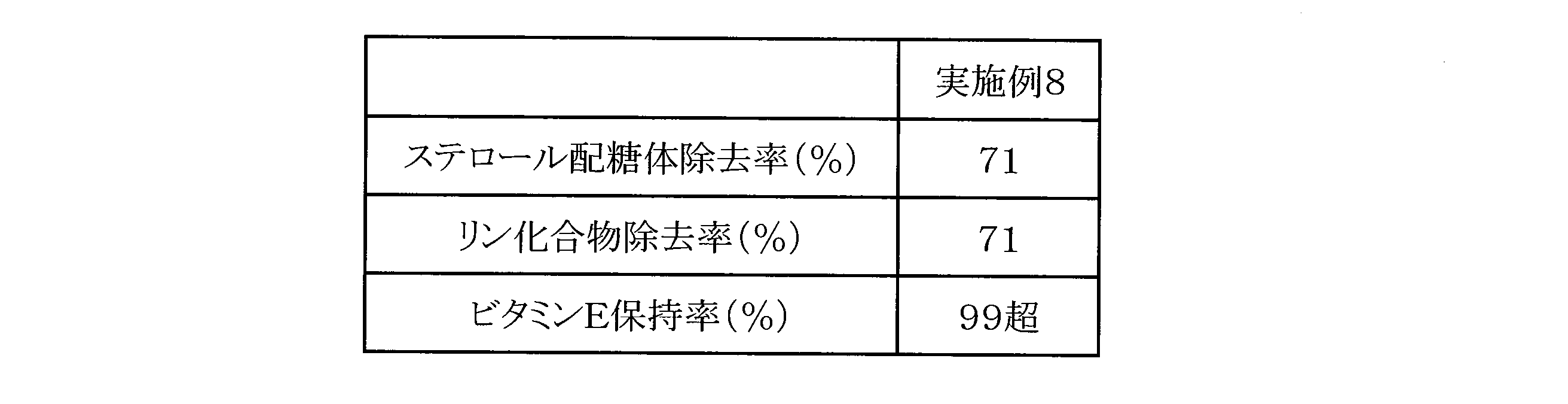
- Example 8 soybean crude oil was used as the fat and oil raw material, the surfactant addition amount was 0.3 wt% (effective amount) with respect to the oil, and the water addition amount was 20 wt% (40 g) with respect to the oil.
- a refined oil was obtained in the same manner except that.
- the sterol glycoside and phosphorus compound removal rate was determined in the same manner as in Example 1, and the vitamin E retention rate was determined in the same manner as in Example 5. The results are shown in Table 5.
- the method of the present invention is an operation effective for removing impurities even for soybean oil, and that vitamin E, which is a useful component, is retained extremely efficiently.
- Example 9 While stirring 200 g of coconut crude oil, the temperature was raised to 40 ° C., and 1.2 g of 30% dodecylamidopropylcarbobetaine aqueous solution was added, and the mixture was stirred at 40 ° C. for 5 minutes. Thereafter, 20 g of water was added and stirring was further continued for 3 hours at 40 ° C. The obtained mixture was centrifuged at 15,000 G for 10 minutes, and gum water was separated by decantation to obtain purified coconut oil. The removal rate of sterol glycoside and phosphorus compound was determined in the same manner as in Example 1. The results are shown in Table 6.
- Example 10 While stirring 200 g of coconut crude oil, the temperature was raised to 90 ° C., and 1.2 g of 30% dodecylamidopropylcarbobetaine aqueous solution was added, and the mixture was stirred at 90 ° C. for 5 minutes. Thereafter, 20 g of water was added and stirring was further continued for 1 hour at 90 ° C. The obtained mixture was centrifuged at 15,000 G for 10 minutes, and gum water was separated by decantation to obtain purified coconut oil. The removal rate of sterol glycoside and phosphorus compound was determined in the same manner as in Example 1. The results are shown in Table 7.
- Example 11 In Example 1, instead of 30% aqueous solution of dodecylamidopropylcarbobetaine as a surfactant, 30% aqueous solution of cocoamidopropylbetaine (Example 11), 26% aqueous solution of dodecylcarbobetaine (Example 12), 26% stearylcarbo Betaine aqueous solution (Example 13), 40% 2-dodecyl-N-carboxymethyl-N-hydroxyethylimidazolinium betaine aqueous solution (Example 14), 30% dodecylhydroxysulfobetaine aqueous solution (Example 15), 30% Coco A refined coconut oil was obtained in the same manner as in Example 1 except that the amidopropylamine oxide aqueous solution (Example 16) was used. The removal rate of sterol glycoside and phosphorus compound was determined in the same manner as in Example 1. The vitamin E retention was determined in the same manner as in Example 5. The results are shown in Tables 8
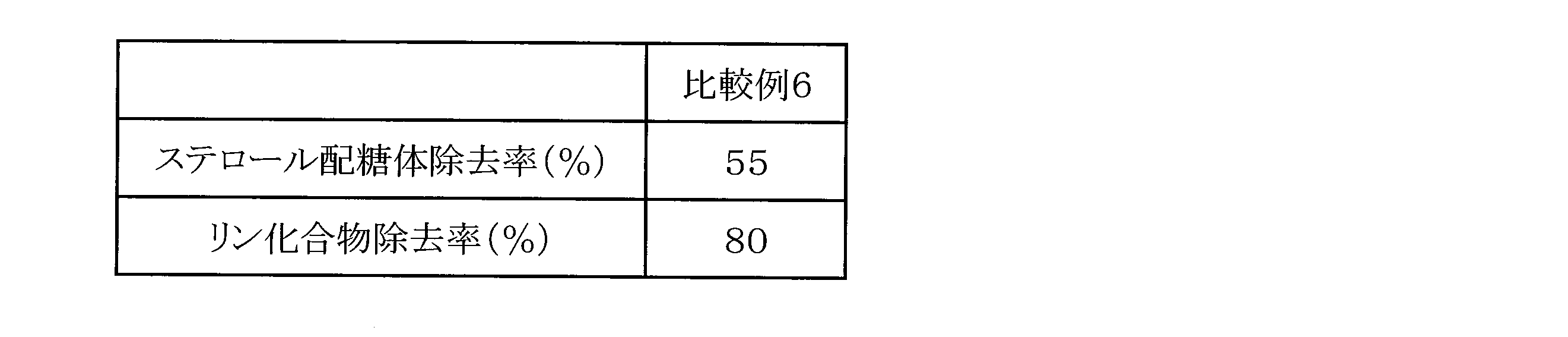
- Example 6 a purified coconut oil was obtained in the same manner as in Example 1 except that 99% dipalmitoyl phosphatidylcholine (Comparative Example 6) was used in place of the 30% dodecylamidopropylcarbobetaine aqueous solution as the surfactant. .
- the removal rate of sterol glycoside and phosphorus compound was determined in the same manner as in Example 1. The results are shown in Table 10.
- Comparative Example 7 In Example 1, refined coconut oil was obtained in the same manner as in Example 1 except that 99% dilauryl phosphate (Comparative Example 7) was used instead of the 30% dodecylamidopropylcarbobetaine aqueous solution as the surfactant. .
- the sterol glycoside removal rate was determined in the same manner as in Example 1. The results are shown in Table 11. Table 11 also shows the phosphorus compound content.
- Example 8 In Example 1, refined coconut oil was obtained in the same manner as in Example 1 except that the amount of water added was increased to 100% by weight.
- the sterol glycoside removal rate was determined in the same manner as in Example 1. The results are shown in Table 12. Table 12 also shows the phosphorus compound removal rate.
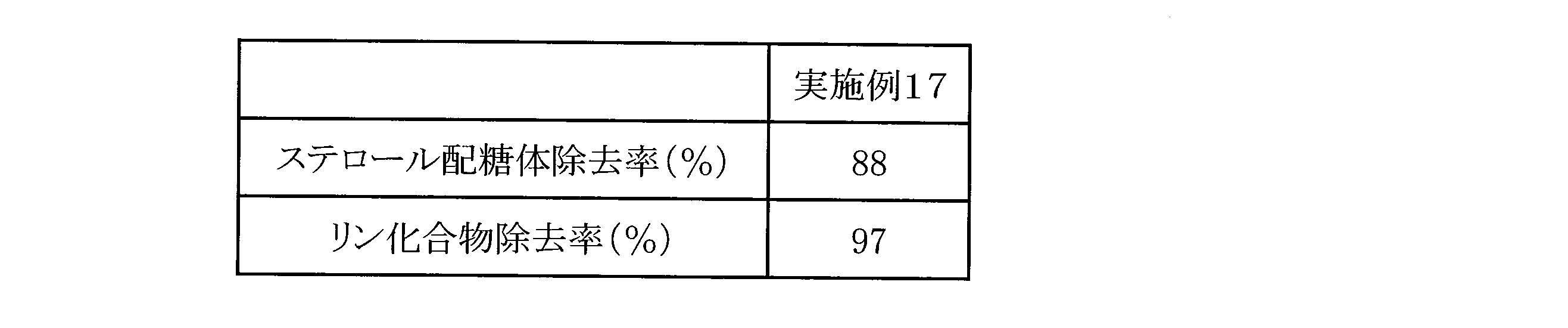
- Example 17 In Example 1, refined coconut oil was obtained in the same manner as in Example 1 except that the amount of water added in Step 2 was changed to 0.2 g. The removal rate of sterol glycoside and phosphorus compound was determined in the same manner as in Example 1. The results are shown in Table 13.
- Example 17 vegetable oils with a removal rate of sterol glycoside and phosphorus compound of 60% or more can be obtained as in Example 1.
Landscapes
- Chemical & Material Sciences (AREA)
- General Chemical & Material Sciences (AREA)
- Life Sciences & Earth Sciences (AREA)
- Engineering & Computer Science (AREA)
- Chemical Kinetics & Catalysis (AREA)
- Oil, Petroleum & Natural Gas (AREA)
- Wood Science & Technology (AREA)
- Organic Chemistry (AREA)
- Fats And Perfumes (AREA)
- Edible Oils And Fats (AREA)
Abstract
Description
背景技術
発明の概要
工程1:ステロール配糖体及びリン化合物を含有する植物油に、アニオン性界面活性剤、カチオン性界面活性剤及び両性界面活性剤から選ばれる1種以上の非リン系界面活性剤又は該非リン系界面活性剤を含む溶液を添加して混合物を得る工程
工程2:工程1で得られた混合物に、当該混合物中の水の含有量が、工程1で用いた植物油に対して0.1~80重量%となるように水を添加して、凝集物を含む混合物を得る工程
工程3:工程2で得られた混合物から、凝集物を分離することにより、ステロール配糖体及びリン化合物の除去率が夫々60%以上である植物油を得る工程
工程1では、ステロール配糖体及びリン化合物を含有する植物油に、アニオン性界面活性剤、カチオン性界面活性剤及び両性界面活性剤から選ばれる1種以上の非リン系界面活性剤又は該非リン系界面活性剤を含む溶液を添加する。
工程2では、工程1で得られた混合物に水を添加して凝集物を含む混合物を得る。工程2では、工程1で得られた混合物中の水の含有量が、工程1で用いた植物油に対して、0.1~80重量%となるように水を添加する。ここで、下限値は、好ましくは0.5重量%以上、より好ましくは1重量%以上、更に好ましくは2重量%以上、より更に好ましくは3重量%以上、特に好ましくは5重量%以上である。一方、上限値は、好ましくは75重量%以下、より好ましくは50重量%以下、更に好ましくは20重量%以下である。実際の工程における作業性の観点から、工程2では、工程1で得られた混合物中の水の含有量が、工程1で用いた植物油に対して0.1~80重量%となるような量の水を添加する。水は、脱イオン水や水道水等を用いることができ、凝集に影響しない程度の量でその他の成分(殺菌成分等)を含んでいてもよい。
工程3では、工程2で得られた混合物から、凝集物を分離することにより、ステロール配糖体及びリン化合物の除去率が夫々60%以上である植物油を得る。ここで、ステロール配糖体の除去率は70%以上が好ましく、80%以上がより好ましく、90%以上がより好ましく、95%以上がより好ましい。また、リン化合物の除去率は70%以上が好ましく、80%以上がより好ましく、90%以上がより好ましく、95%以上がより好ましい。
次の実施例は本発明の実施について述べる。実施例は本発明の例示について述べるものであり、本発明を限定するためではない。

反応容器として縦長の500ccセパラブルフラスコを用いた。ヤシ原油200gを攪拌(
攪拌はメカニカルスターラー、直径60mmの6枚羽ステンレス製翼を使用。回転数は580回転/分)しながら60℃に昇温し、30%(重量%、以下、界面活性剤水溶液について同様)ドデシルアミドプロピルカルボベタイン水溶液1.2gを入れて60℃の条件下5分間攪拌した。その後、水20gを添加し更に60℃の条件下30分間攪拌を続けて、凝集物を含む混合物を得た。得られた混合物を15,000Gで60℃の条件下10分間遠心分離操作(HITACHI himac CR22F)を行い、デカンテーションにより凝集物を含む水相を分離し、精製ヤシ油を得た。精製ヤシ油のリン化合物含量、ステロール配糖体含量を測定し、ヤシ原油のそれと比較して除去率を求めた。
実施例1において、ヤシ原油の昇温温度を40℃とし、30%ドデシルアミドプロピルカルボベタイン水溶液1.2gと水20gとの混合物を添加し、30分間撹拌した。得られた混合物から、実施例1と同様にしてガム水を分離し、精製ヤシ油を得た。実施例1と同様にしてステロール配糖体及びリン化合物除去率を求めた。結果を表2に示す。
比較例1において、ヤシ原油の昇温温度を60℃とした以外は同様にして精製ヤシ油を得た。実施例1と同様にしてステロール配糖体及びリン化合物除去率を求めた。結果を表2に示す。
実施例1において、界面活性剤として30%ドデシルアミドプロピルカルボベタイン水溶液の代わりに、98%ドデシルサルフェートナトリウム水溶液(実施例2、比較例3)、26%ドデシルベンゼンスルホネートナトリウム水溶液(実施例3、比較例4)、50%ドデシルベンジルジメチルアンモニウムクロリド水溶液(実施例4、比較例5)を用いた以外は、実施例2~4に関しては実施例1と同様に、比較例3~5に関しては比較例1と同様にして精製ヤシ油を得た。実施例1と同様にしてステロール配糖体及びリン化合物除去率を求めた。結果を表3に示す。

実施例1において、油脂原料としてパーム原油(実施例5)、又は菜種原油(実施例6)、又はひまわり原油(実施例7)を用いた以外は同様にして精製油を得た。実施例1と同様にしてステロール配糖体及びリン化合物除去率を求めた。また、ビタミンEの保持率についても測定した。結果を表4に示す。
実施例1において、油脂原料として大豆原油を用い、界面活性剤の添加量を油に対して0.3重量%(有効分)、水の添加量を油に対して20重量%(40g)とした以外は同様にして精製油を得た。ステロール配糖体及びリン化合物除去率を実施例1と同様にして、また、ビタミンE保持率を実施例5等と同様にして求めた。結果を表5に示す。
ヤシ原油200gを攪拌しながら40℃に昇温し、30%ドデシルアミドプロピルカルボベタイン水溶液1.2gを入れて40℃の条件下5分間攪拌した。その後、水20gを添加し更に40℃の条件下3時間攪拌を続けた。得られた混合物を15,000Gで10分間遠心分離操作を行い、デカンテーションによりガム水を分離し、精製ヤシ油を得た。実施例1と同様にしてステロール配糖体及びリン化合物除去率を求めた。結果を表6に示す。

ヤシ原油200gを攪拌しながら90℃に昇温し、30%ドデシルアミドプロピルカルボベタイン水溶液1.2gを入れて90℃の条件下5分間攪拌した。その後、水20gを添加し更に90℃の条件下1時間攪拌を続けた。得られた混合物を15,000Gで10分間遠心分離操作を行い、デカンテーションによりガム水を分離し、精製ヤシ油を得た。実施例1と同様にしてステロール配糖体及びリン化合物除去率を求めた。結果を表7に示す。

実施例1において、界面活性剤として30%ドデシルアミドプロピルカルボベタイン水溶液の代わりに、30%ココアミドプロピルベタイン水溶液(実施例11)、26%ドデシルカルボベタイン水溶液(実施例12)、26%ステアリルカルボベタイン水溶液(実施例13)、40%2-ドデシル-N-カルボキシメチル-N-ヒドロキシエチルイミダゾリニウムベタイン水溶液(実施例14)、30%ドデシルヒドロキシスルホベタイン水溶液(実施例15)、30%ココアミドプロピルアミンオキシド水溶液(実施例16)を用いた以外は、実施例1と同様にして精製ヤシ油を得た。実施例1と同様にしてステロール配糖体及びリン化合物除去率を求めた。また、ビタミンE保持率を実施例5等と同様にして求めた。結果を表8、表9に示す。


実施例1において、界面活性剤として30%ドデシルアミドプロピルカルボベタイン水溶液の代わりに、99%ジパルミトイルホスファチジルコリン(比較例6)を用いた以外は、実施例1と同様にして精製ヤシ油を得た。実施例1と同様にしてステロール配糖体及びリン化合物除去率を求めた。結果を表10に示す。
実施例1において、界面活性剤として30%ドデシルアミドプロピルカルボベタイン水溶液の代わりに、99%ジラウリルホスフェート(比較例7)を用いた以外は、実施例1と同様にして精製ヤシ油を得た。実施例1と同様にしてステロール配糖体除去率を求めた。結果を表11に示す。また、表11には、リン化合物の含量も併せて示す。

実施例1において、添加する水の量を100重量%に増やした以外は、実施例1と同様にして精製ヤシ油を得た。実施例1と同様にしてステロール配糖体除去率を求めた。結果を表12に示す。また表12には、リン化合物の除去率も併せて示す。

実施例1において、工程2で添加する水の量を0.2gにした以外は、実施例1と同様にして精製ヤシ油を得た。実施例1と同様にしてステロール配糖体及びリン化合物除去率を求めた。結果を表13に示す。
Claims (9)
- 下記工程1乃至工程3を含む植物油の製造方法。
工程1:ステロール配糖体及びリン化合物を含有する植物油に、アニオン性界面活性剤、カチオン性界面活性剤及び両性界面活性剤から選ばれる1種以上の非リン系界面活性剤又は該非リン系界面活性剤を含む溶液を添加して混合物を得る工程
工程2:工程1で得られた混合物に、当該混合物中の水の含有量が、工程1で用いた植物油に対して0.1~80重量%となるように水を添加して、凝集物を含む混合物を得る工程
工程3:工程2で得られた混合物から、凝集物を分離することにより、ステロール配糖体及びリン化合物の除去率が夫々60%以上である植物油を得る工程 - 上記非リン系界面活性剤が、アルキルサルフェート、アルキルエーテルサルフェート及びアルキルベンゼンスルホネートからなるアニオン性界面活性剤、並びにカルボベタイン及びスルホベタインからなる両性界面活性剤から選ばれる1種以上の非リン系界面活性剤である、請求項1記載の植物油の製造方法。
- 上記植物油が、ヤシ油、パーム核油、パーム核オレイン、パーム核ステアリン、パーム油、菜種油、ひまわり油、大豆油、ヤトロファ油及び藻油からなる群から選ばれる1種以上の植物油である、請求項1又は2記載の植物油の製造方法。
- 工程1において、上記植物油に、上記非リン系界面活性剤又は該界面活性剤を含む溶液を添加後、30~90℃で1分間~10時間攪拌混合した後に、工程2の操作を行う、請求項1~3の何れか1項に記載の植物油の製造方法。
- 工程1における非リン系界面活性剤を含む溶液が、非リン系界面活性剤を有効分として5重量%以上、100重量%未満含有する溶液である、請求項1~4の何れか1項に記載の植物油の製造方法。
- 工程1における非リン系界面活性剤を含む溶液が、非リン系界面活性剤を有効分として20重量%以上、100重量%未満含有する溶液である、請求項1~5の何れか1項に記載の植物油の製造方法。
- 工程1において、上記非リン系界面活性剤又はそれを含む溶液を、上記非リン系界面活性剤の有効分として上記植物油に対して0.01~10重量%添加する、請求項1~6の何れか1項に記載の植物油の製造方法。
- 請求項1~7の何れか1項に記載の方法で得られた植物油に対して、工程4として、エステル反応を行うエステル化合物の製造方法。
- 請求項8に記載の方法で得られたエステル化合物に対して、工程5として、水素化反応を行うアルコール化合物の製造方法。
Priority Applications (2)
| Application Number | Priority Date | Filing Date | Title |
|---|---|---|---|
| BRPI1007435A BRPI1007435A2 (pt) | 2009-02-17 | 2010-02-10 | método para produzir um óleo vegetal, método para produzir um composto de éster, e método para produzir um composto de álcool |
| CN201080004233.9A CN102272280B (zh) | 2009-02-17 | 2010-02-10 | 植物油的制造方法 |
Applications Claiming Priority (4)
| Application Number | Priority Date | Filing Date | Title |
|---|---|---|---|
| JP2009033570 | 2009-02-17 | ||
| JP2009-033570 | 2009-02-17 | ||
| JP2010006499A JP5412301B2 (ja) | 2009-02-17 | 2010-01-15 | 植物油の精製・製造方法 |
| JP2010-006499 | 2010-01-15 |
Publications (1)
| Publication Number | Publication Date |
|---|---|
| WO2010095396A1 true WO2010095396A1 (ja) | 2010-08-26 |
Family
ID=42633686
Family Applications (1)
| Application Number | Title | Priority Date | Filing Date |
|---|---|---|---|
| PCT/JP2010/000823 Ceased WO2010095396A1 (ja) | 2009-02-17 | 2010-02-10 | 植物油の製造方法 |
Country Status (5)
| Country | Link |
|---|---|
| JP (1) | JP5412301B2 (ja) |
| CN (1) | CN102272280B (ja) |
| BR (1) | BRPI1007435A2 (ja) |
| MY (1) | MY156956A (ja) |
| WO (1) | WO2010095396A1 (ja) |
Cited By (1)
| Publication number | Priority date | Publication date | Assignee | Title |
|---|---|---|---|---|
| CN114292702A (zh) * | 2021-12-31 | 2022-04-08 | 河南省商业科学研究所有限责任公司 | 一种利用表面活性剂水溶液和固体碱提取牡丹花精油的方法 |
Families Citing this family (1)
| Publication number | Priority date | Publication date | Assignee | Title |
|---|---|---|---|---|
| JP5875140B2 (ja) * | 2011-06-14 | 2016-03-02 | 中国電力株式会社 | ジャトロファ油の精製方法 |
Citations (4)
| Publication number | Priority date | Publication date | Assignee | Title |
|---|---|---|---|---|
| JP2000502740A (ja) * | 1995-12-29 | 2000-03-07 | イーストマン ケミカル カンパニー | ステロール及びリン化合物を含まない多不飽和脂肪酸及び脂肪酸エステルの混合物 |
| JP2001509836A (ja) * | 1997-01-31 | 2001-07-24 | カーギル,インコーポレーテッド | リン脂質を用いた、脂肪および油からのステロールの除去法 |
| JP2002233398A (ja) * | 2001-02-09 | 2002-08-20 | Ikeda Shokken Kk | 食品用ステロール脂肪酸エステルの製造方法 |
| JP2002543088A (ja) * | 1999-04-27 | 2002-12-17 | フォーブス メディ−テック インコーポレーテッド | 木材または植物由来供給源からのフィトステロールの精製方法、およびそれから生じる組成物 |
Family Cites Families (1)
| Publication number | Priority date | Publication date | Assignee | Title |
|---|---|---|---|---|
| IL147942A0 (en) * | 2002-01-31 | 2002-08-14 | Enzymotec Ltd | Method of fractionation of phytosterol esters in oil and products obtained thereby |
-
2010
- 2010-01-15 JP JP2010006499A patent/JP5412301B2/ja not_active Expired - Fee Related
- 2010-02-10 BR BRPI1007435A patent/BRPI1007435A2/pt not_active Application Discontinuation
- 2010-02-10 WO PCT/JP2010/000823 patent/WO2010095396A1/ja not_active Ceased
- 2010-02-10 CN CN201080004233.9A patent/CN102272280B/zh not_active Expired - Fee Related
- 2010-02-10 MY MYPI2011003821A patent/MY156956A/en unknown
Patent Citations (4)
| Publication number | Priority date | Publication date | Assignee | Title |
|---|---|---|---|---|
| JP2000502740A (ja) * | 1995-12-29 | 2000-03-07 | イーストマン ケミカル カンパニー | ステロール及びリン化合物を含まない多不飽和脂肪酸及び脂肪酸エステルの混合物 |
| JP2001509836A (ja) * | 1997-01-31 | 2001-07-24 | カーギル,インコーポレーテッド | リン脂質を用いた、脂肪および油からのステロールの除去法 |
| JP2002543088A (ja) * | 1999-04-27 | 2002-12-17 | フォーブス メディ−テック インコーポレーテッド | 木材または植物由来供給源からのフィトステロールの精製方法、およびそれから生じる組成物 |
| JP2002233398A (ja) * | 2001-02-09 | 2002-08-20 | Ikeda Shokken Kk | 食品用ステロール脂肪酸エステルの製造方法 |
Non-Patent Citations (2)
| Title |
|---|
| SJOSTROM ET AL.: "A Method for the Preparation of Submicron Particles of Sparingly Water-Soluble Drugs by Precipitation in Oil-in-Water Emulsions. II: Influence of the Emulsifier, the Solvent, and the Drug Substance", J.PHARM.SCI., vol. 82, no. 6, 1993, pages 584 - 589 * |
| TYLE ET AL.: "PHYTOSTEROL STABILIZED EMULSIONS: INTERFACIAL COMPLEXATION AND STRUCTURAL INVESTIGATIONS", DRUG DEV.IND.PHARM., vol. 16, no. 10, 1990, pages 1605 - 1618 * |
Cited By (2)
| Publication number | Priority date | Publication date | Assignee | Title |
|---|---|---|---|---|
| CN114292702A (zh) * | 2021-12-31 | 2022-04-08 | 河南省商业科学研究所有限责任公司 | 一种利用表面活性剂水溶液和固体碱提取牡丹花精油的方法 |
| CN114292702B (zh) * | 2021-12-31 | 2023-06-16 | 河南省商业科学研究所有限责任公司 | 一种利用表面活性剂水溶液和固体碱提取牡丹花精油的方法 |
Also Published As
| Publication number | Publication date |
|---|---|
| MY156956A (en) | 2016-04-15 |
| BRPI1007435A2 (pt) | 2016-02-16 |
| CN102272280A (zh) | 2011-12-07 |
| CN102272280B (zh) | 2014-03-19 |
| JP2010215896A (ja) | 2010-09-30 |
| JP5412301B2 (ja) | 2014-02-12 |
Similar Documents
| Publication | Publication Date | Title |
|---|---|---|
| EP2471897A1 (en) | Method for reducing chloropropanols and formative substance thereof, glycidol fatty acid esters, in glyceride oils | |
| JPWO2011055732A1 (ja) | グリセリド油脂中のクロロプロパノール類及びその形成物質を低減する方法 | |
| CN105767216B (zh) | 一种高油酸油脂组合物及其制备方法 | |
| JP5412301B2 (ja) | 植物油の精製・製造方法 | |
| US8440847B2 (en) | Method of converting free fatty acid (FFA) from oil to methyl ester | |
| HU226074B1 (en) | Process for obtaining vegetable sterols from by-product originating in refining of vegetable oils | |
| JP2012224797A (ja) | エステル交換油脂の製造方法 | |
| JP5748966B2 (ja) | エステル交換油脂の精製方法 | |
| CN113122377B (zh) | 一种在油脂精炼加工过程中脱除塑化剂的方法 | |
| JP2009242777A (ja) | 脂肪酸低級アルキルエステルの製造方法 | |
| JPWO2008078769A1 (ja) | 脂肪酸低級アルキルエステルの製造方法 | |
| EP3362540B1 (en) | Method for reducing neutral oil losses during neutralization step | |
| JP4913330B2 (ja) | 米糠油脱臭スカム不ケン化物濃縮物製造法 | |
| WO2010095397A1 (ja) | 脂肪酸アルキルエステルの製造方法 | |
| JP6405220B2 (ja) | 精製油脂の製造方法 | |
| CA2904406C (en) | Downstream processing of fatty alcohol compositions produced by recombinant host cells | |
| JP2709126B2 (ja) | フライ用油脂の製造方法 | |
| JP4568565B2 (ja) | 遊離脂肪酸が低減された油脂の製造方法 | |
| JP6283510B2 (ja) | トリテルペンアルコール含有油脂の製造方法 | |
| JP4943001B2 (ja) | トコトリエノール類含有組成物の製造方法 | |
| JP2000119682A (ja) | 米ぬか油の製造方法 | |
| JPH0136520B2 (ja) | ||
| WO2012144599A1 (ja) | ダイレクトエステル交換油脂の製造方法 | |
| JPH10168492A (ja) | 脂肪酸石鹸 | |
| JPWO2007074592A1 (ja) | 脂肪酸低級アルキルエステルの製造方法 |
Legal Events
| Date | Code | Title | Description |
|---|---|---|---|
| WWE | Wipo information: entry into national phase |
Ref document number: 201080004233.9 Country of ref document: CN |
|
| 121 | Ep: the epo has been informed by wipo that ep was designated in this application |
Ref document number: 10743526 Country of ref document: EP Kind code of ref document: A1 |
|
| WWE | Wipo information: entry into national phase |
Ref document number: 12011501624 Country of ref document: PH |
|
| NENP | Non-entry into the national phase |
Ref country code: DE |
|
| 122 | Ep: pct application non-entry in european phase |
Ref document number: 10743526 Country of ref document: EP Kind code of ref document: A1 |
|
| REG | Reference to national code |
Ref country code: BR Ref legal event code: B01A Ref document number: PI1007435 Country of ref document: BR |
|
| ENP | Entry into the national phase |
Ref document number: PI1007435 Country of ref document: BR Kind code of ref document: A2 Effective date: 20110727 |