WO2010075783A1 - 耐候性苝酰亚胺染料及其制备方法和用途 - Google Patents
耐候性苝酰亚胺染料及其制备方法和用途 Download PDFInfo
- Publication number
- WO2010075783A1 WO2010075783A1 PCT/CN2009/076229 CN2009076229W WO2010075783A1 WO 2010075783 A1 WO2010075783 A1 WO 2010075783A1 CN 2009076229 W CN2009076229 W CN 2009076229W WO 2010075783 A1 WO2010075783 A1 WO 2010075783A1
- Authority
- WO
- WIPO (PCT)
- Prior art keywords
- dye
- water
- formula
- compound
- reaction
- Prior art date
- Legal status (The legal status is an assumption and is not a legal conclusion. Google has not performed a legal analysis and makes no representation as to the accuracy of the status listed.)
- Ceased
Links
Classifications
-
- C—CHEMISTRY; METALLURGY
- C09—DYES; PAINTS; POLISHES; NATURAL RESINS; ADHESIVES; COMPOSITIONS NOT OTHERWISE PROVIDED FOR; APPLICATIONS OF MATERIALS NOT OTHERWISE PROVIDED FOR
- C09B—ORGANIC DYES OR CLOSELY-RELATED COMPOUNDS FOR PRODUCING DYES, e.g. PIGMENTS; MORDANTS; LAKES
- C09B5/00—Dyes with an anthracene nucleus condensed with one or more heterocyclic rings with or without carbocyclic rings
- C09B5/62—Cyclic imides or amidines of peri-dicarboxylic acids of the anthracene, benzanthrene, or perylene series
-
- C—CHEMISTRY; METALLURGY
- C09—DYES; PAINTS; POLISHES; NATURAL RESINS; ADHESIVES; COMPOSITIONS NOT OTHERWISE PROVIDED FOR; APPLICATIONS OF MATERIALS NOT OTHERWISE PROVIDED FOR
- C09D—COATING COMPOSITIONS, e.g. PAINTS, VARNISHES OR LACQUERS; FILLING PASTES; CHEMICAL PAINT OR INK REMOVERS; INKS; CORRECTING FLUIDS; WOODSTAINS; PASTES OR SOLIDS FOR COLOURING OR PRINTING; USE OF MATERIALS THEREFOR
- C09D11/00—Inks
- C09D11/02—Printing inks
- C09D11/03—Printing inks characterised by features other than the chemical nature of the binder
- C09D11/037—Printing inks characterised by features other than the chemical nature of the binder characterised by the pigment
-
- C—CHEMISTRY; METALLURGY
- C09—DYES; PAINTS; POLISHES; NATURAL RESINS; ADHESIVES; COMPOSITIONS NOT OTHERWISE PROVIDED FOR; APPLICATIONS OF MATERIALS NOT OTHERWISE PROVIDED FOR
- C09D—COATING COMPOSITIONS, e.g. PAINTS, VARNISHES OR LACQUERS; FILLING PASTES; CHEMICAL PAINT OR INK REMOVERS; INKS; CORRECTING FLUIDS; WOODSTAINS; PASTES OR SOLIDS FOR COLOURING OR PRINTING; USE OF MATERIALS THEREFOR
- C09D11/00—Inks
- C09D11/30—Inkjet printing inks
- C09D11/32—Inkjet printing inks characterised by colouring agents
- C09D11/328—Inkjet printing inks characterised by colouring agents characterised by dyes
-
- D—TEXTILES; PAPER
- D21—PAPER-MAKING; PRODUCTION OF CELLULOSE
- D21H—PULP COMPOSITIONS; PREPARATION THEREOF NOT COVERED BY SUBCLASSES D21C OR D21D; IMPREGNATING OR COATING OF PAPER; TREATMENT OF FINISHED PAPER NOT COVERED BY CLASS B31 OR SUBCLASS D21G; PAPER NOT OTHERWISE PROVIDED FOR
- D21H21/00—Non-fibrous material added to the pulp, characterised by its function, form or properties; Paper-impregnating or coating material, characterised by its function, form or properties
- D21H21/14—Non-fibrous material added to the pulp, characterised by its function, form or properties; Paper-impregnating or coating material, characterised by its function, form or properties characterised by function or properties in or on the paper
- D21H21/28—Colorants ; Pigments or opacifying agents
-
- G—PHYSICS
- G03—PHOTOGRAPHY; CINEMATOGRAPHY; ANALOGOUS TECHNIQUES USING WAVES OTHER THAN OPTICAL WAVES; ELECTROGRAPHY; HOLOGRAPHY
- G03G—ELECTROGRAPHY; ELECTROPHOTOGRAPHY; MAGNETOGRAPHY
- G03G9/00—Developers
- G03G9/08—Developers with toner particles
- G03G9/09—Colouring agents for toner particles
- G03G9/0906—Organic dyes
- G03G9/092—Quinacridones
Definitions
- the present invention relates to a weather-resistant phthalimide dye, a preparation method and use thereof, and more particularly to a novel weather-resistant bismuth carboxylic acid bisdiimide dye derivative, a synthesis method thereof and use thereof. Background technique
- Terpene tetracarboxylic acid bisdiimide also known as perylene diimide
- dyes and pigments they are widely used in photoengraving processes, laser dyes, solar cell materials, liquid crystal materials, organic field effect transistors, luminescent materials, and the like.
- the structure of a weatherable phthalimide dye compound is as defined in formula (I): Wherein: the naphthalene ring structure is directly bonded to the nitrogen atom of the diimide by a tertiary carbon atom; ⁇ and independently of each other, H or a water-soluble group attached to the naphthalene ring; R 3 , R 5 and independently of each other It is selected from a neutral substituent or a water-soluble group; n and m are each a number, and n and m are integers not less than 2.
- the naphthalene ring structure passes through a tertiary carbon atom at the 2-position on the naphthalene ring. Directly bonded to the nitrogen atom of the diimide.
- the water-soluble group in the dye compound of the present invention is preferably selected from the group consisting of: SO 3 H, COOH, SO 3 M or COOM, wherein M is a cation, and M is selected from the group consisting of: Li + , Na + , K + , imidazolium cation or N + ( R) 4 , wherein R is H, CH 3 , CH 2 CH 3 , CH 2 CH 2 CH 3 , CH(CH 3 ) or CH 2 CH 2 CH 2 CH 3 . More preferably, SO 3 H or SO 3 M.
- the neutral substituent in the dye compound of the invention is preferably selected from the group consisting of: H, cyano or a halogen atom.
- n+m 5 In still another preferred embodiment of the dye compound of the invention, n+m 5 .
- At least one of R, R 5 and R 6 is a H atom, more preferably at least two are H atoms, more preferably all H atoms.
- a method of preparing a phthalimide dye compound of formula (I) comprising the steps of:
- the sulfonic acid compound is reacted under the following reaction conditions:
- the reaction is carried out in the presence of the catalyst Zn(C3 ⁇ 4COO) 2 ⁇ 2 ⁇ 2 ⁇ under an inert gas in an organic solvent; the substituted fluorene tetracarboxylic dianhydride of the formula ( ⁇ ), the amino group of the formula (IV)
- the molar ratio of the sulfonic acid compound, the catalyst, and the organic solvent is 1:3-10: 0.55 ⁇ 0.94:6 ⁇ 20, and the organic solvent is selected from one or more of imidazole, N-methylpyrrolidone or quinoline, reaction temperature 100-240 ° C, the reaction time is 1-12 hours;
- the catalyst comprises
- the reaction temperature is preferably from 120 to 220, more preferably from 150 to 220 ° C, still more preferably from 160 to 200.
- water is separated while the reaction is carried out, and the solvent is distilled off together with the water formed in the reaction by distillation to increase the yield.
- the inert gas is nitrogen or argon.
- an ink comprising: the above dye of the invention.
- the ink is a printing ink, a coating ink, or an inkjet ink.
- the inkjet ink is preferably a water-based inkjet ink, and may also preferably be a solvent-based inkjet ink.
- the invention relates to an inkjet aqueous ink composition
- an inkjet aqueous ink composition comprising: 1-20% by weight of the above dye compound, 5-50% by weight of a water-miscible organic solvent, and 30-94% by weight of water , based on the total weight of the composition.
- the water-miscible organic solvent is selected from one or more of the following: ethanol, propanol, isopropanol, ethylene glycol, diethylene glycol , triethylene glycol, glycerin, ethylene glycol monobutyl ether, diethylene glycol monobutyl ether, triethylene glycol monobutyl ether, propylene glycol, butanediol, pentanediol, hexanediol, diglycerin, 2- Pyrrolidone and N-methyl-2-pyrrolidone.
- a coating comprising the above dye compound of the invention.
- the coating is preferably an outdoor coating.
- a lacquer comprising the above dye compound of the invention.
- the lacquer is preferably an outdoor lacquer.
- a toner for laser printing comprising the above dye of the invention.
- the invention relates to a marker comprising: the above dye of the invention.
- the use of the dye of the invention is used as a colorant in the following materials: inks, paints, lacquers, laser-printed toners, or markers.
- the use of the dye of the invention is used as a colorant in the following materials: paper, fabric, glass, ceramic, or polymer.
- the fabric described therein is preferably selected from the group consisting of: woven fabrics, knitted fabrics or nonwoven fabrics.
- the polymeric material is preferably selected from the group consisting of rubber, plastic or fiber.
- Figure 1 is a high performance liquid chromatogram of the dye compound prepared in the examples. detailed description
- the naphthalene ring structure is directly bonded to the nitrogen atom of the diimide via a tertiary carbon atom, preferably directly to the nitrogen of the diimide via a tertiary carbon atom at the 2-position on the naphthalene ring. Atomic bonding.
- water-soluble groups or H atoms attached to the naphthalene ring wherein the water-soluble group is preferably SO 3 H or SO 3 M, which group imparts good water solubility to the dye compound.
- water-soluble groups attached to the naphthalene ring except for the 2 position are water-soluble groups attached to the naphthalene ring except for the 2 position.
- n and m represent the number of 1 ⁇ and on the naphthalene ring, respectively, preferably 2, more preferably 3. n+m 5, more preferably 6.
- the water-soluble group is preferably selected from the group consisting of: SO 3 H, COOH, SO 3 M or COOM, wherein M is a cation, and M is selected from the group consisting of: Li + , Na + , K + , imidazolium cation or N + (R) 4 , wherein M is more preferably selected from the group consisting of: Li + , Na + , K + , imidazolium cations.
- the dye compound of the present invention when two or more water-soluble groups are present on each naphthalene ring, they are not in an adjacent position on the naphthalene ring.
- R 3 , R 5 and independently of each other are H, a neutral substituent or a water-soluble group.
- a water-soluble group is also preferably SO 3 H or SO 3 M, which group imparts good water solubility to the dye compound.
- the neutral substituent is preferably a halogen atom or a cyano group, more preferably a halogen atom, and includes a chlorine atom, a bromine atom, and an atomic iodine.
- at least one of , and 1 is a H atom, and more preferably two are H atoms.
- the manner in which the neutral substituent or the water-soluble group R 3 , and the perylenetetracarboxylic dianhydride of the structural formula ( ⁇ ) are introduced can be halogenated by halogen, and halogen can be introduced by a method known in the art.
- halogenated phosphotetracarboxylic dianhydride compound obtained in the step (a) include: 1, 7-dichloroindole tetracarboxylic dianhydride, 1,6,7-trichloroindole tetracarboxylic dianhydride, 1, 6, 7, 12-tetrachloroanthracene tetracarboxylic dianhydride, 1,7-dibromofluorene tetracarboxylic dianhydride, 1,6,7-tribromofluorene tetracarboxylic dianhydride, 1, 6, 7 , 12-tetrabromofluorene tetracarboxylic dianhydride, 1,7-diiodofluorene tetracarboxylic dianhydride, 1,6,7-triiodofluorene tetracarboxylic dianhydride, 1, 6, 7, 12-tetraiodide
- One or more mixtures 1,
- sulfonic acid-substituted perylenetetracarboxylic dianhydride compound examples include: 1, 7-disulfonic acid ruthenium tetracarboxylic dianhydride,
- step (b) The final treatment of the reaction product described in step (b), including water dissolution, filtration, precipitation, and finally Filtration, etc., are all procedures well known in the industry.
- the product is dissolved in water, filtered, and then the filtrate is dropped into an organic solvent to precipitate the product, filtered, and the solid is washed several times with an organic solvent to obtain a compound of the formula (I).
- the aminopolysulfonic acid compound of the formula (IV) used may be, for example, 2-amino-3,6-naphthalenetrisulfonic acid or 2-amino-4.
- the preheating is carried out while stirring before the start of the reaction, in order to convert the solid reaction mixture into a liquid state to facilitate the progress of the reaction, and the preheating is also carried out under the protection of an inert gas.
- the heating temperature is lower than the reaction temperature. It is preferably 80-100 ° C, more preferably 90-100 ° C, and the preheating time is preferably 0.5-1 hour.
- the reaction temperature is preferably from 120 to 220, more preferably from 150 to 220 ° C, still more preferably from 160 to 200 V.
- the reaction time can be shortened accordingly.
- the inert gas used is preferably nitrogen or argon, more preferably nitrogen.
- the yield of the target product obtained by the process of the invention after separation and purification is above 70%.
- the obtained compound was confirmed by high performance liquid chromatography-mass spectrometry (HPLC-MS) and the structure was correct.
- the main principle of the invention is as follows: the large conjugated electron-deficient system in the dye structure is used as a matrix to reduce the HOMO energy level of the excited state of the dye molecule, and the high-energy electrons in the molecular excited state after the dye is excited are transferred in time to improve
- the dye is resistant to UV and ozone, and at the same time, a water-soluble group and a halogen substituent are introduced into the dye molecule, so that the dye has excellent water solubility, weather resistance, light resistance and ozone resistance.
- HOMO energy levels for dye or organic compound molecules are well described in many monographs or literature, as published by CJ Cramer, Essentials of Computational Chemistry, John Wiley & Sons, Inc., 2002.
- an organic molecule such as a dye absorbs light of a suitable wavelength
- an electron at the HOMO level in the dye molecule gains energy and transitions to the LUMO (lowest non-occupied orbital) level.
- the dye molecules are excited and activated.
- the dye molecules are highly susceptible to decomposition reactions or chemical reactions with other molecules such as oxygen (or ozone) to destroy and discolor the original molecules.
- an electron donor group is present in the dye molecule at this point, an electron in the HOMO level of the donor group will shift to the HOMO level of the vacant dye precursor molecule. This process is often referred to as electron transfer. Since electron transfer in the molecule is much faster than electron transfer between molecules, the introduction of an electron donor group into the molecule allows electron transfer to occur rapidly, called photoinduced intramolecular electron transfer (PET).
- PET photoinduced intramolecular electron transfer
- the dye compound has strong UV absorption at 530 ⁇ 550nm, which is a blue red dye.
- the dye compound is simple in synthesis and has excellent water solubility.
- the dye compound has excellent UV and O 3 resistance, and the formulated ink has
- the cost is low, the weathering performance of the printed picture is excellent, and the ink of the same type of foreign original is close to or exceeds in the anti-UV and anti-O 3 performance.
- the dye of the present invention can form a vivid color. It is a red dye and is one of the traditional three primary colors. It can be used in combination with other types of red dyes, and can also be combined with dyes of other colors to form various desired colors.
- the dye of the present invention can be used in a wide variety of applications where weather resistance is required.
- weather-resistant inks, paints, lacquers, markers, and laser-printed toners for outdoor use are used as colorants.
- the ink includes printing ink, coating ink, or inkjet ink, and the like.
- the inkjet ink can be a water based inkjet ink or a solvent based inkjet ink.
- the fabric comprises: a woven fabric, a knitted fabric or a nonwoven fabric, the polymer comprising plastic, rubber or fiber, and the like.
- the dye of the present invention has not only an unexpectedly good weather resistance for use outdoors, but also long-term stability and long-term storage property when it is used indoors. Whether the dye is exposed to air and light after application, or the dye is in storage prior to application, it has long-term color stability and is not susceptible to fading.
- an aqueous inkjet ink composition is formulated with the dye of the present invention according to the following formulation: comprising: 1-20% by weight of the dye of the invention, 5-50% by weight of water-miscible organic The solvent, and 30-94% by weight of water, based on the total weight of the composition.
- the water-miscible organic solvent described therein is preferably selected from one or more of the following: ethanol, propanol, isopropanol, ethylene glycol, diethylene glycol, triethylene glycol, glycerin, ethylene Alcohol monobutyl ether, diethylene glycol monobutyl ether, triethylene glycol monobutyl ether, propylene glycol, butanediol, pentanediol, hexanediol, diglycerin, 2-pyrrolidone and N-methyl-2-pyrrolidone .
- Various other conventional auxiliaries such as surfactant (0-3%), ultraviolet absorbing agent (0-3%), antioxidant (0-3%), and preservative (0) may optionally be added to the ink.
- bactericide (0-3%), pH adjuster (0-3%), metal ion complexing agent (0-2%), humectant (0-15%), driers (0 -5%), water repellent (0-5%), etc.
- surfactants such as nonionic surfactants, anionic surfactants, polymeric surfactants, cationic surfactants, amphoteric surfactants, and the like.
- auxiliaries are described in many existing monographs and patents, such as various surfactants, ultraviolet absorbers, such as those described in U.S. Patent No. 7,034,149, US Pat. No. 6,068,955, US Pat. No. 6,419,722, US Pat. No. 6,235,097, US Pat. No. 7,087,107, US Pat. No. 7,087,107, US Pat. No. 7,087,107, US Pat. Antioxidants, preservatives, fungicides, pH adjusters, metal ion complexing agents, humectants, driers, water repellents.
- the ink is formulated using conventional methods in the inkjet ink industry. When the ink is prepared, it needs to be stirred and heated. It was then filtered through a microporous membrane (pore size 0.02-0.8 ⁇ ) at 0-30 atmosphere.
- the ink has long-term color stability and is not easily faded even during contact with gases and light in the air during storage prior to use. After the ink is jet printed onto the medium, the resulting image also has long-term color stability.
- the synthesis of the dye compound of the present invention and its weather resistance, such as solar and ozone resistance, are illustrated by the following examples, but are not limited to the examples.
- the maximum absorption wavelength max of the ultraviolet visible spectrum in the dye aqueous solution is 498 nm and 535 nm, and the salt form of the partial -SO 3 M in the dye molecule is different, and the obtained high performance liquid chromatogram (HPLC) shows two peaks.
- M The molar mass of the compound (V) should be 1123.0 in terms of H + .
- the negative ion peak of 570.8 ([MW-3H+Na]/2) has a mass-to-charge ratio of 373.1, 747.6, 754.5 three negative ion peaks ([M-3H]/3, [2M-3H/3], respectively [ 2M-4H+Na]/3), an anion peak ([MH]) with a mass-to-charge ratio of 1121.7, all proved that the molar mass of the dye molecule was 1123, which was in agreement with the theoretical value.
- M is calculated as H + , and the molecular molar mass of the dye molecule should be 757.7.
- electrospray mass spectrometry has a peak of mass ratio of 756.4. Is an anion peak ([MH]) of the dye molecule.
- the liquid chromatogram is shown in Figure 1 (measured by a mixed solvent of methanol and water), wherein the peaks 10.573 and 14.849 are dye molecules of the anthracene ring bilaterally linked to the naphthalene ring, and M is an imidazolium cation and a tetramethylammonium of a reversed phase ion pair.
- the cation, peak 24.363 is a dye intermediate molecule which is unilaterally bonded to the naphthalene ring.
- the maximum absorption wavelength max of the ultraviolet visible spectrum in the aqueous dye solution is 499 nm and 534 nm, and the salt form of the partial -SO 3 M in the dye molecule is different, and the obtained high performance liquid chromatogram (HPLC) shows two peaks.
- M has a molecular molar mass of 1123 in terms of H + and the compound (VI).
- the negative ion peak of 570.8 ([MW-3H+Na]/2), the mass-to-charge ratio is 373.1, 747.6, 754.5 three negative ion peaks ([M-3H]/3, [2M-3H/3], [2M, respectively] -4H+Na]/3), an anion peak ([MH]) with a mass-to-charge ratio of 1121.7, all proved that the molar mass of the dye molecule was 1123, which was in agreement with the theoretical value. At the same time, a small amount of dye molecules with a naphthalene ring unilaterally linked to the naphthalene ring was also found.
- the compound (V) prepared in lg Example 1 was dissolved in a mixed solution of 5 g of imidazole and 5 ml of water, and heated to 60 ° C for 30 min. After cooling, ethanol was added dropwise to the solution to precipitate a solid, which was filtered and washed with ethanol. The solid was 2-3 times and dried to give a solid 1.2 g.
- the maximum absorption wavelength max of the ultraviolet visible spectrum in the dye aqueous solution was 498 nm and 535 nm, and the obtained high performance liquid chromatogram (HPLC) showed a peak.
- M is based on the imidazolium cation and the molecular molar mass of the compound should be 1537.
- Electrospray ionization mass spectrometry (API-ES) detection in negative mode, electrospray ionization mass spectrometry has a base-to-charge ratio of 186.2, which is the six negative ion peak of the dye (molecular mass [MW-6M ⁇ ]] / 6), proof The molar mass of the dye molecule is 1537, and the dye is indeed ruthenium, iridium-bis(2-naphthalene-3,6-trisulphonate imidazolium salt) ruthenium tetracarboxylic acid diimide, in line with the theory.
- API-ES Electrospray ionization mass spectrometry
- Example 1 The compound (V) prepared in lg Example 1 was dissolved in 5 ml of water to prepare an aqueous solution, and concentrated HC1 was added dropwise to adjust the pH to a solid. The mixture was heated to 60 ° C and stirred for 30 min. The solid was dissolved in 5 ml of water, and the pH was adjusted to 8 to 9 with a 1 mol/L NaOH solution. Ethanol was added dropwise to the aqueous solution to precipitate a solid, which was filtered and washed with ethanol for 2 to 3 times, and dried to give a solid.
- the maximum absorption wavelength max of the ultraviolet visible spectrum in the aqueous dye solution was 497 nm and 536 nm, and the obtained high performance liquid chromatogram (HPLC) showed a single peak.
- M is in terms of Na + and the molecular molar mass of the compound should be 1253.
- Electrospray ionization mass spectrometry (API-ES) detection in negative mode, electrospray mass spectrometry has a base-to-charge ratio of 185.3, which is the six negative ion peak of the dye (molecular mass [MW-6M Na + ]/6), which proves that the dye is indeed It is ⁇ , ⁇ -bis(2-naphthalene-3,6,8-trisulphonate sodium salt) ruthenium tetracarboxylic acid diimide, in line with the theory.
- API-ES Electrospray ionization mass spectrometry
- the compound (V) prepared in lg of Example 1 was dissolved in 5 ml of water to prepare an aqueous solution, and concentrated HC1 was added dropwise to adjust the pH to a solid. The mixture was heated to 60 ° C and stirred for 30 min. The solid was dissolved in 5 ml of water, and the pH was adjusted to 8 to 9 with a 5% solution of (CH 3 ) 4 ⁇ ⁇ 0 ,. Ethanol was added dropwise to the aqueous solution to precipitate a solid, which was filtered and washed with ethanol for 2 to 3 times and dried. The solid was 0.85 g.
- the maximum absorption wavelength max of the ultraviolet visible spectrum in the dye aqueous solution was 499 nm and 535 nm, and the obtained high performance liquid chromatogram (HPLC) showed a single peak.
- M The molar mass of the compound should be 1,560 based on N + (CH 3 ) 4 .
- Electrospray ionization mass spectrometry (API-ES) detection in negative mode, electrospray ionization mass spectrometry has a base-to-charge ratio of 185.3, which is the six negative ion peak of the dye (molecular mass [MW-6M N + ( CH3 ) 4]/6 ), it is proved that the dye is indeed ruthenium, iridium-bis(2-naphthalene-3,6-trisulphonic acid tetramethylamine salt) ruthenium tetracarboxylic acid diimide, in line with the theory.
- the maximum absorption wavelength max of the ultraviolet visible spectrum in the aqueous dye solution is 501 nm and 534 nm, and the salt form of the partial -SO 3 M in the dye molecule is different, and the obtained high performance liquid chromatogram (HPLC) shows two peaks.
- M The molar mass of the compound (V) should be 1280.8 in terms of H + .
- M has a molecular molar mass of 915.5 in terms of H + , and in negative mode, electrospray mass spectrometry has a peak with a mass-to-charge ratio of 914.4. Is an anion peak ([MH]) of the dye molecule.
- the maximum absorption wavelength max of the ultraviolet visible spectrum in the aqueous dye solution is 503 nm and 536 nm, and the salt form of the partial -SO 3 M in the dye molecule is different, and the obtained high performance liquid chromatogram (HPLC) shows two peaks.
- M The molar mass of the compound (; V) should be 1173.0 based on H + .
- the perylenetetracarboxylic dianhydride of Example 1 was changed to 1,7-disulfonic acid ruthenium tetracarboxylic dianhydride (2.5 mmol) to obtain a compound ( ⁇ ), which was dried to obtain 2.4 g of a solid.
- the maximum absorption wavelength max of the ultraviolet visible spectrum in the dye aqueous solution is 499 nm and 536 nm, and the salt formation form of the partial -SO 3 M in the dye molecule is different, and the obtained high performance liquid chromatogram (HPLC) shows two peaks.
- M The molar mass of the compound (V) should be 1283.2 in terms of H + .
- the color density value of the color block is measured by a conventional color densitometer, such as the WI-QA-1011 color density meter purchased from Guangdong Zhongshan Rainbow Printing Consumables Co., Ltd.
- the measurement steps are as follows:
- test head placing the test head on the unprinted portion of the paper to be measured for color density, measuring the parameters of the paper; Place the test head on the color block where the color density is to be measured, and the color density of the measured color block will be automatically displayed on the instrument screen. For a color patch, repeat the measurement several times at different locations and take the average.
- the OD T is an OD value of the sample measured after the test of the length of time T;
- OD a value is less than 50;
- the OD T is an OD value of the sample measured after the test of the length of time T;
- OD b value is less than 50;
- the dye of the present invention is superior to the commercially available commercial hydrolyzed dye C.I. Reactive Red 180 in terms of wet fastness and storage stability.
Landscapes
- Chemical & Material Sciences (AREA)
- Organic Chemistry (AREA)
- Life Sciences & Earth Sciences (AREA)
- Engineering & Computer Science (AREA)
- Materials Engineering (AREA)
- Wood Science & Technology (AREA)
- Physics & Mathematics (AREA)
- General Physics & Mathematics (AREA)
- Chemical Kinetics & Catalysis (AREA)
- General Chemical & Material Sciences (AREA)
- Ink Jet Recording Methods And Recording Media Thereof (AREA)
- Inks, Pencil-Leads, Or Crayons (AREA)
Description
耐候性茈酰亚胺染料及其制备方法和用途
技术领域
本发明涉及具有一种耐候性茈酰亚胺染料及其制备方法和用途,尤其涉及一种 新颖的耐候性茈四羧酸双二酰亚胺染料衍生物及其合成方法和用途。 背景技术
茈四羧酸双二酰亚胺也叫茈二酰亚胺,这一类化合物具有良好的热稳定性、化 学稳定性和光化学及光物理稳定性。作为染料和颜料使用时,它们在照相制版工艺、 激光染料、 太阳能电池材料、 液晶材料、 有机场效应管、 发光材料等诸多领域均有 广泛的研究和应用。
近年来, 随着喷墨打印技术的发展和应用范围的不断扩大,对喷墨打印图画的 质量要求越来越高。对于应用在恶劣气候环境中的喷墨打印图画,一般要求其具有 优良的耐候性, 即良好的抗紫外 (UV)、 抗臭氧 (03)、 抗酸碱气体和微尘颗粒的 性能。 鉴于部分茈酰亚胺染料具有优良的抗 UV、 抗 O3能力, 近年来国外对其在 喷墨打印领域的应用研究也逐渐发展起来,但是尚没有可商业化的茈酰亚胺染料产 品问世。 发明内容
本发明的目的是提供一种新颖性的耐候性茈酰亚胺染料化合物及其制备方法。 在本发明的第一方面,涉及一种耐候性茈酰亚胺染料化合物的结构如式( I ):
 其中: 萘环结构通过叔碳原子直接与二酰亚胺的氮原子键合; ^ 和 彼此独 立地为 H或连接在萘环上的水溶性基团; R3、 、 R5和 彼此独立地选自中性取 代基或水溶性基团; n和 m分别为 和 的个数, n和 m均为不小于 2的整数。
在该染料化合物的一个优选实施方式中,萘环结构通过萘环上 2位的叔碳原子
直接与二酰亚胺的氮原子键合。
在该染料化合物的另一个优选实施方式中, !^和 彼此独立地为连接在萘环 上除 2位以外任何位置的水溶性基团。 1^和 优选各自为 H、 SO3H或 SO3M。
本发明染料化合物中的水溶性基团优选选自: SO3H、 COOH、 SO3M或 COOM, 其中 M为阳离子, M选自: Li+、 Na+、 K+、 咪唑阳离子或 N+ (R)4, 其中 R为 H、 CH3、 CH2CH3、 CH2CH2CH3、 CH(CH3)或 CH2CH2CH2CH3。更优选 SO3H或 SO3M。
本发明染料化合物中的中性取代基优选选自: H、 氰基或卤原子。
在本发明染料化合物的再一个优选实施方式中, n+m 5。
在本发明染料化合物的再一个优选实施方式中, 在每个萘环上存在两个或更 多个水溶性基团 或 时, 它们在该萘环上均不处于相邻位置。
在本发明染料化合物的再一个优选实施方式中, 所述的 、 、 R5和 R6中 的至少一个为 H原子, 更优选至少两个是 H原子, 更优选全部是 H原子。
在本发明的第二方面, 涉及一种制备式 ( I ) 茈酰亚胺染料化合物的方法, 包括以下步骤:
(a) 首先将中性取代基或水溶性基团 R3、 、 和1^引入结构式 (Π ) 的 茈四羧酸二酐中:


(m)
(b) 将式 (m) 的取代茈四羧酸二酐与结构式 (IV) 的氨基多
磺酸化合物在以下反应条件下进行反应:

( IV ) 反应在催化剂 Zn(C¾COO)2 · 2Η2Ο存在下、 在惰性气体保护下、 在有机溶剂 中进行; 式 (ΠΙ) 的取代茈四羧酸二酐、 式 (IV ) 的氨基多磺酸化合物、 催化剂、 有机溶剂的摩尔比为 1 : 3-10: 0.55〜0.94:6〜20, 有机溶剂选自咪唑、 N-甲基吡咯烷 酮或喹啉中的一种或多种, 反应温度为 100-240°C, 反应时间为 1-12小时;
将反应得到的产物用水溶解、过滤、析出, 最后过滤得到固态的式(I)化合物。 在本发明方法的一个优选实施方式中, 在反应开始之前, 对包括催化剂、 式
(m) 的取代茈四羧酸二酐、 式(no 的氨基多磺酸化合物反应原料和有机溶剂的 呈固态的反应混合物在低于反应温度的温度下加热, 同时搅拌,使固态反应混合物 变成液态, 然后, 将温度升高到 100-240°C进行反应。
在本发明方法中,反应温度优选为 120-220,更优选 150-220°C,更优选 160-200
V。
在本发明方法的另一个优选实施方式中, 在反应进行的同时进行分水, 通过 蒸馏的方式,使溶剂连同反应中形成的水一同被蒸馏出反应体系, 以此能够提高产 率。
在本发明方法的再一个优选实施方式中, 所述的惰性气体是氮气或氩气。 在本发明的第三方面, 涉及一种油墨, 它包含: 本发明的上述染料。
在该油墨的一个优选实施方式中, 所述油墨是印刷油墨、涂敷油墨、或喷墨油 墨。 所述的喷墨油墨优选是水基喷墨油墨、 也可以优选是溶剂基喷墨油墨。
在本发明的第四方面, 涉及一种喷墨水性油墨组合物, 包含: 1-20重量%上述 染料化合物、 5-50重量%可与水混溶的有机溶剂、 和 30-94重量%水, 以组合物的 总重量为基准。
在该油墨组合物的一个优选实施方式中,所述的可与水混溶的有机溶剂选自以 下的一种或多种: 乙醇, 丙醇, 异丙醇, 乙二醇, 二乙二醇, 三乙二醇, 甘油, 乙 二醇单丁醚, 二乙二醇单丁醚, 三乙二醇单丁醚, 丙二醇, 丁二醇, 戊二醇, 己二 醇, 二甘油, 2-吡咯烷酮和 N-甲基 -2-吡咯烷酮。
在本发明的第五方面, 涉及一种涂料, 它包含本发明的上述染料化合物。 该涂 料优选是室外用涂料。
在本发明的第六方面, 涉及一种漆, 它包含本发明的上述染料化合物。 该漆优 选是室外用漆。
在本发明的第七方面,涉及一种用于激光打印的色粉,它包含本发明的上述染 料。
在本发明的第八方面, 涉及一种标识物, 它包含: 本发明的上述染料。
在本发明的第九方面,涉及本发明所述染料的用途,它用作以下材料中的着色 剂: 油墨、 涂料、 漆、 激光打印的色粉、 或标识物。
在本发明的第十方面,涉及本发明所述染料的用途,它用作以下材料中的着色 剂: 纸、 织物、 玻璃、 陶瓷、 或聚合物。 其中所述的织物优选选自: 机织物、 针织 物或非织造织物。 所述的聚合物材料优选选自:橡胶、 塑料或纤维。 附图说明
图 1为实施例制得的染料化合物的高效液相色谱图。 具体实施方式
在本发明的式 (I) 染料化合物中, 萘环结构通过叔碳原子直接与二酰亚胺的 氮原子键合, 优选通过萘环上 2位的叔碳原子直接与二酰亚胺的氮原子键合。
1^和 彼此独立地为连接在萘环上的水溶性基团或 H原子,其中水溶性基团 优选 SO3H或 SO3M, 该基团可赋予染料化合物以很好的水溶性。 1^和 优选彼 此独立地为连接在萘环上除 2位以外任何位置的水溶性基团。
n和 m分别代表 1^和 在萘环上的个数, 优选 2, 更优选 3。 n+m 5, 更优选 6。
在本发明中, 所述的水溶性基团优选选自: SO3H、 COOH、 SO3M或 COOM, 其中 M为阳离子, M选自: Li+、 Na+、 K+、 咪唑阳离子或 N+ (R) 4, 其中 M更优 选选自: Li+、 Na+、 K+、 咪唑阳离子。
R ¾ Η, CH3、 CH2CH3、 CH2CH2CH3、 CH(CH3)或 CH2CH2CH2CH3, R更优选 H、 CH3、 CH2CH3、 CH2CH2CH3。
在本发明的染料化合物中, 当每个萘环上存在两个或更多个水溶性基团 或 时, 它们在该萘环上均不处于相邻位置。
R3、 、 R5和 彼此独立地为 H、 中性取代基或水溶性基团。 其中水溶性基 团也优选 SO3H或 SO3M, 该基团可赋予染料化合物以很好的水溶性。 其中中性取 代基优选卤原子或氰基, 更优选卤原子, 包括氯原子、 溴原子、 和原子碘。 、
、 和1^中优选至少一个是 H原子, 更优选两个是 H原子。 在本发明的制备耐候性茈酰亚胺染料化合物的方法中, 包括以下步骤:
(a) 首先, 将中性取代基或水溶性基团 R3、 、 和1^引入结构式 (Π ) 的 茈四羧酸二酐, 得到式 (ΠΙ ) 的取代茈四羧酸二酐化合物。

(II) (III)
其中将中性取代基或水溶性基团 R3、 、 和 引入结构式(Π ) 的茈四羧 酸二酐的方式, 可以采用本行业内的已知方法, 例如用卤素进行卤化, 可以引入卤 原子取代基; 用发烟硫酸进行磺化, 可以引入磺酸取代基, 先用卤素卤化然后用氰 化钠、 氰化钾或氰化亚铜进行氰基化, 可以引入氰基取代基, 等等。 这些方法在许 多文献都有记载, 例如 J. Org. Chem. 2004年第 69期第 7933-7939页; 和 Zhurnal Organicheskoi Khimi i. 1992年第 28卷第 7期第 1486-1488页。
在步骤 (a) 中得到的卤代茈四羧酸二酐化合物的具体例子包括: 1, 7-二氯 茈四羧酸二酐、 1, 6, 7-三氯茈四羧酸二酐、 1, 6, 7, 12-四氯茈四羧酸二酐、 1, 7-二溴茈四羧酸二酐、 1, 6, 7-三溴茈四羧酸二酐、 1, 6, 7, 12-四溴茈四羧酸二 酐、 1, 7-二碘茈四羧酸二酐、 1, 6, 7-三碘茈四羧酸二酐、 1, 6, 7, 12-四碘茈四 羧酸二酐中的一种或一种以上的混合物。
磺酸基取代茈四羧酸二酐化合物的具体例子包括: 1, 7-二磺酸茈四羧酸二酐、
1, 6, 7-三磺酸茈四羧酸二酐、 1, 6, 7, 12-四磺酸茈四羧酸二酐中的一种或一种以 上的混合物。
(b) 将步骤 (a) 中制得的取代茈四羧酸二酐化合物、 结构式 (IV ) 的氨基多 磺酸化合物、 催化剂、 有机溶剂按摩尔比 1 : 3-10: 0.55〜0.94:6〜20混合在一起, 所 述催化剂是 Zn(CH3COO)2 · 2Η2Ο, 有机溶剂选自咪唑、 Ν-甲基吡咯烷酮、 喹啉中的 一种或多种。 在惰性气体保护下, 将反应体系温度升高到 100-240°C, 开始反应, 反 应时间为 1-12小时。 然后, 将反应得到的产物用水溶解、 过滤、 析出, 最后过滤得 到固态的式 (I) 化合物。
步骤(b) 中所述的最后对反应产物的处理, 包括水溶解、 过滤、 析出, 最后过
滤等, 都是本行业内所熟知的程序。 在一个优选实施方式中, 将产物用水溶解后, 过滤, 然后将滤液滴入有机溶剂中从而将产物析出, 再过滤, 并用有机溶剂洗涤固 体数次, 得到式 (I) 化合物。
在本发明的制备式 (I)化合物的方法中, 采用的结构式 (IV ) 的氨基多磺酸化 合物可以是例如: 2-氨基 -3, 6, 8-萘三磺酸、 2-氨基 -4, 6, 8-萘三磺酸中的一种或 两种, 或者 2-氨基 -3, 6, 8-萘三磺酸、 2-氨基 -4, 6, 8-萘三磺酸中的一种, 和 2-氨 基 4-萘二磺酸、 2-氨基 -1, 5-萘二磺酸、 2-氨基 -1, 6-萘二磺酸、 2-氨基 -1, 7-萘 二磺酸、 2-氨基 -1, 8-萘二磺酸、 2-氨基 -3, 5-萘二磺酸、 2-氨基 -3, 6-萘二磺酸、 2- 氨基 -3, 7-萘二磺酸、 2-氨基 -3, 8-萘二磺酸、 2-氨基 -4, 6-萘二磺酸、 2-氨基 -4, 7- 萘二磺酸、 2-氨基 -4, 8-萘二磺酸、 2-氨基 -5, 7-萘二磺酸、 2-氨基 -5, 8-萘二磺酸、 2-氨基 -6, 8-萘二磺酸中的一种或多种组成的混合物。
在本发明方法的该步骤中, 优选在反应开始之前, 进行预加热同时搅拌, 目的 是将呈固态的反应混合物变成液态, 以利于反应的进行,预加热也在惰性气体保护 下进行, 预加热温度低于反应温度。 优选为 80-100°C, 更优选 90-100°C, 预加热 时间优选 0.5-1小时。
当固态反应混合物变成液态之后, 将温度升高到 100-240°C进行反应。
在本发明方法中,反应温度优选为 120-220,更优选 150-220°C,更优选 160-200 V。 反应温度较高时, 反应时间可以相应缩短。
在本发明的方法中, 优选在反应进行的同时进行分水, gp : 通过蒸馏的方式, 使反应体系中的溶剂连同反应中形成的水一同被蒸馏出反应体系,以此提高产物的 产率。
在本发明的方法中, 所用的惰性气体优选氮气或氩气, 更优选氮气。
由本发明方法得到的目标产物经分离提纯后的产率在 70%以上。 所得化合物经 高效液相色谱-质谱联用 (HPLC-MS ) 图谱确证, 结构无误。
本发明的主要原理是: 以染料结构中大的共轭缺电子体系为母体, 降低染料分 子激发态的 HOMO能级, 及时将染料受激发后处于分子激发态的高能电子转移掉, 以达到提高染料抗 UV、抗臭氧的目的, 同时在染料分子中引入水溶性基团和卤素取 代基, 使染料具有优良的水溶性、 耐候性、 耐光性和耐臭氧性。
关于染料或有机化合物分子的 HOMO能级, 在许多专著或文献中已有明确的 描述, 如 C. J. Cramer, Essentials of Computational Chemistry, John Wiley & Sons 有 限公司出版, 2002。 在染料等有机分子吸收适当波长的光后, 染料分子中位于 HOMO能级上的一个电子会获得能量, 跃迁到 LUMO (最低非占有轨道) 能级,
染料分子被激发、 活化。 这时, 染料分子极易发生分解反应或与其它分子如氧(或 臭氧)等发生化学反应, 使原分子破坏、 退色。 如果此时在染料分子中存在电子给 体基团,给体基团 HOMO能级中的一个电子就会向空缺的染料母体分子的 HOMO 能级转移。这个过程常被称为电子转移。 由于分子内的电子转移要远远快于分子间 的电子转移, 因此, 在分子内引入电子给体基团, 可使电子转移快速发生, 称为光 诱导的分子内电子转移 (PET)。
另一方面,如果分子中存在能级很低的电子接受体,激发的电子会迅速回落到 这个电子接受体中, 即电子由染料的 LUMO能级向电子接受体的 HOMO能级回落, 使染料分子激发体迅速被淬灭。这是一个与上述电子转移方向相反的过程,称为反 PET。 基于此, 发明人完成了本发明。
本发明染料化合物的优点在于:
1. 染料化合物在 530〜550nm有较强的紫外吸收, 为蓝光红色染料。
2. 染料化合物合成方法简单, 具有优良的水溶性。
3. 染料化合物具有优良的抗 UV、 抗 O3性能, 所配制的墨水具有
成本低廉、 打印图画耐候性能优良, 在抗 UV、 抗 O3性能方面接近或超过国外原装 同类型产品墨水。
本发明的染料可形成鲜艳的色彩, 它是红色染料, 是传统三原色之一, 可与其 它各类红色染料复配使用, 也可以与其它颜色的染料复配形成各种需要的颜色。
本发明的染料可以用于各种有耐候性要求的场合, 非常广泛。 例如用于室外 的耐候性的油墨、 涂料、 漆、 标识物、 激光打印色粉, 用作着色剂。 所述油墨包括 印刷油墨、涂敷油墨、或喷墨油墨等等。 喷墨油墨可以是水基喷墨油墨或溶剂基喷 墨油墨。
它也可以用于各种室外用材料中, 用作着色剂, 使材料具有长期的颜色保色 性, 不易褪色。 所述材料包括而不限于: 纸、 织物、 玻璃、 陶瓷、 或聚合物。 所述 织物包括:机织物、针织物或非织造织物,所述聚合物包括塑料、橡胶或纤维等等。
另外, 本发明的染料不仅用于室外具有意外好的耐候性, 当它用于室内时, 也具有长期的稳定性和可长期贮存性。无论该染料在应用后暴露于空气和光线、还 是该染料处于应用之前的贮存期, 它都具有长期的颜色稳定性, 不易褪色。
当它用于室内时, 可以用于上述油墨、 涂料、 漆、 标识物、 激光打印色粉、 和各种材料中, 用作着色剂, 使所述油墨、 涂料、 漆、 标识物、 激光打印色粉、 和 各种材料在长期贮存过程中, 具有意外好的颜色稳定性, 不易褪色。 例如, 当它与 其它助剂一同配成喷墨油墨时, 该油墨处于应用之前的贮存期时, 即使与空气中的
气体(例如氧气和氮气等)和光线接触, 也具有长期的颜色稳定性, 不易褪色。 当 该油墨用于室外时, 还具有意外好的耐候性。
在一个具体的例子中, 用本发明的染料按照以下配方配制成了一种水性喷墨 油墨组合物: 包含: 1-20重量%本发明染料、 5-50重量%可与水混溶的有机溶剂、 和 30-94重量%水, 以组合物的总重量为基准。 其中所述的可与水混溶的有机溶剂 优选选自以下的一种或多种: 乙醇, 丙醇, 异丙醇, 乙二醇, 二乙二醇, 三乙二醇, 甘油, 乙二醇单丁醚, 二乙二醇单丁醚, 三乙二醇单丁醚, 丙二醇, 丁二醇, 戊二 醇, 己二醇, 二甘油, 2-吡咯烷酮和 N-甲基 -2-吡咯烷酮。
该油墨中还可以任选加入各种其它常规助剂, 例如表面活性剂 (0-3%)、 紫外 线吸收剂 (0-3%)、 抗氧剂 (0-3%)、 防腐剂 (0-3%)、 杀菌剂 (0-3%)、 pH 调节 剂 (0-3%)、 金属离子络合剂 (0-2%)、 保湿剂 (0-15%)、 催干剂 (0-5%)、 防水 剂 (0-5%) 等等。 常用的表面活性剂如非离子表面活性剂、 阴离子表面活性剂、 高分子表面活性剂、 阳离子表面活性剂、 两性表面活性剂等。
上述各类助剂在许多现有专著和专利中都有描述, 例如 US7034149、 US6086955 , US6149722 , US6235097 , US7087107 , US7087107 , US7211134 , US2007/0186810 等专利中描述的各种表面活性剂、 紫外线吸收剂、 抗氧剂、 防腐 剂、 杀菌剂、 pH调节剂、 金属离子络合剂、 保湿剂、 催干剂、 防水剂。
该油墨采用喷墨油墨行业内的常规方法配成而成。 油墨配制时, 需要搅拌、 可 加热。 然后用微孔滤膜 (孔径 0.02-0.8 μηι) 在 0-30大气压力下过滤。
该油墨在使用前的贮存过程中, 即使与空气中的气体和光线接触, 也具有长期 的颜色稳定性, 不易褪色。 该油墨被喷射打印到介质上之后, 形成的图像也具有长 期的颜色稳定性。
以下通过实施例(但不限于此实施例)来说明本发明染料化合物的合成、及其 耐候性能, 例如耐日晒和耐臭氧性能。
实施例
实施例 1
化合物 (V ) 的制备 (Μ为 Η+或咪唑阳离子):

( V )
将 lg (2.5mmol) 茈四羧酸二酐 (99.8%) 和 4.1g (7.5mmol) 2-氨基 -3, 6, 8-萘三磺酸 (70%)、 0.35g(1.8mmol)Zn(CH3COO)2 · 2H2O、 咪唑 llg混合均匀, 氮 气保护的条件下加热至 90〜100°C是固体溶解成粘稠状,搅拌 0.5h,升温至 150〜180 V, 分离生成的水, 反应 l〜2h, 得红色浆状物, 停止反应, 将反应物倾入 15〜20ml 水中, 搅拌充分溶解, 滤去固体杂质, 必要时浓缩滤液, 向滤液中滴加乙醇 150ml, 直至有固体析出, 将固体用乙醇回流洗涤 2〜3次, 得暗红色固体, 干燥称重得固体 2.2g。
该染料水溶液中紫外可见光谱最大吸收波长 max为 498nm、 535nm, 染料分 子中部分 -SO3M的成盐形式不同,所得的高效液相色谱谱图(HPLC)显示两个峰。 M 以 H+计, 化合物(V)的分子摩尔质量应为 1123.0。 电喷雾质谱 (; API-ES)检测, 在负模式下, 电喷雾质谱有质荷比 560.5的基峰, 为染料的二负离子峰 (分子质量 [MW-2H]/2),同时有质荷比 570.8的二负离子峰([MW-3H+Na]/2),质荷比为 373.1、 747.6、 754.5三负离子峰 (分别为 [M-3H]/3、 [2M-3H/3], [2M-4H+Na]/3 ) ,质荷比 1121.7的一负离子峰 ([M-H] ) ,都证明染料分子摩尔质量为 1123, 与理论值吻合。 同时也发现了少量茈环母体单边连接萘环的染料分子, M以 H+计,该染料分子的分 子摩尔质量应为 757.7, 在负模式下, 电喷雾质谱有质荷比 756.4的峰, 为该染料 分子的一负离子峰([M-H] )。 液相色谱谱图见图 1 (采用甲醇和水混合溶剂测得), 其中峰 10.573、 14.849为茈环母体双边连接萘环的染料分子, M为咪唑阳离子和 反相离子对的四甲基铵阳离子, 峰 24.363 为茈环母体单边连接萘环的染料中间体 分子。 实施例 2
化合物 (VI ) 的制备 (M为 H+或咪唑阳离子):

(VI ) 将实施例 1中的 2-萘 -3, 6, 8-三磺酸换成 2-萘 -4, 6, 8-三磺酸 (7.5mmol), 得 到化合物 (VI ), 干燥得固体 2.3g。
该染料水溶液中紫外可见光谱最大吸收波长 max为 499nm、 534nm, 染料分 子中部分 -SO3M的成盐形式不同,所得的高效液相色谱谱图(HPLC)显示两个峰。 M以 H+计, 化合物 (VI)的分子摩尔质量应为 1123。 电喷雾质谱 (API-ES)检测, 在 负模式下, 电喷雾质谱有质荷比 560.5 的基峰, 为染料的二负离子峰 (分子质量 [MW-2H]/2),同时有质荷比 570.8的二负离子峰([MW-3H+Na]/2),质荷比为 373.1、 747.6、 754.5三负离子峰 (分别为 [M-3H]/3、 [2M-3H/3], [2M-4H+Na]/3 ) ,质荷比 1121.7的一负离子峰 ([M-H] ) ,都证明染料分子摩尔质量为 1123, 与理论值吻合。 同时也发现了少量茈环母体单边连接萘环的染料分子, M以 H+计,该染料分子的分 子摩尔质量应为 757.7, 在负模式下, 电喷雾质谱有质荷比 756.4的峰, 为该染料 分子的一负离子峰 ([M-H] )。 实施例 3
化合物 ( ) 的制备 (Μ为咪唑阳离子):

将 lg实施例 1制备的化合物 ( V ) 溶于 5g咪唑和 5ml水配制成的混合溶液, 加热至 60°C搅拌 30min, 冷却后向溶液中滴加乙醇至固体析出, 过滤并用乙醇洗涤
固体 2〜3次, 干燥得固体 1.2g。
该染料水溶液中紫外可见光谱最大吸收波长 max为 498nm、 535nm,所得的高 效液相色谱谱图 (HPLC) 显示一个峰。 M以咪唑阳离子计, 该化合物的分子摩尔 质量应为 1537。 电喷雾质谱 (; API-ES)检测, 在负模式下, 电喷雾质谱有质荷比 186.2 的基峰, 为染料的六负离子峰 (分子质量 [MW-6M ΡΒ Λ子] /6) ,证明染料分子摩尔质 量为 1537, 染料确实为 Ν,Ν-双 (2-萘 -3, 6, 8-三磺酸咪唑盐) 茈四羧酸二酰亚胺, 与理论相符。 实施例 4
化合物 (疆) 的制备 (Μ为 Na+):

(疆) 将 lg实施例 1制备的化合物 (V ) 溶于 5ml水配制成水溶液, 滴加浓 HC1 调 pH至固体析出, 加热至 60°C搅拌 30min, 冷却后过滤得固体。 将固体溶于 5ml 水中,用 lmol/L的 NaOH溶液调 pH至 8〜9, 向该水溶液中滴加乙醇至固体析出, 过滤并用乙醇洗涤固体 2〜3次, 干燥得固体 0.8g。 该染料水溶液中紫外可见光谱最大吸收波长 max为 497nm、 536nm, 所得的 高效液相色谱谱图 (HPLC)显示一个单峰。 M以 Na+计, 该化合物的分子摩尔质 量应为 1253。 电喷雾质谱 (API-ES)检测, 在负模式下, 电喷雾质谱有质荷比 185.3 的基峰, 为染料的六负离子峰 (分子质量 [MW-6MNa +]/6), 证明染料确实为 Ν,Ν- 双 (2-萘 -3, 6, 8-三磺酸钠盐) 茈四羧酸二酰亚胺, 与理论相符。
实施例 5
化合物 (DO 的制备 (M为 N+ (CH3) 4):

(DO
将 lg实施例 1制备的化合物 ( V ) 溶于 5ml水配制成水溶液, 滴加浓 HC1调 pH至固体析出,加热至 60°C搅拌 30min,冷却后过滤得固体。将固体溶于 5ml水中, 用 5%的 (CH3) 4Ν · 0Η溶液调 pH至 8〜9, 向该水溶液中滴加乙醇至固体析出, 过滤并用乙醇洗涤固体 2〜3次, 干燥得固体 0.85g。 该染料水溶液中紫外可见光谱最大吸收波长 max为 499nm、 535nm,所得的高 效液相色谱谱图 (HPLC) 显示一个单峰。 M 以 N+ (CH3) 4计, 该化合物的分子 摩尔质量应为 1560。 电喷雾质谱 (; API-ES)检测, 在负模式下, 电喷雾质谱有质荷比 185.3的基峰, 为染料的六负离子峰(分子质量 [MW-6M N + (CH3 ) 4]/6),证明染料确实 为 Ν,Ν-双 (2-萘 -3, 6, 8-三磺酸四甲基胺盐) 茈四羧酸二酰亚胺, 与理论相符。
实施例 6
化合物 (X ) 的制备 (Μ为 Η+或咪唑阳离子):

( X )
将实施例 1中的茈四羧酸二酐换成 1, 7-二溴茈四羧酸二酐 (2.5mmol), 得到化 合物 (X ), 干燥得固体 2.5g。
该染料水溶液中紫外可见光谱最大吸收波长 max为 501nm、 534nm,染料分子 中部分 -SO3M的成盐形式不同, 所得的高效液相色谱谱图 (HPLC)显示两个峰。 M 以 H+计, 化合物(V)的分子摩尔质量应为 1280.8。 电喷雾质谱 (API-ES)检测, 在负 模式下, 电喷雾质谱有质荷比 639.4 的基峰, 为染料的二负离子峰 (分子质量 [MW-2H]/2),同时有质荷比 650.6的二负离子峰([MW-3H+Na]/2),质荷比为 425.9、 852.8、 860.4三负离子峰(分别为 [M-3H]/3、 [2M-3H/3]、 [2M-4H+Na]/3 ),质荷比 1280.0 的一负离子峰 ([M-H] ) ,都证明染料分子摩尔质量为 1280.8, 与理论值吻合。 同时 也发现了少量茈环母体单边连接萘环的染料分子, M 以 H+计,该染料分子的分子摩 尔质量应为 915.5, 在负模式下, 电喷雾质谱有质荷比 914.4的峰, 为该染料分子的 一负离子峰 ([M-H] )。 实施例 7
化合物 (XI ) 的制备 (M为 H+或咪唑阳离子):

( XI ) 将实施例 1中的茈四羧酸二酐换成 1, 7-二氰基茈四羧酸二酐 (2.5mmol), 得到 化合物 (XI ), 干燥得固体 2.3g。
该染料水溶液中紫外可见光谱最大吸收波长 max为 503nm、 536nm,染料分子 中部分 -SO3M的成盐形式不同, 所得的高效液相色谱谱图 (HPLC)显示两个峰。 M 以 H+计, 化合物 (; V)的分子摩尔质量应为 1173.0。 电喷雾质谱 (; API-ES)检测, 在负 模式下, 电喷雾质谱有质荷比 585.5 的基峰, 为染料的二负离子峰 (分子质量 [MW-2H]/2) ,同时有质荷比 596.7的二负离子峰 ([MW-3H+Na]/2) ,质荷比为 390、 78 788.5三负离子峰(分别为 [M-3H]/3、[2M-3H/3]、[2M-4H+Na]/3 ),质荷比 1171.9.0 的一负离子峰 ([M-H] ) ,都证明染料分子摩尔质量为 1173.0, 与理论值吻合。 同时 也发现了少量茈环母体单边连接萘环的染料分子, M 以 H+计,该染料分子的分子摩
尔质量应为 807.7, 在负模式下, 电喷雾质谱有质荷比 806.5的峰, 为该染料分子的 一负离子峰 ([M-H] )。 实施例 8
化合物 (ΧΠ) 的制备 (M为 H+或咪唑阳离子):
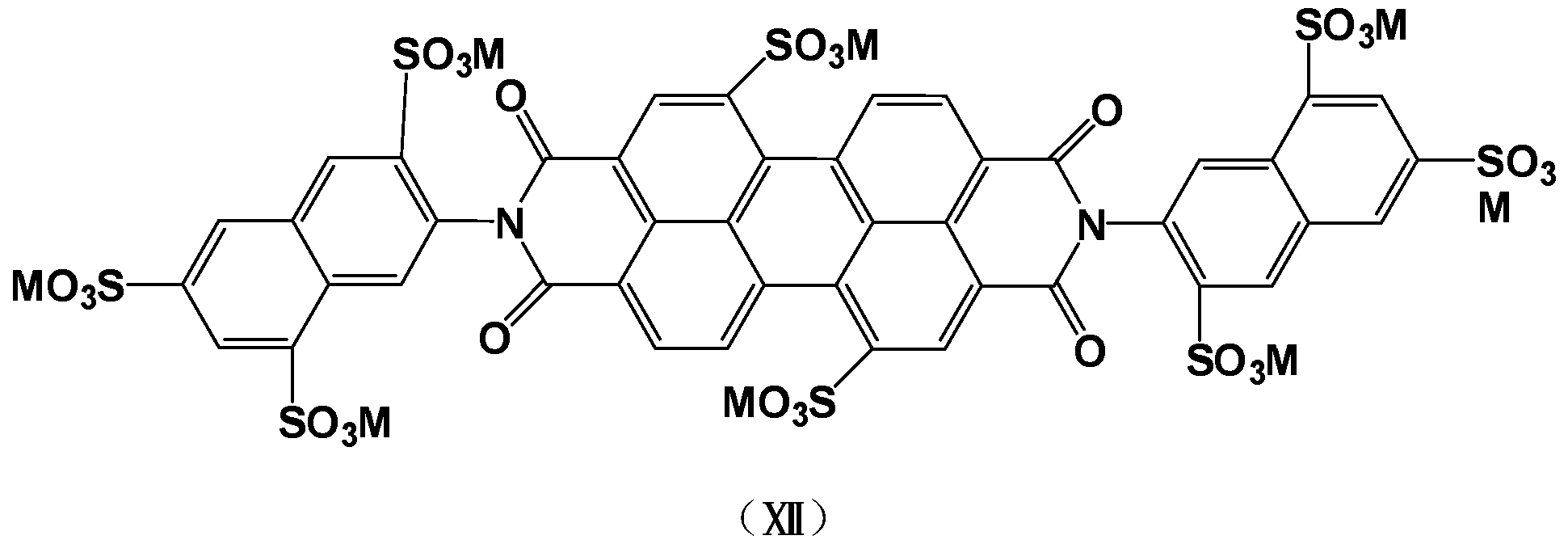
该染料水溶液中紫外可见光谱最大吸收波长 max为 499nm、 536nm,染料分子 中部分 -SO3M的成盐形式不同, 所得的高效液相色谱谱图 (HPLC)显示两个峰。 M 以 H+计, 化合物(V)的分子摩尔质量应为 1283.2。 电喷雾质谱 (; API-ES)检测, 在负 模式下, 电喷雾质谱有质荷比 426.7 的基峰, 为染料的三负离子峰 (分子质量 [MW-3H]/3 ),同时有质荷比 651.8的二负离子峰([MW-3H+Na]/2),质荷比为 854.5、 862.0三负离子峰(分别为 [2M-3H/3]、 [2M-4H+Na]/3 ),质荷比 1282.0的一负离子峰 ( [M-H] ) ,都证明染料分子摩尔质量为 1283.2, 与理论值吻合。 同时也发现了少量 茈环母体单边连接萘环的染料分子, M 以 H+计,该染料分子的分子摩尔质量应为 917.8, 在负模式下, 电喷雾质谱有质荷比 916.5 的峰, 为该染料分子的一负离子峰 ( [M-H] )。 实施例 9
喷墨墨水性能测试与评价
对比染料水解 C.I.活性红 180:

(XIII) 分别将实施例 1~8所合成的染料和市售商品染料水解 C.I.活性红 180 (XIII) 采用如下配方配制成红色墨水。 使用 EPSON RX690喷墨一体机, 打印在施乐纸、 照片纸和喷墨纸上形成色块, 对打印色块进行耐紫外光(UV)性能、 耐臭氧(03) 性能对比测试。 墨水配方如下:
染料 3g
水 (50°C ) 20ml
乙二醇 5ml
一缩二乙二醇 3ml
乙醇 2ml
2-吡咯烷酮 3ml
二乙二醇单丁醚 5ml
20%NP-10 (表面活性剂) 0.1ml
防腐剂 Proxel GXL 0.5g
调节 pH=8.0,冷却后加水至总体积为 100ml,搅拌均匀后用 0.2μηι孔径的滤膜 过滤即得喷墨墨水。其中染料分别为实施例 1〜8所合成的染料, 由其配得的墨水分 别编号为墨水 1〜8, 由市售商品染料 C.I.活性红 180得到的墨水编号为墨水 9。 色块的色密度值 (OD值) 测试仪器及测试方法
色块的色密度值采用常规的色密度仪测量, 例如购自广东中山彩虹打印耗材 有限公司的 WI-QA-1011型色密度仪。 测量步骤如下:
-打开色密度仪电源开关, 进行校正。
-将测试头放在所要测量色密度的纸张的未打印部分, 测量纸张的参数; 然后
将测试头放到所要测量色密度的色块上,仪器屏幕上会自动显示出所测色块的色密 度。 对于一个色块要在不同部位重复测量几次, 取平均值。
耐紫外光 (UV) 性能测试方法及评价标准
将不同墨水在不同类型纸张上打印的色块放入一种由氙灯作为紫外光源提供高 强度紫外光的耐紫外光加速测试装置,在经过时间 T=24小时的高强度紫外光曝晒测 试后, 测试每个样品样品的 OD值, 采用公式 (6-1)计算样品经相同时间高强度曝晒 后的色密度保持率 OD a%:
ODa%=ODT/OD0 X 100% (6- 1 )
其中, ODT为经过时间长度为 T的测试后测得的样品 OD值;
OD。为样品未经测试前的初始 OD值
评价标准: ODa值在 80 - 100之间; 〇
00;1值在70 - 80之间; 〇
ODa值在 50 - 70之间; △
ODa值小于 50; X 耐臭氧 (03) 性能测试方法及评价标准
将不同墨水在不同类型纸张上打印的色块放入一种提供臭氧浓度达到 lppm 的 耐臭氧加速测试装置, 在经过时间 T=24小时的高浓度 03测试后, 测试每个样品样 品的 OD值, 采用公式 (6-2)计算样品经高浓度 03测试后的色密度保持率 OD b%:
ODb%=ODT/OD0 X 100% (6-2)
其中, ODT为经过时间长度为 T的测试后测得的样品 OD值;
OD。为样品未经测试前的初始 OD值
评价标准: ODb值在 80 - 100之间; 〇
0015值在70 - 80之间; 〇
ODb值在 50 - 70之间; △
ODb值小于 50; X
测试结果如表 1-2所示。
表 1 耐紫外光性能测试

表 2 耐臭氧性能测试
 由表 1-2的数据比较可见,本发明合成的染料在抗 UV、抗 O3性能上大大超过 市售商品染料水解 C.I.活性红 180。
另外, 本发明染料在耐湿牢度、 保存稳定性方面也优于市售商品水解染料 C.I. 活性红 180。
Claims
权 利 要 求 类具有式 ( I ) 的茈酰亚胺染料化合物:

其中: 萘环结构通过叔碳原子直接与二酰亚胺的氮原子键合;
Ri和 R2彼此独立地为 H或连接在萘环上的水溶性基团;
R3、 、 R5和 彼此独立地选自中性取代基或水溶性基团;
n和 m分别为 和 R2的个数, n和 m均为不小于 2的整数。
2. 如权利要求 1所述的染料化合物, 其特征在于, 萘环结构通过萘环上 2位 的叔碳原子直接与二酰亚胺的氮原子键合。
3. 如权利要求 1或 2所述的染料化合物, 其特征在于:
和 R2彼此独立地为连接在萘环上除 2位以外任何位置的水溶性基团。
4.如权利要求 1或 2所述的染料化合物, 其中所述的水溶性基团选自: SO3H、 COOH、 SO3M或 COOM, 其中 M为阳离子, M选自: Li+、 Na+、 K+、 咪唑阳离 子或 N+ (R) 4,其中 R为 H、 CH3、 CH2CH3、 CH2CH2CH3、 CH(CH3)或 CH2CH2CH2CH3。
5.如权利要求 4所述的染料化合物,其中所述的水溶性基团是 SO3H或 SO3M。
6. 如权利要求 1或 2所述的染料化合物, 其中所述的中性取代基选自: H、氰 基或卤原子。
7.—种制备式 ( I ) 茈酰亚胺染料化合物的方法, 包括以下步骤:
(a) 首先将中性取代基或水溶性基团 R3、 、 和1^引入结构式 (Π ) 的 茈四羧酸二酐中:

( II )
得到结构式 (m) 的取代茈四羧酸二酐化合物:

(m)
(b)将式 (m) 的取代茈四羧酸二酐与结构式 (IV) 的氨基多磺酸化合物在 以下反应条件下进行反应:

(IV)
反应在催化剂 Zn(C¾COO)2 · 2Η2Ο存在下、 在惰性气体保护下、 在有机溶剂 中进行; 式 (ΠΙ) 的取代茈四羧酸二酐、 式 (IV ) 的氨基多磺酸化合物、 催化剂、 有机溶剂的摩尔比为 1 : 3-10: 0.55〜0.94:6〜20, 有机溶剂选自咪唑、 N-甲基吡咯烷 酮或喹啉中的一种或多种, 反应温度为 100-240°C, 反应时间为 1-12小时;
将反应得到的产物用水溶解、过滤、析出, 最后过滤得到固态的式(I )化合物。
8. 如权利要求 7所述的方法, 其中在反应进行的同时进行分水, 通过蒸馏的 方式, 使溶剂连同反应中形成的水一同被蒸馏出反应体系。
9. 一种水性喷墨油墨组合物, 包含: 1-20重量%权利要求 1所述的染料、 5-50 重量%可与水混溶的有机溶剂、 和 30-94重量%水, 以组合物的总重量为基准。
10. 一种权利要求 1所述染料的用途, 它用作以下材料中的着色剂: 油墨、 涂料、 漆、 激光打印的色粉、 标识物、 纸、 织物、 玻璃、 陶瓷、 或聚合物。
Applications Claiming Priority (2)
| Application Number | Priority Date | Filing Date | Title |
|---|---|---|---|
| CN200810205272 | 2008-12-31 | ||
| CN200810205272.X | 2008-12-31 |
Publications (1)
| Publication Number | Publication Date |
|---|---|
| WO2010075783A1 true WO2010075783A1 (zh) | 2010-07-08 |
Family
ID=42309826
Family Applications (1)
| Application Number | Title | Priority Date | Filing Date |
|---|---|---|---|
| PCT/CN2009/076229 Ceased WO2010075783A1 (zh) | 2008-12-31 | 2009-12-30 | 耐候性苝酰亚胺染料及其制备方法和用途 |
Country Status (1)
| Country | Link |
|---|---|
| WO (1) | WO2010075783A1 (zh) |
Cited By (1)
| Publication number | Priority date | Publication date | Assignee | Title |
|---|---|---|---|---|
| CN104478876A (zh) * | 2014-11-25 | 2015-04-01 | 辽宁鸿港化工有限公司 | 苝四酸二酰亚胺衍生物及其用途 |
Citations (2)
| Publication number | Priority date | Publication date | Assignee | Title |
|---|---|---|---|---|
| DE3703513A1 (de) * | 1987-02-05 | 1988-08-18 | Langhals Heinz | Wasserloesliche perylen-fluoreszenzfarbstoffe |
| DE102005019743A1 (de) * | 2005-04-28 | 2006-11-02 | Sensient Imaging Technologies Gmbh | Wasserlösliche Perylenfarbstoffe für das Tintenstrahl- oder Ink-Jet-Verfahren |
-
2009
- 2009-12-30 WO PCT/CN2009/076229 patent/WO2010075783A1/zh not_active Ceased
Patent Citations (2)
| Publication number | Priority date | Publication date | Assignee | Title |
|---|---|---|---|---|
| DE3703513A1 (de) * | 1987-02-05 | 1988-08-18 | Langhals Heinz | Wasserloesliche perylen-fluoreszenzfarbstoffe |
| DE102005019743A1 (de) * | 2005-04-28 | 2006-11-02 | Sensient Imaging Technologies Gmbh | Wasserlösliche Perylenfarbstoffe für das Tintenstrahl- oder Ink-Jet-Verfahren |
Non-Patent Citations (2)
| Title |
|---|
| HURIYE. ICIL ET AL.: "Energy transfer studies with perylene bis-diimide derivatives", SPECTROSCOPY LETTERS, vol. 31, no. 4, 1998, pages 747 - 755 * |
| JIANQ X. Z ET AL.: "Reddish orange light-emitting diodes made with N,N'-bis(1-naphthyl)-3,4,9,10-perylenbis(dicarboximide)", SYNTHETIC METALS, vol. 91, no. 1-3, 1997, pages 253 - 256 * |
Cited By (1)
| Publication number | Priority date | Publication date | Assignee | Title |
|---|---|---|---|---|
| CN104478876A (zh) * | 2014-11-25 | 2015-04-01 | 辽宁鸿港化工有限公司 | 苝四酸二酰亚胺衍生物及其用途 |
Similar Documents
| Publication | Publication Date | Title |
|---|---|---|
| Geerts et al. | Quaterrylenebis (dicarboximide) s: near infrared absorbing and emitting dyes | |
| CN1239503C (zh) | 液晶苝-3,4:9,10-四羧酸二酰亚胺 | |
| US7211120B2 (en) | Method for forming a pattern of an organic semiconductor film | |
| TWI238175B (en) | Anthrapyridone compounds, and aqueous magenta ink compositions | |
| JP4745226B2 (ja) | フロピロールの製造法 | |
| CN101768369B (zh) | 耐候性苝酰亚胺染料及其制备方法和用途 | |
| JPWO2020045200A1 (ja) | アルキレン化合物、キノフタロン化合物及びキノフタロン混合物 | |
| CN118638051A (zh) | 三芳基甲烷色素、含有该色素的着色组合物、滤色器用着色剂和滤色器 | |
| JP2013253170A (ja) | キサンテン系可溶性前駆体化合物および着色剤 | |
| WO2010075783A1 (zh) | 耐候性苝酰亚胺染料及其制备方法和用途 | |
| JPH10204076A (ja) | ペリレン−3、4−ジカルボン酸無水物の製造方法 | |
| JPWO2011018994A1 (ja) | フタロシアニン化合物およびその製造方法、ならびに該フタロシアニン化合物を含有する着色組成物 | |
| JP6031044B2 (ja) | アントラピリドンスルホン酸化合物およびその調製法 | |
| CN102741354B (zh) | 羰丙砜基蒽吡啶酮磺酸化合物及其制备方法和用途 | |
| EP2789657B1 (en) | Fuchsin dye, preparation method and use thereof | |
| CN101171308B (zh) | 氟喹诺酮并喹诺酮和包含它的喷墨油墨组合物 | |
| WO2018155096A1 (ja) | キサンテン系染料を含有する着色組成物、カラーフィルター用着色剤およびカラーフィルター | |
| TWI914489B (zh) | 二苯并哌喃色素、含有該色素之著色組合物、彩色濾光片用著色劑及彩色濾光片 | |
| JP2012233050A (ja) | 顔料のイミドアルキル化誘導体の製造方法。 | |
| CN102807527B (zh) | 蒽吡啶酮化合物及其制备方法和用途 | |
| TW202537955A (zh) | 三芳基甲烷色素、含有該色素的著色組成物、彩色濾光片用著色劑及彩色濾光片 | |
| CN115260197A (zh) | 一种稠环化合物及其制备方法和应用 | |
| US6740153B2 (en) | Bipyrrolinonylidene-type compound, colorant therewith, and method of production thereof | |
| CN115598826A (zh) | 一种油墨在电润湿显示器件中的应用 | |
| JP2012229365A (ja) | ジケトピロロピロール系顔料のイミドアルキル化誘導体の製造方法 |
Legal Events
| Date | Code | Title | Description |
|---|---|---|---|
| 121 | Ep: the epo has been informed by wipo that ep was designated in this application |
Ref document number: 09836070 Country of ref document: EP Kind code of ref document: A1 |
|
| NENP | Non-entry into the national phase |
Ref country code: DE |
|
| 122 | Ep: pct application non-entry in european phase |
Ref document number: 09836070 Country of ref document: EP Kind code of ref document: A1 |