WO2010071081A1 - トップコート組成物 - Google Patents
トップコート組成物 Download PDFInfo
- Publication number
- WO2010071081A1 WO2010071081A1 PCT/JP2009/070725 JP2009070725W WO2010071081A1 WO 2010071081 A1 WO2010071081 A1 WO 2010071081A1 JP 2009070725 W JP2009070725 W JP 2009070725W WO 2010071081 A1 WO2010071081 A1 WO 2010071081A1
- Authority
- WO
- WIPO (PCT)
- Prior art keywords
- group
- fluorine
- topcoat
- top coat
- topcoat composition
- Prior art date
- Legal status (The legal status is an assumption and is not a legal conclusion. Google has not performed a legal analysis and makes no representation as to the accuracy of the status listed.)
- Ceased
Links
Classifications
-
- G—PHYSICS
- G03—PHOTOGRAPHY; CINEMATOGRAPHY; ANALOGOUS TECHNIQUES USING WAVES OTHER THAN OPTICAL WAVES; ELECTROGRAPHY; HOLOGRAPHY
- G03F—PHOTOMECHANICAL PRODUCTION OF TEXTURED OR PATTERNED SURFACES, e.g. FOR PRINTING, FOR PROCESSING OF SEMICONDUCTOR DEVICES; MATERIALS THEREFOR; ORIGINALS THEREFOR; APPARATUS SPECIALLY ADAPTED THEREFOR
- G03F7/00—Photomechanical, e.g. photolithographic, production of textured or patterned surfaces, e.g. printing surfaces; Materials therefor, e.g. comprising photoresists; Apparatus specially adapted therefor
- G03F7/004—Photosensitive materials
- G03F7/09—Photosensitive materials characterised by structural details, e.g. supports, auxiliary layers
- G03F7/11—Photosensitive materials characterised by structural details, e.g. supports, auxiliary layers having cover layers or intermediate layers, e.g. subbing layers
-
- C—CHEMISTRY; METALLURGY
- C08—ORGANIC MACROMOLECULAR COMPOUNDS; THEIR PREPARATION OR CHEMICAL WORKING-UP; COMPOSITIONS BASED THEREON
- C08F—MACROMOLECULAR COMPOUNDS OBTAINED BY REACTIONS ONLY INVOLVING CARBON-TO-CARBON UNSATURATED BONDS
- C08F220/00—Copolymers of compounds having one or more unsaturated aliphatic radicals, each having only one carbon-to-carbon double bond, and only one being terminated by only one carboxyl radical or a salt, anhydride ester, amide, imide or nitrile thereof
- C08F220/02—Monocarboxylic acids having less than ten carbon atoms; Derivatives thereof
- C08F220/10—Esters
- C08F220/22—Esters containing halogen
- C08F220/24—Esters containing halogen containing perhaloalkyl radicals
-
- C—CHEMISTRY; METALLURGY
- C08—ORGANIC MACROMOLECULAR COMPOUNDS; THEIR PREPARATION OR CHEMICAL WORKING-UP; COMPOSITIONS BASED THEREON
- C08F—MACROMOLECULAR COMPOUNDS OBTAINED BY REACTIONS ONLY INVOLVING CARBON-TO-CARBON UNSATURATED BONDS
- C08F220/00—Copolymers of compounds having one or more unsaturated aliphatic radicals, each having only one carbon-to-carbon double bond, and only one being terminated by only one carboxyl radical or a salt, anhydride ester, amide, imide or nitrile thereof
- C08F220/02—Monocarboxylic acids having less than ten carbon atoms; Derivatives thereof
- C08F220/10—Esters
- C08F220/26—Esters containing oxygen in addition to the carboxy oxygen
- C08F220/28—Esters containing oxygen in addition to the carboxy oxygen containing no aromatic rings in the alcohol moiety
- C08F220/283—Esters containing oxygen in addition to the carboxy oxygen containing no aromatic rings in the alcohol moiety and containing one or more carboxylic moiety in the chain, e.g. acetoacetoxyethyl(meth)acrylate
-
- G—PHYSICS
- G03—PHOTOGRAPHY; CINEMATOGRAPHY; ANALOGOUS TECHNIQUES USING WAVES OTHER THAN OPTICAL WAVES; ELECTROGRAPHY; HOLOGRAPHY
- G03F—PHOTOMECHANICAL PRODUCTION OF TEXTURED OR PATTERNED SURFACES, e.g. FOR PRINTING, FOR PROCESSING OF SEMICONDUCTOR DEVICES; MATERIALS THEREFOR; ORIGINALS THEREFOR; APPARATUS SPECIALLY ADAPTED THEREFOR
- G03F7/00—Photomechanical, e.g. photolithographic, production of textured or patterned surfaces, e.g. printing surfaces; Materials therefor, e.g. comprising photoresists; Apparatus specially adapted therefor
- G03F7/004—Photosensitive materials
-
- G—PHYSICS
- G03—PHOTOGRAPHY; CINEMATOGRAPHY; ANALOGOUS TECHNIQUES USING WAVES OTHER THAN OPTICAL WAVES; ELECTROGRAPHY; HOLOGRAPHY
- G03F—PHOTOMECHANICAL PRODUCTION OF TEXTURED OR PATTERNED SURFACES, e.g. FOR PRINTING, FOR PROCESSING OF SEMICONDUCTOR DEVICES; MATERIALS THEREFOR; ORIGINALS THEREFOR; APPARATUS SPECIALLY ADAPTED THEREFOR
- G03F7/00—Photomechanical, e.g. photolithographic, production of textured or patterned surfaces, e.g. printing surfaces; Materials therefor, e.g. comprising photoresists; Apparatus specially adapted therefor
- G03F7/004—Photosensitive materials
- G03F7/0045—Photosensitive materials with organic non-macromolecular light-sensitive compounds not otherwise provided for, e.g. dissolution inhibitors
-
- G—PHYSICS
- G03—PHOTOGRAPHY; CINEMATOGRAPHY; ANALOGOUS TECHNIQUES USING WAVES OTHER THAN OPTICAL WAVES; ELECTROGRAPHY; HOLOGRAPHY
- G03F—PHOTOMECHANICAL PRODUCTION OF TEXTURED OR PATTERNED SURFACES, e.g. FOR PRINTING, FOR PROCESSING OF SEMICONDUCTOR DEVICES; MATERIALS THEREFOR; ORIGINALS THEREFOR; APPARATUS SPECIALLY ADAPTED THEREFOR
- G03F7/00—Photomechanical, e.g. photolithographic, production of textured or patterned surfaces, e.g. printing surfaces; Materials therefor, e.g. comprising photoresists; Apparatus specially adapted therefor
- G03F7/004—Photosensitive materials
- G03F7/09—Photosensitive materials characterised by structural details, e.g. supports, auxiliary layers
-
- G—PHYSICS
- G03—PHOTOGRAPHY; CINEMATOGRAPHY; ANALOGOUS TECHNIQUES USING WAVES OTHER THAN OPTICAL WAVES; ELECTROGRAPHY; HOLOGRAPHY
- G03F—PHOTOMECHANICAL PRODUCTION OF TEXTURED OR PATTERNED SURFACES, e.g. FOR PRINTING, FOR PROCESSING OF SEMICONDUCTOR DEVICES; MATERIALS THEREFOR; ORIGINALS THEREFOR; APPARATUS SPECIALLY ADAPTED THEREFOR
- G03F7/00—Photomechanical, e.g. photolithographic, production of textured or patterned surfaces, e.g. printing surfaces; Materials therefor, e.g. comprising photoresists; Apparatus specially adapted therefor
- G03F7/004—Photosensitive materials
- G03F7/09—Photosensitive materials characterised by structural details, e.g. supports, auxiliary layers
- G03F7/091—Photosensitive materials characterised by structural details, e.g. supports, auxiliary layers characterised by antireflection means or light filtering or absorbing means, e.g. anti-halation, contrast enhancement
-
- G—PHYSICS
- G03—PHOTOGRAPHY; CINEMATOGRAPHY; ANALOGOUS TECHNIQUES USING WAVES OTHER THAN OPTICAL WAVES; ELECTROGRAPHY; HOLOGRAPHY
- G03F—PHOTOMECHANICAL PRODUCTION OF TEXTURED OR PATTERNED SURFACES, e.g. FOR PRINTING, FOR PROCESSING OF SEMICONDUCTOR DEVICES; MATERIALS THEREFOR; ORIGINALS THEREFOR; APPARATUS SPECIALLY ADAPTED THEREFOR
- G03F7/00—Photomechanical, e.g. photolithographic, production of textured or patterned surfaces, e.g. printing surfaces; Materials therefor, e.g. comprising photoresists; Apparatus specially adapted therefor
- G03F7/20—Exposure; Apparatus therefor
- G03F7/2041—Exposure; Apparatus therefor in the presence of a fluid, e.g. immersion; using fluid cooling means
-
- G—PHYSICS
- G03—PHOTOGRAPHY; CINEMATOGRAPHY; ANALOGOUS TECHNIQUES USING WAVES OTHER THAN OPTICAL WAVES; ELECTROGRAPHY; HOLOGRAPHY
- G03F—PHOTOMECHANICAL PRODUCTION OF TEXTURED OR PATTERNED SURFACES, e.g. FOR PRINTING, FOR PROCESSING OF SEMICONDUCTOR DEVICES; MATERIALS THEREFOR; ORIGINALS THEREFOR; APPARATUS SPECIALLY ADAPTED THEREFOR
- G03F7/00—Photomechanical, e.g. photolithographic, production of textured or patterned surfaces, e.g. printing surfaces; Materials therefor, e.g. comprising photoresists; Apparatus specially adapted therefor
- G03F7/004—Photosensitive materials
- G03F7/0046—Photosensitive materials with perfluoro compounds, e.g. for dry lithography
Definitions
- the present invention relates to a top coat composition for a photoresist containing a fluorine-containing polymer having a specific repeating unit.
- the topcoat composition is particularly useful as a protective film in an immersion exposure process.
- Fluorine compounds have a wide range of advanced materials due to the characteristics of fluorine such as water repellency, oil repellency, low water absorption, heat resistance, weather resistance, corrosion resistance, transparency, photosensitivity, low refractive index, and low dielectric properties.
- a resist material employing a fluorine-based compound as a new material having high transparency with respect to short wavelength ultraviolet rays such as an F 2 laser and an ArF excimer laser has been actively researched.
- the common molecular design in these application fields includes 1,1,1,3,3,3-hexafluoroisopropyl-2-hydroxy group (hexafluoro) in addition to transparency at each wavelength used by introducing fluorine. It is based on various properties such as photosensitivity utilizing the acidic characteristics of fluoroalcohol having an isopropyl hydroxyl group), adhesion to a substrate and high hardness, that is, high glass transition point (Tg).
- NA number of 0.9
- a lens used for a stepper is expressed by NA (numerical aperture), but a value of about 0.9 is considered a physical limit in air and has already been achieved. Therefore, attempts have been made to raise NA to 1.0 or more by filling the space between the lens and the wafer with a medium having a refractive index higher than that of air.
- the medium is pure water (hereinafter, sometimes simply referred to as water).
- An exposure technique based on a liquid immersion method using) has been attracting attention (Non-Patent Document 1).
- Non-patent Document 2 In immersion lithography, various problems have been pointed out because the resist film comes into contact with a medium (for example, water). In particular, there are problems such as a change in pattern shape caused by dissolution of an acid generated in the film by exposure and an amine compound added as a quencher in water, pattern collapse due to swelling, and the like. Therefore, it has been reported that it is effective to provide a topcoat layer on the resist in order to separate the resist film and water (Non-patent Document 2).
- the top coat composition is required to have performance such as good developer solubility, resistance to pure water, separability between the resist film and water, and no damage to the underlying resist film.
- a topcoat composition satisfying such a requirement a composition containing a fluoropolymer having a repeating unit containing a unit containing two or more hexafluoroisopropyl hydroxyl groups has been developed and reported to be particularly excellent in developer solubility. (Patent Document 1).
- the top coat provided on the resist film and protecting the resist film is required to have good developer solubility, resistance to pure water, and separation performance between the resist film and water.
- the topcoat composition used for forming the topcoat is required to have a characteristic that does not attack the underlying resist film.
- the topcoat composition described in Patent Document 1 provides a useful topcoat that is excellent in developer solubility, but is not always necessary when delicate control of solubility is required because the solubility of the topcoat is too high. There has been a demand for a top coat that is not suitable and has appropriate solubility. Further, in the production of the polymer, introduction of two hexafluoroisopropyl hydroxyl groups is costly, and a topcoat composition satisfying the above performance with a cheaper composition has been demanded.
- the hexafluoroisopropyl hydroxyl group is represented by the following structure, has a high fluorine content, and includes a hydroxyl group that is a polar group.
- the inventors of the present invention have further studied the improvement of the solubility of the developer in combination with other substituents.
- the topcoat composition is a polymer in which a specific number of hydroxyl groups are introduced as other substituents.
- the formed top coat has an appropriate developer solubility and is resistant to water. Water and a resist film
- the present inventors have found that a top coat composition that does not attack the resist layer can be obtained.
- a polymerizable compound in which a hexafluoroisopropyl hydroxyl group and a hydroxyl group are simultaneously bonded to an alicyclic structure has not been known so far, and it is not known that a polymer obtained therefrom can be used as a top coat.
- the present invention includes a polymerizable group, a 6-membered or 5-membered alicyclic structure, and in the case of a 6-membered ring, a hexafluoroisopropyl hydroxyl group bonded to the ring and a repeating structure having 1 to 4 hydroxyl groups,
- a top coat composition comprising as a component a fluoropolymer containing a repeating unit having one hexafluoroisopropyl hydroxyl group and one to three hydroxyl groups bonded to the ring.
- a part or all of the hydroxyl group bonded to the hexafluoroisopropyl hydroxyl group or the ring may be protected with a protecting group.
- the fluorine-containing monomer as a raw material for synthesizing the fluorine-containing polymer constituting the topcoat composition of the present invention has good polymerization reactivity, and the fluorine-containing polymer useful for the topcoat composition is relatively inexpensive It has the feature that it can be manufactured.
- the present invention includes the following [Invention 1] to [Invention 10].
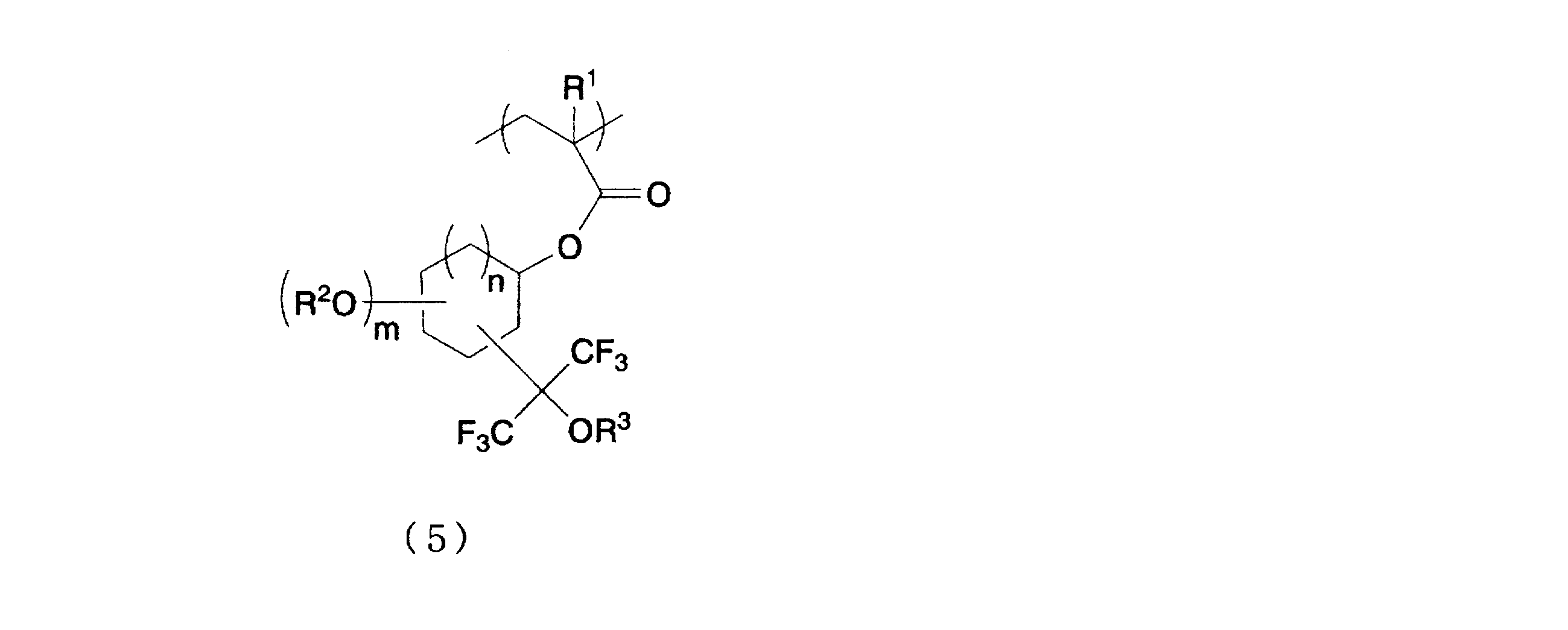
- a top coat composition which is provided on a resist film and protects the resist film, and includes a fluorine-containing polymer having a repeating unit represented by the following general formula (5).
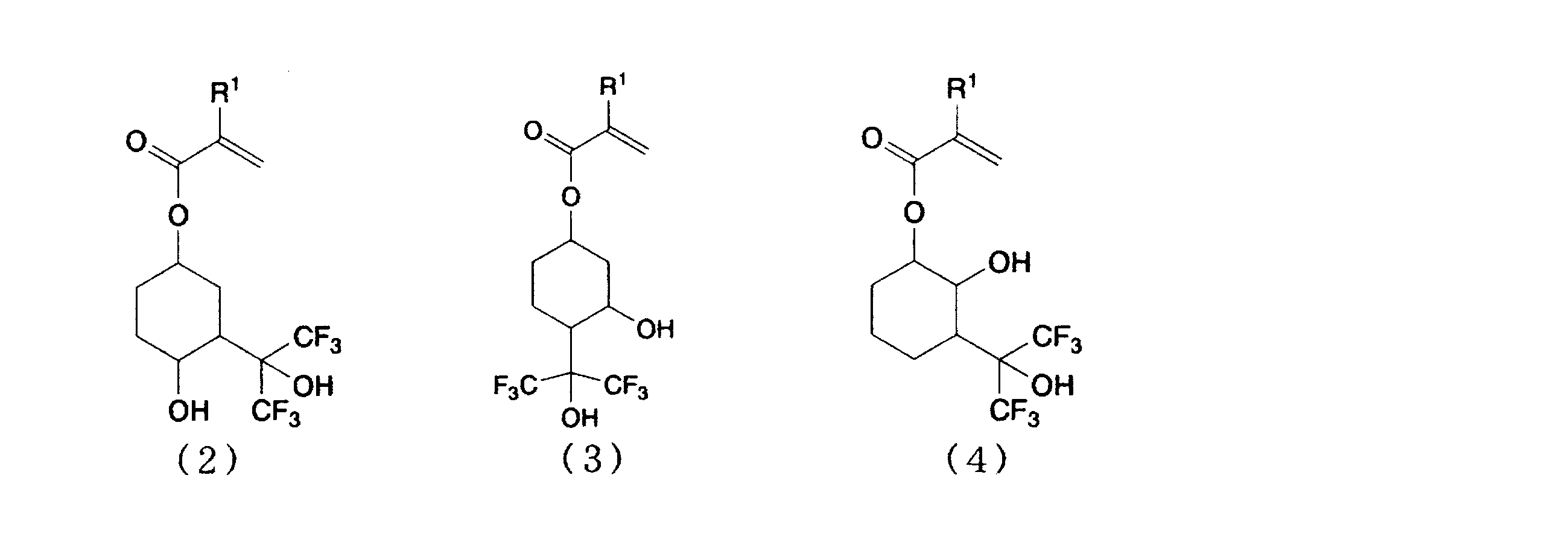
- Topcoat composition [Wherein R 1 represents a hydrogen atom, a methyl group, a fluorine atom, or a trifluoromethyl group. n is 0 or 1, and m is an integer of 1 to (3 + n). R 2 and R 3 each independently represents a hydrogen atom or a protecting group. ]
- the topcoat composition according to invention 2 comprising a fluorine-containing polymer having at least one repeating unit represented by the following general formulas (6) to (8).
- R 1 represents a hydrogen atom, a methyl group, a fluorine atom, or a trifluoromethyl group.
- invention 6 One or two organic solvents selected from the group consisting of cyclic or chain hydrocarbons having 5 to 20 carbon atoms, alcohols having 1 to 20 carbon atoms, and cyclic or chain hydrocarbons partially substituted with fluorine
- the topcoat composition according to invention 5 which is an organic solvent comprising the above.
- Invention 7 Invention 5 or Invention 6 wherein the organic solvent is a solvent in which a hydrocarbon having 5 to 20 carbon atoms is mixed at 50% or more and less than 99.9%, and an alcohol having 1 to 20 carbon atoms is mixed at 0.1% or more and less than 50%. Top coat composition.
- invention 8 The topcoat composition according to any one of inventions 1 to 7, wherein the topcoat composition is used for immersion lithography.
- a topcoat for manufacturing a semiconductor device formed from the topcoat composition according to any one of Inventions 1 to 8.
- the topcoat composition of the present invention has an appropriate developer solubility, is resistant to water, can form a topcoat film with good separation of water and the resist film, and does not attack the resist layer Is obtained.
- the fluorine-containing polymerizable monomer constituting the topcoat composition of the present invention has a good polymerization reactivity, and has a feature that a fluorine-containing polymer useful for the topcoat composition can be produced at a relatively low cost. is doing.
- topcoat composition of the present invention is provided on a resist film and used to form a topcoat that protects the resist film (sometimes referred to as “topcoat film” in the specification).
- a composition (sometimes referred to as a “topcoat solution” in the specification), comprising a fluoropolymer having a repeating unit represented by the following general formula (5)
- a topcoat composition comprising a fluoropolymer having a repeating unit represented by the following general formula (5) A topcoat composition.
- R 1 represents a hydrogen atom, a methyl group, a fluorine atom, or a trifluoromethyl group.
- n is 0 or 1
- m is an integer of 1 to (3 + n).
- R 2 and R 3 each independently represents a hydrogen atom or a protecting group.
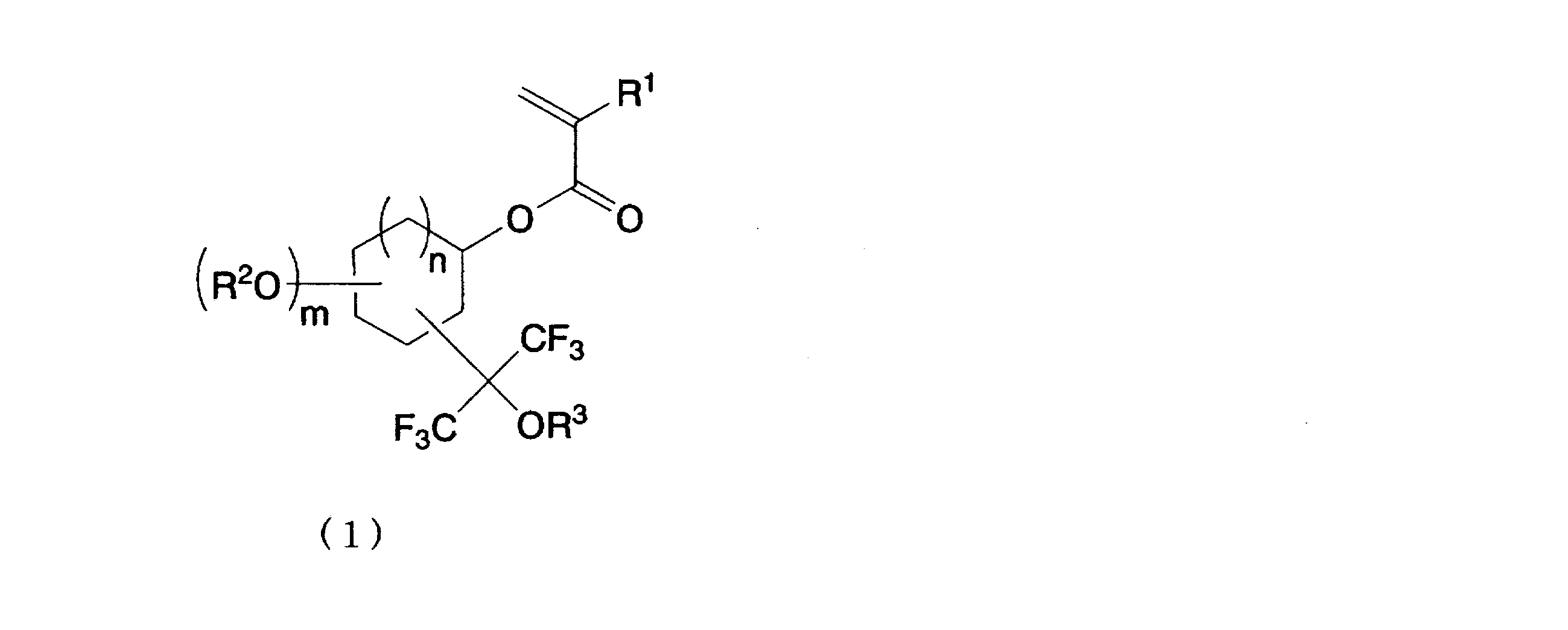
- the fluorine-containing polymerizable monomer that gives the fluorine-containing polymer having the repeating unit of the general formula (5) can be represented by the following general formula (1).
- R 1 represents a hydrogen atom, a methyl group, a fluorine atom, or a trifluoromethyl group.
- n is 0 or 1
- m is an integer of 1 to (3 + n).
- R 2 and R 3 each independently represents a hydrogen atom or a protecting group.
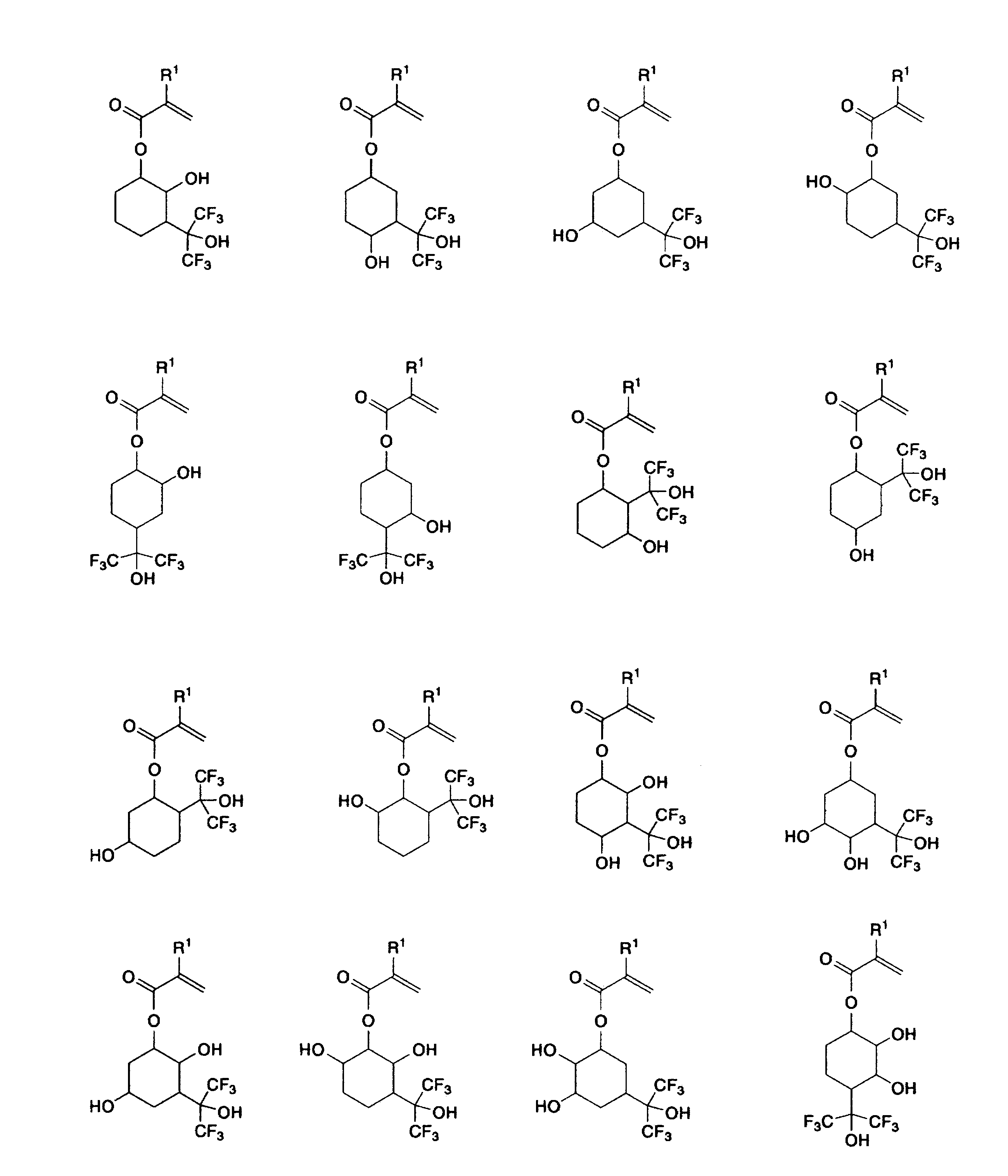
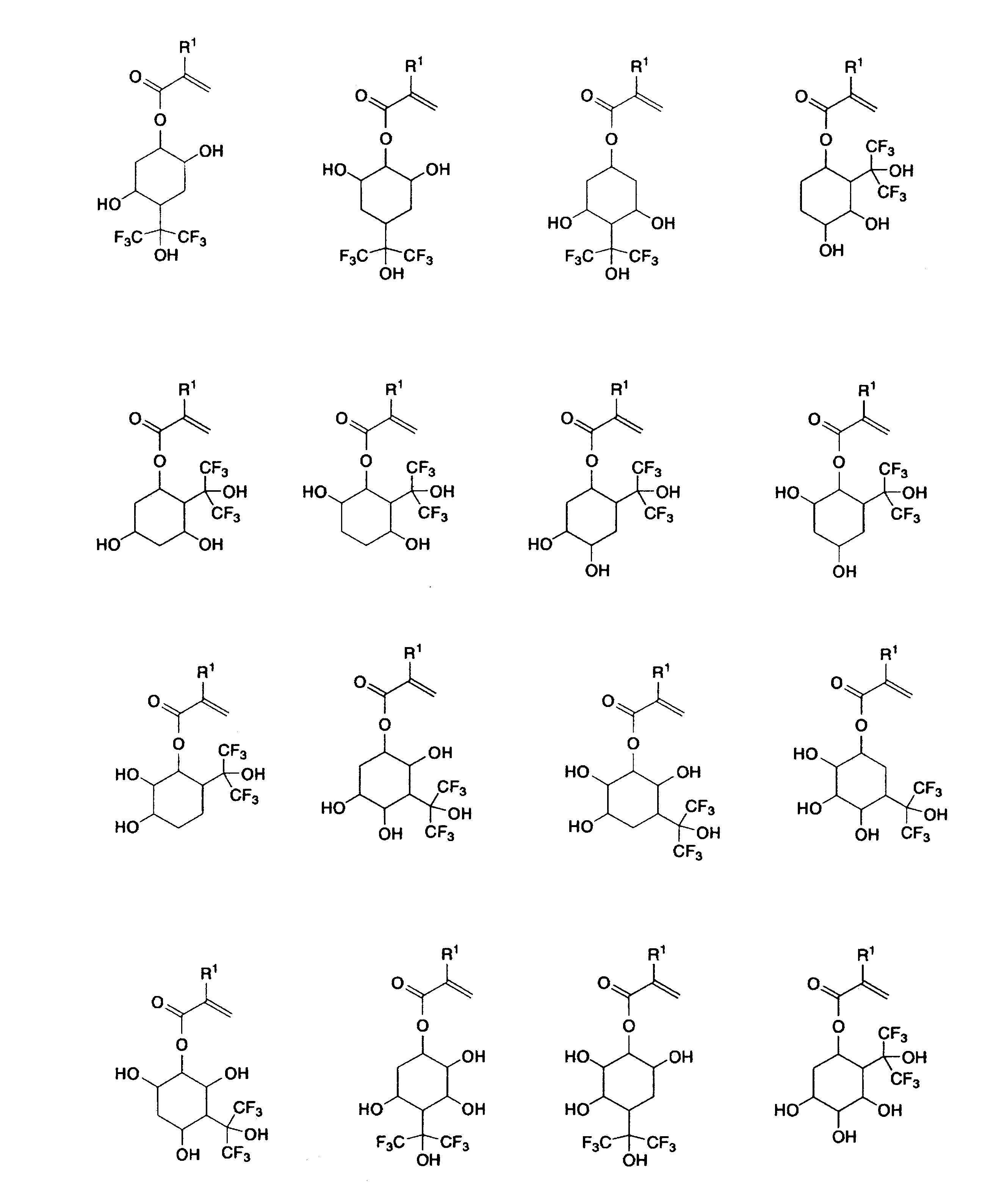
- a 5-membered ring or a 6-membered ring can be used, but a 6-membered ring is preferred because of availability, cost, and synthesis.
- the number m of (R 2 O) — substituents is 1 to (3 + n), and can be 1 to 3 for a 5-membered ring and 1 to 4 for a 6-membered ring.
- the compound represented by the general formula (1) may include a structure in which two substituents other than hydrogen atoms are simultaneously bonded to each carbon atom constituting the alicyclic structure, but the substituent is bonded to the carbon atom.
- a structure in which one substituent and one hydrogen atom are bonded is preferable because it is easily available. Therefore, a fluorine-containing monomer having a structure in which at least one hydrogen atom is bonded to all carbon atoms constituting the alicyclic structure is suitably used for the compound represented by the general formula (1). It is done.
- R 2 and R 3 each independently represents a hydrogen atom or a protecting group.
- the protective group adjusts the affinity or water repellency of the topcoat using a polymer obtained from a fluorine-containing polymerizable monomer or water, or the solubility of the polymer in a solvent.
- R 2 and R 3 are both preferably hydrogen atoms.
- R 1 represents a hydrogen atom, a methyl group, a fluorine atom, or a trifluoromethyl group.
- the number of hydroxyl groups directly bonded to the ring can range from 1 to 3 for a 5-membered ring and from 1 to 4 for a 6-membered ring.
- This hydroxyl group is effective in promoting solubility in a developer, but the possibility of causing swelling during development increases as the number increases.
- the number of hydroxyl groups is preferably 1 to 2 rather than 3 or more.
- hexafluoroisopropyl hydroxyl group and the hydroxyl group are adjacent to each other because of the availability of raw materials, cost, and ease of synthesis.
- Examples of the protecting group include a hydrocarbon group, an alkoxycarbonyl group, an acetal group, and an acyl group.
- the hydrocarbon group is a linear, branched or cyclic hydrocarbon group having 1 to 25 carbon atoms or an aromatic hydrocarbon group, such as a methyl group, an ethyl group, a propyl group, an isopropyl group, a cyclopropyl group, n -Propyl group, iso-propyl group, sec-butyl group, tert-butyl group, n-pentyl group, cyclopentyl group, sec-pentyl group, neopentyl group, hexyl group, cyclohexyl group, ethylhexyl group, norbornyl group, adamantyl group Group, vinyl group, allyl group, butenyl group, pentenyl group, ethynyl group, phenyl
- alkoxycarbonyl group examples include a tert-butoxycarbonyl group, a tert-amyloxycarbonyl group, a methoxycarbonyl group, an ethoxycarbonyl group, and an i-propoxycarbonyl group.
- methoxymethyl group methoxyethoxymethyl group, ethoxyethyl group, butoxyethyl group, cyclohexyloxyethyl group, benzyloxyethyl group, phenethyloxyethyl group, ethoxypropyl group, benzyloxypropyl group, phenethyloxypropyl group , Ethoxybutyl group, chain ether group of ethoxyisobutyl group, and cyclic ether groups such as tetrahydrofuranyl group and tetrahydropyranyl group.
- acyl group acetyl group, propionyl group, butyryl group, heptanoyl group, hexanoyl group, valeryl group, pivaloyl group, isovaleryl group, lauryl group, myristoyl group, palmitoyl group, stearoyl group, oxalyl group, malonyl group, succinyl group, Glutaryl group, adipoyl group, piperoyl group, suberoyl group, azelaoil group, sebacoyl group, acryloyl group, propioroyl group, methacryloyl group, crotonoyl group, oleoyl group, maleoyl group, fumaroyl group, mesaconoyl group, canholoyl group, benzoyl group, phthaloyl group Group, isophthaloyl group, terephthaloyl group, naphthoyl group, toluo
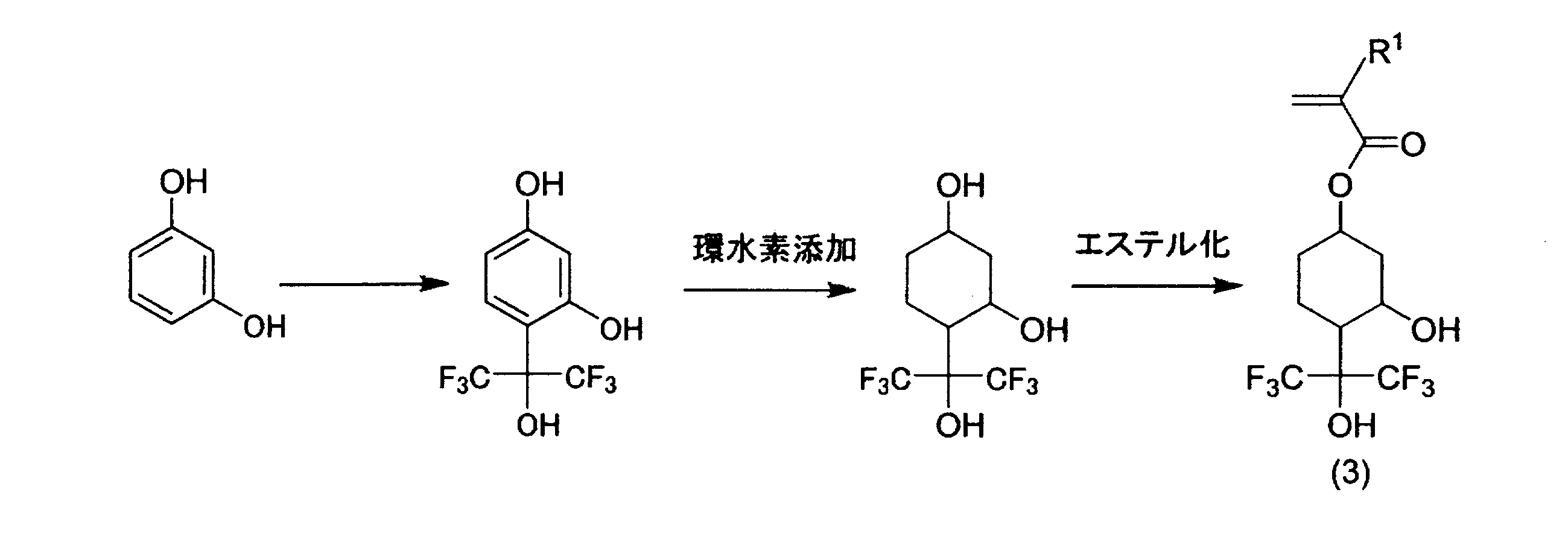
- Non-Patent Document 3 Basil S. et al. Farah, Everett E. et al. Gilbert, Morton Litt, Julian A. Otto, John P. Sibilia J. et al. Org. Chem. 1965, 30 (4), pp 1003-1005.
- Resorcinol can be used as a raw material, and after introduction of a hexafluoroisopropyl hydroxyl group, it can be produced by esterification by ring hydrogenation to the corresponding alcohol.
- the method of ring hydrogenation is not particularly limited, and a known method may be used, such as Ru / C together with an organic solvent.
- a method of performing hydrogenation using a noble metal catalyst is preferably employed.
- acrylic acid derivatives include acrylic acid, methacrylic acid, trifluoromethyl acrylic acid, acrylic acid chloride, methacrylic acid chloride, trifluoromethyl acrylic acid chloride, acrylic acid anhydride, methacrylic acid anhydride, trifluoromethylacrylic.
- An acid anhydride etc. can be illustrated.
- a catalyst may or may not be used, but a catalyst can be used for the purpose of obtaining an appropriate reaction temperature and reaction rate.
- a carboxylic acid such as acrylic acid, methacrylic acid or trifluoromethylacrylic acid
- the reaction can be performed in the presence of an acid catalyst.
- an acid chloride such as acrylic acid chloride, methacrylic acid chloride or trifluoromethyl acrylic acid chloride
- an anhydride such as acrylic acid anhydride, methacrylic acid anhydride or trifluoromethyl acrylic acid anhydride
- an acid catalyst can react in presence of a base catalyst.
- an anhydride it is preferably employed because an appropriate reaction rate can be obtained.
- the acrylic acid derivative may be used in an amount of 1-fold mol or more with respect to 1 mol of the fluorinated alcohol as a raw material, from the viewpoint of the reaction rate and the yield of the target fluorinated polymerizable monomer.
- An amount of 0 to 5 moles is preferred.
- 1.05-fold mole to 2-fold mole is more preferable.
- Examples of the acid catalyst that can be used include a proton acid and a Lewis acid.
- a proton acid such as hydrogen fluoride, sulfuric acid, phosphoric acid, hydrogen chloride, methanesulfonic acid, trifluoromethanesulfonic acid, and trifluoroacetic acid;
- Examples include Lewis acids such as OC 2 H 5 ) 4 , Ti (OC 4 H 9 ) 4 , Ti (OCH (CH 3 ) 2 ) 4 , and Zn (CH 3 COO) 2 .2H 2 O.
- the desired product can be obtained with good yield, and therefore, it is preferably employed. More preferably, methanesulfonic acid, triflu
- an amount of the acid catalyst an amount of 0.01 to 10 times mol can be used with respect to 1 mol of the fluorine-containing alcohol as a raw material. If the amount is less than 0.01 moles, the reaction rate is too slow and the yield of the target fluorine-containing polymerizable monomer is very small. However, the effect of improving the yield cannot be expected, and the by-products are also increased. More preferably, 0.1 to 1.5-fold moles of acid are used with respect to the substrate to achieve an appropriate reaction rate and good yield.
- acrylic acid anhydride or acrylic acid chloride When acrylic acid anhydride or acrylic acid chloride is used as the raw material for the acrylic acid derivative, it is effective to use a base to capture the acid (carboxylic acid or hydrogen chloride) generated in the reaction.
- Bases include inorganic substances such as sodium hydroxide, sodium carbonate, sodium bicarbonate, potassium hydroxide, potassium carbonate, potassium bicarbonate, sodium hydride, sodium methoxide, sodium ethoxide, sodium tert-butoxide, potassium tert-butoxide, etc.
- organic bases such as pyridine, lutidine, triethylamine, diethylamine, piperidine, pyrrolidine, 1,8-diazabicyclo [5,4,0] -7-undecene can be used.
- organic base is used, especially lutidine.
- the amount of the base used is 1 to 10 times mol, preferably 1 to 3 times mol for 1 mol of the fluorinated alcohol.
- the solvent used in the esterification reaction is not particularly limited as long as it is stable during the reaction and dissolves the fluorinated alcohol as a raw material.
- hydrocarbons such as hexane, heptane, benzene, toluene and xylene, ethers such as diethyl ether, tetrahydrofuran and dioxane, halogenated hydrocarbons such as dichloromethane and chloroform, acetonitrile, N, N-dimethylformamide, dimethyl sulfoxide
- Examples include aprotic polar solvents such as hexamethylphosphoric triamide, and these may be used alone or in admixture of two or more.
- the reaction temperature for esterification is not particularly limited, but the reaction can usually be carried out in the range of room temperature to 200 ° C. Since the reaction time varies depending on the above-mentioned acrylic acid derivative, acid catalyst, type and amount of base, reaction temperature, etc., the reaction time is appropriately changed according to this. In practice, it is possible to carry out the reaction while sequentially analyzing the reaction solution during the reaction, and to react until the raw materials are consumed.
- the treatment after the reaction is not particularly limited, but it is possible to add the reaction solution to water or ice water, and then extract the target product by extraction with an organic solvent, or extract the target product by distillation.
- the fluorine-containing polymer of the present invention is a polymer characterized by containing a repeating unit represented by the general formula (5), and the fluorine-containing polymerizability represented by the above general formula (1). It can be produced by cleaving the double bond of the monomer alone or copolymerizing with other monomers. [Wherein R 1 , n, m, R 2 or R 3 has the same meaning as in general formula (1). ]
- the repeating unit represented by the general formula (5) is formed by cleavage of the polymerizable double bond of the fluorine-containing monomer represented by the general formula (1), and other structures are maintained. Accordingly, the disclosure of the fluorine-containing monomer represented by the general formula (1) can be applied as it is to the explanation of R 1 , R 2 , R 3 , m, and n and specific examples of the combination thereof.
- At least one of fluorine-containing polymers having the repeating units represented by the general formulas (6), (7), and (8) is included.
- a fluorine-containing polymer is particularly preferably used.
- R 1 has the same meaning as in general formula (1)].
- bonded with the ring may be protected partly or entirely with a protecting group.
- the monomer copolymerizable with the fluorine-containing polymerizable monomer of the present invention is specifically exemplified, at least maleic anhydride, acrylic acid esters, fluorine-containing acrylic acid esters, methacrylic acid esters, Fluorine-containing methacrylates, styrene compounds, fluorine-containing styrene compounds, vinyl ethers, fluorine-containing vinyl ethers, allyl ethers, fluorine-containing allyl ethers, olefins, fluorine-containing olefins, norbornene compounds, fluorine-containing norbornene compounds And one or more monomers selected from sulfur dioxide, vinyl silanes, vinyl sulfonic acid, and vinyl sulfonic acid ester.
- any ester side chain can be used without any particular limitation.
- Examples of known compounds include methyl acrylate, methyl methacrylate, ethyl acrylate, ethyl methacrylate, and n-propyl acrylate.
- the fluorine-containing acrylic ester and the fluorine-containing methacrylate ester may be a monomer containing a fluorine atom or a fluorine atom-containing group at the ⁇ -position of acrylic, or a substituent containing a fluorine atom at the ester site.
- a fluorine-containing compound which is an acrylic acid ester or a methacrylic acid ester and contains fluorine at both the ⁇ -position and the ester part is also suitable.
- a cyano group may be introduced at the ⁇ -position.
- a monomer having a fluorine-containing alkyl group introduced at the ⁇ -position a trifluoromethyl group, a trifluoroethyl group, or a nonafluoro-n— is introduced at the ⁇ -position of the non-fluorinated acrylic acid ester or methacrylic acid ester described above.
- a monomer provided with a butyl group or the like is employed.
- the monomer containing fluorine at the ester site includes a perfluoroalkyl group as the ester site, a fluoroalkyl group as a fluoroalkyl group, and a unit having a cyclic structure and a fluorine atom at the ester site.
- Acrylic acid ester or methacrylic acid ester is also be used.
- a monomer used in combination with the ⁇ -position fluorine-containing alkyl group can be used. If typical examples of such units are exemplified in the form of monomers, 2,2,2-trifluoroethyl acrylate, 2,2,3,3-tetrafluoropropyl acrylate, 1,1 , 1,3,3,3-hexafluoroisopropyl acrylate, heptafluoroisopropyl acrylate, 1,1-dihydroheptafluoro-n-butyl acrylate, 1,1,5-trihydrooctafluoro-n-pentyl acrylate, 1, 1,2,2-tetrahydrotridecafluoro-n-octyl acrylate, 1,1,2,2-tetrahydroheptadecafluoro-n-decyl acrylate, 2,2,2-trifluoroethyl methacrylate, 2,2,3 , 3-Tetraflu
- polymerizable monomers having a hexafluoroisopropyl hydroxyl group that can be used for copolymerization include the compounds shown below.
- R 1 represents a hydrogen atom, a methyl group, a fluorine atom, or a trifluoromethyl group.
- the hexafluoroisopropyl hydroxyl group may be partly or wholly protected with the above-described protecting group.
- styrene, fluorinated styrene, hydroxystyrene, etc. can be used as the styrene compound and fluorine-containing styrene compound that can be used for copolymerization. More specifically, styrene substituted with aromatic ring hydrogen with a fluorine atom or trifluoromethyl group such as pentafluorostyrene, trifluoromethyl styrene, bistrifluoromethyl styrene, a hexafluoroisopropyl hydroxyl group or a functional group protecting the hydroxyl group Styrene substituted with aromatic ring hydrogen can be used.
- styrene having a halogen, an alkyl group, or a fluorine-containing alkyl group bonded to the ⁇ -position, or a styrene containing a perfluorovinyl group can be used.
- vinyl ether, fluorine-containing vinyl ether, allyl ether, and fluorine-containing allyl ether that can be used for copolymerization include hydroxyl groups such as methyl, ethyl, propyl, butyl, hydroxyethyl, and hydroxybutyl groups. Also good alkyl vinyl ethers or alkyl allyl ethers can be used.
- cyclohexyl group, norbornyl group, aromatic ring or cyclic vinyl having hydrogen or carbonyl bond in its cyclic structure, allyl ether, or fluorine-containing fluorine in which part or all of hydrogen of the above functional group is substituted with fluorine atom Vinyl ether and fluorine-containing allyl ether can also be used.
- vinyl esters, vinyl silanes, olefins, fluorine-containing olefins, norbornene compounds, fluorine-containing norbornene compounds, and compounds containing other polymerizable unsaturated bonds can also be used without particular limitation in the present invention.
- Ethylene, propylene, isobutene, cyclopentene, cyclohexene, etc. can be used for copolymerization, and fluorine-containing olefins include vinyl fluoride, vinylidene fluoride, trifluoroethylene, chlorotrifluoroethylene, tetrafluoroethylene, hexafluoropropylene, Hexafluoroisobutene can be exemplified.
- the norbornene compound and fluorine-containing norbornene compound that can be used in copolymerization are norbornene monomers having a mononuclear structure or a plurality of nuclear structures.
- fluorine-containing olefin, allyl alcohol, fluorine-containing allyl alcohol, homoallyl alcohol, and fluorine-containing homoallyl alcohol are acrylic acid, ⁇ -fluoroacrylic acid, ⁇ -trifluoromethylacrylic acid, methacrylic acid, as described herein.
- a polymerizable monomer having an acid labile group can be used.
- the monomer having an acid labile group include acid anxiety using the hexafluoroisopropyl hydroxyl group of the fluorine-containing polymerizable monomer represented by the above general formulas (1) to (4) or a hydroxyl group bonded to a ring as a protecting group.
- a method of copolymerizing with other polymerizable monomers having an acid labile group is preferably used.
- a method of introducing an acid labile group into the polymer obtained earlier by a polymer reaction later a method of introducing an acid labile group into the polymer obtained earlier by a polymer reaction later, It is also possible to mix a monomer or a polymer having the same.
- the purpose of using an acid labile group is to trap the acid that has been diffused into the top coat generated in the resist film by exposure to high energy rays such as UV rays, excimer laser, X-rays, etc. However, it is to improve the solubility of the top coat in the vicinity of the exposed portion in an alkaline developer.
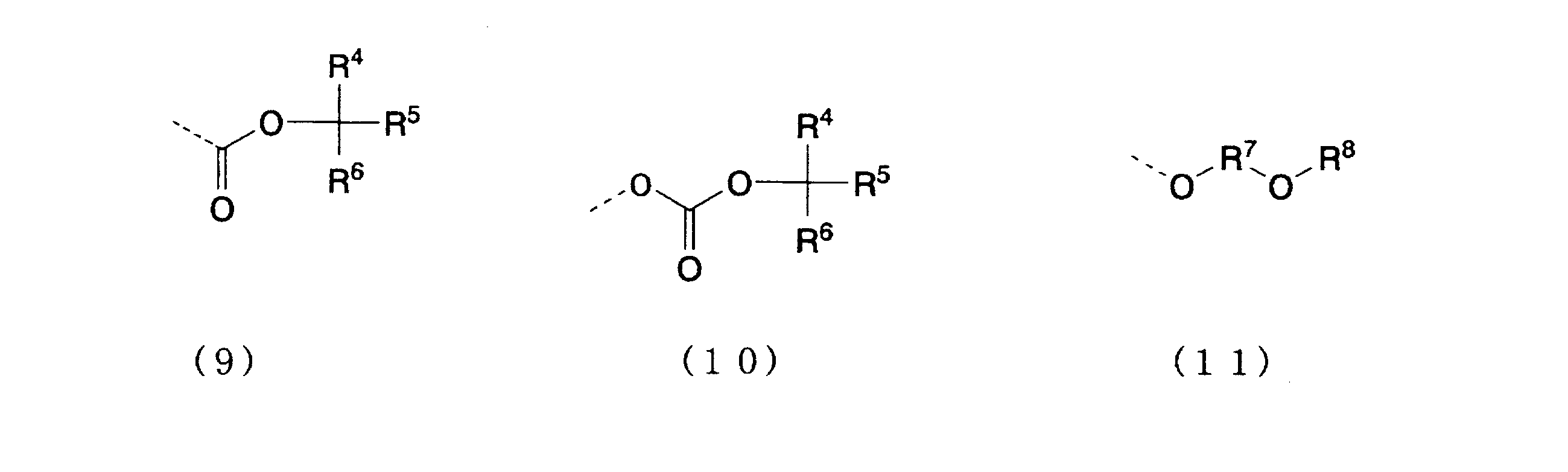
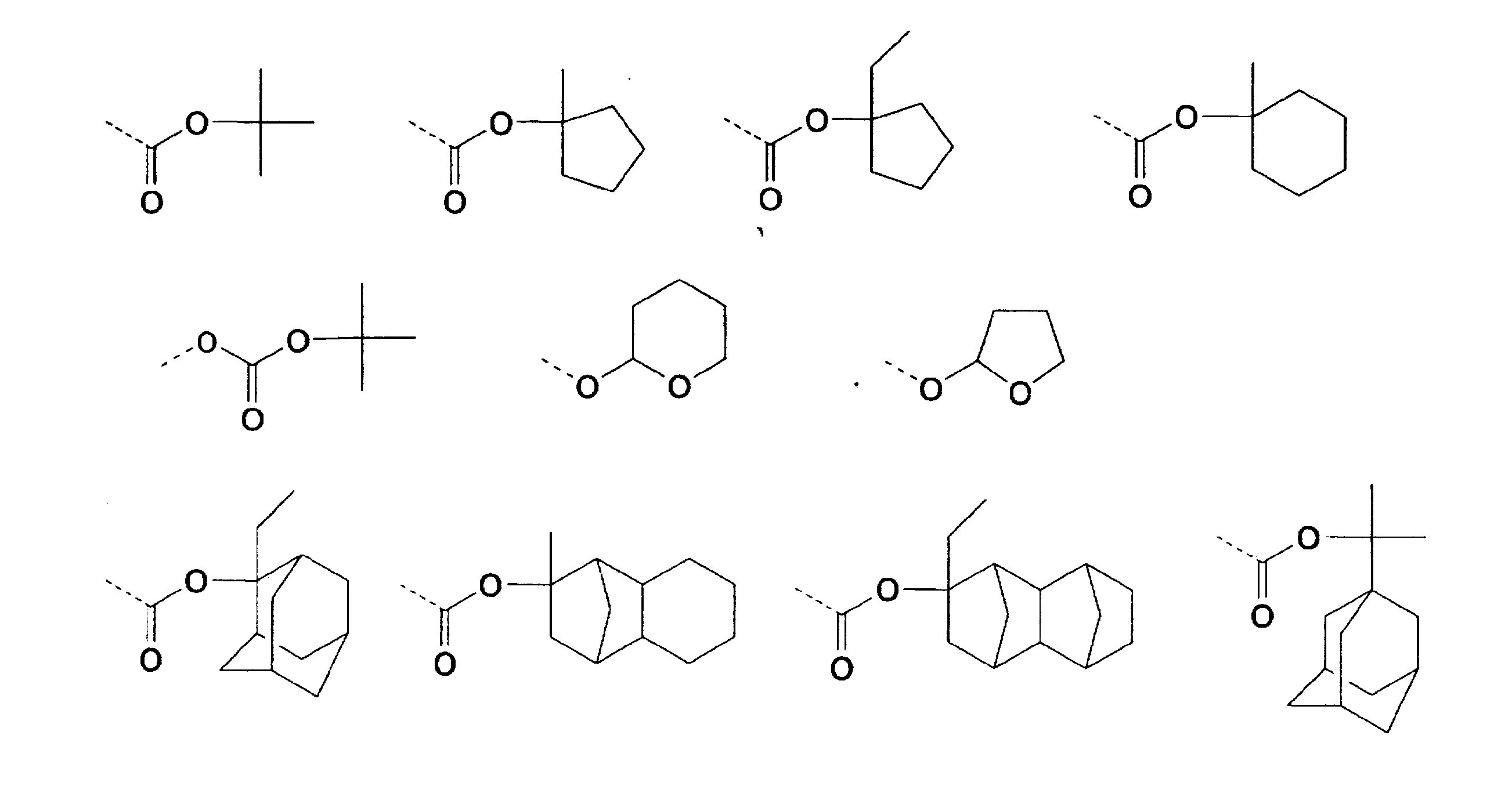
- the polymerizable monomer having an acid labile group other than the fluorine-containing polymerizable monomer represented by the general formulas (1) to (4) that can be used in the present invention has an acid labile group as a photoacid generator. Any one can be used without particular limitation as long as it is hydrolyzed by an acid generated from the acid, and the polymerizable group may be an alkenyl group or a cycloalkenyl group, and may be a vinyl group, 1-methylvinyl group or 1-trimethyl group. Those having a fluoromethylvinylvinyl group are preferred. For example, monomers having groups represented by the following general formulas (9) to (11) can be preferably used.
- R 4 , R 5 , R 6 , R 7 , and R 8 may be the same, and are a linear, branched, or cyclic alkyl group having 1 to 25 carbon atoms, a part of which May contain a fluorine atom, an oxygen atom, a nitrogen atom, a sulfur atom, or a hydroxyl group. Two of R 4 , R 5 and R 6 may combine to form a ring.
- a unit (adhesive group) containing a lactone structure can be introduced for the purpose of improving the adhesiveness to the substrate.
- a lactone structure-containing polymerizable monomer is preferably used.
- Such lactone structures include monocyclic lactone structures such as groups in which one hydrogen atom has been removed from ⁇ -butyrolactone or mevalonic lactone, and polycyclic lactones such as groups in which norbornane lactone has been removed from one hydrogen atom.
- a structure etc. can be illustrated.
- the copolymerizable monomer that can be used in the present invention may be used alone or in combination of two or more.
- the fluoropolymer according to the present invention may be composed of repeating units composed of a plurality of monomers. Although the ratio is set without particular limitation, for example, the following ranges are preferably employed.
- the fluorine-containing polymer according to the present invention is preferably composed only of repeating units formed by cleavage of the fluorine-containing polymerizable monomers represented by the general formulas (1) to (4). Further, this repeating unit can be contained in an amount of 1 to 100 mol%, more preferably 5 to 90 mol%.
- the fluoropolymer according to the present invention may contain 1 to 80 mol%, preferably 5 to 70 mol%, more preferably 10 to 60 mol% of repeating units having an acid labile group. Further, it may contain a repeating unit having no acid labile group by other polymerizable monomer, and may contain 1 to 80 mol%, more preferably 5 to 50 mol% of all repeating units.
- the repeating unit formed by cleavage of the fluorine-containing polymerizable monomer represented by the general formulas (1) to (4) is smaller than 1 mol%, it is clear that the monomer of the present invention is used. Cannot be expected. Further, when the repeating unit having an acid labile group is smaller than 1 mol%, it is not preferable because there is no effect of introducing the acid labile group. At this time, a monomer other than the monomers represented by the general formulas (1) to (4) may be used for forming the repeating unit having an acid labile group, or the general formulas (1) to (4) The monomer represented by 4) may be derived from a monomer having an acid labile group.
- an acid labile group may be introduced by a polymer reaction after polymerization.
- Repeating units derived from other polymerizable monomers that do not contain acid labile groups are used to improve the solubility of the fluoropolymer in organic solvents, the etching resistance of the film, the mechanical strength, etc. If the amount is less than 1 mol%, the effect is not exhibited. If the amount exceeds 80 mol%, the content of repeating units formed by cleavage of the fluorine-containing polymerizable monomers represented by the general formulas (1) to (4) is small. This is not preferable because the effect cannot be sufficiently exhibited.
- the method for polymerizing the fluoropolymer according to the topcoat composition of the present invention is not particularly limited as long as it is a commonly used method, but radical polymerization, ionic polymerization, etc. are preferable. Living anionic polymerization, cationic polymerization, ring-opening metathesis polymerization, vinylene polymerization, and the like can also be used.
- Radical polymerization is carried out in the presence of a radical polymerization initiator or a radical initiator by a known polymerization method such as bulk polymerization, solution polymerization, suspension polymerization or emulsion polymerization, and is either batch-wise, semi-continuous or continuous. This can be done by operation.
- a radical polymerization initiator or a radical initiator by a known polymerization method such as bulk polymerization, solution polymerization, suspension polymerization or emulsion polymerization, and is either batch-wise, semi-continuous or continuous. This can be done by operation.
- the radical polymerization initiator is not particularly limited, and examples thereof include azo compounds, peroxide compounds, and redox compounds. Particularly, azobisisobutyronitrile, t-butylperoxypivalate, Di-t-butyl peroxide, i-butyryl peroxide, lauroyl peroxide, succinic acid peroxide, dicinnamyl peroxide, di-n-propyl peroxydicarbonate, t-butyl peroxyallyl monocarbonate, benzoyl peroxide, Hydrogen peroxide, ammonium persulfate and the like are preferable.
- the reaction vessel used for the polymerization reaction is not particularly limited.
- a polymerization solvent may be used.
- the polymerization solvent those which do not inhibit radical polymerization are preferable, and typical ones are ester systems such as ethyl acetate and n-butyl acetate, ketone systems such as acetone and methyl isobutyl ketone, and hydrocarbons such as toluene and cyclohexane.
- alcohol solvents such as methanol, isopropyl alcohol, and ethylene glycol monomethyl ether. It is also possible to use various solvents such as water, ethers, cyclic ethers, chlorofluorocarbons, and aromatics.
- the reaction temperature of the copolymerization reaction is appropriately changed depending on the radical polymerization initiator or the radical polymerization initiator, and is usually preferably 20 to 200 ° C, particularly preferably 30 to 140 ° C.
- a transition metal catalyst of 4 to 7 groups may be used in the presence of a cocatalyst, and a known method may be used in the presence of a solvent.
- the polymerization catalyst is not particularly limited, and examples thereof include Ti-based, V-based, Mo-based, and W-based catalysts.
- titanium (IV) chloride, vanadium (IV) chloride, vanadium trisacetylacetonate. Vanadium bisacetylacetonate dichloride, molybdenum chloride (VI), tungsten chloride (VI) and the like are preferable.
- the catalyst amount is 10 mol% to 0.001 mol%, preferably 1 mol% to 0.01 mol%, based on the monomer used. *
- cocatalysts examples include alkylaluminum and alkyltin, and in particular, trimethylaluminum, triethylaluminum, tripropylaluminum, triisopropylaluminum, triisobutylaluminum, tri-2-methylbutylaluminum, tri-3-methylbutylaluminum.
- Dimethylaluminum chloride, diethylaluminum chloride, diisopropylaluminum chloride, diisobutylaluminum chloride which dialkylaluminum halides, methylaluminum dichloride, ethylaluminum dichloride, ethylaluminum diiodide, propylaluminum dichloride, isopropylaluminum dichloride, butylaluminum dichloride, monoalkylaluminum halides such as isobutylaluminum dichloride, methylaluminum sesquichloride, ethylaluminum Examples include aluminum series such as alkylaluminum sesquichlorides such as sesquichloride, propylaluminum sesquichloride, and isobutylaluminum sesquichloride, tetra-n-butyltin, tetraphenyltin, and triphenylchlorotin.
- the polymerization solvent only needs to inhibit the polymerization reaction.
- Representative examples include aromatic hydrocarbons such as benzene, toluene, xylene, chlorobenzene and dichlorobenzene, hydrocarbons such as hexane, heptane and cyclohexane, Examples thereof include halogenated hydrocarbons such as carbon tetrachloride, chloroform, methylene chloride, and 1,2-dichloroethane. These solvents can be used alone or in combination of two or more.
- the reaction temperature is usually preferably -70 to 200 ° C, particularly preferably -30 to 60 ° C.
- vinylene polymerization is a transition metal catalyst of group 8 to 10 such as iron, nickel, rhodium, palladium and platinum, or a metal catalyst of group 4 to 6 such as zirconium, titanium, vanadium, chromium, molybdenum and tungsten. May be used, and a known method may be used in the presence of a solvent.
- a transition metal catalyst of group 8 to 10 such as iron, nickel, rhodium, palladium and platinum
- a metal catalyst of group 4 to 6 such as zirconium, titanium, vanadium, chromium, molybdenum and tungsten. May be used, and a known method may be used in the presence of a solvent.
- Examples of the cocatalyst include alkylaluminoxane, alkylaluminum, and the like.
- methylaluminoxane (MAO) trimethylaluminum, triethylaluminum, tripropylaluminum, triisopropylaluminum, triisobutylaluminum, tri-2-methylbutylaluminum, Tri-3-methylbutylaluminum, tri-2-methylpentylaluminum, tri-3-methylpentylaluminum, tri-4-methylpentylaluminum, tri-2-methylhexylaluminum, tri-3-methylhexylaluminum, trioctyl Trialkylaluminums such as aluminum, dimethylaluminum chloride, diethylaluminum chloride, diisopropylaluminum Dialkylaluminum halides such as dimethyl chloride, diisobutylaluminum chloride, methylaluminum dichloride,
- the amount of cocatalyst is 50 to 500 equivalents in terms of Al in the case of methylaluminoxane, and in the case of other alkylaluminums, it is in a range of 100 equivalents or less, preferably 30 equivalents or less in terms of molar ratio to the transition metal catalyst.
- the polymerization solvent only needs to inhibit the polymerization reaction.
- Representative examples include aromatic hydrocarbons such as benzene, toluene, xylene, chlorobenzene and dichlorobenzene, hydrocarbons such as hexane, heptane and cyclohexane, Examples thereof include halogenated hydrocarbons such as carbon tetrachloride, chloroform, methylene chloride and 1,2-dichloroethane, dimethylformamide, N-methylpyrrolidone, N-cyclohexylpyrrolidone and the like. These solvents can be used alone or in combination of two or more.
- the reaction temperature is usually preferably -70 to 200 ° C, particularly preferably -40 to 80 ° C.
- any known method can be used. There are methods such as precipitation filtration or heating distillation under reduced pressure.
- the number average molecular weight of the fluoropolymer according to the topcoat composition of the present invention is usually in the range of 1,000 to 100,000, preferably 3,000 to 50,000.
- the molecular weight dispersion is 1 to 4, preferably 1 to 2.5.
- solubility and casting properties can vary depending on molecular weight.
- Polymers with a high molecular weight have a slower dissolution rate in the developer, and dissolution rates can be faster with a low molecular weight.
- the molecular weight can be controlled by adjusting the polymerization conditions as appropriate based on common knowledge in this technical field. Is possible.
- the fluorinated polymer according to the present invention contains an alicyclic structure and a hexafluoroisopropyl hydroxyl group bonded to the ring, it has a characteristic that the absorbance at a wavelength of 300 nm or less is very low. Therefore, in the exposure, it is possible to use a high energy ray of 300 nm or less.
- the fluoropolymer used for the topcoat composition of the present invention has an alicyclic structure, it gives a relatively high glass transition temperature (Tg). When the glass transition temperature (Tg) is low, the resist constituent components are diffused into the topcoat layer, which is not preferable.
- the fluoropolymer according to the present invention depends on the components to be copolymerized, it has a Tg of about 120 ° C. or higher, and is higher than the baking temperature (100 ° C.), so that such diffusion can be suppressed.
- the topcoat composition of the present invention is used after the fluoropolymer produced above is dissolved in an organic solvent or a mixture of water and an organic solvent.
- an organic solvent that can be used, it is an essential requirement that the solvent is a solvent that hardly erodes the underlying resist film and that is difficult to extract additives and the like from the resist film.
- the organic solvent that hardly erodes the resist film and hardly extracts additives from the resist film includes hydrocarbon solvents, alcohols, ethers, esters, fluorine-based solvents, etc., depending on the composition of the underlying resist film. .
- alkanes such as pentane, hexane, heptane, octane, nonane, decane, hydrocarbon solvents of alicyclics, butanol (normal, iso-isomer, tertiary), methyl ethyl carbinol, pentanol, amyl.
- Alcohols such as alcohol, hexyl alcohol, heptyl alcohol, 4-methyl-2-pentanol, and more preferably a hydrocarbon solvent partially substituted with fluorine are preferably used.
- the hydrocarbon solvent partially substituted with fluorine is an alkane or alicyclic hydrocarbon solvent or alcohol, in which a part of the hydrogen is substituted with a fluorine atom.
- the top coat composition is applied onto the resist film by a spin coat method. Therefore, in these solvents, it is desirable in terms of handling that the boiling point range is suitable for spin coating, that is, the boiling point is about 70 ° C. to 170 ° C.
- hydrocarbons and alcohols having a specific carbon number are preferable in terms of boiling point. If the carbon number is too small, the boiling point is lower than 70 ° C., and if the carbon number is too large, the boiling point exceeds 170 ° C., which is not suitable for spin coating.
- solvents examples include alkanes having 5 to 20 carbon atoms or alicyclic hydrocarbons, hydrocarbon alcohols having 1 to 20 carbon atoms, or those in which the above hydrocarbons or alcohols are partially substituted with fluorine atoms.
- One organic solvent selected from the group consisting of two or more mixed solvents is preferred.
- One organic solvent selected from the group consisting of those or a mixture of two or more thereof may be mentioned.
- composition of hydrocarbons and hydrocarbon alcohols that provide boiling points suitable for spin coating is 50 to less than 99.9% of hydrocarbons having 5 to 20 carbon atoms, and 0.8% of hydrocarbon alcohols having 1 to 20 carbon atoms.
- a solvent mixed at 1% or more and less than 50% is preferable.
- a solvent in which a hydrocarbon having 5 to 10 carbon atoms is mixed at 50 to less than 99.9% and a hydrocarbon alcohol having 1 to 10 carbon atoms at 0.1 to 50% is used.
- the amount of the solvent to be blended is not particularly limited, but it is preferably used so that the solid content concentration of the top coat composition is 3 to 25%, more preferably 5 to 15%. By adjusting the solid content concentration of the topcoat composition, it is possible to adjust the film thickness of the resin film to be formed.
- a hydrophobic additive for suppressing the influence on the swelling and penetration of water an acidic additive for promoting solubility in a developer, and the like can be suitably used.
- the topcoat composition according to the present invention can be used without limitation on the type of resist in the lower layer. That is, the lower layer resist can be suitably used even if it is an arbitrary resist system such as a negative type, a positive type, and a composite type.
- the wavelength used for exposure is not limited, as described above, high-energy rays of 300 nm or less can be used, and KrF excimer laser (248 nm), ArF excimer laser (193 nm), F 2 laser (157 nm), EUV, EB, X A wire can be used preferably, and is particularly preferably used for an ArF excimer laser.
- the topcoat composition of the present invention is suitably applied in immersion lithography.
- the present invention is used in manufacturing a device (semiconductor device) using immersion lithography.
- a device semiconductor device
- the semiconductor device manufactured by microfabrication such as CPU, SRAM, DRAM, etc. which are formed in a silicon wafer, a compound semiconductor substrate, an insulating substrate, etc. is mentioned.
- a resist composition solution is applied onto a support such as a silicon wafer or a semiconductor manufacturing substrate with a spinner or the like and then pre-baked to form a resist layer.
- Conditions for this step can be appropriately set according to the composition of the resist composition to be used.
- the top coat composition solution of the present invention is uniformly applied to the surface of the resist film formed as described above with a spinner or the like, and then heat-treated to form two layers coated on the resist layer with the top coat layer.
- a resin film made of a film is formed.
- the substrate on which this resin layer is formed is immersed in a medium such as water, and then irradiated with high energy rays of 300 nm or less through a desired mask pattern. At this time, the exposure light passes through the medium (for example, water) and the top coat layer and reaches the resist layer. Further, since the resist layer is separated from the medium (for example, water) by the top coat layer, the medium (for example, water) is immersed in the resist layer to swell, or conversely, the resist is eluted into the medium (for example, water). There is nothing.
- the exposed substrate is baked, it is developed using a developer, for example, an alkaline aqueous solution such as a 0.1 to 10% by weight tetramethylammonium hydroxide aqueous solution.
- a developer for example, an alkaline aqueous solution such as a 0.1 to 10% by weight tetramethylammonium hydroxide aqueous solution.
- the top coat layer is first completely dissolved, and then the resist film in the exposed portion is dissolved. That is, it is possible to dissolve and remove a part of the topcoat layer and the resist layer by one development process, and it is possible to obtain a resist pattern corresponding to a desired mask pattern.
- Non-Patent Document 2 Basil S. et al. Farah, Everett E. et al. Gilbert, Morton Litt, Julian A. Otto, John P. Sibilia J. et al. Org. Chem. 1965, 30 (4), pp 1003-1005
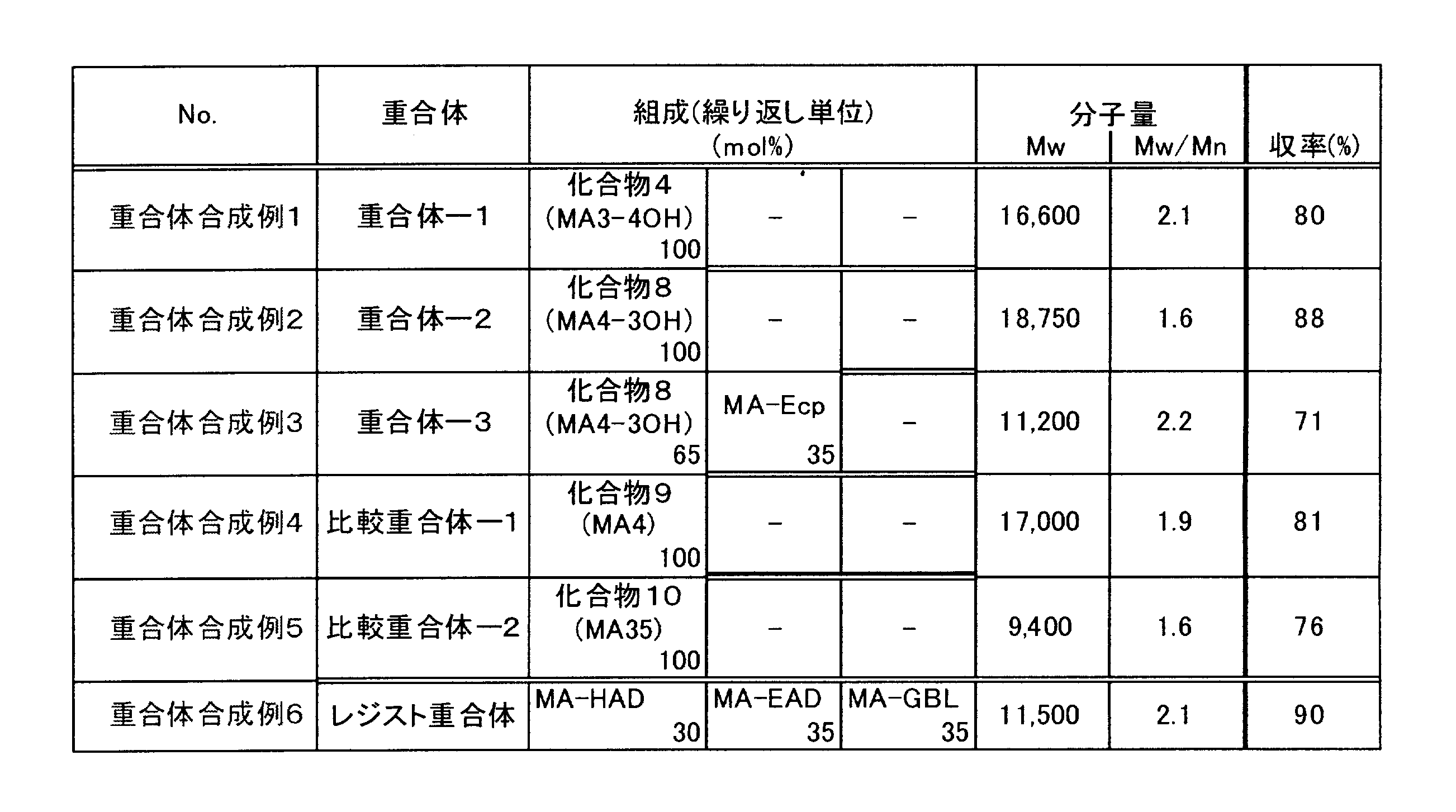
- Polymer Synthesis Example 1 Polymer-1: Compound-4; Homopolymer of MA3-4OH
- the molecular weight (number average molecular weight Mn) and molecular weight dispersion (ratio Mw / Mn of Mn to weight average molecular weight Mw) of the polymer is HLC-8320GPC manufactured by Tosoh.
- one ALPHA-M column and one ALPHA-2500 column manufactured by Tosoh were connected in series, and measurement was performed using tetrahydrofuran as a developing solvent.
- a refractive index difference detector was used as the detector.
- the results are shown in Table 1.
- the composition of the copolymer was determined by 1 H-NMR and 19 F-NMR, and the results are shown in the column of “Composition (Repeating unit)” in Table 1. Same for other polymers.
- top coat composition The evaluation as a top coat composition is shown below.
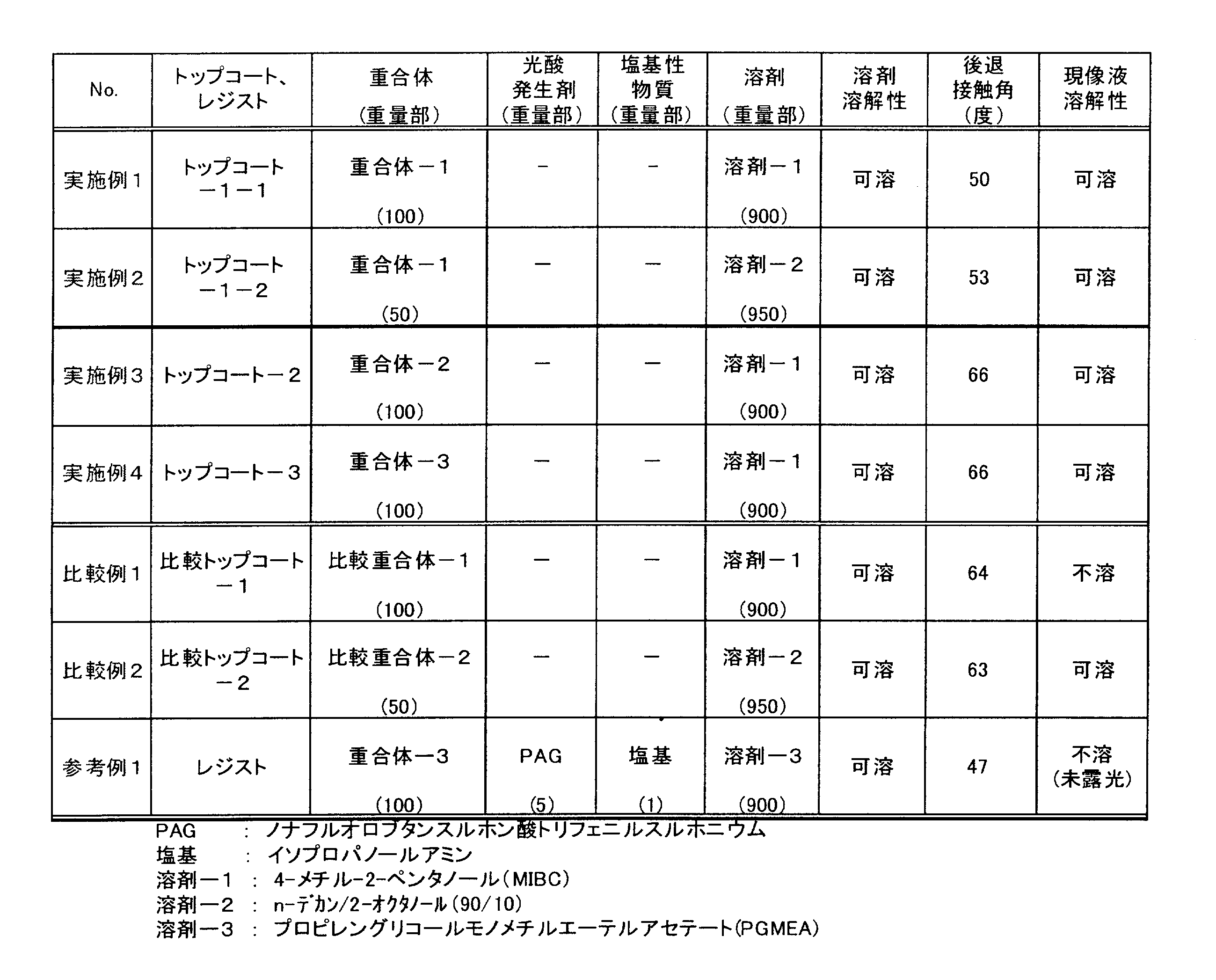
- Each top coat solution is filtered through a membrane filter (0.2 ⁇ m) on a silicon wafer that has been previously treated with an antireflection film (ARC29A, manufactured by Nissan Chemical Industries, 78 nm; baked at 200 ° C. for 60 seconds), and then a spinner is used. Then, spin coating was performed at a rotation speed of 1,500 rpm, and drying was performed on a hot plate at 100 ° C. for 90 seconds, whereby uniform resin films were obtained (Examples 1 to 4, Comparative Examples 1 and 2).
- ARC29A antireflection film
- the receding contact angle was measured for the resin films obtained in Examples 1 to 4 and Comparative Examples 1 and 2 and the resist film obtained from Polymer Synthesis Example 6.
- the receding contact angle of water droplets was measured by the expansion / contraction method of a dynamic contact angle meter (manufactured by Kyowa Interface Science Co., Ltd.) An initial droplet size of 7 ⁇ L was sucked at a rate of 6 ⁇ L / sec for 8 seconds, and a value with a stable dynamic contact angle during suction was defined as a receding contact angle. The results are shown in Table 2.
- the top coat blended with the fluoropolymer and the comparative top coats 1-2 showed a receding contact angle of 50 degrees or more. There was a tendency for the receding contact angle of the resin film to be higher than that of the resist film (Reference Example 1; 47 degrees).
- Resin film formation process resist composition application, topcoat solution application
- the resist solution obtained in Reference Example 1 was spin-coated on a silicon wafer using a spinner and then dried on a hot plate at 100 ° C. for 90 seconds to obtain a resist film having a thickness of 150 nm.
- the top coat-1-1 solution filtered through a membrane filter (0.2 ⁇ m) is spin-coated on this resist film using a spinner and then dried on a hot plate at 100 ° C. for 90 seconds to obtain a total film thickness.
- a 200 nm resin film (a two-layer film composed of a resist layer and a topcoat layer) was formed.
- a silicon film on which a resist film is formed is coated with a solution of each of top coats 1-2, 2, 3, and comparative top coats 1 and -2 to form a resin film (resist layer having a total film thickness of about 200 nm). And a two-layer film comprising a top coat layer).
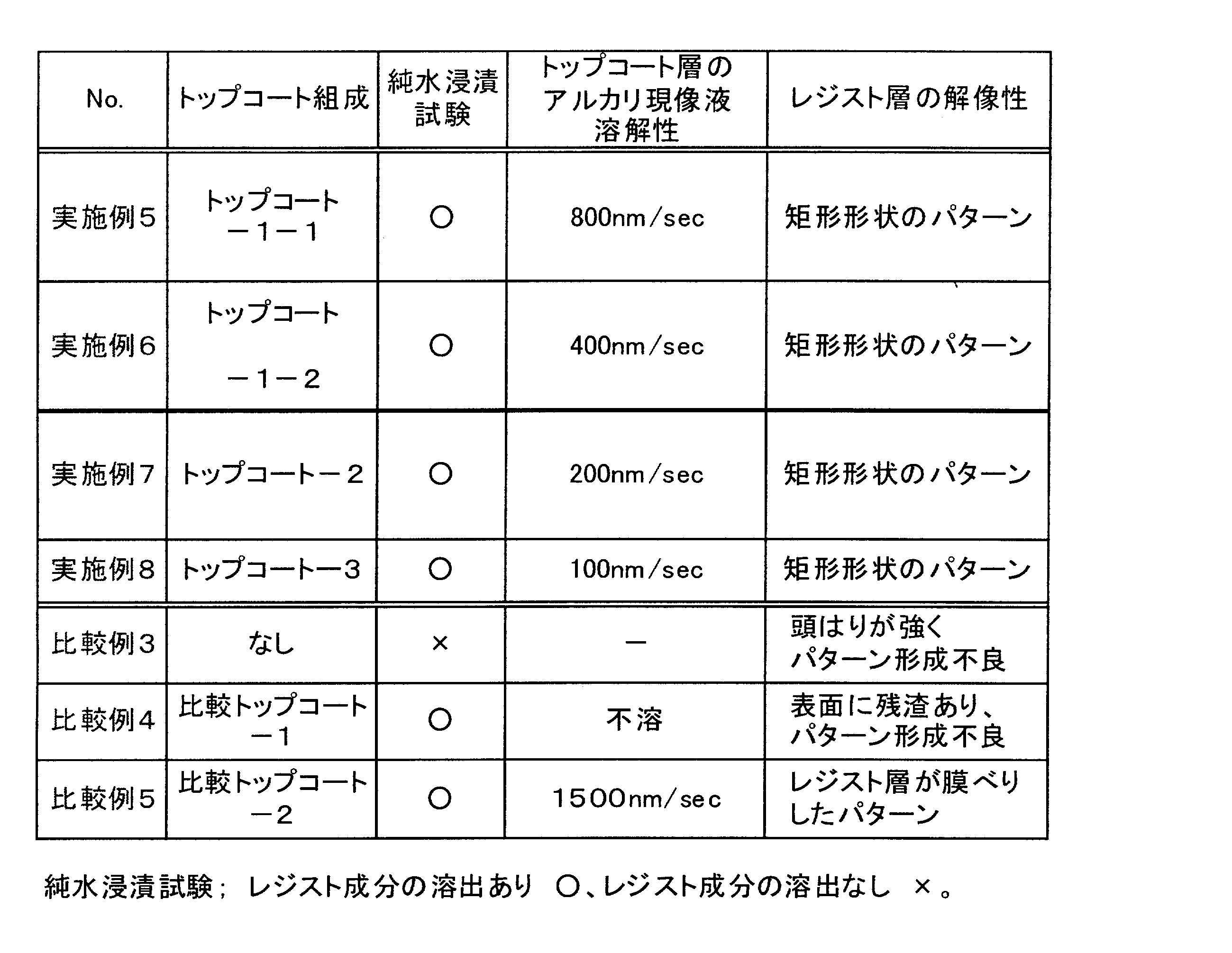
- the resin film formed on the silicon wafer was subjected to the following pure water immersion treatment, top coat layer alkali developer solubility test, and exposure resolution test. The results of these tests are shown in Table 3.
- Comparative Example 4 was insoluble in an alkali developer, and Comparative Example 5 had an extremely high alkali developer dissolution rate, whereas the topcoats of Examples 5 to 8 exhibited intermediate dissolution rates.
Landscapes
- Chemical & Material Sciences (AREA)
- Physics & Mathematics (AREA)
- General Physics & Mathematics (AREA)
- Health & Medical Sciences (AREA)
- Chemical Kinetics & Catalysis (AREA)
- Medicinal Chemistry (AREA)
- Polymers & Plastics (AREA)
- Organic Chemistry (AREA)
- Engineering & Computer Science (AREA)
- Architecture (AREA)
- Structural Engineering (AREA)
- Spectroscopy & Molecular Physics (AREA)
- Materials For Photolithography (AREA)
- Addition Polymer Or Copolymer, Post-Treatments, Or Chemical Modifications (AREA)
- Photosensitive Polymer And Photoresist Processing (AREA)
- Paints Or Removers (AREA)
- Exposure Of Semiconductors, Excluding Electron Or Ion Beam Exposure (AREA)
Abstract
Description

レジスト膜上に設けられて、前記レジスト膜を保護するトップコート組成物であって、下記一般式(5)で表される繰返し単位を有する含フッ素重合体を含むことを特徴とするフォトレジスト用トップコート組成物。

一般式(5)で表される繰り返し単位において、R2およびR3がともに水素原子である発明1に記載のトップコート組成物。
下記一般式(6)~一般式(8)で表される繰返し単位の少なくとも一つを有する含フッ素重合体を含むことを特徴とする発明2に記載のトップコート組成物。

含フッ素重合体が、酸不安定基を有する繰返し単位を含むことを特徴とする発明1から発明3の何れか1つに記載のトップコート組成物。
有機溶剤を含むことを特徴とする発明1から発明4のいずれか1つに記載のトップコート組成物。
有機溶剤が炭素数5~20の環状または鎖状の炭化水素、炭素数1~20のアルコール、部分的にフッ素で置換された環状または鎖状炭化水素よりなる群より選ばれる1種または2種以上からなる有機溶剤である発明5に記載のトップコート組成物。
有機溶剤が炭素数5~20の炭化水素を50%以上99.9%未満、炭素数1~20のアルコールを0.1%以上50%未満で混合した溶剤である発明5または発明6に記載のトップコート組成物。
液浸リソグラフィーに用いることを特徴とする発明1~7のいずれか1つに記載のトップコート組成物。
発明1から発明8のいずれか1つのトップコート組成物から形成された半導体装置製造用のトップコート。
発明9のトップコートを使用して製造した半導体装置。

「非特許文献3」Basil S.Farah,Everett E.Gilbert,Morton Litt,Julian A.Otto,John P.SibiliaJ.Org.Chem.,1965,30(4),pp 1003-1005


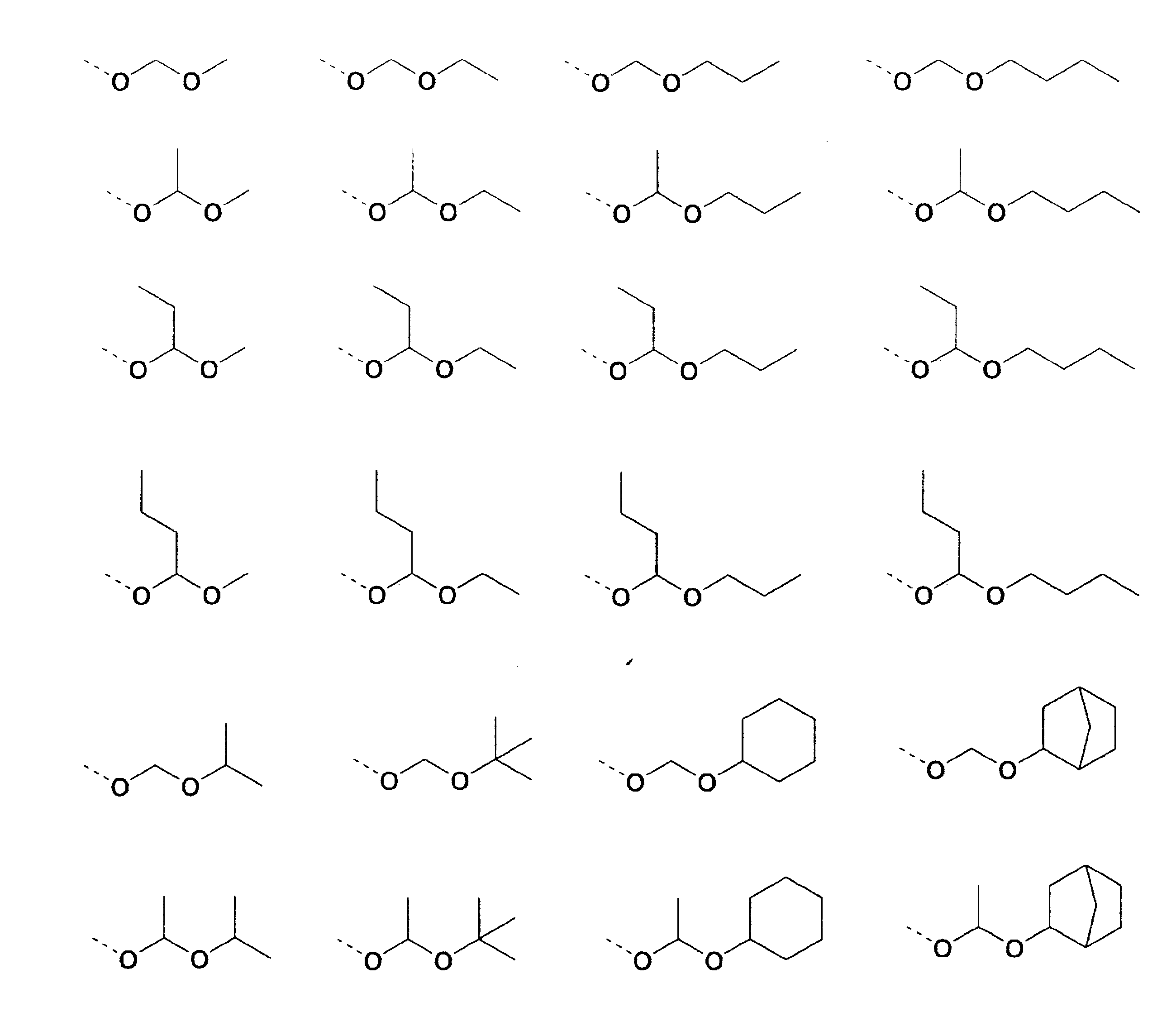
また、特に本発明のトップコート組成物は液浸リソグラフィーにおいて、好適に応用される。
(1)化合物-2: 1-(1,1,1,3,3,3-ヘキサフルオロ-2-ヒドロキシ-2-プロピル)-2,5-ジヒドロキシベンゼンの合成

19F-NMR(溶媒:重アセトン,基準物質:CCl3F);δ(ppm)-75.05 (6F,s)
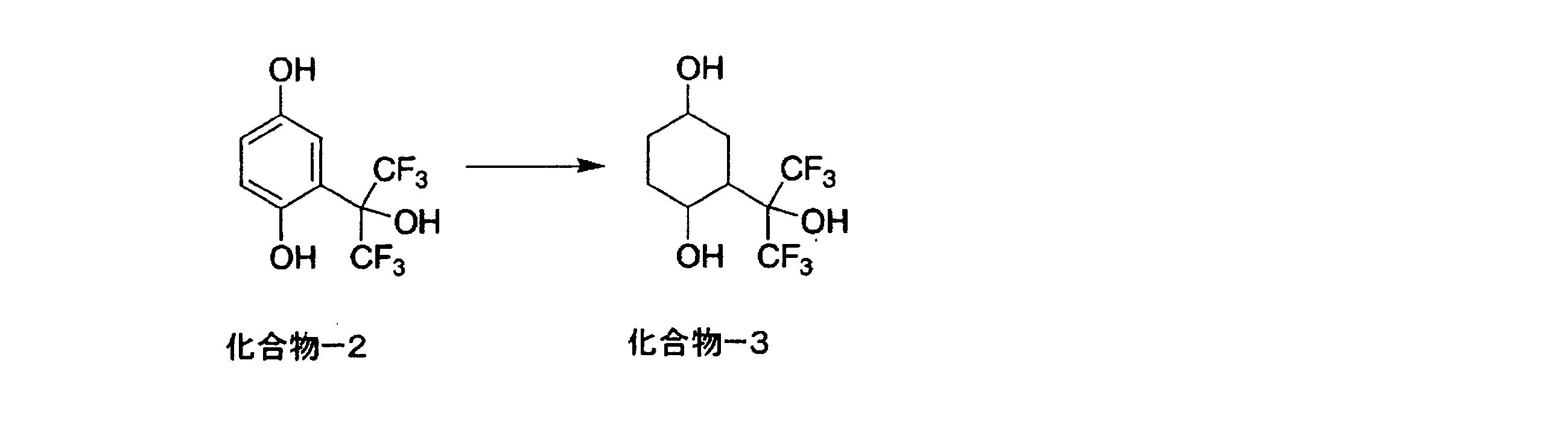
化合物-3A:
19F-NMR(溶媒:重アセトン,基準物質:CCl3F);δ(ppm)-71.25 (3F,q,J=12Hz),-73.86 (3F,q,J=12Hz)
化合物-3B:
19F-NMR(溶媒:重アセトン,基準物質:CCl3F);δ(ppm)-71.25 (3F,q,J=12Hz),-73.86 (3F,q,J=12Hz)

19F-NMR(溶媒:CDCl3,基準物質:CCl3F);δ(ppm)-72.42(3F,q,J=12Hz),-74.72(3F,q,J=12Hz)
(1)化合物-6:1-(1,1,1,3,3,3-ヘキサフルオロ-2-ヒドロキシ-2-プロピル)-2,4-ジヒドロキシベンゼンの合成

「非特許文献2」Basil S.Farah,Everett E.Gilbert,Morton Litt,Julian A.Otto,John P.SibiliaJ.Org.Chem.,1965,30(4),pp1003-1005
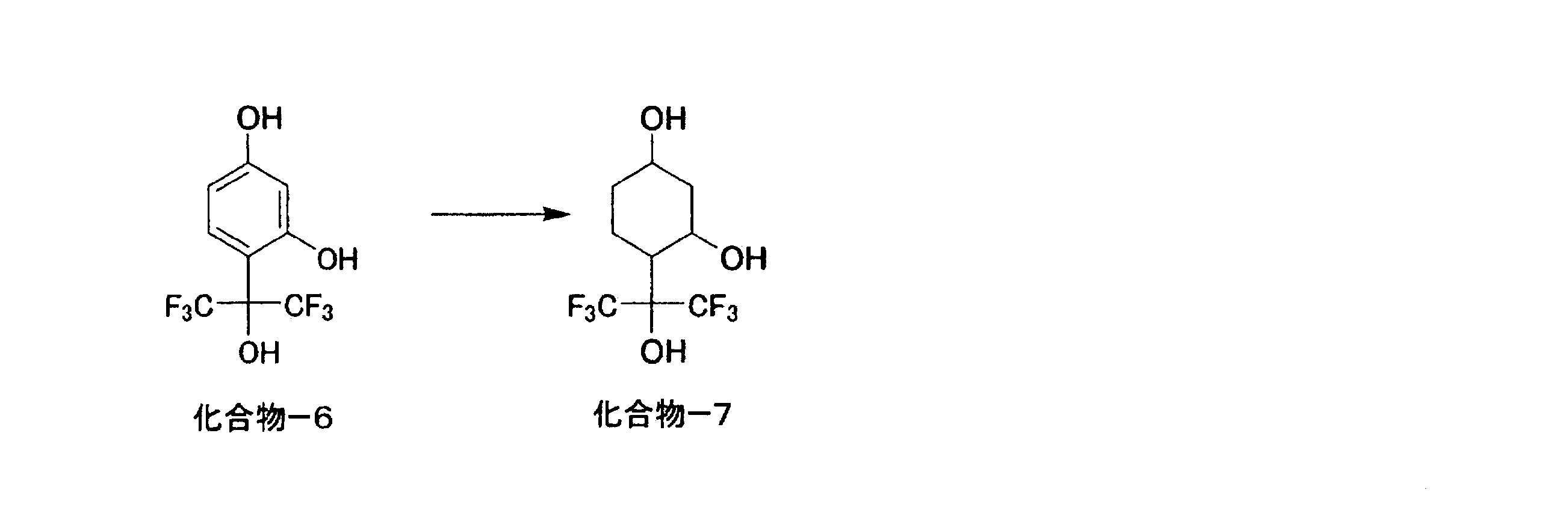

19F-NMR(溶媒:CDCl3 ,基準物質:C6F6);δ(ppm)87.12 (3F,q,J=11.3Hz),89.70 (3F,q,J=11.3Hz)IR(ATR法):ν=3387,1685,1269,1200,1151,1136,1107,1095,979,952cm-1
GC-MS(FI+法):m/e 350(M+)
重合体-1:化合物-4;MA3-4OHのホモポリマー
重合体の分子量(数平均分子量Mn)と分子量分散(Mnと重量平均分子量Mwの比Mw/Mn)は、東ソー製HLC-8320GPCを使用し、東ソー製ALPHA-MカラムとALPHA-2500カラムを1本ずつ直列に繋ぎ、展開溶媒としてテトラヒドロフランを用いて測定した。検出器は屈折率差検出器を用いた。結果を表1に示した。また、共重合体の組成は1H-NMRおよび19F-NMRにより決定し、結果は表1の「組成(繰り返し単位)」の欄に示した。他の重合体において同じ。

重合体-2:化合物-8;MA4-3OHのホモポリマー

重合体-3: 化合物-8/MA-ECp共重合系

比較重合体-1: 化合物-9;MA4のホモポリマー

比較重合体-2: 化合物-10;MA35のホモポリマー

レジスト用重合体:レジスト-1
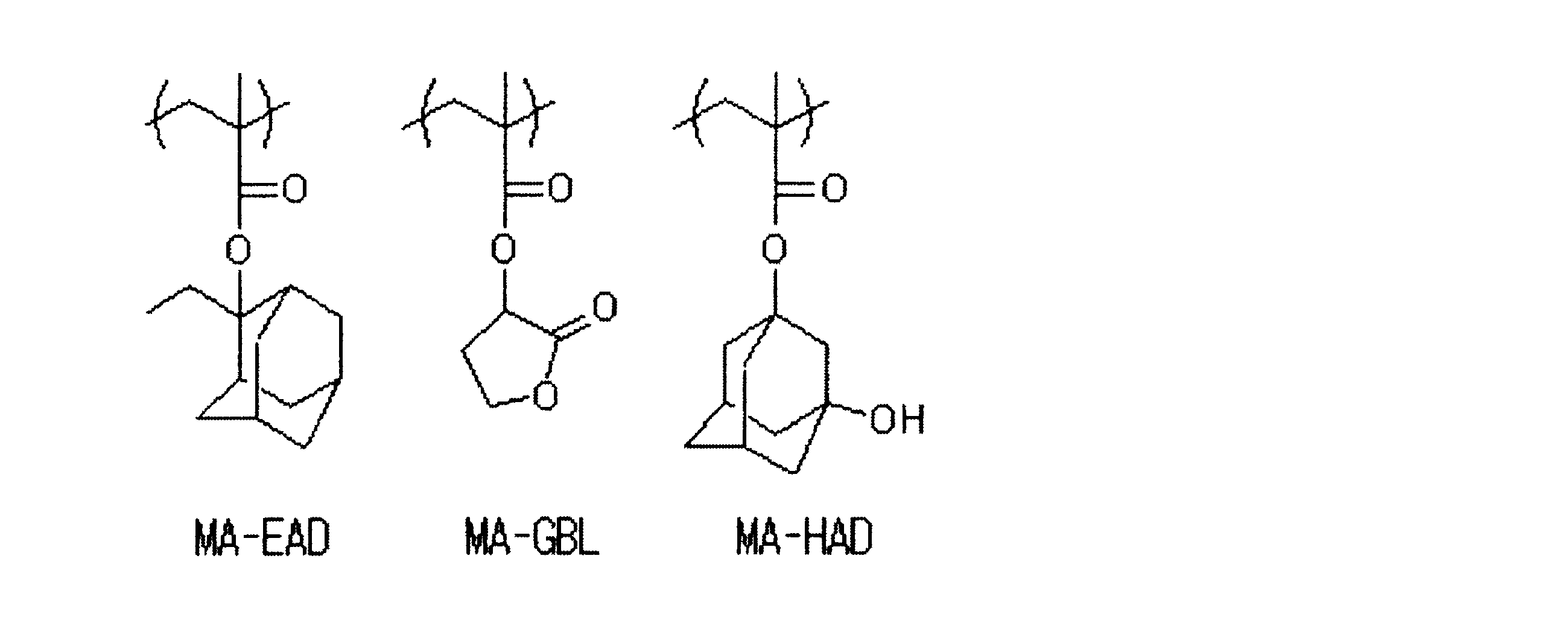
・トップコート組成物配合
重合体合成例1~5で得られた重合体を用い、それぞれ表2の実施例1~4、比較例1および比較例2に示す割合で溶剤に溶解して、調製したところ、いずれも均一で透明なトップコート溶液(トップコート-1-1、トップコート-1-2、トップコート-2、トップコート-3、比較トップコート-1、比較トップコート-2)が得られた。
重合体合成例6で得られたレジスト用重合体をプロピレングリコールモノメチルエーテルアセテート(PGMEA)に溶解し、固形分12%に調整した。さらに酸発生剤としてノナフルオロブタンスルホン酸トリフェニルスルホニウムを重合体100重量部に対して5重量部、塩基としてイソプロパノールアミンを同2重量部溶解し、レジスト溶液を調製した。実施例1と同様に、反射防止膜処理したシリコンウェハーに同様な条件で塗布、乾燥を行いレジスト膜を形成した(参考例1)。
トップコート溶液およびレジスト組成物の配合を調整するにあたり、上記のように表2に示した溶剤を用いトップコート溶液およびレジスト組成物を調製した。いずれも、良好な溶解性を示した。結果を表2に示した。
実施例1~4、比較例1、2で得られた樹脂膜と重合体合成例6から得たレジスト膜について後退接触角を測定した。動的接触角計(協和界面科学社製)の拡張縮小法により、水滴の後退接触角を測定した。初期液滴サイズ7μLを6μL/秒の速度にて8秒間吸引し、吸引中の動的接触角が安定した値を後退接触角とした。結果を表2に示す。
実施例1~4、比較例1および2で得られた樹脂膜を2.38重量%テトラメチルアンモニウムヒドロキシド水溶液(現像液)に室温で60秒間浸漬したところ、比較トップコート-1を用いた場合(比較例1)を除き、速やかに、膜が溶解して消失した。なお、参考例1で得られたレジスト膜について同様に溶解性を測定したところ、未露光であるため膜の溶解は観察されなかった。
参考例1で調製したレジスト溶液、実施例1~4および比較例1~2で調製したトップコート溶液を用いて、下記に示すプロセスでシリコンウエハー上にレジスト層とトップコート層の2層膜よりなる樹脂膜を形成した。
参考例1で得られたレジスト溶液を、スピナーを用いてシリコンウェハー上にスピンコート後、ホットプレート上で100℃で90秒間乾燥し、膜厚150nmのレジスト膜を得た。このレジスト膜上に、メンブランフィルター(0.2μm)でろ過したトップコート-1-1の溶液を、スピナーを用いてスピンコート後、ホットプレート上で100℃で90秒間乾燥して、合計膜厚200nmの樹脂膜(レジスト層とトップコート層からなる2層膜)を形成した。
上記の方法で樹脂膜を形成したシリコンウェハー20枚を、それぞれ、20mlの純水に10分浸漬して溶出物を抽出後、当該抽出液をイオンクロマトグラフィにて測定して、溶出物の有無を確認した。トップコートを設けなかったもの(比較例3)を除いて、光酸発生剤やその分解物に帰属されるピークは観測されなかった。これは、トップコートを設けたことにより、レジスト膜からレジスト成分の水への溶出が抑えられたことを示す。
レジストを塗布して樹脂膜を形成したシリコンウェハーを、レジスト現像アナライザー RDA-790(リソテックジャパン(株)製)を用いて室温でアルカリ現像液(2.38重量%テトラメチルアンモニウムヒドロキシド水溶液)に浸漬して溶解速度を測定した。結果を表3に示した。
レジスト膜上にトップコート溶液を塗布して樹脂膜を形成したシリコンウェハーを、100℃で90秒間プリベークを行った後、フォトマスクを介して193nmで露光した。露光後のウェハーを回転させながら純水を2分間滴下した。その後、120℃で60秒間ポストエクスポーザーベークを行い、アルカリ現像液で現像した。アルカリ現像液としては、2.38重量%テトラメチルアンモニウムヒドロキシド水溶液を用いた。
Claims (10)
- レジスト膜上に設けられて、前記レジスト膜を保護するトップコート組成物であって、下記一般式(5)で表される繰返し単位を有する含フッ素重合体を含むことを特徴とするフォトレジスト用トップコート組成物。

- 一般式(5)で表される繰り返し単位において、R2およびR3がともに水素原子である請求項1に記載のトップコート組成物。
- 下記一般式(6)~一般式(8)で表される繰返し単位の少なくとも一つを有する含フッ素重合体を含むことを特徴とする請求項2に記載のトップコート組成物。

- 含フッ素重合体が、酸不安定基を有する繰返し単位を含むことを特徴とする請求項1から請求項3の何れか1項に記載のトップコート組成物。
- 有機溶剤を含むことを特徴とする請求項1から請求項4のいずれか1項に記載のトップコート組成物。
- 有機溶剤が炭素数5~20の環状または鎖状の炭化水素、炭素数1~20のアルコール、部分的にフッ素で置換された環状または鎖状炭化水素よりなる群より選ばれる1種または2種以上からなる有機溶剤である請求項5に記載のトップコート組成物。
- 有機溶剤が炭素数5~20の炭化水素を50%以上99.9%未満、炭素数1~20のアルコールを0.1%以上50%未満で混合した溶剤である請求項5または請求項6に記載のトップコート組成物。
- 液浸リソグラフィーに用いることを特徴とする請求項1~7のいずれか1項に記載のトップコート組成物。
- 請求項1から請求項8のいずれか1項に記載のトップコート組成物から形成された半導体装置製造用のトップコート。
- 請求項9に記載のトップコートを使用して製造した半導体装置。
Priority Applications (2)
| Application Number | Priority Date | Filing Date | Title |
|---|---|---|---|
| KR1020117015035A KR101331919B1 (ko) | 2008-12-15 | 2009-12-11 | 탑코트 조성물, 반도체 장치 제조용의 탑코트 및 반도체 장치 |
| US13/139,641 US8592508B2 (en) | 2008-12-15 | 2009-12-11 | Top coat composition |
Applications Claiming Priority (2)
| Application Number | Priority Date | Filing Date | Title |
|---|---|---|---|
| JP2008-319028 | 2008-12-15 | ||
| JP2008319028 | 2008-12-15 |
Publications (1)
| Publication Number | Publication Date |
|---|---|
| WO2010071081A1 true WO2010071081A1 (ja) | 2010-06-24 |
Family
ID=42268751
Family Applications (1)
| Application Number | Title | Priority Date | Filing Date |
|---|---|---|---|
| PCT/JP2009/070725 Ceased WO2010071081A1 (ja) | 2008-12-15 | 2009-12-11 | トップコート組成物 |
Country Status (4)
| Country | Link |
|---|---|
| US (1) | US8592508B2 (ja) |
| JP (1) | JP5556160B2 (ja) |
| KR (1) | KR101331919B1 (ja) |
| WO (1) | WO2010071081A1 (ja) |
Families Citing this family (7)
| Publication number | Priority date | Publication date | Assignee | Title |
|---|---|---|---|---|
| KR101343962B1 (ko) * | 2008-12-15 | 2013-12-20 | 샌트랄 글래스 컴퍼니 리미티드 | 함불소 중합성 단량체, 함불소 중합체, 레지스트 재료 및 패턴 형성 방법 그리고 반도체 장치 |
| KR101807198B1 (ko) | 2010-11-09 | 2017-12-11 | 주식회사 동진쎄미켐 | 극자외선 리소그라피용 포토레지스트 탑코트 조성물과 이를 이용하는 패턴 형성 방법 |
| JP5953715B2 (ja) * | 2010-12-01 | 2016-07-20 | 大日本印刷株式会社 | 露光用マスクの表面イオン濃度のモニター方法およびモニターシステム、該モニターシステムを備えた露光用マスク洗浄装置、並びに露光用マスクの製造方法 |
| WO2014104126A1 (ja) * | 2012-12-26 | 2014-07-03 | セントラル硝子株式会社 | ヘキサフルオロイソプロパノール基を含むノボラック樹脂およびその製造方法、並びにその組成物 |
| US9815930B2 (en) | 2015-08-07 | 2017-11-14 | Rohm And Haas Electronic Materials Llc | Block copolymer and associated photoresist composition and method of forming an electronic device |
| US9957339B2 (en) * | 2015-08-07 | 2018-05-01 | Rohm And Haas Electronic Materials Llc | Copolymer and associated layered article, and device-forming method |
| US20190255877A1 (en) * | 2016-10-26 | 2019-08-22 | Hewlett-Packard Development Company L.P. | Substrates with patterned surfaces |
Citations (3)
| Publication number | Priority date | Publication date | Assignee | Title |
|---|---|---|---|---|
| JP2005316352A (ja) * | 2004-03-31 | 2005-11-10 | Central Glass Co Ltd | トップコート組成物 |
| JP2006070244A (ja) * | 2004-08-05 | 2006-03-16 | Shin Etsu Chem Co Ltd | 高分子化合物,レジスト保護膜材料及びパターン形成方法 |
| JP2008203452A (ja) * | 2007-02-19 | 2008-09-04 | Shin Etsu Chem Co Ltd | レジスト材料及びこれを用いたパターン形成方法 |
Family Cites Families (6)
| Publication number | Priority date | Publication date | Assignee | Title |
|---|---|---|---|---|
| WO1997033198A1 (en) * | 1996-03-07 | 1997-09-12 | The B.F. Goodrich Company | Photoresist compositions comprising polycyclic polymers with acid labile pendant groups |
| JP4838437B2 (ja) * | 2000-06-16 | 2011-12-14 | Jsr株式会社 | 感放射線性樹脂組成物 |
| JP4410508B2 (ja) * | 2002-08-07 | 2010-02-03 | セントラル硝子株式会社 | 含フッ素化合物とその高分子化合物 |
| JP4359514B2 (ja) * | 2004-01-30 | 2009-11-04 | セントラル硝子株式会社 | 含フッ素重合性単量体、含フッ素高分子化合物、これを用いたレジスト材料及びパターン形成方法 |
| JP4539847B2 (ja) * | 2004-04-09 | 2010-09-08 | 信越化学工業株式会社 | ポジ型レジスト材料並びにこれを用いたパターン形成方法 |
| KR101400824B1 (ko) * | 2006-09-25 | 2014-05-29 | 후지필름 가부시키가이샤 | 레지스트 조성물, 이 레지스트 조성물에 사용되는 수지, 이수지의 합성에 사용되는 화합물, 및 상기 레지스트조성물을 사용한 패턴형성방법 |
-
2009
- 2009-12-11 KR KR1020117015035A patent/KR101331919B1/ko not_active Expired - Fee Related
- 2009-12-11 US US13/139,641 patent/US8592508B2/en not_active Expired - Fee Related
- 2009-12-11 JP JP2009281162A patent/JP5556160B2/ja not_active Expired - Fee Related
- 2009-12-11 WO PCT/JP2009/070725 patent/WO2010071081A1/ja not_active Ceased
Patent Citations (3)
| Publication number | Priority date | Publication date | Assignee | Title |
|---|---|---|---|---|
| JP2005316352A (ja) * | 2004-03-31 | 2005-11-10 | Central Glass Co Ltd | トップコート組成物 |
| JP2006070244A (ja) * | 2004-08-05 | 2006-03-16 | Shin Etsu Chem Co Ltd | 高分子化合物,レジスト保護膜材料及びパターン形成方法 |
| JP2008203452A (ja) * | 2007-02-19 | 2008-09-04 | Shin Etsu Chem Co Ltd | レジスト材料及びこれを用いたパターン形成方法 |
Also Published As
| Publication number | Publication date |
|---|---|
| KR20110091795A (ko) | 2011-08-12 |
| JP2010164957A (ja) | 2010-07-29 |
| JP5556160B2 (ja) | 2014-07-23 |
| US20110245395A1 (en) | 2011-10-06 |
| KR101331919B1 (ko) | 2013-11-21 |
| US8592508B2 (en) | 2013-11-26 |
Similar Documents
| Publication | Publication Date | Title |
|---|---|---|
| JP5577684B2 (ja) | 含フッ素重合性単量体、含フッ素重合体、レジスト材料及びパターン形成方法 | |
| JP4484603B2 (ja) | トップコート組成物 | |
| JP5018743B2 (ja) | 含フッ素化合物とその高分子化合物 | |
| JP4410508B2 (ja) | 含フッ素化合物とその高分子化合物 | |
| JP5223775B2 (ja) | 液浸レジスト用撥水性添加剤 | |
| KR101413611B1 (ko) | 탑코트 조성물 및 패턴 형성 방법 | |
| JP2005029527A5 (ja) | ||
| JP2005029527A (ja) | フッ素系環状化合物、フッ素系重合性単量体、フッ素系高分子化合物、並びにそれを用いたレジスト材料及びパターン形成方法 | |
| JP5556160B2 (ja) | トップコート組成物 | |
| WO2012036128A1 (ja) | 重合体、およびそれを含むレジスト材料、ならびにそれを用いるパターン形成方法 | |
| JP4520245B2 (ja) | リソグラフィー用トップコート膜の製造方法 | |
| JP4557500B2 (ja) | フッ素系環状化合物 | |
| JP2004307447A (ja) | フッ素系環状化合物、フッ素系重合性単量体、フッ素系高分子化合物並びにそれを用いたレジスト材料及びパターン形成方法 | |
| JP2004323422A5 (ja) | ||
| KR100790478B1 (ko) | 리소그라피용 최상층 코팅 필름 제조 방법 | |
| JP2004099689A (ja) | 含フッ素多環式化合物、それを原料とした高分子化合物、及びそれを用いたフォトレジスト材料 | |
| JP2022101644A (ja) | 含フッ素重合体 |
Legal Events
| Date | Code | Title | Description |
|---|---|---|---|
| 121 | Ep: the epo has been informed by wipo that ep was designated in this application |
Ref document number: 09833384 Country of ref document: EP Kind code of ref document: A1 |
|
| WWE | Wipo information: entry into national phase |
Ref document number: 13139641 Country of ref document: US |
|
| NENP | Non-entry into the national phase |
Ref country code: DE |
|
| ENP | Entry into the national phase |
Ref document number: 20117015035 Country of ref document: KR Kind code of ref document: A |
|
| 122 | Ep: pct application non-entry in european phase |
Ref document number: 09833384 Country of ref document: EP Kind code of ref document: A1 |