WO2010058723A1 - 光学フィルム用樹脂組成物及びその光学フィルム - Google Patents
光学フィルム用樹脂組成物及びその光学フィルム Download PDFInfo
- Publication number
- WO2010058723A1 WO2010058723A1 PCT/JP2009/069183 JP2009069183W WO2010058723A1 WO 2010058723 A1 WO2010058723 A1 WO 2010058723A1 JP 2009069183 W JP2009069183 W JP 2009069183W WO 2010058723 A1 WO2010058723 A1 WO 2010058723A1
- Authority
- WO
- WIPO (PCT)
- Prior art keywords
- mass
- styrene
- film
- optical film
- acrylonitrile
- Prior art date
- Legal status (The legal status is an assumption and is not a legal conclusion. Google has not performed a legal analysis and makes no representation as to the accuracy of the status listed.)
- Ceased
Links
Classifications
-
- C—CHEMISTRY; METALLURGY
- C08—ORGANIC MACROMOLECULAR COMPOUNDS; THEIR PREPARATION OR CHEMICAL WORKING-UP; COMPOSITIONS BASED THEREON
- C08L—COMPOSITIONS OF MACROMOLECULAR COMPOUNDS
- C08L25/00—Compositions of, homopolymers or copolymers of compounds having one or more unsaturated aliphatic radicals, each having only one carbon-to-carbon double bond, and at least one being terminated by an aromatic carbocyclic ring; Compositions of derivatives of such polymers
- C08L25/02—Homopolymers or copolymers of hydrocarbons
- C08L25/04—Homopolymers or copolymers of styrene
- C08L25/08—Copolymers of styrene
- C08L25/12—Copolymers of styrene with unsaturated nitriles
-
- C—CHEMISTRY; METALLURGY
- C08—ORGANIC MACROMOLECULAR COMPOUNDS; THEIR PREPARATION OR CHEMICAL WORKING-UP; COMPOSITIONS BASED THEREON
- C08F—MACROMOLECULAR COMPOUNDS OBTAINED BY REACTIONS ONLY INVOLVING CARBON-TO-CARBON UNSATURATED BONDS
- C08F222/00—Copolymers of compounds having one or more unsaturated aliphatic radicals, each having only one carbon-to-carbon double bond, and at least one being terminated by a carboxyl radical and containing at least one other carboxyl radical in the molecule; Salts, anhydrides, esters, amides, imides, or nitriles thereof
- C08F222/04—Anhydrides, e.g. cyclic anhydrides
- C08F222/06—Maleic anhydride
- C08F222/08—Maleic anhydride with vinyl aromatic monomers
-
- C—CHEMISTRY; METALLURGY
- C08—ORGANIC MACROMOLECULAR COMPOUNDS; THEIR PREPARATION OR CHEMICAL WORKING-UP; COMPOSITIONS BASED THEREON
- C08L—COMPOSITIONS OF MACROMOLECULAR COMPOUNDS
- C08L35/00—Compositions of homopolymers or copolymers of compounds having one or more unsaturated aliphatic radicals, each having only one carbon-to-carbon double bond, and at least one being terminated by a carboxyl radical, and containing at least one other carboxyl radical in the molecule, or of salts, anhydrides, esters, amides, imides or nitriles thereof; Compositions of derivatives of such polymers
- C08L35/06—Copolymers with vinyl aromatic monomers
-
- C—CHEMISTRY; METALLURGY
- C08—ORGANIC MACROMOLECULAR COMPOUNDS; THEIR PREPARATION OR CHEMICAL WORKING-UP; COMPOSITIONS BASED THEREON
- C08F—MACROMOLECULAR COMPOUNDS OBTAINED BY REACTIONS ONLY INVOLVING CARBON-TO-CARBON UNSATURATED BONDS
- C08F212/00—Copolymers of compounds having one or more unsaturated aliphatic radicals, each having only one carbon-to-carbon double bond, and at least one being terminated by an aromatic carbocyclic ring
- C08F212/02—Monomers containing only one unsaturated aliphatic radical
- C08F212/04—Monomers containing only one unsaturated aliphatic radical containing one ring
- C08F212/06—Hydrocarbons
- C08F212/08—Styrene
-
- C—CHEMISTRY; METALLURGY
- C08—ORGANIC MACROMOLECULAR COMPOUNDS; THEIR PREPARATION OR CHEMICAL WORKING-UP; COMPOSITIONS BASED THEREON
- C08L—COMPOSITIONS OF MACROMOLECULAR COMPOUNDS
- C08L2205/00—Polymer mixtures characterised by other features
- C08L2205/02—Polymer mixtures characterised by other features containing two or more polymers of the same C08L -group
-
- C—CHEMISTRY; METALLURGY
- C08—ORGANIC MACROMOLECULAR COMPOUNDS; THEIR PREPARATION OR CHEMICAL WORKING-UP; COMPOSITIONS BASED THEREON
- C08L—COMPOSITIONS OF MACROMOLECULAR COMPOUNDS
- C08L33/00—Compositions of homopolymers or copolymers of compounds having one or more unsaturated aliphatic radicals, each having only one carbon-to-carbon double bond, and only one being terminated by only one carboxyl radical, or of salts, anhydrides, esters, amides, imides or nitriles thereof; Compositions of derivatives of such polymers
- C08L33/18—Homopolymers or copolymers of nitriles
- C08L33/20—Homopolymers or copolymers of acrylonitrile
Definitions
- the present invention relates to a resin composition for an optical film and the optical film.
- Optical molded bodies with controlled optical anisotropy are used for liquid crystal display elements, electroluminescence elements, and the like.
- optical films there are many types of optical molded bodies.
- an optical film there is a film called a retardation film that plays a role of compensating the retardation of the liquid crystal of the liquid crystal display or improving the viewing angle.
- the retardation film for example, polycarbonate or amorphous cyclic polyolefin is used, and these have positive orientation birefringence. It is known that the viewing angle can be further improved by laminating this and an optical film exhibiting negative orientation birefringence.
- the objective of this invention provides the resin composition for optical films, and its optical film. Further, the present invention provides a film having high strength, few film defects, negative orientation birefringence, and excellent retardation development.
- the gist of the present invention is as follows. (1) (i) Styrene monomer units 35 to 55% by mass, maleimide monomer units 30 to 60% by mass, unsaturated dicarboxylic acid anhydride monomer units 0 to 15% by mass, acrylonitrile monomers 20 to 40% by mass of a styrene-maleimide copolymer (A) having a body unit of 0 to 15% by mass and having a weight average molecular weight (Mw) of 100,000 to 145,000, (Ii) A styrene-acrylonitrile copolymer comprising 65 to 70% by mass of a styrene monomer unit and 30 to 35% by mass of an acrylonitrile monomer unit and having a weight average molecular weight (Mw) of 150,000 to 250,000.
- a styrene-acrylonitrile copolymer comprising 65 to 70% by mass of a styrene monomer unit and 30 to 35% by mass of an acrylon
- a resin composition for an optical film comprising 60 to 80% by mass of the polymer (B), and when formed into an unstretched film having a thickness of 100 ⁇ m, film defects having a length of 50 ⁇ m or more are 5 / m 2.
- the resin composition for optical films which is less than.
- the “film defect” refers to a portion that appears to be non-uniform due to the mixing of foreign matters, the occurrence of unmelted spots, and the like.
- the unmelted material is mainly caused by the styrene-maleimide copolymer (A) that cannot be dispersed due to insufficient melt kneading.
- Film defects are measured per 1 m 2 of unstretched film using an image processing analyzer after molding the resin composition for optical films according to the present invention into an unstretched film having a thickness of 100 ⁇ m using an extruder. This is done by examining the number of film defects having a length of 50 ⁇ m or more.
- optical film refers to a film used for optical applications such as a retardation film, an antireflection film, and a polarizer protective film
- melt extruded film refers to a film formed by melt extrusion
- the resin composition of the present invention is useful for an optical film for a thin liquid crystal display element because of its good transparency, heat resistance, film moldability, and film strength.
- a stretched and oriented film is a film. It is useful for retardation films since it has few defects, exhibits negative orientation birefringence, and is excellent in retardation development.
- styrene-maleimide copolymer (A) The composition ratio of the styrene-maleimide copolymer (A) is as follows: styrene monomer unit 35 to 55% by mass, maleimide monomer unit 30 to 60% by mass, unsaturated dicarboxylic anhydride monomer unit 0 15% by mass and 0-15% by mass of acrylonitrile monomer units. If the styrene monomer unit is 35% by mass or more, or if the maleimide monomer unit is 60% by mass or less, it will be easy to mix with the styrene-acrylonitrile copolymer (B) described later, so it will not melt.
- the transparency of the film can be sufficiently secured.
- the unsaturated dicarboxylic acid anhydride monomer unit and the acrylonitrile monomer unit are optional components. In some cases, the transparency of the film can be improved by blending an unsaturated dicarboxylic acid anhydride monomer unit into the styrene-maleimide copolymer (A).
- strength of a film may be able to be improved by mix
- the unsaturated dicarboxylic acid anhydride monomer unit is 15% by mass or less, the thermal stability is not impaired and the film is not colored.
- the acrylonitrile monomer unit is 15% by mass or less, sufficient transparency of the film can be ensured.
- styrene monomer in the styrene-maleimide copolymer (A) examples include styrene, ⁇ -methylstyrene, o-methylstyrene, m-methylstyrene, p-methylstyrene, t-butylstyrene, and chlorostyrene.
- examples thereof include styrene monomers, and among these, styrene is particularly preferable. These styrenic monomers may be a mixture of two or more.
- maleimide monomers in the styrene-maleimide copolymer (A) include N-alkylmaleimides such as N-methylmaleimide, N-butylmaleimide and N-cyclohexylmaleimide, and N-phenylmaleimide and N-chlorophenyl.
- maleimide monomers such as N-arylmaleimides such as maleimide, N-methylphenylmaleimide, N-methoxyphenylmaleimide, N-tribromophenylmaleimide and the like, among which N-cyclohexylmaleimide, N-phenyl Maleimide is preferred.
- These maleimide monomers may be a mixture of two or more.
- Examples of the unsaturated dicarboxylic acid anhydride monomer in the styrene-maleimide copolymer (A) include anhydrides such as maleic acid, itaconic acid, citraconic acid and aconitic acid, with maleic anhydride being particularly preferred. These unsaturated dicarboxylic acid anhydride monomers may be a mixture of two or more.
- acrylonitrile monomer in the styrene-maleimide copolymer (A) examples include acrylonitrile and methacrylonitrile, with acrylonitrile being particularly preferred. These acrylonitrile monomers may be a mixture of two or more.
- the styrene-maleimide copolymer (A) includes copolymerizable vinyl monomer units such as acrylic acid, methyl acrylate, ethyl acrylate, n-butyl acrylate, acrylic acid 2 Monomer units such as ethylhexyl, methacrylic acid, methyl methacrylate, ethyl methacrylate, n-butyl methacrylate, and 2-ethylhexyl methacrylate may be blended in the range of less than 10% by mass.
- vinyl monomer units such as acrylic acid, methyl acrylate, ethyl acrylate, n-butyl acrylate, acrylic acid 2
- Monomer units such as ethylhexyl, methacrylic acid, methyl methacrylate, ethyl methacrylate, n-butyl methacrylate, and 2-ethylhexyl methacrylate may be blended in the range of less than 10% by mass
- styrene-maleimide copolymer (A) As a method for producing the styrene-maleimide copolymer (A), a known method can be adopted, for example, a styrene monomer, a maleimide monomer, an acrylonitrile monomer, and a copolymerizable vinyl monomer.
- a monomer mixture comprising a styrene monomer, an unsaturated dicarboxylic acid anhydride monomer, an acrylonitrile monomer and a copolymerizable vinyl monomer And a method of reacting ammonia and / or a primary amine to convert an acid anhydride group into an imide group.
- the polymerization mode is preferably solution polymerization or bulk polymerization. If a styrene-maleimide copolymer obtained by suspension polymerization or emulsion polymerization is used, the transparency of the film may be low.
- the weight average molecular weight (Mw) of the styrene-maleimide copolymer (A) is 100,000 to 145,000, more preferably 110,000 to 130,000. If Mw is 145,000 or less, it becomes easy to mix with the styrene-acrylonitrile copolymer (B) described later, and hence generation of unmelted spots can be suppressed, and as a result, film defects can be reduced. Moreover, if Mw is 100,000 or more, sufficient film strength can be obtained.
- the method for controlling the Mw of the styrene-maleimide copolymer (A) is not particularly limited, but can be controlled by adjusting the types and addition amounts of the polymerization initiator, the chain transfer agent and the solvent, the polymerization temperature, and the like.
- styrene monomer of the styrene-acrylonitrile copolymer (B) examples include styrene, ⁇ -methyl styrene, o-methyl styrene, m-methyl styrene, p-methyl styrene, t-butyl styrene, and chlorostyrene.
- examples thereof include styrene monomers, and among these, styrene is particularly preferable. These styrenic monomers may be a mixture of two or more.
- Examples of the acrylonitrile monomer of the styrene-acrylonitrile copolymer (B) include acrylonitrile and methacrylonitrile. Among these, acrylonitrile is particularly preferable. These acrylonitrile monomers may be a mixture of two or more.
- the styrene-acrylonitrile copolymer (B) includes copolymerizable vinyl monomer units such as acrylic acid, methyl acrylate, ethyl acrylate, n-butyl acrylate, acrylic acid 2 10 masses of monomer units such as ethylhexyl, methacrylic acid, methyl methacrylate, ethyl methacrylate, n-butyl methacrylate, 2-ethylhexyl methacrylate, maleic anhydride, etc. with respect to the styrene-acrylonitrile copolymer (B) You may mix
- the styrene-acrylonitrile copolymer (B) As a method for producing the styrene-acrylonitrile copolymer (B), a known method can be adopted, for example, a monomer comprising a styrene monomer, an acrylonitrile monomer and a copolymerizable vinyl monomer. The method of copolymerizing a mixture is mentioned.
- the polymerization mode is preferably bulk polymerization or solution polymerization, and more preferably bulk polymerization. If a styrene-acrylonitrile copolymer obtained by suspension polymerization or emulsion polymerization is used, the transparency of the film may be inferior.
- the Mw of the styrene-acrylonitrile copolymer (B) is from 150,000 to 250,000, more preferably from 170,000 to 230,000. If Mw is 250,000 or less, the fluidity is sufficient because the film formability is good, and if Mw is 150,000 or more, the film strength is sufficient.
- the method for controlling Mw of the styrene-acrylonitrile copolymer (B) is not particularly limited, but it can be controlled by adjusting the types and addition amounts of the polymerization initiator, chain transfer agent and solvent, polymerization temperature and the like.
- the resin composition for an optical film comprises 20 to 40% by mass of a styrene-maleimide copolymer (A) and 60 to 80% by mass of a styrene-acrylonitrile copolymer (B), more preferably a styrene-maleimide copolymer. It is composed of 25 to 35% by mass of the blend (A) and 65 to 75% by mass of the styrene-acrylonitrile copolymer (B).
- the heat resistance is sufficiently excellent.
- the polymer (A) is 40% by mass or less and the styrene-acrylonitrile copolymer (B) is 60% by mass or more, the film strength is sufficiently excellent.
- the glass transition temperature of the resin composition for optical films is preferably 110 to 150 ° C, more preferably 115 to 140 ° C. If glass transition temperature is 110 degreeC or more, since heat resistance is high, it is suitable for an optical film. Moreover, if it is 150 degrees C or less, sufficient film moldability can be ensured.
- the glass transition temperature can be adjusted by the composition ratio of the copolymer constituting the resin composition.
- the resin composition for optical films has less than 5 film defects having a length of 50 ⁇ m or more per 1 m 2 of unstretched film having a thickness of 100 ⁇ m.
- An unstretched film refers to a film that has been extruded using an extruder and has not been stretched after being extruded.
- the film defect can be measured using an image processing analyzer such as LUZEX SE (manufactured by Nireco).
- Unmelted spots that cause film defects are the composition ratio of maleimide monomer units in the styrene-maleimide copolymer (A), Mw, and the styrene-maleimide copolymer (A) and styrene-acrylonitrile system. It can be reduced by adjusting the conditions of melt kneading with the copolymer (B).
- the method for producing a resin composition for an optical film is not particularly limited as long as the styrene-maleimide copolymer (A) and the styrene-acrylonitrile copolymer (B) are uniformly dispersed.
- a melt kneading method using a twin screw extruder can be mentioned.
- a method of feeding the whole amount or a styrene-maleimide copolymer (A) and a styrene-acrylonitrile are used. Examples thereof include a method of feeding a part of the copolymer (B) from the root position of the screw and side-feeding the remainder of the styrene-acrylonitrile copolymer (B) from the middle position of the screw.
- the resin temperature is preferably 260 to 320 ° C, more preferably 270 to 310 ° C.
- the resin temperature can be adjusted by adjusting the cylinder temperature, screw rotation speed, and raw material feed amount.
- a combination of a plurality of kneading discs such as a kneading disc neutral that is shifted by 90 degrees and overlapped is preferable.
- a method of installing a screen mesh, a sintered filter, a polymer filter or the like having a mesh opening of 50 ⁇ m or less in a die portion at the tip of the extruder is preferable for removing foreign substances.
- the resin composition for an optical film is a heat resistant stabilizer such as a hindered phenol compound, a lactone compound, a phosphorus compound, or a sulfur compound, a light resistant stabilizer such as a hindered amine compound or a benzotriazole compound, Additives such as lubricants, plasticizers, colorants, antistatic agents and mineral oil may be added. The addition amount is preferably less than 1 part by mass with respect to 100 parts by mass of the resin composition.
- the resin composition for an optical film according to the present embodiment exhibits negative orientation birefringence when stretched and oriented.
- the optical film according to this embodiment can be stretched and oriented by a known method. Since negative orientation birefringence is generated by stretching orientation, it is most preferable for retardation film applications.
- Mw weight average molecular weight
- GPC gel permeation chromatography
- Example A-2 A styrene-maleimide copolymer A-2 was obtained in the same manner as in Experimental Example A-1, except that 0.05 part by mass of ⁇ -methylstyrene dimer was used. According to C-13 NMR analysis, it was 47% by mass of styrene units, 51% by mass of N-phenylmaleimide units, 2% by mass of maleic anhydride units, and Mw was 144,000.
- Example A-3 A styrene-maleimide copolymer A-3 was obtained in the same manner as in Experimental Example A-1, except that 0.15 parts by mass of ⁇ -methylstyrene dimer was used. C-13 NMR analysis showed that the styrene unit was 47% by mass, the N-phenylmaleimide unit was 51% by mass, the maleic anhydride unit was 2% by mass, and the Mw was 106,000.
- Example A-4 A styrene-maleimide copolymer A-4 was obtained in the same manner as in Experimental Example A-1, except that 0.25 part by mass of ⁇ -methylstyrene dimer was used. C-13 NMR analysis showed that the styrene unit was 47% by mass, the N-phenylmaleimide unit was 51% by mass, the maleic anhydride unit was 2% by mass, and the Mw was 92,000.
- Example A-5 A styrene-maleimide copolymer A-5 was obtained in the same manner as in Experimental Example A-1, except that 0.03 part by mass of ⁇ -methylstyrene dimer was used. According to C-13 NMR analysis, it was 47% by mass of styrene units, 51% by mass of N-phenylmaleimide units, 2% by mass of maleic anhydride units, and Mw was 160,000.
- Example A-6 A styrene-maleimide copolymer A-6 was prepared in the same manner as in Experimental Example A-1, except that 54 parts by mass of styrene, 46 parts by mass of maleic anhydride, 41 parts by mass of aniline, and 0.7 parts by mass of triethylamine were used. Obtained. According to C-13 NMR analysis, the styrene unit was 41% by mass, the N-phenylmaleimide was 57% by mass, the maleic anhydride unit was 2% by mass, and the Mw was 123,000.
- Example A-7 A styrene-maleimide copolymer A-7 was prepared in the same manner as in Experimental Example A-1, except that 70 parts by weight of styrene, 30 parts by weight of maleic anhydride, 27 parts by weight of aniline, and 0.5 parts by weight of triethylamine were used. Obtained. According to C-13 NMR analysis, the styrene unit was 58% by mass, the N-phenylmaleimide was 41% by mass, the maleic anhydride unit was 1% by mass, and the Mw was 122,000.
- Example A-8 In an autoclave having a volume of about 25 liters equipped with a stirrer, 37 parts by mass of styrene, 0.1 part by mass of ⁇ -methylstyrene dimer and 100 parts by mass of methyl ethyl ketone were charged, and the inside of the system was replaced with nitrogen gas. The temperature was raised, and a solution prepared by dissolving 63 parts by mass of N-phenylmaleimide and 0.14 parts by mass of t-butylperoxy-2-ethylhexanoate in 200 parts of methyl ethyl ketone was continuously added over 12 hours. After the addition, it was kept at 100 ° C. for 4 hours.
- the reaction solution was supplied to a twin screw extruder with a vent and devolatilized to obtain a styrene-maleimide copolymer A-8.
- the styrene unit was 37% by mass
- the N-phenylmaleimide unit was 63% by mass
- the Mw was 124,000.
- the obtained slurry was neutralized with hydrochloric acid, dehydrated and dried, and beads obtained were extruded with a twin screw extruder equipped with a vent to obtain a styrene-maleimide copolymer A-9.
- C-13 NMR analysis showed that the styrene unit was 45% by mass, the N-phenylmaleimide unit was 55% by mass, and the Mw was 129,000.
- Example A-11 A styrene-maleimide copolymer A-11 was obtained in the same manner as in Experimental Example A-10 except that 49 parts by mass of styrene, 11 parts by mass of acrylonitrile, and 40 parts by mass of N-phenylmaleimide were used. According to C-13 NMR analysis, the styrene unit was 49% by mass, the N-phenylmaleimide unit was 40% by mass, the acrylonitrile unit was 11% by mass, and the Mw was 125,000.
- Example A-12 A styrene-maleimide copolymer A-12 was obtained in the same manner as in Experimental Example A-10 except that 37 parts by mass of styrene, 11 parts by mass of acrylonitrile, and 52 parts by mass of N-phenylmaleimide were used. According to C-13 NMR analysis, it was 37% by mass of styrene units, 52% by mass of N-phenylmaleimide units, 11% by mass of acrylonitrile units, and Mw was 126,000.
- Example A-13 A styrene-maleimide copolymer A-13 was obtained in the same manner as in Experimental Example A-1, except that 36 parts by mass of aniline was changed to 36 parts by mass of cyclohexylamine. C-13 NMR analysis revealed that the styrene unit was 47% by mass, the N-cyclohexylmaleimide unit was 51% by mass, the maleic anhydride unit was 2% by mass, and the Mw was 120,000.
- Example A-14 A styrene-maleimide copolymer A-14 was obtained in the same manner as in Experimental Example A-1, except that 30 parts by weight of aniline was used. C-13 NMR analysis showed that the styrene unit was 48% by mass, the N-phenylmaleimide unit was 46% by mass, the maleic anhydride unit was 6% by mass, and the Mw was 120,000. Table 1 shows the component compositions and Mw of Experimental Examples A-1 to A-14.
- Example B-1 A complete mixing type reactor having a volume of about 20 liters equipped with a stirrer and a devolatilizing tank equipped with a preheater were connected.
- the stirring rate of the complete mixing reactor was 180 rpm.
- the reaction solution was continuously withdrawn from the complete mixing reactor, and the reaction solution was introduced into a devolatilization tank controlled at a temperature of 235 ° C. and a pressure of 1.0 kPa while being heated by a preheater. And other volatiles were removed.
- the resin liquid was extracted with a gear pump and extruded into a strand shape to obtain a pellet-shaped polymer B-1. According to C-13 NMR analysis, the content was 69% by mass of styrene units, 31% by mass of acrylonitrile units, and Mw was 198,000.
- Example B-2 A styrene-acrylonitrile copolymer B-2 was obtained in the same manner as in Experimental Example B-1, except that 60.5 parts by mass of styrene and 39.5 parts by mass of acrylonitrile were used. According to C-13 NMR analysis, the styrene unit was 65% by mass, the acrylonitrile unit was 35% by mass, and the Mw was 210,000.
- Example B-3 A styrene-acrylonitrile copolymer B-3 was obtained in the same manner as in Experimental Example B-1, except that 73.6 parts by mass of styrene, 26.4 parts by mass of acrylonitrile, and 20 parts by mass of ethylbenzene were used. According to C-13 NMR analysis, the styrene unit was 74% by mass, the acrylonitrile unit was 26% by mass, and the Mw was 202,000.
- Example B-4 A styrene-acrylonitrile copolymer B-4 was obtained in the same manner as in Experimental Example B-1, except that 55.8 parts by mass of styrene and 44.2 parts by mass of acrylonitrile were used. According to C-13 NMR analysis, the styrene unit was 62% by mass, the acrylonitrile unit was 38% by mass, and the Mw was 201,000.
- Example B-5 In an autoclave having a volume of about 15 liters equipped with a stirrer, 150 parts by mass of pure water, 3 parts of tribasic calcium phosphate, 45 parts by mass of styrene, 31 parts by mass of acrylonitrile, 0.05 part by mass of ⁇ -methylstyrene dimer, t-butylperoxy After charging 0.2 parts by weight of isopropyl monocarbonate and 0.1 part of t-butyl peroxyacetate and replacing the system with nitrogen gas, the temperature was kept at 103 ° C., and then 24 parts by weight of styrene was kept at 103 ° C. for 4 hours. And continuously added at 105 ° C. for 2 hours over 6 hours.
- Example B-6 A styrene-acrylonitrile copolymer B-6 was obtained in the same manner as in Experimental Example B-5, except that 0.02 part by mass of ⁇ -methylstyrene dimer was used. According to C-13 NMR analysis, the content was 69% by mass of styrene units, 31% by mass of acrylonitrile units, and Mw was 192,000.
- Example B-7 A styrene-acrylonitrile copolymer B-7 was obtained in the same manner as in Experimental Example B-1, except that 15 parts by mass of ethylbenzene was used. According to C-13 NMR analysis, the content was 69% by mass of styrene units, 31% by mass of acrylonitrile units, and Mw was 245,000.
- Example B-8 A styrene-acrylonitrile copolymer B-8 was obtained in the same manner as in Experimental Example B-1, except that 0.056 parts by mass of n-dodecyl mercaptan was used. C-13 NMR analysis showed that the styrene unit was 69% by mass, the acrylonitrile unit was 31% by mass, and the Mw was 134,000.
- Example B-9 A styrene-acrylonitrile copolymer B-9 was obtained in the same manner as in Experimental Example B-1, except that 15 parts by weight of ethylbenzene and 0.005 parts by weight of n-dodecyl mercaptan were used. According to C-13 NMR analysis, the content was 69% by mass of styrene units, 31% by mass of acrylonitrile units, and Mw was 272,000.
- Example B-10 A styrene-acrylonitrile copolymer was obtained in the same manner as in Experimental Example B-1, except that 51.1 parts by mass of styrene, 17.5 parts by mass of ⁇ -methylstyrene, 31.4 parts by mass of acrylonitrile, and 18 parts by mass of ethylbenzene were used. B-10 was obtained. According to C-13 NMR analysis, the styrene unit was 55% by mass, the ⁇ -methylstyrene unit was 14% by mass, the acrylonitrile unit was 31% by mass, and the Mw was 201,000. Table 2 shows the component compositions and Mw of Experimental Examples B-1 to B-10.
- An unstretched film having a thickness of 100 ⁇ m was extruded from the resin composition at a cylinder temperature of 260 ° C. and a die temperature of 260 ° C. using a film extruder equipped with a T die, and wound around a roll.
- the obtained unstretched film was uniaxially stretched 1.8 times at Tg + 20 ° C. using a tenter transverse stretching machine to obtain a stretched optical film.
- the evaluation results of the obtained film are shown in Tables 3 to 4.
- the glass transition temperature was measured by differential scanning calorimetry (DSC) under the following measurement conditions.
- Device name Robot DSC6200 manufactured by Seiko Instruments Inc. Rate of temperature increase: 10 ° C./min A glass transition temperature of 110 ° C. or higher was regarded as acceptable for heat resistance.
- Measurement conditions Measuring instrument: MIT-D FOLDING ENDURANCE TESTER (Toyo Seiki Co., Ltd.) Load (tension): 500 g Heavy folding speed: 175 times / min Folding angle: Left and right 45 degree folding device Tip radius: 0.38 mm Test width: 15mm Bending direction: Film extrusion direction strength criteria “excellent”: folding number 150 times or more “good”: folding number 100 times or more and less than 150 “bad”: folding number 100 times or less (5) Film defect For unstretched film, image Observation was made using a processing analyzer (manufactured by Nireco: LUZEX SE), and the quality was judged according to the following criteria. “Excellent” and “Good” were accepted.
- the resin compositions of Examples 1 to 16 are excellent in transparency, heat resistance, film moldability, and film strength, and have optimal properties particularly for optical films. . Moreover, since there are few film defects, the phase difference development property by extending
- the resin compositions of Comparative Examples 1 to 10 are excellent as optical films in any of transparency, heat resistance, film moldability, film strength, film defects, and retardation development. The value was not shown.
Landscapes
- Chemical & Material Sciences (AREA)
- Health & Medical Sciences (AREA)
- Chemical Kinetics & Catalysis (AREA)
- Medicinal Chemistry (AREA)
- Polymers & Plastics (AREA)
- Organic Chemistry (AREA)
- Polarising Elements (AREA)
- Compositions Of Macromolecular Compounds (AREA)
- Manufacture Of Macromolecular Shaped Articles (AREA)
- Addition Polymer Or Copolymer, Post-Treatments, Or Chemical Modifications (AREA)
Abstract
本発明は、透明性、耐熱性、フィルム成形性、フィルム強度および位相差発現性が良好である光学フィルム用樹脂組成物、並びにフィルム欠陥が少なく、負の配向複屈折性を示す光学フィルムに関する。スチレン系単量体単位35~55質量%、マレイミド系単量体単位30~60質量%、不飽和ジカルボン酸無水物単量体単位0~15質量%、アクリロニトリル系単量体単位0~15質量%からなり、重量平均分子量(Mw)が100,000~145,000であるスチレン-マレイミド系共重合体(A)20~40質量%と、スチレン系単量体単位65~70質量%、アクリロニトリル系単量体単位30~35質量%からなり、Mwが150,000~250,000であるスチレン-アクリロニトリル系共重合体(B)60~80質量%とを含有する。
Description
本発明は、光学フィルム用樹脂組成物及びその光学フィルムに関するものである。
液晶ディスプレー表示素子、エレクトロルミネッセンス素子などに、光学異方性を制御した光学成形体が用いられている。
光学成形体には数多くの種類がある。例えば、光学フィルムがある。光学フィルムの1つとして、液晶ディスプレーの液晶の位相差を補償したり、視野角を向上させたりする役割を担う位相差フィルムと呼ばれるフィルムがある。位相差フィルムとしては例えばポリカーボネートや非晶性の環状ポリオレフィンが用いられていて、これらは正の配向複屈折性を有している。これと負の配向複屈折性を示す光学フィルムとを貼りあわせることで、更に視野角を向上させることができることが知られている。
一方、負の配向複屈折性を示す光学フィルムは実用化にはいたってはいないが、特許文献1、2に記載されているように、ポリスチレン、スチレン-アクリロニトリル共重合体や、スチレン-無水マレイン酸共重合体などが知られている。しかし、これらは、耐熱性やフィルム強度の面で不十分である。これに対し、耐熱性とフィルム強度とを向上させた光学フィルムとしては特許文献3に記載されているものが知られている。
一方、負の配向複屈折性を示す光学フィルムは実用化にはいたってはいないが、特許文献1、2に記載されているように、ポリスチレン、スチレン-アクリロニトリル共重合体や、スチレン-無水マレイン酸共重合体などが知られている。しかし、これらは、耐熱性やフィルム強度の面で不十分である。これに対し、耐熱性とフィルム強度とを向上させた光学フィルムとしては特許文献3に記載されているものが知られている。
しかしながら、現在、更にフィルム強度が高く、しかも異物の混入や未溶融ブツの発生等によって生じるフィルム欠陥の少ない光学フィルムが求められており、特許文献3の方法では必ずしもこの課題を解決することはできない。
本発明の目的は、光学フィルム用樹脂組成物及びその光学フィルムを提供するものである。また、強度が高く、フィルム欠陥が少なく、負の配向複屈折性を示し、位相差発現性に優れたフィルムを提供するものである。
本発明の目的は、光学フィルム用樹脂組成物及びその光学フィルムを提供するものである。また、強度が高く、フィルム欠陥が少なく、負の配向複屈折性を示し、位相差発現性に優れたフィルムを提供するものである。
本発明は、以下を要旨とするものである。
(1)(i)スチレン系単量体単位35~55質量%、マレイミド系単量体単位30~60質量%、不飽和ジカルボン酸無水物単量体単位0~15質量%、アクリロニトリル系単量体単位0~15質量%からなり、重量平均分子量(Mw)が100,000~145,000であるスチレン-マレイミド系共重合体(A)20~40質量%と、
(ii)スチレン系単量体単位65~70質量%、アクリロニトリル系単量体単位30~35質量%からなり、重量平均分子量(Mw)が150,000~250,000であるスチレン-アクリロニトリル系共重合体(B)60~80質量%と
を含有してなる光学フィルム用樹脂組成物であって、厚み100μmの未延伸フィルムに成形した場合に長さ50μm以上のフィルム欠陥が5個/m2未満である光学フィルム用樹脂組成物。
(2)スチレン-マレイミド系共重合体(A)が溶液重合もしくは塊状重合により得られることを特徴とする(1)記載の光学フィルム用樹脂組成物。
(3)スチレン-アクリロニトリル系共重合体(B)が塊状重合もしくは溶液重合により得られることを特徴とする(1)又は(2)記載の光学フィルム用樹脂組成物。
(4)ガラス転移温度が110~150℃である(1)~(3)のいずれかに記載の光学フィルム用樹脂組成物。
(5)(1)~(4)のいずれかに記載の光学フィルム用樹脂組成物からなる光学フィルム。
(6)延伸して配向させると負の配向複屈折性を示す(5)に記載の光学フィルム。
(7)溶融押出フィルムであって、さらに延伸して配向させると負の配向複屈折性を示す(5)に記載の光学フィルム。
(8)延伸フィルムであることを特徴とする(6)又は(7)に記載の光学フィルム。
(9)位相差フィルムであることを特徴とする(8)に記載の光学フィルム。
ここで「フィルム欠陥」とは、異物の混入や未溶融ブツの発生等により、周囲とは不均一となって見える部分を指す。未溶融ブツは、主として、溶融混練が不十分なために分散しきらなかったスチレン-マレイミド系共重合体(A)に起因する。フィルム欠陥の測定は、本発明に係る光学フィルム用樹脂組成物を押出成形機を用いて厚み100μmの未延伸フィルムに成形した後、画像処理解析装置を用いて、未延伸フィルム1m2あたりに存在する長さ50μm以上のフィルム欠陥の数を調べることによって行われる。
また「光学フィルム」とは、位相差フィルム、反射防止フィルム、偏光子保護フィルム等の光学用途に使用されるフィルムをいい、「溶融押出フィルム」とは溶融押出により形成されたフィルムをいう。
(1)(i)スチレン系単量体単位35~55質量%、マレイミド系単量体単位30~60質量%、不飽和ジカルボン酸無水物単量体単位0~15質量%、アクリロニトリル系単量体単位0~15質量%からなり、重量平均分子量(Mw)が100,000~145,000であるスチレン-マレイミド系共重合体(A)20~40質量%と、
(ii)スチレン系単量体単位65~70質量%、アクリロニトリル系単量体単位30~35質量%からなり、重量平均分子量(Mw)が150,000~250,000であるスチレン-アクリロニトリル系共重合体(B)60~80質量%と
を含有してなる光学フィルム用樹脂組成物であって、厚み100μmの未延伸フィルムに成形した場合に長さ50μm以上のフィルム欠陥が5個/m2未満である光学フィルム用樹脂組成物。
(2)スチレン-マレイミド系共重合体(A)が溶液重合もしくは塊状重合により得られることを特徴とする(1)記載の光学フィルム用樹脂組成物。
(3)スチレン-アクリロニトリル系共重合体(B)が塊状重合もしくは溶液重合により得られることを特徴とする(1)又は(2)記載の光学フィルム用樹脂組成物。
(4)ガラス転移温度が110~150℃である(1)~(3)のいずれかに記載の光学フィルム用樹脂組成物。
(5)(1)~(4)のいずれかに記載の光学フィルム用樹脂組成物からなる光学フィルム。
(6)延伸して配向させると負の配向複屈折性を示す(5)に記載の光学フィルム。
(7)溶融押出フィルムであって、さらに延伸して配向させると負の配向複屈折性を示す(5)に記載の光学フィルム。
(8)延伸フィルムであることを特徴とする(6)又は(7)に記載の光学フィルム。
(9)位相差フィルムであることを特徴とする(8)に記載の光学フィルム。
ここで「フィルム欠陥」とは、異物の混入や未溶融ブツの発生等により、周囲とは不均一となって見える部分を指す。未溶融ブツは、主として、溶融混練が不十分なために分散しきらなかったスチレン-マレイミド系共重合体(A)に起因する。フィルム欠陥の測定は、本発明に係る光学フィルム用樹脂組成物を押出成形機を用いて厚み100μmの未延伸フィルムに成形した後、画像処理解析装置を用いて、未延伸フィルム1m2あたりに存在する長さ50μm以上のフィルム欠陥の数を調べることによって行われる。
また「光学フィルム」とは、位相差フィルム、反射防止フィルム、偏光子保護フィルム等の光学用途に使用されるフィルムをいい、「溶融押出フィルム」とは溶融押出により形成されたフィルムをいう。
本発明の樹脂組成物は、透明性、耐熱性、フィルム成形性、フィルム強度が良好なことから、薄型液晶表示素子用の光学フィルムに有用であり、特に、延伸して配向させたフィルムはフィルム欠陥が少なく、負の配向複屈折性を示し、かつ位相差発現性に優れることから位相差フィルムに有用である。
<スチレン-マレイミド系共重合体(A)>
スチレン-マレイミド系共重合体(A)の構成比率は、スチレン系単量体単位35~55質量%、マレイミド系単量体単位30~60質量%、不飽和ジカルボン酸無水物単量体単位0~15質量%、アクリロニトリル系単量体単位0~15質量%である。
スチレン系単量体単位が35質量%以上、または、マレイミド系単量体単位が60質量%以下であれば、後述するスチレン-アクリロニトリル系共重合体(B)と混合しやすくなるため、未溶融ブツの発生を抑制することができ、その結果、フィルム欠陥の発生を低減することができる。スチレン系単量体単位が55質量%以下、または、マレイミド系単量体単位が30質量%以上であれば、フィルムの透明性を十分に確保することができる。
不飽和ジカルボン酸無水物単量体単位およびアクリロニトリル系単量体単位は、任意配合成分である。スチレン-マレイミド系共重合体(A)中に不飽和ジカルボン酸無水物単量体単位を配合することにより、フィルムの透明性を向上できる場合がある。また、アクリロニトリル系単量体単位を配合することにより、フィルムの強度を向上できる場合がある。一方、不飽和ジカルボン酸無水物単量体単位が15質量%以下であれば、熱安定性が損なわれずフィルムに着色を生じることがない。また、アクリロニトリル系単量体単位が15質量%以下であれば、フィルムの十分な透明性を確保することができる。
スチレン-マレイミド系共重合体(A)の構成比率は、スチレン系単量体単位35~55質量%、マレイミド系単量体単位30~60質量%、不飽和ジカルボン酸無水物単量体単位0~15質量%、アクリロニトリル系単量体単位0~15質量%である。
スチレン系単量体単位が35質量%以上、または、マレイミド系単量体単位が60質量%以下であれば、後述するスチレン-アクリロニトリル系共重合体(B)と混合しやすくなるため、未溶融ブツの発生を抑制することができ、その結果、フィルム欠陥の発生を低減することができる。スチレン系単量体単位が55質量%以下、または、マレイミド系単量体単位が30質量%以上であれば、フィルムの透明性を十分に確保することができる。
不飽和ジカルボン酸無水物単量体単位およびアクリロニトリル系単量体単位は、任意配合成分である。スチレン-マレイミド系共重合体(A)中に不飽和ジカルボン酸無水物単量体単位を配合することにより、フィルムの透明性を向上できる場合がある。また、アクリロニトリル系単量体単位を配合することにより、フィルムの強度を向上できる場合がある。一方、不飽和ジカルボン酸無水物単量体単位が15質量%以下であれば、熱安定性が損なわれずフィルムに着色を生じることがない。また、アクリロニトリル系単量体単位が15質量%以下であれば、フィルムの十分な透明性を確保することができる。
スチレン-マレイミド系共重合体(A)におけるスチレン系単量体としては、スチレン、α-メチルスチレン、o-メチルスチレン、m-メチルスチレン、p-メチルスチレン、t-ブチルスチレン、クロルスチレン等のスチレン系単量体が挙げられ、これらの中でも特にスチレンが好ましい。また、これらのスチレン系単量体は2種以上の混合であってもよい。
スチレン-マレイミド系共重合体(A)におけるマレイミド系単量体としては、N-メチルマレイミド、N-ブチルマレイミド、N-シクロヘキシルマレイミド等のN-アルキルマレイミド、及びN-フェニルマレイミド、N-クロルフェニルマレイミド、N-メチルフェニルマレイミド、N-メトキシフェニルマレイミド、N-トリブロモフェニルマレイミド等のN-アリールマレイミド等のマレイミド系単量体が挙げられ、これらの中で特にN-シクロヘキシルマレイミド、N-フェニルマレイミドが好ましい。また、これらのマレイミド系単量体は2種以上の混合であってもよい。
スチレン-マレイミド系共重合体(A)における不飽和ジカルボン酸無水物単量体としては、マレイン酸、イタコン酸、シトラコン酸、アコニット酸等の無水物が挙げられ、特にマレイン酸無水物が好ましい。また、これらの不飽和ジカルボン酸無水物単量体は2種以上の混合であってもよい。
スチレン-マレイミド系共重合体(A)におけるアクリロニトリル系単量体としては、アクリロニトリル、メタアクリロニトリル等が挙げられ、特にアクリロニトリルが好ましい。また、これらのアクリロニトリル系単量体は2種以上の混合であってもよい。
スチレン-マレイミド系共重合体(A)には、以上に加えて、共重合可能なビニル系単量体単位、例えばアクリル酸、アクリル酸メチル、アクリル酸エチル、アクリル酸n-ブチル、アクリル酸2エチルヘキシル、メタクリル酸、メタクリル酸メチル、メタクリル酸エチル、メタクリル酸n-ブチル、メタクリル酸2エチルヘキシル等の単量体単位を10質量%未満の範囲で配合してもよい。
スチレン-マレイミド系共重合体(A)の製造法としては、公知の手法が採用でき、例えば、スチレン系単量体、マレイミド系単量体、アクリロニトリル系単量体および共重合可能なビニル単量体からなる単量体混合物を共重合させる方法や、スチレン系単量体、不飽和ジカルボン酸無水物単量体、アクリロニトリル系単量体及び共重合可能なビニル単量体からなる単量体混合物を共重合させた後、アンモニア及び/または第一級アミンを反応させて酸無水物基をイミド基に変換させる方法等が挙げられる。また、重合の様式は、溶液重合または塊状重合であることが好ましい。懸濁重合や乳化重合で得られたスチレン―マレイミド系共重合体を用いると、フィルムの透明性が低いものとなる場合がある。
スチレン-マレイミド系共重合体(A)の重量平均分子量(Mw)は、100,000~145,000であり、より好ましくは110,000~130,000である。Mwが145,000以下であれば、後述するスチレン-アクリロニトリル系共重合体(B)と混合しやすくなるため未溶融ブツの発生を抑えることができ、その結果フィルム欠陥を低減できる。また、Mwが100,000以上であれば、十分なフィルム強度を得ることができる。
スチレン-マレイミド系共重合体(A)のMwの制御方法については、特に制限はないが、重合開始剤、連鎖移動剤及び溶剤の種類及び添加量、重合温度等を調節することで制御できる。
スチレン-マレイミド系共重合体(A)のMwの制御方法については、特に制限はないが、重合開始剤、連鎖移動剤及び溶剤の種類及び添加量、重合温度等を調節することで制御できる。
<スチレン-アクリロニトリル系共重合体(B)>
スチレン-アクリロニトリル系共重合体(B)のスチレン系単量体とアクリロニトリル系単量体の比率は、スチレン系単量体65~70質量%とアクリロニトリル系単量体30~35質量%である。
スチレン系単量体が65質量%以上でアクリロニトリル系単量体が35質量%以下であれば、フィルムの透明性を十分に確保することができる。スチレン系単量体が70質量%以下でアクリロニトリル系単量体が30質量%以上であれば、フィルム強度を十分に確保することができる。
スチレン-アクリロニトリル系共重合体(B)のスチレン系単量体とアクリロニトリル系単量体の比率は、スチレン系単量体65~70質量%とアクリロニトリル系単量体30~35質量%である。
スチレン系単量体が65質量%以上でアクリロニトリル系単量体が35質量%以下であれば、フィルムの透明性を十分に確保することができる。スチレン系単量体が70質量%以下でアクリロニトリル系単量体が30質量%以上であれば、フィルム強度を十分に確保することができる。
スチレン-アクリロニトリル系共重合体(B)のスチレン系単量体としては、スチレン、α-メチルスチレン、ο-メチルスチレン、m-メチルスチレン、p-メチルスチレン、t-ブチルスチレン、クロルスチレン等のスチレン系単量体が挙げられ、これらの中でも特にスチレンが好ましい。また、これらのスチレン系単量体は2種以上の混合であってもよい。
スチレン-アクリロニトリル系共重合体(B)のアクリロニトリル系単量体としては、アクリロニトリル、メタクリロニトリル等が挙げられ、これらの中では特にアクリロニトリルが好ましい。また、これらのアクリロニトリル系単量体は2種以上の混合であってもよい。
スチレン-アクリロニトリル系共重合体(B)には、以上に加えて、共重合可能なビニル系単量体単位、例えばアクリル酸、アクリル酸メチル、アクリル酸エチル、アクリル酸n-ブチル、アクリル酸2エチルヘキシル、メタクリル酸、メタクリル酸メチル、メタクリル酸エチル、メタクリル酸n-ブチル、メタクリル酸2エチルヘキシル、マレイン酸無水物等の単量体単位をスチレン-アクリロニトリル系共重合体(B)に対して10質量%未満の範囲で配合してもよい。
スチレン-アクリロニトリル系共重合体(B)の製造法としては、公知の手法が採用でき、例えば、スチレン系単量体、アクリロニトリル系単量体および共重合可能なビニル単量体からなる単量体混合物を共重合させる方法が挙げられる。また、重合の様式は、塊状重合または溶液重合であることが好ましく、さらに好ましくは塊状重合である。懸濁重合や乳化重合で得られたスチレン-アクリロニトリル系共重合体を用いると、フィルムの透明性が劣るものとなる場合がある。
スチレン-アクリロニトリル系共重合体(B)のMwは、150,000~250,000であり、より好ましくは170,000~230,000である。Mwが250,000以下であれば流動性が十分であるためフィルム成形性が良好であり、Mwが150,000以上であればフィルム強度が十分となる。
スチレン-アクリロニトリル系共重合体(B)のMwの制御方法については、特に制限はないが、重合開始剤、連鎖移動剤及び溶剤の種類及び添加量、重合温度等を調節することで制御できる。
スチレン-アクリロニトリル系共重合体(B)のMwの制御方法については、特に制限はないが、重合開始剤、連鎖移動剤及び溶剤の種類及び添加量、重合温度等を調節することで制御できる。
<光学フィルム用樹脂組成物>
光学フィルム用の樹脂組成物は、スチレン-マレイミド系共重合体(A)20~40質量%とスチレン-アクリロニトリル系共重合体(B)60~80質量%、より好ましくはスチレン-マレイミド系共重合体(A)25~35質量%とスチレン-アクリロニトリル系共重合体(B)65~75質量%とからなる。
スチレン-マレイミド系共重合体(A)が20質量%以上でスチレン-アクリロニトリル系共重合体(B)が80質量%以下であれば、耐熱性が十分に優れたものとなり、スチレン-マレイミド系共重合体(A)が40質量%以下でスチレン-アクリロニトリル系共重合体(B)が60質量%以上であれば、フィルム強度が十分に優れたものとなる。
光学フィルム用の樹脂組成物は、スチレン-マレイミド系共重合体(A)20~40質量%とスチレン-アクリロニトリル系共重合体(B)60~80質量%、より好ましくはスチレン-マレイミド系共重合体(A)25~35質量%とスチレン-アクリロニトリル系共重合体(B)65~75質量%とからなる。
スチレン-マレイミド系共重合体(A)が20質量%以上でスチレン-アクリロニトリル系共重合体(B)が80質量%以下であれば、耐熱性が十分に優れたものとなり、スチレン-マレイミド系共重合体(A)が40質量%以下でスチレン-アクリロニトリル系共重合体(B)が60質量%以上であれば、フィルム強度が十分に優れたものとなる。
光学フィルム用樹脂組成物のガラス転移温度は好ましくは110~150℃であり、より好ましくは115~140℃である。ガラス転移温度が110℃以上であれば、耐熱性が高いため光学フィルムに好適である。また150℃以下であれば、十分なフィルム成形性を確保することができる。ガラス転移温度は、樹脂組成物を構成する共重合体の組成比等により調整できる。
光学フィルム用樹脂組成物は、厚み100μmの未延伸フィルム1m2あたり、長さ50μm以上のフィルム欠陥の個数が5個未満である。未延伸フィルムとは、押出成形機を用いて押し出したフィルムであって、押し出した後に延伸処理を施していないフィルムのことを指す。フィルム欠陥は、例えば、LUZEX SE(ニレコ社製)等の画像処理解析装置を用いて測定することができる。
フィルム欠陥の原因となる未溶融ブツは、スチレン-マレイミド系共重合体(A)のマレイミド系単量体単位の構成比率、Mw、及びスチレン-マレイミド系共重合体(A)とスチレン-アクリロニトリル系共重合体(B)との溶融混練の条件の調節等によって減らすことができる。
フィルム欠陥の原因となる未溶融ブツは、スチレン-マレイミド系共重合体(A)のマレイミド系単量体単位の構成比率、Mw、及びスチレン-マレイミド系共重合体(A)とスチレン-アクリロニトリル系共重合体(B)との溶融混練の条件の調節等によって減らすことができる。
光学フィルム用樹脂組成物の製造方法としては、スチレン-マレイミド系共重合体(A)とスチレン-アクリロニトリル系共重合体(B)とが均一に分散される方法であれば特に制限はなく、公知の混練方法を用いることができるが、例えば二軸押出機を用いて以下のように溶融混練する方法が挙げられる。
まずスチレン-マレイミド系共重合体(A)とスチレン-アクリロニトリル系共重合体(B)との押出方法としては、全量一括フィードする方法や、スチレン-マレイミド系共重合体(A)とスチレン-アクリロニトリル系共重合体(B)の一部をスクリューの根元位置からフィードし、スチレン-アクリロニトリル系共重合体(B)の残りをスクリューの中間位置からサイドフィードする方法等が挙げられる。
次いで二軸押出機を用いて溶融混練する際の押出条件としては、樹脂温度が260~320℃であることが好ましく、さらに好ましくは270~310℃である。シリンダー温度、スクリュー回転数、および原料フィード量を調整することで樹脂温度は調整することができる。
二軸押出機のスクリュー長さ/シリンダー径(=L/D)は21~48であることが好ましく、さらに好ましくは27~42である。スクリュー構成については特に制限はないが、複数のパドル型円盤が右方向にずれて重なったニーディングディスクライト、複数のパドル型円盤が左方向にずれて重なったニーディングディスクレフト、パドル型円盤が90度ずつずれて重なったニーディングディスクニュートラル等のニーディングディスクを複数個組み合わせたものが好ましい。
さらに、異物除去のため目開きが50μm以下のスクリーンメッシュや焼結フィルター、ポリマーフィルター等のフィルターを、押出機先端のダイス部に設置する方法が好適である。
光学フィルム用樹脂組成物には必要に応じて、ヒンダードフェノール系化合物、ラクトン系化合物、リン系化合物、イオウ系化合物などの耐熱安定剤、ヒンダードアミン系化合物、ベンゾトリアゾール系化合物等の耐光安定剤、滑剤や可塑剤、着色剤、帯電防止剤、鉱油等の添加剤を添加しても差し支えない。その添加量は樹脂組成物100質量部に対して1質量部未満であることが好ましい。
本実施形態に係る光学フィルム用樹脂組成物は、延伸して配向させると負の配向複屈折性を示すものである。
光学フィルム用樹脂組成物のフィルムを成形する方法は特に制限はないが、フィルム押出機を用いて溶融押出する方法が好ましい。
本実施形態に係る光学フィルムは、公知の手法で延伸して配向させることができる。延伸配向により負の配向複屈折性が発生するため、位相差フィルム用途に最も好ましい。
以下、詳細な内容について実施例を用いて説明するが、本発明は以下の実施例に限定されるものではない。
以下において、重量平均分子量(Mw)は、ゲル浸透クロマトグラフィー(GPC)にて測定されるポリスチレン換算のMwであり、下記の測定条件で測定した。
装置名:SYSTEM-21 Shodex(昭和電工社製)
カラム:PL gel MIXED-Bを3本直列
温度:40℃
検出:示差屈折率
溶媒:テトラヒドロフラン
濃度:2質量%
検量線:標準ポリスチレン(PS)(PL社製)を用いて作製し、Mwはポリスチレン換算値で表した。
以下において、重量平均分子量(Mw)は、ゲル浸透クロマトグラフィー(GPC)にて測定されるポリスチレン換算のMwであり、下記の測定条件で測定した。
装置名:SYSTEM-21 Shodex(昭和電工社製)
カラム:PL gel MIXED-Bを3本直列
温度:40℃
検出:示差屈折率
溶媒:テトラヒドロフラン
濃度:2質量%
検量線:標準ポリスチレン(PS)(PL社製)を用いて作製し、Mwはポリスチレン換算値で表した。
[実験例A-1]
攪拌機を備えた容積約25リットルのオートクレーブ中にスチレン60質量部、α-メチルスチレンダイマー0.1質量部、メチルエチルケトン100質量部を仕込み、系内を窒素ガスで置換した後、温度を90℃に昇温し、マレイン酸無水物40質量部とt-ブチルパーオキシ-2-エチルヘキサノエート0.14質量部をメチルエチルケトン200部に溶解した溶液を10時間かけて連続的に添加した。添加後、100℃にて3時間保った。粘稠な反応液にアニリン36質量部、トリエチルアミン0.6質量部を加え140℃で7時間反応させた。反応液をベント付き二軸押出機に供給し、脱揮してスチレン-マレイミド系共重合体A-1を得た。C-13NMR分析よりスチレン単位47質量%、N-フェニルマレイミド単位51質量%、マレイン酸無水物単位2質量%であり、Mwは121,000であった。
攪拌機を備えた容積約25リットルのオートクレーブ中にスチレン60質量部、α-メチルスチレンダイマー0.1質量部、メチルエチルケトン100質量部を仕込み、系内を窒素ガスで置換した後、温度を90℃に昇温し、マレイン酸無水物40質量部とt-ブチルパーオキシ-2-エチルヘキサノエート0.14質量部をメチルエチルケトン200部に溶解した溶液を10時間かけて連続的に添加した。添加後、100℃にて3時間保った。粘稠な反応液にアニリン36質量部、トリエチルアミン0.6質量部を加え140℃で7時間反応させた。反応液をベント付き二軸押出機に供給し、脱揮してスチレン-マレイミド系共重合体A-1を得た。C-13NMR分析よりスチレン単位47質量%、N-フェニルマレイミド単位51質量%、マレイン酸無水物単位2質量%であり、Mwは121,000であった。
[実験例A-2]
α-メチルスチレンダイマー0.05質量部とした以外は、実験例A-1と同様に行い、スチレン-マレイミド系共重合体A-2を得た。C-13NMR分析よりスチレン単位47質量%、N-フェニルマレイミド単位51質量%、マレイン酸無水物単位2質量%であり、Mwは144,000であった。
α-メチルスチレンダイマー0.05質量部とした以外は、実験例A-1と同様に行い、スチレン-マレイミド系共重合体A-2を得た。C-13NMR分析よりスチレン単位47質量%、N-フェニルマレイミド単位51質量%、マレイン酸無水物単位2質量%であり、Mwは144,000であった。
[実験例A-3]
α-メチルスチレンダイマー0.15質量部とした以外は、実験例A-1と同様に行い、スチレン-マレイミド系共重合体A-3を得た。C-13NMR分析よりスチレン単位47質量%、N-フェニルマレイミド単位51質量%、マレイン酸無水物単位2質量%であり、Mwは106,000であった。
α-メチルスチレンダイマー0.15質量部とした以外は、実験例A-1と同様に行い、スチレン-マレイミド系共重合体A-3を得た。C-13NMR分析よりスチレン単位47質量%、N-フェニルマレイミド単位51質量%、マレイン酸無水物単位2質量%であり、Mwは106,000であった。
[実験例A-4]
α-メチルスチレンダイマー0.25質量部とした以外は、実験例A-1と同様に行い、スチレン-マレイミド系共重合体A-4を得た。C-13NMR分析よりスチレン単位47質量%、N-フェニルマレイミド単位51質量%、マレイン酸無水物単位2質量%であり、Mwは92,000であった。
α-メチルスチレンダイマー0.25質量部とした以外は、実験例A-1と同様に行い、スチレン-マレイミド系共重合体A-4を得た。C-13NMR分析よりスチレン単位47質量%、N-フェニルマレイミド単位51質量%、マレイン酸無水物単位2質量%であり、Mwは92,000であった。
[実験例A-5]
α-メチルスチレンダイマー0.03質量部とした以外は、実験例A-1と同様に行い、スチレン-マレイミド系共重合体A-5を得た。C-13NMR分析よりスチレン単位47質量%、N-フェニルマレイミド単位51質量%、マレイン酸無水物単位2質量%であり、Mwは160,000であった。
α-メチルスチレンダイマー0.03質量部とした以外は、実験例A-1と同様に行い、スチレン-マレイミド系共重合体A-5を得た。C-13NMR分析よりスチレン単位47質量%、N-フェニルマレイミド単位51質量%、マレイン酸無水物単位2質量%であり、Mwは160,000であった。
[実験例A-6]
スチレン54質量部、マレイン酸無水物46質量部、アニリン41質量部、トリエチルアミン0.7質量部とした以外は、実験例A-1と同様に行い、スチレン-マレイミド系共重合体A-6を得た。C-13NMR分析よりスチレン単位41質量%、N-フェニルマレイミド57質量%、マレイン酸無水物単位2質量%であり、Mwは123,000であった。
スチレン54質量部、マレイン酸無水物46質量部、アニリン41質量部、トリエチルアミン0.7質量部とした以外は、実験例A-1と同様に行い、スチレン-マレイミド系共重合体A-6を得た。C-13NMR分析よりスチレン単位41質量%、N-フェニルマレイミド57質量%、マレイン酸無水物単位2質量%であり、Mwは123,000であった。
[実験例A-7]
スチレン70質量部、マレイン酸無水物30質量部、アニリン27質量部、トリエチルアミン0.5質量部とした以外は、実験例A-1と同様に行い、スチレン-マレイミド系共重合体A-7を得た。C-13NMR分析よりスチレン単位58質量%、N-フェニルマレイミド41質量%、マレイン酸無水物単位1質量%であり、Mwは122,000であった。
スチレン70質量部、マレイン酸無水物30質量部、アニリン27質量部、トリエチルアミン0.5質量部とした以外は、実験例A-1と同様に行い、スチレン-マレイミド系共重合体A-7を得た。C-13NMR分析よりスチレン単位58質量%、N-フェニルマレイミド41質量%、マレイン酸無水物単位1質量%であり、Mwは122,000であった。
[実験例A-8]
攪拌機を備えた容積約25リットルのオートクレーブ中にスチレン37質量部、α-メチルスチレンダイマー0.1質量部、メチルエチルケトン100質量部を仕込み、系内を窒素ガスで置換した後、温度を90℃に昇温し、N-フェニルマレイミド63質量部とt-ブチルパーオキシ-2-エチルヘキサノエート0.14質量部をメチルエチルケトン200部に溶解した溶液を12時間かけて連続的に添加した。添加後、100℃にて4時間保った。反応液をベント付き二軸押出機に供給し、脱揮してスチレン-マレイミド系共重合体A-8を得た。C-13NMR分析よりスチレン単位37質量%、N-フェニルマレイミド単位63質量%であり、Mwは124,000であった。
攪拌機を備えた容積約25リットルのオートクレーブ中にスチレン37質量部、α-メチルスチレンダイマー0.1質量部、メチルエチルケトン100質量部を仕込み、系内を窒素ガスで置換した後、温度を90℃に昇温し、N-フェニルマレイミド63質量部とt-ブチルパーオキシ-2-エチルヘキサノエート0.14質量部をメチルエチルケトン200部に溶解した溶液を12時間かけて連続的に添加した。添加後、100℃にて4時間保った。反応液をベント付き二軸押出機に供給し、脱揮してスチレン-マレイミド系共重合体A-8を得た。C-13NMR分析よりスチレン単位37質量%、N-フェニルマレイミド単位63質量%であり、Mwは124,000であった。
[実験例A-9]
攪拌機を備えた容積約15リットルのオートクレーブ中に水150質量部、第三リン酸カルシウム3質量部を仕込み、系内を窒素ガスで置換した後、温度を90℃に昇温した。スチレン45質量部、N-フェニルマレイミド55質量部、α-メチルスチレンダイマー0.1質量部の混合液と、t-ブチルパーオキシ-2-エチルヘキサノエート0.14質量部を10時間かけて連続的に添加した。添加終了後、t-ブチルパーオキシアセテート0.1質量部を加え、130℃にて3時間保った。得られたスラリーを塩酸で中和し、脱水、乾燥して得られたビーズをベント付き二軸押出機にて押し出し、スチレン-マレイミド系共重合体A-9を得た。C-13NMR分析よりスチレン単位45質量%、N-フェニルマレイミド単位55質量%であり、Mwは129,000であった。
攪拌機を備えた容積約15リットルのオートクレーブ中に水150質量部、第三リン酸カルシウム3質量部を仕込み、系内を窒素ガスで置換した後、温度を90℃に昇温した。スチレン45質量部、N-フェニルマレイミド55質量部、α-メチルスチレンダイマー0.1質量部の混合液と、t-ブチルパーオキシ-2-エチルヘキサノエート0.14質量部を10時間かけて連続的に添加した。添加終了後、t-ブチルパーオキシアセテート0.1質量部を加え、130℃にて3時間保った。得られたスラリーを塩酸で中和し、脱水、乾燥して得られたビーズをベント付き二軸押出機にて押し出し、スチレン-マレイミド系共重合体A-9を得た。C-13NMR分析よりスチレン単位45質量%、N-フェニルマレイミド単位55質量%であり、Mwは129,000であった。
[実験例A-10]
攪拌機を備えた容積約25リットルのオートクレーブ中にスチレン54質量部、アクリロニトリル13質量部、α-メチルスチレンダイマー0.1質量部、メチルエチルケトン100質量部を仕込み、系内を窒素ガスで置換した後、温度を90℃に昇温し、N-フェニルマレイミド33質量部とt-ブチルパーオキシ-2-エチルヘキサノエート0.14質量部をメチルエチルケトン200部に溶解した溶液を12時間かけて連続的に添加した。添加後、100℃にて4時間保った。反応液をベント付き二軸押出機に供給し、脱揮してスチレン-マレイミド系共重合体A-10を得た。C-13NMR分析よりスチレン単位54質量%、N-フェニルマレイミド単位33質量%、アクリロニトリル単位13質量%であり、Mwは128,000であった。
攪拌機を備えた容積約25リットルのオートクレーブ中にスチレン54質量部、アクリロニトリル13質量部、α-メチルスチレンダイマー0.1質量部、メチルエチルケトン100質量部を仕込み、系内を窒素ガスで置換した後、温度を90℃に昇温し、N-フェニルマレイミド33質量部とt-ブチルパーオキシ-2-エチルヘキサノエート0.14質量部をメチルエチルケトン200部に溶解した溶液を12時間かけて連続的に添加した。添加後、100℃にて4時間保った。反応液をベント付き二軸押出機に供給し、脱揮してスチレン-マレイミド系共重合体A-10を得た。C-13NMR分析よりスチレン単位54質量%、N-フェニルマレイミド単位33質量%、アクリロニトリル単位13質量%であり、Mwは128,000であった。
[実験例A-11]
スチレン49質量部、アクリロニトリル11質量部、N-フェニルマレイミド40質量部とした以外は実験例A-10と同様に行い、スチレン-マレイミド系共重合体A-11を得た。C-13NMR分析よりスチレン単位49質量%、N-フェニルマレイミド単位40質量%、アクリロニトリル単位11質量%であり、Mwは125,000であった。
スチレン49質量部、アクリロニトリル11質量部、N-フェニルマレイミド40質量部とした以外は実験例A-10と同様に行い、スチレン-マレイミド系共重合体A-11を得た。C-13NMR分析よりスチレン単位49質量%、N-フェニルマレイミド単位40質量%、アクリロニトリル単位11質量%であり、Mwは125,000であった。
[実験例A-12]
スチレン37質量部、アクリロニトリル11質量部、N-フェニルマレイミド52質量部とした以外は実験例A-10と同様に行い、スチレン-マレイミド系共重合体A-12を得た。C-13NMR分析よりスチレン単位37質量%、N-フェニルマレイミド単位52質量%、アクリロニトリル単位11質量%であり、Mwは126,000であった。
スチレン37質量部、アクリロニトリル11質量部、N-フェニルマレイミド52質量部とした以外は実験例A-10と同様に行い、スチレン-マレイミド系共重合体A-12を得た。C-13NMR分析よりスチレン単位37質量%、N-フェニルマレイミド単位52質量%、アクリロニトリル単位11質量%であり、Mwは126,000であった。
[実験例A-13]
アニリン36質量部をシクロヘキシルアミン36質量部とした以外は、実験例A-1と同様に行い、スチレン-マレイミド系共重合体A-13を得た。C-13NMR分析よりスチレン単位47質量%、N-シクロヘキシルマレイミド単位51質量%、マレイン酸無水物単位2質量%であり、Mwは120,000であった。
アニリン36質量部をシクロヘキシルアミン36質量部とした以外は、実験例A-1と同様に行い、スチレン-マレイミド系共重合体A-13を得た。C-13NMR分析よりスチレン単位47質量%、N-シクロヘキシルマレイミド単位51質量%、マレイン酸無水物単位2質量%であり、Mwは120,000であった。
[実験例A-14]
アニリン30質量部とした以外は、実験例A-1と同様に行い、スチレン-マレイミド系共重合体A-14を得た。C-13NMR分析よりスチレン単位48質量%、N-フェニルマレイミド単位46質量%、マレイン酸無水物単位6質量%であり、Mwは120,000であった。
上記実験例A-1~A-14の成分組成とMwを表1に示す。
アニリン30質量部とした以外は、実験例A-1と同様に行い、スチレン-マレイミド系共重合体A-14を得た。C-13NMR分析よりスチレン単位48質量%、N-フェニルマレイミド単位46質量%、マレイン酸無水物単位6質量%であり、Mwは120,000であった。
上記実験例A-1~A-14の成分組成とMwを表1に示す。

[実験例B-1]
撹拌機を付した容積約20リットルの完全混合型反応器、予熱器を付した脱揮槽を接続して構成した。スチレン69.1質量部、アクリロニトリル30.9質量部、エチルベンゼン18質量部で構成される単量体混合液を調整し、さらにt-ブチルパーオキシイソプロピルモノカーボネート0.015質量部とn-ドデシルメルカプタン0.013質量部を混合し原料溶液とした。この原料溶液を毎時5kgで温度120℃に制御した完全混合型反応器に導入した。なお、完全混合型反応器の撹拌数は180rpmで実施した。次いで完全混合型反応器より反応液を連続的に抜き出し、この反応液を予熱器で加温しながら、温度235℃で圧力1.0kPaに制御した脱揮槽に導入し、未反応単量体等の揮発分を除去した。この樹脂液をギアポンプで抜き出し、ストランド状に押出し切断することによりペレット形状の重合体B-1を得た。C-13NMR分析よりスチレン単位69質量%、アクリロニトリル単位31質量%であり、Mwは198,000であった。
撹拌機を付した容積約20リットルの完全混合型反応器、予熱器を付した脱揮槽を接続して構成した。スチレン69.1質量部、アクリロニトリル30.9質量部、エチルベンゼン18質量部で構成される単量体混合液を調整し、さらにt-ブチルパーオキシイソプロピルモノカーボネート0.015質量部とn-ドデシルメルカプタン0.013質量部を混合し原料溶液とした。この原料溶液を毎時5kgで温度120℃に制御した完全混合型反応器に導入した。なお、完全混合型反応器の撹拌数は180rpmで実施した。次いで完全混合型反応器より反応液を連続的に抜き出し、この反応液を予熱器で加温しながら、温度235℃で圧力1.0kPaに制御した脱揮槽に導入し、未反応単量体等の揮発分を除去した。この樹脂液をギアポンプで抜き出し、ストランド状に押出し切断することによりペレット形状の重合体B-1を得た。C-13NMR分析よりスチレン単位69質量%、アクリロニトリル単位31質量%であり、Mwは198,000であった。
[実験例B-2]
スチレン60.5質量部、アクリロニトリル39.5質量部とした以外は、実験例B-1と同様に行い、スチレン-アクリロニトリル系共重合体B-2を得た。C-13NMR分析よりスチレン単位65質量%、アクリロニトリル単位35質量%であり、Mwは210,000であった。
スチレン60.5質量部、アクリロニトリル39.5質量部とした以外は、実験例B-1と同様に行い、スチレン-アクリロニトリル系共重合体B-2を得た。C-13NMR分析よりスチレン単位65質量%、アクリロニトリル単位35質量%であり、Mwは210,000であった。
[実験例B-3]
スチレン73.6質量部、アクリロニトリル26.4質量部、エチルベンゼン20質量部とした以外は、実験例B-1と同様に行い、スチレン-アクリロニトリル系共重合体B-3を得た。C-13NMR分析よりスチレン単位74質量%、アクリロニトリル単位26質量%であり、Mwは202,000であった。
スチレン73.6質量部、アクリロニトリル26.4質量部、エチルベンゼン20質量部とした以外は、実験例B-1と同様に行い、スチレン-アクリロニトリル系共重合体B-3を得た。C-13NMR分析よりスチレン単位74質量%、アクリロニトリル単位26質量%であり、Mwは202,000であった。
[実験例B-4]
スチレン55.8質量部、アクリロニトリル44.2質量部とした以外は、実験例B-1と同様に行い、スチレン-アクリロニトリル系共重合体B-4を得た。C-13NMR分析よりスチレン単位62質量%、アクリロニトリル単位38質量%であり、Mwは201,000であった。
スチレン55.8質量部、アクリロニトリル44.2質量部とした以外は、実験例B-1と同様に行い、スチレン-アクリロニトリル系共重合体B-4を得た。C-13NMR分析よりスチレン単位62質量%、アクリロニトリル単位38質量%であり、Mwは201,000であった。
[実験例B-5]
攪拌機を備えた容積約15リットルのオートクレーブ中に純水150質量部、第三リン酸カルシウム3部、スチレン45質量部、アクリロニトリル31質量部、α-メチルスチレンダイマー0.05質量部、t-ブチルパーオキシイソプロピルモノカーボネート0.2質量部、t-ブチルパーオシキアセテート0.1部を仕込み、系内を窒素ガスで置換した後、温度を103℃に保ち、その後スチレン24質量部を103℃で4時間、105℃で2時間の計6時間かけて連続添加した。添加終了後、120℃で3時間保った。得られたスラリーを塩酸で中和し、脱水、乾燥して得られたビーズをベント付き二軸押出機にて押し出し、スチレン-アクリロニトリル系共重合体B-5を得た。C-13NMR分析よりスチレン単位69質量%、アクリロニトリル単位31質量%であり、Mwは153,000であった。
攪拌機を備えた容積約15リットルのオートクレーブ中に純水150質量部、第三リン酸カルシウム3部、スチレン45質量部、アクリロニトリル31質量部、α-メチルスチレンダイマー0.05質量部、t-ブチルパーオキシイソプロピルモノカーボネート0.2質量部、t-ブチルパーオシキアセテート0.1部を仕込み、系内を窒素ガスで置換した後、温度を103℃に保ち、その後スチレン24質量部を103℃で4時間、105℃で2時間の計6時間かけて連続添加した。添加終了後、120℃で3時間保った。得られたスラリーを塩酸で中和し、脱水、乾燥して得られたビーズをベント付き二軸押出機にて押し出し、スチレン-アクリロニトリル系共重合体B-5を得た。C-13NMR分析よりスチレン単位69質量%、アクリロニトリル単位31質量%であり、Mwは153,000であった。
[実験例B-6]
α-メチルスチレンダイマー0.02質量部とした以外は、実験例B-5と同様に行い、スチレン-アクリロニトリル系共重合体B-6を得た。C-13NMR分析よりスチレン単位69質量%、アクリロニトリル単位31質量%であり、Mwは192,000であった。
α-メチルスチレンダイマー0.02質量部とした以外は、実験例B-5と同様に行い、スチレン-アクリロニトリル系共重合体B-6を得た。C-13NMR分析よりスチレン単位69質量%、アクリロニトリル単位31質量%であり、Mwは192,000であった。
[実験例B-7]
エチルベンゼン15質量部とした以外は、実験例B-1と同様に行い、スチレン-アクリロニトリル系共重合体B-7を得た。C-13NMR分析よりスチレン単位69質量%、アクリロニトリル単位31質量%であり、Mwは245,000であった。
エチルベンゼン15質量部とした以外は、実験例B-1と同様に行い、スチレン-アクリロニトリル系共重合体B-7を得た。C-13NMR分析よりスチレン単位69質量%、アクリロニトリル単位31質量%であり、Mwは245,000であった。
[実験例B-8]
n-ドデシルメルカプタン0.056質量部とした以外は、実験例B-1と同様に行い、スチレン-アクリロニトリル系共重合体B-8を得た。C-13NMR分析よりスチレン単位69質量%、アクリロニトリル単位31質量%であり、Mwは134,000であった。
n-ドデシルメルカプタン0.056質量部とした以外は、実験例B-1と同様に行い、スチレン-アクリロニトリル系共重合体B-8を得た。C-13NMR分析よりスチレン単位69質量%、アクリロニトリル単位31質量%であり、Mwは134,000であった。
[実験例B-9]
エチルベンゼン15質量部、n-ドデシルメルカプタン0.005質量部とした以外は、実験例B-1と同様に行い、スチレン-アクリロニトリル系共重合体B-9を得た。C-13NMR分析よりスチレン単位69質量%、アクリロニトリル単位31質量%であり、Mwは272,000であった。
エチルベンゼン15質量部、n-ドデシルメルカプタン0.005質量部とした以外は、実験例B-1と同様に行い、スチレン-アクリロニトリル系共重合体B-9を得た。C-13NMR分析よりスチレン単位69質量%、アクリロニトリル単位31質量%であり、Mwは272,000であった。
[実験例B-10]
スチレン51.1質量部、α-メチルスチレン17.5質量部、アクリロニトリル31.4質量部、エチルベンゼン18質量部とした以外は、実験例B-1と同様に行い、スチレン-アクリロニトリル系共重合体B-10を得た。C-13NMR分析よりスチレン単位55質量%、α-メチルスチレン単位14質量%、アクリロニトリル単位31質量%であり、Mwは201,000であった。
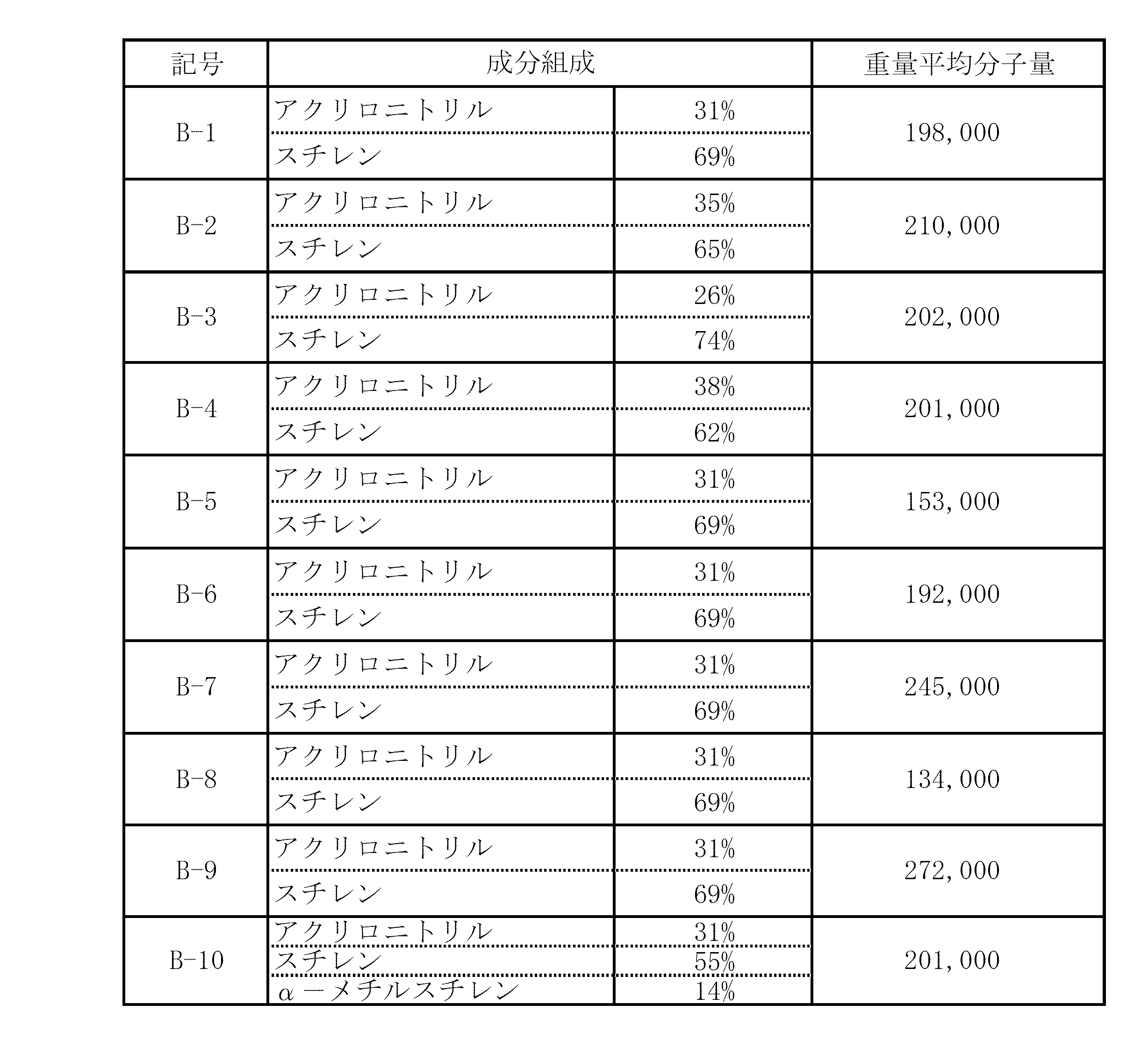
上記実験例B-1~B-10の成分組成とMwを表2に示す。
スチレン51.1質量部、α-メチルスチレン17.5質量部、アクリロニトリル31.4質量部、エチルベンゼン18質量部とした以外は、実験例B-1と同様に行い、スチレン-アクリロニトリル系共重合体B-10を得た。C-13NMR分析よりスチレン単位55質量%、α-メチルスチレン単位14質量%、アクリロニトリル単位31質量%であり、Mwは201,000であった。
上記実験例B-1~B-10の成分組成とMwを表2に示す。
[実施例1~16及び比較例1~10]
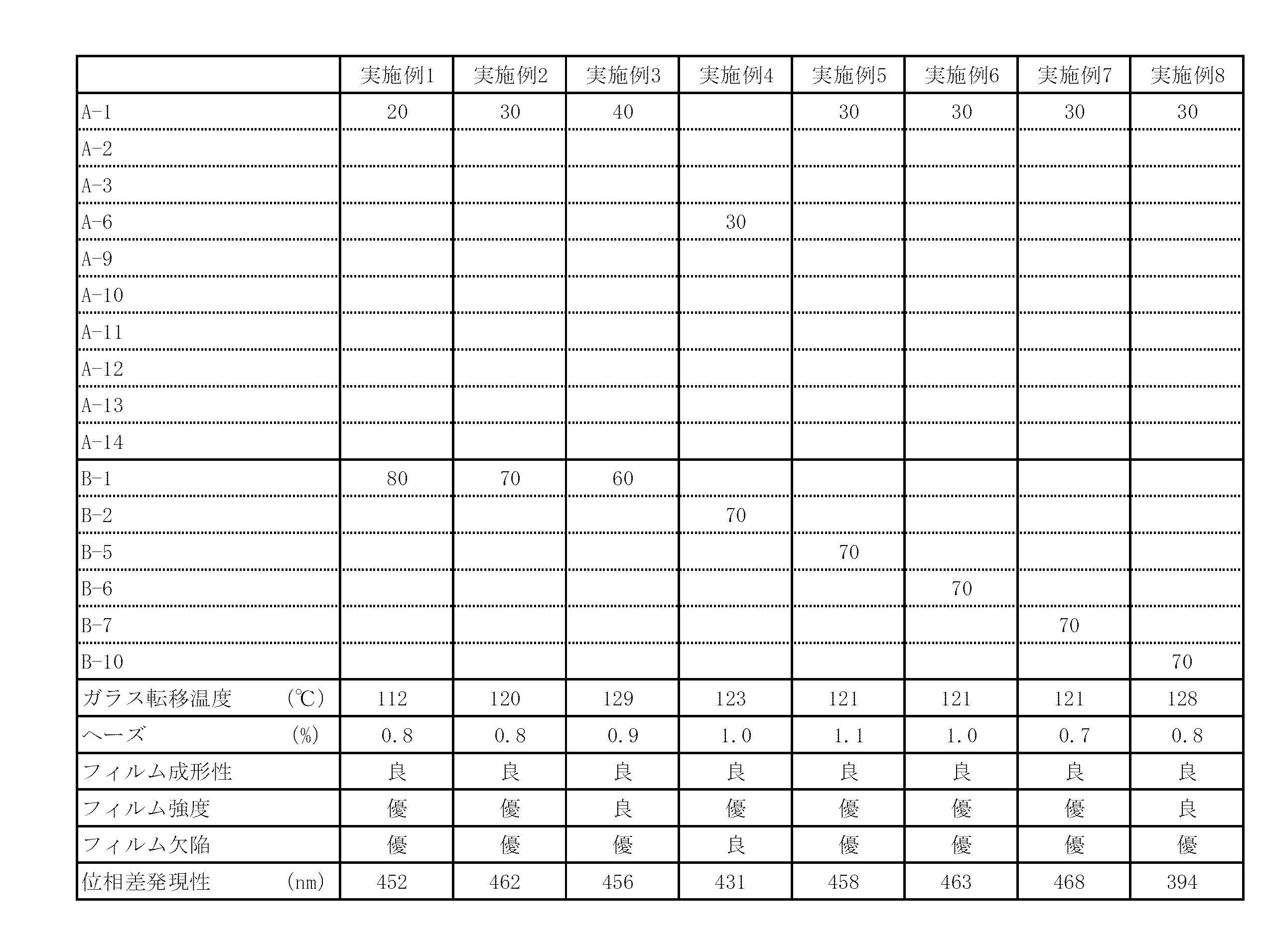
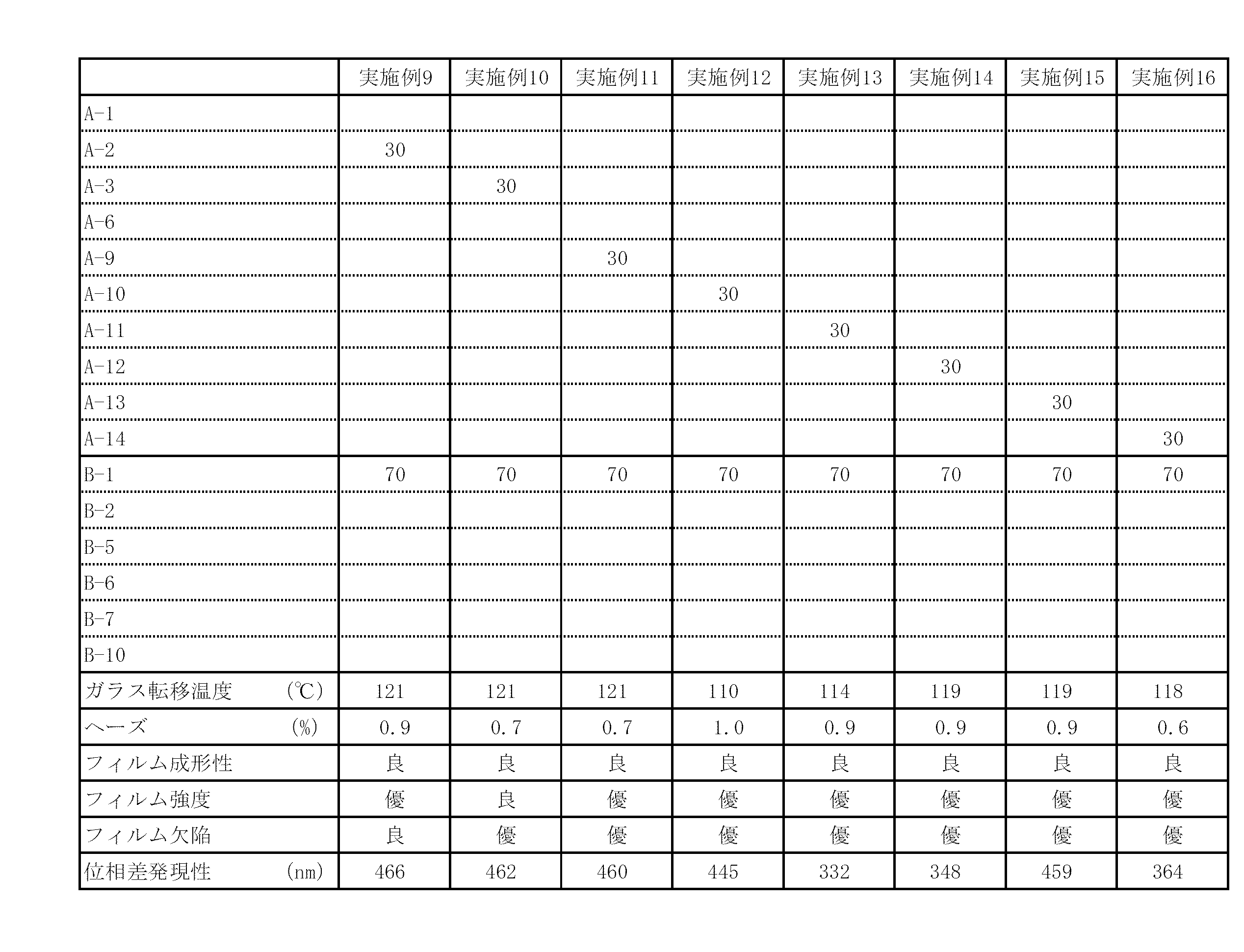
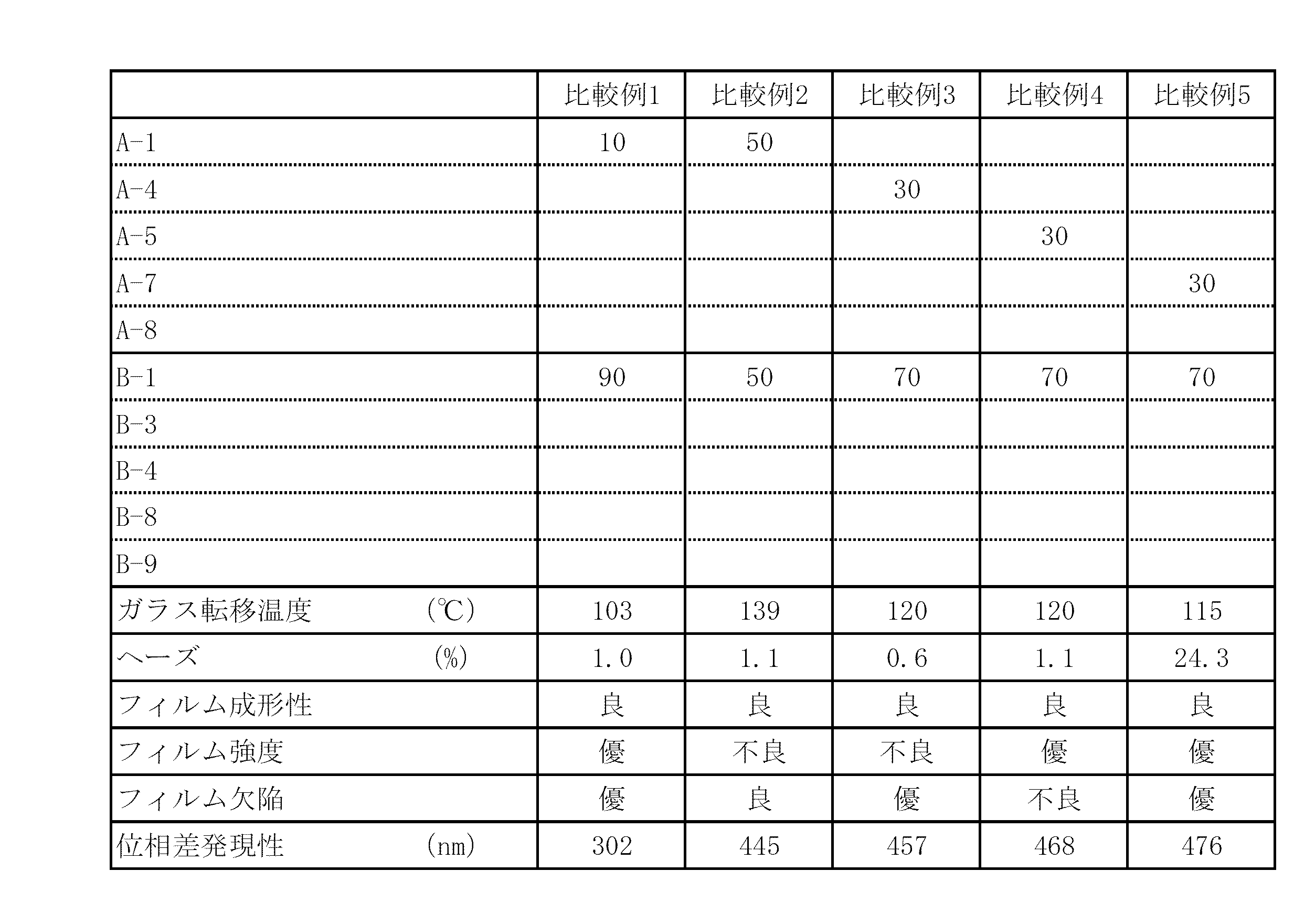
上記実験例で製造したスチレン-マレイミド系共重合体(A)とスチレン-アクリロニトリル系共重合体(B)を、表3~表4で示した割合(質量%)でヘンシェルミキサーを用いて混合した後、二軸押出機(東芝機械(株)社製 TEM-35B、L/D=32)を用い、シリンダー温度270℃、フィード量20kg/時、スクリュー回転数250rpmの条件にて溶融混練してペレット化し、樹脂組成物を得た。なお、溶融混練する際の樹脂温度はどれも280~320℃の範囲であった。
上記実験例で製造したスチレン-マレイミド系共重合体(A)とスチレン-アクリロニトリル系共重合体(B)を、表3~表4で示した割合(質量%)でヘンシェルミキサーを用いて混合した後、二軸押出機(東芝機械(株)社製 TEM-35B、L/D=32)を用い、シリンダー温度270℃、フィード量20kg/時、スクリュー回転数250rpmの条件にて溶融混練してペレット化し、樹脂組成物を得た。なお、溶融混練する際の樹脂温度はどれも280~320℃の範囲であった。
樹脂組成物を、Tダイを付したフィルム押出成形機を用いシリンダー温度260℃、ダイ温度260℃で、厚さ100μmの未延伸フィルムを押し出し、ロールに巻き取った。
得られた未延伸フィルムを、テンター横延伸機を用い、Tg+20℃で1.8倍に一軸延伸し、延伸された光学フィルムを得た。得られたフィルムの評価結果を表3~表4に示した。
得られた未延伸フィルムを、テンター横延伸機を用い、Tg+20℃で1.8倍に一軸延伸し、延伸された光学フィルムを得た。得られたフィルムの評価結果を表3~表4に示した。

評価は下記の方法にて行った。
(1)ガラス転移温度
ガラス転移温度は、下記の測定条件で示差走査熱量測定(DSC)にて測定した。
装置名:セイコーインスツルメンツ(株)社製 Robot DSC6200
昇温速度:10℃/分
ガラス転移温度が110℃以上であるものを耐熱性について合格とした。
(2)ヘーズ
ASTM D1003に基づき、ヘーズメーター(日本電色工業社製NDH-1001DP型)を用いて未延伸フィルムのヘーズ(単位:%)を測定した。
ヘーズの値が1.2%以下であるものを未延伸フィルムの透明性について合格とした。
(3)フィルム成形性
一貫してフィルムを押出成形できたものを「良」、流動性が不足して一貫しては押出成形できなかったものを「不良」とし、「良」を合格とした。
(4)フィルム強度
未延伸フィルムについて耐折強度の測定を以下の条件にて行い、下記基準にて判断した。「優」、「良」を合格とした。
測定条件
測定器:MIT-D FOLODING ENDURANCE TESTER(東洋精機社製)
荷重(張力):500g重
折り曲げ速度:175回/分
折り曲げ角度:左右各45度
折り曲げ装置先端半径:0.38mm
試験幅:15mm
折り曲げ方向:フィルム押出方向
強度判断基準
「優」:折り曲げ回数150回以上
「良」:折り曲げ回数100回以上150回未満
「不良」:折り曲げ回数100回未満
(5)フィルム欠陥
未延伸フィルムについて、画像処理解析装置(ニレコ社製:LUZEX SE)を用いて観測し、下記基準にて良否を判断した。「優」、「良」を合格とした。
「優」:長さ50μm以上のフィルム欠陥が0個/m2
「良」:長さ50μm以上のフィルム欠陥が1~4個/m2
「不良」:長さ50μm以上のフィルム欠陥が5個/m2以上
(6)位相差発現性
位相差測定装置(王子計測社製:KOBRA-WR)を用いて延伸フィルムのリタデーション(以下「Re」,単位:μm)を測定し、300nm以上を合格とした。また、位相差顕微鏡で観察することで、配向複屈折の符号は、実施例と比較例中の全てのサンプルが負であることを確認した。
(1)ガラス転移温度
ガラス転移温度は、下記の測定条件で示差走査熱量測定(DSC)にて測定した。
装置名:セイコーインスツルメンツ(株)社製 Robot DSC6200
昇温速度:10℃/分
ガラス転移温度が110℃以上であるものを耐熱性について合格とした。
(2)ヘーズ
ASTM D1003に基づき、ヘーズメーター(日本電色工業社製NDH-1001DP型)を用いて未延伸フィルムのヘーズ(単位:%)を測定した。
ヘーズの値が1.2%以下であるものを未延伸フィルムの透明性について合格とした。
(3)フィルム成形性
一貫してフィルムを押出成形できたものを「良」、流動性が不足して一貫しては押出成形できなかったものを「不良」とし、「良」を合格とした。
(4)フィルム強度
未延伸フィルムについて耐折強度の測定を以下の条件にて行い、下記基準にて判断した。「優」、「良」を合格とした。
測定条件
測定器:MIT-D FOLODING ENDURANCE TESTER(東洋精機社製)
荷重(張力):500g重
折り曲げ速度:175回/分
折り曲げ角度:左右各45度
折り曲げ装置先端半径:0.38mm
試験幅:15mm
折り曲げ方向:フィルム押出方向
強度判断基準
「優」:折り曲げ回数150回以上
「良」:折り曲げ回数100回以上150回未満
「不良」:折り曲げ回数100回未満
(5)フィルム欠陥
未延伸フィルムについて、画像処理解析装置(ニレコ社製:LUZEX SE)を用いて観測し、下記基準にて良否を判断した。「優」、「良」を合格とした。
「優」:長さ50μm以上のフィルム欠陥が0個/m2
「良」:長さ50μm以上のフィルム欠陥が1~4個/m2
「不良」:長さ50μm以上のフィルム欠陥が5個/m2以上
(6)位相差発現性
位相差測定装置(王子計測社製:KOBRA-WR)を用いて延伸フィルムのリタデーション(以下「Re」,単位:μm)を測定し、300nm以上を合格とした。また、位相差顕微鏡で観察することで、配向複屈折の符号は、実施例と比較例中の全てのサンプルが負であることを確認した。
上記表3に示されるとおり、実施例1~16の樹脂組成物は、透明性、耐熱性、フィルム成形性、フィルム強度にすぐれており、特に光学フィルムに最適な特性を備えていることがわかる。また、フィルム欠陥が少なく、延伸配向による位相差発現性が良好で、且つ負の配向複屈折性を示すため、位相差フィルムに最適な特性を備えていることがわかる。
一方、上記表4に示されるとおり、比較例1~10の樹脂組成物は、透明性、耐熱性、フィルム成形性、フィルム強度、フィルム欠陥、位相差発現性のいずれかにおいて、光学フィルムとして良好な値を示さなかった。
一方、上記表4に示されるとおり、比較例1~10の樹脂組成物は、透明性、耐熱性、フィルム成形性、フィルム強度、フィルム欠陥、位相差発現性のいずれかにおいて、光学フィルムとして良好な値を示さなかった。
以上、本発明を実施例に基づいて説明した。この実施例はあくまで例示であり、種々の変形例が可能なこと、またそうした変形例も本発明の範囲にあることは当業者に理解されるところである。
Claims (9)
- (i)スチレン系単量体単位35~55質量%、マレイミド系単量体単位30~60質量%、不飽和ジカルボン酸無水物単量体単位0~15質量%、アクリロニトリル系単量体単位0~15質量%からなり、重量平均分子量(Mw)が100,000~145,000であるスチレン-マレイミド系共重合体(A)20~40質量%と、
(ii)スチレン系単量体単位65~70質量%、アクリロニトリル系単量体単位30~35質量%からなり、重量平均分子量(Mw)が150,000~250,000であるスチレン-アクリロニトリル系共重合体(B)60~80質量%と
を含有してなる光学フィルム用樹脂組成物であって、厚み100μmの未延伸フィルムに成形した場合に長さ50μm以上のフィルム欠陥が5個/m2未満である光学フィルム用樹脂組成物。 - スチレン-マレイミド系共重合体(A)が溶液重合もしくは塊状重合により得られることを特徴とする請求項1記載の光学フィルム用樹脂組成物。
- スチレン-アクリロニトリル系共重合体(B)が塊状重合もしくは溶液重合により得られることを特徴とする請求項1又は2記載の光学フィルム用樹脂組成物。
- ガラス転移温度が110~150℃である請求項1~3のいずれか1項に記載の光学フィルム用樹脂組成物。
- 請求項1~4のいずれか1項に記載の光学フィルム用樹脂組成物からなる光学フィルム。
- 延伸して配向させると負の配向複屈折性を示す請求項5記載の光学フィルム。
- 溶融押出フィルムであって、さらに延伸して配向させると負の配向複屈折性を示す請求項5記載の光学フィルム。
- 延伸フィルムであることを特徴とする請求項6又は7記載の光学フィルム。
- 位相差フィルムであることを特徴とする請求項8記載の光学フィルム。
Applications Claiming Priority (2)
| Application Number | Priority Date | Filing Date | Title |
|---|---|---|---|
| JP2008298457A JP2012025786A (ja) | 2008-11-21 | 2008-11-21 | 光学フィルム用樹脂組成物及びその光学フィルム |
| JP2008-298457 | 2008-11-21 |
Publications (1)
| Publication Number | Publication Date |
|---|---|
| WO2010058723A1 true WO2010058723A1 (ja) | 2010-05-27 |
Family
ID=42198163
Family Applications (1)
| Application Number | Title | Priority Date | Filing Date |
|---|---|---|---|
| PCT/JP2009/069183 Ceased WO2010058723A1 (ja) | 2008-11-21 | 2009-11-11 | 光学フィルム用樹脂組成物及びその光学フィルム |
Country Status (3)
| Country | Link |
|---|---|
| JP (1) | JP2012025786A (ja) |
| TW (1) | TW201022348A (ja) |
| WO (1) | WO2010058723A1 (ja) |
Cited By (2)
| Publication number | Priority date | Publication date | Assignee | Title |
|---|---|---|---|---|
| JP2013107933A (ja) * | 2011-11-17 | 2013-06-06 | Denki Kagaku Kogyo Kk | 光学用成形体用樹脂組成物及びその製造方法、光学用成形体 |
| CN115926035A (zh) * | 2018-01-09 | 2023-04-07 | 电化株式会社 | 马来酰亚胺系共聚物、其制造方法以及使用马来酰亚胺系共聚物的树脂组合物 |
Families Citing this family (7)
| Publication number | Priority date | Publication date | Assignee | Title |
|---|---|---|---|---|
| KR101418755B1 (ko) | 2011-10-05 | 2014-07-11 | 주식회사 엘지화학 | 광학 필름용 수지 조성물 및 이를 이용한 보상필름 |
| CN104870496B (zh) * | 2012-10-22 | 2017-05-10 | 电化株式会社 | 用于提高芳香族乙烯基‑氰化乙烯基系树脂耐热性的共聚物 |
| WO2015033877A1 (ja) * | 2013-09-03 | 2015-03-12 | 電気化学工業株式会社 | 光学フィルム用共重合体 |
| WO2015033556A1 (ja) * | 2013-09-04 | 2015-03-12 | コニカミノルタ株式会社 | 偏光板保護フィルムとその製造方法、偏光板および液晶表示装置 |
| TWI642688B (zh) * | 2014-09-02 | 2018-12-01 | 日商電化股份有限公司 | Copolymer for optical film |
| JP7549525B2 (ja) * | 2020-12-24 | 2024-09-11 | デンカ株式会社 | スチレン系二軸延伸シート及びそれを用いた容器 |
| JP7835015B2 (ja) * | 2022-01-17 | 2026-03-25 | 株式会社レゾナック | 樹脂組成物、プリプレグ、積層板、樹脂フィルム、プリント配線板、半導体パッケージ、樹脂組成物の製造方法及び樹脂 |
Citations (6)
| Publication number | Priority date | Publication date | Assignee | Title |
|---|---|---|---|---|
| JP2004107371A (ja) * | 2002-09-13 | 2004-04-08 | Kanegafuchi Chem Ind Co Ltd | 樹脂組成物及び光学用フィルム |
| JP2006259622A (ja) * | 2005-03-18 | 2006-09-28 | Sekisui Chem Co Ltd | 偏光子保護フィルムおよび偏光板 |
| JP2007046059A (ja) * | 2006-10-06 | 2007-02-22 | Tosoh Corp | 高靱性フィルム |
| JP2008094912A (ja) * | 2006-10-10 | 2008-04-24 | Denki Kagaku Kogyo Kk | 樹脂組成物と光学成形体 |
| JP2009276420A (ja) * | 2008-05-13 | 2009-11-26 | Asahi Kasei Chemicals Corp | 光学フィルム及び位相差フィルム |
| WO2009151102A1 (ja) * | 2008-06-12 | 2009-12-17 | 電気化学工業株式会社 | 光学成形体用樹脂組成物及びその光学成形体 |
-
2008
- 2008-11-21 JP JP2008298457A patent/JP2012025786A/ja active Pending
-
2009
- 2009-11-11 WO PCT/JP2009/069183 patent/WO2010058723A1/ja not_active Ceased
- 2009-11-20 TW TW098139535A patent/TW201022348A/zh unknown
Patent Citations (6)
| Publication number | Priority date | Publication date | Assignee | Title |
|---|---|---|---|---|
| JP2004107371A (ja) * | 2002-09-13 | 2004-04-08 | Kanegafuchi Chem Ind Co Ltd | 樹脂組成物及び光学用フィルム |
| JP2006259622A (ja) * | 2005-03-18 | 2006-09-28 | Sekisui Chem Co Ltd | 偏光子保護フィルムおよび偏光板 |
| JP2007046059A (ja) * | 2006-10-06 | 2007-02-22 | Tosoh Corp | 高靱性フィルム |
| JP2008094912A (ja) * | 2006-10-10 | 2008-04-24 | Denki Kagaku Kogyo Kk | 樹脂組成物と光学成形体 |
| JP2009276420A (ja) * | 2008-05-13 | 2009-11-26 | Asahi Kasei Chemicals Corp | 光学フィルム及び位相差フィルム |
| WO2009151102A1 (ja) * | 2008-06-12 | 2009-12-17 | 電気化学工業株式会社 | 光学成形体用樹脂組成物及びその光学成形体 |
Cited By (2)
| Publication number | Priority date | Publication date | Assignee | Title |
|---|---|---|---|---|
| JP2013107933A (ja) * | 2011-11-17 | 2013-06-06 | Denki Kagaku Kogyo Kk | 光学用成形体用樹脂組成物及びその製造方法、光学用成形体 |
| CN115926035A (zh) * | 2018-01-09 | 2023-04-07 | 电化株式会社 | 马来酰亚胺系共聚物、其制造方法以及使用马来酰亚胺系共聚物的树脂组合物 |
Also Published As
| Publication number | Publication date |
|---|---|
| TW201022348A (en) | 2010-06-16 |
| JP2012025786A (ja) | 2012-02-09 |
Similar Documents
| Publication | Publication Date | Title |
|---|---|---|
| US9873787B2 (en) | Copolymer for improving methacrylic resin heat resistance | |
| WO2010058723A1 (ja) | 光学フィルム用樹脂組成物及びその光学フィルム | |
| CN108350125B (zh) | 甲基丙烯酸系树脂、甲基丙烯酸系树脂组合物、膜、制造方法 | |
| JP5190564B2 (ja) | アクリル系熱可塑性樹脂組成物及びその成形体 | |
| US9365713B2 (en) | Copolymer for improving heat resistance of aromatic vinyl-vinyl cyanide resin | |
| CN101796086A (zh) | 热塑性共聚树脂及其光学成形体 | |
| JP2023080157A (ja) | メタクリル系樹脂、メタクリル系樹脂組成物、フィルム | |
| JP2012208136A (ja) | 光学成形体用樹脂組成物及びその光学成形体 | |
| CN115427468A (zh) | 马来酰亚胺类共聚物、以及含有马来酰亚胺类共聚物和含氯聚合物的含氯聚合物类树脂组合物 | |
| CN106574015A (zh) | 适于提高甲基丙烯酸类树脂的耐热性的共聚物 | |
| JP2011169921A (ja) | 光学成形体用樹脂組成物及びその光学成形体 | |
| JP2013107933A (ja) | 光学用成形体用樹脂組成物及びその製造方法、光学用成形体 | |
| JP2008094912A (ja) | 樹脂組成物と光学成形体 | |
| CN103608397B (zh) | 树脂组合物和使用该树脂组合物形成的光学补偿膜 | |
| JP2008050536A (ja) | 樹脂組成物と光学成形体 | |
| CN109476899B (zh) | 树脂组合物和由该树脂组合物构成的膜 | |
| WO2025205813A1 (ja) | マレイミド系共重合体 | |
| WO2016186121A1 (ja) | 透明な樹脂組成物及びその製造方法 |
Legal Events
| Date | Code | Title | Description |
|---|---|---|---|
| 121 | Ep: the epo has been informed by wipo that ep was designated in this application |
Ref document number: 09827504 Country of ref document: EP Kind code of ref document: A1 |
|
| NENP | Non-entry into the national phase |
Ref country code: DE |
|
| 122 | Ep: pct application non-entry in european phase |
Ref document number: 09827504 Country of ref document: EP Kind code of ref document: A1 |
|
| NENP | Non-entry into the national phase |
Ref country code: JP |