WO2010029992A1 - 高分子アクチュエータ - Google Patents
高分子アクチュエータ Download PDFInfo
- Publication number
- WO2010029992A1 WO2010029992A1 PCT/JP2009/065906 JP2009065906W WO2010029992A1 WO 2010029992 A1 WO2010029992 A1 WO 2010029992A1 JP 2009065906 W JP2009065906 W JP 2009065906W WO 2010029992 A1 WO2010029992 A1 WO 2010029992A1
- Authority
- WO
- WIPO (PCT)
- Prior art keywords
- carbon
- polymer
- cnt
- cnh
- polymer actuator
- Prior art date
- Legal status (The legal status is an assumption and is not a legal conclusion. Google has not performed a legal analysis and makes no representation as to the accuracy of the status listed.)
- Ceased
Links
Images

Classifications
-
- F—MECHANICAL ENGINEERING; LIGHTING; HEATING; WEAPONS; BLASTING
- F03—MACHINES OR ENGINES FOR LIQUIDS; WIND, SPRING, OR WEIGHT MOTORS; PRODUCING MECHANICAL POWER OR A REACTIVE PROPULSIVE THRUST, NOT OTHERWISE PROVIDED FOR
- F03G—SPRING, WEIGHT, INERTIA OR LIKE MOTORS; MECHANICAL-POWER PRODUCING DEVICES OR MECHANISMS, NOT OTHERWISE PROVIDED FOR OR USING ENERGY SOURCES NOT OTHERWISE PROVIDED FOR
- F03G7/00—Mechanical-power-producing mechanisms, not otherwise provided for or using energy sources not otherwise provided for
- F03G7/04—Mechanical-power-producing mechanisms, not otherwise provided for or using energy sources not otherwise provided for using pressure differences or thermal differences occurring in nature
- F03G7/05—Ocean thermal energy conversion, i.e. OTEC
-
- Y—GENERAL TAGGING OF NEW TECHNOLOGICAL DEVELOPMENTS; GENERAL TAGGING OF CROSS-SECTIONAL TECHNOLOGIES SPANNING OVER SEVERAL SECTIONS OF THE IPC; TECHNICAL SUBJECTS COVERED BY FORMER USPC CROSS-REFERENCE ART COLLECTIONS [XRACs] AND DIGESTS
- Y02—TECHNOLOGIES OR APPLICATIONS FOR MITIGATION OR ADAPTATION AGAINST CLIMATE CHANGE
- Y02E—REDUCTION OF GREENHOUSE GAS [GHG] EMISSIONS, RELATED TO ENERGY GENERATION, TRANSMISSION OR DISTRIBUTION
- Y02E10/00—Energy generation through renewable energy sources
- Y02E10/30—Energy from the sea, e.g. using wave energy or salinity gradient
Definitions
- the present invention relates to an actuator that deforms when a potential difference is applied between electrodes, and more particularly to a polymer actuator that deforms due to movement of ions by an electric field.
- Patent Document 1 As an actuator element that can be operated in the air or in a vacuum, an actuator using a gel of carbon nanotube and ionic liquid as a conductive stretchable active layer has been proposed (Patent Document 1).
- An object of the present invention is to provide a polymer actuator capable of generating a larger driving force and displacement than before with an appropriate blending ratio of carbon nanotubes and carbon nanohorns.
- the present invention relates to a polymer actuator formed of a pair of electrode layers composed of an ionic liquid, a polymer, and carbon nanoparticles, and an electrolyte layer provided between the pair of electrode layers.
- the carbon nanoparticles are a mixture of carbon nanotubes (hereinafter referred to as CNT) and carbon nanohorns (hereinafter referred to as CNH),
- CNT carbon nanotubes
- CNH carbon nanohorns
- the polymer is 17.7 wt% or more and 30.2 wt% or less.
- the compounding ratio of the CNT and the CNH is preferably 2: 1.
- a polymer actuator that exhibits a larger generation force and a larger displacement than ever before. Can be obtained.
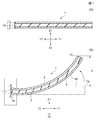
- FIG. 1A is a sectional view for explaining the basic principle of a polymer actuator
- FIG. 1B is a sectional view showing a driving state of the polymer actuator.
- FIGS. 1A and 1B show an ion conductive polymer actuator 1, an electrolyte layer 2, a first electrode layer 3 provided on one surface of the electrolyte layer 2, and the other of the electrolyte layer 2. It is comprised by the three layers of the laminated body 1A with which the 2nd electrode layer 4 provided in this surface was piled up.
- the electrolyte layer 2 is a resin layer capable of ion exchange, and is obtained by impregnating a cation exchange resin with an electrolytic solution as an electrolyte.
- the cation exchange resin is obtained by introducing a hydrophilic functional group such as a sulfonic acid group or a carboxyl group into polyethylene, polystyrene, fluororesin or the like.
- the electrolytic solution is a polar organic solvent containing a salt or an ionic liquid described later.
- the electrolyte layer 2 may be a gel obtained by mixing an ionic liquid into a base polymer such as polyvinylidene fluoride.
- the carbon nanoparticles are a mixture of carbon nanotubes (CNT) and carbon nanohorns (CNH).
- CNT carbon nanotubes
- CNH carbon nanohorns
- the lower limit of the compounding ratio (weight ratio) of the carbon nanoparticles to the total weight (carbon nanoparticles + ionic liquid + polymer) is 25% by weight, and the upper limit is 80% by weight or less.
- the ionic liquid (Ionic® Liquid; IL) used in the present invention is also referred to as a room temperature molten salt or simply a molten salt, and is a salt that exhibits a molten state in a wide temperature range including room temperature (room temperature).
- the ionic liquid used in the present invention preferably has a high ionic conductivity.
- various known ionic liquids can be used, but a stable one that exhibits a liquid state at room temperature (room temperature) or a temperature close to room temperature is preferable.
- a suitable ionic liquid used in the present invention comprises a cation (preferably an imidazolium ion or a quaternary ammonium ion) represented by the following general formulas (I) to (IV) and an anion (X ⁇ ). Things.
- R is a linear or branched alkyl group having 1 to 12 carbon atoms or a branched alkyl group or an ether bond, and the total number of carbon and oxygen is 3 to 12
- R 1 represents a linear or branched alkyl group having 1 to 4 carbon atoms or a hydrogen atom.
- R and R 1 are preferably not the same.
- x is an integer of 1 to 4, respectively.
- Examples of the linear or branched alkyl group having 1 to 12 carbon atoms include methyl, ethyl, n-propyl, isopropyl, n-butyl, isobutyl, sec-butyl, t-butyl, pentyl, hexyl, heptyl, octyl, Examples include nonyl, decyl, undecyl, dodecyl and the like.
- the carbon number is preferably 1 to 8, more preferably 1 to 6.
- linear or branched alkyl group having 1 to 4 carbon atoms examples include methyl, ethyl, n-propyl, isopropyl, n-butyl, isobutyl, sec-butyl and t-butyl.
- Examples of the alkyl group having an ether bond and having a straight chain or a branch having a total number of carbon and oxygen of 3 to 12 include CH 2 OCH 3 , (CH 2 ) p (OCH 2 CH 2 ) q OR 2 (where, p is an integer of 1 to 4, q is an integer of 1 to 4, and R 2 represents CH 3 or C 2 H 5 .
- Anions (X ⁇ ) include tetrafluoroborate ion (BF 4 ), BF 3 CF 3 , BF 3 C 2 F 5 , BF 3 C 3 F 7 , BF 3 C 4 F 9 , hexafluorophosphate ion ( PF 6 ), bis (trifluoromethanesulfonyl) imido ion ((CF 3 SO 2 ) 2 N), perchlorate ion (ClO 4 ), tris (trifluoromethanesulfonyl) carbonate ion (CF 3 SO 2 ) 3 C ), Trifluoromethanesulfonate ion (CF 3 SO 3 ), dicyanamide ion ((CN) 2 N), trifluoroacetate ion (CF 3 COO), organic carboxylate ion and halogen ion.
- PF 6 bis (trifluoromethanesulfonyl) imido ion ((CF 3 SO 2 )
- the cation is 1-ethyl-3-methylimidazolium ion, [N (CH 3 ) (CH 3 ) (C 2 H 5 ) (C 2 H 4 OC 2 H 4 OCH 3 )] + , and those whose anion is a halogen ion or tetrafluoroborate ion can be specifically exemplified.
- a ionic liquid, conductivity as long as more than 0.1 Sm -1, can be used.
- the carbon nanotube used in the present invention is a carbon-based material having a shape in which graphene (graphite sheet) is wound in a cylindrical shape
- the carbon nanohorn is a carbon-based material having a shape in which graphene is wound in a conical shape.
- SWNT single-walled nanotubes
- MWNT multi-walled nanotubes
- Various types are known, such as being divided into molds.
- Carbon nanoparticles generally have a large aspect ratio, that is, thin and long single-walled nanotubes tend to form a gel. Examples thereof include carbon nanoparticles having an aspect ratio of 10 3 or more, preferably 10 4 or more.
- the length of the carbon nanoparticles is usually 1 ⁇ m or more, preferably 50 ⁇ m or more, more preferably 500 ⁇ m or more. Although the upper limit of the length of a carbon nanoparticle is not specifically limited, For example, it is about 3 mm.
- a gel composition from SWNT it is preferable to obtain a gel composition from SWNT.
- a suitable example of a carbon nanotube that is practically used is HiPco (manufactured by Carbon Nanotechnology Inc.), which can be relatively mass-produced using carbon monoxide as a raw material, but of course, it is limited to this. is not.
- Examples of the polymer used in the present invention include a copolymer of a fluorinated olefin having a hydrogen atom and a perfluorinated olefin, such as polyvinylidene fluoride-hexafluoropropylene copolymer [PVDF (HFP)], and polyvinylidene fluoride (PVDF).
- a copolymer of a fluorinated olefin having a hydrogen atom and a perfluorinated olefin such as polyvinylidene fluoride-hexafluoropropylene copolymer [PVDF (HFP)], and polyvinylidene fluoride (PVDF).
- Homopolymers of fluorinated olefins having hydrogen atoms such as, poly (meth) acrylates such as perfluorosulfonic acid (Nafion), poly-2-hydroxyethyl methacrylate (polyHEMA), polymethyl methacrylate (PMMA), poly Examples include ethylene oxide (PEO) and polyacrylonitrile (PAN).
- poly (meth) acrylates such as perfluorosulfonic acid (Nafion), poly-2-hydroxyethyl methacrylate (polyHEMA), polymethyl methacrylate (PMMA), poly Examples include ethylene oxide (PEO) and polyacrylonitrile (PAN).
- the volume tends to expand inside the electrolyte layer 2 at a position biased toward the second electrode layer 4 side. That is, since an expansion stress is generated on the second electrode layer 4 side and an expansion strain is generated based on the expansion stress, a bending stress is generated in the laminate 1A, and as shown in FIG. Bending occurs in the actuator 1.
- the proper blending amount of the carbon particles and the proper blending ratio of the carbon nanotube and the carbon nanohorn will be described from the viewpoint of the generated force and the displacement amount.
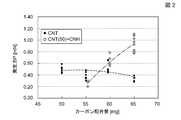
- FIG. 2 is a graph showing the relationship between the compounding amount of carbon particles and the generated force as characteristics of the polymer actuator
- FIG. 3 is a graph showing the relationship between the compounding amount of carbon particles and the displacement as the characteristics of the polymer actuator. is there.
- the displacement amount ⁇ is an initial value indicated by a broken line of the free end 1b when the free end 1b is bent and deformed in the Z direction with the fixed end 1a as a reference, as shown in FIG. It means the difference between the position in the Z direction in the state and the position in the Z direction after deformation indicated by a solid line.
- the displacement ⁇ is proportional to the length dimension (distance) L between the fixed end 1a and the free end 1b.
- ⁇ Amount of carbon particles> 2 and 3 show the generated force P and the displacement ⁇ with respect to the compounding amount of the carbon particles of 50 mg, 55 mg, 60 mg, and 65 mg.
- ⁇ CNT means that the carbon nanotubes (CNT) are 100%
- ⁇ CNT (50) + CNH means that 50 mg of CNT is blended, and the remainder is carbon nanohorn (CNH). ). That is, when the CNT is 50 mg, the compounding amount of CNH is 0 mg. When the CNT is 55 mg, 5 mg of CNH is contained. When the CNT is 60 mg, 10 mg of CNH is contained. When the CNT is 65 mg. Means that 15 mg of CNH is contained.
- the compounding amount of the carbon particles is 55 mg and the CNT is 60 mg and the CNT is 50 mg (CNH is 10 mg) than the case where the CNT is 50 mg (CNH is 5 mg).
- CNH is 10 mg
- CNH is 50 mg
- a larger generated force P and displacement ⁇ are generated. That is, it can be understood that the generated force P and the displacement amount ⁇ increase as the blending amount of the carbon particles increases.
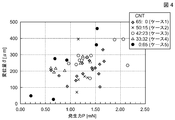
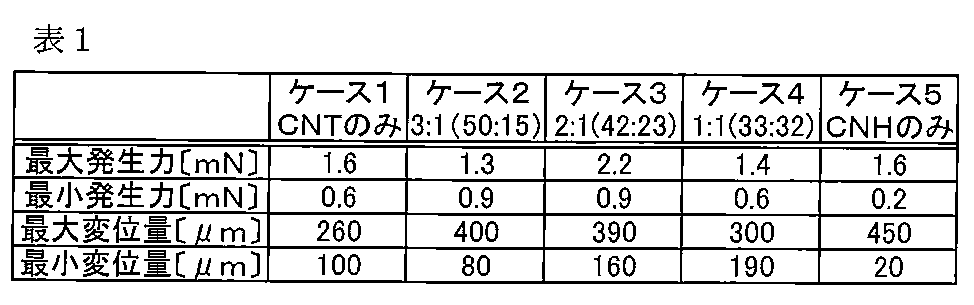
- FIG. 4 is a graph showing the relationship between the generated force and the displacement for each compounding ratio of CNT and CNH as the characteristics of the polymer actuator.
- Table 1 shows the generated force P and the maximum and minimum values of the displacement ⁇ that can be read from FIG. 4 for each case.
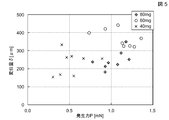
- FIG. 5 is a graph showing the relationship between the generated force and the displacement amount for each blending amount of polymer as the characteristics of the polymer actuator.
- ⁇ indicates the case where the blending amount of the polymer is 80 mg
- ⁇ indicates the case where it is 60 mg
- x indicates the case where it is 40 mg.
- the compounding quantity of the other material which forms the 1st, 2nd electrode layers 3 and 4 is 42 mg of CNT, 23 mg of CNH, and 120 mg of ionic liquids, for example.
- the blending amount of the polymer is most preferably 60 mg, and then 80 mg and 40 mg are preferable in this order.
- / (42 + 23 + 120 + 60) mg 24.5 wt%
- 80 mg / (42 + 23 + 120 + 80) mg 30.2 wt%. Therefore, the preferable range of the polymer is 17.7 wt% to 30.2 wt%.
- the lower limit of the preferred weight ratio of the carbon particles contained in the first and second electrode layers 3 and 4 is 25% by weight or more and the upper limit is less than 82.3% by weight, preferably 80% by weight. Hereinafter, it is more preferably 75.5% by weight and 69.8% by weight.
- (A) is a sectional view for explaining the basic principle of the polymer actuator
- (B) is a sectional view showing a driving state of the polymer actuator
- As a characteristic of the polymer actuator a graph showing the relationship between the amount of carbon particles and the generated force
- As a characteristic of the polymer actuator a graph showing the relationship between the amount of carbon particles and the amount of displacement
- As a characteristic of the polymer actuator a graph showing a relationship between a generated force and a displacement amount for each mixing ratio of CNT and CNH
- As a characteristic of the polymer actuator a graph showing the relationship between the generated force and the displacement amount for each blending amount of the polymer
Landscapes
- Engineering & Computer Science (AREA)
- Chemical & Material Sciences (AREA)
- Combustion & Propulsion (AREA)
- Life Sciences & Earth Sciences (AREA)
- Biodiversity & Conservation Biology (AREA)
- General Life Sciences & Earth Sciences (AREA)
- Oceanography (AREA)
- Sustainable Development (AREA)
- Mechanical Engineering (AREA)
- General Engineering & Computer Science (AREA)
- Compositions Of Macromolecular Compounds (AREA)
- Carbon And Carbon Compounds (AREA)
Abstract
Description
前記カーボンナノ粒子は、カーボンナノチューブ(以下、CNTと称す)とカーボンナノホーン(以下、CNHと称す)とが混成されたものであり、
前記一対の電極層に含まれるイオン液体、ポリマーおよびカーボンナノ粒子の全重量に対し、
前記カーボン粒子が25重量%以上80重量%以下で、且つ前記カーボン粒子に含まれる前記CNTと前記CNHの配合比が、(CNT):(CNH)=1:1ないし3:1の範囲であり、
前記ポリマーが17.7重量%以上30.2重量%以下であることを特徴とするものである。
特に、前記CNTと前記CNHの配合比が、2:1であるものが好ましい。
図1(A)(B)はイオン導電型の高分子アクチュエータ1であり、電解質層2と、この電解質層2の一方の面に設けられた第1の電極層3と、電解質層2の他方の面に設けられた第2の電極層4とが重ねられた積層体1Aの三層で構成される。

[PRxH4-x]+(IV)
実用に供されるカーボンナノチューブの好適な例として、一酸化炭素を原料として比較的量産が可能なHiPco(カーボン・ナノテクノロジー・インコーポレーテッド社製)が挙げられるが、勿論、これに限定されるものではない。
図2及び図3は、カーボン粒子の配合量を50mg、55mg、60mg、65mgに対する発生力Pおよび変位量δを示している。
図4は高分子アクチュエータの特性として、CNTとCNHとの配合比毎の発生力と変位量との関係を示すグラフである。
1A 積層体
2 電解質層
3 第1の電極層
4 第2の電極層
Claims (2)
- イオン液体、ポリマーおよびカーボンナノ粒子からなる一対の電極層と、前記一対の電極層間に設けられた電解質層とから形成される高分子アクチュエータにおいて、
前記カーボンナノ粒子は、カーボンナノチューブ(以下、CNTと称す)とカーボンナノホーン(以下、CNHと称す)とが混成されたものであり、
前記一対の電極層に含まれるイオン液体、ポリマーおよびカーボンナノ粒子の全重量に対し、
前記カーボン粒子が25重量%以上80重量%以下で、且つ前記カーボン粒子に含まれる前記CNTと前記CNHの配合比が、(CNT):(CNH)=1:1ないし3:1の範囲であり、
前記ポリマーが17.7重量%以上30.2重量%以下であることを特徴とする高分子アクチュエータ。 - 前記CNTと前記CNHの配合比が、2:1である請求項1記載の高分子アクチュエータ。
Priority Applications (3)
| Application Number | Priority Date | Filing Date | Title |
|---|---|---|---|
| JP2010528758A JP5252405B2 (ja) | 2008-09-12 | 2009-09-11 | 高分子アクチュエータ |
| CN200980135772.3A CN102150354B (zh) | 2008-09-12 | 2009-09-11 | 高分子驱动器 |
| US13/044,082 US8253308B2 (en) | 2008-09-12 | 2011-03-09 | Polymer actuator |
Applications Claiming Priority (2)
| Application Number | Priority Date | Filing Date | Title |
|---|---|---|---|
| JP2008234541 | 2008-09-12 | ||
| JP2008-234541 | 2008-09-12 |
Related Child Applications (1)
| Application Number | Title | Priority Date | Filing Date |
|---|---|---|---|
| US13/044,082 Continuation US8253308B2 (en) | 2008-09-12 | 2011-03-09 | Polymer actuator |
Publications (1)
| Publication Number | Publication Date |
|---|---|
| WO2010029992A1 true WO2010029992A1 (ja) | 2010-03-18 |
Family
ID=42005242
Family Applications (1)
| Application Number | Title | Priority Date | Filing Date |
|---|---|---|---|
| PCT/JP2009/065906 Ceased WO2010029992A1 (ja) | 2008-09-12 | 2009-09-11 | 高分子アクチュエータ |
Country Status (4)
| Country | Link |
|---|---|
| US (1) | US8253308B2 (ja) |
| JP (1) | JP5252405B2 (ja) |
| CN (1) | CN102150354B (ja) |
| WO (1) | WO2010029992A1 (ja) |
Cited By (7)
| Publication number | Priority date | Publication date | Assignee | Title |
|---|---|---|---|---|
| JP2012095520A (ja) * | 2010-10-01 | 2012-05-17 | Canon Inc | アクチュエータ |
| WO2014104331A1 (ja) | 2012-12-27 | 2014-07-03 | アルプス電気株式会社 | 高分子アクチュエータ素子 |
| WO2017033836A1 (ja) * | 2015-08-21 | 2017-03-02 | 国立研究開発法人産業技術総合研究所 | ナノカーボン高分子アクチュエータ |
| JP2017070138A (ja) * | 2015-10-01 | 2017-04-06 | アルプス電気株式会社 | 高分子アクチュエータ |
| WO2018211981A1 (ja) | 2017-05-18 | 2018-11-22 | 東レ・ダウコーニング株式会社 | フルオロアルキル基含有硬化性オルガノポリシロキサン組成物、その硬化物および当該硬化物を備えたトランスデューサー等 |
| WO2020116440A1 (ja) | 2018-12-07 | 2020-06-11 | ダウ・東レ株式会社 | 硬化性オルガノポリシロキサン組成物、その硬化物および当該硬化物を備えたトランスデューサー等 |
| WO2024075661A1 (ja) | 2022-10-05 | 2024-04-11 | ダウ・東レ株式会社 | トランスデューサー用硬化性オルガノポリシロキサン組成物、その硬化物および当該硬化物を備えたトランスデューサー等 |
Families Citing this family (5)
| Publication number | Priority date | Publication date | Assignee | Title |
|---|---|---|---|---|
| JP5487678B2 (ja) * | 2009-03-31 | 2014-05-07 | ソニー株式会社 | アクチュエータ |
| EP2416488B1 (en) * | 2009-03-31 | 2019-03-06 | Daikin Industries, Ltd. | Electrode film for polymer actuator element, and polymer actuator element comprising same |
| JP5473483B2 (ja) * | 2009-08-27 | 2014-04-16 | キヤノン株式会社 | アクチュエータ |
| JP2013251942A (ja) * | 2012-05-30 | 2013-12-12 | Sony Corp | 高分子アクチュエーター、アクチュエーター装置、高分子アクチュエーターの製造方法及びアクチュエーター装置の製造方法 |
| CN109514544A (zh) * | 2018-12-27 | 2019-03-26 | 浙江工业大学 | 一种仿生机械手 |
Citations (3)
| Publication number | Priority date | Publication date | Assignee | Title |
|---|---|---|---|---|
| JP2005176428A (ja) * | 2003-12-08 | 2005-06-30 | Japan Science & Technology Agency | アクチュエータ素子 |
| JP2007204682A (ja) * | 2006-02-03 | 2007-08-16 | Daikin Ind Ltd | アクチュエータ素子 |
| JP2008034268A (ja) * | 2006-07-31 | 2008-02-14 | National Institute Of Advanced Industrial & Technology | 高強度、高導電性薄膜によるアクチュエータ素子及びその製造方法 |
Family Cites Families (2)
| Publication number | Priority date | Publication date | Assignee | Title |
|---|---|---|---|---|
| US5977685A (en) * | 1996-02-15 | 1999-11-02 | Nitta Corporation | Polyurethane elastomer actuator |
| JP2005269725A (ja) * | 2004-03-17 | 2005-09-29 | Honda Motor Co Ltd | 高分子アクチュエータ |
-
2009
- 2009-09-11 WO PCT/JP2009/065906 patent/WO2010029992A1/ja not_active Ceased
- 2009-09-11 JP JP2010528758A patent/JP5252405B2/ja active Active
- 2009-09-11 CN CN200980135772.3A patent/CN102150354B/zh active Active
-
2011
- 2011-03-09 US US13/044,082 patent/US8253308B2/en not_active Expired - Fee Related
Patent Citations (3)
| Publication number | Priority date | Publication date | Assignee | Title |
|---|---|---|---|---|
| JP2005176428A (ja) * | 2003-12-08 | 2005-06-30 | Japan Science & Technology Agency | アクチュエータ素子 |
| JP2007204682A (ja) * | 2006-02-03 | 2007-08-16 | Daikin Ind Ltd | アクチュエータ素子 |
| JP2008034268A (ja) * | 2006-07-31 | 2008-02-14 | National Institute Of Advanced Industrial & Technology | 高強度、高導電性薄膜によるアクチュエータ素子及びその製造方法 |
Cited By (11)
| Publication number | Priority date | Publication date | Assignee | Title |
|---|---|---|---|---|
| JP2012095520A (ja) * | 2010-10-01 | 2012-05-17 | Canon Inc | アクチュエータ |
| WO2014104331A1 (ja) | 2012-12-27 | 2014-07-03 | アルプス電気株式会社 | 高分子アクチュエータ素子 |
| JPWO2014104331A1 (ja) * | 2012-12-27 | 2017-01-19 | アルプス電気株式会社 | 高分子アクチュエータ素子 |
| US9873609B2 (en) | 2012-12-27 | 2018-01-23 | Alps Electric Co., Ltd. | Polymer actuator element |
| WO2017033836A1 (ja) * | 2015-08-21 | 2017-03-02 | 国立研究開発法人産業技術総合研究所 | ナノカーボン高分子アクチュエータ |
| JPWO2017033836A1 (ja) * | 2015-08-21 | 2018-06-28 | 国立研究開発法人産業技術総合研究所 | ナノカーボン高分子アクチュエータ |
| EP3340254A4 (en) * | 2015-08-21 | 2019-04-10 | National Institute of Advanced Industrial Science and Technology | NANOKOHLENSTOFFPOLYMERAKTUATOR |
| JP2017070138A (ja) * | 2015-10-01 | 2017-04-06 | アルプス電気株式会社 | 高分子アクチュエータ |
| WO2018211981A1 (ja) | 2017-05-18 | 2018-11-22 | 東レ・ダウコーニング株式会社 | フルオロアルキル基含有硬化性オルガノポリシロキサン組成物、その硬化物および当該硬化物を備えたトランスデューサー等 |
| WO2020116440A1 (ja) | 2018-12-07 | 2020-06-11 | ダウ・東レ株式会社 | 硬化性オルガノポリシロキサン組成物、その硬化物および当該硬化物を備えたトランスデューサー等 |
| WO2024075661A1 (ja) | 2022-10-05 | 2024-04-11 | ダウ・東レ株式会社 | トランスデューサー用硬化性オルガノポリシロキサン組成物、その硬化物および当該硬化物を備えたトランスデューサー等 |
Also Published As
| Publication number | Publication date |
|---|---|
| US8253308B2 (en) | 2012-08-28 |
| JP5252405B2 (ja) | 2013-07-31 |
| US20110156538A1 (en) | 2011-06-30 |
| CN102150354A (zh) | 2011-08-10 |
| JPWO2010029992A1 (ja) | 2012-02-02 |
| CN102150354B (zh) | 2014-04-30 |
Similar Documents
| Publication | Publication Date | Title |
|---|---|---|
| JP5252405B2 (ja) | 高分子アクチュエータ | |
| JP4873453B2 (ja) | 導電性薄膜、アクチュエータ素子及びその製造方法 | |
| Cele et al. | Recent progress on Nafion‐based nanocomposite membranes for fuel cell applications | |
| CN1833352A (zh) | 致动器元件及其生产方法 | |
| JP5083911B2 (ja) | カーボンナノチューブと重合性イオン液体およびイオン液体から構成されるアクチュエータ素子 | |
| US8558434B2 (en) | Actuator | |
| JP5332027B2 (ja) | 導電補助剤を添加したカーボンナノチューブ電極を用いたアクチュエータ素子 | |
| Wu et al. | Safety-reinforced plastic crystal composite polymer electrolyte by 3D MoS2-based nano-hybrid for Li-metal batteries | |
| JP5004078B2 (ja) | 高アスペクト比のカーボンナノチューブを用いた高配向性電極によるアクチュエータ素子 | |
| US11121646B2 (en) | Actuator element using carbon electrode | |
| Terasawa et al. | Superior performance of manganese oxide/multi-walled carbon nanotubes polymer actuator over ruthenium oxide/multi-walled carbon nanotubes and single-walled carbon nanotubes | |
| US20240021876A1 (en) | Gel polymer electrolyte supercapacitor | |
| Li et al. | MXene (Ti3C2Tx) anodes for asymmetric supercapacitors with high active mass loading | |
| JP4568885B2 (ja) | 高強度、高導電性薄膜によるアクチュエータ素子及びその製造方法 | |
| US8946971B2 (en) | Actuator | |
| Khalid et al. | Asymmetric and symmetric solid-state supercapacitors based on 3D interconnected polyaniline–carbon nanotube framework | |
| JP2017130276A (ja) | 導電性薄膜、積層体、アクチュエータ素子及びその製造方法 | |
| JP2010158103A (ja) | アクチュエータ | |
| JP4863297B2 (ja) | カーボンナノチューブを用いた高強度、高導電性薄膜およびアクチュエータ素子製造方法 | |
| Terasawa et al. | Superior performance of a vapor grown carbon fiber polymer actuator containing ruthenium oxide over a single-walled carbon nanotube | |
| JP2011078262A (ja) | アクチュエータおよびその製造方法 | |
| JP2014024954A (ja) | 粘土材を添加した炭素電極を用いたアクチュエータ素子 | |
| JP6562319B2 (ja) | ナノカーボン高分子アクチュエータ | |
| JP2013027237A (ja) | アクチュエータ | |
| JP2013021765A (ja) | アクチュエータ素子の駆動方法及び製造方法 |
Legal Events
| Date | Code | Title | Description |
|---|---|---|---|
| WWE | Wipo information: entry into national phase |
Ref document number: 200980135772.3 Country of ref document: CN |
|
| 121 | Ep: the epo has been informed by wipo that ep was designated in this application |
Ref document number: 09813138 Country of ref document: EP Kind code of ref document: A1 |
|
| WWE | Wipo information: entry into national phase |
Ref document number: 2010528758 Country of ref document: JP |
|
| NENP | Non-entry into the national phase |
Ref country code: DE |
|
| 122 | Ep: pct application non-entry in european phase |
Ref document number: 09813138 Country of ref document: EP Kind code of ref document: A1 |