WO2009157147A1 - 一液型シアネート-エポキシ複合樹脂組成物 - Google Patents
一液型シアネート-エポキシ複合樹脂組成物 Download PDFInfo
- Publication number
- WO2009157147A1 WO2009157147A1 PCT/JP2009/002681 JP2009002681W WO2009157147A1 WO 2009157147 A1 WO2009157147 A1 WO 2009157147A1 JP 2009002681 W JP2009002681 W JP 2009002681W WO 2009157147 A1 WO2009157147 A1 WO 2009157147A1
- Authority
- WO
- WIPO (PCT)
- Prior art keywords
- general formula
- component
- resin composition
- epoxy
- cyanate
- Prior art date
- Legal status (The legal status is an assumption and is not a legal conclusion. Google has not performed a legal analysis and makes no representation as to the accuracy of the status listed.)
- Ceased
Links
- 0 C*c1cc(*(c(cc2*C)cc(*C)c2ON)=C)cc(*C=C)c1O* Chemical compound C*c1cc(*(c(cc2*C)cc(*C)c2ON)=C)cc(*C=C)c1O* 0.000 description 2
Classifications
-
- C—CHEMISTRY; METALLURGY
- C08—ORGANIC MACROMOLECULAR COMPOUNDS; THEIR PREPARATION OR CHEMICAL WORKING-UP; COMPOSITIONS BASED THEREON
- C08G—MACROMOLECULAR COMPOUNDS OBTAINED OTHERWISE THAN BY REACTIONS ONLY INVOLVING UNSATURATED CARBON-TO-CARBON BONDS
- C08G73/00—Macromolecular compounds obtained by reactions forming a linkage containing nitrogen with or without oxygen or carbon in the main chain of the macromolecule, not provided for in groups C08G12/00 - C08G71/00
- C08G73/06—Polycondensates having nitrogen-containing heterocyclic rings in the main chain of the macromolecule
- C08G73/0622—Polycondensates containing six-membered rings, not condensed with other rings, with nitrogen atoms as the only ring hetero atoms
- C08G73/0638—Polycondensates containing six-membered rings, not condensed with other rings, with nitrogen atoms as the only ring hetero atoms with at least three nitrogen atoms in the ring
- C08G73/065—Preparatory processes
- C08G73/0655—Preparatory processes from polycyanurates
-
- C—CHEMISTRY; METALLURGY
- C08—ORGANIC MACROMOLECULAR COMPOUNDS; THEIR PREPARATION OR CHEMICAL WORKING-UP; COMPOSITIONS BASED THEREON
- C08G—MACROMOLECULAR COMPOUNDS OBTAINED OTHERWISE THAN BY REACTIONS ONLY INVOLVING UNSATURATED CARBON-TO-CARBON BONDS
- C08G59/00—Polycondensates containing more than one epoxy group per molecule; Macromolecules obtained by polymerising compounds containing more than one epoxy group per molecule using curing agents or catalysts which react with the epoxy groups
- C08G59/18—Macromolecules obtained by polymerising compounds containing more than one epoxy group per molecule using curing agents or catalysts which react with the epoxy groups ; e.g. general methods of curing
- C08G59/182—Macromolecules obtained by polymerising compounds containing more than one epoxy group per molecule using curing agents or catalysts which react with the epoxy groups ; e.g. general methods of curing using pre-adducts of epoxy compounds with curing agents
- C08G59/184—Macromolecules obtained by polymerising compounds containing more than one epoxy group per molecule using curing agents or catalysts which react with the epoxy groups ; e.g. general methods of curing using pre-adducts of epoxy compounds with curing agents with amines
-
- C—CHEMISTRY; METALLURGY
- C08—ORGANIC MACROMOLECULAR COMPOUNDS; THEIR PREPARATION OR CHEMICAL WORKING-UP; COMPOSITIONS BASED THEREON
- C08G—MACROMOLECULAR COMPOUNDS OBTAINED OTHERWISE THAN BY REACTIONS ONLY INVOLVING UNSATURATED CARBON-TO-CARBON BONDS
- C08G59/00—Polycondensates containing more than one epoxy group per molecule; Macromolecules obtained by polymerising compounds containing more than one epoxy group per molecule using curing agents or catalysts which react with the epoxy groups
- C08G59/18—Macromolecules obtained by polymerising compounds containing more than one epoxy group per molecule using curing agents or catalysts which react with the epoxy groups ; e.g. general methods of curing
- C08G59/40—Macromolecules obtained by polymerising compounds containing more than one epoxy group per molecule using curing agents or catalysts which react with the epoxy groups ; e.g. general methods of curing characterised by the curing agents used
- C08G59/4007—Curing agents not provided for by the groups C08G59/42 - C08G59/66
- C08G59/4014—Nitrogen containing compounds
-
- C—CHEMISTRY; METALLURGY
- C08—ORGANIC MACROMOLECULAR COMPOUNDS; THEIR PREPARATION OR CHEMICAL WORKING-UP; COMPOSITIONS BASED THEREON
- C08L—COMPOSITIONS OF MACROMOLECULAR COMPOUNDS
- C08L63/00—Compositions of epoxy resins; Compositions of derivatives of epoxy resins
-
- C—CHEMISTRY; METALLURGY
- C09—DYES; PAINTS; POLISHES; NATURAL RESINS; ADHESIVES; COMPOSITIONS NOT OTHERWISE PROVIDED FOR; APPLICATIONS OF MATERIALS NOT OTHERWISE PROVIDED FOR
- C09J—ADHESIVES; NON-MECHANICAL ASPECTS OF ADHESIVE PROCESSES IN GENERAL; ADHESIVE PROCESSES NOT PROVIDED FOR ELSEWHERE; USE OF MATERIALS AS ADHESIVES
- C09J163/00—Adhesives based on epoxy resins; Adhesives based on derivatives of epoxy resins
-
- C—CHEMISTRY; METALLURGY
- C08—ORGANIC MACROMOLECULAR COMPOUNDS; THEIR PREPARATION OR CHEMICAL WORKING-UP; COMPOSITIONS BASED THEREON
- C08G—MACROMOLECULAR COMPOUNDS OBTAINED OTHERWISE THAN BY REACTIONS ONLY INVOLVING UNSATURATED CARBON-TO-CARBON BONDS
- C08G2261/00—Macromolecular compounds obtained by reactions forming a carbon-to-carbon link in the main chain of the macromolecule
- C08G2261/30—Monomer units or repeat units incorporating structural elements in the main chain
- C08G2261/31—Monomer units or repeat units incorporating structural elements in the main chain incorporating aromatic structural elements in the main chain
- C08G2261/312—Non-condensed aromatic systems, e.g. benzene
-
- C—CHEMISTRY; METALLURGY
- C08—ORGANIC MACROMOLECULAR COMPOUNDS; THEIR PREPARATION OR CHEMICAL WORKING-UP; COMPOSITIONS BASED THEREON
- C08K—Use of inorganic or non-macromolecular organic substances as compounding ingredients
- C08K5/00—Use of organic ingredients
- C08K5/16—Nitrogen-containing compounds
-
- C—CHEMISTRY; METALLURGY
- C08—ORGANIC MACROMOLECULAR COMPOUNDS; THEIR PREPARATION OR CHEMICAL WORKING-UP; COMPOSITIONS BASED THEREON
- C08L—COMPOSITIONS OF MACROMOLECULAR COMPOUNDS
- C08L2666/00—Composition of polymers characterized by a further compound in the blend, being organic macromolecular compounds, natural resins, waxes or and bituminous materials, non-macromolecular organic substances, inorganic substances or characterized by their function in the composition
- C08L2666/02—Organic macromolecular compounds, natural resins, waxes or and bituminous materials
- C08L2666/14—Macromolecular compounds according to C08L59/00 - C08L87/00; Derivatives thereof
- C08L2666/20—Macromolecular compounds having nitrogen in the main chain according to C08L75/00 - C08L79/00; Derivatives thereof
-
- C—CHEMISTRY; METALLURGY
- C08—ORGANIC MACROMOLECULAR COMPOUNDS; THEIR PREPARATION OR CHEMICAL WORKING-UP; COMPOSITIONS BASED THEREON
- C08L—COMPOSITIONS OF MACROMOLECULAR COMPOUNDS
- C08L79/00—Compositions of macromolecular compounds obtained by reactions forming in the main chain of the macromolecule a linkage containing nitrogen with or without oxygen or carbon only, not provided for in groups C08L61/00 - C08L77/00
- C08L79/04—Polycondensates having nitrogen-containing heterocyclic rings in the main chain; Polyhydrazides; Polyamide acids or similar polyimide precursors
Definitions
- the present invention relates to a one-component cyanate-epoxy composite resin composition, particularly comprising a cyanate ester resin, an epoxy resin, and a specific latent curing agent, which are excellent in storage stability and fast curability,
- the present invention relates to a one-component cyanate-epoxy composite resin composition.
- epoxy composite resin compositions have excellent electrical performance and adhesive strength, they are conventionally used for various applications in the electric and electronic fields. Further, when sufficient heat resistance cannot be obtained even if existing epoxy resins are used alone or in combination, a highly heat-resistant cyanate-epoxy composite resin composition obtained by mixing an epoxy resin and a cyanate ester resin. However, it is widely used as a sealing material for semiconductors or for molding electronic circuit boards and the like.
- Patent Document 2 an example of using an amine curing agent in a composite composition containing a cyanate ester and an epoxy resin has also been proposed (Patent Document 2), but in this case, there is a disadvantage that sufficient storage stability cannot be obtained. there were.
- thermosetting resin composition using a latent curing agent containing an imidazole component in a cyanate ester and an epoxy resin (Patent Document 3)
- the amount of cyanate resin used is reduced in order to obtain sufficient stability. We have not yet been able to satisfy with the need to limit it.
- JP 2001-302767 A Japanese Patent Laid-Open No. 60-250026 JP-T-2001-506313
- a first object of the present invention is to provide a one-pack type cyanate-epoxy composite resin composition which is excellent in storage stability and fast curability and has high heat resistance.
- the second object of the present invention can be used in a wide range of applications such as paints or adhesives, and in particular, as a sealing material for protecting semiconductors, having high heat resistance and excellent adhesion, or electronic
- An object of the present invention is to provide a cured product useful for applications such as electronic materials such as adhesion of parts and automotive materials.
- the third object of the present invention is to provide a method for producing a molded product, in which the resin composition of the present invention is cured in a mold.
- cyanate ester resins As a result of intensive studies to achieve the above-mentioned objects, the present inventors have found that cyanate ester resins, epoxy resins, one or more tertiary amino groups in the molecule, and one or more primary and When a cyanate-epoxy composite resin composition comprising a modified amine compound obtained by reacting an amine compound having a secondary amino group and an epoxy compound and a latent curing agent containing a phenol resin is used. Has found that good results can be obtained and has reached the present invention.
- the present invention is a composite resin composition
- a composite resin composition comprising (A) a cyanate ester resin, (B) an epoxy resin, and (C) a latent curing agent, wherein the latent curing agent is one or more.
- a modified amine obtained by reacting an epoxy compound (a-2) with at least one (a-1) selected from amine compounds having a tertiary amino group and one or more primary and / or secondary amino groups
- a one-component cyanate-epoxy composite resin composition comprising a compound (a) and a phenol resin (b), a cured product obtained by polymerizing and curing the resin composition, And a sealing material and an adhesive comprising the resin composition, and a method for producing a molded product comprising curing the resin composition in a mold.
- the amine compound (a-1) is preferably an amine compound represented by the following general formula (I), (II) or (III).
- R 1 and R 2 in the general formula (I) are each independently an alkyl group having 1 to 10 carbon atoms, an alkyl group containing an oxygen atom, a nitrogen atom or a sulfur atom, or the above R 1 and R 2.
- R 3 is an (m + n) -valent hydrocarbon group
- R 4 is a hydrogen atom or an alkyl group having 1 to 10 carbon atoms, or an alkyl group containing an oxygen atom, a nitrogen atom or a sulfur atom N is 1, 2 or 3, and m is 1 or 2.
- R 4 in the general formula (II) is the same as R 4 in the general formula (I), and each R 5 is independently an alkylene group having 1 to 10 carbon atoms, an oxygen atom, a nitrogen atom or a sulfur atom. And l is an integer of 1 to 10.
- R 1 and R 2 in the general formula (III) is the same as R 1 and R 2 in the general formula (I)
- R 5 is the same as R 5 in the general formula (II).
- K is an integer of 1 to 10.
- the amine compound (a-1) represented by the general formula (I) is preferably an amine compound represented by the following general formula (I-1).
- Formula (I-1) R 1 and R 2 in the general formula (I-1) is the same as R 1 and R 2 in the general formula (I), R 6 is an alkylene group having 1 to 10 carbon atoms.
- the modified polyamine compound (a) has an epoxy equivalent of the epoxy compound (a-2) with respect to 1 mol of the amine compound (a-1) represented by the general formula (I-1).
- a modified polyamine obtained by reacting an epoxy compound in an amount of 0.5 to 2 is preferred.
- the latent curing agent of the component (C) preferably contains 10 to 100 parts by mass of the phenol resin as the component (b) with respect to 100 parts by mass of the modified amine compound as the component (a).
- the cyanate ester resin represented by the component (A) is preferably at least one selected from the group consisting of compounds represented by the following general formulas (1) and (2) and prepolymers thereof.
- General formula (1) In the above general formula (1), R 7 is an unsubstituted or fluorine-substituted divalent hydrocarbon group, and R 8 is independently a phenylene group that is unsubstituted or substituted with 1 to 4 alkyl groups. It is.
- R 9 in the general formula (2) is a hydrogen atom or an alkyl group having 1 to 4 carbon atoms, and j is an integer of 1 to 20.
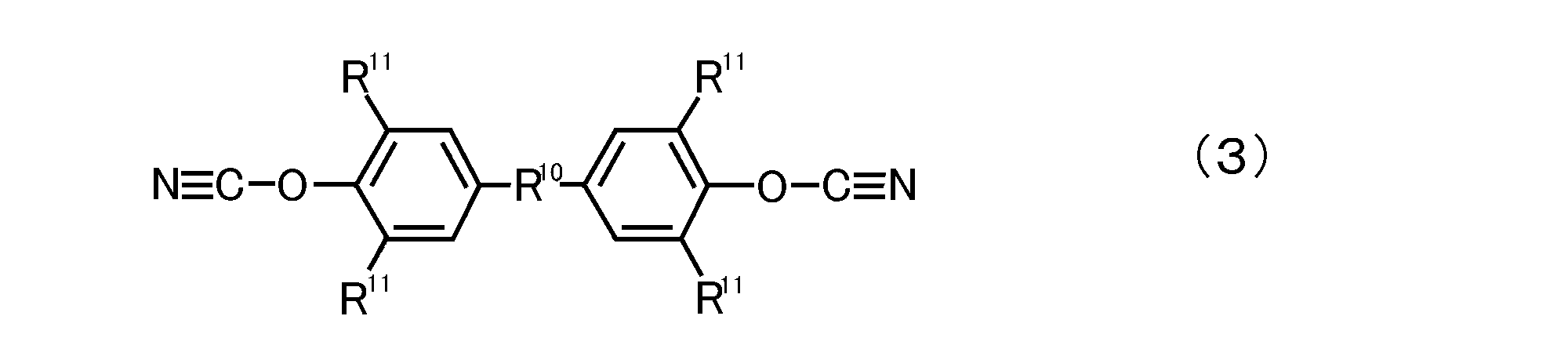
- the compound represented by the general formula (1) is preferably at least one selected from the compounds represented by the following general formula (3).
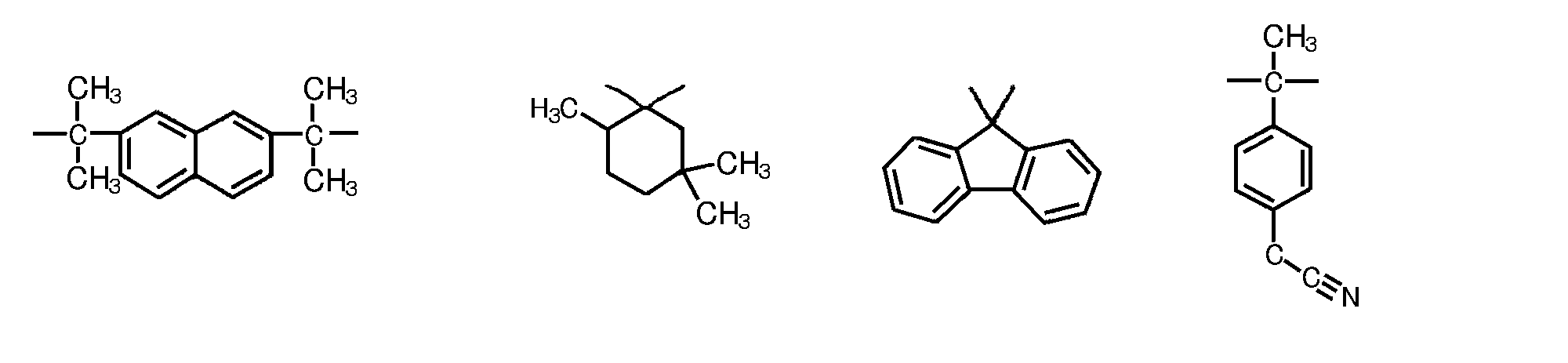
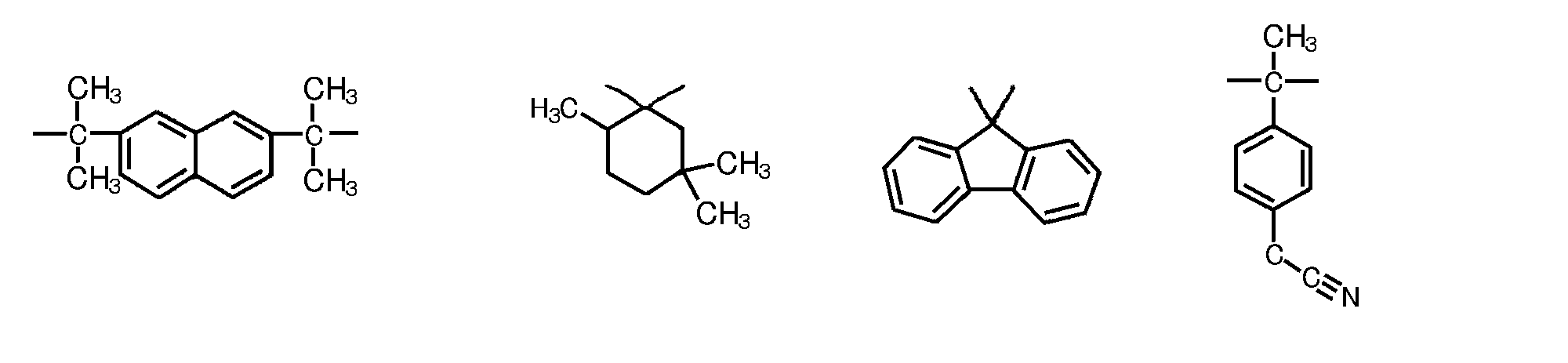
- R 10 of the general formula (3) is any of the groups represented below.
- R 11 is independently a hydrogen atom or an unsubstituted or fluorine-substituted methyl group, and i is an integer of 4 to 12.
- the one-component cyanate-epoxy composite resin composition of the present invention may contain 1 to 10,000 parts by mass of the epoxy resin component (B) relative to 100 parts by mass of the cyanate ester resin component (A).
- the amount of the latent curing agent used as the component (C) is preferably 1 to 100 parts by mass with respect to 100 parts by mass of the total amount of the components (A) and (B).
- the one-component cyanate-epoxy composite resin composition of the present invention is excellent in storage stability and rapid curability, and becomes a molded product excellent in adhesive strength and heat resistance after curing.
- the cyanate ester resin as the component (A) used in the one-component cyanate-epoxy composite resin composition of the present invention is not particularly limited, but is represented by the following general formula (1) or (2). It is preferable that it is a compound.
- General formula (1) In the above general formula (1), R 7 is an unsubstituted or fluorine-substituted divalent hydrocarbon group, and R 8 is independently a phenylene group that is unsubstituted or substituted with 1 to 4 alkyl groups. It is.
- R 9 in the general formula (2) is a hydrogen atom or an alkyl group having 1 to 4 carbon atoms, and j is an integer of 1 to 20.
- a prepolymer in which a part of the cyanate group of the compound of the general formula (1) or (2) forms a triazine ring can also be used as the component (A).
- the prepolymer include compounds in which all or part of the compound of the general formula (1) is trimerized.
- R 10 of the general formula (3) is any of the groups represented below.
- each R 11 is independently a hydrogen atom or an unsubstituted or fluorine-substituted methyl group, and i is an integer of 4 to 12.
- Examples of the epoxy resin used as the component (B) in the one-component cyanate-epoxy composite resin composition of the present invention include mononuclear polyhydric phenol compounds such as hydroquinone, resorcin, pyrocatechol, and phloroglucinol.
- Polyglycidyl ether compounds dihydroxynaphthalene, biphenol, methylene bisphenol (bisphenol F), methylene bis (orthocresol), ethylidene bisphenol, isopropylidene bisphenol (bisphenol A), isopropylidene bis (orthocresol), tetrabromobisphenol A, 1,3 -Bis (4-hydroxycumylbenzene), 1,4-bis (4-hydroxycumylbenzene), 1,1,3-tris (4-hydroxyphenyl) butane, 1,1,2,2- Polyglycols of polynuclear polyhydric phenol compounds such as tiger (4-hydroxyphenyl) ethane, thiobisphenol, sulfobisphenol, oxybisphenol, phenol novolac, orthocresol novolak, ethylphenol novolak, butylphenol novolak, octylphenol novolak, resorcin novolak, terpene phenol Z
- epoxy resins are those internally crosslinked by a terminal isocyanate prepolymer, or those having a high molecular weight with a polyvalent active hydrogen compound (polyhydric phenol, polyamine, carbonyl group-containing compound, polyphosphate ester, etc.) But you can.
- a polyvalent active hydrogen compound polyhydric phenol, polyamine, carbonyl group-containing compound, polyphosphate ester, etc.
- the epoxy equivalent of the epoxy resin (B) used in the present invention is preferably 70 to 3000, and more preferably 90 to 2000. If the epoxy equivalent is less than 70, curability may be lowered, and if it is greater than 3000, sufficient film properties may not be obtained, which is not preferable.
- the latent curing agent of component (C) contained in the one-component cyanate-epoxy composite resin composition of the present invention is obtained by reacting an amine compound (a-1) with an epoxy compound (a-2).
- a modified amine compound (a) and a phenol resin (b) are contained.
- the amine compound used as the component (a-1) is at least one amine compound having one or more tertiary amino groups and one or more primary and / or secondary amino groups, A compound represented by the following general formula (I), (II) or (III) is preferred.
- R 1 and R 2 in the general formula (I) are each independently an alkyl group having 1 to 10 carbon atoms, an alkyl group containing an oxygen atom, a nitrogen atom or a sulfur atom, or the above R 1 and R 2.
- R 3 is an (m + n) -valent hydrocarbon group
- R 4 is a hydrogen atom or an alkyl group having 1 to 10 carbon atoms, or an alkyl group containing an oxygen atom, a nitrogen atom or a sulfur atom N is 1, 2 or 3, and m is 1 or 2.
- R 4 in the general formula (II) is the same as R 4 in the general formula (I), and each R 5 is independently an alkylene group having 1 to 10 carbon atoms, an oxygen atom, a nitrogen atom or a sulfur atom.
- l is an integer of 1 to 10.
- R 1 and R 2 in the general formula (III) is the same as R 1 and R 2 in the general formula (I)
- R 5 is the same as R 5 in the formula (II)
- k is an integer of 1 to 10.
- examples of the amine compound represented by the general formula (I) include N, N-dimethylaminoethylamine, N, N-diethylaminoethylamine, N, N-diisopropylaminoethylamine, and N, N-diallylaminoethylamine.
- Examples of the amine compound represented by the general formula (II) include N, N- (bisaminopropyl) -N-methylamine, N, N-bisaminopropylethylamine, N, N-bisaminopropylpropylamine.
- Examples of the amine compound represented by the general formula (III) include bis [3- (N, N-dimethylaminopropyl)] amine, bis [3- (N, N-diethylaminopropyl)] amine, and bis [ 3- (N, N-diisopropylaminopropyl)] amine, bis [3- (N, N-dibutylaminopropyl)] amine and the like.
- Examples of the amine compound represented by the general formula (I-1) include N, N-dimethylaminoethylamine, N, N-diethylaminoethylamine, N, N-diisopropylaminoethylamine, N, N-diallylaminoethylamine, N, N-benzylmethylaminoethylamine, N, N-dibenzylaminoethylamine, N, N-cyclohexylmethylaminoethylamine, N, N-dicyclohexylaminoethylamine, N- (2-aminoethyl) pyrrolidine, N- (2- Aminoethyl) piperidine, N- (2-aminoethyl) morpholine, N- (2-aminoethyl) piperazine, N- (2-aminoethyl) -N′-methylpiperazine, N, N-dimethylaminoprop
- Examples of the epoxy compound used as the component (a-2) in the one-component cyanate-epoxy composite resin composition of the present invention include phenyl glycidyl ether, allyl glycidyl ether, methyl glycidyl ether, butyl glycidyl ether, second Monoglycidyl ether compounds such as butyl glycidyl ether, 2-ethylhexyl glycidyl ether, 2-methyloctyl glycidyl ether and stearyl glycidyl ether; monoglycidyl ester compounds such as versatic acid glycidyl ester; hydroquinone, resorcin, pyrocatechol, phloroglucinol Polyglycidyl ether compounds of mononuclear polyphenol compounds such as dihydroxynaphthalene, biphenol, methylene bisphenol (bisphenol ), Methylene bis (orthocresol),
- the epoxy compound used as the component (a-2) is preferably a polyglycidyl ether compound having two or more epoxy groups in the molecule.
- polyglycidyl ethers of bisphenol compounds such as methylene bisphenol (bisphenol F), methylene bis (orthocresol), ethylidene bisphenol, isopropylidene bisphenol (bisphenol A), and isopropylidene bis (orthocresol).
- the component (a-2) is reacted in an amount such that the epoxy equivalent is 0.2 to 3 equivalents relative to the amount in which the component (a-1) is 1 mole. It is preferably obtained by reacting in an amount of 0.5 to 2 equivalents.
- the epoxy equivalent of the component (a-2) is 1 mol of the component (a-1).
- the amount is preferably 0.5 to 2 equivalents, and more preferably 0.8 to 1.5 equivalents.
- modified amine compounds can be used in combination as the component (a-1).
- the phenol resin contained as component (b) in the latent curing agent (C) used in the present invention is a phenol resin synthesized from phenols and aldehydes.
- the phenols include phenol, cresol, ethylphenol, n-propylphenol, isopropylphenol, butylphenol, tert-butylphenol, octylphenol, nonylphenol, dodecylphenol, cyclohexylphenol, chlorophenol, bromophenol, resorcin, catechol, hydroquinone.
- the number average molecular weight of the phenol resin as the component (b) is preferably 750 to 1200.
- the amount of the component (b) used in the latent curing agent (C) is preferably 10 to 100 parts by mass, more preferably 20 to 60 parts by mass with respect to 100 parts by mass of the component (a). . If it is less than 10 parts by mass, sufficient curability cannot be obtained, and if it exceeds 100 parts by mass, the physical properties of the cured product are deteriorated, which is not preferable.
- the amount of the component (A) and the component (B) used in the cyanate-epoxy composite resin composition of the present invention is such that the component (B) is 1 to 10,000 parts by mass with respect to 100 parts by mass of the component (A). It is preferably 10 to 1000 parts by mass, and most preferably 20 to 500 parts by mass.
- the amount of the component (C) used in the cyanate-epoxy composite resin composition of the present invention is preferably 1 to 100 parts by mass with respect to 100 parts by mass of the total amount of the components (A) and (B). More preferably, it is ⁇ 60 parts by mass.
- the total amount of the component (A), the component (B) and the component (C) is preferably 50% by mass or more in the cyanate-epoxy composite resin composition of the present invention.
- the cyanate-epoxy composite resin composition of the present invention can be used by dissolving in various solvents for easy handling.
- solvents include ethers such as tetrahydrofuran, 1,2-dimethoxyethane, and 1,2-diethoxyethane; iso- or n-butanol, iso- or n-propanol, amyl alcohol, benzyl alcohol,
- alcohols such as furyl alcohol and tetrahydrofurfuryl alcohol
- ketones such as methyl ethyl ketone, methyl isopropyl ketone and methyl butyl ketone
- aromatic hydrocarbons such as benzene, toluene and xylene
- triethylamine pyridine, dioxane and acetonitrile.
- the amount of the organic solvent used is preferably 0 to 200 parts by weight, preferably 0 to 40 parts by weight, based on 100 parts by weight of the total amount of the components (A), (B) and (C). Is more preferable. If the amount of the organic solvent used exceeds 200 parts by mass, it is not preferable because it volatilizes and is dangerous and harmful.
- cyanate-epoxy composite resin composition of the present invention if necessary, glass fiber, carbon fiber, cellulose, silica sand, cement, kaolin, clay, aluminum hydroxide, bentonite, talc, silica, fine powder silica , Titanium dioxide, carbon black, graphite, iron oxide, bitumen fillers or pigments; thickeners; thixotropic agents; flame retardants; antifoaming agents; rust preventives; colloidal silica, colloidal alumina, etc.
- adhesive resins such as xylene resin and petroleum resin can be used in combination.
- Cyanate ester resin manufactured by Lonza; Cyanate LeCy: CE
- epoxy resin manufactured by ADEKA, Inc .
- EP-4901E bisphenol F type epoxy resin, epoxy equivalent 168: EP
- production examples 1 to 3 A latent curing agent was blended to obtain a one-component cyanate-epoxy composite resin composition.
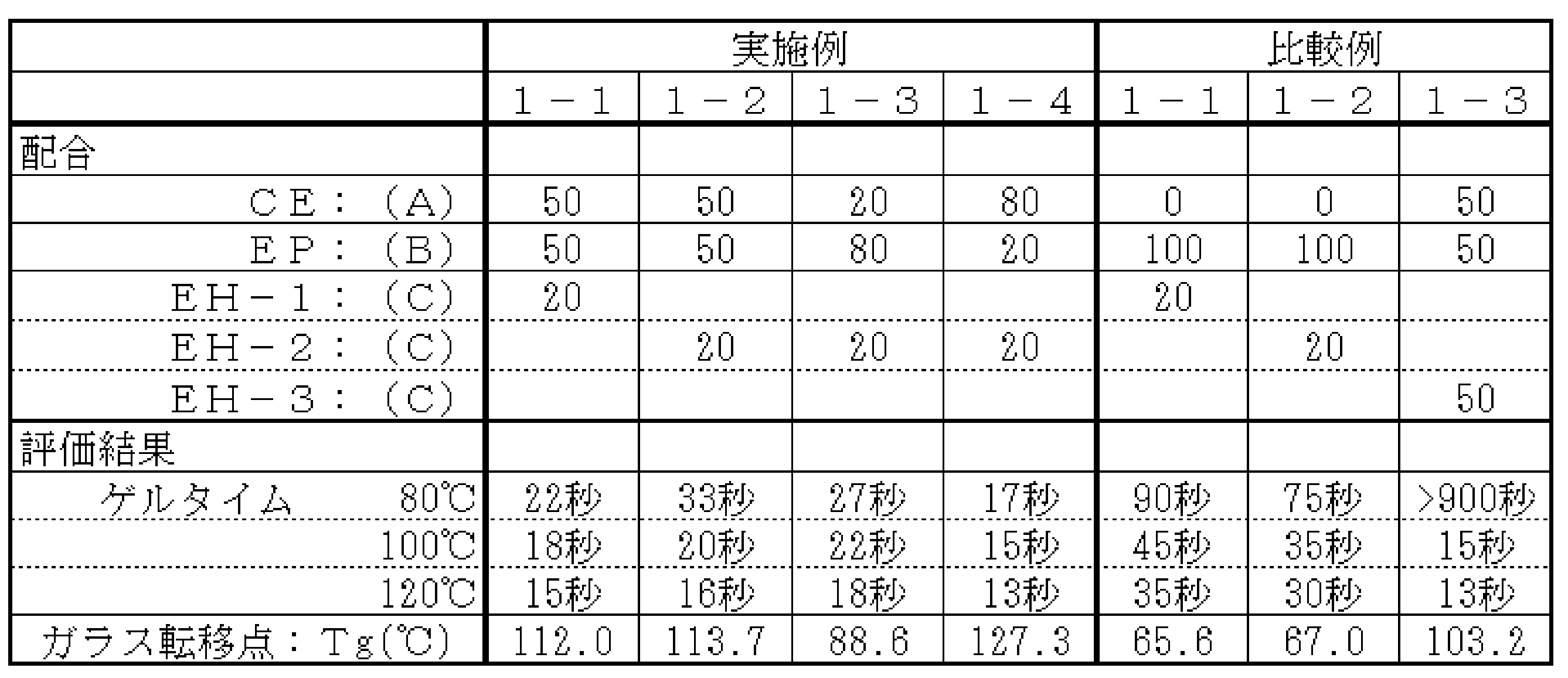
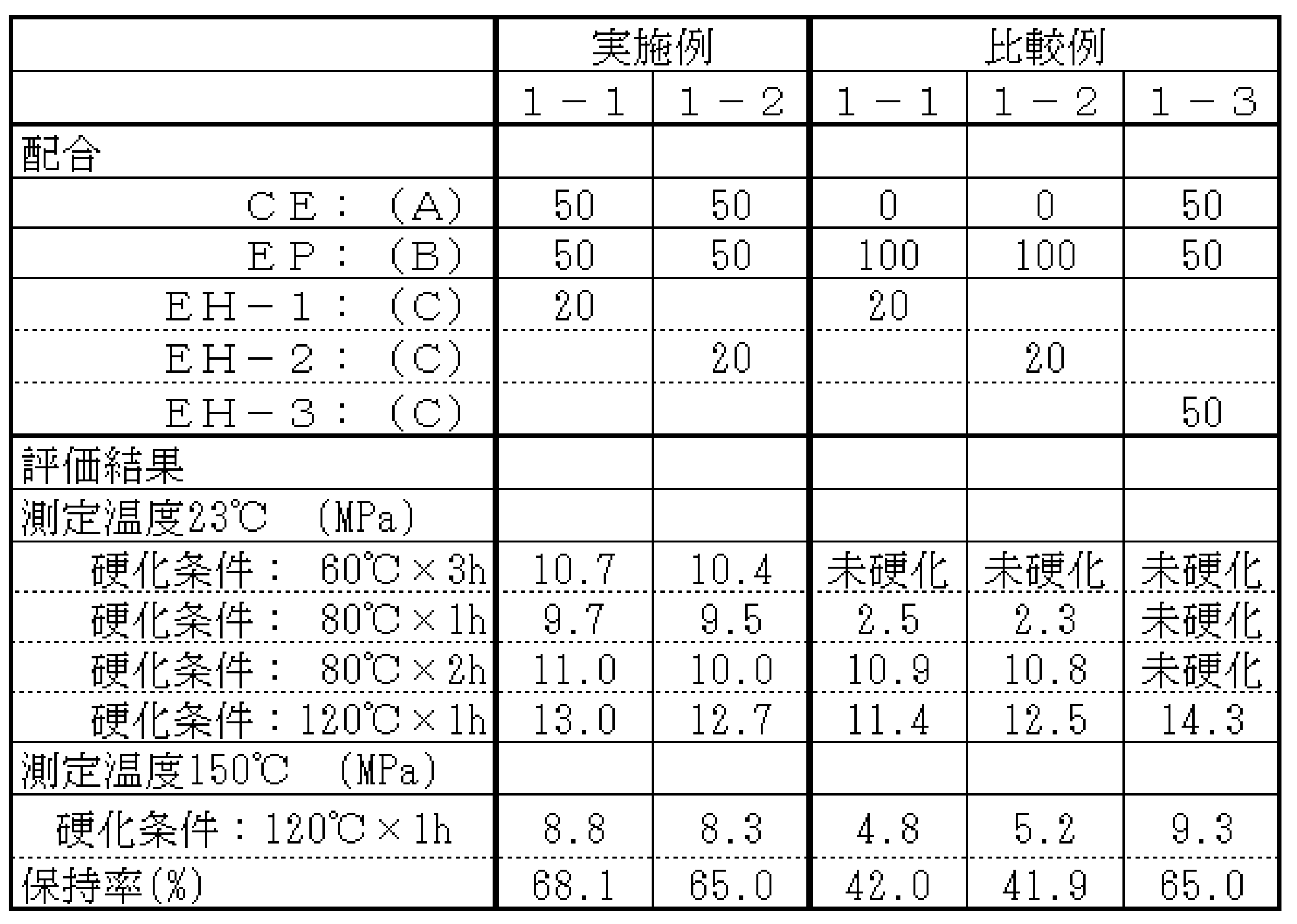
- the obtained one-component cyanate-epoxy composite resin composition was evaluated by the following tests. [Table 1] to [Table 3] show the blending ratio of each component and the test results.
- the TMA chart was measured using a thermal / stress / strain measuring device TMA6100 manufactured by SII Nano Technologies, with a temperature rising rate of 10 ° C./min and a scanning temperature range of ⁇ 35 to 250 ° C.
- the glass transition point was measured from the inflection point of the linear expansion coefficient.
- a cylindrical mold having a bottom diameter of 2 mm, a top diameter of 1.5 mm, and a height of 3 mm is bonded onto a glass epoxy substrate manufactured by impregnating an epoxy resin with a glass fiber cloth piled up, and at a predetermined temperature and time. Cured to prepare a molded product. Under a set temperature atmosphere, a force was applied to the molded product at a rate of 5 mm / min from the lateral direction, the adhesive was peeled off to measure the adhesive strength, and the retention was calculated according to the following formula.
- the one-component cyanate-epoxy composite resin composition of the present invention is excellent in storage stability and heat resistance of the molded product, and has excellent curability and adhesiveness in a wide temperature range from low temperature to high temperature. It was confirmed to have.
- the cyanate-epoxy composite resin set of the present invention can be used for a wide range of applications such as paints or adhesives for concrete, cement mortar, various metals, leather, glass, rubber, plastic, wood, cloth, paper, etc.
- it since it has high heat resistance and excellent adhesiveness, it is useful as a sealing material for protecting a semiconductor, or for use as an electronic material or an automobile material such as adhesion of electronic parts.
Landscapes
- Chemical & Material Sciences (AREA)
- Organic Chemistry (AREA)
- Health & Medical Sciences (AREA)
- Chemical Kinetics & Catalysis (AREA)
- Medicinal Chemistry (AREA)
- Polymers & Plastics (AREA)
- Epoxy Resins (AREA)
- Compositions Of Macromolecular Compounds (AREA)
- Sealing Material Composition (AREA)
- Adhesives Or Adhesive Processes (AREA)
Abstract
Description
本発明の第2の目的は、塗料あるいは接着剤等の広範な用途に使用することができ、特に、高い耐熱性と優れた接着性を有する、半導体保護のための封止材料として、あるいは電子部品の接着等の電子材料や自動車材料としての用途等に有用な硬化物を提供することにある。
更に本発明の第3の目的は、本発明の樹脂組成物を型内で硬化させる、成形物の製造方法を提供することにある。
一般式(I)

上記一般式(I)中のR1及びR2は、それぞれ独立に、炭素原子数1~10のアルキル基、酸素原子、窒素原子若しくは硫黄原子を含有するアルキル基、又は前記R1及びR2が結合してなるアルキレン基、R3は(m+n)価の炭化水素基、R4は水素原子又は炭素原子数1~10のアルキル基、又は酸素原子、窒素原子若しくは硫黄原子を含有するアルキル基であり、nは1、2又は3であり、mは1又は2である。
一般式(II)

一般式(III)

一般式(I-1)

一般式(1)

一般式(2)

一般式(3)

一般式(1)

一般式(2)

また、一般式(1)又は(2)の化合物のシアネート基の一部がトリアジン環を形成したプレポリマーも、(A)成分として使用することができる。プレポリマーとしては、例えば、前記一般式(1)の化合物の全部又は一部が3量化した化合物が挙げられる。
一般式(3)


前記(a-1)成分として使用されるアミン化合物は、1個以上の3級アミノ基、並びに1個以上の1級及び/又は2級アミノ基を有する、少なくとも1種のアミン化合物であり、下記一般式(I)、(II)又は(III)で表される化合物であることが好ましい。



一般式(I-1)

これらの中でも、N,N-ジメチルアミノプロピルアミン又はN,N-ジエチルアミノプロピルアミンを使用することが更に好ましい。
特に、(a-1)成分として一般式(I-1)で表されるポリアミン化合物を用いる場合には、(a-2)成分のエポキシ当量は、(a-1)成分が1モルとなる量に対し、0.5~2当量であることが好ましく、0.8~1.5当量であることが更に好ましい。
また、(A)成分、(B)成分及び(C)成分の合計量は、本発明のシアネート-エポキシ複合樹脂組成物中の50質量%以上であることが好ましい。
フラスコに、N,N-ジメチルアミノプロピルアミン130gを仕込んで80℃に加温した。この系内の温度を100~110℃に保ちながら、アデカレジンEP-4100E((株)ADEKAの商品名;ビスフェノールA型エポキシ樹脂、エポキシ当量190)213gを少しずつ加えた。N,N-ジメチルアミノプロピルアミン1モルに対するアデカレジンEP-4100Eのエポキシ当量は1.12であった。アデカレジンEP-4100Eを添加した後、系を140℃に昇温し、1.5時間反応させて変性ポリアミンを得た。得られた変性ポリアミン100gに対してフェノール樹脂30gを仕込み、180~190℃、30~40トールで1時間かけて脱溶媒を行い、潜在性硬化剤(EH-1)を得た。
アミンをN,N-ジエチルアミノプロピルアミン100gとし、製造例1と同様の手法によりアデカレジンEP-4100E((株)ADEKAの商品名;ビスフェノールA型エポキシ樹脂、エポキシ当量190)213gと反応させて変性ポリアミンを得た。N,N-ジエチルアミノプロピルアミン1モルに対するアデカレジンEP-4100Eのエポキシ当量は1.12であった。得られた変性ポリアミン100gに対してフェノール樹脂30gを仕込み、180~190℃、30~40トールで1時間かけて脱溶媒を行い、潜在性硬化剤(EH-2)を得た。
上記製造例1のアミンをm-キシリレンジアミン100gとし、製造例1と同様の手法により、アデカレジンEP-4100E((株)ADEKAの商品名;ビスフェノールA型エポキシ樹脂、エポキシ当量190)213gと反応させて変性ポリアミンを得た。m-キシリレンジアミン1モルに対するアデカレジンEP-4100Eのエポキシ当量は1.53であった。得られた変性ポリアミン100gに対してフェノール樹脂30gを仕込み、180~190℃、30~40トールで1時間かけて脱溶媒を行い、比較用潜在性硬化剤(EH-3)を得た。
シアネートエステル樹脂(ロンザ社製;シアネートLeCy:CE)、エポキシ樹脂((株)ADEKA社製;EP-4901E、ビスフェノールF型エポキシ樹脂、エポキシ当量168:EP)及び製造例1~3により製造された潜在性硬化剤を配合して一液型シアネート-エポキシ複合樹脂組成物とした。
得られた一液型シアネート-エポキシ複合樹脂組成物について、以下の試験を行い、評価した。〔表1〕~〔表3〕に各成分の配合比及び試験結果を示す。
ブルックフィールドE型回転粘度計を用いて、1rpmで、25℃における初期粘度及び25℃で24時間放置した後の粘度を測定し、増粘率を求めた。
各測定温度に保たれた熱盤上に、各組成物0.5gを滴下し、スパチュラでかき混ぜて流動性がなくなるまでの時間を測定した。
SIIナノテクノロジーズ社製熱・応力・歪測定装置TMA6100を用いて、昇温速度10℃/分、走査温度範囲-35~250℃としてTMAチャートを測定した。線膨張率の変曲点からガラス転移点を測定した。
ガラス繊維製の布を重ねたものにエポキシ樹脂を含浸させて製造したガラスエポキシ基板上に、底面直径2mm×上面直径1.5mm×高さ3mmの円柱型を接着し、所定の温度及び時間で硬化させて成形物を作製した。設定温度雰囲気下で、この成形物に横方向から5mm/分で力を加え、押し剥がして接着強度を測定し、更に下記式により保持率を算出した。


Claims (13)
- シアネートエステル樹脂(A)、エポキシ樹脂(B)及び潜在性硬化剤(C)を含有してなる一液型シアネート-エポキシ複合樹脂組成物であって、前記潜在性硬化剤(C)が、1個以上の3級アミノ基並びに1個以上の1級及び/又は2級アミノ基を有するアミン化合物から選ばれる少なくとも1種(a-1)と、エポキシ化合物(a-2)とを反応させてなる変性アミン化合物(a)及びフェノール樹脂(b)を含有してなることを特徴とする、一液型シアネート-エポキシ複合樹脂組成物。
- 前記アミン化合物(a-1)が、下記一般式(I)、(II)又は(III)で表されるアミン化合物である、請求項1に記載された一液型シアネート-エポキシ複合樹脂組成物。
一般式(I)
上記一般式(I)中のR1及びR2は、それぞれ独立に、炭素原子数1~10のアルキル基、酸素原子、窒素原子若しくは硫黄原子を含有するアルキル基、又は前記R1及びR2が結合してなるアルキレン基であり、R3は(m+n)価の炭化水素基、R4は水素原子又は炭素原子数1~10のアルキル基、又は、酸素原子、窒素原子若しくは硫黄原子を含有するアルキル基であり、nは1、2又は3、mは1又は2である。
一般式(II)
上記一般式(II)中のR4は前記一般式(I) 中のR4と同じであり、R5はそれぞれ独立に、炭素数1~10のアルキレン基、又は、酸素原子、窒素原子若しくは硫黄原子を含有するアルキレン基であり、lは1~10の整数である。
一般式(III)
上記一般式(III)中のR1及びR2は前記一般式(I) 中のR1及びR2と同じであり、R5は前記一般式(II)中のR5と同じであり、kは1~10の整数である。
- 前記一般式(I)で表されるアミン化合物(a-1)が、下記一般式(I-1)で表されるアミン化合物である、請求項2に記載された一液型シアネート-エポキシ複合樹脂組成物。
一般式(I-1)
上記一般式(I-1)中のR1及びR2は、前記一般式(I)中のR1及びR2と同じであり、R6は炭素原子数1~10のアルキレン基である。
- 前記変性ポリアミン化合物(a)が、前記一般式(I-1)で表されるアミン化合物(a-1)1モルとなる量に対し、前記エポキシ化合物(a-2)のエポキシ当量が0.5~2となる量の該エポキシ化合物を反応させて得られた変性ポリアミンである、請求項3に記載された一液型シアネート-エポキシ複合樹脂組成物。
- 前記(C)成分が、前記(a)成分である変性アミン化合物100質量部に対し、(b)成分であるフェノール樹脂を10~100質量部含有する、請求項1又は2に記載された一液型シアネート-エポキシ複合樹脂組成物。
- 前記(A)成分であるシアネートエステル樹脂が、下記一般式(1)及び(2)で表される化合物、並びにこれらのプレポリマーからなる群より選ばれる少なくとも1種である、請求項1又は2に記載された一液型シアネート-エポキシ複合樹脂組成物。
一般式(1)
上記一般式(1)中のR7は、非置換又はフッ素置換の2価の炭化水素基、R8は、それぞれ独立に、非置換又は1~4個のアルキル基で置換されているフェニレン基である。
一般式(2)
上記一般式(2)中のR9は水素原子又は炭素原子数1~4のアルキル基であり、jは1~20の整数である。 - 前記一般式(1)で表される化合物が、下記一般式(3)で表される化合物から選ばれる少なくとも1種である、請求項6に記載された一液型シアネート-エポキシ複合樹脂組成物;
一般式(3)

但し、一般式(3)中のR10は、以下に表される基の何れかである;


前記一般式(3)中のR11は、それぞれ独立に、水素原子又は非置換若しくはフッ素置換のメチル基であり、iは4~12の整数である。 - 前記(A)成分であるシアネートエステル樹脂成分100質量部に対し、(B)成分であるエポキシ樹脂成分を1~10000質量部使用する、請求項1又は2に記載された一液型シアネート-エポキシ複合樹脂組成物。
- 前記(C)成分である潜在性硬化剤の使用量が、(A)成分及び(B)成分の合計量100質量部に対して1~100質量部である、請求項1又は2に記載された一液型シアネート-エポキシ複合樹脂組成物。
- 請求項1又は2に記載された樹脂組成物を重合硬化させてなることを特徴とする硬化物。
- 請求項1又は2に記載された樹脂組成物からなることを特徴とする封止用材料。
- 請求項1又は2に記載された樹脂組成物からなることを特徴とする接着剤。
- 請求項1又は2に記載された樹脂組成物を型内で硬化させることを特徴とする成形物の製造方法。
Priority Applications (3)
| Application Number | Priority Date | Filing Date | Title |
|---|---|---|---|
| KR1020107029236A KR101507198B1 (ko) | 2008-06-27 | 2009-06-12 | 일액형 시아네이트-에폭시 복합 수지 조성물 |
| US13/001,461 US8911586B2 (en) | 2008-06-27 | 2009-06-12 | One liquid type cyanate-epoxy composite resin composition |
| CN200980124035.3A CN102037076B (zh) | 2008-06-27 | 2009-06-12 | 一液型氰酸酯-环氧复合树脂组合物 |
Applications Claiming Priority (2)
| Application Number | Priority Date | Filing Date | Title |
|---|---|---|---|
| JP2008169454A JP5517326B2 (ja) | 2008-06-27 | 2008-06-27 | 一液型シアネート−エポキシ複合樹脂組成物 |
| JP2008-169454 | 2008-06-27 |
Publications (1)
| Publication Number | Publication Date |
|---|---|
| WO2009157147A1 true WO2009157147A1 (ja) | 2009-12-30 |
Family
ID=41444220
Family Applications (1)
| Application Number | Title | Priority Date | Filing Date |
|---|---|---|---|
| PCT/JP2009/002681 Ceased WO2009157147A1 (ja) | 2008-06-27 | 2009-06-12 | 一液型シアネート-エポキシ複合樹脂組成物 |
Country Status (6)
| Country | Link |
|---|---|
| US (1) | US8911586B2 (ja) |
| JP (1) | JP5517326B2 (ja) |
| KR (1) | KR101507198B1 (ja) |
| CN (1) | CN102037076B (ja) |
| TW (1) | TWI465477B (ja) |
| WO (1) | WO2009157147A1 (ja) |
Cited By (6)
| Publication number | Priority date | Publication date | Assignee | Title |
|---|---|---|---|---|
| WO2011099292A1 (ja) * | 2010-02-12 | 2011-08-18 | 株式会社Adeka | 無溶剤一液型シアン酸エステル-エポキシ複合樹脂組成物 |
| US20120077943A1 (en) * | 2010-09-01 | 2012-03-29 | Air Products And Chemicals, Inc. | Low Temperature Curable Epoxy Compositions |
| JP2012150180A (ja) * | 2011-01-17 | 2012-08-09 | Jsr Corp | 感放射線性樹脂組成物、硬化膜及び硬化膜の形成方法 |
| JP2012212051A (ja) * | 2011-03-31 | 2012-11-01 | Toyo Ink Sc Holdings Co Ltd | カラーフィルタ用着色組成物、およびカラーフィルタ |
| JP2020200389A (ja) * | 2019-06-10 | 2020-12-17 | 株式会社Adeka | 硬化性樹脂組成物 |
| JPWO2021193233A1 (ja) * | 2020-03-25 | 2021-09-30 |
Families Citing this family (15)
| Publication number | Priority date | Publication date | Assignee | Title |
|---|---|---|---|---|
| US8198395B2 (en) | 2007-02-07 | 2012-06-12 | Air Products And Chemicals, Inc. | Alkylated aminopropylated ethylenediamines and uses thereof |
| US8168296B2 (en) * | 2007-02-07 | 2012-05-01 | Air Products And Chemicals, Inc. | Benzylated polyalkylene polyamines and uses thereof |
| US8318309B2 (en) * | 2007-02-07 | 2012-11-27 | Air Products And Chemicals, Inc. | Benzylated aminopropylated alkylenediamines and uses thereof |
| US8518547B2 (en) | 2007-02-07 | 2013-08-27 | Air Products And Chemicals, Inc. | Alkylated polyalkylene polyamines and uses thereof |
| US7910667B1 (en) * | 2009-09-11 | 2011-03-22 | Air Products And Chemicals, Inc. | Low temperature curable epoxy compositions containing phenolic-blocked urea curatives |
| TWI491631B (zh) * | 2010-03-05 | 2015-07-11 | Adeka Corp | A photohardenable resin and a dispersant using the same |
| KR101803123B1 (ko) * | 2010-08-12 | 2017-11-29 | 가부시키가이샤 아데카 | 잠재성 경화제 조성물 및 일액 경화성 에폭시 수지 조성물 |
| JP5839870B2 (ja) * | 2011-07-15 | 2016-01-06 | キヤノン株式会社 | 光学素子および光学素子の製造方法 |
| CN105764985B (zh) * | 2013-12-05 | 2018-07-03 | 三键有限公司 | 热固性树脂组合物 |
| CN106047271B (zh) * | 2016-06-22 | 2019-01-29 | 西南科技大学 | 一种低介电氰酸酯胶粘剂及其制备方法 |
| CA3050075A1 (en) | 2017-02-27 | 2018-08-30 | Adeka Corporation | Resin composition for fiber-reinforced plastic, cured product of same, and fiber-reinforced plastic comprising said cured product |
| CN108929519A (zh) * | 2017-05-24 | 2018-12-04 | 洛阳尖端技术研究院 | 一种玄武岩纤维复合材料及其制备方法 |
| CN110914181A (zh) * | 2017-07-20 | 2020-03-24 | 东洋纺株式会社 | 卷膜和膜束 |
| CN107879668B (zh) * | 2017-12-08 | 2020-09-25 | 卡本复合材料(天津)有限公司 | 一种用于伸缩缝快速修补的抗开裂环氧砂浆及其制备方法 |
| JP7811201B2 (ja) * | 2021-03-08 | 2026-02-04 | 株式会社Adeka | 硬化性樹脂組成物、硬化物及び接着剤 |
Citations (8)
| Publication number | Priority date | Publication date | Assignee | Title |
|---|---|---|---|---|
| JPS60250026A (ja) * | 1984-05-28 | 1985-12-10 | Mitsubishi Rayon Co Ltd | エポキシ樹脂組成物 |
| JPS6390531A (ja) * | 1986-10-03 | 1988-04-21 | Sumitomo Bakelite Co Ltd | 半導体封止用エポキシ樹脂組成物 |
| JPH0952941A (ja) * | 1995-08-14 | 1997-02-25 | Shin Etsu Chem Co Ltd | エポキシ樹脂組成物及び半導体装置 |
| JP2000191776A (ja) * | 1998-12-24 | 2000-07-11 | Mitsubishi Gas Chem Co Inc | シアン酸エステル・コ−プレポリマー |
| JP2001172473A (ja) * | 1999-10-07 | 2001-06-26 | Nitto Denko Corp | 半導体封止用エポキシ樹脂組成物およびそれを用いた半導体装置 |
| JP2001302767A (ja) * | 2000-04-25 | 2001-10-31 | Matsushita Electric Works Ltd | 半導体封止用液状エポキシ樹脂組成物、半導体装置およびその製造方法 |
| JP2004511587A (ja) * | 2000-09-28 | 2004-04-15 | 住友ベークライト株式会社 | 低温結合性接着剤組成物 |
| JP2007204669A (ja) * | 2006-02-03 | 2007-08-16 | Asahi Kasei Chemicals Corp | 特定小粒径粒度分布エポキシ樹脂用硬化剤およびエポキシ樹脂組成物 |
Family Cites Families (2)
| Publication number | Priority date | Publication date | Assignee | Title |
|---|---|---|---|---|
| US6469074B1 (en) * | 1999-05-26 | 2002-10-22 | Matsushita Electric Works, Ltd. | Composition of cyanate ester, epoxy resin and acid anhydride |
| JP2002294162A (ja) * | 2001-03-28 | 2002-10-09 | Nippon Paint Co Ltd | 塗料用樹脂組成物の製造方法 |
-
2008
- 2008-06-27 JP JP2008169454A patent/JP5517326B2/ja active Active
-
2009
- 2009-06-12 KR KR1020107029236A patent/KR101507198B1/ko active Active
- 2009-06-12 WO PCT/JP2009/002681 patent/WO2009157147A1/ja not_active Ceased
- 2009-06-12 CN CN200980124035.3A patent/CN102037076B/zh active Active
- 2009-06-12 US US13/001,461 patent/US8911586B2/en active Active
- 2009-06-24 TW TW098121149A patent/TWI465477B/zh active
Patent Citations (8)
| Publication number | Priority date | Publication date | Assignee | Title |
|---|---|---|---|---|
| JPS60250026A (ja) * | 1984-05-28 | 1985-12-10 | Mitsubishi Rayon Co Ltd | エポキシ樹脂組成物 |
| JPS6390531A (ja) * | 1986-10-03 | 1988-04-21 | Sumitomo Bakelite Co Ltd | 半導体封止用エポキシ樹脂組成物 |
| JPH0952941A (ja) * | 1995-08-14 | 1997-02-25 | Shin Etsu Chem Co Ltd | エポキシ樹脂組成物及び半導体装置 |
| JP2000191776A (ja) * | 1998-12-24 | 2000-07-11 | Mitsubishi Gas Chem Co Inc | シアン酸エステル・コ−プレポリマー |
| JP2001172473A (ja) * | 1999-10-07 | 2001-06-26 | Nitto Denko Corp | 半導体封止用エポキシ樹脂組成物およびそれを用いた半導体装置 |
| JP2001302767A (ja) * | 2000-04-25 | 2001-10-31 | Matsushita Electric Works Ltd | 半導体封止用液状エポキシ樹脂組成物、半導体装置およびその製造方法 |
| JP2004511587A (ja) * | 2000-09-28 | 2004-04-15 | 住友ベークライト株式会社 | 低温結合性接着剤組成物 |
| JP2007204669A (ja) * | 2006-02-03 | 2007-08-16 | Asahi Kasei Chemicals Corp | 特定小粒径粒度分布エポキシ樹脂用硬化剤およびエポキシ樹脂組成物 |
Cited By (15)
| Publication number | Priority date | Publication date | Assignee | Title |
|---|---|---|---|---|
| TWI567098B (zh) * | 2010-02-12 | 2017-01-21 | Adeka股份有限公司 | 無溶劑一液型氰酸酯-環氧複合樹脂組成物 |
| KR101888703B1 (ko) * | 2010-02-12 | 2018-08-14 | 가부시키가이샤 아데카 | 무용제 일액형 시안산에스테르-에폭시 복합 수지 조성물 |
| US9382459B2 (en) | 2010-02-12 | 2016-07-05 | Adeka Corporation | Solventless one liquid type cyanate ester-epdxy composite resin composition |
| WO2011099292A1 (ja) * | 2010-02-12 | 2011-08-18 | 株式会社Adeka | 無溶剤一液型シアン酸エステル-エポキシ複合樹脂組成物 |
| CN102906149A (zh) * | 2010-02-12 | 2013-01-30 | Adeka株式会社 | 无溶剂一液型氰酸酯-环氧复合树脂组合物 |
| KR20130001214A (ko) * | 2010-02-12 | 2013-01-03 | 가부시키가이샤 아데카 | 무용제 일액형 시안산에스테르-에폭시 복합 수지 조성물 |
| JP2011162710A (ja) * | 2010-02-12 | 2011-08-25 | Adeka Corp | 無溶剤一液型シアン酸エステル−エポキシ複合樹脂組成物 |
| US9279032B2 (en) * | 2010-09-01 | 2016-03-08 | Air Products And Chemicals, Inc. | Low temperature curable epoxy compositions |
| US20120077943A1 (en) * | 2010-09-01 | 2012-03-29 | Air Products And Chemicals, Inc. | Low Temperature Curable Epoxy Compositions |
| JP2012150180A (ja) * | 2011-01-17 | 2012-08-09 | Jsr Corp | 感放射線性樹脂組成物、硬化膜及び硬化膜の形成方法 |
| JP2012212051A (ja) * | 2011-03-31 | 2012-11-01 | Toyo Ink Sc Holdings Co Ltd | カラーフィルタ用着色組成物、およびカラーフィルタ |
| JP2020200389A (ja) * | 2019-06-10 | 2020-12-17 | 株式会社Adeka | 硬化性樹脂組成物 |
| JPWO2021193233A1 (ja) * | 2020-03-25 | 2021-09-30 | ||
| JP7699104B2 (ja) | 2020-03-25 | 2025-06-26 | 株式会社Adeka | 硬化性樹脂組成物、及び硬化性樹脂組成物の硬化収縮を抑制する方法 |
| US12590178B2 (en) | 2020-03-25 | 2026-03-31 | Adeka Corporation | Curable resin composition and method for suppressing curing shrinkage of curable resin composition |
Also Published As
| Publication number | Publication date |
|---|---|
| JP2010006991A (ja) | 2010-01-14 |
| JP5517326B2 (ja) | 2014-06-11 |
| TWI465477B (zh) | 2014-12-21 |
| CN102037076A (zh) | 2011-04-27 |
| KR20110037971A (ko) | 2011-04-13 |
| CN102037076B (zh) | 2014-05-28 |
| US8911586B2 (en) | 2014-12-16 |
| KR101507198B1 (ko) | 2015-03-30 |
| TW201000511A (en) | 2010-01-01 |
| US20110095453A1 (en) | 2011-04-28 |
Similar Documents
| Publication | Publication Date | Title |
|---|---|---|
| JP5517326B2 (ja) | 一液型シアネート−エポキシ複合樹脂組成物 | |
| JP5603610B2 (ja) | 無溶剤一液型シアン酸エステル−エポキシ複合樹脂組成物 | |
| JP5415947B2 (ja) | 一液型シアネート−エポキシ複合樹脂組成物 | |
| CN101821312B (zh) | 一液型氰酸酯-环氧复合树脂组合物、其固化物及其制造方法以及使用该组合物的密封用材料和粘着剂 | |
| KR101591555B1 (ko) | 일액형 시안산에스테르-에폭시 복합 수지 조성물 | |
| US20120178853A1 (en) | Solventless one liquid type cyanate ester-epoxy composite resin composition | |
| JP4938567B2 (ja) | 一液型シアネート−エポキシ複合樹脂組成物 | |
| JP5876414B2 (ja) | 潜在性硬化剤組成物及び一液硬化性エポキシ樹脂組成物 | |
| JP6886786B2 (ja) | 一液型シアン酸エステル−エポキシ複合樹脂組成物 | |
| TWI425021B (zh) | A liquid cyanide-epoxy composite resin composition, a hardened product thereof and a method for producing the same, and a sealing material and an adhesive |
Legal Events
| Date | Code | Title | Description |
|---|---|---|---|
| WWE | Wipo information: entry into national phase |
Ref document number: 200980124035.3 Country of ref document: CN |
|
| 121 | Ep: the epo has been informed by wipo that ep was designated in this application |
Ref document number: 09769857 Country of ref document: EP Kind code of ref document: A1 |
|
| ENP | Entry into the national phase |
Ref document number: 20107029236 Country of ref document: KR Kind code of ref document: A |
|
| WWE | Wipo information: entry into national phase |
Ref document number: 13001461 Country of ref document: US |
|
| NENP | Non-entry into the national phase |
Ref country code: DE |
|
| 122 | Ep: pct application non-entry in european phase |
Ref document number: 09769857 Country of ref document: EP Kind code of ref document: A1 |