WO2009102017A1 - 空気入りタイヤ - Google Patents
空気入りタイヤ Download PDFInfo
- Publication number
- WO2009102017A1 WO2009102017A1 PCT/JP2009/052409 JP2009052409W WO2009102017A1 WO 2009102017 A1 WO2009102017 A1 WO 2009102017A1 JP 2009052409 W JP2009052409 W JP 2009052409W WO 2009102017 A1 WO2009102017 A1 WO 2009102017A1
- Authority
- WO
- WIPO (PCT)
- Prior art keywords
- weight
- meth
- acrylate
- monomer
- rubber
- Prior art date
- Legal status (The legal status is an assumption and is not a legal conclusion. Google has not performed a legal analysis and makes no representation as to the accuracy of the status listed.)
- Ceased
Links
Classifications
-
- C—CHEMISTRY; METALLURGY
- C08—ORGANIC MACROMOLECULAR COMPOUNDS; THEIR PREPARATION OR CHEMICAL WORKING-UP; COMPOSITIONS BASED THEREON
- C08L—COMPOSITIONS OF MACROMOLECULAR COMPOUNDS
- C08L7/00—Compositions of natural rubber
-
- B—PERFORMING OPERATIONS; TRANSPORTING
- B60—VEHICLES IN GENERAL
- B60C—VEHICLE TYRES; TYRE INFLATION; TYRE CHANGING; CONNECTING VALVES TO INFLATABLE ELASTIC BODIES IN GENERAL; DEVICES OR ARRANGEMENTS RELATED TO TYRES
- B60C1/00—Tyres characterised by the chemical composition or the physical arrangement or mixture of the composition
- B60C1/0016—Compositions of the tread
-
- B—PERFORMING OPERATIONS; TRANSPORTING
- B60—VEHICLES IN GENERAL
- B60C—VEHICLE TYRES; TYRE INFLATION; TYRE CHANGING; CONNECTING VALVES TO INFLATABLE ELASTIC BODIES IN GENERAL; DEVICES OR ARRANGEMENTS RELATED TO TYRES
- B60C11/00—Tyre tread bands; Tread patterns; Anti-skid inserts
- B60C11/14—Anti-skid inserts, e.g. vulcanised into the tread band
-
- C—CHEMISTRY; METALLURGY
- C08—ORGANIC MACROMOLECULAR COMPOUNDS; THEIR PREPARATION OR CHEMICAL WORKING-UP; COMPOSITIONS BASED THEREON
- C08J—WORKING-UP; GENERAL PROCESSES OF COMPOUNDING; AFTER-TREATMENT NOT COVERED BY SUBCLASSES C08B, C08C, C08F, C08G or C08H
- C08J9/00—Working-up of macromolecular substances to porous or cellular articles or materials; After-treatment thereof
- C08J9/32—Working-up of macromolecular substances to porous or cellular articles or materials; After-treatment thereof from compositions containing microballoons, e.g. syntactic foams
-
- C—CHEMISTRY; METALLURGY
- C08—ORGANIC MACROMOLECULAR COMPOUNDS; THEIR PREPARATION OR CHEMICAL WORKING-UP; COMPOSITIONS BASED THEREON
- C08K—Use of inorganic or non-macromolecular organic substances as compounding ingredients
- C08K3/00—Use of inorganic substances as compounding ingredients
- C08K3/34—Silicon-containing compounds
- C08K3/36—Silica
-
- C—CHEMISTRY; METALLURGY
- C08—ORGANIC MACROMOLECULAR COMPOUNDS; THEIR PREPARATION OR CHEMICAL WORKING-UP; COMPOSITIONS BASED THEREON
- C08K—Use of inorganic or non-macromolecular organic substances as compounding ingredients
- C08K5/00—Use of organic ingredients
- C08K5/54—Silicon-containing compounds
- C08K5/548—Silicon-containing compounds containing sulfur
-
- C—CHEMISTRY; METALLURGY
- C08—ORGANIC MACROMOLECULAR COMPOUNDS; THEIR PREPARATION OR CHEMICAL WORKING-UP; COMPOSITIONS BASED THEREON
- C08K—Use of inorganic or non-macromolecular organic substances as compounding ingredients
- C08K7/00—Use of ingredients characterised by shape
- C08K7/22—Expanded, porous or hollow particles
-
- C—CHEMISTRY; METALLURGY
- C08—ORGANIC MACROMOLECULAR COMPOUNDS; THEIR PREPARATION OR CHEMICAL WORKING-UP; COMPOSITIONS BASED THEREON
- C08K—Use of inorganic or non-macromolecular organic substances as compounding ingredients
- C08K9/00—Use of pretreated ingredients
- C08K9/10—Encapsulated ingredients
-
- C—CHEMISTRY; METALLURGY
- C08—ORGANIC MACROMOLECULAR COMPOUNDS; THEIR PREPARATION OR CHEMICAL WORKING-UP; COMPOSITIONS BASED THEREON
- C08L—COMPOSITIONS OF MACROMOLECULAR COMPOUNDS
- C08L9/00—Compositions of homopolymers or copolymers of conjugated diene hydrocarbons
-
- B—PERFORMING OPERATIONS; TRANSPORTING
- B60—VEHICLES IN GENERAL
- B60C—VEHICLE TYRES; TYRE INFLATION; TYRE CHANGING; CONNECTING VALVES TO INFLATABLE ELASTIC BODIES IN GENERAL; DEVICES OR ARRANGEMENTS RELATED TO TYRES
- B60C11/00—Tyre tread bands; Tread patterns; Anti-skid inserts
- B60C11/0008—Tyre tread bands; Tread patterns; Anti-skid inserts characterised by the tread rubber
- B60C2011/0016—Physical properties or dimensions
- B60C2011/0025—Modulus or tan delta
-
- C—CHEMISTRY; METALLURGY
- C08—ORGANIC MACROMOLECULAR COMPOUNDS; THEIR PREPARATION OR CHEMICAL WORKING-UP; COMPOSITIONS BASED THEREON
- C08J—WORKING-UP; GENERAL PROCESSES OF COMPOUNDING; AFTER-TREATMENT NOT COVERED BY SUBCLASSES C08B, C08C, C08F, C08G or C08H
- C08J2203/00—Foams characterized by the expanding agent
- C08J2203/22—Expandable microspheres, e.g. Expancel®
-
- C—CHEMISTRY; METALLURGY
- C08—ORGANIC MACROMOLECULAR COMPOUNDS; THEIR PREPARATION OR CHEMICAL WORKING-UP; COMPOSITIONS BASED THEREON
- C08J—WORKING-UP; GENERAL PROCESSES OF COMPOUNDING; AFTER-TREATMENT NOT COVERED BY SUBCLASSES C08B, C08C, C08F, C08G or C08H
- C08J2307/00—Characterised by the use of natural rubber
-
- C—CHEMISTRY; METALLURGY
- C08—ORGANIC MACROMOLECULAR COMPOUNDS; THEIR PREPARATION OR CHEMICAL WORKING-UP; COMPOSITIONS BASED THEREON
- C08J—WORKING-UP; GENERAL PROCESSES OF COMPOUNDING; AFTER-TREATMENT NOT COVERED BY SUBCLASSES C08B, C08C, C08F, C08G or C08H
- C08J2309/00—Characterised by the use of homopolymers or copolymers of conjugated diene hydrocarbons
-
- C—CHEMISTRY; METALLURGY
- C08—ORGANIC MACROMOLECULAR COMPOUNDS; THEIR PREPARATION OR CHEMICAL WORKING-UP; COMPOSITIONS BASED THEREON
- C08K—Use of inorganic or non-macromolecular organic substances as compounding ingredients
- C08K3/00—Use of inorganic substances as compounding ingredients
- C08K3/02—Elements
- C08K3/04—Carbon
Definitions
- the present invention relates to a pneumatic tire. More specifically, the present invention improves the formation of resin-coated bubbles by thermally expandable microcapsules even when silica is blended with tread rubber to maintain rubber flexibility at low temperatures.
- the present invention relates to a pneumatic tire that improves the frictional force on ice.
- Patent Document 1 discloses that, as a means for forming such bubbles, a thermally expandable microcapsule is blended with a rubber composition for a tire tread and is expanded by heating in a vulcanization process to form resin-coated bubbles. is suggesting.
- Studless tires also maintain the tread rubber's hardness even at low temperatures, thereby improving its adhesion to the ice surface and improving the frictional force on the ice. Sex can be secured.
- the rubber composition is mixed during kneading. Since the shell material of the microcapsule is broken by silica and the microcapsule cannot expand during vulcanization molding, there is a problem that a desired resin-coated bubble cannot be formed and a frictional force on ice cannot be obtained.
- Patent Document 2 the rubber composition is first kneaded with rubber and silica as the primary operation, and then the secondary operation of mixing the micropessel into the rubber and silica mixture is performed. It proposes a sequential method. However, this method is not sufficient to prevent the destruction of the microcapsules during mixing, and further improvement is required.
- the purpose of the present invention is to improve the formation of resin-coated air bubbles by heat-expandable microcapsules and improve frictional force on ice even when silica is blended with tread rubber to maintain rubber flexibility at low temperatures.
- An object of the present invention is to provide a pneumatic tire.
- the tread rubber has a micro filler containing 30 to 100 parts by weight of a reinforcing filler containing 10 parts by weight or more of silica and 100 parts by weight of a diene rubber and containing a thermally expandable substance.
- a pneumatic tire comprising a rubber composition containing 1 to 20 parts by weight of capsules, 3-15% by weight of a sulfur-containing silane coupling agent is blended in the rubber composition with respect to the silica weight, and the microcapsule Thermoplastic polymerized from nitrile monomer (I) as main component and monomer (I) and monomer (II) having unsaturated double bond and carboxyl group in the molecule
- the microcapsule is composed of a resin, has a vapor pressure of 1.4 to 3.0 MPa at 150 ° C.
- the thermoplastic resin constituting the shell material includes, as a monomer, a monomer (III) having two or more polymerizable double bonds and / or a copolymerizable monomer (IV). It should be included in addition.
- the nitrile monomer (I) is preferably at least one selected from acrylonitrile, methacrylonitrile, ⁇ -chloroacrylonitrile, ⁇ -ethoxyacrylonitrile, and fumaronitrile.
- the monomer (II) having an unsaturated double bond and a carboxyl group in the molecule may be at least one selected from acrylic acid, methacrylic acid, itaconic acid, maleic acid, fumaric acid, and citraconic acid.
- the monomer (III) having two or more polymerizable double bonds as an optional component is divinylbenzene, divinylnaphthalene, allyl methacrylate, triacryl formal, triallyl isocyanate, ethylene glycol di (meth) acrylate, diethylene glycol Di (meth) acrylate, triethylene glycol di (meth) acrylate, 1,4-butanediol di (meth) acrylate, 1,9-nonanediol di (meth) acrylate, polyethylene glycol having a weight average molecular weight of 200 (PEG # 200) di (meth) acrylate, polyethylene glycol (PEG # 400) di (meth) acrylate having a weight average molecular weight of 400, 1,6-hexanediol (meth) acrylate, trimethylolpropane trimethacrylate It may be at least one selected.
- the copolymerizable monomer (IV) as an optional component is vinylidene chloride, vinyl acetate, methyl (meth) acrylate, ethyl (meth) acrylate, n-butyl (meth) acrylate, isobutyl (meth) acrylate, t -At least one selected from (meth) acrylic acid esters such as butyl (meth) acrylate, styrene, styrenesulfonic acid, ⁇ -methylstyrene, chlorostyrene, acrylamide, substituted acrylamide, methacrylamide, and substituted methacrylamide .
- the heat-expandable substance may be at least one selected from the group consisting of isoalkanes and normal alkanes.
- the sulfur-containing silane coupling agent is one selected from bis- (3-triethoxysilylpropyl) tetrasulfide, bis (3-triethoxysilylpropyl) disulfide, and 3-trimethoxysilylpropylbenzothiazole tetrasulfide. There should be.
- the pneumatic tire of the present invention comprises 30 to 100 parts by weight of a reinforcing filler containing 10 parts by weight or more of silica and 1 to 20 parts by weight of thermally expandable microcapsules with respect to 100 parts by weight of a diene rubber.
- a reinforcing filler containing 10 parts by weight or more of silica and 1 to 20 parts by weight of thermally expandable microcapsules with respect to 100 parts by weight of a diene rubber.
- the microcapsules since the average particle diameter of the microcapsules is set to a relatively small diameter of 20 to 30 ⁇ m, the microcapsules are hardly broken even when silica is present at the time of mixing the rubber composition.
- the microcapsule has a shell material, the nitrile monomer (I) as a main component, the monomer (I) and a monomer (II) having an unsaturated double bond and a carboxyl group in the molecule.
- the shell material is made soft and the vapor pressure at 150 ° C. of the thermally expandable substance contained in the shell material is 1.4 to 3.0 MPa. Even if the average particle size of the capsule before vulcanization is small, the expansion ratio when expanding during vulcanization is increased so that the average particle size is 40 to 80 ⁇ m, so that the bubble occupation area ratio of the tread rubber is 5 to 30%. As a result, the frictional force on ice is improved.
- the sulfur-containing silane coupling agent is blended in an amount of 3 to 15% by weight based on the silica weight, the dispersibility of the silica is improved, and the flexibility of the tread rubber at low temperatures by the silica blending is increased. It can be compatible with improvement of frictional force on ice.
- the diene rubber used in the present invention may be any rubber that can be used for a tread rubber compound.
- examples thereof include natural rubber, isoprene rubber, butadiene rubber, various styrene butadiene rubbers, acrylonitrile butadiene rubber, and butyl rubber.
- natural rubber, butadiene rubber, and styrene butadiene rubber are preferable as the tread rubber of the studless tire.
- These diene rubbers may be used alone or in combination of a plurality of types.
- the rubber composition for tread contains 30 to 100 parts by weight, preferably 40 to 80 parts by weight of a reinforcing filler containing at least 10 parts by weight of silica with respect to 100 parts by weight of diene rubber.
- a reinforcing filler containing at least 10 parts by weight of silica with respect to 100 parts by weight of diene rubber.
- the blending amount of the reinforcing filler is less than 30 parts by weight, the wear resistance is deteriorated.
- the reinforcing filler exceeds 100 parts by weight, it becomes difficult to maintain the flexibility for the studless tire.
- Examples of reinforcing fillers other than silica include carbon black, clay, calcium carbonate, talc, mica, titanium oxide, and alumina. In particular, carbon black is preferably used in combination with silica.
- the compounding amount of silica is 10 parts by weight or more, preferably 10 to 90 parts by weight, more preferably 10 to 70 parts by weight with respect to 100 parts by weight of the diene rubber. When the amount of silica is less than 10 parts by weight, the flexibility of the rubber at low temperatures cannot be sufficiently maintained.
- the kind of silica is not particularly limited, and those usually blended in a rubber composition can be used. Examples thereof include wet method silica, dry method silica, and surface-treated silica.
- the sulfur-containing silane coupling agent is blended in an amount of 3 to 15% by weight, preferably 5 to 10% by weight, based on the silica weight blended in the rubber composition for tread.
- the sulfur-containing silane coupling agent By blending the sulfur-containing silane coupling agent, the dispersibility of the silica is improved and the reinforcement with the rubber is improved, so that the flexibility of the rubber at a low temperature can be improved.
- the silane coupling agent is less than 3% by weight of the silica weight, the dispersion of the silica is deteriorated and the effect of improving the flexibility of the rubber at a low temperature cannot be expected.
- a silane coupling agent exceeds 15 weight%, silane coupling agents will superpose
- the sulfur-containing silane coupling agent is not particularly limited as long as it can be used in a rubber composition containing silica, and examples thereof include bis- (3-triethoxysilylpropyl) tetrasulfide and bis (3-triethoxysilylpropyl) disulfide. And 3-trimethoxysilylpropylbenzothiazole tetrasulfide, ⁇ -mercaptopropyltriethoxysilane, 3-octanoylthiopropyltriethoxysilane, and the like.
- the thermally expandable microcapsule has a structure in which a thermally expandable substance is encapsulated in a shell material formed of a thermoplastic resin. For this reason, when the microcapsules in the rubber composition are heated during vulcanization of the unvulcanized tire, the thermally expansible material contained in the shell material expands to increase the particle size of the shell material, and in the tread rubber A large number of resin-coated bubbles are formed. As a result, the water film generated on the surface of the ice is efficiently absorbed and removed, and a micro edge effect is obtained, so that the frictional force on ice is improved.
- the compounding amount of the microcapsule is 1 to 20 parts by weight, preferably 2 to 10 parts by weight with respect to 100 parts by weight of the diene rubber.
- the blending amount of the microcapsules is less than 1 part by weight, the volume of the resin-coated bubbles in the tread rubber is insufficient, and the friction force on ice cannot be obtained sufficiently.
- the blending amount exceeds 20 parts by weight, the wear resistance of the tread rubber is deteriorated.
- the microcapsules used in the present invention have an average particle size before vulcanization of 20 to 30 ⁇ m.
- the average particle size of the microcapsules before vulcanization that is, the average particle size before expansion
- the rubber composition is easily broken by silica when kneaded with silica. Resin-coated bubbles cannot be formed.
- the average particle size before expansion is less than 20 ⁇ m, the destruction during mixing of the rubber composition is reduced, but a sufficient particle size after expansion by heating cannot be ensured, so that the desired friction performance on ice is obtained. It becomes impossible.
- the average particle diameter before expansion of the microcapsules is determined by using a laser diffraction particle size distribution measuring device (HEROS & RODOS manufactured by SYMPATEC), a dispersion pressure of a dry dispersion unit of 5.0 bar, and a vacuum degree of 5.0 mbar.
- HEROS & RODOS manufactured by SYMPATEC
- a dispersion pressure of a dry dispersion unit of 5.0 bar a vacuum degree of 5.0 mbar.
- the microcapsules in the tread rubber before vulcanization have an average particle size after vulcanization and after expansion of 40 to 80 ⁇ m.
- the average particle size of the microcapsules after expansion 40 ⁇ m or more the volume of the resin-coated bubbles formed in the tread rubber is sufficiently secured, so that the water film absorption removal effect is improved, and the micro edge Since the effect is also increased, a desired frictional force on ice can be obtained.
- the average particle diameter after expansion exceeds 80 ⁇ m, the contact area between the rubber and ice is lowered, and the performance in a low temperature region where no water film is generated becomes insufficient.
- the average particle size of the microcapsules after expansion is an average particle size measured by cross-sectional observation of the tread rubber using a scanning electron microscope (SEM).
- the microcapsules used in the present invention have a supple structure for the shell material to increase the average particle size after expansion by vulcanization while keeping the average particle size before vulcanization small as described above.
- a material that generates a predetermined vapor pressure when thermally expanded is used.
- thermoplastic resin forming such a shell material is composed mainly of the nitrile monomer (I), and the monomer (I) and a monomer having an unsaturated double bond and a carboxyl group in the molecule. Obtained by copolymerization with (II). In order to improve heat resistance and adjust expansion characteristics, a monomer (III) having two or more polymerizable double bonds and / or a copolymerizable monomer (IV) is added as necessary. May be.
- nitrile monomer (I) examples include acrylonitrile, methacrylonitrile, ⁇ -chloroacrylonitrile, ⁇ -ethoxyacrylonitrile, fumaronitrile, and the like, and mixtures thereof. Particularly preferred is acrylonitrile and / or methacrylonitrile.
- the copolymerization ratio of the monomer (I) is preferably 30 to 97% by weight, more preferably 35 to 95% by weight, and particularly preferably 45 to 90% by weight. Alternatively, the copolymerization ratio of the monomer (I) may be 40 to 96% by weight, more preferably 50 to 90% by weight.
- Examples of the monomer (II) having an unsaturated double bond and a carboxyl group in the molecule include acrylic acid (AA), methacrylic acid (MAA), itaconic acid, maleic acid, fumaric acid, citraconic acid, and the like. The mixture of is illustrated.
- the copolymerization ratio of the monomer (II) is preferably 3 to 70% by weight, more preferably 5 to 65% by weight, and particularly preferably 10 to 55% by weight. Alternatively, the copolymerization ratio of the monomer (II) may be more preferably 4 to 60% by weight, still more preferably 10 to 50% by weight. If the copolymerization ratio of the monomer (II) is less than 3% by weight, the expandability in the high temperature region may be lowered.
- the monomer (III) having two or more polymerizable double bonds may be additionally copolymerized in order to improve heat resistance or to adjust expansion performance in a high temperature region.
- Examples of the monomer (III) having a heavy bond include aromatic divinyl compounds such as divinylbenzene and divinylnaphthalene, allyl methacrylate, triacryl formal, triallyl isocyanate, ethylene glycol di (meth) acrylate, and diethylene glycol di (meth).
- the monomer (III) is an optional component, and when it is added, the copolymerization ratio is preferably 0 to 7% by weight, more preferably 0.05 to 5% by weight, particularly preferably 0.2 to It may be 3% by weight.
- the copolymerization ratio of the monomer (III) within the above range, the heat resistance can be increased and the expansion performance in the high temperature region can be improved.
- the copolymerizable monomer (IV) may be additionally copolymerized in order to adjust the expansion property.
- Examples of the copolymerizable monomer (IV) include vinylidene chloride, vinyl acetate, and methyl.
- (Meth) acrylates such as (meth) acrylate, ethyl (meth) acrylate, n-butyl (meth) acrylate, isobutyl (meth) acrylate, t-butyl (meth) acrylate, styrene, styrene sulfonic acid or sodium salt thereof
- styrene monomers such as ⁇ -methylstyrene and chlorostyrene, acrylamide, substituted acrylamide, methacrylamide, substituted methacrylamide and the like.
- Monomer (IV) is an optional component, and when it is added, the copolymerization ratio is preferably 0 to 25% by weight, more preferably 0.05 to 20% by weight
- the thermoplastic resin forming the shell material of the microcapsule can be obtained by suspension polymerization by a conventional method.
- the polymerization initiator is preferably an oil-soluble peroxide or an azobis compound and has a half-life of 1 to 25 hours, more preferably 5 to 20 hours at the reaction temperature.
- Examples of the polymerization initiator include peroxide compounds such as dialkyl peroxide, diacyl peroxide, peroxy acid ester, peroxydicarbonate, and azo compound.
- the thermally expandable substance encapsulated in the shell material of the microcapsule has a property of vaporizing or expanding by heat and having a vapor pressure at 150 ° C. of 1.4 to 3.0 MPa.
- the vapor pressure is 1.5 to 2.8 MPa.
- the vapor pressure at 150 ° C. is lower than 1.4 MPa, when the average particle diameter before expansion of the microcapsules is reduced, the expansion ratio cannot be increased, and a resin-coated bubble having a desired size is formed. I can't.
- the vapor pressure at 150 ° C. is higher than 3.0 MPa, the processing stability is lowered, which is not preferable.
- the vapor pressure of the thermally expandable substance at 150 ° C. is a value approximated by the Rankine-Dupre vapor pressure equation.
- Such a heat-expandable substance is not particularly limited as long as it has the above-mentioned vapor pressure, but examples thereof include at least one selected from the group consisting of hydrocarbons such as isoalkane and normal alkane. Is done.
- hydrocarbons such as isoalkane and normal alkane.
- isoalkanes include isobutane, isopentane, 2-methylpentane, 2-methylhexane, 2,2,4-trimethylpentane, etc.
- normal alkanes include n-butane, n-propane, n-hexane, Examples thereof include n-heptane and n-octane.
- These hydrocarbons may be used alone or in combination. Even substances other than those mentioned above can be mixed and used when mixed with these hydrocarbons if the vapor pressure at 150 ° C. is 1.4 to 3.0 MPa.
- the thermally expandable substance a substance obtained by dissolving a hydrocarbon that is gaseous at normal temperature in a hydrocarbon that is liquid at normal temperature is preferable.
- a sufficient expansion force can be obtained from the low temperature region to the high temperature region in the vulcanization molding temperature region (150 to 190 ° C.) of the unvulcanized tire.
- the microcapsules used in the present invention have a relatively small average particle size as compared with conventional ones.
- a method for producing such microcapsules first includes a monomer, a polymerization initiator, a thermally expandable substance, and the like.
- a dispersion is prepared in which an oily mixture is dispersed as oily droplets in an aqueous dispersion medium.
- the thermally expandable substance is a hydrocarbon which is a gas at normal temperature, it is preferably carried out in a sufficiently cooled state.
- this dispersion is heated by a conventionally known method to carry out suspension polymerization, whereby microcapsules are obtained.
- a continuous high-speed rotation and high shear type stirring and dispersing machine is preferably used as described in JP-A-7-96167.
- aqueous dispersion stabilizer inorganic fine particles such as silica and magnesium hydroxide are used.
- a condensation product of diethanolamine and an aliphatic dicarboxylic acid, polyvinylpyrrolidone, methylcellulose, polyethylene oxide, polyvinyl alcohol, various emulsifiers, and the like can be used as a dispersion stabilizing auxiliary.
- the area occupied by bubbles in the tread rubber after vulcanization is 5-30%. Preferably it is 7 to 25%. If the area occupied by bubbles is less than 5%, the ratio of resin-coated bubbles in the tread rubber is small, so that the effect of absorbing and removing the water film on the ice surface cannot be sufficiently obtained, and the friction force on ice can be sufficiently obtained. Absent. If the bubble occupation area ratio exceeds 30%, the volume ratio of the resin-coated bubbles in the tread rubber becomes excessive, the contact area between the rubber and ice is reduced, and the performance in a low temperature region where no water film is generated is poor. It will be enough.
- the bubble occupied area ratio is a magnified observation of the cross-section of the tread rubber at 165 times, and the area ratio occupied by the cross-section of all the resin-coated bubbles existing in the observation surface by image processing is measured for 10 fields of view. It means the average value.
- the rubber composition constituting the tread rubber is generally compounded for ordinary vulcanization or crosslinking agents, vulcanization or crosslinking accelerators, various oils, anti-aging agents, plasticizers (softeners), and other general rubbers.
- Various additives that have been used can be blended, and the blending amount of these additives can also be a conventional general blending amount as long as the object of the present invention is not violated.
- the tread rubber contains silica, maintains flexibility at low temperatures, increases adhesion to the ice surface, and has good resin-coated air bubbles due to thermally expandable microcapsules. Since it is formed, the water film on the ice surface can be absorbed and removed, and the frictional force on ice can be improved. Therefore, it is suitable as a studless tire.
- Microcapsules -1 to 4 were prepared by the following preparation method. Table 1 shows the characteristics of the obtained four types of microcapsules-1 to 4.
- Microcapsule-1 As an aqueous system, 80 g of colloidal silica having a solid content of 40%, 1.5 g of diethanolamine-adipic acid condensate, 150 g of sodium chloride, and 500 g of ion-exchanged water were mixed and adjusted to pH 3.5 to produce an aqueous dispersion medium. . As an oil system, 70 g of acrylonitrile, 70 g of methacrylonitrile, 70 g of methacrylic acid, 3 g of ethylene glycol dimethacrylate, and 1 g of azobis (2,4-dimethylvaleronitrile) are mixed to obtain a monomer mixture of a uniform solution, which is thermally expandable.
- the obtained microcapsule-1 encloses a thermally expansible material having a vapor pressure of 2.2 MPa at 150 ° C. by a molar fraction calculation using a vapor pressure approximated by the Rankine-Dupre vapor pressure formula, The diameter was 25 ⁇ m.
- Microcapsule-2 was produced in the same procedure as Microcapsule-1, except that the thermally expandable substance was changed to 30 g of isobutane and 20 g of 2-methylpentane.
- the obtained microcapsule-2 encloses a thermally expandable substance having a vapor pressure of 3.2 MPa at 150 ° C. by a molar fraction calculation using a vapor pressure approximated by the Rankine-Dupre vapor pressure formula, The diameter was 25 ⁇ m.
- Microcapsule-3 was produced in the same procedure as Microcapsule-1, except that the thermally expandable substance was changed to 20 g of isopentane and 30 g of 2-methylpentane, and the rotation speed of the homomixer was changed to 8000 rpm.
- the obtained microcapsule-3 encapsulates a thermally expansible substance having a vapor pressure of 1.3 MPa at 150 ° C. by a molar fraction calculation using a vapor pressure approximated by the Rankine-Dupre vapor pressure formula, The diameter was 25 ⁇ m.
- Microcapsule-4 As an aqueous system, 45 g of colloidal silica having a solid content of 40%, 1 g of diethanolamine-adipic acid condensate, 150 g of sodium chloride and 500 g of ion-exchanged water were mixed and adjusted to pH 3.5 to produce an aqueous dispersion medium. As an oil system, 70 g of acrylonitrile, 70 g of methacrylonitrile, 70 g of methacrylic acid, 3 g of ethylene glycol dimethacrylate, and 1 g of azobis (2,4-dimethylvaleronitrile) are mixed to obtain a monomer mixture of a uniform solution, which is thermally expandable.
- the materials were charged and mixed in an autoclave together with 20 g of isopentane and 30 g of 2-methylpentane. Thereafter, the aqueous dispersion medium was charged into an autoclave, stirred for 5 minutes at 700 rpm, purged with nitrogen, and reacted at a reaction temperature of 60 ° C. for 8 hours.
- the reaction pressure was 0.5 MPa, and stirring was performed at 350 rpm.
- the obtained microcapsule-4 encapsulates a thermally expansible substance having a vapor pressure of 1.3 MPa at 150 ° C. by a molar fraction calculation using a vapor pressure approximated by the Rankine-Dupre vapor pressure formula, The diameter was 40 ⁇ m.
- Bubble Occupied Area Ratio The cross-section of the obtained vulcanized rubber test piece was magnified 165 times, and the bubble occupied area ratio per unit area was measured for 10 visual fields using an image processing device (NEXUS6400 manufactured by Kashiwagi Seisakusho). The average value was obtained. The obtained results are shown in Table 2.
- Frictional force on ice (-1.5 °C)
- the obtained vulcanized rubber test piece was attached to a flat cylindrical base rubber, and the friction coefficient on ice was measured using an inside drum type on-ice friction tester.
- the measurement temperature was ⁇ 1.5 ° C.
- the load was 0.54 MPa
- the drum rotation speed was 25 km / h.
- the resulting friction coefficient on ice was shown in Table 2 as the frictional force on ice, with the index of Comparative Example 1 as 100. The larger this index, the better the frictional force on ice.
- the obtained vulcanized rubber test piece was compliant with JIS K6264 using a Lambourne abrasion tester (manufactured by Iwamoto Seisakusho Co., Ltd.) at a temperature of 20 ° C., a load of 39 N, a slip rate of 30%, and a time of 4 minutes. The amount of wear was measured under the conditions.
- the obtained results are shown in Table 2 as an index with the reciprocal of the value of Comparative Example 1 as 100. It means that it is excellent in abrasion resistance, so that this index
- NR natural rubber
- RSS # 3 BR butadiene rubber
- Nipol BR1220 manufactured by Nippon Zeon CB: Carbon black, Toast Carbon Co., Ltd.
- Seast 6 Silica Niosil AQ manufactured by Nippon Silica Silane coupling agent: Si69 manufactured by Dexa Microcapsules-1 to 4: Microcapsules 1 to 4 prepared by the method described above
- Zinc oxide 3 types of zinc oxide manufactured by Shodo Chemical Industry Co., Ltd.
- Stearic acid Beads manufactured by Nippon Oil & Fats Co., Ltd.
- Anti-aging agent for stearic acid SANTOFLEX 6PPD manufactured by Flexis Aroma oil: Showa Shell Sekiyu Extract 4 S Sulfur: Fine powder sulfur vulcanization accelerator with Jinhua seal oil manufactured by Tsurumi Chemical Co., Ltd .: Noxeller CZ-G manufactured by Ouchi Shinsei Chemical
Landscapes
- Chemical & Material Sciences (AREA)
- Health & Medical Sciences (AREA)
- Chemical Kinetics & Catalysis (AREA)
- Medicinal Chemistry (AREA)
- Polymers & Plastics (AREA)
- Organic Chemistry (AREA)
- Engineering & Computer Science (AREA)
- Mechanical Engineering (AREA)
- Materials Engineering (AREA)
- Compositions Of Macromolecular Compounds (AREA)
- Tires In General (AREA)
Abstract
Description
下記に示す調製方法により、マイクロカプセル-1~4を作成した。得られた4種類のマイクロカプセル-1~4の特性を表1に示す。
水系として、固形分40%のコロイダルシリカ80g、ジエタノールアミン-アジピン酸縮合物1.5g、塩化ナトリウムを150g、イオン交換水500gを加えて混合後、pH3.5に調整し、水性分散媒体を製造した。油系として、アクリロニトリル70g、メタクリロニトリル70g、メタクリル酸70g、エチレングリコールジメタクリレートを3g、アゾビス(2,4-ジメチルバレロニトリル)1gを混合して均一溶液の単量体混合物とし、熱膨張性物質としてイソブタン15g、2-メチルペンタン35gをさらに加えて、油性混合物とした。
この水性分散媒体と油性混合物とを混合し、得られた混合液をホモミキサー(特殊機化工業社製TKホモミキサー)により、回転数9000rpmで5分間分散して懸濁液を調製した。この懸濁液をオートクレーブ中に仕込み、窒素置換し、反応温度60℃で8時間反応させた。反応圧力は0.5MPa、撹拌は350rpmで行った。
得られたマイクロカプセル-1は、ランキン-デュプレの蒸気圧式により近似される蒸気圧を用いたモル分率計算による150℃の蒸気圧が2.2MPaである熱膨張性物質を内包し、平均粒径が25μmであった。
熱膨張性物質をイソブタン30gおよび2-メチルペンタン20gに変更した以外は、マイクロカプセル-1と同様の手順でマイクロカプセル-2を製造した。
得られたマイクロカプセル-2は、ランキン-デュプレの蒸気圧式により近似される蒸気圧を用いたモル分率計算による150℃の蒸気圧が3.2MPaである熱膨張性物質を内包し、平均粒径が25μmであった。
熱膨張性物質をイソペンタン20g、2-メチルペンタン30gに変更し、ホモミキサーの回転数を8000rpmに変更した以外は、マイクロカプセル-1と同様の手順でマイクロカプセル-3を製造した。
得られたマイクロカプセル-3は、ランキン-デュプレの蒸気圧式により近似される蒸気圧を用いたモル分率計算による150℃の蒸気圧が1.3MPaである熱膨張性物質を内包し、平均粒径が25μmであった。
水系として、固形分40%のコロイダルシリカ45g、ジエタノールアミン-アジピン酸縮合物1g、塩化ナトリウムを150g、イオン交換水500gを加えて混合後、pH3.5に調整し、水系分散媒体を製造した。油系として、アクリロニトリル70g、メタクリロニトリル70g、メタクリル酸70g、エチレングリコールジメタクリレートを3g、アゾビス(2,4-ジメチルバレロニトリル)1gを混合して均一溶液の単量体混合物とし、熱膨張性物質としてイソペンタン20gおよび2-メチルペンタン30gとともにオートクレーブ中に仕込み混合した。その後、水系分散媒体をオートクレーブ中に仕込み、5分間700rpmで撹拌後、窒素置換し、反応温度60℃で8時間反応させた。反応圧力は0.5MPa、撹拌は350rpmで行った。
得られたマイクロカプセル-4は、ランキン-デュプレの蒸気圧式により近似される蒸気圧を用いたモル分率計算による150℃の蒸気圧が1.3MPaである熱膨張性物質を内包し、平均粒径が40μmであった。
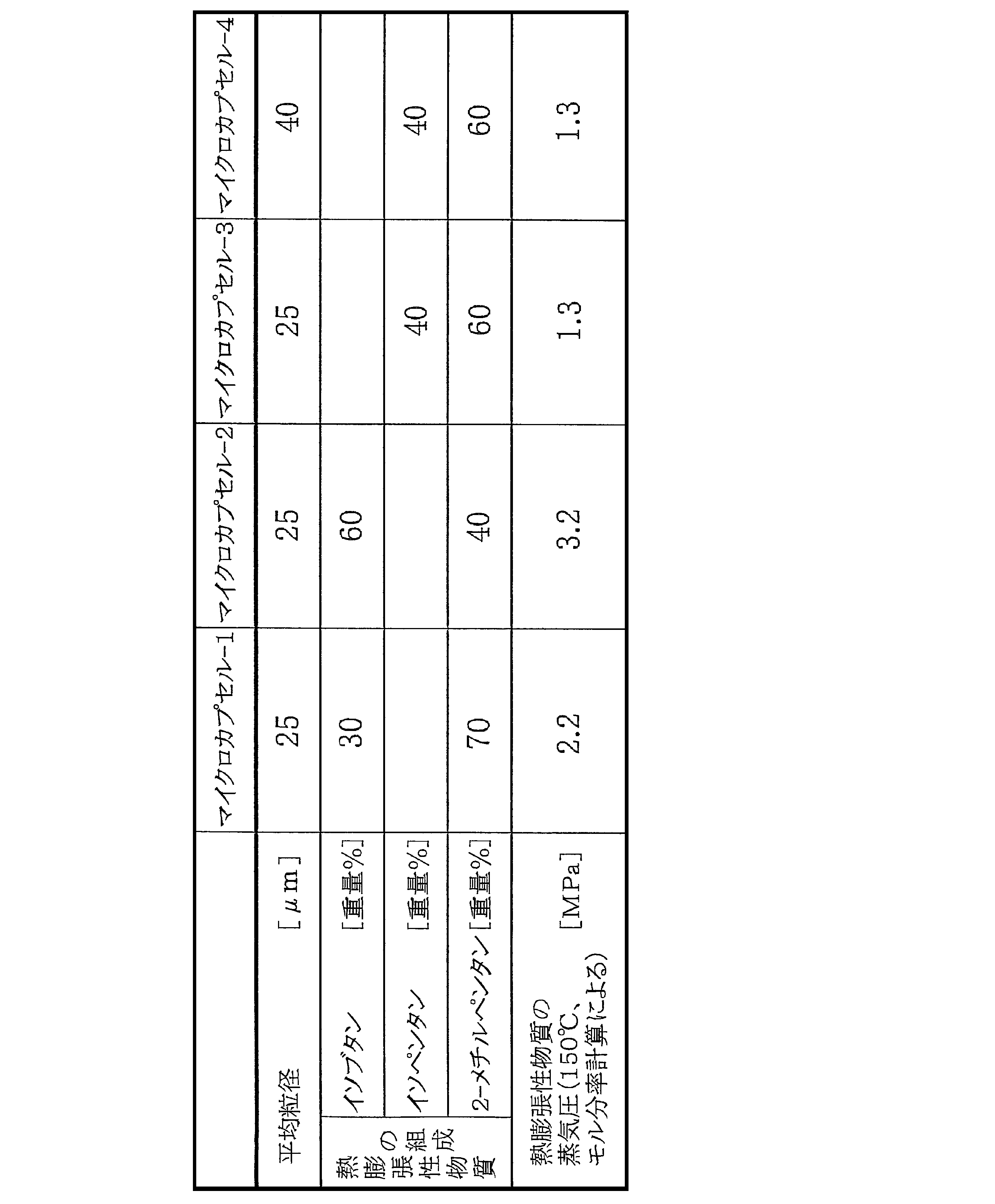
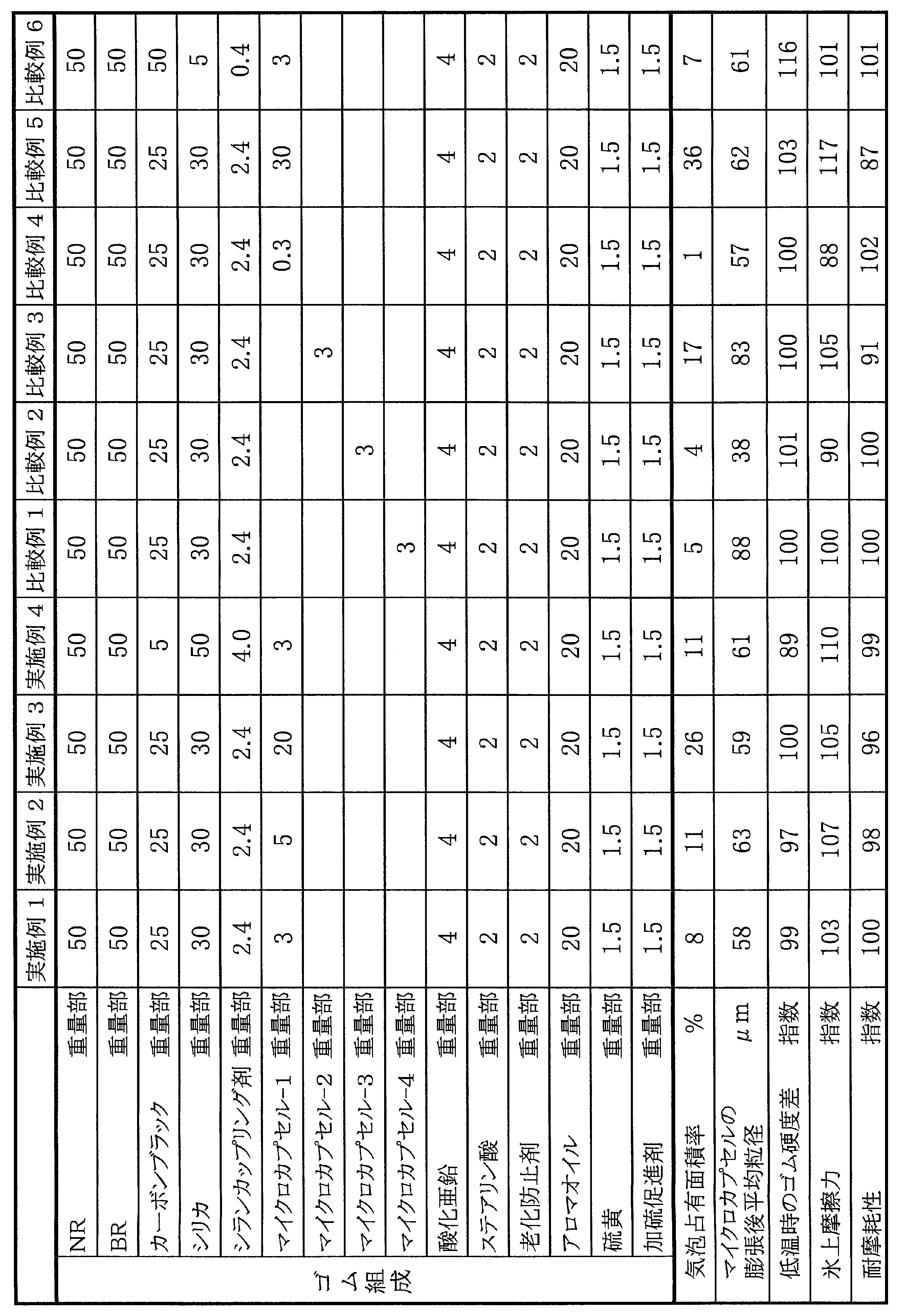
表2に示す配合において、加硫促進剤、硫黄、マイクロカプセルを除く成分を1.7リットル密閉式バンバリーミキサーで5分間混練し、155±5℃に達したときに放出して室温冷却した。これに加硫促進剤、硫黄、マイクロカプセルを配合し、バンバリーミキサーで混合し、10種類のゴム組成物(実施例1~4、比較例1~6)を調製した。
得られた10種類のゴム組成物(実施例1~4、比較例1~6)を所定の金型中で160℃で20分間プレス加硫して加硫ゴム試験片を調製した。得られた加硫ゴム試験片の気泡占有面積率、マイクロカプセルの膨張後の平均粒径、低温時のゴム硬度差、氷上摩擦力及び耐摩耗性を下記に示す方法により評価した。
得られた加硫ゴム試験片の断面を165倍で拡大観察し、画像処理装置(柏木製作所社製NEXUS6400)を使用して、単位面積当たりの気泡占有面積率を10視野について測定し、その平均値を求めた。得られた結果を表2に示す。
得られた加硫ゴム試験片の断面を走査型電子顕微鏡(SEM)により観察し、マイクロカプセルの膨張後の平均粒径の平均値を求めた。得られた結果を表2に示す。
得られた加硫ゴム試験片のゴム硬度を、JIS K6253に準拠し、デュロメータのタイプAにより温度20℃及び-10℃で測定した。2つの温度条件におけるゴム硬度の差を算出し、得られたゴム硬度差を比較例1を100とする指数として表2に示した。この指数が小さいほど低温で硬くなり難く、低温ゴム特性が優れることを意味する。
得られた加硫ゴム試験片を偏平円柱状の台ゴムにはりつけ、インサイドドラム型氷上摩擦試験機を用いて氷上摩擦係数を測定した。測定温度は-1.5℃、荷重は0.54MPa、ドラム回転速度は25km/hにした。得られた氷上摩擦係数を比較例1を100とする指数にし氷上摩擦力として表2に示した。この指数が大きいほど氷上摩擦力が優れることを意味する。
得られた加硫ゴム試験片をJIS K6264に準拠して、ランボーン摩耗試験機(岩本製作所社製)を使用して、温度20℃、荷重39N、スリップ率30%、時間4分の条件で摩耗量を測定した。得られた結果は、比較例1の値の逆数を100とする指数で表わし表2に示した。この指数が大きいほど耐摩耗性に優れることを意味する。
NR:天然ゴム、RSS#3
BR:ブタジエンゴム、日本ゼオン社製Nipol BR1220
CB:カーボンブラック、東海カーボン社製シースト6
シリカ:日本シリカ社製Niosil AQ
シランカップリング剤:デクサ社製Si69
マイクロカプセル-1~4:上述の方法により調製したマイクロカプセル1~4
酸化亜鉛:正同化学工業社製酸化亜鉛3種
ステアリン酸:日本油脂社製ビーズステアリン酸
老化防止剤:フレキシス社製SANTOFLEX 6PPD
アロマオイル:昭和シェル石油社製エキストラクト4号S
硫黄:鶴見化学工業社製金華印油入微粉硫黄
加硫促進剤:大内新興化学工業社製ノクセラーCZ-G
Claims (8)
- トレッドゴムがジエン系ゴム100重量部に対し、シリカを10重量部以上含む補強充填剤を30~100重量部、熱膨張性物質を内包するマイクロカプセルを1~20重量部含むゴム組成物からなる空気入りタイヤにおいて、
前記ゴム組成物に、前記シリカ重量に対して硫黄含有シランカップリング剤を3~15重量%配合すると共に、前記マイクロカプセルの殻材をニトリル系単量体(I)を主成分とし、この単量体(I)と分子中に不飽和二重結合とカルボキシル基を有する単量体(II)とから重合された熱可塑性樹脂から構成すると共に、前記熱膨張性物質の150℃での蒸気圧を1.4~3.0MPaとし、かつ前記ゴム組成物の加硫前における前記マイクロカプセルの平均粒径を20~30μmにすると共に、加硫により膨張後の平均粒径を40~80μmにして、トレッドゴムの気泡占有面積率を5~30%にした空気入りタイヤ。 - 前記マイクロカプセルの殻材を構成する熱可塑性樹脂が、単量体として、2以上の重合性二重結合を有する単量体(III)及び/又は共重合可能な単量体(IV)を追加して含む請求項1に記載の空気入りタイヤ。
- 前記ニトリル系単量体(I)が、アクリロニトリル、メタクリロニトリル、α-クロルアクリロニトリル、α-エトキシアクリロニトリル、フマロニトリルから選ばれる少なくとも1種である請求項1又は2に記載の空気入りタイヤ。
- 前記分子中に不飽和二重結合とカルボキシル基を有する単量体(II)が、アクリル酸、メタクリル酸、イタコン酸、マレイン酸、フマル酸、シトラコン酸から選ばれる少なくとも1種である請求項1,2又は3に記載の空気入りタイヤ。
- 前記2以上の重合性二重結合を有する単量体(III)が、ジビニルベンゼン、ジビニルナフタレン、メタクリル酸アリル、トリアクリルホルマール、トリアリルイソシアネート、エチレングリコールジ(メタ)アクリレート、ジエチレングリコールジ(メタ)アクリレート、トリエチレングリコールジ(メタ)アクリレート、1,4-ブタンジオールジ(メタ)アクリレート、1,9-ノナンジオールジ(メタ)アクリレート、重量平均分子量が200のポリエチレングリコール(PEG#200)ジ(メタ)アクリレート、重量平均分子量が400のポリエチレングリコール(PEG#400)ジ(メタ)アクリレート、1,6-ヘキサンジオール(メタ)アクリレート、トリメチロールプロパントリメタクリレートから選ばれる少なくとも1種である請求項2~4のいずれかに記載の空気入りタイヤ。
- 前記共重合可能な単量体(IV)が、塩化ビニリデン、酢酸ビニル、メチル(メタ)アクリレート、エチル(メタ)アクリレート、n-ブチル(メタ)アクリレート、イソブチル(メタ)アクリレート、t-ブチル(メタ)アクリレートなどの(メタ)アクリル酸エステル、スチレン、スチレンスルホン酸、α-メチルスチレン、クロロスチレン、アクリルアミド、置換アクリルアミド、メタクリルアミド、置換メタクリルアミドから選ばれる少なくとも1種である請求項2~5のいずれかに記載の空気入りタイヤ。
- 前記熱膨張性物質がイソアルカン、ノルマルアルカンからなる群から選ばれる少なくとも1種である請求項1~6のいずれかに記載の空気入りタイヤ。
- 前記硫黄含有シランカップリング剤が、ビス-(3-トリエトキシシリルプロピル)テトラサルファイド、ビス(3-トリエトキシシリルプロピル)ジサルファイド、3-トリメトキシシリルプロピルベンゾチアゾールテトラサルファイドから選ばれる1種である請求項1~7のいずれかに記載の空気入りタイヤ。
Priority Applications (3)
| Application Number | Priority Date | Filing Date | Title |
|---|---|---|---|
| CN200980103000.1A CN101925478B (zh) | 2008-02-13 | 2009-02-13 | 充气轮胎 |
| US12/810,774 US8534333B2 (en) | 2008-02-13 | 2009-02-13 | Pneumatic tire |
| RU2010137798/11A RU2482968C2 (ru) | 2008-02-13 | 2009-02-13 | Пневматическая шина |
Applications Claiming Priority (2)
| Application Number | Priority Date | Filing Date | Title |
|---|---|---|---|
| JP2008031595A JP4289508B1 (ja) | 2008-02-13 | 2008-02-13 | 空気入りタイヤ |
| JP2008-031595 | 2008-02-13 |
Publications (1)
| Publication Number | Publication Date |
|---|---|
| WO2009102017A1 true WO2009102017A1 (ja) | 2009-08-20 |
Family
ID=40921835
Family Applications (1)
| Application Number | Title | Priority Date | Filing Date |
|---|---|---|---|
| PCT/JP2009/052409 Ceased WO2009102017A1 (ja) | 2008-02-13 | 2009-02-13 | 空気入りタイヤ |
Country Status (5)
| Country | Link |
|---|---|
| US (1) | US8534333B2 (ja) |
| JP (1) | JP4289508B1 (ja) |
| CN (1) | CN101925478B (ja) |
| RU (1) | RU2482968C2 (ja) |
| WO (1) | WO2009102017A1 (ja) |
Cited By (1)
| Publication number | Priority date | Publication date | Assignee | Title |
|---|---|---|---|---|
| US9391278B2 (en) | 2012-06-18 | 2016-07-12 | Mitsubishi Chemical Corporation | Polymer compound, charge-transporting polymer, composition for organic electroluminescent element, organic electroluminescent element, organic EL display device, and organic EL light |
Families Citing this family (13)
| Publication number | Priority date | Publication date | Assignee | Title |
|---|---|---|---|---|
| JP5409188B2 (ja) | 2009-08-18 | 2014-02-05 | 住友ゴム工業株式会社 | スタッドレスタイヤ用ゴム組成物及びスタッドレスタイヤ |
| JP5648342B2 (ja) * | 2010-06-29 | 2015-01-07 | 横浜ゴム株式会社 | 空気入りスタッドレスタイヤ用ゴム組成物 |
| JP5569226B2 (ja) * | 2010-07-30 | 2014-08-13 | 横浜ゴム株式会社 | タイヤトレッド用ゴム組成物 |
| JP5363538B2 (ja) | 2011-07-27 | 2013-12-11 | 住友ゴム工業株式会社 | スタッドレスタイヤ用ゴム組成物及びスタッドレスタイヤ |
| EP2799481B1 (en) * | 2011-12-26 | 2017-04-19 | Bridgestone Corporation | Vulcanized rubber, method for producing same, and tire |
| JP5319807B2 (ja) * | 2012-02-29 | 2013-10-16 | 住友ゴム工業株式会社 | スタッドレスタイヤ用ゴム組成物及びスタッドレスタイヤ |
| EP2938675A4 (en) * | 2012-12-26 | 2016-07-20 | Bridgestone Americas Tire | APPEARANCE IMPROVERS FOR CONTAINING COMPOSITIONS WITH PRESERVATIVES |
| JP6180948B2 (ja) * | 2014-01-23 | 2017-08-16 | 横浜ゴム株式会社 | タイヤ用加硫ゴム組成物 |
| JP6318790B2 (ja) * | 2014-04-07 | 2018-05-09 | 横浜ゴム株式会社 | タイヤトレッド用ゴム組成物 |
| JP5967252B1 (ja) * | 2015-04-13 | 2016-08-10 | 横浜ゴム株式会社 | タイヤトレッド用ゴム組成物およびスタッドレスタイヤ |
| JP7172280B2 (ja) * | 2018-08-22 | 2022-11-16 | 横浜ゴム株式会社 | タイヤ用ゴム組成物 |
| JP2023095094A (ja) * | 2021-12-24 | 2023-07-06 | 横浜ゴム株式会社 | タイヤの製造方法 |
| US20240158615A1 (en) * | 2022-11-02 | 2024-05-16 | The Goodyear Tire & Rubber Company | Precipitated silica pretreated with a coupling agent and polyethylene glycol for a rubber composition |
Citations (5)
| Publication number | Priority date | Publication date | Assignee | Title |
|---|---|---|---|---|
| JPH10316801A (ja) * | 1997-05-19 | 1998-12-02 | Yokohama Rubber Co Ltd:The | ゴム組成物およびそれを用いた空気入りタイヤ |
| JP2003105138A (ja) * | 2001-09-28 | 2003-04-09 | Yokohama Rubber Co Ltd:The | 氷上性能が改良されたタイヤトレッド用ゴム組成物の製造方法 |
| JP2004091745A (ja) * | 2002-09-04 | 2004-03-25 | Yokohama Rubber Co Ltd:The | タイヤ用ゴム組成物 |
| JP2004359758A (ja) * | 2003-06-03 | 2004-12-24 | Yokohama Rubber Co Ltd:The | ゴム組成物 |
| JP2007302850A (ja) * | 2006-05-15 | 2007-11-22 | Yokohama Rubber Co Ltd:The | ゴム組成物及びこれをタイヤトレッドに用いた空気入りタイヤ |
Family Cites Families (1)
| Publication number | Priority date | Publication date | Assignee | Title |
|---|---|---|---|---|
| JP5003011B2 (ja) * | 2006-04-20 | 2012-08-15 | 横浜ゴム株式会社 | ゴム組成物 |
-
2008
- 2008-02-13 JP JP2008031595A patent/JP4289508B1/ja active Active
-
2009
- 2009-02-13 CN CN200980103000.1A patent/CN101925478B/zh active Active
- 2009-02-13 RU RU2010137798/11A patent/RU2482968C2/ru active
- 2009-02-13 WO PCT/JP2009/052409 patent/WO2009102017A1/ja not_active Ceased
- 2009-02-13 US US12/810,774 patent/US8534333B2/en not_active Expired - Fee Related
Patent Citations (5)
| Publication number | Priority date | Publication date | Assignee | Title |
|---|---|---|---|---|
| JPH10316801A (ja) * | 1997-05-19 | 1998-12-02 | Yokohama Rubber Co Ltd:The | ゴム組成物およびそれを用いた空気入りタイヤ |
| JP2003105138A (ja) * | 2001-09-28 | 2003-04-09 | Yokohama Rubber Co Ltd:The | 氷上性能が改良されたタイヤトレッド用ゴム組成物の製造方法 |
| JP2004091745A (ja) * | 2002-09-04 | 2004-03-25 | Yokohama Rubber Co Ltd:The | タイヤ用ゴム組成物 |
| JP2004359758A (ja) * | 2003-06-03 | 2004-12-24 | Yokohama Rubber Co Ltd:The | ゴム組成物 |
| JP2007302850A (ja) * | 2006-05-15 | 2007-11-22 | Yokohama Rubber Co Ltd:The | ゴム組成物及びこれをタイヤトレッドに用いた空気入りタイヤ |
Cited By (1)
| Publication number | Priority date | Publication date | Assignee | Title |
|---|---|---|---|---|
| US9391278B2 (en) | 2012-06-18 | 2016-07-12 | Mitsubishi Chemical Corporation | Polymer compound, charge-transporting polymer, composition for organic electroluminescent element, organic electroluminescent element, organic EL display device, and organic EL light |
Also Published As
| Publication number | Publication date |
|---|---|
| US20100288406A1 (en) | 2010-11-18 |
| JP2009190499A (ja) | 2009-08-27 |
| JP4289508B1 (ja) | 2009-07-01 |
| CN101925478A (zh) | 2010-12-22 |
| US8534333B2 (en) | 2013-09-17 |
| CN101925478B (zh) | 2013-03-06 |
| RU2482968C2 (ru) | 2013-05-27 |
| RU2010137798A (ru) | 2012-03-20 |
Similar Documents
| Publication | Publication Date | Title |
|---|---|---|
| JP4289508B1 (ja) | 空気入りタイヤ | |
| JP5322558B2 (ja) | タイヤ用ゴム組成物 | |
| US7902265B2 (en) | Rubber composition for tire | |
| JP5448052B2 (ja) | ゴム組成物およびタイヤ | |
| JP2012102288A (ja) | スタッドレスタイヤトレッド用ゴム組成物 | |
| JP4046678B2 (ja) | タイヤトレッド用ゴム組成物及びそれを用いた空気入りタイヤ | |
| JP6768541B2 (ja) | スタッドレスタイヤ用ゴム組成物 | |
| JP5825506B2 (ja) | タイヤトレッド用ゴム組成物 | |
| JP5499728B2 (ja) | タイヤトレッド用ゴム組成物 | |
| JP5474478B2 (ja) | ゴム組成物 | |
| JP7579680B2 (ja) | スタッドレスタイヤ用ゴム組成物 | |
| JP7835573B2 (ja) | スタッドレスタイヤ用ゴム組成物 | |
| JP2011148897A (ja) | スタッドレスタイヤ用ゴム組成物 | |
| JP6180948B2 (ja) | タイヤ用加硫ゴム組成物 | |
| JP6597159B2 (ja) | 冬用タイヤ用ゴム組成物 | |
| JP6012261B2 (ja) | タイヤトレッド用ゴム組成物 | |
| JP6631149B2 (ja) | 冬用タイヤ用ゴム組成物 | |
| JP6205227B2 (ja) | タイヤ用ゴム組成物 | |
| JP2024082917A (ja) | タイヤ用ゴム組成物 | |
| JP2006056967A (ja) | タイヤ用ゴム組成物 | |
| JP2021161305A (ja) | タイヤ用ゴム組成物 | |
| JP2007302850A (ja) | ゴム組成物及びこれをタイヤトレッドに用いた空気入りタイヤ | |
| JP6244154B2 (ja) | タイヤ用ゴム組成物 |
Legal Events
| Date | Code | Title | Description |
|---|---|---|---|
| WWE | Wipo information: entry into national phase |
Ref document number: 200980103000.1 Country of ref document: CN |
|
| 121 | Ep: the epo has been informed by wipo that ep was designated in this application |
Ref document number: 09709592 Country of ref document: EP Kind code of ref document: A1 |
|
| WWE | Wipo information: entry into national phase |
Ref document number: 12810774 Country of ref document: US |
|
| NENP | Non-entry into the national phase |
Ref country code: DE |
|
| WWE | Wipo information: entry into national phase |
Ref document number: 2010137798 Country of ref document: RU |
|
| 122 | Ep: pct application non-entry in european phase |
Ref document number: 09709592 Country of ref document: EP Kind code of ref document: A1 |