WO2009101875A1 - マッサージ機及びマッサージ方法 - Google Patents
マッサージ機及びマッサージ方法 Download PDFInfo
- Publication number
- WO2009101875A1 WO2009101875A1 PCT/JP2009/051764 JP2009051764W WO2009101875A1 WO 2009101875 A1 WO2009101875 A1 WO 2009101875A1 JP 2009051764 W JP2009051764 W JP 2009051764W WO 2009101875 A1 WO2009101875 A1 WO 2009101875A1
- Authority
- WO
- WIPO (PCT)
- Prior art keywords
- unit
- massage
- electroencephalogram
- massage machine
- noise
- Prior art date
- Legal status (The legal status is an assumption and is not a legal conclusion. Google has not performed a legal analysis and makes no representation as to the accuracy of the status listed.)
- Ceased
Links
Images






Classifications
-
- G—PHYSICS
- G16—INFORMATION AND COMMUNICATION TECHNOLOGY [ICT] SPECIALLY ADAPTED FOR SPECIFIC APPLICATION FIELDS
- G16H—HEALTHCARE INFORMATICS, i.e. INFORMATION AND COMMUNICATION TECHNOLOGY [ICT] SPECIALLY ADAPTED FOR THE HANDLING OR PROCESSING OF MEDICAL OR HEALTHCARE DATA
- G16H20/00—ICT specially adapted for therapies or health-improving plans, e.g. for handling prescriptions, for steering therapy or for monitoring patient compliance
- G16H20/30—ICT specially adapted for therapies or health-improving plans, e.g. for handling prescriptions, for steering therapy or for monitoring patient compliance relating to physical therapies or activities, e.g. physiotherapy, acupressure or exercising
-
- G—PHYSICS
- G16—INFORMATION AND COMMUNICATION TECHNOLOGY [ICT] SPECIALLY ADAPTED FOR SPECIFIC APPLICATION FIELDS
- G16H—HEALTHCARE INFORMATICS, i.e. INFORMATION AND COMMUNICATION TECHNOLOGY [ICT] SPECIALLY ADAPTED FOR THE HANDLING OR PROCESSING OF MEDICAL OR HEALTHCARE DATA
- G16H40/00—ICT specially adapted for the management or administration of healthcare resources or facilities; ICT specially adapted for the management or operation of medical equipment or devices
- G16H40/60—ICT specially adapted for the management or administration of healthcare resources or facilities; ICT specially adapted for the management or operation of medical equipment or devices for the operation of medical equipment or devices
- G16H40/63—ICT specially adapted for the management or administration of healthcare resources or facilities; ICT specially adapted for the management or operation of medical equipment or devices for the operation of medical equipment or devices for local operation
-
- A—HUMAN NECESSITIES
- A61—MEDICAL OR VETERINARY SCIENCE; HYGIENE
- A61B—DIAGNOSIS; SURGERY; IDENTIFICATION
- A61B5/00—Measuring for diagnostic purposes; Identification of persons
- A61B5/24—Detecting, measuring or recording bioelectric or biomagnetic signals of the body or parts thereof
- A61B5/316—Modalities, i.e. specific diagnostic methods
- A61B5/369—Electroencephalography [EEG]
- A61B5/372—Analysis of electroencephalograms
-
- A—HUMAN NECESSITIES
- A61—MEDICAL OR VETERINARY SCIENCE; HYGIENE
- A61H—PHYSICAL THERAPY APPARATUS, e.g. DEVICES FOR LOCATING OR STIMULATING REFLEX POINTS IN THE BODY; ARTIFICIAL RESPIRATION; MASSAGE; BATHING DEVICES FOR SPECIAL THERAPEUTIC OR HYGIENIC PURPOSES OR SPECIFIC PARTS OF THE BODY
- A61H2201/00—Characteristics of apparatus not provided for in the preceding codes
- A61H2201/01—Constructive details
- A61H2201/0119—Support for the device
- A61H2201/0138—Support for the device incorporated in furniture
- A61H2201/0149—Seat or chair
-
- A—HUMAN NECESSITIES
- A61—MEDICAL OR VETERINARY SCIENCE; HYGIENE
- A61H—PHYSICAL THERAPY APPARATUS, e.g. DEVICES FOR LOCATING OR STIMULATING REFLEX POINTS IN THE BODY; ARTIFICIAL RESPIRATION; MASSAGE; BATHING DEVICES FOR SPECIAL THERAPEUTIC OR HYGIENIC PURPOSES OR SPECIFIC PARTS OF THE BODY
- A61H2205/00—Devices for specific parts of the body
- A61H2205/08—Trunk
- A61H2205/081—Back
-
- A—HUMAN NECESSITIES
- A61—MEDICAL OR VETERINARY SCIENCE; HYGIENE
- A61H—PHYSICAL THERAPY APPARATUS, e.g. DEVICES FOR LOCATING OR STIMULATING REFLEX POINTS IN THE BODY; ARTIFICIAL RESPIRATION; MASSAGE; BATHING DEVICES FOR SPECIAL THERAPEUTIC OR HYGIENIC PURPOSES OR SPECIFIC PARTS OF THE BODY
- A61H2230/00—Measuring physical parameters of the user
- A61H2230/08—Other bio-electrical signals
- A61H2230/10—Electroencephalographic signals
-
- A—HUMAN NECESSITIES
- A61—MEDICAL OR VETERINARY SCIENCE; HYGIENE
- A61M—DEVICES FOR INTRODUCING MEDIA INTO, OR ONTO, THE BODY; DEVICES FOR TRANSDUCING BODY MEDIA OR FOR TAKING MEDIA FROM THE BODY; DEVICES FOR PRODUCING OR ENDING SLEEP OR STUPOR
- A61M21/00—Other devices or methods to cause a change in the state of consciousness; Devices for producing or ending sleep by mechanical, optical, or acoustical means, e.g. for hypnosis
- A61M2021/0005—Other devices or methods to cause a change in the state of consciousness; Devices for producing or ending sleep by mechanical, optical, or acoustical means, e.g. for hypnosis by the use of a particular sense, or stimulus
- A61M2021/0044—Other devices or methods to cause a change in the state of consciousness; Devices for producing or ending sleep by mechanical, optical, or acoustical means, e.g. for hypnosis by the use of a particular sense, or stimulus by the sight sense
- A61M2021/005—Other devices or methods to cause a change in the state of consciousness; Devices for producing or ending sleep by mechanical, optical, or acoustical means, e.g. for hypnosis by the use of a particular sense, or stimulus by the sight sense images, e.g. video
-
- A—HUMAN NECESSITIES
- A61—MEDICAL OR VETERINARY SCIENCE; HYGIENE
- A61M—DEVICES FOR INTRODUCING MEDIA INTO, OR ONTO, THE BODY; DEVICES FOR TRANSDUCING BODY MEDIA OR FOR TAKING MEDIA FROM THE BODY; DEVICES FOR PRODUCING OR ENDING SLEEP OR STUPOR
- A61M2230/00—Measuring parameters of the user
- A61M2230/08—Other bio-electrical signals
- A61M2230/10—Electroencephalographic signals
Definitions
- the present invention relates to a massage machine and a massage method.
- a chair type massage machine in which a massage unit is provided in the backrest.
- This massage unit has a treatment element made of kneading balls.
- the treatment element is massaged, struck, and subjected to massage operations such as acupressure.
- the massage operation can be changed by the user operating the operating device, but the massage output such as the strength of finger pressure is set to a constant value. For this reason, even if the user feels painful, the massage machine always continues the massage with the output. In other words, the comfort level of the user is not considered for the massage output. Therefore, as disclosed in Japanese Patent Application Laid-Open No. 2007-215671, a device that can control the operation of the massage unit and adjust the massage output based on the electroencephalogram obtained from the user is proposed.
- the massage machine acquires a brain wave of a user as a determination index for comfort level during massage, and uses this to control the operation of the massage unit. That is, the operation output of the massage unit is adjusted based on the acquired electroencephalogram to increase the comfort level during the massage.
- various noises artifacts
- the operation of the massage unit is controlled based on the electroencephalogram including the influence of noise, there is a possibility that an erroneous output is given to the user.
- an object of the present invention is to provide a massage machine and a massage method that can make a massage operation given to a user an appropriate output.
- the present invention provides a massage machine body that massages a user, an electroencephalogram acquisition unit that acquires an electroencephalogram of the user who is receiving massage by the massage machine body, and the electroencephalogram
- a massage machine including an operation control unit that controls the operation of the massage machine main body based on the electroencephalogram acquired by the acquisition unit, wherein the massage machine during acquisition of the electroencephalogram from the electroencephalogram acquired by the electroencephalogram acquisition unit
- a massage noise removing unit that removes noise caused by the operation of the massage machine main body is provided.
- the brain wave acquired by the electroencephalogram acquisition unit may include noise due to the massage machine body.
- the massage noise removing unit can remove the noise caused by the operation of the massage machine body during the acquisition of the electroencephalogram from the acquired electroencephalogram so that the obtained electroencephalogram can be suppressed in noise. . Therefore, by controlling the massage operation by the operation control unit based on the electroencephalogram, the massage given to the user by the massage machine body can be set to an appropriate output.
- the said massage noise removal part is a memory
- movement of the massage machine main body during acquisition of an electroencephalogram can be obtained from the relevant information which the memory
- the said noise component resulting from a massage machine main body is a frequency component of the noise resulting from a massage machine main body, for example.
- the massage machine further includes an operation noise removing unit that removes operation noise caused by the operation of the user from the electroencephalogram acquired by the electroencephalogram acquisition unit.
- an operation noise removing unit that removes operation noise caused by the operation of the user from the electroencephalogram acquired by the electroencephalogram acquisition unit.
- the eye movement (for example, blinking) of the user is known to affect the electroencephalogram measurement. According to this massage machine, even if the user blinks, for example, the influence on the acquired electroencephalogram Can be suppressed.
- the said operation noise removal part is made into the object for controlling operation
- the determination unit of the operation noise removal unit can determine the presence of the operation noise by comparing the output value of the electroencephalogram acquired by the electroencephalogram acquisition unit with a preset threshold value. According to this, when the user operates, for example, when the user blinks, the output value of the electroencephalogram increases. Therefore, according to this determination unit, the output value of the electroencephalogram acquired by the electroencephalogram acquisition unit is set in advance. The presence of operation noise can be determined by comparing the threshold value. Further, the determination unit of the operation noise removal unit compares the brain wave waveform acquired by the brain wave acquisition unit with the waveform model of the operation noise caused by the operation of the user to determine the presence of the operation noise. Can be determined.
- the electroencephalogram when the user operates, for example, when the user blinks, the electroencephalogram becomes a specific waveform. Therefore, according to this determination unit, the electroencephalogram waveform acquired by the electroencephalogram acquisition unit and the waveform model of the operation noise are obtained. The presence of operational noise can be determined by comparing the type.
- the motion noise removing unit further includes a trend removing unit that performs a moving average process on the brain wave acquired by the brain wave acquiring unit and subtracts the brain wave that has been subjected to the moving average process from the brain wave acquired by the brain wave acquiring unit. It is preferable. According to this, when the user operates slowly (for example, when eye movement is performed), the electroencephalogram fluctuates gently, but the fluctuation of the electroencephalogram can be eliminated.
- the presentation part which shows the said patient's brain wave condition obtained based on the electroencephalogram which completed the noise removal process to the said patient.
- the user who is receiving massage can see the presentation unit and can know his / her brain wave situation (for example, whether he / she feels comfortable or uncomfortable).
- the massage method that can be performed by the massage machine acquires the brain wave of the user receiving massage by the massage machine, removes the noise caused by the massage machine from the acquired brain wave, Based on the removed electroencephalogram, the massage operation by the massage machine is controlled.
- FIG. 1 It is explanatory drawing which shows one Embodiment of the massage machine of this invention. It is a front perspective view of a massage unit. It is a block diagram which shows the principal part of the massage machine of this invention. It is the figure of the electroencephalogram containing the operation noise by blink, (a) is shown in the time domain, (b) is shown in the frequency domain. It is explanatory drawing explaining the function of a correlation coefficient determination part. It is the figure of the electroencephalogram from which operation noise was removed, (a) is shown in the time domain, and (b) is shown in the frequency domain.
- FIG. 1 It is explanatory drawing which shows one Embodiment of the massage machine of this invention. It is a front perspective view of a massage unit. It is a block diagram which shows the principal part of the massage machine of this invention. It is the figure of the electroencephalogram containing the operation noise by blink, (a) is shown in the time domain, (b) is shown in the frequency domain. It is explanatory drawing explaining the function
- FIG. 4 is a diagram of an electroencephalogram during a hitting massage operation, where (a) shows a frequency component, and (b) is an enlarged view of a band of 18 to 21 Hz.
- FIG. 2 is a diagram of an electroencephalogram during a massage massage operation, where (a) shows frequency components, and (b) is an enlarged view of a band of 18 to 21 Hz. It is explanatory drawing of the relevant information which the memory
- FIG. 1 is an explanatory view showing an embodiment of the massage machine of the present invention.
- This massage machine has, as a massage machine body, a seat part 1 on which a user is seated, a backrest part 2 provided at the rear part of the seat part 1, and a leg rest part provided at the front part of the seat part 1. 3 and is a chair type. And massage is given to a user by this massage machine main part.
- the backrest part 2 can be rotated (can be reclined) by a drive mechanism (not shown), and the leg rest part 3 is another drive mechanism (not shown) centered on the front part of the seat part 1. (Not shown) can be rotated up and down.
- the massage machine main body has a massage unit 5, and this massage unit 5 is provided in the backrest 2.
- the massage unit 5 has a treatment operation unit having a treatment element 6 that performs massage operations such as massage, hitting, and acupressure, and a main body frame to which the treatment operation unit is attached so as to be movable back and forth.
- the massage unit 5 moves up and down along a pair of left and right guide rails provided in the backrest 2 by an elevating drive mechanism of the massage machine body.
- the elevating drive mechanism can be, for example, a rack and pinion type, and a rack is provided along the guide rail, and a pinion and a motor with a speed reducer that rotates the pinion are provided in the massage unit 5. is there.
- FIG. 2 is a front perspective view of the massage unit 5.
- the massage unit 5 has an extrusion mechanism that moves the treatment element 6 in the front-rear direction of the backrest 2.
- the push-out mechanism includes an extrusion motor 10 serving as a drive source for moving the treatment operation unit 7 back and forth, a pinion 11 connected to the motor 10 via a speed reduction mechanism, and a pinion 11 that meshes with the pinion 11 and And a rack 12 provided along the front-rear direction.
- the motor 10 and the pinion 11 are fixed to the main body frame 8 of the massage unit 5, and the rack 12 is fixed to the treatment operation unit 7. Accordingly, when the extrusion motor 10 is rotated forward and backward, the pinion 11 is rotated forward and backward, whereby the rack 12 is moved back and forth, and the treatment operation unit 7 is moved back and forth together with the rack 12.
- the treatment operation unit 7 has a kneading mechanism and a tapping mechanism that are driven to make the massaging treatment of the tapping and tapping the treatment element 6.
- the stagnation mechanism includes a stagnation motor, a stagnation shaft, and a power transmission unit including a gear or the like that transmits the power of the stagnation motor to the stagnation shaft.
- the arm 6a to which the treatment element 6 is attached swings.
- the treatment element 6 performs a squeezing operation having a horizontal component.
- the hitting mechanism includes a hitting motor, a hitting shaft, and a power transmission unit including a gear or the like that transmits the power of the hitting motor to the hitting shaft.
- the arm 6a rotates eccentrically with respect to the horizontal axis.
- the treatment element 6 performs a hitting operation having a component in the front-rear direction.
- the kneading mechanism, the hitting mechanism, and the push-out mechanism can be appropriately selected from those normally used, and may be other than those illustrated.
- the amount of massage output by the treatment element 6 mounted on the treatment operation unit 7 can be changed by changing the amount of forward / backward movement of the treatment operation unit 7 by the push-out mechanism.
- the user who is drowning in the backrest part 2 receives a concentrated force (massage force) from the treatment element 6 due to the reaction force of his / her weight. .
- the user can feel a strong massage force by the treatment element 6.
- the treatment operation unit 7 is moved backward (to the opposite side of the user)
- the weight of the user who is drowning in the backrest 2 is not only in the treatment element 6 but also in the main body of the backrest 2.
- the massage force that the user receives from the treatment element 6 is weaker than the intensive massage force. Thereby, a user can feel weak massage power.
- this massage unit 5 can perform massage operations such as itching with the treatment element 6 on the user, and the amount of forward and backward movement of the treatment element 6 (treatment operation unit 7) is increased by the pushing mechanism.
- the massage output (strength) at the time of the massage operation can be changed.
- massage operation and massage output by this massage unit 5 are controlled by operation control part 17 (refer to Drawing 1) with which a massage machine is provided.
- the massage machine includes an electroencephalogram acquisition unit 18 that acquires an electroencephalogram of the user, and the electroencephalogram acquisition unit 18 acquires an electroencephalogram of the user who is receiving massage by the massage unit 5.
- the electroencephalogram acquisition unit 18 acquires an electroencephalogram through a pair of electrodes attached to the head (forehead) and the ear (earlobe) of the user.
- the said operation control part 17 controls the massage operation
- the massage machine is caused by the massage noise unit 5 and the massage unit 5 as an artifact removal unit that removes the operation noise caused by the motion (movement) of the user from the brain wave acquired by the brain wave acquisition unit 18.
- An electromagnetic noise removing unit (massage noise removing unit) 19 for removing electromagnetic noise and a calculation unit 23 are further provided.
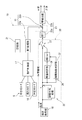
- FIG. 3 is a block diagram showing the main part of the massage machine of the present invention.
- This massage machine includes a programmable microcomputer having a CPU and a storage unit, and a program for executing predetermined functions is stored in the storage unit.
- the operation control unit 17, the electroencephalogram acquisition unit 18, the electromagnetic noise removal unit 19, the operation noise removal unit 20, and the calculation unit 23 are configured.
- the operation control unit 17 has a function of transmitting an operation signal (to each motor) to the pushing mechanism, the kneading mechanism, and the hitting mechanism to execute a predetermined operation.
- the function of the electroencephalogram acquisition unit 18 is to measure and acquire the electroencephalogram of the user, and a conventionally known one can be adopted.
- the operation noise removing unit 20 is configured to remove operation noise caused by the operation of the user from the electroencephalogram acquired by the electroencephalogram acquisition unit 18.
- the operation noise removing unit 20 is configured so that the electromagnetic noise removing unit 19 functions before the process of removing the electromagnetic noise.
- the operation noise removing unit 20 includes a trend removing unit 25 that removes gentle fluctuations in the time domain from the brain wave acquired by the brain wave acquiring unit 18.
- the trend removing unit 25 performs a moving average process on the original electroencephalogram acquired by the electroencephalogram acquisition unit 18 and performs a process of subtracting the electroencephalogram subjected to the moving average process from the original electroencephalogram acquired by the electroencephalogram acquisition unit 18.
- the function of the trend removing unit 25 can remove fluctuations in the electroencephalogram.
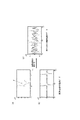
- FIG. 4 is a diagram of an electroencephalogram including operation noise due to blinking, where (a) is shown in the time domain, and (b) is shown in the frequency domain.
- the electroencephalogram in FIG. 4 includes two disturbances (two operation noises).
- FIG. 4B operation noise due to blinking is included in the low frequency range.
- the operation noise removing unit 20 is an operation noise generated by a fast eye movement (blinking) of a user from a processed brain wave processed by the trend removing unit 25 (hereinafter simply referred to as a processed brain wave).
- a determination unit 26 that determines the presence of the operation noise, and a selection unit 27 that excludes a portion where the operation noise exists from the processed brain wave.
- the determination unit 26 includes a threshold determination unit 31 and a correlation coefficient determination unit 32.
- the threshold value determination unit 31 determines the presence of operation noise due to blinking by comparing the output value of the processed electroencephalogram with a preset threshold value. As shown in FIG. 4A, predetermined threshold values x and y are set for the electroencephalogram in the threshold determination unit 31. Then, the threshold value determination unit 31 compares the output value of the processed electroencephalogram with the threshold values x and y, and when the output value of the processed electroencephalogram exceeds the threshold value, the electroencephalogram part is treated. It can be determined that the person is blinking time zone. As described above, when the user blinks, the output value of the electroencephalogram rapidly increases. Therefore, according to the threshold value determination unit 31, the presence of operation noise due to blinking can be determined.
- the correlation coefficient determination unit 32 of FIG. 3 compares the waveform of the processed brain wave with the waveform model of the operation noise generated by the eye movement (blinking) of the user quickly, thereby determining the presence of the operation noise. judge.
- FIG. 5 is an explanatory diagram illustrating the function of the correlation coefficient determination unit 32.
- the waveform model of the operation noise generated by the blink of the user can be a waveform F shown in FIG.
- the template waveform F can be acquired in advance by the brain wave acquisition unit 18 when the user blinks, and the template waveform F is stored in the massage machine (correlation coefficient determination unit 32).
- the correlation coefficient determination unit 32 detects the blinking time zone from the processed brain wave by obtaining the correlation coefficient of the processed brain wave using the template waveform F as a template.
- the correlation coefficient is a statistical index indicating the degree of similarity between two random variables, as is generally known, for example, taking a real value from ⁇ 1 to +1, If this value is close to +1, there is a high positive correlation, and if this value is close to -1, it can be said that there is a high negative correlation. Conversely, if the value is close to zero, the correlation is weak and the similarity is low.
- the correlation coefficient determination unit 32 obtains the similarity between the template waveform F and the waveform of the processed brain wave using the correlation coefficient, and based on this result, the presence of operation noise due to blinking Determine. Specifically, the correlation coefficient determination unit 32 fixes the time series data of the processed electroencephalogram shown in FIG. 5 (b), and advances both the template waveform F with respect to this data in time. Is obtained.
- FIG. 5C shows the waveform of the correlation coefficient obtained by this processing. When FIG. 5C is compared with FIG. 5B, a high correlation value is obtained in the vicinity of the blinking operation existing in the processed brain wave.
- the correlation coefficient determination unit 32 determines that the correlation value is greater than or equal to a predetermined threshold and less than or equal to a predetermined threshold (+0.7 or more, ⁇ 0.7 or less). It is determined that this is a region where operation noise is generated. As described above, when the user blinks, the brain wave becomes a specific waveform. Therefore, according to the correlation coefficient determination unit 32, the waveform of the processed brain wave and the preset waveform template F are obtained. By comparing, the presence of operation noise due to blinking can be determined. A blinking time zone can be detected.
- the sorting unit 27 in FIG. 3 performs the processed electroencephalogram (motion control unit 17) according to the determination result of the determination unit 26, that is, according to the determination result by one or both of the threshold determination unit 31 and the correlation coefficient determination unit 32.
- the part where the operation noise due to blinking exists is excluded from the brain wave to be controlled by the massage operation.
- Fig.6 (a) the part of the blinking time slot
- FIG. 6B shows FIG. 6A in the frequency domain. Comparing FIG. 6B and FIG. 4B, the noise component (low frequency portion) is removed from the electroencephalogram subjected to the operation noise removal processing by blinking.
- the first calculation unit 23 a of the calculation unit 23 is an FFT calculation unit, and converts data obtained by removing the operation noise from the processed brain wave into a frequency domain.
- the second calculation unit 23b of the calculation unit 23 is a band of a predetermined frequency with respect to an electroencephalogram that has been converted into a frequency domain by the first calculation unit 23a and from which electromagnetic noise has been removed from an electromagnetic noise removal unit 19 described later. Perform separation.
- the second calculation unit 23b can acquire a predetermined frequency band existing in the electroencephalogram, that is, an ⁇ wave and a ⁇ wave.
- the operation noise removing method performed by the operation noise removing unit 20 will be described collectively.
- the method includes the following steps. 1. A step of performing a moving average process on an electroencephalogram including eye movement (blinking). 2. A step of removing the trend of the electroencephalogram by subtracting the moving average processed signal from the original electroencephalogram. 3. A step of detecting a blinking time zone by setting a predetermined threshold for the detrended brain wave. 4). 3 above. And a step of detecting a blinking time zone by using a typical blink waveform as a template and obtaining a correlation coefficient of a detrended brain wave. 5). 3 above. Steps and 4.
- a time zone that satisfies the determination conditions in both the threshold value determination unit 31 and the correlation coefficient determination unit 32 is a time zone in which blinking occurs. This is because the threshold values x and y of the threshold value determination unit 31 are set as a narrow range, many portions that are considered to be operational noise due to blinking are determined, and the correlation coefficient determination unit 32 determines from the determined portions. This is because the operational noise caused by the true blink is selected by the waveform template F.
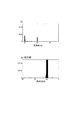
- FIG. 7A is a diagram showing the acquired electroencephalogram with frequency components
- FIG. 7B is an enlarged view of the 18 to 21 Hz band.
- This electroencephalogram is obtained from the user who is receiving a predetermined hitting massage operation by the hitting mechanism of the massage unit 5.
- the brain waves include around 18 Hz and 20 Hz (more precisely, 18.2 to 18.8 Hz and 19.9).
- ⁇ 20.1 Hz) contains noise.
- This noise is caused by the hitting mechanism of the massage unit 5. That is, in the hitting mechanism, the hitting motor rotates when performing a predetermined hitting massage operation. Thereby, when the hitting operation is performed, electromagnetic noise having a specific frequency component is included in the brain wave.
- the electromagnetic noise removing unit 19 executes this hitting massage operation according to the hitting massage operation during acquisition of the brainwave from the brainwave from which the operation noise has been removed by the operation noise removing unit 20.
- a process for removing electromagnetic noise caused by the hitting mechanism is performed.
- FIG. 8 (a) is a diagram showing the acquired brain waves as frequency components
- FIG. 8 (b) is an enlarged view of the 18 to 21 Hz band.
- This electroencephalogram is acquired from a user who is receiving a predetermined massage operation by the massage mechanism of the massage unit 5.
- This brain wave includes noise in 20 Hz (more precisely, 19.9 to 20.1 Hz) in addition to the ⁇ wave and ⁇ wave that are the targets for controlling the massage operation by the operation control unit 17. ing.
- This noise is caused by the massage mechanism of the massage unit 5. That is, in the kneading mechanism, the kneading motor rotates when performing a predetermined hitting massage operation. Thereby, when the stagnation operation is performed, electromagnetic noise having a specific frequency component is included in the brain wave.
- the electromagnetic noise removal unit 19 generates electromagnetic noise caused by the massage mechanism of the massage unit 5 that performs this massage operation according to the massage operation during the acquisition of the brain wave from the brain wave from which the operation noise has been removed. The process which removes is performed.
- the electromagnetic noise removal unit 19 includes a storage unit 21 that stores related information described later, and a processing unit 22 that removes a specific frequency component from the brain wave.
- the related information stored in the storage unit 21 is a type of massage operation (massage operation mode) by the massage unit 5 and a specification generated by the massage unit 5 that executes this type of massage operation. It is correspondence information about the relationship with the frequency component of the electromagnetic noise.
- the storage unit 21 sets “18 Hz and 20 Hz” as specific electromagnetic noise frequencies when the type of massage operation is “tapping massage operation and its output is medium (medium)”. Is remembered. Similarly, when the type of massage operation is “Massage massage operation and its output is medium (medium)”, “20 Hz” is stored as the frequency of the specific electromagnetic noise.
- this related information may be expressed by a mathematical expression other than the table as shown in FIG.
- the first processing unit 22a of the processing unit 22 obtains operation information about the type of massage operation during the acquisition of the electroencephalogram from the operation control unit 17. And the 1st process part 22a acquires the frequency component of the specific electromagnetic noise corresponding to the massage operation
- the second processing unit 22 b of the processing unit 22 uses the specific electromagnetic noise frequency components “18 Hz and 20 Hz” obtained by the first processing unit 22 a from the electroencephalogram from which the operation noise has been removed. Perform the removal process.
- the electromagnetic noise removing unit 19 specifies By performing the process of removing “18 Hz and 20 Hz”, which is the frequency component of the electromagnetic noise, the electromagnetic noise caused by the hitting mechanism can be removed.
- the first processing unit 22 a determines from the related information in FIG. 9 that the specific operation corresponding to this massage operation is performed. “20 Hz” is obtained as a frequency component of electromagnetic noise.
- the type of massage operation is “Massage massage operation (medium)”, as described in FIG. 8A
- the electroencephalogram includes electromagnetic noise around 20 Hz caused by the massage mechanism. Therefore, the electromagnetic noise due to the striking mechanism can be removed by performing the process of removing “20 Hz” that is the frequency component of the specific electromagnetic noise by the electromagnetic noise removing unit 19.
- the massage unit 5 does not affect the necessary electroencephalogram components ( ⁇ wave and ⁇ wave) as much as possible, based on the type of massage operation of the massage unit 5.
- the influence of electromagnetic noise can be removed from the electroencephalogram.
- the frequency component of the specific electromagnetic noise corresponding to the massage operation during the acquisition of the electroencephalogram can be obtained from the related information stored in the storage unit 21, the process of removing the electromagnetic noise can be performed quickly. it can.
- the massage method that can be performed by the massage machine configured as described above is obtained by acquiring the brain wave of the user receiving massage by the massage machine by the brain wave acquisition unit 18, and using the massage machine from the acquired brain wave.
- the generated electromagnetic noise is removed by the electromagnetic noise removing unit 19, and a massage operation by the massage machine is controlled by the operation control unit 17 based on the electroencephalogram from which the electromagnetic noise has been removed.
- the electroencephalogram acquired by the electroencephalogram acquisition unit 18 may include electromagnetic noise generated by the massage unit 5.
- the electromagnetic noise removing unit 19 removes the electromagnetic noise generated by the massage unit 5 performing the massage operation during the acquisition of the electroencephalogram from the acquired electroencephalogram, the obtained electroencephalogram has a suppressed noise. It becomes.
- the massage operation to be given to the user can be made an appropriate output.
- the massage machine of the present invention includes an electroencephalogram state presentation system 35.
- This system 35 presents the state of the brain waves of the user as a determination index of the comfort level during the massage to the user receiving the massage by the massage unit 5.
- the system 35 includes a monitor (presentation unit) 36 viewed by a user sitting on a chair-type massage machine.
- the monitor 36 is provided, for example, above an armrest unit.
- the monitor 36 may be provided in a part of an operating device operated by the user.
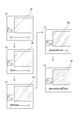
- FIG. 10 is an explanatory diagram showing an example of an electroencephalogram situation (display information) presented on the monitor 36.
- the monitor 36 presents the brain wave status of the user obtained based on the electroencephalogram that has been subjected to the removal process of the operation noise and the electromagnetic noise.
- the electroencephalogram condition presentation system 35 can obtain the ⁇ wave value and the ⁇ wave value acquired by the second calculation unit 23b, and performs a process of changing the display of the monitor 36 based on these values. While the user is undergoing massage, the display on the monitor 36 sequentially changes from FIG. 10 (a) to FIG. 10 (e) over time.
- the display information related to the electroencephalogram state of the monitor 36 is the display color of the monitor 36, and the electroencephalogram state presentation system 35 determines the color of the monitor 36 based on the ratio of the ⁇ wave value to the ⁇ wave value ( ⁇ / ⁇ ).
- the color change is expressed as a change in hatch density. For example, when the value of the ratio ( ⁇ / ⁇ ) is increased, the display color is brought close to red (hatch is dense) to inform that the comfort level is low. On the other hand, when the value of the ratio ( ⁇ / ⁇ ) is reduced, the display color is brought close to blue (hatch is rough) to notify that the comfort level is high.
- the display information regarding the electroencephalogram state of the monitor 36 As the display information regarding the electroencephalogram state of the monitor 36, a bar graph with the horizontal axis representing time and the vertical axis representing the ratio ( ⁇ / ⁇ ) is shown below the display color changing portion. Thereby, the temporal change of the value of the ratio ( ⁇ / ⁇ ) can be graphed, and this can be shown to the user. Further, in FIG. 10, the value of the ratio ( ⁇ / ⁇ ) is also displayed as the display information on the monitor 36.
- the display on the monitor 36 may be information based only on the ⁇ wave or information based only on the ⁇ wave, in addition to the information regarding the ratio ( ⁇ / ⁇ ).
- the information about the ⁇ wave and ⁇ wave at the time of the massage operation performed in the past (previous) is stored in the massage machine, and this time, when performing the same massage operation, the comparison with the previous information is performed. May be presented.
- the user receiving massage can see the state of his / her brain wave in real time by looking at the monitor 36. And it can confirm that the condition of an electroencephalogram, ie, the parameter
- the ⁇ wave value and the ⁇ wave value input to the electroencephalogram state presentation system 35 represent the comfort level (comfort / discomfort) of the user because each of the noises has been removed. As an appropriate indicator.
- the value of the electroencephalogram component (ratio ( ⁇ / ⁇ )) displayed on the monitor 36 is greatly different from a preset general (standard) value, for example, serious fatigue is predicted. Can be displayed on the monitor 36.
- the monitor 36 may be a computer provided separately from the massage machine, although not shown.
- the computer having the function of the electroencephalogram presentation system 35 is stored in a computer (at home), and the massage machine and the computer communicate with each other by connecting the massage machine and the computer with an interface cable. What is necessary is just to comprise. Thereby, the state of the electroencephalogram can be presented by the computer.
- the massage machine of the present invention includes a D-type learning control unit 40.
- the D-type learning control unit 40 is based on the ⁇ wave and ⁇ wave of the user obtained from the electroencephalogram that has been subjected to the removal process of the operation noise and the electromagnetic noise, that is, the user being massaged.
- the massage output is automatically set according to the comfort level felt by the brain, and each time the number of uses is repeated, the massage output is provided with a function to make it preferable for the user.
- the D-type learning control unit 40 has an output setting unit that sets massage output.
- the output setting unit includes an electroencephalogram ( ⁇ wave, ⁇ obtained by the electroencephalogram acquisition unit 18 when the treatment element 6 performs a massage operation with a predetermined finger pressure (predetermined massage output).
- predetermined massage output a predetermined finger pressure
- FIG. 1 the output setting unit that sets massage output.
- the target values are ( ⁇ / ⁇ 0 ) d , ( ⁇ / ⁇ 0 ) d , and ( ⁇ ⁇ ⁇ 0 / ⁇ 0 ⁇ ⁇ ) d , where ⁇ 0 and ⁇ 0 are treatments.
- ⁇ , ⁇ , and ⁇ / ⁇ are learning gains.
- the said process is performed by at least one of (alpha) wave, (beta) wave, and these ratio ((beta) / (alpha)).
- control is performed to adjust the massage output so that the brain wave obtained from the user approaches the target value. Further, by storing this massage output in the massage machine (memory of the D-type learning control unit 40), the massage reflecting this massage output can be performed at the next massage.
- the massage machine of the present invention is not limited to the illustrated form, and may be of other forms within the scope of the present invention.
- the form of the massage unit 5 may be other than that illustrated, and may include an air cell that is expanded and contracted by supplying and discharging air by the operation of the compressor.
- the type of massage may include information for each massage speed other than strong, medium, and weak.
- the mechanism (smearing mechanism, hitting mechanism, etc.) mounted in the massage unit 5 is the noise caused by the operation of the massage machine body, which is removed by the electromagnetic noise removing section (massaging noise removing section) 19.
- the rolling massage is performed by bringing the treatment element 6 into contact with the user and moving the massage unit 5 up and down by the lift drive mechanism.
- movement of a massage machine main body there exists noise resulting from the operation
- the obtained brain wave can be made to be suppressed in noise. Therefore, by controlling the operation of the massage machine body based on this brain wave, the massage given to the user can be set to an appropriate output.
Landscapes
- Health & Medical Sciences (AREA)
- Engineering & Computer Science (AREA)
- Life Sciences & Earth Sciences (AREA)
- Medical Informatics (AREA)
- Public Health (AREA)
- Biomedical Technology (AREA)
- General Health & Medical Sciences (AREA)
- Primary Health Care (AREA)
- Epidemiology (AREA)
- Biophysics (AREA)
- Pathology (AREA)
- Physical Education & Sports Medicine (AREA)
- Surgery (AREA)
- Animal Behavior & Ethology (AREA)
- Heart & Thoracic Surgery (AREA)
- Physics & Mathematics (AREA)
- Veterinary Medicine (AREA)
- Molecular Biology (AREA)
- Psychology (AREA)
- Psychiatry (AREA)
- Business, Economics & Management (AREA)
- General Business, Economics & Management (AREA)
- Massaging Devices (AREA)
- Measurement And Recording Of Electrical Phenomena And Electrical Characteristics Of The Living Body (AREA)
Priority Applications (2)
| Application Number | Priority Date | Filing Date | Title |
|---|---|---|---|
| CN2009801040592A CN102164572A (zh) | 2008-02-12 | 2009-02-03 | 按摩器以及按摩方法 |
| US12/863,095 US20110118636A1 (en) | 2008-02-12 | 2009-02-03 | Massage machine and massage method |
Applications Claiming Priority (2)
| Application Number | Priority Date | Filing Date | Title |
|---|---|---|---|
| JP2008030342A JP2009189398A (ja) | 2008-02-12 | 2008-02-12 | マッサージ機及びマッサージ方法 |
| JP2008-030342 | 2008-02-12 |
Publications (1)
| Publication Number | Publication Date |
|---|---|
| WO2009101875A1 true WO2009101875A1 (ja) | 2009-08-20 |
Family
ID=40956904
Family Applications (1)
| Application Number | Title | Priority Date | Filing Date |
|---|---|---|---|
| PCT/JP2009/051764 Ceased WO2009101875A1 (ja) | 2008-02-12 | 2009-02-03 | マッサージ機及びマッサージ方法 |
Country Status (4)
| Country | Link |
|---|---|
| US (1) | US20110118636A1 (https=) |
| JP (1) | JP2009189398A (https=) |
| CN (1) | CN102164572A (https=) |
| WO (1) | WO2009101875A1 (https=) |
Families Citing this family (23)
| Publication number | Priority date | Publication date | Assignee | Title |
|---|---|---|---|---|
| JP5442405B2 (ja) * | 2009-11-20 | 2014-03-12 | 国立大学法人鳥取大学 | マッサージ機及びマッサージシステム |
| JP5442480B2 (ja) * | 2010-02-08 | 2014-03-12 | 国立大学法人鳥取大学 | マッサージ機、及びマッサージ力の設定方法 |
| US9149409B2 (en) * | 2012-07-17 | 2015-10-06 | Daito Electric Machine Industry Company Limited | Back kneading device and chair-type massage apparatus equipped with the back kneading device |
| US9456784B2 (en) | 2013-03-14 | 2016-10-04 | The Methodist Hospital | Method and apparatus for providing transcranial magnetic stimulation (TMS) to a patient |
| US11730970B2 (en) | 2013-03-14 | 2023-08-22 | The Methodist Hospital | Method and apparatus for providing transcranial magnetic stimulation (TMS) to an individual |
| CN111493820B (zh) | 2013-08-15 | 2023-08-22 | 卫理公会医院 | 用于向个体提供经颅磁刺激(tms)的方法和设备 |
| CN105764415B (zh) * | 2013-10-14 | 2019-10-15 | 卡奥斯基有限公司 | 将非平稳信号分解成函数分量 |
| JP6458387B2 (ja) * | 2014-07-29 | 2019-01-30 | 株式会社きもちラボ | 生体電気ノイズ同定システム及び生体電気ノイズ除去システム |
| IL239191A0 (en) * | 2015-06-03 | 2015-11-30 | Amir B Geva | Image sorting system |
| JP6785446B2 (ja) * | 2016-04-14 | 2020-11-18 | パナソニックIpマネジメント株式会社 | 生体信号計測システム |
| US10874870B2 (en) | 2016-05-05 | 2020-12-29 | The Methodist Hospital | Method and apparatus for providing transcranial magnetic stimulation (TMS) to an individual |
| TWI619487B (zh) * | 2017-02-20 | 2018-04-01 | 督洋生技股份有限公司 | 具腦波調整功能的按摩椅及頭戴裝置 |
| CN107242215A (zh) * | 2017-08-14 | 2017-10-13 | 京东方科技集团股份有限公司 | 垂钓装置及其控制方法 |
| JP7258323B2 (ja) * | 2017-10-31 | 2023-04-17 | ファミリーイナダ株式会社 | マッサージ機およびそれを備えたマッサージ機システム |
| JP2019139769A (ja) * | 2018-02-05 | 2019-08-22 | 株式会社テラプローブ | 脳波を用いた入力システム及びプログラム |
| JP7296618B2 (ja) * | 2018-05-08 | 2023-06-23 | 株式会社Agama-X | 情報処理システム、情報処理装置及びプログラム |
| JP7217602B2 (ja) * | 2018-09-06 | 2023-02-03 | 株式会社フジ医療器 | マッサージ機 |
| WO2020102312A1 (en) | 2018-11-13 | 2020-05-22 | The Methodist Hospital | Method and apparatus for oncomagnetic treatement |
| KR102055081B1 (ko) * | 2019-01-09 | 2019-12-12 | 주식회사 바디프랜드 | 브레인 마사지 기능이 탑재된 안마의자 |
| US20220133589A1 (en) * | 2019-02-07 | 2022-05-05 | Sensei Wellness Holdings, Inc. | Systems and methods for thermographic body mapping with therapy |
| WO2021257967A1 (en) | 2020-06-19 | 2021-12-23 | The Methodist Hospital Dba Houston Methodist Hospital | Method and apparatus for oncomagnetic treatment |
| CN113041128B (zh) * | 2021-04-13 | 2022-07-08 | 四川千里倍益康医疗科技股份有限公司 | 基于电机噪音检测的按摩头加热控制系统及方法 |
| JP2026035107A (ja) * | 2024-08-19 | 2026-03-04 | 国立大学法人神戸大学 | 脳波測定装置、脳波測定システム、及び脳波測定プログラム |
Citations (5)
| Publication number | Priority date | Publication date | Assignee | Title |
|---|---|---|---|---|
| JPH05285182A (ja) * | 1992-04-14 | 1993-11-02 | Onkyo Corp | 音響振動装置付き椅子 |
| JP2001204694A (ja) * | 2000-01-26 | 2001-07-31 | Matsushita Electric Works Ltd | 生体情報検出装置 |
| JP2004261390A (ja) * | 2003-02-28 | 2004-09-24 | Sanyo Electric Co Ltd | ノイズ判断方法及びマッサージ機 |
| JP2007521852A (ja) * | 2003-11-18 | 2007-08-09 | ヴィーヴォメトリックス インコーポレイテッド | 移動式生理学的モニタリングからのデータを処理する方法及びシステム |
| JP2007215671A (ja) * | 2006-02-15 | 2007-08-30 | Tottori Univ | マッサージ機及びマッサージ出力設定方法 |
Family Cites Families (5)
| Publication number | Priority date | Publication date | Assignee | Title |
|---|---|---|---|---|
| JPH09131331A (ja) * | 1995-11-09 | 1997-05-20 | Noryoku Kaihatsu Kenkyusho:Kk | 脳波分析表示装置 |
| JP2003235823A (ja) * | 2002-02-15 | 2003-08-26 | Naohiro Toda | 「生体電気信号における外来交流雑音除去方式」 |
| JP2006006665A (ja) * | 2004-06-25 | 2006-01-12 | Olympus Corp | 脳機能解析システム |
| WO2007041766A1 (en) * | 2005-10-10 | 2007-04-19 | Compumedics Limited | Adaptive real-time line noise suppression for electrical or magnetic physiological signals |
| US7684856B2 (en) * | 2005-12-12 | 2010-03-23 | General Electric Company | Detection of artifacts in bioelectric signals |
-
2008
- 2008-02-12 JP JP2008030342A patent/JP2009189398A/ja active Pending
-
2009
- 2009-02-03 US US12/863,095 patent/US20110118636A1/en not_active Abandoned
- 2009-02-03 WO PCT/JP2009/051764 patent/WO2009101875A1/ja not_active Ceased
- 2009-02-03 CN CN2009801040592A patent/CN102164572A/zh active Pending
Patent Citations (5)
| Publication number | Priority date | Publication date | Assignee | Title |
|---|---|---|---|---|
| JPH05285182A (ja) * | 1992-04-14 | 1993-11-02 | Onkyo Corp | 音響振動装置付き椅子 |
| JP2001204694A (ja) * | 2000-01-26 | 2001-07-31 | Matsushita Electric Works Ltd | 生体情報検出装置 |
| JP2004261390A (ja) * | 2003-02-28 | 2004-09-24 | Sanyo Electric Co Ltd | ノイズ判断方法及びマッサージ機 |
| JP2007521852A (ja) * | 2003-11-18 | 2007-08-09 | ヴィーヴォメトリックス インコーポレイテッド | 移動式生理学的モニタリングからのデータを処理する方法及びシステム |
| JP2007215671A (ja) * | 2006-02-15 | 2007-08-30 | Tottori Univ | マッサージ機及びマッサージ出力設定方法 |
Also Published As
| Publication number | Publication date |
|---|---|
| JP2009189398A (ja) | 2009-08-27 |
| CN102164572A (zh) | 2011-08-24 |
| US20110118636A1 (en) | 2011-05-19 |
Similar Documents
| Publication | Publication Date | Title |
|---|---|---|
| WO2009101875A1 (ja) | マッサージ機及びマッサージ方法 | |
| JP6340691B2 (ja) | マッサージ機 | |
| JP2010220820A (ja) | マッサージ機器およびマッサージプログラム | |
| KR20020042485A (ko) | 마사지기 및 제어기를 구비한 전자 기기 | |
| JP2018064740A (ja) | リハビリテーションシステム | |
| US20030158504A1 (en) | Massaging apparatus | |
| KR20180103517A (ko) | 정신건강 향상과 두뇌 인지기능 회복을 위한 브레인 마사지 기능이 탑재된 안마의자 | |
| CN105167743B (zh) | 身体状态评价装置以及具备该装置的按摩机 | |
| JP2002224182A (ja) | 複数の生体信号から推定した肩こり情報に基づいて制御されるマッサージ機 | |
| JP7258323B2 (ja) | マッサージ機およびそれを備えたマッサージ機システム | |
| CN119920465A (zh) | 一种文本叙事引导的虚拟现实晕动症监测与缓解系统 | |
| CN107174468A (zh) | 生物体状态评价装置以及按摩机 | |
| CN120911768A (zh) | 一种森林康养活动系统及其评估方法 | |
| JP4837392B2 (ja) | マッサージ機 | |
| CN110876672A (zh) | 按摩机 | |
| JP5442405B2 (ja) | マッサージ機及びマッサージシステム | |
| JP2002291826A (ja) | マッサージ条件決定方法及びこの決定方法を使用したマッサージ機 | |
| JP4043188B2 (ja) | コントローラを具えたマッサージ機器 | |
| JP7146196B2 (ja) | スコア算出装置および方法ならびにスコア算出装置の制御プログラム | |
| JP2002304615A (ja) | マッサージ機 | |
| JP2002209965A (ja) | マッサージ装置 | |
| Rabbito et al. | Hemispheric lateralization during active and imagined movements assessed by transcranial doppler ultrasound | |
| JP2001129044A (ja) | 体調調整装置 | |
| TWI771681B (zh) | 能夠得出個人的參數的按摩裝置、系統、和方法 | |
| RU2471453C1 (ru) | Способ коррекции нарушений зрения посредством создания биологической обратной связи и аппаратный комплекс для его осуществления |
Legal Events
| Date | Code | Title | Description |
|---|---|---|---|
| WWE | Wipo information: entry into national phase |
Ref document number: 200980104059.2 Country of ref document: CN |
|
| 121 | Ep: the epo has been informed by wipo that ep was designated in this application |
Ref document number: 09710659 Country of ref document: EP Kind code of ref document: A1 |
|
| WWE | Wipo information: entry into national phase |
Ref document number: 12863095 Country of ref document: US |
|
| NENP | Non-entry into the national phase |
Ref country code: DE |
|
| 122 | Ep: pct application non-entry in european phase |
Ref document number: 09710659 Country of ref document: EP Kind code of ref document: A1 |