WO2009084686A1 - 携帯電子機器及びその制御方法 - Google Patents
携帯電子機器及びその制御方法 Download PDFInfo
- Publication number
- WO2009084686A1 WO2009084686A1 PCT/JP2008/073855 JP2008073855W WO2009084686A1 WO 2009084686 A1 WO2009084686 A1 WO 2009084686A1 JP 2008073855 W JP2008073855 W JP 2008073855W WO 2009084686 A1 WO2009084686 A1 WO 2009084686A1
- Authority
- WO
- WIPO (PCT)
- Prior art keywords
- information
- rechargeable battery
- unit
- storage unit
- electronic device
- Prior art date
- Legal status (The legal status is an assumption and is not a legal conclusion. Google has not performed a legal analysis and makes no representation as to the accuracy of the status listed.)
- Ceased
Links
Images


Classifications
-
- H—ELECTRICITY
- H02—GENERATION; CONVERSION OR DISTRIBUTION OF ELECTRIC POWER
- H02J—ELECTRIC POWER NETWORKS; CIRCUIT ARRANGEMENTS OR SYSTEMS FOR SUPPLYING OR DISTRIBUTING ELECTRIC POWER; SYSTEMS FOR STORING ELECTRIC ENERGY
- H02J7/00—Circuit arrangements for charging or discharging batteries or for supplying loads from batteries
- H02J7/80—Circuit arrangements for charging or discharging batteries or for supplying loads from batteries including monitoring or indicating arrangements
- H02J7/84—Control of state of health [SOH]
-
- G—PHYSICS
- G01—MEASURING; TESTING
- G01R—MEASURING ELECTRIC VARIABLES; MEASURING MAGNETIC VARIABLES
- G01R19/00—Arrangements for measuring currents or voltages or for indicating presence or sign thereof
- G01R19/165—Indicating that current or voltage is either above or below a predetermined value or within or outside a predetermined range of values
-
- G—PHYSICS
- G01—MEASURING; TESTING
- G01R—MEASURING ELECTRIC VARIABLES; MEASURING MAGNETIC VARIABLES
- G01R31/00—Arrangements for testing electric properties; Arrangements for locating electric faults; Arrangements for electrical testing characterised by what is being tested not provided for elsewhere
- G01R31/36—Arrangements for testing, measuring or monitoring the electrical condition of accumulators or electric batteries, e.g. capacity or state of charge [SoC]
- G01R31/367—Software therefor, e.g. for battery testing using modelling or look-up tables
-
- G—PHYSICS
- G01—MEASURING; TESTING
- G01R—MEASURING ELECTRIC VARIABLES; MEASURING MAGNETIC VARIABLES
- G01R31/00—Arrangements for testing electric properties; Arrangements for locating electric faults; Arrangements for electrical testing characterised by what is being tested not provided for elsewhere
- G01R31/36—Arrangements for testing, measuring or monitoring the electrical condition of accumulators or electric batteries, e.g. capacity or state of charge [SoC]
- G01R31/382—Arrangements for monitoring battery or accumulator variables, e.g. SoC
- G01R31/3835—Arrangements for monitoring battery or accumulator variables, e.g. SoC involving only voltage measurements
-
- G—PHYSICS
- G01—MEASURING; TESTING
- G01R—MEASURING ELECTRIC VARIABLES; MEASURING MAGNETIC VARIABLES
- G01R31/00—Arrangements for testing electric properties; Arrangements for locating electric faults; Arrangements for electrical testing characterised by what is being tested not provided for elsewhere
- G01R31/36—Arrangements for testing, measuring or monitoring the electrical condition of accumulators or electric batteries, e.g. capacity or state of charge [SoC]
- G01R31/392—Determining battery ageing or deterioration, e.g. state of health
-
- H—ELECTRICITY
- H01—ELECTRIC ELEMENTS
- H01M—PROCESSES OR MEANS, e.g. BATTERIES, FOR THE DIRECT CONVERSION OF CHEMICAL ENERGY INTO ELECTRICAL ENERGY
- H01M10/00—Secondary cells; Manufacture thereof
- H01M10/42—Methods or arrangements for servicing or maintenance of secondary cells or secondary half-cells
-
- H—ELECTRICITY
- H01—ELECTRIC ELEMENTS
- H01M—PROCESSES OR MEANS, e.g. BATTERIES, FOR THE DIRECT CONVERSION OF CHEMICAL ENERGY INTO ELECTRICAL ENERGY
- H01M10/00—Secondary cells; Manufacture thereof
- H01M10/42—Methods or arrangements for servicing or maintenance of secondary cells or secondary half-cells
- H01M10/48—Accumulators combined with arrangements for measuring, testing or indicating the condition of cells, e.g. the level or density of the electrolyte
-
- H—ELECTRICITY
- H02—GENERATION; CONVERSION OR DISTRIBUTION OF ELECTRIC POWER
- H02J—ELECTRIC POWER NETWORKS; CIRCUIT ARRANGEMENTS OR SYSTEMS FOR SUPPLYING OR DISTRIBUTING ELECTRIC POWER; SYSTEMS FOR STORING ELECTRIC ENERGY
- H02J7/00—Circuit arrangements for charging or discharging batteries or for supplying loads from batteries
- H02J7/02—Circuit arrangements for charging or discharging batteries or for supplying loads from batteries for charging batteries from AC mains by converters
- H02J7/04—Regulation of charging current or voltage
-
- H—ELECTRICITY
- H02—GENERATION; CONVERSION OR DISTRIBUTION OF ELECTRIC POWER
- H02J—ELECTRIC POWER NETWORKS; CIRCUIT ARRANGEMENTS OR SYSTEMS FOR SUPPLYING OR DISTRIBUTING ELECTRIC POWER; SYSTEMS FOR STORING ELECTRIC ENERGY
- H02J7/00—Circuit arrangements for charging or discharging batteries or for supplying loads from batteries
- H02J7/90—Regulation of charging or discharging current or voltage
- H02J7/96—Regulation of charging or discharging current or voltage in response to battery voltage
-
- Y—GENERAL TAGGING OF NEW TECHNOLOGICAL DEVELOPMENTS; GENERAL TAGGING OF CROSS-SECTIONAL TECHNOLOGIES SPANNING OVER SEVERAL SECTIONS OF THE IPC; TECHNICAL SUBJECTS COVERED BY FORMER USPC CROSS-REFERENCE ART COLLECTIONS [XRACs] AND DIGESTS
- Y02—TECHNOLOGIES OR APPLICATIONS FOR MITIGATION OR ADAPTATION AGAINST CLIMATE CHANGE
- Y02E—REDUCTION OF GREENHOUSE GAS [GHG] EMISSIONS, RELATED TO ENERGY GENERATION, TRANSMISSION OR DISTRIBUTION
- Y02E60/00—Enabling technologies; Technologies with a potential or indirect contribution to GHG emissions mitigation
- Y02E60/10—Energy storage using batteries
Definitions
- the present invention relates to a portable electronic device to which a rechargeable battery is attached, and more particularly to a portable electronic device that outputs a use state of the rechargeable battery and a control method thereof.
- lithium-ion batteries are the mainstream for mobile phones, but in the future, mobile terminals will become smaller, lighter, and more sophisticated (continuous digital TV viewing, continuous music playback, web browsing, etc.) ), The charge / discharge cycle of the battery is accelerated, and as a result, it is expected that the battery life tends to be short with respect to the usage period of the portable terminal.
- a method of detecting the life of the battery a method for judging the life of the battery based on a change in the impedance value of the battery (for example, refer to Patent Document 1) and a function related to the charge / discharge curve are stored.
- a method of determining the battery life by weighting and calculating the deterioration value during charging / discharging see, for example, Patent Document 2.
- the battery life is defined by the battery manufacturer, and means, for example, the state when the initial capacity is reduced to about 50 to 60% by about 500 to 600 charge / discharge cycles. If this state is exceeded, the expected operation cannot be secured against the operation of the mobile terminal due to an increase in internal resistance or the like.
- the battery can be removed or attached, and when the battery is replaced, it is difficult to determine the life state of the battery.
- the present invention has been made in view of the above-described problems, and one of its purposes is that the battery can be replaced even when the battery is replaced with a simple configuration without increasing the cost.
- An object of the present invention is to provide a portable electronic device capable of accurately determining the lifetime and a control method thereof.
- a portable electronic device includes a storage unit, a voltage measuring unit that measures the voltage of the rechargeable battery every time charging is performed on the rechargeable battery, and the voltage A control unit that controls the storage unit to store the number-of-charges information specified based on the value of the voltage measured by the measurement unit; and an information acquisition unit that acquires information from the outside. Is characterized in that when the information acquisition unit acquires the number of times of charging related to the rechargeable battery, predetermined information is updated based on the number of times of charging information.
- control unit measures the voltage of the rechargeable battery at the voltage measuring unit every time charging of the rechargeable battery occurs.
- control unit measures the voltage of the rechargeable battery at the voltage measuring unit every time charging of the rechargeable battery occurs.
- the rechargeable battery has unique ID information
- the storage unit stores the ID information of the rechargeable battery and the charge count information in association with each other.
- the storage unit is configured to retain the stored number-of-charges information and the ID information even when the rechargeable battery is removed, and the control unit includes the rechargeable battery.
- the control unit includes the rechargeable battery.
- the battery is mounted, it is checked whether or not the ID information of the rechargeable battery is stored in the storage unit. If the ID information is stored in the storage unit, the number of times of charging corresponding to the ID information.
- the charging number information of the rechargeable battery is acquired by the information acquisition unit, and the acquired charging number information is included in the acquired charging number information. It is preferable to perform predetermined information update based on the information.
- the portable electronic device includes an output unit that outputs various types of information
- the control unit is configured to update the rechargeable battery based on the charge count information stored in the storage unit as the predetermined information update. It is preferable to control so that the information regarding the life is output by the output unit.
- the control unit checks whether or not ID information of the rechargeable battery is stored in the storage unit, and the ID information is stored in the storage unit. If not stored in the storage unit, it is preferable to register the ID information of the rechargeable battery in the storage unit and store the subsequent charging frequency information in association with the ID information.
- the portable electronic device includes an operation unit, and the control unit checks whether or not ID information of the rechargeable battery is stored in the storage unit when the rechargeable battery is mounted, and the ID When the information is not stored in the storage unit, the output unit presents a first selection menu for selecting whether the rechargeable battery is an unused product, and the first operation menu is operated by the operation unit. When it is selected from the selection menu that the product is unused, the storage unit is controlled so that the ID information of the rechargeable battery is newly registered and the subsequent charging frequency information is stored in association with the ID information. It is preferable to do.
- the information acquisition unit displays the charge count information of the rechargeable battery. It is preferable to obtain.
- control unit prompts the information acquisition unit to acquire the charging number information when the information acquisition unit acquires the charging number information of the mounted rechargeable battery. Is preferably controlled to be output by the output unit.
- the control unit checks whether or not ID information of the rechargeable battery is stored in the storage unit, and the ID information is stored in the storage unit.
- the second selection menu for selecting whether or not the rechargeable battery was used in another device is presented by the output unit, and the second selection menu is operated by the operation unit.
- the information acquisition unit acquires the charge count information of the rechargeable battery.
- control unit prompts the information acquisition unit to acquire the charging number information when the information acquisition unit acquires the charging number information of the mounted rechargeable battery. Is preferably controlled to be output by the output unit.
- control unit stores the information in the storage unit when it is selected from the second selection menu that the device has not been used by another device by the operation of the operation unit. It is preferable to perform predetermined information update based on the charge count information.
- the information acquisition unit includes a communication unit that acquires information by communication, and the control unit obtains the charging number information of the attached rechargeable battery from the other device. It is preferable to acquire using communication by the communication unit.
- the communication unit is configured by a direct communication unit that performs direct or wireless communication with the other device.
- a method for controlling a portable electronic device can attach and detach a rechargeable battery, and retain at least a part of stored information even if the rechargeable battery is removed.
- the charge count information is acquired, predetermined information is updated based on the charge count information.
- the battery life can be accurately determined even when the battery is replaced.
- FIG. 1 is an external perspective view of a mobile phone device 1 which is an example of a mobile electronic device according to the present invention.
- a mobile phone device will be described.
- the present invention is not limited to this, and may be a PHS (Personal Handy phone System), a PDA (Personal Digital Assistant), a portable navigation device, a notebook personal computer, or the like. Also good.
- the mobile phone device 1 includes an operation unit side body unit 2 and a display unit side body unit 3.
- the operation unit side body unit 2 includes an operation key group 11 and a microphone 12 to which a voice uttered by a user during a call is input on the surface unit 10.
- the operation key group 11 includes a function setting operation button 13 for operating various functions such as various settings, a telephone book function, and a mail function, and an input operation button 14 for inputting a telephone number and characters such as mail.
- a determination operation button 15 for performing determination and scrolling in various operations.
- the display unit side body unit 3 includes a display 21 for displaying various types of information on the surface unit 20 and an audio output unit 22 for outputting the voice of the other party of the call.
- the upper end of the operation unit side body 2 and the lower end of the display unit side body 3 are connected via a hinge mechanism 4.
- the cellular phone device 1 relatively rotates the operation unit side body 2 and the display unit side body 3 connected via the hinge mechanism 4, thereby
- the display unit side body 3 can be in a state of being open to each other (open state), or the operation unit side body 2 and the display unit side body 3 can be in a folded state (folded state).
- a slide type in which one housing is slid in one direction from a state in which the body portion 3 is overlapped, or an axis line along the overlapping direction of the operation portion side housing portion 2 and the display portion side housing portion 3 It may be a rotary type (turn type) in which one housing is rotated around the center.
- FIG. 2 shows a perspective view in which a part of the operation unit side body 2 is disassembled.
- the operation unit side body unit 2 includes a circuit board 30, a rear case unit 31, a rechargeable battery 32 that is a rechargeable battery, and a rechargeable battery cover 33.
- the circuit board 30 is mounted with an element such as a CPU (corresponding to a control block 48 described later) that performs predetermined arithmetic processing, and when the operation key group 11 on the surface portion 10 is operated by the user, A predetermined signal is supplied to the CPU.
- a battery terminal 46 described later is mounted on the circuit board 30.
- the rear case portion 31 includes a hinge mechanism fixing portion 31A that fixes the hinge mechanism 4, a main antenna storage portion 31B that stores a main antenna 70 that performs communication in a predetermined use frequency band, and a rechargeable battery storage that stores a rechargeable battery 32. Part 31C.
- FIG. 3 is a functional block diagram showing functions of the mobile phone device 1.
- the mobile phone device 1 includes an operation key group 11, a microphone 12, a display 21, an audio output unit 22, a communication unit 41, a storage unit 42, a power supply circuit 43, and audio processing.
- a unit 44, a speaker 45, a battery terminal 46, a non-contact reader 47, and a control block 48 for controlling each unit are provided.
- the battery terminal 46 includes a first terminal 51 and an RFID antenna 52 connected to the non-contact reader 47.
- the rechargeable battery 32 includes a battery cell 61, an authentication storage unit 62, a non-contact output unit 63, and a second terminal 64.
- the connection terminals corresponding to each other of the power supply circuit 43 and the charging device 80 come into contact with each other.
- the battery cell 61 of the rechargeable battery 32 is charged.
- a charging circuit that connects the charging device 80 and the rechargeable battery 32 is formed in a part of the power supply circuit 43.
- the power supply circuit 43 is configured to switch between an ON state and an OFF state of the power feeding operation from the charging device 80 to the rechargeable battery 32 performed by the charging circuit based on a command from the control block 48.
- the communication unit 41 includes a main antenna 70 that communicates with an external device in a predetermined use frequency band, and a communication processing unit 71 that performs signal processing such as modulation processing or demodulation processing.
- the communication unit 41 is supplied with a power supply voltage from the rechargeable battery 32 via the power supply circuit 43.
- the communication unit 41 can be connected to a public communication network via the nearest base station by wireless communication such as the CDMA2000_1x method, for example, as in a general mobile phone device. .
- the storage unit 42 is a non-volatile storage medium, in which ID information of a plurality of rechargeable batteries is stored together with information on the respective usage conditions. In addition, it is assumed that the content stored in the storage unit 42 is configured such that it cannot be rewritten by the user.
- the power supply circuit 43 converts the power supply voltage supplied from the rechargeable battery 32 into a predetermined voltage, and supplies the converted voltage to each part of the mobile phone device 1.
- the voice processing unit 44 is controlled by the control block 48, outputs the voice of the other party during the call from the voice output unit 22, and performs signal processing on the voice of the user input from the microphone 12. Also, the audio processing unit 44 performs, for example, a reproduction process of music data stored in the storage unit 42 and outputs it from the speaker 45.
- the first terminal 51 is connected to the second terminal 64 of the rechargeable battery 32, and supplies the power supply voltage supplied from the battery cell 61 to the power supply circuit 43.
- an authentication storage unit 62 and a non-contact output unit 63 are connected to each other in a circuit.
- the authentication storage unit 62 stores unique ID information for identifying the rechargeable battery.
- the authentication storage unit 62 has a data area sandwiched between a start bit and a stop bit, and can store serial data including a parity bit for error correction.
- ID information ID information unique to the rechargeable battery such as a manufacturing number of the rechargeable battery 32, rechargeable battery type information (lithium ion type, nickel hydrogen type, nickel cadmium type, etc.), Information such as manufacturer type and capacity value is stored in a serial string.
- the characteristics of the rechargeable battery 32 will be described.
- the capacity is generally reduced to about 60% by the charge / discharge operation of about 500 cycles.
- a state where the capacity is reduced to about 60% is called a state where the battery life has been reached.
- the rechargeable battery 32 is still usable even when it reaches the end of its battery life, but in such a state, the impedance also increases, and the expected performance is exhibited. It is a difficult situation.
- the capacity decreases at an accelerated rate (see FIG. 4).
- the present invention proposes a configuration and method capable of accurately determining the battery life even when the rechargeable battery is replaced without increasing the cost with a simple configuration.
- the non-contact reader 47 performs non-contact (wireless) communication with the non-contact output unit 63 via the RFID antenna 52 by the RFID (Radio Frequency Identification) technology according to the control of the control block 48.
- the ID information stored in the authentication storage unit 62 of the rechargeable battery 32 can be read.
- the non-contact reader 47 and the non-contact output unit 63 are not directly connected to the circuit, but when it is detected that the rechargeable battery 32 is attached, first, the control block 48 stands up in the background (without display or sound). Then, based on the command of the control block 48, the contactless reader 47 starts wireless transmission of the authentication request. Further, the non-contact output unit 63 receives the authentication request signal from the non-contact reader 47 without receiving power supply from the battery cell 61 in the rechargeable battery 32, thereby generating operating power by electromagnetic induction. The non-contact output unit 63 reads out the ID information stored in the authentication storage unit 62 using the operating power as a power source, and wirelessly outputs the ID information to the non-contact reader 47.
- the control block 48 includes a voltage measurement unit 100 and a control unit 101.
- the voltage measuring unit 100 is connected to the rechargeable battery 32 and measures the voltage value of the rechargeable battery 32.
- the control unit 101 measures the voltage of the rechargeable battery 32 at the voltage measuring unit 100 each time the rechargeable battery 32 starts charging and ends charging, and is specified based on the measured voltage value. Control is performed so that the number-of-times information is stored in the storage unit 42.
- the mobile phone device 1 includes an information acquisition unit 49 that acquires information on the number of times of charging related to the rechargeable battery 32 from the outside.
- the information acquisition unit 49 may have a configuration including the magnetic field communication unit 102 configured by RFID that acquires information by magnetic field communication.
- the control unit 101 acquires information on the number of times of charging of the rechargeable battery 32 that is attached to another device using magnetic field communication by the magnetic field communication unit 102.
- the information acquisition unit 49 may be configured to perform wired communication such as USB (Universal Serial Bus) in addition to short-range wireless communication such as Bluetooth (registered trademark). In this way, the information acquisition unit 49 is configured by a direct communication unit that performs direct communication between terminals without using a base station or the like.
- wired communication such as USB (Universal Serial Bus)
- short-range wireless communication such as Bluetooth (registered trademark).
- the information acquisition unit 49 is configured by a direct communication unit that performs direct communication between terminals without using a base station or the like.
- the information acquisition part 49 should just be the structure which can acquire charge frequency information from the outside, and is not restricted to RFID.
- the information acquisition unit 49 may be a communication unit configured by infrared communication (IrDA, Infrared Data Association), or may be an interface such as a removable memory card.
- the information acquisition unit 49 is described as being independent of the communication unit 41, but the information acquisition unit 49 may be configured by the communication unit 41.
- the cellular phone device 1 acquires the number of times of charging the rechargeable battery 32 by e-mail or the like transmitted from an external device or the like.
- the information acquisition unit 49 may be configured to be able to acquire battery information indirectly via a base station or the like. It is preferable that the information acquisition unit 49 is configured by a direct communication unit that can acquire information without taking time when the battery is replaced in a situation where radio waves do not reach the base station such as underground or in a building. .
- control unit 101 updates predetermined information based on the charge count information.
- the rechargeable battery 32 when the rechargeable battery 32 is replaced (including the case where the original rechargeable battery 32 is mounted again), the replaced rechargeable battery stored in another device is used. Information on the number of times of charging the battery 32 is acquired, and predetermined information updating is performed based on the acquired number of times of charging information. Therefore, the lifetime of the rechargeable battery 32 can be accurately determined with a simple configuration without increasing the cost.
- the rechargeable battery 32 has unique ID information as described above.
- the storage unit 42 is configured to retain the stored number-of-charges information and ID information even when the rechargeable battery 32 is removed.
- the control unit 101 checks whether the ID information of the rechargeable battery 32 is stored in the storage unit 42, and when the ID information is stored in the storage unit 42. Performs predetermined information update based on the number-of-charges information corresponding to the ID information. Further, when the ID information is not stored in the storage unit 42, the control unit 101 acquires the charge count information of the rechargeable battery 32 by the information acquisition unit 49 and updates predetermined information based on the acquired charge count information. I do.
- the ID information of the rechargeable battery 32 is stored in the storage unit 42. It is determined whether or not the information is stored, that is, whether or not the information on the number of times of charging has been stored in the storage unit 42 in the past. And according to the said determination, the charge frequency information of the rechargeable battery 32 preserve
- the mobile phone device 1 includes an output unit (corresponding to the display 21 and the speaker 45) that outputs various kinds of information. Further, the control unit 101 controls the display 21 and the speaker 45 to output information related to the life of the rechargeable battery 32 based on the number of times of charging stored in the storage unit 42 as predetermined information update.
- the rechargeable battery 32 when the rechargeable battery 32 is replaced (including when the original rechargeable battery 32 is mounted again), the rechargeable battery 32 stored in another device is stored. Information on the number of times of charging is acquired, and information on the life of the rechargeable battery 32 is presented on the display 21 and the speaker 45 based on the acquired number of times of charging information. Therefore, with a simple configuration, accurate information regarding the life of the rechargeable battery 32 can be clearly presented to the user without an increase in cost.
- control unit 101 checks whether or not the ID information of the rechargeable battery 32 is stored in the storage unit 42 when the rechargeable battery 32 is attached. When the ID information is not stored in the storage unit 42, the control unit 101 displays a first selection menu for selecting whether or not the rechargeable battery 32 is an unused product on the output unit (display 21 or speaker 45). Equivalent). When the control unit 101 selects an unused product from the first selection menu by operating the operation key group 11, the control unit 101 newly registers the ID information of the rechargeable battery 32, and the number of times of subsequent charging information Is stored in association with the ID information. In addition, the control unit 101 prompts the information acquisition unit 49 to acquire the charge count information of the rechargeable battery 32 when the use key 11 is selected from the first selection menu by operating the operation key group 11. Is output from the display 21 and the speaker 45.
- the replaced rechargeable battery 32 is an unused item.
- the user selects from the first selection menu. And according to the said selection result, since the message for registering the rechargeable battery 32 newly or acquiring the charge frequency information of the rechargeable battery 32 preserve
- control unit 101 checks whether or not the ID information of the rechargeable battery 32 is stored in the storage unit 42 when the rechargeable battery 32 is attached. Then, when the ID information is stored in the storage unit 42, the control unit 101 outputs a second selection menu for selecting whether or not the rechargeable battery 32 is used in another device (the display 21 and the speaker). Equivalent to 45). Then, when it is selected from the second selection menu that no other device is used by operating the operation key group 11, the control unit 101 is based on the number-of-charges information stored in the storage unit 42. Perform predetermined information update.
- control unit 101 acquires the charge count information of the rechargeable battery 32 using the information acquisition unit 49. Control is performed so that information (message) that prompts the user is output from the display 21 or the speaker 45.
- the replaced rechargeable battery 32 is used by another device.
- the user is allowed to select from the second selection menu whether or not it has been done. And according to the said selection result, since the notification to the effect of acquiring the frequency
- the rechargeable battery 32 having the non-contact output unit 63 and the mobile phone device 1 that has the function of recognizing the charge battery and determining the battery life by recognizing the charge / discharge frequency are assumed.
- the usage history (charge / discharge frequency information) of the rechargeable battery 32 is stored in the other device.
- the mobile telephone apparatus 1 assumes the case where the determination of the battery life of the rechargeable battery 32 is output correctly.
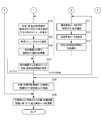
- step S1 the mobile phone device 1 is turned on in accordance with a user operation, and performs a predetermined activation operation.
- step S2 the control unit 101 determines whether or not the rechargeable battery 32 is removed from the rechargeable battery storage unit 31C and attached again.
- the mobile phone device 1 holds history information when the rechargeable battery 32 is removed from the rechargeable battery storage unit 31C or when the rechargeable battery 32 is attached to the rechargeable battery storage unit 31C. .
- the history information is stored and held in the storage unit 42, for example.
- the control unit 101 removes the rechargeable battery 32 from the rechargeable battery storage unit 31 ⁇ / b> C from when the main power supply is turned off until it is turned on by the step S ⁇ b> 1. It can be determined whether or not.
- step S3 it is determined that the rechargeable battery 32 is not removed from the rechargeable battery storage unit 31C.
- step S19 the battery life is displayed on the display 21 without changing the charge / discharge number information.
- step S3 the control unit 101 confirms the ID information of the rechargeable battery 32.
- step S4 the control unit 101 determines whether the rechargeable battery 32 is a new rechargeable battery or a registered rechargeable battery from the ID information of the rechargeable battery 32 confirmed in the process of step S3.
- the storage unit 42 stores ID information and charge / discharge count information for each rechargeable battery 32.
- the control unit 101 accesses the storage unit 42, and the rechargeable battery 32 is new, that is, once in the past. It is determined whether or not the rechargeable battery is not attached to the mobile phone device 1.
- step S7 the process proceeds to step S5.
- step S5 the control unit 101 displays on the display 21 a second selection menu for confirming whether or not the rechargeable battery 32 has been used by another device.
- the user operates the operation key group 11 to select whether or not the rechargeable battery 32 has been used in another device from the second selection menu.
- step S6 the control unit 101 determines whether or not the rechargeable battery 32 is used in another device from the result selected in the process of step S5. If it is determined that the rechargeable battery 32 has been used by another device (Yes), the process proceeds to step S10. If it is determined that the rechargeable battery 32 has not been used by another device (No), step S19 is performed. Proceed to
- step S7 the control unit 101 displays on the display 21 a first selection menu for confirming whether the rechargeable battery 32 is an unused product or a used product.
- the user operates the operation key group 11 to select whether or not the rechargeable battery 32 is an unused product from the first selection menu.
- step S8 the control unit 101 determines whether or not the rechargeable battery 32 is an unused product from the result selected in the process of step S7. If it is determined that the rechargeable battery 32 is an unused product, the process proceeds to step S9. If it is determined that the rechargeable battery 32 is a used product, the process proceeds to step S10.
- step S9 the control unit 101 stores the charge / discharge count information as zero in the storage unit 42 in association with the ID information of the rechargeable battery 32.
- step S10 the control unit 101 displays information (message) on the display 21 as to whether or not to acquire usage history information (charge / discharge frequency information) of the rechargeable battery 32 from another device that has been used.
- the user operates the operation key group 11 to select whether or not to acquire the charging / discharging frequency information of the rechargeable battery 32 from another device. If it is selected to acquire the charging / discharging frequency information of the rechargeable battery 32 from another device (Yes), the process proceeds to step S14, and it is selected not to acquire the charging / discharging frequency information of the rechargeable battery 32 from the other device. If (No), the process proceeds to step S11.
- step S11 since the control unit 101 cannot accurately determine the life of the rechargeable battery 32, the control unit 101 notifies that the display (battery life meter) indicating the battery life is turned off (cancelled) from the display 21.
- step S12 the control unit 101 releases the battery life meter from the display 21.
- step S13 the process proceeds to step S14.
- step S ⁇ b> 14 the control unit 101 selects a menu for selecting means (for example, an interface such as RFID, IrDA, or a memory card) for acquiring information on the number of times of charging / discharging the rechargeable battery 32 from another device. It is displayed on the display 21.
- a menu for selecting means for example, an interface such as RFID, IrDA, or a memory card
- step S15 the control unit 101 causes the user to select one means from the menu displayed on the display 21 in the process of step S14.
- step S ⁇ b> 16 the control unit 101 prepares for communication with other devices according to the means selected by the user.
- the pre-preparation is, for example, preparation (handshake) for confirming whether or not communication can be performed with another device.
- step S ⁇ b> 17 the control unit 101 receives the charge / discharge frequency information of the rechargeable battery 32 transmitted from another device. If information transfer from another device fails, the process according to this process is repeated, and retry is performed a predetermined number of times. If the predetermined number of retries has failed, the process proceeds to step S11.
- step S ⁇ b> 18 the control unit 101 stores the charging / discharging frequency information of the rechargeable battery 32 transmitted from another device in the storage unit 42 in association with the ID information of the rechargeable battery 32.
- step S19 the control unit 101 updates the battery life meter based on the charge / discharge frequency information stored in the storage unit 42 in the process of step S18.
- the mobile phone device 1 performs a charge / discharge number information calculation method and correction method as follows, for example.
- the control unit 101 counts the number of charging / discharging cycles by the rechargeable battery 32 by measuring the voltage state of the rechargeable battery 32. For example, when the control unit 101 is electrically connected to the charger, the number of discharges is determined by measuring the battery voltage of the rechargeable battery 32 before the start of charging (considering the first weighting factor X due to deterioration). Count. In addition, when the control unit 101 is electrically disconnected from the charger, the control unit 101 determines the number of times of charging by measuring the battery voltage of the rechargeable battery 32 after the end of charging (considering the second weighting factor Y due to deterioration). Count.
- the first weighting coefficient X and the second weighting coefficient Y are stored in the storage unit 42 and are referred to when counting the number of times of charging / discharging.
- the first weighting factor X is based on, for example, the change in the capacity ratio with respect to the discharge voltage. (Battery voltage just before the start of charging ⁇ first weighting factor X), (4.20V or more ⁇ 0 times), (4.00V ⁇ 0.1 times), (3.88V ⁇ 0.2 times), (3.83V ⁇ 0.3 times), (3.77V ⁇ 0.4 times), (3.73V ⁇ 0.5 times), (3.69V ⁇ 0.6 times), (3.67V ⁇ 0.7 times), (3.65V ⁇ 0.8 times), (3.60V ⁇ 0.9 times), (3.30V ⁇ 1.0 times), It is determined as follows.
- the second weighting factor Y is based on, for example, a change in the charging rate with respect to the charging voltage.
- Battery voltage immediately after completion of charging ⁇ second weighting coefficient Y (3.60V ⁇ 0 times), (3.80V ⁇ 0.1 times), (3.84V ⁇ 0.2 times), (3.88V ⁇ 0.3 times), (3.92V ⁇ 0.4 times), (3.95V ⁇ 0.5 times), (3.98V ⁇ 0.6 times), (4.02V ⁇ 0.7 times), (4.05V ⁇ 0.8 times), (4.10V ⁇ 0.9 times), (4.20V ⁇ 1.0 times). It is determined as follows.
- the mobile phone device 1 calculates the charge / discharge number information of the rechargeable battery 32 having the ID information, and determines the battery life based on the charge / discharge number information.
- the ID information of the rechargeable battery 32 is read when the rechargeable battery 32 is mounted. If the ID information is new, the user is confirmed whether the rechargeable battery 32 is an unused product. If the product is a used product, the information acquisition unit 49 notifies the user to transfer usage history information (charge / discharge frequency information) of the rechargeable battery 32 from another device. In addition, when the information cannot be acquired and the used product is continuously used, the user is notified that the life determination is not performed. Therefore, an error in determining the life of the rechargeable battery 32 can be prevented, and the usage status and remaining life of the rechargeable battery 32 can be accurately determined.
- the charge / discharge number information of the rechargeable battery 32 is shared with each other by transferring the charge / discharge number information to each other, Can be updated.
- examples of the output destination of the information on the rechargeable battery may be a sound output unit in addition to the display, but are not limited thereto.
- the information on the rechargeable battery may be output to an externally connected monitor or the like, or may be output to an external display device wirelessly connected via an antenna.
- the output unit may be an external connection terminal or a wireless communication unit in addition to the display and the audio output unit, and various forms are conceivable.
Landscapes
- Engineering & Computer Science (AREA)
- General Physics & Mathematics (AREA)
- Physics & Mathematics (AREA)
- General Chemical & Material Sciences (AREA)
- Chemical Kinetics & Catalysis (AREA)
- Electrochemistry (AREA)
- Chemical & Material Sciences (AREA)
- Manufacturing & Machinery (AREA)
- Power Engineering (AREA)
- Secondary Cells (AREA)
- Charge And Discharge Circuits For Batteries Or The Like (AREA)
- Telephone Function (AREA)
- Tests Of Electric Status Of Batteries (AREA)
Abstract
Description
21 ディスプレイ(出力部)
32 充電池
42 記憶部
45 スピーカ(出力部)
48 制御ブロック
49 情報取得部
100 電圧測定部
101 制御部
102 磁界通信部
また、本発明に係る携帯電話装置1は、充電・放電回数情報の計算方法及び補正方法については、例えば、以下のようにして行う。
(充電開始直前の電池電圧 → 第1の重み付け係数X)、
(4.20V以上 → 0回)、
(4.00V → 0.1回)、
(3.88V → 0.2回)、
(3.83V → 0.3回)、
(3.77V → 0.4回)、
(3.73V → 0.5回)、
(3.69V → 0.6回)、
(3.67V → 0.7回)、
(3.65V → 0.8回)、
(3.60V → 0.9回)、
(3.30V → 1.0回)、
のように決定される。
(充電完了直後の電池電圧 → 第2の重み付け係数Y)、
(3.60V → 0回)、
(3.80V → 0.1回)、
(3.84V → 0.2回)、
(3.88V → 0.3回)、
(3.92V → 0.4回)、
(3.95V → 0.5回)、
(3.98V → 0.6回)、
(4.02V → 0.7回)、
(4.05V → 0.8回)、
(4.10V → 0.9回)、
(4.20V → 1.0回)、
のように決定される。
Claims (16)
- 記憶部と、
装着される充電池に対して充電が生じる度に、前記充電池の電圧を測定する電圧測定部と、
前記電圧測定部にて測定された電圧の値に基づいて特定した充電回数情報を前記記憶部に記憶するように制御する制御部と、
情報を外部から取得する情報取得部と、を備え、
前記制御部は、前記情報取得部にて前記充電池に関する充電回数情報を取得した場合、当該充電回数情報に基づいて所定の情報更新を行うことを特徴とする携帯電子機器。 - 前記制御部は、前記充電池に対して充電の終了が生じる度に、前記電圧測定部にて前記充電池の電圧を測定することを特徴とする請求項1に記載の携帯電子機器。
- 前記制御部は、前記充電池に対して充電の開始が生じる度に、前記電圧測定部にて前記充電池の電圧を測定することを特徴とする請求項2に記載の携帯電子機器。
- 前記充電池は、固有のID情報を有しており、
前記記憶部は、前記充電池のID情報と前記充電回数情報とを対応付けて記憶することを特徴とする請求項3に記載の携帯電子機器。 - 前記記憶部は、前記充電池が取り外されても、記憶されている前記充電回数情報及び前記ID情報を保持する構成であり、
前記制御部は、前記充電池が装着された時に、当該充電池のID情報が前記記憶部に記憶されているか否かを確認し、当該ID情報が前記記憶部に記憶されている場合には、当該ID情報に対応する充電回数情報に基づいて所定の情報更新を行い、当該ID情報が前記記憶部に記憶されていない場合には、当該充電池の充電回数情報を前記情報取得部により取得し、取得した当該充電回数情報に基づいて所定の情報更新を行うことを特徴とする請求項4に記載の携帯電子機器。 - 各種の情報を出力する出力部を備え、
前記制御部は、前記所定の情報更新として、前記記憶部に記憶されている前記充電回数情報に基づいて前記充電池の寿命に関する情報を前記出力部により出力するように制御することを特徴とする請求項5に記載の携帯電子機器。 - 前記制御部は、前記充電池が装着された時に、当該充電池のID情報が前記記憶部に記憶されているか否かを確認し、当該ID情報が前記記憶部に記憶されていない場合には、当該充電池のID情報を前記記憶部に登録するとともに、以降の充電回数情報を当該ID情報に対応付けて記憶することを特徴とする請求項5に記載の携帯電子機器。
- 操作部を備え、
前記制御部は、前記充電池が装着された時に、当該充電池のID情報が前記記憶部に記憶されているか否かを確認し、当該ID情報が前記記憶部に記憶されていない場合には、当該充電池が未使用品か否かを選択する第1の選択メニューを前記出力部により提示し、前記操作部の操作により前記第1の選択メニューから未使用品である旨が選択された場合、当該充電池のID情報を新規に登録するとともに、以降の充電回数情報を当該ID情報に対応付けて記憶するように前記記憶部を制御することを特徴とする請求項6に記載の携帯電子機器。 - 前記制御部は、前記操作部の操作により前記第1の選択メニューから使用品である旨が選択された場合、当該充電池の充電回数情報を前記情報取得部により取得することを特徴とする請求項8に記載の携帯電子機器。
- 前記制御部は、装着されている充電池の充電回数情報を、前記情報取得部により取得する際に、前記情報取得部により充電回数情報を取得することを促す情報を前記出力部により出力するように制御することを特徴とする請求項9に記載の携帯電子機器。
- 前記制御部は、前記充電池が装着された時に、当該充電池のID情報が前記記憶部に記憶されているか否かを確認し、当該ID情報が前記記憶部に記憶されていた場合、当該充電池が他の機器で使用されていたか否かを選択する第2の選択メニューを前記出力部により提示し、前記操作部の操作により前記第2の選択メニューから他の機器で使用されていた旨が選択された場合、当該充電池の充電回数情報を前記情報取得部により取得することを特徴とする請求項8に記載の携帯電子機器。
- 前記制御部は、装着されている充電池の充電回数情報を、前記情報取得部により取得する際に、前記情報取得部により充電回数情報を取得することを促す情報を前記出力部により出力するように制御することを特徴とする請求項11に記載の携帯電子機器。
- 前記制御部は、前記操作部の操作により前記第2の選択メニューから他の機器で使用されていなかった旨が選択された場合、前記記憶部に記憶していた充電回数情報に基づいて所定の情報更新を行うことを特徴とする請求項11に記載の携帯電子機器。
- 前記情報取得部は、通信により情報を取得する通信部を有しており、
前記制御部は、装着されている前記充電池の充電回数情報を前記他の機器から前記通信部による通信を利用して取得することを特徴とする請求項1に記載の携帯電子機器。 - 前記通信部は、前記他の機器との間で無線あるいは有線により直接通信を行う直接通信部により構成されていることを特徴とする請求項14に記載の携帯電子機器。
- 充電池を着脱可能であり、前記充電池の取り外しが生じても記憶されている情報の少なくとも一部を保持するよう構成される記憶部と、情報を外部から取得する情報取得部とを有する携帯電子機器における制御方法であって、
装着される充電池に対して充電が生じる度に、前記充電池の電圧を測定するステップと、
測定された電圧の値に基づいて充電回数情報を特定するステップと、
特定した充電回数情報を前記記憶部に記憶するステップと、
を備え、
前記情報取得部にて前記充電池に関する充電回数情報を取得した場合、当該充電回数情報に基づいて所定の情報更新を行う
ことを特徴とする携帯電子機器における制御方法。
Priority Applications (1)
| Application Number | Priority Date | Filing Date | Title |
|---|---|---|---|
| US12/810,807 US8392131B2 (en) | 2007-12-27 | 2008-12-26 | Portable electronic device and method for controlling the same |
Applications Claiming Priority (2)
| Application Number | Priority Date | Filing Date | Title |
|---|---|---|---|
| JP2007-336661 | 2007-12-27 | ||
| JP2007336661A JP5064204B2 (ja) | 2007-12-27 | 2007-12-27 | 携帯電子機器 |
Publications (1)
| Publication Number | Publication Date |
|---|---|
| WO2009084686A1 true WO2009084686A1 (ja) | 2009-07-09 |
Family
ID=40824399
Family Applications (1)
| Application Number | Title | Priority Date | Filing Date |
|---|---|---|---|
| PCT/JP2008/073855 Ceased WO2009084686A1 (ja) | 2007-12-27 | 2008-12-26 | 携帯電子機器及びその制御方法 |
Country Status (4)
| Country | Link |
|---|---|
| US (1) | US8392131B2 (ja) |
| JP (1) | JP5064204B2 (ja) |
| KR (1) | KR20100103592A (ja) |
| WO (1) | WO2009084686A1 (ja) |
Families Citing this family (3)
| Publication number | Priority date | Publication date | Assignee | Title |
|---|---|---|---|---|
| CN103092303A (zh) * | 2011-10-31 | 2013-05-08 | 富泰华工业(深圳)有限公司 | 电子装置及其启动方法 |
| US10528872B2 (en) * | 2014-05-30 | 2020-01-07 | Apple Inc. | Methods and system for managing predictive models |
| JP6257510B2 (ja) * | 2014-12-26 | 2018-01-10 | マクセルホールディングス株式会社 | リチウムイオン二次電池の充電制御方法、および、充電機構 |
Citations (4)
| Publication number | Priority date | Publication date | Assignee | Title |
|---|---|---|---|---|
| JPH02294231A (ja) * | 1989-05-01 | 1990-12-05 | Fujikura Ltd | 交換型充電電池パック用充電装置 |
| JP2004281076A (ja) * | 2003-03-12 | 2004-10-07 | Nikon Corp | 表示器付き電池および電気機器 |
| JP2004349070A (ja) * | 2003-05-21 | 2004-12-09 | Fuji Photo Film Co Ltd | 携帯電子機器 |
| JP2007087707A (ja) * | 2005-09-21 | 2007-04-05 | Yamaha Corp | 携帯装置およびバッテリパック管理システム |
Family Cites Families (10)
| Publication number | Priority date | Publication date | Assignee | Title |
|---|---|---|---|---|
| JP2850967B2 (ja) * | 1991-09-02 | 1999-01-27 | 株式会社ダイフク | 移動車用バッテリーの充放電履歴管理装置 |
| JPH0574501A (ja) | 1991-09-11 | 1993-03-26 | Honda Motor Co Ltd | バツテリの寿命測定装置 |
| US5620810A (en) * | 1992-07-22 | 1997-04-15 | Valence Technology, Inc. | Solid, solvent-containing electrolytes and electrolytic cells produced therefrom |
| US5780992A (en) * | 1995-08-09 | 1998-07-14 | Norand Corporation | Rechargeable battery system adaptable to a plurality of battery types |
| MY125512A (en) * | 1999-03-05 | 2006-08-30 | Sony Corp | Battery pack, method for charging/discharging counting and method for setting residual capacity of the battery pack |
| US7508168B2 (en) * | 2002-05-16 | 2009-03-24 | Sony Corporation | Electronic apparatus with remaining battery power indicating function |
| EP1450173A3 (de) | 2003-02-24 | 2009-07-22 | Daimler AG | Verfahren zur Ermittlung der Alterung einer Batterie |
| US7352152B2 (en) * | 2003-04-04 | 2008-04-01 | Fujifilm Corporation | Portable electronic appliance with a battery having a wireless tag containing battery information |
| GB0312303D0 (en) * | 2003-05-29 | 2003-07-02 | Yuasa Battery Uk Ltd | Battery life monitor and battery state of charge monitor |
| JP2006211787A (ja) * | 2005-01-26 | 2006-08-10 | Brother Ind Ltd | 電子機器 |
-
2007
- 2007-12-27 JP JP2007336661A patent/JP5064204B2/ja not_active Expired - Fee Related
-
2008
- 2008-12-26 US US12/810,807 patent/US8392131B2/en not_active Expired - Fee Related
- 2008-12-26 KR KR1020107015665A patent/KR20100103592A/ko not_active Ceased
- 2008-12-26 WO PCT/JP2008/073855 patent/WO2009084686A1/ja not_active Ceased
Patent Citations (4)
| Publication number | Priority date | Publication date | Assignee | Title |
|---|---|---|---|---|
| JPH02294231A (ja) * | 1989-05-01 | 1990-12-05 | Fujikura Ltd | 交換型充電電池パック用充電装置 |
| JP2004281076A (ja) * | 2003-03-12 | 2004-10-07 | Nikon Corp | 表示器付き電池および電気機器 |
| JP2004349070A (ja) * | 2003-05-21 | 2004-12-09 | Fuji Photo Film Co Ltd | 携帯電子機器 |
| JP2007087707A (ja) * | 2005-09-21 | 2007-04-05 | Yamaha Corp | 携帯装置およびバッテリパック管理システム |
Also Published As
| Publication number | Publication date |
|---|---|
| JP5064204B2 (ja) | 2012-10-31 |
| JP2009158358A (ja) | 2009-07-16 |
| KR20100103592A (ko) | 2010-09-27 |
| US8392131B2 (en) | 2013-03-05 |
| US20100274509A1 (en) | 2010-10-28 |
Similar Documents
| Publication | Publication Date | Title |
|---|---|---|
| JP5103162B2 (ja) | 携帯電子機器 | |
| JP5015760B2 (ja) | 携帯電子機器 | |
| EP1921726A2 (en) | Method and apparatus for displaying charging-state of battery of portable terminal | |
| CN102576336A (zh) | 具有电子邮件发送功能的通信终端,用于发送电子邮件的方法以及计算机可读记录介质 | |
| CN101018255A (zh) | 显示剩余电池电量的移动终端及其方法 | |
| JP2005536172A (ja) | 電力消費量制御システム及びその方法 | |
| CN114465366A (zh) | 一种无线充电的方法及电子设备 | |
| US7068013B2 (en) | Battery circuit with non-volitable memory and thermistor on a single line | |
| JP2001359245A (ja) | 充電方法、二次電池ユニット及び充電器 | |
| EP2731224B1 (en) | Method for processing power source state and terminal supporting the same | |
| JP5064204B2 (ja) | 携帯電子機器 | |
| EP2404185B1 (en) | Method and arrangement for determining energy source unit status | |
| JP5090119B2 (ja) | 携帯電子機器 | |
| JP2001211480A (ja) | 移動通信端末装置及びその充電状態報知方法 | |
| US9197083B2 (en) | Electronic apparatus, control method, and recording medium | |
| JP4987047B2 (ja) | 携帯電話機間の電力移動システム | |
| US20110207507A1 (en) | Mobile communication device and charging system for mobile communication device | |
| JP2011234445A (ja) | 携帯端末、満充電状態検出プログラムおよび満充電状態検出方法 | |
| JP2009207347A (ja) | 携帯電子機器及び充電装置及び充電方法及び充電システム | |
| TWI858575B (zh) | 多電池系統以及相關的處理方法 | |
| KR100627734B1 (ko) | 휴대용 장치의 비상 전원 공급 방법 및 장치 | |
| KR20060069919A (ko) | 이동통신 단말기의 배터리 인증 시스템 및 방법 | |
| JP2005080350A (ja) | 充電式電気機器及び充電池 | |
| JP5749533B2 (ja) | 電子機器 | |
| JP2007306329A (ja) | 携帯電話機の電源システム |
Legal Events
| Date | Code | Title | Description |
|---|---|---|---|
| 121 | Ep: the epo has been informed by wipo that ep was designated in this application |
Ref document number: 08866871 Country of ref document: EP Kind code of ref document: A1 |
|
| WWE | Wipo information: entry into national phase |
Ref document number: 12810807 Country of ref document: US |
|
| NENP | Non-entry into the national phase |
Ref country code: DE |
|
| ENP | Entry into the national phase |
Ref document number: 20107015665 Country of ref document: KR Kind code of ref document: A |
|
| 122 | Ep: pct application non-entry in european phase |
Ref document number: 08866871 Country of ref document: EP Kind code of ref document: A1 |