WO2007101804A1 - Substituierte pyrazolopyrimidine, verfahren zu ihrer herstellung und ihre verwendung zur bekämpfung von schadpilzen sowie sie enthaltende mittel - Google Patents
Substituierte pyrazolopyrimidine, verfahren zu ihrer herstellung und ihre verwendung zur bekämpfung von schadpilzen sowie sie enthaltende mittel Download PDFInfo
- Publication number
- WO2007101804A1 WO2007101804A1 PCT/EP2007/051846 EP2007051846W WO2007101804A1 WO 2007101804 A1 WO2007101804 A1 WO 2007101804A1 EP 2007051846 W EP2007051846 W EP 2007051846W WO 2007101804 A1 WO2007101804 A1 WO 2007101804A1
- Authority
- WO
- WIPO (PCT)
- Prior art keywords
- compounds
- hydrogen
- chlorine
- formula
- methyl
- Prior art date
- Legal status (The legal status is an assumption and is not a legal conclusion. Google has not performed a legal analysis and makes no representation as to the accuracy of the status listed.)
- Ceased
Links
Classifications
-
- A—HUMAN NECESSITIES
- A01—AGRICULTURE; FORESTRY; ANIMAL HUSBANDRY; HUNTING; TRAPPING; FISHING
- A01N—PRESERVATION OF BODIES OF HUMANS OR ANIMALS OR PLANTS OR PARTS THEREOF; BIOCIDES, e.g. AS DISINFECTANTS, AS PESTICIDES OR AS HERBICIDES; PEST REPELLANTS OR ATTRACTANTS; PLANT GROWTH REGULATORS
- A01N43/00—Biocides, pest repellants or attractants, or plant growth regulators containing heterocyclic compounds
- A01N43/90—Biocides, pest repellants or attractants, or plant growth regulators containing heterocyclic compounds having two or more relevant hetero rings, condensed among themselves or with a common carbocyclic ring system
-
- C—CHEMISTRY; METALLURGY
- C07—ORGANIC CHEMISTRY
- C07D—HETEROCYCLIC COMPOUNDS
- C07D487/00—Heterocyclic compounds containing nitrogen atoms as the only ring hetero atoms in the condensed system, not provided for by groups C07D451/00 - C07D477/00
- C07D487/02—Heterocyclic compounds containing nitrogen atoms as the only ring hetero atoms in the condensed system, not provided for by groups C07D451/00 - C07D477/00 in which the condensed system contains two hetero rings
- C07D487/04—Ortho-condensed systems
Definitions
- the present invention relates to substituted pyrazolopyrimidines of the formula I.
- R 1 is hydrogen, Ci-Ci 2 -alkyl, C 2 -haloalkyl, C 2 -C 2 -alkenyl, C 2 -C 2 halo-alkenyl, C 2 -C 2 alkynyl, C 2 -C 2 - haloalkynyl, C3-C8 cycloalkyl, C3-C cycloalkyl 8-halo, C3-C6-cycloalkenyl, C3-C6 halocycloalkenyl, Ci-Cs-alkoxy, Ci-C 8 - haloalkoxy, C 2 -C 8 alkenyloxy, C 2 -C 8 -alkynyloxy, C 3 -C 8 -cycloalkoxy, NH 2 , C 1 -C 8 -alkylamino, C 1 -C 8 -alkylamino, phenyl, naphthyl or a five- or six-membere
- R 3, R 4, R 5, R 6, R 7, R 8 independently of one another hydrogen, C -C -alkyl 8 -alkyl, Ci-C 8 - haloalkyl, C 2 -C 8 -alkenyl -alkyl, C 2 -C 8 -Haloalkenyl, C 2 -C 8 -alkynyl, C 2 -C 8 -halo-genalkinyl, C 3 -C 6 -cycloalkyl, C 3 -C 6 -halocycloalkyl, C 3 -C 6 -cycloalkenyl, C 3 -C 6 -halocycloalkenyl, phenyl, naphthyl or a five- or six-membered saturated, partially unsaturated or aromatic heterocycle containing one, two, three or four heteroatoms from the group O, N and S,
- R 5 can also form, with R 3 or R 7 together with the atoms to which these radicals are bonded, a five-, six-, seven-, eight-, nine- or ten-membered saturated or partially unsaturated ring which, in addition to carbon atoms one, two or three heteroatoms from the group O, N and S may contain as ring member and / or may carry one or more substituents R a ;
- R 3 with R 4 , R 5 with R 6 , R 7 with R 8 may each together form a C 2 -C 5 -alkylene, alkenylene or alkynylene chain, which by one, two or three heteroatoms from the group O, N and S. can be interrupted; R 1 and R 3 to R 8 may each independently carry one, two, three or four identical or different groups R a :
- R a is halogen, cyano, nitro, hydroxy, carboxyl, Ci-C 6 alkyl, Ci-C6 haloalkyl, C2-C8-alkenyl, C2-C8-haloalkenyl, C2-C6-alkynyl, C2-C6 haloalkynyl,
- R ⁇ is C 1 -C 6 -alkyl, C 3 -C 8 -alkenyl, C 3 -C 8 -alkynyl, C 3 -C 6 -cycloalkyl or C 3 -C 6 -cycloalkenyl;
- R b is halogen, cyano, nitro, hydroxy, mercapto, amino, carboxyl, alkyl, haloalkyl, alkenyl, alkoxy, haloalkoxy, alkenyloxy, alkynyloxy,
- Z is hydrogen, carboxyl, formyl, C 5 -C 8 alkyl, Ci-C 8 haloalkyl, C 2 -C 8 -alkenyl -alkyl, C2-C8 haloalkenyl, C 2 -Cs-Al kinyl, C2-C8 Haloalkynyl, C 3 -C 6 -cycloalkyl, C 3 -C 6 -cycloalkenyl, C (O) R ⁇ , C (O) OR ⁇ , C (S) OR ⁇ , C (O) SR ⁇ , C (S) SR ⁇ , C (NR A ) SR ⁇ , C (S) R ⁇ , C (NR ⁇ ) NR A R B , C (NR ⁇ ) R A , C (NR ⁇ ) OR A , C (O) NR A R B , C (NR ⁇ ) R A , C (NR ⁇ ) OR A
- R A , R B independently of one another are hydrogen, C 2 -alkenyl, C 2 -alkynyl or one of the groups mentioned for R ⁇ ;
- R A and R B can also be taken together with the nitrogen atom to which they are attached, or R A and R ⁇ together with the carbon atoms and heteroatoms via which they are bonded, a five- or six-membered saturated, partially unsaturated or form aromatic ring, in addition to carbon atoms one, two or three further heteroatoms from the group O, N and S as a ring member and / or can carry one or more substituents R a ;
- Z can also form with R 6 or R 8 a six-membered saturated or partially unsaturated ring which, in addition to carbon atoms and Y, may contain one or two further heteroatoms from the group N and S as ring member and / or carry one or more substituents R a can, as defined below;
- the group Z may be partially or completely halogenated and / or carry one, two or three groups R b ;
- R 1 and R 2 together with the nitrogen atom to which they are attached, may also form a five, six, seven, eight, nine or ten membered saturated, partially unsaturated, or heterocycle having, in addition to carbon atoms, one, two or three further heteroatoms from the group O, N and S may contain as ring member and which contains at least one substituent selected from UO #, VS # and VY- (CR 5 R 6 ) q -CR 3 R 4 - #, and # the shortcut with is the heterocycle and the heterocycle may also carry one, two or three groups R a ;
- V is hydrogen or one of the groups mentioned at U;
- p is zero, 1, 2, 3, 4 or 5;
- q is zero or 1;
- W 1, W 2 alkyl each independently hydrogen, halogen, cyano, nitro, Ci- C 4 -alkyl, C 2 -C 6 alkenyl, C 2 -C 6 -alkyl ki nyl, Ci-C 4 haloalkyl, hydroxy -C-C 4 alkyl, Ci-C4-alkoxy-Ci-C 4 alkyl, C 2 -C 6 haloalkenyl, C 2 -C 6 haloalkynyl, C3-C6 cycloalkyl, C3-C6-halocycloalkyl, Ci- C 4 alkoxy, Ci-C4-haloalkoxy, Ci-C 4 - alkylthio, Ci-C4-alkylsulfinyl or Ci-C 4 alkylsulfonyl, formyl, thiocarbamoyl, d- C4-alkylcarbonyl, Ci-C 4 alkoxycarbonyl
- R 10 , R 11 , R 12 independently of one another are hydrogen, C 1 -C 8 -alkyl, C 3 -C 6 -cycloalkyl,
- Ci-C8-alkoxy-Ci-C 8 alkyl C 2 -C 8 alkenyl, C 2 -C 8 -alkyl ki nyl, benzyl;
- R 11 and R 12 may together be oxy-C 1 -C 8 -alkyleneoxy, wherein the carbon chain may be substituted by one to three groups of methyl, ethyl, hydroxy, methoxy, ethoxy, hydroxymethyl, methoxymethyl, ethoxymethyl;
- R 13 is hydrogen or C 1 -C 6 -alkyl
- R 14 is C 1 -C 6 -alkyl, C 3 -C 6 -cycloalkyl, phenyl, phenylamino, where the phenyl groups may be substituted by one to five groups R b ;
- X is halogen, cyano, C 1 -C 4 -alkyl, C 1 -C 4 -haloalkyl, C 1 -C 4 -alkoxy or C 1 -C 4 -haloalkoxy;
- n 1, 2, 3, 4 or 5;
- L is halogen, hydroxy, cyanato (OCN), cyano, nitro, C 1 -C 8 -alkyl, C 1 -C 8 -haloalkyl, C 2 -C 10 -alkenyl, C 2 -C 10 -haloalkenyl, C 2 -C 10 -alkynyl, C C 3 -C 6 -cycloalkyl,
- C 3 -C 6 -halocycloalkyl C 3 -C 6 -cycloalkenyl, C 1 -C 8 -alkoxy, C 1 -C -haloalkoxy, C 2 -C 10 -alkenyloxy, C 2 -C 10 -alkynyloxy, C 3 -C 6 -cycloalkyloxy, C 3 -C 6 -cyclo- alkenyloxy, amino, C 1 -C 4 -alkylamino, di (C 1 -C 4) -alkylamino, C 1 -C 4 -alkylcarbonyl-amino, C (O) -R, C (S) -R, S (O) n -R; C 1 -C 8 -alkoxyimino- (C 1 -C 8 ) -alkyl, C 2 -C 10 -alkenyloxyimino- (C 1 -C 8 ) -alky
- R is hydrogen, Ci-C 4 alkyl, Ci-C 2 haloalkyl, Ci-C 4 alkoxy, C 2 -C 4 -alkenyl oxy, C2-C4-alkynyloxy, amino, Ci-C4-alkylamino, di- (Ci-C4) alkylamino; wherein the groups R may be substituted by one, two or three identical or different groups R b as defined above;
- n zero, 1 or 2;
- the invention relates to processes and intermediates for the preparation of these compounds, agents containing them and their use for controlling phytopathogenic harmful fungi.
- WO 02/48151, WO 04/000844, WO 05/056555, WO 05 / 056556WO 05/056557, WO 05/056558 5-chloro-6-phenyl-7-amino-pyrazolopyrimidines are well known. These compounds are known for controlling harmful fungi.
- the object of the present invention is to provide compounds with improved activity and / or broadened spectrum of activity.
- the compounds of the invention can be obtained in various ways.
- they are prepared by reacting 7-Dihalogenpyrazolopyrimidinen of formula II with amines of formula III, in which the variables are as defined for formula I.
- This reaction is advantageously at 0 ° C to 7O 0 C, preferably 1O 0 C to 35 0 C carried leads, preferably in the presence of an inert solvent such as ether, z.
- an inert solvent such as ether, z.
- ether e.g., dioxane, diethyl ether or in particular tetrahydrofuran, halogenated hydrocarbons, such as dichloromethane and aromatic hydrocarbons, such as, for example, toluene [cf. WO 02/48151; WO 04/000844].
- a base such as tertiary amines, for example triethylamine or inorganic amines, such as potassium carbonate is preferred; Excess amine of the formula IM can also serve as a base.
- the 5-chloropyrazolopyrimidines of the formula I are thus accessible. They represent a preferred subject of the invention.
- Other 5,7-dihalo-pyrazolopyrimidines are accessible analogously to the cited literature.
- Amines of the formulas IM are known in the literature, can be prepared by known methods or are commercially available.
- Compounds of the formula I in which X is cyano, alkoxy or haloalkoxy can advantageously be obtained from the reaction of compounds I in which X is halogen, preferably chlorine, with compounds M-X '(formula IV).
- compounds IV represent an inorganic cyanide, an alkoxylate or a haloalkoxylate.
- the reaction is advantageously carried out in the presence of an inert solvent.
- the cation M in formula IV has little significance; For practical reasons, ammonium, tetraalkylammonium or alkali or alkaline earth metal salts are usually preferred.
- the reaction temperature is usually 0 to 12O 0 C, preferably 10 to 40 0 C [see. J. Heterocycl. Chem., Vol. 12, pp. 861-863 (1975)].
- Suitable solvents include ethers such as dioxane, diethyl ether and, preferably, tetrahydrofuran, halogenated hydrocarbons such as dichloromethane and aromatic hydrocarbons such as toluene.
- compounds of the formula I in which X denotes C 1 -C 4 -alkyl may also be prepared from compounds I in which X is in particular chlorine and malonates of the formula VI are prepared.
- X is hydrogen or C 1 -C 3 -alkyl and R is C 1 -C 4 -alkyl. They are converted into compounds of the formula VII and decarboxylated to give compounds I [cf. US Pat. No. 5,994,360]
- the subsequent saponification of the ester VII is carried out under generally customary conditions, depending on the various structural elements, the alkaline or the acidic saponification of the compounds VII may be advantageous. Under the conditions of the ester saponification, the decarboxylation to I can already take place completely or partially.
- the decarboxylation is usually carried out at temperatures from 2O 0 C to 18O 0 C, preferably 5O 0 C to 12O 0 C, in an inert solvent, optionally in the presence of an acid.
- Suitable acids are hydrochloric acid, sulfuric acid, phosphoric acid, formic acid, acetic acid, p-toluenesulfonic acid.
- Suitable solvents are water, aliphatic hydrocarbons such as pentane, hexane, cyclohexane and petroleum ether, aromatic hydrocarbons such as toluene, o-, m- and p-xylene, halogenated hydrocarbons such as methylene chloride, chloroform and chlorobenzene, ethers such as diethyl ether, diisopropyl ether, tert.
- Butanol, and dimethyl sulfoxide, dimethylformamide and dimethylacetamide most preferably the reaction is carried out in hydrochloric acid or acetic acid. It is also possible to use mixtures of the solvents mentioned.
- M stands for a metal ion of the valency Y, such as, for example, B, Zn or Sn and X "for C 1 -C 3 -alkyl.
- This reaction can be carried out, for example, by the following methods: J. Chem. Soc. Perkin Trans. 1187 (1994), ibid. 1, 2345 (1996); WO 99/41255; Aust. J. Chem., 43, 733 (1990); J. Org. Chem., 43, 358 (1978); Chem. Soc. Chem. Commun., 866 (1979); Tetrahedron Lett, Vol. 34, 8267 (1993); ibid., Vol. 33, 413 (1992).
- the compounds of the formula I can also be prepared from hydroxy- or mercaptopyrrazolopyrimidines of the formula Ia.
- the 7-hydroxy, or Mercaptoaminopyrazolopyrimidin of formula Ia is reacted with an alkylating or acylating agent Z-L, wherein L represents a nucleophilic cleavable group.
- L represents a nucleophilic cleavable group.
- carboxylic anhydrides such as.
- acetic anhydride, or carboxylic acid chlorides carboxylic acids in conjunction with coupling reagents, such as di-cyclohexylcarbodiimide or acids, such as HCl used.
- the reaction conditions suitable for the prevention or esterification are generally known to the person skilled in the art [cf .: Organikum, VEB Deutscher Verlag dermaschineen, Berlin (1981)].
- the compounds of formula Ia are z. T. from the documents cited above.
- the reaction mixtures are worked up in the usual way, e.g. by mixing with water, separation of the phases and optionally chromatographic purification of the crude products.
- the intermediate and end products are z.T. in the form of colorless or pale brownish, viscous oils, which are freed or purified under reduced pressure and at moderately elevated temperature from volatile constituents. If the intermediate and end products are obtained as solids, the purification can also be carried out by recrystallization or trituration.
- Halogen fluorine, chlorine, bromine and iodine
- Alkyl saturated, straight-chain or branched hydrocarbon radicals having 1 to 4, 6 or 8 carbon atoms, for example C 1 -C 6 -alkyl, such as methyl, ethyl, propyl, 1-methylethyl, butyl, 1-methyl-propyl, 2-methylpropyl, 1, 1 -Dimethylethyl, pentyl, 1-methylbutyl, 2-methylbutyl, 3-methylbutyl, 2,2-dimethylpropyl, 1-ethylpropyl, hexyl, 1, 1-dimethylpropyl, 1, 2-dimethylpropyl, 1-methylpentyl, 2 Methylpentyl, 3-methylpentyl, 4-methylpentyl, 1, 1-dimethylbutyl, 1, 2-dimethylbutyl, 1, 3-dimethylbutyl, 2,2-dimethylbutyl, 2,3-dimethylbutyl, 3,
- Haloalkyl straight-chain or branched alkyl groups having 1 to 2, 4 or 6 carbon atoms (as mentioned above), in which groups the hydrogen atoms may be partially or completely replaced by halogen atoms as mentioned above: in particular C 1 -C 2 -haloalkyl, such as chloromethyl, bromomethyl, Dichloromethyl, trichloromethyl, fluoromethyl, difluoromethyl, trifluoromethyl, chlorofluoromethyl, dichlorofluoromethyl, chlorodifluoromethyl, 1-chloroethyl, 1-bromoethyl, 1-fluoroethyl, 2-fluoroethyl, 2,2-difluoroethyl, 2,2,2-trifluoroethyl, 2-chloro-2-fluoroethyl, 2-chloro-2,2-difluoroethyl, 2,2-dichloro-2-fluoroethyl, 2,2,2-trichloroeth
- Alkenyl unsaturated, straight-chain or branched hydrocarbon radicals having 2 to 4, 6 or 8 carbon atoms and one or two double bonds in any position, e.g. C2-C6 alkenyl such as ethenyl, 1-propenyl, 2-propenyl, 1-methylethenyl, 1-butenyl, 2-butenyl, 3-butenyl, 1-methyl-1-propenyl, 2-methyl-1-propenyl, 1 Methyl 2-propenyl, 2-methyl-2-propenyl, 1-pentenyl, 2-pentenyl, 3-pentenyl, 4-pentenyl, 1-methyl-1-butenyl, 2-methyl-1-butenyl, 3 Methyl-1-butenyl, 1-methyl-2-butenyl, 2-methyl-2-butenyl, 3-methyl-2-butenyl, 1-methyl-3-butenyl, 2-methyl-3-butenyl, 3-methyl 3-butenyl,
- Haloalkenyl unsaturated, straight-chain or branched hydrocarbon radicals having 2 to 8 carbon atoms and one or two double bonds in any position (as mentioned above), wherein in these groups the hydrogen atoms partially or completely replaced by halogen atoms as mentioned above, in particular fluorine, chlorine and bromine;
- Alkynyl straight-chain or branched hydrocarbon groups having 2 to 4, 6 or 8 carbon atoms and one or two triple bonds in any position, for example C 2 -C 6 alkynyl such as ethynyl, 1-propynyl, 2-propynyl, 1-butynyl, 2-butynyl , 3-butynyl, 1-methyl-2-propynyl, 1-pentynyl, 2-pentynyl, 3-pentynyl, 4-pentynyl, 1-methyl-2-butynyl, 1-methyl-3-butynyl, 2 Methyl 3-butynyl, 3-methyl-1-butynyl, 1, 1-dimethyl-2-propynyl, 1-ethyl-2-propynyl, 1-hexynyl, 2-hexynyl, 3-hexynyl, 4-hexynyl, 5 Hexynyl, 1-methyl-2-pentyny
- Cycloalkyl mono- or bicyclic saturated hydrocarbon groups having 3 to 6 or 8 carbon ring members, e.g. C 1 -C 8 cycloalkyl, such as cyclopropyl, cyclobutyl, cyclopentyl, cyclohexyl, cycloheptyl and cyclooctyl;
- 5- or 6-membered heterocyclyl containing one to three nitrogen atoms and / or one oxygen or sulfur atom or one or two oxygen and / or sulfur atoms e.g. 2-tetrahydrofuranyl, 3-tetrahydrofuranyl, 2-tetrahydrothienyl, 3-tetrahydrothienyl, 2-pyrrolidinyl, 3-pyrrolidinyl, 3-isoxazolidinyl, 4-isoxazolidinyl, 5-isoxazolidinyl, 3-isothiazolidinyl, 4-isothiazolidinyl, 5- isothiazolidinyl, 3-pyrazolidinyl, 4-pyrazolindinyl, 5-pyrazolidinyl, 2-oxazolidinyl, 4-oxazolidinyl, 5-oxazolidinyl, 2-thiazolidinyl, 4-thiazolidinyl, 5-thiazolidinyl, 2-imidazolidinyl, 4-imidazolid
- 5-membered heteroaryl containing one to four nitrogen atoms or one to three nitrogen atoms and one sulfur or oxygen atom 5-membered heteroaryl groups, which besides carbon atoms may contain one to four nitrogen atoms or one to three nitrogen atoms and one sulfur or oxygen atom as ring members for example 2-furyl, 3-furyl, 2-thienyl, 3-thienyl, 2-pyrrolyl, 3-pyrrolyl, 3-pyrazolyl, 4-pyrazolyl, 5-pyrazolyl, 2-oxazolyl, 4-oxazolyl, 5- Oxazolyl, 2-thiazolyl, 4-thiazolyl, 5-thiazolyl, 2-imidazolyl, 4-imidazolyl, and 1, 3,4-triazol-2-yl; 6-membered heteroaryl containing one to three or one to four nitrogen atoms: 6-membered ring heteroaryl groups which, in addition to carbon atoms, may contain one to three or one to four nitrogen atoms as ring members, for
- Alkylene divalent linear chains of 3 to 5 Chb groups, eg, CH 2, CH 2 CH 2 , CH 2 CH 2 CH 2 , CH 2 CH 2 CH 2 CH 2, and CH 2 CH 2 CH 2 CH 2 CH 2 ;
- Oxyalkylene divalent unbranched chains of 2 to 4 Chb groups, wherein a valence is bonded to the skeleton via an oxygen atom, for example OCH 2 CH 2 , OCH 2 CH 2 CH 2 and OCH 2 CH 2 CH 2 CH 2 ;
- Oxyalkylenoxy divalent unbranched chains of 1 to 3 Chb groups, both valences being bonded to the skeleton via an oxygen atom, for example OCH 2 O, OCH 2 CH 2 O and OCH 2 CH 2 CH 2 O;
- R 1 is hydrogen or C 1 -C 4 -alkyl, such as hydrogen or methyl or ethyl, in particular hydrogen.
- a further embodiment relates to compounds I in which the group NR 1 R 2 is ethylglycinol, leucinol, tert-leucineol, valinol, norvalinol, methioninol, phenylalanine, lysinol, argininol, histidinol, asparaginol, glutaminol, serinol, isoleucinol, cysteinol, hydroxymethylpiperidine, cis-2-hydroxymethyl-4-methyl-piperidine, trans-2-hydroxymethyl-4-methyl-piperidine, cyclohexylgylcinol, cyclopentylglycinol, butylglycinol, pentylglycinol, cis-2-aminocyclohexanol, trans-2-aminocyclohexanol, cis 2-aminocyclopentanol, trans-2-aminocyclopentanol,
- a further embodiment relates to compounds I in which R 3 is straight-chain or branched C 1 -C 8 -alkyl, C 3 -C -alkenyl or C 3 -C 6 -cycloalkyl, in particular Ci-C ⁇ -alkyl or C3-C6-cycloalkyl, preferably iso-propyl, iso-butyl, tert. Butyl, sec. Pen- tyl, cyclopropyl or cyclopentyl, in particular tert. Butyl.
- Another embodiment relates to compounds I in which R 3 is not hydrogen or methyl.
- the group R 3 has a branching on the ⁇ -carbon atom.
- the group R 3 is substituted by heteroatom-bonded groups, such as halogen, alkoxy, alkylthio, amino, alkylamino, dialkylamino or formyl, carboxyl, alkoxycarbonyl, alkoxythiocarbonyl or alkenyl, alkynyl groups or C 2 -C 5 -alkylene, both being Valences are bonded to the same carbon atom.
- heteroatom-bonded groups such as halogen, alkoxy, alkylthio, amino, alkylamino, dialkylamino or formyl, carboxyl, alkoxycarbonyl, alkoxythiocarbonyl or alkenyl, alkynyl groups or C 2 -C 5 -alkylene, both being Valences are bonded to the same carbon atom.
- the group R 3 is substituted by C 3 -C 6 -cycloalkyl or C 3 -C 8 -cycloalkenyl.
- the group R 3 is C (O) R A , C (O) OR A , C (S) OR A , C (O) NR A R B , C (S) NR A R B , C (NR A ) R B , C (O) SR ⁇ or C (S) SR ⁇ substituted.
- R ⁇ is preferably Ci-Cs-alkyl or C3-C6-cycloalkyl, which groups may be partially or fully halogenated.
- the group R 3 is represented by a five, six, seven, eight, nine or ten membered saturated, partially unsaturated or aromatic heterocycle containing one, two, three or four heteroatoms from the group O, N and S, substituted.
- a further embodiment relates to compounds I in which R 4 is hydrogen, straight-chain or branched C 1 -C 8 -alkyl or C 3 -C 6 -cycloalkyl, in particular hydrogen, C 1 -C 6 -alkyl or C 3 -C 6 -cycloalkyl, preferably hydrogen, iso -Propyl, tert. Butyl. If R 4 is an alkyl group, R 4 preferably has the same meaning as R 3 .
- R 3 and R 4 together form a C 3 -C 6 -alkylene, in particular a C 3 -C 4 -alkylene group, where the carbon chains may be substituted by heteroatom-bonded groups, such as halogen, alkoxy , Alkylthio, amino, alkylamino, dialkylamino or alkoxycarbonyl.
- R 3 and R 4 together form a C 3 -C 6 -alkylene, in particular a C 3 -C 4 -alkylene group, where the carbon chains are replaced by one or two heteroatoms from the group O, N and S. interrupted chen and may be substituted by heteroatom-bonded groups, such as halogen, alkoxy, alkylthio, amino, alkylamino, dialkylamino or alkoxycarbonyl.
- R 4 , R 5 , R 6 , R 7 and R 8 are each hydrogen or C 1 -C 4 -alkyl, preferably hydrogen, methyl or ethyl, in particular hydrogen.
- the substitution of the groups R 4 , R 5 , R 6 , R 7 and R 8 can be carried out according to the group R 3 .
- R 3 and R 5 together form a C 3 -C 6 -alkylene, C 3 -C 6 -oxyalkylene or C 2 -C 5 -oxyalkyenoxy, in particular a C 3 -C 4 -alkylene group.
- R 5 and R 6 and / or R 7 and R 8 each together form a C 3 -C 6 -alkylene, C 3 -C 6 -oxyalkylene or C 2 -C 5 -oxyalkyenoxy, in particular a C 3 C4-Alkyen distruv.
- the index q has the value zero.
- Another embodiment relates to compounds I in which the index q is 1.
- Another embodiment relates to compounds I in which the index p is zero or 1, in particular zero.
- R 5 and R 6 are preferably hydrogen, provided that the index p has the value zero.
- R 7 is not hydrogen and R 8 is hydrogen, provided that the index p has the value zero.
- the index p has the value zero or 1 and the index q the value 1.
- R 7 and R 8 are preferably hydrogen.
- R 7 is not hydrogen and R 8 is hydrogen.
- Y is oxygen.
- Z represents a monovalent group.
- a further embodiment relates to compounds I in which Z is C 1 -C 4 -alkylcarbonyl, in particular acetyl, n-propan-1-one, 2-methylpropan-1-one or butan-1-one.
- a further embodiment relates to compounds I in which Z is carboxyl or formyl.
- Another embodiment relates to compounds I in which Z is hydrogen.
- Another embodiment relates to compounds I in which Z is carboxyl.
- Another embodiment relates to compounds I in which Z is formyl.
- Another embodiment relates to compounds I in which Z is Cs-Cs-alkyl.
- a further embodiment relates to compounds I in which Z is Ci-Cs-haloalkyl.
- Another embodiment relates to compounds I in which Z is C2-Cs-alkenyl.
- Another embodiment relates to compounds I in which Z is C2-C8-haloalkenyl.
- a further embodiment relates to compounds I in which Z is C2-Cs-alkynyl.
- Another embodiment relates to compounds I in which Z is C2-C8-haloalkynyl.
- Another embodiment relates to compounds I in which Z is C3-C6-cycloalkyl.
- a further embodiment relates to compounds I in which Z is Ca-Cs-cycloalkenyl.
- a further embodiment relates to compounds I in which Z is C (O) R ⁇ .
- a further embodiment relates to compounds I in which Z is C (O) OR ⁇ .
- a further embodiment relates to compounds I in which Z is C (S) OR ⁇ .
- Another embodiment relates to compounds I in which ZC (O) SR is ⁇ .
- a further embodiment relates to compounds I in which ZC (S) SR is ⁇ .
- a further embodiment relates to compounds I in which Z is C (NR A ) SR ⁇ .
- a further embodiment relates to compounds I in which Z is C (S) R ⁇ .
- a further embodiment relates to compounds I in which Z is C (NR ⁇ ) NR A R B.
- a further embodiment relates to compounds I in which Z is C (NR ⁇ ) R A.
- a further embodiment relates to compounds I in which Z is C (NR ⁇ ) OR A means.
- Another embodiment relates to compounds I in which Z is C (O) NR A R B.
- Another embodiment relates to compounds I in which Z is C (S) NR A R B.
- a further embodiment relates to compounds I in which Z is C 1 -C 5 -alkylsulfinyl.
- a further embodiment relates to compounds I in which Z is C 1 -C 5 -alkylthio.
- a further embodiment relates to compounds I in which Z is C 1 -C 5 -alkylsulfonyl.
- a further embodiment relates to compounds I in which Z is C (O) -Ci-C 4 -alkylene-NR A C (NR ⁇ ) NR A R B.
- a further embodiment relates to compounds I in which Z is C (S) -Ci-C 4 -alkylene-NR A C (NR ⁇ ) NR A R B.
- a further embodiment relates to compounds I in which Z is C (NR ⁇ ) -Ci-C 4 -alkylene-NR A C (NR ⁇ ) NR A R B.
- Another embodiment relates to compounds I in which Z is phenyl.
- Another embodiment relates to compounds I in which Z is naphthyl.
- a further embodiment relates to compounds I in which Z represents a five, six, seven, eight, nine or ten membered saturated, partially unsaturated or aromatic see heterocycle containing one, two, three or four heteroatoms from the group O, N and S, which is bonded directly or via a carbonyl, thiocarbonyl, Ci-C4-alkylcarbonyl or Ci-C4-alkylthiocarbonyl group means.
- the abovementioned groups Z can be substituted by one or more groups R b .
- the group Z is substituted by one, two, three or four groups R b , such as halogen, or basic or acidic groups, such as NR A R B , guaninyl, amidyl, hydroxy, carboxyl or sulfonic acids.
- groups R b such as halogen, or basic or acidic groups, such as NR A R B , guaninyl, amidyl, hydroxy, carboxyl or sulfonic acids.
- a further embodiment relates to compounds I in which X is chlorine or bromine, in particular chlorine.
- a further embodiment relates to compounds I in which X is cyano, alkyl or alkoxy, in particular cyano, methyl or methoxy.
- At least one group L is ortho to the point of attachment to the triazolopyrimidine scaffold, in particular chlorine, fluorine or methyl.
- groups R A and R B is hydrogen, C 1 -C 4 -alkyl or C 1 -C 4 -haloalkyl, preferably hydrogen and methyl.
- R ⁇ is CrC 4 -AlkVl or Ci-C4-haloalkyl, preferably methyl.
- the subscript m is preferably from 1 to 4, wherein the groups L may be the same or different. In particular, meanings for L come into question:
- haloalkenyl or haloalkenyl oxy having in each case 2 to 6 carbon atoms and 1 to 1 1 identical or different halogen atoms;
- alkyl in each case straight-chain or branched alkylamino, dialkylamino, alkylcarbonyl, alkylcarbonyloxy, alkoxycarbonyl.alkylsulfonyloxy, hydroximinoalkyl or alkoximinoalkyl having in each case 1 to 6 carbon atoms in the individual alkyl moieties;
- the phenyl group substituted by L m is the group
- L 1 is fluorine, chlorine, CH 3 or CF 3 ;
- L 2 , L 4 are independently hydrogen or fluorine
- L 3 is hydrogen, fluorine, chlorine, CN, CH 3 , OCH 3 , NH 2 , NHCH 3 , N (CH 3 ) 2 , C (O) NH 2 or C (O) CH 3 ; and L 5 is hydrogen, fluorine, chlorine or CH 3 .
- L m is one of the following substituent combinations: 2-fluoro-6-chloro, 2,6-difluoro, 2,6-dichloro, 2-fluoro-6-methyl, 2,4,6- Trifluoro, 2,6-difluoro-4-methoxy, 2-chloro-4-methoxy, pentafluoro, 2-methyl-4-fluoro, 2-trifluoromethyl, 2-methoxy-6-fluoro, 2-chloro, 2-fluoro, 2,4-difluoro, 2-fluoro-4-chloro, 2-chloro-4-fluoro, 2-chloro-5-fluoro, 2,3-difluoro, 2,5-difluoro, 2,3,4-trifluoro, 2-methyl, 2,4-dimethyl, 2-methyl-4-chloro, 2-methyl-5-fluoro, 2-fluoro-4-methyl, 2,6-dimethyl, 2,4,6-trimethyl, 2, 6-Difluoro-4-
- L m is one of the following substituent combinations: 2,6-difluoro, 2,4,6-trifluoro, 2,6-difluoro-4-methoxy, 2,4-difluoro, 2-chloro 4-fluoro, 2,5-difluoro, 2-fluoro-4-methyl.
- W 1 is hydrogen, fluorine, chlorine or bromine, in particular hydrogen.
- W 2 is preferably cyano, fluorine, chlorine, bromine, iodine, nitro, formyl, haloalkyl having 1 to 4 carbon atoms and 1 to 9 fluorine, chlorine and / or bromine atoms, alkyl having 1 to 4 carbon atoms , Cycloalkyl having 3 to 6 carbon atoms, thiocarbamoyl, alkoxycarbonyl having 1 to 4 carbon atoms in the alkoxy part, alkylcarbonyl having 1 to 4 carbon atoms in the alkyl part, hydroxyiminoalkyl having 1 to 4 carbon atoms in the alkyl part or alkoxyiminoalkyl having 1 to 4 carbon atoms in the alkoxy part and 1 to 4 carbon atoms in the alkyl moiety.
- R a is hydrogen or C 1 -C 4 -alkyl, where the groups R a may be different if a plurality of groups R a are present, and R b is CCb, CF 3, propargyl, cyclopropyl or one of the groups mentioned for R a .
- W 2 is cyano
- W 2 is formyl
- W 2 is CR 10 R 11 OR 12 .
- a further embodiment of the invention relates to compounds of the formula 1.1:
- a further embodiment of the invention relates to compounds of the formula 1.2,
- Table 21 Compounds of the formula 1.1 in which X is chlorine, L m is 2-methyl-4-chloro and W 1 , W 2 , R 1 , R 5 and R 6 are hydrogen and the combination of R 3 , R 4 , Y and Z for each compound corresponds to one row of Table A.
- Table 22 Compounds of the formula 1.1, in which X is chlorine, L m is 2-fluoro-4-methyl and W 1 , W 2 , R 1 , R 5 and R 6 are hydrogen and the combination of R 3 , R 4 , Y and Z for each compound corresponds to one row of Table A.
- Table 23 Compounds of the formula 1.1, in which X is chlorine, L m is 2,6-dimethyl and W 1 , W 2 , R 1 , R 5 and R 6 are hydrogen and the combination of R 3 , R 4 , Y and Z is one compound corresponds in each case to one row of Table A.
- Table 24 Compounds of the formula 1.1, in which X is chlorine, L m is 2,4,6-trimethyl and W 1 , W 2 , R 1 , R 5 and R 6 are hydrogen and the combination of R 3 , R 4 , Y and Z for each compound corresponds to one row of Table A.
- Table 25 Compounds of the formula 1.1, in which X is chlorine, L m is 2,6-difluoro-4-methyl and W 1 , W 2 , R 1 , R 5 and R 6 are hydrogen and the combination of R 3 , R 4 , Y and Z for a connection corresponds in each case to one row of Table A.
- Table 26 Compounds of the formula 1.1, in which X is chlorine, L m is 2-trifluoromethyl-4-fluoro and W 1 , W 2 , R 1 , R 5 and R 6 are hydrogen and the combination of R 3 , R 4 , Y and Z for each compound corresponds to one row of Table A.
- Table 27 Compounds of the formula 1.1 in which X is chlorine, L m is 2-trifluoromethyl-5-fluoro and W 1, W 2, R 1, R 5 and R 6 are hydrogen and the combination of R 3, R 4, Y and Z for each compound corresponds to one row of Table A.
- Table 28 Compounds of the formula 1.1, in which X is chlorine, L m is 2-trifluoromethyl-5-chloro and W 1 , W 2 , R 1 , R 5 and R 6 are hydrogen and the combination of R 3 , R 4 , Y and Z for each compound corresponds to one row of Table A.
- Table 29 Compounds of the formula 1.1, in which X is chlorine, L m is 2-trifluoromethyl-5-chloro and W 1 , W 2 , R 1 , R 5 and R 6 are hydrogen and the combination of R 3 , R 4 , Y and Z for each compound corresponds to one row of Table A.
- Table 46 Compounds of the formula 1.1, in which X is chlorine, L m is 2-fluoro-4-chloro and R 1 is methyl, W 1 , W 2 , R 4 and R 5 are hydrogen and the combination of R 3 , R 4 , Y and Z for each compound corresponds to one row of Table A.
- Table 47 Compounds of the formula 1.1 in which X is chlorine, L m 2-chloro-4-fluoro and R 1 is methyl, W 1, W 2, R 4 and R 5 are hydrogen and the combination of R 3, R 4, Y and Z for each compound corresponds to one row of Table A.
- Table 48 Compounds of the formula 1.1, in which X is chlorine, L m is 2,3-difluoro and R 1 is methyl, W 1 , W 2 , R 4 and R 5 are hydrogen and the combination of R 3 , R 4 , Y and Z for a connection corresponds in each case to one row of Table A.
- Table 49 Compounds of the formula 1.1, in which X is chlorine, L m is 2,5-difluoro and R 1 is methyl, W 1 , W 2 , R 4 and R 5 are hydrogen and the combination of R 3 , R 4 , Y and Z for a connection corresponds in each case to one row of Table A.
- Table 50 Compounds of the formula 1.1, in which X is chlorine, L m is 2,3,4-trifluoro and R 1 is methyl, W 1 , W 2 , R 4 and R 5 are hydrogen and the combination of R 3 , R 4 , Y and Z for each compound corresponds to one row of Table A.
- Table 51 Compounds of the formula 1.1 in which X is chlorine, L m is 2-methyl and R 1 is methyl, W 1 , W 2 , R 4 and R 5 are hydrogen and the combination of R 3 , R 4 , Y and Z is a Compound corresponds to one line of Table A.
- Table 52 Compounds of the formula 1.1, in which X is chlorine, L m is 2,4-dimethyl and R 1 is methyl, W 1 , W 2 , R 4 and R 5 are hydrogen, and the combination of R 3 , R 4 , Y and Z for a connection corresponds in each case to one row of Table A.
- Table 53 Compounds of the formula 1.1, in which X is chlorine, L m is 2-methyl-4-chloro and R 1 is methyl, W 1 , W 2 , R 4 and R 5 are hydrogen and the combination of R 3 , R 4 , Y and Z for each compound corresponds to one row of Table A.
- Table 54 Compounds of the formula 1.1, in which X is chlorine, L m is 2-methyl-4-chloro and R 1 is methyl, W 1 , W 2 , R 4 and R 5 are hydrogen and the combination of R 3 , R 4 , Y and Z for each compound corresponds to one row of Table A.
- W 2 , R 4 and R 5 are hydrogen and the combination of R 3 , R 4 , Y and Z is a
- W 2 , R 4 and R 5 are hydrogen and the combination of R 3 , R 4 , Y and Z is a
- W 1 , W 2 , R 4 and R 5 are hydrogen and the combination of R 3 , R 4 , Y and Z for a compound corresponds in each case to one row of Table A.
- Table 71 Compounds of the formula 1.1 in which X is chlorine, L m is pentafluoro, W 1 , R 1 , R 5 and R 6 are hydrogen and W 2 is cyano and the combination of R 3 , R 4 , Y and Z is a compound in each case corresponds to one line of Table A.
- Table 72 Compounds of the formula 1.1, in which X is chlorine, L m is 2-methyl-4-fluoro, W 1 , R 1 , R 5 and R 6 are hydrogen and W 2 is cyano and the combination of R 3 , R 4 , Y and Z for each compound corresponds to one row of Table A.
- Table 73 Compounds of the formula 1.1, in which X is chlorine, L m is 2-trifluoromethyl, W 1 , R 1 , R 5 and R 6 are hydrogen and W 2 is cyano, and the combination of R 3 , R 4 , Y and Z is a Compound corresponds to one line of Table A.
- Table 74 Compounds of the formula 1.1 in which X is chlorine, L m 2-methoxy-6-fluoro, W 1, R 1, R 5 and R 6 are hydrogen and W 2 denote cyano and the combination of R 3, R 4, Y and Z for each compound corresponds to one row of Table A.
- Table 75 Compounds of the formula 1.1, in which X is chlorine, L m is 2-chlorine, W 1 , R 1 , R 5 and R 6 are hydrogen and W 2 is cyano, and the combination of R 3 , R 4 , Y and Z is a Compound corresponds to one line of Table A.
- Table 76 Compounds of the formula 1.1 in which X is chlorine, L m is 2-fluoro, W 1 , R 1 , R 5 and R 6 are hydrogen and W 2 is cyano and the combination of R 3 , R 4 , Y and Z is a Compound corresponds to one line of Table A.
- Table 77 Compounds of the formula 1.1, in which X is chlorine, L m is 2,4-difluoro, W 1 , R 1 , R 5 and R 6 are hydrogen and W 2 is cyano, and the combination of R 3 , R 4 , Y and Z for a connection corresponds in each case to one row of Table A.
- Table 78 Compounds of the formula 1.1, in which X is chlorine, L m is 2-fluoro-4-chloro, W 1 , R 1 , R 5 and R 6 are hydrogen and W 2 is cyano, and the combination of R 3 , R 4 , Y and Z for each compound corresponds to one row of Table A.
- Table 79 Compounds of the formula 1.1, in which X is chlorine, L m is 2-fluoro-4-chloro, W 1 , R 1 , R 5 and R 6 are hydrogen and W 2 is cyano, and the combination of R 3 , R 4 , Y and Z for each compound corresponds to one row of Table A.
- Table 79 Compounds of the formula 1.1, in which X is chlorine, L m is 2-fluoro-4-chloro, W 1 , R 1 , R 5 and R 6 are hydrogen and W 2 is cyano, and the combination of R 3 , R 4 , Y and Z for each compound corresponds to one row of Table
- R 6 is hydrogen and W 2 is cyano and the combination of R 3 , R 4 , Y and Z for a compound corresponds in each case to one row of Table A.
- Table 96 Compounds of the formula 1.1, in which X is chlorine, L m is 2-chloro-4-methoxy, W 1 , R 1 , R 5 and R 6 are hydrogen and W 2 is cyano, and the combination of R 3 , R 4 , Y and Z for each compound corresponds to one row of Table A.
- Table 97 Compounds of the formula I.1 in which X is chlorine, L m is 2-fluoro-6-chloro, R 1 is methyl, W 1 , R 4 and R 5 are hydrogen and W 2 is cyano and the combination of R 3 , R 4 , Y and Z for a connection corresponds in each case to one row of Table A.
- Table 98 Compounds of the formula 1.1, in which X is chlorine, L m is 2,6-difluoro, R 1 is methyl, W 1 , R 4 and R 5 are hydrogen and W 2 is cyano and the combination of R 3 , R 4 , Y and Z for each compound corresponds to one row of Table A.
- Table 99 Compounds of the formula 1.1, in which X is chlorine, L m is 2,6-dichloro, R 1 is methyl, W 1 , R 4 and R 5 are hydrogen and W 2 is cyano and the combination of R 3 , R 4 , Y and Z for each compound corresponds to one row of Table A.
- Table 100 Compounds of the formula 1.1, in which X is chlorine, L m is 2-fluoro-6-methyl, R 1 is methyl, W 1 , R 4 and R 5 are hydrogen and W 2 is cyano, and the combination of R 3 , R 4 , Y and Z for a connection corresponds in each case to one row of Table A.
- Table 101 Compounds of the formula I.1 in which X is chlorine, L m is 2,4,6-trifluoro, R 1 is methyl, W 1 , R 4 and R 5 are hydrogen and W 2 is cyano, and the combination of R 3 , R 4 , Y and Z for a connection corresponds in each case to one row of Table A.
- Table 102 Compounds of the formula 1.1, in which X is chlorine, L m is 2,6-difluoro-4-methoxy, R 1 is methyl, W 1 , R 4 and R 5 are hydrogen and W 2 is cyano, and the combination of R 3 , R 4 , Y and Z for a compound corresponds in each case to one row of Table A.
- Table 103 Compounds of the formula 1.1, in which X is chlorine, L m is pentafluoro, R 1 is methyl, W 1 , R 4 and R 5 are hydrogen and W 2 is cyano, and the combination of R 3 , R 4 , Y and Z is a compound corresponds to one row of Table A.
- Table 104 Compounds of the formula 1.1, in which X is chlorine, L m is pentafluoro, R 1 is methyl, W 1 , R 4 and R 5 are hydrogen and W 2 is cyano, and the combination of R 3 , R 4 , Y and Z is a compound corresponds to one row of Table A.
- Table 104 Compounds of the formula 1.1, in which X is chlorine, L m is pentafluoro, R 1 is methyl, W 1 , R 4 and R 5 are hydrogen and W 2 is cyano, and the combination of R 3 , R 4 , Y and Z is a compound corresponds to one row of Table
- R 5 is hydrogen and W 2 is cyano and the combination of R 3 , R 4 , Y and Z for a compound corresponds in each case to one row of Table A.
- R 5 is hydrogen and W 2 is cyano and the combination of R 3 , R 4 , Y and Z for a compound corresponds in each case to one row of Table A.
- R 5 is hydrogen and W 2 is cyano and the combination of R 3 , R 4 , Y and Z for a compound corresponds in each case to one row of Table A.
- R 5 is hydrogen and W 2 is cyano and the combination of R 3 , R 4 , Y and Z for a compound corresponds in each case to one row of Table A.
- R 5 is hydrogen and W 2 is cyano and the combination of R 3 , R 4 , Y and Z for a compound corresponds in each case to one row of Table A.
- Table 121 Compounds of the formula 1.1, in which X is chlorine, L m is 2,6-difluoro-4-methyl, R 1 is methyl, W 1 , R 4 and R 5 are hydrogen and W 2 is cyano, and the combination of R 3 , R 4 , Y and Z for a compound corresponds in each case to one row of Table A.
- Table 122 Compounds of the formula 1.1 in which X is chlorine, L m is 2-trifluoromethyl-4-fluoro, R 1 is methyl, W 1, R 4 and R 5 are hydrogen and W 2 denote cyano and the combination of R 3, R 4, Y and Z for a connection corresponds in each case to one row of Table A.
- Table 123 Compounds of the formula 1.1 in which X is chlorine, L m is 2-trifluoromethyl-5-fluoro, R 1 is methyl, W 1, R 4 and R 5 are hydrogen and W 2 denote cyano and the combination of R 3, R 4, Y and Z for a connection corresponds in each case to one row of Table A.
- Table 124 Compounds of the formula 1.1, in which X is chlorine, L m is 2-trifluoromethyl-5-chloro, R 1 is methyl, W 1 , R 4 and R 5 are hydrogen and W 2 is cyano and the combination of R 3 , R 4 , Y and Z for a connection corresponds in each case to one row of Table A.
- Table 125 Compounds of the formula 1.1, in which X is chlorine, L m is 2-chloro-4-fluoro, R 1 is methyl, W 1 , R 4 and R 5 are hydrogen and W 2 is cyano, and the combination of R 3 , R 4 , Y and Z for a connection corresponds in each case to one row of Table A.
- Table 126 Compounds of the formula 1.1, in which X is chlorine, L m is 2-chloro-5-fluoro, R 1 is methyl, W 1 , R 4 and R 5 are hydrogen and W 2 is cyano, and the combination of R 3 , R 4 , Y and Z for a connection corresponds in each case to one row of Table A.
- Table 127 Compounds of the formula I.1 in which X is chlorine, L m is 2-methyl-5-fluoro, R 1 is methyl, W 1 , R 4 and R 5 are hydrogen and W 2 is cyano and the combination of R 3 , R 4 , Y and Z for a connection corresponds in each case to one row of Table A.
- Table 128 Compounds of the formula 1.1 in which X is chlorine, L m 2-chloro-4-methoxy, R 1 is methyl, W 1, R 4 and R 5 are hydrogen and W 2 denote cyano and the combination of R 3, R 4, Y and Z for a connection corresponds in each case to one row of Table A.
- Table 129 Compounds of the formula 1.1 in which X is chlorine, L m 2-chloro-4-methoxy, R 1 is methyl, W 1, R 4 and R 5 are hydrogen and W 2 denote cyano and the combination of R 3, R 4, Y and Z for a connection corresponds in each case to one row of Table A.
- Table 129 Compounds of the formula 1.1 in which X is chlorine, L m 2-chloro-4-methoxy, R 1 is methyl, W 1, R 4 and R 5 are hydrogen and W 2 denote cyano and the combination of R 3, R 4, Y and Z for a connection corresponds in each case to one row of Table A.
- Table 146 Compounds of the formula 1.1, in which X is chlorine, L m is 2,3,4-trifluoro, W 1 , R 1 , R 5 and R 6 are hydrogen and W 2 is formyl, and the combination of R 3 , R 4 , Y and Z for each compound corresponds to one row of Table A.
- Table 147 Compounds of the formula 1.1, in which X is chlorine, L m is 2-methyl, W 1 , R 1 , R 5 and R 6 are hydrogen and W 2 is formyl and the combination of R 3 , R 4 , Y and Z is a Compound corresponds to one line of Table A.
- Table 149 Compounds of the formula 1.1, in which X is chlorine, L m is 2-methyl-4-chloro, W 1 , R 1 , R 5 and R 6 are hydrogen and W 2 is formyl and the combination of R 3 , R 4 , Y and Z for each compound corresponds to one row of Table A.
- Table 150 Compounds of the formula 1.1, in which X is chlorine, L m is 2-fluoro-4-methyl, W 1 , R 1 , R 5 and R 6 are hydrogen and W 2 is formyl and the combination of R 3 , R 4 , Y and Z for each compound corresponds to one row of Table A.
- Table 151 Compounds of the formula 1.1, in which X is chlorine, L m is 2,6-dimethyl, W 1 , R 1 , R 5 and R 6
- Table 152 Compounds of the formula 1.1, in which X is chlorine, L m is 2,4,6-trimethyl, W 1 , R 1 , R 5 and R 6 are hydrogen and W 2 is formyl, and the combination of R 3 , R 4 , Y and Z for each compound corresponds to one row of Table A.
- Table 153 Compounds of the formula 1.1, in which X is chlorine, L m is 2,6-difluoro-4-methyl, W 1 , R 1 , R 5 and R 6 are hydrogen and W 2 is formyl and the combination of R 3 , R 4 , Y and Z for a connection corresponds in each case to one row of Table A.
- Table 154 Compounds of the formula 1.1, in which X is chlorine, L m is 2,6-difluoro-4-methyl, W 1 , R 1 , R 5 and R 6 are hydrogen and W 2 is formyl and the combination of R 3 , R 4 , Y and Z for a connection corresponds in each case to one row of Table A.
- Table 154 Compounds of the formula 1.1, in which X is chlorine, L m is 2,6-difluoro-4-methyl, W 1 , R 1 , R 5 and R 6 are hydrogen and W 2 is formyl and the combination of R 3 , R 4 , Y and
- R 5 is hydrogen and W 2 is formyl and the combination of R 3 , R 4 , Y and Z for a compound corresponds in each case to one row of Table A.
- R 5 is hydrogen and W 2 is formyl and the combination of R 3 , R 4 , Y and Z for a compound corresponds in each case to one row of Table A.
- R 5 is hydrogen and W 2 is formyl and the combination of R 3 , R 4 , Y and Z for a compound corresponds in each case to one row of Table A.
- W 1 , R 4 and R 5 are hydrogen and W 2 formyl and the combination of R 3 , R 4 , Y and Z for a compound corresponds in each case to one row of Table A.
- Table 171 Compounds of the formula 1.1, in which X is chlorine, L m is 2-chlorine, R 1 is methyl, W 1 , R 4 and R 5 are hydrogen and W 2 is formyl and the combination of R 3 , R 4 , Y and Z is one compound corresponds in each case to one row of Table A.
- Table 172 Compounds of the formula 1.1, in which X is chlorine, L m is 2-fluoro, R 1 is methyl, W 1 , R 4 and R 5 are hydrogen and W 2 is formyl and the combination of R 3 , R 4 , Y and Z is one compound corresponds in each case to one row of Table A.
- Table 173 Compounds of the formula 1.1, in which X is chlorine, L m is 2,4-difluoro, R 1 is methyl, W 1 , R 4 and R 5 are hydrogen and W 2 is formyl and the combination of R 3 , R 4 , Y and Z for each compound corresponds to one row of Table A.
- Table 174 Compounds of the formula 1.1, in which X is chlorine, L m is 2-fluoro-4-chloro, R 1 is methyl, W 1 , R 4 and R 5 are hydrogen and W 2 is formyl and the combination of R 3 , R 4 , Y and Z for a connection corresponds in each case to one row of Table A.
- Table 175 Compounds of the formula 1.1 in which X is chlorine, L m 2-chloro-4-fluoro, R 1 is methyl, W 1, R 4 and R 5 are hydrogen and W 2 denote formyl, and the combination of R 3, R 4, Y and Z for a connection corresponds in each case to one row of Table A.
- Table 176 Compounds of the formula 1.1, in which X is chlorine, L m is 2,3-difluoro, R 1 is methyl, W 1 , R 4 and R 5 are hydrogen and W 2 is formyl and the combination of R 3 , R 4 , Y and Z for each compound corresponds to one row of Table A.
- Table 177 Compounds of the formula 1.1, in which X is chlorine, L m is 2,5-difluoro, R 1 is methyl, W 1 , R 4 and R 5 are hydrogen and W 2 is formyl and the combination of R 3 , R 4 , Y and Z for each compound corresponds to one row of Table A.
- Table 178 Compounds of the formula 1.1, in which X is chlorine, L m is 2,3,4-trifluoro, R 1 is methyl, W 1 , R 4 and R 5 are hydrogen and W 2 is formyl and the combination of R 3 , R 4 , Y and Z for a connection corresponds in each case to one row of Table A.
- Table 179 Compounds of the formula 1.1, in which X is chlorine, L m is 2,3,4-trifluoro, R 1 is methyl, W 1 , R 4 and R 5 are hydrogen and W 2 is formyl and the combination of R 3 , R 4 , Y and Z for a connection corresponds in each case to one row of Table A.
- Table 179 Compounds of the formula 1.1, in which X is chlorine, L m is 2,3,4-trifluoro, R 1 is methyl, W 1 , R 4 and R 5 are hydrogen and W 2 is formyl and the combination of R 3 , R 4 , Y and Z for
- Table 196 Compounds of the formula 1.1, in which X is chlorine, L m is 2-fluoro-6-methyl, W 1 , R 1 , R 5 and R 6 are hydrogen and W 2 is chlorine and the combination of R 3 , R 4 , Y and Z for each compound corresponds to one row of Table A.
- Table 197 Compounds of the formula 1.1, in which X is chlorine, L m is 2,4,6-trifluoro, W 1 , R 1 , R 5 and R 6 are hydrogen and W 2 is chlorine and the combination of R 3 , R 4 , Y and Z for each compound corresponds to one row of Table A.
- Table 198 Compounds of the formula 1.1, in which X is chlorine, L m is 2,6-difluoro-4-methoxy, W 1 , R 1 , R 5 and R 6 are hydrogen and W 2 is chlorine and the combination of R 3 , R 4 , Y and Z for a connection corresponds in each case to one row of Table A.
- Table 199 Compounds of the formula 1.1 in which X is chlorine, L m is pentafluoro, W 1 , R 1 , R 5 and R 6 are hydrogen and W 2 is chlorine and the combination of R 3 , R 4 , Y and Z is a compound in each case corresponds to one line of Table A.
- Table 200 Compounds of the formula 1.1, in which X is chlorine, L m is 2-methyl-4-fluoro, W 1 , R 1 , R 5 and R 6 are hydrogen and W 2 is chlorine and the combination of R 3 , R 4 , Y and Z for each compound corresponds to one row of Table A.
- Table 201 Compounds of the formula 1.1, in which X is chlorine, L m is 2-trifluoromethyl, W 1 , R 1 , R 5 and R 6 are hydrogen and W 2 is chlorine and the combination of R 3 , R 4 , Y and Z is a Compound corresponds to one line of Table A.
- Table 202 Compounds of the formula 1.1 in which X is chlorine, L m 2-methoxy-6-fluoro, W 1, R 1, R 5 and R 6 are hydrogen and W 2 represent chlorine and the combination of R 3, R 4, Y and Z for each compound corresponds to one row of Table A.
- Table 203 Compounds of the formula 1.1 in which X is chlorine, L m is 2-chlorine, W 1 , R 1 , R 5 and R 6 are hydrogen and W 2 is chlorine and the combination of R 3 , R 4 , Y and Z is a Compound corresponds to one line of Table A.
- Table 204 Compounds of the formula 1.1 in which X is chlorine, L m is 2-chlorine, W 1 , R 1 , R 5 and R 6 are hydrogen and W 2 is chlorine and the combination of R 3 , R 4 , Y and Z is a Compound corresponds to one line of Table A.
- Table 204 Compounds of the formula 1.1 in which X is chlorine, L m is 2-chlorine, W 1 , R 1 , R 5 and R 6 are hydrogen and W 2 is chlorine and the combination of R 3 , R 4 , Y and Z is a Compound corresponds to one line of Table A.
- Table 204 Compounds of the formula 1.1 in which X is chlorine
- Hydrogen and W 2 are chlorine and the combination of R 3 , R 4 , Y and Z for a
- Hydrogen and W 2 are chlorine and the combination of R 3 , R 4 , Y and Z for a
- Hydrogen and W 2 are chlorine and the combination of R 3 , R 4 , Y and Z for a
- Hydrogen and W 2 are chlorine and the combination of R 3 , R 4 , Y and Z for a
- Hydrogen and W 2 are chlorine and the combination of R 3 , R 4 , Y and Z for a
- R 6 is hydrogen and W 2 is chlorine and the combination of R 3 , R 4 , Y and Z for a compound corresponds in each case to one row of Table A.
- Table 221 Compounds of the formula 1.1 in which X is chlorine, L m 2-chloro-4-fluoro, W 1, R 1, R 5 and R 6 are hydrogen and W 2 represent chlorine and the combination of R 3, R 4, Y and Z for each compound corresponds to one row of Table A.
- Table 222 Compounds of the formula 1.1 in which X is chlorine, L m is 2-chloro-5-fluoro, W 1 , R 1 , R 5 and R 6 are hydrogen and W 2 is chlorine and the combination of R 3 , R 4 , Y and Z for each compound corresponds to one row of Table A.
- Table 223 Compounds of the formula 1.1, in which X is chlorine, L m is 2-methyl-5-fluoro, W 1 , R 1 , R 5 and R 6 are hydrogen and W 2 is chlorine and the combination of R 3 , R 4 , Y and Z for each compound corresponds to one row of Table A.
- Table 224 Compounds of the formula 1.1 in which X is chlorine, L m 2-chloro-4-methoxy, W 1, R 1, R 5 and R 6 are hydrogen and W 2 represent chlorine and the combination of R 3, R 4, Y and Z for each compound corresponds to one row of Table A.
- Table 225 Compounds of the formula I.1 in which X is chlorine, L m is 2-fluoro-6-chloro, R 1 is methyl, W 1 , R 4 and R 5 are hydrogen and W 2 is chlorine and the combination of R 3 , R 4 , Y and Z for a connection corresponds in each case to one row of Table A.
- Table 226 Compounds of the formula 1.1, in which X is chlorine, L m is 2,6-difluoro, R 1 is methyl, W 1 , R 4 and R 5 are hydrogen and W 2 is chlorine and the combination of R 3 , R 4 , Y and Z for each compound corresponds to one row of Table A.
- Table 227 Compounds of the formula 1.1, in which X is chlorine, L m is 2,6-dichloro, R 1 is methyl, W 1 , R 4 and R 5 are hydrogen and W 2 is chlorine and the combination of R 3 , R 4 , Y and Z for each compound corresponds to one row of Table A.
- Table 228 Compounds of the formula 1.1, in which X is chlorine, L m is 2-fluoro-6-methyl, R 1 is methyl, W 1 , R 4 and R 5 are hydrogen and W 2 is chlorine and the combination of R 3 , R 4 , Y and Z for a connection corresponds in each case to one row of Table A.
- Table 229 Compounds of the formula 1.1, in which X is chlorine, L m is 2-fluoro-6-methyl, R 1 is methyl, W 1 , R 4 and R 5 are hydrogen and W 2 is chlorine and the combination of R 3 , R 4 , Y and Z for a connection corresponds in each case to one row of Table A.
- Table 229 Compounds of the formula 1.1, in which X is chlorine, L m is 2-fluoro-6-methyl, R 1 is methyl, W 1 , R 4 and R 5 are hydrogen and W 2 is chlorine and the combination of R 3 , R 4 , Y and Z for a connection corresponds in each case to one
- R 5 is hydrogen and W 2 is chlorine and the combination of R 3 , R 4 , Y and Z for a compound corresponds in each case to one row of Table A.
- R 5 is hydrogen and W 2 is chlorine and the combination of R 3 , R 4 , Y and Z for a compound corresponds in each case to one row of Table A.
- R 5 is hydrogen and W 2 is chlorine and the combination of R 3 , R 4 , Y and Z for a compound corresponds in each case to one row of Table A.
- R 5 is hydrogen and W 2 is chlorine and the combination of R 3 , R 4 , Y and Z for a compound corresponds in each case to one row of Table A.
- Hydrogen and W 2 are chlorine and the combination of R 3 , R 4 , Y and Z for a
- R 5 is hydrogen and W 2 is chlorine and the combination of R 3 , R 4 , Y and Z for a compound corresponds in each case to one row of Table A.
- Table 246 Compounds of the formula 1.1 in which X is chlorine, L m is 2-fluoro-4-methyl, R 1 is methyl, W 1 , R 4 and R 5 are hydrogen and W 2 is chlorine and the combination of R 3 , R 4 , Y and Z for a connection corresponds in each case to one row of Table A.
- Table 247 Compounds of the formula 1.1 in which X is chlorine, L m is 2,6-dimethyl, R 1 is methyl, W 1, R 4 and R 5 are hydrogen and W 2 represent chlorine and the combination of R 3, R 4, Y and Z for each compound corresponds to one row of Table A.
- Table 248 Compounds of the formula 1.1, in which X is chlorine, L m is 2,4,6-trimethyl, R 1 is methyl, W 1 , R 4 and R 5 are hydrogen and W 2 is chlorine and the combination of R 3 , R 4 , Y and Z for a connection corresponds in each case to one row of Table A.
- Table 249 Compounds of the formula 1.1, in which X is chlorine, L m is 2,6-difluoro-4-methyl, R 1 is methyl, W 1 , R 4 and R 5 are hydrogen and W 2 is chlorine and the combination of R 3 , R 4 , Y and Z for a compound corresponds in each case to one row of Table A.
- Table 250 Compounds of the formula 1.1 in which X is chlorine, L m is 2-trifluoromethyl-4-fluoro, R 1 is methyl, W 1, R 4 and R 5 are hydrogen and W 2 represent chlorine and the combination of R 3, R 4, Y and Z for a connection corresponds in each case to one row of Table A.
- Table 251 Compounds of the formula I.1 in which X is chlorine, L m is 2-trifluoromethyl-5-fluoro, R 1 is methyl, W 1 , R 4 and R 5 are hydrogen and W 2 is chlorine and the combination of R 3 , R 4 , Y and Z for a connection corresponds in each case to one row of Table A.
- Table 252 Compounds of the formula 1.1 in which X is chlorine, L m is 2-trifluoromethyl-5-chloro, R 1 is methyl, W 1 , R 4 and R 5 are hydrogen and W 2 is chlorine and the combination of R 3 , R 4 , Y and Z for a connection corresponds in each case to one row of Table A.
- Table 253 Compounds of the formula 1.1 in which X is chlorine, L m 2-chloro-4-fluoro, R 1 is methyl, W 1, R 4 and R 5 are hydrogen and W 2 is chlorine and the combination of R 3, R 4, Y and Z for a connection corresponds in each case to one row of Table A.
- Table 254 Compounds of the formula 1.1 in which X is chlorine, L m 2-chloro-4-fluoro, R 1 is methyl, W 1, R 4 and R 5 are hydrogen and W 2 is chlorine and the combination of R 3, R 4, Y and Z for a connection corresponds in each case to one row of Table A.
- Table 271 Compounds of the formula 1.1, in which X is chlorine, L m is 2-chloro-4-fluoro, W 1 , R 1 , R 5 and R 6 are hydrogen and W 2 is hydroxymethyl and the combination of R 3 , R 4 , Y and Z for each compound corresponds to one row of Table A.
- Table 272 Compounds of the formula 1.1, in which X is chlorine, L m is 2,3-difluoro, W 1 , R 1 , R 5 and R 6 are hydrogen and W 2 is hydroxymethyl and the combination of R 3 , R 4 , Y and Z for a connection corresponds in each case to one row of Table A.
- Table 273 Compounds of the formula 1.1, in which X is chlorine, L m is 2,5-difluoro, W 1 , R 1 , R 5 and R 6 are hydrogen and W 2 is hydroxymethyl and the combination of R 3 , R 4 , Y and Z for a connection corresponds in each case to one row of Table A.
- Table 275 Compounds of the formula 1.1, in which X is chlorine, L m is 2-methyl, W 1 , R 1 , R 5 and R 6 are hydrogen and W 2 is hydroxymethyl and the combination of R 3 , R 4 , Y and Z is a Compound corresponds to one line of Table A.
- Table 277 Compounds of the formula 1.1, in which X is chlorine, L m is 2-methyl-4-chloro, W 1 , R 1 , R 5 and R 6 are hydrogen and W 2 is hydroxymethyl and the combination of R 3 , R 4 , Y and Z for each compound corresponds to one row of Table A.
- Table 278 Compounds of the formula 1.1, in which X is chlorine, L m is 2-fluoro-4-methyl, W 1 , R 1 , R 5 and R 6 are hydrogen and W 2 is hydroxymethyl and the combination of R 3 , R 4 , Y and Z for each compound corresponds to one row of Table A.
- Table 279 Compounds of the formula 1.1, in which X is chlorine, L m is 2-fluoro-4-methyl, W 1 , R 1 , R 5 and R 6 are hydrogen and W 2 is hydroxymethyl and the combination of R 3 , R 4 , Y and Z for each compound corresponds to one row of Table A.
- Y and Z for a connection corresponds in each case to one row of Table A.
- Y and Z for a connection corresponds in each case to one row of Table A.
- Y and Z for a connection corresponds in each case to one row of Table A.
- Y and Z for a connection corresponds in each case to one row of Table A.
- Table 298 Compounds of the formula 1.1 in which X is chlorine, L m 2-methoxy-6-fluoro, R 1 is methyl, W 1, R 4 and R 5 are hydrogen and W 2 represent hydroxymethyl, and the combination of R 3, R 4, Y and Z for a connection corresponds in each case to one row of Table A.
- Table 299 Compounds of the formula 1.1, in which X is chlorine, L m is 2-chloro, R 1 is methyl, W 1 , R 4 and R 5 are hydrogen and W 2 is hydroxymethyl and the combination of R 3 , R 4 , Y and Z is one compound corresponds in each case to one row of Table A.
- Table 300 Compounds of the formula 1.1 in which X is chlorine, L m is 2-fluoro, R 1 is methyl, W 1 , R 4 and R 5 are hydrogen and W 2 is hydroxymethyl and the combination of R 3 , R 4 , Y and Z is one compound corresponds in each case to one row of Table A.
- Table 301 Compounds of the formula 1.1, in which X is chlorine, L m is 2,4-difluoro, R 1 is methyl, W 1 , R 4 and R 5 are hydrogen and W 2 is hydroxymethyl and the combination of R 3 , R 4 , Y and Z for each compound corresponds to one row of Table A.
- Table 302 Compounds of the formula 1.1, in which X is chlorine, L m is 2-fluoro-4-chloro, R 1 is methyl, W 1 , R 4 and R 5 are hydrogen and W 2 is hydroxymethyl and the combination of R 3 , R 4 ,
- Y and Z for a connection corresponds in each case to one row of Table A.
- Y and Z for a connection corresponds in each case to one row of Table A.
- Y and Z for a connection corresponds in each case to one row of Table A.
- Y and Z for a connection corresponds in each case to one row of Table A.
- Y and Z for a connection corresponds in each case to one row of Table A.
- Table 321 Compounds of the formula 1.1 in which X is chlorine, L m is 2-fluoro-6-chloro, W 1 , R 1 , R 5 and R 6 are hydrogen and W 2 is N-hydroxyamidinyl and the combination of R 3 , R 4 , Y and Z for a connection corresponds in each case to one row of Table A.
- Table 322 Compounds of the formula 1.1, in which X is chlorine, L m is 2,6-difluoro, W 1 , R 1 , R 5 and R 6 are hydrogen and W 2 is N-hydroxyamidinyl and the combination of R 3 , R 4 , Y and Z for each compound corresponds to one row of Table A.
- Table 323 Compounds of the formula 1.1, in which X is chlorine, L m is 2,6-dichloro, W 1 , R 1 , R 5 and R 6 are hydrogen and W 2 is N-hydroxyamidinyl and the combination of R 3 , R 4 , Y and Z for each compound corresponds to one row of Table A.
- Table 324 Compounds of the formula 1.1, in which X is chlorine, L m is 2-fluoro-6-methyl, W 1 , R 1 , R 5 and R 6 are hydrogen and W 2 is N-hydroxyamidinyl and the combination of R 3 , R 4 , Y and Z for a connection corresponds in each case to one row of Table A.
- Table 325 Compounds of the formula 1.1 in which X is chlorine, L m is 2,4,6-trifluoro, W 1 , R 1 , R 5 and R 6 are hydrogen and W 2 is N-hydroxyamidinyl and the combination of R 3 , R 4 , Y and Z for a connection corresponds in each case to one row of Table A.
- Table 326 Compounds of the formula 1.1, in which X is chlorine, L m is 2,6-difluoro-4-methoxy, W 1 , R 1 , R 5 and R 6 are hydrogen and W 2 is N-hydroxyamidinyl and the combination of R 3 , R 4 , Y and Z for a compound corresponds in each case to one row of Table A.
- Table 327 Compounds of the formula 1.1, in which X is chlorine, L m is pentafluoro, W 1 , R 1 , R 5 and R 6 are hydrogen and W 2 is N-hydroxyamidinyl and the combination of R 3 , R 4 , Y and Z is a Compound corresponds to one line of Table A.
- Table 328 Compounds of the formula 1.1, in which X is chlorine, L m is 2-methyl-4-fluoro, W 1 , R 1 , R 5 and R 6 are hydrogen and W 2 is N-hydroxyamidinyl and the combination of R 3 , R 4 , Y and Z for a connection corresponds in each case to one row of Table A.
- Table 329 Compounds of the formula 1.1, in which X is chlorine, L m is 2-methyl-4-fluoro, W 1 , R 1 , R 5 and R 6 are hydrogen and W 2 is N-hydroxyamidinyl and the combination of R 3 , R 4 , Y and Z for a connection corresponds in each case to one row of Table A.
- Table 329 Compounds of the formula 1.1, in which X is chlorine, L m is 2-methyl-4-fluoro, W 1 , R 1 , R 5 and R 6 are hydrogen and W 2 is N-hydroxyamidinyl and the combination of R 3 , R 4 , Y and
- Y and Z for a connection corresponds in each case to one row of Table A.
- Table 346 Compounds of the formula 1.1 in which X is chlorine, L m is 2-trifluoromethyl-4-fluoro, W 1 , R 1 , R 5 and R 6 are hydrogen and W 2 is N-hydroxyamidinyl and the combination of R 3 , R 4 , Y and Z for a connection corresponds in each case to one row of Table A.
- Table 347 Compounds of the formula I.1 in which X is chlorine, L m is 2-trifluoromethyl-5-fluoro, W 1 , R 1 , R 5 and R 6 are hydrogen and W 2 is N-hydroxyamidinyl and the combination of R 3 , R 4 , Y and Z for a connection corresponds in each case to one row of Table A.
- Table 348 Compounds of the formula 1.1, in which X is chlorine, L m is 2-trifluoromethyl-5-chloro, W 1 , R 1 , R 5 and R 6 are hydrogen and W 2 is N-hydroxyamidinyl and the combination of R 3 , R 4 , Y and Z for a connection corresponds in each case to one row of Table A.
- Table 349 Compounds of the formula 1.1 in which X is chlorine, L m is 2-chloro-4-fluoro, W 1 , R 1 , R 5 and R 6 are hydrogen and W 2 is N-hydroxyamidinyl and the combination of R 3 , R 4 , Y and Z for a connection corresponds in each case to one row of Table A.
- Table 350 Compounds of the formula 1.1, in which X is chlorine, L m is 2-chloro-5-fluoro, W 1 , R 1 , R 5 and R 6 are hydrogen and W 2 is N-hydroxyamidinyl and the combination of R 3 , R 4 , Y and Z for a connection corresponds in each case to one row of Table A.
- Table 351 Compounds of the formula 1.1 in which X is chlorine, L m is 2-methyl-5-fluoro, W 1 , R 1 , R 5 and R 6 are hydrogen and W 2 is N-hydroxyamidinyl and the combination of R 3 , R 4 , Y and Z for a connection corresponds in each case to one row of Table A.
- Table 352 Compounds of the formula 1.1, in which X is chlorine, L m is 2-chloro-4-methoxy, W 1 , R 1 , R 5 and R 6 are hydrogen and W 2 is N-hydroxyamidinyl and the combination of R 3 , R 4 .
- Y and Z for a connection corresponds in each case to one row of Table A.
- Table 353 Compounds of the formula 1.1, in which X is chlorine, L m is 2-fluoro-6-chloro, R 1 is methyl, W 1 , R 4 and R 5 are hydrogen and W 2 is N-hydroxyamidinyl and the combination of R 3 , R 4 , Y and Z for a compound corresponds in each case to one row of Table A.
- Table 354 Compounds of the formula 1.1, in which X is chlorine, L m is 2-fluoro-6-chloro, R 1 is methyl, W 1 , R 4 and R 5 are hydrogen and W 2 is N-hydroxyamidinyl and the combination of R 3 , R 4 , Y and Z for a compound corresponds in each case to one row of Table A.
- Table 354 Compounds of the formula 1.1, in which X is chlorine, L m is 2-fluoro-6-chloro, R 1 is methyl, W 1 , R 4 and R 5 are hydrogen and W 2 is N-hydroxyamidinyl and the combination
- Mean compounds of formula 1.1 in which X is chlorine, L m 2-methoxy-6-fluoro, R 1 is methyl, W 1, R 4 and R 5 are hydrogen and W 2 N-Hydroxyamidinyl and the combination of R 3, R 4, Y and Z for a connection corresponds in each case to one row of Table A.
- R 5 is hydrogen and W 2 is N-hydroxyamidinyl and the combination of R 3 , R 4 ,
- Y and Z for a connection corresponds in each case to one row of Table A.
- R 5 is hydrogen and W 2 is N-hydroxyamidinyl and the combination of R 3 , R 4 ,
- Y and Z for a connection corresponds in each case to one row of Table A.
- R 5 is hydrogen and W 2 is N-hydroxyamidinyl and the combination of R 3 , R 4 ,
- Y and Z for a connection corresponds in each case to one row of Table A.
- Y and Z for a connection corresponds in each case to one row of Table A.
- Table 371 Compounds of the formula 1.1, in which X is chlorine, L m is 2-methyl, R 1 is methyl, W 1 , R 4 and R 5 are hydrogen and W 2 is N-hydroxyamidinyl and the combination of R 3 , R 4 , Y and Z for each compound corresponds to one row of Table A.
- Y and Z for a connection corresponds in each case to one row of Table A.
- Table 373 Compounds of the formula 1.1, in which X is chlorine, L m is 2-methyl-4-chloro, R 1 is methyl, W 1 , R 4 and R 5 are hydrogen and W 2 is N-hydroxyamidinyl and the combination of R 3 , R 4 , Y and Z for a compound corresponds in each case to one row of Table A.
- Table 374 Compounds of the formula 1.1, in which X is chlorine, L m is 2-fluoro-4-methyl, R 1 is methyl, W 1 , R 4 and R 5 are hydrogen and W 2 is N-hydroxyamidinyl and the combination of R 3 , R 4 , Y and Z for a compound corresponds in each case to one row of Table A.
- Table 375 Compounds of the formula 1.1, in which X is chlorine, L m is 2,6-dimethyl, R 1 is methyl, W 1 , R 4 and R 5 are hydrogen and W 2 is N-hydroxyamidinyl and the combination of R 3 , R 4 ,
- Y and Z for a connection corresponds in each case to one row of Table A.
- Table 376 Compounds of the formula 1.1 in which X is chlorine, L m is 2,4,6-trimethyl, R 1 is methyl, W 1, R 4 and R 5 are hydrogen and W 2 denote N-Hydroxyamidinyl and the combination of R 3, R 4 , Y and Z for a compound corresponds in each case to one row of Table A.
- Table mean 377 compounds of formula 1.1, in which X is chlorine, L m is 2,6-difluoro-4-methyl, R 1 is methyl, W 1, R 4 and R 5 are hydrogen and W 2 N-Hydroxyamidinyl and the combination of R 3 , R 4 , Y and Z for a compound corresponds in each case to one row of Table A.
- Table 378 Compounds of the formula 1.1 in which X is chlorine, L m is 2-trifluoromethyl-4-fluoro, R 1 is methyl, W 1, R 4 and R 5 are hydrogen and W 2 denote N-Hydroxyamidinyl and the combination of R 3, R 4 , Y and Z for a compound corresponds in each case to one row of Table A.
- Table 379 Compounds of the formula 1.1 in which X is chlorine, L m is 2-trifluoromethyl-4-fluoro, R 1 is methyl, W 1, R 4 and R 5 are hydrogen and W 2 denote N-Hydroxyamidinyl and the combination of R 3, R 4 , Y and Z for a compound corresponds in each case to one row of Table A.
- the compounds I are suitable as fungicides. They are distinguished by outstanding activity against a broad spectrum of phytopathogenic fungi from the classes of the Ascomycetes, Deuteromycetes, Oomycetes and Basidiomycetes, in particular from the class of the Oomycetes. They are partially systemically effective and can be used in crop protection as foliar, pickling and soil fungicides.
- Potatoes e.g., A. solani or A. alternata
- tomatoes e.g., A. solani or A. alternata
- Alternaria ssp. Spikelet
- Ascochyta species on cereals and vegetables e.g. Ascochyta tritici (leaf drought) on wheat, bipolar and Drechslera species on maize (e.g., D. maydis), cereals, rice and turf,
- Botrytis cinerea (gray mold) on strawberries, vegetables, flowers, vines and
- Bremia lactucae on lettuce Cercospora species on corn, rice, sugar beet and e.g. Cercospora sojina (leaf spot) or Cercospora kikuchii (leaf spot) on soybeans,
- Diaporthe phaseolorum (stalk disease) on soybeans, Drechslera species, Pyrenophora species on maize, cereals, rice and turf, on barley
- Fusarium and Verticillium species on different plants e.g. F. graminearum or
- F. culmorum root rot
- cereals e.g., wheat or barley
- F. oxysporum on tomatoes and Fusarium solani (stalk disease) on soybean Gaeumanomyces graminis (root black) on cereals (for example wheat or barley)
- Gibberella species on cereals and rice e.g., Gibberella fujikuroi
- Michrodochium nivale (snow mold) on cereals (for example wheat or barley),
- Microsphaera diffusa (powdery mildew) on soybeans, Mycosphaerella species on cereals, bananas and peanuts, e.g. M. graminicola on wheat or M. fijiensis on bananas,
- Peronospora species on cabbage e.g., P. brassicae
- bulbous plants e.g., P. destructor
- Peronospora manshurica downy mildew
- Phakopsara pachyrhizi (soybean rust) and Phakopsara meibomiae (soybean rust) on soya beans
- Phytophthora species on various plants e.g. P. capsici on sweet peppers, Phytopthora megasperma on blended soybeans, Phytophthora infestans on potatoes and tomatoes,
- Puccinia species on various plants e.g. P. triticina, P. striformins, P. hordei or P. graminis on cereals (for example wheat or barley) or asparagus (for example P. asparagi),
- Pyrenophora tritici-repentis (leaf drought) on wheat or Pyrenophora teres (nettles) to barley, Entyloma oryzae to rice, Pyricularia grisea to grass and cereals,
- Rhizoctonia species on cotton, rice, potatoes, turf, corn, oilseed rape, potatoes, sugar beets, vegetables and various other plants e.g. Rhizoctonia solani (root / stem rot) on soybeans or Rhizoctonia cerealis (pointed eye spot) on wheat or barley,
- Rhynchosporium secalis on barley, rye and triticale Sclerotinia species on rape, sunflower and e.g. Sclerotinia sclerotiorum (stalk disease) or Sclerotinia rolfsii (stalk disease) on soybeans, Septoria glycines (leaf stain) on soybeans,
- Septoria tritici (Blattseptoria) and Stagonospora nodorum on wheat, Erysiphe (syn. Uncinula) necator on grapevine, Setospaeria species on corn and turf, Sphacelotheca reilinia on corn, Stagonospora nodorum (Ear septoria) on wheat, Thievaliopsis species on soybean and cotton, Tilletia species on cereals,
- Typhula incarnata (snow) on wheat or barley, Ustilago species on cereals, maize (e.g., U. maydis) and sugarcane, Venturia species (scab) on apples (e.g., V. inaequalis) and pears.
- the compounds I are also suitable for controlling harmful fungi in the protection of materials (for example wood, paper, paint dispersions, fibers or fabrics) and in the protection of stored products.
- harmful fungi ascomycetes such as Ophiostoma spp., Ceratocystis spp., Aureobasidium pullulans, Sciophoma spp., Chaetomium spp., Humicola spp., Petriella spp., Trichurus spp .; Basidiomycetes such as Coniophora spp., Coriolus spp., Gloeophyllum spp., Lentinus spp., Pleu- rotus spp., Poria spp., Serpula spp.
- Tyromyces spp. Deuteromycetes such as Aspergillus spp., Cladosporium spp., Penicillium spp., Trichoderma spp., Alternaria spp., Paecilomyces spp. and Zygomycetes such as Mucor spp., moreover, in the protection of the following yeasts: Candida spp. and Saccharomyces cerevisae.
- the present invention relates to the pharmaceutical use of the compounds of the formula (I) according to the invention and / or the pharmaceutically acceptable salts thereof, in particular their use for the treatment of tumors in mammals, for example in humans.
- the compounds I are used by treating the fungi or the plants, seeds, materials or the soil to be protected against fungal attack with a fungicidally effective amount of the active ingredients.
- the application can be done both before and after the infection of the materials, plants or seeds by the fungi.
- the fungicidal compositions generally contain between 0.1 and 95, preferably between 0.5 and 90 wt .-% of active ingredient.
- the application rates in the application in crop protection depending on the nature of the desired effect between 0.01 and 2.0 kg of active ingredient per ha.
- active ingredient in general, amounts of active ingredient of 1 to 1000 g / 100 kg, preferably 5 to 100 g / 100 kg of seed are needed.
- the application rate of active ingredient depends on the type of application and the desired effect. Usual application rates are, for example, 0.001 g to 2 kg, preferably 0.005 g to 1 kg of active ingredient per cubic meter of material treated in the material protection.
- novel active compounds are suitable for good plant tolerance and favorable toxicity to warm-blooded animals for controlling animal pests, in particular insects, arachnids and nematodes, which occur in agriculture, in forests, in the protection of stored products and in the hygiene sector.
- insects can preferably be used as crop protection agents. They are effective against normally sensitive and resistant species as well as against all or individual stages of development.
- the above mentioned pests include:
- the compounds of the formula I can be present in various crystal modifications, which may differ in their biological activity. They are also the subject of the present invention.
- the compounds I can be converted into the usual formulations, e.g. Solutions, emulsions, suspensions, dusts, powders, pastes and granules.
- the application form depends on the respective purpose; It should in any case ensure a fine and uniform distribution of the compound according to the invention.
- the formulations are prepared in a known manner, e.g. by stretching the active ingredient with solvents and / or carriers, if desired using emulsifiers and dispersants.
- Suitable solvents / auxiliaries are essentially: water, aromatic solvents (eg Solvesso products, xylene), paraffins (eg petroleum fractions), alcohols (eg methanol, butanol, pentanol, benzyl alcohol), ketones (eg cyclohexanone, gamma Butyrolactone), pyrrolidones (NMP, NOP), acetates (glycol diacetate), glycols, dimethyl fatty acid amides, fatty acids and fatty acid esters.
- aromatic solvents eg Solvesso products, xylene
- paraffins eg petroleum fractions
- alcohols eg methanol, butanol, pentanol, benzyl alcohol
- ketones eg cyclohe
- solvent mixtures may also be used, - carriers such as ground natural minerals (e.g., kaolins, clays, talc, chalk) and ground synthetic minerals (e.g., fumed silica, silicates); Emulsifiers such as nonionic and anionic emulsifiers (e.g., polyoxyethylene fatty alcohol ethers, alkyl sulfonates and aryl sulfonates) and dispersants such as lignin liquors and methyl cellulose.
- ground natural minerals e.g., kaolins, clays, talc, chalk
- ground synthetic minerals e.g., fumed silica, silicates
- Emulsifiers such as nonionic and anionic emulsifiers (e.g., polyoxyethylene fatty alcohol ethers, alkyl sulfonates and aryl sulfonates) and dispersants such as lignin liquors and methyl cellulose.
- the surface-active substances used are alkali metal, alkaline earth metal, ammonium salts of lignin sulfonic acid, naphthalenesulfonic acid, phenolsulfonic acid, dibutylnaphthalenesulfonic acid, alkylarylsulfonates, alkyl sulfates, alkyl sulfonates, fatty alcohol sulfates, fatty acids and sulfated fatty alcohol glycol ethers, and condensation products of sulfonated naphthalene and naphthalene derivatives with formaldehyde , Condensation products of naphthalene or naphthalenesulfonic acid with phenol and formaldehyde, polyoxyethylene lenoctylphenolether, ethoxylated isooctylphenol, octylphenol, nonylphenol, alkylphenyl nolpolyglykolether, Tributylphenyl
- mineral oil fractions of medium to high boiling point such as kerosine or diesel oil, coal tar oils and oils of vegetable or animal origin, aliphatic, cyclic and aromatic hydrocarbons, e.g. Toluene, xylene, paraffin, tetrahydronaphthalene, alkylated naphthalenes or their derivatives, methanol, ethanol, propanol, butanol, cyclohexanol, cyclohexanone, isophorone, strong polar solvents, e.g. Dimethylsulfoxide, N-methylpyrrolidone or water into consideration.
- mineral oil fractions of medium to high boiling point such as kerosine or diesel oil, coal tar oils and oils of vegetable or animal origin, aliphatic, cyclic and aromatic hydrocarbons, e.g. Toluene, xylene, paraffin, tetrahydronaphthalene, alkylated naphthalenes or their derivative
- Powders, dispersants and dusts may be prepared by mixing or co-grinding the active substances with a solid carrier.
- Granules e.g. Coated, impregnated and homogeneous granules can be prepared by binding the active compounds to solid carriers.
- Solid carriers are e.g. Mineral earths, such as silica gels, silicates, talc, kaolin, attaclay, limestone, lime, chalk, bolus, loess, clay, dolomite, diatomaceous earth, calcium and magnesium sulphate, magnesium oxide, ground plastics, fertilizers, e.g. Ammonium sulfate, ammonium phosphate, ammonium nitrate, ureas and vegetable products such as cereal flour, tree bark, wood and nutshell flour, cellulose powder and other solid carriers.
- Mineral earths such as silica gels, silicates, talc, kaolin, attaclay, limestone, lime, chalk, bolus, loess, clay, dolomite, diatomaceous earth, calcium and magnesium sulphate, magnesium oxide, ground plastics
- the formulations generally contain between 0.01 and 95 wt .-%, preferably between 0.1 and 90 wt .-% of the active ingredient.
- the active ingredients are used in a purity of 90% to 100%, preferably 95% to 100% (according to NMR spectrum).
- formulations are: 1. Products for dilution in water
- a Water-soluble concentrates (SL, LS)
- DC Dispersible Concentrates 20 parts by weight of the active compounds are dissolved in 70 parts by weight of cyclohexanone with addition of 10 parts by weight of a dispersant, for example polyvinylpyrrolidone. Dilution in water gives a dispersion. The active ingredient content is 20% by weight.
- a dispersant for example polyvinylpyrrolidone.
- the active compounds 25 parts by weight of the active compounds are dissolved in 35 parts by weight of xylene with addition of calcium dodecylbenzenesulfonate and castor oil ethoxylate (in each case 5 parts by weight).
- This mixture is added to water by means of an emulsifying machine (e.g., Ultraturax) in 30 parts by weight and made into a homogeneous emulsion. Dilution in water results in an emulsion.
- the formulation has an active ingredient content of 25% by weight.
- the active ingredients 20 parts by weight of the active ingredients are comminuted with the addition of 10 parts by weight of dispersants and wetting agents and 70 parts by weight of water or an organic solvent in a stirred ball mill to a fine active substance suspension. Dilution in water results in a stable suspension of the active ingredient.
- the active ingredient content in the formulation is 20% by weight.
- Water-dispersible and water-soluble granules 50 parts by weight of the active compounds are finely ground with the addition of 50 parts by weight of dispersing and wetting agents and prepared by means of industrial equipment (for example extrusion, spray tower, fluidized bed) as water-dispersible or water-soluble granules. Dilution in water results in a stable dispersion or solution of the active ingredient.
- the formulation has an active ingredient content of 50% by weight.
- Water-dispersible and water-soluble powders 75 parts by weight of the active compounds are ground in a rotor-stator mill with the addition of 25 parts by weight of dispersing and wetting agents and silica gel. Dilution in water results in a stable dispersion or solution of the active ingredient.
- the active ingredient content of the formulation is 75% by weight.
- 0.5 parts by weight of the active ingredients are finely ground and combined with 99.5 parts by weight of carriers. Common processes are extrusion, spray drying or fluidized bed. This gives a granulate for direct application with 0.5 wt .-% active ingredient content.
- LS water-soluble concentrates
- FS suspensions
- DS dusts
- WS water-dispersible and water-soluble powders
- ES emulsions
- EC emulsifiable concentrates
- gel formulations GF
- the active compounds may be used as such, in the form of their formulations or the forms of use prepared therefrom, e.g. in the form of directly sprayable solutions, powders, suspensions or dispersions, emulsions, oil dispersions, pastes, dusts, litter, granules by spraying, misting, dusting, scattering or pouring.
- the forms of application depend entirely on the intended use; In any case, they should ensure the finest possible distribution of the active compounds according to the invention.
- Aqueous application forms can be prepared from emulsion concentrates, pastes or wettable powders (wettable powders, oil dispersions) by adding water.
- the substances as such or dissolved in an oil or solvent, can be homogenized in water by means of wetter, tackifier, dispersant or emulsifier. But it can also be made of effective substance wetting, adhesion, dispersing or emulsifying and possibly solvent or oil concentrates, which are suitable for dilution with water.
- the active compound concentrations in the ready-to-use preparations can be varied within wide ranges. In general, they are between 0.0001 and 10%, preferably between 0.01 and 1%.
- the active ingredients can also be used with great success in the ultra-low-volume (ULV) process, it being possible to apply formulations containing more than 95% by weight of active ingredient or even the active ingredient without additives.
- UUV ultra-low-volume
- wetting agents To the active ingredients oils of various types, wetting agents, adjuvants, herbicides, fungicides, other pesticides, bactericides, possibly also just immediately before use (tank mix), are added. These agents can be added to the compositions according to the invention in a weight ratio of 1: 100 to 100: 1, preferably 1:10 to 10: 1.
Landscapes
- Life Sciences & Earth Sciences (AREA)
- Organic Chemistry (AREA)
- Chemical & Material Sciences (AREA)
- Dentistry (AREA)
- Health & Medical Sciences (AREA)
- Engineering & Computer Science (AREA)
- Plant Pathology (AREA)
- General Health & Medical Sciences (AREA)
- Wood Science & Technology (AREA)
- Zoology (AREA)
- Environmental Sciences (AREA)
- Pest Control & Pesticides (AREA)
- Agronomy & Crop Science (AREA)
- Agricultural Chemicals And Associated Chemicals (AREA)
- Nitrogen Condensed Heterocyclic Rings (AREA)
Abstract
Substituierte Pyrazolopyrimidine der Formel (I), in der die Substituenten gemäß der Beschreibung definiert sind, und landwirtschaftlich annehmbare Salze davon, Verfahren und Zwischenprodukte zur Herstellung dieser Verbindungen, sie enthaltende Mittel sowie ihre Verwendung zur Bekämpfung von pflanzenpathogenen Schadpilzen.
Description
Substituierte Pyrazolopyrimidine, Verfahren zu ihrer Herstellung und ihre Verwendung zur Bekämpfung von Schadpilzen sowie sie enthaltende Mittel
Beschreibung
Die vorliegende Erfindung betrifft substituierte Pyrazolopyrimidine der Formel I

R1 Wasserstoff, Ci-Ci2-Alkyl, Ci-Ci2-Halogenalkyl, C2-Ci2-Alkenyl, C2-Ci2-Halogen- alkenyl, C2-Ci2-Alkinyl, C2-Ci2-Halogenalkinyl, C3-C8-Cycloalkyl, C3-C8-Halogen- cycloalkyl, C3-C6-Cycloalkenyl, C3-C6-Halogencycloalkenyl, Ci-Cs-Alkoxy, Ci-C8- Halogenalkoxy, C2-C8-Alkenyloxy, C2-C8-Alkinyloxy, C3-C8-Cycloalkoxy, NH2, d- C8-Alkylamino, Di-Ci-C8-alkylamino, Phenyl, Naphthyl oder ein fünf- oder sechs- gliedriger gesättigter, partiell ungesättigter oder aromatischer Heterocyclus, enthaltend ein, zwei, drei oder vier Heteroatome aus der Gruppe O, N und S;
R2 Z-Y-(CR7R8)P-(CR5R6)q-CR3R4-# worin # die Verknüpfungsstelle mit dem Stickstoffatom ist und:
R3, R4, R5, R6, R7, R8 unabhängig voneinander Wasserstoff, Ci -C8-Al kyl, Ci-C8- Halogenalkyl, C2-C8-Al kenyl, C2-C8-Halogenalkenyl, C2-C8-Al kinyl, C2-C8-HaIo- genalkinyl, C3-C6-Cycloalkyl, C3-C6-Halogencycloalkyl, C3-C6-Cycloalkenyl, C3-C6- Halogencycloalkenyl, Phenyl, Naphthyl oder ein fünf- oder sechsgliedriger gesät- tigter, partiell ungesättigter oder aromatischer Heterocyclus, enthaltend ein, zwei, drei oder vier Heteroatome aus der Gruppe O, N und S,
R5 kann auch mit R3 oder R7 zusammen mit den Atomen, an die diese Reste gebunden sind, einen fünf-, sechs-, sieben, acht-, neun- oder zehngliedrigen gesät- tigten oder partiell ungesättigten Ring bilden, der neben Kohlenstoffatomen ein, zwei oder drei Heteroatome aus der Gruppe O, N und S als Ringglied enthalten kann und/oder einen oder mehrere Substituenten Ra tragen kann;
R3 mit R4, R5 mit R6, R7 mit R8 können jeweils gemeinsam eine C2-C5-Alkylen-, Alkenylen oder Alkinylenkette bilden, die durch ein, zwei oder drei Heteroatome aus der Gruppe O, N und S unterbrochen sein kann;
R1 und R3 bis R8 können jeweils unabhängig eine, zwei, drei oder vier gleiche oder verschiedene Gruppen Ra tragen:
Ra Halogen, Cyano, Nitro, Hydroxy, Carboxyl, Ci-C6-Alkyl, Ci-C6-Halogenalkyl, C2-C8-Alkenyl, C2-C8-Halogenalkenyl, C2-C6-Alkinyl, C2-C6-Halogenalkinyl,
C3-C6-CyClOaIkVl, C3-C8-Cycloalkenyl, Ci-C6-Alkoxy, Ci-C6-Halogenalkoxy, C2-C6-Alkenyloxy, C3-C6-Halogenalkenyloxy, C3-C6-Alkinyloxy, C3-C6-HaIo- genalkinyloxy, C3-C6-Cycloalkoxy, C3-C6-Cycloalkenyloxy, C(O)Rπ, C(O)ORπ, C(S)ORπ, C(O)SRπ, C(S)SRπ, OC(O)ORπ, Ci -C6-Al kylthio, Cr C6-Alkylamino, Di-Ci-C6-alkylamino, C(O)NHRπ, C(O)NRπ 2, Ci-C6-Alkylen,
Oxy-Ci-C4-alkylen, Oxy-Ci-C3-alkylenoxy, wobei divalente Gruppen an das selbe Atom oder an benachbarte Atome gebunden sein können, Phenyl, Naphthyl, fünf-, sechs-, sieben-, acht-, neun- oder zehngliedriger gesättigter, partiell ungesättigter oder aromatischer Heterocyclus, enthaltend ein, zwei, drei oder vier Heteroatome aus der Gruppe O, N und S;
Rπ CrCβ-Alkyl, C3-C8-Alkenyl, C3-C8-Al kinyl, C3-C6-Cycloalkyl oder C3- C6-Cycloalkenyl;
wobei die aliphatischen, alicyclischen oder aromatischen Gruppen in den vorgenannten Gruppen Ra und Rπ ihrerseits partiell oder vollständig halo- geniert sein und/oder eine, zwei oder drei Gruppen Rb tragen können:
Rb Halogen, Cyano, Nitro, Hydroxy, Mercapto, Amino, Carboxyl, Alkyl, Halogenalkyl, Alkenyl, Alkoxy, Halogenalkoxy, Alkenyloxy, Alkinyloxy,
Alkylthio, Alkylamino, Dialkylamino, Formyl, Alkylcarbonyl, Alkylsulfo- nyl, Alkylsulfoxyl, Alkoxycarbonyl, Alkylcarbonyloxy, Alkoxycarbonylo- xy, Aminocarbonyl, Aminothiocarbonyl, Alkylaminocarbonyl, Dialky- laminocarbonyl, Alkylaminothiocarbonyl, Dialkylaminothiocarbonyl, wobei die Alkylgruppen in diesen Resten 1 bis 6 Kohlenstoffatome enthalten und die genannten Alkenyl- oder Alkinylgruppen in diesen Resten 2 bis 8 Kohlenstoffatome enthalten; Cycloalkyl, Cycloalkoxy, Heterocyclyl, Heterocyclyloxy, wobei die cyclischen Systeme 3 bis 10 Ringglieder enthalten; Aryl, Aryloxy, Arylthio, Aryl-Ci-C6-alkoxy, Aryl- Ci-C6-alkyl, Hetaryl, Hetaryloxy, Hetarylthio, wobei die Arylreste vorzugsweise 6 bis 10 Ringglieder, die Hetarylreste 5 oder 6 Ringglieder enthalten, wobei die cyclischen Systeme partiell oder vollständig ha- logeniert und/oder durch Alkyl- oder Halogenalkylgruppen substituiert sein können;
Sauerstoff oder Schwefel;
Z Wasserstoff, Carboxyl, Formyl, C5-C8-Alkyl, Ci-C8-Halogenalkyl, C2-C8-Al kenyl, C2-C8-Halogenalkenyl, C2-Cs-Al kinyl, C2-C8-Halogenalkinyl, C3-C6-Cycloalkyl, C3- Cβ-Cycloalkenyl, C(O)Rπ, C(O)ORπ, C(S)ORπ, C(O)SRπ, C(S)SRπ, C(NRA)SRπ, C(S)Rπ, C(NRπ)NRARB, C(NRπ)RA, C(NRπ)ORA, C(O)NRARB, C(S)NRARB, Ci-C8- Alkylsulfinyl, Ci -C8-Al kylthio, Ci-C8-Alkylsulfonyl,
C(O)-Ci-C4-alkylen-NRAC(NRπ)NRARB, C(S)-Ci-C4-alkylen-NRAC(NRπ)NRARB, C(NRπ)-Ci-C4-alkylen-NRAC(NRπ)NRARB, Phenyl, Naphthyl, fünf-, sechs-, sieben-, acht-, neun- oder zehngliedriger gesättigter, partiell ungesättigter oder a- romatischer Heterocyclus, enthaltend ein, zwei, drei oder vier Heteroatome aus der Gruppe O, N und S, welcher direkt oder über eine Carbonyl, Thiocarbonyl,
Ci-C4-Alkylcarbonyl oder Ci-C4-Alkylthiocarbonylgruppe gebunden ist; wobei in der Gruppe Z die Kohlenstoffketten durch eine oder mehrere Gruppen Rb substituiert sein können;
RA, RB unabhängig voneinander Wasserstoff, C2-Alkenyl, C2-Alkinyl oder eine der bei Rπ genannten Gruppen;
RA und RB können auch gemeinsam mit dem Stickstoffatom, an das sie gebunden sind, oder RA und Rπ gemeinsam mit den Kohlenstoff- und Hetero- atomen, über die sie gebunden sind, einen fünf- oder sechsgliedrigen gesättigten, teilweise ungesättigten oder aromatischen Ring bilden, der neben Kohlenstoffatomen ein, zwei oder drei weitere Heteroatome aus der Gruppe O, N und S als Ringglied enthalten und/oder einen oder mehrere Substi- tuenten Ra tragen kann;
oder
Z kann auch mit R6 oder R8 einen sechsgliedrigen gesättigten oder teilweise ungesättigten Ring bilden, der neben Kohlenstoffatomen und Y ein oder zwei weite- re Heteroatome aus der Gruppe N und S als Ringglied enthalten kann und/oder einen oder mehrere Substituenten Ra tragen kann, wie unten definiert;
die Gruppe Z kann partiell oder vollständig halogeniert sein und/oder eine, zwei oder drei Gruppen Rb tragen;
R1 und R2 können auch zusammen mit dem Stickstoffatom, an das sie gebunden sind, einen fünf-, sechs-, sieben, acht-, neun- oder zehngliedrigen gesättigten, partiell ungesätigten oder Heterocyclus bilden, der neben Kohlenstoffatomen ein, zwei oder drei weitere Heteroatome aus der Gruppe O, N und S als Ringglied enthal- ten kann und welcher mindestens einen Substituenten enthält, der ausgewählt ist aus U-O-#, V-S-# und V-Y-(CR5R6)q-CR3R4-#, und # die Verknüpfungsstelle mit
dem Heterocyclus ist und der Heterocyclus außerdem eine, zwei oder drei Gruppen Ra tragen kann;
U Carboxyl, Formyl, C5-Cβ-Alkyl, d-Cβ-Halogenalkyl, C2-C8-Alkenyl, C2-C8- Halogenalkenyl, C2-C8-Al kinyl, C2-C8-Halogenalkinyl, C3-C6-Cycloalkyl, C3-
Cβ-Cycloalkenyl, C(O)Rπ, C(O)ORπ, C(S)ORπ, C(O)SRπ, C(S)SRπ, C(NRA)SRπ, C(S)Rπ, C(NRπ)NRARB, C(NRπ)RA, C(NRπ)ORA, C(O)NRARB, C(S)NRARB, d-Cβ-Alkylsulfinyl, Ci -C8-Al kylthio, d-Cβ-Alkylsulfonyl, C(O)-Ci-C4-alkylen-NRAC(NRπ)NRARB, C(S)-Ci-C4-alkylen-NRAC(NRπ)NRARB,
C(NRπ)-Ci-C4-alkylen-NRAC(NRπ)NRARB, Phenyl, Naphthyl, fünf-, sechs-, sieben-, acht-, neun- oder zehngliedriger gesättigter, partiell ungesättigter oder aromatischer Heterocyclus, enthaltend ein, zwei, drei oder vier Hete- roatome aus der Gruppe O, N und S, welcher direkt oder über eine Carbo- nyl, Thiocarbonyl, Ci-C4-Alkylcarbonyl oder Ci-C4-Alkylthiocarbonylgruppe gebunden ist; wobei in der Gruppe Z die Kohlenstoffketten eine, zwei oder drei Gruppen Rb tragen können;
V Wasserstoff oder eine der bei U genannten Gruppen;
p null, 1 , 2, 3, 4 oder 5;
q null oder 1 ;
W1, W2 jeweils unabhängig voneinander Wasserstoff, Halogen, Cyano, Nitro, Ci- C4-Al kyl, C2-C6-Alkenyl, C2-C6-Al ki nyl, Ci-C4-Halogenalkyl, Hydroxy-Ci-C4-alkyl, Ci-C4-Alkoxy-Ci-C4-alkyl, C2-C6-Halogenalkenyl, C2-C6-Halogenalkinyl, C3-C6- Cycloalkyl, C3-C6-Halogencycloalkyl, Ci-C4-Alkoxy, Ci-C4-Halogenalkoxy, Ci-C4- Alkylthio, Ci-C4-Alkylsulfinyl oder Ci-C4-Alkylsulfonyl, Formyl, Thiocarbamoyl, d- C4-Alkylcarbonyl, Ci-C4-Alkoxycarbonyl, Ci-C4-Alkylaminocarbonyl, Ci-C4-Alkox- iminocarbonyl, Hydroximinoalkyl, CR10R11OR12, C(R13)=NR14;
R10,R11,R12 unabhängig voneinander Wasserstoff, Ci-C8-Al kyl, C3-C6-Cycloalkyl,
Ci-C8-Alkoxy-Ci-C8-alkyl, C2-C8-Alkenyl, C2-C8-Al ki nyl, Benzyl;
R11 und R12 können gemeinsam Oxy-Ci-Cs-alkylenoxy bedeuten, worin die Kohlenstoffkette durch eine bis drei Gruppen aus Methyl, Ethyl, Hydroxy, Me- thoxy, Ethoxy, Hydroxymethyl, Methoxymethyl, Ethoxymethyl substituiert sein kann;
R13 Wasserstoff oder d-Cβ-Alkyl;
R14 Ci -Ce-Al kyl, C3-C6-Cycloalkyl, Phenyl, Phenylamino, wobei die Phenylgrup- pen durch eine bis fünf Gruppen Rb substituiert sein können;
X Halogen, Cyano, Ci-C4-Alkyl, Ci-C4-Halogenalkyl, CrC4-AIkOXy oder C1-C4- Halogenalkoxy;
m 1 , 2, 3, 4 oder 5;
L Halogen, Hydroxy, Cyanato (OCN), Cyano, Nitro, Ci-Cs-Alkyl, Ci-Cs-Halogen- alkyl, C2-Cio-Alkenyl, C2-Cio-Halogenalkenyl, C2-Cio-Alkinyl, C3-C6-Cycloalkyl,
C3-C6-Halogencycloalkyl, C3-C6-Cycloalkenyl, Ci-Cs-Alkoxy, Ci-Cs-Halogenalk- oxy, C2-Cio-Alkenyloxy, C2-Cio-Alkinyloxy, C3-C6-Cycloalkyloxy, C3-C6-Cyclo- alkenyloxy, Amino, Ci-C4-Alkylamino, Di-(Ci-C4)-Alkylamino, Ci-C4-Alkylcarbonyl- amino, C(O)-R, C(S)-R, S(O)n-R; Ci-C8-Alkoxyimino-(Ci-C8)-alkyl, C2-C10-AI- kenyloxyimino-(Ci-C8)-alkyl, C2-Cio-Alkinyloxyimino-(Ci-C8)-alkyl, C2-Cio-Alkinyl- carbonyl, C3-C6-Cycloalkylcarbonyl, oder ein fünf-, sechs-, sieben-, acht-, neun- oder zehngliedriger gesättigter, teilweise ungesättigter oder aromatischer Hetero- cyclus enthaltend ein, zwei, drei oder vier Heteroatome aus der Gruppe O, N und S;
R Wasserstoff, Ci-C4-Alkyl, Ci-C2-Halogenalkyl, Ci-C4-Alkoxy, C2-C4-Alkenyl- oxy, C2-C4-Alkinyloxy, Amino, Ci-C4-Alkylamino, Di-(Ci-C4)-Alkylamino; wobei die Gruppen R durch eine, zwei oder drei gleiche oder verschiedene Gruppen Rb substituiert sein können, wie oben definiert;
n null, 1 oder 2;
mit der Maßgabe, dass wenn R1 und R2 einen gesättigten fünfgliederigen Ring bilden und die Gruppe V-Y-(CR5R6)q-CR3R4-# für HOCH2-# steht, W2 für eine Gruppe ausgewählt aus Cyano, Nitro, Ci-C4-Alkyl, Ci-C4-Halogenalkyl, Formyl, CH(Ra)-ORa, C(=O)Rb, C(=O)N(Ra)2, C(=O)N(Ra)N(Ra)2, C(=O)N(Ra)ORa, C(=O)ORa, C(=S)ORa, C(=O)SRa, C(=S)SRa, C(=NRa)Ra steht, und Ra Wasserstoff oder Ci-C4-Alkyl, wobei die Gruppen Ra verschieden sein können, wenn mehrere Gruppen Ra vorliegen, und Rb für CCI3, CF3, Propargyl, Cyclopropyl oder eine der bei Ra genannten Gruppen steht
und landwirtschaftlich annehmbare Salze davon.
Außerdem betrifft die Erfindung Verfahren und Zwischenprodukte zur Herstellung die- ser Verbindungen, sie enthaltende Mittel sowie ihre Verwendung zur Bekämpfung von pflanzenpathogenen Schadpilzen.
Aus WO 02/48151 , WO 04/000844, WO 05/056555, WO 05/056556WO 05/056557, WO 05/056558 sind 5-Chlor-6-phenyl-7-amino-pyrazolopyrimidine allgemein bekannt. Diese Verbindungen sind zur Bekämpfung von Schadpilzen bekannt.
Die erfindungsgemäßen Verbindungen unterscheiden sich von den in den vorgenannten Schriften beschriebenen durch die Ausgestaltung der Gruppe R2 an der 7-Amino- gruppe.
Die Wirkung der bekannten Verbindungen ist in vielen Fällen nicht zufriedenstellend. Davon ausgehend, liegt der vorliegenden Erfindung die Aufgabe zugrunde, Verbindungen mit verbesserter Wirkung und/oder verbreitertem Wirkungsspektrum bereitzustellen.
Demgemäss wurden die eingangs definierten Verbindungen gefunden. Des weiteren wurden Verfahren und Zwischenprodukte zu ihrer Herstellung, sie enthaltende Mittel sowie Verfahren zur Bekämpfung von Schadpilzen unter Verwendung der Verbindungen I gefunden.
Die erfindungsgemäßen Verbindungen können auf verschiedenen Wegen erhalten werden. Vorteilhaft werden sie durch Umsetzung von 7-Dihalogenpyrazolopyrimidinen der Formel Il mit Aminen der Formel III, in der die Variablen wie für Formel I definiert sind, dargestellt.

Diese Umsetzung wird vorteilhaft bei O0C bis 7O0C, bevorzugt 1O0C bis 350C durchge- führt, vorzugsweise in Anwesenheit eines inerten Lösungsmittels, wie Ether, z. B. Di- oxan, Diethylether oder insbesondere Tetra hydrofu ran, halogenierte Kohlenwasserstoffe, wie Dichlormethan und aromatische Kohlenwasserstoffe, wie beispielsweise Toluol [vgl. WO 02/48151 ; WO 04/000844].
Die Verwendung einer Base, wie tertiäre Amine, beispielsweise Triethylamin oder anorganische Amine, wie Kaliumcarbonat ist bevorzugt; auch überschüssiges Amin der Formel IM kann als Base dienen.
Durch Verwendung der aus den eingangs genannten Schriften bekannten 5,7-Dichlor- pyrazolopyrimidine sind so die 5-Chlorpyrazolopyrimidine der Formel I zugänglich. Sie stellen einen bevorzugten Gegenstand der Erfindung dar. Andere 5,7-Dihalogen- pyrazolopyrimidine sind analog der zitierten Literatur zugänglich.
Amine der Formeln IM sind in der Literatur bekannt, können anhand bekannter Methoden hergestellt werden oder sind kommerziell erhältlich.
Verbindungen der Formel I, in der X Cyano, Alkoxy oder Halogenalkoxy bedeutet, kön- nen vorteilhaft aus der Umsetzung von Verbindungen I, in der X Halogen, bevorzugt Chlor bedeutet, mit Verbindungen M-X' (Formel IV) erhalten werden. Verbindungen IV stellen je nach der Bedeutung der einzuführenden Gruppe X' ein anorganisches Cya- nid, ein Alkoxylat oder ein Halogenalkoxylat dar. Die Umsetzung erfolgt vorteilhaft in Anwesenheit eines inerten Lösungsmittels. Das Kation M in Formel IV hat geringe Be- deutung; aus praktischen Gründen sind üblicherweise Ammonium-, Tetraalkylammoni- um- oder Alkali- oder Erdalkalimetallsalze bevorzugt.

Üblicherweise liegt die Reaktionstemperatur bei 0 bis 12O0C, bevorzugt bei 10 bis 4O0C [vgl. J. Heterocycl. Chem., Bd.12, S. 861-863 (1975)].
Geeignete Lösungsmittel umfassen Ether, wie Dioxan, Diethylether und, bevorzugt Tetrahydrofuran, halogenierte Kohlenwasserstoffe wie Dichlormethan und aromatische Kohlenwasserstoffe, wie Toluol.
Verbindungen der Formel I, in denen X für CrC4-AIkVl steht, können vorteilhaft durch folgenden Syntheseweg erhalten werden:

Die Umsetzung der 5-Alkyl-7-halogenopyrazolopyrimidine der Formel V, in der X1 für Ci-C4-Alkyl oder Ci-C4-Halogenalkyl steht, mit Aminen IM oder IMa, erfolgt unter den weiter oben beschriebenen Bedingungen. Die Verbindungen der Formel V sind z. T. aus WO 03/093271 und WO 04/106341 bekannt, bzw. können analog der zitierten Literatur hergestellt werden.
Verbindungen der Formel I, in der X CrC4-AIkVl bedeutet, können alternativ auch aus Verbindungen I, in der X insbesondere Chlor bedeutet und Malonaten der Formel VI hergestellt werden. In Formel VI bedeuten X" Wasserstoff oder Ci-C3-Alkyl und R d- C4-AIkVl. Sie werden zu Verbindungen der Formel VII umgesetzt und zu Verbindungen I decarboxyliert [vgl US 5 994 360]


Die Malonate VI sind in der Literatur bekannt [J. Am. Chem. Soc, Bd. 64, 2714 (1942); J. Org. Chem., Bd. 39, 2172 (1974); HeIv. Chim. Acta, Bd. 61 , 1565 (1978)] oder können gemäß der zitierten Literatur hergestellt werden.
Die anschließende Verseifung des Esters VII erfolgt unter allgemein üblichen Bedingungen, in Abhängigkeit der verschiedenen Strukturelemente kann die alkalische oder die saure Verseifung der Verbindungen VII vorteilhaft sein. Unter den Bedingungen der Esterverseifung kann die Decarboxylierung zu I bereits ganz oder teilweise erfolgen.
Die Decarboxylierung erfolgt üblicherweise bei Temperaturen von 2O0C bis 18O0C, vorzugsweise 5O0C bis 12O0C, in einem inerten Lösungsmittel, gegebenenfalls in Gegenwart einer Säure.
Geeignete Säuren sind Salzsäure, Schwefelsäure, Phosphorsäure, Ameisensäure, Essigsäure, p-Toluolsulfonsäure. Geeignete Lösungsmittel sind Wasser, aliphatische Kohlenwasserstoffe wie Pentan, Hexan, Cyclohexan und Petrolether, aromatische Kohlenwasserstoffe wie Toluol, o-, m- und p-Xylol, halogenierte Kohlenwasserstoffe wie Methylenchlorid, Chloroform und Chlorbenzol, Ether wie Diethylether, Diisopropyl- ether, tert.-Butylmethylether, Dioxan, Anisol und Tetra hydrofu ran, Nitrile wie Acetonitril und Propionitril, Ketone wie Aceton, Methylethylketon, Diethylketon und tert.-Butyl- methylketon, Alkohole wie Methanol, Ethanol, n-Propanol, Isopropanol, n-Butanol und tert.-Butanol, sowie Dimethylsulfoxid, Dimethylformamid und Dimethylacetamid, besonders bevorzugt wird die Reaktion in Salzsäure oder Essigsäure durchgeführt. Es können auch Gemische der genannten Lösungsmittel verwendet werden.
Verbindungen der Formel I, in denen X für Ci-C4-Alkyl steht, können auch durch Kupplung von 5-Halogenpyrazolopyrimidinen der Formel I mit metallorganischen Reagenzien der Formel VIII erhalten werden. In einer Ausführungsform dieses Verfahrens er- folgt die Umsetzung unter Übergangsmetallkatalyse, wie Ni- oder Pd-Katalyse.

In Formel VIII steht M für ein Metallion der Wertigkeit Y, wie beispielsweise B, Zn oder Sn und X" für Ci-C3-Alkyl. Diese Reaktion kann beispielsweise analog folgender Methoden durchgeführt werden: J. Chem. Soc. Perkin Trans. 1 , 1187 (1994), ebenda 1 , 2345 (1996); WO 99/41255; Aust. J. Chem., Bd. 43, 733 (1990); J. Org. Chem., Bd. 43, 358 (1978); J. Chem. Soc. Chem. Commun. 866 (1979); Tetrahedron Lett, Bd. 34, 8267 (1993); ebenda, Bd. 33, 413 (1992).
Die Verbindungen der Formel I können alternativ auch aus Hydroxy- oder Mercaptopy- razolopyrimidinen der Formel Ia hergestellt werden.
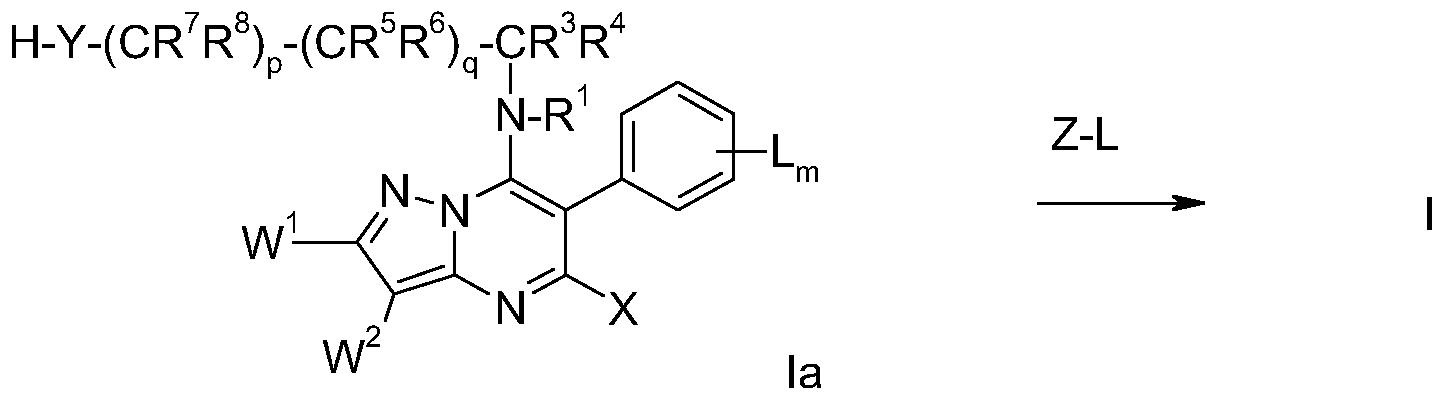
Dazu wird das 7-Hydroxy-, bzw. Mercaptoaminopyrazolopyrimidin der Formel Ia mit einem Alkylierungs- oder Acylierungsmittel Z-L umgesetzt, wobei L eine nucleophil abspaltbare Gruppe darstellt. Üblicherweise werden Halogenide, insbesondere Chloride und Bromide, Carbonsäureanhydride, wie z. B. Acetanhydrid, oder Carbonsäurechloride, Carbonsäuren in Verbindung mit Kupplungsreagentien, wie beispielsweise Di- cyclohexylcarbodiimid oder Säuren, wie beispielsweise HCl eingesetzt. Die für die Ve- retherung, bzw. Veresterung geeigneten Reaktionsbedingungen sind dem Fachmann allgemein bekannt [vgl.: Organikum, VEB Deutscher Verlag der Wissenschaften, Berlin (1981)]. Die Verbindungen der Formel Ia sind z. T. aus den eingangs zitierten Dokumenten bekannt.
Die Reaktionsgemische werden in üblicher weise aufgearbeitet, z.B. durch Mischen mit Wasser, Trennung der Phasen und gegebenenfalls chromatographische Reinigung der Rohprodukte. Die Zwischen- und Endprodukte fallen z.T. in Form farbloser oder schwach bräunlicher, zäher Öle an, die unter vermindertem Druck und bei mäßig erhöhter Temperatur von flüchtigen Anteilen befreit oder gereinigt werden. Sofern die Zwischen- und Endprodukte als Feststoffe erhalten werden, kann die Reinigung auch durch Umkristallisieren oder Digerieren erfolgen.
Sofern einzelne Verbindungen I nicht auf den voranstehend beschriebenen Wegen zugänglich sind, können sie durch Derivatisierung anderer Verbindungen I hergestellt werden.
Sofern bei der Synthese Isomerengemische anfallen, ist im allgemeinen jedoch eine Trennung nicht unbedingt erforderlich, da sich die einzelnen Isomere teilweise während der Aufbereitung für die Anwendung oder bei der Anwendung (z.B. unter Licht-, Säureoder Baseneinwirkung) ineinander umwandeln können. Entsprechende Umwandlungen können auch nach der Anwendung, beispielsweise bei der Behandlung von Pflanzen in der behandelten Pflanze oder im zu bekämpfenden Schadpilz erfolgen.
Bei den in den vorstehenden Formeln angegebenen Definitionen der Symbole wurden Sammelbegriffe verwendet, die allgemein repräsentativ für die folgenden Substituenten stehen:
Halogen: Fluor, Chlor, Brom und Jod;
Alkyl: gesättigte, geradkettige oder verzweigte Kohlenwasserstoffreste mit 1 bis 4, 6 oder 8 Kohlenstoffatomen, z.B. Ci-Cβ-Alkyl wie Methyl, Ethyl, Propyl, 1-Methylethyl, Butyl, 1-Methyl-propyl, 2-Methylpropyl, 1 ,1-Dimethylethyl, Pentyl, 1-Methylbutyl, 2-Me- thylbutyl, 3-Methylbutyl, 2,2-Di-methylpropyl, 1-Ethylpropyl, Hexyl, 1 ,1-Dimethylpropyl, 1 ,2-Dimethylpropyl, 1-Methylpentyl, 2-Methylpentyl, 3-Methylpentyl, 4-Methylpentyl, 1 ,1-Dimethylbutyl, 1 ,2-Dimethylbutyl, 1 ,3-Dimethylbutyl, 2,2-Dimethylbutyl, 2,3-Dime- thylbutyl, 3,3-Dimethylbutyl, 1-Ethylbutyl, 2-Ethylbutyl, 1 ,1 ,2-Trimethylpropyl, 1 ,2,2-Tri- methylpropyl, 1-Ethyl-1-methylpropyl und 1-Ethyl-2-methylpropyl;
Halogenalkyl: geradkettige oder verzweigte Alkylgruppen mit 1 bis 2, 4 oder 6 Kohlenstoffatomen (wie vorstehend genannt), wobei in diesen Gruppen teilweise oder vollständig die Wasserstoffatome durch Halogenatome wie vorstehend genannt ersetzt sein können: insbesondere Ci-C2-Halogenalkyl wie Chlormethyl, Brommethyl, Dichlor- methyl, Trichlormethyl, Fluormethyl, Difluormethyl, Trifluormethyl, Chlorfluormethyl, Dichlorfluormethyl, Chlordifluormethyl, 1-Chlorethyl, 1-Bromethyl, 1-Fluorethyl, 2-Fluor- ethyl, 2,2-Difluorethyl, 2,2,2-Trifluorethyl, 2-Chlor-2-fluorethyl, 2-Chlor-2,2-difluorethyl, 2,2-Dichlor-2-fluorethyl, 2,2,2-Trichlorethyl, Pentafluorethyl oder 1 ,1 , 1-Trifluorprop-2-yl;
Alkenyl: ungesättigte, geradkettige oder verzweigte Kohlenwasserstoffreste mit 2 bis 4, 6 oder 8 Kohlenstoffatomen und einer oder zwei Doppelbindungen in beliebiger Position, z.B. C2-C6-Alkenyl wie Ethenyl, 1-Propenyl, 2-Propenyl, 1-Methylethenyl, 1-Butenyl, 2-Butenyl, 3-Butenyl, 1-Methyl-1-propenyl, 2-Methyl-1-propenyl, 1-Methyl-2-propenyl, 2-Methyl-2-propenyl, 1-Pentenyl, 2-Pentenyl, 3-Pentenyl, 4-Pentenyl, 1-Methyl-1-but- enyl, 2-Methyl-1-butenyl, 3-Methyl-1-butenyl, 1-Methyl-2-butenyl, 2-Methyl-2-butenyl, 3-Methyl-2-butenyl, 1-Methyl-3-butenyl, 2-Methyl-3-butenyl, 3-Methyl-3-butenyl,
1 ,1-Dimethyl-2-propenyl, 1 ,2-Dimethyl-1-propenyl, 1 ,2-Dimethyl-2-propenyl, 1-Ethyl- I propenyl, 1-Ethyl-2-propenyl, 1-Hexenyl, 2-Hexenyl, 3-Hexenyl, 4-Hexenyl, 5-Hex- enyl, 1-Methyl-1-pentenyl, 2-Methyl-1-pentenyl, 3-Methyl-1-pentenyl, 4-Methyl-1-pent- enyl, 1-Methyl-2-pentenyl, 2-Methyl-2-pentenyl, 3-Methyl-2-pentenyl, 4-Methyl-2-pent- enyl, 1-Methyl-3-pentenyl, 2-Methyl-3pentenyl, 3-Methyl-3-pentenyl, 4-Methyl-3-pent- enyl, 1-Methyl-4-pentenyl, 2-Methyl-4-pentenyl, 3-Methyl-4-pentenyl, 4-Methyl-4-pent- enyl, 1 ,1-Dimethyl-2-butenyl, 1 ,1-Dimethyl-3-butenyl, 1 ,2-Dimethyl-1-butenyl, 1 ,2-Di- methyl-2-butenyl, 1 ,2-Dimethyl-3-butenyl, 1 ,3-Dimethyl-1-butenyl, 1 ,3-Dimethyl-2-bu- tenyl, 1 ,3-Dimethyl-3-butenyl, 2,2-Dimethyl-3-butenyl, 2,3-Dimethyl-1-butenyl, 2,3-Di- methyl-2-butenyl, 2,3-Dimethyl-3-butenyl, 3,3-Dimethyl-1-butenyl, 3,3-Dimethyl-2-bu- tenyl, 1-Ethyl-1-butenyl, 1-Ethyl-2-butenyl, 1-Ethyl-3-butenyl, 2-Ethyl-1-butenyl, 2-Ethyl- 2-butenyl, 2-Ethyl-3-butenyl, 1 ,1 ,2-Trimethyl-2-propenyl, 1-Ethyl-1-methyl-2-propenyl, 1-Ethyl-2-methyl-1-propenyl und 1-Ethyl-2-methyl-2-propenyl;
Halogenalkenyl: ungesättigte, geradkettige oder verzweigte Kohlenwasserstoffreste mit 2 bis 8 Kohlenstoffatomen und einer oder zwei Doppelbindungen in beliebiger Position (wie vorstehend genannt), wobei in diesen Gruppen die Wasserstoffatome teilweise
oder vollständig gegen Halogenatome wie vorstehend genannt, insbesondere Fluor, Chlor und Brom, ersetzt sein können;
Alkinyl: geradkettige oder verzweigte Kohlenwasserstoffgruppen mit 2 bis 4, 6 oder 8 Kohlenstoffatomen und einer oder zwei Dreifachbindungen in beliebiger Position, z.B. C2-C6-Alkinyl wie Ethinyl, 1-Propinyl, 2-Propinyl, 1-Butinyl, 2-Butinyl, 3-Butinyl, 1-Me- thyl-2-propinyl, 1-Pentinyl, 2-Pentinyl, 3-Pentinyl, 4-Pentinyl, 1-Methyl-2-butinyl, 1-Me- thyl-3-butinyl, 2-Methyl-3-butinyl, 3-Methyl-1 -butinyl, 1 ,1-Dimethyl-2-propinyl, 1-Ethyl-2- propinyl, 1-Hexinyl, 2-Hexinyl, 3-Hexinyl, 4-Hexinyl, 5-Hexinyl, 1-Methyl-2-pentinyl, 1-Methyl-3-pentinyl, 1-Methyl-4-pentinyl, 2-Methyl-3-pentinyl, 2-Methyl-4-pentinyl, 3-Methyl-1-pentinyl, 3-Methyl-4-pentinyl, 4-Methyl-1-pentinyl, 4-Methyl-2-pentinyl, 1 ,1-Dimethyl-2-butinyl, 1 ,1-Dimethyl-3-butinyl, 1 ,2-Dimethyl-3-butinyl, 2,2-Dimethyl-3- butinyl, 3, 3-Dimethyl-1 -butinyl, 1-Ethyl-2-butinyl, 1 -Ethyl-3-butinyl, 2-Ethyl-3-butinyl und 1 -Ethyl-1 -methyl-2-propinyl;
Cycloalkyl: mono- oder bicyclische, gesättigte Kohlenwasserstoffgruppen mit 3 bis 6 oder 8 Kohlenstoffringgliedern, z.B. Ca-Cs-Cycloalkyl wie Cyclopropyl, Cyclobutyl, Cyc- lopentyl, Cyclohexyl, Cycloheptyl und Cyclooctyl;
fünf- bis zehngliedriger gesättigter, partiell ungesättigter oder aromatischer Heterocyc- lus, enthaltend ein bis vier Heteroatome aus der Gruppe O, N oder S:
5- oder 6-gliedriges Heterocyclyl, enthaltend ein bis drei Stickstoffatome und/oder ein Sauerstoff- oder Schwefelatom oder ein oder zwei Sauerstoff- und/oder Schwefel- atome, z.B. 2-Tetrahydrofuranyl, 3-Tetrahydrofuranyl, 2-Tetrahydrothienyl, 3-Tetra- hydrothienyl, 2-Pyrrolidinyl, 3-Pyrrolidinyl, 3-lsoxazolidinyl, 4-lsoxazolidinyl, 5-lsoxazoli- dinyl, 3-lsothiazolidinyl, 4-lsothiazolidinyl, 5-lsothiazolidinyl, 3-Pyrazolidinyl, 4-Pyrazoli- dinyl, 5-Pyrazolidinyl, 2-Oxazolidinyl, 4-Oxazolidinyl, 5-Oxazolidinyl, 2-Thiazolidinyl, 4- Thiazolidinyl, 5-Thiazolidinyl, 2-lmidazolidinyl, 4-lmidazolidinyl, 2-Pyrrolin-2-yl, 2-Pyrrol- in-3-yl, 3-Pyrrolin-2-yl, 3-Pyrrolin-3-yl, 2-Piperidinyl, 3-Piperidinyl, 4-Piperidinyl, 1 ,3-Di- oxan-5-yl, 2-Tetrahydropyranyl, 4-Tetrahydropyranyl, 2-Tetrahydrothienyl, 3-Hexa- hydropyridazinyl, 4-Hexahydropyridazinyl, 2-Hexahydropyrimidinyl, 4-Hexahydro- pyrimidinyl, 5-Hexahydropyrimidinyl und 2-Piperazinyl;
- 5-gliedriges Heteroaryl, enthaltend ein bis vier Stickstoffatome oder ein bis drei Stickstoffatome und ein Schwefel- oder Sauerstoffatom: 5-Ring Heteroarylgruppen, welche neben Kohlenstoffatomen ein bis vier Stickstoffatome oder ein bis drei Stickstoffatome und ein Schwefel- oder Sauerstoffatom als Ringglieder enthalten können, z.B. 2-Furyl, 3-Furyl, 2-Thienyl, 3-Thienyl, 2-Pyrrolyl, 3-Pyrrolyl, 3-Pyrazolyl, 4-Pyrazo- IyI, 5-Pyrazolyl, 2-Oxazolyl, 4-Oxazolyl, 5-Oxazolyl, 2-Thiazolyl, 4-Thiazolyl, 5-Thiazo- IyI, 2-lmidazolyl, 4-lmidazolyl, und 1 ,3,4-Triazol-2-yl;
6-gliedriges Heteroaryl, enthaltend ein bis drei bzw. ein bis vier Stickstoffatome: 6-Ring Heteroarylgruppen, welche neben Kohlenstoffatomen ein bis drei bzw. ein bis vier Stickstoffatome als Ringglieder enthalten können, z.B. 2-Pyridinyl, 3-Pyridinyl, 4-Pyridinyl, 3-Pyridazinyl, 4-Pyridazinyl, 2-Pyrimidinyl, 4-Pyrimidinyl, 5-Pyrimidinyl und 2-Pyrazinyl;
Alkylen: divalente unverzweigte Ketten aus 3 bis 5 Chb-Gruppen, z.B. CH2, CH2CH2, CH2CH2CH2, CH2CH2CH2CH2 und CH2CH2CH2CH2CH2;
Oxyalkylen: divalente unverzweigte Ketten aus 2 bis 4 Chb-Gruppen, wobei eine Valenz über ein Sauerstoffatom an das Gerüst gebunden ist, z.B. OCH2CH2, OCH2CH2CH2 und OCH2CH2CH2CH2;
Oxyalkylenoxy: divalente unverzweigte Ketten aus 1 bis 3 Chb-Gruppen, wobei beide Valenzen über ein Sauerstoffatom an das Gerüst gebunden ist, z.B. OCH2O, OCH2CH2O und OCH2CH2CH2O;
In dem Umfang der vorliegenden Erfindung sind die (R)- und (S)-Isomere und die Ra- zemate von Verbindungen der Formel I eingeschlossen, die chirale Zentren aufweisen.
Die besonders bevorzugten Ausführungsformen der Zwischenprodukte in Bezug auf die Variablen entsprechen denen der Formel I.
Im Hinblick auf ihre bestimmungsgemäße Verwendung der Pyrazolopyrimidine der Formel I sind die folgenden Bedeutungen der Substituenten, und zwar jeweils für sich allein oder in Kombination, besonders bevorzugt:
Eine Ausgestaltung betrifft Verbindungen I, in denen R1 Wasserstoff oder CrC4-AIkVl bedeutet, wie Wasserstoff oder Methyl oder Ethyl, insbesondere Wasserstoff.
Eine weitere Ausgestaltung betrifft Verbindungen I, in denen die Gruppe NR1R2 für Ethylglycinol, Leucinol, tert-Leucinol, Valinol, Norvalinol, Methioninol, Phenylalanin , Lysinol, Argininol, Histidinol, Asparaginol, Glutaminol, Serinol, Isoleucinol, Cysteinol, Hydroxymethylpiperidin, cis-2-Hydroxymethyl-4-methyl-piperidin, trans-2-Hydroxy- methyl-4-methyl-piperidin, Cyclohexylgylcinol, Cyclopentylglycinol, Butylglycinol, Pen- tylglycinol, cis-2-Aminocyclohexanol, trans-2-Aminocyclohexanol, cis-2-Aminocyclo- pentanol, trans-2-Aminocyclopentanol, cis-1-Amino-2-hydroxyindane oder trans-1- Amino-2-hydroxyindan steht.
Eine weitere Ausgestaltung betrifft Verbindungen I, in denen R3 geradkettiges oder verzweigtes d-Cs-Alkyl, C3-Cs-Alkenyl oder C3-C6-Cycloalkyl bedeutet, insbesondere
Ci-Cβ-Alkyl oder C3-C6-Cycloalkyl, bevorzugt iso-Propyl, iso-Butyl, tert. Butyl, sec. Pen- tyl, Cyclopropyl oder Cyclopentyl, insbesondere tert. Butyl.
Eine weitere Ausgestaltung betrifft Verbindungen I, in denen R3 ungleich Wasserstoff oder Methyl ist.
In einer Ausgestaltung weist die Gruppe R3 eine Verzweigung am α-Kohlenstoffatom auf.
In einer Ausgestaltung ist die Gruppe R3 durch über Heteroatome gebundene Gruppen substituiert, wie Halogen, Alkoxy, Alkylthio, Amino, Alkylamino, Dialkylamino oder For- myl, Carboxyl, Alkoxycarbonyl, Alkoxythiocarbonyl oder Alkenyl, Alkinylgruppen oder C2-C5-Alkylen, wobei beide Valenzen an dasselbe Kohlenstoffatom gebunden sind.
In einer weiteren Ausgestaltung ist die Gruppe R3 durch C3-C6-Cycloalkyl oder C3-C8- Cycloalkenyl substituiert.
In einer weiteren Ausgestaltung ist die Gruppe R3 durch C(O)RA, C(O)ORA, C(S)ORA, C(O)NRARB, C(S)NRARB, C(NRA)RB, C(O)SRπ oder C(S)SRπ substituiert.
Rπ bedeutet bevorzugt Ci-Cs-Alkyl oder C3-C6-Cycloalkyl, welche Gruppen teilweise oder vollständig halogeniert sein können.
In einer weiteren Ausgestaltung ist die Gruppe R3 durch einen fünf-, sechs-, sieben-, acht-, neun- oder zehngliedrigen gesättigten, partiell ungesättigten oder aromatischen Heterocyclus, enthaltend ein, zwei, drei oder vier Heteroatome aus der Gruppe O, N und S, substituiert.
Eine weitere Ausgestaltung betrifft Verbindungen I, in denen R4 Wasserstoff, geradket- tiges oder verzweigtes Ci-Cs-Alkyl oder C3-C6-Cycloalkyl bedeutet, insbesondere Wasserstoff, Ci-Cβ-Alkyl oder C3-C6-Cycloalkyl, bevorzugt Wasserstoff, iso-Propyl, tert. Butyl. Sofern R4 eine Alkylgruppe ist, hat R4 bevorzugt die selbe Bedeutung wie R3.
In einer weiteren Ausgestaltung der Verbindungen der Formel I bilden R3 und R4 ge- meinsam eine C3-C6-Alkyen-, insbesondere eine C3-C4-Alkyengruppe, wobei die Kohlenstoffketten durch über Heteroatome gebundene Gruppen substituiert sein können, wie Halogen, Alkoxy, Alkylthio, Amino, Alkylamino, Dialkylamino oder Alkoxycarbonyl.
In einer weiteren Ausgestaltung der Verbindungen der Formel I bilden R3 und R4 ge- meinsam eine C3-C6-Alkyen-, insbesondere eine C3-C4-Alkyengruppe, wobei die Kohlenstoffketten durch ein oder zwei Heteroatome aus der Gruppe O, N und S unterbro-
chen sind und durch über Heteroatome gebundene Gruppen substituiert sein können, wie Halogen, Alkoxy, Alkylthio, Amino, Alkylamino, Dialkylamino oder Alkoxycarbonyl.
In einer weiteren Ausgestaltung der Verbindungen der Formel I bedeuten R4 , R5 , R6 , R7 und R8 jeweils Wasserstoff oder Ci-C4-Alkyl, bevorzugt Wasserstoff, Methyl oder Ethyl, insbesondere Wasserstoff. Die Substitution der Gruppen R4 , R5 , R6 , R7 und R8 kann entsprechend der Gruppe R3 erfolgen.
In einer weiteren Ausgestaltung der Verbindungen der Formel I bilden R3 und R5 ge- meinsam eine C3-C6-Alkyen-, C3-C6-Oxyalkyen- oder C2-C5-Oxyalkyenoxy-, insbesondere eine C3-C4-Alkyengruppe.
In einer weiteren Ausgestaltung der Verbindungen der Formel I bilden R5 und R6 und/oder R7 und R8 jeweils gemeinsam eine C3-C6-Alkyen-, C3-C6-Oxyalkyen- oder C2-C5- Oxyalkyenoxy-, insbesondere eine C3-C4-Alkyengruppe.
In einer weiteren Ausgestaltung der Verbindungen der Formel I hat der Index q den Wert null.
Eine weitere Ausgestaltung betrifft Verbindungen I, in denen der Index q 1 ist.
Eine weitere Ausgestaltung betrifft Verbindungen I, in denen der Index p null oder 1 , insbesondere null ist.
In einer weiteren Ausgestaltung der Verbindungen der Formel I stehen R5 und R6 bevorzugt für Wasserstoff, sofern der Index p den Wert null hat.
In einer weiteren Ausgestaltung der Verbindungen der Formel I ist R7 ungleich Wasserstoff und R8 steht für Wasserstoff, sofern der Index p den Wert null hat.
In einer weiteren Ausgestaltung der Verbindungen der Formel I hat der Index p den Wert null oder 1 und der Index q den Wert 1.
In einer weiteren Ausgestaltung der Verbindungen der Formel I stehen R7 und R8 be- vorzugt für Wasserstoff.
In einer weiteren Ausgestaltung der Verbindungen der Formel I ist R7 ungleich Wasserstoff und R8 steht für Wasserstoff.
In einer weiteren bevorzugten Ausgestaltung der Verbindungen der Formel I bedeutet Y Sauerstoff.
In einer weiteren Ausgestaltung der Verbindungen der Formel I stellt Z eine monovalente Gruppe dar.
Eine weitere Ausgestaltung betrifft Verbindungen I, in denen Z für Ci-C4-Alkylcarbonyl steht, insbesondere Acetyl, n-Propan-1-on, 2-Methylpropan-1-on oder Butan-1-on.
Eine weitere Ausgestaltung betrifft Verbindungen I, in denen Z für Carboxyl oder For- myl steht.
Eine weitere Ausgestaltung betrifft Verbindungen I, in denen Z Wasserstoff bedeutet.
Eine weitere Ausgestaltung betrifft Verbindungen I, in denen Z Carboxyl bedeutet.
Eine weitere Ausgestaltung betrifft Verbindungen I, in denen Z Formyl bedeutet.
Eine weitere Ausgestaltung betrifft Verbindungen I, in denen Z Cs-Cs-Alkyl bedeutet.
Eine weitere Ausgestaltung betrifft Verbindungen I, in denen Z Ci-Cs-Halogenalkyl bedeutet.
Eine weitere Ausgestaltung betrifft Verbindungen I, in denen Z C2-Cs-Alkenyl bedeutet.
Eine weitere Ausgestaltung betrifft Verbindungen I, in denen Z C2-C8-Halogenalkenyl bedeutet.
Eine weitere Ausgestaltung betrifft Verbindungen I, in denen Z C2-Cs-Alkinyl bedeutet.
Eine weitere Ausgestaltung betrifft Verbindungen I, in denen Z C2-C8-Halogenalkinyl bedeutet.
Eine weitere Ausgestaltung betrifft Verbindungen I, in denen Z C3-C6-Cycloalkyl bedeutet.
Eine weitere Ausgestaltung betrifft Verbindungen I, in denen Z Ca-Cs-Cycloalkenyl be- deutet.
Eine weitere Ausgestaltung betrifft Verbindungen I, in denen Z C(O)Rπ bedeutet.
Eine weitere Ausgestaltung betrifft Verbindungen I, in denen Z C(O)ORπ bedeutet.
Eine weitere Ausgestaltung betrifft Verbindungen I, in denen Z C(S)ORπ bedeutet.
Eine weitere Ausgestaltung betrifft Verbindungen I, in denen Z C(O)SRπ bedeutet.
Eine weitere Ausgestaltung betrifft Verbindungen I, in denen Z C(S)SRπ bedeutet.
Eine weitere Ausgestaltung betrifft Verbindungen I, in denen Z C(NRA)SRπ bedeutet.
Eine weitere Ausgestaltung betrifft Verbindungen I, in denen Z C(S)Rπ bedeutet.
Eine weitere Ausgestaltung betrifft Verbindungen I, in denen Z C(NRπ)NRARB bedeutet.
Eine weitere Ausgestaltung betrifft Verbindungen I, in denen Z C(NRπ)RA bedeutet.
Eine weitere Ausgestaltung betrifft Verbindungen I, in denen Z C(NRπ)ORA bedeutet.
Eine weitere Ausgestaltung betrifft Verbindungen I, in denen Z C(O)NRARB bedeutet.
Eine weitere Ausgestaltung betrifft Verbindungen I, in denen Z C(S)NRARB bedeutet.
Eine weitere Ausgestaltung betrifft Verbindungen I, in denen Z d-Cs-Alkylsulfinyl be- deutet.
Eine weitere Ausgestaltung betrifft Verbindungen I, in denen Z d-Cs-Alkylthio bedeutet.
Eine weitere Ausgestaltung betrifft Verbindungen I, in denen Z d-Cs-Alkylsulfonyl bedeutet.
Eine weitere Ausgestaltung betrifft Verbindungen I, in denen Z C(O)-Ci-C4-alkylen-NRAC(NRπ)NRARB bedeutet.
Eine weitere Ausgestaltung betrifft Verbindungen I, in denen Z C(S)-Ci-C4-alkylen-NRAC(NRπ)NRARB bedeutet.
Eine weitere Ausgestaltung betrifft Verbindungen I, in denen Z C(NRπ)-Ci-C4-alkylen-NRAC(NRπ)NRARB bedeutet.
Eine weitere Ausgestaltung betrifft Verbindungen I, in denen Z Phenyl bedeutet.
Eine weitere Ausgestaltung betrifft Verbindungen I, in denen Z Naphthyl bedeutet.
Eine weitere Ausgestaltung betrifft Verbindungen I, in denen Z einen fünf-, sechs-, sieben-, acht-, neun- oder zehngliedriger gesättigten, partiell ungesättigten oder aromati-
sehen Heterocyclus, enthaltend ein, zwei, drei oder vier Heteroatome aus der Gruppe O, N und S, welcher direkt oder über eine Carbonyl, Thiocarbonyl, Ci-C4-Alkylcarbonyl oder Ci-C4-Alkylthiocarbonylgruppe gebunden ist, bedeutet.
Die vorgenannten Gruppen Z können durch eine oder mehrere Gruppen Rb substituiert sein.
In einer weiteren Ausgestaltung ist die Gruppe Z durch eine, zwei, drei oder vier Gruppen Rb, wie Halogen, oder basische oder saure Gruppen, wie NRARB, Guaninyl, Ami- dyl, Hydroxy, Carboxyl oder Sulfonsäuren substituiert.
Eine weitere Ausgestaltung betrifft Verbindungen I, in denen X Chlor oder Brom, insbesondere Chlor bedeutet.
Eine weitere Ausgestaltung betrifft Verbindungen I, in denen X Cyano, Alkyl oder AIk- oxy, insbesondere Cyano, Methyl oder methoxy bedeutet.
In einer bevorzugten Ausgestaltung der Verbindungen I steht mindestens eine Gruppe L orthoständig zu der Verknüpfungsstelle mit dem Triazolopyrimidingerüst, insbesonde- re Chlor, Fluor oder Methyl.
Eine Ausgestaltung für Gruppen RA, bzw. RB ist Wasserstoff CrC4-AIkVl oder C1-C4- Halogenalkyl, bevorzugt Wasserstoff und Methyl.
Eine Ausgestaltung für Gruppen Rπ ist CrC4-AIkVl oder Ci-C4-Halogenalkyl, bevorzugt Methyl.
Der Index m steht bevorzugt für 1 bis 4, wobei die Gruppen L gleichartig oder verschieden sein können. Dabei kommen insbesondere Bedeutungen für L in Frage:
Halogen, Cyano, Nitro, Amino, Hydroxy, Formyl, Carboxy, Carbamoyl,
Thiocarbamoyl;
jeweils geradkettiges oder verzweigtes Alkyl, Alkoxy, Alkylthio, Alkyl- sulfinyl oder Alkylsulfonyl mit jeweils 1 bis 6 Kohlenstoffatomen;
jeweils geradkettiges oder verzweigtes Alkenyl oder Alkenyloxy mit jeweils 2 bis 6 Kohlenstoffatomen;
- jeweils geradkettiges oder verzweigtes Halogenalkyl, Halogenalkoxy, Halogenal- kylthio, Halogenalkylsulfinyl oder Halogenalkylsulfonyl mit jeweils 1 bis 6 Kohlenstoffatomen und 1 bis 13 gleichen oder ver- schiedenen Halogenatomen;
jeweils geradkettiges oder verzweigtes Halogenalkenyl oder Halogen- alkenyloxy mit jeweils 2 bis 6 Kohlenstoffatomen und 1 bis 13 gleichen oder verschiedenen Halogenatomen;
jeweils geradkettiges oder verzweigtes Halogenalkenyl oder Halogenalkenyl- oxy mit jeweils 2 bis 6 Kohlenstoffatomen und 1 bis 1 1 gleichen oder ver- schiedenen Halogenatomen;
- jeweils geradkettiges oder verzweigtes Alkylamino, Dialkylamino, Alkyl- carbonyl, Alkylcarbonyloxy, Alkoxycarbonyl.Alkylsulfonyloxy, Hydroximi-noalkyl oder Alkox- iminoalkyl mit jeweils 1 bis 6 Kohlenstoffatomen in den einzelnen Alkylteilen;
Cycloalkyl mit 3 bis 6 Kohlenstoffatomen,
in 2,3-Position verknüpftes 1 ,3-Propandiyl, 1 ,4-Butandiyl, Methylendioxy (-0-CH2-O-) oder 1 ,2-Ethylendioxy (-0-CH2-CH2-O-), wobei diese Reste einfach oder mehrfach, gleichartig oder verschieden substituiert sein können durch Halogen, Alkyl mit 1 bis 4 Kohlenstoffatomenund/oder Halogenalkyl mit 1 bis 4 Koh- lenstoffatomen und 1 bis 9 gleichen oder verschiedenen Halogenatomen.
In einer weiteren Ausgestaltung der Verbindungen I steht die durch Lm substituierte Phenylgruppe für die Gru

L1 Fluor, Chlor, CH3 oder CF3;
L2, L4 unabhängig voneinander Wasserstoff oder Fluor;
L3 Wasserstoff, Fluor, Chlor, CN, CH3, OCH3, NH2, NHCH3 , N(CH3)2 , C(O)NH2 oder C(O)CH3; und L5 Wasserstoff, Fluor, Chlor oder CH3 bedeuten.
In einer weiteren Ausgestaltung der Verbindungen I steht Lm für eine der folgenden Substituentenkombinationen: 2-Fluor-6-chlor, 2,6-Difluor, 2,6-Dichlor, 2-Fluor-6-methyl, 2,4,6-Trifluor, 2,6-Difluor-4-methoxy, 2-Chlor-4-methoxy, Pentafluor, 2-Methyl-4-fluor, 2-Trifluormethyl, 2-Methoxy-6-fluor, 2-Chlor, 2-Fluor, 2,4-Difluor, 2-Fluor-4-chlor, 2- Chlor-4-fluor, 2-Chlor-5-fluor, 2,3-Difluor, 2,5-Difluor, 2,3,4-Trifluor, 2-Methyl, 2,4-Dimethyl, 2-Methyl-4-chlor, 2-Methyl-5-fluor, 2-Fluor-4-methyl, 2,6-Dimethyl, 2,4,6- Trimethyl, 2,6-Difluor-4-methyl, 2-Trifluormethyl-4-fluor, 2-Trifluormethyl-5-fluor oder 2-Trifluormethyl-5-chlor.
In einer weiteren Ausgestaltung der Verbindungen I steht Lm für eine der folgenden Substituentenkombinationen: 2,6-Difluor, 2,4,6-Trifluor, 2,6-Difluor-4-methoxy, 2,4- Difluor, 2-Chlor-4-fluor, 2,5-Difluor, 2-Fluor-4-methyl.
In einer weiteren Ausgestaltung der Verbindungen I steht W1 für Wasserstoff, Fluor, Chlor oder Brom, insbesondere für Wasserstoff.
In einer weiteren Ausgestaltung der Verbindungen I steht W2 bevorzugt für Cyano, Fluor, Chlor, Brom, lod, Nitro, Formyl, Halogenalkyl mit 1 bis 4 Kohlenstoffatomen und 1 bis 9 Fluor, Chlor und/oder Bromatomen, Alkyl mit 1 bis 4 Kohlenstoffatomen, Cycloal- kyl mit 3 bis 6 Kohlenstoffatomen, Thiocarbamoyl, Alkoxycarbonyl mit 1 bis 4 Kohlenstoffatomen im Alkoxyteil, Alkylcarbonyl mit 1 bis 4 Kohlenstoffatomen im Alkylteil, Hy- droximinoalkyl mit 1 bis 4 Kohlenstoffatomen im Alkylteil oder für Alkoxyiminoalkyl mit 1 bis 4 Kohlenstoffatomen im Alkoxyteil und 1 bis 4 Kohlenstoffatomen im Alkylteil.
In einer weiteren Ausgestaltung der Verbindungen I, insbesondere solcher, worin die Gruppe V-Y-(CR5R6)q-CR3R4-# für HOCH2-# steht, wenn R1 und R2 einen gesättigten fünfgliederigen Ring bilden, steht W2 für Cyano, Nitro, Ci-C4-AIkVl, Ci-C4-Halogenalkyl, Formyl, CH(Ra)-ORa, C(=O)Rb, C(=O)N(Ra)2, C(=O)N(Ra)N(Ra)2, C(=O)N(Ra)ORa, C(=O)ORa, C(=S)ORa, C(=O)SRa, C(=S)SRa, C(=NRa)Ra steht, und
Ra Wasserstoff oder Ci-C4-AIkVl, wobei die Gruppen Ra verschieden sein können, wenn mehrere Gruppen Ra vorliegen, und Rb für CCb, CF3, Propargyl, Cyclopropyl o- der eine der bei Ra genannten Gruppen steht.
In einer weiteren Ausgestaltung der Verbindungen I, insbesondere solcher, worin die Gruppe V-Y-(CR5R6)q-CR3R4-# für HOCH2-# steht, wenn R1 und R2 einen gesättigten fünfgliederigen Ring bilden, steht W2 für Cyano, Formyl, Methylcarbonyl, Trifluor- methylcarbonyl, CH(Ra)-ORa, C(=O)N(Ra)2, C(=O)ORa oder C(=NRa)Ra.
In einer weiteren Ausgestaltung der Verbindungen I steht W2 für Cyano.
In einer weiteren Ausgestaltung der Verbindungen I steht W2 für Formyl.
In einer weiteren Ausgestaltung der Verbindungen I steht W2 für CR10R11OR12.
In einer weiteren Ausgestaltung der Verbindungen I steht W2 für C(R13)=NR14.
Eine weitere Ausführungsform der Erfindung betrifft Verbindungen der Formel 1.1 :

Eine weitere Ausführungsform der Erfindung betrifft Verbindungen der Formel 1.2,

Insbesondere sind im Hinblick auf ihre Verwendung die in den folgenden Tabellen zusammengestellten Verbindungen I bevorzugt. Die in den Tabellen für einen Substituen- ten genannten Gruppen stellen außerdem für sich betrachtet, unabhängig von der Kombination, in der sie genannt sind, eine besonders bevorzugte Ausgestaltung des betreffenden Substituenten dar.
Neben den in den Tabellen 1 bis 384 genannten Verbindungen stellen auch die entsprechenden Derivate, in denen X Cyano bedeutet, bevorzugte Gegenstände dar.
Neben den in den Tabellen 1 bis 384 genannten Verbindungen stellen auch die entsprechenden Derivate, in denen X Methyl bedeutet, bevorzugte Gegenstände dar.
Neben den in den Tabellen 1 bis 384 genannten Verbindungen stellen auch die ent- sprechenden Derivate, in denen X Methoxy bedeutet, bevorzugte Gegenstände dar.
Neben den in den Tabellen 1 bis 384 genannten und den entsprechenden 5-Cyano, 5-Methyl und 5-Methoxy Verbindungen stellen auch die entsprechenden Derivate, in denen Y Schwefel bedeutet, bevorzugte Gegenstände dar.
Tabelle 1
Verbindungen der Formel 1.1 , in denen X Chlor, Lm 2-Fluor-6-chlor und W1, W2, R1, R5 und R6 Wasserstoff bedeuten und die Kombination von R3, R4, Y und Z für eine Verbindung jeweils einer Zeile der Tabelle A entspricht
Tabelle 2
Verbindungen der Formel 1.1 , in denen X Chlor, Lm 2,6-Difluor und W1, W2, R1, R5 und R6 Wasserstoff bedeuten und die Kombination von R3, R4, Y und Z für eine Verbindung jeweils einer Zeile der Tabelle A entspricht
Tabelle 3
Verbindungen der Formel 1.1 , in denen X Chlor, Lm 2,6-Dichlor und W1, W2, R1, R5 und R6 Wasserstoff bedeuten und die Kombination von R3, R4, Y und Z für eine Verbindung jeweils einer Zeile der Tabelle A entspricht
Tabelle 4
Verbindungen der Formel 1.1 , in denen X Chlor, Lm 2-Fluor-6-methyl und W1, W2, R1, R5 und R6 Wasserstoff bedeuten und die Kombination von R3, R4, Y und Z für eine Ver- bindung jeweils einer Zeile der Tabelle A entspricht
Tabelle 5
Verbindungen der Formel 1.1 , in denen X Chlor, Lm 2,4,6-Trifluor und W1, W2, R1, R5 und R6 Wasserstoff bedeuten und die Kombination von R3, R4, Y und Z für eine Ver- bindung jeweils einer Zeile der Tabelle A entspricht
Tabelle 6
Verbindungen der Formel 1.1 , in denen X Chlor, Lm 2,6-Difluor-4-methoxy und W1, W2, R1, R5 und R6 Wasserstoff bedeuten und die Kombination von R3, R4, Y und Z für eine Verbindung jeweils einer Zeile der Tabelle A entspricht
Tabelle 7
Verbindungen der Formel 1.1 , in denen X Chlor, Lm Pentafluor und W1, W2, R1, R5 und R6 Wasserstoff bedeuten und die Kombination von R3, R4, Y und Z für eine Verbindung jeweils einer Zeile der Tabelle A entspricht
Tabelle 8
Verbindungen der Formel 1.1 , in denen X Chlor, Lm 2-Methyl-4-fluor und W1, W2, R1, R5 und R6 Wasserstoff bedeuten und die Kombination von R3, R4, Y und Z für eine Ver- bindung jeweils einer Zeile der Tabelle A entspricht
Tabelle 9
Verbindungen der Formel 1.1 , in denen X Chlor, Lm 2-Trifluormethyl und W1, W2, R1, R5 und R6 Wasserstoff bedeuten und die Kombination von R3, R4, Y und Z für eine Ver- bindung jeweils einer Zeile der Tabelle A entspricht
Tabelle 10
Verbindungen der Formel 1.1 , in denen X Chlor, Lm 2-Methoxy-6-fluor und W1, W2, R1, R5 und R6 Wasserstoff bedeuten und die Kombination von R3, R4, Y und Z für eine Verbindung jeweils einer Zeile der Tabelle A entspricht
Tabelle 1 1
Verbindungen der Formel 1.1 , in denen X Chlor, Lm 2-Chlor und W1, W2, R1, R5 und R6 Wasserstoff bedeuten und die Kombination von R3, R4, Y und Z für eine Verbindung jeweils einer Zeile der Tabelle A entspricht
Tabelle 12
Verbindungen der Formel 1.1 , in denen X Chlor, Lm 2-Fluor und W1, W2, R1, R5 und R6 Wasserstoff bedeuten und die Kombination von R3, R4, Y und Z für eine Verbindung jeweils einer Zeile der Tabelle A entspricht
Tabelle 13
Verbindungen der Formel 1.1 , in denen X Chlor, Lm 2,4-Difluor und W1, W2, R1, R5 und R6 Wasserstoff bedeuten und die Kombination von R3, R4, Y und Z für eine Verbindung jeweils einer Zeile der Tabelle A entspricht
Tabelle n
Verbindungen der Formel 1.1 , in denen X Chlor, Lm 2-Fluor-4-chlor und W1, W2, R1, R5 und R6 Wasserstoff bedeuten und die Kombination von R3, R4, Y und Z für eine Verbindung jeweils einer Zeile der Tabelle A entspricht
Tabelle 15
Verbindungen der Formel 1.1 , in denen X Chlor, Lm 2-Chlor-4-fluor und W1, W2, R1, R5 und R6 Wasserstoff bedeuten und die Kombination von R3, R4, Y und Z für eine Verbindung jeweils einer Zeile der Tabelle A entspricht
Tabelle 16
Verbindungen der Formel 1.1 , in denen X Chlor, Lm 2,3-Difluor und W1, W2, R1, R5 und R6 Wasserstoff bedeuten und die Kombination von R3, R4, Y und Z für eine Verbindung jeweils einer Zeile der Tabelle A entspricht
Tabelle 17
Verbindungen der Formel 1.1 , in denen X Chlor, Lm 2,5-Difluor und W1, W2, R1, R5 und R6 Wasserstoff bedeuten und die Kombination von R3, R4, Y und Z für eine Verbindung jeweils einer Zeile der Tabelle A entspricht
Tabelle 18
Verbindungen der Formel 1.1 , in denen X Chlor, Lm 2,3,4-Trifluor und W1, W2, R1, R5 und R6 Wasserstoff bedeuten und die Kombination von R3, R4, Y und Z für eine Verbindung jeweils einer Zeile der Tabelle A entspricht
Tabelle 19
Verbindungen der Formel 1.1 , in denen X Chlor, Lm 2-Methyl und W1, W2, R1, R5 und R6 Wasserstoff bedeuten und die Kombination von R3, R4, Y und Z für eine Verbindung jeweils einer Zeile der Tabelle A entspricht
Tabelle 20
Verbindungen der Formel 1.1 , in denen X Chlor, Lm 2,4-Dimethyl und W1, W2, R1, R5
und R6 Wasserstoff bedeuten und die Kombination von R3, R4, Y und Z für eine Verbindung jeweils einer Zeile der Tabelle A entspricht
Tabelle 21 Verbindungen der Formel 1.1 , in denen X Chlor, Lm 2-Methyl-4-chlor und W1, W2, R1, R5 und R6 Wasserstoff bedeuten und die Kombination von R3, R4, Y und Z für eine Verbindung jeweils einer Zeile der Tabelle A entspricht
Tabelle 22 Verbindungen der Formel 1.1 , in denen X Chlor, Lm 2-Fluor-4-methyl und W1, W2, R1, R5 und R6 Wasserstoff bedeuten und die Kombination von R3, R4, Y und Z für eine Verbindung jeweils einer Zeile der Tabelle A entspricht
Tabelle 23 Verbindungen der Formel 1.1 , in denen X Chlor, Lm 2,6-Dimethyl und W1, W2, R1, R5 und R6 Wasserstoff bedeuten und die Kombination von R3, R4, Y und Z für eine Verbindung jeweils einer Zeile der Tabelle A entspricht
Tabelle 24 Verbindungen der Formel 1.1 , in denen X Chlor, Lm 2,4,6-Trimethyl und W1, W2, R1, R5 und R6 Wasserstoff bedeuten und die Kombination von R3, R4, Y und Z für eine Verbindung jeweils einer Zeile der Tabelle A entspricht
Tabelle 25 Verbindungen der Formel 1.1 , in denen X Chlor, Lm 2,6-Difluor-4-methyl und W1, W2, R1, R5 und R6 Wasserstoff bedeuten und die Kombination von R3, R4, Y und Z für eine Verbindung jeweils einer Zeile der Tabelle A entspricht
Tabelle 26 Verbindungen der Formel 1.1 , in denen X Chlor, Lm 2-Trifluormethyl-4-fluor und W1, W2, R1, R5 und R6 Wasserstoff bedeuten und die Kombination von R3, R4, Y und Z für eine Verbindung jeweils einer Zeile der Tabelle A entspricht
Tabelle 27 Verbindungen der Formel 1.1 , in denen X Chlor, Lm 2-Trifluormethyl-5-fluor und W1, W2, R1, R5 und R6 Wasserstoff bedeuten und die Kombination von R3, R4, Y und Z für eine Verbindung jeweils einer Zeile der Tabelle A entspricht
Tabelle 28 Verbindungen der Formel 1.1 , in denen X Chlor, Lm 2-Trifluormethyl-5-chlor und W1, W2, R1, R5 und R6 Wasserstoff bedeuten und die Kombination von R3, R4, Y und Z für eine Verbindung jeweils einer Zeile der Tabelle A entspricht
Tabelle 29
Verbindungen der Formel 1.1 , in denen X Chlor, Lm 2-Chlor-4-fluor und W1, W2, R1, R5 und R6 Wasserstoff bedeuten und die Kombination von R3, R4, Y und Z für eine Ver- bindung jeweils einer Zeile der Tabelle A entspricht
Tabelle 30
Verbindungen der Formel 1.1 , in denen X Chlor, Lm 2-Chlor-5-fluor und W1, W2, R1, R5 und R6 Wasserstoff bedeuten und die Kombination von R3, R4, Y und Z für eine Ver- bindung jeweils einer Zeile der Tabelle A entspricht
Tabelle 31
Verbindungen der Formel 1.1 , in denen X Chlor, Lm 2-Methyl-5-fluor und W1, W2, R1, R5 und R6 Wasserstoff bedeuten und die Kombination von R3, R4, Y und Z für eine Ver- bindung jeweils einer Zeile der Tabelle A entspricht
Tabelle 32
Verbindungen der Formel 1.1 , in denen X Chlor, Lm 2-Chlor-4-methoxy und W1, W2, R1, R5 und R6 Wasserstoff bedeuten und die Kombination von R3, R4, Y und Z für eine Verbindung jeweils einer Zeile der Tabelle A entspricht
Tabelle 33
Verbindungen der Formel 1.1 , in denen X Chlor, Lm 2-Fluor-6-chlor und R1 Methyl, W1, W2, R4 und R5 Wasserstoff bedeuten und die Kombination von R3, R4, Y und Z für eine Verbindung jeweils einer Zeile der Tabelle A entspricht
Tabelle 34
Verbindungen der Formel 1.1 , in denen X Chlor, Lm 2,6-Difluor und R1 Methyl, W1, W2, R4 und R5 Wasserstoff bedeuten und die Kombination von R3, R4, Y und Z für eine Verbindung jeweils einer Zeile der Tabelle A entspricht
Tabelle 35
Verbindungen der Formel 1.1 , in denen X Chlor, Lm 2,6-Dichlor und R1 Methyl, W1, W2, R4 und R5 Wasserstoff bedeuten und die Kombination von R3, R4, Y und Z für eine Verbindung jeweils einer Zeile der Tabelle A entspricht
Tabelle 36
Verbindungen der Formel 1.1 , in denen X Chlor, Lm 2-Fluor-6-methyl und R1 Methyl, W1, W2, R4 und R5 Wasserstoff bedeuten und die Kombination von R3, R4, Y und Z für eine Verbindung jeweils einer Zeile der Tabelle A entspricht
Tabelle 37
Verbindungen der Formel 1.1 , in denen X Chlor, Lm 2,4,6-Trifluor und R1 Methyl, W1, W2, R4 und R5 Wasserstoff bedeuten und die Kombination von R3, R4, Y und Z für eine Verbindung jeweils einer Zeile der Tabelle A entspricht
Tabelle 38
Verbindungen der Formel 1.1 , in denen X Chlor, Lm 2,6-Difluor-4-methoxy und R1 Methyl, W1, W2, R4 und R5 Wasserstoff bedeuten und die Kombination von R3, R4, Y und Z für eine Verbindung jeweils einer Zeile der Tabelle A entspricht
Tabelle 39
Verbindungen der Formel 1.1 , in denen X Chlor, Lm Pentafluor und R1 Methyl, W1, W2, R4 und R5 Wasserstoff bedeuten und die Kombination von R3, R4, Y und Z für eine Verbindung jeweils einer Zeile der Tabelle A entspricht
Tabelle 40
Verbindungen der Formel 1.1 , in denen X Chlor, Lm 2-Methyl-4-fluor und R1 Methyl, W1, W2, R4 und R5 Wasserstoff bedeuten und die Kombination von R3, R4, Y und Z für eine Verbindung jeweils einer Zeile der Tabelle A entspricht
Tabelle 41
Verbindungen der Formel 1.1 , in denen X Chlor, Lm 2-Trifluormethyl und R1 Methyl, W1, W2, R4 und R5 Wasserstoff bedeuten und die Kombination von R3, R4, Y und Z für eine Verbindung jeweils einer Zeile der Tabelle A entspricht
Tabelle 42
Verbindungen der Formel 1.1 , in denen X Chlor, Lm 2-Methoxy-6-fluor und R1 Methyl, W1, W2, R4 und R5 Wasserstoff bedeuten und die Kombination von R3, R4, Y und Z für eine Verbindung jeweils einer Zeile der Tabelle A entspricht
Tabelle 43
Verbindungen der Formel 1.1 , in denen X Chlor, Lm 2-Chlor und R1 Methyl, W1, W2, R4 und R5 Wasserstoff bedeuten und die Kombination von R3, R4, Y und Z für eine Verbindung jeweils einer Zeile der Tabelle A entspricht
Tabelle 44
Verbindungen der Formel 1.1 , in denen X Chlor, Lm 2-Fluor und R1 Methyl, W1, W2, R4 und R5 Wasserstoff bedeuten und die Kombination von R3, R4, Y und Z für eine Verbindung jeweils einer Zeile der Tabelle A entspricht
Tabelle 45
Verbindungen der Formel 1.1 , in denen X Chlor, Lm 2,4-Difluor und R1 Methyl, W1, W2,
R4 und R5 Wasserstoff bedeuten und die Kombination von R3, R4, Y und Z für eine Verbindung jeweils einer Zeile der Tabelle A entspricht
Tabelle 46 Verbindungen der Formel 1.1 , in denen X Chlor, Lm 2-Fluor-4-chlor und R1 Methyl, W1, W2, R4 und R5 Wasserstoff bedeuten und die Kombination von R3, R4, Y und Z für eine Verbindung jeweils einer Zeile der Tabelle A entspricht
Tabelle 47 Verbindungen der Formel 1.1 , in denen X Chlor, Lm 2-Chlor-4-fluor und R1 Methyl, W1, W2, R4 und R5 Wasserstoff bedeuten und die Kombination von R3, R4, Y und Z für eine Verbindung jeweils einer Zeile der Tabelle A entspricht
Tabelle 48 Verbindungen der Formel 1.1 , in denen X Chlor, Lm 2,3-Difluor und R1 Methyl, W1, W2, R4 und R5 Wasserstoff bedeuten und die Kombination von R3, R4, Y und Z für eine Verbindung jeweils einer Zeile der Tabelle A entspricht
Tabelle 49 Verbindungen der Formel 1.1 , in denen X Chlor, Lm 2,5-Difluor und R1 Methyl, W1, W2, R4 und R5 Wasserstoff bedeuten und die Kombination von R3, R4, Y und Z für eine Verbindung jeweils einer Zeile der Tabelle A entspricht
Tabelle 50 Verbindungen der Formel 1.1 , in denen X Chlor, Lm 2,3,4-Trifluor und R1 Methyl, W1, W2, R4 und R5 Wasserstoff bedeuten und die Kombination von R3, R4, Y und Z für eine Verbindung jeweils einer Zeile der Tabelle A entspricht
Tabelle 51 Verbindungen der Formel 1.1 , in denen X Chlor, Lm 2-Methyl und R1 Methyl, W1, W2, R4 und R5 Wasserstoff bedeuten und die Kombination von R3, R4, Y und Z für eine Verbindung jeweils einer Zeile der Tabelle A entspricht
Tabelle 52 Verbindungen der Formel 1.1 , in denen X Chlor, Lm 2,4-Dimethyl und R1 Methyl, W1, W2, R4 und R5 Wasserstoff bedeuten und die Kombination von R3, R4, Y und Z für eine Verbindung jeweils einer Zeile der Tabelle A entspricht
Tabelle 53 Verbindungen der Formel 1.1 , in denen X Chlor, Lm 2-Methyl-4-chlor und R1 Methyl, W1, W2, R4 und R5 Wasserstoff bedeuten und die Kombination von R3, R4, Y und Z für eine Verbindung jeweils einer Zeile der Tabelle A entspricht
Tabelle 54
Verbindungen der Formel 1.1 , in denen X Chlor, Lm 2-Fluor-4-methyl und R1 Methyl, W1, W2, R4 und R5 Wasserstoff bedeuten und die Kombination von R3, R4, Y und Z für eine Verbindung jeweils einer Zeile der Tabelle A entspricht
Tabelle 55
Verbindungen der Formel 1.1 , in denen X Chlor, Lm 2,6-Dimethyl und R1 Methyl, W1, W2, R4 und R5 Wasserstoff bedeuten und die Kombination von R3, R4, Y und Z für eine Verbindung jeweils einer Zeile der Tabelle A entspricht
Tabelle 56
Verbindungen der Formel 1.1 , in denen X Chlor, Lm 2,4,6-Trimethyl und R1 Methyl, W1, W2, R4 und R5 Wasserstoff bedeuten und die Kombination von R3, R4, Y und Z für eine Verbindung jeweils einer Zeile der Tabelle A entspricht
Tabelle 57
Verbindungen der Formel 1.1 , in denen X Chlor, Lm 2,6-Difluor-4-methyl und R1 Methyl, W1, W2, R4 und R5 Wasserstoff bedeuten und die Kombination von R3, R4, Y und Z für eine Verbindung jeweils einer Zeile der Tabelle A entspricht
Tabelle 58
Verbindungen der Formel 1.1 , in denen X Chlor, Lm 2-Trifluormethyl-4-fluor und R1 Methyl, W1, W2, R4 und R5 Wasserstoff bedeuten und die Kombination von R3, R4, Y und Z für eine Verbindung jeweils einer Zeile der Tabelle A entspricht
Tabelle 59
Verbindungen der Formel 1.1 , in denen X Chlor, Lm 2-Trifluormethyl-5-fluor und R1 Methyl, W1, W2, R4 und R5 Wasserstoff bedeuten und die Kombination von R3, R4, Y und Z für eine Verbindung jeweils einer Zeile der Tabelle A entspricht
Tabelle 60
Verbindungen der Formel 1.1 , in denen X Chlor, Lm 2-Trifluormethyl-5-chlor und R1 Methyl, W1, W2, R4 und R5 Wasserstoff bedeuten und die Kombination von R3, R4, Y und Z für eine Verbindung jeweils einer Zeile der Tabelle A entspricht
Tabelle 61
Verbindungen der Formel 1.1 , in denen X Chlor, Lm 2-Chlor-4-fluor und R1 Methyl, W1, W2, R4 und R5 Wasserstoff bedeuten und die Kombination von R3, R4, Y und Z für eine Verbindung jeweils einer Zeile der Tabelle A entspricht
Tabelle 62
Verbindungen der Formel 1.1 , in denen X Chlor, Lm 2-Chlor-5-fluor und R1 Methyl, W1,
W2, R4 und R5 Wasserstoff bedeuten und die Kombination von R3, R4, Y und Z für eine
Verbindung jeweils einer Zeile der Tabelle A entspricht
Tabelle 63
Verbindungen der Formel 1.1 , in denen X Chlor, Lm 2-Methyl-5-fluor und R1 Methyl, W1,
W2, R4 und R5 Wasserstoff bedeuten und die Kombination von R3, R4, Y und Z für eine
Verbindung jeweils einer Zeile der Tabelle A entspricht
Tabelle 64
Verbindungen der Formel 1.1 , in denen X Chlor, Lm 2-Chlor-4-methoxy und R1 Methyl,
W1, W2, R4 und R5 Wasserstoff bedeuten und die Kombination von R3, R4, Y und Z für eine Verbindung jeweils einer Zeile der Tabelle A entspricht
Tabelle 65
Verbindungen der Formel 1.1 , in denen X Chlor, Lm 2-Fluor-6-chlor, W1, R1, R5 und R6
Wasserstoff und W2 Cyano bedeuten und die Kombination von R3, R4, Y und Z für eine
Verbindung jeweils einer Zeile der Tabelle A entspricht
Tabelle 66
Verbindungen der Formel 1.1 , in denen X Chlor, Lm 2,6-Difluor, W1, R1, R5 und R6 Wasserstoff und W2 Cyano bedeuten und die Kombination von R3, R4, Y und Z für eine
Verbindung jeweils einer Zeile der Tabelle A entspricht
Tabelle 67
Verbindungen der Formel 1.1 , in denen X Chlor, Lm 2,6-Dichlor, W1, R1, R5 und R6
Wasserstoff und W2 Cyano bedeuten und die Kombination von R3, R4, Y und Z für eine
Verbindung jeweils einer Zeile der Tabelle A entspricht
Tabelle 68
Verbindungen der Formel 1.1 , in denen X Chlor, Lm 2-Fluor-6-methyl, W1, R1, R5 und R6
Wasserstoff und W2 Cyano bedeuten und die Kombination von R3, R4, Y und Z für eine
Verbindung jeweils einer Zeile der Tabelle A entspricht
Tabelle 69
Verbindungen der Formel 1.1 , in denen X Chlor, Lm 2,4,6-Trifluor, W1, R1, R5 und R6
Wasserstoff und W2 Cyano bedeuten und die Kombination von R3, R4, Y und Z für eine
Verbindung jeweils einer Zeile der Tabelle A entspricht
Tabelle 70
Verbindungen der Formel 1.1 , in denen X Chlor, Lm 2,6-Difluor-4-methoxy, W1, R1, R5
und R6 Wasserstoff und W2 Cyano bedeuten und die Kombination von R3, R4, Y und Z für eine Verbindung jeweils einer Zeile der Tabelle A entspricht
Tabelle 71 Verbindungen der Formel 1.1 , in denen X Chlor, Lm Pentafluor, W1, R1, R5 und R6 Wasserstoff und W2 Cyano bedeuten und die Kombination von R3, R4, Y und Z für eine Verbindung jeweils einer Zeile der Tabelle A entspricht
Tabelle 72 Verbindungen der Formel 1.1 , in denen X Chlor, Lm 2-Methyl-4-fluor, W1, R1, R5 und R6 Wasserstoff und W2 Cyano bedeuten und die Kombination von R3, R4, Y und Z für eine Verbindung jeweils einer Zeile der Tabelle A entspricht
Tabelle 73 Verbindungen der Formel 1.1 , in denen X Chlor, Lm 2-Trifluormethyl, W1, R1, R5 und R6 Wasserstoff und W2 Cyano bedeuten und die Kombination von R3, R4, Y und Z für eine Verbindung jeweils einer Zeile der Tabelle A entspricht
Tabelle 74 Verbindungen der Formel 1.1 , in denen X Chlor, Lm 2-Methoxy-6-fluor, W1, R1, R5 und R6 Wasserstoff und W2 Cyano bedeuten und die Kombination von R3, R4, Y und Z für eine Verbindung jeweils einer Zeile der Tabelle A entspricht
Tabelle 75 Verbindungen der Formel 1.1 , in denen X Chlor, Lm 2-Chlor, W1, R1, R5 und R6 Wasserstoff und W2 Cyano bedeuten und die Kombination von R3, R4, Y und Z für eine Verbindung jeweils einer Zeile der Tabelle A entspricht
Tabelle 76 Verbindungen der Formel 1.1 , in denen X Chlor, Lm 2-Fluor, W1, R1, R5 und R6 Wasserstoff und W2 Cyano bedeuten und die Kombination von R3, R4, Y und Z für eine Verbindung jeweils einer Zeile der Tabelle A entspricht
Tabelle 77 Verbindungen der Formel 1.1 , in denen X Chlor, Lm 2,4-Difluor, W1, R1, R5 und R6 Wasserstoff und W2 Cyano bedeuten und die Kombination von R3, R4, Y und Z für eine Verbindung jeweils einer Zeile der Tabelle A entspricht
Tabelle 78 Verbindungen der Formel 1.1 , in denen X Chlor, Lm 2-Fluor-4-chlor, W1, R1, R5 und R6 Wasserstoff und W2 Cyano bedeuten und die Kombination von R3, R4, Y und Z für eine Verbindung jeweils einer Zeile der Tabelle A entspricht
Tabelle 79
Verbindungen der Formel 1.1 , in denen X Chlor, Lm 2-Chlor-4-fluor, W1, R1, R5 und R6 Wasserstoff und W2 Cyano bedeuten und die Kombination von R3, R4, Y und Z für eine Verbindung jeweils einer Zeile der Tabelle A entspricht
Tabelle 80
Verbindungen der Formel 1.1 , in denen X Chlor, Lm 2,3-Difluor, W1, R1, R5 und R6 Wasserstoff und W2 Cyano bedeuten und die Kombination von R3, R4, Y und Z für eine Verbindung jeweils einer Zeile der Tabelle A entspricht
Tabelle 81
Verbindungen der Formel 1.1 , in denen X Chlor, Lm 2,5-Difluor, W1, R1, R5 und R6 Wasserstoff und W2 Cyano bedeuten und die Kombination von R3, R4, Y und Z für eine Verbindung jeweils einer Zeile der Tabelle A entspricht
Tabelle 82
Verbindungen der Formel 1.1 , in denen X Chlor, Lm 2,3,4-Trifluor, W1, R1, R5 und R6 Wasserstoff und W2 Cyano bedeuten und die Kombination von R3, R4, Y und Z für eine Verbindung jeweils einer Zeile der Tabelle A entspricht
Tabelle 83
Verbindungen der Formel 1.1 , in denen X Chlor, Lm 2-Methyl, W1, R1, R5 und R6 Wasserstoff und W2 Cyano bedeuten und die Kombination von R3, R4, Y und Z für eine Verbindung jeweils einer Zeile der Tabelle A entspricht
Tabelle 84
Verbindungen der Formel 1.1 , in denen X Chlor, Lm 2,4-Dimethyl, W1, R1, R5 und R6 Wasserstoff und W2 Cyano bedeuten und die Kombination von R3, R4, Y und Z für eine Verbindung jeweils einer Zeile der Tabelle A entspricht
Tabelle 85
Verbindungen der Formel 1.1 , in denen X Chlor, Lm 2-Methyl-4-chlor, W1, R1, R5 und R6 Wasserstoff und W2 Cyano bedeuten und die Kombination von R3, R4, Y und Z für eine Verbindung jeweils einer Zeile der Tabelle A entspricht
Tabelle 86
Verbindungen der Formel 1.1 , in denen X Chlor, Lm 2-Fluor-4-methyl, W1, R1, R5 und R6 Wasserstoff und W2 Cyano bedeuten und die Kombination von R3, R4, Y und Z für eine Verbindung jeweils einer Zeile der Tabelle A entspricht
Tabelle 87
Verbindungen der Formel 1.1 , in denen X Chlor, Lm 2,6-Dimethyl, W1, R1, R5 und R6
Wasserstoff und W2 Cyano bedeuten und die Kombination von R3, R4, Y und Z für eine
Verbindung jeweils einer Zeile der Tabelle A entspricht
Tabelle 88
Verbindungen der Formel 1.1 , in denen X Chlor, Lm 2,4,6-Trimethyl, W1, R1, R5 und R6
Wasserstoff und W2 Cyano bedeuten und die Kombination von R3, R4, Y und Z für eine
Verbindung jeweils einer Zeile der Tabelle A entspricht
Tabelle 89
Verbindungen der Formel 1.1 , in denen X Chlor, Lm 2,6-Difluor-4-methyl, W1, R1, R5 und
R6 Wasserstoff und W2 Cyano bedeuten und die Kombination von R3, R4, Y und Z für eine Verbindung jeweils einer Zeile der Tabelle A entspricht
Tabelle 90
Verbindungen der Formel 1.1 , in denen X Chlor, Lm 2-Trifluormethyl-4-fluor, W1, R1, R5 und R6 Wasserstoff und W2 Cyano bedeuten und die Kombination von R3, R4, Y und Z für eine Verbindung jeweils einer Zeile der Tabelle A entspricht
Tabelle 91
Verbindungen der Formel 1.1 , in denen X Chlor, Lm 2-Trifluormethyl-5-fluor, W1, R1, R5 und R6 Wasserstoff und W2 Cyano bedeuten und die Kombination von R3, R4, Y und Z für eine Verbindung jeweils einer Zeile der Tabelle A entspricht
Tabelle 92
Verbindungen der Formel 1.1 , in denen X Chlor, Lm 2-Trifluormethyl-5-chlor, W1, R1, R5 und R6 Wasserstoff und W2 Cyano bedeuten und die Kombination von R3, R4, Y und Z für eine Verbindung jeweils einer Zeile der Tabelle A entspricht
Tabelle 93
Verbindungen der Formel 1.1 , in denen X Chlor, Lm 2-Chlor-4-fluor, W1, R1, R5 und R6
Wasserstoff und W2 Cyano bedeuten und die Kombination von R3, R4, Y und Z für eine
Verbindung jeweils einer Zeile der Tabelle A entspricht
Tabelle 94
Verbindungen der Formel 1.1 , in denen X Chlor, Lm 2-Chlor-5-fluor, W1, R1, R5 und R6
Wasserstoff und W2 Cyano bedeuten und die Kombination von R3, R4, Y und Z für eine
Verbindung jeweils einer Zeile der Tabelle A entspricht
Tabelle 95
Verbindungen der Formel 1.1 , in denen X Chlor, Lm 2-Methyl-5-fluor, W1, R1, R5 und R6
Wasserstoff und W2 Cyano bedeuten und die Kombination von R3, R4, Y und Z für eine Verbindung jeweils einer Zeile der Tabelle A entspricht
Tabelle 96 Verbindungen der Formel 1.1 , in denen X Chlor, Lm 2-Chlor-4-methoxy, W1, R1, R5 und R6 Wasserstoff und W2 Cyano bedeuten und die Kombination von R3, R4, Y und Z für eine Verbindung jeweils einer Zeile der Tabelle A entspricht
Tabelle 97 Verbindungen der Formel 1.1 , in denen X Chlor, Lm 2-Fluor-6-chlor, R1 Methyl, W1, R4 und R5 Wasserstoff und W2 Cyano bedeuten und die Kombination von R3, R4, Y und Z für eine Verbindung jeweils einer Zeile der Tabelle A entspricht
Tabelle 98 Verbindungen der Formel 1.1 , in denen X Chlor, Lm 2,6-Difluor, R1 Methyl, W1, R4 und R5 Wasserstoff und W2 Cyano bedeuten und die Kombination von R3, R4, Y und Z für eine Verbindung jeweils einer Zeile der Tabelle A entspricht
Tabelle 99 Verbindungen der Formel 1.1 , in denen X Chlor, Lm 2,6-Dichlor, R1 Methyl, W1, R4 und R5 Wasserstoff und W2 Cyano bedeuten und die Kombination von R3, R4, Y und Z für eine Verbindung jeweils einer Zeile der Tabelle A entspricht
Tabelle 100 Verbindungen der Formel 1.1 , in denen X Chlor, Lm 2-Fluor-6-methyl, R1 Methyl, W1, R4 und R5 Wasserstoff und W2 Cyano bedeuten und die Kombination von R3, R4, Y und Z für eine Verbindung jeweils einer Zeile der Tabelle A entspricht
Tabelle 101 Verbindungen der Formel 1.1 , in denen X Chlor, Lm 2,4,6-Trifluor, R1 Methyl, W1, R4 und R5 Wasserstoff und W2 Cyano bedeuten und die Kombination von R3, R4, Y und Z für eine Verbindung jeweils einer Zeile der Tabelle A entspricht
Tabelle 102 Verbindungen der Formel 1.1 , in denen X Chlor, Lm 2,6-Difluor-4-methoxy, R1 Methyl, W1, R4 und R5 Wasserstoff und W2 Cyano bedeuten und die Kombination von R3, R4, Y und Z für eine Verbindung jeweils einer Zeile der Tabelle A entspricht
Tabelle 103 Verbindungen der Formel 1.1 , in denen X Chlor, Lm Pentafluor, R1 Methyl, W1, R4 und R5 Wasserstoff und W2 Cyano bedeuten und die Kombination von R3, R4, Y und Z für eine Verbindung jeweils einer Zeile der Tabelle A entspricht
Tabelle 104
Verbindungen der Formel 1.1 , in denen X Chlor, Lm 2-Methyl-4-fluor, R1 Methyl, W1, R4 und R5 Wasserstoff und W2 Cyano bedeuten und die Kombination von R3, R4, Y und Z für eine Verbindung jeweils einer Zeile der Tabelle A entspricht
Tabelle 105
Verbindungen der Formel 1.1 , in denen X Chlor, Lm 2-Trifluormethyl, R1 Methyl, W1, R4 und R5 Wasserstoff und W2 Cyano bedeuten und die Kombination von R3, R4, Y und Z für eine Verbindung jeweils einer Zeile der Tabelle A entspricht
Tabelle 106
Verbindungen der Formel 1.1 , in denen X Chlor, Lm 2-Methoxy-6-fluor, R1 Methyl, W1, R4 und R5 Wasserstoff und W2 Cyano bedeuten und die Kombination von R3, R4, Y und Z für eine Verbindung jeweils einer Zeile der Tabelle A entspricht
Tabelle 107
Verbindungen der Formel 1.1 , in denen X Chlor, Lm 2-Chlor, R1 Methyl, W1, R4 und R5 Wasserstoff und W2 Cyano bedeuten und die Kombination von R3, R4, Y und Z für eine Verbindung jeweils einer Zeile der Tabelle A entspricht
Tabelle 108
Verbindungen der Formel 1.1 , in denen X Chlor, Lm 2-Fluor, R1 Methyl, W1, R4 und R5 Wasserstoff und W2 Cyano bedeuten und die Kombination von R3, R4, Y und Z für eine Verbindung jeweils einer Zeile der Tabelle A entspricht
Tabelle 109
Verbindungen der Formel 1.1 , in denen X Chlor, Lm 2,4-Difluor, R1 Methyl, W1, R4 und R5 Wasserstoff und W2 Cyano bedeuten und die Kombination von R3, R4, Y und Z für eine Verbindung jeweils einer Zeile der Tabelle A entspricht
Tabelle 1 10
Verbindungen der Formel 1.1 , in denen X Chlor, Lm 2-Fluor-4-chlor, R1 Methyl, W1, R4 und R5 Wasserstoff und W2 Cyano bedeuten und die Kombination von R3, R4, Y und Z für eine Verbindung jeweils einer Zeile der Tabelle A entspricht
Tabelle 1 11
Verbindungen der Formel 1.1 , in denen X Chlor, Lm 2-Chlor-4-fluor, R1 Methyl, W1, R4 und R5 Wasserstoff und W2 Cyano bedeuten und die Kombination von R3, R4, Y und Z für eine Verbindung jeweils einer Zeile der Tabelle A entspricht
Tabelle 1 12
Verbindungen der Formel 1.1 , in denen X Chlor, Lm 2,3-Difluor, R1 Methyl, W1, R4 und
R5 Wasserstoff und W2 Cyano bedeuten und die Kombination von R3, R4, Y und Z für eine Verbindung jeweils einer Zeile der Tabelle A entspricht
Tabelle 1 13
Verbindungen der Formel 1.1 , in denen X Chlor, Lm 2,5-Difluor, R1 Methyl, W1, R4 und
R5 Wasserstoff und W2 Cyano bedeuten und die Kombination von R3, R4, Y und Z für eine Verbindung jeweils einer Zeile der Tabelle A entspricht
Tabelle 1 14
Verbindungen der Formel 1.1 , in denen X Chlor, Lm 2,3,4-Trifluor, R1 Methyl, W1, R4 und
R5 Wasserstoff und W2 Cyano bedeuten und die Kombination von R3, R4, Y und Z für eine Verbindung jeweils einer Zeile der Tabelle A entspricht
Tabelle 1 15
Verbindungen der Formel 1.1 , in denen X Chlor, Lm 2-Methyl, R1 Methyl, W1, R4 und R5
Wasserstoff und W2 Cyano bedeuten und die Kombination von R3, R4, Y und Z für eine
Verbindung jeweils einer Zeile der Tabelle A entspricht
Tabelle 1 16
Verbindungen der Formel 1.1 , in denen X Chlor, Lm 2,4-Dimethyl, R1 Methyl, W1, R4 und
R5 Wasserstoff und W2 Cyano bedeuten und die Kombination von R3, R4, Y und Z für eine Verbindung jeweils einer Zeile der Tabelle A entspricht
Tabelle 1 17
Verbindungen der Formel 1.1 , in denen X Chlor, Lm 2-Methyl-4-chlor, R1 Methyl, W1, R4 und R5 Wasserstoff und W2 Cyano bedeuten und die Kombination von R3, R4, Y und Z für eine Verbindung jeweils einer Zeile der Tabelle A entspricht
Tabelle 1 18
Verbindungen der Formel 1.1 , in denen X Chlor, Lm 2-Fluor-4-methyl, R1 Methyl, W1, R4 und R5 Wasserstoff und W2 Cyano bedeuten und die Kombination von R3, R4, Y und Z für eine Verbindung jeweils einer Zeile der Tabelle A entspricht
Tabelle 1 19
Verbindungen der Formel 1.1 , in denen X Chlor, Lm 2,6-Dimethyl, R1 Methyl, W1, R4 und
R5 Wasserstoff und W2 Cyano bedeuten und die Kombination von R3, R4, Y und Z für eine Verbindung jeweils einer Zeile der Tabelle A entspricht
Tabelle 120
Verbindungen der Formel 1.1 , in denen X Chlor, Lm 2,4,6-Trimethyl, R1 Methyl, W1, R4
und R5 Wasserstoff und W2 Cyano bedeuten und die Kombination von R3, R4, Y und Z für eine Verbindung jeweils einer Zeile der Tabelle A entspricht
Tabelle 121 Verbindungen der Formel 1.1 , in denen X Chlor, Lm 2,6-Difluor-4-methyl, R1 Methyl, W1, R4 und R5 Wasserstoff und W2 Cyano bedeuten und die Kombination von R3, R4, Y und Z für eine Verbindung jeweils einer Zeile der Tabelle A entspricht
Tabelle 122 Verbindungen der Formel 1.1 , in denen X Chlor, Lm 2-Trifluormethyl-4-fluor, R1 Methyl, W1, R4 und R5 Wasserstoff und W2 Cyano bedeuten und die Kombination von R3, R4, Y und Z für eine Verbindung jeweils einer Zeile der Tabelle A entspricht
Tabelle 123 Verbindungen der Formel 1.1 , in denen X Chlor, Lm 2-Trifluormethyl-5-fluor, R1 Methyl, W1, R4 und R5 Wasserstoff und W2 Cyano bedeuten und die Kombination von R3, R4, Y und Z für eine Verbindung jeweils einer Zeile der Tabelle A entspricht
Tabelle 124 Verbindungen der Formel 1.1 , in denen X Chlor, Lm 2-Trifluormethyl-5-chlor, R1 Methyl, W1, R4 und R5 Wasserstoff und W2 Cyano bedeuten und die Kombination von R3, R4, Y und Z für eine Verbindung jeweils einer Zeile der Tabelle A entspricht
Tabelle 125 Verbindungen der Formel 1.1 , in denen X Chlor, Lm 2-Chlor-4-fluor, R1 Methyl, W1, R4 und R5 Wasserstoff und W2 Cyano bedeuten und die Kombination von R3, R4, Y und Z für eine Verbindung jeweils einer Zeile der Tabelle A entspricht
Tabelle 126 Verbindungen der Formel 1.1 , in denen X Chlor, Lm 2-Chlor-5-fluor, R1 Methyl, W1, R4 und R5 Wasserstoff und W2 Cyano bedeuten und die Kombination von R3, R4, Y und Z für eine Verbindung jeweils einer Zeile der Tabelle A entspricht
Tabelle 127 Verbindungen der Formel 1.1 , in denen X Chlor, Lm 2-Methyl-5-fluor, R1 Methyl, W1, R4 und R5 Wasserstoff und W2 Cyano bedeuten und die Kombination von R3, R4, Y und Z für eine Verbindung jeweils einer Zeile der Tabelle A entspricht
Tabelle 128 Verbindungen der Formel 1.1 , in denen X Chlor, Lm 2-Chlor-4-methoxy, R1 Methyl, W1, R4 und R5 Wasserstoff und W2 Cyano bedeuten und die Kombination von R3, R4, Y und Z für eine Verbindung jeweils einer Zeile der Tabelle A entspricht
Tabelle 129
Verbindungen der Formel 1.1 , in denen X Chlor, Lm 2-Fluor-6-chlor, W1, R1, R5 und R6 Wasserstoff und W2 Formyl bedeuten und die Kombination von R3, R4, Y und Z für eine Verbindung jeweils einer Zeile der Tabelle A entspricht
Tabelle 130
Verbindungen der Formel 1.1 , in denen X Chlor, Lm 2,6-Difluor, W1, R1, R5 und R6 Wasserstoff und W2 Formyl bedeuten und die Kombination von R3, R4, Y und Z für eine Verbindung jeweils einer Zeile der Tabelle A entspricht
Tabelle 131
Verbindungen der Formel 1.1 , in denen X Chlor, Lm 2,6-Dichlor, W1, R1, R5 und R6 Wasserstoff und W2 Formyl bedeuten und die Kombination von R3, R4, Y und Z für eine Verbindung jeweils einer Zeile der Tabelle A entspricht
Tabelle 132
Verbindungen der Formel 1.1 , in denen X Chlor, Lm 2-Fluor-6-methyl, W1, R1, R5 und R6 Wasserstoff und W2 Formyl bedeuten und die Kombination von R3, R4, Y und Z für eine Verbindung jeweils einer Zeile der Tabelle A entspricht
Tabelle 133
Verbindungen der Formel 1.1 , in denen X Chlor, Lm 2,4,6-Trifluor, W1, R1, R5 und R6 Wasserstoff und W2 Formyl bedeuten und die Kombination von R3, R4, Y und Z für eine Verbindung jeweils einer Zeile der Tabelle A entspricht
Tabelle 134
Verbindungen der Formel 1.1 , in denen X Chlor, Lm 2,6-Difluor-4-methoxy, W1, R1, R5 und R6 Wasserstoff und W2 Formyl bedeuten und die Kombination von R3, R4, Y und Z für eine Verbindung jeweils einer Zeile der Tabelle A entspricht
Tabelle 135
Verbindungen der Formel 1.1 , in denen X Chlor, Lm Pentafluor, W1, R1, R5 und R6 Wasserstoff und W2 Formyl bedeuten und die Kombination von R3, R4, Y und Z für eine Verbindung jeweils einer Zeile der Tabelle A entspricht
Tabelle 136
Verbindungen der Formel 1.1 , in denen X Chlor, Lm 2-Methyl-4-fluor, W1, R1, R5 und R6 Wasserstoff und W2 Formyl bedeuten und die Kombination von R3, R4, Y und Z für eine Verbindung jeweils einer Zeile der Tabelle A entspricht
Tabelle 137
Verbindungen der Formel 1.1 , in denen X Chlor, Lm 2-Trifluormethyl, W1, R1, R5 und R6 Wasserstoff und W2 Formyl bedeuten und die Kombination von R3, R4, Y und Z für eine Verbindung jeweils einer Zeile der Tabelle A entspricht
Tabelle 138
Verbindungen der Formel 1.1 , in denen X Chlor, Lm 2-Methoxy-6-fluor, W1, R1, R5 und R6 Wasserstoff und W2 Formyl bedeuten und die Kombination von R3, R4, Y und Z für eine Verbindung jeweils einer Zeile der Tabelle A entspricht
Tabelle 139
Verbindungen der Formel 1.1 , in denen X Chlor, Lm 2-Chlor, W1, R1, R5 und R6 Wasserstoff und W2 Formyl bedeuten und die Kombination von R3, R4, Y und Z für eine Verbindung jeweils einer Zeile der Tabelle A entspricht
Tabelle 140
Verbindungen der Formel 1.1 , in denen X Chlor, Lm 2-Fluor, W1, R1, R5 und R6 Wasserstoff und W2 Formyl bedeuten und die Kombination von R3, R4, Y und Z für eine Verbindung jeweils einer Zeile der Tabelle A entspricht
Tabelle 141
Verbindungen der Formel 1.1 , in denen X Chlor, Lm 2,4-Difluor, W1, R1, R5 und R6 Wasserstoff und W2 Formyl bedeuten und die Kombination von R3, R4, Y und Z für eine Verbindung jeweils einer Zeile der Tabelle A entspricht
Tabelle 142
Verbindungen der Formel 1.1 , in denen X Chlor, Lm 2-Fluor-4-chlor, W1, R1, R5 und R6 Wasserstoff und W2 Formyl bedeuten und die Kombination von R3, R4, Y und Z für eine Verbindung jeweils einer Zeile der Tabelle A entspricht
Tabelle 143
Verbindungen der Formel 1.1 , in denen X Chlor, Lm 2-Chlor-4-fluor, W1, R1, R5 und R6 Wasserstoff und W2 Formyl bedeuten und die Kombination von R3, R4, Y und Z für eine Verbindung jeweils einer Zeile der Tabelle A entspricht
Tabelle 144
Verbindungen der Formel 1.1 , in denen X Chlor, Lm 2,3-Difluor, W1, R1, R5 und R6 Wasserstoff und W2 Formyl bedeuten und die Kombination von R3, R4, Y und Z für eine Verbindung jeweils einer Zeile der Tabelle A entspricht
Tabelle 145
Verbindungen der Formel 1.1 , in denen X Chlor, Lm 2,5-Difluor, W1, R1, R5 und R6 Was-
serstoff und W2 Formyl bedeuten und die Kombination von R3, R4, Y und Z für eine Verbindung jeweils einer Zeile der Tabelle A entspricht
Tabelle 146 Verbindungen der Formel 1.1 , in denen X Chlor, Lm 2,3,4-Trifluor, W1, R1, R5 und R6 Wasserstoff und W2 Formyl bedeuten und die Kombination von R3, R4, Y und Z für eine Verbindung jeweils einer Zeile der Tabelle A entspricht
Tabelle 147 Verbindungen der Formel 1.1 , in denen X Chlor, Lm 2-Methyl, W1, R1, R5 und R6 Wasserstoff und W2 Formyl bedeuten und die Kombination von R3, R4, Y und Z für eine Verbindung jeweils einer Zeile der Tabelle A entspricht
Tabelle 148 Verbindungen der Formel 1.1 , in denen X Chlor, Lm 2,4-Dimethyl, W1, R1, R5 und R6
Wasserstoff und W2 Formyl bedeuten und die Kombination von R3, R4, Y und Z für eine Verbindung jeweils einer Zeile der Tabelle A entspricht
Tabelle 149 Verbindungen der Formel 1.1 , in denen X Chlor, Lm 2-Methyl-4-chlor, W1, R1, R5 und R6 Wasserstoff und W2 Formyl bedeuten und die Kombination von R3, R4, Y und Z für eine Verbindung jeweils einer Zeile der Tabelle A entspricht
Tabelle 150 Verbindungen der Formel 1.1 , in denen X Chlor, Lm 2-Fluor-4-methyl, W1, R1, R5 und R6 Wasserstoff und W2 Formyl bedeuten und die Kombination von R3, R4, Y und Z für eine Verbindung jeweils einer Zeile der Tabelle A entspricht
Tabelle 151 Verbindungen der Formel 1.1 , in denen X Chlor, Lm 2,6-Dimethyl, W1, R1, R5 und R6
Wasserstoff und W2 Formyl bedeuten und die Kombination von R3, R4, Y und Z für eine Verbindung jeweils einer Zeile der Tabelle A entspricht
Tabelle 152 Verbindungen der Formel 1.1 , in denen X Chlor, Lm 2,4,6-Trimethyl, W1, R1, R5 und R6 Wasserstoff und W2 Formyl bedeuten und die Kombination von R3, R4, Y und Z für eine Verbindung jeweils einer Zeile der Tabelle A entspricht
Tabelle 153 Verbindungen der Formel 1.1 , in denen X Chlor, Lm 2,6-Difluor-4-methyl, W1, R1, R5 und R6 Wasserstoff und W2 Formyl bedeuten und die Kombination von R3, R4, Y und Z für eine Verbindung jeweils einer Zeile der Tabelle A entspricht
Tabelle 154
Verbindungen der Formel 1.1 , in denen X Chlor, Lm 2-Trifluormethyl-4-fluor, W1, R1, R5 und R6 Wasserstoff und W2 Formyl bedeuten und die Kombination von R3, R4, Y und Z für eine Verbindung jeweils einer Zeile der Tabelle A entspricht
Tabelle 155
Verbindungen der Formel 1.1 , in denen X Chlor, Lm 2-Trifluormethyl-5-fluor, W1, R1, R5 und R6 Wasserstoff und W2 Formyl bedeuten und die Kombination von R3, R4, Y und Z für eine Verbindung jeweils einer Zeile der Tabelle A entspricht
Tabelle 156
Verbindungen der Formel 1.1 , in denen X Chlor, Lm 2-Trifluormethyl-5-chlor, W1, R1, R5 und R6 Wasserstoff und W2 Formyl bedeuten und die Kombination von R3, R4, Y und Z für eine Verbindung jeweils einer Zeile der Tabelle A entspricht
Tabelle 157
Verbindungen der Formel 1.1 , in denen X Chlor, Lm 2-Chlor-4-fluor, W1, R1, R5 und R6 Wasserstoff und W2 Formyl bedeuten und die Kombination von R3, R4, Y und Z für eine Verbindung jeweils einer Zeile der Tabelle A entspricht
Tabelle 158
Verbindungen der Formel 1.1 , in denen X Chlor, Lm 2-Chlor-5-fluor, W1, R1, R5 und R6 Wasserstoff und W2 Formyl bedeuten und die Kombination von R3, R4, Y und Z für eine Verbindung jeweils einer Zeile der Tabelle A entspricht
Tabelle 159
Verbindungen der Formel 1.1 , in denen X Chlor, Lm 2-Methyl-5-fluor, W1, R1, R5 und R6 Wasserstoff und W2 Formyl bedeuten und die Kombination von R3, R4, Y und Z für eine Verbindung jeweils einer Zeile der Tabelle A entspricht
Tabelle 160
Verbindungen der Formel 1.1 , in denen X Chlor, Lm 2-Chlor-4-methoxy, W1, R1, R5 und R6 Wasserstoff und W2 Formyl bedeuten und die Kombination von R3, R4, Y und Z für eine Verbindung jeweils einer Zeile der Tabelle A entspricht
Tabelle 161
Verbindungen der Formel 1.1 , in denen X Chlor, Lm 2-Fluor-6-chlor, R1 Methyl, W1, R4 und R5 Wasserstoff und W2 Formyl bedeuten und die Kombination von R3, R4, Y und Z für eine Verbindung jeweils einer Zeile der Tabelle A entspricht
Tabelle 162
Verbindungen der Formel 1.1 , in denen X Chlor, Lm 2,6-Difluor, R1 Methyl, W1, R4 und
R5 Wasserstoff und W2 Formyl bedeuten und die Kombination von R3, R4, Y und Z für eine Verbindung jeweils einer Zeile der Tabelle A entspricht
Tabelle 163
Verbindungen der Formel 1.1 , in denen X Chlor, Lm 2,6-Dichlor, R1 Methyl, W1, R4 und
R5 Wasserstoff und W2 Formyl bedeuten und die Kombination von R3, R4, Y und Z für eine Verbindung jeweils einer Zeile der Tabelle A entspricht
Tabelle 164
Verbindungen der Formel 1.1 , in denen X Chlor, Lm 2-Fluor-6-methyl, R1 Methyl, W1, R4 und R5 Wasserstoff und W2 Formyl bedeuten und die Kombination von R3, R4, Y und Z für eine Verbindung jeweils einer Zeile der Tabelle A entspricht
Tabelle 165
Verbindungen der Formel 1.1 , in denen X Chlor, Lm 2,4,6-Trifluor, R1 Methyl, W1, R4 und
R5 Wasserstoff und W2 Formyl bedeuten und die Kombination von R3, R4, Y und Z für eine Verbindung jeweils einer Zeile der Tabelle A entspricht
Tabelle 166
Verbindungen der Formel 1.1 , in denen X Chlor, Lm 2,6-Difluor-4-methoxy, R1 Methyl,
W1, R4 und R5 Wasserstoff und W2 Formyl bedeuten und die Kombination von R3, R4, Y und Z für eine Verbindung jeweils einer Zeile der Tabelle A entspricht
Tabelle 167
Verbindungen der Formel I, in denen X Chlor, Lm Pentafluor, R1 Methyl, W1, R4 und R5
Wasserstoff und W2 Formyl bedeuten und die Kombination von R3, R4, Y und Z für eine
Verbindung jeweils einer Zeile der Tabelle A entspricht
Tabelle 168
Verbindungen der Formel I, in denen X Chlor, Lm 2-Methyl-4-fluor, R1 Methyl, W1, R4 und R5 Wasserstoff und W2 Formyl bedeuten und die Kombination von R3, R4, Y und Z für eine Verbindung jeweils einer Zeile der Tabelle A entspricht
Tabelle 169
Verbindungen der Formel 1.1 , in denen X Chlor, Lm 2-Trifluormethyl, R1 Methyl, W1, R4 und R5 Wasserstoff und W2 Formyl bedeuten und die Kombination von R3, R4, Y und Z für eine Verbindung jeweils einer Zeile der Tabelle A entspricht
Tabelle 170
Verbindungen der Formel 1.1 , in denen X Chlor, Lm 2-Methoxy-6-fluor, R1 Methyl, W1,
R4 und R5 Wasserstoff und W2 Formyl bedeuten und die Kombination von R3, R4, Y und Z für eine Verbindung jeweils einer Zeile der Tabelle A entspricht
Tabelle 171 Verbindungen der Formel 1.1 , in denen X Chlor, Lm 2-Chlor, R1 Methyl, W1, R4 und R5 Wasserstoff und W2 Formyl bedeuten und die Kombination von R3, R4, Y und Z für eine Verbindung jeweils einer Zeile der Tabelle A entspricht
Tabelle 172 Verbindungen der Formel 1.1 , in denen X Chlor, Lm 2-Fluor, R1 Methyl, W1, R4 und R5 Wasserstoff und W2 Formyl bedeuten und die Kombination von R3, R4, Y und Z für eine Verbindung jeweils einer Zeile der Tabelle A entspricht
Tabelle 173 Verbindungen der Formel 1.1 , in denen X Chlor, Lm 2,4-Difluor, R1 Methyl, W1, R4 und R5 Wasserstoff und W2 Formyl bedeuten und die Kombination von R3, R4, Y und Z für eine Verbindung jeweils einer Zeile der Tabelle A entspricht
Tabelle 174 Verbindungen der Formel 1.1 , in denen X Chlor, Lm 2-Fluor-4-chlor, R1 Methyl, W1, R4 und R5 Wasserstoff und W2 Formyl bedeuten und die Kombination von R3, R4, Y und Z für eine Verbindung jeweils einer Zeile der Tabelle A entspricht
Tabelle 175 Verbindungen der Formel 1.1 , in denen X Chlor, Lm 2-Chlor-4-fluor, R1 Methyl, W1, R4 und R5 Wasserstoff und W2 Formyl bedeuten und die Kombination von R3, R4, Y und Z für eine Verbindung jeweils einer Zeile der Tabelle A entspricht
Tabelle 176 Verbindungen der Formel 1.1 , in denen X Chlor, Lm 2,3-Difluor, R1 Methyl, W1, R4 und R5 Wasserstoff und W2 Formyl bedeuten und die Kombination von R3, R4, Y und Z für eine Verbindung jeweils einer Zeile der Tabelle A entspricht
Tabelle 177 Verbindungen der Formel 1.1 , in denen X Chlor, Lm 2,5-Difluor, R1 Methyl, W1, R4 und R5 Wasserstoff und W2 Formyl bedeuten und die Kombination von R3, R4, Y und Z für eine Verbindung jeweils einer Zeile der Tabelle A entspricht
Tabelle 178 Verbindungen der Formel 1.1 , in denen X Chlor, Lm 2,3,4-Trifluor, R1 Methyl, W1, R4 und R5 Wasserstoff und W2 Formyl bedeuten und die Kombination von R3, R4, Y und Z für eine Verbindung jeweils einer Zeile der Tabelle A entspricht
Tabelle 179
Verbindungen der Formel 1.1 , in denen X Chlor, Lm 2-Methyl, R1 Methyl, W1, R4 und R5 Wasserstoff und W2 Formyl bedeuten und die Kombination von R3, R4, Y und Z für eine Verbindung jeweils einer Zeile der Tabelle A entspricht
Tabelle 180
Verbindungen der Formel 1.1 , in denen X Chlor, Lm 2,4-Dimethyl, R1 Methyl, W1, R4 und R5 Wasserstoff und W2 Formyl bedeuten und die Kombination von R3, R4, Y und Z für eine Verbindung jeweils einer Zeile der Tabelle A entspricht
Tabelle 181
Verbindungen der Formel 1.1 , in denen X Chlor, Lm 2-Methyl-4-chlor, R1 Methyl, W1, R4 und R5 Wasserstoff und W2 Formyl bedeuten und die Kombination von R3, R4, Y und Z für eine Verbindung jeweils einer Zeile der Tabelle A entspricht
Tabelle 182
Verbindungen der Formel 1.1 , in denen X Chlor, Lm 2-Fluor-4-methyl, R1 Methyl, W1, R4 und R5 Wasserstoff und W2 Formyl bedeuten und die Kombination von R3, R4, Y und Z für eine Verbindung jeweils einer Zeile der Tabelle A entspricht
Tabelle 183
Verbindungen der Formel 1.1 , in denen X Chlor, Lm 2,6-Dimethyl, R1 Methyl, W1, R4 und R5 Wasserstoff und W2 Formyl bedeuten und die Kombination von R3, R4, Y und Z für eine Verbindung jeweils einer Zeile der Tabelle A entspricht
Tabelle 184
Verbindungen der Formel 1.1 , in denen X Chlor, Lm 2,4,6-Trimethyl, R1 Methyl, W1, R4 und R5 Wasserstoff und W2 Formyl bedeuten und die Kombination von R3, R4, Y und Z für eine Verbindung jeweils einer Zeile der Tabelle A entspricht
Tabelle 185
Verbindungen der Formel 1.1 , in denen X Chlor, Lm 2,6-Difluor-4-methyl, R1 Methyl, W1, R4 und R5 Wasserstoff und W2 Formyl bedeuten und die Kombination von R3, R4, Y und Z für eine Verbindung jeweils einer Zeile der Tabelle A entspricht
Tabelle 186
Verbindungen der Formel 1.1 , in denen X Chlor, Lm 2-Trifluormethyl-4-fluor, R1 Methyl, W1, R4 und R5 Wasserstoff und W2 Formyl bedeuten und die Kombination von R3, R4, Y und Z für eine Verbindung jeweils einer Zeile der Tabelle A entspricht
Tabelle 187
Verbindungen der Formel 1.1 , in denen X Chlor, Lm 2-Trifluormethyl-5-fluor, R1 Methyl, W1, R4 und R5 Wasserstoff und W2 Formyl bedeuten und die Kombination von R3, R4, Y und Z für eine Verbindung jeweils einer Zeile der Tabelle A entspricht
Tabelle 188
Verbindungen der Formel 1.1 , in denen X Chlor, Lm 2-Trifluormethyl-5-chlor, R1 Methyl, W1, R4 und R5 Wasserstoff und W2 Formyl bedeuten und die Kombination von R3, R4, Y und Z für eine Verbindung jeweils einer Zeile der Tabelle A entspricht
Tabelle 189
Verbindungen der Formel 1.1 , in denen X Chlor, Lm 2-Chlor-4-fluor, R1 Methyl, W1, R4 und R5 Wasserstoff und W2 Formyl bedeuten und die Kombination von R3, R4, Y und Z für eine Verbindung jeweils einer Zeile der Tabelle A entspricht
Tabelle 190
Verbindungen der Formel 1.1 , in denen X Chlor, Lm 2-Chlor-5-fluor, R1 Methyl, W1, R4 und R5 Wasserstoff und W2 Formyl bedeuten und die Kombination von R3, R4, Y und Z für eine Verbindung jeweils einer Zeile der Tabelle A entspricht
Tabelle 191
Verbindungen der Formel 1.1 , in denen X Chlor, Lm 2-Methyl-5-fluor, R1 Methyl, W1, R4 und R5 Wasserstoff und W2 Formyl bedeuten und die Kombination von R3, R4, Y und Z für eine Verbindung jeweils einer Zeile der Tabelle A entspricht
Tabelle 192
Verbindungen der Formel 1.1 , in denen X Chlor, Lm 2-Chlor-4-methoxy, R1 Methyl, W1, R4 und R5 Wasserstoff und W2 Formyl bedeuten und die Kombination von R3, R4, Y und Z für eine Verbindung jeweils einer Zeile der Tabelle A entspricht
Tabelle 193
Verbindungen der Formel 1.1 , in denen X Chlor, Lm 2-Fluor-6-chlor, W1, R1, R5 und R6 Wasserstoff und W2 Formyl bedeuten und die Kombination von R3, R4, Y und Z für eine Verbindung jeweils einer Zeile der Tabelle A entspricht
Tabelle 194
Verbindungen der Formel 1.1 , in denen X Chlor, Lm 2,6-Difluor, W1, R1, R5 und R6 Wasserstoff und W2 Chlor bedeuten und die Kombination von R3, R4, Y und Z für eine Verbindung jeweils einer Zeile der Tabelle A entspricht
Tabelle 195
Verbindungen der Formel 1.1 , in denen X Chlor, Lm 2,6-Dichlor, W1, R1, R5 und R6
Wasserstoff und W2 Chlor bedeuten und die Kombination von R3, R4, Y und Z für eine Verbindung jeweils einer Zeile der Tabelle A entspricht
Tabelle 196 Verbindungen der Formel 1.1 , in denen X Chlor, Lm 2-Fluor-6-methyl, W1, R1, R5 und R6 Wasserstoff und W2 Chlor bedeuten und die Kombination von R3, R4, Y und Z für eine Verbindung jeweils einer Zeile der Tabelle A entspricht
Tabelle 197 Verbindungen der Formel 1.1 , in denen X Chlor, Lm 2,4,6-Trifluor, W1, R1, R5 und R6 Wasserstoff und W2 Chlor bedeuten und die Kombination von R3, R4, Y und Z für eine Verbindung jeweils einer Zeile der Tabelle A entspricht
Tabelle 198 Verbindungen der Formel 1.1 , in denen X Chlor, Lm 2,6-Difluor-4-methoxy, W1, R1, R5 und R6 Wasserstoff und W2 Chlor bedeuten und die Kombination von R3, R4, Y und Z für eine Verbindung jeweils einer Zeile der Tabelle A entspricht
Tabelle 199 Verbindungen der Formel 1.1 , in denen X Chlor, Lm Pentafluor, W1, R1, R5 und R6 Wasserstoff und W2 Chlor bedeuten und die Kombination von R3, R4, Y und Z für eine Verbindung jeweils einer Zeile der Tabelle A entspricht
Tabelle 200 Verbindungen der Formel 1.1 , in denen X Chlor, Lm 2-Methyl-4-fluor, W1, R1, R5 und R6 Wasserstoff und W2 Chlor bedeuten und die Kombination von R3, R4, Y und Z für eine Verbindung jeweils einer Zeile der Tabelle A entspricht
Tabelle 201 Verbindungen der Formel 1.1 , in denen X Chlor, Lm 2-Trifluormethyl, W1, R1, R5 und R6 Wasserstoff und W2 Chlor bedeuten und die Kombination von R3, R4, Y und Z für eine Verbindung jeweils einer Zeile der Tabelle A entspricht
Tabelle 202 Verbindungen der Formel 1.1 , in denen X Chlor, Lm 2-Methoxy-6-fluor, W1, R1, R5 und R6 Wasserstoff und W2 Chlor bedeuten und die Kombination von R3, R4, Y und Z für eine Verbindung jeweils einer Zeile der Tabelle A entspricht
Tabelle 203 Verbindungen der Formel 1.1 , in denen X Chlor, Lm 2-Chlor, W1, R1, R5 und R6 Wasserstoff und W2 Chlor bedeuten und die Kombination von R3, R4, Y und Z für eine Verbindung jeweils einer Zeile der Tabelle A entspricht
Tabelle 204
Verbindungen der Formel 1.1 , in denen X Chlor, Lm 2-Fluor, W1, R1, R5 und R6 Wasserstoff und W2 Chlor bedeuten und die Kombination von R3, R4, Y und Z für eine Verbin- düng jeweils einer Zeile der Tabelle A entspricht
Tabelle 205
Verbindungen der Formel 1.1 , in denen X Chlor, Lm 2,4-Difluor, W1, R1, R5 und R6 Wasserstoff und W2 Chlor bedeuten und die Kombination von R3, R4, Y und Z für eine Ver- bindung jeweils einer Zeile der Tabelle A entspricht
Tabelle 206
Verbindungen der Formel 1.1 , in denen X Chlor, Lm 2-Fluor-4-chlor, W1, R1, R5 und R6 Wasserstoff und W2 Chlor bedeuten und die Kombination von R3, R4, Y und Z für eine Verbindung jeweils einer Zeile der Tabelle A entspricht
Tabelle 207
Verbindungen der Formel 1.1 , in denen X Chlor, Lm 2-Chlor-4-fluor, W1, R1, R5 und R6 Wasserstoff und W2 Chlor bedeuten und die Kombination von R3, R4, Y und Z für eine Verbindung jeweils einer Zeile der Tabelle A entspricht
Tabelle 208
Verbindungen der Formel 1.1 , in denen X Chlor, Lm 2,3-Difluor, W1, R1, R5 und R6 Wasserstoff und W2 Chlor bedeuten und die Kombination von R3, R4, Y und Z für eine Ver- bindung jeweils einer Zeile der Tabelle A entspricht
Tabelle 209
Verbindungen der Formel 1.1 , in denen X Chlor, Lm 2,5-Difluor, W1, R1, R5 und R6 Wasserstoff und W2 Chlor bedeuten und die Kombination von R3, R4, Y und Z für eine Ver- bindung jeweils einer Zeile der Tabelle A entspricht
Tabelle 210
Verbindungen der Formel 1.1 , in denen X Chlor, Lm 2,3,4-Trifluor, W1, R1, R5 und R6 Wasserstoff und W2 Chlor bedeuten und die Kombination von R3, R4, Y und Z für eine Verbindung jeweils einer Zeile der Tabelle A entspricht
Tabelle 211
Verbindungen der Formel 1.1 , in denen X Chlor, Lm 2-Methyl, W1, R1, R5 und R6 Wasserstoff und W2 Chlor bedeuten und die Kombination von R3, R4, Y und Z für eine Ver- bindung jeweils einer Zeile der Tabelle A entspricht
Tabelle 212
Verbindungen der Formel 1.1 , in denen X Chlor, Lm 2,4-Dimethyl, W1, R1, R5 und R6
Wasserstoff und W2 Chlor bedeuten und die Kombination von R3, R4, Y und Z für eine
Verbindung jeweils einer Zeile der Tabelle A entspricht
Tabelle 213
Verbindungen der Formel 1.1 , in denen X Chlor, Lm 2-Methyl-4-chlor, W1, R1, R5 und R6
Wasserstoff und W2 Chlor bedeuten und die Kombination von R3, R4, Y und Z für eine
Verbindung jeweils einer Zeile der Tabelle A entspricht
Tabelle 214
Verbindungen der Formel 1.1 , in denen X Chlor, Lm 2-Fluor-4-methyl, W1, R1, R5 und R6
Wasserstoff und W2 Chlor bedeuten und die Kombination von R3, R4, Y und Z für eine
Verbindung jeweils einer Zeile der Tabelle A entspricht
Tabelle 215
Verbindungen der Formel 1.1 , in denen X Chlor, Lm 2,6-Dimethyl, W1, R1, R5 und R6
Wasserstoff und W2 Chlor bedeuten und die Kombination von R3, R4, Y und Z für eine
Verbindung jeweils einer Zeile der Tabelle A entspricht
Tabelle 216
Verbindungen der Formel 1.1 , in denen X Chlor, Lm 2,4,6-Trimethyl, W1, R1, R5 und R6
Wasserstoff und W2 Chlor bedeuten und die Kombination von R3, R4, Y und Z für eine
Verbindung jeweils einer Zeile der Tabelle A entspricht
Tabelle 217
Verbindungen der Formel 1.1 , in denen X Chlor, Lm 2,6-Difluor-4-methyl, W1, R1, R5 und
R6 Wasserstoff und W2 Chlor bedeuten und die Kombination von R3, R4, Y und Z für eine Verbindung jeweils einer Zeile der Tabelle A entspricht
Tabelle 218
Verbindungen der Formel 1.1 , in denen X Chlor, Lm 2-Trifluormethyl-4-fluor, W1, R1, R5 und R6 Wasserstoff und W2 Chlor bedeuten und die Kombination von R3, R4, Y und Z für eine Verbindung jeweils einer Zeile der Tabelle A entspricht
Tabelle 219
Verbindungen der Formel 1.1 , in denen X Chlor, Lm 2-Trifluormethyl-5-fluor, W1, R1, R5 und R6 Wasserstoff und W2 Chlor bedeuten und die Kombination von R3, R4, Y und Z für eine Verbindung jeweils einer Zeile der Tabelle A entspricht
Tabelle 220
Verbindungen der Formel 1.1 , in denen X Chlor, Lm 2-Trifluormethyl-5-chlor, W1, R1, R5
und R6 Wasserstoff und W2 Chlor bedeuten und die Kombination von R3, R4, Y und Z für eine Verbindung jeweils einer Zeile der Tabelle A entspricht
Tabelle 221 Verbindungen der Formel 1.1 , in denen X Chlor, Lm 2-Chlor-4-fluor, W1, R1, R5 und R6 Wasserstoff und W2 Chlor bedeuten und die Kombination von R3, R4, Y und Z für eine Verbindung jeweils einer Zeile der Tabelle A entspricht
Tabelle 222 Verbindungen der Formel 1.1 , in denen X Chlor, Lm 2-Chlor-5-fluor, W1, R1, R5 und R6 Wasserstoff und W2 Chlor bedeuten und die Kombination von R3, R4, Y und Z für eine Verbindung jeweils einer Zeile der Tabelle A entspricht
Tabelle 223 Verbindungen der Formel 1.1 , in denen X Chlor, Lm 2-Methyl-5-fluor, W1, R1, R5 und R6 Wasserstoff und W2 Chlor bedeuten und die Kombination von R3, R4, Y und Z für eine Verbindung jeweils einer Zeile der Tabelle A entspricht
Tabelle 224 Verbindungen der Formel 1.1 , in denen X Chlor, Lm 2-Chlor-4-methoxy, W1, R1, R5 und R6 Wasserstoff und W2 Chlor bedeuten und die Kombination von R3, R4, Y und Z für eine Verbindung jeweils einer Zeile der Tabelle A entspricht
Tabelle 225 Verbindungen der Formel 1.1 , in denen X Chlor, Lm 2-Fluor-6-chlor, R1 Methyl, W1, R4 und R5 Wasserstoff und W2 Chlor bedeuten und die Kombination von R3, R4, Y und Z für eine Verbindung jeweils einer Zeile der Tabelle A entspricht
Tabelle 226 Verbindungen der Formel 1.1 , in denen X Chlor, Lm 2,6-Difluor, R1 Methyl, W1, R4 und R5 Wasserstoff und W2 Chlor bedeuten und die Kombination von R3, R4, Y und Z für eine Verbindung jeweils einer Zeile der Tabelle A entspricht
Tabelle 227 Verbindungen der Formel 1.1 , in denen X Chlor, Lm 2,6-Dichlor, R1 Methyl, W1, R4 und R5 Wasserstoff und W2 Chlor bedeuten und die Kombination von R3, R4, Y und Z für eine Verbindung jeweils einer Zeile der Tabelle A entspricht
Tabelle 228 Verbindungen der Formel 1.1 , in denen X Chlor, Lm 2-Fluor-6-methyl, R1 Methyl, W1, R4 und R5 Wasserstoff und W2 Chlor bedeuten und die Kombination von R3, R4, Y und Z für eine Verbindung jeweils einer Zeile der Tabelle A entspricht
Tabelle 229
Verbindungen der Formel 1.1 , in denen X Chlor, Lm 2,4,6-Trifluor, R1 Methyl, W1, R4 und R5 Wasserstoff und W2 Chlor bedeuten und die Kombination von R3, R4, Y und Z für eine Verbindung jeweils einer Zeile der Tabelle A entspricht
Tabelle 230
Verbindungen der Formel 1.1 , in denen X Chlor, Lm 2,6-Difluor-4-methoxy, R1 Methyl, W1, R4 und R5 Wasserstoff und W2 Chlor bedeuten und die Kombination von R3, R4, Y und Z für eine Verbindung jeweils einer Zeile der Tabelle A entspricht
Tabelle 231
Verbindungen der Formel 1.1 , in denen X Chlor, Lm Pentafluor, R1 Methyl, W1, R4 und R5 Wasserstoff und W2 Chlor bedeuten und die Kombination von R3, R4, Y und Z für eine Verbindung jeweils einer Zeile der Tabelle A entspricht
Tabelle 232
Verbindungen der Formel 1.1 , in denen X Chlor, Lm 2-Methyl-4-fluor, R1 Methyl, W1, R4 und R5 Wasserstoff und W2 Chlor bedeuten und die Kombination von R3, R4, Y und Z für eine Verbindung jeweils einer Zeile der Tabelle A entspricht
Tabelle 233
Verbindungen der Formel 1.1 , in denen X Chlor, Lm 2-Trifluormethyl, R1 Methyl, W1, R4 und R5 Wasserstoff und W2 Chlor bedeuten und die Kombination von R3, R4, Y und Z für eine Verbindung jeweils einer Zeile der Tabelle A entspricht
Tabelle 234
Verbindungen der Formel 1.1 , in denen X Chlor, Lm 2-Methoxy-6-fluor, R1 Methyl, W1, R4 und R5 Wasserstoff und W2 Chlor bedeuten und die Kombination von R3, R4, Y und Z für eine Verbindung jeweils einer Zeile der Tabelle A entspricht
Tabelle 235
Verbindungen der Formel 1.1 , in denen X Chlor, Lm 2-Chlor, R1 Methyl, W1, R4 und R5 Wasserstoff und W2 Chlor bedeuten und die Kombination von R3, R4, Y und Z für eine Verbindung jeweils einer Zeile der Tabelle A entspricht
Tabelle 236
Verbindungen der Formel 1.1 , in denen X Chlor, Lm 2-Fluor, R1 Methyl, W1, R4 und R5 Wasserstoff und W2 Chlor bedeuten und die Kombination von R3, R4, Y und Z für eine Verbindung jeweils einer Zeile der Tabelle A entspricht
Tabelle 237
Verbindungen der Formel 1.1 , in denen X Chlor, Lm 2,4-Difluor, R1 Methyl, W1, R4 und
R5 Wasserstoff und W2 Chlor bedeuten und die Kombination von R3, R4, Y und Z für eine Verbindung jeweils einer Zeile der Tabelle A entspricht
Tabelle 238
Verbindungen der Formel 1.1 , in denen X Chlor, Lm 2-Fluor-4-chlor, R1 Methyl, W1, R4 und R5 Wasserstoff und W2 Chlor bedeuten und die Kombination von R3, R4, Y und Z für eine Verbindung jeweils einer Zeile der Tabelle A entspricht
Tabelle 239
Verbindungen der Formel 1.1 , in denen X Chlor, Lm 2-Chlor-4-fluor, R1 Methyl, W1, R4 und R5 Wasserstoff und W2 Chlor bedeuten und die Kombination von R3, R4, Y und Z für eine Verbindung jeweils einer Zeile der Tabelle A entspricht
Tabelle 240
Verbindungen der Formel 1.1 , in denen X Chlor, Lm 2,3-Difluor, R1 Methyl, W1, R4 und
R5 Wasserstoff und W2 Chlor bedeuten und die Kombination von R3, R4, Y und Z für eine Verbindung jeweils einer Zeile der Tabelle A entspricht
Tabelle 241
Verbindungen der Formel 1.1 , in denen X Chlor, Lm 2,5-Difluor, R1 Methyl, W1, R4 und
R5 Wasserstoff und W2 Chlor bedeuten und die Kombination von R3, R4, Y und Z für eine Verbindung jeweils einer Zeile der Tabelle A entspricht
Tabelle 242
Verbindungen der Formel 1.1 , in denen X Chlor, Lm 2,3,4-Trifluor, R1 Methyl, W1, R4 und
R5 Wasserstoff und W2 Chlor bedeuten und die Kombination von R3, R4, Y und Z für eine Verbindung jeweils einer Zeile der Tabelle A entspricht
Tabelle 243
Verbindungen der Formel 1.1 , in denen X Chlor, Lm 2-Methyl, R1 Methyl, W1, R4 und R5
Wasserstoff und W2 Chlor bedeuten und die Kombination von R3, R4, Y und Z für eine
Verbindung jeweils einer Zeile der Tabelle A entspricht
Tabelle 244
Verbindungen der Formel 1.1 , in denen X Chlor, Lm 2,4-Dimethyl, R1 Methyl, W1, R4 und
R5 Wasserstoff und W2 Chlor bedeuten und die Kombination von R3, R4, Y und Z für eine Verbindung jeweils einer Zeile der Tabelle A entspricht
Tabelle 245
Verbindungen der Formel 1.1 , in denen X Chlor, Lm 2-Methyl-4-chlor, R1 Methyl, W1, R4
und R5 Wasserstoff und W2 Chlor bedeuten und die Kombination von R3, R4, Y und Z für eine Verbindung jeweils einer Zeile der Tabelle A entspricht
Tabelle 246 Verbindungen der Formel 1.1 , in denen X Chlor, Lm 2-Fluor-4-methyl, R1 Methyl, W1, R4 und R5 Wasserstoff und W2 Chlor bedeuten und die Kombination von R3, R4, Y und Z für eine Verbindung jeweils einer Zeile der Tabelle A entspricht
Tabelle 247 Verbindungen der Formel 1.1 , in denen X Chlor, Lm 2,6-Dimethyl, R1 Methyl, W1, R4 und R5 Wasserstoff und W2 Chlor bedeuten und die Kombination von R3, R4, Y und Z für eine Verbindung jeweils einer Zeile der Tabelle A entspricht
Tabelle 248 Verbindungen der Formel 1.1 , in denen X Chlor, Lm 2,4,6-Trimethyl, R1 Methyl, W1, R4 und R5 Wasserstoff und W2 Chlor bedeuten und die Kombination von R3, R4, Y und Z für eine Verbindung jeweils einer Zeile der Tabelle A entspricht
Tabelle 249 Verbindungen der Formel 1.1 , in denen X Chlor, Lm 2,6-Difluor-4-methyl, R1 Methyl, W1, R4 und R5 Wasserstoff und W2 Chlor bedeuten und die Kombination von R3, R4, Y und Z für eine Verbindung jeweils einer Zeile der Tabelle A entspricht
Tabelle 250 Verbindungen der Formel 1.1 , in denen X Chlor, Lm 2-Trifluormethyl-4-fluor, R1 Methyl, W1, R4 und R5 Wasserstoff und W2 Chlor bedeuten und die Kombination von R3, R4, Y und Z für eine Verbindung jeweils einer Zeile der Tabelle A entspricht
Tabelle 251 Verbindungen der Formel 1.1 , in denen X Chlor, Lm 2-Trifluormethyl-5-fluor, R1 Methyl, W1, R4 und R5 Wasserstoff und W2 Chlor bedeuten und die Kombination von R3, R4, Y und Z für eine Verbindung jeweils einer Zeile der Tabelle A entspricht
Tabelle 252 Verbindungen der Formel 1.1 , in denen X Chlor, Lm 2-Trifluormethyl-5-chlor, R1 Methyl, W1, R4 und R5 Wasserstoff und W2 Chlor bedeuten und die Kombination von R3, R4, Y und Z für eine Verbindung jeweils einer Zeile der Tabelle A entspricht
Tabelle 253 Verbindungen der Formel 1.1 , in denen X Chlor, Lm 2-Chlor-4-fluor, R1 Methyl, W1, R4 und R5 Wasserstoff und W2 Chlor bedeuten und die Kombination von R3, R4, Y und Z für eine Verbindung jeweils einer Zeile der Tabelle A entspricht
Tabelle 254
Verbindungen der Formel 1.1 , in denen X Chlor, Lm 2-Chlor-5-fluor, R1 Methyl, W1, R4 und R5 Wasserstoff und W2 Chlor bedeuten und die Kombination von R3, R4, Y und Z für eine Verbindung jeweils einer Zeile der Tabelle A entspricht
Tabelle 255
Verbindungen der Formel 1.1 , in denen X Chlor, Lm 2-Methyl-5-fluor, R1 Methyl, W1, R4 und R5 Wasserstoff und W2 Chlor bedeuten und die Kombination von R3, R4, Y und Z für eine Verbindung jeweils einer Zeile der Tabelle A entspricht
Tabelle 256
Verbindungen der Formel 1.1 , in denen X Chlor, Lm 2-Chlor-4-methoxy, R1 Methyl, W1, R4 und R5 Wasserstoff und W2 Chlor bedeuten und die Kombination von R3, R4, Y und Z für eine Verbindung jeweils einer Zeile der Tabelle A entspricht
Tabelle 257
Verbindungen der Formel 1.1 , in denen X Chlor, Lm 2-Fluor-6-chlor, W1, R1, R5 und R6 Wasserstoff und W2 Hydroxymethyl bedeuten und die Kombination von R3, R4, Y und Z für eine Verbindung jeweils einer Zeile der Tabelle A entspricht
Tabelle 258
Verbindungen der Formel 1.1 , in denen X Chlor, Lm 2,6-Difluor, W1, R1, R5 und R6 Wasserstoff und W2 Hydroxymethyl bedeuten und die Kombination von R3, R4, Y und Z für eine Verbindung jeweils einer Zeile der Tabelle A entspricht
Tabelle 259
Verbindungen der Formel 1.1 , in denen X Chlor, Lm 2,6-Dichlor, W1, R1, R5 und R6 Wasserstoff und W2 Hydroxymethyl bedeuten und die Kombination von R3, R4, Y und Z für eine Verbindung jeweils einer Zeile der Tabelle A entspricht
Tabelle 260
Verbindungen der Formel 1.1 , in denen X Chlor, Lm 2-Fluor-6-methyl, W1, R1, R5 und R6 Wasserstoff und W2 Hydroxymethyl bedeuten und die Kombination von R3, R4, Y und Z für eine Verbindung jeweils einer Zeile der Tabelle A entspricht
Tabelle 261
Verbindungen der Formel 1.1 , in denen X Chlor, Lm 2,4,6-Trifluor, W1, R1, R5 und R6 Wasserstoff und W2 Hydroxymethyl bedeuten und die Kombination von R3, R4, Y und Z für eine Verbindung jeweils einer Zeile der Tabelle A entspricht
Tabelle 262
Verbindungen der Formel 1.1 , in denen X Chlor, Lm 2,6-Difluor-4-methoxy, W1, R1, R5 und R6 Wasserstoff und W2 Hydroxymethyl bedeuten und die Kombination von R3, R4, Y und Z für eine Verbindung jeweils einer Zeile der Tabelle A entspricht
Tabelle 263
Verbindungen der Formel 1.1 , in denen X Chlor, Lm Pentafluor, W1, R1, R5 und R6 Wasserstoff und W2 Hydroxymethyl bedeuten und die Kombination von R3, R4, Y und Z für eine Verbindung jeweils einer Zeile der Tabelle A entspricht
Tabelle 264
Verbindungen der Formel 1.1 , in denen X Chlor, Lm 2-Methyl-4-fluor, W1, R1, R5 und R6 Wasserstoff und W2 Hydroxymethyl bedeuten und die Kombination von R3, R4, Y und Z für eine Verbindung jeweils einer Zeile der Tabelle A entspricht
Tabelle 265
Verbindungen der Formel 1.1 , in denen X Chlor, Lm 2-Trifluormethyl, W1, R1, R5 und R6 Wasserstoff und W2 Hydroxymethyl bedeuten und die Kombination von R3, R4, Y und Z für eine Verbindung jeweils einer Zeile der Tabelle A entspricht
Tabelle 266
Verbindungen der Formel 1.1 , in denen X Chlor, Lm 2-Methoxy-6-fluor, W1, R1, R5 und R6 Wasserstoff und W2 Hydroxymethyl bedeuten und die Kombination von R3, R4, Y und Z für eine Verbindung jeweils einer Zeile der Tabelle A entspricht
Tabelle 267
Verbindungen der Formel 1.1 , in denen X Chlor, Lm 2-Chlor, W1, R1, R5 und R6 Wasserstoff und W2 Hydroxymethyl bedeuten und die Kombination von R3, R4, Y und Z für eine Verbindung jeweils einer Zeile der Tabelle A entspricht
Tabelle 268
Verbindungen der Formel 1.1 , in denen X Chlor, Lm 2-Fluor, W1, R1, R5 und R6 Wasserstoff und W2 Hydroxymethyl bedeuten und die Kombination von R3, R4, Y und Z für eine Verbindung jeweils einer Zeile der Tabelle A entspricht
Tabelle 269
Verbindungen der Formel 1.1 , in denen X Chlor, Lm 2,4-Difluor, W1, R1, R5 und R6 Wasserstoff und W2 Hydroxymethyl bedeuten und die Kombination von R3, R4, Y und Z für eine Verbindung jeweils einer Zeile der Tabelle A entspricht
Tabelle 270
Verbindungen der Formel 1.1 , in denen X Chlor, Lm 2-Fluor-4-chlor, W1, R1, R5 und R6
Wasserstoff und W2 Hydroxymethyl bedeuten und die Kombination von R3, R4, Y und Z für eine Verbindung jeweils einer Zeile der Tabelle A entspricht
Tabelle 271 Verbindungen der Formel 1.1 , in denen X Chlor, Lm 2-Chlor-4-fluor, W1, R1, R5 und R6 Wasserstoff und W2 Hydroxymethyl bedeuten und die Kombination von R3, R4, Y und Z für eine Verbindung jeweils einer Zeile der Tabelle A entspricht
Tabelle 272 Verbindungen der Formel 1.1 , in denen X Chlor, Lm 2,3-Difluor, W1, R1, R5 und R6 Wasserstoff und W2 Hydroxymethyl bedeuten und die Kombination von R3, R4, Y und Z für eine Verbindung jeweils einer Zeile der Tabelle A entspricht
Tabelle 273 Verbindungen der Formel 1.1 , in denen X Chlor, Lm 2,5-Difluor, W1, R1, R5 und R6 Wasserstoff und W2 Hydroxymethyl bedeuten und die Kombination von R3, R4, Y und Z für eine Verbindung jeweils einer Zeile der Tabelle A entspricht
Tabelle 274 Verbindungen der Formel 1.1 , in denen X Chlor, Lm 2,3,4-Trifluor, W1, R1, R5 und R6
Wasserstoff und W2 Hydroxymethyl bedeuten und die Kombination von R3, R4, Y und Z für eine Verbindung jeweils einer Zeile der Tabelle A entspricht
Tabelle 275 Verbindungen der Formel 1.1 , in denen X Chlor, Lm 2-Methyl, W1, R1, R5 und R6 Wasserstoff und W2 Hydroxymethyl bedeuten und die Kombination von R3, R4, Y und Z für eine Verbindung jeweils einer Zeile der Tabelle A entspricht
Tabelle 276 Verbindungen der Formel 1.1 , in denen X Chlor, Lm 2,4-Dimethyl, W1, R1, R5 und R6
Wasserstoff und W2 Hydroxymethyl bedeuten und die Kombination von R3, R4, Y und Z für eine Verbindung jeweils einer Zeile der Tabelle A entspricht
Tabelle 277 Verbindungen der Formel 1.1 , in denen X Chlor, Lm 2-Methyl-4-chlor, W1, R1, R5 und R6 Wasserstoff und W2 Hydroxymethyl bedeuten und die Kombination von R3, R4, Y und Z für eine Verbindung jeweils einer Zeile der Tabelle A entspricht
Tabelle 278 Verbindungen der Formel 1.1 , in denen X Chlor, Lm 2-Fluor-4-methyl, W1, R1, R5 und R6 Wasserstoff und W2 Hydroxymethyl bedeuten und die Kombination von R3, R4, Y und Z für eine Verbindung jeweils einer Zeile der Tabelle A entspricht
Tabelle 279
Verbindungen der Formel 1.1 , in denen X Chlor, Lm 2,6-Dimethyl, W1, R1, R5 und R6 Wasserstoff und W2 Hydroxymethyl bedeuten und die Kombination von R3, R4, Y und Z für eine Verbindung jeweils einer Zeile der Tabelle A entspricht
Tabelle 280
Verbindungen der Formel 1.1 , in denen X Chlor, Lm 2,4,6-Trimethyl, W1, R1, R5 und R6 Wasserstoff und W2 Hydroxymethyl bedeuten und die Kombination von R3, R4, Y und Z für eine Verbindung jeweils einer Zeile der Tabelle A entspricht
Tabelle 281
Verbindungen der Formel 1.1 , in denen X Chlor, Lm 2,6-Difluor-4-methyl, W1, R1, R5 und R6 Wasserstoff und W2 Hydroxymethyl bedeuten und die Kombination von R3, R4, Y und Z für eine Verbindung jeweils einer Zeile der Tabelle A entspricht
Tabelle 282
Verbindungen der Formel 1.1 , in denen X Chlor, Lm 2-Trifluormethyl-4-fluor, W1, R1, R5 und R6 Wasserstoff und W2 Hydroxymethyl bedeuten und die Kombination von R3, R4, Y und Z für eine Verbindung jeweils einer Zeile der Tabelle A entspricht
Tabelle 283
Verbindungen der Formel 1.1 , in denen X Chlor, Lm 2-Trifluormethyl-5-fluor, W1, R1, R5 und R6 Wasserstoff und W2 Hydroxymethyl bedeuten und die Kombination von R3, R4, Y und Z für eine Verbindung jeweils einer Zeile der Tabelle A entspricht
Tabelle 284
Verbindungen der Formel 1.1 , in denen X Chlor, Lm 2-Trifluormethyl-5-chlor, W1, R1, R5 und R6 Wasserstoff und W2 Hydroxymethyl bedeuten und die Kombination von R3, R4, Y und Z für eine Verbindung jeweils einer Zeile der Tabelle A entspricht
Tabelle 285
Verbindungen der Formel 1.1 , in denen X Chlor, Lm 2-Chlor-4-fluor, W1, R1, R5 und R6 Wasserstoff und W2 Hydroxymethyl bedeuten und die Kombination von R3, R4, Y und Z für eine Verbindung jeweils einer Zeile der Tabelle A entspricht
Tabelle 286
Verbindungen der Formel 1.1 , in denen X Chlor, Lm 2-Chlor-5-fluor, W1, R1, R5 und R6 Wasserstoff und W2 Hydroxymethyl bedeuten und die Kombination von R3, R4, Y und Z für eine Verbindung jeweils einer Zeile der Tabelle A entspricht
Tabelle 287
Verbindungen der Formel 1.1 , in denen X Chlor, Lm 2-Methyl-5-fluor, W1, R1, R5 und R6 Wasserstoff und W2 Hydroxymethyl bedeuten und die Kombination von R3, R4, Y und Z für eine Verbindung jeweils einer Zeile der Tabelle A entspricht
Tabelle 288
Verbindungen der Formel 1.1 , in denen X Chlor, Lm 2-Chlor-4-methoxy, W1, R1, R5 und R6 Wasserstoff und W2 Hydroxymethyl bedeuten und die Kombination von R3, R4, Y und Z für eine Verbindung jeweils einer Zeile der Tabelle A entspricht
Tabelle 289
Verbindungen der Formel 1.1 , in denen X Chlor, Lm 2-Fluor-6-chlor, R1 Methyl, W1, R4 und R5 Wasserstoff und W2 Hydroxymethyl bedeuten und die Kombination von R3, R4,
Y und Z für eine Verbindung jeweils einer Zeile der Tabelle A entspricht
Tabelle 290
Verbindungen der Formel 1.1 , in denen X Chlor, Lm 2,6-Difluor, R1 Methyl, W1, R4 und R5 Wasserstoff und W2 Hydroxymethyl bedeuten und die Kombination von R3, R4, Y und Z für eine Verbindung jeweils einer Zeile der Tabelle A entspricht
Tabelle 291
Verbindungen der Formel 1.1 , in denen X Chlor, Lm 2,6-Dichlor, R1 Methyl, W1, R4 und R5 Wasserstoff und W2 Hydroxymethyl bedeuten und die Kombination von R3, R4, Y und Z für eine Verbindung jeweils einer Zeile der Tabelle A entspricht
Tabelle 292
Verbindungen der Formel 1.1 , in denen X Chlor, Lm 2-Fluor-6-methyl, R1 Methyl, W1, R4 und R5 Wasserstoff und W2 Hydroxymethyl bedeuten und die Kombination von R3, R4,
Y und Z für eine Verbindung jeweils einer Zeile der Tabelle A entspricht
Tabelle 293
Verbindungen der Formel 1.1 , in denen X Chlor, Lm 2,4,6-Trifluor, R1 Methyl, W1, R4 und R5 Wasserstoff und W2 Hydroxymethyl bedeuten und die Kombination von R3, R4, Y und Z für eine Verbindung jeweils einer Zeile der Tabelle A entspricht
Tabelle 294
Verbindungen der Formel 1.1 , in denen X Chlor, Lm 2,6-Difluor-4-methoxy, R1 Methyl, W1, R4 und R5 Wasserstoff und W2 Hydroxymethyl bedeuten und die Kombination von R3, R4, Y und Z für eine Verbindung jeweils einer Zeile der Tabelle A entspricht
Tabelle 295
Verbindungen der Formel 1.1 , in denen X Chlor, Lm Pentafluor, R1 Methyl, W1, R4 und
R5 Wasserstoff und W2 Hydroxymethyl bedeuten und die Kombination von R3, R4, Y und Z für eine Verbindung jeweils einer Zeile der Tabelle A entspricht
Tabelle 296 Verbindungen der Formel 1.1 , in denen X Chlor, Lm 2-Methyl-4-fluor, R1 Methyl, W1, R4 und R5 Wasserstoff und W2 Hydroxymethyl bedeuten und die Kombination von R3, R4,
Y und Z für eine Verbindung jeweils einer Zeile der Tabelle A entspricht
Tabelle 297 Verbindungen der Formel 1.1 , in denen X Chlor, Lm 2-Trifluormethyl, R1 Methyl, W1, R4 und R5 Wasserstoff und W2 Hydroxymethyl bedeuten und die Kombination von R3, R4,
Y und Z für eine Verbindung jeweils einer Zeile der Tabelle A entspricht
Tabelle 298 Verbindungen der Formel 1.1 , in denen X Chlor, Lm 2-Methoxy-6-fluor, R1 Methyl, W1, R4 und R5 Wasserstoff und W2 Hydroxymethyl bedeuten und die Kombination von R3, R4, Y und Z für eine Verbindung jeweils einer Zeile der Tabelle A entspricht
Tabelle 299 Verbindungen der Formel 1.1 , in denen X Chlor, Lm 2-Chlor, R1 Methyl, W1, R4 und R5 Wasserstoff und W2 Hydroxymethyl bedeuten und die Kombination von R3, R4, Y und Z für eine Verbindung jeweils einer Zeile der Tabelle A entspricht
Tabelle 300 Verbindungen der Formel 1.1 , in denen X Chlor, Lm 2-Fluor, R1 Methyl, W1, R4 und R5 Wasserstoff und W2 Hydroxymethyl bedeuten und die Kombination von R3, R4, Y und Z für eine Verbindung jeweils einer Zeile der Tabelle A entspricht
Tabelle 301 Verbindungen der Formel 1.1 , in denen X Chlor, Lm 2,4-Difluor, R1 Methyl, W1, R4 und R5 Wasserstoff und W2 Hydroxymethyl bedeuten und die Kombination von R3, R4, Y und Z für eine Verbindung jeweils einer Zeile der Tabelle A entspricht
Tabelle 302 Verbindungen der Formel 1.1 , in denen X Chlor, Lm 2-Fluor-4-chlor, R1 Methyl, W1, R4 und R5 Wasserstoff und W2 Hydroxymethyl bedeuten und die Kombination von R3, R4,
Y und Z für eine Verbindung jeweils einer Zeile der Tabelle A entspricht
Tabelle 303 Verbindungen der Formel 1.1 , in denen X Chlor, Lm 2-Chlor-4-fluor, R1 Methyl, W1, R4 und R5 Wasserstoff und W2 Hydroxymethyl bedeuten und die Kombination von R3, R4,
Y und Z für eine Verbindung jeweils einer Zeile der Tabelle A entspricht
Tabelle 304
Verbindungen der Formel 1.1 , in denen X Chlor, Lm 2,3-Difluor, R1 Methyl, W1, R4 und R5 Wasserstoff und W2 Hydroxymethyl bedeuten und die Kombination von R3, R4, Y und Z für eine Verbindung jeweils einer Zeile der Tabelle A entspricht
Tabelle 305
Verbindungen der Formel 1.1 , in denen X Chlor, Lm 2,5-Difluor, R1 Methyl, W1, R4 und R5 Wasserstoff und W2 Hydroxymethyl bedeuten und die Kombination von R3, R4, Y und Z für eine Verbindung jeweils einer Zeile der Tabelle A entspricht
Tabelle 306
Verbindungen der Formel 1.1 , in denen X Chlor, Lm 2,3,4-Trifluor, R1 Methyl, W1, R4 und R5 Wasserstoff und W2 Hydroxymethyl bedeuten und die Kombination von R3, R4, Y und Z für eine Verbindung jeweils einer Zeile der Tabelle A entspricht
Tabelle 307
Verbindungen der Formel 1.1 , in denen X Chlor, Lm 2-Methyl, R1 Methyl, W1, R4 und R5 Wasserstoff und W2 Hydroxymethyl bedeuten und die Kombination von R3, R4, Y und Z für eine Verbindung jeweils einer Zeile der Tabelle A entspricht
Tabelle 308
Verbindungen der Formel 1.1 , in denen X Chlor, Lm 2,4-Dimethyl, R1 Methyl, W1, R4 und R5 Wasserstoff und W2 Hydroxymethyl bedeuten und die Kombination von R3, R4, Y und Z für eine Verbindung jeweils einer Zeile der Tabelle A entspricht
Tabelle 309
Verbindungen der Formel 1.1 , in denen X Chlor, Lm 2-Methyl-4-chlor, R1 Methyl, W1, R4 und R5 Wasserstoff und W2 Hydroxymethyl bedeuten und die Kombination von R3, R4, Y und Z für eine Verbindung jeweils einer Zeile der Tabelle A entspricht
Tabelle 310
Verbindungen der Formel 1.1 , in denen X Chlor, Lm 2-Fluor-4-methyl, R1 Methyl, W1, R4 und R5 Wasserstoff und W2 Hydroxymethyl bedeuten und die Kombination von R3, R4, Y und Z für eine Verbindung jeweils einer Zeile der Tabelle A entspricht
Tabelle 311
Verbindungen der Formel 1.1 , in denen X Chlor, Lm 2,6-Dimethyl, R1 Methyl, W1, R4 und R5 Wasserstoff und W2 Hydroxymethyl bedeuten und die Kombination von R3, R4, Y und Z für eine Verbindung jeweils einer Zeile der Tabelle A entspricht
Tabelle 312
Verbindungen der Formel 1.1 , in denen X Chlor, Lm 2,4,6-Trimethyl, R1 Methyl, W1, R4 und R5 Wasserstoff und W2 Hydroxymethyl bedeuten und die Kombination von R3, R4,
Y und Z für eine Verbindung jeweils einer Zeile der Tabelle A entspricht
Tabelle 313
Verbindungen der Formel 1.1 , in denen X Chlor, Lm 2,6-Difluor-4-methyl, R1 Methyl, W1, R4 und R5 Wasserstoff und W2 Hydroxymethyl bedeuten und die Kombination von R3, R4, Y und Z für eine Verbindung jeweils einer Zeile der Tabelle A entspricht
Tabelle 314
Verbindungen der Formel 1.1 , in denen X Chlor, Lm 2-Trifluormethyl-4-fluor, R1 Methyl, W1, R4 und R5 Wasserstoff und W2 Hydroxymethyl bedeuten und die Kombination von R3, R4, Y und Z für eine Verbindung jeweils einer Zeile der Tabelle A entspricht
Tabelle 315
Verbindungen der Formel 1.1 , in denen X Chlor, Lm 2-Trifluormethyl-5-fluor, R1 Methyl, W1, R4 und R5 Wasserstoff und W2 Hydroxymethyl bedeuten und die Kombination von R3, R4, Y und Z für eine Verbindung jeweils einer Zeile der Tabelle A entspricht
Tabelle 316
Verbindungen der Formel 1.1 , in denen X Chlor, Lm 2-Trifluormethyl-5-chlor, R1 Methyl, W1, R4 und R5 Wasserstoff und W2 Hydroxymethyl bedeuten und die Kombination von R3, R4, Y und Z für eine Verbindung jeweils einer Zeile der Tabelle A entspricht
Tabelle 317
Verbindungen der Formel 1.1 , in denen X Chlor, Lm 2-Chlor-4-fluor, R1 Methyl, W1, R4 und R5 Wasserstoff und W2 Hydroxymethyl bedeuten und die Kombination von R3, R4,
Y und Z für eine Verbindung jeweils einer Zeile der Tabelle A entspricht
Tabelle 318
Verbindungen der Formel 1.1 , in denen X Chlor, Lm 2-Chlor-5-fluor, R1 Methyl, W1, R4 und R5 Wasserstoff und W2 Hydroxymethyl bedeuten und die Kombination von R3, R4,
Y und Z für eine Verbindung jeweils einer Zeile der Tabelle A entspricht
Tabelle 319
Verbindungen der Formel 1.1 , in denen X Chlor, Lm 2-Methyl-5-fluor, R1 Methyl, W1, R4 und R5 Wasserstoff und W2 Hydroxymethyl bedeuten und die Kombination von R3, R4,
Y und Z für eine Verbindung jeweils einer Zeile der Tabelle A entspricht
Tabelle 320
Verbindungen der Formel 1.1 , in denen X Chlor, Lm 2-Chlor-4-methoxy, R1 Methyl, W1,
R4 und R5 Wasserstoff und W2 Hydroxymethyl bedeuten und die Kombination von R3, R4, Y und Z für eine Verbindung jeweils einer Zeile der Tabelle A entspricht
Tabelle 321 Verbindungen der Formel 1.1 , in denen X Chlor, Lm 2-Fluor-6-chlor, W1, R1, R5 und R6 Wasserstoff und W2 N-Hydroxyamidinyl bedeuten und die Kombination von R3, R4, Y und Z für eine Verbindung jeweils einer Zeile der Tabelle A entspricht
Tabelle 322 Verbindungen der Formel 1.1 , in denen X Chlor, Lm 2,6-Difluor, W1, R1, R5 und R6 Wasserstoff und W2 N-Hydroxyamidinyl bedeuten und die Kombination von R3, R4, Y und Z für eine Verbindung jeweils einer Zeile der Tabelle A entspricht
Tabelle 323 Verbindungen der Formel 1.1 , in denen X Chlor, Lm 2,6-Dichlor, W1, R1, R5 und R6 Wasserstoff und W2 N-Hydroxyamidinyl bedeuten und die Kombination von R3, R4, Y und Z für eine Verbindung jeweils einer Zeile der Tabelle A entspricht
Tabelle 324 Verbindungen der Formel 1.1 , in denen X Chlor, Lm 2-Fluor-6-methyl, W1, R1, R5 und R6 Wasserstoff und W2 N-Hydroxyamidinyl bedeuten und die Kombination von R3, R4, Y und Z für eine Verbindung jeweils einer Zeile der Tabelle A entspricht
Tabelle 325 Verbindungen der Formel 1.1 , in denen X Chlor, Lm 2,4,6-Trifluor, W1, R1, R5 und R6 Wasserstoff und W2 N-Hydroxyamidinyl bedeuten und die Kombination von R3, R4, Y und Z für eine Verbindung jeweils einer Zeile der Tabelle A entspricht
Tabelle 326 Verbindungen der Formel 1.1 , in denen X Chlor, Lm 2,6-Difluor-4-methoxy, W1, R1, R5 und R6 Wasserstoff und W2 N-Hydroxyamidinyl bedeuten und die Kombination von R3, R4, Y und Z für eine Verbindung jeweils einer Zeile der Tabelle A entspricht
Tabelle 327 Verbindungen der Formel 1.1 , in denen X Chlor, Lm Pentafluor, W1, R1, R5 und R6 Wasserstoff und W2 N-Hydroxyamidinyl bedeuten und die Kombination von R3, R4, Y und Z für eine Verbindung jeweils einer Zeile der Tabelle A entspricht
Tabelle 328 Verbindungen der Formel 1.1 , in denen X Chlor, Lm 2-Methyl-4-fluor, W1, R1, R5 und R6 Wasserstoff und W2 N-Hydroxyamidinyl bedeuten und die Kombination von R3, R4, Y und Z für eine Verbindung jeweils einer Zeile der Tabelle A entspricht
Tabelle 329
Verbindungen der Formel 1.1 , in denen X Chlor, Lm 2-Trifluormethyl, W1, R1, R5 und R6 Wasserstoff und W2 N-Hydroxyamidinyl bedeuten und die Kombination von R3, R4, Y und Z für eine Verbindung jeweils einer Zeile der Tabelle A entspricht
Tabelle 330
Verbindungen der Formel 1.1 , in denen X Chlor, Lm 2-Methoxy-6-fluor, W1, R1, R5 und R6 Wasserstoff und W2 N-Hydroxyamidinyl bedeuten und die Kombination von R3, R4, Y und Z für eine Verbindung jeweils einer Zeile der Tabelle A entspricht
Tabelle 331
Verbindungen der Formel 1.1 , in denen X Chlor, Lm 2-Chlor, W1, R1, R5 und R6 Wasserstoff und W2 N-Hydroxyamidinyl bedeuten und die Kombination von R3, R4, Y und Z für eine Verbindung jeweils einer Zeile der Tabelle A entspricht
Tabelle 332
Verbindungen der Formel 1.1 , in denen X Chlor, Lm 2-Fluor, W1, R1, R5 und R6 Wasserstoff und W2 N-Hydroxyamidinyl bedeuten und die Kombination von R3, R4, Y und Z für eine Verbindung jeweils einer Zeile der Tabelle A entspricht
Tabelle 333
Verbindungen der Formel 1.1 , in denen X Chlor, Lm 2,4-Difluor, W1, R1, R5 und R6 Wasserstoff und W2 N-Hydroxyamidinyl bedeuten und die Kombination von R3, R4, Y und Z für eine Verbindung jeweils einer Zeile der Tabelle A entspricht
Tabelle 334
Verbindungen der Formel 1.1 , in denen X Chlor, Lm 2-Fluor-4-chlor, W1, R1, R5 und R6 Wasserstoff und W2 N-Hydroxyamidinyl bedeuten und die Kombination von R3, R4, Y und Z für eine Verbindung jeweils einer Zeile der Tabelle A entspricht
Tabelle 335
Verbindungen der Formel 1.1 , in denen X Chlor, Lm 2-Chlor-4-fluor, W1, R1, R5 und R6 Wasserstoff und W2 N-Hydroxyamidinyl bedeuten und die Kombination von R3, R4, Y und Z für eine Verbindung jeweils einer Zeile der Tabelle A entspricht
Tabelle 336
Verbindungen der Formel 1.1 , in denen X Chlor, Lm 2,3-Difluor, W1, R1, R5 und R6 Wasserstoff und W2 N-Hydroxyamidinyl bedeuten und die Kombination von R3, R4, Y und Z für eine Verbindung jeweils einer Zeile der Tabelle A entspricht
Tabelle 337
Verbindungen der Formel 1.1 , in denen X Chlor, Lm 2,5-Difluor, W1, R1, R5 und R6 Wasserstoff und W2 N-Hydroxyamidinyl bedeuten und die Kombination von R3, R4, Y und Z für eine Verbindung jeweils einer Zeile der Tabelle A entspricht
Tabelle 338
Verbindungen der Formel 1.1 , in denen X Chlor, Lm 2,3,4-Trifluor, W1, R1, R5 und R6 Wasserstoff und W2 N-Hydroxyamidinyl bedeuten und die Kombination von R3, R4, Y und Z für eine Verbindung jeweils einer Zeile der Tabelle A entspricht
Tabelle 339
Verbindungen der Formel 1.1 , in denen X Chlor, Lm 2-Methyl, W1, R1, R5 und R6 Wasserstoff und W2 N-Hydroxyamidinyl bedeuten und die Kombination von R3, R4, Y und Z für eine Verbindung jeweils einer Zeile der Tabelle A entspricht
Tabelle 340
Verbindungen der Formel 1.1 , in denen X Chlor, Lm 2,4-Dimethyl, W1, R1, R5 und R6 Wasserstoff und W2 N-Hydroxyamidinyl bedeuten und die Kombination von R3, R4, Y und Z für eine Verbindung jeweils einer Zeile der Tabelle A entspricht
Tabelle 341
Verbindungen der Formel 1.1 , in denen X Chlor, Lm 2-Methyl-4-chlor, W1, R1, R5 und R6 Wasserstoff und W2 N-Hydroxyamidinyl bedeuten und die Kombination von R3, R4, Y und Z für eine Verbindung jeweils einer Zeile der Tabelle A entspricht
Tabelle 342
Verbindungen der Formel 1.1 , in denen X Chlor, Lm 2-Fluor-4-methyl, W1, R1, R5 und R6 Wasserstoff und W2 N-Hydroxyamidinyl bedeuten und die Kombination von R3, R4, Y und Z für eine Verbindung jeweils einer Zeile der Tabelle A entspricht
Tabelle 343
Verbindungen der Formel 1.1 , in denen X Chlor, Lm 2,6-Dimethyl, W1, R1, R5 und R6 Wasserstoff und W2 N-Hydroxyamidinyl bedeuten und die Kombination von R3, R4, Y und Z für eine Verbindung jeweils einer Zeile der Tabelle A entspricht
Tabelle 344
Verbindungen der Formel 1.1 , in denen X Chlor, Lm 2,4,6-Trimethyl, W1, R1, R5 und R6 Wasserstoff und W2 N-Hydroxyamidinyl bedeuten und die Kombination von R3, R4, Y und Z für eine Verbindung jeweils einer Zeile der Tabelle A entspricht
Tabelle 345
Verbindungen der Formel 1.1 , in denen X Chlor, Lm 2,6-Difluor-4-methyl, W1, R1, R5 und
R6 Wasserstoff und W2 N-Hydroxyamidinyl bedeuten und die Kombination von R3, R4,
Y und Z für eine Verbindung jeweils einer Zeile der Tabelle A entspricht
Tabelle 346 Verbindungen der Formel 1.1 , in denen X Chlor, Lm 2-Trifluormethyl-4-fluor, W1, R1, R5 und R6 Wasserstoff und W2 N-Hydroxyamidinyl bedeuten und die Kombination von R3, R4, Y und Z für eine Verbindung jeweils einer Zeile der Tabelle A entspricht
Tabelle 347 Verbindungen der Formel 1.1 , in denen X Chlor, Lm 2-Trifluormethyl-5-fluor, W1, R1, R5 und R6 Wasserstoff und W2 N-Hydroxyamidinyl bedeuten und die Kombination von R3, R4, Y und Z für eine Verbindung jeweils einer Zeile der Tabelle A entspricht
Tabelle 348 Verbindungen der Formel 1.1 , in denen X Chlor, Lm 2-Trifluormethyl-5-chlor, W1, R1, R5 und R6 Wasserstoff und W2 N-Hydroxyamidinyl bedeuten und die Kombination von R3, R4, Y und Z für eine Verbindung jeweils einer Zeile der Tabelle A entspricht
Tabelle 349 Verbindungen der Formel 1.1 , in denen X Chlor, Lm 2-Chlor-4-fluor, W1, R1, R5 und R6 Wasserstoff und W2 N-Hydroxyamidinyl bedeuten und die Kombination von R3, R4, Y und Z für eine Verbindung jeweils einer Zeile der Tabelle A entspricht
Tabelle 350 Verbindungen der Formel 1.1 , in denen X Chlor, Lm 2-Chlor-5-fluor, W1, R1, R5 und R6 Wasserstoff und W2 N-Hydroxyamidinyl bedeuten und die Kombination von R3, R4, Y und Z für eine Verbindung jeweils einer Zeile der Tabelle A entspricht
Tabelle 351 Verbindungen der Formel 1.1 , in denen X Chlor, Lm 2-Methyl-5-fluor, W1, R1, R5 und R6 Wasserstoff und W2 N-Hydroxyamidinyl bedeuten und die Kombination von R3, R4, Y und Z für eine Verbindung jeweils einer Zeile der Tabelle A entspricht
Tabelle 352 Verbindungen der Formel 1.1 , in denen X Chlor, Lm 2-Chlor-4-methoxy, W1, R1, R5 und R6 Wasserstoff und W2 N-Hydroxyamidinyl bedeuten und die Kombination von R3, R4,
Y und Z für eine Verbindung jeweils einer Zeile der Tabelle A entspricht
Tabelle 353 Verbindungen der Formel 1.1 , in denen X Chlor, Lm 2-Fluor-6-chlor, R1 Methyl, W1, R4 und R5 Wasserstoff und W2 N-Hydroxyamidinyl bedeuten und die Kombination von R3, R4, Y und Z für eine Verbindung jeweils einer Zeile der Tabelle A entspricht
Tabelle 354
Verbindungen der Formel 1.1 , in denen X Chlor, Lm 2,6-Difluor, R1 Methyl, W1, R4 und R5 Wasserstoff und W2 N-Hydroxyamidinyl bedeuten und die Kombination von R3, R4, Y und Z für eine Verbindung jeweils einer Zeile der Tabelle A entspricht
Tabelle 355
Verbindungen der Formel 1.1 , in denen X Chlor, Lm 2,6-Dichlor, R1 Methyl, W1, R4 und R5 Wasserstoff und W2 N-Hydroxyamidinyl bedeuten und die Kombination von R3, R4, Y und Z für eine Verbindung jeweils einer Zeile der Tabelle A entspricht
Tabelle 356
Verbindungen der Formel 1.1 , in denen X Chlor, Lm 2-Fluor-6-methyl, R1 Methyl, W1, R4 und R5 Wasserstoff und W2 N-Hydroxyamidinyl bedeuten und die Kombination von R3, R4, Y und Z für eine Verbindung jeweils einer Zeile der Tabelle A entspricht
Tabelle 357
Verbindungen der Formel 1.1 , in denen X Chlor, Lm 2,4,6-Trifluor, R1 Methyl, W1, R4 und R5 Wasserstoff und W2 N-Hydroxyamidinyl bedeuten und die Kombination von R3, R4, Y und Z für eine Verbindung jeweils einer Zeile der Tabelle A entspricht
Tabelle 358
Verbindungen der Formel 1.1 , in denen X Chlor, Lm 2,6-Difluor-4-methoxy, R1 Methyl, W1, R4 und R5 Wasserstoff und W2 N-Hydroxyamidinyl bedeuten und die Kombination von R3, R4, Y und Z für eine Verbindung jeweils einer Zeile der Tabelle A entspricht
Tabelle 359
Verbindungen der Formel 1.1 , in denen X Chlor, Lm Pentafluor, R1 Methyl, W1, R4 und R5 Wasserstoff und W2 N-Hydroxyamidinyl bedeuten und die Kombination von R3, R4, Y und Z für eine Verbindung jeweils einer Zeile der Tabelle A entspricht
Tabelle 360
Verbindungen der Formel 1.1 , in denen X Chlor, Lm 2-Methyl-4-fluor, R1 Methyl, W1, R4 und R5 Wasserstoff und W2 N-Hydroxyamidinyl bedeuten und die Kombination von R3, R4, Y und Z für eine Verbindung jeweils einer Zeile der Tabelle A entspricht
Tabelle 361
Verbindungen der Formel 1.1 , in denen X Chlor, Lm 2-Trifluormethyl, R1 Methyl, W1, R4 und R5 Wasserstoff und W2 N-Hydroxyamidinyl bedeuten und die Kombination von R3, R4, Y und Z für eine Verbindung jeweils einer Zeile der Tabelle A entspricht
Tabelle 362
Verbindungen der Formel 1.1 , in denen X Chlor, Lm 2-Methoxy-6-fluor, R1 Methyl, W1, R4 und R5 Wasserstoff und W2 N-Hydroxyamidinyl bedeuten und die Kombination von R3, R4, Y und Z für eine Verbindung jeweils einer Zeile der Tabelle A entspricht
Tabelle 363
Verbindungen der Formel 1.1 , in denen X Chlor, Lm 2-Chlor, R1 Methyl, W1, R4 und R5 Wasserstoff und W2 N-Hydroxyamidinyl bedeuten und die Kombination von R3, R4, Y und Z für eine Verbindung jeweils einer Zeile der Tabelle A entspricht
Tabelle 364
Verbindungen der Formel 1.1 , in denen X Chlor, Lm 2-Fluor, R1 Methyl, W1, R4 und R5 Wasserstoff und W2 N-Hydroxyamidinyl bedeuten und die Kombination von R3, R4, Y und Z für eine Verbindung jeweils einer Zeile der Tabelle A entspricht
Tabelle 365
Verbindungen der Formel 1.1 , in denen X Chlor, Lm 2,4-Difluor, R1 Methyl, W1, R4 und
R5 Wasserstoff und W2 N-Hydroxyamidinyl bedeuten und die Kombination von R3, R4,
Y und Z für eine Verbindung jeweils einer Zeile der Tabelle A entspricht
Tabelle 366
Verbindungen der Formel 1.1 , in denen X Chlor, Lm 2-Fluor-4-chlor, R1 Methyl, W1, R4 und R5 Wasserstoff und W2 N-Hydroxyamidinyl bedeuten und die Kombination von R3, R4, Y und Z für eine Verbindung jeweils einer Zeile der Tabelle A entspricht
Tabelle 367
Verbindungen der Formel 1.1 , in denen X Chlor, Lm 2-Chlor-4-fluor, R1 Methyl, W1, R4 und R5 Wasserstoff und W2 N-Hydroxyamidinyl bedeuten und die Kombination von R3, R4, Y und Z für eine Verbindung jeweils einer Zeile der Tabelle A entspricht
Tabelle 368
Verbindungen der Formel 1.1 , in denen X Chlor, Lm 2,3-Difluor, R1 Methyl, W1, R4 und
R5 Wasserstoff und W2 N-Hydroxyamidinyl bedeuten und die Kombination von R3, R4,
Y und Z für eine Verbindung jeweils einer Zeile der Tabelle A entspricht
Tabelle 369
Verbindungen der Formel 1.1 , in denen X Chlor, Lm 2,5-Difluor, R1 Methyl, W1, R4 und
R5 Wasserstoff und W2 N-Hydroxyamidinyl bedeuten und die Kombination von R3, R4,
Y und Z für eine Verbindung jeweils einer Zeile der Tabelle A entspricht
Tabelle 370
Verbindungen der Formel 1.1 , in denen X Chlor, Lm 2,3,4-Trifluor, R1 Methyl, W1, R4 und
R5 Wasserstoff und W2 N-Hydroxyamidinyl bedeuten und die Kombination von R3, R4,
Y und Z für eine Verbindung jeweils einer Zeile der Tabelle A entspricht
Tabelle 371 Verbindungen der Formel 1.1 , in denen X Chlor, Lm 2-Methyl, R1 Methyl, W1, R4 und R5 Wasserstoff und W2 N-Hydroxyamidinyl bedeuten und die Kombination von R3, R4, Y und Z für eine Verbindung jeweils einer Zeile der Tabelle A entspricht
Tabelle 372 Verbindungen der Formel 1.1 , in denen X Chlor, Lm 2,4-Dimethyl, R1 Methyl, W1, R4 und R5 Wasserstoff und W2 N-Hydroxyamidinyl bedeuten und die Kombination von R3, R4,
Y und Z für eine Verbindung jeweils einer Zeile der Tabelle A entspricht
Tabelle 373 Verbindungen der Formel 1.1 , in denen X Chlor, Lm 2-Methyl-4-chlor, R1 Methyl, W1, R4 und R5 Wasserstoff und W2 N-Hydroxyamidinyl bedeuten und die Kombination von R3, R4, Y und Z für eine Verbindung jeweils einer Zeile der Tabelle A entspricht
Tabelle 374 Verbindungen der Formel 1.1 , in denen X Chlor, Lm 2-Fluor-4-methyl, R1 Methyl, W1, R4 und R5 Wasserstoff und W2 N-Hydroxyamidinyl bedeuten und die Kombination von R3, R4, Y und Z für eine Verbindung jeweils einer Zeile der Tabelle A entspricht
Tabelle 375 Verbindungen der Formel 1.1 , in denen X Chlor, Lm 2,6-Dimethyl, R1 Methyl, W1, R4 und R5 Wasserstoff und W2 N-Hydroxyamidinyl bedeuten und die Kombination von R3, R4,
Y und Z für eine Verbindung jeweils einer Zeile der Tabelle A entspricht
Tabelle 376 Verbindungen der Formel 1.1 , in denen X Chlor, Lm 2,4,6-Trimethyl, R1 Methyl, W1, R4 und R5 Wasserstoff und W2 N-Hydroxyamidinyl bedeuten und die Kombination von R3, R4, Y und Z für eine Verbindung jeweils einer Zeile der Tabelle A entspricht
Tabelle 377 Verbindungen der Formel 1.1 , in denen X Chlor, Lm 2,6-Difluor-4-methyl, R1 Methyl, W1, R4 und R5 Wasserstoff und W2 N-Hydroxyamidinyl bedeuten und die Kombination von R3, R4, Y und Z für eine Verbindung jeweils einer Zeile der Tabelle A entspricht
Tabelle 378 Verbindungen der Formel 1.1 , in denen X Chlor, Lm 2-Trifluormethyl-4-fluor, R1 Methyl, W1, R4 und R5 Wasserstoff und W2 N-Hydroxyamidinyl bedeuten und die Kombination von R3, R4, Y und Z für eine Verbindung jeweils einer Zeile der Tabelle A entspricht
Tabelle 379
Verbindungen der Formel 1.1 , in denen X Chlor, Lm 2-Trifluormethyl-5-fluor, R1 Methyl, W1, R4 und R5 Wasserstoff und W2 N-Hydroxyamidinyl bedeuten und die Kombination von R3, R4, Y und Z für eine Verbindung jeweils einer Zeile der Tabelle A entspricht
Tabelle 380
Verbindungen der Formel 1.1 , in denen X Chlor, Lm 2-Trifluormethyl-5-chlor, R1 Methyl, W1, R4 und R5 Wasserstoff und W2 N-Hydroxyamidinyl bedeuten und die Kombination von R3, R4, Y und Z für eine Verbindung jeweils einer Zeile der Tabelle A entspricht
Tabelle 381
Verbindungen der Formel 1.1 , in denen X Chlor, Lm 2-Chlor-4-fluor, R1 Methyl, W1, R4 und R5 Wasserstoff und W2 N-Hydroxyamidinyl bedeuten und die Kombination von R3, R4, Y und Z für eine Verbindung jeweils einer Zeile der Tabelle A entspricht
Tabelle 382
Verbindungen der Formel 1.1 , in denen X Chlor, Lm 2-Chlor-5-fluor, R1 Methyl, W1, R4 und R5 Wasserstoff und W2 N-Hydroxyamidinyl bedeuten und die Kombination von R3, R4, Y und Z für eine Verbindung jeweils einer Zeile der Tabelle A entspricht
Tabelle 383
Verbindungen der Formel 1.1 , in denen X Chlor, Lm 2-Methyl-5-fluor, R1 Methyl, W1, R4 und R5 Wasserstoff und W2 N-Hydroxyamidinyl bedeuten und die Kombination von R3, R4, Y und Z für eine Verbindung jeweils einer Zeile der Tabelle A entspricht
Tabelle 384
Verbindungen der Formel 1.1 , in denen X Chlor, Lm 2-Chlor-4-methoxy, R1 Methyl, W1, R4 und R5 Wasserstoff und W2 N-Hydroxyamidinyl bedeuten und die Kombination von R3, R4, Y und Z für eine Verbindung jeweils einer Zeile der Tabelle A entspricht


Die Verbindungen I eignen sich als Fungizide. Sie zeichnen sich aus durch eine hervorragende Wirksamkeit gegen ein breites Spektrum von pflanzenpathogenen Pilzen aus der Klasse der Ascomyceten, Deuteromyceten, Oomyceten und Basidiomyceten, insbesondere aus der Klasse der Oomyceten. Sie sind zum Teil systemisch wirksam und können im Pflanzenschutz als Blatt-, Beiz- und Bodenfungizide eingesetzt werden.
Besondere Bedeutung haben sie für die Bekämpfung einer Vielzahl von Pilzen an ver- schiedenen Kulturpflanzen wie Weizen, Roggen, Gerste, Hafer, Reis, Mais, Gras, Bananen, Baumwolle, Soja, Kaffee, Zuckerrohr, Wein, Obst- und Zierpflanzen und Gemüsepflanzen wie Gurken, Bohnen, Tomaten, Kartoffeln und Kürbissen, sowie an den Samen dieser Pflanzen. Sie können auch in Kulturen, die durch Züchtung, einschließlich gentechnischer Methoden, gegen Insekten- oder Pilzbefall tolerant sind, verwendet werden. Darüber hinaus sind sie geeignet für die Bekämpfung von Botryosphaeria Arten, Cylindrocarpon Arten, Eutypa lata, Neonectria liriodendri und Stereum hirsutum, die unter anderem das Holz oder die Wurzeln von Weinreben befallen.
Speziell eignen sie sich zur Bekämpfung folgender Pflanzenkrankheiten: Alternaria Arten an Gemüse, Raps, Zuckerrüben, Obst, Reis, Sojabohnen sowie an
Kartoffeln (z.B. A. solani oder A. alternata) und Tomaten (z.B. A. solani oder A. alter- nata) und Alternaria ssp. (Ährenschwärze) an Weizen,
Aphanomyces Arten an Zuckerrüben und Gemüse,
Ascochyta Arten an Getreide and Gemüse z.B. Ascochyta tritici (Blattdürre) an Weizen, Bipolaris- und Drechslera Arten an Mais (z.B. D. maydis), Getreide, Reis und Rasen,
Blumeria graminis (Echter Mehltau) an Getreide (z.B. Weizen oder Gerste),
Botrytis cinerea (Grauschimmel) an Erdbeeren, Gemüse, Blumen, Weinreben und
Weizen (Ährenschimmel),
Bremia lactucae an Salat, Cercospora Arten an Mais, Reis, Zuckerrüben und z.B. Cercospora sojina (Blattflecken) oder Cercospora kikuchii (Blattflecken) an Sojabohnen,
Cladosporium herbarum (Ährenschwärze) an Weizen,
Cochliobolus Arten an Mais, Getreide (z.B. Cochliobolus sativus) und Reis (z.B. Coch- liobolus miyabeanus), Colletotricum Arten an Baumwolle und z.B. Colletotrichum truncatum (Antracnose) an
Sojabohnen
Corynespora cassiicola (Blattflecken) an Sojabohnen,
Dematophora necatrix (Wurzel-/Stengelfäule) an Sojabohnen,
Diaporthe phaseolorum (Stengelkrankheit) an Sojabohnen, Drechslera Arten, Pyrenophora Arten an Mais, Getreide, Reis und Rasen, an Gerste
(z.B. D. teres) und an Weizen (z.B. D. tritici-repentis),
Esca an Weinrebe, verursacht durch Phaeoacremonium chlamydosporium, Ph. Aleo- philum, und Formitipora punctata (syn. Phellinus punctatus),
Elsinoe ampelina an Weinrebe,
Epicoccum spp. (Ährenschwärze) an Weizen, Exserohilum Arten an Mais,
Erysiphe cichoracearum und Sphaerotheca fuliginea an Gurkengewächsen,
Fusarium und Verticillium Arten an verschiedenen Pflanzen: z.B. F. graminearum oder
F. culmorum (Wurzelfäule) an Getreide (z.B. Weizen oder Gerste) oder z.B. F. oxyspo- rum an Tomaten und Fusarium solani (Stengelkrankheit) an Sojabohnen Gaeumanomyces graminis (Wurzelschwärze) an Getreide (z.B. Weizen oder Gerste),
Gibberella Arten an Getreide und Reis (z.B. Gibberella fujikuroi),
Glomerella cingulata an Weinrebe und anderen Pflanzen,
Grainstaining complex an Reis,
Guignardia budwelli an Weinrebe, Helminthosporium Arten an Mais und Reis, lsariopsis clavispora an Weinrebe,
Macrophomina phaseolina (Wurzel-/Stengelfäule) an Sojabohnen,
Michrodochium nivale (Schneeschimmel) an Getreide (z.B. Weizen oder Gerste),
Microsphaera diffusa (Echter Mehltau) an Sojabohnen, Mycosphaerella Arten an Getreide, Bananen und Erdnüssen, wie z.B. M. graminicola an Weizen oder M. fijiensis an Bananen,
Peronospora Arten an Kohl (z.B. P. brassicae), Zwiebelgewächsen (z.B. P. destructor) und z.B. Peronospora manshurica (Falscher Mehltau) an Sojabohnen
Phakopsara pachyrhizi (Soja-Rost) und Phakopsara meibomiae (Soja-Rost) an Soja- bohnen,
Phialophora gregata (Stengelkrankheit) an Sojabohnen
Phomopsis Arten an Sonnenblumen, Weinrebe (z.B. P. viticola) und Sojabohnen (z.B.
Phomopsis phaseoli),
Phytophthora Arten an verschiedenen Pflanzen z.B. P. capsici an Paprika, Phytopthora megasperma (BlatWStengelfäule) an Sojabohnen, Phytophthora infestans an Kartoffeln und Tomaten,
Plasmopara viticola an Weinreben,
Podosphaera leucotricha an Apfel,
Pseudocercosporella herpotrichoides (Halmbruch) an Getreide (Weizen oder Gerste), Pseudoperonospora an verschiedenen Pflanzen z.B. P. cubensis an Gurke oder
P. humili an Hopfen,
Pseudopezicula tracheiphilai an Weinrebe,
Puccinia Arten an verschiedenen Pflanzen z.B. P. triticina, P. striformins, P. hordei o- der P. graminis an Getreide (z.B. Weizen oder Gerste) oder an Spargel (z.B. P. aspa- ragi),
Pyricularia oryzae, Corticium sasakii, Sarocladium oryzae, S. attenuatum,
Pyrenophora tritici-repentis (Blattdürre) an Weizen oder Pyrenophora teres (Netzfle-
cken) an Gerste, Entyloma oryzae an Reis, Pyricularia grisea an Rasen und Getreide,
Pythium spp. an Rasen, Reis, Mais, Weizen, Baumwolle, Raps, Sonnenblumen, Zu- ckerrüben, Gemüse und anderen Pflanzen (z.B. P. ultiumum oder P. aphanidermatum), Ramularia collo-cygni (Ramularia/Sonnenbrand-Komplex/Physiological leaf spots) an Gerste,
Rhizoctonia Arten an Baumwolle, Reis, Kartoffeln, Rasen, Mais, Raps, Kartoffeln, Zuckerrüben, Gemüse und an verschiedenen weiteren Pflanzen z.B. Rhizoctonia solani (Wurzel-/Stengelfäule) an Sojabohnen oder Rhizoctonia cerealis (Spitzer Augenfleck) an Weizen oder Gerste,
Rhynchosporium secalis an Gerste (Blattflecken), Roggen und Triticale, Sclerotinia Arten an Raps, Sonnenblumen und z.B. Sclerotinia sclerotiorum (Stengelkrankheit) oder Sclerotinia rolfsii (Stengelkrankheit) an Sojabohnen, Septoria glycines (Blattflecken) an Sojabohnen,
Septoria tritici (Blattseptoria) und Stagonospora nodorum an Weizen, Erysiphe (syn. Uncinula) necator an Weinrebe, Setospaeria Arten an Mais und Rasen, Sphacelotheca reilinia an Mais, Stagonospora nodorum (Ährenseptoria) an Weizen, Thievaliopsis Arten an Sojabohnen und Baumwolle, Tilletia Arten an Getreide,
Typhula incarnata (Schneefäule) an Weizen oder Gerste, Ustilago Arten an Getreide, Mais (z.B. U. maydis) und Zuckerrohr, Venturia Arten (Schorf) an Äpfeln (z.B. V. inaequalis) und Birnen.
Die Verbindungen I eignen sich außerdem zur Bekämpfung von Schadpilzen im Materialschutz (z.B. Holz, Papier, Dispersionen für den Anstrich, Fasern bzw. Gewebe) und im Vorratsschutz. Im Holzschutz finden insbesondere folgende Schadpilze Beachtung: Ascomyceten wie Ophiostoma spp., Ceratocystis spp., Aureobasidium pullulans, ScIe- rophoma spp., Chaetomium spp., Humicola spp., Petriella spp., Trichurus spp.; Basidi- omyceten wie Coniophora spp., Coriolus spp., Gloeophyllum spp., Lentinus spp., Pleu- rotus spp., Poria spp., Serpula spp. und Tyromyces spp., Deuteromyceten wie Aspergillus spp., Cladosporium spp., Penicillium spp., Trichoderma spp., Alternaria spp., Paecilomyces spp. und Zygomyceten wie Mucor spp., darüber hinaus im Materialschutz folgende Hefepilze: Candida spp. und Saccharomyces cerevisae.
Weiterhin betrifft die vorliegende Erfindung die pharmazeutische Verwendung der erfindungsgemäßen Verbindungen der Formel (I) und/oder der pharmazeutisch annehm- baren Salze davon, insbesondere deren Verwendung zur Behandlung von Tumoren bei Säugetieren wie zum Beispiel bei Menschen.
Die Verbindungen I werden angewendet, indem man die Pilze oder die vor Pilzbefall zu schützenden Pflanzen, Saatgüter, Materialien oder den Erdboden mit einer fungizid wirksamen Menge der Wirkstoffe behandelt. Die Anwendung kann sowohl vor als auch nach der Infektion der Materialien, Pflanzen oder Samen durch die Pilze erfolgen.
Die fungiziden Mittel enthalten im allgemeinen zwischen 0,1 und 95, vorzugsweise zwischen 0,5 und 90 Gew.-% Wirkstoff.
Die Aufwandmengen liegen bei der Anwendung im Pflanzenschutz je nach Art des gewünschten Effektes zwischen 0,01 und 2,0 kg Wirkstoff pro ha.
Bei der Saatgutbehandlung werden im allgemeinen Wirkstoffmengen von 1 bis 1000 g/100 kg, vorzugsweise 5 bis 100 g/100 kg Saatgut benötigt.
Bei der Anwendung im Material- bzw. Vorratsschutz richtet sich die Aufwandmenge an Wirkstoff nach der Art des Einsatzgebietes und des gewünschten Effekts. Übliche Aufwandmengen sind im Materialschutz beispielsweise 0,001 g bis 2 kg, vorzugsweise 0,005 g bis 1 kg Wirkstoff pro Kubikmeter behandelten Materials.
Die erfindungsgemässen Wirkstoffe eignen sich bei guter Pflanzenverträglichkeit und günstiger Warmblütertoxizität zur Bekämpfung von tierischen Schädlingen, insbesondere Insekten, Spinnentieren und Nematoden, die in der Landwirtschaft, in Forsten, im Vorrats-und Materialschutz sowie auf dem Hygienesektor vorkommen.
Sie können vorzugsweise als Pflanzenschutzmittel eingesetzt werden. Sie sind gegen normal sensible und resistente Arten sowie gegen alle oder einzelne Entwicklungsstadien wirksam. Zu den oben erwähnten Schädlingen gehören :
Aus der Ordnung der Isopoda z. B. Oniscus asellus, Armadillidium vulgäre, Porcellio scaber.
Aus der Ordnung der Diplopoda z. B. Blaniulus guttulatus.
Aus der Ordnung der Chilopoda z. B. Geophilus carpophagus, Scutigera spp..
Aus der Ordnung der Symphyla z. B. Scutigerella immaculata.
Aus der Ordnung der Thysanura z. B.Lepisma saccharina.
Aus der Ordnung der Collembola z. B. Onychiurus armatus.
Aus der Ordnung der Orthoptera z. B. Achetadomesticus, Gryllotalpa spp., Locusta migratoria migratorioides, Melanoplus spp., Schistocercagregaria.
Aus der Ordnung der Blattaria z. B. Blatta orientalis, Periplaneta americana, Leuco- phaeamaderae, Blattella germanica.
Aus der Ordnung der Dermaptera z. B. Forficula auricularia.
Aus der Ordnung der Isoptera z. B.Reticulitermes spp..
Die Verbindungen der Formel I können in verschiedenen Kristallmodifikationen vorliegen, die sich in der biologischen Wirksamkeit unterscheiden können. Sie sind ebenfalls Gegenstand der vorliegenden Erfindung.
Die Verbindungen I können in die üblichen Formulierungen überführt werden, z.B. Lösungen, Emulsionen, Suspensionen, Stäube, Pulver, Pasten und Granulate. Die Anwendungsform richtet sich nach dem jeweiligen Verwendungszweck; sie soll in jedem Fall eine feine und gleichmäßige Verteilung der erfindungsgemäßen Verbindung gewährleisten.
Die Formulierungen werden in bekannter Weise hergestellt, z.B. durch Verstrecken des Wirkstoffs mit Lösungsmitteln und/oder Trägerstoffen, gewünschtenfalls unter Verwendung von Emulgiermitteln und Dispergiermitteln. Als Lösungsmittel / Hilfsstoffe kommen dafür im wesentlichen in Betracht: - Wasser, aromatische Lösungsmittel (z.B. Solvesso Produkte, XyIoI), Paraffine (z.B. Erdölfraktionen), Alkohole (z.B. Methanol, Butanol, Pentanol, Benzylalkohol), Keto- ne (z.B. Cyclohexanon, gamma-Butryolacton), Pyrrolidone (NMP, NOP), Acetate (Glykoldiacetat), Glykole, Dimethylfettsäureamide, Fettsäuren und Fettsäureester. Grundsätzlich können auch Lösungsmittelgemische verwendet werden, - Trägerstoffe wie natürliche Gesteinsmehle (z.B. Kaoline, Tonerden, Talkum, Kreide) und synthetische Gesteinsmehle (z.B. hochdisperse Kieselsäure, Silikate); Emulgiermittel wie nichtionogene und anionische Emulgatoren (z.B. Polyoxyethylen- Fettalkohol-Ether, Alkylsulfonate und Arylsulfonate) und Dispergiermittel wie Lignin- Sulfitablaugen und Methylcellulose.
Als oberflächenaktive Stoffe kommen Alkali-, Erdalkali-, Ammoniumsalze von Ligninsul- fonsäure, Naphthalinsulfonsäure, Phenolsulfonsäure, Dibutylnaphthalinsulfonsäure, Alkylarylsulfonate, Alkylsulfate, Alkylsulfonate, Fettalkoholsulfate, Fettsäuren und sulfa- tierte Fettalkoholglykolether zum Einsatz, ferner Kondensationsprodukte von sulfonier- tem Naphthalin und Naphthalinderivaten mit Formaldehyd, Kondensationsprodukte des Naphthalins bzw. der Naphtalinsulfonsäure mit Phenol und Formaldehyd, Polyoxyethy- lenoctylphenolether, ethoxyliertes Isooctylphenol, Octylphenol, Nonylphenol, Alkylphe-
nolpolyglykolether, Tributylphenylpolyglykolether, Tristerylphenylpolyglykolether, Alkyl- arylpolyetheralkohole, Alkohol- und Fettalkoholethylenoxid-Kondensate, ethoxyliertes Rizinusöl, Polyoxyethylenalkylether, ethoxyliertes Polyoxypropylen, Laurylalkoholpoly- glykoletheracetal, Sorbitester, Ligninsulfitablaugen und Methylcellulose in Betracht.
Zur Herstellung von direkt versprühbaren Lösungen, Emulsionen, Pasten oder Öldis- persionen kommen Mineralölfraktionen von mittlerem bis hohem Siedepunkt, wie Kero- sin oder Dieselöl, ferner Kohlenteeröle sowie Öle pflanzlichen oder tierischen Ursprungs, aliphatische, cyclische und aromatische Kohlenwasserstoffe, z.B. Toluol, Xy- lol, Paraffin, Tetrahydronaphthalin, alkylierte Naphthaline oder deren Derivate, Methanol, Ethanol, Propanol, Butanol, Cyclohexanol, Cyclohexanon, Isophoron, stark polare Lösungsmittel, z.B. Dimethylsulfoxid, N-Methylpyrrolidon oder Wasser in Betracht.
Pulver-, Streu- und Stäubemittel können durch Mischen oder gemeinsames Vermählen der wirksamen Substanzen mit einem festen Trägerstoff hergestellt werden.
Granulate, z.B. Umhüllungs-, Imprägnierungs- und Homogengranulate, können durch Bindung der Wirkstoffe an feste Trägerstoffe hergestellt werden. Feste Trägerstoffe sind z.B. Mineralerden, wie Kieselgele, Silikate, Talkum, Kaolin, Attaclay, Kalkstein, Kalk, Kreide, Bolus, Löß, Ton, Dolomit, Diatomeenerde, Calcium- und Magnesiumsulfat, Magnesiumoxid, gemahlene Kunststoffe, Düngemittel, wie z.B. Ammoniumsulfat, Ammoniumphosphat, Ammoniumnitrat, Harnstoffe und pflanzliche Produkte, wie Getreidemehl, Baumrinden-, Holz- und Nußschalenmehl, Cellulosepulver und andere feste Trägerstoffe.
Die Formulierungen enthalten im allgemeinen zwischen 0,01 und 95 Gew.-%, vorzugsweise zwischen 0,1 und 90 Gew.-% des Wirkstoffs. Die Wirkstoffe werden dabei in einer Reinheit von 90% bis 100%, vorzugsweise 95% bis 100% (nach NMR-Spektrum) eingesetzt.
Beispiele für Formulierungen sind: 1. Produkte zur Verdünnung in Wasser
A Wasserlösliche Konzentrate (SL, LS)
10 Gew.-Teile der Wirkstoffe werden mit 90 Gew.-Teilen Wasser oder einem wasser- löslichen Lösungsmittel gelöst. Alternativ werden Netzmittel oder andere Hilfsmittel zugefügt. Bei der Verdünnung in Wasser löst sich der Wirkstoff. Man erhält auf diese Weise eine Formulierung mit 10 Gew.-% Wirkstoffgehalt.
B Dispergierbare Konzentrate (DC) 20 Gew.-Teile der Wirkstoffe werden in 70 Gew.-Teilen Cyclohexanon unter Zusatz von 10 Gew.-Teilen eines Dispergiermittels z.B. Polyvinylpyrrolidon gelöst. Bei Verdünnung in Wasser ergibt sich eine Dispersion. Der Wirkstoffgehalt beträgt 20 Gew.-%
C Emulgierbare Konzentrate (EC)
15 Gew.-Teile der Wirkstoffe werden in 75 Gew.-Teilen XyIoI unter Zusatz von Ca- Dodecylbenzolsulfonat und Ricinusölethoxylat (jeweils 5 Gew.-Teile) gelöst. Bei der Verdünnung in Wasser ergibt sich eine Emulsion. Die Formulierung hat 15 Gew.-% Wirkstoffgehalt.
D Emulsionen (EW, EO, ES)
25 Gew.-Teile der Wirkstoffe werden in 35 Gew.-Teile XyIoI unter Zusatz von Ca- Dodecylbenzolsulfonat und Ricinusölethoxylat (jeweils 5 Gew.-Teile) gelöst. Diese Mischung wird mittels einer Emulgiermaschine (z.B. Ultraturax) in 30 Gew.Teile Wasser gegeben und zu einer homogenen Emulsion gebracht. Bei der Verdünnung in Wasser ergibt sich eine Emulsion. Die Formulierung hat einen Wirkstoffgehalt von 25 Gew.-%.
E Suspensionen (SC, OD, FS)
20 Gew.-Teile der Wirkstoffe werden unter Zusatz von 10 Gew.-Teilen Dispergier- und Netzmitteln und 70 Gew.-Teilen Wasser oder einem organischen Lösungsmittel in einer Rührwerkskugelmühle zu einer feinen Wirkstoffsuspension zerkleinert. Bei der Verdünnung in Wasser ergibt sich eine stabile Suspension des Wirkstoffs. Der Wirk- stoffgehalt in der Formulierung beträgt 20 Gew.-% .
F Wasserdispergierbare und wasserlösliche Granulate (WG, SG) 50 Gew.-Teile der Wirkstoffe werden unter Zusatz von 50 Gew-Teilen Dispergier- und Netzmitteln fein gemahlen und mittels technischer Geräte (z.B. Extrusion, Sprühturm, Wirbelschicht) als wasserdispergierbare oder wasserlösliche Granulate hergestellt. Bei der Verdünnung in Wasser ergibt sich eine stabile Dispersion oder Lösung des Wirkstoffs. Die Formulierung hat einen Wirkstoffgehalt von 50 Gew.-%.
G Wasserdispergierbare und wasserlösliche Pulver (WP, SP, SS, WS) 75 Gew.-Teile der Wirkstoffe werden unter Zusatz von 25 Gew.-Teilen Dispergier- und Netzmitteln sowie Kieselsäuregel in einer Rotor-Strator Mühle vermählen. Bei der Verdünnung in Wasser ergibt sich eine stabile Dispersion oder Lösung des Wirkstoffs. Der Wirkstoffgehalt der Formulierung beträgt 75 Gew.-%.
H Gelformulierungen
In einer Kugelmühle werden 20 Gew.-Teile der Wirkstoffe, 10 Gew.-Teile Dispergiermittel, 1Gew.-Teil Geliermittel und 70 Gew.-Teile Wasser oder eines organischen Lösungsmittels zu einer feinen Suspension vermählen. Bei der Verdünnung mit Wasser ergibt sich eine stabile Suspension mit 20 Gew.-% Wirkstoffgehalt.
2. Produkte für die Direktapplikation
I Stäube (DP, DS)
5 Gew.-Teile der Wirkstoffe werden fein gemahlen und mit 95 Gew.-Teilen feinteiligem Kaolin innig vermischt. Man erhält dadurch ein Stäubemittel mit 5 Gew.-% Wirkstoffgehalt.
J Granulate (GR, FG, GG, MG)
0,5 Gew-Teile der Wirkstoffe werden fein gemahlen und mit 99,5 Gewichtsteilen Trägerstoffe verbunden. Gängige Verfahren sind dabei die Extrusion, die Sprühtrocknung oder die Wirbelschicht. Man erhält dadurch ein Granulat für die Direktapplikation mit 0,5 Gew.-% Wirkstoffgehalt.
K ULV- Lösungen (UL)
10 Gew.-Teile der Wirkstoffe werden in 90 Gew.-Teilen eines organischen Lösungsmittel z.B. XyIoI gelöst. Dadurch erhält man ein Produkt für die Direktapplikation mit 10 Gew.-% Wirkstoffgehalt.
Für die Saatgutbehandlung werden üblicherweise wasserlösliche Konzentrate (LS), Suspensionen (FS), Stäube (DS), wasserdispergierbare und wasserlösliche Pulver (WS, SS), Emulsionen (ES), emulgierbare Konzentrate (EC) und Gelformulierungen (GF) verwendet. Diese Formulierungen können auf das Saatgut unverdünnt oder, bevorzugt, verdünnt angewendet werden. Die Anwendung kann vor der Aussaat erfolgen.
Die Wirkstoffe können als solche, in Form ihrer Formulierungen oder den daraus bereiteten Anwendungsformen, z.B. in Form von direkt versprühbaren Lösungen, Pulvern, Suspensionen oder Dispersionen, Emulsionen, Öldispersionen, Pasten, Stäubemitteln, Streumitteln, Granulaten durch Versprühen, Vernebeln, Verstäuben, Verstreuen oder Gießen angewendet werden. Die Anwendungsformen richten sich ganz nach den Verwendungszwecken; sie sollten in jedem Fall möglichst die feinste Verteilung der erfindungsgemäßen Wirkstoffe gewährleisten.
Wässrige Anwendungsformen können aus Emulsionskonzentraten, Pasten oder netzbaren Pulvern (Spritzpulver, Öldispersionen) durch Zusatz von Wasser bereitet werden. Zur Herstellung von Emulsionen, Pasten oder Öldispersionen können die Substanzen als solche oder in einem Öl oder Lösungsmittel gelöst, mittels Netz-, Haft-, Dispergier- oder Emulgiermitttel in Wasser homogenisiert werden. Es können aber auch aus wirksamer Substanz Netz-, Haft-, Dispergier- oder Emulgiermittel und eventuell Lösungsmittel oder Öl bestehende Konzentrate hergestellt werden, die zur Verdünnung mit Wasser geeignet sind.
Die Wirkstoffkonzentrationen in den anwendungsfertigen Zubereitungen können in größeren Bereichen variiert werden. Im allgemeinen liegen sie zwischen 0,0001 und 10%, vorzugsweise zwischen 0,01 und 1 %.
Die Wirkstoffe können auch mit gutem Erfolg im Ultra-Low-Volume-Verfahren (ULV) verwendet werden, wobei es möglich ist, Formulierungen mit mehr als 95 Gew.-% Wirkstoff oder sogar den Wirkstoff ohne Zusätze auszubringen.
Zu den Wirkstoffen können Öle verschiedenen Typs, Netzmittel, Adjuvante, Herbizide, Fungizide, andere Schädlingsbekämpfungsmittel, Bakterizide, gegebenenfalls auch erst unmittelbar vor der Anwendung (Tankmix), zugesetzt werden. Diese Mittel können zu den erfindungsgemäßen Mitteln im Gewichtsverhältnis 1 :100 bis 100:1 , bevorzugt 1 :10 bis 10:1 zugemischt werden.
Als Adjuvante in diesem Sinne kommen insbesondere in Frage: organisch modifizierte Polysiloxane, z.B. Break Thru S 240®; Alkoholalkoxylate, z. B. Atplus 245®, Atplus MBA 1303®, Plurafac LF 300® und Lutensol ON 30®; EO-PO-Blockpolymerisate, z. B. Pluro- nie RPE 2035® und Genapol B®; Alkoholethoxylate, z. B. Lutensol XP 80®; und Natri- umdioctylsulfosuccinat, z. B. Leophen RA®.
Die erfindungsgemäßen Mittel können in der Anwendungsform als Fungizide auch zusammen mit anderen Wirkstoffen vorliegen, der z.B. mit Herbiziden, Insektiziden, Wachstumsregulatoren, Fungiziden oder auch mit Düngemitteln. Beim Vermischen der Verbindungen (I) bzw. der sie enthaltenden Mittel mit einem oder mehreren weiteren Wirkstoffen, insbesondere Fungiziden, kann beispielsweise in vielen Fällen das Wirkungsspektrum verbreitert werden oder Resistenzentwicklungen vorgebeugt werden. In vielen Fällen erhält man dabei synergistische Effekte.
Die folgende Liste von Fungiziden, mit denen die erfindungsgemäßen Verbindungen gemeinsam angewendet werden können, soll die Kombinationsmöglichkeiten erläutern, nicht aber einschränken:
Strobilurine
Azoxystrobin, Dimoxystrobin, Enestroburin, Fluoxastrobin, Kresoxim-methyl, Methomi- nostrobin, Orysastrobin, Picoxystrobin, Pyraclostrobin, Pyribencarb, Trifloxystrobin, 2- (2-(6-(3-Chlor-2-methyl-phenoxy)-5-fluor-pyrimidin-4-yloxy)-phenyl)-2-methoxyimino-N- methyl-acetamid, 2-(ortho-((2,5-Dimethylphenyl-oxymethylen)phenyl)-3-methoxy-acryl- säuremethylester, 3-Methoxy-2-(2-(N-(4-methoxy-phenyl)-cyclopropancarboximidoyl- sulfanylmethyl)-phenyl)-acrylsäuremethylester;
Carbonsäureamide
- Carbonsäureanilide: Benalaxyl, Benalaxyl-M, Benodanil, Bixafen, Boscalid, Carbo- xin, Fenfuram, Fenhexamid, Flutolanil, Furametpyr, Isotianil, Kiralaxyl, Mepronil,
Metalaxyl, Ofurace , Oxadixyl, Oxycarboxin , Penthiopyrad, Tecloftalam, Thifluzami- de, Tiadinil, 2-Amino-4-methyl-thiazol-5-carbonsäureanilid, 2-Chlor-N-(1 ,1 ,3-tri-
methyl-indan-4-yl)-nicotinamid, N-(3\4'-Dichlor-5-fluor-biphenyl-2-yl)-3-difluormethyl- 1-methyl-1 H-pyrazol-4-carbonsäureamid, 5-Fluor-1 ,3-dimethyl-1 H-pyτazol-4- carbonsäure [2-(1 ,3-dimethyl-butyl)-phenyl]-amid, N-(4'-Chlor-3',5-difluor-biphenyl-2- yl)-3-difluormethyl-1 -methyl-1 H-pyrazol-4-carbonsäureamid, N-(4'-Chlor-3',5-difluor- biphenyl-2-yl)-3-trifluormethyl-1 -methyl-1 H-pyrazol-4-carbonsäureamid, N-(3',4'-
Dichlor-5-fluor-biphenyl-2-yl)-3-trifluormethyl-1 -methyl-1 H-pyrazol-4-carbon- säureamid, N-(3',5-Difluor-4'-methyl-biphenyl-2-yl)-3-difluormethyl-1 -methyl-1 H- pyrazol-4-carbonsäureamid, N-(3',5-Difluor-4'-methyl-biphenyl-2-yl)-3-trifluormethyl- 1 -methyl-1 H-pyrazol-4-carbonsäureamid, N-(2-Bicyclopropyl-2-yl-phenyl)-3-difluor- methyl-1 -methyl-1 H-pyrazol-4-carbonsäureamid, N-(cis-2-Bicyclopropyl-2-yl-phe- nyl)-3-difluormethyl-1 -methyl-1 H-pyrazol-4-carbonsäureamid, N-(trans-2-Bicyclo- propyl-2-yl-phenyl)-3-difluormethyl-1 -methyl-1 H-pyrazol-4-carbonsäureamid,
- Carbonsäuremorpholide: Dimethomorph, Flumorph;
- Benzoesäureamide: Flumetover, Fluopicolide, Fluopyram, Zoxamide, N-(3-Ethyl- 3,5-5trimethyl-cyclohexyl)-3-formylamino-2-hydroxy-benzamid;
- Sonstige Carbonsäureamide: Carpropamid, Diclocymet, Mandipropamid, Oxytetracyclin, Silthiofam, N-(6-methoxy-pyridin-3-yl)cyclopropancarbonsäureamid;
Azole - Triazole: Azaconazole, Bitertanol, Bromuconazole, Cyproconazole, Difenoconazole, Diniconazole, Diniconazole-M, Epoxiconazole, Fenbuconazole, Fluquinconazole, Flusilazole, Flutriafol, Hexaconazol, Imibenconazole, Ipconazole, Metconazol, My- clobutanil, Oxpoconazol, Paclobutrazol, Penconazole, Propiconazole, Prothiocona- zole, Simeconazole, Tebuconazole, Tetraconazole, Triadimefon, Triadimenol, Triti- conazole, Uniconazol, 1-(4-Chlor-phenyl)-2-([1 ,2,4]triazol-1-yl)-cycloheptanol;
- Imidazole: Cyazofamid, Imazalil, Imazalil-sulfat, Pefurazoate, Prochloraz, Triflumizole;
- Benzimidazole: Benomyl, Carbendazim , Fuberidazole , Thiabendazole;
- Sonstige: Ethaboxam, Etridiazole, Hymexazole, 1-(4-Chlor-phenyl)-1-(propin-2- yloxy)-3-(4-(3,4-dimethoxy-phenyl)-isoxazol-5-yl)-propan-2-on;
Stickstoffhaltige Heterocyclylverbindungen
- Pyridine: Fluazinam, Pyrifenox, 3-[5-(4-Chlor-phenyl)-2,3-dimethyl-isoxazolidin-3-yl]- pyridin, 2,3,5,6-Tetrachlor-4-methansulfonyl-pyridin, 3,4,5-Trichlor-pyridin-2,6-di- carbonitril, N-(1-(5-Brom-3-chlor-pyridin-2-yl)-ethyl)-2,4-dichlor-nicotinamid, N-((5-
Brom-S-chlor-pyridin^-ylJ-methyl^^-dichlor-nicotinamid;
- Pyrimidine: Bupirimate, Cyprodinil, Diflumetorim, Fenarimol, Ferimzone, Me- panipyrim, Nitrapyrin, Nuarimol, Pyrimethanil;
- Pyrrole: Fludioxonil, Fenpiclonil; - Morpholine: Aldimorph, Dodemorph, Dodemorph-Acetat, Fenpropimorph, Tridemorph;
- Dicarboximide: Fluoroimid, Iprodione, Procymidone, Vinclozolin;
- sonstige: Acibenzolar-S-methyl, Amisulbrom, Anilazin, Blasticidin-S, Captafol, Captan, Chinomethionat, Dazomet, Debacarb, Diclomezine, Difenzoquat, Difenzoquat-methylsulphat, Famoxadone, Fenamidone, Fenoxanil, Fenpropidin, Folpet, Octhilinone, Oxolinsäure, Piperalin, Probenazole, Proquinazid, Pyroquilon, Quinoxyfen, Triazoxid, Tricyclazole, Triforine, 5-Chlor-7-(4-methyl-piperidin-1-yl)-6-
(2,4,6-trifluor-phenyl)-[1 ,2,4]triazolo[1 ,5-a]pyτimidin, 2-Butoxy-6-iodo-3-propyl- chromen-4-on; Carbamate und Dithiocarbamate
- Thio- und Dithiocarbamate: Ferbam, Mancozeb, Maneb, Metam, Methasulphocarb, Metiram, Propineb, Thiram, Zineb, Ziram;
- Carbamate: Diethofencarb, Benthiavalicarb, Iprovalicarb, Propamocarb, Propamocarb hydrochlorid, Valiphenal, N-(1-(1-(4-Cyanophenyl)ethansulfonyl)-but- 2-yl)carbaminsäure-(4-fluorophenyl)ester;
Sonstige Fungizide
- Guanidine: Dodine, Dodine freie Base, Guazatine, Guazatine-Acetat, Iminoctadine, Iminoctadine-Triacetat, Iminoctadine-tris(albesilat);
- Antibiotika: Kasugamycin, Kasugamycin-hydrochlorid-Hydrat, Polyoxine, Streptomycin, Validamycin A; - Nitrophenylderivate:
Binapacryl, Dicloran, Dinobuton, Dinocap, Nitrothal-isopropyl, Tecnazen;
- Organometallverbindungen: Fentin Salze wie beispielsweise Fentin-Acetat, Fentin- Chlorid, Fentin-Hydroxid;
- Schwefelhaltige Heterocyclylverbindungen: Isoprothiolane, Dithianon; - Organophosphorverbindungen: Edifenphos, Fosetyl, Fosetyl-aluminium, Iprobenfos, Pyrazophos, Tolclofos-methyl;
- Organochlorverbindungen: Chlorothalonil, Dichlofluanid, Dichlorophen, Flusulfami- de, Hexachlorbenzene, Pencycuron, Pentachlorophenol und dessen Salze, Phtha- Nd, Quintozene, Thiophanate-Methyl, Tolylfluanid, N-(4-Chlor-2-nitro-phenyl)-N- ethyl-4-methyl-benzolsulfonamid;
- Anorganische Wirkstoffe: Phosphorige Säure und ihre Salze, Schwefel, Bordeaux Brühe, Kupfersalze wie beispielsweise Kupferacetat, Kupferhydroxid, Kupferoxy- chlorid, basisches Kupfersulfat;
- Sonstige: Biphenyl, Bronopol, Cyflufenamid, Cymoxanil, Diphenylamin, Metrafeno- ne, Mildiomycin, Oxin-Kupfer, Prohexadione-Calcium, Spiroxamine, Tolylfluanid, N-
(Cyclopropylmethoxyimino-(6-difluormethoxy-2,3-difluor-phenyl)-methyl)-2-phenyl acetamid, N'-(4-(4-Chlor-3-trifluormethyl-phenoxy)-2,5-dimethyl-phenyl)-N-ethyl-N- methylformamidin, N'-(4-(4-Fluor-3-trifluormethyl-phenoxy)-2,5-dimethyl-phenyl)-N- ethyl-N-methylformamidin, N'-(2-Methyl-5-trifluormethyl-4-(3-trimethylsilanyl-prop- oxy)-phenyl)-N-ethyl-N-methylformamidin, N'-(5-Difluormethyl-2-methyl-4-(3-tri- methylsilanyl-propoxy)-phenyl)-N-ethyl-N-methylformamidin.
Synthesebeispiele
Die in den nachstehenden Synthesebeispielen wiedergegebenen Vorschriften wurden unter entsprechender Abwandlung der Ausgangsverbindungen zur Gewinnung weiterer Verbindungen I benutzt. Die so erhaltenen Verbindungen sind in den anschließenden Tabellen mit physikalischen Angaben aufgeführt.
Beispiel 1 : Herstellung von 5-Chlor-7-(2-(S)-hydroxymethyl-pyrrolidin-1-yl)-6-(2,4,6- trifluorphenyl)-pyrazolo[1 ,5-a]pyrimidine-3-carbonitril
Zu einer Mischung aus 5,00 g (14,6 mmol) 5,7-Dichlor-6-(2,4,6-trifluorphenyl)- pyrazolo[1 ,5-a]pyrimidin-3-carbonitril (vgl. WO 2004/000844) und 1 ,47 g (14,6 mmol) Triethylamin in 50 ml Dichlormethan wurden 1 ,62 g (16,0 mmol) S-Prolinol zugegeben. Das Reaktionsgemisch wurde für 18 Std. bei 20 bis 25°C gerührt, mit Wasser versetzt und mit Dichlormethan extrahiert. Die vereinigten organischen Phasen wurden mit Wasser gewaschen, getrocknet und das Lösungsmittel abdestilliert. Nach Chromatographie an Kieselgel (Cyclohexan/Essigester = 2:1 ) wurden 5,385 g (13,21 mmol) der Titelverbindung erhalten. LogP(CE) = 3.3
Beispiel 2: Herstellung von lsobuttersäure1-[5-chlor-3-cyano-6-(2,4,6-trifluorphenyl)- pyrazolo[1 ,5-a]pyrimidin-7-yl]-pyrrolidin-2-ylmethyl ester
Eine Lösung von 100 mg (0,25 mmol) des Produktes aus Beispiel 1 in 5 ml Dichlor- methan wurde mit 25 mg (0,25 mmol) Triethylamin und 3 mg (0,02 mmol) DMAP versetzt. Anschliessend wurden bei 20 bis 25°C 47 mg (0,29 mmol) Isobuttersäureanhydrid beigegeben und die gemeinsame Lösung 16 Std. gerührt. Nach Beendigung der Reaktion wurde mit Wasser versetzt und mit Dichlormethan extrahiert. Die vereinigten organischen Phasen wurden mit Wasser gewaschen, getrocknet und vom Lösungsmit- tel befreit. Nach Chromatographie an Kieselgel (Cyclohexan/Essigester = 2:1 ) wurden 81 mg (0,17 mmol) der Titelverbindung erhalten. LogP(CE) = 3.9
Die HPLC-Retentionszeiten (RT) in der folgenden Tabelle wurden unter Verwendung der RP-18 Säule Chromolith Speed ROD (Fa. Merck KgaA, Deutschland) mit dem Eluenten Acetonitril + 0,1 % Trifluoressigsäure (TFA) / Wasser + 0,1 % TFA in einem Gradienten von 5:95 bis 95:5 in 5 min bei 40°C bestimmt. Massensprektrometrie erfolgte unter Quadropol Elektrospray Ionisation, 80 V (positiv Modus).
 Beispiele für die Wirkung gegen Schadpilze
Die fungizide Wirkung der Verbindungen der Formel I ließ sich durch die folgenden Versuche zeigen:
Die Wirkstoffe wurden als eine Stammlösung aufbereitet mit 25 mg Wirkstoff, welcher mit einem Gemisch aus Aceton und/oder DMSO und dem Emulgator Uniperol® EL (Netzmittel mit Emulgier- und Dispergierwirkung auf der Basis ethoxylierter Alkylpheno- Ie) im Volumen-Verhältnis Lösungsmittel-Emulgator von 99 zu 1 ad 10 ml aufgefüllt wurde. Anschließend wurde ad 100 ml mit Wasser aufgefüllt. Diese Stammlösung wurde mit dem beschriebenen Lösungsmittel-Emulgator-Wasser Gemisch zu der unten angegeben Wirkstoffkonzentration verdünnt.
Als Vergleichsverbindungen wurden die als Nrn. 1 12, 252, bzw. 384 der Tabelle 1 von WO 2004/000844 bekannten Verbindungen A, B und C, bzw. die der allgemeinen Lehre der WO 2004/000844 entsprechende Verbindung D verwendet:

Vergleichsbeispiel 1 - Protektive Wirksamkeit gegen Puccinia recondita an Weizen (Weizenbraunrost)
Blätter von in Töpfen gewachsenen Weizensämlingen der Sorte "Kanzler" wurden mit einer wässriger Suspension in der unten angegebenen Wirkstoffkonzentration bis zur Tropfnässe besprüht. Am nächsten Tag wurden die behandelten Pflanzen mit einer Sporensuspension des Weizenbraunrostes (Puccinia recondita) inokuliert. Anschließend wurden die Pflanzen für 24 Stunden in eine Kammer mit hoher Luftfeuchtigkeit (90 bis 95 %) bei 20 bis 22°C gestellt. Während dieser Zeit keimten die Sporen aus und die Keimschläuche drangen in das Blattgewebe ein. Am folgenden Tag wurden die Versuchspflanzen ins Gewächshaus zurückgestellt und bei Temperaturen zwischen 20 und 22°C
und 65 bis 70 % relativer Luftfeuchte für weitere 7 Tage kultiviert. Dann wurde das Ausmaß der Rostpilzentwicklung auf den Blättern visuell ermittelt. In diesem Test zeigten die mit 250 ppm der Verbindungen 1-1 , I-2, bzw. I-3 behandelten Pflanzen maximal 1 % Befall, während die mit 250 ppm der Vergleichsverbindungen A, B, C, bzw. D behandelten und die unbehandelten Pflanzen zu 90% befallen waren.
Vergleichsbeispiel 2 - Aktivität gegen die Krautfäule an Tomaten verursacht durch Phy- tophthora infestans bei protektiver Behandlung
Blätter von getopften Tomatenpflanzen wurden mit einer wässriger Suspension in der unten angegebenen Wirkstoffkonzentration bis zur Tropfnässe besprüht. Am folgenden Tag wurden die Blätter mit einer wässrigen Sporangienaufschwemmung von Phytoph- thora infestans infiziert. Anschließend wurden die Pflanzen in einer wasserdampf- gesättigten Kammer bei Temperaturen zwischen 18 und 2O0C aufgestellt. Nach 6 Tagen hatte sich die Krautfäule auf den unbehandelten, jedoch infizierten Kontrollpflan- zen so stark entwickelt, dass der Befall visuell in % ermittelt werden konnte.
In diesem Test zeigten die mit 250 ppm der Verbindung 1-1 behandelten Pflanzen keinen Befall, während die mit 250 ppm der Vergleichsverbindung B behandelten und die unbehandelten Pflanzen zu 90% befallen waren.
Vergleichsbeispiel 3 - Kurative Wirksamkeit gegen die Septoria-Blattfleckenkrankheit des Weizens verursacht durch Septoria tritici
Blätter von in Töpfen gewachsenen Weizenkeimlingen wurden mit einer Sporensuspension der Blattfleckenkrankheit Septoria tritici inokuliert. Die Versuchspflanzen wurden anschließend für 4 Tage im Gewächshaus bei Temperaturen zwischen 20 und 22°C und einer relativen Luftfeuchtigkeit nahe 100 % aufgestellt, anschließend bei Temperaturen zwischen 16 und 18°C und einer Luftfeuchte von ca. 70%. Sechs Tage nach der Inoku- laton wurden die Pflanzen mit einer wässrigen Wirkstofflösung in den unten angegebenen Konzentration bis zur Tropfnässe besprüht. Nach Antrocknen des Spritzbelags wurden die Pflanzen wieder zurückgestellt. Nach 14 Tagen wurde das Ausmaß der Krankheits- entwicklung visuell in % Befall der gesamten Blattfläche ermittelt.
In diesem Test zeigten die mit 250 ppm der Verbindung I-3 behandelten Pflanzen keinen Befall, während die mit 250 ppm der Vergleichsverbindung D behandelten zu 70% und die unbehandelten Pflanzen zu 90% befallen waren.
Mikrotests
Die Wirkstoffe wurden getrennt als Stammlösung formuliert mit einer Konzentration von 10000 ppm in DMSO.
Anwendungsbeispiel 4 - Aktivität gegen den Verursacher des Reisbrandes Pyricularia oryzae im Mikrotitter-Test
Die Stammlösung wird in eine Mikrotitterplatte (MTP) pipettiert und mit einem wässri- gen Pilznährmedium auf Malzbasis auf die angegebene Wirkstoffkonzentration verdünnt. Anschließend erfolgte die Zugabe einer wässrigen Sporensuspension von Pyri- cularia oryzae. Die Platten wurden in einer wasserdampf-gesättigten Kammer bei Temperaturen von 18°C aufgestellt. Mit einem Absorbtionsphotometer wurden die MTPs am 7. Tag nach der Inokulation bei 405nm gemessen.
Die gemessenen Parameter wurden mit dem Wachstum der wirkstofffreien Kontrollvariante (=100%) und dem pilz- und wirkstofffreien Leerwert verrechnet, um das relative Wachstum in % der Pathogene in den einzelnen Wirkstoffen zu ermitteln. In diesem Test zeigten die mit 125 ppm der Verbindungen I-5, 1-6, 1-8, 1-9 bzw. 1-10 behandelten Proben maximal 8% relatives Wachstum der Pathogene.
Anwendungsbeispiel 5 - Aktivität gegen den Verursacher des Septoria Blattdürre Sep- toria tritici im Mikrotitter-Test Die Stammlösung wird in eine Mikrotitterplatte (MTP) pipettiert und mit einem wässrigen Pilznährmedium auf Malzbasis auf die angegebene Wirkstoffkonzentration verdünnt. Anschließend erfolgte die Zugabe einer wässrigen Sporensuspension von Septoria tritici. Die Platten wurden in einer wasserdampf-gesättigten Kammer bei Temperaturen von 18°C aufgestellt. Mit einem Absorbtionsphotometer wurden die MTPs am 7. Tag nach der Inokulation bei 405nm gemessen. Die Auswertung erfolgte analog Beispiel 4.
In diesem Test zeigten die mit 125 ppm der Verbindungen I-5, bzw. I-8 behandelten Proben maximal 10% relatives Wachstum der Pathogene.
Anwendungsbeispiel 6 - Aktivität gegen den Verursacher der Grauschimmel Botrytis cine- rea im Mikrotitter-Test
Die Stammlösung wird in eine Mikrotitterplatte (MTP) pipettiert und mit einem wässrigen Pilznährmedium auf Malzbasis auf die angegebene Wirkstoffkonzentration verdünnt. Anschließend erfolgte die Zugabe einer wässrigen Sporensuspension von Botrytis cinerea. Die Platten wurden in einer wasserdampf-gesättigten Kammer bei Temperaturen von 18°C aufgestellt. Mit einem Absorbtionsphotometer wurden die MTPs am 7. Tag nach der Inokulation bei 405nm gemessen. Die Auswertung erfolgte analog Beispiel 4. In diesem Test zeigten die mit 125 ppm der Verbindung 1-10 behandelten Proben 7% relatives Wachstum der Pathogene.
Claims
1. Verbindungen der Formel I
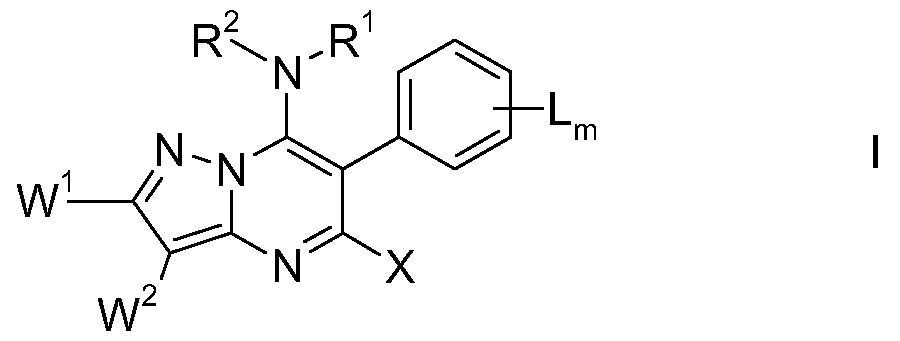
R1 Wasserstoff, Ci-Ci2-Alkyl, Ci-Ci2-Halogenalkyl, C2-Ci2-Alkenyl, C2-Ci2- Halogenalkenyl, C2-Ci2-Alkinyl, C2-Ci2-Halogenalkinyl, C3-C8-Cycloalkyl, C3-C8-Halogencycloalkyl, C3-C6-Cycloalkenyl, C3-C6-Halogencycloalkenyl, Ci-Cs-Alkoxy, Ci-C8-Halogenalkoxy, C2-C8-Alkenyloxy, C2-C8-Alkinyloxy,
Ca-Cs-Cycloalkoxy, NH2, Ci-C8-Alkylamino, Di-Ci-C8-alkylamino, Phenyl, Naphthyl oder ein fünf- oder sechsgliedriger gesättigter, partiell ungesättigter oder aromatischer Heterocyclus, enthaltend ein, zwei, drei oder vier He- teroatome aus der Gruppe O, N und S;
R2 Z-Y-(CR7R8)P-CR5R6-CR3R4-#, worin # die Verknüpfungsstelle mit dem Stickstoff atom ist und:
R3, R4, R5, R6, R7, R8 unabhängig voneinander Wasserstoff, Ci -C8-Al kyl, Ci-Cs-Halogenalkyl, C2-C8-Al kenyl, C2-C8-Halogenalkenyl, C2-C8-Al kinyl,
C2-C8-Halogenalkinyl, C3-C6-Cycloalkyl, C3-C6-Halogencycloalkyl, C3-C6- Cycloalkenyl, C3-C6-Halogencycloalkenyl, Phenyl, Naphthyl oder ein fünf- oder sechsgliedriger gesättigter, partiell ungesättigter oder aromatischer Heterocyclus, enthaltend ein, zwei, drei oder vier Heteroatome aus der Gruppe O, N und S,
R5 kann auch mit R3 oder R7 zusammen mit den Atomen, an die diese Reste gebunden sind, einen fünf-, sechs-, sieben, acht-, neun- oder zehnglied- rigen gesättigten oder partiell ungesättigten Ring bilden, der neben Kohlen- stoffatomen ein, zwei oder drei Heteroatome aus der Gruppe O, N und S als Ringglied enthalten kann und/oder einen oder mehrere Substituenten Ra tragen kann;
R3 mit R4, R5 mit R6, R7 mit R8 können jeweils gemeinsam eine C2-Cs-Al- kylen-, Alkenylen oder Alkinylenkette bilden, die durch ein, zwei oder drei
Heteroatome aus der Gruppe O, N und S unterbrochen sein kann; R1 und R3 bis R8 können jeweils unabhängig eine, zwei, drei oder vier gleiche oder verschiedene Gruppen Ra tragen:
Ra Halogen, Cyano, Nitro, Hydroxy, Carboxyl, Ci-C6-Alkyl, Ci-C6-HaIo- genalkyl, C2-C8-Alkenyl, C2-C8-Halogenalkenyl, C2-C6-Al kinyl, C2-C6-
Halogenalkinyl, C3-C6-Cycloalkyl, C3-C8-Cycloalkenyl, Ci-C6-Alkoxy, Ci-C6-Halogenalkoxy, C2-C6-Alkenyloxy, C3-C6-Halogenalkenyloxy, C3-C6-Alkinyloxy, C3-C6-Halogenalkinyloxy, C3-C6-Cycloalkoxy, C3-C6- Cycloalkenyloxy, C(O)Rπ, C(O)ORπ, C(S)ORπ, C(O)SRπ, C(S)SRπ, OC(O)ORπ, Ci-C6-Alkylthio, Ci-C6-Alkylamino, Di-Ci-C6-alkylamino,
C(O)NHRπ, C(O)NRπ 2, Ci-C6-Alkylen, Oxy-Ci-C4-alkylen, Oxy-Ci-C3- alkylenoxy, wobei divalente Gruppen an das selbe Atom oder an benachbarte Atome gebunden sein können, Phenyl, Naphthyl, fünf-, sechs-, sieben-, acht-, neun- oder zehngliedriger gesättigter, partiell ungesättigter oder aromatischer Heterocyclus, enthaltend ein, zwei, drei oder vier Heteroatome aus der Gruppe O, N und S;
Rπ Ci-Cs-Alkyl, C3-C8-Alkenyl, C3-C8-Al kinyl, C3-C6-Cycloalkyl oder
C3-C6-CyCl oa I kenyl ;
wobei die aliphatischen, alicyclischen oder aromatischen Gruppen in den vorgenannten Gruppen Ra und Rπ ihrerseits partiell oder vollständig halogeniert sein und/oder eine, zwei oder drei Gruppen Rb tragen können:
Rb Halogen, Cyano, Nitro, Hydroxy, Mercapto, Amino, Carboxyl, Alkyl, Halogenalkyl, Alkenyl, Alkoxy, Halogenalkoxy, Alkenyl- oxy, Alkinyloxy, Alkylthio, Alkylamino, Dialkylamino, Formyl, Al- kylcarbonyl, Alkylsulfonyl, Alkylsulfoxyl, Alkoxycarbonyl, Alkyl- carbonyloxy, Alkoxycarbonyloxy, Aminocarbonyl, Aminothiocar- bonyl, Alkylaminocarbonyl, Dialkylaminocarbonyl, Alkylamino- thiocarbonyl, Dialkylaminothiocarbonyl, wobei die Alkylgruppen in diesen Resten 1 bis 6 Kohlenstoffatome enthalten und die genannten Alkenyl- oder Alkinylgruppen in diesen Resten 2 bis 8 Kohlenstoffatome enthalten; Cycloalkyl, Cycloalkoxy, Hetero- cyclyl, Heterocyclyloxy, wobei die cyclischen Systeme 3 bis 10 Ringglieder enthalten; Aryl, Aryloxy, Arylthio, Aryl-Ci-C6-alkoxy, Aryl-Ci-C6-alkyl, Hetaryl, Hetaryloxy, Hetarylthio, wobei die Aryl- reste vorzugsweise 6 bis 10 Ringglieder, die Hetarylreste 5 o- der 6 Ringglieder enthalten, wobei die cyclischen Systeme partiell oder vollständig halogeniert und/oder durch Alkyl- oder Ha- logenalkylgruppen substituiert sein können; Y Sauerstoff oder Schwefel;
Z Wasserstoff, Carboxyl, Formyl, C5-C8-Alkyl, Ci-C8-Halogenalkyl, C2- Cs-Alkenyl, C2-C8-Halogenalkenyl, C2-C8-Al kinyl, C2-C8-Halogen- alkinyl, C3-C6-Cycloalkyl, C3-C8-Cycloalkenyl, C(O)Rπ, C(O)ORπ, C(S)ORπ, C(O)SRπ, C(S)SRπ, C(NRA)SRπ, C(S)Rπ, C(NRπ)NRARB, C(NRπ)RA, C(NRπ)ORA, C(O)NRARB, C(S)NRARB, Ci-C8-Alkylsulfinyl, Ci-C8-Alkylthio, Ci-C8-Alkylsulfonyl, C(O)-Ci-C4-alkylen-NRAC(NRπ)NRARB,
C(S)-Ci-C4-alkylen-NRAC(NRπ)NRARB,
C(NRπ)-Ci-C4-alkylen-NRAC(NRπ)NRARB, Phenyl, Naphthyl, fünf-, sechs-, sieben-, acht-, neun- oder zehngliedriger gesättigter, partiell ungesättigter oder aromatischer Heterocyclus, enthaltend ein, zwei, drei oder vier Heteroatome aus der Gruppe O, N und S, welcher direkt oder über eine Carbonyl, Thiocarbonyl, Ci-C4-Alkylcarbonyl oder Ci-CrAlkylthiocarbonylgruppe gebunden ist; wobei in der Gruppe Z die Kohlenstoffketten durch eine oder mehrere Gruppen Rb substituiert sein können;
RA,RB unabhängig voneinander Wasserstoff, C2-Alkenyl, C2-Alkinyl oder eine der bei Rπ genannten Gruppen;
RA und RB können auch gemeinsam mit dem Stickstoffatom, an das sie ge- bunden sind, oder RA und Rπ gemeinsam mit den Kohlenstoff- und Hetero- atomen, über die sie gebunden sind, einen fünf- oder sechsgliedrigen gesättigten, teilweise ungesättigten oder aromatischen Ring bilden, der neben Kohlenstoffatomen ein, zwei oder drei weitere Heteroatome aus der Gruppe O, N und S als Ringglied enthalten und/oder einen oder mehrere Substi- tuenten Ra tragen kann;
oder
Z kann auch mit R6 oder R8 einen sechsgliedrigen gesättigten oder teilwei- se ungesättigten Ring bilden, der neben Kohlenstoffatomen und Y ein oder zwei weitere Heteroatome aus der Gruppe N und S als Ringglied enthalten kann und/oder einen oder mehrere Substituenten Ra tragen kann;
die Gruppe Z kann partiell oder vollständig halogeniert sein und/oder eine, zwei oder drei Gruppen Rb tragen; R1 und R2 können auch zusammen mit dem Stickstoffatom, an das sie gebunden sind, einen fünf-, sechs-, sieben, acht-, neun- oder zehngliedrigen gesättigten, partiell ungesätigten oder Heterocyclus bilden, der neben Kohlenstoffatomen ein, zwei oder drei weitere Heteroatome aus der Gruppe O, N und S als Ringglied enthalten kann und welcher mindestens einen Substituenten enthält, der ausgewählt ist aus U-O-#, V-S-# und V-Y-(CR5R6)q-CR3R4-#, und # die Verknüpfungsstelle mit dem Heterocyclus ist und der Heterocyclus außerdem eine, zwei oder drei Gruppen Ra tragen kann;
U Carboxyl, Formyl, C5-C8-Alkyl, Ci-C8-Halogenalkyl, C2-C8-Alkenyl, C2-C8-
Halogenalkenyl, C2-C8-Al kinyl, C2-C8-Halogenalkinyl, C3-C6-Cycloalkyl, C3- C8-Cycloalkenyl, C(O)Rπ, C(O)ORπ, C(S)ORπ, C(O)SRπ, C(S)SRπ, C(NRA)SRπ, C(S)Rπ, C(NRπ)NRARB, C(NRπ)RA, C(NRπ)ORA, C(O)NRARB, C(S)NRARB, Ci-C8-Alkylsulfinyl, Ci -C8-Al kylthio, Ci-C8-Alkylsulfonyl, C(O)-Ci-C4-alkylen-NRAC(NRπ)NRARB,
C(S)-Ci-C4-alkylen-NRAC(NRπ)NRARB,
C(NRπ)-Ci-C4-alkylen-NRAC(NRπ)NRARB, Phenyl, Naphthyl, fünf-, sechs-, sieben-, acht-, neun- oder zehngliedriger gesättigter, partiell ungesättigter oder aromatischer Heterocyclus, enthaltend ein, zwei, drei oder vier Hete- roatome aus der Gruppe O, N und S, welcher direkt oder über eine Carbo- nyl, Thiocarbonyl, Ci-C4-Alkylcarbonyl oder Ci-C4-Alkylthiocarbonylgruppe gebunden ist; wobei in der Gruppe Z die Kohlenstoffketten eine, zwei oder drei Gruppen Rb tragen können;
q null oder 1 ;
V Wasserstoff oder eine der bei U genannten Gruppen;
p null, 1 , 2, 3, 4 oder 5;
W1W2 jeweils unabhängig voneinander Wasserstoff, Halogen, Cyano, Nitro, d- C4-Alkyl, C2-C6-Alkenyl, C2-C6-Al kinyl, Ci-C4-Halogenalkyl, Hydroxy-Ci-C4- alkyl, Ci-C4-Alkoxy-Ci-C4-alkyl, C2-C6-Halogenalkenyl, C2-C6-Halogen- alkinyl, C3-C6-Cycloalkyl, C3-C6-Halogencycloalkyl, Ci-C4-Alkoxy, CrC4- Halogenalkoxy, Ci-C4-Alkylthio, Ci -C4-Al kylsu If inyl oder Ci-C4-Alkylsul- fonyl, Formyl, Thiocarbamoyl, Ci-C4-Alkylcarbonyl, Ci-C4-Alkoxycarbonyl, Ci-C4-Alkylaminocarbonyl, Ci-C4-Alkoximinocarbonyl, Hydroximinoalkyl, CR10R11OR12, C(R13)=NR14;
R10,R11,R12 unabhängig voneinander Wasserstoff, Ci-C8-Alkyl, C3-C6-CyCIo- alkyl, Ci-C8-Alkoxy-Ci-C8-alkyl, C2-C8-Alkenyl, C2-C8-Al kinyl, Benzyl; R11 und R12 können gemeinsam Oxy-Ci-Cs-alkylenoxy bedeuten, worin die Kohlenstoffkette durch eine bis drei Gruppen aus Methyl, Ethyl, Hydroxy, Methoxy, Ethoxy, Hydroxymethyl, Methoxymethyl, Ethoxymethyl substituiert sein kann;
R13 Wasserstoff oder d-Cβ-Alkyl;
R14 d-Cs-Alkyl, C3-C6-Cycloalkyl, Phenyl, Phenylamino, wobei die Phe- nylgruppen durch eine bis fünf Gruppen Rb substituiert sein können;
X Halogen, Cyano, Ci-C4-Alkyl, Ci-C4-Halogenalkyl, CrC4-AIkOXy oder Ci-C4-Halogenalkoxy;
m 1 , 2, 3, 4 oder 5;
L Halogen, Hydroxy, Cyanato (OCN), Cyano, Nitro, Ci -C8-Al kyl, Ci-C8-HaIo- genalkyl, C2-Cio-Alkenyl, C2-Cio-Halogenalkenyl, C2-Cio-Alkinyl, C3-C6- Cycloalkyl, C3-C6-Halogencycloalkyl, C3-C6-Cycloalkenyl, Ci-C8-Alkoxy, d- C8-Halogenalkoxy, C2-Cio-Alkenyloxy, C2-Cio-Alkinyloxy, C3-C6-Cycloalkyl- oxy, C3-C6-Cycloalkenyloxy, Amino, Ci-C4-Alkylamino, Di-(Ci-C4)-Alkyl- amino, Ci-C4-Alkylcarbonylamino, C(O)-R, C(S)-R, S(O)n-R; Ci-C8-Alkoxy- imino-(Ci-C8)-alkyl, C2-Cio-Alkenyloxyimino-(Ci-C8)-alkyl, C2-Cio-Alkinyl- oxyimino-(Ci-C8)-alkyl, C2-Cio-Alkinylcarbonyl, C3-C6-Cycloalkylcarbonyl, oder ein fünf-, sechs-, sieben-, acht-, neun- oder zehngliedriger gesättigter, teilweise ungesättigter oder aromatischer Heterocyclus enthaltend ein, zwei, drei oder vier Heteroatome aus der Gruppe O, N und S;
R Wasserstoff, Ci-C4-Alkyl, Ci-C2-Halogenalkyl, Ci-C4-Alkoxy, C2-C4- Alkenyloxy, C2-C4-Alkinyloxy, Amino, Ci-C4-Alkylamino, Di-(Ci-C4)- Alkylamino; wobei die Gruppen R durch eine, zwei oder drei gleiche oder verschiedene Gruppen Rb substituiert sein können;
n null, 1 oder 2;
mit der Maßgabe, dass wenn R1 und R2 einen gesättigten fünfgliederigen Ring bilden und die Gruppe V-Y-(CR5R6)q-CR3R4-# für HOCH2-# steht, W2 für eine Gruppe ausgewählt aus Cyano, Nitro, Ci-C4-Alkyl, Ci-C4- Halogenalkyl, Formyl, CH(Ra)-ORa, C(=O)Rb, C(=O)N(Ra)2, C(=O)N(Ra)N(Ra)2, C(=O)N(Ra)ORa, C(=O)ORa, C(=S)ORa, C(=O)SRa, C(=S)SRa, C(=NRa)Ra steht, und Ra Wasserstoff oder Ci-C4-Alkyl, wobei die Gruppen Ra verschieden sein können, wenn mehrere Gruppen Ra vorliegen, und Rb für CCI3, CF3, Propargyl, Cyclopro- pyl oder eine der bei Ra genannten Gruppen steht
und landwirtschaftlich annehmbare Salze davon.
2. Verbindungen nach Anspruch 1 , worin die Gruppe V-Y-(CR5R6)q-CR3R4-# nicht für HOCH2-# steht, wenn R1 und R2 einen gesättigten fünfgliederigen Ring bilden.
3. Verbindungen nach Anspruch 1 oder 2, worin X Fluor, Chlor oder Brom bedeutet.
4. Verbindungen nach Anspruch 1 oder 2, worin X Methyl, Ethyl oder n-Propyl bedeutet.
5. Verbindungen nach einem der Ansprüche 1 bis 4, worin R2
Z-Y-(CR7R8)P-CR5R6-CR3R4-# bedeutet, worin p null oder 1 ist.
6. Verbindungen nach einem der Ansprüche 1 bis 5, worin Z Wasserstoff, Ci-Cβ- Halogenalkyl, Ci-Cδ-Alkylcarbonyl, Ci-Cδ-Alkoxycarbonyl, Aminocarbonyl, Ci-Cβ- Alkylaminocarbonyl, Di-Ci-C6-alkylaminocarbonyl, Ci-Cδ-Alkylthiocarbonyl, Ci-Cβ-
Alkoxythiocarbonyl, Aminothiocarbonyl, Ci-C6-Alkylaminothiocarbonyl, Di-Ci-Cδ- alkylaminothiocarbonyl oder Heterocyclylcarbonyl, worin Heterocyclyl ein fünf-, sechs-, sieben-, acht-, neun- oder zehngliedriger gesättigter, partiell ungesättigter oder aromatischer Heterocyclus ist, der ein, zwei, drei oder vier Heteroatome aus der Gruppe O, N und S enthält, bedeutet.
7. Verbindungen nach einem der Ansprüche 1 bis 6, worin Z Alkylcarbonyl oder Alkoxycarbonyl bedeutet.
8. Verbindungen nach einem der Ansprüche 1 bis 4, worin R1 und R2 zusammen mit dem Stickstoffatom, an das sie gebunden sind, einen fünf-, sechs-, sieben, acht-, neun- oder zehngliedrigen gesättigten oder partiell ungesätigten Heterocyclus bilden, der neben Kohlenstoffatomen ein, zwei oder drei weitere Heteroatome aus der Gruppe O, N und S als Ringglied enthalten kann und welcher mindes- tens einen Substituenten enthält, der ausgewählt ist aus U-O-#, V-S-# und
V-Y-CR3R4-#, wobei der Heterocyclus ein oder zwei Gruppen Ra enthalten kann.
9. Verbindungen nach einem der Ansprüche 1 bis 4 und 6 bis 8, worin U und V nicht Ci-Cs-Alkyl bedeuten.
10. Verbindungen nach einem der Ansprüche 1 bis 4 und 6 bis 9, worin V für Wasserstoff steht.
1 1. Verbindungen nach einem der Ansprüche 1 bis 10, worin W1 und W2 Wasserstoff bedeuten.
12. Verbindungen nach einem der Ansprüche 1 bis 1 1 , in der mindestens eine Gruppe L orthoständig zu der Verknüpfungsstelle mit dem Pyrazolopyrimidingerüst steht.
13. Verbindungen nach einem der Ansprüche 1 bis 12, in der die durch Lm substitu- ierte Phenylgruppe für die Gruppe A
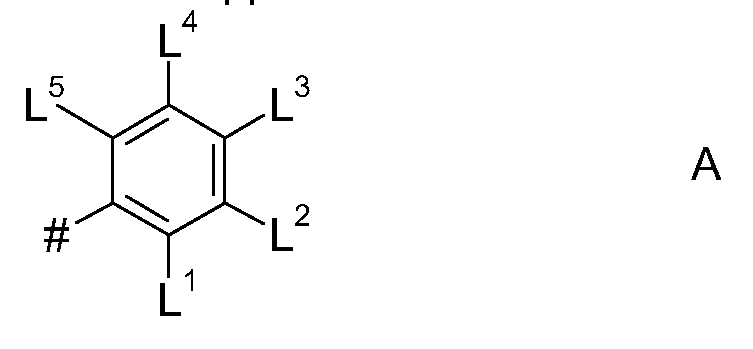
L1 Fluor, Chlor, CH3 oder CF3; L2, L4 unabhängig voneinander Wasserstoff oder Fluor;
L3 Wasserstoff, Fluor, Chlor, CN, CH3, OCH3, NH2, NHCH3 , N(CH3)2 ,
C(O)NH2 oder C(O)CH3; und L5 Wasserstoff, Fluor, Chlor oder CH3 bedeuten.
14. Verbindungen nach einem der Ansprüche 1 bis 13, in der die durch Lm substituierte Phenylgruppe für eine der folgenden Substituentenkombinationen steht: 2- Fluor-6-chlor, 2,6-Difluor, 2,6-Dichlor, 2-Fluor-6-methyl, 2,4,6-Trifluor, 2,6-Difluor- 4-methoxy, 2-Chlor-4-methoxy, Pentafluor, 2-Methyl-4-fluor, 2-Trifluormethyl, 2- Methoxy-6-fluor, 2-Chlor, 2-Fluor, 2,4-Difluor, 2-Fluor-4-chlor, 2-Chlor-4-fluor, 2- Chlor-5-fluor, 2,3-Difluor, 2,5-Difluor, 2,3,4-Trifluor, 2-Methyl, 2,4-Dimethyl, 2-
Methyl-4-chlor, 2-Methyl-5-fluor, 2-Fluor-4-methyl, 2,6-Dimethyl, 2,4,6-Trimethyl, 2,6-Difluor-4-methyl, 2-Trifluormethyl-4-fluor, 2-Trifluormethyl-5-fluor oder 2- Trifluormethyl-5-chlor.
15. Fungizides Mittel, umfassend mindestens eine Verbindung der Formel I gemäß einem der Ansprüche 1 bis 14 und/oder ein landwirtschaftlich verträgliches Salz davon und einen festen oder flüssigen Trägerstoff.
16. Mittel nach Anspruch 15, ferner umfassend einen weiteren fungiziden, insektizi- den und/oder herbiziden Wirkstoff.
17. Saatgut, umfassend mindestens eine Verbindung gemäß einem der Ansprüche 1 bis 14 in einer Menge von 1 bis 1000 g pro 100 kg.
18. Kombination aus mindestens einer Verbindung der Formel (I) gemäß einem der Ansprüche 1 bis 14 und/oder einem landwirtschaftlich verträglichen Salz davon und mindestens einem weiteren fungiziden, insektiziden und/oder herbiziden Wirkstoff.
19. Verwendung einer Verbindung der Formel (I) gemäß einem der Ansprüche 1 bis 19 und/oder eines landwirtschaftlich verträglichen Salzes davon zur Bekämpfung von phytopathogenen Pilzen.
20. Verfahren zur Bekämpfung von phytopathogenen Pilzen, umfassend die Behandlung die Pilze und/oder die vor Pilzbefall zu schützenden Materialien, Pflanzen, den Boden und/oder Saatgüter mit einer wirksamen Menge mindestens einer Verbindung gemäß einem der Ansprüche 1 bis 14 und/oder eines landwirtschaft- lieh verträglichen Salzes davon behandelt.
21. Verfahren zur Herstellung der Verbindungen gemäß Anspruch 1 , 2 oder 3, in der X für Halogen steht, durch Umsetzung von Dihalogenpyrazolopyrimidinen der Formel II,

22. Verfahren zur Herstellung der Verbindungen gemäß Anspruch 1 bis 14 durch Umsetzung von Hydroxy- oder Mercaptopyrazolopyrimidinen der Formel Ia

23. Verwendung der Verbindungen der Formel Ia gemäß Anspruch 22 als Zwischenprodukte.
24. Verfahren zur Herstellung der Verbindungen gemäß Anspruch 1 oder 2, in der X Cyano, Alkoxy oder Halogenalkoxy bedeutet, durch Umsetzung von Verbindungen der Formel I gemäß Anspruch 1 , in der X für Halogen steht, mit Cyaniden, Alkoxylaten oder Halogenalkoxylaten
M-X' IV
in der M ein Ammonium-, Tetraalkylammonium- Alkali- oder Erdalkalimetallkation darstellt.
Applications Claiming Priority (2)
| Application Number | Priority Date | Filing Date | Title |
|---|---|---|---|
| EP06110753.8 | 2006-03-07 | ||
| EP06110753 | 2006-03-07 |
Publications (1)
| Publication Number | Publication Date |
|---|---|
| WO2007101804A1 true WO2007101804A1 (de) | 2007-09-13 |
Family
ID=38050033
Family Applications (1)
| Application Number | Title | Priority Date | Filing Date |
|---|---|---|---|
| PCT/EP2007/051846 Ceased WO2007101804A1 (de) | 2006-03-07 | 2007-02-27 | Substituierte pyrazolopyrimidine, verfahren zu ihrer herstellung und ihre verwendung zur bekämpfung von schadpilzen sowie sie enthaltende mittel |
Country Status (1)
| Country | Link |
|---|---|
| WO (1) | WO2007101804A1 (de) |
Cited By (2)
| Publication number | Priority date | Publication date | Assignee | Title |
|---|---|---|---|---|
| WO2008019723A1 (de) * | 2006-08-17 | 2008-02-21 | Bayer Cropscience Ag | Insektizide heterocyclische carbonsäurederivate |
| US10390476B2 (en) | 2010-11-22 | 2019-08-27 | Bayer Cropscience Lp | Fungicidal compositions and methods |
Citations (8)
| Publication number | Priority date | Publication date | Assignee | Title |
|---|---|---|---|---|
| WO2002048151A1 (en) * | 2000-12-11 | 2002-06-20 | Basf Aktiengesellschaft | 6-phenyl-pyrazolopyrimidines |
| WO2004000844A1 (de) * | 2002-05-29 | 2003-12-31 | Bayer Cropscience Aktiengesellschaft | Pyrazolopyrimidine und ihre verwendung zur bekämpfung von schädlichen organismen |
| WO2004106341A1 (de) * | 2003-06-03 | 2004-12-09 | Basf Aktiengesellschaft | Substituierte pyrazolopyrimidine, verfahren zu ihrer herstellung und ihre verwendung zur bekämpfung von schadpilzen sowie sie enthaltende mittel |
| WO2005056557A1 (de) * | 2003-12-10 | 2005-06-23 | Bayer Cropscience Aktiengesellschaft | 7-amino-5-halopyrazolopyrimidine mit fungizider wirkung |
| WO2005056559A1 (de) * | 2003-12-10 | 2005-06-23 | Bayer Cropscience Aktiengesellschaft | Pyrazolopyrimidine |
| WO2005056558A1 (de) * | 2003-12-10 | 2005-06-23 | Bayer Cropscience Aktiengesellschaft | Pyrazolopyrimidine als fungizide wirkstoffe |
| WO2005056555A1 (de) * | 2003-12-10 | 2005-06-23 | Bayer Cropscience Aktiengesellschaft | Pyrazolopyrimidine |
| WO2005056556A1 (de) * | 2003-12-10 | 2005-06-23 | Bayer Cropscience Aktiengesellschaft | Pyrazolopyrimidine |
-
2007
- 2007-02-27 WO PCT/EP2007/051846 patent/WO2007101804A1/de not_active Ceased
Patent Citations (8)
| Publication number | Priority date | Publication date | Assignee | Title |
|---|---|---|---|---|
| WO2002048151A1 (en) * | 2000-12-11 | 2002-06-20 | Basf Aktiengesellschaft | 6-phenyl-pyrazolopyrimidines |
| WO2004000844A1 (de) * | 2002-05-29 | 2003-12-31 | Bayer Cropscience Aktiengesellschaft | Pyrazolopyrimidine und ihre verwendung zur bekämpfung von schädlichen organismen |
| WO2004106341A1 (de) * | 2003-06-03 | 2004-12-09 | Basf Aktiengesellschaft | Substituierte pyrazolopyrimidine, verfahren zu ihrer herstellung und ihre verwendung zur bekämpfung von schadpilzen sowie sie enthaltende mittel |
| WO2005056557A1 (de) * | 2003-12-10 | 2005-06-23 | Bayer Cropscience Aktiengesellschaft | 7-amino-5-halopyrazolopyrimidine mit fungizider wirkung |
| WO2005056559A1 (de) * | 2003-12-10 | 2005-06-23 | Bayer Cropscience Aktiengesellschaft | Pyrazolopyrimidine |
| WO2005056558A1 (de) * | 2003-12-10 | 2005-06-23 | Bayer Cropscience Aktiengesellschaft | Pyrazolopyrimidine als fungizide wirkstoffe |
| WO2005056555A1 (de) * | 2003-12-10 | 2005-06-23 | Bayer Cropscience Aktiengesellschaft | Pyrazolopyrimidine |
| WO2005056556A1 (de) * | 2003-12-10 | 2005-06-23 | Bayer Cropscience Aktiengesellschaft | Pyrazolopyrimidine |
Cited By (3)
| Publication number | Priority date | Publication date | Assignee | Title |
|---|---|---|---|---|
| WO2008019723A1 (de) * | 2006-08-17 | 2008-02-21 | Bayer Cropscience Ag | Insektizide heterocyclische carbonsäurederivate |
| US10390476B2 (en) | 2010-11-22 | 2019-08-27 | Bayer Cropscience Lp | Fungicidal compositions and methods |
| US11140903B2 (en) | 2010-11-22 | 2021-10-12 | Bayer Cropscience Lp | Fungicidal compositions and methods |
Similar Documents
| Publication | Publication Date | Title |
|---|---|---|
| EP1633755A1 (de) | Substituierte pyrazolopyrimidine, verfahren zu ihrer herstellung und ihre verwendung zur bekämpfung von schadpilzen sowie sie enthaltende mittel | |
| WO2007101871A1 (de) | Substituierte imidazolopyrimidine, verfahren zu ihrer herstellung und ihre verwendung zur bekämpfung von schadpilzen sowie sie enthaltende mittel | |
| WO2007113136A1 (de) | Verwendung von substituierten riazolopyrimidinen zur bekämpfung von phyto pathogenen schadpilzen | |
| EP2046794A1 (de) | Fungizide azolopyrimidine, verfahren zu ihrer herstellung und ihre verwendung zur bekämpfung von schadpilzen sowie sie enthaltende mittel | |
| EP1720879A2 (de) | Azolopyrimidin-verbindungen und ihre verwendung zur bekämpfung von schadpilzen | |
| WO2007101804A1 (de) | Substituierte pyrazolopyrimidine, verfahren zu ihrer herstellung und ihre verwendung zur bekämpfung von schadpilzen sowie sie enthaltende mittel | |
| WO2007116011A2 (de) | Substituierte triazolopyrimidine, verfahren zu ihrer herstellung und ihre verwendung zur bekämpfung von schadpilzen sowie sie enthaltende mittel | |
| WO2007101859A1 (de) | Substituierte pyrazolopyrimidine, verfahren zu ihrer herstellung und ihre verwendung zur bekämpfung von schadpilzen sowie sie enthaltende mittel | |
| EP1910373A1 (de) | Fungizide 6-phenyl-triazolopyrimidinylamine | |
| WO2007048734A1 (de) | Verwendung von 5-amino-pyrazolen zur bekämpfung pflanzenpathogener schadpilze, neue 5-amino-pyrazole, verfahren zu ihrer herstellung und sie enthaltende mittel | |
| EP1575957A1 (de) | 2-mercapto-substituierte triazolopyrimidine, verfahren zu ihrer herstellung und ihre verwendung zur bekämpfung von schadpilzen sowie sie enthaltende mittel | |
| WO2007101810A1 (de) | Substituierte triazolopyrimidine, verfahren zu ihrer herstellung und ihre verwendung zur bekämpfung von schadpilzen sowie sie enthaltende mittel | |
| EP1765824B1 (de) | Substituierte 6-phenyl-7-amino-triazolopyrimidine, verfahren zu ihrer herstellung und ihre verwendung zur bekämpfung von schadpilzen sowie sie enthaltende mittel | |
| WO2007048733A1 (de) | Verwendung von 5-amino-pyrazolen zur bekämpfung pflanzenpathogener schadpilze, neue 5-amino-pyrazole, verfahren zu ihrer herstellung und sie enthaltende mittel | |
| EP2117312A1 (de) | Verwendung von azolopyrimidinen zur bekämpfung von pflanzenpathogenen schadpilzen | |
| DE102007008940A1 (de) | Substituierte Imidazolopyrimidine, Verfahren zu ihrer Herstellung und ihre Verwendung zur Bekämpfung von Schadpilzen sowie sie enthaltende Mittel | |
| EP1697365B1 (de) | 6-(2-fluor-4-alkoxyphenyl)-triazolopyrimidine, verfahren zu ihrer herstellung, ihre verwendung zur bekämpfung von schadpilen sowie sie enthaltende mittel | |
| WO2007099092A1 (de) | Substituierte 6-phenyl-7-amino-[1,2,4]-triazolo[1,5-a]pyrimidine und deren verwendung zur bekämpfung von schadpilzen | |
| EP1797095A1 (de) | 6-phenyl-7-amino-triazolopyrimidine, verfahren zu ihrer herstellung und ihre verwendung zur bekämpfung von schadpilzen sowie sie enthaltende mittel | |
| DE102007008939A1 (de) | Substituierte Imidazolopyrimidine, Verfahren zu ihrer Herstellung und ihre Verwendung zur Bekämpfung von Schadpilzen sowie sie enthaltende Mittel | |
| WO2005123739A1 (de) | 6-(2-fluorphenyl)-triazolopyrimidine, verfahren zu ihrer herstellung und ihre verwendung zur bekämpfung von schadpilzen sowie sie enthaltende mittel | |
| EP1725557B1 (de) | 6-(2-chlor-5-halogenphenyl)-triazolopyrimidine, verfahren zu ihrer herstellung und ihre verwendung zur bekämpfung von schadpilzen sowie sie enthaltende mittel | |
| EP1697366B1 (de) | 6-(2-chlor-4-alkoxy-phenyl)-triazolopyrimidine, verfahren zu ihrer herstellung und ihre verwendung zur bekämpfung von schadpilzen sowie sie enthaltende mittel | |
| EP1909580A1 (de) | Fungizide 5-methyl-6-phenyl-triazolopyrimidinylamine | |
| WO2007023020A1 (de) | 7-amino-6-heteroaryl-1,2,4-triazolo[1,5-a]pyrimidin-verbindungen und ihre verwendung zur bekämpfung von schadpilzen |
Legal Events
| Date | Code | Title | Description |
|---|---|---|---|
| 121 | Ep: the epo has been informed by wipo that ep was designated in this application | ||
| NENP | Non-entry into the national phase |
Ref country code: DE |
|
| 122 | Ep: pct application non-entry in european phase |
Ref document number: 07712335 Country of ref document: EP Kind code of ref document: A1 |