WO2006085476A1 - 膜タンパク質をコードする核酸に対するプローブdnaを作成する方法、膜タンパク質をコードする遺伝子の発現を検出する方法、及びプローブdna固定化担体 - Google Patents
膜タンパク質をコードする核酸に対するプローブdnaを作成する方法、膜タンパク質をコードする遺伝子の発現を検出する方法、及びプローブdna固定化担体 Download PDFInfo
- Publication number
- WO2006085476A1 WO2006085476A1 PCT/JP2006/301805 JP2006301805W WO2006085476A1 WO 2006085476 A1 WO2006085476 A1 WO 2006085476A1 JP 2006301805 W JP2006301805 W JP 2006301805W WO 2006085476 A1 WO2006085476 A1 WO 2006085476A1
- Authority
- WO
- WIPO (PCT)
- Prior art keywords
- dna
- membrane protein
- base sequence
- receptor
- probe dna
- Prior art date
- Legal status (The legal status is an assumption and is not a legal conclusion. Google has not performed a legal analysis and makes no representation as to the accuracy of the status listed.)
- Ceased
Links
Classifications
-
- C—CHEMISTRY; METALLURGY
- C12—BIOCHEMISTRY; BEER; SPIRITS; WINE; VINEGAR; MICROBIOLOGY; ENZYMOLOGY; MUTATION OR GENETIC ENGINEERING
- C12N—MICROORGANISMS OR ENZYMES; COMPOSITIONS THEREOF; PROPAGATING, PRESERVING, OR MAINTAINING MICROORGANISMS; MUTATION OR GENETIC ENGINEERING; CULTURE MEDIA
- C12N15/00—Mutation or genetic engineering; DNA or RNA concerning genetic engineering, vectors, e.g. plasmids, or their isolation, preparation or purification; Use of hosts therefor
- C12N15/09—Recombinant DNA-technology
- C12N15/10—Processes for the isolation, preparation or purification of DNA or RNA
- C12N15/1034—Isolating an individual clone by screening libraries
- C12N15/1051—Gene trapping, e.g. exon-, intron-, IRES-, signal sequence-trap cloning, trap vectors
Definitions
- the present invention relates to a method for preparing a probe DNA for detecting the expression of a gene encoding a membrane protein, a method for detecting the expression of the gene using the probe DNA, and a method for detecting the expression of the gene. And a method for detecting expression of the gene using the carrier.
- Membrane proteins play important functions in signal transduction and mass transport through cell membranes as receptors, ion channels, and transporters. Yes. Membrane proteins are roughly divided into two types based on their structure. One is a superficial membrane protein bound to the cell membrane surface, and the other is an integral membrane protein embedded in the lipid bilayer of the cell membrane. The structure of an integral membrane protein is composed of an extracellular region, an intracellular region, and a transmembrane region. The transmembrane region is rich in hydrophobic amino acids and is thought to form an ⁇ -helix in the membrane.
- this domain is a signal sequence that initiates transmembrane passage of the nascent peptide chain that follows the C-terminal side of the membrane protein when biosynthesized, or stop transfer that stops permeation of the protein.
- membrane proteins are specifically expressed in cancer cells, and these are considered useful for developing various diagnostic agents and anticancer agents as tumor antigens. And 70% of the target of drugs used for treatment of various diseases and diseases is said to be membrane protein. By analyzing the expression pattern of membrane protein, target of tissue-specific therapeutic drug It is expected to clarify.
- As a method of analyzing the expression of a membrane protein a method of analyzing the membrane protein itself can be considered.
- membrane proteins are difficult to purify due to their high hydrophobicity, and the three-dimensional structure is complex due to the presence of the lipid bilayer in the cell membrane, resulting in a complex three-dimensional structure. Its expression analysis is very difficult compared to proteins.
- RT-PCR and Northern plot are not suitable for exhaustive analysis and are insufficient for analysis of the expression of a wide variety of membrane proteins as described above.
- the method using a cDNA microarray has problems in that it takes time and labor to isolate cDNA and the amount of DNA to be immobilized becomes unstable.
- An object of the present invention is to provide a method for rapidly and comprehensively detecting the expression of a gene encoding a membrane protein.
- the present inventors code a region that is a partial region of a gene that codes for a membrane protein and is essential for membrane binding in the membrane protein.
- a nucleic acid encoding a membrane protein is specifically detected by using DNA consisting of a partial region containing at least part of an exon sequence and containing a certain amount of cytosine and guanine, or DNA complementary to the partial region as a probe.
- the present invention includes the following inventions.
- a membrane protein comprising: selecting the partial region containing a total of 40 to 60% of the DNA and preparing a DNA comprising the partial region or a DNA comprising a base sequence complementary to the partial region Probing DNA for the nucleic acid to be prepared.
- a method for detecting the expression of a gene encoding a membrane protein by allowing the probe DNA prepared by the method according to (1) and a sample-derived nucleic acid to be hybridized.
- Probe DNA immobilization carrier on which the selected probe DNA is immobilized
- SEQ ID NO: 1 to 10 DNA of 10 to 5000 bases including a part of DNA that also has the base sequence ability represented by any of L015
- DNA comprising a base sequence having homology with DNAs (a) to (), which specifically hybridizes with a nucleic acid encoding the corresponding membrane protein.
- the support is a solid support having a functional group capable of covalently bonding to the probe DNA on the substrate, and at least one surface layer selected from diamond, soft diamond, carbon-based material, and carbide, (3) Or (4) The probe DNA immobilization carrier according to (4).
- Probe DNA selected from the group consisting of the following DNAs (a) to (e):
- SEQ ID NO: 1 to 10 DNA of 10 to 5000 bases including a part of DNA that also has the base sequence ability represented by any of L015
- DNA comprising a base sequence having homology with DNAs (a) to (), which specifically hybridizes with a nucleic acid encoding the corresponding membrane protein.
- the probe DNA is a partial region of a gene encoding a membrane protein, and is usually 5% or more, preferably 60% or more, more preferably 80% or more, more preferably, of its base sequence. 90% or more, and most preferably 95% or more has an exon arrangement ability encoding a region essential for membrane binding in a membrane protein, and cytosine and guanine are usually 40 to 60% in total, preferably 45 to 55%. DNA consisting of the partial region contained at a ratio of In the present invention, DNA complementary to the DNA is also used as probe DNA.
- the membrane protein has a meaning usually used in this technical field, that is, a protein constituting a biological membrane.
- membrane proteins there are membrane surface proteins attached to the surface of biological membranes, membrane integral proteins buried inside, for example, receptors, transporters, membrane-bound enzymes, cytoforce-in receptors Family I, ion channel, extracellular matrix protein, cell adhesion factor, membrane-bound cell growth factor, more specifically, tyrosine kinase growth factor receptor, squamous cell carcinoma antigen (SCCA1), CD34, EGF family , EGF receptor family, type I and type II TGF ⁇ 8 receptor
- SCCA1 squamous cell carcinoma antigen
- a probe for a nucleic acid that encodes a membrane protein that characterizes the surface properties of cells among the above proteins, that is, a membrane protein that is highly expressed in the cell membrane of the target cell, is preferably prepared.
- the membrane protein force described in Table 1 below is preferably selected as the membrane protein.
- the base sequence of the DNA encoding each membrane protein is shown in Table 1. It is an ession number and is registered with GenBank (http://www.ncbi.nlm.nih.gov).
- the region essential for membrane binding means a region responsible for binding between the membrane protein and the cell membrane in the membrane protein.
- Such regions include, but are not limited to, transmembrane regions that are usually composed of hydrophobic amino acids and regions that contain amino acids to which GPI anchors that bind to the membrane via lipids are bound. is not.
- transmembrane region in the membrane protein and the region containing the amino acid to which the GPI anchor binds it is possible to specify the information power that has already been made public, or if no known information is available, Search can be performed using a prediction program or the like.
- the base length of the probe DNA of the present invention is a length capable of hybridizing with a nucleic acid encoding a membrane protein, and is usually 10 to 5000 bases, preferably 15 to 500 bases, more preferably
- L00 base 20-: L00 base, more preferably 40-70 base.
- the probe DNA of the present invention is preferably selected from the group consisting of the following DNAs (a) to (e):
- DNA comprising a base sequence having homology with DNAs (a) to (), which specifically hybridizes with a nucleic acid encoding the corresponding membrane protein.
- the part of the DNA is at least 15 bases, more preferably at least 20 bases, most preferably DNA in the DNA having the nucleotide sequence represented by any of SEQ ID NOs: 1 to L015 It means a portion having a continuous base sequence ability of 30 to 60 bases in length.
- a base sequence having homology with DNA usually has a homology or identity of about 70% or more, preferably about 80% or more, more preferably about 90% or more, and most preferably about 95% or more. Which specifically hybridizes with the nucleic acid encoding the corresponding membrane protein.
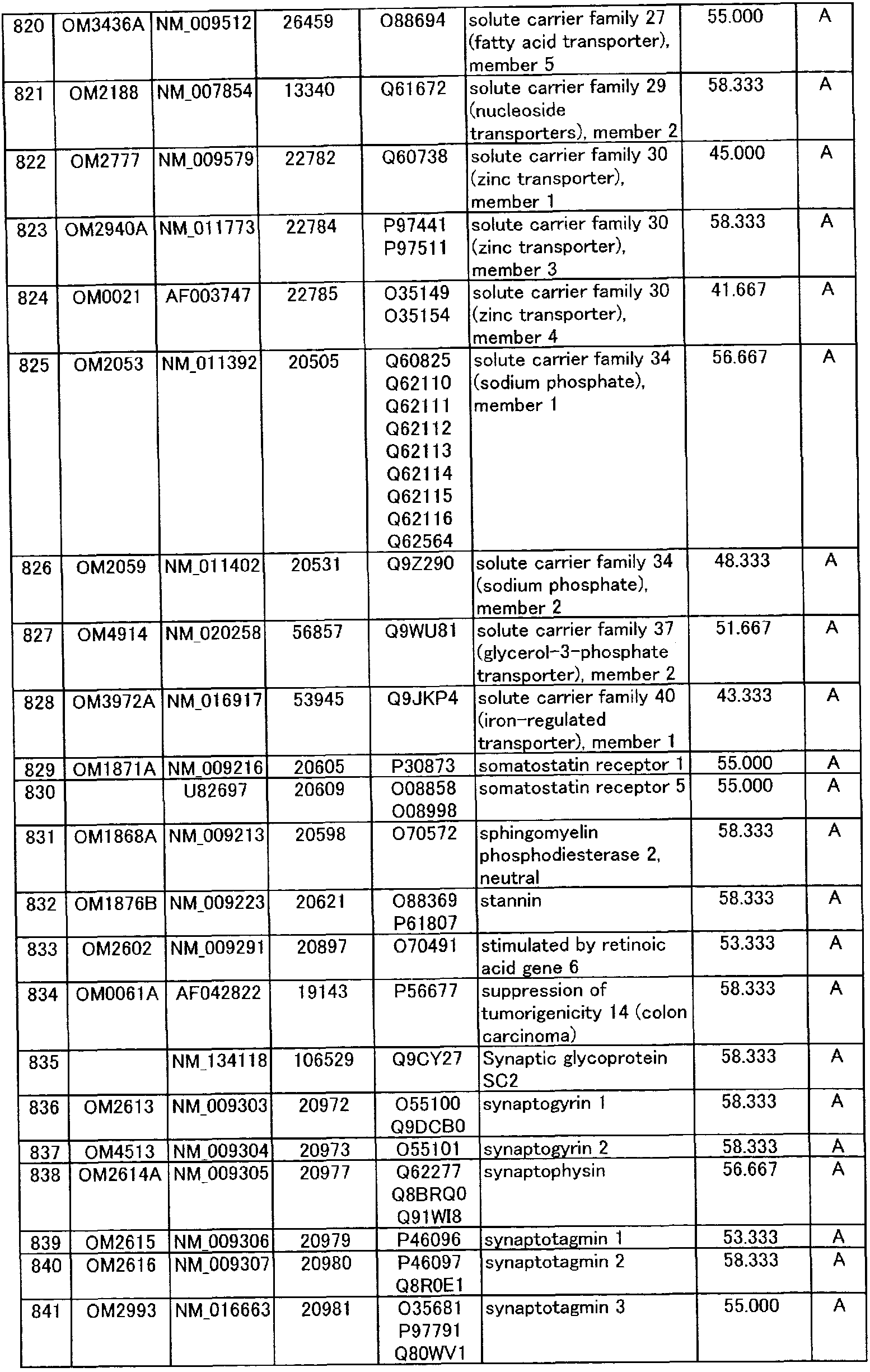
- Means the base sequence to be Nucleic acids encoding membrane proteins include both DNA and RNA, preferably cDNA.
- Specifically hybridizing means that a hybridized state with a nucleic acid encoding a membrane protein can be maintained under stringent hybridization conditions.
- the stringent hybridization conditions are, for example, conditions in which the sodium concentration is 15 to 40 mM, preferably 15 to 20 mM, and the temperature is 50 to 70 ° C, preferably 60 to 65 ° C. . In particular, it is most preferable that the sodium concentration is 16 to 17 mM and the temperature is 65 ° C.
- Probe DNA immobilization carrier [0018]
- the present invention also relates to a carrier on which the probe DNA is immobilized.
- the probe DNA-immobilized carrier is useful in detecting the expression of membrane proteins.
- the probe DNA can be immobilized on a carrier by a method known in the art.
- Prepare the spotting solution by dissolving or dispersing the probe DNA to be immobilized and its PCR product (DNA fragment amplified by PCR) in a solvent.
- the solvent for dissolving or dispersing the probe DNA include polar organic solvents such as distilled water, SSC (saline-sodium citrate), PBS (phosphate buffered saline), and sodium bicarbonate (NaHCO 3), such as dimethyl sulfoxide.
- One or more solvents selected for their strength such as dimethylformamide, tetrahydrofuran, trifluoroacetic acid, triethylamine, 1-methyl-2-pyrrolidone, dioxane, and ethyl acetate can be used.
- PBS polymethylformamide
- tetrahydrofuran trifluoroacetic acid
- triethylamine triethylamine
- 1-methyl-2-pyrrolidone dioxane
- ethyl acetate ethyl acetate
- a spotter device provided in a DNA chip preparation device is used to spot the surface of a carrier surface treated with polycation (polylysine, polyethyleneimine, etc.), and charge the DNA.
- polycation polylysine, polyethyleneimine, etc.
- a method of electrostatically coupling on a carrier using the above is used.
- a method using a silane coupling agent having an amino group, an aldehyde group, an epoxy group or the like is also used as a method for treating the carrier surface.
- an amino group, an aldehyde group, and the like are introduced on the surface of the carrier by a covalent bond, so that they are stably present on the surface of the carrier as compared with the case of using a polycation.
- a probe DNA into which a reactive group is introduced is synthesized, and the surface of the carrier is treated with the DNA. Can be spotted and covalently bonded.
- a method of reacting an amino group-introduced DNA in the presence of PDC (p-phenolic diisothiocyanate) in an amino group-introduced slide glass and a method of reacting the slide glass with an aldehyde group-introduced DNA and so on.
- Spotting is performed by dispensing a spotting solution containing probe DNA onto a 96-well or 384-well plastic plate and dropping the dispensed solution onto a carrier using a spot device or the like.
- a spot device a sample solution is usually held on a pin, the pin is brought into contact with the carrier surface, and the solution is transferred to the carrier surface to form a spot.
- a pin type device is used.
- pin tips such as solid pin type (especially, with a grooved one) and tile pin type (with a groove like a fountain pen). Can even be used.
- tile pin type Preferably, it is a tile pin type.
- a spot device using an ink jet method using the principle of an ink jet printer or a capillary method using a capillary tube can also be used.
- the spotting amount of the spotting solution per spot can be determined as appropriate by those skilled in the art, but is usually in the range of lpL to 1 ⁇ L, preferably in the range of lOOpL to LOONL.
- the spot size is usually in the range of 50 to 300 / ⁇ ⁇ in diameter.
- the distance between the spots is usually in the range of 0 to 1.5 mm, preferably in the range of 100 to 700 ⁇ m. After spotting, it is preferable to incubate at room temperature to 100 ° C, preferably 70 to 80 ° C, usually for 3 hours or less, preferably 0.5 to 1.5 hours.
- the carrier is washed to remove non-immobilized DNA and the like.
- the cleaning solution those commonly used in this technical field can be used.
- an aqueous solution containing 2 X SSC and 0.2% SDS (sodium dodecyl sulfate) can be used. In this way, a carrier having hundreds to tens of thousands of spots can be obtained.
- the probe DNA-immobilized carrier of the present invention is usually at least 10, preferably at least 50, more preferably at least 100, more preferably at least 500, most preferably. Alternatively, at least 1000 types of probe DNA are immobilized. In the probe DNA-immobilized carrier of the present invention, usually at least 10 spots or more, preferably 50 to: L000 spots, more preferably 1000 to 2000 spots of probe DNA are immobilized. For one type of probe DNA, spotting is usually performed at 1 to 10 spots, preferably 3 to 5 spots.
- Carrier for immobilizing probe DNA [0026] Carrier for immobilizing probe DNA:
- the carrier for immobilizing the probe DNA those commonly used in this technical field can be used.
- noble metals such as platinum, platinum black, gold, palladium, rhodium, silver, mercury, tungsten and their compounds, and conductor materials such as carbon represented by graphite and carbon fiber; single crystal silicon, amorphous silicon, Semiconductor materials typified by carbide, oxide and nitride nitride, composite materials of these semiconductor materials typified by SOI (Silicon 'on' Insulator); glass, quartz glass, alumina, sapphire , Inorganic materials such as ceramics, forsterite, photosensitive glass; polyethylene, ethylene, polypropylene, polyisobutylene, polyethylene terephthalate, unsaturated polyester, fluorine-containing resin, polyvinyl chloride, polyvinyl chloride, poly (vinyl acetate), Polybulu alcohol, polybuluaceta , Acrylic resin, polyacrylonitrile, polystyrene,
- a carrier for immobilizing probe DNA a functional group capable of covalently binding to a nucleic acid on a substrate, and at least one surface layer selected from diamond, soft diamond, a carbon-based substance, and a carbide force It is preferred to use a solid support having
- Examples of the material of the substrate used for the solid support include, for example, silicone, glass, fiber, wood, paper, ceramics, plastic (for example, polyester resin, polyethylene resin, polypropylene resin, ABS resin) (Acrylonitrile Butadiene Styrene resin), nylon, acrylic resin, fluorine resin, polycarbonate resin, polyurethane resin, methylpentene resin, phenol resin, melamine resin, epoxy resin, salt resin, vinyl resin ), Composition Diamond, high-pressure synthetic diamond, natural diamond, soft diamond (eg diamond-like carbon), amorphous carbon; gold, silver, copper, aluminum, tungsten, molybdenum, and other metals; the metal powder, ceramic powder, etc. Examples include those obtained by mixing and bonding the above-mentioned resin with a binder as a binder; those obtained by compacting raw materials such as the above-mentioned metal powder and ceramic powder with a press molding machine at high temperature.
- plastic for example, polyester resin, polyethylene resin, polypropylene resin,
- the solid support of the present invention has a surface layer on a substrate.
- a compound for introducing a functional group capable of covalently bonding with a nucleic acid can be firmly fixed on a substrate.
- the surface layer is formed of at least one selected from diamond, soft diamond, carbon-based material and carbide.
- diamond, soft diamond, carbon-based material, and carbide include synthetic diamond, high-pressure synthetic diamond, natural diamond, soft diamond (for example, diamond-like carbon), amorphous carbon, carbon-based material (for example, graphite, fullerene, Carbon nanotubes), mixtures thereof, or laminates thereof, hafnium carbide, niobium carbide, silicon carbide, tantalum carbide, thorium carbide, titanium carbide, uranium carbide, tungsten carbide, zirconium carbide, molybdenum carbide, Examples thereof include carbides such as chromium carbide and vanadium carbide.
- the soft diamond is a generic term for an imperfect diamond structure that is a mixture of diamond and carbon, such as so-called diamond-like carbon (DLC), and the mixing ratio is not particularly limited. In the present invention, it is preferable to use a soft diamond.
- the substrate is formed of at least one material selected from diamond, soft diamond, carbon-based material and carbide, it is not necessary to form a new surface layer on the substrate.
- a surface treatment is performed to form a surface layer formed of at least one material selected from diamond, soft diamond, carbon-based material, and carbide.
- a substrate obtained by forming a soft diamond film on a slide glass can be given.
- diamond-like carbon is formed by ionization deposition in a mixed gas containing 0 to 99% by volume of hydrogen gas and 100 to 1% by volume of methane gas. It is preferable that it is created.
- the thickness of the surface layer formed by the surface treatment is Inn! Preferably it is ⁇ 100 ⁇ m.
- the surface layer is formed on the substrate by a known method, for example, microwave plasma CVD (chemical vapor deposition) method, ECRCVD (electric cyclotron resonance chemical vapor deposition) method, ICP (inductive coupled plasma) method, DC sputtering method, ECR (Electric Cyclotron Resonance) sputtering method, ion plating method, arc ion plating method, EB (Electron Beam) vapor deposition method, resistance heating vapor deposition method, ionization vapor deposition method, arc vapor deposition method, laser It can be performed by vapor deposition.
- microwave plasma CVD chemical vapor deposition
- ECRCVD electric cyclotron resonance chemical vapor deposition
- ICP inductive coupled plasma
- DC sputtering method DC sputtering method
- ECR Electro Cyclotron Resonance
- ion plating method ion plating method
- arc ion plating method arc ion plating method
- EB Electro
- a surface layer may be formed by forming a laminate or a composite of the above-mentioned substrate materials (for example, a composite of diamond and another substance (for example, a two-phase body)).
- the shape and size of the substrate are not particularly limited, and examples of the shape include a flat plate shape, a thread shape, a spherical shape, a polygonal shape, a powder shape, and the like. Width 0.1 ⁇ 100mm, Length 0.1 ⁇ 100mm, Thickness 0.01 ⁇ : About LOmm.
- a single layer of Ti, Au, Pt, Nb, Cr, TiC, TiN, or a composite film thereof may be formed on the front or back surface of the substrate as a reflective layer. Since the thickness of the reflective layer needs to be uniform throughout, it is preferably 10 nm or more, more preferably lOOnm or more.
- the substrate When glass is used as the substrate, its surface is preferably intentionally roughened with Ra (jIS B 0601) in the range of lnm to 1000nm. Such a roughened surface is advantageous in that it increases the surface area of the substrate and immobilizes a large amount of probe DNA at a high density.
- Ra jIS B 0601
- the solid support of the present invention may be provided with an electrostatic layer in order to attract nucleic acid electrostatically.
- the electrostatic layer is not particularly limited as long as it attracts nucleic acid electrostatically and improves the amount of nucleic acid immobilized.
- a compound having a positive charge such as an amino group-containing compound. Can be used.
- amino group-containing compound examples include an unsubstituted amino group (one NH 3), or a carbon number of 1 to 6
- R is a substituent
- the amino group-containing compound is introduced into the film forming apparatus during the surface treatment to contain the amino group.
- a carbon-based film is formed.
- the electrostatic layer is formed without being covalently bonded to the surface layer, the above-mentioned non-substituted or mono-substituted is provided on the substrate in order to increase the affinity between the electrostatic layer and the surface layer, that is, the adhesion. It is preferable to introduce a functional group that can be covalently bonded to a nucleic acid after vapor-depositing the compound having an amino group and a carbon compound.
- the carbon compound used here is not particularly limited as long as it can be supplied as a gas.
- methane, ethane, and propane which are gases at normal temperature, are preferable.
- the vapor deposition method the ionized vapor deposition method is preferable.
- the conditions of the ion vapor deposition method are preferably an operating pressure of 0.1 to 50 Pa and an acceleration voltage of 2 to 1000 V.
- the electrostatic layer is formed by covalently bonding to the surface layer
- the substrate having the surface layer is irradiated with ultraviolet rays in chlorine gas to chlorinate the surface, and then the amino group-containing substrate is formed.
- compounds for example, polyallylamine, polylysine, 4, 4 ,, 4 "-triaminotriphenylmethane, triamterene and other polyvalent amines are reacted to form an amino group at the end not bonded to the substrate.
- an electrostatic layer can be formed.
- a reaction for introducing a functional group capable of covalently bonding to a nucleic acid for example, introduction of a carboxyl group using a dicarboxylic acid or a polyvalent carboxylic acid
- a functional group capable of covalently bonding to a nucleic acid after the substrate is immersed in a solution containing the compound having an unsubstituted or monosubstituted amino group.
- the solvent for the solution include water, N-methylpyrrolidone, and ethanol.
- a carboxyl group is introduced into a substrate provided with an electrostatic layer using dicarboxylic acid or polyvalent carboxylic acid, it is activated with N-hydroxysuccinimide and Z or carbodiimides in advance.
- the reaction is preferably performed in the presence of N-hydroxysuccinimide and Z or carpositimide.
- the substrate When forming an electrostatic layer by immersing the substrate in a solution containing a compound having an unsubstituted or monosubstituted amino group, and using polyallylamine as the amino group-containing compound, the substrate The amount of nucleic acid immobilized is further improved.
- the thickness of the electrostatic layer is Inn! It is preferably ⁇ 500 ⁇ m.
- the solid support in the present invention has a functional group capable of covalently binding to a nucleic acid.
- the functional group can be formed by chemically modifying the substrate surface.
- Examples of the functional group include a carboxyl group, an active ester group, a haloformyl group, a hydroxyl group, a sulfate group, a cyano group, a nitro group, a thiol group, and an amino group.
- Examples of the compound used for introducing a carboxyl group as a functional group include, for example, the formula: X—R—COOH (wherein X is a halogen atom, R 1 is a divalent carbon atom having 1 to 12 carbon atoms)
- Dicarboxylic acid monohalides such as succinic acid monochloride, malonic acid monochloride; phthalic anhydride, succinic anhydride, Examples include acid anhydrides such as oxalic anhydride, maleic anhydride, and butanetetracarboxylic anhydride.
- the carboxyl group introduced as described above is composed of a dehydrating condensing agent such as cyanamide-carpositimide (for example, 1- [3- (dimethylamino) propyl] -3-ethylcarbopositimide), N-hydroxysuccinimide, etc.
- cyanamide-carpositimide for example, 1- [3- (dimethylamino) propyl] -3-ethylcarbopositimide
- N-hydroxysuccinimide etc.
- An active ester can be obtained with the above compound.
- Examples of the compound used for introducing a haloformyl group as a functional group include, for example, the formula: X—OC—R 6 —CO—X (wherein X is a halogen atom, R 6 is a single bond or carbon number) 1 to 12 divalent hydrocarbon groups)), dino and rides of dicarboxylic acids such as succinic chloride and malonic chloride.
- Examples of the compound used for introducing a hydroxyl group as a functional group include the formula: HO — R 7 — COOH (wherein R 7 represents a divalent hydrocarbon group having 1 to 12 carbon atoms). Hydroxy acid or phenolic acid represented by
- Examples of the compound used for introducing an amino group as a functional group include amino acids.
- polycarboxylic acids such as polyacrylic acid, polymethacrylic acid, trimellitic acid, butanetetraforce rubonic acid can be used for improving hydrophilicity.
- the probe DNA can be firmly fixed, so that diagnosis with high detection sensitivity and reliability is possible.
- the method for detecting the expression of the gene encoding the membrane protein of the present invention is not particularly limited as long as it is based on the hybridization of the probe DNA of the present invention and the nucleic acid encoding the membrane protein. Any method known in the art can be used. Examples include Northern blotting, RNase protection assay, Southern blotting in colony cloning, colony Z plaque hybridization, and microarray.
- the probe DNA immobilized on a carrier is brought into contact with the sample cDNA obtained by reverse transcription of the mRNA derived from the sample, and the probe DNA is contacted.
- the level of mRNA encoding the corresponding membrane protein in the sample is measured, thereby detecting the expression level of the gene encoding the membrane protein.
- the expression of a gene encoding a membrane protein is detected by detecting the presence or absence of expression of a gene encoding a membrane protein, and by changing the expression level of the gene encoding the membrane protein. Also included are deviations in detecting and quantifying the expression level of a gene encoding a membrane protein.
- Sample cDNA can be prepared by methods known in the art. For example, add total RNA isolated from a sample into a reaction mixture containing RT primers and an appropriate buffer. After incubation for primer annealing, RT buffer, dNTP, DTT, aminoallyl dUTP, RNase inhibitor and reverse transcriptase are further added. After incubation to complete reverse transcription of RNA, the RT product is reacted with a reactive labeling reagent. Alternatively, the labeled dNTPs can be incubated in the PCR reaction mixture without labeling the primers. PCR amplification can be performed in a DNA thermal cycler according to conventional techniques.
- the label is not particularly limited as long as it can be incorporated into nucleic acids.
- fluorescent labels CyDye such as Cy3 and Cy5, FITC, RITC, rhodamine, texta thread, TET, TAMRA, FAM , HEX, ROX, etc.
- radiolabels ⁇ -32P, y-32P, 35S, etc.
- the sample solution is prepared by dissolving in a buffer such that the nucleic acid concentration in the solution is usually 0.01 to: LOO / z g, preferably 1 to 50 g.
- This solution is dropped on the carrier on which the probe DNA prepared above is immobilized, and hybridized by incubation.
- Hybridization can be performed according to a known method or a method similar thereto, such as the method described in Molecular Cloning 2 (J. Sambrook et al., Cold Spring Harbor Lab. Press, 1989). .
- incubation is usually performed at 50 to 70 ° C, preferably 55 to 65 ° C, usually for 1 to 20 hours, preferably 5 to 16 hours. Finally, the carrier is washed, dried, and then the hybridization can be detected by reading the label derived from the hybridized nucleic acid.
- the probe DNA-immobilized carrier of the present invention can be dissociated once hybridized with the nucleic acid derived from the sample, and then washed with the carrier. In addition, the nucleic acid can be hybridized again.
- a carrier a solid support having a functional group capable of covalently bonding to DNA on a substrate and at least one surface layer selected from diamond, soft diamond, carbonaceous material and carbide, nucleic acid can be dissociated and nominated. The reproducibility of the redaction reaction can be improved.
- the dissociation of the hybridized nucleic acid is usually a solution having a sodium concentration of 1 to 15 mM at room temperature to 100 ° C, preferably 90 to 100 ° C, more preferably 95 to 100 ° C, and usually 10 to 60 ° C. It can be carried out by washing for 10 minutes, preferably 10 to 40 minutes, more preferably 30 to 35 minutes.
- aqueous solution for washing ultrapure water, sodium hydrogen carbonate solution, SSC solution, PBS solution or the like can be used. In the present invention, it is preferable to perform washing for 10 to 30 minutes using ultrapure water at 95 to 100 ° C.
- a diamond-like carbon layer is coated on a 3 mm square silicon substrate, amino groups are introduced by ammonia plasma treatment, modified with carboxyl groups, and then activated with N-hydroxysuccinimide to immobilize probe DNA.
- a carrier was made.
- a microarray spotter SPBIO2000 (Hitachi Soft) was used as a probe, and 1015 kinds of 60-mer DNAs aminated at 5 ′ end adjusted to 5 pmol / ⁇ L were spotted as probe DNA. Final concentration in 20% PEG (polyethylene glycol) solution
- the DNA fragment was dissolved at a concentration of 5 M to obtain a spotting solution.
- Table 1 shows 1015 types of probe DNA immobilized on a carrier. Number power of the column described as SEQ ID NO. In Table 1 Corresponds to the sequence number of each probe DNA shown in the sequence table.
- the column with the gene name is the general name of the protein encoded by the gene. The name registered with the gene sequence in the gene database, or the name registered with the amino acid sequence in the protein sequence database. It is.
- the symbols A to D shown in the column on the rightmost side of “Creation method” indicate the probe DNA production method, and the meanings of the symbols are as follows.
- a region force encoding a transmembrane region in a gene encoding each membrane protein was also created by selecting a region having a cytosine and guanine content power of 0 to 60%.
- B Created by selecting a region with 0 to 60% content of cytosine and guanine from the region encoding the transmembrane region in the gene encoding each membrane protein and the surrounding region
- a region coding for a transmembrane region in a gene encoding each membrane protein is identified as a transmembrane region prediction program (TMpred, (K. Hoftnann & W. Stoffel (1993) Biol. Chem. Hope-Seyler 374, 166) ) And created by selecting a region with cytosine and guanine content rate S40-60% from the obtained region
- a region with a cytosine and guanine content rate of 0 to 60% is selected.
- the CG content in these probe DNAs is shown in%.
- alpha 1 A subunit alpha 1 A subunit
- alpha 1 E subunit alpha 1 E subunit
- antigen A-D alpha
- antigen A-U alpha
- a nucleic acid encoding a membrane protein can be specifically detected, and thus the expression of a gene encoding the membrane protein can be detected quickly and exhaustively.
Landscapes
- Life Sciences & Earth Sciences (AREA)
- Genetics & Genomics (AREA)
- Health & Medical Sciences (AREA)
- Chemical & Material Sciences (AREA)
- Engineering & Computer Science (AREA)
- Bioinformatics & Cheminformatics (AREA)
- Organic Chemistry (AREA)
- Zoology (AREA)
- Biomedical Technology (AREA)
- Wood Science & Technology (AREA)
- Biotechnology (AREA)
- General Engineering & Computer Science (AREA)
- Crystallography & Structural Chemistry (AREA)
- Plant Pathology (AREA)
- Molecular Biology (AREA)
- Microbiology (AREA)
- Biophysics (AREA)
- Physics & Mathematics (AREA)
- Biochemistry (AREA)
- General Health & Medical Sciences (AREA)
- Bioinformatics & Computational Biology (AREA)
- Measuring Or Testing Involving Enzymes Or Micro-Organisms (AREA)
- Apparatus Associated With Microorganisms And Enzymes (AREA)
Abstract
本発明は、膜タンパク質をコードする遺伝子の発現を迅速かつ網羅的に検出する方法を提供することを目的とする。膜タンパク質をコードする遺伝子の部分領域であって、その塩基配列の5%以上が膜タンパク質における膜結合に必須の領域をコードするエキソン配列からなり、かつシトシンおよびグアニンを合計で40~60%の割合で含有する該部分領域を選択し、該部分領域の塩基配列または該部分領域に相補的な塩基配列からなるDNAを作成することを含む、膜タンパク質をコードする核酸に対するプローブDNAを作成する方法。
Description
明 細 書
膜タンパク質をコードする核酸に対するプローブ DNAを作成する方法、 膜タンパク質をコードする遺伝子の発現を検出する方法、及びプローブ DNA固 定化担体
技術分野
[0001] 本発明は、膜タンパク質をコードする遺伝子の発現を検出するためのプローブ DN Aを作成する方法、該プローブ DNAを用いて該遺伝子の発現を検出する方法、該 プローブ DNAが固定ィ匕された担体ならびに該担体を用いて該遺伝子の発現を検出 する方法に関する。
背景技術
[0002] 膜タンパク質は、真核細胞の全タンパク質の約 30%にも及ぶ種類があり、レセプタ 一、イオンチャンネル、トランスポーターなどとして、細胞膜を介する情報伝達や物質 輸送において重要な機能を担っている。膜タンパク質は、その構造から大きく 2種類 に分けられる。一つは細胞膜表面に結合した表在性膜タンパク質であり、他方は細 胞膜の脂質二重層に埋め込まれた内在性膜タンパク質である。内在性膜タンパク質 の構造は、細胞外領域、細胞内領域および膜貫通領域から構成される。膜貫通領域 は疎水性アミノ酸に富み、膜内においては α—ヘリックスを形成すると考えられる。膜 貫通領域を複数個有するタンパク質の場合、このドメインは、膜タンパク質が生合成 される際、その C末端側に続く新生ペプチド鎖の膜透過を開始させるシグナル配列、 またはその透過を停止させるストップトランスファー配列として機能する。多くの場合、 それぞれの機能を持ったドメインが交互に配置されており、このドメインを介して細胞 外領域と細胞内領域が交互に並んでいる。
[0003] ある種の膜タンパク質は癌細胞で特異的に発現しているものがあり、これらは腫瘍 抗原として各種診断薬や抗癌剤を開発するうえで有用であると考えられている。そし て、様々な病気や疾患の治療に使われる薬剤のターゲットの 70%は、膜タンパク質 であると言われており、膜タンパク質の発現パターンを解析することで、組織特異的 な治療薬の標的を明らかにすることが期待される。
[0004] 膜タンパク質の発現を解析する方法として、膜タンパク質自体を解析する方法が考 えられる。しかし、膜タンパク質は、疎水性が高いため精製が困難であるとともに、細 胞膜の脂質二重層に存在するという特殊な環境下にあるため立体構造が複雑で、細 胞内に存在する水溶性タンパク質に比べその発現解析が非常に困難である。 RT— PCR法やノーザンプロット法により解析する方法は、網羅的解析には不向きで、上記 のように極めて多様な膜タンパク質の発現解析には不十分である。また、 cDNAマイ クロアレイを用いる方法は、 cDNAの単離に時間と手間が力かるとともに、固定化す る DNA量が不安定になると!/、う問題がある。
発明の開示
発明が解決しょうとする課題
[0005] 本発明は、膜タンパク質をコードする遺伝子の発現を迅速かつ網羅的に検出する 方法を提供することを目的とする。
課題を解決するための手段
[0006] 本発明者らは、上記課題を解決すべく鋭意研究を行った結果、膜タンパク質をコー ドする遺伝子の部分領域であって、膜タンパク質における膜結合に必須の領域をコ ードするェキソン配列の少なくとも一部を含み、かつシトシンおよびグァニンを一定量 含む部分領域からなる DNA、または該部分領域に相補的な DNAをプローブとして 用いることにより、膜タンパク質をコードする核酸を特異的に検出できることを見いだ し、本発明を完成させるに至った。
[0007] すなわち、本発明は以下の発明を包含する。
(1)膜タンパク質をコードする遺伝子の部分領域であって、その塩基配列の 5%以上 が膜タンパク質における膜結合に必須の領域をコードする部分を含むェキソン中の 配列からなり、かつシトシンおよびグァニンを合計で 40〜60%の割合で含有する該 部分領域を選択し、該部分領域からなる DNAまたは該部分領域に相補的な塩基配 列からなる DNAを作成することを含む、膜タンパク質をコードする核酸に対するプロ ーブ DNAを作成する方法。
(2) (1)記載の方法によって作成されたプローブ DNAと試料由来の核酸とをノ、イブ リダィズさせることによって、膜タンパク質をコードする遺伝子の発現を検出する方法
(3)膜タンパク質をコードする遺伝子の部分領域であって、その塩基配列の 5%以上 が膜タンパク質における膜結合に必須の領域をコードする部分を含むェキソン中の 配列からなり、かつシトシンおよびグァニンを合計で 40〜60%の割合で含有する該 部分領域からなる DNA及び該部分領域に相補的な塩基配列からなる DNAから選 択されるプローブ DNAが固定化されてなる担体。
(4)以下の (a)〜(e)の DNAからなる群力 選択されるプローブ DNAが固定化されて なるプローブ DNA固定化担体:
(a)配列番号 1〜: L015のいずれかで表される塩基配列からなる DNA
(b)配列番号 1〜1015のいずれかで表される塩基配列と相補的な塩基配列力もなる DNA
(c)配列番号 1〜: L015のいずれかで表される塩基配列力もなる DNAの一部を含む 1 0〜5000塩基の DNA
(d)配列番号 1〜1015のいずれかで表される塩基配列と相補的な塩基配列力もなる DNAの一部を含む 10〜5000塩基の DNA
(e) (a)〜( の DNAと相同性を有する塩基配列からなり、対応する膜タンパク質をコー ドする核酸と特異的にハイブリダィズする DNA。
(5)担体が、基板上にプローブ DNAと共有結合しうる官能基、ならびにダイヤモンド 、軟ダイヤモンド、炭素系物質および炭化物から選ばれる少なくとも 1種の表面層を 有する固体支持体である、 (3)または (4)記載のプローブ DNA固定化担体。
(6) (3)〜(5)のいずれかに記載のプローブ DNA固定化担体を用いて、膜タンパク 質をコードする遺伝子の発現を検出する方法。
(7) 以下の (a)〜(e)の DNAからなる群から選択されるプローブ DNA:
(a)配列番号 1〜: L015のいずれかで表される塩基配列からなる DNA
(b)配列番号 1〜1015のいずれかで表される塩基配列と相補的な塩基配列力もなる DNA
(c)配列番号 1〜: L015のいずれかで表される塩基配列力もなる DNAの一部を含む 1 0〜5000塩基の DNA
(d)配列番号 1〜1015のいずれかで表される塩基配列と相補的な塩基配列力もなる DNAの一部を含む 10〜5000塩基の DNA
(e) (a)〜( の DNAと相同性を有する塩基配列からなり、対応する膜タンパク質をコー ドする核酸と特異的にハイブリダィズする DNA。
発明を実施するための最良の形態
[0008] プローブ DNAの作成:
本発明の一態様において、プローブ DNAは、膜タンパク質をコードする遺伝子の 部分領域であって、その塩基配列の通常 5%以上、好ましくは 60%以上、より好まし くは 80%以上、さらに好ましくは 90%以上、最も好ましくは 95%以上が膜タンパク質 における膜結合に必須の領域をコードするェキソン配列力 なり、かつシトシンおよ びグァニンを合計で通常 40〜60%、好ましくは 45〜55%の割合で含有する該部分 領域からなる DNAである。本発明においては、該 DNAに相補的な DNAもプローブ DNAとして使用される。
[0009] 本発明において、膜タンパク質とは、当技術分野において通常用いられる意味を 有し、すなわち、生体膜を構成しているタンパク質を意味する。膜タンパク質としては 、生体膜の表面に付着している膜表在性タンパク質、内部に埋もれている膜内在性 タンパク質があり、例えば、受容体、輸送体、膜結合性酵素、サイト力イン受容体ファ ミリ一、イオンチャネル、細胞外マトリックスタンパク質、細胞接着因子、膜結合性細胞 増殖因子、より具体的には、チロシンキナーゼ型増殖因子受容体、扁平上皮細胞癌 抗原(SCCA1)、 CD34、 EGFファミリー、 EGF受容体ファミリー、 I型及び II型 TGF ι8受容体ファ
ミリ一、インターロイキン受容体ファミリー、 TNF受容体ファミリー、 Notchファミリー、 EGF— CFCファミリーなどが挙げられる。本発明では、好ましくは、上記のタンパク質 の中でも細胞の表面の性質を特徴付ける膜タンパク質、すなわち対象となる細胞の 細胞膜において発現量の多い膜タンパク質をコードする核酸に対するプローブを作 成する。
[0010] 本発明において膜タンパク質は、好ましくは、下記の表 1に記載される膜タンパク質 力も選択される。各膜タンパク質をコードする DNAの塩基配列は、表 1に記載の Acc
ession番号で、 GenBankに登録されている (http://www.ncbi.nlm.nih.gov)。
[0011] 膜結合に必須の領域とは、膜タンパク質における、該膜タンパク質と細胞膜との結 合を担う領域を意味する。そのような領域としては、通常疎水性のアミノ酸で構成され る膜貫通領域や、脂質を介して膜に結合する GPIアンカーが結合するアミノ酸を含 む領域等が含まれるがこれらに限定されるものではない。
[0012] 膜タンパク質における膜貫通領域および GPIアンカーが結合するアミノ酸を含む領 域については、既に公開されている情報力も特定することができ、あるいは公知の情 報が得られない場合は、公知の予測プログラム等を用いて検索することができる。
[0013] 本発明のプローブ DNAの塩基長は、膜タンパク質をコードする核酸とハイブリダィ ズ可能な長さであり、通常 10〜5000塩基、好ましくは 15〜500塩基、より好ましくは
20〜: L00塩基、さらに好ましくは 40〜70塩基である。
[0014] 本発明のプローブ DNAは、好ましくは、以下の (a)〜(e)の DNAからなる群から選択 される:
(a)配列番号 1〜: L015のいずれかで表される塩基配列からなる DNA
(b)配列番号 1〜1015のいずれかで表される塩基配列と相補的な塩基配列力もなる DNA
(c)配列番号 1〜: L015のいずれかで表される塩基配列力もなる DNAの一部を含む 1 0〜5000塩基の DNA、より好ましくは 20〜: LOO塩基の DNA
(d)配列番号 1〜1015のいずれかで表される塩基配列と相補的な塩基配列力もなる DNAの一部を含む 10〜5000塩基の DNA、より好ましくは 20〜: LOO塩基の DNA
(e) (a)〜( の DNAと相同性を有する塩基配列からなり、対応する膜タンパク質をコー ドする核酸と特異的にハイブリダィズする DNA。
[0015] ここで DNAの一部とは、配列番号 1〜: L015のいずれかで表される塩基配列力もな る DNAにおける、少なくとも 15塩基長、より好ましくは少なくとも 20塩基長、最も好ま しくは 30〜60塩基長の連続した塩基配列力もなる部分を意味する。
[0016] DNAと相同性を有する塩基配列とは、通常約 70%以上、好ましくは約 80%以上、 より好ましくは約 90%以上、最も好ましくは約 95%以上の相同性または同一性を有 する塩基配列力もなり、対応する膜タンパク質をコードする核酸と特異的にハイブリダ
ィズする塩基配列を意味する。膜タンパク質をコードする核酸には、 DNAおよび RN Aの双方が含まれ、好ましくは cDNAである。
[0017] 特異的にハイブリダィズするとは、ストリンジェントなハイブリダィゼーシヨン条件下で 、膜タンパク質をコードする核酸とハイブリダィズした状態を保てることを意味する。ス トリンジェントなハイブリダィゼーシヨン条件とは、例えば、ナトリウム濃度が 15〜40m M、好ましくは 15〜20mMで、温度が 50〜70°C、好ましくは 60〜65°Cの条件を示 す。特に、ナトリウム濃度が 16〜17mMで温度が 65°Cの場合が最も好ましい。
[0018] プローブ DNA固定化担体:
本発明はまた、上記プローブ DNAが固定ィ匕されてなる担体に関する。当該プロ一 ブ DNA固定ィ匕担体は、膜タンパク質の発現の検出において有用である。
[0019] プローブ DNAの担体への固定化は、当技術分野で公知の方法によって行うことが できる。固定化するプローブ DNAやその PCR産物(DNAを PCR法によって増幅さ せた DNA断片)を溶媒に溶解または分散して、スポッティング溶液を調製する。この スポッティング溶液を、担体上にスポッティングした後インキュベートすることにより、プ ローブ DNAを担体上に固定化することができる。プローブ DNAを溶解または分散 する溶媒としては、例えば、蒸留水、 SSC (saline- sodium citrate)、 PBS (phosphate b uffered saline),重曹(NaHCO )など、極性有機溶媒、例えば、ジメチルスルホキシド
3
、ジメチルホルムアミド、テトラヒドロフラン、トリフルォロ酢酸、トリエチルァミン、 1—メ チル— 2—ピロリドン、ジォキサン、酢酸ェチルなど力も選ばれる 1以上の溶媒を使用 できる。本発明においては、 PBSを使用するのが好ましい。
[0020] プローブ DNAの固定化には、 DNAチップ作成装置に備えられたスポッター装置 を用いて、ポリ陽イオン (ポリリシン、ポリエチレンイミン等)で表面処理した担体表面 にスポッティングして、 DNAの荷電を利用して担体上に静電結合させる方法が一般 的に利用される。また、担体表面の処理方法として、アミノ基、アルデヒド基、エポキシ 基等を有するシランカップリング剤を用いる方法も利用される。この場合には、ァミノ 基、アルデヒド基等は、共有結合により担体表面に導入されるため、ポリ陽イオンによ る場合と比較して安定に担体表面に存在する。
[0021] 反応活性基を導入したプローブ DNAを合成し、表面処理した担体表面に該 DNA
をスポッティグし、共有結合させることもできる。例えば、アミノ基を導入したスライドガ ラスに、 PDC (p—フエ-レンジイソチオシァネート)存在下、アミノ基導入 DNAを反 応させる方法、および該スライドガラスに、アルデヒド基導入 DNAを反応させる方法 などがある。
[0022] スポッティングは、プローブ DNAを含むスポッティング溶液を、 96穴または 384穴 等のプラスチックプレートに分注し、分注した溶液をスポット装置等を用いて担体上に 滴下することによって行う。スポット装置としては通常は、ピンに試料溶液を保持させ 、そのピンを担体表面に接触させ、そして溶液を担体表面に移行させてスポットを形 成する
ピン方式による装置が用いられる。ピンの先端の形状には、ソリッドピンタイプ (特に、 溝が切られて 、な 、もの)、タイルピンタイプ(万年筆のように溝が切られて 、るもの) など様々なタイプがあり、いずれであっても使用することができる。好ましくは、タイル ピンタイプである。また、ピン方式以外にも、インクジェットプリンタの原理を利用したィ ンクジェット方式や、毛細管によるキヤビラリ方式などを利用したスポット装置も用いる ことができる。
[0023] スポット当たりのスポッティング溶液のスポッティング量は、当業者であれば適宜決 定することができるが、通常、 lpL〜l μ Lの範囲にあり、好ましくは lOOpL〜: LOOnL の範囲にある。スポットの大きさは、通常、直径が 50〜300 /ζ πιの範囲にある。そして 、スポット間の距離は、通常、 0〜1. 5mmの範囲にあり、好ましくは 100〜700 μ m の範囲にある。スポッティング後、通常、室温〜 100°C、好ましくは 70〜80°Cにて、 通常、 3時間以下、好ましくは 0. 5〜1. 5時間インキュベートとすることが好ましい。
[0024] プローブ DNAを担体に固定化した後、固定化されていない DNA等を除去するた め、担体を洗浄する。洗浄液としては、当技術分野で通常用いられているものを使用 することができ、例えば、 2 X SSC、 0. 2%SDS (ドデシル硫酸ナトリウム)を含む水溶 液を使用することができる。このようにして、数百〜数万個のスポットを有する担体を 得ることができる。
[0025] 本発明のプローブ DNA固定ィ匕担体は、通常少なくとも 10種、好ましくは少なくとも 50種、より好ましくは少なくとも 100種、さらに好ましくは少なくとも 500種、最も好まし
くは少なくとも 1000種のプローブ DNAが固定化されている。また、本発明のプロ一 ブ DNA固定化担体は、通常、少なくとも 10スポット以上、好ましくは 50〜: L000スポ ット、より好ましくは 1000〜2000スポットのプローブ DNAが固定化されている。 1種 類のプローブ DNAについて、通常 1〜10スポット、好ましくは 3〜5スポットをスポッテ イングする。
[0026] プローブ DNAを固定化するための担体:
プローブ DNAを固定ィ匕する担体としては、当技術分野で通常用いられるものを使 用できる。例えば、白金、白金黒、金、パラジウム、ロジウム、銀、水銀、タングステン およびそれらの化合物などの貴金属、およびグラフアイト、カーボンファイバーに代表 される炭素などの導電体材料;単結晶シリコン、アモルファスシリコン、炭化ケィ素、酸 化ケィ素、窒化ケィ素などに代表される半導体材料、 SOI (シリコン'オン'インシユレ ータ)などに代表されるこれら半導体材料の複合素材;ガラス、石英ガラス、アルミナ、 サファイア、セラミタス、フォルステライト、感光性ガラスなどの無機材料;ポリエチレン 、エチレン、ポリプロピレン、ポリイソブチレン、ポリエチレンテレフタレート、不飽和ポリ エステル、含フッ素榭脂、ポリ塩化ビニル、ポリ塩ィ匕ビユリデン、ポリ酢酸ビュル、ポリ ビュルアルコール、ポリビュルァセタール、アクリル榭脂、ポリアクリロニトリル、ポリス チレン、ァセタール榭脂、ポリカーボネート、ポリアミド、フエノール榭脂、ユリア榭脂、 エポキシ榭脂、メラミン榭脂、スチレン'アクリロニトリル共重合体、アクリロニトリル 'ブ タジエンスチレン共重合体、ポリフエ-レンオキサイドおよびポリスルホンなどの有機 材料等が挙げられる。
[0027] 本発明においては、プローブ DNAを固定ィ匕する担体として、基板上に核酸と共有 結合しうる官能基、ならびにダイヤモンド、軟ダイヤモンド、炭素系物質および炭化物 力 選ばれる少なくとも 1種の表面層を有する固体支持体を用いるのが好ましい。
[0028] 上記固体支持体に用いられる基板の材料としては、例えば、シリコーン、ガラス、繊 維、木材、紙、セラミックス、プラスチック (例えば、ポリエステル榭脂、ポリエチレン榭 脂、ポリプロピレン榭脂、 ABS榭脂(Acrylonitrile Butadiene Styrene榭脂)、ナ ィロン、アクリル榭脂、フッ素榭脂、ポリカーボネート榭脂、ポリウレタン榭脂、メチルぺ ンテン樹脂、フエノール榭脂、メラミン榭脂、エポキシ榭脂、塩ィ匕ビニル榭脂)、合成
ダイヤモンド、高圧合成ダイヤモンド、天然ダイヤモンド、軟ダイヤモンド (例えば、ダ ィャモンドライクカーボン)、アモルファスカーボン;金、銀、銅、アルミニウム、タングス テン、モリブデン等の金属;前記金属粉末、セラミック粉末等に、前記榭脂をバインダ 一として混合、結合形成したもの;前記金属粉末やセラミックス粉末等の原料をプレス 成形機で圧粉したものを高温で焼結したものが挙げられる。
[0029] 本発明の固体支持体は、基板上に表面層を有する。この表面層により、核酸と共有 結合しうる官能基を導入するための化合物を基板上に強固に固定ィ匕することができ る。
[0030] 表面層は、ダイヤモンド、軟ダイヤモンド、炭素系物質および炭化物から選ばれる 少なくとも 1種カゝら形成される。ダイヤモンド、軟ダイヤモンド、炭素系物質および炭化 物としては、例えば、合成ダイヤモンド、高圧合成ダイヤモンド、天然ダイヤモンド、軟 ダイヤモンド(例えば、ダイヤモンドライクカーボン)、アモルファスカーボン、炭素系 物質(例えば、グラフアイト、フラーレン、カーボンナノチューブ)のいずれか、それらの 混合物、またはそれらを積層させたもの、炭化ハフニウム、炭化ニオブ、炭化珪素、 炭化タンタル、炭化トリウム、炭化チタン、炭化ウラン、炭化タングステン、炭化ジルコ ユウム、炭化モリブデン、炭化クロム、炭化バナジウム等の炭化物を挙げることができ る。ここで、軟ダイヤモンドとは、いわゆるダイヤモンドライクカーボン(DLC : Diamond Like Carbon)等の、ダイヤモンドとカーボンとの混合体である不完全ダイヤモンド構 造体を総称し、その混合割合は、特に限定されない。本発明においては、軟ダイヤ モンドを用いるのが好まし 、。
[0031] 基板が、ダイヤモンド、軟ダイヤモンド、炭素系物質および炭化物から選ばれる少 なくとも 1種の材料で形成されている場合は、基板上に新たに表面層を形成させる必 要はないが、基板がそれ以外の材料で形成されている場合は、表面処理を施すこと によりダイヤモンド、軟ダイヤモンド、炭素系物質および炭化物から選ばれる少なくと も 1種の材料で形成される表面層を形成させる。
[0032] 表面処理を施した基板の一例としては、スライドガラスに軟ダイヤモンドを製膜した 基板が挙げられる。このような基板は、ダイヤモンドライクカーボンが、水素ガス 0〜9 9体積%、残りメタンガス 100〜1体積%を含んだ混合ガス中で、イオン化蒸着法によ
り作成したものであることが好ま 、。
表面処理によって形成される表面層の厚みは、 Inn!〜 100 μ mであることが好まし い。
[0033] 基板への表面層の形成は、公知の方法、例えば、マイクロ波プラズマ CVD (Chemi cal Vapor Deposit)法、 ECRCVD (Electric Cyclotron Resonance Chemical Vapor D eposit)法、 ICP (Inductive Coupled Plasma)法、直流スパッタリング法、 ECR(Electri c Cyclotron Resonance)スパッタリング法、イオンプレーティング法、アークイオンプレ 一ティング法、 EB (Electron Beam)蒸着法、抵抗加熱蒸着法、イオン化蒸着法、ァー ク蒸着法、レーザ蒸着法などにより行うことができる。
[0034] また、前記の基板材料の積層体や複合体 (例えば、ダイヤモンドと他の物質との複 合体、(例えば 2相体))を形成することにより、表面層としてもよい。
[0035] 基板の形状およびサイズは特に限定されないが、形状としては、平板状、糸状、球 状、多角形状、粉末状などが挙げられ、サイズは、平板状のものを用いる場合、通常 は、幅 0. 1~ 100mm,長さ 0. 1~ 100mm,厚み 0. 01〜: LOmm程度である。
[0036] また、基板の表面または裏面に、反射層として Ti、 Au、 Pt、 Nb、 Cr、 TiC、 TiN等 の単層またはこれらの複合膜を製膜してもよい。反射層の厚みは、全体に均一である ことが必要なため、好ましくは 10nm以上、更に好ましくは lOOnm以上である。
[0037] 基板としてガラスを用いる場合、その表面は、 Ra (jIS B 0601)で lnm〜1000nm の範囲で意図的に粗面化されていることも好ましい。このような粗面化表面は基板の 表面積が増えて、多量のプローブ DNAを高密度で固定化できる点で好都合である
[0038] 本発明の固体支持体には、核酸を静電的に引き寄せるために静電層が設けられて いてもよい。
[0039] 静電層としては、核酸を静電的に引き寄せ、核酸の固定ィ匕量を向上させるものであ れば、特に制限はないが、例えば、アミノ基含有化合物など正荷電を有する化合物 を用いて形成することができる。
[0040] 前記アミノ基含有ィ匕合物としては、非置換のアミノ基(一 NH )、または炭素数 1〜6
2
のアルキル基等で一置換されたァミノ基(一 NHR;Rは置換基)を有する化合物、例
えばエチレンジァミン、へキサメチレンジァミン、 n—プロピルァミン、モノメチルァミン 、ジメチルァミン、モノェチルァミン、ジェチルァミン、ァリルァミン、アミノアゾベンゼン 、ァミノアルコール (例えば、エタノールァミン)、アタリノール、ァミノ安息香酸、ァミノ アントラキノン、アミノ酸(グリシン、了ラニン、ノ リン、ロイシン、セリン、トレオ-ン、シス ティン、メチォニン、フエ二ルァラニン、トリプトファン、チロシン、プロリン、シスチン、グ ルタミン酸、ァスパラギン酸、グルタミン、ァスパラギン、リシン、アルギニン、ヒスチジン )、ァ-リン、またはこれらの重合体 (例えば、ポリアリルァミン、ポリリシン)や共重合体 ;4, 4,, 4,,—卜リアミノ卜リフエ-ルメタン、卜リアムテレン、スペルミジン、スペルミン、プ トレシンなどのポリアミン(多価ァミン)が挙げられる。
[0041] 静電層を表面層と共有結合させずに形成する場合には、例えば、表面処理する際 に前記アミノ基含有化合物を製膜装置内に導入することによって、アミノ基を含有す る炭素系皮膜を製膜する。また、静電層を表面層と共有結合させずに形成する場合 には、静電層と表面層との親和性、即ち密着性を高める点で、基板上に、前記の非 置換または一置換されたアミノ基を有する化合物および炭素化合物を蒸着させた後 、核酸と共有結合しうる官能基を導入することが好ましい。ここで用いる炭素化合物と しては、気体として供給することができれば特に制限はな 、が、例えば常温で気体で あるメタン、ェタン、プロパンが好ましい。蒸着の方法としては、イオン化蒸着法が好 ましぐイオンィ匕蒸着法の条件としては、作動圧が 0. l〜50Pa、そして加速電圧が 2 00〜1000Vの範囲であることが好ましい。
[0042] 静電層を表面層と共有結合させて形成する場合には、例えば、表面層を有する基 板に、塩素ガス中で紫外線照射して表面を塩素化し、次いで前記アミノ基含有ィ匕合 物のうち、例えば、ポリアリルァミン、ポリリシン、 4, 4,, 4"—トリアミノトリフエ-ルメタン 、トリアムテレン等の多価アミンを反応させて、基板と結合していない側の末端にアミ ノ基を導入することにより、静電層を形成することができる。
[0043] また、静電層が施された基板に核酸と共有結合しうる官能基を導入する反応 (例え ば、ジカルボン酸または多価カルボン酸を用いるカルボキシル基の導入)を溶液中で 行う場合には、基板を、前記の非置換または一置換されたアミノ基を有する化合物を 含有する溶液中に浸潰した後、核酸と共有結合しうる官能基を導入することが好まし
い。前記溶液の溶媒としては、例えば水、 N—メチルピロリドン、エタノールが挙げら れる。
[0044] 静電層が施された基板に、ジカルボン酸または多価カルボン酸を用いてカルボキ シル基を導入する場合には、予め N—ヒドロキシスクシンイミドおよび Zまたはカルボ ジイミド類で活性化させたり、あるいは、反応を N—ヒドロキシスクシンイミドおよび Zま たはカルポジイミド類の存在下に行うことが好ましい。
[0045] 基板を、非置換または一置換されたアミノ基を有する化合物を含有する溶液中に 浸漬することにより、静電層を形成する場合に、アミノ基含有化合物としてポリアリル アミンを用いると、基板との密着性に優れ、核酸の固定ィ匕量がより向上する。
静電層の厚みは、 Inn!〜 500 μ mであることが好ましい。
[0046] 本発明における固体支持体は、核酸と共有結合しうる官能基を有する。該官能基 は、基板表面に化学修飾を施すことにより形成することができる。
[0047] 前記官能基としては、例えばカルボキシル基、活性エステル基、ハロホルミル基、 水酸基、硫酸基、シァノ基、ニトロ基、チオール基、ァミノ基が挙げられる。
[0048] 官能基としてカルボキシル基を導入するために用いられる化合物としては、例えば 、式: X—R— COOH (式中、 Xはハロゲン原子、 R1は炭素数 1〜12の 2価の炭化水 素基を表す。)で示されるハロカルボン酸、例えばクロ口酢酸、フルォロ酢酸、ブロモ 酢酸、ョード酢酸、 2—クロ口プロピ才ン酸、 3—クロ口プロピ才ン酸、 3—クロロアクリノレ 酸、 4—クロ口安息香酸;式: HOOC— R2— COOH (式中、 R2は単結合または炭素 数 1〜12の 2価の炭化水素基を表す。)で示されるジカルボン酸、例えばシユウ酸、 マロン酸、コハク酸、マレイン酸、フマル酸、フタル酸;ポリアクリル酸、ポリメタクリル酸 、トリメリット酸、ブタンテトラカルボン酸などの多価カルボン酸;式: R3— CO— R4—C OOH (式中、 R3は水素原子または炭素数 1〜12の 2価の炭化水素基、 R4は炭素数 1〜 12の 2価の炭化水素基を表す。 )で示されるケト酸またはアルデヒド酸;式: X— O C— R5— COOH (式中、 Xはハロゲン原子、 R5は単結合または炭素数 1〜12の 2価 の炭化水素基を表す。)で示されるジカルボン酸のモノハライド、例えばコハク酸モノ クロリド、マロン酸モノクロリド;無水フタル酸、無水コハク酸、無水シユウ酸、無水マレ イン酸、無水ブタンテトラカルボン酸などの酸無水物が挙げられる。
[0049] 前記のようにして導入されたカルボキシル基は、シアナミドゃカルポジイミド (例えば 、 1— [3— (ジメチルァミノ)プロピル]— 3—ェチルカルポジイミド)などの脱水縮合剤 と N—ヒドロキシスクシンイミドなどの化合物で活性エステルイ匕することができる。
[0050] 官能基としてハロホルミル基を導入するために用いられる化合物としては、例えば、 式: X— OC— R6— CO— X(式中、 Xはハロゲン原子、 R6は単結合または炭素数 1〜 12の 2価の炭化水素基を表す。)で示されるジカルボン酸のジノ、ライド、例えばコハク 酸クロリド、マロン酸クロリドが挙げられる。
[0051] 官能基として水酸基を導入するために用いられる化合物としては、例えば、式: HO — R7— COOH (式中、 R7は炭素数 1〜12の 2価の炭化水素基を表す。)で示される ヒドロキシ酸またはフエノール酸が挙げられる。
[0052] 官能基としてアミノ基を導入するために用いられる化合物としては、例えばアミノ酸 が挙げられる。
[0053] 前記の化合物のうち、ポリアクリル酸、ポリメタクリル酸、トリメリット酸、ブタンテトラ力 ルボン酸などの多価カルボン酸は親水性を向上させるために使用することもできる。
[0054] 担体として上記のような固体支持体を用いることにより、プローブ DNAを強固に固 定ィ匕することができるため、検出感度と信頼性の高い診断が可能になる。
[0055] 膜タンパク質をコードする遺伝子の発現検出:
本発明の膜タンパク質をコードする遺伝子の発現を検出する方法は、本発明のプ ローブ DNAと膜タンパク質をコードする核酸とのハイブリダィゼーシヨンに基づくもの であれば特に制限されず、当技術分野において公知の方法を使用できる。例えば、 ノーザンブロッテイング、 RNaseプロテクションアツセィ、 cDNAクローニングにおける サザンブロッテイングやコロニー Zプラークハイブリダィゼーシヨン、マイクロアレイなど が挙げられる。
[0056] 本発明の検出方法の一実施形態では、担体上に固定ィヒされた上記プローブ DNA と、試料由来の mRNAを逆転写することにより得られる試料 cDNAとを接触させ、プ ローブ DNAとハイブリダィズする試料 cDNAを検出することによって、試料中の対応 する膜タンパク質をコードする mRNAレベルを測定し、それによつて膜タンパク質を コードする遺伝子の発現レベルを検出する。
[0057] 本発明において膜タンパク質をコードする遺伝子の発現を検出するとは、膜タンパ ク質をコードする遺伝子の発現の有無を検出すること、膜タンパク質をコードする遺 伝子の発現レベルの変化を検出すること、および膜タンパク質をコードする遺伝子の 発現レベルを定量することの 、ずれも包含する。
[0058] 試料 cDNAは、当技術分野で公知の方法によって調製できる。例えば、試料から 単離された全 RNAを RTプライマーおよび適当なバッファーを含む反応混合物中に 添カロする。プライマーアニーリングのためのインキュベート後、 RTバッファー、 dNTP 、 DTT、アミノアリル dUTP、 RNaseインヒビターおよび逆転写酵素をさらに添加する 。 RNAの逆転写が完了するようにインキュベーション後、 RT産物を反応性標識試薬 と反応させる。別法では、プライマーを標識せずに、標識ィヒ dNTPを PCR反応混合 物中でインキュベートしてもよい。 PCR増幅は、従来の技術に従って、 DNAサーマ ルサイクラ一中で行うことができる。
[0059] 標識としては、核酸に取り込むことが可能なものであれば特に限定されないが、例 えば、蛍光標識(Cy3および Cy5などの CyDye、 FITC、 RITC、ローダミン、テキサ スレッド、 TET、 TAMRA、 FAM、 HEX, ROXなど)、放射能標識( α— 32P、 y - 32P、 35Sなど)などが挙げられる。
[0060] 試料溶液は、溶液中の核酸濃度が通常 0. 01〜: LOO /z g、好ましくは 1〜50 gと なるようにバッファーに溶解することによって調製する。この溶液を、上記で調製した プローブ DNAが固定化された担体上に滴下し、インキュベーションを行うことにより ハイブリダィズさせる。ハイブリダィゼーシヨンは、公知の方法またはそれに準じる方 法、例 は、 Molecular Cloning 2 (J. Sambrook et al., Cold Spring Harbor Lab. Pre ss, 1989)に記載の方法などに従って行うことができる。
[0061] 本発明の検出方法において、インキュベーションは、通常 50〜70°C、好ましくは 5 5〜65°Cで、通常 1〜20時間、好ましくは 5〜16時間で行う。最後に、担体を洗浄し 、乾燥後、ハイブリダィズした核酸に由来する標識を読みとることによりハイブリダィゼ ーシヨンを検出することができる。
[0062] 本発明のプローブ DNA固定ィ匕担体は、試料由来の核酸とハイブリダィズさせた後 、担体を洗浄することにより、一度ハイブリダィズした核酸を解離させることができ、さ
らに、再度核酸をハイブリダィズさせることができる。基板上に DNAと共有結合しうる 官能基、ならびにダイヤモンド、軟ダイヤモンド、炭素系物質および炭化物から選ば れる少なくとも 1種の表面層を有する固体支持体を担体として用いることにより、核酸 の解離およびノヽイブリダィゼーシヨン反応の再現性を向上させることができる。
[0063] ハイブリダィズした核酸の解離は、通常、室温〜 100°C、好ましくは 90〜100°C、よ り好ましくは 95〜100°Cのナトリウム濃度が l〜15mMの溶液で、通常 10〜60分、 好ましくは 10〜40分、より好ましくは 30〜35分洗浄することにより実施できる。洗浄 のための水性溶液としては、超純水、炭酸水素ナトリウム溶液、 SSC溶液、 PBS溶液 等を使用することができる。本発明においては 95〜100°Cの超純水を用いて、 10〜 30分洗浄を実施するのが好ま 、。
実施例
[0064] (実施例 1)プローブ DNA固定化担体の作成
3mm角のシリコン基板にダイヤモンドライクカーボン層をコ一ティングし、アンモ- ァプラズマ処理によりアミノ基を導入し、カルボキシル基で修飾後、 N—ヒドロキシスク シンイミドで活性エステルイ匕し、プローブ DNA固定化用の担体を作成した。この担体 に、マイクロアレイ用スポッター SPBIO2000 (日立ソフト)を使用して、 5pmol/ μ L に調整した 1015種の 5'末端をァミノ化した 60merの DNAをプローブ DNAとしてス ポットした。最終濃度 20% PEG (ポリエチレングリコール)溶液に
DNA断片を 5 Mの濃度で溶解し、スポッティング溶液とした。
[0065] 担体上に固定化した 1015種のプローブ DNAについて、以下の表 1に示す。表 1 において SEQ ID NO.と記載された列の番号力 配列表に示した各プローブ DNAの 配列番号に相当する。遺伝子名と記載した列は、その遺伝子がコードするタンパク質 の一般的名称であり、遺伝子データベースに遺伝子配列と共に登録された名称、あ るいはタンパク質配列データーベースにそのアミノ酸配列とともに登録されている名 称である。一番右の「作成方法」と記載した列に示す A〜Dの記号は、プローブ DNA の作成方法を示しており、各記号が示す意味は以下のとおりである。
[0066] A:各膜タンパク質をコードする遺伝子における膜貫通領域をコードする領域力もシト シンおよびグァニンの含有率力 0〜60%の領域を選択して作成したもの
B :各膜タンパク質をコードする遺伝子における膜貫通領域をコードする領域および その周辺の領域からシトシンおよびグァニンの含有率力 0〜60%の領域を選択し て作成したもの
C :各膜タンパク質をコードする遺伝子における膜貫通領域をコードする領域を、膜 貫通領域予測プログラム(TMpred, (K. Hoftnann & W. Stoffel (1993) Biol. Chem. Ho ppe-Seyler 374, 166) )で検索し、得られた領域からシトシンおよびグァニンの含有率 力 S40〜60%の領域を選択して作成したもの
D:各膜タンパク質における GPIアンカーが結合するアミノ酸を含む領域をコードする 領域力 シトシンおよびグァニンの含有率力 0〜60%の領域を選択して作成したも の :ポシティブコントローノレ
また、これらプローブ DNAにおける CG含量を%で示す。
[表 1]


87 OM1290A 刚— 007568 12223 Q05928 betaceilulin, epidermal 48.333 A growth factor family
member
88 NM_021316 57754 Q9JKC6 BM88 antigen 55.000 A
Q9DBA0
89 N _026505 68010 Q9D0し 6 BMP and activin 55.000 A
Q91XS6 membrane-bound
inhibitor, homolog
(Xenopus laevis)
90 OM1486 NM— 009フ 66 12209 054798 bombesin - like receptor 51.667 A
088790 3
91 O 0423B 刚— 009763 12182 Q64277 bone marrow stromal 51.667 D cell antigen 1
92 M319 D 16250 12166 P36895 bone morphogenetic 46.667 A protein receptor, type
93 OM0988 X78438 12062 P32299 bradykinin receptor, 58.333 A beta 2
94 N J 75642 210933 Q80ZF8 brain-specific 41.667 A angiogenesis inhibitor 3
95 O 1602 NM_013483 12231 Q62556 butyrophilin, subfamily 41.667 A
P97392 1, member A1
96 MC459 X06340 12560 P10287 cadherin 3 58.333 A
Q61465
97 OM1542A NM 009866 12552 P55288 cadherin 1 1 53.333 A
98 OM4660 NM 019707 12554 Q9WTR5 cadherin 13 58.333 D
99 O 1350 N .007663 12556 088338 cadherin 16 55.000 A
Q9JLZ5
100 OM4705 NM 0 9753 12557 Q9R100 cadherin 17 41.667 A
101 NM 174988 104010 Q9WTP5 cadherin 22 53.333 A
102 NM— 023370 22295 Q99PF4 cadherin 23 55.000 A
Q99NH1 (otocadhermj
Q9D4N9
103 O 1550 NM— 009886 12614 035161 cadherin EGF LAG 53.333 A seven-pass G-type
receptor 1
104 NM— 017392 53883 cadherin EGF LAG 55.000 A seven-pass G-type
receptor 2
105 N .080437 107934 Q912I0 cadherin EGF LAG 58.333 A
Q9ESD0 seven-pass G - type
receptor 3
106 NM 198656 381409 P59862 cadherin - like 26 56.667 A
107 N .018782 54598 Q9R1W5 calcitonin receptor-like 41.667 A
Q9QXH8
Q9WUP2
108 O 1296A NM— 007578 12286 P97445 calcium channel, 43.333 A voltage-dependent, P/Q
type, alpha 1 A subunit
109 O 1495 N _009781 12288 Q01815 calcium channel, 45.000 A
Q04476 voltage - dependent, L
Q61242 type, alpha 1 C subunit
Q99242
1 10 O 1496 NM— 009782 12290 Q61290 calcium channel, 45.000 A voltage-dependent, R
type, alpha 1 E subunit
1 1 1 OM1298A NM_007582 12299 070578 calcium channel, 58.333 A voltage-dependent,
gamma subunit 1


OM3937 NM 016869 53419 Q9Z319 corin 58.333 A
NM.009988 13052 coxsackievirus and 58.333 A adenovirus receptor
OM1386 N .007724 12789 Q62398 cyclic nucleotide gated 51.667 A channel alpha 2
NM.021 76 58861 Q99JA4 cysteinyi leukotriene 41.667 A
Q9JJ71 receptor 1
Q9JK47
NM— 133720 70086 Q920A1 cysteinyi leukotriene 43.333 A receptor 2
NM.021050 12638 P26361 cystic fibrosis 46.667 A
Q63893 transmembrane
Q63894 conductance regulator
Q9JKQ6 homolog
O 2162 NM_007807 13058 Q61093 cytochrome b - 245, beta 46.667 A polypeptide
M720 X0571 12477 P09793 cytotoxic T- 45.000 A
Q o σ o9QZZ7 lymphocyte— associated
O O
O 1384 NM— 007721 59289 0 o08707 D6 beta-chemokine 58.333 A
O oo c to ωo' m σ> o receptor
o t
NM一 007827 13137 Q6147 c σ σ6o>> decay accelerating 41.667 B factor 2
M29 U83628 13135 defender against cell 53.333 A death 1
OM2187 NM_007853 13244 009005 degenerative 51.667 A spermatocyte homolog
(Drosophila)
M227 X85788 13176 P7021 1 deleted in colorectal 48.333 A carcinoma
B222 D 16847 13386 Q09163 delta - like 1 homolog 58.333 A
Q07645 (Drosophila)
Q62208
MB220 Y1 1895 13389 delta-like 3 (Drosophila) 58.333 B
N .007882 13507 desmocollin 3 46.667 A
NM— 007883 1351 1 desmoglein 2 58.333 A
V241 U8601 6 1351 2 035902 desmoglein 3 53.333 A
OM2203 NM 007876 13479 P31428 dipeptidase 1 (renal) 53.333 D
OM0208 L07264 1 5200 Q061 86 diphtheria toxin 53.333 A
O 4954 NM— 00フ 584 12305 Q03146 discoidin domain 58.333 A receptor family, member
OM41 79 NM_008746 18214 Q62371 discoidin domain 48.333 A receptor family, member
NM— 025705 66686 Q9D4J3 discoidin, CUB and 51 .667 A
Q8R327 LCCL domain containing
Q9D696 1
NM.028523 フ 3379 Q91 ZV3 discoidin, CUB and 58.333 A
Q8BKI4 LCCL domain containing

 242 MC215 Y10007 14089 P97321 Fibroblast activation 46.667 A protein
243 MB242 X51893 14182 P16092 Fibroblast growth factor 51.667 A
Q01736 receptor 1
Q61562
244 MB248 X78568 14254 FMS-like tyrosine 56.667 A kinase 1
245 B250 U29875 14256 P49772 FMS-like tyrosine 58.333 B
Q64085 kinase 3 ligand
246 O 2303 N 008034 14275 P35846 folate receptor 1 (adult) 58.333 D
247 OM2304 NM 008035 14276 Q05685 folate receptor 2 (fetal) 48.333 D
248 OM2538 NM 013521 14293 P33766 forrnyl peptide receptor 46.667 A
249 NMJ321457 14362 frizzled homolog 1 46.667 A
(Drosophila)
250 NM— 020510 57265 frizzled homolog 2 51.667 A
(Drosophila)
251 NM一 021458 14365 Q61086 frizzled homolog 3 41.667 A
O O o o o
o < (Drosophila)
o
252 NM— 008055 14366 Q61 O ton088 frizzled homolog 4 41.667 A
(Drosophila)
253 N .022721 14367 Q9EQD0 frizzled homolog 5 53.333 A
008975 (Drosophila)
254 NM— 008056 14368 Q61089 frizzled homolog 6 50.000 A
(Drosophila)
255 OM0686 NM— 008057 14369 Q61090 frizzled homolog 7 50.000 A
(Drosophila)
256 NM— 008058 14370 Q61091 frizzled homolog 8 53.333 A
(Drosophila)
257 NM— 016893 53618 Q9 TS2 Fucosyltransferase 8 43.333 A
Q921 U1
258 NM_019503 56188 Q9Z239 FXYD domain- 56.667 A containing ion transport
259 OM1253 NM.007503 1 1936 Q04646 FXYD domain- 58.333 A
Q923I2 containing ion transport
Q923I3 regulator 2
Q923I4
260 MC253 X93038 17178 Q61835 FXYD domain- 53.333 A containing ion transport
261 NM— 033648 108017 Q9D2W0 FXYD domain- 55.000 A containing ion transport
262 NM.022004 59095 FXYD domain- 55.000 A containing ion transport
regulator 6
263 NM_022007 57780 P59648 FXYD domain- 58.333 A
Q8BTD2 containing ion transport
264 O 3028 NM— 008154 14748 P35413 G - protein coupled 50.000 A receptor
265 U 23807 14769 P49681 G protein-coupled 56.667 A receptor 7
266 OM3027 NM— 008151 14738 P35412 G - protein coupled 50.000 A receptor 12
267 NM— 145440 217369 Q8VIH9 G protein— coupled 53.333 A receptor 14
268 O 0698 U46923 14760 Q61 121 G protein-coupled 51.667 A receptor 19
269 NM— 145132 20791 1 Q8JZL2 G protein coupled 51.667 A receptor 24
270 N _173410 233919 Q8BZA7 G protein-coupled 56.667 A Q80T55 receptor 26
Q8BXZ5
271 O 3030 N .008158 14761 054897 G protein-coupled 58.333 A receptor 27
272 NM_008159 14762 088416 G protein-coupled 41.667 A receptor 33
273 O 3456 NM_01 1823 23890 Q9R1 K6 G protein-coupled 43.333 A receptor 34
274 N _022320 64095 Q9ES90 G protein-coupled 48.333 A receptor 35
275 OM3217 NM_009962 14764 Q9Z2J6 G protein-coupled 55.000 A receptor 44
276 NM_053107 93690 Q9EQQ4 G protein-coupled 51.667 A receptor 45
277 O 2471 N _010195 14160 Q9Z1 P4 G protein-coupled 45.000 A receptor 49
278 N .018882 14766 Q8K209 G protein-coupled 46.667 A
Q90ZT2 receptor 56
279 NM.030733 81006 Q9EQQ3 G protein-coupled 48.333 A receptor 63
280 NMJ 78712 237175 Q8CJ12 G protein-coupled 50.000 A
Q8BL10 receptor 64
Q8CJ08
Q8CJ09
Q8CJ10
281 OM0676 N .008152 14744 Q61038 G— protein coupled 50.000 A
Q921 N3 receptor 65
282 N .010341 14767 055040 G protein-coupled 53.333 C receptor 66
283 NM_175493 238377 Q8BFQ3 G protein-coupled 51.667 A
Q80T34 receptor 68
284 NM— 021381 58182 Q9JKL1 G protein-coupled 50.000 A receptor 73
285 N J 44944 246313 Q8K458 G protein-coupled 46.667 A
Q80XQ0 receptor 73_like 1
Q8BIR4
286 NMJ 33192 104443 Q924H0 G protein-coupled 51.667 A
Q8BKR6 receptor 74
287 NMJ 75520 243270 Q8C131 G protein-coupted 50.000 A receptor 81
288 OM3218A NM— 010287 1460& P30731 G protein-coupfed 46.667 A receptor 83
289 NMJ 45066 64450 P60894 G protein-coupled 55.000 A
Q9JHI6 receptor 85
Q9NPD1
290 NM— 028808 74191 Q9D8I2 G protein - coupled 41.667 A
Q8C412 receptor 86
Q8CAL2
291 NM— 032399 841 1 1 Q99 T7 G protein-coupled 41.667 A
Q8C4Y7 receptor 87
292 NM— 032400 841 12 Q99MT6 G protein-coupled 48.333 A receptor 91
293 NMJ 73036 54672 Q8R0T6 G protein— coupled 45.000 A receptor 97
294 NM— 181817 242093 Q7TQP4 G protein-coupled 55.000 A
Q80UD6 receptor 100
295 AY255576 245424 Q80T62 G protein-coupled 46.667 A receptor 101


392 AF027865 14960 P 14434 H-2 class II 46.667 B 0781 95 histocompatibility
antigen, A— B alpha
393 K01923 14960 P04228 H-2 class H 45.000 B histocompatibility
antigen, A-D alpha
394 K00008 14961 P01921 H-2 class II 58.333 A
019458 histocompatibility
Q31 138 antigen, A—D beta chain
Q31 139
395 K01 924 14960 P 14435 H-2 class II 46.667 B histocompatibility
antigen, A_F alpha chain
396 M1 3541 14961 P06346 H-2 class 11 58.333 A histocompatibility
antigen, A-F beta chain
397 21 931 14960 P01910 H-2 class II 45.000 B histocompatibility
antigen, A- K alpha
398 M13538 14961 P06343 H-2 class II 58.333 A
Histocompatibility
antigen, A - K beta chain
399 KOI 925 14960 P04227 H-2 class II 45.000 B histocompatibility
antigen, A-Q alpha
400 MI 3537 14961 P06342 H-2 class II 58.333 A histocompatibility
antigen, A-Q beta chain
401 M1 1356 14960 P 14436 H-2 class II 45.000 B histocompatibility
antigen, A - R alpha
402 1 1358 14960 P 14437 H-2 class II 46.667 B histocompatibility
antigen, A - S alpha
403 Ml 3540 14961 P06345 H-2 class II 58.333 A histocompatibility
antigen, A - S beta chain
404 K01926 14960 P 14438 H-2 class I 46.667 B histocompatibility
antigen, A - U alpha
405 M36940 14969 P04230 H-2 class II 53.333 A histocompatibility
antigen, E-B beta chain
406 M35682 14969 P20040 H-2 class II 53.333 A histocompatibility
antigen, E-Q beta chain
407 M1 1355 14969 P04231 H-2 class II 53.333 A histocompatibility
antigen, E_S beta chain
408 M12818 14968 P14439 H-2 class II 51.667 A histocompatibility
antigen, E_U alpha chain
409 X52643 14960 P231 50 H-2 class II 58.333 A histocompatibility
antigen, E alpha chain
410 X52642 14969 P 18469 H-2 class II 58.333 A histocompatibility
antigen, I-E beta chain
41 1 OM3053 N _008202 14977 Q31 1 25 H2-K region expressed 58.333 A
Q9Z1W1 gene 4


538 N .030699 80883 Q8R4G0 netrin G1 58.333 B Q8R4F3
Q8R4F4
Q8R4F5
Q8R4F6
Q8R4F7
Q8R4F8
Q8R4F9
Q9ESR3
Q9ESR4
Q9ESR5
Q9ESR6
Q9ESR7
Q9ESR8
539 NMJ 33500 171 171 netrtn G2 58.333 B
540 NM_010875 17967 P13594 neural cell adhesion 56.667 D
Q61950 molecule 1
541 X07200 17967 P13595 neural cell adhesion 56.667 A
Q61949 molecule 1 , 180 kDa
isoform
542 OM4160 NM一 008721 18146 Q64322 neural proliferation, 58.333 A differentiation and
control gene 1
543 X 486093 21 1323 Q6DR98 neuregulin 1 51.667 C
544 AW476657 109645 P56974 neuregulin 2 56.66フ A
545 O 4169 NM 008734 18183 035181 neuregulin 3 43.333 A
546 NM 032002 83961 Q9WTX4 neuregulin 4 58.333 A
547 NM 020252 18189 Q80Y87 neurexin I 58.333 C
548 NMJ 82716 2691 16 Q810U3 neurofascin 53.333 A
549 NM 138666 192167 Q99K10 neuroligin 1 55.000 A
550 NMJ 72932 245537 Q8BYM5 neurohgin 3 58.333 A
Q8BXR4
551 NMJ 76930 319504 Q810U4 neuronal cell adhesion 43.333 A
Q80U33 molecule
Q8BLG8
Q8BX92
Q8BYJ8
552 NMJ53581 234267 P35802 Neuronal membrane 50.000 A glycoprotein 6-a
553 NM_023122 14758 P35803 Neuronal membrane 55.000 A
Q8R3J6 glycoprotein M6 - b
Q99L14
Q9D4F5
Q9JHG9
Q9JHI1
Q9JHK2
Q9JI62
Q9JI63
Q9JI64
Q9JI65
554 NM 018766 18216 088319 neurotensin receptor 45.000 A
555 NM 172290 235106 Q99PJ0 neurotrimin 55.000 D
556 MA301 33385 18212 P15209 neurotrophic tyrosine 56.667 A
Q91 XJ9 kinase, receptor, type 2


614 OM3345A N .0 0606 16522 potassium inwardly- 48.333 A rectifying channel,
subfamily J, member 6
615 OM3183A NM.008428 16523 P97794 potassium inwardly- 48.333 A rectirying channel,
subfamily J, member 8
616 O 3184 NM_008429 16524 P48543 potassium inwardly— 58.333 A
Q9WUE1 rectifying channel,
subfamily J, member 9
617 OM4922 NM.020269 16513 Q9JM63 potassium inwardly- 48.333 A rectifying channel,
subfamily J, member 10
618 OM4622 NM_019664 16516 088932 potassium inwardly- 45.000 A
Q9J 34 rectifying channel,
Oooooooco subfamily J, member 15
619 O 0459 U09383 16531 Q084t»6- 0 potassium large 53.333 A
Q64703 conductance calcium- Q8VHF1 activated channel,
Q9R196 subfamily M, alpha
member 1
620 OM0042 AF02071 1 16533 potassium large 53.333 A conductance calcium- activated channel,
subfamily M, beta
member 1
621 OM3187 NM— 008432 16532 054982 potassium large 41.667 C conductance pH—
sensitive channel,
subfamily M, alpha
member 3
622 OM3178A N _008421 16502 P15388 potassium voltage gated 58.333 A channel, Shaw-related
subfamily, member 1
623 O 3179A NM— 008422 16504 Q63959 potassium voltage gated 58.333 A
Q62088 channel, Shaw— related
subfamily, member 3
624 O 3338 NM_010595 16485 P16388 potassium voltage- 58.333 A gated channel, shaker- related subfamily,
625 O 3175 N .008417 16490 P15386 potassium voltage - 48.333 A
Q02010 gated channel, shaker- related subfamily,
626 OM3176 NM— 008418 16491 P16390 potassium voltage - 51.667 A gated channel, shaker- related subfamily,
627 O 3177 N .008419 16493 Q61762 potassium voltage- 58.333 A gated channel, shaker- related subfamily,
628 OM3180A NM_008423 16506 Q03719 potassium voltage- 51.667 A
Q8CC68 gated channel, Sha
related family, member


665 NM_178685 219257 protocadherin 20 46.667 A
666 NM— 1751 16 67168 Q8BMC0 purinergic receptor 46.667 A
(family A group 5)
667 OM0639A U22829 18441 P49650 purinergic receptor P2Y, 48.333 A
G - protein coupled 1
668 NM— 027571 70839 Q9CPV9 purinergic receptor P2Y, 46.667 A
G - protein coupled 12
669 NM— 147010 259012 Q8VGR8 putative olfactory 41.667 A receptor 1 72-1
670 NM_146573 258566 Q8VFK2 Putative otfactory 46.667 A receptor 175—2
671 N _146572 258565 Q8VFK1 Putative olfactory 48.333 A receptor 175 - 3
672 NM— 146436 258428 Q8VF76 Putative olfactory 41.667 A receptor 175 - 5
673 NM J 46592 258585 Q8VFL9 Putative olfactory 43.333 A receptor 179 - 2
674 NM.207154 228228 Q8VES2 Putative olfactory 46.667 A receptor 179 - 4
675 NM— 146365 258362 Q8VF13 Putative otfactory 46.667 A receptor 179-7
676 NM 147015 25901フ Q8VGS3 Putative olfactory 43.333 A receptor 180-1
677 NM— 147013 259015 Q8VGS1 Putative olfactory 45.000 A receptor 185 - 3
678 NMJ4701 1 259013 Q8VGR9 Putative olfactory 41.667 A receptor 185-4
679 NMJ 46588 258581 Q8VFL5 Putative olfactory 48.333 A receptor 196 - 2
680 N _146581 258574 Q8VFK8 Putative olfactory 45.000 A receptor 201 - 1
681 NMJ 46580 258573 Q8VFK7 Putative olfactory 45.000 A receptor 201—2
682 NMJ46702 258697 Q8VFX2 Putative olfactory 41.667 A receptor 202-4
683 NMJ 46926 258928 Q8VGI6 Putative olfactory 45.000 A receptor 204-1
684 NMJ 46925 258927 Q8VGI5 Putative olfactory 51.667 A receptor 204-2
685 AY073164 258926 Q8VGI4 Putative olfactory 43.333 A receptor 204 - 3
686 NMJ 46775 258771 Q8VG44 Putative olfactory 41.667 A receptor 204-4
687 NMJ 46774 258770 Q8VG43 Putative olfactory 55.000 A receptor 204-5
688 NMJ 46773 258769 Q8VG42 Putative olfactory 45.000 A receptor 204 - 6
689 NMJ 46743 258738 Q8VG13 Putative olfactory 43.333 A receptor 204—7
690 NMJ 46739 258734 Q8VG09 Putative olfactory 50.000 A receptor 204 - 8
691 NMJ 46738 258733 Q8VG08 Putative olfactory 46.667 A receptor 204 - 9
692 NM— 146737 258732 Q8VG0フ Putative olfactory 48.333 A receptor 204-10
693 NMJ 46736 258731 Q8VG06 Putative olfactory 46.667 A receptor 204- 1 1

721 OM5015 NM_009017 19369 008603 retinoic acid early 51.667 D transcript beta
722 OM4896 NM— 020030 56554 Q9JI58 retinoic acid early 45.000 D transcript delta
723 圖— 009018 19370 008604 retinoic acid early 50.000 D transcript gamma
724 ΝΜ.02Ί 557 17252 Q9QYF1 retinol dehydrogenase 48.333 A
Q9D0U5 1 1
725 OM3849 N .016678 53614 Q9Z0J1 reversion—inducing - 58.333 D cysteine— rich protein
with kazal motifs
726 N J 77740 244058 Q6PCX7 RGM domain family, 56.667 B
Q7TQ34 member A
Q8CIH6
727 NMJ 78615 68799 Q7TQ33 RGM domain family, 58.333 D
Q8BNR6 member 6
Q8CBM7
728 NM_027126 69585 Q7TQ32 RGM domain family, 51.667 D
Q8CEU7 member C
Q8K1D4
フ 29 N 145383 212541 P 15409 rhodopsin 48.333 A
730 NMJ 39228 246104 P588 ω73 rhomboid, veinlet-tike 4 46.667 A
731 N .019413 19876 08902二6 roundabout homolo 1 53.333 A
(Drosophila)
732 NMJ 75549 268902 Q7TPD3 roundabout homolog 2 48.333 A
Q8BJ59 (Drosophila)
733 N _01 1248 19649 Q9Z2I4 roundabout homolog 3 58.333 B
(Drosophila)
734 NM— 021340 5781 1 Q9Z2B3 RPE-retinal G protein- 51.667 A coupled receptor
735 O 1833 NM.009161 20391 sarcoglycan, alpha 51.667 A
(dystrophin— associated
glycoprotein)
736 OM351 1 NM— 01 1390 24051 P82349 sarcoglycan, beta 46.667 A
(dystrophin-associated
glycoprotein)
737 O 3512 N .011891 24052 P82347 sarcoglycan, delta 41.667 A
(dystrophin-associated
glycoprotein)
738 O 2032 NM 01 1360 20392 070258 sarcoglycan, epsilon 55.000 A
739 OM3513 NM— 01 1892 24053 P82348 sarcoglycan, gamma 48.333 A
(dystrophin- associated
glycoprotein)
740 NMJ 53790 224024 P59222 scavenger receptor 58.333 B class F, member 2
741 NM.O26907 58210 Q9JL59 secreted and 43.333 A transmembrane protein
742 OM1829 NM— 009149 20340 Q61543 selectin, endothelial cell, 50.000 A
Q9QZ40 iigand
743 N .01 1350 20355 Q92123 sema domain, 53.333 A
Q9R1Y1 immunoglobulin domain
(Ig), TM domain, and
short cytoplasmic
744 OM3577 NM— 01 1976 26456 Q9WUH7 sema domain, 50.000 A immunoglobulin domain
(Ig), transmembrane
domain (TM) and short
cytoplasmic domain,
(Eemaphorin) 4G

766 OM4693 NM_019741 56485 Q9WV38 solute carrier family 2 41.667 A
(facilitated glucose
transporter), member 5
767 NMJ319488 56017 Q9JIF3 solute carrier family 2 ( 58.333 A
Q9JJP4 facilitated glucose
Q9JJZ0 transporter), member 8
768 MM— 145559 1 17591 Q99JJ2 solute carrier family 2 45.000 C
(facilitated glucose
transporter), member 9
769 N _130451 170441 Q8VHD6 solute carrier family 2 53.333 C
(facilitated glucose
transporter), member 10
770 OM1864 NM.009205 20532 055093 solute carrier family 3, 55.000 C member 1
771 OM2060 NM.01 1 03 20533 P04919 solute carrier family 4 56.667 A
(anion exchanger),
member 1
772 OM1865 MM— 009207 20535 P13808 solute carrier family 4 58.333 A
Q9ES09 (anion exchanger),
Q9ES10 member 2
Q9ES1 1
Q9ES12
Q9ES13
773 O 1866A NM一 009208 20536 P16283 solute carrier family 4 55.000 A
(anion exchanger),
member 3
774 O 4754 NM.019810 20537 Q9QXX5 solute carrier family 5 45.000 A
(sodium/glucose
cotransporter), member
775 O 3998 NM— 017391 53881 Q9JKZ2 solute carrier family 5 41.667 A
(inositol transporters),
member 3
776 OM0795 U76306 20538 055192 solute carrier family 6 55.000 A
(neurotransmitter
transporter,
noradrenalin), member 2
777 O 2394 NM— 010020 13162 Q9R1 I2 solute carrier family 6 53.333 A
Q60719 (neurotransmitter
Q9R1 I2 transporter, dopamine),
member 3
778 OM0035 AF013604 15567 Q60857 solute carrier family 6 43.333 A
035241 (neurotransmitter
transporter, serotonin),
member 4
779 O 2625 NM.009320 21366 035316 solute carrier family 6 58.333 A
P31642 (neurotransmitter
Q91WI2 transporter, taurine),
member 6
780 O 0945 X67056 14664 P28571 solute carrier family 6 43.333 A
(neurotrsnsmitter
transporter, glycine),
member 9
781 OM4908 NM.020049 56774 Q9R183 solute carrier family 6 41.667 A
Q9J A9 (neu rotra n smitte r
Q91Y60 transporter), member 14
Q9D317
782 OM1263 NM— 007513 1 1987 Q09143 solute carrier family 7 50.000 A
P30824 (cationic amino acid
transporter, y+ system),
member 1
 800 OM0063 AF058055 20501 P53986 solute carrier family 16 53.333 A
(monocarboxylic acid
transporters), member 1
801 O 1859 NM—009197 20502 070324 solute carrier family 6 53.333 A
(monocarboxylic acid
transporters), member 2
802 OM2052 NM,01 1391 20503 070451 solute carrier family 16 46.667 A
(monocarboxylic acid
transporters), member 7
803 OM1860 NM,009198 20504 Q61983 solute carrier family 17 43.333 A
(sodium phosphate),
member 1
804 NM—031 196 20509 P41438 solute carrier family 19 50.000 A
Q62450 ( folate transporter 1 ),
Q62451 member 1
805 OM2102 NM一 015747 20515 Q61609 solute carrier family 20, 50.000 A member 1
806 O 3715 NM—013797 28248 Q9QXZ6 solute carrier family 21 53.333 A
(organic anion
transporter), member 1
807 NM_033314 24059 Q9EPT5 solute carrier family 21 51.667 A member 2
808 O 1862 NM— 009203 20521 054778 solute carrier family 22 56.667 A
(organic anion/cation
transporter), member 12
809 OM1861 NM_009202 20517 008966 solute carrier family 22 51.667 C
(organic cation
transporter), member 1
810 OM4192 NM— 008767 18400 054959 solute carrier family 22 55.000 C
(organic cation
transporter), member 18
81 1 OM2094 NM_013667 20518 070577 solute carrier family 22 53.333 C
(organic cation
transporter), member 2
812 OM2054A NM— 01 1395 20519 Q9 TW5 solute carrier family 22 55.000 A
Q9R209 (organic cation
transporter), member 3
813 OM4641 N _019687 30805 Q92306 solute carrier family 22 45 000 A
(organic cation
transporter), member 4
814 O 2055 NM_01 1396 20520 Q920E8 solute carrier family 22 46,667 A
(organic cation
transporter), member 5
815 OM4676 NM— 019723 56517 Q9WTN6 solute carrier family 22 50.000 A
(organic cation
transporter), member 9
816 OM2056A NM— 01 1397 20522 Q922J0 solute carrier family 23 50.000 A
Q8C3 2 (nucleobase
Q91WR7 transporters), member 1
817 NM— 021353 13487 Q9WVC8 solute carrier family 26 48.333 A
(chloride anion
exchanger), member 3
818 O 2209A NM.007885 13521 Q62273 solute carrier family 26 46.667 A
(sulfate transporter),
member 2
819 O 3491 NM— 011867 23985 Q9R155 solute carrier family 26, 56.667 A member 4
 873 OM2641 NM 009348 21684 008524 ; ectorin beta 56.667 D
874 N _010330 13723 P21995 Teratocardnoma 56.667 A glycoprotein GP - 70
875 NM— 020487 57256 Q9JHJ7 testis in 56.667 D
Q9DA14
876 MB310 J04060 21824 P15306 thrombomodulin 58.333 A
877 0匪 67 NM— 016715 57914 Q9JMD5 thymic stroma卜 derived 58.333 B
Q8CII9 ymphopoietin, receptor
Q9CRJ6
Q9JEE7
Q9JIQ7
Q9JJH8
878 OM2692A NM.009417 22018 P35419 thyroid peroxidase 56.667 A
Q8C8B1
879 NM— 009403 21949 P32972 TNFSF8 or CD30LG or 55.000 A
CD30し
880 O 3526A NM^01 1905 24088 Q9QUN7 tolhiike receptor 2 58.333 A
Q9DBC4
881 O 3980 NM 016928 53791 Q9Jし F7 toll-like receptor 5 48.333 A
882 O 2848 NM— 011604 21899 Q9WTQ4 toll-like receptor 6 58.333 A
Q9EPW9
883 NM 053205 1 1 1 174 Q923Y8 trace amine receptor 1 45.000 A
884 O 1 131 M29618 22042 Q6235 ¾ O O D1 transferrin receptor 43.333 A
Q61560
885 OM3822 NM— 015799 50765 Q9JKX3 transferrin receptor 2 56.667 A
Q920I6
Q99 Q9
Q9CPT2
886 MA270 D32072 21813 Q62312 transforming growth 58.333 A
Q63947 factor, beta receptor EI
887 NM— 009443 22134 Q6Z313 trans-golgi network 43.333 A protein
888 NM— 009444 22135 Q62314 trans-golgi network 46.667 A protein 2
889 O 2874 NM— 01 1643 22063 Q61056 transient receptor 45細 A
035722 potential cation channel,
subfamily C, member 1
890 OM2875 NM一 011644 22064 Q9R244 transient receptor 41.667 A
Q9ES59 potential cation channel
Q9ES60 subfamily C, member 2
Q9R243
891 OM4542 NM— 019510 22065 Q9QZC1 transient receptor 41.667 A
Q61058 potential cation channel
subfamily C, member J
892 OM3006 NM— 016984 22066 transient receptor 43.333 A potential cation channel
subfamily C, member 4
893 OM2699 NM— 009428 22067 Q9QX29 transient receptor 48.333 A
Q61059 potential cation channel
Q9QWT1 subfamily G, member 5
Q9R0D4
894 OM2987 NMJ)13838 22068 Q61 143 transient receptor 41.667 A
Q9Z2J1 potential cation channel
subfamily C, member 6
895 OM3622 NM一 012035 26946 Q9WVC5 transient receptor 43.333 A potential cation channel
subfamily C, member 7


991 NM.010684 16783 P1 1438 lysosomal membrane 58.333 A
Q62020 glycoprotein KCD107A)
992 O 2026 NM.011352 20361 Q9QUR8 sema domain, 58.333 B
088371 immunoglobulin domain
(Ig), and GPi membrane
anchor, (semaphorin;
7A(CD108 antigen)
993 MB 195 NM_O07779 Ϊ 2978 P09581 colony stimulating 56.667 A
Q9DBH9 factor 1
994 M85 NM.207624 1 1421 P09470 angiotensin converting 58.333 B enzyme(CD143)
995 OM0514A Y16256 12215 Basigin(CD147 antigen) 58.333 A
996 OM3665 NM_013730 27218 Q9QU 4 signaling lymphocyte 43.333 A o o Q σ σσ σο οοοσσσασ οσσσ ο oσ α o a.9QXZ3 activation
0.
molecule(CD150)
5 =
997 NM 018767 54215 08 oo88 O
O r75 CD 160 antigen 53.333 D
998 NM_009655 1 1658 O CO CD166 antigen 56.667 A
M o o
999 OM0406 NM— 00991 1 12767 chemokine (G - X_C 56.667 A motif) receptor
4(CD184)
1000 OM4322A NM_010818 17470 CD200 antigen 41.667 A
1001 NM— 021325 57781 Q9ES57 CD 200 cell surface 41.667 B glycoprotein receptor
1002 NM一 013825 17076 Q60767 lymphocyte antigen 56.667 A
Q8C7T3 75(CD205antigen)
Q91 XL8
Q9QUZ6
1003 NM 144943 246278 Q8R442 CD 207 antigen 58.333 C
1004 NMJ 33238 170786 Q912X1 CD209a antigen 55 000 A
Q91ZW5
1005 NM— 026972 69165 CD209b antigen 56.667 A
1006 NMJ 30904 170779 Q91ZW8 CD209d antigen 51.667 A
Q8VIK4
1007 NM 130905 170780 Q91 ZW7 Cd209e antigen 53.333 A
 産業上の利用可能性
本発明により、膜タンパク質をコードする核酸を特異的に検出することができ、従つ て膜タンパク質をコードする遺伝子の発現を迅速かつ網羅的に検出することができる
Claims
[1] 膜タンパク質をコードする遺伝子の部分領域であって、その塩基配列の 5%以上が 膜タンパク質における膜結合に必須の領域をコードする部分を含むェキソン中の配 列からなり、かつシトシンおよびグァニンを合計で 40〜60%の割合で含有する該部 分領域を選択し、該部分領域からなる DNAまたは該部分領域に相補的な塩基配列 カゝらなる DNAを作成することを含む、膜タンパク質をコードする核酸に対するプロ一 ブ DNAを作成する方法。
[2] 請求項 1記載の方法によって作成されたプローブ DNAと試料由来の核酸とをノ、ィ ブリダィズさせることによって、膜タンパク質をコードする遺伝子の発現を検出する方 法。
[3] 膜タンパク質をコードする遺伝子の部分領域であって、その塩基配列の 5%以上が 膜タンパク質における膜結合に必須の領域をコードする部分を含むェキソン中の配 列からなり、かつシトシンおよびグァニンを合計で 40〜60%の割合で含有する該部 分領域からなる DNA及び該部分領域に相補的な塩基配列からなる DNAから選択 されるプローブ DNAが固定化されてなる担体。
[4] 以下の (a)〜(e)の DNAからなる群力 選択されるプローブ DNAが固定化されてな るプローブ DNA固定化担体:
(a)配列番号 1〜: L015のいずれかで表される塩基配列からなる DNA
(b)配列番号 1〜1015のいずれかで表される塩基配列と相補的な塩基配列力もなる DNA
(c)配列番号 1〜: L015のいずれかで表される塩基配列力もなる DNAの一部を含む 1 0〜5000塩基の DNA
(d)配列番号 1〜1015のいずれかで表される塩基配列と相補的な塩基配列力もなる DNAの一部を含む 10〜5000塩基の DNA
(e) (a)〜( の DNAと相同性を有する塩基配列からなり、対応する膜タンパク質をコー ドする核酸と特異的にハイブリダィズする DNA。
[5] 担体が、基板上にプローブ DNAと共有結合しうる官能基、ならびにダイヤモンド、 軟ダイヤモンド、炭素系物質および炭化物力 選ばれる少なくとも 1種の表面層を有
する固体支持体である、請求項 3または 4記載のプローブ DNA固定ィ匕担体。
[6] 請求項 3〜5のいずれ力 1項記載のプローブ DNA固定化担体を用いて、膜タンパ ク質をコードする遺伝子の発現を検出する方法。
[7] 以下の (a)〜(e)の DNAからなる群から選択されるプローブ DNA:
(a)配列番号 1〜: L015のいずれかで表される塩基配列からなる DNA
(b)配列番号 1〜1015のいずれかで表される塩基配列と相補的な塩基配列力もなる DNA
(c)配列番号 1〜: L015のいずれかで表される塩基配列力もなる DNAの一部を含む 1 0〜5000塩基の DNA
(d)配列番号 1〜1015のいずれかで表される塩基配列と相補的な塩基配列力もなる DNAの一部を含む 10〜5000塩基の DNA
(e) (a)〜( の DNAと相同性を有する塩基配列からなり、対応する膜タンパク質をコー ドする核酸と特異的にハイブリダィズする DNA。
Applications Claiming Priority (2)
| Application Number | Priority Date | Filing Date | Title |
|---|---|---|---|
| JP2005031888A JP2006217821A (ja) | 2005-02-08 | 2005-02-08 | 膜タンパク質をコードする核酸に対するプローブdnaを作成する方法、膜タンパク質をコードする遺伝子の発現を検出する方法、及びプローブdna固定化担体 |
| JP2005-031888 | 2005-02-08 |
Publications (1)
| Publication Number | Publication Date |
|---|---|
| WO2006085476A1 true WO2006085476A1 (ja) | 2006-08-17 |
Family
ID=36793051
Family Applications (1)
| Application Number | Title | Priority Date | Filing Date |
|---|---|---|---|
| PCT/JP2006/301805 Ceased WO2006085476A1 (ja) | 2005-02-08 | 2006-02-02 | 膜タンパク質をコードする核酸に対するプローブdnaを作成する方法、膜タンパク質をコードする遺伝子の発現を検出する方法、及びプローブdna固定化担体 |
Country Status (2)
| Country | Link |
|---|---|
| JP (1) | JP2006217821A (ja) |
| WO (1) | WO2006085476A1 (ja) |
Families Citing this family (1)
| Publication number | Priority date | Publication date | Assignee | Title |
|---|---|---|---|---|
| JP2009050182A (ja) * | 2007-08-24 | 2009-03-12 | Okayama Univ | ヒトおよびラットの細胞表面マーカー遺伝子を結合したdnaアレイとその用途 |
Citations (1)
| Publication number | Priority date | Publication date | Assignee | Title |
|---|---|---|---|---|
| JP2005224189A (ja) * | 2004-02-13 | 2005-08-25 | Toyo Kohan Co Ltd | 膜タンパク質をコードする核酸に対するプローブdnaを作成する方法、膜タンパク質をコードする遺伝子の発現を検出する方法、及びプローブdna固定化担体 |
-
2005
- 2005-02-08 JP JP2005031888A patent/JP2006217821A/ja active Pending
-
2006
- 2006-02-02 WO PCT/JP2006/301805 patent/WO2006085476A1/ja not_active Ceased
Patent Citations (1)
| Publication number | Priority date | Publication date | Assignee | Title |
|---|---|---|---|---|
| JP2005224189A (ja) * | 2004-02-13 | 2005-08-25 | Toyo Kohan Co Ltd | 膜タンパク質をコードする核酸に対するプローブdnaを作成する方法、膜タンパク質をコードする遺伝子の発現を検出する方法、及びプローブdna固定化担体 |
Non-Patent Citations (7)
| Title |
|---|
| HIRAYAMA K. ET AL.: "Mouse Saibo Hyomen Marker Array o Mochiita Zokibetsu Idenshi Hatsugen no Kaiseki", 28TH ANNUAL MEETING OF THE MOLECULAR BIOLOGY SOCIETY OF JAPAN KOEN YOSHISHU, 25 November 2005 (2005-11-25), pages 746, 3P-1088, XP003000717 * |
| KOHEN R. ET AL.: "Cloning of the mouse 5-HT6 serotonin receptor and mutagenesis studies of the third cytoplasmic loop", MOLECULAR BRAIN RESEARCH, vol. 90, no. 2, 2001, pages 110 - 117, XP002323793 * |
| MANSOUR A. ET AL.: "Delta opioid receptor mRNA distribution in the brain: Comparison to delta receptor binding and proenkephalin mRNA", JOURNAL OF CHEMICAL NEUROANATOMY, vol. 6, no. 6, 1993, pages 351 - 362, XP002987989 * |
| MONTROSE-RAFIZADEH C. ET AL.: "Cellular differentiation regulates expression of Cl- transport and cystic fibrosis transmembrane conductance regulator mRNA in human intestinal cells", J. BIOL. CHEM., vol. 266, no. 7, 1991, pages 4495 - 4499, XP002987990 * |
| SAMBROOK J. ET AL.: "Molecular cloning: A laboratory manual", vol. 2ND ED., 1989, COLD SPRING HABOR LABORATORY PRESS, pages: 11.12 - 11.13, XP003000715 * |
| SMUTZER G. ET AL.: "Inositol 1,4,5-trisphosphate receptor expression in odontoblast cells", BIOCHIMICA ET BIOPHYSICA ACTA (BBA) - MOLECULAR CELL RESEARCH, vol. 1358, no. 3, 1997, pages 221 - 228, XP004277697 * |
| TAKUA ET AL.: "Saibo Hyomen Marker Microarray o Mochiirua BALB/c 3T3 Saibo to Sono SV40 Keishitsu Tenkan Saibo SV-T2 no Hikaku", 27TH ANNUAL MEETING OF THE MOLECULAR BIOLOGY SOCIETY OF JAPAN PROGRAM. KOEN YOSHISHU, 25 November 2004 (2004-11-25), pages 896, 3PA-439, XP003000716 * |
Also Published As
| Publication number | Publication date |
|---|---|
| JP2006217821A (ja) | 2006-08-24 |
Similar Documents
| Publication | Publication Date | Title |
|---|---|---|
| JP4209687B2 (ja) | 生体膜のアレイおよびその製造方法と用途 | |
| US20020028455A1 (en) | Methods and reagents for assembling molecules on solid supports | |
| US20020019015A1 (en) | Arrays of biological membranes and methods and use thereof | |
| JP5735426B2 (ja) | 核酸を保持するための担体 | |
| CN100558890C (zh) | 具有静电层的固体支持物及其用途 | |
| WO2006085476A1 (ja) | 膜タンパク質をコードする核酸に対するプローブdnaを作成する方法、膜タンパク質をコードする遺伝子の発現を検出する方法、及びプローブdna固定化担体 | |
| JP5759351B2 (ja) | ボロン酸基固定化支持体を用いたピロリン酸検出法 | |
| WO2001085791A1 (en) | Nucleic acid sequences for novel gpcrs | |
| JP2009050182A (ja) | ヒトおよびラットの細胞表面マーカー遺伝子を結合したdnaアレイとその用途 | |
| JP2005224189A (ja) | 膜タンパク質をコードする核酸に対するプローブdnaを作成する方法、膜タンパク質をコードする遺伝子の発現を検出する方法、及びプローブdna固定化担体 | |
| KR100818275B1 (ko) | 노로바이러스의 표적 서열을 증폭하기 위한 프라이머 세트,노로바이러스의 표적 서열에 특이적으로 혼성화하는프로브 세트, 상기 프로브 세트가 고정화되어 있는마이크로어레이 및 상기 프로브 세트를 이용하여노로바이러스의 존재를 검출하는 방법 | |
| JP4527388B2 (ja) | ポリペプチドとレセプターとの相互作用を検出する方法、該検出する方法を用いてリガンドまたはリガンド変異体をスクリーニングする方法および該検出する方法を用いる診断方法 | |
| Pascolo et al. | Detection of MRP1 mRNA in human tumors and tumor cell lines by in situ RT-PCR | |
| JPWO2009130797A1 (ja) | Abo式血液型を判定するためのプローブセット | |
| JP3878567B2 (ja) | 生体関連分子固定化担体用ブロッキング剤、それを用いたブロッキング方法およびそれからなる生体関連分子検出用キット | |
| US10180429B2 (en) | Molecule immobilization patterns and method for forming the same | |
| JP4243319B2 (ja) | 蛋白質チップ | |
| US20060141465A1 (en) | Method of immobilizing a polynucleotide on a solid support, solid immobilization support thus obtained, method of detecting target polynucleotide from the solid support and solution for immobilizing the polynucleotide | |
| JP2006020591A (ja) | Dna及び/またはrnaの検出方法、仲介オリゴヌクレオチド及びdna及び/またはrnaの検出のためのキット | |
| JP6032721B2 (ja) | ポリヌクレオチド固定化体 | |
| JP2004239642A (ja) | Dnaまたはプロテイン固定用ガラス基板ならびにそれを用いたdnaおよびプロテインチップ | |
| KR20030051806A (ko) | 하이브리드 형성용 담체 및 하이브리드의 고정화 방법 | |
| JP2006132963A (ja) | 生体分子アレイ |
Legal Events
| Date | Code | Title | Description |
|---|---|---|---|
| 121 | Ep: the epo has been informed by wipo that ep was designated in this application | ||
| NENP | Non-entry into the national phase |
Ref country code: DE |
|
| 122 | Ep: pct application non-entry in european phase |
Ref document number: 06712948 Country of ref document: EP Kind code of ref document: A1 |
|
| WWW | Wipo information: withdrawn in national office |
Ref document number: 6712948 Country of ref document: EP |