WO2005116769A1 - ポジ型レジスト組成物及びレジストパターン形成方法 - Google Patents

ポジ型レジスト組成物及びレジストパターン形成方法 Download PDF

Info

Publication number
WO2005116769A1
WO2005116769A1 PCT/JP2005/009564 JP2005009564W WO2005116769A1 WO 2005116769 A1 WO2005116769 A1 WO 2005116769A1 JP 2005009564 W JP2005009564 W JP 2005009564W WO 2005116769 A1 WO2005116769 A1 WO 2005116769A1
Authority
WO
WIPO (PCT)
Prior art keywords
formula
lower alkyl
alkyl group
structural unit
resist composition
Prior art date
Legal status (The legal status is an assumption and is not a legal conclusion. Google has not performed a legal analysis and makes no representation as to the accuracy of the status listed.)
Ceased
Application number
PCT/JP2005/009564
Other languages
English (en)
French (fr)
Inventor
Hiroaki Shimizu
Masaru Takeshita
Current Assignee (The listed assignees may be inaccurate. Google has not performed a legal analysis and makes no representation or warranty as to the accuracy of the list.)
Tokyo Ohka Kogyo Co Ltd
Original Assignee
Tokyo Ohka Kogyo Co Ltd
Priority date (The priority date is an assumption and is not a legal conclusion. Google has not performed a legal analysis and makes no representation as to the accuracy of the date listed.)
Filing date
Publication date
Application filed by Tokyo Ohka Kogyo Co Ltd filed Critical Tokyo Ohka Kogyo Co Ltd
Priority to US11/597,005 priority Critical patent/US8097396B2/en
Publication of WO2005116769A1 publication Critical patent/WO2005116769A1/ja
Anticipated expiration legal-status Critical
Ceased legal-status Critical Current

Links

Classifications

    • GPHYSICS
    • G03PHOTOGRAPHY; CINEMATOGRAPHY; ANALOGOUS TECHNIQUES USING WAVES OTHER THAN OPTICAL WAVES; ELECTROGRAPHY; HOLOGRAPHY
    • G03FPHOTOMECHANICAL PRODUCTION OF TEXTURED OR PATTERNED SURFACES, e.g. FOR PRINTING, FOR PROCESSING OF SEMICONDUCTOR DEVICES; MATERIALS THEREFOR; ORIGINALS THEREFOR; APPARATUS SPECIALLY ADAPTED THEREFOR
    • G03F7/00Photomechanical, e.g. photolithographic, production of textured or patterned surfaces, e.g. printing surfaces; Materials therefor, e.g. comprising photoresists; Apparatus specially adapted therefor
    • G03F7/004Photosensitive materials
    • G03F7/039Macromolecular compounds which are photodegradable, e.g. positive electron resists
    • G03F7/0392Macromolecular compounds which are photodegradable, e.g. positive electron resists the macromolecular compound being present in a chemically amplified positive photoresist composition
    • G03F7/0397Macromolecular compounds which are photodegradable, e.g. positive electron resists the macromolecular compound being present in a chemically amplified positive photoresist composition the macromolecular compound having an alicyclic moiety in a side chain
    • YGENERAL TAGGING OF NEW TECHNOLOGICAL DEVELOPMENTS; GENERAL TAGGING OF CROSS-SECTIONAL TECHNOLOGIES SPANNING OVER SEVERAL SECTIONS OF THE IPC; TECHNICAL SUBJECTS COVERED BY FORMER USPC CROSS-REFERENCE ART COLLECTIONS [XRACs] AND DIGESTS
    • Y10TECHNICAL SUBJECTS COVERED BY FORMER USPC
    • Y10STECHNICAL SUBJECTS COVERED BY FORMER USPC CROSS-REFERENCE ART COLLECTIONS [XRACs] AND DIGESTS
    • Y10S430/00Radiation imagery chemistry: process, composition, or product thereof
    • Y10S430/1053Imaging affecting physical property or radiation sensitive material, or producing nonplanar or printing surface - process, composition, or product: radiation sensitive composition or product or process of making binder containing
    • Y10S430/1055Radiation sensitive composition or product or process of making
    • Y10S430/106Binder containing
    • Y10S430/111Polymer of unsaturated acid or ester

Definitions

  • the present invention relates to a positive resist composition and a method for forming a resist pattern.
  • a chemically amplified photoresist composition using V (extreme ultraviolet light), EB (electron beam) or the like as a light source (radiation source) is described in, for example, JP-A-2003-167347 (Patent Document 1).
  • the resin component (A) and the acid generator component (B) which generates an acid upon irradiation with radiation are dissolved in an organic solvent (C).
  • Such a photoresist composition is required to have good lithography characteristics (resolution, depth of focus characteristics, resist pattern shape, etc.).
  • This diffeat is, for example, a defect that is generally detected when the developed resist pattern is observed directly above the developed resist pattern by a surface defect observation device (trade name “KLA”) manufactured by KLA Tencor. .
  • the defects include, for example, scum, bubbles, dust, bridges between resist patterns, uneven color, and precipitates after development.
  • Patent Document 1 JP 2003-167347 A Disclosure of the invention
  • the present invention has been made in view of the above circumstances, and it is an object of the present invention to provide a positive resist composition capable of reducing the amount of diffetate and a method of forming a resist pattern using the same.
  • the present invention employs the following configurations.
  • the first aspect is a resist composition
  • a resist composition comprising (A) a resin component whose alkali solubility is increased by the action of an acid, and (B) an acid generator component that generates an acid upon exposure to light
  • Component (A) is a structural unit (al) derived from an acrylate ester containing an acid dissociable, dissolution inhibiting group, a structural unit (a2) derived from an ex-lower alkyl acrylate ester having a rataton ring, and A copolymer (A1) having a structural unit ( a3 ) that also has a (a lower alkyl) acrylate ester power containing a polar group-containing polycyclic group, and a resist having the above-mentioned resist composition strength on a support; It is a positive type resist yarn composition in which the measured contact angle of the surface of the resist film after forming a film and applying a developing solution to the surface of the resist film is 40 degrees or less.
  • a second embodiment is a resist composition
  • a resist composition comprising (A) a resin component whose alkali solubility is increased by the action of an acid, and (B) an acid generator component which generates an acid upon exposure to light. Then, a resist film made of the above resist composition is formed, and the measured value of the contact angle of the surface of the resist film after applying a developing solution to the surface of the resist film is 40 degrees or less. Things.
  • a third aspect is a resist composition
  • a resist composition comprising (A) a resin component whose alkali solubility increases by the action of an acid, and (B) an acid generator component which generates an acid upon exposure to light, comprising the following (1) And a positive resist composition satisfying the conditions of (2).
  • the component (A) is a structural unit (al ′) derived from ( ⁇ lower alkyl) acrylate containing an acid dissociable, dissolution inhibiting group, and an (a-lower alkyl) attaryl having a rataton ring.
  • a resist film having the same strength as that of the resist composition is formed on a support, and a measured value of a contact angle of the surface of the resist film after applying a developing solution on the surface of the resist film is 40 degrees or less .
  • the positive resist composition according to any one of the first to third embodiments is coated on a substrate, pre-betaed, selectively exposed, and then subjected to PEB (post-exposure baking), followed by heating.
  • PEB post-exposure baking
  • ( ⁇ lower alkyl) acrylate means one or both of ⁇ -lower alkyl acrylate such as methacrylate and acrylate. I do.
  • the “ ⁇ lower alkyl acrylate” means a hydrogen atom bonded to the ⁇ carbon atom of the acrylate is substituted with a lower alkyl group.
  • Structural unit means a monomer unit constituting a polymer.
  • the “structural unit derived from an acrylate ester” means a structural unit formed by cleavage of an ethylenic double bond of an acrylate ester.
  • the “structural unit from which ⁇ -lower alkyl acrylate power is also derived” means a structural unit formed by cleavage of the ethylenic double bond of ⁇ -lower alkyl acrylate.
  • (A-Lower alkyl) acrylate ester derived structural unit means a structural unit formed by cleavage of the ethylenic double bond of (a-lower alkyl) acrylate ester.
  • exposure is a concept including general radiation irradiation.
  • a positive resist composition capable of reducing the amount of defattate and a method for forming a resist pattern using the same can be provided.
  • the positive resist composition of the first embodiment is a resist composition containing (A) a resin component whose alkali solubility is increased by the action of an acid, and (B) an acid generator component that generates an acid upon exposure.
  • the component (A) is a structural unit derived from an acrylate ester containing an acid dissociable, dissolution inhibiting group (al), a structural unit derived from an ex-lower alkyl acrylate ester having a rataton ring (a2), And (A1) having a structural unit ( a3 ) from which a (a lower alkyl) acrylate ester power containing a polar group-containing polycyclic group is also derived, wherein the resist composition is formed on a support. After forming a resist film and applying a developing solution to the surface of the resist film, the measured value of the contact angle on the surface of the resist film is 40 degrees or less.
  • a hydrogen atom or a hydrogen atom further bonded to the ⁇ - position carbon atom to which the ester group is bonded in the structural unit (al), the structural unit (a2), and the structural unit (a3), a hydrogen atom or a hydrogen atom further bonded to the ⁇ - position carbon atom to which the ester group is bonded.
  • a copolymer (A1) in which a lower alkyl group is selected and combined for each structural unit it is possible to reduce the amount of dimethylate. The required lithographic properties are also obtained.
  • Copolymer (A1) [Hereinafter, it may be referred to as component (A1). ], Constituent unit (al)
  • a hydrogen atom is bonded to the ⁇ -carbon atom.
  • the acid dissociable, dissolution inhibiting group of the structural unit (al) has an alkali dissolution inhibiting property that renders the entire component (A1) insoluble in alkali before exposure, and at the same time, reacts with the acid generated from the acid generator (B) after exposure. It is a group that dissociates by action to convert the entire component (A1) to alkali-soluble.
  • a resin for a resist composition of an ArF excimer laser can be appropriately selected and used from a large number of groups proposed.
  • a group forming a cyclic or chain tertiary alkyl ester with a carboxyl group of acrylic acid and a group forming a cyclic or chain alkoxyalkyl group are widely known.
  • a cyclic or chain alkoxyalkyl ester forms an ester by substituting a hydrogen atom of a carboxyl group with an alkoxyalkyl group, and forms a carboxyloxy group (1-C (O) —O—
  • the alkoxyalkyl group is bonded to the terminal oxygen atom of
  • this structure shows the following structure. When an acid acts on this alkoxyalkyl ester group, the bond between the oxygen atom and the alkoxyalkyl group is cleaved.
  • Examples of such a cyclic or chain alkoxyalkyl group include 1-methoxymethyl group, 1 ethoxyxyl group, 1 isopropoxyl, 1-cyclohexyloxethyl, 2-adamantoxmethyl, 1-methyla Examples include a damantoxymethyl group and a 4-oxo-2 adamantoxymethyl group.
  • Examples of the acid dissociable, dissolution inhibiting group that forms a chain tertiary alkyl ester include a t-butyl group and a tert-amyl group.
  • the structural unit (al) is preferably a structural unit containing a cyclic, especially an acid dissociable, dissolution inhibiting group containing an alicyclic group.
  • the alicyclic group may be either monocyclic or polycyclic.For example, in ArF resists, etc., a number of proposed intermediate forces can be appropriately selected and used. Alicyclic groups are preferred. Further, the alicyclic group is preferably saturated, which is preferably a hydrocarbon group.
  • Examples of the monocyclic alicyclic group include a group in which one hydrogen atom has been removed from a cycloalkane.
  • Examples of the polycyclic alicyclic group include groups obtained by removing one hydrogen atom from bicycloalkane, tricycloalkane, tetracycloalkane, and the like.
  • examples of a single ring include a cyclopentyl group and a cyclohexyl group.
  • polycyclic groups include groups in which one hydrogen atom has been removed from a polycycloalkane such as adamantane, norbornane, isobornane, tricyclodecane, and tetracyclododecane.
  • an adamantyl group from which one hydrogen atom is removed from adamantane a norbornyl group from which one hydrogen atom is removed from norbornane, and tricyclodecanyl from which one hydrogen atom is removed from tricyclodecane
  • a tetracyclododele group obtained by removing one hydrogen atom from a tetracyclododecane group is industrially preferred.
  • the structural unit (al) is preferably at least one selected from the following general formulas ( ⁇ ) to ( ⁇ ).
  • R 1 is a lower alkyl group.
  • R 2 and R 3 are each independently a lower alkyl group.
  • R 4 is a tertiary alkyl group.
  • R 1 a lower linear or branched alkyl group having 1 to 5 carbon atoms is preferable.
  • a methyl group, an ethyl group, a propyl group, an isopropyl group, an n-butyl group, an isobutyl group, a pen Examples include a tyl group, an isopentyl group, and a neopentyl group. Among them, a methyl group and an ethyl group are preferable because they are industrially easily available.
  • R 2 and R 3 each independently is preferably a linear or branched lower alkyl group of 1 to 5 carbon atoms. Among them, the case where both R 2 and R 3 are methyl groups is industrially preferable.
  • a structural unit derived from 2- (1-adamantyl) -2-propyl atalylate may be mentioned. it can.
  • R 4 is a chain tertiary alkyl group or a cyclic tertiary alkyl group.
  • Examples of the chain tertiary alkyl group include a tert-butyl group and a tert-amyl group, and a tert-butyl group is industrially preferable.
  • the tertiary alkyl group is an alkyl group having a tertiary carbon atom.
  • Examples of the cyclic tertiary alkyl group are the same as those exemplified above for the “acid-dissociable, dissolution-inhibiting group containing an alicyclic group”, and include a 2-methyl-2-adamantyl group and a 2-ethyl-2-adamantyl group.
  • group COOR 4 may be bonded to the position 3 or 4 of the tetracyclododele group shown in the formula, but the bonding position cannot be specified.
  • carboxyl group residue of the acrylate unit is bonded to the position 8 or 9 shown in the formula, but the bonding position cannot be specified.
  • the structural unit (al) can be used alone or in combination of two or more.
  • the structural unit (al) is, (A1) relative to the total of all the structural units within the component, 20 to 60 mole 0/0, preferably from 30 to 50 mole 0/0, at 35 to 45 mole 0/0 Most preferably.
  • a pattern can be obtained by setting the lower limit or higher, and a balance with other constituent units can be obtained by setting the lower limit or lower.
  • the lower carbon group is bonded to the ⁇ -carbon atom.
  • the structural unit (a2) is a monocyclic ring in which the lower alkyl acrylate ester has a rataton ring in the ester side chain.
  • Examples of the structural unit include a group or a polycyclic cyclic group having a rataton ring.
  • the rataton ring is a human including -oc (o) structure. One ring and count it as the first ring. Therefore, here, a ratatone ring alone is referred to as a monocyclic group, and a compound having another ring structure is referred to as a polycyclic group regardless of its structure.
  • the structural unit (a2) specifically, for example, a monocyclic group excluding one ⁇ -petit mouth rataton force hydrogen atom or a rataton ring-containing bicycloalkane force hydrogen atom except one hydrogen atom And those having a polycyclic group.
  • a lower alkyl group bonded to a carbon atom is preferably a linear or branched alkyl group having 1 to 5 carbon atoms, such as a methyl group, an ethyl group, Examples include a propyl group, an isopropyl group, an n -butyl group, an isobutyl group, a tert-butyl group, a pentyl group, an isopentyl group, and a neopentyl group.
  • a methyl group is preferred.
  • R ′ is a lower alkyl group
  • R 5 is each independently a hydrogen atom or a lower alkyl group.
  • R ′ is a lower alkyl group, and m is 0 or 1.
  • R ′ is a lower alkyl group.
  • R ′ is a lower alkyl group.
  • R 5 and R 6 are each independently a hydrogen atom or a lower alkyl group, preferably a hydrogen atom.
  • the lower alkyl group is preferred properly a linear or branched alkyl group having 1 to 5 carbon atoms, a methyl group, Echiru group, propyl group, an isopropyl radical, n-butyl group, isobutyl group, tert -A butyl group, a pentyl group, an isopentyl group and a neopentyl group.
  • a methyl group is preferred.
  • the structural unit represented by (IV) also favors the point force for reducing defetatate.
  • R-methyl group, R 5 and R 6 are hydrogen atoms, and the position of the ester bond between methacrylic acid ester and ⁇ -butyrate rataton is ⁇ -position of the rataton ring. Most preferred is Butyro Rataton! / ,.
  • the structural unit (a2) can be used alone or in combination of two or more.
  • the lithography characteristics are improved by setting the lower limit or more, and the balance with other constituent units can be balanced by setting the upper limit or less.
  • the structural unit (a3) enhances the hydrophilicity of the entire component (A1), enhances the affinity with the developer, improves the alkali solubility in the exposed area, and contributes to the improvement in resolution.
  • any of a lower alkyl group and a hydrogen atom may be bonded to the ⁇ -carbon atom, but a hydrogen atom is preferable.
  • a lower alkyl group it is the same as that of the above-mentioned R '.
  • Examples of the polar group include a hydroxyl group, a cyano group, a carboxyl group, and an amino group, and a hydroxyl group is particularly preferable.
  • polycyclic group examples include a polycyclic alicyclic hydrocarbon group (polycyclic group).
  • the polycyclic group can be appropriately selected from many polycyclic groups similar to those exemplified for the structural unit (al).
  • At least one of the following general formulas (VIII) to (IX) is also selected. Preferably, there is.
  • R is a hydrogen atom or a lower alkyl group, and n is an integer of 1-3.
  • the lower alkyl group is the same as defined above for R ′.
  • n 1 and the hydroxyl group is bonded to the 3-position of the adamantyl group are preferable.
  • R is a hydrogen atom or a lower alkyl group, and k is an integer of 1 to 3.
  • R is the same as described above for the lower alkyl group and the hydrogen atom bonded to the oc carbon atom.
  • k 1
  • the cyano group is bonded to the 5- or 6-position of the norbornal group.
  • the structural unit (a3) can be used alone or in combination of two or more.
  • Structural unit (a3) is 10 to 50 units of the total of all structural units that constitute component (A1). Le 0/0, preferably from 15 to 40 mole 0/0 Including the preferred tool 20-30 mol% and most preferred arbitrariness.
  • the lithography characteristics are improved by setting the lower limit or more, and the balance with other constituent units can be balanced by setting the lower limit or less.
  • the component (A1) may contain a structural unit other than the structural units (al) to (a3).
  • / ⁇ is suitably at least 70 mol%, preferably at least 80 mol%, most preferably 100 mol%, of the total of these constituent units.
  • the structural units (a4) other than the structural units (al) to (a3) are not classified into the structural units (al) to (a3) described above, and are not particularly limited as long as they are other structural units. ! / ,.
  • a constitutional unit containing a polycyclic alicyclic hydrocarbon group and derived from (ex lower alkyl) acrylate ester force is preferable.
  • the polycyclic alicyclic hydrocarbon group include, for example, the same as those exemplified in the case of the structural unit (al), and particularly, a tricyclodehydryl group, an adamantyl group, and a tetracyclododele group.
  • At least one selected from the group consisting of isobol group is preferable in terms of industrial availability.
  • structural unit (a4) include those having the following structures ( ⁇ ) to ( ⁇ ).
  • R is a hydrogen atom or a lower alkyl group
  • R is a hydrogen atom or a lower alkyl group
  • R is a hydrogen atom or a lower alkyl group
  • the structural unit (a4) When having the structural unit (a4), the structural unit (a4), (A1) component, 1 to 25 mole 0/0 of the total of all the structural units, preferably 5 to 20 mol 0/0 Is preferably included in the range.
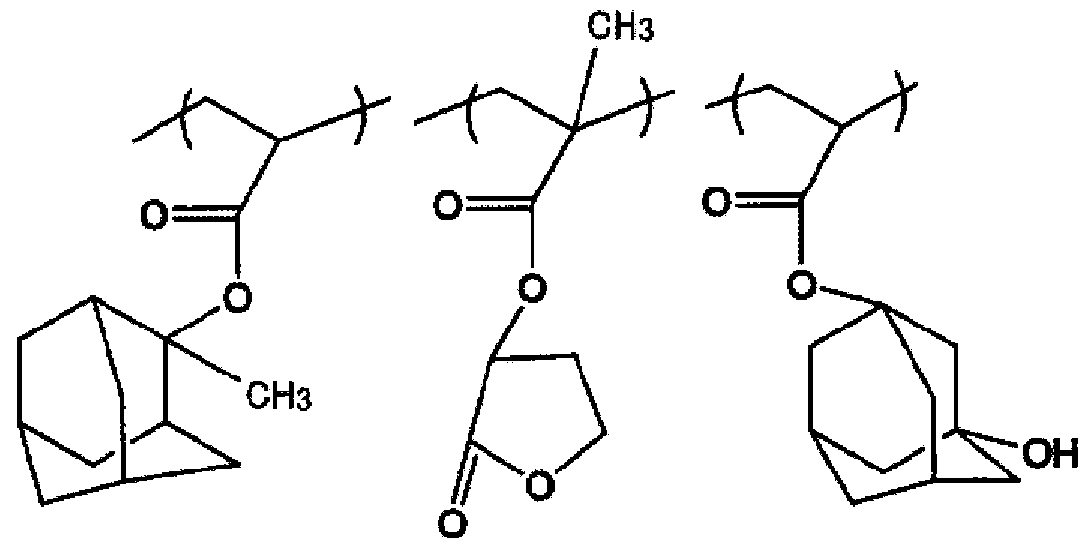
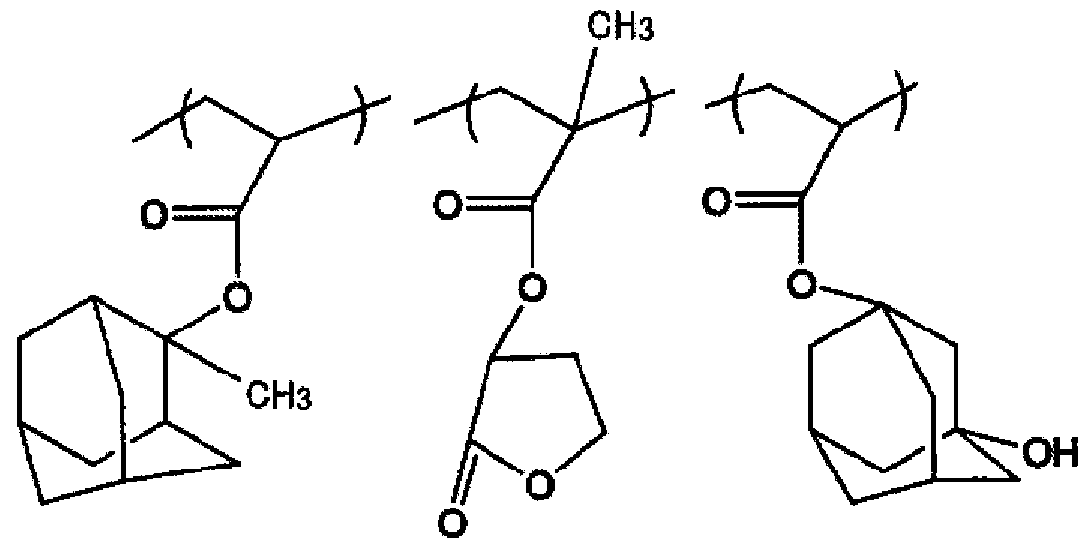
  • the component (A1) is preferably a copolymer containing at least a structural unit represented by the following chemical formula, and particularly preferably a copolymer having the power of these structural units.
  • the (Al) component can be composed of one or more resins.
  • the component (A1) can be obtained by, for example, polymerizing the monomer related to each structural unit by known radical polymerization using a radical polymerization initiator such as azobisisobutyl-tolyl (AIBN). Can be.
  • a radical polymerization initiator such as azobisisobutyl-tolyl (AIBN).
  • the mass average molecular weight (weight average molecular weight in terms of polystyrene by gel permeation chromatography, hereinafter the same) of the component (A1) is, for example, 30,000 or less, preferably 20,000 or less, more preferably 12,000 or less. More preferably there is most preferably 1000
  • the lower limit is not particularly limited, but is preferably 4000 or more, more preferably 5000 or more, from the viewpoint of suppressing the falling of the pattern and improving the resolution.
  • the component (B) can be used without particular limitation from known acid generators used in conventional chemically amplified resist compositions.
  • Such acid generators include, for example, rhodium salt-based acid generators such as rhododium salt and sulfo-dum salt, oxime sulfonate-based acid generators, bisalkyl or bisarylsulfol-diazomethanes, Many types are known, such as diazomethane-based acid generators such as poly (bissulfol) diazomethanes, iminosulfonate-based acid generators, and disulfone-based acid generators.
  • rhodium salt-based acid generators such as rhododium salt and sulfo-dum salt
  • oxime sulfonate-based acid generators bisalkyl or bisarylsulfol-diazomethanes
  • diazomethane-based acid generators such as poly (bissulfol) diazomethanes, iminosulfonate-based acid generators, and disulfone-
  • the acid salt-based acid generator include trifluoromethanesulfonate or nonafluorobutanesulfonate of difluoro-donium, trifluoromethanesulfonate of bis (4-tert-butylphenyl) iodene or Nonafluorobutanesulfonate, trifluorosulfonate trifluoromethanesulfonate, heptafluorop Mouth pansulfonate or its nonafluorobutanesulfonate, tri (4-methylphenol) snolefonium triphneoleolomethansnolefonate, its heptaphnoleolopropanesnorephonate or its nonafluorobutanesulfonate, dimethyl (4- (Hydroxynaphthyl) snolefonium, trifluorophenol snorfonate, heptafanolole
  • oxime sulfonate-based acid generator examples include ⁇ (methylsulfo-roximino) -phenylacetonitrile, at- (methylsulfo-roxyimino) - ⁇ -methoxyphenylacetonitrile, ⁇ - (trifluoromethyl) Sulfo-Roxyimino) -Furea-ceto-tolyl, ⁇ - (Trifluoromethylsulfo-Roxyimino) -p-Methoxyphenyl-acetonitrile, at- (Ethylsulfonyloxyminino) -p-Methoxyphenylacetonitrile, ⁇ - (Propylsulfo-roximinino) p-methylphenyl-acetonitrile, ⁇ (methylsulfo-roximinino) ⁇ -bromo-phenylacetonitrile and the like. Of these, ⁇ (methylsulfo-roximin
  • bisalkyl or bisarylsulfol-didiazomethanes include bis (isopropylsulfol) diazomethane, bis ( ⁇ toluenesulfol) diazomethane, and bis (1 1,1-Dimethylethylsulfol) diazomethane, bis (cyclohexylsulfol) diazomethane, bis (2,4 dimethylphenylsulfol) ) Diazomethane and the like.
  • poly (bissulfonyl) diazomethanes for example, 1,3-bis (phenylsulfol-diazomethylsulfol) propane (diamide A) having the following structure, 1,4 -Bis (phenylsulfol-diazomethylsulfol) butane (disulfide compound B), 1,6-bis (phenylsulfol-didiazomethylsulfol) hexane (disulfide compound C) ), 1,10-Bis (phenylsulfol-l-dazomethylsulfol) decane (I-Rid Compound D), 1,2-Bis (cyclohexylsulfol-l-dizazomethylsulfol) ethane (I) Daggered compound E), 1,3-bis (cyclohexylsulfol-l-dazomethylsulfol-l) propane (I-drug combination F
  • an onium salt having a fluorinated alkylsulfonic acid ion as an ion.
  • X represents an alkylene group having 2 to 6 carbon atoms in which at least one hydrogen atom is substituted by a fluorine atom; ⁇ and ⁇ each independently represent a fluorine atom in which at least one hydrogen atom is a fluorine atom.
  • X is a linear or branched alkylene group in which at least one hydrogen atom is substituted by a fluorine atom, and the alkylene group has, for example, 2 carbon atoms. -6, preferably 3-5, and most preferably 3 carbon atoms.
  • ⁇ and ⁇ are each independently a linear or branched alkyl group in which at least one hydrogen atom is substituted by a fluorine atom, and the alkyl group has, for example, 1 to LO, preferably LO. Is from 1 to 7, more preferably from 1 to 3.
  • the alkylene group of X or the alkyl groups of ⁇ and ⁇ as the number of hydrogen atoms substituted with fluorine atoms increases, the strength of the acid increases, and high energy of 200 nm or less or electron beam U, which is preferred because transparency is improved.
  • the proportion of fluorine atoms in the alkylene group or alkyl group, that is, the fluorination rate, is preferably 70 to 100%, more preferably 90 to LOO%, and most preferably all hydrogen atoms are fluorine. It is a perfluoroalkylene group or a perfluoroalkyl group substituted with an atom.
  • R "to R" each independently represent an aryl group or an alkyl group.
  • At least one of R U to R 13 represents an aryl group. Of R U ⁇ R 13, 2 or more it is not the most preferred all ⁇ rie is preferable Le a group member R U to R 13 is a Ariru group.
  • the aryl group of R U to R 13 is not particularly limited, for example, an aryl group having 6 to 20 carbon atoms, whether or not substituted with an alkyl group, an alkoxy group, a halogen atom or the like. Good phenyl and naphthyl groups are exemplified. An aryl group having 6 to 10 carbon atoms is preferable because it can be synthesized at low cost.
  • the alkyl group of R U to R 13 is not particularly limited, and examples thereof include a linear, branched or cyclic alkyl group having 1 to 10 carbon atoms. It is preferable that it has 1 to 5 carbon atoms from the viewpoint of excellent resolution. Specifically, methyl, ethyl, n-propyl, isopropyl, n-butyl, isobutyl, n-pentyl, cyclopentyl, hexyl, cyclohexyl, nonyl, A methyl group can be mentioned as a preferable one because it is excellent in resolution and can be synthesized at low cost.
  • R U to R 13 are phenol groups.
  • one type of acid generator may be used alone, or two or more types may be used in combination.
  • the content of the component (B) is 0.5 to 30 parts by mass, preferably 1 to 10 parts by mass, per 100 parts by mass of the component (A). If the amount is less than the above range, pattern formation may not be sufficiently performed. If the amount exceeds the above range, a uniform solution may not be obtained and storage stability may be deteriorated.
  • the positive resist composition of the present invention further comprises, as an optional component, a nitrogen-containing organic compound (D) (hereinafter referred to as component (D)) in order to improve the resist pattern shape, the stability with time of storage, and the like. And ⁇ ⁇ ) can be blended.
  • D nitrogen-containing organic compound
  • the lower aliphatic amine refers to an alkyl or alkyl alcohol amine having 5 or less carbon atoms.
  • the secondary and tertiary amines include trimethylamine, getylamine, triethylamine, and di- n—. Forces such as propylamine, tri-n-propylamine, tripentylamine, diethanolamine, triethanolamine, triisopropanolamine, etc.
  • tertiary alcohols such as triethanolamine and triisopropanolamine are used. preferable.
  • the component (D) is generally used in the range of 0.01 to 5.0 parts by mass based on 100 parts by mass of the component (A).
  • an organic carboxylic acid or an oxo acid of phosphorus is further added as an optional component.
  • a derivative (E) thereof hereinafter, referred to as a component (E)
  • the component (D) and the component (E) can be used in combination, or one of them can be used.
  • the organic carboxylic acid for example, malonic acid, citric acid, malic acid, succinic acid, benzoic acid, salicylic acid and the like are suitable.
  • a derivative such as phosphoric acid or an ester thereof such as phosphoric acid, di-n-butyl phosphate, and diphenyl phosphate, phosphonic acid, and phosphonic acid Acid dimethyl ester, phosphonic acid di-n-butyl ester, phenyl phosphonic acid, phosphonic acid diphenyl ester, phosphonic acid dibenzyl ester, etc., phosphonic acids and their derivatives such as esters, phosphinic acid, phenylphosphinic acid, etc. Derivatives such as phosphinic acids and their esters are preferred, of which phosphonic acids are particularly preferred! /.
  • the component (E) is used in an amount of 0.01 to 5.0 parts by mass per 100 parts by mass of the component (A).
  • Organic solvent The positive resist composition of the present invention can be produced by dissolving the materials in an organic solvent.
  • any one can be used as long as it can dissolve each component to be used and can form a uniform solution.
  • the above can be appropriately selected and used.
  • ketones such as ⁇ -butyrolataton, acetone, methyl ethyl ketone, cyclohexanone, methyl isoamyl ketone, and 2-heptanone; ethylene glycol, ethylene glycolone monoacetate, diethylene glycol, diethylene glycolone monoacetate, and propylene Polyhydric alcohols such as glycol, propylene glycol monoacetate, dipropylene glycol or dipropylene glycol monoacetate, such as monomethyl ether, monoethyl ether, monopropyl ether, monobutyl ether or monophenyl ether, and derivatives thereof, and dioxane.
  • ketones such as ⁇ -butyrolataton, acetone, methyl ethyl ketone, cyclohexanone, methyl isoamyl ketone, and 2-heptanone
  • organic solvents may be used alone or as a mixed solvent of two or more. Further, a mixed solvent obtained by mixing propylene glycol monomethyl ether acetate (PGMEA) and a polar solvent is preferable.
  • the mixing ratio may be appropriately determined in consideration of the compatibility between PGMEA and the polar solvent, but is preferably 1: 9 to 9: 1, more preferably 2: 8 to 8: 2. It is preferable to be within the range! / ,.
  • the mass ratio of PGMEA: EL is preferably 2: 8 to 8: 2, more preferably 3: 7 to 7: 3! / ,.
  • a mixed solvent of at least one selected from PGMEA and EL and ⁇ -petit mouth rataton is also preferable.
  • the mixing ratio of the former and the latter is preferably 70: 30-95: 5.
  • the amount of the organic solvent used is not particularly limited, it is a concentration that can be applied to a substrate or the like, and is appropriately set according to a coating film thickness.
  • the solid content concentration of the resist composition is 2 to 20 mass%. %, Preferably in the range of 5 to 15% by mass.
  • the positive resist composition of the present invention may further contain, if desired, additives that are miscible, for example, an additional resin for improving the performance of the resist film, a surfactant for improving coating properties, and dissolution inhibition.
  • additives that are miscible for example, an additional resin for improving the performance of the resist film, a surfactant for improving coating properties, and dissolution inhibition.
  • Agents, plasticizers, stabilizers, coloring agents, antihalation agents, dyes, and the like can be appropriately added and contained.
  • a resist film having the above-mentioned resist composition strength is formed on a support, and a contact angle of the surface of the resist film after a developer is applied to the surface of the resist film.
  • the contact angle is substantially 25 degrees or more, preferably 30 degrees or more. By satisfying this range, the difference can be further reduced. Further, lithography characteristics are improved. It is preferably 30 to 40 degrees, more preferably 32 to 40 degrees, more preferably 35 to 40 degrees, and most preferably 36 to 39 degrees.
  • the contact angle can be changed by adjusting the type and the amount of the constituent unit of the component (A1), or the type and the amount of the other components such as the component (B) described later in detail.
  • the method for measuring the contact angle will be described in detail in the description of the second embodiment.
  • the use of the positive resist composition of the first aspect can reduce the amount of diffetate. Also, the required lithography characteristics can be obtained. Further, the sensitivity is improved.
  • the required lithography characteristics can be obtained also in the shrink process described below. Further, in the shrink process, even if the temperature of the shrink process is set lower than in the past, the shrink process can be narrowed, and the point power of the apparatus and handling is also suitable. is there.
  • a positive resist composition is applied on a substrate, pre-betaed (PAB), selectively exposed, then subjected to PEB (post-exposure baking), and subjected to alkali development to obtain a resist pattern.
  • PAB pre-betaed
  • PEB post-exposure baking
  • alkali development to obtain a resist pattern.
  • the exposed area is dissolved with an alkaline developer to remove After removal, rinsing with pure water is usually performed to further remove the remaining developer and the like.
  • the contact angle of the surface of the resist film is small and easily wet (high hydrophilicity)
  • a precipitate containing a resin component that causes defetat, Affinity with relatively hydrophobic solids (including those that re-precipitate during rinsing), such as residues dissolved in the alkaline developer is low, and these precipitates and residuals have a strong It is speculated that during the rinsing and the like, the surface of the resist film is promptly removed, and this may reduce the amount of diffetate.
  • a second embodiment is a resist composition
  • a resist composition comprising (A) a resin component whose alkali solubility is increased by the action of an acid, and (B) an acid generator component which generates an acid upon exposure to light. Then, a resist film consisting of a resist composition is formed, and after a developer is applied to the surface of the resist film, the measured value of the contact angle on the surface of the resist film is 40 degrees or less. Things.
  • the differential can be reduced.
  • the lower limit is, for example, 25 degrees or more, preferably 30 degrees or more.
  • the measured value of the contact angle is 30 to 40 degrees, more preferably 32 to 40 degrees, particularly preferably 35 to 40 degrees, and most preferably 36 to 39 degrees.
  • the angle By setting the angle to 35 degrees or more, it is possible to realize excellent lithography characteristics such as DOF (depth of focus) along with reduction of the diffeatate.
  • DOF depth of focus
  • a more preferred range for the measured contact angle is 36-39 degrees.
  • the contact angle is measured as follows.
  • the component (A) has a structural unit (al ′) derived from an ( ⁇ -lower alkyl) acrylate ester containing an acid dissociable, dissolution inhibiting group and a rataton ring ( It is preferable to have a structural unit (a2 ′) derived from an (a-lower alkyl) acrylate ester.
  • the preferred ratio of the structural unit (al ′) in the component (A) is the same as the ratio in the copolymer ( ⁇ ′) in the third embodiment described later.
  • the preferred ratio of the structural unit (a2 ′) in the component (A) is the same as the ratio in the copolymer ( ⁇ ′) in the third embodiment described later.
  • the structural unit (al ') and the structural unit (a2') are not particularly limited, but are preferably contained as a copolymer.
  • the component (A) is derived from a structural unit (al '), a structural unit (a2'), and a (ex-lower alkyl) acrylate ester derived from a polar group-containing polycyclic group.
  • U which is preferably a copolymer (A1 ′) having (a3,).
  • the value of the contact angle can be adjusted to a preferable range by, for example, the following means.
  • the contact angle becomes Can easily be adjusted to less than 40 degrees. Furthermore, it is preferable to use the copolymer obtained by using the structural unit (a3) together with the structural unit (al) and the structural unit (a2) as the component (A).
  • the value of the contact angle of the resist composition is adjusted to 40 degrees or less by mixing a plurality of copolymers using the same type of structural unit.
  • the same type of constituent units indicates that the chemical structures are the same. Also, (ii) the measured values of the contact angle of the resist composition using only each copolymer as the base resin, depending on the lot to be manufactured, even if the copolymers have the same type and proportion of structural units. May be different from each other. It is presumed that this is because the production conditions such as temperature and pressure are slightly different and the distribution of the constituent units constituting the copolymer is biased.
  • a base resin when a base resin is obtained by mixing a copolymer having a large contact angle value and a copolymer having a small contact angle value when used as a resist composition, a base resin having a contact angle of 40 ° or less is obtained.
  • a resist composition can be obtained.
  • a first copolymer and a second copolymer are used. These are composed of a plurality of structural units of the same type, the ratios of the structural units are the same, and the production lots are different.
  • a composition other than the mixing ratio of the first copolymer and the second copolymer is determined in advance for the intended resist composition.
  • a first resist composition was prepared in which the component (A), which is a base resin, was made 100% by mass of the first copolymer, based on the composition of the target resist composition. I do.
  • the contact angle of the first resist composition is measured as described above. This measured value is XI.
  • a second resist composition in which the component (A) as the base resin is made 100% by mass of the second copolymer is produced.
  • the first copolymer was mixed with the first copolymer so that the measured value of the contact angle was 40 degrees or less. Then, the mixing ratio of the second copolymer is calculated.
  • the ratio of Yl, ⁇ 2 is determined so as to satisfy the following equation.
  • the first copolymer and the second copolymer are mixed in accordance with this ratio to produce ( ⁇ ⁇ ⁇ ⁇ ) a resist composition, and when the measured value of the contact angle is 40 degrees or less, A composition can be obtained.
  • the plurality of copolymers to be mixed preferably have the same type of structural unit force.
  • the ratio of the constituent units may be different between a plurality of copolymers, but the same is preferable because the control of the contact angle is easy.
  • the number of copolymers to be mixed is not particularly limited as long as it is two or more, preferably two to three, and particularly preferably two.
  • the contact angle of a plurality of copolymers to be mixed is determined by measuring the contact angle of at least one copolymer. It is desirable that the force is 0 degree or more and the contact angle of the other copolymer is less than 40 degrees.
  • the contact angle of the former is more preferably more than 40 degrees, furthermore 42 to 50 degrees.
  • the latter contact angle is more preferably 30 to 34 degrees.
  • composition other than the types of the components is designed to be the same as that of Example 1 described later, and the contact angle of the resist composition is measured.
  • the component (A) is preferably used for ArF excimer laser. Even if the composition other than the kind is slightly changed, the effect of the present invention can be obtained. Therefore, the mixing ratio of the copolymer in the component (A) can be easily obtained.
  • the contact angle can be changed by adjusting the type and the amount of the constituent unit of the component ( ⁇ ′) or the type and the amount of the other component such as the component ( ⁇ ). For example, the amount of a structural unit having a hydrophilic portion, such as a structural unit (a2 ′) or a structural unit (a3 ′), is increased; in the component (B), an acid generator having a hydrophilic group is used. Select; there is a method of adding a compound having a hydrophilic group as an additive.
  • a resist pattern can be obtained by applying a positive resist composition onto a substrate, pre-betaing, selectively exposing, subjecting to PEB (post-exposure baking), and alkali developing to obtain a resist pattern.
  • PEB post-exposure baking
  • alkali developing alkali developing
  • the contact angle of the surface of the resist film is small and easy to wet (high hydrophilicity)
  • a precipitate containing a resin component that causes defetat, Affinity with relatively hydrophobic solids (including those that re-precipitate during rinsing) such as residues dissolved in the alkaline developer decreases, and these precipitates and residuals Physical properties It is speculated that during the alkali development and rinsing, the surface of the resist film is promptly removed from the surface of the resist film, thereby reducing the amount of defattate.
  • the positive resist composition of the third embodiment is a resist composition containing (A) a resin component whose alkali solubility is increased by the action of an acid, and (B) an acid generator component which generates an acid upon exposure. Therefore, the following conditions (1) and (2) are satisfied.
  • the component (A) is a structural unit (al ') derived from ( ⁇ lower alkyl) acrylate containing an acid dissociable, dissolution inhibiting group, and an (ex-lower alkyl) attaryl having a rataton ring.
  • a resist film having a resist composition strength is formed on a support, and a measured value of a contact angle on the surface of the resist film after applying a developing solution on the surface of the resist film is 40 degrees or less. .
  • Copolymer ( ⁇ ') [hereinafter sometimes referred to as component ( ⁇ ⁇ ⁇ ')] 'Structural unit (al')
  • the structural unit (al ′) corresponds to the structural unit (al) described for the component (A1).
  • the structural unit (al ') is not limited to a hydrogen atom, and is different from the structural unit (al) in that it is a hydrogen atom or a lower alkyl group. Therefore, the configuration other than that bonded to the ⁇ -carbon atom [preferred embodiment, the blending amount in the copolymer ( ⁇ ′), etc.] can be the same as that of the structural unit (al).
  • the lower alkyl group capable of bonding to the carbon atom a can be the same as the lower alkyl group bonding to the ⁇ carbon atom of the structural unit (a2).
  • the structural unit (al ') is preferably at least one selected from the following general formulas ( ⁇ ) to ( ⁇ ).
  • R is a hydrogen atom or a lower alkyl group
  • R 1 is a lower alkyl group
  • R and I ⁇ are the same as described above.
  • R is a hydrogen atom or a lower alkyl group, and R 2 and R ° are each independently a lower alkyl group.
  • R, R 2 and R 3 are as defined above.
  • R is a hydrogen atom or a lower alkyl group
  • R 4 is a tertiary alkyl group. is there. ]
  • R, R 4 are as defined above.
  • the structural unit (a2 ′) corresponds to the structural unit (a2) described in the component (A1).
  • the one bonded to the carbon atom a is not limited to a lower alkyl group, and is different from the point power structural unit (a2) which is a hydrogen atom or a lower alkyl group.
  • the configuration other than that bonded to the ⁇ -carbon atom [preferred embodiment, the blending amount in the copolymer ( ⁇ ′), etc.] can be the same as that of the structural unit (a2).
  • the lower alkyl group that can be bonded to the a carbon atom can be the same as the lower alkyl group that is bonded to the oc carbon atom of the structural unit (a2).
  • the structural unit (a2 ') is preferably at least one selected from the following formulas (IV') to (Vn ').
  • R is a hydrogen atom or a lower alkyl group
  • R 5 and R 6 are each independently a hydrogen atom or a lower alkyl group.
  • R, R 5 and R 6 are the same as described above.
  • R is a hydrogen atom or a lower alkyl group, and m is 0 or 1.
  • R and m are the same as described above.
  • R is a hydrogen atom or a lower alkyl group.
  • R is a hydrogen atom or a lower alkyl group.
  • the structural unit (a3,) is the same as the structural unit (a3).
  • the blending amount in the copolymer ( ⁇ ) can be the same as that of the structural unit (a3).
  • the structural unit (a3 ′) is preferably at least one of the following general formulas (VIII ′) to (IX ′), similarly to the structural unit (a3).
  • R is a hydrogen atom or a lower alkyl group, and ⁇ is an integer of 1 to 3.
  • equation ( ⁇ ′) is the same as that of equation (VIII).
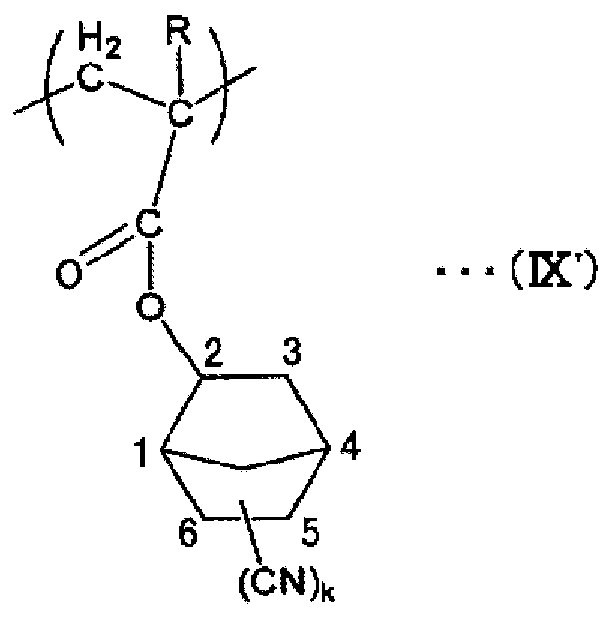
  • R is a hydrogen atom or a lower alkyl group, and k is an integer of 1-3.
  • the description of the formula (IX ') is the same as that of the formula (IX). [0118] • Other constituent units
  • the component (Al,) may contain a structural unit other than the structural units (al,) to (a3,), and the total amount of these structural units is preferably 70 mol / mol. % or more, preferably 8 0 mole 0/0 or more, and most preferably 100 mole 0/0.
  • structural units (a4,) other than the structural units (al,) to (a3,) are not classified into the above structural units (a1 ') to (a3'). Not particularly limited! / ,.
  • the structural unit (a4 ′) corresponds to the structural unit (a4) described in the component (A1), and a similar unit can be used.
  • the component (II) is more preferably a copolymer containing at least a structural unit represented by the following chemical formula, and is particularly preferably a copolymer having the power of these structural units.
  • the structural unit (al ′) is a structural unit derived from an acrylate ester
  • the structural unit (a2 ′) is a structural unit derived from an ⁇ -lower alkyl acrylate. This facilitates the adjustment of the contact angle and improves the effect of suppressing the differential.
  • the component (A1 ') can be composed of one or more resins.
  • the component ( ⁇ ′) is obtained, for example, by polymerizing a monomer related to each structural unit by a known radical polymerization using a radical polymerization initiator such as azobisisobutyl-tolyl ( ⁇ ). be able to.
  • a radical polymerization initiator such as azobisisobutyl-tolyl ( ⁇ ).
  • the weight average molecular weight (weight average molecular weight in terms of polystyrene by gel permeation chromatography, hereinafter the same) of the component (A1,) is, for example, 30,000 or less, and 20000 or less. It is preferably below 12000, more preferably below 12000, most preferably below 10,000.
  • the lower limit is not particularly limited, but is preferably 4000 or more, and more preferably 5000 or more, from the viewpoint of suppressing the turn of the turn and improving the resolution.
  • the weight average molecular weight (polystyrene equivalent weight average molecular weight by gel permeation chromatography, hereinafter the same) of the components is, for example, about 12,000 or less, preferably 10,000 or less.
  • the lower limit is not particularly limited, but is preferably 4000 or more, and more preferably 5000 or more, in terms of suppression of the fall of the no-turn and resolution.
  • a resist film made of a resist composition is formed on a support, and a contact angle of the surface of the resist film is measured after a developer is applied to the surface of the resist film.
  • the fixed value is 40 degrees or less.
  • the contact angle is substantially 25 degrees or more, preferably 30 degrees or more.
  • the differential can be reduced. More preferably, the measured value of the contact angle is 30 to 40 degrees, more preferably 32 to 40 degrees, particularly preferably 35 to 40 degrees, and most preferably 36 to 39 degrees.
  • the contact angle can be changed by adjusting the type and the amount of the constituent unit of the component ( ⁇ ′) or the type and the amount of the other component such as the component ( ⁇ ). For example, increase the amount of a structural unit having a hydrophilic portion, such as a structural unit (a2 ') or a structural unit (a3').
  • Component (B) an acid generator having a hydrophilic group is selected; there is a method of adding a compound having a hydrophilic group as an additive.
  • the contact angle can be easily adjusted.
  • the contact angle is measured as follows.
  • the use of the positive resist composition of the third embodiment makes it possible to reduce the amount of diffetate. Also, the required lithography characteristics can be obtained. Furthermore, the sensitivity is improved. The required lithography characteristics can also be obtained in the shrink process described later.
  • a resist pattern can be obtained by applying a positive resist composition onto a substrate, pre-betaing, selectively exposing, subjecting to PEB (post-exposure baking), and alkali developing to obtain a resist pattern.
  • PEB post-exposure baking
  • alkali developing alkali developing
  • the contact angle of the surface of the resist film is small and easily wet (high in hydrophilicity)
  • a precipitate containing a resin component that causes defetat, Affinity with relatively hydrophobic solids (including those that re-precipitate during rinsing) such as residues dissolved in the alkaline developer decreases, and these precipitates and residuals Physical properties It is speculated that during the alkali development and rinsing, the surface of the resist film is promptly removed from the surface of the resist film, thereby reducing the amount of defattate.
  • the method of forming a resist pattern according to the present invention can be performed, for example, as follows. That is, first, the positive resist composition is coated on a support such as silicon wafer by a spinner or the like, and the pre-beta is heated at a temperature of 80 to 150 ° C. for 40 to 120 seconds, preferably 60 to 90 seconds. After selectively exposing (irradiating) an ArF excimer laser beam through a desired mask pattern using, for example, an ArF exposure apparatus, the PEB (exposure) is performed under a temperature condition of 80 to 150 ° C. Post-heating) for 40 to 120 seconds, preferably 60 to 90 seconds. Next, this is developed using an alkali developing solution, for example, an aqueous solution of 0.1 to 10% by mass of tetramethylammonium hydroxide. Thus, a resist pattern faithful to the mask pattern can be obtained.
  • an alkali developing solution for example, an aqueous solution of 0.1 to 10% by mass of tetramethylammonium hydro
  • an organic or inorganic antireflection film can be provided between the support (substrate) and the coating layer of the resist composition.
  • the support is not particularly limited, and a conventionally known support can be used. Examples thereof include a substrate for electronic components and a substrate on which a predetermined wiring pattern is formed. It comes out.
  • the substrate examples include a substrate made of metal such as silicon-ano, copper, chromium, iron, and aluminum, and a glass substrate.
  • the wiring pattern for example, copper, solder, chromium, aluminum, nickel, gold, and the like can be used.
  • the wavelength used for exposure is not particularly limited.
  • the resist composition which is effective in the present invention is effective for ArF excimer laser.
  • the positive resist composition of the present invention is suitably used in a shrink process described in detail below. In other words, even when applied to a shrink process, favorable lithography characteristics realizable.
  • the present applicant After forming a resist pattern on a support, the present applicant forms a water-soluble coating on the resist pattern, and heat-treats the water-soluble coating to shrink it.
  • a shrink process for reducing the size of a resist pattern by utilizing the action has been proposed (JP-A-2003-107752, JP-A-2003-202679, etc.).
  • the shrink process is a method in which after a resist pattern is coated with a water-soluble coating, the water-soluble coating is thermally contracted by heat treatment, and the space between the resist patterns is reduced by the heat-shrinking action.
  • a resist pattern forming method for performing a shrink process can be performed, for example, as follows.
  • a resist pattern is formed according to the general method described above.
  • a water-soluble coating forming agent containing a water-soluble polymer or the like is applied on a resist pattern formed on a support, and preferably, a water-soluble coating is formed on the entire surface of the resist pattern and laminated. Form the body.
  • the support After applying the water-soluble coating-forming agent, the support may be pre-betaed at a temperature of 80 to 100 ° C for 30 to 90 seconds.
  • the coating method can be performed according to a known method which is conventionally used for forming a resist layer or the like. That is, an aqueous solution of the coating forming agent is applied on the resist pattern by, for example, a spinner.
  • the water-soluble coating preferably has a thickness of about 0.1 to 0.5 m, which is preferably about the same as or covering the height of the photoresist pattern.
  • a heat treatment is performed on the obtained laminate to thermally shrink the water-soluble coating. Due to the heat shrinkage effect of the water-soluble coating, the side walls of the resist pattern in contact with the water-soluble coating are attracted to each other, and the distance between the portions of the resist in the resist pattern (between the patterns) is reduced. As a result, the pattern can be miniaturized. [0141] In the shrink process, the heat treatment is performed at a temperature at which the water-soluble coating shrinks and at a heating temperature and a heating time at which the resist does not cause thermal flow.
  • the heating temperature is 3 to 50 ° C, preferably about 5 to 30 ° C lower than the temperature (fluidization temperature) at which the resist pattern formed on the support starts to flow (flow) spontaneously by the heat treatment. ! ⁇ It is preferable to heat within the temperature range. Further, in consideration of the shrink force of the water-soluble coating, the preferable heat treatment is usually in the temperature range of preferably about 80 to 160 ° C, more preferably about 130 to 160 ° C. In the positive resist composition of the first embodiment, the pattern can be narrowed even if the heating temperature is set low. Suitable temperature conditions are, for example, 70-150 ° C.
  • the fluidization temperature of the resist pattern varies depending on the type and the amount of the components contained in the resist composition.
  • the heating time varies depending on the heating temperature, and is usually about 30 to 90 seconds.
  • the water-soluble coating remaining on the pattern is removed by washing with an aqueous solvent, preferably pure water, for 10 to 60 seconds.
  • an aqueous solvent preferably pure water
  • the water-soluble coating can be easily removed by washing with water, and can be completely removed on the support and the resist pattern.
  • the water-soluble coating forming agent contains a water-soluble polymer.
  • a water-soluble coating forming agent containing such a water-soluble polymer is suitably used for a shrink process.
  • water-soluble polymer acrylic polymers, vinyl polymers, cellulose derivatives, alkylene glycol polymers, urea polymers, melamine polymers, epoxy polymers are particularly preferable from the industrial point of view. It is preferable to select and use also a coalescence and an amide polymer power.
  • the acrylic polymer refers to a polymer containing an acrylic monomer
  • the vinyl polymer refers to a polymer containing a vinyl monomer
  • the cellulose polymer refers to a cellulose polymer.
  • Alkylene glycol-based polymer means a polymer containing an alkylene glycol-based monomer
  • urea-based polymer means a polymer containing a urea-based monomer.
  • a melamine-based polymer refers to a polymer containing a melamine-based monomer
  • an epoxy-based polymer refers to an epoxy-based monomer.
  • an amide-based polymer means a polymer containing an amide-based monomer.
  • These polymers may be used alone or as a mixture of two or more.
  • acrylic polymer examples include acrylic acid, acrylamide, methyl acrylate, methacrylic acid, methyl methacrylate, N, N-dimethylacrylamide, N, N-dimethylaminopropyl methacrylamide, N, N-dimethyl Aminopropylacrylamide, N-methylacrylamide, diacetoneacrylamide, N, N-dimethylaminoethyl methacrylate, N, N-getylaminoethyl methacrylate, N, N-dimethylaminoethyl acrylate, acryloyl
  • examples include a polymer or a copolymer having a structural unit derived from a monomer such as morpholine.
  • bullet polymer examples include a polymer or a copolymer having a structural unit derived from a monomer such as morpholine, N-bulpyrrolidone, bulimidazolidinone, and vinyl acetate.
  • Examples of the cellulosic derivative include hydroxypropylmethylcellulose phthalate, hydroxypropylmethylcellulose acetate phthalate, hydroxypropylmethyl cenorellose hexahydrophthalate, hydroxypropinolemethinoresenolerose acetate succinate, hydroxypropinolemethinoresenolerose, and hydroxypropylmethylcellenoacetate.
  • Examples include propynoresenorelose, hydroxyethyl cellulose, cellulose acetate hexahydrophthalate, canoleboxymethylcellulose, ethylcellulose, and methylcellulose.
  • alkylene glycol-based polymer examples include an addition polymer or an addition copolymer of a monomer such as ethylene glycol or propylene glycol.
  • urea-based polymer examples include those having a structural unit derived from a monomer such as methylolated urea, dimethylol urea, and ethylene urea.
  • Examples of the melamine-based polymer include methoxymethylated melamine, methoxymethylated isobutoxymethylated melamine, and methoxyethylated melamine, which have a constitutional unit from which a monomeric force is also induced.
  • the composition contains at least one selected from the group consisting of alkylene glycol polymer, cellulose polymer, bull polymer, and acryl polymer.
  • alkylene glycol polymer cellulose polymer
  • bull polymer acryl polymer
  • acryl polymer a copolymer of an acryl-based monomer and a monomer other than an acrylic-based monomer. The point that the size of the photoresist pattern can be efficiently reduced while maintaining the shape of the photoresist pattern during heat treatment. preferable.
  • a water-soluble polymer containing N-butylpyrrolidone as a monomer having a proton donating property and acrylic acid as a monomer having a proton accepting property is preferable because of a large shrinkage ratio upon heating. That is, it is preferable that the water-soluble polymer has a structural unit from which acrylic acid power is also induced and a structural unit from which bulpyrrolidone force is induced.
  • the compounding ratio of the constituent components is not particularly limited. However, when a water-soluble polymer is used as a mixture, especially when stability over time is emphasized, the compounding of the acryl polymer is considered. Preferably, the ratio is higher than the other constituent polymers. In addition to improving the stability over time, it is also possible to solve the problem by adding an acidic compound such as p-toluenesulfonic acid and dodecylbenzenesulfonic acid in addition to the excessive amount of the acrylic polymer as described above. It is possible.
  • an acidic compound such as p-toluenesulfonic acid and dodecylbenzenesulfonic acid
  • the water-soluble coating-forming agent preferably further contains a surfactant. As a result, the occurrence of differential can be effectively prevented.
  • a water-soluble amine may be further added to the water-soluble coating forming agent, if desired, from the viewpoint of preventing generation of impurities, pH adjustment and the like.
  • the water-soluble coating forming agent may further contain a non-amine-based water-soluble organic solvent, if desired, from the viewpoint of miniaturization of the photoresist pattern size and suppression of the occurrence of diffeatate.
  • the water-soluble coating forming agent is preferably used in the form of water having a concentration of 3 to 50% by mass or a solution of water and an alcohol-based solvent (alcohol concentration has an upper limit of about 30% by mass based on water).
  • Masu U particularly preferred to be used as a 5-20% by weight solution.
  • component (B), component (D), and an organic solvent were mixed to form a solution, and a positive resist composition having a solid content of 8 % by mass was produced.
  • the contact angle of the resist film made of the resist composition after application of the developing solution was 37.7 degrees (37.7 degrees).
  • the Tg of the copolymer was 120 ° C.
  • the Tg (glass transition point) was measured with a thermal analyzer TGZDTA6200 (product name, manufactured by Seiko Instrument Co.) under a temperature rising condition of 10 ° CZmin.
  • the molar ratio of lZmZn is 40 mol% Z40 mol% Z20 mol%, the mass average molecular weight is 10,000, and the degree of dispersion [Mw (mass average molecular weight) Z Mn (number average molecular weight )] 2.0 copolymer
  • the following copolymer, component (B), component (D), and an organic solvent were mixed to form a solution, and a positive resist composition having a solid content of 8 % by mass was produced.
  • the contact angle of the resist film made of the resist composition after application with the developing solution was 51.18 degrees (51.18 degrees).
  • the Tg of the copolymer was 138 ° C.
  • Example 1 The resist compositions of Example 1 and Comparative Example 1 were evaluated as follows.
  • Organic antireflective coating composition "ARC-29A” (trade name, manufactured by Prue Science) is applied on an 8-inch silicon wafer using a spinner, and placed on a hot plate at 205 ° C for 60 seconds. By firing and drying, an organic antireflection film having a thickness of 77 nm was formed. Then, a positive resist composition is applied on the antireflection film using a spinner, pre-beta (PAB) at 110 ° C for 90 seconds on a hot plate, and dried to form a 225 nm-thick resist layer. did.
  • PAB pre-beta
  • the sensitivity when each pattern is formed is (1—1) 23. Onj / cm 2 , (1—2) 3 0.5 mjZcm 2 , (2—1) 32. Onj / cm 2 , (2-2) 42.5 mjZcm 2 , indicating that the resist composition of the example had a high sensitivity.
  • Example 1 Each of the positive resist compositions of Example 1 and Comparative Example 1 was directly applied on an 8-inch silicon wafer using a spinner, and pre-plated (PAB) at 105 ° C for 90 seconds on a hot plate. Then, a resist layer having a thickness of 220 nm was formed by drying.
  • PAB pre-plated
  • a PEB treatment was conducted under conditions of 100 ° C, 90 seconds, further 23 ° C at 2.38 mass 0/0 tetra Mechiruanmo - 60 seconds and puddle developed with Umuhidorokishido solution, 1 sec at 1000 rpm, then 500 revolutions For 15 seconds (forced conditions that make it more likely to cause differential attack).
  • the solution was dropped and dried to form a resist pattern.
  • a normal rinsing process in which a rinsing liquid was dropped in the order of 2000 rotations for 10 seconds and 1000 rotations for 50 seconds was performed.
  • the pattern formed a dense hole pattern having a hole diameter of 300 nm (a pattern in which hole patterns having a diameter of 300 nm were arranged at intervals of 300 nm).
  • a resist pattern was formed in the same manner as in “Evaluation of resolution”, and the depth of focus (DOF) was measured.
  • Example 1 the following measured values were obtained.
  • Water-soluble coating forming agent FSC5000EX (product name, manufactured by Tokyo Ohka Kogyo Co., Ltd.)
  • resist composition 1 A resist composition was produced in the same manner as in Example 1 except that the component (A) was used. This is referred to as “resist composition 1”.
  • the measured value of the contact angle of the resist composition 1 was 44.45 degrees (44.45 degrees) (Comparative Example 2).
  • the structural unit force represented by the chemical formula (1) is as follows: the molar ratio of lZmZn is 40 mol% Z40 mol% Z20 mol%, the mass average molecular weight is 10,000, and the degree of dispersion [Mw (mass average molecular weight) Z
  • a resist composition was produced in the same manner as in Example 1, except that the copolymer 2-1 was used instead of the copolymer 2-1. This is referred to as resist composition 2.
  • Copolymer 2-2 100 parts by mass
  • Copolymer 2-Copolymer 2 consisting of the same constituent units and the same proportions of the same constituent units as in Copolymer 2-1 and having the same mass average molecular weight and degree of fraction, and differing only in the production lot from Copolymer 2-1. -2
  • the measured value of the contact angle of the resist composition 2 was 33.72 degrees (33.72 °) (Example 2).
  • the measured value of the contact angle of the resist composition 3 was 38.87 degrees (38.87 °) (Example 3).
  • the resist compositions 1, 2, and 3 were measured for defifate in accordance with the above “Evaluation of Defattate.” As a result, it was found that the number of the resist yarn 1 was 27598 pieces of Z8 inch wafer.
  • the resist composition 2 was a 69-piece Z8-inch wafer.
  • the resist composition 3 was 354 Z8 inch wafers.
  • the resist compositions 2 and 3 (Examples 2 and 3) having a measured force of contact angle of 0 degree or less had a favorable evaluation of the diffetate.
  • the resist composition 1 (Comparative Example 2) having a measured contact angle of more than 40 degrees was poor in the evaluation of defattate. From these results, it is clear that even when copolymers of the same type and the same ratio of the constituent units are used, measured values of the contact angle are different due to differences in production lots and the like.

Landscapes

  • Physics & Mathematics (AREA)
  • Spectroscopy & Molecular Physics (AREA)
  • General Physics & Mathematics (AREA)
  • Materials For Photolithography (AREA)
  • Exposure And Positioning Against Photoresist Photosensitive Materials (AREA)

Abstract

 (A)酸の作用によりアルカリ可溶性が増大する樹脂成分、及び(B)露光により酸を発生する酸発生剤成分を含有するレジスト組成物であって、  前記(A)成分が、酸解離性溶解抑制基を含むアクリル酸エステルから誘導される構成単位(a1)、ラクトン環を有するα-低級アルキルアクリル酸エステルから誘導される構成単位(a2)、及び極性基含有多環式基を含む(α-低級アルキル)アクリル酸エステルから誘導される構成単位(a3)を有する共重合体(A1)であるポジ型レジスト組成物。

Description

ポジ型レジスト組成物及びレジストパターン形成方法
技術分野
[0001] 本発明は、ポジ型レジスト組成物及びレジストパターン形成方法に関する。
本願は、 2004年 05月 28日に日本国特許庁に出願された特願 2004— 159421 号と、 2004年 11月 05曰に日本国特許庁に出願された特願 2004— 322545号に 対し優先権を主張し、その内容をここに援用する。
背景技術
[0002] 一般に KrFエキシマレーザー、 ArFエキシマレーザー、 Fエキシマレーザー、 EU
2
V (極端紫外光)、 EB (電子線)等を光源 (放射線源)に用いる化学増幅型のホトレジ スト組成物は、例えば、特開 2003— 167347号公報 (特許文献 1)に記載されている 様に、榭脂成分 (A)と、放射線の照射により酸を発生する酸発生剤成分 (B)を、有 機溶剤 (C)に溶解してなるものである。
[0003] そして、このようなホトレジスト組成物には、リソグラフィー特性 (解像性、焦点深度幅 特性、レジストパターン形状等)が良好であることが要求される。
さらには、近年のように高解像性のレジストパターンが要求されるようになってくると 、これらの特性に加えて、従来以上に現像後のレジストパターンのディフエタト (表面 欠陥)の改善が 、つそう必要となってくる。
このディフエタトとは、例えば、 KLAテンコール社の表面欠陥観察装置(商品名「K LA」)により、現像後のレジストパターンを真上カゝら観察した際に検知される不具合全 般のことである。この不具合とは、例えば現像後のスカム、泡、ゴミ、レジストパターン 間のブリッジ、色むら、析出物等である。
さらに近年、現象後のレジストパターンのディフエタトの中でも、特に ArFエキシマレ 一ザ一以降、すなわち ArFエキシマレーザー、 Fエキシマレーザー、 EUV
2 、 EB等を 光源とした 130nm以下のレジストパターンのような微細なレジストパターンを形成す る場合には、ディフエタトの解決の問題が!/ヽつそう厳しくなつてきて 、る。
特許文献 1 :特開 2003— 167347号公報 発明の開示
発明が解決しょうとする課題
[0004] し力しながら、従来のポジ型レジスト組成物では、充分にディフエタトを低減すること ができない。
[0005] 本発明は前記事情に鑑みてなされたものであって、ディフエタトを低減することがで きるポジ型レジスト組成物及びこれを用いたレジストパターン形成方法を提供すること を課題とする。
課題を解決するための手段
[0006] 上記の目的を達成するために、本発明は以下の構成を採用した。
第 1の態様 (aspect)は、(A)酸の作用によりアルカリ可溶性が増大する榭脂成分、 及び (B)露光により酸を発生する酸発生剤成分を含有するレジスト組成物であって、 前記 (A)成分が、酸解離性溶解抑制基を含むアクリル酸エステルから誘導される 構成単位 (al)、ラタトン環を有する ex—低級アルキルアクリル酸エステルカゝら誘導さ れる構成単位 (a2)、及び極性基含有多環式基を含む( a 低級アルキル)アクリル 酸エステル力も誘導される構成単位 (a3)を有する共重合体 (A1)であり、かつ 支持体上に、前記レジスト組成物力 なるレジスト膜を形成し、該レジスト膜の表面 に現像液を塗布した後の当該レジスト膜の表面の接触角の測定値が 40度以下であ るポジ型レジスト糸且成物である。
第 2の態様は、(A)酸の作用によりアルカリ可溶性が増大する榭脂成分、及び (B) 露光により酸を発生する酸発生剤成分を含有するレジスト組成物であって、支持体 の上に、前記レジスト組成物カゝらなるレジスト膜を形成し、該レジスト膜の表面に現像 液を塗布した後の当該レジスト膜の表面の接触角の測定値が 40度以下であるポジ 型レジスト組成物である。
第 3の態様は、(A)酸の作用によりアルカリ可溶性が増大する榭脂成分、及び (B) 露光により酸を発生する酸発生剤成分を含有するレジスト組成物であって、下記(1) 、 (2)の条件を満足するポジ型レジスト組成物である。
( 1)前記 (A)成分が、酸解離性溶解抑制基を含む(α 低級アルキル)アクリル酸ェ ステルカゝら誘導される構成単位 (al ' )、ラタトン環を有する( a—低級アルキル)アタリ ル酸エステルから誘導される構成単位 (&2' )、及び極性基含有多環式基を含む( a 低級アルキル)アクリル酸エステル力 誘導される構成単位 (a3, )を有する共重合 体 (Al,)である。
(2)支持体の上に、前記レジスト組成物力 なるレジスト膜を形成し、該レジスト膜の 表面に現像液を塗布した後の当該レジスト膜の表面の接触角の測定値が 40度以下 である。
第 4の態様は、前記第 1乃至第 3のいずれかの態様のポジ型レジスト組成物を基板 上に塗布し、プレベータし、選択的に露光した後、 PEB (露光後加熱)を施し、アル力 リ現像してレジストパターンを形成するレジストパターン形成方法である。
[0007] なお、本発明にお!/、て、「( α 低級アルキル)アクリル酸エステル」とは、メタクリル 酸エステル等の α—低級アルキルアクリル酸エステルと、アクリル酸エステルの一方 あるいは両方を意味する。ここで、 「α 低級アルキルアクリル酸エステル」とは、ァク リル酸エステルの α炭素原子に結合した水素原子が低級アルキル基で置換されたも のを意味する。
「構成単位」とは、重合体を構成するモノマー単位を意味する。
「アクリル酸エステルカゝら誘導される構成単位」とは、アクリル酸エステルのエチレン 性二重結合が開裂して構成される構成単位を意味する。
「 α—低級アルキルアクリル酸エステル力も誘導される構成単位」とは、 α—低級ァ ルキルアクリル酸エステルのエチレン性二重結合が開裂して構成される構成単位を 意味する。
「( a—低級アルキル)アクリル酸エステル力 誘導される構成単位」とは、 ( a—低 級アルキル)アクリル酸エステルのエチレン性二重結合が開裂して構成される構成単 位を意味する。
そして、「露光」は放射線の照射全般を含む概念とする。
発明の効果
[0008] 本発明においては、ディフエタトを低減することができるポジ型レジスト組成物及び これを用いたレジストパターン形成方法を提供することができる。
発明を実施するための最良の形態 [0009] [ポジ型レジスト組成物] <第 1の態様 >
第 1の態様のポジ型レジスト組成物は、 (A)酸の作用によりアルカリ可溶性が増大 する榭脂成分、及び (B)露光により酸を発生する酸発生剤成分を含有するレジスト 組成物であって、
前記 (A)成分が、酸解離性溶解抑制基を含むアクリル酸エステルから誘導される 構成単位 (a l)、ラタトン環を有する ex—低級アルキルアクリル酸エステルカゝら誘導さ れる構成単位 (a2)、及び極性基含有多環式基を含む( a 低級アルキル)アクリル 酸エステル力も誘導される構成単位 (a3)を有する共重合体 (A1)であって、支持体 上に、前記レジスト組成物からなるレジスト膜を形成し、該レジスト膜の表面に現像液 を塗布した後の当該レジスト膜の表面の接触角の測定値が 40度以下である。
[0010] 第 1の態様においては、構成単位 (a l)と、構成単位 (a2)と、構成単位 (a3)におい て、エステル基が結合する α位の炭素原子に、さらに結合する水素原子あるいは低 級アルキル基を、各構成単位毎に選択して組み合わせた共重合体 (A1)を用いるこ とにより、ディフエタトを低減することができる。また必要なリソグラフィー特性も得られ る。
[0011] 共重合体 (A1) [以下、(A1)成分という場合がある。 ],構成単位 (al)
構成単位 (al)において、 α炭素原子に結合しているのは、水素原子である。
構成単位 (al)の酸解離性溶解抑制基は、露光前の (A1)成分全体をアルカリ不 溶とするアルカリ溶解抑制性を有すると同時に、露光後に酸発生剤 (B)から発生した 酸の作用により解離し、この (A1)成分全体をアルカリ可溶性へ変化させる基である。
酸解離性溶解抑制基としては、例えば ArFエキシマレーザーのレジスト組成物用 の榭脂にお ヽて、多数提案されて ヽるものの中から適宜選択して用いることができる 。一般的には、アクリル酸のカルボキシル基と環状又は鎖状の第 3級アルキルエステ ルを形成する基、及び環状又は鎖状のアルコキシアルキル基を形成する基が広く知 られている。
[0012] 環状または鎖状のアルコキシアルキルエステルとは、カルボキシル基の水素原子が アルコキシアルキル基で置換されることによりエステルを形成しており、そのカルボ- ルォキシ基(一 C (O)— O—)の末端の酸素原子に前記アルコキシアルキル基が結 合して 、る構造を示し、このアルコキシアルキルエステル基は酸が作用すると酸素原 子とアルコキシアルキル基との間で結合が切断される。このような環状または鎖状の アルコキシアルキル基としては、 1ーメトキシメチル基、 1 エトキシェチル基、 1 イソ プロポキシェチル、 1ーシクロへキシルォキシェチル基、 2—ァダマントキシメチル基 、 1ーメチルァダマントキシメチル基、 4 ォキソ 2 ァダマントキシメチル基等が挙 げられる。
鎖状の第 3級アルキルエステルを形成する酸解離性溶解抑制基としては、例えば t ブチル基、 tert—ァミル基等が挙げられる。
なお、構成単位 (al)としては、環状、特に、脂環式基を含有する酸解離性溶解 抑制基を含む構成単位が好ましい。脂環式基としては、単環、または多環のいずれ でもよぐ例えば ArFレジスト等において、多数提案されているものの中力も適宜選択 して用いることができる力 エッチング耐性の点からは多環の脂環式基が好ましい。ま た、脂環式基は炭化水素基が好ましぐ飽和であることが好ましい。
単環の脂環式基としては、例えば、シクロアルカンから 1個の水素原子を除いた基 が挙げられる。多環の脂環式基としては、例えばビシクロアルカン、トリシクロアルカン 、テトラシクロアルカンなどから 1個の水素原子を除 、た基などを例示できる。
具体的には、単環のものとしては、シクロペンチル基、シクロへキシル基などが挙 げられる。多環のものとしては、ァダマンタン、ノルボルナン、イソボルナン、トリシクロ デカン、テトラシクロドデカンなどのポリシクロアルカンから 1個の水素原子を除いた基 などが挙げられる。
これらの中でもァダマンタンから 1個の水素原子を除いたァダマンチル基、ノルボ ルナンから 1個の水素原子を除いたノルボル-ル基、トリシクロデカンからの 1個の水 素原子を除いたトリシクロデカニル基、テトラシクロドデカンから 1個の水素原子を除 Vヽたテトラシクロドデ力-ル基が工業上好ま 、。
[0013] より具体的には、構成単位 (al)は、下記一般式 (Ι)〜(ΠΙ)力 選ばれる少なくとも 1種であると好ましい。
[0014] [化 1]
Figure imgf000007_0001
[式 (I)中、 R1は低級アルキル基である。 ]
[0015] [化 2]
Figure imgf000007_0002
[式 (II)中、 R2及び R3はそれぞれ独立に低級アルキル基である。 ]
[化 3]
Figure imgf000007_0003
[式 (III)中、 R4は第 3級アルキル基である。 ]
[0017] 前記 R1としては、炭素数 1〜5の低級の直鎖又は分岐状のアルキル基が好ましぐ メチル基、ェチル基、プロピル基、イソプロピル基、 n—ブチル基、イソブチル基、ペン チル基、イソペンチル基、ネオペンチル基等が挙げられる。その中でも、メチル基、ェ チル基であることが工業的に入手が容易であることから好ましい。 [0018] 前記 R2及び R3は、それぞれ独立に、好ましくは炭素数 1〜5の直鎖または分岐の 低級アルキル基である。中でも、 R2、 R3が共にメチル基である場合が工業的に好まし ぐ具体的には、 2- (1—ァダマンチル)—2—プロピルアタリレートから誘導される構 成単位を挙げることができる。
[0019] 前記 R4が鎖状の第 3級アルキル基または環状の第 3級アルキル基であることが好ま しい。鎖状の第 3級アルキル基としては、例えば tert ブチル基や tert—ァミル基で あり、 tert ブチル基である場合が工業的に好ましい。なお、第 3級アルキル基とは、 第 3級炭素原子を有するアルキル基である。
環状の第 3級アルキル基としては、前述の「脂環式基を含有する酸解離性溶解抑 制基」で例示したものと同じであり、 2—メチルー 2—ァダマンチル基、 2—ェチルー 2 ーァダマンチル基、 2—(1ーァダマンチル) 2—プロピル基、 1ーェチルシクロへキ シル基、 1ーェチルシクロペンチル基、 1ーメチルシクロへキシル基、 1ーメチルシクロ ペンチル基等を挙げることができる。
また、基一 COOR4は、式中に示したテトラシクロドデ力-ル基の 3または 4の位置 に結合していてよいが、結合位置は特定できない。また、アタリレート構成単位のカル ボキシル基残基も同様に式中に示した 8または 9の位置に結合して 、てよ 、が、結合 位置は特定できない。
[0020] 構成単位 (al)は 1種または 2種以上組み合わせて用いることができる。
構成単位 (al)は、(A1)成分中の全構成単位の合計に対して、 20〜60モル0 /0、 好ましくは 30〜50モル0 /0であり、 35〜45モル0 /0であることが最も好ましい。
下限値以上とすることによってパターンを得ることができ、上限値以下とすることにより 他の構成単位とのバランスをとることができる。
[0021] ·構成単位 (a2)
構成単位 (a2)において、 α炭素原子に結合しているのは、低級アルキル基である 構成単位 (a2)としては、 a 低級アルキルアクリル酸エステルのエステル側鎖部 にラタトン環力 なる単環式基またはラタトン環を有する多環の環式基が結合した構 成単位が挙げられる。なお、このときラタトン環とは、 -o-c(o) 構造を含むひと つの環を示し、これをひとつの目の環として数える。したがって、ここではラタトン環の みの場合は単環式基、さらに他の環構造を有する場合は、その構造に関わらず多環 式基と称する。
そして、構成単位 (a2)としては、具体的には例えば、 γ—プチ口ラタトン力 水素原 子 1つを除いた単環式基や、ラタトン環含有ビシクロアルカン力 水素原子を 1つを除 V、た多環式基を有するもの等が挙げられる。
構成単位 (a2)にお 、て、 a炭素原子に結合して!/、る低級アルキル基は、好ましく は炭素数 1〜5の直鎖又は分岐状アルキル基であり、メチル基、ェチル基、プロピル 基、イソプロピル基、 n—ブチル基、イソブチル基、 tert-ブチル基、ペンチル基、イソ ペンチル基、ネオペンチル基などが挙げられる。工業的にはメチル基が好ましい。
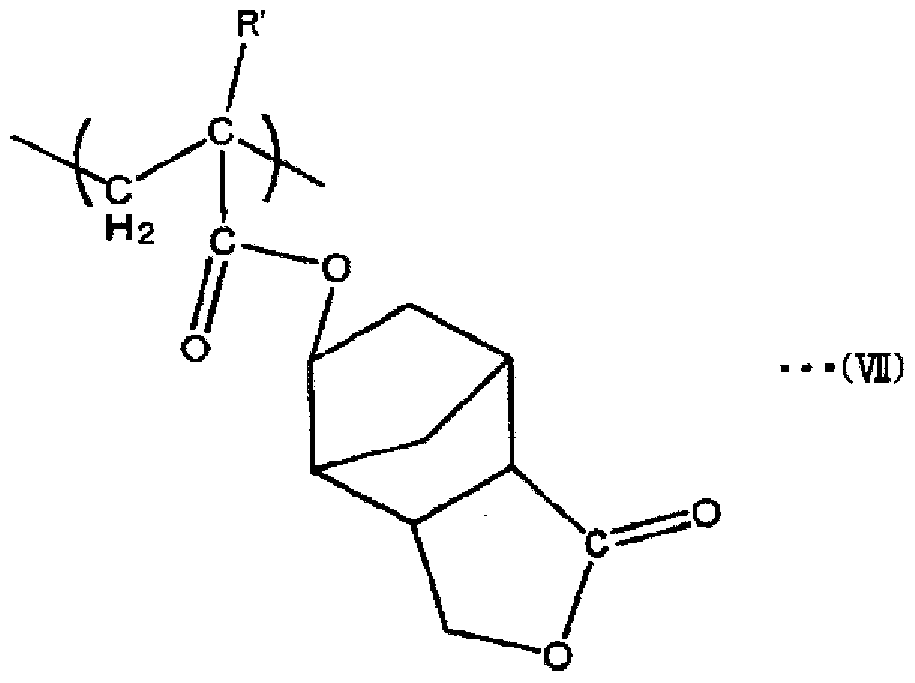
[0022] 具体的には、例えば以下の一般式 (IV)〜(VII)力も選ばれる少なくとも 1種である ことが好ましい。
[0023] [化 4]
Figure imgf000009_0001
[式 (IV)中、 R'は低級アルキル基であり、 R5、 ま、それぞれ独立に、水素原子ま たは低級アルキル基である。 ]
[0024] [化 5]
Figure imgf000010_0001
[式 (V)中、 R'は低級アルキル基であり、 mは 0又は 1である。 ]
[化 6]
Figure imgf000010_0002
[式 (VI)中、 R'は低級アルキル基である。 ]
[化 7]
Figure imgf000010_0003
[式 (VII)中、 R'は低級アルキル基である。 ]
R'の低級アルキル基の説明は、上述の α炭素原子に結合している低級アルキル 基の説明と同様である。
式 (IV)中において、 R5、 R6は、それぞれ独立に、水素原子または低級アルキル基 であり、好ましくは水素原子である。 R R6において、低級アルキル基としては、好ま しくは炭素数 1〜5の直鎖又は分岐状アルキル基であり、メチル基、ェチル基、プロピ ル基、イソプロピル基、 n ブチル基、イソブチル基、 tert-ブチル基、ペンチル基、ィ ソペンチル基、ネオペンチル基などが挙げられる。工業的にはメチル基が好ましい。 また、一般式 (IV)〜 (VII)で表される構成単位の中でも、(IV)で表される構成単 位がディフエタト低減の点力も好ましぐ (IV)で表される構成単位の中でも R'カ^チ ル基、 R5、 R6が水素原子であり、メタクリル酸エステルと γ—ブチ口ラタトンとのエステ ル結合の位置が、そのラタトン環状の α位である aーメタクリロイ口キシー y ブチロ ラタトンであることが最も好まし!/、。
[0028] 構成単位 (a2)は 1種または 2種以上組み合わせて用いることができる。
構成単位 (a2)は、(A1)成分中の全構成単位の合計に対して、 20〜60モル0 /0、 好ましくは 20〜50モル0 /0含まれていると好ましぐ 30〜45モル0 /0であることが最も好 ましい。下限値以上とすることによりリソグラフィー特性が向上し、上限値以下とするこ とにより他の構成単位とのバランスをとることができる。
[0029] ·構成単位 (a3)
構成単位 (a3)により、(A1)成分全体の親水性が高まり、現像液との親和性が高ま つて、露光部でのアルカリ溶解性が向上し、解像性の向上に寄与する。
構成単位 (a3)において、 α炭素原子に結合するのは、低級アルキル基、水素原 子のうち、いずれでもよいが、水素原子が好ましい。低級アルキル基については、前 記 R'と同様である。
極性基としては、水酸基、シァノ基、カルボキシル基、アミノ基等が挙げられ、特に 水酸基が好ましい。
多環式基としては、多環式の脂環式炭化水素基 (多環式基)が挙げられる。該多 環式基としては、構成単位 (al)において例示したものと同様の多数の多環式基から 適宜選択して用いることができる。
[0030] 構成単位 (a3)としては、下記一般式 (VIII)〜 (IX)力も選ばれる少なくとも 1種で あることが好ましい。
[0031] [化 8]
Figure imgf000012_0001
[式 (VIII)中、 Rは水素原子または低級アルキル基であり、 nは 1〜3の整数である。 ] Rにおいて、低級アルキル基については、前記 R'と同様である。
[0032] これらの中でも、 nが 1であり、水酸基がァダマンチル基の 3位に結合しているものが 好ましい。
[0033] [化 9]
…(κ)
Figure imgf000012_0002
[式 (IX)中、 Rは水素原子または低級アルキル基であり、 kは 1〜3の整数である。 ]
[0034] Rは上記 oc炭素原子に結合する低級アルキル基、水素原子の説明と同様である。
これらの中でも、 kが 1であるものが好ましい。また、シァノ基がノルボルナ-ル基の 5 位又は 6位に結合して 、ることが好ま 、。
[0035] 構成単位 (a3)は 1種または 2種以上組み合わせて用いることができる。
構成単位 (a3)は、(A1)成分を構成する全構成単位の合計に対して、 10〜50モ ル0 /0、好ましくは 15〜40モル0 /0含まれていると好ましぐ 20〜30モル%が最も好ま しい。
下限値以上とすることによりリソグラフィー特性が向上し、上限値以下とすることによ り他の構成単位とのバランスをとることができる。
[0036] ·その他の構成単位
(A1)成分は、前記構成単位 (al)〜(a3)以外の構成単位を含んで 、てもよ!/ヽが 、好適にはこれらの構成単位の合計が全構成単位中 70モル%以上、好ましくは 80 モル%以上、最も好ましくは 100モル%である。
構成単位 (al)〜(a3)以外の他の構成単位 (a4)としては、上述の構成単位 (al) 〜(a3)に分類されな 、他の構成単位であれば特に限定するものではな!/、。
[0037] 例えば多環の脂環式炭化水素基を含み、かつ( ex 低級アルキル)アクリル酸エス テル力 誘導される構成単位等が好ましい。該多環の脂環式炭化水素基は、例えば 、前記の構成単位 (a l)の場合に例示したものと同様のものを例示することができ、特 にトリシクロデ力-ル基、ァダマンチル基、テトラシクロドデ力-ル基、ノルボルニル基
、イソボル-ル基力 選ばれる少なくとも 1種以上であると、工業上入手し易い等の点 で好ましい。
構成単位 (a4)として、具体的には、下記 (Χ)〜(ΧΠ)の構造のものを例示すること ができる。
[0038] [化 10]
Figure imgf000013_0001
(式中、 Rは水素原子又は低級アルキル基である) この構成単位は、通常、 5位又は 6位の結合位置の異性体の混合物として得られる
[0039] [化 11」
Figure imgf000014_0001
(式中、 Rは水素原子又は低級アルキル基である)
[0040] [化 12]
Figure imgf000014_0002
(式中、 Rは水素原子又は低級アルキル基である)
[0041] 構成単位 (a4)を有する場合、構成単位 (a4)は、(A1)成分中、全構成単位の合計 に対して 1〜25モル0 /0、好ましくは 5〜20モル0 /0の範囲で含まれていると好ましい。
[0042] また、(A1)成分は、下記化学式で表される構成単位を少なくとも含む共重合体で あることが好ましぐこれらの構成単位力もなる共重合体であることが特に好ましい。
[0043] [化 13]
Figure imgf000015_0001
[0044] (Al)成分は 1種または 2種以上の榭脂から構成することができる。
そして、(A1)成分は、例えば各構成単位に係るモノマーを、例えばァゾビスイソ プチ口-トリル (AIBN)のようなラジカル重合開始剤を用いた公知のラジカル重合等 によって重合させること〖こよって得ることができる。
[0045] (A1)成分の質量平均分子量(ゲルパーミエーシヨンクロマトグラフィによるポリス チレン換算質量平均分子量、以下同様。)は、例えば 30000以下であり、 20000以 下であることが好ましぐ 12000以下であることがさらに好ましぐ最も好ましくは 1000
0以下とされる。
下限値は特に限定するものではないが、ノ ターン倒れの抑制、解像性向上等の 点で、好ましくは 4000以上、さらに好ましくは 5000以上とされる。
[0046] (B)成分
(B)成分は、従来の化学増幅型レジスト組成物にお 、て使用されて 、る公知の酸 発生剤から特に限定せずに用いることができる。
このような酸発生剤としては、これまで、ョードニゥム塩やスルホ -ゥム塩などのォ- ゥム塩系酸発生剤、ォキシムスルホネート系酸発生剤、ビスアルキルまたはビスァリ 一ルスルホ -ルジァゾメタン類、ポリ(ビススルホ -ル)ジァゾメタン類などのジァゾメタ ン系酸発生剤、イミノスルホネート系酸発生剤、ジスルホン系酸発生剤など多種のも のが知られている。
[0047] ォ-ゥム塩系酸発生剤の具体例としては、ジフエ-ルョードニゥムのトリフルォロメタ ンスルホネートまたはノナフルォロブタンスルホネート、ビス(4—tert—ブチルフエ- ル)ョードニゥムのトリフルォロメタンスルホネートまたはノナフルォロブタンスルホネー ト、トリフエ-ルスルホ-ゥムのトリフルォロメタンスルホネート、そのヘプタフルォロプ 口パンスルホネートまたはそのノナフルォロブタンスルホネート、トリ(4 メチルフエ- ル)スノレホニゥムのトリフノレオロメタンスノレホネート、そのヘプタフノレォロプロパンスノレ ホネートまたはそのノナフルォロブタンスルホネート、ジメチル(4ーヒドロキシナフチ ル)スノレホニゥムのトリフノレオロメタンスノレホネート、そのヘプタフノレォロプロパンスノレ ホネートまたはそのノナフルォロブタンスルホネート、モノフエ-ルジメチルスルホ -ゥ ムのトリフルォロンメタンスルホネート、そのヘプタフルォロプロパンスルホネートまた はそのノナフルォロブタンスルホネート、ジフエ-ルモノメチルスルホ-ゥムのトリフル ォロメタンスルホネート、そのヘプタフルォロプロパンスルホネートまたはそのノナフル ォロブタンスルホネート、(4 メチルフエ-ル)ジフエ-ルスルホ-ゥムのトリフルォロ メタンスルホネート、そのヘプタフルォロプロパンスルホネートまたはそのノナフルォロ ブタンスルホネート、(4—メトキシフエ-ル)ジフエ-ルスルホ-ゥムのトリフルォロメタ ンスルホネート、そのヘプタフルォロプロパンスルホネートまたはそのノナフルォロブ タンスルホネート、トリ(4— tert ブチル)フエ-ルスルホ-ゥムのトリフルォロメタンス ルホネート、そのヘプタフルォロプロパンスルホネートまたはそのノナフルォロブタン スルホネートなどが挙げられる。
[0048] ォキシムスルホネート系酸発生剤の具体例としては、 α (メチルスルホ -ルォキシ ィミノ)—フエ-ルァセトニトリル、 at - (メチルスルホ -ルォキシィミノ)—ρ—メトキシフ ェ-ルァセトニトリル、 α - (トリフルォロメチルスルホ -ルォキシィミノ)—フエ-ルァ セト-トリル、 α - (トリフルォロメチルスルホ -ルォキシィミノ)—p—メトキシフエ-ル ァセトニトリル、 at - (ェチルスルホニルォキシィミノ)—p—メトキシフエ二ルァセトニト リル、 α—(プロピルスルホ -ルォキシィミノ) p メチルフエ-ルァセトニトリル、 α (メチルスルホ -ルォキシィミノ) ρ ブロモフエ-ルァセトニトリルなどが挙げられ る。これらの中で、 α (メチルスルホ -ルォキシィミノ) ρ—メトキシフエ-ルァセト 二トリルが好ましい。
[0049] ジァゾメタン系酸発生剤のうち、ビスアルキルまたはビスァリールスルホ -ルジァゾメ タン類の具体例としては、ビス(イソプロピルスルホ -ル)ジァゾメタン、ビス(ρ トルェ ンスルホ -ル)ジァゾメタン、ビス( 1 , 1—ジメチルェチルスルホ -ル)ジァゾメタン、ビ ス(シクロへキシルスルホ -ル)ジァゾメタン、ビス(2, 4 ジメチルフエ-ルスルホ-ル )ジァゾメタン等が挙げられる。
また、ポリ(ビススルホニル)ジァゾメタン類としては、例えば、以下に示す構造をもつ 1, 3—ビス(フエ-ルスルホ-ルジァゾメチルスルホ -ル)プロパン(ィ匕合物 A)、 1, 4 -ビス(フエ-ルスルホ-ルジァゾメチルスルホ -ル)ブタン(ィ匕合物 B)、 1 , 6—ビス( フエ-ルスルホ-ルジァゾメチルスルホ -ル)へキサン(ィ匕合物 C)、 1 , 10—ビス(フエ ニルスルホ-ルジァゾメチルスルホ -ル)デカン(ィ匕合物 D)、 1 , 2—ビス(シクロへキ シルスルホ-ルジァゾメチルスルホ -ル)ェタン(ィ匕合物 E)、 1, 3—ビス(シクロへキ シルスルホ-ルジァゾメチルスルホ -ル)プロパン(ィ匕合物 F、)、 1, 6—ビス(シクロへ キシルスルホ-ルジァゾメチルスルホ -ル)へキサン(ィ匕合物 G)、 1 , 10—ビス(シク 口へキシルスルホ-ルジァゾメチルスルホ -ル)デカン(ィ匕合物 H)などを挙げることが できる。
[化 14]
Figure imgf000018_0001
[0051] 本発明にお 、ては、中でも、 (B)成分としてフッ素化アルキルスルホン酸イオンをァ ェオンとするォニゥム塩を用 L、ることが好まし 、。
[0052] また、(B)成分としては、下記一般式 (b— 1)または (b— 2)
[0053] [化 15]
Figure imgf000019_0001
Figure imgf000019_0002
[式中、 Xは、少なくとも 1つの水素原子がフッ素原子で置換された炭素数 2〜6のァ ルキレン基を表し; Υ、 Ζは、それぞれ独立に、少なくとも 1つの水素原子がフッ素原 子で置換された炭素数 1〜10のアルキル基を表し; R"〜R13は、それぞれ独立に、 ァリール基またはアルキル基を表し、 RU〜R13のうち少なくとも 1っはァリール基を表 す]で表される構成単位カゝらなる群カゝら選ばれる少なくとも 1種のスルホ -ゥム化合物 も好ましい。
式 (b— 1)、 (b— 2)中、 Xは、少なくとも 1つの水素原子がフッ素原子で置換された 直鎖状または分岐状のアルキレン基であり、該アルキレン基の炭素数は例えば 2〜6 であり、好ましくは 3〜5、最も好ましくは炭素数 3である。
Υ、 Ζは、それぞれ独立に、少なくとも 1つの水素原子がフッ素原子で置換された直 鎖状または分岐状のアルキル基であり、該アルキル基の炭素数は例えば 1〜: LOであ り、好ましくは 1〜7、より好ましくは 1〜3である。
Xのアルキレン基の炭素数または Υ、 Ζのアルキル基の炭素数が小さ!/、ほどレジスト 溶媒への溶解性も良好であるため好まし 、。
また、 Xのアルキレン基または Υ、 Ζのアルキル基において、フッ素原子で置換され ている水素原子の数が多いほど、酸の強度が強くなり、また 200nm以下の高工ネル ギ一光や電子線に対する透明性が向上するので好ま U、。該アルキレン基またはァ ルキル基中のフッ素原子の割合、すなわちフッ素化率は、好ましくは 70〜100%、さ らに好ましくは 90〜: LOO%であり、最も好ましくは、全ての水素原子がフッ素原子で 置換されたパーフルォロアルキレン基またはパーフルォロアルキル基である。 [0055] R"〜R "はそれぞれ独立にァリール基またはアルキル基を表す。
RU〜R13のうち、少なくとも 1っはァリール基を表す。 RU〜R13のうち、 2以上がァリ ール基であることが好ましぐ RU〜R13のすべてがァリール基であることが最も好まし い。
RU〜R13のァリール基としては、特に制限はなぐ例えば、炭素数 6〜20のァリー ル基であって、アルキル基、アルコキシ基、ハロゲン原子等で置換されていてもされ ていなくてもよいフエニル基、ナフチル基が挙げられる。安価に合成可能なことから、 炭素数 6〜10のァリール基が好ましい。
RU〜R13のアルキル基としては、特に制限はなぐ例えば炭素数 1〜10の直鎖状、 分岐状または環状のアルキル基等が挙げられる。解像性に優れる点から、炭素数 1 〜5であることが好ましい。具体的には、メチル基、ェチル基、 n—プロピル基、イソプ 口ピル基、 n—ブチル基、イソブチル基、 n—ペンチル基、シクロペンチル基、へキシ ル基、シクロへキシル基、ノニル基、デカニル基等が挙げられ、解像性に優れ、また 安価に合成可能なことから好ましいものとして、メチル基を挙げることができる。
これらの中で、 RU〜R13はすべてフエ-ル基であることが最も好まし 、。
[0056] これらのスルホ -ゥム化合物は、単独で用いてもよいし、 2種以上を組み合わせて 用いてもよい。
[0057] (B)成分としては、 1種の酸発生剤を単独で用いてもよいし、 2種以上を組み合わ せて用いてもよい。
(B)成分の含有量は、(A)成分 100質量部に対し、 0. 5〜30質量部、好ましくは 1 〜10質量部とされる。上記範囲より少ないとパターン形成が十分に行われないおそ れがあり、上記範囲を超えると均一な溶液が得られにくぐ保存安定性が低下する原 因となるおそれがある。
[0058] 本発明のポジ型レジスト組成物には、レジストパターン形状、引き置き経時安定性 などを向上させるために、さらに任意の成分として、含窒素有機化合物 (D) (以下、 ( D)成分と ヽぅ)を配合させることができる。
[0059] (D)含窒素有機化合物
(D)成分は、既に多種多様なものが提案されているので、公知のもの力 任意に用 いれば良いが、ァミン、特に第 2級低級脂肪族アミンゃ第 3級低級脂肪族ァミンが好 ましい。
ここで、低級脂肪族ァミンとは炭素数 5以下のアルキルまたはアルキルアルコール のァミンを言い、この第 2級や第 3級ァミンの例としては、トリメチルァミン、ジェチルァ ミン、トリェチルァミン、ジ—n—プロピルァミン、トリ— n—プロピルァミン、トリペンチル ァミン、ジエタノールァミン、トリエタノールァミン、トリイソプロパノールァミンなどが挙 げられる力 特にトリエタノールァミン、トリイソプロパノールァミンのような第 3級アル力 ノールァミンが好ましい。
これらは単独で用いてもょ 、し、 2種以上を組み合わせて用いてもょ 、。
(D)成分は、(A)成分 100質量部に対して、通常 0. 01〜5. 0質量部の範囲で用 いられる。
[0060] また、前記 (D)成分との配合による感度劣化を防ぎ、またレジストパターン形状、引 き置き安定性等の向上の目的で、さらに任意の成分として、有機カルボン酸又はリン のォキソ酸若しくはその誘導体 (E) (以下、(E)成分という)を含有させることができる 。なお、(D)成分と (E)成分は併用することもできるし、いずれか 1種を用いることもで きる。
[0061] (E)成分
(E)成分において、有機カルボン酸としては、例えば、マロン酸、クェン酸、リンゴ酸 、コハク酸、安息香酸、サリチル酸などが好適である。
(E)成分において、リンのォキソ酸若しくはその誘導体としては、リン酸、リン酸ジ -n -ブチルエステル、リン酸ジフエ-ルエステルなどのリン酸又はそれらのエステルのよ うな誘導体、ホスホン酸、ホスホン酸ジメチルエステル、ホスホン酸-ジ -n-ブチルエス テル、フエニルホスホン酸、ホスホン酸ジフエ-ルエステル、ホスホン酸ジベンジルェ ステルなどのホスホン酸及びそれらのエステルのような誘導体、ホスフィン酸、フエ- ルホスフィン酸などのホスフィン酸及びそれらのエステルのような誘導体が挙げられ、 これらの中で特にホスホン酸が好まし!/、。
(E)成分は、(A)成分 100質量部当り 0. 01〜5. 0質量部の割合で用いられる。
[0062] 有機溶剤 本発明のポジ型レジスト組成物は、材料を有機溶剤に溶解させて製造することがで きる。
有機溶剤としては、使用する各成分を溶解し、均一な溶液とすることができるもので あればよぐ従来、化学増幅型レジストの溶剤として公知のものの中から任意のものを 1種または 2種以上適宜選択して用いることができる。
例えば、 γ —ブチロラタトン、アセトン、メチルェチルケトン、シクロへキサノン、メチ ルイソアミルケトン、 2—へプタノンなどのケトン類や、エチレングリコール、エチレング リコーノレモノアセテート、ジエチレングリコール、ジエチレングリコーノレモノアセテート、 プロピレングリコール、プロピレングリコーノレモノアセテート、ジプロピレングリコール、 またはジプロピレングリコールモノアセテートのモノメチルエーテル、モノェチルエー テル、モノプロピルエーテル、モノブチルエーテルまたはモノフエニルエーテルなど の多価アルコール類およびその誘導体や、ジォキサンのような環式エーテル類や、 乳酸メチル、乳酸ェチル(EL)、酢酸メチル、酢酸ェチル、酢酸ブチル、ピルビン酸メ チル、ピルビン酸ェチル、メトキシプロピオン酸メチル、エトキシプロピオン酸ェチルな どのエステル類などを挙げることができる。
これらの有機溶剤は単独で用いてもよぐ 2種以上の混合溶剤として用いてもよい。 また、プロピレングリコールモノメチルエーテルアセテート(PGMEA)と極性溶剤と を混合した混合溶媒は好ましい。その配合比(質量比)は、 PGMEAと極性溶剤との 相溶性等を考慮して適宜決定すればよいが、好ましくは 1 : 9〜9 : 1、より好ましくは 2 : 8〜8: 2の範囲内とすることが好まし!/、。
より具体的には、極性溶剤として ELを配合する場合は、 PGMEA:ELの質量比が 好ましくは 2: 8〜8: 2、より好ましくは 3: 7〜7: 3であると好まし!/、。
また、有機溶剤として、その他には、 PGMEA及び ELの中カゝら選ばれる少なくとも 1種と γ—プチ口ラタトンとの混合溶剤も好ましい。この場合、混合割合としては、前 者と後者の質量比が好ましくは 70: 30-95 : 5とされる。
有機溶剤の使用量は特に限定しないが、基板等に塗布可能な濃度で、塗布膜厚 に応じて適宜設定されるものであるが、一般的にはレジスト組成物の固形分濃度 2〜 20質量%、好ましくは 5〜15質量%の範囲内となる様に用いられる。 [0064] その他の任意成分
本発明のポジ型レジスト組成物には、さらに所望により混和性のある添加剤、例え ばレジスト膜の性能を改良するための付加的榭脂、塗布性を向上させるための界面 活性剤、溶解抑制剤、可塑剤、安定剤、着色剤、ハレーション防止剤、染料などを適 宜、添加含有させることができる。
[0065] また、第 1の態様においては、支持体の上に、上記レジスト組成物力 なるレジスト 膜を形成し、該レジスト膜の表面に現像液を塗布した後の当該レジスト膜の表面の接 触角の測定値が 40度以下であることが好ましい。すなわち、第 1の態様においても、 第 2の態様、第 3の態様における特定の接触角の値を満足することが好ましい。そし て、特に限定するものではないが、実質的には接触角 25度以上、好ましくは 30度以 上である。この範囲を満足することによって、さらにディフエタトを低減することができる 。また、リソグラフィー特性が向上する。好ましくは 30〜40度である、さらに好ましくは 32〜40度であり、より好ましくは 35〜40度であり、最も好ましくは 36〜39度である。 接触角は、(A1)成分の構成単位の種類や配合量、あるいは詳細には後述する(B )成分等の他の成分の種類、配合量を調整することによって変更することができる。 接触角の測定方法にっ 、ては、第 2の態様の説明にお 、て詳述する。
[0066] 第 1の態様のポジ型レジスト組成物を用いることにより、ディフエタトを低減することが できる。また、必要なリソグラフィー特性も得られる。さらには感度が向上する。
また、後述するシュリンクプロセスにおいても、必要なリソグラフィー特性が得られる さらにシュリンクプロセスでは、シュリンク工程の温度を従来よりも低く設定しても、狭 小させることができ、装置、ハンドリングの点力も好適である。
[0067] 第 1の態様において、ディフエタトの低減効果が得られる理由は定かではないが、 上記構成により、レジスト膜の表面の接触角が小さくなる傾向があることに起因するの ではないかと推測される。
すなわち、ポジ型レジスト組成物を基板上に塗布し、プレベータ(PAB)し、選択的 に露光した後、 PEB (露光後加熱)を施し、アルカリ現像してレジストパターンを得るこ とができる力 アルカリ現像工程においては、アルカリ現像液で露光部を溶解し、除 去した後、さらに残留する現像液等を除去するために純水によるリンスを行うのが通 常である。
このとき、第 1の態様のポジ型レジスト組成物においては、レジスト膜の表面の接触 角が小さぐ濡れやすい (親水性が高い)ため、ディフエタトの原因となる榭脂成分を 含む析出物や、アルカリ現像液に対して溶け残った残留物等の、比較的疎水性の固 形分 (リンス時に再析出するものを含む)との親和性が低くなり、これら析出物や残留 物力 アルカリ現像時、リンス時等に、レジスト膜表面カゝら速やかに除去され、これに よりディフエタトが低減するのではないかと推測される。
[0068] <第 2の態様および第 3の態様 >
(第 2の態様)
第 2の態様は、(A)酸の作用によりアルカリ可溶性が増大する榭脂成分、及び (B) 露光により酸を発生する酸発生剤成分を含有するレジスト組成物であって、支持体 の上に、レジスト組成物カゝらなるレジスト膜を形成し、該レジスト膜の表面に現像液を 塗布した後の当該レジスト膜の表面の接触角の測定値が 40度以下であるポジ型レ ジスト組成物である。
接触角の測定値が 40度以下であることにより、ディフエタトを低減することができる。 下限値は例えば 25度以上、好ましくは 30度以上である。
さらに好ましくは接触角の測定値が 30〜40度であり、より好ましくは 32〜40度であり 、特に好ましくは 35〜40度であり、最も好ましくは 36〜39度である。
35度以上にすることにより、ディフエタトの低減とともに、 DOF (焦点深度幅)などの 良好なリソグラフィー特性が実現できる。
接触角の測定値のより好ましい範囲は 36〜39度である。
[0069] 接触角は以下の様にして測定するものである。
1)直径 6インチのシリコン基板の上に、固形分濃度 8質量%のレジスト組成物溶液 1 mlを回転数 1500rpmでスピンコートした後、 90°Cの温度条件で 90秒間加熱する。
2)上記レジスト膜の上に、現像装置 [製品名 TD6133U (タツモ株式会社製) ]を用 いて、 23°Cにて、 2. 38質量0 /0テトラメチルアンモ-ゥムヒドロキシド水溶液(アルカリ 現像液)を 30秒間滴下した後、回転数 1500rpmで 20秒間スピンして乾燥させる。 3)乾燥後のレジスト膜に対して、 FACE接触角計 CA— X150型 (製品名 協和界面 科学株式会社製)を用い、装置に備え付けられている注射器に前記レジスト膜を接 触させ (注射器とレジスト膜とが接触した際に、 2 Lの純水が滴下される)、その際の 接触角を測定する。
[0070] (A)成分
また、第 2の態様においては、(A)成分が、酸解離性溶解抑制基を含む(α—低級 アルキル)アクリル酸エステルカゝら誘導される構成単位 (al ' )と、ラタトン環を有する( a—低級アルキル)アクリル酸エステルカゝら誘導される構成単位 (a2')とを有すること が好ましい。
[0071] '構成単位 (al,)
後述する第 3の態様と同様である。構成単位 (al ' )の (A)成分中の好ま ヽ割合は 、後述する第 3の態様における共重合体 (ΑΙ')中の割合と同様である。
•構成単位 (a2,)
後述する第 3の態様と同様である。構成単位 (a2')の (A)成分中の好ましい割合は 、後述する第 3の態様における共重合体 (ΑΙ')中の割合と同様である。
[0072] 構成単位 (al')、構成単位 (a2')は特に限定するものではないが、共重合体として 含まれていると好ましい。
[0073] また、(A)成分が、構成単位 (al')、構成単位 (a2')、及び極性基含有多環式基 を含む( ex—低級アルキル)アクリル酸エステル力 誘導される構成単位 (a3, )を有 する共重合体 (A1 ' )であると好ま U、。
[0074] ·共重合体 (ΑΙ')
第 3の態様と同様である。
[0075] (Β)成分
第 1の態様と同様である。
[0076] (D)成分
第 1の態様と同様である。
[0077] (Ε)成分
第 1の態様と同様である。 [0078] 有機溶剤
第 1の態様と同様である。
[0079] その他の任意成分
第 1の態様と同様である。
[0080] 第 2の態様において、接触角の値は例えば以下の様な手段によって好ましい範囲 に調整することができる。
(方法 1)
第 1の態様の様に、構成単位 (al,)として、構成単位 (al)を用い、構成単位 (a2,) として、構成単位 (a2)を用いた共重合体を用いると接触角の値を 40度以下に調整 することが容易である。さらに、構成単位 (al)、構成単位 (a2)とともに構成単位 (a3) を用 、た共重合体を (A)成分に用 、ると好ま 、。
[0081] (方法 2)
同じ種類の構成単位を用いた複数の共重合体を混合することによって、レジスト組 成物の接触角の値を 40度以下に調整する。
同じ種類の構成単位カゝらなる共重合体どうしであっても、 (i)構成単位の割合が異 なっていると、通常、それぞれの共重合体のみをベース榭脂として用いたレジスト組 成物の接触角の測定値が異なる。
ここで、「同じ種類の構成単位」とは、化学構造が一致していることを示す。 また、(ii)構成単位の種類も、割合も同じ共重合体どうしであっても、製造するロット によって、それぞれの共重合体のみをベース榭脂として用いたレジスト組成物の接触 角の測定値が相互に異なることがある。これは、温度、圧力などの製造条件がわずか に異なること等によって、共重合体を構成する構成単位の分布の偏りなどが生じるた めではないかと推測される。
そこで、レジスト組成物としたときに大きい接触角の値を示す共重合体と、小さい接 触角の値を示す共重合体を混合した混合榭脂をベース榭脂とすると、接触角 40度 以下のレジスト組成物を得ることができる。
[0082] 以下に具体例を示して説明する。
この例においては、第 1の共重合体と、第 2の共重合体とを用いる。 これらは同じ種類の複数の構成単位カゝらなり、構成単位同士の割合も同じであり、 製造ロットが異なるものとする。
まず、予め目的とするレジスト組成物について、第 1の共重合体と第 2の共重合体 の混合割合以外の組成を決定する。
[0083] っ 、で、目的とするレジスト組成物の組成にぉ 、て、ベース榭脂である (A)成分を、 第 1の共重合体 100質量%とした第 1のレジスト組成物を製造する。
そして、この第 1のレジスト組成物について、上記の様にして接触角を測定する。この 測定値を XIとする。
第 2の共重合体についても、同様に、ベース榭脂である (A)成分を、第 2の共重合体 100質量%とした第 2のレジスト組成物を製造する。
そして、この第 2のレジスト組成物について、上記の様にして接触角を測定する。こ の測定値を X2とする。
[0084] そして、これらの共重合体を混合した (A)成分を用いたレジスト組成物にぉ ヽて、 その接触角の測定値が 40度以下となる様に、第 1の共重合体と、第 2の共重合体の 混合割合を算出する。
すなわち、以下の式を満足する様に、 Yl、 Υ2の割合を決定する。
[XI (。 ) XY1 (質量%) +Χ2 (° ) ΧΥ2 (質量%) ]Ζ100≤40 (° )
なお、 Y1は第 1の共重合体の (Α)成分中の割合 (質量%)、 Υ2は第 2の共重合体 の(A)成分中の割合(質量0 /0)であり、 Yl + Y2= 100である。
[0085] そして、この割合にしたがって第 1の共重合体と第 2の共重合体を混合して (Α)成 分としてレジスト組成物を製造すると、接触角の測定値が 40度以下のレジスト組成物 を得ることができる。
[0086] 混合する複数の共重合体は、同じ種類の構成単位力もなるものが好ましい。
複数の共重合体間において、構成単位の割合は異なっていてもよいが、同じであ ると接触角の制御が容易であり好ましい。
また、混合する共重合体の数は 2種以上であれば特に限定することはなぐ好ましく は 2〜3種、特に 2種とすることが好ましい。
[0087] 混合する複数の共重合体の接触角は、少なくとも 1種の共重合体の接触角の測定 値力 0度以上であり、もう 1種の共重合体の接触角は 40度未満であることが望まし い。前者の接触角はより好ましくは 40度超であり、さらには 42〜50度である。後者の 接触角は、より好ましくは 30〜34度である。
[0088] なお、上述の様に共重合体の混合割合を決定するために接触角を測定する際に、
(Α)成分の種類以外の組成を、後述する実施例 1と同様の組成に設計して、レジスト 組成物の接触角を測定すると好ま 、。
実施例 1と同様の組成を適用して接触角の測定値を求めて (Α)成分における共重 合体の混合割合を設定すると、例えば ArFエキシマレーザー用として好ま ヽ組成 において、(A)成分の種類以外の組成が多少変更になっても、本発明の効果を得る ことができる。そのため、簡便に (A)成分における共重合体の混合割合を求めること ができる。
[0089] (方法 3)
接触角は、(ΑΙ ' )成分の構成単位の種類や配合量、あるいは(Β)成分等の他の 成分の種類、配合量を調整することによって変更することができる。例えば、構成単 位 (a2' )、構成単位 (a3' )の様な、親水性の部位を有する構成単位の配合量を増加 させる;(B)成分において、親水性基をもつ酸発生剤を選択する;添加剤として親水 性基をもつ化合物を添加するの方法がある。
[0090] 第 2の態様にぉ 、てはディフエタトの低減効果が得られる。
[0091] 第 2の態様において、ディフエタトの低減効果が得られる理由は定かではないが、 以下の様に考えられる。
すなわち、ポジ型レジスト組成物を基板上に塗布し、プレベータし、選択的に露光 した後、 PEB (露光後加熱)を施し、アルカリ現像してレジストパターンを得ることがで きるが、アルカリ現像工程においては、現像液で露光部を溶解し、除去した後、さら に残留する現像液等を除去するために純水によるリンスを行うのが通常である。 このとき、第 2の態様のポジ型レジスト組成物においては、レジスト膜の表面の接触 角が小さぐ濡れやすい (親水性が高い)ため、ディフエタトの原因となる榭脂成分を 含む析出物や、アルカリ現像液に対して溶け残った残留物等の比較的疎水性の固 形分 (リンス時に再析出するものを含む)との親和性が低くなり、これら析出物や残留 物力 アルカリ現像時、リンス時等に、レジスト膜表面カゝら速やかに除去され、これに よりディフエタトが低減されるのではないかと推測される。
[0092] (第 3の態様)
第 3の態様のポジ型レジスト組成物は、(A)酸の作用によりアルカリ可溶性が増大 する榭脂成分、及び (B)露光により酸を発生する酸発生剤成分を含有するレジスト 組成物であって、下記(1)、 (2)の条件を満足する。
(1)前記 (A)成分が、酸解離性溶解抑制基を含む(α 低級アルキル)アクリル酸ェ ステルカゝら誘導される構成単位 (al ' )、ラタトン環を有する( ex—低級アルキル)アタリ ル酸エステルから誘導される構成単位 (&2' )、及び極性基含有多環式基を含む( a 低級アルキル)アクリル酸エステル力 誘導される構成単位 (a3, )を有する共重合 体 (Al,)である。
(2)支持体の上に、レジスト組成物力 なるレジスト膜を形成し、該レジスト膜の表面 に現像液を塗布した後の当該レジスト膜の表面の接触角の測定値が 40度以下であ る。
[0093] 共重合体 (ΑΙ') [以下、(ΑΙ')成分という場合がある]'構成単位 (al')
構成単位 (al ' )は、前記 (A1)成分にお!ヽて説明した構成単位 (al)に対応する。 ただし、構成単位 (al')においては、 α炭素原子に結合するものは水素原子に限定 されておらず、水素原子または低級アルキル基である点が、構成単位 (al)と異なる。 よって、 α炭素原子に結合するもの以外の構成 [好ましい態様、共重合体 (ΑΙ')中 の配合量等]は、構成単位 (al)と同様とすることができる。
そして、 a炭素原子に結合し得る低級アルキル基は、前記構成単位 (a2)の α炭素 原子に結合している低級アルキル基と同様とすることができる。
構成単位 (al ' )にお 、ては、 oc炭素原子に水素原子が結合して!/、るものがより好 ましい。
[0094] また、構成単位 (al')は、下記一般式 (Γ)〜(Π )から選ばれる少なくとも 1種であ ると好まし ヽ。
[0095] [化 16]
Figure imgf000030_0001
[0096] [式 (Γ )中、 Rは水素原子または低級アルキル基であり、 R1は低級アルキル基である o ]
[0097] R、I^は前記と同じである。
[0098] [化 17]
Figure imgf000030_0002
[式 (ΙΓ )中、 Rは水素原子または低級アルキル基であり、 R2及び R°はそれぞれ独立 に低級アルキル基である。 ]
[0099] R、R2及び R3は前記と同じである。
[0100] [化 18]
Figure imgf000030_0003
[式 (ΠΓ )中、 Rは水素原子または低級アルキル基であり、 R4は第 3級アルキル基で ある。 ]
[0101] R、 R4は前記と同じである。
[0102] '構成単位 (a2,)
構成単位 (a2 ' )は、前記 (A1)成分において説明した構成単位 (a2)に対応する。 ただし、構成単位 (a2 ' )にお ヽては、 a炭素原子に結合するものは低級アルキル基 に限定されておらず、水素原子または低級アルキル基である点力 構成単位 (a2)と 異なる。
よって、 α炭素原子に結合するもの以外の構成 [好ましい態様、共重合体 (ΑΙ ' )中 の配合量等]は、構成単位 (a2)と同様とすることができる。
そして、 a炭素原子に結合し得る低級アルキル基は、構成単位 (a2)の oc炭素原子 に結合している低級アルキル基と同様とすることができる。
構成単位 (a2 ' )においては、 α炭素原子に結合する低級アルキル基が結合してい るものがより好ましい。
[0103] また、構成単位 (a2 ' )は下記一般式 (IV' )〜(Vn' )から選ばれる少なくとも 1種で あることが好ましい。
[0104] [化 19]
Figure imgf000031_0001
[式 (IV,)中、 Rは水素原子または低級アルキル基であり、 R5、 R6は、それぞれ独立 に、水素原子または低級アルキル基である。 ]
[0105] R、 R5、 R6は前記と同じである。
[0106] [化 20]
Figure imgf000032_0001
[式 (V' )中、 Rは水素原子または低級アルキル基であり、 mは 0又は 1である。 ] [0107] R、 mは前記と同じである。
[0108] [化 21]
Figure imgf000032_0002
[式 (VI' )中、 Rは水素原子または低級アルキル基である。 ]
[0109] Rは前記と同じである。
[0110] [化 22]
Figure imgf000032_0003
[式 (νΐΓ)中、 Rは水素原子または低級アルキル基である。 ] [0111] Rの説明は前記と同じである。
[0112] '構成単位 (a3,)
構成単位 (a3,)は、構成単位 (a3)と同様である。
よって、好ましい態様、共重合体 (ΑΙ ' )中の配合量等は、構成単位 (a3)と同様と することができる。
[0113] 前記構成単位 (a3' )は、構成単位 (a3)と同様、下記一般式 (VIII' )〜 (IX' )力も選 ばれる少なくとも 1種であることが好ま 、。
[0114] [化 23]
Figure imgf000033_0001
[式 (νΐΠ' )中、 Rは水素原子または低級アルキル基であり、 ηは 1〜3の整数である。 ]
[0115] 式 (νΐΠ' )の説明は、式 (VIII)と同様である。
[0116] [化 24]
Figure imgf000033_0002
[式 (ΙΧ' )中、 Rは水素原子または低級アルキル基であり、 kは 1〜3の整数である。 ] 式 (IX' )の説明は、式 (IX)と同様である。 [0118] •その他の構成単位
(Al, )成分は、前記構成単位 (al,)〜(a3,)以外の構成単位を含んで 、てもよ!/ヽ 力 好適にはこれらの構成単位の合計が全構成単位中 70モル%以上、好ましくは 8 0モル0 /0以上、最も好ましくは 100モル0 /0である。
構成単位 (al,)〜(a3,)以外の他の構成単位 (a4, )としては、上述の構成単位 (a 1 ' )〜(a3 ' )に分類されな 、他の構成単位であれば特に限定するものではな!/、。 構成単位 (a4' )は、前記 (A1)成分において説明した構成単位 (a4)に対応し、こ れと同様のものを用いることができる。
[0119] また、(ΑΙ ' )成分は、下記化学式で表される構成単位を少なくとも含む共重合体で あることが好ましぐこれらの構成単位力もなる共重合体であることが特に好ましい。
[0120] [化 25]
Figure imgf000034_0001
[0121] また、第 3の態様においても、第 1の態様を満足することがより好ましい。
すなわち、構成単位 (al ' )がアクリル酸エステル力 誘導される構成単位であり、構 成単位 (a2' )が α—低級アルキルアクリル酸エステル力 誘導される構成単位であ ると、より望ましい。これにより、接触角の調整が容易となるとともに、ディフエタト抑制 の効果が向上する。
[0122] (A1 ' )成分は 1種または 2種以上の榭脂から構成することができる。
そして、(ΑΙ ' )成分は、例えば各構成単位に係るモノマーを、例えばァゾビスイソ プチ口-トリル (ΑΙΒΝ)のようなラジカル重合開始剤を用いた公知のラジカル重合等 によって重合させること〖こよって得ることができる。
[0123] (A1, )成分の質量平均分子量 (ゲルパーミエーシヨンクロマトグラフィによるポリス チレン換算質量平均分子量、以下同様。)は、例えば 30000以下であり、 20000以 下であることが好ましぐ 12000以下であることがさらに好ましぐ最も好ましくは 1000 0以下とされる。
下限値は特に限定するものではないが、ノターン倒れの抑制、解像性向上等の 点で、好ましくは 4000以上、さらに好ましくは 5000以上とされる。
成分の質量平均分子量 (ゲルパーミエーシヨンクロマトグラフィによるポリスチレン換 算質量平均分子量、以下同様。)は、例えば約 12000以下、好ましくは 10000以下 とされる。
下限値は特に限定するものではないが、ノターン倒れの抑制、解像性等の点で、 好ましくは 4000以上、さらに好ましくは 5000以上とされる。
[0124] (B)成分
第 1の態様と同様である。
[0125] (D)成分
第 1の態様と同様である。
[0126] (E)成分第 1の態様と同様である。
[0127] 有機溶剤
第 1の態様と同様である。
[0128] その他の任意成分
第 1の態様と同様である。
[0129] 第 3の態様においては、支持体の上に、レジスト組成物からなるレジスト膜を形成し 、該レジスト膜の表面に現像液を塗布した後の当該レジスト膜の表面の接触角の測 定値が 40度以下である。そして、特に限定するものではないが、実質的には接触角 は 25度以上、好ましくは 30度以上である。 40度以下とすることによりディフエタトを低 減することができる。さらに好ましくは接触角の測定値が 30〜40度であり、より好まし くは 32〜40度であり、特に好ましくは 35〜40度であり、最も好ましくは 36〜39度で ある。
接触角は、(ΑΙ ' )成分の構成単位の種類や配合量、あるいは(Β)成分等の他の 成分の種類、配合量を調整することによって変更することができる。例えば、構成単 位 (a2' )、構成単位 (a3' )の様な、親水性の部位を有する構成単位の配合量を増加 させる;(B)成分において、親水性基をもつ酸発生剤を選択する;添加剤として 親水性基をもつ化合物を添加するの方法がある。特に第 1の態様を更に満足する 様にすると、接触角の調整が容易である。
[0130] 接触角測定条件
接触角は以下の様にして測定するものである。
1)直径 6インチのシリコン基板の上に、固形分濃度 8質量%のレジスト組成物溶液 1 mlを回転数 1500rpmでスピンコートした後、 90°Cの温度条件で 90秒間加熱する。
2)上記レジスト膜の上に、現像装置 [製品名 TD6133U (タツモ株式会社製) ]を用 いて、 23°Cにて、 2. 38質量0 /0テトラメチルアンモ-ゥムヒドロキシド水溶液(アルカリ 現像液)を 30秒間滴下した後、回転数 1500rpmで 20秒間スピンして乾燥させる。
3)乾燥後のレジスト膜に対して、 FACE接触角計 CA— X150型 (製品名 協和界面 科学株式会社製)を用い、装置に備え付けられている注射器に前記レジスト膜を接 触させ (注射器とレジスト膜とが接触した際に、 2 Lの純水が滴下される)、その際の 接触角を測定する。
[0131] 第 3の態様のポジ型レジスト組成物を用いることにより、ディフエタトを低減することが できる。また、必要なリソグラフィー特性も得られる。さらには 感度が向上する。また、 後述するシュリンクプロセスにおいても、必要なリソグラフィー特性が得られる。
[0132] 第 3の態様において、ディフエタトの低減効果が得られる理由は定かではないが、 以下の様に考えられる。
すなわち、ポジ型レジスト組成物を基板上に塗布し、プレベータし、選択的に露光 した後、 PEB (露光後加熱)を施し、アルカリ現像してレジストパターンを得ることがで きるが、アルカリ現像工程においては、現像液で露光部を溶解し、除去した後、さら に残留する現像液等を除去するために純水によるリンスを行うのが通常である。 このとき、第 3の態様のポジ型レジスト組成物においては、レジスト膜の表面の接触 角が小さぐ濡れやすい (親水性が高い)ため、ディフエタトの原因となる榭脂成分を 含む析出物や、アルカリ現像液に対して溶け残った残留物等の比較的疎水性の固 形分 (リンス時に再析出するものを含む)との親和性が低くなり、これら析出物や残留 物力 アルカリ現像時、リンス時等に、レジスト膜表面カゝら速やかに除去され、これに よりディフエタトが低減されるのではないかと推測される。
[0133] [レジストパターン形成方法 (第 4の態様) ] <一般的な方法 >
本発明のレジストパターン形成方法は例えば以下の様にして行うことができる。 すなわち、まずシリコンゥエーハのような支持体上に、上記ポジ型レジスト組成物を スピンナーなどで塗布し、 80〜150°Cの温度条件下、プレベータを 40〜120秒間、 好ましくは 60〜90秒間施し、これに例えば ArF露光装置などにより、 ArFエキシマレ 一ザ一光を所望のマスクパターンを介して選択的に露光 (放射線を照射)した後、 80 〜150°Cの温度条件下、 PEB (露光後加熱)を 40〜120秒間、好ましくは 60〜90秒 間施す。次いでこれをアルカリ現像液、例えば 0. 1〜 10質量%テトラメチルアンモ- ゥムヒドロキシド水溶液を用いて現像処理する。このようにして、マスクパターンに忠実 なレジストパターンを得ることができる。
なお、支持体 (基板)とレジスト組成物の塗布層との間には、有機系または無機系の 反射防止膜を設けることもできる。
[0134] 支持体としては、特に限定されず、従来公知のものを用いることができ、例えば、電 子部品用の基板や、これに所定の配線パターンが形成されたものなどを例示するこ とがでさる。
基板としては、例えばシリコンゥエーノ、、銅、クロム、鉄、アルミニウムなどの金属製 の基板や、ガラス基板などが挙げられる。
配線パターンの材料としては、例えば銅、ハンダ、クロム、アルミニウム、ニッケル、 金などが使用可能である。
[0135] 露光 (放射線の照射)に用いる波長は、特に限定されず、 ArFエキシマレーザー、 KrFエキシマレーザー、 Fエキシマレーザー、 EUV (極紫外線)、 VUV (真空紫外
2
線)、 EB (電子線)、 X線、軟 X線などの放射線を用いて行うことができる。特に、本発 明に力かるレジスト組成物は、 ArFエキシマレーザーに対して有効である。
[0136] <シュリンクプロセスへの適用 >
本発明のポジ型レジスト糸且成物は、以下に詳述するシュリンクプロセスに好適に用 いられる。すなわち、シュリンクプロセスに適用しても、好ましいリソグラフィー特性が 実現できる。
[0137] 本出願人は、支持体上にレジストパターンを形成した後、該レジストパターン上に水 溶性被覆を形成し、該水溶性被覆を加熱処理することによって収縮 (シュリンク)させ 、その熱収縮作用を利用してレジストパターンのサイズを狭小せしめるシュリンクプロ セスを提案している(特開 2003— 107752号公報、特開 2003— 202679号公開公 報等)。
シュリンクプロセスは、レジストパターンを水溶性被覆で被覆した後、加熱処理によ り該水溶性被覆を熱収縮させ、その熱収縮作用によりレジストパターン間の間隔を狭 小させる方法である。
[0138] シュリンクプロセスを行うレジストパターン形成方法は、例えば以下のようにして行う ことができる。
まず、上述の一般的な方法にしたがってレジストパターンを形成する。
[0139] 次いで、レジストパターンの現像後に、レジストパターンのパターンサイズを狭小す るシュリンクプロセスを行う。
シュリンクプロセスでは、まず、支持体上に形成されたレジストパターン上に、水溶 性ポリマー等を含む水溶性被覆形成剤を塗布し、好ましくはレジストパターン全体の 表面上に水溶性被覆を形成して積層体を形成する。
なお、水溶性被覆形成剤を塗布した後に、 80〜100°Cの温度で 30〜90秒間、支 持体にプリベータを施してもよ 、。
塗布方法は、レジスト層等を形成するために従来用いられて!/、る公知の方法に従 つて行うことができる。すなわち、例えばスピンナ一等により、上記被覆形成剤の水溶 液をレジストパターン上に塗布する。
水溶性被覆の厚さとしては、ホトレジストパターンの高さと同程度あるいはそれを覆 う程度の高さが好ましぐ通常、 0. 1〜0. 5 m程度が適当である。
[0140] 次 、で、得られた積層体に対して熱処理を行って、水溶性被覆を熱収縮させる。こ の水溶性被覆の熱収縮作用により、該水溶性被覆に接するレジストパターンの側壁 同士が互いに引き寄せられ、レジストパターン中のレジストのな!、部分 (パターン間) の間隔が狭められる。その結果、パターンの微小化を行うことができる。 [0141] シュリンクプロセスにおいて、加熱処理は、水溶性被覆が収縮する温度であって、 レジストが熱流動を起さない加熱温度及び加熱時間で行う。
加熱温度は、支持体上に形成したレジストパターンが、加熱処理により自発的に流 動(フロー)し始める温度 (流動化温度)よりも 3〜50°C、好ましくは 5〜30°C程度低!ヽ 温度の範囲で加熱するのが好ましい。さらに、水溶性被覆のシュリンク力も考慮する と、好ましい加熱処理は、通常、好ましくは 80〜160°C程度、より好ましくは 130〜16 0°C程度の温度範囲である。なお、第 1の態様のポジ型レジスト組成物においては、 当該加熱温度を低く設定してもパターンを狭小させることができる。好適な温度条件 は例えば 70〜 150°Cである。
なお、レジストパターンの流動化温度は、レジスト組成物に含まれる成分の種類や 配合量によってそれぞれ異なる。
加熱時間は、加熱温度によっても変わる力 通常、 30〜90秒間程度である。
[0142] この後、パターン上に残留する水溶性被覆は、水系溶剤、好ましくは純水により 10 〜60秒間洗浄することにより除去する。水溶性被覆は、水での洗浄除去が容易であ り、支持体及びレジストパターン上力 完全に除去することができる。
[0143] 以下、当該プロセスに好適な水溶性被覆形成剤について説明する。
水溶性被覆形成剤は、水溶性ポリマーを含有するものである。
このような水溶性ポリマーを含有する水溶性被覆形成剤は、シュリンクプロセス用 として好適に用いられる。
[0144] 水溶性ポリマーとしては、特に、工業上の点から、アクリル系重合体、ビニル系重 合体、セルロース系誘導体、アルキレングリコール系重合体、尿素系重合体、メラミン 系重合体、エポキシ系重合体、アミド系重合体力も選択して用いることが好ましい。
なお、アクリル系重合体とは、アクリル系モノマーを含有する重合体を意味し、ビ- ル系重合体とは、ビニル系モノマーを含有する重合体を意味し、セルロース系重合 体とは、セルロース系モノマーを含有する重合体を意味し、アルキレングリコール系 重合体とは、アルキレングリコール系モノマーを含有する重合体を意味し、尿素系重 合体とは、尿素系モノマーを含有する重合体を意味し、メラミン系重合体とは、メラミ ン系モノマーを含有する重合体を意味し、エポキシ系重合体とは、エポキシ系モノマ 一を含有する重合体を意味し、アミド系重合体とは、アミド系モノマーを含有する重合 体を意味する。
これらの重合体は、単独で用いても、 2種以上を混合して用いてもよい。
[0145] アクリル系重合体としては、例えば、アクリル酸、アクリルアミド、アクリル酸メチル、メ タクリル酸、メタクリル酸メチル、 N, N—ジメチルアクリルアミド、 N, N—ジメチルァミノ プロピルメタクリルアミド、 N, N—ジメチルァミノプロピルアクリルアミド、 N—メチルァ クリルアミド、ジアセトンアクリルアミド、 N, N—ジメチルアミノエチルメタタリレート、 N, N—ジェチルアミノエチルメタタリレート、 N, N—ジメチルアミノエチルアタリレート、ァ クリロイルモルホリン等のモノマー力 誘導される構成単位を有する重合体または共 重合体が挙げられる。
[0146] ビュル系重合体としては、例えば、モルフォリン、 N—ビュルピロリドン、ビュルイミダ ゾリジノン、酢酸ビニル等のモノマー力 誘導される構成単位を有する重合体または 共重合体が挙げられる。
[0147] セルロース系誘導体としては、例えばヒドロキシプロピルメチルセルロースフタレート 、ヒドロキシプロピルメチルセルロースアセテートフタレート、ヒドロキシプロピルメチル セノレロースへキサヒドロフタレート、ヒドロキシプロピノレメチノレセノレロースアセテートサク シネート、ヒドロキシプロピノレメチノレセノレロース、ヒドロキシプロピノレセノレロース、ヒドロ キシェチルセルロール、セルロールアセテートへキサヒドロフタレート、カノレボキシメチ ルセルロース、ェチルセルロース、メチルセルロース等が挙げられる。
[0148] アルキレングリコール系重合体としては、例えば、エチレングリコール、プロピレング リコール等のモノマーの付加重合体または付加共重合体などが挙げられる。
[0149] 尿素系重合体としては、例えば、メチロール化尿素、ジメチロールィヒ尿素、エチレン 尿素等のモノマーから誘導される構成単位を有するものが挙げられる。
[0150] メラミン系重合体としては、例えば、メトキシメチル化メラミン、メトキシメチル化イソブ トキシメチル化メラミン、メトキシェチル化メラミン等のモノマー力も誘導される構成単 位を有するものが挙げられる。
[0151] さらに、エポキシ系重合体、ナイロン系重合体などの中で水溶性のものも用いること ができる。 [0152] 中でも、アルキレングリコール系重合体、セルロース系重合体、ビュル系重合体、ァ クリル系重合体の中力 選ばれる少なくとも 1種を含む構成とするのが好ましぐ特に は、 pH調整が容易であるという点力 アクリル系重合体が最も好ましい。さらには、ァ クリル系モノマーと、アクリル系モノマー以外のモノマーとの共重合体とすること力 加 熱処理時にホトレジストパターンの形状を維持しつつ、ホトレジストパターンサイズを 効率よく狭小させることができるという点力も好ましい。
そして、特に、加熱時の収縮の割合が大きいことから、プロトン供与性を有するモノ マーとして N—ビュルピロリドン、プロトン受容性を有するモノマーとしてアクリル酸を 含む水溶性ポリマーが好ましい。すなわち、水溶性ポリマーが、アクリル酸力も誘導さ れる構成単位とビュルピロリドン力 誘導される構成単位とを有するものであることが 好ましい。
[0153] 水溶性ポリマーは、共重合体として用いる場合、構成成分の配合比は特に限定さ れるものでないが、混合物として用いる場合、特に経時安定性を重視するなら、アタリ ル系重合体の配合比を、それ以外の他の構成重合体よりも多くすることが好ま 、。 なお、経時安定性の向上は、アクリル系重合体を上記のように過多に配合する以外 に、 p—トルエンスルホン酸、ドデシルベンゼンスルホン酸等の酸性化合物を添カロす ることにより解決することも可會である。
[0154] 水溶性被覆形成剤としては、さら〖こ、界面活性剤を含むことが好ましい。これにより 、ディフエタトの発生を効果的に防止することができる。
また、水溶性被覆形成剤には、不純物発生防止、 pH調整等の点から、所望により 、さらに水溶性アミンを配合してもよい。
また水溶性被覆形成剤には、ホトレジストパターンサイズの微細化、ディフエタトの 発生抑制などの点から、所望により、さらに非ァミン系水溶性有機溶媒を配合しても よい。
[0155] 水溶性被覆形成剤は、 3〜50質量%濃度の水または、水とアルコール系溶媒 (ァ ルコール濃度は水に対して 30質量%程度を上限とする)の溶液として用いるのが好 ましぐ 5〜20質量%濃度の溶液として用いるのが特に好ま U、。
実施例 [0156] [実施例 1]
下記共重合体、(B)成分、(D)成分、有機溶剤を混合して溶液とし、固形分濃度8 質量%のポジ型レジスト組成物を製造した。
当該レジスト組成物カゝらなるレジスト膜の現像液塗布後の接触角は、 37. 7度(37. 7° )であった。また、共重合体の Tgは 120°Cであった。なお、 Tg (ガラス転移点)は 、熱分析装置 TGZDTA6200 (製品名 Seiko Instrument社製)にて 10°CZmin の昇温条件で測定を行った。
[0157] 共重合体 100質量部
下記化学式(1)で表される構成単位からなり、 lZmZnのモル比が 40モル%Z40 モル%Z20モル%、質量平均分子量が 10000、分散度 [Mw (質量平均分子量) Z Mn (数平均分子量) ] 2. 0の共重合体
[0158] [化 26]
Figure imgf000042_0001
[0159] (B)成分 3. 5質量部
下記化学式で表される化合物
[0160] [化 27]
f¾so3
Figure imgf000042_0002
[0161] (D)成分 0. 1質量部
トリエタノールァミン
[0162] 有機溶剤
PGMEA/EL = 6 :4 (質量比)の混合溶媒
[0163] [比較例 1]
下記共重合体、(B)成分、(D)成分、有機溶剤を混合して溶液とし、固形分濃度8 質量%のポジ型レジスト組成物を製造した。当該レジスト組成物カゝらなるレジスト膜の 現像液塗布後の接触角は、 51. 18度(51. 18° )であった。また、共重合体の Tgは 138°Cであった。
[0164] 共重合体 100質量部
下記化学式(2)で表される構成単位からなり、 l' /m' /n'のモル比が 40モル%Z 40モル%Z20モル%、質量平均分子量が 10000、分散度 [Mw (質量平均分子量 ) ZMn (数平均分子量) ] 2. 0の共重合体
[0165] [化 28]
Figure imgf000043_0001
[0166] (B)成分:実施例 1と同様 (D)成分:実施例 1と同様有機溶剤:実施例 1と同様
[0167] [試験方法]
実施例 1、比較例 1のレジスト組成物について、以下の様にして評価した。
[0168] (1)通常のプロセス (解像性評価)
有機系反射防止膜組成物「ARC— 29A」(商品名、プリュヮーサイエンス社製)を、 スピンナーを用いて 8インチシリコンゥヱーハ上に塗布し、ホットプレート上で 205°C、 60秒間焼成して乾燥させることにより、膜厚 77nmの有機系反射防止膜を形成した。 そして、ポジ型レジスト組成物を、スピンナーを用いて反射防止膜上に塗布し、ホット プレート上で 110°C、 90秒間プレベータ(PAB)し、乾燥することにより、膜厚 225nm のレジスト層を形成した。
ついで、 ArF露光装置 NSR—S306 (-コン社製; NA (開口数) =0. 78, 2Z3輪 帯)により、 ArFエキシマレーザー(193nm)を、マスクパターン(ハーフトーン)を介し て選択的に照射した。
そして、 100°C、 90秒間の条件で PEB処理し、さらに 23°Cにて 2. 38質量0 /0テトラ メチルアンモ-ゥムヒドロキシド水溶液で 60秒間パドル現像し、その後 20秒間水洗し て乾燥してレジストパターンを形成した。
[0169] パターンは、以下の 4通りをそれぞれ形成した。
(1 - 1)直径 lOOnmのアイソレートホールパターン(1—2)直径 130nmのアイソレー トホールパターン(2— 1)ホールの直径が lOOnmのデンスホールパターン(直径 100 nmのホールパターンを lOOnm間隔で配置したパターン)(2— 2)ホールの直径が 1 30nmのデンスホールパターン(直径 130nmのホールパターンを 130nm間隔で配 置したパターン)
[0170] それぞれのパターンが形成される際の感度は、(1— 1) 23. Onj/cm2, (1— 2) 3 0. 5mjZcm2、 (2—1) 32. Onj/cm2, (2— 2) 42. 5mjZcm2であり、実施例のレ ジスト組成物の方カゝ感度が高カゝつた。
[0171] (ディフ タト評価)
実施例 1及び比較例 1のポジ型レジスト組成物にっ 、て、それぞれスピンナーを用 いて 8インチシリコンゥエーハ上に直接塗布し、ホットプレート上で 105°C、 90秒間プ レベータ(PAB)し、乾燥することにより、膜厚 220nmのレジスト層を形成した。
ついで、 ArF露光装置 NSR—S306 (-コン社製; NA (開口数) =0. 78, 2Z3輪 帯)により、 ArFエキシマレーザー(193nm)を、マスクパターン(バイナリー)を介して 選択的に照射した。
そして、 100°C、 90秒間の条件で PEB処理し、さらに 23°Cにて 2. 38質量0 /0テトラ メチルアンモ-ゥムヒドロキシド水溶液で 60秒間パドル現像し、 1000回転で 1秒間、 次に 500回転で 15秒間の条件 (ディフエタトがより発生しやすいような強制条件)でリ ンス液を滴下して、乾燥してレジストパターンを形成した。尚、前述の「解像性評価」 においては、 2000回転で 10秒間、 1000回転で 50秒間の順序でリンス液を滴下す る通常のリンスのプロセスを行った。
また、パターンは、ホールの直径が 300nmのデンスホールパターン(直径 300nm のホールパターンを、 300nm間隔で配置したパターン)を形成した。
次に、 KLAテンコール社製の表面欠陥観察装置 KLA2351 (製品名)を用いて 測定し、ゥエーハ内の欠陥数を評価したところ、実施例 1では 257個 Z8インチウエー ノヽ、比較例 1では 22535個 Z8インチウエーハであった。
[0172] (焦点深度幅特性)
前記「解像性評価」と同様にしてレジストパターンを形成し、焦点深度幅 (DOF)を 測定した。
[0173] 実施例 1においては、以下の測定値が得られた。
(1 - 1)直径 lOOnmのアイソレートホールパターン: 0. 25 m(l— 2)直径 130nm のアイソレートホールパターン: 0. 30 m (2— 1)ホールの直径が lOOnmのデンス ホールパターン: 0. 35 /z m (2— 2)ホールの直径が 130nmのデンスホールパターン : 0. 50
[0174] 比較例 1においては、以下の測定値が得られた。
(1 - 1)直径 lOOnmのアイソレートホールパターン: 0. 25 m(l— 2)直径 130nm のアイソレートホールパターン: 0. 25 m (2— 1)ホールの直径が lOOnmのデンス ホールパターン: 0. 25 /z m (2— 2)ホールの直径が 130nmのデンスホールパターン : 0. 25
[0175] (2) シュリンクプロセス
実施例 1、比較例 1のポジ型レジスト組成物を用いて、上記(1— 2) (2— 2)のレジス トパターンに対して、シュリンクプロセスを行ったところ、それぞれホールの直径が 10
Onmになるまでシュリンクした。そして、このときそれぞれ以下の 5項目について試験 を行ったところ、いずれも結果に差はなかった。
[0176] (i)アイソレートホールパターンの焦点深度幅特性、(ii)デンスホールパターンの焦 点深度幅特性、(iii)シュリンク量の露光量に対する依存性、(iv)プロキシミティ エフ ェクト(デンスホールパターンにおいて、ホールの直径は lOOnm—定とし、ホールと ホールとの距離を変化させたときの、実際に形成されるホールのサイズとの関係)、(V )パターン形状。
[0177] なお、水溶性被覆形成剤は以下のものを使用し、シュリンクプロセスの加熱温度は 、実施例 1において 140°C、比較例 1において 150°Cとした。すなわち、実施例にお いては、シュリンクプロセスの温度を低くしてもパターンを狭小させることができた。こ れは実施例 1の榭脂の Tgが比較例 1の榭脂の Tgより低い為と考えられる。
水溶性被覆形成剤: FSC5000EX (製品名 東京応化工業株式会社製)
[0178] 実施例の結果より、本発明に係る実施例 1のポジ型レジスト組成物を用いることによ り、ディフエタトが大幅に低減できることが確認できた。
そして、このとき焦点深度幅特性については、(1— 1)及び(2—1)のレジストパター ンにおいて比較例 1より向上していた。パターン形状については比較例 1と差がなぐ 従来と同様の特性を維持できた。また、比較例 1に比べて感度が高い為、スループッ トの向上が期待できる。また、シュリンクプロセスを行った場合も、比較例 1と差がなく 、従来と同様の特性を維持できることが確認できた。
[0179] [実施例 2〜3、比較例 2] (レジスト組成物 1、 2、 3の製造) (1)下記共重合体 2— 1を
(A)成分とした以外は実施例 1と同様にしてレジスト組成物を製造した。これをレジス ト組成物 1とする。
当該レジスト組成物 1の接触角の測定値は、 44. 45度 (44. 45° )であった(比較 例 2)。
[0180] 共重合体 2— 1 100質量部
前記化学式(1)で表される構成単位力 なり、 lZmZnのモル比が 40モル%Z40 モル%Z20モル%、質量平均分子量が 10000、分散度 [Mw (質量平均分子量) Z
Mn (数平均分子量) ] 2. 0の共重合体
[0181] (2)ついで、以下の様にして、共重合体 2— 2を (A)成分としたレジスト組成物を製造 した。
すなわち、共重合体 2—1にかえて、下記共重合体 2— 2を用いて、実施例 1と同様 にしてレジスト組成物を製造した。これをレジスト組成物 2とする。 [0182] 共重合体 2— 2 100質量部
共重合体 2— 1と同じ構成単位、同じ構成単位の割合からなり、質量平均分子量、 分度も同じ共重合体であって、共重合体 2— 1と製造ロットのみが異なる共重合体 2 - 2
[0183] 当該レジスト組成物 2の接触角の測定値は、 33. 72度(33. 72° )であった(実施 例 2)。
[0184] (3) (1)、 (2)の接触角の測定値から、共重合体 2— 1、共重合体 2— 2を混合してレ ジスト組成物を製造したときに接触角の測定値が 40度以下になる混合比を計算した そして、共重合体 2—1にかえて、共重合体 2—1と共重合体 2— 2を 1 : 1 (質量比) で混合してベース榭脂とした以外は、 (1)と同様にしてレジスト組成物を製造した。 これをレジスト組成物 3とする。
当該レジスト組成物 3の接触角の測定値は、 38. 87度(38. 87° )であった(実施 例 3)。
[0185] (評価)(1)レジスト組成物 1、 2、 3について、上記「ディフエタト評価」にしたがってデ イフェタトを測定したところ、レジスト糸且成物 1は 27598個 Z8インチウエーハであった 。レジスト組成物 2は 69個 Z8インチウエーハであった。レジスト組成物 3は 354個 Z8 インチウヱーハであった。
[0186] この様に、接触角の測定値力 0度以下のレジスト組成物 2、 3 (実施例 2、 3)のディ フエタト評価は良好であった。そして、接触角の測定値が 40度を超えるレジスト組成 物 1 (比較例 2)についてはディフエタト評価は不良であった。 これらの結果より、同じ 種類、同じ割合の構成単位カゝらなる共重合体を用いた場合であっても、製造ロットの 違いなどによって接触角の測定値が異なることが明らかである。
また、接触角が大きいものはディフエタト特性が不良であることが明らかである。 そして、接触角の測定値からレジスト組成物の組成を設計することにより、接触角の 測定値が 40度以下のレジスト組成物を得ることができ、これによりディフエタトを低減 できることが明ら力となった。
[0187] [比較例 3〜6] さらに、接触角の測定値の影響を調べるために、以下の様にして比較例 3〜6のレ ジスト組成物を製造し、ディフエタト評価を行った。
(比較例 3)
以下の化学式(3)力 なる共重合体(p: q :r =40モル%: 40モル%: 20モル0 /0、質 量平均分子量 10000、分散度 2. 1)を用いた以外は実施例 1と同様にしてレジスト組 成物を製造し、ディフエタト評価を行った。
[化 29]
Figure imgf000048_0001
(比較例 4)
以下の化学式(4)からなる共重合体(p,: q': r' =40モル%:40モル%: 20モル% 、質量平均分子量 7000、分散度 1. 5)を用いた以外は実施例 1と同様にしてレジス ト組成物を製造し、ディフエタト評価を行った。
[化 30]
Figure imgf000048_0002
(比較例 5) 以下の化学式(5)力もなる共重合体のポリマー末端にポリマー末端に— S— CH
2
-CH -CH— C (CF ) —OHがポリマー 100モル0 /0に対して 2モル0 /0導入されて
2 2 3 2
いる共重合体(p" : q" :r" =40モル% :40モル%: 20モル%、質量平均分子量 6500 、分散度 1. 6)を用いた以外は実施例 1と同様にしてレジスト組成物を製造し、ディフ ェクト評価を行った。
[化 31]
Figure imgf000049_0001
(比較例 6)
以下の化学式(6)からなる共重合体(ρ' ": q' " :r" ' = 50モル%:40モル%: 10 モル%、質量平均分子量 10000、分散度 2. 0)を用いた以外は実施例 1と同様にし てレジスト組成物を製造し、ディフエタト評価を行った。
[化 32]
Figure imgf000049_0002
結果を、実施例 1〜3、比較例 1〜2のディフエタト評価をあわせて表 1に示した。 表 1に示した結果より、構成単位の種類や組み合わせが異なるレジスト組成物にお いて、レジスト組成物の接触角の測定値力 0度以下である場合にはディフエタト評価 が良好であり、 40度を超えるとディフエクト評価が不良となることがわ力つた。
[表 1] 共重合体の テ フ Iゥト
接触角 (° )
化学式 (個 /8インチウ )
実施例 1 式 (1 ) 37. 7 257
比較例 1 式 (2) 51. 18 22535
比纏 2 式 (1) 44. 45 27598
実施例 2 式 (" 33. 72 69
実施例 3 式 (1 ) 38. 87 354
比較例 3 式 (3) 48. 06 7400
比較例 4 式 (4) 43. 69 17091
比較例 5 式 (5) 46. 85 7666
比較例 6 式 (6) 43. 33 5964
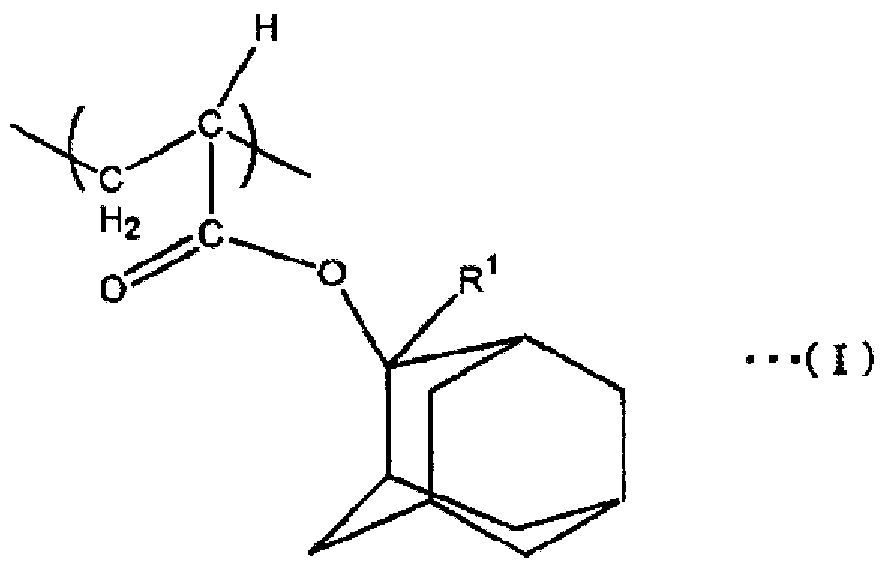
Claims

請求の範囲 [1] (A)酸の作用によりアルカリ可溶性が増大する榭脂成分、及び (B)露光により酸を 発生する酸発生剤成分を含有するレジスト組成物であって、 前記 (A)成分が、酸解離性溶解抑制基を含むアクリル酸エステルから誘導される 構成単位 (a l)、ラタトン環を有する ex—低級アルキルアクリル酸エステルから誘導さ れる構成単位 (a2)、及び極性基含有多環式基を含む( a 低級アルキル)アクリル 酸エステル力も誘導される構成単位 (a3)を有する共重合体 (A1)であり、かつ 支持体上に、前記レジスト組成物力 なるレジスト膜を形成し、該レジスト膜の表面 に現像液を塗布した後の当該レジスト膜の表面の接触角の測定値が 40度以下であ るポジ型レジスト糸且成物。 [2] 請求項 1に記載のポジ型レジスト組成物にぉ 、て、前記構成単位 (a l)は、下記一 般式 (I)〜 (III)力 選ばれる少なくとも 1種であるポジ型レジスト組成物。
[化 1]
Figure imgf000051_0001
[式 (I)中、 R1は低級アルキル基である。 ]
[化 2]
Figure imgf000051_0002
[式 (II)中、 R2及び R3はそれぞれ独立に低級アルキル基である。 ]
[化 3]
Figure imgf000052_0001
[式 (III)中、 R4は第 3級アルキル基である。 ]
請求項 1に記載のポジ型レジスト組成物において、前記構成単位 (a2)は下記一般 式 (IV)〜(VII)力も選ばれる少なくとも 1種であるポジ型レジスト組成物。
[化 4]
Figure imgf000052_0002
[式 (IV)中、 R'は低級アルキル基であり、 R5、 ま、それぞれ独立に、水素原子ま たは低級アルキル基である。 ]
[化 5]
Figure imgf000052_0003
[式 (V)中、 R'は低級アルキル基であり、 mは 0又は 1である。 ]
[化 6]
Figure imgf000053_0001
[式 (VI)中、 R'は低級アルキル基である。 ]
[化 7]
Figure imgf000053_0002
[式 (VII)中、 R'は低級アルキル基である。 ]
請求項 1に記載のポジ型レジスト組成物において、前記構成単位 (a3)は、下記 般式 (VIII)〜(IX)カゝら選ばれる少なくとも 1種であるポジ型レジスト組成物。
[化 8] (! H)
Figure imgf000054_0001
[式 (VIII)中、 Rは水素原子また 低級アルキル基であり、 nは 1〜3の整数である。 ] [化 9]
Figure imgf000054_0002
[式 (IX)中、 Rは水素原子または低級アルキル基であり、 kは 1〜3の整数である。 ]
請求項 2〜4の ヽずれか一項に記載のポジ型レジスト組成物にお 、て、前記共重 合体 (A1)が、下記化学式で表される構成単位を少なくとも含む共重合体であるポジ 型レジスト組成物。
[化 10]
Figure imgf000054_0003
[6] (A)酸の作用によりアルカリ可溶性が増大する榭脂成分、及び (B)露光により酸を 発生する酸発生剤成分を含有するレジスト組成物であって、支持体の上に、前記レ ジスト組成物カゝらなるレジスト膜を形成し、該レジスト膜の表面に現像液を塗布した後 の当該レジスト膜の表面の接触角の測定値が 40度以下であるポジ型レジスト組成物
[7] 請求項 6に記載のポジ型レジスト組成物において、接触角の測定値が 30〜40度で あるポジ型レジスト糸且成物。
[8] 請求項 6に記載のポジ型レジスト組成物にお ヽて、 (A)成分が、酸解離性溶解抑 制基を含む( ex—低級アルキル)アクリル酸エステル力 誘導される構成単位 (al, ) と、ラタトン環を有する( α—低級アルキル)アクリル酸エステルカゝら誘導される構成単 位 (a2 ' )とを有するポジ型レジスト組成物。
[9] 請求項 8に記載のポジ型レジスト組成物にぉ 、て、 (A)成分が、構成単位 (a l ' )、 構成単位 (a2 ' )および極性基含有多環式基を含む( ex—低級アルキル)アクリル酸 エステルカゝら誘導される構成単位 (a3, )を有する共重合体 (A1, )であるポジ型レジ スト組成物。
[10] (A)酸の作用によりアルカリ可溶性が増大する榭脂成分、及び (B)露光により酸を 発生する酸発生剤成分を含有するレジスト組成物であって、下記(1)、 (2)の条件を 満足するポジ型レジスト組成物。
( 1)前記 (A)成分が、酸解離性溶解抑制基を含む(α 低級アルキル)アクリル酸ェ ステルカゝら誘導される構成単位 (al ' )、ラタトン環を有する( ex—低級アルキル)アタリ ル酸エステルから誘導される構成単位 (&2 ' )、及び極性基含有多環式基を含む( a 低級アルキル)アクリル酸エステル力 誘導される構成単位 (a3, )を有する共重合 体 (Al,)である。
(2)支持体の上に、前記レジスト組成物力 なるレジスト膜を形成し、該レジスト膜の 表面に現像液を塗布した後の当該レジスト膜の表面の接触角の測定値が 40度以下 である。
[11] 請求項 8に記載のポジ型レジスト組成物において、前記構成単位 (a l ' )は、下記一 般式 (Γ )〜 (III ' )力も選ばれる少なくとも 1種であるポジ型レジスト組成物。 [化 11]
Figure imgf000056_0001
[式 (Γ)中、 Rは水素原子または低級アルキル基であり、 R1は低級アルキル基である 。 ]
[化 12]
Figure imgf000056_0002
[式 (ΙΓ)中、 Rは水素原子または低級アルキル基であり、 R2及び R3はそれぞれ独立 に低級アルキル基である。 ]
[化 13]
Figure imgf000056_0003
[式 (ΠΓ)中、 Rは水素原子または低級アルキル基であり、 R4は第 3級アルキル基で ある。 ] 請求項 9に記載のポジ型レジスト組成物において、前記構成単位 (al')は、下記 般式 (Γ )〜 (III ' )力も選ばれる少なくとも 1種であるポジ型レジスト組成物。
[化 14]
Figure imgf000057_0001
[式 (Γ)中、 Rは水素原子または低級アルキル基であり、 R1は低級アルキル基である 。 ]
[化 15]
Figure imgf000057_0002
[式 (ΙΓ)中、 Rは水素原子または低級アルキル基であり、 R2及び R3はそれぞれ独立 に低級アルキル基である。 ]
[化 16]
Figure imgf000057_0003
[式 (ΠΓ)中、 Rは水素原子または低級アルキル基であり、 R4は第 3級アルキル基で ある。 ]
請求項 10に記載のポジ型レジスト組成物において、前記構成単位 (al')は、下記 一般式 (Γ )〜 (III ' )力も選ばれる少なくとも 1種であるポジ型レジスト組成物。
[化 17]
Figure imgf000058_0001
[式 (Γ)中、 Rは水素原子または低級アルキル基であり、 R1は低級アルキル基である 。 ]
[化 18]
Figure imgf000058_0002
[式 (ΙΓ)中、 Rは水素原子または低級アルキル基であり、 R2及び R3はそれぞれ独立 に低級アルキル基である。 ]
[化 19]
Figure imgf000059_0001
[式 (ΠΓ )中、 Rは水素原子または低級アルキル基であり、 R4は第 3級アルキル基で ある。 ]
請求項 8に記載のポジ型レジスト組成物において、前記構成単位 (a2' )は下記一 般式 (IV' )〜(VII ' )力 選ばれる少なくとも 1種であるポジ型レジスト組成物。
[化 20]
Figure imgf000059_0002
[式 (IV' )中、 Rは水素原子または低級アルキル基であり、 、 R6は、それぞれ独立 に、水素原子または低級アルキル基である。 ]
[化 21]
Figure imgf000059_0003
[式 (V' )中、 Rは水素原子または低級アルキル基であり、 mは 0又は 1である。 ]
[化 22]
Figure imgf000060_0001
[式 (νΓ )中、 Rは水素原子または低級アルキル基である。 ]
[化 23]
Figure imgf000060_0002
[式 (νΐΓ )中、 Rは水素原子または低級アルキル基である。 ]
請求項 9に記載のポジ型レジスト糸且成物にお 、て、前記構成単位 (a2 ' )は下記 般式 (IV' )〜(VII ' )力 選ばれる少なくとも 1種であるポジ型レジスト組成物。
[化 24]
Figure imgf000060_0003
[式 (IV' )中、 Rは水素原子または低級アルキル基であり、 R5、 R6は、それぞれ独立 に、水素原子または低級アルキル基である。 ]
[化 25]
Figure imgf000061_0001
[式 (V' )中、 Rは水素原子または低級アルキル基であり、 mは 0又は 1である。 ]
[化 26]
Figure imgf000061_0002
[式 (VI' )中、 Rは水素原子または低級アルキル基である。 ]
[化 27]
Figure imgf000061_0003
[式 (νΐΓ)中、 Rは水素原子または低級アルキル基である。 ] 請求項 10に記載のポジ型レジスト組成物において、前記構成単位 (a2' )は下記一 般式 (IV' )〜(VII ' )力 選ばれる少なくとも 1種であるポジ型レジスト組成物。
[化 28]
Figure imgf000062_0001
[式 (IV,)中、 Rは水素原子または低級アルキル基であり、 R5、 R6は、それぞれ独立 に、水素原子または低級アルキル基である。 ]
[化 29]
Figure imgf000062_0002
[式 (V' )中、 Rは水素原子または低級アルキル基であり、 mは 0又は 1である。 ]
[化 30]
Figure imgf000063_0001
[式 (νΓ)中、 Rは水素原子または低級アルキル基である。 ]
[化 31]
Figure imgf000063_0002
[式 (νΐΓ)中、 Rは水素原子または低級アルキル基である。 ]
請求項 9項に記載のポジ型レジスト組成物において、前記構成単位 (a3' )は、下記 一般式 (νιπ' )〜(IX' )力も選ばれる少なくとも 1種であるポジ型レジスト組成物。
[化 32]
Figure imgf000063_0003
[式 (νΐΠ' )中、 Rは水素原子または低級アルキル基であり、 nは 1〜3の整数である。 ]
[化 33]
Figure imgf000064_0001
[式 (IX' )中、 Rは水素原子または低級アルキル基であり、 kは 1〜3の整数である。 ] 請求項 10項に記載のポジ型レジスト組成物において、前記構成単位 (a3' )は、下 記一般式 (VIII ' )〜 (IX, )力も選ばれる少なくとも 1種であるポジ型レジスト組成物。
[化 34]
Figure imgf000064_0002
[式 (νΐΠ' )中、 Rは水素原子または低級アルキル基であり、 ηは 1〜3の整数である ]
[化 35]
Figure imgf000065_0001
[式 (ΙΧ')中、 Rは水素原子または低級アルキル基であり、 kは 1〜3の整数である。 ] 請求項 9に記載のポジ型レジスト組成物において、前記共重合体 (ΑΙ')が、下記 化学式で表される構成単位を少なくとも含む共重合体であるポジ型レジスト組成物。
[化 36]
Figure imgf000065_0002
請求項 10に記載のポジ型レジスト組成物において、前記共重合体 (ΑΙ')が、下記 化学式で表される構成単位を少なくとも含む共重合体であるポジ型レジスト組成物。
[化 37]
Figure imgf000065_0003
[21] 請求項 8に記載のポジ型レジスト糸且成物にお 、て、 構成単位 (al ' )がアクリル酸エステル力も誘導される構成単位であり、構成単位 (a 2' )がひ一低級アルキルアクリル酸エステル力も誘導される構成単位である、ポジ型 レジスト組成物。
[22] 請求項 9に記載のポジ型レジスト組成物にぉ ヽて、
構成単位 (al ' )がアクリル酸エステル力も誘導される構成単位であり、構成単位 (a 2' )がひ一低級アルキルアクリル酸エステル力も誘導される構成単位である、ポジ型 レジスト組成物。
[23] 請求項 10に記載のポジ型レジスト組成物にぉ ヽて、
構成単位 (al ' )がアクリル酸エステル力も誘導される構成単位であり、構成単位 (a 2' )がひ一低級アルキルアクリル酸エステル力も誘導される構成単位である、ポジ型 レジスト組成物。
[24] 請求項 1に記載のポジ型レジスト組成物において、さらに含窒素有機化合物を含有 するポジ型レジスト組成物。
[25] 請求項 6に記載のポジ型レジスト組成物において、さらに含窒素有機化合物を含有 するポジ型レジスト組成物。
[26] 請求項 10に記載のポジ型レジスト組成物において、さらに含窒素有機化合物を含 有するポジ型レジスト組成物。
[27] 請求項 1に記載のポジ型レジスト組成物を基板上に塗布し、プレベータし、選択的 に露光した後、 PEB (露光後加熱)を施し、アルカリ現像してレジストパターンを形成 するレジストパターン形成方法。
[28] 請求項 6に記載のポジ型レジスト組成物を基板上に塗布し、プレベータし、選択的 に露光した後、 PEB (露光後加熱)を施し、アルカリ現像してレジストパターンを形成 するレジストパターン形成方法。
[29] 請求項 10に記載のポジ型レジスト組成物を基板上に塗布し、プレベータし、選択 的に露光した後、 PEB (露光後加熱)を施し、アルカリ現像してレジストパターンを形 成するレジストパターン形成方法。
PCT/JP2005/009564 2004-05-28 2005-05-25 ポジ型レジスト組成物及びレジストパターン形成方法 Ceased WO2005116769A1 (ja)

Priority Applications (1)

Application Number Priority Date Filing Date Title
US11/597,005 US8097396B2 (en) 2004-05-28 2005-05-25 Positive resist composition and method for forming resist pattern

Applications Claiming Priority (4)

Application Number Priority Date Filing Date Title
JP2004-159421 2004-05-28
JP2004159421 2004-05-28
JP2004322545A JP4279237B2 (ja) 2004-05-28 2004-11-05 ポジ型レジスト組成物及びレジストパターン形成方法
JP2004-322545 2004-11-05

Publications (1)

Publication Number Publication Date
WO2005116769A1 true WO2005116769A1 (ja) 2005-12-08

Family

ID=35451033

Family Applications (1)

Application Number Title Priority Date Filing Date
PCT/JP2005/009564 Ceased WO2005116769A1 (ja) 2004-05-28 2005-05-25 ポジ型レジスト組成物及びレジストパターン形成方法
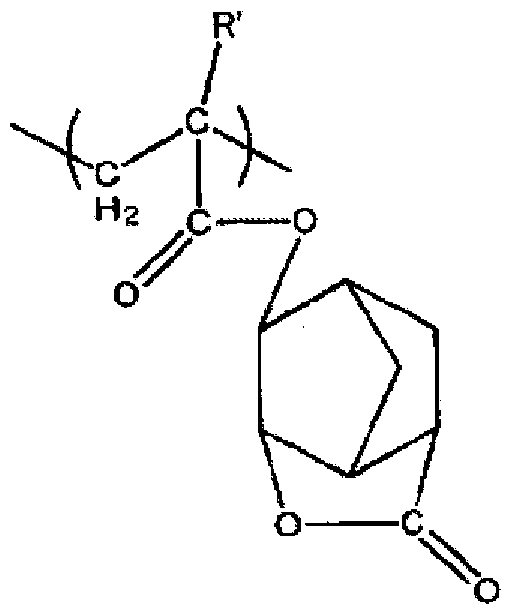
Country Status (4)

Country Link
US (1) US8097396B2 (ja)
JP (1) JP4279237B2 (ja)
TW (1) TWI282485B (ja)
WO (1) WO2005116769A1 (ja)

Cited By (1)

* Cited by examiner, † Cited by third party
Publication number Priority date Publication date Assignee Title
WO2006049246A1 (ja) * 2004-11-05 2006-05-11 Tokyo Ohka Kogyo Co., Ltd. レジスト組成物の製造方法およびレジスト組成物

Families Citing this family (3)

* Cited by examiner, † Cited by third party
Publication number Priority date Publication date Assignee Title
JP5364444B2 (ja) * 2008-07-15 2013-12-11 東京応化工業株式会社 レジスト組成物、レジストパターン形成方法、化合物、酸発生剤
JP5689253B2 (ja) * 2009-06-24 2015-03-25 住友化学株式会社 化学増幅型フォトレジスト組成物及びレジストパターンの製造方法
US9733564B2 (en) * 2010-10-18 2017-08-15 Mitsubishi Chemical Corporation Copolymers for lithography and method for producing same, resist composition, method for producing substrate with pattern formed thereupon, method for evaluating copolymers, and method for analyzing copolymer compositions

Citations (3)

* Cited by examiner, † Cited by third party
Publication number Priority date Publication date Assignee Title
JP2001183836A (ja) * 1999-12-22 2001-07-06 Sumitomo Chem Co Ltd 化学増幅型ポジ型レジスト組成物
JP2003131382A (ja) * 2001-10-26 2003-05-09 Mitsubishi Rayon Co Ltd 化学増幅型レジスト用重合体
JP2003167347A (ja) * 2001-12-03 2003-06-13 Tokyo Ohka Kogyo Co Ltd ポジ型レジスト組成物及びレジストパターンの形成方法

Family Cites Families (16)

* Cited by examiner, † Cited by third party
Publication number Priority date Publication date Assignee Title
TWI263866B (en) * 1999-01-18 2006-10-11 Sumitomo Chemical Co Chemical amplification type positive resist composition
JP3934816B2 (ja) 1999-03-18 2007-06-20 東京応化工業株式会社 ディフェクト抑制ポジ型レジスト塗布液
JP2001215704A (ja) * 2000-01-31 2001-08-10 Sumitomo Chem Co Ltd 化学増幅型ポジ型レジスト組成物
JP2001318466A (ja) 2000-02-28 2001-11-16 Sumitomo Chem Co Ltd 化学増幅型ポジ型レジスト組成物
TW573225B (en) 2000-02-28 2004-01-21 Sumitomo Chemical Co Chemically amplified positive resist composition
WO2002069044A2 (en) * 2001-02-25 2002-09-06 Shipley Company, L.L.C. Polymers and photoresist compositions
JP4187949B2 (ja) 2001-06-21 2008-11-26 富士フイルム株式会社 ポジ型レジスト組成物
US20030008968A1 (en) 2001-07-05 2003-01-09 Yoshiki Sugeta Method for reducing pattern dimension in photoresist layer
US6844133B2 (en) * 2001-08-31 2005-01-18 Shin-Etsu Chemical Co., Ltd. Polymer, resist composition and patterning process
JP3476082B2 (ja) 2001-11-05 2003-12-10 東京応化工業株式会社 パターン微細化用被覆形成剤およびそれを用いた微細パターンの形成方法
JP3895224B2 (ja) 2001-12-03 2007-03-22 東京応化工業株式会社 ポジ型レジスト組成物及びそれを用いたレジストパターン形成方法
JP4025102B2 (ja) * 2002-03-18 2007-12-19 富士フイルム株式会社 ポジ型レジスト組成物
US7279265B2 (en) 2003-03-27 2007-10-09 Fujifilm Corporation Positive resist composition and pattern formation method using the same
JP4360955B2 (ja) 2003-03-27 2009-11-11 富士フイルム株式会社 ポジ型レジスト組成物及びそれを用いたパターン形成方法
JP2005164633A (ja) * 2003-11-28 2005-06-23 Tokyo Ohka Kogyo Co Ltd ポジ型レジスト組成物及びレジストパターン形成方法
JP2005300998A (ja) * 2004-04-13 2005-10-27 Tokyo Ohka Kogyo Co Ltd ポジ型レジスト組成物及びレジストパターン形成方法

Patent Citations (3)

* Cited by examiner, † Cited by third party
Publication number Priority date Publication date Assignee Title
JP2001183836A (ja) * 1999-12-22 2001-07-06 Sumitomo Chem Co Ltd 化学増幅型ポジ型レジスト組成物
JP2003131382A (ja) * 2001-10-26 2003-05-09 Mitsubishi Rayon Co Ltd 化学増幅型レジスト用重合体
JP2003167347A (ja) * 2001-12-03 2003-06-13 Tokyo Ohka Kogyo Co Ltd ポジ型レジスト組成物及びレジストパターンの形成方法

Cited By (2)

* Cited by examiner, † Cited by third party
Publication number Priority date Publication date Assignee Title
WO2006049246A1 (ja) * 2004-11-05 2006-05-11 Tokyo Ohka Kogyo Co., Ltd. レジスト組成物の製造方法およびレジスト組成物
US7767378B2 (en) 2004-11-05 2010-08-03 Tokyo Ohka Kogyo Co., Ltd. Method for producing resist composition and resist composition

Also Published As

Publication number Publication date
JP2006011357A (ja) 2006-01-12
TW200615696A (en) 2006-05-16
TWI282485B (en) 2007-06-11
US8097396B2 (en) 2012-01-17
JP4279237B2 (ja) 2009-06-17
US20080063974A1 (en) 2008-03-13

Similar Documents

Publication Publication Date Title
KR100593228B1 (ko) 포지티브형 레지스트 조성물 및 이를 사용한 레지스트 패턴형성방법
KR100852376B1 (ko) 레지스트 조성물, 적층체, 및 레지스트 패턴 형성 방법
JP5470328B2 (ja) ポジ型レジスト組成物及びレジストパターン形成方法
WO2006082740A1 (ja) ポジ型レジスト組成物およびレジストパターン形成方法
WO2005101128A1 (ja) ポジ型レジスト組成物及びレジストパターン形成方法
JP4327003B2 (ja) ポジ型レジスト組成物及びそれを用いたレジストパターン形成方法
JP4628809B2 (ja) ネガ型レジスト組成物およびレジストパターン形成方法
WO2007148492A1 (ja) ポジ型レジスト組成物およびレジストパターン形成方法
WO2005116769A1 (ja) ポジ型レジスト組成物及びレジストパターン形成方法
JP4485913B2 (ja) レジスト組成物の製造方法およびレジスト組成物
WO2005106587A1 (ja) ポジ型レジスト組成物、レジストパターン形成方法及びイオンインプランテーション方法
JP4401840B2 (ja) ポジ型レジスト組成物及びそれを用いたレジストパターン形成方法
WO2006080151A1 (ja) レジストパターン形成方法
JP3895350B2 (ja) ポジ型レジスト組成物及びそれを用いたレジストパターン形成方法
JP3895352B2 (ja) ポジ型レジスト組成物及びそれを用いたレジストパターン形成方法
JP2005042092A (ja) ポジ型レジスト組成物及びそれを用いたレジストパターン形成方法
JP3895351B2 (ja) ポジ型レジスト組成物及びそれを用いたレジストパターン形成方法
JP2005037887A (ja) ポジ型レジスト組成物及びそれを用いたレジストパターン形成方法
WO2007138873A1 (ja) 液浸露光用レジスト組成物およびレジストパターン形成方法

Legal Events

Date Code Title Description
AK Designated states

Kind code of ref document: A1

Designated state(s): AE AG AL AM AT AU AZ BA BB BG BR BW BY BZ CA CH CN CO CR CU CZ DE DK DM DZ EC EE EG ES FI GB GD GE GH GM HR HU ID IL IN IS KE KG KM KP KR KZ LC LK LR LS LT LU LV MA MD MG MK MN MW MX MZ NA NG NI NO NZ OM PG PH PL PT RO RU SC SD SE SG SK SL SM SY TJ TM TN TR TT TZ UA UG US UZ VC VN YU ZA ZM ZW

AL Designated countries for regional patents

Kind code of ref document: A1

Designated state(s): BW GH GM KE LS MW MZ NA SD SL SZ TZ UG ZM ZW AM AZ BY KG KZ MD RU TJ TM AT BE BG CH CY CZ DE DK EE ES FI FR GB GR HU IE IS IT LT LU MC NL PL PT RO SE SI SK TR BF BJ CF CG CI CM GA GN GQ GW ML MR NE SN TD TG

121 Ep: the epo has been informed by wipo that ep was designated in this application
WWE Wipo information: entry into national phase

Ref document number: 11597005

Country of ref document: US

NENP Non-entry into the national phase

Ref country code: DE

WWW Wipo information: withdrawn in national office

Country of ref document: DE

122 Ep: pct application non-entry in european phase
WWP Wipo information: published in national office

Ref document number: 11597005

Country of ref document: US