WO2005016988A1 - 硬化性樹脂組成物 - Google Patents
硬化性樹脂組成物 Download PDFInfo
- Publication number
- WO2005016988A1 WO2005016988A1 PCT/JP2004/011873 JP2004011873W WO2005016988A1 WO 2005016988 A1 WO2005016988 A1 WO 2005016988A1 JP 2004011873 W JP2004011873 W JP 2004011873W WO 2005016988 A1 WO2005016988 A1 WO 2005016988A1
- Authority
- WO
- WIPO (PCT)
- Prior art keywords
- epoxy resin
- component
- cured product
- resin composition
- vdh
- Prior art date
- Legal status (The legal status is an assumption and is not a legal conclusion. Google has not performed a legal analysis and makes no representation as to the accuracy of the status listed.)
- Ceased
Links
Classifications
-
- C—CHEMISTRY; METALLURGY
- C08—ORGANIC MACROMOLECULAR COMPOUNDS; THEIR PREPARATION OR CHEMICAL WORKING-UP; COMPOSITIONS BASED THEREON
- C08L—COMPOSITIONS OF MACROMOLECULAR COMPOUNDS
- C08L63/00—Compositions of epoxy resins; Compositions of derivatives of epoxy resins
-
- C—CHEMISTRY; METALLURGY
- C08—ORGANIC MACROMOLECULAR COMPOUNDS; THEIR PREPARATION OR CHEMICAL WORKING-UP; COMPOSITIONS BASED THEREON
- C08G—MACROMOLECULAR COMPOUNDS OBTAINED OTHERWISE THAN BY REACTIONS ONLY INVOLVING UNSATURATED CARBON-TO-CARBON BONDS
- C08G59/00—Polycondensates containing more than one epoxy group per molecule; Macromolecules obtained by polymerising compounds containing more than one epoxy group per molecule using curing agents or catalysts which react with the epoxy groups
- C08G59/18—Macromolecules obtained by polymerising compounds containing more than one epoxy group per molecule using curing agents or catalysts which react with the epoxy groups ; e.g. general methods of curing
- C08G59/40—Macromolecules obtained by polymerising compounds containing more than one epoxy group per molecule using curing agents or catalysts which react with the epoxy groups ; e.g. general methods of curing characterised by the curing agents used
- C08G59/50—Amines
- C08G59/56—Amines together with other curing agents
- C08G59/58—Amines together with other curing agents with polycarboxylic acids or with anhydrides, halides, or low-molecular-weight esters thereof
Definitions
- the present invention relates to a curable resin composition. More specifically, the present invention relates to a one-pack type epoxy resin composition which is excellent in stability at normal temperature, and is cured rapidly at a relatively low temperature when heated to obtain a colorless and transparent cured product.
- BACKGROUND ART One-part epoxy resin compositions containing a hydrazide compound as a curing agent have high heat resistance, electrical insulation properties and storage stability.
- hydrazide compounds generally have very low impurities due to their high crystallinity. This property is useful for applications such as semiconductor encapsulation and liquid crystal encapsulation, for example, where it is necessary to ensure high reliability by extremely reducing ionic impurities and volatile impurities.
- Patent Document 1 discloses that a hydrazide compound according to the present invention (which is also a hydantoin compound; this hydrazide compound is hereinafter referred to as VDH) is an epoxy resin. It is disclosed that a composition blended in a predetermined amount with a resin has good storage stability and cures at a temperature of 130 ° C. or less to give a colorless, transparent and tough cured product. VDH has a small amount of ionic impurities, so there is little occurrence of defects derived from ionic impurities. VDH is used as a curing agent in semiconductor sealing and liquid crystal sealing applications that require high reliability.
- Patent Document 2 discloses that a one-part epoxy resin composition using a dihydrazide compound as a curing agent has a ( ⁇ ) high curing temperature and a low curing rate, and (ii) an improvement in moisture absorption.
- the drawback is that reducing the amount of the dihydrazide compound reduces the heat resistance, so that a compound with multiple phenolic OH groups or a compound with multiple phenolic groups is used together with the dihydrazide compound at a specific ratio. It has been shown that this can be overcome by doing so. However, there is no description on the uniformity of VDH curing according to the present invention, and no mention is made of the appearance of the cured product.
- Patent Document 3 Japanese Unexamined Patent Publication (Kokai) No. 635-256515 (Patent Document 3) also states that the curability can be significantly improved by using a hydrazide compound and a dibasic acid in combination. No knowledge was given on.
- Patent Document 4 discloses that a specific urea compound is used in addition to an epoxy resin, a hydrazide compound, and a dibasic acid, so that the resin has a fast curing property and a high adhesive property. It has been shown that a composition can be obtained that simultaneously satisfies good storage stability. However, there is no mention of VDH here, nor does it mention the uniformity of cure. Furthermore, there is no description on the appearance of the cured product.
- Patent Document 1 Japanese Patent Application Laid-Open No. 58-12909
- Patent Document 2 Japanese Patent Application Laid-Open No. Sho 62-172
- Patent Document 3 Japanese Patent Application Laid-Open No. Sho 63-3-2556615
- Patent Document 4 Japanese Patent Publication No. 8-1992
- Non-Patent Document 1 Summary of Special Lecture by the Epoxy Resin Technology Association (Takeuchi, April 1998) Disclosure of the invention
- An object of the present invention is to provide an epoxy resin composition containing VDH as a curing agent, a one-part epoxy resin composition that can be stored at room temperature, and a uniform, colorless and transparent curing in a wide heating range from low to high temperatures. It is to provide a way to get things.
- the present inventor has found that by using a specific dibasic acid having a melting point of 105-137 ° C having 4 or more carbon atoms together with VDH together with an epoxy resin, the epoxy resin can be cured at a high temperature of 120 ° C or more.
- a one-pack type epoxy resin composition that can obtain a uniform, colorless and transparent cured product is obtained.
- the cured product would be an extremely cured product, and based on such knowledge, the present invention was completed.
- the component (C) in the first embodiment is a one-part liquid wherein the component (C) is a dibasic acid represented by the following general formula (2) (where ⁇ is an integer of 8 to 18).
- the present invention relates to an epoxy resin composition.
- the present invention relates to a one-part epoxy resin composition wherein the component (c) in the second embodiment is decandioic acid or dodecanoic acid. [The invention's effect]
- the one-part epoxy resin composition of the present invention comprises a hydrazide compound (VDH) represented by the above formula (1) as a curing agent, a specific dibasic acid, and a one-part storable at room temperature.
- VDH hydrazide compound
- the epoxy resin (component (a)) used in the present invention may be any as long as it has an average of one or more epoxy groups in one molecule.
- various novolak type epoxy resins include, for example, various phenol novolak resins such as phenol, cresol, bisphenol A, bisphenol F, and bisphenol S; phenol novolak resins containing a xylylene skeleton; Glycidyl etherified products of various nopolak resins such as phenol novolak resin containing a triazine skeleton and phenol nopolak resin containing a fluorene skeleton.
- Examples of the daricidyl ether of a polyhydric phenol include resorcinol diglycidyl ether.
- Examples of the glycidyl ether of a polyhydric alcohol include 1,6-hexanediyldiglycidyl ether, trimethylolpropane triglycidyl ether, and polypropylene dalicol diglycidyl ether.
- alicyclic epoxy resins examples include 3,4-epoxycyclohexylmethyl (3,4-epoxy) cyclohexanecarboxylate, ⁇ -force prolactone-modified 3,4-epoxycyclohexylmethyl- (3,4-epoxy) cyclohexanecarboxylate, and the like.
- glycidyl ester examples include diglycidyl adipic ester, didaricidyl phthalate hexate, and diglycidyl ester of tetrahydrodol phthalate.
- glycidylamine examples include ⁇ , ⁇ -diglycidylol 0-toluidine, ⁇ , ⁇ -diglycidylamine, ⁇ , ⁇ , ⁇ ', ⁇ '-tetraglycidylamine m-xylene diamine, 1,3-bis (N , N-diglycidylaminomethyl) cyclohexane.
- the component (a) of the one-pack type epoxy resin composition of the present invention is preferably a bisphenol A type epoxy resin, a bisphenol F type epoxy resin, a hydrogenated bisphenol A type epoxy resin.
- VDH which is the component (b) of the one-pack type epoxy resin composition of the present invention and represented by the above formula (1) is 1,3-bis (hydrazinocarboethyl) -15-isopropylhydantoin It is.
- the production method is disclosed in Patent Document 1. In use, it is pulverized to 100 im or less, preferably 20 Atm or less, and used as a hardener dispersed in an epoxy resin.
- a dibasic acid having 4 or more carbon atoms and a melting point of 105 to 1370C is selected.
- the structure is not particularly limited as long as it has two carboxyl groups. Although it may have various functional groups such as unsaturated bonds, linear or branched saturated hydrocarbon dibasic acids are preferred from the viewpoint that they do not easily decompose and do not accompany another kind of reaction.
- a linear type represented by the following general formula (3) (where m is an integer of 4 or more) is more preferable.
- the melting point of such a dibasic acid needs to be around 120 ° C., which is the melting point of VDH, from the viewpoint of preventing VDH from being separated from the epoxy resin.
- the temperature is from 0 to 13 ° C., more preferably from 115 to 135 ° C., and still more preferably from 124 to 134 ° C.
- the temperature is lower than 105 ° C, the storage stability of the composition is extremely lowered in the sense that the viscosity rise is large.
- the melting point is higher than 1337 ° C, the melting point of VDH (120 ° C) and the melting point of dibasic acid are too different from each other, so that phase separation of VDH cannot be prevented and uniform curing can be achieved. I can't get anything.
- dibasic acid examples include decandioic acid, dodecandioic acid, tetradecanoic acid, hexadecanedioic acid, cytadecandiodic acid, eicosanediacid, and the like.
- Other elements are preferably decandioic acid and dodecandioic acid in view of the fact that the curing temperature range is wide and the production is easy to control.
- the amount of the component (c) is suitably 0.5 to 30 parts by weight based on 100 parts by weight of the component (a). More preferably, it is 3 to 10 parts by weight.
- the compounding amount of component (b) is suitably 0.7 to 1.1 equivalent in terms of the total of NH groups at both ends of VDH of component (b) with respect to the epoxy group of component (a). More preferably, it is 0.8 to 1.1 equivalent.
- the sum of the equivalent of the NH group of the component (b) and the equivalent of the carboxyl group of the component (c) is 0.7 to 1.2 equivalent to the equivalent of the epoxy group of the component (a). The amount is appropriate. If the amount is less than 0.7 equivalent, the curing will be insufficient, and if the amount is more than 1.2 equivalents, the water resistance of the cured product will decrease.
- additives can be added to the one-pack type epoxy resin composition of the present invention, if desired or necessary, to such an extent that the effect is not impaired.
- a filler, a pigment, a dye, an antioxidant, an ultraviolet absorber, an internal mold release agent, a lubricant, an antifoaming agent, a leveling agent, and the like can be blended.
- Antioxidants are used to prevent coloration. For example, hindered phenols having a radical-promoting action, organic sulfides having a peroxide decomposing action, organic phosphites, 9,10-dihydro 9 One-year-old 10-phosphaphenanthren 10-year-old cypress.
- the one-pack type epoxy resin composition of the present invention comprising the three components (a), (b) and (c) as essential components can be produced by a conventional method.
- it can be obtained by dispersing a hydrazide compound VDH and a dibasic acid and other powder components as required or necessary in an epoxy resin with three rolls.
- it can be manufactured using equipment that has a kneading and dispersing action such as a planetary mixer and a vacuum grinder. It is preferable to include a defoaming step such as defoaming under reduced pressure to prevent air bubbles from being mixed into the cured product.
- the one-part epoxy resin composition of the present invention can be stored at room temperature, refrigerated or frozen, and is stable for up to 2 weeks at 25 ° C and up to 6 months at refrigerated at 5 ° C. It is.
- the one-part epoxy resin composition of the present invention can be cured by a method usually used for curing epoxy resins.
- it can be cured by hot-air oven, infrared oven, far-infrared oven, or heat molding using a mold.
- hot-air oven infrared oven, far-infrared oven, or heat molding using a mold.
- These devices are It is possible to use either a single type or a continuous type.
- a curing temperature that gives a uniform, colorless and transparent cured product a range of 90 to 150 ° C is usually selected from the effect of the combination of VDH and a dibasic acid, and preferably 90 to 140 ° C, More preferably, 100 to 120 ° C is selected. If the temperature exceeds 150 ° C., coloring may occur, and if the temperature is lower than 90 ° C., a remarkably long curing time is required, which is not preferable.
- the curing time is usually selected from 10 minutes to 3 hours, preferably from 10 minutes to 2 hours, more preferably from 10 minutes to 3 hours, from the viewpoint of ordinary productivity and workability.
- compositions prepared in Examples and Comparative Examples were evaluated by gel time measurement, observation of the appearance of a cured product, and storage stability.
- the gel time at 100 ° C and 100 ° C was measured using a Yasuda gelling tester (manufactured by Yasuda Seiki Seisakusho) using about 2.5 g of the composition. did.
- the gel time measurement at 130 ° C, 140 ° C and 150 ° C is performed by placing about 0.1 g of the composition on a hot plate at a predetermined temperature, causing the composition to lose fluidity and gel. The time until was measured.
- the appearance of the cured product is 90 ° C, 100 ° C, 110 ° C, 120 ° C, 130 ° C, 140 ° C and 150 ° C in a hot air oven 6
- the cured product cured for 0 minutes was visually observed.
- the appearance was evaluated according to the following criteria.
- the storage stability was evaluated as ⁇ (pass) when the viscosity of the composition at 25 ° C after 2 weeks was within twice the initial viscosity, and X (fail) when the viscosity was more than twice the initial viscosity.
- Epicoat 828 ELJ Bisphenol A type epoxy resin manufactured by Japan Epoxy Resin Co., Ltd., epoxy equivalent: 190
- VDH manufactured by Ajinomoto Fine Techno Co., Inc., average particle size 3 wm
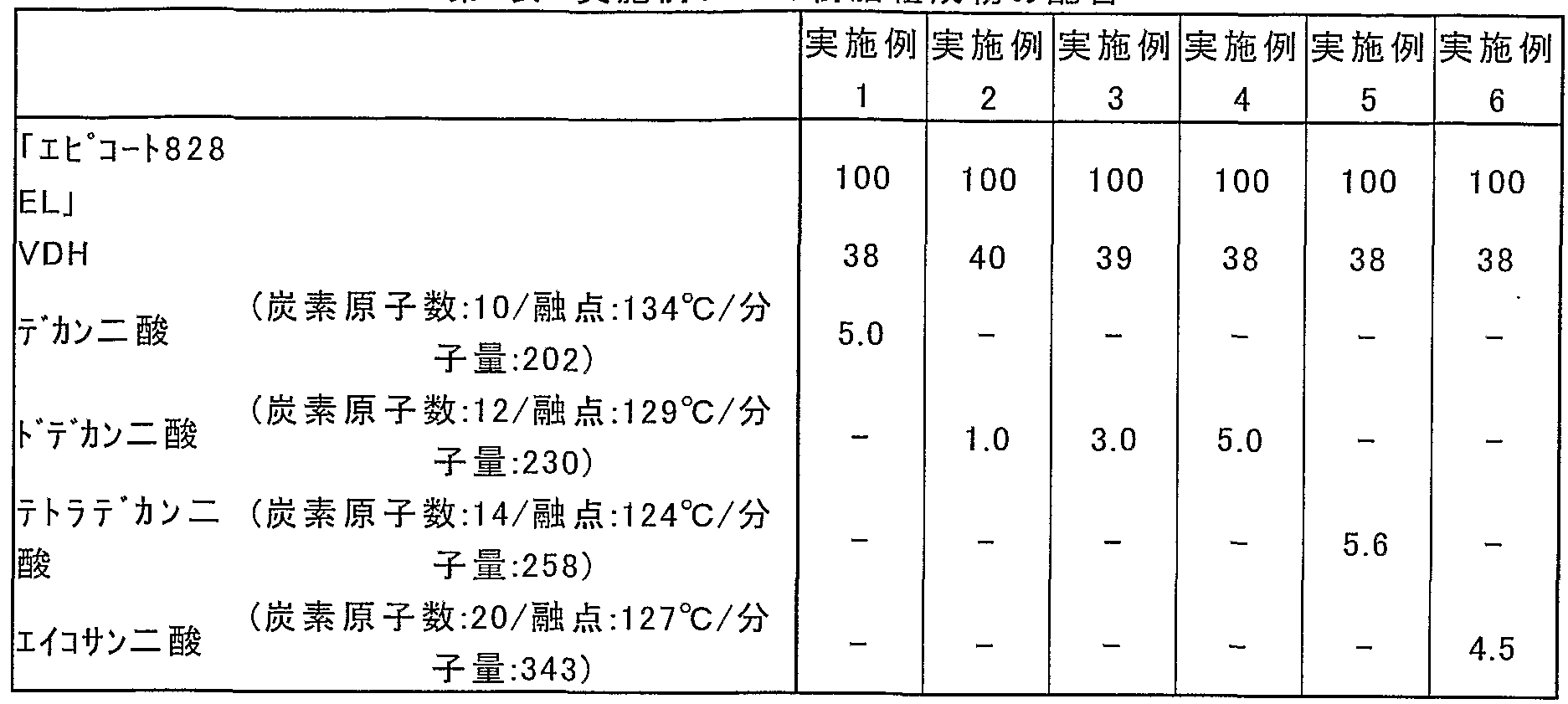
- Table 1 Table 1 below
- the various carboxylic acid compounds described were mixed in the proportions shown in the table, dispersed using a three-roll mill, and then defoamed under reduced pressure using a vacuum grinder to obtain an epoxy resin composition.
- the viscosity of the film, the appearance of the cured product, and the viscosity of the composition after 2 weeks were measured at 25 ° C. The results are shown in Table 2 below.
- Table 1 Formulation of resin compositions of Examples 1 to 6
- Table 2 shows that the compositions of Examples 1 to 6 all have good storage stability. In addition, it can be seen that, in comparison with the composition of Comparative Example 1 in Table 4, the compositions of Examples 1 to 6 all have a wider temperature range at which a uniform cured product can be obtained. Particularly, in the compositions of Examples 1 and 4, a colorless and transparent cured product was obtained at 90 to 150 ° C.
- the composition of Comparative Example 1 is a composition corresponding to the example described in JP-A-58-12909 (Patent Document 1), and has a good storage stability. A uniform cured product can only be obtained at 0 ° C.
- the composition of Comparative Example 2 has good storage stability and can obtain a uniform cured product at 90 to 120 ° C., but all the cured products are colored yellow.
- the compositions of Comparative Examples 3 and 4 were uncured or non-uniformly cured at any curing temperature of 90 to 150 ° C. All of the compositions of Comparative Examples 3 to 7, 9 and 11 had poor storage stability.
- the composition of Comparative Example 7 obtained a colorless and transparent cured product at 100 to 150 ° C, but was cured after storage at 25 ° C for 3 days, and had extremely poor storage stability.
- the composition of Comparative Example 8 was a composition in which adipic dihydrazide was used as a curing agent instead of the hydrazide compound VDH and dodecane diacid was added, and the storage stability was good, but the operation using the hydrazide compound VDH was carried out. Poor curability compared to the composition of the example.Curing at 90 to 130 ° C did not produce a uniform cured product, and cured at 140 ° C and 150 ° C was uniform. However, it was colored yellow.
- the composition of Comparative Example 9 was a composition in which bisphenol A was added using the hydrazide compound VDH as a curing agent, and a colorless and transparent cured product was obtained at 100 to 120 ° C. Extremely poor stability. Cured after storage at 25 ° C for 1 week.
- the composition of Comparative Example 10 is a composition corresponding to the examples described in the above-mentioned JP-A-62-17204 (Patent Document 2). Although the storage stability was good, it did not cure below 100 ° C, and at 110 ° C, a nearly transparent cured product was obtained, but the surface condition of the cured product was poor. In addition, the cured product at a temperature of 120 to 500 ° C. was colored yellow.
- the composition of Comparative Example 11 is a composition corresponding to the example described in Japanese Patent Publication No. 8-19212 (Patent Document 4). At a curing temperature of 120 ° C or lower, a uniform cured product could not be obtained, and at a temperature of 130 ° C or higher, the cured product was colored yellow. In addition, storage stability was poor.
- the composition of Comparative Example 12 is a composition corresponding to the examples described in Japanese Patent Application Laid-Open No. 63-256666 / Patent Document 3. An almost colorless and transparent cured product was obtained when cured at 120 ° C, but a transparent cured product was not obtained at temperatures lower than 110 ° C, and the cured product was colored yellow when cured at 130 ° C or higher. have done.
- the one-part epoxy resin composition of the present invention is capable of obtaining a colorless and transparent cured product due to the characteristics of VDH having low-temperature curability and low ionic impurities and the effect of blending a special dibasic acid. Utilizing its characteristics, it can be widely used in industrial applications such as semiconductor encapsulants, liquid crystal encapsulants, lens compositions, and LED encapsulants.
Landscapes
- Chemical & Material Sciences (AREA)
- Health & Medical Sciences (AREA)
- Chemical Kinetics & Catalysis (AREA)
- Medicinal Chemistry (AREA)
- Polymers & Plastics (AREA)
- Organic Chemistry (AREA)
- Epoxy Resins (AREA)
Abstract
Description




Claims

Applications Claiming Priority (2)
| Application Number | Priority Date | Filing Date | Title |
|---|---|---|---|
| JP2003-293724 | 2003-08-15 | ||
| JP2003293724A JP2005060573A (ja) | 2003-08-15 | 2003-08-15 | 硬化性樹脂組成物 |
Publications (1)
| Publication Number | Publication Date |
|---|---|
| WO2005016988A1 true WO2005016988A1 (ja) | 2005-02-24 |
Family
ID=34191006
Family Applications (1)
| Application Number | Title | Priority Date | Filing Date |
|---|---|---|---|
| PCT/JP2004/011873 Ceased WO2005016988A1 (ja) | 2003-08-15 | 2004-08-12 | 硬化性樹脂組成物 |
Country Status (5)
| Country | Link |
|---|---|
| JP (1) | JP2005060573A (ja) |
| KR (1) | KR20060037275A (ja) |
| CN (1) | CN1835984A (ja) |
| TW (1) | TW200505957A (ja) |
| WO (1) | WO2005016988A1 (ja) |
Families Citing this family (4)
| Publication number | Priority date | Publication date | Assignee | Title |
|---|---|---|---|---|
| KR101341137B1 (ko) * | 2007-07-30 | 2013-12-13 | 삼성디스플레이 주식회사 | 밀봉제 및 이를 이용한 표시 장치 |
| KR101821574B1 (ko) * | 2010-08-05 | 2018-01-25 | 닛산 가가쿠 고교 가부시키 가이샤 | 질소 함유 고리를 갖는 에폭시 화합물 |
| JP7425612B2 (ja) * | 2019-04-10 | 2024-01-31 | シチズン時計株式会社 | 熱硬化性樹脂組成物、時計部品、夜光カプセルおよび夜光カプセルの製造方法 |
| JP7804887B2 (ja) * | 2022-08-10 | 2026-01-23 | 味の素株式会社 | エポキシ樹脂用硬化剤およびエポキシ樹脂組成物 |
Citations (4)
| Publication number | Priority date | Publication date | Assignee | Title |
|---|---|---|---|---|
| JPS55147565A (en) * | 1979-05-04 | 1980-11-17 | Kurimoto Iron Works Ltd | Powdered painting material |
| JPS58129019A (ja) * | 1982-01-29 | 1983-08-01 | Ajinomoto Co Inc | エポキシ樹脂用潜在性硬化剤 |
| JPS6381119A (ja) * | 1986-09-25 | 1988-04-12 | Ajinomoto Co Inc | 一液性エポキシ樹脂組成物 |
| JP2001311953A (ja) * | 2000-04-28 | 2001-11-09 | Ricoh Co Ltd | 無溶剤型プラスチックフィルム液晶素子用シール剤及び表示素子 |
-
2003
- 2003-08-15 JP JP2003293724A patent/JP2005060573A/ja active Pending
-
2004
- 2004-07-15 TW TW093121182A patent/TW200505957A/zh unknown
- 2004-08-12 WO PCT/JP2004/011873 patent/WO2005016988A1/ja not_active Ceased
- 2004-08-12 CN CNA2004800233237A patent/CN1835984A/zh active Pending
- 2004-08-12 KR KR1020057024758A patent/KR20060037275A/ko not_active Withdrawn
Patent Citations (4)
| Publication number | Priority date | Publication date | Assignee | Title |
|---|---|---|---|---|
| JPS55147565A (en) * | 1979-05-04 | 1980-11-17 | Kurimoto Iron Works Ltd | Powdered painting material |
| JPS58129019A (ja) * | 1982-01-29 | 1983-08-01 | Ajinomoto Co Inc | エポキシ樹脂用潜在性硬化剤 |
| JPS6381119A (ja) * | 1986-09-25 | 1988-04-12 | Ajinomoto Co Inc | 一液性エポキシ樹脂組成物 |
| JP2001311953A (ja) * | 2000-04-28 | 2001-11-09 | Ricoh Co Ltd | 無溶剤型プラスチックフィルム液晶素子用シール剤及び表示素子 |
Also Published As
| Publication number | Publication date |
|---|---|
| JP2005060573A (ja) | 2005-03-10 |
| KR20060037275A (ko) | 2006-05-03 |
| CN1835984A (zh) | 2006-09-20 |
| TW200505957A (en) | 2005-02-16 |
Similar Documents
| Publication | Publication Date | Title |
|---|---|---|
| JP3913476B2 (ja) | 樹脂組成物 | |
| TWI540146B (zh) | 絕緣調配物 | |
| US20130158198A1 (en) | Epoxy resin composition and its preparing method | |
| EP2158250A1 (de) | Katalysator für die härtung von epoxiden | |
| CN100432063C (zh) | 环氧化合物,其制备方法以及应用 | |
| JP5792054B2 (ja) | 硬化性組成物及びその硬化物 | |
| CN108026252A (zh) | 环氧树脂组合物 | |
| KR20180003354A (ko) | 속경화성, 저점도, 및 고내열성을 갖는 에폭시 수지 조성물 | |
| JP2016531998A (ja) | 硬化性エポキシ樹脂組成物 | |
| JP2008019350A (ja) | 硬化性樹脂組成物 | |
| US3025263A (en) | Epoxy carboxylic acid dianhydride compositions | |
| TW201323514A (zh) | 一液型環氧樹脂組成物 | |
| JPWO2018159564A1 (ja) | 樹脂組成物 | |
| CN111527120A (zh) | 环氧树脂组合物、固化物及电气电子部件 | |
| JP2005060573A (ja) | 硬化性樹脂組成物 | |
| KR20220007073A (ko) | 잠재성 경화 촉매 및 그것을 포함하는 수지 조성물 | |
| JP7642295B2 (ja) | 熱硬化性樹脂組成物 | |
| JP2018009090A (ja) | 光半導体用樹脂組成物及びその製造方法、並びに光半導体装置 | |
| EP4059973B1 (en) | Epoxy resin compositions and methods for preparing them | |
| EP3959217B1 (en) | Improvements in or relating to curatives | |
| JP4126575B2 (ja) | 電子部品封止材料の製造方法 | |
| KR20220138144A (ko) | 산 무수물기반 에폭시 화합물, 이를 포함하는 에폭시 수지 조성물 및 이로부터 제조된 경화물 | |
| KR102454213B1 (ko) | 산 무수물기반 에폭시 화합물, 이를 포함하는 에폭시 접착제 조성물 및 이로부터 제조된 경화물 | |
| KR102398321B1 (ko) | 초저온 속경화성 에폭시 수지의 제조방법 및 이에 의해 제조된 수지를 포함하는 분체도료용 조성물 | |
| JP2011001442A (ja) | エポキシ樹脂組成物、繊維強化複合材料、および繊維強化複合材料の製造方法 |
Legal Events
| Date | Code | Title | Description |
|---|---|---|---|
| WWE | Wipo information: entry into national phase |
Ref document number: 200480023323.7 Country of ref document: CN |
|
| AK | Designated states |
Kind code of ref document: A1 Designated state(s): AE AG AL AM AT AU AZ BA BB BG BR BW BY BZ CA CH CN CO CR CU CZ DE DK DM DZ EC EE EG ES FI GB GD GE GH GM HR HU ID IL IN IS KE KG KP KR KZ LC LK LR LS LT LU LV MA MD MG MK MN MW MX MZ NA NI NO NZ OM PG PH PL PT RO RU SC SD SE SG SK SL SY TJ TM TN TR TT TZ UA UG US UZ VC VN YU ZA ZM ZW |
|
| AL | Designated countries for regional patents |
Kind code of ref document: A1 Designated state(s): BW GH GM KE LS MW MZ NA SD SL SZ TZ UG ZM ZW AM AZ BY KG KZ MD RU TJ TM AT BE BG CH CY CZ DE DK EE ES FI FR GB GR HU IE IT LU MC NL PL PT RO SE SI SK TR BF BJ CF CG CI CM GA GN GQ GW ML MR NE SN TD TG |
|
| 121 | Ep: the epo has been informed by wipo that ep was designated in this application | ||
| WWE | Wipo information: entry into national phase |
Ref document number: 1020057024758 Country of ref document: KR |
|
| WWP | Wipo information: published in national office |
Ref document number: 1020057024758 Country of ref document: KR |
|
| 122 | Ep: pct application non-entry in european phase |