WO2005012387A1 - 高分子化合物およびそれを用いた高分子発光素子 - Google Patents
高分子化合物およびそれを用いた高分子発光素子 Download PDFInfo
- Publication number
- WO2005012387A1 WO2005012387A1 PCT/JP2004/011020 JP2004011020W WO2005012387A1 WO 2005012387 A1 WO2005012387 A1 WO 2005012387A1 JP 2004011020 W JP2004011020 W JP 2004011020W WO 2005012387 A1 WO2005012387 A1 WO 2005012387A1
- Authority
- WO
- WIPO (PCT)
- Prior art keywords
- group
- polymer
- polymer compound
- layer
- compound
- Prior art date
- Legal status (The legal status is an assumption and is not a legal conclusion. Google has not performed a legal analysis and makes no representation as to the accuracy of the status listed.)
- Ceased
Links
Classifications
-
- C—CHEMISTRY; METALLURGY
- C09—DYES; PAINTS; POLISHES; NATURAL RESINS; ADHESIVES; COMPOSITIONS NOT OTHERWISE PROVIDED FOR; APPLICATIONS OF MATERIALS NOT OTHERWISE PROVIDED FOR
- C09K—MATERIALS FOR MISCELLANEOUS APPLICATIONS, NOT PROVIDED FOR ELSEWHERE
- C09K11/00—Luminescent materials, e.g. electroluminescent or chemiluminescent
- C09K11/06—Luminescent materials, e.g. electroluminescent or chemiluminescent containing organic luminescent materials
-
- C—CHEMISTRY; METALLURGY
- C08—ORGANIC MACROMOLECULAR COMPOUNDS; THEIR PREPARATION OR CHEMICAL WORKING-UP; COMPOSITIONS BASED THEREON
- C08G—MACROMOLECULAR COMPOUNDS OBTAINED OTHERWISE THAN BY REACTIONS ONLY INVOLVING UNSATURATED CARBON-TO-CARBON BONDS
- C08G61/00—Macromolecular compounds obtained by reactions forming a carbon-to-carbon link in the main chain of the macromolecule
-
- H—ELECTRICITY
- H05—ELECTRIC TECHNIQUES NOT OTHERWISE PROVIDED FOR
- H05B—ELECTRIC HEATING; ELECTRIC LIGHT SOURCES NOT OTHERWISE PROVIDED FOR; CIRCUIT ARRANGEMENTS FOR ELECTRIC LIGHT SOURCES, IN GENERAL
- H05B33/00—Electroluminescent light sources
- H05B33/12—Light sources with substantially two-dimensional [2D] radiating surfaces
- H05B33/14—Light sources with substantially two-dimensional [2D] radiating surfaces characterised by the chemical or physical composition or the arrangement of the electroluminescent material, or by the simultaneous addition of the electroluminescent material in or onto the light source
-
- C—CHEMISTRY; METALLURGY
- C09—DYES; PAINTS; POLISHES; NATURAL RESINS; ADHESIVES; COMPOSITIONS NOT OTHERWISE PROVIDED FOR; APPLICATIONS OF MATERIALS NOT OTHERWISE PROVIDED FOR
- C09K—MATERIALS FOR MISCELLANEOUS APPLICATIONS, NOT PROVIDED FOR ELSEWHERE
- C09K2211/00—Chemical nature of organic luminescent or tenebrescent compounds
- C09K2211/14—Macromolecular compounds
- C09K2211/1408—Carbocyclic compounds
- C09K2211/1425—Non-condensed systems
Definitions
- the present invention relates to a polymer compound and a polymer light-emitting device (polymer LED).
- high molecular weight light emitting materials Different from low molecular weight light emitting materials, high molecular weight light emitting materials have been studied in various ways because they are soluble in a solvent and can form a light emitting layer in a light emitting device by a coating method.
- a polymer compound having a fluorenediyl group in which a linear or branched alkyl group is bonded to a ring as a repeating unit is known to be useful as a light-emitting material (Advanced Materials 20 0 0 12 ⁇ 5. ⁇ 362).
- An object of the present invention is to provide a polymer compound which is useful as a light emitting material and has excellent heat resistance.
- the present inventors have conducted intensive studies in order to solve the above-mentioned problems, and as a result, as a repeating unit, an alicyclic hydrocarbon group or a saturated heterocyclic group, an arylene group or a heterocyclic group bonded to a ring via an alkylene group.
- the present inventors have found that a polymer compound having a heterocyclic group is useful as a light emitting material and has excellent heat resistance, and completed the present invention.
- the present invention is to provide a containing a repeating unit represented by the following formula (1), a polymer compound number average molecular weight of Borisuchiren terms is 1 0 3 to 1 0 8.
- a r 1 represents an arylene group or a divalent heterocyclic group, and the A r 1 has 1 to 4 groups represented by 1 L-1 Y.
- Y represents an alicyclic hydrocarbon group or a saturated heterocyclic group.
- L is an alkyl group, an alkoxy group, an alkylthio group, an aryl group, an aryloxy group, an arylthio group, an arylalkyl group, an arylalkoxy group, an arylalkylthio group, an arylalkenyl group, an arylalkynyl group, an amino group, From substituted amino groups, silyl groups, substituted silyl groups, halogen atoms, acyl groups, acyloxy groups, imine residues, amide groups, acid imide groups, monovalent heterocyclic groups, hydroxyl groups, substituted carboxyl groups and cyano groups Represents an alkylene group which may be substituted with a selected group.
- R 1 , R 2 , R 3 , R 4 , R 5 , R 6 , R 7 and R 8 each independently represent a hydrogen atom, an alkyl group, an aryl group, a monovalent heterocyclic group or a cyano group.
- n is 0 or 1.
- the polymer compound of the present invention comprises a repeating unit represented by the above formula (1), the number average molecular weight in terms of polystyrene is usually 1 0 3 to 108.
- Ar 1 represents an arylene group or a divalent heterocyclic group, and the Ar 1 has 1 to 4 groups represented by 1 L and 1 Y.
- Y represents an alicyclic hydrocarbon group or a saturated heterocyclic group, and these are an alkyl group, an alkoxy group, an alkylthio group, an aryl group, an aryloxy group, an arylthio group, an arylalkyl group, an arylalkoxy group.
- the number of carbon atoms constituting the ring of the alicyclic hydrocarbon group is usually about 5 to 16.
- the carbon atoms constituting the ring of the saturated heterocyclic group is usually about 4 to 60, as its concrete examples below are illustrated in - - (5 3 5) (5 2 7) - Groups.
- R ′ in (5-1) to (5-53) is independently a hydrogen atom, an alkyl group, an alkoxy group, an alkylthio group, an aryl group, an aryloxy group, an arylthio group, an arylalkyl group, an arylalkoxy group, Arylalkylthio group, arylalkenyl group, arylalkynyl group, amino group, substituted amino group, silyl group, substituted silyl group, halogen atom, acyl group, acyloxy group, imine residue, amide group, acid imide group, 1 And a divalent heterocyclic group, a propyloxyl group, a substituted lipoxyl group, a cyano group, and the like.
- the alkyl group which the alicyclic hydrocarbon group or the saturated heterocyclic group may have may be linear, branched or cyclic.
- the number of carbon atoms is usually about 1 to 20 and preferably 3 to 20.
- the alkoxy group may be linear, branched or cyclic.
- the number of carbon atoms is usually about 1 to 20 and preferably 3 to 20.
- Examples include a penoxy group, a pentyloxy group, a hexyloxy group, an octyloxy group, a
- the alkylthio group may be linear, branched or cyclic.
- the number of carbon atoms is usually about 1 to 20 and preferably 3 to 20.
- the aryl group usually has about 6 to 60 carbon atoms, and preferably 7 to 48 carbon atoms. More specifically, a phenyl group or a C ⁇ Cu alkoxyphenyl group (where "-" indicates that the number of carbon atoms is 1 to 12; the same applies to the following).
- a C 1, to C 12 alkylphenyl group is preferred.
- the aryl group is an atomic group obtained by removing one hydrogen atom from an aromatic hydrocarbon.
- the aromatic hydrocarbon includes those having a condensed ring, and those in which two or more independent benzene rings or condensed rings are bonded directly or via a group such as vinylene.
- C i ⁇ C 12 alkylphenyl group as Specifically, methylphenyl group, Echirufueniru group, dimethyl phenylpropyl group, a propyl phenylalanine group, mesityl group, methyl E chill phenylalanine group, i
- the aryloxy group usually has about 6 to 60 carbon atoms, preferably 7 to 48 carbon atoms. Specific examples thereof include a phenoxy group, a C ⁇ Cu alkoxyphenoxy group, an alkyl phenoxy group, a 1-naphthyloxy group, a 2-naphthyloxy group, a penfluorofluorophenyl group, and the like. ⁇ to 12 alkyl phenoxy groups are preferred.
- alkoxyphenyl examples include methoxy, ethoxy, propyloxy, i-propyloxy, butoxy, i-butoxy, t-butoxy, pentyloxy, hexyloxy, cyclohexyloxy, heptyloxy, octyloxy, and 2-ethoxy.
- Examples include lehexyloxy, nonyloxy, decyloxy, 3,7-dimethyloctyloxy, lauryloxy, and the like.
- C 1 to C 12 alkylphenoxy group examples include methylphenoxy, ethylphenoxy, dimethylphenoxy, propylphenoxy, 1,3,5-trimethylphenoxy, and methylethyl Enoxy group, i-propyl phenoxy group, butyl phenoxy group, i-butyl phenoxy group, t-butyl phenoxy group, pentyl phenoxy group, isoamyl phenoxy group, hexyl phenoxy group, heptyl phenoxy group, octyl phenoxy group, Examples include a nonylphenoxy group, a decylphenoxy group, and a dodecylphenoxy group.
- the arylthio group usually has about 6 to 60 carbon atoms, preferably 7 to 48 carbon atoms.
- Illustrative examples include a CC ⁇ alkoxyphenylthio group, ⁇ ;! Alkylalkylthio group.
- the arylalkyl group usually has about 7 to 60 carbon atoms, and preferably 7 to 48 carbon atoms.
- the arylalkoxy group usually has about 7 to 60 carbon atoms, and preferably 7 to 48 carbon atoms. Specifically, phenyl methoxy, phenylethoxy, phenylbutoxy, phenylpentyloxy, phenylhexyloxy, phenylheptyloxy, phenyloxy, phenyloxy, etc. 12 alkoxy groups, ⁇ alkoxy phenyl ⁇ 0 12 alkoxy groups, C ⁇ C alkyl phenyl ⁇ 12 alkoxy groups, 1 naphthyl ⁇ ! ⁇ 12 alkoxy groups, 2-naphthyl-C! Cu alkoxy groups, etc. Examples are shown in C ⁇ Cu alkoxy phenyl. ⁇ Alkoxy ⁇ ⁇ 12 Arukirufue two Roux C, -C, 2 alkoxy groups are preferred.
- the arylalkylthio group usually has about 7 to 60 carbon atoms, and preferably has 1 to 48 carbon atoms. Specifically, phenylene Lou ⁇ 0 12 alkylthio group, ⁇ Ji alkoxy phenylene Lou C ⁇ C 12 alkylthio group, C ⁇ C 12 Arukirufue two Lou C ⁇ C 12 alkylthio O group, 1 one Nafuchiru C ⁇ !
- C 2 alkylthio group 2-naphthyl - C, -C 12, such as an alkylthio group and the like, C, -C I2 alkoxy phenylalanine - C, -C 12 alkylthio group, C, -C 12 Arukirufue two Roux C, ⁇ A C 12 alkylthio group is preferred.
- the arylalkenyl group usually has about 7 to 60 carbon atoms, and preferably 7 to 48 carbon atoms.
- the arylalkynyl group usually has about 7 to 60 carbon atoms, and preferably 7 to 48 carbon atoms.
- substituted amino group examples include an amino group substituted with one or two groups selected from an alkyl group, an aryl group, an arylalkyl group and a monovalent heterocyclic group.
- the alkyl group, aryl group, and aryl group may have a substituent.
- the carbon number is usually about 1 to 60 without including the carbon number of the substituent, and is preferably 2 to 48.
- Examples of the substituted silyl group include a silyl group substituted with one, two, or three groups selected from an alkyl group, an aryl group, an arylalkyl group, and a monovalent heterocyclic group. It is about 60, and preferably has 3 to 48 carbon atoms.
- the alkyl group, phenyl group, arylalkyl group or monovalent heterocyclic group may have a substituent.
- a trimethylsilyl group a triethylsilyl group, a triprovilsilyl group, a tri-i-propylsilyl group, a dimethyl-i-propylsilyl group, a dimethyl-i-propylsilyl group, a t-butylsilyldimethylsilyl group, a pentyldimethylsilyl group, Xyldimethylsilyl group, heptyldimethylsilyl group, octyldimethylsilyl group, 2-ethylhexyldimethylsilyl group, nonyldimethylsilyl group, decyldimethylsilyl group, 3,7-dimethyloctyl-dimethylsilyl group , lauryl dimethyl silyl group, phenyl - C, ⁇ C I2 alkyl silyl group, C, ⁇ C 12 Arukokishifue two
- halogen atom examples include a fluorine atom, a chlorine atom, a bromine atom and an iodine atom.
- the acyl group usually has about 2 to 20 carbon atoms, and preferably has 2 to 18 carbon atoms. Specific examples include an acetyl group, a propionyl group, a butyryl group, an isoptyryl group, a pivaloyl group, a benzoyl group, a trifluoroacetyl group, and a pentafluorobenzoyl group.
- the acyloxy group usually has about 2 to 20 carbon atoms, and preferably has 2 to 18 carbon atoms. Specific examples include an acetoxy group, a propionyloxy group, a petyriloxy group, an isobutyryloxy group, a piperyloxy group, a benzoyloxy group, a trifluoroacetyloxy group, and a pentafluorofluorobenzoyloxy group.
- examples thereof include aldimines, ketimines, and hydrogen atoms on these N substituted with alkyl groups.
- a residue obtained by removing one hydrogen atom from such a compound which usually has about 2 to 20 carbon atoms, and preferably 2 to 18 carbon atoms.
- groups represented by the following structural formulas are exemplified.
- the amide group usually has about 2 to 20 carbon atoms, and preferably has 2 to 18 carbon atoms.
- Examples thereof include a fluoroacetamide group and a dipentafluorobenzamide group.
- Examples of the acid imide group include a residue obtained by removing a hydrogen atom bonded to the nitrogen atom from the acid imide, which usually has about 2 to 60 carbon atoms, and preferably has 2 to 48 carbon atoms. .
- the following groups are exemplified.
- the monovalent heterocyclic group refers to an atomic group remaining after removing one hydrogen atom from the heterocyclic compound, and usually has about 4 to 60 carbon atoms, and preferably 4 to 20 carbon atoms.
- the carbon number of the heterocyclic group does not include the carbon number of the substituent.
- the heterocyclic compound is an organic compound having a cyclic structure in which the elements constituting the ring include not only carbon atoms but also hetero atoms such as oxygen, sulfur, nitrogen, phosphorus, and boron in the ring. To include.
- a phenyl group a CCu alkyl phenyl group, a pyrrolyl group, a furyl group, a pyridyl group, a d-C 12 alkylpyridyl group, a piperidyl group, a quinolyl group, and an isoquinolyl group.
- a phenyl group a CCu alkyl phenyl group, a pyrrolyl group, a furyl group, a pyridyl group, a d-C 12 alkylpyridyl group, a piperidyl group, a quinolyl group, and an isoquinolyl group.
- pyridyl group and ⁇ alkylpyridyl group are preferred.
- the substituent ropoxyl group usually has about 2 to 60 carbon atoms, and preferably has 2 to 48 carbon atoms.
- substituents in the case of a substituent containing an alkyl chain, they may be straight-chain, branched or cyclic, or a combination thereof. If not straight-chain, for example, an isoamyl group , hexyl group 2 Echiru, 3, 7-Jimechiruokuchiru group, key sill group cycloheteroalkyl, 4-C, such as cyclohexyl group and the like to -C 12 alkylcycloalkyl. Further, the tips of two alkyl chains may be connected to form a ring.
- methyl or methylene groups in the alkyl chain may be replaced by heteroatom-containing groups or one or more fluorine-substituted methyl or methylene groups.
- substituents when an aryl group or a heterocyclic group is contained in a part thereof, they may further have one or more substituents.
- L in the group represented by L 1 Y in the formula (1) is an alkyl group, an alkoxy group, an alkylthio group, an aryl group, an aryloxy group, an arylthio group, an arylalkyl group, an arylalkoxy group, an arylalkylthio group, Arylalkenyl group, arylalkynyl group, amino group, substituted amino group, silyl group, substituted silyl group, halogen atom, acyl group, acyloxy group, imine residue, amide group, acid imide group, monovalent heterocyclic group , An alkylene group which may be substituted with a group selected from a lipoxyl group, a propyloxyl group and a cyano group; and when L is an alkylene group having 2 or more carbon atoms, one CH 2 contained in the alkylene group —One or more of the groups are one O—, —S—, one CO—, —C ⁇
- R 3 , R 4 , R 5 , R 6 , R 7 and R 8 each independently represent a hydrogen atom, an alkyl group, an aryl group, a monovalent heterocyclic group or a cyano group.
- the carbon number of the alkyl group in R 3 to R 8 is usually about 1 to 20, and examples thereof include a methyl group, an ethyl group, a propyl group, an i-propyl group, a butyl group, and an i-butyl group.
- the number of carbon atoms of Ariru group has usually about 6 to 60, and specific examples thereof include phenyl group, C, -C 12 alkoxy phenylalanine group, ⁇ . ⁇ Alkylphenyl group, 1 one-naphthyl, 2-naphthyl, 1 one-anthracenyl group, 9 one anthracenyl group, pentafluorophenyl group and the like, C, -C 12 alkoxy phenylpropyl group, A C ⁇ Cu alkylphenyl group is preferred.
- the aryl group is an atomic group obtained by removing one hydrogen atom from an aromatic hydrocarbon and having a condensed ring, a group in which two or more independent benzene rings or condensed rings are directly or a group such as vinylene. Also included are those that are linked through the intermediary.
- the monovalent heterocyclic group means an atomic group remaining after removing one hydrogen atom from a heterocyclic compound, and usually has about 4 to 60 carbon atoms, and preferably 4 to 20 carbon atoms. Note that the carbon number of the monovalent heterocyclic group does not include the carbon number of the substituent.
- heterocyclic compound refers to an organic compound having a cyclic structure, in which the elements constituting the ring include not only carbon atoms but also hetero atoms such as oxygen, sulfur, nitrogen, phosphorus, and boron in the ring. A thing. Specifically, thienyl group, C!
- Rukirucheniru group a pyrrolyl group, a furyl group, a pyridyl group, ⁇ ⁇ 12 alkyl pyridyl group, piperidyl group, quinolyl group, isoquinolyl group and the like, thienyl group, c, ⁇ c 12 ⁇ Rukirucheniru group, a pyridyl group, the d ⁇ C 12 alkyl pyridyl group are preferable.
- R 3 to R 8 include an alkyl chain
- the alkyl chain may be linear, branched, or cyclic, and the ends of a plurality of alkyl chains are connected to each other to form a ring. Is also good.
- R 9 to R 14 are Each independently represents a group selected from the group consisting of a hydrogen atom, an alkyl group, an aryl group, a monovalent heterocyclic group and a cyano group.
- L examples include groups exemplified by the following formula (6).
- * represents a site binding to Ar 1
- p represents a positive integer of 1 to 12
- an arbitrary number of hydrogen atoms of the methylene group may be substituted with R ′ ′′.
- R is independently a hydrogen atom, an alkyl group, an alkoxy group, an alkylthio group, an aryl group, an aryloxy group, an arylthio group, an arylalkyl group, an arylalkoxy group, an arylalkylthio group, or an arylalkenyl group.
- Specific examples of R include the same as those exemplified for R ', and when two or more R' ' They may be the same or different.
- L can be represented by the formula (6), or has the formula one CH 2 one one or two of (6), one ⁇ _, - S-, -S i R 3 R 4 - is a case that is replaced by -, -NR 5.
- p l to 3
- the site binding to A r 1 is replaced by one 0—, —S—, one S i R 3 R 4 —, —NR 5 — .
- Ar 1 represents a ⁇ Li one alkylene group or a divalent heterocyclic group, wherein Ar 1 is one
- L-Y It has one to four groups represented by L-Y, and may further have a substituent.
- the number of carbon atoms constituting the ring of the ren group is about 6 to 60, and the number of carbon atoms constituting the ring of the divalent heterocyclic group is about 4 to 60.
- a r 1 includes, for example, the following formula (2-1) or (2-2).
- one X— represents one C (R 21 R 22 ) one, one S— or one O—
- R 21 and R 22 each independently represent an alkyl group, an aryl group, a monovalent heterocyclic group or -Represents a group represented by LY.
- Ring A, ring B, ring C and ring D each independently represent an aromatic ring which may have a group represented by —L—Y.
- the total number of groups represented by 1 L-1 Y in the formula is 1 or more and 4 or less, and A ring, B ring, C ring and D ring may further have a substituent.
- Y is before Has the same meaning as described above, and when there are a plurality of L and Y, they may be the same or different.
- aromatic ring examples include aromatic hydrocarbon rings such as a benzene ring, a naphthalene ring, an anthracene ring, a tetracene ring, a pen benzene ring, a pyrene ring, a phenanthrene ring;
- aromatic hydrocarbon rings such as a benzene ring, a naphthalene ring, an anthracene ring, a tetracene ring, a pen benzene ring, a pyrene ring, a phenanthrene ring
- heteroaromatic rings such as an isoquinoline ring, a thiophene ring, a furan ring, and a pyrroyl ring.
- the types of the aromatic rings of the ring A, ring B, ring C and ring D may be the same or different.
- ring A, the ring B, the ring C and the ring D are preferably aromatic hydrocarbon rings.
- Definitions and specific examples of R 2 1 and R 2 2 is as defined above R 3 to R 8.
- Examples of the substituent which ring A, ring B, ring C and ring D may have include an alkyl group, an alkoxy group, an alkylthio group, an aryl group, an aryloxy group, an arylthio group, an arylalkyl group, an arylalkoxy group , Arylalkylthio, arylalkenyl, arylalkynyl, amino, substituted amino, silyl, substituted silyl, halogen atom, acyl, acyloxy, imine residue, amide, acid
- Examples include an imido group, a monovalent complex ring group, a propyloxyl group, a substituted carboxyl group, and a cyano group.
- arylene group in the formulas (2-1) and (2-2) include the following in the following formulas (4-1) to (4-3), respectively.
- R are 1 L-1 Y.
- divalent heterocyclic group examples include, in the following Formulas (4-4) to (4-23), Of those, one or more and four or less are 1L-1Y. 9
- arylene groups include those represented by the following formulas (4-24) to (4-58), in which at least 1 and at most 4 of each R are —L-Y Is exemplified-
- divalent heterocyclic group examples include those represented by the following formulas (4-59) to (4-164), wherein 1 to 4 of each R are 1 L-1 Y Is done.
- R in the above formulas (4-1) to (4-164) is independently a hydrogen atom, an alkyl group, an alkoxy group, an alkylthio group, an aryl group, an aryloxy group, an arylthio group, an arylalkyl group, or an arylalkyl group.
- one structural formula has a plurality of Rs, which may be the same group or different groups, and each is independently selected. However, when R is 4 or more, one or more and 4 or less are groups represented by —X—Y, and when R is 3 or less, one or more and R is the maximum number or less. Is a group represented by one X—Y.
- a r 1 is preferably the above formula (2-1) or (2-2), and particularly preferably A r 1 is the above formula (2-1).
- ring A, ring B, ring C and ring D are more preferably aromatic hydrocarbon rings.
- one X- is one C (R 21 R 22) one [wherein, R 2 1 and R 22 are as defined above.
- (4-1-1) to (4-1-3) when —X— is equal to one (for example, (4-1-4) to (4-6) (4-10) , (4-12), (4-14), (4-16-1), (4-118), (4-120), (4-2 2));
- X— is one S— For example, (4-1-7)-(4-1-9) (4-11-1), (4-13-1), (4-1-15), (4-17-1), (4-19-1), (4-11-2) ) And (4-2 3)) are more preferred.
- the case represented by the following formulas (3-1) to (3-5) is more preferable, and the case represented by (3-1) is particularly preferable.
- X, L and Y represent the same meaning as described above, and the bond of L not bonded to Y is directly connected to any of the aromatic rings intersecting the illustrated line .
- R 1 and R 2 each independently represent a hydrogen atom, an alkyl group, a aryl group, a monovalent heterocyclic group or a cyano group.
- R 1 R 2 specific examples of the alkyl group, aryl group and monovalent heterocyclic group for R 1 R 2 are the same as those described for R 3 to R 8 above.
- RR 2 contains an alkyl chain
- this alkyl chain may be linear, branched, or cyclic, may form a ring tips of the plurality of the alkyl chains are connected to each other.
- W a group selected from the group consisting of
- the total amount of the repeating units represented by the above formula (1) is usually 1 mol% or more and 100 mol% or less of the total of all the repeating units of the polymer compound of the present invention. Preferably, it is 10 mol% or more and 100 mol% or less.
- the polymer compound of the present invention has the above formula as long as it does not impair the fluorescence properties and the charge transport properties.
- a repeating unit other than the repeating unit represented by (1) may be contained, but the content is 1 mol% or more and 90 mol% or less. Preferably, it is at least 10 mol% and at most 90 mol%, more preferably at least 50 mol% and at most 90 mol%.
- the polymer compound of the present invention can contain a compound other than the above formula (1) As the repeating unit, the following formula (7), the formula
- R M is an alkyl group, an alkoxy group, an alkylthio group, an aryl group, an aryloxy group, an arylthio group, an arylalkyl group, an arylalkoxy group, an arylalkylthio group, an arylalkenyl group, an arylalkynyl group, Amino group, substituted amino group, silyl group, substituted silyl group, halogen atom, acyl group, acyloxy group, imine residue, amide group, acid imide group, monovalent heterocyclic group, hydroxyl group, substituted carboxyl group or cyano group Represents a group.
- n shows the integer of 0-4. When a plurality of RMs are present, they may be the same or different.
- R 21 and R 22 are each independently an alkyl group, an alkoxy group, an alkylthio group, an aryl group, an aryloxy group, an arylthio group, an arylalkyl group, an arylalkoxy group, an arylalkylthio group, an arylalkenyl group , Aryl alkynyl W 200
- R 25 and R 26 are each independently an alkyl group, an alkoxy group, an alkylthio group, an aryl group, an aryloxy group, an arylthio group, an arylalkyl group, an aryl alkoxy group, an arylalkylthio group, Arylalkenyl group, arylalkynyl group, amino group, substituted amino group, silyl group, substituted silyl group, halogen atom, acyl group, acyloxy group, imine residue, amide group, acid imide group, monovalent heterocyclic ring A lipoxyl group, a propyloxyl group or a cyano group.
- R 23 and R 24 are each independently an integer of 0-4 Indicates.
- R 23 and R 24 each independently represent a hydrogen atom, an alkyl group, an aryl group, a monovalent heterocyclic group, a lipoxyl group, a propyloxyl group or a cyano group.
- R 25 and R 26 may be the same or different.
- equation (9) is
- R 26 represents an alkyl group, an alkoxy group, an alkylthio group, an aryl group, an aryloxy group, an arylthio group, an arylalkyl group, an arylalkoxy group, an arylalkylthio group, an arylalkenyl group, an arylalkynyl group, Amino group, substituted amino group, silyl group, substituted silyl group, halogen atom, acyl group, acyloxy group, imine residue, amide group, acid imide group, monovalent heterocyclic group, lipoxyl group, lipoxyl group, or Represents a cyano group.
- s represents an integer of 0 to 2.
- a r 2 and A r 3 are each independently a ⁇ Li one alkylene group, a divalent heterocyclic group.
- sa and sb each independently represent 0 or 1.
- X 2 represents a 0, S, SO, S_ ⁇ 2, S e or T e,. When a plurality of R26s are present, they may be the same or different.
- R "and R 28 are each independently an alkyl group, an alkoxy group, an alkylthio group, an aryl group, an aryloxy group, an arylthio group, an arylalkyl group, an arylalkoxy group, an arylalkylthio group , Arylalkenyl, arylalkynyl, amino, substituted amino, silyl, substituted silyl, halogen, acyl, 7 siloxy, imine, amide, acid imide, monovalent hetero ring group, a carboxyl group, a substituted force Rupokishiru group or Shiano group. shows a to 2 integer. t and u each independently represent an integer of 0 to 4.
- X 2 is ⁇ , S, S 0 2, S e, Te, N—R 29 , or S i R 3 »R 31.
- X 3 and X 4 each independently represent N or C-R 32.
- R 29 , R 30 R 31 and R 32 are independently hydrogen sources
- R 27 , R 28 and R 32 may be the same or different when there are a plurality of R 27 , R 28 and R 32 respectively.
- Examples of the central five-membered ring of the repeating unit represented by the formula (11) include thiadiazol, oxaziazole, triazole, thiophene, furan, silole and the like.
- a specific example of equation (11) is
- R 33 and R 38 each independently represent an alkyl group, an alkoxy group, an alkylthio group, an aryl group, an aryloxy group, an arylthio group, an arylalkyl group, an arylalkoxy group, an arylalkylthio group, an arylalkenyl group, Arylalkynyl group, amino group, substituted amino group, silyl group, substituted silyl group, halogen atom, acyl group, acyloxy group, imine residue, amide group, acid imide group, monovalent heterocyclic group, lipoxyl group And a substitution power of a lipoxyl group or a cyano group.
- V and w each independently represent an integer of 0-4.
- R 34 , R 35 , R 36 and R 37 each independently represent a hydrogen atom, an alkyl group, an aryl group, a monovalent heterocyclic group, a lipoxyl group, a substitution lipoxyl group or a cyano group.
- Ar 4 represents an arylene group, a divalent heterocyclic group or a divalent group having a metal complex structure. When a plurality of R 33 and R 38 are present, they may be the same or different.
- Ar 12 , 1" 13 and 8 1 " 14 each independently represent an arylene group or a divalent heterocyclic group.
- Ar 15 and 8 1" 16 1 "and 17 each independently represent an aryl group or a monovalent heterocyclic group.
- Nn and mm each independently represent 0 or 1, and 0 ⁇ nn + mm ⁇ 1.
- repeating unit represented by the above formula (13) include the following.
- R in the above formula has the same definition as R in the above formulas (4-1) to (4-164).
- one structural formula has a plurality of Rs, but they may be the same or different groups.
- the compound preferably has at least one other than a hydrogen atom, and preferably has low symmetry in the shape of the repeating unit including a substituent.
- R when R includes an aryl group or a heterocyclic group as a part thereof, they may further have one or more substituents.
- R when R is an alkyl group-containing substituent, they may be linear, branched, or cyclic, or a combination thereof.
- substituent when the substituent is not linear, for example, an isoamyl group, Examples thereof include an ethylhexyl group, a 3,7-dimethyloctyl group, a cyclohexyl group, and a 4- ⁇ to 12- alkylcyclohexyl group.
- at least one of the polymer chains contains a cyclic or branched alkyl chain.
- a plurality of Rs may be linked to form a ring.
- R is a group containing an alkyl chain
- the alkyl chain may be interrupted by a group containing a hetero atom.
- the hetero atom include an oxygen atom, a sulfur atom, and a nitrogen atom.
- the polymer compound of the present invention may be a random, block or graft copolymer, or a polymer having an intermediate structure between them, for example, a block copolymer-bearing random copolymer. Is also good.
- Polymer light-emitting material with high quantum yield of fluorescence or phosphorescence (polymer From the viewpoint of obtaining an amount of light-emitting material), a random copolymer having block properties or a block or graft copolymer is preferable to a completely random copolymer. If the main chain is branched and has three or more terminal groups, dendrimers are also included.
- repeating units may be linked by a non-conjugated unit, or the repeating unit may contain a non-covalent part thereof.
- bonding structure examples include those shown below, and combinations of two or more of the following.
- R is a group selected from the same substituents as described above, and Ar represents a hydrocarbon group having 6 to 60 carbon atoms.
- the polymer compound of the present invention may be a random, block or graft copolymer, or a polymer having an intermediate structure between them, such as a block copolymerized random copolymer. Is also good. From the viewpoint of obtaining a polymeric fluorescent substance having a high quantum yield of fluorescence, a random copolymer having a block property or a block or graft copolymer is preferable to a completely random copolymer. If the main chain is branched and has three or more terminal parts, ⁇ dendrimers are also included.
- the terminal group of the polymer compound of the present invention may be protected with a stable group, since if the polymerization active group is left as it is, the light emitting characteristics and lifetime of the device may be reduced. .
- Those having a conjugated bond continuous with the conjugated structure of the main chain are preferable.
- carbon A structure bonded to an aryl group or a heterocyclic group via a single carbon bond is exemplified.
- substituents and the like described in Chemical Formula 10 of JP-A-9-45478 are exemplified.
- the number average molecular weight of the polymer compound of the present invention in terms of polystyrene is 10 3 to 10 8 , preferably 10 4 to 10 6 .
- the weight average molecular weight in terms of polystyrene is usually 10 3 to 10 8 , preferably 5 ⁇ 10 4 to 5 ⁇ 10 6 .
- Examples of good solvents for the polymer compound of the present invention include chloroform, methylene chloride, dichloromethane, tetrahydrofuran, toluene, xylene, mesitylene, tetralin, decalin, and n-butylbenzene. Although it depends on the structure and molecular weight of the polymer compound, usually, the polymer compound of the present invention can be dissolved in these solvents in an amount of 0.1% by weight or more.
- the polymer compound of the present invention can be produced, for example, as follows.
- a method described in JP-A-5-202355 can be mentioned. That is, polymerization of a compound having a formyl group and a compound having a phosphonium methyl group, or a formyl group and a diphosphonium salt compound by a Wittig reaction, and a Horner-Wa reaction of a dialdehyde compound and a diphosphite compound.
- a method of polymerizing the corresponding monomer by a Su zuki coupling reaction for example, a method of polymerizing by a Grignard reaction, a method of polymerizing by a Ni (0) complex, a method of polymerization with an oxidizer such as Fe C 1 3, electrochemically methods oxidative polymerization, a method by decomposition of an intermediate polymer having a suitable leaving group, are exemplified.
- polymerization by the Wittig reaction polymerization by the Heck reaction, polymerization by the Knoevenage 1 reaction, polymerization by the Suzuki coupling reaction, polymerization by the Grignard reaction, and polymerization by the nickel zero-valent complex
- the method is preferable because the structure can be easily controlled.
- the purity of the polymer affects the performance of the device such as light emission characteristics. It is preferred to polymerize afterwards. After the polymerization, it is preferable to carry out a purification treatment such as reprecipitation purification or fractionation by chromatography.
- the polymer compound of the present invention usually has fluorescence or phosphorescence in a solid state, and can be used as a polymer light-emitting material (a high-molecular weight light-emitting material). Further, the polymer compound has an excellent electron transporting ability and can be suitably used as a polymer LED material or a charge transport material.
- the polymer LED using the polymer light-emitting material is a high-performance polymer LED that can be driven with low voltage and high efficiency. Accordingly, the polymer LED can be preferably used for a backlight of a liquid crystal display, a curved or flat light source for illumination, a segment type display element, a dot matrix flat panel display, and the like.
- the polymer compound of the present invention can also be used as a material for conductive thin films such as dyes for lasers, materials for organic solar cells, organic semiconductors for organic transistors, conductive thin films, and organic semiconductor thin films.
- the polymer LED of the present invention has an organic layer between an electrode composed of an anode and a cathode, and the organic layer contains the polymer compound of the present invention.
- the organic layer may be any of a light emitting layer, a hole transporting layer, an electron transporting layer, and the like, but the organic layer is preferably a light emitting layer.
- the light-emitting layer refers to a layer having a function of emitting light
- the hole-transport layer refers to a layer having a function of transporting holes
- the electron-transport layer refers to a layer having a function of transporting electrons.
- the electron transport layer and the hole transport layer are collectively called a charge transport layer. Two or more light emitting layers, hole transport layers, and electron transport layers may be used independently.
- the organic layer is a light emitting layer
- the light emitting layer as an organic layer may further contain a hole transporting material, an electron transporting material, or a fluorescent material.
- the mixing ratio of the hole transporting material is lwt% to 80wt%, preferably 5wt% to 60wt%, based on the whole mixture. It is.
- the mixing ratio of the electron transporting material to the whole mixture is lwt% to 80wt%, preferably 5wt% to 60wt%. is there.
- the mixing ratio of the fluorescent material to the whole mixture is lwt% to 80wt%, preferably 5wt% to 60wt%. .
- the mixing ratio of the fluorescent material to the whole mixture is 1 wt% to 50 wt%.
- the total of the hole transporting material and the electron transporting material is 1 wt% to 50 wt%, preferably 5 wt% to 40 wt%. Is from 99 wt% to 20 wt%.
- hole transporting material As the hole transporting material, the electron transporting material, and the fluorescent material to be mixed, known low-molecular compounds and high-molecular compounds can be used, but high-molecular compounds are preferably used.
- W099Z13692, W099 / 48160, GB2340304A, WO 00/53656, WO 0 1/19834, WO 00/55927, GB as the hole transporting material, electron transporting material and fluorescent material of the polymer compound.
- low molecular compound fluorescent materials examples include naphthalene derivatives, anthracene or its derivatives, perylene or its derivatives, polymethine, xanthene, coumarin and cyanine dyes, and 8-hydroxyquinoline or its derivatives.
- a metal complex of a derivative, aromatic amine, tetraphenylcyclopentene or a derivative thereof, or tetraphenylbutadiene or a derivative thereof can be used.
- JP-A-57-51781 and JP-A-59-194393 can be used.
- composition of the present invention contains at least one material selected from a hole transport material, an electron transport material, and a fluorescent material and at least one polymer compound of the present invention. It can be used as a material or the like.
- the content ratio of at least one material selected from a hole transport material, an electron transport material, and a fluorescent material and the polymer compound of the present invention may be determined according to the application.
- the same content ratio as in the light emitting layer is preferable.
- the optimum value of the thickness of the light emitting layer in the polymer LED of the present invention differs depending on the material used, and may be selected so that the driving voltage and the luminous efficiency have appropriate values, for example, from l nm to 1 m. , Preferably 2 nm to 500 nm, and more preferably 5 ⁇ ! ⁇ 200 nm.
- a method of forming the light emitting layer for example, a method of forming a film from a solution is exemplified.
- a printing method such as a printing method or an inkjet printing method can be used.
- Printing methods such as a screen printing method, a flexographic printing method, an offset printing method, and an ink jet printing method are preferable in that pattern formation and multicolor coating are easy.
- the ink composition used in the printing method or the like only needs to contain at least one kind of the polymer compound of the present invention.
- a hole transport material, an electron transport material, a fluorescent material , A solvent, and an additive such as a stabilizer is added to the polymer compound of the present invention.
- the proportion of the polymer compound of the present invention in the ink composition is from 20 wt% to 10 Owt%, preferably from 4 Owt% to 10 Owt%, based on the total weight of the composition excluding the solvent. is there.
- the proportion of the solvent is 1 wt% to 99.9 wt%, preferably 6 Owt% to 99.5 wt%, based on the total weight of the composition. More preferably, it is from 8% to 99.0%.
- the viscosity of the ink composition varies depending on the printing method.However, when the ink composition passes through a discharging device such as an ink jet printing method, the viscosity is 25 ° to prevent clogging and flight bending during discharging. C is preferably in the range of 1 to 2 OmPas.
- the solvent used as the ink composition is not particularly limited, but is preferably a solvent capable of dissolving or uniformly dispersing materials other than the solvent constituting the ink composition.
- the solvent may be a chlorine-based solvent such as chloroform, methylene chloride or dichloroethane, an ether-based solvent such as tetrahydrofuran, toluene, or xylene.
- ketone solvents such as acetone and methyl ethyl ketone
- ester solvents such as ethyl acetate, butyl acetate and ethyl cellosolve acetate.
- the polymer LED of the present invention includes a polymer LED having an electron transport layer between a cathode and a light-emitting layer, a polymer LED having a hole transport layer between an anode and a light-emitting layer, A polymer LED in which an electron transport layer is provided between the cathode and the light emitting layer and a hole transport layer is provided between the anode and the light emitting layer is exemplified.
- the hole transporting material used may be polyvinyl carbazole or a derivative thereof, polysilane or a derivative thereof, or a polysiloxane having an aromatic amine in a side chain or a main chain.
- the hole transporting material used may be polyvinyl carbazole or a derivative thereof, polysilane or a derivative thereof, or a polysiloxane having an aromatic amine in a side chain or a main chain.
- Derivative pyrazoline derivative, 7 lylamine derivative, stilbene derivative, triphenylenediamine derivative, polyaniline or its derivative, polythiophene or its derivative, polypyrrole or its derivative, poly (p-phenylenevinylene) or its derivative, or poly (2 , 5—Chenylene vinylene) or a derivative thereof.
- examples of the hole transporting material include JP-A-63-72057, JP-A-63-175580, and JP-A-2-135559. Nos. 2, 313, 361, 219, 988, 3, 379, 92, 315, 184 Those described are exemplified.
- polyvinyl carbazole or a derivative thereof, polysilane or a derivative thereof, a polysiloxane derivative having an aromatic amine compound group in a side chain or a main chain as a hole transporting material used for the hole transporting layer
- a polymer hole transporting material such as polyaniline or a derivative thereof, polythiophene or a derivative thereof, poly (p-phenylenepinylene) or a derivative thereof, or poly (2,5-chenylenepinylene) or a derivative thereof is preferable.
- More preferred are polyvinylcarbazole or a derivative thereof, polysilane or a derivative thereof, and a polysiloxane derivative having an aromatic amine in a side chain or a main chain.
- low molecular weight positive transport material examples include pyrazoline derivatives, arylamine derivatives, stilbene derivatives, and triphenylenediamine derivatives.
- pyrazoline derivatives examples include pyrazoline derivatives, arylamine derivatives, stilbene derivatives, and triphenylenediamine derivatives.
- arylamine derivatives examples include pyrazoline derivatives, arylamine derivatives, stilbene derivatives, and triphenylenediamine derivatives.
- a low-molecular-weight hole-transporting material it is preferable to use the material by dispersing it in a polymer binder.
- polystyrene polystyrene
- polystyrene polystyrene
- polystyrene polystyrene
- polystyrene polystyrene
- Polypinylcarpazole or a derivative thereof is obtained, for example, from a pinyl monomer by cationic polymerization or radical polymerization.
- polysilanes and derivatives thereof examples include Chemical 'Review (Chem. Rev.), Vol. 89, pp. 139 (1989), British Patent GB2 301 196 Compounds described in this document are exemplified. Although the synthesis methods described above can be used as the synthesis method, the Kipping method is particularly preferably used.
- polysiloxane or a derivative thereof those having the structure of the above low-molecular-weight hole-transporting material in a side chain or a main chain are preferably used because the siloxane skeleton structure has almost no hole-transporting property.
- those having a hole transporting aromatic amine in the side chain or main chain are exemplified.
- the method of forming the hole transport layer There is no limitation on the method of forming the hole transport layer.
- a method of forming a film from a mixed solution with a polymer binder is exemplified.
- the polymer hole transporting material a method by film formation from a solution is exemplified.
- the solvent used for film formation from a solution is not particularly limited as long as it can dissolve the hole transporting material.
- the solvent include chlorinated solvents such as chloroform, methylene chloride and dichloroethane, ether solvents such as tetrahydrofuran, aromatic hydrocarbon solvents such as toluene and xylene, and ketone solvents such as acetone and methyl ether ketone.
- ester solvents such as ethyl acetate, butyl acetate, and ethyl cellsorb acetate.
- the thickness of the hole transport layer differs depending on the material used, and the thickness may be selected so that the driving voltage and the luminous efficiency are appropriate values, but at least a thickness that does not cause pinholes is necessary. If the thickness is too large, the driving voltage of the device becomes high, which is not preferable. Accordingly, the thickness of the hole transport layer is, for example, 1 nm to 1, preferably 2 nm to 500 nm, and more preferably 5 nm to 200 nm.
- the polymer LED of the present invention has an electron transporting layer
- known electron transporting materials can be used, such as oxadiazole derivative, anthraquinodimethane or its derivative, benzoquinone or its derivative, naphthoquinone or A derivative thereof, anthraquinone or a derivative thereof, tetracyanoanthraquinodimethane or a derivative thereof, a fluorenone derivative, diphenyldisocyanoethylene or a derivative thereof, a diphenoquinone derivative, or a metal complex of 8-hydroxyquinoline or a derivative thereof, Examples thereof include polyquinoline or a derivative thereof, polyquinoxaline or a derivative thereof, polyfluorene or a derivative thereof, and the like.
- oxadiazole derivatives benzoquinone or its derivatives, anthraquinone or its derivatives, or metal complexes of 8-hydroxyquinoline or its derivatives, polyquinolines or their derivatives, polyquinoxalines or their derivatives, and polyfluorenes or their derivatives More preferred are 2- (4-biphenylyl) -5- (4-t-butylphenyl) -1,3,4-oxaziazol, benzoquinone, anthraquinone, tris (8-quinolinol) aluminum, and polyquinoline.
- the method of forming the electron transport layer There is no particular limitation on the method of forming the electron transport layer.
- a vacuum evaporation method from a powder or a method of forming a film from a solution or a molten state is used. Examples of the method include film formation from a solution or a molten state.
- the above polymer binder may be used in combination.
- the solvent used for film formation from a solution is not particularly limited as long as it dissolves the electron transport material and Z or a polymer binder.
- the solvent examples include chlorinated solvents such as chloroform, methylene chloride and dichloroethane, ether solvents such as tetrahydrofuran, aromatic hydrocarbon solvents such as toluene and xylene, and ketones such as acetone and methyl ethyl ketone.
- chlorinated solvents such as chloroform, methylene chloride and dichloroethane
- ether solvents such as tetrahydrofuran
- aromatic hydrocarbon solvents such as toluene and xylene
- ketones such as acetone and methyl ethyl ketone
- ester solvents such as ethyl acetate, butyl acetate and ethyl cellosolve acetate.
- Coating methods such as printing, flexographic printing, offset printing, and inkjet printing can be used.
- the optimum value of the thickness of the electron transporting layer differs depending on the material used, and may be selected so that the driving voltage and the luminous efficiency are appropriate values, but at least a thickness that does not cause pinholes is necessary. Yes, too thick is not preferable because the driving voltage of the device becomes high. Accordingly, the film thickness of the electron transport layer is, for example, 1 nm to 1 im, preferably 2 nm to 500 nm, and more preferably 5 nm to 200 nm.
- charge transport layers provided adjacent to the electrodes, those having the function of improving the charge injection efficiency from the electrodes and having the effect of lowering the driving voltage of the device are particularly suitable for the charge injection layers (hole injection layers). , Electron injection layer).
- the above-described charge injection layer or an insulating layer having a thickness of 2 nm or less may be provided adjacent to the electrode to improve adhesion to the electrode and improve charge injection from the electrode.
- a thin buffer layer may be inserted at the interface between the charge transport layer and the light emitting layer in order to improve the performance and prevent mixing.
- the order and number of layers to be laminated and the thickness of each layer can be appropriately used in consideration of luminous efficiency and device life.
- a polymer LED provided with a charge injection layer includes a polymer LED provided with a charge injection layer adjacent to a cathode, and a charge injection layer adjacent to an anode.
- the charge injection layer include a layer containing a conductive polymer, a layer provided between the anode and the hole transport layer, and an intermediate layer between the anode material and the hole transport material contained in the hole transport layer.
- a layer containing a material having an ionization potential of value between the cathode and the electron transport layer, including a material having an electron affinity between the cathode material and the electron transport material contained in the electron transport layer A layer is exemplified.
- the electric conductivity of the conducting polymer is preferably 1 0- 5 S / cm or more and 10 3 or less, the leakage current between light emitting pixels the small to order, and more preferably 10 2 or less than 10- 5 SZcm, 10 1 hereinafter 10- 5 S / cm or more is more preferable.
- the conductive polymer preferably has an electric conductivity of 1 Cr 5 S / cm or more and 10 3 S / cm or less. in order to reduce the current, more preferably not more than 10- 5 S / cm or more 10 2 S / cm, or less 10- 5 S / 0111 or 1 O'S / cm is more preferable.
- ions are doped into the conducting polymer.
- the types of ions to be dropped are anions for the hole injection layer and cations for the electron injection layer.
- examples of anions include polystyrenesulfonate, alkylbenzenesulfonate, camphorsulfonate, and the like.
- examples of cations include lithium, sodium, potassium, and tetrabutylammonium. Is exemplified.
- the thickness of the charge injection layer is, for example, 1 nm to 100 nm, and preferably 2 nm to 50 nm.
- the material used for the charge injection layer may be appropriately selected in relation to the material of the electrode and the adjacent layer.
- the insulating layer having a thickness of 2 nm or less has a function of facilitating charge injection.
- the material of the insulating layer include metal fluorides, metal oxides, and organic insulating materials.
- Polymer LEDs with an insulating layer with a thickness of 2 nm or less include polymer LEDs with an insulating layer with a thickness of 2 nm or less adjacent to the cathode, and insulation with a thickness of 2 nm or less adjacent to the anode. Polymer LED provided with a layer is exemplified.
- Anode Light-emitting layer: Insulation layer with a thickness of 2 nm or less
- the substrate for forming the polymer LED of the present invention is not limited as long as it does not change when the electrodes are formed and the organic layer is formed, and examples thereof include glass, plastic, polymer films, and silicon substrates. .
- the opposite electrode is preferably transparent or translucent.
- At least one of the anode and the cathode of the polymer LED of the present invention is transparent or translucent.
- the anode side is transparent or translucent.
- a conductive metal oxide film, a translucent metal thin film, or the like is used as a material for the anode.
- a film formed using a conductive glass made of indium oxide, zinc oxide, tin oxide, and a complex thereof such as indium tin oxide (ITO), indium zinc zinc oxide, and the like. (NESA, etc.), gold, platinum, silver, copper, etc. are used, and IT ⁇ , indium-zinc oxide, and tin oxide are preferred.
- Examples of the manufacturing method include a vacuum deposition method, a sputtering method, an ion plating method, and a plating method.
- an organic transparent conductive film such as polyaniline or a derivative thereof, polythiophene or a derivative thereof may be used.
- the thickness of the anode can be appropriately selected in consideration of light transmittance and electric conductivity, but is, for example, 10 nm to 10 // m, preferably 20 nm to 1 zm, and Preferably it is between 50 nm and 500 nm.
- a layer of nm or less may be provided.
- a material having a small work function is preferable.
- a material having a small work function is preferable.
- Metals such as magnesium, calcium, strontium, barium, aluminum, scandium, vanadium, zinc, yttrium, indium, cerium, samarium, europium, terbium, ytterbium, and two or more of these alloys or one of them
- An alloy of at least one of gold, silver, platinum, copper, manganese, titanium, cobalt, nickel, tungsten, and tin, graphite, or a graphite interlayer compound is used.
- the alloy examples include a magnesium-silver alloy, a magnesium-indium alloy, a magnesium-aluminum alloy, an indium-silver alloy, a lithium-aluminum alloy, a lithium-magnesium alloy, a lithium-indium alloy, and a calcium aluminum alloy.
- the cathode may have a laminated structure of two or more layers. The thickness of the cathode can be appropriately selected in consideration of electric conductivity and durability, for example, from 10 nm to 10 m, preferably from 20 nm to lim, more preferably It is 50 nm to 500 nm.
- a vacuum evaporation method, a sputtering method, a lamination method in which a metal thin film is thermocompression-bonded, and the like are used.
- a layer made of a conductive polymer or a layer made of a metal oxide, a metal fluoride, an organic insulating material, or the like having an average thickness of 2 nm or less may be provided between the cathode and the organic material layer.
- a protective layer for protecting the polymer LED may be attached. In order to use the polymer LED stably for a long period of time, it is preferable to attach a protective layer and / or a protective cover to protect the device from the outside.
- the protective layer polymer compounds, metal oxides, metal fluorides, metal borides, and the like can be used.
- a glass plate, a plastic plate whose surface has been subjected to a low water permeability treatment, or the like can be used, and a method in which the cover is bonded to the element substrate with a heat effect resin or a photocurable resin and sealed is used. It is preferably used. If the space is maintained using a spacer, it is easy to prevent the element from being damaged. If the space is filled with an inert gas such as nitrogen or argon, oxidation of the cathode can be prevented.
- the polymer LED of the present invention can be used as a planar light source, a segment display, a dot matrix display, a backlight of a liquid crystal display, and the like.
- a planar anode and a planar cathode may be arranged so as to overlap.
- both the anode and the cathode may be formed in a stripe shape and arranged so as to be orthogonal to each other. Partial color display and multi-color display can be achieved by a method in which a plurality of types of polymeric fluorescent substances having different emission colors are separately applied, or a method using a color filter or a fluorescence conversion filter.
- the dot matrix element can be passively driven, or may be actively driven in combination with TFT or the like.
- These display elements can be used as display devices such as computers, televisions, mobile terminals, mobile phones, car navigation systems, and video camera pewfinders.
- planar light emitting element is a self-luminous thin type, and can be suitably used as a planar light source for a backlight of a liquid crystal display device or a planar illumination light source. If a flexible substrate is used, it can be used as a curved light source or display device.
- the number average molecular weight was determined by gel permeation chromatography (GPC) using the form of chloroform as a solvent, and the number average molecular weight in terms of polystyrene was determined.
- the glass transition point was determined by DSC (DSC2902, manufactured by TAInstruments).
- 2,7-Dibromofluorene 6.58 was dissolved in 15 ml of 1 ⁇ , N-dimethylsulfoxide in a three-necked flask under an inert atmosphere. To this were added 5 ml of water, 9.6 g of sodium hydroxide, 0.40 g of tetrabutylammonium bromide, and 17.7 g of bromomethylcyclohexane, and the temperature was raised to 110 ° C. Then, the mixture was stirred for 3 hours. Thereafter, the mixture was allowed to cool, the precipitated crystals were separated by filtration, and the crystals were washed with water and recrystallized with ethanol to obtain the desired product (7.7 g, yield 74.5%).
- this solution was cooled, poured into a mixed solution of 25% ammonia water 1 Om 1 methanol 12 Om 1 / ion-exchanged water 5 Om 1 and stirred for about 1 hour.
- the generated precipitate was recovered by filtration.
- the precipitate was washed with ethanol and dried under reduced pressure for 2 hours.
- the precipitate was dissolved in 3 OmL of toluene, 3 OmL of 1N hydrochloric acid was added, and the mixture was stirred for 1 hour.
- the aqueous layer was removed, and 3 OmL of 4% ammonia water was added to the organic layer. The layer was removed.
- the organic layer was dropped into 15 OmL of methanol and stirred for 1 hour, and the deposited precipitate was filtered and dried under reduced pressure for 2 hours. Dissolved in 30 mL. Thereafter, purification was carried out through an alumina column (alumina amount: 20 g), the recovered toluene solution was added dropwise to 10 OmL of methanol, and the mixture was stirred for 1 hour. The deposited precipitate was filtered and dried under reduced pressure for 2 hours. The yield of the obtained polymer was 0.14 g. This polymer is called polymer compound 1.
- the polystyrene reduced number average molecular weight of Polymer Compound 1 was 5.4 ⁇ 10 4 , and the polystyrene reduced weight average molecular weight was 1.2 ⁇ 10 5 .
- the glass transition temperature was 131 ° C. when measured using DSC.
- the deposited precipitate was filtered, dried under reduced pressure for 2 hours, and dissolved in 75 mL of toluene. Thereafter, purification was carried out through an alumina column (alumina amount: 40 g), and the recovered toluene solution was dropped into 20 OmL of methanol, stirred for 1 hour, and the deposited precipitate was filtered and dried under reduced pressure for 2 hours. The yield of the obtained polymer was 0.19.
- This polymer is called polymer compound 2.
- the polystyrene reduced number average molecular weight of Polymer Compound 2 was 4.9 ⁇ 10 4
- the polystyrene reduced weight average molecular weight was 1.2 ⁇ 10 5 .
- the glass transition temperature measured by DSC was 194 ° C.
- Comparative Example 1 Synthesis of polymer compound 3) Tetrahydrofuran, dehydrated from 2,7-jibu mouth mo 9,9-dioctylfluorene 26 g, 2,7-jibu mouth mo 9,9-diisopentylfluorene 5.6 g and 2,2'-bipyridyl 22 g After dissolving in 160 OmL, the inside of the system was purged with nitrogen by bubbling with nitrogen. Under a nitrogen atmosphere, 40 g of bis (1,5-cyclooctadiene) nickel (0) was added to the solution, the temperature was raised to 60 ° C., and the mixture was reacted for 8 hours.
- this reaction solution was cooled to room temperature (about 25), added dropwise to a mixed solution of 25% ammonia water 120 OmLZ methanol 1200 mLZ ion-exchanged water 120 OmL, stirred for 30 minutes, and the deposited precipitate was filtered. After washing with methanol, it was dried under reduced pressure for 2 hours. After dissolving in 110 mL of toluene, filtration was performed, 200 mL of 1N hydrochloric acid was added to the filtrate, and the mixture was stirred for 1 hour. The aqueous layer was removed, and 220 mL of 2% aqueous ammonia was added to the organic layer. After stirring for 1 hour, the aqueous layer was removed.
- Compound B The raw material 2,2,5,5, -tetramethoxy-1,1, -piphenyl was synthesized from 1-bromo-1,2,5-dimethoxybenzene by a coupling reaction using zero-valent nickel.
- the obtained jib mouth was placed in a three-necked flask under an inert atmosphere, and dehydrated methylene chloride was added.
- the maximum isomer production was about 7%.
- the reaction solution was cooled to around room temperature, and 1050 ml of hexane was added. The precipitate was separated by filtration, washed with hexane and dried to obtain the desired product (yield 2.lg; 20% yield).
- the generated precipitate was recovered by filtration.
- the precipitate was washed with ethanol and dried under reduced pressure for 2 hours.
- this precipitate was dissolved in 3 OmL of toluene, 3 OmL of 1N hydrochloric acid was added, and the mixture was stirred for 1 hour.
- the aqueous layer was removed, and 3 OmL of 4% aqueous ammonia was added to the organic layer.
- the organic layer was dropped into 15 OmL of methanol and stirred for 1 hour.
- the deposited precipitate was filtered, dried under reduced pressure for 2 hours, and dissolved in 3 OmL of toluene.
- the polymer compound 4 had a polystyrene reduced number average molecular weight of 3.2 ⁇ 10 4 and a polystyrene reduced weight average molecular weight of 8.8 ⁇ 10 4 .
- the glass transition temperature was 255 ° C when measured using DSC.
- Example 6 Synthesis of polymer compound 5)
- this solution was cooled, poured into a mixed solution of 25% aqueous ammonia 1 Oml / methanol 12 Oml / ion-exchanged water 5 Oml, and stirred for about 1 hour.
- the generated precipitate was collected by filtration.
- the precipitate was washed with ethanol and dried under reduced pressure for 2 hours.
- this precipitate was dissolved in toluene (75 mL), 1N hydrochloric acid (75 mL) was added, and the mixture was stirred for 1 hour.
- the aqueous layer was removed, the organic layer was added with 4% aqueous ammonia (75 mL), and the aqueous layer was removed after stirring for 1 hour. .
- the organic layer was dropped into 20 OmL of methanol and stirred for 1 hour.
- the deposited precipitate was filtered, dried under reduced pressure for 2 hours, and dissolved in 75 mL of toluene. Thereafter, purification was carried out through an alumina column (40 g of alumina), and the recovered toluene solution was added dropwise to 20 OmL of methanol, stirred for 1 hour, and the deposited precipitate was filtered and dried under reduced pressure for 2 hours.
- the yield of the obtained polymer was 1.3 g.
- the ratio of the repeating units of the cyclohexylmethoxy-substituted product to the octyloxy-substituted product is 50:50. This polymer is referred to as polymer compound 5.
- the mixture was filtered, dried under reduced pressure for 2 hours, and dissolved in 18 ml of toluene. After adding 18 mL of 1N hydrochloric acid and stirring for 3 hours, the aqueous layer was removed, and 18 mL of 4% aqueous ammonia was added to the organic layer, and the mixture was stirred for 3 hours and then the aqueous layer was removed. The organic layer was added dropwise to 9 OmL of methanol and stirred for 30 minutes. The deposited precipitate was filtered, dried under reduced pressure for 2 hours, and dissolved in 18 mL of toluene.
- a 0.2 wt% chloroform solution of polymer compound 4 was spin-coated on a quartz plate to form a thin film.
- the fluorescence spectrum of this thin film was measured using a fluorescence spectrophotometer (FL3-221 TAU manufactured by JOB INYVON / S PEX).
- the fluorescence intensity was calculated using the spectrum excited at 350 nm.
- the relative value of the fluorescence intensity was determined by dividing the area of the fluorescence spectrum plotted with the wave number on the horizontal axis by the absorbance at 350 nm.
- the fluorescence peak was 413 nm and the fluorescence intensity was 6.2.
- the fluorescent spectrum was measured in the same manner as in Example 9, except that a 0.8 wt% toluene solution of the polymer compound 5 was used.
- the fluorescence peak was 416 nm, and the fluorescence intensity was 5.1. Comparative Example 2
- the fluorescence spectrum of the polymer compound 6 was measured in the same manner as described in Example 4.
- the fluorescence peak was 412 nm and the fluorescence intensity was 4.13.
- a glass substrate coated with an IT ⁇ film with a thickness of 150 nm by sputtering is spin-coated with a solution of poly (ethylenedioxythiophene) / polystyrene sulfonic acid (Bayer, Bay trónP). Films were formed to a thickness of nm and dried on a hot plate at 200 for 10 minutes. Next, a film was formed at a rotation speed of 1000 rpm by spin coating using a toluene solution prepared so that the polymer compound 5 became 1.7 wt%.
- a device was produced in the same manner as in Example 6, except that Polymer Compound 6 was used instead of Polymer Compound 2.
- the film was formed by spin coating at 2300 rpm. By applying a voltage to the obtained element, EL light emission having a peak at 436 nm was obtained.
- the device emitted 100 cdZm 2 at about 6.4 V.
- the maximum luminous efficiency was 0.8 cd ZA.
- the polymer compound of the present invention is useful as a light emitting material and has excellent heat resistance.
- the polymer LED using the polymer compound can be preferably used for devices such as a curved or planar light source as a backlight, a segment type display element, and a dot matrix flat panel display.
Landscapes
- Chemical & Material Sciences (AREA)
- Organic Chemistry (AREA)
- Health & Medical Sciences (AREA)
- Chemical Kinetics & Catalysis (AREA)
- Medicinal Chemistry (AREA)
- Polymers & Plastics (AREA)
- Engineering & Computer Science (AREA)
- Materials Engineering (AREA)
- Electroluminescent Light Sources (AREA)
Abstract
下記式(1)で示される繰り返し単位を含む高分子化合物。(ここで、Ar1は、アリーレン基または2価の複素環基を表し、該Ar1は、−L―Yで示される基1個以上4個以下を有する。Yは、脂環式炭化水素基または飽和複素環基を表し、Lはアルキル基、アルコキシ基、アルキルチオ基、アリール基、アリールオキシ基等で置換されていてもよいアルキレン基を表す。Lが炭素数2以上の場合、該アルキレン基に含まれる−CH2−基の一つ以上が、−O−,−S−,―CO−,−CO2−、−SO−,―SO2―,−SiR3R4−,−NR5−,−BR6−,−PR7−または−P(=O)(R8)―で置き換えられていてもよい。R1~R8は、水素原子、アルキル基、アリール基等を表し、nは0または1である。)
Description
W
1
高分子化合物およびそれを用いた高分子発光素子 技術分野
本発明は、 高分子化合物および高分子発光素子 (高分子 L E D) に関するものである。 背景技術
高分子量の発光材料は低分子量のそれ明とは異なり溶媒に可溶で塗布法により発光素子 における発光層を形成できることから種々検討されている。
田
その例として、 繰り返し単位として、 直鎖または枝分かれのアルキル基が環に結合し たフルオレンジィル基を有する高分子化合物が発光材料として有用であることが知られ ている (Advanced Mater i al s 2 0 0 0 12 Νο5. ρ 362) 。
ところで、 発光材料として高分子化合物を用いた発光素子の安定性を高めるためには、 該高分子ィヒ合物の耐熱性が高いことが求められるが、 上記の高分子化合物は、 その耐熱 性が未だ十分ではなかつた。
発明の開示 .
本発明の目的は発光材料として有用で、 耐熱性に優れる高分子化合物を提供すること にある。
本発明者等は、 上記課題を解決すべく鋭意検討した結果、 繰り返し単位として、 脂環 式炭化水素基または飽和複素環基がアルキレン基を介して環に結合したァリ一レン基ま たは複素環基を有する高分子化合物が、 発光材料として有用で、 耐熱性に優れることを 見出し、 本発明を完成した。
すなわち、 本発明は、 下記式 (1) で示される繰り返し単位を含み、 ボリスチレン 換算の数平均分子量が 1 0 3〜1 0 8である高分子化合物を提供するものである。

ここで、 A r 1は、 ァリーレン基または 2価の複素環基を表し、 該 A r 1は、 一 L一 Yで 示される基 1個以上 4個以下を有する。 Yは脂環式炭化水素基または飽和複素環基を表
し、 Lはアルキル基、 アルコキシ基、 アルキルチオ基、 ァリール基、 ァリールォキシ基、 ァリールチオ基、 ァリールアルキル基、 ァリールアルコキシ基、 ァリールアルキルチオ 基、 ァリールアルケニル基、 ァリールアルキニル基、 アミノ基、 置換アミノ基、 シリル 基、 置換シリル基、 ハロゲン原子、 ァシル基、 ァシルォキシ基、 ィミン残基、 アミド基、 酸イミド基、 1価の複素環基、 力ルポキシル基、 置換カルボキシル基およびシァノ基か ら選ばれる基で置換されていてもよいアルキレン基を表す。 Lが炭素数 2以上の場合、 該アルキレン基に含まれる一 CH2—基の一つ以上が、 — 0—, — S—, 一CO— , -C 〇2—、 一SO—, — S02— —S i R3R4—, -NR5-, -BR6-, —PR7—または 一 P (=〇) (R8) 一で置き換えられていてもよい。 R1, R2、 R3、 R4、 R5、 R6、 R 7および R 8は、 それぞれ独立に水素原子、 アルキル基、 ァリール基、 1価の複素環基 またはシァノ基を表す。 nは 0または 1である。
発明を実施するための最良の形態
本発明の高分子化合物は上記式 (1) で示される繰り返し単位を含み、 ポリスチレン 換算の数平均分子量が通常 1 03〜 108である。
式中、 Ar 1は、 ァリーレン基または 2価の複素環基を表し、 該 Ar 1は、 一 L一 Yで 示される基 1個以上 4個以下を有する。
Yは、 脂環式炭化水素基または飽和複素環基を表し、 これらは、 アルキル基、 アルコ キシ基、 アルキルチオ基、 ァリール基、 ァリ一ルォキシ基、 ァリールチオ基、 ァリール アルキル基、 ァリールアルコキシ基、 ァリールアルキルチオ基、 ァリールアルケニル基、 ァリールアルキニル基、 アミノ基、 置換アミノ基、 シリル基、 置換シリル基、 ハロゲン 原子、 ァシル基、 ァシルォキシ基、 ィミン残基、 アミド基、 酸イミド基、 1価の複素環 基、 力ルポキシル基、 置換力ルポキシル基およびシァノ基等の置換基を有していてもよ い。
ここに脂環式炭化水素基の環を構成する炭素原子数は通常 5〜 16程度である。
その具体的な例としては下記 (5— 1) 〜 (5— 26) に例示された基が挙げられる。


(5-20) (5-21)

(5-26)
また、 飽和複素環基の環を構成する炭素原子数は、 通常 4〜60程度であり、 その具 体的な例としては下記 (5— 27) 〜 (5— 5 3) に例示された基が挙げられる。


(5^1) (5-42) (5-43)


(5-49) (5-50) (5-51)

(5-52) (5-53)
( 5—1)〜(5— 5 3 )における R 'はそれぞれ独立に水素原子、 アルキル基、 アルコキ シ基、 アルキルチオ基、 ァリール基、 ァリールォキシ基、 ァリールチオ基、 ァリールァ ルキル基、 ァリールアルコキシ基、 ァリールアルキルチオ基、 ァリールアルケニル基、 ァリールアルキニル基、 アミノ基、 置換アミノ基、 シリル基、 置換シリル基、 ハロゲン 原子、 ァシル基、 ァシルォキシ基、 ィミン残基、 アミド基、 酸イミド基、 1価の複素環 基、 力ルポキシル基、 置換力ルポキシル基、 シァノ基等である。
脂環式炭化水素基または飽和複素環基が有していてもよいアルキル基としては、 直鎖、 分岐または環状のいずれでもよい。 炭素数は通常 1〜2 0程度であり、 好ましくは炭素 数 3〜2 0である。 具体的には、 メチル基、 ェチル基、 プロピル基、 i一プロピル基、 ブチル基、 i一ブチル基、 t—プチル基、 ペンチル基、 へキシル基、 シクロへキシル 基、 ヘプチル基、 ォクチル基、 2—ェチルへキシル基、 ノニル基、 デシル基、 3 , 7 - ジメチルォクチル基、 ラウリル基、 トリフルォロメチル基、 ペンタフルォロェチル基、 パーフルォロブチル基、 パ一フルォ口へキシル基、 パーフルォロォクチル基などが挙げ られ、 ペンチル基、 へキシル基、 ォクチル基、 2—ェチルへキシル基、 デシル基、 3 , 7ージメチルォクチル基が好ましい。
アルコキシ基は、 直鎖、 分岐または環状のいずれでもよい。 炭素数は通常 1 ~ 2 0程 度であり、 好ましくは炭素数 3〜2 0である。 具体的には、 メトキシ基、 エトキシ基、 プロピルォキシ基、 i一プロピルォキシ基、 ブトキシ基、 i一ブトキシ基、 t一ブト キシ基、 ペンチルォキシ基、 へキシルォキシ基、 ヘプチルォキシ基、 ォクチルォキシ基、 2一ェチルへキシルォキシ基、 ノニルォキシ基、 デシルォキシ基、 3 , 7—ジメチルォ
クチルォキシ基、 ラウリルォキシ基、 トリフルォロメトキシ基、 ペン夕フルォロェトキ シ基、 パーフルォロブトキシ基、 パーフルォ口へキシル基、 パーフルォロォクチル基、 メトキシメチルォキシ基、 2—メトキシェチルォキシ基などが挙げられ、 ペンチルォキ シ基、 へキシルォキシ基、 ォクチルォキシ基、 2—ェチルへキシルォキシ基、 デシルォ キシ基、 3 , 7—ジメチルォクチルォキシ基が好ましい。
アルキルチオ基は、 直鎖、 分岐または環状のいずれでもよい。 炭素数は通常 1〜2 0 程度であり、 好ましくは炭素数 3〜2 0である。 具体的には、 メチルチオ基、 ェチルチ ォ基、 プロピルチォ基、 i一プロピルチオ基、 プチルチオ基、 i一プチルチオ基、 t一プチルチオ基、 ペンチルチオ基、 へキシルチオ基、 へプチルチオ基、 ォクチルチオ 基、 2—ェチルへキシルチオ基、 ノニルチオ基、 デシルチオ基、 3 , 7—ジメチルォク チルチオ基、 ラウリルチオ基、 トリフルォロメチルチオ基などが挙げられ、 ペンチルチ ォ基、 へキシルチオ基、 ォクチルチオ基、 2—ェチルへキシルチオ基、 デシルチオ基、 3 , 7—ジメチルォクチルチオ基が好ましい。
ァリール基は、 炭素数は通常 6〜 6 0程度であり、 好ましくは 7 ~ 4 8である。 具体 的には、 フエニル基、 C ^ C uアルコキシフエニル基 ( 〜じ は、 炭素数 1〜 1 2で あることを示す。 以下も同様である。 ) 、 じ!〜 ^アルキルフエニル基、 1一ナフチル 基、 2—ナフチル基、 1一アントラセニル基、 2—アントラセニル基、 9一アントラセ ニル基、 ペン夕フルオロフェニル基などが例示され、 ^〜じ12アルコキシフエニル基、
C ,〜C 12アルキルフエニル基が好ましい。 ここに、 ァリール基とは、 芳香族炭化水素か ら、 水素原子 1個を除いた原子団である。 ここに芳香族炭化水素としては、 縮合環をも つもの、 独立したベンゼン環または縮合環 2個以上が直接またはビニレン等の基を介し て結合したものが含まれる。
C ,〜C 12アルコキシとして具体的には、 メトキシ、 エトキシ、 プロピルォキシ、 i— プロピルォキシ、 ブトキシ、 i一ブトキシ、 t一ブトキシ、 ペンチルォキシ、 へキシル ォキシ、 シクロへキシルォキシ、 ヘプチルォキシ、 ォクチルォキシ、 2—ェチルへキシ ルォキシ、 ノニルォキシ、 デシルォキシ、 3 , 7—ジメチルォクチルォキシ、 ラウリル ォキシなどが例示される。
C i〜C12アルキルフエニル基として具体的にはメチルフエニル基、 ェチルフエニル基、 ジメチルフエニル基、 プロピルフエニル基、 メシチル基、 メチルェチルフエニル基、 i
—プロピルフエニル基、 ブチルフエニル基、 i—プチルフエニル基、 t一ブチルフエ二 ル基、 ペンチルフエ二ル基、 イソアミルフエ二ル基、 へキシルフェニル基、 ヘプチルフ ェニル基、 ォクチルフエ二ル基、 ノニルフエニル基、 デシルフェニル基、 ドデシルフェ ニル基などが例示される。
ァリールォキシ基としては、 炭素数は通常 6〜6 0程度であり、 好ましくは 7 ~ 4 8 である。 具体的には、 フエノキシ基、 C ^ Cuアルコキシフエノキシ基、 〜じ アル キルフエノキシ基、 1一ナフチルォキシ基、 2—ナフチルォキシ基、 ペン夕フルオロフ ェニルォキシ基などが例示され、 〜 ^アルコキシフエノキシ基、 〜〇12アルキル フエノキシ基が好ましい。
〜じ^アルコキシフエニルとして具体的には、 メトキシ、 エトキシ、 プロピルォキ シ、 i一プロピルォキシ、 ブトキシ、 i—ブトキシ、 t一ブトキシ、 ペンチルォキシ、 へキシルォキシ、 シクロへキシルォキシ、 ヘプチルォキシ、 ォクチルォキシ、 2—ェチ ルへキシルォキシ、 ノニルォキシ、 デシルォキシ、 3 , 7—ジメチルォクチルォキシ、 ラウリルォキシなどが例示される。 C ,〜 C 12アルキルフエノキシ基として具体的にはメ チルフエノキシ基、 ェチルフエノキシ基、 ジメチルフエノキシ基、 プロピルフエノキシ 基、 1, 3, 5—トリメチルフエノキシ基、 メチルェチルフエノキシ基、 i一プロピルフエ ノキシ基、 プチルフエノキシ基、 i 一ブチルフエノキシ基、 t一ブチルフエノキシ基、 ペンチルフエノキシ基、 イソアミルフエノキシ基、 へキシルフエノキシ基、 ヘプチルフ エノキシ基、 ォクチルフエノキシ基、 ノニルフエノキシ基、 デシルフエノキシ基、 ドデ シルフエノキシ基などが例示される。
ァリ一ルチオ基としては、 炭素数は通常 6〜 6 0程度であり、 好ましくは炭素数 7〜 4 8である。 具体的には、 フエ二ルチオ基、 C ,〜C 12アルコキシフエ二ルチオ基、 C,〜 C 12アルキルフエ二ルチオ基、 1一ナフチルチオ基、 2—ナフチルチオ基、 ペン夕フル オロフェニルチオ基などが例示され、 C C^アルコキシフエ二ルチオ基、 〜 ;!ァ ルキルフエ二ルチオ基が好ましい。
ァリールアルキル基は、 炭素数は通常 7〜 60程度であり、 好ましくは 7〜48であ る。 具体的には、 フエ二ルー 〜じ^アルキル基、 C,〜C12アルコキシフエ二ルー C,~ C12アルキル基、 C,~C12アルキルフエ二ルー C C 12アルキル基、 1一ナフチルー d 〜C12アルキル基、 2—ナフチル— ~〇12アルキル基などが例示され、 C,〜C12アル コキシフエ二ルー 〜じ^アルキル基、 C,〜C12アルキルフエニル— C! Cuアルキル 基が好ましい。
ァリールアルコキシ基は、 炭素数は通常 7 ~ 60程度であり、 好ましくは炭素数 7〜 48である。 具体的には、 フエニルメトキシ基、 フエニルエトキシ基、 フエニルブトキ シ基、 フエニルペンチロキシ基、 フエニルへキシロキシ基、 フエニルへプチロキシ基、 フエニルォクチロキシ基などのフエ二ルー〇,~〇12アルコキシ基、 〜じ アルコキシ フエ二ルー 〜012アルコキシ基、 C^C アルキルフエ二ルー 〜じ12アルコキシ基、 1一ナフチルー〇!〜じ12アルコキシ基、 2—ナフチル— C! Cuアルコキシ基などが例 示され、 C^Cuアルコキシフエ二ルー 〜。^アルコキシ基、 ^〜〇12アルキルフエ 二ルー C,〜C,2アルコキシ基が好ましい。
ァリールアルキルチオ基は、 炭素数は通常 7〜 60程度であり、 好ましくは炭素数 1 ~48である。 具体的には、 フエ二ルー 〜012アルキルチオ基、 〜じ アルコキシ フエ二ルー C ,〜 C 12アルキルチオ基、 C,~C12アルキルフエ二ルー C,~C12アルキルチ ォ基、 1一ナフチルー C广 C!2アルキルチオ基、 2—ナフチル— C,〜C12アルキルチオ 基などが例示され、 C,〜CI2アルコキシフエニル— C,〜C12アルキルチオ基、 C,〜C12 アルキルフエ二ルー C ,〜 C 12アルキルチオ基が好ましい。
ァリールァルケニル基は、 炭素数は通常 7〜 60程度であり、 好ましくは炭素数 7〜 48である。 具体的には、 フエ二ルー C2~C12アルケニル基、 C,〜C12アルコキシフエ 二ルー C2〜C12アルケニル基、 C ,〜 C 12アルキルフエ二ルー C 2〜 C 12アルケニル基、 1 —ナフチルー C 2〜 C 12アルケニル基、 2—ナフチルー C 2〜 C 12アルケニル基などが例示 され、 C,〜C,2アルコキシフエ二ルー C2〜C12アルケニル基、 C2〜C12アルキルフエ二 ルー〇,~〇!2アルケニル基が好ましい。
ァリ一ルアルキニル基は、 炭素数は通常 7〜 60程度であり、 好ましくは炭素数 7〜 48である。 具体的には、 フエニル— C2〜C12アルキニル基、 C,〜C12アルコキシフエ
二ルー C2〜C12アルキニル基、 〜じ ァルキルフェニルー^〜じ ァルキニル基、 1 一ナフチルー C 2〜 C 12アルキニル基、 2—ナフチル— C 2~ C 12アルキニル基などが例示 され、 C^Cnアルコキシフエ二ルー C2〜C12アルキニル基、 〜〇12アルキルフエ二 ルー C2〜 C 12アルキニル基が好ましい。
置換アミノ基としては、 アルキル基、 ァリール基、 ァリールアルキル基または 1価の 複素環基から選ばれる 1または 2個の基で置換されたァミノ基があげられ、 該アルキル 基、 ァリール基、 ァリールアルキル基または 1価の複素環基は置換基を有していてもよ い。 炭素数は該置換基の炭素数を含めないで通常 1〜60程度であり、 好ましくは炭素 数 2〜48である。
具体的には、 メチルァミノ基、 ジメチルァミノ基、 ェチルァミノ基、 ジェチルァミノ 基、 プロピルアミノ基、 ジプロピルアミノ基、 i一プロピルアミノ基、 ジイソプロピル アミノ基、 プチルァミノ基、 i—プチルァミノ基、 t一プチルァミノ基、 ペンチルアミ ノ基、 へキシルァミノ基、 ヘプチルァミノ基、 ォクチルァミノ基、 2—ェチルへキシル アミノ基、 ノニルァミノ基、 デシルァミノ基、 3, 7—ジメチルォクチルァミノ基、 ラ ゥリルアミノ基、 ピロリジル基、 ピペリジル基、 ジトリフルォロメチルァミノ基フエ二 ルァミノ基、 ジフエ二ルァミノ基、 C,~CI2アルコキシフエニルァミノ基、 ジ (C,〜C 12アルコキシフエニル) アミノ基、 ジ (C,〜C12アルキルフエニル) アミノ基、 1ーナ フヂルァミノ基、 2—ナフチルァミノ基、 ペンタフルオロフェニルァミノ基、 ピリジル アミノ基、 ピリダジニルァミノ基、 ピリミジルアミノ基、 ビラジルァミノ基、 トリアジ ルァミノ基フエ二ルー C,〜C12アルキルアミノ基、 C^Cuアルコキシフエニル— C,〜 C12アルキルアミノ基、 C,~C12アルキルフエ二ルー C ,~ C 12アルキルァミノ基、 ジ (C,〜C12アルコキシフエ二ルー C,〜C12アルキル) アミノ基、 ジ ( 〜。^アルキル フエ二ルー 〜〇12アルキル) アミノ基、 1一ナフチルー アルキルアミノ基、 2—ナフチルー 〜〇12アルキルアミノ基などが例示される。
置換シリル基としては、 アルキル基、 ァリール基、 ァリールアルキル基または 1価の 複素環基から選ばれる 1、 2または 3個の基で置換されたシリル基があげられ、 炭素数 は通常 1〜60程度であり、 好ましくは炭素数 3〜48である。 なお該アルキル基、 7 リ一ル基、 ァリールアルキル基または 1価の複素環基は置換基を有していてもよい。
具体的には、 トリメチルシリル基、 トリェチルシリル基、 トリプロビルシリル基、 ト リー i一プロビルシリル基、 ジメチルー i一プロピリシリル基、 ジェチルー i一プロピ ルシリル基、 t—プチルシリルジメチルシリル基、 ペンチルジメチルシリル基、 へキシ ルジメチルシリル基、 へプチルジメチルシリル基、 ォクチルジメチルシリル基、 2—ェ チルへキシルージメチルシリル基、 ノニルジメチルシリル基、 デシルジメチルシリル基、 3 , 7—ジメチルォクチルージメチルシリル基、 ラウリルジメチルシリル基、 フエニル - C,~ CI2アルキルシリル基、 C ,〜 C 12アルコキシフエ二ルー C ,〜 C 12アルキルシリル 基、 C i〜C12アルキルフエニル— C,〜C 12アルキルシリル基、 1一ナフチルー 〜じ^ アルキルシリル基、 2—ナフチル— 〜〇12アルキルシリル基、 フエ二ルー C ^ Cuァ ルキルジメチルシリル基、 トリフエニルシリル基、 トリー p—キシリルシリル基、 トリ ベンジルシリル基、 ジフエニルメチルシリル基、 t _プチルジフエニルシリル基、 ジメ チルフェニルシリル基などが例示される。
ハロゲン原子としては、 フッ素原子、 塩素原子、 臭素原子、 ヨウ素原子が例示される。 ァシル基は、 炭素数は通常 2〜 2 0程度であり、 好ましくは炭素数 2〜1 8である。 具体的には、 ァセチル基、 プロピオニル基、 プチリル基、 イソプチリル基、 ピバロィル 基、 ベンゾィル基、 トリフルォロアセチル基、 ペンタフルォロベンゾィル基などが例示 される。
ァシルォキシ基は、 炭素数は通常 2 ~ 2 0程度であり、 好ましくは炭素数 2〜1 8で ある。 具体的には、 ァセトキシ基、 プロピオニルォキシ基、 プチリルォキシ基、 イソブ チリルォキシ基、 ピパロィルォキシ基、 ベンゾィルォキシ基、 トリフルォロアセチルォ キシ基、 ペン夕フルォロベンゾィルォキシ基などが例示される。
ィミン残基としては、 ィミン化合物 (分子内に、 一 N = C -を持つ有機化合物のこと をいう。 その例として、 アルジミン、 ケチミン及びこれらの N上の水素原子が、 アルキ ル基等で置換された化合物があげられる) から水素原子 1個を除いた残基があげられ、 通常炭素数 2〜 2 0程度であり、 好ましくは炭素数 2〜 1 8である。 具体的には、 以下 の構造式で示される基などが例示される。

酸イミド基としては、 酸イミドからその窒素原子に結合した水素原子を除いて得られ る残基があげられ、 通常炭素数 2〜 6 0程度であり、 好ましくは炭素数 2〜4 8である。 具体的には以下に示す基が例示される。

1価の複素環基とは、 複素環化合物から水素原子 1個を除いた残りの原子団をいい、 炭素数は通常 4 ~ 6 0程度であり、 好ましくは 4〜2 0である。 なお、 複素環基の炭素 数には、 置換基の炭素数は含まれない。 ここに複素環ィ匕合物とは、 環式構造をもつ有機 化合物のうち、 環を構成する元素が炭素原子だけでなく、 酸素、 硫黄、 窒素、 燐、 硼素 などのへテロ原子を環内に含むものをいう。 具体的には、 チェニル基、 C C uアルキ ルチェ二ル基、 ピロリル基、 フリル基、 ピリジル基、 d~ C 12アルキルピリジル基、 ピ ペリジル基、 キノリル基、 イソキノリル基などが例示され、 チェニル基、 〜〇12アル キルチェニル基、 ピリジル基、 〜じ アルキルピリジル基が好ましい。
置換力ルポキシル基は、 通常炭素数 2〜 6 0程度であり、 好ましくは炭素数 2〜 4 8 である。 アルキル基、 ァリール基、 ァリールアルキル基または 1価の複素環基で置換さ れたカルポキシル基をいい、 メトキシカルポニル基、 エトキシカルポニル基、 プロポキ シカルポニル基、 i—プロポキシカルポニル基、 ブトキシカルポニル基、 i—ブトキシ カルポニル基、 t一ブトキシカルポニル基、 ペンチルォキシカルポニル基、 へキシロキ シカルポニル基、 ヘプチルォキシカルポニル基、 ォクチルォキシカルポニル基、 2—ェ チルへキシ口キシカルポニル基、 ノニルォキシカルボニル基、 デシロキシカルポニル基、
3 , 7—ジメチルォクチルォキシカルボ二ル基、 ドデシルォキシカルポニル基、 トリフ ルォロメトキシカルポニル基、 ペン夕フルォロエトキシカルポニル基、 パーフルォロブ トキシカルボニル基、 パーフルォ口へキシルォキシカルポニル基、 パーフルォロォクチ ルォキシカルポニル基、 フエノキシカルポニル基、 ナフトキシカルポニル基、 ピリジル ォキシカルボ二ル基、 などが挙げられる。 なお該アルキル基、 ァリ一ル基、 ァリ一ルァ ルキル基または 1価の複素環基は置換基を有していてもよい。 置換力ルポキシル基の炭 素数には該置換基の炭素数は含まれない。
上記置換基の例のうち、 アルキル鎖を含む置換基においては、 それらは直鎖、 分岐ま たは環状のいずれかまたはそれらの組み合わせであってもよく、 直鎖でない場合、 例え ば、 イソアミル基、 2—ェチルへキシル基、 3, 7—ジメチルォクチル基、 シクロへキ シル基、 4— C ,〜C 12アルキルシクロへキシル基などが例示される。 また、 2つのアル キル鎖の先端が連結されて環を形成していても良い。 さらに、 アルキル鎖の一部のメチ ル基ゃメチレン基がヘテロ原子を含む基や一つ以上のフッ素で置換されたメチル基やメ チレン基で置き換えられていてもよぐ、 それらのヘテロ原子としては、 酸素原子、 硫黄 原子、 窒素原子などが例示される。 さらに、 置換基の例のうち、 ァリール基や複素環基 をその一部に含む場合は、 それらがさらに 1つ以上の置換基を有していてもよい。 式 (1) の一 L一 Yで示される基における Lはアルキル基、 アルコキシ基、 アルキルチ ォ基、 ァリール基、 ァリールォキシ基、 ァリールチオ基、 ァリールアルキル基、 ァリー ルアルコキシ基、 ァリールアルキルチオ基、 ァリ一ルァルケニル基、 ァリールアルキニ ル基、 アミノ基、 置換アミノ基、 シリル基、 置換シリル基、 ハロゲン原子、 ァシル基、 ァシルォキシ基、 ィミン残基、 アミド基、 酸イミド基、 1価の複素環基、 力ルポキシル 基、 置換力ルポキシル基およびシァノ基から選ばれる基で置換されていてもよいアルキ レン基を表し、 Lが炭素数 2以上のアルキレン基の場合、 該アルキレン基に含まれる一 C H2—基の一つ以上が、 一 O— , —S—, 一C O— , —C〇2—、 - S O - , — s o2— —S i R3R4—, - N R5- , 一 B R6—, 一 P R7—または— P (= 0) (R8) —で置き 換えられていてもよい。 R 3、 R 4、 R 5、 R 6、 R 7および R 8は、 それぞれ独立に水素 原子、 アルキル基、 ァリール基、 1価の複素環基またはシァノ基を表す。
ここで、 R3〜R 8におけるアルキル基の炭素数は、 通常 1〜20程度であり、 その具 体例としては、 メチル基、 ェチル基、 プロピル基、 i一プロピル基、 ブチル基、 iーブ チル基、 t一ブチル基、 ペンチル基、 へキシル基、 シクロへキシル基、 ヘプチル基、 ォ クチル基、 2—ェチルへキシル基、 ノニル基、 デシル基、 3, 7—ジメチルォクチル基、 ラウリル基、 トリフルォロメチル基、 ペンタフルォロェチル基、 パーフルォロブチル基、 パーフルォ口へキシル基、 パ一フルォロォクチル基などが挙げられ、 ペンチル基、 へキ シル基、 ォクチル基、 2—ェチルへキシル基、 デシル基、 3, 7—ジメチルォクチル基 が好ましい。
ァリール基の炭素数は、 通常 6〜60程度であり、 その具体例としては、 フエニル基、 C,〜C12アルコキシフエニル基、 〜。^アルキルフエニル基、 1一ナフチル基、 2— ナフチル基、 1一アントラセニル基、 2—アントラセニル基、 9一アントラセニル基、 ペンタフルオロフェニル基などが例示され、 C,〜C12アルコキシフエニル基、 C^Cu アルキルフエニル基が好ましい。 ここに、 ァリール基とは、 芳香族炭化水素から、 水素 原子 1個を除いた原子団であり、 縮合環をもつもの、 独立したベンゼン環または縮合環 2個以上が直接またはビニレン等の基を介して結合したものも含まれる。
1価の複素環基とは、 複素環化合物から水素原子 1個を除いた残りの原子団をいい、 炭素数は通常 4〜 60程度であり、 好ましくは 4〜20である。 なお、 1価の複素環基 の炭素数には、 置換基の炭素数は含まれない。 ここに複素環化合物とは、 環式構造をも つ有機化合物のうち、 環を構成する元素が炭素原子だけでなく、 酸素、 硫黄、 窒素、 燐、 硼素などのへテロ原子を環内に含むものをいう。 具体的には、 チェニル基、 C! Cuァ ルキルチェニル基、 ピロリル基、 フリル基、 ピリジル基、 ^〜〇12アルキルピリジル基、 ピペリジル基、 キノリル基、 イソキノリル基などが例示され、 チェニル基、 c,~c12ァ ルキルチェニル基、 ピリジル基、 d~C12アルキルピリジル基が好ましい。
R3〜R 8がアルキル鎖を含む場合、 該アルキル鎖は、 直鎖状、 分岐状、 環状のいずれ であってもよく、 複数のアルキル鎖の先端が互いに連結して環を形成していてもよい。 該アルキル基に含まれる— CH2—基の一つ以上が、 一〇—, — S—, — CO-, 一 CO 2—、 -SO-, —SO—, -S i R9R10-, NR11—, -BR12-, 一 PR13 -、 — P (=〇) (Ru) 一からなる群から選ばれる基と置換されていてもよい。 R9〜R14は、
それぞれ独立に水素原子、 アルキル基、 ァリール基、 1価の複素環基およびシァノ基か らなる群から選ばれる基を示す。
Lの具体例としては、 下記式 (6) で例示された基が挙げられる。
※一 (CH2)p― (6)
ここで、 ※は Ar 1に結合する部位、 pは 1〜12の正の整数を表し、 メチレン基の任意 の数の水素原子が R' 'で置換されていてもよい。
ここで R"はそれぞれ独立に水素原子、 アルキル基、 アルコキシ基、 アルキルチオ 基、 ァリ一ル基、 ァリールォキシ基、 ァリールチオ基、 ァリールアルキル基、 ァリール アルコキシ基、 ァリールアルキルチオ基、 ァリールアルケニル基、 ァリールアルキニル 基、 アミノ基、 置換アミノ基、 シリル基、 置換シリル基、 ハロゲン原子、 ァシル基、 ァ シルォキシ基、 ィミン残基、 アミド基、 酸イミド基、 1価の複素環基、 力ルポキシル基、 置換力ルポキシル基、 シァノ基等であり、 R"の具体的な例としては R'で例示したも のと同様のものが挙げられ、 R ' 'が二つ以上存在する場合はそれらは互いに同一であつ ても異なっていてもよい。
該アルキレン基に含まれる一 CH2—基の一つ以上が、 —O—, 一 S—, — CO—, 一 C〇2—、 一SO— , — S02—, 一 S i R3R4—, 一 NR5—, 一 BR6—, 一 PR7—また は一 P (=〇) (R8) 一で置きかえられている場合の例としては、 上記一 C (R") 2 —の一つ以上が— O—, 一 S—, — CO-, — C〇2—、 —SO—, — S02— —S i R3R4—, -NR5-, -BR6-, —PR7—または一 P (=0) (R8) 一で置きかえら れており、 二つ以上が置き換えられている場合、 それらは互いに独立で隣接していない。
Lの好ましい例としては (6) の式で表されるか、 あるいは、 (6) の式の一 CH2 一の一つあるいは二つが、 一〇_, — S— , -S i R3R4-, —NR5—で置きかえられ ている場合である。
中でも、 p=l〜3であることが好ましく、 A r 1に結合する部位が一 0—, — S— , 一 S i R3R4— , —NR5—で置きかえられている場合が好ましい。
式 (1) 中、 Ar1は、 ァリ一レン基または 2価の複素環基を表し、 該 Ar1は、 一
L一 Yで示される基 1個以上 4個以下を有し、 さらに置換基を有していてもよい。 ァリー
レン基の環を構成する炭素数は 6 ~ 6 0程度であり、 2価の複素環基の環を構成する炭 素数は 4〜 6 0程度である。
一 L一 Yで示される基としては、 例えば以下の式で表される基が好ましい。

R" R" R" R'
※ 一 C— C— C 5¾
I I I
R" R" R" R" R"
R' R' R' R'


A r 1としては、 例えば、 下記式 (2— 1) または (2— 2) があげられる。

ここで、 一X—は一 C (R21R22) 一、 一 S—または一O—を表し、 R21および R22 はそれぞれ独立に、 アルキル基、 ァリール基、 1価の複素環基または- L-Yで示される 基を表す。 A環、 B環、 C環および D環はそれぞれ独立に— L一 Yで示される基を有して いてもよい芳香環を表す。 式中の一 L一 Yで示される基の合計数は 1個以上 4個以下であ り、 A環、 B環、 C環および D環はさらに置換基を有していてもよい„ Lおよび Yは前
記と同じ意味を表し、 Lおよび Yがそれぞれ複数存在する場合、 それらは同一であって も異なっていてもよい。
芳香環としては、 ベンゼン環、 ナフタレン環、 アントラセン環、 テトラセン環、 ペン 夕セン環、 ピレン環、 フエナントレン環等の芳香族炭化水素環;ピリジン環、 ビビリジ ン環、 フエナント口リン環、 キノリン環、 イソキノリン環、 チォフェン環、 フラン環、 ピロ一ル環などの複素芳香環が挙げられる。 ここで A環、 B環、 C環および D環の芳香 環の種類は、 同一でも異なっていてもよい。
また、 A環、 B環、 C環および D環が芳香族炭化水素環であるものが好ましい。 R 2 1 および R 2 2の定義および具体例は上記 R 3〜R 8 と同じである。
A環、 B環、 C環および D環が有していてもよい置換基としては、 アルキル基、 アル コキシ基、 アルキルチオ基、 ァリール基、 ァリールォキシ基、 ァリールチオ基、 ァリー ルアルキル基、 ァリールアルコキシ基、 ァリ一ルアルキルチオ基、 ァリールアルケニル 基、 ァリールアルキニル基、 アミノ基、 置換アミノ基、 シリル基、 置換シリル基、 ハロ ゲン原子、 ァシル基、 ァシルォキシ基、 ィミン残基、 アミド基、 酸イミド基、 1価の複 素環基、 力ルポキシル基、 置換カルボキシル基およびシァノ基が挙げられる。
式 (2— 1) 、 (2-2) の中で、 ァリ一レン基に該当するものの具体例としては、 それ ぞれの下記式 (4-1) 〜 (4-3) において、 それぞれの Rのうち 1個以上 4個以下が一 L一 Yであるものが例示される。

式 (2-1) 、 (2-2) の中で、 2価の複素環基に該当するものの具体例としては、 下記 式 (4-4) 〜 (4-23) において、 それぞれの Rのうち 1個以上 4個以下が一 L一 Yである ものが例示される。
9


ΟΖΟΪΪΟ請 Zdf/ェ:) d .8CZT0/S00Z OAV


(4-22) (4-23)
ァリ一レン基の例としては、 また、 下式 (4— 24) 〜 (4— 58) で示され、 それ ぞれの Rのうち 1個以上 4個以下が— L一 Yであるものが例示される―
{9Z-P)

OZOTlO/tOOZdT/13d nio膽 z O/W
osno/soidr/uld-8S10 OAV

α:
ォ {3}7) (9寸. d¾j¾d ¾ c c cノ
(9} (3iト {81 sI) ( ((OS4) (63)

(4-52) (4-53)

(4-56) (4-57) (4-58)
2価の複素環基の例としては、 また、 下式 (4— 59) 〜 (4一 164) で示され それぞれの Rのうち 1個以上 4個以下が一 L一 Yであるものが例示される。

(4-65) (4-66) (4-67) (4-69) (4-70)
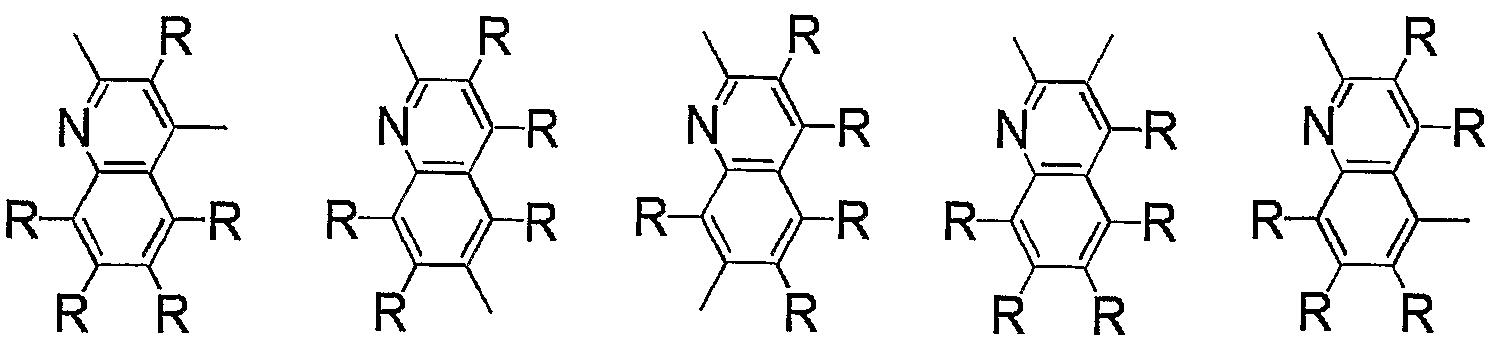


(4-99)
i霞n oza/urld z-8fn/oiz OM

ID O
/vu/ O inoさ oifcld z-8oizAV

(6ε ) (8εけ)

(9ε ) (SSH7)


(6 - 1?) (8 - )

63
ΟΖΟΐΐΟ請 Zdf/ェ:) d .8CZT0/S00Z OAV


上記 A の例において、 1つの構造式中に複数の Rを有しているが、 それらは同一 の基であってもよいし、 異なる基であってもよく、 それぞれ独立に選択される。 但し、 Rが 4個以上の場合はそのうち 1個以上 4個以下が、 —X— Yで示される基であり、 R が 3個以下の場合はそのうち 1個以上、 Rの最大数以下の基が、 一 X— Yで示される基 である。
式 (1) のァリ一レン基、 2価の複素環基におけるアルキル基、 アルコキシ基、 アル キルチオ基、 ァリール基、 ァリールォキシ基、 ァリールチオ基、 ァリールアルキル某、
ァリールアルコキシ基、 ァリールアルキルチオ基、 ァリールアルケニル基、 ァリールァ ルキニル基、 アミノ基、 置換アミノ基、 置換シリル基、 ハロゲン原子、 ァシル基、 ァシ ルォキシ基、 ィミン残基、 アミド基、 酸イミド基、 1価の複素環基、 置換カルボキシル 基の定義、 具体例は、 脂肪族複素環基におけるそれらの定義、 具体例と同じである。 中でも、 A r 1が上記式 (2-1) または (2— 2) であることが好ましく、 特に A r 1が上記式 (2-1) である場合が好ましい。
上記式 (2-1) 、 (2-2) において、 A環、 B環、 C環および D環が芳香族炭化 水素環であることがさらに好ましい。
上記式 (2-1) 、 (2-2) において、 一 X—が一 C (R21R22) 一 〔ここで、 R 21および R22は前記と同じ意味を表す。 〕 である場合 (例えば、 (4一 1) 〜 (4一 3) ) ;—X—が一〇一である場合 (例えば、 (4一 4) 〜 (4— 6) (4— 1 0) 、 (4— 12) 、 (4— 14) 、 (4一 16) 、 (4一 18) 、 (4一 20) 、 (4-2 2) ) ;—X—が一 S—である場合 (例えば、 (4一 7) 〜 (4一 9) (4— 1 1) 、 (4一 13) 、 (4— 1 5) 、 (4一 17) 、 (4一 1 9) 、 (4— 21) 、 (4-2 3) ) がさらに好ましい。
中でも、 下記式 (3— 1) ~ (3- 5) で示される場合がさらに好ましく、 (3— 1) で示される場合が特に好ましい。

式 (3— 1)
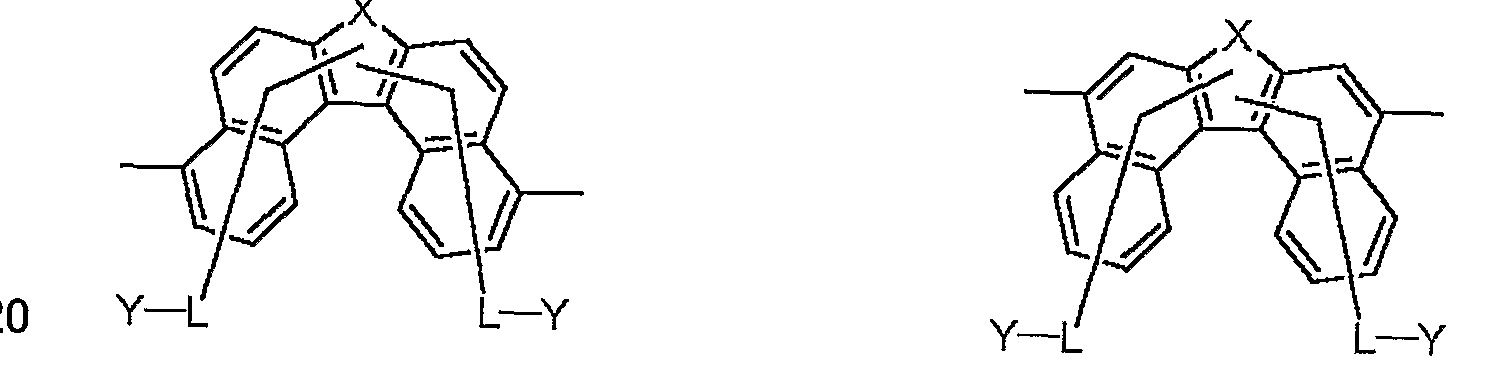
式 (3-2) 式 (3 - 3)

式 (3— 4) 式 (3- 5)
ここで、 X、 Lおよび Yは前記と同じ意味を表し、 Yと結合していない Lの結合手は図 示した線が交差しているいずれかの芳香環に直接連結しているものとする。
なお上式(3— 1)〜 (3— 5) において Xがー C (R21R22) 一の場合には、 R21 および R 22の 1または 2がー L- Yである場合も含む。
上式(3—:!)〜 (3— 5) において Xがー C (R21R22) 一の場合には、 R21およ ぴ R 22の少なくとも一方が一 L-Yである場合が好ましい。
上式(3—;!)〜 (3— 5) において Xがー S—または一〇—の場合には、 — L—の上 式(3—:!)〜 (3— 5) に直結する部分は—〇一, 一 S—, 一 S i R3R4—, 一 NR5— で置きかえられている場合が好ましい。
上記式 (1) において R1および R 2は、 それぞれ独立に水素原子、 アルキル基、 ァリ —ル基、 1価の複素環基またはシァノ基を表す。
ここで R1 R 2におけるアルキル基、 ァリール基、 1価の複素環基の具体例としては、 上記 R3~R 8で示したものと同じものが例示される。
R R2がアルキル鎖を含む場合、 該アルキル鎖は、 直鎖状、 分岐状、 環状のいずれ であってもよく、 複数のアルキル鎖の先端が互いに連結して環を形成していてもよい。 該アルキル基に含まれる一 CH「基の一つ以上が、 一〇—, — S—, 一 CO—, —CO 2—、 -SO-, 一 S02—, -S i R9R10-, NR11-, 一 BR12—, 一 PR13—、 一 P (=〇) (R14) 一からなる群から選ばれる基と置換されていてもよい。 R9〜R14は、 それぞれ独立に水素原子、 炭素数 1〜 20のアルキル基、 炭素数 6〜 60のァリール基、 炭素数 4〜 60の複素環化合物およびシァノ基からなる群から選ばれる基を示す。
W
34 上記式 (1) で示される繰り返し単位の合計の量は通常、 本発明の高分子化合物が有 する全繰り返し単位の合計の 1モル%以上 100モル%以下である。 好ましくは、 10 モル%以上 100モル%以下である。
本発明の高分子化合物は、 蛍光特性や電荷輸送特性を損なわない範囲で、 上記式
(1) で示される繰り返し単位以外の繰り返し単位を含んでいてもよいが、 1モル%以 上 90モル%以下である。 好ましくは、 10モル%以上 90モル%以下であり、 より好 ましくは、 50モル%以上 90モル%以下である。 また、 式(1)で示される繰り返し単 位に加え、 それ以外の繰り返し単位を 1種類以上含む共重合体の場合、 本発明の高分子 化合物が含むことができる、 上記式(1)以外の繰り返し単位として、 下記式 (7) 、 式
(8) 、 式 (9) 、 式 (1 0) 、 式 (1 1) 、 式 (12) または式 (13) で示される 繰り返し単位が好ましい。

ここで、 RMは、 アルキル基、 アルコキシ基、 アルキルチオ基、 ァリール基、 ァリール ォキシ基、 ァリールチオ基、 ァリールアルキル基、 ァリールアルコキシ基、 ァリールァ ルキルチオ基、 ァリールアルケニル基、 ァリールアルキニル基、 アミノ基、 置換アミノ 基、 シリル基、 置換シリル基、 ハロゲン原子、 ァシル基、 ァシルォキシ基、 ィミン残基、 アミド基、 酸イミド基、 1価の複素環基、 力ルポキシル基、 置換カルボキシル基または シァノ基を示す。 nは 0〜4の整数を示す。 RMが複数存在する場合、 それらは同一で あっても異なっていてもよい。
式 (7) の具体例としては、

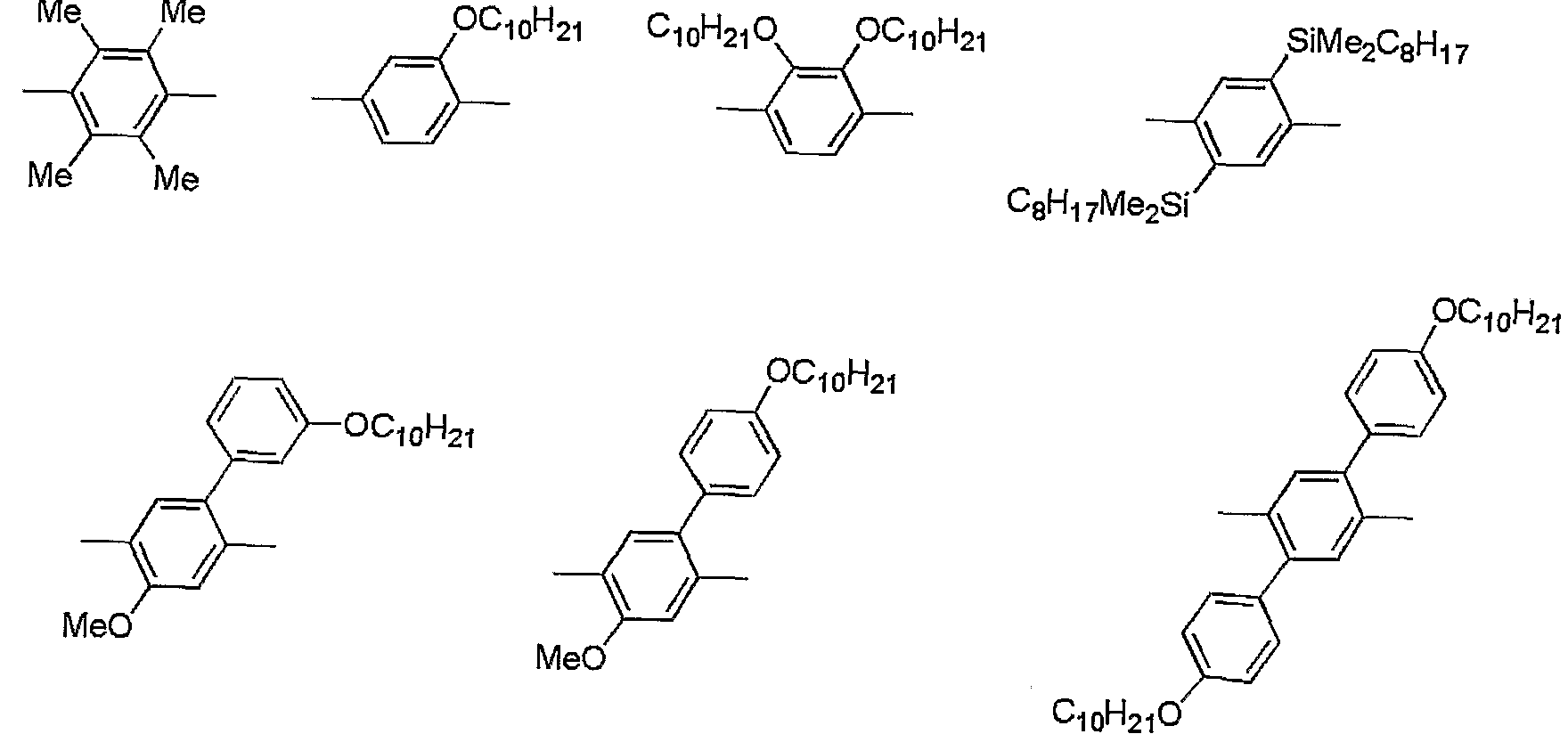
があげられる。

36 基、 アミノ基、 置換アミノ基、 シリル基、 置換シリル基、 ハロゲン原子、 ァシル基、 ァ シルォキシ基、 ィミン残基、 アミド基、 酸イミド基、 1価の複素環基、 力ルポキシル基、 置換カルボキシル基またはシァノ基を示す。 0および pはそれぞれ独立に 0〜 3の整数 を示す。 R21および R22がそれぞれ複数存在する場合、 それらは同一であっても異なつ ていてもよい。
式 (8) の具体例としては


ここで、 R25および R26は、 それぞれ独立にアルキル基、 アルコキシ基、 アルキルチオ 基、 ァリール基、 ァリールォキシ基、 ァリ一ルチオ基、 ァリールアルキル基、 ァリール アルコキシ基、 ァリ一ルアルキルチオ基、 ァリールアルケニル基、 ァリールアルキニル 基、 アミノ基、 置換アミノ基、 シリル基、 置換シリル基、 ハロゲン原子、 ァシル基、 ァ シルォキシ基、 ィミン残基、 アミド基、 酸イミド基、 1価の複素環基、 力ルポキシル基、 置換力ルポキシル基またはシァノ基を示す。 qおよび rはそれぞれ独立に 0 4の整数
を示す。 R23および R24は、 それぞれ独立に水素原子、 アルキル基、 ァリール基、 1価 の複素環基、 力ルポキシル基、 置換力ルポキシル基またはシァノ基を示す。 R25および R26がそれぞれ複数存在する場合、 それらは同一であっても異なっていてもよい。 式 (9) の具体例としては


があげられる。

式 (10) の具体例としては


ここで、 R"および R28は、 それぞれ独立にアルキル基、 アルコキシ基、 アルキルチオ 基、 ァリ一ル基、 ァリールォキシ基、 ァリ一ルチオ基、 ァリールアルキル基、 ァリール アルコキシ基、 ァリールアルキルチオ基、 ァリールアルケニル基、 ァリールアルキニル 基、 アミノ基、 置換アミノ基、 シリル基、 置換シリル基、 ハロゲン原子、 ァシル基、 7 シルォキシ基、 ィミン残基、 アミド基、 酸イミド基、 1価の複素環基、 カルボキシル基、 置換力ルポキシル基またはシァノ基を示す。 〜2の整数を示す。 tおよび uはそれぞれ 独立に 0〜4の整数を示す。 X 2は、 〇、 S、 S 02、 S e, T e、 N— R29、 または S i R3»R31を示す。 X3および X4は、 それぞれ独立に Nまたは C一 R32を示す。 R29、 R30 R31および R32はそれぞれ独立に水素原子、 アルキル基、 ァリール基、 ァリールアルキ ル基または 1価の複素環基を示す。 R27、 R28および R32がそれぞれ複数存在する場合、 それらは同一であっても異なっていてもよい。
式 (1 1 ) で示される繰り返し単位の中央の 5員環の例としては、 チアジアゾ一ル、 ォキサジァゾール、 トリァゾール、 チォフェン、 フラン、 シロールなどが挙げられる。 式 (11) の具体例としては


があげられる。

ここで、 R33および R38は、 それぞれ独立にアルキル基、 アルコキシ基、 アルキルチオ 基、 ァリール基、 ァリールォキシ基、 ァリールチオ基、 ァリールアルキル基、 ァリール アルコキシ基、 ァリールアルキルチオ基、 ァリールアルケニル基、 ァリールアルキニル 基、 アミノ基、 置換アミノ基、 シリル基、 置換シリル基、 ハロゲン原子、 ァシル基、 ァ シルォキシ基、 ィミン残基、 アミド基、 酸イミド基、 1価の複素環基、 力ルポキシル基、 置換力ルポキシル基またはシァノ基を示す。 Vおよび wはそれぞれ独立に 0〜4の整数 を示す。 R34、 R35、 R36および R37は、 それぞれ独立に水素原子、 アルキル基、 ァリー ル基、 1価の複素環基、 力ルポキシル基、 置換力ルポキシル基またはシァノ基を示す。 A r 4はァリ一レン基、 2価の複素環基または金属錯体構造を有する 2価の基を示す。 R33および R38がそれぞれ複数存在する場合、 それらは同一であっても異なっていても よい。
式(12)の具体例としては
41


ここで、 A r„, Ar12、 1"13ぉょび八1"14は、 それぞれ独立にァリ一レン基または 2価の複素環基を表す。 Ar15、 八1"16ぉょび 1"17は、 それぞれ独立にァリール基また は 1価の複素環基を表す。 n nおよび mmはそれぞれ独立に 0または 1を表し、 0≤ n n +mm≤ 1である。
上記式 (13) で示される繰り返し単位の具体例としては、 以下のものが挙げられる。


また、 上記式において Rがアルキル鎖を含む置換基においては、 それらは直鎖、 分岐 または環状のいずれかまたはそれらの組み合わせであってもよく、 直鎖でない場合、 例 えば、 イソアミル基、 2—ェチルへキシル基、 3, 7—ジメチルォクチル基、 シクロへ キシル基、 4— ^〜じ12アルキルシクロへキシル基などが例示される。 高分子化合物の 溶媒への溶解性を高めるためには、 1つ以上に環状または分岐のあるアルキル鎖が含ま れることが好ましい。
また、 複数の Rが連結して環を形成していてもよい。 さらに、 Rがアルキル鎖を含む 基の場合は、 該アルキル鎖は、 ヘテロ原子を含む基で中断されていてもよい。 ここ 、 ヘテロ原子としては、 酸素原子、 硫黄原子、 窒素原子などが例示される。
式 (2 - 1 ) 、 ( 2 - 2 ) で表される本発明の高分子化合物において、 特に- X- =- O -、 - S -の場合の高分子化合物は蛍光強度が優れる。
また、 本発明の高分子化合物は、 ランダム、 ブロックまたはグラフト共重合体であつ てもよいし、 それらの中間的な構造を有する高分子、 例えばプロック性を帯びたランダ ム共重合体であってもよい。 蛍光またはりん光の量子収率の高い高分子発光体 (高分子
量の発光材料)を得る観点からは完全なランダム共重合体よりプロック性を帯びたラン ダム共重合体やプロックまたはグラフト共重合体が好ましい。 主鎖に枝分かれがあり、 末端部が 3つ以上ある場合ゃデンドリマーも含まれる。
また、 これらの繰り返し単位が、 非共役の単位で連結されていてもよいし、 繰り返し 単位にそれらの非共 部分が含まれていてもよい。 結合構造としては、 以下に示すもの、 および以下に示すもののうち 2つ以上を組み合わせたものなどが例示される。 ここで、 Rは前記のものと同じ置換基から選ばれる基であり、 A rは炭素数 6 ~ 6 0個の炭化水 基を示す。

また、 本発明の高分子化合物の末端基は、 重合活性基がそのまま残っていると、 素子 にしたときの発光特性や寿命が低下する可能性があるので、 安定な基で保護されていて よい。 主鎖の共役構造と連続した共役結合を有しているものが好ましく、 例えば、 炭素
一炭素結合を介してァリール基または複素環基と結合している構造が例示される。 具体 的には、 特開平 9— 45478号公報の化 1 0に記載の置換基等が例示される。
本発明の高分子化合物のポリスチレン換算の数平均分子量は 103〜108であり、 好 ましくは 104〜106である。 また、 ポリスチレン換算の重量平均分子量は通常 103〜 108であり、 好ましくは 5X 10⁴〜5X 10⁶である。
本発明の高分子化合物に対する良溶媒としては、 クロ口ホルム、 塩化メチレン、 ジク ロロェタン、 テトラヒドロフラン、 トルエン、 キシレン、 メシチレン、 テトラリン、 デ カリン、 n—プチルベンゼンなどが例示される。 高分子化合物の構造や分子量にもよる が、 通常は本発明の高分子化合物をこれらの溶媒に 0. 1重量%以上溶解させることが できる。
本発明の高分子化合物は例えば、 次のようにして製造することができる。 主鎖にビニ レン基を有する場合には、 例えば特開平 5— 202355号公報に記載の方法が挙げら れる。 すなわち、 ホルミル基を有する化合物とホスホニゥムメチル基を有する化合物と の、 もしくはホルミル基とジホスホニゥム塩化合物との Wi t t i g反応による重合、 ジアルデヒド化合物とジ亜リン酸エステル化合物との Ho r n e r -Wa nd s wo r t h-Emmo s o n s法による重合、 ビニル基を有する化合物とハロゲン原子を有す る化合物との He c k反応による重合、 モノハロゲン化メチル基を 2つあるいは 2っ以 上有する化合物の脱ハロゲン化水素法による重縮合、 スルホニゥム塩基を 2つあるいは 2つ以上有する化合物のスルホニゥム塩分解法による重縮合、 ホルミル基を有する化合 物とシァノ基を有する化合物との Kn o e V e n a g e 1反応による重合などの方法、 ホルミル基を 2つあるいは 2つ以上有する化合物の McMu r r y反応による重合など の方法が例示される。
また、 主鎖にピニレン基を有しない場合には、 例えば該当するモノマーから Su z u k iカップリング反応により重合する方法、 Gr i gn a r d反応により重合する方法、 N i (0) 錯体により重合する方法、 Fe C 13等の酸化剤により重合する方法、 電気 化学的に酸化重合する方法、 あるいは適当な脱離基を有する中間体高分子の分解による 方法などが例示される。
これらのうち、 W i t t i g反応による重合、 H e c k反応による重合、 K n o e v e n a g e 1反応による重合、 および S u z u k iカツプリング反応により重合する方 法、 G r i g n a r d反応により重合する方法、 ニッケルゼロ価錯体により重合する方 法が、 構造制御がしやすいので好ましい。
本発明の高分子化合物を高分子 L E D等に用いる場合、 その純度が発光特性等の素子 の性能に影響を与えるため、 重合前のモノマーを蒸留、 昇華精製、 再結晶等の方法で精 製したのちに重合することが好ましい。 また重合後、 再沈精製、 クロマトグラフィーに よる分別等の純ィ匕処理をすることが好ましい。
次に本発明の高分子ィヒ合物の用途について説明する。
本発明の高分子化合物は、 通常、 固体状態で蛍光または燐光を有し、 高分子発光体 (高 分子量の発光材料)として用いることができる。 また、 該高分子化合物は優れた電子輸 送能を有しており、 高分子 L E D用材料や電荷輸送材料として好適に用いることができ る。 該高分子発光体を用いた高分子 L E Dは低電圧、 高効率で駆動できる高性能の高分 子 L E Dである。 従って、 該高分子 L E Dは液晶ディスプレイのバックライト、 または 照明用としての曲面状や平面状の光源、 セグメントタイプの表示素子、 ドットマトリツ クスのフラットパネルディスプレイ等の装置に好ましく使用できる。
また、 本発明の高分子化合物はレーザー用色素、 有機太陽電池用材料、 有機トランジ ス夕用の有機半導体、 導電性薄膜、 有機半導体薄膜などの伝導性薄膜用材料としても用 いることができる。
さらに、 蛍光や燐光を発する発光性薄膜材料としても用いることができる。
次に、 本発明の高分子 L E Dについて説明する。
本発明の高分子 L E Dは、 陽極および陰極からなる電極間に、 有機層を有し、 該有機 層が本発明の高分子化合物を含むことを特徴とする。
有機層は、 発光層、 正孔輸送層、 電子輸送層等のいずれであってもよいが、 有機層が 発光層であることが好ましい。
ここに、 発光層とは、 発光する機能を有する層をいい、 正孔輸送層とは、 正孔を輸送 する機能を有する層をいい、 電子輸送層とは、 電子を輸送する機能を有する層をいう。
なお、 電子輸送層と正孔輸送層を総称して電荷輸送層と呼ぶ。 発光層、 正孔輸送層、 電 子輸送層は、 それぞれ独立に 2層以上用いてもよい。
有機層が発光層である場合、 有機層である発光層がさらに正孔輸送性材料、 電子輸送 性材料または蛍光性材料を含んでいてもよい。
本発明の高分子化合物と正孔輸送性材料と混合する場合には、 その混合物全体に対し て、 正孔輸送性材料の混合割合は lwt %〜80wt %であり、 好ましくは 5wt %〜 60wt%である。 本発明の高分子材料と電子輸送性材料を混合する場合には、 その混 合物全体に対して電子輸送性材料の混合割合は lwt %~80wt %であり、 好ましく は 5wt %〜60wt%である。 さらに、 本発明の高分子化合物と蛍光性材料を混合す る場合にはその混合物全体に対して蛍光性材料の混合割合は lwt %〜80wt %であ り、 好ましくは 5wt%〜60wt %である。 本発明の高分子化合物と蛍光性材料、 正 孔輸送性材料および/または電子輸送性材料を混合する場合にはその混合物全体に対し て蛍光性材料の混合割合は 1 w t %〜 50 w t %であり、 好ましくは 5wt%〜40w t %であり、 正孔輸送性材料と電子輸送性材料はそれらの合計で 1 w t %〜 50 w t % であり、 好ましくは 5wt%〜40wt%であり、 本発明の高分子化合物の含有量は 9 9w t %〜20w t %である。
混合する正孔輸送性材料、 電子輸送性材料、 蛍光性材料は公知の低分子化合物や高分 子化合物が使用できるが、 高分子化合物を用いることが好ましい。 高分子化合物の正 孔輸送性材料、 電子輸送性材料および蛍光性材料としては、 W099Z13692、 W 099/48160、 GB2340304 A、 WO 00/53656、 WO 0 1/1 9 834、 WO 00/55927, GB 2348316, W〇 00/46321、 WOO 0/06665, WO 99/54943, W〇 99/54385、 US 5777070, WO 98ノ 06773、 WO 97 05184、 WO 00/35987、 WO 00/5 3655、 W〇 0 1/34722、 WO 99/24526、 WO 00/22027、 W 000/22026、 WO 98/27136、 US 573636, WO 98/2126 2、 US 5741 921, W〇 97/09394、 WO 96/29356、 WO 96/ 1 06 17、 EP 0707020. WO 95/07955, 特開平 2001— 18 16 18、 特開平 2001— 1231 56、 特開平 200 1— 3045、 特開平 2000—
351967、 特開平 2000— 303066、 特開平 2000— 299189、 特開 平 2000— 252065、 特開平 2000— 136379、 特開平 2000- 104 057、 特開平 2000— 80167、 特開平 10— 324870、 特開平 10— 1 1
4891、 特開平 9—1 1 1233、 特開平 9— 45478等に開示されているポリフ ルオレン、 その誘導体および共重合体、 ポリアリーレン、 その誘導体および共重合体、 ポリアリ一レンピニレン、 その誘導体および共重合体、 芳香族ァミンおょぴその誘導体 の (共) 重合体が例示される。
低分子化合物の蛍光性材料としでは、 例えば、 ナフタレン誘導体、 アントラセンもし くはその誘導体、 ペリレンもしくはその誘導体、 ポリメチン系、 キサンテン系、 クマリ ン系、 シァニン系などの色素類、 8—ヒドロキシキノリンもしくはその誘導体の金属錯 体、 芳香族ァミン、 テトラフエニルシクロペン夕ジェンもしくはその誘導体、 またはテ トラフェニルブタジエンもしくはその誘導体などを用いることができる。
具体的には、 例えば特開昭 57— 51781号、 同 59— 1 94393号公報に記載 されているもの等、 公知のものが使用可能である。
本発明の組成物は、 正孔輸送材料、 電子輸送材料および蛍光材料から選ばれる少なく とも 1種類の材料と本発明の高分子化合物の少なくとも 1種類を含有するものであり、 発光材料や電荷輸送材料等として用いることができる。
正孔輸送材料、 電子輸送材料および蛍光材料から選ばれる少なくとも 1種類の材料と本 発明の高分子化合物の含有比率は、 用途に応じて決めればよいが、 発光材料の用途の場 合は、 上記の発光層におけると同じ含有比率が好ましい。
本発明の高分子 L E Dにおける発光層の膜厚としては、 用いる材料によつて最適値が 異なり、 駆動電圧と発光効率が適度な値となるように選択すればよいが、 例えば l nm から 1 mであり、 好ましくは 2 nm〜500 nmであり、 さらに好ましくは 5 ηπ!〜 200 nmである。
発光層の形成方法としては、 例えば、 溶液からの成膜による方法が例示される。 溶液からの成膜方法としては、 スピンコート法、 キャスティング法、 マイクログラビア コート法、 グラビアコート法、 パーコート法、 口一ルコ一ト法、 ワイアーパーコート法 ディップコート法、 スプレーコート法、 スクリーン印刷法、 フレキソ印刷法、 オフセッ
ト印刷法、 インクジェットプリント法等の塗布法を用いることができる。 パターン形成 や多色の塗分けが容易であるという点で、 スクリーン印刷法、 フレキソ印刷法、 オフセ ット印刷法、 ィンクジェットプリント法等の印刷法が好ましい。
印刷法等で用いるィンク組成物としては、 少なくとも 1種類の本発明の高分子化合物 が含有されていればよく、 また本発明の高分子化合物以外に正孔輸送材料、 電子輸送材 料、 蛍光材料、 溶媒、 安定剤などの添加剤を含んでいてもよい。
該ィンク組成物中における本発明の高分子ィヒ合物の割合は、 溶媒を除いた組成物の全 重量に対して 20wt%〜10 Owt%であり、 好ましくは 4 Owt %~10 Owt % である。
またインク組成物中に溶媒が含まれる場合の溶媒の割合は、 組成物の全重量に対して 1 w t %~99. 9wt %であり、 好ましくは 6 Owt %〜99. 5wt%であり、 さ らに好ましく 8 Ow t %〜99. 0 %である。
ィンク組成物の粘度は印刷法によって異なるが、 インクジェットプリント法などィン ク組成物が吐出装置を経由するもの場合には、 吐出時の目づまりや飛行曲がりを防止す るために粘度が 25°Cにおいて 1〜2 OmP a · sの範囲であることが好ましい。 ィンク組成物として用いる溶媒としては特に制限はないが、 該ィンク組成物を構成す る溶媒以外の材料を溶解または均一に分散できるものが好ましい。 該インク組成物を構 成する材料が非極性溶媒に可溶なものである場合に、 該溶媒としてクロ口ホルム、 塩化 メチレン、 ジクロロェタン等の塩素系溶媒、 テトラヒドロフラン等のエーテル系溶媒、 トルエン、 キシレン等の芳香族炭化水素系溶媒、 アセトン、 メチルェチルケトン等のケ トン系溶媒、 酢酸エヂル、 酢酸プチル、 ェチルセルソルブアセテート等のエステル系溶 媒が例示される。
また、 本発明の高分子 LEDとしては、 陰極と発光層との間に、 電子輸送層を設けた 高分子 LED、 陽極と発光層との間に、 正孔輸送層を設けた高分子 LED、 陰極と発光 層との間に、 電子輸送層を設け、 かつ陽極と発光層との間に、 正孔輸送層を設けた高分 子 LED等が挙げられる。
例えば、 具体的には、 以下の a) 〜d) の構造が例示される。
a) 陽極/発光層/陰極
b ) 陽極,正孔輸送層 Z発光層,陰極
c ) 陽極 Z発光層 Z電子輸送層ノ陰極
d ) 陽極 Z正孔輸送層 Z発光層ノ電子輸送層 Z陰極
(ここで、 /は各層が隣接して積層されていることを示す。 以下同じ。 )
本発明の高分子 L E Dが正孔輸送層を有する場合、 使用される正孔輸送性材料として は、 ポリビニルカルバゾールもしくはその誘導体、 ポリシランもしくはその誘導体、 側 鎖もしくは主鎖に芳香族ァミンを有するポリシロキサン誘導体、 ピラゾリン誘導体、 7 リールァミン誘導体、 スチルベン誘導体、 トリフエ二ルジァミン誘導体、 ポリア二リン もしくはその誘導体、 ポリチォフェンもしくはその誘導体、 ポリピロールもしくはその 誘導体、 ポリ (p—フエ二レンビニレン) もしくはその誘導体、 またはポリ (2 , 5— チェ二レンビニレン) もしくはその誘導体などが例示される。
具体的には、 該正孔輸送性材料として、 特開昭 6 3 - 7 0 2 5 7号公報、 同 6 3— 1 7 5 8 6 0号公報、 特開平 2— 1 3 5 3 5 9号公報、 同 2— 1 3 5 3 6 1号公報、 同 2 一 2 0 9 9 8 8号公報、 同 3— 3 7 9 9 2号公報、 同 3— 1 5 2 1 8 4号公報に記載さ れているもの等が例示される。
これらの中で、 正孔輸送層に用いる正孔輸送性材料として、 ポリビニルカルバゾ一ル もしくはその誘導体、 ポリシランもしくはその誘導体、 側鎖もしくは主鎖に芳香族アミ ン化合物基を有するポリシロキサン誘導体、 ポリア二リンもしくはその誘導体、 ポリチ ォフェンもしくはその誘導体、 ポリ (p—フエ二レンピニレン) もしくはその誘導体、 またはポリ (2 , 5—チェ二レンピニレン) もしくはその誘導体等の高分子正孔輸送性 材料が好ましく、 さらに好ましくはポリビニルカルパゾ一ルもしくはその誘導体、 ポリ シランもしくはその誘導体、 側鎖もしくは主鎖に芳香族ァミンを有するポリシロキサン 誘導体である。
また、 低分子化合物の正 ¾^輸送性材料としてはピラゾリン誘導体、 ァリールアミン誘 導体、 スチルベン誘導体、 トリフエ二ルジァミン誘導体が例示される。 低分子の正孔輸 送性材料の場合には、 高分子バインダーに分散させて用いることが好ましい。
混合する高分子バインダ一としては、 電荷輸送を極度に阻害しないものが好ましく、 また可視光に対する吸収が強くないものが好適に用いられる。 該高分子バインダ一とし
て、 ポリ (N—ピニルカルバゾ一ル) 、 ポリア二リンもしくはその誘導体、 ポリチオフ ェンもしくはその誘導体、 ポリ (p—フエ二レンビニレン) もしくはその誘導体、 ポリ
( 2 , 5—チェ二レンビニレン) もしくはその誘導体、 ポリカーボネート、 ポリアクリ レート、 ポリメチルァクリレート、 ポリメチルメタクリレート、 ポリスチレン、 ポリ塩 化ビニル、 ポリシロキサン等が例示される。
ポリピニルカルパゾールもしくはその誘導体は、 例えばピニルモノマーからカチオン 重合またはラジカル重合によって得られる。
ポリシランもしくはその誘導体としては、 ケミカル 'レビュー (C h e m. R e v . ) 第 8 9巻、 1 3 5 9頁 (1 9 8 9年) 、 英国特許 G B 2 3 0 0 1 9 6号公開明細 書に記載の化合物等が例示される。 合成方法もこれらに記載の方法を用いることができ るが、 特にキッピング法が好適に用いられる。
ポリシロキサンもしくはその誘導体は、 シロキサン骨格構造には正孔輸送性がほとん どないので、 側鎖または主鎖に上記低分子正孔輸送性材料の構造を有するものが好適に 用いられる。 特に正孔輸送性の芳香族アミンを側鎖または主鎖に有するものが例示され る。
正孔輸送層の成膜の方法に制限はないが、 低分子正孔輸送性材料では、 高分子バイン ダ一との混合溶液からの成膜による方法が例示される。 また、 高分子正孔輸送性材料で は、 溶液からの成膜による方法が例示される。
溶液からの成膜に用いる溶媒としては、 正孔輸送性材料を溶解させるものであれば特 に制限はない。 該溶媒として、 クロ口ホルム、 塩化メチレン、 ジクロロェタン等の塩素 系溶媒、 テトラヒドロフラン等のエーテル系溶媒、 トルエン、 キシレン等の芳香族炭ィ匕 水素系溶媒、 アセトン、 メチルエヂルケトン等のケトン系溶媒、 酢酸ェチル、 酢酸プチ ル、 ェチルセルソルプアセテート等のエステル系溶媒が例示される。
溶液からの成膜方法としては、 溶液からのスピンコート法、 キャスティング法、 マイ クログラビアコート法、 グラビアコート法、 バーコ一ト法、 ロールコート法、 ワイア一 バーコート法、 ディップコート法、 スプレーコート法、 スクリーン印刷法、 フレキソ印 刷法、 オフセット印刷法、 インクジェットプリント法等の塗布法を用いることができる。
正孔輸送層の膜厚としては、 用いる材料によって最適値が異なり、 駆動電圧と発光効 率が適度な値となるように選択すればよいが、 少なくともピンホールが発生しないよう な厚さが必要であり、 あまり厚いと、 素子の駆動電圧が高くなり好ましくない。 従って、 該正孔輸送層の膜厚としては、 例えば 1 nmから 1 であり、 好ましくは 2 nm〜5 O O nmであり、 さらに好ましくは 5 nm〜 200 nmである。
本発明の高分子 L EDが電子輸送層を有する場合、 使用される電子輸送性材料として は公知のものが使用でき、 ォキサジァゾール誘導体、 アントラキノジメタンもしくはそ の誘導体、 ベンゾキノンもしくはその誘導体、 ナフトキノンもしくはその誘導体、 アン トラキノンもしくはその誘導体、 テトラシァノアンスラキノジメタンもしくはその誘導 体、 フルォレノン誘導体、 ジフエニルジシァノエチレンもしくはその誘導体、 ジフエノ キノン誘導体、 または 8—ヒドロキシキノリンもしくはその誘導体の金属錯体、 ポリキ ノリンもしくはその誘導体、 ポリキノキサリンもしくはその誘導体、 ポリフルオレンも しくはその誘導体等が例示される。
具体的には、 特開昭 63 - 70257号公報、 同 63— 1 75860号公報、 特開平 2— 1 35359号公報、 同 2— 135361号公報、 同 2— 209988号公報、 同 3 - 37992号公報、 同 3— 1 52 184号公報に記載されているもの等が例示され る。
これらのうち、 ォキサジァゾ一ル誘導体、 ベンゾキノンもしくはその誘導体、 アント ラキノンもしくはその誘導体、 または 8—ヒドロキシキノリンもしくはその誘導体の金 属錯体、 ポリキノリンもしくはその誘導体、 ポリキノキサリンもしくはその誘導体、 ポ リフルオレンもしくはその誘導体が好ましく、 2— (4—ビフエ二リル) — 5— (4- t一ブチルフエニル) 一 1, 3, 4一ォキサジァゾ一ル、 ベンゾキノン、 アントラキノ ン、 トリス (8—キノリノール) アルミニウム、 ポリキノリンがさらに好ましい。
電子輸送層の成膜法としては特に制限はないが、 低分子電子輸送性材料では、 粉末か らの真空蒸着法、 または溶液もしくは溶融状態からの成膜による方法が、 高分子電子輸 送材料では溶液または溶融状態からの成膜による方法がそれぞれ例示される。 溶液また は溶融状態からの成膜時には、 上記の高分子バインダーを併用してもよい。
溶液からの成膜に用いる溶媒としては、 電子輸送材料および Zまたは高分子パインダ 一を溶解させるものであれば特に制限はない。 該溶媒として、 クロ口ホルム、 塩化メチ レン、 ジクロロェタン等の塩素系溶媒、 テトラヒドロフラン等のエーテル系溶媒、 トル ェン、 キシレン等の芳香族炭化水素系溶媒、 アセトン、 メチルェチルケトン等のケトン 系溶媒、 酢酸ェチル、 酢酸プチル、 ェチルセルソルブアセテート等のエステル系溶媒が 例示される。
溶液または溶融状態からの成膜方法としては、 スピンコート法、 キャスティング法、 マイクログラビアコート法、 グラビアコート法、 バーコート法、 ロールコート法、 ワイ アーパーコート法、 ディップコート法、 スプレーコート法、 スクリーン印刷法、 フレキ ソ印刷法、 オフセット印刷法、 インクジェットプリント法等の塗布法を用いることがで さる。
電子輸送層の膜厚としては、 用いる材料によって最適値が異なり、 駆動電圧と発光効 率が適度な値となるように選択すればよいが、 少なくともピンホールが発生しないよう な厚さが必要であり、 あまり厚いと、 素子の駆動電圧が高くなり好ましくない。 従って、 該電子輸送層の膜厚としては、 例えば 1 n mから 1 i mであり、 好ましくは 2 n m〜5 0 0 n mであり、 さらに好ましくは 5 n m〜2 0 0 n mである。
また、 電極に隣接して設けた電荷輸送層のうち、 電極からの電荷注入効率を改善する 機能を有し、 素子の駆動電圧を下げる効果を有するものは、 特に電荷注入層 (正孔注入 層、 電子注入層) と一般に呼ばれることがある。
さらに電極との密着性向上や電極からの電荷注入の改善のために、 電極に隣接して前 記の電荷注入層又は膜厚 2 n m以下の絶縁層を設けてもよく、 また、 界面の密着性向上 や混合の防止等のために電荷輸送層や発光層の界面に薄いバッファー層を揷入してもよ い。
積層する層の順番や数、 および各層の厚さについては、 発光効率や素子寿命を勘案し て適宜用いることができる。
本発明において、 電荷注入層 (電子注入層、 正孔注入層) を設けた高分子 L E Dとし ては、 陰極に隣接して電荷注入層を設けた高分子 L E D、 陽極に隣接して電荷注入層を 設けた高分子 L E Dが挙げられる。
例えば、 具体的には、 以下の e) ~p) の構造が挙げられる。
e) 陽極/電荷注入層 Z発光層ノ陰極
f) 陽極 Z発光層ノ電荷注入層ノ陰極
g) 陽極/電荷注入層 Z発光層/電荷注入層 Z陰極
h) 陽極/電荷注入層/正孔輸送層ノ発光層 Z陰極
i ) 陽極 Z正孔輸送層/発光層 電荷注入層 陰極
j ) 陽極/電荷注入層 Z正孔輸送層 Z発光層ノ電荷注入層ノ陰極
k) 陽極/電荷注入層 Z発光層/電子輸送層ノ陰極
1 ) 陽極 Z発光層 電子輸送層 電荷注入層 陰極
m) 陽極 電荷注入層/発光層ノ電子輸送層/電荷注入層 陰極
n) 陽極/電荷注入層 Z正孔輸送層 Z発光層 電子輸送層 Z陰極
o) 陽極/正孔輸送層 Z発光層 Z電子輸送層/電荷注入層 Z陰極
P ) 陽極 Z電荷注入層/正孔輸送層/発光層ノ電子輸送層 電荷注入層 陰極
電荷注入層の具体的な例としては、 導電性高分子を含む層、 陽極と正孔輸送層との間 に設けられ、 陽極材料と正孔輸送層に含まれる正孔輸送性材料との中間の値のイオン化 ポテンシャルを有する材料を含む層、 陰極と電子輸送層との間に設けられ、 陰極材料と 電子輸送層に含まれる電子輸送性材料との中間の値の電子親和力を有する材料を含む層 などが例示される。
上記電荷注入層が導電性高分子を含む層の場合、 該導電性高分子の電気伝導度は、 1 0—5S/cm以上 103以下であることが好ましく、 発光画素間のリーク電流を小さくす るためには、 10—5SZcm以上 102以下がより好ましく、 10—5S/cm以上 101以 下がさらに好ましい。
上記電荷注入層が導電性高分子を含む層の場合、 該導電性高分子の電気伝導度は、 1 Cr5S/cm以上 103S/cm以下であることが好ましく、 発光画素間のリーク電流を 小さくするためには、 10— 5S/cm以上 102S/cm以下がより好ましく、 10—5S /0111以上1 O'S/c m以下がさらに好ましい。
通常は該導電性高分子の電気伝導度を 10— 5S/cm以上 103以下とするために、 該 導電性高分子に適量のイオンをドープする。
ド一プするイオンの種類は、 正孔注入層であればァニオン、 電子注入層であればカチ オンである。 ァニオンの例としては、 ポリスチレンスルホン酸イオン、 アルキルべンゼ ンスルホン酸イオン、 樟脳スルホン酸イオンなどが例示され、 カチオンの例としては、 リチウムイオン、 ナトリウムイオン、 カリウムイオン、 テトラプチルアンモニゥムィォ ンなどが例示される。
電荷注入層の膜厚としては、 例えば 1 nm〜l 00 nmであり、 2 nm〜50nmが 好ましい。
電荷注入層に用いる材料は、 電極や隣接する層の材料との関係で適宜選択すればよく、 ポリア二リンおよびその誘導体、 ポリチォフェンおよびその誘導体、 ポリピロールおよ びその誘導体、 ポリフエ二レンビニレンおよびその誘導体、 ポリチェ二レンビニレンお よびその誘導体、 ポリキノリンおよびその誘導体、 ポリキノキサリンおよびその誘導体、 芳香族ァミン構造を主鎖または側鎖に含む重合体などの導電性高分子、 金属フタロシア ニン (銅フタロシアニンなど) 、 カーボンなどが例示される。
膜厚 2 nm以下の絶縁層は電荷注入を容易にする機能を有するものである。 上記絶縁 層の材料としては、 金属フッ化物、 金属酸化物、 有機絶縁材料等が挙げられる。 膜厚 2 nm以下の絶縁層を設けた高分子 LEDとしては、 陰極に隣接して膜厚 2 nm以下の絶 縁層を設けた高分子 LED、 陽極に隣接して膜厚 2 nm以下の絶縁層を設けた高分子 L EDが挙げられる。
具体的には、 例えば、 以下の q) ~ab) の構造が挙げられる。
q) 陽極/膜厚 2 nm以下の絶縁層 Z発光層/陰極
r) 陽極ノ発光層ノ膜厚 2 nm以下の絶縁層ノ陰極
s ) 陽極/膜厚 2 nm以下の絶縁層/発光層 Z膜厚 2 nm以下の絶縁層 陰極
t) 陽極/膜厚 2 nm以下の絶縁層/正孔輸送層 Z発光層/陰極
u ) 陽極/正孔輸送層ノ発光層 Z膜厚 2 n m以下の絶縁層 Z陰極
V ) 陽極/膜厚 2 n m以下の絶縁層/正孔輸送層ノ発光層 Z膜厚 2 n m以下の絶縁層 Z 陰極
w) 陽極 Z膜厚 2 nm以下の絶縁層ノ発光層 Z電子輸送層 Z陰極
x) 陽極/発光層 Z電子輸送層 Z膜厚 2 nm以下の絶縁層ノ陰極
y) 陽極/膜厚 2 nm以下の絶縁層/発光層 Z電子輸送層 膜厚 2 nm以下の絶縁層/
« 陰極
z)陽極 Z膜厚 2 nm以下の絶縁層/正孔輸送層ノ発光層 Z電子輸送層/陰極
a a)陽極 Z正孔輸送層 Z発光層/電子輸送層 Z膜厚 2 nm以下の絶縁層/陰極 a b) 陽極 Z膜厚 2 nm以下の絶縁層 Z正孔輸送層 Z発光層/電子輸送層/膜厚 2 nm 以下の絶縁層 Z陰極
本発明の高分子 LEDを形成する基板は、 電極を形成し、 有機物の層を形成する際に 変化しないものであればよく、 例えばガラス、 プラスチック、 高分子フィルム、 シリコ ン基板などが例示される。 不透明な基板の場合には、 反対の電極が透明または半透明で あることが好ましい。
通常本発明の高分子 L EDが有する陽極および陰極の少なくとも一方が透明または半 透明である。 陽極側が透明または半透明であることが好ましい。 該陽極の材料としては、 導電性の金属酸化物膜、 半透明の金属薄膜等が用いられる。 具体的には、 酸化インジゥ ム、 酸化亜鉛、 酸化スズ、 およびそれらの複合体であるインジウム ·スズ ·ォキサイド (I TO) 、 インジウム ·亜鉛 ·オキサイド等からなる導電性ガラスを用いて作成され た膜 (NESAなど) や、 金、 白金、 銀、 銅等が用いられ、 I T〇、 インジウム -亜 鉛'オキサイド、 酸化スズが好ましい。 作製方法としては、 真空蒸着法、 スパッタリン グ法、 イオンプレーティング法、 メツキ法等が挙げられる。 また、 該陽極として、 ポリ ァニリンもしくはその誘導体、 ポリチオフェンもしくはその誘導体などの有機の透明導 電膜を用いてもよい。
陽極の膜厚は、 光の透過性と電気伝導度とを考慮して、 適宜選択することができるが、 例えば 10 nmから 10 //mであり、 好ましくは 20 nm~ 1 zmであり、 さらに好ま しくは 50 nm〜500 nmである。
また、 陽極上に、 電荷注入を容易にするために、 フタロシアニン誘導体、 導電性高分 子、 カーボンなどからなる層、 あるいは金属酸化物や金属フッ化物、 有機絶緣材料等か らなる平均膜厚 2 nm以下の層を設けてもよい。
本発明の高分子 L EDで用いる陰極の材料としては、 仕事関数の小さい材料が好まし レ^ 例えば、 リチウム、 ナトリウム、 カリウム、 ルビジウム、 セシウム、 ベリリウム、
マグネシウム、 カルシウム、 ストロンチウム、 バリウム、 アルミニウム、 スカンジウム、 バナジウム、 亜鉛、 イットリウム、 インジウム、 セリウム、 サマリウム、 ユーロピウム、 テルビウム、 イッテルビウムなどの金属、 およびそれらのうち 2つ以上の合金、 あるい はそれらのうち 1つ以上と、 金、 銀、 白金、 銅、 マンガン、 チタン、 コバルト、 ニッケ ル、 タングステン、 錫のうち 1つ以上との合金、 グラフアイトまたはグラフアイト層間 化合物等が用いられる。 合金の例としては、 マグネシウム一銀合金、 マグネシウムーィ ンジゥム合金、 マグネシウム一アルミニウム合金、 インジウム—銀合金、 リチウム一ァ ルミニゥム合金、 リチウム—マグネシウム合金、 リチウム—インジウム合金、 カルシゥ ムーアルミニゥム合金などが挙げられる。 陰極を 2層以上の積層構造としてもよい。 陰極の膜厚は、 電気伝導度や耐久性を考慮して、 適宜選択することができるが、 例え ば 1 0 nmから 1 0 mであり、 好ましくは 2 0 n m〜l i mであり、 さらに好ましく は 5 0 nm〜 5 0 0 n mである。
陰極の作製方法としては、 真空蒸着法、 スパッタリング法、 また金属薄膜を熱圧着す るラミネート法等が用いられる。 また、 陰極と有機物層との間に、 導電性高分子からな る層、 あるいは金属酸化物や金属フッ化物、 有機絶縁材料等からなる平均膜厚 2 nm以 下の層を設けてもよく、 陰極作製後、 該高分子 L E Dを保護する保護層を装着していて もよい。 該高分子 L E Dを長期安定的に用いるためには、 素子を外部から保護するため に、 保護層および/または保護カバーを装着することが好ましい。
該保護層としては、 高分子化合物、 金属酸化物、 金属フッ化物、 金属ホウ化物などを 用いることができる。 また、 保護カバーとしては、 ガラス板、 表面に低透水率処理を施 したプラスチック板などを用いることができ、 該カバーを熱効果樹脂や光硬化樹脂で素 子基板と貼り合わせて密閉する方法が好適に用いられる。 スぺーサ一を用いて空間を維 持すれば、 素子がキズつくのを防ぐことが容易である。 該空間に窒素やアルゴンのよう な不活性なガスを封入すれば、 陰極の酸化を防止することができ、 さらに酸化バリウム 等の乾燥剤を該空間内に設置することにより製造工程で吸着した水分が素子にタメ一ジ を与えるのを抑制することが容易となる。 これらのうち、 いずれか 1つ以上の方策をと ることが好ましい。
本発明の高分子 L E Dは面状光源、 セグメント表示装置、 ドットマトリックス表示装 置、 液晶表示装置のバックライト等として用いることができる。
本発明の高分子 L E Dを用いて面状の発光を得るためには、 面状の陽極と陰極が重な り合うように配置すればよい。 また、 パターン状の発光を得るためには、 前記面状の発 光素子の表面にパターン状の窓を設けたマスクを設置する方法、 非発光部の有機物層を 極端に厚く形成し実質的に非発光とする方法、 陽極または陰極のいずれか一方、 または 両方の電極をパターン状に形成する方法がある。 これらのいずれかの方法でパターンを 形成し、 いくつかの電極を独立に O n ZO F Fできるように配置することにより、 数字 や文字、 簡単な記号などを表示できるセグメントタイプの表示素子が得られる。 更に、 ドットマトリックス素子とするためには、 陽極と陰極をともにストライプ状に形成して 直交するように配置すればよい。 複数の種類の発光色の異なる高分子蛍光体を塗り分け る方法や、 カラーフィルターまたは蛍光変換フィルターを用いる方法により、 部分カラ —表示、 マルチ力ラー表示が可能となる。 ドットマトリックス素子は、 パッシブ駆動も 可能であるし、 T F Tなどと組み合わせてアクティブ駆動してもよい。 これらの表示素 子は、 コンピュータ、 テレビ、 携帯端末、 携帯電話、 カーナピゲ一シヨン、 ビデオカメ ラのピューファインダーなどの表示装置として用いることができる。
さらに、 前記面状の発光素子は、 自発光薄型であり、 液晶表示装置のバックライト用 の面状光源、 あるいは面状の照明用光源として好適に用いることができる。 また、 フレ キシブルな基板を用いれば、 曲面状の光源や表示装置としても使用できる。
以下、 本発明をさらに詳細に説明するために実施例を示すが、 本発明はこれらに限定 されるものではない。
ここで、 数平均分子量については、 クロ口ホルムを溶媒として、 ゲルパーミエ一ショ ンクロマトグラフィー (G P C) によりポリスチレン換算の数平均分子量を求めた。 ガ ラス転移点は D S C (D S C 2 9 2 0、 TA I n s t r u m e n t s製) により求め た。
(化合物 Aの合成)

化合物 A
不活性雰囲気下の三つ口フラスコに 2, 7—ジブロモフルオレン 6. 58を1^, N- ジメチルスルホキシド 15 m 1に溶解した。 これに水 5 m 1、 水酸化ナトリウム 9. 6 g、 テトラプチルアンモニゥムブロマイド 0. 40 gを加え、 さらにブロモメチルシク 口へキサン 17. 7 gを加え、 そのまま 1 10°Cまで昇温し 3時間攪拌した。 その後、 放冷し、 析出した結晶を濾別して、 結晶を水洗後、 エタノールで再結晶して目的物を得 た (収量 7. 7 g、 収率 74. 5%) 。
Ή-NMR (30 OMHz/CDC 13) :
δ 0. 49〜0. 94 (m、 16H) 、 1. 34-1. 37 (m、 6 H) 、 1. 87 (d、 4H) 、 7. 43~7. 51 (m、 6 H) 。 実施例 2 (高分子化合物 1の合成)
化合物 A 0. 25 g、 2, 7—ジブ口モー 9, 9ージォクチルフルオレン 0. 24 gおよび 2、 2' ービピリジル 0. 33 gを反応容器に仕込んだ後、 反応系内を窒素ガ スで置換した。 これに、 あらかじめアルゴンガスでパブリングして、 脱気したテトラヒ ドロフラン (脱水溶媒) 24mlを加えた。 次に、 この混合溶液に、 ビス (1, 5—シ クロォクタジェン) ニッケル (0) を 0. 60 g加え、 60でで 3時間反応した。 なお、 反応は、 窒素ガス雰囲気中で行った。 反応後、 この溶液を冷却した後、 25%アンモニ ァ水 1 Om 1 メタノール 12 Om 1 /イオン交換水 5 Om 1混合溶液中にそそぎ込み、 約 1時間攪拌した。 次に、 生成した沈殿を、 ろ過することにより回収した。 この沈殿を エタノールで洗浄した後、 2時間減圧乾燥した。 次に、 この沈殿をトルエン 3 OmLに 溶解し、 1N塩酸 3 OmLを加えて 1時間攪拌し、 水層の除去して有機層に 4 %アンモ ニァ水 3 OmLを加え、 1時間攪拌した後に水層を除去した。 有機層はメタノール 1 5 OmLに滴下して 1時間攪拌し、 析出した沈殿をろ過して 2時間減圧乾燥し、 トルエン
30mLに溶解させた。 その後、 アルミナカラム (アルミナ量 20 g) を通して精製を 行い、 回収したトルエン溶液をメタノール 10 OmLに滴下して 1時間攪拌し、 析出し た沈殿をろ過して 2時間減圧乾燥させた。 得られた重合体の収量は 0. 14 gであった。 この重合体を高分子化合物 1と呼ぶ。 高分子化合物 1のポリスチレン換算数平均分子量 は、 5. 4x 10⁴であり、 ポリスチレン換算重量平均分子量は 1. 2x l 05であった。 またガラス転移温度を DS Cを用いて測定したところ、 131°Cであった。 実施例 3 (高分子化合物 2の合成)
化合物 A 0. 38 g、 2, 7—ジブロモ一 9, 9ージォクチルフルオレン 0. 10 gおよび 2、 2' 一ビビリジル 0. 33 gを反応容器に仕込んだ後、 反応系内を窒素ガ スで置換した。 これに、 あらかじめアルゴンガスでパブリングして、 脱気したテトラヒ ドロフラン 6 Om 1を加えた。 次に、 この混合溶液に、 ビス (1, 5—シクロォクタジ ェン) ニッケル (0) を 0. 60 g加え、 60°Cで 3時間反応した。 なお、 反応は、 窒 素ガス雰囲気中で行った。 反応後、 この溶液を冷却した後、 25%アンモニア水 10m 1Zメタノール 12 Oml イオン交換水 5 Oml混合溶液中にそそぎ込み、 約 1時間 攪捽した。 次に、 生成した沈殿を、 ろ過することにより回収した。 この沈殿をエタノー ルで洗浄した後、 2時間減圧乾燥した。 次に、 この沈殿をトルエン 75mLに溶解し、 1N塩酸 75 mLを加えて 1時間攪拌し、 水層の除去して有機層に 4 %アンモニア水 7 5mLを加え、 1時間攪拌した後に水層を除去した。 有機層はメタノール 20 OmLに 滴下して 1時間攪拌し、 析出した沈殿をろ過して 2時間減圧乾燥し、 トルエン 75mL に溶解させた。 その後、 アルミナカラム (アルミナ量 40 g) を通して精製を行い、 回 収したトルエン溶液をメタノール 20 OmLに滴下して 1時間攪拌し、 析出した沈殿を ろ過して 2時間減圧乾燥させた。 得られた重合体の収量は 0. 19 であった。 この重 合体を高分子化合物 2と呼ぶ。 高分子化合物 2のポリスチレン換算数平均分子量は、 4. 9 x 10⁴であり、 ポリスチレン換算重量平均分子量は 1. 2 x 1 05であった。 またガ ラス転移温度を DSCを用いて測定したところ、 194°Cであった。 比較例 1 (高分子化合物 3の合成)
2, 7—ジブ口モー 9, 9—ジォクチルフルオレン 26 g、 2, 7—ジブ口モー 9, 9—ジイソペンチルフルオレン 5. 6 gおよび 2, 2 ' ―ビピリジル 22 gを脱水した テトラヒドロフラン 160 OmLに溶解した後、 窒素でパブリングして系内を窒素置換 した。 窒素雰囲気下において、 この溶液に、 ビス (1、 5—シクロォクタジェン) ニッ ケル (0) 40 g加え、 60°Cまで昇温し、 8時間反応させた。 反応後、 この反応液を 室温 (約 25 ) まで冷却し、 25%アンモニア水 120 OmLZメタノール 1200 mLZイオン交換水 120 OmL混合溶液中に滴下して 30分間攪拌した後、 析出した 沈殿をろ過し、 メタノールで洗浄した後、 2時間減圧乾燥した。 その後、 トルエン 1 1 0 OmLに溶解させてからろ過を行い、 ろ液に 1N塩酸 200 OmLを加えて 1時間攪 拌し、 水層の除去して有機層に 2%アンモニア水 220 OmLを加え、 1時間攪拌した 後に水層を除去した。 水 100 OmLを加えて 1分間攪拌し、 水層を除去する操作を 2 回行った後、 有機層はメタノール 330 OmLに滴下して 1時間攪拌し、 析出した沈殿 をろ過し、 メタノールで洗浄した。 2時間減圧乾燥した後、 トルエン 210 OmLに溶 解させ、 アルミナカラム (アルミナ量 420 g) を通して精製を行い、 回収したトルェ ン溶液をメタノール 420 OmLに滴下して 1時間攪捽し、 析出した沈殿をろ過して 2 時間減圧乾燥させた。 その後、 得られた重合体の収量は 20 gであった。 この重合体 を高分子化合物 3と呼ぶ。
高分子化合物 3のポリスチレン換算数平均分子量は、 6. 1 X 10 であり、 ポリス チレン換算重量平均分子量は 1. 4X 10⁵であった。 またガラス転移温度を D S Cを 用いて測定したところ、 87^であった。 合成例 1 (化合物 Bの合成)

化合物 B
原料である 2, 2, , 5, 5, —テトラメトキシー 1, 1, —ピフエニルは、 1—ブ ロモ一 2, 5—ジメトキシベンゼンからゼロ価ニッケルを用いたカップリング反応にて 合成した。
不活性雰囲気下の三つ口フラスコに 2, 2' , 5, 5' —テトラメトキシー 1, 1 ' ーピフエニル 20. 0 gを入れ、 脱水 Ν, Ν—ジメチルホルムアミド 200m 1に溶解 した。 フラスコを氷浴で冷却しながら、 滴下ロートから N—プロモスクシンイミド 1 6. 5 g 93mmo 1の脱水 N, N—ジメチルホルムアミド 14 Om 1を 1 5分かけて滴下 した。 滴下終了後ゆっくりと攪拌しながらゆっくりと室温へ戻し、 1日攪拌した。
反応液に水 60 Omlを加えて、 析出した沈殿をろ別回収した。 得られた沈殿をトル ェン Zへキサンで再結晶しジブ口モ体を得た。
この得られたジブ口モ体を不活性雰囲気下の三つ口フラスコに入れ、 脱水塩化メチレン
200mlに溶解した。 フラスコを氷浴で冷却しながら、 滴下ロートから三臭化ホウ素 の塩ィ匕メチレン溶液 (lmo 1/L、 1 0 Oml) を 30分かけて滴下した。 滴下終了 後ゆつくりと攪拌しながらゆつくりと室温へ戻し、 一夜攪拌した。
反応液から酢酸ェチルで抽出し、 有機層を水洗いした後、 溶媒を留去して目的物を得 た (収量 1 7. 4 g;収率 63%) 。
'H— NMR (30 OMHz/CDC 13) : δ 6. 74 (s、 2 H) 、 6. 97 (s、 2H) 、 8. 97 (s、 2H) 、 9. 45 (s、 2H) 。 合成例 2 (化合物 Cの合成)

化合物 C
不活性雰囲気下の三つ口フラスコに化合物 B 1 7. 4 g、 ゼオライト 4. 7 g
(Zeolite HSZ-360HUA (Tosoh) 、 Y型ゼオライト、 ポアサイズ 8.5Α、 カチオン種 Η +) 、 およびモレキュラーシーブスで乾燥した ο—ジクロロベンゼン 1 70mlを加え た。 オイルパスで加熱しながら攪拌した (パス温 140°CXU時間および 1 50°CX 7
時間) 。 反応の進行が止まり、 原料が多く残ったので、 同量のゼォライトを追加しさら に反応を延長した (バス温 1 50°CX 10時間) 。 生成物の主成分は目的物であった。 L C面百より目的物の生成量は約 32 %であった。 目的物以外に原料 45%と異性体が見 られた。 異性体の生成量は最大のもので 7%程度であった。 反応液を室温付近まで冷却 し、 へキサン 1050m lを加えた。 析出したろ別し、 へキサンで洗浄 ·乾燥し目的物 を得た (収量 2. l g ;収率 20%) 。
MSスぺクトル: [M-H]— 356.9 実施例 4 (化合物 Dの合成)

化合物 D
不活性雰囲気下の三つ口フラスコに化合物 C 2. 8 gを N, N—ジメチルホルムアミ ド 5 lmlに溶解した。 これにプロモメチルシクロへキサン 4. 0 g、 炭酸カリウム
4. 8 gを加え、 そのまま 1 60°Cまで昇温し 3時間攪拌した。 その後、 トルエンを加 えて、 希塩酸、 水で洗浄し、 有機層を硫酸ナトリウムで乾燥し、 溶媒を留去した。 得ら れた固体を、 加熱エタノールでリパルプ洗浄し、 目的物を得た (収量 3. 5 g、 収率 8
5. 9 %) 。
Ή-NMR (30 OMHz/CDC 13) :
61 - 09〜: 1. 41 (m、 10H) 、 1. 72-1. 99 (m、 12H) 、 3. 8 8 (d、 4H) 、 7. 28 (s、 2 H) 、 7. 70 (s、 2 H) 。 合成例 3 (化合物 Eの合成)

化合物 E
不活性雰囲気下の三つ口フラスコに化合物 C 2. l gをN, N—ジメチルホルムアミ ド 190mlに溶解した。 これに 1一ブロモオクタン 2. 4g、 炭酸カリウム 2. 0 g を加え、 そのまま 160°Cまで昇温し 6時間攪拌した。 反応終了後室温に戻し、 水を加 えた後酢酸ェチルで抽出し、 水洗後、 溶媒を留去した。 シリカゲルクロマトグラフィー で精製し目的物を得た (収量 1. 6g、 化合物 Bからの収率 46%) 。
Ή-NMR (30 OMHz/CDC 13) :
(50. 90 (t、 6H) 、 1. 26〜: L. 95 (m、 24H) 、 4. 11 (t、 4 H) 、 7. 34 (s、 2H) 、 7. 74 (s、 2 H) 実施例 5 (高分子化合物 4の合成)
化合物 D 0. 40 gと 2、 2' —ビピリジル 0. 23 gを反応容器に仕込んだ後、 反応系内を窒素ガスで置換した。 これに、 あらかじめアルゴンガスでバブリングして、 脱気したテトラヒドロフラン 2 Om 1を加えた。 次に、 この混合溶液に、 ビス (1, 5 ーシクロォクタジェン) ニッケル (0) を 0. 40 g加え、 60°Cで 3時間反応した。 なお、 反応は、 窒素ガス雰囲気中で行った。 反応後、 この溶液を冷却した後、 25%ァ ンモニァ水 1 OmlZメタノール 12 Oml/イオン交換水 5 Oml混合溶液中にそそ ぎ込み、 約 1時間攪拌した。 次に、 生成した沈殿を、 ろ過することにより回収した。 こ の沈殿をエタノールで洗浄した後、 2時間減圧乾燥した。 次に、 この沈殿をトルエン 3 OmLに溶解し、 1N塩酸 3 OmLを加えて 1時間攪拌し、 水層の除去して有機層に 4%アンモニア水 3 OmLを加え、 1時間攪拌した後に水層を除去した。 有機層はメタ ノール 15 OmLに滴下して 1時間攪拌し、 析出した沈殿をろ過して 2時間減圧乾燥し、 トルエン 3 OmLに溶解させた。 その後、 アルミナカラム (アルミナ量 20 g) を通し
て精製を行い、 回収したトルエン溶液をメタノール 1 0 OmLに滴下して 1時間攪拌し、 析出した沈殿をろ過して 2時間減圧乾燥させた。 得られた重合体の収量は 0. 051 g であった。 この重合体を高分子化合物 4と呼ぶ。
高分子化合物 4のポリスチレン換算数平均分子量は、 3. 2 x l 04であり、 ポリス チレン換算重量平均分子量は 8. 8 X 10⁴であった。 またガラス転移温度を DSCを 用いて測定したところ、 255°Cであった。 実施例 6 (高分子化合物 5の合成)
化合物 D 0. 66 gと化合物 E 0. 70 gと 2、 2 ' ーピピリジル 0. 83 gを 反応容器に仕込んだ後、 反応系内を窒素ガスで置換した。 これに、 あらかじめアルゴン ガスでバブリングして、 脱気したテトラヒドロフラン 6 Om lを加えた。 次に、 この混 合溶液に、 ビス (1, 5—シクロォクタジェン) ニッケル (0) を 1. 5 g加え、 6 0°Cで 3時間反応した。 なお、 反応は、 窒素ガス雰囲気中で行った。 反応後、 この溶液 を冷却した後、 25%アンモニア水 1 Oml /メタノール 12 Oml/イオン交換水 5 Oml混合溶液中にそそぎ込み、 約 1時間攪捽した。 次に、 生成した沈殿を、 ろ過する ことにより回収した。 この沈殿をエタノールで洗浄した後、 2時間減圧乾燥した。 次に、 この沈殿をトルエン 75mLに溶解し、 1N塩酸 75mLを加えて 1時間攪拌し、 水層 の除去して有機層に 4%アンモニア水 75mLを加え、 1時間攪拌した後に水層を除去 した。 有機層はメタノール 20 OmLに滴下して 1時間攪拌し、 析出した沈殿をろ過し て 2時間減圧乾燥し、 トルエン 75 mLに溶解させた。 その後、 アルミナカラム (アル ミナ量 40 g) を通して精製を行い、 回収したトルエン溶液をメタノール 20 OmLに 滴下して 1時間攪拌し、 析出した沈殿をろ過して 2時間減圧乾燥させた。 得られた重合 体の収量は 1. 3 gであった。 共重合体において、 シクロへキシルメトキシ置換体とォ クチルォキシ置換体の繰り返し単位の比は、 50 : 50である。 この重合体を高分子化 合物 5と呼ぶ。
高分子化合物 2のポリスチレン換算数平均分子量は、 2. 7 x l 04であり、 ポリス チレン換算重量平均分子量は 9. O x 104であった。 またガラス転移温度を DSCを 用いて測定したところ、 164Xであった。
比較例 2 (高分子化合物 6の合成)
化合物 E 0. 2 6 gと 2, 2 ' —ビビリジル 0. 1 8 gを脱水したテトラヒドロ フラン 59mLに溶解した後、 窒素雰囲気下において、 この溶液に、 ビス (1、 5—シ クロォクタジェン) ニッケル (0) 0. 3 1 g加え、 60°Cまで昇温し、 3時間反応 させた。 反応後、 この反応液を室温まで冷却し、 2 5%アンモニア水 6m l /メタノー ル 72 m 1 Zィォン交換水 3 0m l混合溶液中に滴下して 3 0分攪拌した後、 析出した 沈殿をろ過して 2時間減圧乾燥し、 トルエン 1 8m lに溶解させた。 1N塩酸 1 8mL を加えて 3時間攪拌した後、 水層を除去して有機層に 4%アンモニア水 1 8mLを加え て 3時間攪拌した後に水層を除去した。 有機層はメタノール 9 OmLに滴下して 30分 攪拌し、 析出した沈殿をろ過して 2時間減圧乾燥し、 トルエン 18mLに溶解させた。 その後、 アルミナカラム (アルミナ量 30 g) を通して精製を行い、 回収したトルエン 溶液をメタノール 1 2 OmLに滴下して 30分攪拌し、 析出した沈殿をろ過して 2時間 減圧乾燥させた。 得られた重合体の収量は 0. 0 5 gであった。 この重合体を高分子化 合物 6と呼ぶ。 この高分子化合物 6のポリスチレン換算の数平均分子量は、 Mn = 7. 7 X 1 0 重量平均分子量は、 Mw=3. 1 X 1 05であった。 またガラス転移温度を DS Cを用いて測定したところ、 93 であった。 合成例 4 (化合物 Fの合成)
 化合物 F
化合物 F
不活性雰囲気下 1 1の四つ口フラスコに 2, 8—ジブロモジベンゾチォフェン 7 g と THF 2 80m lを入れ、 室温で撹拌、 溶かした後、 一 7 8でまで冷却した。 n— ブチルリチウム 29m l (1. 6モルへキサン溶液) を滴下した。 滴下終了後、 温度 を保持したまま 2時間撹拌し、 トリメトキシポロン酸 1 3 gを滴下した。 滴下終了後、 ゆっくり室温まで戻した。 3時間室温で撹拌後、 TLCで原料の消失を確認した。 5 %
硫酸 100mlを加えて反応を終了させ、 室温で 12時間撹拌した。 水を加えて洗浄 し、 有機層を抽出した。 溶媒を酢酸ェチルに置換した後、 30%過酸化水素水 5ml を加え、 40°Cで 5時間撹拌した。 その後有機層を抽出し、 1 0%硫酸アンモニゥム鉄
(II) 水溶液で洗浄後乾燥、 溶媒を除去することにより、 茶色の固体 4. 4 gを得た。 L C一 MS測定からは二量体などの副生成物も生成しており、 化合物 Aの純度は 77 %
(LC面百) であった。
MS (APC I (一) ) : (M-H) ― 21 5 合成例 5 (化合物 Gの合成)

化合物 G
不活性雰囲気下で 200m 1の三つ口フラスコに化合物 F 4. 43 gと臭化 n—ォ クチル 25. l g、 および炭酸カリウム 12. 5 gを入れ、 溶媒としてメチルイソ プチルケトン 50mlを加えて 125 ^で 6時間加熱還流した。' 反応終了後、 溶媒を 除き、 クロ口ホルムと水で分離、 有機層を抽出し、 さらに水で 2回洗浄した。 無水硫酸 ナトリウムで乾燥後、 シリカゲルカラム (展開溶媒: トルエン Zシクロへキサン =1Z 10) で精製することにより、 8. 49 g (LC面百 97%、 収率 94%) の化合物 G を得た。
Ή-NMR (30 OMHz/CDC 13) :
δ 0. 91 (t、 6H) 、 1. 31-1. 90 (m、 24H) 、 4. 08 (t、 4 H) 、 7. 07 (dd、 2H) 、 7. 55 (d、 2 H) 、 7. 68 (d、 2 H) 合成例 6 (化合物 Hの合成)

化合物 H
100m 1三つ口フラスコに化合物 G 6. 67 gと酢酸 40mlを入れ、 オイル バスでパス温度 140°Cまで昇温した。 続いて、 30 %過酸化水素水 13mlを冷却 管から加え、 1時間強く撹拌した後、 冷水 18 Omlに注いで反応を終了させた。 クロ 口ホルムで抽出、 乾燥後溶媒を除去することによって、 6. 96 g (LC面百 90%、 収率 97%) の化合物 Hを得た。
Ή-NMR (30 OMHz/CDC 13) :
δ 0. 90 (t、 6H) , 1. 26-1. 87 (m、 24H) , 4. 06 (t、 4 H) 、 7. 19 (dd、 2H) 、 7. 69 (d、 2 H) 、 7. 84 (d、 2 H) MS (APC I (+) ) : (M + H) + 473 合成例 7 (化合物 Iの合成)

化合物 I
不活性雰囲気下 20 Om 1四つ口フラスコに化合物 H 3. 96 gと酢酸ノクロロホ ルム =1 : 1混合液 15mlを加え、 70でで撹拌し、 溶解させた。 続いて、 臭素 6. 02 gを上記の溶媒 3 m 1に溶かして加え、 3時間撹拌した。 チォ硫酸ナ卜リウ ム水溶液を加えて未反応の臭素を除き、 クロ口ホルムと水で分離、 有機層を抽出、 乾燥 した。 溶媒を除去し、 シリカゲルカラム (展開溶媒:クロ口ホルムノへキサン =1/ 4) で精製することにより、 4. 46 g (LC面百 98%、 収率 84%) の化合物 Iを 得た。
Ή-NMR (30 OMHz/CDC 13) :
δ 0. 95 (t、 6H) 、 1. 30〜; L. 99 (m、 24H) 、 4. 19 (t、 4 H) 、 7. 04 (s、 2H) 、 7. 89 (s、 2 H)
MS (FD+) M+ 630 合成例 8 (化合物 Jの合成)

化合物 J
不活性雰囲気下 200ml三つ口フラスコに化合物 I 3 · 9 gとジェチルエーテル 50mlを入れ、 40°Cまで昇温、 撹拌した。 水素化アルミニウムリチウム 1. 1 7 gを少量ずつ加え、 5時間反応させた。 水を少量ずつ加えることによって過剰な水素化 アルミニウムリチウムを分解し、 36%塩酸 5. 7mlで洗浄した。 クロ口ホルム、 水で分離、 有機層を抽出後乾燥した。 シリカゲルカラム (展開溶媒:クロ口ホルム Zへ キサン =1Z5) で精製することにより、 1. 8 g (LC面百 99%、 収率 49%) の 化合物 Jを得た。 'Η— NMR (30 OMHz/CDC 13) :
δ 0. 90 (t、 6H) 、 1. 26-1. 97 (m、 24H) 、 4. 15 (t、 4 H) 、 7. 45 (s、 2H) 、 7. 94 (s、 2 H)
MS (FD+) M+ 598
MS (APC I (+) ) 法によれば、 61 5、 598にピークが検出された。 合成例 9 (化合物 Kの合成)

化合物
不活性雰囲気下 1 1の四つ口フラスコに化合物 J 1. 0 gとジクロロメタン 1 1ml を入れ、 0でまで冷却した。 1. 0M三臭化ホウ素のジクロロメタン溶液 3. 5mlを 滴下した。 滴下終了後、 40 °Cまで加温して 5時間撹拌した。
反応マスに水 100mlを加え、 析出した結晶を濾別した。 得られた結晶を乾燥し化合 物 Kを 0. 60 g得た。
MS (APC ! (-) ) : (M-H) - 373 実施例 7 (化合物 Lの合成)

化合物
不活性雰囲気下の三つ口フラスコに化合物 K 5. 9 gを Ν, Ν—ジメチルホルムアミ ド 1 50mlに溶解した。 これにブロモメチルシクロへキサン 8. 0 g、 炭酸力リウ ム 1 0. 4 gを加え、 そのまま 160でまで昇温し 3時間攪拌した。 その後、 トルエン を加えて、 希塩酸、 水で洗浄し、 有機層を硫酸ナトリウムで乾燥し、 溶媒を留去した。 得られた固体を、 エタノール/トルエンで再結晶し、 化合物 Lを得た (収量 7. l g、 収率 83. 5 %) 。
Ή-NMR (30 OMHz/CDC 13) :
δ 1. 16〜: 1. 42 (m、 10 H) 、 1. 73〜 2. 01 (m、 12 H) 、 3. 9 6 (d、 4H) 、 7. 45 (s、 2 H) 、 7. 95 (s、 2 H) 。 実施例 8 (高分子化合物 7の合成)
化合物 L 0. 24 g、 化合物 D 0. 25 gおよび 2、 2' —ビビリジル 0. 24 gを脱水したテトラヒドロフラン 2 Omlに溶解した後、 窒素雰囲気下において、 この 混合溶液に、 ビス (1, 5—シクロォクタジェン) ニッケル (0) を 0. 42 g加え、 60°Cで 3時間反応した。 なお、 反応は、 窒素ガス雰囲気中で行った。 反応後、 この溶 液を冷却した後、 25%アンモニア水 1 Oml メタノール 12 Om lZイオン交換水 5 Om l混合溶液中にそそぎ込み、 約 1時間攪拌した。 次に、 生成した沈殿を、 ろ過す ることにより回収した。 この沈殿をエタノ一ルで洗浄した後、 2時間減圧乾燥した。 次 に、 この沈殿をトルエン 3 OmLに溶解し、 1N塩酸 3 OmLを加えて 1時間攪拌し、 水層の除去して有機層に 4%アンモニア水 3 OmLを加え、 1時間攪拌した後に水層を 除去した。 有機層はメタノール 1 5 OmLに滴下して 1時間攪拌し、 析出した沈殿をろ 過して 2時間減圧乾燥し、 トルエン 3 OmLに溶解させた。 その後、 アルミナカラム (アルミナ量 20 g) を通して精製を行い、 回収したトルエン溶液をメタノール 100
mLに滴下して 1時間攪拌し、 析出した沈殿をろ過して 2時間減圧乾燥させた。 得られ た TS 366の収量は 0. 19 gであった。 TS 366のポリスチレン換算数平均分子 量は、 1. 5 X 1 04であり、 ポリスチレン換算重量平均分子量は 2. 9x l 04であつ た。 またガラス転移温度を DS Cを用いて測定したところ、 1 50でであった。 実施例 9
高分子化合物 4の 0. 2wt %クロロホルム溶液を石英板上にスピンコートして薄膜 を作製した。 この薄膜の蛍光スペクトルを蛍光分光光度計 ( J OB I N YVON/S PEX社製 FL 3— 221 TAU) を用いて測定した。 なお、 蛍光強度の算出には 350 nmで励起した時のスぺクトルを用いた。 横軸に波数をとつてプロットした蛍光 スぺクトルの面積を 350 nmでの吸光度で除することにより蛍光強度の相対値を求め た。 蛍光ピークは 413 nm, 蛍光強度は 6. 2であった。 実施例 10
高分子化合物 5の 0. 8wt %トルエン溶液を用いること以外は、 実施例 9記載と同 様の方法で蛍光スぺクトルを測定した。 蛍光ピークは 416 nm、 蛍光強度は 5. 1で あった。 比較例 2
高分子化合物 6の蛍光スペクトルを、 実施例 4記載と同様の方法で蛍光項スペクトル を測定した。 蛍光ピークは 41 2 nm、 蛍光強度は 4. 13であった。 実施例 1 1
スパッタ法により 150 nmの厚みで I T〇膜を付けたガラス基板に、 ポリ (ェチレ ンジォキシチォフェン) /ポリスチレンスルホン酸の溶液 (バイエル社、 B ay t r ο nP) を用いてスピンコートにより 70 nmの厚みで成膜し、 ホットプレート上で 20 0でで 10分間乾燥した。 次に、 高分子化合物 5が 1. 7 w t %となるように調製した トルエン溶液を用いてスピンコートにより 1000 r pmの回転速度で成膜した。 さら
に、 これを減圧下 80°Cで 1時間乾燥した後、 フッ化リチウムを約 4 nmを蒸着し、 陰 極として、 カルシウムを約 20 nm、 次いでアルミニウムを約 50 nm蒸着して、 EL 素子を作製した。 なお真空度が、 1 X 10—4P a以下に到達したのち、 金属の蒸着を開 始した。 得られた素子に電圧を引加することにより、 420 nmにピ一クを有する EL 発光が得られた。 該素子は、 約 5. 6 Vで 100 c dZm2の発光を示した。 また最大 発光効率は 1. lcdZAであった。 比較例 3
高分子化合物 2の代わりに高分子化合物 6を用いた以外は実施例 6と同様に素子を作 製して得た。 製膜は 2300 r pmでスピンコートすることにより行った。 得られた素 子に電圧を印加することにより 436 nmにピークを有する EL発光が得られた。 該素 子は、 約 6. 4Vで 100 c dZm2の発光を示した。 また最大発光効率は 0. 8 cd ZAであった。 産業上の利用可能性
本発明の高分子化合物は、 発光材料として有用で、 耐熱性に優れる。 該高分子化合物 を用いた高分子 LEDは、 バックライトとしての曲面状や面状光源、 セグメントタイプ の表示素子、 ドットマトリックスのフラットパネルディスプレイ等の装置に好ましく使 用できる。
Claims
請求の範囲 下記式 (1) で示される繰り返し単位を含み、 ポリスチレン換算の数平均分子量 03〜108であることを特徵とする高分子化合物。

(ここで、 Ar 1は、 ァリ一レン基または 2価の複素環基を表し、 該 Ar 1は、 一 L一 Y で示される基 1個以上 4個以下を有する。 Yは脂環式炭化水素基または飽和複素環基を 表し、 Lはアルキル基、 アルコキシ基、 アルキルチオ基、 ァリール基、 ァリールォキシ 基、 ァリ一ルチオ基、 ァリ一ルアルキル基、 ァリールアルコキシ基、 ァリールアルキル チォ基、 ァリールアルケニル基、 ァリールアルキニル基、 アミノ基、 置換アミノ基、 シ リル基、 置換シリル基、 ハロゲン原子、 ァシル基、 ァシルォキシ基、 ィミン残基、 アミ ド基、 酸イミド基、 1価の複素環基、 力ルポキシル基、 置換力ルポキシル基およびシァ ノ基から選ばれる基で置換されていてもよいアルキレン基を表す。 Lが炭素数 2以上の 場合、 該アルキレン基に含まれる— CH2—基の一つ以上が、 — O—, — S— , —CO— — C〇2—、 -SO-, — S02— — S i R3R4—, 一NR5—, -BR6-, —PR7—ま たは一 P (=0) (R8) 一で置き換えられていてもよい。 R R2、 R3、 R4、 R5、 R6、 R 7および R 8は、 それぞれ独立に水素原子、 アルキル基、 ァリール基、 1価の複 素環基またはシァノ基を表し、 nは 0または 1である。 )
2. n=0であることを特徴とする請求項 1記載の高分子化合物。
3. Ar 1が下記式 (2— 1) 、 ( 2— 2 ) であることを特徵とする請求項 1または 2に記載の高分子化合物。

(ここで、 一 X—は一 C (R21R22) ―、 一S—または一 O—を表し、 R21および R2 2はそれぞれ独立に、 アルキル基、 ァリール基、 1価の複素環基または- L-Yで示され る基を表す。 A環、 B環、 C環および D環はそれぞれ独立に一 L一 Yで示される基を有し ていてもよい芳香環を表し、 式中の一 L一 Yで示される基の合計数は 1個以上 4個以下で
ある。 Lおよび Yは前記と同じ意味を表し、 Lおよび Υがそれぞれ複数存在する場合、 それらは同一であっても異なっていてもよい。 )
4 . Α環、 B環、 C環および D環が芳香族炭化水素環であることを特徴とする請求項 3記載の高分子化合物。
5 . 上記式 (2— 1 ) で示される繰り返し単位が、 下記式 (3— 1;) 〜 (3— 5 ) か ら選ばれる繰り返し単位であることを特徴とする請求項 4記載の高分子化合物。

式 (3—4 ) 式 (3— 5 )
(ここで、 X、 Lおよび Yは前記と同じ意味を表し、 Yと結合していない Lの結合手は 図示した線が交差しているいずれかの芳香環に直接連結しているものとする。 )
6 . 正孔輸送材料、 電子輸送材料および蛍光材料から選ばれる少なくとも 1種類の材 料との請求項 1 ~ 5のいずれかに記載の高分子化合物少なくとも 1種類とを含有するこ とを特徴とする組成物。
7 . 請求項 1 ~ 5のいずれかに記載の高分子化合物を含有することを特徴とするィン ク組成物。
8. 粘度が 25 において 1~2 OmP a · sであることを特徵とする請求項 7記載 のインク組成物。
9. 請求項 1〜 5のいずれかに記載の高分子化合物を含有する発光性薄膜。
1 0. 請求項 1〜5のいずれかに記載の高分子化合物を含有する導電性薄膜。
1 1. 請求項 1〜 5のいずれかに記載の高分子化合物を含有する有機半導体薄膜。
12. 陽極および陰極からなる電極間に、 有機層を有し、 該有機層が請求項 1〜5のい ずれかに記載の高分子ィヒ合物を含むことを特徴とする高分子発光素子。
13. 有機層が発光層であることを特徴とする請求項 12記載の高分子発光素子。
14. 発光層がさらに正孔輸送性材料、 電子輸送材料または蛍光材料を含むことを特徴 とする請求項 13記載の高分子発光素子。
15. 請求項 12~14のいずれかに記載の高分子発光素子を用いたことを特徴とする 面状光源。
16. 請求項 12〜14のいずれかに記載の高分子発光素子を用いたことを特徴とする セグメント表示装置。
17. 請求項 12〜14のいずれかに記載の高分子発光素子を用いたことを特徴とする ドットマトリックス表示装置。
18. 請求項 12〜 14のいずれかに記載の高分子発光素子をパックライトとすること を特徵とする液晶表示装置。
Applications Claiming Priority (2)
| Application Number | Priority Date | Filing Date | Title |
|---|---|---|---|
| JP2003204494 | 2003-07-31 | ||
| JP2003-204494 | 2003-07-31 |
Publications (1)
| Publication Number | Publication Date |
|---|---|
| WO2005012387A1 true WO2005012387A1 (ja) | 2005-02-10 |
Family
ID=34113647
Family Applications (1)
| Application Number | Title | Priority Date | Filing Date |
|---|---|---|---|
| PCT/JP2004/011020 Ceased WO2005012387A1 (ja) | 2003-07-31 | 2004-07-27 | 高分子化合物およびそれを用いた高分子発光素子 |
Country Status (1)
| Country | Link |
|---|---|
| WO (1) | WO2005012387A1 (ja) |
Cited By (1)
| Publication number | Priority date | Publication date | Assignee | Title |
|---|---|---|---|---|
| JP2010222383A (ja) * | 2009-03-19 | 2010-10-07 | Sumitomo Chemical Co Ltd | 芳香族化合物とそれを用いてなる電子素子 |
Citations (7)
| Publication number | Priority date | Publication date | Assignee | Title |
|---|---|---|---|---|
| JP2000303066A (ja) * | 1999-04-21 | 2000-10-31 | Sumitomo Chem Co Ltd | 高分子蛍光体およびそれを用いた高分子発光素子 |
| JP2001003045A (ja) * | 1999-04-21 | 2001-01-09 | Sumitomo Chem Co Ltd | 高分子蛍光体およびそれを用いた高分子発光素子 |
| JP2002003834A (ja) * | 2000-06-22 | 2002-01-09 | Sumitomo Chem Co Ltd | 高分子蛍光体およびそれを用いた高分子発光素子 |
| WO2002050926A2 (de) * | 2000-12-20 | 2002-06-27 | Siemens Aktiengesellschaft | Organischer halbleiter, herstellungsverfahren dazu und verwendungen |
| EP1323762A2 (en) * | 2001-12-19 | 2003-07-02 | Sumitomo Chemical Company, Limited | Copolymer or polymer composition and polymer light-emitting device |
| JP2004002703A (ja) * | 2002-03-15 | 2004-01-08 | Sumitomo Chem Co Ltd | 高分子化合物およびそれを用いた高分子発光素子 |
| JP2004059899A (ja) * | 2002-06-05 | 2004-02-26 | Sumitomo Chem Co Ltd | 高分子化合物およびそれを用いた高分子発光素子 |
-
2004
- 2004-07-27 WO PCT/JP2004/011020 patent/WO2005012387A1/ja not_active Ceased
Patent Citations (7)
| Publication number | Priority date | Publication date | Assignee | Title |
|---|---|---|---|---|
| JP2000303066A (ja) * | 1999-04-21 | 2000-10-31 | Sumitomo Chem Co Ltd | 高分子蛍光体およびそれを用いた高分子発光素子 |
| JP2001003045A (ja) * | 1999-04-21 | 2001-01-09 | Sumitomo Chem Co Ltd | 高分子蛍光体およびそれを用いた高分子発光素子 |
| JP2002003834A (ja) * | 2000-06-22 | 2002-01-09 | Sumitomo Chem Co Ltd | 高分子蛍光体およびそれを用いた高分子発光素子 |
| WO2002050926A2 (de) * | 2000-12-20 | 2002-06-27 | Siemens Aktiengesellschaft | Organischer halbleiter, herstellungsverfahren dazu und verwendungen |
| EP1323762A2 (en) * | 2001-12-19 | 2003-07-02 | Sumitomo Chemical Company, Limited | Copolymer or polymer composition and polymer light-emitting device |
| JP2004002703A (ja) * | 2002-03-15 | 2004-01-08 | Sumitomo Chem Co Ltd | 高分子化合物およびそれを用いた高分子発光素子 |
| JP2004059899A (ja) * | 2002-06-05 | 2004-02-26 | Sumitomo Chem Co Ltd | 高分子化合物およびそれを用いた高分子発光素子 |
Cited By (1)
| Publication number | Priority date | Publication date | Assignee | Title |
|---|---|---|---|---|
| JP2010222383A (ja) * | 2009-03-19 | 2010-10-07 | Sumitomo Chemical Co Ltd | 芳香族化合物とそれを用いてなる電子素子 |
Similar Documents
| Publication | Publication Date | Title |
|---|---|---|
| JP5867489B2 (ja) | 高分子材料およびそれを用いた素子 | |
| JP4321110B2 (ja) | 高分子化合物およびそれを用いた高分子発光素子 | |
| JP5454527B2 (ja) | 白色発光素子 | |
| WO2007043495A9 (ja) | 共重合体およびそれを用いた高分子発光素子 | |
| WO2006118345A1 (ja) | 高分子化合物およびそれを用いた高分子発光素子 | |
| WO2003099901A1 (fr) | Polymere et element luminescent polymere contenant ce polymere | |
| JP4788334B2 (ja) | 高分子化合物およびそれを用いた素子 | |
| JP2004002703A (ja) | 高分子化合物およびそれを用いた高分子発光素子 | |
| WO2005082969A1 (ja) | 高分子化合物およびそれを用いた高分子発光素子 | |
| JP2002338665A (ja) | 高分子化合物、その製造方法および高分子発光素子 | |
| JP5211448B2 (ja) | 高分子材料およびそれを用いた素子 | |
| WO2005026231A1 (ja) | 高分子錯体化合物およびそれを用いた高分子発光素子 | |
| JP4228741B2 (ja) | 高分子発光体およびそれを用いた高分子発光素子 | |
| JP5162868B2 (ja) | 高分子発光素子及び有機トランジスタ並びにそれらに有用な組成物 | |
| WO2004101682A1 (ja) | 組成物および高分子発光素子 | |
| JP5239116B2 (ja) | 高分子発光体組成物および高分子発光素子 | |
| JP4957669B2 (ja) | 高分子化合物およびそれを用いた高分子発光素子 | |
| EP1961782A1 (en) | Polymer material and polymer light-emitting device using same | |
| JP5162856B2 (ja) | 高分子発光素子及び有機トランジスタ並びにそれらに有用な組成物 | |
| JP4576918B2 (ja) | 高分子化合物およびそれを用いた高分子発光素子 | |
| JP4904752B2 (ja) | 高分子化合物およびそれを用いた高分子発光素子 | |
| WO2005012387A1 (ja) | 高分子化合物およびそれを用いた高分子発光素子 | |
| JP4724440B2 (ja) | 高分子化合物及びそれを用いた高分子発光素子 | |
| JP2004315679A (ja) | 高分子蛍光体組成物 | |
| JP2009132883A (ja) | 高分子化合物及びそれを用いた高分子発光素子 |
Legal Events
| Date | Code | Title | Description |
|---|---|---|---|
| AK | Designated states |
Kind code of ref document: A1 Designated state(s): AE AG AL AM AT AU AZ BA BB BG BR BW BY BZ CA CH CN CO CR CU CZ DE DK DM DZ EC EE EG ES FI GB GD GE GH GM HR HU ID IL IN IS KE KG KP KR KZ LC LK LR LS LT LU LV MA MD MG MK MN MW MX MZ NA NI NO NZ OM PG PH PL PT RO RU SC SD SE SG SK SL SY TJ TM TN TR TT TZ UA UG US UZ VC VN YU ZA ZM ZW |
|
| AL | Designated countries for regional patents |
Kind code of ref document: A1 Designated state(s): GM KE LS MW MZ NA SD SL SZ TZ UG ZM ZW AM AZ BY KG KZ MD RU TJ TM AT BE BG CH CY CZ DE DK EE ES FI FR GB GR HU IE IT LU MC NL PL PT RO SE SI SK TR BF BJ CF CG CI CM GA GN GQ GW ML MR NE SN TD TG |
|
| 121 | Ep: the epo has been informed by wipo that ep was designated in this application | ||
| 122 | Ep: pct application non-entry in european phase |