US9829332B2 - Method and machine for generating map data and a method and navigation device for determining a route using map data - Google Patents
Method and machine for generating map data and a method and navigation device for determining a route using map data Download PDFInfo
- Publication number
- US9829332B2 US9829332B2 US12/734,261 US73426108A US9829332B2 US 9829332 B2 US9829332 B2 US 9829332B2 US 73426108 A US73426108 A US 73426108A US 9829332 B2 US9829332 B2 US 9829332B2
- Authority
- US
- United States
- Prior art keywords
- speed
- segment
- data
- travel
- speed profile
- Prior art date
- Legal status (The legal status is an assumption and is not a legal conclusion. Google has not performed a legal analysis and makes no representation as to the accuracy of the status listed.)
- Active, expires
Links
Images




Classifications
-
- G—PHYSICS
- G01—MEASURING; TESTING
- G01C—MEASURING DISTANCES, LEVELS OR BEARINGS; SURVEYING; NAVIGATION; GYROSCOPIC INSTRUMENTS; PHOTOGRAMMETRY OR VIDEOGRAMMETRY
- G01C21/00—Navigation; Navigational instruments not provided for in groups G01C1/00 - G01C19/00
- G01C21/38—Electronic maps specially adapted for navigation; Updating thereof
- G01C21/3804—Creation or updating of map data
- G01C21/3833—Creation or updating of map data characterised by the source of data
- G01C21/3844—Data obtained from position sensors only, e.g. from inertial navigation
-
- G—PHYSICS
- G01—MEASURING; TESTING
- G01C—MEASURING DISTANCES, LEVELS OR BEARINGS; SURVEYING; NAVIGATION; GYROSCOPIC INSTRUMENTS; PHOTOGRAMMETRY OR VIDEOGRAMMETRY
- G01C21/00—Navigation; Navigational instruments not provided for in groups G01C1/00 - G01C19/00
- G01C21/26—Navigation; Navigational instruments not provided for in groups G01C1/00 - G01C19/00 specially adapted for navigation in a road network
- G01C21/34—Route searching; Route guidance
- G01C21/3453—Special cost functions, i.e. other than distance or default speed limit of road segments
- G01C21/3492—Special cost functions, i.e. other than distance or default speed limit of road segments employing speed data or traffic data, e.g. real-time or historical
-
- G—PHYSICS
- G01—MEASURING; TESTING
- G01C—MEASURING DISTANCES, LEVELS OR BEARINGS; SURVEYING; NAVIGATION; GYROSCOPIC INSTRUMENTS; PHOTOGRAMMETRY OR VIDEOGRAMMETRY
- G01C21/00—Navigation; Navigational instruments not provided for in groups G01C1/00 - G01C19/00
- G01C21/26—Navigation; Navigational instruments not provided for in groups G01C1/00 - G01C19/00 specially adapted for navigation in a road network
- G01C21/28—Navigation; Navigational instruments not provided for in groups G01C1/00 - G01C19/00 specially adapted for navigation in a road network with correlation of data from several navigational instruments
- G01C21/30—Map- or contour-matching
- G01C21/32—Structuring or formatting of map data
-
- G—PHYSICS
- G08—SIGNALLING
- G08G—TRAFFIC CONTROL SYSTEMS
- G08G1/00—Traffic control systems for road vehicles
- G08G1/01—Detecting movement of traffic to be counted or controlled
- G08G1/0104—Measuring and analyzing of parameters relative to traffic conditions
-
- G—PHYSICS
- G08—SIGNALLING
- G08G—TRAFFIC CONTROL SYSTEMS
- G08G1/00—Traffic control systems for road vehicles
- G08G1/01—Detecting movement of traffic to be counted or controlled
- G08G1/0104—Measuring and analyzing of parameters relative to traffic conditions
- G08G1/0125—Traffic data processing
- G08G1/0129—Traffic data processing for creating historical data or processing based on historical data
-
- G—PHYSICS
- G08—SIGNALLING
- G08G—TRAFFIC CONTROL SYSTEMS
- G08G1/00—Traffic control systems for road vehicles
- G08G1/01—Detecting movement of traffic to be counted or controlled
- G08G1/052—Detecting movement of traffic to be counted or controlled with provision for determining speed or overspeed
-
- G—PHYSICS
- G08—SIGNALLING
- G08G—TRAFFIC CONTROL SYSTEMS
- G08G1/00—Traffic control systems for road vehicles
- G08G1/09—Arrangements for giving variable traffic instructions
- G08G1/0962—Arrangements for giving variable traffic instructions having an indicator mounted inside the vehicle, e.g. giving voice messages
- G08G1/0968—Systems involving transmission of navigation instructions to the vehicle
- G08G1/096805—Systems involving transmission of navigation instructions to the vehicle where the transmitted instructions are used to compute a route
- G08G1/096827—Systems involving transmission of navigation instructions to the vehicle where the transmitted instructions are used to compute a route where the route is computed onboard
-
- G—PHYSICS
- G08—SIGNALLING
- G08G—TRAFFIC CONTROL SYSTEMS
- G08G1/00—Traffic control systems for road vehicles
- G08G1/09—Arrangements for giving variable traffic instructions
- G08G1/0962—Arrangements for giving variable traffic instructions having an indicator mounted inside the vehicle, e.g. giving voice messages
- G08G1/0968—Systems involving transmission of navigation instructions to the vehicle
- G08G1/096833—Systems involving transmission of navigation instructions to the vehicle where different aspects are considered when computing the route
- G08G1/096844—Systems involving transmission of navigation instructions to the vehicle where different aspects are considered when computing the route where the complete route is dynamically recomputed based on new data
-
- G—PHYSICS
- G08—SIGNALLING
- G08G—TRAFFIC CONTROL SYSTEMS
- G08G1/00—Traffic control systems for road vehicles
- G08G1/09—Arrangements for giving variable traffic instructions
- G08G1/0962—Arrangements for giving variable traffic instructions having an indicator mounted inside the vehicle, e.g. giving voice messages
- G08G1/0968—Systems involving transmission of navigation instructions to the vehicle
- G08G1/096877—Systems involving transmission of navigation instructions to the vehicle where the input to the navigation device is provided by a suitable I/O arrangement
- G08G1/096888—Systems involving transmission of navigation instructions to the vehicle where the input to the navigation device is provided by a suitable I/O arrangement where input information is obtained using learning systems, e.g. history databases
Definitions
- the invention relates to a method and machine for generating map data, in particular, map data to be used in navigation devices and a method and navigation device for determining a route using map data.
- the invention has particular application to a Portable Navigation Devices (PND).
- PND Portable Navigation Devices
- Map data for electronic navigation devices such as GPS based personal navigation devices like the GOTM from TomTom International BV, comes from specialist map vendors such as Tele Atlas NV. Such devices are also referred to as Portable Navigation Devices (PND's).
- PND's Portable Navigation Devices
- This map data is specially designed to be used by route guidance algorithms, typically using location data from the GPS system.
- roads can be described as lines—i.e. vectors (e.g. start point, end point, direction for a road, with an entire road being made up of many hundreds of such segments, each uniquely defined by start point/end point direction parameters).
- a map is then a set of such road vectors, data associated with each vector (speed limit; travel direction, etc.) plus points of interest (POIs), plus road names, plus other geographic features like park boundaries, river boundaries, etc., all of which are defined in terms of vectors.
- All map features e.g. road vectors, POIs etc.
- Tele Atlas starts with basic road information from various sources, such as the Ordnance Survey for roads in England. It also has a large, dedicated team of vehicles driving on roads, plus personnel checking other maps and aerial photographs, to update and check its data. This data constitutes the core of the Tele Atlas map database. This map database is being continuously enhanced with geo-referenced data. It is then checked and published four times a year to device manufacturers like TomTom.
- Each such road segment has associated therewith a speed parameter for that road segment which gives an indication of the speed at which a vehicle can travel along that segment and is an average speed generated by the party that produced the map data, which may be, for example, Tele Atlas.
- the speed parameter is used by route planning algorithms on PND's on which the map is processed. The accuracy of such route planning thus depends on the accuracy of the speed parameter. For example, a user is often presented with an option on his/her PND to have it generate the fastest route between the current location of the device and a destination. The route calculated by the PND may well not be the fastest route if the speed parameters are inaccurate.
- Tele Atlas have developed a system in which GPS data is uploaded from PND's and used to provide speed parameters for segments of the map data which aims to provide speed parameters which show the true speed on a road segment at predetermined times of a day.
- a method of processing speed data to generate map data which comprises a plurality of navigable segments representing segments of a navigable route in an area covered by the map, the method comprising:
- Such a method is advantageous because it helps to ensure that each navigable segment in the area covered by the map data has an abnormal speed profile associated therewith which may be used during specified times by a navigation device to obtain a better indication of the traffic flow along that road segment at that time than would be the case if the average speed of the normal speed profile was used.
- the specified times may be national holidays, national events, such as Christmas day, national sporting events, for example times at which a national sports team is competing, days of national celebration/mourning, and/or times of unusual weather, such as heavy rain or snowfall, fog, extreme heat, or other weather condition that can affect traffic flow.
- Such an improved estimate of speed for any given road segment at such specified times may well increase the accuracy of routing algorithms to determine a journey across the area represented by the map data.
- a time recurring weekly means a time that recurs in a significant number, if not all weeks, i.e. times such as Mondays, Tuesdays, Wednesdays, Thursdays, Fridays, Saturdays, Sundays, weekdays, weekends and portions of these, such as Monday mornings, Tuesdays between 8 a.m. and 9 a.m., portions of a weekday or weekend, such as Tuesday to Thursday, etc.
- the term may also include a time that recurs weekly in a particular period of the year, for example, a time that recurs in weeks of the summer, winter, autumn or spring.
- the method may comprise assigning to each segment an identifier identifying when a navigation device should use the abnormal speed profile for determination of a route.
- the identification may one or more specified times and/or one or more specified conditions, such as weather conditions.
- the method may comprise identifying times of atypical traffic behaviour and generating the or each abnormal speed profile by identifying from the speed data the measured speed of travel through the segments at one or more of the identified times in the past and determining from the identified speed data one or more average speeds of travel through the segment.
- the identified times may be past national holidays, such as UK Bank Holidays and/or Christmas day, and one of the abnormal speed profiles may be average speeds of travel through the segments during the past national holidays.
- generating the or each abnormal speed profile may comprise speeds of travel determined by increasing or decreasing the average speeds of the normal speed profile.
- the specified times may be times when there is severe weather conditions, such as snow or rain
- an abnormal speed profile for times of severe weather may be generated by scaling down the average speeds of the normal speed profile by a predetermined factor.
- the abnormal speed profile may be a scaling factor and the step of assigning may comprise assigning to each segment the normal speed profile and the scaling factor.
- Use of such scaling factors may be beneficial as the extra memory space required for storing such a scaling factor may be less than a completely new speed profile comprising average speeds throughout the specified time period.
- the method may comprise identifying the specified times from the speed data by identifying times in the past when the measured speeds of travel do not conform within predetermined thresholds to the average speeds of the normal speed profile and correlating these identified times in the past with times in the future. In this way, the specified times can be automatically identified.
- the method may comprise checking whether the specified times occur in non-weekly occurring periods, for example monthly or yearly. This may be required such that the method can automatically determine when the specified days will occur in the future.
- the specified times may be identified by searching for events in an events database.
- the events database may be received from an external source, such as a weather station, events organiser or the like.
- the method may comprise correlating the identified times with known events occurring at the identified time, for example national sporting events, festivals or the weather, and identifying the specified times when the abnormal speed profile is to be used by determining from an events database times in the future when similar events occur.
- the navigable segments generally represent segments of a road but may also represent segments of any other path, channel or the like navigable by a vehicle, person or the like.
- a navigable segment may represent a segment of a path, river, canal, cycle path, tow path, rail way line, or the like.
- the method may comprise an initial step of capturing GPS data.
- Such capture of GPS data may be by way of uploading GPS data from at least one, and generally a plurality, of Portable Navigation Devices (PND's).
- PND's Portable Navigation Devices
- the uploaded GPS data from the PND's may be stored for processing in the steps of the method.
- the GPS data is processed in order to generate the speed data associated with one or more navigable segments.
- Such a method is believed advantageous since it allows the speed data to reflect the recorded speeds on a navigable segment rather than assuming that the speed at which traffic flows along a segment is a speed limit associated with that segment.
- PND's, or other devices, using the map data should be able to produce more accurate route planning.
- the speed data may be generated from data received from a plurality of PND's or other navigable devices.
- the skilled person will appreciate that basing data on a plurality of devices is likely to result in speed data that more closely relates to actual conditions on the navigable segment.
- the processing may generate a daily measured speed profile for each navigable segment (i.e. a speed profile which is specific to a day; in this case of the normal speed profile, specific to a day of the week).
- a daily measured abnormal average speed for a specified day for example a day on which a non-weekly event occurs, such as Christmas day). Daily may be thought of as a first time period.
- the processing may aim to generate a measured speed profile covering other time periods; ie second time periods which may be longer time periods than the first time period.
- the processing may aim to generate a weekday measured speed profile and/or a weekend measured speed profile.
- Other embodiments may use a single measured speed profile for a weekly period.
- time periods eg daily
- the processing may aim to generate a measured speed profile covering other time periods; ie second time periods which may be longer time periods than the first time period.
- the processing may aim to generate a weekday measured speed profile and/or a weekend measured speed profile.
- Other embodiments may use a single measured speed profile for a weekly period.
- time periods eg daily
- the map data may comprise data on a first map, in which the normal speed profile is associated with the navigable segments, and data on at least one second maps for use on specified times/days, in which the abnormal speed profile is associated with the navigable segments.
- the method may comprise sending the data on the first map to a navigation device on request and sending data on the or one of the second maps when map data is requested for the specified time/day to which the second map is applicable.
- the navigation device and/or the user may decide when the traffic conditions will be atypical to the normal weekly traffic conditions and request data on a second map that ensures the routing algorithms of the navigation device determines a route based on data that is a better representation of the traffic conditions. It may be desirable for data on the second map data to be pulled from a central processing server in order to reduce the number of downloads compared to a method in which the map data is pushed to the navigation device from the central server.
- the data on the one or more second maps may be sent to the navigation device automatically on the specified time/day to which that second map is applicable. In this way, the navigation device is automatically updated with map data that gives a better representation of the traffic conditions.
- the method may comprise receiving data on future specified times and, in response to receiving the data on future specified times, associating the or one of the abnormal speed profiles with the future specified times.
- the modified map data may be sent to a navigation device on or before the specified time.
- the specified time may be a time at which a national event, such as a sporting event, occurs and the data on the second map may comprise the abnormal average speeds for navigable segments of the map that occur during such a national event.
- the navigation device can determine when to use the abnormal speed profile from the map data.
- a machine readable data carrier containing instructions, which when read by a machine cause that machine to perform the method of the first aspect of the invention.
- a machine arranged to process speed data to generate map data comprising a plurality of navigable segments representing segments of a navigable route in an area covered by the map with each segment being arranged to have speed data associated therewith, the machine comprising a processor arranged to:
- a machine readable medium containing instructions which when read by a machine cause that machine to perform as the machine of the fourth aspect of the invention.
- map data comprising a plurality of navigable segments representing segments of a navigable route in an area covered by the map data, each navigable segment has speed data associated therewith wherein at least one of the navigable segments has associated therewith a normal speed profile, one or more abnormal speed profiles and an identification of when a navigation device should use the or each abnormal speed profile in a routing algorithm rather than the normal speed profile.
- a machine readable medium containing the map data of the fifth aspect of the invention.
- a seventh aspect of the invention there is provided a method of determining a route across an area using map data, the map data comprising a plurality of navigable segments representing segments of a navigable route in the area covered by the map data, at least one of the navigable segments has associated therewith a normal speed profile for a weekly recurring time period comprising an expected speed of travel through the segment during the recurring time period and a specified condition when a time of travel through the segment is significantly different to the time of travel according to the normal speed profile, the method comprising:
- the method uses a speed profile that may be appropriate to the conditions at the time of travel.
- the specified condition may be a specified date; time and date; time and/or date and location; traffic condition or a weather condition.
- the other speed profile may be a normal speed profile for the segment for a weekly time period that does not correspond to the time of travel. For example, if the specified condition is that the time of travel is a national holiday, the other speed profile used for determining the route may be normal speed profile for a Saturday or Sunday rather than the weekday profile that would normally be used.
- the map data may comprise an abnormal speed profile comprising a speed of travel through the segments at a time of the specified condition, and the other speed profile may be the abnormal speed profile.
- the use of bespoke speed profiles for the specified condition may result in a more accurate prediction of speeds during times of atypical traffic behaviour.
- the method comprises obtaining data on an affected area and a specified condition, such as an event, traffic or weather condition, and determining a route using at least one of the abnormal speed profiles for segments that are within the affected area and using at least one of the normal speed profiles for segments outside the affected area.
- a specified condition such as an event, traffic or weather condition
- the method can determine a route taking account of events that only have a local impact on the speed of travel through a segment.
- the affected area may be an area which receives heavy snow or rain or an area affected by a traffic incident.
- the method may comprise receiving data on conditions such as events, traffic and the weather.
- the method may comprise receiving data on a location of a traffic incident or other event and determining an affected area by identifying segments within a predetermined distance of the incident or other event, for example within 50 or 100 km.
- the method may comprise determining whether the specified condition is met from a calendar.
- the calendar may identify when specified conditions, such as national holidays and festivals, occur.
- the time of travel may be determined from the time the request for determination of a route is received or from a time specified in the request for determination of the route.
- a navigation device arranged to determine a route across an area, comprising memory having stored thereon map data comprising a plurality of navigable segments representing segments of a navigable route in the area covered by the map data, at least one of the navigable segments has associated therewith a normal speed profile for a weekly recurring time period comprising an expected speed of travel through the segment during the recurring time period and a specified condition when a time of travel through the segment is significantly different to the time of travel according to the corresponding normal speed profile, an input for receiving a request for determination of a navigable route, a route calculator arranged to identify whether at a time of travel the specified condition is met and, if the condition is met, determining a route using at least one other speed profile otherwise determining a route using the speed of travel through that segment according to the normal speed profile for the weekly time period corresponding to the time of travel.
- the navigation device may comprise a receiver for receiving data on current conditions, such as traffic and weather conditions and events, at the time of travel.
- the memory may have stored therein a calendar identifying when specified conditions, such as national holidays and festivals, occur.
- a machine readable medium containing instructions which when read by a processor of a navigation device cause that navigation device to perform in accordance with the tenth aspect of the invention.
- each road segment is represented by data within the map data providing the map.
- data representing the road segment may include an identifier which provides a reference to the speed data.
- the reference may provide a reference to a generated speed profile. This reference may be provided in the form of a look-up table.
- the machine readable medium may comprise any of the following: a floppy disk, a CD ROM, a DVD ROM/RAM (including a ⁇ R/ ⁇ RW and +R/+RW), a hard drive, a memory (including a USB memory key, an SD card, a MemorystickTM, a compact flash card, or the like), a tape, any other form of magneto optical storage, a transmitted signal (including an Internet download, an FTP transfer, etc), a wire, or any other suitable medium.
- a floppy disk a CD ROM, a DVD ROM/RAM (including a ⁇ R/ ⁇ RW and +R/+RW)
- a hard drive including a USB memory key, an SD card, a MemorystickTM, a compact flash card, or the like
- a memory including a USB memory key, an SD card, a MemorystickTM, a compact flash card, or the like
- a tape any other form of magneto optical storage
- a transmitted signal including an Internet download,
- FIG. 1 is a schematic illustration of an exemplary part of a Global Positioning System (GPS) usable by a navigation device;
- GPS Global Positioning System
- FIG. 2 is a schematic diagram of a communications system for communication between a navigation device and a server;
- FIG. 3 is a schematic illustration of electronic components of the navigation device of FIG. 2 or any other suitable navigation device;
- FIG. 4 is a schematic diagram of an arrangement of mounting and/or docking a navigation device
- FIG. 5 is a schematic representation of an architectural stack employed by the navigation device of FIG. 3 ;
- FIG. 6 shows a flowchart outlining an embodiment for matching GPS fixes within a trace to a map
- FIG. 7 shows a flowchart outlining an embodiment for generating an average
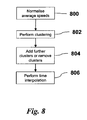
- FIG. 8 shows a flowchart outlining an embodiment for performing cluster formation on averages
- FIG. 9 shows an example set of cluster generated speed profiles which are an output for the clustering algorithm
- FIG. 10 shows a flow chart outlining a fall back strategy used to improve the quality of measured speed profiles associated with road segments
- FIG. 11 shows a flowchart outlining an embodiment of how the quality of measured speed profile data is improved
- FIG. 12 shows a flowchart outlining how the cluster generated speed profiles are associated with road segments of at least one map
- FIG. 13 shows a flowchart outlining how abnormal speed profiles are generated for times if atypical traffic behaviour
- FIG. 14 shows a flowchart outlining how the navigation device operates to use the abnormal speed profiles for times if atypical traffic behaviour
- a navigation device is intended to include (without limitation) any type of route planning and navigation device, irrespective of whether that device is embodied as a PND, a vehicle such as an automobile, or indeed a portable computing resource, for example a portable personal computer (PC), a mobile telephone or a Personal Digital Assistant (PDA) executing route planning and navigation software.
- PC personal computer
- PDA Personal Digital Assistant
- road segments are described with reference to road segments. It should be realised that the invention may also be applicable to other navigable segments, such as segments of a path, river, canal, cycle path, tow path, rail way line, or the like. For ease of reference these are commonly referred to as a road segment.
- the Global Positioning System (GPS) of FIG. 1 and the like are used for a variety of purposes.
- the GPS is a satellite-radio based navigation system capable of determining continuous position, velocity, time, and in some instances direction information for an unlimited number of users.
- NAVSTAR the GPS incorporates a plurality of satellites which orbit the earth in extremely precise orbits. Based on these precise orbits, GPS satellites can relay their location, as GPS data, to any number of receiving units.
- Global Positioning systems could be used, such as GLOSNASS, the European Galileo positioning system, COMPASS positioning system or IRNSS (Indian Regional Navigational Satellite System).
- the GPS system is implemented when a device, specially equipped to receive GPS data, begins scanning radio frequencies for GPS satellite signals. Upon receiving a radio signal from a GPS satellite, the device determines the precise location of that satellite via one of a plurality of different conventional methods. The device will continue scanning, in most instances, for signals until it has acquired at least three different satellite signals (noting that position is not normally, but can be determined, with only two signals using other triangulation techniques). Implementing geometric triangulation, the receiver utilizes the three known positions to determine its own two-dimensional position relative to the satellites. This can be done in a known manner. Additionally, acquiring a fourth satellite signal allows the receiving device to calculate its three dimensional position by the same geometrical calculation in a known manner. The position and velocity data can be updated in real time on a continuous basis by an unlimited number of users.
- the GPS system 100 comprises a plurality of satellites 102 orbiting about the earth 104 .
- a GPS receiver 106 receives GPS data as spread spectrum GPS satellite data signals 108 from a number of the plurality of satellites 102 .
- the spread spectrum data signals 108 are continuously transmitted from each satellite 102 , the spread spectrum data signals 108 transmitted each comprise a data stream including information identifying a particular satellite 102 from which the data stream originates.
- the GPS receiver 106 generally requires spread spectrum data signals 108 from at least three satellites 102 in order to be able to calculate a two-dimensional position. Receipt of a fourth spread spectrum data signal enables the GPS receiver 106 to calculate, using a known technique, a three-dimensional position.
- a navigation device 200 (ie a PND) comprising or coupled to the GPS receiver device 106 , is capable of establishing a data session, if required, with network hardware of a “mobile” or telecommunications network via a mobile device (not shown), for example a mobile telephone, PDA, and/or any device with mobile telephone technology, in order to establish a digital connection, for example a digital connection via known Bluetooth technology. Thereafter, through its network service provider, the mobile device can establish a network connection (through the Internet for example) with a server 150 .
- a network connection through the Internet for example
- a “mobile” network connection can be established between the navigation device 200 (which can be, and often times is, mobile as it travels alone and/or in a vehicle) and the server 150 to provide a “real-time” or at least very “up to date” gateway for information.
- the establishing of the network connection between the mobile device (via a service provider) and another device such as the server 150 , using the Internet for example, can be done in a known manner.
- any number of appropriate data communications protocols can be employed, for example the TCP/IP layered protocol.
- the mobile device can utilize any number of communication standards such as CDMA2000, GSM, IEEE 802.11 a/b/c/g/n, etc.
- the Internet connection may be utilised, which can be achieved via data connection, via a mobile phone or mobile phone technology within the navigation device 200 for example.
- the navigation device 200 may, of course, include its own mobile telephone technology within the navigation device 200 itself (including an antenna for example, or optionally using the internal antenna of the navigation device 200 ).
- the mobile phone technology within the navigation device 200 can include internal components, and/or can include an insertable card (e.g. Subscriber Identity Module (SIM) card), complete with necessary mobile phone technology and/or an antenna for example.
- SIM Subscriber Identity Module
- mobile phone technology within the navigation device 200 can similarly establish a network connection between the navigation device 200 and the server 150 , via the Internet for example, in a manner similar to that of any mobile device.
- a Bluetooth enabled navigation device may be used to work correctly with the ever changing spectrum of mobile phone models, manufacturers, etc., model/manufacturer specific settings may be stored on the navigation device 200 for example. The data stored for this information can be updated.
- the navigation device 200 is depicted as being in communication with the server 150 via a generic communications channel 152 that can be implemented by any of a number of different arrangements.
- the communication channel 152 generically represents the propagating medium or path that connects the navigation device 200 and the server 150 .
- the server 150 and the navigation device 200 can communicate when a connection via the communications channel 152 is established between the server 150 and the navigation device 200 (noting that such a connection can be a data connection via mobile device, a direct connection via personal computer via the Internet, etc.).
- the communication channel 152 is not limited to a particular communication technology. Additionally, the communication channel 152 is not limited to a single communication technology; that is, the channel 152 may include several communication links that use a variety of technology. For example, the communication channel 152 can be adapted to provide a path for electrical, optical, and/or electromagnetic communications, etc. As such, the communication channel 152 includes, but is not limited to, one or a combination of the following: electric circuits, electrical conductors such as wires and coaxial cables, fibre optic cables, converters, radio-frequency (RF) waves, the atmosphere, free space, etc. Furthermore, the communication channel 152 can include intermediate devices such as routers, repeaters, buffers, transmitters, and receivers, for example.
- RF radio-frequency
- the communication channel 152 includes telephone and computer networks. Furthermore, the communication channel 152 may be capable of accommodating wireless communication, for example, infrared communications, radio frequency communications, such as microwave frequency communications, etc. Additionally, the communication channel 152 can accommodate satellite communication.
- the communication signals transmitted through the communication channel 152 include, but are not limited to, signals as may be required or desired for given communication technology.
- the signals may be adapted to be used in cellular communication technology such as Time Division Multiple Access (TDMA), Frequency Division Multiple Access (FDMA), Code Division Multiple Access (CDMA), Global System for Mobile Communications (GSM), General Packet Radio Service (GPRS), etc.
- TDMA Time Division Multiple Access
- FDMA Frequency Division Multiple Access
- CDMA Code Division Multiple Access
- GSM Global System for Mobile Communications
- GPRS General Packet Radio Service
- Both digital and analogue signals can be transmitted through the communication channel 152 .
- These signals may be modulated, encrypted and/or compressed signals as may be desirable for the communication technology.
- the server 150 includes, in addition to other components which may not be illustrated, a processor 154 operatively connected to a memory 156 and further operatively connected, via a wired or wireless connection 158 , to a mass data storage device 160 .
- the mass storage device 160 contains a store of navigation data and map information, and can again be a separate device from the server 150 or can be incorporated into the server 150 .
- the processor 154 is further operatively connected to transmitter 162 and receiver 164 , to transmit and receive information to and from navigation device 200 via communications channel 152 .
- the signals sent and received may include data, communication, and/or other propagated signals.
- the transmitter 162 and receiver 164 may be selected or designed according to the communications requirement and communication technology used in the communication design for the navigation system 200 . Further, it should be noted that the functions of transmitter 162 and receiver 164 may be combined into a single transceiver.
- the navigation device 200 can be arranged to communicate with the server 150 through communications channel 152 , using transmitter 166 and receiver 168 to send and receive signals and/or data through the communications channel 152 , noting that these devices can further be used to communicate with devices other than server 150 .
- the transmitter 166 and receiver 168 are selected or designed according to communication requirements and communication technology used in the communication design for the navigation device 200 and the functions of the transmitter 166 and receiver 168 may be combined into a single transceiver as described above in relation to FIG. 2 .
- the navigation device 200 comprises other hardware and/or functional parts, which will be described later herein in further detail.
- Software stored in server memory 156 provides instructions for the processor 154 and allows the server 150 to provide services to the navigation device 200 .
- One service provided by the server 150 involves processing requests from the navigation device 200 and transmitting navigation data from the mass data storage 160 to the navigation device 200 .
- Another service that can be provided by the server 150 includes processing the navigation data using various algorithms for a desired application and sending the results of these calculations to the navigation device 200 .
- the server 150 constitutes a remote source of data accessible by the navigation device 200 via a wireless channel.
- the server 150 may include a network server located on a local area network (LAN), wide area network (WAN), virtual private network (VPN), etc.
- LAN local area network
- WAN wide area network
- VPN virtual private network
- the server 150 may include a personal computer such as a desktop or laptop computer, and the communication channel 152 may be a cable connected between the personal computer and the navigation device 200 .
- a personal computer may be connected between the navigation device 200 and the server 150 to establish an Internet connection between the server 150 and the navigation device 200 .
- the navigation device 200 may be provided with information from the server 150 via information downloads which may be updated automatically, from time to time, or upon a user connecting the navigation device 200 to the server 150 and/or may be more dynamic upon a more constant or frequent connection being made between the server 150 and navigation device 200 via a wireless mobile connection device and TCP/IP connection for example.
- the processor 154 in the server 150 may be used to handle the bulk of processing needs, however, a processor (not shown in FIG. 2 ) of the navigation device 200 can also handle much processing and calculation, oftentimes independent of a connection to a server 150 .
- the block diagram of the navigation device 200 is not inclusive of all components of the navigation device, but is only representative of many example components.
- the navigation device 200 is located within a housing (not shown).
- the navigation device 200 includes processing circuitry comprising, for example, the processor 202 mentioned above, the processor 202 being coupled to an input device 204 and a display device, for example a display screen 206 .
- a display device for example a display screen 206 .
- the input device 204 represents any number of input devices, including a keyboard device, voice input device, touch panel and/or any other known input device utilised to input information.
- the display screen 206 can include any type of display screen such as a Liquid Crystal Display (LCD), for example.
- LCD Liquid Crystal Display
- one aspect of the input device 204 , the touch panel, and the display screen 206 are integrated so as to provide an integrated input and display device, including a touchpad or touchscreen input 250 ( FIG. 4 ) to enable both input of information (via direct input, menu selection, etc.) and display of information through the touch panel screen so that a user need only touch a portion of the display screen 206 to select one of a plurality of display choices or to activate one of a plurality of virtual or “soft” buttons.
- the processor 202 supports a Graphical User Interface (GUI) that operates in conjunction with the touchscreen.
- GUI Graphical User Interface
- the processor 202 is operatively connected to and capable of receiving input information from input device 204 via a connection 210 , and operatively connected to at least one of the display screen 206 and the output device 208 , via respective output connections 212 , to output information thereto.
- the navigation device 200 may include an output device 208 , for example an audible output device (e.g. a loudspeaker).
- an audible output device e.g. a loudspeaker
- input device 204 can include a microphone and software for receiving input voice commands as well.
- the navigation device 200 can also include any additional input device 204 and/or any additional output device, such as audio input/output devices for example.
- the processor 202 is operatively connected to memory 214 via connection 216 and is further adapted to receive/send information from/to input/output (I/O) ports 218 via connection 220 , wherein the I/O port 218 is connectible to an I/O device 222 external to the navigation device 200 .
- the external I/O device 222 may include, but is not limited to an external listening device, such as an earpiece for example.
- connection to I/O device 222 can further be a wired or wireless connection to any other external device such as a car stereo unit for hands-free operation and/or for voice activated operation for example, for connection to an earpiece or headphones, and/or for connection to a mobile telephone for example, wherein the mobile telephone connection can be used to establish a data connection between the navigation device 200 and the Internet or any other network for example, and/or to establish a connection to a server via the Internet or some other network for example.
- any other external device such as a car stereo unit for hands-free operation and/or for voice activated operation for example, for connection to an earpiece or headphones, and/or for connection to a mobile telephone for example
- the mobile telephone connection can be used to establish a data connection between the navigation device 200 and the Internet or any other network for example, and/or to establish a connection to a server via the Internet or some other network for example.
- the memory 214 of the navigation device 200 comprises a portion of non-volatile memory (for example to store program code) and a portion of volatile memory (for example to store data as the program code is executed).
- the navigation device also comprises a port 228 , which communicates with the processor 202 via connection 230 , to allow a removable memory card (commonly referred to as a card) to be added to the device 200 .
- a removable memory card commonly referred to as a card
- the port is arranged to allow an SD (Secure Digital) card to be added.
- the port may allow other formats of memory to be connected (such as Compact Flash (CF) cards, Memory SticksTM, xD memory cards, USB (Universal Serial Bus) Flash drives, MMC (MultiMedia) cards, SmartMedia cards, Microdrives, or the like).
- CF Compact Flash
- Memory SticksTM Memory SticksTM
- xD memory cards xD memory cards
- USB Universal Serial Bus
- MMC MultiMedia cards
- SmartMedia cards SmartMedia cards
- Microdrives or the like.
- FIG. 3 further illustrates an operative connection between the processor 202 and an antenna/receiver 224 via connection 226 , wherein the antenna/receiver 224 can be a GPS antenna/receiver for example and as such would function as the GPS receiver 106 of FIG. 1 .
- the antenna and receiver designated by reference numeral 224 are combined schematically for illustration, but that the antenna and receiver may be separately located components, and that the antenna may be a GPS patch antenna or helical antenna for example.
- the electronic components shown in FIG. 3 are powered by one or more power sources (not shown) in a conventional manner.
- power sources may include an internal battery and/or a input for a low voltage DC supply or any other suitable arrangement.
- the components shown in FIG. 3 may be in communication with one another via wired and/or wireless connections and the like.
- the navigation device 200 described herein can be a portable or handheld navigation device 200 .
- the portable or handheld navigation device 200 of FIG. 3 can be connected or “docked” in a known manner to a vehicle such as a bicycle, a motorbike, a car or a boat for example. Such a navigation device 200 is then removable from the docked location for portable or handheld navigation use. Indeed, in other embodiments, the device 200 may be arranged to be handheld to allow for navigation of a user.
- the navigation device 200 may be a unit that includes the integrated input and display device 206 and the other components of FIG. 2 (including, but not limited to, the internal GPS receiver 224 , the processor 202 , a power supply (not shown), memory systems 214 , etc.).
- the navigation device 200 may sit on an arm 252 , which itself may be secured to a vehicle dashboard/window/etc. using a suction cup 254 .
- This arm 252 is one example of a docking station to which the navigation device 200 can be docked.
- the navigation device 200 can be docked or otherwise connected to the arm 252 of the docking station by snap connecting the navigation device 200 to the arm 252 for example.
- the navigation device 200 may then be rotatable on the arm 252 .
- a button (not shown) on the navigation device 200 may be pressed, for example.
- Other equally suitable arrangements for coupling and decoupling the navigation device 200 to a docking station are well known to persons of ordinary skill in the art.
- the processor 202 and memory 214 cooperate to support a BIOS (Basic Input/Output System) 282 that functions as an interface between functional hardware components 280 of the navigation device 200 and the software executed by the device.
- BIOS Basic Input/Output System
- the processor 202 then loads an operating system 284 from the memory 214 , which provides an environment in which application software 286 (implementing some or all of the described route planning and navigation functionality) can run.
- the application software 286 provides an operational environment including the Graphical User Interface (GUI) that supports core functions of the navigation device, for example map viewing, route planning, navigation functions and any other functions associated therewith.
- GUI Graphical User Interface
- part of the application software 286 comprises a view generation module 288 .
- the processor 202 of the navigation device is programmed to receive GPS data received by the antenna 224 and, from time to time, to store that GPS data, together with a time stamp of when the GPS data was received, within the memory 214 to build up a record of the location of the navigation device.
- Each data record so-stored may be thought of as a GPS fix; ie it is a fix of the location of the navigation device and comprises a latitude, a longitude, a time stamp and an accuracy report.
- the data is stored substantially on a periodic basis which is for example every 5 seconds.
- a periodic basis which is for example every 5 seconds.
- the resolution might be substantially every: 1 second, 10 seconds, 15 seconds, 20 seconds, 30 seconds, 45 seconds, 1 minute, 2.5 minutes (or indeed, any period in between these periods).
- the quality of the captured data reduces as the period increases and whilst the degree of degradation will at least in part be dependent upon the speed at which the navigation device 200 was moving a period of roughly 15 seconds may provide a suitable upper limit.
- the navigation device 200 Whilst the navigation device 200 is generally arranged to build up a record of its whereabouts, some embodiments, do not record data for a predetermined period and/or distance at the start or end of a journey. Such an arrangement helps to protect the privacy of the user of the navigation device 200 since it is likely to protect the location of his/her home and other frequented destinations. For example, the navigation device 200 may be arranged not to store data for roughly the first 5 minutes of a journey and/or for roughly the first mile of a journey.
- the GPS may not be stored on a periodic basis but may be stored within the memory when a predetermined event occurs.
- the processor 202 may be programmed to store the GPS data when the device passes a road junction, a change of road segment, or other such event.
- the processor 202 is arranged, from time to time, to upload the record of the whereabouts of the device 200 (ie the GPS data and the time stamp) to the server 150 .
- the uploading of the data occurs on a periodic basis which may for example be once every 24 hours.
- the skilled person will appreciate that other periods are possible and may be substantially any of the following periods: 15 minutes, 30 minutes, hourly, every 2 hours, every 5 hours, every 12 hours, every 2 days, weekly, or any time in between these.
- the processor 202 may be arranged to upload the record of the whereabouts on a substantially real time basis, although this may inevitably mean that data is in fact transmitted from time to time with a relatively short period between the transmissions and as such may be more correctly thought of as being pseudo real time.
- the navigation device may be arranged to buffer the GPS fixes within the memory 214 and/or on a card inserted in the port 228 and to transmit these when a predetermined number have been stored. This predetermined number may be on the order of 20, 36, 100, 200 or any number in between. The skilled person will appreciate that the predetermined number is in part governed by the size of the memory 214 /card within the port 228 .
- the processor 202 may be arranged to upload the record to the server 152 when a communication channel 152 is created. This may for example, be when the navigation device 200 is connected to a user's computer. Again, in such embodiments, the navigation device may be arranged to buffer the GPS fixes within the memory 214 or on a card inserted in the port 228 . Should the memory 214 or card inserted in the port 228 become full of GPS fixes the navigation device may be arranged to delete the oldest GPS fixes and as such it may be thought of as a First in First Out (FIFO) buffer.
- FIFO First in First Out
- the record of the whereabouts comprises one or more traces with each trace representing the movement of that navigation device 200 within a 24 hour period.
- Each 24 is arranged to coincide with a calendar day but in other embodiments, this need not be the case.
- a user of a navigation device 200 gives his/her consent for the record of the devices whereabouts to be uploaded to the server 150 . If no consent is given then no record is uploaded to the server 150 .
- the navigation device itself, and/or a computer to which the navigation device is connected may be arranged to ask the user for his/her consent to such use of the record of whereabouts.
- the server 150 is arranged to receive the record of the whereabouts of the device and to store this within the mass data storage 160 for processing. Thus, as time passes the mass data storage 160 accumulates a plurality of records of the whereabouts of navigation devices 200 which have uploaded data.
- the mass data storage 160 also contains map data.
- map data provides information about the location of road segments, points of interest and other such information that is generally found on map.
- the server 150 is arranged to perform a map matching function between the map data and the GPS fixes contained within the records of the whereabouts that have been received and such a process is described in relation to FIG. 6 .
- map matching may be performed in a so-called real time manner; ie as the records of whereabouts are received or may be performed a time later after the records of the whereabouts have been recalled from the mass data storage 160 .
- each GPS trace (ie a 24 hour period of GPS data) is divided 600 into one or more trips with each trip representing a single journey of the navigation device 200 which are subsequently stored for later processing.
- each trip GPS fixes whose accuracy report received from the navigation device is not sufficiently high are rejected 602 .
- a fix may be rejected if the accuracy report indicates that the signals from less than three satellites 102 were being received by the navigation device 200 in relation to that GPS fix.
- each trip is clipped 604 when the reported time between fixes goes above a threshold value. Each trip that passes this pre-processing stage is passed to be map matched.
- a clipped trip is a trip in which the there is a predetermined time period between consecutive GPS fixes of greater than a predetermined time. As such, it might be inferred that the vehicle has remained stationary and as such it should be considered a first trip has ended and a second trip has commenced. Thus, a clipped trip becomes two separate trips.
- the predetermined time is roughly 3 minutes.
- the gap may be any other suitable time, such as roughly any of the following: 15 seconds, 30 seconds, 1 minute, 90 seconds, 2 minutes, 5 minutes, 10 minutes or any time in between these.
- data may in some embodiments, be rejected in later processing.
- Such an embodiment can be useful in that it can remove data relating to so-called stop-start traffic which occurs after incidents such as a crash or the like which may leave remaining data more representative of steady state traffic flow.
- Each trip is taken in turn and fixes within that trip are matched to a map from within the map data.
- Each map comprises a plurality of road segments along which it is possible to travel with each segment being represented within the map as a straight vector.
- the program code running on the processor 154 of the server 150 provides a map matcher that is arranged to step over the or each fix in the trip that is being processed until it finds a fix which lies within a segment or is sufficiently close to a segment in order for it to be assumed to have occurred on that segment (ie it is within a distance threshold of the segment). This threshold allows for less than 100% GPS accuracy and the compressing effect of splitting the road into a set of straight vectors.
- Each trip has an initial fix (ie the first fix within the trip) which is harder to associate with a segment than other fixes within the trip since there are no segments that have already identified which can be used to constrain the selection of the segments. If, for this first fix, multiple segments are within the threshold 606 , then the algorithm looks to the next GPS fix (ie the 2nd fix) within the trip and generates a set of roots from those multiple segments based on the possible travel as a function of the distance between the 2 fixes (ie between the 1st and 2nd fixes). If the 2nd fix does not lead to a unique candidate segment for the 1st fix, then the algorithm moves to the 3rd fix within the trip and again generates and compares the possible routes to try and provide a unique candidate for the first fix 608 . This process may continue until the remaining GPS fixes within a trip have been processed.
- the next GPS fix ie the 2nd fix
- An advantage of such an embodiment is that although any one first fix in isolation may be near multiple segments, and in isolation these segments can not be distinguished between, it becomes possible using the further travel (ie the 2nd and 3rd fixes) to determine the identity of the segment with which the first fix is associated. Thus, a first segment for a trip is determined by the map matcher.
- the subsequent fixes of a trip are processed 610 to determine if they are within the distance threshold of the segment, and the map matcher is arranged to associate that segment with each of the fixes that lie within the distance threshold.
- the map matcher process a fix that is outwith the distance threshold it is arranged to generate a new set of candidate segments for that fix.
- the next segment is one which is connected to the end of the one which has just been processed. These neighbouring segments are obtained by the map matcher from the underlying map data.
- the map matcher fails to identify a segment for a given fix that follows on from the previous segment, either because there are no segments within a threshold, or it cannot uniquely identify a single segment, then the map matcher is arranged to step through subsequent fixes 616 in order to further constrain the journey until it can identify a segment that is a unique match. That is, if the nth fix cannot be uniquely associated with a segment the nth+1 segment is used to further constrain the identification of a segment. If the nth+1 fix does not produce a unique segment then the nth+2 fix is used. In some embodiments, this process may carry on until a unique segment is identified or all of the GPS fixes with a trip have been processed.
- the map matcher is arranged to try and uniquely identify segments; in the embodiment being described, it does not attempt to create a continuous route, only to try and match segments to fixes. In other embodiments, it may be desirable to try and have the map matcher generate continuous routes.
- a series of road segments are obtained along which the navigation device 200 has travelled in the trip being analysed. Subsequently, the map matcher further processes these road segments and assigns, from the GPS fixes, an ingress time and also a transit time for that segment. These assigned times are stored within the mass data storage 160 for later processing. It may well be that a plurality of GPS fixes are stored for each road segment. However, regardless of whether how many GPS fixes are associated with each segment, the ingress time, GPS fixes and the length of the segment (which in this embodiment is stored within the map data) are used to calculate the average speed for that segment of road. This average speed is then stored within the mass data storage 160 associated with the relevant assigned times and that segment. Information relating to a speed of traffic flow on a road segment and assigned to a road segment may be thought of as being speed data for that road segment.
- the server 150 is further arranged to run averaging program code on the processor 154 to provide an averager which processes the assigned times to generate one or more averages therefrom as described below.
- the averaging process used in this embodiment is now described in relation to FIG. 7 .
- the averager groups the average speeds for each road segment on the map being processed. Within the grouping for each road segment, the averager is further arranged to group the average speeds within a set of predetermined time periods 702 .
- a set of predetermined time periods 702 are grouped together for further analysis.
- the time periods are one hour durations but this need not be the case and the skilled person will appreciate, from the following description, that as the length of the time period decreases the resolution of the data is increased but storage requirements are increased.
- Other suitable time periods might substantially any of the following: 1 minute, 5 minute, 10 minute, 15 minute, 30 min, 2 hours, 6 hours, 12 hours, or any time in between these times.
- average speeds are stored in a time local to the area covered by the map being processed rather than a centralised time. Such a method is convenient as it provides a natural basis for traffic related issues.
- the average speed is only added to the group for the predetermined period if the average speed falls within a predetermined range.
- the method excludes speeds which exceed a maximum predetermined threshold (which may be roughly 180 km/h) and further, the method excludes speeds which fall below a predetermined amount of the average speed for that segment in that predetermined time period (which may for example be 2 km/h).
- a maximum predetermined threshold which may be roughly 180 km/h
- the method excludes speeds which fall below a predetermined amount of the average speed for that segment in that predetermined time period (which may for example be 2 km/h).
- speeds which are well below the average speed for that segment in that time may well be associated with a problem in the traffic flow for that segment, such as a traffic jam or the like.
- the max permitted speed may be set as the speed limit for that segment of road, but the skilled person will appreciate that such information can be inaccurate in map data that is being processed and also that the speed limit for a segment of road may in fact not give an accurate indication of traffic conditions.
- an average speed is calculated for each road segment for each predetermined time period. For example, all of the speeds within the 8.00 am to 8.59 am time period, for each segment of road are averaged.
- each segment of road on the map 24 average speeds; an average speed for each hour long predetermined time period. It will be appreciated that if a different duration of time period is used then there will be a different number of average speeds. It will be further appreciated that, in fact, not all road segments will necessarily have an average speed assigned thereto for every time period since some roads may be traversed infrequently, particularly at unsociable times such as the early hours of the morning.
- quality checks are performed 706 .
- this check ensures that more than a predetermined number of assigned times were used to generate average speed per segment. If this is not the case then that average speed per segment is rejected for further processing leaving a gap for that segment at one or more time periods. In some embodiments, the average is rejected if there are fewer than 5 values that went to make up that average. Other embodiments may of course use different values, such as 2, 3, 4, 6, 7, 8, 10, 20 or more or any value in between these.
- Further quality checks may be implemented to reject averages on any of the following: whether the deviation in the data is beyond a predetermined threshold;
- the set of averages for any given road segment may be thought of as a measured speed profile for that road segment.
- step 708 an assessment is made as to the overall coverage of average speeds per road segment. If the coverage of trustworthy averages is high enough then the map data is forwarded for further processing. However, if the coverage is below a predetermined threshold then the map is rejected from further consideration 710 . Acceptable maps are passed for cluster formation as is described in relation to FIG. 8 .
- Such cluster formation aims to extract regular speed profiles for time periods, such as days, that recur weekly in an automatic or semi-automatic manner; as will be discussed later, data compression, which may be significant, can be achieved if it is assumed that roads of a similar class may have a similar speed profile. For example, the speed each week at 10 am on a Sunday morning for a first segment of road may be similar to the speed at the same time for a second segment of road. If this similarity for those segments of road is repeated for other times then the speed profile for the first and second segments may be considered to be represented by the same speed profile of the second segment.
- the clustering as now defined aims to locate such similarities. Normalisation of speed profiles, as discussed below, may also allow a speed profile to be used for roads of a different class.
- the measured speed profile is further processed in order to amalgamate the night-time time periods.
- the average speeds between 9 pm and 5 am ie 8 time periods
- this night-time average is used for each of 8 time periods.
- each speed profile has a flat speed profile between the hours of 9 pm and 8 am which may be termed the free flow speed of that road segment.
- the free flow speed represents the speed at which a vehicle, generally a car, travels along the road and it is often the case that the free flow speed is different from the speed limit for that road segment.
- the free flow speed may also be roughly the same as the speed limit for that road segment.
- a first step 800 and in order to limit the number of clusters the measured speed profiles are normalised.
- Such normalisation can be performed according to a number of criteria.
- normalisation occurs according to the free flow speed that has been calculated for the segment of road with which the average is associated.
- the average speed per road segment that is passed to the clustering algorithm has a value of between 0 and 1.
- Such a method can aid further data compression since it can make the resulting cluster-generated speed profile independent of the type of road and as such it becomes possible to use the same set of speed profiles for road segments having any road type.
- Use of the free-flow speeds during the night time period may reduce the dimension of the cluster formation since it may be possible to neglect night time speed values.
- the average speed or the speed limit of a road segment may be used as a further criterion against which to perform the normalisation.
- days showing a similar traffic behavior can be grouped together by processing by a clustering algorithm. If the expected traffic behavior is different the cluster formation should run independently.
- An input parameter to the clustering algorithm is the number of desired clusters and a typical range is 10-70 for a day of the week.
- There are known methods to approach the optimal number of clusters e.g. having some quality measures assigned and enlarging/reducing the numbers of clusters according to its trend) which may be used to determine whether the output of the clustering is acceptable.
- the clustering algorithm is run and arranged to generate around 60 clusters. In other embodiments, the algorithm may be arranged to generate more or less clusters initially. The resultant clusters are then processed to determine whether the generated clusters are satisfactory: are some of the clusters too similar (ie substantially the same)? Do any of the clusters have discontinuities therein? If there are problems with any of the clusters then the algorithm is re-run with the process aiming to generate fewer clusters than the first iteration. This iterative process is repeated until a satisfactory set of clusters is determined.
- whether the clusters are satisfactory includes a step of determining whether or not any of the cluster-generated profiles contain frequencies above a predetermined threshold. The presence of such frequencies indicates that that cluster-generated speed profile has a rate of change that is too high (ie there may be a discontinuity) and if used may result in instability, etc. within a navigation device 200 using that data to generate a route.
- Whether or not the clusters are satisfactory may also include the step of performing a comparison between at least some, and generally each, of the cluster-generated speed profiles. In one particular embodiment this may be performed by a least squares comparison.
- the cluster is performed by cluster analysis, but other class building methods might be used as well.
- a simple and efficient approach is the so-called k-means clustering algorithm.
- This non-hierarchical method normally starts with k random seeds and redistributes the class members according to a minimum error criteria based on a chosen metric. The algorithm leads to local minima only, therefore for an optimal solution it has to run multiple times. The run with the minimum error estimates gives what may be a preferred solution.
- the centroids of the final clusters form the predefined clusters.
- other clustering techniques may be used and these include hierarchical clustering and fuzzy clustering.
- Some embodiments may add further clusters 804 .
- some embodiments may add a flat line as a speed profile for road segments that have no trustworthy trend, e.g. due to low data coverage or because of traffic related issues.
- the clusters are interpolated to a variable time resolution. In one embodiment this is performed using cubic splines but other techniques are possible such as an exponential fitting function. The skilled person will also appreciate similar techniques that may be used.
- the time resolution used in the cluster analysis procedure itself is coarser than is finally desired, which may occur in order that there are a sufficient number of reliable average speed in any one predetermined time period, the time resolution can now be modified. For example, it can be modified to finer resolution to meet the requirements of the intended use. For example, it can be advantageous to have a finer resolution having a more continuous profile in place is desired to provide smoother routes which might otherwise “jump” on time boundaries if the time resolution is too coarse.
- the cluster-generated profiles are interpolated in order that they have a resolution of roughly 5 min intervals, although any other period may be used. Such a period may be convenient for later processing using the cluster-generated speed profile.
- FIG. 9 shows a typical output from the clustering algorithm for a map in which the input average speed values have been clustered into 16 independent cluster generated speed profiles.
- each section of road can now be referred to as having one of the 16 cluster generated speed profiles. If in other embodiments, the number of clusters is varied then the number of possible speed profiles for any one segment of road is also changed.
- a suitable set of cluster generated speed profiles has been determined—in this embodiment 16 have been generated—then these are associated with one or more maps.
- a set of speed profiles will be more accurate for the map from which they have been generated since traffic behavior may be different on roads not on that map. For example, should a map cover a single country then it may be that traffic in a different country follows slightly different patterns.
- the speed profiles may be associated with a plurality of maps. In one example, this may be appropriate if the map covers a portion of a country and/or it may be appropriate to use the map for a plurality of countries.
- Each road segment that is present on the map being processed is analysed and may have one of the cluster generated speed profiles (as shown in FIG. 9 ) associated therewith to define an expected speed of travel though that segment throughout a week.
- each road segment has a speed profile associated therewith in which there is a high degree of belief (as a first step this is assessed on whether the measured speed profile is suitable).
- a fall back strategy is used to replace the measured speed profile with speed data which is likely to prove better for routing purposed when processed by a PND or other device.
- an average speed 1000 for the road segment being processed which comprises an average of all the speed data collected for that road segment is used instead of the measured speed profile. That is the data collected for each time period for each day is averaged to generate a single speed. This single average speed may be, in due course, mapped to the flat cluster generated speed profile (number 15 in FIG. 9 ).
- measures may be used to measure the quality of the average. For example, in some embodiments, it may be required that the average is made up from more than a predetermined number of speeds, which may for example be roughly 10 speeds. Thresholds may be applied to the averages to ensure that they are above a minimum value (which may for example be roughly 2 km/h) and/or below a maximum value (which may for example be roughly 150 km/h). The standard deviation may also be used to determine whether the average is of a high enough quality.
- road segments may be classified according to a classification system within map data such that roads of similar characteristics are classified within the same classification. For example, maps generated by one party have 8 categories into which road segments are classified.
- the average for a given road segment is analysed to ensure that at least a predetermined percentage of roads within the classification for that road segment have provided a speed which has been used to generate the average. If this test fails then not only is the average rejected, but the gap filling procedure described next may also be omitted.
- speed profile number 15 may be used to represent any road segment having a single average speed associated therewith.
- each road segment on the map being processed is categorised as being a member of one of a predetermined number of categories 1100 .
- This categorisation of each road segment need only be performed once and the resulting categorisation maintained for further road segments for which the gap-filling process is invoked.
- Other embodiments could of course re-calculate at each invocation or indeed calculate the categories on the fly.
- a category average speed is calculated for each one of the predetermined categories 1102 , in this case 40 categories.
- the category average that is generated is a single figure per category and in order to achieve this average speed for each predetermined time period is averaged using any suitable averaging technique as mentioned herein. Again, the skilled person will appreciate that this step may only need to be performed once and the category average speed maintained for future invocations of the gap-filling process.
- quality_factor_rel_min is given by relative standard deviation of a class in % of the mean speed divided by square root of number of hits, quality_factor_abs*100/mean_speed.
- table 2 may well vary in other embodiments and are shown as an example only.
- replacement values used in table 3 may well vary in other embodiments, depending upon the area covered by the map, the party that generated the map data, etc.
- the average for the classification should lie above a minimum threshold and below a maximum threshold which are computed in the following way, with min and max are pseudo code minimum and maximum functions:
- Min_speed_threshold max [ max (mean ⁇ lower_relative_devision*mean/100 , mean ⁇ lower_absolute_devision) , lower_limit ]
- Max_speed_threshold min [ min (mean+upper_relative_devision*mean/100 , mean+upper_absolute_devision) , upper_limit ] whereas mean is the mean speed of the appropriate speed class of the segment.
- the other quantities are defined in Table 4.
- a speed associated with a segment fails these criteria then that speed is replaced by its threshold based on its mean speed unless the speed associated with the segment does not offend the absolute speed limits in which case the absolute speed limits will be used as the speed for that segment.
- an average speed may have been generated, based upon road segments within the same category from the predetermined 40.
- the gap-filling process might still fail (ie no average is generated which passes the quality checks).
- the speed associated with that road segment is set to be the speed that has been provided by the map data supplier according to Functional Road Class (FRC).
- the functional road class may for example comprise roughly 8 categories, although this might differ between map data suppliers. That is, the free flow speed is set to a value according to the FRC and the cluster generated speed profile is set to be, in this embodiment, profile number 15.
- the speed profile (whether a measured speed profile or an average inserted by gap filling) associated with a road segment is now mapped to one of the cluster generated speed profiles to generate the map data which can be used by navigation devices such as PND's. This may be performed regardless of whether the speed information is a measured speed profile or an average in view of the presence of the flat cluster generated speed profile number 15.
- step 1210 the speed profile is compared, using a least squares comparison, with each of the speed profiles in the set of cluster generated speed profiles. After these 16 comparisons have been made it is possible to determine which speed profile from the set of 16 is closest to the speed profile associated with the road segment and in step 1220 a reference to the cluster generated speed profile that is deemed to be closest is stored in the map data for that road segment. Also stored in the map data in relation to that road segment is the free flow speed for that road segment which has been calculated earlier.
- the average speed information can be thought of as comprising an approximation to the daily hourly average between the hours of 9 am to 5 pm.
- the average speed information may be thought of as being an average speed which is averaged across all time periods.
- a final check is made to see if a sufficient number of road segments have a measured speed profile associated with them (as opposed to an average that has been inserted instead of a measured speed profile). If this check is not passed then the whole map is rejected and not released for use.
- the total length of road segments is calculated for each Functional Road Class (FRC).
- FRC Functional Road Class
- the FRC's are related to the 40 categories listed in table 2 as shown in table 5 below.
- the length of road segment within each FRC with average speed data assigned thereto should be above the threshold percentage of the total road length within the FRC as shown in table 5.
- a first fall back strategy (should the measured speed profile been deemed unacceptable) may be to aggregate the same predetermined time periods for each day are added to that period for each of the other days and then the resulting aggregated speed profile is used for each day rather than using a measured speed profile for each separate day. Therefore, in such an embodiment, a weekly speed profile is generated by adding the same time periods for each of the days Monday to Friday and a weekend speed profile is generated by adding the same time periods for each of Saturday and Sunday. It will be appreciated that traffic flow on the weekend may well be different to traffic flow on week days.
- Such aggregated speed profile may then be checked to see if it passes quality criteria before using other fall back strategies if it is not acceptable. These checks may be made using the same, or at least similar, criteria to those used to assess the measured speed profiles. If the aggregation of the data has improved the quality so that both the weekly and weekend speed profiles pass the quality check then these speed profiles are used for that road segment.
- the speed profiles calculated by the above-described method define the expected speed of travel through the segments for a normal week and are used as the default speed profiles to determine a navigation route. Therefore, these speed profiles are termed the “normal” speed profiles and, as will be appreciated, have been determined by processing speed data aggregated together from multiple time periods that recur weekly.
- traffic behaviour may be substantially different from the normal speed profile if there is an event that is not a typical weekly event, such as a national holiday, festival, extreme weather or a traffic incident.
- the processor 154 is arranged to process the speed data to generate abnormal speed profiles for the segments to be used at specified times when these events occur.
- step 1300 the processor 202 identifies times in the past during which atypical traffic behaviour did or was expected to occur. This may carried out by the processor 154 searching through an events calendar (not shown) stored in memory 156 of times of non-weekly events that may have had an impact on traffic behaviour.
- the processor 154 determines one or more abnormal speed profiles to be assigned to the segments.
- the abnormal speed profiles may be a pointer to use one of the normal speed profiles normally used for a different time period.
- the specified time may be a national holiday, such as a UK bank holiday
- the abnormal speed profile may be a pointer to the normal speed profile for a Sunday, identifying that this normal speed profile should also be used for days (that are not Sundays) that are national holidays.
- the processor 154 may generate an abnormal speed profile by extracting the speed data for all time periods identified as having atypical traffic behaviour and having a common attribute, such as being a national holiday or a time or day on which there was severe weather conditions, aggregating this speed data and generating speed profiles from this speed data in accordance with method described above with reference to FIGS. 7 to 12 . This results in a series of speed profiles specifically for times of atypical traffic behaviour, such as national holidays or times of severe weather.
- the processor 154 may also generate an abnormal speed profile by scaling up or down (in most circumstances down) the normal speed profiles already calculated.
- the processor 154 assigns each abnormal speed profile to one or more the segments of the map data and assigns an identifier identifying under what conditions the abnormal speed profile should be used. This may be determined from an events calendar for future events or from the identification of specific conditions when atypical traffic behaviour occurs, for example conditions identified as being present when atypical traffic behaviour occurred in the past.
- the created map data is sent to the navigation device 200 by server 150 for use in determining a route across an area covered by the map data.
- the processor 202 of the navigation device 200 identifies 1400 the conditions at a time of travel on the route.
- the navigation device 200 comprise an event calendar of future events stored in memory 214 or on a memory card in card port 228 and receives real-time updates on the weather and traffic via antenna/receiver 224 , which is also stored in memory.
- the processor 202 searches the events calendar and stored real-time updates to determine 1401 if the conditions at the time of travel match the specified condition of the identifier in the map data that indicates when to use the abnormal speed profile rather than the normal speed profile. If it does, then the processor 202 uses the abnormal speed profiles for determining the route. If not, then the processor 202 uses the normal speed profiles for determining the route.
- the real-time updates may include a location at which the traffic incident or severe weather condition is occurring/will occur.
- the processor 202 uses a boundary box/affected area approach to determine for which segments the abnormal speed profile should be used and for which segments the normal speed profile should be used.
- the processor 202 identifies segments within a predetermined distance of the incident or other event, for example within 50 or 100 km, and uses the abnormal profile for these segments and uses the normal speed profile for segments outside of this (or any other affected area). In this way, the navigation device can take account of events that may have a local rather than global affect on the traffic.
- the processor 200 of the navigation device 202 may use a different one of the other normal speed profiles for the speed of travel through the segments rather than the normal speed profile corresponding to the time of travel when a specified condition is identified at the time of travel. In this way, it is not necessary for the map data to comprise abnormal speed profiles.
- Such functionality may be appropriate where the specified condition is that the time of travel is a national holiday. If this condition is met the processor 202 will use the speed profile of a Saturday or Sunday rather then for speed profile for the day on which the national holiday falls.
- the processor 202 when determining a route in the UK, may use the normal speed profile for a Sunday for determining a route rather than the Monday normal speed profile.
- an apparatus provided to execute a method as described herein may comprise hardware, software, firmware or any combination of two or more of these.
- GPS data has been used to refer to position data derived from a GPS global positioning system as for example described in relation to FIG. 1
- other position data could be processed in a manner similar to the methods as described herein.
- GPS data may be replaceable with the phrase positioning data.
- Such position information could for example be derived from position information derived from mobile phone operation, data received at toll barriers, data obtained from induction loops embedded in roads, data obtained from number plate recognition system or any other suitable data.
Landscapes
- Engineering & Computer Science (AREA)
- Radar, Positioning & Navigation (AREA)
- Remote Sensing (AREA)
- Physics & Mathematics (AREA)
- General Physics & Mathematics (AREA)
- Automation & Control Theory (AREA)
- Chemical & Material Sciences (AREA)
- Analytical Chemistry (AREA)
- Mathematical Physics (AREA)
- Databases & Information Systems (AREA)
- Navigation (AREA)
- Traffic Control Systems (AREA)
- Instructional Devices (AREA)
- Position Fixing By Use Of Radio Waves (AREA)
Priority Applications (1)
| Application Number | Priority Date | Filing Date | Title |
|---|---|---|---|
| US12/734,261 US9829332B2 (en) | 2007-10-26 | 2008-10-22 | Method and machine for generating map data and a method and navigation device for determining a route using map data |
Applications Claiming Priority (4)
| Application Number | Priority Date | Filing Date | Title |
|---|---|---|---|
| US99605007P | 2007-10-26 | 2007-10-26 | |
| US99605207P | 2007-10-26 | 2007-10-26 | |
| PCT/EP2008/064317 WO2009053405A1 (en) | 2007-10-26 | 2008-10-22 | A method and machine for generating map data and a method and navigation device for determining a route using map data |
| US12/734,261 US9829332B2 (en) | 2007-10-26 | 2008-10-22 | Method and machine for generating map data and a method and navigation device for determining a route using map data |
Publications (2)
| Publication Number | Publication Date |
|---|---|
| US20100299055A1 US20100299055A1 (en) | 2010-11-25 |
| US9829332B2 true US9829332B2 (en) | 2017-11-28 |
Family
ID=40149835
Family Applications (6)
| Application Number | Title | Priority Date | Filing Date |
|---|---|---|---|
| US12/734,261 Active 2029-05-18 US9829332B2 (en) | 2007-10-26 | 2008-10-22 | Method and machine for generating map data and a method and navigation device for determining a route using map data |
| US12/734,256 Active 2030-05-21 US8958983B2 (en) | 2007-10-26 | 2008-10-22 | Method of processing positioning data |
| US12/734,259 Active 2029-02-17 US9952057B2 (en) | 2007-10-26 | 2008-10-22 | Method of processing positioning data |
| US12/734,253 Active 2029-03-09 US10024676B2 (en) | 2007-10-26 | 2008-10-22 | Method of processing positioning data |
| US12/734,260 Active 2031-01-31 US9297664B2 (en) | 2007-10-26 | 2008-10-22 | Method of processing positioning data |
| US14/602,877 Active US10024677B2 (en) | 2007-10-26 | 2015-01-22 | Method of processing positioning data |
Family Applications After (5)
| Application Number | Title | Priority Date | Filing Date |
|---|---|---|---|
| US12/734,256 Active 2030-05-21 US8958983B2 (en) | 2007-10-26 | 2008-10-22 | Method of processing positioning data |
| US12/734,259 Active 2029-02-17 US9952057B2 (en) | 2007-10-26 | 2008-10-22 | Method of processing positioning data |
| US12/734,253 Active 2029-03-09 US10024676B2 (en) | 2007-10-26 | 2008-10-22 | Method of processing positioning data |
| US12/734,260 Active 2031-01-31 US9297664B2 (en) | 2007-10-26 | 2008-10-22 | Method of processing positioning data |
| US14/602,877 Active US10024677B2 (en) | 2007-10-26 | 2015-01-22 | Method of processing positioning data |
Country Status (10)
| Country | Link |
|---|---|
| US (6) | US9829332B2 (enExample) |
| EP (8) | EP2203716A1 (enExample) |
| JP (10) | JP5315353B2 (enExample) |
| CN (7) | CN101836080B (enExample) |
| AU (6) | AU2008316523A1 (enExample) |
| CA (6) | CA2703503C (enExample) |
| ES (2) | ES2386394T3 (enExample) |
| RU (5) | RU2486473C2 (enExample) |
| TW (6) | TW200928308A (enExample) |
| WO (6) | WO2009053410A1 (enExample) |
Cited By (3)
| Publication number | Priority date | Publication date | Assignee | Title |
|---|---|---|---|---|
| US10279809B2 (en) * | 2015-02-10 | 2019-05-07 | Denso Corporation | Travelled-route selecting apparatus and method |
| FR3111225A1 (fr) * | 2020-06-08 | 2021-12-10 | Université Gustave Eiffel | Procédé mis en œuvre par ordinateur de gestion du trafic routier d’une zone routière |
| US12013248B2 (en) | 2020-09-22 | 2024-06-18 | Grabtaxi Holdings Pte. Ltd. | Method and device for determining a navigation profile for a vehicle in a geographical area |
Families Citing this family (132)
| Publication number | Priority date | Publication date | Assignee | Title |
|---|---|---|---|---|
| RU2486473C2 (ru) | 2007-10-26 | 2013-06-27 | Томтом Интернэшнл Б.В. | Способ обработки данных позиционирования |
| US8015144B2 (en) | 2008-02-26 | 2011-09-06 | Microsoft Corporation | Learning transportation modes from raw GPS data |
| US8972177B2 (en) | 2008-02-26 | 2015-03-03 | Microsoft Technology Licensing, Llc | System for logging life experiences using geographic cues |
| US8966121B2 (en) | 2008-03-03 | 2015-02-24 | Microsoft Corporation | Client-side management of domain name information |
| GB0822893D0 (en) * | 2008-12-16 | 2009-01-21 | Tele Atlas Bv | Advanced speed profiles - Further updates |
| US9063226B2 (en) | 2009-01-14 | 2015-06-23 | Microsoft Technology Licensing, Llc | Detecting spatial outliers in a location entity dataset |
| US8290695B2 (en) | 2009-01-16 | 2012-10-16 | Volker Hiestermann | Method for computing an energy efficient route |
| EP2452325B1 (en) | 2009-07-09 | 2014-04-23 | TomTom International B.V. | Navigation device and method for time-dependent route calculation |
| US9109909B2 (en) | 2009-07-09 | 2015-08-18 | Tomtom International B.V. | Navigation devices |
| US20110046881A1 (en) * | 2009-08-20 | 2011-02-24 | Jeyhan Karaoguz | Personal mapping system |
| US8275649B2 (en) | 2009-09-18 | 2012-09-25 | Microsoft Corporation | Mining life pattern based on location history |
| WO2011036855A1 (ja) * | 2009-09-24 | 2011-03-31 | 三菱電機株式会社 | 走行パターン生成装置 |
| US9009177B2 (en) | 2009-09-25 | 2015-04-14 | Microsoft Corporation | Recommending points of interests in a region |
| US9154560B2 (en) | 2009-10-12 | 2015-10-06 | Qualcomm Incorporated | Method and system for building annotation layers based on location aware user context information |
| US9173337B2 (en) | 2009-10-19 | 2015-11-03 | Efc Systems, Inc. | GNSS optimized control system and method |
| AU2015271869B2 (en) * | 2009-12-15 | 2017-05-25 | Here Global B.V. | Speed profile dictionary |
| US8396663B2 (en) | 2009-12-15 | 2013-03-12 | Navteq B.V. | Speed profile dictionary |
| EP2534608B1 (en) * | 2010-02-08 | 2019-05-01 | TomTom Global Content B.V. | Methods for digital mapping and associated apparatus |
| US8612134B2 (en) | 2010-02-23 | 2013-12-17 | Microsoft Corporation | Mining correlation between locations using location history |
| US9261376B2 (en) | 2010-02-24 | 2016-02-16 | Microsoft Technology Licensing, Llc | Route computation based on route-oriented vehicle trajectories |
| US10288433B2 (en) | 2010-02-25 | 2019-05-14 | Microsoft Technology Licensing, Llc | Map-matching for low-sampling-rate GPS trajectories |
| WO2011131376A1 (en) | 2010-04-23 | 2011-10-27 | Tomtom International B.V. | Navigation devices and methods carried out thereon |
| US8719198B2 (en) | 2010-05-04 | 2014-05-06 | Microsoft Corporation | Collaborative location and activity recommendations |
| US9593957B2 (en) | 2010-06-04 | 2017-03-14 | Microsoft Technology Licensing, Llc | Searching similar trajectories by locations |
| US8645061B2 (en) | 2010-06-16 | 2014-02-04 | Microsoft Corporation | Probabilistic map matching from a plurality of observational and contextual factors |
| US20110320114A1 (en) * | 2010-06-28 | 2011-12-29 | Microsoft Corporation | Map Annotation Messaging |
| FR2963149B1 (fr) * | 2010-07-20 | 2014-03-07 | Coyote Sys | Procede d'amelioration de la fiabilite des indications de limitations de vitesse pour systemes embarques |
| EP2617021A1 (en) * | 2010-09-13 | 2013-07-24 | Tomtom International BV | Improvements in or relating to portable processing devices |
| DE102010047080B4 (de) * | 2010-10-01 | 2012-09-06 | Audi Ag | Verfahren zum Gewinnen eines Geschwindigkeitsprofils |
| JP2012078273A (ja) * | 2010-10-05 | 2012-04-19 | Casio Comput Co Ltd | 情報処理装置及び方法、並びにプログラム |
| WO2012056655A1 (ja) * | 2010-10-28 | 2012-05-03 | パナソニック株式会社 | 交通事故検出装置及び交通事故検出方法 |
| GB201018815D0 (en) * | 2010-11-08 | 2010-12-22 | Tomtom Int Bv | High-definition weather for improved routing and navigation systems |
| EP2455714B1 (en) * | 2010-11-18 | 2019-01-23 | Harman Becker Automotive Systems GmbH | Method and device for displaying road segments |
| US9170111B2 (en) | 2010-12-07 | 2015-10-27 | Tomtom International B.V. | Mapping or navigation apparatus and method of operation thereof |
| JP5673310B2 (ja) * | 2010-12-09 | 2015-02-18 | 株式会社オートネットワーク技術研究所 | 情報処理システム |
| KR101994324B1 (ko) * | 2010-12-31 | 2019-06-28 | 톰톰 네비게이션 비.브이. | 내비게이션 방법 및 시스템 |
| EP2659469A1 (en) | 2010-12-31 | 2013-11-06 | Tomtom Belgium N.V. | Systems and methods for obtaining and using traffic flow information |
| GB201113122D0 (en) | 2011-02-03 | 2011-09-14 | Tom Tom Dev Germany Gmbh | Generating segment data |
| US8717387B1 (en) * | 2011-04-04 | 2014-05-06 | Google Inc. | Correction of misaligned map data from different sources |
| KR101683917B1 (ko) * | 2011-04-27 | 2016-12-07 | 현대자동차주식회사 | 운전패턴 기반의 속도 프로파일 생성 장치 및 그 방법 |
| GB2492331A (en) | 2011-06-27 | 2013-01-02 | Tomtom Int Bv | Means for estimating journey attributes based on mobile device journey data |
| RU2484533C2 (ru) * | 2011-08-26 | 2013-06-10 | Валерий Михайлович Газаров | Способ определения оптимального маршрута и устройство |
| US10341693B2 (en) * | 2011-10-04 | 2019-07-02 | International Business Machines Corporation | Pre-emptive content caching in mobile networks |
| US8788193B2 (en) | 2011-10-17 | 2014-07-22 | Gen-9, Inc. | Tracking activity, velocity, and heading using sensors in mobile devices or other systems |
| FR2983614B1 (fr) * | 2011-12-02 | 2017-02-03 | Renault Sa | Procede d'estimation de la consommaton energetique d'un vehicule automobile |
| US9754226B2 (en) | 2011-12-13 | 2017-09-05 | Microsoft Technology Licensing, Llc | Urban computing of route-oriented vehicles |
| US8670934B2 (en) * | 2011-12-16 | 2014-03-11 | Toyota Jidosha Kabushiki Kaisha | Journey destination endpoint determination |
| US20130166188A1 (en) | 2011-12-21 | 2013-06-27 | Microsoft Corporation | Determine Spatiotemporal Causal Interactions In Data |
| US8666645B2 (en) | 2011-12-21 | 2014-03-04 | Navteq B.V. | Method of selecting a traffic pattern for use by a navigation system |
| CN103116174B (zh) * | 2012-02-15 | 2014-07-09 | 金三立视频科技(深圳)有限公司 | 基于预测编码修正模式的gps地图定位应用算法 |
| GB201205348D0 (en) | 2012-03-27 | 2012-05-09 | Tomtom Belgium Nv | Digital location-based data methods and product |
| US8712682B1 (en) * | 2012-03-29 | 2014-04-29 | Google Inc. | Estimating travel time |
| US20130274955A1 (en) * | 2012-04-13 | 2013-10-17 | Walter Steven Rosenbaum | Method for analyzing operation characteristics of a vehicle driver |
| US9429437B2 (en) | 2012-06-08 | 2016-08-30 | Apple Inc. | Determining location and direction of travel using map vector constraints |
| JP5953990B2 (ja) * | 2012-07-02 | 2016-07-20 | 富士通株式会社 | 通信制御装置、通信制御システムおよび通信制御方法 |
| US20150304873A1 (en) * | 2012-08-02 | 2015-10-22 | Deutsche Telekom Ag | Enhanced radio resource management |
| TWI477744B (zh) * | 2012-09-24 | 2015-03-21 | Navigation gradient map, its generating method and navigation device | |
| GB201219742D0 (en) * | 2012-11-02 | 2012-12-12 | Tom Tom Int Bv | Methods and systems for generating a horizon for use in an advanced driver assistance system (adas) |
| DE102012023561B4 (de) * | 2012-12-03 | 2014-08-14 | Audi Ag | Verfahren zur verkehrsflussbedingten Adaption von Anhaltevorgängen an ein synthetisch moduliertes Geschwindigkeitsprofil entlang einer mit einem Fahrzeug gefahrenen Strecke sowie Steuergerät zur Durchführung des Verfahrens |
| WO2014102928A1 (ja) * | 2012-12-26 | 2014-07-03 | パイオニア株式会社 | 経路探索装置、経路探索方法、経路探索用プログラム及び経路探索用プログラムを記録したコンピュータ読み取り可能な記録媒体 |
| US10039460B2 (en) | 2013-01-22 | 2018-08-07 | MiSleeping, Inc. | Neural activity recording apparatus and method of using same |
| CN103971587A (zh) * | 2013-02-05 | 2014-08-06 | 昆达电脑科技(昆山)有限公司 | 导航用渐层地图、其产生方法及导航装置 |
| JP5819868B2 (ja) * | 2013-02-12 | 2015-11-24 | 株式会社ゼンリン | 新規道路検出ロジック |
| GB201305131D0 (en) * | 2013-03-20 | 2013-05-01 | Tomtom Dev Germany Gmbh | Methods and systems for detecting a closure of a navigable element |
| JP6237762B2 (ja) * | 2013-03-21 | 2017-11-29 | ソニー株式会社 | 情報処理装置、情報処理システム、及び情報処理方法 |
| GB201307550D0 (en) | 2013-04-26 | 2013-06-12 | Tomtom Dev Germany Gmbh | Methods and systems of providing information indicative of a recommended navigable stretch |
| US9489637B2 (en) | 2013-04-29 | 2016-11-08 | Here Global B.V. | Method and apparatus for deriving spatial properties of bus stops and traffic controls |
| DE102013008373A1 (de) * | 2013-05-16 | 2014-11-20 | GM Global Technology Operations LLC (n. d. Gesetzen des Staates Delaware) | Verfahren und System zum Bereitstellen von Informationen über Parkgebühren auf einem gebührenpflichtigen Parkplatz |
| US10048075B2 (en) | 2013-07-19 | 2018-08-14 | Sap Se | Trajectory data compression |
| CN104422460B (zh) * | 2013-09-06 | 2017-08-01 | 上海博泰悦臻电子设备制造有限公司 | 一种导航方法及导航装置 |
| GB201316386D0 (en) * | 2013-09-15 | 2013-10-30 | Tomtom Dev Germany Gmbh | Generating routes to optimise traffic flow |
| US9183743B2 (en) | 2013-10-31 | 2015-11-10 | Bayerische Motoren Werke Aktiengesellschaft | Systems and methods for estimating traffic signal information |
| GB201400601D0 (en) | 2014-01-14 | 2014-03-05 | Tomtom Int Bv | Apparatus and method for a probe data management |
| JP5910655B2 (ja) * | 2014-03-25 | 2016-04-27 | トヨタ自動車株式会社 | 移動速度予測装置及び移動速度予測方法 |
| US9549291B2 (en) * | 2014-03-31 | 2017-01-17 | Ford Global Technologies, Llc | Crowd enhanced connectivity map for data transfer intermittency mitigation |
| US10528246B2 (en) | 2014-04-10 | 2020-01-07 | Htc Corporation | Method and device for managing information |
| GB201408474D0 (en) * | 2014-05-13 | 2014-06-25 | Tomtom Int Bv | Methods and systems for detecting a partial closure of a navigable element |
| US9663111B2 (en) * | 2014-05-30 | 2017-05-30 | Ford Global Technologies, Llc | Vehicle speed profile prediction using neural networks |
| US10415988B2 (en) * | 2014-07-08 | 2019-09-17 | Omnitracs, Llc | Integration of hours of service and navigation |
| DE102014213326A1 (de) * | 2014-07-09 | 2016-01-14 | Bayerische Motoren Werke Aktiengesellschaft | Verfahren zur Verarbeitung von Daten eines Fahrstreckenprofils, Decodierverfahren, Codier- und Decodierverfahren, System, Computerprogramm und Computerprogrammprodukt |
| US9336448B2 (en) | 2014-08-11 | 2016-05-10 | Here Global B.V. | Variable speed sign value prediction and confidence modeling |
| GB201415802D0 (en) * | 2014-09-07 | 2014-10-22 | Tomtom Int Bv | Methods and systems for identifying navigable elements affected by weather conditions |
| US10109184B2 (en) * | 2014-10-08 | 2018-10-23 | Here Global B.V. | Probe based variable speed sign value |
| RU2580335C1 (ru) * | 2014-10-17 | 2016-04-10 | Общество С Ограниченной Ответственностью "Яндекс" | Способ обработки картографических данных |
| EP3234626A4 (en) * | 2014-12-18 | 2018-08-22 | Innerspace Technology Inc. | Method and system for sensing interior spaces to auto-generate a navigational map |
| GB201503227D0 (en) | 2015-02-26 | 2015-04-15 | Tomtom Int Bv | Methods and systems for generating routing policies and routes |
| CN104952124A (zh) * | 2015-06-07 | 2015-09-30 | 深圳市超级柒科技有限公司 | 通用型全自动智能汽车安全黑匣子及系统 |
| GB2539676B (en) * | 2015-06-23 | 2020-11-25 | Bentley Motors Ltd | A method of controlling speed of a vehicle |
| US9761133B2 (en) | 2015-06-26 | 2017-09-12 | Here Global B.V. | Determination of a free-flow speed for a link segment |
| CN106324634B (zh) * | 2015-07-03 | 2019-03-08 | 石家庄市善理通益科技有限公司 | Gps定位数据的处理方法和装置 |
| RU2597667C1 (ru) * | 2015-08-04 | 2016-09-20 | Егор Вадимович Созинов | Способ графического отображения маршрута движения транспортного средства |
| GB201601296D0 (en) * | 2016-01-25 | 2016-03-09 | Tomtom Traffic Bv | Methods and systems for generating expected speeds of travel |
| US9970771B2 (en) * | 2016-02-03 | 2018-05-15 | Here Global B.V. | Navigational database update package |
| GB201604159D0 (en) | 2016-02-09 | 2016-04-27 | Tomtom Traffic Bv | Methods and systems for identifying navigable elements affected by weather conditions |
| CN107144286B (zh) * | 2016-03-01 | 2021-08-24 | 阿里巴巴集团控股有限公司 | 导航方法及装置 |
| US10151592B2 (en) * | 2016-04-28 | 2018-12-11 | Here Global B.V. | Map matching quality evaluation |
| US10068470B2 (en) * | 2016-05-06 | 2018-09-04 | Here Global B.V. | Determination of an average traffic speed |
| US10451429B2 (en) * | 2016-08-04 | 2019-10-22 | Here Global B.V. | Generalization factor based generation of navigation data |
| CN106297285B (zh) * | 2016-08-17 | 2018-09-21 | 重庆大学 | 基于动态权重的高速公路交通运行状态模糊综合评价方法 |
| WO2018060472A1 (en) | 2016-09-29 | 2018-04-05 | Tomtom Traffic B.V. | Methods and systems for generating profile data for segments of an electronic map |
| US10040464B2 (en) | 2016-10-21 | 2018-08-07 | Westinghouse Air Brake Technologies Corporation | System and method for providing location and navigation services using positive train control data |
| CN109937574B (zh) * | 2016-11-11 | 2021-11-09 | 索尼公司 | 发送设备、发送方法和内容分发系统 |
| KR102857583B1 (ko) * | 2016-12-14 | 2025-09-09 | 삼성전자주식회사 | 주행 정보 추정 방법 및 장치 |
| EP3339807B1 (en) * | 2016-12-20 | 2024-03-13 | HERE Global B.V. | An apparatus and associated methods for determining the location of a vehicle |
| JP2017096963A (ja) * | 2016-12-22 | 2017-06-01 | トムトム ベルギー ネムローゼ フエンノートシャップTomTom Belgium N.V. | ナビゲーションの方法及びシステム |
| CN108257416B (zh) * | 2016-12-28 | 2021-03-23 | 华为技术有限公司 | 路径规划的方法、装置和系统 |
| IL250762B (en) | 2017-02-23 | 2020-09-30 | Appelman Dina | Method and system for unmanned vehicle navigation |
| JP6383063B1 (ja) * | 2017-08-07 | 2018-08-29 | ヤフー株式会社 | 算出装置、算出方法及び算出プログラム |
| US10365660B2 (en) * | 2017-10-31 | 2019-07-30 | Savioke, Inc. | Computer system and method for automated indoor surveying by robots |
| KR102612960B1 (ko) * | 2018-01-23 | 2023-12-13 | 삼성전자주식회사 | 지도 수신 방법 및 이를 위한 장치 |
| RU2679468C1 (ru) * | 2018-03-01 | 2019-02-11 | Общество с ограниченной ответственностью "СЕНСЕ ГНБ" | Удаленное устройство отображения информации приемника системы локации положения бурового инструмента r-box |
| EP3765822A4 (en) | 2018-03-13 | 2021-10-27 | Beijing Didi Infinity Technology and Development Co., Ltd. | Systems and methods for generating road map |
| US11650059B2 (en) * | 2018-06-06 | 2023-05-16 | Toyota Research Institute, Inc. | Systems and methods for localizing a vehicle using an accuracy specification |
| CN108806238B (zh) * | 2018-06-21 | 2020-09-01 | 中国联合网络通信集团有限公司 | 车辆控制方法、装置、设备及存储介质 |
| US10242571B1 (en) * | 2018-08-02 | 2019-03-26 | Mapanything, Inc. | Utilizing determined optimized time windows for precomputing optimal path matrices to reduce computer resource usage |
| US11293770B2 (en) | 2018-08-02 | 2022-04-05 | salesforces.com, Inc. | Geographic routing engine |
| CN113056757A (zh) * | 2018-08-07 | 2021-06-29 | 数字生态系统有限责任公司 | 用于实时生成自动多式联运货运服务的方法和系统 |
| US11513526B2 (en) * | 2018-08-30 | 2022-11-29 | Elta Systems Ltd. | Method of navigating a vehicle and system thereof |
| CN109035783B (zh) * | 2018-09-17 | 2021-06-11 | 东南大学 | 一种基于公交gps轨迹的虚拟路网缺失路段自动识别方法 |
| US11538338B2 (en) * | 2018-09-24 | 2022-12-27 | Verizon Patent And Licensing Inc. | Providing map fragments to a device |
| RU188926U1 (ru) * | 2018-10-31 | 2019-04-29 | Федеральное государственное бюджетное образовательное учреждение высшего образования "Мурманский государственный технический университет" (ФГБОУ ВО "МГТУ") | Устройство спутникового мониторинга транспорта |
| CN109581441B (zh) * | 2018-12-18 | 2019-11-08 | 武汉大学 | 基于站间相关性空间结构函数构建的gnss成像方法 |
| TWI735889B (zh) * | 2019-06-11 | 2021-08-11 | 萬潤科技股份有限公司 | 自走式裝置移動方法及執行該移動方法的自走式裝置 |
| US12300043B1 (en) * | 2019-07-12 | 2025-05-13 | Allstate Insurance Company | Roadside assistance detection |
| CN110379167B (zh) * | 2019-07-31 | 2021-07-23 | 中国工商银行股份有限公司 | 车辆在高速路中的行驶路径确定方法及装置 |
| JP7396230B2 (ja) * | 2020-08-26 | 2023-12-12 | トヨタ自動車株式会社 | 誤差診断装置及び車両制御装置 |
| JP7490599B2 (ja) * | 2021-03-08 | 2024-05-27 | 株式会社東芝 | 情報処理装置、情報処理方法、および情報処理プログラム |
| CN113763700B (zh) * | 2021-04-26 | 2022-09-20 | 腾讯云计算(北京)有限责任公司 | 信息处理方法、装置、计算机设备及存储介质 |
| WO2022251225A1 (en) * | 2021-05-25 | 2022-12-01 | Cambridge Mobile Telematics Inc. | Method and system for vehicle route determination based on motion data |
| EP4513140A3 (en) * | 2021-09-15 | 2025-04-30 | GEOTAB Inc. | Snap to road, popular routes, popular stops, predicting roadway speed, and contiguous region identification |
| US20230123565A1 (en) * | 2021-10-14 | 2023-04-20 | Furuno Electric Co., Ltd. | Track management device and method |
| CN118966497B (zh) * | 2024-07-31 | 2025-04-25 | 广州三十二号国际旅行社有限公司 | 一种智慧旅游路线规划方法及系统 |
Citations (68)
| Publication number | Priority date | Publication date | Assignee | Title |
|---|---|---|---|---|
| JPH07129893A (ja) | 1993-10-29 | 1995-05-19 | Toyota Motor Corp | 車両用経路誘導装置 |
| WO1999009374A2 (en) | 1997-08-19 | 1999-02-25 | Siemens Automotive Corporation | Vehicle information system |
| US5913917A (en) | 1997-08-04 | 1999-06-22 | Trimble Navigation Limited | Fuel consumption estimation |
| US6012013A (en) * | 1995-03-31 | 2000-01-04 | Trimble Navigation Limited | Vehicle position reporting in user defined uni-dimensional coordinate system |
| US6122593A (en) | 1999-08-03 | 2000-09-19 | Navigation Technologies Corporation | Method and system for providing a preview of a route calculated with a navigation system |
| US6178374B1 (en) | 1996-10-10 | 2001-01-23 | Mannesmann Ag | Method and device for transmitting data on traffic assessment |
| US6181020B1 (en) * | 1998-06-04 | 2001-01-30 | Nissan Motor Co., Ltd. | Integrated driving torque control system for automotive vehicles with continuously variable automatic transmission |
| US6188943B1 (en) * | 1997-05-22 | 2001-02-13 | Nissan Motor Co., Ltd. | Integrated control system for electronically-controlled engine and automatic transmission |
| US20010029425A1 (en) * | 2000-03-17 | 2001-10-11 | David Myr | Real time vehicle guidance and traffic forecasting system |
| US6317686B1 (en) | 2000-07-21 | 2001-11-13 | Bin Ran | Method of providing travel time |
| WO2002001532A1 (en) | 2000-06-26 | 2002-01-03 | Custom Traffic Pty Ltd | Method and system for providing traffic and related information |
| DE10037827A1 (de) | 2000-08-03 | 2002-02-14 | Daimler Chrysler Ag | Fahrzeugautonomes Verkehrsinformationssystem |
| US6401027B1 (en) | 1999-03-19 | 2002-06-04 | Wenking Corp. | Remote road traffic data collection and intelligent vehicle highway system |
| US20020082771A1 (en) | 2000-12-26 | 2002-06-27 | Anderson Andrew V. | Method and apparatus for deriving travel profiles |
| JP2002206936A (ja) | 2001-01-09 | 2002-07-26 | Matsushita Electric Ind Co Ltd | 経路計算方法及びそれを実施する装置 |
| US6567744B1 (en) * | 2000-03-15 | 2003-05-20 | Honda Giken Kogyo Kabushiki Kaisha | In-vehicle navigation apparatus |
| US6587777B1 (en) | 2000-10-23 | 2003-07-01 | Sun Microsystems, Inc. | System and method for location based traffic reporting |
| US6621452B2 (en) | 1997-08-19 | 2003-09-16 | Siemens Vdo Automotive Corporation | Vehicle information system |
| JP2003294470A (ja) | 2002-03-28 | 2003-10-15 | Seiko Epson Corp | 経路探索装置、ナビゲーション装置及びプログラム |
| US20040030670A1 (en) | 2002-08-07 | 2004-02-12 | Mark Barton | Method and system for obtaining recurring delay data using navigation systems |
| US20040034467A1 (en) | 2002-08-09 | 2004-02-19 | Paul Sampedro | System and method for determining and employing road network traffic status |
| US6707421B1 (en) * | 1997-08-19 | 2004-03-16 | Siemens Vdo Automotive Corporation | Driver information system |
| CN1536514A (zh) | 2003-02-05 | 2004-10-13 | ��ʽ�������λ��Ѷ�鱨 | 导航装置的路径搜索方法和交通信息显示方法 |
| US20040230373A1 (en) | 2003-05-12 | 2004-11-18 | Assimakis Tzamaloukas | Hierarchical floating car data network |
| JP2005017151A (ja) | 2003-06-27 | 2005-01-20 | Xanavi Informatics Corp | ナビゲーション装置およびその処理方法 |
| EP1503355A1 (en) | 2003-07-30 | 2005-02-02 | Pioneer Corporation | A device, system and a method for processing statistic traffic information |
| JP2005038447A (ja) | 2001-11-27 | 2005-02-10 | Fuji Xerox Co Ltd | 移動情報処理装置及び移動情報処理方法 |
| US20050093720A1 (en) | 2003-10-16 | 2005-05-05 | Hitachi, Ltd. | Traffic information providing system and car navigation system |
| JP2005201793A (ja) | 2004-01-16 | 2005-07-28 | Xanavi Informatics Corp | ナビゲーション装置の経路探索方法 |
| US20050206534A1 (en) | 2004-02-27 | 2005-09-22 | Hitachi, Ltd. | Traffic information prediction apparatus |
| US20050222751A1 (en) * | 2004-04-06 | 2005-10-06 | Honda Motor Co., Ltd | Method for refining traffic flow data |
| US6990401B2 (en) * | 2002-10-04 | 2006-01-24 | Daimlerchrysler Ag | Predictive speed control for a motor vehicle |
| EP1657692A1 (en) | 2004-11-12 | 2006-05-17 | Aisin Aw Co., Ltd. | Traffic information gathering systems, methods, and programs |
| US7050903B1 (en) | 2003-09-23 | 2006-05-23 | Navteq North America, Llc | Method and system for developing traffic messages |
| JP2006138742A (ja) | 2004-11-12 | 2006-06-01 | Aisin Aw Co Ltd | 情報収集システム及び情報収集方法のプログラム |
| JP2006184084A (ja) | 2004-12-27 | 2006-07-13 | Nissan Motor Co Ltd | ナビゲーション装置 |
| US7079946B2 (en) | 2003-08-29 | 2006-07-18 | Denso Corporation | Iterative logical renewal of navigable map database |
| US20060178807A1 (en) | 2004-09-10 | 2006-08-10 | Xanavi Informatics Corporation | Apparatus and method for processing and displaying traffic information in an automotive navigation system |
| WO2006093047A1 (ja) | 2005-03-04 | 2006-09-08 | Pioneer Corporation | 経路探索装置、経路探索方法、経路探索プログラムおよび記録媒体 |
| US20060206256A1 (en) | 2005-03-09 | 2006-09-14 | Hitachi, Ltd. | Traffic information system |
| JP2006329712A (ja) | 2005-05-24 | 2006-12-07 | Matsushita Electric Ind Co Ltd | 経路探索装置 |
| JP2007047034A (ja) | 2005-08-10 | 2007-02-22 | Toyota Motor Corp | 経路情報提供装置 |
| GB2431261A (en) | 2005-10-10 | 2007-04-18 | Applied Generics Ltd | Route planner |
| US20070208496A1 (en) | 2006-03-03 | 2007-09-06 | Downs Oliver B | Obtaining road traffic condition data from mobile data sources |
| US20070208501A1 (en) | 2006-03-03 | 2007-09-06 | Inrix, Inc. | Assessing road traffic speed using data obtained from mobile data sources |
| DE102006010572A1 (de) | 2006-03-06 | 2007-09-13 | Gerhard Lauche | Verkehrsleitsystem |
| EP1840519A2 (en) | 2006-03-28 | 2007-10-03 | Aisin AW Co., Ltd. | Route search method and navigation apparatus |
| FR2900728A1 (fr) | 2006-05-04 | 2007-11-09 | Peugeot Citroen Automobiles Sa | Procede et dispositif d'information routiere utilisant des profils de vitesse pour chaque route |
| US20070296575A1 (en) | 2006-04-29 | 2007-12-27 | Trex Enterprises Corp. | Disaster alert device, system and method |
| US20080004789A1 (en) | 2006-06-30 | 2008-01-03 | Microsoft Corporation | Inferring road speeds for context-sensitive routing |
| JP2008039676A (ja) | 2006-08-09 | 2008-02-21 | Hitachi Ltd | ナビゲーション装置、および、その表示方法 |
| US7375649B2 (en) | 2002-03-05 | 2008-05-20 | Triangle Software Llc | Traffic routing based on segment travel time |
| US20080234921A1 (en) | 2007-03-09 | 2008-09-25 | Lucien Groenhuijzen | Navigation device assisting road traffic congestion management |
| JP2009031039A (ja) | 2007-07-25 | 2009-02-12 | Xanavi Informatics Corp | 経路探索装置、およびその経路探索方法 |
| JP2009036996A (ja) | 2007-08-01 | 2009-02-19 | Clarion Co Ltd | 車載用情報端末、その制御方法及びその制御プログラム |
| US20090088965A1 (en) | 2007-10-02 | 2009-04-02 | International Business Machines Corporation | Enhancement for navigation systems for using weather information when predicting a quickest travel path |
| US7516041B2 (en) | 2005-10-14 | 2009-04-07 | Dash Navigation, Inc. | System and method for identifying road features |
| US20090287405A1 (en) | 2008-05-15 | 2009-11-19 | Garmin Ltd. | Traffic data quality |
| US7630986B1 (en) | 1999-10-27 | 2009-12-08 | Pinpoint, Incorporated | Secure data interchange |
| US7774121B2 (en) * | 2007-07-31 | 2010-08-10 | Gm Global Technology Operations, Inc. | Curve speed control system with adaptive map preview time and driving mode selection |
| CN101836079A (zh) | 2007-10-26 | 2010-09-15 | 通腾科技股份有限公司 | 处理定位数据的方法 |
| CN101846522A (zh) | 2010-06-21 | 2010-09-29 | 江苏新科软件有限公司 | 能计算碳排量的汽车导航装置 |
| US20100253541A1 (en) | 2009-04-02 | 2010-10-07 | Gm Global Technology Operations, Inc. | Traffic infrastructure indicator on head-up display |
| US20100253542A1 (en) | 2009-04-02 | 2010-10-07 | Gm Global Technology Operations, Inc. | Point of interest location marking on full windshield head-up display |
| US20110055210A1 (en) | 2009-09-02 | 2011-03-03 | The Government Of The U.S.A., As Represented By The Secretary Of The Navy | Robust Adaptive Data Clustering in Evolving Environments |
| US7957893B2 (en) | 2004-11-30 | 2011-06-07 | Dash Navigation, Inc. | Methods and systems for deducing road geometry and connectivity |
| US8063755B2 (en) * | 2010-05-28 | 2011-11-22 | Ford Global Technologies, Llc | Method and device for assisting a driver in developing a fuel-saving driving style |
| US20130304379A1 (en) | 2010-11-08 | 2013-11-14 | Daniel Fulger | Navigation apparatus and method |
Family Cites Families (83)
| Publication number | Priority date | Publication date | Assignee | Title |
|---|---|---|---|---|
| US2270480A (en) * | 1940-12-02 | 1942-01-20 | Scovill Manufacturing Co | Drink mixer agitator |
| GB2091526B (en) | 1981-01-13 | 1985-10-02 | Harris Corp | Digital map generator and display system |
| US7421321B2 (en) | 1995-06-07 | 2008-09-02 | Automotive Technologies International, Inc. | System for obtaining vehicular information |
| US5933100A (en) | 1995-12-27 | 1999-08-03 | Mitsubishi Electric Information Technology Center America, Inc. | Automobile navigation system with dynamic traffic data |
| JP3491867B2 (ja) | 1996-11-13 | 2004-01-26 | 松下電器産業株式会社 | 経路選出方法およびシステム |
| JPH10197270A (ja) * | 1996-12-30 | 1998-07-31 | Casio Comput Co Ltd | ナビゲーション装置、所要時間情報算出方法及び記録媒体 |
| US6215442B1 (en) | 1997-02-03 | 2001-04-10 | Snaptrack, Inc. | Method and apparatus for determining time in a satellite positioning system |
| JP3719310B2 (ja) * | 1997-06-17 | 2005-11-24 | 三菱電機株式会社 | ナビゲーション装置 |
| US5945997A (en) | 1997-06-26 | 1999-08-31 | S3 Incorporated | Block- and band-oriented traversal in three-dimensional triangle rendering |
| US6256577B1 (en) * | 1999-09-17 | 2001-07-03 | Intel Corporation | Using predictive traffic modeling |
| GB0011797D0 (en) * | 2000-05-16 | 2000-07-05 | Yeoman Group Plc | Improved vehicle routeing |
| WO2002003094A2 (fr) * | 2000-06-30 | 2002-01-10 | Alstom Belgium S.A. | Procede de determination en securite de la localisation d'un objet, de preference un vehicule, se deplacant selon une trajectoire connue |
| JP2002117491A (ja) | 2000-08-04 | 2002-04-19 | Ntt Communications Kk | 移動体運行情報提供システム及び方法と、移動体運行情報サービスセンタ |
| US20070150375A1 (en) * | 2000-12-08 | 2007-06-28 | Ping Yang | Method and apparatus for efficient meal delivery |
| JP2003021528A (ja) * | 2001-07-09 | 2003-01-24 | Kenwood Corp | ナビゲーション装置、到着時刻算出方法、及びプログラム |
| US6577946B2 (en) | 2001-07-10 | 2003-06-10 | Makor Issues And Rights Ltd. | Traffic information gathering via cellular phone networks for intelligent transportation systems |
| JP3841401B2 (ja) | 2001-09-26 | 2006-11-01 | 株式会社東芝 | 構内案内装置、サーバ装置およびプログラム |
| US20030134648A1 (en) | 2001-10-04 | 2003-07-17 | Reed Mark Jefferson | Machine for providing a dynamic data base of geographic location information for a plurality of wireless devices and process for making same |
| US6973384B2 (en) | 2001-12-06 | 2005-12-06 | Bellsouth Intellectual Property Corporation | Automated location-intelligent traffic notification service systems and methods |
| DE10313057A1 (de) | 2002-03-25 | 2003-11-06 | Aisin Aw Co | Navigationssystem und Programm für ein Navigationssystem-Einstellverfahren |
| JP3849590B2 (ja) * | 2002-06-21 | 2006-11-22 | 株式会社日立製作所 | 交通情報システム |
| GB0220062D0 (en) * | 2002-08-29 | 2002-10-09 | Itis Holdings Plc | Traffic scheduling system |
| KR100542014B1 (ko) * | 2002-10-04 | 2006-01-10 | 엘지전자 주식회사 | 복합교차로 경로 안내를 위한 차량 항법유도방법 |
| JP3876838B2 (ja) * | 2003-01-17 | 2007-02-07 | トヨタ自動車株式会社 | 車両用高加速時変速制御装置 |
| JP4281965B2 (ja) * | 2003-02-11 | 2009-06-17 | ハーマン ベッカー オートモーティブ システムズ ゲーエムベーハー | 高さ情報を生成する衛星ナビゲーションシステム |
| DE60316536T2 (de) | 2003-04-15 | 2008-07-03 | Harman Becker Automotive Systems Gmbh | Datenbanksystem für eine Navigationsvorrichtung |
| US7035734B2 (en) | 2003-12-10 | 2006-04-25 | Cisco Technology, Inc. | Method and system for communicating navigation information |
| JP2005251134A (ja) * | 2004-03-08 | 2005-09-15 | Nec Corp | 情報検索装置および情報検索方法 |
| US20050222756A1 (en) | 2004-04-05 | 2005-10-06 | Davis Scott B | Methods for displaying a route traveled by mobile users in a communication network |
| US7680596B2 (en) * | 2004-04-06 | 2010-03-16 | Honda Motor Co., Ltd. | Route calculation method for a vehicle navigation system |
| US7298891B2 (en) | 2004-07-15 | 2007-11-20 | Harris Corporation | Bare earth digital elevation model extraction for three-dimensional registration from topographical points |
| JP2006084384A (ja) | 2004-09-17 | 2006-03-30 | Denso Corp | 車両用ナビゲーション装置 |
| US7797100B2 (en) * | 2004-09-24 | 2010-09-14 | Aisin Aw Co., Ltd. | Navigation systems, methods, and programs |
| US7616715B2 (en) | 2004-11-30 | 2009-11-10 | Stmicroelectronics Asia Pacific Pte. Ltd. | Method and system for estimating the speed of a mobile device in a network |
| TWI268342B (en) | 2004-12-31 | 2006-12-11 | Giga Byte Tech Co Ltd | System and method for planning route |
| JP2006293876A (ja) | 2005-04-14 | 2006-10-26 | Hitachi Ltd | 交通情報収集装置及び車載装置 |
| WO2006121986A2 (en) | 2005-05-06 | 2006-11-16 | Facet Technology Corp. | Network-based navigation system having virtual drive-thru advertisements integrated with actual imagery from along a physical route |
| JP2006337182A (ja) * | 2005-06-02 | 2006-12-14 | Xanavi Informatics Corp | カーナビゲーションシステム、交通情報提供装置、カーナビゲーション装置、交通情報提供方法および交通情報提供プログラム |
| US7454288B2 (en) | 2005-07-29 | 2008-11-18 | Gm Global Technology Operations, Inc. | System and method for clustering probe vehicles for real-time traffic application |
| US7698061B2 (en) | 2005-09-23 | 2010-04-13 | Scenera Technologies, Llc | System and method for selecting and presenting a route to a user |
| TW200712529A (en) | 2005-09-23 | 2007-04-01 | Wonde Proud Technology Co Ltd | Dual-directional GPS navigation method and device |
| JP4735179B2 (ja) | 2005-10-12 | 2011-07-27 | 株式会社デンソー | 車両制御装置 |
| CN1956566B (zh) * | 2005-10-28 | 2010-04-21 | 环达电脑(上海)有限公司 | 在配备gps模块的移动设备上自动修改道路属性信息的方法 |
| CN1963847B (zh) * | 2005-11-07 | 2011-03-09 | 同济大学 | 预测公交车到站的方法 |
| JP4735296B2 (ja) | 2006-02-03 | 2011-07-27 | 株式会社デンソー | プローブ情報収集システム及びfcd車載機 |
| JP4816124B2 (ja) * | 2006-02-20 | 2011-11-16 | 株式会社デンソー | 地図評価装置および地図評価方法 |
| JP4811063B2 (ja) | 2006-03-10 | 2011-11-09 | アイシン・エィ・ダブリュ株式会社 | 交通データ算出システム |
| TW200737058A (en) | 2006-03-17 | 2007-10-01 | Mitac Int Corp | A safety navigation system using wireless communication technology and method thereof |
| JP2007248347A (ja) * | 2006-03-17 | 2007-09-27 | Iseki & Co Ltd | 農業用管理システム |
| EP2038610B1 (en) * | 2006-07-10 | 2013-08-21 | Aisin AW Co., Ltd. | Systems and methods for map update distribution and notification |
| US7908076B2 (en) * | 2006-08-18 | 2011-03-15 | Inrix, Inc. | Representative road traffic flow information based on historical data |
| DE102006044438A1 (de) * | 2006-09-21 | 2008-04-03 | Robert Bosch Gmbh | Anzeigevorrichtung zur Anzeige einer Reiseroute |
| KR101467557B1 (ko) * | 2007-05-02 | 2014-12-10 | 엘지전자 주식회사 | 주행 경로 선택 |
| EP2006818B1 (en) * | 2007-06-15 | 2012-04-25 | Xanavi Informatics Corporation | Traffic information providing system and method for generating traffic information |
| US8353749B2 (en) | 2007-09-04 | 2013-01-15 | Dean Sanders | Vehicle tracking system, method and game |
| JP4918918B2 (ja) | 2008-03-24 | 2012-04-18 | アイシン・エィ・ダブリュ株式会社 | ナビゲーションシステム、経路案内方法及び経路案内プログラム |
| BRPI0822735A2 (pt) | 2008-06-25 | 2017-08-22 | Tomtom Int Bv | Aparelho de navegação e método de detecção de que uma instalação de estacionamento está sendo procurada |
| US8108141B2 (en) | 2008-08-28 | 2012-01-31 | Empire Technology Development Llc | Intelligent travel routing system and method |
| US8121415B2 (en) * | 2008-10-28 | 2012-02-21 | Quality Vision International, Inc. | Combining feature boundaries |
| US20100209882A1 (en) | 2009-02-18 | 2010-08-19 | Gm Global Technology Operations, Inc. | Driving skill recognition based on straight-line driving behavior |
| JP2010210284A (ja) | 2009-03-06 | 2010-09-24 | Denso Corp | 交通管理装置および交通管理方法 |
| US20120047087A1 (en) | 2009-03-25 | 2012-02-23 | Waldeck Technology Llc | Smart encounters |
| US8255146B2 (en) | 2009-09-23 | 2012-08-28 | Sudharshan Srinivasan | Time slot based roadway traffic management system |
| US8396663B2 (en) * | 2009-12-15 | 2013-03-12 | Navteq B.V. | Speed profile dictionary |
| JP2011137725A (ja) | 2009-12-28 | 2011-07-14 | Clarion Co Ltd | ナビゲーション装置およびその経路探索方法 |
| JP5066206B2 (ja) | 2010-03-11 | 2012-11-07 | 日立オートモティブシステムズ株式会社 | リンク列変換方法、道路情報提供装置および道路情報提供システム |
| JP2011252767A (ja) | 2010-06-01 | 2011-12-15 | Toyota Motor Corp | 情報処理システム |
| KR101994324B1 (ko) | 2010-12-31 | 2019-06-28 | 톰톰 네비게이션 비.브이. | 내비게이션 방법 및 시스템 |
| EP2659469A1 (en) | 2010-12-31 | 2013-11-06 | Tomtom Belgium N.V. | Systems and methods for obtaining and using traffic flow information |
| CN102682041B (zh) | 2011-03-18 | 2014-06-04 | 日电(中国)有限公司 | 用户行为识别设备及方法 |
| US8977295B2 (en) | 2011-12-08 | 2015-03-10 | Here Global B.V. | Method and apparatus for generating real-time map and location-based data |
| US8649962B2 (en) | 2011-12-19 | 2014-02-11 | International Business Machines Corporation | Planning a route for a convoy of automobiles |
| JP5876593B2 (ja) * | 2012-01-19 | 2016-03-02 | ナイキ イノベイト シーブイ | マルチ活動プラットフォーム及びインタフェース |
| US8768604B1 (en) * | 2012-06-30 | 2014-07-01 | Tomasz R. Klimek | Method and system for normalizing and comparing GPS data from multiple vehicles |
| US20140012494A1 (en) | 2012-07-06 | 2014-01-09 | International Business Machines Corporation | Collaborative gps tracking |
| US9883340B2 (en) | 2012-08-10 | 2018-01-30 | Here Global B.V. | Method and apparatus for providing group route recommendations |
| US9300646B1 (en) * | 2013-03-15 | 2016-03-29 | Microstrategy Incorporated | Logging location and time data associated with a credential |
| US10700920B2 (en) * | 2013-04-29 | 2020-06-30 | Moogsoft, Inc. | System and methods for decomposing events from managed infrastructures that includes a floating point unit |
| US9297651B2 (en) * | 2013-12-11 | 2016-03-29 | Strava, Inc. | Generating user preference activity maps |
| US9536424B2 (en) | 2014-02-10 | 2017-01-03 | Here Global B.V. | Adaptive traffic dynamics prediction |
| US9824505B2 (en) * | 2014-02-25 | 2017-11-21 | Ford Global Technologies, Llc | Method for triggering a vehicle system monitor |
| US9613527B2 (en) * | 2014-09-26 | 2017-04-04 | Here Global B.V. | Method and apparatus for providing smaller incremental updates to a navigational database |
| US20160269411A1 (en) * | 2015-03-12 | 2016-09-15 | Ronen MALACHI | System and Method for Anonymous Biometric Access Control |
-
2008
- 2008-10-22 RU RU2010121147/28A patent/RU2486473C2/ru active
- 2008-10-22 US US12/734,261 patent/US9829332B2/en active Active
- 2008-10-22 JP JP2010530450A patent/JP5315353B2/ja active Active
- 2008-10-22 WO PCT/EP2008/064322 patent/WO2009053410A1/en not_active Ceased
- 2008-10-22 WO PCT/EP2008/064320 patent/WO2009053408A1/en not_active Ceased
- 2008-10-22 AU AU2008316523A patent/AU2008316523A1/en not_active Abandoned
- 2008-10-22 CA CA2703503A patent/CA2703503C/en active Active
- 2008-10-22 JP JP2010530447A patent/JP2011501173A/ja active Pending
- 2008-10-22 CN CN200880112931.3A patent/CN101836080B/zh active Active
- 2008-10-22 US US12/734,256 patent/US8958983B2/en active Active
- 2008-10-22 AU AU2008316525A patent/AU2008316525A1/en not_active Abandoned
- 2008-10-22 CN CN2008801127820A patent/CN101836079B/zh active Active
- 2008-10-22 ES ES08842961T patent/ES2386394T3/es active Active
- 2008-10-22 JP JP2010530448A patent/JP5315352B2/ja active Active
- 2008-10-22 EP EP08842327A patent/EP2203716A1/en not_active Withdrawn
- 2008-10-22 US US12/734,259 patent/US9952057B2/en active Active
- 2008-10-22 JP JP2010530451A patent/JP2011502248A/ja not_active Withdrawn
- 2008-10-22 AU AU2008316529A patent/AU2008316529A1/en not_active Abandoned
- 2008-10-22 AU AU2008316522A patent/AU2008316522A1/en not_active Abandoned
- 2008-10-22 RU RU2010121136/08A patent/RU2501087C2/ru active
- 2008-10-22 CN CN200880112990A patent/CN101836081A/zh active Pending
- 2008-10-22 CA CA2703505A patent/CA2703505A1/en not_active Abandoned
- 2008-10-22 AU AU2008316530A patent/AU2008316530A1/en not_active Abandoned
- 2008-10-22 CA CA2703507A patent/CA2703507C/en active Active
- 2008-10-22 CN CN201410646263.XA patent/CN104316064B/zh active Active
- 2008-10-22 EP EP08842310A patent/EP2203715A1/en not_active Withdrawn
- 2008-10-22 RU RU2010121277/28A patent/RU2498220C2/ru active
- 2008-10-22 EP EP08842961A patent/EP2203717B1/en active Active
- 2008-10-22 CN CN2008801131915A patent/CN101836084B/zh active Active
- 2008-10-22 WO PCT/EP2008/064318 patent/WO2009053406A1/en not_active Ceased
- 2008-10-22 AU AU2008316527A patent/AU2008316527A1/en not_active Abandoned
- 2008-10-22 WO PCT/EP2008/064317 patent/WO2009053405A1/en not_active Ceased
- 2008-10-22 CN CN200880113016A patent/CN101836082A/zh active Pending
- 2008-10-22 CA CA2703515A patent/CA2703515C/en active Active
- 2008-10-22 RU RU2010121152/28A patent/RU2489681C2/ru active
- 2008-10-22 EP EP12199258A patent/EP2573519A1/en not_active Withdrawn
- 2008-10-22 EP EP08843085.5A patent/EP2203718B1/en active Active
- 2008-10-22 ES ES08843085.5T patent/ES2458144T3/es active Active
- 2008-10-22 CN CN200880113017.0A patent/CN101836083B/zh active Active
- 2008-10-22 EP EP08841951.0A patent/EP2203714B1/en active Active
- 2008-10-22 CA CA2703502A patent/CA2703502C/en active Active
- 2008-10-22 CA CA2703510A patent/CA2703510A1/en not_active Abandoned
- 2008-10-22 WO PCT/EP2008/064319 patent/WO2009053407A1/en not_active Ceased
- 2008-10-22 JP JP2010530452A patent/JP5713676B2/ja active Active
- 2008-10-22 US US12/734,253 patent/US10024676B2/en active Active
- 2008-10-22 JP JP2010530449A patent/JP5460604B2/ja active Active
- 2008-10-22 RU RU2010121151/28A patent/RU2010121151A/ru not_active Application Discontinuation
- 2008-10-22 WO PCT/EP2008/064323 patent/WO2009053411A1/en not_active Ceased
- 2008-10-22 EP EP08841337A patent/EP2203713A1/en not_active Withdrawn
- 2008-10-22 US US12/734,260 patent/US9297664B2/en active Active
- 2008-10-22 EP EP15177376.9A patent/EP2963389B1/en active Active
- 2008-10-27 TW TW097141273A patent/TW200928308A/zh unknown
- 2008-10-27 TW TW097141270A patent/TW200928312A/zh unknown
- 2008-10-27 TW TW097141268A patent/TW200925554A/zh unknown
- 2008-10-27 TW TW097141276A patent/TW200925631A/zh unknown
- 2008-10-27 TW TW097141274A patent/TW200925557A/zh unknown
- 2008-10-27 TW TW097141269A patent/TW200925556A/zh unknown
-
2013
- 2013-07-08 JP JP2013143070A patent/JP5990498B2/ja active Active
-
2014
- 2014-12-08 JP JP2014248372A patent/JP2015096957A/ja not_active Withdrawn
-
2015
- 2015-01-22 US US14/602,877 patent/US10024677B2/en active Active
-
2016
- 2016-03-24 JP JP2016060864A patent/JP6284970B2/ja active Active
- 2016-08-15 JP JP2016159354A patent/JP6450716B2/ja active Active
Patent Citations (84)
| Publication number | Priority date | Publication date | Assignee | Title |
|---|---|---|---|---|
| JPH07129893A (ja) | 1993-10-29 | 1995-05-19 | Toyota Motor Corp | 車両用経路誘導装置 |
| US6012013A (en) * | 1995-03-31 | 2000-01-04 | Trimble Navigation Limited | Vehicle position reporting in user defined uni-dimensional coordinate system |
| US6178374B1 (en) | 1996-10-10 | 2001-01-23 | Mannesmann Ag | Method and device for transmitting data on traffic assessment |
| US6188943B1 (en) * | 1997-05-22 | 2001-02-13 | Nissan Motor Co., Ltd. | Integrated control system for electronically-controlled engine and automatic transmission |
| US5913917A (en) | 1997-08-04 | 1999-06-22 | Trimble Navigation Limited | Fuel consumption estimation |
| EP1005627B1 (en) | 1997-08-19 | 2003-10-29 | Siemens VDO Automotive Corporation | Vehicle information system |
| WO1999009374A2 (en) | 1997-08-19 | 1999-02-25 | Siemens Automotive Corporation | Vehicle information system |
| US6621452B2 (en) | 1997-08-19 | 2003-09-16 | Siemens Vdo Automotive Corporation | Vehicle information system |
| US20040104842A1 (en) * | 1997-08-19 | 2004-06-03 | Siemens Vdo Automotive Corporation, A Delaware Corporation | Driver information system |
| US6707421B1 (en) * | 1997-08-19 | 2004-03-16 | Siemens Vdo Automotive Corporation | Driver information system |
| JP2007226845A (ja) | 1997-08-19 | 2007-09-06 | Siemens Vdo Automotive Corp | 車両情報システム |
| US6181020B1 (en) * | 1998-06-04 | 2001-01-30 | Nissan Motor Co., Ltd. | Integrated driving torque control system for automotive vehicles with continuously variable automatic transmission |
| US6401027B1 (en) | 1999-03-19 | 2002-06-04 | Wenking Corp. | Remote road traffic data collection and intelligent vehicle highway system |
| US6122593A (en) | 1999-08-03 | 2000-09-19 | Navigation Technologies Corporation | Method and system for providing a preview of a route calculated with a navigation system |
| US7630986B1 (en) | 1999-10-27 | 2009-12-08 | Pinpoint, Incorporated | Secure data interchange |
| US6567744B1 (en) * | 2000-03-15 | 2003-05-20 | Honda Giken Kogyo Kabushiki Kaisha | In-vehicle navigation apparatus |
| US20010029425A1 (en) * | 2000-03-17 | 2001-10-11 | David Myr | Real time vehicle guidance and traffic forecasting system |
| WO2002001532A1 (en) | 2000-06-26 | 2002-01-03 | Custom Traffic Pty Ltd | Method and system for providing traffic and related information |
| US6317686B1 (en) | 2000-07-21 | 2001-11-13 | Bin Ran | Method of providing travel time |
| DE10037827A1 (de) | 2000-08-03 | 2002-02-14 | Daimler Chrysler Ag | Fahrzeugautonomes Verkehrsinformationssystem |
| US6587777B1 (en) | 2000-10-23 | 2003-07-01 | Sun Microsystems, Inc. | System and method for location based traffic reporting |
| US20020082771A1 (en) | 2000-12-26 | 2002-06-27 | Anderson Andrew V. | Method and apparatus for deriving travel profiles |
| JP2002206936A (ja) | 2001-01-09 | 2002-07-26 | Matsushita Electric Ind Co Ltd | 経路計算方法及びそれを実施する装置 |
| JP2005038447A (ja) | 2001-11-27 | 2005-02-10 | Fuji Xerox Co Ltd | 移動情報処理装置及び移動情報処理方法 |
| US7375649B2 (en) | 2002-03-05 | 2008-05-20 | Triangle Software Llc | Traffic routing based on segment travel time |
| JP2003294470A (ja) | 2002-03-28 | 2003-10-15 | Seiko Epson Corp | 経路探索装置、ナビゲーション装置及びプログラム |
| US20040030670A1 (en) | 2002-08-07 | 2004-02-12 | Mark Barton | Method and system for obtaining recurring delay data using navigation systems |
| US20040034467A1 (en) | 2002-08-09 | 2004-02-19 | Paul Sampedro | System and method for determining and employing road network traffic status |
| US6990401B2 (en) * | 2002-10-04 | 2006-01-24 | Daimlerchrysler Ag | Predictive speed control for a motor vehicle |
| US20040225437A1 (en) | 2003-02-05 | 2004-11-11 | Yoshinori Endo | Route search method and traffic information display method for a navigation device |
| CN1536514A (zh) | 2003-02-05 | 2004-10-13 | ��ʽ�������λ��Ѷ�鱨 | 导航装置的路径搜索方法和交通信息显示方法 |
| US7512489B2 (en) | 2003-02-05 | 2009-03-31 | Xanavi Informatics Corporation | Route search method and traffic information display method for a navigation device |
| US20040230373A1 (en) | 2003-05-12 | 2004-11-18 | Assimakis Tzamaloukas | Hierarchical floating car data network |
| JP2005017151A (ja) | 2003-06-27 | 2005-01-20 | Xanavi Informatics Corp | ナビゲーション装置およびその処理方法 |
| EP1503355A1 (en) | 2003-07-30 | 2005-02-02 | Pioneer Corporation | A device, system and a method for processing statistic traffic information |
| US20050027434A1 (en) | 2003-07-30 | 2005-02-03 | Pioneer Corporation | Information processing device, system thereof, method thereof, program thereof and recording medium storing such program |
| US7079946B2 (en) | 2003-08-29 | 2006-07-18 | Denso Corporation | Iterative logical renewal of navigable map database |
| US7050903B1 (en) | 2003-09-23 | 2006-05-23 | Navteq North America, Llc | Method and system for developing traffic messages |
| US20050093720A1 (en) | 2003-10-16 | 2005-05-05 | Hitachi, Ltd. | Traffic information providing system and car navigation system |
| JP2005201793A (ja) | 2004-01-16 | 2005-07-28 | Xanavi Informatics Corp | ナビゲーション装置の経路探索方法 |
| US20070162222A1 (en) | 2004-01-16 | 2007-07-12 | Yoshinori Endo | Route search method for navigation device |
| US20050206534A1 (en) | 2004-02-27 | 2005-09-22 | Hitachi, Ltd. | Traffic information prediction apparatus |
| US20050222751A1 (en) * | 2004-04-06 | 2005-10-06 | Honda Motor Co., Ltd | Method for refining traffic flow data |
| US20060178807A1 (en) | 2004-09-10 | 2006-08-10 | Xanavi Informatics Corporation | Apparatus and method for processing and displaying traffic information in an automotive navigation system |
| JP2006138742A (ja) | 2004-11-12 | 2006-06-01 | Aisin Aw Co Ltd | 情報収集システム及び情報収集方法のプログラム |
| US20060106531A1 (en) | 2004-11-12 | 2006-05-18 | Aisin Aw Co., Ltd. | Information gathering systems, methods, and programs |
| EP1657692A1 (en) | 2004-11-12 | 2006-05-17 | Aisin Aw Co., Ltd. | Traffic information gathering systems, methods, and programs |
| US7957893B2 (en) | 2004-11-30 | 2011-06-07 | Dash Navigation, Inc. | Methods and systems for deducing road geometry and connectivity |
| JP2006184084A (ja) | 2004-12-27 | 2006-07-13 | Nissan Motor Co Ltd | ナビゲーション装置 |
| WO2006093047A1 (ja) | 2005-03-04 | 2006-09-08 | Pioneer Corporation | 経路探索装置、経路探索方法、経路探索プログラムおよび記録媒体 |
| US20060206256A1 (en) | 2005-03-09 | 2006-09-14 | Hitachi, Ltd. | Traffic information system |
| JP2006329712A (ja) | 2005-05-24 | 2006-12-07 | Matsushita Electric Ind Co Ltd | 経路探索装置 |
| JP2007047034A (ja) | 2005-08-10 | 2007-02-22 | Toyota Motor Corp | 経路情報提供装置 |
| US20070106465A1 (en) * | 2005-10-10 | 2007-05-10 | Tomtom International B.V. | Method of planning a route to a destination |
| WO2007042796A1 (en) | 2005-10-10 | 2007-04-19 | Applied Generics Ltd | A method of and a navigation device for time-dependent route planning |
| GB2431261A (en) | 2005-10-10 | 2007-04-18 | Applied Generics Ltd | Route planner |
| US7516041B2 (en) | 2005-10-14 | 2009-04-07 | Dash Navigation, Inc. | System and method for identifying road features |
| US20070208496A1 (en) | 2006-03-03 | 2007-09-06 | Downs Oliver B | Obtaining road traffic condition data from mobile data sources |
| US20070208501A1 (en) | 2006-03-03 | 2007-09-06 | Inrix, Inc. | Assessing road traffic speed using data obtained from mobile data sources |
| DE102006010572A1 (de) | 2006-03-06 | 2007-09-13 | Gerhard Lauche | Verkehrsleitsystem |
| EP1840519A2 (en) | 2006-03-28 | 2007-10-03 | Aisin AW Co., Ltd. | Route search method and navigation apparatus |
| US20070296575A1 (en) | 2006-04-29 | 2007-12-27 | Trex Enterprises Corp. | Disaster alert device, system and method |
| FR2900728A1 (fr) | 2006-05-04 | 2007-11-09 | Peugeot Citroen Automobiles Sa | Procede et dispositif d'information routiere utilisant des profils de vitesse pour chaque route |
| US20080004789A1 (en) | 2006-06-30 | 2008-01-03 | Microsoft Corporation | Inferring road speeds for context-sensitive routing |
| US7706964B2 (en) | 2006-06-30 | 2010-04-27 | Microsoft Corporation | Inferring road speeds for context-sensitive routing |
| JP2008039676A (ja) | 2006-08-09 | 2008-02-21 | Hitachi Ltd | ナビゲーション装置、および、その表示方法 |
| US20080234921A1 (en) | 2007-03-09 | 2008-09-25 | Lucien Groenhuijzen | Navigation device assisting road traffic congestion management |
| US8332132B2 (en) * | 2007-03-09 | 2012-12-11 | Tomtom International B.V. | Navigation device assisting road traffic congestion management |
| JP2009031039A (ja) | 2007-07-25 | 2009-02-12 | Xanavi Informatics Corp | 経路探索装置、およびその経路探索方法 |
| US7774121B2 (en) * | 2007-07-31 | 2010-08-10 | Gm Global Technology Operations, Inc. | Curve speed control system with adaptive map preview time and driving mode selection |
| JP2009036996A (ja) | 2007-08-01 | 2009-02-19 | Clarion Co Ltd | 車載用情報端末、その制御方法及びその制御プログラム |
| US20090088965A1 (en) | 2007-10-02 | 2009-04-02 | International Business Machines Corporation | Enhancement for navigation systems for using weather information when predicting a quickest travel path |
| CN101836083A (zh) | 2007-10-26 | 2010-09-15 | 通腾科技股份有限公司 | 创建地图数据的方法 |
| US20100250127A1 (en) | 2007-10-26 | 2010-09-30 | Geert Hilbrandie | Method of processing positioning data |
| US20100312472A1 (en) | 2007-10-26 | 2010-12-09 | Geert Hilbrandie | Method of processing positioning data |
| CN101836079A (zh) | 2007-10-26 | 2010-09-15 | 通腾科技股份有限公司 | 处理定位数据的方法 |
| US20090287405A1 (en) | 2008-05-15 | 2009-11-19 | Garmin Ltd. | Traffic data quality |
| US20100253541A1 (en) | 2009-04-02 | 2010-10-07 | Gm Global Technology Operations, Inc. | Traffic infrastructure indicator on head-up display |
| US20100253542A1 (en) | 2009-04-02 | 2010-10-07 | Gm Global Technology Operations, Inc. | Point of interest location marking on full windshield head-up display |
| US20110055210A1 (en) | 2009-09-02 | 2011-03-03 | The Government Of The U.S.A., As Represented By The Secretary Of The Navy | Robust Adaptive Data Clustering in Evolving Environments |
| US8063755B2 (en) * | 2010-05-28 | 2011-11-22 | Ford Global Technologies, Llc | Method and device for assisting a driver in developing a fuel-saving driving style |
| CN101846522A (zh) | 2010-06-21 | 2010-09-29 | 江苏新科软件有限公司 | 能计算碳排量的汽车导航装置 |
| US20130304379A1 (en) | 2010-11-08 | 2013-11-14 | Daniel Fulger | Navigation apparatus and method |
| KR20130127989A (ko) | 2010-11-08 | 2013-11-25 | 톰톰 디벨롭먼트 저머니 게엠베하 | 내비게이션 장치 및 방법 |
Non-Patent Citations (9)
| Title |
|---|
| A Tutorial on Clustering Algorithms, 3pages, dated Aug. 11, 2007 via wayback machine, available online @ http://web.archive.org/web/20070811043338/http://home.dei.polimi.it/matteucc/Clustering/tutorial—html/, last accessed Jun. 5, 2012. |
| Berkin, Bartin, A Clustering Based Methodology for Determining the Optical Roadway Configuration of Detectors for Travel Time Estimation, Transportation Research Board 2007 Annual Meeting, Submitted to the 86th Transportation Research Board Annual Meeting, Aug. 1, 2006, found online at www.rits.rutgers.edu/files/clusteringpaper.pdf, see pp. 1-13. |
| International Search Report issued Feb. 11, 2009 for International Application No. PCT/EP2008/064319. |
| International Search Report issued Feb. 18, 2009 for International Application No. PCT/EP2008/064317. |
| International Search Report issued Feb. 4, 2009 for International Application No. PCT/EP2008/064318. |
| International Search Report issued Feb. 4, 2009 for International Application No. PCT/EP2008/064322. |
| International Search Report issued Mar. 23, 2009 for International Application No. PCT/EP2008/064320. |
| International Search Report issued Mar. 23, 2009 for International Application No. PCT/EP2008/064323. |
| Standard Deviation Definition, 2pages, May 8, 2005 available online @ http://web.archive.org/web/20050208112010/http://www.chemicool.com/definition/standard—deviation.html, last accessed Jun. 5, 2012. |
Cited By (3)
| Publication number | Priority date | Publication date | Assignee | Title |
|---|---|---|---|---|
| US10279809B2 (en) * | 2015-02-10 | 2019-05-07 | Denso Corporation | Travelled-route selecting apparatus and method |
| FR3111225A1 (fr) * | 2020-06-08 | 2021-12-10 | Université Gustave Eiffel | Procédé mis en œuvre par ordinateur de gestion du trafic routier d’une zone routière |
| US12013248B2 (en) | 2020-09-22 | 2024-06-18 | Grabtaxi Holdings Pte. Ltd. | Method and device for determining a navigation profile for a vehicle in a geographical area |
Also Published As
Similar Documents
| Publication | Publication Date | Title |
|---|---|---|
| US9829332B2 (en) | Method and machine for generating map data and a method and navigation device for determining a route using map data | |
| HK1144596A (en) | A method and machine for generating map data and a method and navigation device for determining a route using map data | |
| HK1144597A (en) | A method of processing positioning data | |
| HK1144460A (en) | A method of creating map data | |
| HK1144462A (en) | A method of processing positioning data |
Legal Events
| Date | Code | Title | Description |
|---|---|---|---|
| AS | Assignment |
Owner name: TOMTOM INTERNATIONAL B.V., NETHERLANDS Free format text: ASSIGNMENT OF ASSIGNORS INTEREST;ASSIGNORS:HILBRANDIE, GEERT;SCHAFER, RALF-PETER;MIETH, PETER;AND OTHERS;SIGNING DATES FROM 20100106 TO 20100607;REEL/FRAME:024549/0655 |
|
| AS | Assignment |
Owner name: TOMTOM NAVIGATION B.V., NETHERLANDS Free format text: DEED OF DEMERGER AND INCORPORATION;ASSIGNOR:TOMTOM INTERNATIONAL B.V.;REEL/FRAME:041994/0330 Effective date: 20150602 |
|
| STCF | Information on status: patent grant |
Free format text: PATENTED CASE |
|
| MAFP | Maintenance fee payment |
Free format text: PAYMENT OF MAINTENANCE FEE, 4TH YEAR, LARGE ENTITY (ORIGINAL EVENT CODE: M1551); ENTITY STATUS OF PATENT OWNER: LARGE ENTITY Year of fee payment: 4 |
|
| MAFP | Maintenance fee payment |
Free format text: PAYMENT OF MAINTENANCE FEE, 8TH YEAR, LARGE ENTITY (ORIGINAL EVENT CODE: M1552); ENTITY STATUS OF PATENT OWNER: LARGE ENTITY Year of fee payment: 8 |