US9533283B2 - Regeneration method for Cu-BTC material - Google Patents
Regeneration method for Cu-BTC material Download PDFInfo
- Publication number
- US9533283B2 US9533283B2 US14/427,885 US201214427885A US9533283B2 US 9533283 B2 US9533283 B2 US 9533283B2 US 201214427885 A US201214427885 A US 201214427885A US 9533283 B2 US9533283 B2 US 9533283B2
- Authority
- US
- United States
- Prior art keywords
- btc
- solid
- adsorbed
- guest molecules
- acid
- Prior art date
- Legal status (The legal status is an assumption and is not a legal conclusion. Google has not performed a legal analysis and makes no representation as to the accuracy of the status listed.)
- Active
Links
- 239000013148 Cu-BTC MOF Substances 0.000 title claims abstract description 63
- NOSIKKRVQUQXEJ-UHFFFAOYSA-H tricopper;benzene-1,3,5-tricarboxylate Chemical compound [Cu+2].[Cu+2].[Cu+2].[O-]C(=O)C1=CC(C([O-])=O)=CC(C([O-])=O)=C1.[O-]C(=O)C1=CC(C([O-])=O)=CC(C([O-])=O)=C1 NOSIKKRVQUQXEJ-UHFFFAOYSA-H 0.000 title claims abstract description 63
- 239000000463 material Substances 0.000 title claims abstract description 37
- 238000011069 regeneration method Methods 0.000 title claims description 28
- 239000007787 solid Substances 0.000 claims abstract description 37
- 230000002378 acidificating effect Effects 0.000 claims abstract description 24
- 238000000034 method Methods 0.000 claims abstract description 23
- 239000002904 solvent Substances 0.000 claims abstract description 15
- 239000003960 organic solvent Substances 0.000 claims abstract description 13
- 238000001914 filtration Methods 0.000 claims abstract description 8
- 230000001172 regenerating effect Effects 0.000 claims abstract description 8
- 238000001035 drying Methods 0.000 claims abstract description 4
- 238000005406 washing Methods 0.000 claims abstract description 4
- 230000008929 regeneration Effects 0.000 claims description 27
- ZMXDDKWLCZADIW-UHFFFAOYSA-N N,N-Dimethylformamide Chemical compound CN(C)C=O ZMXDDKWLCZADIW-UHFFFAOYSA-N 0.000 claims description 21
- 238000001179 sorption measurement Methods 0.000 claims description 17
- CURLTUGMZLYLDI-UHFFFAOYSA-N Carbon dioxide Chemical compound O=C=O CURLTUGMZLYLDI-UHFFFAOYSA-N 0.000 claims description 16
- VEXZGXHMUGYJMC-UHFFFAOYSA-N Hydrochloric acid Chemical compound Cl VEXZGXHMUGYJMC-UHFFFAOYSA-N 0.000 claims description 12
- QAOWNCQODCNURD-UHFFFAOYSA-N Sulfuric acid Chemical compound OS(O)(=O)=O QAOWNCQODCNURD-UHFFFAOYSA-N 0.000 claims description 10
- QTBSBXVTEAMEQO-UHFFFAOYSA-N Acetic acid Chemical compound CC(O)=O QTBSBXVTEAMEQO-UHFFFAOYSA-N 0.000 claims description 9
- WEVYAHXRMPXWCK-UHFFFAOYSA-N Acetonitrile Chemical compound CC#N WEVYAHXRMPXWCK-UHFFFAOYSA-N 0.000 claims description 9
- OKKJLVBELUTLKV-UHFFFAOYSA-N Methanol Chemical compound OC OKKJLVBELUTLKV-UHFFFAOYSA-N 0.000 claims description 9
- LFQSCWFLJHTTHZ-UHFFFAOYSA-N Ethanol Chemical compound CCO LFQSCWFLJHTTHZ-UHFFFAOYSA-N 0.000 claims description 8
- 239000007789 gas Substances 0.000 claims description 7
- 239000007788 liquid Substances 0.000 claims description 7
- CSCPPACGZOOCGX-UHFFFAOYSA-N Acetone Chemical compound CC(C)=O CSCPPACGZOOCGX-UHFFFAOYSA-N 0.000 claims description 6
- IAZDPXIOMUYVGZ-UHFFFAOYSA-N Dimethylsulphoxide Chemical compound CS(C)=O IAZDPXIOMUYVGZ-UHFFFAOYSA-N 0.000 claims description 6
- BDAGIHXWWSANSR-UHFFFAOYSA-N methanoic acid Natural products OC=O BDAGIHXWWSANSR-UHFFFAOYSA-N 0.000 claims description 6
- KRHYYFGTRYWZRS-UHFFFAOYSA-N Fluorane Chemical compound F KRHYYFGTRYWZRS-UHFFFAOYSA-N 0.000 claims description 4
- CPELXLSAUQHCOX-UHFFFAOYSA-N Hydrogen bromide Chemical compound Br CPELXLSAUQHCOX-UHFFFAOYSA-N 0.000 claims description 4
- GRYLNZFGIOXLOG-UHFFFAOYSA-N Nitric acid Chemical compound O[N+]([O-])=O GRYLNZFGIOXLOG-UHFFFAOYSA-N 0.000 claims description 4
- NBIIXXVUZAFLBC-UHFFFAOYSA-N Phosphoric acid Chemical compound OP(O)(O)=O NBIIXXVUZAFLBC-UHFFFAOYSA-N 0.000 claims description 4
- 229910017604 nitric acid Inorganic materials 0.000 claims description 4
- OSWFIVFLDKOXQC-UHFFFAOYSA-N 4-(3-methoxyphenyl)aniline Chemical compound COC1=CC=CC(C=2C=CC(N)=CC=2)=C1 OSWFIVFLDKOXQC-UHFFFAOYSA-N 0.000 claims description 3
- FXHOOIRPVKKKFG-UHFFFAOYSA-N N,N-Dimethylacetamide Chemical compound CN(C)C(C)=O FXHOOIRPVKKKFG-UHFFFAOYSA-N 0.000 claims description 3
- 235000019253 formic acid Nutrition 0.000 claims description 3
- GNOIPBMMFNIUFM-UHFFFAOYSA-N hexamethylphosphoric triamide Chemical compound CN(C)P(=O)(N(C)C)N(C)C GNOIPBMMFNIUFM-UHFFFAOYSA-N 0.000 claims description 3
- HXJUTPCZVOIRIF-UHFFFAOYSA-N sulfolane Chemical compound O=S1(=O)CCCC1 HXJUTPCZVOIRIF-UHFFFAOYSA-N 0.000 claims description 3
- RBTBFTRPCNLSDE-UHFFFAOYSA-N 3,7-bis(dimethylamino)phenothiazin-5-ium Chemical compound C1=CC(N(C)C)=CC2=[S+]C3=CC(N(C)C)=CC=C3N=C21 RBTBFTRPCNLSDE-UHFFFAOYSA-N 0.000 claims description 2
- RWSOTUBLDIXVET-UHFFFAOYSA-N Dihydrogen sulfide Chemical compound S RWSOTUBLDIXVET-UHFFFAOYSA-N 0.000 claims description 2
- JCXJVPUVTGWSNB-UHFFFAOYSA-N Nitrogen dioxide Chemical compound O=[N]=O JCXJVPUVTGWSNB-UHFFFAOYSA-N 0.000 claims description 2
- RAHZWNYVWXNFOC-UHFFFAOYSA-N Sulphur dioxide Chemical compound O=S=O RAHZWNYVWXNFOC-UHFFFAOYSA-N 0.000 claims description 2
- 229910000147 aluminium phosphate Inorganic materials 0.000 claims description 2
- BVKZGUZCCUSVTD-UHFFFAOYSA-N carbonic acid Chemical compound OC(O)=O BVKZGUZCCUSVTD-UHFFFAOYSA-N 0.000 claims description 2
- JBTHDAVBDKKSRW-UHFFFAOYSA-N chembl1552233 Chemical compound CC1=CC(C)=CC=C1N=NC1=C(O)C=CC2=CC=CC=C12 JBTHDAVBDKKSRW-UHFFFAOYSA-N 0.000 claims description 2
- 229910000042 hydrogen bromide Inorganic materials 0.000 claims description 2
- XMBWDFGMSWQBCA-UHFFFAOYSA-N hydrogen iodide Chemical compound I XMBWDFGMSWQBCA-UHFFFAOYSA-N 0.000 claims description 2
- 229910000043 hydrogen iodide Inorganic materials 0.000 claims description 2
- MCPLVIGCWWTHFH-UHFFFAOYSA-L methyl blue Chemical compound [Na+].[Na+].C1=CC(S(=O)(=O)[O-])=CC=C1NC1=CC=C(C(=C2C=CC(C=C2)=[NH+]C=2C=CC(=CC=2)S([O-])(=O)=O)C=2C=CC(NC=3C=CC(=CC=3)S([O-])(=O)=O)=CC=2)C=C1 MCPLVIGCWWTHFH-UHFFFAOYSA-L 0.000 claims description 2
- STZCRXQWRGQSJD-GEEYTBSJSA-M methyl orange Chemical compound [Na+].C1=CC(N(C)C)=CC=C1\N=N\C1=CC=C(S([O-])(=O)=O)C=C1 STZCRXQWRGQSJD-GEEYTBSJSA-M 0.000 claims description 2
- 229940012189 methyl orange Drugs 0.000 claims description 2
- CEQFOVLGLXCDCX-WUKNDPDISA-N methyl red Chemical compound C1=CC(N(C)C)=CC=C1\N=N\C1=CC=CC=C1C(O)=O CEQFOVLGLXCDCX-WUKNDPDISA-N 0.000 claims description 2
- 229960000907 methylthioninium chloride Drugs 0.000 claims description 2
- 229940073450 sudan red Drugs 0.000 claims description 2
- 239000011148 porous material Substances 0.000 description 12
- 238000003756 stirring Methods 0.000 description 8
- 239000012621 metal-organic framework Substances 0.000 description 7
- 239000002253 acid Substances 0.000 description 5
- 230000008901 benefit Effects 0.000 description 5
- 230000000052 comparative effect Effects 0.000 description 5
- OKTJSMMVPCPJKN-UHFFFAOYSA-N Carbon Chemical compound [C] OKTJSMMVPCPJKN-UHFFFAOYSA-N 0.000 description 4
- 239000000975 dye Substances 0.000 description 4
- 239000002994 raw material Substances 0.000 description 4
- 238000005265 energy consumption Methods 0.000 description 3
- 238000005470 impregnation Methods 0.000 description 3
- 230000009467 reduction Effects 0.000 description 3
- 229920006395 saturated elastomer Polymers 0.000 description 3
- 238000006243 chemical reaction Methods 0.000 description 2
- 239000007795 chemical reaction product Substances 0.000 description 2
- 238000003795 desorption Methods 0.000 description 2
- 239000000047 product Substances 0.000 description 2
- 239000003586 protic polar solvent Substances 0.000 description 2
- 238000004065 wastewater treatment Methods 0.000 description 2
- UGFAIRIUMAVXCW-UHFFFAOYSA-N Carbon monoxide Chemical compound [O+]#[C-] UGFAIRIUMAVXCW-UHFFFAOYSA-N 0.000 description 1
- 241000282414 Homo sapiens Species 0.000 description 1
- 238000002441 X-ray diffraction Methods 0.000 description 1
- 229910021536 Zeolite Inorganic materials 0.000 description 1
- 230000009471 action Effects 0.000 description 1
- 230000004913 activation Effects 0.000 description 1
- 239000003463 adsorbent Substances 0.000 description 1
- 150000001412 amines Chemical class 0.000 description 1
- 230000009286 beneficial effect Effects 0.000 description 1
- 239000003153 chemical reaction reagent Substances 0.000 description 1
- 150000001875 compounds Chemical class 0.000 description 1
- 238000007796 conventional method Methods 0.000 description 1
- 230000009849 deactivation Effects 0.000 description 1
- 230000003247 decreasing effect Effects 0.000 description 1
- 238000011161 development Methods 0.000 description 1
- 230000018109 developmental process Effects 0.000 description 1
- 238000010586 diagram Methods 0.000 description 1
- HNPSIPDUKPIQMN-UHFFFAOYSA-N dioxosilane;oxo(oxoalumanyloxy)alumane Chemical compound O=[Si]=O.O=[Al]O[Al]=O HNPSIPDUKPIQMN-UHFFFAOYSA-N 0.000 description 1
- 230000000694 effects Effects 0.000 description 1
- 230000007613 environmental effect Effects 0.000 description 1
- 238000002474 experimental method Methods 0.000 description 1
- 239000003546 flue gas Substances 0.000 description 1
- 239000002803 fossil fuel Substances 0.000 description 1
- 239000005431 greenhouse gas Substances 0.000 description 1
- 239000004434 industrial solvent Substances 0.000 description 1
- 239000002184 metal Substances 0.000 description 1
- 229910021645 metal ion Inorganic materials 0.000 description 1
- 125000002496 methyl group Chemical group [H]C([H])([H])* 0.000 description 1
- 239000002808 molecular sieve Substances 0.000 description 1
- 239000013110 organic ligand Substances 0.000 description 1
- 239000002245 particle Substances 0.000 description 1
- 230000000737 periodic effect Effects 0.000 description 1
- 238000002360 preparation method Methods 0.000 description 1
- 238000012545 processing Methods 0.000 description 1
- 238000011160 research Methods 0.000 description 1
- 238000001338 self-assembly Methods 0.000 description 1
- URGAHOPLAPQHLN-UHFFFAOYSA-N sodium aluminosilicate Chemical compound [Na+].[Al+3].[O-][Si]([O-])=O.[O-][Si]([O-])=O URGAHOPLAPQHLN-UHFFFAOYSA-N 0.000 description 1
- 239000011232 storage material Substances 0.000 description 1
- 238000009210 therapy by ultrasound Methods 0.000 description 1
- 239000010457 zeolite Substances 0.000 description 1
Images


Classifications
-
- B—PERFORMING OPERATIONS; TRANSPORTING
- B01—PHYSICAL OR CHEMICAL PROCESSES OR APPARATUS IN GENERAL
- B01J—CHEMICAL OR PHYSICAL PROCESSES, e.g. CATALYSIS OR COLLOID CHEMISTRY; THEIR RELEVANT APPARATUS
- B01J20/00—Solid sorbent compositions or filter aid compositions; Sorbents for chromatography; Processes for preparing, regenerating or reactivating thereof
- B01J20/30—Processes for preparing, regenerating, or reactivating
- B01J20/34—Regenerating or reactivating
- B01J20/345—Regenerating or reactivating using a particular desorbing compound or mixture
- B01J20/3475—Regenerating or reactivating using a particular desorbing compound or mixture in the liquid phase
-
- B—PERFORMING OPERATIONS; TRANSPORTING
- B01—PHYSICAL OR CHEMICAL PROCESSES OR APPARATUS IN GENERAL
- B01J—CHEMICAL OR PHYSICAL PROCESSES, e.g. CATALYSIS OR COLLOID CHEMISTRY; THEIR RELEVANT APPARATUS
- B01J20/00—Solid sorbent compositions or filter aid compositions; Sorbents for chromatography; Processes for preparing, regenerating or reactivating thereof
- B01J20/22—Solid sorbent compositions or filter aid compositions; Sorbents for chromatography; Processes for preparing, regenerating or reactivating thereof comprising organic material
- B01J20/223—Solid sorbent compositions or filter aid compositions; Sorbents for chromatography; Processes for preparing, regenerating or reactivating thereof comprising organic material containing metals, e.g. organo-metallic compounds, coordination complexes
-
- B—PERFORMING OPERATIONS; TRANSPORTING
- B01—PHYSICAL OR CHEMICAL PROCESSES OR APPARATUS IN GENERAL
- B01J—CHEMICAL OR PHYSICAL PROCESSES, e.g. CATALYSIS OR COLLOID CHEMISTRY; THEIR RELEVANT APPARATUS
- B01J20/00—Solid sorbent compositions or filter aid compositions; Sorbents for chromatography; Processes for preparing, regenerating or reactivating thereof
- B01J20/22—Solid sorbent compositions or filter aid compositions; Sorbents for chromatography; Processes for preparing, regenerating or reactivating thereof comprising organic material
- B01J20/223—Solid sorbent compositions or filter aid compositions; Sorbents for chromatography; Processes for preparing, regenerating or reactivating thereof comprising organic material containing metals, e.g. organo-metallic compounds, coordination complexes
- B01J20/226—Coordination polymers, e.g. metal-organic frameworks [MOF], zeolitic imidazolate frameworks [ZIF]
-
- B—PERFORMING OPERATIONS; TRANSPORTING
- B01—PHYSICAL OR CHEMICAL PROCESSES OR APPARATUS IN GENERAL
- B01J—CHEMICAL OR PHYSICAL PROCESSES, e.g. CATALYSIS OR COLLOID CHEMISTRY; THEIR RELEVANT APPARATUS
- B01J20/00—Solid sorbent compositions or filter aid compositions; Sorbents for chromatography; Processes for preparing, regenerating or reactivating thereof
- B01J20/28—Solid sorbent compositions or filter aid compositions; Sorbents for chromatography; Processes for preparing, regenerating or reactivating thereof characterised by their form or physical properties
- B01J20/28054—Solid sorbent compositions or filter aid compositions; Sorbents for chromatography; Processes for preparing, regenerating or reactivating thereof characterised by their form or physical properties characterised by their surface properties or porosity
- B01J20/28057—Surface area, e.g. B.E.T specific surface area
- B01J20/28064—Surface area, e.g. B.E.T specific surface area being in the range 500-1000 m2/g
-
- B—PERFORMING OPERATIONS; TRANSPORTING
- B01—PHYSICAL OR CHEMICAL PROCESSES OR APPARATUS IN GENERAL
- B01J—CHEMICAL OR PHYSICAL PROCESSES, e.g. CATALYSIS OR COLLOID CHEMISTRY; THEIR RELEVANT APPARATUS
- B01J20/00—Solid sorbent compositions or filter aid compositions; Sorbents for chromatography; Processes for preparing, regenerating or reactivating thereof
- B01J20/28—Solid sorbent compositions or filter aid compositions; Sorbents for chromatography; Processes for preparing, regenerating or reactivating thereof characterised by their form or physical properties
- B01J20/28054—Solid sorbent compositions or filter aid compositions; Sorbents for chromatography; Processes for preparing, regenerating or reactivating thereof characterised by their form or physical properties characterised by their surface properties or porosity
- B01J20/28057—Surface area, e.g. B.E.T specific surface area
- B01J20/28066—Surface area, e.g. B.E.T specific surface area being more than 1000 m2/g
-
- B—PERFORMING OPERATIONS; TRANSPORTING
- B01—PHYSICAL OR CHEMICAL PROCESSES OR APPARATUS IN GENERAL
- B01J—CHEMICAL OR PHYSICAL PROCESSES, e.g. CATALYSIS OR COLLOID CHEMISTRY; THEIR RELEVANT APPARATUS
- B01J20/00—Solid sorbent compositions or filter aid compositions; Sorbents for chromatography; Processes for preparing, regenerating or reactivating thereof
- B01J20/28—Solid sorbent compositions or filter aid compositions; Sorbents for chromatography; Processes for preparing, regenerating or reactivating thereof characterised by their form or physical properties
- B01J20/28054—Solid sorbent compositions or filter aid compositions; Sorbents for chromatography; Processes for preparing, regenerating or reactivating thereof characterised by their form or physical properties characterised by their surface properties or porosity
- B01J20/28069—Pore volume, e.g. total pore volume, mesopore volume, micropore volume
- B01J20/28071—Pore volume, e.g. total pore volume, mesopore volume, micropore volume being less than 0.5 ml/g
-
- B—PERFORMING OPERATIONS; TRANSPORTING
- B01—PHYSICAL OR CHEMICAL PROCESSES OR APPARATUS IN GENERAL
- B01J—CHEMICAL OR PHYSICAL PROCESSES, e.g. CATALYSIS OR COLLOID CHEMISTRY; THEIR RELEVANT APPARATUS
- B01J20/00—Solid sorbent compositions or filter aid compositions; Sorbents for chromatography; Processes for preparing, regenerating or reactivating thereof
- B01J20/30—Processes for preparing, regenerating, or reactivating
- B01J20/34—Regenerating or reactivating
- B01J20/3425—Regenerating or reactivating of sorbents or filter aids comprising organic materials
-
- B—PERFORMING OPERATIONS; TRANSPORTING
- B01—PHYSICAL OR CHEMICAL PROCESSES OR APPARATUS IN GENERAL
- B01J—CHEMICAL OR PHYSICAL PROCESSES, e.g. CATALYSIS OR COLLOID CHEMISTRY; THEIR RELEVANT APPARATUS
- B01J20/00—Solid sorbent compositions or filter aid compositions; Sorbents for chromatography; Processes for preparing, regenerating or reactivating thereof
- B01J20/30—Processes for preparing, regenerating, or reactivating
- B01J20/34—Regenerating or reactivating
- B01J20/345—Regenerating or reactivating using a particular desorbing compound or mixture
- B01J20/3458—Regenerating or reactivating using a particular desorbing compound or mixture in the gas phase
-
- C—CHEMISTRY; METALLURGY
- C07—ORGANIC CHEMISTRY
- C07F—ACYCLIC, CARBOCYCLIC OR HETEROCYCLIC COMPOUNDS CONTAINING ELEMENTS OTHER THAN CARBON, HYDROGEN, HALOGEN, OXYGEN, NITROGEN, SULFUR, SELENIUM OR TELLURIUM
- C07F1/00—Compounds containing elements of Groups 1 or 11 of the Periodic Table
- C07F1/08—Copper compounds
-
- Y02C10/08—
-
- Y—GENERAL TAGGING OF NEW TECHNOLOGICAL DEVELOPMENTS; GENERAL TAGGING OF CROSS-SECTIONAL TECHNOLOGIES SPANNING OVER SEVERAL SECTIONS OF THE IPC; TECHNICAL SUBJECTS COVERED BY FORMER USPC CROSS-REFERENCE ART COLLECTIONS [XRACs] AND DIGESTS
- Y02—TECHNOLOGIES OR APPLICATIONS FOR MITIGATION OR ADAPTATION AGAINST CLIMATE CHANGE
- Y02C—CAPTURE, STORAGE, SEQUESTRATION OR DISPOSAL OF GREENHOUSE GASES [GHG]
- Y02C20/00—Capture or disposal of greenhouse gases
- Y02C20/40—Capture or disposal of greenhouse gases of CO2
Definitions
- the present invention belongs to the field of metal organic framework materials, particularly relates to a method for regenerating a Cu-BTC material.
- Metal organic frameworks are porous materials having a periodic network structure formed by metal ions or clusters and organic ligands through self-assembly, and have the advantages of large specific surface area, high porosity, and adjustable structure. Due the great advantages in gas adsorption and storage relative to commercial activated carbon and zeolite, MOFs are considered as the most promising gas adsorption and storage materials, and have attracted extensive attention in recent years.
- the stronger adsorption capacity always means higher energy costs for desorption, compared with molecular sieve and activated carbon, the processing capacity of the MOFs material on gases such as CO 2 and organic dyes is significantly improved, but the adsorbing material still needs to be regenerated through high-temperature, negative-pressure and ultrasound treatment, and the energy costs for regeneration are high. Furthermore, due to the existence of highly polar molecules such as H 2 O and H 2 S, the adsorbing material is easily poisoned and deactivated during adsorption, thus further decreasing the regeneration efficiency of the adsorbing material.
- Cu-BTC As one of the most famous MOFs materials, Cu-BTC has been commercialized. Due to high stability and structural features such as unsaturated metal sites, Cu-BTC is widely considered as the most promising gas adsorption and capture material and wastewater treatment material. However, as described above, the existing regeneration techniques still adopt high temperature and negative-pressure activation, the energy consumption is high, and the problem of adsorbent deactivation cannot be solved.
- the present invention provides a method for rapidly regenerating a Cu-BTC material by switching a solvent or a steam environment at normal temperature and normal pressure.
- the method has the characteristics of moderate operating condition, complete desorption of guest molecules, and low energy costs.
- the objective of the present invention can be achieved through the following measures:
- a method for regenerating a Cu-BTC material including: impregnating Cu-BTC adsorbed with guest molecules in an acidic proton solvent or a steam environment thereof, and filtering the Cu-BTC material to obtain a solid; and impregnating the solid in a non-acidic organic solvent or a steam environment thereof, and finally filtering, washing and drying the solid, to complete the regeneration of the Cu-BTC material.
- the guest molecules in the present invention refer to gas molecules and organic dye molecules, include various gas molecules and dye molecules that can be adsorbed by the Cu-BTC material, and specifically are one or more selected from CO 2 , CO, N 2 , H 2 , CH 4 , C 2 H 2 , C 2 H 4 , NO, NO 2 , SO 2 , H 2 S, methyl orange, methyl blue, methylene blue, methyl red and Sudan red.
- This method can be used to treat Cu-BTC materials with different adsorption capacities, and the adsorption capacity (that is, the mass fraction of the adsorbed molecules in the total amount of the material) is generally 0 to 100 wt %, and further the adsorption capacity is 0.1 wt % to 100 wt %, where the Cu-BTC material has different maximum adsorptions according to the saturated adsorption capacity of different molecules.
- the Cu-BTC of the present invention is a porous high-specific surface area material having a specific surface area greater than 600 m 2 /g.
- the regenerative Cu-BTC material before and after regeneration according to this method has a specific surface area greater than 600 m 2 /g.
- the acidic proton solvent in the present invention refers to a protic solvent having a pH value of less than 7, and is preferably at least one of acetic acid, formic acid, hydrochloric acid, sulfuric acid, nitric acid, carbonic acid, phosphoric acid, hydrofluoric acid, hydrogen bromide and hydrogen iodide.
- the pH value of the acidic proton solvent of the present invention is 1 to 6, best regeneration effect can be achieved, and when the pH value is excessive low or high, the regeneration of Cu-BTC cannot be realized.
- the concentration is excessively high, the structure of Cu-BTC may be decomposed, thus resulting in that Cu-BTC cannot be regenerated; when the concentration is excessively low, Cu-BTC cannot be desorbed and regenerated completely.
- Cu-BTC adsorbed with guest molecules When Cu-BTC adsorbed with guest molecules is impregnated in an acidic proton solvent, the liquid volume is 20 folds mL/g of the solid mass; when the solid-liquid ratio is excessively low, Cu-BTC cannot be reacted and regenerated completely.
- Cu-BTC adsorbed with guest molecules is impregnated in an acidic proton solvent or a steam environment thereof for a duration of 1 min to 72 h, preferably, for a duration of 1 min to 10 h, and further preferably, for a duration of 1 min to 100 min.
- various steams can be prepared from different solvents by using existing methods and are used for impregnation, and preferably, saturated steams are used for impregnation.
- the non-acidic organic solvent in the present invention refers to a non-acidic organic solvent having an pH value of greater than 7, and is preferably at least one of methanol, ethanol, N,N-dimethylformamide, dimethyl sulfoxide, acetonitrile, sulfolane, acetone, dimethylacetamide and hexamethylphosphoramide.
- the liquid volume of the non-acidic organic solvent is 10 folds mL/g and more of the solid mass.
- the solid is impregnated in the non-acidic organic solvent for a duration of 1 min to 72 h, preferably, for a duration of 1 min to 10 h, and further preferably, for a duration of 1 min to 100 min.
- the present invention has the advantage that the raw materials for regenerating the Cu-BTC material are commonly inexpensive industrial solvents, and the regeneration is carried out at normal temperature and normal pressure, so the reaction condition is more moderate and the energy costs are lower, compared with conventional high-temperature negative-pressure regeneration.
- the present invention has the advantage that Cu-BTC is regenerated completely, and there is almost no difference in the adsorption capacity for guest molecules before and after regeneration.
- the present invention has the advantages that the regeneration of Cu-BTC is rapid, and Cu-BTC can rapidly release the guest molecules by means of the action of the protic solvent.
- FIG. 1 is a comparison diagram of XRD patterns before and after regeneration of Cu-BTC in Embodiment 1,
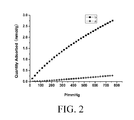
- FIG. 2 shows CO 2 adsorption curves before and after regeneration of Cu-BTC in Embodiment 1, CO 2 adsorption curves a) before regeneration and b) after regeneration of Cu-BTC at normal temperature and normal pressure.
- Embodiments 2 to 10 were carried out according to the steps in Embodiment 1, and the raw materials and conditions for specific reactions were shown in Table 1.
- the adsorbed guest molecules were organic dye molecules, and in Embodiment 10, a saturated steam was used for impregnation.
- the structure and the performance of the product were shown in Table 2.
- Comparative Examples 1 and 2 indicate that when the acid is excessively strong or weak, regeneration of Cu-BTC cannot be realized, and moreover, when the acid concentration is excessively low, the structure of the regenerated Cu-BTC is changed, Cu-BTC is directly decomposed and cannot be regenerated.
- Comparative Example 3 indicate that when the ratio of the liquid volume to the solid mass is too low, the guest molecules in Cu-BTC cannot be completely desorbed, and Cu-BTC cannot be completely regenerated.
Landscapes
- Chemical & Material Sciences (AREA)
- Analytical Chemistry (AREA)
- Organic Chemistry (AREA)
- Chemical Kinetics & Catalysis (AREA)
- Inorganic Chemistry (AREA)
- Solid-Sorbent Or Filter-Aiding Compositions (AREA)
Applications Claiming Priority (1)
| Application Number | Priority Date | Filing Date | Title |
|---|---|---|---|
| PCT/CN2012/082725 WO2014056164A1 (zh) | 2012-10-10 | 2012-10-10 | 一种Cu-BTC材料的再生方法 |
Publications (2)
| Publication Number | Publication Date |
|---|---|
| US20150246341A1 US20150246341A1 (en) | 2015-09-03 |
| US9533283B2 true US9533283B2 (en) | 2017-01-03 |
Family
ID=50476875
Family Applications (1)
| Application Number | Title | Priority Date | Filing Date |
|---|---|---|---|
| US14/427,885 Active US9533283B2 (en) | 2012-10-10 | 2012-10-10 | Regeneration method for Cu-BTC material |
Country Status (3)
| Country | Link |
|---|---|
| US (1) | US9533283B2 (de) |
| EP (1) | EP2907569B1 (de) |
| WO (1) | WO2014056164A1 (de) |
Families Citing this family (6)
| Publication number | Priority date | Publication date | Assignee | Title |
|---|---|---|---|---|
| CN105694535B (zh) * | 2015-12-30 | 2017-07-14 | 晨光生物科技集团股份有限公司 | 一种工业化去除辣椒红中危害物的方法 |
| CN106866985B (zh) * | 2017-01-07 | 2019-11-26 | 青岛科技大学 | 一种用于乙炔和甲烷吸附分离的金属有机骨架材料及其制备方法 |
| CN109876775B (zh) * | 2017-12-06 | 2022-04-08 | 中国石油化工股份有限公司 | 一种金属有机骨架纤维材料及其制备方法 |
| CN109575306B (zh) * | 2018-12-20 | 2022-03-25 | 华东理工大学 | 一种改性Cu-BTC材料及其制备方法和应用 |
| CN112657558A (zh) * | 2021-01-29 | 2021-04-16 | 昆明理工大学 | 等离子体改性催化剂在脱除硫化氢、磷化氢、砷化氢中的应用 |
| CN117680113A (zh) * | 2023-12-27 | 2024-03-12 | 山西工程技术学院 | 一种廉价高效二氧化碳捕集材料及其制备、吸附方法 |
Citations (6)
| Publication number | Priority date | Publication date | Assignee | Title |
|---|---|---|---|---|
| JP2006218348A (ja) | 2005-02-08 | 2006-08-24 | Honda Motor Co Ltd | 水素吸着材の活性化方法 |
| JP2006220173A (ja) | 2005-02-08 | 2006-08-24 | Honda Motor Co Ltd | 水素吸着材の活性化方法 |
| WO2010136677A1 (fr) * | 2009-05-28 | 2010-12-02 | Centre National De La Recherche Scientifique -Cnrs | Utilisation d'un solide hybride cristallin poreux comme catalyseur de reduction d'oxydes d'azote et dispositifs |
| CN102389686A (zh) | 2011-09-22 | 2012-03-28 | 中国石油大学(北京) | 一种含co2混合气的分离方法 |
| US20120210872A1 (en) * | 2009-10-30 | 2012-08-23 | Yanyu Duan | Removal of krypton and xenon impurities from argon by mof adsorbent |
| CN103146183A (zh) | 2013-03-05 | 2013-06-12 | 苏州旭光聚合物有限公司 | 一种高硬度pa/abs复合材料及制备方法 |
Family Cites Families (1)
| Publication number | Priority date | Publication date | Assignee | Title |
|---|---|---|---|---|
| CA2633652A1 (en) * | 2005-12-21 | 2007-10-04 | Uop Llc | The use of mofs in pressure swing adsorption |
-
2012
- 2012-10-10 US US14/427,885 patent/US9533283B2/en active Active
- 2012-10-10 WO PCT/CN2012/082725 patent/WO2014056164A1/zh not_active Ceased
- 2012-10-10 EP EP12886372.7A patent/EP2907569B1/de not_active Not-in-force
Patent Citations (7)
| Publication number | Priority date | Publication date | Assignee | Title |
|---|---|---|---|---|
| JP2006218348A (ja) | 2005-02-08 | 2006-08-24 | Honda Motor Co Ltd | 水素吸着材の活性化方法 |
| JP2006220173A (ja) | 2005-02-08 | 2006-08-24 | Honda Motor Co Ltd | 水素吸着材の活性化方法 |
| WO2010136677A1 (fr) * | 2009-05-28 | 2010-12-02 | Centre National De La Recherche Scientifique -Cnrs | Utilisation d'un solide hybride cristallin poreux comme catalyseur de reduction d'oxydes d'azote et dispositifs |
| US20120129684A1 (en) * | 2009-05-28 | 2012-05-24 | Centre National De La Recherche Scientifique Cnrs | Use of a porous crystalline hybrid solid as a nitrogen oxide reduction catalyst and devices |
| US20120210872A1 (en) * | 2009-10-30 | 2012-08-23 | Yanyu Duan | Removal of krypton and xenon impurities from argon by mof adsorbent |
| CN102389686A (zh) | 2011-09-22 | 2012-03-28 | 中国石油大学(北京) | 一种含co2混合气的分离方法 |
| CN103146183A (zh) | 2013-03-05 | 2013-06-12 | 苏州旭光聚合物有限公司 | 一种高硬度pa/abs复合材料及制备方法 |
Also Published As
| Publication number | Publication date |
|---|---|
| EP2907569B1 (de) | 2018-08-22 |
| US20150246341A1 (en) | 2015-09-03 |
| WO2014056164A1 (zh) | 2014-04-17 |
| EP2907569A1 (de) | 2015-08-19 |
| EP2907569A4 (de) | 2016-07-06 |
Similar Documents
| Publication | Publication Date | Title |
|---|---|---|
| CN110496604B (zh) | 一种钴镍双金属有机框架二氧化碳吸附材料及其制备方法与应用 | |
| US20150246341A1 (en) | Regeneration method for cu-btc material | |
| Shi et al. | Review on multidimensional adsorbents for CO2 capture from ambient air: recent advances and future perspectives | |
| CN115779860A (zh) | 吸附燃煤烟气中二氧化碳的壳聚糖与有机胺复合固体吸附剂及其制备方法、应用和再生方法 | |
| CN102580679B (zh) | 一种改性微波活性炭吸附剂的制备方法 | |
| CN103349962B (zh) | 耐臭氧氧化的低浓度有机化合物吸附催化材料及其制备方法 | |
| CN102068876A (zh) | 一种烟气脱硫的工艺方法 | |
| WO2010012660A1 (en) | Process for producing alcohol | |
| CN108126660A (zh) | 一种基于浸渍活性炭的co2固体吸附剂、制备方法及其用途 | |
| CN108970590A (zh) | 利用活性材料或改性活性材料捕获及富集空气中二氧化碳的方法及其应用 | |
| CN113797897A (zh) | 一种用于捕集co2的改性壳聚糖基碳气凝胶的制备方法 | |
| CN105457615A (zh) | 用于超深度油气回收的Mn改性金属有机骨架材料吸附剂的制备方法 | |
| KR20150114724A (ko) | 수분안정성이 개선된 이산화탄소 흡수제 및 그 제조방법 | |
| CN103920464A (zh) | 一种可吸附沼气中CO2功能的MOFs材料的制备方法 | |
| CN103755639B (zh) | 一种氨基乙酸功能性离子液体及其制备方法和应用 | |
| CN110813260A (zh) | 一种高效吸附低浓度氨气的多级孔聚合物固体酸的制备方法 | |
| CN102068960B (zh) | 吸附氮氧化物蜂窝活性炭吸附剂的再生方法 | |
| CN103435620A (zh) | 用于co2吸附与分离的多孔铜金属有机骨架材料及其制备方法 | |
| CN110201661A (zh) | 一种多孔阵列结构的锰基生物炭及其制备方法和应用 | |
| Güven et al. | The prospects for radiation technology in mitigating carbon footprint | |
| CN102671628A (zh) | 一种微孔分子筛-功能化离子液体复合材料及其制备方法 | |
| CN116282328A (zh) | 一种低温催化全氟化合物矿化协同活性炭高效再生的方法 | |
| CN104014224A (zh) | 一种从混合气中分离二氧化碳的方法 | |
| CN111821812A (zh) | 一种co2的吸收剂及其合成与应用 | |
| CN106944004B (zh) | 一种有机胺改性海泡石吸附剂及其制备方法和应用 |
Legal Events
| Date | Code | Title | Description |
|---|---|---|---|
| AS | Assignment |
Owner name: NANJING TECH UNIVERSITY, CHINA Free format text: ASSIGNMENT OF ASSIGNORS INTEREST;ASSIGNORS:ZHANG, SUOYING;LU, XIAOHUA;YAO, WENJUN;AND OTHERS;REEL/FRAME:035199/0159 Effective date: 20150309 Owner name: CHANGSHU YUTYRONE ADVANCED WEAR MATERIALS TECHNOLO Free format text: ASSIGNMENT OF ASSIGNORS INTEREST;ASSIGNORS:ZHANG, SUOYING;LU, XIAOHUA;YAO, WENJUN;AND OTHERS;REEL/FRAME:035199/0159 Effective date: 20150309 |
|
| STCF | Information on status: patent grant |
Free format text: PATENTED CASE |
|
| MAFP | Maintenance fee payment |
Free format text: PAYMENT OF MAINTENANCE FEE, 4TH YR, SMALL ENTITY (ORIGINAL EVENT CODE: M2551); ENTITY STATUS OF PATENT OWNER: SMALL ENTITY Year of fee payment: 4 |
|
| FEPP | Fee payment procedure |
Free format text: MAINTENANCE FEE REMINDER MAILED (ORIGINAL EVENT CODE: REM.); ENTITY STATUS OF PATENT OWNER: SMALL ENTITY |
|
| FEPP | Fee payment procedure |
Free format text: 7.5 YR SURCHARGE - LATE PMT W/IN 6 MO, SMALL ENTITY (ORIGINAL EVENT CODE: M2555); ENTITY STATUS OF PATENT OWNER: SMALL ENTITY |
|
| MAFP | Maintenance fee payment |
Free format text: PAYMENT OF MAINTENANCE FEE, 8TH YR, SMALL ENTITY (ORIGINAL EVENT CODE: M2552); ENTITY STATUS OF PATENT OWNER: SMALL ENTITY Year of fee payment: 8 |