US9070051B2 - Image forming apparatus and control method for enabling proper execution of setting and power-off of the image forming apparatus - Google Patents
Image forming apparatus and control method for enabling proper execution of setting and power-off of the image forming apparatus Download PDFInfo
- Publication number
- US9070051B2 US9070051B2 US13/762,116 US201313762116A US9070051B2 US 9070051 B2 US9070051 B2 US 9070051B2 US 201313762116 A US201313762116 A US 201313762116A US 9070051 B2 US9070051 B2 US 9070051B2
- Authority
- US
- United States
- Prior art keywords
- task
- power
- setting
- device setting
- processing
- Prior art date
- Legal status (The legal status is an assumption and is not a legal conclusion. Google has not performed a legal analysis and makes no representation as to the accuracy of the status listed.)
- Active, expires
Links
Images




Classifications
-
- G—PHYSICS
- G06—COMPUTING OR CALCULATING; COUNTING
- G06K—GRAPHICAL DATA READING; PRESENTATION OF DATA; RECORD CARRIERS; HANDLING RECORD CARRIERS
- G06K15/00—Arrangements for producing a permanent visual presentation of the output data, e.g. computer output printers
- G06K15/02—Arrangements for producing a permanent visual presentation of the output data, e.g. computer output printers using printers
-
- G—PHYSICS
- G06—COMPUTING OR CALCULATING; COUNTING
- G06F—ELECTRIC DIGITAL DATA PROCESSING
- G06F3/00—Input arrangements for transferring data to be processed into a form capable of being handled by the computer; Output arrangements for transferring data from processing unit to output unit, e.g. interface arrangements
- G06F3/12—Digital output to print unit, e.g. line printer, chain printer
- G06F3/1201—Dedicated interfaces to print systems
- G06F3/1202—Dedicated interfaces to print systems specifically adapted to achieve a particular effect
- G06F3/1203—Improving or facilitating administration, e.g. print management
-
- G—PHYSICS
- G06—COMPUTING OR CALCULATING; COUNTING
- G06F—ELECTRIC DIGITAL DATA PROCESSING
- G06F3/00—Input arrangements for transferring data to be processed into a form capable of being handled by the computer; Output arrangements for transferring data from processing unit to output unit, e.g. interface arrangements
- G06F3/12—Digital output to print unit, e.g. line printer, chain printer
- G06F3/1201—Dedicated interfaces to print systems
- G06F3/1223—Dedicated interfaces to print systems specifically adapted to use a particular technique
- G06F3/1229—Printer resources management or printer maintenance, e.g. device status, power levels
-
- G—PHYSICS
- G06—COMPUTING OR CALCULATING; COUNTING
- G06F—ELECTRIC DIGITAL DATA PROCESSING
- G06F3/00—Input arrangements for transferring data to be processed into a form capable of being handled by the computer; Output arrangements for transferring data from processing unit to output unit, e.g. interface arrangements
- G06F3/12—Digital output to print unit, e.g. line printer, chain printer
- G06F3/1201—Dedicated interfaces to print systems
- G06F3/1278—Dedicated interfaces to print systems specifically adapted to adopt a particular infrastructure
- G06F3/1285—Remote printer device, e.g. being remote from client or server
-
- G—PHYSICS
- G06—COMPUTING OR CALCULATING; COUNTING
- G06K—GRAPHICAL DATA READING; PRESENTATION OF DATA; RECORD CARRIERS; HANDLING RECORD CARRIERS
- G06K15/00—Arrangements for producing a permanent visual presentation of the output data, e.g. computer output printers
- G06K15/40—Details not directly involved in printing, e.g. machine management, management of the arrangement as a whole or of its constitutive parts
- G06K15/4055—Managing power consumption, e.g. standby mode
-
- H—ELECTRICITY
- H04—ELECTRIC COMMUNICATION TECHNIQUE
- H04L—TRANSMISSION OF DIGITAL INFORMATION, e.g. TELEGRAPHIC COMMUNICATION
- H04L41/00—Arrangements for maintenance, administration or management of data switching networks, e.g. of packet switching networks
- H04L41/08—Configuration management of networks or network elements
- H04L41/0803—Configuration setting
- H04L41/0823—Configuration setting characterised by the purposes of a change of settings, e.g. optimising configuration for enhancing reliability
- H04L41/0833—Configuration setting characterised by the purposes of a change of settings, e.g. optimising configuration for enhancing reliability for reduction of network energy consumption
Definitions
- the present invention relates to an image forming apparatus and a method for controlling the image forming apparatus.
- Conventional management systems of a network device such as an image forming apparatus include ones having a function of powering off the device, a function of executing device setting, and a function of subsequently restarting the device to apply the change in setting.
- Some management systems are capable of immediately executing such functions according to an instruction from an administrator and/or automatically executing the functions according to a schedule setting.
- the functions may be scheduled to be automatically executed in an overlapping manner.
- Some management systems have a function of performing at least either one of the functions at a shifted time to prevent a power-off from being executed during device setting (See Japanese Patent Application Laid-Open No. 2010-004335).
- the conventional network device management systems have also not been able to properly execute a power-off, whether instructed to be immediately executed or automatically executed according to a schedule setting, if the time to execute the power-off passes during a restart.
- the present invention is directed to a method for enabling proper execution of setting and a power-off of an image forming apparatus even if the setting, an accompanying restart, and the power-off of the image forming apparatus are instructed to be executed immediately or according to a schedule setting in an overlapping manner.
- an image forming apparatus includes a first designation unit configured to designate a power-off task of shutting down the image forming apparatus in a designated period, a second designation unit configured to designate a setting task of executing a setting process for setting a setting item of the image forming apparatus in a designated period and a restart process for restarting the image forming apparatus after the setting process, and a task control unit configured to control execution of the designated power-off task and the designated setting task, wherein the task control unit is configured to, if the power-off task is designated, perform control to change processing of the power-off task and the setting task according to which of the processes of the setting task a period that an end of the designated period of the power-off task reaches corresponds to.
- FIG. 1 is a diagram illustrating an example of a system to which an image forming apparatus according to a first exemplary embodiment can be applied.
- FIG. 2 is a block diagram schematically illustrating apart of a configuration of a multifunction peripheral (MFP).
- MFP multifunction peripheral
- FIG. 3 is a block diagram schematically illustrating a configuration of an information processing apparatus.
- FIG. 4 is a block diagram illustrating an internal configuration of network management software of a network device management system according to the first exemplary embodiment, the network management software running on a controller of the MFP.
- FIG. 5 is a diagram schematically illustrating a data configuration of power-off task data.
- FIG. 6 is a diagram schematically illustrating a power-off task generation screen which a power-off task generation module displays on a web browser running on the information processing apparatus via a network by using a servlet and from which the administrator can generate a power-off task.
- FIG. 7 is a diagram schematically illustrating a data configuration of device setting task data.
- FIG. 8 is a diagram schematically illustrating a device setting task generation screen which a device setting task generation module displays on a web browser running on the information processing apparatus via the network by using a servlet and from which the administrator can generate a device setting task.
- FIG. 9 is a diagram schematically illustrating an error screen.
- FIG. 10 is a flowchart illustrating an example of a procedure by which the power-off task generation module generates a power-off task.
- FIG. 11 is a diagram schematically illustrating schedule data for a timer unit to process.
- FIG. 12 is a flowchart illustrating an example of a procedure by which a power-off task registration module registers a power-off task.
- FIG. 13 is a flowchart illustrating an example of a procedure by which the device setting task generation module generates a device setting task.
- FIG. 14 is a flowchart illustrating an example of a procedure by which a device setting task registration module registers a device setting task.
- FIG. 15 is a flowchart illustrating an example of a procedure by which a timer notification module calls a scheduled task.
- FIG. 16A is a flowchart illustrating main processing of a task control unit.
- FIG. 16B is a flowchart illustrating power-off task processing [ 1 ] of the task control unit.
- FIG. 16C is a flowchart illustrating device setting task processing [ 1 ] of the task control unit.
- FIG. 16D is a flowchart illustrating power-off task processing [ 2 ] of the task control unit.
- FIG. 16E is a flowchart illustrating device setting task processing [ 2 ] of the task control unit.
- FIG. 16F is a flowchart illustrating device setting task processing [ 3 ] of the task control unit.
- FIG. 16G is a flowchart illustrating reboot processing [ 1 ] of the task control unit.
- FIG. 17 is a diagram schematically illustrating a power-off task cancel screen which the task control unit displays on a web browser running on the information processing apparatus via the network by using a servlet and from which the administrator can cancel a power-off task.
- FIG. 18 is a flowchart illustrating power-off task processing [ 2 ] of the task control unit according to a second exemplary embodiment.
- FIG. 19 is a flowchart illustrating power-off task processing [ 2 ] of the task control unit according to a third exemplary embodiment.
- FIG. 20 is a block diagram illustrating an example of an internal configuration of network device management software according to the second exemplary embodiment.
- FIG. 21A is a flowchart illustrating device setting task processing [ 2 ] of the task control unit according to a fourth exemplary embodiment.
- FIG. 21B is a flowchart illustrating reboot processing [ 1 ] of the task control unit according to the fourth exemplary embodiment.
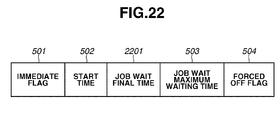
- FIG. 22 is a diagram schematically illustrating a data configuration of power-off task data according to the fourth exemplary embodiment.
- FIG. 23 is diagram schematically illustrating a device setting task cancel screen which the task control unit displays on a web browser running on the information processing apparatus via the network by using a servlet and from which the administrator can cancel a device setting task.
- FIG. 24 is a flowchart illustrating an example of a procedure by which a power-off task generation module according to a fifth exemplary embodiment generates a power-off task.
- FIG. 25 is a diagram schematically illustrating a power-off task generation screen which the power-off task generation module according to the fifth exemplary embodiment displays on a web browser running on the information processing apparatus via the network by using a servlet and from which the administrator can generate a power-off task.
- FIG. 26A is a flowchart illustrating device setting task processing [ 1 ] of the task control unit according to the fifth exemplary embodiment.
- FIG. 26B is a flowchart illustrating device setting task processing [ 3 ] of the task control unit according to the fifth exemplary embodiment.
- FIG. 27 is a diagram schematically illustrating a device setting task generation screen which a device setting task generation module according to a sixth exemplary embodiment displays on a web browser running on the information processing apparatus via the network by using a servlet and from which the administrator can generate a device setting task.
- FIG. 28 is a flowchart illustrating an example of a procedure by which the device setting task generation module according to the sixth exemplary embodiment generates a device setting task.
- FIG. 1 is a diagram illustrating an example of a system to which an image forming apparatus according to a first exemplary embodiment can be applied.
- an image forming apparatus (hereinafter, referred to as an MFP) 102 is connected to a network 101 .
- An information processing apparatus 103 is also connected to the network 101 .
- FIG. 2 is a block diagram schematically illustrating a part of a configuration of the MFP 102 .
- the MFP 102 includes a control unit 201 .
- a controller 202 is a main body portion of the control unit 201 .
- the controller 202 includes a central processing unit (CPU), a read-only memory (ROM), and a random access memory (RAM), which are not illustrated.
- the CPU executes programs stored in the ROM to control the entire MFP 102 in a comprehensive manner.
- the control unit 201 includes a storage 203 such as a hard disk drive (HDD) or a solid state drive (SSD), and an operation panel 204 .
- the control unit 201 is connected to the network 101 via a network interface 205 .
- An engine interface 206 is connected to an image forming engine (not illustrated) of the MFP 102 .
- a power supply control interface 207 is connected to a power supply unit (not illustrated) of the MFP 102 .
- FIG. 3 is a block diagram schematically illustrating a configuration of the information processing apparatus 103 .
- the information processing apparatus 103 includes a main body 301 , which includes a CPU 302 , a bus 303 , and a RAM 304 .
- the bus 303 is connected to the CPU 302 .
- the main body 301 also includes a ROM 305 .
- the information processing apparatus 103 is connected to the network 101 via a network interface 306 .
- Examples of a storage 308 include an HDD or an SSD.
- the information processing apparatus 103 also includes a human interface device (hereinafter, referred to as HID) interface 307 , an input device 309 such as a keyboard and a mouse, and an output device 310 such as a display and a speaker.
- HID human interface device
- the input device 309 and the output device 310 are connected to the HID interface 307 .
- FIG. 4 is a block diagram illustrating an internal configuration of network management software of a network device management system according to the first exemplary embodiment.
- the network management software runs on the controller 202 of the MFP 102 .
- the entire network management software 401 corresponds to functions that the CPU inside the controller 202 implements by executing programs stored in the internal ROM.
- the network management software 401 includes a timer unit 411 , a job detection unit 412 , a task control unit 413 , a power-off task providing unit 414 , and a device setting task providing unit 415 .
- the power-off task providing unit 414 includes a power-off task generation module 421 , a power-off execution module 422 , a power-off task data storage module 423 , and a power-off task registration module 424 .
- the power-off execution module 422 executes a power-off (shutdown) of the MFP 102 .
- the modules 421 to 424 will be described in detail below.
- the device setting task providing unit 415 includes a device setting task generation module 431 , a device setting value acquisition module 432 , a device setting execution module 433 , a restart execution module 434 , a device setting task data storage module 435 , and a device setting task registration module 436 .
- the modules 431 to 436 will be described in detail below.
- the timer unit 411 includes a timer notification module 441 and a schedule data storage module 442 .
- the modules 441 and 442 will be described in detail below.
- FIG. 5 is a diagram schematically illustrating a data configuration of power-off task data.
- the power-off task generation module 421 generates power-off task data.
- the power-off task data is stored in the power-off task data storage module 423 .
- An immediate flag 501 determines whether to execute the power-off task immediately or according to a schedule.
- a start time 502 is set if the power-off task is to be executed according to a schedule. Even if the power-off task is to be immediately executed, the power-off task generation module 421 may store the current time as the start time 502 when generating the power-off task data.
- a job wait maximum waiting time 503 determines an upper limit of waiting time for performing a job wait before actually executing a power-off.
- a forced off flag 504 determines whether to forcibly execute a power-off if a job still exists after the lapse of the job wait maximum waiting time 503 .
- the administrator can instruct whether to issue a forced execution instruction to forcibly execute the power-off task even if execution of a waited job does not end within a designated period (before the lapse of the job wait maximum waiting time 503 since the start time 502 ).
- FIG. 6 is a diagram schematically illustrating a power-off task generation screen which the power-off task generation module 421 displays on a web browser running on the information processing apparatus 103 via the network 101 by using a servlet and from which the administrator can generate a power-off task.
- an update button 601 is operable to update a setting or settings of a power-off task based on inputs on the screen.
- An immediate execution button 602 is operable to immediately execute a power-off task based on inputs on the screen.
- a cancel button 603 is operable to end the screen without setting a power-off task.
- a job wait maximum waiting time entry field 611 is operable for the administrator to input the job wait maximum waiting time 503 .
- a forced power-off check box 612 is operable for the administrator to designate the value of the forced off flag 504 .
- a schedule setting check box 621 is operable for the administrator to designate whether to execute the power-off task according to a schedule.
- a start time date section entry field 622 is operable for the administrator to input a date section of the start time 502 if the power-off task is to be executed according to a schedule.
- a start time time-section entry field 623 is operable for the administrator to input a time section of the start time 502 if the power-off task is to be executed according to a schedule.
- FIG. 7 is a diagram schematically illustrating a data configuration of device setting task data.
- the device setting task generation module 431 generates device setting task data.
- the device setting task data is stored in the device setting task data storage module 435 .
- an immediate flag 701 determines whether to execute the device setting task immediately or according to a schedule.
- a start time 702 is set if the device setting task is to be executed according to a schedule.
- a storage destination type 703 indicates the type of a storage destination of a device setting value file for the device setting value acquisition module 432 to acquire.
- a file path 704 indicates the file path of the device setting value file for the device setting value acquisition module 704 to acquire.
- the device setting value file is a file containing setting items and setting values of the device to be set by the device setting task.
- the administrator generates the device setting value file in advance and stores the device setting value file in a storage location on the network 101 , accessible from the MFP 102 (for example, Windows (registered trademark) shared file inside the information processing apparatus 103 ).
- Possible settings of the storage destination type 703 include a Windows (registered trademark) shared file and the storage 203 in the MFP 102 .
- a user name 705 indicates the user name of a user for the device setting value acquisition module 432 to use when accessing the device setting value file.
- a password 706 indicates the password of the user for the device setting value acquisition module 432 to use when accessing the device setting value file.
- a setting processing pre-start job wait maximum waiting time 707 determines an upper limit of waiting time for performing a job wait before starting processing for importing device setting values in the device setting task.
- a pre-restart job wait maximum waiting time 708 determines an upper limit of waiting time for performing a job wait before executing a restart after the processing for importing the device setting values in the device setting task is completed.
- FIG. 8 is a diagram schematically illustrating a device setting task generation screen which the device setting task generation module 431 displays on a web browser running on the information processing apparatus 103 via the network 101 by using a servlet and from which the administrator can generate a device setting task.
- an update button 801 is operable to update a setting or settings of a device setting task based on inputs on the screen.
- An immediate execution button 802 is operable to immediately execute a device setting task based on inputs on the screen.
- a cancel button 803 is operable to end the screen without setting a device setting task.
- a storage destination type designation drop-down box 811 is operable to select a storage destination type 703 .
- Alternatives include a Windows (registered trademark) shared folder and a file transfer protocol (FTP) server.
- Windows registered trademark
- FTP file transfer protocol
- a file path entry field 812 is operable for the administrator to input the file path 704 .
- a user name entry field 813 is operable for the administrator to input the user name 705 of the user that is used when accessing the file path 704 .
- a password entry field 814 is operable for the administrator to input the password 706 of the user.
- a setting processing pre-start job wait maximum waiting time entry field 821 is operable for the administrator to input the setting processing pre-start job wait maximum waiting time 707 of the device setting task to generate.
- a pre-restart job wait maximum waiting time entry field 822 is operable for the administrator to input the pre-restart job wait maximum waiting time 708 of the device setting task to generate.
- An execution schedule setting enabling check box 831 is operable for the administrator to designate whether to set an execution schedule.
- a start time date section entry field 832 is operable for the administrator to input a date section of the start time 702 .
- a start time time-section entry field 833 is operable for the administrator to input a time section of the start time 702 .
- FIG. 9 is a diagram schematically illustrating an error screen.
- the administrator makes inconsistent inputs on the power-off task generation screen ( FIG. 6 ) or the device setting task generation screen ( FIG. 8 ). If the administrator then presses the update button 601 or 801 or the immediate execution button 602 or 802 , the power-off task generation module 421 or the device setting task generation module 431 determines that an error has occurred.
- the power-off task generation module 621 or the device setting task generation module 431 displays the error screen on a web browser of the information processing apparatus 103 via the network 101 by using a servlet.
- a confirm button 901 is pressed, the power-off task generation module 621 or the device setting task generation module 431 closes the error screen.
- FIG. 10 is a flowchart illustrating an example of the procedure by which the power-off task generation module 421 generates a power-off task.
- the processing of this flowchart is implemented by the CPU inside the controller 202 executing a program stored in the internal ROM.
- the power-off task generation module 421 initially receives a request to generate a power-off task from the information processing apparatus 103 . In step S 1001 , the power-off task generation module 421 starts the processing.
- step S 1002 the power-off task generation module 421 generates and transmits the power-off task generation screen ( FIG. 6 ) to the information processing apparatus 103 .
- a web browser is running on the information processing apparatus 103 .
- the administrator inputs necessary information on the web browser and presses the update button 601 or the immediate execution button 602 , or presses the cancel button 603 without inputting any particular information. After such operations, the information processing apparatus 103 transmits input data to the power-off task generation module 421 .
- step S 1003 the power-off task generation module 421 receives the input data transmitted from the information processing apparatus 103 .
- step S 1004 the power-off task generation module 421 checks whether the input data is consistent.
- step S 1004 If the input data is determined not to be consistent (NO in step S 1004 ), the power-off task generation module 421 advances the processing to step S 1005 .
- step S 1005 the power-off task generation module 421 generates and transmits the error screen ( FIG. 9 ) to the information processing apparatus 103 .
- the web browser running on the information processing apparatus 103 draws the error screen ( FIG. 9 ).
- the administrator examines the contents of the error screen and presses the confirm button 901 .
- the information processing apparatus 103 transmits response data indicating that the confirm button 901 is pressed to the power-off task generation module 421 .
- step S 1006 the power-off task generation module 421 receives the response data indicating that the confirm button 901 is pressed, and performs control to return to step S 1002 and continue the processing.
- step S 1004 If, in step S 1004 , the input data is determined to be consistent (YES in step S 1004 ), the power-off task generation module 421 advances the processing to step S 1007 .
- step S 1007 the power-off task generation module 421 examines the contents of the input data to check whether the button the administrator has pressed is either of the update button 601 and the immediate execution button 602 .
- step S 1011 the power-off task generation module 421 simply ends the power-off task generation processing.
- step S 1007 the power-off task generation module 421 advances the processing to step S 1008 .
- step S 1008 the power-off task generation module 421 generates power-off task data ( FIG. 5 ) from the contents of the input data.
- step S 1009 the power-off task generation module 421 stores the power-off task data generated in step S 1008 into the power-off task data storage module 423 .
- step S 1010 the power-off task generation module 421 calls the power-off task registration module 424 to register a power-off task corresponding to the power-off task data stored in step S 1009 .
- the power-off task generation module 421 passes a pointer of the power-off task data corresponding to the task to be registered to the power-off task registration module 424 .
- the pointer indicates the storage location of the power-off task data in the power-off task data storage module 423 .
- schedule data ( FIG. 11 ) on the power-off task is stored into the schedule data storage module 442 . Details of the processing for registering a power-off task are illustrated in FIG. 12 .
- the power-off task generation module 421 completes the power-off task generation processing.
- Schedule data will be described with reference to FIG. 11 .
- FIG. 11 is a diagram schematically illustrating schedule data for the timer unit 411 to process.
- the schedule data includes a set time 1101 of the schedule, data 1102 indicating a schedule type (a power-off task or a device setting task), and a pointer 1103 to power-off task data or device setting task data.
- FIG. 12 is a flowchart illustrating an example of a procedure by which the power-off task registration module 424 registers a power-off task. The processing of this flowchart is implemented by the CPU inside the controller 202 executing a program stored in the internal ROM.
- the power-off task generation module 421 initially calls the power-off task registration module 424 .
- the power-off task registration module 424 starts the processing.
- the power-off task registration module 424 when called, receives the pointer (indicating the storage location in the power-off task data storage module 423 ) of the power-off task data corresponding to the task to be registered from the power-off task generation module 421 .
- step S 1202 the power-off task registration module 424 determines whether the task to be registered is designated to be executed according to a schedule or designated to be immediately executed, based on the power-off task data read from the pointer designated by the power-off task generation module 421 .
- step S 1202 If the task is determined to be designated to be executed according to a schedule (YES in step S 1202 ), the power-off task registration module 424 advances the processing to step S 1203 .
- step S 1203 the power-off task registration module 424 generates schedule data ( FIG. 11 ) based on the power-off task data read from the pointer designated by the power-off task generation module 421 .
- step S 1204 the power-off task registration module 424 stores the schedule data generated in step S 1203 into the schedule data storage module 442 of the timer unit 411 .
- step S 1206 the power-off task registration module 424 completes the processing.
- the schedule data is stored into the schedule data storage module 442
- the set time 1101 is registered into a timer.
- the timer notification module 441 makes a notification to the task control unit 413 .
- the set time 1101 of the schedule data stored in the schedule data storage module 442 is also registered into the timer when the MFP 102 is restarted.
- the timer unit 411 is capable of registering only one power-off task.
- step S 1202 If, in step S 1202 , the task is determined to be not designated to be executed according to a schedule, i.e., to be designated to be immediately executed (NO in step S 1202 ), the power-off task registration module 424 advances the processing to step S 1205 .
- step S 1205 the power-off task registration module 424 passes the pointer of the designated power-off task data to the task control unit 413 for immediate execution.
- step S 1206 the power-off task registration module 424 completes the processing.
- FIG. 13 is a flowchart illustrating an example of the procedure by which the device setting task generation module 431 generates a device setting task. The processing of this flowchart is implemented by the CPU inside the controller 202 executing a program stored in the internal ROM.
- the device setting task generation module 431 initially receives a request to generate a device setting task from the information processing apparatus 103 . In step S 1301 , the device setting task generation module 431 starts the processing.
- step S 1302 the device setting task generation module 431 generates and transmits the device setting task generation screen ( FIG. 8 ) to the information processing unit 103 .
- a web browser is running on the information processing apparatus 103 .
- the administrator inputs necessary information and presses the update button 801 or the immediate execution button 802 , or presses the cancel button 803 without inputting any particular information. After such operations, the information processing apparatus 103 transmits input data to the device setting task generation module 431 .
- step S 1303 the device setting task generation module 431 receives the input data transmitted from the information processing apparatus 103 .
- step S 1304 the device setting task generation module 431 checks whether the input data is consistent.
- step S 1304 If the input data is determined not to be consistent (NO in step S 1304 ), the device setting task generation module 431 advances the processing to step S 1305 .
- step S 1305 the device setting task generation module 431 generates and transmits the error screen ( FIG. 9 ) to the information processing apparatus 103 .
- the web browser running on the information processing apparatus 103 draws the error screen ( FIG. 9 ).
- the administrator examines the contents of the error screen and presses the confirm button 901 .
- the information processing apparatus 103 transmits response data indicating that the confirm button 901 is pressed to the device setting task generation module 431 .
- step S 1306 the device setting task generation module 431 receives the response data indicating that the confirm button 901 is pressed, and performs control to return to step S 1302 and continue the processing.
- step S 1304 If, in step S 1304 , the input data is determined to be consistent (YES in step S 1304 ), the device setting task generation module 431 advances the processing to step S 1307 .
- step S 1307 the device setting task generation module 431 examines the contents of the input data to check whether the button the administrator has pressed is either of the update button 801 or the immediate execution button 802 .
- step S 1311 the device setting task generation module 431 simply completes the device setting task generation processing.
- the device setting task generation module 431 advances the processing to step S 1308 .
- step S 1308 the device setting task generation module 431 generates device setting task data ( FIG. 7 ) from the contents of the input data.
- step S 1309 the device setting task generation module 431 stores the device setting task data into the device setting task data storage module 435 .
- step S 1310 the device setting task generation module 431 calls the device setting task registration module 436 to register a device setting task corresponding to the device setting task data stored into the device setting task data storage module 435 in step S 1309 .
- the device setting task generation module 431 passes a pointer of the device setting task data corresponding to the task to be registered to the device setting task registration module 436 .
- the pointer indicates the storage location of the device setting task data in the device setting task data storage module 435 .
- schedule data ( FIG. 11 ) on the device setting task is stored into the schedule data storage module 442 . Details of the processing for registering a device setting task are illustrated in FIG. 14 .
- the device setting task generation module 431 completes the device setting task generation processing.
- FIG. 14 is a flowchart illustrating an example of a procedure by which the device setting task registration module 436 registers a device setting task. The processing of this flowchart is implemented by the CPU inside the controller 202 executing a program stored in the internal ROM.
- the device setting task generation module 431 initially calls the device setting task registration module 436 .
- the device setting task registration module 436 starts the processing.
- the device setting task registration module 436 when called, receives the pointer (indicating the storage location in the device setting task data storage module 435 ) of the device setting task data corresponding to the task to be registered from the device setting task generation module 431 .
- step S 1402 the device setting task registration module 436 determines whether the task to be registered is designated to be executed according to a schedule or designated to be immediately executed, based on the device setting task data read from the pointer designated by the device setting task generation module 431 .
- step S 1402 If the task is determined to be designated to be executed according to a schedule (YES in step S 1402 ), the device setting task registration module 436 advances the processing to step S 1403 .
- step S 1403 the device setting task registration module 436 generates schedule data ( FIG. 11 ) based on the device setting task data read from the pointer designated by the device setting task generation module 431 .
- step S 1404 the device setting task registration module 436 stores the schedule data generated in step S 1403 into the schedule data storage module 442 of the timer unit 411 .
- step S 1406 the device setting task registration module 436 completes the processing.
- the schedule data is stored into the schedule data storage module 442
- the set time 1101 is registered into a timer.
- the timer notification module 441 makes a notification to the task control unit 413 .
- the set time 1101 of the schedule data stored in the schedule data storage module 442 is also registered into the timer when the MFP 102 is restarted.
- the timer unit 411 is capable of registering only one device setting task.
- step S 1402 the device setting task registration module 436 advances the processing to step S 1405 .
- step S 1405 the device setting task registration module 436 passes the pointer of the designated device setting task data to the task control unit 413 .
- step S 1406 the device setting task registration module 436 completes the processing.
- FIG. 15 is a flowchart illustrating an example of a procedure by which the timer notification module 441 calls a scheduled task. The processing of this flowchart is implemented by the CPU inside the controller 202 executing a program stored in the internal ROM.
- the timer notification module 441 is called at startup time and at predetermined timing. In step S 1501 , the timer notification module 441 starts the processing.
- step S 1502 the timer notification module 441 checks whether it is immediately after startup.
- step S 1502 If it is determined to be immediately after startup (YES in step S 1502 ), the timer notification unit 441 advances the processing to step S 1503 .
- step S 1503 the timer notification unit 441 determines whether there is a schedule designated for next startup time. More specifically, the timer notification unit 441 determines whether the schedule data storage module 442 contains schedule data ( FIG. 11 ) in which the set time 1101 has a special time value (99:99) representing “next startup time.”
- step S 1504 If there is determined to be no schedule designated for next startup time, i.e., the schedule data storage module 442 is determined to contain no schedule data in which the set time 1101 has the special time value (99:99) representing “next startup time” (NO in step S 1503 ), the timer notification module 441 advances the processing to step S 1504 .
- step S 1502 If, in step S 1502 , it is determined not to be immediately after startup (NO in step S 1502 ), the timer notification module 441 advances the processing to step S 1504 .
- step S 1504 the timer notification module 441 checks whether it is a time registered in the schedule data, i.e., whether the current time has reached the set time 1101 included in each piece of the schedule data ( FIG. 11 ) stored in the schedule data storage module 442 .
- the network device management system is configured so that the set time 1101 included in each piece of schedule data is registered into a timer when stored, and that the set time 1101 has been reached can be known by receiving a signal from the timer.
- step S 1504 If it is determined not to be a time registered in the schedule data, i.e., the current time is determined not to have reached a set time 1101 registered in the schedule data (NO in step S 1504 ), the timer notification module 441 returns to step S 1504 and continues the processing.
- step S 1504 if it is determined to be a time registered in the schedule data, i.e., the current time is determined to have reached a set time 1101 registered in the schedule data (YES in step S 1504 ), the timer notification module 441 advances the processing to step S 1505 .
- step S 1503 If, in step S 1503 , there is determined to be a schedule designated for next startup time, i.e., the schedule data storage module 442 is determined to contain schedule data in which the set time 1101 has the special time value (99:99) representing “next startup time” (YES in step S 1503 ), the timer notification module 441 advances the processing to step S 1505 .
- step S 1505 the timer notification module 441 acquires the schedule data that is determined to have reached the registered time in step S 1504 or the schedule that is determined to be designated for next startup time in step S 1503 .
- step S 1506 the timer notification module 441 acquires the pointer 1103 to the task data included in the schedule data acquired in step S 1505 .
- step S 1507 the timer notification module 441 passes the pointer 1103 of the task data acquired in step S 1506 to the task control unit 413 .
- step S 1508 the timer notification module 441 ends the processing. As a result, the task is called and processed.
- FIG. 16A is a flowchart illustrating main processing of the task control unit 413 .
- the processing of this flowchart is implemented by the CPU inside the controller 202 executing a program stored in the internal ROM.
- the timer notification module 441 , the power-off task registration module 424 , or the device setting task registration module 436 passes a pointer 1103 of task data to the task control unit 413 .
- step S 16001 the task control unit 413 starts the processing.
- step S 16002 the task control unit 413 reads the task data corresponding to the passed pointer, and checks whether the task data is of a power-off task.
- step S 16003 the task control unit 413 performs power-off task processing [ 1 ] ( FIG. 16B ). Exiting from the power-off task processing [ 1 ] in step S 16003 , then in step S 16007 , the task control unit 413 ends the processing.
- step S 16002 if the task data corresponding to the passed pointer is determined not to be of a power-off task (NO in step S 16002 ), the task data is device setting task data.
- the task control unit 413 advances the processing to step S 16004 .
- step S 16004 the task control unit 413 refers to the start time 702 of the device setting task data corresponding to the passed pointer, and refers to the power-off task data storage module 423 to check whether there is a power-off task at a time (near time) within predetermined time Ti from the start time 702 .
- step S 16005 the task control unit 413 performs device setting task processing [ 1 ] ( FIG. 16C ). Exiting from the device setting task processing [ 1 ] in step S 16005 , then in step S 16007 , the task control unit 413 ends the processing.
- step S 16006 the task control unit 413 performs device setting task processing [ 2 ] ( FIG. 16E ). Exiting from the device setting task processing [ 2 ] in step S 16006 , then in step S 16007 , the task control unit 413 ends the processing.
- FIG. 16B is a flowchart illustrating the power-off task processing [ 1 ] of the task control unit 413 .
- the processing of this flowchart is implemented by the CPU inside the controller 202 executing a program stored in the internal ROM.
- step S 16101 of the power-off task processing [ 1 ] the task control unit 413 initially performs a job wait (power-off wait). In this step, the task control unit 413 waits until time has elapsed as much as the job wait maximum waiting time 503 of the power-off task currently in process, until there becomes no remaining job in the meantime, or until a new device setting task is issued in the meantime.
- step S 16101 If a new device setting task is determined to be issued during the job wait in step S 16101 (“THERE IS NEW DEVICE SETTING TASK” in step S 16101 ), the task control unit 413 advances the processing to step S 16102 .
- the situation where “a new device setting task is issued” refers to when a pointer of new device setting task data is passed to the task control unit 413 (step S 1507 of FIG. 15 or step S 1405 of FIG. 14 ).
- step S 16102 the task control unit 413 reschedules the device setting task. More specifically, the task control unit 413 generates new device setting task data in which the start time 702 has the special time value “99:99” representing next startup time by using the contents of the task data on the new device setting task issued. The task control unit 413 registers the generated device setting task data by using the device setting task registration module 436 . After the registration, the task control unit 413 advances the processing to step S 16103 .
- step S 16103 the task control unit 413 performs power-off task processing [ 2 ] ( FIG. 16D ). Exiting from the power-off task processing [ 2 ] in step S 16103 , the task control unit 413 exits from the power-off task processing [ 1 ] and advances the processing to the next step according to the processing procedure of the calling source.
- step S 16101 If there is determined to be no remaining job during the job wait in step S 16101 (“THERE IS NO REMAINING JOB” in step S 16101 ), the task control unit 413 advances the processing to step S 16104 . If, in step S 16101 , there is no job from the beginning, the task control unit 413 also advances the processing to step S 16104 .
- step S 16104 the task control unit 413 instructs the power-off execution module 422 to power off.
- the task control unit 413 then exits from the power-off task processing [ 1 ] and advances the processing to the next step according to the processing procedure of the calling source.
- step S 16101 If the job wait maximum waiting time 503 is determined to have elapsed during the job wait in step S 16101 (“WAITING TIME HAS ELAPSED” in step S 16101 ), the task control unit 413 advances the processing to step S 16105 . Such a situation corresponds to the case where all jobs are not completed before the lapse of the job wait maximum waiting time 503 .
- step S 16105 the task control unit 413 checks whether the forced off flag 504 of the power-off task data is on.
- step S 16105 If the forced off flag 504 of the power-off task data is determined to be on (YES in step S 16105 ), the task control unit 413 advances the processing to step S 16104 and instructs the power-off execution module 422 to power off.
- the task control unit 413 simply exits from the power-off task processing [ 1 ] and advances the processing to the next step according to the processing procedure of the calling source. In other words, no power-off is executed according to the user's intention (setting of the forced off flag 504 ).
- FIG. 16C is a flowchart illustrating the device setting task processing [ 1 ] of the task control unit 413 .
- the processing of this flowchart is implemented by the CPU inside the controller 202 executing a program stored in the internal ROM.
- step S 16201 of the device setting task processing [ 1 ] the task control unit 413 initially performs a pre-start wait. In this step, the task control unit 413 waits until time has elapsed as much as the setting processing pre-start job wait maximum waiting time 707 of the device setting task currently in process, until there becomes no remaining job in the meantime, or until a new power-off task is issued in the meantime.
- step S 16201 If a new power-off task is determined to be issued during the pre-start wait in step S 16201 (“THERE IS NEW POWER-OFF TASK” in step S 16201 ), the task control unit 413 advances the processing to step S 16202 .
- the situation where “a new power-off task is issued” refers to when a pointer of new power-off task data is passed to the task control unit 413 (step S 1507 of FIG. 15 or step S 1205 of FIG. 12 ).
- step S 16202 the task control unit 413 compares a device setting processing completion expected final time Tcomp of the device setting task currently in process with a final execution time Ts of the power-off task.
- the final execution time Ts of the power-off task refers to a time when the job wait maximum waiting time 503 has elapsed since the start time 502 of the new power-off task.
- a time when the setting processing pre-start job wait maximum waiting time 707 has elapsed since the start time 702 of the device setting task in process will be referred to as a device setting processing start final time Tw.
- a maximum amount of time that is expected to be needed for the device setting value acquisition module 432 to acquire a device setting value file will be denoted by Tf.
- Tc A maximum amount of time Tc that is expected to be needed for the device setting execution module 433 to complete device setting since start of execution will be denoted by Tc.
- the device setting processing completion expected final time Tcomp at which the device setting execution module 433 is expected to complete executing the device setting is calculated by Tw+Tf+Tc.
- step S 16202 If, in step S 16202 , Tcomp is determined to be greater, i.e., the final execution time Ts of the power-off task is determined to come first (“Ts COMES FIRST” in step S 16202 ), the task control unit 413 advances the processing to step S 16203 .
- step S 16203 the task control unit 413 reschedules the device setting task. More specifically, the task control unit 413 generates new device setting task data in which the start time 702 has the special time value “99:99” representing next startup time by using the contents of the task data of the device setting task currently in process.
- the task control unit 413 registers the generated device setting task data by using the device setting task registration module 436 . After the registration, the task control unit 413 advances the processing to step S 16204 .
- step S 16204 the task control unit 413 performs the power-off task processing [ 2 ] ( FIG. 16D ). Exiting from the power-off task processing [ 2 ] in step S 16204 , the task control unit 413 exits from the device setting task processing [ 1 ] and advances the processing to the next step according to the processing procedure of the calling source.
- step S 16202 If, in step S 16202 , Ts is determined to be greater, i.e., the device setting processing completion expected final time Tcomp is determined to come first (“Tcomp COMES FIRST” in step S 16202 ), the task control unit 413 advances the processing to step S 16205 .
- step S 16205 the task control unit 413 performs device setting task processing [ 3 ] ( FIG. 16F ). Exiting from the device setting task processing [ 3 ] in step S 16205 , the task control unit 413 exits from the device setting task processing [ 1 ] and advances the processing to the next step according to the processing procedure of the calling source.
- step S 16201 If there is determined to be no remaining job during the pre-start wait in step S 16201 (“THERE IS NO REMAINING JOB” in step S 16201 ), the task control unit 413 advances the processing to step S 16206 .
- step S 16206 the task control unit 413 executes device setting.
- the task control unit 413 initially causes the device setting value acquisition module 432 to acquire the device setting value file.
- the task control unit 413 then causes the device setting execution module 433 to execute device setting.
- step S 16207 the task control unit 413 performs reboot processing [ 1 ] ( FIG. 16G ). Exiting from the reboot processing [ 1 ] in step S 16206 , the task control unit 413 exits from the device setting task processing [ 1 ] and advances the processing to the next step according to the processing procedure of the calling source.
- step S 16201 If the setting processing pre-start job wait maximum waiting time 707 is determined to have elapsed during the pre-start wait in step S 16201 (“WAITING TIME HAS ELAPSED” in step S 16201 ), the task control unit 413 simply exits from the device setting task processing [ 1 ] and advances the processing to the next step according to the processing procedure of the calling source.
- FIG. 16D is a flowchart illustrating the power-off task processing [ 2 ] of the task control unit 413 .
- the processing of this flowchart is implemented by the CPU inside the controller 202 executing a program stored in the internal ROM.
- step S 16301 of the power-off task processing [ 2 ] the task control unit 413 initially performs a job wait.
- the task control unit 413 waits until the job wait maximum waiting time 503 of the task data on the power-off task currently in process has elapsed or until there becomes no remaining job in the meantime. That the job wait maximum waiting time 503 has elapsed refers to the lapse of the job wait maximum waiting time 503 since the start time 502 of the power-off task currently in process.
- step S 16301 If there is determined to be no remaining job during the job wait in step S 16301 (“THERE IS NO REMAINING JOB” in step S 16301 ), the task control unit 413 advances the processing to step S 16302 .
- step S 16302 the task control unit 413 instructs the power-off execution module 422 to power off.
- the task control unit 413 exits from the power-off task processing [ 2 ] and advances the processing to the next step according to the processing procedure of the calling source.
- step S 16301 If the job wait maximum waiting time 503 is determined to have elapsed during the job wait in step S 16301 (“WAITING TIME HAS ELAPSED” in step S 16301 ), the task control unit 413 advances the processing to step S 16303 .
- step S 16303 the task control unit 413 checks whether the forced off flag 504 is on.
- step S 16303 If the forced off flag 504 is determined to be on (YES in step S 16303 ), the task control unit 413 advances the processing to step S 16302 and instructs the power-off execution module 422 to power off.
- the task control unit 413 simply exits from the power-off task processing [ 2 ] and advances the processing to the next step according to the processing procedure of the calling source. In other words, no power-off is executed according to the user's intention (setting of the forced off flag 504 ).
- FIG. 16E is a flowchart illustrating the device setting task processing [ 2 ] of the task control unit 413 .
- the processing of this flowchart is implemented by the CPU inside the controller 202 executing a program stored in the internal ROM.
- step S 16401 of the device setting task processing [ 2 ] the task control unit 413 initially compares Tcomp of the device setting task currently in process with Ts of the power-off task at a near time.
- Tcomp COMES FIRST the device setting processing completion expected final time Tcomp is determined to come first (“Tcomp COMES FIRST” in step S 16401 )
- the task control unit 413 advances the processing to step S 16402 .
- step S 16402 the task control unit 413 performs a pre-start wait.
- the task control unit 413 waits until time has elapsed a much as the setting processing pre-start job wait maximum waiting time 707 of the device setting task in process or until there becomes no remaining job in the meantime. That the setting processing pre-start jog wait maximum waiting time 707 has elapsed refers to the lapse of the setting processing pre-start job wait maximum waiting time 707 since the start time 702 of the device setting task in process.
- step S 16403 the task control unit 413 executes device setting.
- the task control unit 413 initially causes the device setting value acquisition module 432 to acquire the device setting value file.
- the task control unit 413 then causes the device setting execution module 433 to execute the device setting.
- the task control unit 413 advances the processing to step S 16404 .
- step S 16404 the task control unit 413 compares the final execution time Ts of the power-off task with a time Tr (hereinafter, referred to as a restart completion expected final time Tr).
- the restart completion expected final time Tr is when a predetermined restart omission determination criterion time Tn (for example, pre-restart job wait maximum waiting time 708 +restart execution time+time corresponding to the starting time of the device) has elapsed since the current time.
- the task control unit 413 advances the processing to step S 16405 to perform a restart by priority.
- step S 16405 the task control unit 413 reschedules the power-off task. More specifically, the task control unit 413 generates and registers new power-off task data in which the start time 502 has “99:99” representing execution at next startup time by using the contents of the task data of the foregoing power-off task. The task control unit 413 then deletes the foregoing power-off task. The task control unit 413 then advances the processing to step S 16406 .
- step S 16406 the task control unit 413 performs a pre-restart wait.
- the task control unit 413 waits until there is no remaining job or until the pre-restart job wait maximum waiting time 708 of the device setting task in process has elapsed.
- the task control unit 413 advances the processing to step S 16407 .
- step S 16407 the task control unit 413 instructs the restart execution module 434 to restart.
- the task control unit 413 exits from the device setting task processing [ 2 ] and advances the processing to the next step according to the processing procedure of the calling source.
- step S 16401 If, in step S 16401 , Ts is determined to come first, i.e., the final execution time Ts of the power-off task is determined to come first (“Ts COMES FIRST” in step S 16401 ), the task control unit 413 advances the processing to step S 16408 .
- step S 16408 the task control unit 413 reschedules the device setting task in process. Specifically, the task control unit 413 generates and registers new device setting task data in which the start time 702 has “99:99” representing execution at next startup time by utilizing the data of the device setting task in process. The task control unit 413 then deletes the device setting task in process for rescheduling. The task control unit 413 then advances the processing to step S 16409 .
- step S 16402 If the setting processing pre-start job wait maximum waiting time 707 is determined to have elapsed during the pre-start wait in step S 16402 (“WAITING TIME HAS ELAPSED” in step S 16402 ) or if the final execution time Ts of the power-off task is determined to come first in step S 16404 (“Ts COMES FIRST” in step S 16404 ), the task control unit 413 also advances the processing to step S 16409 .
- step S 16409 the task control unit 413 performs the power-off task processing [ 2 ]. Exiting from the power-off task processing [ 2 ], the task control unit 413 exits from the device setting task processing [ 2 ] and advances the processing to the next step according to the processing procedure of the calling source.
- FIG. 16F is a flowchart illustrating the device setting task processing [ 3 ] of the task control unit 413 .
- the processing of this flowchart is implemented by the CPU inside the controller 202 executing a program stored in the internal ROM.
- step S 16501 of the device setting task processing [ 3 ] the task control unit 413 initially performs a pre-start wait.
- the task control unit 413 waits until the setting processing pre-start job wait maximum waiting time 707 of the device setting task in process has elapsed or until there becomes no remaining job in the meantime. That the setting processing pre-start job wait maximum waiting time 707 has elapsed refers to the lapse of the setting processing pre-start job wait maximum waiting time 707 since the start time 702 of the device setting task in process.
- step S 16501 If there is determined to be no remaining job during the pre-start wait in step S 16501 (“THERE IS NO REMAINING JOB” in step S 16501 ), the task control unit 413 advances the processing to step S 16402 .
- step S 16402 the task control unit 413 executes device setting.
- the task control unit 413 initially causes the device setting value acquisition module 432 to acquire the device setting value file.
- the task control unit 413 then causes the device setting execution module 433 to execute device setting.
- the task control unit 413 then advances the processing to step S 16503 .
- step S 16503 the task control unit 413 compares the final execution time Ts of the power-off task with the restart completion expected final time Tr.
- step S 16503 If the restart completion expected final time Tr is determined to come first (“Tr COMES FIRST” in step S 16503 ), the task control unit 413 determines that a restart will be completed first, and advances the processing to step S 16504 .
- step S 16504 the task control unit 413 reschedules the power-off task so that the power-off task will be executed at next startup time, and advances the processing to step S 16505 .
- step S 16505 the task control unit 413 performs a pre-restart wait.
- the task control unit 413 waits until there is no remaining job or until the pre-restart job wait maximum waiting time 708 has elapsed.
- the task control unit 413 advances the processing to step S 16506 .
- step S 16506 the task control unit 413 instructs the restart execution module 434 to restart.
- the task control unit 413 exits from the device setting task processing [ 3 ] and advances the processing to the next step according to the processing procedure of the calling source.
- step S 16501 If the setting processing pre-start job wait maximum waiting time 707 is determined to have elapsed during the pre-start wait in step S 16501 (“WAITING TIME HAS ELAPSED” in step S 16501 ) or if the final execution time Ts of the power-off task is determined to come first in step S 16503 (“Ts COMES FIRST” in step S 16503 ), the task control unit 413 advances the processing to step S 16507 .
- step S 16507 the task control unit 413 performs the power-off task processing [ 2 ]. Exiting from the power-off task processing [ 2 ], the task control unit 413 exits from the device setting task processing [ 3 ] and advances the processing to the next step according to the processing procedure of the calling source.
- FIG. 16G is a flowchart illustrating the reboot processing [ 1 ] of the task control unit 413 .
- the processing of this flowchart is implemented by the CPU inside the controller 202 executing a program stored in the internal ROM.
- step S 16601 of the reboot processing [ 1 ] the task control unit 413 initially performs a pre-start wait.
- the task control unit 413 waits until time has elapsed as much as the setting processing pre-start job wait maximum waiting time 707 of the device setting task in process, until there becomes no remaining job in the meantime, or until a new power-off task is issued in the meantime. That the setting processing pre-start job wait maximum waiting time 707 has elapsed refers to the lapse of the setting processing pre-start job wait maximum waiting time 707 since the start time 702 of the device setting task in process.
- step S 16601 If a new power-off task is determined to be issued during the pre-start wait in step S 16601 (“THERE IS NEW POWER-OFF TASK” in step S 16601 ), the task control unit 413 advances the processing to step S 16602 .
- step S 16602 the task control unit 413 compares the final execution time Ts of the power-off task with the restart completion expected final time Tr.
- Tr COMES FIRST If Tr is determined to come first (“Tr COMES FIRST” in step S 16602 ), the task control unit 413 determines that a restart will be completed first, and advances the processing to step S 16603 .
- step S 16603 the task control unit 413 reschedules the power-off task so that the power-off task will be performed at next startup time, and advances the processing to step S 16604 .
- step S 16604 the task control unit 413 performs a pre-restart wait.
- the pre-restart wait in step S 16604 the task control unit 413 waits until there is no remaining job or until the pre-restart job wait maximum waiting time 708 has elapsed.
- the task control unit 413 advances the processing to step S 16605 .
- step S 16605 the task control unit 413 instructs the restart execution module 434 to restart. After the completion of the restart instruction, the task control unit 413 exits from the reboot processing [ 1 ] and advances the processing to the next step according to the processing procedure of the calling source.
- step S 16601 If, in step S 16601 , there is determined to be no remaining job or the pre-restart job wait maximum waiting time 708 is determined to have elapsed (“THERE IS NO REMAINING JOB OR WAITING TIME HAS ELAPSED” in step S 16601 ), the task control unit 413 advances the processing to step S 16606 .
- step S 16602 If, in step S 16602 , Ts is determined to come first (“Ts COMES FIRST” in step S 16602 ), the task control unit 413 advances the processing to step S 16606 .
- step S 16606 the task control unit 413 performs the power-off task processing [ 2 ]. Exiting from the power-off task processing [ 2 ], the task control unit 413 exits from the reboot processing [ 1 ] and advances the processing to the next step according to the processing procedure of the calling source.
- device setting and a power-off can be properly performed even if the device setting, an accompanying restart, and the power-off are instructed to be immediately executed or scheduled in an overlapping manner.
- a power-off is prevented from being left undone against the user's intention at a time when the power-off is supposed to have surely been performed. This can prevent a device failure from occurring even if an external power supply is disconnected.
- the processing of the power-off task providing unit 414 is configured to designate a power-off task of shutting down the image forming apparatus 102 within a designated period.
- the processing of the device setting task providing unit 415 is configured to designate a device setting task of executing a setting process for setting a setting item of the image forming apparatus 102 within a designated period and a restart process for restarting the image forming apparatus 102 after the setting process.
- the task control unit 413 performs control to change the processing according to which of a plurality of phases (a pre-start wait, execution of device setting, a pre-restart wait, execution of a restart, and a device startup) of the device setting task the final execution time Ts of the power-off task (i.e., the end of the user-designated period, or the final time when the power-off is allowed) comes in.
- the task control unit 413 performs control to once cancel the device setting task, reschedule the device setting task so that the device setting task will be executed at next startup time, and execute the power-off task.
- the task control unit 413 performs control to execute the device setting included in the device setting task, cancel processing subsequent to the pre-restart wait, and execute the power-off task. In other words, the task control unit 413 performs control to cancel the execution of the restart included in the device setting task, and execute the power-off task.
- the task control unit 413 performs the device setting included in the device setting task, once cancels the power-off task, reschedules the power-off task so that the power-off task will be executed at next startup time, and performs the processing subsequent to the pre-restart wait of the device setting task.
- proper processing can be performed even if device setting, an accompanying restart, and a power-off are instructed in an overlapping manner.
- the execution of a restart included in a device setting task is canceled in order to execute a power-off task, and then the power-off task is canceled. In such a case, the device setting can be left unapplied.
- Examples include a case where the forced off flag 504 is off and a job still remains even after the lapse of the job wait maximum waiting time 503 .
- Another example is a case where a power-off task is configured to be able to be canceled by a predetermined user (administrator) and the power-off task is canceled.
- a power-off can thus be left undone even if the execution of a restart subsequent to device setting is canceled. In such cases, the result of execution of the device setting that is supposed to be applied to the device is left unapplied due to the absence of the restart.
- the MFP 102 includes a function of notifying the administrator of an event occurring in the device (MFP 102 ).
- the MFP 102 is configured to make a notification to the administrator in the event that the device is left without a restart.
- the second exemplary embodiment will be described below only in terms of differences from the first exemplary embodiment. Omitted details are similar to those of the first exemplary embodiment.
- Network device management software according to the second exemplary embodiment will initially be described with reference to FIG. 20 .
- FIG. 20 is a block diagram illustrating an example of an internal configuration of the network device management software according to the second exemplary embodiment.
- the units and modules 401 to 442 illustrated in FIG. 20 are similar to those illustrated in FIG. 4 . A description thereof is omitted.
- a state notification unit 2001 makes a notification to the administrator when an event to be notified to the administrator occurs in the network device management system. For example, if restart processing of a device setting task is canceled due to the presence of a power-off task and then the power-off task is canceled, the state notification unit 2001 transmits the event to the information processing apparatus 103 of the administrator to notify the administrator of the cancellation of the power-off task.
- the state notification unit 2001 is configured to make the notification to a notification designation (such as an e-mail address) of the administrator by using a notification unit such as e-mail.
- the notification destination (such as an e-mail address) of the administrator is stored in a storage device such as the storage 203 of the MFP 102 in advance.
- FIG. 17 is a diagram schematically illustrating a power-off task cancel screen which the task control unit 413 displays on a web browser running on the information processing apparatus 103 via the network 101 by using a servlet and from which the administrator can cancel a power-off task.
- the power-off task cancel screen includes a confirm button 1701 for the cancellation of a power-off task and a quit button 1702 for the cancellation of a power-off task.
- the task control unit 413 receives a request to cancel a power-off task from the information processing apparatus 103 , the task control unit 413 generates and transmits the power-off task cancel button ( FIG. 17 ) to the information processing apparatus 103 .
- a web browser is running on the information processing apparatus 103 .
- the information processing apparatus 103 displays the power-off task cancel screen ( FIG. 17 ) on the web browser.
- the information processing apparatus 103 transmits operation information to the task control unit 413 .
- the task control unit 413 receives the operation information transmitted from the information processing apparatus 103 , and examines the operation information. If the operation information indicates a pressing operation on the confirm button 171 , the task control unit 413 cancels the power-off task. On the other hand, if the operation information indicates a pressing operation on the quit button 1702 , the task control unit 413 will not cancel the power-off task.
- FIG. 18 is a flowchart illustrating the power-off task processing [ 2 ] of the task control unit 413 according to the second exemplary embodiment.
- the processing of this flowchart is implemented by the CPU inside the controller 202 executing a program stored in the internal ROM.
- step S 18001 of the power-off task processing [ 2 ] the task control unit 413 initially performs a job wait.
- the task control unit 413 waits until the job wait maximum waiting time 503 of the task data on the power-off task currently in process has elapsed, until there becomes no remaining job in the meantime, or until the power-off task is canceled in the meantime.
- the lapse of the job wait maximum waiting time 503 refers to the lapse of the job wait maximum waiting time 503 since the start time 502 of the power-off task currently in process.
- step S 18001 If there is determined to be no remaining job during the job wait in step S 18001 (“THERE IS NO REMAINING JOB” in step S 18001 ), the task control unit 413 advances the processing to step S 18002 .
- the processing in step S 18002 is similar to that in step S 16302 in FIG. 16D . A description thereof is omitted.
- step S 18001 If the job wait maximum waiting time 503 is determined to have elapsed during the job wait in step S 18001 (“WAITING TIME HAS ELAPSED” in step S 18001 ), the task control unit 413 advances the processing to step S 18003 .
- step S 18003 the task control unit 413 check whether the forced off flag 504 is on. If the forced off flag 504 is determined to be on (YES in step S 18003 ), the task control unit 413 determines that the power-off task is instructed to be forcibly executed, and advances the processing to step S 18002 .
- step S 18003 the task control unit 413 determines that the power-off task is not instructed to be forcibly executed, and advances the processing to step S 18004 .
- step S 18001 If the power-off task is determined to be canceled during the job wait in step S 18001 (“CANCELED” in step S 18001 ), the task control unit 413 advances the processing to step S 18004 .
- step S 18004 the task control unit 413 notifies the administrator via the state notification unit 2001 that the processing of the task has ended without a power-off. After the completion of the notification in step S 18004 , the task control unit 413 exits from the power-off task processing [ 2 ] and advances the processing to the next step according to the processing procedure of the calling source.
- the forced off flag 504 is set so that the power-off task does not force a power-off, or if the administrator cancels the power-off task afterwards and the MFP 102 remains powered on, a notification is made to the administrator.
- the administrator can manually restart the device (MFP 102 ) without delay, whereby the device setting is promptly and properly applied to the device and becomes usable.
- the task control unit 413 may also be configured to make a notification to the administrator via the state notification unit 2001 in the following cases.
- the task control unit 413 may be configured, if the determination in step S 16105 of FIG. 16B is NO, to notify the administrator that the power-off will not be executed.
- the task control unit 413 may be configured, if the determination in step S 16201 of FIG. 16C is “WAITING TIME HAS ELAPSED,” to notify the user that the device setting will not be executed.
- the task control unit 413 may be configured, if the setting processing pre-start job maximum waiting time 707 is determined to have elapsed during the pre-start wait in step S 16501 of FIG. 16F , to notify the administrator that the device setting will not be executed.
- the task control unit 413 may be configured, if device setting is executed, to notify the administrator of the execution.
- the task control unit 413 may also be configured, if processing is not performed as set by the administrator like when device setting is not executed due to job execution, to notify the administrator of the failed execution.
- the task control unit 413 may be configured to make a notification to the administrator immediately before a power-off is executed, or immediately before or immediately after a restart is executed.
- the administrator can immediately comprehend the state of the device (MFP 102 ) and facilitate management and/or promptly take necessary measures.
- the task control unit 413 is configured to make a notification to the administrator and thereby prompt the administrator to restart the device if a restart that accompanies device setting is initially canceled due to the presence of a power-off task and then the power off-task is canceled.
- the task control unit 413 is configured to automatically execute a restart in such a case.
- the third exemplary embodiment will be described below only in terms of differences from the second exemplary embodiment. Omitted details are similar to those of the second exemplary embodiment.
- Power-off task processing [ 2 ] according to the third exemplary embodiment will be described with reference to FIG. 19 .
- the rest of the task processing of the task control unit 413 is similar to that of the first exemplary embodiment. A description thereof is omitted.
- FIG. 19 is a flowchart illustrating the power-off task processing [ 2 ] of the task control unit 413 according to the third exemplary embodiment.
- the processing of this flowchart is implemented by the CPU inside the controller 202 executing a program stored in the internal ROM. Similar steps to those of FIG. 18 are designated by the same step numbers. The following description deals only with differences from FIG. 18 .
- step S 18003 If, in step S 18003 , the forced off flag 504 is determined not to be on (NO in step S 18003 ), the task control unit 413 determines that the power-off task is not instructed to be forcibly executed. After the end of the processing of the waited job, the task control unit 413 advances the processing to step S 19004 .
- step S 18001 If the power-off task is determined to be canceled during the job wait in step S 18001 (“CANCELED” in step S 18001 ), the task control unit 413 also advances the processing to step S 19004 .
- step S 19004 the task control unit 413 instructs the restart execution module 434 to restart.
- the task control unit 413 exits from the power-off task processing [ 2 ] and advances the processing to the next step according to the processing procedure of the calling source.
- proper processing can be performed even if a restart that accompanies device setting is initially canceled due to the presence of a power-off task and then the power-off task is canceled.
- the forced off flag 504 is set so that the power-off task does not force a power-off, or if the administrator cancels the power-off task afterwards and the MFP 102 remains powered on, a proper restart is performed anew, whereby the device setting is properly applied and becomes usable.
- the administrator needs to receive a notification and manually restart the device.
- One of the advantages of the third exemplary embodiment is that such an operation is not needed.
- the third exemplary embodiment may include the state notification unit 2001 illustrated in FIG. 20 .
- the task control unit 413 may be configured to make a notification to the administrator via the state notification unit 2001 .
- the task control unit 413 may be configured, if a restart is executed in step S 19004 of FIG. 19 , to notify the administrator of the execution of the restart.
- the task control unit 413 may also be configured to make a notification to the administrator in various other cases described in the last paragraphs of the second exemplary embodiment.
- the administrator can immediately comprehend the state of the device (MFP 102 ) and facilitate management and/or promptly take necessary measures.
- the task control unit 413 is configured, if the final execution time Ts of a power-off task comes before the device setting processing completion expected final time Tcomp, to always execute a device setting task at next startup time. In such a case, the device setting task will be completed and the setting will be applied later than expected. A higher priority may be given to the execution of the device setting task. However, the final execution time Ts of the power-off task will elapse while the device setting execution module 433 is executing the device setting, which can make the power-off not possible to execute.
- the task control unit 413 is configured to maximize the possibility of execution of both a device setting task and a power-off task even if the final execution time Ts of the power-off task is set to come during the execution of the device setting execution module 433 .
- the fourth exemplary embodiment will be described below only in terms of differences from the first to third exemplary embodiment. Omitted details are similar to those of the first to third exemplary embodiments.
- Power-off task data according to the fourth exemplary embodiment will initially be described with reference to FIG. 22 .
- FIG. 22 is a diagram schematically illustrating a data configuration of the power-off task data according to the fourth exemplary embodiment.
- the power-off task data also includes a job wait final time 2201 .
- the job wait final time 2201 is calculated by the power-off task generation module 421 .
- the power-off task generation module 421 while generating power-off task data, calculates the job wait final time 2201 by the following method. If the immediate flag 501 indicates that the power-off task is to be “executed according to a schedule,” the power-off task generation module 421 calculates the job wait final time 2201 by adding the job wait maximum waiting time 503 to the start time 502 . If the immediate flag 501 indicates that the power-off task is to be “immediately executed,” the power-off task generation module 421 calculates the job wait final time 2201 by adding the job wait maximum waiting time 503 to the current time.
- device setting task processing [ 2 ] according to the fourth exemplary embodiment will be described with reference to FIG. 21A .
- Reboot processing [ 1 ] according to the fourth exemplary embodiment will be described with reference to FIG. 21B .
- the rest of the task processing of the task control unit 413 is similar to that of any of the first to third exemplary embodiments. A description thereof is omitted.
- FIG. 21A is a flowchart illustrating the device setting task processing [ 2 ] of the task control unit 413 according to the fourth exemplary embodiment.
- the processing of this flowchart is implemented by the CPU inside the controller 202 executing a program stored in the internal ROM. Similar steps to those of FIG. 16E are designated by the same step numbers. The following description deals only with differences from FIG. 16E .
- step S 16401 of the device setting task processing [ 2 ] the task control unit 413 compares the device setting processing completion expected final time Tcomp of the device setting task currently in process with the final execution time Ts of the power-off task at a near time. If the final execution time Ts of the power-off task is determined to come before the device setting processing completion expected final time Tcomp (“Ts COMES FIRST” in step S 16401 ), the task control unit 413 advances the processing to step S 21401 .
- step S 21401 the task control unit 413 compares the start time 502 of the power-off task with Tcomp.
- step S 21401 If the start time 502 is determined to come after Tcomp (“Tcomp COMES FIRST” in step S 21401 ), the task control unit 413 simply advances the processing to step S 16402 .
- step S 21402 the task control unit 413 reschedules the power-off task. More specifically, the task control unit 413 generates and registers power-off task data in which the start time 502 is set to “88:88” which represents that the power-off task is to be executed immediately after the completion of device setting processing. The task control unit 413 then deletes the former power-off task data for rescheduling. After the completion of the rescheduling, the task control unit 413 advances the processing to step S 16402 .
- step S 16403 the task control unit 413 completes the device setting, and advances the processing to step S 21403 .
- step S 21403 the task control unit 413 check whether there is a power-off task designated for a start time “88:88.” The task control unit 413 thereby determines whether there is a power-off task to be executed immediately after the completion of the device setting processing.
- the task control unit 413 determines that there is no power-off task to be executed immediately after the completion of the device setting processing (NO in step S 21403 ). The task control unit 413 advances the processing to step S 16404 .
- the task control unit 413 determines that there is a power-off task to be executed immediately after the completion of the device setting processing (YES in step S 21403 ). The task control unit 413 advances the processing to step S 21404 .
- step S 21404 the task control unit 413 recalculates waiting time. If the current time has passed the final execution time Ts (i.e., the job wait final time 2201 ) of the original power-off task, the task control unit 413 sets the current time into the start time 502 and “0” into the job wait maximum waiting time 503 to make the waiting time zero. On the other hand, if the current time has not yet passed the final execution time Ts (job wait final time 2201 ) of the original power-off task, the task control unit 413 sets the current time into the start time 502 and a difference between Ts and the current time into the job wait maximum waiting time 503 , thereby setting the waiting time to the difference between Ts and the current time. After the completion of the recalculation of the waiting time, the task control unit 413 advances the processing to step S 16409 . Other steps are similar to those of FIG. 16E . A description thereof is omitted.
- FIG. 21B is a flowchart illustrating the reboot processing [ 1 ] of the task control unit 413 according to the fourth exemplary embodiment.
- the processing of this flowchart is implemented by the CPU inside the controller 202 executing a program stored in the internal ROM. Similar steps to those of FIG. 16G are designated by the same step numbers. The following description deals only with differences from FIG. 16G .
- the task control unit 413 initially checks whether there is a new power-off task.
- step S 21601 If there is determined to be a new power-off task (YES in step S 21601 ), the task control unit 413 advances the processing to step S 21602 .
- step S 21602 the task control unit 413 compares the current time with the final execution time Ts of the power-off task.
- step S 21602 If the current time is determined not to have passed Ts yet (“NOT PAST Ts” in step S 21602 ), the task control unit 413 advances the processing to step S 16602 .
- step S 21602 the task control unit 413 advances the processing to step S 16606 .
- the final execution time Ts of a power-off task comes between the start of device setting processing of a device setting task and the device setting processing completion expected final time Tcomp.
- the entire device setting task is canceled and will be executed at next startup time. This can cause a considerable delay of the time when the device setting task is eventually executed.
- the device setting based on the device setting task can be executed at an initially intended time where possible, along with a power-off.
- the reboot processing [ 1 ] includes two separate steps “pre-restart wait” and “instruct to restart.”
- the task control unit 413 initially enters a “pre-restart wait” before checking for the presence of a new power-off task.
- the task control unit 413 is configured, if there is a new power-off task that is issued during the “device setting processing” immediately before the reboot processing [ 1 ] and reaches the final execution time Ts, to process the power-off task by priority.
- the “device setting processing” is always executed after a restart. This can increase the possibility that the device setting takes effect later than expected by the administrator.
- the task control unit 413 is configured to reschedule a power-off task so that the power-off task will be executed immediately after the setting process of a device setting task, and execute the setting process of the device setting task even if the end (Ts) of the designated period of the power-off task falls within a period between the beginning of the designated period of the device setting task and the date and time (Tcomp) when the setting process is estimated to be completed, provided that the beginning (start time 502 ) of the designated period of the power-off task comes before the date and time (Tcomp) when the setting process of the device setting task is estimated to be completed.
- Ts end of the designated period of the power-off task falls within a period between the beginning of the designated period of the device setting task and the date and time (Tcomp) when the setting process is estimated to be completed, provided that the beginning (start time 502 ) of the designated period of the power-off task comes before the date and time (Tcomp) when the setting process of the device setting task is estimated to be completed.
- an external power supply may be disconnected while device setting based on a device setting task is in operation.
- the administrator can generate a power-off task in consideration of the time when the power supply may be disconnected.
- the administrator may sometimes be unaware that a device setting task would start device setting processing at the same time.
- a fifth exemplary embodiment deals with a configuration that can avoid such a situation by imposing limitations on the generation of a power-off task in the foregoing case.
- the fifth exemplary embodiment will be described below with reference to the drawings.
- the following description deals only with differences from the first to fourth exemplary embodiments. Omitted details are similar to those of any of the first to fourth exemplary embodiments.
- Power-off task generation processing according to the fifth exemplary embodiment will initially be described with reference to the flowchart of FIG. 24 .
- FIG. 24 is a flowchart illustrating an example of a procedure by which the power-off task generation module 421 according to the fifth exemplary embodiment generates a power-off task.
- the processing of this flowchart is implemented by the CPU inside the controller 202 executing a program stored in the internal ROM. Similar steps to those of FIG. 10 are designated by the same step numbers. The following description deals only with differences from FIG. 10 .
- the power-off task generation module 421 initially receives a request to generate a power-off task from the information processing apparatus 103 . In step S 2401 , the power-off task generation module 421 starts the processing.
- step S 2402 the power-off task generation module 421 determines whether there is device setting task data.
- step S 2402 If there is determined to be no device setting task data (NO in step S 2402 ), the power-off task generation module 421 advances the processing to step S 1002 .
- step S 2402 If there is determined to be device setting task data (YES in step S 2402 ), the power-off task generation module 421 advances the processing to step S 2403 .
- step S 2403 the power-off task generation module 421 calculates a constraint condition on a power-off task. More specifically, the power-off task generation module 421 calculates a constraint condition that inhibits the generation of a power-off task whose final execution time Ts reaches or exceeds the device setting processing completion expected final time Tcomp. The power-off task generation module 421 then advances the processing to step S 1002 .
- step S 2404 the power-off task generation module 421 performs data consistency check processing.
- the power-off task generation module 421 verifies data consistency as in step S 1004 of FIG. 10 .
- the power-off task generation module 421 also determines data to be inconsistent if the data is operable to generate a power-off task that interferes with the foregoing constraint condition.
- the rest of the processing is similar to that illustrated in FIG. 10 . A description thereof is omitted.
- a power-off task generation screen according to the fifth exemplary embodiment will be described below with reference to FIG. 25 .
- FIG. 25 is a diagram schematically illustrating the power-off task generation screen which the power-off task generation module 421 according to the fifth exemplary embodiment displays on a web browser running on the information processing apparatus 103 via the network 101 by using a servlet and from which the administrator can generate a power-off task. Similar items to those of FIG. 6 are designated by the same reference numerals. The following description deals only with differences from FIG. 6 .
- the power-off task generation screen includes a message 2501 to be presented to the administrator about the foregoing constraint condition.
- the message 2501 will not be displayed if there is no device setting task. Without a device setting task, the power-off task generation screen is the same as that illustrated in FIG. 6 .
- FIG. 23 is a diagram schematically illustrating a device setting task cancel screen which the task control unit 413 displays on a web browser running on the information processing apparatus 103 via the network 101 by using a servlet and from which the administrator can cancel a device setting task.
- the device setting task cancel screen includes a confirm button 2301 for the cancellation of a device setting task, and a quit button 2302 for the cancellation of the device setting task.
- the task control unit 413 receives a request to cancel a device setting task from the information processing apparatus 103 , the task control unit 413 generates and transmits the device setting task cancel screen ( FIG. 23 ) to the information processing apparatus 103 .
- a web browser is running on the information processing apparatus 103 .
- the information processing apparatus 103 displays the device setting task cancel screen ( FIG. 23 ) on the web browser.
- the information processing apparatus 103 transmits operation information to the task control unit 413 .
- the task control unit 413 receives the operation information transmitted from the information processing apparatus 103 , and examines the operation information. If the operation information indicates a pressing operation on the confirm button 2301 , the task control unit 413 cancels the device setting task. On the other hand, if the operation information indicates a pressing operation on the quit button 2302 , the task control unit 413 will not cancel the device setting task.
- device setting task processing [ 1 ] according to the fifth exemplary embodiment will be described with reference to FIG. 26A .
- Device setting task processing [ 3 ] according to the fifth exemplary embodiment will be described with reference to FIG. 26B .
- the rest of the task processing of the task control unit 413 is similar to that of any of the first to fourth exemplary embodiments. A description thereof is omitted.
- FIG. 26A is a flowchart illustrating the device setting task processing [ 1 ] of the task control unit 413 according to the fifth exemplary embodiment.
- the processing of this flowchart is implemented by the CPU inside the controller 202 executing a program stored in the internal ROM. Similar steps to those of FIG. 16C are designated by the same stem numbers. The following description deals only with differences from FIG. 16C .
- step S 26201 of the device setting task processing [ 1 ] the task control unit 413 initially performs a pre-start wait. In this step, the task control unit 413 waits until time has elapsed as much as the setting processing pre-start job wait maximum waiting time 707 of the device setting task currently in process, until there becomes no remaining job in the meantime, until a new power-off task is issued in the meantime, or until the device setting task is canceled in the meantime.
- step S 26201 If a new power-off task is determined to be issued during the pre-start wait in step S 26201 (“THERE IS NEW POWER-OFF TASK” in step S 26201 ), the task control unit 413 advances the processing to step S 16202 .
- the processing in steps S 16202 to S 16205 is similar to that in FIG. 16C . A description thereof is omitted.
- step S 26201 If there is determined to be no remaining job during the pre-start wait in step S 26201 (“THERE IS NO REMAINING JOB” in step S 26201 ), the task control unit 413 advances the processing to step S 16206 .
- the processing in steps S 16206 and S 16207 is similar to that in FIG. 16C . A description thereof is omitted.
- step S 26201 If the setting processing pre-start job wait maximum waiting time 707 is determined to have elapsed during the pre-start wait in step S 26201 (“WAITING TIME HAS ELAPSED” in step S 26201 ), the task control unit 413 simply exits from the device setting task processing [ 1 ] and advances the processing to the next step according to the processing procedure of the calling source.
- step S 26201 If the device setting task is determined to be canceled during the pre-start wait in step S 26201 (“DEVICE SETTING TASK IS CANCELED” in step S 26201 ), the task control unit 413 simply exits from the device setting task processing [ 1 ] and advances the processing to the next step according to the processing procedure of the calling source.
- FIG. 26B is a flowchart illustrating the device setting task processing [ 3 ] of the task control unit 413 according to the fifth exemplary embodiment.
- the processing of this flowchart is implemented by the CPU inside the controller 202 executing a program stored in the internal ROM. Similar steps to those of FIG. 16F are designated by the same step numbers. The following description deals only with differences from FIG. 16F .
- step S 26501 in the device setting task processing [ 3 ] the task control unit 413 initially performs a pre-start wait. In this step, the task control unit 413 waits until the setting processing pre-start job wait maximum waiting time 707 of the device setting task in process has elapsed, until there becomes no remaining job in the meantime, or until the device setting task is canceled in the meantime.
- step S 26501 If there is determined to be no remaining job during the pre-start wait in step S 26501 (“THERE IS NO REMAINING JOB” in step S 26501 ), the task control unit 413 advances the processing to step S 16502 .
- the processing in steps S 16502 to S 16506 is similar to that in FIG. 16F . A description thereof is omitted.
- step S 26501 If the setting processing pre-start job wait maximum waiting time 707 is determined to have elapsed during the pre-start wait in step S 26501 (“WAITING TIME HAS ELAPSED” in step S 26501 ), the task control unit 413 advances the processing to step S 16507 .
- step S 26501 If the device setting task is determined to be canceled during the pre-start wait in step S 26501 (“DEVICE SETTING TASK IS CANCELED” in step S 26501 ), the task control unit 413 advances the processing to step S 16507 .
- step S 16507 is similar to that in FIG. 16F . A description thereof is omitted.
- the administrator is not allowed to generate a power-off task that may cause a power-off while the device setting value acquisition module 432 or the device setting execution module 433 is acquiring a device setting value or executing setting.
- the power-off task providing unit 414 inhibits designation of a power-off task such that the end of the designated period of the power-off task to be designated is included in a period between the beginning of the designated period of the designated device setting task and a date and time when the setting process is estimated to be completed. This can inform the administrator of the danger that a power-off may be scheduled for a period when the acquisition of a device setting value and the execution of device setting are in process.
- the administrator can freely set a device setting task. If a power-off task is already set, the administrator can thus set a device setting task that may conflict with the power-off task.
- a sixth exemplary embodiment provides a configuration that imposes a constraint condition so that if there is a power-off task, a device setting task that may conflict with the power-off task is not able to be generated.
- the sixth exemplary embodiment will be described below only in terms of differences from the fifth exemplary embodiment. Omitted details are similar to those of the fifth exemplary embodiment.
- FIG. 28 is a flowchart illustrating an example of a procedure by which the device setting task generation module 431 according to the sixth exemplary embodiment generates a device setting task.
- the processing of this flowchart is implemented by the CPU inside the controller 202 executing a program stored in the internal ROM. Similar steps to those of FIG. 13 are designated by the same step numbers. The following description deals only with differences from FIG. 13 .
- the device setting task generation module 431 initially receives a request to generate a device setting task from the information processing apparatus 103 . In step S 2801 , the device setting task generation module 431 starts the processing.
- step S 2802 the device setting task generation module 431 checks whether there is power-off task data.
- step S 2802 If there is determined to be power-off task data (YES in step S 2802 ), the device setting task generation module 431 advances the processing to step S 2803 .
- step S 2803 the device setting task generation module 431 calculates a constraint condition on a device setting task.
- the device setting task generation module 431 calculates the constraint condition so that an execution time and waiting time cannot be set to call the device setting value acquisition module 432 or the device setting execution module 433 in a time range where a power-off may occur, i.e., between the start time 502 and the final execution time Ts of the power-off task.
- the device setting task generation module 431 then advances the processing to step S 1302 .
- step S 2802 If, in step S 2802 , there is determined to be no power-off task data (NO in step S 2802 ), the device setting task generation module 431 advances the processing to step S 1302 .
- step S 2804 the device setting task generation module 431 performs data consistency check processing.
- the device setting task generation module 431 verifies data consistency like step S 1307 of FIG. 10 .
- the device setting task generation module 431 also determines data to be inconsistent if the data is operable to generate a device setting task that interferes with the foregoing constraint condition.
- the rest of the processing is similar to that illustrated in FIG. 13 . A description thereof is omitted.
- FIG. 27 is a diagram schematically illustrating the device setting task generation screen, which the device setting task generation module 431 according to the sixth exemplary embodiment displays on a web browser running on the information processing apparatus 103 via the network 101 by using a servlet and from which the administrator can generate a device setting task. Similar items to those of FIG. 8 are designate by the same reference numerals. The follow description deals only with differences from FIG. 8 .
- the device setting task generation screen includes a message 2701 to be presented to the administrator about the foregoing constraint condition.
- the message 2701 will not be displayed if there is no power-off task. Without a power-off task, the device setting task generation screen is the same as that illustrated in FIG. 8 .
- the administrator is not allowed to generate a device setting task that may acquire a device setting value or execute setting at a time when a power-off may be executed. More specifically, the device setting task providing unit 415 inhibits designation of a device setting task such that the end of the designated period of the designated power-off task is not included in a period between the beginning of the designated period the device setting task to be designated and a date and time when the setting process is estimated to be completed. This can inform the administrator of the danger that the acquisition of a device setting value or the execution of device setting may be scheduled for a period when a power-off is in process.
- device setting and a power-off can be properly performed even if the device setting, an accompanying restart, and the power-off are instructed to be executed immediately or according to a schedule in an overlapping manner.
- a power-off is prevented from being left undone at a time when the power-off is supposed to have surely been performed. This can prevent a failure of the device (the MFP 102 ) from occurring even if the power supply is disconnected from outside.
- an exemplary embodiment of the present invention may be practiced, for example, as a system, apparatus, method, program, and/or storage medium. Specifically, an exemplary embodiment of the present invention can be applied to a system including a plurality of devices, or can be applied to an apparatus including a single device.
- aspects of the present invention can also be realized by a computer of a system or apparatus (or devices such as a CPU or MPU) that reads out and executes a program recorded on a memory device to perform the functions of the above-described embodiment(s), and by a method, the steps of which are performed by a computer of a system or apparatus by, for example, reading out and executing a program recorded on a memory device to perform the functions of the above-described embodiment(s).
- the program is provided to the computer for example via a network or from a recording medium of various types serving as the memory device (e.g., computer-readable medium).
Landscapes
- Engineering & Computer Science (AREA)
- Theoretical Computer Science (AREA)
- General Engineering & Computer Science (AREA)
- Physics & Mathematics (AREA)
- General Physics & Mathematics (AREA)
- Human Computer Interaction (AREA)
- Computer Networks & Wireless Communication (AREA)
- Signal Processing (AREA)
- Accessory Devices And Overall Control Thereof (AREA)
- Facsimiles In General (AREA)
- Control Or Security For Electrophotography (AREA)
Applications Claiming Priority (2)
| Application Number | Priority Date | Filing Date | Title |
|---|---|---|---|
| JP2012-031392 | 2012-02-16 | ||
| JP2012031392A JP5868208B2 (ja) | 2012-02-16 | 2012-02-16 | 画像形成装置、画像形成装置の制御方法、及びプログラム |
Publications (2)
| Publication Number | Publication Date |
|---|---|
| US20130215450A1 US20130215450A1 (en) | 2013-08-22 |
| US9070051B2 true US9070051B2 (en) | 2015-06-30 |
Family
ID=48982067
Family Applications (1)
| Application Number | Title | Priority Date | Filing Date |
|---|---|---|---|
| US13/762,116 Active 2033-03-03 US9070051B2 (en) | 2012-02-16 | 2013-02-07 | Image forming apparatus and control method for enabling proper execution of setting and power-off of the image forming apparatus |
Country Status (2)
| Country | Link |
|---|---|
| US (1) | US9070051B2 (enExample) |
| JP (1) | JP5868208B2 (enExample) |
Families Citing this family (6)
| Publication number | Priority date | Publication date | Assignee | Title |
|---|---|---|---|---|
| JP2013186589A (ja) * | 2012-03-06 | 2013-09-19 | Canon Inc | 電源制御装置、電源制御方法及びプログラム |
| JP6197341B2 (ja) * | 2013-04-09 | 2017-09-20 | 株式会社リコー | 画像形成装置、電源制御システム、電源制御方法、及びプログラム |
| JP6395378B2 (ja) * | 2013-12-27 | 2018-09-26 | キヤノン株式会社 | 印刷装置、印刷装置の制御方法 |
| JP6431279B2 (ja) * | 2014-04-18 | 2018-11-28 | キヤノン株式会社 | 印刷装置、印刷装置の制御方法 |
| JP2023007771A (ja) * | 2021-07-02 | 2023-01-19 | 京セラドキュメントソリューションズ株式会社 | スケジュール連携システム及び多機能周辺装置 |
| JP2023036111A (ja) * | 2021-09-02 | 2023-03-14 | キヤノン株式会社 | 情報処理装置、方法、及びプログラム |
Citations (13)
| Publication number | Priority date | Publication date | Assignee | Title |
|---|---|---|---|---|
| US20040128368A1 (en) * | 2002-08-30 | 2004-07-01 | Canon Kabushiki Kaisha | Information processing apparatus, network device control method, program for implementing the control method, and storage medium storing the program |
| US20040148379A1 (en) * | 2002-09-24 | 2004-07-29 | Masaaki Ogura | Remote management system, intermediary apparatus therefor, and method of updating software in the intermediary apparatus |
| US20040213588A1 (en) * | 2001-08-27 | 2004-10-28 | Hisanori Kawaura | Image forming apparatus, program updating method and recording medium |
| US20070236734A1 (en) * | 2006-04-05 | 2007-10-11 | Sharp Kabushiki Kaisha | Image processing apparatus |
| US20080002236A1 (en) * | 2006-06-29 | 2008-01-03 | Brother Kogyo Kabushiki Kaisha | Image forming apparatus |
| US20080155286A1 (en) * | 2006-12-21 | 2008-06-26 | Canon Kabushiki Kaisha | Information processing apparatus, information processing method, and program for executing the method |
| JP2010004335A (ja) | 2008-06-20 | 2010-01-07 | Konica Minolta Business Technologies Inc | 画像形成装置およびプログラム |
| US20100315670A1 (en) * | 2009-06-16 | 2010-12-16 | Brother Kogyo Kabushiki Kaisha | Communication device |
| US20110321028A1 (en) * | 2010-06-23 | 2011-12-29 | Microsoft Corporation | Applications including multiple experience modules |
| US20120278643A1 (en) * | 2011-04-28 | 2012-11-01 | Brother Kogyo Kabushiki Kaisha | Image forming apparatus and image reading apparatus |
| US20120300250A1 (en) * | 2011-05-25 | 2012-11-29 | Fuji Xerox Co., Ltd. | Image processing apparatus and computer-readable medium |
| US20140025974A1 (en) * | 2012-07-17 | 2014-01-23 | Canon Kabushiki Kaisha | Information processing apparatus, server and method of controlling the same |
| US20140047425A1 (en) * | 2012-08-07 | 2014-02-13 | Microsoft Corporation | Initiating update operations |
Family Cites Families (1)
| Publication number | Priority date | Publication date | Assignee | Title |
|---|---|---|---|---|
| JP2009181467A (ja) * | 2008-01-31 | 2009-08-13 | Canon Inc | 画像形成装置及びその処理方法 |
-
2012
- 2012-02-16 JP JP2012031392A patent/JP5868208B2/ja active Active
-
2013
- 2013-02-07 US US13/762,116 patent/US9070051B2/en active Active
Patent Citations (14)
| Publication number | Priority date | Publication date | Assignee | Title |
|---|---|---|---|---|
| US20040213588A1 (en) * | 2001-08-27 | 2004-10-28 | Hisanori Kawaura | Image forming apparatus, program updating method and recording medium |
| US20050100353A1 (en) * | 2001-08-27 | 2005-05-12 | Hisanori Kawaura | Image forming apparatus including a device that updates stored program based on updating data which is selected based on program that is started or startable |
| US20040128368A1 (en) * | 2002-08-30 | 2004-07-01 | Canon Kabushiki Kaisha | Information processing apparatus, network device control method, program for implementing the control method, and storage medium storing the program |
| US20040148379A1 (en) * | 2002-09-24 | 2004-07-29 | Masaaki Ogura | Remote management system, intermediary apparatus therefor, and method of updating software in the intermediary apparatus |
| US20070236734A1 (en) * | 2006-04-05 | 2007-10-11 | Sharp Kabushiki Kaisha | Image processing apparatus |
| US20080002236A1 (en) * | 2006-06-29 | 2008-01-03 | Brother Kogyo Kabushiki Kaisha | Image forming apparatus |
| US20080155286A1 (en) * | 2006-12-21 | 2008-06-26 | Canon Kabushiki Kaisha | Information processing apparatus, information processing method, and program for executing the method |
| JP2010004335A (ja) | 2008-06-20 | 2010-01-07 | Konica Minolta Business Technologies Inc | 画像形成装置およびプログラム |
| US20100315670A1 (en) * | 2009-06-16 | 2010-12-16 | Brother Kogyo Kabushiki Kaisha | Communication device |
| US20110321028A1 (en) * | 2010-06-23 | 2011-12-29 | Microsoft Corporation | Applications including multiple experience modules |
| US20120278643A1 (en) * | 2011-04-28 | 2012-11-01 | Brother Kogyo Kabushiki Kaisha | Image forming apparatus and image reading apparatus |
| US20120300250A1 (en) * | 2011-05-25 | 2012-11-29 | Fuji Xerox Co., Ltd. | Image processing apparatus and computer-readable medium |
| US20140025974A1 (en) * | 2012-07-17 | 2014-01-23 | Canon Kabushiki Kaisha | Information processing apparatus, server and method of controlling the same |
| US20140047425A1 (en) * | 2012-08-07 | 2014-02-13 | Microsoft Corporation | Initiating update operations |
Also Published As
| Publication number | Publication date |
|---|---|
| JP5868208B2 (ja) | 2016-02-24 |
| US20130215450A1 (en) | 2013-08-22 |
| JP2013168827A (ja) | 2013-08-29 |
Similar Documents
| Publication | Publication Date | Title |
|---|---|---|
| US9070051B2 (en) | Image forming apparatus and control method for enabling proper execution of setting and power-off of the image forming apparatus | |
| CN101930274B (zh) | 信息处理装置及其控制方法 | |
| US8988700B2 (en) | Print control apparatus that performs continued processing of job when power is restored, method of controlling the same, and storage medium | |
| US8780396B2 (en) | Printing apparatus, printing system and printing method for switching between a power saving mode | |
| JP2014238515A (ja) | 情報処理システム、情報処理方法、および、プログラム | |
| US8922810B2 (en) | Information processing apparatus and method for displaying status information of a job present in a print queue | |
| EP2799952B1 (en) | Information processing system, information processing apparatus and start up control method | |
| US20140160507A1 (en) | Image processing apparatus, method for controlling image processing apparatus, and program | |
| US8775785B2 (en) | Program management method for performing start-up process for programs during start-up of device based on the previous start-up status to prevent occurrence of an out of memory condition | |
| US8996849B2 (en) | Starting of an image processing device using predetermined data stored in a storage for rapid powered on and power down | |
| JP5715491B2 (ja) | 情報処理装置及びその起動制御方法 | |
| US9378441B2 (en) | Information processing apparatus, method for controlling the same, and program | |
| US11076055B2 (en) | Control apparatus detects an error in image processor and reboots the image processor before transmits printing data to printing apparatus | |
| JP6485227B2 (ja) | 画像形成装置、画像形成システム、画像形成方法およびプログラム | |
| US9128738B2 (en) | Information processing program and information processing method | |
| JP2010079572A (ja) | 情報処理装置、外部記憶装置、制御方法 | |
| JP6752440B2 (ja) | 印刷制御装置、印刷システムおよびプログラム | |
| JP2015116685A (ja) | 画像形成装置、画像形成装置の制御方法およびプログラム | |
| JP2016175349A (ja) | 制御装置、画像形成装置、制御方法およびプログラム | |
| US12248778B2 (en) | Communication device and control method | |
| JP2015114882A (ja) | 画像形成装置、その制御方法及びプログラム | |
| JP2009055393A (ja) | 情報処理装置 | |
| JP2012168610A (ja) | 管理システム、管理装置、制御方法、及び、プログラム | |
| JP2007318697A (ja) | 画像形成システム | |
| JP2014049101A (ja) | 電子装置、電子装置の電力供給状態表示方法、及びプログラム |
Legal Events
| Date | Code | Title | Description |
|---|---|---|---|
| AS | Assignment |
Owner name: CANON KABUSHIKI KAISHA, JAPAN Free format text: ASSIGNMENT OF ASSIGNORS INTEREST;ASSIGNOR:HATANO, MANAMI;REEL/FRAME:030358/0875 Effective date: 20130130 |
|
| STCF | Information on status: patent grant |
Free format text: PATENTED CASE |
|
| MAFP | Maintenance fee payment |
Free format text: PAYMENT OF MAINTENANCE FEE, 4TH YEAR, LARGE ENTITY (ORIGINAL EVENT CODE: M1551); ENTITY STATUS OF PATENT OWNER: LARGE ENTITY Year of fee payment: 4 |
|
| MAFP | Maintenance fee payment |
Free format text: PAYMENT OF MAINTENANCE FEE, 8TH YEAR, LARGE ENTITY (ORIGINAL EVENT CODE: M1552); ENTITY STATUS OF PATENT OWNER: LARGE ENTITY Year of fee payment: 8 |