US8067094B2 - Films including thermoplastic silicone block copolymers - Google Patents
Films including thermoplastic silicone block copolymers Download PDFInfo
- Publication number
- US8067094B2 US8067094B2 US11/614,357 US61435706A US8067094B2 US 8067094 B2 US8067094 B2 US 8067094B2 US 61435706 A US61435706 A US 61435706A US 8067094 B2 US8067094 B2 US 8067094B2
- Authority
- US
- United States
- Prior art keywords
- film
- materials
- composite
- composite film
- layer
- Prior art date
- Legal status (The legal status is an assumption and is not a legal conclusion. Google has not performed a legal analysis and makes no representation as to the accuracy of the status listed.)
- Active, expires
Links
- 0 C.C.[1*][Si]([1*])(O[Si]([1*])([1*])[Y]NC)O[Si]([1*])([1*])[Y]NC(=O)BC(=O)N([3*])CN([3*])C(=O)BC(C)=O Chemical compound C.C.[1*][Si]([1*])(O[Si]([1*])([1*])[Y]NC)O[Si]([1*])([1*])[Y]NC(=O)BC(=O)N([3*])CN([3*])C(=O)BC(C)=O 0.000 description 3
Images

Classifications
-
- C—CHEMISTRY; METALLURGY
- C08—ORGANIC MACROMOLECULAR COMPOUNDS; THEIR PREPARATION OR CHEMICAL WORKING-UP; COMPOSITIONS BASED THEREON
- C08G—MACROMOLECULAR COMPOUNDS OBTAINED OTHERWISE THAN BY REACTIONS ONLY INVOLVING UNSATURATED CARBON-TO-CARBON BONDS
- C08G77/00—Macromolecular compounds obtained by reactions forming a linkage containing silicon with or without sulfur, nitrogen, oxygen or carbon in the main chain of the macromolecule
- C08G77/42—Block-or graft-polymers containing polysiloxane sequences
- C08G77/452—Block-or graft-polymers containing polysiloxane sequences containing nitrogen-containing sequences
- C08G77/455—Block-or graft-polymers containing polysiloxane sequences containing nitrogen-containing sequences containing polyamide, polyesteramide or polyimide sequences
-
- B—PERFORMING OPERATIONS; TRANSPORTING
- B32—LAYERED PRODUCTS
- B32B—LAYERED PRODUCTS, i.e. PRODUCTS BUILT-UP OF STRATA OF FLAT OR NON-FLAT, e.g. CELLULAR OR HONEYCOMB, FORM
- B32B27/00—Layered products comprising a layer of synthetic resin
- B32B27/06—Layered products comprising a layer of synthetic resin as the main or only constituent of a layer, which is next to another layer of the same or of a different material
- B32B27/08—Layered products comprising a layer of synthetic resin as the main or only constituent of a layer, which is next to another layer of the same or of a different material of synthetic resin
-
- B—PERFORMING OPERATIONS; TRANSPORTING
- B32—LAYERED PRODUCTS
- B32B—LAYERED PRODUCTS, i.e. PRODUCTS BUILT-UP OF STRATA OF FLAT OR NON-FLAT, e.g. CELLULAR OR HONEYCOMB, FORM
- B32B27/00—Layered products comprising a layer of synthetic resin
- B32B27/18—Layered products comprising a layer of synthetic resin characterised by the use of special additives
-
- B—PERFORMING OPERATIONS; TRANSPORTING
- B32—LAYERED PRODUCTS
- B32B—LAYERED PRODUCTS, i.e. PRODUCTS BUILT-UP OF STRATA OF FLAT OR NON-FLAT, e.g. CELLULAR OR HONEYCOMB, FORM
- B32B27/00—Layered products comprising a layer of synthetic resin
- B32B27/28—Layered products comprising a layer of synthetic resin comprising synthetic resins not wholly covered by any one of the sub-groups B32B27/30 - B32B27/42
-
- B—PERFORMING OPERATIONS; TRANSPORTING
- B32—LAYERED PRODUCTS
- B32B—LAYERED PRODUCTS, i.e. PRODUCTS BUILT-UP OF STRATA OF FLAT OR NON-FLAT, e.g. CELLULAR OR HONEYCOMB, FORM
- B32B27/00—Layered products comprising a layer of synthetic resin
- B32B27/28—Layered products comprising a layer of synthetic resin comprising synthetic resins not wholly covered by any one of the sub-groups B32B27/30 - B32B27/42
- B32B27/283—Layered products comprising a layer of synthetic resin comprising synthetic resins not wholly covered by any one of the sub-groups B32B27/30 - B32B27/42 comprising polysiloxanes
-
- B—PERFORMING OPERATIONS; TRANSPORTING
- B32—LAYERED PRODUCTS
- B32B—LAYERED PRODUCTS, i.e. PRODUCTS BUILT-UP OF STRATA OF FLAT OR NON-FLAT, e.g. CELLULAR OR HONEYCOMB, FORM
- B32B27/00—Layered products comprising a layer of synthetic resin
- B32B27/34—Layered products comprising a layer of synthetic resin comprising polyamides
-
- B—PERFORMING OPERATIONS; TRANSPORTING
- B32—LAYERED PRODUCTS
- B32B—LAYERED PRODUCTS, i.e. PRODUCTS BUILT-UP OF STRATA OF FLAT OR NON-FLAT, e.g. CELLULAR OR HONEYCOMB, FORM
- B32B27/00—Layered products comprising a layer of synthetic resin
- B32B27/36—Layered products comprising a layer of synthetic resin comprising polyesters
-
- B—PERFORMING OPERATIONS; TRANSPORTING
- B32—LAYERED PRODUCTS
- B32B—LAYERED PRODUCTS, i.e. PRODUCTS BUILT-UP OF STRATA OF FLAT OR NON-FLAT, e.g. CELLULAR OR HONEYCOMB, FORM
- B32B7/00—Layered products characterised by the relation between layers; Layered products characterised by the relative orientation of features between layers, or by the relative values of a measurable parameter between layers, i.e. products comprising layers having different physical, chemical or physicochemical properties; Layered products characterised by the interconnection of layers
- B32B7/02—Physical, chemical or physicochemical properties
- B32B7/023—Optical properties
-
- B—PERFORMING OPERATIONS; TRANSPORTING
- B32—LAYERED PRODUCTS
- B32B—LAYERED PRODUCTS, i.e. PRODUCTS BUILT-UP OF STRATA OF FLAT OR NON-FLAT, e.g. CELLULAR OR HONEYCOMB, FORM
- B32B7/00—Layered products characterised by the relation between layers; Layered products characterised by the relative orientation of features between layers, or by the relative values of a measurable parameter between layers, i.e. products comprising layers having different physical, chemical or physicochemical properties; Layered products characterised by the interconnection of layers
- B32B7/04—Interconnection of layers
- B32B7/10—Interconnection of layers at least one layer having inter-reactive properties
-
- C—CHEMISTRY; METALLURGY
- C09—DYES; PAINTS; POLISHES; NATURAL RESINS; ADHESIVES; COMPOSITIONS NOT OTHERWISE PROVIDED FOR; APPLICATIONS OF MATERIALS NOT OTHERWISE PROVIDED FOR
- C09D—COATING COMPOSITIONS, e.g. PAINTS, VARNISHES OR LACQUERS; FILLING PASTES; CHEMICAL PAINT OR INK REMOVERS; INKS; CORRECTING FLUIDS; WOODSTAINS; PASTES OR SOLIDS FOR COLOURING OR PRINTING; USE OF MATERIALS THEREFOR
- C09D183/00—Coating compositions based on macromolecular compounds obtained by reactions forming in the main chain of the macromolecule a linkage containing silicon, with or without sulfur, nitrogen, oxygen, or carbon only; Coating compositions based on derivatives of such polymers
- C09D183/10—Block or graft copolymers containing polysiloxane sequences
-
- G—PHYSICS
- G02—OPTICS
- G02B—OPTICAL ELEMENTS, SYSTEMS OR APPARATUS
- G02B1/00—Optical elements characterised by the material of which they are made; Optical coatings for optical elements
- G02B1/04—Optical elements characterised by the material of which they are made; Optical coatings for optical elements made of organic materials, e.g. plastics
-
- G—PHYSICS
- G02—OPTICS
- G02B—OPTICAL ELEMENTS, SYSTEMS OR APPARATUS
- G02B5/00—Optical elements other than lenses
- G02B5/30—Polarising elements
- G02B5/3025—Polarisers, i.e. arrangements capable of producing a definite output polarisation state from an unpolarised input state
- G02B5/3033—Polarisers, i.e. arrangements capable of producing a definite output polarisation state from an unpolarised input state in the form of a thin sheet or foil, e.g. Polaroid
- G02B5/3041—Polarisers, i.e. arrangements capable of producing a definite output polarisation state from an unpolarised input state in the form of a thin sheet or foil, e.g. Polaroid comprising multiple thin layers, e.g. multilayer stacks
- G02B5/305—Polarisers, i.e. arrangements capable of producing a definite output polarisation state from an unpolarised input state in the form of a thin sheet or foil, e.g. Polaroid comprising multiple thin layers, e.g. multilayer stacks including organic materials, e.g. polymeric layers
-
- B—PERFORMING OPERATIONS; TRANSPORTING
- B32—LAYERED PRODUCTS
- B32B—LAYERED PRODUCTS, i.e. PRODUCTS BUILT-UP OF STRATA OF FLAT OR NON-FLAT, e.g. CELLULAR OR HONEYCOMB, FORM
- B32B2250/00—Layers arrangement
- B32B2250/05—5 or more layers
-
- B—PERFORMING OPERATIONS; TRANSPORTING
- B32—LAYERED PRODUCTS
- B32B—LAYERED PRODUCTS, i.e. PRODUCTS BUILT-UP OF STRATA OF FLAT OR NON-FLAT, e.g. CELLULAR OR HONEYCOMB, FORM
- B32B2250/00—Layers arrangement
- B32B2250/24—All layers being polymeric
-
- B—PERFORMING OPERATIONS; TRANSPORTING
- B32—LAYERED PRODUCTS
- B32B—LAYERED PRODUCTS, i.e. PRODUCTS BUILT-UP OF STRATA OF FLAT OR NON-FLAT, e.g. CELLULAR OR HONEYCOMB, FORM
- B32B2274/00—Thermoplastic elastomer material
-
- B—PERFORMING OPERATIONS; TRANSPORTING
- B32—LAYERED PRODUCTS
- B32B—LAYERED PRODUCTS, i.e. PRODUCTS BUILT-UP OF STRATA OF FLAT OR NON-FLAT, e.g. CELLULAR OR HONEYCOMB, FORM
- B32B2307/00—Properties of the layers or laminate
- B32B2307/20—Properties of the layers or laminate having particular electrical or magnetic properties, e.g. piezoelectric
- B32B2307/21—Anti-static
-
- B—PERFORMING OPERATIONS; TRANSPORTING
- B32—LAYERED PRODUCTS
- B32B—LAYERED PRODUCTS, i.e. PRODUCTS BUILT-UP OF STRATA OF FLAT OR NON-FLAT, e.g. CELLULAR OR HONEYCOMB, FORM
- B32B2307/00—Properties of the layers or laminate
- B32B2307/30—Properties of the layers or laminate having particular thermal properties
- B32B2307/306—Resistant to heat
- B32B2307/3065—Flame resistant or retardant, fire resistant or retardant
-
- B—PERFORMING OPERATIONS; TRANSPORTING
- B32—LAYERED PRODUCTS
- B32B—LAYERED PRODUCTS, i.e. PRODUCTS BUILT-UP OF STRATA OF FLAT OR NON-FLAT, e.g. CELLULAR OR HONEYCOMB, FORM
- B32B2307/00—Properties of the layers or laminate
- B32B2307/40—Properties of the layers or laminate having particular optical properties
-
- B—PERFORMING OPERATIONS; TRANSPORTING
- B32—LAYERED PRODUCTS
- B32B—LAYERED PRODUCTS, i.e. PRODUCTS BUILT-UP OF STRATA OF FLAT OR NON-FLAT, e.g. CELLULAR OR HONEYCOMB, FORM
- B32B2307/00—Properties of the layers or laminate
- B32B2307/40—Properties of the layers or laminate having particular optical properties
- B32B2307/418—Refractive
-
- B—PERFORMING OPERATIONS; TRANSPORTING
- B32—LAYERED PRODUCTS
- B32B—LAYERED PRODUCTS, i.e. PRODUCTS BUILT-UP OF STRATA OF FLAT OR NON-FLAT, e.g. CELLULAR OR HONEYCOMB, FORM
- B32B2307/00—Properties of the layers or laminate
- B32B2307/40—Properties of the layers or laminate having particular optical properties
- B32B2307/42—Polarizing, birefringent, filtering
-
- B—PERFORMING OPERATIONS; TRANSPORTING
- B32—LAYERED PRODUCTS
- B32B—LAYERED PRODUCTS, i.e. PRODUCTS BUILT-UP OF STRATA OF FLAT OR NON-FLAT, e.g. CELLULAR OR HONEYCOMB, FORM
- B32B2307/00—Properties of the layers or laminate
- B32B2307/50—Properties of the layers or laminate having particular mechanical properties
- B32B2307/514—Oriented
- B32B2307/518—Oriented bi-axially
-
- B—PERFORMING OPERATIONS; TRANSPORTING
- B32—LAYERED PRODUCTS
- B32B—LAYERED PRODUCTS, i.e. PRODUCTS BUILT-UP OF STRATA OF FLAT OR NON-FLAT, e.g. CELLULAR OR HONEYCOMB, FORM
- B32B2307/00—Properties of the layers or laminate
- B32B2307/50—Properties of the layers or laminate having particular mechanical properties
- B32B2307/554—Wear resistance
-
- B—PERFORMING OPERATIONS; TRANSPORTING
- B32—LAYERED PRODUCTS
- B32B—LAYERED PRODUCTS, i.e. PRODUCTS BUILT-UP OF STRATA OF FLAT OR NON-FLAT, e.g. CELLULAR OR HONEYCOMB, FORM
- B32B2307/00—Properties of the layers or laminate
- B32B2307/50—Properties of the layers or laminate having particular mechanical properties
- B32B2307/584—Scratch resistance
-
- B—PERFORMING OPERATIONS; TRANSPORTING
- B32—LAYERED PRODUCTS
- B32B—LAYERED PRODUCTS, i.e. PRODUCTS BUILT-UP OF STRATA OF FLAT OR NON-FLAT, e.g. CELLULAR OR HONEYCOMB, FORM
- B32B2551/00—Optical elements
-
- B—PERFORMING OPERATIONS; TRANSPORTING
- B32—LAYERED PRODUCTS
- B32B—LAYERED PRODUCTS, i.e. PRODUCTS BUILT-UP OF STRATA OF FLAT OR NON-FLAT, e.g. CELLULAR OR HONEYCOMB, FORM
- B32B37/00—Methods or apparatus for laminating, e.g. by curing or by ultrasonic bonding
- B32B37/14—Methods or apparatus for laminating, e.g. by curing or by ultrasonic bonding characterised by the properties of the layers
- B32B37/15—Methods or apparatus for laminating, e.g. by curing or by ultrasonic bonding characterised by the properties of the layers with at least one layer being manufactured and immediately laminated before reaching its stable state, e.g. in which a layer is extruded and laminated while in semi-molten state
- B32B37/153—Methods or apparatus for laminating, e.g. by curing or by ultrasonic bonding characterised by the properties of the layers with at least one layer being manufactured and immediately laminated before reaching its stable state, e.g. in which a layer is extruded and laminated while in semi-molten state at least one layer is extruded and immediately laminated while in semi-molten state
-
- G—PHYSICS
- G02—OPTICS
- G02B—OPTICAL ELEMENTS, SYSTEMS OR APPARATUS
- G02B5/00—Optical elements other than lenses
- G02B5/08—Mirrors
- G02B5/0816—Multilayer mirrors, i.e. having two or more reflecting layers
- G02B5/0825—Multilayer mirrors, i.e. having two or more reflecting layers the reflecting layers comprising dielectric materials only
- G02B5/0841—Multilayer mirrors, i.e. having two or more reflecting layers the reflecting layers comprising dielectric materials only comprising organic materials, e.g. polymers
-
- Y—GENERAL TAGGING OF NEW TECHNOLOGICAL DEVELOPMENTS; GENERAL TAGGING OF CROSS-SECTIONAL TECHNOLOGIES SPANNING OVER SEVERAL SECTIONS OF THE IPC; TECHNICAL SUBJECTS COVERED BY FORMER USPC CROSS-REFERENCE ART COLLECTIONS [XRACs] AND DIGESTS
- Y10—TECHNICAL SUBJECTS COVERED BY FORMER USPC
- Y10T—TECHNICAL SUBJECTS COVERED BY FORMER US CLASSIFICATION
- Y10T428/00—Stock material or miscellaneous articles
- Y10T428/31504—Composite [nonstructural laminate]
- Y10T428/31652—Of asbestos
- Y10T428/31663—As siloxane, silicone or silane
-
- Y—GENERAL TAGGING OF NEW TECHNOLOGICAL DEVELOPMENTS; GENERAL TAGGING OF CROSS-SECTIONAL TECHNOLOGIES SPANNING OVER SEVERAL SECTIONS OF THE IPC; TECHNICAL SUBJECTS COVERED BY FORMER USPC CROSS-REFERENCE ART COLLECTIONS [XRACs] AND DIGESTS
- Y10—TECHNICAL SUBJECTS COVERED BY FORMER USPC
- Y10T—TECHNICAL SUBJECTS COVERED BY FORMER US CLASSIFICATION
- Y10T428/00—Stock material or miscellaneous articles
- Y10T428/31504—Composite [nonstructural laminate]
- Y10T428/31725—Of polyamide
-
- Y—GENERAL TAGGING OF NEW TECHNOLOGICAL DEVELOPMENTS; GENERAL TAGGING OF CROSS-SECTIONAL TECHNOLOGIES SPANNING OVER SEVERAL SECTIONS OF THE IPC; TECHNICAL SUBJECTS COVERED BY FORMER USPC CROSS-REFERENCE ART COLLECTIONS [XRACs] AND DIGESTS
- Y10—TECHNICAL SUBJECTS COVERED BY FORMER USPC
- Y10T—TECHNICAL SUBJECTS COVERED BY FORMER US CLASSIFICATION
- Y10T428/00—Stock material or miscellaneous articles
- Y10T428/31504—Composite [nonstructural laminate]
- Y10T428/31725—Of polyamide
- Y10T428/31736—Next to polyester
Definitions
- films can have favorable optical and physical properties
- one limitation of some films is that they can incur damage to their surfaces, such as scratching, denting and particle contamination, during manufacturing, handling, transport and use.
- Such defects especially in films such as optical films, can render the films unusable or can necessitate their use only in combination with additional diffusers in order to hide the defects from the viewer.
- Protecting films from incurring damage and eliminating, reducing or hiding defects on optical films is particularly important in displays that are typically viewed at close distance for extended periods of time.
- a composite film includes a first film and a second film contiguous to the first film.
- the first film includes a light transmissive material.
- the second film includes a polydiorganosiloxane polyamide block copolymer.
- the second film includes a polydiorganosiloxane polyoxamide block copolymer.
- FIG. 1 shows one exemplary embodiment of a film including a skin layer.
- FIG. 2 shows a second exemplary embodiment of a film including two skin layers.
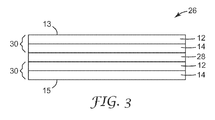
- FIG. 3 shows a third exemplary embodiment of a film including an internal layer of different material.
- the present disclosure is directed to a composite film having a plurality of layers.
- a particularly suitable application of the composite film of the present disclosure is as an optical film.
- Some suitable applications are described in U.S. Pat. No. 6,531,230, entitled “Color shifting film,” and U.S. Pat. No. 6,045,894, entitled “Clear to colored security film,” which are hereby incorporated by reference.
- Composite films of the present disclosure possess unexpectedly high delamination resistance. Moreover, in some exemplary embodiments they exhibit advantages of higher optical power, thinner construction, less color absorption or loss due to the reduced material volume in the thin film construction, and less UV-absorption compared to other films.
- birefringent means that the indices of refraction in orthogonal x, y, and z directions are not all the same.
- the axes are selected so that x and y axes are in the plane of the layer and the z axis is normal to the plane of the layer and typically corresponds to the thickness or height of the layer.
- the x-axis is generally chosen to be the in-plane direction with the largest index of refraction, which typically corresponds to one of the directions in which the optical film is oriented (e.g., stretched);
- film refers to one or more layers of one or more materials; a film may be disposed on a substrate and need not be capable of independent structural integrity; for example, coatings are considered to be films;
- high refractive index and low refractive index are relative terms; when two layers are compared in at least one direction of interest, the layer that has a greater in-plane refractive index is the high refractive index layer, and the layer that has a lower in-plane refractive index is the low refractive index layer;
- index of refraction refers to a refractive index of a material in the plane of the material with respect to light at 633 nm and normal incidence, unless otherwise indicated;
- polymer means, unless otherwise indicated, polymers and copolymers (i.e., polymers formed from two or more monomers or comonomers, including terpolymers, for example), as well as copolymers or polymers that can be formed in a miscible blend by, for example, coextrusion or reaction, including transesterification, for example. Block, random, graft, and alternating polymers are included, unless indicated otherwise; and
- Tg means the temperature at which a polymer transitions from a glassy to a rubbery state, as measured by differential scanning calorimetry.
- An exemplary composite film 10 of the present disclosure as illustrated in FIG. 1 includes film 16 and skin layer 20 .
- film 16 includes a light transmissive material.
- film 16 is a multilayer film having alternating layers 12 , 14 of at least two materials.
- the materials of layers 12 and 14 are polymeric.
- Composite film 10 includes first major surface 13 and second major surface 15 .
- U.S. Pat. No. 6,827,886, entitled “Method for making composite optical films,” hereby incorporated by reference describes methods that can be adapted for making composite film 10 .
- film 16 is a multilayer film as described in U.S. patent application Ser. No. 60/753,791, filed on Dec.
- film 16 is illustrated and described as a multilayer film in FIG. 1 , in another embodiment, film 16 is a monolithic film. In addition, although film 16 is illustrated as having planar surfaces, at least one surface of the film 16 may be structured. If the composite film 10 includes a structured major surface, the skin layer 20 may be applied or otherwise disposed on a major surface opposite the structured surface.
- film 16 is an optical film.
- Film 16 can be a single layer of a suitable optically clear material such as polycarbonate, which may or may not include volume diffusers.
- suitable optically clear material such as polycarbonate, which may or may not include volume diffusers.
- Exemplary optical films that are suitable for use in the present disclosure include composite reflective films such as those described in, for example, U.S. Pat. Nos. 5,882,774 and 6,352,761 and in PCT Publications No. WO95/17303; WO95/17691; WO95/17692; WO95/17699; WO96/19347; and WO99/36262, all of which are incorporated herein by reference.
- Both multilayer reflective optical films (e.g., mirrors and polarizers) and continuous/disperse phase reflective optical films rely on index of refraction differences between at least two different materials (typically polymers) to selectively reflect light of at least one polarization orientation.
- Suitable diffuse reflective polarizers including a continuous phase and a disperse phase disposed within the continuous phase are described in, for example, U.S. Pat. No. 5,825,543, incorporated herein by reference, and in, for example, U.S. Pat. No. 5,867,316, incorporated herein by reference.
- films can be created with a range of reflectivities for differently oriented plane-polarized incident light.
- Oriented direction is the direction in which the film is stretched.
- Transverse direction is the direction in the plane of the film orthogonal to the direction in which the film is oriented.
- Composite film 10 includes two or more layers, and each layer can be made from any of a number of different materials. The characteristics which determine the choice of materials for a particular stack depend upon the desired performance of composite film 10 .
- Composite film 10 can contain as many materials as there are layers in the stack. However, for ease of illustration, exemplary embodiments of composite film 10 show only a few different materials.
- the materials of composite film 10 have compatible thermal processing ranges and similar rheological properties (for example, melt viscosities) such that they can be co-extruded.
- the number of layers in composite film 10 is selected to achieve the desired properties using the minimum number of layers for reasons of film thickness, flexibility and economy.
- the boundaries between the different materials, or between chemically identical materials with different physical properties, can be abrupt or gradual. Except for some simple cases with analytical solutions, analysis of the latter type of stratified media with continuously varying index is usually treated as a much larger number of thinner uniform layers having abrupt boundaries but with only a small change in properties between adjacent layers.
- Materials suitable for making films 16 for use in exemplary embodiments of the present disclosure include polymers such as, for example, polyesters, copolyesters and modified copolyesters.
- Polyesters suitable for use in some exemplary optical films according to the present disclosure generally include carboxylate and glycol subunits and can be generated by reactions of carboxylate monomer molecules with glycol monomer molecules. Each carboxylate monomer molecule has two or more carboxylic acid or ester functional groups and each glycol monomer molecule has two or more hydroxy functional groups.
- the carboxylate monomer molecules may all be the same or there may be two or more different types of molecules. The same applies to the glycol monomer molecules.
- Also included within the term “polyester” are polycarbonates derived from the reaction of glycol monomer molecules with esters of carbonic acid.
- Some exemplary materials for film 16 are crystalline, semi-crystalline, amorphous or liquid crystalline materials, including polymers, such as polyolefins. Other exemplary materials include inorganic materials. Specific examples of suitable materials for film 16 include polymethyl methacrylate (PMMA), polyalkylene naphthalates (e.g., PEN(polyethylene naphthalate), PPN(polypropylene naphthalate), PBN(polybutylene naphthalate), and PCN(poly-1,4-cyclohexanedimethylene naphthalate), PHN(polyhexamethylenenaphthalate)) and isomers thereof (e.g., 2,6-, 1,4-, 1,5-, 2,7-, and 2,3-PEN), polyalkylene terephthalates (e.g., PET(polyethylene terephthalate), PPT(polypropylene terephthalate), PBT(polybutylene terephthalate), and PCT(pol
- copolymers e.g., copolymers of PEN, PBN, PPN, PCN, PHN, PET, PBT, PPT, PCT, PHT (e.g., copolymers of 2,6-, 1,4-, 1,5-, 2,7-, and/or 2,3-naphthalene dicarboxylic acid, or esters thereof, with (a) terephthalic acid, or esters thereof; (b) isophthalic acid, or esters thereof; (c) phthalic acid, or esters thereof; (d) alkane glycols; (e) cycloalkane glycols (e.g., cyclohexane dimethane diol); (f) alkane dicarboxylic acids; and/or (g) cycloalkane dicarboxylic acids (e.g., cyclohexane dicarboxylic acid)), copolymers of polyalkylene terephthalates (e.g.,
- each individual layer may include blends of two or more of the above-described polymers or copolymers (e.g., blends of sPS and atactic polystyrene).
- the coPEN described may also be a blend of pellets where at least one component is a polymer based on naphthalene dicarboxylic acid and other components are other polyesters or polycarbonates, such as a PET, a PEN or a coPEN. In one embodiment of the present disclosure, two or more of these materials are used in alternating layers, such as layers 12 , 14 of FIG. 1 .
- the low refractive index material for layer 14 or skin layer 20 is a thermoplastic polydiorganosiloxane polyamide block copolymer (where the polyamide component may be ethylene terephthalamide, hexamethylene adipamide, butylene sebacamide, or any other known polyamide).
- the material for layer 14 or skin layer 20 is a polydiorganosiloxane polyoxamide block copolymer, further described in U.S. patent application Ser. No. 11/317,271, filed on Dec. 23, 2005, incorporated herein by reference in its entirety.
- the polydiorganosiloxane polyoxamide block copolymers have a plurality of oxalylamino and aminoxalylamino groups (e.g., the oxalylamino groups can be part of the aminoxalylamino groups).
- the polydiorganosiloxane polyoxamide copolymers can contain a relatively large fraction of the polydiorganosiloxane segment compared to many known polydiorganosiloxane polyamide copolymers.
- the polydiorganosiloxane polyoxamide copolymer can usually be subjected to elevated temperatures up to 250° C. or higher without apparent degradation.
- a copolymeric material that contains at least two repeat units of Formula I.
- each R 1 is independently an alkyl, haloalkyl, aralkyl, alkenyl, aryl, or aryl substituted with an alkyl, alkoxy, or halo.
- Each Y is independently an alkylene, aralkylene, or a combination thereof.
- Subscript n is independently an integer of 0 to 1500 and subscript p is an integer of 1 to 10.
- Group G is a divalent group that is the residue unit that is equal to a diamine of formula R 3 HN-G-NHR 3 minus the two —NHR 3 groups (i.e., amino groups) where R 3 is hydrogen, alkyl, or forms a heterocyclic group when taken together with G and with the nitrogen to which it is attached.
- Each group B is independently a covalent bond, an alkylene of 4-20 carbons, an aralkylene, an arylene, or a combination thereof.
- the polydiorganosiloxane polyamide block copolymer of Formula I is referred to as a polydiorganosiloxane polyoxamide block copolymer.
- Each asterisk indicates the position of attachment of the repeating unit to another group such as another repeat unit.
- Such polydiorganosiloxane polyamide block copolymers are thermally stable over a wide range of processing temperatures and can also be prepared with a wide range of viscosities.
- exemplary polydiorganosiloxane polyoxamide block copolymers have a refractive index of about 1.41 at 633 nm.
- Polydiorganosiloxane polyamide block copolymers demonstrate high levels of adhesion to many coextruded polymers. Moreover, they are highly extensible or drawable in that they can be stretched to high levels without significant degradation of or change in their optical properties.
- a suitable polydiorganosiloxane polyamide block copolymer is selected to be paired with the selected high refractive index material, taking into account compatibility properties such as melt viscosity, thermal stability, and adhesion, especially during the length orientation and/or tentering operations required for processing.
- Polydiorganosiloxane polyamide block copolymers with hard segment contents from about 1 percent to about 10 percent are especially suitable because they are thermoplastic elastomers: solid under ambient conditions, yet able to soften or flow at elevated temperatures.
- hard segment refers to organic amide blocks and terminal groups.
- the polyamine residue is the polyamine minus the —NHR 3 groups.
- the polydiorganosiloxane residue is connected to the polyamine residue by amide linkages.
- Desirable material properties of polydiorganosiloxane polyamide block copolymers for use in skin layer 20 include, for example: (1) isotropic or negative birefringence, (2) thermal stability (stable to at least about 250 degrees C. for about 1 hour), (3) processing temperatures compatible with those of many polymers of film 16 (from about room temperature to about 300 degrees C., assuming the viscosity has been tailored appropriately), (4) UV stability or protectability, (5) high clarity (e.g., high transmission and low absorption over wavelengths of interest), (6) low Tg (in this case, ⁇ 120 degrees C.), (7) viscosities that facilitate viscosity matching with many polymers of film 16 , to ensure co-extrusion and flow stability, (8) good interlayer adhesion with film 16 , (9) low optical dispersion, (10) good z-index matching with film 16 , (11) drawability (e.g., the ability to be oriented without birefringence), and (12) scratch and abrasion resistance.
- polydiorganosiloxane polyamide block copolymers can be made with a range of refractive indices, it will be understood that a polydiorganosiloxane polyamide block copolymer having a relatively high refractive index, and meeting all other requirements set forth herein for a high refractive index layer polymer, could serve as the material of high refractive index layer 12 .
- Delamination of the interphase between polymer layers 16 , 20 in composite films 10 is usually predictable using knowledge of polymer interactions.
- the polymer interaction can be calculated using polymer solubility parameters as disclosed in the literature.
- the method involves calculating the cohesive properties of a given pair of polymers which is called cohesive energy, E co .
- E co ⁇ i ⁇ E o , i ⁇ n ⁇ ⁇ ( J mol ) ⁇ ⁇ cohesive ⁇ ⁇ energy ( 1 )
- E o,i and n are the molar cohesive energy and number for each functional group in the repeating unit of a polymer, respectively.
- V ⁇ i ⁇ V i ⁇ n ⁇ ⁇ ( cm 3 mol ) ⁇ ⁇ molar ⁇ ⁇ volume ( 2 )
- V i is the molar volume for individual functional group in the repeating unit.
- V ref V ref RT ⁇ ( ⁇ 1 - ⁇ 2 ) 2 ⁇ ⁇ interaction ⁇ ⁇ parameter ( 4 )
- V ref is the reference volume
- R is the gas constant
- T is the temperature in K.
- a miscible polymer pair would have identical solubility parameters, resulting in a value for ⁇ that is very close to zero.
- the interaction parameter will be significantly larger than zero.
- composite films 10 having polydiorganosiloxane polyoxamide block copolymers in skin layer 20 paired with polyesters such as PET or PEN in film 16 have higher interaction parameters ( ⁇ 2.2) than other polymer pairs. This indicates theoretically that composite films 10 will possess a thin interphase between the materials. Accordingly, one would expect that such composite films 10 would tend to exhibit weak interlayer adhesion and therefore be subject to delamination.
- films of 3-layer construction were produced using a pilot scale coextrusion line.
- the extrusion temperatures depend on the viscosity of the materials.
- a processing temperature of about 530° F. (277° C.) was chosen for PET, PMMA and the polydiorganosiloxane polyoxamide block copolymer. Due to its higher melting point, PEN was extruded at 540° F. (282° C.).
- the die and feedblock were run at 530° F. (277° C.) for PET and 540° F. (282° C.) for PEN.
- the 6 inch (15.2 cm) wide extrudate was quenched on a chill roll and 30 mil (0.76 mm) cast web was collected.
- the delamination strength in g/in was tested using a 90° Peel Delamination Test Method described in the test method section.
- a cast three-layer film 10 having polydiorganosiloxane polyoxamide block copolymers in layer 20 and PET in layer 16 exhibited an average delamination strength of about 1280 g/in.
- a cast three-layer film having PMMA and PEN exhibited an average delamination strength of about 18 g/in.
- 3-layer cast webs were subsequently stretched in a biaxial stretcher (KARO IV, a commercially available instrument made by Bruckner of Siegsdorf, Germany).
- the stretching temperature was 130° C. for the PEN/PMMA cast web and 95° C. for PET/polydiorganosiloxane polyoxamide block copolymer cast web.
- the draw ratio was 3 ⁇ 3 and draw speed was 100-150%/sec for both systems.
- the delamination strength in g/in was tested using a 90° Peel Delamination Test Method described in the test method section.
- An oriented (stretched) three-layer film 10 having polydiorganosiloxane polyoxamide block copolymers in layer 20 and PET in layer 16 exhibited an average delamination strength of about 100 g/in.
- an oriented (stretched) three-layer film having PMMA and PEN exhibited an average delamination strength of about 30 g/in.
- adhesion measurements are a complicated combination of several types of forces.
- One contributor to the measured adhesion force is the chemical bond or interaction that occurs between molecules. Included would be covalent bonds, hydrogen bonding, and van der Waals forces, for example. In the case of rather inert, low index resins, one would expect this contribution to be small.
- a second contributor is physical: for example, entanglements—which relate to miscibility.
- a third contributor to the adhesion force between the composites is the dissipation of energy during the peel or interfacial fracture. See U.S. Patent Pub. No. 2003-0072931-A1, entitled “Low Tg Composite Optical Films,” which is hereby incorporated by reference.
- the viscoelastic nature of the polymers is important.
- the Tg of the polydiorganosiloxane segment of the polydiorganosiloxane polyamide block copolymers ( ⁇ 120° C.) is lower than that of other low index resins such as PMMA (110° C.).
- the very low Tg shifts the ductile/brittle transition to lower temperatures.
- the polydiorganosiloxane polyamide block copolymers are prone to viscoelastic deformation rather than brittle fracture upon external impact. This results in improved properties such as high tear, puncture, delamination, imprint and impact resistance.
- polydiorganosiloxane polyoxamide block copolymers go through a thermal transition at temperatures of concern in extrusion and heat set. Initially out of an extruder, the polydiorganosiloxane polyoxamide block copolymers demonstrate a high adhesion value with other polymers which drops somewhat when stretched at 90° C. It is possible that such stretching occurs at temperatures where the phase separated hard segments (amide-sections) are not mobile, inducing some strain. However, as shown in TABLE 1, heat setting at higher temperatures allows for annealing or dissipation of strain, again leading to higher delamination forces.
- hydrogen bonding refers to an electrostatic interaction of hydrogen of a highly polarized bond (e.g., O—H or N—H) and a lone pair of electrons of a small electronegative atom (e.g., fluorine, oxygen, or nitrogen) in a neighboring molecule or in another functional group. Optimization of these interactions occurs where temperature (mobility) allows these groups to associate with one another.
- the 3-layer PET-based oriented composite films 10 were heat set at elevated temperature for a period of time to improve the dimensional stability.
- the delamination strength in g/in was tested using a 90° Peel Delamination Test Method described in the test method section.
- the delamination results at different heat set temperatures and times for oriented PET and polydiorganosiloxane polyoxamide block copolymer composite films 10 are summarized in the following Table:
- composite film 10 When used as an optical film, composite film 10 is typically thin. Suitable films have varying thicknesses, but in exemplary embodiments, they have thicknesses of less than about 15 mils (about 380 micrometers), more typically less than about 10 mils (about 250 micrometers), and preferably less than about 7 mils (about 180 micrometers). Depending on the application, suitable composite films 10 may be as thin as about 0.5 mil (about 12.7 micrometers) or thinner or as thick as about 15 mils (about 381 micrometers) or thicker. An optical film also normally undergoes various bending and rolling steps during processing, and therefore, in exemplary embodiments of the present disclosure, composite film 10 is preferably flexible.
- the ability to achieve the desired relationships among the various indices of refraction (and thus the optical properties of composite film 10 ) is influenced by the processing conditions used to prepare composite film 10 .
- the films are generally prepared by co-extruding the individual polymers to form composite film 10 and then orienting film 10 by stretching at a selected temperature, optionally followed by heat-setting at a selected temperature. Alternatively, the extrusion and orientation steps may be performed simultaneously.
- film 10 is stretched substantially in one direction (uniaxial orientation), while in the case of mirror films, film 10 is stretched substantially in two directions (biaxial orientation).
- composite film 10 may be allowed to dimensionally relax in a cross-stretch direction, resulting in a natural reduction in cross-stretch (equal to the square root of the stretch ratio); composite film 10 may be constrained to limit any substantial change in cross-stretch dimension; or composite film 10 may be actively stretched in a cross-stretch dimension.
- composite film 10 may be stretched in the machine direction, as with a length orienter, or in width using a tenter.
- the pre-stretch temperature, stretch temperature, stretch rate, stretch ratio, heat set temperature, heat set time, heat set relaxation, and cross-stretch relaxation are selected to yield a composite film 10 having the desired refractive index relationship and physical dimensions. These variables are interdependent; thus, for example, a relatively low stretch rate could be used if coupled with, for example, a relatively low stretch temperature.
- a stretch ratio in the range from about 1:2 to about 1:10 (more preferably about 1:3 to about 1:7) in the stretch direction and from about 1:0.2 to about 1:10 (more preferably from about 1:0.5 to about 1:7) orthogonal to the stretch direction is selected in an exemplary embodiment.
- Suitable composite films 10 may also be prepared using techniques such as spin coating (e.g., as described in Boese et al., J. Polym. Sci.: Part B, 30:1321 (1992) for birefringent polyimides) and vacuum deposition (e.g., as described by Zang et. al., Appl. Phys. Letters, 59:823 (1991) for crystalline organic compounds); the latter technique is particularly useful for certain combinations of crystalline organic compounds and inorganic materials.
- spin coating e.g., as described in Boese et al., J. Polym. Sci.: Part B, 30:1321 (1992) for birefringent polyimides
- vacuum deposition e.g., as described by Zang et. al., Appl. Phys. Letters, 59:823 (1991) for crystalline organic compounds
- composite films 10 may be prepared by laminating the one or more skin layers 20 , 24 to the film 16 , coextruding the one or more skin layers 20 , 24 with the film 16 or by coating the one or more skin layers 20 , 24 onto the film 16 .
- FIG. 1 shows composite film 10 having a single skin layer 20 .
- FIG. 2 shows composite film 22 having two skin layers 20 , 24 .
- composite film 22 of FIG. 2 is similar to composite film 10 of FIG. 1 with the addition of skin layer 24 on second major surface 15 .
- FIG. 3 shows composite film 26 having internal layer 28 between film layers 30 .
- one or more layers 20 , 24 , 28 comprise the polydiorganosiloxane polyamide block copolymers discussed above.
- each layer of composite film 10 , 22 , 26 can be varied to make a composite film 10 , 22 , 26 having a particular desired thickness and performance characteristics.
- additional layers 20 , 24 , 28 should not unduly compromise the optical properties required for the application to which the composite films 10 , 22 , 26 are directed.
- Skin layers 20 , 24 and interior layer 28 may be integrated at the time of film formation, either by coextrusion or in a separate coating or extrusion step, or they may be applied to the finished film 16 , 30 at a later time, such as by coating or lamination of skin layer 20 , 24 to a previously formed film 16 , 30 .
- Total additional layer 20 , 24 , 28 thicknesses typically range from about 2% to about 50% of the total thickness of composite film 10 , 22 , 26 .
- polydiorganosiloxane polyamide block copolymers are used in one or more additional layers 20 , 24 , 28 .
- the polydiorganosiloxane polyamide block copolymers serve as receptors for additives to enhance the performance of, or impart other desired characteristics to, composite films 10 , 22 , 26 .
- Polydiorganosiloxane polyamide block copolymers are particularly good receptors for non-polar, low molecular weight materials. Examples of exemplary additives are described in U.S. Pat. Nos. 6,368,699, and 6,459,514 both entitled “Composite Polymer Film with Additional Coatings or Layers,” both of which are incorporated herein by reference, and U.S.
- composition of additional layers 20 , 24 , 28 may be chosen, for example, to protect the integrity of films 16 , 30 during or after processing, to add mechanical or physical properties to composite film 10 , 22 , 26 ; or to add optical functionality to composite film 10 , 22 , 26 .
- Functional components such as antistatic additives, ultraviolet light absorbers (UVAs), hindered amine light stabilizers (HALS), dyes, colorants, pigments, antioxidants, slip agents, low adhesion materials, conductive materials, abrasion resistant materials, optical elements, dimensional stabilizers, adhesives, tackifiers, flame retardants, phosphorescent materials, fluorescent materials, nanoparticles, anti-graffiti agents, dew-resistant agents, load bearing agents, silicate resins, light diffusing materials, light absorptive materials and optical brighteners may be included in these layers, preferably such that they do not substantially interfere with the desired optical or other properties of the resulting product.
- UVAs ultraviolet light absorbers
- HALS hindered amine light stabilizers
- dyes colorants, pigments, antioxidants, slip agents, low adhesion materials, conductive materials, abrasion resistant materials, optical elements, dimensional stabilizers, adhesives, tackifiers, flame retardants, phosphorescent materials, fluorescent materials, nano
- one or more additional layers 20 , 24 , 28 may be or may include diffusers, such as a rough, matte or structured surface, a beaded diffuser or a diffuser including organic and/or inorganic particles, or any number or combination thereof.
- diffusers such as a rough, matte or structured surface, a beaded diffuser or a diffuser including organic and/or inorganic particles, or any number or combination thereof.
- the functional components listed above may also be incorporated into polydiorganosiloxane polyamide block copolymer layers 12 , 14 provided such incorporation does not adversely affect any of the optical requirements for the layer(s) to an undesirable extent.
- Skin layers 20 , 24 may also be used to impart or improve scratch and abrasion resistance in the resulting composite film 10 , 22 .
- Polydiorganosiloxane polyamide block copolymers used in skin layers 20 , 24 are inherently scratch and abrasion resistant because of their high resilience.
- a skin layer 20 , 24 comprising particles of silica embedded in the polydiorganosiloxane polyamide block copolymer matrix may be used.
- Layers 20 , 24 , 28 made of polydiorganosiloxane polyamide block copolymers also impart or improve puncture and/or tear resistance in the resulting composite film 10 , 22 , 26 .
- Adhering these layers to composite film 10 , 22 , 26 during the manufacturing process, such as by a coextrusion process, provides the advantage that composite film 10 , 22 , 26 is protected during the manufacturing process.
- additional layer 20 , 24 , 28 includes a dye or pigment that absorbs in one or more selected regions of the spectrum. Exemplary selected regions can include portions or all of the visible spectrum as well as ultraviolet and infrared. If all of the visible spectrum is absorbed, the layer will appear opaque. Additives for layers 20 , 24 , 28 can be selected in order to change the apparent color of light transmitted or reflected by composite film 10 , 22 , 26 . They can also be used to compliment the properties of the film, particularly where the film transmits some light frequencies while reflecting others. In another embodiment, the use of a UV absorptive material in a skin cover layer 20 , 24 is particularly desirable because it may be used to protect inner layers 16 that may sometimes be unstable when exposed to UV radiation. In one embodiment, a fluorescent material is incorporated into layer 20 , 24 , 28 . Fluorescent materials absorb electromagnetic energy in the ultraviolet region of the spectrum and reemit in the visible.
- the polydiorganosiloxane polyamides of layers 20 , 24 , 28 can be formulated into adhesive compositions such as pressure sensitive adhesives and heat activated adhesives that contain a tackifier.
- adhesive compositions comprising polydiorganosiloxane polyoxamides are further described in U.S. patent application Ser. No. 11/317,602, filed on Dec. 23, 2005, incorporated herein by reference in its entirety.
- polydiorganosiloxane polyamide block copolymers provide a superior bonding surface compared to materials such as polyester, they can be used in one exemplary embodiment as a skin tie layer 20 , 24 to promote adhesion between film 16 and another film (including, for example, a curable resin layer) to produce a composite film.
- the polydiorganosiloxane polyamide block copolymers are applied as adhesive skin layers 20 , 24 in cases where composite film 10 , 22 is intended for later lamination to another material, such as a glass or metal substrate.
- polydiorganosiloxane polyamide block copolymers have such a low refractive index, their use as skin layer 20 , 24 reduces or minimizes reflection losses at film surface 13 , 15 thus reducing glare and improving optical performance.
- each film layer 30 is illustrated as a multilayer element in FIG. 3 , in another embodiment, each film layer 30 is a monolithic film.
- the composite film 10 may include an absorbing or dichroic polarizer layer, as described, for example, in U.S. Pat. No. 6,096,375 to Ouderkirk et al., entitled “Optical Polarizer,” incorporated herein by reference.
- the skin layer 20 , 24 may be or may include an absorbing polarizer or the absorbing polarizer may be disposed over the skin layer 20 , 24 .
- the transmission axis of the dichroic polarizer is aligned with the transmission axis of a reflective polarizer.
- Shore A Hardness was measured according to ASTM D2240-5 Standard Test Method for Rubber Property—Durometer Hardness. This test method is based on the penetration of a specific type of indentor when forced into the material under specified conditions. The indentation hardness is inversely related to the penetration and is dependent on the elastic modulus and viscoelastic behavior of the material.
- a multilayer film (or cast web) to be tested was cut into a 25.4 mm wide strip specimen.
- the film strip specimen was adhered to a glass substrate (about 50 mm ⁇ 150 mm) using a double sided adhesive tape with identical width (Trade name Scotch #396, 3M Co., St. Paul, Minn.).
- the adhesive tape is dispensed directly atop the entire multilayer film strip specimen and also adhered to the center portion of the glass substrate.
- a short length of the tape strip, at the end of the tape strip which is adhered to the additional length of the substrate was left dangling, unadhered, so it could be gripped by hand.
- Peel (delamination) of the film was initiated by a sharp, quick pull on this free end of the tape strip, with one's thumb firmly placed 1 ⁇ 4 from the leading edge of the film strip specimen, to prevent peeling too much of the film strip specimen.
- the peel-initiated plaque was then loaded in a Slip/Peel Tester (Instrumentors, Inc., Strongsville, Ohio). The portion of the film strip specimen adhering to the tape strip was peeled away from the substrate at a 90° peel angle, at 2.54 cm/second, at 25° C. and 50% relative humidity. The average delamination force in g/in of 5 peels was recorded.
- the number of equivalents of precursor was equal to the number of equivalents of N-hexylamine added to the sample minus the number of equivalents of hydrochloric acid added during titration.
- the equivalent weight was equal to the sample weight of the precursor divided by the number of equivalents of the precursor.
- Average inherent viscosities (IV) were measured at 30° C. using a Canon-Fenske viscometer (Model No. 50 P296) in a tetrahydrofuran (THF) solution at 30° C. at a concentration of 0.2 g/dL. Inherent viscosities of the materials of the invention were found to be essentially independent of concentration in the range of 0.1 to 0.4 g/dL. The average inherent viscosities were averaged over 3 or more runs. Any variations for determining average inherent viscosities are set forth in specific Examples.
- An exemplary composite film 26 is described in the following examples:
- a PET/silicone polyamide/PET film 26 was constructed as follows:
- the sample Upon removal from the stretcher, the sample visually exhibited excellent spreading (continuous layer of uniform thickness) of the silicone polyamide between the PET film layers. Additionally, the silicone polyamide/PET interfaces proved to have significant adhesive strength.
- PDMS diamine a polydimethylsiloxane diamine with an average molecular weight of about 5,000 g/mole that was prepared as described in U.S. Pat. No. 5,214,119, incorporated by reference
- This polydiorganosiloxane polyoxamide block copolymer resin was then incorporated into a 3-layer film through a process of co-extrusion.
- This extrusion was carried out as follows: A 1.5′′ Davis-Standard single-screw extruder utilized dried standard PET resin (0.60 IV) known as DMT clear (available from 3M corporation) to feed the bottom (chill roll side) layer of a three layer die/feedblock. A 25 mm Berstorff twin-screw extruded was used to feed the middle layer of the die and polydiorganosiloxane polyoxamide block copolymer resin was fed into this extruder.
- a 1′′ Davis-Standard single-screw extruder utilized dried standard PET resin (0.60 IV) known as DMT clear (available from 3M corporation) to feed the top layer of a three layer die.
- An extrusion processing temperature of about 530° F. (277° C.) was chosen for PET and polydiorganosiloxane polyoxamide block copolymer materials.
- a 6 inch (15.2 cm) wide extrudate was quenched on a chill roll and 30 mil (0.76 mm) cast web was collected.
- excellent film formation and interlayer adhesion were achieved according to the 90° C. Peel Delamination Test Method.
- This polydiorganosiloxane polyoxamide block copolymer resin was then incorporated into a 61-layer film through the process of co-extrusion. This extrusion was carried out as follows:
- a melt processing temperature of about 540° F. (282° C.) was utilized for the PET extrusion train, while the polydiorganosiloxane polyoxamide block copolymer extrusion line was heated to a temperature of 450° F. (232° C.).
- the 61 layer feedblock and die were heated to a temperature of 530° F. (277° C.).
- a 6 inch (15.2 cm) wide extrudate was quenched on a chill roll and 22 mil cast web was collected.
- the resulting 61-layer cast web was tested for delamination strength using the 90° Peel Delamination Test Method. Excellent interlayer adhesion was verified. Excellent film formation and interlayer adhesion were achieved. Optical micrographs of the cast web sample were taken to verify distinct layer formation.
- a portion of the cast web sample was cut into a 4′′ ⁇ 4′′ square and then clamped into an 85° C. laboratory biaxial film stretcher. The film was heated for 30 seconds at 95° C. and stretched at 20%/sec in a balanced biaxial 3:1 stretch ratio. The stretched 61-layer film was tested for delamination strength using the 90° Peel Delamination Test Method. Excellent interlayer adhesion was verified.
- the kettle was heated to 150° C. Once a temperature of 150° C. was reached, the kettle was vented over the course of 5 minutes. The kettle was subjected to vacuum ( ⁇ 65 mmHg) for 40 minutes to remove the ethanol and toluene. The kettle was then pressured to 2 psig and the viscous molten polymer was then drained into Teflon coated trays and allowed to cool. The cooled silicone polyoxamide product, polydiorganosiloxane polyoxamide block copolymer, was then ground into fine pellets. The IV of this material was determined to be 0.829 dL/g (in THF).
- This polydiorganosiloxane polyoxamide block copolymer resin was then incorporated into a 61-layer film through the process of co-extrusion. This extrusion was carried out as follows:
- a melt processing temperature of about 540° F. (282° C.) was utilized for the PET extrusion train, the polydiorganosiloxane polyoxamide block copolymer extrusion train, and the 61 layer feedblock and die.
- a 6 inch (15.2 cm) wide extrudate was quenched on a chill roll and 22 mil cast web was collected.
- the resulting 61-layer cast web was tested for delamination strength using the 90° Peel Delamination Test Method. Excellent interlayer adhesion was verified. Excellent film formation and interlayer adhesion was achieved. Optical micrographs of the cast web sample were taken to verify distinct layer formation.
- the stretched 61-layer film was tested for delamination strength using the 90° Peel Delamination Test Method. Excellent interlayer adhesion was verified.
- a portion of the cast web sample was cut into a 4′′ ⁇ 4′′ square and then clamped into an 85° C. laboratory biaxial film stretcher. The film was heated for 30 seconds at 95° C. and stretched at 20%/sec in a balanced biaxial 3:1 stretch ratio.
- a 30% by weight solution of 526.0 parts of a 5260 MW polydimethylsiloxane diamine (prepared as described in U.S. Pat. No. 5,214,119, incorporated herein by reference) and 11.6 parts of hexamethylene diamine in isopropyl alcohol was prepared.
- a 30% by weight solution in isopropyl alcohol of 82.9 parts of the methyl salicylate adipate ester (prepared as above) was prepared and this solution was added suddenly to the first solution.
- the clear solution was stirred at room temperature overnight during which time the viscosity of the solution rose significantly.
- the solution was cast into a glass tray, the solvent allowed to evaporate over several hours, and dried completely in an oven at 70 degrees C. overnight to provide a clear, strong elastomeric film, silicone polyadipamide.
- the silicone polyadipamide was dissolved in a 50 wt % methyl ethyl ketone/50 wt % isopropanol blend at 10 wt % solids. This solution was coated out onto an unprimed oriented polyester film (Scotchpar 2 mil PET film available from 3M company) using a #12 Meyer rod, leaving an uncoated margin all around the coated area. The sample was allowed to dry. Coating appearance of the dried silicone polyadipamide was excellent. The polymer coating could not be removed from the film. The coated PET film was then folded over onto itself, with the coated side comprising the inside of the folded film. This specimen was placed in a 210° C. press at 2000 PSI for 30 seconds. Upon removal from the press, the specimen was grasped by hand by the uncoated margins of the PET substrate film, and pulled apart. Failure occurred cohesively within the silicone polyadipamide layer and the silicone polyadipamide layer was not removed from either of the PET surfaces.
Landscapes
- Chemical & Material Sciences (AREA)
- Physics & Mathematics (AREA)
- Chemical Kinetics & Catalysis (AREA)
- Optics & Photonics (AREA)
- General Physics & Mathematics (AREA)
- Organic Chemistry (AREA)
- Polymers & Plastics (AREA)
- Health & Medical Sciences (AREA)
- Medicinal Chemistry (AREA)
- Life Sciences & Earth Sciences (AREA)
- Engineering & Computer Science (AREA)
- Materials Engineering (AREA)
- Wood Science & Technology (AREA)
- Laminated Bodies (AREA)
- Silicon Polymers (AREA)
- Compositions Of Macromolecular Compounds (AREA)
Priority Applications (1)
| Application Number | Priority Date | Filing Date | Title |
|---|---|---|---|
| US11/614,357 US8067094B2 (en) | 2005-12-23 | 2006-12-21 | Films including thermoplastic silicone block copolymers |
Applications Claiming Priority (2)
| Application Number | Priority Date | Filing Date | Title |
|---|---|---|---|
| US75385705P | 2005-12-23 | 2005-12-23 | |
| US11/614,357 US8067094B2 (en) | 2005-12-23 | 2006-12-21 | Films including thermoplastic silicone block copolymers |
Publications (2)
| Publication Number | Publication Date |
|---|---|
| US20070177273A1 US20070177273A1 (en) | 2007-08-02 |
| US8067094B2 true US8067094B2 (en) | 2011-11-29 |
Family
ID=38189132
Family Applications (1)
| Application Number | Title | Priority Date | Filing Date |
|---|---|---|---|
| US11/614,357 Active 2029-05-08 US8067094B2 (en) | 2005-12-23 | 2006-12-21 | Films including thermoplastic silicone block copolymers |
Country Status (7)
| Country | Link |
|---|---|
| US (1) | US8067094B2 (enExample) |
| EP (1) | EP1963899B1 (enExample) |
| JP (1) | JP5144538B2 (enExample) |
| KR (1) | KR101298355B1 (enExample) |
| CN (1) | CN101346649B (enExample) |
| TW (1) | TWI424922B (enExample) |
| WO (1) | WO2007073502A2 (enExample) |
Cited By (15)
| Publication number | Priority date | Publication date | Assignee | Title |
|---|---|---|---|---|
| US20140131306A1 (en) * | 2011-07-25 | 2014-05-15 | Henkel US IP LLC | Photocurable adhesive composition and use of the same |
| US20140370243A1 (en) * | 2005-12-23 | 2014-12-18 | 3M Innovative Properties Company | Polydiorganosiloxane polyoxamide copolymers |
| US9119289B2 (en) | 2013-02-25 | 2015-08-25 | 3M Innovative Properties Company | Film constructions for interdigitated electrodes with bus bars and methods of making same |
| US9359261B2 (en) | 2013-05-07 | 2016-06-07 | Corning Incorporated | Low-color scratch-resistant articles with a multilayer optical film |
| US9366784B2 (en) | 2013-05-07 | 2016-06-14 | Corning Incorporated | Low-color scratch-resistant articles with a multilayer optical film |
| US9684097B2 (en) | 2013-05-07 | 2017-06-20 | Corning Incorporated | Scratch-resistant articles with retained optical properties |
| US9703011B2 (en) | 2013-05-07 | 2017-07-11 | Corning Incorporated | Scratch-resistant articles with a gradient layer |
| US10763004B2 (en) | 2014-03-12 | 2020-09-01 | 3M Innovative Properties Company | Conductive polymeric material |
| US10837103B2 (en) | 2014-08-01 | 2020-11-17 | Corning Incorporated | Scratch-resistant materials and articles including the same |
| US10948629B2 (en) | 2018-08-17 | 2021-03-16 | Corning Incorporated | Inorganic oxide articles with thin, durable anti-reflective structures |
| US11002885B2 (en) | 2015-09-14 | 2021-05-11 | Corning Incorporated | Scratch-resistant anti-reflective articles |
| US11150393B2 (en) * | 2013-09-06 | 2021-10-19 | 3M Innovative Properties Company | Multilayer optical film |
| US11267973B2 (en) | 2014-05-12 | 2022-03-08 | Corning Incorporated | Durable anti-reflective articles |
| US11667565B2 (en) | 2013-05-07 | 2023-06-06 | Corning Incorporated | Scratch-resistant laminates with retained optical properties |
| US12352924B2 (en) | 2020-07-09 | 2025-07-08 | Corning Incorporated | Display articles with diffractive, antiglare surfaces and methods of making the same |
Families Citing this family (32)
| Publication number | Priority date | Publication date | Assignee | Title |
|---|---|---|---|---|
| EP1963897B1 (en) * | 2005-12-23 | 2015-01-21 | 3M Innovative Properties Company | Multilayer films including thermoplastic silicone block copolymers |
| WO2007145885A2 (en) * | 2006-06-05 | 2007-12-21 | Dow Corning Corporation | Ductile multilayer silicone resin films |
| US7705103B2 (en) | 2007-06-22 | 2010-04-27 | 3M Innovative Properties Company | Polydiorganosiloxane polyoxamide copolymers |
| US7507849B2 (en) * | 2007-06-22 | 2009-03-24 | 3M Innovative Properties Company | Cyclic silazanes containing an oxamido ester group and methods of making these compounds |
| US20080318065A1 (en) | 2007-06-22 | 2008-12-25 | Sherman Audrey A | Mixtures of polydiorganosiloxane polyamide-containing components and organic polymers |
| US8063166B2 (en) | 2007-06-22 | 2011-11-22 | 3M Innovative Properties Company | Polydiorganosiloxane polyamide copolymers having organic soft segments |
| US7705101B2 (en) * | 2007-06-22 | 2010-04-27 | 3M Innovative Properties Company | Branched polydiorganosiloxane polyamide copolymers |
| US8431671B2 (en) * | 2008-03-26 | 2013-04-30 | 3M Innovative Properties Company | Structured polydiorganosiloxane polyamide containing devices and methods |
| EP2324388A4 (en) * | 2008-08-19 | 2016-07-20 | 3M Innovative Properties Co | MULTILAYER OPTICAL ARTICLES |
| WO2010059579A1 (en) * | 2008-11-19 | 2010-05-27 | 3M Innovative Properties Company | High transmission flux leveling multilayer optical film and related constructions |
| JP5706332B2 (ja) | 2008-11-19 | 2015-04-22 | スリーエム イノベイティブ プロパティズ カンパニー | 極方向及び方位方向の両方における出力制限を有する反射性フィルムの組み合わせ体並びに関連する構成 |
| KR101696492B1 (ko) * | 2008-11-19 | 2017-01-13 | 쓰리엠 이노베이티브 프로퍼티즈 컴파니 | 극 방향과 방위각 방향 둘 모두에서 출력 구속을 갖는 다층 광학 필름 및 관련 구조체 |
| KR101703363B1 (ko) * | 2008-11-19 | 2017-02-06 | 쓰리엠 이노베이티브 프로퍼티즈 컴파니 | 조명 기구 및 다른 조명 시스템에서의 광 관리를 위한 브루스터 각 필름 |
| KR20110111287A (ko) | 2008-12-17 | 2011-10-10 | 쓰리엠 이노베이티브 프로퍼티즈 캄파니 | 고 투명성 용도를 위한 실리콘 폴리옥사미드 공정 첨가제 |
| ES2606401T3 (es) | 2008-12-17 | 2017-03-23 | 3M Innovative Properties Company | Aditivos de procesamiento de polímero basados en silicona termoplástica para aplicaciones de moldeo por inyección |
| JP5770734B2 (ja) * | 2009-09-21 | 2015-08-26 | スリーエム イノベイティブ プロパティズ カンパニー | シリコーンポリオキサミド及びシリコーンポリオキサミド−ヒドラジドコポリマー |
| CN102712750B (zh) | 2009-12-30 | 2014-06-25 | 3M创新有限公司 | 具有乙二酰胺基团的含全氟聚醚化合物 |
| EP2519563B1 (en) | 2009-12-30 | 2013-11-06 | 3M Innovative Properties Company | Methods of making polydiorganosiloxane polyoxamide copolymers |
| EP2519560B1 (en) | 2009-12-30 | 2017-06-28 | 3M Innovative Properties Company | Copolymers with perfluoropolyether segment and multiple aminooxalylamino groups |
| US8552124B2 (en) | 2009-12-30 | 2013-10-08 | 3M Innovative Properties Company | Copolymers with perfluoropolyether segment and polydiorganosiloxane segment |
| JP2013185822A (ja) * | 2012-03-05 | 2013-09-19 | Toyota Motor Corp | 高分子材料の解析方法 |
| EP3086145B1 (en) | 2013-12-20 | 2018-12-05 | LG Chem, Ltd. | Optical film |
| JP2017518636A (ja) * | 2014-05-15 | 2017-07-06 | スリーエム イノベイティブ プロパティズ カンパニー | 反射基材上のフレキシブル回路 |
| WO2018030701A1 (ko) * | 2016-08-11 | 2018-02-15 | 삼성에스디아이 주식회사 | 광학표시장치의 보호 필름, 이를 포함하는 광학 부재 및 이를 포함하는 광학표시장치 |
| US12291386B2 (en) | 2018-09-25 | 2025-05-06 | Amcor Flexibles North America, Inc. | Liners for bulk containers |
| US11260622B2 (en) * | 2018-11-13 | 2022-03-01 | Dupont Electronics, Inc. | Multilayer polymer film |
| CN114746166A (zh) * | 2019-11-25 | 2022-07-12 | 3M创新有限公司 | 具有聚二有机硅氧烷-聚乙二酰胺共聚物表层的中空纤维膜及其制备和使用方法 |
| US12613366B2 (en) * | 2020-04-06 | 2026-04-28 | Viavi Solutions Inc. | Article including a stack of alternating layers |
| US12504571B2 (en) | 2020-04-06 | 2025-12-23 | Viavi Solutions Inc. | Article including two external layers of absorbing nanoparticles |
| US20230167266A1 (en) * | 2020-05-11 | 2023-06-01 | Wacker Chemie Ag | Compositions containing colorants, process for preparing said compositions and their use |
| KR102184015B1 (ko) * | 2020-06-30 | 2020-11-27 | 우진프라콤(주) | 산소차단용 재생 폴리프로필렌이 포함된 열성형 트레이 및 그 제조방법 |
| JP2024507883A (ja) * | 2021-02-18 | 2024-02-21 | インテグレーテッド リサイクリング テクノロジーズ コーポレーション | 廃棄プリント回路基板の化学的分離 |
Citations (58)
| Publication number | Priority date | Publication date | Assignee | Title |
|---|---|---|---|---|
| US3247392A (en) | 1961-05-17 | 1966-04-19 | Optical Coating Laboratory Inc | Optical coating and assembly used as a band pass interference filter reflecting in the ultraviolet and infrared |
| US3890269A (en) | 1972-08-11 | 1975-06-17 | Stauffer Chemical Co | Process for preparing aminofunctional polysiloxane polymers |
| US4119615A (en) | 1976-09-24 | 1978-10-10 | Texaco Development Corporation | Thermoplastic adhesive polyoxamide from polyoxypropylene polyamine |
| US4249011A (en) | 1979-06-25 | 1981-02-03 | Minnesota Mining And Manufacturing Company | Poly(ethylenically unsaturated alkoxy) heterocyclic compounds |
| US4374237A (en) * | 1981-12-21 | 1983-02-15 | Union Carbide Corporation | Silane-containing isocyanate-terminated polyurethane polymers |
| US4661577A (en) | 1985-10-01 | 1987-04-28 | General Electric Company | Aminofunctional polysiloxanes |
| US5026890A (en) | 1988-05-20 | 1991-06-25 | General Electric Company | Method and intermediates for preparation of bis(aminoalkyl)polydiorganosiloxanes |
| JPH03231812A (ja) | 1990-02-08 | 1991-10-15 | Unitika Ltd | 離型フイルム |
| US5214119A (en) | 1986-06-20 | 1993-05-25 | Minnesota Mining And Manufacturing Company | Block copolymer, method of making the same, dimaine precursors of the same, method of making such diamines and end products comprising the block copolymer |
| JPH05229271A (ja) * | 1992-02-21 | 1993-09-07 | Ricoh Co Ltd | 熱転写記録媒体 |
| US5276122A (en) | 1991-08-15 | 1994-01-04 | Shin-Etsu Chemical Co., Ltd. | Method of manufacturing aminogroup-containing polysiloxanes of uniform quality |
| US5360659A (en) | 1993-05-24 | 1994-11-01 | The Dow Chemical Company | Two component infrared reflecting film |
| US5437813A (en) | 1992-12-28 | 1995-08-01 | Hoechst Aktiengesellschaft | Liquid crystal display device |
| US5512650A (en) | 1986-06-20 | 1996-04-30 | Minnesota Mining And Manufacturing Company | Block copolymer, method of making the same, diamine precursors of the same, method of making such diamines and end products comprising the block copolymer |
| JPH08269340A (ja) | 1996-02-02 | 1996-10-15 | Dainippon Printing Co Ltd | 画像形成用シート |
| US5663262A (en) | 1988-11-11 | 1997-09-02 | Nippon Paint Co., Ltd. | Compound containing an oxamic acid group, a process for producing the compound, and a resin composition containing the compound |
| US5814711A (en) | 1996-12-05 | 1998-09-29 | Hoechst Celanese Corp. | Polymerization medium to prepare multi-block copolymers |
| US5825542A (en) | 1995-06-26 | 1998-10-20 | Minnesota Mining And Manufacturing Company | Diffusely reflecting multilayer polarizers and mirrors |
| US5825543A (en) | 1996-02-29 | 1998-10-20 | Minnesota Mining And Manufacturing Company | Diffusely reflecting polarizing element including a first birefringent phase and a second phase |
| US5828488A (en) | 1993-12-21 | 1998-10-27 | Minnesota Mining And Manufacturing Co. | Reflective polarizer display |
| US5837804A (en) | 1995-07-27 | 1998-11-17 | Hitachi Chemical Company, Ltd. | Polyimides and optical parts obtained by using the same |
| US5867316A (en) | 1996-02-29 | 1999-02-02 | Minnesota Mining And Manufacturing Company | Multilayer film having a continuous and disperse phase |
| US5882774A (en) * | 1993-12-21 | 1999-03-16 | Minnesota Mining And Manufacturing Company | Optical film |
| US5981680A (en) | 1998-07-13 | 1999-11-09 | Dow Corning Corporation | Method of making siloxane-based polyamides |
| US6025897A (en) | 1993-12-21 | 2000-02-15 | 3M Innovative Properties Co. | Display with reflective polarizer and randomizing cavity |
| US6045894A (en) | 1998-01-13 | 2000-04-04 | 3M Innovative Properties Company | Clear to colored security film |
| US6051216A (en) | 1997-08-01 | 2000-04-18 | Colgate-Palmolive Company | Cosmetic composition containing siloxane based polyamides as thickening agents |
| US6096375A (en) | 1993-12-21 | 2000-08-01 | 3M Innovative Properties Company | Optical polarizer |
| US6101032A (en) | 1994-04-06 | 2000-08-08 | 3M Innovative Properties Company | Light fixture having a multilayer polymeric film |
| US6340404B1 (en) | 1994-02-15 | 2002-01-22 | Dai Nippon Printing Co., Ltd. | Optical functional materials and process for producing the same |
| US6352761B1 (en) | 1998-01-13 | 2002-03-05 | 3M Innovative Properties Company | Modified copolyesters and improved multilayer reflective films |
| US6355759B1 (en) | 1996-04-25 | 2002-03-12 | 3M Innovative Properties Company | Polydiorganosiloxane polyurea segmented copolymers and a process for making same |
| US6368699B1 (en) | 1995-06-26 | 2002-04-09 | 3M Innovative Properties Company | Multilayer polymer film with additional coatings or layers |
| US6407195B2 (en) | 1996-04-25 | 2002-06-18 | 3M Innovative Properties Company | Tackified polydiorganosiloxane oligourea segmented copolymers and a process for making same |
| US6441118B2 (en) | 1996-04-25 | 2002-08-27 | 3M Innovative Properties Company | Polydiorganosiloxane oligourea segmented copolymers and a process for making same |
| US6449093B2 (en) * | 1999-10-12 | 2002-09-10 | 3M Innovative Properties Company | Optical bodies made with a birefringent polymer |
| US6503632B1 (en) * | 1998-08-14 | 2003-01-07 | Nof Corporation | Polydialkylsiloxane/polyamide copolymer, process for producing the same, and various materials |
| US6531230B1 (en) | 1998-01-13 | 2003-03-11 | 3M Innovative Properties Company | Color shifting film |
| US6531620B2 (en) | 2000-10-05 | 2003-03-11 | Consortium Fur Elecktrochemische Industrie Gmbh | Cyclic silazanes |
| US6602609B1 (en) | 2000-04-07 | 2003-08-05 | Exxonmobil Oil Corporation | Multilayer polymeric film with non-migratory antiblock agent |
| US20030165676A1 (en) | 2001-12-18 | 2003-09-04 | Zhiming Zhou | Silicone priming compositions, articles, and methods |
| US20030175510A1 (en) | 2001-12-18 | 2003-09-18 | 3M Innovative Properties Company | Silicone pressure sensitive adhesives prepared using processing aids, articles, and methods |
| US20030194537A1 (en) | 2002-04-12 | 2003-10-16 | Bhagwagar Dorab Edul | Thermally conductive phase change materials and methods for their preparation and use |
| US6664359B1 (en) | 1996-04-25 | 2003-12-16 | 3M Innovative Properties Company | Tackified polydiorganosiloxane polyurea segmented copolymers and a process for making same |
| US20030235553A1 (en) | 2002-06-12 | 2003-12-25 | L'oreal | Cosmetic compositions containing at least one silicone-polyamide polymer, at least one oil and at least one film-forming agent and methods of using the same |
| US6730397B2 (en) | 2001-12-18 | 2004-05-04 | 3M Innovative Properties Company | Silicone pressure sensitive adhesives, articles and methods |
| US20040115153A1 (en) | 2002-12-17 | 2004-06-17 | L'oreal | Compositions containing at least one oil structured with at least one silicone-polyamide polymer, and at least one silicone gum and methods of using the same |
| US20040120912A1 (en) | 2002-12-17 | 2004-06-24 | L'oreal | Compositions containing at least one oil structured with at least one silicone-polyamide polymer, and at least one crystalline silicone compound and methods of using the same |
| WO2004054523A1 (en) | 2002-12-17 | 2004-07-01 | L'oreal | Care and/or make-up cosmetic composition structured with silicone polymers |
| US6783349B2 (en) | 1998-01-13 | 2004-08-31 | 3M Innovative Properties Company | Apparatus for making multilayer optical films |
| US20050003208A1 (en) | 2003-07-01 | 2005-01-06 | Graf John Frederick | Method of reducing the color contribution of a coated top layer in a multi-layer material |
| US20050009985A1 (en) | 2003-07-10 | 2005-01-13 | Ernst Selbertinger | Crosslinkable siloxane-urea copolymers |
| US6846893B1 (en) | 1996-10-23 | 2005-01-25 | Minnesota Mining And Manufacturing Company | Polymer mixtures containing polydiorganosiloxane urea-containing components |
| US7019304B2 (en) | 2003-10-06 | 2006-03-28 | General Electric Company | Solid-state radiation imager with back-side irradiation |
| US7052762B2 (en) | 2001-05-24 | 2006-05-30 | 3M Innovative Properties Company | Low Tg multilayer optical films |
| JP2006225577A (ja) | 2005-02-21 | 2006-08-31 | Mitsubishi Chemicals Corp | 離型性樹脂組成物、離型性シート及び離型性フィルム、並びに粘着シート又は粘着フィルム |
| US20070177272A1 (en) | 2005-12-23 | 2007-08-02 | 3M Innovative Properties Company | Multilayer films including thermoplastic silicone block copolymers |
| US7501184B2 (en) * | 2005-12-23 | 2009-03-10 | 3M Innovative Properties Company | Polydiorganosiloxane polyoxamide copolymers |
Family Cites Families (1)
| Publication number | Priority date | Publication date | Assignee | Title |
|---|---|---|---|---|
| US5670598A (en) * | 1995-03-24 | 1997-09-23 | Minnesota Mining And Manufacturing Company | Diblock and triblock polydiorganosiloxane-polyurea block copolymers |
-
2006
- 2006-12-21 EP EP20060848742 patent/EP1963899B1/en not_active Not-in-force
- 2006-12-21 US US11/614,357 patent/US8067094B2/en active Active
- 2006-12-21 CN CN2006800488894A patent/CN101346649B/zh not_active Expired - Fee Related
- 2006-12-21 KR KR1020087017888A patent/KR101298355B1/ko not_active Expired - Fee Related
- 2006-12-21 JP JP2008547620A patent/JP5144538B2/ja not_active Expired - Fee Related
- 2006-12-21 WO PCT/US2006/049070 patent/WO2007073502A2/en not_active Ceased
- 2006-12-22 TW TW95148621A patent/TWI424922B/zh not_active IP Right Cessation
Patent Citations (62)
| Publication number | Priority date | Publication date | Assignee | Title |
|---|---|---|---|---|
| US3247392A (en) | 1961-05-17 | 1966-04-19 | Optical Coating Laboratory Inc | Optical coating and assembly used as a band pass interference filter reflecting in the ultraviolet and infrared |
| US3890269A (en) | 1972-08-11 | 1975-06-17 | Stauffer Chemical Co | Process for preparing aminofunctional polysiloxane polymers |
| US4119615A (en) | 1976-09-24 | 1978-10-10 | Texaco Development Corporation | Thermoplastic adhesive polyoxamide from polyoxypropylene polyamine |
| US4249011A (en) | 1979-06-25 | 1981-02-03 | Minnesota Mining And Manufacturing Company | Poly(ethylenically unsaturated alkoxy) heterocyclic compounds |
| US4374237A (en) * | 1981-12-21 | 1983-02-15 | Union Carbide Corporation | Silane-containing isocyanate-terminated polyurethane polymers |
| US4661577A (en) | 1985-10-01 | 1987-04-28 | General Electric Company | Aminofunctional polysiloxanes |
| US5512650A (en) | 1986-06-20 | 1996-04-30 | Minnesota Mining And Manufacturing Company | Block copolymer, method of making the same, diamine precursors of the same, method of making such diamines and end products comprising the block copolymer |
| US5461134A (en) | 1986-06-20 | 1995-10-24 | Minnesota Mining And Manufacturing Company | Block copolymer, method of making the same, diamine precursors of the same, method of making such diamines and end products comprising the block copolymer |
| US5214119A (en) | 1986-06-20 | 1993-05-25 | Minnesota Mining And Manufacturing Company | Block copolymer, method of making the same, dimaine precursors of the same, method of making such diamines and end products comprising the block copolymer |
| US5290615A (en) | 1986-06-20 | 1994-03-01 | Minnesota Mining And Manufacturing Company | Organopolysiloxane-polyurea block copolymer release agents |
| US5026890A (en) | 1988-05-20 | 1991-06-25 | General Electric Company | Method and intermediates for preparation of bis(aminoalkyl)polydiorganosiloxanes |
| US5663262A (en) | 1988-11-11 | 1997-09-02 | Nippon Paint Co., Ltd. | Compound containing an oxamic acid group, a process for producing the compound, and a resin composition containing the compound |
| JPH03231812A (ja) | 1990-02-08 | 1991-10-15 | Unitika Ltd | 離型フイルム |
| US5276122A (en) | 1991-08-15 | 1994-01-04 | Shin-Etsu Chemical Co., Ltd. | Method of manufacturing aminogroup-containing polysiloxanes of uniform quality |
| JPH05229271A (ja) * | 1992-02-21 | 1993-09-07 | Ricoh Co Ltd | 熱転写記録媒体 |
| US5437813A (en) | 1992-12-28 | 1995-08-01 | Hoechst Aktiengesellschaft | Liquid crystal display device |
| US5360659A (en) | 1993-05-24 | 1994-11-01 | The Dow Chemical Company | Two component infrared reflecting film |
| US5828488A (en) | 1993-12-21 | 1998-10-27 | Minnesota Mining And Manufacturing Co. | Reflective polarizer display |
| US6096375A (en) | 1993-12-21 | 2000-08-01 | 3M Innovative Properties Company | Optical polarizer |
| US6025897A (en) | 1993-12-21 | 2000-02-15 | 3M Innovative Properties Co. | Display with reflective polarizer and randomizing cavity |
| US5882774A (en) * | 1993-12-21 | 1999-03-16 | Minnesota Mining And Manufacturing Company | Optical film |
| US6340404B1 (en) | 1994-02-15 | 2002-01-22 | Dai Nippon Printing Co., Ltd. | Optical functional materials and process for producing the same |
| US6101032A (en) | 1994-04-06 | 2000-08-08 | 3M Innovative Properties Company | Light fixture having a multilayer polymeric film |
| US6368699B1 (en) | 1995-06-26 | 2002-04-09 | 3M Innovative Properties Company | Multilayer polymer film with additional coatings or layers |
| US6459514B2 (en) * | 1995-06-26 | 2002-10-01 | 3M Innovative Properties Company | Multilayer polymer film with additional coatings or layers |
| US5825542A (en) | 1995-06-26 | 1998-10-20 | Minnesota Mining And Manufacturing Company | Diffusely reflecting multilayer polarizers and mirrors |
| US5837804A (en) | 1995-07-27 | 1998-11-17 | Hitachi Chemical Company, Ltd. | Polyimides and optical parts obtained by using the same |
| JPH08269340A (ja) | 1996-02-02 | 1996-10-15 | Dainippon Printing Co Ltd | 画像形成用シート |
| US5867316A (en) | 1996-02-29 | 1999-02-02 | Minnesota Mining And Manufacturing Company | Multilayer film having a continuous and disperse phase |
| US5825543A (en) | 1996-02-29 | 1998-10-20 | Minnesota Mining And Manufacturing Company | Diffusely reflecting polarizing element including a first birefringent phase and a second phase |
| US6441118B2 (en) | 1996-04-25 | 2002-08-27 | 3M Innovative Properties Company | Polydiorganosiloxane oligourea segmented copolymers and a process for making same |
| US6407195B2 (en) | 1996-04-25 | 2002-06-18 | 3M Innovative Properties Company | Tackified polydiorganosiloxane oligourea segmented copolymers and a process for making same |
| US6664359B1 (en) | 1996-04-25 | 2003-12-16 | 3M Innovative Properties Company | Tackified polydiorganosiloxane polyurea segmented copolymers and a process for making same |
| US6355759B1 (en) | 1996-04-25 | 2002-03-12 | 3M Innovative Properties Company | Polydiorganosiloxane polyurea segmented copolymers and a process for making same |
| US6846893B1 (en) | 1996-10-23 | 2005-01-25 | Minnesota Mining And Manufacturing Company | Polymer mixtures containing polydiorganosiloxane urea-containing components |
| US5814711A (en) | 1996-12-05 | 1998-09-29 | Hoechst Celanese Corp. | Polymerization medium to prepare multi-block copolymers |
| US6051216A (en) | 1997-08-01 | 2000-04-18 | Colgate-Palmolive Company | Cosmetic composition containing siloxane based polyamides as thickening agents |
| US6783349B2 (en) | 1998-01-13 | 2004-08-31 | 3M Innovative Properties Company | Apparatus for making multilayer optical films |
| US6045894A (en) | 1998-01-13 | 2000-04-04 | 3M Innovative Properties Company | Clear to colored security film |
| US6531230B1 (en) | 1998-01-13 | 2003-03-11 | 3M Innovative Properties Company | Color shifting film |
| US6352761B1 (en) | 1998-01-13 | 2002-03-05 | 3M Innovative Properties Company | Modified copolyesters and improved multilayer reflective films |
| US6827886B2 (en) | 1998-01-13 | 2004-12-07 | 3M Innovative Properties Company | Method for making multilayer optical films |
| US5981680A (en) | 1998-07-13 | 1999-11-09 | Dow Corning Corporation | Method of making siloxane-based polyamides |
| US6503632B1 (en) * | 1998-08-14 | 2003-01-07 | Nof Corporation | Polydialkylsiloxane/polyamide copolymer, process for producing the same, and various materials |
| US6449093B2 (en) * | 1999-10-12 | 2002-09-10 | 3M Innovative Properties Company | Optical bodies made with a birefringent polymer |
| US6602609B1 (en) | 2000-04-07 | 2003-08-05 | Exxonmobil Oil Corporation | Multilayer polymeric film with non-migratory antiblock agent |
| US6531620B2 (en) | 2000-10-05 | 2003-03-11 | Consortium Fur Elecktrochemische Industrie Gmbh | Cyclic silazanes |
| US7052762B2 (en) | 2001-05-24 | 2006-05-30 | 3M Innovative Properties Company | Low Tg multilayer optical films |
| US20030175510A1 (en) | 2001-12-18 | 2003-09-18 | 3M Innovative Properties Company | Silicone pressure sensitive adhesives prepared using processing aids, articles, and methods |
| US20030165676A1 (en) | 2001-12-18 | 2003-09-04 | Zhiming Zhou | Silicone priming compositions, articles, and methods |
| US6730397B2 (en) | 2001-12-18 | 2004-05-04 | 3M Innovative Properties Company | Silicone pressure sensitive adhesives, articles and methods |
| US20030194537A1 (en) | 2002-04-12 | 2003-10-16 | Bhagwagar Dorab Edul | Thermally conductive phase change materials and methods for their preparation and use |
| US20030235553A1 (en) | 2002-06-12 | 2003-12-25 | L'oreal | Cosmetic compositions containing at least one silicone-polyamide polymer, at least one oil and at least one film-forming agent and methods of using the same |
| WO2004054523A1 (en) | 2002-12-17 | 2004-07-01 | L'oreal | Care and/or make-up cosmetic composition structured with silicone polymers |
| US20040120912A1 (en) | 2002-12-17 | 2004-06-24 | L'oreal | Compositions containing at least one oil structured with at least one silicone-polyamide polymer, and at least one crystalline silicone compound and methods of using the same |
| US20040115153A1 (en) | 2002-12-17 | 2004-06-17 | L'oreal | Compositions containing at least one oil structured with at least one silicone-polyamide polymer, and at least one silicone gum and methods of using the same |
| US20050003208A1 (en) | 2003-07-01 | 2005-01-06 | Graf John Frederick | Method of reducing the color contribution of a coated top layer in a multi-layer material |
| US20050009985A1 (en) | 2003-07-10 | 2005-01-13 | Ernst Selbertinger | Crosslinkable siloxane-urea copolymers |
| US7019304B2 (en) | 2003-10-06 | 2006-03-28 | General Electric Company | Solid-state radiation imager with back-side irradiation |
| JP2006225577A (ja) | 2005-02-21 | 2006-08-31 | Mitsubishi Chemicals Corp | 離型性樹脂組成物、離型性シート及び離型性フィルム、並びに粘着シート又は粘着フィルム |
| US20070177272A1 (en) | 2005-12-23 | 2007-08-02 | 3M Innovative Properties Company | Multilayer films including thermoplastic silicone block copolymers |
| US7501184B2 (en) * | 2005-12-23 | 2009-03-10 | 3M Innovative Properties Company | Polydiorganosiloxane polyoxamide copolymers |
Non-Patent Citations (5)
| Title |
|---|
| Extended European Search Report for European Application No. 06 84 8742, 8 pages. |
| Machine translation of JP 5-229271. * |
| McGrath et al. "Synthesis and Characterization of Segmented Siloxane Copolymers", Polymer Preprints, vol. 39, No. 1, 1998, pp. 455-456. |
| U.S. Appl. No. 60/753,791, titled "Multilayer Films Including Thermoplastic Silicone Block Copolymers", filed Dec. 23, 2005. |
| U.S. Appl. No. 60/753,857, titled "Films Including Thermoplastic Silicone Block Copolymers", filed Dec. 23, 2005. |
Cited By (28)
| Publication number | Priority date | Publication date | Assignee | Title |
|---|---|---|---|---|
| US9434821B2 (en) | 2005-12-23 | 2016-09-06 | 3M Innovative Properties Company | Polydiorganosiloxane polyoxamide copolymers |
| US20140370243A1 (en) * | 2005-12-23 | 2014-12-18 | 3M Innovative Properties Company | Polydiorganosiloxane polyoxamide copolymers |
| US9206290B2 (en) * | 2005-12-23 | 2015-12-08 | 3M Innovative Properties Company | Polydiorganosiloxane polyoxamide copolymers |
| US20140131306A1 (en) * | 2011-07-25 | 2014-05-15 | Henkel US IP LLC | Photocurable adhesive composition and use of the same |
| US9663685B2 (en) * | 2011-07-25 | 2017-05-30 | Henkel IP & Holding GmbH | Photocurable adhesive composition and use of the same |
| US9119289B2 (en) | 2013-02-25 | 2015-08-25 | 3M Innovative Properties Company | Film constructions for interdigitated electrodes with bus bars and methods of making same |
| US10444408B2 (en) | 2013-05-07 | 2019-10-15 | Corning Incorporated | Low-color scratch-resistant articles with a multilayer optical film |
| US9366784B2 (en) | 2013-05-07 | 2016-06-14 | Corning Incorporated | Low-color scratch-resistant articles with a multilayer optical film |
| US9684097B2 (en) | 2013-05-07 | 2017-06-20 | Corning Incorporated | Scratch-resistant articles with retained optical properties |
| US9703011B2 (en) | 2013-05-07 | 2017-07-11 | Corning Incorporated | Scratch-resistant articles with a gradient layer |
| US11667565B2 (en) | 2013-05-07 | 2023-06-06 | Corning Incorporated | Scratch-resistant laminates with retained optical properties |
| US11714213B2 (en) | 2013-05-07 | 2023-08-01 | Corning Incorporated | Low-color scratch-resistant articles with a multilayer optical film |
| US12625302B2 (en) | 2013-05-07 | 2026-05-12 | Corning Incorporated | Low-color scratch-resistant articles with a multilayer optical film |
| US11231526B2 (en) | 2013-05-07 | 2022-01-25 | Corning Incorporated | Low-color scratch-resistant articles with a multilayer optical film |
| US9359261B2 (en) | 2013-05-07 | 2016-06-07 | Corning Incorporated | Low-color scratch-resistant articles with a multilayer optical film |
| US12195384B2 (en) | 2013-05-07 | 2025-01-14 | Corning Incorporated | Scratch-resistant laminates with retained optical properties |
| US11150393B2 (en) * | 2013-09-06 | 2021-10-19 | 3M Innovative Properties Company | Multilayer optical film |
| US10763004B2 (en) | 2014-03-12 | 2020-09-01 | 3M Innovative Properties Company | Conductive polymeric material |
| US12421398B2 (en) | 2014-05-12 | 2025-09-23 | Corning Incorporated | Durable anti-reflective articles |
| US11267973B2 (en) | 2014-05-12 | 2022-03-08 | Corning Incorporated | Durable anti-reflective articles |
| US10995404B2 (en) | 2014-08-01 | 2021-05-04 | Corning Incorporated | Scratch-resistant materials and articles including the same |
| US10837103B2 (en) | 2014-08-01 | 2020-11-17 | Corning Incorporated | Scratch-resistant materials and articles including the same |
| US11698475B2 (en) | 2015-09-14 | 2023-07-11 | Corning Incorporated | Scratch-resistant anti-reflective articles |
| US11002885B2 (en) | 2015-09-14 | 2021-05-11 | Corning Incorporated | Scratch-resistant anti-reflective articles |
| US11567237B2 (en) | 2018-08-17 | 2023-01-31 | Corning Incorporated | Inorganic oxide articles with thin, durable anti-reflective structures |
| US11906699B2 (en) | 2018-08-17 | 2024-02-20 | Corning Incorporated | Inorganic oxide articles with thin, durable anti reflective structures |
| US10948629B2 (en) | 2018-08-17 | 2021-03-16 | Corning Incorporated | Inorganic oxide articles with thin, durable anti-reflective structures |
| US12352924B2 (en) | 2020-07-09 | 2025-07-08 | Corning Incorporated | Display articles with diffractive, antiglare surfaces and methods of making the same |
Also Published As
| Publication number | Publication date |
|---|---|
| JP5144538B2 (ja) | 2013-02-13 |
| TW200732146A (en) | 2007-09-01 |
| EP1963899B1 (en) | 2013-08-28 |
| CN101346649B (zh) | 2010-09-01 |
| EP1963899A4 (en) | 2011-06-22 |
| US20070177273A1 (en) | 2007-08-02 |
| EP1963899A2 (en) | 2008-09-03 |
| JP2009521346A (ja) | 2009-06-04 |
| HK1120311A1 (en) | 2009-03-27 |
| WO2007073502A2 (en) | 2007-06-28 |
| KR101298355B1 (ko) | 2013-08-20 |
| KR20080091151A (ko) | 2008-10-09 |
| CN101346649A (zh) | 2009-01-14 |
| WO2007073502A3 (en) | 2007-08-16 |
| TWI424922B (zh) | 2014-02-01 |
Similar Documents
| Publication | Publication Date | Title |
|---|---|---|
| EP1963899B1 (en) | Films including thermoplastic silicone block copolymers | |
| US7820297B2 (en) | Multilayer films including thermoplastic silicone block copolymers | |
| KR101083900B1 (ko) | 광학 필름에서 뒤틀림을 감소시키기 위한 재료, 구조 및방법 | |
| KR102655116B1 (ko) | 적층 필름 | |
| WO2002034514A1 (en) | Method and materials for preventing warping in optical films | |
| CN101155690A (zh) | 带有光学薄膜并且该光学薄膜具有特定功能层的光学体 | |
| HK1120311B (en) | Films including thermoplastic silicone block copolymers | |
| HK1120312B (en) | Multilayer films including thermoplastic silicone block copolymers | |
| JP2023032119A (ja) | 折りたたみ型ディスプレイ | |
| WO2017141516A1 (ja) | 積層体、偏光板及び画像表示装置 |
Legal Events
| Date | Code | Title | Description |
|---|---|---|---|
| AS | Assignment |
Owner name: 3M INNOVATIVE PROPERTIES COMPANY, MINNESOTA Free format text: ASSIGNMENT OF ASSIGNORS INTEREST;ASSIGNORS:BENSON, KARL E.;HANSEN, RICHARD G.;JOHNSON, STEPHEN A.;AND OTHERS;SIGNING DATES FROM 20070305 TO 20070409;REEL/FRAME:019139/0273 Owner name: 3M INNOVATIVE PROPERTIES COMPANY, MINNESOTA Free format text: ASSIGNMENT OF ASSIGNORS INTEREST;ASSIGNORS:BENSON, KARL E.;HANSEN, RICHARD G.;JOHNSON, STEPHEN A.;AND OTHERS;REEL/FRAME:019139/0273;SIGNING DATES FROM 20070305 TO 20070409 |
|
| STCF | Information on status: patent grant |
Free format text: PATENTED CASE |
|
| CC | Certificate of correction | ||
| FPAY | Fee payment |
Year of fee payment: 4 |
|
| MAFP | Maintenance fee payment |
Free format text: PAYMENT OF MAINTENANCE FEE, 8TH YEAR, LARGE ENTITY (ORIGINAL EVENT CODE: M1552); ENTITY STATUS OF PATENT OWNER: LARGE ENTITY Year of fee payment: 8 |
|
| MAFP | Maintenance fee payment |
Free format text: PAYMENT OF MAINTENANCE FEE, 12TH YEAR, LARGE ENTITY (ORIGINAL EVENT CODE: M1553); ENTITY STATUS OF PATENT OWNER: LARGE ENTITY Year of fee payment: 12 |