US7293541B2 - Combustion-type power tool having ignition proof arrangement - Google Patents
Combustion-type power tool having ignition proof arrangement Download PDFInfo
- Publication number
- US7293541B2 US7293541B2 US11/356,105 US35610506A US7293541B2 US 7293541 B2 US7293541 B2 US 7293541B2 US 35610506 A US35610506 A US 35610506A US 7293541 B2 US7293541 B2 US 7293541B2
- Authority
- US
- United States
- Prior art keywords
- ignition
- combustion
- combustion chamber
- power tool
- type power
- Prior art date
- Legal status (The legal status is an assumption and is not a legal conclusion. Google has not performed a legal analysis and makes no representation as to the accuracy of the status listed.)
- Expired - Fee Related
Links
Images


Classifications
-
- B—PERFORMING OPERATIONS; TRANSPORTING
- B25—HAND TOOLS; PORTABLE POWER-DRIVEN TOOLS; MANIPULATORS
- B25C—HAND-HELD NAILING OR STAPLING TOOLS; MANUALLY OPERATED PORTABLE STAPLING TOOLS
- B25C1/00—Hand-held nailing tools; Nail feeding devices
- B25C1/08—Hand-held nailing tools; Nail feeding devices operated by combustion pressure
Definitions
- the present invention relates to a combustion-type power tool, and more particularly, to such power tool capable of driving a fastener of driving such as a nail, an anchor, and a staple into a workpiece by igniting a mixture of air and gaseous fuel, which in turn causes a linear momentum of a piston.
- U.S. Pat. Nos. 5,197,646 and 4,522,162 disclose a combustion type power tool having a combustion chamber arrangement in which motive power of a piston is generated upon ignition of air-fuel mixture to drive a fastener such as a nail and a rivet into a workpiece.
- the power tool generally includes a housing frame, a head cover, a combustion chamber frame, a cylinder, a piston, and a driver blade.
- the head cover is positioned at one end of the housing frame.
- the combustion chamber frame is reciprocally movable and abuttable on the head cover.
- the cylinder is disposed in the housing frame.
- the piston is reciprocally movable within the cylinder.
- the driver blade is attached to the piston to drive the fastener by the movement of the piston.
- a sealed combustion chamber is defined by the head cover, combustion chamber frame, cylinder, and piston when the combustion chamber frame is in abutment with the head cover.
- a gas canister accumulating therein a combustible fuel is provided in the housing frame.
- An ignition plug is provided to generate a spark for igniting air-fuel mixture when the fuel is injected and vaporized in the combustion chamber. Upon explosive combustion, the piston is rapidly moved to move the driver blade so that the fastener is driven into the workpiece.
- a combustion-type power tool including a housing, a cylinder, a piston, a combustion chamber frame, a fan, and an ignition unit.
- the housing has one end.
- the cylinder head is disposed at the one end and formed with a fuel injection passage.
- the cylinder is disposed in and fixed to the housing.
- the cylinder defines an axial direction.
- the piston is slidably disposed in the cylinder and reciprocally movable in the axial direction.
- the combustion chamber frame is disposed in the housing and movable in the axial direction.
- the combustion chamber frame is abuttable on the cylinder head to provide a combustion chamber in cooperation with the cylinder head and the piston.
- the fan is rotatably disposed in the combustion chamber for agitating and mixing an air with a combustible gas injected into the combustion chamber through the fuel injection passage.
- the ignition unit includes an ignition plug and an ignition ground.
- the ignition plug is exposed to the combustion chamber and has a tapered tip end portion providing an acute angle of less than or equal to 45 degree.
- the ignition ground generates a spark between the ignition plug and the ignition ground to ignite a mixture of air and the combustible gas, to thus provide a fire.
- an ignition arrangement in a combustion type power tool in which a fan is provided in a combustion chamber defined by a cylinder head, a movable combustion chamber frame, a cylinder and a piston, a motive power of the piston being generated upon combustion of a mixture of air and a combustible gas in the combustion chamber.
- the ignition arrangement includes an ignition plug and an ignition ground. The ignition plug is exposed to the combustion chamber and has a tapered tip end portion providing an acute angle of less than or equal to 45 degree.
- the ignition ground is disposed in the combustion chamber and generates a spark between the ignition plug and the ignition ground to ignite the mixture to thus provide a fire.
- a combustion-type power tool including a housing, a combustion chamber, and an ignition unit.
- the housing defines an outer frame.
- the combustion chamber is provided in the housing.
- the ignition unit includes an ignition plug exposed to the combustion chamber and has a tapered tip end portion providing an acute angle of less than or equal to 45 degrees.
- FIG. 1 is a schematic side view partly cross-sectioned showing a combustion-type power tool and shows an initial state prior to fastener driving operation;
- FIG. 2 is a schematic side view partly cross-sectioned showing a combustion-type power tool as viewed from the left side in FIG. 1 .
- FIG. 3 is a partial enlarged diagram showing the vicinity of the combustion chamber of the combustion-type power tool and shows a state where a sealed combustion chamber is provided in the fastener driving operation;
- FIG. 4 is a cross-sectional view showing an ignition arrangement in a combustion-type power tool according to a first embodiment of the present invention
- FIG. 5 is a perspective view showing the ignition arrangement in a combustion-type power tool according to a first embodiment of the present invention
- FIG. 6 is a bottom view showing the ignition arrangement in a combustion-type power tool according to a first embodiment of the present invention.
- FIG. 7 is a graphical representation showing the relationship between the tip end angle ⁇ 1 and an emission rate of unwanted spark according to a first embodiment of the present invention
- FIG. 8 is a cross-sectional view showing an ignition arrangement in a combustion-type power tool according to a second embodiment of the present invention.
- FIG. 9 is a perspective view showing an ignition arrangement in a conventional combustion-type power tool.
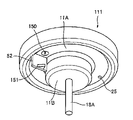
- FIG. 10 is a bottom view showing the ignition arrangement in a conventional combustion-type power tool.
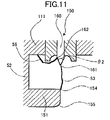
- FIG. 11 is a cross-sectional view showing an ignition arrangement in a conventional combustion-type power tool.
- FIGS. 1 through 8 A combustion-type power tool according to an embodiment of the invention will be described with reference to FIGS. 1 through 8 .
- the embodiment pertains to a combustion-type nail driver.
- the terms “upper”, “lower”, “above”, “below”, “upward”, “downward” and the like will be used assuming that the combustion-type nail driver is disposed in an orientation in which a nail is fired vertically downward.
- the combustion-type nail driver 1 shown in FIG. 1 has a housing 2 constituting an outer frame.
- a head cover 3 formed with an intake port 3 a is mounted on the top of the housing 2 .
- a handle 4 extends from one side of the housing 2 .
- the handle 4 has a trigger switch 5 and detachably accommodates therein a battery pack 4 a .
- the combustion-type nail driver 1 also has a canister housing 29 at one side of the housing 2 from which the handle 4 extends.
- a gas canister 30 (see FIG. 3 ) containing therein a combustible liquidized gas is detachably installable in the canister housing 29 .
- a magazine 6 accommodating therein a bundle of nails (not shown) is disposed below the handle 4 .
- a nose 7 extends from near the lower end of the housing 2 .
- the nose 7 is integral with a cylinder 20 described later and has a tip end abuttable on a workpiece 28 .
- the nose 7 is adapted for guiding sliding movement of a driver blade 23 a described later and for guiding the nail driven into the workpiece 28 .
- a push lever 9 is reciprocally slidingly movably supported to the nose 7 , and projects from the tip end 7 a of the nose 7 .
- the push lever 9 has an upper end in association with or abuttable on a connection unit 12 fixed to a combustion-chamber frame 10 described later.
- the connection unit 12 includes a pair of arm sections 12 A each having stepwise bending portions, and a connector section 12 B having a generally rectangular shape. Each upper end of each arm section 12 A is bent into L-shape and fixed to the combustion-chamber frame 10 . Each lower end of each arm section 12 A is fixed to the connector section 12 B by means of screws 12 C.
- the connector section 12 B has major sides each provided with an upstanding piece at each end portion of the major side. Each upstanding piece is formed with a thread hole with which each screw 12 C is threadingly engageable. Each upstanding piece is bent at an angle of substantially 90 degrees at each major side, so that two bent upstanding pieces are in confronting relation to each other.
- the connector section 12 B has a flat area beside the upstanding pieces. The flat area serves as a spring seat.
- a compression coil spring 22 is interposed between the connector section 12 B and the cylinder 20 for normally urging the push lever 9 in a protruding direction from the housing 2 .
- a cylinder head 11 is fixedly secured to the top of the housing 2 and substantially covers the open top end of the housing 2 .
- a motor 18 is disposed at one side of the cylinder head 11 opposite the combustion chamber 26 as will be described later.
- An ignition plug 50 (see FIG. 5 ) is disposed in the vicinity of the motor 18 and the ignition position is directed toward the combustion chamber 26 .
- a switch container 31 is provided in the lower side of the canister housing 29 .
- a switch 32 is contained the switch container 31 for detecting an uppermost stroke end position of the combustion-chamber frame 10 described later when the nail driver 1 is pressed against the workpiece 28 .
- the switch 32 can be turned ON when the push lever 9 is elevated to a predetermined position for starting rotation of the motor 18 .
- the cylinder head 11 has a handle side in which is formed a fuel ejection passage 25 which allows a combustible gas to pass therethrough.
- a fuel ejection passage 25 which allows a combustible gas to pass therethrough.
- One end of the ejection passage 25 opens at the lower surface of the cylinder head 11 .
- Another end of the ejection passage 25 serves as a gas canister connecting portion 25 a in communication with a gas canister 30 .
- the combustion-chamber frame 10 is provided in the housing 2 and is movable in the lengthwise direction of the housing 2 .
- the uppermost end of the combustion-chamber frame 10 is abuttable on the lower surface of the cylinder head 11 .
- the combustion-chamber frame includes a base chamber frame 10 a and a chamber head 10 b connected integrally using a bolt 10 c (see FIG. 2 ). Since the arm section 12 A is connected to the combustion-chamber frame 10 , the combustion-chamber frame 10 is moved in accordance with the movement of the push lever 9 .
- the cylinder 20 is fixed to the housing 2 .
- An outer peripheral surface of the cylinder 20 is in sliding contact with the inner circumference of the combustion-chamber frame 10 for guiding the movement of the combustion-chamber frame 10 .
- the cylinder 20 has an axially intermediate portion formed with an exhaust hole 21 .
- An exhaust-gas check valve 21 A is provided to selectively close the exhaust hole 21 .
- a piston 23 is slidably and reciprocally movably provided in the cylinder 20 .
- the piston 23 divides an inner space of the cylinder 20 into an upper space above the piston 23 and a lower space below the piston 23 .
- the driver blade 23 a extends downwards from the lower surface of the piston 23 to the nose 7 , so that the tip end of the driver blade 23 a can strike against the nail (not shown).
- a bumper 24 made from an elastic material such as rubber is disposed at a lower side of the cylinder 20 . The piston 23 strikes against the bumper 24 when the piston 23 is moved downward toward a bottom dead center.
- the housing 2 has a lower portion formed with an exhaust port 2 a .
- the first and second flow passages 27 A and 27 B allow a combustion gas and a fresh air to pass along the outer peripheral surface of the cylinder 20 for discharging these gases through the exhaust port 2 a of the housing 2 . Further, the above-described intake port 3 a is formed for supplying a fresh air into the combustion chamber 26 , and the exhaust hole 21 discharges combustion gas generated in the combustion chamber 26 .
- the motor 18 has a fan shaft 18 A, and a fan 19 positioned in the combustion chamber 26 is fixed to a tip end of the fan shaft 18 A. Rotation of the fan 19 performs the following three functions. First, the fan 19 stirs and mixes the air with the combustible gas as long as the combustion-chamber frame 10 remains in abutment with the cylinder head 11 . Second, after the mixed gas has been ignited, the fan 19 causes turbulence of the air-fuel mixture, thus promoting the turbulent combustion of the air-fuel mixture in the combustion chamber 26 .
- the fan 19 performs scavenging such that the exhaust gas in the combustion chamber 26 can be scavenged therefrom and also performs cooling of the cylinder 20 when the combustion-chamber frame 10 moves away from the cylinder head 11 and when the first and second flow passages 27 A and 27 B are provided.
- a plurality of ribs 10 A protrudes radially inwardly from the portion of the combustion chamber frame 10 , the portion defining the combustion chamber 26 .
- Each rib 10 A extends in the axial direction of the combustion chamber frame 10 .
- the ribs 10 A promote stirring and mixing of the air and the combustible gas in the combustion chamber 26 in cooperation with the fan 18 .
- the push lever 9 In the non-operational state of the combustion-type nail driver 1 , the push lever 9 is biased downward by the biasing force of the compression coil spring 22 , so that the push lever 9 protrudes from the lower end of the nose 7 .
- the uppermost end of the combustion-chamber frame 10 is spaced away from the cylinder head 11 because the combustion-chamber frame 10 is in association with the push lever 9 through the arm section 8 .
- a part of the combustion-chamber frame 10 which part defines the combustion chamber 26 is also spaced apart from the top portion of the cylinder 20 .
- the first and second flow passages 27 A and 27 B are provided. In this condition, the piston 23 stays at the top dead center in the cylinder 20 .
- the gas canister 30 is tilted toward the cylinder head 11 .
- the injection rod 30 a of the gas canister 30 is pressed against a gas canister connecting portion 25 a of the cylinder head 11 . Therefore, the liquidized combustible gas in the gas canister 30 is ejected once from the ejection port of the fuel ejection passage 25 into the combustion chamber 26 .
- the combustion-chamber frame 10 reaches the uppermost stroke end whereupon the switch 32 is turned ON to supply electric power to the motor 18 and start rotation of the fan 19 .
- the piston 23 strikes against the bumper 24 , and the combustion gas is discharged out of the cylinder 20 through the exhaust hole 21 of the cylinder 20 .
- the exhaust-gas check valve 21 A is closed. Combustion gas still remaining in the cylinder 20 and the combustion chamber 26 has a high temperature at a phase immediately after the combustion. The heat is absorbed through the inner surfaces of the cylinder 20 and the combustion-chamber frame 10 , and the temperature of these components is also increased. However, the absorbed heat is released to the atmosphere through the outer surfaces of the cylinder 20 and the combustion-chamber frame 10 .
- the trigger switch 5 is turned OFF, and the user lifts the nail driver 1 until the push lever 9 is separated from the workpiece 28 .
- the push lever 9 and the combustion-chamber frame 10 move downward due to the biasing force of the compression coil spring 22 .
- the fan 19 keeps rotating for a predetermined period of time in spite of OFF state of the trigger switch 5 because of an operation of a control portion (not shown).
- the first and second flow passages are provided at the upper side of the combustion-chamber frame 10 , so that fresh air flows into the combustion chamber 26 through the intake port 3 a formed in the head cover 3 and the residual gas is expelled through the exhaust port 2 a by the rotation of the fan 19 .
- the combustion chamber 26 is scavenged.
- the rotation of the fan 19 is stopped to restore an initial stationary state. Thereafter, subsequent nail driving operation can be performed by repeating the above described operation process.
- FIG. 5 is a perspective view particularly showing the cylinder head 11 as viewed from a side of a combustion chamber 26
- FIG. 6 is a schematic view as viewed up from the combustion chamber 26 toward the ignition ground 51 .
- the ignition plug 50 is fixed to the cylinder head 11 and an ignition point is exposed to the combustion chamber 26 through one end face 11 A of the cylinder head 11 .
- the one end face 11 A defines the upper end of the combustion chamber 26 .
- the ignition plug 50 has a core 60 having a cylindrical stem portion and a tapered tip end portion.
- a motor boss 11 B for storing the motor 18 protrudes from the one end face 11 A.
- the motor boss 11 B has an end portion from which the fan shaft 18 A extends.
- An ignition ground holding portion 52 protrudes from the end face 11 A and extends in a generally radial direction.
- the ignition ground 51 is attached to the ignition ground holding portion 52 at a position in confrontation with the ignition plug 50 .
- a spark 53 is shot between the ignition point of the ignition plug 50 and the ignition ground 51 .
- the spark 53 is shot from an acute corner 61 of the core 60 .
- a tip end of the core 60 has an acute angle ⁇ 1 of not more than 45 degrees (30 degrees in the illustrated embodiment).
- ⁇ 1 of not more than 45 degrees (30 degrees in the illustrated embodiment).
- the acute angle will lead to an increase in an angle at a discontinuous portion 62 at a boundary between the cylindrical stem portion and the tapered tip end portion.
- emission of an unwanted spark from the discontinuous portion 62 can be avoided.
- the unwanted spark is a spark that does not cause ignition of the air-fuel mixture.
- a side 55 opposite to the spark seating face of the ignition ground 51 is tapered as shown in FIG. 4 to provide an angle ⁇ 1 .
- This angle is about 30 degrees in the depicted embodiment.
- the ignition ground 51 has a triangular shape having an apex end providing an angle ⁇ 1 as shown in FIG. 6 . This angle is not more than 45 degrees (about 40 degrees in the depicted embodiment). Because of the apex portion, thermal capacity of the ignition ground 51 can be reduced and an acute angle can be realized to concentrate spark receiving point at the apex portion. As a result, ignitability can be enhanced.
- FIG. 7 is a graphical representation showing the relationship between the tip end angle ⁇ 1 and an emission rate of unwanted spark.
- emission of the unwanted spark can be restrained if the tip end angle is not more than 45 degrees.
- a volume of the ignition plug core 60 is reduced to reduce its thermal capacity. Consequently, absorption of a heat of the ignited fire into the ignition plug from the tip end 61 can also be restrained. As a result, stabilized ignition can result.
- FIG. 8 shows an ignition arrangement according to a second embodiment of the present invention.
- a line connecting the ignition point of the ignition plug 61 to an apex end of the ignition ground 54 does not extend in parallel with the axial direction of the cylinder, but these are offset from each other in a radial direction of the cylinder by an offset amount X of about 1 mm.
- This structure ensures a bridging of the spark 53 between the tip end portion 61 of the core 60 and the apex end 54 of the ignition ground 51 .
- heat absorption into the tip end portion of the ignition plug and into the apex end of the ignition ground can be reduced or restrained, and generation of unwanted spark can be avoided, thereby avoiding misfiring so that stabilized ignition can be realized.
- FIGS. 9 through 11 show the conventional ignition arrangement.
- An angle ⁇ 2 of the tip end portion 161 of the core 160 was 60 degrees as shown in FIG. 11 .
- unwanted spark 56 may be emitted from the angled portion 162 of the ignition core 160 toward the head cover 113 .
- This spark 56 does not cause ignition of the air-fuel mixture.
- the apex angle ⁇ 2 at the apex portion 154 of the ignition ground 151 was in a range of from 50 to 60 degrees, and a side opposite to the spark receiving side of the ignition ground 151 extends approximately parallel thereto with a minute round portion 155 .
- Such arrangement of the ignition ground could not sufficiently reduce its thermal capacity. Therefore, a heat of the ignited fire may be robbed by the ignition ground 151 . The heat is also robbed into the ignition plug 150 due to its thermal capacity greater than that of the present embodiment.
Landscapes
- Engineering & Computer Science (AREA)
- Chemical & Material Sciences (AREA)
- Combustion & Propulsion (AREA)
- Mechanical Engineering (AREA)
- Portable Nailing Machines And Staplers (AREA)
- Spark Plugs (AREA)
Applications Claiming Priority (2)
| Application Number | Priority Date | Filing Date | Title |
|---|---|---|---|
| JP2005043277A JP4586564B2 (ja) | 2005-02-18 | 2005-02-18 | 燃焼式釘打機 |
| JPP2005-043277 | 2005-02-18 |
Publications (2)
| Publication Number | Publication Date |
|---|---|
| US20060185629A1 US20060185629A1 (en) | 2006-08-24 |
| US7293541B2 true US7293541B2 (en) | 2007-11-13 |
Family
ID=36405941
Family Applications (1)
| Application Number | Title | Priority Date | Filing Date |
|---|---|---|---|
| US11/356,105 Expired - Fee Related US7293541B2 (en) | 2005-02-18 | 2006-02-17 | Combustion-type power tool having ignition proof arrangement |
Country Status (3)
| Country | Link |
|---|---|
| US (1) | US7293541B2 (enExample) |
| EP (1) | EP1693157B1 (enExample) |
| JP (1) | JP4586564B2 (enExample) |
Families Citing this family (3)
| Publication number | Priority date | Publication date | Assignee | Title |
|---|---|---|---|---|
| US7931181B2 (en) * | 2005-02-18 | 2011-04-26 | Hitachi Koki Co., Ltd. | Combustion-type power tool with trigger control arrangements |
| JP5122204B2 (ja) * | 2007-07-26 | 2013-01-16 | 株式会社マキタ | 燃焼式打ち込み工具 |
| JP6720634B2 (ja) * | 2016-03-29 | 2020-07-08 | マックス株式会社 | 手持ち工具 |
Citations (10)
| Publication number | Priority date | Publication date | Assignee | Title |
|---|---|---|---|---|
| US4522162A (en) | 1981-01-22 | 1985-06-11 | Signode Corporation | Portable gas-powered tool with linear motor |
| JPH0325307A (ja) | 1989-06-22 | 1991-02-04 | Fuji Electric Co Ltd | 外光三角方式測距装置 |
| US5197646A (en) | 1992-03-09 | 1993-03-30 | Illinois Tool Works Inc. | Combustion-powered tool assembly |
| US5373214A (en) * | 1992-06-12 | 1994-12-13 | Mccready; David F. | Spark plug and electrode arrangement therefor |
| JPH0736985A (ja) | 1993-07-15 | 1995-02-07 | Toray Ind Inc | 洗濯物管理用表示体および洗濯物の管理方法 |
| US5408961A (en) * | 1993-08-09 | 1995-04-25 | Innovative Automative Technologies Int. Ltd. | Ignition plug |
| US5598816A (en) * | 1989-09-08 | 1997-02-04 | Pedersen; John R. C. | Carburetor metering system alone and in combination with a wick or spark plug |
| US6495948B1 (en) * | 1998-03-02 | 2002-12-17 | Pyrotek Enterprises, Inc. | Spark plug |
| US6611084B2 (en) * | 2001-02-27 | 2003-08-26 | Ngk Spark Plug Co., Ltd. | Spark plug |
| US6783047B2 (en) * | 2002-04-24 | 2004-08-31 | Hilti Aktiengesellschaft | Expanding gas-operated setting tool |
Family Cites Families (13)
| Publication number | Priority date | Publication date | Assignee | Title |
|---|---|---|---|---|
| DE2520622A1 (de) * | 1975-05-09 | 1976-11-18 | Bosch Gmbh Robert | Zuendkerze fuer brennkraftmaschinen |
| JPS6145583A (ja) * | 1984-08-07 | 1986-03-05 | 日本特殊陶業株式会社 | 点火プラグ |
| JPH04236231A (ja) | 1991-01-16 | 1992-08-25 | Nippon Paint Co Ltd | 2−プロピニルオキシ基を有するシリコーン化合物 |
| BE1009076A5 (fr) * | 1993-03-02 | 1996-11-05 | Bogaert Bernard Van Den | Electrode de masse amelioree pour bougie. |
| US5650687A (en) * | 1994-03-01 | 1997-07-22 | Van Den Bogaert; Bernard | Ground electrodes for ignition plugs |
| DE19950351C2 (de) * | 1999-10-19 | 2002-06-13 | Hilti Ag | Vorrichtung zur Erzeugung einer laminaren Flammfront, insbesondere für brennkraftbetriebene Setzgeräte zum Setzen von Befestigungselementen |
| JP3980279B2 (ja) * | 2000-02-16 | 2007-09-26 | 日本特殊陶業株式会社 | スパークプラグ |
| JP4705280B2 (ja) * | 2001-08-10 | 2011-06-22 | 日本特殊陶業株式会社 | スパークプラグ |
| JP2004207219A (ja) * | 2002-12-10 | 2004-07-22 | Denso Corp | スパークプラグ |
| JP4039269B2 (ja) * | 2003-02-21 | 2008-01-30 | 日立工機株式会社 | 燃焼式動力工具 |
| JP4158598B2 (ja) * | 2003-05-15 | 2008-10-01 | 日立工機株式会社 | 燃焼式動力工具 |
| JP2005056786A (ja) * | 2003-08-07 | 2005-03-03 | Denso Corp | スパークプラグ |
| JP4144472B2 (ja) * | 2003-08-11 | 2008-09-03 | 日立工機株式会社 | 燃焼式動力工具 |
-
2005
- 2005-02-18 JP JP2005043277A patent/JP4586564B2/ja not_active Expired - Fee Related
-
2006
- 2006-02-17 US US11/356,105 patent/US7293541B2/en not_active Expired - Fee Related
- 2006-02-18 EP EP06250877A patent/EP1693157B1/en not_active Not-in-force
Patent Citations (11)
| Publication number | Priority date | Publication date | Assignee | Title |
|---|---|---|---|---|
| US4522162A (en) | 1981-01-22 | 1985-06-11 | Signode Corporation | Portable gas-powered tool with linear motor |
| US4522162B1 (enExample) | 1981-01-22 | 1989-03-21 | ||
| JPH0325307A (ja) | 1989-06-22 | 1991-02-04 | Fuji Electric Co Ltd | 外光三角方式測距装置 |
| US5598816A (en) * | 1989-09-08 | 1997-02-04 | Pedersen; John R. C. | Carburetor metering system alone and in combination with a wick or spark plug |
| US5197646A (en) | 1992-03-09 | 1993-03-30 | Illinois Tool Works Inc. | Combustion-powered tool assembly |
| US5373214A (en) * | 1992-06-12 | 1994-12-13 | Mccready; David F. | Spark plug and electrode arrangement therefor |
| JPH0736985A (ja) | 1993-07-15 | 1995-02-07 | Toray Ind Inc | 洗濯物管理用表示体および洗濯物の管理方法 |
| US5408961A (en) * | 1993-08-09 | 1995-04-25 | Innovative Automative Technologies Int. Ltd. | Ignition plug |
| US6495948B1 (en) * | 1998-03-02 | 2002-12-17 | Pyrotek Enterprises, Inc. | Spark plug |
| US6611084B2 (en) * | 2001-02-27 | 2003-08-26 | Ngk Spark Plug Co., Ltd. | Spark plug |
| US6783047B2 (en) * | 2002-04-24 | 2004-08-31 | Hilti Aktiengesellschaft | Expanding gas-operated setting tool |
Also Published As
| Publication number | Publication date |
|---|---|
| US20060185629A1 (en) | 2006-08-24 |
| JP2006224269A (ja) | 2006-08-31 |
| JP4586564B2 (ja) | 2010-11-24 |
| EP1693157B1 (en) | 2011-11-02 |
| EP1693157A2 (en) | 2006-08-23 |
| EP1693157A3 (en) | 2010-02-24 |
Similar Documents
| Publication | Publication Date | Title |
|---|---|---|
| US7316209B2 (en) | Combustion type power tool having buffer piece | |
| US7194988B2 (en) | Combustion-type power tool | |
| US20100187280A1 (en) | Combustion-type power tool | |
| US7387092B2 (en) | Combustion-type power tool having cooling arrangement | |
| US20070138231A1 (en) | Combustion type power tool having segmental connection unit | |
| US7484481B2 (en) | Combustion-type power tool having switch protection arrangement | |
| US7931181B2 (en) | Combustion-type power tool with trigger control arrangements | |
| US7743955B2 (en) | Combustion type power tool having fan | |
| US7066117B2 (en) | Combustion chamber arrangement in combustion type power tool | |
| US7063053B2 (en) | Combustion type power tool having fin for effectively cooling cylinder | |
| US7305940B2 (en) | Combustion-type power tool having ignition proof arrangement | |
| US20060042574A1 (en) | Combustion-type power tool providing specific spark energy | |
| US7293541B2 (en) | Combustion-type power tool having ignition proof arrangement | |
| US7131404B2 (en) | Combustion-type power tool having gas canister cooling arrangement |
Legal Events
| Date | Code | Title | Description |
|---|---|---|---|
| AS | Assignment |
Owner name: HITACHI KOKI CO., LTD., JAPAN Free format text: ASSIGNMENT OF ASSIGNORS INTEREST;ASSIGNORS:NISHIKAWA, TOMOMASA;FUJISAWA, HARUHISA;OHTSU, SHINKI;REEL/FRAME:017851/0338 Effective date: 20060417 |
|
| STCF | Information on status: patent grant |
Free format text: PATENTED CASE |
|
| FEPP | Fee payment procedure |
Free format text: PAYOR NUMBER ASSIGNED (ORIGINAL EVENT CODE: ASPN); ENTITY STATUS OF PATENT OWNER: LARGE ENTITY |
|
| FPAY | Fee payment |
Year of fee payment: 4 |
|
| FPAY | Fee payment |
Year of fee payment: 8 |
|
| FEPP | Fee payment procedure |
Free format text: MAINTENANCE FEE REMINDER MAILED (ORIGINAL EVENT CODE: REM.); ENTITY STATUS OF PATENT OWNER: LARGE ENTITY |
|
| LAPS | Lapse for failure to pay maintenance fees |
Free format text: PATENT EXPIRED FOR FAILURE TO PAY MAINTENANCE FEES (ORIGINAL EVENT CODE: EXP.); ENTITY STATUS OF PATENT OWNER: LARGE ENTITY |
|
| STCH | Information on status: patent discontinuation |
Free format text: PATENT EXPIRED DUE TO NONPAYMENT OF MAINTENANCE FEES UNDER 37 CFR 1.362 |
|
| FP | Lapsed due to failure to pay maintenance fee |
Effective date: 20191113 |