US7289832B1 - Mobile station used for CDMA mobile communication systems - Google Patents
Mobile station used for CDMA mobile communication systems Download PDFInfo
- Publication number
- US7289832B1 US7289832B1 US09/664,855 US66485500A US7289832B1 US 7289832 B1 US7289832 B1 US 7289832B1 US 66485500 A US66485500 A US 66485500A US 7289832 B1 US7289832 B1 US 7289832B1
- Authority
- US
- United States
- Prior art keywords
- base station
- location registration
- registration request
- request signal
- receiver
- Prior art date
- Legal status (The legal status is an assumption and is not a legal conclusion. Google has not performed a legal analysis and makes no representation as to the accuracy of the status listed.)
- Expired - Fee Related, expires
Links
Images



Classifications
-
- H—ELECTRICITY
- H04—ELECTRIC COMMUNICATION TECHNIQUE
- H04W—WIRELESS COMMUNICATION NETWORKS
- H04W60/00—Affiliation to network, e.g. registration; Terminating affiliation with the network, e.g. de-registration
- H04W60/02—Affiliation to network, e.g. registration; Terminating affiliation with the network, e.g. de-registration by periodical registration
-
- H—ELECTRICITY
- H04—ELECTRIC COMMUNICATION TECHNIQUE
- H04W—WIRELESS COMMUNICATION NETWORKS
- H04W52/00—Power management, e.g. Transmission Power Control [TPC] or power classes
- H04W52/02—Power saving arrangements
- H04W52/0209—Power saving arrangements in terminal devices
- H04W52/0225—Power saving arrangements in terminal devices using monitoring of external events, e.g. the presence of a signal
- H04W52/0241—Power saving arrangements in terminal devices using monitoring of external events, e.g. the presence of a signal where no transmission is received, e.g. out of range of the transmitter
-
- H—ELECTRICITY
- H04—ELECTRIC COMMUNICATION TECHNIQUE
- H04W—WIRELESS COMMUNICATION NETWORKS
- H04W88/00—Devices specially adapted for wireless communication networks, e.g. terminals, base stations or access point devices
- H04W88/02—Terminal devices
-
- Y—GENERAL TAGGING OF NEW TECHNOLOGICAL DEVELOPMENTS; GENERAL TAGGING OF CROSS-SECTIONAL TECHNOLOGIES SPANNING OVER SEVERAL SECTIONS OF THE IPC; TECHNICAL SUBJECTS COVERED BY FORMER USPC CROSS-REFERENCE ART COLLECTIONS [XRACs] AND DIGESTS
- Y02—TECHNOLOGIES OR APPLICATIONS FOR MITIGATION OR ADAPTATION AGAINST CLIMATE CHANGE
- Y02D—CLIMATE CHANGE MITIGATION TECHNOLOGIES IN INFORMATION AND COMMUNICATION TECHNOLOGIES [ICT], I.E. INFORMATION AND COMMUNICATION TECHNOLOGIES AIMING AT THE REDUCTION OF THEIR OWN ENERGY USE
- Y02D30/00—Reducing energy consumption in communication networks
- Y02D30/70—Reducing energy consumption in communication networks in wireless communication networks
Definitions
- the system performs a location registration process to recognize where a mobile station is located before the mobile station enters the standby status. Even in the standby status, this process is performed, for the center to control the movement of the mobile station, periodically or every time the registered area for a location is changed.
- FIG. 6 specifically illustrates the flow of this location registration process.
- the mobile station acquires a base station (step S 180 ). This is a process in which a base station that transmits a signal having a receiving electric field of a level higher than a predetermined level is sought for.
- OUT OF AREA is displayed (steps S 182 and S 184 ).
- the timer is set (step S 188 ), and another attempt to acquire a base station is made (step S 180 ) after the timer has counted a predetermined period of time (step S 190 ).
- a base station providing high receiving quality is acquired, and the signals from the acquired base station are received (step S 186 ). Then predetermined information is extracted from the received signals, and it is determined whether the location registration process is necessary (step S 192 ). If it is determined that the location registration process is not necessary, the standby status is set (step S 194 ). If it is determined that the location registration process is necessary, the location registration request signal is transmitted to the base station (step 196 ). When the location registration request signal is received by the base station, the acknowledge signal is usually transmitted from the corresponding base station, and the mobile station waits for the acknowledge signal for a predetermined period of time (step S 198 ).
- the location registration is completed and the standby status is entered (step S 194 ).
- the acknowledge signal is not received within the predetermined period of time, the location registration request signal is transmitted again after acquiring the base station, and the mobile station waits for the acknowledge signal from the base station. If the mobile station moves only a little under such a situation, the location registration request signal does not reach the base station making it impossible for the base station to transmit the acknowledge signal. Consequently, the mobile station has to continue the location registration process solely waiting for the acknowledge signal.
- the mobile station has to wait for the acknowledge signal from the base station for a long period of time significantly consuming the batteries.
- the base station can not transmit the acknowledge signal to the mobile station because the location acknowledge signal does not reach the base station. If the acknowledge signal is not received after waiting a predetermined period of time, the mobile station acquires the base station again and requests the location registration, keeping waiting for the acknowledge signal and consuming the power.
- a first aspect of the present invention relates to a mobile station for a CDMA mobile communication system, comprising: a transmitting section for transmitting a location registration request signal to a base station; a receiving section for receiving an acknowledge signal from the base station after the base station receives the location registration request signal from the transmitting section; and a control section for prohibiting power supply to the receiving section for a predetermined period of time if the acknowledge signal transmitted from the base station is not received within a predetermined period of time after the location registration request signal has been transmitted from the transmitting section.
- a second aspect of the present invention relates to a mobile station for a CDMA mobile communication system, comprising: a transmitting section for transmitting a location registration request signal to a base station; a receiving section for receiving an acknowledge signal from the base station after the base station receives the location registration request signal from the transmitting section; and a control section for disabling the receiving section for a predetermined period of time if the acknowledge signal transmitted from the base station is not received within a predetermined period of time after the location registration request signal has been transmitted from the transmitting section.
- a third aspect of the present invention relates to a mobile station for a CDMA mobile communication system, comprising: a transmitting section for transmitting a location registration request signal to a first base station; a receiving section for receiving an acknowledge signal from the first base station after the first base station receives the location registration request signal from the transmitting section; an acquiring section for acquiring a second base station if the acknowledge signal transmitted from the first base station is not received within a predetermined period of time after the location registration request signal has been transmitted from the transmitting section; and a causing section for transmitting a location registration request signal to the acquired second base station, and causing the receiving section to receive an acknowledge signal from the second base station after the second base station receives the location registration request signal from the transmitting section.
- a fourth aspect of the present invention relates to a method of registering a location of a mobile station in a CDMA mobile communication system, comprising the step of: transmitting a location registration request signal from a transmitting section of the mobile station to a base station; receiving at a receiving section of the mobile station an acknowledge signal from the base station after the base station receives the location registration request signal from the transmitting section; and prohibiting at a control section power supply to the receiving section for a predetermined period of time if the acknowledge signal transmitted from the base station is not received within a predetermined period of time after the location registration request signal has been transmitted from the transmitting section.
- FIG. 1A is a block diagram showing an embodiment of the present invention.
- FIG. 1B is a block diagram showing an alternative embodiment of the present invention.
- FIG. 2 is a flowchart showing part of an embodiment of the present invention.
- FIG. 3 is a flowchart showing part of an alternative embodiment of the present invention.
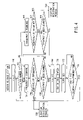
- FIG. 4 is a flowchart showing the base station acquiring process of an embodiment of the present invention.
- FIG. 5 is a schematic diagram showing an alternative embodiment of the present invention.
- FIG. 6 is a flowchart for an example of the prior art.
- FIG. 1A illustrates a mobile station
- high frequency signals are generated from the sound which is input to the microphone 1 through the transmitting section 2 .
- the shared unit 4 introduces the high frequency signals to the antenna 10 to transmit them as high frequency reverse signals.
- the high frequency forward signals that have been transmitted from the base station are received by the antenna of the shared unit 4 .
- the high frequency forward signals that have been received are converted to intermediate frequency signals by frequency conversion after being amplified by the IF section 12 .
- the signals that have been converted to intermediate frequency signals, after being amplified by the IF section 14 are converted to base band signals and demodulated.
- the signals that have been converted to base band signals are signal-processed by the BB section 16 , converted analog sound signals, and output from the speaker 18 .
- control section 20 provides instruction signals to the switches 22 , 24 , and 26 that control the on-off of the power source Vcc for the RF section, IF section, and BB section.
- This embodiment features the following.
- the base station can not transmit the location registration acknowledge signal if the location registration request signal does not reach the base station due to the conditions of radio wave propagation environment.
- the mobile station solely waiting for the location registration acknowledge signal, continues sending the location registration request signal until the location registration acknowledge signal is received.
- the object of the embodiment of the invention is to prevent the consumption of power by turning OFF the power supply to the receiving section for a certain period of time when the location registration acknowledge signal from the base station is not received.
- the mobile station starts acquiring a base station when the power source is turned on or a certain period of time has elapsed under standby status (step S 102 ). That is, the mobile station receives information transmitted by base stations, and it is determined whether the received signals are above a predetermined level (step S 104 ). If signals above a predetermined level are not received, OUT OF AREA is displayed (step S 106 ). If signals above the predetermined level are received, the mobile station acquires the base station that provides the signal of the best quality. If OUT OF AREA is displayed, the timer is set (step S 108 ), and a new attempt to acquire a base station is made after the timer has counted a predetermined period of time (step S 110 ).
- the mobile station After deciding the base station to communicated with in the step S 104 , the mobile station receives signals from the base station to extract specified information (step S 112 ), and determines whether the location registration is necessary by comparing the extracted information with the information stored during the standby period before determining whether the location registration is necessary (step S 114 ). When it is determined that the location registration is not necessary, the standby status is set (step S 116 ). When it is determined that the location registration is necessary, the location registration request signal is transmitted (step S 118 ). Because the acknowledge signal is usually transmitted when the location registration request signal is received by a base station, the mobile station waits for the acknowledge signal from the base station (step S 120 ).
- step S 116 If the acknowledge signal is returned within a predetermined period of time, the location registration is completed, and the mobile station enters the standby status (step S 116 ). If the acknowledge signal is not received within a predetermined period of time, the power supply to the RF section 12 , IF section 14 , and BB section 16 of the receiving section is suspended for a predetermined period of time n (steps S 120 and S 122 ).
- the value of the predetermined period of time n is taken, for example, as 30 seconds, 1 minute, or 2 minutes.
- the power supply is turned off by the control section 20 using the switches 22 , 24 , and 26 .
- the mobile station resumes power supply to start acquiring a base station (step S 125 ). If a calling is requested (step S 124 ), another attempt is made to acquire a base station (steps S 130 and S 132 ) as illustrated in FIG. 3 . If the acquiring of a base station is not completed, OUT OF AREA is displayed (step S 136 ).
- step S 138 calling signals including the location registration signal are transmitted (step S 138 ), which is received by the base station and the acknowledge signal is returned.
- step S 140 the mobile station begins communication through the assigned communication channel (step S 142 ), and returns to the standby status after completing the communication (steps S 144 and S 146 ).
- the power supply to the receiving section is controlled and turned off.
- FIG. 1B that illustrates a specific constitution of such an arrangement, while the receiving signal is supplied to the RF section 12 and the IF section 14 , the receiving action is prohibited for a predetermined period n by preventing the receiving signal from being supplied to the BB section 16 by controlling the toggling of the switch 30 using the control signal from the control section 20 . This results in the saving of power because the location registration process is eliminated.
- FIG. 4 illustrates a preferable embodiment of base-station acquirement described in FIGS. 2 and 3 .
- the mobile station in an area where the forward signal from a base station reaches the mobile station well but it is difficult for the reverse signal to reach the base station, the mobile station often fails repeatedly to receive the location registration acknowledge signal.
- the mobile station when the mobile station has failed once to receive the location registration acknowledge signal, the mobile station searches for another base station different from the one that has been acquired and communicates with the second base station of the newly-found system, so that the failure to receive the acknowledge signal is prevented. This is particularly effective when the mobile station is located in an area where two base stations overlap.
- the counter variable m is set to 1 (step S 150 ), and it is determined whether m is an odd number (step S 152 ). If m is an odd number, one of the usable frequencies (referred to as frequency A and the other is referred to as frequency B), is scanned (step S 154 ). Then, it is determined whether a base station has been acquired using frequency A (step S 156 ), and the procedure proceeds to the location registration process if succeeded (step S 158 ). If failed to acquire using frequency A, it is checked whether frequency B has been scanned (step S 158 ). If not, frequency B is scanned (step S 160 ).
- step S 162 it is determined whether frequency B has succeeded to acquire a base station (step S 162 ), and the procedure proceeds to the location registration process if succeeded (step S 164 ). If frequency B has failed to acquire a base station, it is checked whether frequency A has been scanned (step S 166 ). If not, frequency A is scanned in step S 154 .
- step S 158 If it is found that frequency B has been scanned in step S 158 , or that frequency A has been scanned in step S 166 , the value of m is incremented (step S 168 ), and OUT OF AREA is displayed (step S 170 ) assuming that both frequency A and frequency B have failed to acquire a base station. Then the timer is set and it is determined whether the predetermined period of time has elapsed (steps S 172 and S 174 ). When the predetermined period of time has elapsed, the procedure returns to step S 152 and decide the order of the frequencies to be scanned based on the value of m. That is, if m is an even number, frequency B is scanned first to acquire a base station, then frequency A is scanned if a base station is not acquired using frequency B.
- the period of time for which the power supply is suspended when the acknowledge signal corresponding to the location registration request signal is not received is assumed to be constant, it is also possible, as shown in FIG. 5 , that the power consumption is more effectively saved by increasing the period of power supply suspension stepwise.
- the intervals of power supply suspension are, for example, interval A is 30 seconds, interval B 1 minutes, and interval C 2 minutes.
- the mobile station according to the present invention turns off the power supply to the receiving section or prohibits the action of the receiving section for a predetermined period of time when the acknowledge signal is not received within a predetermined period after the location registration request signal is transmitted.
- it is enabled to save the power by eliminating the situation of the prior art in which the mobile station continues to transmit the location registration request signals solely keeping waiting for the acknowledge signal when the acknowledge signal is not received.
Landscapes
- Engineering & Computer Science (AREA)
- Computer Networks & Wireless Communication (AREA)
- Signal Processing (AREA)
- Mobile Radio Communication Systems (AREA)
Priority Applications (1)
| Application Number | Priority Date | Filing Date | Title |
|---|---|---|---|
| US11/780,947 US7890148B2 (en) | 1999-09-29 | 2007-07-20 | Mobile station used for CDMA mobile communication systems |
Applications Claiming Priority (1)
| Application Number | Priority Date | Filing Date | Title |
|---|---|---|---|
| JP27551499A JP4046909B2 (ja) | 1999-09-29 | 1999-09-29 | 移動局 |
Related Child Applications (1)
| Application Number | Title | Priority Date | Filing Date |
|---|---|---|---|
| US11/780,947 Continuation US7890148B2 (en) | 1999-09-29 | 2007-07-20 | Mobile station used for CDMA mobile communication systems |
Publications (1)
| Publication Number | Publication Date |
|---|---|
| US7289832B1 true US7289832B1 (en) | 2007-10-30 |
Family
ID=17556542
Family Applications (2)
| Application Number | Title | Priority Date | Filing Date |
|---|---|---|---|
| US09/664,855 Expired - Fee Related US7289832B1 (en) | 1999-09-29 | 2000-09-19 | Mobile station used for CDMA mobile communication systems |
| US11/780,947 Expired - Fee Related US7890148B2 (en) | 1999-09-29 | 2007-07-20 | Mobile station used for CDMA mobile communication systems |
Family Applications After (1)
| Application Number | Title | Priority Date | Filing Date |
|---|---|---|---|
| US11/780,947 Expired - Fee Related US7890148B2 (en) | 1999-09-29 | 2007-07-20 | Mobile station used for CDMA mobile communication systems |
Country Status (2)
| Country | Link |
|---|---|
| US (2) | US7289832B1 (enExample) |
| JP (1) | JP4046909B2 (enExample) |
Cited By (7)
| Publication number | Priority date | Publication date | Assignee | Title |
|---|---|---|---|---|
| US20040087350A1 (en) * | 2002-10-30 | 2004-05-06 | Nec Corporation | Mobile phone with power saving function |
| US20060240798A1 (en) * | 2005-03-11 | 2006-10-26 | Tadeusz Jarosinski | Apparatus and methods for control of sleep modes in a transceiver |
| US20070070908A1 (en) * | 2005-09-27 | 2007-03-29 | Donna Ghosh | Method and apparatus for carrier allocation and management in multi-carrier communication systems |
| US20080235529A1 (en) * | 2007-03-22 | 2008-09-25 | Kabushiki Kaisha Toshiba | Information processing apparatus and cellular phone |
| US20100022272A1 (en) * | 2000-12-22 | 2010-01-28 | Shah Nitin J | Method and apparatus for disabling the rf functionality of a multi-function wireless communication device while maintaining access to local functionality |
| US9867131B2 (en) | 2013-06-17 | 2018-01-09 | Huawei Device (Dongguan) Co., Ltd. | Wake-up control method and apparatus, and terminal device |
| US20230291781A1 (en) * | 2022-03-11 | 2023-09-14 | Qualcomm Incorporated | Techniques for multimedia uplink packet handling |
Families Citing this family (4)
| Publication number | Priority date | Publication date | Assignee | Title |
|---|---|---|---|---|
| JP3525828B2 (ja) | 1999-11-01 | 2004-05-10 | 株式会社日立製作所 | 位置登録制御方法とそれを用いた移動局装置 |
| WO2005086378A1 (en) | 2004-03-04 | 2005-09-15 | Sk Telecom Co., Ltd. | Multi-mode multi-band mobile communication terminal and mode switching method thereof |
| EP2092771B1 (en) * | 2006-10-25 | 2018-06-27 | QUALCOMM Incorporated | Uniform out-of-service search for wireless communication systems |
| EP2210242A4 (en) * | 2007-11-13 | 2012-04-18 | Spielo Mfg Ulc | WIRELESS WEATHER SYSTEM |
Citations (6)
| Publication number | Priority date | Publication date | Assignee | Title |
|---|---|---|---|---|
| US5031231A (en) * | 1988-09-26 | 1991-07-09 | Nec Corporation | Mobile telephone station with power saving circuit |
| US5351041A (en) * | 1990-10-25 | 1994-09-27 | Pioneer Electronic Corporation | Method of data communication in communication network on automobile |
| US5797094A (en) * | 1995-05-23 | 1998-08-18 | Telefonaktiebolaget L M Ericsson (Publ) | Method and apparatus for supporting the delivery of short message service messages to sleeping mobile stations in a cellular communications system |
| US6073035A (en) * | 1996-08-09 | 2000-06-06 | Oki Telecom, Inc. | System unavailablity power reduction method with early failure and no rotation |
| US6181938B1 (en) * | 1996-06-07 | 2001-01-30 | Kolster Oy Ab | Intelligent call routing in telecommunication network with dual mode terminals |
| US6421539B1 (en) * | 1998-08-27 | 2002-07-16 | Samsung Electronics Co Ltd | Method for registering the location of a mobile station after performing inter-MSC soft handoff in a cellular |
Family Cites Families (6)
| Publication number | Priority date | Publication date | Assignee | Title |
|---|---|---|---|---|
| JPH0653881A (ja) | 1992-08-03 | 1994-02-25 | Nippon Telegr & Teleph Corp <Ntt> | 移動通信方式およびこれに用いる受信装置 |
| JPH0787010A (ja) | 1993-09-17 | 1995-03-31 | Fujitsu Ltd | 携帯電話システム用移動機のバッテリセービング回路 |
| JPH0851661A (ja) | 1994-08-04 | 1996-02-20 | Toyo Commun Equip Co Ltd | 移動無線通信システム |
| JP3119565B2 (ja) | 1995-01-26 | 2000-12-25 | 日本電気移動通信株式会社 | 無線通信装置 |
| JPH09294288A (ja) | 1996-04-25 | 1997-11-11 | Toshiba Corp | 無線通信機能付き情報処理装置及び無線通信方法 |
| JP2878205B2 (ja) | 1996-09-30 | 1999-04-05 | 日本電気アイシーマイコンシステム株式会社 | 移動体通信装置及びその制御方法 |
-
1999
- 1999-09-29 JP JP27551499A patent/JP4046909B2/ja not_active Expired - Fee Related
-
2000
- 2000-09-19 US US09/664,855 patent/US7289832B1/en not_active Expired - Fee Related
-
2007
- 2007-07-20 US US11/780,947 patent/US7890148B2/en not_active Expired - Fee Related
Patent Citations (6)
| Publication number | Priority date | Publication date | Assignee | Title |
|---|---|---|---|---|
| US5031231A (en) * | 1988-09-26 | 1991-07-09 | Nec Corporation | Mobile telephone station with power saving circuit |
| US5351041A (en) * | 1990-10-25 | 1994-09-27 | Pioneer Electronic Corporation | Method of data communication in communication network on automobile |
| US5797094A (en) * | 1995-05-23 | 1998-08-18 | Telefonaktiebolaget L M Ericsson (Publ) | Method and apparatus for supporting the delivery of short message service messages to sleeping mobile stations in a cellular communications system |
| US6181938B1 (en) * | 1996-06-07 | 2001-01-30 | Kolster Oy Ab | Intelligent call routing in telecommunication network with dual mode terminals |
| US6073035A (en) * | 1996-08-09 | 2000-06-06 | Oki Telecom, Inc. | System unavailablity power reduction method with early failure and no rotation |
| US6421539B1 (en) * | 1998-08-27 | 2002-07-16 | Samsung Electronics Co Ltd | Method for registering the location of a mobile station after performing inter-MSC soft handoff in a cellular |
Cited By (17)
| Publication number | Priority date | Publication date | Assignee | Title |
|---|---|---|---|---|
| US20100022272A1 (en) * | 2000-12-22 | 2010-01-28 | Shah Nitin J | Method and apparatus for disabling the rf functionality of a multi-function wireless communication device while maintaining access to local functionality |
| US9055426B2 (en) | 2000-12-22 | 2015-06-09 | Durham Logistics, Llc | Method and apparatus for disabling the RF functionality of a multi-function wireless communication device while maintaining access to local functionality |
| US8706161B2 (en) | 2000-12-22 | 2014-04-22 | Durham Logistics, Llc | Method and apparatus for disabling the RF functionality of a multi-function wireless communication device while maintaining access to local functionality |
| US8175642B2 (en) | 2000-12-22 | 2012-05-08 | Durham Logistics, Llc | Method and apparatus for disabling the RF functionality of a multi-function wireless communication device while maintaining access to local functionality |
| US8019384B2 (en) * | 2000-12-22 | 2011-09-13 | Durham Logistics, Llc | Method and apparatus for disabling the RF functionality of a multi-function wireless communication device while maintaining access to local functionality |
| US7653419B2 (en) * | 2002-10-30 | 2010-01-26 | Nec Corporation | Mobile phone with power saving function |
| US20040087350A1 (en) * | 2002-10-30 | 2004-05-06 | Nec Corporation | Mobile phone with power saving function |
| US8509859B2 (en) * | 2005-03-11 | 2013-08-13 | Qualcomm Incorporated | Apparatus and methods for control of sleep modes in a transceiver |
| US20060240798A1 (en) * | 2005-03-11 | 2006-10-26 | Tadeusz Jarosinski | Apparatus and methods for control of sleep modes in a transceiver |
| US20070070908A1 (en) * | 2005-09-27 | 2007-03-29 | Donna Ghosh | Method and apparatus for carrier allocation and management in multi-carrier communication systems |
| US9955438B2 (en) * | 2005-09-27 | 2018-04-24 | Qualcomm Incorporated | Method and apparatus for carrier allocation and management in multi-carrier communication systems |
| US7930001B2 (en) * | 2007-03-22 | 2011-04-19 | Fujitsu Toshiba Mobile Communications Limited | Information processing apparatus and cellular phone |
| US20080235529A1 (en) * | 2007-03-22 | 2008-09-25 | Kabushiki Kaisha Toshiba | Information processing apparatus and cellular phone |
| US9867131B2 (en) | 2013-06-17 | 2018-01-09 | Huawei Device (Dongguan) Co., Ltd. | Wake-up control method and apparatus, and terminal device |
| US10057856B2 (en) | 2013-06-17 | 2018-08-21 | Huawei Device (Dongguan) Co., Ltd. | Wake-up control method and apparatus, and terminal device |
| US20230291781A1 (en) * | 2022-03-11 | 2023-09-14 | Qualcomm Incorporated | Techniques for multimedia uplink packet handling |
| US12261899B2 (en) * | 2022-03-11 | 2025-03-25 | Qualcomm Incorporated | Techniques for multimedia uplink packet handling |
Also Published As
| Publication number | Publication date |
|---|---|
| US20070263555A1 (en) | 2007-11-15 |
| JP4046909B2 (ja) | 2008-02-13 |
| JP2001102990A (ja) | 2001-04-13 |
| US7890148B2 (en) | 2011-02-15 |
Similar Documents
| Publication | Publication Date | Title |
|---|---|---|
| US7890148B2 (en) | Mobile station used for CDMA mobile communication systems | |
| US7146151B2 (en) | Power saving method for a mobile terminal | |
| EP1249147B1 (en) | Transmitter/receiver system and transmitter/receiver apparatus for controlling the exchange of audio data | |
| US7184765B1 (en) | Enhanced roaming notification of call handoffs | |
| KR19980025145A (ko) | 이동 통신 장치 및 그 장치를 제어하는 방법 | |
| EP1802146B1 (en) | Wireless communication system, wireless communication control apparatus, wireless communication apparatus and wireless communication method | |
| WO1995031046A1 (en) | System for scanning channels | |
| JP2003188794A (ja) | 携帯電話機 | |
| JP2011004341A (ja) | 無線受信装置、無線送信装置およびビーコン受信タイミング決定方法 | |
| JPH0563635A (ja) | 無線基地局出力制御によるトラヒツク分散方式 | |
| JP3862546B2 (ja) | 無線通信端末装置 | |
| JPH11177479A (ja) | 無線電話機の入力信号走査装置および方法 | |
| KR101430598B1 (ko) | 무선통신시스템에서 수면 모드 제어 장치 및 방법 | |
| KR20000061118A (ko) | 무선통신 시스템에서 단말기의 전력제어 방법 | |
| US5987324A (en) | Method to prevent cellular phone from receiving control channel of wrong system | |
| JP3204186B2 (ja) | 基地局選択方式 | |
| JPH0795144A (ja) | 携帯端末のバッテリーセーブ制御装置 | |
| JPH0262062B2 (enExample) | ||
| JPH1075194A (ja) | 無線通信機 | |
| JP2007259479A (ja) | 移動局 | |
| US20240224141A1 (en) | Wireless terminal, method for connecting wireless terminal and program for controlling connection | |
| JP2649585B2 (ja) | マルチチャンネルアクセス無線通信装置 | |
| JPH07162933A (ja) | 携帯電話システム | |
| KR20080038192A (ko) | 음성 채널 및 방송 채널에서 동시 통신을 위한 방법 및장치 | |
| JPH09261710A (ja) | 移動体無線システム |
Legal Events
| Date | Code | Title | Description |
|---|---|---|---|
| AS | Assignment |
Owner name: KABUSHIKI KAISHA TOSHIBA, JAPAN Free format text: ASSIGNMENT OF ASSIGNORS INTEREST;ASSIGNORS:ENOKI, MASAYUKI;KAWABATA, KIYOSHI;REEL/FRAME:011134/0068 Effective date: 20000913 |
|
| AS | Assignment |
Owner name: KABUSHIKI KAISHA TOSHIBA, JAPAN Free format text: CORPORATE ADDRESS CHANGE;ASSIGNOR:KABUSHIKI KAISHA TOSHIBA;REEL/FRAME:024946/0964 Effective date: 20010701 |
|
| AS | Assignment |
Owner name: FUJITSU TOSHIBA MOBILE COMMUNICATIONS LIMITED, JAPAN Free format text: ASSIGNMENT OF ASSIGNORS INTEREST;ASSIGNOR:KABUSHIKI KAISHA TOSHIBA;REEL/FRAME:025433/0713 Effective date: 20101014 Owner name: FUJITSU TOSHIBA MOBILE COMMUNICATIONS LIMITED, JAP Free format text: ASSIGNMENT OF ASSIGNORS INTEREST;ASSIGNOR:KABUSHIKI KAISHA TOSHIBA;REEL/FRAME:025433/0713 Effective date: 20101014 |
|
| FEPP | Fee payment procedure |
Free format text: PAYER NUMBER DE-ASSIGNED (ORIGINAL EVENT CODE: RMPN); ENTITY STATUS OF PATENT OWNER: LARGE ENTITY Free format text: PAYOR NUMBER ASSIGNED (ORIGINAL EVENT CODE: ASPN); ENTITY STATUS OF PATENT OWNER: LARGE ENTITY |
|
| FPAY | Fee payment |
Year of fee payment: 4 |
|
| AS | Assignment |
Owner name: FUJITSU MOBILE COMMUNICATIONS LIMITED, JAPAN Free format text: CHANGE OF NAME;ASSIGNOR:FUJITSU TOSHIBA MOBILE COMMUNICATIONS LIMITED;REEL/FRAME:029644/0754 Effective date: 20121127 |
|
| REMI | Maintenance fee reminder mailed | ||
| LAPS | Lapse for failure to pay maintenance fees | ||
| STCH | Information on status: patent discontinuation |
Free format text: PATENT EXPIRED DUE TO NONPAYMENT OF MAINTENANCE FEES UNDER 37 CFR 1.362 |
|
| FP | Lapsed due to failure to pay maintenance fee |
Effective date: 20151030 |