US5420548A - Quartz crystal oscillator angular velocity detector circuits - Google Patents
Quartz crystal oscillator angular velocity detector circuits Download PDFInfo
- Publication number
- US5420548A US5420548A US08/256,443 US25644394A US5420548A US 5420548 A US5420548 A US 5420548A US 25644394 A US25644394 A US 25644394A US 5420548 A US5420548 A US 5420548A
- Authority
- US
- United States
- Prior art keywords
- electrode
- circuit
- oscillator
- output
- quartz crystal
- Prior art date
- Legal status (The legal status is an assumption and is not a legal conclusion. Google has not performed a legal analysis and makes no representation as to the accuracy of the status listed.)
- Expired - Lifetime
Links
Images




Classifications
-
- G—PHYSICS
- G01—MEASURING; TESTING
- G01C—MEASURING DISTANCES, LEVELS OR BEARINGS; SURVEYING; NAVIGATION; GYROSCOPIC INSTRUMENTS; PHOTOGRAMMETRY OR VIDEOGRAMMETRY
- G01C19/00—Gyroscopes; Turn-sensitive devices using vibrating masses; Turn-sensitive devices without moving masses; Measuring angular rate using gyroscopic effects
- G01C19/56—Turn-sensitive devices using vibrating masses, e.g. vibratory angular rate sensors based on Coriolis forces
- G01C19/5607—Turn-sensitive devices using vibrating masses, e.g. vibratory angular rate sensors based on Coriolis forces using vibrating tuning forks
Definitions
- the present invention relates to a circuit for detecting a rotation angular velocity using an angular velocity sensor comprising an oscillator, and, more particularly, to a circuit for detecting a rotation angular velocity which can provide highly accurate measurements and is adapted to mass production.
- oscillator-type angular velocity sensors which detect Corioli's force from a detecting element on a vibrating object is being developed in recent years.
- the mass of a gyroscope is vibrated at a specific frequency.
- a rotation force is applied to the mass, a Corioli's force at the same frequency is created to the direction perpendicular to the vibration of the mass.
- the principle of the oscillator-type angular velocity sensor consists of measuring the mass vibration of this force for the determination of the angular velocity.
- a circuit for detecting an angular velocity using an angular velocity sensor based on this principle is disclosed, for example, in Japanese Patent Application Laid-open (kokai) 172711/1991.
- the oscillator disclosed in this patent application is a coupling oscillator of a tuning-fork structure which comprises vibrator units, each consisting of a driving section and a detection section joined perpendicularly to each other, and coupling blocks connecting these vibrator units.
- oscillators Conventionally, elastic-invariable metals, such as Elinvar, or PZT-type piezoelectric ceramics have been used as oscillators.
- electrodes are formed on the metal surface, a thin piezoelectric element is adhered to the electrodes, then electrodes are again formed on the piezoelectric element.
- An oscillator circuit for vibrating an oscillator principally consists of an amplifier and a feedback circuit.
- the following formulas (1) and (2) apply to the vibration conditions of the circuit,
- ⁇ is the amplification factor of the amplifier
- ⁇ 1 is the transmission rate of the feedback circuit
- ⁇ is the transmission rate of the feedback circuit
- ⁇ 2 is a phase lag.
- conventional vibrator circuits for angular velocity circuits take a system of acquiring the phase lag of 360° for one loop by a phase lag of 180° at the amplifier, a phase lag of 90° by a phase shift circuit comprising a combination of resistors and capacities, and another phase lag of 90° by a resistor and the capacity of the piezoelectric element itself.
- a decrease in the transmission rate ⁇ in the feedback circuit caused by the resistance of the phase shift circuit requires an increased amplification factor ⁇ for the amplifier or provision of two or more amplifiers.
- a standard voltage generation circuit in order to stabilize the vibration by maintaining the transmission rate ⁇ of the feedback circuit constant, a standard voltage generation circuit must be provided. This makes the detector circuit complicated.
- the present invention has been achieved in order to solve these problems, and has an object of providing a circuit for detecting a rotation angular velocity, which is equipped with an oscillator circuit having a simple structure and capable of creating vibrations in a highly stable manner, and which provides high accuracy measurements and is adapted to mass production.
- the circuit for detection of angular velocity comprises a quartz crystal oscillator which is provided with a first electrode for driving the oscillator and a second electrode installed perpendicularly to the first electrode for taking out an electric field generated by rotation of the oscillator; an oscillator circuit having an inverting amplifier with the input terminal connected to the first electrode and the output terminal connected to the second electrode of the quartz crystal oscillator; a differential amplifier circuit with the input terminal connected to the second electrode of the quartz crystal oscillator; a detector circuit which receives the output from the differential amplifier circuit and using the output from the oscillator circuit as detection signals; and an output amplifier circuit which receives the output from the detector circuit.
- the circuit for detection of angular velocity comprises a quartz crystal oscillator which is provided with a first electrode installed on two parallel planes of the oscillator for driving the oscillator and a second electrode installed perpendicularly to the first electrode for taking out an electric field generated by rotation of the oscillator; an oscillator circuit having an inverting amplifier with the input terminal connected to a portion of the first electrode and the output terminal connected to the other portion of the first electrode of the quartz crystal oscillator; a differential amplifier circuit with the input terminal connected to the second electrode of the quartz crystal oscillator; a detector circuit which receives the output from the differential amplifier circuit and using the output from the oscillator circuit as detection signals; and an output amplifier circuit which receives the output from the detector circuit.
- the circuit for detection of angular velocity comprises a quartz crystal oscillator which is provided with a first electrode and a second electrode installed perpendicularly to the first electrode for driving the oscillator; a third electrode installed on the same plane as the oscillator as a part of the second electrode for taking out an electric field generated by rotation the oscillator; an oscillator circuit having an inverting amplifier with the input terminal connected to the first electrode and the output terminal connected to the second electrode of the quartz crystal oscillator; a differential amplifier circuit with the input terminal connected to the third electrode of the quartz crystal oscillator; a detector circuit which receives the output from the differential amplifier circuit and using the output from the oscillator circuit as detection signals; and an output amplifier circuit which receives the output from the detector circuit.
- the circuit for detection of angular velocity comprises a quartz crystal oscillator which is provided with a first electrode and a second electrode installed perpendicularly to the first electrode for driving the oscillator; a third electrode connected to the second electrode, a fourth electrode installed on the opposite plane of the third electrode, a fifth electrode installed on the same plane as the oscillator as the third electrode, and a sixth electrode installed on the same plane as the oscillator as the fourth electrode, for taking out an electric field generated by rotation, the oscillator; an oscillator circuit having an inverting amplifier with the input terminal connected to the first electrode and the output terminal connected to the second electrode of the quartz crystal oscillator; a differential amplifier circuit having the input terminal connected to the fifth and sixth electrode of the quartz crystal oscillator; a detector circuit which receives the output from the differential amplifier circuit and using the output from the oscillator circuit as detection signals; and an output amplifier circuit which receives the output from the detector circuit.
- a circuit for detection of angular velocity which comprises a quartz crystal oscillator which is provided with a first electrode and a second electrode installed perpendicularly to the first electrode for driving the oscillator; a third electrode connected to the second electrode, and a fourth electrode and a fifth electrode installed on the opposite plane of the third electrode, for taking out an electric field generated by rotation the oscillator; an oscillator circuit having an inverting amplifier with the input terminal connected to the first electrode and the output terminal connected to the second electrode of the quartz crystal oscillator; a differential amplifier circuit having the input terminal connected to the fourth and fifth electrodes of the crystal oscillator; a detector circuit which receives the output from the differential amplifier circuit and using the output from the oscillator circuit as detection signals; and an output amplifier circuit which receives the output from the detector circuit.
- a circuit for detection of angular velocity which comprises a quartz crystal oscillator which is provided with a first electrode and a second electrode installed perpendicularly to the first electrode for driving the oscillator; a third electrode connected to the second electrode, a fourth electrode installed perpendicularly to the third electrode, and a fifth electrode installed on the opposite plane of the fourth electrode, for taking out an electric field generated by rotation the oscillator, an oscillator circuit having an inverted amplifier with the input terminal connected to the first electrode and the output terminal connected to the second electrode of the quartz crystal oscillator; a differential amplifier circuit having the input terminal connected to the fourth and fifth electrodes of the quartz crystal oscillator; a detector circuit which receives the output from the differential amplifier circuit and using the output from the oscillator circuit as detection signals; and an output amplifier circuit which receives the output from the detector circuit.
- the oscillator circuit of the present invention has the above-mentioned construction with the quartz crystal oscillator and the inverting amplifier, in the case of the quartz crystal oscillator vibrating at a frequency in the neighborhood of 32 KHz, the return circuit has an amplification factor
- of about 0.2-0.9
- a phase lag ⁇ 2 of about 180°.
- the circuit for detection of angular velocity of the present invention requires no phase shift circuit for the return section of the oscillator circuit and can thus perform highly stable vibrations without reduction in the transmission rate and variations in the phase lag due to characteristic changes in a phase shift circuit. Further, detection output is superimposed to the vibration output to stabilize the operation of the differential amplifier circuit. This prevents drift from being generated in the detector circuit output, thus remarkably increasing the measurement accuracy.
- the circuit construction is simplified and adaptable to mass production.
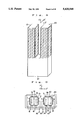
- FIG. 1 is a drawing showing the detector circuit for the first embodiment of the present invention.
- FIG. 2 is a perspective view of the quartz crystal oscillator in the first embodiment of the present invention.
- FIG. 3 is a cross-sectional view of the electrode for the quartz crystal oscillator in the first embodiment of the present invention.
- FIG. 4 is a drawing showing the detector circuit for the second embodiment of the present invention.
- FIG. 5 is a perspective view of the quartz crystal oscillator in the second embodiment of the present invention.
- FIG. 6 is a cross-sectional view of the electrode for the quartz crystal oscillator in the second embodiment of the present invention.
- FIG. 7 is a drawing showing the detector circuit for the third embodiment of the present invention.
- FIG. 8 is a perspective view of the quartz crystal oscillator in the third embodiment of the present invention.
- FIG. 9 is a cross-sectional view of the electrode for the quartz crystal oscillator in the third embodiment of the present invention.
- FIG. 10 is a cross-sectional view of the electrode for the quartz crystal oscillator in the fourth embodiment of the present invention.
- FIG. 11 is a cross-sectional view of the electrode for the quartz crystal oscillator in the fifth embodiment of the present invention.
- FIG. 12 is a front elevation of the quartz crystal oscillator in the fifth embodiment of the present invention.
- FIG. 13 is a rear elevation of the quartz crystal oscillator in the fifth embodiment of the present invention.
- FIG. 14 is a cross-sectional view of the electrode for the quartz crystal oscillator in the sixth embodiment of the present invention.
- FIG. 15 is a front elevation of the quartz crystal oscillator in the sixth embodiment of the present invention.
- FIG. 16 is a rear elevation of the quartz crystal oscillator in the sixth embodiment of the present invention.
- FIG. 17 is a cross-sectional view of the electrode for the quartz crystal oscillator in the seventh embodiment of the present invention.
- FIG. 18 is a front elevation of the quartz crystal oscillator in the seventh embodiment of the present invention.
- FIG. 19 is a side elevation of the quartz crystal oscillator in the seventh embodiment of the present invention.
- FIG. 20 is a rear elevation of the quartz crystal oscillator in the seventh embodiment of the present invention.
- FIG. 21 is a cross-sectional view of the electrode for the quartz crystal oscillator in the eighth embodiment of the present invention.
- FIG. 22 is a front elevation of the quartz crystal oscillator in the eighth embodiment of the present invention.
- FIG. 23 is a rear elevation of the quartz crystal oscillator in the eighth embodiment of the present invention.
- FIG. 1 is a drawing showing the detector circuit for the first embodiment of the present invention
- FIG. 2 is a perspective view of the quartz crystal oscillator in the first embodiment
- FIG. 3 is a cross-sectional view showing the arrangement and mutual connection among electrodes for the oscillator.
- the quartz crystal oscillator shown in FIG. 2 is a so-called X-cut quartz crystal oscillator, in which the quartz crystal is cut at XY' plane having Y axis (mechanical axis) Y' axis produced by rotating XY plane by 0°-10° with respect to X axis (electric axis), so as to arrange electrodes such that expansion to the direction of the Y' axis is allowed to occur at both sides of the neutral plane 81 (FIG. 3) of vibration.
- the Z' axis is a Z axis (optical axis) crossing the Y' axis at right angle.
- the quartz crystal oscillator is of a tuning-fork-type consisting of branch sections 19, 20 and a base section 21. These are integrally formed from one quartz plate by a photoengraving and etching process or by a wire-saw technique.
- electrode 1 is provided on one of the planes parallel to the Y'Z' plane of one of the branches (19) of the tuning fork, and electrode 2 is provided on the opposite plane. Further, electrode 7 is provided on one of the planes parallel to the Y'Z' plane of the other branch 20 of the tuning fork, and electrode 8 is provided on the opposite plane. Electrodes 1 and 2, and electrodes 7 and 8 are connected to each other within the quartz crystal oscillator, and terminals 16 and 15 are provided, respectively. Electrodes 3 and 4 are provided on one of the planes parallel to the XY' plane of branch 19, and electrodes 5 and 6 are provided on the opposite plane.
- Electrodes 9 and 10 are provided on one of the planes parallel to the XY' plane of branch 20, and electrodes 11 and 12 are provided on the opposite plane. Then, electrodes 3 and 6, electrodes 4 and 5, electrodes 9 and 12, and electrodes 10 and 11 are connected to each other within the quartz crystal oscillator, and terminals 17, 18, 13 and 14 are provided, respectively. These electrodes 1-12 are formed by vacuum deposition of a metal film, such as chromium and gold.
- terminals 13 to 18 of the quartz crystal oscillator 30 are connected to oscillator circuit 40.
- terminals 13 and 14 are connected to output of invertor 46, which is an inverting amplifier constructed by a CMOS transistor (complementary field effect transistor), via resistors 44 and 43 of oscillator circuit 40, and terminal 15 is connected to the input of invertor 46.
- Terminal 16 is connected to the output of invertor 46.
- terminals 17, and 18 are connected to the input of invertor 46 via resistors 41 and 42.
- These resistors 41 and 42 may be provided as thin film resistors, for example, on the base 21 of the quartz crystal oscillator shown FIG. 2.
- Resistor 45 is a feedback resistor (Rf)
- condensers 47 and 48 are respectively an input capacity (Cin) and an output capacity (Cout). These form a feedback circuit together with the quartz crystal oscillator 30.
- Corioli's force Fc is created on the both branch sections 19 and 20 of the tuning fork to the directions opposite to each other in a plane parallel to the Y'Z' plane.
- Corioli's force Fc applied to one of the branches is expressed by the following formula (4),
- a is a velocity amplitude of vibration
- ⁇ o is an angular frequency of vibration
- m is the mass of the vibrating portion.
- Corioli's force created by angular velocity ⁇ deforms the branched section of the oscillator, and an electric field is generated to the direction of the arrow shown in a broken line in FIG. 3.
- the output of oscillation circuit 40 is deducted from the output of the differential amplifier circuit 50, and the value thus obtained entirely depends on the field generated by angular velocity ⁇ .
- phase of the output voltage of differential amplifier circuit 50 and that of oscillator circuit 40 must be the same.
- the differential amplifier circuit 50 also acts as a phase shift circuit, so that the phase of the output voltage of differential amplifier circuit 50 and that of oscillator circuit 40 are identical. If necessary, a phase shift circuit may be provided after the differential amplifier circuit 50 or the oscillator circuit 40.
- the output of differential amplifier circuit 50 is connected to the input terminal of detector circuit 60, and detection is performed as the output of oscillator circuit 40 as detection signals.
- the output of detector circuit 60 is connected to the input terminal of output amplifier circuit 70 which contains a smoothing circuit.
- the rotation angular velocity of the amplifier circuit 70 is d.c. voltage, based on which value the rotations angular velocity can be known, and thus the system can act as an angular velocity detector (a gyroscope).
- FIG. 4 is a drawing showing the detector circuit for the second embodiment
- FIG. 5 is a perspective view of the quartz crystal oscillator in the second embodiment
- FIG. 6 is a cross-sectional view showing the arrangement and mutual connection among electrodes for the oscillator.
- the quartz crystal oscillator shown in FIG. 5 is an X-cut quartz crystal oscillator, the same as in the first embodiment, and consists of branched sections 19, 20 and base 21.
- the branched sections 19, 20 form electrodes.
- electrode 1 is provided on one of the planes parallel to the Y'Z' plane of one of the branches (19) of the tuning fork, and electrode 2 is provided on the opposite plane.
- electrode 26 is provided on one of the planes parallel to the XY' plane and electrode 27 is provided on the opposite plane.
- electrodes 7, 8, 9, 10, 11 and 12 are provided in the same manner as in the first embodiment, shown in FIG. 3.
- Electrodes 1 and 2, electrodes 26 and 27, and electrodes 7 and 8 are connected to each other within the quartz crystal oscillator, and terminals 16 and 25 are provided, respectively. Further, in the same manner as the in first embodiment, terminal 13 connected to electrodes 9 and 12, and terminal 13 connected to electrodes 10 and 11 are provided.
- terminals 13, 14, 16 and 25 of the quartz crystal oscillator 30 are connected to oscillator circuit 40.
- terminals 13 and 14 are connected to the output of invertor 46 via resistors 43 and 44 of oscillator circuit 40, and terminals 25 is connected to the input of invertor 46.
- This construction enables a driving voltage created by oscillator circuit 40 to be applied solely to the branch section 19 of the quartz crystal oscillator in FIG. 5, thus ensuring high vibration stability.
- terminals 13 and 14 of quartz crystal oscillator 30 are connected to differential amplifier circuit 50.
- the construction and operation of the differential amplifier circuit 50, detector circuit 60, and output amplifier circuit 70 are the same as discussed for the first embodiment.
- FIG. 7 is a drawing showing the detector circuit for the third embodiment
- FIG. 8 is a perspective view of the oscillator in the third embodiment
- FIG. 9 is a cross-sectional view showing the arrangement and mutual connection among electrodes for the oscillator.
- the quartz crystal oscillator shown in FIG. 8 is a so-called NT-cut quartz crystal oscillator, in which the quartz crystal is cut on the Z'Y' plane at X' axis , Y' axis, and Z' axis, each corresponding respectively to X axis (electric axis), Y axis, and Z axis, and produced by rotating the XY plane by 2°-10° and the YZ plane by 50°-60°, with respect to the X axis, so as to arrange electrodes such that expansion to the direction of the Z' axis is allowed to occur on the neutral plane of vibration 81.
- the quartz crystal oscillator consists of branch sections 19, 20 and base section 21. Electrodes are formed on these branched sections 19 and 20.
- electrode 1 is provided on one of the planes parallel to the X'Y' plane of one of the branches (19) of the tuning fork, and electrode 2 is provided on the opposite plane. Further, electrode 7 is provided on one of the planes parallel to the X'Y' plane of branch 20 of the tuning fork, and electrode 8 is provided on the opposite plane. Electrodes 1 and 2, and electrodes 7 and 8 are connected to each other within the quartz crystal oscillator, and terminals 16 and 15 are provided, respectively. Electrodes 3 and 4 are provided on one of the planes parallel to Z'Y' plane of branch 19, and electrodes 5 and 6 are provided on the opposite plane.
- Electrodes 9 and 10 are provided on one of the planes parallel to the Z'Y' plane of branch 20, and electrodes 11 and 12 are provided on the opposite plane. Then, electrodes 3 and 6, electrodes 10 and 11, electrodes 4 and 5, and electrodes 12 and 9 are connected to each other within the quartz crystal oscillator, and terminals 13 and 14 are provided, respectively.
- terminals 13 and 14 of the quartz crystal oscillator 30 are connected to oscillator circuit 40. Specifically, terminal 13 is connected to the output of invertor 46, and terminal 14 is connected to the input of invertor 46. Further, terminals 1, 5, and 16 are connected to the input of differential amplifier circuit 50.
- FIG. 10 is across-sectional view of the arrangement and mutual connections of the electrode for the quartz crystal oscillator in the fourth embodiment of the present invention.
- the quartz crystal oscillator in this embodiment is an NT-cut quartz crystal oscillator, the same as that of the third embodiment.
- electrode 1 is provided on one of the planes parallel to X'Y' plane of one of the branches (19) of the tuning fork, and electrode 2 is provided on the opposite plane.
- electrodes 7 is provided on one of the planes parallel to the X'Y' plane of branch 20 of the tuning fork, and electrode 8 is provided on the opposite plane.
- Electrodes 1 and 2, and electrodes 7 and 8 are connected to each other within the quartz crystal oscillator, and terminals 16 and 15 are provided, respectively.
- electrodes 3 and 4 are provided on one of the planes parallel to the Z'Y' plane of the branch 19, and electrode 27 is provided on the opposite plane.
- Electrodes 9 and 10 are provided on one of the planes parallel to the Z'Y' plane of the branch 20, and electrode 24 is provided on the opposite plane. Electrodes 3 and 10, and electrodes 4 and 9 are connected to each other within the quartz crystal oscillator, and terminals 14 and 13 are provided, respectively. Electrodes 24 and 27 are connected to each other.
- terminals 13 and 14 of the quartz crystal oscillator 30 are connected to oscillator circuit 40. Specifically, terminals 13 is connected to the output of invertor 46, and terminals 14 is connected to the input of invertor 46. Further, terminals 15 and 16 are connected to the input of differential amplifier circuit 50.
- the construction and operation of the differential amplifier circuit 50, detector circuit 60, and output amplifier circuit 70 are the same as discussed for the previous embodiment.
- FIG. 11 is a cross-sectional view showing arrangement and mutual connection of the electrodes for the quartz crystal oscillator in the fifth embodiment
- FIG. 12 and FIG. 13 are plan views showing arrangement of the electrodes for the quartz crystal oscillator, wherein FIG. 12 is a front elevation and FIG. 13 is a rear elevation of the quartz crystal oscillator.
- the quartz crystal oscillator of this embodiment is an X-cut quartz crystal oscillator. As shown in FIG. 12, the quartz crystal oscillator consists of branched sections 19, 20 and base 21. The end of the base 21 is fixed by a member 22. The branched sections 19, 20, and the base 21 form electrodes as shown in FIGS. 12 and 13.
- electrode 1 is provided on one of the planes parallel to the Y'Z' plane of one of the branches (19) of the tuning fork
- electrode 3 is provided on one of the planes parallel to the XY' plane
- electrode 5 is provided on the opposite plane.
- electrode 8 is provided on the plane parallel to the Y'Z' of the other branch 20
- electrodes 9 and 10 is provided on one of the planes parallel to the XY' plane
- electrodes 11 and 12 are provided on the opposite plane.
- Electrodes 1, 10 and 12, and electrodes 3, 5 and 8 are connected to each other within the quartz crystal oscillator, and terminals 13 and 14 are provided, respectively. These electrodes 1, 3, 5, 8, 10 and 12 are the electrodes driving the quartz crystal oscillator.
- terminal 16 is provided to electrode 9, and terminal 15 is provided to electrode 11. These are electrodes for taking out the generated electric field.
- terminals 13 and 14 of the quartz crystal oscillator 30 are connected to oscillator circuit 40. Specifically, terminal 13 is connected to the output of invertor 46, and terminals 14 is connected to the input of invertor 46. Further, terminals 15 and 16 are connected to the input of differential amplifier circuit 50.
- FIG. 14 is a cross-sectional view of the arrangement and mutual connections of the electrodes for the quartz crystal oscillator in the sixth embodiment of the present invention
- FIG. 15 and FIG. 16 are plan views showing arrangement of the electrodes for the quartz crystal oscillator, wherein FIG. 15 is a front elevation and FIG. 16 is a rear elevation of the quartz crystal oscillator.
- the quartz crystal oscillator of this embodiment is an X-cut quartz crystal oscillator. As shown in FIG. 15, the quartz crystal oscillator consists of branched sections 19, 20 and base 21. The end of the base 21 forms a fixed member 23, which forms a terminal for external connection. Electrodes are formed at branched sections 19, 20, and base 21 as shown in FIGS. 15 and 16.
- electrode 1 is provided on one of the planes parallel to the Y'Z' plane of one of the branches (19) of the tuning fork, and electrode 2 is provided on the opposite plane.
- electrode 26 is provided on one of the planes parallel to the XY' plane, and electrode 27 is provided on the opposite plane.
- Electrodes 9 and 10 are provided on the plane parallel to the XY' plane of the other branch 20, and electrodes 11 and 12 are provided on the opposite plane.
- Electrodes 1 and 2, and electrodes 26 and 27 are connected to each other within the quartz crystal oscillator, and terminals 13 and 14 are provided, respectively. These electrodes 1, 2, 26 and 27 are the electrodes for driving the quartz crystal oscillator. Further, electrodes 9, 11, and 2 are connected to each other within the quartz crystal oscillator.
- Electrode 9 and electrode 11 therefore have the same potential as the output voltage of the oscillator circuit.
- Terminal 15 is provided to electrode 10
- terminal 16 is provided to electrode 12.
- These electrodes 10 and 12 are electrodes for taking out the electric field generated by rotation of the oscillator. Because electrodes 9 and 11 are of the same potential as the output of oscillator circuit 40, the output at electrodes 15 and 16 are the output of oscillator circuit 40, superimposed by the generated field. Arrangements obtained by rotating the electrodes on branched section 19 either right or left by 90° in FIG. 14 are also part of this embodiment.
- terminals 13 and 14 of the quartz crystal oscillator 30 are connected to oscillator circuit 40. Specifically, terminal 13 is connected to the output of invertor 46, and terminal 14 is connected to the input of invertor 46. Further, terminals 15 and 16 are connected to the input of differential amplifier circuit 50.
- differential amplifier circuit 50 Because the output of differential amplifier circuit 50 is subtracted by the output of oscillator circuit 40, this value is entirely dependent on the field generated by angular velocity ⁇ .
- the construction and operation of the differential amplifier circuit 50, detector circuit 60, and output amplifier circuit 70 are the same as discussed for previous embodiments.
- FIG. 17 is a cross-sectional view of the arrangement and mutual connections of the electrodes for the quartz crystal oscillator in the seventh embodiment of the present invention
- FIG. 18 and FIG. 19 are plan views showing arrangement of the electrodes for the quartz crystal oscillator, wherein FIG. 18 is a front elevation and FIG. 19 is a rear elevation of the quartz crystal oscillator.
- the quartz crystal oscillator of this embodiment is an X-cut quartz crystal oscillator. As shown in FIG. 18, the quartz crystal oscillator consists of branched sections 19, 20, a base 21, and a fixed member 23. Electrodes are formed on the branched sections 19, 20, and the base 21, as shown in FIGS. 18, 19 and 20.
- electrode 1 is provided on one of the planes parallel to the Y'Z' plane of one of the branches (19) off the tuning fork, and electrode 2 is provided on the opposite plane.
- electrode 26 is provided on one of the planes parallel to the XY' plane, and electrode 27 is provided on the opposite plane.
- Electrode 7 is provided on the plane parallel to the Y'Z' plane of the other branch 20, and electrodes 28 and 29 are provided on the opposite plane.
- Electrodes 1 and 2, and electrodes 26 and 27 are connected to each other within the quartz crystal oscillator, and terminals 13 and 14 are provided, respectively. These electrodes 1, 2, 26 and 27 are the electrodes for driving the quartz crystal oscillator.
- electrode 7 is connected to electrodes 26 and 27 As discussed below, terminal 13 connected to these electrodes 26, 27 and 7 is connected to the output of oscillator circuit 40 in FIG. 7. Electrode 7 therefore has the same potential as the output voltage of the oscillator circuit 40. Terminal 15 is provided to electrode 28, and terminal 16 is provided to electrode 29. These electrodes 28 and 29 are electrodes for taking out the electric field generated by rotation. Because electrode 7 is of the same potential as the output of oscillator circuit 40, output at terminals 15 and 16 is the output of oscillator circuit 30, superimposed by the generated field. Arrangements obtained by rotating the electrodes on branched section 19 either right or left by 90° in FIG. 17 are also part of this embodiment.
- terminals 13 and 14 of the quartz crystal oscillator 30 are connected to oscillator circuit 40. Specifically, terminal 13 is connected to the output of invertor 46, and terminal 14 is connected to the input of invertor 46. Further, terminals 15 and 16 are connected to the input of differential amplifier circuit 50.
- the construction and operation of the differential amplifier circuit 50, detector circuit 60, and output amplifier circuit 70 are the same as discussed for the previous embodiments.
- FIG. 21 is a cross-sectional view of the arrangement and mutual connections of the electrodes for the quartz crystal oscillator in the eighth embodiment
- FIGS. 22 and 23 are plan views showing an arrangement of the electrodes for the quartz crystal oscillator, wherein FIG. 22 is a front elevation and FIG. 23 is a rear elevation of the quartz crystal oscillator.
- the quartz crystal oscillator of this embodiment is an X-cut quartz crystal oscillator. As shown in FIG. 22, the quartz crystal oscillator consists of branched sections 19, 20, a base 21, and a fixed member 23. Electrodes are formed on the branched sections 19, 20, and the base 21, as shown in FIGS. 22 and 23.
- electrode 1 is provided on one of the planes parallel the to Y'Z' plane of one of the branches (19) of the tuning fork, and electrode 2 is provided on the opposite plane.
- electrode 26 is provided on one of the planes parallel to XY' plane, and electrode 27 is provided on the opposite plane.
- Electrode 10 is provided on the plane parallel to the Y'Z' plane of the other branch 20, electrode 12 is provided on the opposite plane, and electrode 7 is further provided on the plane parallel to the Y'Z' plane.
- Electrodes 1 and 2, and electrodes 26 and 27 are connected to each other within the quartz crystal oscillator, and terminals 14 and 13 are provided, respectively. These electrodes 1, 2, 26 and 27 are the electrodes driving quartz crystal oscillator.
- electrode 7 is connected to electrodes 26 and 27. As discussed later, terminal 13 connected to these electrodes 26, 27 and 7 is connected to the output of oscillator circuit 40 in FIG. 7. Electrode 7 therefore has the same potential as the output voltage of the oscillator circuit 40. Terminal 15 is provided to electrode 10, and terminal 16 is provided to electrode 12. These electrodes 10 and 12 are electrodes for taking out the electric field generated by rotation of the oscillator. Because electrode 7 is of the same potential as the output of oscillator circuit 40, the output at terminals 15 and 16 is the output of oscillator circuit 40, superimposed by the generated field. Arrangements obtained by rotating the electrodes on branched section 19 either right or left by 90° in FIG. 21 are also part of this embodiment.
- terminals 13 and 14 of the quartz crystal oscillator 30 are connected to oscillator circuit 40. Specifically, terminal 13 is connected to the output of invertor 46, and terminal 14 is connected to the input of invertor 46. Further, terminals 15 and 16 are connected to, the input of differential amplifier circuit 50.
- the construction and operation of the differential amplifier circuit 50, detector circuit 60, and output amplifier circuit 70 are the same as discussed for the previous embodiments.
- invertors consisting of CMOS transistors as inverting amplifiers
- CMOS transistors for all other circuits.
- quartz crystal oscillators with a vibration frequency about 32 KHz were given in the above embodiments, oscillators having a frequency of a higher range can also be used for these oscillator circuits with the same construction, if the frequency is suitably selected.
- oscillators using quartz for substrates are given in the above embodiments, it is possible to use other materials possessing piezoelectric characteristics, such as lithium tantalate single crystals, lithium niobate single crystals, and lithium borate single crystals.
- the oscillators can be also produced by adhering or coating materials having piezoelectric characteristics to silicon substrate.
- tuning-fork-type oscillators were exemplified in the above descriptions, other tuning instruments which can produce bending vibration are also applicable to the present invention.
- the first and second embodiments are embodiments of claim 1; the third and fourth embodiments are those of claim 2; the fifth embodiment represents claim 3; the sixth embodiment, claim 4; the seventh embodiment, claim 5; and the eighth embodiment, claim 6. It should be understood that all embodiments are given for the purpose of illustration of the present invention and are not intended to be limiting thereof.
- the circuits for detection of angular velocity of the present invention can be suitably used for inertia navigation of airplanes and ships. They are also suitable for use in small-type equipments, such as head-mount displays of virtual-reality-type, mouse for personal computers, hand-touch equipments of video cameras, and small-type robots.
Landscapes
- Physics & Mathematics (AREA)
- Engineering & Computer Science (AREA)
- General Physics & Mathematics (AREA)
- Radar, Positioning & Navigation (AREA)
- Remote Sensing (AREA)
- Gyroscopes (AREA)
Applications Claiming Priority (6)
| Application Number | Priority Date | Filing Date | Title |
|---|---|---|---|
| JP32992892 | 1992-11-17 | ||
| JP4-329928 | 1992-11-17 | ||
| JP5-235514 | 1993-08-27 | ||
| JP23551493 | 1993-08-27 | ||
| JP25360493 | 1993-09-17 | ||
| JP5-253604 | 1993-09-17 |
Publications (1)
| Publication Number | Publication Date |
|---|---|
| US5420548A true US5420548A (en) | 1995-05-30 |
Family
ID=27332271
Family Applications (1)
| Application Number | Title | Priority Date | Filing Date |
|---|---|---|---|
| US08/256,443 Expired - Lifetime US5420548A (en) | 1992-11-17 | 1994-07-12 | Quartz crystal oscillator angular velocity detector circuits |
Country Status (5)
| Country | Link |
|---|---|
| US (1) | US5420548A (de) |
| EP (1) | EP0636860B1 (de) |
| JP (1) | JP3421720B2 (de) |
| DE (1) | DE69316745T2 (de) |
| WO (1) | WO1994011706A1 (de) |
Cited By (20)
| Publication number | Priority date | Publication date | Assignee | Title |
|---|---|---|---|---|
| US5719460A (en) * | 1994-11-28 | 1998-02-17 | Nippondenso Co., Ltd | Angular velocity sensor |
| US5757107A (en) * | 1994-11-01 | 1998-05-26 | Fujitsu Limited | Tuning-fork vibratory gyro and sensor system using the same |
| US5847279A (en) * | 1995-06-29 | 1998-12-08 | Asulab S.A. | Angular speed measuring device |
| US5861705A (en) * | 1994-11-01 | 1999-01-19 | Fujitsu Limited | Tuning-fork vibratory gyro and sensor system using the same |
| US5939631A (en) * | 1998-03-13 | 1999-08-17 | Bei Technologies Inc. | Low impedance single-ended tuning fork and method |
| US5942839A (en) * | 1995-08-31 | 1999-08-24 | Alps Electric Co., Ltd. | Piezoelectric vibrator and vibratory gyroscope using the same |
| US5962953A (en) * | 1996-07-31 | 1999-10-05 | Nec Corporation | Piezoelectric transformer with monitor electrodes for sensing unbalanced vibration of the transformer |
| US5970793A (en) * | 1996-07-08 | 1999-10-26 | Citizen Watch Co., Ltd. | Angular velocity sensor and angular velocity sensing system |
| US6049157A (en) * | 1997-01-10 | 2000-04-11 | Sony Corporation | Angular velocity sensor |
| US6177756B1 (en) * | 1998-06-18 | 2001-01-23 | Fujitsu Limited | Piezoelectric gyro and method of driving the piezoelectric gyro |
| US6281619B1 (en) * | 1997-05-09 | 2001-08-28 | Citizen Watch Co., Ltd. | Vibration gyro |
| US6327908B1 (en) * | 1997-08-22 | 2001-12-11 | Fujitsu Limited | Tuning fork type vibration gyro |
| US6532817B1 (en) * | 1998-05-06 | 2003-03-18 | Matsushita Electric Industrial Co., Ltd. | Angular velocity sensor and process for manufacturing the same |
| US6588274B1 (en) * | 1999-10-29 | 2003-07-08 | Murata Manufacturing Co., Ltd. | Self-diagnosing circuit for vibrating gyroscope |
| US20040118206A1 (en) * | 2001-04-13 | 2004-06-24 | Fujitsu Media Devices Limited | Tuning-fork type vibration gyro and electrode trimming method therefor |
| US20040191944A1 (en) * | 2003-03-28 | 2004-09-30 | Akihiro Shioji | Method for manufacturing samll crystal resonator |
| US20060226741A1 (en) * | 2004-12-16 | 2006-10-12 | Seiichiro Ogura | Piezoelectric gyro element and piezoelectric gyroscope |
| US20090007664A1 (en) * | 2007-07-06 | 2009-01-08 | Epson Toyocom Corporation | Vibration gyro |
| US20100000322A1 (en) * | 2008-07-04 | 2010-01-07 | Sony Corporation | Angular velocity sensor and method of manufacturing the same |
| US20110195978A1 (en) * | 2008-10-10 | 2011-08-11 | Purdue Research Foundation | Compounds for treatment of alzheimer's disease |
Families Citing this family (3)
| Publication number | Priority date | Publication date | Assignee | Title |
|---|---|---|---|---|
| WO1996038710A1 (de) * | 1995-05-31 | 1996-12-05 | Litef Gmbh | Mikromechanischer drehratensensor |
| ATE246820T1 (de) | 1997-05-29 | 2003-08-15 | Sun Microsystems Inc | Verfahren und vorrichtung zur versiegelung und unterschrift von objekten |
| WO2006038675A1 (ja) * | 2004-10-07 | 2006-04-13 | Matsushita Electric Industrial Co., Ltd. | 角速度センサ |
Citations (11)
| Publication number | Priority date | Publication date | Assignee | Title |
|---|---|---|---|---|
| JPS61191917A (ja) * | 1985-02-20 | 1986-08-26 | Tadashi Konno | 音叉型振動ジヤイロ |
| JPS62106315A (ja) * | 1985-11-01 | 1987-05-16 | Tokyo Koku Keiki Kk | 振動ジヤイロ |
| US4674331A (en) * | 1984-07-27 | 1987-06-23 | Watson Industries Inc. | Angular rate sensor |
| US4930351A (en) * | 1988-03-24 | 1990-06-05 | Wjm Corporation | Vibratory linear acceleration and angular rate sensing system |
| JPH03172714A (ja) * | 1989-11-30 | 1991-07-26 | Murata Mfg Co Ltd | 検出回路 |
| JPH04102013A (ja) * | 1990-08-21 | 1992-04-03 | Nec Home Electron Ltd | 振動ジャイロおよびその駆動方法 |
| JPH04118515A (ja) * | 1990-09-10 | 1992-04-20 | Aisin Seiki Co Ltd | 角速度検出器および加速度検出器 |
| EP0503807A2 (de) * | 1991-03-12 | 1992-09-16 | New Sd, Inc. | Stimmgabelinertialsensor mit einem Ende und Verfahren |
| US5270607A (en) * | 1991-06-07 | 1993-12-14 | Akai Electric Co., Ltd. | Vibration control apparatus |
| US5293779A (en) * | 1990-12-11 | 1994-03-15 | Murata Manufacturing Co., Ltd. | Detecting circuit for detecting an abnormal state in a vibrating gyroscope |
| US5349857A (en) * | 1988-08-12 | 1994-09-27 | Murata Manufacturing Co., Ltd. | Vibratory gyroscope |
Family Cites Families (4)
| Publication number | Priority date | Publication date | Assignee | Title |
|---|---|---|---|---|
| JPS6177712A (ja) * | 1984-09-25 | 1986-04-21 | Nippon Denso Co Ltd | 角速度センサ |
| JPH0758196B2 (ja) * | 1984-11-15 | 1995-06-21 | 日本電装株式会社 | 角速度センサの製造方法 |
| JPS61240115A (ja) * | 1985-04-18 | 1986-10-25 | Matsushita Electric Ind Co Ltd | 角速度センサ |
| JPH04297874A (ja) * | 1991-01-22 | 1992-10-21 | Matsushita Electric Ind Co Ltd | 角速度センサ駆動装置 |
-
1993
- 1993-11-15 WO PCT/JP1993/001668 patent/WO1994011706A1/ja not_active Ceased
- 1993-11-15 DE DE69316745T patent/DE69316745T2/de not_active Expired - Lifetime
- 1993-11-15 JP JP51193094A patent/JP3421720B2/ja not_active Expired - Fee Related
- 1993-11-15 EP EP93924822A patent/EP0636860B1/de not_active Expired - Lifetime
-
1994
- 1994-07-12 US US08/256,443 patent/US5420548A/en not_active Expired - Lifetime
Patent Citations (11)
| Publication number | Priority date | Publication date | Assignee | Title |
|---|---|---|---|---|
| US4674331A (en) * | 1984-07-27 | 1987-06-23 | Watson Industries Inc. | Angular rate sensor |
| JPS61191917A (ja) * | 1985-02-20 | 1986-08-26 | Tadashi Konno | 音叉型振動ジヤイロ |
| JPS62106315A (ja) * | 1985-11-01 | 1987-05-16 | Tokyo Koku Keiki Kk | 振動ジヤイロ |
| US4930351A (en) * | 1988-03-24 | 1990-06-05 | Wjm Corporation | Vibratory linear acceleration and angular rate sensing system |
| US5349857A (en) * | 1988-08-12 | 1994-09-27 | Murata Manufacturing Co., Ltd. | Vibratory gyroscope |
| JPH03172714A (ja) * | 1989-11-30 | 1991-07-26 | Murata Mfg Co Ltd | 検出回路 |
| JPH04102013A (ja) * | 1990-08-21 | 1992-04-03 | Nec Home Electron Ltd | 振動ジャイロおよびその駆動方法 |
| JPH04118515A (ja) * | 1990-09-10 | 1992-04-20 | Aisin Seiki Co Ltd | 角速度検出器および加速度検出器 |
| US5293779A (en) * | 1990-12-11 | 1994-03-15 | Murata Manufacturing Co., Ltd. | Detecting circuit for detecting an abnormal state in a vibrating gyroscope |
| EP0503807A2 (de) * | 1991-03-12 | 1992-09-16 | New Sd, Inc. | Stimmgabelinertialsensor mit einem Ende und Verfahren |
| US5270607A (en) * | 1991-06-07 | 1993-12-14 | Akai Electric Co., Ltd. | Vibration control apparatus |
Non-Patent Citations (8)
| Title |
|---|
| Patent Abstracts of Japan, vol. 10, No. 250 (P 491), Aug. 28, 1986. * |
| Patent Abstracts of Japan, vol. 10, No. 250 (P-491), Aug. 28, 1986. |
| Patent Abstracts of Japan, vol. 10, No. 305 (P 507), Oct. 17, 1986. * |
| Patent Abstracts of Japan, vol. 10, No. 305 (P-507), Oct. 17, 1986. |
| Patent Abstracts of Japan, vol. 11, No. 87 (P 557), Mar. 17, 1987. * |
| Patent Abstracts of Japan, vol. 11, No. 87 (P-557), Mar. 17, 1987. |
| Patent Abstracts of Japan, vol. 17, No. 109 (P 1497), Mar. 5, 1993. * |
| Patent Abstracts of Japan, vol. 17, No. 109 (P-1497), Mar. 5, 1993. |
Cited By (26)
| Publication number | Priority date | Publication date | Assignee | Title |
|---|---|---|---|---|
| US5757107A (en) * | 1994-11-01 | 1998-05-26 | Fujitsu Limited | Tuning-fork vibratory gyro and sensor system using the same |
| US5861705A (en) * | 1994-11-01 | 1999-01-19 | Fujitsu Limited | Tuning-fork vibratory gyro and sensor system using the same |
| US5719460A (en) * | 1994-11-28 | 1998-02-17 | Nippondenso Co., Ltd | Angular velocity sensor |
| US5847279A (en) * | 1995-06-29 | 1998-12-08 | Asulab S.A. | Angular speed measuring device |
| US5942839A (en) * | 1995-08-31 | 1999-08-24 | Alps Electric Co., Ltd. | Piezoelectric vibrator and vibratory gyroscope using the same |
| US5970793A (en) * | 1996-07-08 | 1999-10-26 | Citizen Watch Co., Ltd. | Angular velocity sensor and angular velocity sensing system |
| US6170330B1 (en) | 1996-07-08 | 2001-01-09 | Citizen Watch Co., Ltd. | Angular velocity sensor and angular velocity sensing system |
| US5962953A (en) * | 1996-07-31 | 1999-10-05 | Nec Corporation | Piezoelectric transformer with monitor electrodes for sensing unbalanced vibration of the transformer |
| US6049157A (en) * | 1997-01-10 | 2000-04-11 | Sony Corporation | Angular velocity sensor |
| US6281619B1 (en) * | 1997-05-09 | 2001-08-28 | Citizen Watch Co., Ltd. | Vibration gyro |
| US6327908B1 (en) * | 1997-08-22 | 2001-12-11 | Fujitsu Limited | Tuning fork type vibration gyro |
| US5939631A (en) * | 1998-03-13 | 1999-08-17 | Bei Technologies Inc. | Low impedance single-ended tuning fork and method |
| US6532817B1 (en) * | 1998-05-06 | 2003-03-18 | Matsushita Electric Industrial Co., Ltd. | Angular velocity sensor and process for manufacturing the same |
| US6177756B1 (en) * | 1998-06-18 | 2001-01-23 | Fujitsu Limited | Piezoelectric gyro and method of driving the piezoelectric gyro |
| US6588274B1 (en) * | 1999-10-29 | 2003-07-08 | Murata Manufacturing Co., Ltd. | Self-diagnosing circuit for vibrating gyroscope |
| US6931927B2 (en) * | 2001-04-13 | 2005-08-23 | Fujitsu Media Devices Limited | Tuning fork vibration gyro |
| US20040118206A1 (en) * | 2001-04-13 | 2004-06-24 | Fujitsu Media Devices Limited | Tuning-fork type vibration gyro and electrode trimming method therefor |
| US20040191944A1 (en) * | 2003-03-28 | 2004-09-30 | Akihiro Shioji | Method for manufacturing samll crystal resonator |
| US7138288B2 (en) * | 2003-03-28 | 2006-11-21 | Citizen Watch Co., Ltd. | Method for manufacturing small crystal resonator |
| US20060226741A1 (en) * | 2004-12-16 | 2006-10-12 | Seiichiro Ogura | Piezoelectric gyro element and piezoelectric gyroscope |
| US7348716B2 (en) * | 2004-12-16 | 2008-03-25 | Seiko Epson Corporation | Piezoelectric gyro element and piezoelectric gyroscope |
| US20090007664A1 (en) * | 2007-07-06 | 2009-01-08 | Epson Toyocom Corporation | Vibration gyro |
| US8065914B2 (en) * | 2007-07-06 | 2011-11-29 | Seiko Epson Corporation | Vibration gyro |
| US20100000322A1 (en) * | 2008-07-04 | 2010-01-07 | Sony Corporation | Angular velocity sensor and method of manufacturing the same |
| US8516888B2 (en) * | 2008-07-04 | 2013-08-27 | Sony Corporation | Angular velocity sensor and method of manufacturing the same |
| US20110195978A1 (en) * | 2008-10-10 | 2011-08-11 | Purdue Research Foundation | Compounds for treatment of alzheimer's disease |
Also Published As
| Publication number | Publication date |
|---|---|
| EP0636860B1 (de) | 1998-01-28 |
| DE69316745D1 (de) | 1998-03-05 |
| DE69316745T2 (de) | 1998-07-16 |
| WO1994011706A1 (fr) | 1994-05-26 |
| EP0636860A1 (de) | 1995-02-01 |
| EP0636860A4 (de) | 1994-10-20 |
| JP3421720B2 (ja) | 2003-06-30 |
Similar Documents
| Publication | Publication Date | Title |
|---|---|---|
| US5420548A (en) | Quartz crystal oscillator angular velocity detector circuits | |
| JPWO1994011706A1 (ja) | 角速度検出回路 | |
| US4750364A (en) | Angular velocity and acceleration sensor | |
| US6046531A (en) | Vibrator, vibratory gyroscope, and linear accelerometer | |
| JPH063455B2 (ja) | 振動ジャイロ | |
| WO2005085758A1 (ja) | 角速度センサ用音叉型振動子、この振動子を用いた角速度センサ及びこの角速度センサを用いた自動車 | |
| JPH07306048A (ja) | 圧電振動子 | |
| JPH08152328A (ja) | 角速度センサ及びその使用方法 | |
| US6205857B1 (en) | Angular velocity sensing device | |
| US6170330B1 (en) | Angular velocity sensor and angular velocity sensing system | |
| US5495759A (en) | Detecting circuit which suppresses a drift signal | |
| US6281619B1 (en) | Vibration gyro | |
| JPH07167662A (ja) | 検出回路 | |
| JPH07167661A (ja) | 振動ジャイロ | |
| JPH07139952A (ja) | 振動ジャイロ | |
| KR101017822B1 (ko) | 표면탄성파를 이용한 자이로스코프 및 각속도 측정 방법 | |
| JP3419632B2 (ja) | 角速度センサ素子及び角速度検出装置 | |
| JPH08136263A (ja) | 検出回路 | |
| JPH06194176A (ja) | 振動子 | |
| JP2001116552A (ja) | 振動ジャイロ | |
| JPH10332381A (ja) | 角速度検出装置 | |
| JP2000213940A (ja) | 圧電ジャイロ、圧電ジャイロの駆動方法、圧電ジャイロの検出方法及び圧電ジャイロの機械結合の評価方法 | |
| JPH0979856A (ja) | 音叉形振動ジャイロ | |
| JPH07174570A (ja) | 振動ジャイロ | |
| JPH1078327A (ja) | 角速度検出素子および角速度検出装置 |
Legal Events
| Date | Code | Title | Description |
|---|---|---|---|
| AS | Assignment |
Owner name: CITIZEN WATCH CO., LTD. 1-1, NISHI-SHINJUKU, JA Free format text: ASSIGNMENT OF ASSIGNORS INTEREST;ASSIGNOR:NAKAJIMA, FUMIO;REEL/FRAME:007110/0890 Effective date: 19940609 |
|
| FEPP | Fee payment procedure |
Free format text: PAYOR NUMBER ASSIGNED (ORIGINAL EVENT CODE: ASPN); ENTITY STATUS OF PATENT OWNER: LARGE ENTITY |
|
| STCF | Information on status: patent grant |
Free format text: PATENTED CASE |
|
| FPAY | Fee payment |
Year of fee payment: 4 |
|
| FPAY | Fee payment |
Year of fee payment: 8 |
|
| FPAY | Fee payment |
Year of fee payment: 12 |
|
| FEPP | Fee payment procedure |
Free format text: PAYER NUMBER DE-ASSIGNED (ORIGINAL EVENT CODE: RMPN); ENTITY STATUS OF PATENT OWNER: LARGE ENTITY Free format text: PAYOR NUMBER ASSIGNED (ORIGINAL EVENT CODE: ASPN); ENTITY STATUS OF PATENT OWNER: LARGE ENTITY |
|
| AS | Assignment |
Owner name: CITIZEN HOLDINGS CO., LTD., JAPAN Free format text: CHANGE OF NAME;ASSIGNOR:CITIZEN WATCH CO., LTD.;REEL/FRAME:019817/0701 Effective date: 20070402 |