US4005347A - Electronically commutated motor and method of making same - Google Patents
Electronically commutated motor and method of making same Download PDFInfo
- Publication number
- US4005347A US4005347A US05/482,409 US48240974A US4005347A US 4005347 A US4005347 A US 4005347A US 48240974 A US48240974 A US 48240974A US 4005347 A US4005347 A US 4005347A
- Authority
- US
- United States
- Prior art keywords
- windings
- winding
- armature
- motor
- rotor
- Prior art date
- Legal status (The legal status is an assumption and is not a legal conclusion. Google has not performed a legal analysis and makes no representation as to the accuracy of the status listed.)
- Expired - Lifetime
Links
- 238000004519 manufacturing process Methods 0.000 title description 7
- 238000004804 winding Methods 0.000 claims abstract description 268
- 230000004044 response Effects 0.000 claims abstract description 16
- 230000008093 supporting effect Effects 0.000 claims abstract description 8
- 230000003750 conditioning effect Effects 0.000 claims description 21
- 230000000694 effects Effects 0.000 claims description 12
- 230000003287 optical effect Effects 0.000 claims description 11
- 239000003990 capacitor Substances 0.000 claims description 10
- 230000008878 coupling Effects 0.000 claims description 8
- 238000010168 coupling process Methods 0.000 claims description 8
- 238000005859 coupling reaction Methods 0.000 claims description 8
- 230000001681 protective effect Effects 0.000 claims description 7
- 239000000696 magnetic material Substances 0.000 claims 1
- 230000000737 periodic effect Effects 0.000 claims 1
- 230000004907 flux Effects 0.000 abstract description 2
- 239000007787 solid Substances 0.000 description 14
- 238000003475 lamination Methods 0.000 description 11
- 239000004020 conductor Substances 0.000 description 10
- 239000000463 material Substances 0.000 description 10
- 230000001976 improved effect Effects 0.000 description 9
- 230000006698 induction Effects 0.000 description 6
- 238000000034 method Methods 0.000 description 6
- RYGMFSIKBFXOCR-UHFFFAOYSA-N Copper Chemical compound [Cu] RYGMFSIKBFXOCR-UHFFFAOYSA-N 0.000 description 5
- 230000008901 benefit Effects 0.000 description 5
- XEEYBQQBJWHFJM-UHFFFAOYSA-N Iron Chemical compound [Fe] XEEYBQQBJWHFJM-UHFFFAOYSA-N 0.000 description 4
- 230000000712 assembly Effects 0.000 description 4
- 238000000429 assembly Methods 0.000 description 4
- 230000004323 axial length Effects 0.000 description 4
- 229910052802 copper Inorganic materials 0.000 description 4
- 239000010949 copper Substances 0.000 description 4
- 238000013461 design Methods 0.000 description 4
- 238000009826 distribution Methods 0.000 description 4
- 229910000831 Steel Inorganic materials 0.000 description 3
- 238000013459 approach Methods 0.000 description 3
- 238000011161 development Methods 0.000 description 3
- 230000018109 developmental process Effects 0.000 description 3
- 238000010586 diagram Methods 0.000 description 3
- 230000001965 increasing effect Effects 0.000 description 3
- 230000001939 inductive effect Effects 0.000 description 3
- 239000010959 steel Substances 0.000 description 3
- 239000004593 Epoxy Substances 0.000 description 2
- XAGFODPZIPBFFR-UHFFFAOYSA-N aluminium Chemical compound [Al] XAGFODPZIPBFFR-UHFFFAOYSA-N 0.000 description 2
- 229910052782 aluminium Inorganic materials 0.000 description 2
- 230000000903 blocking effect Effects 0.000 description 2
- 239000000919 ceramic Substances 0.000 description 2
- 238000010276 construction Methods 0.000 description 2
- 230000001419 dependent effect Effects 0.000 description 2
- 229910052742 iron Inorganic materials 0.000 description 2
- 230000002093 peripheral effect Effects 0.000 description 2
- 230000008569 process Effects 0.000 description 2
- 229910000859 α-Fe Inorganic materials 0.000 description 2
- 229910001369 Brass Inorganic materials 0.000 description 1
- OKTJSMMVPCPJKN-UHFFFAOYSA-N Carbon Chemical compound [C] OKTJSMMVPCPJKN-UHFFFAOYSA-N 0.000 description 1
- 230000009471 action Effects 0.000 description 1
- 239000000853 adhesive Substances 0.000 description 1
- 230000001070 adhesive effect Effects 0.000 description 1
- 230000002411 adverse Effects 0.000 description 1
- 238000004378 air conditioning Methods 0.000 description 1
- 229910000828 alnico Inorganic materials 0.000 description 1
- 230000015572 biosynthetic process Effects 0.000 description 1
- 239000010951 brass Substances 0.000 description 1
- 229910052799 carbon Inorganic materials 0.000 description 1
- 238000006243 chemical reaction Methods 0.000 description 1
- KPLQYGBQNPPQGA-UHFFFAOYSA-N cobalt samarium Chemical compound [Co].[Sm] KPLQYGBQNPPQGA-UHFFFAOYSA-N 0.000 description 1
- 239000012141 concentrate Substances 0.000 description 1
- 230000005347 demagnetization Effects 0.000 description 1
- 238000004146 energy storage Methods 0.000 description 1
- 230000005284 excitation Effects 0.000 description 1
- 230000006872 improvement Effects 0.000 description 1
- 230000002427 irreversible effect Effects 0.000 description 1
- 230000005415 magnetization Effects 0.000 description 1
- 238000005457 optimization Methods 0.000 description 1
- 230000010287 polarization Effects 0.000 description 1
- 238000004080 punching Methods 0.000 description 1
- 238000011084 recovery Methods 0.000 description 1
- 230000009467 reduction Effects 0.000 description 1
- 239000003507 refrigerant Substances 0.000 description 1
- 230000000630 rising effect Effects 0.000 description 1
- 238000012360 testing method Methods 0.000 description 1
Images




Classifications
-
- F—MECHANICAL ENGINEERING; LIGHTING; HEATING; WEAPONS; BLASTING
- F23—COMBUSTION APPARATUS; COMBUSTION PROCESSES
- F23N—REGULATING OR CONTROLLING COMBUSTION
- F23N3/00—Regulating air supply or draught
- F23N3/08—Regulating air supply or draught by power-assisted systems
- F23N3/082—Regulating air supply or draught by power-assisted systems using electronic means
-
- H—ELECTRICITY
- H02—GENERATION; CONVERSION OR DISTRIBUTION OF ELECTRIC POWER
- H02K—DYNAMO-ELECTRIC MACHINES
- H02K29/00—Motors or generators having non-mechanical commutating devices, e.g. discharge tubes or semiconductor devices
- H02K29/06—Motors or generators having non-mechanical commutating devices, e.g. discharge tubes or semiconductor devices with position sensing devices
- H02K29/10—Motors or generators having non-mechanical commutating devices, e.g. discharge tubes or semiconductor devices with position sensing devices using light effect devices
-
- H—ELECTRICITY
- H02—GENERATION; CONVERSION OR DISTRIBUTION OF ELECTRIC POWER
- H02P—CONTROL OR REGULATION OF ELECTRIC MOTORS, ELECTRIC GENERATORS OR DYNAMO-ELECTRIC CONVERTERS; CONTROLLING TRANSFORMERS, REACTORS OR CHOKE COILS
- H02P6/00—Arrangements for controlling synchronous motors or other dynamo-electric motors using electronic commutation dependent on the rotor position; Electronic commutators therefor
- H02P6/14—Electronic commutators
- H02P6/16—Circuit arrangements for detecting position
-
- F—MECHANICAL ENGINEERING; LIGHTING; HEATING; WEAPONS; BLASTING
- F23—COMBUSTION APPARATUS; COMBUSTION PROCESSES
- F23N—REGULATING OR CONTROLLING COMBUSTION
- F23N2233/00—Ventilators
- F23N2233/02—Ventilators in stacks
- F23N2233/04—Ventilators in stacks with variable speed
-
- F—MECHANICAL ENGINEERING; LIGHTING; HEATING; WEAPONS; BLASTING
- F25—REFRIGERATION OR COOLING; COMBINED HEATING AND REFRIGERATION SYSTEMS; HEAT PUMP SYSTEMS; MANUFACTURE OR STORAGE OF ICE; LIQUEFACTION SOLIDIFICATION OF GASES
- F25B—REFRIGERATION MACHINES, PLANTS OR SYSTEMS; COMBINED HEATING AND REFRIGERATION SYSTEMS; HEAT PUMP SYSTEMS
- F25B2600/00—Control issues
- F25B2600/02—Compressor control
- F25B2600/021—Inverters therefor
-
- H—ELECTRICITY
- H02—GENERATION; CONVERSION OR DISTRIBUTION OF ELECTRIC POWER
- H02P—CONTROL OR REGULATION OF ELECTRIC MOTORS, ELECTRIC GENERATORS OR DYNAMO-ELECTRIC CONVERTERS; CONTROLLING TRANSFORMERS, REACTORS OR CHOKE COILS
- H02P2209/00—Indexing scheme relating to controlling arrangements characterised by the waveform of the supplied voltage or current
- H02P2209/07—Trapezoidal waveform
Definitions
- This invention relates generally to rotating dynamoelectric machines and, more particularly, to such machines that receive power from a direct current or rectified alternating current power supply and that utilize electronic commutation means.
- commutation is essentially a mechanical switching operation to control the currents through the armature winding sections. This operation is accomplished in conventional machines with brushes and segmented commutators. In such constructions, the brushes wear and require frequent replacement. Sparking and its attendant generation of RF noise is also unavoidably present.
- Motors embodying selected features of my invention are readily adapted for applications where space requirements are at a minimum.
- such motors are readily adapted to drive the compressor of an automobile air conditioning system from the output of the alternator, or the compressor of a recreational vehicle battery source.
- an electronically commutated motor and compressor may both be sealed in a hermatic enclosure.
- carbon pollution products are objectionable and use of brushless motors in such arrangements provides a distinct advantage over mechanical commutation.
- the units are hermetically sealed, the reliability of the motor must be very good, and all parts of the motor must be such that refrigerant will neither damage the motor nor be damaged by motor component or the materials from which said components are made.
- DC stators embodying the invention may be wound using conventional AC winding machinery.
- Electronic commutation may be achieved by either a bridge or star connection.
- the former improves copper winding utilization, while the latter offers the advantage of simplified electronics and by judicious selection of winding parameters, magnet size and electronics which controls the commutation cycle, there is obtained a reliable, highly efficient brushless DC motor having a desired speed-torque which may be fabricated at a reasonable cost.
- a primary object of the present invention is to provide brushless DC motor which is reliable and efficient in operation and method of making same.
- Another object of the present invention is to provide an improved brushless DC motor which may be economically fabricated; may be constructed in a very compact package; or may be provided with shaft sensors disposed within a stator winding end turn envelope.
- Still another object of the present invention is to provide an improved brushless DC motor wherein the advancement of commutation of the stator windings is controlled by the position of optical light coupling sensors.
- Yet another object of the present invention is to provide a minimized number of position sensors in an electronically commutated motor and, more specifically, to provide a minimum number of position sensors.
- a further object of the present invention is to provide an improved motor to be energized from a direct current or rectified alternating current source wherein the armature windings are of the distributed winding type.
- Another further object of the present invention is to provide an electronically commutated motor that utilizes bifilar windings in the armature.
- a still further object of the present invention is to provide an electronically commutated motor of a minimized physical size.
- a still further object of the present invention is to provide an electronically commutated motor that includes means for protecting output stage solid state devices in a particular manner to provide energy recovery or conservation so as to increase the overall efficiency of an electronically commutated motor and the electronic means that provide commutation for such motor.
- Yet a still further object of the present invention is to provide an electronically commutated motor wherein commutation is preselectively advanced.
- an improved brushless DC motor having distributed stator windings which may be wound and connected, as desired, in either a star or bridge configuration.
- the rotor has positioned therein a pair of arcuate magnets each having a preferred minimum arcuate magnets each having a preferred minimum arc length per pole of at least about seventy to 90 electrical degrees, assuming that relatively high efficiencies are desired.
- Windings are disposed in the slots of an armature member and connected to, preferably, produce substantially mutually perpendicular magnetic fields when energized.
- Commutation of the windings is achieved by means of a solid state circuit controlled by sensing means including a pair of sensors spaced from each other by an arcuate distance of approximately 90 electrical degrees and which are preset relative to the armature assembly for a given rotor assembly.
- a minimum number of sensors are utilized, with this minimum number being equal to the number of binary digits needed to describe the number of switching positions, minus one, for the motor. For example, if the motor winding is to be switched four times per 360 electrical degrees of rotation, one would select the number of binary digits needed to describe the decimal number 3. As will be understood, two binary digits [i.e., 11] describe the number 3. Accordingly, only two sensors would need to be used. Since the number of sensors is relates to the switching positions per 360 electrical degrees of rotation, two sensors may be used for two pole, four pole, six pole, etc., motors.
- optical sensors are utilized in conjunction with one or more rotor mounted shutters. Whether optical or other types of sensors are utilized, the sensors are preset relative to the armature assembly (for a given rotor assembly) so that the switching point is advanced (i.e., so as to advance the commutation of the windings) such that a winding is energized before the rotor reaches its maximum torque per unit current producing position in order to aid the build-up of current in the winding being energized. This can yield higher torques, higher efficiencies, and higher speeds.
- the preferred amount of optimum advance, for a given motor design and desired end use, is primarily a function of motor speed, all as discussed in more detail hereinafter.
- FIG. 1 is an exploded, perspective view of the main elements of a brushless DC motor embodying teachings of the present invention in one form thereof;
- FIG. 2 is a diagrammatic front elevational view of the stator or armature core of FIG. 1, diagrammatically illustrating a selected winding arrangement for the motor of FIG. 1;
- FIG. 3 is a diagrammatic representation of parts of the motor of FIG. 1 showing the position of the rotor magnets relative to the armature windings at the instant of turn-on of one of the windings, with a zero electrical degree advance setting;
- FIG. 4 is a fragmentary, side elevational view, partly in cross-section, better showing the physical interrelationship of the support bracket assembly in the motor assembly of FIG. 1;
- FIGS. 5A and 5B illustrate the construction and equivalent electrical circuit, respectively, of a light sensitive element used as a shaft position sensing element in the assembly of FIG. 1;
- FIG. 6 is a schematic diagram of a solid state commutating circuit embodying features of the present invention and arranged for switching the windings of the motor of FIG. 1 when such windings are connected in a star configuration;
- FIG. 7 is a schematic diagram of the signal conditioning circuit, shown in block form in FIG. 6, for producing position control signals indicative of the rotational position of the rotor of FIG. 1;
- FIG. 8 illustates the relative relationship between the angular position of the rotor and the outputs of two light sensitive elements, A and B, and the switching pulses produced as a result of rotor rotation;
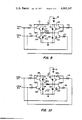
- FIGS. 9 and 10 are schematic diagrams of a solid state commutating circuit embodying features of the present invention, and arranged for switching the windings of the motor of FIG. 1 when such windings are connected in a bridge configuration;
- FIGS. 11A-C are graphical representations of torque per ampere as a function of rotor position, magnet arc length and distribution of turns for magnet arc lengths of 180 electrical degrees, 160 electrical degrees, and 135 electrical degrees, respectively; and schematically illustrate different arc lengths of rotor magnet arc lengths; and
- FIGS. 12-15 are plots of torque per ampere as a function of rotor position (in electrical degrees) for different amounts or extends of spread (or relative concentration) of stator windings.
- a permanent magnet rotor 10 is mounted on a shaft 11 which is rotatably supported by conventional not shown bearing means within any desired not shown housing.
- the rotor 10 is magnetized across its diameter in a manner known to the art.
- the rotor 10 comprises a solid magnetic steel core 12 and a pair of arcuate magnets 13 and 14 disposed on the periphery of the core in diametrically opposed relationship.
- the magnets 13 and 14 were ceramic magnets, but it will be understood that they could be cobalt samarium, Alnico, or any other available type of magnet material.
- the primary selection criteria are expense and physical size of the motor.
- the arc length of each ceramic magnet is preferably between 135 electrical degrees and 160 electrical degrees, but could be as much as 180 electrical degrees and as low as approximately 90 electrical degrees. Arc lengths of less than 120 electrical degrees would generally result in poor efficiency with the winding arrangement specifically shown in FIG. 2, and are thus not preferred with such arrangement.
- each coil group preferably would span about 10 slots.
- each coil group preferably would include three coils per coil group spanning 9, 7, and 5 teeth, respectively. This type of arrangement would provide optimized efficiency characteristics of such motor.
- the stationary armature assembly 15 includes a relatively low reluctance magnetic member 16 which is formed of a plurality of like stator laminations 17 assembled in juxtaposed relationship.
- the laminations may be held together by a plurality of stator through-bolts 18, only two of which are fragmentary shown, that pass through coaxially positioned through-bolt holes 19 in the stator lamination.
- the core laminations may be welded, keyed, adhesively bonded together, or merely held together by the windings, all as will be understood by persons skilled in the art.
- Each lamination includes a plurality of teeth 20 along its interior bore such that the assembled laminations provide a plurality of axially extending slots 21 within which the stator windings 22 are disposed.
- Windings 22 may be wound by means of conventional induction motor winding machinery.
- the winding turns may be wound directly in the core slots; or the windings may be wound into a coil receiver and subsequently be axially inserted into the core slots, for example, with equipment of the type shown and described in U.S. Pats. Nos. 3,522,650 3,324,536, 3,797,105, or 3,732,897, the disclosures of which are incorporated herein by reference.
- each winding has a spread of 90 electrical degrees across the stator slots so as to generate mutually perpendicular magnetic fields when energized.
- the winding end turns extend beyond the core end faces, and the winding ends or leads are brought out and connected separately to the control circuit and the associated switching means.
- FIG. 2 there is illustrated an exemplary winding arrangement for a 1/20 horsepower, 3000 rpm electronically commutated DC motor embodying principles of my invention.
- the selected lamination or punching includes 24 slots, and 54 bifilar turns are provided for each winding. With the oppositely disposed pairs of windings would bifilarly, I provide four windings a, b, c, d. Windings a and c are bifilar wound and occupy the six uppermost and six lowermost slots 21, as viewed in the drawing, and are shown as being included by the dash lines. Windings b and b and d are bifilar wound, and occupy the six left-hand and six right-hand slots, as viewed in FIG. 2.
- the stator 17 is wound with a winding turn distribution of 10 turns, 10 turns, 7 turns, from outermost to innermost coil, respectively, for each coil group shown in FIG. 2.
- Each winding is shown as including two coil groups, of course.
- the particular number of turns in a slot for each winding and the resultant distribution could be varied according to the desired motor characteristics to be obtaind.
- the outermost coils of each coil group could be maximized in number while the innermost coil turns are minimized so as to concentrate the winding.
- a higher average torque will result (assuming stating core, rotor conversion winding resistance, and total turn count is held constant), but the switching point will be more critical, the amount of advancement may have to be changed and minimum locked rotor torque will be reduced.
- dips in torque would be of greater amplitude, but of less duration.
- each winding are concentrically disposed in a given pair of slots with the desired number of turns in each slot.
- the winding of course continues in the next pair of slots, and the desired number of slots or teeth are spanned which in the illustrated embodiment is eleven teeth and providing a spread of, for example, 90 electrical degrees for each winding and enabling the windings to sequentially generate mutually perpendicular magnetic fields when sequentially energized.
- bifilar strands two windings are wound simultaneously and one end of each strand may then be conveniently grounded to provide a star winding configuration. It is again noted that the arrangement is readily adapted for winding and placement by conventional winding machinery used for winding AC motors.
- winding b has been illustrated somewhat differently than windings a, c, and d.
- Winding b has been shown to illustrate the direction of current flow therein during at least one commutation period and arrows have been used to indicate the direction of current flow in the end turn portions of windings b.
- dots and crosses (enclosed within circles) have been used to illustrate the direction of current flow in the respective turns of winding b that are disposed within the magnetic core slots.
- a dot would indicate that current is flowing upwardly out of the plane of the drawing, and crosses indicate current flowing downwardly relative to the plane of the drawing.
- winding b would establish north and south poles oriented as represented by the letters N and S in FIG. 2.
- the stationary armature assembly has an axial bore 23 within which is received the rotor 10.
- the arcuate magnets 13 and 14 are disposed (e.g., by an adhesive such as epoxy) on the outer surfaces of the low reluctance core 12 (which may be laminated but does not need to be) with North-South polarizations as indicated in FIG. 3. Magnetization is in the radical direction with radial thickness selected to produce the desired magnetomotive force (for a given magnet material) or to assure that no irreversible demagnetization occurs from the fields produced by the current in the stator windings during stalled conditions.
- magnets 13 and 14 have been described as being adhesively bonded to the outer peripheral surface of the core 12, it is important only that fields of opposite polarity be established by the rotor assembly.
- bar type magnets or magnets of any other desired shape
- the magnets when permanent magnets are used
- the magnets may be disposed within a magnetic iron cage structure or fabricated in any other desired manner.
- an excited rotor wherein the north and south poles are established by current carrying conductors may also be utilized.
- slip rings or any other suitable means would be used to interconnect the rotor windings with a source of excitation current.
- the axial length of the magnets is dependent on the total flux desired.
- the instantaneous torque curves and the net torque output is dependent on the magnet arc or arc length beta ( ⁇ ) of the magnet which, as hereinbefore noted, should be preferably constrained within 135 electrical degrees and 160 electrical degrees, for greatest efficiency.
- a shaft position sensor assembly 40 Adjacent one end of the rotor is positions a shaft position sensor assembly 40 comprising a shutter 41 and bracket 42 for supporting a pair of optical interrupter modules, i.e., optical light coupling sensors 43 and 44.
- Shutter 41 may be formed of any optical opaque (at the pertinent wave length) material or coated material such as, for example, aluminum (brass, steel, etc.), and includes a flat disc shape element 45 having a shutter flange 46 extending along the periphery of the disc element for an arcuate distance of approximately 180 electrical degrees.
- the disc element includes a central opening 47 slightly large in diameter than the diameter of the rotor shaft 11 so that it may be conveniently passed over the rotor shaft and mounted flush with the end face of the solid steel core 12.
- a pair of bolt receiving openings 48 are provided for receiving mounting bolts (not shown) adapted to be threaded into prethreaded openings 50 provided in the core 12.
- mounting bolts not shown
- flange 46 extends outwardly from the rotor and is cooperatively associated with sensors 43 and 44 to effect generation of rotor position reference signals in response to the position of the rotor relative to the stator.
- bracket 42 comprises a first arcuate shaped segment 51 having an elongated slot 52 along its length. Slot 52 permits the bracket to the adjustably attached to the stator laminations 17 by means of the stator through bolts.
- a second arcuate shaped segment 53 is supported radially inward of the first segment by means of an interconnecting U-shaped strap for arm member 54.
- strap 54 is shaped to pass over the end turns and support the sensors 43 and 44 with a 90° spatial orientation within the end turns of the stator windings and in cooperative relationship with the outward extending shutter flange 46. It should be noted that the sensors are supported within the outermost axial dimension of the winding end turns as well as within the radial dimensions thus minimizing the axial length of the motor, the dimension of the strap adding very little to the overall axial length.
- the coupler includes a source of light energy 55 which may be a light emitting diode and a light sensor 56 which may be a light sensitive phototransistor in light coupling relationship with the light emitting diode.
- Diode 55 and phototransistor 56 are formed in separate blocks 57 and 58, respectively, separated by a channel 59 and mounted to a supporting base 60.
- Base 60 of each sensor is secured at opposite ends of supporting segment 53 such that the sensors are spaced from each other by an arcuate distance of 90 electrical degrees. Convenient openings are provided in the segment to allow the terminal conductors 61 of the sensors to pass freely therethrough.
- Commutation of the stator windings is achieved by means of a solid control circuit 70 comprising NOR gates and transistor switches and drivers activated in response to signals from the shaft position sensors.
- the circuit may be of the type illustrated in FIGS. 6 and 7 where a star winding configuration is employed or of the type illustrated in FIGS. 7, 9 and 10 where a bridge arrangement is employed.
- control circuit receives the output of the light sensitive shaft position sensor assembly 40 to derive switching signals for commutation of the stator windings.
- the outputs of the sensors 43 and 44 produce two position signals indicative of the position of rotor 10 with respect to the fixed position of the stator windings.
- the two position signals are applied to a first signal conditioning circuit 70 which develops four control signals which correspond to those positions of the rotor while (1) shutter flange 46 is passing through channel 59 of sensor 43 thereby blocking its photosensor; (2) shutter flange 46 is passing through channel 59 of both sensors 43 and 44 thereby blocking both photosensors; (3) shutter flange 46 is passing through channel 59 of sensor 44 and blocks the photosensor of sensor 44 but has unblocked the photosensor of sensor 43; and (4) shutter flange 46 is clear of both sensors.
- the shutter operates to block or intercept the light from the source of light energy of each optical coupler during one half of each revolution of the rotor, while permitting passage of light energy from each source of light to its associated photosensor during the remaining half of the rotor revolution.
- the on-off combination of the sensor provides four position control signals
- the adjustable bracket assembly provides a convenient means for preselectively advancing the commutation of the windings and aid the build-up of current in the winding being commutated and obtain a desired speed-torque relationship with greater efficiency.
- each coupler 43, 44 is high when the energy received from the LED 55 is prevented from exciting the associated phototransistor 56, i.e., when shutter flange 46 passes between the LED and the phototransistor.
- a first position signal occurs whenever the coupler 43 is blocked and this signal appears on line 68.
- a second position signal occurs whenever coupler 44 is blocked and this signal appears on line 69.
- each coupler consists of an LED 55 and a phototransistor 56.
- the collector of each phototransistor is independently connected through an associated resistor 71 or 72 to a positive bus line 73.
- Diodes 55 are connected in series and in turn through biasing resistor 74 to the positive bus 73.
- the emitters of the phototransistors and the series connected diodes are returned to a common ground line 75.
- the first signal conditioning circuit includes four NOR gates arranged to develop the four position control signals A, A (not A), B, and B (not B) which are indicative of the rotational position of the rotor 10 (within a 90° region) and which are utilized to control current switching in the stator windings.
- one input of each NOR gate 76 and 77 is connected to lines 68 and 69, respectively, and the other inputs of each NOR gate 76 and 77 are returned to ground line 75.
- the outputs of NOR gates 76 and 77 establish the A and B position control signals applied to the second signal conditioning circuit.
- the A and B control signals are also applied respectively, to one of the input terminals of NOR gates 78 and 79, the output of which comprises the A (logic compliment not A) and B (logic compliment not B) position control signals.
- the other input of each NOR gate 78 and 79 is grounded.
- the duration and sequence of the signals A, A, B, and B are schematically depicted in the upper portion of FIG. 8.
- the four position control signals A, A, B and B are applied to the second signal conditioning circuit shown in detail in FIG. 6.
- the function of the second signal conditioning circuit is to produce four switching signals for sequentially switching the associated stator windings 22a, 22b, 22c and 22d.
- each winding is associated with a separate signal channel including its own NOR gate 80, transistor 81 and driving stage comprising transistors 82 and 83. Operation of each channel is identical and to avoid duplication, the description will be limited to the operation of a single channel.
- the channel for the a winding is referred to as the a channel and the associated components in that channel have each numerical reference character followed by the letter a to signify its association with that channel.
- the a channel controls switching of winding a
- the b channel controls switching of winding b, and so forth.
- Channel a is shown as the lowermost channel of the second signal conditioning circuit in FIG. 6.
- NOR gate 80a has its two inputs connected to receive the A and B inputs from NOR gates 78 and 77.
- each of the other channels are arranged to receive two position control signals from the first signal conditioning circuit 70 such that the four channels produce four successive switching pulses for each revolution of the rotor, as best understood by referring to the lower half of FIG. 8.
- the duration and sequence of the signals A + B, A + B, A + B, and A + B are schematically depicted.
- Gate 80a for example, has a 1 output when the A and B inputs are both at zero. This occurs just once in a revolution of the shutter 41. Similarly, for gate 80b, its output is 1 when the A and B inputs are at zero. This, again, is a singular combination in each revolution. Gates 80c and 80d are in like manner connected to A, B and A, B inputs, respectively.
- the switching signals from each NOR gate 80 are amplified by an associated transistor 81 to which the switching signal is applied through a base resistor 84.
- the output of each transistor 81 is directed to the base circuits of a power switch set comprising transistors 82 and 83 which are switched to effect energization of the stator windings 22a-22d in a predetermined timed relation.
- Transistor 81 comprises an NPN transistor, the emitter of which is grounded through line 85.
- the collector of each transistor 81 is connected through a resistor 86 to the base an NPN transistor 82.
- the collector and emitter of each transistor 82 are connected, respectively, to the base and collector of the associated transistor 83 forming a conventional modified Darlington configuration.
- Each stator winding is connected through the collector-emitter junction of its associated transistor 83 to the positive bus 87.
- a protective diode 88 is connected across the emitter-collector of each transistor 83 to provide a current path from the associated winding to the positive bus line 87.
- the anode of each diode 88 is connected to the ungrounded side of the associated winding 22 and the emitter of transistor 83 to insure that the polarity of the diode is such as to allow the return of energy released by the decaying magnetic field of a winding when it is deenergized.
- the back current generated by the decaying magnetic field is shunted part the transistor 83 through line 90 causing the charging of capacitor 91 which is connected across the positive bus line and ground.
- the energy stored in capacitor 91 will be returned to the system upon discharge of the capacitor when the next winding is turned on resulting in an overall increase in efficiency of the motor.
- the improved efficiency may be as high as 10%.
- each diode 88 and capacitor 91 is equally effective for rectified AC and battery supplies. It should be noted that for a rectified AC line, the diodes associated with the supply source are switched in such direction as to allow current to flow through the motor, but not back to the line. Thus, the capacitor 91 serves to store energy from the switched windings. Capacitor 91 could be replace by a Zenor diode which would absorb and dissipate the recovered energy as heat. While such an arrangement could provide protection to the transistors 83a, b, c, d, it would not provide for improved efficiency because the energy would be dissipated rather than being returned to the system.
- Resistor 92 connected in positive bus line 87, together with capacitors 93, 94 and a 15-volt Zenor diode 95 (for a nominal applied average voltage of 12 volts) provides a protective filter network for the circuit components against the possibility of line 87 being raised to a voltage great enough to destroy the solid state components which could occur, for example, if the motor is run off a battery charger that could supply more than eighteen volt peaks.
- Stator windings 22a- 22d of FIG. 7 are wound bifilarly and are arranged in a star configuration with one end of each winding tied to a common ground. This provides an efficient arrangement which enables the windings to be switched on and off individually with a minimum of electronics and which enables the inductive energy of a switched winding to be recovered.
- winding 22a when winding 22a is turned off, for example, the decaying magnetic field induces a current in the companion conductor of winding 22c due to the bifilar winding arrangement and the resultant transformer action.
- the feedback diodes 88 around each switching transistor provide a path for current associated with trapped inductive energy and protect the transistor, while capacitor 91 enables this energy to be recovered.
- This arrangement provides for relative utilization of the windings in a slot of only 50%. To provide for full utilization of the windings, providing for even more efficient utilization of winding material, resort may be made to the bridge circuit arrangement of FIGS. 9 and 10.
- stator windings 122a and 122b are wound in the same manner as the stator windings 22a and 22b of the star configuration of FIG. 6.
- the stator windings 122a and 122b are wound in the same manner as the stator windings 22a and 22b of the star configuration of FIG. 6.
- bifilar strands as was done with windings 22a, 22c
- only single strands are employed and a particular winding is switched in by switching of a pair of transistors.
- four power switch sets 101-108 are provided for each pair of windings.
- Each power set comprises a pair of NPN transistors arranged in a Darlington configuration.
- the base of the input transistor of each power set is connected through its associated base resistor 109-116 to the output of a transistor amplifier 81 of one of the channels in a manner shown, for example, in FIG. 6.
- the a channel output of transistor 81a is connected to the input of power switch set 101 and 103, the b channel to sets 105 and 107, the c channel to sets 102 and 104 and the d channel to sets 106 and 108.
- Winding 122a is energized when current I a flows with the power sets 101 and 103 turned on. Winding 122a, in effect, acts like winding 22c of FIGS. 2 and 6 when power sets 102 and 104 are turned on and current I c flows.
- the bridge circuit for switching in winding 122b operates in a like manner when current I b and I d flow.
- Each transistor is provided with a protective diode 117-124 connected across the emitter-collector terminals and poled to provide a path for the current associated with stored inductive energy which is released when the transistors are turned off.
- circuit arrangements provide a relatively simple, but highly efficient and economic, means for controlling the commutation of a motor embodying the present invention.
- Advanced timing angle (or advancement of commutation) is defined in accordance with FIG. 3.
- Zero advance would exist if a winding was turned on when the magnetic center of a rotor magnet was moving theretoward and at the instant that the magnetic center of the rotor was 135 electrical degrees from alignment with the axis of the magnetic pole established thereby. This would be the theoretical optimum. However, switching of the winding 10 electrical degrees before this theoretical optimum position is reached, constitutes a 10° advancement of commutation.
- the preferred amount of advancement of the timing angle is associated with the L/R time constant of the winding. At 0 electrical degrees advance, the current in the winding builds up too slowly to achieve maximum possible torque throughout its full "on" time.
- Timing angle is preselectively adjusted by peripheral rotation of bracket 42, which positions the light coupling sensors 43 and 44 with relation to shutter flange 46.
- Nb and Sb The general location of the polar axes or centers of magnets 13, 14, on the other hand, are represented by the rotation N, S. It is to be understood that north and south poles Nb, Sb, are established by winding 22b when it is energized as indicated in FIG. 2.
- windings 22a, 22b, 22c, and 22d are commutated in sequence; and as the poles Nb, Sb (associated with winding 22b) disappear; the poles Nc, Sc (associated with winding 22c) appear.
- the center of magnetic poles S of magnet 14 is positioned 45 electrical degrees past pole Sb.
- winding 22b should be switched on at this instant to establish poles Nb, Sb; and winding 22b should remain energized for ninety electrical degrees. Then, winding 22b would be switched off and winding 22c would be switched on, assuming clockwise rotation of the rotor as indicated by arrow R in FIG. 3.
- the angle alpha equaled about twenty electrical degrees.
- winding 22a was de-energized, and winding 22b was energized to establish poles Nb, Sb when the axis of poles Sb of magnet 14 was about 145 electrical degrees therefrom.
- winding 22b was de-energized and winding 22c was energized so as to establish poles Nc, Sc. This then continues of course for the four windings 22a, b, c, d, as will be understood.
- FIGS. 11A, B, C reveal the effect on the ratio T/I when magnets of different arc lengths are used with a given stator or armature configuration.
- FIGS. 11A represents a plot of T/I when the magnet arc length is 180 electrical degrees and the windings 22a, b, c, d have the same number of turns in each slot.
- the solid trapezoidal curve shows instantaneous torque per ampere for a constant value of current flowing in winding 22a if that winding is energized or left "on" for a full revolution of the rotor.
- the dashed trapezoidal curve is similarly drawn for winding 22b to represent its instantaneous torque per ampere contribution.
- the heavy solid curve displays a net effect of winding 22a being "on” for 90 electrical degrees only, and winding 22b being “on” for 90 electrical degrees and so on for windings 22c and 22d.
- the heavy solid curve is displaced from the other curves for illustration convenience.
- Winding 22a is turned on at approximately 45 electrical degrees after the polar axes of the rotor magnets have passed the center of the poles to be established by winding 22a.
- the distributed windings are thus seen to introduce a trapezoidal shape to the instantaneous torque in contrast to the theoretical ideal square shape which would otherwise be obtained for an ideal case utilizing concentrated windings.
- FIGS. 11A-C schematically depict the arcuate length of various rotor magnets as well as the "spread" of the winding conductors of winding 22a.
- “Spread" is used to indicate the angular expanse of adjacent stator slots that carry the conductors of a given winding.
- each winding has two groups of conductors, disposed in slots, and each group has a spread of 90 electrical degrees (six slots).
- FIG. 11B illustrates the torque per ampere developed as a function of rotor position, utilizing an arc magnet having an arc length of 160 electrical degrees.
- the windings are, again, assumed to be ideally or uniformly distributed and winding current to be at a constant value.
- the instantaneous torque per ampere as a function of rotor position curve retains its trapezoidal shape, as in FIG. 11A, but the build-up is slower and the time at maximum torque is shorter. The net or average torque, however, is only slightly reduced.
- magnet arc length can be reduced from 180 electrical degrees to 160 electrical degrees with essentially no loss in motor performance.
- the value of 135 electrical degrees for magnet arc length is, also, significant in that it represents an optimum choice from a manufacturing standpoint in that best yields for processes used to produce ferrite magnets result when arc segments are normally at 135 mechanical degrees (it being noted that mechanical degrees are equal to electrical degrees for two-pole motors).
- magnets having arc lengths as low as 120 electrical degrees can be utilized without substantially sacrificing motor performance and efficiency. In preferred embodiments that have been constructed and tested however, the arc length of the magnets have been between 135 and 160 electrical degrees.
- the curves of FIG. 11 are ideal representations of torque per ampere. They depart from the ideal when winding inductance, rotor speed and advance timing angle are taken into account. Inductance slows the rate of current rise, so that L/R time constant of the windings becomes an increasingly important factor as higher rated speeds are selected. As a general rule, the advance timing angle is greater for higher speeds, but optimum performance is achieved when winding turn off or commutation occurs nearly on a flat portion of the torque curves of FIGS. 11A-C, and turn on occurs on a rising portion of these same torque curves.
- FIGS. 12-15 are similar to FIGS. 11A-C at least to the extent that the former are idealized plots of the ratio T/I (torque per ampere) for a motor such as the one of FIG. 1 as a function of rotor position for different amounts or extents of stator winding spread.
- the solid trapezoidal curves show instantaneous torque per ampere that would result if one winding (e.g., winding 22a) were left "on" for a full revolution of a rotor.
- the dashed trapezoidal curves are similarly drawn for another winding (e.g., winding 22b).
- the data for curves 12-15 are based on an assumption that a single two rotor having magnet arcs of 135 electrical degrees is used with stators having different winding spans or concentrations.
- the curves of FIGS. 12-15 would result, respectively, with winding set side turn spreads of 90, 60, 120, and 30 electrical degrees, respectively.
- the duration or extent, in electrical degrees, of the flat portions of the curves in FIGS. 12-15 have been denoted in the drawing figures. It will be noted that the duration of such flat portions decrease with increasing coil side turn spreads. Stated conversely, increasing coil side turn concentrations cause increased flat portion (maximum T/I) duration.
- windings 22 include end turn portions disposed along the end faces of the stator core, and side turn portions that are disposed along the axially extending stator core slots.
- winding b is formed of two sections or coil groups. Each of these groups have three concentric coils, with each coil comprised of a plurality of turns and with side turn portions of such coils in a stator slot. The span of the outermost coil of each coil group determines the span of each coil group. However, the "spread" or "concentration” of winding 22b is determined by the collective arcuate span of one half of the side turn portions of both coil groups.
- Such methods relate of course to the manufacture of brushless DC motors (whether or not they are of the electronically commutated variety), and include: the selection of AC induction motor types of cores; the development of distributed windings in slots of such cores by means of available AC induction motor equipment to form wound stator assemblies; and the assembly of such wound stator assemblies with permanent magnet rotor assemblies.
- the development of the distributed windings preferably includes the provision of at least two coil groups for optimization, four coil groups), that each comprise one or more concentric coils of one or more turns each.
- the winding turns may be wound and established (concurrently or sequentially) in coil receiving means and then axially inserted into the axially extending core slots (either directly from the coil receiving means or from an axial inserting means to which the winding turns are transferred from the coil receiving means).
- Table I The data of Table I was obtained by testing one motor that embodies the present invention and that was operated from a 12 volt DC supply.
- the motor utilized a standard stator lamination design that is used commercially in induction motor applications.
- the lamination was substantially identical to the lamination shown in FIG. 2.
- the bore of the core was about 2 inches with a stack height of about 2 inches.
- the core had 24 slots, and carried distributed copper magnet wire winding side turn portions that were bifilar wound.
- Eight winding coil groups total (four bifilar coil groups) were used. Each coil group included three coils and each coil comprised from outermost coil to innermost coil respectively: 7, 10, and 10 turns.
- the wire was about 0.05 diameter (uninsulated) copper wire.
- the coils of each coil group spanned, from outer to inner coils respectively, 11, 9, 7 teeth respectively.
- the "spread" of an associated pair of coil groups was six slots or 90 mechanical degrees. It thus will be understood that eight slots contained 14 conductors (seven bifilar conductor pairs), while the rest of the slots had 20 conductors each.
- the rotor magnets were formed of ferrite magnet material from Allen Bradley Co. and designated as M-7 material.
- the arc length of each of the two magnets used was 143 mechanical degrees; the thickness was about 0.25 inches; and the axial length was about 2 inches.
- the magnets were epoxy bonded to a solid, soft iron rotor core and the assembled rotor had an outer diameter of about 1.98 inches. Commutation and sensing was accomplished with circuits substantially identical to those shown herein.
- the actual circuit components i.e., transistors, resistors, capacitors, etc.
- the motor was commutated with from zero to 22 electrical degree advance. Since the motor was a two-pole motor, electrical degrees were of course equal to mechanical degrees.
- Table I does show the significant improvement in efficiency and torque that is attainable by advancement of commutation. Thus, a 15 electrical degree advance would provide significantly more maximum efficiency at 2600 rpm; whereas an advance of 22 degrees would provide significantly greater maximum torque at 2600 rpm.
Landscapes
- Engineering & Computer Science (AREA)
- Power Engineering (AREA)
- Chemical & Material Sciences (AREA)
- Combustion & Propulsion (AREA)
- Mechanical Engineering (AREA)
- General Engineering & Computer Science (AREA)
- Control Of Motors That Do Not Use Commutators (AREA)
- Brushless Motors (AREA)
Priority Applications (18)
| Application Number | Priority Date | Filing Date | Title |
|---|---|---|---|
| US05/482,409 US4005347A (en) | 1974-06-24 | 1974-06-24 | Electronically commutated motor and method of making same |
| CA228,444A CA1035008A (en) | 1974-06-24 | 1975-06-02 | Electronically commutated motor and method of making same |
| AR259174A AR213272A1 (es) | 1974-06-24 | 1975-06-12 | Motor de corriente continua |
| DE19752527744 DE2527744A1 (de) | 1974-06-24 | 1975-06-21 | Elektronisch kommutierter motor und verfahren zu seiner herstellung |
| IT24661/75A IT1044299B (it) | 1974-06-24 | 1975-06-23 | Motore commutato elettronicamente e relativ metodo di fabbricazione |
| DK286575A DK159229C (da) | 1974-06-24 | 1975-06-24 | Boerstefri jaevnstroemsmotor |
| FR7519769A FR2276723A1 (fr) | 1974-06-24 | 1975-06-24 | Moteur a courant continu a commutation electronique et son procede de fabrication |
| BR5110/75D BR7503972A (pt) | 1974-06-24 | 1975-06-24 | Motor comutado eletronicamente e processo de producao do mesmo |
| US05/802,484 US4169990A (en) | 1974-06-24 | 1977-06-01 | Electronically commutated motor |
| US06/141,268 US4390826A (en) | 1974-06-24 | 1980-04-17 | Laundering apparatus, method of operating a laundry machine, control system for an electronically commutated motor, method of operating an electronically commutated motor, and circuit |
| US06/191,056 US4459519A (en) | 1974-06-24 | 1980-09-25 | Electronically commutated motor systems and control therefor |
| US06/463,147 US4654566A (en) | 1974-06-24 | 1983-02-02 | Control system, method of operating an electronically commutated motor, and laundering apparatus |
| US07/483,329 US5075608A (en) | 1974-06-24 | 1990-02-20 | Control system, electronically commutated motor system, draft inducer apparatus and method |
| US07/515,317 US5023527A (en) | 1974-06-24 | 1990-04-18 | Control circuits, electronically commutated motor systems and methods |
| US07/661,818 US5227704A (en) | 1974-06-24 | 1991-02-27 | Motor controls, refrigeration systems and methods of motor operation and control |
| US07/661,807 US5125067A (en) | 1974-06-24 | 1991-02-27 | Motor controls, refrigeration systems and methods of motor operation and control |
| US08/038,135 US5376866A (en) | 1974-06-24 | 1993-03-26 | Motor controls, refrigeration systems and methods of motor operation and control |
| US08/156,297 USRE35124E (en) | 1974-06-24 | 1993-11-23 | Control system, electronically commutated motor system, draft inducer apparatus and method |
Applications Claiming Priority (1)
| Application Number | Priority Date | Filing Date | Title |
|---|---|---|---|
| US05/482,409 US4005347A (en) | 1974-06-24 | 1974-06-24 | Electronically commutated motor and method of making same |
Related Parent Applications (1)
| Application Number | Title | Priority Date | Filing Date |
|---|---|---|---|
| US05/482,407 Continuation-In-Part US4015182A (en) | 1974-06-24 | 1974-06-24 | Refrigeration system and control therefor |
Related Child Applications (1)
| Application Number | Title | Priority Date | Filing Date |
|---|---|---|---|
| US72976176A Continuation-In-Part | 1974-06-24 | 1976-10-05 |
Publications (1)
| Publication Number | Publication Date |
|---|---|
| US4005347A true US4005347A (en) | 1977-01-25 |
Family
ID=23915957
Family Applications (1)
| Application Number | Title | Priority Date | Filing Date |
|---|---|---|---|
| US05/482,409 Expired - Lifetime US4005347A (en) | 1974-06-24 | 1974-06-24 | Electronically commutated motor and method of making same |
Country Status (8)
| Country | Link |
|---|---|
| US (1) | US4005347A (enExample) |
| AR (1) | AR213272A1 (enExample) |
| BR (1) | BR7503972A (enExample) |
| CA (1) | CA1035008A (enExample) |
| DE (1) | DE2527744A1 (enExample) |
| DK (1) | DK159229C (enExample) |
| FR (1) | FR2276723A1 (enExample) |
| IT (1) | IT1044299B (enExample) |
Cited By (73)
| Publication number | Priority date | Publication date | Assignee | Title |
|---|---|---|---|---|
| US4092572A (en) * | 1975-09-04 | 1978-05-30 | Pioneer Electronic Corporation | Brushless D.C. motor driving system |
| DE2901000A1 (de) * | 1979-01-12 | 1980-08-14 | Teldix Gmbh | Kollektorlose gleichstrommaschine |
| US4228384A (en) * | 1978-05-08 | 1980-10-14 | Kollmorgen Technologies Corporation | Brushless DC printed motor |
| US4296362A (en) * | 1978-05-18 | 1981-10-20 | Beasley Electric Corporation | Motor having electronically switched stator field current and integral torque control |
| US4374347A (en) * | 1980-03-19 | 1983-02-15 | Papst Motoren Kg | Brushless d-c motor system |
| US4390826A (en) * | 1974-06-24 | 1983-06-28 | General Electric Company | Laundering apparatus, method of operating a laundry machine, control system for an electronically commutated motor, method of operating an electronically commutated motor, and circuit |
| US4429263A (en) | 1978-08-11 | 1984-01-31 | Papst-Motoren Kg | Low magnetic leakage flux brushless pulse controlled D-C motor |
| US4434546A (en) | 1979-09-21 | 1984-03-06 | General Electric Company | Method of making a core |
| US4437325A (en) | 1979-09-21 | 1984-03-20 | General Electric Company | Laundry machine |
| US4449079A (en) * | 1980-04-17 | 1984-05-15 | General Electric Company | Control system for an electronically commutated motor |
| DE3319121A1 (de) | 1983-02-02 | 1984-08-02 | General Electric Co., Schenectady, N.Y. | Steueranordnung, verfahren zum betreiben eines elektronisch kommutierten motors und waschvorrichtung |
| DE3306642A1 (de) * | 1983-02-25 | 1984-09-13 | Licentia Patent-Verwaltungs-Gmbh, 6000 Frankfurt | Verfahren zur fortschaltung des staenderdrehfeldes einer synchronmaschine |
| US4476736A (en) * | 1979-09-21 | 1984-10-16 | General Electric Company | Transmission for a laundry machine |
| FR2547962A1 (fr) * | 1983-06-09 | 1984-12-28 | Gen Electric | Circuit integre pour un circuit de commande d'un moteur a commutation electronique |
| US4491772A (en) * | 1983-06-09 | 1985-01-01 | General Electric Company | Control circuit for an electronically commutated motor (ECM), method of timing the electronic commutation of an ECM, and method of operating an ECM |
| US4494055A (en) * | 1983-06-09 | 1985-01-15 | General Electric Company | Control circuit for an electronically commutated motor including reversing; method of operating an ECM including reversing |
| US4499408A (en) * | 1983-06-09 | 1985-02-12 | General Electric Company | Control circuit for an electronically commutated motor, an integrated circuit for an ECM, and a method of operating an ECM |
| US4500821A (en) * | 1983-06-09 | 1985-02-19 | General Electric Company | Speed or torque control circuit for an electronically commutated motor (ECM) and method of controlling the torque or speed of an ECM |
| US4528485A (en) * | 1982-04-13 | 1985-07-09 | General Electric Company | Electronically commutated motor, method of operating such, control circuit, laundry machine and drive therefor |
| US4532459A (en) * | 1980-04-17 | 1985-07-30 | General Electric Company | Laundering apparatus, method of operating a laundry machine, control system for an electronically commutated motor and method of operating an electronically commutated motor |
| US4540921A (en) * | 1984-04-19 | 1985-09-10 | General Electric Company | Laundry apparatus and method of controlling such |
| US4547714A (en) * | 1978-08-11 | 1985-10-15 | Papst-Motoren Gmbh & Co. Kg | Low magnetic leakage flux brushless pulse controlled d-c motor |
| US4636936A (en) * | 1984-04-19 | 1987-01-13 | General Electric Company | Control system for an electronically commutated motor |
| US4638233A (en) * | 1985-10-24 | 1987-01-20 | General Electric Company | Method of establishing a preferred rate of air flow, method of determining torque, and apparatus |
| US4642537A (en) * | 1983-12-13 | 1987-02-10 | General Electric Company | Laundering apparatus |
| US4642536A (en) * | 1984-04-19 | 1987-02-10 | General Electric Company | Control system for an electronically commutated motor, method of controlling such, method of controlling an electronically commutated motor and laundry apparatus |
| US4689973A (en) * | 1979-09-21 | 1987-09-01 | General Electric Company | Laundry machine drive |
| US4806717A (en) * | 1979-09-21 | 1989-02-21 | General Electric Company | Drive for a laundry machine |
| US4806833A (en) * | 1986-09-22 | 1989-02-21 | General Electric Company | System for conditioning air, method of operating such, and circuit |
| US4814677A (en) * | 1987-12-14 | 1989-03-21 | General Electric Company | Field orientation control of a permanent magnet motor |
| US4856286A (en) * | 1987-12-02 | 1989-08-15 | American Standard Inc. | Refrigeration compressor driven by a DC motor |
| US4859921A (en) * | 1988-03-10 | 1989-08-22 | General Electric Company | Electronic control circuits, electronically commutated motor systems, switching regulator power supplies, and methods |
| US4862009A (en) * | 1988-03-22 | 1989-08-29 | General Electric Company | Combined electric starter and alternator system using a permanent magnet synchronous machine |
| US4998865A (en) * | 1988-07-11 | 1991-03-12 | Aisan Kogyo Kabushiki Kaisha | Brushless DC pump with enclosed circuit board |
| USRE33655E (en) * | 1979-09-21 | 1991-08-06 | General Electric Company | Laundry machine drive |
| US5117167A (en) * | 1990-11-01 | 1992-05-26 | Rotron, Incorporated | Commutating energy suppression circuit for an electronically commutated DC motor |
| US5220255A (en) * | 1990-10-12 | 1993-06-15 | Lennox Industries Inc. | Interface for interconnecting a thermostat and an electronically commutated motor |
| US5350991A (en) * | 1990-01-12 | 1994-09-27 | Bae Youn S | Magnetic induction method and magnetic circuit of rotator for generating mechanical and electric power |
| US5424625A (en) * | 1993-03-26 | 1995-06-13 | Haner; Lambert | Repulsion motor |
| US5510726A (en) * | 1993-11-17 | 1996-04-23 | R. E. Phelon Co., Inc. | Armature tester |
| US5541487A (en) * | 1994-01-24 | 1996-07-30 | Alps Electric Co., Ltd. | Driving circuit for stepping motor |
| US5557182A (en) * | 1993-02-26 | 1996-09-17 | General Electric Company | System and methods for controlling a draft inducer to provide a desired operating area |
| US5612599A (en) * | 1994-04-25 | 1997-03-18 | Ricoh Company, Ltd. | DC brushless motor driving device, DC brushless motor, and image forming device using the driving device and brushless motor |
| US5616995A (en) * | 1993-02-22 | 1997-04-01 | General Electric Company | Systems and methods for controlling a draft inducer for a furnace |
| WO1997026699A1 (en) * | 1996-01-17 | 1997-07-24 | Mpc Products Corporation | Multiple pole, multiple phase, permanent magnet motor and method for winding |
| US5657638A (en) * | 1995-10-02 | 1997-08-19 | General Electric Company | Two speed control circuit for a refrigerator fan |
| US5676069A (en) * | 1993-02-22 | 1997-10-14 | General Electric Company | Systems and methods for controlling a draft inducer for a furnace |
| US5680021A (en) * | 1993-02-22 | 1997-10-21 | General Electric Company | Systems and methods for controlling a draft inducer for a furnace |
| EP0739080A3 (en) * | 1995-04-17 | 1997-10-29 | Martin Marietta Corp | Brushless DC motor |
| US5682826A (en) * | 1993-02-22 | 1997-11-04 | General Electric Company | Systems and methods for controlling a draft inducer for a furnace |
| WO1998015051A1 (en) * | 1996-10-01 | 1998-04-09 | Emerson Electric Co. | Method and apparatus for aligning a rotor position transducer |
| US5747910A (en) * | 1992-11-23 | 1998-05-05 | Haner; Lambert | Brushless motor |
| DE3348465C2 (de) * | 1983-02-02 | 1998-06-25 | Gen Electric | Steueranordnung für einen elektronisch kommutierten Gleichstrommotor |
| US5821722A (en) * | 1995-06-06 | 1998-10-13 | General Electric Company | Multiphase electrical motor, control and method using overlapping conduction periods in the windings |
| US5821660A (en) * | 1997-03-05 | 1998-10-13 | Mts Systems Corporation | Brushless direct current motor having adjustable motor characteristics |
| US6008560A (en) * | 1998-02-13 | 1999-12-28 | General Electric Company | Inverter driven motor having winding termination reducing EMI |
| DE3645316C2 (de) * | 1985-09-16 | 2000-02-24 | Fisher & Paykel | Verfahren zum Steuern eines drehrichtungsumkehrbaren elektronisch kommutierten Gleichstrommotors |
| US6049187A (en) * | 1993-03-26 | 2000-04-11 | Dynamotors, Inc. | Speed control for brushless repulsion motor |
| DE3448483C2 (de) * | 1983-06-09 | 2001-08-09 | Gen Electric | Steuerschaltung für einen Motor mit elektronischem Kommutator und Verfahren zum Betreiben desselben |
| DE3420560C2 (de) * | 1983-06-09 | 2001-09-13 | Gen Electric | Steuerschaltung für einen Motor mit elektronischem Kommutator und Verfahren zum Steuern desselben |
| US20030210009A1 (en) * | 2002-05-10 | 2003-11-13 | Analog Devices, Inc. | Pulse width modulated drive system for electronically commutated motors |
| US6703805B2 (en) | 2002-04-12 | 2004-03-09 | Mountain Engineering Ii, Inc. | System for measuring the position of an electric motor |
| KR100455306B1 (ko) * | 2002-03-21 | 2004-11-06 | 주식회사 대우일렉트로닉스 | 이중 권선형 2상 브러시리스 직류 모터 |
| US20060091839A1 (en) * | 2004-11-02 | 2006-05-04 | General Electric Company | Method and apparatus for discrete speed compensated torque step motor control |
| US20090309441A1 (en) * | 2008-06-11 | 2009-12-17 | System General Corporation | Sensor fastening method and sensor fastening frame for use therewith |
| US8482181B2 (en) | 2008-06-04 | 2013-07-09 | Convergent Power, Inc. | Three phase synchronous reluctance motor with constant air gap and recovery of inductive field energy |
| US8820433B2 (en) | 2011-08-30 | 2014-09-02 | Black & Decker Inc. | Axially compact power tool |
| WO2014021911A3 (en) * | 2012-07-30 | 2015-06-18 | Convergent Power, Inc. | Controller for back emf reducing motor |
| US10243491B2 (en) | 2014-12-18 | 2019-03-26 | Black & Decker Inc. | Control scheme to increase power output of a power tool using conduction band and advance angle |
| US20200158121A1 (en) * | 2008-09-04 | 2020-05-21 | Delta T, Llc | Ceiling fan |
| US10848038B2 (en) * | 2017-11-27 | 2020-11-24 | Hyoseong Electric Co., Ltd. | Winding method for BLDC motor |
| US11329597B2 (en) | 2015-11-02 | 2022-05-10 | Black & Decker Inc. | Reducing noise and lowering harmonics in power tools using conduction band control schemes |
| US11569765B2 (en) | 2019-10-11 | 2023-01-31 | Black & Decker Inc. | Power tool receiving different capacity battery packs |
Families Citing this family (15)
| Publication number | Priority date | Publication date | Assignee | Title |
|---|---|---|---|---|
| US5023527A (en) | 1974-06-24 | 1991-06-11 | General Electric Company | Control circuits, electronically commutated motor systems and methods |
| USRE35124E (en) * | 1974-06-24 | 1995-12-19 | General Electric Company | Control system, electronically commutated motor system, draft inducer apparatus and method |
| US4459519A (en) * | 1974-06-24 | 1984-07-10 | General Electric Company | Electronically commutated motor systems and control therefor |
| US5075608A (en) * | 1974-06-24 | 1991-12-24 | Erdman David M | Control system, electronically commutated motor system, draft inducer apparatus and method |
| IL52902A0 (en) * | 1976-10-05 | 1977-11-30 | Gen Electric | Electronically commutated motor and method of making same |
| CH658348A5 (de) * | 1979-11-30 | 1986-10-31 | Papst Motoren Kg | Zweipulsiger kollektorloser gleichstrommotor. |
| DE3245033C2 (de) * | 1981-12-05 | 2003-05-28 | Papst Licensing Gmbh & Co Kg | Kollektorloser Gleichstrommotor |
| DE3218740A1 (de) * | 1982-05-18 | 1983-11-24 | Ebm Elektrobau Mulfingen Gmbh & Co, 7119 Mulfingen | Steuerschaltung fuer einen kollektorlosen gleichstrommotor |
| FR2527854A1 (fr) * | 1982-05-26 | 1983-12-02 | Photowatt Int | Moteur a courant continu fonctionnant immerge |
| JPS6111483A (ja) * | 1984-06-27 | 1986-01-18 | Honda Motor Co Ltd | ポンプ装置 |
| JPH0667258B2 (ja) * | 1985-08-12 | 1994-08-24 | 松下電器産業株式会社 | ブラシレスモ−タ |
| DE3819064C3 (de) * | 1988-06-04 | 1995-05-18 | Quick Rotan Elektromotoren | Verfahren zur Steuerung von bürstenlosen Elektromotoren sowie Steuerschaltung hierfür |
| DE3819062C3 (de) * | 1988-06-04 | 1995-04-20 | Quick Rotan Elektromotoren | Verfahren zur Steuerung von bürstenlosen Elektromotoren sowie Steuerschaltung hierfür |
| DE3919926A1 (de) * | 1989-06-19 | 1990-12-20 | Vdo Schindling | Verfahren zum bestimmen der absoluten position eines zeigers in einer anzeigeeinrichtung und anzeigeeinrichtung |
| DE4218888C2 (de) * | 1992-06-09 | 1995-06-08 | Barth Hubert Dipl Ing Fh | Elektrische Maschine |
Citations (8)
| Publication number | Priority date | Publication date | Assignee | Title |
|---|---|---|---|---|
| US3353076A (en) * | 1964-11-19 | 1967-11-14 | Eastman Kodak Co | Motor control circuit for a stepping motor |
| US3531702A (en) * | 1968-03-05 | 1970-09-29 | Sperry Rand Corp | Logic control system for brushless d.c. motors |
| US3577053A (en) * | 1969-02-17 | 1971-05-04 | Sperry Rand Corp | Brushless dc motor including a variable attenuator fed commutator |
| US3581173A (en) * | 1969-06-09 | 1971-05-25 | Sperry Rand Corp | Light actuated brushless dc motor |
| US3633084A (en) * | 1970-06-24 | 1972-01-04 | Sperry Rand Corp | Brushless dc motor having automatic braking |
| US3634873A (en) * | 1969-06-12 | 1972-01-11 | Sanyo Electric Co | Hermetically sealed dc-motor-compressor unit |
| US3780363A (en) * | 1971-05-03 | 1973-12-18 | Papst Motoren Kg | Brushless dynamo electric machine, particularly electric motor |
| US3783357A (en) * | 1970-11-14 | 1974-01-01 | Canon Kk | Constant speed controlling device for a direct current motor |
Family Cites Families (6)
| Publication number | Priority date | Publication date | Assignee | Title |
|---|---|---|---|---|
| US3096467A (en) * | 1959-10-09 | 1963-07-02 | Ferranti Ltd | Brushless d. c. motor with permanent magnet rotor |
| FR1374991A (fr) * | 1962-09-05 | 1964-10-16 | Gen Aeronautique Marcel Dassau | Moteur électrique |
| US3331005A (en) * | 1964-03-16 | 1967-07-11 | Lear Jet Corp | Brushless d. c. motor |
| DE1763422A1 (de) * | 1968-05-25 | 1971-08-05 | Licentia Gmbh | Drehzahlumschaltbarer elektronisch kommutierter Gleichstrommotor |
| US3559013A (en) * | 1969-07-23 | 1971-01-26 | Sperry Rand Corp | Commutation overlap control for brushless d.c. motor |
| JPS5122605B1 (enExample) * | 1970-07-20 | 1976-07-10 |
-
1974
- 1974-06-24 US US05/482,409 patent/US4005347A/en not_active Expired - Lifetime
-
1975
- 1975-06-02 CA CA228,444A patent/CA1035008A/en not_active Expired
- 1975-06-12 AR AR259174A patent/AR213272A1/es active
- 1975-06-21 DE DE19752527744 patent/DE2527744A1/de not_active Ceased
- 1975-06-23 IT IT24661/75A patent/IT1044299B/it active
- 1975-06-24 BR BR5110/75D patent/BR7503972A/pt unknown
- 1975-06-24 DK DK286575A patent/DK159229C/da not_active IP Right Cessation
- 1975-06-24 FR FR7519769A patent/FR2276723A1/fr active Granted
Patent Citations (8)
| Publication number | Priority date | Publication date | Assignee | Title |
|---|---|---|---|---|
| US3353076A (en) * | 1964-11-19 | 1967-11-14 | Eastman Kodak Co | Motor control circuit for a stepping motor |
| US3531702A (en) * | 1968-03-05 | 1970-09-29 | Sperry Rand Corp | Logic control system for brushless d.c. motors |
| US3577053A (en) * | 1969-02-17 | 1971-05-04 | Sperry Rand Corp | Brushless dc motor including a variable attenuator fed commutator |
| US3581173A (en) * | 1969-06-09 | 1971-05-25 | Sperry Rand Corp | Light actuated brushless dc motor |
| US3634873A (en) * | 1969-06-12 | 1972-01-11 | Sanyo Electric Co | Hermetically sealed dc-motor-compressor unit |
| US3633084A (en) * | 1970-06-24 | 1972-01-04 | Sperry Rand Corp | Brushless dc motor having automatic braking |
| US3783357A (en) * | 1970-11-14 | 1974-01-01 | Canon Kk | Constant speed controlling device for a direct current motor |
| US3780363A (en) * | 1971-05-03 | 1973-12-18 | Papst Motoren Kg | Brushless dynamo electric machine, particularly electric motor |
Cited By (83)
| Publication number | Priority date | Publication date | Assignee | Title |
|---|---|---|---|---|
| US4390826A (en) * | 1974-06-24 | 1983-06-28 | General Electric Company | Laundering apparatus, method of operating a laundry machine, control system for an electronically commutated motor, method of operating an electronically commutated motor, and circuit |
| US4092572A (en) * | 1975-09-04 | 1978-05-30 | Pioneer Electronic Corporation | Brushless D.C. motor driving system |
| US4228384A (en) * | 1978-05-08 | 1980-10-14 | Kollmorgen Technologies Corporation | Brushless DC printed motor |
| US4296362A (en) * | 1978-05-18 | 1981-10-20 | Beasley Electric Corporation | Motor having electronically switched stator field current and integral torque control |
| US4547714A (en) * | 1978-08-11 | 1985-10-15 | Papst-Motoren Gmbh & Co. Kg | Low magnetic leakage flux brushless pulse controlled d-c motor |
| US4429263A (en) | 1978-08-11 | 1984-01-31 | Papst-Motoren Kg | Low magnetic leakage flux brushless pulse controlled D-C motor |
| DE2901000A1 (de) * | 1979-01-12 | 1980-08-14 | Teldix Gmbh | Kollektorlose gleichstrommaschine |
| US4434546A (en) | 1979-09-21 | 1984-03-06 | General Electric Company | Method of making a core |
| US4476736A (en) * | 1979-09-21 | 1984-10-16 | General Electric Company | Transmission for a laundry machine |
| US4437325A (en) | 1979-09-21 | 1984-03-20 | General Electric Company | Laundry machine |
| US4689973A (en) * | 1979-09-21 | 1987-09-01 | General Electric Company | Laundry machine drive |
| USRE33655E (en) * | 1979-09-21 | 1991-08-06 | General Electric Company | Laundry machine drive |
| US4806717A (en) * | 1979-09-21 | 1989-02-21 | General Electric Company | Drive for a laundry machine |
| US4374347A (en) * | 1980-03-19 | 1983-02-15 | Papst Motoren Kg | Brushless d-c motor system |
| US4449079A (en) * | 1980-04-17 | 1984-05-15 | General Electric Company | Control system for an electronically commutated motor |
| US4532459A (en) * | 1980-04-17 | 1985-07-30 | General Electric Company | Laundering apparatus, method of operating a laundry machine, control system for an electronically commutated motor and method of operating an electronically commutated motor |
| US4528485A (en) * | 1982-04-13 | 1985-07-09 | General Electric Company | Electronically commutated motor, method of operating such, control circuit, laundry machine and drive therefor |
| DE3348465C2 (de) * | 1983-02-02 | 1998-06-25 | Gen Electric | Steueranordnung für einen elektronisch kommutierten Gleichstrommotor |
| DE3319121A1 (de) | 1983-02-02 | 1984-08-02 | General Electric Co., Schenectady, N.Y. | Steueranordnung, verfahren zum betreiben eines elektronisch kommutierten motors und waschvorrichtung |
| DE3306642A1 (de) * | 1983-02-25 | 1984-09-13 | Licentia Patent-Verwaltungs-Gmbh, 6000 Frankfurt | Verfahren zur fortschaltung des staenderdrehfeldes einer synchronmaschine |
| FR2547962A1 (fr) * | 1983-06-09 | 1984-12-28 | Gen Electric | Circuit integre pour un circuit de commande d'un moteur a commutation electronique |
| US4500821A (en) * | 1983-06-09 | 1985-02-19 | General Electric Company | Speed or torque control circuit for an electronically commutated motor (ECM) and method of controlling the torque or speed of an ECM |
| DE3448483C2 (de) * | 1983-06-09 | 2001-08-09 | Gen Electric | Steuerschaltung für einen Motor mit elektronischem Kommutator und Verfahren zum Betreiben desselben |
| DE3420560C2 (de) * | 1983-06-09 | 2001-09-13 | Gen Electric | Steuerschaltung für einen Motor mit elektronischem Kommutator und Verfahren zum Steuern desselben |
| DE3448484B4 (de) * | 1983-06-09 | 2005-01-27 | General Electric Co. | Motorsteuerschaltung und Verfahren zur Steuerung von Drehzahl und Drehrichtung eines elektronisch kommutierten Gleichstrommotors |
| US4499408A (en) * | 1983-06-09 | 1985-02-12 | General Electric Company | Control circuit for an electronically commutated motor, an integrated circuit for an ECM, and a method of operating an ECM |
| US4494055A (en) * | 1983-06-09 | 1985-01-15 | General Electric Company | Control circuit for an electronically commutated motor including reversing; method of operating an ECM including reversing |
| US4491772A (en) * | 1983-06-09 | 1985-01-01 | General Electric Company | Control circuit for an electronically commutated motor (ECM), method of timing the electronic commutation of an ECM, and method of operating an ECM |
| US4642537A (en) * | 1983-12-13 | 1987-02-10 | General Electric Company | Laundering apparatus |
| US4636936A (en) * | 1984-04-19 | 1987-01-13 | General Electric Company | Control system for an electronically commutated motor |
| US4642536A (en) * | 1984-04-19 | 1987-02-10 | General Electric Company | Control system for an electronically commutated motor, method of controlling such, method of controlling an electronically commutated motor and laundry apparatus |
| US4540921A (en) * | 1984-04-19 | 1985-09-10 | General Electric Company | Laundry apparatus and method of controlling such |
| FR2563388A1 (fr) * | 1984-04-19 | 1985-10-25 | Gen Electric | Procede et circuit de commande pour moteur a commutation electronique et son application a une machine a laver |
| DE3513420A1 (de) * | 1984-04-19 | 1985-11-07 | General Electric Co., Schenectady, N.Y. | Steueranordnung fuer einen elektronisch kommutierten motor, elektronisch kommutiertes motorsystem, waschvorrichtung und verfahren zum steuern derselben |
| DE3645316C2 (de) * | 1985-09-16 | 2000-02-24 | Fisher & Paykel | Verfahren zum Steuern eines drehrichtungsumkehrbaren elektronisch kommutierten Gleichstrommotors |
| US4638233A (en) * | 1985-10-24 | 1987-01-20 | General Electric Company | Method of establishing a preferred rate of air flow, method of determining torque, and apparatus |
| US4806833A (en) * | 1986-09-22 | 1989-02-21 | General Electric Company | System for conditioning air, method of operating such, and circuit |
| US4856286A (en) * | 1987-12-02 | 1989-08-15 | American Standard Inc. | Refrigeration compressor driven by a DC motor |
| US4814677A (en) * | 1987-12-14 | 1989-03-21 | General Electric Company | Field orientation control of a permanent magnet motor |
| US4859921A (en) * | 1988-03-10 | 1989-08-22 | General Electric Company | Electronic control circuits, electronically commutated motor systems, switching regulator power supplies, and methods |
| US4862009A (en) * | 1988-03-22 | 1989-08-29 | General Electric Company | Combined electric starter and alternator system using a permanent magnet synchronous machine |
| US4998865A (en) * | 1988-07-11 | 1991-03-12 | Aisan Kogyo Kabushiki Kaisha | Brushless DC pump with enclosed circuit board |
| US5350991A (en) * | 1990-01-12 | 1994-09-27 | Bae Youn S | Magnetic induction method and magnetic circuit of rotator for generating mechanical and electric power |
| US5220255A (en) * | 1990-10-12 | 1993-06-15 | Lennox Industries Inc. | Interface for interconnecting a thermostat and an electronically commutated motor |
| US5117167A (en) * | 1990-11-01 | 1992-05-26 | Rotron, Incorporated | Commutating energy suppression circuit for an electronically commutated DC motor |
| US5747910A (en) * | 1992-11-23 | 1998-05-05 | Haner; Lambert | Brushless motor |
| US5682826A (en) * | 1993-02-22 | 1997-11-04 | General Electric Company | Systems and methods for controlling a draft inducer for a furnace |
| US5616995A (en) * | 1993-02-22 | 1997-04-01 | General Electric Company | Systems and methods for controlling a draft inducer for a furnace |
| US5676069A (en) * | 1993-02-22 | 1997-10-14 | General Electric Company | Systems and methods for controlling a draft inducer for a furnace |
| US5680021A (en) * | 1993-02-22 | 1997-10-21 | General Electric Company | Systems and methods for controlling a draft inducer for a furnace |
| US5557182A (en) * | 1993-02-26 | 1996-09-17 | General Electric Company | System and methods for controlling a draft inducer to provide a desired operating area |
| US5424625A (en) * | 1993-03-26 | 1995-06-13 | Haner; Lambert | Repulsion motor |
| US5936374A (en) * | 1993-03-26 | 1999-08-10 | Haner; Lambert | Repulsion motor |
| US5686805A (en) * | 1993-03-26 | 1997-11-11 | Haner; Lambert | Repulsion motor |
| US5491398A (en) * | 1993-03-26 | 1996-02-13 | Haner; Lambert | Repulsion motor |
| US6049187A (en) * | 1993-03-26 | 2000-04-11 | Dynamotors, Inc. | Speed control for brushless repulsion motor |
| US5510726A (en) * | 1993-11-17 | 1996-04-23 | R. E. Phelon Co., Inc. | Armature tester |
| US5541487A (en) * | 1994-01-24 | 1996-07-30 | Alps Electric Co., Ltd. | Driving circuit for stepping motor |
| US5612599A (en) * | 1994-04-25 | 1997-03-18 | Ricoh Company, Ltd. | DC brushless motor driving device, DC brushless motor, and image forming device using the driving device and brushless motor |
| EP0739080A3 (en) * | 1995-04-17 | 1997-10-29 | Martin Marietta Corp | Brushless DC motor |
| US5821722A (en) * | 1995-06-06 | 1998-10-13 | General Electric Company | Multiphase electrical motor, control and method using overlapping conduction periods in the windings |
| US5657638A (en) * | 1995-10-02 | 1997-08-19 | General Electric Company | Two speed control circuit for a refrigerator fan |
| WO1997026699A1 (en) * | 1996-01-17 | 1997-07-24 | Mpc Products Corporation | Multiple pole, multiple phase, permanent magnet motor and method for winding |
| US5723931A (en) * | 1996-01-17 | 1998-03-03 | Mpc Products Corporation | Multiple pole, multiple phase, permanent magnet motor and method for winding |
| US5786646A (en) * | 1996-10-01 | 1998-07-28 | Emerson Electric Co. | Method and apparatus for aligning a rotor position transducer |
| WO1998015051A1 (en) * | 1996-10-01 | 1998-04-09 | Emerson Electric Co. | Method and apparatus for aligning a rotor position transducer |
| US5821660A (en) * | 1997-03-05 | 1998-10-13 | Mts Systems Corporation | Brushless direct current motor having adjustable motor characteristics |
| US6008560A (en) * | 1998-02-13 | 1999-12-28 | General Electric Company | Inverter driven motor having winding termination reducing EMI |
| KR100455306B1 (ko) * | 2002-03-21 | 2004-11-06 | 주식회사 대우일렉트로닉스 | 이중 권선형 2상 브러시리스 직류 모터 |
| US6703805B2 (en) | 2002-04-12 | 2004-03-09 | Mountain Engineering Ii, Inc. | System for measuring the position of an electric motor |
| US20030210009A1 (en) * | 2002-05-10 | 2003-11-13 | Analog Devices, Inc. | Pulse width modulated drive system for electronically commutated motors |
| US20060091839A1 (en) * | 2004-11-02 | 2006-05-04 | General Electric Company | Method and apparatus for discrete speed compensated torque step motor control |
| US7161316B2 (en) * | 2004-11-02 | 2007-01-09 | General Electric Company | Method and apparatus for discrete speed compensated torque step motor control |
| US8482181B2 (en) | 2008-06-04 | 2013-07-09 | Convergent Power, Inc. | Three phase synchronous reluctance motor with constant air gap and recovery of inductive field energy |
| US20090309441A1 (en) * | 2008-06-11 | 2009-12-17 | System General Corporation | Sensor fastening method and sensor fastening frame for use therewith |
| US8587172B2 (en) * | 2008-06-11 | 2013-11-19 | System General Corporation | Sensor fastening method and sensor fastening frame for use therewith |
| US20200158121A1 (en) * | 2008-09-04 | 2020-05-21 | Delta T, Llc | Ceiling fan |
| US8820433B2 (en) | 2011-08-30 | 2014-09-02 | Black & Decker Inc. | Axially compact power tool |
| WO2014021911A3 (en) * | 2012-07-30 | 2015-06-18 | Convergent Power, Inc. | Controller for back emf reducing motor |
| US10243491B2 (en) | 2014-12-18 | 2019-03-26 | Black & Decker Inc. | Control scheme to increase power output of a power tool using conduction band and advance angle |
| US11329597B2 (en) | 2015-11-02 | 2022-05-10 | Black & Decker Inc. | Reducing noise and lowering harmonics in power tools using conduction band control schemes |
| US10848038B2 (en) * | 2017-11-27 | 2020-11-24 | Hyoseong Electric Co., Ltd. | Winding method for BLDC motor |
| US11569765B2 (en) | 2019-10-11 | 2023-01-31 | Black & Decker Inc. | Power tool receiving different capacity battery packs |
Also Published As
| Publication number | Publication date |
|---|---|
| DK159229B (da) | 1990-09-17 |
| DK286575A (da) | 1975-12-25 |
| DK159229C (da) | 1991-03-04 |
| FR2276723B1 (enExample) | 1983-02-04 |
| CA1035008A (en) | 1978-07-18 |
| DE2527744A1 (de) | 1976-01-15 |
| FR2276723A1 (fr) | 1976-01-23 |
| AR213272A1 (es) | 1979-01-15 |
| BR7503972A (pt) | 1976-07-06 |
| IT1044299B (it) | 1980-03-20 |
Similar Documents
| Publication | Publication Date | Title |
|---|---|---|
| US4005347A (en) | Electronically commutated motor and method of making same | |
| US5125067A (en) | Motor controls, refrigeration systems and methods of motor operation and control | |
| US5376866A (en) | Motor controls, refrigeration systems and methods of motor operation and control | |
| US5758709A (en) | Method of fabricating a rotor for an electric motor | |
| US4169990A (en) | Electronically commutated motor | |
| US6995494B2 (en) | Axial gap brushless DC motor | |
| US5663605A (en) | Rotating electrical machine with electromagnetic and permanent magnet excitation | |
| EP0206212B1 (en) | Improvements in or relating to electrical drive systems | |
| US5041749A (en) | High speed, high power, single phase brushless DC motor | |
| US4874975A (en) | Brushless DC motor | |
| US5652493A (en) | Polyphase split-phase switched reluctance motor | |
| US3978356A (en) | Self-starting synchronous motor with permanent magnet rotor | |
| US4217513A (en) | Direct current motor | |
| US6217298B1 (en) | Electrodynamic transmission and a centrifugal pump with a transmission of this kind | |
| CA1177880A (en) | Bifilar bruhless dc motor | |
| KR970060638A (ko) | 브러시리스 직류모터 | |
| US6724115B2 (en) | High electrical and mechanical response structure of motor-generator | |
| US4823039A (en) | Electrical machines | |
| EP1414140A1 (en) | Electric machine, in particular an axial gap brushless DC motor | |
| CA2051752A1 (en) | Rotor lamination for an ac permanent magnet synchronous motor | |
| EP0182702B2 (en) | Brushless DC motor | |
| WO1990002437A1 (en) | An electric motor | |
| CA2102283A1 (en) | Sensor Motor | |
| US5124606A (en) | Dual rotor with continuous/positioning reverse controls | |
| CA2246951A1 (en) | Brushless dc motor using permanent magnet |