US20110303272A1 - Photoelectric Conversion Device and Manufacturing Method Thereof - Google Patents
Photoelectric Conversion Device and Manufacturing Method Thereof Download PDFInfo
- Publication number
- US20110303272A1 US20110303272A1 US13/154,990 US201113154990A US2011303272A1 US 20110303272 A1 US20110303272 A1 US 20110303272A1 US 201113154990 A US201113154990 A US 201113154990A US 2011303272 A1 US2011303272 A1 US 2011303272A1
- Authority
- US
- United States
- Prior art keywords
- semiconductor layer
- photoelectric conversion
- conversion device
- insulating resin
- over
- Prior art date
- Legal status (The legal status is an assumption and is not a legal conclusion. Google has not performed a legal analysis and makes no representation as to the accuracy of the status listed.)
- Abandoned
Links
- 238000006243 chemical reaction Methods 0.000 title claims abstract description 78
- 238000004519 manufacturing process Methods 0.000 title claims description 29
- 239000004065 semiconductor Substances 0.000 claims abstract description 243
- 239000011347 resin Substances 0.000 claims abstract description 94
- 229920005989 resin Polymers 0.000 claims abstract description 94
- 238000000926 separation method Methods 0.000 claims abstract description 81
- 230000007847 structural defect Effects 0.000 claims abstract description 50
- 239000000758 substrate Substances 0.000 claims abstract description 40
- 238000000034 method Methods 0.000 claims description 37
- 239000000463 material Substances 0.000 claims description 17
- 229910021417 amorphous silicon Inorganic materials 0.000 claims description 15
- 229910021424 microcrystalline silicon Inorganic materials 0.000 claims description 15
- 229910021420 polycrystalline silicon Inorganic materials 0.000 claims description 11
- 229910021419 crystalline silicon Inorganic materials 0.000 claims description 6
- 230000007547 defect Effects 0.000 abstract description 6
- 239000010410 layer Substances 0.000 description 178
- 239000010408 film Substances 0.000 description 102
- 239000002245 particle Substances 0.000 description 10
- HEZMWWAKWCSUCB-PHDIDXHHSA-N (3R,4R)-3,4-dihydroxycyclohexa-1,5-diene-1-carboxylic acid Chemical compound O[C@@H]1C=CC(C(O)=O)=C[C@H]1O HEZMWWAKWCSUCB-PHDIDXHHSA-N 0.000 description 9
- 229910052782 aluminium Inorganic materials 0.000 description 9
- XAGFODPZIPBFFR-UHFFFAOYSA-N aluminium Chemical compound [Al] XAGFODPZIPBFFR-UHFFFAOYSA-N 0.000 description 9
- 239000007789 gas Substances 0.000 description 9
- 238000003475 lamination Methods 0.000 description 8
- 239000011521 glass Substances 0.000 description 7
- 229910052751 metal Inorganic materials 0.000 description 7
- 239000002184 metal Substances 0.000 description 7
- PXHVJJICTQNCMI-UHFFFAOYSA-N Nickel Chemical compound [Ni] PXHVJJICTQNCMI-UHFFFAOYSA-N 0.000 description 6
- BQCADISMDOOEFD-UHFFFAOYSA-N Silver Chemical compound [Ag] BQCADISMDOOEFD-UHFFFAOYSA-N 0.000 description 6
- 239000012535 impurity Substances 0.000 description 6
- 238000007650 screen-printing Methods 0.000 description 6
- 229910052709 silver Inorganic materials 0.000 description 6
- 239000004332 silver Substances 0.000 description 6
- 229910001220 stainless steel Inorganic materials 0.000 description 6
- 239000010935 stainless steel Substances 0.000 description 6
- XLOMVQKBTHCTTD-UHFFFAOYSA-N Zinc monoxide Chemical compound [Zn]=O XLOMVQKBTHCTTD-UHFFFAOYSA-N 0.000 description 5
- 238000005268 plasma chemical vapour deposition Methods 0.000 description 5
- XOLBLPGZBRYERU-UHFFFAOYSA-N tin dioxide Chemical compound O=[Sn]=O XOLBLPGZBRYERU-UHFFFAOYSA-N 0.000 description 5
- 230000002950 deficient Effects 0.000 description 4
- -1 or the like Substances 0.000 description 4
- 238000010248 power generation Methods 0.000 description 4
- 238000004544 sputter deposition Methods 0.000 description 4
- ZOKXTWBITQBERF-UHFFFAOYSA-N Molybdenum Chemical compound [Mo] ZOKXTWBITQBERF-UHFFFAOYSA-N 0.000 description 3
- BLRPTPMANUNPDV-UHFFFAOYSA-N Silane Chemical compound [SiH4] BLRPTPMANUNPDV-UHFFFAOYSA-N 0.000 description 3
- XUIMIQQOPSSXEZ-UHFFFAOYSA-N Silicon Chemical compound [Si] XUIMIQQOPSSXEZ-UHFFFAOYSA-N 0.000 description 3
- 229910052787 antimony Inorganic materials 0.000 description 3
- WATWJIUSRGPENY-UHFFFAOYSA-N antimony atom Chemical compound [Sb] WATWJIUSRGPENY-UHFFFAOYSA-N 0.000 description 3
- 230000015572 biosynthetic process Effects 0.000 description 3
- 230000000694 effects Effects 0.000 description 3
- 239000003822 epoxy resin Substances 0.000 description 3
- 238000000605 extraction Methods 0.000 description 3
- AMGQUBHHOARCQH-UHFFFAOYSA-N indium;oxotin Chemical compound [In].[Sn]=O AMGQUBHHOARCQH-UHFFFAOYSA-N 0.000 description 3
- 229910052750 molybdenum Inorganic materials 0.000 description 3
- 239000011733 molybdenum Substances 0.000 description 3
- 229910052759 nickel Inorganic materials 0.000 description 3
- 230000010355 oscillation Effects 0.000 description 3
- 230000000737 periodic effect Effects 0.000 description 3
- 229920000647 polyepoxide Polymers 0.000 description 3
- 229920001721 polyimide Polymers 0.000 description 3
- 238000003672 processing method Methods 0.000 description 3
- 238000007789 sealing Methods 0.000 description 3
- 229910000077 silane Inorganic materials 0.000 description 3
- 229910052710 silicon Inorganic materials 0.000 description 3
- 239000010703 silicon Substances 0.000 description 3
- 229910001887 tin oxide Inorganic materials 0.000 description 3
- 239000004925 Acrylic resin Substances 0.000 description 2
- 229920000178 Acrylic resin Polymers 0.000 description 2
- ZOXJGFHDIHLPTG-UHFFFAOYSA-N Boron Chemical compound [B] ZOXJGFHDIHLPTG-UHFFFAOYSA-N 0.000 description 2
- OKTJSMMVPCPJKN-UHFFFAOYSA-N Carbon Chemical compound [C] OKTJSMMVPCPJKN-UHFFFAOYSA-N 0.000 description 2
- CURLTUGMZLYLDI-UHFFFAOYSA-N Carbon dioxide Chemical compound O=C=O CURLTUGMZLYLDI-UHFFFAOYSA-N 0.000 description 2
- RYGMFSIKBFXOCR-UHFFFAOYSA-N Copper Chemical compound [Cu] RYGMFSIKBFXOCR-UHFFFAOYSA-N 0.000 description 2
- XYFCBTPGUUZFHI-UHFFFAOYSA-N Phosphine Chemical compound P XYFCBTPGUUZFHI-UHFFFAOYSA-N 0.000 description 2
- 239000004696 Poly ether ether ketone Substances 0.000 description 2
- 239000004697 Polyetherimide Substances 0.000 description 2
- 239000004642 Polyimide Substances 0.000 description 2
- HCHKCACWOHOZIP-UHFFFAOYSA-N Zinc Chemical compound [Zn] HCHKCACWOHOZIP-UHFFFAOYSA-N 0.000 description 2
- 238000010521 absorption reaction Methods 0.000 description 2
- 229910052796 boron Inorganic materials 0.000 description 2
- 229910052799 carbon Inorganic materials 0.000 description 2
- 230000015556 catabolic process Effects 0.000 description 2
- 229910052802 copper Inorganic materials 0.000 description 2
- 239000010949 copper Substances 0.000 description 2
- 239000013078 crystal Substances 0.000 description 2
- 238000006731 degradation reaction Methods 0.000 description 2
- 238000010586 diagram Methods 0.000 description 2
- 230000002349 favourable effect Effects 0.000 description 2
- 239000005357 flat glass Substances 0.000 description 2
- 238000005286 illumination Methods 0.000 description 2
- 230000010354 integration Effects 0.000 description 2
- 230000007257 malfunction Effects 0.000 description 2
- 239000005011 phenolic resin Substances 0.000 description 2
- 229920002492 poly(sulfone) Polymers 0.000 description 2
- 229920001230 polyarylate Polymers 0.000 description 2
- 229920001707 polybutylene terephthalate Polymers 0.000 description 2
- 229920002530 polyetherether ketone Polymers 0.000 description 2
- 229920001601 polyetherimide Polymers 0.000 description 2
- 239000011112 polyethylene naphthalate Substances 0.000 description 2
- 229920000139 polyethylene terephthalate Polymers 0.000 description 2
- 239000005020 polyethylene terephthalate Substances 0.000 description 2
- 230000001681 protective effect Effects 0.000 description 2
- 239000002356 single layer Substances 0.000 description 2
- 239000010409 thin film Substances 0.000 description 2
- 239000011787 zinc oxide Substances 0.000 description 2
- VYZAMTAEIAYCRO-UHFFFAOYSA-N Chromium Chemical compound [Cr] VYZAMTAEIAYCRO-UHFFFAOYSA-N 0.000 description 1
- PXGOKWXKJXAPGV-UHFFFAOYSA-N Fluorine Chemical compound FF PXGOKWXKJXAPGV-UHFFFAOYSA-N 0.000 description 1
- GYHNNYVSQQEPJS-UHFFFAOYSA-N Gallium Chemical compound [Ga] GYHNNYVSQQEPJS-UHFFFAOYSA-N 0.000 description 1
- UFHFLCQGNIYNRP-UHFFFAOYSA-N Hydrogen Chemical compound [H][H] UFHFLCQGNIYNRP-UHFFFAOYSA-N 0.000 description 1
- HBBGRARXTFLTSG-UHFFFAOYSA-N Lithium ion Chemical compound [Li+] HBBGRARXTFLTSG-UHFFFAOYSA-N 0.000 description 1
- OAICVXFJPJFONN-UHFFFAOYSA-N Phosphorus Chemical compound [P] OAICVXFJPJFONN-UHFFFAOYSA-N 0.000 description 1
- 229920012266 Poly(ether sulfone) PES Polymers 0.000 description 1
- 239000004743 Polypropylene Substances 0.000 description 1
- RTAQQCXQSZGOHL-UHFFFAOYSA-N Titanium Chemical compound [Ti] RTAQQCXQSZGOHL-UHFFFAOYSA-N 0.000 description 1
- XECAHXYUAAWDEL-UHFFFAOYSA-N acrylonitrile butadiene styrene Chemical compound C=CC=C.C=CC#N.C=CC1=CC=CC=C1 XECAHXYUAAWDEL-UHFFFAOYSA-N 0.000 description 1
- 239000004676 acrylonitrile butadiene styrene Substances 0.000 description 1
- 229920000122 acrylonitrile butadiene styrene Polymers 0.000 description 1
- 239000003513 alkali Substances 0.000 description 1
- 239000005407 aluminoborosilicate glass Substances 0.000 description 1
- 239000005354 aluminosilicate glass Substances 0.000 description 1
- 229910052785 arsenic Inorganic materials 0.000 description 1
- RQNWIZPPADIBDY-UHFFFAOYSA-N arsenic atom Chemical compound [As] RQNWIZPPADIBDY-UHFFFAOYSA-N 0.000 description 1
- 229910052788 barium Inorganic materials 0.000 description 1
- DSAJWYNOEDNPEQ-UHFFFAOYSA-N barium atom Chemical compound [Ba] DSAJWYNOEDNPEQ-UHFFFAOYSA-N 0.000 description 1
- 229910052795 boron group element Inorganic materials 0.000 description 1
- 239000005388 borosilicate glass Substances 0.000 description 1
- 229910002092 carbon dioxide Inorganic materials 0.000 description 1
- 239000001569 carbon dioxide Substances 0.000 description 1
- 239000000919 ceramic Substances 0.000 description 1
- 229910052804 chromium Inorganic materials 0.000 description 1
- 239000011651 chromium Substances 0.000 description 1
- 238000004140 cleaning Methods 0.000 description 1
- 239000002131 composite material Substances 0.000 description 1
- PZPGRFITIJYNEJ-UHFFFAOYSA-N disilane Chemical compound [SiH3][SiH3] PZPGRFITIJYNEJ-UHFFFAOYSA-N 0.000 description 1
- 239000011737 fluorine Substances 0.000 description 1
- 229910052731 fluorine Inorganic materials 0.000 description 1
- 229910052733 gallium Inorganic materials 0.000 description 1
- 229910052739 hydrogen Inorganic materials 0.000 description 1
- 239000001257 hydrogen Substances 0.000 description 1
- 238000009413 insulation Methods 0.000 description 1
- 239000005355 lead glass Substances 0.000 description 1
- 239000004973 liquid crystal related substance Substances 0.000 description 1
- 229910001416 lithium ion Inorganic materials 0.000 description 1
- 229910052698 phosphorus Inorganic materials 0.000 description 1
- 239000011574 phosphorus Substances 0.000 description 1
- 229910000073 phosphorus hydride Inorganic materials 0.000 description 1
- 229910052696 pnictogen Inorganic materials 0.000 description 1
- 229920002647 polyamide Polymers 0.000 description 1
- 239000004417 polycarbonate Substances 0.000 description 1
- 229920000515 polycarbonate Polymers 0.000 description 1
- 239000009719 polyimide resin Substances 0.000 description 1
- 229920001155 polypropylene Polymers 0.000 description 1
- 229940075065 polyvinyl acetate Drugs 0.000 description 1
- 229920002689 polyvinyl acetate Polymers 0.000 description 1
- 239000011118 polyvinyl acetate Substances 0.000 description 1
- 239000004800 polyvinyl chloride Substances 0.000 description 1
- 229920000915 polyvinyl chloride Polymers 0.000 description 1
- 239000010453 quartz Substances 0.000 description 1
- 238000002310 reflectometry Methods 0.000 description 1
- 230000003252 repetitive effect Effects 0.000 description 1
- VYPSYNLAJGMNEJ-UHFFFAOYSA-N silicon dioxide Inorganic materials O=[Si]=O VYPSYNLAJGMNEJ-UHFFFAOYSA-N 0.000 description 1
- 229920002050 silicone resin Polymers 0.000 description 1
- 238000005549 size reduction Methods 0.000 description 1
- 239000012209 synthetic fiber Substances 0.000 description 1
- 229920002994 synthetic fiber Polymers 0.000 description 1
- 229910052715 tantalum Inorganic materials 0.000 description 1
- GUVRBAGPIYLISA-UHFFFAOYSA-N tantalum atom Chemical compound [Ta] GUVRBAGPIYLISA-UHFFFAOYSA-N 0.000 description 1
- 239000010936 titanium Substances 0.000 description 1
- 229910052719 titanium Inorganic materials 0.000 description 1
- WFKWXMTUELFFGS-UHFFFAOYSA-N tungsten Chemical compound [W] WFKWXMTUELFFGS-UHFFFAOYSA-N 0.000 description 1
- 229910052721 tungsten Inorganic materials 0.000 description 1
- 239000010937 tungsten Substances 0.000 description 1
- 238000010792 warming Methods 0.000 description 1
- 229910052725 zinc Inorganic materials 0.000 description 1
- 239000011701 zinc Substances 0.000 description 1
Images




Classifications
-
- H—ELECTRICITY
- H10—SEMICONDUCTOR DEVICES; ELECTRIC SOLID-STATE DEVICES NOT OTHERWISE PROVIDED FOR
- H10F—INORGANIC SEMICONDUCTOR DEVICES SENSITIVE TO INFRARED RADIATION, LIGHT, ELECTROMAGNETIC RADIATION OF SHORTER WAVELENGTH OR CORPUSCULAR RADIATION
- H10F71/00—Manufacture or treatment of devices covered by this subclass
-
- H—ELECTRICITY
- H10—SEMICONDUCTOR DEVICES; ELECTRIC SOLID-STATE DEVICES NOT OTHERWISE PROVIDED FOR
- H10F—INORGANIC SEMICONDUCTOR DEVICES SENSITIVE TO INFRARED RADIATION, LIGHT, ELECTROMAGNETIC RADIATION OF SHORTER WAVELENGTH OR CORPUSCULAR RADIATION
- H10F10/00—Individual photovoltaic cells, e.g. solar cells
- H10F10/10—Individual photovoltaic cells, e.g. solar cells having potential barriers
- H10F10/17—Photovoltaic cells having only PIN junction potential barriers
-
- H—ELECTRICITY
- H10—SEMICONDUCTOR DEVICES; ELECTRIC SOLID-STATE DEVICES NOT OTHERWISE PROVIDED FOR
- H10F—INORGANIC SEMICONDUCTOR DEVICES SENSITIVE TO INFRARED RADIATION, LIGHT, ELECTROMAGNETIC RADIATION OF SHORTER WAVELENGTH OR CORPUSCULAR RADIATION
- H10F19/00—Integrated devices, or assemblies of multiple devices, comprising at least one photovoltaic cell covered by group H10F10/00, e.g. photovoltaic modules
- H10F19/30—Integrated devices, or assemblies of multiple devices, comprising at least one photovoltaic cell covered by group H10F10/00, e.g. photovoltaic modules comprising thin-film photovoltaic cells
- H10F19/31—Integrated devices, or assemblies of multiple devices, comprising at least one photovoltaic cell covered by group H10F10/00, e.g. photovoltaic modules comprising thin-film photovoltaic cells having multiple laterally adjacent thin-film photovoltaic cells deposited on the same substrate
-
- H—ELECTRICITY
- H10—SEMICONDUCTOR DEVICES; ELECTRIC SOLID-STATE DEVICES NOT OTHERWISE PROVIDED FOR
- H10F—INORGANIC SEMICONDUCTOR DEVICES SENSITIVE TO INFRARED RADIATION, LIGHT, ELECTROMAGNETIC RADIATION OF SHORTER WAVELENGTH OR CORPUSCULAR RADIATION
- H10F19/00—Integrated devices, or assemblies of multiple devices, comprising at least one photovoltaic cell covered by group H10F10/00, e.g. photovoltaic modules
- H10F19/30—Integrated devices, or assemblies of multiple devices, comprising at least one photovoltaic cell covered by group H10F10/00, e.g. photovoltaic modules comprising thin-film photovoltaic cells
- H10F19/31—Integrated devices, or assemblies of multiple devices, comprising at least one photovoltaic cell covered by group H10F10/00, e.g. photovoltaic modules comprising thin-film photovoltaic cells having multiple laterally adjacent thin-film photovoltaic cells deposited on the same substrate
- H10F19/33—Patterning processes to connect the photovoltaic cells, e.g. laser cutting of conductive or active layers
-
- H—ELECTRICITY
- H10—SEMICONDUCTOR DEVICES; ELECTRIC SOLID-STATE DEVICES NOT OTHERWISE PROVIDED FOR
- H10F—INORGANIC SEMICONDUCTOR DEVICES SENSITIVE TO INFRARED RADIATION, LIGHT, ELECTROMAGNETIC RADIATION OF SHORTER WAVELENGTH OR CORPUSCULAR RADIATION
- H10F19/00—Integrated devices, or assemblies of multiple devices, comprising at least one photovoltaic cell covered by group H10F10/00, e.g. photovoltaic modules
- H10F19/30—Integrated devices, or assemblies of multiple devices, comprising at least one photovoltaic cell covered by group H10F10/00, e.g. photovoltaic modules comprising thin-film photovoltaic cells
- H10F19/31—Integrated devices, or assemblies of multiple devices, comprising at least one photovoltaic cell covered by group H10F10/00, e.g. photovoltaic modules comprising thin-film photovoltaic cells having multiple laterally adjacent thin-film photovoltaic cells deposited on the same substrate
- H10F19/35—Structures for the connecting of adjacent photovoltaic cells, e.g. interconnections or insulating spacers
-
- Y—GENERAL TAGGING OF NEW TECHNOLOGICAL DEVELOPMENTS; GENERAL TAGGING OF CROSS-SECTIONAL TECHNOLOGIES SPANNING OVER SEVERAL SECTIONS OF THE IPC; TECHNICAL SUBJECTS COVERED BY FORMER USPC CROSS-REFERENCE ART COLLECTIONS [XRACs] AND DIGESTS
- Y02—TECHNOLOGIES OR APPLICATIONS FOR MITIGATION OR ADAPTATION AGAINST CLIMATE CHANGE
- Y02E—REDUCTION OF GREENHOUSE GAS [GHG] EMISSIONS, RELATED TO ENERGY GENERATION, TRANSMISSION OR DISTRIBUTION
- Y02E10/00—Energy generation through renewable energy sources
- Y02E10/50—Photovoltaic [PV] energy
- Y02E10/548—Amorphous silicon PV cells
Definitions
- the present invention relates to a photoelectric conversion device and a manufacturing method thereof.
- solar batteries for power supply in residential use or the like which generate power with outside solar light
- Such solar batteries are mainly formed using crystalline silicon such as single crystalline silicon or polycrystalline silicon, and although power can be generated efficiently when light with high illuminance such as solar light is emitted, there is a problem that power generation capability drops significantly when the weather is cloudy or raining. Furthermore, the solar batteries pretty much cannot generate power indoors under fluorescent lighting or the like.
- Amorphous silicon solar batteries are thin-film solar batteries, and have an advantage that they can be manufactured at a low cost.
- thin-film solar batteries are structurally weak against tiny defects, and electrical characteristics can be degraded due to structural defects such as pinholes and scratches.
- the structural defects cause short circuits and leak currents by their own effects or by affecting another process and reducing parallel resistance between electrodes of a solar battery. Even if a leak current is very small, under low illuminance that generates little electrical current, electrical characteristic of the solar cell becomes extremely degraded.
- Patent Document 1 discloses a method of preventing a short circuit between top and bottom electrodes by applying a photo-resist over a semiconductor film that has a structural defect and prebaking it to fix the photo-resist on the structural defect, and then unfixing unnecessary photo-resist that is over the semiconductor film by ultraviolet light irradiation and removing it by a development process.
- a structural defect is formed accidentally in a region that is a photoelectric conversion layer, a structural defect may also be formed in a processing region for integrating a photoelectric conversion device.
- a “structural defect” refers to a defect where a portion of a film is missing, and does not refer to a crystal defect where a crystal structure is disturbed or the like.
- a structural defect may occur due to peeling of a film.
- a wall surface of the separation process region is approximately perpendicular to a substrate, and there are cases in which coverage by a film that is formed in the region is defective. In this case, a defective portion in the coverage becomes a structural defect.
- Such a structural defect caused by such a phenomenon encourages a short circuit, a leak current, or the like between top and bottom electrodes of the photoelectric conversion device. Consequently, electrical characteristic under low illuminance is degraded.
- an object of one embodiment of the present invention is to inactivate a structural defect that is formed in a region that is a photoelectric conversion layer and in a processing region for integration in a photoelectric conversion device, and prevent a short circuit or a leak current between top and bottom electrodes.
- One embodiment of the present invention relates to a photoelectric conversion device with a structure of filling with an insulating resin a region of processing and separating a photoelectric conversion layer and a structural defect that is formed undesirably in a semiconductor layer, and a manufacturing method thereof.
- One embodiment of the present invention disclosed in this specification is a photoelectric conversion device including a first conductive layer that is formed over a substrate; a first semiconductor layer having one conductivity type that is formed over the first conductive layer; a second semiconductor layer made of an intrinsic semiconductor that is formed over the first semiconductor layer; a third semiconductor layer having an opposite conductivity type to the one conductivity type that is formed over the second semiconductor layer; a second conductive layer that is formed over the third semiconductor layer; a first separation groove that separates the first conductive layer, the first semiconductor layer, the second semiconductor layer, and the third semiconductor layer into a plurality of pieces; a second separation groove that separates the first semiconductor layer, the second semiconductor layer, and the third semiconductor layer into a plurality of pieces; and a third separation groove that separates the second conductive layer into a plurality of pieces, wherein a structural defect that exists in at least one of the first semiconductor layer, the second semiconductor layer, and the third semiconductor layer, and the first separation groove are filled with an insulating resin, and the second conductive layer is formed in
- a photoelectric conversion device including a first conductive layer that is formed over a substrate; a first semiconductor layer having one conductivity type that is formed over the first conductive layer; a second semiconductor layer made of an intrinsic semiconductor that is formed over the first semiconductor layer; a third semiconductor layer having an opposite conductivity type to the one conductivity type that is formed over the second semiconductor layer; a second conductive layer that is formed over the third semiconductor layer; a third conductive layer that is formed over the second conductive layer; a first separation groove that separates the first conductive layer, the first semiconductor layer, the second semiconductor layer, and the third semiconductor layer into a plurality of pieces; a second separation groove that separates the second conductive layer into a plurality of pieces; and a connection groove for the third conductive layer to connect to the first conductive layer, wherein a structural defect that exists in at least one of the first semiconductor layer, the second semiconductor layer, and the third semiconductor layer, and the first separation groove are filled with an insulating resin, and the second conductive layer
- the second semiconductor layer made from the intrinsic semiconductor layer is preferably formed using amorphous silicon.
- the insulating resin is preferably a positive-type photosensitive resin.
- Another embodiment of the present invention disclosed in this specification is a manufacturing method of a photoelectric conversion device including the steps of forming a first conductive layer over a substrate; forming a first semiconductor layer having one conductivity type over the first conductive layer; forming a second semiconductor layer made of an intrinsic semiconductor over the first semiconductor layer; forming a third semiconductor layer having an opposite conductivity type to the one conductivity type over the second semiconductor layer; forming a first separation groove for separating the first conductive layer, the first semiconductor layer, the second semiconductor layer, and the third semiconductor layer into a plurality of pieces; forming an insulating resin so as to cover the third semiconductor layer and to fill the first separation groove; removing an unnecessary region of the insulating resin; forming the second separation groove for separating the first semiconductor layer, the second semiconductor layer, and the third semiconductor layer into a plurality of pieces; forming a second conductive layer so as to cover the third semiconductor layer and the insulating resin and to fill the second separation groove; and forming a third separation groove for separating the second conductive layer into
- Yet another embodiment of the present invention disclosed in this specification is a manufacturing method of a photoelectric conversion device including the steps of forming a first conductive layer over a substrate; forming a first semiconductor layer having one conductivity type over the first conductive layer; forming a second semiconductor layer made of an intrinsic semiconductor over the first semiconductor layer; forming a third semiconductor layer having an opposite conductivity type to the one conductivity type over the second semiconductor layer; forming a first separation groove for separating the first conductive layer, the first semiconductor layer, the second semiconductor layer, and the third semiconductor layer into a plurality of pieces; forming a first insulating resin so as to cover the third semiconductor layer and to fill the first separation groove; removing an unnecessary region of the first insulating resin; forming a second insulating resin into an island shape over the third semiconductor layer; forming a second conductive layer over the third semiconductor layer, the first insulating resin, and the second insulating resin; forming a second separation groove for separating the second conductive layer into a plurality of pieces; forming a
- the photosensitive resin is also filled in a structural defect that exists in at least one of the first semiconductor layer, the second semiconductor layer, and the third semiconductor layer.
- a positive-type photosensitive resin is preferably used
- a thermo-setting resin is preferably used.
- a photoelectric conversion device that can supply stable power even under low illuminance can be provided.
- FIG. 1 is a cross-sectional view illustrating a photoelectric conversion device in which an insulating resin is filled in a separation process region of a cell and in a structural defect;
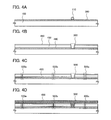
- FIGS. 2A to 2D are process cross-sectional views illustrating a manufacturing method of a photoelectric conversion device
- FIGS. 3A to 3D are process cross-sectional views illustrating a manufacturing method of a photoelectric conversion device
- FIGS. 4A to 4D are process cross-sectional views illustrating a manufacturing method of a photoelectric conversion device
- FIGS. 5A to 5D are process cross-sectional views illustrating a manufacturing method of a photoelectric conversion device
- FIGS. 6A to 6D are process cross-sectional views illustrating a manufacturing method of a photoelectric conversion device.
- FIGS. 7A and 7B are block diagrams illustrating an electronic appliance and a charge and discharge control circuit, respectively.
- FIG. 1 is a cross-sectional view of a photoelectric conversion device according to one embodiment of the present invention.
- a photoelectric conversion device in this embodiment has an integrated structure, including a substrate 100 , a first electrode 120 , a first semiconductor layer 140 , a second semiconductor layer 150 , a third semiconductor layer 160 , a second electrode 180 , and an insulating resin 190 .
- an example is shown where cells divided into three are connected in series using the first electrode 120 and the second electrode 180 . Needless to say, cells are not limited to three, and a practitioner may appropriately determine the number of divided cells to obtain desired power.
- the structural defects 200 a and 200 b which are pinholes, scratches, or the like, and the insulating resin 190 which fill them is formed.
- this insulating resin 190 By formation of this insulating resin 190 , the structural defects 200 a and 200 b are inactivated, and a short circuit or a leak current between top and bottom electrode layers can be prevented.
- the insulating resin 190 is also formed in first separation grooves 220 a, 220 b, 220 c, and 220 d which separate the first electrode 120 , the first semiconductor layer 140 , the second semiconductor layer 150 , and the third semiconductor layer 160 .
- a shape of the insulating resin 190 is not limited that that shown in the figure, and any shape is acceptable as long as the insulating resin 190 covers wall surfaces of the structural defects 200 a and 200 b, and wall surfaces of the first separation grooves 220 a, 220 b, 220 c, and 220 d.
- a separation groove for forming the first electrode 120 has been for separating only a conductive film.
- a semiconductor film that is formed thereover has easily peeled off.
- adhesion is weak between a substrate surface that is exposed by the separation process and a semiconductor film that is formed thereover, a similar situation is observed, and a region where film peeling occurred has been a structural defect.
- a wall surface of the separation groove that has separated only a conductive film is approximately perpendicular to the substrate, and coverage by a semiconductor film that is formed in that region may become defective. Also, in a top portion of the wall surface, there are cases in which a protrusion that like a burr from metal processing is formed, and coverage defect also occurs easily in such a portion. In such cases, defective portions in the coverage become structural defects.
- the first separation grooves 220 a, 220 b, 220 c, and 220 d are also formed in the first semiconductor layer 140 , the second semiconductor layer 150 , and the third semiconductor layer 160 in a manner that is continual from regions that are separated in a light-transmitting conductive film that is the first electrode 120 , and then the insulating resin 190 is filled in the separation grooves so that the semiconductor layers are not formed in the separation grooves. With this, insulation between the first electrode 120 and the second electrode 180 is increased, and a short circuit or a leak current can be prevented.
- a glass plate such as general flat glass, clear flat glass, lead glass, or crystallized glass can be used.
- a non-alkali glass substrate of aluminosilicate glass, barium borosilicate glass, aluminoborosilicate glass, or the like, or a quartz substrate can be used.
- a glass substrate is used as the substrate 100 , and this substrate side is set as a light incidence side.
- a resin substrate can be used as the substrate 100 .
- the following can be given: polyether sulfone (PES); polyethylene terephthalate (PET);
- PEN polyethylene naphthalate
- PC polycarbonate
- PEEK polyether etherketone
- PSF polysulfone
- PEI polyether imide
- PAR polyarylate
- PBT polybutylene terephthalate
- polyimide an acrylonitrile butadiene styrene resin
- poly vinyl chloride polypropylene
- poly vinyl acetate an acrylic resin, and the like.
- a light-transmitting conductive film containing the following can be used: indium tin oxide (ITO); indium tin oxide containing silicon (ITSO); zinc oxide (ZnO); indium tin oxide containing zinc (IZO); zinc oxide containing gallium (GZO); zinc oxide containing aluminum (AZO); tin oxide (SnO 2 ); tin oxide containing fluorine (FTO); tin oxide containing antimony (ATO); or the like.
- ITO indium tin oxide
- ITSO indium tin oxide containing silicon
- ZnO zinc oxide
- IZO indium tin oxide containing zinc
- ZZO zinc oxide containing gallium
- AZO zinc oxide containing aluminum
- tin oxide containing fluorine (FTO); tin oxide containing antimony (ATO); or the like can be used: indium tin oxide (ITO); indium tin oxide
- a lamination of an ITO film and an AZO film, a lamination of an ITO film and an FTO film, or the like can be used.
- a film thickness is to be greater than or equal to 100 nm and less than or equal to 1000 nm, preferably greater than or equal to 400 nm and less than or equal to 1000 nm in total.
- a surface of the first electrode 120 may have a textured structure so as to give a light-trapping effect.
- a metal film of aluminum, titanium, nickel, silver, molybdenum, tantalum, tungsten, chromium, copper, stainless steel, or the like can be used.
- the metal film is not limited to a single layer, and different films may be laminated.
- a lamination of a stainless steel film and an aluminum film, a lamination of a silver film and an aluminum film, or the like can be used.
- a total film thickness is to be greater than or equal to 100 nm and less than or equal to 600 nm, preferably greater than or equal to 100 nm and less than or equal to 300 nm.
- a conductive paste such as a carbon paste, a nickel paste, a silver paste, a molybdenum paste, or a copper paste can be used.
- the second electrode 180 may be a lamination of the above light-transmitting conductive film and a metal film.
- the film thickness of the light-transmitting conductive film is preferably greater than or equal to 10 nm and less than or equal to 100 nm.
- a lamination in which an aluminum film, a silver film, and an ITO film are formed in this order from the substrate side can be used.
- an ITO film which is a light-transmitting conductive film is used for the first electrode 120 , and a lamination of a stainless steel film and an aluminum film is used for the second electrode 180 .
- materials used for the electrodes may be reversed. Note that although a light-transmitting conductive film is used for an electrode on the light incidence side, a type of an opposing electrode is not limited, and the practitioner may appropriately select the type of electrode to be used.
- the first semiconductor layer 140 a semiconductor film having one conductivity type can be used, and for the third semiconductor layer 160 , a semiconductor film having an opposite conductivity type to the one conductivity of the first semiconductor layer 140 can be used.
- a p-type silicon semiconductor film is used for the first semiconductor layer 140 and an n-type silicon semiconductor film is used for the third semiconductor layer 160 , conductivity types may be reversed.
- the film thickness of the first semiconductor layer 140 is preferably greater than or equal to 5 nm and less than or equal to 30 nm
- the film thickness of the third semiconductor layer 160 is preferably greater than or equal to 10 nm and less than or equal to 30 nm.
- amorphous silicon can be used for the first semiconductor layer 140 and the third semiconductor layer 160 , microcrystalline silicon or polycrystalline silicon that has lower resistance is preferably used.
- an intrinsic semiconductor refers not only to a so-called intrinsic semiconductor in which the Fermi level lies in the middle of a band gap, but also to a semiconductor in which a concentration of an impurity imparting p-type or n-type conductivity is 1 ⁇ 10 20 cm ⁇ 3 or lower, and in which photoconductivity is 100 times or more than a dark conductivity.
- This intrinsic semiconductor may include an impurity element belonging to Group 13 or Group 15 of the periodic table.
- the film thickness of the second semiconductor layer 150 is preferably greater than or equal to 100 nm and less than or equal to 600 nm.
- amorphous silicon, microcrystalline silicon, polycrystalline silicon, or the like can be used as the intrinsic semiconductor used for the second semiconductor layer 150 .
- amorphous silicon which has high photoelectric conversion capability with respect to visible light ray.
- a photosensitive resin As the insulating resin 190 which fills the first separation groove and the structural defects 200 a and 200 b formed in the region including the first semiconductor layer 140 , the second semiconductor layer 150 , and the third semiconductor layer 160 , a photosensitive resin is used.
- the structural defects 200 a and 200 b are pinholes that are formed undesirably due to a particle or the like during a process for forming the semiconductor layers.
- the structural defects 200 a and 200 b are shown in a manner that penetrates the three semiconductor layers of the first semiconductor layer 140 , the second semiconductor layer 150 , and the third semiconductor layer 160 , a process of structural defect formation results from various phenomenons, and is not limited thereto. For example, there is a case in which a structural defect is formed above the second semiconductor layer 150 , or a case in which a structural defect is formed in a manner that includes the first electrode 120 .
- a structural defect is a region in which a layer that is supposed to be formed is missing, and a possibility of another layer getting in to that region is high. Accordingly, this becomes a cause for degradation of an electrical characteristic such as a short circuit or a leak current.
- a scratch formed on a film surface is also a structural defect, and becomes a cause for malfunction in the same manner as a pinhole.
- a scratch on a film surface is formed mainly by contact with another object.
- a light-transmitting conductive film 320 serving as the first electrode 120 is formed over the substrate 100 which is a glass substrate or the like.
- an ITO film is formed with a thickness of 500 nm.
- particles 110 a and 110 b are attached accidentally to the light-transmitting conductive film 320 (see FIG. 2A ).
- a p-type microcrystalline silicon film is formed with a thickness of 30 nm.
- a doping gas containing an impurity imparting p-type conductivity is mixed into a source gas, and a p-type microcrystalline silicon film is formed by a plasma CVD method.
- the impurity imparting p-type conductivity boron, aluminum, or the like that is a Group 13 element in the periodic table can be given.
- a doping gas such as diborane is mixed into a source gas such as silane and used in forming a p-type microcrystalline silicon.
- the first semiconductor layer 140 may be formed using amorphous silicon, it is preferably formed using microcrystalline silicon which has lower resistance and favorable adhesion to the light-transmitting conductive film 320 .
- an i-type amorphous silicon film is formed with a thickness of 600 nm as the second semiconductor layer 150 .
- a source gas silane or disilane can be used, and hydrogen may be added thereto.
- an atmospheric component contained in the film may serve as a donor in some cases; therefore, greater than or equal to 0.001 at. % and less than or equal to 0.1 at. % of boron (B) may be added to the film so that the conductivity type may become close to i-type.
- an n-type microcrystalline film with a thickness of 30 nm is formed as the third semiconductor layer 160 .
- the n-type microcrystalline silicon is formed using a source gas into which a doping gas containing an impurity imparting n-type conductivity is mixed.
- a doping gas containing an impurity imparting n-type conductivity phosphorus, arsenic, or antimony which is a Group 15 element in the periodic table, or the like can be typically given.
- a doping gas such as phosphine is mixed into a source gas such as silane, and used in forming the n-type microcrystalline silicon film.
- the third semiconductor layer 160 may be formed using amorphous silicon, it is preferably formed using microcrystalline silicon which has lower resistance.
- the particles 110 a and 110 b attached to the light-transmitting conductive film 320 form the structural defects 200 a and 200 b in the first semiconductor layer 140 , the second semiconductor layer 150 , and the third semiconductor layer 160 (see FIG. 2B ). Note that FIG. 2B shows a state in which the particles and the semiconductor layers formed thereover are removed.
- the separation grooves 220 a, 220 b, 220 c, and 220 d are formed, which separate the light-transmitting conductive film 320 , the first semiconductor layer 140 , the second semiconductor layer 150 , and the third semiconductor layer 160 into a plurality of pieces (see FIG. 2C ).
- the separation grooves can be formed by a laser process or the like.
- a laser used in this laser process is preferably a continuous wave laser or a pulsed laser which emits light in an infrared light region.
- the laser process may be performed using an Nd-YAG laser (wavelength of 1064 nm) with a beam diameter of 30 ⁇ m, an output of 0.5 W, an oscillation frequency of 25 kHz, and a scanning speed of 20 cm/sec. Note that here, a portion of the separation grooves may reach the substrate 100 . Also, by the light-transmitting conductive film 320 getting separated in this step, the first electrode 120 is formed.
- the number of steps can be reduced, and particles that are generated during the laser process can also be reduced.
- the light-transmitting conductive film and the semiconductor layers may be separated separately.
- the light-transmitting conductive film 320 is formed, the laser process is performed to form the first separation grooves, the first semiconductor layer 140 , the second semiconductor layer 150 , and the third semiconductor layer 160 are formed thereover, and then the laser process is performed again on the semiconductor layers in which the first separation grooves are formed.
- the laser process is performed again on the semiconductor layers in which the first separation grooves are formed.
- a step of forming the first separation grooves 220 a, 220 b, 220 c, and 220 d needs to be after forming the semiconductor layers. If the step of forming the separation grooves is performed after forming the conductive layer over the semiconductor layers, the conductive layer is formed in the structural defects 200 a and 200 b, and this leads to malfunction such as a short circuit or a leak current.
- the insulating resin 190 is formed in a manner that covers the third semiconductor layer 160 and fills the structural defects 200 a and 200 b, and the first separation grooves 220 a, 220 b, 220 c, and 220 d (see FIG. 2D ).
- a photosensitive resin is used as the insulating resin. For example, there is a photo-resist, photosensitive polyimide, or the like, and by exposing a portion thereof, a desired form can be obtained.
- a photo-resist is used.
- the photo-resist is formed with a thickness of greater than or equal to 0.5 ⁇ m and less than or equal to 5 ⁇ m using a spin-coater or a slit-coater, and after prebaking it, exposure is performed using light with a wavelength with which the photo-resist to be used is exposed. For example, ultraviolet light with a wavelength of greater than or equal to 300 nm and less than or equal to 400 nm can be used.
- a positive-type photo-resist exposure is performed from a photo-resist side, and exposure time is adjusted so that the photo-resist up to a surface of the third semiconductor layer is exposed. In this case, a portion that is not exposed becomes fixed, and a portion that is exposed becomes unfixed.
- a negative-type photo-resist exposure is performed from a substrate side. Exposure can be performed on regions of the structural defects and separation grooves through a light-transmitting substrate or a light-transmitting conductive film. In this case, a portion that is exposed becomes fixed, and a portion that is not exposed becomes unfixed.
- the first electrode 120 needs to be a light-transmitting conductive film. If a metal film is used for the first electrode 120 , light is blocked in all portions except the first separation grooves 220 a, 220 b, 220 c, and 220 d, and the photosensitive resin that is filled in the structural defects 200 a and 200 b cannot be exposed. Also, in the case where a structural defect is formed only in a top layer of the semiconductor layers, light is blocked by the semiconductor layer in a lower layer, and the photosensitive resin cannot be exposed. Furthermore, since exposure is performed from the substrate 100 side, the semiconductor layers are irradiated with ultraviolet light through a light-transmitting conductive film which is the first electrode 120 . In this embodiment, since amorphous silicon is used for the second semiconductor layer 150 , irradiation of ultraviolet light encourages light degradation, which is not preferable. Accordingly, the photosensitive resin used as the insulating resin 190 is preferably a positive type.
- the unfixed photo-resist can be removed while leaving behind the photo-resist (insulating resin 190 ) that is fixed in the structural defects 200 a and 200 b, and the first separation grooves 220 a, 220 b, 220 c, and 220 d (see FIG. 3A ). Then, post baking is performed, and the photo-resist is chemically stabilized.
- second separation grooves 260 a, 260 b, and 260 c are formed, which separate the first semiconductor layer 140 , the second semiconductor layer 150 , and the third semiconductor layer 160 into a plurality of pieces (see FIG. 3B ).
- the separation grooves can be formed by a laser process or the like.
- a laser used in this laser process is preferably a continuous wave laser or a pulsed laser which emits light in a visible light region or an infrared light region.
- the laser process may be performed using the second harmonic of an Nd-YAG laser (wavelength of 532 nm) with a beam diameter of 30 ⁇ m, an output of 0.05 W, an oscillation frequency of 20 kHz, and a stage scanning speed of 50 cm/sec.
- a conductive film 380 serving as the second electrode 180 is formed.
- a lamination of a stainless steel film with a thickness of 5 nm and an aluminum film with a thickness of 300 nm is used. Note that the stainless steel film is to be on a side that comes into contact with the third semiconductor layer 160 (see FIG. 3C ).
- third separation grooves 280 a, 280 b, and 280 c are formed, which separate the conductive film 380 into a plurality of pieces (see FIG. 3D ).
- the separation grooves can be formed by a laser process or the like.
- a laser used in this laser process is preferably a continuous wave laser or a pulsed laser which emits light in a visible light region or an infrared light region.
- the laser process may be performed using a second high frequency wave of an Nd-YAG laser (wavelength of 532 nm) with a beam diameter of 30 ⁇ m, output of 0.05 W, an oscillation frequency of 20 kHz, and a stage scanning speed of 50 cm/sec. Note that by the conductive film 380 getting separated in this step, the second electrode 180 is formed.
- the semiconductor layers in a region that is irradiated by the laser during the laser process may be removed.
- the second electrode 180 may be formed by screen printing.
- a conductive paste such as a carbon paste, a nickel paste, a silver paste, or a molybdenum paste can be used.
- the third separation grooves 280 a, 280 b, and 280 c are formed without the laser process described above.
- a protective insulating layer for improving reliability may be formed in a manner that covers the second electrode 180 and fills the third separation grooves 280 a, 280 b, and 280 c, while excluding a terminal portion (a portion of the second electrode 180 ) for taking out power to the exterior.
- an inorganic film or an insulating resin can be used for the protective insulating layer.
- This embodiment can be implemented in appropriate combination with a structure described in another embodiment.
- the conductive film 380 serving as a first electrode 420 is formed over the substrate 100 .
- a polyethylene naphthalate (PEN) substrate of a resin material is used as the substrate 100 .
- PEN polyethylene naphthalate
- the thickness of the substrate 100 is not limited, roll-to-roll processing can be performed if a thin substrate with a thickness of about 100 ⁇ m is used, for example.
- a step by a screen printing method, a laser processing method, or the like is included. Accordingly, almost the entire manufacturing process of a photoelectric conversion device can be performed by roll-to-roll processing. Furthermore, the process may partially be performed by roll-to-roll processing, and then divided into sheet forms to perform latter steps individually for each sheet. For example, by attaching each piece of the divided sheet to a frame that is formed of ceramic, a metal, a composite body thereof, or the like, it can be handled in the same manner as a glass substrate or the like.
- the conductive film 380 is formed by a sputtering method.
- the same material used for the second electrode 180 described in Embodiment 1 can be used.
- a metal film is used in which an aluminum film with a thickness of 300 tun and a stainless steel film with a thickness of 5 nm are laminated in this order from the substrate 100 side.
- a particle 110 is attached undesirably to the conductive film 380 after forming the conductive film 380 is described (see FIG. 4A ).
- the particle 110 is shown to have a spherical shape in the figure as an example, there are various modes in size, shape, and material.
- an n-type microcrystalline silicon film with a thickness of 30 nm is formed as a first semiconductor layer 440 ; an i-type amorphous silicon film with a thickness of 600 nm is formed as a second semiconductor layer 450 ; and a p-type microcrystalline silicon with a thickness of 30 nm is formed as a third semiconductor layer 460 , in this order.
- a structural defect 500 is formed due to the particle 110 being in the way.
- the particle 110 is unstably attached to the first electrode 420 ; therefore, it may be moved by a small vibration, air current, or the like. Also, the particle 110 may be intentionally removed by a cleaning step. Such a state is shown in FIG. 4B .
- first separation grooves 520 a, 520 b, and 520 c are formed, which separate the conductive film 380 , the first semiconductor layer 440 , the second semiconductor layer 450 , and the third semiconductor layer 460 into a plurality of pieces (see FIG. 4C ).
- the separation grooves can be formed by the laser processing method used to form the first separation grooves 220 a, 220 b, 220 c, and 220 d in Embodiment 1. Note that here, a portion of the separation grooves may reach the substrate 100 . Furthermore, by the conductive film 380 getting separated in this step, the first electrode 420 is formed.
- a first insulating resin 490 is formed in a manner that covers the third semiconductor layer 460 and fills the structural defect 500 and the first separation grooves 520 a, 520 b, and 520 c (see FIG. 4D ).
- the insulating resin 190 described in Embodiment 1 can be used.
- a photo-resist is formed and then exposure and development is performed to remove unnecessary photo-resist.
- a photo-resist (the first insulating resin 490 ) that is filled in the structural defect 500 and the first separation grooves 520 a, 520 b, and 520 c is stabilized (see FIG. 5A ).
- second insulating resins 600 a, 600 b, and 600 c are formed over the third semiconductor layer 460 (see FIG. 5B ).
- the second insulating resins 600 a, 600 b, and 600 c serve as stoppers when performing a laser process on a light-transmitting conductive film that is formed thereover.
- the insulating resins are preferably formed by a screen printing method, and a thermo-setting resin such as an epoxy resin, a phenol resin, a silicone resin, an acrylic resin, or a polyimide resin can be used.
- a thermo-setting resin such as an epoxy resin, a phenol resin, a silicone resin, an acrylic resin, or a polyimide resin
- an epoxy resin is used.
- the resin preferably has a black color in order to encourage absorption of the above-mentioned laser light.
- the light-transmitting conductive film 320 is formed over the third semiconductor layer 460 , the first insulating resin 490 , and the second insulating resins 600 a, 600 b, and 600 c, by a sputtering method (see FIG. 5C ).
- the same material used for the first electrode 120 in Embodiment 1 can be used.
- an ITO film with a thickness of 100 nm is used.
- portions where the second insulating resins 600 a, 600 b, and 600 c are stacked over the light-transmitting conductive film 320 are subjected to a laser process, to form second separation grooves 640 a, 640 b, and 640 c (see FIG. 5D ).
- the separation grooves can be formed by the laser processing method that is used to form the first separation grooves 220 a, 220 b, 220 c, and 220 d in Embodiment 1. Note that here, a groove many formed in a portion of each of the second insulating resins 600 a, 600 b, and 600 c. Furthermore, by the light-transmitting conductive film 320 getting separated in this step, a second electrode 480 is formed.
- third insulating resins 660 a, 660 b, and 660 c are formed for sealing the second separation grooves 640 a, 640 b, and 640 c (see FIG. 6A ).
- the insulating resins can be formed using the same method and material that are used to form the second insulating resins 600 a, 600 b, and 600 c.
- third electrodes 680 a, 680 b, and 680 c are formed so as to be in contact with the second electrode 480 (see FIG. 6B ).
- the third electrodes 680 a, 680 b, and 680 c can be formed by a screen printing method.
- a thermo-setting conductive paste is preferably used for a material, such as a silver paste, for example.
- connection grooves 700 a, 700 b, and 700 c are regions that weld together and electrically connect the third electrode 680 a, 680 b, and 680 c to the first electrode 420 .
- the connection grooves may be formed by forming separation grooves in the first electrode 420 , the first semiconductor layer 440 , the second semiconductor layer 450 , and the third semiconductor layer 460 , and then filling the separation grooves to form the third electrodes 680 a, 680 b, and 680 c.
- the third electrode 680 a serves as a extraction electrode for taking out the first electrode 420 of an adjacent cell to a surface side.
- the third electrode 680 b serves as a connection electrode for connecting adjacent cells in series.
- the third electrode 680 c serves as a extraction electrode of the second electrode 480 to which the electrode is connected.
- the third electrode 680 c can serve as the extraction electrode even without forming the connection groove 700 c, since resistance can be lowered by a portion of the third electrode 680 c being connected to the first electrode 420 , it is preferable to form the connection groove 700 c.
- the number of cells to be integrated is not limited thereto, and can be appropriately determined by the practitioner.
- a grid electrode 720 may be formed, which extends from a portion of each of the third electrode 680 b and the third electrode 680 c towards an adjacent cell.
- resistance loss can be reduced, and electrical characteristic can be improved particularly under high illuminance.
- the grid electrodes 720 are formed with space therebetween and toward a depth direction of the figure; therefore, they do not cover an entire light-receiving surface.
- FIG. 6D shows a cross-sectional view of a region where the grid electrodes 720 are formed.
- a sealing resin for improving reliability a light-transmitting insulating resin may be provided on a light-receiving surface side.
- the sealing resin can be formed by a screen printing method using a thermo-setting epoxy resin, phenol resin, or the like.
- an integrated photoelectric conversion device with high yield can be manufactured, in which a defect such as a short circuit or a leak current can be suppressed as much as possible.
- a photoelectric conversion device disclosed in this specification can be used in various electronic devices.
- an example of using the photoelectric conversion device as a power source of an electronic book will be described.
- FIG. 7A shows an electronic book (also called an “E-book”), which can include a housing 9630 , a display portion 9631 , an operation key 9632 , a photoelectric conversion device 9633 , and a charge and discharge control circuit 9634 .
- the electronic book shown in FIG. 7A can have a function of displaying various data (such as a still image, a moving image, and a text image), a function of displaying a calendar, a date, a time, or the like on the display portion, a function of operating or editing the data displayed on the display portion, a function of controlling processing by various software (programs), and the like. Note that FIG.
- FIG. 7A shows an example of a structure of the charge and discharge control circuit 9634 that includes a battery 9635 , a DCDC converter 9636 , and a DCDC converter 9637 .
- the photoelectric conversion device 9633 is not limited to a region shown in the figure, and can be appropriately provided in an empty space (a front surface or a rear surface) of the housing 9630 .
- the battery 9635 there is an advantage in using a lithium ion battery in that size reduction or the like can be realized.
- FIG. 7B shows the photoelectric conversion device 9633 , the charge and discharge control circuit 9634 , and the display portion 9631 .
- the charge and discharge control circuit 9634 includes the battery 9635 , the DCDC converter 9636 , the DCDC converter 9637 , and switches SW 1 to SW 3 .
- a voltage of power that is generated by the photoelectric conversion device is raised or lowered in the DCDC converter 9636 so as to be a favorable voltage for charging the battery 9635 .
- the switch SW 1 is turned on, the voltage of the power is raised or lowered in the DCDC converter 9637 to a voltage that is needed in the display portion 9631 , and power is supplied to the display portion 9631 .
- the SW 1 is turned off and the SW 2 is turned on to charge the battery 9635 .
- the DCDC converters therebetween may be omitted in a structure that allows directly supplying power to the display portion from the photoelectric conversion device, directly charging the battery from the photoelectric conversion device, or directly supplying power to the display portion from the battery.
- the battery 9635 may be charged by a combination of the photoelectric conversion device 9633 and a photoelectric conversion device with a different structure than the structure of the photoelectric conversion device 9633 .
- the combination may be of the photoelectric conversion device 9633 and another power generation means.
Landscapes
- Photovoltaic Devices (AREA)
Applications Claiming Priority (2)
| Application Number | Priority Date | Filing Date | Title |
|---|---|---|---|
| JP2010131841 | 2010-06-09 | ||
| JP2010-131841 | 2010-06-09 |
Publications (1)
| Publication Number | Publication Date |
|---|---|
| US20110303272A1 true US20110303272A1 (en) | 2011-12-15 |
Family
ID=45095240
Family Applications (1)
| Application Number | Title | Priority Date | Filing Date |
|---|---|---|---|
| US13/154,990 Abandoned US20110303272A1 (en) | 2010-06-09 | 2011-06-07 | Photoelectric Conversion Device and Manufacturing Method Thereof |
Country Status (2)
| Country | Link |
|---|---|
| US (1) | US20110303272A1 (https=) |
| JP (1) | JP5700665B2 (https=) |
Cited By (3)
| Publication number | Priority date | Publication date | Assignee | Title |
|---|---|---|---|---|
| CN104380484A (zh) * | 2012-06-28 | 2015-02-25 | Lg伊诺特有限公司 | 太阳能电池和用于制造太阳能电池的方法 |
| US20150144182A1 (en) * | 2012-06-05 | 2015-05-28 | Lg Innotek Co., Ltd. | Solar cell and method for manufacturing same |
| US9413289B2 (en) | 2010-10-29 | 2016-08-09 | Semiconductor Energy Laboratory Co., Ltd. | Photoelectric conversion device |
Families Citing this family (1)
| Publication number | Priority date | Publication date | Assignee | Title |
|---|---|---|---|---|
| EP3718145A4 (en) * | 2017-11-30 | 2021-06-23 | China Triumph International Engineering Co., Ltd. | Thin film device with additional conductive lines and method for producing it |
Citations (8)
| Publication number | Priority date | Publication date | Assignee | Title |
|---|---|---|---|---|
| US4981525A (en) * | 1988-02-19 | 1991-01-01 | Sanyo Electric Co., Ltd. | Photovoltaic device |
| US5131954A (en) * | 1990-10-15 | 1992-07-21 | United Solar Systems Corporation | Monolithic solar cell array and method for its manufacturing |
| US5385848A (en) * | 1993-09-20 | 1995-01-31 | Iowa Thin Film Technologies, Inc | Method for fabricating an interconnected array of semiconductor devices |
| US6225552B1 (en) * | 1996-07-24 | 2001-05-01 | Semiconductor Energy Laboratory Co., Ltd. | Planar solar cell array and production method of the same |
| US20060035469A1 (en) * | 2004-08-10 | 2006-02-16 | Nugent Truong | Methods for forming an undercut region and electronic devices incorporating the same |
| US7095090B2 (en) * | 1992-09-11 | 2006-08-22 | Semiconductor Energy Laboratory Co., Ltd. | Photoelectric conversion device |
| US20070079866A1 (en) * | 2005-10-07 | 2007-04-12 | Applied Materials, Inc. | System and method for making an improved thin film solar cell interconnect |
| US20080224941A1 (en) * | 2007-03-13 | 2008-09-18 | Semiconductor Energy Laboratory Co., Ltd. | Semiconductor device and manufacturing method thereof |
Family Cites Families (5)
| Publication number | Priority date | Publication date | Assignee | Title |
|---|---|---|---|---|
| JPS6254478A (ja) * | 1985-08-24 | 1987-03-10 | Semiconductor Energy Lab Co Ltd | 光電変換装置 |
| JPS6269566A (ja) * | 1985-09-21 | 1987-03-30 | Semiconductor Energy Lab Co Ltd | 光電変換装置作製方法 |
| JPS6284569A (ja) * | 1985-10-08 | 1987-04-18 | Sanyo Electric Co Ltd | 光起電力装置の製造方法 |
| JPH04336471A (ja) * | 1991-05-13 | 1992-11-24 | Canon Inc | 半導体薄膜のピンホールの除去方法 |
| TW200849621A (en) * | 2006-12-21 | 2008-12-16 | Helianthos Bv | Method for making solar sub-cells from a solar cell |
-
2011
- 2011-06-07 US US13/154,990 patent/US20110303272A1/en not_active Abandoned
- 2011-06-08 JP JP2011128179A patent/JP5700665B2/ja not_active Expired - Fee Related
Patent Citations (8)
| Publication number | Priority date | Publication date | Assignee | Title |
|---|---|---|---|---|
| US4981525A (en) * | 1988-02-19 | 1991-01-01 | Sanyo Electric Co., Ltd. | Photovoltaic device |
| US5131954A (en) * | 1990-10-15 | 1992-07-21 | United Solar Systems Corporation | Monolithic solar cell array and method for its manufacturing |
| US7095090B2 (en) * | 1992-09-11 | 2006-08-22 | Semiconductor Energy Laboratory Co., Ltd. | Photoelectric conversion device |
| US5385848A (en) * | 1993-09-20 | 1995-01-31 | Iowa Thin Film Technologies, Inc | Method for fabricating an interconnected array of semiconductor devices |
| US6225552B1 (en) * | 1996-07-24 | 2001-05-01 | Semiconductor Energy Laboratory Co., Ltd. | Planar solar cell array and production method of the same |
| US20060035469A1 (en) * | 2004-08-10 | 2006-02-16 | Nugent Truong | Methods for forming an undercut region and electronic devices incorporating the same |
| US20070079866A1 (en) * | 2005-10-07 | 2007-04-12 | Applied Materials, Inc. | System and method for making an improved thin film solar cell interconnect |
| US20080224941A1 (en) * | 2007-03-13 | 2008-09-18 | Semiconductor Energy Laboratory Co., Ltd. | Semiconductor device and manufacturing method thereof |
Cited By (4)
| Publication number | Priority date | Publication date | Assignee | Title |
|---|---|---|---|---|
| US9413289B2 (en) | 2010-10-29 | 2016-08-09 | Semiconductor Energy Laboratory Co., Ltd. | Photoelectric conversion device |
| US20150144182A1 (en) * | 2012-06-05 | 2015-05-28 | Lg Innotek Co., Ltd. | Solar cell and method for manufacturing same |
| US9806207B2 (en) * | 2012-06-05 | 2017-10-31 | Lg Innotek Co., Ltd. | Solar cell and method for manufacturing same |
| CN104380484A (zh) * | 2012-06-28 | 2015-02-25 | Lg伊诺特有限公司 | 太阳能电池和用于制造太阳能电池的方法 |
Also Published As
| Publication number | Publication date |
|---|---|
| JP5700665B2 (ja) | 2015-04-15 |
| JP2012019208A (ja) | 2012-01-26 |
Similar Documents
| Publication | Publication Date | Title |
|---|---|---|
| CN100454584C (zh) | 透光性薄膜太阳能电池模块及其制造方法 | |
| US9059347B2 (en) | Photoelectric conversion device and manufacturing method thereof | |
| US8859880B2 (en) | Method and structure for tiling industrial thin-film solar devices | |
| US7855822B2 (en) | Photosensitive electrochromic device | |
| CN102239571B (zh) | 薄膜光电变换装置的制造方法 | |
| US7057102B2 (en) | Solar cell module and portable electronic apparatus with it | |
| US20120060890A1 (en) | Solar cell module and method for manufacturing the same | |
| CN102017172A (zh) | 薄膜太阳能电池模块的制造方法和薄膜太阳能电池模块 | |
| US20110303272A1 (en) | Photoelectric Conversion Device and Manufacturing Method Thereof | |
| US9214587B2 (en) | Photoelectric conversion module and manufacturing method thereof | |
| CN107845688A (zh) | 太阳能电池镂空电路及太阳能电池显示装置 | |
| US9087953B2 (en) | Solar cell module and method for manufacturing the same | |
| TW201316537A (zh) | 用來製造穿透式太陽能電池模組的方法 | |
| KR101819238B1 (ko) | 전기 이중층 캐패시터, 또는 태양광 발전 장치 | |
| JP2011243970A (ja) | 光電変換装置及びその作製方法 | |
| CN101809761B (zh) | 太阳能电池组件的制造方法 | |
| TWI590477B (zh) | 太陽能電池鏤空電路及太陽能電池顯示裝置 | |
| CN115207147B (zh) | 太阳能电池模块与太阳能电池显示装置 | |
| CN207264710U (zh) | 一种显示装置及电子设备 | |
| CN106033782A (zh) | 太阳能电池、太阳能电池模块及其制作方法 | |
| CN120659473A (zh) | 太阳能电池及太阳能发电系统 | |
| TW201633553A (zh) | 太陽能電池、太陽能電池模組及其製作方法 | |
| CN103000707A (zh) | 太阳能电池模块及其制造方法 | |
| JPWO2013080550A1 (ja) | 太陽電池モジュール | |
| JP2005311180A (ja) | 単位薄膜太陽電池内の微小欠陥部除去方法および薄膜太陽電池モジュールの製造方法 |
Legal Events
| Date | Code | Title | Description |
|---|---|---|---|
| AS | Assignment |
Owner name: SEMICONDUCTOR ENERGY LABORATORY CO., LTD., JAPAN Free format text: ASSIGNMENT OF ASSIGNORS INTEREST;ASSIGNORS:NISHI, KAZUO;HIROSE, TAKASHI;ISAKA, FUMITO;AND OTHERS;SIGNING DATES FROM 20110527 TO 20110601;REEL/FRAME:026403/0268 |
|
| STCB | Information on status: application discontinuation |
Free format text: ABANDONED -- FAILURE TO RESPOND TO AN OFFICE ACTION |