US11226527B2 - Display device - Google Patents
Display device Download PDFInfo
- Publication number
- US11226527B2 US11226527B2 US16/802,442 US202016802442A US11226527B2 US 11226527 B2 US11226527 B2 US 11226527B2 US 202016802442 A US202016802442 A US 202016802442A US 11226527 B2 US11226527 B2 US 11226527B2
- Authority
- US
- United States
- Prior art keywords
- data line
- line
- disposed
- region
- pixel
- Prior art date
- Legal status (The legal status is an assumption and is not a legal conclusion. Google has not performed a legal analysis and makes no representation as to the accuracy of the status listed.)
- Active
Links
Images







Classifications
-
- G—PHYSICS
- G02—OPTICS
- G02F—OPTICAL DEVICES OR ARRANGEMENTS FOR THE CONTROL OF LIGHT BY MODIFICATION OF THE OPTICAL PROPERTIES OF THE MEDIA OF THE ELEMENTS INVOLVED THEREIN; NON-LINEAR OPTICS; FREQUENCY-CHANGING OF LIGHT; OPTICAL LOGIC ELEMENTS; OPTICAL ANALOGUE/DIGITAL CONVERTERS
- G02F1/00—Devices or arrangements for the control of the intensity, colour, phase, polarisation or direction of light arriving from an independent light source, e.g. switching, gating or modulating; Non-linear optics
- G02F1/01—Devices or arrangements for the control of the intensity, colour, phase, polarisation or direction of light arriving from an independent light source, e.g. switching, gating or modulating; Non-linear optics for the control of the intensity, phase, polarisation or colour
- G02F1/13—Devices or arrangements for the control of the intensity, colour, phase, polarisation or direction of light arriving from an independent light source, e.g. switching, gating or modulating; Non-linear optics for the control of the intensity, phase, polarisation or colour based on liquid crystals, e.g. single liquid crystal display cells
- G02F1/133—Constructional arrangements; Operation of liquid crystal cells; Circuit arrangements
- G02F1/1333—Constructional arrangements; Manufacturing methods
- G02F1/1343—Electrodes
- G02F1/134309—Electrodes characterised by their geometrical arrangement
-
- G—PHYSICS
- G02—OPTICS
- G02F—OPTICAL DEVICES OR ARRANGEMENTS FOR THE CONTROL OF LIGHT BY MODIFICATION OF THE OPTICAL PROPERTIES OF THE MEDIA OF THE ELEMENTS INVOLVED THEREIN; NON-LINEAR OPTICS; FREQUENCY-CHANGING OF LIGHT; OPTICAL LOGIC ELEMENTS; OPTICAL ANALOGUE/DIGITAL CONVERTERS
- G02F1/00—Devices or arrangements for the control of the intensity, colour, phase, polarisation or direction of light arriving from an independent light source, e.g. switching, gating or modulating; Non-linear optics
- G02F1/01—Devices or arrangements for the control of the intensity, colour, phase, polarisation or direction of light arriving from an independent light source, e.g. switching, gating or modulating; Non-linear optics for the control of the intensity, phase, polarisation or colour
- G02F1/13—Devices or arrangements for the control of the intensity, colour, phase, polarisation or direction of light arriving from an independent light source, e.g. switching, gating or modulating; Non-linear optics for the control of the intensity, phase, polarisation or colour based on liquid crystals, e.g. single liquid crystal display cells
- G02F1/133—Constructional arrangements; Operation of liquid crystal cells; Circuit arrangements
- G02F1/1333—Constructional arrangements; Manufacturing methods
- G02F1/1343—Electrodes
-
- G—PHYSICS
- G02—OPTICS
- G02F—OPTICAL DEVICES OR ARRANGEMENTS FOR THE CONTROL OF LIGHT BY MODIFICATION OF THE OPTICAL PROPERTIES OF THE MEDIA OF THE ELEMENTS INVOLVED THEREIN; NON-LINEAR OPTICS; FREQUENCY-CHANGING OF LIGHT; OPTICAL LOGIC ELEMENTS; OPTICAL ANALOGUE/DIGITAL CONVERTERS
- G02F1/00—Devices or arrangements for the control of the intensity, colour, phase, polarisation or direction of light arriving from an independent light source, e.g. switching, gating or modulating; Non-linear optics
- G02F1/01—Devices or arrangements for the control of the intensity, colour, phase, polarisation or direction of light arriving from an independent light source, e.g. switching, gating or modulating; Non-linear optics for the control of the intensity, phase, polarisation or colour
- G02F1/13—Devices or arrangements for the control of the intensity, colour, phase, polarisation or direction of light arriving from an independent light source, e.g. switching, gating or modulating; Non-linear optics for the control of the intensity, phase, polarisation or colour based on liquid crystals, e.g. single liquid crystal display cells
- G02F1/133—Constructional arrangements; Operation of liquid crystal cells; Circuit arrangements
- G02F1/1333—Constructional arrangements; Manufacturing methods
- G02F1/1343—Electrodes
- G02F1/134309—Electrodes characterised by their geometrical arrangement
- G02F1/134345—Subdivided pixels, e.g. for grey scale or redundancy
- G02F1/134354—Subdivided pixels, e.g. for grey scale or redundancy the sub-pixels being capacitively coupled
-
- G—PHYSICS
- G02—OPTICS
- G02F—OPTICAL DEVICES OR ARRANGEMENTS FOR THE CONTROL OF LIGHT BY MODIFICATION OF THE OPTICAL PROPERTIES OF THE MEDIA OF THE ELEMENTS INVOLVED THEREIN; NON-LINEAR OPTICS; FREQUENCY-CHANGING OF LIGHT; OPTICAL LOGIC ELEMENTS; OPTICAL ANALOGUE/DIGITAL CONVERTERS
- G02F1/00—Devices or arrangements for the control of the intensity, colour, phase, polarisation or direction of light arriving from an independent light source, e.g. switching, gating or modulating; Non-linear optics
- G02F1/01—Devices or arrangements for the control of the intensity, colour, phase, polarisation or direction of light arriving from an independent light source, e.g. switching, gating or modulating; Non-linear optics for the control of the intensity, phase, polarisation or colour
- G02F1/13—Devices or arrangements for the control of the intensity, colour, phase, polarisation or direction of light arriving from an independent light source, e.g. switching, gating or modulating; Non-linear optics for the control of the intensity, phase, polarisation or colour based on liquid crystals, e.g. single liquid crystal display cells
- G02F1/133—Constructional arrangements; Operation of liquid crystal cells; Circuit arrangements
- G02F1/136—Liquid crystal cells structurally associated with a semi-conducting layer or substrate, e.g. cells forming part of an integrated circuit
- G02F1/1362—Active matrix addressed cells
- G02F1/136209—Light shielding layers, e.g. black matrix, incorporated in the active matrix substrate, e.g. structurally associated with the switching element
-
- G—PHYSICS
- G02—OPTICS
- G02F—OPTICAL DEVICES OR ARRANGEMENTS FOR THE CONTROL OF LIGHT BY MODIFICATION OF THE OPTICAL PROPERTIES OF THE MEDIA OF THE ELEMENTS INVOLVED THEREIN; NON-LINEAR OPTICS; FREQUENCY-CHANGING OF LIGHT; OPTICAL LOGIC ELEMENTS; OPTICAL ANALOGUE/DIGITAL CONVERTERS
- G02F1/00—Devices or arrangements for the control of the intensity, colour, phase, polarisation or direction of light arriving from an independent light source, e.g. switching, gating or modulating; Non-linear optics
- G02F1/01—Devices or arrangements for the control of the intensity, colour, phase, polarisation or direction of light arriving from an independent light source, e.g. switching, gating or modulating; Non-linear optics for the control of the intensity, phase, polarisation or colour
- G02F1/13—Devices or arrangements for the control of the intensity, colour, phase, polarisation or direction of light arriving from an independent light source, e.g. switching, gating or modulating; Non-linear optics for the control of the intensity, phase, polarisation or colour based on liquid crystals, e.g. single liquid crystal display cells
- G02F1/133—Constructional arrangements; Operation of liquid crystal cells; Circuit arrangements
- G02F1/136—Liquid crystal cells structurally associated with a semi-conducting layer or substrate, e.g. cells forming part of an integrated circuit
- G02F1/1362—Active matrix addressed cells
- G02F1/136213—Storage capacitors associated with the pixel electrode
-
- G—PHYSICS
- G02—OPTICS
- G02F—OPTICAL DEVICES OR ARRANGEMENTS FOR THE CONTROL OF LIGHT BY MODIFICATION OF THE OPTICAL PROPERTIES OF THE MEDIA OF THE ELEMENTS INVOLVED THEREIN; NON-LINEAR OPTICS; FREQUENCY-CHANGING OF LIGHT; OPTICAL LOGIC ELEMENTS; OPTICAL ANALOGUE/DIGITAL CONVERTERS
- G02F1/00—Devices or arrangements for the control of the intensity, colour, phase, polarisation or direction of light arriving from an independent light source, e.g. switching, gating or modulating; Non-linear optics
- G02F1/01—Devices or arrangements for the control of the intensity, colour, phase, polarisation or direction of light arriving from an independent light source, e.g. switching, gating or modulating; Non-linear optics for the control of the intensity, phase, polarisation or colour
- G02F1/13—Devices or arrangements for the control of the intensity, colour, phase, polarisation or direction of light arriving from an independent light source, e.g. switching, gating or modulating; Non-linear optics for the control of the intensity, phase, polarisation or colour based on liquid crystals, e.g. single liquid crystal display cells
- G02F1/133—Constructional arrangements; Operation of liquid crystal cells; Circuit arrangements
- G02F1/136—Liquid crystal cells structurally associated with a semi-conducting layer or substrate, e.g. cells forming part of an integrated circuit
- G02F1/1362—Active matrix addressed cells
- G02F1/136227—Through-hole connection of the pixel electrode to the active element through an insulation layer
-
- G—PHYSICS
- G02—OPTICS
- G02F—OPTICAL DEVICES OR ARRANGEMENTS FOR THE CONTROL OF LIGHT BY MODIFICATION OF THE OPTICAL PROPERTIES OF THE MEDIA OF THE ELEMENTS INVOLVED THEREIN; NON-LINEAR OPTICS; FREQUENCY-CHANGING OF LIGHT; OPTICAL LOGIC ELEMENTS; OPTICAL ANALOGUE/DIGITAL CONVERTERS
- G02F1/00—Devices or arrangements for the control of the intensity, colour, phase, polarisation or direction of light arriving from an independent light source, e.g. switching, gating or modulating; Non-linear optics
- G02F1/01—Devices or arrangements for the control of the intensity, colour, phase, polarisation or direction of light arriving from an independent light source, e.g. switching, gating or modulating; Non-linear optics for the control of the intensity, phase, polarisation or colour
- G02F1/13—Devices or arrangements for the control of the intensity, colour, phase, polarisation or direction of light arriving from an independent light source, e.g. switching, gating or modulating; Non-linear optics for the control of the intensity, phase, polarisation or colour based on liquid crystals, e.g. single liquid crystal display cells
- G02F1/133—Constructional arrangements; Operation of liquid crystal cells; Circuit arrangements
- G02F1/136—Liquid crystal cells structurally associated with a semi-conducting layer or substrate, e.g. cells forming part of an integrated circuit
- G02F1/1362—Active matrix addressed cells
- G02F1/136286—Wiring, e.g. gate line, drain line
-
- G—PHYSICS
- G09—EDUCATION; CRYPTOGRAPHY; DISPLAY; ADVERTISING; SEALS
- G09G—ARRANGEMENTS OR CIRCUITS FOR CONTROL OF INDICATING DEVICES USING STATIC MEANS TO PRESENT VARIABLE INFORMATION
- G09G3/00—Control arrangements or circuits, of interest only in connection with visual indicators other than cathode-ray tubes
- G09G3/20—Control arrangements or circuits, of interest only in connection with visual indicators other than cathode-ray tubes for presentation of an assembly of a number of characters, e.g. a page, by composing the assembly by combination of individual elements arranged in a matrix no fixed position being assigned to or needed to be assigned to the individual characters or partial characters
- G09G3/34—Control arrangements or circuits, of interest only in connection with visual indicators other than cathode-ray tubes for presentation of an assembly of a number of characters, e.g. a page, by composing the assembly by combination of individual elements arranged in a matrix no fixed position being assigned to or needed to be assigned to the individual characters or partial characters by control of light from an independent source
- G09G3/36—Control arrangements or circuits, of interest only in connection with visual indicators other than cathode-ray tubes for presentation of an assembly of a number of characters, e.g. a page, by composing the assembly by combination of individual elements arranged in a matrix no fixed position being assigned to or needed to be assigned to the individual characters or partial characters by control of light from an independent source using liquid crystals
- G09G3/3611—Control of matrices with row and column drivers
- G09G3/3648—Control of matrices with row and column drivers using an active matrix
-
- G—PHYSICS
- G02—OPTICS
- G02F—OPTICAL DEVICES OR ARRANGEMENTS FOR THE CONTROL OF LIGHT BY MODIFICATION OF THE OPTICAL PROPERTIES OF THE MEDIA OF THE ELEMENTS INVOLVED THEREIN; NON-LINEAR OPTICS; FREQUENCY-CHANGING OF LIGHT; OPTICAL LOGIC ELEMENTS; OPTICAL ANALOGUE/DIGITAL CONVERTERS
- G02F1/00—Devices or arrangements for the control of the intensity, colour, phase, polarisation or direction of light arriving from an independent light source, e.g. switching, gating or modulating; Non-linear optics
- G02F1/01—Devices or arrangements for the control of the intensity, colour, phase, polarisation or direction of light arriving from an independent light source, e.g. switching, gating or modulating; Non-linear optics for the control of the intensity, phase, polarisation or colour
- G02F1/13—Devices or arrangements for the control of the intensity, colour, phase, polarisation or direction of light arriving from an independent light source, e.g. switching, gating or modulating; Non-linear optics for the control of the intensity, phase, polarisation or colour based on liquid crystals, e.g. single liquid crystal display cells
- G02F1/133—Constructional arrangements; Operation of liquid crystal cells; Circuit arrangements
- G02F1/1333—Constructional arrangements; Manufacturing methods
- G02F1/1337—Surface-induced orientation of the liquid crystal molecules, e.g. by alignment layers
- G02F1/133707—Structures for producing distorted electric fields, e.g. bumps, protrusions, recesses, slits in pixel electrodes
-
- G—PHYSICS
- G02—OPTICS
- G02F—OPTICAL DEVICES OR ARRANGEMENTS FOR THE CONTROL OF LIGHT BY MODIFICATION OF THE OPTICAL PROPERTIES OF THE MEDIA OF THE ELEMENTS INVOLVED THEREIN; NON-LINEAR OPTICS; FREQUENCY-CHANGING OF LIGHT; OPTICAL LOGIC ELEMENTS; OPTICAL ANALOGUE/DIGITAL CONVERTERS
- G02F1/00—Devices or arrangements for the control of the intensity, colour, phase, polarisation or direction of light arriving from an independent light source, e.g. switching, gating or modulating; Non-linear optics
- G02F1/01—Devices or arrangements for the control of the intensity, colour, phase, polarisation or direction of light arriving from an independent light source, e.g. switching, gating or modulating; Non-linear optics for the control of the intensity, phase, polarisation or colour
- G02F1/13—Devices or arrangements for the control of the intensity, colour, phase, polarisation or direction of light arriving from an independent light source, e.g. switching, gating or modulating; Non-linear optics for the control of the intensity, phase, polarisation or colour based on liquid crystals, e.g. single liquid crystal display cells
- G02F1/133—Constructional arrangements; Operation of liquid crystal cells; Circuit arrangements
- G02F1/1333—Constructional arrangements; Manufacturing methods
- G02F1/1343—Electrodes
- G02F1/134309—Electrodes characterised by their geometrical arrangement
- G02F1/134345—Subdivided pixels, e.g. for grey scale or redundancy
-
- G—PHYSICS
- G02—OPTICS
- G02F—OPTICAL DEVICES OR ARRANGEMENTS FOR THE CONTROL OF LIGHT BY MODIFICATION OF THE OPTICAL PROPERTIES OF THE MEDIA OF THE ELEMENTS INVOLVED THEREIN; NON-LINEAR OPTICS; FREQUENCY-CHANGING OF LIGHT; OPTICAL LOGIC ELEMENTS; OPTICAL ANALOGUE/DIGITAL CONVERTERS
- G02F2201/00—Constructional arrangements not provided for in groups G02F1/00 - G02F7/00
- G02F2201/12—Constructional arrangements not provided for in groups G02F1/00 - G02F7/00 electrode
- G02F2201/123—Constructional arrangements not provided for in groups G02F1/00 - G02F7/00 electrode pixel
-
- G—PHYSICS
- G02—OPTICS
- G02F—OPTICAL DEVICES OR ARRANGEMENTS FOR THE CONTROL OF LIGHT BY MODIFICATION OF THE OPTICAL PROPERTIES OF THE MEDIA OF THE ELEMENTS INVOLVED THEREIN; NON-LINEAR OPTICS; FREQUENCY-CHANGING OF LIGHT; OPTICAL LOGIC ELEMENTS; OPTICAL ANALOGUE/DIGITAL CONVERTERS
- G02F2203/00—Function characteristic
- G02F2203/30—Gray scale
-
- G—PHYSICS
- G09—EDUCATION; CRYPTOGRAPHY; DISPLAY; ADVERTISING; SEALS
- G09G—ARRANGEMENTS OR CIRCUITS FOR CONTROL OF INDICATING DEVICES USING STATIC MEANS TO PRESENT VARIABLE INFORMATION
- G09G2300/00—Aspects of the constitution of display devices
- G09G2300/04—Structural and physical details of display devices
- G09G2300/0421—Structural details of the set of electrodes
- G09G2300/0426—Layout of electrodes and connections
-
- G—PHYSICS
- G09—EDUCATION; CRYPTOGRAPHY; DISPLAY; ADVERTISING; SEALS
- G09G—ARRANGEMENTS OR CIRCUITS FOR CONTROL OF INDICATING DEVICES USING STATIC MEANS TO PRESENT VARIABLE INFORMATION
- G09G2320/00—Control of display operating conditions
- G09G2320/02—Improving the quality of display appearance
- G09G2320/0223—Compensation for problems related to R-C delay and attenuation in electrodes of matrix panels, e.g. in gate electrodes or on-substrate video signal electrodes
-
- G—PHYSICS
- G09—EDUCATION; CRYPTOGRAPHY; DISPLAY; ADVERTISING; SEALS
- G09G—ARRANGEMENTS OR CIRCUITS FOR CONTROL OF INDICATING DEVICES USING STATIC MEANS TO PRESENT VARIABLE INFORMATION
- G09G2320/00—Control of display operating conditions
- G09G2320/02—Improving the quality of display appearance
- G09G2320/0233—Improving the luminance or brightness uniformity across the screen
Definitions
- the present disclosure relates to a display device, and in detail, relates to a display device for differentiating a capacitance for each region of the display device.
- a liquid crystal display is a flat panel display that is widely used and includes two display panel sheets in which field generating electrodes such as pixel electrodes and common electrodes are formed, and a liquid crystal layer interposed between the display panels.
- a voltage is applied to the field generating electrodes to generate an electric field in the liquid crystal layer, which determines the direction of liquid crystal molecules of the liquid crystal layer, and an image is displayed by controlling the polarization of incident light.
- the liquid crystal display also includes a switching element connected to each pixel electrode, and a plurality of signal lines such as a gate line and a data line for applying a voltage to the pixel electrode by controlling the switching element.
- Exemplary embodiments provide a display device capable of compensate a luminance difference by a data voltage.
- a display device includes: a substrate including a first region and a second region; and a plurality of pixels disposed on the substrate, wherein the plurality of pixels each include a first data line and a second data line overlapping a pixel electrode, a first capacitance between the first data line and the pixel electrode is smaller than a second capacitance between the second data line and the pixel electrode in a pixel disposed in the first region, and the first capacitance between the first data line and the pixel electrode is larger than the second capacitance between the second data line and the pixel electrode in a pixel disposed in the second region.
- the display panel may be scanned in a direction from the first region to the second region.
- the plurality of pixels may each include: a gate line disposed on the substrate; a data line disposed to be insulated from the gate line; the pixel electrode disposed to overlap the first data line and the second data line; and a pixel electrode protrusion connected to the pixel electrode, wherein the data line may include the first data line and the second data line, and the pixel disposed in the first region may include a second pixel electrode protrusion overlapping the second data line.
- An area of the first pixel electrode protrusion overlapping the first data line in the pixel disposed in the second region may be wider than an area of the first pixel electrode protrusion overlapping the first data line of the pixel disposed in the first region.
- the first data line may be electrically connected to the pixel electrode of the pixel, and the second data line may not be electrically connected to the pixel electrode that is electrically connected to the first data line.
- the pixel may include a display area and a light blocking area, and in the light blocking area of the pixel disposed in the first region, a width of the first data line may be narrower than a width of the second data line.
- a width of the first data line may be wider than a width of the second data line.
- a plurality of semiconductor layers disposed between the gate line and the data line may be further included, and the plurality of semiconductor layers may each include a dummy semiconductor layer disposed at a region where the gate line and the data line cross each other.
- the gate line may include a first gate line and a second gate line parallel to each other, and a gate electrode disposed between the first gate line and the second gate line, and a part of the plurality of semiconductor layers, may be disposed to overlap the gate electrode so as to configure a transistor.
- the first data line and the second data line may be curved at one edge of the pixel electrode, and a curved length of the second data line may be longer than a curved length of the first data line.
- a storage electrode line disposed on the same layer as the gate line may be further included, the storage electrode line may include a first storage electrode line, a second storage electrode line, and a third storage electrode line, the first storage electrode line may be disposed to be adjacent to one edge of the pixel electrode, the third storage electrode line may be disposed to be adjacent to another edge of the pixel electrode, and the second storage electrode line may be disposed to overlap the center of the pixel electrode.
- the first data line may be disposed between the first storage electrode line and the second storage electrode line
- the second data line may be disposed between the second storage electrode line and the third storage electrode line.
- a display device includes: a substrate including a first region and a second region; and a plurality of pixels disposed on the substrate, wherein the plurality of pixels each include a first data line and a second data line overlapping a pixel electrode, in a pixel disposed in the first region, a first capacitance between the first data line and the pixel electrode is smaller than a second capacitance between the second data line and the pixel electrode, and a difference between the first capacitance and the second capacitance in the first region decreases stepwise closer to the second region.
- a first capacitance between the first data line and the pixel electrode may be larger than a second capacitance between the second data line and the pixel electrode, and in the second region, a difference between the first capacitance and the second capacitance may increase stepwise farther away from the first region.
- the first capacitance and the second capacitance may be equal in the center region of the substrate.
- the plurality of pixels may each include: a gate line disposed on the substrate; a data line disposed to be insulated from the gate line; a pixel electrode disposed to overlap the first data line and the second data line; and a pixel electrode protrusion connected to the pixel electrode, wherein the data line may include the first data line and the second data line, the pixel disposed in the first region may include a second pixel electrode protrusion overlapping the second data line, and the area of the first pixel electrode protrusion overlapping the first data line in the pixel disposed in the second region may be larger than the area of the first pixel electrode protrusion overlapping the first data line of the pixel disposed in the first region.
- the pixel may include a display area and a light blocking area, and in the pixel disposed in the first region, the width of the first data line may be narrower than the width of the second data line in the light blocking area, while in the pixel disposed in the second region, the width of the first data line may be wider than the width of the second data line in the light blocking area.
- the first data line may be electrically connected to the pixel electrode of the pixel, and the second data line may not be electrically connected to the pixel electrode that is electrically connected to the first data line.
- a display device includes: a substrate including a first region and a second region; and a plurality of pixels disposed on the substrate, wherein the pixels include a first data line and a second data line overlapping a pixel electrode, a pixel disposed in the first region includes a second pixel electrode protrusion overlapping the second data line, and an area of the first pixel electrode protrusion overlapping the first data line in the pixel disposed in the second region is larger than an area of the first pixel electrode protrusion overlapping the first data line of the pixel disposed in the first region.
- a display device includes: a substrate including a first region and a second region; and a plurality of pixels disposed on the substrate, wherein the plurality of pixels each include a first data line and a second data line overlapping a pixel electrode, the pixels include a display area and a light blocking area, in the pixel disposed in the first region, a width of the first data line is narrower than a width of the second data line in the light blocking area, and in a pixel disposed in the second region, a width of the first data line is wider than a width of the second data line in the light blocking area.
- a display device capable of compensating a luminance difference by a data voltage is provided.
- FIG. 1 is a view schematically showing a display device according to an embodiment of the present inventive concept.
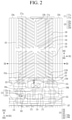
- FIG. 2 is a layout view of one pixel disposed in a first region A 1 .
- FIG. 3A is a cross-sectional view of a display device of FIG. 2 taken along a line IIIa-IIIa′.
- FIG. 3B is a cross-sectional view of a display device of FIG. 2 taken along a line IIIb-IIIb′.
- FIG. 4 is a layout view of one pixel disposed in a second region A 2 .
- FIG. 5 shows various causes that affect a luminance and results in a display device.
- FIGS. 6A and 6B are views for measuring a luminance of a display device when displaying an image without a white box.
- FIG. 6A shows a measuring position
- FIG. 6B is an image for measuring a luminance at a measuring position.
- FIGS. 7A, 7B, 7C, and 7D are views for measuring a luminance of a display device when displaying an image including a white box.
- FIG. 7A shows a measuring position
- FIG. 7B is an image for measuring a luminance at a measuring position.
- FIG. 7C shows a luminance for each position for the same cross-section as in FIG. 3B .
- FIG. 7D shows a reason that a luminance is high near a first data line and a luminance is low near a second data line.
- FIGS. 8A, 8B, and 8C are views showing a luminance in upper and lower regions of a white box of a display device when a self-capacitance is larger than a neighboring-capacitance.
- FIG. 8A is a view showing a brightness in an upper end and a lower end of a white box when a self-capacitance is larger than a neighboring-capacitance.
- FIG. 8B is a view showing a voltage behavior in an upper end of a white box.
- FIG. 8C is a view showing a voltage behavior in a lower end of a white box.
- FIGS. 9A, 9B, and 9C are views showing a luminance in upper and lower regions of a white box of a display device when a self-capacitance is smaller than a neighboring-capacitance.
- FIG. 9A is a view showing a brightness in an upper end and a lower end of a white box when a self-capacitance is smaller than a neighboring-capacitance.
- FIG. 9 B is a view showing a voltage behavior in an upper end of a white box.
- FIG. 9C is a view showing a voltage behavior in a lower end of a white box.
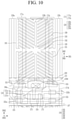
- FIG. 10 is a top plan view of a pixel disposed in a first region A 1 according to another embodiment.
- FIG. 11 is a top plan view of a pixel disposed in a second region A 2 according to another embodiment.
- FIG. 12 is a view showing a display device according to another embodiment of the present inventive concept.
- the phrase “on a plane” means viewing a target portion from the top
- the phrase “on a cross-section” means viewing a cross-section formed by vertically cutting a target portion from the side.
- FIG. 1 is a view schematically showing a display device 1000 according to an embodiment of the present inventive concept.
- the display device 1000 according to an embodiment of the present inventive concept includes a first region A 1 and a second region A 2 .
- the first region A 1 and the second region A 2 are disposed at opposite sides with respect to a center in a second direction DR 2 of the display device 1000 .
- a scan is performed in a direction from the first region A 1 to the second region A 2 .
- capacitances Cdp between a data line and a pixel electrode in the first region A 1 and the second region A 2 are different from each other.
- the pixel electrode overlaps two data lines.
- one data line is the data line connected to a corresponding pixel (hereinafter, a first data line)
- the other data line is the data line connected to a neighboring pixel (hereinafter, a second data line).
- the capacitance between the first data line and the pixel electrode (hereinafter, a self-capacitance Cdp 1 ) is smaller than the capacitance between the second data line and the pixel electrode (hereinafter, a neighboring-capacitance Cdp 2 ).
- the self-capacitance Cdp 1 is larger than the neighboring-capacitance Cdp 2 .
- the luminance deviation due to the data voltage may be compensated. Detailed effects are described in detail later.
- the meaning of the pixel includes the area occupied by one transistor and the pixel electrode 2 connected thereto, and FIG. 2 shows one pixel.
- FIG. 2 is a layout view of one pixel disposed in a first region A 1 .
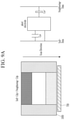
- FIG. 3A is a cross-sectional view of a display device of FIG. 2 taken along a line IIIa-IIIa′.
- FIG. 3B is a cross-sectional view of a display device of FIG. 2 taken along a line IIIb-IIIb′.
- a plurality of gate lines 121 disposed on a first substrate 110 made of transparent glass or plastic are included.
- the gate lines 121 transmit a gate signal and extend in a first direction DR 1 .
- Each gate line 121 includes a first gate line 121 a and a second gate line 121 b that are separated from each other, and a gate electrode 124 connecting the first gate line 121 a and the second gate line 121 b.
- a storage electrode line 129 may be disposed on the same layer as the gate line 121 .
- the storage electrode line 129 includes a first storage electrode line 129 a , a second storage electrode line 129 b , and a third storage electrode line 129 c extending in the second direction DR 2 , and the first storage electrode line 129 a , the second storage electrode line 129 b , and the third storage electrode line 129 c are connected to a transverse storage electrode line 129 d extending parallel to the first direction DR 1 .
- the second storage electrode line 129 b may include two parts that are separated from each other, and the second storage electrode line 129 b that is not connected to the transverse storage electrode line 129 d may be disposed with an island shape.
- a gate insulating layer 140 made of an insulating material such as a silicon oxide or a silicon nitride is disposed on the gate line 121 and the storage electrode line 129 .
- the gate insulating layer 140 may have a multilayered structure including at least two insulating layers having different physical properties.
- a plurality of semiconductor layers 154 are disposed on the gate insulating layer 140 .
- the semiconductor layer 154 may be disposed overlapping the gate electrode 124 .
- dummy semiconductor layers 155 disposed on the same layer as the semiconductor layer 154 may be disposed at a position where the gate line 121 and the data line 171 are crossed and a position where the storage electrode line 129 and the data line 171 are crossed. These dummy semiconductor layers 155 smooth a step at the region where the wires are crossed. However, the dummy semiconductor layer 155 does not constitute a transistor or the like.
- a plurality of data lines 171 , a plurality of source electrodes 173 connected to the data lines 171 , and a plurality of drain electrodes 175 are disposed on the semiconductor layer 154 and the gate insulating layer 140 .
- the data line 171 extends in the second direction DR 2 , thereby crossing the gate line 121 .
- the data line 171 includes a first data line 171 a and a second data line 171 b .
- the first data line 171 a and the second data line 171 b overlap the pixel electrode 191 , and are disposed without overlapping the storage electrode line 129 .
- first data line 171 a may be disposed between the first storage electrode line 129 a and the second storage electrode line 129 b .
- second data line 171 b may be disposed between the second storage electrode line 129 b and the third storage electrode line 129 c.
- the first data line 171 a each constitutes a respective transistor of the overlapping pixels.
- the second data line 171 b constitutes the transistors of other pixels (not shown) neighboring in the second direction. That is, in the present embodiment, two data lines overlap one pixel electrode 191 , but only one data line 171 a is electrically connected to the pixel electrode 191 and the other data line 171 b is electrically connected to the pixel electrode neighboring thereto.
- the second data line 171 b may be disposed to be curved and/or bent near the edge of the pixel electrode 191 in the second direction DR 2 .
- the first data line 171 a may be also disposed to be curved near the edge of the pixel electrode 191 in the second direction DR 2 .
- the curved length 312 b of the second data line 171 b may be longer than the curved length 312 a of the first data line 171 a (e.g., the length of the bent portion of the second data line 171 b may be longer than the bent portion of the first data line 171 a ).
- a portion of the first data line 171 a constitutes the source electrode 173 .
- the source electrode 173 extends from the data line 171 and overlaps the gate electrode 124 , and may have an approximate U-shape.
- the drain electrode 175 is separated from the data line 171 , and extends from the center of the U-shape of the source electrode 173 toward the top.
- One gate electrode 124 , one source electrode 173 , and one drain electrode 175 form one thin film transistor (TFT) together with the semiconductor layer 154 , and the channel region of the thin film transistor is formed in the semiconductor layer 154 between the source electrode 173 and the drain electrodes 175 .
- TFT thin film transistor
- the color filters may include a red color filter, a green color filter, and a blue color filter. Each color filter may be located in the region corresponding to one pixel electrode 191 .
- the insulating layer 180 may be made of an inorganic insulator such as a silicon nitride or a silicon oxide, an organic insulator, or a low dielectric constant insulator.
- the insulating layer 180 and the color filter 230 include a contact hole 181 overlapping the drain electrode 175 .
- the pixel electrode 191 is physically and electrically connected to the drain electrode 175 through the contact hole 181 , thereby receiving the data voltage from the drain electrode 175 .
- the pixel electrode 191 may include a transparent conductor such as ITO or IZO.
- the pixel electrode includes a transverse stem part 192 extending in the first direction DR 1 , and a longitudinal stem part 193 crossing the transverse stem part and extending in the second direction DR 2 . Fine branches 199 extend from each stem part.
- the pixel electrode 191 overlaps both the first storage electrode line 129 a and the third storage electrode line 129 c , and includes an outer longitudinal stem part 195 extending along the second direction DR 2 .
- the outer longitudinal stem part 195 is connected to the edge of the transverse stem part 192 of the pixel electrode 191 .
- the pixel electrode 191 also includes an outer transverse stem part 196 .
- the outer transverse stem part 196 is disposed adjacent to the transistor TFT, and a part of the outer transverse stem part 196 is connected to the drain electrode 175 through the contact hole 181 , thereby receiving the voltage.
- a part of the outer transverse stem part 196 includes a first protrusion 196 a that overlaps the first data line 171 a and a second protrusion 196 b that overlaps the second data lines.
- the first data line 171 a and the first protrusion 196 a overlapping each other form a self-capacitance Cdp 1 .
- the second data line 171 b and the second protrusion 196 b overlapping each other constitute the neighboring-capacitance Cdp 2 .
- the area of the second protrusion 196 b is larger than the area of the first protrusion 196 a . Therefore, the value of the neighboring-capacitance Cdp 2 between the second protrusion 196 b and the second data line 171 b is larger than the value of the self-capacitance Cdp 1 .
- the value of the neighboring-capacitance Cdp 2 is larger than the value of the self-capacitance Cdp 1 such that the luminance deviation due to the data voltage may be compensated. Specific effects will be described later.
- an overlapping pixel electrode 197 overlapping the part of the gate line 121 is included.
- the overlapping pixel electrode 197 may extend along the first direction DR 1 .
- a light blocking member 220 is disposed on the pixel electrode 191 .
- the light blocking member 220 is disposed along the first direction DR 1 , and overlaps the transistor and the gate line 121 and the like.
- the region overlapping the light blocking member 220 is referred to as a light blocking area, and the region not overlapping the light blocking member 220 is referred to as a display area.
- a common electrode 270 is disposed on a second substrate 210 .
- a liquid crystal layer 3 including liquid crystal molecules 31 is disposed between a first display panel 100 and a second display panel 200 .
- FIG. 3B shows another cross-section of FIG. 2 .
- the first storage electrode line 129 a , the second storage electrode line 129 b , and the third storage electrode line 129 c are disposed to be separated from each other on the first substrate 110 , and the first data line 171 a and the second data line 171 b are disposed therebetween.
- the description of the other constituent elements is the same as that in FIG. 3A such that the detailed explanations of the same constituent elements are omitted.
- FIG. 4 is a layout view of one pixel disposed in the second region A 2 .
- the arrangement of the pixel disposed in the second region A 2 is the same as that in FIG. 2 except for the configuration related to the first protrusion 196 a of the outer transverse stem part 196 .
- the detailed description of the same constituent elements is omitted.
- the outer transverse stem part 196 only includes the first protrusion 196 a without the second protrusion. Therefore, the first protrusion 196 a and the first data line 171 form the self-capacitance Cdp 1 , and the value of the self-capacitance Cdp 1 becomes larger than the value of the neighboring-capacitance Cdp 2 .
- the second protrusion is not disposed. However, the outer transverse stem part 196 and the second data line 171 b are partially overlapped, thereby forming the neighboring-capacitance Cdp 2 in the overlapping region.
- the self-capacitance Cdp 1 is larger than the neighboring-capacitance Cdp 2 .
- the area 304 of the first protrusion 196 a intersecting with the first data line 171 a of FIG. 4 is larger than the area 302 of the first protrusion 196 a intersecting with the first data line 171 a of FIG. 2 .
- the first protrusion 196 a of FIG. 2 is the structure disposed to compensate the capacitance by the curved part of the second data line 171 b because the second data line 171 b is curved near the edge of the pixel electrode 191 in the second direction DR 2 . Accordingly, in the pixel of FIG. 4 , the area 304 of the first protrusion 196 a intersecting with the first data line 171 a should be larger than the area 302 that in the pixel of FIG. 2 , and in this case, the self-capacitance Cdp 1 becomes larger than the neighboring-capacitance Cdp 2 .
- the pixel disposed in the first region A 1 further includes the second protrusion overlapping the second data line such that the neighboring-capacitance Cdp 2 is larger than the self-capacitance Cdp 1 , and in the pixel disposed in the second region A 2 , the area of the first protrusion overlapping the first data line is further wider without including the second protrusion, such that the self-capacitance Cdp 1 is larger than the neighboring-capacitance Cdp 2 .
- the luminance deviation due to the data voltage may be compensated.
- FIG. 5 shows various causes that affect a luminance and results in a display device.
- the self-capacitance Cdp 1 when displaying an image in which a white box is disposed at the center, if the self-capacitance Cdp 1 is large, the image appears bright at the top of the white box and dark at the bottom. Conversely, if the self-capacitance Cdp 1 decreases, the image appears dark at the top of the white box and bright at the bottom.
- the luminance of the display device is also affected by TFT leakage and the data voltage. Particularly, in the display device according to the present embodiment, since the data line 171 and the pixel electrode 191 are overlapped in the display area, the effect of the luminance due to the data voltage is great. Referring to FIG. 5 , the change in the luminance due to the data voltage appears bright at the top and bottom of the white box.
- the data voltage causes a problem that the display device is visibly brighter at the top and bottom of the white box.
- the self-capacitance Cdp 1 is made smaller than the neighboring-capacitance Cdp 2 at the top of the white box, that is, at the top of the display device, so that the display device is recognized to be darkened, thereby compensating the luminance brightened by the data voltage.
- the self-capacitance Cdp 1 is made larger than the neighboring-capacitance Cdp 2 at the bottom of the white box, that is, at the bottom of the display device, so that the display device is recognized to be darkened, thereby compensating the luminance brightened by the data voltage.
- FIGS. 6A and 6B are views for measuring a luminance of a display device when displaying an image without a white box.
- FIG. 6A shows a measuring position
- FIG. 6B is an image for measuring a luminance at a measuring position.
- FIG. 6A shows a display panel 1000 and a pad 700 . Referring to FIG. 6B , it is confirmed that there is no luminance deviation according to the position in the pixel in the image without the white box.
- FIGS. 7A, 7B, 7C, and 7D are views for measuring a luminance of a display device when displaying an image including a white box.
- FIG. 7A shows a measuring position
- FIG. 7B is an image for measuring a luminance at a measuring position.
- FIG. 7A shows the display panel 1000 and the pad 700 .
- FIG. 7B in the case of the image including the white box, it may be confirmed that the luminance deviation appears for each position in the pixel.
- FIG. 7C shows a luminance for each position for the same cross-section as in FIG. 3B . Referring to FIG.
- the luminance is high near the first data line 171 a which is electrically connected to the pixel electrode 191 , and the luminance is low near the second data line 171 b which is not electrically connected to the pixel electrode 191 .
- FIG. 7D shows a reason why a luminance is high near the first data line 171 a and a luminance is low near the second data line 171 b .
- potential increases near the first data line 171 a connected to the pixel electrode to supply a data voltage of 15 V such that the luminance is high.
- the potential decreases near the second data line 171 b to which the data voltage is not supplied during the driving of the corresponding pixel that is connected to the neighboring pixel electrode, and accordingly, the luminance is lower.
- FIGS. 8A, 8B, and 8C are views showing a luminance in an upper and lower region of a white box of a display device when a self-capacitance Cdp 1 is larger than a neighboring-capacitance Cdp 2 .
- FIG. 8A is a view showing a brightness in an upper end and a lower end of a white box when a self-capacitance Cdp 1 is larger than a neighboring-capacitance Cdp 2 .
- FIG. 8A shows the display panel 1000 and the pad 700 . Referring to FIG. 8A , the top of the white box appears lighter, and the bottom of the white box appears darker.
- FIG. 8B is a view showing a voltage behavior in an upper end of a white box.
- FIG. 8B shows the image appearance bright because the data voltages are driven in the direction away from each other.
- FIG. 8C shows the voltage behavior at the bottom of the white box. As shown in FIG. 8C , at the bottom of the white box, the data voltages are driven in the direction toward each other such that the image appears dark.
- FIGS. 9A, 9B, and 9C are views showing a luminance in an upper and lower region of a white box of a display device when a self-capacitance Cdp 1 is smaller than a neighboring-capacitance Cdp 2 .
- FIG. 9A is a view showing a brightness in an upper end and a lower end of a white box when a self-capacitance Cdp 1 is smaller than a neighboring-capacitance Cdp 2 .
- FIG. 9A shows the display panel 1000 and the pad 700 . Referring to FIG. 9A , the top of the white box appears darker, and the bottom of the white box appears lighter.
- FIG. 9B is a view showing a voltage behavior in an upper end of a white box.
- FIG. 9C is a view showing a voltage behavior in a lower end of a white box. As shown in FIG. 9C , at the bottom of the white box, the image appears dark because the data voltages are driven in the direction away from each other.
- the luminance of the entire display device increases by the data voltage, thereby solving the phenomenon of being displayed brightly.
- the self-capacitance Cdp 1 should be smaller than the neighboring-capacitance Cdp 2 to reduce the luminance of the top of the display device, that is, the top of the white box. Therefore, to increase the neighboring-capacitance Cdp 2 , as shown in FIG. 2 , the second protrusion 196 b is added.
- the self-capacitance Cdp 1 should be smaller than the neighboring-capacitance Cdp 2 . Accordingly, to increase the self-capacitance Cdp 1 , as shown in FIG. 4 , the area of the first protrusion 196 a is increased.
- the embodiment adjusting the self-capacitance Cdp 1 and the neighboring-capacitance Cdp 2 by using the first protrusion 196 a and the second protrusion 196 b as the part of the pixel electrode 191 was described.
- the self-capacitance Cdp 1 and the neighboring-capacitance Cdp 2 may be adjusted by controlling the width of the data line, not the pixel electrode 191 .
- FIG. 10 and FIG. 11 are views showing a pixel disposed in a first region A 1 and a second region A 2 in a display device according to another embodiment.
- FIG. 10 is a top plan view of the pixel disposed in the first region A 1
- FIG. 11 is a top plan view of the pixel disposed in the second region A 2 .
- the width 322 b of the second data line 171 b expands in the region overlapping the light blocking member 220 .
- the width 322 a of the first data line 171 a is narrower than the width 322 b of the second data line 171 b . Therefore, since like FIG.
- the neighboring-capacitance Cdp 2 is larger than the self-capacitance Cdp 1 and is in the upper region of the display device, the luminance is decreased in this case as confirmed from FIG. 5 , and it is possible to compensate the luminance increase due to the data voltage.
- Other configurations are the same as those described above, and the detailed description of the same constituent elements is omitted.
- the width of the first data line 171 a extends in the region overlapping the light blocking member 220 . That is, without changing the area of the first protrusion 196 a , by increasing the width of the first data line 171 a , the overlapping area of the pixel electrode 191 and the first data line 171 a increases. Accordingly, the self-capacitance Cdp 1 is larger than the neighboring-capacitance Cdp 2 . Since the second region A 2 is the lower end region of the display device, the luminance decreases as confirmed in FIG. 5 , and accordingly, like in FIG. 4 , the luminance increase of the data voltage may be compensated. Other configurations are the same as those described above, and the detailed description of the same constituent elements is omitted.
- the self-capacitance Cdp 1 is smaller than the neighboring-capacitance Cdp 2 in the first region A 1 , and the self-capacitance Cdp 1 is larger than the neighboring-capacitance Cdp 2 in the second region A 2 .
- the difference between the self-capacitance Cdp 1 and the neighboring-capacitance Cdp 2 may increase and decrease stepwise.
- FIG. 12 is a view showing a display device 1000 according to another embodiment of the present inventive concept.
- the difference between the self-capacitance Cdp 1 and neighboring-capacitance Cdp 2 is greatest in the uppermost region divided by the center of the display device 1000 .
- the difference between the self-capacitance Cdp 1 and the neighboring-capacitance Cdp 2 decreases toward the center, and the self-capacitance Cdp 1 and the neighboring-capacitance Cdp 2 become equal at the center of the display device.
- the self-capacitance Cdp 1 While passing through the center of the display device 1000 , the self-capacitance Cdp 1 is larger than the neighboring-capacitance Cdp 2 at the lower side, and the difference therebetween increases farther away from the center. If the difference between the self-capacitance Cdp 1 and the neighboring-capacitance Cdp 2 is adjusted stepwise, the increase in luminance due to the data voltage may be effectively compensated.
- the values of the self-capacitance Cdp 1 and the neighboring-capacitance Cdp 2 may be adjusted in various ways. That is, as shown in FIG. 2 to FIG. 4 , these values may be adjusted by using the areas of the first protrusion 196 a and the second protrusion 196 b that are disposed on the same layer as the pixel electrode 191 , and as shown in FIG. 10 and FIG. 11 , by using the widths of the first data line 171 a and the second data line 171 b.
- the capacitance increases as the area of the protrusion is larger or the width of the data line increases, a person of ordinary skill in the art may adjust the capacitance by increasing or decreasing the area or width stepwise by each region of the display device 1000 .
Landscapes
- Physics & Mathematics (AREA)
- Nonlinear Science (AREA)
- Engineering & Computer Science (AREA)
- Crystallography & Structural Chemistry (AREA)
- Chemical & Material Sciences (AREA)
- General Physics & Mathematics (AREA)
- Mathematical Physics (AREA)
- Optics & Photonics (AREA)
- Microelectronics & Electronic Packaging (AREA)
- Power Engineering (AREA)
- Geometry (AREA)
- Liquid Crystal (AREA)
- Computer Hardware Design (AREA)
- Theoretical Computer Science (AREA)
- Devices For Indicating Variable Information By Combining Individual Elements (AREA)
Abstract
Description
Claims (10)
Priority Applications (1)
| Application Number | Priority Date | Filing Date | Title |
|---|---|---|---|
| US17/543,725 US11762251B2 (en) | 2019-04-30 | 2021-12-06 | Display device |
Applications Claiming Priority (2)
| Application Number | Priority Date | Filing Date | Title |
|---|---|---|---|
| KR10-2019-0050337 | 2019-04-30 | ||
| KR1020190050337A KR102785175B1 (en) | 2019-04-30 | 2019-04-30 | Display device |
Related Child Applications (1)
| Application Number | Title | Priority Date | Filing Date |
|---|---|---|---|
| US17/543,725 Division US11762251B2 (en) | 2019-04-30 | 2021-12-06 | Display device |
Publications (2)
| Publication Number | Publication Date |
|---|---|
| US20200348571A1 US20200348571A1 (en) | 2020-11-05 |
| US11226527B2 true US11226527B2 (en) | 2022-01-18 |
Family
ID=72984954
Family Applications (2)
| Application Number | Title | Priority Date | Filing Date |
|---|---|---|---|
| US16/802,442 Active US11226527B2 (en) | 2019-04-30 | 2020-02-26 | Display device |
| US17/543,725 Active US11762251B2 (en) | 2019-04-30 | 2021-12-06 | Display device |
Family Applications After (1)
| Application Number | Title | Priority Date | Filing Date |
|---|---|---|---|
| US17/543,725 Active US11762251B2 (en) | 2019-04-30 | 2021-12-06 | Display device |
Country Status (3)
| Country | Link |
|---|---|
| US (2) | US11226527B2 (en) |
| KR (1) | KR102785175B1 (en) |
| CN (1) | CN111856827B (en) |
Families Citing this family (3)
| Publication number | Priority date | Publication date | Assignee | Title |
|---|---|---|---|---|
| KR102810948B1 (en) * | 2020-04-14 | 2025-05-21 | 삼성디스플레이 주식회사 | Liquid crystal device |
| CN115877618B (en) | 2022-12-29 | 2024-11-01 | Tcl华星光电技术有限公司 | Display panel and display device |
| CN118444506A (en) * | 2024-05-08 | 2024-08-06 | 厦门天马光电子有限公司 | Display panel and display device |
Citations (12)
| Publication number | Priority date | Publication date | Assignee | Title |
|---|---|---|---|---|
| US6429907B1 (en) * | 1999-02-24 | 2002-08-06 | Lg Philips Lcd Co., Ltd. | Liquid crystal display having improved image quality by reducing the excited interference voltage |
| KR100905015B1 (en) | 2002-12-26 | 2009-06-30 | 엘지디스플레이 주식회사 | Liquid crystal display without the bright shining of the end line |
| US20100073273A1 (en) * | 2008-09-23 | 2010-03-25 | Chul Nam | Liquid crystal panel and liquid crystal display device having the same |
| KR101240646B1 (en) | 2005-09-07 | 2013-03-08 | 삼성디스플레이 주식회사 | Liquid crystal display |
| US20130215344A1 (en) * | 2009-05-19 | 2013-08-22 | Samsung Display Co., Ltd. | Liquid crystal display |
| US20160147119A1 (en) * | 2014-11-21 | 2016-05-26 | Samsung Display Co., Ltd. | Liquid crystal display |
| KR101641538B1 (en) | 2008-12-24 | 2016-07-22 | 삼성디스플레이 주식회사 | Display panel |
| US20160313613A1 (en) * | 2015-04-22 | 2016-10-27 | Au Optronics Corp. | Pixel structure and display panel |
| KR20170039000A (en) | 2015-09-30 | 2017-04-10 | 엘지디스플레이 주식회사 | Array Substrate For Liquid Crystal Display Device |
| US10281784B1 (en) * | 2017-12-06 | 2019-05-07 | Samsung Display Co., Ltd. | Liquid crystal display device |
| US20190296048A1 (en) * | 2018-03-22 | 2019-09-26 | Samsung Display Co., Ltd, | Display device |
| US20190355318A1 (en) * | 2018-05-17 | 2019-11-21 | Samsung Display Co., Ltd. | Display device |
Family Cites Families (11)
| Publication number | Priority date | Publication date | Assignee | Title |
|---|---|---|---|---|
| JP3723747B2 (en) * | 2000-06-16 | 2005-12-07 | 松下電器産業株式会社 | Display device and driving method thereof |
| JP2004133028A (en) * | 2002-10-08 | 2004-04-30 | Toshiba Matsushita Display Technology Co Ltd | Liquid crystal display device |
| KR100898785B1 (en) * | 2002-10-24 | 2009-05-20 | 엘지디스플레이 주식회사 | LCD Display |
| JP3958306B2 (en) * | 2003-09-02 | 2007-08-15 | シャープ株式会社 | Liquid crystal display |
| JP4276965B2 (en) * | 2004-02-04 | 2009-06-10 | シャープ株式会社 | Display device |
| KR101206286B1 (en) * | 2005-12-27 | 2012-11-29 | 엘지디스플레이 주식회사 | Method of fabricating liquid crystal display device |
| CN101416105B (en) * | 2006-04-04 | 2011-04-13 | 夏普株式会社 | Liquid crystal display device |
| KR101574127B1 (en) * | 2008-09-29 | 2015-12-04 | 삼성디스플레이 주식회사 | Liquid crystal display |
| KR101706311B1 (en) * | 2010-01-18 | 2017-02-14 | 삼성디스플레이 주식회사 | Liquid crystal display and repari method thereof |
| WO2012093621A1 (en) * | 2011-01-06 | 2012-07-12 | シャープ株式会社 | Liquid-crystal display device |
| WO2012157651A1 (en) * | 2011-05-18 | 2012-11-22 | シャープ株式会社 | Liquid crystal display device, driving method for liquid crystal display device, and television receiver |
-
2019
- 2019-04-30 KR KR1020190050337A patent/KR102785175B1/en active Active
-
2020
- 2020-02-26 US US16/802,442 patent/US11226527B2/en active Active
- 2020-04-30 CN CN202010365114.1A patent/CN111856827B/en active Active
-
2021
- 2021-12-06 US US17/543,725 patent/US11762251B2/en active Active
Patent Citations (12)
| Publication number | Priority date | Publication date | Assignee | Title |
|---|---|---|---|---|
| US6429907B1 (en) * | 1999-02-24 | 2002-08-06 | Lg Philips Lcd Co., Ltd. | Liquid crystal display having improved image quality by reducing the excited interference voltage |
| KR100905015B1 (en) | 2002-12-26 | 2009-06-30 | 엘지디스플레이 주식회사 | Liquid crystal display without the bright shining of the end line |
| KR101240646B1 (en) | 2005-09-07 | 2013-03-08 | 삼성디스플레이 주식회사 | Liquid crystal display |
| US20100073273A1 (en) * | 2008-09-23 | 2010-03-25 | Chul Nam | Liquid crystal panel and liquid crystal display device having the same |
| KR101641538B1 (en) | 2008-12-24 | 2016-07-22 | 삼성디스플레이 주식회사 | Display panel |
| US20130215344A1 (en) * | 2009-05-19 | 2013-08-22 | Samsung Display Co., Ltd. | Liquid crystal display |
| US20160147119A1 (en) * | 2014-11-21 | 2016-05-26 | Samsung Display Co., Ltd. | Liquid crystal display |
| US20160313613A1 (en) * | 2015-04-22 | 2016-10-27 | Au Optronics Corp. | Pixel structure and display panel |
| KR20170039000A (en) | 2015-09-30 | 2017-04-10 | 엘지디스플레이 주식회사 | Array Substrate For Liquid Crystal Display Device |
| US10281784B1 (en) * | 2017-12-06 | 2019-05-07 | Samsung Display Co., Ltd. | Liquid crystal display device |
| US20190296048A1 (en) * | 2018-03-22 | 2019-09-26 | Samsung Display Co., Ltd, | Display device |
| US20190355318A1 (en) * | 2018-05-17 | 2019-11-21 | Samsung Display Co., Ltd. | Display device |
Also Published As
| Publication number | Publication date |
|---|---|
| CN111856827B (en) | 2025-01-03 |
| KR20200127073A (en) | 2020-11-10 |
| US20200348571A1 (en) | 2020-11-05 |
| KR102785175B1 (en) | 2025-03-21 |
| US20220107537A1 (en) | 2022-04-07 |
| US11762251B2 (en) | 2023-09-19 |
| CN111856827A (en) | 2020-10-30 |
Similar Documents
| Publication | Publication Date | Title |
|---|---|---|
| US12376381B2 (en) | Display device | |
| US9213205B2 (en) | Liquid crystal display having multiple pixel regions for improved transmittance | |
| US8988621B2 (en) | Array substrate and display panel having the same | |
| US11762251B2 (en) | Display device | |
| KR102652674B1 (en) | Ultra High Resolution Liquid Crystal Display | |
| US20110234957A1 (en) | Display apparatus | |
| US10622384B2 (en) | Liquid crystal display panel and liquid crystal display | |
| US9766525B2 (en) | Active-matrix substrate and display device | |
| KR102031682B1 (en) | Ultra High Resolution Liquid Crystal Display Having A Compensating Thin Film Transistor At Each Pixel | |
| US10809579B2 (en) | Liquid crystal display | |
| JP5868993B2 (en) | Liquid crystal display element and liquid crystal display device | |
| CN104246593B (en) | Liquid crystal display element and liquid crystal display device | |
| US20160202585A1 (en) | Liquid crystal display | |
| US20210217779A1 (en) | Substrate for display device and display device | |
| KR102162754B1 (en) | Ultra High Resolution Liquid Crystal Display Having A Compensating Thin Film Transistor | |
| KR102346086B1 (en) | Liquid crystal display device having a compensting thin film transistor | |
| KR20080098882A (en) | Liquid crystal display | |
| US8648973B2 (en) | Liquid crystal display with reduced parasitic capacitance variation | |
| KR102202453B1 (en) | Ultra High Resolution Liquid Crystal Display Having A Compensating Thin Film Transistor | |
| US9397120B2 (en) | Array substrate and a display device having the same | |
| KR20180047614A (en) | Ultra High Resolution Liquid Crystal Display |
Legal Events
| Date | Code | Title | Description |
|---|---|---|---|
| AS | Assignment |
Owner name: SAMSUNG DISPLAY CO., LTD., KOREA, REPUBLIC OF Free format text: ASSIGNMENT OF ASSIGNORS INTEREST;ASSIGNORS:RYU, GWON-HEON;KIM, KWI HYUN;CHOI, KOOK HYUN;AND OTHERS;REEL/FRAME:051942/0775 Effective date: 20191028 |
|
| FEPP | Fee payment procedure |
Free format text: ENTITY STATUS SET TO UNDISCOUNTED (ORIGINAL EVENT CODE: BIG.); ENTITY STATUS OF PATENT OWNER: LARGE ENTITY |
|
| STPP | Information on status: patent application and granting procedure in general |
Free format text: NON FINAL ACTION MAILED |
|
| STPP | Information on status: patent application and granting procedure in general |
Free format text: RESPONSE TO NON-FINAL OFFICE ACTION ENTERED AND FORWARDED TO EXAMINER |
|
| STPP | Information on status: patent application and granting procedure in general |
Free format text: FINAL REJECTION MAILED |
|
| STPP | Information on status: patent application and granting procedure in general |
Free format text: ADVISORY ACTION MAILED |
|
| STPP | Information on status: patent application and granting procedure in general |
Free format text: DOCKETED NEW CASE - READY FOR EXAMINATION |
|
| STPP | Information on status: patent application and granting procedure in general |
Free format text: NOTICE OF ALLOWANCE MAILED -- APPLICATION RECEIVED IN OFFICE OF PUBLICATIONS |
|
| STPP | Information on status: patent application and granting procedure in general |
Free format text: PUBLICATIONS -- ISSUE FEE PAYMENT VERIFIED |
|
| STCF | Information on status: patent grant |
Free format text: PATENTED CASE |
|
| MAFP | Maintenance fee payment |
Free format text: PAYMENT OF MAINTENANCE FEE, 4TH YEAR, LARGE ENTITY (ORIGINAL EVENT CODE: M1551); ENTITY STATUS OF PATENT OWNER: LARGE ENTITY Year of fee payment: 4 |