US10196185B2 - Push-pull aseptic cap for bottles - Google Patents
Push-pull aseptic cap for bottles Download PDFInfo
- Publication number
- US10196185B2 US10196185B2 US15/361,381 US201615361381A US10196185B2 US 10196185 B2 US10196185 B2 US 10196185B2 US 201615361381 A US201615361381 A US 201615361381A US 10196185 B2 US10196185 B2 US 10196185B2
- Authority
- US
- United States
- Prior art keywords
- nipple
- shutter
- guide
- openings
- bottle
- Prior art date
- Legal status (The legal status is an assumption and is not a legal conclusion. Google has not performed a legal analysis and makes no representation as to the accuracy of the status listed.)
- Expired - Fee Related, expires
Links
- 235000013361 beverage Nutrition 0.000 claims abstract description 46
- 238000004891 communication Methods 0.000 claims abstract description 8
- 239000002775 capsule Substances 0.000 claims description 45
- 230000008878 coupling Effects 0.000 claims description 19
- 238000010168 coupling process Methods 0.000 claims description 19
- 238000005859 coupling reaction Methods 0.000 claims description 19
- 210000002445 nipple Anatomy 0.000 claims description 18
- 230000000295 complement effect Effects 0.000 claims description 7
- 238000000034 method Methods 0.000 claims description 7
- -1 polypropylene Polymers 0.000 claims description 7
- 239000004743 Polypropylene Substances 0.000 claims description 3
- 229920001155 polypropylene Polymers 0.000 claims description 3
- 238000011017 operating method Methods 0.000 claims description 2
- 238000011109 contamination Methods 0.000 description 7
- 239000004033 plastic Substances 0.000 description 6
- 229920003023 plastic Polymers 0.000 description 6
- 239000004698 Polyethylene Substances 0.000 description 5
- 239000000654 additive Substances 0.000 description 5
- 230000000996 additive effect Effects 0.000 description 5
- 239000000463 material Substances 0.000 description 5
- 229920000573 polyethylene Polymers 0.000 description 5
- 230000008569 process Effects 0.000 description 4
- 229920001903 high density polyethylene Polymers 0.000 description 3
- 239000004700 high-density polyethylene Substances 0.000 description 3
- 238000004806 packaging method and process Methods 0.000 description 3
- 230000001954 sterilising effect Effects 0.000 description 3
- 230000009747 swallowing Effects 0.000 description 3
- 230000008901 benefit Effects 0.000 description 2
- 238000004519 manufacturing process Methods 0.000 description 2
- 230000007246 mechanism Effects 0.000 description 2
- 230000009467 reduction Effects 0.000 description 2
- 238000004659 sterilization and disinfection Methods 0.000 description 2
- 206010003497 Asphyxia Diseases 0.000 description 1
- 241001122767 Theaceae Species 0.000 description 1
- 229910052782 aluminium Inorganic materials 0.000 description 1
- 239000004411 aluminium Substances 0.000 description 1
- 230000006866 deterioration Effects 0.000 description 1
- 235000015203 fruit juice Nutrition 0.000 description 1
- 238000007654 immersion Methods 0.000 description 1
- 230000005865 ionizing radiation Effects 0.000 description 1
- 239000007788 liquid Substances 0.000 description 1
- 238000012423 maintenance Methods 0.000 description 1
- 239000012528 membrane Substances 0.000 description 1
- 238000012986 modification Methods 0.000 description 1
- 230000004048 modification Effects 0.000 description 1
- 230000005855 radiation Effects 0.000 description 1
- 230000001105 regulatory effect Effects 0.000 description 1
- 238000011012 sanitization Methods 0.000 description 1
- 238000000926 separation method Methods 0.000 description 1
- 239000010902 straw Substances 0.000 description 1
- 238000013519 translation Methods 0.000 description 1
- XLYOFNOQVPJJNP-UHFFFAOYSA-N water Substances O XLYOFNOQVPJJNP-UHFFFAOYSA-N 0.000 description 1
- 230000003313 weakening effect Effects 0.000 description 1
Images


Classifications
-
- B—PERFORMING OPERATIONS; TRANSPORTING
- B65—CONVEYING; PACKING; STORING; HANDLING THIN OR FILAMENTARY MATERIAL
- B65D—CONTAINERS FOR STORAGE OR TRANSPORT OF ARTICLES OR MATERIALS, e.g. BAGS, BARRELS, BOTTLES, BOXES, CANS, CARTONS, CRATES, DRUMS, JARS, TANKS, HOPPERS, FORWARDING CONTAINERS; ACCESSORIES, CLOSURES, OR FITTINGS THEREFOR; PACKAGING ELEMENTS; PACKAGES
- B65D47/00—Closures with filling and discharging, or with discharging, devices
- B65D47/04—Closures with discharging devices other than pumps
- B65D47/06—Closures with discharging devices other than pumps with pouring spouts or tubes; with discharge nozzles or passages
- B65D47/061—Closures with discharging devices other than pumps with pouring spouts or tubes; with discharge nozzles or passages with telescopic, retractable or reversible spouts, tubes or nozzles
-
- B—PERFORMING OPERATIONS; TRANSPORTING
- B65—CONVEYING; PACKING; STORING; HANDLING THIN OR FILAMENTARY MATERIAL
- B65D—CONTAINERS FOR STORAGE OR TRANSPORT OF ARTICLES OR MATERIALS, e.g. BAGS, BARRELS, BOTTLES, BOXES, CANS, CARTONS, CRATES, DRUMS, JARS, TANKS, HOPPERS, FORWARDING CONTAINERS; ACCESSORIES, CLOSURES, OR FITTINGS THEREFOR; PACKAGING ELEMENTS; PACKAGES
- B65D1/00—Rigid or semi-rigid containers having bodies formed in one piece, e.g. by casting metallic material, by moulding plastics, by blowing vitreous material, by throwing ceramic material, by moulding pulped fibrous material or by deep-drawing operations performed on sheet material
- B65D1/02—Bottles or similar containers with necks or like restricted apertures, designed for pouring contents
- B65D1/0223—Bottles or similar containers with necks or like restricted apertures, designed for pouring contents characterised by shape
- B65D1/023—Neck construction
- B65D1/0246—Closure retaining means, e.g. beads, screw-threads
-
- B—PERFORMING OPERATIONS; TRANSPORTING
- B65—CONVEYING; PACKING; STORING; HANDLING THIN OR FILAMENTARY MATERIAL
- B65D—CONTAINERS FOR STORAGE OR TRANSPORT OF ARTICLES OR MATERIALS, e.g. BAGS, BARRELS, BOTTLES, BOXES, CANS, CARTONS, CRATES, DRUMS, JARS, TANKS, HOPPERS, FORWARDING CONTAINERS; ACCESSORIES, CLOSURES, OR FITTINGS THEREFOR; PACKAGING ELEMENTS; PACKAGES
- B65D41/00—Caps, e.g. crown caps or crown seals, i.e. members having parts arranged for engagement with the external periphery of a neck or wall defining a pouring opening or discharge aperture; Protective cap-like covers for closure members, e.g. decorative covers of metal foil or paper
- B65D41/02—Caps or cap-like covers without lines of weakness, tearing strips, tags, or like opening or removal devices
- B65D41/04—Threaded or like caps or cap-like covers secured by rotation
-
- B—PERFORMING OPERATIONS; TRANSPORTING
- B65—CONVEYING; PACKING; STORING; HANDLING THIN OR FILAMENTARY MATERIAL
- B65D—CONTAINERS FOR STORAGE OR TRANSPORT OF ARTICLES OR MATERIALS, e.g. BAGS, BARRELS, BOTTLES, BOXES, CANS, CARTONS, CRATES, DRUMS, JARS, TANKS, HOPPERS, FORWARDING CONTAINERS; ACCESSORIES, CLOSURES, OR FITTINGS THEREFOR; PACKAGING ELEMENTS; PACKAGES
- B65D41/00—Caps, e.g. crown caps or crown seals, i.e. members having parts arranged for engagement with the external periphery of a neck or wall defining a pouring opening or discharge aperture; Protective cap-like covers for closure members, e.g. decorative covers of metal foil or paper
- B65D41/32—Caps or cap-like covers with lines of weakness, tearing-strips, tags, or like opening or removal devices, e.g. to facilitate formation of pouring openings
- B65D41/34—Threaded or like caps or cap-like covers provided with tamper elements formed in, or attached to, the closure skirt
- B65D41/3423—Threaded or like caps or cap-like covers provided with tamper elements formed in, or attached to, the closure skirt with flexible tabs, or elements rotated from a non-engaging to an engaging position, formed on the tamper element or in the closure skirt
- B65D41/3428—Threaded or like caps or cap-like covers provided with tamper elements formed in, or attached to, the closure skirt with flexible tabs, or elements rotated from a non-engaging to an engaging position, formed on the tamper element or in the closure skirt the tamper element being integrally connected to the closure by means of bridges
-
- B—PERFORMING OPERATIONS; TRANSPORTING
- B65—CONVEYING; PACKING; STORING; HANDLING THIN OR FILAMENTARY MATERIAL
- B65D—CONTAINERS FOR STORAGE OR TRANSPORT OF ARTICLES OR MATERIALS, e.g. BAGS, BARRELS, BOTTLES, BOXES, CANS, CARTONS, CRATES, DRUMS, JARS, TANKS, HOPPERS, FORWARDING CONTAINERS; ACCESSORIES, CLOSURES, OR FITTINGS THEREFOR; PACKAGING ELEMENTS; PACKAGES
- B65D47/00—Closures with filling and discharging, or with discharging, devices
- B65D47/04—Closures with discharging devices other than pumps
- B65D47/20—Closures with discharging devices other than pumps comprising hand-operated members for controlling discharge
- B65D47/24—Closures with discharging devices other than pumps comprising hand-operated members for controlling discharge with poppet valves or lift valves, i.e. valves opening or closing a passageway by a relative motion substantially perpendicular to the plane of the seat
- B65D47/245—Closures with discharging devices other than pumps comprising hand-operated members for controlling discharge with poppet valves or lift valves, i.e. valves opening or closing a passageway by a relative motion substantially perpendicular to the plane of the seat the valve being opened or closed by actuating a stopper-type element
- B65D47/247—Closures with discharging devices other than pumps comprising hand-operated members for controlling discharge with poppet valves or lift valves, i.e. valves opening or closing a passageway by a relative motion substantially perpendicular to the plane of the seat the valve being opened or closed by actuating a stopper-type element moving linearly, i.e. without rotational motion
Definitions
- the present patent application relates to a bottle push-pull aseptic dispenser cap.
- beverage bottles generally made of plastic are provided with aseptic dispenser caps known as “push-pull” caps, which are structured to permit a user to easily dose the amount of beverage delivered from the bottle, and to hermetically seal the bottle upon re-closure.
- patent EP 1 065 150 describes a push-pull aseptic dispenser cap comprising a main cylindrical body, which has a vertical reference axis and is provided with an internally threaded ring that is screwed onto the thread obtained on the outside wall of the neck of the bottle.
- the main cylindrical body further comprises a first flat upper annular wall, orthogonal to the reference axis, which abuts against the upper edge of the neck, and a second flat upper wall that is above the first annular wall in a plane parallel thereto.
- the push-pull aseptic dispenser cap further comprises a tubular projection that protrudes cantilevered from said second flat upper wall, in the opposite direction to the neck, so as to extend completely outside and above said neck, and a cylinder shaped dispenser cap, provided at the top with a central hole through which the beverage can flow out and provided at the bottom with a cylindrical stop element.
- the dispenser cap is slidingly coupled to the tubular projection so that it can be moved axially between a lowered closed position, in which the cylindrical stop element is fitted in a fluid-tight manner in a central hole obtained in the second flat wall in order to seal the bottle hermetically, and a raised delivery position, in which the cylindrical stop element is at a distance from the second flat wall so as to disengage the through hole and place the space inside the bottle in communication with the central through hole in the dispenser cap, via a central channel in the projection, and thus to allow the beverage to be removed from the bottle.
- the push-pull aseptic dispenser cap further comprises an external capsule shaped so as to be coupled to the main cylindrical body and thus internally contain the dispenser cap to protect it.
- the push-pull aseptic dispenser caps of the type described above are widely used in the beverage bottle market in that they have made it possible to eliminate the paper-aluminium disk that was used in previous caps as a membrane to close the neck in order to guarantee the maintenance of the hermetic seal of the bottle prior to its use.
- the cap described above has an improved structure capable of both simplifying the processes of manufacturing the cap and of coupling it to the bottle, with a subsequent reduction in production costs, and of making the part handier for beverage consumers to use.
- the need is felt to reduce the risk of contamination of the beverage via the cap, before and during the use of the bottle.
- the cap described above has some structural mechanical problems that seriously affect the bottlers capacity to withstand top loading, and therefore represent limits in terms of the volume of the bottle packaging.
- the weight of the other bottles stacked on top of a bottle is discharged, through the capsule, directly onto the dispenser cap and onto the tubular projection outside the neck and may in certain conditions, for example when a maximum weight limit is exceeded, cause plastic deformation/warping of the dispenser cap and of the tubular projection, and deterioration of the closing mechanism defined by the closing element and the hole.
- said closing element causes flaring of the hole, damaging the hermetic seal of the cap in the closed position and thus exposing the beverage to the risk of contamination.
- this problem is overcome by limiting the number of layers of bottles that are stacked in the packaging to below a maximum limit and by subjecting the cap to two sterilization processes before it is coupled to the bottle, that is, ionizing radiation and immersion of the cap in a sanitizing liquid.
- the cap is also particularly prone to being a vehicle of contamination of the beverage during the use of the bottle by the user.
- the dispenser cap repeatedly comes into contact with the hands of the user who, in practice, tends to take hold of it in order to more easily overcome the non-negligible resistance thereof to slide on the projection.
- a second need is to reduce the risk of suffocation of users due to accidentally swallowing parts of the cap.
- the cap described above can easily be detached from the bottle.
- a simple manual operation is all that is required to unscrew the main body from the neck.
- the user is able refill the bottle several times.
- the bottle is designed and produced to be used just once, using it for too long and repeatedly fitting; removing the cap results in a weakening/wearing out of the parts of said cap, in particular of the dispenser cap, which will in time gradually tend to become detached from the projection and thus give rise to said risk of swallowing.
- US 2015 266 634 A1 describes tubular fastening means fixed to the neck of the bottle and a cap member coupled to the tubular fastening means to close the bottle.
- the tubular fastening means are suitable to contain an article and comprise a tubular body with slots in the side, while the cap member is provided with an inner tubular portion that slides inside the tubular means between a closed position of the slots and an open position thereof so that the article contained in the tubular means is poured into the bottle.
- the cap described in US 2015 266 634 merely has the function of closing the bottle and is not suitable to be easily gripped between the lips/teeth of the user to allow the latter to drink the beverage contained in the bottle.
- the cap member has the structural mechanical problems described above in that the weight of bottles stacked on top of it would tend to deform the upper annular portion 114 which protrudes above the neck of the bottle even in its closed condition.
- US 2009 057 262 A1 describes a conventional bottle cap including an additive holding unit which is supported in the mouth of the bottle by an upper flange and contains an additive, and a tubular unit mounted so as to slide in the additive holding unit from and towards an extracted position in which it opens openings in the side of the additive holding unit to discharge the additive into the bottle, and is closed at the top by a seal.
- US 2009 057 262 is not suitable for use as a push-pull aseptic cap because once the upper seal has been opened the beverage is exposed to contamination.
- FR 1 375 655 A describes a conventional dispenser spout that can be fitted by a user to the neck of the bottle and which is manually axially moved by the user to control the amount of beverage to be discharged.
- the dispenser spout described in FR 1 375 655 is not suitable for use as a push-pull aseptic cap because the beverage is highly susceptible to contamination both before and during the use of the bottle.
- US 2009 230 075 A1 describes a conventional push-pull cap that is not suitable for use as an aseptic cap because during the use of the bottle it is repeatedly held by the user and can accidentally become detached from the bottle.
- US 2007 0199 914 and DE 297 08 202 U1 also describe conventional push-pull caps in which the tubular projection always protrudes from the top of the neck and is therefore prone to the structural mechanical problems described above.
- the Applicant has therefore conducted an in-depth study for the purpose of developing an improved push-pull aseptic dispenser cap, capable of achieving the following objectives:
- the purpose of the present invention is thus to provide a solution that achieves at least the aims listed above.
- a bottle push-pull aseptic dispenser cap characterized by comprising a guide-body having a reference axis and designed to be coupled to the mouth of a bottle; the guide-body being provided with a tubular shaped inner chamber, a central hub extending coaxially to said reference axis inside said tubular shaped chamber, and through openings obtained in a portion of the bottom wall of said guide-body surrounding said hub and designed to place the inner space of the bottle containing the beverage in communication with said inner chamber, and a shutter-nipple which is coupled in an axially sliding manner to said guide-body so as to slide axially inside the inner chamber along said reference axis, between a retracted position in which said shutter-nipple closes said through openings in a fluid-tight manner and has its upper end completely inside said inner chamber, and an extracted position in which said shutter-nipple disengages the through openings so as to be able to receive, from the latter, said beverage
- a bottle push-pull aseptic dispenser cap comprising: a guide-body having a reference axis and designed to be coupled to the mouth of a bottle; the guide-body being provided with a tubular shaped inner chamber, a central hub which extends coaxially to said reference axis inside said tubular changer, and through openings obtained in a portion of the bottom wall of said guide-body surrounding said hub and which are designed to place the inner space of the bottle containing the beverage in communication with said inner chamber; and a shutter-nipple which comprises a tubular body which is separate and distinct from the guide body and is coupled in a telescopic manner in said inner chamber and internally incorporates a central stem which extends coaxially to said reference axis so as to be fitted in an axially sliding manner in said hub; said method comprising the step of axially translating said shutter-nipple inside the inner chamber along said reference axis, between a retracted position in which said
- FIG. 1 shows a perspective view of a push-pull aseptic dispenser cap coupled to the mouth of a bottle, produced according to the teachings of the present invention
- FIG. 2 is a perspective, exploded view of the push-pull aseptic dispenser cap shown in FIG. 1 ;
- FIG. 3 is a vertical perspective view of the push-pull dispenser cap in an extracted position
- FIG. 4 is a vertical perspective view of the push-pull dispenser cap shown in FIG. 3 without the capsule;
- FIG. 5 is a vertical section of the push-pull aseptic dispenser cap shown in FIG. 1 , in a retracted position, in which the capsule is uncoupled from the guide-body;
- FIG. 6 is a vertical section of the push-pull aseptic dispenser cap in a retracted position
- FIG. 7 is the section along the line VII-VII of the push-pull aseptic dispenser cap shown in FIG. 3 ;
- FIG. 8 is the section along the line VIII-VIII of the push-pull aseptic dispenser cap shown in FIG. 4 ;
- FIG. 9 is a perspective view, partially from above, of the guide-body of the push-pull aseptic dispenser cap shown in FIG. 1 ;
- FIG. 10 is a plan view of the guide-body illustrated in FIG. 9 ;
- FIG. 11 is a substantially vertical perspective view partially from below of the guide-body illustrated in FIG. 9 ;
- FIG. 12 is a substantially vertical perspective view partially from below of the shutter-nipple of the cap illustrated in FIG. 1 ;
- FIG. 13 is a slightly inclined perspective view from above of the shutter-nipple of the cap illustrated in FIG. 1 ;
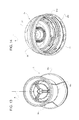
- FIG. 14 is a partially inclined perspective view from below of the capsule of the cap illustrated in FIG. 1 .
- bottles 2 designed to hold beverages, preferably, but not necessarily, so-called “pressurized” beverages.
- the bottles 2 may contain water, orangeade, or any similar kind of beverage.
- the pressure inside the bottle 2 may be, for example, approximately 1 Bar.
- the cap implemented according to the present invention may also be used to close bottles 2 containing beverages that are not “pressurized”, for example such as tea, fruit juice, or any other similar kind of beverage.
- the bottle 2 to which the cap 1 is coupled may be of the single-use, or disposable type, it is made of plastic material, for instance polyethylene (PET) or a similar material, and essentially comprises a cylindrical neck or mouth 3 preferably having a smooth inner wall 3 a and, preferably, an outer wall 3 b that is at least partially threaded.
- PET polyethylene
- the cap 1 comprises a guide-body 4 having a reference axis A (vertical in the example that is illustrated) and is designed to be permanently coupled, i.e., in a manually irremovable manner, to the mouth 3 of the bottle 2 .
- the guide-body 4 may be made of plastic material, such as for example polyethylene, preferably, but not necessarily, HDPE (High-Density Polyethylene) and is provided with a tubular shaped inner chamber 4 a which extends inside the mouth 3 and is closed at the bottom.
- a series of through openings 4 b which, under certain operating conditions (described in detail later on), place the inner space of the body of the bottle 2 containing the beverage in communication with the inner chamber 4 a so that the latter is able to receive the beverage, during the discharge thereof.
- the cap 1 further comprises a straw or shutter-nipple 5 , which is made of plastic material and is coupled in a telescopic manner in the guide-body 4 so as to axially move the guide-body 4 inside the inner chamber 4 a along the axis A.
- a straw or shutter-nipple 5 which is made of plastic material and is coupled in a telescopic manner in the guide-body 4 so as to axially move the guide-body 4 inside the inner chamber 4 a along the axis A.
- the shutter-nipple 5 can move axially inside the inner chamber 4 a , between a retracted position (shown in FIGS. 5 and 6 ), in which the shutter-nipple 5 closes the through openings 4 b to close the mouth 3 hermetically, and an extracted position (shown in FIGS. 3, 4, 7 and 8 ), in which the shutter-nipple 5 is arranged so that, on the one hand, it disengages the through openings 4 b and thus allows the beverage to flow through them into the inner chamber 4 a , and, on the other, it protrudes cantilevered from the guide-body 4 so that it can easily be gripped between the user's lip/teeth.
- the shutter-nipple 5 in the retracted position, is arranged inside the inner chamber 4 a of the guide-body 4 so that, on the one hand, the shutter-nipple 5 engages the through openings 4 b so as to close them in a fluid-tight manner, and, on the other, it has its upper distal end completely inside the inner chamber 4 a .
- the shutter-nipple 5 in the retracted position, conveniently assumes a so-called “retracted” position, in which said shutter-nipple 5 is contained/arranged completely inside the guide-body 4 .
- the shutter-nipple 5 in the extracted position, is arranged so that, on the one hand, it opens the through openings 4 b to place the body of the bottle 2 containing the beverage in hydraulic communication with the shutter-nipple 5 via the inner chamber 4 a , and, on the other, it extends cantilevered outwardly from the upper end of the guide-body 4 (top in FIGS. 4, 7 and 8 ) so as to allow the user to sip/suck the beverage through said shutter-nipple 5 .
- the guide-body 4 comprises a cup-shaped body 6 that is fitted inside the mouth 3 of the bottle 2 .
- the cup-shaped body 6 is provided with a cylindrical wall 7 that is fitted inside the mouth 3 , is open at the top, and is closed at the bottom by a bottom wall 8 .
- the outer surface of the cylindrical wall 7 is substantially smooth (not threaded) and is shaped so as to be arranged facing the smooth inner surface 3 a (not threaded) of the mouth 3 .
- the cylindrical wall 7 extends coaxially to the axis A downwards starting from the top edge of the mouth 3 so as to lie/extend completely inside the mouth 3 , whereas the inner surface of said cylindrical wall 7 forms/delimits the inner chamber 4 a of the guide-body 4 .
- the upper edge of the cylindrical wall 7 incorporates an annular flange 9 structured so as to fasten the guide-body 4 to the bottle 2 in a manually irremovable manner.
- the annular flange 9 preferably has a substantially L-shaped profile.
- the annular flange 9 comprises a flat annular portion 9 a , orthogonal to the axis A, which extends cantilevered outwards from the upper edge of the cylindrical wall 7 and has a portion of its bottom surface that abuts against the top annular edge of the mouth 3 .
- the annular flange 9 further comprises a cylindrical annular portion 9 b coaxial to the axis A, which extends downwards from the outer edge of the flat annular portion 9 a and has its inner surface that abuts against/rests upon the outer surface of the mouth 3 preferably in correspondence with the top annular edge thereof.
- the annular flange 9 further comprises an inner annular tongue 9 c which extends downwards from an intermediate position of the flat annular portion 9 a , between the outer surface of the cylindrical wall 7 and the cylindrical portion 9 b , so as to abut against the inner surface of the mouth 3 .
- annular seat 10 coaxial to the axis A, inside which, in use, a protruding projection or annular rib 11 of the mouth 3 is arranged.
- annular rib 11 protrudes outwards from a smooth circular sector of the outer surface of the mouth 3 arranged above the threaded portion, preferably in correspondence with the top edge of said mouth 3 .
- the annular rib 11 may preferably be shaped to have a cross section (vertical) substantially complementary to the cross section (vertical) of the respective annular seat 10 so as to achieve with the latter, cooperating with the inner annular tongue 9 c , a snap coupling (undercut coupling) of the guide-body 4 in the mouth 3 .
- the annular rib 11 when snapped into the seat 10 , holds the guide-body 4 permanently anchored to the mouth 3 and thus achieves a manually irremovable coupling of the cap 1 to the bottle 2 .
- the inner annular tongue 9 c is structured to bend slightly inwards when fitted on the mouth 3 so as to press elastically on the inner surface of the mouth 3 and achieve a fluid-tight coupling on the latter.
- the guide-body 4 of the cap 1 cannot be detached from the bottle 2 by means of a manual operation, this conveniently prevents the bottle from being re-used and re-filled when all the contents have been consumed.
- the bottom wall 8 of the cup-shaped body 6 is substantially cap or bell shaped with the concavity/roundedness protruding towards the inside of said cup-shaped body 6 .
- the bottom wall 8 comprises a central hub 12 closed at the bottom which extends inside the cup-shaped body 6 remaining coaxial to the axis A.
- the hub 12 may comprise an upper portion 12 a which extends inside the inner chamber 4 a towards the annular flange 9 , and a lower portion 12 b that extends preferably below the lower annular edge of the cup-shaped body 6 so as to partially protrude inside the body of the bottle 2 .
- the through openings 4 b consist of through holes, which are preferably obtained in the rounded portion of the bottom wall 8 surrounding the hub 12 .
- the through openings 4 b may be distributed on the top of the roundedness of the bottom wall 8 that surrounds the hub 12 so as to form one or more perforated sectors 13 through which the beverage passes/flows towards the inner chamber 4 a.
- each perforated sector 13 comprises a plurality of through holes, preferably three or more.
- the Applicant has found that providing at least three perforated sectors 13 each with at least three through holes with a diameter of approximately 1 mm, achieves, on the one hand, the advantage of regulating the amount of beverage that can be discharged from the bottle through the holes and, on the other, of preventing the beverage from flowing through the holes when the bottle is tipped over.
- the through openings 4 b are obtained inside a series of concavities or recesses 14 formed in the rounded portion of the bottom wall 8 surrounding the hub 12 .
- the recesses 14 are open towards the inner chamber 4 a , whereas the through openings 4 b are preferably obtained in the bottom walls of the recesses 14 on which they form said perforated sectors 13 .
- the lower surface of the bottom wall 8 may also be provided with collars 15 , each of which extends along the perimeter of a bottom wall of the respective recess 14 so as to surround the through openings 4 b that are present in said recess 14 .
- Each collar 15 conveniently forms a dispensing duct suitable to carry the beverage at a predefined flow rate towards the through openings 4 b.
- the shutter-nipple 5 As far as the shutter-nipple 5 is concerned, it comprises a tubular body 16 coaxial to the axis A which is coupled in a telescopic manner to the cup-shaped body 6 so that it has a lower annular edge fitted so as to slide on the inner surface of the inner chamber 4 a , and incorporates a central stem 18 which extends coaxially to the reference axis A and is, in turn, fitted in an axially sliding manner in the hub 12 so as to maintain the tubular body 16 in a substantially central position coaxial to the axis A, during the axial movement of the shutter-nipple 5 .
- the tubular body 16 is separate and distinct from the guide-body 4 , that is to say, it is completely independent and detachable from the guide-body 4 and may preferably be made of polypropylene.
- the Applicant has found that when the tubular body 16 is made of polypropylene and the guide-body 4 of polyethylene, the lower annular edge of the tubular body 6 adheres well to the inner sliding surface of the inner chamber 4 a .
- the inner chamber 4 a which is less rigid than the tubular body 6 , tends to become locally deformed when it comes into contact with the latter and its surface thus adapts to the rigid outside shape of the lower annular edge.
- the tubular body 16 has a flared or truncated cone shaped lower tubular portion 16 a having the greater perimeter edge facing the bottom wall 8 , and an upper tubular portion 16 b , preferably cylindrical, which extends starting from the smaller upper perimeter edge of the lower tubular portion 16 a towards the flange 9 and constitutes the end portion of the shutter-nipple 5 used by the user to drink the beverage.
- the tubular body 16 is also provided with a series of internal closing segments or fins 20 which extend from the inner surface of said tubular body 16 towards the bottom wall 8 , and are designed, in use, to abut against the bottom wall 8 so as to close, in a fluid-tight manner, the through openings 4 b when the shutter-nipple 5 is in the retracted position.
- the closing fins 20 are angularly distributed on the inner surface of the tubular body 16 , preferably angularly equally spaced, so as to be aligned with the underlying recesses 14 along respective axes parallel to the axis A.
- the closing fins 20 also have free lower ends shaped so as to engage the recesses 14 in order to close the through openings 4 b provided therein when the shutter-nipple 5 is in the retracted position and, vice versa, to disengage the recesses 14 to open the through openings 4 b when the shutter nipple 5 is not in the retracted position ( FIGS. 5-6 ).
- the closing fins 20 are fixed to the inner surface of the lower tubular portion 16 a of the tubular body 16 , preferably approximately on the smaller upper annular edge of said lower tubular portion 16 a and are arranged in planes substantially parallel to the axis A (vertical in the Figures), whereas the free lower ends of the closing fins 20 may preferably, but not necessarily, have an arched shape complementary to a corresponding arched shape of the respective recesses 14 .
- the lower tubular portion 16 a may have an inner surface with a shape that is substantially complementary to the bottom wall 8 so as to be able to completely rest on the latter and at the same time fit its greater lower annular edge inside an annular groove 8 a provided in the bottom wall 8 ( FIGS. 5, 6, 7 and 8 ).
- the lower portion of the bottom wall 8 may be substantially cylinder shaped, arranged adjacent to the lower portion of the cylindrical wall 7 so as to delimit therewith the annular groove 8 a .
- the annular groove 8 a may be dimensioned so that, in use, it holds the greater lower annular edge of the lower tubular portion 16 a so that the movement of the nipple 5 from the retracted position requires the application of a minimum predefined force by the user ( FIGS. 5 and 6 ).
- the stem 18 of the nipple 5 and the hub 12 are coupled so as to be able to slide axially one with respect to the other.
- the stem 18 of the nipple 5 and the hub 12 are also structured so as to be angularly fixed with respect to one another so that the nipple 5 , in use, cannot rotate about the axis A with respect to the guide-body 4 .
- the cross sections of the stem 18 and of the central inner tubular wall of the hub 12 which receives the stem 18 may be shaped to complement one another, so that the angular coupling between them determines the correct alignment of the closing fins 20 with the respective recesses 14 .
- the cross section of the stem 18 and the central duct of the hub 12 may be star shaped, toothed, triangular or of a similar shape.
- the cap 1 may also be provided with a first mechanical end-of-stroke designed to stop the movement of the shutter-nipple 5 when the shutter-nipple 5 reaches the extracted position.
- the mechanical end-of-stroke may comprise a cylindrical collar 21 coaxial to the axis A, which extends cantilevered upwards from the flat annular portion 9 a of the flange 9 and delimits with its inner surface the upper end portion of the chamber 4 a.
- the mechanical end-of-stroke may further comprise an annular projection 22 , which protrudes inwards from the inner surface of the collar 21 , and an annular groove 23 which is obtained in the outer surface of the lower tubular portion 16 a in correspondence with the respective lower edge and is designed, in use, to be engaged by the annular projection 22 so as to stop the axial movement of the shutter-nipple 5 and thus prevent it from being uncoupled from the cup-shaped body 6 .
- the cap 1 further comprises a cover or capsule 24 that may be made of plastic material, such as for example polyethylene, preferably HDPE, and is designed to be coupled to the mouth 3 to protect the guide-body 4 and the shutter-nipple 5 .
- a cover or capsule 24 may be made of plastic material, such as for example polyethylene, preferably HDPE, and is designed to be coupled to the mouth 3 to protect the guide-body 4 and the shutter-nipple 5 .
- the capsule 24 is shaped so as to have a substantially cylindrical side wall 24 a coaxial to the axis A, which has a threaded inner surface designed in use to be screwed onto the threaded outer surface of the mouth 3 ; and a flat wall 24 b , which lies in a plane substantially orthogonal to the axis A, closes the upper end of the side wall 24 a , and is designed in use to be arranged so that its inner surface abuts against the upper edge of the collar 21 when the capsule 24 is screwed completely onto the thread of the mouth 3 ( FIG. 6 ).
- the cap 1 further comprises a coupling member 25 designed to couple the capsule 24 in a stable but easily removable manner to the shutter-nipple 5 so that an axial movement of the capsule 24 along the axis A with respect to the mouth 3 results in a corresponding axial movement of the shutter-nipple 5 with respect to the guide-body 4 .
- the coupling member 25 may further comprise on the inner surface an annular projection 26 coaxial to the axis A on which there is formed a central annular groove 27 , designed to house the upper annular edge of the shutter-nipple 5 .
- the upper annular edge of the shutter-nipple 5 engages by interference in the annular groove 27 and remains trapped/held between the two inner walls of the annular projection 26 that delimit the annular groove 27 ( FIGS. 6 and 7 ).
- the upper annular edge of the shutter-nipple 5 is provided with an annular projection 5 a that protrudes outwards and is arranged inside the annular groove 27 so that it is centrally anchored to the capsule 24 which is designed to axially slide the nipple 5 .
- the upper annular edge of the shutter-nipple 5 which is angularly fixed with respect to the guide-body 3 , slides idly inside the groove 27 of the capsule 24 while remaining anchored thereto during the axial movement of the capsule 24 .
- the capsule 24 further comprises three teeth 28 (only one of which is illustrated in FIG. 14 ) preferably helical shaped or rectilinear and sloping with respect to a plane orthogonal to the axis A, which are arranged angularly equally spaced from one another along the upper perimeter edge of the inner surface of the side wall 24 a , and are designed in use to engage corresponding grooves 29 having a complementary shape obtained in the outer surface of the cylindrical annular wall 9 b of the flange 9 ( FIG. 11 ).
- the capsule 24 further comprises a breakable tamper-proof ring 24 c that forms the lower part of the side wall 24 a , which is preferably undercut-coupled to a ring or flat annular portion 3 d arranged on the outer surface of the mouth 3 immediately below the threaded portion thereof.
- the breakable tamper-proof ring 24 c is designed to break and come away from the remaining portion of the side wall 24 a of the capsule 24 the first time the capsule 24 is raised axially from the annular portion 28 of the mouth 3 the first time said capsule 24 is unscrewed ( FIG. 5 ).
- the cap 1 is pre-assembled by arranging the shutter-nipple 5 in the guide-body 4 .
- the stem 18 is inserted in the hub and at the same time the tubular body 16 is coupled in a telescopic manner in the inner chamber 4 a of the guide-body 4 .
- the shutter-nipple 5 is then moved axially to the retracted position.
- the capsule 24 is coupled axially in the guide-body 4 and is partially rotated about the axis A to fit/screw the three teeth 28 of the capsule in the grooves 29 of the guide-body 4 .
- the presence of the teeth 28 in the capsule 24 thus makes it possible to guarantee the angular coupling of the capsule 24 to the guide-body 4 and so prevent the accidental separation of the capsule 24 from said guide-body 4 during the assembly of the cap 1 on the bottle 2 .
- the upper annular edge of the nipple 5 is coupled in the annular groove 27 of the capsule 24 and during the axial movement of the latter, its flat wall 24 b makes the shutter-nipple 5 perform a brief axial movement along the axis A towards the bottom wall 8 to ensure that the nipple 5 reaches its retracted position in which the closing fins 20 engage in the recesses 14 closing the through openings 4 b in a fluid-tight manner.
- the tubular chamber 4 a of the guide-body 4 is completely isolated from the outside.
- the assembly of the pre-assembled cap 1 on the bottle 2 comprises the steps of: placing the annular flange 9 so that it rests on the upper perimeter edge of the mouth 3 , screwing the capsule 24 onto the threaded portion of the mouth 3 to axially push/pull the guide-body 4 downwards to a closed/protection position, in which the annular rib 11 engages in the annular seat 10 so as to achieve a snap coupling between the guide-body 4 and the mouth 3 , and in which the breakable tamper-proof ring 24 c is arranged below the annular portion 3 d of the mouth 3 .
- the shutter-nipple 5 is arranged completely inside the inner chamber 4 a , that is, it is retracted, whereas the flat wall 24 b of the capsule 24 rests on the upper edge of the cup-shaped body 6 which is in turn anchored to the upper edge of the mouth 3 by means of the annular flange 9 .
- the breakable tamper-proof ring 24 c is held by the annular portion 3 d of the mouth 3 and so comes away from the body of the capsule 24 during the upward movement thereof.
- the capsule 24 is unscrewed from the mouth 3 , it axially moves the shutter-nipple 5 by means of the coupling member 25 until it is completely unscrewed from the thread of the mouth 3 .
- the upward movement of the annular body 16 causes the closing fins 20 to rise and disengage the recesses 14 and thus open the through openings 4 b .
- the shutter-nipple 5 is moved to the extracted position by means of a simple axial movement of the capsule 24 outwards. During the axial movement of the capsule 24 , the upper edge of the tubular body 16 remains trapped inside the annular groove 23 and the shutter-nipple 5 is thus extracted from the guide-body 4 until it reaches the extracted position.
- the beverage In the extracted position of the nipple 5 , the beverage can be discharged from the bottle 2 to flow into the inner chamber 4 a , through the through openings 4 b , and can thus be delivered to the user through the tubular body 16 ( FIG. 8 ).
- the cap is particularly robust and allows the bottle to withstand a greater top load.
- the nipple of the present cap in the retracted position, is arranged completely inside the chamber and so has no support function and is not subject to deformation/warping.
- the weight of any bottles stacked vertically on the capsule of the bottle underneath is fully discharged, through the flange of the cup-shaped body onto the top edge of the mouth of the bottle.
- any downward forces applied by the bottles stacked on top of the bottle push the closing fins further into the respective recesses which increases the hermetic seal without causing any flaring of the holes or contamination of the beverage.
- the coupling of the closing fins in the recesses and the coupling of the capsule create an inner tubular chamber which is isolated from the outside environment. Thanks to this, the process of sterilizing the cap by means of radiation can be eliminated, with all the consequences in terms of cost reduction.
- the arrangement of the nipple (retractable) inside the guide-body eliminates any risk of said nipple breaking when (for example after a fall) the upper portion of the bottle accidentally bangs against a rigid surface.
- the manually irremovable coupling achieved by the snap coupling of the flange to the mouth ensures that the bottle is only used once so that there is a lower possibility of the components accidentally coming off and the risk of swallowing such parts is greatly reduced.
- the push-pull cap described above does not affect the height of the bottle.
- the height of the push-pull cap described above, in the retracted position is substantially zero and thus entirely similar to conventional caps not of the push-pull type.
- the bottles provided with the cap described above can be stored in automatic dispensing machines for bottles with conventional caps, without requiring any changes to the storage and dispensing mechanisms of such machines.
Landscapes
- Engineering & Computer Science (AREA)
- Mechanical Engineering (AREA)
- Ceramic Engineering (AREA)
- Closures For Containers (AREA)
- Sealing Of Jars (AREA)
- Filling Of Jars Or Cans And Processes For Cleaning And Sealing Jars (AREA)
Applications Claiming Priority (2)
| Application Number | Priority Date | Filing Date | Title |
|---|---|---|---|
| ITUB2015A005956A ITUB20155956A1 (it) | 2015-11-27 | 2015-11-27 | Tappo asettico dosatore push-pull per bottiglie |
| IT102015000077792 | 2015-11-27 |
Publications (2)
| Publication Number | Publication Date |
|---|---|
| US20170152080A1 US20170152080A1 (en) | 2017-06-01 |
| US10196185B2 true US10196185B2 (en) | 2019-02-05 |
Family
ID=55485185
Family Applications (1)
| Application Number | Title | Priority Date | Filing Date |
|---|---|---|---|
| US15/361,381 Expired - Fee Related US10196185B2 (en) | 2015-11-27 | 2016-11-26 | Push-pull aseptic cap for bottles |
Country Status (3)
| Country | Link |
|---|---|
| US (1) | US10196185B2 (de) |
| EP (1) | EP3173350B1 (de) |
| IT (1) | ITUB20155956A1 (de) |
Cited By (11)
| Publication number | Priority date | Publication date | Assignee | Title |
|---|---|---|---|---|
| USD867062S1 (en) * | 2016-10-11 | 2019-11-19 | Runway Blue, Llc | Lid |
| USD883737S1 (en) | 2018-10-17 | 2020-05-12 | Yeti Coolers, Llc | Lid |
| USD883738S1 (en) | 2018-10-17 | 2020-05-12 | Yeti Coolers, Llc | Lid |
| USD896572S1 (en) | 2018-08-20 | 2020-09-22 | Yeti Coolers, Llc | Container lid |
| USD897151S1 (en) | 2018-10-17 | 2020-09-29 | Yeti Coolers, Llc | Lid |
| US10959553B2 (en) | 2016-10-17 | 2021-03-30 | Yeti Coolers, Llc | Container and method of forming a container |
| US11034505B2 (en) | 2016-10-17 | 2021-06-15 | Yeti Coolers, Llc | Container and method of forming a container |
| US11273961B2 (en) | 2015-08-14 | 2022-03-15 | Yeti Coolers, Llc | Container with magnetic cap |
| USD960660S1 (en) | 2015-11-20 | 2022-08-16 | Yeti Coolers, Llc | Jug |
| US11524833B2 (en) | 2016-10-17 | 2022-12-13 | Yeti Coolers, Llc | Container and method of forming a container |
| US12589919B2 (en) | 2024-06-06 | 2026-03-31 | Yeti Coolers, Llc | Lid assembly for beverage container |
Families Citing this family (6)
| Publication number | Priority date | Publication date | Assignee | Title |
|---|---|---|---|---|
| PL236612B1 (pl) * | 2017-11-13 | 2021-02-08 | Krajewski Dariusz Jerzy | Nakrętka z dozownikiem do saszetek, zwłaszcza dla płynnych produktów spożywczych |
| US11053054B2 (en) | 2018-08-03 | 2021-07-06 | Gateway Plastics, Inc. | Spout fitment and cap |
| JP7386727B2 (ja) * | 2020-02-28 | 2023-11-27 | 株式会社吉野工業所 | 塗布容器 |
| US11325762B2 (en) * | 2020-09-15 | 2022-05-10 | Elc Management Llc | Container-closure system |
| US12397975B2 (en) * | 2021-01-27 | 2025-08-26 | Gill, Llc | Multi-component sample container cap |
| CN114275338B (zh) * | 2021-11-24 | 2025-02-14 | 高金月 | 一种量化排油的自充气防漏通用油瓶盖 |
Citations (14)
| Publication number | Priority date | Publication date | Assignee | Title |
|---|---|---|---|---|
| US2936935A (en) * | 1957-05-02 | 1960-05-17 | Irving L Rabb | Dispensing head |
| FR1375655A (fr) | 1959-09-04 | 1964-10-23 | Bouchon verseur escamotable à débit réglable | |
| US3521796A (en) * | 1968-06-10 | 1970-07-28 | Armstrong Cork Co | Sliding plunger dispensing closure |
| US3777936A (en) * | 1972-07-24 | 1973-12-11 | Polytop Corp | Safety dispensing closure |
| US4020981A (en) * | 1975-11-11 | 1977-05-03 | Anchor Hocking Corporation | Safety closure device |
| US4408700A (en) * | 1981-05-28 | 1983-10-11 | Owens-Illinois, Inc. | Multi-part dispensing closure having a frangible connecting web |
| US5145094A (en) * | 1990-08-20 | 1992-09-08 | Edward M. Bennett | Dispensing closure for squeeze bottle |
| DE29708202U1 (de) | 1997-05-06 | 1997-07-03 | Chen, Yow-Chia, Shi Hu Chen, Changhua | Düse für Wasserflasche |
| FR2894566A1 (fr) | 2005-12-13 | 2007-06-15 | Cep Ind Sa | Conditionnement a systeme de distribution perfectionne |
| US20070199914A1 (en) | 2006-02-24 | 2007-08-30 | Ming-Hua Hung | Cap assembly for bottles |
| US20090057262A1 (en) | 2007-08-07 | 2009-03-05 | Young Kook Cho | Bottle cap with additive supplying structure |
| US20090230075A1 (en) | 2008-03-11 | 2009-09-17 | Springer Kenny J | Easy pour low profile flow control dispensing cap |
| FR2953814A1 (fr) | 2009-12-15 | 2011-06-17 | Fl Participations | Recipient equipe d'un bouchon d'ouverture et de refermeture etanche |
| US20150266634A1 (en) | 2014-03-19 | 2015-09-24 | Fang-Lin YANG | Bottle cap and container with bottle cap |
Family Cites Families (1)
| Publication number | Priority date | Publication date | Assignee | Title |
|---|---|---|---|---|
| IT1306677B1 (it) | 1999-06-29 | 2001-10-02 | San Benedetto Acqua Minerale | Tappo asettico per contenitori di liquidi. |
-
2015
- 2015-11-27 IT ITUB2015A005956A patent/ITUB20155956A1/it unknown
-
2016
- 2016-11-25 EP EP16200825.4A patent/EP3173350B1/de not_active Not-in-force
- 2016-11-26 US US15/361,381 patent/US10196185B2/en not_active Expired - Fee Related
Patent Citations (14)
| Publication number | Priority date | Publication date | Assignee | Title |
|---|---|---|---|---|
| US2936935A (en) * | 1957-05-02 | 1960-05-17 | Irving L Rabb | Dispensing head |
| FR1375655A (fr) | 1959-09-04 | 1964-10-23 | Bouchon verseur escamotable à débit réglable | |
| US3521796A (en) * | 1968-06-10 | 1970-07-28 | Armstrong Cork Co | Sliding plunger dispensing closure |
| US3777936A (en) * | 1972-07-24 | 1973-12-11 | Polytop Corp | Safety dispensing closure |
| US4020981A (en) * | 1975-11-11 | 1977-05-03 | Anchor Hocking Corporation | Safety closure device |
| US4408700A (en) * | 1981-05-28 | 1983-10-11 | Owens-Illinois, Inc. | Multi-part dispensing closure having a frangible connecting web |
| US5145094A (en) * | 1990-08-20 | 1992-09-08 | Edward M. Bennett | Dispensing closure for squeeze bottle |
| DE29708202U1 (de) | 1997-05-06 | 1997-07-03 | Chen, Yow-Chia, Shi Hu Chen, Changhua | Düse für Wasserflasche |
| FR2894566A1 (fr) | 2005-12-13 | 2007-06-15 | Cep Ind Sa | Conditionnement a systeme de distribution perfectionne |
| US20070199914A1 (en) | 2006-02-24 | 2007-08-30 | Ming-Hua Hung | Cap assembly for bottles |
| US20090057262A1 (en) | 2007-08-07 | 2009-03-05 | Young Kook Cho | Bottle cap with additive supplying structure |
| US20090230075A1 (en) | 2008-03-11 | 2009-09-17 | Springer Kenny J | Easy pour low profile flow control dispensing cap |
| FR2953814A1 (fr) | 2009-12-15 | 2011-06-17 | Fl Participations | Recipient equipe d'un bouchon d'ouverture et de refermeture etanche |
| US20150266634A1 (en) | 2014-03-19 | 2015-09-24 | Fang-Lin YANG | Bottle cap and container with bottle cap |
Non-Patent Citations (1)
| Title |
|---|
| Italian Search Report and Written Opinion, Italian Patent Application No. 102015000077792 filed on Nov. 27, 2015, 9 pages, dated Jun. 12, 2016. |
Cited By (26)
| Publication number | Priority date | Publication date | Assignee | Title |
|---|---|---|---|---|
| US11273961B2 (en) | 2015-08-14 | 2022-03-15 | Yeti Coolers, Llc | Container with magnetic cap |
| US12227340B2 (en) | 2015-08-14 | 2025-02-18 | Yeti Coolers, Llc | Container with magnetic cap |
| US11794960B2 (en) | 2015-08-14 | 2023-10-24 | Yeti Coolers, Llc | Container with magnetic cap |
| USD1039919S1 (en) | 2015-11-20 | 2024-08-27 | Yeti Coolers, Llc | Jug |
| USD1018214S1 (en) | 2015-11-20 | 2024-03-19 | Yeti Coolers, Llc | Jug |
| USD960660S1 (en) | 2015-11-20 | 2022-08-16 | Yeti Coolers, Llc | Jug |
| USD867062S1 (en) * | 2016-10-11 | 2019-11-19 | Runway Blue, Llc | Lid |
| US11930944B2 (en) | 2016-10-17 | 2024-03-19 | Yeti Coolers, Llc | Container and method of forming a container |
| US11814235B2 (en) | 2016-10-17 | 2023-11-14 | Yeti Coolers, Llc | Container and method of forming a container |
| US12269666B2 (en) | 2016-10-17 | 2025-04-08 | Yeti Coolers, Llc | Container and method of forming a container |
| US10959553B2 (en) | 2016-10-17 | 2021-03-30 | Yeti Coolers, Llc | Container and method of forming a container |
| US11840365B2 (en) | 2016-10-17 | 2023-12-12 | Yeti Coolers, Llc | Container and method of forming a container |
| US11503932B2 (en) | 2016-10-17 | 2022-11-22 | Yeti Coolers, Llc | Container and method of forming a container |
| US11524833B2 (en) | 2016-10-17 | 2022-12-13 | Yeti Coolers, Llc | Container and method of forming a container |
| US11034505B2 (en) | 2016-10-17 | 2021-06-15 | Yeti Coolers, Llc | Container and method of forming a container |
| USD913746S1 (en) | 2018-08-20 | 2021-03-23 | Yeti Coolers, Llc | Container lid |
| USD988789S1 (en) | 2018-08-20 | 2023-06-13 | Yeti Coolers, Llc | Container lid |
| USD913745S1 (en) | 2018-08-20 | 2021-03-23 | Yeti Coolers, Llc | Container lid |
| USD896572S1 (en) | 2018-08-20 | 2020-09-22 | Yeti Coolers, Llc | Container lid |
| USD1061140S1 (en) | 2018-08-20 | 2025-02-11 | Yeti Coolers, Llc | Container lid |
| USD897151S1 (en) | 2018-10-17 | 2020-09-29 | Yeti Coolers, Llc | Lid |
| USD883738S1 (en) | 2018-10-17 | 2020-05-12 | Yeti Coolers, Llc | Lid |
| USD1046619S1 (en) | 2018-10-17 | 2024-10-15 | Yeti Coolers, Llc | Lid |
| USD883737S1 (en) | 2018-10-17 | 2020-05-12 | Yeti Coolers, Llc | Lid |
| USD935268S1 (en) | 2018-10-17 | 2021-11-09 | Yeti Coolers, Llc | Lid |
| US12589919B2 (en) | 2024-06-06 | 2026-03-31 | Yeti Coolers, Llc | Lid assembly for beverage container |
Also Published As
| Publication number | Publication date |
|---|---|
| EP3173350A1 (de) | 2017-05-31 |
| EP3173350B1 (de) | 2019-10-02 |
| US20170152080A1 (en) | 2017-06-01 |
| ITUB20155956A1 (it) | 2017-05-27 |
Similar Documents
| Publication | Publication Date | Title |
|---|---|---|
| US10196185B2 (en) | Push-pull aseptic cap for bottles | |
| US7568576B2 (en) | Infusion cap | |
| CN103648923B (zh) | 具有用于将添加剂引入到容器的内含物中的机构的容器封闭装置 | |
| EP1065150B1 (de) | Aseptischer Verschluss für Flüssigkeitsbehälter | |
| EP1924509B1 (de) | Verschüttsicherer verschluss | |
| PL200210B1 (pl) | Zamknięcie dozujące otwierane przez przekręcanie posiadające opcjonalną przekłuwaną wkładkę | |
| EP3551545B1 (de) | Verschluss mit ausgiesstülle und mittel zur einführung eines additivs in einen getränkebehälter | |
| US9452868B2 (en) | Device for pouring liquid contained in a container | |
| GB2559594A (en) | A liquid dispenser and method | |
| EP1727739B1 (de) | Volumetrischer spender | |
| US7740134B2 (en) | Infusion cap with reservoir shiftable downwardly | |
| JP3938960B2 (ja) | 複合キャップ | |
| US11452672B2 (en) | Pediatric dosing dispenser | |
| JPH10175659A (ja) | 複合プラスチックキャップ | |
| US20130032595A1 (en) | Drink containers with unremovable closures | |
| IT202300014775A1 (it) | Tappo erogatore per bottiglie | |
| JP2008081130A (ja) | 液体ディスペンサー | |
| WO2016020372A1 (en) | Improvements in or relating to push-pull closures | |
| HK1035171B (en) | Aseptic closure for containers of liquids | |
| RO128994B1 (ro) | Dispozitiv de îmbuteliere, închidere şi etanşeizare a lichidelor sub presiune, din recipiente | |
| HK1196805B (en) | Container closure having means for introducing an additive into the contents of the container |
Legal Events
| Date | Code | Title | Description |
|---|---|---|---|
| AS | Assignment |
Owner name: ACQUA MINERALE SAN BENEDETTO S.P.A., ITALY Free format text: ASSIGNMENT OF ASSIGNORS INTEREST;ASSIGNOR:ZOPPAS, ENRICO;REEL/FRAME:042073/0007 Effective date: 20170213 |
|
| STCF | Information on status: patent grant |
Free format text: PATENTED CASE |
|
| CC | Certificate of correction | ||
| FEPP | Fee payment procedure |
Free format text: MAINTENANCE FEE REMINDER MAILED (ORIGINAL EVENT CODE: REM.); ENTITY STATUS OF PATENT OWNER: LARGE ENTITY |
|
| LAPS | Lapse for failure to pay maintenance fees |
Free format text: PATENT EXPIRED FOR FAILURE TO PAY MAINTENANCE FEES (ORIGINAL EVENT CODE: EXP.); ENTITY STATUS OF PATENT OWNER: LARGE ENTITY |
|
| STCH | Information on status: patent discontinuation |
Free format text: PATENT EXPIRED DUE TO NONPAYMENT OF MAINTENANCE FEES UNDER 37 CFR 1.362 |
|
| FP | Lapsed due to failure to pay maintenance fee |
Effective date: 20230205 |