US10104666B2 - Method and system for compensating for doubly selective channel and related apparatus - Google Patents
Method and system for compensating for doubly selective channel and related apparatus Download PDFInfo
- Publication number
- US10104666B2 US10104666B2 US15/369,462 US201615369462A US10104666B2 US 10104666 B2 US10104666 B2 US 10104666B2 US 201615369462 A US201615369462 A US 201615369462A US 10104666 B2 US10104666 B2 US 10104666B2
- Authority
- US
- United States
- Prior art keywords
- signals
- time domain
- signal
- fractional
- domain signals
- Prior art date
- Legal status (The legal status is an assumption and is not a legal conclusion. Google has not performed a legal analysis and makes no representation as to the accuracy of the status listed.)
- Active, expires
Links
- 238000000034 method Methods 0.000 title claims abstract description 87
- 239000011159 matrix material Substances 0.000 claims abstract description 100
- 238000004891 communication Methods 0.000 claims abstract description 70
- 238000012545 processing Methods 0.000 claims description 92
- 125000004122 cyclic group Chemical group 0.000 claims description 20
- 238000000605 extraction Methods 0.000 claims description 13
- 239000000284 extract Substances 0.000 claims description 5
- 230000005055 memory storage Effects 0.000 claims 2
- 238000005457 optimization Methods 0.000 abstract description 12
- 238000005516 engineering process Methods 0.000 abstract description 2
- 238000010586 diagram Methods 0.000 description 12
- 238000006243 chemical reaction Methods 0.000 description 10
- 230000005540 biological transmission Effects 0.000 description 6
- 230000010363 phase shift Effects 0.000 description 4
- 238000007781 pre-processing Methods 0.000 description 4
- 238000005070 sampling Methods 0.000 description 3
- 230000000694 effects Effects 0.000 description 2
- 238000005562 fading Methods 0.000 description 2
- 230000008054 signal transmission Effects 0.000 description 2
- 108010076504 Protein Sorting Signals Proteins 0.000 description 1
- 238000012986 modification Methods 0.000 description 1
- 230000004048 modification Effects 0.000 description 1
- 230000003287 optical effect Effects 0.000 description 1
- 238000003672 processing method Methods 0.000 description 1
- 238000011160 research Methods 0.000 description 1
- 230000004044 response Effects 0.000 description 1
Images




Classifications
-
- H—ELECTRICITY
- H04—ELECTRIC COMMUNICATION TECHNIQUE
- H04L—TRANSMISSION OF DIGITAL INFORMATION, e.g. TELEGRAPHIC COMMUNICATION
- H04L27/00—Modulated-carrier systems
- H04L27/26—Systems using multi-frequency codes
- H04L27/2601—Multicarrier modulation systems
- H04L27/2647—Arrangements specific to the receiver only
- H04L27/2649—Demodulators
- H04L27/265—Fourier transform demodulators, e.g. fast Fourier transform [FFT] or discrete Fourier transform [DFT] demodulators
- H04L27/26522—Fourier transform demodulators, e.g. fast Fourier transform [FFT] or discrete Fourier transform [DFT] demodulators using partial FFTs
-
- H—ELECTRICITY
- H04—ELECTRIC COMMUNICATION TECHNIQUE
- H04W—WIRELESS COMMUNICATION NETWORKS
- H04W72/00—Local resource management
- H04W72/04—Wireless resource allocation
- H04W72/044—Wireless resource allocation based on the type of the allocated resource
- H04W72/0453—Resources in frequency domain, e.g. a carrier in FDMA
-
- H—ELECTRICITY
- H04—ELECTRIC COMMUNICATION TECHNIQUE
- H04B—TRANSMISSION
- H04B1/00—Details of transmission systems, not covered by a single one of groups H04B3/00 - H04B13/00; Details of transmission systems not characterised by the medium used for transmission
- H04B1/69—Spread spectrum techniques
- H04B1/707—Spread spectrum techniques using direct sequence modulation
- H04B1/7097—Interference-related aspects
- H04B1/7103—Interference-related aspects the interference being multiple access interference
- H04B1/7105—Joint detection techniques, e.g. linear detectors
- H04B1/71055—Joint detection techniques, e.g. linear detectors using minimum mean squared error [MMSE] detector
-
- H—ELECTRICITY
- H04—ELECTRIC COMMUNICATION TECHNIQUE
- H04L—TRANSMISSION OF DIGITAL INFORMATION, e.g. TELEGRAPHIC COMMUNICATION
- H04L1/00—Arrangements for detecting or preventing errors in the information received
- H04L1/02—Arrangements for detecting or preventing errors in the information received by diversity reception
- H04L1/06—Arrangements for detecting or preventing errors in the information received by diversity reception using space diversity
- H04L1/0618—Space-time coding
- H04L1/0675—Space-time coding characterised by the signaling
- H04L1/0681—Space-time coding characterised by the signaling adapting space time parameters, i.e. modifying the space time matrix
-
- H—ELECTRICITY
- H04—ELECTRIC COMMUNICATION TECHNIQUE
- H04L—TRANSMISSION OF DIGITAL INFORMATION, e.g. TELEGRAPHIC COMMUNICATION
- H04L25/00—Baseband systems
- H04L25/02—Details ; arrangements for supplying electrical power along data transmission lines
- H04L25/0202—Channel estimation
- H04L25/0204—Channel estimation of multiple channels
-
- H—ELECTRICITY
- H04—ELECTRIC COMMUNICATION TECHNIQUE
- H04L—TRANSMISSION OF DIGITAL INFORMATION, e.g. TELEGRAPHIC COMMUNICATION
- H04L25/00—Baseband systems
- H04L25/02—Details ; arrangements for supplying electrical power along data transmission lines
- H04L25/03—Shaping networks in transmitter or receiver, e.g. adaptive shaping networks
- H04L25/03006—Arrangements for removing intersymbol interference
- H04L25/03159—Arrangements for removing intersymbol interference operating in the frequency domain
-
- H—ELECTRICITY
- H04—ELECTRIC COMMUNICATION TECHNIQUE
- H04L—TRANSMISSION OF DIGITAL INFORMATION, e.g. TELEGRAPHIC COMMUNICATION
- H04L27/00—Modulated-carrier systems
- H04L27/26—Systems using multi-frequency codes
- H04L27/2601—Multicarrier modulation systems
- H04L27/2602—Signal structure
-
- H—ELECTRICITY
- H04—ELECTRIC COMMUNICATION TECHNIQUE
- H04L—TRANSMISSION OF DIGITAL INFORMATION, e.g. TELEGRAPHIC COMMUNICATION
- H04L5/00—Arrangements affording multiple use of the transmission path
- H04L5/003—Arrangements for allocating sub-channels of the transmission path
- H04L5/0048—Allocation of pilot signals, i.e. of signals known to the receiver
-
- H—ELECTRICITY
- H04—ELECTRIC COMMUNICATION TECHNIQUE
- H04W—WIRELESS COMMUNICATION NETWORKS
- H04W24/00—Supervisory, monitoring or testing arrangements
- H04W24/02—Arrangements for optimising operational condition
Definitions
- the present invention relates to the field of communications technologies, and in particular, to a method and system for compensating for a doubly selective channel, and a related apparatus.
- a time- and frequency-selective fading channel namely, a time and frequency doubly selective channel (hereinafter referred to as “doubly selective channel”) is a hotspot of recent research, such as underwater acoustic communication, low orbit satellite communication, Digital video broadcasting (DVB), and Worldwide Interoperability for Microwave Access (WiMAX).
- DVB Digital video broadcasting
- WiMAX Worldwide Interoperability for Microwave Access
- a method in the prior art is to apply partial Fast Fourier Transform (FFT) demodulation to an Orthogonal Frequency Division Multiplexing (OFDM) system.
- FFT Fast Fourier Transform
- OFDM Orthogonal Frequency Division Multiplexing
- the OFDM system is subject to a fast time-varying doubly selective channel, the OFDM system is affected by inter-carrier interference that is caused by a Doppler effect.
- partial FFT demodulation is applied to a hybrid carrier system, which greatly improves performance; however, due to very high complexity, the method is limited in an actual application.
- MMSE Minimum Mean Square Error
- Embodiments of the present invention provide a method and system for compensating for a doubly selective channel, and a related apparatus, where an optimization method is used to apply a banded equalization channel compensation method and a partial FFT transform to a communications system, thereby improving system performance.
- a first aspect of an embodiment of the present invention provides a communications device, including:
- a signal receiving unit configured to receive multiple time domain signals transmitted by a transmit end, where the multiple time domain signals are obtained by the transmit end by respectively performing a weighted fractional Fourier transform on multiple to-be-sent signals based on multiple different modulation orders ⁇ , and the multiple to-be-sent signals are multiple wanted signals to which a transmit pilot sequence is added;
- a fractional signal obtaining unit configured to sequentially perform partial fast Fourier transform processing, channel compensation processing, and ( ⁇ 1) th order weighted fractional Fourier transform processing on each time domain signal of the multiple time domain signals received by the signal receiving unit, to obtain a corresponding fractional domain signal;
- an extraction and calculation unit configured to extract a receive pilot sequence in the fractional domain signal that is corresponding to each of the multiple time domain signals obtained by the fractional signal obtaining unit, and calculate a mean square error between the extracted receive pilot sequence and a transmit pilot sequence;
- a selecting and determining unit configured to select a first modulation order of a fractional domain signal corresponding to a minimum mean square error from the mean square errors that are respectively calculated by the extraction and calculation unit according to the fractional domain signals corresponding to the multiple time domain signals, and determine a channel compensation parameter corresponding to the first modulation order;
- an order sending unit configured to send the first modulation order obtained by the selecting and determining unit to the transmit end, so that the transmit end transmits a wanted signal according to the first modulation order
- a channel compensation unit configured to perform channel compensation by using the channel compensation parameter determined by the selecting and determining unit.
- the communications device further includes:
- a prefix processing unit configured to: before the fractional signal obtaining unit obtains the fractional domain signal, separately remove a prefix of the multiple time domain signals received by the signal receiving unit, where the prefix of the time domain signals is a cyclic prefix formed when the transmit end copies and places a segment of signal included in an original time domain signal in front of the original time domain signal;
- the fractional signal obtaining unit is specifically configured to sequentially perform partial fast Fourier transform processing, channel compensation processing, and ( ⁇ 1) th order weighted fractional Fourier transform processing on each prefix-removed time domain signal of the multiple prefix-removed time domain signals obtained by the prefix processing unit, to obtain a corresponding fractional domain signal.
- the fractional signal obtaining unit specifically includes:
- a partial fast Fourier transform unit configured to: evenly split a wanted signal of a length M in the time domain signals received by the signal receiving unit or the prefix-removed time domain signals obtained by the prefix processing unit into Q blocks of signals; add each block of signals with a zero so that a length of each block of signals is M; and perform a Fourier transform on each zero-added block of signals to obtain a frequency domain signal of each block, where Q is greater than or equal to 2;
- a compensation unit configured to respectively perform, by using different channel compensation matrixes, channel compensation on the frequency domain signals of all the blocks obtained by the frequency domain transform unit, and superpose the compensated frequency domain signals of all the blocks to obtain a compensated frequency domain signal;
- a fractional domain transform unit configured to perform an ( ⁇ 1) th order weighted fractional Fourier transform on the frequency domain signal that is compensated by the compensation unit, to obtain a fractional domain signal.
- the channel compensation parameter includes a channel compensation matrix corresponding to the frequency domain signal of each block
- the selecting and determining unit specifically includes:
- a selection unit configured to select a first modulation order of a fractional domain signal corresponding to a minimum mean square error from the mean square errors that are respectively calculated by the extraction and calculation unit according to the fractional domain signals corresponding to the multiple time domain signals;
- a block quantity determining unit configured to determine a quantity Q of blocks used for partial fast Fourier transform processing when a fractional domain signal corresponding to the first modulation order is obtained
- z k [I] (k ⁇ P)
- M,: , k 1, 2, . . . , M is used to represent a matrix including all elements from the ((k ⁇ P)
- a second aspect of an embodiment of the present invention provides a communications device, including:
- a time domain signal obtaining unit configured to respectively perform, based on multiple different modulation orders ⁇ , weighted fractional Fourier transform processing on multiple to-be-sent signals to obtain multiple time domain signals; where the multiple to-be-sent signals are multiple wanted signals to which a transmit pilot sequence is added;
- a sending unit configured to transmit the multiple time domain signals to a receive end, so that the receive end selects a first modulation order from the multiple modulation orders ⁇ according to the multiple time domain signals;
- a transmission unit configured to receive the first modulation order returned by the receive end and transmit a wanted signal according to the first modulation order.
- the time domain signal obtaining unit is specifically configured to perform, based on multiple different modulation orders ⁇ , an ⁇ th order weighted fractional Fourier transform on multiple fractional domain signals to obtain the multiple time domain signals.
- the sending unit specifically includes:
- a prefix adding unit configured to add a prefix to the time domain signals, where the prefix refers to a cyclic prefix formed by copying and placing a segment of signal included in the time domain signals in front of the time domain signals;
- a signal sending unit configured to transmit, to the receive end, the time domain signals to which the prefix is added by the prefix adding unit.
- a third aspect of an embodiment of the present invention provides a system for compensating for a doubly selective channel, including a first communications device and a second communications device, where:
- the first communications device is the communications device according to the first aspect of the embodiment of the present invention or any one of the first to the third possible implementation manners of the first aspect
- the second communications device is the communications device according to the second aspect of the embodiment of the present invention or the first or the second possible implementation manner of the second aspect.
- a fourth aspect of an embodiment of the present invention provides a method for compensating for a doubly selective channel, including:
- the multiple time domain signals are obtained by the transmit end by respectively performing a weighted fractional Fourier transform on multiple to-be-sent signals based on multiple different modulation orders ⁇ , and the multiple to-be-sent signals are multiple wanted signals to which a transmit pilot sequence is added;
- the method further includes:
- the prefix of the time domain signals is a cyclic prefix formed when the transmit end copies and places a segment of signal included in an original time domain signal in front of the original time domain signal;
- the sequentially performing partial fast Fourier transform processing, channel compensation processing, and ( ⁇ 1) th order weighted fractional Fourier transform processing on the time domain signals or the prefix-removed time domain signals to obtain a fractional domain signal specifically includes:
- the channel compensation parameter includes a channel compensation matrix corresponding to the frequency domain signal of each block, and the determining a channel compensation parameter corresponding to the first modulation order specifically includes:
- z k [I] (k ⁇ P)
- M,: , k 1, 2, . . . , M is used to represent a matrix including all elements from the ((k ⁇ P)
- a fifth aspect of an embodiment of the present invention provides a method for compensating for a doubly selective signal, including:
- the respectively performing, based on multiple different modulation orders ⁇ , weighted fractional Fourier transform processing on multiple to-be-sent signals to obtain multiple time domain signals specifically includes:
- the transmitting the multiple time domain signals to a receive end specifically includes:
- the prefix refers to a cyclic prefix formed by copying and placing a segment of signal included in the time domain signals in front of the time domain signals
- a receive end obtains, based on a minimum mean square error between a transmit pilot sequence and a receive pilot sequence, an optimal parameter used in a process of channel compensation and signal modulation, that is, a modulation order and a channel compensation parameter such as a channel compensation matrix. Therefore, according to the embodiments of the present invention, an optimization method is used to apply a banded equalization channel compensation method and a partial FFT transform to a communications system, thereby improving system performance.
- FIG. 1 is a schematic structural diagram of a communications device according to device embodiment 1 of the present invention.
- FIG. 2 is a schematic structural diagram of another communications device according to device embodiment 1 of the present invention.
- FIG. 3 is a schematic structural diagram of a communications device according to device embodiment 2 of the present invention.
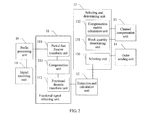
- FIG. 4 is a schematic structural diagram of a communications device according to device embodiment 3 of the present invention.
- FIG. 5 is a flowchart of a method for compensating for a doubly selective channel according to an embodiment of the present invention
- FIG. 6 is a method flowchart of performing frequency domain transform processing, channel compensation processing, and ( ⁇ 1) th order demodulation processing to obtain a fractional domain signal in a method for compensating for a doubly selective channel according to an embodiment of the present invention
- FIG. 7 is a flowchart of another method for compensating for a doubly selective channel according to an embodiment of the present invention.
- FIG. 8 is a schematic structural diagram of a receive end and a transmit end when implementing a method for compensating for a doubly selective channel in an application embodiment of the present invention
- FIG. 9 is a schematic structural diagram of a transmit end when adding a prefix to a time domain signal in an application embodiment of the present invention.
- FIG. 10 is a diagram of a correspondence between a signal bit error rate and a signal-to-noise ratio after a method for compensating for a doubly selective channel is adopted in multiple systems in an application embodiment of the present invention.
- a communications device is provided, where the communications device is an apparatus for compensating for a doubly selective signal, and a schematic structural diagram is shown in FIG. 1 .
- the communications device includes: a signal receiving unit 10 , a fractional signal obtaining unit 11 , an extraction and calculation unit 12 , a selecting and determining unit 13 , an order sending unit 14 , and a channel compensation unit 15 .
- the signal receiving unit 10 is configured to receive multiple time domain signals transmitted by a transmit end, where the multiple time domain signals transmitted by the transmit end are obtained by the transmit end by respectively performing a weighted fractional Fourier transform on multiple to-be-sent signals based on multiple different modulation orders ⁇ , and the multiple to-be-sent signals are multiple wanted signals to which a transmit pilot sequence is added.
- the transmit end respectively inserts preset transmit pilot sequences into specific locations of the multiple wanted signals, and then modulates and sends the to-be-sent signals into which the transmit pilot sequences are inserted.
- different transmit pilot sequences may be inserted into multiple wanted signals.
- a same transmit pilot sequence may be inserted into multiple wanted signals.
- the fractional signal obtaining unit 11 is configured to sequentially perform partial fast Fourier transform processing, channel compensation processing, and ( ⁇ 1) th order weighted fractional Fourier transform processing on each time domain signal of the multiple time domain signals received by the signal receiving unit 12 to obtain a corresponding fractional domain signal.
- a frequency domain signal may be obtained after the partial FFT transform is performed on a time domain signal;
- the channel compensation processing is to process the frequency domain signal according to the banded MMSE equalization method, specifically by multiplying a channel compensation matrix by a frequency domain signal;
- the ( ⁇ 1) th order weighted fractional Fourier transform processing means in this embodiment, that an ( ⁇ 1) th order WFRFT transform is performed on the signal after signal compensation processing to obtain a fractional domain signal.
- the extraction and calculation unit 12 is configured to extract a receive pilot sequence in the fractional domain signal that is corresponding to each of the multiple time domain signals obtained by the fractional signal obtaining unit 11 , and calculate a mean square error between the extracted receive pilot sequence and a transmit pilot sequence.
- a process of extracting the receive pilot sequence by the extraction and calculation unit 12 is inverse to a process of inserting the transmit pilot sequence by the transmit end.
- the extraction and calculation unit 12 obtains, by extracting, the receive pilot sequence at a specific location in the fractional domain signal.
- the transmit pilot sequence has been preset in the communications device according to this embodiment.
- the extraction and calculation unit 12 may calculate a mean square error directly according to the extracted receive pilot sequence and the preset transmit pilot sequence.
- the extraction and calculation unit 12 calculates a corresponding mean square error for the fractional domain signal corresponding to each time signal.
- the selecting and determining unit 13 is configured to select a first modulation order of a fractional domain signal corresponding to a minimum mean square error from the mean square errors that are respectively calculated by the extraction and calculation unit 12 according to the fractional domain signals corresponding to the multiple time domain signals, and determine a channel compensation parameter corresponding to the first modulation order, for example, a channel compensation matrix.
- the order sending unit 14 is configured to send the first modulation order obtained by the selecting and determining unit 13 to the transmit end, so that the transmit end sends a wanted signal according to the first modulation order.
- the channel compensation unit 15 is configured to perform channel compensation by using the channel compensation parameter determined by the selecting and determining unit 13 .
- an optimal parameter used in a process of channel compensation and signal modulation that is, a modulation order and a channel compensation parameter such as a channel compensation matrix is obtained based on a minimum mean square error between a transmit pilot sequence and a receive pilot sequence. Therefore, an optimization method is used to apply a banded equalization channel compensation method and a partial FFT transform to a communications system, thereby improving system performance.
- the communications device may further include a prefix processing unit 16 ; where the fractional signal obtaining unit 11 may be specifically implemented by using a partial fast Fourier transform unit 110 , a compensation unit 111 , and a fractional domain transform unit 112 , and the selecting and determining unit 13 may be implemented by using a selection unit 130 , a block quantity determining unit 131 , and a compensation matrix calculation unit 132 .
- the prefix processing unit 16 is configured to: before the fractional signal obtaining unit 11 obtains the fractional domain signal, separately remove a prefix of the multiple time domain signals received by the signal receiving unit 10 , where the prefix of the time domain signals is a cyclic prefix formed when the transmit end copies and places a segment of signal included in an original time domain signal in front of the original time domain signal.
- the partial fast Fourier transform unit 110 is configured to evenly split a wanted signal of a length M in the time domain signals received by the signal receiving unit 10 or the prefix-removed time domain signals obtained by the prefix processing unit 16 into Q blocks of signals; add each block of signals with a zero so that a length of each block of signals is M; and perform a Fourier transform on each zero-added block of signals to obtain a frequency domain signal of each block, where Q is greater than or equal to 2.
- the compensation unit 111 is configured to respectively perform, by using different channel compensation matrixes, channel compensation on the frequency domain signals of all the blocks obtained by the frequency domain transform unit 110 , and superpose the compensated frequency domain signals of all the blocks to obtain a compensated frequency domain signal.
- the fractional domain transform unit 112 is configured to perform an ( ⁇ 1) th order weighted fractional Fourier transform on the frequency domain signal that is compensated by the compensation unit 111 , to obtain a fractional domain signal.
- the selection unit 130 is configured to select a first modulation order of a fractional domain signal corresponding to a minimum mean square error from the mean square errors that are respectively calculated by the extraction and calculation unit 12 according to the fractional domain signals corresponding to the multiple time domain signals.
- the block quantity determining unit 131 is configured to determine a quantity Q of blocks used for partial fast Fourier transform processing that is performed by the frequency domain transform unit 110 included in the fractional signal obtaining unit 11 , in a process of obtaining the fractional domain signal corresponding to the first modulation order.
- z k [I] (k ⁇ P)
- M,: , k 1, 2, . . . , M is used to represent a matrix including all elements from the ((k ⁇ P)
- the prefix processing unit 16 may first remove a prefix of the time domain signal; then three units included in the fractional signal obtaining unit 11 implement conversion of the prefix-removed time domain signal into a fractional domain signal; then the extraction and calculation unit 12 extracts a receive pilot sequence in the fractional domain signal obtained by the fractional domain transform unit 112 in the fractional signal obtaining unit 11 ; then the three units in the selecting and determining unit 13 obtain optimized parameters, that is, the first modulation order, the quantity of blocks, and the channel compensation matrix; and finally, the order sending unit 14 sends the first modulation order selected by the selection unit 130 in the selecting and determining unit 13 to the transmit end, the block quantity determining unit 131 transfers the determined quantity of blocks to the frequency domain transform unit 110 for a frequency domain transform, and the compensation matrix calculation unit 132 transfers the calculated channel compensation matrix to the channel compensation unit 15 for channel compensation.
- a communications device is provided, where the communications device is an apparatus for compensating for a doubly selective signal, and a schematic structural diagram is shown in FIG. 3 .
- the communications device includes: a memory 20 , a processor 21 , a transmitter 22 , and a receiver 23 that are separately connected to a bus.
- the memory 20 may store information such as a file required for data processing by the processor 21 , and the transmitter 22 and the receiver 23 are ports for the communications device to communicate with another device.
- the receiver 23 is configured to receive multiple time domain signals transmitted by a transmit end, where the multiple time domain signals are obtained by the transmit end by respectively performing a weighted fractional Fourier transform on multiple to-be-sent signals based on multiple different modulation orders ⁇ , and the multiple to-be-sent signals are multiple wanted signals to which a transmit pilot sequence is added.
- the transmit end respectively inserts preset transmit pilot sequences into specific locations of the multiple wanted signals, and then modulates and sends the to-be-sent signals into which the transmit pilot sequences are inserted.
- different transmit pilot sequences may be inserted into multiple wanted signals. For ease of calculation, in an actual application process, a same transmit pilot sequence may be inserted into multiple wanted signals.
- the processor 21 is configured to: sequentially perform partial fast Fourier transform processing, channel compensation processing, and ( ⁇ 1) th order weighted fractional Fourier transform processing on each time domain signal of the multiple time domain signals to obtain a corresponding fractional domain signal; extract a receive pilot sequence in the fractional domain signal that is corresponding to each of the multiple time domain signals, and calculate a mean square error between the extracted receive pilot sequence and a transmit pilot sequence; select a first modulation order of a fractional domain signal corresponding to a minimum mean square error from the mean square errors that are respectively calculated by the processor 21 according to the fractional domain signals corresponding to the multiple time domain signals, and determine a channel compensation parameter corresponding to the first modulation order, for example, a channel compensation matrix; and send the first modulation order to the transmit end, so that the transmit end transmits a wanted signal according to the first modulation order; and perform channel compensation by using the determined channel compensation parameter.
- the communications device may obtain an optimal parameter used in a process of channel compensation and signal modulation, that is, a modulation order and a channel compensation parameter such as a channel compensation matrix.
- An optimization method is used to apply a banded equalization channel compensation method and a partial FFT transform to a communications system, thereby improving system performance.
- a frequency domain signal may be obtained after the processor 21 performs the partial FFT transform on a time domain signal; the channel compensation processing is to process the frequency domain signal according to the banded MMSE equalization method, specifically by multiplying a channel compensation matrix by a frequency domain signal; the ( ⁇ 1) th order weighted fractional Fourier transform processing means, in this embodiment, that an ( ⁇ 1) th order WFRFT transform is performed on the signal after signal compensation processing to obtain a fractional domain signal.
- a process of extracting the receive pilot sequence by the processor 21 is inverse to a process of inserting the transmit pilot sequence by the transmit end. Specifically, the processor 21 obtains, by extracting, the receive pilot sequence at a specific location in the fractional domain signal. However, the transmit pilot sequence has been preset in the communications device according to this embodiment. After the receive pilot sequence is extracted, a mean square error may be calculated directly according to the extracted receive pilot sequence and the preset transmit pilot sequence.
- the processor 21 is further configured to: after the receiver receives the multiple time domain signals, separately remove a prefix of the multiple time domain signals, where the prefix of the time domain signals is a cyclic prefix formed when the transmit end copies and places a segment of signal included in an original time domain signal in front of the original time domain signal. Then the processor 21 performs a series of processing on the prefix-removed time domain signals to obtain a frequency domain signal. Specifically:
- the processor 21 is specifically configured to: evenly split a wanted signal of a length M in the received time domain signals or the prefix-removed time domain signals into Q blocks of signals; add each block of signals with a zero so that a length of each block of signals is M; and perform a Fourier transform on each zero-added block of signals to obtain a frequency domain signal of each block, where Q is greater than or equal to 2; respectively perform, by using different channel compensation matrixes, channel compensation on the frequency domain signals of all the blocks, and superpose the compensated frequency domain signals of all the blocks to obtain a compensated frequency domain signal; and perform an ( ⁇ 1) th order weighted fractional Fourier transform on the compensated frequency domain signal to obtain a fractional domain signal.
- z k [I] (k ⁇ P)
- M,: , k 1, 2, . . . , M is used to represent a matrix including all elements from the ((k ⁇ P)
- a communications device is provided, where the communications device is an apparatus for compensating for a doubly selective signal, and a schematic structural diagram is shown in FIG. 4 .
- the communications device includes: a time domain signal obtaining unit 30 , a sending unit 31 , and a transmission unit 32 .
- the time domain signal obtaining unit 30 is configured to respectively perform, based on multiple different modulation orders ⁇ , weighted fractional Fourier transform processing on multiple to-be-sent signals to obtain multiple time domain signals, where the multiple to-be-sent signals are multiple wanted signals to which a transmit pilot sequence is added.
- the time domain signal obtaining unit 30 is specifically configured to perform, based on multiple different modulation orders ⁇ , an ⁇ th order weighted fractional Fourier transform on multiple to-be-sent fractional domain signals to obtain the multiple time domain signals.
- different transmit pilot sequences may be inserted into multiple wanted signals. For ease of calculation, in an actual application process, a same transmit pilot sequence may be inserted into multiple wanted signals.
- the sending unit 31 is configured to transmit the multiple time domain signals obtained by the time domain signal obtaining unit 30 to a receive end, so that the receive end selects a first modulation order from the multiple modulation orders ⁇ according to the multiple time domain signals.
- the sending unit 31 may be implemented by using a prefix adding unit and a signal sending unit.
- the prefix adding unit is configured to add a prefix to the time domain signals, where the prefix refers to a cyclic prefix formed by copying and placing a segment of signal included in the time domain signals in front of the time domain signals; and the signal sending unit is configured to transmit, to the receive end, the time domain signals to which the prefix is added by the prefix adding unit.
- the transmission unit 32 is configured to receive the first modulation order returned by the receive end according to the multiple time domain signals sent by the sending unit 31 , and transmit a wanted signal according to the first modulation order.
- the receive end may provide feedback to the communications device in this embodiment according to the optimized first modulation order that is obtained in the foregoing device embodiment 1, thereby improving performance of the transmission unit 32 when transmitting a wanted signal.
- a communications device is provided, where the communications device is an apparatus for compensating for a doubly selective signal, and a schematic structural diagram is similar to that shown in FIG. 3 .
- the communications device includes: a memory, a processor, a transmitter, and a receiver that are separately connected to a bus.
- the memory may store information such as a file required for data processing by the processor, and the transmitter and the receiver are ports for the communications device to communicate with another device.
- the processor in this embodiment is configured to: respectively perform, based on multiple different modulation orders ⁇ , weighted fractional Fourier transform processing on multiple to-be-sent signals to obtain multiple time domain signals, where the multiple to-be-sent signals are multiple wanted signals to which a transmit pilot sequence is added; and control the transmitter to transmit the multiple time domain signals to a receive end, so that the receive end selects a first modulation order from the multiple modulation orders ⁇ according to the multiple time domain signals.
- the receiver receives the first modulation order that is returned, according to the multiple time domain signals, by the receive end, and transmits a wanted signal according to the first modulation order.
- the receive end may provide feedback to the communications device in this embodiment according to the optimized first modulation order that is obtained in the foregoing device embodiment 1, thereby improving performance of signal transmission.
- the processor When obtaining the multiple time domain signals, the processor is specifically configured to perform, based on multiple different modulation orders ⁇ , an ⁇ th weighted fractional Fourier transform on multiple to-be-sent fractional domain signals to obtain the multiple time domain signals.
- the processor may further preprocess the multiple time domain signals after obtaining the multiple time domain signals. Specifically, a prefix is added to the time domain signals, where the prefix refers to a cyclic prefix formed by copying and placing a segment of signal included in the time domain signals in front of the time domain signals. Then the time domain signals to which the prefix is added are transmitted to the receive end.
- An embodiment of the present invention further provides a system for compensating for a doubly selective channel, including a first communications device and a second communications device.
- a structure of the first communications device is similar to a structure of the communications device according to the foregoing device embodiment 1 or 2
- a structure of the second communications device is similar to a structure of the communications device according to the foregoing device embodiment 3 or 4, and details are not described herein.
- An embodiment of the present invention further provides a method for compensating for a doubly selective channel, which is mainly applied to compensate for a doubly selective channel when a doubly selective channel is used for communication in a system such as a hybrid carrier system, an OFDM system, or a single carrier system.
- the method is mainly executed by a communication receive end, that is, the communications device in the foregoing device embodiment 1 or 2.
- FIG. 5 A flowchart is shown in FIG. 5 , which includes:
- Step 101 A receive end receives multiple time domain signals transmitted by a transmit end, where the multiple time domain signals are obtained by the transmit end by respectively performing a weighted fractional Fourier transform on multiple to-be-sent signals based on multiple different modulation orders ⁇ , and the multiple to-be-sent signals are multiple wanted signals to which a transmit pilot sequence is added.
- the transmit end when transmitting a signal on a doubly selective channel, the transmit end respectively inserts preset transmit pilot sequences into specific locations of the multiple wanted signals, and then modulates and sends the obtained to-be-sent signals into which the transmit pilot sequences are inserted.
- different transmit pilot sequences may be inserted into multiple wanted signals.
- a same transmit pilot sequence may be inserted into multiple wanted signals.
- the transmit end performs modulation processing on the to-be-sent signals by means of weighted-type fractional Fourier transform (Weighted-type fractional Fourier transform, WFRFT). It is assumed that the to-be-sent signals are ⁇ th order fractional domain signals, an ⁇ th order WFRFT transform is performed on the to-be-sent signals to obtain time domain signals.
- WFRFT weighted-type fractional Fourier transform
- Step 102 The receive end sequentially performs partial fast Fourier transform processing, channel compensation processing, and ( ⁇ 1) th order weighted fractional Fourier transform processing on each time domain signal of the time domain signals received in step 101 to obtain a corresponding fractional domain signal.
- a frequency domain signal may be obtained after the partial FFT transform is performed on a time domain signal;
- the channel compensation processing is to process the frequency domain signal according to the banded MMSE equalization method, specifically by multiplying a channel compensation matrix by a frequency domain signal;
- the ( ⁇ 1) th order weighted fractional Fourier transform processing means in this embodiment, that an ( ⁇ 1) th order WFRFT transform is performed on the signal after signal compensation processing to obtain a fractional domain signal.
- the receive end after receiving the multiple time domain signals, the receive end needs to perform preprocessing on the multiple time domain signals at least once.
- a specific processing method for the preprocessing is determined by preprocessing performed by the transmit end before sending the time domain signals. For example, if the preprocessing is to add a prefix to an original time domain signal, the receive end needs to perform processing such as removing a prefix of a received time domain signal.
- the prefix of the time domain signal may be a cyclic prefix formed when the transmit end copies and places a segment L of signal included in an original time domain signal in front of the original time domain signal.
- Step 103 The receive end extracts a receive pilot sequence in the fractional domain signal that is corresponding to each of the multiple time domain signals, and calculates a mean square error between the extracted receive pilot sequence and a transmit pilot sequence.
- a process of extracting the receive pilot sequence by the receive end is inverse to a process of inserting the transmit pilot sequence by the transmit end.
- the receive end obtains, by extracting, the receive pilot sequence at a specific location in the fractional domain signal.
- the transmit pilot sequence has been preset in the receive end. After the receive pilot sequence is extracted, a mean square error may be calculated directly according to the extracted receive pilot sequence and the preset transmit pilot sequence.
- Step 104 The receive end selects a first modulation order of a fractional domain signal corresponding to a minimum mean square error from the mean square errors that are respectively calculated according to the fractional domain signals corresponding to the multiple time domain signals, and determines a channel compensation parameter corresponding to the first modulation order.
- the transmit end when sending a signal, performs modulation processing, that is, a weighted fractional Fourier transform on multiple to-be-sent signals based on multiple different modulation orders ⁇ , and then transmits the signals separately through a doubly selective channel. Then the receive end selects a relatively optimized modulation order and a relatively optimized channel compensation parameter by using a channel estimation method.
- modulation processing that is, a weighted fractional Fourier transform on multiple to-be-sent signals based on multiple different modulation orders ⁇
- Step 105 The receive end sends the first modulation order to the transmit end, so that the transmit end sends a signal according to the first modulation order, and the receive end performs channel compensation by using the channel compensation parameter determined in step 104 .
- the receive end After the receive end separately performs steps 102 and 103 on multiple time domain signals, multiple mean square errors are obtained. Then the receive end selects a minimum mean square error, and uses a first modulation order of a fractional domain signal corresponding to the receive pilot sequence as an optimal modulation order and feeds back the order to the transmit end, where the receive pilot sequence is used to calculate the minimum mean square error. In addition, because different modulation orders correspond to different signal compensation parameters, the receive end obtains a corresponding channel compensation parameter according to the selected first modulation order, for example, a signal compensation matrix, and uses the channel compensation parameter in a subsequent channel compensation process.
- a receive end obtains, based on a minimum mean square error between a transmit pilot sequence and a receive pilot sequence, an optimal parameter used in a process of channel compensation and signal modulation, that is, a modulation order and a channel compensation parameter such as a channel compensation matrix. Therefore, according to this embodiment of the present invention, an optimization method is used to apply a banded equalization channel compensation method and a partial FFT transform to a communications system, thereby improving system performance.
- performing step 102 by the receive end may specifically include the following steps:
- a wanted signal of a length M in the time domain signals received in step 101 or the time domain signals that have undergone processing at least once such as prefix removing may be evenly split into Q blocks of signals, where Q is greater than or equal to 2;
- each block of signals is added with a zero, so that a length of each block of signals is M;
- a Fourier transform is performed on each zero-added block of signals to obtain a frequency domain signal of each block; therefore, after the Fourier transform is performed on each block of signals, interference on a wanted signal may be partially distributed to another unwanted signal such as a zero-added portion.
- channel compensation processing is respectively performed on frequency domain signals of all the blocks by using different channel compensation matrixes, and the compensated frequency domain signals of all the blocks are superposed to obtain a compensated frequency domain signal.
- the channel compensation parameter determined by the receive end in performing step 104 may include a channel compensation matrix corresponding to the frequency domain signal of each block. Specifically, when determining a quantity Q of blocks used for performing partial FFT transform, the receive end may directly determine a quantity Q of blocks used for performing frequency domain transform processing when the fractional domain signal corresponding to the foregoing first modulation order is obtained.
- different quantities Q of blocks may be used, that is, different quantities Q of blocks corresponding to the time domain signals obtained based on different modulation orders ⁇ , and a correspondence between a modulation order ⁇ and a quantity Q of blocks may be preset in the receive end. In this case, as long as the receive end learns a modulation order, a corresponding quantity of blocks can be determined.
- z k [I] (k ⁇ P)
- M,: , k 1, 2, . . . , M is used to represent a matrix including all elements from the ((k ⁇ P)
- An embodiment of the present invention provides a method for compensating for a doubly selective channel, which is mainly applied to compensate for a doubly selective channel when a doubly selective channel is used for communication in a hybrid carrier system.
- the method is mainly executed by a communication transmit end, that is, the communications device in the foregoing device embodiment 3 or 4.
- a flowchart is shown in FIG. 7 , which includes:
- Step 201 A transmit end respectively performs, based on multiple different modulation orders ⁇ , weighted fractional Fourier transform processing on multiple to-be-sent signals to obtain multiple time domain signals, where the multiple to-be-sent signals are multiple wanted signals to which a transmit pilot sequence is added.
- the transmit end may perform, based on multiple different modulation orders ⁇ , an ⁇ th order weighted fractional Fourier transform on the multiple to-be-sent fractional domain signals to obtain multiple time domain signals.
- Step 202 The transmit end transmits the multiple time domain signals to a receive end, so that the receive end selects a first modulation order from the multiple modulation orders ⁇ according to the multiple time domain signals. Specifically, the receive end may obtain the first modulation order according to the method in steps 101 to 105 in the foregoing embodiment, and return the first modulation order to the transmit end. Details are not described herein.
- the transmit end when transmitting the time domain signals, to suppress inter-symbol interference, may first add a prefix to the time domain signals, where the prefix refers to a cyclic prefix formed by copying and placing a segment of signal included in the time domain signals in front of the time domain signals; and then transmit the time domain signals to which the prefix is added.
- the prefix refers to a cyclic prefix formed by copying and placing a segment of signal included in the time domain signals in front of the time domain signals
- Step 203 When the transmit end receives a first modulation order returned by the receive end, where the first modulation order is an optimal modulation order determined by the receive end, the transmit end transmits a wanted signal according to the first modulation order in subsequent transmission of a wanted signal.
- FIG. 8 schematic structural diagrams of the transmit end and the receive end are shown in FIG. 8 , which includes:
- the receive end includes a WFRFT module and a parallel/serial conversion module.
- the WFRFT module of the receive end respectively performs an ⁇ th order WFRFT transform on multiple to-be-sent signals of a length M, such as binary phase shift keying (Binary Phase Shift Keying, BSPK) signals or quadrature phase shift keying (Quadrature Phase Shift Keying, QPSK) signals, based on multiple different modulation orders ⁇ to obtain multiple time domain signals.
- the WFRFT module may use a discrete four-term weighted fractional Fourier transform. Specifically:
- W ⁇ is denoted as W for short.
- W A 0 ( ⁇ )I+A 1 ( ⁇ )F+A 2 ( ⁇ ) ⁇ I+A 3 ( ⁇ ) ⁇ F, where A 0 ( ⁇ ) ⁇ A 3 ( ⁇ ) is a weighting coefficient, which is defined as follows:
- I is an M ⁇ M identity matrix
- F is an M ⁇ M discrete Fourier transform matrix
- exp(.) represents an e exponent operator
- ⁇ is a permutation matrix, where there is only one non-zero element in each row and each column of the permutation matrix.
- F and ⁇ may be specifically represented as follows:
- a cyclic prefix of a length L cp is added to a time domain signal after parallel/serial conversion, and duration of the cyclic prefix may be set to be greater than a maximum channel delay spread; and then the time domain signal to which the prefix is added is transmitted on a doubly selective channel.
- the receive end includes a serial/parallel conversion module, a partial FFT module, a channel compensation module, a WFRFT module, a parameter optimization control module, a channel estimation module, and a pilot extracting module.
- H t is a time domain matrix form of a time-varying channel; it is assumed that H t is an M ⁇ M cyclic convolution matrix; [H t ] k,(k ⁇ 1)
- n is Gaussian white noise; because there is noise interference during signal transmission on a doubly selective channel, here, all signals processed at the receive end by default are signals to which noise is added.
- the channel compensation module uses the banded MMSE equalization method to respectively perform, by using different channel compensation matrixes, channel compensation processing on the frequency domain signal of each block that is obtained by means of processing by the partial FFT module.
- a channel compensation matrix for the frequency domain signal of the q th block is G q
- G q is an M ⁇ M matrix
- compensated frequency domain signals of all the blocks are superposed to obtain a compensated frequency domain signal ⁇ .
- i q diag([0 1 ⁇ [(q ⁇ 1)M/Q] ,1 1 ⁇ (M/Q) ,0 1 ⁇ (M ⁇ qM/Q) ]), i q represents an M ⁇ M diagonal matrix.
- z k [I] (k ⁇ P)
- M,: , k 1, 2, . . .
- M represents a matrix including all elements from the ((k ⁇ P)
- P is a constant, whose value is generally P ⁇ M. Selection of P is related to a magnitude of Doppler.
- I 2P+1 represents an identity matrix of (2P+1) ⁇ (2P+1)
- h k is an element in the k th column in ⁇ tilde over (H) ⁇ k
- N 0 is noise power
- G q,k represents a column vector of M ⁇ 1
- ⁇ q,k G q,k H Y q,k
- ⁇ q,k represents the k th element of ⁇ q .
- formula (5) may be represented as:
- the pilot extracting module extracts a receive pilot sequence from the fractional domain signal obtained by the WFRFT module and transmits the receive pilot sequence to the parameter optimization control module.
- the channel estimation module connected to the pilot extracting module is intended to estimate information about a channel, including parameters such as Doppler, a channel gain, and a multi-path delay. These parameters are used when the parameter optimization control module selects an optimized modulation order and an optimized channel compensation parameter.
- the parameter optimization control module determines a first modulation order and a quantity Q of blocks corresponding to one of the receive pilot sequences according to the following optimization method, and then obtains a channel compensation matrix of the frequency domain signal of each block according to the foregoing formula (13):
- arg ⁇ , ⁇ min Q ⁇ ⁇ • ⁇ 2 represents values of a modulation order and a quantity of blocks, which enable a minimum mean square error between a receive pilot sequence and a transmit pilot sequence, and Z( ) means that a pilot sequence is fetched.
- the parameter optimization control module feeds back the obtained first modulation order to the transmit end and the WFRFT module of the receive end, so that the transmit end and the WFRFT module of the receive end perform a weighted fractional Fourier transform according to the first modulation order during subsequent signal processing; transfers the obtained quantity Q of blocks to the partial FFT module of the receive end, so that the partial FFT module uses Quantity Q of blocks for block splitting in a subsequent frequency domain transform processing process; and transfers the calculated channel compensation matrix to the channel compensation module of the receive end, so that the channel compensation module performs processing according to the calculated channel compensation matrix in a subsequent channel compensation process.
- T represents transpose of a matrix or a vector
- H represents conjugate transpose of a matrix or a vector
- b represents modulo of a numerical value a with respect to a numerical value b
- W ⁇ is an ⁇ th order weighted matrix
- [ ⁇ ] m,n represents an element in the m th row and the n th column of a matrix
- [ ⁇ ] m:n represents a matrix including all elements fetched from the m th row to the n th row in a matrix
- 0 1 ⁇ N represents a 1 ⁇ N all-zero vector
- 1 1 ⁇ N represents a 1 ⁇ N all-one vector
- diag(B) represents a diagonal matrix including a vector B
- ⁇ represents an upper bound of a numerical value.
- applying the method in this embodiment of the present invention to a hybrid carrier system may significantly reduce a bit error rate and improve communication quality.
- applying the method in this embodiment of the present invention to a hybrid carrier system can significantly reduce a bit error rate when a signal-to-noise ratio is greater than 20 dB.
- the program may be stored in a computer readable storage medium.
- the storage medium may include: a read-only memory (ROM), a random-access memory (RAN), a magnetic disk, or an optical disc.
Landscapes
- Engineering & Computer Science (AREA)
- Signal Processing (AREA)
- Computer Networks & Wireless Communication (AREA)
- Power Engineering (AREA)
- Physics & Mathematics (AREA)
- Mathematical Physics (AREA)
- Discrete Mathematics (AREA)
- General Physics & Mathematics (AREA)
- Digital Transmission Methods That Use Modulated Carrier Waves (AREA)
Applications Claiming Priority (4)
| Application Number | Priority Date | Filing Date | Title |
|---|---|---|---|
| CN201410250710.XA CN105187339B (zh) | 2014-06-06 | 2014-06-06 | 一种双选信道的补偿方法、系统及相关装置 |
| CN201410250710.X | 2014-06-06 | ||
| CN201410250710 | 2014-06-06 | ||
| PCT/CN2015/073627 WO2015184875A1 (zh) | 2014-06-06 | 2015-03-04 | 一种双选信道的补偿方法、系统及相关装置 |
Related Parent Applications (1)
| Application Number | Title | Priority Date | Filing Date |
|---|---|---|---|
| PCT/CN2015/073627 Continuation WO2015184875A1 (zh) | 2014-06-06 | 2015-03-04 | 一种双选信道的补偿方法、系统及相关装置 |
Publications (2)
| Publication Number | Publication Date |
|---|---|
| US20170094665A1 US20170094665A1 (en) | 2017-03-30 |
| US10104666B2 true US10104666B2 (en) | 2018-10-16 |
Family
ID=54766101
Family Applications (1)
| Application Number | Title | Priority Date | Filing Date |
|---|---|---|---|
| US15/369,462 Active 2035-05-15 US10104666B2 (en) | 2014-06-06 | 2016-12-05 | Method and system for compensating for doubly selective channel and related apparatus |
Country Status (4)
| Country | Link |
|---|---|
| US (1) | US10104666B2 (de) |
| EP (1) | EP3154231B1 (de) |
| CN (1) | CN105187339B (de) |
| WO (1) | WO2015184875A1 (de) |
Families Citing this family (22)
| Publication number | Priority date | Publication date | Assignee | Title |
|---|---|---|---|---|
| CN106559126A (zh) * | 2015-09-29 | 2017-04-05 | 华为技术有限公司 | 信号发送方法、信号接收方法、发射端及接收端 |
| CN105871440A (zh) * | 2016-06-15 | 2016-08-17 | 哈尔滨工业大学 | 混合载波多天线分量传输的信号接收方法 |
| CN106534008B (zh) * | 2016-11-25 | 2019-08-02 | 西安烽火电子科技有限责任公司 | 无线多径信道的功率补偿mmse均衡方法 |
| CN106487731B (zh) * | 2016-12-22 | 2022-11-04 | 桂林电子科技大学 | 一种基于小波变换的混合载波调制方法和系统 |
| CN107026811B (zh) * | 2017-05-08 | 2019-09-13 | 哈尔滨工业大学 | 基于最小均方误差均衡的混合载波阶数选择方法 |
| CN109391292B (zh) * | 2018-12-20 | 2021-07-16 | 哈尔滨工业大学 | 加权分数傅里叶变换域双时隙分集与复用的协同传输方法 |
| CN110389325B (zh) * | 2019-07-17 | 2022-11-04 | 中北大学 | 一种旋翼无人机的雷达微多普勒信号提取方法 |
| US11943081B2 (en) | 2019-10-22 | 2024-03-26 | Nanyang Technological University | Method of receiving a transmitted signal over a time-varying channel and receiver thereof |
| CN111245766B (zh) * | 2020-01-19 | 2023-02-03 | 哈尔滨工业大学 | 基于频域双分量扩展加权傅里叶变换的计算分集方法 |
| US10972316B1 (en) * | 2020-02-06 | 2021-04-06 | The Aerospace Corporation | Channel estimation using a chirp signal and the Fractional Fourier Transform |
| CN111371531B (zh) * | 2020-02-19 | 2022-09-30 | 哈尔滨工业大学 | 基于扩展加权分数傅里叶变换的时域能量交织传输方法 |
| CN111711951B (zh) * | 2020-06-15 | 2022-09-20 | 哈尔滨工业大学 | 一种加权分数傅里叶变换域多分量自干扰传输方法 |
| CN113301565B (zh) * | 2021-05-25 | 2023-04-25 | 哈尔滨工业大学 | 基于扩展加权分数傅里叶变换的波形多样化安全传输方法及系统 |
| CN113328969B (zh) * | 2021-06-04 | 2022-12-09 | 中国人民解放军空军工程大学 | 基于mp-wfrft和人工噪声的多波束定向调制方法及系统 |
| CN113381834B (zh) * | 2021-06-09 | 2022-08-05 | 哈尔滨工业大学 | 一种基于扩展加权分数傅里叶变换的定向调制方法及系统 |
| CN113630151B (zh) * | 2021-09-18 | 2022-07-19 | 哈尔滨工业大学 | 一种时频联合扩展传输方法 |
| CN113872724B (zh) * | 2021-09-24 | 2024-04-30 | 天津津航计算技术研究所 | 一种基于WFrFT和调制跳变的抗截获装置及方法 |
| CN114157322B (zh) * | 2021-11-16 | 2023-03-21 | 山东轻工职业学院 | 基于加权分数阶傅里叶变换的低截获信号产生方法 |
| CN116886469A (zh) * | 2021-12-29 | 2023-10-13 | 中国移动通信有限公司研究院 | 一种信号的处理方法、装置及设备 |
| CN115333593A (zh) * | 2022-05-24 | 2022-11-11 | 西安石油大学 | 多用户协作物理层邻域安全通信方法、发射机及存储介质 |
| CN119172213B (zh) * | 2024-11-21 | 2025-02-14 | 中国电子科技集团公司第五十四研究所 | 一种基于时变分数傅里叶变换的信号隐蔽传输方法 |
| CN120075001B (zh) * | 2025-03-12 | 2025-11-11 | 西安电子科技大学 | 卫星通信的ofdm信号时域非线性失真恢复方法及装置 |
Citations (31)
| Publication number | Priority date | Publication date | Assignee | Title |
|---|---|---|---|---|
| US20030191843A1 (en) * | 2002-04-04 | 2003-10-09 | Joel Balissat | Secure network connection for devices on a private network |
| US20030193889A1 (en) * | 2002-04-11 | 2003-10-16 | Intel Corporation | Wireless device and method for interference and channel adaptation in an OFDM communication system |
| US20030219022A1 (en) * | 2002-01-28 | 2003-11-27 | Hughes Electronics | Method and system for utilizing virtual private network (VPN) connections in a performance enhanced network |
| US20050073948A1 (en) * | 2003-03-27 | 2005-04-07 | Ktfreetel Co., Ltd. | Orthogonal frequency division multiplexing wireless communication operable on frequency selective channel, and channel compensation method |
| WO2005036770A1 (en) | 2003-10-13 | 2005-04-21 | Nokia Corporation | Method for suppressing interference and arrangement for same, and radio communications receiver |
| CN1859346A (zh) | 2006-04-29 | 2006-11-08 | 北京理工大学 | 基于分数阶傅立叶变换的正交频分复用(ofdm)系统 |
| US20060293056A1 (en) * | 2005-06-27 | 2006-12-28 | Samsung Electronics Co., Ltd. | Method and apparatus for transmitting/receiving downlink data for UE in soft handover region in an OFDM system |
| US20070208854A1 (en) * | 2006-03-03 | 2007-09-06 | Santa Wiryaman | Network interface device |
| US20070211786A1 (en) * | 1998-02-12 | 2007-09-13 | Steve Shattil | Multicarrier Sub-Layer for Direct Sequence Channel and Multiple-Access Coding |
| US20080107124A1 (en) * | 2006-11-06 | 2008-05-08 | Jordi Ros-Giralt | System and method for supporting mobility and multipath packet delivery in ip communications and computer networks across nat and firewall boxes |
| US20080130790A1 (en) * | 2004-07-30 | 2008-06-05 | Antionio Forenza | System and method for distributed input distributed output wireless communications |
| US20080227422A1 (en) * | 2007-03-14 | 2008-09-18 | Samsung Electronics Co. Ltd. | Apparatus and method for interference cancellation in multi-antenna system |
| US20090046816A1 (en) * | 2007-07-04 | 2009-02-19 | Lg Electronics Inc. | Digital broadcasting system and method of processing data |
| US20090110033A1 (en) * | 1998-02-12 | 2009-04-30 | Lot 41 Acquisition Foundation, Llc | Multicarrier sub-layer for direct sequence channel and multiple-access coding |
| US7554983B1 (en) * | 2004-12-20 | 2009-06-30 | Packeteer, Inc. | Probing hosts against network application profiles to facilitate classification of network traffic |
| US20090175367A1 (en) * | 2006-01-06 | 2009-07-09 | Panasonic Corporation | Wireless communication device |
| US20090219800A1 (en) * | 2006-02-23 | 2009-09-03 | Wladimir Bocquet | Transmission Method with Optimal Power Allocation Emitted for Multicarrier Transmitter |
| US20100205313A1 (en) * | 2009-02-06 | 2010-08-12 | Sagem-Interstar, Inc. | Scalable NAT Traversal |
| US8046829B2 (en) * | 2004-08-17 | 2011-10-25 | Toshiba America Research, Inc. | Method for dynamically and securely establishing a tunnel |
| US20120219079A1 (en) * | 2009-10-27 | 2012-08-30 | Takashi Yoshimoto | Receiving device, receiving method, communication system, and communication method |
| CN103326976A (zh) | 2013-07-10 | 2013-09-25 | 哈尔滨工业大学 | 基于加权分数傅立叶变换的双弥散信道下的迭代频域最小均方误差均衡方法 |
| CN103414678A (zh) | 2013-08-02 | 2013-11-27 | 浙江大学 | 基于Vector OFDM的双选择性信道的变换域均衡方法 |
| CN103457901A (zh) | 2013-09-12 | 2013-12-18 | 哈尔滨工业大学 | 基于信道感知的混合载波信号传输方法 |
| US20130343379A1 (en) * | 2012-06-21 | 2013-12-26 | Jonathan Stroud | Ethernet-based internal device management |
| US20140204841A1 (en) * | 2011-08-15 | 2014-07-24 | Sharp Kabushiki Kaisha | Wireless transmission device and wireless reception device |
| US20140237585A1 (en) * | 2013-02-19 | 2014-08-21 | Cisco Technology, Inc. | Use of Virtual Network Interfaces and a Websocket Based Transport Mechanism to Realize Secure Node-to-Site and Site-to-Site Virtual Private Network Solutions |
| US8972543B1 (en) * | 2012-04-11 | 2015-03-03 | Spirent Communications, Inc. | Managing clients utilizing reverse transactions |
| US20150095648A1 (en) * | 2013-09-10 | 2015-04-02 | John A. Nix | Secure PKI Communications for "Machine-to-Machine" Modules, including Key Derivation by Modules and Authenticating Public Keys |
| US20150257072A1 (en) * | 2012-09-25 | 2015-09-10 | Sharp Kabushiki Kaisha | Base station and terminal |
| US20150296417A1 (en) * | 2012-11-01 | 2015-10-15 | Sharp Kabushiki Kaisha | Base station and terminal |
| US20170012749A1 (en) * | 2012-06-25 | 2017-01-12 | Cohere Technologies, Inc. | Orthogonal time frequency space communication system compatible with ofdm |
-
2014
- 2014-06-06 CN CN201410250710.XA patent/CN105187339B/zh active Active
-
2015
- 2015-03-04 EP EP15802852.2A patent/EP3154231B1/de active Active
- 2015-03-04 WO PCT/CN2015/073627 patent/WO2015184875A1/zh not_active Ceased
-
2016
- 2016-12-05 US US15/369,462 patent/US10104666B2/en active Active
Patent Citations (31)
| Publication number | Priority date | Publication date | Assignee | Title |
|---|---|---|---|---|
| US20090110033A1 (en) * | 1998-02-12 | 2009-04-30 | Lot 41 Acquisition Foundation, Llc | Multicarrier sub-layer for direct sequence channel and multiple-access coding |
| US20070211786A1 (en) * | 1998-02-12 | 2007-09-13 | Steve Shattil | Multicarrier Sub-Layer for Direct Sequence Channel and Multiple-Access Coding |
| US20030219022A1 (en) * | 2002-01-28 | 2003-11-27 | Hughes Electronics | Method and system for utilizing virtual private network (VPN) connections in a performance enhanced network |
| US20030191843A1 (en) * | 2002-04-04 | 2003-10-09 | Joel Balissat | Secure network connection for devices on a private network |
| US20030193889A1 (en) * | 2002-04-11 | 2003-10-16 | Intel Corporation | Wireless device and method for interference and channel adaptation in an OFDM communication system |
| US20050073948A1 (en) * | 2003-03-27 | 2005-04-07 | Ktfreetel Co., Ltd. | Orthogonal frequency division multiplexing wireless communication operable on frequency selective channel, and channel compensation method |
| WO2005036770A1 (en) | 2003-10-13 | 2005-04-21 | Nokia Corporation | Method for suppressing interference and arrangement for same, and radio communications receiver |
| US20080130790A1 (en) * | 2004-07-30 | 2008-06-05 | Antionio Forenza | System and method for distributed input distributed output wireless communications |
| US8046829B2 (en) * | 2004-08-17 | 2011-10-25 | Toshiba America Research, Inc. | Method for dynamically and securely establishing a tunnel |
| US7554983B1 (en) * | 2004-12-20 | 2009-06-30 | Packeteer, Inc. | Probing hosts against network application profiles to facilitate classification of network traffic |
| US20060293056A1 (en) * | 2005-06-27 | 2006-12-28 | Samsung Electronics Co., Ltd. | Method and apparatus for transmitting/receiving downlink data for UE in soft handover region in an OFDM system |
| US20090175367A1 (en) * | 2006-01-06 | 2009-07-09 | Panasonic Corporation | Wireless communication device |
| US20090219800A1 (en) * | 2006-02-23 | 2009-09-03 | Wladimir Bocquet | Transmission Method with Optimal Power Allocation Emitted for Multicarrier Transmitter |
| US20070208854A1 (en) * | 2006-03-03 | 2007-09-06 | Santa Wiryaman | Network interface device |
| CN1859346A (zh) | 2006-04-29 | 2006-11-08 | 北京理工大学 | 基于分数阶傅立叶变换的正交频分复用(ofdm)系统 |
| US20080107124A1 (en) * | 2006-11-06 | 2008-05-08 | Jordi Ros-Giralt | System and method for supporting mobility and multipath packet delivery in ip communications and computer networks across nat and firewall boxes |
| US20080227422A1 (en) * | 2007-03-14 | 2008-09-18 | Samsung Electronics Co. Ltd. | Apparatus and method for interference cancellation in multi-antenna system |
| US20090046816A1 (en) * | 2007-07-04 | 2009-02-19 | Lg Electronics Inc. | Digital broadcasting system and method of processing data |
| US20100205313A1 (en) * | 2009-02-06 | 2010-08-12 | Sagem-Interstar, Inc. | Scalable NAT Traversal |
| US20120219079A1 (en) * | 2009-10-27 | 2012-08-30 | Takashi Yoshimoto | Receiving device, receiving method, communication system, and communication method |
| US20140204841A1 (en) * | 2011-08-15 | 2014-07-24 | Sharp Kabushiki Kaisha | Wireless transmission device and wireless reception device |
| US8972543B1 (en) * | 2012-04-11 | 2015-03-03 | Spirent Communications, Inc. | Managing clients utilizing reverse transactions |
| US20130343379A1 (en) * | 2012-06-21 | 2013-12-26 | Jonathan Stroud | Ethernet-based internal device management |
| US20170012749A1 (en) * | 2012-06-25 | 2017-01-12 | Cohere Technologies, Inc. | Orthogonal time frequency space communication system compatible with ofdm |
| US20150257072A1 (en) * | 2012-09-25 | 2015-09-10 | Sharp Kabushiki Kaisha | Base station and terminal |
| US20150296417A1 (en) * | 2012-11-01 | 2015-10-15 | Sharp Kabushiki Kaisha | Base station and terminal |
| US20140237585A1 (en) * | 2013-02-19 | 2014-08-21 | Cisco Technology, Inc. | Use of Virtual Network Interfaces and a Websocket Based Transport Mechanism to Realize Secure Node-to-Site and Site-to-Site Virtual Private Network Solutions |
| CN103326976A (zh) | 2013-07-10 | 2013-09-25 | 哈尔滨工业大学 | 基于加权分数傅立叶变换的双弥散信道下的迭代频域最小均方误差均衡方法 |
| CN103414678A (zh) | 2013-08-02 | 2013-11-27 | 浙江大学 | 基于Vector OFDM的双选择性信道的变换域均衡方法 |
| US20150095648A1 (en) * | 2013-09-10 | 2015-04-02 | John A. Nix | Secure PKI Communications for "Machine-to-Machine" Modules, including Key Derivation by Modules and Authenticating Public Keys |
| CN103457901A (zh) | 2013-09-12 | 2013-12-18 | 哈尔滨工业大学 | 基于信道感知的混合载波信号传输方法 |
Non-Patent Citations (7)
| Title |
|---|
| Li, et al., "Low Complexity Equalization of HCM Systems with DPFFT Demodulation over Doubly-Selective Channels", IEEE Signal Processing Letters, vol. 21, Issue 7, Jul. 2014, 4 pages. |
| Li, et at., "Hybrid Carrier Communication with Partial FFT Demodulation over Underwater Acoustic Channels", IEEE Communications Letters, vol. 17, No. 12, Dec. 2013, 4 pages. |
| Ma et al., "Optimal Training for Block Transmissions Over Doubly Selective Wireless Fading Channels", IEEE Transactions on Signal Processing, vol. 51, No. 5, May 2003, 16 pages. |
| Martone, Massimiliano (Max), "A Multicarrier System Based on the Fractional Fourier Transform for Time-Frequency-Selective Channels", IEEE Transactions on Communications, vol. 49, No. 6, Jun. 2001, 10 pages. |
| Muralidhar et al., "A Low-Complexity Kalman Approach for Channel Estimation in Doubly-Selective OFDM Systems", IEEE Signal Processing Letters, vol. 16, No. 7, Jul. 2009, 4 pages. |
| Schniter, Philip, "Low-Complexity Equalization of OFDM in Doubly Selective Channels", IEEE Transactions on Signal Processing, vol. 52, No. 4, Apr. 2004, 10 pages. |
| Yerramalli et al., "Partial FFT Demodulation: A Detection Method for Highly Doppler Distorted OFDM Systems", IEEE Transactions on Signal Processing, vol. 60, No. 11, Nov. 2012, 13 pages. |
Also Published As
| Publication number | Publication date |
|---|---|
| US20170094665A1 (en) | 2017-03-30 |
| EP3154231A4 (de) | 2017-07-05 |
| CN105187339B (zh) | 2018-12-07 |
| EP3154231B1 (de) | 2020-05-06 |
| EP3154231A1 (de) | 2017-04-12 |
| WO2015184875A1 (zh) | 2015-12-10 |
| CN105187339A (zh) | 2015-12-23 |
Similar Documents
| Publication | Publication Date | Title |
|---|---|---|
| US10104666B2 (en) | Method and system for compensating for doubly selective channel and related apparatus | |
| US8290081B2 (en) | Transmission/reception methods and modules for a multiple-carrier multiple-antenna system using training sequences | |
| US8422595B2 (en) | Channel estimation for communication systems with multiple transmit antennas | |
| US8081690B2 (en) | OFDM channel estimation | |
| US6990153B1 (en) | Method and apparatus for semi-blind communication channel estimation | |
| JP2004519899A (ja) | 複雑さが低減したチャンネル応答推定を有するマルチキャリヤ伝送システム | |
| JP2009081535A (ja) | 通信装置及び希望波伝送路特性算出方法 | |
| CN102546485B (zh) | 一种频偏估计的方法及装置 | |
| WO2015143621A1 (zh) | 导频序列的插入、提取方法和设备 | |
| US20080181335A1 (en) | Wireless communication apparatus | |
| US9385908B2 (en) | Communication apparatus and communication method | |
| EP2381632A1 (de) | Verfahren und Kanalbeurteilungsanordnung zur Durchführung der Kanalbeurteilung | |
| JP2005192109A (ja) | Ofdm無線通信システムのための伝搬路推定器及びこれを用いた受信装置 | |
| CN104301260A (zh) | 一种信道参数估计方法及系统 | |
| CN114884777B (zh) | 一种基于变换域的信道估计方法 | |
| Zarikoff et al. | Multiple frequency offset estimation for the downlink of coordinated MIMO systems | |
| EP1819116B1 (de) | Kanalschätzer und Verfahren zur Kanalschätzung | |
| KR101853184B1 (ko) | 하나 이상의 수신된 무선 신호를 처리하는 장치 및 방법 | |
| CN102970253B (zh) | 基于解调参考信号的信道估计装置、方法和接收机 | |
| GB2508579A (en) | Inter-cell interference cancellation | |
| JP6306857B2 (ja) | 受信装置及びプログラム | |
| KR20200005807A (ko) | 블라인드 선택 매핑 방법 및 그 수행 장치 | |
| US20090175392A1 (en) | System, Apparatus, and Method for Cancelling Interferences of Received Signals | |
| CN109842577B (zh) | 一种高动态情景下信道质量测定方法 | |
| Schlegel et al. | Embedded pilot and multi-size OFDM processing for jointly time and frequency selective channels |
Legal Events
| Date | Code | Title | Description |
|---|---|---|---|
| AS | Assignment |
Owner name: HUAWEI TECHNOLOGIES CO., LTD., CHINA Free format text: ASSIGNMENT OF ASSIGNORS INTEREST;ASSIGNORS:SHA, XUEJUN;LI, YONG;MEI, LIN;AND OTHERS;SIGNING DATES FROM 20170217 TO 20170224;REEL/FRAME:041589/0586 |
|
| STCF | Information on status: patent grant |
Free format text: PATENTED CASE |
|
| MAFP | Maintenance fee payment |
Free format text: PAYMENT OF MAINTENANCE FEE, 4TH YEAR, LARGE ENTITY (ORIGINAL EVENT CODE: M1551); ENTITY STATUS OF PATENT OWNER: LARGE ENTITY Year of fee payment: 4 |