RU2254373C2 - Method of a diffusion juice clarification - Google Patents
Method of a diffusion juice clarification Download PDFInfo
- Publication number
- RU2254373C2 RU2254373C2 RU2003105788/13A RU2003105788A RU2254373C2 RU 2254373 C2 RU2254373 C2 RU 2254373C2 RU 2003105788/13 A RU2003105788/13 A RU 2003105788/13A RU 2003105788 A RU2003105788 A RU 2003105788A RU 2254373 C2 RU2254373 C2 RU 2254373C2
- Authority
- RU
- Russia
- Prior art keywords
- juice
- saturation
- diffusion
- clarification
- defecation
- Prior art date
Links
Landscapes
- Separation Of Suspended Particles By Flocculating Agents (AREA)
Abstract
Description
Изобретение относится к сахарной промышленности и может быть использовано в производстве сахара.The invention relates to the sugar industry and can be used in the production of sugar.
Известен способ очистки сахаросодержащего раствора в производстве сахара (А.С. 1240785), предусматривающий получение диффузионного сока из исходного сырья, его нагревание, преддефекацию, введение коагулянта на стадии преддефекации при рН 8,2-9,5, дефекацию, сатурацию, отделение осадка, сульфитацию и дальнейшую переработку. При этом в качестве коагулянта используют сульфат алюминия в количестве 0,04-0,08% к массе сока. Введение сульфата алюминия на стадии преддефекации заметно повышает эффект очистки.A known method of purification of a sugar-containing solution in the production of sugar (A.S. 1240785), which provides for the production of diffusion juice from the feedstock, its heating, pre-defecation, the introduction of coagulant at the stage of pre-defecation at pH 8.2-9.5, defecation, saturation, separation of sediment , sulfitation and further processing. At the same time, aluminum sulfate is used as a coagulant in an amount of 0.04-0.08% by weight of juice. The introduction of aluminum sulfate at the pre-defecation stage significantly increases the cleaning effect.
Недостатком указанного способа является образование дополнительного значительного количества твердой фазы, образующей трудно отделяемые осадки из-за очень малого размера частиц. Фильтрационно-седиментационные свойства изменяются, что влечет за собой требования увеличения площади фильтрации и зеркала отстаивания применяемого оборудования, что усложняет технологическую схему, повышая затраты, тем самым снижает экономическую эффективность способа.The disadvantage of this method is the formation of an additional significant amount of solid phase, forming difficult to separate precipitation due to the very small particle size. Filtration and sedimentation properties change, which entails the requirements for increasing the filtration area and the settling mirror of the equipment used, which complicates the process flow chart, increasing costs, thereby reducing the economic efficiency of the method.
Наиболее близким способом того же назначения к заявляемому изобретению по совокупности признаков является способ очистки сахаросодержащего раствора по А.С. №1113412, который принят за прототип.The closest method of the same purpose to the claimed invention according to a combination of features is the method of purification of a sugar-containing solution according to A.S. No. 1113412, which is taken as a prototype.
Способ очистки диффузионного сока предусматривает преварительную коагуляцию несахаров реагентом, либо солью (NH4)2 SO4 в количестве 0,029-0,035%, либо Na2SO4 или Na2SO3 в количестве 0,09-0,11% к массе сухих веществ, дефекосатурацию, введение флокулянта полиакриламида, преддефекацию, дефекацию, сатурацию и фильтрацию.The method for purification of diffusion juice involves preliminary coagulation of non-sugars with a reagent or a (NH 4 ) 2 SO 4 salt in an amount of 0.029-0.035%, or Na 2 SO 4 or Na 2 SO 3 in an amount of 0.09-0.11% by weight of solids , defecosaturation, administration of a polyacrylamide flocculant, predefecation, defecation, saturation and filtration.
Получение диффузионного сока из свеклы и его очистку по этому способу осуществляют следующим образом. Свеклу измельчают в стружку, ее обессахаривают путем экстракции в диффузионном аппарате с отводом из него диффузионного сока и жома.Obtaining diffusion juice from beets and its purification by this method is as follows. Beets are crushed into chips, it is desugared by extraction in a diffusion apparatus with the removal of diffusion juice and pulp from it.
Диффузионный сок подвергают нагреванию до температуры 44-47°С, вводят в соответственном количестве любую из указанных выше солей, возвращают суспензию сока 2-й сатурации, содержащую СаО (как вариант проводят дефекосатурацию: добавляют СаO и СO2).Затем добавляют флокулянт.The diffusion juice is heated to a temperature of 44-47 ° C, any of the above salts is added in an appropriate amount, the suspension of 2nd saturation juice containing CaO is returned (defecosaturation is carried out as an option: CaO and CO 2 are added. Then a flocculant is added.
После этого проводят преддефекацию при той же температуре в течение 15 минут, нагревают сок до 85°С, осуществляют основную дефекацию, сатутурацию с введением известкового молока перед последней. Отсатурированный сок фильтруют и получают сок 2-й сатурации.After this, pre-defecation is carried out at the same temperature for 15 minutes, the juice is heated to 85 ° C, basic defecation, saturation with the introduction of milk of lime before the last are carried out. The separated juice is filtered and 2nd saturation juice is obtained.
В процессе очистки диффузионного сока по данному способу реагент для коагуляции несахаров и флокулянт для получения агрегированного осадка вводят в диффузионный сок перед преддефекацией.In the process of purification of diffusion juice by this method, a reagent for coagulation of non-sugars and a flocculant to obtain an aggregated precipitate are introduced into diffusion juice before predefection.
Недостатком указанного способа является присущая способу возможность разрушения полученных флокулированием агрегатов осадка под действием активных сил гидродинамики и темперирования потока сока в последующих процессах до фильтрации из-за их недостаточной прочности. В связи с указанным наблюдается появление от разрушения мути - тонкодисперсной части осадка, что ухудшает его фильтрационно- седиментационные свойства. Поэтому эффективность очистки уменьшается.The disadvantage of this method is inherent in the method of the possibility of destruction obtained by flocculation of sludge aggregates under the action of the active forces of hydrodynamics and tempering the juice flow in subsequent processes prior to filtration due to their insufficient strength. In connection with the aforementioned, the appearance of the destruction of turbidity is a finely dispersed part of the sediment, which affects its filtration and sedimentation properties. Therefore, the cleaning efficiency is reduced.
Также недостатком указанного способа является сложность технологических приемов.Another disadvantage of this method is the complexity of technological methods.
Технический результат предлагаемого изобретения заключается в повышении эффекта очистки диффузионного сока при уменьшении расхода извести, при этом без включения дополнительных капиталоемких технологических приемов.The technical result of the invention is to increase the cleaning effect of diffusion juice while reducing the consumption of lime, while without the inclusion of additional capital-intensive technological methods.
Для достижения технического результата предложен способ очистки диффузионного сока, предусматривающий его нагревание, введение коагулянта и флокулянта, преддефекацию, дефекацию, сатурацию, отделение осадка от сатурационного сока и возврат части сатурационного сока на преддефекацию, отличающийся тем, что в качестве коагулянта используют гидроксохлорид алюминия, вводят его в нагретый диффузионный сок и в возврат сатурационного сока до достижения его концентрации 0,01-0,12 г/л, при этом из флокулянтов используют сополимер акриламида с акрилатом натрия с анионной активностью 30-40% и его вводят в сатурационный сок, направляемый на отделение осадка, до достижения его концентрации 0,004-0,030 г/л.To achieve a technical result, a method is proposed for purifying diffusion juice, which involves heating it, introducing a coagulant and flocculant, predefining, defecating, saturating, separating the precipitate from saturation juice and returning part of the saturation juice to predefining, characterized in that aluminum hydroxide is used as a coagulant, introduced it into heated diffusion juice and into the return of saturation juice until its concentration reaches 0.01-0.12 g / l, while the acrylamide-acry copolymer is used from flocculants sodium atom to the anionic activity of 30-40% and is administered in carbonated juice is directed to the separation of sludge, until its concentration 0,004-0,030 g / l.
Кроме того, целесообразно в преддефекованный сок вводить указанный флокулянт до достижения концентрации 0,001-0,020 г/л и образовавшийся осадок удаляют соответствующим способом.In addition, it is advisable to introduce the indicated flocculant into the pre-defecated juice until a concentration of 0.001-0.020 g / l is reached and the precipitate formed is removed in an appropriate way.
Использование в качестве реагентов гидроксохлорида алюминия и сополимера акриламида с акрилатом натрия с анионной активностью 30-40% и ввод их в поток в указанных точках позволяет добиться более полного физико-химического осаждения загрязняющих веществ из жидкой фазы диффузионного сока, эффективное удаление осажденных несахаров за счет улучшения фильтрационно-седиментационных свойств полученного осадка. В комплексе это позволит повысить эффективность очистки диффузионного сока при уменьшении расхода той части известкового камня, который расходуется для стрктурирования осадка (на дефекации и сатурации).The use of aluminum hydroxide chloride and a copolymer of acrylamide with sodium acrylate with anionic activity of 30-40% and introducing them into the stream at the indicated points allows for more complete physicochemical deposition of pollutants from the liquid phase of diffusion juice, effective removal of precipitated non-sugars by improving filtration and sedimentation properties of the obtained precipitate. In combination, this will increase the efficiency of purification of diffusion juice while reducing the consumption of that part of the limestone that is consumed for structuring the sediment (for defecation and saturation).
При использовании гидроксохлорида алюминия в предлагаемом способе он дополнительно к тому, что разрушает устойчивость коллоидов ВМС, проявляет свойство образовывать химические соединения с несахарами, переводя их из растворенного состояния в твердую фазу осадка. Кроме того, выявилось, что в растворах в присутствии сахарозы катионы алюминия данного вещества приобретают высокополимерную форму, благодаря которой дополнительно проявляются агрегирующие свойства частиц осажденных несахаров наименьшей крупности. Применение этих качеств гидроксохлорида алюминия в сочетании с флокуляцией с анионной активностью 30-40% сополимером акриламида с акрилатом натрия данный способ позволяет осуществить агрегирование по всему спектру крупности дисперсии, в том числе в области частиц, образующих мутность и цветность. В результате появляется суспензия, в которой твердая фаза несахаров представлена крупными, четко очерченными флокулами, а жидкая фаза диффузионного сока - прозрачной жидкостью. Разделение полученной суспензии по фазам с высокой эффективностью может быть произведено существующими гидромеханическими процессами: отстаиванием и фильтрацией.When using aluminum hydroxychloride in the proposed method, in addition to destroying the stability of the IUD colloids, it exhibits the property of forming chemical compounds with non-sugars, transferring them from the dissolved state to the solid phase of the precipitate. In addition, it was found that in solutions in the presence of sucrose the aluminum cations of this substance acquire a high polymer form, due to which the aggregating properties of the particles of precipitated nesugars of the smallest size are additionally manifested. The use of these qualities of aluminum hydroxychloride in combination with flocculation with anionic activity of a 30-40% copolymer of acrylamide with sodium acrylate, this method allows aggregation over the entire spectrum of the dispersion fineness, including in the region of particles forming turbidity and color. As a result, a suspension appears in which the solid phase of non-sugars is represented by large, clearly defined flocs, and the liquid phase of diffusion juice is represented by a transparent liquid. The separation of the resulting suspension into phases with high efficiency can be performed by existing hydromechanical processes: sedimentation and filtration.
Для очистки сахаросодержащего раствора наиболее эффективно работают сополимеры акриламида с акрилатом натрия с анионной активностью 30-40%. При использовании данного вещества с анионной активностью менее 30% наблюдается незначительное улучшение основных технологических показателей сахаросодержащих растворов. Применение сополимера акриламида с акрилатом натрия с анионной активностью более 40% сопряжено со значительным увеличением затрат на производство такого продукта, что делает не экономичным его применение в предлагаемом способе.For the purification of a sugar-containing solution, copolymers of acrylamide with sodium acrylate with anionic activity of 30-40% work most effectively. When using this substance with anionic activity of less than 30%, a slight improvement in the main technological parameters of sugar-containing solutions is observed. The use of a copolymer of acrylamide with sodium acrylate with anionic activity of more than 40% is associated with a significant increase in the cost of producing such a product, which makes its use in the proposed method not economical.
Кроме того, введение реагентов должно быть обязательно последовательным и при этом разрыв во введении реагентов должен быть не менее 0,5 минут. Как показали исследования, при одновременном введении реагентов чистота сока повышается незначительно от 85 до 85,3% вместо 87,4%, как при последовательном введении, и скорость отстаивания твердой фазы повышается до 13,1 см/мин, но менее эффективно, как, например, при последовательном введении, до 20,0 см/мин. Это явление можно объяснить кинетикой процессов взаимодействия гидроксохлорида алюминия с несахарами при образовании твердой фазы и коагуляции.In addition, the introduction of reagents must be consistent and the gap in the introduction of reagents should be at least 0.5 minutes. Studies have shown that with the simultaneous introduction of reagents, the purity of the juice increases slightly from 85 to 85.3% instead of 87.4%, as with sequential administration, and the rate of sedimentation of the solid phase increases to 13.1 cm / min, but less efficiently, as for example, with sequential administration, up to 20.0 cm / min. This phenomenon can be explained by the kinetics of the interaction of aluminum hydroxochloride with non-sugars during the formation of a solid phase and coagulation.
На чертеже представлен график изменения среднего размера флокулы во времени при перемешивании сахаросодержащего дефекованного раствора с сополимером акриламида с акрилатом натрия.The drawing shows a graph of the change in the average size of the flocs over time with stirring of the sugar-containing defecated solution with a copolymer of acrylamide with sodium acrylate.
Способ осуществляют следующим образом.The method is as follows.
Диффузионный сок нагревают до температуры 50°С и направляют на прогрессивную преддефекацию, которую проводят до рН20 на выходе из преддефекатора, равном 11,2-11,6. Из реагентов сначала используют гидроксохлорид алюминия в количестве 0,01-0,12 г/л, который вводят в диффузионной сок и в возврат отсатурированного нефильтрованного сока, направляемого на прогрессивную преддефекацию.Diffusion juice is heated to a temperature of 50 ° C and sent to progressive predefection, which is carried out to a pH of 20 at the outlet of the predefector, equal to 11.2-11.6. Of the reagents, aluminum hydroxide chloride is first used in an amount of 0.01-0.12 g / l, which is introduced into the diffusion juice and into the return of the filtered unfiltered juice directed to progressive predefection.
Затем выполняют обработку сока известковым молоком по активной щелочности по фенолфталеину 0,4-0,9% СаО, ведут холодную дефекацию до 60°С в течение 20 мин и горячую дефекацию при 85-90°С в течение 10 минут.Then the juice is processed with lime milk according to the active alkalinity of phenolphthalein 0.4-0.9% CaO, cold defecation is carried out to 60 ° C for 20 minutes and hot defecation at 85-90 ° C for 10 minutes.
Дефекованный сок нагревают до 85-90°С, затем проводят первую сатурацию до достижения рН 11,4-11,6.The defecated juice is heated to 85-90 ° C, then the first saturation is carried out until a pH of 11.4-11.6 is reached.
Часть нефильтрованного отсатурированного сока возвращают на прогрессивную преддефекацию.A portion of unfiltered, saturated juice is returned to progressive predefection.
В оставшуюся часть нефильтрованного сатурированного сока вводят сополимер акриламида с акрилатом натрия в количестве 0,004-0,030 г/л и направляют на удаление осадка (сгущением или фильтрацией).A copolymer of acrylamide with sodium acrylate in an amount of 0.004-0.030 g / l is introduced into the remaining unfiltered saturated juice and sent to remove the precipitate (by thickening or by filtration).
Фильтрованный сок вновь нагревают до 95-97°С, проводят обработку сока известковым молоком до щелочности по фенолфталеину 0,20-0,25% СаО и проводят дефекацию в течение 5 минут. При необходимости согласно способу вводят гидроксохлорид алюминия в количестве 0,06-0,10 г/л.The filtered juice is again heated to 95-97 ° C, the juice is treated with milk of lime until alkalinity of 0.20-0.25% CaO with phenolphthalein, and defecation is carried out for 5 minutes. If necessary, according to the method, aluminum hydroxochloride is introduced in an amount of 0.06-0.10 g / l.
Затем сатурируют до достижения рН 9,2-9,4.Then saturate to achieve a pH of 9.2 to 9.4.
После вводят сополимер акриламида с акрилатом натрия в количестве 0,0005 -0,010 мг/л и выдерживают отсатурированный сок в течение 10 минут для дозревания. Этот нефильтрованный сок второй сатурации направляют на удаление осадка. После фильтрации суспензию с осадком возвращают на прогрессивную преддефекацию в зону с равным рН, а фильтрованный сок направляют на получение сиропа.Then, a copolymer of acrylamide with sodium acrylate is introduced in an amount of 0.0005-0.010 mg / L and the saturated juice is kept for 10 minutes to ripen. This unfiltered juice of the second saturation is sent to remove the precipitate. After filtration, the suspension with sediment is returned for progressive predefec tion to an area with an equal pH, and the filtered juice is sent to obtain a syrup.
Для выведения осадка после преддефекации осуществляют ввод сополимера акриламида акрилатом натрия в количестве 0,050-10,000 г/л при достижении рН сока 11,0-12,0 после ввода извести, затем преддефекованный сок направляют на разделение жидкой и твердой фаз (отстаивание, фильтрацию) с выделением коагулята, а осветленный сок направляют на основную дефекацию.To remove the precipitate after pre-defecation, the acrylamide copolymer is introduced with sodium acrylate in an amount of 0.050-10,000 g / l when the pH of the juice reaches 11.0-12.0 after lime is added, then the pre-defecated juice is sent to the separation of liquid and solid phases (sedimentation, filtration) with the release of coagulate, and clarified juice is sent to the main defecation.
На всех указанных ступенях ввода реагентов в технологические процессы гидроксохлорид алюминия вводят в обрабатываемый раствор, выдерживая при непрерывном перемешивании не менее 0,5 минуты, затем последовательно, как описано выше, в обработанный раствор дополнительно вводят сополимер акриламида с акрилатом натрия анионной активностью 30-40%, при этом вводят при непрерывном перемешивании и время выдержки составляет не менее также 0,5 минуты.At all of the indicated steps for introducing reagents into the technological processes, aluminum hydroxychloride is introduced into the solution being treated, keeping under continuous stirring for at least 0.5 minutes, then, subsequently, as described above, an additional copolymer of acrylamide with sodium acrylate with anionic activity of 30–40% is added to the treated solution , this is introduced with continuous stirring and the exposure time is at least 0.5 minutes.
Реагенты подобраны экспериментальным путем для достижения технического результата изобретения.Reagents are selected experimentally to achieve a technical result of the invention.
Реагенты выпускаются в промышленном производстве в виде сыпучих порошков. Их используют в виде 3-5%, и 0,01-0,05%-ных водных растворов, растворяя их в либо чистой, либо аммиачной, либо барометрической водах при температуре от 10-95°С, предпочтительнее 35-75°С. Дозируют растворы реагентов в обрабатываемые сахаросодержащие растворы из расчета массы порошка на объем очищаемого раствора. Количество вводимого реагента определено также экспериментальным путем. При введении их меньше или больше указанных количеств ухудшаются условия отделения и фильтрации осадков.Reagents are produced in industrial production in the form of bulk powders. They are used in the form of 3-5%, and 0.01-0.05% aqueous solutions, dissolving them in either pure or ammonia or barometric waters at a temperature of 10-95 ° C, preferably 35-75 ° C . Reagent solutions are dosed into processed sugar-containing solutions based on the weight of the powder per volume of the solution being purified. The amount of introduced reagent is also determined experimentally. With the introduction of less or more of these amounts, the conditions for separation and filtration of precipitates worsen.
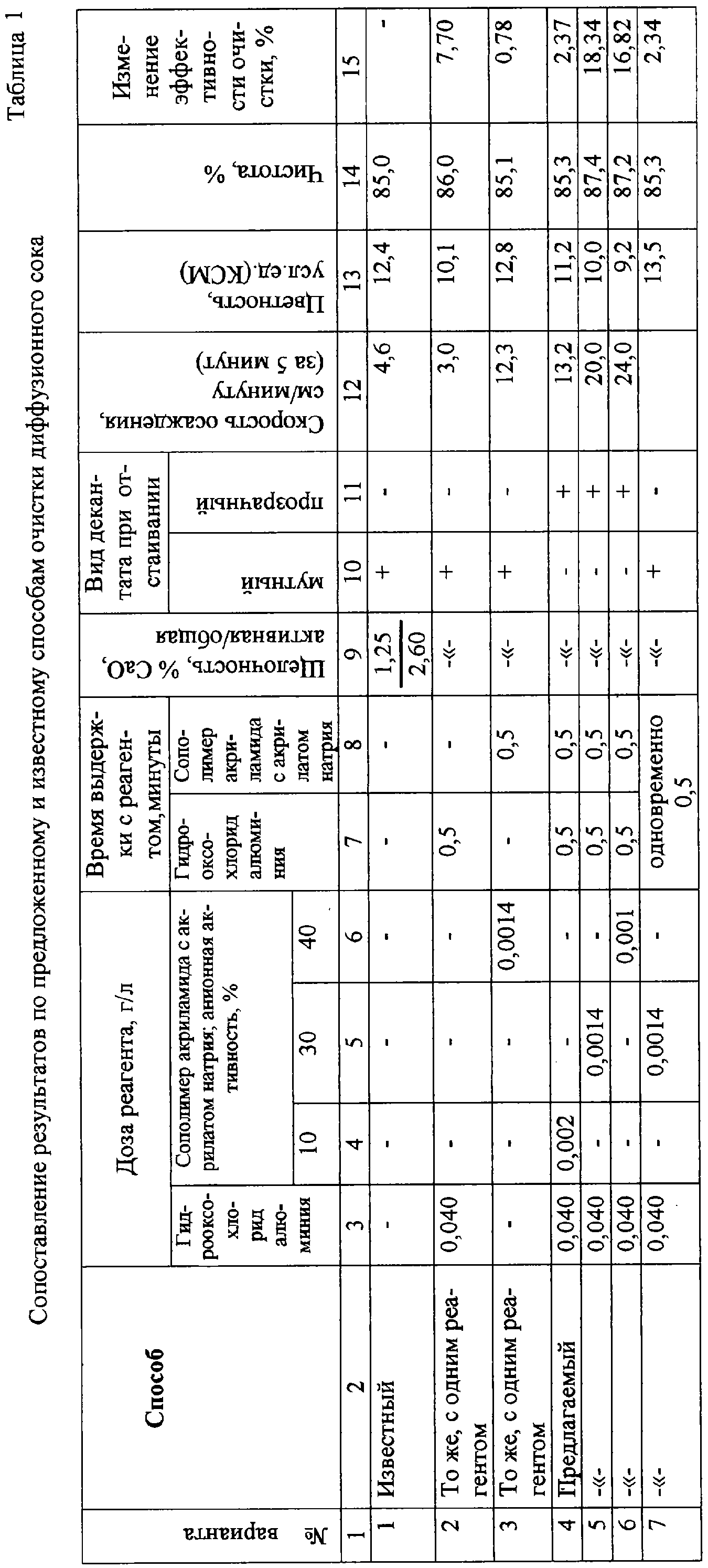
Доза реагентов, последовательность их введения и длительность процесса определялась в лабораторных условиях. В процессе очистки анализируются основные технологические показатели сока и определяют эффект очистки сока в сокоочистительном отделении. Результаты анализов сока по предложенному способу приведены в таблице 1.The dose of reagents, the sequence of their introduction and the duration of the process was determined in laboratory conditions. In the process of cleaning, the basic technological indicators of the juice are analyzed and the effect of juice purification in the juice purification department is determined. The results of the analysis of juice by the proposed method are shown in table 1.
Параллельно проводят очистку диффузионного сока по известному способу (вариант №1): все операции, как описано выше, но выполняют обработку сока известковым молоком по активной щелочности по фенолфталеину 1,25% СаО без обработки реагентами.In parallel, the diffusion juice is cleaned by a known method (option No. 1): all operations are as described above, but the juice is treated with lime milk by the active alkalinity of phenolphthalein 1.25% CaO without treatment with reagents.
Пример 1 (Вариант 1, см. таблицу)Example 1 (Option 1, see table)
Диффузионный сок (СВ=14,0%; Дб=87,2%) нагревают до температуры 50°С и направляют его на преддефекацию, где при перемешивании вводят возврат нефильтрованного сока 1-й сатурации и суспензию 2-й сатурации, поддерживая рН20 на выходе из преддефекатора равным 11,2-11,6.Diffusion juice (CB = 14.0%; DB = 87.2%) is heated to a temperature of 50 ° C and directed to predefection, where, with stirring, the return of unfiltered juice of the 1st saturation and suspension of the 2nd saturation are introduced, maintaining a pH of 20 at the exit of the predefector equal to 11.2-11.6.
Затем выполняют обработку сока известковым молоком по активной щелочности по фенолфталеину 1,20-1,25% СаО, ведут холодную дефекацию до 60°С в течение 20 мин и горячую дефекацию при 87,5°С в течение 10 минут. Дефекованный сок нагревают до 90°С, затем проводят первую сатурацию до достижения рН 11,2-11,6, затем направляют на удаление осадка отстаиванием и фильтрацией. Полученную суспензию направляют на вакуумную фильтрацию, а фильтрованный сок - на вторую сатурацию диоксидом углерода.Then, juice is treated with milk of lime by active alkalinity for phenolphthalein 1.20-1.25% CaO, cold defecation is carried out to 60 ° C for 20 minutes and hot defecation at 87.5 ° C for 10 minutes. The defecated juice is heated to 90 ° C, then the first saturation is carried out until a pH of 11.2-11.6 is reached, then it is directed to sediment removal by settling and filtration. The resulting suspension is sent to vacuum filtration, and the filtered juice to a second carbon dioxide saturation.
При этом достигнутые основные технологические показатели сока после отстаивания составили следующие значения: Дб=89,8-91,0%, ЦВ=17,9 усл.ед.; скорость осаждения осадка = 3,6 см за минуту. Эффект очистки 32,6%.Moreover, the achieved basic technological indicators of juice after settling amounted to the following values: DB = 89.8-91.0%, CV = 17.9 srvc .; sedimentation rate = 3.6 cm per minute. The cleaning effect of 32.6%.
Пример 2 (Вариант 2, см. таблицу)Example 2 (Option 2, see table)
Процесс вели аналогично вышеописанному.The process was conducted similarly to the above.
Активная щелочность на основной дефекации по фенолфталеину 1,0-1,25% СаОActive alkalinity at the main bowel movement for phenolphthalein 1.0-1.25% CaO
Использовали для очистки диффузионного сока только один из предложенных реагентов: гидроксохлорид алюминия в количестве 0,04 г/л сока при непрерывном перемешивании и времени выдержки 0,5 минуты.Only one of the proposed reagents was used for purification of diffusion juice: aluminum hydroxychloride in an amount of 0.04 g / l of juice with continuous stirring and a holding time of 0.5 minutes.
При этом достигнутые основные технологические показатели сока после отстаивания составили следующие значения: Дб=89,8%, ЦВ=23,8 усл.ед.; скорость осаждения осадка = 3,6 см за минуту. Эффект очистки 40,4%.Moreover, the achieved basic technological indicators of juice after settling amounted to the following values: DB = 89.8%, CV = 23.8 srvc .; sedimentation rate = 3.6 cm per minute. The cleaning effect of 40.4%.
Пример 3 (Вариант 3, см. таблицу)Example 3 (Option 3, see table)
Процесс вели аналогично вышеописанному.The process was conducted similarly to the above.
Активная щелочность на основной дефекации по фенолфталеину 1,4% СаОActive alkalinity at the main bowel movement for phenolphthalein 1.4% CaO
В нефильтрованный сатурированный сок вводят только сополимер акриламида с акрилатом натрия в количестве 0,0014 г/л сока, выдерживая при непрерывном перемешивании 0,5 минуты.Only copolymer of acrylamide with sodium acrylate in the amount of 0.0014 g / l of juice is introduced into unfiltered, saturated juice, keeping it under continuous stirring for 0.5 minutes.
При этом достигнутые основные технологические показатели сока после отстаивания составили следующие значения: Дб=89,9%, ЦВ=24,8 усл.ед.; скорость осаждения осадка = 3,4 см за минуту. Эффект очистки 40,4%.At the same time, the achieved basic technological indicators of juice after sedimentation amounted to the following values: DB = 89.9%, CV = 24.8 srvc .; sedimentation rate = 3.4 cm per minute. The cleaning effect of 40.4%.
Пример 4 (Вариант 4, см. таблицу)Example 4 (Option 4, see table)
Диффузионный сок (СВ=14,2%; Дб=86,2%) нагревают до температуры 50°С и направляют его на преддефекацию, где при перемешивании вводят возврат нефильтрованного сока 1-й сатурации и суспензию 2-й сатурации, поддерживая рН20 на выходе из преддефекатора равным 11,2-11,6.Diffusion juice (CB = 14.2%; DB = 86.2%) is heated to a temperature of 50 ° C and sent for predefection, where, with stirring, the return of unfiltered juice of the 1st saturation and suspension of the 2nd saturation are introduced, maintaining a pH of 20 at the exit of the predefector equal to 11.2-11.6.
Затем выполняют обработку сока известковым молоком по активной щелочности по фенолфталеину 0,85% СаО, ведут холодную дефекацию до 60°С в течение 20 мин и горячую дефекацию при 87,5°С в течение 10 минут. Дефекованный сок нагревают до 90°С, затем проводят первую сатурацию до достижения рН 11,2-11,6.Then the juice is treated with lime milk according to the active alkalinity of 0.85% CaO with phenolphthalein, cold bowel movements up to 60 ° C for 20 minutes and hot bowel movements at 87.5 ° C for 10 minutes. The defecated juice is heated to 90 ° C, then the first saturation is carried out until a pH of 11.2-11.6 is reached.
В возврат нефильтрованного сатурированного сока из реагентов сначала вводят гидроксохлорид алюминия в количестве 0,04 г/л сока при непрерывном перемешивании и время выдержки составляет 0,5 минуты. Затем в нефильтрованный сатурированный сок вводят сополимер акриламида с акрилатом натрия в количестве 0,002-0,005 г/л сока, выдерживая при непрерывном перемешивании 0,5 минуты и направляют на удаление осадка отстаиванием и фильтрацией. Полученную суспензию направляют на вакуумную фильтрацию, а фильтрованный сок - на вторую сатурацию диоксидом углерода.In the return of unfiltered saturated juice from the reagents, aluminum hydroxochloride is first introduced in an amount of 0.04 g / l of juice with continuous stirring and the exposure time is 0.5 minutes. Then, a copolymer of acrylamide with sodium acrylate in the amount of 0.002-0.005 g / l of juice is introduced into unfiltered, saturated juice, keeping it under continuous stirring for 0.5 minutes and sent to remove the precipitate by settling and filtering. The resulting suspension is sent to vacuum filtration, and the filtered juice to a second carbon dioxide saturation.
При этом достигнутые основные технологические показатели после отстаивания составили следующие значения: Дб=91,2%; Цв=19,9%; скорость осаждения осадка 4,6 см за минуту. Эффект очистки 34,3%.At the same time, the achieved main technological indicators after settling amounted to the following values: DB = 91.2%; Tsv = 19.9%; sediment deposition rate of 4.6 cm per minute. The cleaning effect of 34.3%.
Пример 5 (Вариант 5, см. таблицу)Example 5 (Option 5, see table)
Диффузионный сок (СВ=14,2%; Дб=86,2%) нагревают до температуры 50°С и направляют его на преддефекацию, где при перемешивании вводят возврат нефильтрованного сока 1-й сатурации и суспензию 2-й сатурации, поддерживая рН20 на выходе из преддефекатора равным 11,2-11,6.Diffusion juice (CB = 14.2%; DB = 86.2%) is heated to a temperature of 50 ° C and sent for predefection, where, with stirring, the return of unfiltered juice of the 1st saturation and suspension of the 2nd saturation are introduced, maintaining a pH of 20 at the exit of the predefector equal to 11.2-11.6.
Затем выполняют обработку сока известковым молоком по активной щелочности по фенолфталеину 1,25% СаО, ведут холодную дефекацию до 60°С в течение 20 мин и горячую дефекацию при 87,5°С в течение 10 минут. Дефекованный сок нагревают до 90°С, затем проводят первую сатурацию до достижения рН 11,2-11,6.Then the juice is treated with lime milk according to the active alkalinity of phenolphthalein 1.25% CaO, cold defecation is carried out to 60 ° C for 20 minutes and hot defecation at 87.5 ° C for 10 minutes. The defecated juice is heated to 90 ° C, then the first saturation is carried out until a pH of 11.2-11.6 is reached.
В возврат нефильтрованного сатурированного сока из реагентов сначала вводят гидроксохлорид алюминия в количестве 0,012 г/л сока при непрерывном перемешивании и время выдержки составляет 0,5 минуты. Затем в нефильтрованный сатурированный сок вводят сополимер акриламида с акрилатом натрия в количестве 0,006 г/л сока, выдерживая при непрерывном перемешивании 0,5 минуты, и направляют на удаление осадка отстаиванием и фильтрацией. Полученную суспензию направляют на вакуумную фильтрацию, а фильтрованный сок - на вторую сатурацию диоксидом углерода.To return unfiltered saturated juice from the reagents, aluminum hydroxochloride is first introduced in an amount of 0.012 g / l of juice with continuous stirring and the exposure time is 0.5 minutes. Then, a copolymer of acrylamide with sodium acrylate in the amount of 0.006 g / l of juice is introduced into unfiltered, saturated juice, keeping for 0.5 minutes with continuous stirring, and sent to sediment removal by sedimentation and filtration. The resulting suspension is sent to vacuum filtration, and the filtered juice to a second carbon dioxide saturation.
При этом достигнутые основные технологические показатели после отстаивания составили следующие значения: Дб=97,0%; Цв=19,1%; скорость осаждения осадка 24 см за минуту. Эффект очистки 80,7%.At the same time, the achieved main technological indicators after settling amounted to the following values: DB = 97.0%; Tsv = 19.1%; sedimentation rate of 24 cm per minute. The cleaning effect of 80.7%.
Пример 6 (Вариант 6, см. таблицу)Example 6 (Option 6, see table)
Диффузионный сок (СВ=10,8%; Дб=86,8%) нагревают до температуры 50°С и направляют его на преддефекацию, где при перемешивании вводят возврат нефильтрованного сока 1-й сатурации и суспензию 2-й сатурации, поддерживая рН20 на выходе из преддефекатора равным 11,2-11,6.Diffusion juice (CB = 10.8%; DB = 86.8%) is heated to a temperature of 50 ° C and sent to pre-defecation, where, with stirring, the return of unfiltered juice of the 1st saturation and suspension of the 2nd saturation is introduced, maintaining a pH of 20 at the exit of the predefector equal to 11.2-11.6.
Затем выполняют обработку сока известковым молоком по активной щелочности по фенолфталеину 1,65% СаО, ведут холодную дефекацию до 60°С в течение 20 мин и горячую дефекацию при 87,5°С в течение 10 минут. Дефекованный сок нагревают до 90°С, затем проводят первую сатурацию до достижения рН 11,2-11,6.Then the juice is treated with milk of lime by active alkalinity for phenolphthalein 1.65% CaO, cold defecation is carried out up to 60 ° C for 20 minutes and hot defecation at 87.5 ° C for 10 minutes. The defecated juice is heated to 90 ° C, then the first saturation is carried out until a pH of 11.2-11.6 is reached.
В возврат нефильтрованного сатурированного сока из реагентов сначала вводят гидроксохлорид алюминия в количестве 0,012 г/л сока при непрерывном перемешивании и время выдержки составляет 0,5 минуты. Затем в нефильтрованный сатурированный сок вводят сополимер акриламида с акрилатом натрия в количестве 0,010 г/л сока, выдерживая при непрерывном перемешивании 0,5 минуты, и направляют на удаление осадка отстаиванием и фильтрацией. Полученную суспензию направляют на вакуумную фильтрацию, а фильтрованный сок - на вторую сатурацию диоксидом углерода.To return unfiltered saturated juice from the reagents, aluminum hydroxochloride is first introduced in an amount of 0.012 g / l of juice with continuous stirring and the exposure time is 0.5 minutes. Then, a copolymer of acrylamide with sodium acrylate in the amount of 0.010 g / l of juice is introduced into unfiltered, saturated juice, keeping for 0.5 minutes with continuous stirring, and sent to sediment removal by sedimentation and filtration. The resulting suspension is sent to vacuum filtration, and the filtered juice to a second carbon dioxide saturation.
При этом достигнутые основные технологические показатели после отстаивания составили следующие значения: Дб=91,8%; Цв=18,2%; скорость осаждения осадка 45 см за минуту. Эффект очистки 41,3%.At the same time, the achieved main technological indicators after settling amounted to the following values: DB = 91.8%; Tsv = 18.2%; sediment deposition rate of 45 cm per minute. The cleaning effect of 41.3%.
Как видно из таблицы, чистота сока после 1 сатурации выше на 2,4%, скорость осаждения увеличилась в 4-5 раз и декантат очищается при этом до содержания взвешенных частиц менее 12 мг/л.As can be seen from the table, the purity of the juice after 1 saturation is 2.4% higher, the deposition rate increased by 4-5 times and the decantate is purified to a suspended particle content of less than 12 mg / L.
Таким образом, по незначительным изменениям основных технологических показателей сока, как видно из таблицы, каждый реагент в отдельности работает значительно менее эффективно, чем в совокупности:Thus, according to minor changes in the main technological indicators of juice, as can be seen from the table, each reagent individually works much less efficiently than in the aggregate:
- чистота сока повышается до 86% при вводе гидроксохлорида алюминия, но скорость осаждения полученной совместным осаждением с известью твердой фазы падает до 3 см/мин- the purity of the juice increases to 86% with the introduction of aluminum hydroxochloride, but the deposition rate obtained by co-precipitation with lime solid phase drops to 3 cm / min
илиor
- скорость осаждения твердой фазы, полученной взаимодействием с известью, увеличивается до 12,3 см/мин, а чистота фильтрованного сока остается на прежнем уровне.- the rate of deposition of the solid phase obtained by interaction with lime increases to 12.3 cm / min, and the purity of the filtered juice remains at the same level.
В сахаросодержащем растворе наиболее эффективно работают сополимеры акриламида с акрилатом натрия с анионной активностью 30-40%. При использовании данного вещества с анионной активностью менее 30% наблюдается незначительное улучшение основных технологических показателей сока (см. таблицу 1, вариант №4, графы 10-15). Применение сополимера акриламида с акрилатом натрия с анионной активностью более 40% сопряжено со значительным увеличением затрат на производство такого продукта, что делает не экономичным его применение в предлагаемом способе.In a sugar-containing solution, copolymers of acrylamide with sodium acrylate with anionic activity of 30-40% work most effectively. When using this substance with anionic activity of less than 30%, a slight improvement in the main technological parameters of juice is observed (see table 1, option No. 4, columns 10-15). The use of a copolymer of acrylamide with sodium acrylate with anionic activity of more than 40% is associated with a significant increase in the cost of producing such a product, which makes its use in the proposed method not economical.
Кроме того, введение реагентов должно быть обязательно последовательным и при этом разрыв во введении реагентов должен быть не менее 0,5 минуты. Достаточно сравнить данные по основным технологическим показателям сока, приведенные в строках с вариантами №5 и №7 таблицы 1. При одновременном введении реагентов чистота сока повышается незначительно от 85 до 85,3% вместо до 87,4%, как при последовательном введении, и скорость отстаивания твердой фазы повышается до 13,1 см в минуту, но менее эффективно, как, например, при последовательном введении, до 20,0 см в минуту. Это явление можно объяснить кинетикой процессов взаимодействия гидроксохлорида алюминия с несахарами при образовании твердой фазы и коагуляции.In addition, the introduction of reagents must be consistent and the gap in the introduction of reagents should be at least 0.5 minutes. It is enough to compare the data on the main technological indicators of the juice given in the lines with options No. 5 and No. 7 of table 1. With the simultaneous introduction of reagents, the purity of the juice increases slightly from 85 to 85.3% instead of up to 87.4%, as with sequential introduction, and the rate of sedimentation of the solid phase increases to 13.1 cm per minute, but less efficiently, as, for example, with sequential administration, up to 20.0 cm per minute. This phenomenon can be explained by the kinetics of the interaction of aluminum hydroxochloride with non-sugars during the formation of a solid phase and coagulation.
Также существует кинетика агрегации осадка при обработке суспензии сока сополимерами акриламида с акрилатом натрия. Изменение среднего размера флокулы во времени при перемешивании сахаросодержащего раствора с сополимером акриламида с акрилатом натрия во времени представлено на чертеже. Практически для всего ряда сополимеров (с анионной активностью 30 и 40%) образование и формирование флокул происходит за 0,3-0,5 минуты, см. кривые на чертеже. Поэтому в способе отмечается время выдержки как время созревания флокулы перед разделением фаз.There is also a kinetics of sediment aggregation when processing a suspension of juice with acrylamide-sodium acrylate copolymers. The change in the average size of the flocs in time with mixing of the sugar-containing solution with a copolymer of acrylamide with sodium acrylate in time is shown in the drawing. For almost the entire range of copolymers (with anionic activity of 30 and 40%), the formation and formation of flocs occurs in 0.3-0.5 minutes, see the curves in the drawing. Therefore, the method notes the exposure time as the ripening time of the flocs before phase separation.
Таким образом, как видно из приведенных данных, введение в сахаросодержащий раствор совокупности вышеназванных осаждающих реагентов в указанной последовательности и количествах повышает чистоту или доброкачественность растворов на 2,4%, дает прозрачный декантат со скоростью осаждения полученной твердой фазы 20,0-24,0 см в минуту, при этом прирост эффективности очистки увеличивается на 16,62-18,34% в зависимости от количества и качества поданных реагентов.Thus, as can be seen from the above data, the introduction of a combination of the above precipitating reagents into the sugar-containing solution in the indicated sequence and amount increases the purity or quality of the solutions by 2.4%, gives a transparent decantate with a deposition rate of the obtained solid phase of 20.0-24.0 cm per minute, while the increase in cleaning efficiency increases by 16.62-18.34%, depending on the quantity and quality of the supplied reagents.
Осадки становятся устойчивыми, улучшаются их седиментационные качества: скорость осаждения осадка после обработки увеличивается в 4-5 раз. При отстаивании унос твердой фазы с осветленным соком составляет не более 15 мг на литр.Precipitation becomes stable, their sedimentation qualities improve: the sedimentation rate of the precipitate after treatment increases by 4-5 times. When settling, the entrainment of the solid phase with clarified juice is not more than 15 mg per liter.
В промышленных условиях предлагаемый способ реализуется следующим образом.In industrial conditions, the proposed method is implemented as follows.
Сахаросодержащий раствор, представляющий собой диффузионный сок, получают путем измельчения корнеплодов свеклы с сахаристостью 14,5-16,9%, экстракции свекловичной стружки в диффузионном аппарате с отводом диффузионного сока.Sugar-containing solution, which is a diffusion juice, is obtained by grinding beet root crops with a sugar content of 14.5-16.9%, extraction of beet chips in a diffusion apparatus with the removal of diffusion juice.
В диффузионный сок, имеющий чистоту 84-87,2%, сначала вводят при непрерывном перемешивании гидроксохлорид алюминия в количестве 0,04-0,06 г/л, затем нагревают до температуры 50°С и направляют его на прогрессивную преддефекацию, где при перемешивании вводят постепенно смесь суспезий с первой и второй сатурации и известковое молоко, поддерживая рН20 на выходе из преддефекатора равным 11,2-11,4.In a diffusion juice, having a purity of 84-87.2%, aluminum hydroxochloride in the amount of 0.04-0.06 g / l is first introduced with continuous stirring, then it is heated to a temperature of 50 ° C and sent to progressive predefection, where with stirring gradually introducing a mixture of suspensions from the first and second saturation and milk of lime, maintaining a pH of 20 at the outlet of the predefector equal to 11.2-11.4.
Затем выполняют обработку сока известковым молоком по активной щелочности по фенолфталеину 0,85-1,65% СаО, ведут холодную дефекацию до 60°С в течение 20 мин и горячую дефекацию при 87°С в течение 10 минут. Дефекованный сок нагревают до 90°С, затем проводят первую сатурацию до достижения рН 11,4-11,6. Гидроксохлорид алюминия в количестве 0,02-0,06 г/л при непрерывном перемешивании дополнительно вводят в возвращаемую часть отсатурированного нефильтрованного сока, направляемую на прогрессивную преддефекацию.Then the juice is treated with milk of lime by active alkalinity for phenolphthalein 0.85-1.65% CaO, cold defecation is carried out to 60 ° C for 20 minutes and hot defecation at 87 ° C for 10 minutes. The defecated juice is heated to 90 ° C, then the first saturation is carried out until a pH of 11.4-11.6 is reached. Aluminum hydroxide chloride in an amount of 0.02-0.06 g / l with continuous stirring is additionally introduced into the returnable part of the filtered unfiltered juice, directed to progressive predefection.
В оставшуюся часть нефильтрованного сатурированного сока вводят сополимер акриламида с акрилатом натрия в количестве 0,003-0,006 г/л, выдерживая при непрерывном перемешивании 10 минут, и направляют на сгущение и фильтрацию. Полученную суспензию направляют на вакуумную фильтрацию, а фильтрованный сок - на вторую сатурацию диоксидом углерода.A copolymer of acrylamide with sodium acrylate in the amount of 0.003-0.006 g / l is introduced into the remaining unfiltered, saturated juice, keeping it under continuous stirring for 10 minutes, and sent for thickening and filtration. The resulting suspension is sent to vacuum filtration, and the filtered juice to a second carbon dioxide saturation.
Фильтрованный сок, обработанный гидроксохлоридом алюминия, вновь нагревают до 97°С, проводят обработку сока известковым молоком до щелочности по фенолфталеину 0,25% СаО, дефекацию в течение 5 минут и сатурируют до достижения рН 9,2-9,4, вводят сополимер акриламида с акрилатом натрия в количестве 0,002-0,004 г/л, с выдержкой отсатурированного сока при непрерывном перемешивании и его фильтрацией. После фильтрации суспензию с осадком возвращают на прогрессивную преддефекацию в зону с равным рН, а фильтрованный сок направляют на получение сиропа.The filtered juice treated with aluminum hydrochloride is again heated to 97 ° C, the juice is treated with lime milk to a phenolphthalein alkalinity of 0.25% CaO, defecated for 5 minutes and saturated until pH 9.2-9.4 is reached, acrylamide copolymer is introduced with sodium acrylate in an amount of 0.002-0.004 g / l, with the aging of the saturated juice with continuous stirring and its filtration. After filtration, the suspension with sediment is returned for progressive predefec tion to an area with an equal pH, and the filtered juice is sent to obtain a syrup.
Параллельно проводят очистку диффузионного сока по известному способу: все операции, как описано выше, но выполняют обработку сока известковым молоком по активной щелочности по фенолфталеину 1,25-1,40% СаО без обработки реагентами.In parallel, the diffusion juice is cleaned by a known method: all operations are as described above, but they perform juice treatment with lime milk according to the active alkalinity of phenolphthalein 1.25-1.40% CaO without treatment with reagents.
Доза реагентов, последовательность их введения и длительность процесса определяется в лабораторных условиях в зависимости от качества перерабатываемой в данный момент свеклы.The dose of reagents, the sequence of their introduction and the duration of the process is determined in laboratory conditions, depending on the quality of the beets currently being processed.
В процессе очистки анализируются основные технологические показатели сока и определяют эффект очистки сока в сокоочистительном отделении.In the process of cleaning, the basic technological indicators of the juice are analyzed and the effect of juice purification in the juice purification department is determined.
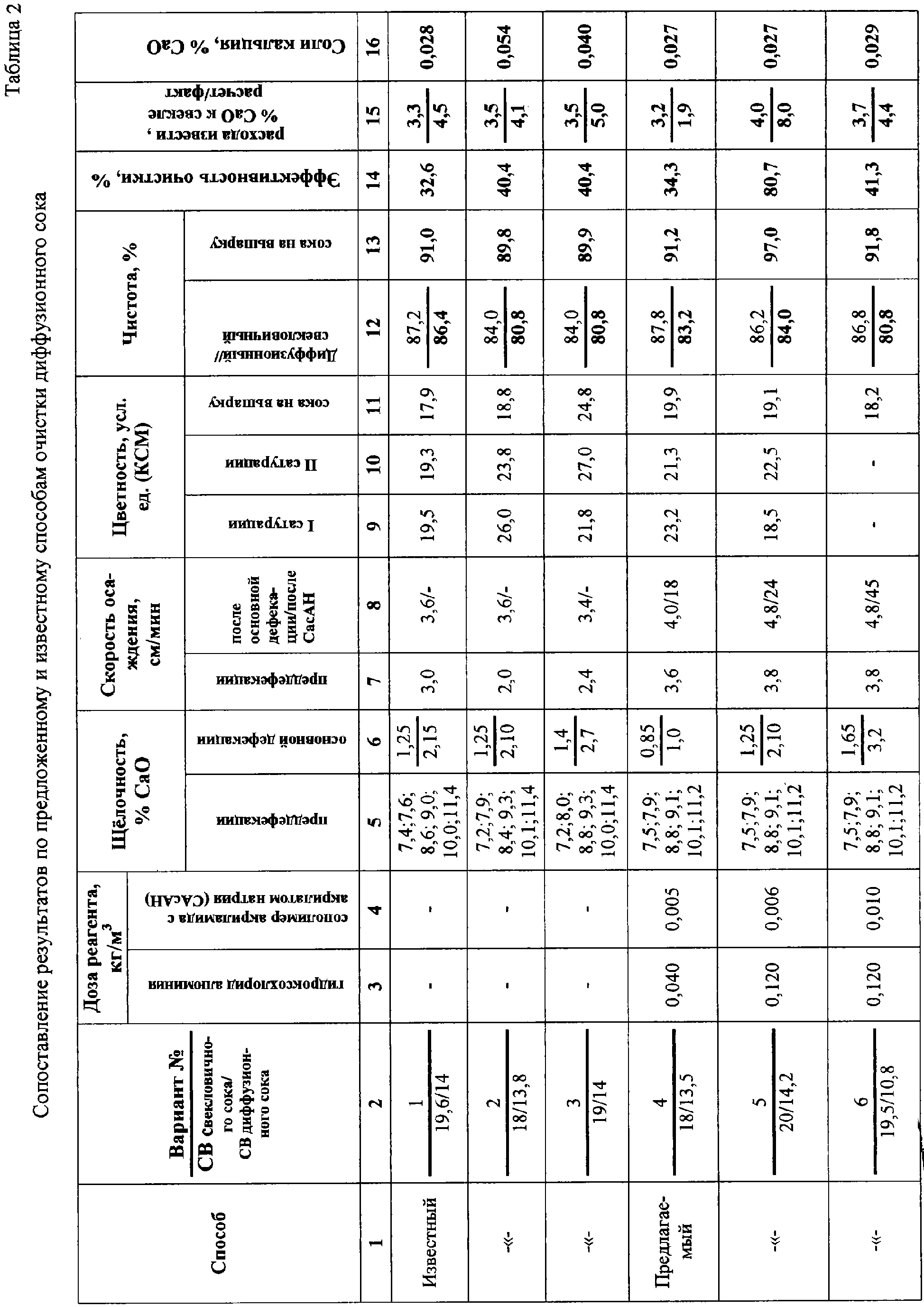
Результаты анализов диффузионного сока и достигнутые основные технологические показатели по известному и предложенному способам приведены в таблице 2.The results of the analysis of diffusion juice and the achieved main technological indicators for the known and proposed methods are shown in table 2.
Введение осаждающих реагентов и известкового молока по активной щелочности по фенолфталеину 0,85% СаО (см. вариант №4, графа 6) позволяет снизить расход извести на основную дефекацию на 40,6%.The introduction of precipitating reagents and milk of lime by active alkalinity for phenolphthalein 0.85% CaO (see option No. 4, column 6) allows to reduce the consumption of lime for basic bowel movements by 40.6%.
При большем снижении расхода извести до значений 0,1-0,4% СаО и расхода реагентов в указанных пределах (в таблице не приведены эти данные) эффективность очистки была достаточной, чтобы осадок сохранил фильтрационные качества и цветность готового сахара-песка сохранялась на уровне не выше 0,8 усл. ед., т.е. отвечала требованиям ГОСТ 21-78.With a greater reduction in lime consumption to 0.1-0.4% CaO and reagent consumption within the indicated limits (these data are not shown in the table), the cleaning efficiency was sufficient to preserve the filtering properties and the color of the finished sugar remained unchanged above 0.8 srvc units, i.e. Meets the requirements of GOST 21-78.
При переработке свеклы длительного хранения и перерасходе извести на 17,2% из-за снижения качества сока по известному способу, см вариант №2 и 42,8%, см. вариант №3, эффективность очистки остается на уровне 40,4%, см. графу 14, при этом увеличилось содержание солей кальция с 0,028% до 0,054 и 0,040%, см графу 16. Чистота сока при этом практически остается на том же уровне.When processing beets of long-term storage and overrun of lime by 17.2% due to a decrease in the quality of juice by a known method, see option No. 2 and 42.8%, see option No. 3, the cleaning efficiency remains at the level of 40.4%, cm column 14, while the content of calcium salts increased from 0.028% to 0.054 and 0.040%, see column 16. The purity of the juice remains almost the same.
По предлагаемому способу с перерасходом извести эффективность очистки повысилась на 11,2%, см. вариант №6, и 48,1%, вариант №5. Чистота сока по предложенному способу повышается на 0,2-6,2%, см. таблицу 2, варианты №4-6, графы 12, 13 и в отдельном случае достигала 97%.According to the proposed method with an excessive consumption of lime, the cleaning efficiency increased by 11.2%, see option No. 6, and 48.1%, option No. 5. The purity of the juice according to the proposed method is increased by 0.2-6.2%, see table 2, options No. 4-6, columns 12, 13 and in a particular case reached 97%.
Под совокупным действием реагентов и растворенной извести часть несахаров устойчиво разлагается с минимальным выходом красящих веществ, в том числе окисление полифенолов происходит без существенного нарастания цветности. Даже при значительном снижении расхода извести на основную дефекацию цветность сока не нарастает и остается на уровне 19,9 усл.ед.Under the combined action of reagents and dissolved lime, some of the non-sugars are stably decomposed with a minimum yield of coloring substances, including the oxidation of polyphenols without a significant increase in color. Even with a significant reduction in the consumption of lime for basic bowel movements, the color of the juice does not increase and remains at the level of 19.9 standard units.
При активной фильтрации со скоростью 10-13 л/м2 мин на фильтрующих саморазгружающихся фильтрах (ФиЛС) фильтрат выходит с проскоком твердой фазы через фильтровальную ткань 5-40 мг/л сока. Количество используемых в работе фильтров сократилось на 30%.With active filtration at a rate of 10-13 l / m 2 min on filtering self-unloading filters (Fils), the filtrate exits with a breakthrough of the solid phase through the filter cloth 5-40 mg / l of juice. The number of filters used in the work was reduced by 30%.
На стадии горячей дефекации при достаточно полном разложении редуцирующих и других несахаров под действием реагентов и извести образуются соли кальция, которые разлагаются после второй сатурации солями карбоната калия, натрия, то есть за счет уменьшения натуральной щелочности сока. Снижение кальциевых солей в полтора раза относительно сравниваемого способа позволяет достичь минимальных значений их концентраций - до 0,02% СаО.At the stage of hot bowel movement with a fairly complete decomposition of reducing and other non-sugars under the influence of reagents and lime, calcium salts are formed, which decompose after the second saturation with salts of potassium carbonate, sodium, that is, by reducing the natural alkalinity of the juice. A decrease in calcium salts by one and a half times relative to the compared method allows to achieve the minimum values of their concentrations - up to 0.02% CaO.
Предложенный способ прошел промышленные испытания на сахарном заводе ОАО «Елань». Результаты испытаний показали высокую эффективность способа и возможность его многоцелевого использования: как снижения расхода извести при ее дефиците в условиях производства, так и повышения извлечения сахарозы из свеклы и увеличения выхода сахара. При этом использование предложенного способа позволило сократить материальные и энергетические ресурсы на очистку диффузионного сока за счет снижения расхода известкового камня и угля на 30%, выведения в горячий резерв одной из трех обжиговых печей и отключения одного из трех компрессоров сатурационного газа, а также увеличить выход сахара с увеличением чистоты диффузионного сока, направленного на выпарку.The proposed method has passed industrial tests at the sugar factory OJSC "Elan". The test results showed the high efficiency of the method and the possibility of its multipurpose use: both to reduce the consumption of lime when it is deficient in the production environment, and to increase the extraction of sucrose from beets and increase the yield of sugar. Moreover, the use of the proposed method allowed to reduce material and energy resources for the purification of diffusion juice by reducing the consumption of limestone and coal by 30%, removing one of the three kilns in the hot reserve and shutting down one of the three saturation gas compressors, and also increasing the sugar yield with an increase in the purity of the diffusion juice aimed at evaporation.
В период испытаний установлены следующие технологические показатели:During the test period, the following technological indicators were established:
1. Прирост эффекта очистки сока на стадии 1-й сатурации составил 10,83%.1. The increase in the effect of juice purification at the stage of the 1st saturation was 10.83%.
2. Увеличение чистоты сульфитированного сока составило 1,51%.2. The increase in the purity of sulfated juice was 1.51%.
3. Снижение потерь сахара в фильтрационном осадке за счет увеличения пористости осадка составило 0,04%.3. The decrease in sugar loss in the filter cake by increasing the porosity of the cake was 0.04%.
4. Количество работающего оборудования уменьшилось на 25-30%.4. The number of operating equipment decreased by 25-30%.
5. Стабилизировался режим работы и температурный режим горения в известково-газовых печах. Температура отходящего сатурационного газа стабильно поддерживалась на уровне 80-120°С.5. The operating mode and temperature regime of combustion in calcareous gas furnaces were stabilized. The temperature of the off-gas saturation gas was stably maintained at a level of 80-120 ° C.
6. Для обеспечения работы станции сокоочистки достаточно было работы двух печей. одна из трех печей стала работать с минимальной загрузкой.6. To ensure the operation of the juice purification station, the work of two furnaces was sufficient. one of the three furnaces began to work with minimal load.
Таким образом, был достигнут технический результат изобретения: повышение эффекта очистки сахаросодержащего раствора при уменьшении расхода извести и при этом стабильность работы производства сахара при ухудшении качества сырья (независимо от качества сырья) без включения дополнительных технологических приемов; снижение материальных, энергетических затрат, снижение себестоимости готового продукта.Thus, the technical result of the invention was achieved: increasing the cleaning effect of the sugar-containing solution while reducing the consumption of lime and at the same time the stability of sugar production when the quality of the raw materials deteriorates (regardless of the quality of the raw materials) without the inclusion of additional technological methods; reduction of material, energy costs, reduction of the cost of the finished product.
Claims (2)
Priority Applications (1)
| Application Number | Priority Date | Filing Date | Title |
|---|---|---|---|
| RU2003105788/13A RU2254373C2 (en) | 2003-02-28 | 2003-02-28 | Method of a diffusion juice clarification |
Applications Claiming Priority (1)
| Application Number | Priority Date | Filing Date | Title |
|---|---|---|---|
| RU2003105788/13A RU2254373C2 (en) | 2003-02-28 | 2003-02-28 | Method of a diffusion juice clarification |
Publications (2)
| Publication Number | Publication Date |
|---|---|
| RU2003105788A RU2003105788A (en) | 2004-11-27 |
| RU2254373C2 true RU2254373C2 (en) | 2005-06-20 |
Family
ID=35836050
Family Applications (1)
| Application Number | Title | Priority Date | Filing Date |
|---|---|---|---|
| RU2003105788/13A RU2254373C2 (en) | 2003-02-28 | 2003-02-28 | Method of a diffusion juice clarification |
Country Status (1)
| Country | Link |
|---|---|
| RU (1) | RU2254373C2 (en) |
Citations (3)
| Publication number | Priority date | Publication date | Assignee | Title |
|---|---|---|---|---|
| US4382823A (en) * | 1981-09-24 | 1983-05-10 | The Coca Cola Company | Process for the purification of sugar syrups |
| SU1240785A1 (en) * | 1984-04-04 | 1986-06-30 | Производственно-Техническое Предприятие "Сахпромэнергоналадка" | Method of purifying diffusion juice |
| WO1996015274A1 (en) * | 1994-11-15 | 1996-05-23 | Cultor Oy | A process for decolorization of solutions |
-
2003
- 2003-02-28 RU RU2003105788/13A patent/RU2254373C2/en not_active IP Right Cessation
Patent Citations (3)
| Publication number | Priority date | Publication date | Assignee | Title |
|---|---|---|---|---|
| US4382823A (en) * | 1981-09-24 | 1983-05-10 | The Coca Cola Company | Process for the purification of sugar syrups |
| SU1240785A1 (en) * | 1984-04-04 | 1986-06-30 | Производственно-Техническое Предприятие "Сахпромэнергоналадка" | Method of purifying diffusion juice |
| WO1996015274A1 (en) * | 1994-11-15 | 1996-05-23 | Cultor Oy | A process for decolorization of solutions |
Similar Documents
| Publication | Publication Date | Title |
|---|---|---|
| US8893612B2 (en) | Process for reducing the lime consumption in sugar beet juice purification | |
| US9163292B2 (en) | Compositions and process for improving carbonatation clarification of sugar liquors and syrups | |
| CN1958811B (en) | Composite type clearing agent in use for refining sugar, and preparation method | |
| CN205170867U (en) | Sugar -cane juice does not have peace and quiet system of sulphur | |
| EP3087034A2 (en) | Novel purification processes | |
| CN1912143A (en) | Clear-muddy separation settling technology of sugar production | |
| US11679371B2 (en) | Method for producing functionally improved carbolime | |
| RU2105817C1 (en) | Method of diffusion sap refining | |
| RU2315008C1 (en) | Method of sedimentation of the argillous slimes from the salting solutions containing the finely dispersed argillous particles | |
| SU1306958A1 (en) | Method of purifying sugar-containing solutions | |
| US20190376154A1 (en) | Filter media for the removal of particles, ions, and biological materials, and decolorization in a sugar purification process, and use thereof | |
| US2679464A (en) | Carbonation process | |
| RU2205070C1 (en) | Method of treating exhausted salt regeneration solutions for sodium-cationite filters | |
| RU2418861C1 (en) | Method of purifying diffusion juice | |
| SU1017735A1 (en) | Method for purifying diffusion juice | |
| SU1534052A1 (en) | Method of purifying diffuse juice | |
| SU1147770A1 (en) | Method of cleaning diffusion juice | |
| RU2195498C2 (en) | Diffusion juice refining process | |
| SU51436A1 (en) | The method of producing acetylene | |
| SU1196372A1 (en) | Method of purifying diffusion joice | |
| RU1816740C (en) | Method of preparing coagulant for purifying transporter washing water of beet sugar production | |
| RU2568490C1 (en) | Method to purify diffusion juice | |
| SU1167199A1 (en) | Method of purifying diffusion juice | |
| RU1838420C (en) | Method of diffusion juice purification | |
| RU2172348C1 (en) | Diffusion juice purification process |
Legal Events
| Date | Code | Title | Description |
|---|---|---|---|
| MM4A | The patent is invalid due to non-payment of fees |
Effective date: 20060301 |