EP4579236A2 - Verfahren zur erhöhung des forcierten exspiratorischen volumens bei asthmatikern mit benralizumab - Google Patents
Verfahren zur erhöhung des forcierten exspiratorischen volumens bei asthmatikern mit benralizumab Download PDFInfo
- Publication number
- EP4579236A2 EP4579236A2 EP25150773.7A EP25150773A EP4579236A2 EP 4579236 A2 EP4579236 A2 EP 4579236A2 EP 25150773 A EP25150773 A EP 25150773A EP 4579236 A2 EP4579236 A2 EP 4579236A2
- Authority
- EP
- European Patent Office
- Prior art keywords
- benralizumab
- patient
- fev
- antigen
- weeks
- Prior art date
- Legal status (The legal status is an assumption and is not a legal conclusion. Google has not performed a legal analysis and makes no representation as to the accuracy of the status listed.)
- Pending
Links
Images



Classifications
-
- A—HUMAN NECESSITIES
- A61—MEDICAL OR VETERINARY SCIENCE; HYGIENE
- A61K—PREPARATIONS FOR MEDICAL, DENTAL OR TOILETRY PURPOSES
- A61K39/00—Medicinal preparations containing antigens or antibodies
- A61K39/395—Antibodies; Immunoglobulins; Immune serum, e.g. antilymphocytic serum
- A61K39/39533—Antibodies; Immunoglobulins; Immune serum, e.g. antilymphocytic serum against materials from animals
- A61K39/39541—Antibodies; Immunoglobulins; Immune serum, e.g. antilymphocytic serum against materials from animals against normal tissues, cells
-
- A—HUMAN NECESSITIES
- A61—MEDICAL OR VETERINARY SCIENCE; HYGIENE
- A61K—PREPARATIONS FOR MEDICAL, DENTAL OR TOILETRY PURPOSES
- A61K39/00—Medicinal preparations containing antigens or antibodies
- A61K39/395—Antibodies; Immunoglobulins; Immune serum, e.g. antilymphocytic serum
-
- A—HUMAN NECESSITIES
- A61—MEDICAL OR VETERINARY SCIENCE; HYGIENE
- A61K—PREPARATIONS FOR MEDICAL, DENTAL OR TOILETRY PURPOSES
- A61K45/00—Medicinal preparations containing active ingredients not provided for in groups A61K31/00 - A61K41/00
- A61K45/06—Mixtures of active ingredients without chemical characterisation, e.g. antiphlogistics and cardiaca
-
- A—HUMAN NECESSITIES
- A61—MEDICAL OR VETERINARY SCIENCE; HYGIENE
- A61P—SPECIFIC THERAPEUTIC ACTIVITY OF CHEMICAL COMPOUNDS OR MEDICINAL PREPARATIONS
- A61P11/00—Drugs for disorders of the respiratory system
- A61P11/06—Antiasthmatics
-
- A—HUMAN NECESSITIES
- A61—MEDICAL OR VETERINARY SCIENCE; HYGIENE
- A61P—SPECIFIC THERAPEUTIC ACTIVITY OF CHEMICAL COMPOUNDS OR MEDICINAL PREPARATIONS
- A61P43/00—Drugs for specific purposes, not provided for in groups A61P1/00-A61P41/00
-
- C—CHEMISTRY; METALLURGY
- C07—ORGANIC CHEMISTRY
- C07K—PEPTIDES
- C07K16/00—Immunoglobulins [IGs], e.g. monoclonal or polyclonal antibodies
- C07K16/18—Immunoglobulins [IGs], e.g. monoclonal or polyclonal antibodies against material from animals or humans
- C07K16/28—Immunoglobulins [IGs], e.g. monoclonal or polyclonal antibodies against material from animals or humans against receptors, cell surface antigens or cell surface determinants
- C07K16/2866—Immunoglobulins [IGs], e.g. monoclonal or polyclonal antibodies against material from animals or humans against receptors, cell surface antigens or cell surface determinants against receptors for cytokines, lymphokines, interferons
-
- A—HUMAN NECESSITIES
- A61—MEDICAL OR VETERINARY SCIENCE; HYGIENE
- A61K—PREPARATIONS FOR MEDICAL, DENTAL OR TOILETRY PURPOSES
- A61K39/00—Medicinal preparations containing antigens or antibodies
- A61K2039/505—Medicinal preparations containing antigens or antibodies comprising antibodies
-
- C—CHEMISTRY; METALLURGY
- C07—ORGANIC CHEMISTRY
- C07K—PEPTIDES
- C07K2317/00—Immunoglobulins specific features
- C07K2317/20—Immunoglobulins specific features characterized by taxonomic origin
- C07K2317/24—Immunoglobulins specific features characterized by taxonomic origin containing regions, domains or residues from different species, e.g. chimeric, humanized or veneered
Definitions
- eosinophils are a major causative cells of asthmatic airway inflammation.
- Peripheral blood (PB) eosinophilia is a risk factor for relapse of acute asthma ( Janson C and Herala M. Resp Med 86(2):101-104 (1992 )).
- PB peripheral blood
- the risk of dying from asthma was 7.4 (confidence interval, 2.8-19.7) times greater than in those without eosinophilia ( Ulrik C and Fredericksen J. Chest 108:10-15 (1995 )).
- Necropsy results have identified 2 distinct pathogenic inflammatory mechanisms of fatal asthma ( Restrepo R and Peters J. Curr Opin Pulm Med 14: 13-23 (2008 )).
- a neutrophilic infiltrate is more prominent in those dying suddenly (approximately within 2 hours on onset of symptoms), while an eosinophilic infiltrate is more common in those dying from more protracted asthma crises.
- Sputum and blood eosinophils can also be increased in patients presenting to the ED with rapid onset of asthma symptoms ( Bellido-Casado J, et al. Arch Bronconeumol 46(11): 587-93 (2010 )).
- Benralizumab (MEDI-563) is a humanized monoclonal antibody (mAb) that binds to the alpha chain of the interleukin-5 receptor alpha (IL-5R ⁇ ), which is expressed on eosinophils and basophils. It induces apoptosis of these cells via antibody-dependent cell cytotoxicity.
- IV intravenous
- benralizumab administered to adults with mild asthma provoked prolonged PB eosinopenia likely due to the effects on eosinophil/basophil bone marrow progenitors that express the target ( Busse W, et al. JACI 125: 1237-1244 e2 (2010 )).
- a single dose of benralizumab significantly reduced the blood eosinophil count in subjects who presented to the emergency department with a severe asthma exacerbation, but did not impact pulmonary function ( WO 2013/066780 ).
- a method of treating asthma comprises administering to an asthma patient an effective amount of benralizumab or an antigen-binding fragment thereof, wherein the patient has a forced expiratory volume in one second (FEV 1 ) of at least 75% predicted value prior to the administration.
- FEV 1 forced expiratory volume in one second
- a method of treating asthma comprises administering at least two doses of benralizumab or an antigen-binding fragment thereof to an asthma patient.
- the administration increases the patient's FEV 1 . In certain aspects, the administration increases the patient's FEV 1 within 4 weeks of the first administration. In certain aspects, the FEViis increased by at least 0.1 L. In certain aspects, the FEV 1 is increased by at least 0.13 L. In certain aspects, the FEV 1 is increased by at least 0.2 L. In certain aspects, the FEV 1 is increased by at least 0.25 L. In certain aspects the FEV 1 is increased by at least 0.50 L.
- the asthma is eosinophilic asthma.
- the patient has a blood eosinophil count of at least 300 cells/ ⁇ l.
- the patient has a forced expiratory volume in one second (FEV 1 ) of at least 75% predicted value prior to the administration.
- the patient has an asthma control questionnaire score of at least 1.5 prior to the administration.
- the patient uses high-dose inhaled corticosteroids (ICS).
- the patient uses long-acting ⁇ 2 agonists (LABA).
- the patient has a history of exacerbations.
- the history of exacerbations comprises at least two exacerbations in the year prior to the administration of benralizumab or an antigen-binding fragment thereof.
- the history of exacerbations comprises no more than six exacerbations in the year prior to the administration of benralizumab or an antigen-binding fragment thereof.
- At least two doses of benralizumab or an antigen-binding fragment thereof are administered to the patient.
- benralizumab or an antigen-binding fragment thereof is administered at about 2 mg to about 100 mg per dose. In certain aspects, benralizumab or an antigen-binding fragment thereof is administered at about 20 mg per dose. In certain aspects, benralizumab or an antigen-binding fragment thereof is administered at about 30 mg per dose. In certain aspects, benralizumab or an antigen-binding fragment thereof is administered at about 100 mg per dose.
- benralizumab or an antigen-binding fragment thereof is administered once every four weeks to once every twelve weeks. In certain aspects, benralizumab or an antigen-binding fragment thereof is administered once every four weeks. In certain aspects, benralizumab or an antigen-binding fragment thereof is administered once every eight weeks. In certain aspects, benralizumab or an antigen-binding fragment thereof is administered once every four weeks for twelve weeks and then once every eight weeks.
- benralizumab or an antigen-binding fragment thereof is administered parenterally. In certain aspects, benralizumab or an antigen-binding fragment thereof is administered subcutaneously.
- benralizumab or an antigen-binding fragment thereof is administered in addition to corticosteroid therapy.
- a method of increasing forced expiratory volume in one second (FEV 1 ) in an asthma patient comprises administering to the patient 20-100 mg of benralizumab or an antigen-binding fragment thereof, wherein the patient has an blood eosinophil count of at least 300 cells/ ⁇ l prior to the administration.
- the method comprises administering 20 mg of benralizumab or an antigen-binding fragment thereof.
- the 20 mg of benralizumab is administered once every four weeks for twelve weeks and then once every eight weeks.
- the method comprises administering 30 mg of benralizumab or an antigen-binding fragment thereof.
- the 30 mg of benralizumab is administered once every four weeks for eight weeks and then once every eight weeks. In certain aspects, the 30 mg of benralizumab is administered once every four weeks. In certain aspects, the method comprises administering 100 mg of benralizumab or an antigen-binding fragment thereof. . In certain aspects, the 100 mg of benralizumab is administered once every four weeks for twelve weeks and then once every eight weeks.
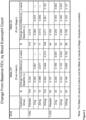
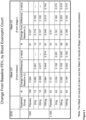
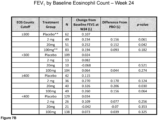
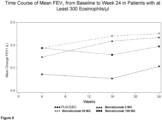
- administering results in the increase in forced expiratory volume in one second (FEV 1 ) as shown in Examples 1-2.
- a or “an” entity refers to one or more of that entity; for example, “an anti-IL-5 ⁇ antibody” is understood to represent one or more anti-IL-5 ⁇ antibodies.
- the terms “a” (or “an”), “one or more,” and “at least one” can be used interchangeably herein.
- the methods provided include administering an effective amount of benralizumab or an antigen-binding fragment thereof.
- Benralizumab and antigen-binding fragments thereof for use in the methods provided herein comprise a heavy chain and a light chain or a heavy chain variable region and a light chain variable region.
- benralizumab or an antigen-binding fragment thereof for use in the methods provided herein includes any one of the amino acid sequences of SEQ ID NOs: 1-4.
- benralizumab or an antigen-binding fragment thereof for use in the methods provided herein comprises a light chain variable region comprising the amino acid sequence of SEQ ID NO: 1 and a heavy chain variable region comprising the amino acid sequence of SEQ ID NO:3.
- benralizumab or an antigen-binding fragment thereof for use in the methods provided herein comprises a light chain comprising the amino acid sequence of SEQ ID NO: 2 and heavy chain comprising the amino acid sequence of SEQ ID NO:4.
- benralizumab or an antigen-binding fragment thereof for use in the methods provided herein comprises a heavy chain variable region and a light chain variable region, wherein the heavy chain variable region comprises the Kabat-defined CDR1, CDR2, and CDR3 sequences of SEQ ID NOs: 7-9, and wherein the light chain variable region comprises the Kabat-defined CDR1, CDR2, and CDR3 sequences of SEQ ID NOs: 10-12.
- the heavy chain variable region comprises the Kabat-defined CDR1, CDR2, and CDR3 sequences of SEQ ID NOs: 7-9
- the light chain variable region comprises the Kabat-defined CDR1, CDR2, and CDR3 sequences of SEQ ID NOs: 10-12.
- a patient presenting at a physician's office or ED with asthma is administered benralizumab or an antigen-binding fragment thereof.
- benralizumab or an antigen-binding fragment thereof can be administered only once or infrequently while still providing benefit to the patient in increasing the forced expiratory volume in one second (FEV 1 ).
- FEV 1 forced expiratory volume in one second
- the patient is administered additional follow-on doses.
- Follow-on doses can be administered at various time intervals depending on the patient's age, weight, ability to comply with physician instructions, clinical assessment, eosinophil count (blood or sputum eosinophils), Eosinophilic Cationic Protein (ECP) measurement, Eosinophil-derived neurotoxin measurement (EDN), Major Basic Protein (MBP) measurement and other factors, including the judgment of the attending physician.
- the intervals between doses can be every four weeks, every five weeks, every 6 weeks, every 8 weeks, every 10 weeks, every 12 weeks, or longer intervals. In certain aspects the intervals between doses can be every 4 weeks, every 8 weeks or every 12 weeks.
- the single dose or first dose is administered to the asthma patient shortly after the patient presents with an acute exacerbation, e.g., a mild, moderate or severe exacerbation.
- an acute exacerbation e.g., a mild, moderate or severe exacerbation.
- the single or first dose of benralizumab or an antigen-binding fragment thereof can be administered during the presenting clinic or hospital visit, or in the case of very severe exacerbations, within 1, 2, 3, 4, 5, 6, 7, or more days, e.g., 7 days of the acute exacerbation, allowing the patient's symptoms to stabilize prior to administration of benralizumab.
- At least two doses of benralizumab or antigen-binding fragment thereof are administered to the patient.
- at least three doses, at least four doses, at least five doses, at least six doses, or at least seven doses are administered to the patient.
- benralizumab or an antigen-binding fragment thereof is administered over the course of four weeks, over the course of eight weeks, over the course of twelve weeks, over the course of twenty-four weeks, or over the course of a year.
- the patient can receive follow on doses of benralizumab or an antigen-binding fragment thereof at periodic intervals, e.g ., every 4 weeks, every 5 weeks, every 6 weeks, every 8 weeks, every 12 weeks, or as scheduled based on patient's age, weight, ability to comply with physician instructions, clinical assessment, eosinophil count (blood or sputum eosinophils), Eosinophilic Cationic Protein (ECP) measurement, Eosinophil-derived neurotoxin measurement (EDN), Major Basic Protein (MBP) measurement and other factors, including the judgment of the attending physician.
- ECP Eosinophilic Cationic Protein
- EDN Eosinophil-derived neurotoxin measurement
- MBP Major Basic Protein
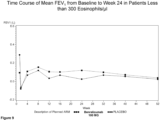
- Use of the methods provided herein can increase FEV 1 by at least 0.05 L, at least 0.1 L, at least 0.13 L, at least 0.15 L, at least 0.20 L, at least 0.21 L, at least 0.22 L, at least 0.23 L, at least 0.24 L, or at least 0.25 L, at least 0.30 L, at least 0.35 L, at least 0.40 L, at least 0.45 L, or at least 0.50 L over the 24-week period.
- use of the methods provided herein i.e., administration of benralizumab or an antigen-binding fragment thereof to an asthma patient, increases the forced expiratory volume in one second (FEV 1 ) of patient over a 52-week period following administration of the benralizumab or antigen-binding fragment thereof.
- the patient is "eosinophilic positive" meaning the patient is one whose asthma is likely to be eosinophilic.
- the asthma patient has a particular blood eosinophil count, e.g., prior to the administration of benralizumab or an antigen-binding fragment thereof.
- Blood eosinophil counts can be measured, for example, using a complete blood count (CBC) with cell differential.
- CBC complete blood count
- the asthma patient has a blood eosinophil count of at least 300 cells/ ⁇ l prior to the administration of benralizumab or an antigen-binding fragment thereof. In certain aspects, the asthma patient has a blood eosinophil count of at least 350 cells/ ⁇ l, at least 400 cells/ ⁇ l, at least 450 cells/ ⁇ l, or at least 500 cells/ ⁇ l prior to the administration of benralizumab or an antigen-binding fragment thereof.
- the asthma patient has a blood eosinophil count of less than 300 cells/ ⁇ l prior to the administration of benralizumab or an antigen-binding fragment thereof. In certain aspects, the asthma patient has a blood eosinophil count of at least 100 cells/ ⁇ l, at least 150 cells/ ⁇ l, at least 180 cells/ ⁇ l,at least 200 cells/ ⁇ l, or at least 250 cells/ ⁇ l prior to the administration of benralizumab or an antigen-binding fragment thereof.
- the asthma patient was prescribed or has been using a medium-dose of inhaled corticosteroids (ICS) use prior to the administration of benralizumab or an antigen-binding fragment thereof.
- ICS inhaled corticosteroids
- a medium-dose of ICS can be a dose of at least 600 ⁇ g to 1,200 ⁇ g budesonide daily or an equivalent dose of another ICS.
- the asthma patient was prescribed or had been using a high-dose of ICS use prior to the administration of benralizumab or an antigen-binding fragment thereof.
- a high-dose of ICS can be a dose of at least 1,200 ⁇ g budesonide daily or an equivalent dose of another ICS.
- a high dose of ICS can also be a dose of greater than 1,200 ⁇ g to 2000 ⁇ g budesonide daily or an equivalent dose of another ICS.
- the asthma patient was prescribed or has been using oral corticosteroids prior to the administration of benralizumab or an antigen-binding fragment thereof.
- administration of benralizumab or an antigen-binding fragment thereof decreases the use of oral corticosteroids in an asthma patient.
- the administration decreases the use of oral corticosteroids in an asthma patient by at least 50%.
- the asthma patient was prescribed or had been using a long-acting beta agonist (LABA) prior to the administration of benralizumab or an antigen-binding fragment thereof.
- LAA long-acting beta agonist
- the asthma patient was prescribed or had been using both ICS and LABA prior to the administration of benralizumab or an antigen-binding fragment thereof.
- the asthma patient has a blood eosinophil count of at least 300 cells/ ⁇ l and high ICS use prior to the administration of benralizumab or an antigen-binding fragment thereof.
- the asthma patient has a forced expiratory volume in 1 second (FEV 1 ) of at least 40% and less than 90% predicted value prior to the administration of benralizumab or an antigen-binding fragment thereof.
- FEV 1 is greater than 70% predicted value prior to the administration of benralizumab or an antigen-binding fragment thereof.
- the FEV 1 is greater than 70% and less than 90% predicted value prior to the administration of benralizumab or an antigen-binding fragment thereof.
- the FEV 1 is at least 75% predicted value prior to the administration of benralizumab or an antigen-binding fragment thereof.
- Subjects must have been stable in the subjects for at least 30 days prior to screening. Subjects must also have had at least 2, but no more than 6, documented asthma exacerbations in the 12 months prior to screening that required the use of a systemic corticosteroid burst. Subjects must also have had a morning pre-bronchodilator forced expiratory volume in 1 second (FEV 1 ) of at least 40% and less than 90% predicted during the screening/run-in period (described below). Subjects must also have fulfilled one of the following criteria:
- ACQ Asthma Control Questionnaire
- Subjects were not able to participate if they had a cigarette exposure of 10 pack-years or more or had been smoking within 12 months prior to screening or had any condition (e.g., any eosinophilic lower respiratory disease other than asthma, chronic obstructive pulmonary disease (COPD), or cystic fibrosis) that, in the opinion of the investigator or medical monitor, would interfere with the evaluation.
- Subjects were also not able to participate if they had received an oral corticosteroid burst or short-acting systemic corticosteroid within 30 days prior to screening or during the screening/run-in period.
Landscapes
- Health & Medical Sciences (AREA)
- Chemical & Material Sciences (AREA)
- Medicinal Chemistry (AREA)
- Life Sciences & Earth Sciences (AREA)
- General Health & Medical Sciences (AREA)
- Organic Chemistry (AREA)
- Immunology (AREA)
- Veterinary Medicine (AREA)
- Pharmacology & Pharmacy (AREA)
- Animal Behavior & Ethology (AREA)
- Public Health (AREA)
- Engineering & Computer Science (AREA)
- Bioinformatics & Cheminformatics (AREA)
- Epidemiology (AREA)
- Pulmonology (AREA)
- Molecular Biology (AREA)
- Proteomics, Peptides & Aminoacids (AREA)
- Genetics & Genomics (AREA)
- Biochemistry (AREA)
- Biophysics (AREA)
- Nuclear Medicine, Radiotherapy & Molecular Imaging (AREA)
- General Chemical & Material Sciences (AREA)
- Chemical Kinetics & Catalysis (AREA)
- Microbiology (AREA)
- Mycology (AREA)
- Biomedical Technology (AREA)
- Medicines Containing Antibodies Or Antigens For Use As Internal Diagnostic Agents (AREA)
- Pharmaceuticals Containing Other Organic And Inorganic Compounds (AREA)
- Peptides Or Proteins (AREA)
- Medicines That Contain Protein Lipid Enzymes And Other Medicines (AREA)
- Medicinal Preparation (AREA)
- Endocrinology (AREA)
Priority Applications (1)
| Application Number | Priority Date | Filing Date | Title |
|---|---|---|---|
| EP25191983.3A EP4636400A3 (de) | 2013-08-12 | 2014-08-07 | Verfahren zur erhöhung des forcierten exspiratorischen volumens bei asthmatikern mit benralizumab |
Applications Claiming Priority (5)
| Application Number | Priority Date | Filing Date | Title |
|---|---|---|---|
| US201361864948P | 2013-08-12 | 2013-08-12 | |
| PCT/US2014/050119 WO2015023507A2 (en) | 2013-08-12 | 2014-08-07 | Methods for increasing forced expiratory volume in asthmatics using benralizumab |
| EP19158446.5A EP3520811B1 (de) | 2013-08-12 | 2014-08-07 | Verfahren zur erhöhung des forcierten exspiratorischen volumens bei asthmatikern mit benralizumab |
| EP20208316.8A EP3875487A1 (de) | 2013-08-12 | 2014-08-07 | Verfahren zur erhöhung des forcierten exspiratorischen volumens bei asthmatikern mit benralizumab |
| EP14836725.3A EP3033104B1 (de) | 2013-08-12 | 2014-08-07 | Verfahren zur erhöhung des forcierten exspiratorischen volumens bei asthmatikern mit benralizumab |
Related Parent Applications (3)
| Application Number | Title | Priority Date | Filing Date |
|---|---|---|---|
| EP19158446.5A Division EP3520811B1 (de) | 2013-08-12 | 2014-08-07 | Verfahren zur erhöhung des forcierten exspiratorischen volumens bei asthmatikern mit benralizumab |
| EP20208316.8A Division EP3875487A1 (de) | 2013-08-12 | 2014-08-07 | Verfahren zur erhöhung des forcierten exspiratorischen volumens bei asthmatikern mit benralizumab |
| EP14836725.3A Division EP3033104B1 (de) | 2013-08-12 | 2014-08-07 | Verfahren zur erhöhung des forcierten exspiratorischen volumens bei asthmatikern mit benralizumab |
Related Child Applications (2)
| Application Number | Title | Priority Date | Filing Date |
|---|---|---|---|
| EP25191983.3A Division EP4636400A3 (de) | 2013-08-12 | 2014-08-07 | Verfahren zur erhöhung des forcierten exspiratorischen volumens bei asthmatikern mit benralizumab |
| EP25191983.3A Division-Into EP4636400A3 (de) | 2013-08-12 | 2014-08-07 | Verfahren zur erhöhung des forcierten exspiratorischen volumens bei asthmatikern mit benralizumab |
Publications (2)
| Publication Number | Publication Date |
|---|---|
| EP4579236A2 true EP4579236A2 (de) | 2025-07-02 |
| EP4579236A3 EP4579236A3 (de) | 2025-09-17 |
Family
ID=52448838
Family Applications (5)
| Application Number | Title | Priority Date | Filing Date |
|---|---|---|---|
| EP25150773.7A Pending EP4579236A3 (de) | 2013-08-12 | 2014-08-07 | Verfahren zur erhöhung des forcierten exspiratorischen volumens bei asthmatikern mit benralizumab |
| EP20208316.8A Withdrawn EP3875487A1 (de) | 2013-08-12 | 2014-08-07 | Verfahren zur erhöhung des forcierten exspiratorischen volumens bei asthmatikern mit benralizumab |
| EP25191983.3A Pending EP4636400A3 (de) | 2013-08-12 | 2014-08-07 | Verfahren zur erhöhung des forcierten exspiratorischen volumens bei asthmatikern mit benralizumab |
| EP19158446.5A Active EP3520811B1 (de) | 2013-08-12 | 2014-08-07 | Verfahren zur erhöhung des forcierten exspiratorischen volumens bei asthmatikern mit benralizumab |
| EP14836725.3A Active EP3033104B1 (de) | 2013-08-12 | 2014-08-07 | Verfahren zur erhöhung des forcierten exspiratorischen volumens bei asthmatikern mit benralizumab |
Family Applications After (4)
| Application Number | Title | Priority Date | Filing Date |
|---|---|---|---|
| EP20208316.8A Withdrawn EP3875487A1 (de) | 2013-08-12 | 2014-08-07 | Verfahren zur erhöhung des forcierten exspiratorischen volumens bei asthmatikern mit benralizumab |
| EP25191983.3A Pending EP4636400A3 (de) | 2013-08-12 | 2014-08-07 | Verfahren zur erhöhung des forcierten exspiratorischen volumens bei asthmatikern mit benralizumab |
| EP19158446.5A Active EP3520811B1 (de) | 2013-08-12 | 2014-08-07 | Verfahren zur erhöhung des forcierten exspiratorischen volumens bei asthmatikern mit benralizumab |
| EP14836725.3A Active EP3033104B1 (de) | 2013-08-12 | 2014-08-07 | Verfahren zur erhöhung des forcierten exspiratorischen volumens bei asthmatikern mit benralizumab |
Country Status (26)
| Country | Link |
|---|---|
| US (1) | US9441046B2 (de) |
| EP (5) | EP4579236A3 (de) |
| JP (4) | JP6746496B2 (de) |
| KR (1) | KR102337599B1 (de) |
| CN (2) | CN111588849A (de) |
| AU (2) | AU2014306959B2 (de) |
| BR (1) | BR112016002317A8 (de) |
| CA (1) | CA2917603C (de) |
| CY (2) | CY1122033T1 (de) |
| DK (2) | DK3033104T3 (de) |
| ES (2) | ES2866426T3 (de) |
| HK (1) | HK1222559A1 (de) |
| HR (2) | HRP20190920T1 (de) |
| HU (2) | HUE053627T2 (de) |
| LT (2) | LT3033104T (de) |
| ME (1) | ME03403B (de) |
| MX (2) | MX381102B (de) |
| PL (2) | PL3520811T3 (de) |
| PT (2) | PT3520811T (de) |
| RS (2) | RS58711B1 (de) |
| RU (1) | RU2703568C2 (de) |
| SG (1) | SG11201600483QA (de) |
| SI (2) | SI3033104T1 (de) |
| SM (2) | SMT202100152T1 (de) |
| TR (1) | TR201907907T4 (de) |
| WO (1) | WO2015023507A2 (de) |
Families Citing this family (7)
| Publication number | Priority date | Publication date | Assignee | Title |
|---|---|---|---|---|
| SG11201600484TA (en) | 2013-08-12 | 2016-02-26 | Medimmune Llc | Methods for improving asthma symptoms using benralizumab |
| CN105451760A (zh) | 2013-08-12 | 2016-03-30 | 米迪缪尼有限公司 | 使用贝那利珠单抗降低哮喘恶化率的方法 |
| EP3485902A1 (de) * | 2013-10-15 | 2019-05-22 | Astrazeneca AB | Verfahren zur behandlung der chronisch obstruktiven lungenerkrankung mit benralizumab |
| CA2926089C (en) * | 2013-10-24 | 2022-08-30 | Medimmune, Llc | Stable, aqueous antibody formulations |
| TW202110479A (zh) * | 2019-05-16 | 2021-03-16 | 瑞典商阿斯特捷利康公司 | 使用貝那利珠單抗治療增強型患者群體慢性阻塞性肺病之方法 |
| TW202126688A (zh) * | 2019-09-27 | 2021-07-16 | 瑞典商阿斯特捷利康公司 | 使用貝那利珠單抗治療遲發性氣喘之方法 |
| TW202214692A (zh) * | 2020-06-05 | 2022-04-16 | 瑞典商阿斯特捷利康公司 | 治療患有鼻瘜肉的患者的重度氣喘之方法 |
Citations (3)
| Publication number | Priority date | Publication date | Assignee | Title |
|---|---|---|---|---|
| US6018032A (en) | 1995-09-11 | 2000-01-25 | Kyowa Hakko Kogyo Co., Ltd. | Antibody against human interleukin-5-receptor α chain |
| US20100291073A1 (en) | 2007-05-14 | 2010-11-18 | Medimmune, Llc | Methods of reducing eosinophil levels |
| WO2013066780A2 (en) | 2011-11-01 | 2013-05-10 | Medimmune, Llc | Methods for reducing the frequency and severity of acute exacerbations of asthma |
Family Cites Families (14)
| Publication number | Priority date | Publication date | Assignee | Title |
|---|---|---|---|---|
| US6746839B1 (en) * | 1998-01-12 | 2004-06-08 | Interleukin Genetics, Inc. | Diagnostics and therapeutics for an obstructive airway disease |
| AU3672800A (en) | 1999-04-09 | 2000-11-14 | Kyowa Hakko Kogyo Co. Ltd. | Method for controlling the activity of immunologically functional molecule |
| WO2001060405A1 (en) | 2000-02-15 | 2001-08-23 | Kyowa Hakko Kogyo Co., Ltd. | Eosinophil-specific apoptosis inducer |
| US6946292B2 (en) | 2000-10-06 | 2005-09-20 | Kyowa Hakko Kogyo Co., Ltd. | Cells producing antibody compositions with increased antibody dependent cytotoxic activity |
| US8093357B2 (en) | 2002-03-01 | 2012-01-10 | Xencor, Inc. | Optimized Fc variants and methods for their generation |
| EP1688437A4 (de) | 2003-10-08 | 2007-09-26 | Kyowa Hakko Kogyo Kk | Spezifisch an den il-5-rezeptor bindende antikörperzusammensetzung |
| US20060014680A1 (en) | 2004-07-13 | 2006-01-19 | Caiding Xu | Peptides and compounds that bind to the IL-5 receptor |
| DK1931709T3 (en) | 2005-10-03 | 2017-03-13 | Xencor Inc | FC VARIETIES WITH OPTIMIZED FC RECEPTOR BINDING PROPERTIES |
| RU2383345C1 (ru) * | 2008-08-07 | 2010-03-10 | Государственное образовательное учреждение высшего профессионального образования "Нижегородская государственная медицинская академия Росздрава" (ГОУ ВПО "НИЖГМА РОСЗДРАВА") | Способ лечения больных бронхиальной астмой |
| WO2012083132A2 (en) * | 2010-12-16 | 2012-06-21 | Genentech, Inc. | Diagnosis and treatments relating to th2 inhibition |
| CN102544908B (zh) | 2010-12-17 | 2016-01-06 | 富士康(昆山)电脑接插件有限公司 | 电连接器组件及插头连接器 |
| EP2710370A4 (de) * | 2011-05-18 | 2015-01-07 | Medimmune Llc | Verfahren zur diagnose und behandlung von lungenerkrankungen oder -leiden |
| CN105451760A (zh) | 2013-08-12 | 2016-03-30 | 米迪缪尼有限公司 | 使用贝那利珠单抗降低哮喘恶化率的方法 |
| SG11201600484TA (en) | 2013-08-12 | 2016-02-26 | Medimmune Llc | Methods for improving asthma symptoms using benralizumab |
-
2014
- 2014-08-07 DK DK14836725.3T patent/DK3033104T3/da active
- 2014-08-07 EP EP25150773.7A patent/EP4579236A3/de active Pending
- 2014-08-07 EP EP20208316.8A patent/EP3875487A1/de not_active Withdrawn
- 2014-08-07 SI SI201431191T patent/SI3033104T1/sl unknown
- 2014-08-07 EP EP25191983.3A patent/EP4636400A3/de active Pending
- 2014-08-07 RS RS20190556A patent/RS58711B1/sr unknown
- 2014-08-07 MX MX2016001384A patent/MX381102B/es unknown
- 2014-08-07 RS RS20210305A patent/RS61565B1/sr unknown
- 2014-08-07 LT LTEP14836725.3T patent/LT3033104T/lt unknown
- 2014-08-07 CA CA2917603A patent/CA2917603C/en active Active
- 2014-08-07 SG SG11201600483QA patent/SG11201600483QA/en unknown
- 2014-08-07 PT PT191584465T patent/PT3520811T/pt unknown
- 2014-08-07 HU HUE19158446A patent/HUE053627T2/hu unknown
- 2014-08-07 SI SI201431795T patent/SI3520811T1/sl unknown
- 2014-08-07 RU RU2016108809A patent/RU2703568C2/ru active
- 2014-08-07 ES ES19158446T patent/ES2866426T3/es active Active
- 2014-08-07 JP JP2016534615A patent/JP6746496B2/ja active Active
- 2014-08-07 PL PL19158446T patent/PL3520811T3/pl unknown
- 2014-08-07 DK DK19158446.5T patent/DK3520811T3/da active
- 2014-08-07 US US14/454,138 patent/US9441046B2/en active Active
- 2014-08-07 PT PT14836725T patent/PT3033104T/pt unknown
- 2014-08-07 LT LTEP19158446.5T patent/LT3520811T/lt unknown
- 2014-08-07 ME MEP-2019-137A patent/ME03403B/de unknown
- 2014-08-07 CN CN202010450690.6A patent/CN111588849A/zh active Pending
- 2014-08-07 HR HRP20190920TT patent/HRP20190920T1/hr unknown
- 2014-08-07 SM SM20210152T patent/SMT202100152T1/it unknown
- 2014-08-07 HK HK16110776.1A patent/HK1222559A1/zh unknown
- 2014-08-07 PL PL14836725T patent/PL3033104T3/pl unknown
- 2014-08-07 SM SM20190311T patent/SMT201900311T1/it unknown
- 2014-08-07 EP EP19158446.5A patent/EP3520811B1/de active Active
- 2014-08-07 HU HUE14836725A patent/HUE043497T2/hu unknown
- 2014-08-07 EP EP14836725.3A patent/EP3033104B1/de active Active
- 2014-08-07 KR KR1020167006576A patent/KR102337599B1/ko active Active
- 2014-08-07 BR BR112016002317A patent/BR112016002317A8/pt not_active Application Discontinuation
- 2014-08-07 ES ES14836725T patent/ES2733602T3/es active Active
- 2014-08-07 CN CN201480045047.8A patent/CN105451769A/zh active Pending
- 2014-08-07 WO PCT/US2014/050119 patent/WO2015023507A2/en not_active Ceased
- 2014-08-07 TR TR2019/07907T patent/TR201907907T4/tr unknown
- 2014-08-07 AU AU2014306959A patent/AU2014306959B2/en active Active
-
2016
- 2016-01-29 MX MX2021003826A patent/MX2021003826A/es unknown
-
2019
- 2019-07-03 CY CY20191100700T patent/CY1122033T1/el unknown
-
2020
- 2020-02-21 AU AU2020201277A patent/AU2020201277A1/en not_active Abandoned
- 2020-04-03 JP JP2020067766A patent/JP2020125304A/ja not_active Withdrawn
-
2021
- 2021-03-10 HR HRP20210406TT patent/HRP20210406T1/hr unknown
- 2021-03-24 CY CY20211100261T patent/CY1124399T1/el unknown
-
2022
- 2022-06-07 JP JP2022092222A patent/JP2022120010A/ja active Pending
-
2024
- 2024-07-05 JP JP2024108997A patent/JP2024129140A/ja active Pending
Patent Citations (3)
| Publication number | Priority date | Publication date | Assignee | Title |
|---|---|---|---|---|
| US6018032A (en) | 1995-09-11 | 2000-01-25 | Kyowa Hakko Kogyo Co., Ltd. | Antibody against human interleukin-5-receptor α chain |
| US20100291073A1 (en) | 2007-05-14 | 2010-11-18 | Medimmune, Llc | Methods of reducing eosinophil levels |
| WO2013066780A2 (en) | 2011-11-01 | 2013-05-10 | Medimmune, Llc | Methods for reducing the frequency and severity of acute exacerbations of asthma |
Non-Patent Citations (15)
| Title |
|---|
| "Am J Respir Crit Care Med.", vol. 161, 2000, AMERICAN THORACIC SOCIETY, pages: 309 - 329 |
| BELLIDO-CASADO J ET AL., ARCH BRONCONEUMOL, vol. 46, no. 11, 2010, pages 587 - 93 |
| BUSSE W ET AL., JACI, vol. 125, 2010, pages 1237 - 1244 |
| GREEN R ET AL., LANCET, vol. 360, 2002, pages 1715 - 21 |
| HALDAR P ET AL., NEIM, vol. 360, 2009, pages 973 - 84 |
| HANKINSON ET AL., AM J RESPIR CRIT CARE MED, vol. 159, 1999, pages 179 - 87 |
| JAMES A., CURR OPIN PULM MED, vol. 11, no. 1, 2005, pages 1 - 6 |
| JANSON CHERALA M., RESP MED, vol. 86, no. 2, 1992, pages 101 - 104 |
| KRISHNAN J ET AL., AJRCCM, vol. 170, 2004, pages 1281 - 85 |
| LEDERLE F ET AL., ARCH INT MED, vol. 147, 1987, pages 2201 - 03 |
| MASOLI M ET AL., ALLERGY, vol. 59, 2004, pages 469 - 78 |
| MILLER ET AL., EUR RESPIR J, vol. 26, 2005, pages 153 - 61 |
| RESTREPO RPETERS J., CURR OPIN PULM MED, vol. 14, 2008, pages 13 - 23 |
| SORKNESS ET AL., J APPL PHYSIOL, vol. 104, 2008, pages 394 - 403 |
| ULRIK CFREDERICKSEN J., CHEST, vol. 108, 1995, pages 10 - 15 |
Also Published As
Similar Documents
| Publication | Publication Date | Title |
|---|---|---|
| US9441037B2 (en) | Methods for reducing exacerbation rates of asthma using benralizumab | |
| AU2020201277A1 (en) | Methods for increasing forced expiratory volume in asthmatics using benralizumab | |
| AU2020202564A1 (en) | Methods for improving asthma symptoms using benralizumab | |
| HK40058739A (en) | Methods for increasing forced expiratory volume in asthmatics using benralizumab | |
| HK40012636B (en) | Methods for increasing forced expiratory volume in asthmatics using benralizumab | |
| HK40012636A (en) | Methods for increasing forced expiratory volume in asthmatics using benralizumab | |
| HK40064505A (en) | Methods for improving asthma symptoms using benralizumab | |
| HK1225300B (en) | Methods for increasing forced expiratory volume in asthmatics using benralizumab | |
| HK40013807B (en) | Methods for improving asthma symptoms using benralizumab | |
| HK40013807A (en) | Methods for improving asthma symptoms using benralizumab | |
| HK1225303B (en) | Methods for improving asthma symptoms using benralizumab |
Legal Events
| Date | Code | Title | Description |
|---|---|---|---|
| PUAI | Public reference made under article 153(3) epc to a published international application that has entered the european phase |
Free format text: ORIGINAL CODE: 0009012 |
|
| STAA | Information on the status of an ep patent application or granted ep patent |
Free format text: STATUS: THE APPLICATION HAS BEEN PUBLISHED |
|
| AC | Divisional application: reference to earlier application |
Ref document number: 3033104 Country of ref document: EP Kind code of ref document: P Ref document number: 3520811 Country of ref document: EP Kind code of ref document: P Ref document number: 3875487 Country of ref document: EP Kind code of ref document: P |
|
| AK | Designated contracting states |
Kind code of ref document: A2 Designated state(s): AL AT BE BG CH CY CZ DE DK EE ES FI FR GB GR HR HU IE IS IT LI LT LU LV MC MK MT NL NO PL PT RO RS SE SI SK SM TR |
|
| REG | Reference to a national code |
Ref country code: DE Ref legal event code: R079 Free format text: PREVIOUS MAIN CLASS: G01N0033480000 Ipc: C07K0016280000 |
|
| PUAL | Search report despatched |
Free format text: ORIGINAL CODE: 0009013 |