EP4552534A1 - Seat pad - Google Patents
Seat pad Download PDFInfo
- Publication number
- EP4552534A1 EP4552534A1 EP23833578.0A EP23833578A EP4552534A1 EP 4552534 A1 EP4552534 A1 EP 4552534A1 EP 23833578 A EP23833578 A EP 23833578A EP 4552534 A1 EP4552534 A1 EP 4552534A1
- Authority
- EP
- European Patent Office
- Prior art keywords
- seat pad
- polyol
- less
- layer
- hardness
- Prior art date
- Legal status (The legal status is an assumption and is not a legal conclusion. Google has not performed a legal analysis and makes no representation as to the accuracy of the status listed.)
- Pending
Links
Images


Classifications
-
- A—HUMAN NECESSITIES
- A47—FURNITURE; DOMESTIC ARTICLES OR APPLIANCES; COFFEE MILLS; SPICE MILLS; SUCTION CLEANERS IN GENERAL
- A47C—CHAIRS; SOFAS; BEDS
- A47C7/00—Parts, details, or accessories of chairs or stools
- A47C7/02—Seat parts
- A47C7/18—Seat parts having foamed material included in cushioning part
-
- C—CHEMISTRY; METALLURGY
- C08—ORGANIC MACROMOLECULAR COMPOUNDS; THEIR PREPARATION OR CHEMICAL WORKING-UP; COMPOSITIONS BASED THEREON
- C08G—MACROMOLECULAR COMPOUNDS OBTAINED OTHERWISE THAN BY REACTIONS ONLY INVOLVING UNSATURATED CARBON-TO-CARBON BONDS
- C08G18/00—Polymeric products of isocyanates or isothiocyanates
- C08G18/06—Polymeric products of isocyanates or isothiocyanates with compounds having active hydrogen
- C08G18/28—Polymeric products of isocyanates or isothiocyanates with compounds having active hydrogen characterised by the compounds used containing active hydrogen
- C08G18/40—High-molecular-weight compounds
- C08G18/48—Polyethers
- C08G18/4804—Two or more polyethers of different physical or chemical nature
- C08G18/4808—Mixtures of two or more polyetherdiols
-
- B—PERFORMING OPERATIONS; TRANSPORTING
- B60—VEHICLES IN GENERAL
- B60N—SEATS SPECIALLY ADAPTED FOR VEHICLES; VEHICLE PASSENGER ACCOMMODATION NOT OTHERWISE PROVIDED FOR
- B60N2/00—Seats specially adapted for vehicles; Arrangement or mounting of seats in vehicles
- B60N2/70—Upholstery springs ; Upholstery
- B60N2/7017—Upholstery springs ; Upholstery characterised by the manufacturing process; manufacturing upholstery or upholstery springs not otherwise provided for
-
- C—CHEMISTRY; METALLURGY
- C08—ORGANIC MACROMOLECULAR COMPOUNDS; THEIR PREPARATION OR CHEMICAL WORKING-UP; COMPOSITIONS BASED THEREON
- C08G—MACROMOLECULAR COMPOUNDS OBTAINED OTHERWISE THAN BY REACTIONS ONLY INVOLVING UNSATURATED CARBON-TO-CARBON BONDS
- C08G18/00—Polymeric products of isocyanates or isothiocyanates
- C08G18/06—Polymeric products of isocyanates or isothiocyanates with compounds having active hydrogen
- C08G18/08—Processes
- C08G18/16—Catalysts
- C08G18/18—Catalysts containing secondary or tertiary amines or salts thereof
- C08G18/1833—Catalysts containing secondary or tertiary amines or salts thereof having ether, acetal, or orthoester groups
-
- C—CHEMISTRY; METALLURGY
- C08—ORGANIC MACROMOLECULAR COMPOUNDS; THEIR PREPARATION OR CHEMICAL WORKING-UP; COMPOSITIONS BASED THEREON
- C08G—MACROMOLECULAR COMPOUNDS OBTAINED OTHERWISE THAN BY REACTIONS ONLY INVOLVING UNSATURATED CARBON-TO-CARBON BONDS
- C08G18/00—Polymeric products of isocyanates or isothiocyanates
- C08G18/06—Polymeric products of isocyanates or isothiocyanates with compounds having active hydrogen
- C08G18/28—Polymeric products of isocyanates or isothiocyanates with compounds having active hydrogen characterised by the compounds used containing active hydrogen
- C08G18/65—Low-molecular-weight compounds having active hydrogen with high-molecular-weight compounds having active hydrogen
- C08G18/66—Compounds of groups C08G18/42, C08G18/48, or C08G18/52
- C08G18/6666—Compounds of group C08G18/48 or C08G18/52
- C08G18/667—Compounds of group C08G18/48 or C08G18/52 with compounds of group C08G18/32 or polyamines of C08G18/38
- C08G18/6674—Compounds of group C08G18/48 or C08G18/52 with compounds of group C08G18/32 or polyamines of C08G18/38 with compounds of group C08G18/3203
- C08G18/6677—Compounds of group C08G18/48 or C08G18/52 with compounds of group C08G18/32 or polyamines of C08G18/38 with compounds of group C08G18/3203 having at least three hydroxy groups
-
- C—CHEMISTRY; METALLURGY
- C08—ORGANIC MACROMOLECULAR COMPOUNDS; THEIR PREPARATION OR CHEMICAL WORKING-UP; COMPOSITIONS BASED THEREON
- C08G—MACROMOLECULAR COMPOUNDS OBTAINED OTHERWISE THAN BY REACTIONS ONLY INVOLVING UNSATURATED CARBON-TO-CARBON BONDS
- C08G18/00—Polymeric products of isocyanates or isothiocyanates
- C08G18/06—Polymeric products of isocyanates or isothiocyanates with compounds having active hydrogen
- C08G18/70—Polymeric products of isocyanates or isothiocyanates with compounds having active hydrogen characterised by the isocyanates or isothiocyanates used
- C08G18/72—Polyisocyanates or polyisothiocyanates
- C08G18/77—Polyisocyanates or polyisothiocyanates having heteroatoms in addition to the isocyanate or isothiocyanate nitrogen and oxygen or sulfur
- C08G18/78—Nitrogen
- C08G18/79—Nitrogen characterised by the polyisocyanates used, these having groups formed by oligomerisation of isocyanates or isothiocyanates
- C08G18/797—Nitrogen characterised by the polyisocyanates used, these having groups formed by oligomerisation of isocyanates or isothiocyanates containing carbodiimide and/or uretone-imine groups
-
- C—CHEMISTRY; METALLURGY
- C08—ORGANIC MACROMOLECULAR COMPOUNDS; THEIR PREPARATION OR CHEMICAL WORKING-UP; COMPOSITIONS BASED THEREON
- C08G—MACROMOLECULAR COMPOUNDS OBTAINED OTHERWISE THAN BY REACTIONS ONLY INVOLVING UNSATURATED CARBON-TO-CARBON BONDS
- C08G71/00—Macromolecular compounds obtained by reactions forming a ureide or urethane link, otherwise, than from isocyanate radicals in the main chain of the macromolecule
- C08G71/04—Polyurethanes
-
- B—PERFORMING OPERATIONS; TRANSPORTING
- B60—VEHICLES IN GENERAL
- B60N—SEATS SPECIALLY ADAPTED FOR VEHICLES; VEHICLE PASSENGER ACCOMMODATION NOT OTHERWISE PROVIDED FOR
- B60N2/00—Seats specially adapted for vehicles; Arrangement or mounting of seats in vehicles
- B60N2/64—Back-rests or cushions
- B60N2/646—Back-rests or cushions shape of the cushion
-
- B—PERFORMING OPERATIONS; TRANSPORTING
- B60—VEHICLES IN GENERAL
- B60N—SEATS SPECIALLY ADAPTED FOR VEHICLES; VEHICLE PASSENGER ACCOMMODATION NOT OTHERWISE PROVIDED FOR
- B60N2/00—Seats specially adapted for vehicles; Arrangement or mounting of seats in vehicles
- B60N2/90—Details or parts not otherwise provided for
-
- C—CHEMISTRY; METALLURGY
- C08—ORGANIC MACROMOLECULAR COMPOUNDS; THEIR PREPARATION OR CHEMICAL WORKING-UP; COMPOSITIONS BASED THEREON
- C08G—MACROMOLECULAR COMPOUNDS OBTAINED OTHERWISE THAN BY REACTIONS ONLY INVOLVING UNSATURATED CARBON-TO-CARBON BONDS
- C08G18/00—Polymeric products of isocyanates or isothiocyanates
- C08G18/06—Polymeric products of isocyanates or isothiocyanates with compounds having active hydrogen
- C08G18/08—Processes
- C08G18/16—Catalysts
- C08G18/18—Catalysts containing secondary or tertiary amines or salts thereof
- C08G18/20—Heterocyclic amines; Salts thereof
- C08G18/2045—Heterocyclic amines; Salts thereof containing condensed heterocyclic rings
- C08G18/2063—Heterocyclic amines; Salts thereof containing condensed heterocyclic rings having two nitrogen atoms in the condensed ring system
-
- C—CHEMISTRY; METALLURGY
- C08—ORGANIC MACROMOLECULAR COMPOUNDS; THEIR PREPARATION OR CHEMICAL WORKING-UP; COMPOSITIONS BASED THEREON
- C08G—MACROMOLECULAR COMPOUNDS OBTAINED OTHERWISE THAN BY REACTIONS ONLY INVOLVING UNSATURATED CARBON-TO-CARBON BONDS
- C08G18/00—Polymeric products of isocyanates or isothiocyanates
- C08G18/06—Polymeric products of isocyanates or isothiocyanates with compounds having active hydrogen
- C08G18/28—Polymeric products of isocyanates or isothiocyanates with compounds having active hydrogen characterised by the compounds used containing active hydrogen
- C08G18/30—Low-molecular-weight compounds
- C08G18/32—Polyhydroxy compounds; Polyamines; Hydroxyamines
- C08G18/3203—Polyhydroxy compounds
- C08G18/3206—Polyhydroxy compounds aliphatic
-
- C—CHEMISTRY; METALLURGY
- C08—ORGANIC MACROMOLECULAR COMPOUNDS; THEIR PREPARATION OR CHEMICAL WORKING-UP; COMPOSITIONS BASED THEREON
- C08G—MACROMOLECULAR COMPOUNDS OBTAINED OTHERWISE THAN BY REACTIONS ONLY INVOLVING UNSATURATED CARBON-TO-CARBON BONDS
- C08G18/00—Polymeric products of isocyanates or isothiocyanates
- C08G18/06—Polymeric products of isocyanates or isothiocyanates with compounds having active hydrogen
- C08G18/28—Polymeric products of isocyanates or isothiocyanates with compounds having active hydrogen characterised by the compounds used containing active hydrogen
- C08G18/40—High-molecular-weight compounds
- C08G18/48—Polyethers
- C08G18/4833—Polyethers containing oxyethylene units
- C08G18/4837—Polyethers containing oxyethylene units and other oxyalkylene units
-
- C—CHEMISTRY; METALLURGY
- C08—ORGANIC MACROMOLECULAR COMPOUNDS; THEIR PREPARATION OR CHEMICAL WORKING-UP; COMPOSITIONS BASED THEREON
- C08G—MACROMOLECULAR COMPOUNDS OBTAINED OTHERWISE THAN BY REACTIONS ONLY INVOLVING UNSATURATED CARBON-TO-CARBON BONDS
- C08G2110/00—Foam properties
- C08G2110/0041—Foam properties having specified density
- C08G2110/0058—≥50 and <150kg/m3
-
- C—CHEMISTRY; METALLURGY
- C08—ORGANIC MACROMOLECULAR COMPOUNDS; THEIR PREPARATION OR CHEMICAL WORKING-UP; COMPOSITIONS BASED THEREON
- C08G—MACROMOLECULAR COMPOUNDS OBTAINED OTHERWISE THAN BY REACTIONS ONLY INVOLVING UNSATURATED CARBON-TO-CARBON BONDS
- C08G2110/00—Foam properties
- C08G2110/0083—Foam properties prepared using water as the sole blowing agent
Definitions
- the present disclosure relates to a seat pad.
- Patent Literature 1 and Patent Literature 2 describe seat cushion materials using polyether polyol (PPG).
- a seat pad mounted on a vehicle such as an automobile, a ship, or an airplane
- improvement of ride comfort performance is required.
- the ride comfort performance include good bending, hardly giving a bottom touch feeling, durability for maintaining the posture of the seated person, and front surface softness for improving the touch of the seat when seated.
- the present disclosure has been made in view of the above circumstances, and an object of the present disclosure is to improve ride comfort performance of a seat pad by improving at least one of good bending, hardly giving a bottom touch feeling, durability, and front surface softness.
- the seat pad of the present disclosure can improve ride comfort performance.
- a seat pad 110 is a seat pad made of polyurethane foam obtained from a composition containing a polyol and an isocyanate.
- the seat pad 110 has a compression deflection coefficient of 2.8 or less as measured in accordance with JIS K6400-2 (2012 version) Method E.
- the seat pad 110 is made of polyurethane foam, and is preferably made of flexible polyurethane foam.
- the polyurethane foam is obtained from a composition containing a polyol and an isocyanate.
- the composition may contain at least one selected from a foaming agent, a catalyst, a foam stabilizer, and a crosslinking agent as an optional component.
- the polyol is not particularly limited.
- the polyol preferably includes a polyol (a) having an EO unit content of 50 mol% or more when the total amount of the alkylene oxide units is 100 mol%.
- a the description in the section "Seat pad 10 (second aspect)” described later is applied as it is, and the description thereof is omitted.
- the description in the section "Seat pad 10 (second aspect)” described later is applied as it is, and the description thereof is omitted.
- the compression deflection coefficient is obtained as a value obtained by taking a force-deflection curve in accordance with JIS K6400-2 (2012 version) Method E, and dividing the force at 65% compression by the force at 25% compression.
- Compression deflection coefficient force at 65% compression/force at 25% compression
- the deflection characteristic in a low load range can be an index of a bottom touch feeling when a person sits down.
- the deflection characteristic in a high load range (for example, 700 N or more and 980 N or less) can be an index of a bottom touch feeling when vibration is applied during driving or the like.
- the inventors of the present application have obtained a new finding that setting the compression deflection coefficient to 2.8 or less in a seat pad makes it possible to make a bottom touch feeling difficult to be felt, mainly in a high load range. That is, the technology of the present disclosure has been developed based on the findings that the seat pad 110 that bends well and hardly gives a bottom touch feeling can be obtained by reducing the compression deflection coefficient.
- the compression deflection coefficient (in accordance with JIS K6400-2 (2012 version) Method E) of the seat pad 110 is 2.8 or less, preferably 2.7 or less, and more preferably 2.5 or less.
- the lower limit value of the compression deflection coefficient of the seat pad 110 is not particularly limited, and may be, for example, 2.0 or more, or 2.2 or more.
- the entire seat pad 110 including skins is used as the test piece.
- the compression deflection coefficient can be measured as follows.
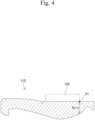
- a pressurizing plate 120 is applied to a portion of the seat pad where the buttocks touch, and a force-deflection curve is obtained in accordance with JIS K6400-2 (2012 version) Method E.
- the load at which it turns from pressurization to decompression during compression of the seat pad was set at 980 N.
- the force at 65% compression and the force at 25% compression are obtained as follows.
- the initial thickness (thickness before compression) of a thickness T min at the thinnest position P1 located under the pressurizing plate 120 and having the smallest thickness is taken as 100%, and the force when the thickness T min at the thinnest position P1 is compressed by 25% of the initial thickness to become 75% of the initial thickness is defined as the force at 25% compression.
- a force when the thickness T min at the thinnest position P1 is compressed by 65% of the initial thickness to become a thickness of 35% is defined as a force at the time of 65% compression.
- the compression deflection coefficient is calculated based on the above mathematical formula.
- the shape of the seat pad is not limited to the shapes in Figs. 3 and 4 .
- the shape of the seat pad may be a rectangular parallelepiped as in Experimental Examples 1 to 10 described later.
- Experimental Examples 1 to 6 and 8 to 10 described later since the test piece has a rectangular parallelepiped shape having a length of 400 mm, a width of 400 mm, and a height of 100 mm including skins, the initial thickness (thickness before compression) of the thickness T min at the thinnest position P1 is 100 mm, the thickness at 25% compression is 75 mm, and the thickness at 65% compression is 35 mm.
- the test piece has a rectangular parallelepiped shape having a length of 400 mm, a width of 400 mm, and a height of 50 mm including skins
- the initial thickness (thickness before compression) of the thickness T min at the thinnest position P1 is 50 mm
- the thickness at 25% compression is 37.5 mm
- the thickness at 65% compression is 17.5 mm.
- the hysteresis loss rate (in accordance with JIS K6400-2 (2012 version) Method E) of the seat pad 110 is preferably 22% or less, preferably 20% or less, and may be 18% or less, or 15% or less from the viewpoint of durability.
- the lower limit of the hysteresis loss rate is not particularly limited, but is usually 5.0% or more.
- test piece used for the measurement and how to obtain the force-deflection curve are the same as in (2.1) Compression deflection coefficient.
- the density of a central portion of the seat pad 110 excluding the front surface and the back surface is not particularly limited. From the viewpoint of weight reduction, the density is preferably 100 kg/m 3 or less, more preferably 80 kg/m 3 or less, and still more preferably 75 kg/m 3 or less.
- the lower limit value of the density is not particularly limited, but is usually 20 kg/m 3 or more. From these viewpoints, the density is preferably 20 kg/m 3 or more and 100 kg/m 3 or less, and can be set in a range in which the lower limit value and the upper limit value are appropriately combined.
- the density of the central portion excluding the front surface and the back surface can be measured as follows.
- a rectangular parallelepiped test piece having a length of 100 mm, a width of 100 mm, and a height of 50 mm excluding the skins is taken from the central portion of the seat pad 110.
- a height direction of the test piece is made to coincide with a front surface-back surface direction of the seat pad 110.
- the mass of the collected test piece is measured, and the mass of the test piece is divided by the volume to calculate the density (kg/m 3 ) of the central portion.
- the 25% hardness of the seat pad 110 (in accordance with JIS K6400-2 (2012 version) Method D) is not particularly limited.
- the 25% hardness of the entire seat pad 110 is preferably 80 N or more and 400 N or less, more preferably 120 N or more and 300 N or less, and still more preferably 160 N or more and 280 N or less.
- the test piece to be measured for hardness is a rectangular parallelepiped having a length of 400 mm a width of 400 mm including the front and back skins.
- a rectangular parallelepiped having a length of 400 mm, a width of 400 mm, and a height of 100 mm including the skins is used as a test piece.
- a rectangular parallelepiped having a length of 400 mm, a width of 400 mm, and a height of 50 mm including the skins is used as a test piece.
- a pressurizing plate having a diameter of 200 mm is used. At the time of measurement, the test piece is placed on a support plate of a tester such that the center of the test piece corresponds to the center of the pressurizing plate.
- the stress relaxation rate of the seat pad 110 is preferably 24% or less, more preferably 20% or less, and still more preferably 15% or less from the viewpoint of durability, and it may be 12% or less, 10% or less, 9.0% or less, or 8.0% or less.
- the lower limit value of the stress relaxation rate is not particularly limited, and may be, for example, 1.0% or more.
- the stress relaxation rate tends to increase as the thickness of the seat pad 110 decreases.
- the technology of the present disclosure is particularly useful in that the stress relaxation rate can be reduced even in the seat pad 110 with a reduced thickness.
- the stress relaxation rate (%) can be measured as follows.
- the entire seat pad 110 including skins is used as the test piece.
- a height direction of the test piece is made to coincide with a front surface-back surface direction of the seat pad 110.
- a circular pressurizing plate 120 with a diameter of 200 mm is used to compress the test piece by a distance of 75% of the initial thickness of the polyurethane foam at a rate of 50 mm/min.
- the pressurizing plate 120 is applied to a portion of the seat pad 110 where the buttocks touch.
- the thickness at the position under the center position of the pressurizing plate 120 is defined as an initial thickness (thickness before compression). Thereafter, the load is removed, and the test piece is left for 1 minute.
- the shape of the seat pad is not limited to the shapes in Figs. 3 and 4 .
- the shape of the seat pad may be a rectangular parallelepiped as in Experimental Examples 1 to 10 described later.
- Experimental Examples 1 to 6 and 8 to 10 described later since a rectangular parallelepiped having a length of 400 mm, a width of 400 mm, and a height of 100 mm including the skins is used as the test piece, the thickness at the position under the center position of the pressure plate 120, i.e., the initial thickness (thickness before compression), is 100 mm.
- the rebound resilience (in accordance with JIS K6400-3 (2011 version)) of the seat pad 110 is preferably 70% or less, more preferably 60% or less, still more preferably 55% or less, and it may be 50% or less, 46% or less, or 44% or less from the viewpoint of improving the ride comfort performance.
- the lower limit value of the rebound resilience of the seat pad 110 is not particularly limited, and it may be, for example, 10% or more, 20% or more, or 30% or more.
- the seat pad 110 of the present embodiment has a small deflection coefficient, the seat pad bends well, and hardly gives a bottom touch feeling.
- the seat pad 110 of the present embodiment can secure ride comfort performance even though a so-called placing slab is not placed, thus contributing to weight reduction, thickness reduction, and cost reduction of the seat pad 110.
- a seat pad 10 is a seat pad made of polyurethane foam obtained from a composition containing a polyol and an isocyanate.
- the polyol includes a polyether polyol having an ethylene oxide unit content of 50 mol% or more when the total amount of the alkylene oxide units is 100 mol%.
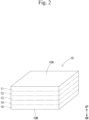
- the seat pad 10 satisfies F1/F3 ⁇ 1.0 when the portion between a front surface 10A and a back surface 10B is divided into five equal parts in the thickness direction, which are defined as a first layer 11, a second layer 12, a third layer 13, a fourth layer 14, and a fifth layer 15 in this order from the front surface 10A side, the Asker F hardness of the third layer 13 measured from the front surface 10A side is defined as F3, and the Asker F hardness of the first layer 11 measured from the front surface 10A side is defined as F1.
- the seat pad 10 is made of polyurethane foam, and is preferably made of flexible polyurethane foam.
- the polyurethane foam is obtained from a composition containing a polyol and an isocyanate.
- the composition may contain at least one selected from a foaming agent, a catalyst, a foam stabilizer, and a crosslinking agent as an optional component. Each component of the composition will be described.
- the polyol includes a polyol (a) having an EO unit content of 50 mol% or more when the total amount of the alkylene oxide units is 100 mol%.
- the EO unit content refers to a content when the total amount of the alkylene oxide units is 100 mol%.
- the polyol (a) is a polyether polyol having an EO unit content of 50 mol% or more.
- the EO unit content is preferably 60 mol% or more, more preferably 70 mol% or more, still more preferably 75 mol% or more, and particularly preferably 80 mol% or more from the viewpoint of reducing the stress relaxation rate and the hysteresis loss rate.
- the upper limit value of the EO unit content is not particularly limited, and it may be 100 mol%. Only one of the polyol (a) may be used, or two or more thereof may be used in combination. For example, a polyol having an EO unit content of 75 mol% and a polyol having an EO unit content of 80 mol% may be used in combination.
- Examples of the alkylene oxide other than the ethylene oxide used for the production of the polyol (a) include propylene oxide and butylene oxide.
- the alkylene oxide other than the ethylene oxide propylene oxide is suitable.
- the polyol (a) a polyol in which all of the units excluding the EO units are propylene oxide units (hereinafter, abbreviated as "PO unit") can be preferably used.
- the number-average molecular weight of the polyol (a) is not particularly limited.
- the number-average molecular weight of the polyol (a) is preferably 20,000 or less, more preferably 15,000 or less, still more preferably 10,000 or less, still more preferably 7,000 or less, and still more preferably 5,000 or less from the viewpoint of achieving low repulsion.
- the lower limit of the number-average molecular weight of the polyol (a) is usually 2,000 or more and may be 1,000 or more.
- the number-average molecular weight of the polyol (a) can be measured by gel permeation chromatography (GPC).
- GPC gel permeation chromatography
- the catalog value may be employed as the number-average molecular weight of the polyol (a).
- the number of functional groups of the polyol (a) is not particularly limited.
- the number of functional groups of the polyol (a) is preferably less than 3, more preferably 2.5 or less, and still more preferably 2 from the viewpoint of reducing the stress relaxation rate and the hysteresis loss rate.
- the number of functional groups in the polyol (a) is usually 2 or more.
- the polyol (a) is preferably a polyoxyethylene/propylene glycol copolymer having an EO unit content of 50 mol% or more.
- the number of functional groups means the average of the number of active hydrogen groups of each component contained in the polyol.
- the catalog value may be employed as the number of functional groups of the polyol (a).
- the content of the polyol (a) is not particularly limited.
- the content of the polyol (a) is more than 0 parts by mass, preferably 20 parts by mass or more, more preferably 40 parts by mass or more, and may be 50 parts by mass or more, 60 parts by mass or more, 70 parts by mass or more, or 80 parts by mass or more when the total amount of the polyol is 100 parts by mass.
- the upper limit value of the content of the polyol (a) is preferably 95 parts by mass or less, more preferably 93 parts by mass or less, and still more preferably 90 parts by mass or less from the viewpoint of moldability. From these viewpoints, the content of the polyol (a) is preferably 20 parts by mass or more and 95 parts by mass or less, and can be set in a range in which the lower limit value and the upper limit value are appropriately combined.
- the polyol may contain an additional polyol other than the polyol (a) (hereinafter, also simply referred to as "additional polyol").
- the additional polyol is not particularly limited as long as it is a polyol having an ethylene oxide unit content of less than 50 mol% (it is not necessary to contain an ethylene oxide unit).
- a polyether polyol having an ethylene oxide unit content of less than 50 mol%, a polymer polyol having an ethylene oxide unit content of less than 50 mol%, a polyester polyol, or the like can be used.
- the additional polyol is preferably a polyether polyol having an ethylene oxide unit content of less than 50 mol% from the viewpoint of various physical properties such as impact absorbability. Only one of the additional polyol may be used, or two or more thereof may be used in combination.
- the number of functional groups of the additional polyol is not particularly limited.
- the number of functional groups of the additional polyol is preferably less than 3, more preferably 2.5 or less, and still more preferably 2.
- the number of functional groups of the additional polyol is usually 2 or more.
- the number of functional groups of the additional polyol is the above value, formation of a network structure can be suppressed when the polyol and the isocyanate react with each other. It is presumed that in the polyurethane foam formed in this manner, entanglement of polyurethane molecules during compression is suppressed, and the stress relaxation rate and the hysteresis loss rate are reduced.
- the number-average molecular weight of the additional polyol is not particularly limited.
- the number-average molecular weight of the polyol is preferably 2,000 or more and 20,000 or less, more preferably 2,500 or more and 15,000 or less, and still more preferably 3,000 or more and 10,000 or less.
- polyether polyols containing PO units, butylene oxide units, and the like as other alkylene oxide units excluding EO units examples of the additional polyol include polyether polyols containing PO units, butylene oxide units, and the like as other alkylene oxide units excluding EO units.
- this polyether polyol is referred to as a polyol (b).
- a polyoxyethylene/propylene glycol copolymer having an EO unit content of less than 50 mol%, polypropylene glycol (PPG), and polytetramethylene glycol (PTMG) are preferable, and a polyoxyethylene/propylene glycol copolymer having an EO unit content of less than 50 mol% is more preferable.
- a polyol other than the polyol (b) may be used as long as characteristics such as rebound resilience, stress relaxation rate, and hysteresis loss rate of the polyurethane foam are not impaired. Only one of the additional polyol other than the polyol (b) may be used, or two or more thereof may be used in combination.
- the EO unit content in the polyol (b) is not particularly limited.
- the EO unit content in the polyol (b) is preferably more than 0 mol%, more preferably 10 mol% or more, and still more preferably 15 mol% or more, from the viewpoint of reducing the stress relaxation rate and the hysteresis loss rate.
- the upper limit of the EO unit content in the polyol (b) is not particularly limited, and may be less than 50 mol%.
- the content of the polyol (b) is not particularly limited.
- the content of the polyol (b) is preferably 5 parts by mass or more, more preferably 8 parts by mass or more, and still more preferably 12 parts by mass or more when the total amount of the polyol is 100 parts by mass, from the viewpoint of improving the cushioning property.
- the content of the polyol (b) is preferably 50 parts by mass or less, more preferably 40 parts by mass or less, and still more preferably 30 parts by mass or less from the viewpoint of sufficiently blending the polyol (a) to secure the softness of the front surface.
- the content of the polyol (b) is preferably 5 parts by mass or more and 50 parts by mass or less, more preferably 8 parts by mass or more and 40 parts by mass or less, and still more preferably 12 parts by mass or more and 30 parts by mass or less.
- the cushioning property of the polyurethane foam can be improved. The reason is not clear, but is presumed as follows.
- the foaming agent is an optional component.
- water alternative fluorocarbon, or a hydrocarbon such as pentane can be used singly or in combination.
- water is particularly preferable.
- carbon dioxide gas is generated during the reaction between the polyol and the isocyanate, and foaming is performed by the carbon dioxide gas.
- the amount of water as the foaming agent is preferably 1.0 parts by mass or more and 4.0 parts by mass or less, more preferably 1.5 parts by mass or more and 3.5 parts by mass or less, and still more preferably 2.0 parts by mass or more and 3.0 parts by mass or less with respect to 100 parts by mass of the polyol.
- the catalyst is an optional component.
- a known catalyst for a polyurethane foam can be used.
- the catalyst include a resinization catalyst and a foaming catalyst.
- the resinization catalyst is a catalyst that promotes the urethanization reaction (resinization reaction) between the polyol and the isocyanate.
- the resinization catalyst is not limited, and examples thereof include amine-based catalysts such as triethylenediamine, 1,2-dimethylimidazole, N ⁇ (N',N'-dimethylaminoethyl)-morpholine, tetramethylguanidine, dimethylaminoethanol, N-methyl-N'-(2hydroxyethyl)-piperazine, N,N,N',N'-tetramethylpropane 1,3-diamine, N,N'-dimethylpiperazine, N,N,N',N'-tetramethylhexane-1,6-diamine, N,N,N',N",N"-pentamethyldipropylene-triamine, N-(2-hydroxyethyl)morpholine, ethylene glycol bis(3-dimethyl)-aminopropyl ether, N,N-dimethylcyclohexylamine, and N-methyl-N'-(2dimethylamino)eth
- the foaming catalyst is a catalyst that promotes the reaction between isocyanate and water to generate carbon dioxide gas.
- the foaming catalyst is not limited, and examples thereof include amine-based catalysts such as bis(2-dimethylaminoethyl)ether, triethylamine, dimethylaminoethoxyethanol, N,N,N'-trimethylaminoethyl-ethanolamine, and N,N,N',N",N"-pentamethyldiethylenetriamine.
- the total amount of the catalyst is preferably 0.2 parts by mass or more and 3.0 parts by mass or less with respect to 100 parts by mass of the polyol.
- the foam stabilizer is an optional component.
- the foam stabilizer may be any one that is usually employed as a urethane foam raw material, and examples thereof include silicone-based compounds and nonionic surfactants.
- the amount of the foam stabilizer is preferably 0.05 parts by mass or more and 2.0 parts by mass or less with respect to 100 parts by mass of the polyol.
- the crosslinking agent is an optional component.
- the crosslinking agent is blended to improve the hardness and tear strength of the polyurethane foam, and is particularly effective for increasing the hardness.
- crosslinking agent examples include polyhydric alcohols such as trimethylolpropane, glycerol, 1,4-butanediol, and diethylene glycol, and amines such as ethanolamines and polyethylene polyamines. Two or more crosslinking agents may be used.
- the total amount of the crosslinking agent is preferably 0.1 parts by mass or more and 6.0 parts by mass or less with respect to 100 parts by mass of the polyol.
- the isocyanate is not particularly limited.
- an MDI-based isocyanate (diphenylmethane diisocyanate-based isocyanate) is preferable.
- the front surface 10A of the polyurethane foam can have a softer touch than when TDI (toluene diisocyanate) is used, for example.
- MDI-based isocyanate examples include: monomeric MDI such as 2,2'-diphenylmethane diisocyanate (2,2'-MDI), 2,4'-diphenylmethane diisocyanate (2,4'-MDI), and 4,4'-diphenylmethane diisocyanate (4,4'-MDI); polymeric MDI which is a mixture of diphenylmethane diisocyanate and polymethylene polyphenylene polyisocyanate; carbodiimide-modified products, urethane-modified products, urea-modified products, allophanate-modified products, biuret-modified products, and isocyanurate-modified products thereof; and MDI prepolymers obtained by reacting these isocyanates with polyols.
- a plurality of types of MDI-based isocyanates may be used in combination.
- the isocyanate preferably contains carbodiimide-modified diphenylmethane diisocyanate, more preferably contains monomeric MDI and carbodiimide-modified diphenylmethane diisocyanate, and further preferably is a mixture of a monomeric MDI, carbodiimide-modified diphenylmethane diisocyanate, and polymeric MDI.
- the total amount of the monomeric MDI and the carbodiimide-modified diphenylmethane diisocyanate is preferably 60 parts by mass or more, more preferably 70 parts by mass or more, and still more preferably 80 parts by mass or more when the total amount of the isocyanate is 100 parts by mass, from the viewpoint of suppressing formation of a network structure when the polyol and the isocyanate react with each other.
- the upper limit value of the total amount of the monomeric MDI and the carbodiimide-modified diphenylmethane diisocyanate is not particularly limited, and may be 100 parts by mass.
- the mass ratio between the total amount of monomeric MDI and carbodiimide-modified diphenylmethane diisocyanate and the amount of polymeric MDI is preferably 60 : 40 to 100 : 0, more preferably 70 : 30 to 98 : 2, and still more preferably 80 : 20 to 96 : 4.
- the isocyanate index is preferably 80 or more, preferably 90 or more, still more preferably 97 or more, particularly preferably 100 or more.
- the isocyanate index is preferably 120 or less, more preferably 110 or less.
- the isocyanate index can be, for example, a range obtained by combining the upper limit value and the lower limit value, and the index can be, for example, 97 or more and 120 or less.
- the isocyanate index is a value obtained by multiplying a value obtained by dividing the number of moles of isocyanate groups in the isocyanate by the total number of moles of active hydrogen groups such as hydroxyl groups of the polyol and water as a foaming agent, by 100, and is calculated by [NCO equivalent of isocyanate/active hydrogen equivalent ⁇ 100].
- Examples of an additive to be appropriately blended in addition include a flame retardant and a colorant.
- the flame retardant is blended to reduce flammability of the polyurethane foam.
- the flame retardant include known liquid flame retardants and solid flame retardants. Examples thereof include: halogenated polymers such as polyvinyl chloride, chloroprene rubber, and chlorinated polyethylene; phosphoric acid esters and halogenated phosphoric acid ester compounds, organic flame retardants such as melamine resins and urea resins; and inorganic flame retardants such as antimony oxide and aluminum hydroxide.
- the flame retardant is not limited to one type, and two or more types may be used in combination.
- the total amount of the flame retardant is preferably 0.1 parts by mass or more and 6.0 parts by mass or less with respect to 100 parts by mass of the polyol.
- the colorant is blended in order to make the polyurethane foam have an appropriate color, and a colorant corresponding to the desired color is used.
- a colorant corresponding to the desired color examples include a pigment and graphite.
- the surface on the side of a seated person in a state where the seated person is seated on the seat pad 10 is referred to as a front surface 10A of the seat pad 10, and the surface opposite to the front surface 10A is referred to as a back surface 10B of the seat pad 10.
- the front surface 10A of the seat pad 10 can be suitably molded, when the seat pad 10 is molded using a molding die, as a surface in contact with a bottom surface of the lower mold, for example.
- the front surface 10A of the seat pad 10 normally faces upward.
- the upper side is indicated by an arrow UP
- the lower side is indicated by an arrow DW.
- the size and shape of the seat pad 10 are not particularly limited as long as it can support the buttocks or the like (for example, buttocks, back, waist) of the seated person.
- the thickness of the portion of the seat pad 10 that supports the buttocks of the seated person is, for example, 20 mm or more, 30 mm or more, preferably 40 mm or more, more preferably 50 mm or more, and still more preferably 60 mm or more.
- the thickness of the portion of the seat pad 10 is usually 120 mm or less, and may be, for example, 100 mm or less, 80 mm or less, 75 mm or less, or 70 mm or less.
- the seat pad 10 satisfies the following Formula (1) when the portion between the front surface 10A and the back surface 10B is divided into five equal parts in the thickness direction, which are defined as a first layer 11, a second layer 12, a third layer 13, a fourth layer 14, and a fifth layer 15 in this order from the front surface 10A side, the Asker F hardness of the third layer 13 measured from the front surface 10A side is defined as F3, and the Asker F hardness of the first layer 11 measured from the front surface 10A side is defined as F1. From the viewpoint of maintaining the posture of the seated person while securing the softness of the front surface, the seat pad 10 preferably satisfies any one of the following Formulas (2) to (4).
- the seat pad 10 may satisfy, for example, any one of the following Formulas (5) to (7). 0.20 ⁇ F 1 / F 3 0.30 ⁇ F 1 / F 3 0.40 ⁇ F 1 / F 3
- the seat pad 10 preferably satisfies 0.20 ⁇ F1/F3 ⁇ 0.85, more preferably satisfies 0.30 ⁇ F1/F3 ⁇ 0.70, and still more preferably satisfies 0.40 ⁇ F1/F3 ⁇ 0.65.
- an Asker hardness meter F type is used, the Asker hardness meter F type is installed on a test piece, and a value after a lapse of 20 seconds is read.
- the test piece for measuring the Asker F hardness has a square plate shape with 400 mm of length and width.
- the thickness of the test piece is a thickness obtained by dividing the seat pad 10 into five equal parts in the thickness direction.
- the Asker F hardness F1 is measured by installing the Asker hardness meter F type at the center of the front surface 10A of the first layer 11.
- the Asker F hardness F3 is measured by installing the Asker hardness meter F type at the center of the surface of the third layer 13 on the front surface 10A side.
- Asker F hardness of the second layer 12 measured from the front surface 10A side is defined as F2
- the Asker F hardness of the fourth layer 14 measured from the front surface 10A side is defined as F4.
- the Asker F hardness F2 is measured by installing the Asker hardness meter F type at the center of the surface of the second layer 12 on the front surface 10A side.
- the Asker F hardness F4 is measured by installing the Asker hardness meter F type at the center of the surface of the fourth layer 14 on the front surface 10A side.
- the Asker F hardness measured from the back surface 10B side is defined as F5.
- the Asker F hardness F5 is measured by installing the Asker hardness meter F type at the center of the back surface 10B of the fifth layer 15.
- the Asker F hardness in each layer of the seat pad 10 is not particularly limited as long as the above requirements are satisfied.
- the Asker F hardness in each layer of the seat pad 10 may further satisfy one or more of the following requirements.
- the seat pad 10 preferably satisfies F1/F2 ⁇ 1.0 from the viewpoint of suitably holding the posture of the seated person while securing the softness of the front surface. With such a configuration, sufficient hardness can be secured in a portion at a distance of 1/5 or more of the thickness of the seat pad 10 from the front surface, and the seat pad 10 in which only the surface layer portion of 20% or less of the total thickness is soft can be suitably realized. Further, the seat pad 10 may satisfy any one of Formulas (8) to (10). 0.30 ⁇ F 1 / F 2 ⁇ 0.85 0.30 ⁇ F 1 / F 2 ⁇ 0.70 0.40 ⁇ F 1 / F 2 ⁇ 0.65
- the seat pad 10 may satisfy any one of the following Formulas (11) to (13) from the viewpoint of securing the hardness of the back surface 10B side of the seat pad 10 while securing the softness of the front surface.
- any one of the Formulas (11) to (13) is satisfied, the posture of the seated person can be suitably maintained without placing a separate polyurethane foam having higher hardness than the front surface 10A side (so-called placing slab) on the back surface 10B side, for example. 0.55 ⁇ F 1 / F 5 ⁇ 0.90 0.60 ⁇ F 1 / F 5 ⁇ 0.85 0.65 ⁇ F 1 / F 5 ⁇ 0.80
- the seat pad 10 is preferably made of polyurethane foam that exhibits the following hardness, when a regular quadrangular prism-shaped sample having a length of 400 mm, a width of 400 mm, and a thickness of 100 mm is prepared and the Asker F hardness of each layer is measured.
- the Asker F hardness F1 is preferably 60 or less, more preferably 50 or less, and still more preferably 40 or less from the viewpoint of the softness of the front surface.
- the Asker F hardness F1 is preferably 12 or more, more preferably 15 or more, and still more preferably 20 or more from the viewpoint of ease of production. From these viewpoints, the Asker F hardness F1 is preferably 12 or more and 60 or less, more preferably 15 or more and 50 or less, and still more preferably 20 or more and 40 or less.
- the Asker F hardness F3 is preferably 18 or more, more preferably 20 or more, and still more preferably 30 or more from the viewpoint of maintaining the posture of the seated person.
- the Asker F hardness F3 is preferably 80 or less, more preferably 75 or less, and still more preferably 70 or less from the viewpoint of ease of production. From these viewpoints, the Asker F hardness F3 is preferably 18 or more and 80 or less, more preferably 20 or more and 75 or less, and still more preferably 30 or more and 70 or less.
- the absolute value of the difference between F1 and F3 is preferably 4 or more, and may be 10 or more, 15 or more, 20 or more, or 25 or more from the viewpoint of the softness of the front surface and maintaining the posture of the seated person.
- the upper limit value of the absolute value of the difference between F1 and F3 is not particularly limited, and may be, for example, 50 or less, 45 or less, or 40 or less.
- the Asker F hardness F2 is preferably 18 or more and 80 or less, more preferably 20 or more and 75 or less, and still more preferably 30 or more and 70 or less from the viewpoint of maintaining the posture of the seated person and ease of production.
- the Asker F hardness F4 is preferably 18 or more and 80 or less, more preferably 20 or more and 75 or less, and still more preferably 30 or more and 70 or less from the viewpoint of securing hardness of the back surface 10B side of the seat pad 10 and ease of production.
- the Asker F hardness F5 is preferably 15 or more and 65 or less, more preferably 18 or more and 60 or less, and still more preferably 25 or more and 55 or less from the viewpoint of securing hardness of the back surface 10B side of the seat pad 10 and ease of production.
- the absolute value of the difference between F2 and F3 (
- the lower limit value of the absolute value of the difference between F2 and F3 is 0.
- the absolute value of the difference between F4 and F3 (
- the lower limit value of the absolute value of the difference between F4 and F3 is 0.
- the Asker F hardness of each layer of the seat pad 10 can be controlled, for example, by adjusting the type of components contained in the composition of the polyurethane foam, the blending proportion of each component, and the like. For example, when the addition amount of the foaming agent is increased, the Asker F hardness F3 of the third layer 13 can be increased while the Asker F hardness F1 of the first layer 11 is maintained. For example, when the addition amount of the crosslinking agent is reduced, the Asker F hardness F3 of the third layer 13 can be increased while the Asker F hardness F1 of the first layer 11 is maintained. When the isocyanate index is increased, F1/F3 tends to be decreased. Further, when the seat pad 10 is a molded foam, the Asker F hardness of each layer can be controlled by appropriately setting the orientation of the molding die with respect to the vertical direction and thereby adjusting the reactivity during molding.
- the hardness of each layer of the seat pad 10 exhibits similar characteristics even when a hardness measurement method such as 25% hardness (in accordance with JIS K6400-2 (2012 version) Method D) is used instead of the hardness measurement method described above.
- the density of the central portion of the seat pad 10 excluding the front surface 10A and the back surface 10B is not particularly limited. From the viewpoint of weight reduction, the density is preferably 100 kg/m 3 or less, more preferably 80 kg/m 3 or less, and still more preferably 75 kg/m 3 or less.
- the lower limit value of the density is not particularly limited, but is usually 20 kg/m 3 or more. From these viewpoints, the density is preferably 20 kg/m 3 or more and 100 kg/m 3 or less, and can be set in a range in which the lower limit value and the upper limit value are appropriately combined.
- the density of the central portion excluding the front surface 10A and the back surface 10B can be measured as follows.
- a rectangular parallelepiped test piece having a length of 100 mm, a width of 100 mm, and a height of 50 mm excluding the skins is taken from the central portion of the seat pad 10.
- a height direction of the test piece is made to coincide with a front surface-back surface direction of the seat pad 10.
- the mass of the collected test piece is measured, and the mass of the test piece is divided by the volume to calculate the density (kg/m 3 ) of the central portion.
- the 25% hardness of the seat pad 10 (in accordance with JIS K6400-2 (2012 version) Method D) is not particularly limited.
- the 25% hardness of the entire seat pad 10 is preferably 80 N or more and 400 N or less, more preferably 120 N or more and 300 N or less, and still more preferably 160 N or more and 280 N or less.
- the test piece to be measured for hardness is a rectangular parallelepiped having a length of 400 mm a width of 400 mm including the front and back skins.
- a rectangular parallelepiped having a length of 400 mm, a width of 400 mm, and a height of 100 mm including the skins is used as a test piece.
- a rectangular parallelepiped having a length of 400 mm, a width of 400 mm, and a height of 50 mm including the skins is used as a test piece.
- a pressurizing plate having a diameter of 200 mm is used. At the time of measurement, the test piece is placed on a support plate of a tester such that the center of the test piece corresponds to the center of the pressurizing plate.
- the hysteresis loss rate (in accordance with JIS K6400-2 (2012 version) Method E) of the seat pad 10 is preferably 22% or less, preferably 20% or less, and may be 18% or less or 15% or less from the viewpoint of durability.
- the lower limit of the hysteresis loss rate is not particularly limited, but is usually 5.0% or more.
- the test piece used for the measurement is obtained as follows.
- the entire seat pad 10 including the skins is used as the test piece.
- a rectangular parallelepiped having a length of 400 mm, a width of 400 mm, and a height of 100 mm including the skins is used as a test piece.
- a rectangular parallelepiped having a length of 400 mm, a width of 400 mm, and a height of 50 mm including the skins is used as a test piece.
- a height direction of the test piece is made to coincide with a front surface-back surface direction of the seat pad 10.
- the compression deflection coefficient (in accordance with JIS K6400-2 (2012 version) Method E) of the seat pad 10 is preferably 2.9 or less, and may be 2.7 or less or 2.5 or less from the viewpoint of reducing a bottom touch feeling.
- the lower limit value of the compression deflection coefficient of the seat pad 10 is not particularly limited, and may be, for example, 2.0 or more, or 2.2 or more.
- test piece and the method for acquiring the force-deflection curve used in the measurement is the same as the test piece and the method for acquiring the force-deflection curve in (2.4) Measurement of hysteresis loss rate.
- the stress relaxation rate of the seat pad 10 is preferably 24% or less, more preferably 20% or less, and still more preferably 15% or less from the viewpoint of durability, and it may be 12% or less, 10% or less, 9.0% or less, or 8.0% or less.
- the lower limit value of the stress relaxation rate is not particularly limited, and may be, for example, 1.0% or more.
- the stress relaxation rate tends to increase as the thickness of the seat pad 10 decreases.
- the technology of the present disclosure is particularly useful in that the stress relaxation rate can be reduced even in the seat pad 10 with a reduced thickness.
- the stress relaxation rate (%) can be measured as follows.
- the entire seat pad 10 including the skins is used as the test piece.
- a rectangular parallelepiped having a length of 400 mm, a width of 400 mm, and a height of 100 mm including the skins is used as a test piece.
- a rectangular parallelepiped having a length of 400 mm, a width of 400 mm, and a height of 50 mm including the skins is used as a test piece.
- a height direction of the test piece is made to coincide with a front surface-back surface direction of the seat pad 10.
- the rebound resilience (in accordance with JIS K6400-3 (2011 version)) of the seat pad 10 is preferably 70% or less, more preferably 60% or less, still more preferably 55% or less, and it may be 50% or less, 46% or less, or 44% or less from the viewpoint of improving the ride comfort performance.
- the lower limit value of the rebound resilience of the seat pad 10 is not particularly limited, and it may be, for example, 10% or more, 20% or more, or 30% or more.
- the seat pad 10 can be produced by a known foaming method in which a composition is stirred and mixed to react a polyol with an isocyanate.
- the foaming method includes slab foaming and mold foaming, and any molding method may be used.
- the seat pad 10 is preferably a molded foam.
- Mold foaming is a method in which a mixed composition is filled in a mold and foamed in the mold.
- the front surface 10A is preferably a surface in contact with the lower surface of the molding space
- the back surface 10B is preferably the surface in contact with the upper surface of the molding space.
- ride comfort performance In recent years, with reduction in thickness and weight of the seat pad 10 of an automobile, a ship, an aircraft, or the like, securing of ride comfort performance has been a problem.
- ride comfort performance include softness of the front surface that improves the touch of the seat at the time of seating, durability for maintaining the posture of the seated person, and the like.
- the seat pad 10 of the present embodiment is excellent in front surface softness, a favorable touch can be realized.
- the seat pad 10 of the present embodiment can secure the hardness of the central portion in the thickness direction, durability for maintaining the posture of the seated person is excellent.
- the seat pad 10 of the present embodiment can secure ride comfort performance even though a so-called placing slab is not placed, thus contributing to weight reduction, thickness reduction, and cost reduction of the seat pad 10.
- the present embodiment it is possible to reduce the hysteresis loss rate and the stress relaxation rate, and to realize the seat pad 10 that is hardly flattened and has high durability (see Fig. 1 ).
- compositions blended in the proportions shown in Table 1 were prepared, and samples for respective Experimental Examples were prepared by mold foaming.
- the samples for Experimental Examples 1 to 6 and 8 to 10 had a regular square pillar shape with a length of 400 mm, a width of 400 mm, and a thickness of 100 mm.
- the sample of Experimental Example 7 had a regular quadrangular prism shape with a length of 400 mm, a width of 400 mm, and a thickness of 50 mm.
- test piece was cut out from the polyurethane foam produced using the above raw materials, and the hysteresis loss rate, the stress relaxation rate, the rebound resilience, and the like were measured by the following methods. The results are shown in Tables 1 and 2. In Experimental Example 2, since demolding was not possible, physical properties were not evaluated.
- the density (kg/m 3 ) was measured by the method described in the embodiment.
- the 25% hardness (N) was measured by the method described in the embodiment. That is, the 25% hardness was measured by the method described in the embodiment. That is, in Experimental Examples 1 to 6 and 8 to 10, a rectangular parallelepiped having a length of 400 mm, a width of 400 mm, and a height of 100 mm including the skins was used as the test piece. In Experimental Example 7, a rectangular parallelepiped having a length of 400 mm, a width of 400 mm, and a height of 50 mm including the skins was used as the test piece.
- the hysteresis loss rate (%) was measured in accordance with JIS K6400-2 Method E. The smaller the numerical value, the better the posture maintaining property (durability) at the time of seating.
- the compression deflection coefficient (%) was measured in accordance with JIS K6400-2 Method E. The smaller the numerical value, the better the vibration absorbability.
- the stress relaxation rate (%) was measured by the method described in the embodiment. The smaller the numerical value, the better the posture maintaining property (durability) at the time of seating.
- the rebound resilience (%) was measured in accordance with JIS K6400-3 (2011 version). Appropriately suppressing the rebound resilience can improve ride comfort performance.
- the Asker F hardness was measured by the method described in the embodiment, and the ratio of the Asker F hardness of the first layer to the Asker F hardness of each layer was calculated. The results are also shown in Tables 1 and 2.
- the Asker F hardness of each layer from the first layer to the fifth layer was measured by the method described in the embodiment.
- the ratio of the Asker F hardness of the first layer to the Asker F hardness of each layer was calculated by dividing the Asker F hardness of the first layer by the Asker F hardness of each layer.
- Tables 1 and 2 for example, the ratio of the Asker F hardness of the first layer to the Asker F hardness of the third layer is shown in "First layer/third layer".
- Experimental Example 1 does not satisfy Requirement (b) or (c).
- Experimental Example 2 does not satisfy Requirement (a).
- Experimental Examples 3 to 10 satisfying Requirements (a) to (c) had good front surface softness and durability as compared with Comparative Example 1.
- Experimental Examples 3 to 10 satisfying Requirements (a) to (c) showed the characteristics of the first layer (F1) ⁇ the fifth layer (F5) ⁇ the third layer (F3).
- Experimental Examples 4 to 10 further satisfies the following Requirement (d).
- the softness of the front surface was still more favorable.
- Experimental Examples 3 to 10 further satisfy the following Requirement (e).
- a polyurethane foam having good front surface softness and durability was suitably obtained.
- Experimental Examples 3 to 10 further satisfy the following Requirement (f). Experimental Examples 3 to 10 further satisfying Requirement (f) had good vibration absorbency.
- Experimental Examples 4 to 10 further satisfy the following Requirement (g).
- Experimental Examples 4 to 10 further satisfying Requirement (g) had excellent ride comfort performance.
- Experimental Examples 3 to 8 and 10 further satisfy the following Requirement (h).
- Experimental Examples 4 to 7 and 10 further satisfy the following Requirement (i).
- Experimental Example 5 is compared with Experimental Example 4 in which the addition amount of the foaming agent is smaller than that in Experimental Example 5.
- the Asker F hardness of the first layer was substantially equal.
- the first layer/the third layer (F1/F3) was smaller than that in Experimental Example 4. From this result, it was suggested that the softness and durability of the front surface can be improved by increasing the addition amount of the foaming agent.
- the technology of the present disclosure is effective even in the case of reducing the density of the seat pad.
- Experimental Example 5 is compared with Experimental Example 6 in which the addition amount of the crosslinking agent is larger than that in Experimental Example 5.
- the Asker F hardness of the first layer was substantially equal.
- the first layer/the third layer (F1/F3) was smaller than that in Experimental Example 6. From this result, it was suggested that the softness and durability of the front surface can be improved by reducing the amount of the additive.
- Experimental Example 5 with a thickness of 100 mm and Experimental Example 7 with a thickness of 50 mm are compared.
- the Asker F hardness of each layer of Experimental Example 7 was smaller than the Asker F hardness of the layer at the same position of Experimental Example 5,
- Experimental Example 7 also showed characteristics of first layer (F1) ⁇ fifth layer (F5) ⁇ third layer (F3) as in Experimental Example 5. From this result, it was suggested that that the technology of the present disclosure is also effective for a thin seat pad.
- Experimental Example 4 is compared with Experimental Example 8 having a density lower than that of Experimental Example 4.
- the Asker F hardness of each layer of Experimental Example 8 was slightly smaller than the Asker F hardness of the layer at the same position of Experimental Example 4, Experimental Example 8 also showed characteristics of first layer (F1) ⁇ fifth layer (F5) ⁇ third layer (F3) as in Experimental Example 4. From this result, it was suggested that the technology of the present disclosure is also effective for a low density seat pad.
- Experimental Example 5 with the isocyanate index 105 Experimental Example 3 with the isocyanate index 85, and Experimental Example 10 with the isocyanate index 95 are compared.
- the first layer/the third layer (F1/F3) was 0.750.
- the first layer/the third layer (F1/F3) was 0.651.
- the first layer/the third layer (F1/F3) was 0.493. From this result, it was suggested that as the isocyanate index was larger, the softness of the front surface was able to be improved.
- Experimental Example 5 and Experimental Example 9 in which the blending proportion of the polyol is different from each other are compared.
- the Asker F hardness of each layer of Experimental Example 9 was larger than the Asker F hardness of the layer at the same position of Experimental Example 5, Experimental Example 9 also showed characteristics of first layer (F1) ⁇ fifth layer (F5) ⁇ third layer (F3) as in Experimental Example 5.
- the stress relaxation rate of 7.7% in Experimental Example 5 was smaller than the stress relaxation rate of 18.4% in Experimental Example 9. From this result, it was suggested that the higher the content of the polyol (a), the more the durability can be improved.
- Experimental Example 1 does not satisfy Requirement (f).
- Experimental Examples 3 to 10 satisfying Requirements (a) and (f) bending was better, and a bottom touch feeling was less likely to be felt than that in Comparative Example 1.
- Experimental Examples 4 to 10 further satisfy the following Requirement (g).
- Experimental Examples 4 to 10 further satisfying Requirement (g) had excellent ride comfort performance.
- Experimental Examples 3 to 8 and 10 further satisfy the following Requirement (h).
- Experimental Examples 4 to 7 and 10 further satisfy the following Requirement (i).
- Experimental Example 5 with the isocyanate index 105 Experimental Example 3 with the isocyanate index 85, and Experimental Example 10 with the isocyanate index 95 are compared.
- the compression deflection coefficient was smaller than that in Experimental Example 5, and the deflection amount in a high load region (700 N or more and 980 N or less) was large.
- Experimental Example 5 satisfying Requirements (a) and (f) is compared with Experimental Example 1 satisfying Requirement (a) and not satisfying Requirement (f).
- the 25% hardness was larger than that in Experimental Example 1 by about 50 N, but the compression deflection coefficient was smaller than that in Experimental Example 1, and the deflection amount in a high load region (700 N or more and 980 N or less) was large.
- Experimental Example 4 with 85 parts by mass of the polyol (a)
- Experimental Example 8 with 80 parts by mass of the polyol (a)
- Experimental Example 9 with 60 parts by mass of the polyol (a) are compared to each other. It was found that when the amount of the polyol (a) decreases, the compression deflection coefficient increases, and the deflection amount in a high load region (700 N or more and 980 N or less) decreases.
Landscapes
- Chemical & Material Sciences (AREA)
- Health & Medical Sciences (AREA)
- Chemical Kinetics & Catalysis (AREA)
- Medicinal Chemistry (AREA)
- Polymers & Plastics (AREA)
- Organic Chemistry (AREA)
- Engineering & Computer Science (AREA)
- Manufacturing & Machinery (AREA)
- Aviation & Aerospace Engineering (AREA)
- Transportation (AREA)
- Mechanical Engineering (AREA)
- Polyurethanes Or Polyureas (AREA)
- Mattresses And Other Support Structures For Chairs And Beds (AREA)
- Seats For Vehicles (AREA)
Applications Claiming Priority (3)
| Application Number | Priority Date | Filing Date | Title |
|---|---|---|---|
| JP2022108852 | 2022-07-06 | ||
| JP2022179573 | 2022-11-09 | ||
| PCT/JP2023/018699 WO2024009627A1 (ja) | 2022-07-06 | 2023-05-19 | シートパッド |
Publications (1)
| Publication Number | Publication Date |
|---|---|
| EP4552534A1 true EP4552534A1 (en) | 2025-05-14 |
Family
ID=89453006
Family Applications (1)
| Application Number | Title | Priority Date | Filing Date |
|---|---|---|---|
| EP23833578.0A Pending EP4552534A1 (en) | 2022-07-06 | 2023-05-19 | Seat pad |
Country Status (5)
| Country | Link |
|---|---|
| US (1) | US20250359679A1 (https=) |
| EP (1) | EP4552534A1 (https=) |
| JP (2) | JP7720475B2 (https=) |
| CN (1) | CN119325351A (https=) |
| WO (1) | WO2024009627A1 (https=) |
Families Citing this family (1)
| Publication number | Priority date | Publication date | Assignee | Title |
|---|---|---|---|---|
| CN121203114B (zh) * | 2025-11-25 | 2026-03-20 | 河星新材料科技(广东)有限公司 | 用于飞机坐垫的海绵及其制备方法 |
Family Cites Families (8)
| Publication number | Priority date | Publication date | Assignee | Title |
|---|---|---|---|---|
| JP2000070565A (ja) * | 1998-08-31 | 2000-03-07 | Toyo Tire & Rubber Co Ltd | シート用パッドの製造方法 |
| CN102574976B (zh) | 2009-10-05 | 2014-01-08 | 旭硝子株式会社 | 软质聚氨酯泡沫塑料的制造方法及片材 |
| JP6498265B1 (ja) | 2017-12-15 | 2019-04-10 | 日本発條株式会社 | 座席用クッション材、および座席 |
| JP2019085469A (ja) * | 2017-11-06 | 2019-06-06 | 三洋化成工業株式会社 | 軟質ポリウレタンフォーム及び車両用座席クッション材 |
| JP7368102B2 (ja) * | 2018-04-27 | 2023-10-24 | 株式会社イノアックコーポレーション | ポリウレタンフォームとその製造方法 |
| JP7225655B2 (ja) | 2018-10-09 | 2023-02-21 | 東ソー株式会社 | 含フッ素脂肪族環構造を含むフッ素樹脂粒子の製造方法 |
| JP7460482B2 (ja) | 2020-08-27 | 2024-04-02 | 日本発條株式会社 | 座席用クッション材及び座席 |
| JP2022108852A (ja) | 2021-01-14 | 2022-07-27 | 日産化学株式会社 | ヒドロキシ基含有ポリマーを含む金属表面塗布膜形成組成物 |
-
2023
- 2023-05-19 EP EP23833578.0A patent/EP4552534A1/en active Pending
- 2023-05-19 CN CN202380045478.3A patent/CN119325351A/zh active Pending
- 2023-05-19 US US18/873,089 patent/US20250359679A1/en active Pending
- 2023-05-19 JP JP2024507901A patent/JP7720475B2/ja active Active
- 2023-05-19 WO PCT/JP2023/018699 patent/WO2024009627A1/ja not_active Ceased
-
2025
- 2025-07-28 JP JP2025125761A patent/JP2025160350A/ja active Pending
Also Published As
| Publication number | Publication date |
|---|---|
| US20250359679A1 (en) | 2025-11-27 |
| JPWO2024009627A1 (https=) | 2024-01-11 |
| JP7720475B2 (ja) | 2025-08-07 |
| WO2024009627A1 (ja) | 2024-01-11 |
| JP2025160350A (ja) | 2025-10-22 |
| CN119325351A (zh) | 2025-01-17 |
Similar Documents
| Publication | Publication Date | Title |
|---|---|---|
| EP3144331B1 (en) | Soft polyurethane foam molded article and seat pad | |
| US10166893B2 (en) | Seat pad | |
| WO2011102449A1 (ja) | クッションパッド及びその製造方法 | |
| EP1884530A1 (en) | Soft polyurethane foam, method for producing same, and sheet using such soft polyurethane foam for use in automobile | |
| EP3391784A1 (en) | Seat pad | |
| EP4552534A1 (en) | Seat pad | |
| EP3643731B1 (en) | Composition for soft polyurethane foam, soft polyurethane foam, and vehicle seat pad | |
| US20180079853A1 (en) | Polyurethane forming composition and flexible polyurethane foam | |
| JP4718158B2 (ja) | 軟質ポリウレタン発泡体 | |
| JP4199770B2 (ja) | 軟質ポリウレタンフォーム | |
| JP2010280855A (ja) | 車輌用シートクッション用軟質ポリウレタンフォームおよびその製造方法 | |
| EP4292475B1 (en) | Polyurethane foam and seat pad | |
| JP5594070B2 (ja) | 軟質ポリウレタンフォームの製造法 | |
| EP4555902A1 (en) | Seat pad | |
| JP7847932B2 (ja) | シートパッド | |
| JP2003147044A (ja) | 軟質ポリウレタンフォームの製造方法 | |
| JP2022123873A (ja) | シートパッド | |
| JP5274996B2 (ja) | 軟質ポリウレタンフォームの製造方法 | |
| US20250361352A1 (en) | Composition for flexible polyurethane foam, flexible polyurethane foam, and automotive seat pad | |
| CN116782797A (zh) | 聚氨酯泡沫以及座椅垫 | |
| JP5732844B2 (ja) | 架橋剤組成物及びそれを用いた軟質ポリウレタンフォームの製造法 | |
| JP2020012095A (ja) | シートパッド用ポリウレタンフォーム、自動車用シートパッド、及びシートパッド用ポリウレタンフォームの製造方法 | |
| JP2022001466A (ja) | 車両用シート基材と車両用シート | |
| WO2020009239A1 (ja) | シートパッド用ポリウレタンフォーム、自動車用シートパッド、及びシートパッド用ポリウレタンフォームの製造方法 |
Legal Events
| Date | Code | Title | Description |
|---|---|---|---|
| STAA | Information on the status of an ep patent application or granted ep patent |
Free format text: STATUS: THE INTERNATIONAL PUBLICATION HAS BEEN MADE |
|
| PUAI | Public reference made under article 153(3) epc to a published international application that has entered the european phase |
Free format text: ORIGINAL CODE: 0009012 |
|
| STAA | Information on the status of an ep patent application or granted ep patent |
Free format text: STATUS: REQUEST FOR EXAMINATION WAS MADE |
|
| 17P | Request for examination filed |
Effective date: 20241120 |
|
| AK | Designated contracting states |
Kind code of ref document: A1 Designated state(s): AL AT BE BG CH CY CZ DE DK EE ES FI FR GB GR HR HU IE IS IT LI LT LU LV MC ME MK MT NL NO PL PT RO RS SE SI SK SM TR |
|
| DAV | Request for validation of the european patent (deleted) | ||
| DAX | Request for extension of the european patent (deleted) |