EP4549411A1 - Crystallized glass, chemically toughened glass, and method for producing crystallized glass - Google Patents
Crystallized glass, chemically toughened glass, and method for producing crystallized glass Download PDFInfo
- Publication number
- EP4549411A1 EP4549411A1 EP23831405.8A EP23831405A EP4549411A1 EP 4549411 A1 EP4549411 A1 EP 4549411A1 EP 23831405 A EP23831405 A EP 23831405A EP 4549411 A1 EP4549411 A1 EP 4549411A1
- Authority
- EP
- European Patent Office
- Prior art keywords
- glass
- less
- glass ceramic
- crystal
- mol
- Prior art date
- Legal status (The legal status is an assumption and is not a legal conclusion. Google has not performed a legal analysis and makes no representation as to the accuracy of the status listed.)
- Pending
Links
Images




Classifications
-
- C—CHEMISTRY; METALLURGY
- C03—GLASS; MINERAL OR SLAG WOOL
- C03C—CHEMICAL COMPOSITION OF GLASSES, GLAZES OR VITREOUS ENAMELS; SURFACE TREATMENT OF GLASS; SURFACE TREATMENT OF FIBRES OR FILAMENTS MADE FROM GLASS, MINERALS OR SLAGS; JOINING GLASS TO GLASS OR OTHER MATERIALS
- C03C10/00—Devitrified glass ceramics, i.e. glass ceramics having a crystalline phase dispersed in a glassy phase and constituting at least 50% by weight of the total composition
- C03C10/0018—Devitrified glass ceramics, i.e. glass ceramics having a crystalline phase dispersed in a glassy phase and constituting at least 50% by weight of the total composition containing SiO2, Al2O3 and monovalent metal oxide as main constituents
- C03C10/0027—Devitrified glass ceramics, i.e. glass ceramics having a crystalline phase dispersed in a glassy phase and constituting at least 50% by weight of the total composition containing SiO2, Al2O3 and monovalent metal oxide as main constituents containing SiO2, Al2O3, Li2O as main constituents
-
- C—CHEMISTRY; METALLURGY
- C03—GLASS; MINERAL OR SLAG WOOL
- C03B—MANUFACTURE, SHAPING, OR SUPPLEMENTARY PROCESSES
- C03B27/00—Tempering or quenching glass products
- C03B27/012—Tempering or quenching glass products by heat treatment, e.g. for crystallisation; Heat treatment of glass products before tempering by cooling
-
- C—CHEMISTRY; METALLURGY
- C03—GLASS; MINERAL OR SLAG WOOL
- C03C—CHEMICAL COMPOSITION OF GLASSES, GLAZES OR VITREOUS ENAMELS; SURFACE TREATMENT OF GLASS; SURFACE TREATMENT OF FIBRES OR FILAMENTS MADE FROM GLASS, MINERALS OR SLAGS; JOINING GLASS TO GLASS OR OTHER MATERIALS
- C03C21/00—Treatment of glass, not in the form of fibres or filaments, by diffusing ions or metals in the surface
-
- C—CHEMISTRY; METALLURGY
- C03—GLASS; MINERAL OR SLAG WOOL
- C03C—CHEMICAL COMPOSITION OF GLASSES, GLAZES OR VITREOUS ENAMELS; SURFACE TREATMENT OF GLASS; SURFACE TREATMENT OF FIBRES OR FILAMENTS MADE FROM GLASS, MINERALS OR SLAGS; JOINING GLASS TO GLASS OR OTHER MATERIALS
- C03C21/00—Treatment of glass, not in the form of fibres or filaments, by diffusing ions or metals in the surface
- C03C21/001—Treatment of glass, not in the form of fibres or filaments, by diffusing ions or metals in the surface in liquid phase, e.g. molten salts, solutions
- C03C21/002—Treatment of glass, not in the form of fibres or filaments, by diffusing ions or metals in the surface in liquid phase, e.g. molten salts, solutions to perform ion-exchange between alkali ions
-
- C—CHEMISTRY; METALLURGY
- C03—GLASS; MINERAL OR SLAG WOOL
- C03C—CHEMICAL COMPOSITION OF GLASSES, GLAZES OR VITREOUS ENAMELS; SURFACE TREATMENT OF GLASS; SURFACE TREATMENT OF FIBRES OR FILAMENTS MADE FROM GLASS, MINERALS OR SLAGS; JOINING GLASS TO GLASS OR OTHER MATERIALS
- C03C3/00—Glass compositions
- C03C3/04—Glass compositions containing silica
- C03C3/076—Glass compositions containing silica with 40% to 90% silica, by weight
- C03C3/083—Glass compositions containing silica with 40% to 90% silica, by weight containing aluminium oxide or an iron compound
-
- C—CHEMISTRY; METALLURGY
- C03—GLASS; MINERAL OR SLAG WOOL
- C03C—CHEMICAL COMPOSITION OF GLASSES, GLAZES OR VITREOUS ENAMELS; SURFACE TREATMENT OF GLASS; SURFACE TREATMENT OF FIBRES OR FILAMENTS MADE FROM GLASS, MINERALS OR SLAGS; JOINING GLASS TO GLASS OR OTHER MATERIALS
- C03C3/00—Glass compositions
- C03C3/04—Glass compositions containing silica
- C03C3/076—Glass compositions containing silica with 40% to 90% silica, by weight
- C03C3/097—Glass compositions containing silica with 40% to 90% silica, by weight containing phosphorus, niobium or tantalum
Definitions
- the present invention relates to a glass ceramic, a chemically strengthened glass, and a method for producing a glass ceramic.
- a cover glass of a mobile terminal or the like is required to have strength enough not to easily crack even when the mobile terminal is dropped, and therefore, a chemically strengthened glass is widely used therefor.
- the chemically strengthened glass is a glass obtained by immersing a glass in a molten salt such as sodium nitrate to cause ion exchange between an alkali ion contained in the glass and an alkali ion contained in the molten salt and having a larger ion radius, and thereby forming a compressive stress layer on a surface portion of the glass.
- a glass ceramic is obtained by precipitating a crystal in the glass, and is harder and less likely to be scratched than an amorphous glass containing no crystal.
- glass ceramic which is able to be chemically strengthened can have high strength while preventing fracturing as compared with an amorphous glass.
- the cover glass of a mobile terminal or the like is often required to have high transparency in order to improve the visibility of a display. That is, in the case of the cover glass of a mobile terminal or the like, there are cases where both the strength, especially drop strength, and the transparency are required.
- Patent Literature 1 discloses a glass ceramic suitable for a protective member for portable electronic devices and optical devices, particularly for a back cover.
- Patent Literature 2 discloses a glass ceramic including 30 wt% to 65 wt% of a first crystal phase of lithium disilicate and 20 wt% to 60 wt% of a second crystal phase of ⁇ -spodumene.
- the glass ceramics disclosed in Patent Literature 1 and Patent Literature 2 are both a glass ceramic which is able to be chemically strengthened.
- an object of the present invention is to provide a glass ceramic that is excellent in strength by chemical strengthening and excellent in both drop strength and transparency.
- another object of the present invention is to provide a chemically strengthened glass excellent in both drop strength and transparency.
- a still another object of the present invention is to provide a method for producing the above glass ceramic.
- the inventors of the present invention have found that the above problems can be solved by using a glass ceramic containing a predetermined crystal and having a fracture toughness value K IC being a predetermined value or more and a haze value being a predetermined value or less. Thus, the present invention has been completed.
- the present invention relates to the following 1 to 22.
- the glass ceramic according to the present invention contains a predetermined crystal and has a fracture toughness value K IC of a predetermined value or more and a haze value of a predetermined value or less, and is thus excellent in strength by chemical strengthening and excellent in both drop strength and transparency.
- the chemically strengthened glass according to the present invention is a glass ceramic, contains a predetermined crystal, and has a fracture toughness value K IC of a predetermined value or more and a haze value of a predetermined value or less, and is thus excellent in both drop strength and transparency.
- a "chemically strengthened glass” refers to a glass after a chemical strengthening treatment
- a "glass for chemical strengthening” refers to a glass before a chemical strengthening treatment
- a "base composition of a chemically strengthened glass” is a glass composition of the glass for chemical strengthening.
- a glass composition at a depth of 1/2 of a sheet thickness t is the base composition of the chemically strengthened glass except for a case where an extreme ion exchange treatment is performed.
- the glass composition is expressed in mol% in terms of oxides unless otherwise specified, and mol% is simply expressed as "%".
- being substantially free of means that a component has a content equal to or less than an impurity level contained in raw materials and the like, that is, the component is not intentionally contained. Specifically, the content is, for example, less than 0.1 mol%.
- a stress profile represents a compressive stress value with the depth from a glass surface as a variable.
- a “compressive stress layer depth (DOL)” is a depth at which the compressive stress value (CS) is zero.
- An “internal tensile stress value (CT)” refers to a tensile stress value at a depth of 1/2 of the sheet thickness t of the glass.
- the stress profile in the present description can be measured using a scattered light photoelastic stress meter (for example, SLP-1000 manufactured by Orihara Industrial Co., Ltd.).
- a scattered light photoelastic stress meter for example, SLP-1000 manufactured by Orihara Industrial Co., Ltd.
- the measurement accuracy near a sample surface may decrease due to an influence of surface scattering.
- the compressive stress value represented by a function of the depth follows a complementary error function, and therefore, a surface stress value can be obtained by measuring an internal stress value.
- the stress value on the surface portion is measured by using another method, for example, a measurement method using a surface stress meter.
- an "amorphous glass” and a “glass ceramic” may be collectively referred to as a "glass”.
- the "amorphous glass” refers to a glass in which a diffraction peak indicating a crystal is not observed by using powder X-ray diffraction.
- the "glass ceramic” refers to a glass in which a crystal is precipitated obtained by subjecting the "amorphous glass” to a heat treatment to precipitate the crystal.
- the “glass ceramic” refers to a glass in which a diffraction peak indicating a crystal is observed by using X-ray diffraction (XRD).
- XRD X-ray diffraction
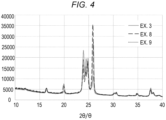
- the X-ray diffraction measurement can be performed by using, for example, a measurement method using CuK ⁇ rays in a range where 2 ⁇ is 10° to 80°.
- the amorphous glass before the heat treatment may be referred to as a "base glass of the glass ceramic".
- the crystal precipitated in the glass ceramic can be identified by powder X-ray diffraction (PXRD) measurement.
- a content of each crystal in the glass ceramic is a crystal molar fraction of each crystal in consideration of a proportion at which the crystal molar fraction is maximized, the entire glass ceramic being taken as 100 mol%, and the crystal precipitated at the composition and the temperature being precipitated in a stoichiometric composition.
- a glass ceramic according to a first embodiment of the present invention contains: at least one of a lithium disilicate type crystal and a solid solution crystal thereof; at least one of a virgilite type crystal and a solid solution crystal thereof; and a residual glass phase, in which a fracture toughness value K IC is 1.0 MPa ⁇ m 0.5 or more, and a haze value in terms of a thickness of 0.7 mm is 0.8% or less.
- a glass ceramic according to a second embodiment of the present invention contains: at least one of a lithium disilicate type crystal and a solid solution crystal thereof; at least one of a ⁇ -spodumene type crystal and a solid solution crystal thereof; and a residual glass phase, in which a fracture toughness value K IC is 1.2 MPa ⁇ m 0.5 or more, and a haze value in terms of a thickness of 0.7 mm is 2.0% or less.
- the glass ceramic according to the first embodiment and the glass ceramic according to the second embodiment may be collectively referred to as a glass ceramic according to the present embodiment.
- the glass ceramic according to the first embodiment contains: at least one of a lithium disilicate type crystal and a solid solution crystal thereof, at least one of a virgilite type crystal and a solid solution crystal thereof; and a residual glass phase.
- the glass ceramic according to the first embodiment contains at least one of a lithium disilicate type crystal and a solid solution crystal thereof.
- the lithium disilicate type crystal is a crystal having a composition represented by Li 2 Si 2 O 5 .
- the lithium disilicate type crystal and a solid solution crystal thereof include perfect lithium disilicate (Li 2 Si 2 O 5 ), lithium disilicate containing defects, and lithium disilicate in which a different element is solid-dissolved.
- “at least one of a lithium disilicate type crystal and a solid solution crystal thereof” may be referred to as a "lithium disilicate-based crystal".
- a content of the lithium disilicate-based crystal is preferably 36 mol% or more, more preferably 42 mol% or more, and particularly preferably 48 mol% or more, from the viewpoint of increasing the fracture toughness value K IC .
- the content is preferably 63 mol% or less, and particularly preferably 56 mol% or less, from the viewpoint of ensuring an appropriate amount of the residual glass phase or virgilite to be precipitated.
- the glass ceramic according to the first embodiment contains at least one of a virgilite type crystal and a solid solution crystal thereof.
- the virgilite type crystal is a hexagonal crystal having a composition represented by LiAlSi 2 O 6 .
- the virgilite type crystal and a solid solution crystal thereof include perfect virgilite (LiAlSi 2 O 6 ), virgilite containing defects, and virgilite in which a different element is solid-dissolved, and specifically, include one in which at least one or more selected from the group consisting of Na, K and a divalent cation is substituted on the Li site in hexagonal LiAlSi 2 O 6 , or one in which a trivalent cation is substituted on at least one of the Al site and the Si site in hexagonal LiAlSi 2 O 6 .
- "at least one of a virgilite type crystal and a solid solution crystal thereof" may be referred to as a "virgilite-based crystal”.
- the inventors of the present invention have found that when the glass ceramic contains the lithium disilicate-based crystal and the virgilite-based crystal, the fracture toughness value K IC of the glass ceramic can be made relatively larger while the haze value can be made relatively smaller As the reasons, it is thought that the lithium disilicate-based crystal easily increases the fracture toughness value K IC of the glass ceramic, and refractive index matching with a lithium disilicate phase by generation of the virgilite-based crystal suppresses the haze. That is, when the glass ceramic according to the first embodiment contains the lithium disilicate-based crystal and the virgilite-based crystal, both the drop strength and the transparency are excellent.
- a content of the virgilite-based crystal is preferably 18 mol% or more, more preferably 21 mol% or more, and particularly preferably 24 mol% or more, from the viewpoint of improving the toughness through crystal precipitation.
- the content is preferably 36 mol% or less, more preferably 32 mol% or less, and particularly preferably 28 mol% or less, from the viewpoint of complementary generation with lithium disilicate.
- the glass ceramic according to the first embodiment preferably contains 54 mol% or more of the lithium disilicate-based crystal and the virgilite-based crystal in total, from the viewpoint of high toughness and low haze.
- the total content of the lithium disilicate-based crystal and the virgilite-based crystal is more preferably 63 mol% or more, particularly preferably 72 mol% or more, and still more preferably 81 mol% or more.
- the total content is preferably 95 mol% or less, more preferably 93 mol% or less, still more preferably 91 mol% or less, and particularly preferably 90 mol% or less, from the viewpoint of formability including a residual glass and chemical strengthening.
- the glass ceramic according to the first embodiment may contain any crystals (other crystals) other than the lithium disilicate-based crystal and the virgilite-based crystal, as long as the effects of the present invention are not impaired.
- the other crystals include a ⁇ -spodumene-based crystal will be described later as the second embodiment.
- the other crystals may include at least one crystal selected from petalite, eucryptite, and lithium phosphate.
- Examples of the other crystals include a mixed crystal compound based on ZrO 2 , ZnO, and the like.
- a preferred content thereof is preferably 5 mol% or less, more preferably 4 mol% or less, still more preferably 3 mol% or less, and particularly preferably 2 mol% or less, for each type of crystal, from the viewpoint of reducing the haze value.
- the content of the other crystals is preferably 0 mol% or more, for each type of crystal, from the viewpoint of nucleation, and is preferably a content that the other crystals function only as a nucleation species, and it is preferable to increase the amount of the main crystal to be precipitated as much as possible.
- the total content of the other crystals is preferably 5 mol% or less, more preferably 4 mol% or less, still more preferably 3 mol% or less, and particularly preferably 2 mol% or less, from the viewpoint of reducing the haze.
- the total content of the other crystals is preferably 0 mol% or more from the viewpoint of nucleation, and is preferably a content that the other crystals function only as a nucleation species, and it is preferable to increase the amount of the main crystal to be precipitated as much as possible.
- the glass ceramic according to the first embodiment has a degree of crystallinity of preferably 56 mol% or more, more preferably 65 mol% or more, still more preferably 74 mol% or more, and particularly preferably 83 mol% or more, from the viewpoint of high toughness.
- the degree of crystallinity is preferably 97 mol% or less, more preferably 95 mol% or less, still more preferably 93 mol% or less, and particularly preferably 92 mol% or less, from the viewpoint of the formability by the residual glass phase.
- the degree of crystallinity is a total of precipitation proportions of respective crystals in the glass ceramic, and is a total of the content proportions of the lithium disilicate-based crystal, the virgilite-based crystal, and the other crystals.
- the glass ceramic according to the first embodiment contains a residual glass phase.
- the residual glass phase is an amorphous phase in the glass ceramic.
- a proportion of the residual glass phase is preferably 44 mol% or less, more preferably 35 mol% or less, still more preferably 26 mol% or less, and particularly preferably 17 mol% or less.
- the proportion of the residual glass phase is preferably 3 mol% or more, more preferably 5 mol% or more, still more preferably 7 mol% or more, and particularly preferably 8 mol% or more, from the viewpoint of improving the formability.
- the proportion of the residual glass phase refers to a value obtained by subtracting a crystal molar fraction from 100 mol% in consideration of a proportion at which the crystal molar fraction is maximized, the entire glass ceramic being taken as 100 mol%, and the crystal precipitated at the composition and the temperature being precipitated in a stoichiometric composition.
- an average particle diameter of the precipitated crystal is preferably 80 nm or less, more preferably 70 nm or less, still more preferably 60 nm or less, still more preferably 50 nm or less, particularly preferably 40 nm or less, and most preferably 30 nm or less, from the viewpoint of improving the transparency.
- the average particle diameter of the precipitated crystal is, for example, preferably 5 nm or more, more preferably 6 nm or more, still more preferably 7 nm or more, particularly preferably 8 nm or more, even more preferably 9 nm or more, and most preferably 10 nm or more, in order to increase the strength.
- the average particle diameter of the precipitated crystal is determined based on a transmission electron microscope (TEM) image.
- the average particle diameter of the precipitated crystal can be estimated based on a scanning electron microscope (SEM) image.
- the glass ceramic according to the second embodiment contains: at least one of a lithium disilicate type crystal and a solid solution crystal thereof; at least one of a ⁇ -spodumene type crystal and a solid solution crystal thereof; and a residual glass phase.
- the glass ceramic according to the second embodiment contains at least one of a lithium disilicate type crystal and a solid solution crystal thereof.
- the lithium disilicate type crystal is a crystal having a composition represented by Li 2 Si 2 O 5 .
- the lithium disilicate type crystal and a solid solution crystal thereof include perfect lithium disilicate (Li 2 Si 2 O 5 ), lithium disilicate containing defects, and lithium disilicate in which a different element is solid-dissolved.
- “at least one of a lithium disilicate type crystal and a solid solution crystal thereof” may be referred to as a "lithium disilicate-based crystal".
- a content of the lithium disilicate-based crystal is preferably 36 mol% or more, more preferably 42 mol% or more, and particularly preferably 48 mol% or more, from the viewpoint of increasing the fracture toughness value K IC .
- the content is preferably 63 mol% or less, and particularly preferably 56 mol% or less, from the viewpoint of chemical strengthening.
- the glass ceramic containing the lithium disilicate-based crystal can be checked by a method same as the method in the first embodiment.
- the glass ceramic according to the second embodiment contains at least one of a ⁇ -spodumene type crystal and a solid solution crystal thereof.
- the ⁇ -spodumene type crystal is a tetragonal crystal having a composition represented by LiAlSi 2 O 6 .
- the ⁇ -spodumene type crystal and a solid solution crystal thereof include perfect ⁇ -spodumene (LiAlSi 2 O 6 ), ⁇ -spodumene containing defects, and ⁇ -spodumene in which a different element is solid-dissolved, and specifically, include one in which at least one or more selected from the group consisting of Na, K and a divalent cation is substituted on the Li site in tetragonal LiAlSi 2 O 6 , or one in which a trivalent cation is substituted on at least one of the Al site and the Si site in tetragonal LiAlSi 2 O 6 .
- ⁇ -spodumene-based crystal at least one of a ⁇ -spodumene type crystal and a solid solution crystal thereof.
- the inventors of the present invention have found that when the glass ceramic contains the lithium disilicate-based crystal and the ⁇ -spodumene-based crystal, the fracture toughness value K IC of the glass ceramic can be made relatively larger while the haze value can be made relatively smaller.
- the lithium disilicate-based crystal easily increases the fracture toughness value K IC of the glass ceramic, and refractive index matching with a lithium disilicate phase by generation of the ⁇ -spodumene-based crystal suppresses the haze. That is, when the glass ceramic according to the second embodiment contains the lithium disilicate-based crystal and the ⁇ -spodumene-based crystal, both the drop strength and the transparency are excellent.
- the ⁇ -spodumene-based crystal tends to make a glass ceramic more excellent in chemical strengthening properties. Therefore, the glass ceramic according to the second embodiment is excellent in both drop strength and transparency, and is more excellent in chemical strengthening properties. Note that, here, being excellent in chemical strengthening properties refers to that a compressive stress difference between the surface and the interior is generated due to a chemical strengthening treatment, making it easier to increase the strength.
- the ⁇ -spodumene-based crystal and the above virgilite-based crystal have the same composition but are crystal species different from each other.
- the virgilite-based crystal is of a crystal species that can precipitate as a precursor of the ⁇ -spodumene-based crystal. Therefore, the glass ceramic according to the second embodiment may further contain a virgilite-based crystal in addition to the lithium disilicate-based crystal and the ⁇ -spodumene-based crystal. In this case, the glass ceramic according to the second embodiment can also be the glass ceramic according to the first embodiment.
- a content of the ⁇ -spodumene-based crystal is preferably 18 mol% or more, more preferably 21 mol% or more, and particularly preferably 24 mol% or more, from the viewpoint of improving the toughness through crystal precipitation and from the viewpoint of improving the chemical strengthening properties.
- the content is preferably 36 mol% or less, more preferably 32 mol% or less, and particularly preferably 28 mol% or less, from the viewpoint of complementary generation with lithium disilicate.
- a content of the virgilite-based crystal has a relationship with a generation amount of the ⁇ -spodumene-based crystal.
- the content of the virgilite-based crystal is preferably 13 mol% or more, more preferably 15 mol% or more, and particularly preferably 18 mol% or more, from the viewpoint of improving the chemical strengthening properties by containing the ⁇ -spodumene-based crystal.
- the content is preferably 36 mol% or less, more preferably 30 mol% or less, and particularly preferably 27 mol% or less, from the viewpoint of reducing the haze.
- the glass ceramic containing the virgilite-based crystal can be checked by a method same as the method in the first embodiment.
- the glass ceramic according to the second embodiment preferably contains 11 mol% or more of the ⁇ -spodumene-based crystal and the virgilite-based crystal in total, from the viewpoint of improving the toughness through crystal precipitation and from the viewpoint of improving the chemical strengthening properties.
- the total content of the ⁇ -spodumene-based crystal and the virgilite-based crystal is more preferably 13 mol% or more, particularly preferably 15 mol% or more, and still more preferably 17 mol% or more.
- the total content is preferably 36 mol% or less, more preferably 34 mol% or less, still more preferably 32 mol% or less, and particularly preferably 30 mol% or less, from the viewpoint of reducing the haze.
- the glass ceramic according to the second embodiment preferably contains 54 mol% or more of the lithium disilicate-based crystal, the ⁇ -spodumene-based crystal, and the virgilite-based crystal in total, from the viewpoint of obtaining a material that is easy to be chemically strengthened and that has high toughness.
- the total content of the lithium disilicate-based crystal and the ⁇ -spodumene-based crystal is more preferably 63 mol% or more, particularly preferably 72 mol% or more, and still more preferably 81 mol% or more.
- the total content is preferably 95 mol% or less, more preferably 93 mol% or less, still more preferably 91 mol% or less, and particularly preferably 90 mol% or less, from the viewpoint of the formability including a residual glass and the chemical strengthening properties.
- the glass ceramic according to the second embodiment may contain any crystals (other crystals) other than the lithium disilicate-based crystal, the ⁇ -spodumene-based crystal, and the virgilite-based crystal, as long as the effects of the present invention are not impaired.
- the other crystals may include at least one crystal selected from petalite, eucryptite, and lithium phosphate.
- Examples of the other crystals include a mixed crystal compound based on ZrO 2 , ZnO, and the like.
- a preferred content thereof is preferably 5 mol% or less, more preferably 4 mol% or less, still more preferably 3 mol% or less, and particularly preferably 2 mol% or less, for each type of crystal, from the viewpoint of reducing the haze.
- the content of the other crystals is preferably 0 mol% or more, for each type of crystal, from the viewpoint of nucleation, and is preferably a content that the other crystals function only as a nucleation species and that the amount of the main crystal to be precipitated is increased as much as possible.
- the total content of the other crystals is preferably 5 mol% or less, more preferably 4 mol% or less, still more preferably 3 mol% or less, and particularly preferably 2 mol% or less, from the viewpoint of reducing the haze.
- the total content of the other crystals is preferably 0 mol% or more from the viewpoint of nucleation, and is preferably a content that the other crystals function only as a nucleation species, and it is preferable to increase the amount of the main crystal to be precipitated as much as possible.
- the glass ceramic according to the second embodiment has a degree of crystallinity of preferably 56 mol% or more, more preferably 65 mol% or more, still more preferably 74 mol% or more, and particularly preferably 83 mol% or more, from the viewpoint of achieving both fracture toughness and ease of chemical strengthening.
- the degree of crystallinity is preferably 97 mol% or less, more preferably 95 mol% or less, still more preferably 93 mol% or less, and particularly preferably 92 mol% or less, from the viewpoint of the formability by the residual glass phase.
- the degree of crystallinity is a total of precipitation proportions of respective crystals in the glass ceramic, and is a total of the content proportions of the lithium disilicate-based crystal, the ⁇ -spodumene-based crystal, the virgilite-based crystal, and the other crystals.
- the glass ceramic according to the second embodiment contains a residual glass phase.
- a proportion of the residual glass phase is preferably 44 mol% or less, more preferably 35 mol% or less, still more preferably 26 mol% or less, and particularly preferably 17 mol% or less.
- the proportion of the residual glass phase is preferably 3 mol% or more, more preferably 5 mol% or more, still more preferably 7 mol% or more, and particularly preferably 8 mol% or more, from the viewpoint of the formability.
- the definition of the residual glass phase is the same as in the first embodiment, and a proportion thereof is determined by a method same as the method in the first embodiment.
- an average particle diameter of the precipitated crystal is preferably 80 nm or less, more preferably 70 nm or less, still more preferably 60 nm or less, still more preferably 50 nm or less, particularly preferably 40 nm or less, and most preferably 30 nm or less, from the viewpoint of improving the transparency.
- the average particle diameter of the precipitated crystal is, for example, preferably 5 nm or more, more preferably 6 nm or more, still more preferably 7 nm or more, particularly preferably 8 nm or more, even more preferably 9 nm or more, and most preferably 10 nm or more, in order to increase the strength.
- the average particle diameter of the precipitated crystal is determined based on a transmission electron microscope (TEM) image.
- the average particle diameter of the precipitated crystal can be estimated based on a scanning electron microscope (SEM) image.
- the glass ceramic according to the first embodiment has a fracture toughness value K IC of 1.0 MPa ⁇ m 0.5 or more.
- the fracture toughness value K IC is more preferably 1.1 MPa ⁇ m 0.5 or more, and still more preferably 1.2 MPa ⁇ m 0.5 or more.
- the glass ceramic according to the second embodiment has a fracture toughness value K IC of 1.2 MPa ⁇ m 0.5 or more.
- the fracture toughness value K IC is more preferably 1.1 MPa ⁇ m 0.5 or more, and still more preferably 1.2 MPa ⁇ m 0.5 or more.
- the fracture toughness value K IC is not particularly limited in upper limit, and may be, for example, 1.4 MPa ⁇ m 0.5 or less.
- Examples of a method of setting the fracture toughness value K IC to the above range include using the crystal species contained in a glass ceramic as described above, and preferred examples thereof include relatively increasing the degree of crystallinity, setting the glass composition to a preferred range to be described later, and adjusting a crystal proportion.
- the fracture toughness value K IC refers to a value measured by using a double cleavage drilled compression (DCDC) method ( Acta metall. mater. Vol. 43, pp. 3453-3458, 1995 ) or an SEPB method specified in JIS R1607. Since the DCDC method can determine the fracture toughness value K IC more accurately than the SEPB method, the fracture toughness value K IC is more preferably a value determined by using the DCDC method.
- DCDC double cleavage drilled compression
- the DCDC method is performed by using a sample having a shape shown in FIG. 1 and Autograph AGS-X5KN manufactured by Shimadzu Corporation and measuring a state of crack growth using a high-speed camera.
- the high-speed camera in order to capture a crack that grows over a long distance of 9 mm or more while changing the rate, among a Region III, in a region where the crack grows at a high rate of 1 ⁇ 10 -4 m/s or more, the high-speed camera is caused to follow the crack at a rate of 500 ⁇ m/s or more and capture the crack, and in a region where the crack grows at a slow rate of less than 1 ⁇ 10 -4 m/s, the crack is captured at a camera speed. Note that, the camera exposes at an interval short enough that the crack growth rate can be evaluated.
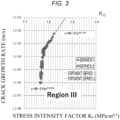
- a K I -v curve showing a relationship between a stress intensity factor K I (unit: MPa ⁇ m 0.5 ) and a crack growth rate v (unit: m/s) as shown in FIG. 2 is measured, the obtained Region III data is regressed and extrapolated using a linear equation, and the stress intensity factor K I at 0.1 m/s is defined as the fracture toughness value K IC .
- the K I -v curve has a Region I, a Region II, and the Region III from a region where the crack growth rate v is small.
- the Region I refers to a slow growth region of cracks caused by a bond cleavage reaction
- the Region II refers to a crack growth region where water and other molecules react at a crack front
- the Region III refers to a region where the crack growth rate accelerates and transitions to unstable fracture ( Introduction to Fracture in Glass, Yoshida, New Glass magazine (September 2008 ), and Fatigue Crack Growth Properties of Hot Work Die Steels, Yamada Toyota Lab R&D review, Vol. 27, (December 1992 )).
- the inventors of the present invention have found that the glass ceramic according to the present embodiment has a peculiar inflection in the Region III in the K I -v curve.
- the K I -v curve showing the relationship between the stress intensity factor K I (unit:MPa ⁇ m 0.5 ) and the crack growth rate v (unit: m/s) is measured
- the K I -v curve preferably has an inflection point in the Region III.
- FIG. 3 is a diagram showing a Region III in a K I -v curve of a glass ceramic in Example 3 in Examples to be described later.
- a general K I -v curve measured for a material such as a glass has no inflection in the Region III
- the K I -v curve measured for the glass ceramic according to the present embodiment has an inflection point in the Region III.
- “having an inflection point in the Region III” refers to that a power value of K I that can best express v changes around a certain value of K 1 .
- This inflection is thought to occur when, at a certain crack growth rate, the crack growth is trapped in an internal crystal or a residual glass structure, and the movement of a leading edge of the crack growth is restricted by the structure, thereby reducing a rate of increase in the crack growth rate. Then, the glass ceramic according to the present embodiment having the inflection in the Region III in the K I -v curve is thought to contribute to the glass ceramic according to the present embodiment having a relatively large fracture toughness value K IC , as described above.
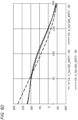
- a ratio (x_Region III-2/x_region III-1) of a shoulder value (x_Region III-2) of the exponential function on a Region III-2 side to a shoulder value (x_Region III-1) of the exponential function on a Region III-1 side is preferably less than 0.25.
- the shoulder value (x_Region III-1) of the exponential function on the Region III-1 side and the shoulder value (x_Region III-2) of the exponential function on the Region III-2 side are calculated and are thought to be indices representing a degree of crack propagation rate in the Region III-1 and the Region III-2, respectively. Therefore, in consideration of the parameter x_Region III-2/x_region III-1, this can be thought as an index representing a degree of crack growth in the material structure. The smaller the ratio, the larger the energy required for the crack growth in a high-rate crack growth region, and the larger the fracture toughness.
- the ratio (x_Region III-2/x_region III-1) is preferably less than 0.25, and more preferably 0.20 or less.
- the ratio (x_Region III-2/x_region III-1) is not particularly limited in lower limit, and is preferably 0.01 or more from the viewpoint of achieving a uniform fracture process.
- Examples of an aspect pf the present embodiment include a glass ceramic containing a crystal, in which when a K I -v curve showing a relationship between a stress intensity factor K I (unit: MPa ⁇ m 0.5 ) and a crack growth rate v (unit: m/s) of the glass ceramic is measured, the K I -v curve has a Region I, a Region II, and a Region III from a region where the crack growth rate v is small, the K I -v curve has an inflection point in the Region III, and when a region where the crack growth rate v is small is defined as a Region III-1 and a region where the crack growth rate v is large is defined as a Region III-2 in the Region III with the inflection point as a boundary, and the crack growth rate v is fitted to the stress intensity factor K I using an exponential function, a ratio (x_Region III-2/x_region III-1) of an exponent value (x_Region III-2) of the exponential function on a Region III-2
- a glass ceramic having the above features of the K I -v curve may be subjected to chemical strengthening to obtain a compressive stress layer on a surface, and a chemically strengthened glass which is the glass ceramic having the above features of the K I -v curve may be obtained.
- the fracture index can be calculated under the following conditions.
- the state of crack growth is measured using a high-speed camera. Further more specifically, in order to capture a crack that grows over a long distance of 9 mm or more while changing the rate, among the cracks in the Region III, in a region where the crack grows at a high rate of 1 ⁇ 10 -4 m/s or more, the high-speed camera is caused to follow the crack at a rate of 500 ⁇ m/s or more and capture the crack.
- the shoulder value of the exponential function is thought to represent a material-specific value which is a main factor of the fracture toughness value K IC . Therefore, it is thought that the x_Region III-2 parameter itself is a dominant factor in providing larger resistance to the crack growth.
- a coefficient value (MPa -1 ⁇ m -0.5 ) for the stress intensity factor within the exponent is preferably less than 130, more preferably less than 120, and most preferably less than 110, less than 100, and less than 90 in order.
- Examples of an aspect pf the present embodiment include a glass ceramic, in which when a KI-v curve showing a relationship between a stress intensity factor K I (unit: MPa ⁇ m 0.5 ) and a crack growth rate v (unit: m/s) of the glass ceramic is measured, in fitting the crack growth rate v between 1 ⁇ 10 -4 m/s and 1 ⁇ 10 -1 m/s to K I using an exponential function having e as a base, a coefficient value for the stress intensity factor within an exponent is less than 130 (MPa -1 ⁇ m -0.5 ), and a haze value in terms of a thickness of 0.7 mm is less than 2.0%.
- the glass ceramic according to the first embodiment has a haze value in terms of a thickness of 0.7 mm of 0.8% or less. Accordingly, the glass ceramic according to the first embodiment is excellent in transparency.
- the haze value of the glass ceramic according to the first embodiment is more preferably 0.7% or less, still more preferably 0.6% or less, even more preferably 0.5% or less, particularly preferably 0.3% or less, more particularly preferably 0.2% or less, and most preferably 0.15% or less.
- the glass ceramic according to the second embodiment has a haze value in terms of a thickness of 0.7 mm of 2.0% or less. Accordingly, the glass ceramic according to the second embodiment is excellent in transparency.
- the haze value is preferably 1.8% or less, more preferably 1.6% or less, still more preferably 1.4% or less, 1.2% or less, 1.0% or less, 0.8% or less, 0.7% or less, and 0.6% or less in order, even more preferably 0.5% or less, particularly preferably 0.3% or less, more particularly preferably 0.2% or less, and most preferably 0.15% or less.
- the haze value is not particularly limited in lower limit, and may be, for example, 0.1% or more.
- Examples of a method of setting the haze value to the above range include using the crystal species contained in a glass ceramic as described above, and preferred examples thereof include adjusting a crystal generation condition and adjusting the residual glass component.
- the haze value is a value measured in accordance with JIS K7136 (2000).
- T 0.7 100 ⁇ T 0.7/t /(1-R) ⁇ (1.4/t-2) [%].
- X ⁇ Y represents X Y .
- the haze value H 0.7 in the case of 0.7 mm is determined according to the following equation.
- the sheet thickness may be adjusted to 0.7 mm by polishing, etching, or the like to actually measure the haze value.
- the composition of the glass ceramic according to the present embodiment is the same as the glass composition of the amorphous glass before crystallization in a production method to be described later, that is, the composition of the base glass of the glass ceramic. Therefore, preferred aspects of the composition of the glass ceramic according to the present embodiment and the glass composition of the base glass of the glass ceramic are the same.
- the composition of the glass ceramic in the present description refers to the total composition of a crystal phase and an amorphous phase of the glass ceramic.
- the composition of the glass ceramic is determined by subjecting the glass ceramic to a heat treatment at a temperature equal to or higher than a melting point and analyzing the vitrified glass.
- An example of the analysis method is a fluorescent X-ray analysis method.
- composition of the glass ceramic according to the present embodiment is not particularly limited, and an example of a preferred aspect is as follows.
- a lower limit of a preferred content of a non-essential component is 0%.
- the glass ceramic according to the present embodiment is a lithium aluminosilicate glass containing SiO 2 , Al 2 O 3 , and Li 2 O. Since the lithium aluminosilicate glass contains lithium ions, which are alkali ions having the smallest ion radius, a chemically strengthened glass having a preferred stress profile is easily obtained by a chemical strengthening treatment in which ion exchange is performed using various molten salts.
- SiO 2 is a component that constitutes the lithium disilicate-based crystal, the virgilite-based crystal, and the ⁇ -spodumene-based crystal, and is an essential component.
- SiO 2 is a component that constitutes a glass network and is also a component that improves the chemical durability.
- the content of SiO 2 is preferably 65% or more, more preferably 66% or more, still more preferably 67% or more, and particularly preferably 68% or more, from the viewpoint of precipitating the lithium disilicate-based crystal and at least one of the virgilite-based crystal and the ⁇ -spodumene-based crystal, and from the viewpoint of improving the chemical durability.
- the content of SiO 2 is preferably 75% or less, more preferably 74% or less, still more preferably 73% or less, and particularly preferably 72% or less, in order to improve the meltability during glass production.
- Li 2 O is a component that constitutes the lithium disilicate-based crystal, the virgilite-based crystal, and the ⁇ -spodumene-based crystal, and is an essential component.
- Li 2 O is a component that forms the surface compressive stress by ion exchange, and is also a component that improves the meltability of the glass.
- the glass ceramic contains Li 2 O, a stress profile with a large surface compressive stress and a large compressive stress layer is obtained by a method of performing ion exchange of Li ions on the glass surface with Na ions, and further ion exchange of Na ions with K ions.
- the content of Li 2 O is preferably 23% or more, more preferably 23.5% or more, and particularly preferably 24% or more, from the viewpoint of precipitating the lithium disilicate-based crystal and at least one of the virgilite-based crystal and the ⁇ -spodumene-based crystal, and from the viewpoint of increasing the strength by chemical strengthening.
- the content of Li 2 O is preferably 25% or less, and particularly preferably 24.9% or less, in order to stabilize the glass.
- Al 2 O 3 is a component that constitutes the virgilite-based crystal and the ⁇ -spodumene-based crystal, and is an essential component.
- Al 2 O 3 is an effective component from the viewpoint of improving the ion exchange performance during chemical strengthening and increasing the surface compressive stress after strengthening.
- Al 2 O 3 is also a component that improves the chemical durability.
- the content of Al 2 O 3 is preferably 4% or more, and more preferably 4.5% or more, in order to precipitate at least one of the virgilite-based crystal and the ⁇ -spodumene-based crystal, and in order to improve the chemical durability or the chemical strengthening properties.
- the content of Al 2 O 3 is preferably 8% or less, more preferably 7% or less, still more preferably 6.5% or less, and particularly preferably 6% or less, from the viewpoint of precipitating lithium disilicate.
- the total content of Li 2 O and Al 2 O 3 is preferably 27% or more, more preferably 28% or more, still more preferably 29% or more, and particularly preferably 29.5% or more, from the viewpoint of appropriately adjusting the crystal to be generated.
- the total content of Li 2 O and Al 2 O 3 is preferably 33% or less, more preferably 32% or less, still more preferably 31% or less, and particularly preferably 30.5% or less, from the viewpoint of adjusting the crystal to be generated and the residual glass phase.
- a ratio (Al 2 O 3 /Li 2 O) of the content of Al 2 O 3 to the content of Li 2 O may influence a proportion of the precipitated crystal. That is, when the value of (Al 2 O 3 /Li 2 O) is relatively large, a ratio of the precipitation proportion of at least one of the virgilite-based crystal and the ⁇ -spodumene-based crystal to the precipitation proportion of the lithium disilicate-based crystal tends to be large. Therefore, (Al 2 O 3 /Li 2 O) is preferably 0.15 or more, and more preferably 0.20 or more, from the viewpoint of setting the precipitation proportion of each crystal to the above preferred range. (Al 2 O 3 /Li 2 O) is preferably 0.50 or less, and more preferably 0.36 or less, from the same viewpoint.
- P 2 O 5 is a component that serves as a crystal nucleus of the lithium disilicate-based crystal.
- the content of P 2 O 5 is preferably 0.5% or more, more preferably 0.7% or more, and still more preferably 1.0% or more, from the viewpoint of precipitating the lithium disilicate-based crystal.
- the content of P 2 O 5 is preferably 2.5% or less, more preferably 2.0% or less, still more preferably 1.8% or less, and particularly preferably 1.6% or less, from the viewpoint of improving the acid resistance.
- P 2 O 5 may influence the precipitation of not only the lithium disilicate-based crystal but also at least one crystal of the virgilite-based crystal and the ⁇ -spodumene-based crystal. This is because P 2 O 5 may be a crystal nucleus of these crystals, and the residual glass that has changed due to the generation of the lithium disilicate type crystal may influence the generation of these crystals.
- ZrO 2 is a component that can increase the surface compressive stress of the chemically strengthened glass, and is also a component that can act as a nucleating agent.
- ZrO 2 is preferably 0.6% or more, more preferably 0.7% or more, and still more preferably 0.8% or more.
- the content of ZrO 2 is preferably 2% or less, more preferably 1.5% or less, still more preferably 1.3% or less, and particularly preferably 1.1% or less, from the viewpoint of reducing the haze.
- B 2 O 3 is not an essential component, but is a component that can reduce the brittleness of the glass, improve the crack resistance, and facilitate the precipitation of the ⁇ -spodumene-based crystal.
- the glass ceramic according to the present embodiment may contain B 2 O 3 .
- the content thereof is preferably 0.2% or more, and more preferably 0.3% or more.
- the content of B 2 O 3 is preferably 1% or less, and more preferably 0.7% or less, from the viewpoint of improving the acid resistance. From the viewpoint of reducing the haze, it is most preferable that the glass ceramic according to the present embodiment is substantially free of B 2 O 3 .
- Na 2 O and K 2 O are not essential components, but are components that improve the meltability of the glass and are also components that improve the ion exchange performance.
- the glass ceramic according to the present embodiment may contain at least one of Na 2 O and K 2 O.
- the total content of Na 2 O and K 2 O is preferably 0% or more, more preferably 0.5% or more, and still more preferably 0.7% or more, from the viewpoint of improving the meltability of the glass and from the viewpoint of improving the ion exchange performance.
- the total content of Na 2 O and K 2 O is preferably 3% or less, and more preferably 1% or less, from the viewpoint of preventing a decrease in chemical strengthening properties and chemical durability and reducing the haze.
- Na 2 O is a component that forms a surface compressive stress layer in a chemical strengthening treatment using a potassium salt, and is a component that can improve the meltability of the glass.
- the content thereof is preferably 0% or more, and more preferably 0.5% or more.
- the content of Na 2 O is preferably 1.5% or less, and more preferably 1% or less.
- K 2 O is a component that improves the meltability of the glass and is also a component that improves the ion exchange performance.
- the content thereof is preferably 0% or more, and more preferably 0.1% or more, from the viewpoint of obtaining the effect.
- the content of K 2 O is preferably 1% or less from the viewpoint of preventing a decrease in chemical strengthening properties and chemical durability, and it is preferable that K 2 O is not contained from the viewpoint of reducing the haze.
- ZnO is not an essential component, but is a component that can improve the meltability of the glass.
- the glass ceramic according to the present embodiment may contain ZnO.
- the content of ZnO is preferably 0.1% or more, and more preferably 0.2% or more.
- the content of ZnO is preferably 1% or less, more preferably 0.7% or less, and still more preferably 0.5% or less, from the viewpoint of improving the weather resistance.
- SnO 2 is not an essential component, but is a component that can lower the melting temperature and remove fine bubbles from the glass.
- the glass ceramic according to the present embodiment may contain SnO 2 .
- the content of SnO 2 is preferably 0.1% or more, and more preferably 0.5% or more.
- the content of SnO 2 is preferably 1% or less, and more preferably 0.9% or less, from the viewpoint of reducing coloration.
- a sum of molar proportions of P 2 O 5 , ZrO 2 , B 2 O 3 , Na 2 O, K 2 O, ZnO, and SnO 2 is preferably 5% or less with respect to a sum of molar proportions of Li 2 O, Al 2 O 3 and SiO 2 .
- the total proportion of components that constitutes the lithium disilicate-based crystal, the virgilite-based crystal, and the ⁇ -spodumene-based crystal, that is, Li 2 O, Al 2 O 3 and SiO 2 is relatively large.
- a glass ceramic containing the lithium disilicate-based crystal and at least one of the virgilite-based crystal and the ⁇ -spodumene-based crystal is easily obtained, and the precipitation proportion of these crystals can be increased, and the degree of crystallinity can be easily increased.
- the sum of molar proportions of P 2 O 5 , ZrO 2 , B 2 O 3 , Na 2 O, K 2 O, ZnO, and SnO 2 is more preferably 4% or less, and still more preferably 3% or less, with respect to the sum of molar proportions of Li 2 O, Al 2 O 3 and SiO 2 .
- the above ratio is preferably 0.7% or more from the viewpoint of nucleation.
- Nb 2 O 5 , Ta 2 O 5 , Gd 2 O 3 , and CeO 2 are components that prevent solarization of the glass and are components that improve the meltability.
- the glass ceramic according to the present embodiment may contain at least one or more of these components.
- a total content thereof is preferably 0.03% or more, more preferably 0.1% or more, still more preferably 0.3% or more, particularly preferably 0.5% or more, even more preferably 0.8% or more, and most preferably 1% or more.
- the total content of these components is preferably 3% or less, more preferably 2.5% or less, still more preferably 2% or less, particularly preferably 1.5% or less, even more preferably 1% or less, and most preferably 0.5% or less.
- Fe 2 O 3 is a component that can improve the meltability of the glass by absorbing heat rays.
- the glass ceramic according to the present embodiment preferably contains Fe 2 O 3 .
- the content of Fe 2 O 3 is preferably 0.002% or more, more preferably 0.003% or more, still more preferably 0.005% or more, particularly preferably 0.007% or more, even more preferably 0.008% or more, and most preferably 0.01% or more, in wt% in terms of oxides.
- the content thereof is preferably 0.3% or less, more preferably 0.04% or less, still more preferably 0.03% or less, particularly preferably 0.025% or less, even more preferably 0.02% or less, and most preferably 0.015% or less in wt% in terms of oxides, from the viewpoint of improving the transparency of the glass.
- Fe (III) in an oxidized state and Fe (II) in a reduced state are mixed generally.
- Fe (III) causes yellow coloring
- Fe (II) causes blue coloring
- green coloring occurs in the glass depending on the balance therebetween.
- the glass ceramic according to the present embodiment may contain a coloring component within a range not impairing the effects of the present invention.
- a coloring component include Co 3 O 4 , MnO 2 , NiO, CuO, Cr 2 O 3 , V 2 O 5 , Bi 2 O 3 , SeO 2 , CeO 2 , Er 2 O 3 , and Nd 2 O 3 .
- the content of the coloring component in total is preferably 5% or less, more preferably 4% or less, still more preferably 3% or less, particularly preferably 2% or less, and even more preferably 1% or less in percentage in terms of oxides.
- the glass ceramic according to the present embodiment is substantially free of these components.
- SO 3 , a chloride, and a fluoride may be appropriately contained as a refining agent or the like during melting of the glass.
- 2 O 3 is preferably not contained.
- the content thereof is preferably 0.3% or less, and more preferably 0.1% or less, and it is most preferable that Sb 2 O 3 is not contained.
- Specific examples of a preferred composition of the glass ceramic according to the present embodiment include, but are not limited to, the following examples.
- the composition of the base glass contains, in mol% in terms of oxides,
- the composition of the base glass contains, in mol% in terms of oxides,
- the composition of the base glass contains, in mol% in terms of oxides,
- the glass ceramic according to the present embodiment has a Young's modulus of preferably 100 GPa or more, more preferably 102 GPa or more, and still more preferably 105 GPa or more, from the viewpoint of preventing warpage caused by chemical strengthening and improving the fracture toughness.
- the Young's modulus is not particularly limited in upper limit value, and the Young's modulus may be, for example, 120 GPa or less.
- the Young's modulus can be measured by using, for example, an ultrasonic method.
- the base glass (amorphous glass) of the glass ceramic according to the present embodiment has a glass transition temperature of preferably 400°C or higher from the viewpoint of ease of handling in a process of producing the glass ceramic.
- the glass transition temperature is preferably 600°C or lower from the viewpoint of facilitating a cooling process.
- the glass transition temperature can be determined, for example, based on a DSC curve measured by using a differential scanning calorimeter.
- the base glass (amorphous glass) of the glass ceramic has a devitrification temperature of preferably 1200°C or lower, and more preferably 1150°C or lower, from the viewpoint of ease of preparation of the base glass.
- the devitrification temperature is not particularly limited in lower limit value, and the devitrification temperature may be, for example, 1000°C or higher.
- the devitrification temperature of the glass is an average value of a maximum temperature at which crystals are precipitated on the surface and the inside of the glass and a minimum temperature at which crystals do not precipitate when pulverized glass particles are charged into a platinum dish and subjected to a heat treatment for 17 hours in an electric furnace controlled at a constant temperature and observation is performed using an optical microscope on the sample after the heat treatment.
- a log ⁇ value is preferably 2.5 or more, and more preferably 30 or more, from the viewpoint of ease of continuous production.
- the log ⁇ is not particularly limited in upper limit value, and the log ⁇ may be, for example, 4 or less.
- the devitrification viscosity ⁇ in the present description is a viscosity value at the devitrification temperature, and is determined by using a cylinder rotation method.
- the shape of the glass ceramic according to the present embodiment is not particularly limited, and is preferably, for example, a sheet shape.
- the sheet thickness (t) thereof is, for example, 2 mm or less, preferably 1.5 mm or less, more preferably 1 mm or less, still more preferably 0.9 mm or less, particularly preferably 0.8 mm or less, still more preferably 0.7 mm or less, and most preferably 0.6 mm or less, from the viewpoint of improving the chemical strengthening effect.
- the sheet thickness is, for example, preferably 0.1 mm or more, more preferably 0.2 mm or more, still more preferably 0.3 mm or more, even more preferably 0.35 mm or more, particularly preferably 0.4 mm or more, and more particularly preferably 0.5 mm or more, from the viewpoint of obtaining a sufficient strength increasing effect through a chemical strengthening treatment.
- the shape of the glass ceramic according to the present embodiment may be a shape other than a sheet shape depending on a product to be applied, an application, or the like.
- the glass sheet may have an edged shape or the like in which a thickness of an outer periphery is different.
- a form of the glass sheet is not limited thereto, and for example, two main surfaces may not be parallel to each other. In addition, one or both of the two main surfaces may be entirely or partially curved. More specifically, the glass sheet may be, for example, a flat sheet-shaped glass sheet having no warpage or a curved glass sheet having a curved surface.
- a chemically strengthened glass according to the present embodiment is obtained by subjecting the above glass ceramic according to the present embodiment to chemical strengthening. That is, a base composition of the chemically strengthened glass according to the present embodiment is the same as the composition of the above glass ceramic according to the present embodiment, and a preferred composition range is also the same.
- the content proportion of an alkali metal element is different between a surface layer and a center in the thickness direction.
- the glass composition in the deepest portion from the surface of the chemically strengthened glass is the same as the base composition of the chemically strengthened glass except for a case where an extreme ion exchange treatment is performed.
- the deepest portion from the glass surface is, for example, a depth of 1/2 of the sheet thickness t.
- the strength can be increased.
- the crystal contained in the chemically strengthened glass according to the present embodiment and the content thereof are the same as those of the glass ceramic according to the present embodiment except for a case where an extreme ion exchange treatment or the like is performed. That is, the chemically strengthened glass according to the present embodiment is excellent in drop strength and transparency for the same reason as for the glass ceramic according to the present embodiment.
- Both of a relatively large fracture toughness value K IC and being chemically strengthened contribute to increasing the strength of the chemically strengthened glass.
- the chemically strengthened glass according to the present embodiment has a relatively large fracture toughness value and is subjected to chemical strengthening, and is thus a chemically strengthened glass that has both of these properties and is excellent in strength.
- Examples of the chemically strengthened glass according to the present embodiment include a chemically strengthened glass according to a third embodiment and a chemically strengthened glass according to a fourth embodiment below.
- the chemically strengthened glass according to the third embodiment includes a compressive stress layer at a surface, in which a surface compressive stress value CS is 150 MPa or more, at least one of a lithium disilicate type crystal and a solid solution crystal thereof, at least one of a virgilite type crystal and a solid solution crystal thereof, and a residual glass phase are contained, a fracture toughness value K IC is 1.0 MPa ⁇ m 0.5 or more, and a haze value in terms of a thickness of 0.7 mm is 0.8% or less, and the chemically strengthened glass is a glass ceramic. That is, the above chemically strengthened glass is a chemically strengthened glass which is the glass ceramic according to the first embodiment.
- the chemically strengthened glass according to the fourth embodiment includes a compressive stress layer at a surface, in which a surface compressive stress value CS is 100 MPa or more, at least one of a lithium disilicate type crystal and a solid solution crystal thereof, at least one of a ⁇ -spodumene type crystal and a solid solution crystal thereof, and a residual glass phase are contained, a fracture toughness value K IC is 1.2 MPa ⁇ m 0.5 or more, a haze value in terms of a thickness of 0.7 mm is 2.0% or less, and the chemically strengthened glass is a glass ceramic. That is, the above chemically strengthened glass is a chemically strengthened glass which is the glass ceramic according to the second embodiment.
- the base composition of the chemically strengthened glass according to the present embodiment contains, in mol% in terms of oxides,
- the surface compressive stress value CS is 150 MPa or more, more preferably 160 MPa or more, still more preferably 170 MPa or more, and even more preferably 180 MPa or more.
- the surface compressive stress value CS is 100 MPa or more, preferably 140 MPa or more, more preferably 150 MPa or more, still more preferably 160 MPa or more, and even more preferably 170 MPa or more.
- the surface compressive stress value CS is not particularly limited in upper limit value, and the surface compressive stress value Cs may be, for example, 1400 MPa or less.
- a compressive stress value CS 50 at a depth of 50 ⁇ m from the surface is preferably 40 MPa or more, and more preferably 50 MPa or more.
- the CS 50 is not particularly limited in upper limit value, and the CS 50 may be, for example, 150 MPa or less.
- the internal tensile stress value CT is preferably 40 MPa or more, and more preferably 50 MPa or more.
- the CT is the above value or more, the compressive stress near the surface increases, and the strength increases.
- the CT is not particularly limited in upper limit value, and the CT is, for example, preferably 150 MPa or less, and more preferably 120 MPa or less.
- a compressive stress layer depth DOL is preferably 0.3t or less since in the case where it is too large with respect to the thickness t (mm), the CT may be too large.
- the DOL is preferably 0.1t or more, and more preferably 0.2t or more, from the viewpoint of increasing the strength.
- a preferred sheet thickness (t) and a preferred shape of the chemically strengthened glass according to the present embodiment are the same as the preferred sheet thickness (t) and the preferred shape of the above glass ceramic according to the present embodiment.
- the chemically strengthened glass according to the present embodiment can be produced by subjecting the above glass ceramic according to the present embodiment to a chemical strengthening treatment.
- the glass ceramic according to the present embodiment can be produced by subjecting the amorphous glass (the base glass of the glass ceramic) to a heat treatment for crystallization.
- the amorphous glass can be produced, for example, by the following method. Note that, the production method described below is an example in the case of producing a sheet-shaped glass ceramic and a sheet-shaped chemically strengthened glass.
- a glass having a preferred composition glass raw materials are blended, and then heated and melted in a glass melting furnace. Thereafter, the molten glass is homogenized by bubbling, stirring, addition of a refining agent, and the like, and formed into a glass sheet having a predetermined thickness by using a known forming method, followed by annealing. Alternatively, the molten glass may be formed into a block shape, followed by annealing, and cut into a sheet shape. Note that, in order to prevent nucleation during the preparation of the amorphous glass, it is preferable to slowly cool the glass at a temperature lower than the glass transition point by several tens of degrees. In addition, when the surface is scratched during processing or the like, the scratch will be the starting point for inducing surface crystallization, and therefore it is preferable to perform a treatment such that the scratch is not provided on the surface as much as possible.
- a preferred glass composition of the amorphous glass is the same as the preferred composition of the above glass ceramic or the base glass of the glass ceramic.
- the amorphous glass obtained by the above procedure is subjected to a heat treatment to obtain a glass ceramic.
- a method of the heat treatment is not particularly limited, and for example, the following method is preferred.
- the heat treatment includes a plurality of stages of heat treatment
- the plurality of stages of heat treatment include a first stage of heat treatment at 500°C to 540°C for 10 minutes to 24 hours and a final stage of heat treatment at 730°C to 860°C for 10 minutes to 24 hours, and a temperature increase rate and a temperature decrease rate in each stage of heat treatment are 5°C/min to 120°C/min.
- the plurality of stages of heat treatment refers to performing a heat treatment of holding a predetermined temperature range for a predetermined time a plurality of times while changing the temperature range.
- the heat treatment preferably includes at least two stages of heat treatment, and from the viewpoint of preventing haze, more preferably includes three stages.
- the first stage of heat treatment is preferably a heat treatment at 500°C to 540°C for 10 minutes to 24 hours.
- the temperature range in the first stage of heat treatment is preferably a temperature range in which a crystal nucleation rate increases in the glass composition.
- the holding time in the first stage of heat treatment is preferably a relatively long period of time to generate a sufficient number of crystal nuclei. When a large number of crystal nuclei are generated, a size of each crystal is reduced, and a glass ceramic having high transparency is easily obtained.
- the temperature range in the first stage of heat treatment is preferably 500°C to 540°C, and more preferably 520°C to 540°C.
- the holding time in the first stage of heat treatment is preferably 10 minutes to 24 hours, and more preferably 2 hours to 10 hours.
- the final stage of heat treatment is preferably a heat treatment at 730°C or more and lower than 800°C for 2 hours to 8 hours or at 830°C to 860°C for 10 minutes to 60 minutes.
- the temperature range in the final stage of heat treatment is preferably a temperature range in which a crystal nucleation rate increases in the glass composition.
- the inventors of the present invention have found that in the case of performing a heat treatment at a temperature range of 800°C or higher for a relatively long period of time in the final stage of heat treatment, ⁇ -spodumene is more likely to be generated, but this tends to increase the haze.
- the final stage of heat treatment is preferably at 730°C or more and lower than 800°C for 2 hours to 8 hours.
- the final stage of heat treatment is preferably a heat treatment at 830°C to 860°C for 10 minutes to 60 minutes. Therefore, as described above, the final stage of heat treatment is preferably a heat treatment at 730°C or more and lower than 800°C for 2 hours to 8 hours or at 830°C to 860°C for 10 minutes to 60 minutes.
- the temperature range is more preferably 760°C to 790°C, and the holding time is more preferably 1 hour to 6 hours.
- the temperature range is more preferably 840°C to 850°C, and the holding time is more preferably 15 minutes to 40 minutes.
- the heat treatment includes three or more stages of heat treatment, that is, in the case where a further heat treatment is provided between the first stage and the final stage, the heat treatment is preferably a heat treatment at 540°C to 650°C for 10 minutes to 24 hours, and more preferably a heat treatment at 580°C to 630°C for 30 minutes to 6 hours, from the viewpoint of generating a precursor crystal.
- the temperature increase rate and the temperature decrease rate in each stage of heat treatment are preferably 5°C/min to 120°C/min.
- the temperature increase rate and the temperature decrease rate are preferably 5°C/min or more since a crystal growth rate within the material can be followed.
- the temperature increase rate and the temperature decrease rate are preferably 120°C/min or less since material deformation can be prevented.
- the temperature increase rate when the temperature is increased to the temperature range in the final stage of heat treatment is preferably relatively large, and specifically, 50°C/min to 120°C/min is preferred. Accordingly, it is easy to precipitate the ⁇ -spodumene-based crystal in the glass ceramic while maintaining the transparency. The reason for this is thought to be that the ⁇ -spodumene-based crystal can be generated while preventing a great change in structure shape.
- volume crystallization is preferred from the viewpoint of preventing orientation of precipitated crystals which causes light scattering.
- the crystallization form is surface crystallization, and in the case where crystallization occurs but no surface crystallization is observed, it can be determined that the crystallization form is volume crystallization.
- conditions such as the above compositions and heat treatments are adjusted within preferred ranges.
- the molten glass may be homogenized and formed into a glass sheet having a predetermined thickness, or the molten glass may be formed into a block shape and then continuously subjected to a crystallization treatment.
- a setter plate examples include a silicon carbide plate, a silicon nitride plate, a SiN plate, an alumina plate, a mullite cordierite plate, a mullite plate, and a glass ceramic plate.
- a material having a large thermal conductivity is preferred.
- the thermal conductivity of the setter plate is preferably 2 W/(m ⁇ K) or more, more preferably 20 W/(m ⁇ K) or more, and still more preferably 40 W/(m ⁇ K) or more.
- a release agent can be used to prevent the glass from adhering to the setter plate.
- the release agent include an alumina cloth and a glass cloth. Further examples thereof include powdery boron nitride, alumina, and minerals.
- the release agent in a powder form may be mixed with a solvent and applied by spraying or the like.
- an average particle diameter thereof is preferably 80 ⁇ m or less, more preferably 50 ⁇ m or less, and still more preferably 30 ⁇ m or less.
- the glass may be laminated in order to improve working efficiency.
- a release agent is preferably used between a glass and a glass.
- a setter plate may be placed between a glass and a glass.
- the glass ceramic obtained by the above procedure is subjected to grinding and polishing if necessary to form a glass ceramic sheet.
- the chemical strengthening treatment is a treatment in which a glass is brought into contact with a metal salt by a method such as immersion of the glass in a molten solution of a metal salt (for example, potassium nitrate) containing metal ions having a large ion radius, and thereby metal ions having a small ion radius in the glass are substituted with the metal ions having a large ion radius.
- a metal salt for example, potassium nitrate
- the metal ions having a small ion radius are typically Na ions or Li ions.
- the metal ions having a large ion radius are typically Na ions or K ions, more specifically, Na ions or K ions for Li ions, and K ions for Na ions.
- Li-Na exchange Li ions in the glass are exchanged with Na ions.
- Na-K exchange Na ions in the glass are exchanged with K ions.
- Examples of the molten salt for performing the chemical strengthening treatment include a nitrate, a sulfate, a carbonate, and a chloride.
- examples of the nitrate include lithium nitrate, sodium nitrate, potassium nitrate, cesium nitrate, and silver nitrate.
- examples of the sulfate include lithium sulfate, sodium sulfate, potassium sulfate, cesium sulfate, and silver sulfate.
- Examples of the carbonate include lithium carbonate, sodium carbonate, and potassium carbonate.
- Examples of the chloride include lithium chloride, sodium chloride, potassium chloride, cesium chloride, and silver chloride.
- a time, a temperature, and the like can be selected in consideration of a glass composition, a type of the molten salt, and the like.
- the glass ceramic according to the present embodiment is preferably subjected to a chemical strengthening treatment at preferably 450°C or lower for preferably 20 hours or shorter.
- the chemical strengthening treatment may be, for example, two-stage ion exchange as follows.
- a metal salt for example, sodium nitrate
- Na ions at preferably about 350°C to 500°C for preferably about 0.1 hours to 10 hours. This can cause ion exchange between Li ions in the glass ceramic and Na ions in the metal salt, thereby forming a relatively deep compressive stress layer.
- the glass ceramic is immersed in a metal salt (for example, potassium nitrate) containing K ions at preferably about 350°C to 500°C for preferably about 0.1 hours to 10 hours. Accordingly, a large compressive stress is generated in a portion of the compressive stress layer formed in the previous treatment, for example, within a depth of about 10 ⁇ m. According to such a two-stage treatment, a stress profile having a large surface compressive stress value is easily obtained.
- a metal salt for example, potassium nitrate
- the glass ceramic according to the present embodiment and the chemically strengthened glass according to the present embodiment are excellent in both drop strength and transparency, and are therefore useful as a cover glass or a circuit board for use in electronic devices.
- the glass ceramic according to the present embodiment and the chemically strengthened glass according to the present embodiment are particularly useful as a cover glass for use in mobile devices such as a mobile phone, a smart phone, a personal digital assistant (PDA), and a tablet terminal.
- mobile devices such as a mobile phone, a smart phone, a personal digital assistant (PDA), and a tablet terminal.
- PDA personal digital assistant
- the glass ceramic according to the present embodiment and the chemically strengthened glass according to the present embodiment are also useful for applications which are not intended to be carried such as a cover glass of a display device such as a television (TV), a personal computer (PC), and a touch panel, an elevator wall surface, or a wall surface (full-screen display) of a construction such as a house and a building, a building material such as a window glass, a table top, an interior of an automobile, an airplane, or the like, and a cover glass thereof, and a casing having a curved surface shape that is not a sheet shape by bending or forming.
- a cover glass of a display device such as a television (TV), a personal computer (PC), and a touch panel
- an elevator wall surface or a wall surface (full-screen display) of a construction such as a house and a building
- a building material such as a window glass, a table top, an interior of an automobile, an airplane, or the like
- Glass raw materials were blended to have the compositions shown in Table 1 and Table 2 in mol% in terms of oxides, and weighed to obtain 400 g of glass. Next, the mixed raw materials were charged into a platinum crucible, followed by charging into an electric furnace at 1500°C to 1700°C, melted for about 3 hours, defoamed, and homogenized.
- the obtained molten glass was poured into a metal mold, held at a temperature about 50°C higher than the glass transition point for 1 hour, and then cooled to room temperature at a rate of 0.5°C/min, to obtain a glass block.
- the obtained glass block was cut, ground, and finally mirror-polished on both surfaces to obtain a glass sheet having a thickness of 2 mm (amorphous glass 0 to amorphous glass 12).
- Table 1 and Table 2 show compositions of the amorphous glass 0 to the amorphous glass 12, and the glass transition temperature, the devitrification temperature, and the devitrification viscosity ⁇ (log ⁇ ) of each amorphous glass.
- the methods for measuring the physical properties are as follows. Note that, the blank spaces in Table 1 and Table 2 indicate that the corresponding physical property is not measured.
- the glass transition temperature was determined by using a method of pulverizing the amorphous glass using an agate mortar, charging about 80 mg of powder into a platinum cell, performing heating from room temperature to 1100°C at a temperature increase rate of 10°C/min, and measuring a DSC curve using a differential scanning calorimeter (DSC3300SA manufactured by Bruker Corporation).
- the pulverized glass particles were charged into a platinum dish and subjected to a heat treatment for 17 hours in an electric furnace controlled at a constant temperature. In observation using an optical microscope on the sample after the heat treatment, the average value of the maximum temperature at which crystals were precipitated on the surface and the inside of the glass and the minimum temperature at which crystals did not precipitate was determined as the devitrification temperature.
- the devitrification viscosity ⁇ was measured by using a rotation cylinder method.
- Table 1 Composition proportion (mol%) Amorphous glass 0 Amorphous glass 1 Amorphous glass 2 Amorphous glass 3 Amorphous glass 4 Amorphous glass 5 Amorphous glass 6 SiO 2 68.6 68.3 68.3 68.3 68.4 68.3 70.0 Al 2 O 3 4.4 4.4 4.9 5.4 4.9 4.9 4.5 Li 2 O 25.0 24.9 24.4 23.9 24.4 21.5 25.5 ZrO 2 1.0 1.0 1.0 1.0 1.0 1.0 1.0 1.0 1.0 1.0 1.0 1.0 1.0 1.0 1.0 1.0 1.0 1.0 1.0 1.0 1.0 1.0 1.0 1.0 1.0 1.0 1.0 1.0 1.0 1.0 1.0 1.0 1.0 1.0 1.0 1.0 1.0 1.0 1.0 1.0 1.0 1.0 1.0 1.0 1.0 1.0 1.0 1.0 1.0 1.0 1.0 1.0 1.0 1.0 1.0 1.0 1.0 1.0 1.0
- Example 1 to Example 23 Each of the obtained amorphous glasses was subjected to a heat treatment to obtain glass ceramics in Example 1 to Example 23. That is, the amorphous glasses having the numbers shown in Tables 3 to 6 were subjected to a heat treatment under the conditions described in the "heat treatment condition" to obtain glass ceramics.
- the description in the column "heat treatment condition" for the glass ceramic in Example 1 means that the first stage of heat treatment is increasing the temperature to 540°C at a temperature increase rate of 10°C/min and holding the temperature at 540°C for 4 hours, the second stage of heat treatment is increasing the temperature to 600°C at a temperature increase rate of 10°C/min and holding the temperature at 600°C for 4 hours, and the third stage of heat treatment is increasing the temperature to 780°C at a temperature increase rate of 10°C/min and holding the temperature at 780°C for 4 hours.
- the physical properties described in Tables 3 to 6 were obtained from the obtained glass ceramics.
- the glass ceramics in Examples 1 to 5 and Examples 8 to 15 are Inventive Examples, and the glass ceramics in Examples 6, 7, and 16 to 23 are Comparative Examples.
- the obtained glass ceramic was subjected to PXRD measurement by the following procedure to identify a crystal species.
- a glass ceramic sheet subjected to a SPDR method was pulverized using an agate mortar and an agate pestle, to give a powder for PXRD measurement.
- Powder X-ray diffraction was measured under the following conditions to identify the precipitated crystal.
- a diffraction peak pattern recorded in an ICSD inorganic crystal structure database and an ICDD powder diffraction database was used.
- the content (proportion) of each crystal in the glass ceramic was a crystal molar fraction of each crystal in consideration of a proportion at which the crystal molar fraction was maximized, the entire glass ceramic being taken as 100 mol%, and the crystal precipitated at the composition and the temperature being precipitated in a stoichiometric composition.
- the total of the crystal molar fractions of each crystal was subtracted from 100 mol% to obtain the proportion of the residual glass phase. Note that, in Example 14, the contents of the virgilite-based crystal and the ⁇ -spodumene-based crystal are shown as a total amount thereof.
- the crystallization form was identified by using an optical microscope. In observation using an optical microscope, in the case where a continuous crystalline structure was observed to be formed from the interface between the material and air, the crystallization form was surface crystallization, and in the case where no surface crystallization was observed but a crystal peak was observed in the X-ray diffraction, the crystallization form was volume crystallization.
- the haze value [unit: %] of the glass ceramic under a C light source was measured using a haze meter (HZ-V3, manufactured by Suga Test Instruments Co., Ltd.). In addition, the appearance of the glass ceramic was visually checked.
- the Young's modulus of the glass was measured by using an ultrasonic method.
- the fracture toughness value K IC [unit: MPa ⁇ m 0.5 ] was measured by using the SEPB method or the DCDC method.
- the measurement using the SEPB method was performed in accordance with JIS R1607.
- the measurement using the DCDC method was performed as follows. With reference to the method described in M. Y. He, M.R. Turner and A.G. Evans, Acta Metall. Mater. 43 (1995) 3453., by using the DCDC method, a sample having a shape shown in FIG. 1 and Autograph AGS-X5KN manufactured by SHIMADZU Corporation were used, a K I -v curve showing the relationship between the stress intensity factor K I (unit: MPa ⁇ m 0.5 ) and the crack growth rate v (unit: m/s) as shown in FIG.
- FIG. 3 is a diagram showing a Region III in a K I -v curve of the glass ceramic in Example 3.
- a region where the crack growth rate v is small is defined as a Region III-1 and a region where the crack growth rate v is large is defined as a Region III-2 in the K I -v curve with the inflection point as a boundary, and the crack growth rate v is fitted to the stress intensity factor K I using an exponential function.
- the exponent value (x_Region III-1) of the exponential function on the Region III-1 side is 416.96x
- the exponent value (x_Region III-2) of the exponential function on the Region III-2 side is 64.125x. Therefore, the ratio (x_Region III-2/x_region III-1) is 0.15.
- Such specific inflection in the Region III in the K I -v curve was also observed in Inventive Examples other than Example 3 (i.e., Example 8), and the ratio (x_Region III-2/x_region III-1) was less than 0.25 in all of Inventive Examples.
- Example 1 Example 2 Example 3 Amorphous glass 0 1 1 Heat treatment condition 540°C, 4 hours (10°C/min) 500°C, 4 hours (10°C/min) 540°C, 4 hours (10°C/min) 600°C, 4 hours (10°C/min) 600°C, 4 hours (10°C/min) 780°C, 4 hours (10°C/min) 780°C, 4 hours (10°C/min) 780°C, 4 hours (10°C/min) 780°C, 4 hours (10°C/min) Crystallization form Volume crystallization Volume crystallization Volume crystallization K IC (DCDC method) - - 1.28 K IC (SEPB method) - 1.28 1.28 Haze/appearance 0.47%/colorless and transparent 0.77%/slightly milky white and transparent 0.58%/slightly milky white and transparent Precipitated crystal Li 2 Si 2 O 5 , LiAlSi 2 O 6 (Virgilite) Li 2 Si 2 O 5 , LiAlSi 2
- Examples 1 to 5 and Examples 8 to 14 which are Inventive Examples, a glass ceramic having reduced haze is obtained. It can also be seen that the introduction of P 2 O 5 induces volume crystallization from surface crystallization. It is also suggested that when the base glass of the glass ceramic is rich in Al 2 O 3 and poor in Li 2 O, the amount of the lithium disilicate type crystal tends to decrease and the amount of the virgilite type crystal tends to increase. This tendency can also be observed from graphs showing the results of the X-ray diffraction measurement for Examples 3, 8 and 9 shown in FIG. 4 .
- amorphous glass 1 shows the haze value (%) of the glass ceramic obtained by treating the amorphous glass 1 under each heat treatment condition.
- FIG. 5A is a diagram showing a stress profile when each glass ceramic is immersed in a salt containing 100% sodium nitrate at 380°C for 4 hours.
- FIG. 5B is a diagram showing a stress profile when each glass ceramic is immersed in a salt containing 100% sodium nitrate at 450°C for 4 hours.
- FIG. 5C is a diagram showing a stress profile when each glass ceramic is immersed in a salt containing 100% sodium nitrate at 380°C for 8 hours.
- FIG. 5A is a diagram showing a stress profile when each glass ceramic is immersed in a salt containing 100% sodium nitrate at 380°C for 4 hours.
- FIG. 5B is a diagram showing a stress profile when each glass ceramic is immersed in a salt containing 100% sodium nitrate at 450°C for 4 hours.
- FIG. 5C is a diagram showing a stress profile when each glass ceramic is immersed in a salt containing 100% sodium nitrate at 380°C for 8
- 5D is a diagram showing a stress profile when each glass ceramic is immersed in a salt containing 100% sodium nitrate at 450°C for 8 hours. Note that, the stress profile was measured by using a scattered light photoelastic stress meter (SLP-1000 manufactured by Orihara Industrial Co., Ltd.). In each stress profile in FIG. 5A to FIG. 5D , the horizontal axis represents the depth ( ⁇ m) from the surface, and the vertical axis represents the compressive stress value (MPa).
- the glass ceramics in Examples 3, 8, and 9, which are Inventive Examples can provide excellent strength by chemical strengthening. It can also be seen that in the 380°C treatment, the magnitude of the compressive stress due to the composition tends to be maintained even when the treatment time is extended, and in the 450°C treatment, the surface tends to relax along with the treatment time, but the DOL tends to increase.
Landscapes
- Chemical & Material Sciences (AREA)
- Engineering & Computer Science (AREA)
- Materials Engineering (AREA)
- Organic Chemistry (AREA)
- Life Sciences & Earth Sciences (AREA)
- Chemical Kinetics & Catalysis (AREA)
- General Chemical & Material Sciences (AREA)
- Geochemistry & Mineralogy (AREA)
- Ceramic Engineering (AREA)
- Crystallography & Structural Chemistry (AREA)
- Dispersion Chemistry (AREA)
- Thermal Sciences (AREA)
- Physics & Mathematics (AREA)
- Glass Compositions (AREA)
- Re-Forming, After-Treatment, Cutting And Transporting Of Glass Products (AREA)
Applications Claiming Priority (2)
| Application Number | Priority Date | Filing Date | Title |
|---|---|---|---|
| JP2022106563 | 2022-06-30 | ||
| PCT/JP2023/023677 WO2024004965A1 (ja) | 2022-06-30 | 2023-06-26 | 結晶化ガラス、化学強化ガラス及び結晶化ガラスの製造方法 |
Publications (1)
| Publication Number | Publication Date |
|---|---|
| EP4549411A1 true EP4549411A1 (en) | 2025-05-07 |
Family
ID=89383118
Family Applications (1)
| Application Number | Title | Priority Date | Filing Date |
|---|---|---|---|
| EP23831405.8A Pending EP4549411A1 (en) | 2022-06-30 | 2023-06-26 | Crystallized glass, chemically toughened glass, and method for producing crystallized glass |
Country Status (6)
| Country | Link |
|---|---|
| US (1) | US20260116813A1 (https=) |
| EP (1) | EP4549411A1 (https=) |
| JP (1) | JPWO2024004965A1 (https=) |
| KR (1) | KR20250029053A (https=) |
| CN (1) | CN119451921A (https=) |
| WO (1) | WO2024004965A1 (https=) |
Family Cites Families (9)
| Publication number | Priority date | Publication date | Assignee | Title |
|---|---|---|---|---|
| AU2012244543B2 (en) * | 2011-04-20 | 2015-10-01 | Straumann Holding Ag | Process for preparing a glass-ceramic body |
| US9701573B2 (en) | 2013-09-06 | 2017-07-11 | Corning Incorporated | High strength glass-ceramics having lithium disilicate and beta-spodumene structures |
| DE102016119108A1 (de) * | 2016-10-07 | 2018-04-12 | Degudent Gmbh | Lithiumsilikat-Glaskeramik |
| WO2019022035A1 (ja) * | 2017-07-26 | 2019-01-31 | Agc株式会社 | 化学強化ガラスおよびその製造方法 |
| US10723649B2 (en) * | 2017-11-30 | 2020-07-28 | Corning Incorporated | Black lithium silicate glass ceramics |
| KR102554280B1 (ko) | 2017-12-01 | 2023-07-12 | 시디지엠 글라스 컴퍼니 리미티드 | 결정화 유리 및 그 기판 |
| EP3823935A1 (en) * | 2018-07-16 | 2021-05-26 | Corning Incorporated | Glass ceramic articles having improved properties and methods for making the same |
| JP2020033202A (ja) * | 2018-08-27 | 2020-03-05 | Agc株式会社 | 結晶化ガラス基体、化学強化ガラス板、及びこれらの製造方法 |
| JP7585794B2 (ja) | 2021-01-07 | 2024-11-19 | 三菱電機株式会社 | 半導体装置 |
-
2023
- 2023-06-26 JP JP2024530843A patent/JPWO2024004965A1/ja active Pending
- 2023-06-26 EP EP23831405.8A patent/EP4549411A1/en active Pending
- 2023-06-26 KR KR1020247042089A patent/KR20250029053A/ko active Pending
- 2023-06-26 WO PCT/JP2023/023677 patent/WO2024004965A1/ja not_active Ceased
- 2023-06-26 CN CN202380050383.0A patent/CN119451921A/zh active Pending
-
2024
- 2024-12-27 US US19/003,804 patent/US20260116813A1/en active Pending
Also Published As
| Publication number | Publication date |
|---|---|
| WO2024004965A1 (ja) | 2024-01-04 |
| CN119451921A (zh) | 2025-02-14 |
| US20260116813A1 (en) | 2026-04-30 |
| JPWO2024004965A1 (https=) | 2024-01-04 |
| KR20250029053A (ko) | 2025-03-04 |
Similar Documents
| Publication | Publication Date | Title |
|---|---|---|
| JP7115479B2 (ja) | 結晶化ガラスおよび化学強化ガラス | |
| JP7609065B2 (ja) | 化学強化ガラスおよびその製造方法 | |
| JP7074269B1 (ja) | 化学強化ガラスおよび結晶化ガラス並びにそれらの製造方法 | |
| JP7657403B2 (ja) | 化学強化結晶化ガラス及びその製造方法 | |
| WO2020121888A1 (ja) | 化学強化ガラス板、並びに化学強化ガラスを含むカバーガラス及び電子機器 | |
| WO2023032937A1 (ja) | 結晶化ガラス及びその製造方法、化学強化ガラス並びに電子デバイス | |
| JP2025156434A (ja) | ガラスおよび化学強化ガラス | |
| CN114466828A (zh) | 微晶玻璃和化学强化玻璃 | |
| WO2021221067A1 (ja) | ガラス、化学強化ガラスおよび電子機器 | |
| WO2019172426A1 (ja) | カバーガラスおよび無線通信機器 | |
| WO2022215717A1 (ja) | 化学強化ガラス及びその製造方法 | |
| US20230406763A1 (en) | Chemically-strengthened glass containing glass ceramic, and method for manufacturing same | |
| KR20230088356A (ko) | 결정화 유리 | |
| EP4549411A1 (en) | Crystallized glass, chemically toughened glass, and method for producing crystallized glass | |
| US20240150226A1 (en) | Crystallized glass, chemically strengthened glass and electronic device | |
| US20230060972A1 (en) | Chemically strengthened glass article and manufacturing method thereof | |
| US20260078052A1 (en) | Chemically strengthened glass and method for producing chemically strengthened glass | |
| US20260078051A1 (en) | Chemically strengthened glass, method for producing chemically strengthened glass, cover glass, and solar cell module | |
| EP4541777A1 (en) | Glass for chemical strengthening, and glass | |
| WO2026018811A1 (ja) | ガラスおよび結晶化ガラス | |
| WO2025254111A1 (ja) | 化学強化ガラス、結晶化ガラス、及びガラス | |
| WO2023127306A1 (ja) | 結晶化ガラス及び結晶性ガラス | |
| WO2025254115A1 (ja) | 結晶化ガラス | |
| WO2025254110A1 (ja) | ガラス、化学強化ガラス、ガラスの製造方法および化学強化ガラスの製造方法 | |
| JP2025103785A (ja) | 化学強化ガラス、化学強化ガラスの製造方法およびカバーガラス |
Legal Events
| Date | Code | Title | Description |
|---|---|---|---|
| STAA | Information on the status of an ep patent application or granted ep patent |
Free format text: STATUS: THE INTERNATIONAL PUBLICATION HAS BEEN MADE |
|
| PUAI | Public reference made under article 153(3) epc to a published international application that has entered the european phase |
Free format text: ORIGINAL CODE: 0009012 |
|
| STAA | Information on the status of an ep patent application or granted ep patent |
Free format text: STATUS: REQUEST FOR EXAMINATION WAS MADE |
|
| 17P | Request for examination filed |
Effective date: 20250109 |
|
| AK | Designated contracting states |
Kind code of ref document: A1 Designated state(s): AL AT BE BG CH CY CZ DE DK EE ES FI FR GB GR HR HU IE IS IT LI LT LU LV MC ME MK MT NL NO PL PT RO RS SE SI SK SM TR |
|
| DAV | Request for validation of the european patent (deleted) | ||
| DAX | Request for extension of the european patent (deleted) |