EP4549119A1 - Coating detachment mechanism and coating detachment device - Google Patents
Coating detachment mechanism and coating detachment device Download PDFInfo
- Publication number
- EP4549119A1 EP4549119A1 EP23830924.9A EP23830924A EP4549119A1 EP 4549119 A1 EP4549119 A1 EP 4549119A1 EP 23830924 A EP23830924 A EP 23830924A EP 4549119 A1 EP4549119 A1 EP 4549119A1
- Authority
- EP
- European Patent Office
- Prior art keywords
- film
- coating film
- coated
- suction
- coating
- Prior art date
- Legal status (The legal status is an assumption and is not a legal conclusion. Google has not performed a legal analysis and makes no representation as to the accuracy of the status listed.)
- Pending
Links
Images




Classifications
-
- B—PERFORMING OPERATIONS; TRANSPORTING
- B29—WORKING OF PLASTICS; WORKING OF SUBSTANCES IN A PLASTIC STATE IN GENERAL
- B29B—PREPARATION OR PRETREATMENT OF THE MATERIAL TO BE SHAPED; MAKING GRANULES OR PREFORMS; RECOVERY OF PLASTICS OR OTHER CONSTITUENTS OF WASTE MATERIAL CONTAINING PLASTICS
- B29B17/00—Recovery of plastics or other constituents of waste material containing plastics
- B29B17/02—Separating plastics from other materials
-
- B—PERFORMING OPERATIONS; TRANSPORTING
- B29—WORKING OF PLASTICS; WORKING OF SUBSTANCES IN A PLASTIC STATE IN GENERAL
- B29C—SHAPING OR JOINING OF PLASTICS; SHAPING OF MATERIAL IN A PLASTIC STATE, NOT OTHERWISE PROVIDED FOR; AFTER-TREATMENT OF THE SHAPED PRODUCTS, e.g. REPAIRING
- B29C63/00—Lining or sheathing, i.e. applying preformed layers or sheathings of plastics; Apparatus therefor
- B29C63/0004—Component parts, details or accessories; Auxiliary operations
- B29C63/0013—Removing old coatings
-
- B—PERFORMING OPERATIONS; TRANSPORTING
- B29—WORKING OF PLASTICS; WORKING OF SUBSTANCES IN A PLASTIC STATE IN GENERAL
- B29B—PREPARATION OR PRETREATMENT OF THE MATERIAL TO BE SHAPED; MAKING GRANULES OR PREFORMS; RECOVERY OF PLASTICS OR OTHER CONSTITUENTS OF WASTE MATERIAL CONTAINING PLASTICS
- B29B17/00—Recovery of plastics or other constituents of waste material containing plastics
- B29B17/02—Separating plastics from other materials
- B29B2017/0213—Specific separating techniques
- B29B2017/0217—Mechanical separating techniques; devices therefor
-
- Y—GENERAL TAGGING OF NEW TECHNOLOGICAL DEVELOPMENTS; GENERAL TAGGING OF CROSS-SECTIONAL TECHNOLOGIES SPANNING OVER SEVERAL SECTIONS OF THE IPC; TECHNICAL SUBJECTS COVERED BY FORMER USPC CROSS-REFERENCE ART COLLECTIONS [XRACs] AND DIGESTS
- Y02—TECHNOLOGIES OR APPLICATIONS FOR MITIGATION OR ADAPTATION AGAINST CLIMATE CHANGE
- Y02E—REDUCTION OF GREENHOUSE GAS [GHG] EMISSIONS, RELATED TO ENERGY GENERATION, TRANSMISSION OR DISTRIBUTION
- Y02E60/00—Enabling technologies; Technologies with a potential or indirect contribution to GHG emissions mitigation
- Y02E60/10—Energy storage using batteries
Definitions
- the present invention relates to a coating film removing mechanism and a coating film removing equipment including the coating film removing mechanism.
- plastics are used in various fields, plastics are considered to be a cause of marine pollution such as microplastics, and there is an urgent need to reduce the environmental impact of plastics.
- a general method for producing this MLCC includes a step of forming a ceramic green sheet layer on a release film obtained by forming a release layer on a plastic base film, which is used as a carrier sheet, and a step of removing the ceramic green sheet layer to form a ceramic green sheet.
- a recycled film may be obtained by collecting/pulverizing/forming a resin chip, and then remelting to form a film.
- a component of a release layer contained in a release film generally has a composition different from a component constituting a base film from the viewpoint of releasability, when a release film with a release layer is pulverized to form a resin chip and then remelted to form a film, it is difficult to stably form a film because the component of the release layer exists as a foreign substance.
- Patent Literature 1 discloses a method in which a rotating brush having metal fiber bristles as a removing member is brought into direct contact with a coating film on a film surface while being rotated to remove the coating film, and a plurality of suction nozzles are placed in a circumferential direction of the rotating brush in order to remove a coating film piece (hereinafter, removed substance) attached to the rotating brush.
- Patent Literature 2 discloses, as a method for removing a foreign substance on a film surface, a method for collecting and removing a foreign substance by wetting a rotating rod member with a solvent and then bringing the rod member into contact with a film surface to attach the foreign substance to an outer peripheral surface of the rod member. Further, in order to prevent the foreign substance attached to the outer peripheral surface of the rod member from being reattached to the film from the rod, a suction nozzle provided with a slit portion capable of reducing the pressure for removing the foreign substance from the outer peripheral surface of the rod member is disclosed.
- the suction nozzles are to be brought close to each other, it is necessary to place the suction nozzles between the rotating brush and the film to be conveyed, but since both are moving, the suction nozzles need to be placed at a certain distance from both, and cannot be brought close to each other. That is, the removed coating film piece cannot be sufficiently collected and removed, and the removed substance cannot be prevented from being reattached to the film, and the quality of the recycled film deteriorates.
- the removed substance is removed by being transferred to the outer peripheral surface after being removed once by the rod member, but when the rod rotates at a high speed, the removed substance may be scattered around and reattached to the film.
- the transferred removed substance falls on a holding member of the rod member, and the position where the removed substance falls is right beside the opening portion in a slit shape, that is, the position of the edge of the opening portion.
- the suction wind speed is significantly reduced. That is, the suction removal performance for the removed substance is lowered at the edge of the opening portion, the removed substance cannot be sufficiently collected and removed, and as a result, the removed substance remains on the rod member, and the quality of the recycled film deteriorates. Further, since the internal shape of the slit is formed with a constant gap up to the bottom, a flow in the film width direction cannot be sufficiently formed inside the suction nozzle. That is, for a wide film, a uniform suction wind speed cannot be obtained in the film width direction.
- the suction wind speed particularly increases at a place to which a suction device such as a blower or a vacuum pump is connected, and the suction wind speed decreases at a place far from the place to which the suction device is connected in the film width direction to cause a problem that the suction removal performance for the removed substance is insufficient.
- the present invention provides, as a mechanism for removing a coating film from a base film with the coating film, a coating film removing mechanism that can prevent the removed substance from being reattached to the film to cause contamination by reliably sucking and removing the removed substance while preventing scattering and deposition of the removed substance, and can stably remove the coating film continuously for a long time.
- the coating film removing mechanism of the present invention when used, in the case of removing a coating film of a base film with the coating film, it is possible to stably and continuously remove the coating film without reattachment of the removed coating film to the base film.
- FIG. 1 is a schematic view of a coating film removing equipment 101 of the present invention.
- the coating film removing equipment 101 includes an unwinding device 2 that unwinds a film 1 (hereinafter, sometimes referred to as a coated film) including a coating film 3 on one surface of a base film 4, a winding device 5 that winds the base film 4 after the coating film 3 on the surface of the coated film 1 is removed, and a conveyance device 6 that conveys the film in a direction of an arrow X in a state where a tension is applied to the film.
- a film 1 hereinafter, sometimes referred to as a coated film
- a coating film removing mechanism 7 for removing the coating film 3 from the coated film 1, and sucking a removed substance 21 having been removed and discharging it to the outside of the equipment is provided between the unwinding device 2 and the winding device 5.
- the coating film removing mechanism 7 includes a removing member 8 for removing the coating film 3 by coming into direct contact with the surface of the coating film 3 of the coated film 1, and a nozzle member 9 on the upstream side of the removing member 8 in the film conveyance direction.
- the removing member 8 and the nozzle member 9 are fastened to each other and extend in the width direction of the base film 4.
- the fastening of the removing member 8 and the nozzle member 9 constituting the coating film removing mechanism 7 may be, for example, fastening and fixing using a bolt or a clamp, but is not limited thereto.
- the coating film removing mechanism 7 is connected to a tank 10 for primarily storing the removed substance 21 after removing, and it is possible to suck the removed substance 21 after removing by the coating film removing mechanism 7 by connecting a suction device 12 to the tank 10.
- FIG. 2 is a central cross-sectional view of the coating film removing mechanism 7 used in FIG. 1 in the film width direction.
- an opening portion 16 is formed to constitute a suction nozzle that sucks and removes the removed substance 21.
- the suction nozzle By constituting the suction nozzle by the nozzle member 9 and the removing member 8, the removed substance 21 removed by the removing member 8 can be immediately sucked and removed.
- the removing member 8 includes a tip portion 15 that extends in the film width direction and comes into contact with the coated film 1.
- a side surface 14 of the nozzle member 9 on the upstream side and a side surface 19 of the removing member 8 on the downstream side are inclined so as to approach each other toward the tip portion 15. With such a shape, the nozzle member 9 can be placed without being in contact with the coated film 1, and the removing member 8 can be placed without being in contact with the base film 4.
- the coating film removing mechanism 7 can be placed even when the angle formed by the coated film 1 and the base film 4 is small. Further, the position of the opening portion 16 can be brought close to the tip portion 15. As a result, the removed substance 21 can be immediately sucked and removed, and therefore the coating film can be stably and continuously removed without either depositing the removed substance 21 on the removing member 8 or scattering around after deposition.
- FIG. 7 is a schematic view illustrating a conveyance direction speed vector 22 of the coated film 1 and a suction direction speed vector 24 of the suction nozzle in the coating film removing mechanism 7 illustrated in FIG. 2 .
- a vector component 23 which is a component of the conveyance direction speed vector 22 in the suction direction, is opposite in direction to the suction direction speed vector 24 generated by the suction mechanism 12. This is a direction in which the fluidity of the removed substance 21 in the suction direction is reduced, which leads to a reduction in suction efficiency. Therefore, the vector component 23 is preferably small.
- the vector component 23 increases or decreases depending on the angle ⁇ formed by the coated film 1 and the side surface of the removing member 8 on the upstream side in the film conveyance direction, or the direction thereof is reversed, but in order to reduce the vector component 23 directed upward, the angle ⁇ formed by the coated film 1 and the side surface of the removing member 8 on the upstream side may be increased.
- FIG. 8 is a schematic view illustrating the conveyance direction speed vector 22 of the coated film 1 and the suction direction speed vector 24 of the suction nozzle in the coating film removing mechanism 7 of the present invention according to a different aspect from FIG. 2 .
- the coating film removing mechanism 7 is disposed such that the angle ⁇ formed by the coated film 1 and the side surface of the removing member 8 on the upstream side is larger than 90°.
- the vector component 23 is directed in the same direction as the suction direction speed vector 24, and a vector obtained by adding these acts on the removed substance 21, and the fluidity of the removed substance 21 is improved, so that the suction efficiency is increased.
- the angle ⁇ formed by the coated film 1 and the side surface of the removing member 8 on the upstream side is preferably 30° to 120°.
- the angle ⁇ formed by the coated film 1 and the side surface of the removing member 8 on the upstream side is more preferably 30° to 90°.
- the vector component 23 is directed upward as illustrated in FIG. 7 , but its size is small (0 at 90°), and it can be considered that there is little influence on the decrease in fluidity of the removed substance 21, and the angle formed by the coated film 1 and the base film 4 can also be reduced, so that the removability does not deteriorate.
- FIG. 3 is a perspective view of the inside of the coating film removing mechanism 7 in a state where the removing member 8 is removed from the coating film removing mechanism 7.
- the suction nozzle including the nozzle member 9 and the removing member 8 includes an opening portion 16, a slit portion 17, and a decompression chamber 18, and the opening portion 16, the slit portion 17, and the decompression chamber 18 communicate with each other.
- a pipe connection portion 20 is provided below the decompression chamber 16, and is connected to the tank 10 from the viewing connection portion 20 via a pipe.
- the slit portion 17 from the opening portion 16 to the decompression chamber 18 is designed to have a high pressure loss at the place by forming a narrow flow path, and is conversely designed to have a low pressure loss at the place by increasing the volume of the decompression chamber 18, which is a space having a larger cross-sectional area perpendicular to the suction direction than the slit portion 17. This can make it easier to generate an airflow in the film width direction in the decompression chamber 18, so that the suction wind speed generated in the opening portion 16 can be made substantially uniform in the film width direction.
- the gap of the slit portion 17 in the conveyance direction, the length of the slit portion 17 from the opening portion 16 to the decompression chamber 18, and the volume of the decompression chamber 18 may be appropriately optimized according to the properties of the removed substance to be generated. For example, when the removed substance 21 has no fluidity and is likely to clog the narrow flow path of the slit portion 17, it is preferable to widen the gap of the slit portion 17 or shorten the length of the slit portion 17.
- the suction wind speed generated in the opening portion 16 becomes non-uniform in the film width direction, and therefore it is preferable to make an appropriate adjustment so that the suction wind speed is substantially uniform by increasing the volume of the decompression chamber 18.
- the pipe connection portion 20 is disposed at the center of the nozzle member 9 in the film width direction, but the present invention is not limited thereto, and it may be provided at an end portion or a plurality of pipe connection portions may be provided.
- FIG. 4 another embodiment of the coating film removing mechanism 7 of the present invention is illustrated in FIG. 4 .
- a slit portion 17 is formed by sandwiching a spacer member 13 between a nozzle member 9A and a removing member 8 in which the slit portion 17 is not formed instead of forming the flow path of the slit portion 17 in the nozzle member 9 as in the embodiment in FIG. 3 .
- the gap of the slit portion 17 and the opening width of the opening portion 16 in the film width direction can be freely changed by the spacer member 13. That is, when the film width of the coated film 1 varies, the opening width can be easily changed to an appropriate opening width.
- the nozzle member 9 is placed on the side surface of the removing member 8 on the upstream side in the film conveyance direction, and the wall surface of the removing member 8 is configured as one of the internal wall surfaces of the coating film removing mechanism 7, so that it is possible to eliminate a step generated when a general-purpose suction nozzle is attached to the removing member 8 or a joint of members. As a result, even when the removed substance 21 has high viscosity, the removed substance 21 does not deposit inside the coating film removing mechanism 7, and the removed substance 21 can be more efficiently sucked.
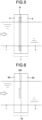
- FIG. 5 is a schematic top view of a state where the coating film 3 is removed from the coated film 1 in the coating film removing mechanism 7 illustrated in FIG. 2 as viewed from above through the film.
- the opening portion 16 extends in the film width direction, and its opening width is wider than the width of base film 4. Since the opening portion 16 extends in the film width direction, the removed substance 21 removed by the removing member 8 can be immediately sucked in the entire width of the film. Further, even when the coated film 1 meanders in the film width direction, the removed substance 21 can be immediately sucked within the range of the opening width because the opening width is wider than the width of the base film 4.
- the opening width is too wide with respect to the film width, since air is preferentially sucked from the opening portion 16 on the outer side of the film width, the ability to suck the removed substance 21, which is essential, deteriorates.
- the removed substance 21 can be immediately sucked by setting the opening width of the opening portion 16 to 150% or less with respect to the film width of the coated film 1 to become a target for removing.
- the opening width exceeded 150% with respect to the film width, it was difficult to suck the removed substance 21.
- FIG. 6 is a schematic top view of the coating film removing mechanism of the present invention according to a different aspect from FIG. 5 , and is a schematic top view illustrating a coating film removing mechanism 7B in which the opening width of an opening portion 16B is narrower than the film width.
- the coating film removing mechanism 7B illustrated in FIG. 6 is suitable when the fluidity of a removed substance 21 removed by a removing member 8B is high, and is particularly suitably used, for example, when a coating film containing a cleaning liquid or the like is removed.
- the removed substance 21 When the removed substance 21 has fluidity, the removed substance 21 flows in the film width direction to the opening portion 16B while running along the removing member 8B, and therefore even if the coated film 1 meanders in the film width direction, the removed substance 21 can be sucked and removed.
- the opening area of the opening portion 16B is narrowed, the suction wind speed or the suction pressure in the opening portion 16B can be increased, and the suction and removal can be more efficiently performed.
- the opening width is too narrower than the film width, the entire amount of the removed substance 21 removed by the removing member 8B cannot be completely sucked, and the opening portion 16B may be clogged.
- the removed substance 21 can be sucked and removed by setting the opening width of the opening portion 16B to 4% or more with respect to the film width of the coated film 1 to become a target for removing. In the case of being narrower than that, a phenomenon that the removed substance 21 blocks the opening portion 16B was sometimes observed.
- the tank 10 (see FIG. 1 ) connected from the pipe connection portion 20 of the coating film removing mechanisms 7 and 7B can not only accumulate the removed substance 21 sucked by the suction device 12 but also discharge the removed substance from a discharge port 11 to the outside after the operation of the equipment is stopped or during continuous operation.
- the removed substance 21 does not flow into the suction device 12, and failure of the suction device 12 can be prevented.
- the coated film 1 is set in the coating film removing equipment 101, and is conveyed from the unwinding device 2 to the winding device 5.
- the coating film 3 on the surface of the coated film 1 comes into contact with the tip portion 15 of the removing member 8, so that the coating film 3 is removed.
- the coating film 3 is sucked from the opening portion 16 of the coating film removing mechanism 7 as the removed substance 21.
- the removed substance 21 passes through the slit portion 17 from the opening portion 16, moves to the decompression chamber 18 and the pipe connection portion 20, and is accumulated in the tank 10. At this time, since the wind speed of the air sucked from the opening portion 16 is uniform suction wind speed in the width direction of the film, the removed substance 21 generated in the entire width of the film can be sucked in the opening portion 16.
- a cleaning liquid may be applied to the coating film 3 of the coated film 1 to be conveyed before the coating film 3 is brought into contact with the tip portion 15.
- a cleaning liquid applying device (not illustrated), a water tank that stores water as a cleaning liquid may be provided on the upstream side of the coating film removing mechanism 7 in the film conveyance direction, and a device that immerses the coated film 1 in cleaning water or directly applies a cleaning liquid to the surface of the coated film 1 may be provided.
- the device that directly applies a cleaning liquid include a high-pressure cleaning machine, a shower nozzle, a spray nozzle, and a steam nozzle.
- the cleaning liquid may be sucked together with the removed substance 21 by the coating film removing mechanism 7, and it is preferable that both the cleaning liquid and the removed substance 21 are accumulated in the tank 10 and discharged to the outside after the operation of the equipment is stopped or during continuous operation.
- the cleaning liquid can be accumulated in the tank 10, and therefore in the same manner as the accumulation of the removed substance 21, the suction device 12 can be prevented from directly sucking the cleaning liquid, and failure of the suction device 12 can be prevented.
- the pipe connection portion 20 has one connection point, but may have a plurality of connection points.
- the suction air volume is larger than that in the case of one point, and the suction wind speed can be increased.
- each of the plurality of pipe connection points sucks the removed substance 21 in a string shape, and as a result, the removed substance 21 may be accumulated inside the coating film removing mechanism 7.
- the coating film 3 is removed from the coated film 1 including the coating film 3 on one surface of the base film 4 has been described, but the same can be carried out even when the coating film 3 is removed from the coated film 1 including the coating film 3 on both surfaces of the base film 4.
- the coating film 3 on one surface of the coated film 1 may be removed by the coating film removing mechanism 7, and then the coating film 3 on the other surface of the coated film 1 may be removed by another coating film removing mechanism 7 after the coated film 1 is turned upside down.
- a polyvinyl alcohol resin as a water-soluble resin was formed to have a film thickness of 0.1 ⁇ m, and a curable silicone resin as a release component was further formed thereon to have a film thickness of 0.1 ⁇ m to prepare a coated film 1.
- the coated film 1 was set in the unwinding device 2 of the coating film removing equipment 101.
- the conveyance speed was set to 50 m/min, and coating film removing from the coated film 1 was performed while applying water in an amount of 0.1 L/m 2 as a cleaning liquid to the surface of the coating film 3 of the coated film 1 using a spray nozzle as a cleaning liquid applying device from a position spaced 400 mm apart on the upstream side of the coating film removing mechanism 7 in the film conveyance direction.
- the length of the tip portion 15 in the film width direction was set to 500 mm
- the opening width of the opening portion 16 and the width of the slit portion 17 were set to 200 mm
- the gap of the slit portion 17 was set to 2 mm
- the length (d1) of the slit portion 17 in the vertical direction in FIG. 2 was set to 3 mm.
- the center positions in the film width direction of the tip portion 15 and the opening portion 16 were matched with each other.
- the position (d2) of the opening portion 16 was set to close to the tip portion 15 of the removing member 8 at a distance of 3 mm.
- the angle ⁇ formed by the coated film 1 and the side surface of the removing member 8 on the upstream side was set to 45°, and the angle formed by the coated film 1 and the base film 4 was set to 90°.
- a ring blower (VFC608Z manufactured by TERAL INC.) was connected as the suction device 12, the suction wind speed at the opening portion 16 was set to 6 m/s, and the device was kept in continuous operation during coating film removing.
- the suction wind speed was measured using Climomaster (MODEL 6501-C0, manufactured by KANOMAX CORPORATION) in a state where the heights of the opening portion 16 and the tip portion 15 of the removing member 8 were matched and the base film was not in contact with the tip portion 15.
- the opening width of the opening portion 16 and the width of the slit portion 17 of the coating film removing mechanism 7 were each set to 300 mm.
- the other conditions were set in the same manner as in Example 1, and coating film removing was performed.
- the coated film 1 was conveyed for 10 minutes, and meandering of the coated film 1 occurred up to 10 mm in the film width direction.
- it could be verified that the removed substance 21 removed from the coated film 1 could be immediately sucked without depositing the removed substance 21 on the removing member 8 or clogging the opening portion 16 of the coating film removing mechanism 7, and there was no appearance that the removed substance 21 was reattached to the end portion of the base film 4.
- the film wound by the winding device 5 was analyzed using SEM-EDX, no component of the removed substance was detected.
- the width of each of the opening portion 16 and the slit portion 17 of the coating film removing mechanism 7 was set to 8 mm.
- the other conditions were set in the same manner as in Example 1, and coating film removing was performed.
- the coated film was conveyed for 10 minutes, and meandering of the coated film 1 occurred up to 10 mm in the film width direction.
- the removed substance 21 did not clog the opening portion 16 of the coating film removing mechanism 7, the removed substance 21 containing water flowed in the vicinity of the tip portion 15 of the removing member 8 in the film width direction, and could be sucked in the opening portion 16 without any problem. Further, there was no appearance of reattachment to the end portion of the base film 1.
- the film wound by the winding device 5 was analyzed using SEM-EDX, no component of the removed substance was detected.
Landscapes
- Engineering & Computer Science (AREA)
- Manufacturing & Machinery (AREA)
- Environmental & Geological Engineering (AREA)
- Mechanical Engineering (AREA)
- Folding Of Thin Sheet-Like Materials, Special Discharging Devices, And Others (AREA)
- Coating Apparatus (AREA)
- Application Of Or Painting With Fluid Materials (AREA)
Applications Claiming Priority (2)
| Application Number | Priority Date | Filing Date | Title |
|---|---|---|---|
| JP2022106831 | 2022-07-01 | ||
| PCT/JP2023/019709 WO2024004473A1 (ja) | 2022-07-01 | 2023-05-26 | 被膜剥離機構および被膜剥離装置 |
Publications (1)
| Publication Number | Publication Date |
|---|---|
| EP4549119A1 true EP4549119A1 (en) | 2025-05-07 |
Family
ID=89382724
Family Applications (1)
| Application Number | Title | Priority Date | Filing Date |
|---|---|---|---|
| EP23830924.9A Pending EP4549119A1 (en) | 2022-07-01 | 2023-05-26 | Coating detachment mechanism and coating detachment device |
Country Status (6)
| Country | Link |
|---|---|
| EP (1) | EP4549119A1 (https=) |
| JP (1) | JPWO2024004473A1 (https=) |
| KR (1) | KR20250026763A (https=) |
| CN (1) | CN119278123A (https=) |
| TW (1) | TW202415520A (https=) |
| WO (1) | WO2024004473A1 (https=) |
Family Cites Families (7)
| Publication number | Priority date | Publication date | Assignee | Title |
|---|---|---|---|---|
| JPS5720319A (en) * | 1980-07-11 | 1982-02-02 | Azuma Kogyo Kk | Production of elongated tape from magnetic substance-removed magnetic tape |
| JPS6260749A (ja) | 1985-09-12 | 1987-03-17 | Fuji Photo Film Co Ltd | 可撓性支持体の除塵方法及び装置 |
| JP2001179741A (ja) * | 1999-12-28 | 2001-07-03 | N Tsuu Syst Kk | シート上の塗布物の剥離方法及び剥離装置 |
| JP2001259538A (ja) * | 2000-03-21 | 2001-09-25 | Chuki Seiki Kk | フィルムから付着物を除去する方法及びその装置 |
| JP2012171276A (ja) | 2011-02-23 | 2012-09-10 | Teijin Dupont Films Japan Ltd | 熱可塑性樹脂フィルムの製造装置及び製造方法 |
| JP5937374B2 (ja) * | 2012-02-08 | 2016-06-22 | 帝人デュポンフィルム株式会社 | 熱可塑性樹脂フィルムの製造装置及び製造方法 |
| JP2020100119A (ja) * | 2018-12-25 | 2020-07-02 | セイコーエプソン株式会社 | 処理装置および処理方法 |
-
2023
- 2023-05-26 JP JP2023535422A patent/JPWO2024004473A1/ja active Pending
- 2023-05-26 WO PCT/JP2023/019709 patent/WO2024004473A1/ja not_active Ceased
- 2023-05-26 KR KR1020247038267A patent/KR20250026763A/ko active Pending
- 2023-05-26 CN CN202380043585.2A patent/CN119278123A/zh active Pending
- 2023-05-26 EP EP23830924.9A patent/EP4549119A1/en active Pending
- 2023-06-12 TW TW112121877A patent/TW202415520A/zh unknown
Also Published As
| Publication number | Publication date |
|---|---|
| TW202415520A (zh) | 2024-04-16 |
| WO2024004473A1 (ja) | 2024-01-04 |
| JPWO2024004473A1 (https=) | 2024-01-04 |
| CN119278123A (zh) | 2025-01-07 |
| KR20250026763A (ko) | 2025-02-25 |
Similar Documents
| Publication | Publication Date | Title |
|---|---|---|
| EP4306223A1 (en) | Method for separating coating from film with coating, and apparatus for separating coating | |
| KR101352855B1 (ko) | 기판의 표면을 처리하기 위한 장치 및 방법 | |
| EP4549119A1 (en) | Coating detachment mechanism and coating detachment device | |
| JPH1135201A (ja) | ベースフィルムの除塵方法及び装置 | |
| KR102152491B1 (ko) | 에어 나이프 및 이를 포함하는 분진 제거 장치 | |
| KR101464825B1 (ko) | 도포 장치 | |
| CN101096025A (zh) | 涂敷装置和涂敷方法 | |
| WO2024247486A1 (ja) | 被膜剥離装置および被膜剥離方法 | |
| CN1974459B (zh) | 溶剂回收系统 | |
| TW200824518A (en) | Conveyer for surface treatment | |
| JP2024020963A (ja) | 付着物除去装置、付着物除去方法、シート部材のリサイクル方法及び電子部品の製造方法 | |
| EP4484108A1 (en) | Coating film peeling device and coating film peeling method | |
| JP7826784B2 (ja) | 被膜剥離装置および被膜剥離方法 | |
| JP2002066430A (ja) | 塗布液吸引装置 | |
| TWI913410B (zh) | 從附有被膜之薄膜的被膜剝離方法及被膜剝離裝置 | |
| CN219534495U (zh) | 一种集成电路芯片用保护装置 | |
| JP7753909B2 (ja) | 被膜付きフィルムからの被膜の剥離装置および被膜の剥離方法 | |
| JP7704098B2 (ja) | 付着物除去装置、付着物除去方法、シート部材のリサイクル方法及び電子部品の製造方法 | |
| EP4737023A1 (en) | Coating peeling device and coating peeling method | |
| JP2024020961A (ja) | 付着物除去装置、付着物除去方法、シート部材のリサイクル方法及び電子部品の製造方法 | |
| KR100572450B1 (ko) | 스페이서 테이프의 세정장치 및 스페이서 테이프의 세정방법 | |
| CN119456568A (zh) | 烫金膜电化铝粉尘处理装置 | |
| JPS5864027A (ja) | 半導体製造装置 | |
| JP2007083188A (ja) | 塗布液吸引ノズル及び塗布液吸引装置 | |
| JPH0652962U (ja) | バーコータ塗布装置の塗布層厚調整機構 |
Legal Events
| Date | Code | Title | Description |
|---|---|---|---|
| STAA | Information on the status of an ep patent application or granted ep patent |
Free format text: STATUS: THE INTERNATIONAL PUBLICATION HAS BEEN MADE |
|
| PUAI | Public reference made under article 153(3) epc to a published international application that has entered the european phase |
Free format text: ORIGINAL CODE: 0009012 |
|
| STAA | Information on the status of an ep patent application or granted ep patent |
Free format text: STATUS: REQUEST FOR EXAMINATION WAS MADE |
|
| 17P | Request for examination filed |
Effective date: 20241114 |
|
| AK | Designated contracting states |
Kind code of ref document: A1 Designated state(s): AL AT BE BG CH CY CZ DE DK EE ES FI FR GB GR HR HU IE IS IT LI LT LU LV MC ME MK MT NL NO PL PT RO RS SE SI SK SM TR |
|
| DAV | Request for validation of the european patent (deleted) | ||
| DAX | Request for extension of the european patent (deleted) |