EP4545876A1 - Wärmequelleneinheit - Google Patents
Wärmequelleneinheit Download PDFInfo
- Publication number
- EP4545876A1 EP4545876A1 EP24801460.7A EP24801460A EP4545876A1 EP 4545876 A1 EP4545876 A1 EP 4545876A1 EP 24801460 A EP24801460 A EP 24801460A EP 4545876 A1 EP4545876 A1 EP 4545876A1
- Authority
- EP
- European Patent Office
- Prior art keywords
- refrigerant
- pipe
- heat source
- liquid
- gas
- Prior art date
- Legal status (The legal status is an assumption and is not a legal conclusion. Google has not performed a legal analysis and makes no representation as to the accuracy of the status listed.)
- Pending
Links
Images

Classifications
-
- F—MECHANICAL ENGINEERING; LIGHTING; HEATING; WEAPONS; BLASTING
- F25—REFRIGERATION OR COOLING; COMBINED HEATING AND REFRIGERATION SYSTEMS; HEAT PUMP SYSTEMS; MANUFACTURE OR STORAGE OF ICE; LIQUEFACTION SOLIDIFICATION OF GASES
- F25B—REFRIGERATION MACHINES, PLANTS OR SYSTEMS; COMBINED HEATING AND REFRIGERATION SYSTEMS; HEAT PUMP SYSTEMS
- F25B13/00—Compression machines, plants or systems, with reversible cycle
-
- F—MECHANICAL ENGINEERING; LIGHTING; HEATING; WEAPONS; BLASTING
- F25—REFRIGERATION OR COOLING; COMBINED HEATING AND REFRIGERATION SYSTEMS; HEAT PUMP SYSTEMS; MANUFACTURE OR STORAGE OF ICE; LIQUEFACTION SOLIDIFICATION OF GASES
- F25B—REFRIGERATION MACHINES, PLANTS OR SYSTEMS; COMBINED HEATING AND REFRIGERATION SYSTEMS; HEAT PUMP SYSTEMS
- F25B40/00—Subcoolers, desuperheaters or superheaters
-
- F—MECHANICAL ENGINEERING; LIGHTING; HEATING; WEAPONS; BLASTING
- F25—REFRIGERATION OR COOLING; COMBINED HEATING AND REFRIGERATION SYSTEMS; HEAT PUMP SYSTEMS; MANUFACTURE OR STORAGE OF ICE; LIQUEFACTION SOLIDIFICATION OF GASES
- F25B—REFRIGERATION MACHINES, PLANTS OR SYSTEMS; COMBINED HEATING AND REFRIGERATION SYSTEMS; HEAT PUMP SYSTEMS
- F25B41/00—Fluid-circulation arrangements
- F25B41/20—Disposition of valves, e.g. of on-off valves or flow control valves
- F25B41/24—Arrangement of shut-off valves for disconnecting a part of the refrigerant cycle, e.g. an outdoor part
-
- F—MECHANICAL ENGINEERING; LIGHTING; HEATING; WEAPONS; BLASTING
- F25—REFRIGERATION OR COOLING; COMBINED HEATING AND REFRIGERATION SYSTEMS; HEAT PUMP SYSTEMS; MANUFACTURE OR STORAGE OF ICE; LIQUEFACTION SOLIDIFICATION OF GASES
- F25B—REFRIGERATION MACHINES, PLANTS OR SYSTEMS; COMBINED HEATING AND REFRIGERATION SYSTEMS; HEAT PUMP SYSTEMS
- F25B45/00—Arrangements for charging or discharging refrigerant
-
- F—MECHANICAL ENGINEERING; LIGHTING; HEATING; WEAPONS; BLASTING
- F25—REFRIGERATION OR COOLING; COMBINED HEATING AND REFRIGERATION SYSTEMS; HEAT PUMP SYSTEMS; MANUFACTURE OR STORAGE OF ICE; LIQUEFACTION SOLIDIFICATION OF GASES
- F25B—REFRIGERATION MACHINES, PLANTS OR SYSTEMS; COMBINED HEATING AND REFRIGERATION SYSTEMS; HEAT PUMP SYSTEMS
- F25B2313/00—Compression machines, plants or systems with reversible cycle not otherwise provided for
- F25B2313/023—Compression machines, plants or systems with reversible cycle not otherwise provided for using multiple indoor units
- F25B2313/0233—Compression machines, plants or systems with reversible cycle not otherwise provided for using multiple indoor units in parallel arrangements
-
- F—MECHANICAL ENGINEERING; LIGHTING; HEATING; WEAPONS; BLASTING
- F25—REFRIGERATION OR COOLING; COMBINED HEATING AND REFRIGERATION SYSTEMS; HEAT PUMP SYSTEMS; MANUFACTURE OR STORAGE OF ICE; LIQUEFACTION SOLIDIFICATION OF GASES
- F25B—REFRIGERATION MACHINES, PLANTS OR SYSTEMS; COMBINED HEATING AND REFRIGERATION SYSTEMS; HEAT PUMP SYSTEMS
- F25B2345/00—Details for charging or discharging refrigerants; Service stations therefor
- F25B2345/001—Charging refrigerant to a cycle
-
- F—MECHANICAL ENGINEERING; LIGHTING; HEATING; WEAPONS; BLASTING
- F25—REFRIGERATION OR COOLING; COMBINED HEATING AND REFRIGERATION SYSTEMS; HEAT PUMP SYSTEMS; MANUFACTURE OR STORAGE OF ICE; LIQUEFACTION SOLIDIFICATION OF GASES
- F25B—REFRIGERATION MACHINES, PLANTS OR SYSTEMS; COMBINED HEATING AND REFRIGERATION SYSTEMS; HEAT PUMP SYSTEMS
- F25B2400/00—General features or devices for refrigeration machines, plants or systems, combined heating and refrigeration systems or heat-pump systems, i.e. not limited to a particular subgroup of F25B
- F25B2400/12—Inflammable refrigerants
- F25B2400/121—Inflammable refrigerants using R1234
-
- F—MECHANICAL ENGINEERING; LIGHTING; HEATING; WEAPONS; BLASTING
- F25—REFRIGERATION OR COOLING; COMBINED HEATING AND REFRIGERATION SYSTEMS; HEAT PUMP SYSTEMS; MANUFACTURE OR STORAGE OF ICE; LIQUEFACTION SOLIDIFICATION OF GASES
- F25B—REFRIGERATION MACHINES, PLANTS OR SYSTEMS; COMBINED HEATING AND REFRIGERATION SYSTEMS; HEAT PUMP SYSTEMS
- F25B2400/00—General features or devices for refrigeration machines, plants or systems, combined heating and refrigeration systems or heat-pump systems, i.e. not limited to a particular subgroup of F25B
- F25B2400/16—Receivers
Definitions
- the present disclosure relates to a heat source unit of an air conditioner using a non-azeotropic mixed refrigerant.
- the refrigeration cycle can be filled with the refrigerant before shipment from the factory because a closed refrigerant circuit is already formed in the factory, and the refrigeration cycle cannot be applied to a split air conditioner in which a refrigerant circuit is formed by connecting a utilization unit and a heat source unit with a pipe at an installation location.
- a heat source unit is connected to a utilization unit via a pipe at an installation location to constitute a refrigerant circuit.
- a refrigerant filled in the heat source unit is a non-azeotropic mixed refrigerant having a temperature glide of 1°C or higher during evaporation and condensation.
- the heat source unit is filled in advance with the refrigerant in an amount required for the refrigerant circuit when a length of the pipe is a first length that eliminates the need for additionally filling the refrigerant circuit with the refrigerant.
- the heat source unit is filled with the refrigerant in advance to save on-site filling work, and thus, the composition ratio of the non-azeotropic mixed refrigerant can be maintained.
- a heat source unit is the heat source unit according to the first aspect, in which the utilization unit as one utilization unit is connected to the heat source unit to constitute the refrigerant circuit.
- a heat source unit is the heat source unit according to the first aspect, in which a plurality of the utilization units are connected in parallel to the heat source unit to constitute the refrigerant circuit.
- a heat source unit according to a fourth aspect is the heat source unit according to any one of the first to third aspects, in which the temperature glide during evaporation and condensation of the refrigerant is 5°C or higher.
- a heat source unit is the heat source unit according to any one of the first to fourth aspects, in which the pipe that is equal to or larger than a 2.5/8-inch pipe (having an outer diameter of 7.93 mm) and through which a liquid refrigerant or a gas-liquid mixed refrigerant flows is connected to the heat source unit.
- the pipe diameter of the pipe through which a liquid refrigerant or a gas-liquid mixed refrigerant flows needs to be increased, and the filling amount of the refrigerant increases.
- the risk that the composition ratio of the refrigerant changes during filling on site increases. Therefore, in the heat source unit, there is a great advantage of filling the heat source unit with the refrigerant in advance in terms of maintaining the composition ratio of the non-azeotropic mixed refrigerant.
- a heat source unit is the heat source unit according to the fifth aspect, in which the pipe through which the liquid refrigerant or the gas-liquid mixed refrigerant flows is a 2.5/8-inch pipe (having an outer diameter of 7.93 mm).
- a 2.5/8-inch pipe is suitable as the pipe through which the liquid refrigerant or the gas-liquid mixed refrigerant flows from both viewpoints of "reduction of pressure loss” and "reduction of an additional refrigerant filling amount”.
- a heat source unit is the heat source unit according to any one of the first to sixth aspects, in which an amount of the refrigerant filled in advance in the heat source unit is two to three times an amount of an R32 refrigerant required in the refrigerant circuit as a whole when the refrigerant circuit in which the length of the pipe is set to the first length is filled with the R32 refrigerant.
- Some non-azeotropic mixed refrigerants require a filling amount two to three times the amount of R32 refrigerant having a temperature glide of 0, and such a refrigerant has a high risk of changing the composition ratio at the time of on-site filling. Therefore, in the heat source unit, there is a great advantage of filling the heat source unit with the refrigerant in advance in terms of maintaining the composition ratio of the non-azeotropic mixed refrigerant.
- a heat source unit according to an eighth aspect is the heat source unit according to any one of the first to seventh aspects, in which the first length is 30 m.
- a heat source unit is the heat source unit according to any one of the first to eighth aspects, and includes a first shutoff valve, a second shutoff valve, and a heat source circuit.
- the heat source circuit is a flow path of the refrigerant from the first shutoff valve to the second shutoff valve, and constitutes a part of the refrigerant circuit.
- the heat source circuit includes a compressor, a heat exchanger, and a decompressor. The compressor, the heat exchanger, and the decompressor are connected in order.
- the heat source circuit further includes a high-pressure receiver connected between the heat exchanger and the decompressor.
- a heat source unit is the heat source unit according to the ninth aspect, in which a volume ratio of the high-pressure receiver to the heat exchanger is in a range of 0.04 to 0.6.
- FIG. 1 is a circuit diagram of a refrigerant circuit 10 of an air conditioner 1 according to a first embodiment of the present disclosure.
- one indoor unit 30 as a utilization unit is connected to one outdoor unit 20 as a heat source unit via a liquid refrigerant pipe 5 and a gas refrigerant pipe 6.
- the refrigerant filled in the refrigerant circuit 10 is a non-azeotropic mixed refrigerant having a temperature glide of 1°C or higher during evaporation and condensation.
- the refrigerant is filled after the outdoor unit 20 and the indoor unit 30 are connected via the liquid refrigerant pipe 5 and the gas refrigerant pipe 6 at the installation location of the air conditioner 1.
- the outdoor unit 20 before the liquid refrigerant pipe 5 and the gas refrigerant pipe 6 are connected is filled in advance with the refrigerant in an amount required in the refrigerant circuit 10 as a whole when the lengths of the liquid refrigerant pipe 5 and the gas refrigerant pipe 6 are set to a predetermined first length L1 regardless of the actual lengths of the liquid refrigerant pipe 5 and the gas refrigerant pipe 6.
- the outdoor unit 20 includes a compressor 11, a four-way switching valve 13, an outdoor heat exchanger 15, a bridge circuit unit 17, a liquid gas heat exchanger 19, a high-pressure receiver 21, an expansion valve 23, a liquid-side shutoff valve 25, a gas-side shutoff valve 26, and an accumulator 27.
- the compressor 11, the four-way switching valve 13, the outdoor heat exchanger 15, the bridge circuit unit 17, the liquid gas heat exchanger 19, the high-pressure receiver 21, the expansion valve 23, and the accumulator 27 are provided in a refrigerant flow path from the liquid-side shutoff valve 25 to the gas-side shutoff valve 26, and constitute a heat source circuit 20a that is a part of the refrigerant circuit 10.
- an outdoor fan 29 that generates an air flow is disposed to promote heat exchange between air and the outdoor heat exchanger 15.
- the compressor 11 includes a suction port 11a and a discharge port 11b.
- the refrigerant flows into the compressor 11 through the suction port 11a, is compressed to have a high temperature and a high pressure, and flows out from the discharge port 11b.
- the four-way switching valve 13 includes a first port P1, a second port P2, a third port P3, and a fourth port P4.
- the first port P1 is linked to the discharge port 11b of the compressor 11.
- the second port P2 is linked to the outdoor heat exchanger 15.
- the third port P3 is linked to the suction port 11a of the compressor 11 via the liquid gas heat exchanger 19 and the accumulator 27.
- the fourth port P4 is linked to the gas-side shutoff valve 26.
- the outdoor heat exchanger 15 is an air heat exchanger.
- the outdoor heat exchanger 15 causes heat exchange between the refrigerant flowing inside and outside air sent from the outdoor fan 29.
- a fin-and-tube heat exchanger is employed as the outdoor heat exchanger 15.
- a first connection point S1 between the check valve 17a and the check valve 17b is linked to the outdoor heat exchanger 15.
- a second connection point S2 between the check valve 17a and the check valve 17c is linked to the expansion valve 23.
- a third connection point S3 between the check valve 17c and the check valve 17d is linked to the liquid-side shutoff valve 25.
- a fourth connection point S4 between the check valve 17b and the check valve 17d is linked to a liquid pipe 19a of the liquid gas heat exchanger 19.
- the liquid gas heat exchanger 19 causes heat exchange between a high-pressure refrigerant flowing through the liquid pipe 19a and a low-pressure refrigerant flowing through a gas pipe 19b.
- the liquid gas heat exchanger 19 is a double pipe heat exchanger.
- the high-pressure receiver 21 temporarily stores the refrigerant subcooled by the liquid gas heat exchanger 19.
- the expansion valve 23 is disposed between an outlet of the high-pressure receiver 21 and the second connection point S2 of the bridge circuit unit 17.
- the expansion valve 23 decompresses the refrigerant flowing from the high-pressure receiver 21 toward the second connection point S2 of the bridge circuit unit 17 to a predetermined low pressure.
- the liquid-side shutoff valve 25 is connected between the third connection point S3 of the bridge circuit unit 17 and an indoor heat exchanger 35.
- the liquid-side shutoff valve 25 and the indoor heat exchanger 35 are connected by the liquid refrigerant pipe 5.
- the gas-side shutoff valve 26 is connected in series with the four-way switching valve 13 between the four-way switching valve 13 and the indoor heat exchanger 35.
- the gas-side shutoff valve 26 and the indoor heat exchanger 35 are connected by the gas refrigerant pipe 6.
- the accumulator 27 is connected between the four-way switching valve 13 and the suction port 11a of the compressor 11.
- the accumulator 24 collects a liquid refrigerant that has not been gasified in an evaporator, and prevents the liquid refrigerant from flowing into the suction port 11a of the compressor 11.
- the outdoor fan 29 generates an air flow to promote heat exchange between the refrigerant flowing in the outdoor heat exchanger 15 and air.
- the outdoor fan 29 is a propeller fan.
- the indoor heat exchanger 35 is disposed in the indoor unit 30.
- An indoor fan 37 that generates an air flow is disposed in the indoor unit 30 to promote heat exchange between air and the indoor heat exchanger 35.
- the indoor heat exchanger 35 is an air heat exchanger.
- the indoor heat exchanger 35 causes heat exchange between the refrigerant flowing inside and indoor air sent from the indoor fan 37.
- a fin-and-tube heat exchanger is employed as the indoor heat exchanger 35.
- the indoor heat exchanger 35 has one end connected to the liquid-side shutoff valve 25 via the liquid refrigerant pipe 5 and the other end connected to the gas-side shutoff valve 26 via the gas refrigerant pipe 6.
- the indoor fan 37 generates an air flow to promote heat exchange between the refrigerant flowing inside the indoor heat exchanger 35 and the indoor air.
- the indoor fan 37 is a sirocco fan.
- the liquid refrigerant pipe 5 and the gas refrigerant pipe 6 connect the outdoor unit 20 and the indoor unit 30 to constitute the refrigerant circuit 10.
- the lengths of the liquid refrigerant pipe 5 and the gas refrigerant pipe 6 are determined in accordance with the installation positions of the outdoor unit 20 and the indoor unit 30.
- the liquid refrigerant pipe 5 links the liquid-side shutoff valve 25 of the outdoor unit 20 and a refrigerant inlet of the indoor heat exchanger 35 of the indoor unit 30 during a cooling operation (a refrigerant outlet during a heating operation).
- the gas refrigerant pipe 6 links the gas-side shutoff valve 26 of the outdoor unit 20 and the refrigerant outlet of the indoor heat exchanger 35 of the indoor unit 30 during the cooling operation (the refrigerant inlet during the heating operation).
- the pipe diameter of the liquid refrigerant pipe 5 needs to be increased, and a 2.5/8-inch pipe (having an outer diameter of 7.93 mm) or a larger pipe is desirable.
- the filling amount of the refrigerant increases, and as the filling amount increases, the risk that the composition ratio of the refrigerant changes during filling on site increases. Therefore, in the air conditioner 1, there is a great advantage of filling the outdoor unit 20 with the refrigerant in advance in terms of maintaining the composition ratio of the non-azeotropic mixed refrigerant.
- a control unit 40 controls an operating frequency of the compressor 11, switching of the four-way switching valve 13, an opening degree of the expansion valve 23, and the like.
- the control unit 40 includes a printed circuit board equipped with a microprocessor and a memory.
- the refrigerant used in the present embodiment is a non-azeotropic mixed refrigerant.
- the non-azeotropic mixed refrigerant two or more refrigerants having different boiling points are mixed. Since the refrigerant having a higher boiling point condenses earlier than the refrigerant having a lower boiling point, the isotherm of the non-azeotropic mixed refrigerant goes down to the right from the saturated liquid line toward the saturated vapor line. Therefore, temperature glide is generated in the saturated liquid line and the saturated vapor line under the same pressure condition.
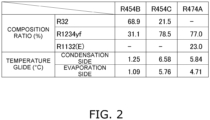
- FIG. 2 is a table showing the composition ratio and the temperature glide of the non-azeotropic mixed refrigerant used in the present embodiment. Physical property values of R454B, R454C, and R474A are determined on the basis of the composition ratio shown in FIG. 2 .
- the operation of the air conditioner 1 will be described by taking the cooling operation and the heating operation as examples.
- the four-way switching valve 13 is maintained in a state indicated by solid lines in FIG. 1 .
- the high-temperature and high-pressure gas refrigerant discharged from the compressor 11 flows into the outdoor heat exchanger 15 via the four-way switching valve 13, and exchanges heat with outdoor air to be condensed.
- the condensed refrigerant flows into the liquid pipe 19a of the liquid gas heat exchanger 19 through the first connection point S1, the check valve 17b, and the fourth connection point S4 of the bridge circuit unit 17.
- the refrigerant flowing through the liquid pipe 19a exchanges heat with the refrigerant flowing through the gas pipe 19b to be subcooled.
- the refrigerant having flowed through the liquid pipe 19a is temporarily stored in the high-pressure receiver 21.
- the refrigerant flowing out of the high-pressure receiver 21 is decompressed to a predetermined low pressure in the expansion valve 23.
- the refrigerant decompressed by the expansion valve 23 flows into the indoor heat exchanger 35 through the second connection point S2, the check valve 17c, and the third connection point S3 of the bridge circuit unit 17.
- the refrigerant exchanges heat with the indoor air in the indoor heat exchanger 35 and evaporates.
- the indoor air cooled by the evaporation of the refrigerant is blown into an indoor space by the corresponding indoor fan 37 to cool the indoor space.
- the refrigerant flowing through the gas pipe 19b exchanges heat with the refrigerant flowing through the liquid pipe 19a to become superheated steam.
- the refrigerant having flowed through the gas pipe 19b is sucked into the compressor 11 through the accumulator 27.
- the indoor air heated by the heat exchange with the refrigerant is blown into the indoor space by the indoor fan 37 to heat the indoor space.
- the refrigerant condensed in the indoor heat exchanger 35 flows through the liquid refrigerant pipe 5 to reach the bridge circuit unit 17.
- the refrigerant flows into the liquid pipe 19a of the liquid gas heat exchanger 19 through the third connection point S3, the check valve 17d, and the fourth connection point S4 of the bridge circuit unit 17.
- the refrigerant flowing through the liquid pipe 19a exchanges heat with the refrigerant flowing through the gas pipe 19b to be subcooled.
- the refrigerant having flowed through the liquid pipe 19a is temporarily stored in the high-pressure receiver 21.
- the refrigerant flowing out of the high-pressure receiver 21 is decompressed to a predetermined low pressure by the expansion valve 23.
- the decompressed refrigerant flows into the outdoor heat exchanger 15 through the second connection point S2, the check valve 17a, and the first connection point S1 of the bridge circuit unit 17.
- the refrigerant exchanges heat with the outdoor air in the outdoor heat exchanger 15 and evaporates.
- the refrigerant evaporated in the outdoor heat exchanger 15 flows into the gas pipe 19b of the liquid gas heat exchanger 19 through the four-way switching valve 13.
- the refrigerant flowing through the gas pipe 19b exchanges heat with the refrigerant flowing through the liquid pipe 19a to become superheated steam.
- the refrigerant having flowed through the gas pipe 19b is sucked into the compressor 11 through the accumulator 27.
- the refrigerant is filled after the outdoor unit 20 and the indoor unit 30 are connected via the liquid refrigerant pipe 5 and the gas refrigerant pipe 6 at the installation location of the air conditioner 1.
- the lengths of the liquid refrigerant pipe 5 and the gas refrigerant pipe 6 are determined in accordance with the installation positions of the outdoor unit 20 and the indoor unit 30.
- the air conditioner 1 according to the present embodiment, a non-azeotropic mixed refrigerant is used, and there is a high risk that the composition ratio changes at the time of refrigerant filling after installation. Therefore, it is necessary to reduce the risk.
- the heat source circuit 20a of the outdoor unit 20 is filled in advance with an amount of refrigerant corresponding to the required amount of refrigerant in the refrigerant circuit 10 when the liquid refrigerant pipe 5 and the gas refrigerant pipe 6 have the predetermined first length L1.
- the first length L1 is a length that eliminates the need for additionally filling the refrigerant into the refrigerant circuit 10 constituted by connecting the outdoor unit 20 and the indoor unit 30 via the liquid refrigerant pipe 5 and the gas refrigerant pipe 6.
- the first length L1 is set to 30 m.
- the refrigerant is filled in the outdoor heat exchanger 15, the liquid gas heat exchanger 19, the high-pressure receiver 21, the accumulator 27, and the pipes connecting the above included in the heat source circuit 20a of the outdoor unit 20.
- the amount of the non-azeotropic mixed refrigerant filled in advance in the outdoor unit 20 needs to be, for example, two to three times an amount of R32 refrigerant required in the refrigerant circuit 10 as a whole when the refrigerant circuit 10 in which the liquid refrigerant pipe 5 and the gas refrigerant pipe 6 are set to the first length is filled with the R32 refrigerant.
- a pipe diameter in the outdoor unit 20 is made larger than a pipe diameter in the indoor unit 30.
- the volume ratio of the outdoor heat exchanger 15 to the indoor heat exchanger 35 is set to three or more in order that the amount of refrigerant filled in advance in the outdoor unit 20 satisfies the amount of refrigerant required in the refrigerant circuit 10 as a whole.
- the volume ratio of the high-pressure receiver 21 to the outdoor heat exchanger 15 within a range of 0.04 to 0.6, the amount of refrigerant filled in advance in the outdoor unit 20 required in the refrigerant circuit 10 as a whole can be satisfied with a margin.
- the installation work of the air conditioner 1 includes a step of installing the outdoor unit 20 and the indoor unit 30 at installation locations, a step of connecting the outdoor unit 20 and the indoor unit 30 via the liquid refrigerant pipe 5 and the gas refrigerant pipe 6, and a step of sending the refrigerant filled in the outdoor unit 20 to the refrigerant circuit 10.
- the refrigerant circuit 10 is filled by opening the liquid-side shutoff valve 25 and the gas-side shutoff valve 26.
- the outdoor unit 20 and the indoor unit 30 are connected via the liquid refrigerant pipe 5 and the gas refrigerant pipe 6 at the installation locations to constitute the refrigerant circuit 10.
- the refrigerant filled in the refrigerant circuit 10 is a non-azeotropic mixed refrigerant having a temperature glide of 1°C or higher during evaporation and condensation.
- the lengths of the liquid refrigerant pipe 5 and the gas refrigerant pipe 6 are determined in accordance with the installation positions of the outdoor unit 20 and the indoor unit 30.
- the outdoor unit 20 is filled in advance with an amount of refrigerant corresponding to the required amount of refrigerant in the refrigerant circuit 10 when the liquid refrigerant pipe 5 and the gas refrigerant pipe 6 have the first length L1.
- the outdoor unit 20 is filled with the refrigerant in advance to save on-site filling work, and thus, the composition ratio of the non-azeotropic mixed refrigerant can be maintained.
- the liquid refrigerant pipe 5 is desirably a 2.5/8-inch pipe (having an outer diameter of 7.93 mm) or a larger pipe.
- the pipe diameter of the liquid refrigerant pipe 5 needs to be increased, and the filling amount of the refrigerant increases.
- the risk that the composition ratio of the refrigerant changes during filling on site increases. Therefore, in the air conditioner 1, there is a great advantage of filling the outdoor unit 20 with the refrigerant in advance in terms of maintaining the composition ratio of the non-azeotropic mixed refrigerant.
- the amount of the non-azeotropic mixed refrigerant filled in advance in the outdoor unit 20 is two to three times an amount of single R32 refrigerant required in the refrigerant circuit 10 as a whole when the refrigerant circuit 10 in which the lengths of the liquid refrigerant pipe 5 and the gas refrigerant pipe 6 are set to the first length L1 is filled with the R32 refrigerant.
- Some non-azeotropic mixed refrigerants require a filling amount two to three times the amount of R32 refrigerant having a temperature glide of 0, and such a refrigerant has a high risk of changing the composition ratio at the time of on-site filling. Therefore, in the air conditioner 1, there is a great advantage of filling the outdoor unit 20 with the refrigerant in advance in terms of maintaining the composition ratio of the non-azeotropic mixed refrigerant.
- the volume ratio of the outdoor heat exchanger 15 to the indoor heat exchanger 35 is three or more. As a result, the amount of refrigerant filled in advance in the outdoor unit 20 can satisfy the amount of refrigerant required in the refrigerant circuit 10 as a whole.
- the high-pressure receiver 21 is connected between the outdoor heat exchanger 15 and the expansion valve 23.
- the volume ratio of the high-pressure receiver 21 to the outdoor heat exchanger 15 is in a range of 0.04 to 0.6.
- the amount of refrigerant corresponding to an internal volume of the high-pressure receiver 21 can be included in the amount of refrigerant that can be filled in advance in the outdoor unit 20.
- the refrigerant circuit 10 is provided with the liquid gas heat exchanger 19 that causes heat exchange between a high-pressure liquid refrigerant and a low-pressure gas refrigerant.
- the liquid gas heat exchanger 19 is a double pipe heat exchanger.
- the amount of refrigerant corresponding to an internal volume of the liquid gas heat exchanger 19 can be included in the amount of refrigerant that can be filled in advance in the outdoor unit 20.
- a worker who performs installation work of the air conditioner 1 determines whether the lengths of the liquid refrigerant pipe 5 and the gas refrigerant pipe 6 required for the installation work of the air conditioner 1 are equal to or less than the first length L1.
- the refrigerant filled in the outdoor unit 20 is equal to or more than the required amount of refrigerant, and thus, a step of additionally filling the refrigerant is unnecessary. Therefore, after the outdoor unit 20 and the indoor unit 30 are connected via the liquid refrigerant pipe 5 and the gas refrigerant pipe 6 without performing the step of additionally filling the refrigerant, the installation work ends.
- the amount of refrigerant filled in the outdoor unit 20 is equal to or more than the required amount of refrigerant in the refrigerant circuit 10 when the lengths of the liquid refrigerant pipe 5 and the gas refrigerant pipe 6 are equal to or less than the first length L1.
- the refrigerant filled in advance in the outdoor unit 20 is insufficient for the required amount of refrigerant, and thus the step of additionally filling the refrigerant is necessary.
- the step of additionally filling the refrigerant is performed, and the refrigerant circuit 10 is additionally filled with an amount of refrigerant corresponding to the lengths of the liquid refrigerant pipe 5 and the gas refrigerant pipe 6.
- the refrigerant is additionally filled, for example, from a service port of the liquid-side shutoff valve 25 or the gas-side shutoff valve 26.
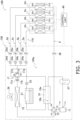
- FIG. 3 is a circuit diagram of a refrigerant circuit 110 of an air conditioner 100 according to a second embodiment of the present disclosure.
- the air conditioner 100 is a multi-chamber air conditioner, and a plurality of indoor units 30a, 30b, 30c, and 30d as utilization units are connected in parallel to one outdoor unit 120 as a heat source unit.
- the compressor 11, the four-way switching valve 13, the outdoor heat exchanger 15, the bridge circuit unit 17, the liquid gas heat exchanger 19, the high-pressure receiver 21, the expansion valve 23, and the accumulator 27 are provided in the flow path of the refrigerant from liquid-side shutoff valves 25a, 25b, 25c, and 25d to the gas-side shutoff valve 26, and constitute a heat source circuit 120a as a part of the refrigerant circuit 10.
- the compressor 11, the four-way switching valve 13, the outdoor heat exchanger 15, the bridge circuit unit 17, the liquid gas heat exchanger 19, the high-pressure receiver 21, the expansion valve 23, and the refrigerant to be filled are common to those in the first embodiment, and thus will not be described.
- second expansion valves 24a, 24b, 24c, and 24d are connected in parallel.
- the second expansion valves 24a, 24b, 24c, and 24d are connected in series to the corresponding liquid-side shutoff valves 25a, 25b, 25c, and 25d.
- the liquid-side shutoff valves 25a, 25b, 25c, and 25d are connected in series to the corresponding second expansion valves 24a, 24b, 24c, and 24d between the corresponding second expansion valves 24a, 24b, 24c, and 24d and corresponding indoor heat exchangers 35a, 35b, 35c, and 35d.
- liquid-side shutoff valves 25a, 25b, 25c, and 25d and the corresponding indoor heat exchangers 35a, 35b, 35c, and 35d are connected by corresponding liquid refrigerant pipes 5a, 5b, 5c, and 5d.
- the indoor heat exchangers 35a, 35b, 35c, and 35d are disposed in the indoor units 30a, 30b, 30c, and 30d, respectively.
- Indoor fans 37a, 37b, 37c, and 37d that generate air flows are respectively disposed in the indoor units 30a, 30b, 30c, and 30d to promote heat exchange between air and the indoor heat exchangers 35a, 35b, 35c, and 35d.
- the indoor heat exchangers 35a, 35b, 35c, and 35d are air heat exchangers.
- the indoor heat exchangers 35a, 35b, 35c, and 35d cause heat exchange between the refrigerant flowing inside and the indoor air sent from the corresponding indoor fans 37a, 37b, 37c, and 37d.
- fin-and-tube heat exchangers are employed as the indoor heat exchangers 35a, 35b, 35c, and 35d.
- the indoor heat exchanger 35a has one end connected to the liquid-side shutoff valve 25a via the liquid refrigerant pipe 5a and the other end connected to the gas-side shutoff valve 26.
- the indoor heat exchanger 35b has one end connected to the liquid-side shutoff valve 25b via the liquid refrigerant pipe 5b and the other end connected to the gas-side shutoff valve 26 via the gas refrigerant pipe 6.
- the indoor heat exchanger 35c has one end connected to the liquid-side shutoff valve 25c via the liquid refrigerant pipe 5c and the other end connected to the gas-side shutoff valve 26 via the gas refrigerant pipe 6.
- the indoor heat exchanger 35d has one end connected to the liquid-side shutoff valve 25d via the liquid refrigerant pipe 5d and the other end connected to the gas-side shutoff valve 26 via the gas refrigerant pipe 6.
- the indoor fans 37a, 37b, 37c, and 37d generate an air flow to promote heat exchange between the refrigerant flowing inside the corresponding indoor heat exchangers 35a, 35b, 35c, and 35d and air.
- the indoor fans 37a, 37b, 37c, and 37d are sirocco fans.
- the liquid refrigerant pipes 5a, 5b, 5c, and 5d and the gas refrigerant pipe 6 connect the outdoor unit 120 and the indoor units 30a, 30b, 30c, and 30d to constitute the refrigerant circuit 110.
- the lengths of the liquid refrigerant pipes 5a, 5b, 5c, and 5d and the gas refrigerant pipe 6 are determined in accordance with the installation positions of the outdoor unit 120 and the indoor units 30a, 30b, 30c, and 30d.
- the liquid refrigerant pipes 5a, 5b, 5c, and 5d link the corresponding liquid-side shutoff valves 25a, 25b, 25c, and 25d of the outdoor unit 120 and refrigerant inlets of the corresponding indoor heat exchangers 35a, 35b, 35c, and 35d during the cooling operation (refrigerant outlets during the heating operation).
- the gas refrigerant pipe 6 connects the gas-side shutoff valve 26 of the outdoor unit 120 and the refrigerant outlet of the indoor heat exchangers 35a, 35b, 35d, and 35c during the cooling operation (the refrigerant inlet during the heating operation).
- the pipe diameters of the liquid refrigerant pipes 5a, 5b, 5c, and 5d need to be increased, and 2.5/8-inch pipes (having an outer diameter of 7.93 mm) or larger pipes are desirable.
- the filling amount of the refrigerant increases, and as the filling amount increases, the risk that the composition ratio of the refrigerant changes during filling on site increases. Therefore, in the air conditioner 100, there is a great advantage of filling the outdoor unit 120 with the refrigerant in advance in terms of maintaining the composition ratio of the non-azeotropic mixed refrigerant.
- the control unit 40 controls the operating frequency of compressor 11, switching of the four-way switching valve 13, the opening degree of the expansion valve 23, an opening degree of second expansion valves 24a, 24b, 24c, and 24d, and the like.
- the control unit 40 includes a printed circuit board equipped with a microprocessor and a memory.
- the operation of the air conditioner 100 will be described by taking the cooling operation and the heating operation as examples.
- the four-way switching valve 13 is maintained in a state indicated by solid lines in FIG. 3 .
- the expansion valve 23 is controlled such that a valve opening degree is fully opened.
- the high-temperature and high-pressure gas refrigerant discharged from the compressor 11 flows into the outdoor heat exchanger 15 via the four-way switching valve 13, and exchanges heat with outdoor air to be condensed.
- the condensed refrigerant flows into the liquid pipe 19a of the liquid gas heat exchanger 19 through the first connection point S1, the check valve 17b, and the fourth connection point S4 of the bridge circuit unit 17.
- the refrigerant flowing through the liquid pipe 19a exchanges heat with the refrigerant flowing through the gas pipe 19b to be subcooled.
- the refrigerant having flowed through the liquid pipe 19a is temporarily stored in the high-pressure receiver 21. Then, the refrigerant flowing out of the high-pressure receiver 21 passes through the expansion valve 23 that is fully opened, and is distributed to the second expansion valves 24a, 24b, 24c, and 24d through the second connection point S2, the check valve 17c, and the third connection point S3 of the bridge circuit unit 17, and is decompressed to a predetermined low pressure.
- the refrigerant decompressed by the second expansion valves 24a, 24b, 24c, and 24d exchanges heat with indoor air in the corresponding indoor heat exchangers 35a, 35b, 35c, and 35d, and evaporates.
- the indoor air cooled by the evaporation of the refrigerant is blown into the indoor space by the corresponding indoor fans 37a, 37b, 37c, and 37d to cool the indoor space.
- the refrigerant evaporated in the indoor heat exchangers 35a, 35b, 35c, and 35d merges in the gas refrigerant pipe 6 and flows into the gas pipe 19b of the liquid gas heat exchanger 19 through the four-way switching valve 13.
- the refrigerant flowing through the gas pipe 19b exchanges heat with the refrigerant flowing through the liquid pipe 19a to become superheated steam.
- the refrigerant having flowed through the gas pipe 19b is sucked into the compressor 11 through the accumulator 27.
- the four-way switching valve 13 is maintained in a state indicated by broken lines in FIG. 3 .
- the second expansion valve 24a, 24b, 24c, and 24d are controlled such that each valve opening degree is fully opened.
- the high-temperature and high-pressure gas refrigerant discharged from the compressor 11 flows into each of the indoor heat exchangers 35a, 35b, 35c, and 35d via the four-way switching valve 13, and exchanges heat with the indoor air to be condensed.
- the indoor air heated by the heat exchange with the refrigerant is blown into the indoor space by the corresponding indoor fans 37a, 37b, 37c, and 37d to heat the indoor space.
- the refrigerant condensed in the indoor heat exchangers 35a, 35b, 35c, and 35d flows to the corresponding liquid refrigerant pipes 5a, 5b, 5c, and 5d, and reaches the corresponding second expansion valves 24a, 24b, 24c, and 24d. Since the valve opening degrees of the second expansion valves 24a, 24b, 24c, and 24d are fully opened, the refrigerant passes through the second expansion valves 24a, 24b, 24c, and 24d and merges without being decompressed.
- the refrigerant flows into the liquid pipe 19a of the liquid gas heat exchanger 19 through the third connection point S3, the check valve 17d, and the fourth connection point S4 of the bridge circuit unit 17.
- the refrigerant flowing through the liquid pipe 19a exchanges heat with the refrigerant flowing through the gas pipe 19b to be subcooled.
- the refrigerant having flowed through the liquid pipe 19a is temporarily stored in the high-pressure receiver 21.
- the refrigerant flowing out of the high-pressure receiver 21 is decompressed to a predetermined low pressure by the expansion valve 23.
- the decompressed refrigerant flows into the outdoor heat exchanger 15 through the second connection point S2, the check valve 17a, and the first connection point S1 of the bridge circuit unit 17.
- the refrigerant exchanges heat with the outdoor air in the outdoor heat exchanger 15 and evaporates.
- the refrigerant evaporated in the outdoor heat exchanger 15 flows into the gas pipe 19b of the liquid gas heat exchanger 19 through the four-way switching valve 13.
- the refrigerant flowing through the gas pipe 19b exchanges heat with the refrigerant flowing through the liquid pipe 19a to become superheated steam.
- the refrigerant having flowed through the gas pipe 19b is sucked into the compressor 11 through the accumulator 27.
- the refrigerant is filled after the outdoor unit 120 and the indoor units 30a, 30b, 30c, and 30d are connected via the liquid refrigerant pipes 5a, 5b, 5c, and 5d and the gas refrigerant pipe 6 at the installation location of the air conditioner 100.
- the lengths of the liquid refrigerant pipes 5a, 5b, 5c, and 5d and the gas refrigerant pipe 6 are determined in accordance with the installation positions of the outdoor unit 120 and the indoor units 30a, 30b, 30c, and 30d.
- the air conditioner 100 according to the present embodiment, a non-azeotropic mixed refrigerant is used, and there is a high risk that the composition ratio changes at the time of refrigerant filling after installation. Therefore, it is necessary to reduce the risk.
- the heat source circuit 120a of the outdoor unit 120 is filled in advance with an amount of refrigerant corresponding to the required refrigerant amount in the refrigerant circuit 110 when the liquid refrigerant pipes 5a, 5b, 5c, and 5d and the gas refrigerant pipe 6 have the predetermined first length L1.
- the first length L1 is a length that eliminates the need for additionally filling the refrigerant into the refrigerant circuit 110 constituted by connecting the outdoor unit 120 and the indoor units 30a, 30b, 30c, and 30d via the liquid refrigerant pipes 5a, 5b, 5c, and 5d and the gas refrigerant pipe 6.
- the first length L1 is set to 30 m.
- the refrigerant is filled in the outdoor heat exchanger 15, the liquid gas heat exchanger 19, the high-pressure receiver 21, the accumulator 27, and the pipes connecting the above included in the heat source circuit 120a of the outdoor unit 120.
- the amount of the non-azeotropic mixed refrigerant filled in advance in the outdoor unit 120 needs to be, for example, two to three times an amount of R32 refrigerant required in the refrigerant circuit 110 as a whole when the refrigerant circuit 110 in which the liquid refrigerant pipes 5a, 5b, 5c, and 5d and the gas refrigerant pipe 6 are set to the first length is filled with the R32 refrigerant.
- a pipe diameter in the outdoor unit 120 is made larger than pipe diameters in the indoor units 30a, 30b, 30c, and 30d.
- the volume ratio of the high-pressure receiver 21 to the outdoor heat exchanger 15 within a range of 0.04 to 0.6, the amount of refrigerant filled in advance in the outdoor unit 120 required in the refrigerant circuit 110 as a whole can be satisfied with a margin.
- the installation work of the air conditioner 100 includes a step of installing the outdoor unit 120 and the indoor units 30a, 30b, 30c, and 30d at installation locations, a step of connecting the outdoor unit 120 and the indoor units 30a, 30b, 30c, and 30d via the liquid refrigerant pipes 5a, 5b, 5c, and 5d and the gas refrigerant pipe 6, and a step of sending the refrigerant filled in the outdoor unit 120 to the refrigerant circuit 110.
- the refrigerant circuit 110 is filled by opening the liquid-side shutoff valves 25a, 25b, 25c, and 25d and the gas-side shutoff valve 26.
- the outdoor unit 120 is filled in advance with an amount of refrigerant corresponding to the required amount of refrigerant in the refrigerant circuit 110 when the liquid refrigerant pipes 5a,5b, 5c, and 5d and the gas refrigerant pipe 6 have the first length L1.
- the outdoor unit 120 is filled with the refrigerant in advance to save on-site filling work, and thus, the composition ratio of the non-azeotropic mixed refrigerant can be maintained.
- the liquid refrigerant pipes 5a, 5b, 5c, and 5d are desirably 2.5/8-inch pipes (having an outer diameter of 7.93 mm) or larger pipes.
- the pipe diameters of the liquid refrigerant pipes 5a, 5b, 5c, and 5d need to be increased, and the filling amount of the refrigerant increases.
- the risk that the composition ratio of the refrigerant changes during filling on site increases. Therefore, in the air conditioner 100, there is a great advantage of filling the outdoor unit 120 with the refrigerant in advance in terms of maintaining the composition ratio of the non-azeotropic mixed refrigerant.
- the amount of the non-azeotropic mixed refrigerant filled in advance in the outdoor unit 120 is two to three times an amount of single R32 refrigerant required in the refrigerant circuit 110 as a whole when the refrigerant circuit 110 in which the lengths of the liquid refrigerant pipe 5 and the gas refrigerant pipe 6 are set to the first length L1 is filled with the R32 refrigerant.
- Some non-azeotropic mixed refrigerants require a filling amount two to three times the amount of R32 refrigerant having a temperature glide of 0, and such a refrigerant has a high risk of changing the composition ratio at the time of on-site filling. Therefore, in the air conditioner 100, there is a great advantage of filling the outdoor unit 120 with the refrigerant in advance in terms of maintaining the composition ratio of the non-azeotropic mixed refrigerant.
- the volume ratio of the outdoor heat exchanger 15 to the total volume of the indoor heat exchangers 35a, 35b, 35c, and 35d is three or more.
- the amount of refrigerant filled in advance in the outdoor unit 120 can satisfy the amount of refrigerant required in the refrigerant circuit 110 as a whole.
- the high-pressure receiver 21 is connected between the outdoor heat exchanger 15 and the expansion valve 23.
- the volume ratio of the high-pressure receiver 21 to the outdoor heat exchanger 15 is in a range of 0.04 to 0.6.
- the amount of refrigerant corresponding to an internal volume of the high-pressure receiver 21 can be included in the amount of refrigerant that can be filled in advance in the outdoor unit 120.
- the refrigerant circuit 110 is provided with the liquid gas heat exchanger 19 that causes heat exchange between a high-pressure liquid refrigerant and a low-pressure gas refrigerant.
- the liquid gas heat exchanger 19 is a double pipe heat exchanger.
- the amount of refrigerant corresponding to an internal volume of the liquid gas heat exchanger 19 can be included in the amount of refrigerant that can be filled in advance in the outdoor unit 120.
- a worker who performs installation work of the air conditioner 100 determines whether the lengths of the liquid refrigerant pipes 5a, 5b, 5c, and 5d and the gas refrigerant pipe 6 required for the installation work of the air conditioner 100 are equal to or less than the first length L1.
- the refrigerant filled in the outdoor unit 120 is equal to or more than the required amount of refrigerant, and thus, a step of additionally filling the refrigerant is unnecessary. Therefore, after the outdoor unit 120 and the indoor units 30a, 30b, 30c and 30d are connected via the liquid refrigerant pipes 5a, 5b, 5c, and 5d and the gas refrigerant pipe 6 without performing the step of additionally filling the refrigerant, the installation work ends.
- the amount of refrigerant filled in the outdoor unit 120 is more than the required amount of refrigerant in the refrigerant circuit 110 when the lengths of the liquid refrigerant pipes 5a, 5b, 5c, and 5d and the gas refrigerant pipe 6 are equal to or less than the first length L1.
- the refrigerant filled in advance in the outdoor unit 120 is insufficient for the required amount of refrigerant, and thus the step of additionally filling the refrigerant is necessary.
- the step of additionally filling the refrigerant is performed, and the refrigerant circuit 110 is additionally filled with an amount of refrigerant corresponding to the lengths of the liquid refrigerant pipes 5a, 5b, 5c, and 5d and the gas refrigerant pipe 6.
- the refrigerant is additionally filled, for example, from a service port of the liquid-side shutoff valves 25a, 25b, 25c, and 25d or the gas-side shutoff valve 26.
- Patent Literature 1 WO 2013/111180 A
Landscapes
- Engineering & Computer Science (AREA)
- Physics & Mathematics (AREA)
- Mechanical Engineering (AREA)
- Thermal Sciences (AREA)
- General Engineering & Computer Science (AREA)
- Compression-Type Refrigeration Machines With Reversible Cycles (AREA)
Applications Claiming Priority (2)
| Application Number | Priority Date | Filing Date | Title |
|---|---|---|---|
| JP2023145352A JP2025038623A (ja) | 2023-09-07 | 2023-09-07 | 熱源ユニット |
| PCT/JP2024/029749 WO2025052936A1 (ja) | 2023-09-07 | 2024-08-22 | 熱源ユニット |
Publications (2)
| Publication Number | Publication Date |
|---|---|
| EP4545876A1 true EP4545876A1 (de) | 2025-04-30 |
| EP4545876A4 EP4545876A4 (de) | 2025-08-06 |
Family
ID=93705016
Family Applications (1)
| Application Number | Title | Priority Date | Filing Date |
|---|---|---|---|
| EP24801460.7A Pending EP4545876A4 (de) | 2023-09-07 | 2024-08-22 | Wärmequelleneinheit |
Country Status (3)
| Country | Link |
|---|---|
| EP (1) | EP4545876A4 (de) |
| JP (1) | JP2025038623A (de) |
| WO (1) | WO2025052936A1 (de) |
Family Cites Families (7)
| Publication number | Priority date | Publication date | Assignee | Title |
|---|---|---|---|---|
| JP2002089978A (ja) * | 2000-09-11 | 2002-03-27 | Daikin Ind Ltd | ペア型の冷凍装置およびマルチ型の冷凍装置 |
| WO2013111180A1 (ja) | 2012-01-24 | 2013-08-01 | 三菱電機株式会社 | 空気調和装置の冷媒充填方法、空気調和装置 |
| JP2017075760A (ja) * | 2015-10-16 | 2017-04-20 | ダイキン工業株式会社 | 空気調和機 |
| CN116804500A (zh) * | 2018-07-17 | 2023-09-26 | 大金工业株式会社 | 制冷循环装置 |
| JP2021055958A (ja) * | 2019-09-30 | 2021-04-08 | ダイキン工業株式会社 | 冷凍装置 |
| WO2021106793A1 (ja) * | 2019-11-25 | 2021-06-03 | ダイキン工業株式会社 | 冷媒サイクルシステム |
| JP7112008B1 (ja) * | 2021-05-21 | 2022-08-03 | ダイキン工業株式会社 | 冷凍サイクル装置 |
-
2023
- 2023-09-07 JP JP2023145352A patent/JP2025038623A/ja active Pending
-
2024
- 2024-08-22 EP EP24801460.7A patent/EP4545876A4/de active Pending
- 2024-08-22 WO PCT/JP2024/029749 patent/WO2025052936A1/ja active Pending
Also Published As
| Publication number | Publication date |
|---|---|
| JP2025038623A (ja) | 2025-03-19 |
| WO2025052936A1 (ja) | 2025-03-13 |
| EP4545876A4 (de) | 2025-08-06 |
Similar Documents
| Publication | Publication Date | Title |
|---|---|---|
| US9068766B2 (en) | Air-conditioning and hot water supply combination system | |
| EP3690352A1 (de) | Kühlvorrichtung | |
| AU2009248466B2 (en) | Refrigeration Apparatus | |
| EP2375188A1 (de) | Klimaanlage | |
| US10907866B2 (en) | Refrigerant cycle apparatus and air conditioning apparatus including the same | |
| EP1498668B1 (de) | Wärmequelleneinheit von klimaanlage und klimaanlage | |
| JP6888068B2 (ja) | 冷凍サイクル装置およびそれを備えた空気調和装置 | |
| US20220057100A1 (en) | Air-conditioning apparatus | |
| EP3680565A1 (de) | Klimatisierungsvorrichtung | |
| CN106796045A (zh) | 空气调节装置 | |
| GB2578391A (en) | Condenser and refrigeration device provided with condenser | |
| CN104870905A (zh) | 空调装置 | |
| CN104456731B (zh) | 多联机 | |
| CN105899884A (zh) | 热源侧单元以及空调装置 | |
| JP2007240025A (ja) | 冷凍装置 | |
| EP3156743A1 (de) | Klimaanlagenvorrichtung | |
| WO2018101439A1 (ja) | 配管径の決定方法、配管径の決定装置、および冷凍装置 | |
| EP3933300A1 (de) | Klimatisierungsvorrichtung | |
| EP4545876A1 (de) | Wärmequelleneinheit | |
| EP1876401B1 (de) | Kühlvorrichtung | |
| KR20040094338A (ko) | 공기조화장치 | |
| EP4328525B1 (de) | Kältekreislaufvorrichtung | |
| JP2021055961A (ja) | 空気調和機 | |
| GB2573891A (en) | Refrigeration cycle device | |
| WO2021065677A1 (ja) | 空気調和機 |
Legal Events
| Date | Code | Title | Description |
|---|---|---|---|
| STAA | Information on the status of an ep patent application or granted ep patent |
Free format text: STATUS: UNKNOWN |
|
| STAA | Information on the status of an ep patent application or granted ep patent |
Free format text: STATUS: THE INTERNATIONAL PUBLICATION HAS BEEN MADE |
|
| PUAI | Public reference made under article 153(3) epc to a published international application that has entered the european phase |
Free format text: ORIGINAL CODE: 0009012 |
|
| STAA | Information on the status of an ep patent application or granted ep patent |
Free format text: STATUS: REQUEST FOR EXAMINATION WAS MADE |
|
| 17P | Request for examination filed |
Effective date: 20241113 |
|
| AK | Designated contracting states |
Kind code of ref document: A1 Designated state(s): AL AT BE BG CH CY CZ DE DK EE ES FI FR GB GR HR HU IE IS IT LI LT LU LV MC ME MK MT NL NO PL PT RO RS SE SI SK SM TR |
|
| A4 | Supplementary search report drawn up and despatched |
Effective date: 20250704 |
|
| RIC1 | Information provided on ipc code assigned before grant |
Ipc: F25B 1/00 20060101AFI20250630BHEP Ipc: F25B 13/00 20060101ALI20250630BHEP Ipc: F25B 40/00 20060101ALI20250630BHEP Ipc: F25B 41/24 20210101ALI20250630BHEP Ipc: F25B 45/00 20060101ALI20250630BHEP |
|
| P01 | Opt-out of the competence of the unified patent court (upc) registered |
Free format text: CASE NUMBER: UPC_APP_3794_4545876/2025 Effective date: 20250820 |