EP4538379A1 - Method for producing cells, method for producing heteromultimeric protein, method for producing bispecific antibody, and method for producing vector set, mammalian cells, cho cells, and cell pool - Google Patents
Method for producing cells, method for producing heteromultimeric protein, method for producing bispecific antibody, and method for producing vector set, mammalian cells, cho cells, and cell pool Download PDFInfo
- Publication number
- EP4538379A1 EP4538379A1 EP23819929.3A EP23819929A EP4538379A1 EP 4538379 A1 EP4538379 A1 EP 4538379A1 EP 23819929 A EP23819929 A EP 23819929A EP 4538379 A1 EP4538379 A1 EP 4538379A1
- Authority
- EP
- European Patent Office
- Prior art keywords
- expression
- chain
- expression vector
- vector
- subunits
- Prior art date
- Legal status (The legal status is an assumption and is not a legal conclusion. Google has not performed a legal analysis and makes no representation as to the accuracy of the status listed.)
- Pending
Links
Images



Classifications
-
- C—CHEMISTRY; METALLURGY
- C12—BIOCHEMISTRY; BEER; SPIRITS; WINE; VINEGAR; MICROBIOLOGY; ENZYMOLOGY; MUTATION OR GENETIC ENGINEERING
- C12N—MICROORGANISMS OR ENZYMES; COMPOSITIONS THEREOF; PROPAGATING, PRESERVING, OR MAINTAINING MICROORGANISMS; MUTATION OR GENETIC ENGINEERING; CULTURE MEDIA
- C12N15/00—Mutation or genetic engineering; DNA or RNA concerning genetic engineering, vectors, e.g. plasmids, or their isolation, preparation or purification; Use of hosts therefor
- C12N15/09—Recombinant DNA-technology
- C12N15/63—Introduction of foreign genetic material using vectors; Vectors; Use of hosts therefor; Regulation of expression
- C12N15/79—Vectors or expression systems specially adapted for eukaryotic hosts
- C12N15/85—Vectors or expression systems specially adapted for eukaryotic hosts for animal cells
-
- C—CHEMISTRY; METALLURGY
- C07—ORGANIC CHEMISTRY
- C07K—PEPTIDES
- C07K14/00—Peptides having more than 20 amino acids; Gastrins; Somatostatins; Melanotropins; Derivatives thereof
- C07K14/435—Peptides having more than 20 amino acids; Gastrins; Somatostatins; Melanotropins; Derivatives thereof from animals; from humans
- C07K14/78—Connective tissue peptides, e.g. collagen, elastin, laminin, fibronectin, vitronectin or cold insoluble globulin [CIG]
-
- C—CHEMISTRY; METALLURGY
- C07—ORGANIC CHEMISTRY
- C07K—PEPTIDES
- C07K16/00—Immunoglobulins [IG], e.g. monoclonal or polyclonal antibodies
-
- C—CHEMISTRY; METALLURGY
- C07—ORGANIC CHEMISTRY
- C07K—PEPTIDES
- C07K16/00—Immunoglobulins [IG], e.g. monoclonal or polyclonal antibodies
- C07K16/46—Hybrid immunoglobulins
-
- C—CHEMISTRY; METALLURGY
- C12—BIOCHEMISTRY; BEER; SPIRITS; WINE; VINEGAR; MICROBIOLOGY; ENZYMOLOGY; MUTATION OR GENETIC ENGINEERING
- C12N—MICROORGANISMS OR ENZYMES; COMPOSITIONS THEREOF; PROPAGATING, PRESERVING, OR MAINTAINING MICROORGANISMS; MUTATION OR GENETIC ENGINEERING; CULTURE MEDIA
- C12N15/00—Mutation or genetic engineering; DNA or RNA concerning genetic engineering, vectors, e.g. plasmids, or their isolation, preparation or purification; Use of hosts therefor
- C12N15/09—Recombinant DNA-technology
- C12N15/11—DNA or RNA fragments; Modified forms thereof; Non-coding nucleic acids having a biological activity
- C12N15/62—DNA sequences coding for fusion proteins
-
- C—CHEMISTRY; METALLURGY
- C12—BIOCHEMISTRY; BEER; SPIRITS; WINE; VINEGAR; MICROBIOLOGY; ENZYMOLOGY; MUTATION OR GENETIC ENGINEERING
- C12N—MICROORGANISMS OR ENZYMES; COMPOSITIONS THEREOF; PROPAGATING, PRESERVING, OR MAINTAINING MICROORGANISMS; MUTATION OR GENETIC ENGINEERING; CULTURE MEDIA
- C12N15/00—Mutation or genetic engineering; DNA or RNA concerning genetic engineering, vectors, e.g. plasmids, or their isolation, preparation or purification; Use of hosts therefor
- C12N15/09—Recombinant DNA-technology
- C12N15/63—Introduction of foreign genetic material using vectors; Vectors; Use of hosts therefor; Regulation of expression
- C12N15/65—Introduction of foreign genetic material using vectors; Vectors; Use of hosts therefor; Regulation of expression using markers
-
- C—CHEMISTRY; METALLURGY
- C12—BIOCHEMISTRY; BEER; SPIRITS; WINE; VINEGAR; MICROBIOLOGY; ENZYMOLOGY; MUTATION OR GENETIC ENGINEERING
- C12N—MICROORGANISMS OR ENZYMES; COMPOSITIONS THEREOF; PROPAGATING, PRESERVING, OR MAINTAINING MICROORGANISMS; MUTATION OR GENETIC ENGINEERING; CULTURE MEDIA
- C12N5/00—Undifferentiated human, animal or plant cells, e.g. cell lines; Tissues; Cultivation or maintenance thereof; Culture media therefor
- C12N5/06—Animal cells or tissues; Human cells or tissues
- C12N5/0602—Vertebrate cells
- C12N5/0693—Tumour cells; Cancer cells
-
- C—CHEMISTRY; METALLURGY
- C12—BIOCHEMISTRY; BEER; SPIRITS; WINE; VINEGAR; MICROBIOLOGY; ENZYMOLOGY; MUTATION OR GENETIC ENGINEERING
- C12N—MICROORGANISMS OR ENZYMES; COMPOSITIONS THEREOF; PROPAGATING, PRESERVING, OR MAINTAINING MICROORGANISMS; MUTATION OR GENETIC ENGINEERING; CULTURE MEDIA
- C12N5/00—Undifferentiated human, animal or plant cells, e.g. cell lines; Tissues; Cultivation or maintenance thereof; Culture media therefor
- C12N5/10—Cells modified by introduction of foreign genetic material
-
- C—CHEMISTRY; METALLURGY
- C07—ORGANIC CHEMISTRY
- C07K—PEPTIDES
- C07K2317/00—Immunoglobulins specific features
- C07K2317/30—Immunoglobulins specific features characterized by aspects of specificity or valency
- C07K2317/31—Immunoglobulins specific features characterized by aspects of specificity or valency multispecific
-
- C—CHEMISTRY; METALLURGY
- C07—ORGANIC CHEMISTRY
- C07K—PEPTIDES
- C07K2317/00—Immunoglobulins specific features
- C07K2317/50—Immunoglobulins specific features characterized by immunoglobulin fragments
- C07K2317/51—Complete heavy chain or Fd fragment, i.e. VH + CH1
-
- C—CHEMISTRY; METALLURGY
- C07—ORGANIC CHEMISTRY
- C07K—PEPTIDES
- C07K2317/00—Immunoglobulins specific features
- C07K2317/50—Immunoglobulins specific features characterized by immunoglobulin fragments
- C07K2317/515—Complete light chain, i.e. VL + CL
-
- C—CHEMISTRY; METALLURGY
- C07—ORGANIC CHEMISTRY
- C07K—PEPTIDES
- C07K2317/00—Immunoglobulins specific features
- C07K2317/60—Immunoglobulins specific features characterized by non-natural combinations of immunoglobulin fragments
- C07K2317/62—Immunoglobulins specific features characterized by non-natural combinations of immunoglobulin fragments comprising only variable region components
- C07K2317/622—Single chain antibody (scFv)
-
- C—CHEMISTRY; METALLURGY
- C07—ORGANIC CHEMISTRY
- C07K—PEPTIDES
- C07K2317/00—Immunoglobulins specific features
- C07K2317/60—Immunoglobulins specific features characterized by non-natural combinations of immunoglobulin fragments
- C07K2317/64—Immunoglobulins specific features characterized by non-natural combinations of immunoglobulin fragments comprising a combination of variable region and constant region components
-
- C—CHEMISTRY; METALLURGY
- C07—ORGANIC CHEMISTRY
- C07K—PEPTIDES
- C07K2319/00—Fusion polypeptide
- C07K2319/01—Fusion polypeptide containing a localisation/targetting motif
- C07K2319/02—Fusion polypeptide containing a localisation/targetting motif containing a signal sequence
-
- C—CHEMISTRY; METALLURGY
- C12—BIOCHEMISTRY; BEER; SPIRITS; WINE; VINEGAR; MICROBIOLOGY; ENZYMOLOGY; MUTATION OR GENETIC ENGINEERING
- C12N—MICROORGANISMS OR ENZYMES; COMPOSITIONS THEREOF; PROPAGATING, PRESERVING, OR MAINTAINING MICROORGANISMS; MUTATION OR GENETIC ENGINEERING; CULTURE MEDIA
- C12N2510/00—Genetically modified cells
- C12N2510/02—Cells for production
-
- C—CHEMISTRY; METALLURGY
- C12—BIOCHEMISTRY; BEER; SPIRITS; WINE; VINEGAR; MICROBIOLOGY; ENZYMOLOGY; MUTATION OR GENETIC ENGINEERING
- C12N—MICROORGANISMS OR ENZYMES; COMPOSITIONS THEREOF; PROPAGATING, PRESERVING, OR MAINTAINING MICROORGANISMS; MUTATION OR GENETIC ENGINEERING; CULTURE MEDIA
- C12N2800/00—Nucleic acids vectors
- C12N2800/10—Plasmid DNA
- C12N2800/106—Plasmid DNA for vertebrates
- C12N2800/107—Plasmid DNA for vertebrates for mammalian
-
- C—CHEMISTRY; METALLURGY
- C12—BIOCHEMISTRY; BEER; SPIRITS; WINE; VINEGAR; MICROBIOLOGY; ENZYMOLOGY; MUTATION OR GENETIC ENGINEERING
- C12Y—ENZYMES
- C12Y105/00—Oxidoreductases acting on the CH-NH group of donors (1.5)
- C12Y105/01—Oxidoreductases acting on the CH-NH group of donors (1.5) with NAD+ or NADP+ as acceptor (1.5.1)
- C12Y105/01003—Dihydrofolate reductase (1.5.1.3)
-
- C—CHEMISTRY; METALLURGY
- C12—BIOCHEMISTRY; BEER; SPIRITS; WINE; VINEGAR; MICROBIOLOGY; ENZYMOLOGY; MUTATION OR GENETIC ENGINEERING
- C12Y—ENZYMES
- C12Y603/00—Ligases forming carbon-nitrogen bonds (6.3)
- C12Y603/01—Acid-ammonia (or amine)ligases (amide synthases)(6.3.1)
- C12Y603/01002—Glutamate-ammonia ligase (6.3.1.2)
Definitions
- the present disclosure relates to a method for producing cells, a method for producing heteromultimeric proteins, a method for producing bispecific antibodies, and a method for producing vector sets, mammalian cells, CHO cells, and cell pools.
- Patent Literature 1 discloses a method of selecting cells expressing a bispecific antibody including transducing eukaryotic cells with lentiviruses.
- Patent Literature 3 discloses multispecific antigen-binding molecules that include (1) a domain containing an antibody variable region having glypican 3 binding activity, (2) a domain containing an antibody variable region having T cell receptor complex binding activity, and (3) a domain containing an Fc region with reduced Fcy receptor binding activity, wherein an L-chain variable region contained in the variable region of (1) and the variable region of (2) is a common amino acid sequence.
- Patent Literature 4 discloses a multispecific antigen-binding molecule that contains a first antigen binding site recognizing blood coagulation factor IX and a second antigen binding site recognizing blood coagulation factor X, and that has a function substituting for a function of blood coagulation factor VIII.
- Patent Literature 6 discloses a bispecific anti-HER2 antibody having a common light chain and two different heavy chains.
- Patent Literature 7 discloses a bispecific antibody that binds to the extracellular portion of PD-1 and the extracellular portion of TIM-3.
- Patent Literature 8 discloses a bispecific antibody that binds to hPD-L1, and TIGIT or LAG-3.
- Patent Literature 9 discloses a bispecific antibody that binds to CD38 and PD-L1.
- the optimal ratio of the expression levels of the subunits is predetermined, and at a number ratio according to the ratio thus obtained, the expression cassettes of the subunits are placed on one expression vector.
- the optimal ratio of the expression levels of subunits is a relatively large integer (e.g., 1:2:3), the total number of expression cassettes to be placed on one expression vector increases. As a result, the size of the expression vector increases, and the introduction rate into host cells decreases.
- the present disclosure provides a means different from the above two means, as the means of increasing the expression level or purity of the heteromultimeric protein.
- An object of an embodiment of the present disclosure is to provide a method for producing cells excellent in productivity of a heteromultimeric protein or a bispecific antibody.
- An object of an embodiment of the present disclosure is to provide mammalian cells and CHO cells that produce a heteromultimeric protein or a bispecific antibody.
- mammalian cells and CHO cells that produce a heteromultimeric protein or a bispecific antibody.
- stepwise numerical value ranges shown in the present disclosure the upper limit value or the lower limit value shown in one numerical value range can be replaced with the upper limit value or the lower limit value shown in another stepwise numerical value range.
- the upper limit value or the lower limit value in the numerical value range can be replaced with the values shown in Examples.
- heteromultimeric protein examples include an antibody, an Fc fusion protein, an enzyme, an interleukin, a cytokine, a chemokine, a peptide hormone, a growth factor, a transcription factor, a receptor, a receptor fragment, a therapeutic protein, a virus, a virus-like particle, and a vaccine.
- the antibody examples include a human antibody that has a human variable region and a human constant region; a mouse antibody that has a mouse variable region and a mouse constant region; a chimeric antibody in which regions derived from a plurality of animals are combined; a humanized antibody that has a mouse variable region and a human constant region; and a humanized antibody that has a camelid heavy chain variable region and a human Fc region.
- the antibody examples include a bispecific antibody and a multispecific antibody.
- the bispecific antibody refers to an antibody capable of simultaneously binding to two epitopes.
- the multispecific antibody refers to an antibody capable of simultaneously binding to three or more epitopes.
- the structure of the bispecific antibody and the number of epitope-binding sites are not limited.
- the structure of the multispecific antibody and the number of epitope-binding sites are not limited.
- the antigen and structure of the bispecific antibody are not limited as long as it has an arm that recognizes a first antigen and an arm that recognizes a second antigen.
- Examples of the bispecific antibody include emicizumab, blinatumomab, vanucizumab, istiratumab, pasotuxizumab, duligotuzumab, duvortuxizumab, and faricimab.
- An embodiment of the present disclosure is a method for producing cells that produce a heteromultimeric protein.
- the method for producing cells includes introducing a vector set of a first expression vector and a second expression vector into a host cell, and selecting cells that produce a heteromultimeric protein from the host cell into which the vector set has been introduced.
- vector set means a set of the first expression vector and the second expression vector.
- the first expression vector and the second expression vector are collectively referred to as "expression vector”.
- bacterial cells examples include Gram-negative bacterial cells such as E. coli, Salmonella typhimurium, Serratia marcescens, Pseudomonas putida, Pseudomonas aeruginosa; and Gram-positive bacterial cells such as Bacillus subtilis.
- Preferred bacterial cells are Enterobacteriaceae, and more preferably E. coli, especially B strain or K12 strain.
- yeast examples include Saccharomyces cerevisiae, Pichia pastoris, and Hansenula polymorpha.
- insect cell examples include BmN cells derived from Bombyx mori, Sf9 cells and Sf21 cells derived from Spodoptera frugiperda, S2 cells derived from Drosophila melanogaster, and Pv11 cells derived from Polypedilum vanderplanki.
- the order of introduction of the first expression vector and the second expression vector into the host cell is not limited.
- the first expression vector and the second expression vector may be introduced together or separately into the host cell. It is preferable to introduce the first expression vector and the second expression vector together into the host cell, from the viewpoint of shortening the steps and period of time required to produce cells of interest.
- a vector solution containing both the expression vectors is prepared.
- the molar concentration ratio of the first expression vector and the second expression vector in this vector solution is, for example, 1:5 to 5:1, 1:2 to 2:1, or 1:1.
- the sizes of the first expression vector and the second expression vector are not limited.
- the size of the first expression vector is, for example, 400 bp (base pair) to 50,000 bp, 600 bp to 20,000 bp, or 800 bp to 10,000 bp.
- the size of the second expression vector is, for example, 400 bp (base pair) to 50,000 bp, 600 bp to 20,000 bp, or 800 bp to 10,000 bp.
- the expression vector that has been introduced into the host cell may be integrated into the genome of the host cell, may be integrated into an extrachromosomal element such as plasmid, or may be contained in the cell as an independent extrachromosomal element.
- the expression vector is preferably integrated into the genome of the host cell, from the viewpoint of allowing the heteromultimeric protein of interest to be expressed for a long period of time.
- the expression level of the heteromultimeric protein is the amount of the heteromultimeric protein itself.
- the purity of the heteromultimeric protein refers to the proportion of the heteromultimeric protein of interest to the total amount of multiple types of proteins.
- the expression level and/or purity of proteins can be measured by a known method. For example, the amount of protein separated by electrophoresis or the like is detected by a known method such as a fluorescence method, and absorbance measurement. Measurement equipment such as icIEF analysis instrument Maurice (Protein Simple) can be used.
- icIEF analysis instrument Maurice Protein Simple
- the cells that produce a heteromultimeric protein may be transiently expressing cells or stably expressing cells, and are preferably stably expressing cells.
- the expression cassette of the subunit contains all nucleic acids required for the expression of the subunit.
- the size and the base sequence of the expression cassette of the subunit are not limited.
- the size of the expression cassette of the subunit is, for example, 400 bp (base pair) to 4000 bp, 600 bp to 3000 bp, or 800 bp to 2000 bp.
- subunits constituting heteromultimeric proteins are divided into two groups of subunit X and subunit Y.
- the subunit X is a part of subunits constituting heteromultimeric proteins, and is a subunit whose expression is to be enhanced, for example.
- the subunit X is a part, but not all, of subunits constituting heteromultimeric proteins.
- the subunit X may be in one type, or two or more types.
- the number of types of the subunit X is an integer of 1 or higher and (n-1) or smaller.
- the subunit Y is subunits remaining after the subunit X is removed from the subunits constituting the heteromultimeric protein.
- the subunit Y may be in one type, or two or more types.
- the expression cassette of the subunit X is contained in both the first expression vector and the second expression vector.
- both the first expression vector and the second expression vector contain the expression cassette of the subunit X.
- the subunit X is expressed from both the first expression vector and the second expression vector.
- the first expression vector contains the expression cassette of X1, the expression cassette of X2, and the expression cassette of X3, and the second expression vector contains the expression cassette of X1, the expression cassette of X2, and the expression cassette of X3.
- the number of the expression cassettes of at least one subunit X that the first expression vector contains may be one, or two or more for each subunit type.
- the number of the expression cassettes of the subunit X that the first expression vector contains may be the same or different between subunit types.
- the subunit X is composed of three types of X1, X2, and X3, the number of the expression cassettes of X1, the number of the expression cassettes of X2, and the number of the expression cassettes of X3 that the first expression vector contains are independent from each other; and the numbers may all be the same, or may be different from each other.
- the number of the expression cassettes of at least one subunit X that the second expression vector contains may be one, or two or more for each subunit type.
- the number of the expression cassettes of the subunits X that the second expression vector contains may be the same or different between subunit types.
- the subunit X is composed of three types of X1, X2, and X3, the number of the expression cassettes of X1, the number of the expression cassettes of X2, and the number of the expression cassettes of X3 that the second expression vector contains are independent from each other; and the numbers may all be the same, or may be different from each other.
- One example of embodiments includes a form in which the first expression vector contains one expression cassette of at least one subunit X for each type, and the second expression vector contains one expression cassette of at least one subunit X for each type.
- the expression cassette of at least one subunit Y is contained in one of the first expression vector and the second expression vector for each type. At least one subunit Y is expressed from one of the first expression vector and the second expression vector for each type.
- one of the first expression vector and the second expression vector may contain all of the expression cassettes of the subunit Y, or the first expression vector and the second expression vector may contain the expression cassettes of the subunit Y divided for each subunit type.
- the subunit Y is composed of three types of Y1, Y2, and Y3, the form may be any of the following:
- the number of the expression cassettes of at least one subunit Y that the first expression vector contains may be one, or two or more for each subunit type.
- the number of the expression cassettes of the subunits Y that the first expression vector contains may be the same or different between subunit types.
- the subunit Y that the first expression vector contains is composed of three types of Y1, Y2, and Y3, the number of the expression cassettes of Y1, the number of the expression cassettes of Y2, and the number of the expression cassettes of Y3 that the first expression vector contains are independent from each other; and the numbers may all be the same, or may be different from each other.
- the number of the expression cassettes of at least one subunit Y that the second expression vector contains may be one, or two or more for each subunit type.
- the number of the expression cassettes of the subunits Y that the second expression vector contains may be the same or different between subunit types.
- the vector set for the bispecific antibody above is preferable such that the first expression vector and the second expression vector each contain one expression cassette of the L-chain, one of the first expression vector and the second expression vector contains one expression cassette of the first H-chain, and one of the first expression vector and the second expression vector contains one expression cassette of the second H-chain.
- bispecific antibody consisting of the H-chain, the L-chain, and the scFv-Fc is a trimer in which one H-chain, one L-chain, and one scFv-Fc are aggregated.
- viral vector-derived nucleic acids examples include those derived from adenoviruses, adeno-associated viruses, retroviruses, vaccinia viruses, poxviruses, lentiviruses, herpesviruses, baculoviruses, and bacteriophages.
- the expression vector may contain, for example, a replication origin, a restriction enzyme site, a transcription terminator, and a plasmid stability locus such as a cer stability sequence.
- promoters examples include the promoter disclosed in J. Mol. Biol. 1986; 189(1): 113-30 , a phage polymerase promoter, and an E. coli polymerase promoter. Specific examples thereof include T7A1, T7A2, T7A3, ⁇ pL, ⁇ pR, lac, lacUV5, trp, tac, trc, phoA, and rrnB.
- Promoters contained in the expression cassette of each subunit may be the same or different in each type.
- all of the expression cassettes of the subunits constituting the heteromultimeric protein contain promoters of the same type.
- all of the expression cassettes of the subunits constituting the heteromultimeric protein contain an hEF-1 ⁇ promoter.
- the expression cassettes of the subunits preferably contain a coding sequence of a secretion leader, for the purpose of facilitating transportation or secretion of the expressed polypeptides to the outside of the cell.
- the secretion leader is one of signal peptides, which induces the transportation or secretion of polypeptides to the outside of the cell.
- the selective agent is an enzyme inhibitor
- examples in which the selective agent is an enzyme inhibitor include the DHFR-MTX system.
- the selective agent is methotrexate (MTX), and the selection marker is dihydrofolate reductase (DHFR) and a gene thereof.
- MTX methotrexate
- DHFR dihydrofolate reductase
- the DHFR-MTX system is a system effective in host cells lacking the DHFR gene (e.g., CHO-DG44 cells).
- One example of embodiments of the vector set for the bispecific antibody consisting of the first H-chain, the second H-chain, and the L-chain common to the first H-chain and the second H-chain includes a vector set below.
- a vector set in which the first expression vector contains the expression cassette of the H-chain, the expression cassette of the L-chain, the expression cassette of the scFv-Fc, and the expression cassette of the first selection marker, and the second expression vector contains the expression cassette of the L-chain, the expression cassette of the scFv-Fc, and the expression cassette of the second selection marker.
- Embodiments of the present disclosure do not exclude the use of a third expression vector other than the vector set (i.e., the first expression vector and the second expression vector).
- the third expression vector may be used for expressing polypeptides necessary for host cell growth or metabolism, for example.
- One embodiment of the present disclosure is a mammalian cell that is transfected with the vector set.
- the mammalian cell transfected with the vector set may be a transiently expressing cell or a stably expressing cell of a heteromultimeric protein, and is preferably a stably expressing cell.
- the amount of mRNA measured by quantitative polymerase chain reaction is useful to predict whether the number of copies of the expression cassettes present in the cells is large or small.
- the amount of mRNA measured by quantitative PCR is preferably such that, when the amount of mRNA of the first H-chain is 1, the amount of mRNA of the second H-chain be 0.5 to 2, and the amount of mRNA of the L-chain be 2 to 10.
- the amount of mRNA measured by quantitative PCR is preferably such that, when the amount of mRNA of the first H-chain is 1, the amount of mRNA of the second H-chain be 0.625 to 1.6, and the amount of mRNA of the L-chain be 3 to 8.
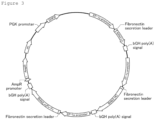
- Figure 2 is a vector map of the expression vector 2.
- the expression vector 2 is a vector that contains one expression cassette of common LC, and one expression cassette of a hygromycin resistance gene.
- the expression cassette of common LC contains a hEF-1 ⁇ promoter, a coding sequence of a fibronectin secretion leader, a coding sequence of common LC, and a polyA sequence; and the coding sequence of common LC is sequentially arranged downstream of the coding sequence of the fibronectin secretion leader in the same reading frame.
- the expression vector 1 alone, or the expression vectors 1 and 2 were introduced into CHO-DG44 cells by an electroporation method.
- the culture volume was expanded to 20 mL, the mixture was transferred to a 125 mL shaking culture flask for shake-culturing.
- BiAb2-TGV cells the concentration of BiAb of interest was 1.0 g/L, whereas, in BiAb2-TGV/DGV cells, the concentration of BiAb of interest was 1.7 g/L.
- the amount of mRNA of LC was 2.1 times greater than the amount of mRNA of HC and the amount of mRNA of scFv-Fc was 0.2 times greater than the amount of mRNA of HC.
- One expression cassette of HC, one expression cassette of LC, and one expression cassette of scFv-Fc are contained in the expression vector 3, and therefore, it is conceivable that BiAb2-TGV cells carry the expression cassette of HC, the expression cassette of LC, and the expression cassette of scFv-Fc at a number ratio of 1:1:1. It was presumed that the difference of the amounts of mRNA between the subunits is due to the difference of transcription efficiency of each expression cassette, and in particular, the transcription efficiency of scFv-Fc was found out to be significantly low compared to those of HC and LC.
- CHO cells in which the expression level and purity of BiAb2 were high were selected from CHO cells transfected with the vector set of the expression vector 3 and the expression vector 4, and therefore, CHO cells excellent in productivity of BiAb2 were able to be produced.
Landscapes
- Health & Medical Sciences (AREA)
- Genetics & Genomics (AREA)
- Life Sciences & Earth Sciences (AREA)
- Chemical & Material Sciences (AREA)
- Engineering & Computer Science (AREA)
- Organic Chemistry (AREA)
- Biomedical Technology (AREA)
- Zoology (AREA)
- Biotechnology (AREA)
- Bioinformatics & Cheminformatics (AREA)
- Wood Science & Technology (AREA)
- General Engineering & Computer Science (AREA)
- General Health & Medical Sciences (AREA)
- Biochemistry (AREA)
- Molecular Biology (AREA)
- Biophysics (AREA)
- Microbiology (AREA)
- Plant Pathology (AREA)
- Physics & Mathematics (AREA)
- Immunology (AREA)
- Medicinal Chemistry (AREA)
- Proteomics, Peptides & Aminoacids (AREA)
- Cell Biology (AREA)
- Oncology (AREA)
- Toxicology (AREA)
- Gastroenterology & Hepatology (AREA)
- Preparation Of Compounds By Using Micro-Organisms (AREA)
Applications Claiming Priority (2)
| Application Number | Priority Date | Filing Date | Title |
|---|---|---|---|
| JP2022094577 | 2022-06-10 | ||
| PCT/JP2023/021621 WO2023238949A1 (ja) | 2022-06-10 | 2023-06-09 | 細胞の作出方法、ヘテロ多量体タンパク質の製造方法、バイスペシフィック抗体の製造方法、ベクターセット、哺乳動物細胞、cho細胞、及び細胞プールの作出方法 |
Publications (1)
| Publication Number | Publication Date |
|---|---|
| EP4538379A1 true EP4538379A1 (en) | 2025-04-16 |
Family
ID=89118463
Family Applications (1)
| Application Number | Title | Priority Date | Filing Date |
|---|---|---|---|
| EP23819929.3A Pending EP4538379A1 (en) | 2022-06-10 | 2023-06-09 | Method for producing cells, method for producing heteromultimeric protein, method for producing bispecific antibody, and method for producing vector set, mammalian cells, cho cells, and cell pool |
Country Status (6)
| Country | Link |
|---|---|
| US (1) | US20250361524A1 (https=) |
| EP (1) | EP4538379A1 (https=) |
| JP (1) | JPWO2023238949A1 (https=) |
| KR (1) | KR20250022761A (https=) |
| CN (1) | CN119654417A (https=) |
| WO (1) | WO2023238949A1 (https=) |
Family Cites Families (17)
| Publication number | Priority date | Publication date | Assignee | Title |
|---|---|---|---|---|
| KR101618767B1 (ko) * | 2008-09-02 | 2016-05-09 | 한국생명공학연구원 | 외래단백질을 고효율로 생산하는 리더서열 |
| JP5592215B2 (ja) | 2010-09-22 | 2014-09-17 | ダイセル・エボニック株式会社 | 粉末状封止剤及び封止方法 |
| TWI452136B (zh) | 2010-11-17 | 2014-09-11 | 中外製藥股份有限公司 | A multiple specific antigen-binding molecule that replaces the function of Factor VIII in blood coagulation |
| CN104011080B (zh) | 2011-12-22 | 2017-10-20 | 弗·哈夫曼-拉罗切有限公司 | 用于真核细胞的全长抗体展示系统及其用途 |
| JP5602904B2 (ja) | 2013-03-15 | 2014-10-08 | 株式会社技研製作所 | 地質推定方法及び地質推定システム |
| US9873891B2 (en) | 2013-05-03 | 2018-01-23 | Fujifilm Diosynth Biotechnologies Uk Limited | Expression process |
| EP3083696B1 (en) | 2013-12-20 | 2018-02-14 | F.Hoffmann-La Roche Ag | Bispecific her2 antibodies and methods of use |
| MA40764A (fr) | 2014-09-26 | 2017-08-01 | Chugai Pharmaceutical Co Ltd | Agent thérapeutique induisant une cytotoxicité |
| CN110655582B (zh) | 2015-01-08 | 2022-12-16 | 江苏康宁杰瑞生物制药有限公司 | 具有共同轻链的双特异性抗体或抗体混合物 |
| JP2016047722A (ja) | 2015-11-11 | 2016-04-07 | 三菱製鋼株式会社 | 懸架コイルばね及びストラット型懸架装置 |
| PT3433273T (pt) | 2016-03-25 | 2022-02-21 | Biomunex Pharmaceuticals | Moléculas de ligação a cd38 e pd-l1 |
| SG11201807885PA (en) * | 2016-04-20 | 2018-10-30 | Regeneron Pharma | Compositions and methods for making antibodies based on use of expression-enhancing loci |
| RU2769282C2 (ru) | 2016-06-20 | 2022-03-30 | Кимаб Лимитед | Анти-PD-L1 и IL-2 цитокины |
| MX2020000055A (es) | 2017-07-06 | 2020-08-06 | Merus Nv | Anticuerpos biespecificos antiproteina 1 de muerte celular programada (pd-1) -anti inmunoglobulina de celulas t y dominio de mucina que contiene -3 (tim-3). |
| CA3081854A1 (en) | 2017-11-08 | 2019-05-16 | Kyowa Kirin Co., Ltd. | Bispecific antibody which binds to cd40 and epcam |
| JP2019093342A (ja) | 2017-11-22 | 2019-06-20 | 株式会社ジャパンユニックス | ミキサー |
| JP7650583B2 (ja) | 2020-12-15 | 2025-03-25 | 株式会社ディスコ | チップの製造方法 |
-
2023
- 2023-06-09 JP JP2024527044A patent/JPWO2023238949A1/ja active Pending
- 2023-06-09 KR KR1020257000217A patent/KR20250022761A/ko active Pending
- 2023-06-09 WO PCT/JP2023/021621 patent/WO2023238949A1/ja not_active Ceased
- 2023-06-09 EP EP23819929.3A patent/EP4538379A1/en active Pending
- 2023-06-09 US US18/872,350 patent/US20250361524A1/en active Pending
- 2023-06-09 CN CN202380057844.7A patent/CN119654417A/zh active Pending
Also Published As
| Publication number | Publication date |
|---|---|
| JPWO2023238949A1 (https=) | 2023-12-14 |
| KR20250022761A (ko) | 2025-02-17 |
| US20250361524A1 (en) | 2025-11-27 |
| CN119654417A (zh) | 2025-03-18 |
| WO2023238949A1 (ja) | 2023-12-14 |
Similar Documents
| Publication | Publication Date | Title |
|---|---|---|
| KR102180660B1 (ko) | 발현 방법 | |
| CN1202261C (zh) | 重组细胞的制备方法 | |
| JP2011518790A (ja) | ポリクローナルタンパク質を製造する方法 | |
| US10611831B2 (en) | Production cell line enhancers | |
| JP6087148B2 (ja) | タンパク質の生産方法 | |
| CN116218782A (zh) | 细胞选择和修饰细胞代谢的方法 | |
| CN102498212B (zh) | Cho/cert细胞系 | |
| JP7543246B2 (ja) | 内因性タンパク質のレベルを低下させることによって生物学的産物の産生を改善する方法 | |
| EP4538379A1 (en) | Method for producing cells, method for producing heteromultimeric protein, method for producing bispecific antibody, and method for producing vector set, mammalian cells, cho cells, and cell pool | |
| HK40118945A (en) | Method for producing cells, method for producing heteromultimeric protein, method for producing bispecific antibody, and method for producing vector set, mammalian cells, cho cells, and cell pool | |
| CN120322561A (zh) | 新型转座酶系统 | |
| JP7826509B2 (ja) | 選択マーカーとしての新規グルタミン合成酵素変異体 | |
| EP4650440A1 (en) | Method for producing cell, method for producing multispecific antibody, vector set, mammalian cell, cho cell, and method for producing cell pool | |
| US20240076405A1 (en) | Expression vectors for immunoglobulins and applications thereof | |
| HK1167429A (en) | Cho/cert cell lines |
Legal Events
| Date | Code | Title | Description |
|---|---|---|---|
| STAA | Information on the status of an ep patent application or granted ep patent |
Free format text: STATUS: THE INTERNATIONAL PUBLICATION HAS BEEN MADE |
|
| PUAI | Public reference made under article 153(3) epc to a published international application that has entered the european phase |
Free format text: ORIGINAL CODE: 0009012 |
|
| STAA | Information on the status of an ep patent application or granted ep patent |
Free format text: STATUS: REQUEST FOR EXAMINATION WAS MADE |
|
| 17P | Request for examination filed |
Effective date: 20250102 |
|
| AK | Designated contracting states |
Kind code of ref document: A1 Designated state(s): AL AT BE BG CH CY CZ DE DK EE ES FI FR GB GR HR HU IE IS IT LI LT LU LV MC ME MK MT NL NO PL PT RO RS SE SI SK SM TR |
|
| REG | Reference to a national code |
Ref country code: HK Ref legal event code: DE Ref document number: 40118945 Country of ref document: HK |
|
| DAV | Request for validation of the european patent (deleted) | ||
| DAX | Request for extension of the european patent (deleted) |