EP4535441A1 - Lösungsmittelfreie elektrode - Google Patents
Lösungsmittelfreie elektrode Download PDFInfo
- Publication number
- EP4535441A1 EP4535441A1 EP23201365.6A EP23201365A EP4535441A1 EP 4535441 A1 EP4535441 A1 EP 4535441A1 EP 23201365 A EP23201365 A EP 23201365A EP 4535441 A1 EP4535441 A1 EP 4535441A1
- Authority
- EP
- European Patent Office
- Prior art keywords
- group
- polymer
- solvent
- electrode
- weight
- Prior art date
- Legal status (The legal status is an assumption and is not a legal conclusion. Google has not performed a legal analysis and makes no representation as to the accuracy of the status listed.)
- Pending
Links
Images

Classifications
-
- H—ELECTRICITY
- H01—ELECTRIC ELEMENTS
- H01M—PROCESSES OR MEANS, e.g. BATTERIES, FOR THE DIRECT CONVERSION OF CHEMICAL ENERGY INTO ELECTRICAL ENERGY
- H01M10/00—Secondary cells; Manufacture thereof
- H01M10/05—Accumulators with non-aqueous electrolyte
- H01M10/052—Li-accumulators
- H01M10/0525—Rocking-chair batteries, i.e. batteries with lithium insertion or intercalation in both electrodes; Lithium-ion batteries
-
- H—ELECTRICITY
- H01—ELECTRIC ELEMENTS
- H01M—PROCESSES OR MEANS, e.g. BATTERIES, FOR THE DIRECT CONVERSION OF CHEMICAL ENERGY INTO ELECTRICAL ENERGY
- H01M10/00—Secondary cells; Manufacture thereof
- H01M10/05—Accumulators with non-aqueous electrolyte
- H01M10/056—Accumulators with non-aqueous electrolyte characterised by the materials used as electrolytes, e.g. mixed inorganic/organic electrolytes
- H01M10/0564—Accumulators with non-aqueous electrolyte characterised by the materials used as electrolytes, e.g. mixed inorganic/organic electrolytes the electrolyte being constituted of organic materials only
- H01M10/0565—Polymeric materials, e.g. gel-type or solid-type
-
- H—ELECTRICITY
- H01—ELECTRIC ELEMENTS
- H01M—PROCESSES OR MEANS, e.g. BATTERIES, FOR THE DIRECT CONVERSION OF CHEMICAL ENERGY INTO ELECTRICAL ENERGY
- H01M4/00—Electrodes
- H01M4/02—Electrodes composed of, or comprising, active material
- H01M4/04—Processes of manufacture in general
- H01M4/043—Processes of manufacture in general involving compressing or compaction
-
- H—ELECTRICITY
- H01—ELECTRIC ELEMENTS
- H01M—PROCESSES OR MEANS, e.g. BATTERIES, FOR THE DIRECT CONVERSION OF CHEMICAL ENERGY INTO ELECTRICAL ENERGY
- H01M4/00—Electrodes
- H01M4/02—Electrodes composed of, or comprising, active material
- H01M4/13—Electrodes for accumulators with non-aqueous electrolyte, e.g. for lithium-accumulators; Processes of manufacture thereof
-
- H—ELECTRICITY
- H01—ELECTRIC ELEMENTS
- H01M—PROCESSES OR MEANS, e.g. BATTERIES, FOR THE DIRECT CONVERSION OF CHEMICAL ENERGY INTO ELECTRICAL ENERGY
- H01M4/00—Electrodes
- H01M4/02—Electrodes composed of, or comprising, active material
- H01M4/13—Electrodes for accumulators with non-aqueous electrolyte, e.g. for lithium-accumulators; Processes of manufacture thereof
- H01M4/139—Processes of manufacture
-
- H—ELECTRICITY
- H01—ELECTRIC ELEMENTS
- H01M—PROCESSES OR MEANS, e.g. BATTERIES, FOR THE DIRECT CONVERSION OF CHEMICAL ENERGY INTO ELECTRICAL ENERGY
- H01M4/00—Electrodes
- H01M4/02—Electrodes composed of, or comprising, active material
- H01M4/36—Selection of substances as active materials, active masses, active liquids
- H01M4/58—Selection of substances as active materials, active masses, active liquids of inorganic compounds other than oxides or hydroxides, e.g. sulfides, selenides, tellurides, halogenides or LiCoFy; of polyanionic structures, e.g. phosphates, silicates or borates
- H01M4/5825—Oxygenated metallic salts or polyanionic structures, e.g. borates, phosphates, silicates, olivines
-
- H—ELECTRICITY
- H01—ELECTRIC ELEMENTS
- H01M—PROCESSES OR MEANS, e.g. BATTERIES, FOR THE DIRECT CONVERSION OF CHEMICAL ENERGY INTO ELECTRICAL ENERGY
- H01M4/00—Electrodes
- H01M4/02—Electrodes composed of, or comprising, active material
- H01M4/62—Selection of inactive substances as ingredients for active masses, e.g. binders, fillers
- H01M4/621—Binders
- H01M4/622—Binders being polymers
-
- H—ELECTRICITY
- H01—ELECTRIC ELEMENTS
- H01M—PROCESSES OR MEANS, e.g. BATTERIES, FOR THE DIRECT CONVERSION OF CHEMICAL ENERGY INTO ELECTRICAL ENERGY
- H01M4/00—Electrodes
- H01M4/02—Electrodes composed of, or comprising, active material
- H01M4/62—Selection of inactive substances as ingredients for active masses, e.g. binders, fillers
- H01M4/624—Electric conductive fillers
- H01M4/625—Carbon or graphite
-
- H—ELECTRICITY
- H01—ELECTRIC ELEMENTS
- H01M—PROCESSES OR MEANS, e.g. BATTERIES, FOR THE DIRECT CONVERSION OF CHEMICAL ENERGY INTO ELECTRICAL ENERGY
- H01M2300/00—Electrolytes
- H01M2300/0017—Non-aqueous electrolytes
- H01M2300/0065—Solid electrolytes
- H01M2300/0082—Organic polymers
-
- H—ELECTRICITY
- H01—ELECTRIC ELEMENTS
- H01M—PROCESSES OR MEANS, e.g. BATTERIES, FOR THE DIRECT CONVERSION OF CHEMICAL ENERGY INTO ELECTRICAL ENERGY
- H01M4/00—Electrodes
- H01M4/02—Electrodes composed of, or comprising, active material
- H01M4/13—Electrodes for accumulators with non-aqueous electrolyte, e.g. for lithium-accumulators; Processes of manufacture thereof
- H01M4/131—Electrodes based on mixed oxides or hydroxides, or on mixtures of oxides or hydroxides, e.g. LiCoOx
-
- H—ELECTRICITY
- H01—ELECTRIC ELEMENTS
- H01M—PROCESSES OR MEANS, e.g. BATTERIES, FOR THE DIRECT CONVERSION OF CHEMICAL ENERGY INTO ELECTRICAL ENERGY
- H01M4/00—Electrodes
- H01M4/02—Electrodes composed of, or comprising, active material
- H01M4/13—Electrodes for accumulators with non-aqueous electrolyte, e.g. for lithium-accumulators; Processes of manufacture thereof
- H01M4/136—Electrodes based on inorganic compounds other than oxides or hydroxides, e.g. sulfides, selenides, tellurides, halogenides or LiCoFy
-
- Y—GENERAL TAGGING OF NEW TECHNOLOGICAL DEVELOPMENTS; GENERAL TAGGING OF CROSS-SECTIONAL TECHNOLOGIES SPANNING OVER SEVERAL SECTIONS OF THE IPC; TECHNICAL SUBJECTS COVERED BY FORMER USPC CROSS-REFERENCE ART COLLECTIONS [XRACs] AND DIGESTS
- Y02—TECHNOLOGIES OR APPLICATIONS FOR MITIGATION OR ADAPTATION AGAINST CLIMATE CHANGE
- Y02E—REDUCTION OF GREENHOUSE GAS [GHG] EMISSIONS, RELATED TO ENERGY GENERATION, TRANSMISSION OR DISTRIBUTION
- Y02E60/00—Enabling technologies; Technologies with a potential or indirect contribution to GHG emissions mitigation
- Y02E60/10—Energy storage using batteries
Definitions
- the present invention relates to a solvent-free electrode and to a method of manufacturing the same. It also relates to a cell comprising said solvent-free electrode and optionally a solid electrolyte.
- Li-ion batteries with a liquid electrolyte have been known for decades.
- these liquid electrolytes can affect battery safety, for example, due to the generation of lithium metal dendrites that can cause short circuits in the battery.
- electrolyte leaks are possible if the battery seal is defective.
- Solid electrolytes are used to replace liquid electrolytes in alkali metal or alkaline earth metal ion (e.g., Li-ion) and pure alkali metal or pure alkaline earth metal anode (e.g., Li-metal) batteries, because they provide a solution to the safety and leakage problems associated with liquid electrolytes.
- alkali metal or alkaline earth metal ion e.g., Li-ion
- pure alkali metal or pure alkaline earth metal anode e.g., Li-metal
- the disadvantage of solid electrolytes is that it is more difficult to create an intimate interface between the electrode and the electrolyte. This can result in a reduction in battery life.
- the object of the present invention is to overcome the aforementioned disadvantages by developing a solvent-free electrode, having excellent mechanical strength, high energy density while being capable of forming an intimate interface with a solid electrolyte.
- the present invention consists in producing a solvent-free electrode comprising an active material, a source or receiver of lithium ions, a carbon-based material for increasing the electrical conductivity of the electrode and a polymer intended to bind the active material and the carbon-based material.
- the electrode is made up solely of the active material, the carbon-based material and the polymer.
- the new electrode formulation allows for the complete elimination of solvents in electrode manufacturing. This simplifies manufacturing and reduces production costs.
- the battery life is increased and its performance is improved thanks to the intimate interface between the electrode and electrolyte materials.
- photo-activatable includes components, molecules, groups or moieties that can be activated by radiation, such as - but not limited to - ultraviolet (UV) radiation, infrared (IR) radiation, visible light radiation, or combinations thereof.
- UV ultraviolet
- IR infrared
- thermally activatable includes components, molecules, groups or moieties that can be activated upon a change in temperature.
- the change in temperature is a warming.
- the activation temperature is between 20°C and 150°C, preferably between 25°C and 100°C.
- Activation by heat and/or radiation includes, but is not limited to, activation to allow oligomerization, polymerization or crosslinking, and/or initiation of oligomerization, polymerization or crosslinking.
- An “end group” is considered a group that is present at one end (of the chain) of the polymer.
- a "telechelic oligomer” as used in the present disclosure is considered to be an oligomer capable of undergoing further polymerization due to the presence of at least one reactive group at each of the (chain) ends of the oligomer.
- a second aspect of the invention relates to a cell comprising, for at least one of the two electrodes, a solvent-free electrode as described previously.
- said cell further comprises a solid electrolyte made from said polymer with at least one maleimide group, an acrylate group or a methacrylate group.
- the polymer is ground to obtain a powder before the mixing step.
- there is a step of grinding the mixture preferably under nitrogen.
- the pressing is carried out at a temperature between 90°C and 150°C, preferably between 100°C and 140°C, under a force between 5 kN and 25 kN, preferably between 10 kN and 20 kN, for a time between 1 minute and 20 minutes, preferably between 3 minutes and 10 minutes.
- the pressing is carried out between a sheet acting as a separator and a current collector.
- the present invention relates to a solvent-free electrode.
- This electrode comprises an active material, a carbon-based material and a polymer which acts as a binder between the active material and the carbon-based material. carbon-based.
- the electrode is made up of the active material, the carbon-based material and the polymer which acts as a binder.
- the active material is a source of lithium ions, capable of receiving lithium ions and/or restoring lithium ions in its structure.
- the active material is chosen from LiFePO 4 , LiNiMnCoO 2 , LiCoO 2 , Li 4 Ti 5 O 12 and graphite.
- the active material is a source of lithium ions and therefore responsible for the capacity of the electrode and capable of receiving lithium ions in its structure.
- the active material is capable of receiving and restoring lithium ions in its structure by intercalation.
- the active material is more specifically LiFePO 4 , LiNiMnCoO 2 or LiCoO 2 , and for an anode, it is more specifically Li 4 Ti 5 O 12 or graphite.
- the carbon-based material is intended to increase the electrical conductivity of the electrode.
- it comprises or is made of activated carbon, carbon black and/or graphite.
- the polymer acting as a binder comprises at least one maleimide group, an acrylate group or a methacrylate group.
- the maleimide group, acrylate group or methacrylate group is an end group.
- the polymer also comprises a salt of an alkali metal and/or an alkaline earth metal.
- it is a lithium salt or a sodium salt. More preferably, it is a lithium salt.
- the polymer comprises at least one maleimide group and a lithium salt or a sodium salt, more preferably a lithium salt.
- the electrode comprises the active material in a weight percentage of between 50% and 80%, preferably between 60% and 75%, the carbon-based material in a weight percentage of between 0.5% and 5%, preferably between 1% and 4%, the polymer in a percentage by weight of between 10% and 45%, preferably between 20% and 35%.
- the first group of the first polymer of the polymerizable composition according to the invention is capable of coordinating cations of an alkali metal and/or an alkaline earth metal, advantageously the cations of the alkali metal and/or the alkaline earth metal in the electrode according to the invention.
- the first group is advantageously chosen so as to ensure ionic conductivity within the electrode.
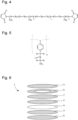
- non-limiting examples of the first group are a polyethylene oxide (PEO) group as shown in Figure 1 , and a polyethylene glycol (PEG) group.
- u indicates the number of repetitions and is chosen between 20 and 80, preferably between 30 and 70, more preferably between 40 and 60, for example between 50 and 55.
- the second group of the first polymer of the polymerizable composition according to the invention is a group provided in order to allow the polymerization of the polymerizable composition.
- the second group is therefore photo-activatable and/or thermo-activatable.
- Non-limiting examples are a maleimide group, as shown in the Figure 2 , an acrylate group and a methacrylate group.
- the first polymer has a molar mass of between 1000 g/mol and 5000 g/mol, preferably between 1500 g/mol and 4000 g/mol, such as between 2000 g/mol and 3000 g/mol, more preferably between 2250 g/mol and 2750 g/mol, for example between 2350 g/mol and 2600 g/mol.
- the first polymer contains between 0.1 and 0.7 mEq (milli-equivalent) of the second group per gram of the first polymer, preferably between 0.2 and 0.6 mEq, more preferably between 0.3 and 0.5 mEq, for example between 0.35 and 0.45 mEq, or 0.4 mEq.
- first polymer are ⁇ -methoxy ⁇ -maleimide polyethylene oxide, as shown in Figure 3 , polyethylene glycol methacrylate (PEGMA), and ⁇ -methoxy ⁇ -maleimide polyethylene glycol.
- the polymerizable composition contains between 10% and 50% by weight of the first polymer, preferably between 12% and 45% by weight, for example between 15% and 40% by weight, based on the total weight of the polymerizable composition.
- the polymerizable composition also contains an oligomer.
- the oligomer has at least two photo-activatable and/or thermo-activatable groups. These groups may be polymerized with the second group of the first polymer and/or with a third group of a second polymer. Preferably, the groups of the oligomer may be polymerized with at least the third group of a second polymer.
- the photo-activatable and/or thermo-activatable groups may be, without being limited to, a maleimide group, an acrylate and a methacrylate.
- the oligomer contains between 0.1 and 0.7 mEq (milli-equivalent) of photo-activatable and/or thermo-activatable groups per gram of the oligomer, preferably between 0.2 and 0.9 mEq, more preferably between 0.3 and 0.8 mEq, for example between 0.4 and 0.7 mEq, or between 0.5 and 0.6 mEq.
- oligomer is PPG-block-PEG-block-PPG, ⁇ , ⁇ -bis(maleimide), shown in Figure 4 .
- It is a polyethylene and polypropylene oxide (PEO-PPO) having a maleimide group at each end of the chain.
- PEO-PPO polyethylene and polypropylene oxide
- x + z is between 2 and 20, preferably between 5 and 15, more preferably between 6 and 12, for example between 8 and 9.
- y is between 20 and 100, preferably between 40 and 80, more preferably between 50 and 75, for example between 60 and 70, or between 62 and 67.
- oligomer is polyethylene glycol (PEG) having a methacrylate (MA) group at each end of the chain (PEG-DiMA).
- PEG polyethylene glycol
- MA methacrylate
- the oligomer has a molar mass of between 250 g/mol and 10000 g/mol, preferably between 500 g/mol and 5000 g/mol, more preferably between 750 g/mol and 4000 g/mol, for example between 1000 g/mol and 3750 g/mol, or between 2000 g/mol and 3600 g/mol.
- the polymerizable composition contains between 1% and 20% by weight of the oligomer, preferably between 2% and 15% by weight, for example between 3% and 15% by weight, based on the total weight of the polymerizable composition.
- the oligomer comprises at least one photo-activatable and/or thermo-activatable group at each end of the oligomer chain, the oligomer in this case being a telechelic oligomer.
- a telechelic oligomer By adding a telechelic oligomer to the polymerizable composition, it is possible to better control the polymerization and therefore the structure of the polymer network obtained.
- the polymer network is a linear polymer network.
- the chains between two nodes of the polymerized composition thus obtained are sufficiently long so that the polymerized composition is quite "loose" and the electrode has excellent ionic conductivity.
- the oligomer is capable of acting as a plasticizer and/or an ionic conductivity amplifier of the electrode.
- the second polymer of the polymerizable composition contains a third group.
- the third group comprises a salt of an alkali metal and/or a salt of an alkaline earth metal.
- the alkali metal contains lithium, sodium, potassium, or combinations thereof.
- the alkali metal is lithium.
- the alkaline earth metal contains magnesium, beryllium, calcium, or combinations thereof.
- the alkaline earth metal is magnesium.
- the third group is capable of providing cations of the alkali metal and/or the alkaline earth metal in the electrode.
- the cations of the alkali metal and/or the alkaline earth metal can, in the electrode, move along the first polymer and the oligomer. This movement induces the ionic conductivity of the electrode.
- the third group, being integrated into the chain of the second polymer also makes it possible, in the electrode, to reduce the mobility of the counter-anions of the alkali metal and/or the alkaline earth metal, which makes it possible to increase the mobility of the alkali metal and/or the alkaline earth metal.
- FIG. 5 shows an example of the second polymer of the polymerizable composition of the invention, in which the third group is lithium bis(trifluoromethane)sulfimide (LiSTFSI, CAS No. 210226-98-5).
- the polymerizable composition contains between 1% and 20% by weight of the second polymer, preferably between 2% and 15% by weight, for example between 5% and 10% by weight, based on the total weight of the polymerizable composition.
- the plasticizer in the polymerizable composition advantageously solubilizes the components of the composition.
- An example of the plasticizer includes, but is not limited to, propylene carbonate.
- the polymerizable composition contains between 20% and 60% by weight of the plasticizer, preferably between 25% and 55% by weight, for example between 30% and 50% by weight, based on the total weight of the polymerizable composition.
- the composition also comprises a polymerization initiator.
- the polymerization initiator makes it possible to initiate the polymerization between the second group of the first polymer, the photo-activatable and/or thermo-activatable groups of the oligomer and the third group of the second polymer.
- the initiation of the polymerization, and/or the polymerization itself is carried out under the effect of a temperature between 20°C and 200°C, preferably between 20°C and 150°C, more preferably between 25°C and 100°C, such as between 30°C and 80°C, or under the effect of radiation.
- the radiation contains one or more of UV radiation, IR radiation and visible light radiation (VIS).
- the polymerization step is carried out under the effect of radiation, preferably UV radiation, it has a duration of between 5 seconds and 20 minutes, for example between 10 seconds and 15 minutes, preferably between 20 seconds and 10 minutes, more preferably between 30 seconds and 5 minutes, such as 4 minutes, 3 minutes, 2 minutes, 1 minute, or 55 seconds, 50 seconds or 45 seconds.
- radiation preferably UV radiation
- it has a duration of between 5 seconds and 20 minutes, for example between 10 seconds and 15 minutes, preferably between 20 seconds and 10 minutes, more preferably between 30 seconds and 5 minutes, such as 4 minutes, 3 minutes, 2 minutes, 1 minute, or 55 seconds, 50 seconds or 45 seconds.
- the polymerization is carried out under the influence of temperature, it has a duration of between 1 minute and 5 hours, preferably between 5 minutes and 4 hours, for example between 10 minutes and 3 hours, between 20 minutes and 2.5 hours, or between 30 minutes and 2 hours.
- the polymerization initiator is advantageously of a radical nature. This means, in the present disclosure, that the polymerization initiator is capable of releasing radicals under the effect of temperature or radiation as described above. These radicals then initiate the polymerization between the first polymer, the second polymer and the oligomer of the composition.
- polymerization initiator examples include, but are not limited to, 2,2'-azobis(isobutyronitrile) (AIBN) and 2-hydroxy-4'-(2-hydroxyethoxy)-2-methylpropiophenone (CAS No. 106797-53-9).
- the polymerizable composition contains between 0.01% and 2% by weight of the polymerization initiator, preferably between 0.1% and 1.5% by weight, for example between 0.25% and 1% by weight, based on the total weight of the polymerizable composition.
- the polymerizable composition may also contain a salt of an alkali metal and/or a salt of an alkaline earth metal.
- the salt of an alkali metal contains, or substantially consists of, a lithium salt.
- the salt of an alkaline earth metal contains, or substantially consists of, a magnesium salt.
- the salts include lithium bis(fluorosulfonyl) imide (LIFSI) and lithium bis(trifluoromethanesulfonyl) imide (LITFSI).
- the inventors surprisingly discovered that by adding a salt of an alkali metal and/or a salt of an alkaline earth metal into the polymerizable composition, the electrode has better ionic conductivity. compared to electrodes made with a polymer obtained from a composition without an alkali metal salt and/or an alkaline earth metal salt added. The inventors believe that the increased conductivity is achieved through a synergy between the salt of the third group of the second polymer and the separate salt added into the composition.
- the polymerizable composition comprises a salt of an alkali metal and/or a salt of an alkaline earth metal
- the composition contains between 0.5% and 5% by weight of the salt, preferably between 0.75% and 4% by weight, for example between 1% and 3% by weight, based on the total weight of the polymerizable composition.
- the polymer is ground before mixing with the other powders.
- it is the mixture comprising the polymer and the two other powders which is ground before polymerization.
- the process comprises an additional step of freezing the polymer or mixture before the grinding step to make the polymer brittle, this step being, for example, carried out under nitrogen.
- the pressing is carried out at a temperature between 90°C and 150°C, preferably between 100°C and 140°C, under a force between 5 kN and 25 kN, preferably between 10 kN and 20 kN, for a time between 1 minute and 20 minutes, preferably between 3 minutes and 10 minutes.
- the pressing is carried out between a sheet 9 and a current collector 10.
- the sheet can be an integral part of the electrode obtained or be removed, or even fall off by itself while keeping a functional electrode.
- the sheet can be a cellulose sheet acting as a separator and the current collector can be made of aluminum or an aluminum alloy.
- the present disclosure also relates to a cell comprising the solvent-free electrode according to the invention.
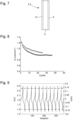
- Figure 6 shows an example of a cell 1. It has a button cell type configuration, known in the prior art as the CR2032 type configuration.
- the cell 1 comprises an anode 2 and a cathode 3 with at least one of the two electrodes made with the formulation according to the invention.
- the cell 1 further comprises a solid polymer electrolyte 4 between the anode 2 and the cathode 3 made with the polymerizable composition described above.
- the cell 1 further comprises a button battery cover 5, a button battery base 6, a spacer 7 and a spring 8.
- the spacer 7 and the spring 8 provide good contact between the other components 2, 3, 4, 5, 6 of the cell 1.
- the cell performance was tested for a cell comprising a cathode according to the invention with LiFePO 4 as active material in a weight content of 70%, a polymer comprising a maleimide group in a weight content of 28%, and carbon black. in a weight content of 2%.
- the cathode was produced by mixing the different powders and pressing them between a cellulose sheet and an aluminum current collector under a pressure of 15 kN, at a temperature of 120°C for 5 minutes.
- the cathode was assembled within the battery comprising a commercial Li 4 Ti 5 O 12 (LTO) anode with a theoretical capacity of 1.25 mAh/cm 3 and comprising a standard liquid electrolyte (LP30).
- LTO Li 4 Ti 5 O 12
- the cell life was tested by charging and discharging the cell for more than 30 cycles between 1.5 V and 2.4 V as shown in Figure 9 for the first ten cycles.
- the cycling rate compared to LTO was C/16, which corresponds to a charge of 0.140 mA.
- Charging was carried out by applying a constant current and discharging was carried out by applying the same current but in negative. During each cycle, the cell was charged to a state of charge of 100% and discharged to a depth of discharge of 100%.
- figure 8 represents the surface capacity as a function of the number of cycles. It emerges from the figure 8 that the loss of surface capacity after 30 cycles is below 25% compared to the surface capacity of the first cycle with a capacity that stabilizes after about fifteen cycles. The battery therefore has good capacity stability, which means a good lifespan.
Landscapes
- Chemical & Material Sciences (AREA)
- Chemical Kinetics & Catalysis (AREA)
- General Chemical & Material Sciences (AREA)
- Electrochemistry (AREA)
- Engineering & Computer Science (AREA)
- Manufacturing & Machinery (AREA)
- Materials Engineering (AREA)
- Inorganic Chemistry (AREA)
- Physics & Mathematics (AREA)
- General Physics & Mathematics (AREA)
- Dispersion Chemistry (AREA)
- Condensed Matter Physics & Semiconductors (AREA)
- Crystallography & Structural Chemistry (AREA)
- Battery Electrode And Active Subsutance (AREA)
- Compositions Of Macromolecular Compounds (AREA)
Priority Applications (4)
| Application Number | Priority Date | Filing Date | Title |
|---|---|---|---|
| EP23201365.6A EP4535441A1 (de) | 2023-10-03 | 2023-10-03 | Lösungsmittelfreie elektrode |
| US18/794,115 US20250112222A1 (en) | 2023-10-03 | 2024-08-05 | Solvent-free electrode |
| JP2024144303A JP2025062998A (ja) | 2023-10-03 | 2024-08-26 | 無溶媒電極 |
| CN202411396512.4A CN119764447A (zh) | 2023-10-03 | 2024-10-08 | 无溶剂电极 |
Applications Claiming Priority (1)
| Application Number | Priority Date | Filing Date | Title |
|---|---|---|---|
| EP23201365.6A EP4535441A1 (de) | 2023-10-03 | 2023-10-03 | Lösungsmittelfreie elektrode |
Publications (1)
| Publication Number | Publication Date |
|---|---|
| EP4535441A1 true EP4535441A1 (de) | 2025-04-09 |
Family
ID=88241233
Family Applications (1)
| Application Number | Title | Priority Date | Filing Date |
|---|---|---|---|
| EP23201365.6A Pending EP4535441A1 (de) | 2023-10-03 | 2023-10-03 | Lösungsmittelfreie elektrode |
Country Status (4)
| Country | Link |
|---|---|
| US (1) | US20250112222A1 (de) |
| EP (1) | EP4535441A1 (de) |
| JP (1) | JP2025062998A (de) |
| CN (1) | CN119764447A (de) |
Citations (4)
| Publication number | Priority date | Publication date | Assignee | Title |
|---|---|---|---|---|
| JP2013105676A (ja) * | 2011-11-15 | 2013-05-30 | Yamagata Univ | ビススルホンイミド構造を持つポリマー及びこれを含む電極ならびに電池 |
| CN110003399A (zh) * | 2019-03-06 | 2019-07-12 | 南开大学 | 一种单离子导电聚合物电解质膜的制备及应用 |
| CN116314792A (zh) * | 2023-01-17 | 2023-06-23 | 深圳市研一新材料有限责任公司 | 一种干电极粘结剂、负极干粉混合物及其应用 |
| EP4243113A1 (de) * | 2021-07-30 | 2023-09-13 | LG Energy Solution, Ltd. | Elektrode für sekundärbatterie, verfahren zur herstellung davon und sekundärbatterie mit der elektrode |
Family Cites Families (3)
| Publication number | Priority date | Publication date | Assignee | Title |
|---|---|---|---|---|
| JP5593664B2 (ja) * | 2009-09-29 | 2014-09-24 | 住友ベークライト株式会社 | リチウム二次電池負極合剤、リチウム二次電池負極およびリチウム二次電池 |
| CN103509153B (zh) * | 2012-06-15 | 2016-05-25 | 华中科技大学 | 一种聚合物单离子电解质及其制备方法 |
| KR102767176B1 (ko) * | 2015-09-16 | 2025-02-11 | 니폰 제온 가부시키가이샤 | 전고체 이차 전지용 바인더 및 전고체 이차 전지 |
-
2023
- 2023-10-03 EP EP23201365.6A patent/EP4535441A1/de active Pending
-
2024
- 2024-08-05 US US18/794,115 patent/US20250112222A1/en active Pending
- 2024-08-26 JP JP2024144303A patent/JP2025062998A/ja active Pending
- 2024-10-08 CN CN202411396512.4A patent/CN119764447A/zh active Pending
Patent Citations (4)
| Publication number | Priority date | Publication date | Assignee | Title |
|---|---|---|---|---|
| JP2013105676A (ja) * | 2011-11-15 | 2013-05-30 | Yamagata Univ | ビススルホンイミド構造を持つポリマー及びこれを含む電極ならびに電池 |
| CN110003399A (zh) * | 2019-03-06 | 2019-07-12 | 南开大学 | 一种单离子导电聚合物电解质膜的制备及应用 |
| EP4243113A1 (de) * | 2021-07-30 | 2023-09-13 | LG Energy Solution, Ltd. | Elektrode für sekundärbatterie, verfahren zur herstellung davon und sekundärbatterie mit der elektrode |
| CN116314792A (zh) * | 2023-01-17 | 2023-06-23 | 深圳市研一新材料有限责任公司 | 一种干电极粘结剂、负极干粉混合物及其应用 |
Non-Patent Citations (1)
| Title |
|---|
| CAS , no. 106797-53-9 |
Also Published As
| Publication number | Publication date |
|---|---|
| CN119764447A (zh) | 2025-04-04 |
| US20250112222A1 (en) | 2025-04-03 |
| JP2025062998A (ja) | 2025-04-15 |
Similar Documents
| Publication | Publication Date | Title |
|---|---|---|
| FR2988225A1 (fr) | Anode pour cellule de batterie lithium-ion, son procede de fabrication et cette batterie l'incorporant. | |
| JP4371952B2 (ja) | リチウム電池用の結合剤と電極及びそれを採用したリチウム電池 | |
| FR3007204A1 (fr) | Utilisation de nouveaux composes a titre de matiere active d'electrode negative dans une batterie sodium-ion. | |
| CA2967918A1 (fr) | Batterie lithium organique | |
| EP2721682A1 (de) | Flüssiger elektrolyt für lithiumbatterie enthaltend eine quaternäre mischung aus nicht-wässrigen organischen lösungsmitteln | |
| FR2724490A1 (fr) | Electrode composite carbone/polymere pour generateur electrochimique rechargeable au lithium | |
| EP1846331B1 (de) | Verfahren zur modifizierung eines mindestens ein übergangsmetall enthaltenden lithiierten oxids mittels phosphationen | |
| EP4535441A1 (de) | Lösungsmittelfreie elektrode | |
| CH721173A2 (fr) | Électrode sans solvant | |
| WO2018141062A1 (fr) | Matériau d'électrode, électrode et batterie tout solide comprenant un oxyde complexe de structure olivine | |
| EP3179550B1 (de) | Elektrochemische zelle für eine lithium-batterie, die eine elektrode auf der basis eines silizium-graphit-verbundmaterials und einen spezifischen elektrolyten umfasst | |
| EP4635007A1 (de) | Negative elektroden auf der basis von silizium und fluoriertem additiv | |
| EP3898522B1 (de) | Negativelektroden-aktivmaterial auf der basis von eisen und lithiumhydroxysulfid | |
| EP2454777A1 (de) | Flüssigelektrolyt für einen lithiumakku mit einer mischung aus waserfreien organischen lösungsmitteln | |
| EP4303961A1 (de) | Polymerisierbare zusammensetzung für einen festen polymerelektrolyten | |
| CH719858A2 (fr) | Composant polymérisable pour électrolyte polymère solide. | |
| FR2725709A1 (fr) | Oxyde de lithium et son utilisation comme matiere active d'une electrode | |
| FR3072500B1 (fr) | Utilisation d'une batterie li-ion comprenant une anode contenant un alliage a base d'etain et d'antimoine | |
| WO2014068216A1 (fr) | Procede pour la preparation d'une batterie au lithium | |
| FR3073672A1 (fr) | Procede de preparation d'une cellule electrochimique pour batterie au lithium comprenant un electrolyte gelifie specifique | |
| WO2016030389A1 (fr) | Batterie comprenant un materiau pour électrode négative adherant au collecteur de courant anodique | |
| CA2249630C (fr) | Composition electrolytique a base de polymeres pour generateur electrochimique | |
| EP4195306A1 (de) | Spezifische positivelektroden mit einem spezifischen salz für eine alkalimetall-ionen-batterie | |
| WO2024120976A1 (fr) | Electrode et électrolyte pour batterie lithium-ion incorporant un composé polymère | |
| WO2023089041A1 (fr) | Electrolytes ceramiques de type sulfure |
Legal Events
| Date | Code | Title | Description |
|---|---|---|---|
| PUAI | Public reference made under article 153(3) epc to a published international application that has entered the european phase |
Free format text: ORIGINAL CODE: 0009012 |
|
| STAA | Information on the status of an ep patent application or granted ep patent |
Free format text: STATUS: THE APPLICATION HAS BEEN PUBLISHED |
|
| AK | Designated contracting states |
Kind code of ref document: A1 Designated state(s): AL AT BE BG CH CY CZ DE DK EE ES FI FR GB GR HR HU IE IS IT LI LT LU LV MC ME MK MT NL NO PL PT RO RS SE SI SK SM TR |
|
| P01 | Opt-out of the competence of the unified patent court (upc) registered |
Free format text: CASE NUMBER: APP_29176/2025 Effective date: 20250618 |
|
| STAA | Information on the status of an ep patent application or granted ep patent |
Free format text: STATUS: REQUEST FOR EXAMINATION WAS MADE |
|
| 17P | Request for examination filed |
Effective date: 20250730 |