EP4529243A2 - Sidelink-kapazitätsinformationsübertragung und sicherheit zwischen peer-endgeräten - Google Patents
Sidelink-kapazitätsinformationsübertragung und sicherheit zwischen peer-endgeräten Download PDFInfo
- Publication number
- EP4529243A2 EP4529243A2 EP25150348.8A EP25150348A EP4529243A2 EP 4529243 A2 EP4529243 A2 EP 4529243A2 EP 25150348 A EP25150348 A EP 25150348A EP 4529243 A2 EP4529243 A2 EP 4529243A2
- Authority
- EP
- European Patent Office
- Prior art keywords
- terminal
- capability information
- capability
- sidelink
- communication
- Prior art date
- Legal status (The legal status is an assumption and is not a legal conclusion. Google has not performed a legal analysis and makes no representation as to the accuracy of the status listed.)
- Pending
Links
Images




Classifications
-
- H—ELECTRICITY
- H04—ELECTRIC COMMUNICATION TECHNIQUE
- H04W—WIRELESS COMMUNICATION NETWORKS
- H04W76/00—Connection management
- H04W76/10—Connection setup
- H04W76/14—Direct-mode setup
-
- H—ELECTRICITY
- H04—ELECTRIC COMMUNICATION TECHNIQUE
- H04B—TRANSMISSION
- H04B17/00—Monitoring; Testing
- H04B17/30—Monitoring; Testing of propagation channels
- H04B17/309—Measuring or estimating channel quality parameters
-
- H—ELECTRICITY
- H04—ELECTRIC COMMUNICATION TECHNIQUE
- H04L—TRANSMISSION OF DIGITAL INFORMATION, e.g. TELEGRAPHIC COMMUNICATION
- H04L9/00—Cryptographic mechanisms or cryptographic arrangements for secret or secure communications; Network security protocols
- H04L9/08—Key distribution or management, e.g. generation, sharing or updating, of cryptographic keys or passwords
- H04L9/0816—Key establishment, i.e. cryptographic processes or cryptographic protocols whereby a shared secret becomes available to two or more parties, for subsequent use
- H04L9/0819—Key transport or distribution, i.e. key establishment techniques where one party creates or otherwise obtains a secret value, and securely transfers it to the other(s)
- H04L9/0822—Key transport or distribution, i.e. key establishment techniques where one party creates or otherwise obtains a secret value, and securely transfers it to the other(s) using key encryption key
-
- H—ELECTRICITY
- H04—ELECTRIC COMMUNICATION TECHNIQUE
- H04W—WIRELESS COMMUNICATION NETWORKS
- H04W12/00—Security arrangements; Authentication; Protecting privacy or anonymity
- H04W12/04—Key management, e.g. using generic bootstrapping architecture [GBA]
- H04W12/047—Key management, e.g. using generic bootstrapping architecture [GBA] without using a trusted network node as an anchor
- H04W12/0471—Key exchange
-
- H—ELECTRICITY
- H04—ELECTRIC COMMUNICATION TECHNIQUE
- H04W—WIRELESS COMMUNICATION NETWORKS
- H04W12/00—Security arrangements; Authentication; Protecting privacy or anonymity
- H04W12/10—Integrity
-
- H—ELECTRICITY
- H04—ELECTRIC COMMUNICATION TECHNIQUE
- H04W—WIRELESS COMMUNICATION NETWORKS
- H04W24/00—Supervisory, monitoring or testing arrangements
- H04W24/10—Scheduling measurement reports ; Arrangements for measurement reports
-
- H—ELECTRICITY
- H04—ELECTRIC COMMUNICATION TECHNIQUE
- H04W—WIRELESS COMMUNICATION NETWORKS
- H04W4/00—Services specially adapted for wireless communication networks; Facilities therefor
- H04W4/06—Selective distribution of broadcast services, e.g. multimedia broadcast multicast service [MBMS]; Services to user groups; One-way selective calling services
-
- H—ELECTRICITY
- H04—ELECTRIC COMMUNICATION TECHNIQUE
- H04W—WIRELESS COMMUNICATION NETWORKS
- H04W4/00—Services specially adapted for wireless communication networks; Facilities therefor
- H04W4/30—Services specially adapted for particular environments, situations or purposes
- H04W4/40—Services specially adapted for particular environments, situations or purposes for vehicles, e.g. vehicle-to-pedestrians [V2P]
-
- H—ELECTRICITY
- H04—ELECTRIC COMMUNICATION TECHNIQUE
- H04W—WIRELESS COMMUNICATION NETWORKS
- H04W8/00—Network data management
- H04W8/22—Processing or transfer of terminal data, e.g. status or physical capabilities
- H04W8/24—Transfer of terminal data
-
- H—ELECTRICITY
- H04—ELECTRIC COMMUNICATION TECHNIQUE
- H04W—WIRELESS COMMUNICATION NETWORKS
- H04W92/00—Interfaces specially adapted for wireless communication networks
- H04W92/16—Interfaces between hierarchically similar devices
- H04W92/18—Interfaces between hierarchically similar devices between terminal devices
Definitions
- This patent document is directed generally to wireless communications.
- This document discloses methods, systems, and devices related to digital wireless communication, and more specifically, to techniques related to transmitting sidelink capability information and security information between terminals.
- a method for wireless communication includes transmitting, by the first terminal, capability information associated with the first terminal to the second terminal based on a triggering event, the capability information associated with the first terminal relating to a capability of the first terminal to directly communicate with a second terminal.
- a method for wireless communication includes receiving, by a second terminal, capability information associated with a first terminal from the first terminal, the capability information associated with the first terminal relating to a capability of the first terminal to directly communicate with the second terminal. The method also includes determining, by the second terminal, transmission parameters for unicast communication with the first terminal.
- a wireless communications apparatus comprising a processor.
- the processor is configured to implement a method described herein.
- the various techniques described herein may be embodied as processor-executable code and stored on a computer-readable program medium.
- Some embodiments may preferably implement the following solutions, written in a clause-format.
- NR 5G New Radio
- Telematics may refer to communication protocols and data exchange standards relating to a vehicle X (X: cars, pedestrians, road-side devices connected to the Internet, etc.), a wireless communication system network, and an information exchange. Communication through the Internet of Vehicles may enable vehicles to increase driving safety, improve traffic efficiency, and access convenience or entertainment information.
- Vehicle network communications may include three different types: (1) communication between the vehicle and the vehicle (Vehicle-to-Vehicle (or V2V)), vehicle and roadside equipment/network infrastructure (Vehicle-To-Infrastructure/Vehicle-to-Network (or V2I /V2N), and Vehicle-to-Pedestrian (V2P). Any vehicle network communications may collectively be referred to as vehicle to everything (V2X) communication.
- V2X vehicle to everything
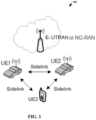
- FIG. 1 is a block diagram of an example V2X communication system.
- user-based devices User Equipment
- V2X communication between a direct/sidelink link.
- data may not be forwarded by the base station and the core network, and may be directly transmitted by the source UE to the target UE through an air interface (PC5 interface), as shown in FIG. 1 .
- PC5 interface air interface
- 3GPP has established research on vehicle networking communication based on advanced V2X services of the fifth generation mobile communication technology (5G), including 5G air interface-based vehicle networking communication and 5G direct link (sidelink)-based vehicle networking communication.
- 5G fifth generation mobile communication technology
- PC5 interface RRC signaling interaction may be supported.
- PC5 RRC signaling may include a message for transmitting UE capability information.
- the present embodiments relate to obtaining peer UE's capability information and interacting for PC5 UE capability information exchange for sidelink transmission parameters selection.
- PC5 RRC signaling may not be transmitted without security protection, and the present embodiments may provide a security protection mechanism for protecting PC5 RRC signaling at the access-stratum (AS) layer.
- AS access-stratum
- a first UE may transmit sidelink capability information to a second UE.
- the transmission of sidelink capability information may be triggered by any of: (1) a higher layer indication, (2) sending a direct communication acceptance message, (3) sending a link modification acceptance message, (4) receiving capability information relating to a peer UE, and (5) receiving a direct communication acceptance message.
- the first UE may receive a sidelink capability enquiry message from the second UE before the first UE sends sidelink capability information to the second UE.
- the second UE may report the first UE's sidelink capability information to the base station via SidelinkUEInformation.
- the second UE may report first UE's sidelink capability information via a UECapablility message to the base station when receiving a capability enquiry message from the base station.
- the capability enquiry message may indicate the identifier of the first UE, where the identifier may include a L2 ID, an AS-level ID, or another ID identifying the first UE.
- the sidelink security configuration information may include any of a key K SLRRCint for sidelink unicast signaling integrity protection and a key K SLRRCenc for sidelink unicast signaling encryption.
- Sidelink Security Configuration Information/Sidelink Security Completion Information can be sent via a newly defined sidelink security mode command/security mode complete signaling message or included in the PC5 RRC connection establishment request/response message to send or may be included in the PC5 SRB configuration information/response information to send.
- the first UE may send the second UE's sidelink security capability information to the base station. Before the first UE sends the sidelink security configuration to the second UE, the first UE may receive the sidelink security information sent by the base station.
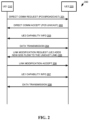
- FIG. 2 illustrates a signaling process 200 to obtain peer UE capability information and transmit UE capability information in a one-way procedure.
- step 201 may include UE1 210 sending a direct communication request (PC5 broadcast) to UE2 220.
- PC5 broadcast direct communication request
- the UE2 220 may trigger the sending of the UE capability to the UE1 210 (step 203). Specifically, the UE2 220 may send the UE capability triggered by the upper layer (e.g., the V2X layer).
- the upper layer may explicitly indicate the UE2 220 sends the UE capability or the UE2 220 indirectly being triggered to send the UE capability according to the direct communication acceptance message submitted by the upper layer.
- the UE2 220 may send the UE capability information after sending the direct communication accept message, or the direct communication accept message and the UE capability information may be multiplexed in the same MAC PDU to transmit.
- the PC5 RRC signaling may be sent in the RLC AM mode. If the UE2 220 does not receive the ack feedback corresponding to the UE capability information from UE1, the UE2 220 may send/retransmit the UE capability information to the UE1 210 again.
- the UE1 210 may select/adjust the transmission parameter to communicate with the UE2 220. Then UE1 transmits V2X packets to UE2 (step 204).
- the PC5 unicast link can be used for bidirectional data transmission. After a period of time, if UE2 220 has data to send to UE1 210, UE2 220 may initiate a link modification request (step 205) to add new PC5 QoS flow information to the unicast link. If UE1 210 agrees to add the new QoS flow to the unicast link, UElresponses by sending a link modification accept message (step 206).
- UE1 210 may be triggered to send the UE capability to UE2 220 (step 207). Specifically, the UE1 210 may send the UE capability being triggered by the upper layer (e.g., the V2X layer), and when the upper layer sends the link modification accept message, the UE1 210 may indicate that the UE1 210 access layer sends the UE capability.
- the upper layer e.g., the V2X layer
- the UE2 220 may select/adjust the transmission parameter to send data to the UE1 210.
- the UE1 210 may send the UE capability information after transmitting the link modification accept message, or the link modification accept message and the UE capability message may be multiplexed in the same MAC PDU to transmit.
- UE2 220 may transmit data (step 208) to the UE1 210 after receiving UE1 210 capability information.
- FIG. 3 illustrates a signaling process 300 to obtain peer UE's capability information and transmit UE capability information in a one-way procedure.
- the UE capability interaction can be performed immediately after the PC5 unicast link is established, which facilitates subsequent bidirectional data transmission.
- UE2 320 may send a direct communication acceptance message (step 302) to UE1 310.
- UE2 320 may trigger the transmission of UE capability (step 303) to UE1 310.
- the UE1 310 may transmit its UE capability information (step 304) to the UE2 320. In this manner, there may be no association between UE1 310 transmitting UE capability information and UE2 320 transmitting UE capability information.
- UE1 310 may transmit its UE capability information to the UE2 320.
- the UE capability exchange may be initiated after the PC5 unicast link between the UE1 310 and the UE2 320 is successfully established.
- the UE1 310 may be triggered to send the UE capability information to the UE2 320, and the UE2 320 sends the UE capability information to the UE1 310 upon receiving the UE capability information of the UE1 310.
- the UE capability information may include the sidelink capability information of the UE on the PC5 interface, including at least one of the following: information indicating whether to support the out-of-order delivery, information indicating whether to support the short PDCP SN, the supported header compression profile, the supported integrity protection algorithms, and the supported encryption and decryption algorithms, information indicating whether to support RLC AM short SN, information indicating whether to support RLC UM short SN, information indicating whether to support RLC UM long SN, supported modulation and demodulation orders/modulation and demodulation coding mechanisms, information indicating whether to support 64QAM, information indicating whether to support HARQ feedback, information indicating whether HARQ feedback is enabled, information indicating whether to support transmit diversity, information indicating whether to support sidelink RRM measurement, information indicating whether to support sidelink RLM/RLF measurement, supported cellular and sidelink band combination information, supported sidelink band combination information, information indicating whether to support synchronization signal transmission, and a supported RF parameter.
- the supported modulation and demodulation orders/modulation and demodulation coding mechanisms may include at least one of the following: BPSK, QPSK, QAM16, QAM64, QAM256.
- Whether to support 64QAM may further include at least one of the following: information indicating whether to support 64QAM reception, information indicating whether to support 64QAM transmission.
- Information indicating whether to support the HARQ feedback may include at least one of the following: information indicating whether to support unicast HARQ feedback, information indicating whether to support the groupcast HARQ feedback mode 1, and information indicating whether to support the groupcast HARQ feedback mode 2.
- the groupcast HARQ feedback mode 1 means that the receiving UEs share the feedback resource and may only perform HARQ NACK feedback.
- the groupcast HARQ feedback mode 2 may refer to that each receiving UE uses an independent feedback resource.
- Information indicating whether to support the transmit diversity further includes at least one of the following: information indicating whether to support the small delay Cyclic Delay Diversity, information indicating whether to support the space-frequency block code.
- the supported RF parameters may include at least one of the following: FR1 (low frequency carrier frequency range, such as 0-6 GHz), FR2 (high frequency carrier frequency range, such as 6 GHz or higher).
- the UE1 may send its own capability information to the peer UE2 only when receiving capability enquiry message from UE2.
- the capability enquiry message may include at least one of the following: a radio access technology (RAT) type, and capability request filtering.
- the wireless access technology type may include at least one of the following: a new air interface (R16), or a forward-compatible version of the subsequent protocol.
- the capability request may be filtered, indicating that only the capability information of some aspects of the peer UE is requested, for example, the peer UE is only requested to transmit the supported modulation and demodulation orders/modulation and demodulation coding mechanisms and the capability of supporting HARQ feedback.
- the UE1 may report UE2's capability information to the base station after obtaining the sidelink capability information for the peer UE2 in order for the base station to configure sidelink unicast communication between UE1 and UE2.
- the UE1 may transmit the sidelink capability information of the unicast communication peer UE (such as UE2 and other unicast communication target UEs) to the base station via the sidelink UE Information.
- the UE sidelink capability information may include at least one of the following: out-of-order delivery, short PDCP SN, supported header compressed profiles, supported integrity protection algorithms, supported encryption and decryption algorithms, RLC AM short SN, RLC UM short SN, RLC UM long SN, modulation and demodulation order/modulation and demodulation coding mechanism, information indicating whether to support 64QAM, HARQ feedback, information indicating whether HARQ is enabled/disabled, information indicating whether to support transmit diversity, sidelink RRM measurement, sidelink RLM/RLF measurement, cellular and sidelink band combination information, sidelink frequency band combination information, synchronization signal transmission, and RF parameters.
- the UE1 may transmit the sidelink capability information of UE2 to the base station.
- a target UE such as UE2
- the UE1 may transmit the sidelink capability information of UE2 to the base station.
- the base station may determine the unicast communication related configuration of the UE1 and the UE2 according to the capability information of the UE1 and the peer UE2, such as the sidelink resource configuration mode and the modulation and demodulation scheme/encoding mechanism, PDCP SN length, RLC SN length, sidelink RRM measurement configuration, etc., and send the relevant configuration to UE1.
- UE1 may utilize the base station configured sidelink unicast transmission parameters for subsequent communication with UE2.
- FIG. 4 illustrates a signaling process 400 to receive sidelink security information from a base station.
- the V2X data packet may include security certificates, thus AS security mechanism for user plane may not need.
- AS security mechanism for user plane may not need.
- security protection for PC5 RRC/control plane may be considered.
- the security protection of PC5 RRC signaling/control plane can be provided by the access-stratum (AS) layer security protection mechanism.
- AS access-stratum
- the base station can provide security configuration for the sidelink.
- the base station When receiving a new target (UE2) of sidelink unicast communication from UE1, the base station provides UE1 the sidelink security information for sidelink unicast signaling and/or data transmission between UE1 and UE2, comprising at least one of the following: a sidelink unicast communication secret key, integrity protection algorithm for signaling, integrity protection algorithm for data, encryption algorithm for data and encryption algorithm for signaling.
- Sidelink security information can be included as part of the PC5 SRB/DRB configuration or as part of a sidelink unicast communication common configuration.
- the UE1 After receiving sidelink security information from the base station, the UE1 derives the integrity protection key K SLRRCint and encryption key K SLRRCenc for sidelink unicast signaling and the integrity protection key K SLUPint and encryption key K SLUPenc for sidelink unicast data transmission.
- the UE1 may receive the sidelink security key information directly from the base station, i.e., the base station may transmit to the UE1 of sidelink security key information which may include: K SLUPint and K SLUPenc .
- FIG. 5 illustrates a signaling process 500 to forward sidelink security configuration information between peer UEs.
- UE1 may transmit sidelink security configuration information to the UE2 (step 501), the UE2 may receive integrity protection algorithm and encryption algorithm and obtain/derive the K SLRRCint and K SLRRCenc for signaling and the K SLUPint and K SLUPenc for data. UE2 then transmits sidelink security complete message to the UE1.
- UE1 may transmit sidelink security configuration information to the UE2, sidelink security configuration information may include at least one of the following: a sidelink unicast communication key, integrity protection algorithm for signaling, integrity protection algorithm for data, encryption algorithm for signaling, encryption algorithm for data, K SLRRCint , K SLRRCenc , K SLUPint and K SLUPenc . If the sidelink security configuration information received by UE2 does not include the key K SLRRCint , K SLRRCenc , K SLUPint and K SLUPenc , UE2 may derive the keys such as K SLRRCint , K SLRRCenc , K SLUPint and K SLUPenc by itself. And UE2 sends a sidelink security completion message to UE1.
- sidelink security configuration information may include at least one of the following: a sidelink unicast communication key, integrity protection algorithm for signaling, integrity protection algorithm for data, encryption algorithm for signaling, encryption algorithm for data, K SLR
- the sidelink security configuration information/sidelink security completion information may be sent through the newly defined sidelink security mode command/security mode complete signaling messages or included in the PC5 RRC Connection Setup Request/Response message or included in PC5 RRC messages for PC5 SRB configuration /response message.
- the security protection of sidelink unicast signaling is activated between UE1 and UE2, all subsequent PC5 RRC signaling and/or data using the corresponding encryption algorithm and integrity protection algorithm and the corresponding key K SLRRCint , K SLRRCenc , K SLUPint and K SLUPenc for security protection.
- the UE1 may apply the integrity protection for signaling using indicated algorithm and corresponding key K SLRRCint to transmit the security configuration information.
- UE2 Upon receiving the security configuration information from UE1, UE2 verifies the integrity protection of the message using the algorithm indicated in the message and the corresponding key, after the integrity protection verification is passed, K SLRRCenc , K SLUPint and K SLLPenc may be derived.
- the UE2 may perform integrity protection on the PC5 RRC message including the sidelink security completion information by using the integrity protection algorithm configured by the UE1 and the corresponding key when transmitting the sidelink security completion information.
- the UE1 may obtain security configuration information from a broadcast system information message or pre-configuration, such as sidelink unicast communication key, integrity protection algorithm for signaling, integrity protection algorithm for data, encryption algorithm for signaling, and encryption algorithm for data. UE1 then derives the corresponding keys for sidelink unicast signaling and/or data security protection, such as K SLRRCint , K SLRRCenc , K SLUPint and KsLLPenc.
- UE1 and UE2 may exchange/negotiate sidelink security configuration.
- UE1 may obtain security capability information of UE2, such as a supported integrity protection algorithm and an encryption algorithm for sidelink unicast signaling and data.
- UE1 may combine its own security capability information with the security capability information of UE2 to determine the sidelink security configuration and sends sidelink security configuration information to UE2.
- the sidelink security configuration information may include at least one of the following: a key for sidelink unicast communication, integrity protection algorithm for signaling, integrity protection algorithm for data, encryption algorithm for signaling and encryption algorithm for data.
- UE2 may derive the corresponding keys K SLRRCint , K SLRRCenc , K SLUPint and K SLUPenc .
- the sidelink security configuration information may also include the keys K SLRRCint , K SLRRCenc , K SLUPint and K SLUPenc .
- UE2 may send sidelink security completion information to UE1 (step 502).
- the security protection of sidelink unicast signaling is activated between UE1 and UE2, all subsequent PC5 RRC signaling and/or data using the corresponding encryption algorithm and integrity protection algorithm and the corresponding key K SLRRCint , K SLRRCenc , K SLUPint and K SLUPenc for security protection.
- MAC multiplexing and logical channel prioritization procedure in LTE V2X sidelink communication, data belonging to logical channels identified by different source layer 2 ID and destination layer 2 IDs (identifier) may be unable to be multiplexed into the same MAC PDU for transmission.
- identifier identifier
- multiple unicast communication links identified by different source layer 2 ID and destination layer 2 IDs may be established between two UEs. If the MAC multiplexing and logical channel prioritization procedures of LTE V2X are followed, data associated with logical channels identified by different source layer 2 ID and destination layer 2 IDs may not be able to be multiplexed into the same MAC PDU for transmission between the same peer UE, so there may be some waste of resources in some cases.
- Example Embodiment 4 relates to improving the MAC multiplexing and logical channel prioritization processes for sidelink unicast communication.
- FIG. 6 illustrates a block diagram 600 of a MAC PDU format, according to a first scenario.
- the logical channel identity may be unique within the source and destination layer 2 identities. That is, if there is more than one unicast communication link with different source and destination layer 2 IDs between the two UEs, these unicast communication links identified by different source and destination layer 2 IDs may include the same LCID.
- LCID may be modified to be unique within a UE, rather than unique within the source and destination layer 2 identities.
- a UE may use different logical channel identities (no duplication) for all destination layer 2 identities (whether unicast, groupcast, or broadcast).
- LCP when the UE first selects the first destination (target layer 2 identity), all the logical channel data may be transferred and there are remaining resources.
- the UE can continue to select the second destination in the other unicast links within the actual pair UEs corresponding to the first destination and continue to serve the second destination's logical channels in decreasing order of logical channel priority until resources are exhausted.
- only the first destination layer 2 ID (and the corresponding source layer 2 ID) may be included in the MAC PDU subheader.
- the peer UE can identify the corresponding source and destination layer 2 identity according to the LCID which is unique in the source UE. As shown in FIG. 6 , there may be 3 unicast links between UE1 and UE2, src1-dest1, src2-dest2 and src3-dest3, each with multiple logical channel data transmissions.
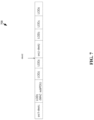
- FIG. 7 illustrates a block diagram 700 of a MAC PDU format, according to a second scenario.
- a second scenario may include optimizing the MAC PDU format for sidelink unicast communication.
- UE1 and UE2 may identify each other the multiple unicast links with different source and destination layer 2 identities between them. Then, in the LCP procedure, when all the logical channel data of the first destination (destination layer 2 identity, actually corresponding to the UE2) the UE selected are transferred and there are remaining resources, UE1 can then continue to select the second destination in the other unicast links towards the actual target UE (UE2) corresponding to the first destination, and continue to serve the logical channels of the second destination in descending order of logical channel priority until resources are exhausted.
- UE2 identity destination layer 2 identity
- MAC subPDU data identified by the associated LCID corresponding to the source and destination layer 2 ID. If there is space left/remaining resources, after the first MAC subhead (src1-dest1) and its associated LCID data (MAC subPDU) identified by the source layer 2 ID1 and destination layer 2 ID1, the second MAC subhead (src2-dest2) and its associated LCID data (MAC subPDU) identified the source layer 2 ID2 and destination layer 2 ID2 may be followed until space is exhausted.
- FIG. 8 illustrates a block diagram 800 of a method to transmit sidelink capability information between peer terminals.
- the method may include transmitting, by the first terminal, capability information associated with the first terminal to the second terminal based on a triggering event, the capability information associated with the first terminal relating to a capability of the first terminal to directly communicate with a second terminal (block 8002).
- the capability information may include sidelink capability information as described in the present embodiments.
- the method includes receiving, by the first terminal, a direct communication request message from the second terminal indicating a request to establish a unicast link between the first terminal and the second terminal; and transmitting, by the first terminal, a direct communication acceptance message to the second terminal indicating an acceptance of establishing the unicast link between the first terminal and the second terminal, wherein transmitting the capability information associated with the first terminal to the second terminal is based on transmitting the direct communication acceptance message to the second terminal.
- the method includes receiving, by the first terminal, a link modification request from the second terminal requesting an additional quality of service flow to a unicast link between the first terminal and the second terminal; and responsive to receiving the link modification request from the second terminal, transmitting a link modification acceptance message to the second terminal indicating an acceptance of the additional quality of service flow to the unicast link between the first terminal and the second terminal, wherein transmitting the capability information associated with the first terminal to the second terminal is based on transmitting the link modification acceptance message to the second terminal.
- the first terminal transmits the capability information associated with the first terminal upon receiving a direct communication acceptance message from the second terminal, wherein the direct communication acceptance message indicates that an acceptance is in response to a direct communication request message from the first terminal requesting to establish a unicast link between the first terminal and the second terminal.
- the first terminal transmits the capability information associated with the first terminal upon receiving the capability information associated with the second terminal from the second terminal.
- the first terminal transmits the capability information associated with the first terminal upon receiving a capability enquiry from the second terminal.
- the capability enquiry includes a radio access technology (RAT) type.
- RAT radio access technology
- the capability enquiry includes a capability request filter.
- first terminal transmits the capability information associated with the first terminal upon receiving an indication from an upper layer, wherein the indication includes one of: capability transmission, the acceptance of a new unicast link with the second terminal, the acceptance of addition of a quality of service flow to the unicast link with the second terminal, the successful establishment of a new unicast link with the second terminal.
- a method for wireless communications includes receiving, by a second terminal, capability information associated with a first terminal from the first terminal, the capability information associated with the first terminal relating to a capability of the first terminal to directly communicate with the second terminal; and determining, by the second terminal, transmission parameters for unicast communication with the first terminal.
- said determining the transmission parameters for unicast communication with the first terminal is based on receiving the capability information associated with the first terminal from the first terminal.
- the method includes sending, by the second terminal, capability information associated with the first terminal received from the first terminal to a communication node, wherein the capability information associated with the first terminal is sent to the communication node via a sidelink terminal information message.
- the method includes receiving, by the second terminal, a capability enquiry message from the communication node, the capability enquiry message including an identifier of the first terminal; and sending, by the second terminal, capability information associated with the first terminal received from the first terminal to a communication node via a terminal capability information message.
- the method includes receiving, by the second terminal, a sidelink transmission configuration from the communication node; and determining, by the second terminal, transmission parameters of the unicast communication with the first terminal based on the sidelink transmission configuration.
- capability information includes an indication of supporting out-of-order delivery.
- capability information includes an indication of supporting short and/or long packet data convergence protocol (PDCP) sequence number (SN).
- PDCP packet data convergence protocol
- SN sequence number
- capability information includes an indication of supporting radio link control (RLC) acknowledged mode (AM) short and/or long SN.
- RLC radio link control
- AM acknowledged mode
- capability information includes an indication of supporting RLC unacknowledged mode (UM) short and/or long SN.
- UM RLC unacknowledged mode
- capability information includes an indication of supporting or enabling of hybrid automatic repeat request (HARQ) feedback.
- HARQ hybrid automatic repeat request
- capability information includes an indication of supporting sidelink radio resource management (RRM) measurement.
- RRM radio resource management
- capability information includes an indication of supporting sidelink radio link monitoring (RLM).
- RLM sidelink radio link monitoring
- the method includes transmitting, by the first terminal, security configuration information to the second terminal; and receiving, by the first terminal, a security configuration complete message from the second terminal.
- the security configuration information includes a key for unicast communication.
- the security configuration information includes any of an integrity protection algorithm for unicast communication and an encryption algorithm for unicast communication.
- the security configuration information includes any of a key of integrity protection for unicast communication and a key of encryption for unicast communication.
- the method includes receiving, by the first terminal, security capability information associated with the second terminal from the second terminal, wherein the security capability information includes the supported integrity protection algorithms and/or encryption algorithms for unicast communication.
- the method includes forwarding, by the first terminal, security capability information associated with the second terminal relating to unicast communication to a communication node.
- the method includes transmitting, by the first terminal, security capability information associated with the first terminal relating to unicast communication to a communication node.
- the method includes receiving, by the first terminal, security information from a communication node, wherein the security information includes at least one of a key for unicast communication, an integrity protection algorithm for unicast communication, an encryption algorithm for unicast communication, a key of integrity protection for unicast communication, and a key of encryption for unicast communication.
- the security configuration information is applied to the integrity protection algorithm and the key of integrity protection, and wherein the second terminal verify the integrity protection of the security configuration information and transmits the security configuration complete message applied to the integrity protection algorithm and the key of the integrity protection after a check of the integrity protection is passed.
- the method includes assembling, by the second terminal, a MAC PDU to send to the first terminal,
- the MAC PDU includes a MAC subheader, which includes a first pair of source identifier and destination identifier identifying a first unicast link between the second terminal and the first terminal and multiple MAC subPDUs, each of which identified by a logical channel identity, wherein each of the logical channel identity is unique in the second terminal, wherein the MAC subPDUs identified by logical channel identities belong to a first pair of source identifier and destination identifier identifying a first unicast link and a second pair of source identifier and destination identifier identifying a second unicast link between the second terminal and the first terminal.
- the method includes assembling, by the second terminal, a MAC PDU to send to the first terminal, wherein the MAC PDU includes a first MAC subheader, which includes a first pair of source identifier and destination identifier identifying a first unicast link between the second terminal and the first terminal, and followed several MAC subPDUs, each of which identified by a logical channel identity, belong to the first pair of source identifier and destination identifier, and a second MAC subheader, which includes a second pair of source identifier and destination identifier identifying a second unicast link between the second terminal and the first terminal, and followed several MAC subPDUs, each of which identified by a logical channel identity, belong to the second pair of source identifier and destination identifier.
- the MAC PDU includes a first MAC subheader, which includes a first pair of source identifier and destination identifier identifying a first unicast link between the second terminal and the first terminal, and followed several MAC subPDU
- FIG. 9 shows an example of a wireless communication system where techniques in accordance with one or more embodiments of the present technology can be applied.
- a wireless communication system 900 can include one or more base stations (BSs) 905a, 905b, one or more wireless devices 910a, 910b, 910c, 910d, and a core network 925.
- a base station 905a, 905b can provide wireless service to wireless devices 910a, 910b, 910c and 910d in one or more wireless sectors.
- a base station 905a, 905b includes directional antennas to produce two or more directional beams to provide wireless coverage in different sectors.
- the core network 925 can communicate with one or more base stations 905a, 905b.
- the core network 925 provides connectivity with other wireless communication systems and wired communication systems.
- the core network may include one or more service subscription databases to store information related to the subscribed wireless devices 910a, 910b, 910c, and 910d.
- a first base station 905a can provide wireless service based on a first radio access technology
- a second base station 905b can provide wireless service based on a second radio access technology.
- the base stations 905a and 905b may be co-located or may be separately installed in the field according to the deployment scenario.
- the wireless devices 910a, 910b, 910c, and 910d can support multiple different radio access technologies.
- the base stations 905a, 905b may be configured to implement some techniques described in the present document.
- the wireless devices 910a to 910d may be configured to implement some techniques described in the present document.
- a wireless communication system can include multiple networks using different wireless technologies.
- a dual-mode or multi-mode wireless device includes two or more wireless technologies that could be used to connect to different wireless networks.
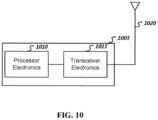
- FIG. 10 is a block diagram representation of a portion of a hardware platform.
- a hardware platform 1005 such as a network device or a base station or a wireless device (or UE) can include processor electronics 1010 such as a microprocessor that implements one or more of the techniques presented in this document.
- the hardware platform 1005 can include transceiver electronics 1015 to send and/or receive wired or wireless signals over one or more communication interfaces such as antenna 1020 or a wireline interface.
- the hardware platform 1005 can implement other communication interfaces with defined protocols for transmitting and receiving data.
- the hardware platform 1005 can include one or more memories (not explicitly shown) configured to store information such as data and/or instructions.
- the processor electronics 1010 can include at least a portion of the transceiver electronics 1015. In some embodiments, at least some of the disclosed techniques, modules or functions and network nodes are implemented using the hardware platform 1005.
- the disclosed and other embodiments, modules and the functional operations described in this document can be implemented in digital electronic circuitry, or in computer software, firmware, or hardware, including the structures disclosed in this document and their structural equivalents, or in combinations of one or more of them.
- the disclosed and other embodiments can be implemented as one or more computer program products, i.e., one or more modules of computer program instructions encoded on a computer readable medium for execution by, or to control the operation of, data processing apparatus.
- the computer readable medium can be a machine-readable storage device, a machine-readable storage substrate, a memory device, a composition of matter effecting a machine-readable propagated signal, or a combination of one or more them.
- data processing apparatus encompasses all apparatus, devices, and machines for processing data, including by way of example a programmable processor, a computer, or multiple processors or computers.
- the apparatus can include, in addition to hardware, code that creates an execution environment for the computer program in question, e.g., code that constitutes processor firmware, a protocol stack, a database management system, an operating system, or a combination of one or more of them.
- a propagated signal is an artificially generated signal, e.g., a machine-generated electrical, optical, or electromagnetic signal, that is generated to encode information for transmission to suitable receiver apparatus.
- a computer program (also known as a program, software, software application, script, or code) can be written in any form of programming language, including compiled or interpreted languages, and it can be deployed in any form, including as a stand-alone program or as a module, component, subroutine, or other unit suitable for use in a computing environment.
- a computer program does not necessarily correspond to a file in a file system.
- a program can be stored in a portion of a file that holds other programs or data (e.g., one or more scripts stored in a markup language document), in a single file dedicated to the program in question, or in multiple coordinated files (e.g., files that store one or more modules, sub programs, or portions of code).
- a computer program can be deployed to be executed on one computer or on multiple computers that are located at one site or distributed across multiple sites and interconnected by a communication network.
- the processes and logic flows described in this document can be performed by one or more programmable processors executing one or more computer programs to perform functions by operating on input data and generating output.
- the processes and logic flows can also be performed by, and apparatus can also be implemented as, special purpose logic circuitry, e.g., an FPGA (field programmable gate array) or an ASIC (application specific integrated circuit).
- processors suitable for the execution of a computer program include, by way of example, both general and special purpose microprocessors, and any one or more processors of any kind of digital computer.
- a processor will receive instructions and data from a read only memory or a random-access memory or both.
- the essential elements of a computer are a processor for performing instructions and one or more memory devices for storing instructions and data.
- a computer will also include, or be operatively coupled to receive data from or transfer data to, or both, one or more mass storage devices for storing data, e.g., magnetic, magneto optical disks, or optical disks.
- mass storage devices for storing data, e.g., magnetic, magneto optical disks, or optical disks.
- a computer need not have such devices.
- Computer readable media suitable for storing computer program instructions and data include all forms of non-volatile memory, media and memory devices, including by way of example semiconductor memory devices, e.g., EPROM, EEPROM, and flash memory devices; magnetic disks, e.g., internal hard disks or removable disks; magneto optical disks; and CD ROM and DVD-ROM disks.
- semiconductor memory devices e.g., EPROM, EEPROM, and flash memory devices
- magnetic disks e.g., internal hard disks or removable disks
- magneto optical disks e.g., CD ROM and DVD-ROM disks.
- the processor and the memory can be supplemented by, or incorporated in, special purpose logic circuitry.
Landscapes
- Engineering & Computer Science (AREA)
- Computer Networks & Wireless Communication (AREA)
- Signal Processing (AREA)
- Computer Security & Cryptography (AREA)
- Databases & Information Systems (AREA)
- Multimedia (AREA)
- Quality & Reliability (AREA)
- Physics & Mathematics (AREA)
- Electromagnetism (AREA)
- Mobile Radio Communication Systems (AREA)
- Telephonic Communication Services (AREA)
Priority Applications (1)
| Application Number | Priority Date | Filing Date | Title |
|---|---|---|---|
| EP25150348.8A EP4529243A3 (de) | 2019-08-15 | 2019-08-15 | Sidelink-kapazitätsinformationsübertragung und sicherheit zwischen peer-endgeräten |
Applications Claiming Priority (3)
| Application Number | Priority Date | Filing Date | Title |
|---|---|---|---|
| EP19941311.3A EP4014518B1 (de) | 2019-08-15 | 2019-08-15 | Sidelink-kapazitätsinformationsübertragung und sicherheit zwischen peer-endgeräten |
| PCT/CN2019/100695 WO2021026851A1 (en) | 2019-08-15 | 2019-08-15 | Sidelink capability information transmission and security between peer terminals |
| EP25150348.8A EP4529243A3 (de) | 2019-08-15 | 2019-08-15 | Sidelink-kapazitätsinformationsübertragung und sicherheit zwischen peer-endgeräten |
Related Parent Applications (2)
| Application Number | Title | Priority Date | Filing Date |
|---|---|---|---|
| EP19941311.3A Division EP4014518B1 (de) | 2019-08-15 | 2019-08-15 | Sidelink-kapazitätsinformationsübertragung und sicherheit zwischen peer-endgeräten |
| EP19941311.3A Division-Into EP4014518B1 (de) | 2019-08-15 | 2019-08-15 | Sidelink-kapazitätsinformationsübertragung und sicherheit zwischen peer-endgeräten |
Publications (2)
| Publication Number | Publication Date |
|---|---|
| EP4529243A2 true EP4529243A2 (de) | 2025-03-26 |
| EP4529243A3 EP4529243A3 (de) | 2025-05-07 |
Family
ID=74570845
Family Applications (2)
| Application Number | Title | Priority Date | Filing Date |
|---|---|---|---|
| EP19941311.3A Active EP4014518B1 (de) | 2019-08-15 | 2019-08-15 | Sidelink-kapazitätsinformationsübertragung und sicherheit zwischen peer-endgeräten |
| EP25150348.8A Pending EP4529243A3 (de) | 2019-08-15 | 2019-08-15 | Sidelink-kapazitätsinformationsübertragung und sicherheit zwischen peer-endgeräten |
Family Applications Before (1)
| Application Number | Title | Priority Date | Filing Date |
|---|---|---|---|
| EP19941311.3A Active EP4014518B1 (de) | 2019-08-15 | 2019-08-15 | Sidelink-kapazitätsinformationsübertragung und sicherheit zwischen peer-endgeräten |
Country Status (6)
| Country | Link |
|---|---|
| US (2) | US12022540B2 (de) |
| EP (2) | EP4014518B1 (de) |
| KR (1) | KR102707175B1 (de) |
| CN (1) | CN114223225B (de) |
| ES (1) | ES3013061T3 (de) |
| WO (1) | WO2021026851A1 (de) |
Families Citing this family (5)
| Publication number | Priority date | Publication date | Assignee | Title |
|---|---|---|---|---|
| US12219630B2 (en) * | 2019-10-02 | 2025-02-04 | Samsung Electronics Co., Ltd. | Method and apparatus for processing out-of-order delivery for PDCP layer in wireless D2D communication system |
| WO2021161476A1 (ja) * | 2020-02-13 | 2021-08-19 | 株式会社Nttドコモ | 端末及び通信方法 |
| US12490082B2 (en) * | 2020-06-29 | 2025-12-02 | Asustek Computer Inc. | Method and apparatus for user equipment (UE) reporting sidelink UE capability information in a wireless communication system |
| US20250294362A1 (en) * | 2022-07-14 | 2025-09-18 | Innopeak Technology, Inc. | Security establishing method and user equipment |
| WO2024065840A1 (zh) * | 2022-09-30 | 2024-04-04 | 北京小米移动软件有限公司 | 一种路径切换能力的交互方法及其装置 |
Family Cites Families (22)
| Publication number | Priority date | Publication date | Assignee | Title |
|---|---|---|---|---|
| CN101034923A (zh) * | 2006-03-07 | 2007-09-12 | 松下电器产业株式会社 | 一种用于多天线无线通信系统中的分组调度方法和系统 |
| CN100512467C (zh) * | 2007-01-29 | 2009-07-08 | 中兴通讯股份有限公司 | 移动终端接收mbms业务的方法、mbms业务会话检测方法及mbms业务传输系统 |
| US7874483B2 (en) * | 2007-11-14 | 2011-01-25 | Hand Held Products, Inc. | Encoded information reading terminal with wireless path selection capability |
| US9042340B2 (en) * | 2009-02-10 | 2015-05-26 | Nokia Corporation | Method, apparatus and computer program product for transfer of capability support information in a multi-rat environment |
| US9072072B2 (en) * | 2011-04-29 | 2015-06-30 | Qualcomm Incorporated | Methods and apparatuses for managing simultaneous unicast and multicast/broadcast services in a wireless communication system |
| CN103067563B (zh) * | 2011-10-19 | 2017-02-01 | 中兴通讯股份有限公司 | 一种终端能力信息管理和发现的方法、系统及装置 |
| CN104284299A (zh) * | 2013-07-09 | 2015-01-14 | 中兴通讯股份有限公司 | 集群多播决策方法、集群终端及集群服务器 |
| KR20180127311A (ko) * | 2016-03-30 | 2018-11-28 | 광동 오포 모바일 텔레커뮤니케이션즈 코포레이션 리미티드 | 데이터 전송 방법, 단말기 및 기지국 |
| US20200337024A1 (en) * | 2016-04-25 | 2020-10-22 | Guangdong Oppo Mobile Telecommunications Corp., Ltd. | Data transmission method and device |
| US10897784B2 (en) * | 2016-09-09 | 2021-01-19 | Nec Corporation | Apparatus and method for wireless communication, and non-transitory computer readable medium storing program |
| CN108307389A (zh) * | 2016-09-26 | 2018-07-20 | 中兴通讯股份有限公司 | 数据安全保护方法、网络接入设备及终端 |
| EP3310098A1 (de) * | 2016-10-17 | 2018-04-18 | Gemalto M2M GmbH | Drahtloses gerät-zu-gerät-kommunikationsverfahren |
| CN107995605B (zh) * | 2016-10-27 | 2020-07-10 | 工业和信息化部电信研究院 | 一种移动通信系统及终端直通单播发送控制方法 |
| WO2018231006A1 (en) * | 2017-06-16 | 2018-12-20 | Samsung Electronics Co., Ltd. | Method and apparatus for rapidly reporting frequency measurement results in next generation mobile communication system |
| CN109429188A (zh) * | 2017-08-21 | 2019-03-05 | 成都鼎桥通信技术有限公司 | 基于Btrunc的集群用户测量GAP规避方法及设备 |
| CN111165041B (zh) * | 2017-09-28 | 2022-07-15 | 中兴通讯股份有限公司 | 用于在直通链路通信中执行双连接通信的系统和方法 |
| US10939288B2 (en) * | 2018-01-14 | 2021-03-02 | Qualcomm Incorporated | Cellular unicast link establishment for vehicle-to-vehicle (V2V) communication |
| CN110830958B (zh) * | 2018-08-10 | 2023-01-03 | 大唐移动通信设备有限公司 | 直通链路的单播连接建立方法、终端及装置 |
| KR102717785B1 (ko) * | 2019-03-28 | 2024-10-16 | 삼성전자 주식회사 | 무선 통신 시스템에서 직접 통신을 위한 사이드링크 RLC (Radio Link Control) 계층 파라미터를 구성하는 장치 및 방법 |
| US20200344574A1 (en) * | 2019-04-24 | 2020-10-29 | Lg Electronics Inc. | Method of ue operation related to feedback resource determination in sidelink groupcast in communication system |
| CN113661772B (zh) * | 2019-04-30 | 2024-10-11 | 富士通株式会社 | 边链路传输中用户设备能力的标识方法及装置 |
| JP6902651B2 (ja) * | 2019-05-02 | 2021-07-14 | 華碩電腦股▲ふん▼有限公司 | 無線通信システムにおけるユニキャスト伝送のサイドリンク無線ベアラ(slrb)設定を要求するための方法および装置 |
-
2019
- 2019-08-15 WO PCT/CN2019/100695 patent/WO2021026851A1/en not_active Ceased
- 2019-08-15 KR KR1020227004897A patent/KR102707175B1/ko active Active
- 2019-08-15 EP EP19941311.3A patent/EP4014518B1/de active Active
- 2019-08-15 EP EP25150348.8A patent/EP4529243A3/de active Pending
- 2019-08-15 CN CN201980099378.2A patent/CN114223225B/zh active Active
- 2019-08-15 ES ES19941311T patent/ES3013061T3/es active Active
-
2022
- 2022-02-15 US US17/672,290 patent/US12022540B2/en active Active
-
2024
- 2024-05-16 US US18/665,889 patent/US12262428B2/en active Active
Also Published As
| Publication number | Publication date |
|---|---|
| US20220174763A1 (en) | 2022-06-02 |
| CN114223225A (zh) | 2022-03-22 |
| KR102707175B1 (ko) | 2024-09-13 |
| EP4014518A1 (de) | 2022-06-22 |
| US12022540B2 (en) | 2024-06-25 |
| KR20220047772A (ko) | 2022-04-19 |
| EP4529243A3 (de) | 2025-05-07 |
| US20240381459A1 (en) | 2024-11-14 |
| EP4014518A4 (de) | 2022-08-03 |
| WO2021026851A1 (en) | 2021-02-18 |
| ES3013061T3 (en) | 2025-04-10 |
| CN114223225B (zh) | 2023-07-14 |
| EP4014518B1 (de) | 2025-02-12 |
| US12262428B2 (en) | 2025-03-25 |
Similar Documents
| Publication | Publication Date | Title |
|---|---|---|
| US12262428B2 (en) | Sidelink capability information transmission and security between peer terminals | |
| US12041485B2 (en) | Management of backhaul bearer for control plane signaling transmissions | |
| CN114041314A (zh) | 用户设备和调度节点 | |
| CN114651409B (zh) | 在通信系统中发送和接收harq响应的方法和装置 | |
| KR20220132465A (ko) | Drx 동작을 지원하는 통신 시스템에서 하나 이상의 링크들에 대한 자원 센싱 및 선택을 위한 방법 및 장치 | |
| CN118696568A (zh) | 设备到设备中继通信 | |
| KR20210091041A (ko) | 통신 시스템에서 사이드링크 데이터의 송수신을 위한 방법 및 장치 | |
| CN116326027B (zh) | 通信方法及通信设备 | |
| CN116671243A (zh) | 侧链路中继通信的方法和装置 | |
| CN117242813A (zh) | 路径建立方法、选择方法、装置、终端设备及存储介质 | |
| JP7585291B2 (ja) | 端末及び通信方法 | |
| KR102695280B1 (ko) | V2x 통신을 지원하는 통신 시스템에서 송신/수신을 위한 설정 정보를 포함하는 제어 정보의 송수신 방법 및 장치 | |
| CN116615939A (zh) | 基于侧链路中ue间协调信息的通信方法 | |
| US20240405961A1 (en) | Internet-of-vehicles power saving schemes | |
| KR102746918B1 (ko) | V2x 통신을 지원하는 통신 시스템에서 이종 rat를 사용한 데이터의 송수신 방법 및 장치 | |
| CN121220178A (zh) | 用于在无线通信系统中管理通过终端中继配置的端到端连接的方法和设备 | |
| WO2025152940A1 (zh) | 基于区块链的数据传输方法及通信装置 | |
| CN120836190A (zh) | 用于多物理随机接入信道传输的通信装置和通信方法 | |
| WO2025069635A1 (ja) | 端末、基地局、及び、通信方法 | |
| KR20220056130A (ko) | 사이드링크에서 릴레이 통신을 위한 방법 및 장치 | |
| WO2025033039A1 (ja) | 端末、及び、通信方法 | |
| WO2025033024A1 (ja) | 端末、及び、通信方法 | |
| CN120129062A (zh) | 辅载波的配置方法、单元、系统、电子设备及存储介质 | |
| CN116746263A (zh) | 在侧链路通信中发送和接收ue间协调信息的方法和装置 | |
| CN117837246A (zh) | 用于发送/接收与侧链路通信相关的ue间协调信息的方法和装置 |
Legal Events
| Date | Code | Title | Description |
|---|---|---|---|
| PUAI | Public reference made under article 153(3) epc to a published international application that has entered the european phase |
Free format text: ORIGINAL CODE: 0009012 |
|
| STAA | Information on the status of an ep patent application or granted ep patent |
Free format text: STATUS: THE APPLICATION HAS BEEN PUBLISHED |
|
| AC | Divisional application: reference to earlier application |
Ref document number: 4014518 Country of ref document: EP Kind code of ref document: P |
|
| AK | Designated contracting states |
Kind code of ref document: A2 Designated state(s): AL AT BE BG CH CY CZ DE DK EE ES FI FR GB GR HR HU IE IS IT LI LT LU LV MC MK MT NL NO PL PT RO RS SE SI SK SM TR |
|
| REG | Reference to a national code |
Ref country code: DE Ref legal event code: R079 Free format text: PREVIOUS MAIN CLASS: H04W0004400000 Ipc: H04W0004060000 |
|
| PUAL | Search report despatched |
Free format text: ORIGINAL CODE: 0009013 |
|
| AK | Designated contracting states |
Kind code of ref document: A3 Designated state(s): AL AT BE BG CH CY CZ DE DK EE ES FI FR GB GR HR HU IE IS IT LI LT LU LV MC MK MT NL NO PL PT RO RS SE SI SK SM TR |
|
| RIC1 | Information provided on ipc code assigned before grant |
Ipc: H04W 4/40 20180101ALI20250401BHEP Ipc: H04W 12/0471 20210101ALI20250401BHEP Ipc: H04W 4/06 20090101AFI20250401BHEP |
|
| STAA | Information on the status of an ep patent application or granted ep patent |
Free format text: STATUS: REQUEST FOR EXAMINATION WAS MADE |
|
| 17P | Request for examination filed |
Effective date: 20251107 |